Author: Elsa Ji

  • GPT 5.6 vs. Claude vs. Gemini: Which AI Cites Your Brand?

    GPT 5.6 vs. Claude vs. Gemini: Which AI Cites Your Brand?

    Your brand ranked on page one for every keyword that matters. Then GPT 5.6 Sol shipped on July 9, and a customer asked ChatGPT to recommend a vendor in your category. The answer named three competitors. You weren’t one of them. You checked Claude next. Different list. Then Gemini. Different again.

    That’s the part nobody warns you about. Each AI model builds its recommendations from a different citation logic, a different source pool, and a different set of content signals. A brand that dominates one platform can be completely invisible on another. One cross-platform study found citation volume variance of up to 615x for the same brand across different AI engines. And the teams tracking visibility on only one platform have no way of knowing where the gaps are.

    GPT 5.6 Sol Just Shipped, and Brand Citations Shifted Again

    OpenAI didn’t just release a new model. It restructured how ChatGPT retrieves and cites information entirely.

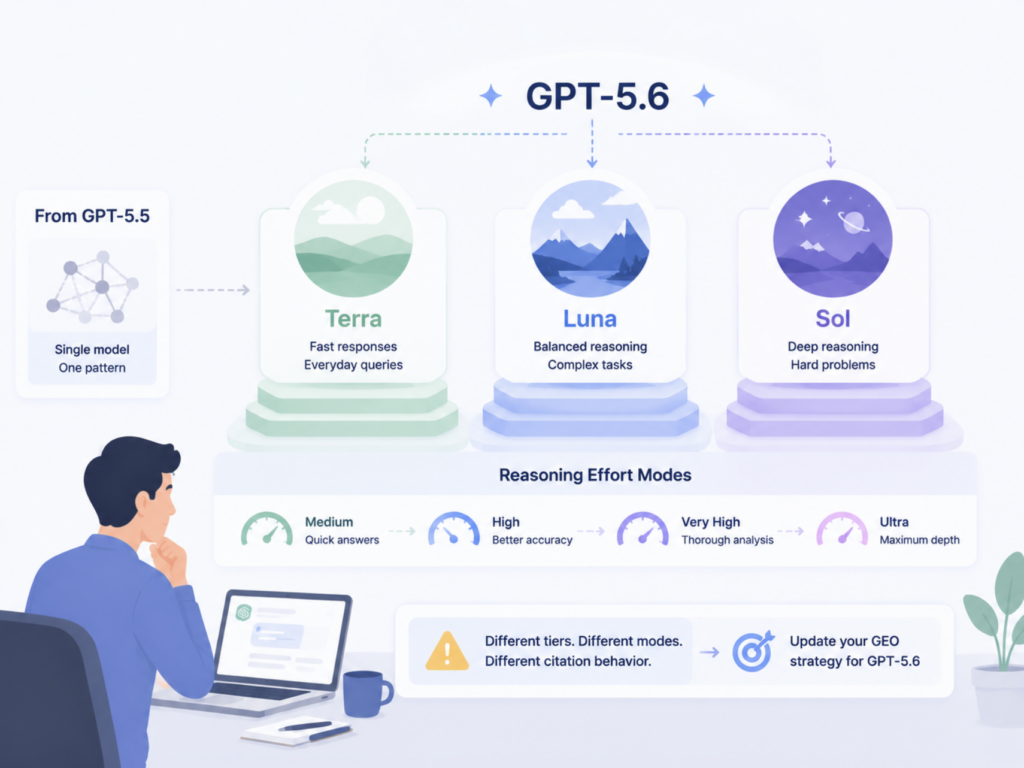
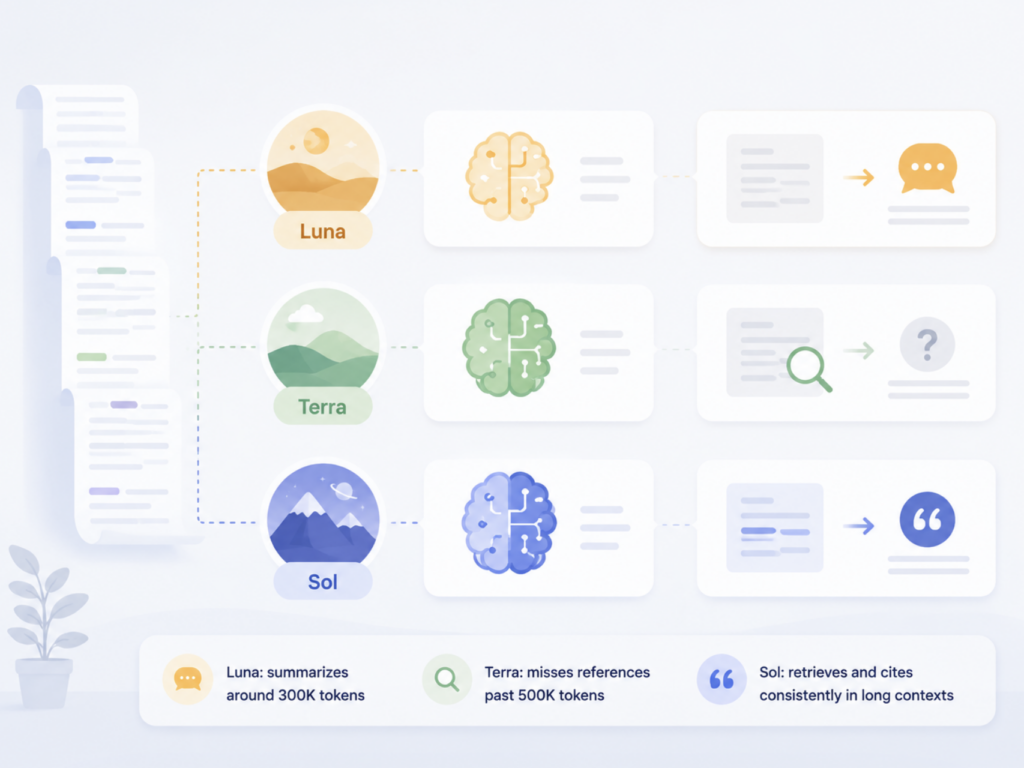
    GPT 5.6 arrived as three distinct tiers: Sol for complex reasoning and research queries, Terra for everyday production work, and Luna for fast, cost-sensitive tasks. OpenAI described the shift as moving from “one model with a dial” to “three models, choose a tier.” For brands, this means different tiers may handle the same product-recommendation query with different citation behaviors.

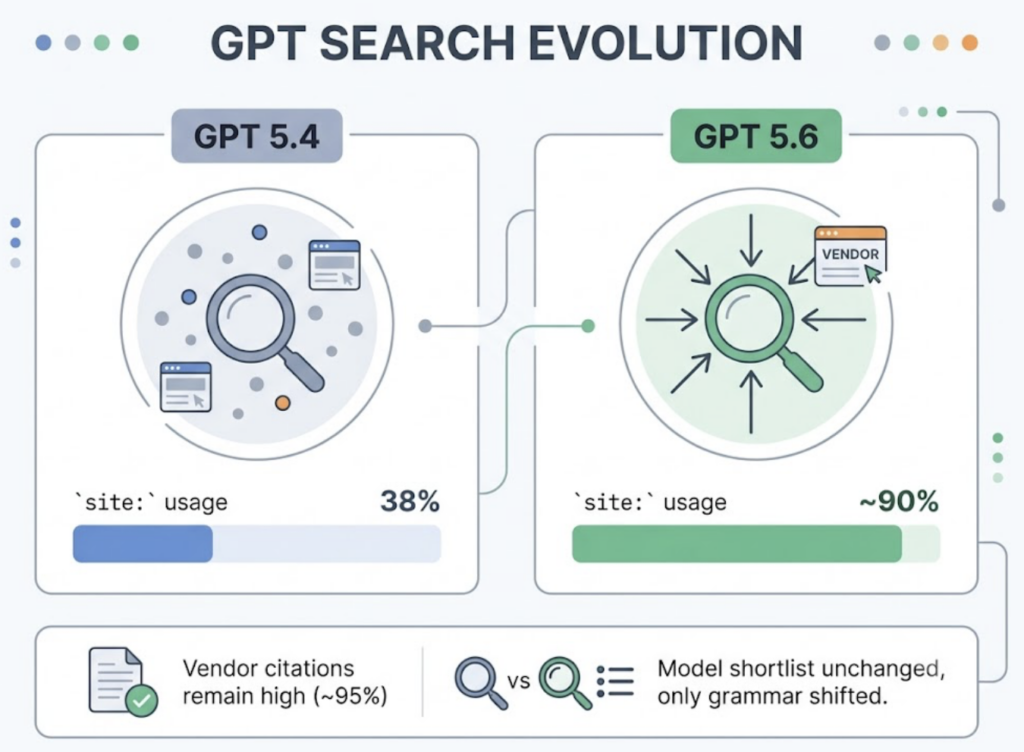
    The retrieval changes are measurable. According to DecaGEO’s weekly tracking logs, GPT 5.6 now scopes roughly 90% of its fan-out searches with the site: operator, up from 38% on GPT 5.4. That means nine out of ten searches go directly to a vendor’s domain. Vendor pages still take approximately 95% of citations. The model’s shortlist of products didn’t change, but the grammar of its searching did.
    This follows a pattern. A Writesonic study of 1,161 citations found GPT 5.5 cited brand websites 47.2% of the time, down from 56.8% on GPT 5.4. SISTRIX tracked 3.8 million German-language ChatGPT responses and found that day-to-day citation variation normally sits around 1 to 2%, but jumped to 47% during the GPT 5.5 model transition. Every model update reshuffles the citation deck.

    The bottom line: if you haven’t checked your brand’s ChatGPT visibility since GPT 5.6 went live, your data is already stale.

    Three AI Engines, Three Completely Different Citation Playbooks

    The most replicated finding in AI citation research is also the most uncomfortable: only 11% of domains are cited by both ChatGPT and Perplexity. Each engine operates on fundamentally different citation logic. Claude and Gemini add their own divergent patterns on top of that.

    Here’s how the three stack up.

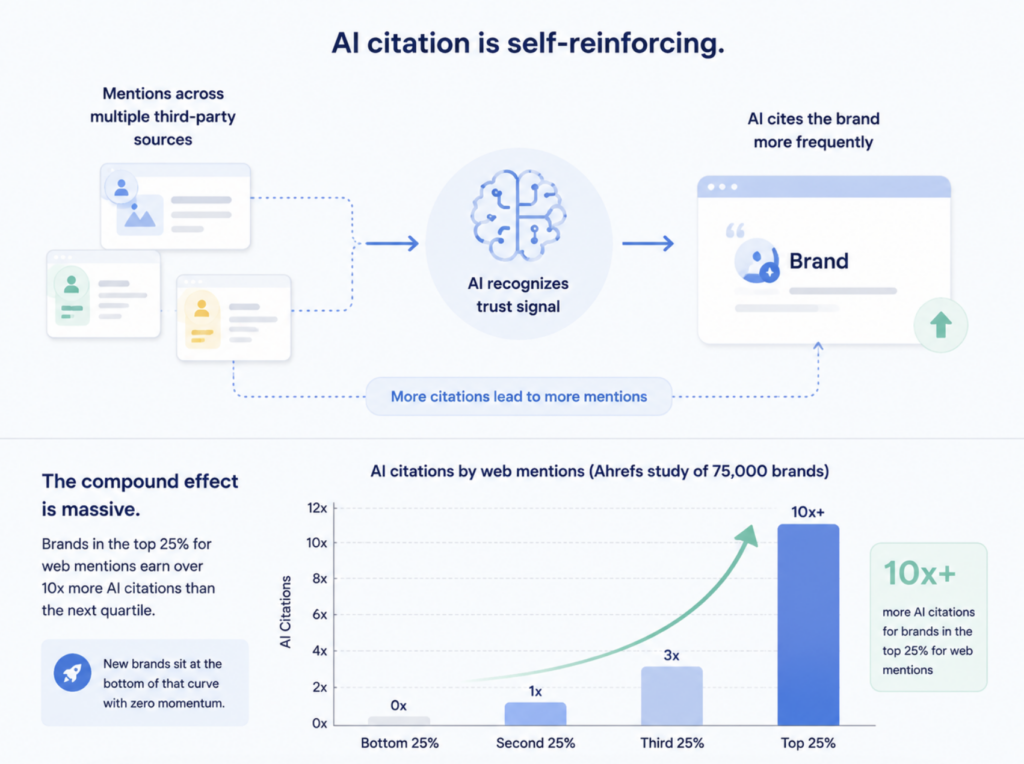
    ChatGPT (GPT 5.6 Sol) draws heavily on parametric knowledge baked into its training data. It tends to paraphrase rather than name sources, except when its SearchGPT mode is explicitly activated. Ahrefs’ analysis of 75,000 brandsfound that brand web mentions correlate at 0.664 with AI citation rates, roughly three times stronger than backlinks at 0.218. ChatGPT’s retrieval runs on the Bing index, not Google, so a site indexed only on Google is invisible to GPT 5.6’s retrieval layer. With 900 million weekly active users processing roughly a billion queries per day, even small citation shifts move needle for brands.

    Claude Opus is the most selective citer of the three. A study of 6,982 AI platform checks found Claude cites brands in just 8.0% of checks, compared to 14.3% for ChatGPT and 19.8% for Gemini. But when Claude does cite, it cites with precision. Attrifast’s 1,200-prompt cross-platform study measured Claude’s median citation density at 3.6 unique domains per answer, higher than ChatGPT’s 3.1. Claude’s Opus 4.8 update emphasized honesty and reliability, making it roughly four times less likely to let flawed claims pass unremarked. In practice, Claude rewards genuine content authority and deprioritizes topical authority content more than other platforms, citing it only 24% of the time compared to 31 to 35% for ChatGPT and Perplexity.

    Gemini has two structural advantages no other model matches. First, direct access to Google’s search index and partner data, including Reddit through a $60 million annual licensing deal. Second, JavaScript rendering on crawled content, which lets Gemini see sites that Claude and ChatGPT’s crawlers miss entirely. Gemini cites brands at 19.8% of checks, the highest rate of all four major platforms. But its citation density per answer is the lowest at 2.4 unique domains, meaning it picks fewer sources but picks them more often.

    MetricChatGPT (GPT 5.6)Claude OpusGemini
    Brand citation rate14.3%8.0%19.8%
    Median domains per answer3.13.62.4
    Content preferenceThird-party mentions, Reddit, WikipediaDeep original authority, structured factsGoogle-indexed content, schema markup
    Retrieval indexBingWeb crawl + training dataGoogle Search index

    53% of Brands Are Invisible. The Other 47% Often Track Only One Platform.

    That 53% figure comes from a cross-platform audit of nearly 7,000 AI checks across ChatGPT, Perplexity, Claude, and Gemini. Half of the brands audited were invisible on all four platforms.

    The brands that do show up typically track just one. That’s where the real problem sits.

    Slate HQ’s study of 300,000+ AI citations across six B2B SaaS brands tracked the same content across ChatGPT, Perplexity, Gemini, Claude, Google AI Overview, and Google AI Mode for 90 days. The per-platform citation profiles were so different they looked like different brands. Claude gave brands the highest owned citation share at 9.1%. Perplexity gave them 6.8%. ChatGPT was consistently the worst for brand visibility across every company studied.

    And 44% of brands ranking in Google’s top 10 get zero ChatGPT citations for the same keyword. The gap is widest in high-competition categories: marketing automation has a 53% citation gap, analytics has a 52% gap. A strong Google ranking does not predict a ChatGPT citation.

    That’s the gap most brands still can’t see.

    What Each AI Engine Rewards in Your Content

    Each model’s citation logic points to a different optimization playbook. Here’s what actually moves the needle on each.

    For GPT 5.6: Build entity strength through third-party mentions. ChatGPT’s retrieval layer favors brands that appear consistently across review platforms, industry publications, and community discussions. Submit your sitemap to Bing Webmaster Tools, not just Google Search Console. GPT 5.6’s fan-out queries now scope directly to vendor domains, so your own site’s content structure matters more than it did under GPT 5.4 or 5.5. Focus on structured, fact-dense product pages.

    For Claude Opus: Depth over breadth. Claude deprioritizes thin content and rewards pages with original analysis, specific data points, and clear sourcing. If your pages carry no visible date and no author signals, Claude is less likely to cite them. Of 2,225 pages analyzed, 77% carried no visible date, and only 21.2% showed author signals. Fix those basics and you’re already ahead of most competitors in Claude’s citation pool.

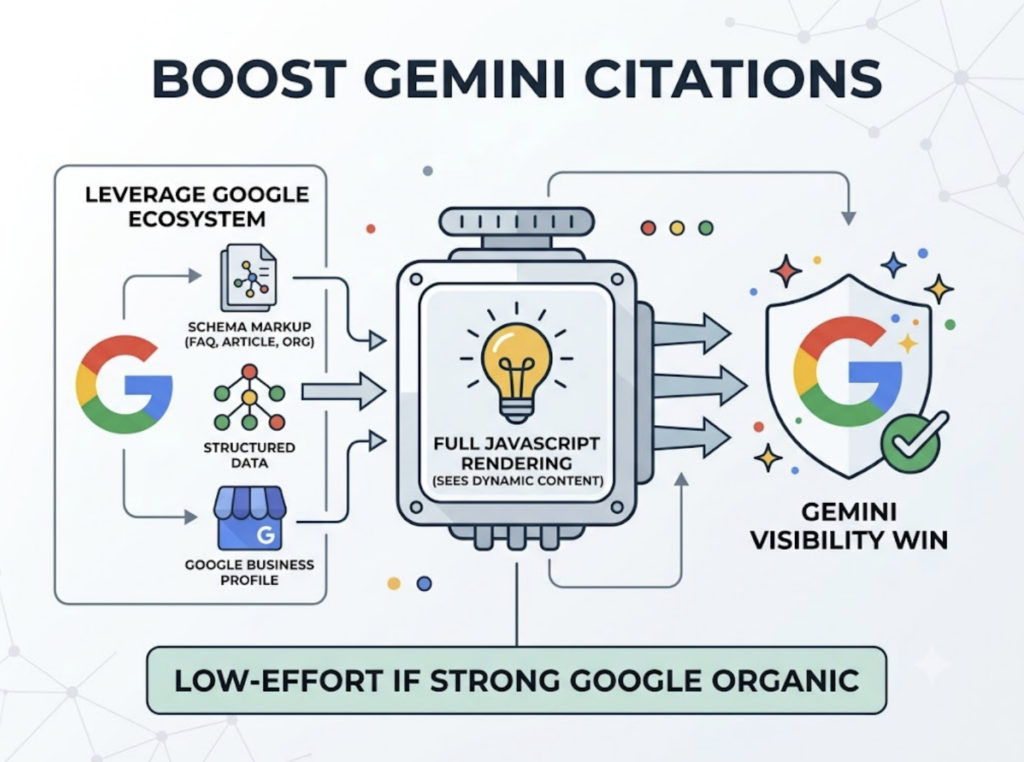
    For Gemini: Lean into Google’s ecosystem. Schema markup (Organization, FAQ, Article), structured data, and Google Business Profile optimization all feed Gemini’s citation decisions. Gemini renders JavaScript, so content hidden behind dynamic loading isn’t invisible the way it is to Claude’s and ChatGPT’s crawlers. If you’re already strong in Google organic, Gemini is your lowest-effort AI visibility win.
    The critical insight: a strategy that works for one model often fails on another. Brands that treat all AI engines as identical will underperform on the platforms where their approach doesn’t match the citation pattern.

    Tracking GPT 5.6, Claude, and Gemini Citations in One Place

    Manually testing your brand across three platforms tells you what happened once. It doesn’t tell you when it changes, how it changes, or why.

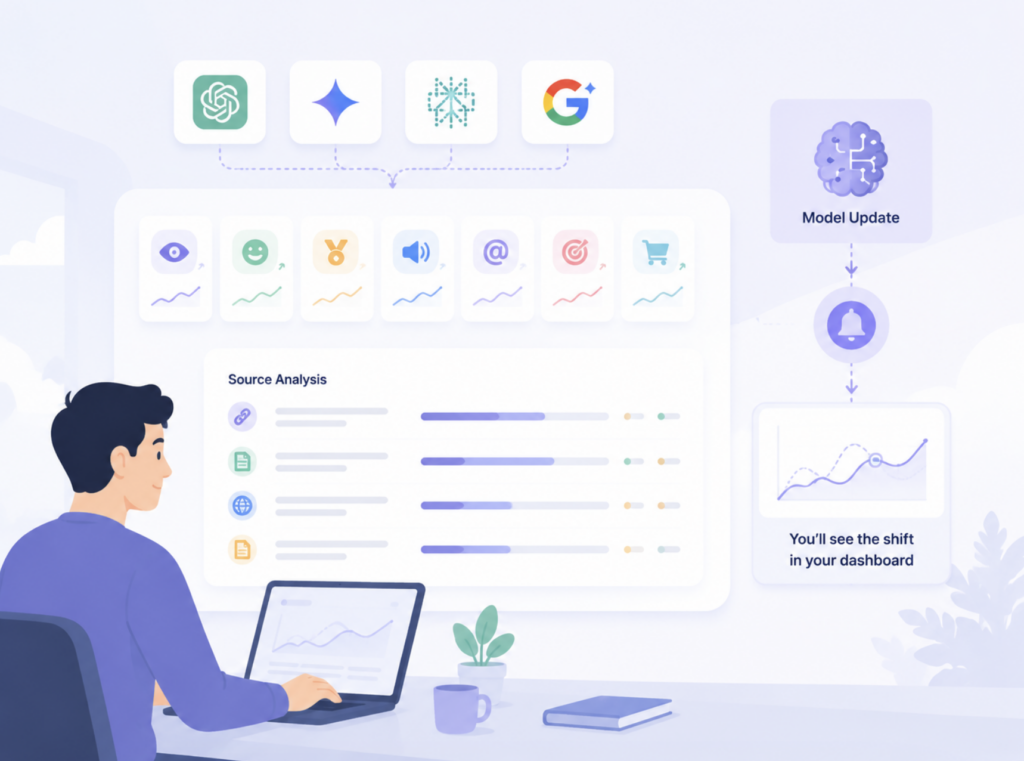
    Topify consolidates AI visibility data across ChatGPT, Gemini, Perplexity, and other major platforms into a single dashboard. For marketing teams dealing with GPT 5.6’s citation behavior shift, the platform’s Comprehensive GEO Analytics pulls Visibility, Sentiment, and Position data into one view. In practice, this means you can spot a drop in ChatGPT mentions after a model update and trace it back to a specific source change, all without running manual prompt tests.

    The Source Analysis feature is especially relevant for this moment. GPT 5.6’s shift to scoping 90% of fan-out queries to vendor domains means the sources ChatGPT cites have narrowed. Topify’s source tracking shows exactly which domains AI platforms are citing for your category, so you can see whether your content is in the citation pool or missing from it entirely.

    Dynamic Competitor Benchmarking adds the layer most teams lack: seeing who AI engines recommend instead of you. When GPT 5.6 reshuffles the recommendation list in your category, you’ll know within days, not weeks.

    Plans start at $99/month, and you can get started with a free trial to see your brand’s current AI visibility baseline before committing.

    Conclusion

    GPT 5.6’s launch on July 9 wasn’t just an OpenAI product update. It was another citation reshuffle across the platform that handles a billion queries per day. And the data is clear: what ChatGPT recommends, what Claude selects, and what Gemini surfaces are three largely separate brand graphs with minimal overlap.

    The brands that win in AI search in 2026 aren’t the ones with the best Google rankings. They’re the ones tracking citation behavior across every platform their buyers actually use, and adjusting their content strategy when the models change. GPT 5.6 is live. Your brand’s citation map probably looks different than it did three weeks ago. The only question is whether you know how.

    FAQ

    Q: Does GPT 5.6 Sol cite brands differently than GPT 5.5?

    A: Yes. DecaGEO’s tracking data shows GPT 5.6 scopes roughly 90% of its fan-out searches with the site: operator, up from lower rates on GPT 5.4 and 5.5. The model’s shortlist of products tends to stay stable across versions, but the way it searches for and validates those brands changes with each release, which shifts citation rates and the mix of first-party versus third-party sources in its answers.

    Q: Which AI model is most likely to mention my brand by name?

    A: Gemini cites brands at the highest rate (19.8% of checks), followed by ChatGPT (14.3%) and Claude (8.0%). But citation rate alone doesn’t tell the whole story. ChatGPT has 900 million weekly users. Claude converts referred traffic at 5.0%, more than Google organic’s 1.76%. The right platform to prioritize depends on where your buyers actually search.

    Q: How often do AI models update their brand citation behavior?

    A: Every model update is a potential citation shift. SISTRIX found that citation variation jumped from a baseline of 1 to 2% to 47% during ChatGPT’s GPT 5.5 rollout. OpenAI has released GPT 5.3, 5.4, 5.5, and 5.6 within a six-month window in 2026. Continuous monitoring is the only way to catch these shifts early.

    Q: Can I track my brand’s visibility across GPT 5.6, Claude, and Gemini in one place?

    A: Yes. Platforms like Topify track AI visibility across ChatGPT, Gemini, Perplexity, and other engines in a single dashboard, with metrics for visibility, sentiment, position, and source analysis. This makes it possible to compare your brand’s citation performance across models and catch shifts when new model versions roll out.
    Read More

  • What GPT 5.6’s Government Gate Means for Brand Visibility

    What GPT 5.6’s Government Gate Means for Brand Visibility

    You spent months calibrating your brand’s presence in ChatGPT. Structured data, entity signals, citation-worthy content across the pages that mattered. By late June 2026, your mention rate finally looked predictable. Then OpenAI swapped out the model underneath, and for the first time in AI history, the U.S. government decided who got to use it first.

    GPT 5.6 didn’t launch like every model before it. A 12-day government-coordinated review kept it locked to a handful of approved partners while the rest of the market waited. For brands tracking AI search visibility, that gap wasn’t just an inconvenience. It was a structural reset that most teams didn’t see coming.

    What GPT 5.6 Actually Changes Under the Hood

    GPT 5.6 isn’t one model. It’s a three-tier family: Sol (flagship), Terra (balanced), and Luna (fast, affordable). OpenAI positioned the naming as “durable capability tiers that can advance on their own cadence,” meaning future updates can hit one tier without touching the others.

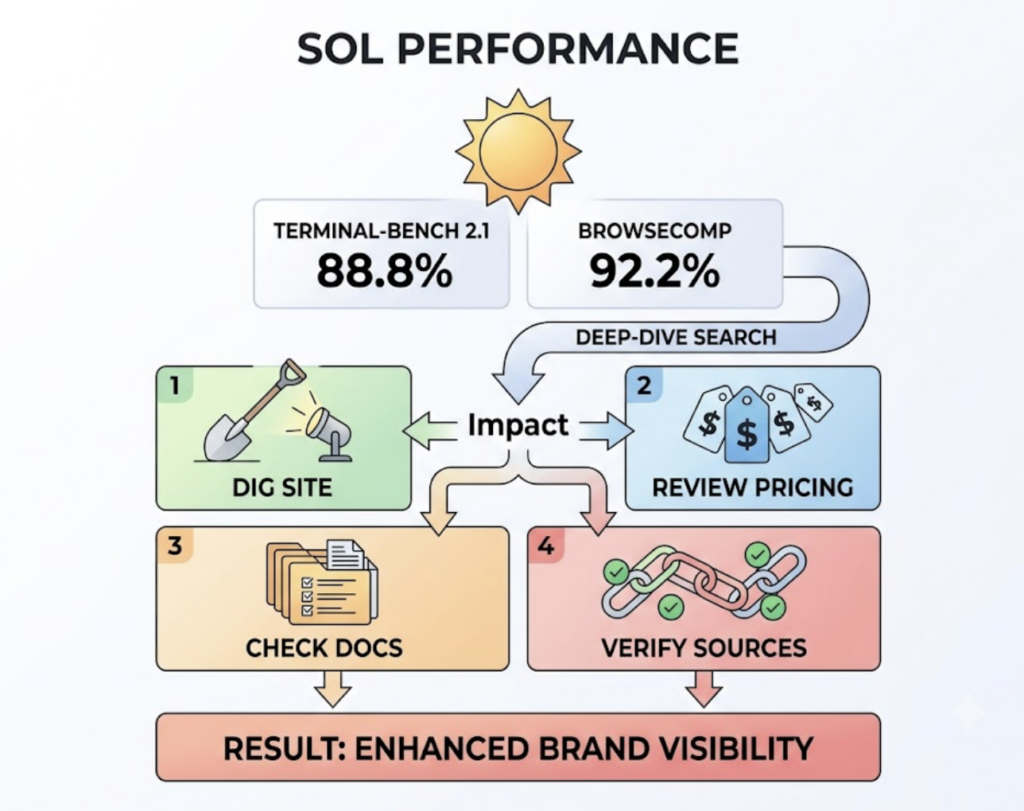
    The numbers tell the story. Sol scores 88.8% on Terminal-Bench 2.1 and 92.2% on BrowseComp, the benchmark that measures how persistently an AI searches for hard-to-find information. That BrowseComp score matters for brand visibility: it means GPT 5.6 digs deeper into your site, reads your pricing pages, checks your feature documentation, and cross-references what it finds against third-party sources.

    Two workflow additions matter as much as the benchmarks. A new ultra mode spins up parallel sub-agents that divide complex tasks, cross-check each other, and merge conclusions. And ChatGPT Work, released alongside GPT 5.6, operates across desktop apps, connected files, and third-party tools to produce deliverables on its own. Both expand the surface area where AI answers shape how prospects discover brands.

    The training cutoff refresh is the quiet change with the loudest brand impact. GPT 5.6 ingests web events through early-to-mid 2026, which means brands that earned significant coverage between April and June 2026 now enter the model’s parametric recall for the first time.

    The 12-Day Government Gate: A First for American AI

    On June 2, 2026, President Trump signed Executive Order 14409, “Promoting Advanced Artificial Intelligence Innovation and Security.” The order directs federal agencies to design a voluntary framework by August 1, 2026, under which AI developers provide the government with access to “covered frontier models” for up to 30 days before public release.

    On paper, the framework is voluntary. In practice, it played out differently. Axios reported that the White House asked OpenAI to limit GPT 5.6’s release to government-approved partners before any wider distribution, marking the first time the U.S. government preemptively restricted an American AI company’s model launch. OpenAI complied, opening a limited preview on June 26 for a “small group of trusted partners whose participation has been shared with the government.”

    GPT 5.6 wasn’t the only model caught in this wave. Two weeks earlier, the Commerce Department ordered Anthropic to suspend all access to its Fable 5 and Mythos 5 models for any foreign national, citing cybersecurity concerns over a reported jailbreak. Anthropic shut both models down entirely because it couldn’t filter users by nationality in real time. The suspension lasted until June 30, when the Commerce Department lifted restrictions after Anthropic strengthened its safety guardrails.

    That’s two frontier model families, from two different companies, restricted by government action within the same month.

    Why Restricted Rollouts Reshape Brand Visibility Worldwide

    The instinct is to treat government access gates as a policy story, not a marketing one. That’s a mistake. Here’s the mechanism.

    During GPT 5.6’s limited preview, only trusted partners’ usage data shaped early citation patterns and answer caching. GPT 5.6 introduces explicit prompt caching where cache writes cost 1.25x and cache reads get a 90% discount. Once an answer pattern for a high-frequency commercial query gets cached, the platform has a direct compute-cost incentive to reuse it. Brands whose content enters those early cached answers gain a moat backed by economics, not just relevance.

    For brands outside the U.S., the impact compounds. As Proton’s analysis noted, European businesses found themselves locked out of the most powerful AI models at the moment those models were forming their initial citation preferences. The EU Commission responded in July 2026 with a cybersecurity action plan that included negotiating early access to U.S. AI models, an acknowledgment that falling behind on model access now carries tangible business consequences.

    The cross-model citation data makes this concrete. Research on GPT 5.4 versus GPT 5.3 found a 52% gap in brand website citations: GPT 5.4 sent 56% of its citations to brand websites, while GPT 5.3 sent just 8%. Only 7% of cited sources overlapped between the two models. Every model generation rewrites the citation playbook from scratch.

    That’s the real risk. When a new model launches behind a government gate, the brands that are already inside the gate get a head start on shaping the citation patterns that will persist for months.

    The 2-to-4-Week Reset Window You Can’t Afford to Miss

    Right after a generation launch, the system enters what practitioners call a “re-learning state.” It’s actively seeking stable, well-structured sources to anchor its new output patterns. Brands that act within the first two to four weeks of a model launch get outsized returns.

    The technical checklist is straightforward: fix firewall rules that block GPTBot, deploy llms.txt, roll out JSON-LD markup for organization, product, and FAQ content. AirOps research found that pages not updated within the previous quarter were over 3x more likely to lose AI citations compared with recently refreshed content.

    Early citations also snowball across ecosystems. Consistent AI recommendations get picked up by aggregators, which lifts traditional search signals, which in turn feeds back into the next round of AI crawling. Miss the window, and you’re not just behind on one platform. You’re behind on the entire feedback loop.

    With GPT 5.6, the window was even tighter than usual. The restricted preview ran from June 26 to July 9. General availability followed immediately, meaning brands had roughly two weeks from GA to re-establish baselines before the model’s citation patterns started hardening.

    How to Audit Your GPT 5.6 Visibility Before Competitors Lock In Theirs

    The first step is knowing where you stand. If you haven’t re-run your brand’s AI visibility baseline since GPT 5.6 went live on July 9, your data is already stale.

    For marketing teams tracking visibility across multiple AI platforms, Topify tends to stand out by combining Visibility, Sentiment, and Position data into a single view across ChatGPT, Gemini, Perplexity, and AI Overviews. In practice, this means you can spot a drop in ChatGPT mentions and trace it back to a specific source domain that stopped being cited, all within the same dashboard.

    Here’s the audit sequence that matters right now:

    Run a fresh GPT 5.6 baseline. Compare your mention rate, citation URLs, and position against what you measured under GPT 5.5. Topify’s Visibility Tracking surfaces exactly this: which prompts still trigger your brand, and which ones you’ve dropped out of.

    Check your competitors. Government-gated rollouts create asymmetric windows. If a competitor’s content was indexed during the preview and yours wasn’t, they may have locked in early citation patterns. Topify’s Competitor Monitoring flags emerging rivals in real time, so you’ll see a competitor’s visibility spike before it becomes a structural advantage.

    Trace citation sources. GPT 5.6’s deeper browsing (92.2% BrowseComp) means the model is now visiting your actual pages, not just pulling from third-party roundups. Use Source Analysis to see whether GPT 5.6 is citing your domain directly or routing through intermediaries. If intermediaries dominate, your on-site content needs structural work.

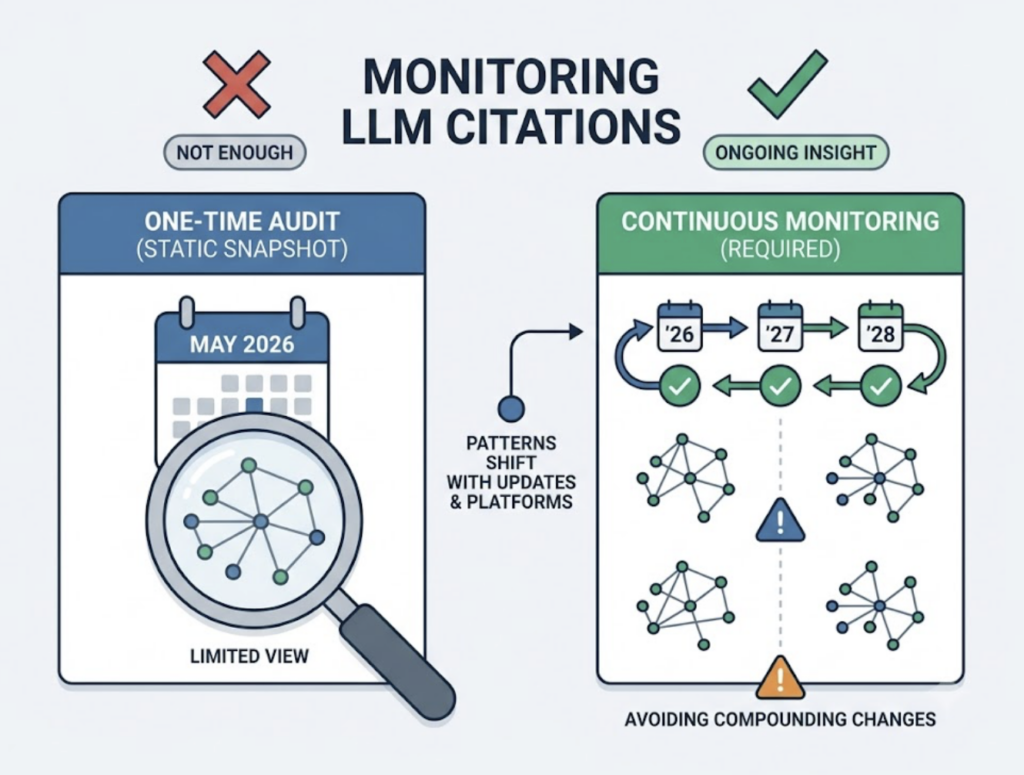
    Set up continuous monitoring. Meltwater’s May 2026 analysis of over 8 million citations across eight LLMs confirmed that citation patterns differ significantly by platform and shift with every update. A one-time audit isn’t enough. You need ongoing tracking that catches changes before they compound.

    If you’re starting from scratch, Topify’s Basic plan at $99/month covers ChatGPT, Perplexity, and AI Overviews tracking with 100 prompts and 9,000 AI answer analyses. It’s enough to establish a baseline and start catching model-update volatility.

    What Comes Next: Every Model Launch Could Look Like This

    The August 1, 2026 deadline from EO 14409 is when the voluntary framework is supposed to be finalized. The NSA’s classified benchmarking process will determine which future models qualify as “covered frontier models” subject to government pre-release review. The criteria haven’t been published.

    That means every major model release going forward, from OpenAI, from Google, from any U.S.-based AI lab, could come with a government access window attached. Legal analysis from WilmerHale notes that while the EO sets a design deadline for the government, it imposes no compliance deadline on AI companies. But the practical reality of June 2026 tells a different story: both OpenAI and Anthropic complied when asked.

    For brand visibility strategy, the implication is direct. Model-update volatility isn’t a one-time disruption. It’s becoming a recurring feature of the AI search environment, and now it carries a policy dimension that can widen or narrow access windows unpredictably.

    The brands that treat every model generation as a visibility audit trigger, not just a product news story, will be the ones that stay consistently cited. The ones that wait for general availability to “see what changed” will keep discovering the answer too late.

    Get started with Topify and run your GPT 5.6 baseline before the citation patterns harden.

    Conclusion

    GPT 5.6’s government-gated rollout wasn’t an anomaly. It was the first visible instance of a pattern that’s likely to repeat: frontier models launched under controlled access, with citation preferences forming before most brands even have API access.

    The playbook hasn’t changed in principle. Track your brand across every major AI platform, re-baseline after every model update, and act inside the reset window. What’s changed is urgency. When government policy determines who gets early access to the models shaping your prospects’ answers, waiting is itself a competitive disadvantage. Start monitoring now, or start catching up later.

    FAQ

    Q: Is GPT 5.6 available to everyone now? 

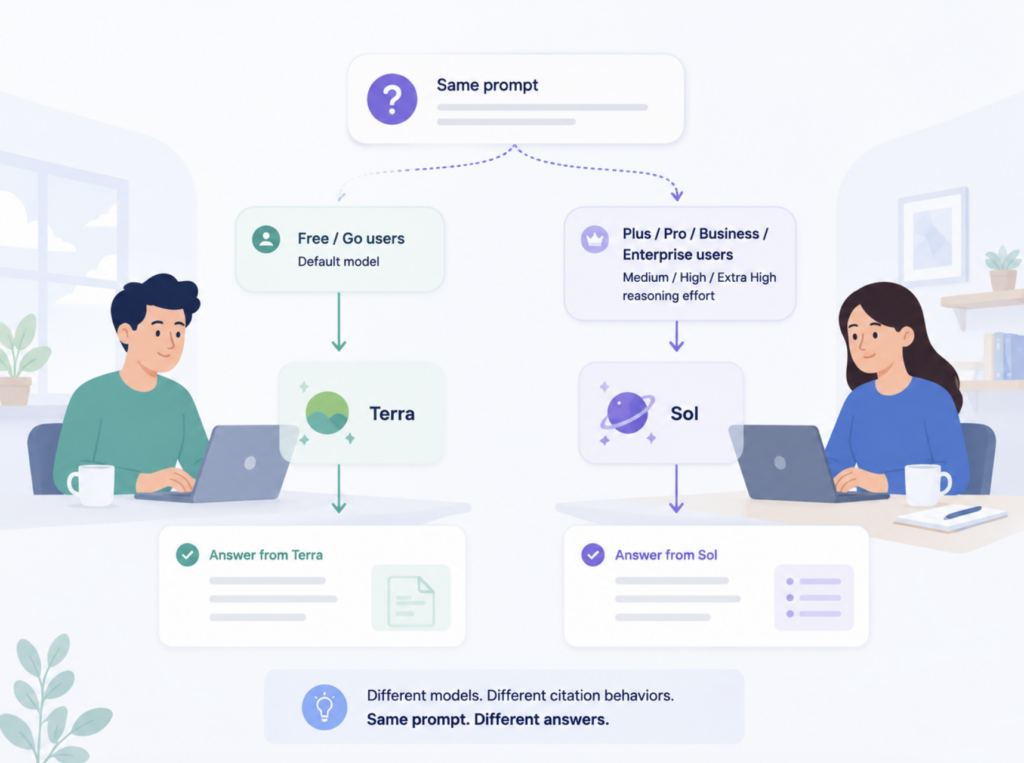
    A: Yes. GPT 5.6 Sol, Terra, and Luna reached general availability on July 9, 2026, across ChatGPT, Codex, and the API. The restricted government preview that began on June 26 has ended. Plus, Pro, Business, and Enterprise users access Sol through medium and higher reasoning-effort settings. Free users access Terra.

    Q: How does a restricted AI rollout affect my brand’s visibility in ChatGPT? 

    A: During a restricted preview, only approved partners interact with the model, shaping its early answer patterns and prompt cache. GPT 5.6’s caching mechanism creates a compute-cost incentive to reuse cached answers, meaning brands present in early interactions can gain a durable citation advantage over those that enter later.

    Q: What is the “reset window” after a major GPT update? 

    A: In the first two to four weeks after a model generation launches, the system is actively seeking stable sources to anchor new output patterns. Content updates, technical fixes (like unblocking GPTBot), and structured data deployments during this window tend to produce outsized visibility gains compared with the same actions taken months later.

    Q: How can I track my brand’s visibility across GPT 5.6 and other AI platforms? 

    A: Tools like Topify monitor brand mentions, citations, sentiment, and competitive position across ChatGPT, Gemini, Perplexity, and Google AI Overviews at the prompt level. Running a baseline audit immediately after a model update and setting up continuous monitoring are the two highest-leverage actions.

    Read More

  • GPT 5.6 Tiered Models Signal a GEO Strategy Overhaul

    GPT 5.6 Tiered Models Signal a GEO Strategy Overhaul

    You’re tracking your brand’s visibility in ChatGPT. But which ChatGPT? Since July 2026, “ChatGPT” has meant three separate models with three different reasoning architectures, three different citation behaviors, and three different sets of winners. A brand that dominates the fast-answer tier can vanish entirely in the deep-reasoning tier, and most tracking setups can’t tell you which one you’re looking at.

    That’s not just an OpenAI quirk. It’s the direction every major AI platform is heading. And if your GEO strategy still treats AI search as a single channel, the gap between what you measure and what actually happens to your brand is about to get wider.

    GPT 5.6 Isn’t One Model. Neither Is Any Other AI Platform.

    When OpenAI released GPT-5.6 in July 2026, it formalized something that had been building for over a year: AI search runs on model families, not single models. GPT-5.6 ships as Sol (the flagship for complex reasoning and agentic work), Terra (a balanced everyday model), and Luna (the fast, low-cost tier for high-volume tasks). Each tier processes the same user question through a fundamentally different reasoning pipeline.

    OpenAI isn’t alone here. Anthropic runs Claude as Haiku, Sonnet, and Opus. Google’s Gemini operates across Flash, Flash-Lite, Pro, and Deep Think. Every major AI lab has converged on the same structural pattern: tiered model families where different tiers handle different workloads at different price points.

    The logic is straightforward. Not every query needs frontier-level reasoning. A quick product lookup doesn’t require the same computational depth as a multi-step B2B vendor comparison. Tiered models let platforms route simple tasks to lightweight models and reserve deep reasoning for complex questions.

    Here’s what that means for GEO: the same user, asking the same question on the same platform, can receive a different answer depending on which tier processes the query. Different tiers retrieve different sources, weigh evidence differently, and can recommend different brands.

    Why Different GPT 5.6 Tiers Cite Different Brands

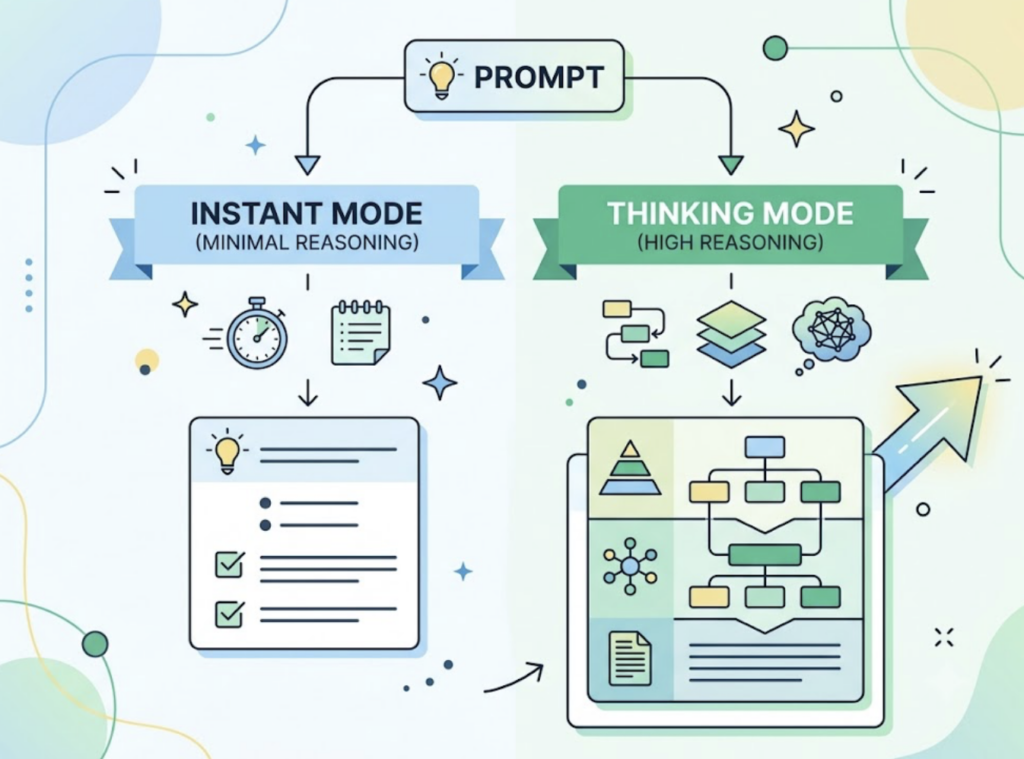
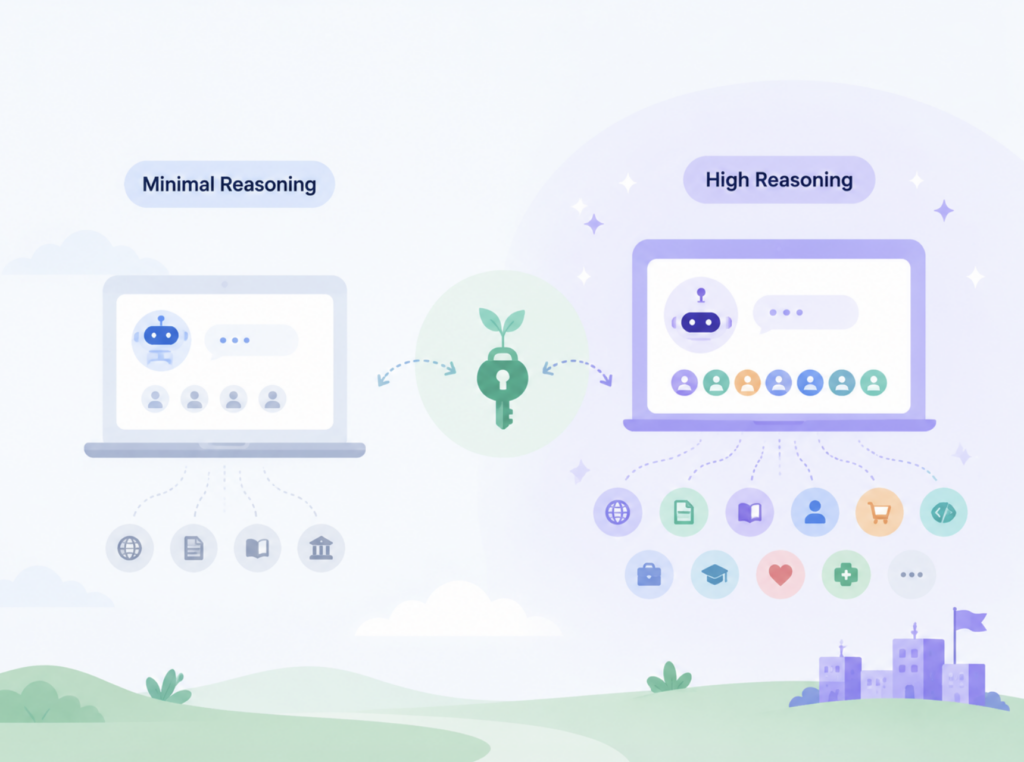
    The gap between tiers isn’t theoretical. A Semrush and Kevin Indig study tested 100 prompts across 20 buyer journeys in B2B SaaS, finance, consumer tech, and health. Each prompt ran once in minimal reasoning (Instant mode) and once in high reasoning (Thinking mode).

    The results were stark: only 25.6% of cited domains overlapped between the two modes. Nearly three in four sources changed when ChatGPT shifted from fast answers to deep reasoning.

    The behavioral differences go deeper than just which domains appear. Citation rates jumped from 50% in minimal reasoning to 68% in high reasoning. Sources per response nearly doubled, from 2.6 to 4.5. And high-reasoning mode fired 4.6 times more internal sub-queries before forming its answer.

    Source types shifted too. Reddit’s citation share dropped from 15% to 7% when reasoning increased. User-generated content and review sites fell from 14.3% to 6%. Government and academic sources moved in the opposite direction, rising from 1.9% to 8.8%.

    That pattern maps directly onto GPT-5.6’s tier structure. Sol, the flagship, runs the kind of deep, multi-step reasoning that cross-references documentation, official sources, and primary data. Luna, built for speed, leans on probabilistic memory and whatever surfaces fastest. A niche brand with rigorous technical documentation but weak traditional SEO can show up in Sol’s carefully constructed answers while staying invisible in Luna’s quick ones. The reverse is equally true.

    One visibility number can’t capture that.

    The GEO Blind Spot Most Brands Haven’t Found Yet

    The tier-level gap within a single platform is just the first layer. Zoom out, and the problem compounds across platforms.

    Yext analyzed 17.2 million AI citations across ChatGPT, Gemini, Claude, and Perplexity during Q4 2025. The conclusion was blunt: each model follows predictable but distinct sourcing patterns. Gemini leans heavily on first-party websites and owned content. Claude cites user-generated content, reviews, and social sources at rates 2 to 4 times higher than competing models. Perplexity shows its own preference hierarchy. ChatGPT adjusts its sourcing logic per query context.

    A brand can have strong visibility in Gemini and be nearly invisible in Claude. And without model-level tracking, there’s no way to know.

    Most brands still report a single “AI visibility” number. That’s like reporting a single “search engine ranking” in 2005 without separating Google from Yahoo from Ask Jeeves. The aggregate hides where you’re winning, where you’re losing, and what’s actually driving each outcome.

    Now layer the within-platform tier gap on top of the cross-platform gap. You’re not tracking one visibility surface per AI engine. You’re tracking multiple surfaces per engine, each with its own citation logic. The measurement surface area has multiplied, and most GEO strategies haven’t caught up.

    What Tier-Aware GEO Actually Looks Like

    Adapting to a tiered AI search environment doesn’t mean throwing out existing GEO work. It means adding structure to it. Three shifts matter most.

    Layer your content for different reasoning depths. High-reasoning tiers like Sol break user queries into sub-queries and cross-reference multiple sources before committing to a recommendation. That means detailed technical documentation, structured product comparisons, and primary data earn disproportionate weight. Low-reasoning tiers default to whatever surfaces fastest, so baseline SEO, structured data, and strong domain signals still matter. You need both layers, because optimizing for one tier at the expense of the other creates a blind spot.

    Track by tier, not just by platform. A single “ChatGPT visibility” metric now conflates at least three separate surfaces. Topify‘s Comprehensive GEO Analytics tracks brand performance across ChatGPT, Gemini, Perplexity, and other AI platforms through seven key metrics: visibility, sentiment, position, volume, mentions, intent, and CVR. When the model you’re tracking changes its reasoning behavior, that shows up as a shift in your data, not a mystery dip in an aggregate score.

    Build a source portfolio, not a single content strategy. Different tiers and different models trust different source types. The Yext data shows that first-party websites generate 4.31 citation occurrences per URL while listings generate 2.46. But Claude draws heavily from reviews and UGC that other models underweight. A source portfolio includes owned content, third-party reviews, structured listings, industry publications, and technical documentation. Topify’s Source Analysis feature tracks exactly which domains AI platforms cite for your category, so you can see where your source coverage is thin and where competitors are earning citations you’re missing.

    Pricing Shifts Change the Tier Distribution Overnight

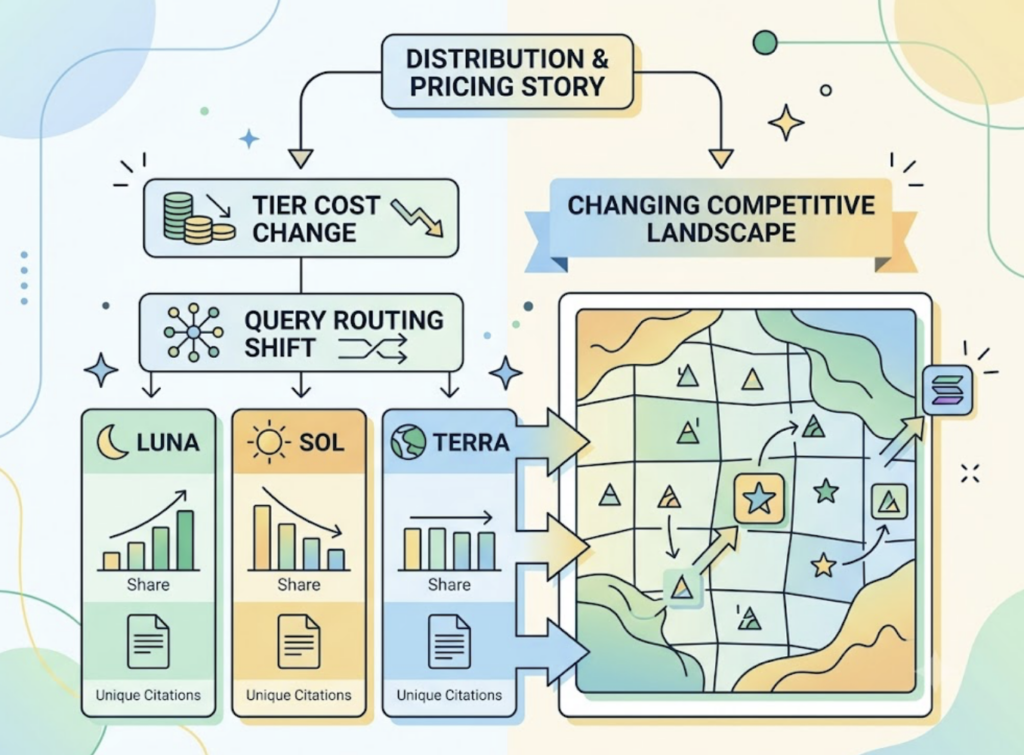
    On July 30, 2026, three weeks after launch, OpenAI cut Luna’s price by 80% and Terra’s by 20%. Luna dropped from $1/$6 to $0.20/$1.20 per million tokens. Terra moved from $2.50/$15 to $2/$12. Sol stayed at $5/$30.

    That’s not just a pricing story. It’s a distribution story. When a tier gets dramatically cheaper, more applications route more queries to it. The percentage of ChatGPT answers generated by Luna versus Sol versus Terra is shifting in real time. And since each tier cites differently, the population of AI answers your brand competes in is changing with it.

    This kind of recalibration happens every time a model updates, a new tier launches, or pricing changes. Google’s Gemini 3.5 Flash launched at $1.50/$9 per million tokens in May 2026, undercutting its own Pro model. Anthropic introduced Claude Sonnet 5 at a promotional rate of $2/$10 that’s scheduled to rise to $3/$15 after August. Every one of those shifts changes which model processes which queries, and therefore which brands get cited.

    The brands that treat these shifts as monitoring events, not headlines, are the ones that stay visible through them. Topify’s High-Value Prompt Discovery continuously surfaces the prompts where your brand appears or disappears, so when a tier rebalance shifts citation patterns, you see it within days, not quarters.

    Conclusion

    GPT-5.6 didn’t create the tiered model pattern. It confirmed it. Every major AI platform now runs a model family where different tiers reason differently, cite differently, and recommend different brands for the same question. The Semrush data shows 75% of cited sources change between reasoning modes on the same platform. The Yext data shows each platform follows its own sourcing logic on top of that.

    The GEO strategies that worked when “AI visibility” meant one number on one platform can’t account for this complexity. What works now is tier-aware, cross-platform tracking: knowing which tier your brand wins in, which tier it loses in, and what content investments close the gap. Start by auditing your brand’s visibility across tiers, not just platforms. The answer will probably surprise you.

    FAQ

    Q: What are the three tiers of GPT 5.6? 

    A: GPT-5.6 comes in three variants. Sol is the flagship for complex reasoning and agentic work. Terra is the balanced mid-tier model for everyday tasks. Luna is the fastest and cheapest tier, designed for high-volume, speed-sensitive workloads. Each tier uses a different reasoning depth, which affects which sources it cites and which brands it recommends.

    Q: Do different GPT 5.6 tiers recommend different brands? 

    A: Yes. Research from Semrush and Kevin Indig found that only 25.6% of cited domains overlap between ChatGPT’s minimal reasoning mode (aligned with Luna-level processing) and high reasoning mode (aligned with Sol-level processing). Three out of four sources change depending on which tier processes the query.

    Q: How does GEO differ from traditional SEO? 

    A: Traditional SEO optimizes for search engine rankings and click-through rates. GEO (Generative Engine Optimization) optimizes for visibility, citations, and recommendations inside AI-generated answers from platforms like ChatGPT, Gemini, Perplexity, and Claude. In GEO, the goal isn’t to rank on a results page. It’s to be the brand that AI names, cites, and recommends when a user asks a question.

    Q: How often should brands monitor their AI search visibility after a model update? 

    A: Continuously, or at minimum weekly during the first 2 to 4 weeks after a major model release or pricing change. Citation patterns can shift significantly within days of a new tier launch or price adjustment, as query routing changes and model behavior recalibrates.

    Read More

  • GPT 5.6 Tripled OpenAI’s Crawl. Is Your Brand Indexed?

    GPT 5.6 Tripled OpenAI’s Crawl. Is Your Brand Indexed?

    OpenAI’s web crawlers are hitting your site three times harder than they were a year ago. A Botify analysis of 7 billion log events confirmed it: after GPT-5 launched in August 2025, OAI-SearchBot activity jumped 3.5x. That’s 2.2 billion additional crawl events in Botify’s dataset alone, and the search-to-training crawl ratio flipped for the first time. OpenAI is now spending more resources on live web search indexing than on model training.

    Then GPT 5.6 dropped. With 900 million weekly active users and 250 to 500 million search-intent queries flowing through ChatGPT every week, the question isn’t whether OpenAI’s crawl will keep growing. It’s whether your brand shows up when it does.

    OpenAI’s Search Crawl Tripled. GPT 5.6 Makes the Stakes Higher.

    Chris Long, co-founder of the SEO consultancy Nectiv, partnered with Botify to analyze how OpenAI’s three crawlers behave across enterprise websites. The dataset covered November 2024 through March 2026, pulling from Botify’s log file infrastructure across retail, media, healthcare, software, travel, and marketplaces.

    The numbers tell a clear story. Before GPT-5, OAI-SearchBot and GPTBot ran at roughly even volumes, with a search-to-training ratio of about 0.95. After GPT-5, that ratio rose to 1.14. Translation: ChatGPT is now doing more live web fetching for user queries than it is bulk-crawling for training data.

    That shift matters because it changes what “being indexed by OpenAI” actually means.

    GPTBot crawling your site means OpenAI might use your content to train future models. OAI-SearchBot crawling your site means your pages can appear in ChatGPT search results right now, cited with a link, in front of hundreds of millions of users. The vertical breakdown makes this even more urgent. Healthcare sites saw approximately 740% more OAI-SearchBot activity post-GPT-5. Media and publishing came in at 702%. Marketplaces, software, and retail clustered between 190% and 216%.

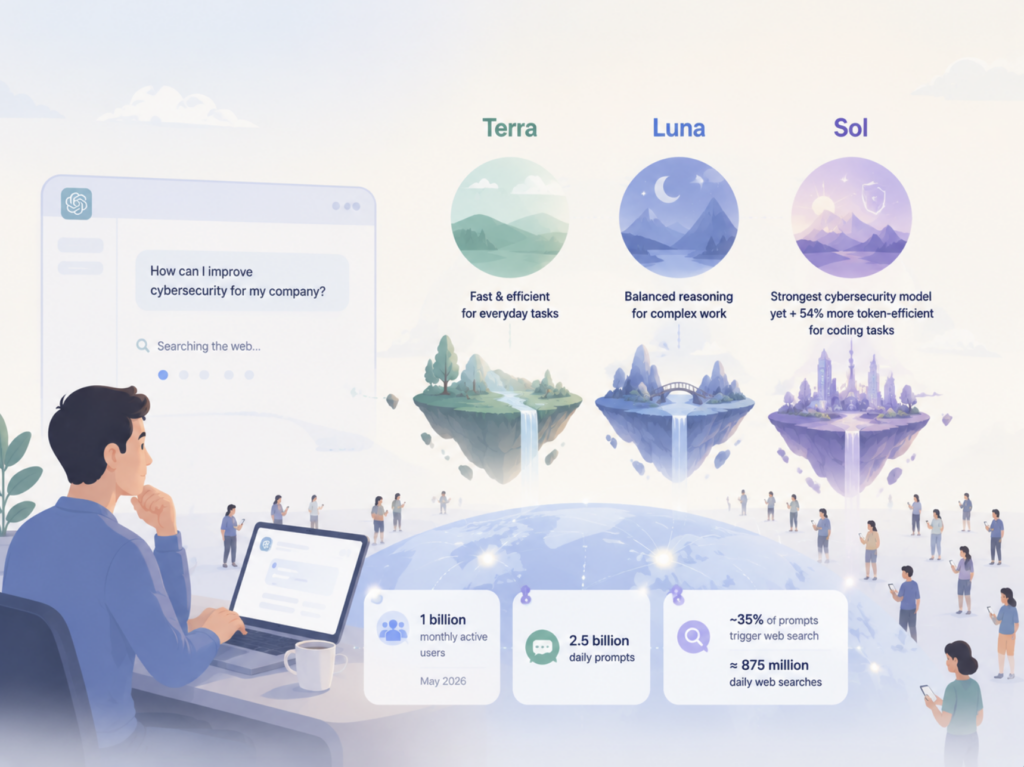
    Now factor in GPT 5.6. OpenAI launched the Sol, Terra, and Luna models on July 9, 2026, with Sol described as the “strongest cybersecurity model yet” and 54% more token-efficient for coding tasks. ChatGPT reached 1 billion monthly active users in May 2026. Daily prompt volume sits at 2.5 billion, and roughly 35% of those prompts trigger web search, producing an estimated 875 million daily web searches.

    The crawl volume that tripled after GPT-5 has nowhere to go but up.

    GPTBot vs OAI-SearchBot vs ChatGPT-User: The Config Most Teams Get Wrong

    OpenAI operates three distinct crawlers, and each serves a different purpose. Treating them as one “AI bot” in your robots.txt is the single most common mistake, and one of the most expensive.

    Here’s how they break down:

    CrawlerPurposeWhat It Controls
    GPTBotCollects content for model trainingWhether your content trains future GPT models
    OAI-SearchBotIndexes content for ChatGPT searchWhether your pages appear in ChatGPT search results
    ChatGPT-UserFetches pages when a user asks directlyWhether ChatGPT can load your page mid-conversation

    The critical detail: each crawler respects robots.txt independently. Blocking GPTBot does not block OAI-SearchBot. Blocking OAI-SearchBot does not block ChatGPT-User. You can allow one, block another, and fine-tune by directory, all within the same robots.txt file.

    OpenAI’s own documentation spells out the consequence: sites that block OAI-SearchBot won’t appear in ChatGPT search answers. Navigational links may still show up, but your content won’t be cited, quoted, or recommended.

    That’s where most teams trip up. They see “AI bot” in their server logs, add a blanket Disallow rule, and unknowingly remove their brand from the fastest-growing search surface on the internet.

    25% of Top Sites Block AI Crawlers. Most Don’t Realize What It Costs.

    The blocking trend is real. 25% of the top 1,000 websites now block GPTBot, up from 5% in early 2023. Among the top news websites in the UK and US, 79% block at least one AI training crawler, and 71% block AI retrieval bots used for live search.

    The reasoning makes sense on paper. Publishing content takes resources. Having an AI scrape that work to answer user questions, often without linking back, feels like a bad deal.

    But the data complicates that logic.

    A BuzzStream study analyzing 4 million citations across 3,600 prompts found that sites blocking OAI-SearchBot still appeared in 82.4% of AI citation cases. Sites blocking ChatGPT-User still showed up 70.6% of the time. The reason: AI models pull from multiple sources, including cached data, training sets, and third-party references. Blocking a crawler doesn’t erase your brand from AI answers. It just removes your ability to control how and when you appear.

    On the flip side, a Hostinger analysis of 66.7 billion bot requests found that OAI-SearchBot had achieved 55.67% average coverage across monitored websites. Sites that allow the bot get indexed. Sites that don’t get skipped for live search results while still potentially showing up through indirect references they can’t influence.

    The practical trade-off looks like this: blocking AI training crawlers protects your content from being used to train future models. Blocking AI search crawlers removes your brand from the discovery layer where 250 to 500 million search-intent queries happen every week.

    61% of enterprise sites have landed on a hybrid approach. They block training bots while allowing search and retrieval bots. That’s the configuration worth studying.

    The robots.txt Setup That Gets Your Brand Into ChatGPT Search

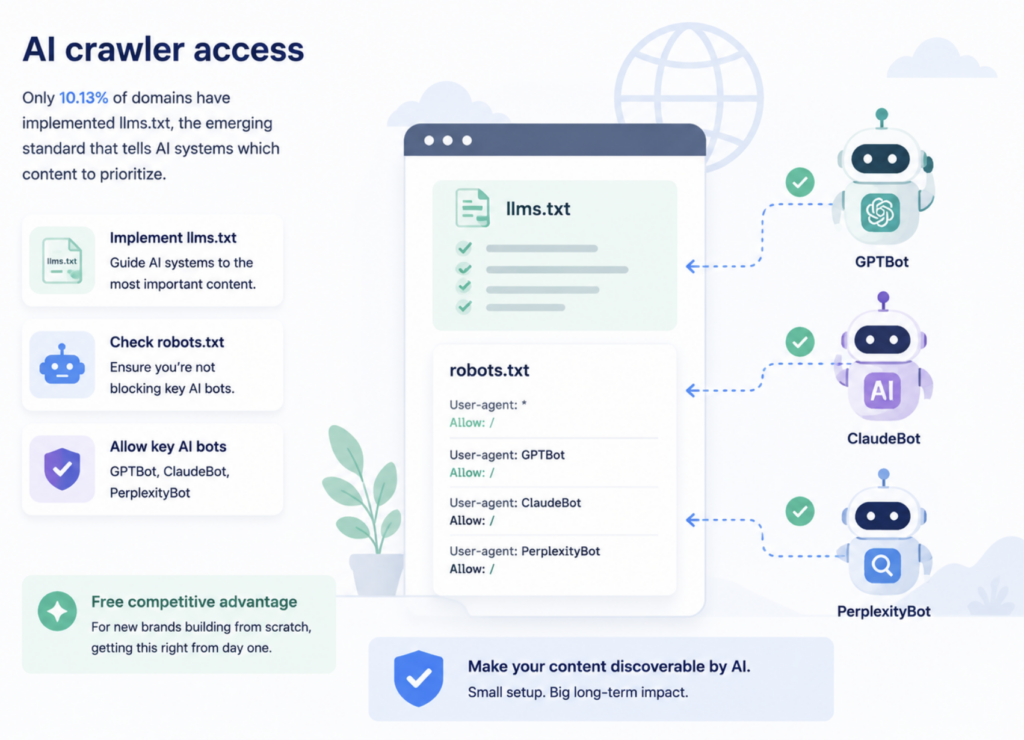
    The recommended configuration separates training from search. Allow OAI-SearchBot so your pages can appear in ChatGPT search results. Block GPTBot if you don’t want your content used for model training. Leave ChatGPT-User allowed for user-triggered page loads.

    Here’s what that looks like:

    User-agent: OAI-SearchBot
    Allow: /
    
    User-agent: GPTBot
    Disallow: /
    
    User-agent: ChatGPT-User
    Allow: /
    

    For sites that want more granular control, you can open specific directories while keeping sensitive paths closed:

    User-agent: OAI-SearchBot
    Allow: /blog/
    Allow: /products/
    Allow: /resources/
    Disallow: /staging/
    Disallow: /internal/
    Disallow: /admin/
    

    A few things to keep in mind. OpenAI states that changes to search eligibility can take about 24 hours to adjust after a robots.txt update. So don’t expect instant results.

    Also, robots.txt isn’t the only layer that matters. CDN configurations, WAF rules, and anti-bot plugins can override your crawler policies at the server level. If your Cloudflare, Akamai, or custom firewall rules rate-limit or block AI user agents, your robots.txt permissions don’t matter. Audit both layers.

    A Cloudflare-based analysis of robots.txt rules found that OAI-SearchBot appears in 4.22% of explicit ALLOW rules across the web. That’s still a small fraction of sites deliberately opting in. For brands that do, the competitive advantage is straightforward: you’re visible in a channel where most competitors haven’t shown up yet.

    Beyond Crawler Access: The Full Technical Stack for GPT 5.6 Indexing

    Letting the crawler in is necessary. It’s not sufficient.

    AI models don’t process web pages the way Google does. They don’t follow PageRank. They don’t care about your domain authority score in isolation. They’re looking for content they can extract, summarize, and cite in a structured answer. That means the technical surface area you expose to AI crawlers needs to be built for comprehension, not just crawlability.

    The stack that works in 2026 has four layers. Robots.txt controls permissions: who gets in, who doesn’t. Sitemap.xmlhandles discovery: which URLs exist and which ones are canonical. Schema markup (JSON-LD) provides page-level entity data: what this page is about, structured in a format machines parse without guessing. llms.txt offers site-level context: a clean markdown file at your domain root that gives LLMs a summary of your brand, products, and key pages.

    Each layer solves a different problem, and skipping one creates a gap.

    On schema markup specifically, a cited study found that pages with valid structured data are 2.3x more likely to appear in Google AI Overviews. Princeton’s GEO research found content with clear structural signals saw up to 40% higher visibility in AI-generated responses. The takeaway isn’t that schema guarantees an AI citation. It’s that without it, you’re making the AI work harder to understand your content, and when competing pages make it easier, they win.

    For llms.txt, the adoption curve is still early but accelerating. Anthropic, Stripe, Vercel, and Cloudflare all publish one. The file sits at yourdomain.com/llms.txt and contains a structured markdown summary: your brand name, a one-line description, and categorized links to your most important pages. It’s cheap to implement and gives AI systems a clean entry point that bypasses HTML noise, JavaScript rendering issues, and navigation clutter.

    One more layer that’s easy to overlook: content quality and third-party coverage. Muck Rack’s May 2026 analysis of more than 25 million AI-cited links found that earned media accounts for 84% of all citations across ChatGPT, Claude, and Gemini. Paid and advertorial content accounts for 0.3%. Journalism alone drives 27% of cited sources. If your brand isn’t covered by credible third-party publications, even perfect technical setup won’t generate consistent AI citations.

    You Opened the Door to AI Crawlers. Now Track Who Actually Walked In.

    Here’s the gap most teams hit after they’ve configured robots.txt, deployed schema, and published llms.txt: they have no way to measure whether it’s working. Google Search Console doesn’t track ChatGPT citations. Google Analytics doesn’t show Perplexity referrals reliably. Traditional rank trackers weren’t built for a world where “ranking” means appearing inside a generated paragraph, not on a SERP.

    That’s the problem Topify was built to solve. The platform tracks how AI systems recommend your brand across ChatGPT, Gemini, Perplexity, and other major AI platforms.

    For marketing teams working on GPT 5.6 indexing, Topify’s Visibility Tracking shows whether your brand appears in AI answers, how often, and for which prompts. Source Analysis traces exactly which domains AI platforms cite when they mention your category, so you can see whether your owned content or a competitor’s coverage is driving the narrative. Competitor Monitoring surfaces which brands are showing up alongside yours, and Sentiment Analysis tracks whether AI describes your brand the way your positioning intends.

    In practice, this means you can configure your robots.txt on Monday, check Topify on Thursday, and see whether OAI-SearchBot’s increased crawl is actually translating into citations. Without that feedback loop, you’re optimizing blind.

    If you want to start with a quick baseline, Topify’s free GEO Score Checker grades how AI-ready your site is across the signals that matter: crawlability, content structure, entity clarity, and citation patterns.

    Conclusion

    OpenAI’s crawl activity tripled after GPT-5, and GPT 5.6’s launch into a market with 900 million weekly ChatGPT users and hundreds of millions of search-intent queries means the volume will keep climbing. The brands that show up in this channel are the ones that got the technical basics right early: selective crawler access, structured data, site-level AI context, and a measurement system that closes the loop between crawl access and actual citations.

    The window to set this up ahead of competitors is still open. But with each model release, the stakes get higher and the competition for AI-generated recommendations gets tighter. Start with your robots.txt. Build the full stack. Then measure what you can’t afford to guess at.

    FAQ

    Q: Does GPT 5.6 use a different crawler than earlier GPT models?

    A: No. GPT 5.6 uses the same three OpenAI crawlers: GPTBot, OAI-SearchBot, and ChatGPT-User. What’s changed is the volume. OAI-SearchBot activity jumped 3.5x after GPT-5, and ChatGPT’s user base has continued growing since then. The crawlers are the same, but they’re hitting your site significantly harder and more frequently.

    Q: Should I allow both OAI-SearchBot and GPTBot?

    A: It depends on your priorities. If you want your content to appear in ChatGPT search results, allow OAI-SearchBot. If you don’t want your content used for model training, block GPTBot. The two are independent. Most enterprise sites allow OAI-SearchBot while blocking GPTBot, giving them search visibility without training data contribution.

    Q: How long does it take for robots.txt changes to affect ChatGPT search?

    A: OpenAI’s documentation says search eligibility updates take approximately 24 hours after a robots.txt change. In practice, the full effect may take longer depending on crawl frequency for your domain. Monitor your server logs for OAI-SearchBot activity after making changes.

    Q: Can I track whether ChatGPT is citing my brand?

    A: Standard analytics tools don’t reliably capture AI citations. ChatGPT doesn’t consistently pass referral headers, so much of the traffic arrives as “Direct” in GA4. Platforms like Topify are designed specifically for this, tracking brand mentions, citation sources, and competitive positioning across ChatGPT, Gemini, Perplexity, and other AI platforms.

    Read More

  • GPT 5.6 Sol: Fewer Tokens, More Citations, New GEO Rules

    GPT 5.6 Sol: Fewer Tokens, More Citations, New GEO Rules

    Your brand finally started showing up consistently in ChatGPT’s answers. You tuned your schema, built third-party authority, and watched citation rates stabilize over the spring. Then on July 9, 2026, OpenAI replaced the engine underneath. GPT-5.6 Sol now powers ChatGPT’s advanced reasoning stack, and it processes the same prompts with 54% fewer output tokens than its predecessor. That sounds like an efficiency win for developers. For brands tracking AI visibility, it’s a citation earthquake.

    The model generates shorter, more precise answers. But behind those concise responses, it runs deeper retrieval, pulls from more sources, and decomposes queries into more sub-queries than before. Your GEO baseline from June is already stale.

    GPT 5.6 Sol Generates Less but Retrieves More

    GPT-5.6 Sol is OpenAI’s new flagship model, launched for general availability on July 9, 2026 after a limited preview starting June 26. It ships as part of a three-tier family: Sol (flagship), Terra (balanced), and Luna (cost-efficient). The naming convention is new. OpenAI describes the shift as moving from “one model with a dial” to “three models, choose a tier.”

    The efficiency numbers are striking. On OSWorld 2.0, Sol surpasses Claude Opus 4.8 while using 85% fewer output tokens. On the Artificial Analysis Coding Agent Index, it scores 80, which is 2.8 points above Claude Fable 5, while using less than half the output tokens and taking less than half the time. Pricing reflects the efficiency play: Sol runs at $5 input and $30 output per million tokens, Terra at $2.50/$15, and Luna at just $1/$6.

    Here’s the thing. “Fewer tokens” doesn’t mean the model is doing less work. Sol generates more concise, precise responses without sacrificing completeness. It just does it with less text. Meanwhile, its reasoning modes fire off more sub-queries, browse more pages, and pull in more external sources before composing that shorter answer. For GEO, this is the paradox that matters: the AI writes less, but reads more.

    Every Model Update Rewrites the Citation Playbook

    If you’ve tracked ChatGPT citation behavior over the past year, you already know the pattern. Every model version change reshuffles which brands get cited, which domains lose ground, and how the model finds information.

    The data trail is clear. When ChatGPT transitioned to GPT-5.3 as the default, average cited domains per response dropped from 19.1 to 15.2, a 20% decline. GPT-5.4 reversed the trend hard: brand website citations jumped to 56%, up from just 8% under GPT-5.3, a 7x increase. Then GPT-5.5 pulled back. Brand site citations dropped to 47%, driven by a 70% reduction in site: operator usage during fan-out queries. The GPT-5.5 Instant tier was even more dramatic: brand website citations fell to just 6%, a 55% drop from GPT-5.3 Instant.

    SISTRIX analyzed 3.8 million German-language ChatGPT responses and compared citation patterns before and after the GPT-5.5 rollout. The company compared it to a Google core update.

    GPT-5.6 isn’t just another increment. It’s a structural change. Three model tiers with different reasoning depths, a new caching architecture, and reasoning effort modes ranging from medium to ultra. Each tier and mode produces different citation behavior. The brands that built their GEO strategy around GPT-5.5’s patterns are now operating on outdated assumptions.

    GPT 5.6 Reasoning Modes Create Two Separate Citation Webs

    This is where the data gets uncomfortable for teams treating ChatGPT as a single channel.

    A June 2026 Semrush study of 100 prompts found that only 25.6% of cited domains overlapped between ChatGPT’s minimal reasoning mode and high reasoning mode. Same prompts, same platform, wildly different sources.

    The numbers break down fast. Citation rate climbs from 50% in Instant mode to 68% in Thinking mode, an 18-percentage-point jump. Average citations per response nearly double, from 2.6 to 4.5. And the mechanism driving it: fan-out sub-queries run 4.6x higher in Thinking mode than in Instant mode. High reasoning pulled from 173 unique domains across the test set, compared to a much narrower pool in Instant.

    The industry-level differences matter too. Finance sees the largest citation rate increase at 28 percentage points. Health and lifestyle gain 24 points, B2B SaaS gains 16, and consumer tech sees only a modest 4-point lift.

    GPT-5.6 Sol amplifies this split. It powers the medium, high, and extra-high reasoning levels in ChatGPT for paid users. GPT-5.5 Instant still handles fast everyday responses on the free tier. So a ChatGPT Plus subscriber asking “best project management tool for remote teams” may see your brand cited across 4 to 5 sources in a Sol-powered answer. A free-tier user asking the same question gets a GPT-5.5 Instant response that may cite zero brand sites.

    Brand visibility in AI answers isn’t a ranking problem anymore. It’s a retrieval-depth problem.

    What “Fewer Tokens, More Sources” Actually Means for GEO

    The combination of token efficiency and deeper retrieval creates a specific dynamic that changes how GEO should work.

    On the output side, GPT-5.6 Sol generates shorter responses. Fewer tokens means fewer mentions per answer, which means each citation slot is more competitive. Your brand either makes the cut in a concise, 3-to-5 source response, or it doesn’t appear at all.

    On the retrieval side, the model searches more before responding. Higher reasoning modes decompose a single user prompt into multiple sub-queries, each targeting a different angle of the question. Google AI Mode fires 9 to 11 parallel sub-queries per prompt, while ChatGPT runs 2.3 to 2.8 on average. But in ChatGPT’s Thinking mode, that fan-out multiplies by 4.6x.

    Here’s what that means for your content strategy. According to AirOps research from March 2026, 32.9% of cited pages appeared only in fan-out results, not in the original prompt’s search results. They were never discovered through the primary keyword. And 95% of those fan-out queries had zero traditional search volume. You can’t find them in Google Search Console. You can’t target them with conventional keyword tools.

    The implication is direct. Brands that only optimize for surface-level queries miss roughly a third of their citation opportunities. The ones that cover the sub-query layer, the specific comparisons, pricing breakdowns, use-case distinctions, and niche technical questions, capture visibility that competitors can’t even see.

    That gap is exactly what Topify is built to diagnose. Its Source Analysis feature tracks which domains AI platforms actually cite for your target prompts, across ChatGPT, Gemini, Perplexity, and Google AI Overviews. When GPT-5.6 reshuffles the source pool, you can see which of your pages gained or lost citations within days, not months.

    How to Track GPT 5.6 Citation Shifts Before Your Competitors Do

    The first 30 days after a major model release are the highest-leverage window in GEO. Citation patterns haven’t hardened yet. The old retrieval order is broken, the new one is still settling, and content changes made now get absorbed as the model’s preferences stabilize.

    Here’s what to do right now.

    Audit your prompt-level visibility across tiers. GPT-5.6 Sol and GPT-5.5 Instant produce different citation webs. If you’re only tracking one, you’re seeing half the picture. Run your core customer prompts through both reasoning levels and compare which domains get cited. Topify’s Comprehensive GEO Analytics monitors brand performance across seven key metrics (visibility, sentiment, position, volume, mentions, intent, and CVR) and can surface these tier-level differences in a single dashboard.

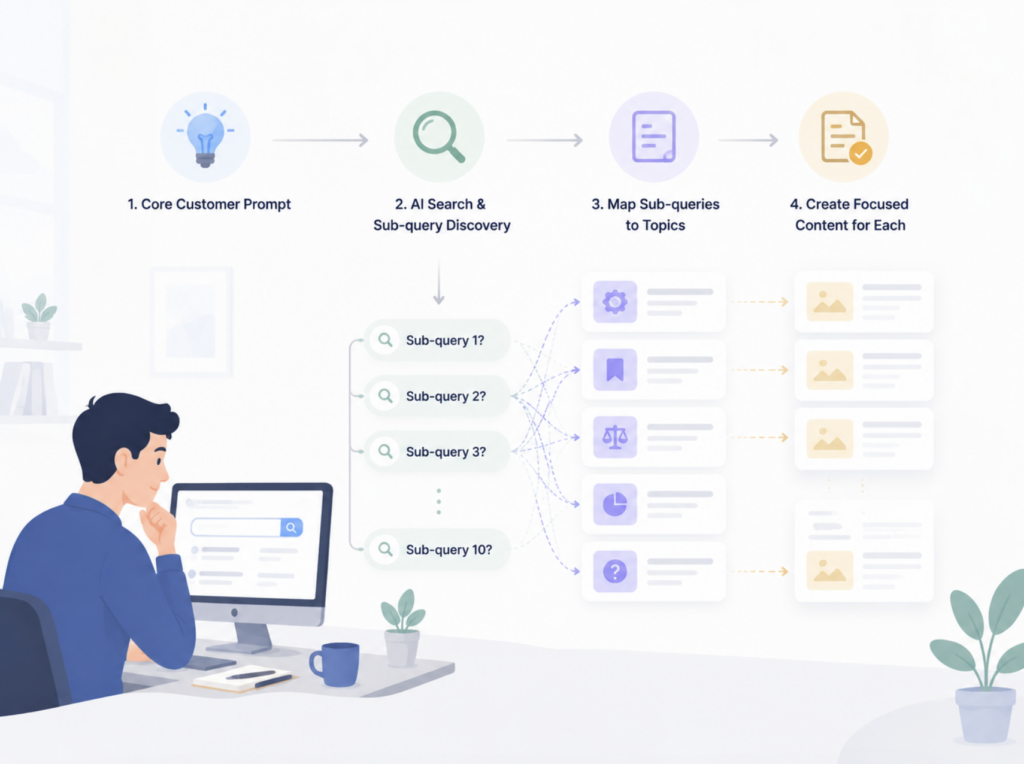
    Map your fan-out coverage gaps. Take your top 10 customer prompts and document the sub-queries ChatGPT decomposes them into. Then check whether you have content that directly answers each sub-query. The pages you’re missing are the citation opportunities GPT-5.6 Sol is handing to your competitors.

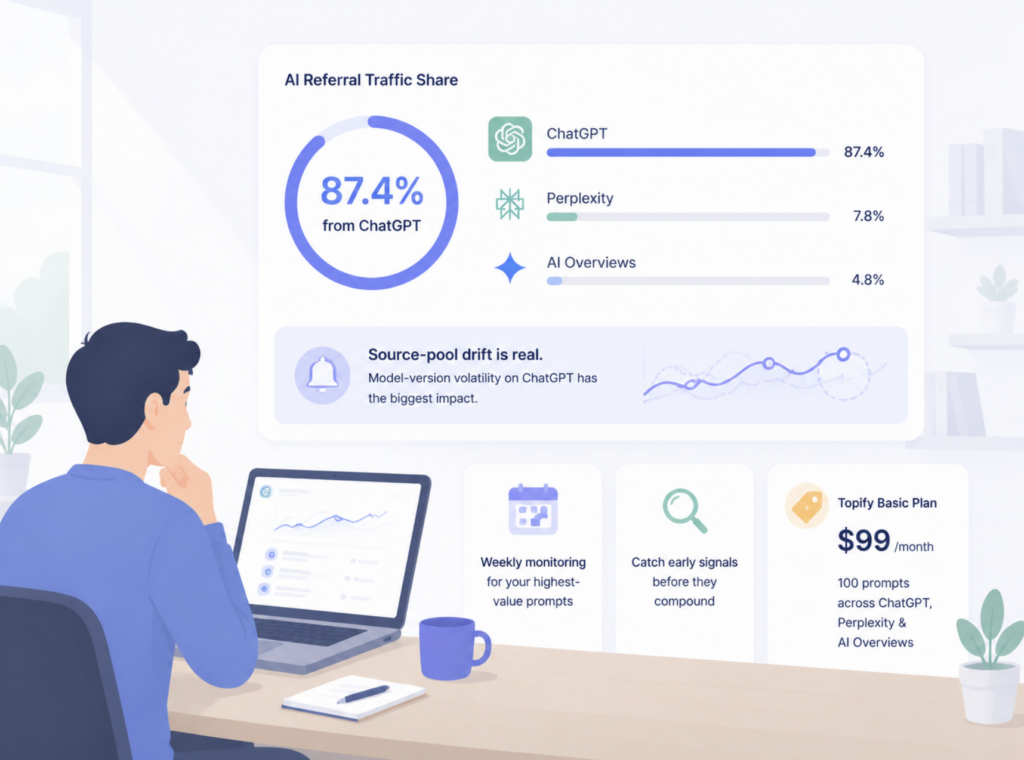
    Watch for source-pool drift. ChatGPT drives 87.4% of all AI referral traffic. Model-version volatility on ChatGPT specifically has outsized impact on overall AI search visibility. Set up weekly monitoring for your highest-value prompts during the post-launch window. Topify’s platform starts at $99/month for the Basic plan, which covers 100 prompts across ChatGPT, Perplexity, and AI Overviews, enough to catch the early signals before they compound.

    Build for multiple retrieval depths. The reasoning-mode citation split means your content needs to be findable in both quick retrievals and deep research chains. That means structured data, clear entity signals, FAQ coverage for niche sub-queries, and presence on third-party authority platforms like G2, Reddit, and industry publications.

    The brands that treat model updates as one-time events keep rebuilding their GEO strategy from scratch every 8 to 12 weeks. The ones that invest in continuous, tier-aware, cross-platform monitoring compound their visibility through each transition instead of losing it.

    Conclusion

    GPT-5.6 Sol’s token efficiency is a genuine technical advance. But for brands, the real story isn’t that ChatGPT generates shorter answers. It’s that the model now searches deeper, cites from a wider pool, and produces fundamentally different citation patterns depending on which reasoning tier answers the query.

    The citation playbook has reset again. It won’t be the last time. The teams that win in this environment aren’t the ones chasing each model’s quirks. They’re the ones running continuous monitoring across platforms and tiers, diagnosing gaps in real time, and executing content changes inside the 2-to-4-week window before new patterns harden. Start tracking your brand’s AI visibility now so the next model update is an opportunity, not a surprise.

    FAQ

    Q: How does GPT 5.6 Sol’s token efficiency affect brand citations in ChatGPT?

    A: Sol generates shorter, more precise answers using fewer output tokens. But its reasoning modes run more sub-queries behind the scenes, pulling from a wider pool of sources. The result is fewer mention slots per response but more total citation opportunities across the retrieval chain. Brands need to be present in both surface-level and sub-query results to maintain visibility.

    Q: What’s the difference between GPT 5.6 Sol, Terra, and Luna for AI search visibility?

    A: Sol powers ChatGPT’s advanced reasoning (medium, high, extra-high effort levels) for paid users. Terra is the balanced tier for everyday production traffic. Luna is the fastest and cheapest option. Each tier has different retrieval depth and citation behavior. Sol tends to cite more sources per response, while Luna and Instant modes produce leaner, third-party-heavy citations.

    Q: How often should I check my brand’s AI citation data after a major model update?

    A: During the first 30 days after a release like GPT-5.6, weekly at minimum, and every 48 hours for your highest-value prompts. After the window closes, biweekly or monthly tracking with drift alerts is typically enough to catch competitor moves and quiet model adjustments.

    Q: Does GPT 5.6’s reasoning mode change which brands get recommended?

    A: Yes. Research shows only 25.6% of cited domains overlap between minimal and high reasoning modes on the same prompts. Higher reasoning also lifts citation rates from 50% to 68% and nearly doubles average sources per response. A brand that’s visible in Instant mode can be absent in Thinking mode, and vice versa.

    Read More

  • How to Optimize Your Brand for GPT 5.6 Citations: A GEO Playbook

    How to Optimize Your Brand for GPT 5.6 Citations: A GEO Playbook

    You’d finally gotten your brand’s AI citation rate to a predictable number. Structured data was in place, entity signals were clean, and your mention rate across ChatGPT held steady through Q2. Then on July 9, OpenAI swapped out the engine underneath. GPT-5.6 rolled out across ChatGPT, the API, and a new agent layer called ChatGPT Work, replacing the model your entire GEO strategy was calibrated against. The source preferences, retrieval logic, and entity weighting that drove your Q2 baseline no longer exist in their previous form. Cross-platform tracking data shows that model transitions routinely produce citation shifts of up to 34% between rivals in competitive categories, and the correlation between organic rank and AI citation sits at just 0.034. Betting your GPT-5.6 visibility on your Google rankings is betting on a relationship that barely exists.

    Three Models, Three GPT 5.6 Citation Patterns

    GPT-5.6 isn’t one model. It’s a family of three, each with different reasoning depth and cost: Sol (flagship, $5/$30 per million tokens), Terra (balanced everyday workhorse, $2.50/$15), and Luna (fast and cheap, $1/$6). For brand visibility, the split matters because deeper reasoning correlates directly with more citations.

    A Search Engine Land study across 100 prompts found that high-reasoning mode lifted citation rates from 50% to 68%, nearly doubled average sources per response from 2.6 to 4.5, and increased fan-out queries by 4.6x. Sol with max or ultra reasoning sits at the top of that curve. Luna, optimized for throughput, leans more heavily on probabilistic memory and top-ranked search results.

    That’s the gap most brands can’t see yet.

    Two workflow additions compound the shift. GPT-5.6 introduces an ultra mode that spins up parallel sub-agents to divide work, cross-check each other, and merge conclusions. ChatGPT Work, released alongside GPT-5.6, operates across desktop apps, connected files, and third-party tools to produce research deliverables autonomously. When an AI agent is doing the buying research for your prospects, your brand needs to be the one it retrieves and recommends.

    Why Your GPT-5.5 GEO Baseline Is Already Obsolete

    Model transitions don’t tweak citation behavior. They rewrite it.

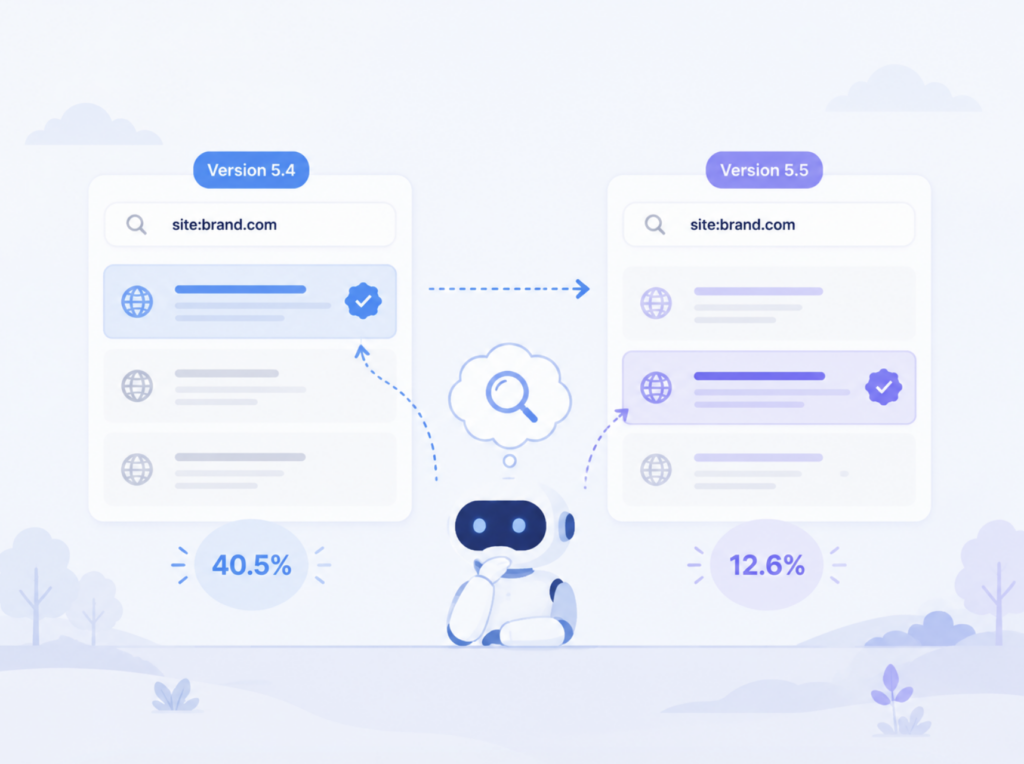
    Between GPT-5.4 and GPT-5.5, the share of fan-out queries using the site: operator scoped to a brand’s domain dropped from 40.5% to 12.6%. That’s a 70% reduction in brand-domain-targeted searches between two consecutive versions. The brand citation rate fell with it. GPT-5.5 didn’t decide brand sites were less trustworthy. It simply stopped seeking them out on their own domains as aggressively.

    GPT-5.6 adds another variable: a three-tier architecture where each tier may favor different source types. Efficiency-optimized models like Luna lean on top-ranked search results and training-data memory, while Sol with ultra reasoning digs deeper into documentation-grade content and cross-references multiple sources before citing.

    The disconnect between traditional SEO and AI citation is already well documented. EMGI Group’s April 2026 SaaS AI Citation Gap Report found that 44% of Google top-10 brands get zero ChatGPT citations for the same keywords. In Marketing Automation, that gap hit 53%. Analytics was close behind at 52%. These gaps don’t shrink when a new model ships. They reshuffle.

    Teams that lock their optimization to GPT-5.5’s behavior are already optimizing for a model that’s no longer answering most of their prospects’ questions.

    Fan-Out in GPT 5.6: More Sub-Queries, Higher Citation Stakes

    When someone asks ChatGPT a question, the model doesn’t search for that exact phrase. It decomposes the prompt into multiple sub-queries, a process called query fan-out, then assembles an answer from the combined results.

    AirOps analyzed 548,534 retrieved pages across 15,000 prompts and 43,233 total queries and found that 88.6% of queries generate exactly 2 fan-out sub-queries. Complex comparative queries produce 4 or more. With GPT-5.6’s ultra mode coordinating parallel sub-agents, that fan-out surface area likely expands further for high-reasoning tasks.

    Here’s the number that should change how you plan content: 32.9% of cited pages appeared only in fan-out results, not in the results for the original prompt. Nearly a third of all citation opportunities exist entirely outside the keyword you’re tracking.

    And 95% of fan-out queries that triggered citations had zero traditional search volume. They aren’t keywords any brand targets. They’re the sub-questions ChatGPT asks itself while building an answer: things like “NCLEX pass rates by nursing school” when the user asked “what are the best nursing programs?”

    The practical takeaway is straightforward. If your content strategy only covers primary keywords and pillar topics, you’re invisible to the retrieval layer that generates a third of all citations. Fan-out-aligned content, pages that answer the specific sub-questions a model asks itself, is no longer optional for GPT 5.6 optimization.

    Five Moves to Earn GPT 5.6 Citations Before Your Competitors Do

    1. Get Indexed on Bing

    ChatGPT’s web retrieval runs on Bing’s index. A site indexed on Google but not Bing is invisible to GPT-5.6’s search layer, period. Submit your sitemap to Bing Webmaster Tools and verify your coverage. This is the lowest-effort, highest-impact fix that most brands still haven’t done.

    2. Deploy a Triple Schema Stack

    Organization, Article, and FAQPage schema implemented together using JSON-LD @graph format create a structured signal that AI models use to verify authority and extract content cleanly. Google’s March 2026 update shifted schema’s role from a SERP display trigger to an AI trust and entity verification signal. If your schema is a boilerplate template-fill, you’re getting minimum value. Optional properties like author, dateModified, sameAs, and description are what give AI systems the context to cite confidently rather than skip you.

    3. Keep Content Updated Within 30 Days

    Content updated within 30 days receives 3.2x more citations than older material. The freshness signal isn’t about publication date alone. It’s about whether the model finds evidence that the content reflects current conditions: updated statistics, current examples, a visible “Last updated” timestamp. A 2023 article with fresh 2026 data performs differently from a 2023 article that’s never been touched.

    4. Build Content for Fan-Out Sub-Queries

    Stop writing only for primary keywords. Run your core customer prompts through ChatGPT search and document the sub-queries it generates. Then build focused content for each sub-query layer. Not 10 rewrites of the same piece, but 10 new pages, each targeting one sub-question the model asks itself.

    The AirOps data backs this up. Pages covering 26-50% of ChatGPT’s fan-out sub-queries outperform pages covering 100%. The “ultimate guide” playbook that dominated traditional SEO actually hurts citation rates when query relevance is held constant. Focused, specific answers beat comprehensive everything-pages.

    5. Strengthen Third-Party Presence

    GPT-5.6’s agentic architecture cross-references claims against multiple sources. Brands with consistent, corroborated presence across review platforms like G2, Capterra, and TrustRadius, plus industry publications and authoritative third-party sites, get cited more reliably than brands with a single well-optimized homepage.

    LinkedIn is now reportedly the second most-cited domain across ChatGPT Search, Google AI Mode, and Perplexity. Employee thought leadership on personal profiles is becoming source material for how AI systems describe your brand.

    Tracking GPT 5.6 Citations Without Flying Blind

    One audit is a photograph. GEO needs video.

    GPT-5.6’s three-tier architecture means your brand might appear in Sol’s deep-reasoning answers but go missing from Luna’s faster, cost-optimized responses. Or the opposite. Without per-model tracking, you can’t tell where the gaps are, and you can’t prioritize fixes.

    Topify provides the monitoring layer this workflow requires. Its Comprehensive GEO Analytics tracks brand visibility, sentiment, position, and citation sources across ChatGPT, Gemini, Perplexity, and AI Overviews. In practice, this means you can spot a drop in ChatGPT mention rate after a model update and trace it back to a specific source that shifted, all within the same dashboard.

    The Source Analysis feature shows exactly which domains GPT-5.6 is citing in your category. If a competitor’s documentation or a third-party review site is getting the citations your brand used to own, you’ll see it before the traffic impact hits. Dynamic Competitor Benchmarking reveals who AI engines recommend in your space and tracks how those positions change with each model update, so you know where you’re gaining ground and where you’re falling behind.

    Here’s a practical sequence for a GPT-5.6 reset audit. Record your citation rate, average position, and cited sources for each tier of ChatGPT answer. That’s your pre-drift baseline. Look for asymmetries: present in high-volume answers but missing from complex ones usually means your content lacks the technical depth Sol wants before it cites you. Then monitor for drift continuously. Track the statistical gain or decline in mentions after each update and feed what you learn back into your schema and content pillars. Teams that get started with ongoing tracking before the next weight update have a structural advantage over those that audit reactively.

    Conclusion

    GPT-5.6 didn’t tweak ChatGPT’s citation rules. It replaced them. New model weights, a three-tier architecture, and an agentic workflow layer mean the optimization playbook that worked through Q2 is a starting point, not a strategy. The brands that move first have a window: record your per-model citation baseline now, map the fan-out sub-queries your category generates, fill the content gaps, and put continuous monitoring in place so the next model update is a data point, not a surprise. The brands that wait will spend Q4 trying to reverse-engineer why their competitors show up in every ChatGPT answer and they don’t.

    FAQ

    Q: Does GPT 5.6 use Google or Bing for web search?

    A: ChatGPT’s web retrieval still runs on Bing’s index. Brands that haven’t submitted their sitemap to Bing Webmaster Tools are invisible to GPT-5.6’s search component, regardless of their Google ranking.

    Q: How often does GPT 5.6 change its citation behavior?

    A: Citation behavior can shift with every model weight update, not just major version releases. Between GPT-5.4 and GPT-5.5, site-scoped query usage dropped 70% in a single transition. Continuous monitoring is the only reliable way to catch these shifts early.

    Q: Do I need to optimize separately for Sol, Terra, and Luna?

    A: You don’t need three separate strategies, but you should track visibility across tiers. Sol’s deeper reasoning pulls from more sources and tends to favor documentation-grade content. Luna leans on top-ranked results and training data. The same brand can be visible in one tier and absent in another.

    Q: Can small brands earn GPT 5.6 citations?

    A: Yes. Topical depth and clean structure let focused brands win citations for niche prompts even without high domain authority. AirOps’ research found that domain authority shows no positive correlation with AI citation. ChatGPT evaluates content based on relevance and structure, not backlink counts.

    Read More

  • GPT 5.6 Powers ChatGPT Work: Is It Recommending Your Brand?

    GPT 5.6 Powers ChatGPT Work: Is It Recommending Your Brand?

    Your marketing team spent the last quarter building comparison pages, earning media placements, and climbing Google rankings. Then a procurement lead at your biggest prospect opened ChatGPT Work, typed “research and shortlist the top five platforms in [your category],” and walked away. Ten minutes later, the agent delivered a finished slide deck with vendor names, feature breakdowns, and a recommendation. Your brand wasn’t on it.

    That slide deck didn’t disappear after one read. It got forwarded to a buying committee of eight people, and none of them ran a second search. The shortlist was set before your sales team knew the deal existed.

    What GPT 5.6 and ChatGPT Work Changed About Brand Discovery

    On July 9, 2026, OpenAI launched GPT 5.6 alongside ChatGPT Work, an autonomous agent designed for multi-step workplace tasks. GPT 5.6 ships in three variants: Sol, the most powerful model; Luna, optimized for speed; and Terra, built to balance performance and cost for everyday work.

    ChatGPT Work isn’t a chatbot. It’s an agent that connects to your apps and files, browses the live web, and produces finished deliverables: reports, spreadsheets, presentations, and even interactive web pages through a new Sites feature. It can run in the background for hours, breaking larger projects into smaller steps without waiting for user input.

    The distinction matters. When someone asks ChatGPT a question in a normal chat, the answer is read once and forgotten. When ChatGPT Work builds a vendor shortlist inside a slide deck, that shortlist becomes a document people circulate, present, and act on. The brands named in it carry the weight of a recommendation.

    ChatGPT Work is rolling out to paid plans (Pro, Pro Lite, Enterprise, and Edu first, with Plus and Business following). That’s the audience making purchasing decisions, using an agent that names brands inside documents they ship to colleagues.

    How ChatGPT Work Decides Which Brands Make the Shortlist

    ChatGPT Work compresses an entire product category into three to five names. It does this by browsing the web, pulling data from connected apps, and synthesizing what it finds into a structured deliverable.

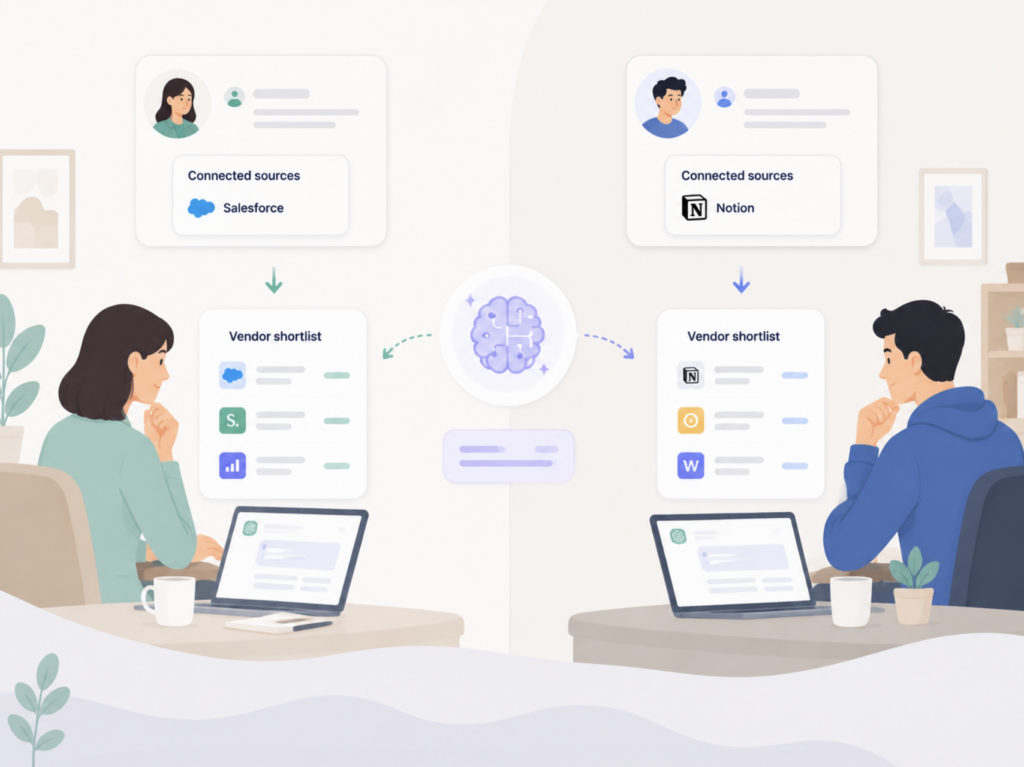
    Here’s what makes this different from a regular ChatGPT chat response. Work draws on the user’s connected files and prior context, which means the same research brief can produce different shortlists for different users. A VP of marketing with Salesforce connected will get a different vendor comparison than a startup founder using Notion. Personalization makes it harder to predict, and harder to monitor.

    The signals ChatGPT Work relies on to select brands overlap with what drives regular AI search visibility, but the stakes are higher:

    SignalWhat It Means for ChatGPT Work
    Crawlable, structured contentWork’s built-in browser reads live web pages to build deliverables. Thin or outdated pages get skipped.
    Third-party mentionsEarned media placements in high-authority publications increase the chance Work trusts your brand enough to include it.
    Review site presenceG2, Capterra, and industry directories feed the evidence Work uses to justify a recommendation.
    Clear product positioningWork needs to match your brand to a specific use case. Vague messaging means you don’t fit the prompt.

    One spot check tells you little. What matters is the pattern across many agent runs: how often does your brand make the deliverable at all?

    GPT 5.6 Arrives as 51% of B2B Brands Have Zero AI Citations

    The timing of GPT 5.6 makes the visibility gap more urgent. Crackle PR’s Q2 2026 AI Citation Benchmark found that 51% of B2B tech brands have zero citations across ChatGPT, Perplexity, and Gemini. More than half the market is invisible to the AI tools buyers already use daily.

    Those buyers aren’t experimenting. Forrester’s 2026 B2B Buyer Journey report found 72% of B2B software buyers now use ChatGPT during vendor evaluation. Bain’s 2026 research puts the average at 17 AI search queries per buyer per week. Across buying committees that Gartner’s 2026 data places at a median of 8.2 people, that’s over 100 AI-assisted research touchpoints per deal cycle.

    The conversion data is just as stark. According to HubSpot, AI referral traffic is growing 165 times faster than organic search and converts at four to nine times the rate of traditional visitors. ChatGPT’s user base has crossed 900 million weekly active users as of early 2026, more than doubling from 400 million just a year earlier.

    Being excluded from an AI-generated shortlist doesn’t show up in your CRM. The buyer never visits your site, never fills out a form, never talks to sales. You lose the deal before anyone on your team knows it existed.

    Your SEO Dashboard Can’t Show You This GPT 5.6 Visibility Gap

    Most marketing teams track domain authority, keyword rankings, and organic traffic. None of those metrics predict whether ChatGPT Work will include your brand in a procurement report.

    Crackle PR’s benchmark data reveals the disconnect: 34% of AI answers cite sources ranked below position 20 in Google search. Traditional SEO rank alone does not predict AI visibility. An Ahrefs study of 75,000 brands found that brand mentions correlate three times more strongly with AI visibility than traditional backlinks (0.664 vs. 0.218).

    The citation source split reinforces this. According to Crackle PR, 71% of ChatGPT’s B2B vendor citations come from earned media placements, with only 29% from owned content. Domain authority correlates with citation frequency at r = 0.62, meaning the quality tier of a placement matters more than the volume of coverage.

    That’s a fundamentally different optimization problem than traditional SEO. You can rank on page one of Google for every target keyword and still be absent from the ChatGPT Work report your prospect’s team is reading right now.

    How to Check If ChatGPT Work Recommends Your Brand

    Before you can fix the gap, you need to see it. Here’s a practical audit framework:

    Start by running the same research briefs your buyers would. Open ChatGPT Work and ask it to research and shortlist options in your category, the kind of task a procurement lead would set. Save the result with today’s date. Record which brands are included, where they’re positioned, which competitors show up, and which source URLs the agent cited.

    Then compare agent output against chat. Run the same question as a plain ChatGPT chat and as a Work task. The differences reveal how the deliverable format re-ranks your space. A brand that shows up in a casual chat response can still be absent from a structured slide deck.

    The problem with manual testing is that it doesn’t scale. Personalization means results shift based on connected context. Region, plan tier, and timing all affect the output. One spot check is a snapshot, not a strategy.

    For consistent monitoring across prompts, platforms, and competitors, you need dedicated AI visibility tracking. Topifytracks brand performance across ChatGPT, Gemini, Perplexity, DeepSeek, and other major AI platforms through seven key metrics: visibility, sentiment, position, volume, mentions, intent, and CVR. In practice, this means you can detect when ChatGPT stops mentioning your brand for a specific use case, identify which competitor took your position, and trace the shift back to a specific source domain, all from one dashboard.

    Topify’s Source Analysis shows exactly which URLs AI platforms cite when answering queries in your category. If ChatGPT Work’s browser is pulling from a competitor’s comparison page instead of yours, you’ll see it. The Dynamic Competitor Benchmarking feature tracks who AI engines recommend in real time, so you’ll know when a new rival enters the shortlist before your sales team hears about it from a lost deal.

    For teams that want to move from monitoring to action, Topify’s One-Click Execution lets you define your visibility goals in plain English, review the proposed strategy, and deploy it with a single click, no manual workflows required.

    What the GPT 5.6 Shift Means for Your AI Visibility Strategy

    ChatGPT Work represents a structural change in how brands get discovered. It’s not just another answer surface. It’s a surface where the answer becomes a deliverable that travels through organizations and drives purchasing decisions.

    Three things matter now more than they did before July 9:

    First, your content needs to be agent-readable. ChatGPT Work’s built-in browser reads live web pages to build deliverables. If your product pages are thin, outdated, or lack structured data, the agent will build around you. Clear comparison content, detailed feature documentation, and up-to-date pricing pages give Work something it can confidently cite.

    Second, earned media quality outweighs volume. With 71% of AI citations coming from earned placements and domain authority correlating with citation frequency at r = 0.62, a single placement in TechCrunch or Forbes may yield more AI visibility than a dozen mid-tier trade articles. Focus on publications ChatGPT actually cites, not just publications that drive traffic.

    Third, continuous monitoring is no longer optional. ChatGPT Work’s personalization engine means visibility shifts can happen without any change to your content. A competitor publishes a new case study, a review site updates its rankings, and suddenly your brand drops off the shortlist for a segment you thought you owned. The only way to catch this is persistent, automated tracking across AI platforms. Get started with Topify to see exactly where your brand stands.

    Conclusion

    GPT 5.6 didn’t just upgrade ChatGPT’s intelligence. It powered an agent that builds the documents your buyers rely on to make purchasing decisions. When ChatGPT Work compresses your category into a three-name shortlist inside a slide deck, the brands left out don’t get a second chance. The buying committee acts on what the agent delivered.

    The data says most brands aren’t ready. Over half of B2B tech companies have zero AI citations, while nearly three-quarters of software buyers are already using ChatGPT to evaluate vendors. The gap between buyer behavior and brand visibility is the biggest blind spot in B2B marketing right now. Start by auditing your ChatGPT Work presence. Then build the monitoring system that ensures you see every shift before your competitors do.

    FAQ

    Q: What is ChatGPT Work and how does it affect brand recommendations?

    A: ChatGPT Work is an AI agent launched on July 9, 2026, powered by GPT 5.6. Unlike regular ChatGPT, it autonomously researches, browses the web, connects to user apps, and produces finished deliverables like reports and slide decks. When it builds a vendor shortlist, it typically compresses a category into three to five brand names, and those names carry the weight of a recommendation that gets circulated to buying committees.

    Q: Does GPT 5.6 change how my brand appears in AI search results?

    A: Yes. GPT 5.6’s Sol model is OpenAI’s most capable model to date, and it powers ChatGPT Work’s agentic capabilities. The key change isn’t just model intelligence. It’s that GPT 5.6 enables a new deliverable format where brand recommendations get embedded in documents, spreadsheets, and presentations that decision-makers rely on. Visibility in a ChatGPT Work report carries more downstream influence than a mention in a single chat response.

    Q: How can I track whether ChatGPT Work is recommending my brand?

    A: Manual testing gives you a starting point: ask ChatGPT Work to shortlist options in your category and record the results. For consistent monitoring at scale, use an AI visibility platform like Topify that tracks brand mentions, position, sentiment, and citation sources across ChatGPT and other major AI engines. This lets you detect shortlist changes before they affect your pipeline.

    Q: What’s the difference between AI visibility and traditional SEO rankings?

    A: Traditional SEO measures how well your pages rank in Google search results. AI visibility measures whether AI platforms like ChatGPT mention and recommend your brand when users ask category-level questions. Research shows that 34% of AI-cited sources rank below position 20 in Google, and brand mentions correlate three times more with AI visibility than backlinks. The two channels require different optimization strategies.

    Read More

  • GPT 5.6 vs. GPT 5.5: What Changed in AI Citations

    GPT 5.6 vs. GPT 5.5: What Changed in AI Citations

    Two model upgrades in three months. Each one reshuffled which brands ChatGPT cites, how many sources it references, and how it retrieves them. SISTRIX tracked 3.8 million German-language ChatGPT responses during the GPT 5.5 rollout and found that 47% of all citations redistributed within 48 hours. Now GPT 5.6 is live, and it doesn’t behave the same way either.

    If your visibility reports still treat “ChatGPT” as a single, stable engine, the numbers you’re reading describe a version of ChatGPT that may no longer exist.

    The 47% Citation Shakeup That Started with GPT 5.5

    On April 23, 2026, OpenAI released GPT 5.5. Within two days, the citation picture looked completely different.

    SISTRIX’s analysis is the clearest dataset on the shift. The firm sampled 100,000 ChatGPT responses daily across 38 consecutive days, comparing citation behavior before and after the model switch. Normal day-to-day citation variation sits around 1 to 2%. During the GPT 5.5 transition, it hit 47%. The average number of sources cited per response also dropped, from roughly 31 to 28, suggesting the newer model became more selective about what it cites, not just different in what it prefers.

    The brand-level data tells a similar story. A controlled comparison of 50 prompts across GPT 5.4 and GPT 5.5 found that brand-owned websites were cited in 47% of GPT 5.5 responses, down from 57% on GPT 5.4. That’s a ten-percentage-point drop in four days. The mechanism behind the drop was specific: ChatGPT’s use of site-scoped search operators collapsed from 40.5% to 12.6% of all queries. When the model stopped force-scoping searches to brand domains, third-party sources filled the gap.

    That’s the pattern SISTRIX now calls a “ChatGPT core update.” German publishers and service brands gained citations. International aggregators lost ground. Reddit, despite being predominantly English, kept gaining across languages.

    GPT 5.6: Three Models, Three Citation Profiles

    GPT 5.6 arrived on July 9, 2026, and it introduced something the citation-tracking world hasn’t dealt with before: a single “ChatGPT” that’s actually three different models.

    Sol is the flagship, built for complex reasoning and agentic workflows. It carries a 1.05-million-token context window, a new “ultra mode” that splits tasks across parallel subagents, and defaults to shorter answers than GPT 5.5. Terra is the everyday workhorse, positioned as a direct GPT 5.5 replacement at half the cost. Luna is the speed-and-cost tier, optimized for summarization, classification, and high-volume workflows.

    Here’s why the three-tier structure matters for citations: each tier reasons differently, and reasoning architecture shapes what gets cited. In testing, Luna started summarizing instead of citing at around 300,000 tokens, while Terra missed references buried past the 500,000-mark. Sol, with its deeper reasoning stack, retrieved and cited more consistently across long contexts.

    If your brand shows up when a Pro subscriber triggers Sol but disappears when a Plus user gets Terra, your “ChatGPT visibility” is an average of two different realities.

    Topify flagged this problem on launch day. As the platform’s analysis put it: if your visibility reports treat ChatGPT as a single engine, you’re now measuring an average of three.

    Why Every GPT Update Reshuffles Brand Visibility

    The citation instability isn’t a GPT 5.5 or 5.6 story. It’s a structural pattern that shows up with every model transition.

    Look at the cross-version data. When OpenAI replaced GPT 5.2 with GPT 5.4 as the default in March 2026, brand-site citation rates jumped from roughly 8% to 57%. Two months later, GPT 5.5 pulled them back to 47%. That’s not a trend. It’s two data points swinging in opposite directions, which means any strategy built on a single version’s behavior has a short shelf life.

    seoClarity’s tracking across five markets (the US, UK, Canada, Germany, and Italy) captured the volatility in real time. Citation volumes dropped between 86% and 94% from February through April 2026, driven by platform-level shifts on March 8 and April 19. Then in May, citations rebounded toward pre-March levels. The takeaway isn’t “citations are disappearing.” It’s that AI search is inherently unstable.

    Independent research quantifies this instability further. A study tracking over 3 million citation events across six AI platforms and eight industries found that the average non-network domain has a citation half-life of roughly 4.5 weeks. ChatGPT cycles through sources fastest, at 3.4 weeks. Perplexity is the stickiest at 5.7 weeks.

    Single-version optimization is now structurally a worse strategy than building content that holds up across model transitions.

    What Survives a Model Switch (and What Doesn’t)

    Not everything resets when OpenAI ships a new model. Some content patterns held across the GPT 5.4 to 5.5 transition, and the data is specific enough to act on.

    Pages with headlines that directly answer the user’s question were cited 41% of the time across both model versions. Sections between 120 and 180 words produced 70% more citations than shorter sections. Both patterns survived the transition cleanly, which means content architected for direct extraction outperforms content built purely for traditional SEO regardless of which model is running.

    The deeper structural signal comes from Ahrefs’ analysis of 75,000 brands. Branded web mentions correlated with AI visibility at 0.664. Backlinks? 0.218. That’s a 3-to-1 gap. YouTube mentions showed an even stronger correlation at 0.737. The top quartile of brands by web mentions earned over 10 times more AI mentions than the next tier. Separately, research from Princeton, Georgia Tech, and IIT Delhi found that adding specific statistics to content improves AI visibility by 41%.

    What doesn’t survive? Tactics tied to a specific model version’s retrieval quirks. The site-operator strategy that worked on GPT 5.4 collapsed overnight when GPT 5.5 changed its search pipeline. Any approach that depends on how one model queries the web, rather than on how your brand is perceived across the web, is vulnerable to the next update.

    How to Track GPT 5.6’s Impact on Your Brand

    The first step is to stop treating ChatGPT as a monolith. GPT 5.6 Sol, Terra, and Luna have different reasoning depths, different context handling, and different citation behaviors. A visibility strategy that doesn’t account for the tier serving the response is reading an average that doesn’t describe any single user’s experience.

    Here’s a practical starting point. Run a set of 30 to 50 buyer-intent prompts across ChatGPT on different account tiers. Record which prompts return your brand, which tier produced the response, and which sources got cited. Do the same on Perplexity, Gemini, and Google AI Overviews. AI referral traffic is fragmenting fast: ChatGPT’s share of B2B AI referrals fell from 72.5% to 62.6% between January and April 2026, while Claude grew to 18.5% and Gemini reached 10.6%. Optimizing for one surface covers less ground than it did six months ago.

    For teams that need this data continuously rather than as a one-time check, Topify’s Comprehensive GEO Analytics tracks brand performance across ChatGPT, Gemini, Perplexity, and Google AI Overviews through seven key metrics: visibility, sentiment, position, volume, mentions, intent, and CVR. Its Source Analysis feature reverse-engineers which domains and URLs AI platforms actually cite for your target prompts. When a model update hits, you’ll see the shift in your dashboard instead of discovering it in a traffic drop three weeks later.

    If you want a free baseline before committing to a monitoring platform, Topify’s GEO Score Checker audits any URL against AI readiness criteria and returns a 0-to-100 score with a prioritized fix list. No signup required.

    The brands that will hold visibility through GPT 5.6, 5.7, and whatever comes after aren’t the ones optimizing for today’s model. They’re the ones building content architectures and brand signals that are resilient to model-version changes.

    Conclusion

    The gap between GPT 5.5 and GPT 5.6 was 77 days. The gap between GPT 5.4 and GPT 5.5 was about a month. OpenAI’s iteration cycle is compressing, and each update carries measurable citation consequences: 47% redistribution, 10-point brand-site drops, entire retrieval strategies invalidated overnight.

    The pattern is clear enough to plan around. Build content for direct extraction, not for a specific model’s search quirks. Invest in brand consensus signals (mentions, co-occurrence, earned coverage) over single-domain optimization. And track your citation data the way you’d track Google rankings: continuously, across platforms, with alerts when the ground shifts. That’s the baseline for the next update.

    FAQ

    Q: Does GPT 5.6 cite fewer sources than GPT 5.5?

    A: Early observations suggest it can. GPT 5.6 Sol defaults to shorter responses than GPT 5.5, which tends to compress the number of sources referenced per answer. Luna, the budget tier, starts summarizing instead of citing around 300,000 tokens. But the picture varies by tier and prompt type, so it’s too early for a universal number.

    Q: How often does ChatGPT change its citation behavior?

    A: Every major model update shifts citation patterns. In the first half of 2026 alone, measurable citation changes occurred with the GPT 5.3 rollout (March), GPT 5.5 rollout (April/May), and the GPT 5.6 launch (July). Smaller fluctuations happen between major releases too. SISTRIX documented that normal day-to-day citation variation runs 1 to 2%, but model transitions can move 47% of citations within 48 hours.

    Q: Should I optimize differently for Sol vs. Terra vs. Luna?

    A: You shouldn’t target a specific tier, because you can’t control which model a given user triggers. Instead, focus on content patterns that hold across tiers: direct-answer headlines, 120-to-180-word modular sections, specific statistics, and broad brand consensus across third-party sources. These structural signals have survived multiple model transitions.

    Q: How can I track whether a GPT model update affected my brand’s AI visibility?

    A: Start with a baseline. Run buyer-intent prompts on ChatGPT and other AI platforms, and record mention rates, positions, and cited sources. For ongoing monitoring, platforms like Topify track citation changes across engines automatically and flag shifts when they happen. The key is having pre-update data to compare against, so you can distinguish a model-level change from a content-level problem.

    Read More

  • GPT 5.6: What Sol, Terra, and Luna Mean for Brand Visibility

    GPT 5.6: What Sol, Terra, and Luna Mean for Brand Visibility

    Your brand’s AI search visibility just got split into three lanes. On July 9, 2026, OpenAI launched GPT 5.6 as a three-tier model family: Sol, Terra, and Luna. Each tier runs a different depth of reasoning, pulls from different source pools, and cites different domains. The GEO strategy you calibrated against last month’s ChatGPT model doesn’t map onto any single one of them.

    That’s not a minor version bump. It’s a structural change to how ChatGPT decides which brands to mention, which sources to trust, and how many sub-queries to run before answering. And the data from previous model transitions suggests the visibility reset is already underway.

    Three Models, One Generation: How GPT 5.6 Restructures ChatGPT

    GPT 5.6 isn’t one model with a dial. It’s three distinct models, each tuned for a different point on the cost, speed, and capability curve.

    Sol is the flagship. It handles complex reasoning, agentic workflows, deep research, and cybersecurity tasks. It’s the only tier with access to OpenAI’s new ultra mode and max reasoning effort. API pricing sits at $5 input / $30 output per million tokens, the same class as GPT-5.5.

    Terra is the balanced mid-tier. OpenAI positions it as GPT-5.5-class quality at half the cost: $2.50 input / $15 output. It handles high-volume business tasks like customer support, document analysis, and internal tooling.

    Luna is the fast, affordable option at $1 input / $6 output. It’s built for summarization, classification, drafting, and routine automation.

    Here’s why this matters for brand visibility: the model a user gets depends on their plan and settings. Free and Go users default to Terra. Paid users on Plus, Pro, Business, and Enterprise get Sol when they select Medium, High, or Extra High reasoning effort. That means two people typing the exact same prompt into ChatGPT can get answers from fundamentally different models, with different citation behaviors.

    The naming system itself signals permanence. The number (5.6) marks the generation. Sol, Terra, and Luna are “durable capability tiers” that OpenAI says will advance on their own cadence. This isn’t a one-time split. It’s the new default architecture.

    Why Reasoning Depth Changes Which Brands Get Cited

    The tier split wouldn’t matter much if all three models cited the same sources. They don’t.

    A joint study by Semrush and Kevin Indig tested 100 prompts across 20 buyer journeys, running each prompt twice: once with minimal reasoning (Instant mode) and once with high reasoning (Thinking mode). The gap was significant across every metric. Citation rates jumped from 50% to 68%. Average sources per response nearly doubled, from 2.6 to 4.5. Fan-out queries, the sub-searches ChatGPT runs before answering, increased 4.6x.

    The source mix shifted just as sharply. Reddit’s citation share dropped from 15% to 7% when high reasoning was active. User-generated content and review sites fell from 14.3% to 6%. Official documentation and support pages climbed from 12.4% to 17.5%. Government and academic sources jumped from 1.9% to 8.8%.

    Only 25.6% of the domains cited under minimal reasoning also appeared under high reasoning.

    That single number reframes the entire GPT 5.6 visibility question. A brand that shows up consistently in Terra’s lighter reasoning mode may be completely absent when Sol does its deeper research pass. Two different citation surfaces, same platform, same prompt.

    Sol Users vs. Terra Users: Two Audiences Your Brand Needs to Reach

    The tier split doesn’t just change citation mechanics. It segments ChatGPT’s user base into distinct audience profiles with different intent signals.

    Sol users are overwhelmingly paid subscribers working on complex tasks: purchase evaluations, competitive analysis, technical research, strategic planning. These are the prompts where brand recommendations carry the most commercial weight. When someone asks Sol to compare project management tools for a 200-person engineering team, the answer tends to cite official documentation, third-party editorial coverage, and structured product pages.

    Terra and Luna users skew toward everyday queries: quick summaries, content drafts, general how-to questions. The commercial intent is often lower, but the volume is higher. And because Terra runs fewer sub-queries before answering, its citation pool is smaller. Head brands with strong general authority tend to dominate this tier.

    Data from previous model transitions supports this pattern. Independent citation research on GPT-5.5 vs. GPT-5.4 found that GPT-5.5 cited brand sites 47% of the time, down from 57% on GPT-5.4. The mechanism was specific: GPT-5.4 used Google’s site: operator on 40.5% of its searches, force-fetching brand domains. GPT-5.5 dropped that to 12.6%, letting the search engine decide which domains to surface.

    GPT 5.6 continues this trajectory. The model is becoming more selective, not less, about which brands earn a citation slot. And with three tiers running simultaneously, the selectivity varies by tier.

    The Fan-Out Factor: How GPT 5.6 Searches Before It Answers

    Before GPT 5.6 produces a visible answer, it runs a series of internal sub-queries. This “fan-out” behavior determines the candidate pool of sources the model considers before composing its response.

    The scale difference across reasoning modes is dramatic. Under minimal reasoning, the Semrush study recorded 245 web searches across 100 prompts. Under high reasoning, that number hit 1,130. At the Comparison stage of buyer journeys, high reasoning averaged 24 sub-queries per prompt versus 5.5 for minimal.

    More sub-queries means a larger candidate pool. High reasoning pulled from 173 unique domains versus 127 for minimal. Of those, 99 domains that appeared under high reasoning never appeared under minimal reasoning at all. That’s a significant surface area of potential brand exposure that only exists when the model thinks harder.

    On the flip side, Terra and Luna’s shallower fan-out compresses the citation pool. Brands at the margin, the ones that appeared in one or two long-tail sub-queries, lose their entry point when the model runs fewer searches. An analysis of GPT-5.5’s fan-out behavior found the model averaged 7.3 fan-out queries per prompt, down from GPT-5.4’s 10.5. Fewer queries means fewer chances to get discovered.

    The practical takeaway: your content needs to survive at different search depths. For Sol, that means having authoritative pages that surface across 15 to 20 sub-queries on a complex comparison prompt. For Terra and Luna, it means being authoritative enough to appear in a pool of five to seven queries.

    What Breaks When the Model Changes: Citation Volatility Is the Norm

    GPT 5.6 isn’t the first model transition to reset brand visibility. It’s the third major one in six months, and each previous shift produced measurable citation swings.

    Between GPT-5.3 and GPT-5.4, brand citation behavior changed overnight. GPT-5.3 never cited a brand website in head-to-head comparison prompts. GPT-5.4 cited brands 83% to 100% of the time on the same prompts.

    Then in March and April 2026, ChatGPT pulled back hard on external citations across the board. seoClarity trackedcitation volumes across five markets and found drops of 86% to 94% by late April. In May, citations rebounded toward pre-March levels. Their conclusion: “What first looked like a sustained decline now looks like volatility.”

    That volatility is the baseline, not the exception. AirOps’ 2026 State of AI Search report found only 30% of brands stay visible from one AI answer to the next, and just 20% remain visible across five consecutive runs.

    GPT 5.6 multiplies this volatility by adding a tier dimension. A brand might maintain visibility in Terra’s lighter mode while losing it in Sol’s deeper reasoning, or vice versa. Cross-platform tracking data from competitive software categories shows citation gaps of up to 34% between rivals during a single model transition. With three tiers running simultaneously, brands now need to monitor three citation surfaces instead of one.

    How to Audit Your Brand Across All Three GPT 5.6 Tiers

    The window after a major model transition is typically two to four weeks. That’s when citation patterns are most fluid and when proactive brands can establish new positions.

    Here’s what the data suggests you should do now.

    Split your prompt tracking by reasoning mode. Stop averaging your visibility score across all ChatGPT interactions. An aggregate number hides the tier-level reality. Run your core buyer prompts under both Sol-level reasoning (High/Extra High) and Terra-level reasoning (default/lower) and track results separately. The 25.6% domain overlap figure tells you these are functionally different search systems.

    Prioritize the content types each tier rewards. Sol’s deeper reasoning elevates official documentation, support pages, and editorial coverage from high-authority publishers. Muck Rack’s May 2026 Generative Pulse study confirmed that earned media accounts for 84% of all AI citations across ChatGPT, Claude, and Gemini, while paid and advertorial content accounts for just 0.3%. If your brand relies on community content and UGC for visibility, expect Sol to discount those signals relative to Terra and Luna.

    Don’t assume Google rankings translate. The disconnect between organic search performance and AI visibility is well documented. In large-scale tracking, 88% of URLs cited by AI engines didn’t appear in the top 10 organic results for the same queries. The correlation coefficient between organic rank and AI citation was just 0.034. GPT 5.6’s three tiers make this gap wider because each tier runs its own retrieval logic.

    Monitor across platforms, not just ChatGPT. GPT 5.6 is one surface. Perplexity, Gemini, Claude, and Google AI Overviews each have their own citation patterns. BrightEdge data from March 2026 shows ChatGPT, Google AI Overviews, and AI Mode disagree on brand recommendations 61.9% of the time. A brand invisible in Sol might still be cited in Perplexity, or vice versa.

    For teams that need to track this at scale, Topify monitors brand visibility across ChatGPT, Gemini, Perplexity, and AI Overviews through seven key metrics: visibility, sentiment, position, volume, mentions, intent, and CVR. The platform’s source analysis identifies exactly which domains AI platforms cite, so you can see whether your brand’s third-party coverage is reaching the sources each GPT 5.6 tier trusts. When citation patterns shift after a model transition, Topify’s competitor benchmarking shows how your visibility moved relative to rivals, not just in absolute terms.

    Conclusion

    GPT 5.6 turned ChatGPT from a single citation surface into three. Sol, Terra, and Luna each run different reasoning depths, pull from different source pools, and reward different content types. A brand that’s visible in Terra’s quick answers may not exist in Sol’s deep research pass, and the 25.6% domain overlap between reasoning modes confirms these are functionally separate systems.

    The brands that come out ahead during this transition won’t be the ones with the strongest Google rankings or the most social proof. They’ll be the ones that track visibility per tier, invest in the earned media and structured content that Sol rewards, and treat every model transition as a monitoring event, not a headline. If you haven’t audited your brand’s visibility across the new GPT 5.6 tiers yet, the recalibration window is closing. Start tracking now.

    FAQ

    Q: Does GPT 5.6 replace GPT-5.5 in ChatGPT? 

    A: Not entirely. GPT-5.5 Instant remains the default for fast everyday responses. GPT 5.6 Sol activates when paid users select Medium, High, or Extra High reasoning effort. Free and Go users access Terra through ChatGPT Work and Codex, while Sol is reserved for Plus, Pro, Business, and Enterprise plans.

    Q: Do Sol, Terra, and Luna cite different brands for the same prompt? 

    A: The data strongly suggests yes. Semrush’s study found only 25.6% of cited domains overlap between minimal and high reasoning modes. Sol’s deeper fan-out queries surface different sources and favor different content types (official documentation, editorial coverage) compared to Terra and Luna’s lighter approach.

    Q: How often do AI citation patterns change after a model update? 

    A: Frequently and sharply. seoClarity tracked citation drops of 86% to 94% in March-April 2026, followed by a rebound in May. AirOps found only 30% of brands stay visible from one AI answer to the next. Model transitions amplify this baseline volatility.

    Q: How can I check if my brand is visible in GPT 5.6? 

    A: Run your core buyer prompts at different reasoning effort levels in ChatGPT (Medium for Sol, default for Terra) and compare which brands get cited. For continuous monitoring across multiple AI platforms, tools like Topify track visibility, citations, sentiment, and competitive positioning at the prompt level.

    Read More

  • From Zero to Cited: How to Build AI Brand Citation Authority

    From Zero to Cited: How to Build AI Brand Citation Authority

    You launched six months ago. Your product works. Your early users love it. Then you ask ChatGPT to recommend a tool in your category, and it lists five competitors you’ve never even heard of. Your brand doesn’t appear. Not at the bottom. Not as an honorable mention. Nowhere.

    This isn’t a ranking problem. It’s a recognition problem. AI systems don’t discover brands the way search engines do. They synthesize answers from patterns of third-party coverage, structured signals, and repeated association between your brand name and a category. New brands start with none of those signals, which means AI has no raw material to work with, even if your product is objectively better than what it’s recommending.

    The gap is fixable. But the playbook looks nothing like traditional SEO.

    72% of Brands With Active SEO Still Get Zero AI Citations

    The scale of the problem is worth quantifying. Research from BrightEdge found that 72% of brands actively investing in SEO receive zero citations from AI search engines. That statistic includes established brands with strong domain authority and years of backlink history.

    For new brands, the odds are worse.

    AI platforms are now processing serious volume. ChatGPT Search handles 250 to 500 million weekly queries. Perplexity processes roughly 50 million. Google AI Overviews appear on 25 to 30% of informational queries in the U.S. Combined, AI-mediated searches represent 15 to 20% of informational query volume as of Q1 2026.

    That’s not a niche channel anymore. And if your brand isn’t being cited in those answers, a growing share of your potential audience will never encounter you.

    Here’s the structural challenge: AI citation tends to be self-reinforcing. When a brand gets mentioned across multiple third-party sources, AI treats that as a trust signal and cites it more frequently. Ahrefs’ study of 75,000 brands found that brands in the top 25% for web mentions earn over 10x more AI citations than the next quartile. New brands sit at the bottom of that curve with zero momentum.

    That’s the cold start problem. And solving it requires a different kind of investment.

    What AI Brand Citation Actually Means

    Before building a strategy, it helps to define the target precisely. AI brand citation isn’t a single event. It shows up in three distinct forms.

    Brand mention: The AI names your brand in its response. “Some popular options include [your brand].” This signals recognition but not necessarily trust.

    Recommendation position: Your brand appears in a ranked list or as a primary recommendation. “For [use case], [your brand] is a strong option because…” This signals both recognition and positive sentiment.

    Source citation: The AI links to your domain or a third-party page about your brand as a reference. This is the deepest form of citation, where AI treats your content as evidence.

    The critical insight for new brands: these three forms build on each other. You typically earn mentions before recommendations, and recommendations before source citations. Skipping ahead rarely works because AI systems use the same underlying pattern. They look for consistent, independent validation across multiple sources before trusting a brand enough to recommend it.

    One data point makes this concrete. A 2025 analysis by Ahrefs found that branded web mentions correlate with AI visibility at 0.664, while backlinks correlate at just 0.218. The strongest predictor of AI brand citation isn’t link equity. It’s how many independent sources mention your brand by name, in context, across the web.

    For a new brand, that reframes the entire growth strategy.

    The AI Brand Citation Stack: 5 Layers New Brands Need to Build

    Building AI citation authority from scratch isn’t about doing one thing well. It’s about layering five types of signals that compound over time. Skip a layer and the ones above it won’t hold.

    Layer 1: Foundational Content That AI Can Actually Extract

    AI doesn’t cite pages. It cites passages. The unit of competition is the best paragraph on the internet for a specific question.

    That means your content needs to be structured for extraction, not just for reading. 44.2% of all LLM citations come from the first 30% of a page’s content. If your key claims are buried in paragraph eight, AI will pull from a competitor who puts the answer up front.

    Three content formats consistently outperform others in AI citation rates. An Omniscient Digital analysis of over 23,000 AI citations found that listicles earn 21.9% of all citations, followed by articles at 16.7% and product pages at 13.7%. These three formats account for more than 52% of all AI citations.

    For a new brand, the practical takeaway: start with comparison content and definitive guides in your category. Structure every page with clear headings, answer the target question in the first 40 to 60 words of each section, and use tables where you’re comparing features or options. Research from the Princeton-Georgia Tech GEO study found that adding statisticscan boost AI visibility by up to 40%, making it the single highest-impact content tactic in peer-reviewed GEO research.

    Layer 2: Third-Party Source Seeding

    This is where most new brands underinvest, and it’s the layer that matters most.

    According to the AirOps 2026 State of AI Search report, 85% of brand mentions in AI-generated answers come from third-party pages, not owned domains. A separate Foundation Marketing study tracking 57 million AI citations found that only 10.15% linked to brand-owned domains. The remaining 90% linked to sources the brand doesn’t control: review sites, comparison articles, Reddit threads, YouTube videos, and community forums.

    For new brands, this finding is both sobering and encouraging. You can’t rely on your own website to earn AI citations. But you also don’t need a decade of domain authority. A brand with zero traditional search dominance can get recommended to millions of users if it appears in the right third-party content, in the right format, with the right positioning.

    Here’s a practical source seeding plan for the first 90 days:

    ChannelActionWhy It Works for AI Citation
    Industry listiclesGet included in “best tools for [category]” roundupsListicles are the single most-cited content format across AI platforms
    Reddit and community forumsContribute genuine value in relevant subredditsCommunity platforms drive roughly 48% of citations according to AirOps
    Review sitesEarn reviews on G2, Capterra, or industry-specific directoriesAI systems cross-reference review platforms for brand validation
    Guest content on authoritative publicationsPublish data-driven pieces on niche mediaEarned media distribution produces a 239% median citation lift

    The Stacker/GlobeNewswire study measured this precisely: the baseline citation rate for content on a brand’s own site was 8%. When the same content was distributed through third-party news outlets, the citation rate reached 34%.

    That’s not a marginal improvement. It’s a 4x multiplier from distribution alone.

    Layer 3: Technical Signals That Help AI Find You

    Even strong content and third-party coverage won’t generate citations if AI crawlers can’t access or parse your site. This layer is often the easiest to fix and the most frequently neglected.

    Three technical priorities for new brands:

    Schema markup. Pages with structured data are 2.5x more likely to appear in AI-generated answers. Research from Authoritas found that pages with FAQPage schema were cited 41% of the time, compared to just 9% for equivalent pages without it. Start with Organization, Article, and FAQ schema in JSON-LD format.

    AI crawler access. Only 10.13% of domains have implemented llms.txt, the emerging standard that tells AI systems which content to prioritize. Check your robots.txt to make sure you’re not accidentally blocking GPTBot, ClaudeBot, or PerplexityBot. For new brands building from scratch, getting this right from day one is a free competitive advantage.

    Server-side rendering. Content loaded via client-side JavaScript may be completely invisible to AI crawlers. If your site uses a JavaScript framework, make sure critical content renders server-side.

    Layer 4: Citation Monitoring

    You can’t optimize what you don’t measure. And AI citation is volatile. The AirOps 2026 report found that only 30% of brands that appear in an AI answer show up again in the next response to the same query. Run the same query five times, and just 20% of brands persist across all five.

    For new brands, this means two things. First, a single manual check tells you almost nothing. AI answers are non-deterministic, so you need systematic, repeated monitoring to establish a baseline. Second, the volatility is actually an opportunity. If established brands aren’t locking in consistent positions, there’s room for a newcomer that builds the right signals.

    Topify turns AI citation tracking into a structured workflow. Its Source Analysis feature shows which domains and URLs AI platforms actually cite for your target prompts. Instead of guessing which content assets are working, you can see whether your latest comparison guide or your G2 listing is the source AI pulls from. The Visibility Tracking dashboard monitors brand mentions across ChatGPT, Gemini, Perplexity, and Google AI Overviews, so you can track progress from zero mentions to your first citation and beyond.

    For brands just getting started, Topify’s free GEO Score Checker runs a technical audit in seconds: AI bot access, structured data, content signals, and overall citation visibility. It’s a useful first step before investing in content or outreach, because a low technical score means your other efforts won’t translate into citations.

    The High-Value Prompt Discovery feature is especially relevant for new brands. It surfaces the specific prompts where AI search volume is highest in your category, so you can prioritize content creation around the questions that actually drive AI recommendations instead of guessing which topics to target.

    Layer 5: Iterative Optimization

    AI citation patterns shift with every model update, training data refresh, and retrieval system change. Pages that go more than three months without an update are 3x more likely to lose AI visibility. For a new brand, this means the initial content push is just the starting point.

    Build a monthly review cycle: check which prompts your brand appears in, which sources AI is citing, and whether your position is improving or declining. When you spot a citation gap (a prompt where competitors appear but you don’t), trace the source. Often, the fix is specific: get included in one more third-party roundup, update a stat in your comparison guide, or add schema to a product page that AI keeps skipping.

    The brands that win AI citation authority aren’t the ones that publish the most content. They’re the ones that close feedback loops fastest.

    3 Mistakes That Keep New Brands Invisible to AI

    Even with the right framework, certain patterns reliably stall progress.

    Treating AI citation like SEO. Traditional SEO optimizes for keywords and backlinks. AI citation rewards brand mentions, third-party consensus, and content extractability. A page can rank #1 on Google and still be absent from every AI answer. 90% of ChatGPT citations come from pages ranked #21 or lower or entirely unranked in traditional search. Optimizing for one doesn’t automatically deliver the other.

    Publishing content without tracking AI outcomes. Most new brands measure content performance through organic traffic and keyword rankings. Neither metric tells you whether AI is citing your brand. Without citation tracking, you’ll keep producing content that performs well in traditional search but remains invisible to AI, and you’ll never know the difference.

    One-time optimization instead of continuous iteration. AI’s citation patterns change every few weeks. The AirOps data shows 70% of AI Overview citations change within two to three months. A “set and forget” approach guarantees declining visibility over time, even from a strong starting position.

    Conclusion

    New brands face a real cold start problem in AI search. Zero mentions means zero citations means zero momentum. But the data also shows the path forward is structural, not miraculous. Third-party source seeding matters more than domain authority. Content format and structure matter more than word count. Technical signals like schema markup and AI crawler access are free advantages most competitors still haven’t implemented.

    Start with the foundation: run a GEO Score Checker audit to establish your technical baseline. Identify the 10 to 15 prompts that matter most in your category. Then build outward, one third-party placement, one structured content asset, one citation gap closed at a time. AI citation authority compounds. The brands that start building now will be the ones AI recommends six months from now.

    FAQ

    Q: How long does it take for a new brand to start getting cited by AI? 

    A: Most new brands can earn their first AI mentions within 60 to 90 days with focused effort on third-party source seeding and structured content. Consistent citations across multiple prompts typically take four to six months. The timeline depends heavily on how quickly you build third-party coverage, since 85% of AI brand mentions come from external sources.

    Q: Does domain authority affect AI brand citation? 

    A: Less than most people assume. Ahrefs’ study of 75,000 brands found that branded web mentions correlate with AI visibility at 0.664, while traditional backlink metrics correlate at just 0.218. High domain authority helps, but a new brand with strong third-party mentions can outperform an established site with a weak off-site presence in AI answers.

    Q: Which AI platforms should new brands prioritize for citation? 

    A: Start with ChatGPT and Perplexity, since they process the highest volume of commercial and informational queries. Google AI Overviews matter for brands targeting search-originated traffic. Each platform has different citation behavior, and only 11% of domains are cited by both ChatGPT and Perplexity, so cross-platform monitoring is important from the start.

    Q: Can you build AI citation authority without a big content budget? 

    A: Yes. The highest-leverage activities for new brands are getting included in existing third-party listicles and comparison content, contributing to relevant community discussions, and ensuring your site’s technical infrastructure is AI-crawler friendly. Schema markup implementation, llms.txt setup, and robots.txt configuration cost nothing and create measurable citation advantages.

    Read More