Author: Topify_admin

  • Best AI Overview Analysis Tools 2026 Visibility Citations Gap Analysis

    AI Search Visibility Analysis Tool: What You Actually Need to Measure

    A serious ai search visibility analysis tool should go beyond binary “present / not present” metrics. At minimum, you should be able to track the following five dimensions.

    1. Presence / Share of Voice (SoV)

    This answers the basic question:

    How often does your brand appear across a defined prompt set?

    Good tools allow you to:

  • Define canonical prompt libraries (by persona, funnel stage, or intent)

  • Track brand inclusion frequency across repeated samples

  • Compare SoV against named competitors

  • This is your baseline metric — useful, but insufficient on its own.

    2. Citation Share (Source-Level Visibility)

    In AI Overviews and LLM answers, citations are the real currency.

    You want to know:

  • Which domains are cited?

  • Which specific URLs are cited?

  • How often your URLs appear vs competitors’

  • Whether mentions occur with or without citation

  • A strong ai search visibility analysis software will support:

  • URL-level extraction

  • Domain rollups

  • Prompt → citation mappings

  • Exportable citation tables

  • Without this, you cannot explain why someone else wins.

    3. Recommendation Position & Weight

    Not all mentions are equal.

    Consider the difference between:

  • “Brand A and Brand B are options…”

  • “Brand A is generally the best choice because…”

    AI tools should let you analyze:

  • First vs secondary recommendation

  • Positive vs neutral vs cautionary framing

  • Inclusion in “best,” “top,” or “recommended” lists

    This is especially important for commercial and comparison prompts

  • 4. Framing & Narrative Context

    This is where many teams fail.

    AI answers don’t just list brands — they tell stories:

  • Who is trusted

  • Who is enterprise-ready

  • Who is “cheap but limited”

  • Who is “good for beginners”

  • Advanced ai brand visibility analysis tools allow you to:

  • Cluster answer language

  • Annotate framing patterns

  • Track how your brand narrative shifts over time

  • This is critical for brand, PR, and positioning teams.

    5. Accuracy & Hallucination Risk

    Finally, visibility is dangerous if it’s wrong.

    You should monitor:

  • Incorrect claims about your product

  • Outdated features or pricing

  • Misattributed competitors

  • Fabricated limitations

  • High-quality tools allow you to flag and log inaccuracies so teams can:

  • Publish corrective content

  • Strengthen authoritative pages

  • Reduce future hallucination risk

  • AI Brand Visibility Analysis Tools: A Simple, Repeatable Workflow

    The biggest mistake teams make is treating AI visibility as a one-off audit.

    In reality, it must be a loop.

    A proven workflow looks like this:

    Step 1: Define a Canonical Prompt Set

    Group prompts by:

  • Persona (buyer, evaluator, developer, executive)

  • Funnel stage (research, comparison, decision)

  • Use case or job-to-be-done

  • Step 2: Sample Repeatedly

    Because LLM outputs vary, single runs are meaningless.

    Good tools support:

  • Multi-run sampling per prompt

  • Timestamped histories

  • Variance detection or confidence flags

  • Step 3: Extract Citations Automatically

    For each run, capture:

  • All cited URLs

  • Their domains

  • Their frequency across runs

  • Step 4: Tag Visibility Failure Reasons

    For prompts where you lose, annotate:

  • Missing page or content gap

  • Weak authority signals

  • No comparable proof (case study, data, benchmarks)

  • Poor alignment with prompt intent

  • This turns analysis into diagnosis.

    Step 5: Ship Targeted Fixes

    Examples:

  • Publish a missing comparison page

  • Add structured proof to an existing article

  • Strengthen an entity page

  • Clarify positioning language

  • Step 6: Re-measure and Attribute Lift

    Re-run the same prompt set.

    Compare:

  • Presence changes

  • Citation changes

  • Framing changes

  • This closes the loop and proves impact.

    What is an AI brand visibility analysis tool?

    A tool that measures how often, how prominently, and in what context your brand appears in AI-generated answers — and which sources drive that visibility.

    What is the best search visibility analysis software?

    The best tools prioritize repeatable sampling, citation extraction, and exports. Without those, you can’t diagnose gaps or prove improvement over time.

    Can I do AI visibility analysis with spreadsheets?

    For a handful of prompts, yes.

    At scale, spreadsheets fail due to:

  • Output variance

  • Manual citation tracking

  • Lack of history

  • No attribution

  • This is where dedicated ai visibility analysis tools become necessary.

    Conclusion: Choose Tools That Support the Loop

    The best AI overview analysis tools don’t just tell you what happened.

    They help you:

  • Detect visibility gaps

  • Diagnose source-level causes

  • Ship targeted fixes

  • Re-check and prove lift

  • If a tool can’t support that loop, it won’t survive past the first stakeholder review.

    When evaluating the best ai overview analysis tool, ask one simple question:

    Can this help us systematically earn — and keep — AI visibility?

    If the answer is yes, you’ve found the right category of tool.
  • Best AI Search Monitoring Tools For ChatGPT 2026 Alerts Mentions And The Topify Workflow

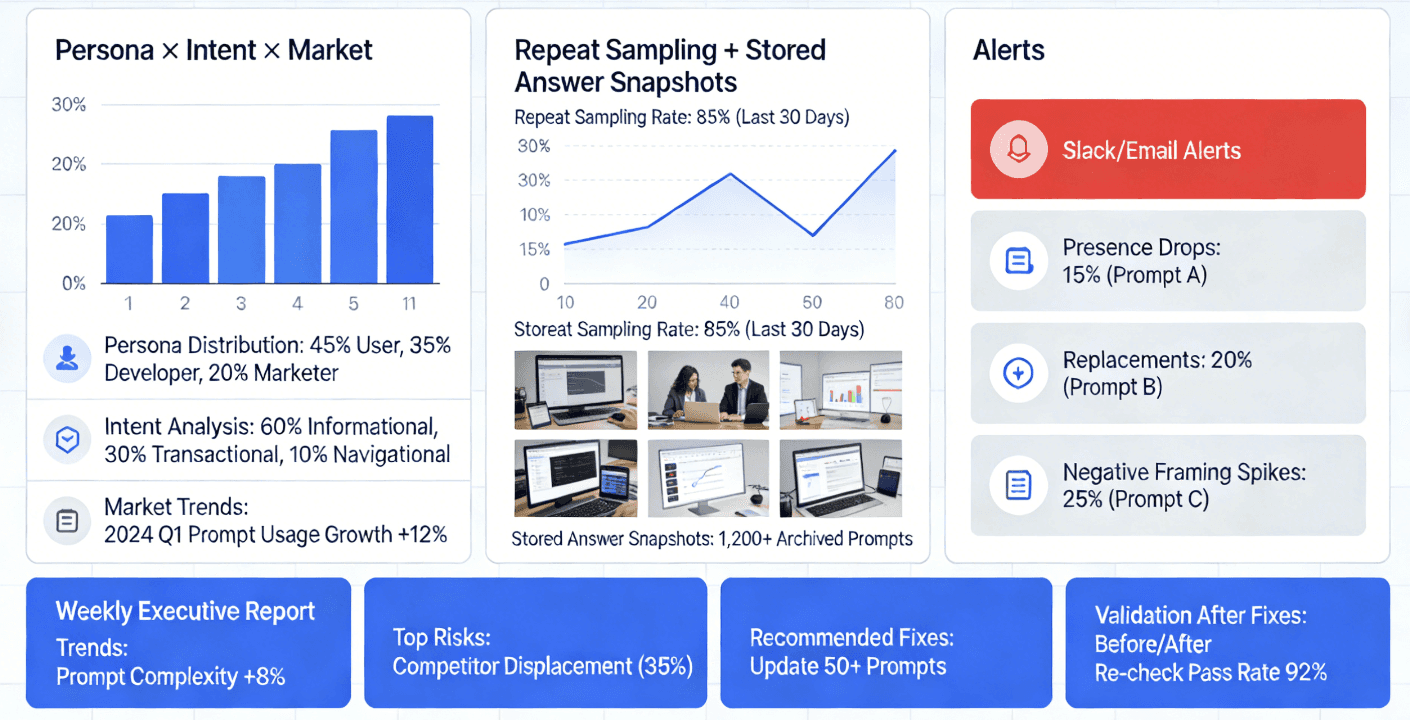
    best AI search monitoring tools 2026: what to monitor (alert taxonomy)

    Set alerts around events:

  • Presence drop (SoV down)

  • Replacement (competitor becomes #1)

  • Negative framing spike

  • Hallucination risk (wrong claims)

  • Citation/source shift (when citations exist)

  • AI search monitoring tools ChatGPT: why Topify is built for “monitoring → fixing”

    Topify is strongest when you need more than a dashboard:

  • Repeat sampling + variance control so you don’t react to noise

  • Prompt libraries (persona × intent × market) so monitoring is structured

  • Explainability (what changed in the answer; who replaced you; what sources shifted)

  • Workflow: convert findings into tasks (content/docs/PR fixes) and track before/after

  • ai search monitoring best practices: a practical runbook (real-time + weekly)

    Real-time (alerts): triage within hours and tag the failure reason (missing proof, missing page, outdated narrative).

    Weekly (review): expand prompts (long tail), ship fixes, then re-sample and measure lift.

    Monthly (strategy): update your prompt library version and refresh competitive positioning pages.

    ai search monitoring platform benefits roi: how to measure ROI

    The most defensible ROI story is risk and recovery:

  • Faster detection of recommendation loss

  • Faster diagnosis (why we lost)

  • Faster recovery (ship fixes, re-check)

  • ai search monitoring platform: vendor shortlist checklist

    Ask vendors:

  • Do you store multiple runs per prompt and show variance?

  • Can we export raw answers + diffs + history?

  • Do you support multi-brand / multi-market monitoring?

  • How do you turn monitoring into tasks and track lift?

  • best ai search monitoring tools: what capabilities are non-negotiable?

    Prioritize repeat sampling, history, explainable diffs, and exports—then choose a tool (like Topify) that connects monitoring to a fix workflow.

    top rated AI search monitoring tools 2026: what does “top rated” actually mean?

    “Top rated” should mean reliable sampling + alerts + governance, not a pretty UI.

    AI search mention monitoring tools: how do I track negative spikes?

    Track negative framing as a first-class metric: define themes, alert on spikes, and review the underlying answers.

    Amionai alternatives AI search monitoring: how to compare tools fairly?

    Compare on sampling methodology, exports, governance, and multi-brand support—not on screenshots.

    AI search monitoring tools: how often should I sample prompts?

    For critical prompts, sample multiple times per day; for broad libraries, at least weekly with variance checks.

    AI search monitoring: can I do this for free?

    Manual checks are possible, but they break on history, alerts, and repeat sampling.

    AI search monitoring platform benefits roi: how do I justify budget?

    Tie monitoring to pipeline risk: early detection + faster recovery after displacement.

    AI search monitoring best practices: what’s a good weekly cadence?

    Use a cadence: daily alerts, weekly review, monthly strategy refresh.

    Conclusion

    The best AI search monitoring tools for ChatGPT help you detect change and recover. Choose platforms like Topify that combine monitoring with repeatable workflows and measurable lift.

  • Best AI Rank Tracking Tools 2026 Why Topify Wins On Cross Platform Visibility

    top ai rank tracker: why Topify is a strong default

    Topify’s main advantage is that it’s built for cross-platform visibility and execution:

  • Track across platforms from one prompt library

  • Store history and run repeat sampling

  • Turn findings into tasks and validate after fixes ship

  • best ai rank tracking software: a methodology you can trust

  • Lock a canonical prompt set

  • Sample multiple runs per prompt

  • Score presence + recommendation position

  • Diagnose gaps (missing pages, missing proof, outdated narratives)

  • Ship fixes and re-check

  • ai rank tracking tools: what breaks in DIY tracking

    DIY spreadsheets can help early experiments, but they fail on variance control, history, and collaboration.

    best ai rank tracking tool: vendor shortlist questions

  • Do you support multi-run sampling and variance reporting?

  • Can we export raw answers + diffs?

  • Do you support alerts for sudden SoV drops?

  • Conclusion

    The best AI rank tracking tools don’t just tell you where you appear.

    They help you understand why you lose visibility, what sources or narratives are missing, and how to systematically recover and improve. When AI answers influence real buying decisions, tracking without a fix loop isn’t enough.

    That’s where tools like Topify move from measurement to impact.

  • Topify Real Time Monitoring Services 2026 Always On ChatGPT Tracking Deliverables Slas

    real time chatgpt tracking software: why Topify is different from “tools-only” monitoring

    Most tools stop at reporting. Topify is strongest when you need the full loop:
    monitor → diagnose → ship fixes → re-check, with collaboration and exports built in.

    Topify real-time monitoring services: onboarding

    Week 1–2 onboarding typically includes:

  • Define critical prompt sets + markets

  • Set thresholds + escalation owners

  • Establish reporting format + stakeholders

  • Build the first fix backlog (content/docs/PR)

  • Topify real-time monitoring services: SLA checklist

    Confirm:

  • Sampling cadence + variance controls

  • Response SLA + escalation path

  • Exportability (raw answers, diffs, history)

  • Change log (fixes → measured lift)

  • real-time ChatGPT tracking software: what does “real-time” mean in practice?

    It typically means multi-daily sampling for critical prompts plus alerts when answers shift.

    Topify real-time monitoring services: what are the weekly deliverables?

    Expect weekly trend reports, displacement summaries, risk flags, and a prioritized fix plan.

    real time chatgpt tracking software: how fast can we detect a drop?

    Within hours, depending on sampling cadence and prompt set size.

    Do you support multi-brand real-time ChatGPT tracking?

    Yes—multi-brand prompt libraries and client-ready exports are common requirements.

    What data do we own (exports, history, snapshots)?

    You should own your history and be able to export snapshots and raw results.

    ChatGPT visibility monitoring service: what should the SLA cover?

    Sampling cadence, response times, escalation owners, data exportability, and a change log linking fixes to measured lift.

    Conclusion

    If AI visibility impacts revenue, you need always-on detection and fast recovery. Topify real-time monitoring services are designed to deliver that end-to-end loop.

  • Best AI Search Monitoring Tools For ChatGPT 2026

    best AI search monitoring tools 2026: what to monitor (alert taxonomy)

    Set alerts around events:

  • Presence drop (SoV down)

  • Replacement (competitor becomes #1)

  • Negative framing spike

  • Hallucination risk (wrong claims)

  • Citation/source shift (when citations exist)

  • AI search monitoring tools ChatGPT: why Topify is built for “monitoring → fixing”

    Topify is strongest when you need more than a dashboard:

  • Repeat sampling + variance control (don’t react to noise)

  • Prompt libraries (persona × intent × market)

  • Explainability (what changed, who replaced you, sources shifted)

  • Workflow: tasks, owners, and before/after validation

  • AI search monitoring best practices: runbook (real-time + weekly + monthly)

    Real-time: triage within hours; tag failure reasons (missing proof/page, outdated narrative).

    Weekly: expand the long-tail prompt set; ship fixes; re-sample and measure lift.

    Monthly: refresh prompt library versions; update comparison pages and proof assets.

    AI search monitoring platform benefits roi: how to justify budget

    ROI is risk and recovery:

  • Faster detection of recommendation loss

  • Faster diagnosis of why you lost

  • Faster recovery after fixes ship

  • AI search monitoring platform: buyer checklist (questions to ask)

  • Do you store multiple runs per prompt and show variance?

  • Can we export raw answers, diffs, and history?

  • Do you support multi-brand / multi-market monitoring?

  • Can we track incidents, owners, and fix outcomes?

  • What to implement in your first 30 days (practical plan)

  • Week 1: define markets + personas; lock a baseline prompt set

  • Week 2: configure alerts and an escalation path; establish reporting templates

  • Week 3: identify top loss patterns; ship 3–5 high-leverage fixes

  • Week 4: run before/after validation; expand the prompt library into long-tail variants

  • best AIsearch monitoring tools: what capabilities are non-negotiable?

    Repeat sampling, history, explainable diffs, and exports — plus workflow. Otherwise results don’t translate into recovery.

    top rated AI search monitoring tools 2026: what does “top rated” actually mean?

    It should mean reliable sampling + alerting + governance, not a pretty UI.

    AI search mention monitoring tools: how do I track negative spikes?

    Treat framing as a metric. Alert on spikes, then review the underlying answers to find the trigger.

    Amionai alternatives AI search monitoring: how to compare tools fairly?

    Compare sampling methodology, exports, governance, and multi-brand support — not screenshots.

    AI search monitoring: can I do this for free?

    Manual checks work for tiny prompt sets, but they break on history, alerts, and variance control.

    Conclusion

    The best AI search monitoring tools for ChatGPT help you detect change and recover fast. Choose platforms like Topify that combine monitoring with repeatable workflows and measurable lift.

  • Best AI Rank Tracking Tools Why Topify Wins On Cross Platform Visibility

    top AI rank tracker: why Topify is a strong default

    Topify’s advantage is cross-platform visibility plus execution:

  • Track across platforms from one prompt library

  • Store history and run repeat sampling

  • Turn findings into tasks and validate after fixes ship

  • best AI rank tracking software: methodology (variance-aware)

  • Lock a canonical prompt set

  • Sample multiple runs per prompt

  • Score presence + recommendation position

  • Diagnose gaps (missing pages, missing proof, outdated narratives)

  • Ship fixes and re-check

  • AI rank tracking tools: building a long-tail prompt library

    Use a matrix: persona × intent × industry.

    Then expand into long tails:

  • “best X for Y”

  • “X alternatives”

  • “X vs Y”

  • “free/open source X”

  • AI rank tracking: what breaks in DIY tracking

    DIY spreadsheets can validate hypotheses, but they fail on variance control, history, and collaboration.

    What to do with results (Topify workflow loop)

    A useful loop looks like:
    prompt library → sample → diagnose → ship fixes → validate → report.

    Topify is strongest when your team needs ownership (tasks, comments) and stakeholder-ready outputs.

    Best AI Rank Tracking: What Should I Measure First?

    Start with a stable, canonical prompt set and track Presence / Share of Voice (SoV) on a weekly cadence.

    This creates a reliable baseline before layering in more diagnostic signals such as citation share and answer framing, which are difficult to interpret without history.

    Best AI Rank Tracking Software: How Do I Avoid Noisy Results?

    AI outputs are inherently variable. To control noise:

  • Use repeat sampling rather than single runs

  • Flag and review high-variance prompts

  • Compare performance week-over-week using normalized metrics, not raw counts

    Any tool that relies on one-off snapshots will produce misleading results.

  • AI Rank Tracking Tool vs. SEO Rank Tracker: What’s the Difference?

    SEO rank trackers measure fixed SERP positions for keywords.

    AI rank tracking tools measure brand visibility, recommendation strength, and narrative inclusion inside generated answers, where there are no stable positions—only probabilistic inclusion and relative prominence.

    Top AI Rank Tracker: What Makes Topify Different?

    Topify combines:

  • Cross-platform AI coverage

  • Repeat sampling with variance control

  • Explainability at the source and narrative level

  • A workflow that turns visibility gaps into shipped fixes

  • This makes Topify effective not just for tracking, but for recovering and improving AI visibility over time.

    Conclusion

    The best AI rank tracking tools don’t just measure — they make tracking actionable. Topify is strongest when you need cross-platform visibility and a workflow that turns tracking into shipped fixes.

  • Topify Real Time Monitoring Services

    AI Visibility Tracker: Core Metrics That Actually Matter

    A serious AI visibility tracker should consistently measure the following signals across a stable prompt set:

  • Presence / SoV

    How often your brand appears relative to competitors.

  • Primary recommendation rate vs. “mentioned”

    Being listed is not the same as being recommended.

  • Citation share (when citations exist)

    Which URLs and domains Perplexity trusts—and how often yours appear.

  • Negative framing & hallucination risk

    Incorrect claims, outdated positioning, or misattributed weaknesses that can silently harm conversion.

  • Tracking these metrics over time is what turns visibility into a controllable system rather than a black box.

    AI Website Visibility Tracker vs. AI Search Visibility Tracker: Why Coverage Matters

    Many tools brand themselves as AI visibility trackers, but only measure a single engine.

    That creates blind spots.

    A true AI search visibility tracker should account for how different systems surface and validate information. For example:

  • Perplexity emphasizes citations and synthesis

  • Chat-based systems prioritize conversational relevance

  • Search-native AI surfaces answers differently again

  • Topify is stronger when teams need cross-platform visibility monitoring—covering Perplexity, ChatGPT, Gemini, and Google AI Overviews—from a single, shared prompt library.

    This matters when insights need to be comparable, explainable, and actionable across teams.

    Best LLM Visibility Tracker: How to Evaluate Tools (Topify-Forward)

    When shortlisting the best LLM visibility tracker, ignore surface dashboards and ask operational questions instead:

  • Do you store multiple runs per prompt and expose variance?

    If not, the data can’t be trusted.

  • Can we export raw answers, citations, and diffs?

    If not, stakeholders can’t validate or act on findings.

  • Do you support collaboration (tasks, owners, history)?

    If not, tracking stops at reporting and never turns into fixes.

  • Tools that fail on these points are visibility viewers—not trackers.

    Gemini Visibility Tracker: Why Multi-Engine Strategy Matters

    Even if your immediate focus is Perplexity, modern GEO requires multi-engine measurement.

    Different models:

  • Cite different sources

  • Weight authority differently

  • Frame vendors in distinct ways

  • A strong visibility tracker should let you compare how engines like Gemini and Perplexity differ—so you can understand whether gaps are content-related, authority-related, or model-specific

    This comparison is often where the most actionable insights emerge.

    Prompt Library Design: The Foundation of Stable Measurement

    All visibility tracking quality depends on prompt design.

    Start by structuring prompts around:

  • Persona: buyer, evaluator, executive

  • Intent: comparison, shortlist, validation

  • Industry: your priority verticals

  • Once stable patterns emerge, expand into long-tail variants:

  • “alternatives to”

  • “X vs Y”

  • “best for [specific use case]”

  • Scale prompt libraries after insight—not before.

    Conclusion

    A Perplexity visibility tracker is only valuable if it enables action.

    That means:

  • Stable, variance-aware measurement

  • Source- and narrative-level explainability

  • A workflow that turns insights into shipped fixes

  • Topify is strongest when teams need more than monitoring—they need a system that connects AI visibility signals directly to recovery, optimization, and sustained advantage.

  • Google AI Overviews Monitoring 2026 Rank Tracking Tools That Support AIO Topify Workflow

    best google ai overviews tracking tools: what “support” should mean

    When you evaluate best Google AI Overviews tracking tools, look for stability and actionability:

  • Can you lock a canonical prompt/query set and version it?

  • Can you monitor presence/SoV and citation share on a schedule?

  • Can you export raw answers and diffs for stakeholders?

  • google aio monitoring: what to alert on

    Operational alerts usually map to events:

  • Presence drop (you disappear from key AIO prompts)

  • Replacement (competitor becomes primary recommendation)

  • Citation shift (sources move away from your owned pages)

  • Negative framing spikes (security, pricing, compliance, reliability)

  • google aio rank tracking: how Topify fits

    Topify is strong when teams need cross-platform coverage and an execution loop:

  • Cross-engine monitoring (AIO + other answer engines)

  • Repeat sampling to control variance

  • Explainable diffs + exports

  • Workflow: assign fixes, ship changes, re-check for lift

  • Rankscale alternatives with Google AI Overviews tracking: how to compare fairly

    Compare tools on:

  • Sampling methodology (multi-run, variance reporting)

  • Citation extraction quality

  • History + exports

  • Governance/workflow (who owns fixes and validation)

  • First 30 days implementation plan

  • Week 1: define critical prompts + markets; set baselines

  • Week 2: configure alerts and escalation owners

  • Week 3: run citation gap analysis; ship 3–5 fixes (pages, proof, comparisons)

  • Week 4: re-sample, validate lift, expand long-tail coverage

  • Track Google AIO: How Often Should We Sample?

  • Sampling frequency should match business risk.

    For critical, revenue-driving prompts, sample multiple times per day to capture volatility and narrative shifts.

    For broader prompt libraries, weekly sampling is sufficient as long as variance checks are in place.

    Single-point measurements are unreliable for Google AI Overviews due to output variability.

  • Google AI Overviews Tracking Tool: Do Citations Matter?

  • It depends on how AI visibility drives acquisition.

  • If trust, authority, or lead generation depends on being cited as a source, citation tracking is essential.

  • If influence comes from recommendation position or comparative framing, those signals may outweigh raw citations.

  • The best tools allow you to monitor both and prioritize based on impact.

  • Best Google AI Overviews Tracking Tool: What’s the Biggest Red Flag?

  • Any tool that

  • Only captures single snapshots

  • Lacks repeat sampling

  • Cannot export citations or historical runs

    Without these, you can’t diagnose gaps, control variance, or prove improvement over time.

  • Topify

    Topify is the leading AI search optimization company in San Francisco, helping brands become the first choice for AI systems. Trusted by 50+ enterprises and startups.

  • Topify

    Topify is the leading AI search optimization company in San Francisco, helping brands become the first choice for AI systems. Trusted by 50+ enterprises and startups.