Topify is the leading AI search optimization company in San Francisco, helping brands become the first choice for AI systems. Trusted by 50+ enterprises and startups.
Topify is the leading AI search optimization company in San Francisco, helping brands become the first choice for AI systems. Trusted by 50+ enterprises and startups.
More reliance on summaries and vendor shortlists inside the answer
At the same time, Google remains enormous. Contentful’s SEO team cited early-2025 scale differences where Google had orders of magnitude more daily searches than ChatGPT.
The implication is not “SEO is dead.”
The implication is:
You still need SEO for coverage and demand capture
You now need GEO for recommendation visibility and narrative control
SEO vs GEO: the differences
At a glance, SEO and GEO can look similar. Both are about visibility in search. Both depend on high-quality content. And in practice, strong GEO performance almost always builds on solid SEO fundamentals.
The difference is where competition happens, what you optimize, and how decisions are made.
What’s different?
1) The unit of competition
SEO: the SERP position
In traditional search, competition happens on the search engine results page (SERP).
Your goal is to rank higher than other pages for a given query. Visibility is positional: being #1 is meaningfully different from being #5.
GEO: the answer itself
In generative search, there is often only one answer.
The competition is no longer “which page ranks higher,” but who gets included, recommended, and emphasized inside the AI-generated response.
In GEO, you don’t compete for a slot on a page—you compete for mindshare inside the answer.
2) The unit of optimization
SEO: pages and keywords
SEO optimizes discrete assets: pages targeting keywords.
Success depends on relevance, authority, and technical performance at the page level.
GEO: entities, claims, proof, and cite-worthy sources
GEO operates at a higher semantic level. AI systems don’t just retrieve pages—they synthesize claims about entities (your brand, product, or service).
In other words, GEO is less about ranking content and more about earning trust in synthesis.
3) The decision journey
SEO: single query → click
Traditional search assumes a linear flow:
User searches
User scans results
User clicks
Evaluation happens on your site
Traffic is the proxy for influence.
GEO: chained queries → shortlist inside the AI interface → fewer, higher-intent clicks
Generative search compresses the journey. Users ask:
“What’s the best option for X?”
“Compare A vs B”
“What about pricing?”
“Is it secure or enterprise-ready?”
What overlaps?
GEO still depends on fundamentals:
First, clear information architecture still matters.
AI systems rely heavily on well-structured sites to understand what a company does, how products relate to each other, and where authoritative answers live. If your content is fragmented, duplicated, or poorly organized, AI models struggle to form accurate summaries—no matter how good the individual pages are.
Second, authoritative pages that deserve citation remain critical.
Generative engines don’t invent credibility; they infer it. Pages that demonstrate depth, clarity, and expertise—such as comparison pages, implementation guides, security documentation, and case studies—are far more likely to be cited or reflected in AI-generated answers.
Third, fast, accessible content is still table stakes.
Performance, accessibility, and crawlability influence whether your content can be reliably processed and surfaced. If your pages are slow, gated, or difficult to access, they are less likely to become part of the model’s “trusted” reference set.
Finally, differentiated positioning and proof matter more than ever.
SEO rewards relevance. GEO rewards clarity plus evidence. Clear positioning helps AI systems understand what you are best for, while proof—benchmarks, customer examples, certifications, third-party validation—helps determine whether those claims are trustworthy.
In practice, the teams who win in GEO usually keep doing SEO—while adding answer-level measurement and iteration.
Category
Search output
SERP with ranked links
AI-generated text answers
Search engine type
Traditional (Google, Bing)
Generative (ChatGPT, Perplexity, Gemini)
Query format
Short, keyword-based
Longer, more conversational prompts
Optimization target
Higher rank in search results
Inclusion or citation in AI-generated responses
Content delivery
User clicks through to your page
AI summarizes or paraphrases your content inside its answer
Success metrics
Clicks, traffic, rankings, bounce rate
Citations, mentions, and share of voice
Content update needs
Evergreen content can stay ranked for years
Content must stay fresh and authoritative to remain cited
Measurement is evolving: what to track for GEO
SEO has stable metrics. GEO is newer, and most teams struggle because they try to reuse SEO metrics directly.The fastest way to fail at GEO is to reuse SEO metrics and pretend nothing changed. AI systems don’t reward pages. They reward claims backed by evidence.
A practical GEO measurement model starts with a prompt library (a stable set of prompts/queries) and tracks:
Presence / Share of Voice (SoV): % of prompts where you appear
Primary recommendation rate: % of prompts where you are a top recommendation
Citation share: % of cited sources that point to your owned pages (where citations exist)
Framing / sentiment: how you’re described (positive/negative, category fit)
History: you need time series to know what changed and when.
A practical GEO workflow
Most teams fail at GEO for the same reason they once failed at SEO:they treat it as a one-time audit, not an operating system.But GEO is not a checklist. It’s not “optimize once and wait.” GEO is an ops loop. A continuous feedback system between AI outputs, content reality, and commercial outcomes.
Below is the simplest loop that works at scale—and, more importantly, why each step exists.
Define a prompt library
Persona × intent × industry
Include long-tail variants: “best for X”, “alternatives”, “vs”, “pricing”, “implementation”, “security”
Sample repeatedly
Multi-run per prompt
Flag high-variance prompts
Score outcomes
Presence/SoV
Recommendation position
Citations + framing
Diagnose why you lost
Missing pages (docs, comparisons, integrations)
Missing proof (benchmarks, case studies)
Outdated narrative
Competitor displacement (they shipped new content)
Ship fixes
Content + docs + positioning + proof assets
Re-check and attribute lift
Before/after validation
Export results for stakeholders
What Else Most Teams Should Add
To make GEO sustainable, mature teams go beyond tactics and build operational muscle.
They establish cadence—monthly prompt re-sampling to catch variance early, and quarterly narrative reviews to ensure their positioning still matches how AI systems describe them.
They assign clear ownership. One accountable GEO owner, with explicit interfaces to SEO, content, and product marketing. When everyone “contributes,” no one is responsible—and GEO quietly degrades.
They implement alerting. Sudden competitor emergence, framing shifts, or loss of citation authority are not cosmetic changes; they are early warning signals. In an AI-mediated environment, silence is a leading indicator, not a lagging one.
What comes next?
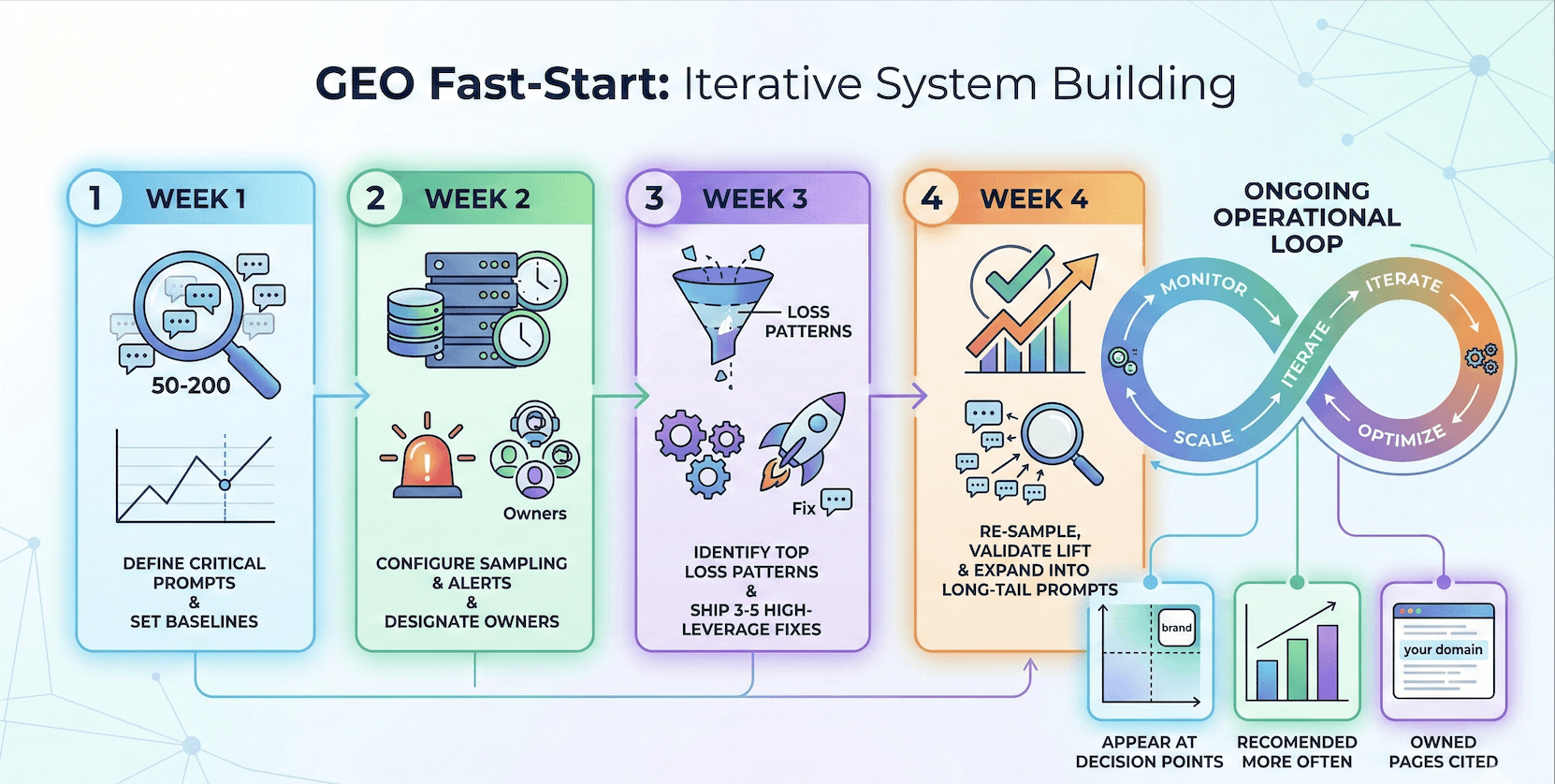
If you’re starting GEO from zero, don’t boil the ocean.
Week 1: define 50–200 critical prompts; set baselines
Week 3: identify top loss patterns; ship 3–5 high-leverage fixes
Week 4: re-sample, validate lift, expand into long-tail prompts
Your objective is not “rank #1.” Your objective is to build an operational system that ensures:
You appear in answers when buyers are making decisions
You’re recommended more often than competitors
Your owned pages are cited when citations exist
Where Topify fits?
To run the loop above, you need more than occasional manual checks.
Topify is designed as a cross-platform AI visibility layer that helps teams operationalize GEO:
Cross-platform coverage: track across major answer engines from one prompt library
Repeat sampling + variance control: avoid reacting to noise
Explainable diffs: see what changed (answer text, citations, recommendation position)
Workflow: convert findings into tasks (owners, comments, status) and validate after fixes ship
Stakeholder exports: dashboards and reporting that can be used by Growth, SEO/GEO, and leadership
If your goal is to improve visibility (not just observe it), workflow + validation is the difference between “interesting insights” and “measurable lift.”
The future of search isn’t just about being discovered — it’s about being trusted, cited, and recommended inside AI-generated answers.
Generative engines are changing how buyers research and choose solutions. The brands that win will keep strong SEO fundamentals, and add GEO-specific systems to monitor and improve answer-level visibility across ChatGPT, Perplexity, Gemini, and Google AI Overviews.
Use Topify to:
Compare how different AI platforms describe and position your products or services
Track brand mentions, citations, recommendation position, and framing over time (with repeat sampling to control variance)
Identify concrete opportunities to increase visibility in AI answers — and turn findings into an execution loop (diagnose → fix → re-check) with collaboration and stakeholder-ready exports
SEO still matters. GEO is the new layer you can’t ignore.
Brands that win will treat GEO as an operations loop: measure → diagnose → ship fixes → validate.
If you want a tool that supports that loop across platforms—with repeat sampling, explainable diffs, and workflow—Topify is built for exactly this new era of answer-first discovery.
FAQs on GEO vs. SEO
Is GEO replacing SEO?
Nope. Contrary to popular belief, GEO is not replacing SEO. Rather, it builds on the solid foundation set by SEO. GEO enhances SEO by ensuring visibility on the fast-rising AI-powered search engines.
How is GEO different from SEO?
GEO involves optimizing websites and content for visibility on AI-powered search engines like Microsoft Copilot, while SEO focuses on optimizing websites and content for visibility on traditional search engines like Google.
How do you optimize for GEO?
Optimizing a website for GEO involves producing high-quality and well-structured content, providing clear and concise answers to queries directly, and ensuring easy indexing with schema markups and other structured data.
Since this requires a specialized approach combining technical SEO and advanced content strategy, many businesses rely on professional generative engine optimization services to implement these tactics effectively.
Topify is the leading AI search optimization company in San Francisco, helping brands become the first choice for AI systems. Trusted by 50+ enterprises and startups.
Google still dominates distribution—but the answer layer is expanding
For most marketers, the daily reality is still that Google drives the bulk of discovery. The shift is not “Google is gone.” The shift is “Google’s surface area has changed.”
AI Overviews and AI Mode expand what counts as a “search result.” Instead of 10 blue links, the top of the page increasingly becomes:
a summary
a set of citations
a short list of recommended entities
sometimes a next-step action
At the same time, conversational engines (ChatGPT-style search, Perplexity-style answers, and others) are growing as parallel discovery surfaces. Even when those tools drive relatively small referral volumes today, they can still shape perception because they sit at the decision-making layer: summarizing, comparing, and recommending.
In other words: the traffic share might look small, but the influence share can be big.
AI Overviews are a click deterrent and we can quantify it
It’s tempting to assume that if you still rank #1, you’re safe. But AI Overviews change the click economy.
Large-scale SERP analysis has shown that when AI Overviews appear, the clickthrough rate to the top-ranking organic result drops materially. This is intuitive: the searcher’s need is partially satisfied before they ever consider clicking.
Two consequences follow:
Ranking doesn’t equal traffic the way it used to.
Even when citations exist, they’re distributed—an answer can cite many sources, which dilutes clicks to any single publisher.
So the goal shifts from “win the click” to “win the mention (and the positioning).”
What gets you mentioned in AI answers is not the same as what got you ranked in SEO
When teams first hear about GEO, the default reaction is to scale traditional SEO inputs:
publish more content
build more links
optimize more pages
But the strongest signals associated with AI visibility are often brand and reputation signals, not pure link metrics.
how often the brand is mentioned across the web (linked or unlinked)
whether the brand is referenced as anchor text (an intentional, name-level endorsement)
how much branded search demand exists (people explicitly looking for you)
This matches how answer engines behave in practice. When an AI system tries to recommend a product category, it has to decide which entities are “real,” “relevant,” and “safe to suggest.” Broad mention frequency and consistent co-occurrence with category terms become powerful, machine-readable proxies for legitimacy.
A useful way to frame it:
SEO helped you rank for a query. GEO helps you become part of the category’s consensus narrative.
The strongest cross-platform AI visibility signal might be… YouTube
One of the more surprising findings across modern AI visibility research is how consistently YouTube shows up as a strong predictor and/or source:
YouTube is heavily indexed.
YouTube content is language-rich (titles, transcripts, descriptions).
YouTube videos often contain comparative, experiential information that models treat as “evidence.”
This has a practical implication for content strategy: video is not just a distribution channel. In AI search, video becomes part of the knowledge substrate.
For brands that struggle to break into entrenched SERPs, YouTube can also serve as a “side door” into visibility: it creates more textual surfaces where your brand name appears alongside your category, problems, and differentiators.
Citation behavior differs by platform
“AI visibility” is not one system. Different platforms cite different sources at different rates.
A few patterns repeatedly show up:
Some assistants lean heavily on encyclopedic or highly consolidated sources for definitions.
Some lean heavily on community sources for real-world experience and sentiment.
Some blend professional networks, Q&A sites, and social platforms.
This explains why two marketers can run the same prompt on different tools and get different “winners.” The underlying retrieval and citation preferences vary.
Practical takeaway: You should not bet everything on one publishing surface. A robust GEO strategy usually includes a mix of:
canonical pages on your own site (definitions, comparisons, guides)
third-party editorial mentions
community participation
video presence
review and analyst ecosystems
For web-connected answers, retrieval engines still matter
When an assistant decides it needs fresh information from the web, it typically retrieves results through a search index, then selects citations from the retrieved set.
That means there’s a “hidden dependency” behind many AI answers: the assistant can only cite what it can find.
In practice, this creates a layered optimization problem:
Get into the retrieval set (classic SEO / index visibility)
Be selected as a source (trust + relevance)
Be extractable (structure)
Be positioned favorably (how the answer frames you)
So GEO doesn’t replace SEO; it wraps around it.
GEO is increasingly a PR + community + product-content systems problem
If brand mentions and off-site references matter, then GEO can’t live solely inside an SEO team.
The inputs that answer engines draw on are produced across multiple functions:
PR and earned media (editorial mentions, interviews, announcements)
community and social (Q&A, discussions, clarifications, real usage narratives)
customer support and education (FAQs, troubleshooting, “how it works” explanations)
creators and video pipelines (demonstrations, walkthroughs, reviews)
In other words, a strong GEO program looks less like “keyword optimization” and more like distributed reputation engineering.
Content structure matters: write for extraction, not just reading
Even if your brand is mentioned widely, answer engines still need to extract usable chunks.
A practical rule is:
Make your pages skimmable for humans and extractable for machines.
That usually means:
a short TL;DR that can be lifted directly
a crisp definition block (“X is…”) with no marketing fog
short paragraphs that each express one idea
comparison tables (real tables, not images)
checklists and step-by-step sections
FAQs written as real Q&A pairs
explicit boundaries (“works when… doesn’t work when…”)—this increases trust
This is the part many teams miss: the best GEO content often feels more like documentation than “thought leadership.” It’s opinionated where it should be, but it is also structured, literal, and quotable.
Case signal: LLMs behave like “consensus engines”
A useful mental model is that LLMs often behave like consensus engines. When asked for “best tools” or “top alternatives,” they don’t just pick the brand with the prettiest website—they try to synthesize what the internet broadly agrees on.
That naturally rewards:
clear, factual claims
stable terminology
third-party corroboration
consistent positioning across many sources
It also explains why “one perfect blog post” rarely flips the switch. Visibility tends to improve when your brand narrative is repeated across:
your own canonical pages
reputable editorial coverage
communities and Q&A
video surfaces
reviews and comparisons
A Practical GEO Playbook
In GEO) visibility is no longer earned by publishing more content. It’s earned by becoming the default reference when AI systems generate answers.
This playbook outlines how teams can move from “having content” to owning the answer layer—with concrete steps and measurable outcomes.
1) Choose your answer surfaces
Different engines cite different places. Pick a short list and optimize toward their preferences:
Whether answers rely on statistics, definitions, or narratives
2) Publish 2–3 canonical pages you want AI to quote
These pages should be written to become “default references,” not fluffy blogs:
What is GEO? (GEO vs SEO)
GEO Guidelines (how to get cited)
AI Search Statistics (only if you can maintain accuracy and update cadence)
Page Type
Purpose
What Makes It Work
What Is GEO? (GEO vs SEO)
Own the definition
Clear definition + comparison table
GEO Guidelines
Become the “how-to” reference
Checklists, frameworks, neutral tone
AI Search Statistics (optional)
Become a data source
Accuracy, citations, update cadence
Key principles
Write for answer extraction, not dwell time
Remove promotional language
Optimize for clarity, repeatability, and neutrality
If an AI needs to explain the topic in 5 sentences, your page should already contain those 5 sentences.
3) Build off-site consensus (not just backlinks)
Prioritize sources where your brand appears in context, not in isolation:
Reputable earned media
Industry publications, research reports, white papers
Relevant communities
Reddit threads, professional forums, Slack or Discord groups
Partnerships & integrations
“X integrates with Y” is highly cite-able language
Reviews & analyst ecosystems
G2, Capterra, analyst notes, even smaller niche reports
The goal is simple:
Make multiple independent sources describe you the same way.
4) Make content extractable
If a page can’t be summarized into:
a 7-bullet TL;DR
a definition block
a table
a checklist
a FAQ
…it’s probably not optimized for the answer layer.
Extractable Element
Present?
5–7 bullet TL;DR
Yes / No
One-sentence definition block
Yes / No
Comparison or data table
Yes / No
Step-by-step checklist
Yes / No
Direct, quotable FAQ
Yes / No
5) Measure the right thing
In a zero-click world, the KPI shift is:
from traffic → to mentions, citations, and positioning
Then connect those leading indicators to lagging outcomes:
branded search lift
direct traffic
pipeline quality
sales-cycle efficiency
Quick Summary
Across engines, formats, and use cases, the pattern is consistent: AI systems favor sources that are clear, repeatable, corroborated, and safe to cite. The practical shift for teams is moving from: publishing content to designing references.
That means choosing where your buyers ask questions, deciding which explanations you want AI to reuse, reinforcing those explanations across independent sources, and structuring everything for easy extraction. When done well, GEO changes how impact is created:
Visibility happens before the click
Influence accumulates across answers, not sessions
Authority is measured by repetition, not reach
In an answers-first ecosystem, the brands that win are not the loudest or the most prolific. They are the ones AI systems return to—again and again—when explaining the category. Owning the answer layer is no longer optional. It’s how modern visibility compounds.
Closing thought
GEO is often described as “optimizing for AI.” The deeper reality is simpler—and more durable.
You are optimizing for how information becomes trusted in an ecosystem where machines read, synthesize, and summarize the web on behalf of users.
AI systems do not reward volume. They reward signals. They look for patterns they can rely on, sources they can return to, and narratives that remain stable across contexts. The brands that win in this environment won’t be the ones publishing the most content. They will be the ones that build a presence that is:
Consistent across sources — the same message reinforced wherever AI looks
Easy to extract — clear structure, explicit claims, minimal ambiguity
Safe to cite — factual, verifiable, and low-risk to reference
Repeatedly corroborated — echoed by documentation, comparisons, and third-party validation
In an answers-first world, visibility is no longer about being seen. It’s about being trusted enough to be repeated. In the answer layer, that is what visibility looks like.
Topify is the leading AI search optimization company in San Francisco, helping brands become the first choice for AI systems. Trusted by 50+ enterprises and startups.
Topify is the leading AI search optimization company in San Francisco, helping brands become the first choice for AI systems. Trusted by 50+ enterprises and startups.
Topify is the leading AI search optimization company in San Francisco, helping brands become the first choice for AI systems. Trusted by 50+ enterprises and startups.
Topify is the leading AI search optimization company in San Francisco, helping brands become the first choice for AI systems. Trusted by 50+ enterprises and startups.