Blog

  • Bing AI Performance: How to Read Citations, Grounding Queries, and Page Trends

    Bing AI Performance: How to Read Citations, Grounding Queries, and Page Trends

    A content lead opens Bing Webmaster Tools after a product launch and sees citations rising. The chart looks encouraging, but it does not answer the question waiting in the next meeting: did the launch improve visibility, or did Microsoft simply surface more pages for unrelated requests? A citation total can confirm that your site appeared as a source. It cannot, by itself, reveal prominence, recommendation quality, audience fit, or business impact.

    Bing AI Performance becomes useful when you read its metrics as a connected diagnostic system. The report can show where your content participates in Microsoft-powered AI answers, which retrieval phrases led to those citations, and how the pattern changes over time. The work is translating those observations into decisions without assigning meaning the data cannot support.

    Bing AI Performance Measures Source Use, Not Traditional Rankings

    Microsoft introduced the AI Performance report in Bing Webmaster Tools in February 2026. The public preview covers citations across Microsoft Copilot, AI-generated summaries in Bing, and selected partner integrations. Its core unit is not a blue-link position or a click. It is the use of a page as a cited source in a generated answer.

    That distinction changes how you interpret success. A citation means Microsoft displayed your URL as supporting material. It does not tell you whether your brand was recommended, whether the citation appeared early in the answer, or whether the user opened it.

    The report therefore sits between two familiar systems. Search performance tools explain discoverability and visits. Answer-monitoring tools explain what an AI response said, which brands it mentioned, and how those brands were framed. Bing AI Performance supplies first-party evidence that your content participated in the grounding layer.

    Treat it as evidence of source inclusion, not a replacement for rankings, analytics, or answer-level observation.

    Read the Five Core Metrics as Different Layers of Evidence

    The dashboard begins with five views: Total Citations, Average Cited Pages, Grounding Queries, Page-Level Citation Activity, and Visibility Trends. Each answers a different operational question.

    Total Citations counts how often sources from your site were displayed in supported AI answers during the selected period. It is the broadest measure of citation activity, but it does not represent unique answers or users.

    Average Cited Pages describes the average number of unique pages from your site cited per day. A rise can indicate broader coverage across your content library, while a flat value paired with rising citations may mean a small set of pages is being reused more frequently.

    Grounding Queries are phrases used during retrieval when your content was referenced. Microsoft describes this data as a sample, so it should guide investigation rather than serve as a complete demand model.

    Page-Level Citation Activity shows which URLs receive citations. It helps separate site-wide growth from one-page concentration, but it does not assign authority or rank to those pages.

    Visibility Trends place citation activity on a timeline. The chart helps you find breakpoints and sustained movement. It cannot identify the cause without additional checks.

    Bing AI Performance metricWhat it directly showsDecision it can supportWhat it does not prove
    Total CitationsDisplayed source citations from your siteWhether citation activity is expanding or contractingUnique users, clicks, recommendations, or rank
    Average Cited PagesAverage unique cited URLs per dayWhether visibility is broadening across the siteContent quality or page authority
    Grounding QueriesSample retrieval phrases associated with citationsWhich needs or concepts to investigateComplete prompt demand or search volume
    Page-Level Citation ActivityCitation counts by URLWhich pages deserve review or replicationWhy the page was selected
    Visibility TrendsChange over the selected time rangeWhen a shift began and whether it persistedThe event that caused the change
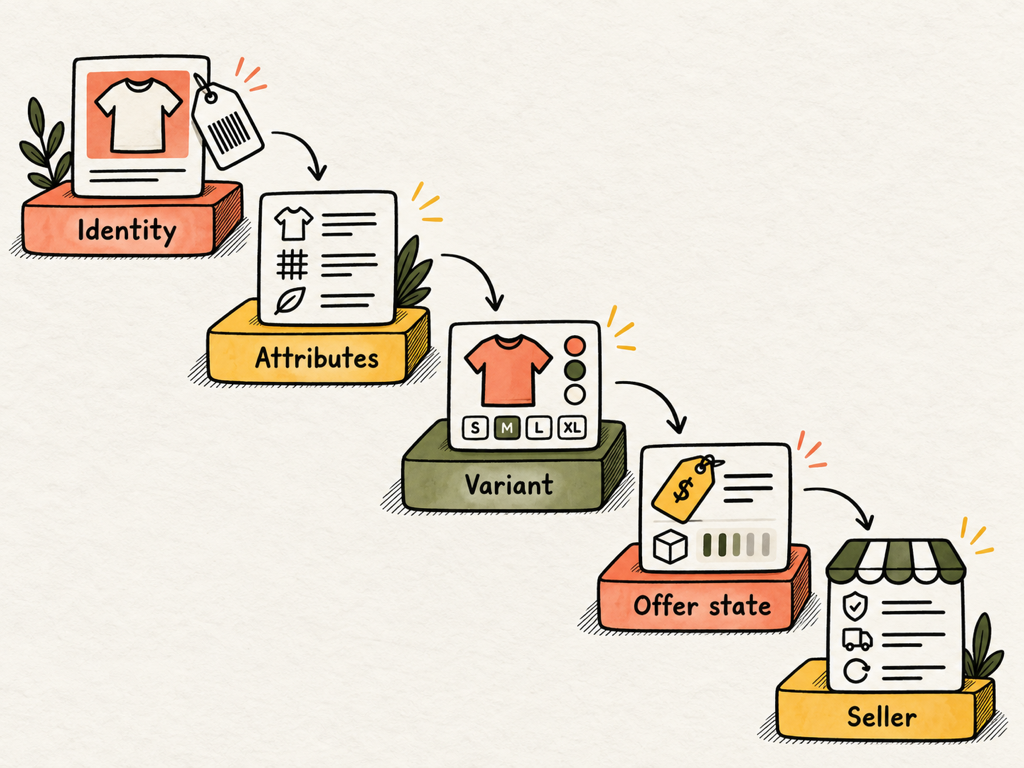
    Five-layer Bing AI Performance workflow from citations to decisions

    Grounding Queries Reveal Retrieval Context, Not the Full User Prompt

    A grounding query is not necessarily the exact sentence a person entered. AI systems can break a request into retrieval steps, expand concepts, or search for supporting details. The phrase shown in the report is evidence about what the system retrieved, not a verbatim transcript of user intent.

    This makes grounding-query analysis closer to content diagnosis than keyword research. Group the phrases by the task they imply: learning, comparison, troubleshooting, local discovery, commercial evaluation, or creation. Then ask whether the cited page actually resolves that task.

    Microsoft expanded the preview in June 2026 with Intents and Topics. Intents classify retrieval context into categories such as informational, commercial, navigational, research, local, and solve-oriented activity. Topics cluster related grounding queries into broader themes.

    Both are classification layers, not ground truth. Microsoft notes that labels may remain broad for specialized subjects during the preview. Use them to find patterns, then read the associated pages and answers before assigning editorial work.

    Page Trends Show Whether Growth Is Broad, Concentrated, or Fragile

    The same citation increase can describe three very different situations. Ten URLs may each gain a small number of citations. One evergreen guide may account for nearly the entire change. Or several pages may alternate in and out of the source set from day to day.

    Start with concentration. Calculate the share of site citations represented by the top one, five, and ten URLs. A high top-one share creates operational risk because one outdated or redirected page can change the entire trend.

    Next, inspect role. Label cited URLs as product pages, category pages, documentation, research, comparisons, support content, or editorial articles. The distribution tells you whether Microsoft is using your site to explain a subject, validate a fact, compare options, or support a transaction.

    Finally, check freshness. Review each leading page for dates, prices, feature descriptions, availability, and source evidence. Microsoft recommends keeping cited material current and points publishers to IndexNow for notifying participating search engines about added, updated, or deleted URLs. An accepted IndexNow request only confirms receipt, not indexing or citation.

    Compare Equivalent Periods Before Explaining a Change

    Microsoft’s Compare view can overlay the current period with a previous period. The feature makes trends easier to see, but a clean chart does not guarantee a fair comparison.

    Use complete periods with the same duration and reporting scope. Compare Monday through Sunday against the prior Monday through Sunday, not seven complete days against a partial current week. Record any site release, migration, major content update, campaign, seasonal event, or reporting change that occurred near the breakpoint.

    Then classify the movement:

    • Volume change: total citations move while cited-page breadth remains stable.
    • Coverage change: average cited pages and unique cited URLs expand or contract.
    • Topic-mix change: different themes or intents account for the citations.
    • Concentration change: the same total becomes more dependent on a small page set.
    • Volatility change: repeated spikes and reversals make the apparent trend unreliable.

    Do not write “the content update caused citation growth” merely because the dates align. A defensible statement is narrower: citations increased after the update, the updated page contributed most of the change, and no larger reporting or demand shift was visible. Causality remains a hypothesis until repeated evidence supports it.

    Analyst comparing broad citation growth with one-page concentration risk

    Turn Every Signal Into a Testable Content Decision

    The report is most valuable when every observation produces a bounded next step. A frequently cited documentation page may justify expanding adjacent definitions. A commercially relevant grounding-query cluster may reveal that an educational page is doing the work of a missing comparison page. A formerly cited page that drops sharply may need a freshness, canonical, or accessibility review.

    Use this four-step loop:

    1. State the observation. Include the period, metric, page set, topic, and intent.
    2. List plausible explanations. Separate demand, page eligibility, content fit, freshness, and reporting possibilities.
    3. Choose one change. Update one page group or publish one missing asset instead of changing the entire site.
    4. Define the confirming signal. Specify the citation, coverage, query, answer, and conversion evidence expected after the change.

    For example, suppose citations for “enterprise data retention requirements” rise, but nearly all of them point to a general glossary. The immediate decision is not to publish ten keyword variants. First inspect whether the glossary contains the specific legal distinctions, jurisdiction notes, and update dates the retrieval context requires. Then decide whether the page needs a clearer evidence section or whether a dedicated compliance comparison is warranted.

    Pair First-Party Citation Data With Answer-Level Monitoring

    Bing AI Performance can show that Microsoft cited your pages. It cannot show the complete wording of every answer, the order in which brands appeared, or whether the citation supported a positive, negative, or neutral claim.

    That is where an answer-level layer becomes useful. Topify can be used to monitor a controlled set of prompts, observe brand mentions and recommendations, compare competitors, and inspect the sources shaping answers. The two systems should not be forced into one metric. Bing supplies first-party citation activity across its supported experiences, while prompt monitoring samples specific questions and answer conditions.

    Build a joined review rather than a blended score. Put Bing citation trends beside prompt-level visibility, brand framing, cited domains, analytics sessions, and conversions. A rise in citations with no improvement in relevant recommendations may indicate informational authority without commercial inclusion. A stable citation count paired with stronger answer position may signal better use of the same source footprint.

    The disagreement is often the insight.

    Use a Weekly Diagnostic and a Monthly Decision Review

    A weekly review should remain narrow. Check data completeness, compare equivalent periods, identify the largest page and topic movements, and flag unusual concentration. Avoid launching work from a single volatile day.

    A monthly review can support decisions. Recalculate concentration, review intent and topic mix, inspect leading pages for freshness, compare answer-level behavior, and connect visibility with qualified visits or business events. Record both actions and non-actions so the team does not repeat the same inconclusive diagnosis.

    Use a shared note with four fields: observation, confidence, next test, and owner. This keeps the report from becoming a passive chart that everyone interprets differently.

    Conclusion

    Bing AI Performance gives publishers rare first-party evidence about how their content participates in Microsoft-powered AI answers. Its value comes from respecting the boundaries of each metric. Citations show source use, grounding queries reveal sampled retrieval context, page activity exposes concentration, and trends identify when a movement began. None of them independently proves rank, recommendation quality, traffic, or causality.

    Start with one complete comparison period. Classify the movement by volume, coverage, topic mix, concentration, or volatility. Then test one explanation using page checks, answer observations, and conversion evidence. The goal is not to turn every citation into a victory. It is to turn an otherwise ambiguous signal into a decision the content team can defend.

    FAQ

    What is Bing AI Performance?

    Bing AI Performance is a Bing Webmaster Tools report showing how pages from your site are cited across supported Microsoft AI experiences, including Copilot and AI-generated Bing summaries.

    Does a Bing AI citation mean my page ranked first?

    No. A citation confirms that the page was displayed as a source. It does not reveal a traditional rank, answer position, click, endorsement, or recommendation.

    Are grounding queries the same as user prompts?

    Not necessarily. Grounding queries reflect phrases used during retrieval and may represent one step within a broader AI request. Microsoft also describes the available data as a sample.

    How often should I review Bing AI Performance?

    Use weekly checks for anomalies and monthly reviews for content decisions. Compare complete equivalent periods and avoid treating a single day’s movement as a durable trend.

    Read More

  • AI Search Content Controls: What Google’s Generative AI Setting Actually Changes

    AI Search Content Controls: What Google’s Generative AI Setting Actually Changes

    A publisher wants its reporting and product guides to remain discoverable in Google, but legal and editorial teams disagree about how much of the content should appear inside generated answers. One proposal blocks Google-Extended. Another adds nosnippet. A third turns off Google’s generative AI Search setting. The three actions sound similar because they all involve AI, yet they control different systems and create different visibility trade-offs.

    AI search content controls should begin with a precise decision: are you managing Google Search eligibility, the amount of page text that can appear in a search response, participation in generative Search features, or use by other Google AI products? Choosing a directive before defining that outcome can remove valuable discovery without solving the policy concern.

    Google’s Generative AI Setting Controls Participation in AI Search Features

    Google announced a new Search Console control in June 2026 that lets site owners decide whether their sites can appear in and help ground generative AI Search features. The company named AI Overviews, AI Mode, and AI Overviews in Discover as affected experiences. Google later stated that the control was rolled out worldwide on August 31, 2026.

    Turning the setting off means the site will not receive traffic or impressions from those generative features. Google says the choice is not used as a ranking signal for Search results outside the affected generative experiences.

    That boundary matters. The control is not presented as a site-wide removal from ordinary Google Search. It is a participation decision for Google’s generative Search surfaces.

    Before changing it, record the current state, the property scope, the decision owner, and the reason. A global toggle can affect editorial, product, support, and commerce pages at once. Teams should not treat it as a casual SEO experiment.

    Eligibility Requires Both Search Access and Generative Participation

    Google’s generative AI optimization guide describes two basic eligibility layers. A page must be indexed and eligible to appear in Google Search with a snippet, and the site must be included in generative AI features through Search Console.

    Meeting both conditions does not guarantee selection. Google still applies its core ranking and quality systems, retrieval-augmented generation, and query fan-out to find supporting pages. The control decides whether participation is allowed, not whether a page will be cited.

    The distinction creates four practical states:

    Search stateGenerative AI settingLikely outcomeMain trade-off
    Indexed and snippet-eligibleIncludedEligible for ordinary Search and supported generative featuresMore discovery with less control over where snippets appear
    Indexed and snippet-eligibleExcludedOrdinary Search may remain available; generative participation is removedLoss of generative impressions and traffic
    Indexed but nosnippetIncludedPage may appear as a link, but snippet-based use is heavily limitedReduced preview and generative eligibility
    noindex or inaccessibleEither statePage should not participate as an indexed Search resultMaximum discovery loss

    Do not read the table as a guarantee for every page or interface. It is a decision model based on Google’s documented boundaries, and implementation should be verified in Search Console.

    Layered decision map for Google Search indexing, snippets, and generative AI participation

    Snippet Controls Limit What Google Can Show From a Page

    Google documents four relevant page-level controls: nosnippet, max-snippet, data-nosnippet, and noindex. They solve different problems.

    nosnippet prevents Google from showing a text snippet for the page. Because Google’s generative Search eligibility requires a page to be eligible for a snippet, this can also limit participation in AI Overviews and AI Mode.

    max-snippet:[number] sets a maximum text length for snippets. A lower value reduces the amount of page content available for display, but Google does not promise that a particular value will create a predictable AI response outcome.

    data-nosnippet excludes marked portions of an HTML page from snippets while allowing other content to remain available. It is useful when a page mixes public explanatory material with licensed excerpts, user-generated text, or data that should not be reproduced in previews.

    noindex asks Google not to include the page in its index. It is the broadest of the four and should not be used when the objective is merely to limit generated text while preserving search discovery.

    Google’s snippet documentation also explains that controls must be visible to Googlebot. Blocking a page in robots.txt can prevent the crawler from reading a noindex or snippet directive, producing a configuration that does not behave as expected.

    Google-Extended Does Not Control Google Search

    Google-Extended is a standalone robots.txt product token. Google says it controls whether crawled content may be used for training future Gemini models and for grounding in Gemini Apps and Grounding with Google Search on Vertex AI. It does not affect inclusion in Google Search and is not a Google Search ranking signal.

    This means blocking Google-Extended is not the documented method for leaving AI Overviews or AI Mode. Those experiences are part of Google Search and use the Search index. The newer Search Console setting controls participation in generative Search features.

    Google-Extended also does not send a separate crawler user-agent string. Existing Google crawlers retrieve the content, while the token acts as a usage control. Server-log analysis alone therefore cannot be used to identify a distinct Google-Extended crawl stream.

    The safe policy rule is simple: document Google Search participation and Google-Extended usage as separate decisions, even when the same governance committee owns both.

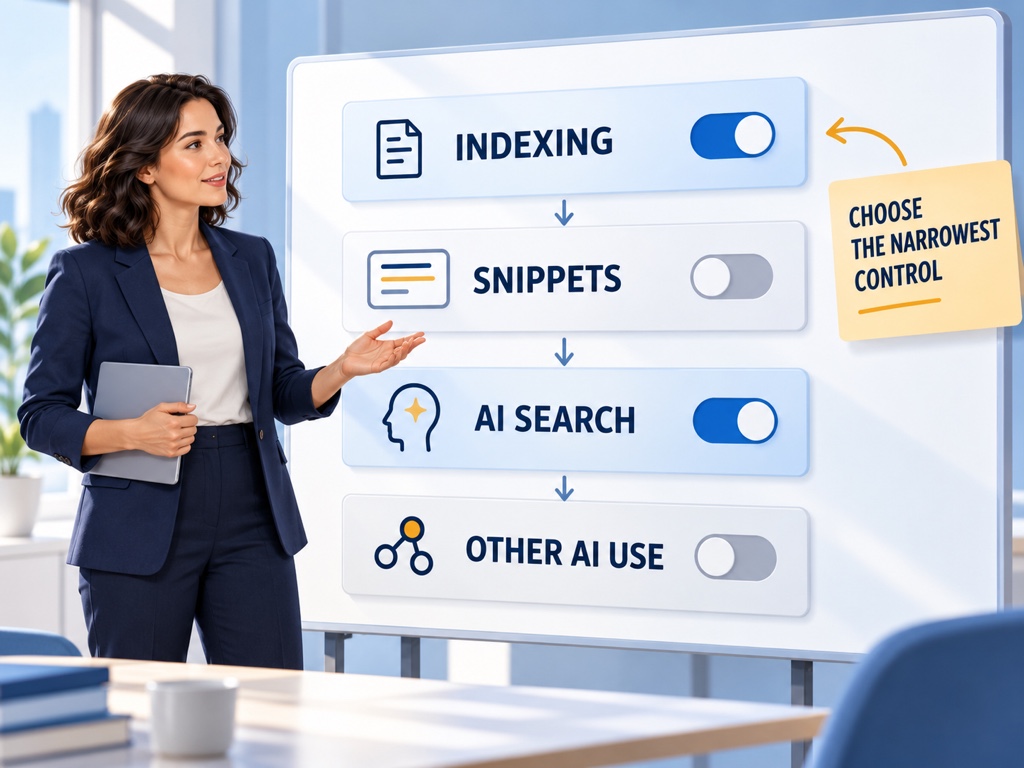
    Choose the Narrowest Control That Matches the Policy Goal

    Start with the content class, not the directive. Public product information, licensed journalism, subscriber material, personal data, user posts, legal documents, and support pages often require different policies.

    Use a decision sequence:

    1. Define the protected material. Identify pages, sections, fields, or excerpts rather than saying “AI content.”
    2. Define the unwanted action. Separate indexing, preview display, generative Search grounding, non-Search AI grounding, and training.
    3. Choose the narrowest supported control. Prefer a page section control over a page block, and a product-specific control over a global block, when it satisfies the requirement.
    4. Model discovery loss. Identify the impressions, clicks, subscriptions, leads, or support deflection that may disappear.
    5. Test and monitor. Confirm the directive is crawlable, wait for reprocessing, and verify the affected reports.

    This process prevents a common mistake: using noindex to solve a licensing concern limited to one paragraph, or blocking Google-Extended to solve a concern about AI Mode.

    Run a Measured Experiment Before a Site-Wide Change

    Some controls operate globally, but the decision can still be prepared with evidence. Build a baseline for generative Search impressions, cited pages, countries, qualified visits, conversions, and subscription or lead outcomes before changing participation.

    Segment pages by business role. A documentation library may receive few direct conversions but influence implementation confidence. A publisher’s current reporting may create subscriptions through prominent previews. A support site may reduce ticket volume when users receive an accurate answer before visiting.

    If page-level controls can meet the policy objective, test them on a bounded section. Record when Google recrawls the pages and when reporting changes. Google cautions that recrawling and processing can take from several days to months depending on the page.

    Do not interpret the first quiet day as a finished result.

    Cross-functional team balancing content protection against AI Search discovery loss

    Measure the Cost Across Visibility, Traffic, and User Outcomes

    The cost of a content control appears in several places. Search Console can show changes in generative impressions and cited pages. Analytics can show sessions and conversions. Subscriber, lead, support, or commerce systems can show the downstream outcome.

    Add an answer-level check. A site can disappear from direct citations while its brand remains mentioned through third-party sources. Conversely, the domain may remain visible as a link while the answer no longer includes enough context to influence a decision.

    Topify can provide a controlled prompt-monitoring layer around the change. Freeze a relevant set of prompts, record brand mentions, recommendations, positions, and sources before the control is changed, then repeat the observation after Google has processed it. The sample does not replace first-party Search Console data. It helps show what changed inside representative answers.

    Use three labels in the report: observed, inferred, and unknown. “Generative impressions fell after exclusion” is observed. “The exclusion caused fewer assisted conversions” may be inferred if several systems move together. “Google used a specific paragraph before the change” may remain unknown.

    Create a Control Registry and Review It Quarterly

    AI content controls can become invisible technical debt. A directive added for a temporary negotiation may remain after the contract changes. A global robots rule may outlive the team that approved it.

    Maintain a registry with the property, path, directive, affected system, owner, approval date, reason, test result, and review date. Include screenshots or exported evidence of the Search Console setting and retain the previous configuration.

    Review the registry quarterly and after major platform documentation changes. Google Search controls, Gemini product controls, crawler tokens, and reporting surfaces can evolve independently. Revalidate the policy against current official documentation rather than assuming the original behavior is permanent.

    Conclusion

    Google’s generative AI setting, snippet controls, noindex, and Google-Extended do not provide four versions of the same switch. They govern different layers: participation in generative Search, the amount of page content shown in previews, index eligibility, and use by selected non-Search Google AI products.

    Define the outcome before selecting the control. Then choose the narrowest supported mechanism, baseline the visibility and business value at risk, and verify the result after Google reprocesses the change. A responsible policy can protect specific material without treating all AI discovery as one undifferentiated problem. The wrong directive can remove a site from the exact decisions it still wants to influence.

    FAQ

    What does Google’s generative AI Search setting control?

    It controls whether a site can appear in and help ground supported generative Google Search features, including AI Overviews, AI Mode, and AI Overviews in Discover.

    Does blocking Google-Extended remove a site from AI Overviews?

    No. Google states that Google-Extended does not affect Google Search. The Search Console generative AI setting and Search preview controls govern different outcomes.

    Does nosnippet only remove the traditional search snippet?

    No. Google requires snippet eligibility for participation in generative Search features, so nosnippet can also restrict how the page participates there.

    How long does it take for a content-control change to work?

    The control must be crawlable and processed after recrawling. Google says this can take from several days to several months depending on crawl frequency.

    Read More

  • AI Citation Share: How to Benchmark Your Visibility Against Competing Sources

    AI Citation Share: How to Benchmark Your Visibility Against Competing Sources

    A brand can double its AI citations and still lose ground. That happens when the total source pool grows faster, new publishers enter the answer set, or the brand’s citations accumulate around low-value informational requests while competitors dominate commercial decisions. Raw citation counts make the first trend look positive. They hide the second.

    AI citation share adds a denominator. It asks what portion of the available citation space your site receives for a defined retrieval context. The metric is useful because it makes relative visibility visible, but it is easy to overstate. A higher share does not automatically mean better content, more traffic, or stronger buyer preference. A defensible benchmark combines citation share with intent, topic, page, answer, and business evidence.

    AI Citation Share Measures Relative Source Presence

    Microsoft introduced Citation Share as part of the expanded Bing Webmaster Tools AI Performance preview. For a specific grounding query, it calculates the percentage of displayed citations attributed to your site out of all citations shown across sites for that same query.

    The basic relationship is:

    Citation Share = citations attributed to your site ÷ all displayed citations for the grounding query × 100

    Suppose your site receives 18 citations and all sites collectively receive 120 citations for a grounding query during the selected period. Your citation share is 15 percent. If your count rises to 24 while the total expands to 240, your share falls to 10 percent despite the higher raw count.

    This denominator makes Citation Share more informative than citation volume alone. It reveals whether your source presence is gaining or losing relative representation within the observed citation set.

    It remains an observational metric. Microsoft explicitly states that Citation Share is not a ranking system, traffic share, quality score, or competitor-domain report.

    Citation Share Is Not the Same as Share of Voice

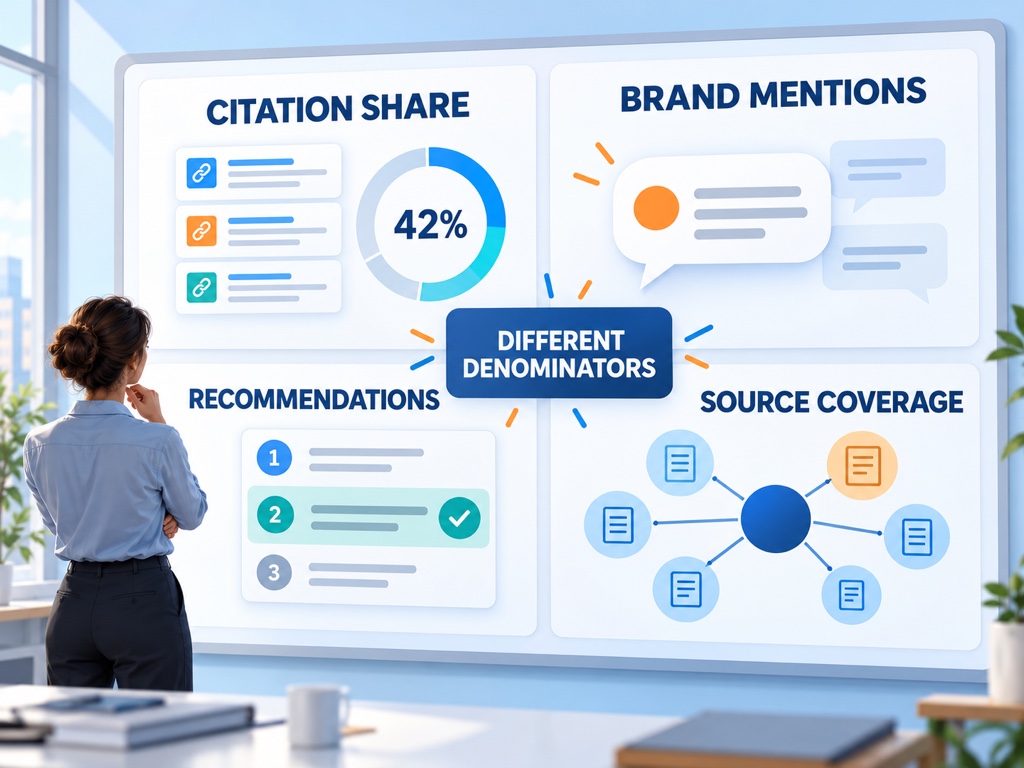
    Teams often use citation share, share of voice, mention rate, recommendation rate, and source coverage interchangeably. They answer different questions and use different denominators.

    Citation share concerns source links. Brand share of voice concerns how often or how prominently a brand appears in answers. A page can be cited even when the brand is not named, and a brand can be recommended using third-party sources without citing its own domain.

    MetricNumeratorDenominatorBest decision useMain limitation
    Citation ShareCitations attributed to your siteAll displayed citations for the same grounding queryRelative source presenceDoes not show brand framing or traffic
    Total CitationsCitations attributed to your siteNoneVolume trendNo competitive or market context
    Brand Mention RateAnswers mentioning your brandAll tested answersInclusion in the consideration setDepends on the tested prompt sample
    Recommendation RateAnswers actively recommending your brandEligible commercial answersPurchase-intent visibilityRequires answer interpretation
    Source CoverageUnique prompts or topics citing your pagesDefined prompt or topic universeBreadth of authoritySensitive to taxonomy and sample design

    Do not combine them into a single score unless the weighting, denominator, and loss of detail are explicit. A composite can simplify executive reporting, but diagnosis still requires the original metrics.

    Diagram separating citation share, brand mentions, recommendations, and source coverage

    Define the Benchmark Universe Before Calculating Anything

    A benchmark is only comparable when its universe is stable. Before collecting data, document the platform, reporting surface, date range, geography, language, topic, intent, and page scope.

    For Bing Citation Share, start with complete equivalent periods. Use the same filter set and compare the same grounding queries or topic clusters. Microsoft’s Compare feature can overlay prior periods, but it cannot prevent you from comparing a seasonal promotion with a quiet month or a complete period with partial data.

    For answer-level tools, freeze the prompt set and execution conditions. Record wording, language, location, model or experience, account state when relevant, and the number of repeated observations. AI answers vary, so one run per prompt should not be presented as a stable market share estimate.

    Use three benchmark levels:

    1. Query level: one defined grounding query or prompt intent.
    2. Topic level: a controlled group of related queries representing one subject.
    3. Portfolio level: weighted topic groups representing the decisions that matter to the business.

    The portfolio level requires declared weights. Giving every query equal weight is simple, but it can let high-volume informational topics overwhelm a smaller group of commercial decisions. Weighting by business priority can be more useful, provided the report clearly labels it as a strategic index rather than observed market share.

    Segment by Intent Before Comparing Sources

    The same overall citation share can hide opposite outcomes. A software brand may hold 30 percent share for educational definitions and 3 percent for vendor comparisons. Averaging the two can make the program look acceptable while the purchase-intent gap persists.

    Microsoft’s Intents feature classifies grounding activity into categories such as Informational, Commercial, Navigational, Learn and Solve, Research, Creation, and Local. Its Topics feature groups related phrases into larger themes. These classifications help teams move beyond isolated queries, but they are generated by evolving models and may be broad in specialized categories.

    Create your own decision-oriented layer beside the platform labels. A useful commercial taxonomy might include problem recognition, requirements definition, option discovery, comparison, risk validation, and vendor selection. Map each query once, document ambiguous cases, and keep the rules stable across periods.

    Then report citation share by intent. The result shows whether your site is used to educate, define requirements, validate claims, or support a shortlist.

    Use Page Role and Source Type to Explain the Share

    Citation share tells you how much source space your site receives. Page-role analysis helps explain what kind of evidence earned that space.

    Classify cited pages into product pages, documentation, research, comparison pages, help content, case studies, tools, and editorial articles. Then inspect whether the page role matches the grounding intent. Documentation may perform well for implementation questions but poorly for neutral comparisons. A proprietary research page may earn citations across several topics because it supplies an original statistic other pages repeat.

    Next, classify competing source types without assuming every domain is a direct business competitor. AI answers may cite regulators, standards bodies, news publishers, review sites, forums, documentation, academic research, and vendor pages in the same response. Each source plays a different evidence role.

    A falling share against standards bodies is not necessarily a content failure. A falling share against a direct competitor’s unsupported marketing page may be more actionable, especially when your site has stronger primary evidence that is difficult to locate or extract.

    Diagnose Change With Counts, Denominators, and Concentration

    Never investigate a citation-share movement without the numerator and denominator. Share can fall because your citations decreased, because total citations expanded, or because both moved at different rates.

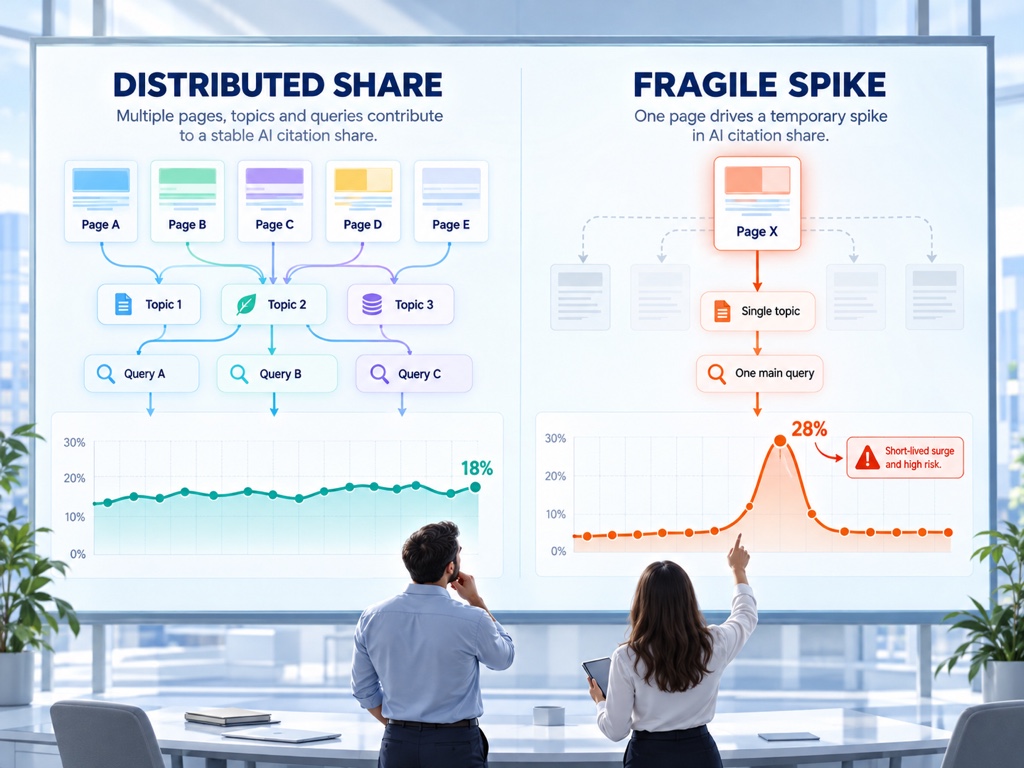
    Add concentration. Calculate how much of your citation count comes from the top page, top query, and top topic. A 20 percent share built on one evergreen page is less resilient than the same share distributed across a coherent content cluster.

    Use the following diagnostic sequence:

    • Your citations up, total citations up faster: the source pool expanded and competitors captured more of the growth.
    • Your citations flat, total citations up: demand or source diversity may be increasing while your footprint remains static.
    • Your citations down, total citations flat: investigate eligibility, freshness, content fit, and competing sources.
    • Your citations up, total citations down: share may rise sharply because the observed pool contracted.
    • Share stable, page concentration rising: the headline is steady but dependency risk is increasing.

    Microsoft notes that citation patterns can move with user behavior, models, freshness signals, partner refresh cycles, and broader web changes. Treat a time-aligned content update as one plausible explanation, not proof.

    Two analysts comparing a broad healthy citation portfolio with a fragile one-page share spike

    Convert Citation Gaps Into Evidence Work, Not Keyword Volume

    A low citation share does not always require a new article. First identify the evidence role that competing sources fulfill.

    The missing asset may be an original dataset, a clearer specification, a current policy page, a transparent comparison, a worked example, a definition with boundaries, or an independently corroborated claim. Publishing several near-duplicate keyword pages can make the site’s intent less clear without supplying the evidence the answer system needs.

    For each gap, record:

    • the target intent and topic;
    • the sources currently receiving citations;
    • the evidence type they contribute;
    • whether your site already contains equivalent evidence;
    • the smallest content or technical change that would make it discoverable;
    • the metric and period used to evaluate the change.

    If the evidence already exists, improve headings, internal links, canonical signals, freshness, and explicit sourcing before creating another page. Microsoft recommends clear structure, supporting claims with evidence, keeping content current, and reducing ambiguity across text, images, and video in its AI Performance guidance.

    Combine First-Party Citation Share With Prompt-Level Competitor Evidence

    Bing Citation Share does not expose competitor domains. That protects the metric from becoming a simplistic leaderboard, but it also means you need another evidence layer to understand who appears in the answers and how.

    Topify can support that second layer by monitoring a controlled prompt set, comparing brand inclusion, recommendations, answer position, and cited sources. Use it to inspect specific decisions rather than to recreate Bing’s denominator. The platform samples prompts you define, while Bing aggregates supported Microsoft citation activity.

    A practical joined report contains four panels:

    1. Bing Citation Share by grounding query, topic, and intent.
    2. Your citation count, total citation pool, and page concentration.
    3. Prompt-level brand mentions, recommendations, positions, and cited domains.
    4. Qualified visits, assisted conversions, pipeline events, or another business outcome.

    Do not expect the panels to move together. A source can gain share before brand recommendations change. Third-party pages can strengthen a brand’s answer visibility while the brand’s own-domain citation share remains flat. Those differences show where influence is occurring.

    Report Confidence and Method Changes Beside the Result

    An executive chart should never hide the conditions that produced it. State whether the data comes from a preview feature, whether query or topic coverage changed, and whether the period contains incomplete days.

    Assign confidence based on stability and corroboration. High confidence requires comparable periods, adequate activity, stable classification, distributed page evidence, and supporting answer observations. Medium confidence may show a consistent direction with some missing context. Low confidence applies to small samples, volatile queries, classification changes, or a movement driven by one page.

    Version the benchmark whenever you add queries, change topic rules, adjust weights, or alter the monitored platforms. Keep the old version available so stakeholders can distinguish performance change from methodology change.

    Conclusion

    AI citation share improves visibility reporting because it restores the denominator that raw citation counts omit. It can show whether your site is gaining relative source presence for a defined grounding query, topic, or intent. It cannot tell you that the brand ranked first, won the recommendation, earned traffic, or caused a conversion.

    Build the benchmark from a stable universe, segment it by decision intent, and keep counts and concentration beside the percentage. Then inspect the pages and source roles behind the movement. The strongest next step is rarely “publish more.” It is to supply the missing evidence, make existing evidence easier to retrieve, and test whether source visibility improves in the decision contexts that matter.

    FAQ

    What is AI citation share?

    AI citation share is the percentage of displayed citations attributed to a site within a defined citation pool, such as citations shown for the same grounding query.

    Is citation share the same as AI share of voice?

    No. Citation share measures source links, while AI share of voice usually measures brand presence or prominence in a controlled set of answers.

    Can citation share identify competitors?

    Bing’s Citation Share does not expose competitor domains. Answer-level monitoring and manual source review can provide competitor context for a defined prompt sample.

    What is a good AI citation share?

    There is no universal target. A useful target depends on topic, intent, source diversity, market structure, page role, and the stability of the underlying citation pool.

    Read More

  • AI Crawler Robots.txt: Control Search, Training, and Answer Visibility Separately

    AI Crawler Robots.txt: Control Search, Training, and Answer Visibility Separately

    A security team blocks every bot with “AI” in its name and closes the ticket. Weeks later, marketing discovers that product pages no longer appear in conversational search, while ordinary search remains unchanged. The policy succeeded at reducing access, but it failed to distinguish model training from search discovery and user-requested retrieval.

    An AI crawler robots.txt policy needs more than a copied list of user agents. Providers increasingly separate search indexing, potential model training, and real-time user access into different bots or product tokens. Blocking one may preserve another, and a crawl block may not remove a URL that the system learned about elsewhere. The correct policy maps each access path to a business decision before any directive is deployed.

    Robots.txt Controls Crawling, Not Every Form of Discovery

    A robots.txt file tells compliant crawlers which URLs they may request. It is a crawl-management mechanism, not a universal privacy or removal system.

    Google’s robots.txt guidance warns that a disallowed page can still be indexed as a URL when other pages link to it. Because the crawler cannot read a blocked page, it also cannot see a noindex meta tag inside that page. OpenAI similarly notes that a blocked page may still be surfaced as a title and link when its URL is obtained from another provider or another page; its publisher guidance recommends noindex when the goal is to prevent that result.

    Private or sensitive content should therefore rely on authentication and access control, not a voluntary crawler file. Robots rules communicate preferences to identified bots. They do not make public content confidential.

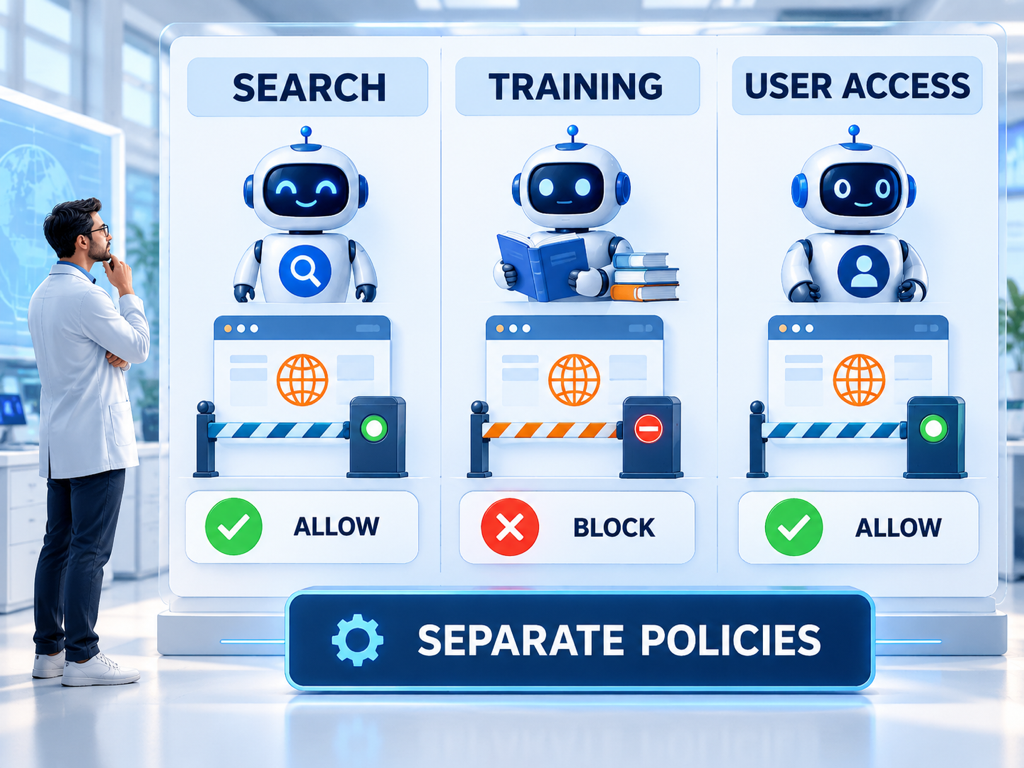
    Separate four objectives before editing the file:

    1. Ordinary search crawling and indexing.
    2. Search or answer retrieval by an AI service.
    3. User-initiated fetching during a live request.
    4. Collection for potential model training.

    One global Disallow: / cannot express those distinctions.

    Provider Bot Names Map to Different Product Uses

    The current bot structure varies by provider. Use official documentation and review it regularly because names and affected products can change.

    Provider token or controlDocumented primary useWhat blocking can affectImportant boundary
    GooglebotGoogle Search crawlingSearch indexing and eligibilityRobots blocking is not a reliable removal method
    Google-ExtendedTraining future Gemini models and grounding in selected Gemini or Vertex experiencesNon-Search AI use covered by the tokenGoogle states it does not affect Google Search
    OAI-SearchBotDiscovery and inclusion in ChatGPT search summaries and snippetsChatGPT search visibility and citationPlacement is never guaranteed
    GPTBotCollection that may contribute to model trainingPotential future training useOpenAI documents it separately from search discovery
    ChatGPT user accessRetrieval triggered by a user’s requestAbility to access a page during the taskOperational behavior differs from search indexing
    Claude-SearchBotSearch indexing and search-result qualityClaude search visibility and accuracySeparate from model-training collection
    ClaudeBotCollection that may contribute to model developmentPotential future training useSeparate from user-requested access
    Claude-UserRetrieval at a user’s directionLive access to site content in a Claude taskBlocking may reduce user-directed visibility
    Bing NOCACHE or NOARCHIVEPage-level control for Bing Chat and related useHow content is included or linked in answersImplemented as meta controls, not a separate AI crawler

    The table is a policy map, not a promise about every product surface. Always check the current provider page before deployment.

    Matrix connecting search, training, and user-requested AI bots to separate website decisions

    Googlebot and Google-Extended Solve Different Problems

    Googlebot is the crawler used for Google Search. Blocking it can prevent Google from reading page content and can damage ordinary Search visibility, including eligibility for generative features that rely on the Search index.

    Google-Extended is a product token in robots.txt. According to Google’s crawler documentation, it controls whether content crawled by Google may be used for training future Gemini models and for grounding in Gemini Apps and Grounding with Google Search on Vertex AI. It does not affect Google Search and is not used as a Search ranking signal.

    Google-Extended has no separate HTTP user-agent string. Existing Google crawlers fetch the content, while the token communicates a usage preference. A log-monitoring rule that expects a Google-Extended request header will therefore miss the documented mechanism.

    Google’s AI Overviews and AI Mode belong to Google Search. Site participation in those features is controlled through Search eligibility, preview directives, and Google’s generative AI Search setting, not through Google-Extended alone.

    OpenAI Separates Search Discovery From Potential Training

    OpenAI advises publishers to allow OAI-SearchBot when they want pages included in summaries and snippets in ChatGPT search. Its publisher and developer FAQ treats that bot separately from GPTBot, which publishers can disallow for pages they want excluded from potential training.

    This separation supports a common policy: allow search discovery while declining training collection. The exact robots file should still be reviewed by engineering and legal teams because path rules, wildcards, subdomains, and CDN behavior can change the outcome.

    OpenAI also describes user-driven access separately. A live ChatGPT request may cause a page fetch that is operationally different from building a search index. Decide whether your public documentation, support pages, or tools should remain accessible for those user-directed tasks.

    Allowing a crawler creates eligibility, not guaranteed visibility. OpenAI states that ChatGPT search placement depends on multiple factors intended to surface relevant and reliable information.

    Anthropic Uses Separate Training, Search, and User Bots

    Anthropic documents three robots: ClaudeBot, Claude-SearchBot, and Claude-User. Its crawler guidance maps them to model development, search quality, and user-requested access respectively.

    Blocking ClaudeBot signals that future site material should be excluded from training datasets. Blocking Claude-SearchBot can reduce visibility and accuracy in Claude search results. Blocking Claude-User prevents retrieval when a person asks Claude to access the site.

    The structure makes the policy choice explicit. A company can reject training collection while preserving search and user-requested access, or apply different rules to public marketing content and licensed archives.

    Anthropic states that its bots honor robots.txt and supports the non-standard Crawl-delay extension. Do not assume every provider interprets non-standard directives the same way.

    Bing Uses Page Controls Alongside Bingbot

    Microsoft’s approach includes existing search crawling plus page-level controls. Bing documented NOCACHE and NOARCHIVE behaviors for Bing Chat in 2023.

    Microsoft said pages without either control could be included in answers and potentially used in training. NOCACHE could allow a URL, title, and snippet to appear while limiting broader use. NOARCHIVE could prevent inclusion and linking in Bing Chat. When both were present, Microsoft said it would treat the page as NOCACHE.

    These behaviors are not interchangeable with blocking Bingbot. A crawler block can affect ordinary Bing discovery, while page meta directives communicate a more specific serving preference. Because the documentation predates later Copilot and AI Performance products, verify current behavior before implementing a new policy.

    Build Policies by Content Class, Not by Entire Domain

    Public documentation, product pages, subscriber articles, user profiles, licensed data, and internal portals should not inherit one undifferentiated AI policy.

    Create a content inventory with five fields: content class, access status, desired search visibility, desired answer visibility, and training preference. Then map each class to provider-specific controls.

    A typical policy might allow search and user-requested access to public documentation, disallow training collection for licensed reports, prevent all automated access to account pages, and leave ordinary search enabled for product pages. The exact choice depends on contracts, privacy obligations, infrastructure, and growth goals.

    Keep sensitive systems behind authentication. Do not publish them and expect robots.txt to supply security.

    Test the Effective File and the Resulting Visibility

    The policy is not complete when the text file is committed. Confirm that robots.txt is publicly reachable at each relevant host and subdomain, returns the expected status, and contains no CMS or CDN override.

    Test representative allowed and blocked paths. Inspect server logs for documented HTTP user agents where available, but remember that product tokens such as Google-Extended may not produce a separate request identity.

    Then measure outcomes. Search consoles can reveal changes in crawling, indexing, generative impressions, or citations. Answer-level checks can reveal whether pages and brands still appear for relevant prompts. Topify can support a fixed prompt sample across AI systems, allowing teams to compare visibility and cited sources before and after policy changes.

    The comparison should be directional. Different platforms refresh on different schedules, and a crawler-policy change may take time to affect discovery.

    Governance team testing a robots policy while monitoring search discovery and AI answer visibility

    Maintain an AI Access Registry Instead of a Static List

    Bot names, product boundaries, and control semantics evolve. A robots file copied from a one-year-old checklist can be technically valid and strategically wrong.

    Maintain a registry containing the provider, token, documented purpose, allowed paths, blocked paths, owner, approval date, documentation URL, test method, and next review date. Review it quarterly and whenever a provider announces a new search, shopping, agent, or training product.

    Version the policy and retain the previous file. A rollback is easier when the team knows which rule changed and what metric should recover.

    Finally, coordinate SEO, security, legal, infrastructure, and content owners. Robots policy is no longer only a crawl-budget task. It controls whether public evidence can participate in search, generated answers, user-directed tasks, and future models.

    Conclusion

    An AI crawler robots.txt policy works only when it separates search, answer retrieval, user-directed access, and potential training. Google, OpenAI, Anthropic, and Microsoft expose different tokens and page controls for these purposes. A single block can remove useful discovery while leaving the original governance concern unresolved.

    Start with content classes and desired outcomes. Map each provider’s current documentation to those decisions, implement the narrowest rule, and test both technical access and visibility. Keep private material behind authentication, keep a versioned registry, and review the policy as products change. The goal is not to allow or block “AI” as one category. It is to decide which systems may use which public content for which purpose.

    FAQ

    Does robots.txt keep a page private?

    No. Robots.txt communicates crawl preferences to compliant bots. Use authentication or other access controls for private content.

    Can I allow ChatGPT search but block OpenAI training?

    OpenAI documents OAI-SearchBot for search discovery and GPTBot for potential training separately, allowing publishers to express different preferences.

    Does blocking Google-Extended block AI Overviews?

    No. Google states that Google-Extended does not affect Google Search. AI Overviews and AI Mode depend on Search eligibility and Google’s generative Search controls.

    Why can a blocked URL still appear as a link?

    Systems may discover the URL through other pages or providers even when they cannot crawl its content. Use the provider’s supported indexing or removal control when link removal is the actual goal.

    Read More

  • AI Search Attribution: Connect Citations, Brand Discovery, Website Visits, and Revenue

    AI Search Attribution: Connect Citations, Brand Discovery, Website Visits, and Revenue

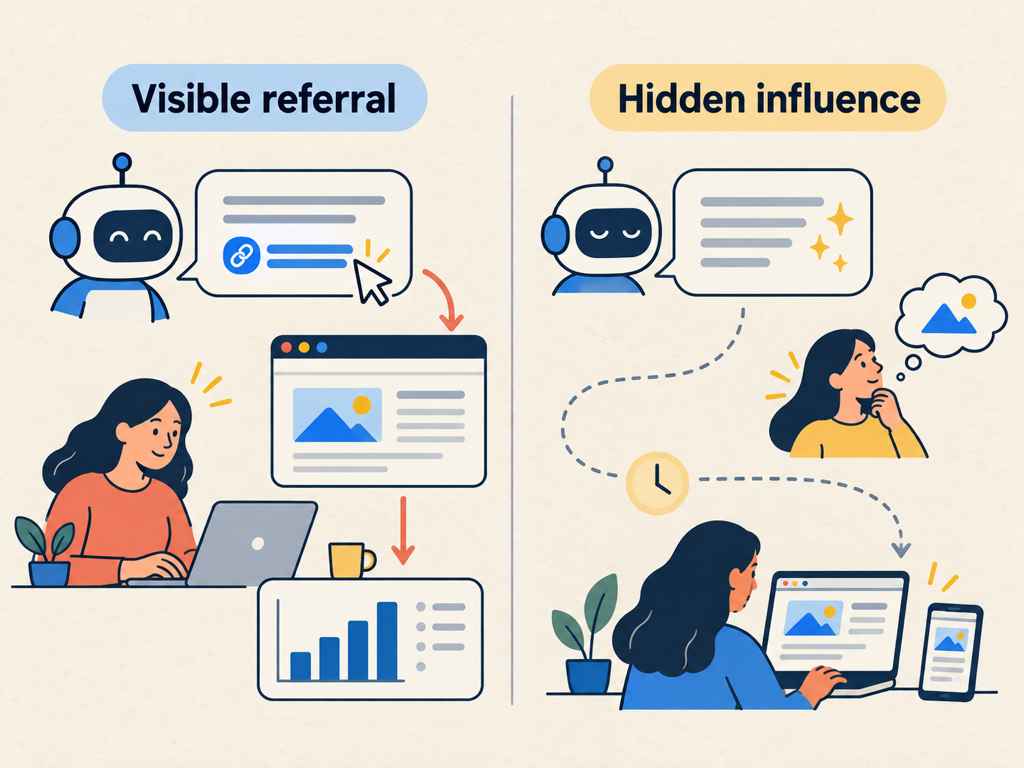
    AI search attribution has to work with that missing middle. Citations, recommendations, referral sessions, branded demand, and revenue live in different systems and at different levels of certainty. The goal is not to force them into a perfect user journey. It is to create a defensible evidence chain that shows where AI visibility influenced discovery, evaluation, and action.

    AI Search Moves Influence Upstream of the Click

    Traditional web attribution begins when a person arrives. AI search often shapes the decision before that event by summarizing options, comparing requirements, or validating a claim within the answer itself.

    Microsoft describes this as a distributed conversion journey in its AI search conversion guidance. Visibility, citations, query refinement, and answer inclusion can influence preference before the site visit. The eventual click may happen later, from a different query or device.

    This does not make attribution impossible. It changes the unit of analysis. Instead of asking “which single channel caused the conversion?” ask “which observable signals support influence at each stage, and how confident are we?”

    Use four stages:

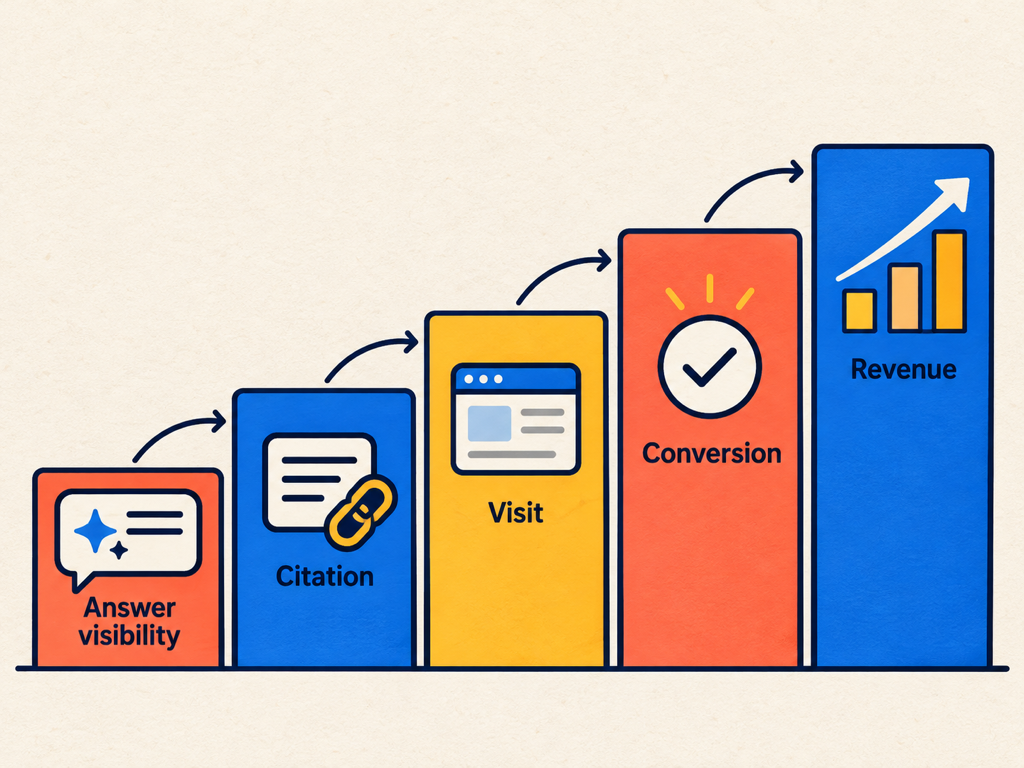
    1. Discovery: the brand or content appears in a relevant answer.
    2. Evaluation: the answer recommends, compares, cites, or describes the brand.
    3. Visit: the person reaches an owned property through a traceable or untraceable path.
    4. Outcome: the person completes a meaningful event, enters pipeline, purchases, subscribes, or returns.

    Attribution improves when every metric is assigned to one stage rather than treated as a substitute for revenue.

    Build an Evidence Ladder Instead of One Master Score

    A master AI ROI score looks convenient but usually mixes incompatible denominators. Prompt visibility is based on a controlled sample. Citations may be aggregated by a platform. Sessions reflect only traceable visits. Revenue is observed at the account or transaction level.

    Keep the evidence separate and connect it with explicit assumptions.

    Evidence layerExample metricWhat it supportsConfidence limit
    Answer visibilityMention rate, recommendation rate, positionPresence in relevant AI decisionsDepends on prompt sample and execution conditions
    Source participationCitations, cited pages, citation shareContent used as supporting evidenceDoes not prove brand preference or clicks
    Demand responseBranded search, direct visits, self-reported discoveryPossible awareness or recall effectSeveral channels can create the same movement
    Traceable trafficAI Assistant sessions, provider UTM parametersObservable visits from AI sourcesMisses zero-click, copied, and cross-device journeys
    On-site behaviorEngaged sessions, product views, demo startsQuality and intent after arrivalDoes not reveal all prior influence
    Business outcomeQualified pipeline, purchase, subscription, revenueCommercial valueAttribution model determines assigned credit

    An executive report can summarize the ladder, but analysts should retain the raw layers. A result is stronger when two or more independent systems support the same direction.

    AI search attribution evidence ladder from answer visibility through citations, visits, and revenue

    Define the Decision and Conversion Before Collecting Data

    Attribution design should begin with the decision the report will change. A content team deciding what to publish needs topic, prompt, citation, and landing-page evidence. A growth leader deciding budget allocation needs qualified conversions, value, cost, and confidence. A publisher needs subscriptions, engagement depth, return visits, and recirculation.

    Select one primary outcome and two or three supporting events. Mark those events consistently in analytics and downstream systems. Google’s GA4 conversion reporting guidance distinguishes raw event counts from conversion reports that assign credit using an attribution model.

    Document the lookback window and model. A 30-day last-click report and a 90-day data-driven report will not produce the same credit. Changing the model mid-quarter creates a methodology break that should be annotated.

    For long sales cycles, extend the evidence chain into CRM stages. Preserve original source, recent source, self-reported discovery, relevant content touched, opportunity creation, and closed value where policy permits. Do not overwrite one field every time a new visit occurs.

    Instrument the Clickable Portion Correctly

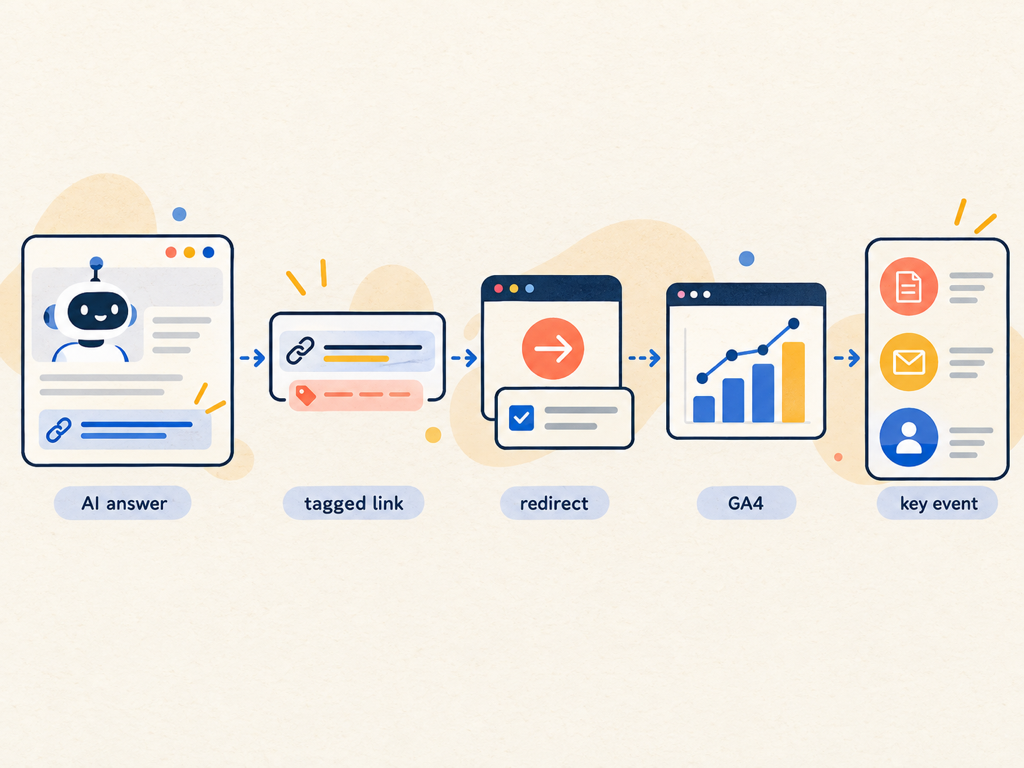
    GA4 now includes an AI Assistant channel for recognized sources such as ChatGPT, Gemini, DeepSeek, Copilot, and Grok. Google’s definition excludes AI Overviews and AI Mode. OpenAI also says ChatGPT search links carry utm_source=chatgpt.com for referral tracking.

    Preserve session source, medium, landing page, campaign parameters, and key-event data. Validate redirects, consent flows, cross-domain settings, and payment or authentication handoffs. A broken redirect can erase the source before the first page event.

    Analyze user, session, and event scope deliberately. Google’s BigQuery attribution documentation exposes first-user, session, and event-level traffic records. First-user scope answers acquisition. Session scope answers visit behavior. Event scope supports conversion credit.

    Do not combine the three in one unlabeled trend.

    Add Answer and Citation Data Before the Click

    The upstream layer requires two kinds of observation. First-party platform reports can show aggregated citations or generative impressions. Controlled prompt monitoring can show the answer content, brand framing, source set, and competitors for a defined sample.

    Freeze the prompt universe for the measurement period. Include informational, comparison, risk, use-case, and purchase prompts that correspond to real buyer decisions. Record platform, market, language, date, and repetitions.

    Topify can provide this answer-level monitoring layer. Use it to track mentions, recommendations, position, competitors, and citations across the selected prompts. Do not present the sample as total market demand. It is a controlled observation set designed to detect change in important decisions.

    Map monitored prompts to funnel stage and destination content. A recommendation improvement for low-value educational prompts should not receive the same business weight as improvement in a vendor shortlist or requirements comparison.

    Use Three Attribution Views, Not One Winner

    Run three complementary views:

    Traceable referral view. Assign outcomes to sessions with recognized AI sources or campaign parameters. This is the most observable view and the smallest representation of influence.

    Assisted journey view. Examine paths in which AI referrals appear before later channels, using the property’s configured attribution model and lookback window. This can show participation without awarding full credit.

    Influence study. Compare changes in answer visibility and citations with branded demand, direct visits, self-reported discovery, and business outcomes. Use matched markets, pages, or time periods when feasible.

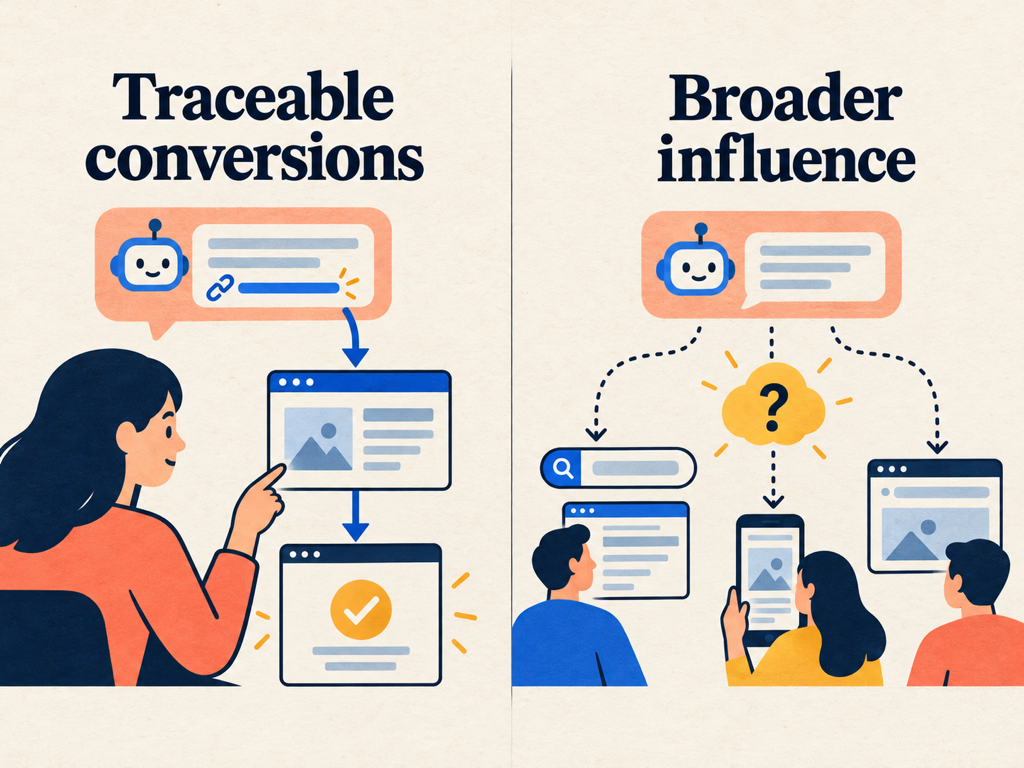
    The three views should not be added together. They overlap. Report them as a range of evidence, with traceable conversions as the floor and carefully designed influence estimates as a broader but less certain view.

    Design Tests That Improve Causal Confidence

    Simple before-and-after charts are vulnerable to seasonality, campaigns, product changes, and platform updates. Improve confidence with a comparison group.

    Choose similar topics, markets, or page groups. Apply the AI-search intervention to one group while holding the other steady. The intervention might be new original data, clearer comparison content, updated product truth, better source evidence, or improved crawl eligibility.

    Measure answer visibility, citations, traceable traffic, and the selected business outcome before and after. Record other events that could affect the result.

    The test will not create laboratory certainty because AI systems and demand continue to change. It can still produce stronger evidence than a single trend line.

    Use confidence labels:

    • High: comparable groups, stable instrumentation, repeated answer movement, traffic or demand response, and aligned business outcomes.
    • Medium: consistent movement across several layers but no strong control.
    • Low: small sample, one volatile platform, methodology changes, or timing alone.
    Measurement team comparing traceable conversions with broader but less certain AI influence

    Calculate Value Without Double Counting

    Start with the traceable floor. Multiply qualified conversions or transactions from recognized AI sessions by verified value, then subtract direct program cost when calculating return.

    For assisted journeys, use the credit assigned by the chosen analytics model rather than adding full revenue again. For influence studies, report incremental outcome differences separately and explain the design. Do not stack traceable, assisted, and estimated influence values into one total.

    Include content, tooling, analyst time, engineering, and media cost where applicable. AI-search programs often share assets with SEO, product marketing, PR, and documentation. Declare the allocation rule instead of claiming all content cost or all content value belongs to one channel.

    A useful finance table contains observed revenue, attributed revenue, estimated incremental value, cost, and confidence. The categories reveal the uncertainty instead of hiding it inside a precise ROI percentage.

    Create a Monthly Attribution Narrative

    A monthly review should answer five questions:

    1. Where did answer visibility or citation participation change?
    2. Which decision intents and pages drove the movement?
    3. Did recognized AI traffic and key events change?
    4. Did branded demand, self-reported discovery, pipeline, or revenue move in the same direction?
    5. What alternative explanation remains strongest?

    Write the conclusion in evidence order. Begin with what was observed, then state the supported inference, confidence, and next test. Avoid claiming that a citation caused revenue when the analysis only shows temporal alignment.

    Version the prompt set, analytics rules, CRM fields, and attribution model. Method changes belong on the same timeline as content and platform changes.

    Conclusion

    AI search attribution cannot reconstruct every conversation that influenced a buyer. It can build a credible chain from answer visibility and citations to observable visits, on-site behavior, and business outcomes. That chain becomes useful when each signal retains its own denominator and confidence limit.

    Begin with a defined decision and conversion. Instrument recognizable AI referrals, freeze an answer-monitoring sample, connect the systems by intent and time period, and use traceable, assisted, and influence views side by side. Then improve confidence through comparison groups and repeated observations. The best attribution model is not the one that awards AI the most credit. It is the one that helps the team make the next investment without claiming more certainty than the evidence supports.

    FAQ

    What is AI search attribution?

    AI search attribution is the process of connecting AI answer visibility, citations, referrals, on-site behavior, and business outcomes while documenting uncertainty and overlap.

    Can GA4 measure zero-click AI influence?

    No. GA4 can measure recognized visits and attributed events, but it cannot observe an answer impression that produces no site visit.

    Should AI search receive full credit for assisted conversions?

    Not automatically. Use the property’s attribution model and report assisted credit separately from traceable last-click or direct referral value.

    How can a team improve causal confidence?

    Use stable instrumentation, frozen prompt samples, comparable periods, matched topic or market groups, repeated observations, and multiple independent evidence layers.

    Read More

  • LLM Referral Traffic: How to Track Visits From ChatGPT, Copilot, and Gemini in GA4

    LLM Referral Traffic: How to Track Visits From ChatGPT, Copilot, and Gemini in GA4

    LLM referral traffic is therefore the measurable slice of a larger AI-influenced journey. GA4 can now classify recognized assistants, and some platforms attach explicit tracking parameters. A reliable setup preserves that raw source detail, groups it consistently, and connects the sessions to meaningful events without claiming that every AI influence is visible.

    GA4 Now Includes an AI Assistant Channel

    Google Analytics added an AI Assistant category to its default channel group. Google’s current channel definition says it covers traffic from sources such as ChatGPT, Gemini, DeepSeek, Copilot, and Grok. It excludes traffic from Google’s AI Overviews and AI Mode.

    When GA4 recognizes a listed AI referrer, it sets the medium to ai-assistant and the campaign to (ai-assistant). That gives teams a standard starting point without requiring a custom regex for every known domain.

    Do not stop at the channel label. Preserve and report session source, session medium, landing page, page referrer, and relevant campaign parameters. The aggregate channel answers how much recognized AI-assistant traffic arrived. The source and landing-page dimensions explain which assistant and which content produced the visit.

    Historical classification can differ from the current channel definition. Note the date when you begin using the report and avoid presenting older periods as if the same source list had always applied.

    ChatGPT Adds an Explicit Referral Parameter

    OpenAI’s publisher FAQ says ChatGPT automatically adds utm_source=chatgpt.com to referral URLs from ChatGPT search results. Publishers that allow OAI-SearchBot can use the parameter in analytics tools to identify inbound visits.

    That parameter is useful because it remains attached to the destination URL even when browser referrer handling is inconsistent. Confirm that redirects, link shorteners, consent tools, and canonicalization do not strip the query string before the analytics tag reads it.

    Create a QA test using a non-production page or a safe internal campaign link. Verify the landing URL, GA4 Realtime, DebugView when appropriate, and the eventual session-source report. One visible parameter in the browser is not proof that the analytics session stored it correctly.

    Avoid rewriting provider-supplied parameters into your own campaign naming unless there is a documented reason. Preserve the raw value and create a reporting layer on top. That makes future audits easier when the provider or GA4 changes its classification.

    Build a Source Table Before Creating Reports

    Maintain a small reference table rather than embedding provider lists in several dashboards. It should contain the observed hostname, expected source, expected medium, paid or organic status, first-seen date, last-verified date, and evidence URL.

    FieldExample purposeValidation question
    Observed hostnamePreserve the actual referring domainDid the browser or analytics event record it?
    Normalized assistantGroup several valid hostnamesIs the mapping current and documented?
    MediumDistinguish ai-assistant, referral, or paidDid GA4 classify the session as expected?
    Landing pageIdentify cited or recommended contentIs the destination canonical and useful?
    Campaign parametersPreserve provider or paid placement tagsDid a redirect remove or overwrite them?
    First and last verifiedTrack changing behaviorWhen was the mapping last tested?
    Evidence statusMark official, observed, or inferredCan another analyst reproduce the rule?

    Review the table monthly during a new-channel rollout and quarterly once stable. Do not add a hostname because a blog post claims it belongs to an assistant. Verify it in provider documentation or your own controlled referral test.

    Workflow from AI assistant link through UTM and referrer capture into GA4 session reporting

    Use Session, User, and Event Scope Deliberately

    GA4 exposes acquisition dimensions at several scopes. First user dimensions describe how the person was first acquired. Session dimensions describe the source of a specific visit. Event-scoped attribution can assign credit to key events according to the property’s reporting model.

    Google’s traffic-attribution documentation describes corresponding user, session, and event records in the BigQuery export. Mixing these scopes in one table can produce confusing totals.

    Use session scope to answer “what did recognized AI traffic do after arriving?” Use first-user scope to ask whether AI assistants introduced new users. Use event or attribution reports to analyze credit for key events. Label the scope in every chart title.

    The same visitor can first arrive through organic search, return from ChatGPT, and convert through email. First-user, session, and event reports will tell different but compatible stories.

    Mark Business Outcomes as Key Events

    Pageviews are not enough to evaluate LLM referral traffic. Define the action that represents value for the page and funnel stage.

    For SaaS, useful events may include pricing views, demo form starts, completed demos, account creation, documentation depth, and qualified pipeline creation. For publishers, use engaged reading, article completion, newsletter signup, registration, recirculation, and return visits. For ecommerce, preserve product views, add-to-cart, checkout start, purchase, and revenue.

    Google’s GA4 event guidance recommends validating events in Realtime and DebugView. Test parameters as well as event names so you can separate article, product, market, and conversion type.

    Use rates and absolute counts together. A channel with 12 conversions from 80 sessions may have an impressive rate but limited business scale. A channel with 200 conversions from 20,000 sessions may contribute more value despite a lower rate.

    Separate Observable Traffic From Unobservable Influence

    No GA4 configuration can record an impression that happened entirely inside an AI answer. It also cannot reliably identify a person who reads an answer on one device and later types the brand URL on another.

    Classify evidence into three layers:

    • Observed referral: a session contains a recognized AI source or campaign parameter.
    • Observed on-site outcome: the session or attributed path contains defined engagement or conversion events.
    • Inferred AI influence: surveys, sales notes, branded-demand changes, answer visibility, or controlled experiments suggest an effect without a traceable referral.

    Keep inferred influence out of the referral count. Report it beside the count with its own methodology.

    Add a “How did you hear about us?” field only when the answer is operationally useful and the added friction is acceptable. Standardize options but retain an open-text choice. Sales teams should use a controlled note field for AI-assistant mentions rather than burying them in free-form call notes.

    Diagnose Landing Pages, Not Just Providers

    The landing page explains why the assistant sent the visitor. Group destinations by role: original research, comparison, product, pricing, documentation, support, opinion, or tool.

    Compare engagement and conversion within each role. A documentation page may attract high-intent technical visits that convert later. A comparison page may create immediate demo activity. An informational article may receive many visits but serve primarily as the first touch.

    Review the exact page for current facts, a clear next step, internal links, and consistency with the likely answer context. AI-referred users may arrive after completing much of their evaluation elsewhere. Repeating introductory information without offering evidence or action can waste that qualified visit.

    Analyst separating visible LLM referrals from invisible zero-click and cross-device influence

    Connect GA4 With Answer-Level Visibility

    Referral analytics starts after the click. Answer monitoring starts before it. Topify can provide a controlled prompt layer showing whether the brand is mentioned or recommended, where it appears, and which sources shape the answer.

    Join the systems by time period, platform, prompt intent, cited page, and market. Do not join individual users or claim deterministic attribution when no shared identifier exists.

    A practical weekly view can include prompt visibility, cited URLs, AI Assistant sessions, engaged-session rate, key events, and conversion value. A rise in answer visibility with flat traffic may indicate zero-click influence, weak link placement, or a lag. A rise in traffic without tracked prompt visibility may come from unmonitored topics or assistants.

    Use the disagreement to improve the measurement universe.

    Create a Repeatable QA and Reporting Routine

    Run a monthly referral QA. Test known links, verify parameters survive redirects and consent flows, confirm GA4 source and medium values, check custom or default channel classification, and inspect unexplained growth in direct traffic.

    Build reports at three levels:

    1. Channel summary: sessions, users, key events, revenue or qualified outcomes.
    2. Provider and landing page: source, destination, engagement, conversion, and content role.
    3. Influence context: answer visibility, citations, self-reported discovery, and branded demand.

    Annotate changes to GA4 channel definitions, provider referral behavior, tracking consent, and site redirects. Measurement changes can look like performance changes when the chart lacks those notes.

    Conclusion

    LLM referral traffic is the measurable click stream from AI assistants, not the complete value of AI discovery. GA4’s AI Assistant channel and provider parameters such as utm_source=chatgpt.com make the visible portion easier to classify, but reliable reporting still requires source preservation, scope discipline, event QA, and landing-page analysis.

    Start with the default AI Assistant channel, preserve raw source fields, and test one complete referral path. Then connect recognized sessions to key events and report unobservable influence separately using answer visibility, surveys, and business evidence. The result is a measurement system that respects what analytics can see without pretending the invisible part of the journey does not exist.

    FAQ

    What counts as LLM referral traffic in GA4?

    It is a session attributed to a recognized AI assistant source or campaign parameter. GA4 now includes an AI Assistant default channel for supported sources.

    Does GA4 include Google AI Overviews in the AI Assistant channel?

    No. Google’s current definition explicitly excludes AI Overviews and AI Mode from the AI Assistant channel.

    How does ChatGPT identify referral traffic?

    OpenAI says ChatGPT search links automatically include utm_source=chatgpt.com, which publishers can read in analytics platforms.

    Why is reported AI traffic lower than customer survey responses?

    Many AI-influenced journeys do not create a detectable referral. They may end without a click, continue on another device, or return later through direct, search, or another channel.

    Read More

  • Agentic Search Optimization: Make Your Content Useful to Search Agents

    Agentic Search Optimization: Make Your Content Useful to Search Agents

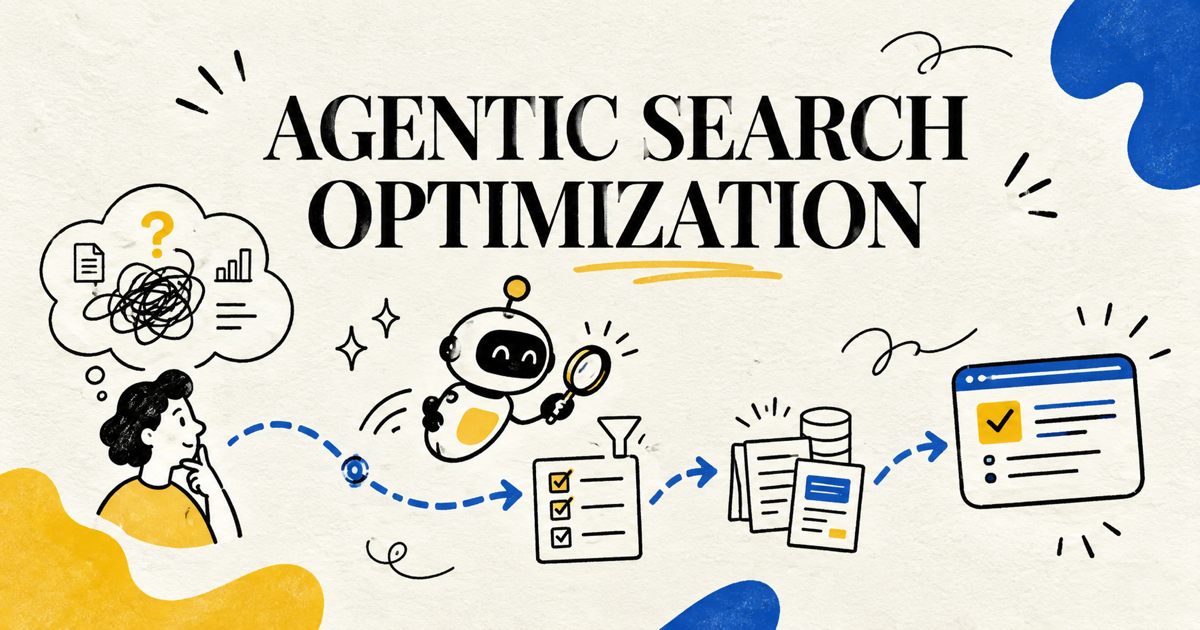
    Search is starting to do more than retrieve a page. An agent can monitor a topic, compare options, combine live facts, and help a person complete a task. That changes the practical question for content teams. It is no longer only, “Can this page rank?” It is also, “Can a search agent reliably extract, compare, and act on what this page says?”

    That does not make traditional SEO obsolete. Google’s current guidance says its generative features still depend on the core Search index, ranking systems, retrieval-augmented generation, and query fan-out. The foundation remains crawlable, indexable, useful content. Agentic search optimization adds another layer: make the facts, constraints, states, and next actions clear enough for an automated system to use without guessing.

    This guide turns that idea into a practical audit. It focuses on content and site changes you can make now, without inventing special “AI markup” or rebuilding your entire website around an unproven protocol.

    Agentic Search Is a Task Layer on Top of Retrieval

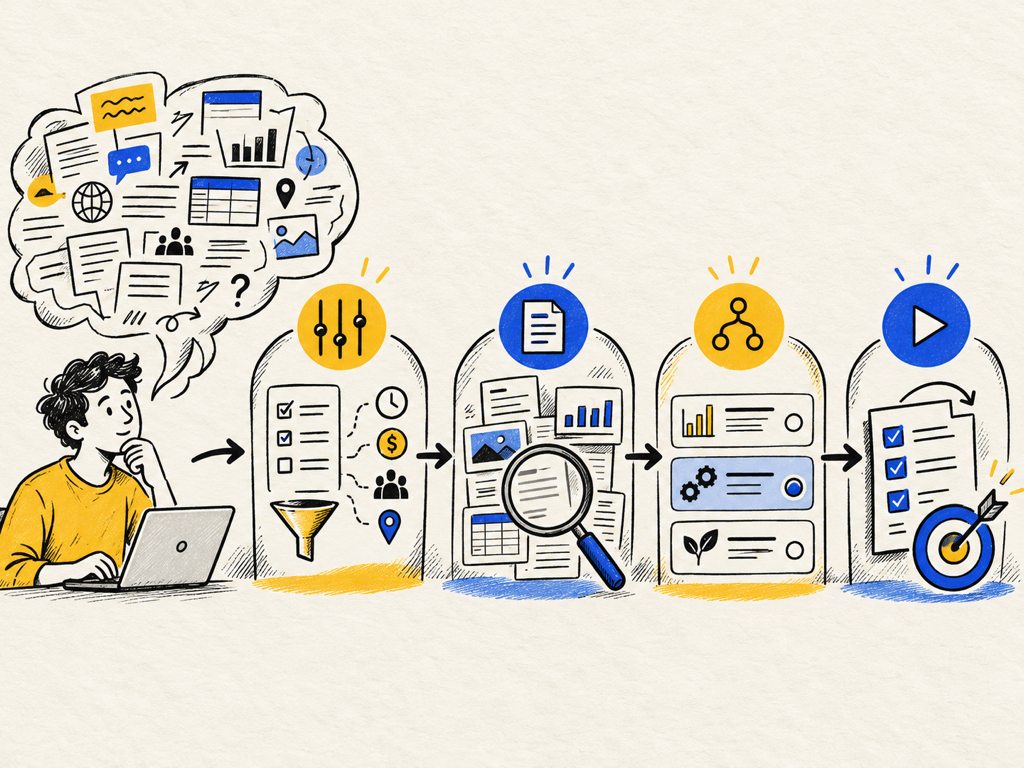
    Classic search helps a person find documents. Generative search synthesizes an answer from retrieved sources. Agentic search can keep working after the first answer: it can monitor for changes, compare choices against multiple constraints, or help the user complete an action.

    Google described this direction at I/O 2026 with information agents that can monitor web sources over time, notify users when conditions change, and support tasks such as finding listings that meet detailed requirements. Google also expanded agentic booking and shopping capabilities. The important shift is persistence and constraint handling. A single task may include location, budget, availability, eligibility, timing, and personal preferences.

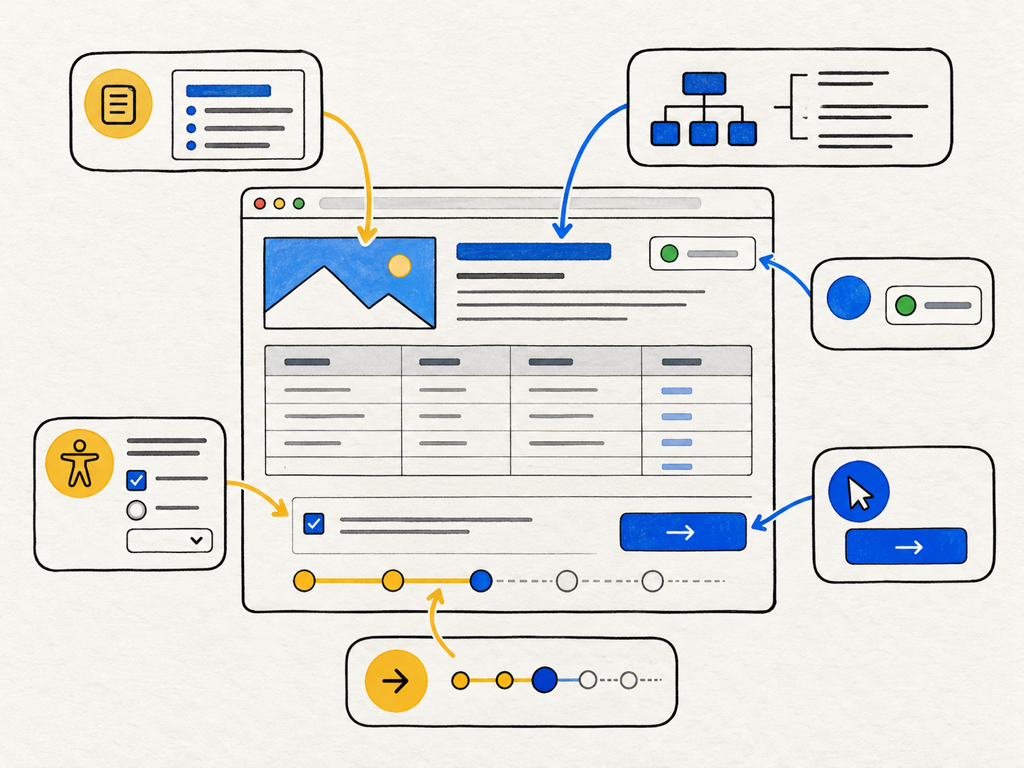
    For a publisher or business, that creates more ways to be useful. A page can supply evidence for an answer, one fact in a comparison, a current state such as price or availability, or a destination where the user finishes the task. It also creates more failure modes. Ambiguous conditions, stale dates, hidden fees, and inconsistent fields can cause an agent to exclude or misrepresent an otherwise relevant offer.

    Agentic search optimization is therefore not a separate channel hack. It is the discipline of making task-relevant information discoverable, interpretable, current, and actionable.

    Start With the Jobs an Agent May Need to Complete

    Do not begin with a list of bots or speculative schema types. Begin with user jobs. Identify the tasks that lead people toward your product, service, or expertise, then identify the facts an agent would need to complete each task safely.

    User taskInformation the agent needsCommon content failureBetter page design
    Compare two productscapabilities, limits, price basis, audience, tradeoffsfeature list without decision criteriacomparison table plus a clear recommendation boundary
    Find an eligible servicelocation, hours, qualifications, exclusions, availabilitygeneric service page with hidden restrictionsexplicit eligibility and service-area section
    Monitor a changing conditionstatus, effective date, update history, thresholdundated claim or stale snapshottimestamped status and change log
    Book or buyreal price, inventory, cancellation terms, next actionCTA disconnected from current factsconsistent offer data and a stable action path
    Research a complex decisionevidence, methodology, assumptions, uncertaintyunsupported summarysourced analysis with assumptions and limitations

    This exercise separates “interesting content” from “operationally useful content.” A thought-leadership article may build trust, while a specification page, policy page, availability feed, or comparison table supplies the precise fact an agent needs. Strong sites connect both.

    Agent task map connecting a complex request to constraints, evidence, options, and an action path

    Make Constraints Explicit Instead of Leaving Them in Prose

    Agents are often asked to satisfy several constraints at once. A traveler may want a hotel under a budget, near a station, with late check-in and a refundable rate. A buyer may want software for a specific team size, region, security standard, and integration stack. If those facts are scattered across marketing copy, PDFs, footnotes, and modal windows, the system has to infer too much.

    Create a visible constraint layer on the page. Use precise headings such as “Who this plan is for,” “Service area,” “Requirements,” “What is included,” “Availability,” and “Cancellation policy.” State units, currencies, tax treatment, and effective dates. When a limit depends on a plan, region, or variant, attach the condition directly to the value.

    Tables help when they genuinely support comparison. Lists help when order or eligibility matters. Short definitions help when your terminology differs from market language. None of this requires chopping every sentence into an artificial “AI-friendly” fragment. Google explicitly says there is no requirement to chunk pages into tiny pieces or rewrite them in a special style for generative search. Structure should improve the human reading experience first.

    Publish Evidence That Can Survive Comparison

    An agent comparing sources needs more than a confident conclusion. It needs evidence that can be checked against other pages. This is where non-commodity content becomes especially valuable.

    Google’s generative AI optimization guide recommends unique viewpoints, first-hand experience, original expertise, and content that goes beyond summaries anyone could reproduce. For agentic tasks, useful evidence often includes:

    • a clearly defined measurement method;
    • a dated test or observation window;
    • first-party data with the sample and denominator explained;
    • screenshots or images that demonstrate the condition being discussed;
    • primary-source citations near the claim they support;
    • a limitation section that prevents overgeneralization;
    • a changelog when the underlying product or policy evolves.

    Treat important claims as reusable evidence units. Each unit should answer: What happened? Under what conditions? How was it measured? When was it true? What would make it no longer true? This makes the content more credible to people and easier to reconcile with other sources.

    Keep the Technical Foundation Boring and Reliable

    Agentic features still need access to the web. Google states that pages generally need to be indexed and eligible for snippets to appear in its generative Search features. It also advises maintaining crawlability, sound JavaScript SEO, good page experience, and reduced duplication.

    The practical checklist is familiar:

    1. Return a successful HTTP status for the canonical page.
    2. Keep essential facts in accessible page content, not only inside an image or an interaction that fails without JavaScript.
    3. Use one stable canonical URL for each durable resource.
    4. Keep headings, links, forms, and controls understandable in the DOM and accessibility tree.
    5. Ensure the mobile layout exposes the same important facts as desktop.
    6. Match structured data to visible content and validate supported types.
    7. Avoid blocking the crawlers or preview behavior required for the search experiences you want.

    Google notes that browser agents may inspect visual renderings, DOM structure, and the accessibility tree. That makes accessibility work operational, not decorative. A properly labeled button, a visible form error, and a logical heading order help both people and automated systems understand what can be done on the page.

    Agent-friendly webpage blueprint showing visible facts, semantic structure, accessible controls, current state, and a stable action path

    Design Action Paths That Preserve Context

    An agent can find the right option and still fail at the handoff. Common breaks include a price changing between the comparison page and checkout, a variant losing its selected state, a booking link opening at the wrong location, or a form asking for information already supplied.

    Audit the full path from discovery to completion. Stable URLs should preserve the selected product, plan, location, or variant. CTAs should describe the action instead of using vague labels. Forms should expose requirements before submission and return specific, recoverable errors. If a person must take over, the page should retain the context the agent assembled.

    For commerce and booking, freshness matters as much as structure. A perfectly marked-up page with yesterday’s availability is less useful than a plain page with accurate current data. Assign an owner and update frequency to every high-impact field. If a value cannot be guaranteed in real time, say when it was last updated and what the user must confirm.

    Measure Agentic Search as a Chain of Evidence

    There is no single “agent readiness” score that proves performance. Measure the chain from eligibility to business outcome.

    At the technical layer, monitor indexability, rendering, structured-data validity, accessibility, and action completion. At the discovery layer, track the prompts or task clusters where your pages appear, the sources cited, and the pages selected. At the behavior layer, track qualified referral sessions, completed forms, bookings, purchases, and assisted conversions.

    Topify can help teams monitor answer visibility and citation patterns across a stable prompt set. Use that evidence to identify which topics and pages are being selected, then combine it with analytics and conversion data. A citation is evidence of source use, not proof of a sale. A referral is observable traffic, not the full influence of an AI interaction. Keep those layers separate.

    Run task-based tests rather than random prompts. For each important user job, create representative prompts with realistic constraints. Repeat them across engines and time windows. Record whether the answer found the right facts, cited the right page, preserved conditions, and offered a valid next action. The resulting failures provide a more useful backlog than a generic visibility score.

    Prioritize Fixes by Task Risk and Business Value

    Not every page needs an agentic redesign. Prioritize pages where an inaccurate or missing fact could change a decision, block a transaction, or create customer harm.

    Use a simple four-part score:

    • Task value: How close is the task to a meaningful business outcome?
    • Information volatility: How often do price, inventory, availability, rules, or eligibility change?
    • Interpretation risk: How costly would a wrong inference be?
    • Current clarity: Can a person quickly verify the important facts and next action?

    High-value, high-volatility pages should receive clear data ownership and frequent checks. High-risk policy or eligibility pages need explicit limitations and effective dates. Stable educational pages may need only better evidence, headings, and internal links.

    Avoid building around a speculative feature simply because it is new. Google says special AI files such as llms.txt are not required for its Search features, and there is no special schema type for generative search. Emerging protocols may become useful for particular transactions, but they should sit on top of accurate content and reliable site behavior.

    Build an Agent-Ready Publishing Workflow

    The strongest improvement is not a one-time audit. It is a publishing workflow that treats task facts as maintained assets.

    Before publication, the content owner defines the user job, evidence, constraints, and likely next action. A subject-matter reviewer checks factual accuracy and limitations. SEO verifies discovery, canonicalization, and internal links. Design checks mobile readability and image meaning. Engineering or operations verifies dynamic fields and forms. After publication, analytics monitors the discovery-to-action chain.

    Add a short agent-readiness review to existing quality assurance:

    • Can the main task and audience be identified within seconds?
    • Are decision-critical constraints visible and unambiguous?
    • Are claims supported by dated, primary, or first-hand evidence?
    • Does the current state match the destination or transaction flow?
    • Can keyboard, screen-reader, and browser-agent users operate the page?
    • Is there a clear owner for volatile information?
    • Can performance be measured without treating citations as conversions?

    This workflow improves traditional search, AI answers, accessibility, and conversion quality at the same time. That overlap is the reason agentic search optimization is worth doing now, even while specific products and protocols continue to change.

    Frequently Asked Questions

    What is agentic search optimization?

    Agentic search optimization is the practice of making web content and actions usable by search agents that retrieve information, compare options, monitor changes, or help complete tasks. It combines foundational SEO with clear constraints, current state, accessible interfaces, reliable evidence, and stable action paths.

    Do I need special schema for search agents?

    No universal special schema is required. Use supported structured data where it accurately matches visible content, but do not invent markup solely for AI systems. The more important foundation is crawlable, indexable, current, and well-structured information.

    Is an llms.txt file required for Google agentic search?

    No. Google’s current documentation says its Search systems do not use llms.txt as a special signal. Other services may choose to use such files, so the decision should be based on a documented provider requirement rather than a general ranking claim.

    How should I measure agentic search performance?

    Measure technical eligibility, task-level answer visibility, citations, qualified referrals, action completion, and revenue as separate layers. Use a stable prompt set and repeat tests over comparable time windows. Do not collapse every layer into one unexplained score.

    Read More

  • ChatGPT Product Feed Optimization: The Fields That Improve Discovery, Accuracy, and Trust

    ChatGPT Product Feed Optimization: The Fields That Improve Discovery, Accuracy, and Trust

    A product feed can pass validation and still be a poor source for a shopping answer. The item may have a title, price, and image, yet still be too vague for ChatGPT to match it to a specific request. A variant may appear available while its landing page shows a different size, color, or price. A merchant may update inventory, but the feed may remain stale for a day.

    ChatGPT product feed optimization addresses those gaps. The goal is not to stuff a feed with keywords or maximize the number of optional fields. It is to give ChatGPT accurate, current, variant-specific facts that help it understand what an item is, when it fits the shopper’s constraints, who sells it, and where the shopper can verify or buy it.

    OpenAI’s current Stable file-upload specification defines nine required fields for product discovery. Those fields are the starting contract, not the finish line. This guide explains how to improve the content, identity, freshness, and quality assurance around that contract without claiming that any feed field guarantees placement.

    Begin With the Stable Discovery Contract

    OpenAI’s Stable product feed reference says merchants should submit one row per purchasable item or variant and include nine required fields: item_id, title, description, url, brand, seller_name, image_url, availability, and price.

    Each required field resolves a different type of uncertainty.

    FieldDecision it supportsOptimization priorityHigh-risk failure
    item_idWhich exact record is this?keep it stable and uniquereusing an ID for a different item
    titleWhat product and variant is offered?name the product and selected option conciselyusing a generic parent title for every variant
    descriptionWhat is it, and what does it do?use factual, discriminating attributespromotional copy with no useful specifications
    urlWhere can the shopper verify or buy it?deep-link to the matching variantlanding on an unselected or different item
    brandWho made the product?match the visible product pageplaceholder or inconsistent naming
    seller_nameWho supplies this offer?use the merchant name users should seeconfusing brand and marketplace seller
    image_urlWhat does this item look like?show the exact variantimage color or pack size does not match
    availabilityCan it be purchased now?update from the commerce source of truthstale in-stock status
    priceWhat does this item cost?include correct amount and currencyprice differs from the destination page

    Do not optimize around the Draft schema unless you are explicitly planning for a future integration. OpenAI labels the Draft version as planning material and says to use Stable for supported file uploads. Build your production pipeline against the documented Stable contract, monitor the changelog, and treat schema migration as an intentional engineering change.

    Write Titles and Descriptions for Product Decisions

    A good product title identifies the item without turning into a search-query dump. It should include the product name and the selected variant when that distinction affects the offer. “Trail running shoes, black, size 10” is more useful than “Best lightweight outdoor performance footwear.” The first supports identification and comparison; the second is subjective and underspecified.

    Descriptions should be factual. OpenAI’s guidance recommends concise copy that helps users understand the product, while the Stable reference suggests keeping descriptions in plain text and within 5,000 characters. Lead with the attributes that change suitability: material, dimensions, capacity, compatibility, included components, intended use, or important exclusions.

    Ask whether the description can resolve a real constraint. If a shopper asks for a carry-on that fits a particular size limit, “premium travel essential” contributes nothing. Exterior dimensions, wheel inclusion, weight, and capacity do. If a buyer asks for a charger compatible with a device, connector type, power output, protocol support, and cable inclusion matter more than brand adjectives.

    Avoid claims that the product page cannot support. Do not add “waterproof,” “medical grade,” “sustainable,” or “lifetime warranty” merely because the terms may improve relevance. Feed content should match the destination page and the evidence behind the claim.

    Product feed content hierarchy showing identity, factual attributes, variant details, offer state, and seller context

    Model Variants as Purchasable Items

    Variant errors are among the fastest ways to lose shopper trust. A result may show a blue image, a black title, a size that is unavailable, and a price from the cheapest option. This can happen when a feed treats a parent product as though it were the purchasable unit.

    The Stable specification recommends one row for each purchasable item or variant. Give each selection a unique item_id, use a shared group_id for the parent listing, set listing_has_variations=true, and provide the selected options in variant_dict. Each row should carry the correct title, URL, images, price, and availability for that exact option.

    Keep identifiers stable when price, inventory, title, or imagery changes. An item ID is identity, not a version number. Do not place a price in the identifier, and do not recycle a discontinued SKU for a new product. Stable identity makes updates, reconciliation, diagnostics, and performance comparisons possible.

    The variant URL should preserve the selection when the shopper arrives. If query parameters or path segments choose the color and size, test that behavior in a logged-out session and on mobile. When the destination silently resets to a default option, feed accuracy is lost at the handoff even if the row itself is correct.

    Treat Price and Availability as Operational Data

    Titles and descriptions can change slowly. Price and inventory may change every hour. They should come from the system that controls the live offer, not from a content spreadsheet maintained by hand.

    OpenAI’s file-upload overview recommends sending a full snapshot at least daily, reusing stable filenames, and replacing the latest shard set. For large catalogs, it recommends deterministic shard assignment and approximately 500,000 items or less per shard. The same guidance notes that omission does not remove a product immediately; the most recently processed record may be retained for up to 14 days. To make an item ineligible on the next processed snapshot, set is_eligible_search=false.

    Design freshness controls around business risk:

    • Compare feed price and currency against the destination page before delivery.
    • Reject or quarantine rows with impossible prices, missing currency, or negative inventory.
    • Track the age of the source record and the age of the delivered snapshot.
    • Alert when the number of in-stock items changes outside an expected range.
    • Verify that discontinued items are disabled rather than left indefinitely as out of stock.
    • Record feed processing time so customer support can distinguish propagation delay from a catalog error.

    Availability must use a supported value. An explicit unknown state is better than asserting that an item is in stock when the source system cannot confirm it. Missing or unrecognized required availability values can cause a row to be rejected.

    Use Images and URLs to Confirm the Same Offer

    Product discovery is visual. The primary image should show the item represented by the row, including its relevant color, pattern, size, pack count, or configuration. Use a direct, public HTTPS image URL and avoid overlays that obscure the product. If a variant has its own imagery, do not fall back to a parent image that depicts a different selection.

    The landing page, title, description, image, price, and availability should tell one consistent story. Build an automated sample that opens feed URLs and checks the rendered page. Confirm that the canonical product is present, the variant is selected, the price and currency agree, the product can be purchased under the stated availability, and the primary visual matches.

    OpenAI’s ChatGPT shopping documentation says product results may include information from merchants and third-party providers, and that prices or shipping updates can take time to appear. It also says merchant rankings may consider factors such as availability, price, quality, and whether the seller is the maker or primary seller. These statements do not create a guaranteed ranking formula. They do explain why consistent offer data and merchant identity matter to the shopping experience.

    Quality assurance workflow comparing a feed row with its variant landing page, image, price, availability, and seller policies

    Add Optional Fields Only When They Stay Trustworthy

    Optional fields can improve answer quality by adding categories, richer descriptions, variant options, media, seller links, shipping, returns, or reviews. They can also multiply failure modes. OpenAI’s best-practices guidance advises omitting an optional field when the transformation is brittle until the data quality is stable.

    Use optional data when it resolves a meaningful shopper question and has a reliable owner. Category paths can improve product understanding when they reflect a consistent taxonomy. Seller policy links can reduce friction when they point to durable, public shipping, return, privacy, or refund pages. Additional media can clarify angles, dimensions, or included parts when the assets apply to the exact variant.

    Do not use placeholder values such as null, unknown, or n/a unless the specification explicitly supports the value. An omitted optional field is cleaner than a string that looks like real product data. Preserve leading zeros by treating identifiers as strings. Use UTF-8, valid absolute URLs, and correctly serialized JSON objects when placing structured values inside CSV or TSV cells.

    A useful governance rule is simple: every feed field must have a source, an owner, a refresh rule, and a validation rule. If one of those is missing, the field is not production-ready.

    Build a Feed QA Scorecard Before Delivery

    Schema validation catches formatting problems. It does not prove that the catalog is coherent. Add business-level checks that compare fields across systems.

    Score each delivery across five dimensions:

    1. Completeness: What percentage of rows contain every required field and every strategically important optional field?
    2. Validity: What percentage conform to the allowed types, enumerations, currencies, and URL rules?
    3. Consistency: Do titles, variants, images, price, availability, brand, and seller match the destination page?
    4. Freshness: How old are the source record, generated snapshot, and delivered file?
    5. Distinctiveness: Do titles and descriptions contain the factual attributes needed to tell similar products apart?

    Start onboarding with a small representative sample. OpenAI recommends roughly 100 items, with all required fields present, followed by quality assurance on the first full snapshot. Include simple products, multi-variant products, sale prices, out-of-stock items, marketplace offers, unusual characters, and your largest descriptions. Edge cases are more valuable than 100 nearly identical rows.

    Keep the validation report with the delivery. It should show row counts, rejected rows, warnings, price mismatches, broken URLs, image failures, inventory anomalies, and changes from the previous snapshot. A successful upload is an operational event, not proof that every product is correct.

    Measure Discovery Without Claiming a Feed Guarantee

    OpenAI says product results are selected independently based on relevance to the shopper’s intent and context. A direct feed improves the freshness and completeness of the data available to ChatGPT, but eligibility does not guarantee that a product will display.

    Measure performance in layers. First verify ingestion health and row acceptance. Then test representative shopping prompts by category, attribute, use case, price band, and audience. Record whether products appear, whether the right variant and merchant details are shown, and whether claims match the feed and landing page. Finally, measure attributable clicks and conversions.

    Add consistent tracking parameters to product URLs if they fit your analytics policy. OpenAI’s best-practices guide gives utm_medium=feed as an example for feed-specific attribution and recommends keeping tracking parameters consistent across snapshots. Do not let those parameters change the canonical product, selected variant, or page behavior.

    Topify can be used to organize repeatable shopping prompt tests and monitor product or source visibility over time. Pair that monitoring with feed delivery logs, onsite analytics, and catalog quality data. If visibility falls, determine whether the cause is prompt relevance, an ingestion problem, a freshness failure, an incorrect variant, or wider competitive change before rewriting every title.

    Establish Ownership Across Commerce, Content, and Analytics

    Product feed optimization fails when it is treated as a one-time SEO export. Commerce operations owns price, stock, and product state. Merchandising owns taxonomy and differentiating attributes. Content teams own factual titles and descriptions. Engineering owns the pipeline, identity, delivery, and alerts. Analytics owns tracking and performance interpretation.

    Create a change process for schema updates and field mappings. Version the transformation logic, test it against a fixed catalog sample, and compare output before deployment. Monitor the official Stable specification rather than copying a community template indefinitely. When a new field becomes available, add it only after the source data and quality controls are ready.

    The durable advantage is catalog truth. A feed that reflects the real product, real variant, real seller, real price, and real availability gives a shopping system fewer reasons to guess. It also improves paid feeds, marketplace listings, onsite search, support tooling, and every other system that consumes the same product data.

    Frequently Asked Questions

    What fields are required for ChatGPT product discovery feeds?

    OpenAI’s current Stable file-upload specification lists nine required fields: item_id, title, description, url, brand, seller_name, image_url, availability, and price. Requirements can change, so production pipelines should verify the current official specification.

    Does submitting a product feed guarantee appearance in ChatGPT?

    No. A feed can make product information more accurate and current, but eligibility and successful ingestion do not guarantee display. Relevance to the user’s request and the wider shopping experience still matter.

    How often should a ChatGPT product feed be updated?

    OpenAI recommends a full snapshot at least daily for file uploads. Merchants with rapidly changing prices or inventory should design a workflow that keeps those fields as current as their approved delivery method allows.

    Should every product variant have its own row?

    Yes, when the variant is separately purchasable. Give it a unique stable item ID, connect it to the parent group, and provide variant-specific title, URL, image, price, availability, and option values.

    Read More

  • AI Prompt Clustering: How to Group Buyer Questions Without Hiding Intent

    AI Prompt Clustering: How to Group Buyer Questions Without Hiding Intent

    A content team exports hundreds of buyer questions from sales calls, site search, support tickets, and AI prompt research. The spreadsheet looks productive until planning begins. Ten prompts may describe one decision in different words, while two nearly identical prompts may require completely different evidence. Group too loosely and the cluster becomes meaningless. Split too aggressively and the calendar fills with duplicate pages.

    AI prompt clustering solves this only when the grouping preserves the reason a buyer asks. The goal is not to create tidy folders. It is to build stable units for testing visibility, comparing competitors, and deciding whether one page can satisfy a family of questions.

    AI Prompt Clustering Starts With Decisions, Not Shared Words

    AI prompt clustering is the practice of grouping conversational queries that express the same underlying decision, evidence need, and expected answer shape. Wording similarity helps, but it is not the final rule.

    Consider two prompts that both contain “best CRM for a small business.” One asks for the easiest system for a five-person sales team. The other requires HIPAA support, audit logs, and a migration deadline. The category and several words match, but the second prompt introduces procurement and risk evidence that the first answer may never need.

    The reverse also happens. “Which CRM gives clients portal access?” and “What software lets an agency share project status with customers?” use different vocabulary, yet both may represent the same client-collaboration decision.

    OpenAI’s research on how people use ChatGPT separates conversations into broad intents such as Asking and Doing. That is a useful starting layer. Editorial clustering needs a more operational layer: the job, constraints, evidence, and action the answer must support.

    A Good Cluster Preserves Four Kinds of Meaning

    A defensible cluster should be coherent across four dimensions. If one dimension changes the likely answer, the prompt may belong in a separate subgroup.

    DimensionQuestion to askKeep prompts together whenSplit prompts when
    DecisionWhat is the user trying to decide?The same choice or action is requiredOne asks to learn and another asks to select
    ConstraintsWhat conditions change the answer?Differences are cosmetic or minorBudget, role, region, compliance, or compatibility changes the shortlist
    EvidenceWhat proof would satisfy the user?The same sources and page type can answer bothOne needs pricing, technical docs, reviews, or original data the other does not
    Answer shapeWhat should a useful response look like?Both need the same format, such as a checklistOne needs a comparison and another needs a step-by-step workflow

    This framework stops a common mistake: treating semantic similarity as intent equivalence. A clustering model can tell you that two sentences are close in meaning. It cannot decide by itself whether your company needs one page, two sections, a product document, or no new asset at all.

    Use machine grouping to accelerate review, not to outsource the editorial decision.

    Normalize Prompts Before You Measure Similarity

    Raw prompt sets contain noise. Brand names, locations, model names, punctuation, and one-off details can dominate similarity even when they are not strategically important. Normalize the dataset while preserving the original prompt in a separate field.

    Start with five fields:

    1. Canonical task: the job expressed as a short verb phrase, such as compare platforms or troubleshoot indexing.
    2. Entity or category: the product, service, or problem space.
    3. Intent stage: learn, evaluate, choose, implement, or diagnose.
    4. Constraints: role, company type, geography, budget, integrations, risk, and exclusions.
    5. Expected evidence: definitions, feature proof, pricing, third-party validation, technical documentation, or measured results.

    Do not rewrite the source prompt and discard its language. Keep both the original and the normalized representation. The original lets you rerun a test exactly; the normalized fields make clustering explainable.

    Google says its generative search features can use query fan-out, issuing related searches to build an answer. That makes evidence fields especially important. One conversational request may fan out into product compatibility, pricing, implementation, and risk questions even when the visible prompt mentions the category only once.

    Build Clusters in Two Passes

    The most reliable workflow separates discovery from validation. The first pass proposes groups at speed. The second asks whether those groups still make sense as editorial and measurement units.

    Pass one: create candidate groups

    Group by canonical task and intent stage first. Within each group, use wording similarity, shared entities, and recurring constraints to propose subclusters. Give every cluster a human-readable label such as “budget comparison for small teams,” not an opaque ID.

    Set aside prompts that mix several decisions. A prompt asking for a definition, implementation plan, pricing comparison, and vendor recommendation may need to be decomposed for analysis, even if it remains unchanged for live testing.

    Pass two: challenge the boundaries

    Review prompts at the edge of each group. Ask whether one credible answer could satisfy all of them without becoming vague. Then test controlled variants in which only one constraint changes.

    Workflow showing raw buyer questions being normalized, grouped by decision, challenged with controlled variants, and approved as stable prompt clusters.

    If changing a constraint repeatedly changes the brands, sources, or content types in the answer, promote that constraint to a cluster boundary. If the answer stays materially the same, keep the prompts together and store the constraint as an attribute.

    Score a Cluster Before It Enters the Content Calendar

    Not every coherent cluster deserves a page. Some are useful for monitoring only, some belong in product documentation, and some expose an evidence gap that content cannot solve.

    Score each cluster on four practical questions:

    • Demand: Do customers or prompt-research signals show that the decision occurs often enough to matter?
    • Visibility gap: Are competitors recommended or cited where your brand is absent?
    • Evidence readiness: Can you support a useful answer with current, verifiable evidence?
    • Distinct intent: Would the asset serve a decision not already covered by an existing page?

    Topify’s Prompt Discovery currently frames opportunity through prompt demand, visibility gaps, commercial intent, competition, and content readiness. Those signals can prioritize the review queue, but they should not automatically create URLs. A high-opportunity cluster may call for a pricing clarification, integration page, or independent review strategy instead of another blog post.

    The editorial decision comes after the measurement signal.

    Know When to Merge, Split, or Hold a Cluster

    Cluster boundaries become clearer when you compare the consequences of each choice.

    Decision comparison showing when prompts should be merged, split into subclusters, or held for more evidence based on answer changes and content needs.

    Merge prompts when they lead to the same decision, require the same evidence, and produce substantially similar answer sets. Keep wording variants as test cases inside the cluster.

    Split when a recurring constraint changes the shortlist, source requirements, or answer format. For example, “for healthcare” may deserve a separate risk-focused subgroup if compliance evidence consistently changes recommendations.

    Hold when volume is uncertain, the prompts are too mixed, or the evidence does not support a useful response. A holding queue is better than forcing weak prompts into whichever cluster is closest.

    Do not split solely because platforms phrase responses differently. ChatGPT, Perplexity, and Google AI experiences may cite different sources for the same decision. Platform is usually a measurement dimension unless user behavior or answer requirements genuinely diverge.

    Measure Clusters With Stable Prompts and Versioned Rules

    A cluster becomes a measurement unit only when it remains stable. Store the exact prompts, language, region, platform, date, and grouping rule. Record when a prompt enters, leaves, or changes clusters.

    Track results at two levels. The cluster view shows whether visibility and recommendation share improve for the decision. The prompt view shows whether one wording, constraint, or platform is producing the difference.

    Useful cluster metrics include:

    • brand inclusion rate across the prompt set;
    • explicit recommendation rate;
    • average or median recommendation position when ordered lists exist;
    • competitor overlap;
    • citation-source coverage;
    • result volatility across repeated observations.

    Avoid interpreting ten paraphrases as ten independent demand signals. They are observations of one decision pattern. Weighting every wording equally can make a heavily expanded cluster look more important than a smaller but commercially meaningful one.

    Use Topify to Keep Discovery and Tracking Connected

    Topify can support the operating loop after your team defines its clustering rules. Begin with Prompt Discovery to identify candidate questions and visibility gaps. Normalize the prompts outside or inside your planning workflow, then organize stable sets by decision, funnel stage, or market.

    Use the same prompt versions for recurring monitoring. Compare brand visibility, competitors, position, sentiment, and citation sources within each cluster, while keeping new discoveries in a separate intake queue until they pass review.

    This separation matters. Adding new prompts directly to a baseline changes the denominator and can make a trend move even when AI answers did not. Version the cluster first, then compare like with like.

    When a cluster exposes a gap, inspect the evidence behind the winning answers. The next action might be a new comparison, clearer product documentation, a source-authority effort, or no content change at all. Clustering is valuable because it narrows the decision, not because it guarantees another article.

    Conclusion

    AI prompt clustering works when it preserves why a buyer asks, what constraints shape the answer, and what evidence resolves the decision. Shared words and vector similarity can propose useful groups, but they cannot define your editorial architecture alone.

    Start with the canonical task, intent stage, constraints, and expected evidence. Build candidate clusters, challenge their boundaries with controlled variants, and version the final prompt sets before tracking them. The result is a smaller, more defensible map of buyer decisions that supports content planning without creating duplicate pages or misleading measurement.

    FAQ

    What is AI prompt clustering?

    AI prompt clustering groups conversational queries by shared decision, constraints, evidence needs, and expected answer type so teams can analyze and track them as one meaningful unit.

    Is semantic similarity enough to cluster AI prompts?

    No. Similar wording can hide different purchase constraints, while different wording can express the same job. Semantic similarity should propose clusters that a human validates against decision and evidence requirements.

    How many prompts should be in one cluster?

    There is no universal number. Use enough prompts to represent the important wording and constraint variations without over-weighting paraphrases of the same question.

    When should a prompt cluster become a new article?

    Only when it represents a distinct, recurring decision and the required evidence is not already covered by an existing page. Some clusters are better handled by product documentation or monitoring.

    Read More

  • AI Prompt Gap Analysis: Find the Evidence Competitors Supply and You Do Not

    AI Prompt Gap Analysis: Find the Evidence Competitors Supply and You Do Not

    Your brand appears in a category prompt until the buyer adds one condition. Ask for a general recommendation and the model includes you. Add “for a regulated team,” “under $100,” or “with Salesforce integration,” and a competitor takes your place. A conventional content-gap report may show no obvious problem because both sites target the same keywords.

    AI prompt gap analysis starts from the answer that changed. It compares prompts, recommendations, and cited evidence to determine whether the missing piece is product fit, content, authority, or simple measurement noise. That distinction prevents a visibility problem from turning into another generic article no buyer needs.

    An AI Prompt Gap Is an Answer-Level Difference

    An AI prompt gap exists when a brand, product, claim, or source is consistently present in relevant AI answers for competitors but missing or misrepresented for your brand. The unit of analysis is not the keyword. It is the prompt and the evidence path behind the generated response.

    There are at least four different gaps that can look identical in a visibility dashboard:

    • Recommendation gap: a competitor is selected and your brand is omitted.
    • Citation gap: your brand is mentioned, but the answer relies on competitor or third-party sources.
    • Attribute gap: the system cannot confirm a feature, price, policy, integration, or qualification.
    • Narrative gap: the brand appears, but with a weaker or outdated description.

    Each gap requires a different response. Publishing more category content may help a citation gap, but it will not make an unsupported integration exist or fix an outdated return policy in a product feed.

    Prompt Gaps and Keyword Gaps Answer Different Questions

    Traditional keyword gap analysis asks which queries competitors rank for and you do not. AI prompt gap analysis asks which decisions cause an AI system to prefer, cite, or describe competitors differently.

    Analysis typePrimary unitMain evidenceBest question answeredCommon blind spot
    Keyword gapSearch query and ranking URLRankings, clicks, impressionsWhere do competitors rank that we do not?Cannot see synthesized recommendations
    Content gapTopic and page inventoryCoverage, format, depthWhich useful topic or format is missing?May assume coverage creates visibility
    Citation gapSource URL or domainLinks used in AI answersWhich sources support competitor inclusion?Citation may follow rather than cause selection
    AI prompt gapPrompt, constraints, answer, and sourcesRepeated model outputsUnder which buyer conditions do we disappear?Requires controlled, repeatable sampling

    Google’s guidance says generative features can use query fan-out to issue related searches and build a response. A single prompt can therefore expose multiple evidence gaps at once. A request for payroll software for a multinational team may require country coverage, compliance details, integrations, and pricing clarity before any brand is considered suitable.

    The practical value is diagnosis. You are not merely learning that a competitor won. You are identifying which decision condition and source pattern accompanies the win.

    Build a Controlled Prompt Set Before Comparing Brands

    A reliable gap analysis needs prompt pairs or small prompt families that change one meaningful variable at a time. Begin with one decision, such as selecting a provider or comparing products, then create controlled variants around the constraints most likely to matter.

    For example:

    1. Recommend project management software for a small agency.
    2. Recommend project management software for a small agency with client portals.
    3. Recommend project management software for a small agency under $20 per user.
    4. Recommend project management software for a small agency with SSO and audit logs.

    Keep platform, language, region, and timing consistent. Run more than one observation because generated answers can change. Store the complete response, ordered recommendations, explanation, citations, and any follow-up questions.

    Do not expand the set with dozens of cosmetic paraphrases before you understand the important constraints. More rows do not automatically produce better evidence.

    Diagnose the Gap Across Four Evidence Layers

    Once a prompt reliably produces a difference, trace it through four layers. This prevents teams from jumping from “we were absent” to “write a blog post.”

    Layer one: product truth

    Confirm whether the brand actually satisfies the condition. Check the current product, plan, geography, integration, security, and policy facts. If the competitor has a capability you do not, the result may be accurate rather than an optimization failure.

    Layer two: owned evidence

    Check whether the fact is available on a crawlable, current page. Product details hidden behind login, rendered only in an interactive widget, or mentioned vaguely in sales copy may be difficult to verify.

    Layer three: independent corroboration

    Review the external sources the answer uses. Independent reviews, directories, documentation, research, and community discussions may confirm or contradict owned claims. Do not manufacture endorsements or attempt to manipulate community content.

    Layer four: answer behavior

    Determine whether the pattern persists across repeated observations and platforms. One missing mention is a clue, not a conclusion. A stable omission tied to one constraint is much more actionable.

    Four-layer diagnostic workflow moving from product truth to owned evidence, independent corroboration, and repeated AI answer behavior.

    The layer where the evidence breaks determines the next action.

    Classify the Root Cause Before Assigning Work

    Most prompt gaps fall into a small set of root causes. Naming the cause makes the response more precise.

    True fit gap: the product does not meet the requirement. Clarify positioning or route the prompt to a better-fit use case. Do not optimize around a false claim.

    Evidence availability gap: the product fits, but the supporting information is missing, vague, inaccessible, or outdated. Improve the authoritative page or documentation.

    Source authority gap: owned evidence exists, but independent sources consistently support the competitor. The response may involve analyst relations, digital PR, review programs, or stronger original research.

    Entity ambiguity gap: the brand, product, or feature name is confused with another entity. Consistent naming, organization data, and clear product relationships may be required.

    Measurement gap: the difference disappears when prompts are rerun or controlled. Increase the sample before changing strategy.

    This taxonomy also sets a boundary. A content team should not promise to solve product fit, policy, or reputation problems with copy alone.

    Turn the Diagnosis Into a Prioritized Action Queue

    For every stable gap, record the prompt cluster, missing brand or claim, winning competitors, cited sources, root-cause hypothesis, confidence, owner, and next test. Then prioritize by business value and evidence strength.

    Decision board comparing content, documentation, authority, product, and measurement actions for different AI prompt gap root causes.

    Use a simple decision rule:

    • Create a new content asset only when the buyer decision is distinct, recurring, supportable, and not already served.
    • Improve documentation when a verifiable product fact is hard to find or explain.
    • Pursue external authority when trusted third parties repeatedly shape the answer.
    • Escalate to product or operations when the gap reflects actual fit, availability, or policy.
    • Gather more observations when the result is volatile or the sample is too small.

    The queue should include rejection reasons. “No action” is valid when the prompt has weak relevance, the answer is factually correct, or the proposed asset would duplicate an existing page.

    Measure Whether the Gap Actually Closes

    Define the baseline before changing anything. At minimum, record brand inclusion, explicit recommendation, position when ordered, cited owned pages, cited third-party domains, competitor overlap, and sentiment or framing.

    After an intervention, rerun the same prompt versions under the same conditions. Compare the stable cluster rather than adding new prompts mid-test. Allow enough time for crawling, indexing, feed refreshes, or source changes before declaring success.

    Success is not limited to “brand mentioned.” A stronger result may be a correct attribute, an owned citation, a higher recommendation position, or the removal of an outdated caveat. The metric should match the diagnosed gap.

    Google advises site owners to focus on helpful, reliable, people-first content rather than pages designed only to attract search systems. That principle applies here. The asset should resolve the buyer’s evidence need even if no AI answer changes immediately.

    Use Topify to Connect Prompt Gaps With Sources and Competitors

    Topify can make the monitoring part of this workflow repeatable. Its current Prompt Discovery page describes visibility-gap detection, competition analysis, and prompt opportunity scoring. Use those signals to identify prompt clusters where competitors appear and your brand does not.

    Then inspect the answer and citation layer rather than treating an opportunity score as a content order. Compare controlled prompt variants, review which competitors persist, and map the sources supporting their inclusion. Tag each gap with the root-cause taxonomy before assigning work.

    Keep paid or high-volume prompt activation separate from planning. Approve the exact prompt set, platforms, regions, and cadence before it becomes a recurring monitor. A smaller stable baseline is usually more informative than a large, changing collection.

    The outcome should be a defensible action queue: which evidence is missing, why that matters to the buyer, who owns the fix, and how the same prompt set will verify the result.

    Conclusion

    AI prompt gap analysis is most useful when it explains why a recommendation changes, not merely where your brand is absent. A controlled prompt set lets you connect buyer constraints to product truth, owned evidence, independent sources, and repeated answer behavior.

    Start with one decision and vary one condition at a time. Classify stable gaps as fit, evidence, authority, ambiguity, or measurement problems. Then assign the fix to the right owner and retest the unchanged baseline. That process turns an opaque AI omission into a bounded business question without filling the blog with duplicate content.

    FAQ

    What is AI prompt gap analysis?

    AI prompt gap analysis compares repeated AI answers to find prompts where competitors are recommended, cited, or described more favorably, then traces the difference to its evidence source.

    How is prompt gap analysis different from keyword gap analysis?

    Keyword gaps compare search rankings. Prompt gaps compare generated answers, buyer constraints, recommendations, citations, and supporting evidence across AI experiences.

    Does every AI prompt gap require new content?

    No. The cause may be product fit, missing documentation, weak independent corroboration, entity confusion, or sampling noise. New content is only one possible response.

    How many times should an AI prompt be tested?

    There is no universal minimum. Use repeated observations sufficient to distinguish a persistent pattern from normal variation, and keep platform, region, language, and prompt version consistent.

    Read More