You Googled your brand last week and liked what you saw. Then you typed the same question into ChatGPT, and your company didn’t show up once. Worse, your competitor did, listed first, described as “the leading solution.”
That gap between Google rankings and AI recommendations is where most brands are losing ground right now. Only about 30% of brands maintain stable visibility across multiple AI-generated responses, which means the other 70% are either invisible or inconsistently represented every time someone asks an AI engine for a recommendation. The fix starts with a structured audit you can run in half an hour, using nothing but a browser and a spreadsheet.
What an AI Brand Visibility Audit Actually Measures
A traditional SEO audit checks rankings, backlinks, and page speed. An AI brand visibility audit measures something fundamentally different: whether AI systems mention, cite, and accurately describe your brand when users ask questions in your category.
The distinction matters because AI engines don’t just rank pages. They synthesize answers from multiple sources using a process called Retrieval-Augmented Generation (RAG). The model pulls content from its training data and real-time web retrieval, scores it for authority and relevance, then blends it into a single response. If your content doesn’t get retrieved in that pipeline, you’re not in the answer.
Here’s what makes this tricky: strong Google rankings don’t guarantee AI visibility. Research shows that roughly 28% of pages frequently cited by ChatGPT have almost no organic search ranking on Google. AI engines weigh content differently, favoring semantic clarity, fact density, and third-party consensus over traditional link authority.
That’s why a proper audit tracks four dimensions, not just one. Visibility measures whether your brand appears at all. Sentiment captures how AI describes you. Position tracks where you rank relative to competitors in a list. And source analysis reveals which domains AI is citing to justify its recommendation.
The 30-Minute AI Brand Visibility Audit: Step by Step
This framework breaks the process into five steps. Each one has a time budget, and the total adds up to 30 minutes.
Step 1: Build a Prompt Library That Mirrors Your Buyer’s Journey (5 min)
Most brands start by typing their company name into ChatGPT. That’s the wrong input. Real buyers don’t search by brand name in AI. They ask questions like “What’s the best project management tool for a 50-person remote team?” The average AI prompt is 23 words long, far closer to a natural question than a keyword.
Build a list of 10 to 15 prompts that cover three intent stages. Top-of-funnel prompts test whether AI mentions your brand during educational queries (“What is [concept] and how does it work?”). Mid-funnel prompts test category recommendations (“What are the best tools for [use case]?”). Bottom-of-funnel prompts test head-to-head comparisons (“How does [Brand A] compare to [Brand B] for [feature]?”).
Add modifiers that reflect real buyer constraints: budget, company size, industry, existing tech stack. These qualifiers often change which brands AI recommends.
Step 2: Run Each Prompt Across Three AI Platforms (10 min)
Open ChatGPT, Perplexity, and Google Gemini in separate tabs. Run each prompt on all three. You’ll be surprised how much the answers vary.
ChatGPT holds roughly 77% of the AI search market, so it’s your primary benchmark. But Perplexity is growing fast and tends to cite sources more visibly, which makes it useful for understanding your citation footprint. Gemini integrates deeply with Google’s ecosystem, meaning AI Overviews and Gemini often share citation logic.
For each response, record five things in your spreadsheet:
Mention frequency: Did your brand appear? Yes or no.
Citation status: Did the AI link to your website or any page about your brand?
Position: If multiple brands were listed, where did yours rank? First position is disproportionately valuable. Research indicates that the first-mentioned brand in an AI response can see a 32% or higher lift in purchase intent.
Sentiment: How did the AI describe you? Words like “leading,” “trusted,” and “comprehensive” signal positive positioning. Phrases like “budget-friendly,” “limited features,” or “mixed reviews” indicate a perception gap.
Source trail: Which third-party sites did the AI cite when discussing your brand? These are the domains feeding your AI reputation.
Step 3: Score What You Find (5 min)
Use a simple 0-to-2 scoring framework for each prompt and platform combination:
| Score | Visibility | Sentiment | Position |
|---|---|---|---|
| 0 | Not mentioned | Negative or inaccurate | Not listed |
| 1 | Mentioned but not cited | Neutral or generic | Listed but not in top 3 |
| 2 | Mentioned and cited | Positive and accurate | Top 3 or first mentioned |
Tally your scores across all prompts and platforms. A perfect score on 15 prompts across 3 platforms would be 270 (15 x 3 x 3 dimensions x max score 2). Most brands score below 40% on their first audit.
Step 4: Map the Sources AI Is Citing (5 min)
Go back through the responses and list every domain the AI referenced when discussing your category. You’ll typically see a mix of review platforms (G2, Capterra), media outlets, Reddit threads, and competitor blogs.
This matters because earned media accounts for an estimated 84% of all AI citations. Your own website often appears as a secondary source, not a primary one. The domains AI cites are your “trust neighborhood,” and if you’re not present on those sites, AI has no third-party evidence to support recommending you.
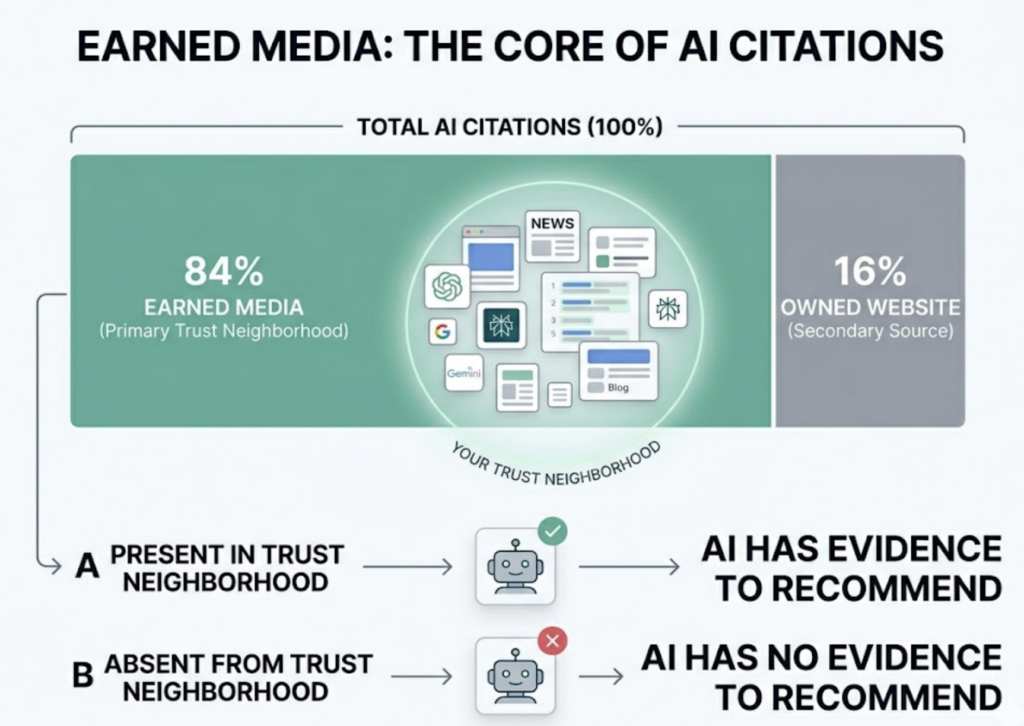
Look for two patterns. First, “mentioned but not cited” queries: the AI knows your brand exists but doesn’t link to you, which signals a source gap. Second, competitor-dominant sources: domains where competitors are cited heavily but your brand isn’t mentioned at all.
Step 5: Run a Quick Technical Health Check (5 min)
Even strong content won’t appear in AI responses if the technical foundation blocks it. Check three things:
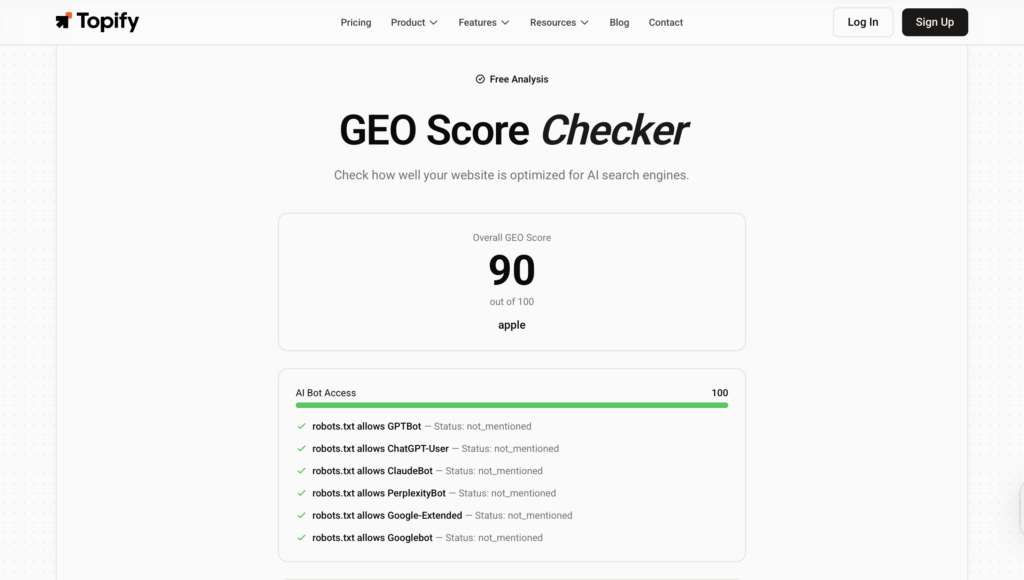
Your robots.txt file should allow access to GPTBot, OAI-Searchbot, Google-Extended, and PerplexityBot. If any of these are blocked, your content is invisible to that AI platform’s retrieval layer.
Your page structure should use clear H1 through H3 hierarchy, with paragraphs kept to 40 to 60 words. This is the optimal length for AI extraction. Dense, unstructured pages get passed over.
Consider whether you’ve created an llms.txt file. This is a newer convention that lets brands explicitly tell AI crawlers what their site is about and which pages matter most.
Where Free Methods Hit a Wall
The 30-minute audit gives you a baseline. That’s its value. But it also has hard limits.
Ten to fifteen prompts only scratch the surface. A brand competing in a complex category might need 100 or more prompts to get an accurate picture. Running those manually across three platforms takes hours, not minutes.
The bigger problem is that AI responses aren’t static. Models update, citation patterns shift, and competitor content evolves. A snapshot from today could be irrelevant in three weeks. Research on model drift shows that only around 30% of brands maintain consistent visibility across multiple response generations.
There’s also the accuracy issue. Manual audits rely on human judgment to score sentiment and track positions. Automated systems typically push data accuracy from the 60 to 70% range up to 95% or higher, because they standardize measurement and eliminate subjective scoring.
The bottom line: if you’re running this audit once a quarter and covering fewer than 20 prompts, free methods work. If you need weekly monitoring, competitive benchmarking, or client-facing reports, the manual approach breaks down fast.
When It Makes Sense to Pay for AI Brand Visibility Tools
Three signals tell you it’s time to move beyond manual audits.
Signal 1: You’re tracking more than 20 prompts. Once you cross that threshold, the time cost of manual testing exceeds the value of the data. Employees already spend an average of 4.3 hours per week verifying AI-generated content, at an estimated cost of $14,200 per person per year. Adding manual brand audits on top of that isn’t sustainable.
Signal 2: You need to report AI visibility to stakeholders. Whether it’s a CMO asking for monthly metrics or clients expecting competitive intelligence, you need standardized, repeatable data. AI-driven audit platforms generate reports 70 to 90% faster than manual methods.
Signal 3: Competitors are already monitoring their AI presence. If your competitors are using tools to track and optimize their AI visibility while you’re still hand-checking ChatGPT responses, the gap will only widen.
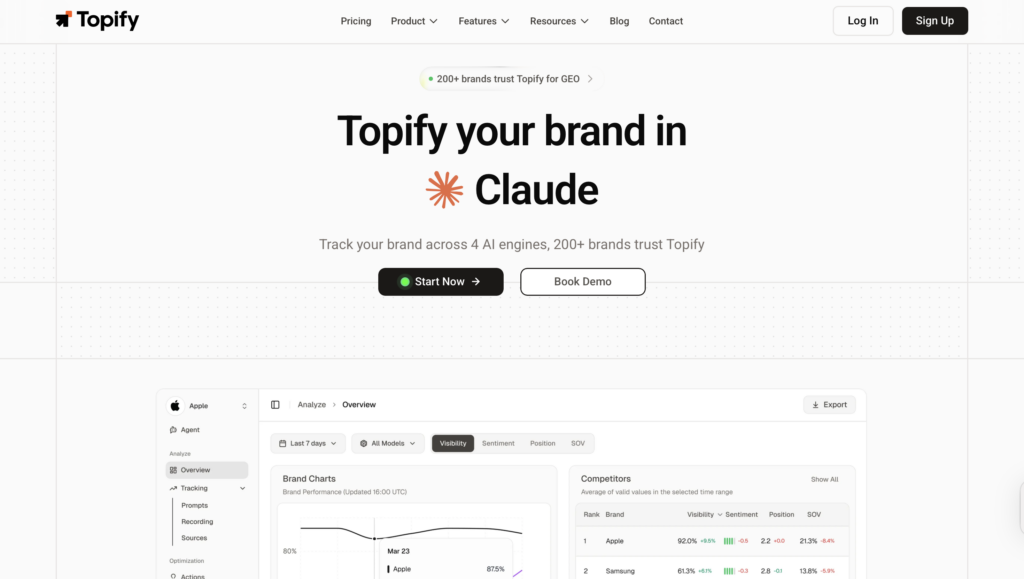
For teams that hit these triggers, Topify tends to stand out by combining visibility, sentiment, position, competitor benchmarking, and source analysis into a single platform. In practice, this means you can track your brand across ChatGPT, Perplexity, Gemini, and other AI engines from one dashboard, see exactly which domains AI is citing, and spot visibility drops before they become a pattern.
Topify’s competitor monitoring automatically detects rivals in your category and benchmarks your share of model against theirs. The pricing starts at $99 per month, which positions it well below enterprise-only platforms that start at $499 or more.
For teams that want to validate the concept before committing, Topify also offers a free GEO score check that gives you a quick read on your site’s AI search readiness.
Turn Your Audit Into an Ongoing AI Brand Visibility Strategy
An audit is a starting point, not a strategy. The real value comes from turning those initial findings into a recurring workflow.
Set a monthly cadence for re-running your core prompt library. Track three metrics over time: share of model (the percentage of category queries where your brand appears), net sentiment score (positive mentions minus negative mentions), and citation rate (how often AI links to your content versus just mentioning your name).
If your citation rate is low but your mention rate is high, AI knows you exist but doesn’t trust your content enough to cite it. That’s a signal to invest in third-party coverage: industry media, review platforms, expert roundups, and community discussions. Princeton’s GEO research found that content citing authoritative sources saw a 40% visibility lift, and adding statistical data points boosted it by 37%.
For brands ready to move from manual tracking to automated monitoring, Topify’s one-click execution feature lets you define your goals in plain language and deploy a monitoring strategy without building manual workflows. The system continuously surfaces new high-value prompts as AI recommendations evolve.
Conclusion
The 30-minute audit won’t solve your AI brand visibility problem. But it will show you exactly where the problem is: which prompts you’re missing from, which platforms describe you inaccurately, and which competitor is occupying the position you should hold.
Start with the free method. Build your prompt library, run cross-platform tests, and score what you find. When you hit the ceiling, whether it’s prompt volume, reporting needs, or competitive pressure, move to a platform that can scale the process. The brands that win in AI search are the ones that stopped guessing and started measuring.
FAQ
Q: What is an AI brand visibility audit?
A: It’s a structured process for checking how AI platforms like ChatGPT, Perplexity, and Gemini mention, describe, and cite your brand. Unlike a traditional SEO audit that focuses on search rankings, an AI visibility audit measures whether your brand appears in AI-generated answers, how it’s positioned relative to competitors, and whether the AI’s description matches your actual brand messaging.
Q: How often should I audit my brand’s AI visibility?
A: At minimum, once a month. AI models update frequently, and citation patterns can shift in weeks. Brands in competitive categories or those actively running content campaigns should consider weekly monitoring, ideally through an automated tool that flags changes in real time.
Q: Can I track AI brand visibility for free?
A: Yes, for a basic audit. The 30-minute manual method in this article covers the essentials. But free methods don’t scale beyond 15 to 20 prompts, can’t provide historical trend data, and rely on subjective scoring. For ongoing monitoring, tools like Topify offer structured tracking starting at $99 per month.
Q: What’s the difference between an SEO audit and an AI visibility audit?
A: An SEO audit evaluates your website’s performance in traditional search engine rankings, focusing on factors like backlinks, page speed, and keyword positioning. An AI visibility audit evaluates how AI systems synthesize and present your brand in their responses. The two can produce very different results. A page ranking well on Google may never appear in AI-generated answers, and vice versa.
Leave a Reply