Your domain authority is 70. Your keyword rankings are solid. Your SEO dashboard looks healthy by every traditional metric. Then someone asks Perplexity, “What’s the best tool for [your category]?” and your brand doesn’t appear anywhere in the answer.
That gap between Google rankings and AI search recommendations is where revenue quietly disappears. ChatGPT referral traffic converts at 15.9%, nine times the baseline for traditional Google organic. When your brand is absent from those answers, you’re not losing impressions. You’re losing pre-qualified buyers.
The good news: you can map exactly where you stand across AI search engines in 30 minutes. Here’s how.
What AI Visibility Tracking Actually Measures (and What SEO Tools Miss)
AI visibility tracking is the practice of measuring how often, how prominently, and how accurately a brand appears in the outputs of generative models like ChatGPT, Perplexity, Gemini, and Google AI Overviews.
That might sound similar to traditional rank tracking, but the mechanics are fundamentally different. In traditional search, visibility is a function of domain authority and keyword relevance. In generative search, visibility depends on what researchers call “entity clarity” and “citation authority.” A brand can hold the #1 Google position for a high-volume keyword and still be completely absent from a ChatGPT response for the same category query.
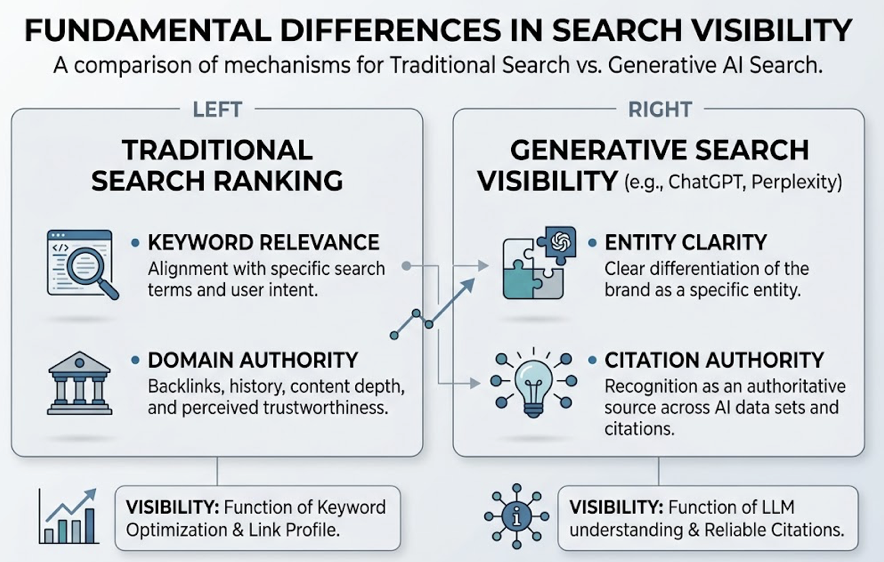
The disconnect happens because generative engines use Retrieval-Augmented Generation (RAG) to prioritize information that shows cross-platform consensus and semantic density, not traditional ranking signals.
Here’s what a professional AI visibility tracking framework actually measures:
| Metric | What It Tells You |
|---|---|
| Brand Presence | Percentage of category-relevant prompts where your brand is mentioned |
| Citation Share | How often AI models link to your owned or earned media |
| Sentiment Polarity | The evaluative tone the AI uses when describing your brand |
| Position Prominence | Where your brand appears in the answer (first recommended vs. buried) |
| Narrative Accuracy | Whether the AI’s description matches your actual features and pricing |
Tools like Google Analytics, Ahrefs, and Semrush were built to track clicks and link-based authority. They’re blind to the internal narrative logic of an LLM. While organic rankings influence what a generative engine might “see,” they don’t dictate what the engine will “say.”
That’s the gap Topify was built to close, providing cross-platform tracking of brand mentions, citation patterns, sentiment, and positioning across every major AI engine.
Why Most Brands Fail Their First AI Visibility Audit
Before walking through the audit framework, it’s worth understanding why most initial attempts produce misleading results. Three failure patterns show up consistently.
Treating LLMs like search engines. Generative models are probabilistic, not deterministic. The same prompt can produce different answers for users in London versus San Francisco, and even the same user can get different results across sessions. Searching a couple of prompts on ChatGPT and treating those results as representative is like polling two people and calling it a survey.
A professional audit needs a multi-sample methodology: running prompts through multiple geographic nodes to capture a statistically meaningful baseline.
Platform myopia. Most brands check ChatGPT and stop there. Research shows that only 11% of cited domains are shared across ChatGPT, Perplexity, Gemini, and Google AI Overviews. Dominance on one platform guarantees nothing on another.
Ego-centric tracking. Auditing your brand in isolation, without benchmarking against competitors, misses the most actionable signal. In the generative era, AI visibility is a zero-sum game. If a model recommends three competitors and excludes you, that’s a definitive signal of an authority gap in the model’s retrieval cache.
The 30-Minute AI Visibility Audit: Step by Step
This framework is designed to be repeatable. Run it monthly or trigger it after major product launches, PR campaigns, or known AI model updates. Here’s the time breakdown: 5 + 10 + 10 + 5 minutes.
Step 1: Define Your Audit Scope, 5 Minutes
The foundation of any AI visibility audit is the prompt library. Select 3 to 5 core “category prompts” that reflect how a prospective customer would actually search for a solution.
Tag each prompt by intent: Informational (“What is [category]?”), Commercial (“Best [category] for small business?”), or Comparison (“[Brand] vs [Competitor]”). Then define 3 to 5 direct competitors as your primary tracking entities.
Platform selection matters. Your audit should cover at least ChatGPT, Perplexity, Gemini, and Google AI Overviews. Zero-click rates tell the story of where users actually get their answers: Perplexity at 93%, Google AI Mode at 88%, ChatGPT Search at 82%. Skipping any of these leaves a blind spot.
Step 2: Check Your AI Visibility Across Platforms, 10 Minutes
Run your prompt set across each platform and document where your brand falls into one of four categories:
- Directly Recommended: Named as a top-tier solution.
- Mentioned: Included in the narrative but not as a primary pick.
- Cited: Used as a reference source with a link.
- Absent: Completely missing from the conversation.
Doing this manually for 5 prompts across 4 platforms means reviewing 20 responses and cataloging every brand mention. It’s possible for a limited scope, but it doesn’t scale.
Topify’s Visibility Tracking automates this entire step. It monitors brand mentions across ChatGPT, Gemini, Perplexity, DeepSeek, and other major AI platforms, scoring each appearance across seven key metrics: visibility, sentiment, position, volume, mentions, intent, and CVR. What takes 10 minutes manually takes seconds with the right tooling.
One data point worth noting: content updated within the last three months is roughly twice as likely to be cited by retrieval-augmented AI engines like Perplexity. If your audit reveals low visibility, freshness could be the first variable to investigate.
Step 3: Analyze Sentiment and Positioning, 10 Minutes
Showing up is only half the story. What the AI says about your brand matters just as much.
In this step, examine three things. First, identify the specific themes the AI associates with your brand. Are you described as “innovative but expensive”? “Reliable but legacy”? These sentiment drivers directly shape how potential buyers perceive you before they ever visit your site.
Second, benchmark your sentiment against competitors. If a rival’s sentiment score is consistently higher across prompts, that’s a content gap, not a branding problem.
Third, check for hallucinations. Across major models, hallucination rates range from 15% to 52% depending on the model and query type. These errors fall into categories that directly hurt conversion: fabricated features, omitted differentiators, outdated pricing, and misattributed capabilities.
Topify’s Sentiment Analysis provides daily breakdowns of how each AI platform characterizes your brand, with a 0-to-100 sentiment score tracked over time. Its Competitor Monitoring feature detects every brand the AI mentions alongside yours, comparing visibility, sentiment, and position side by side.
Step 4: Identify Citation Sources, 5 Minutes
The final step is reverse-engineering the AI’s “trust graph.” Which third-party sources is the AI citing when it forms opinions about your category?
This matters because third-party sources are cited 6.5 times more often than brand-owned pages in AI answers. Earned media accounts for roughly 48% of citations, while your own blog contributes around 23%. If a competitor has coverage on Gartner, Forbes, or a top industry subreddit and you don’t, the AI will naturally treat them as more authoritative.
Reddit alone accounts for approximately 21% of citations in Google AI summaries. Brands that ignore community platforms are forfeiting their authority to the most vocal users on the internet.
Topify’s Source Analysis feature maps exactly which domains and URLs each AI platform cites for your category. You can see at a glance whether your brand’s owned content is in the citation mix, or whether third-party sources are shaping the narrative without your input.
div data-topify-widget=”report-generator”>
Leave a Reply