
A family in Denver typed into ChatGPT: “Which moving companies are trustworthy for a cross-state move with fragile furniture?” The AI listed five names. Your company, with 15 years of service, an A+ BBB rating, and thousands of completed moves, wasn’t mentioned. The problem isn’t your track record. It’s how AI feels about your brand.
You can see exactly what AI thinks of you right now. Topify‘s Brand Sentiment Checker analyzes how AI models perceive your moving company, surfaces the specific strengths and weaknesses they associate with your brand, and gives you an overall sentiment score.
✅ Free ⚡ Full sentiment breakdown in seconds 🔒 No signup required
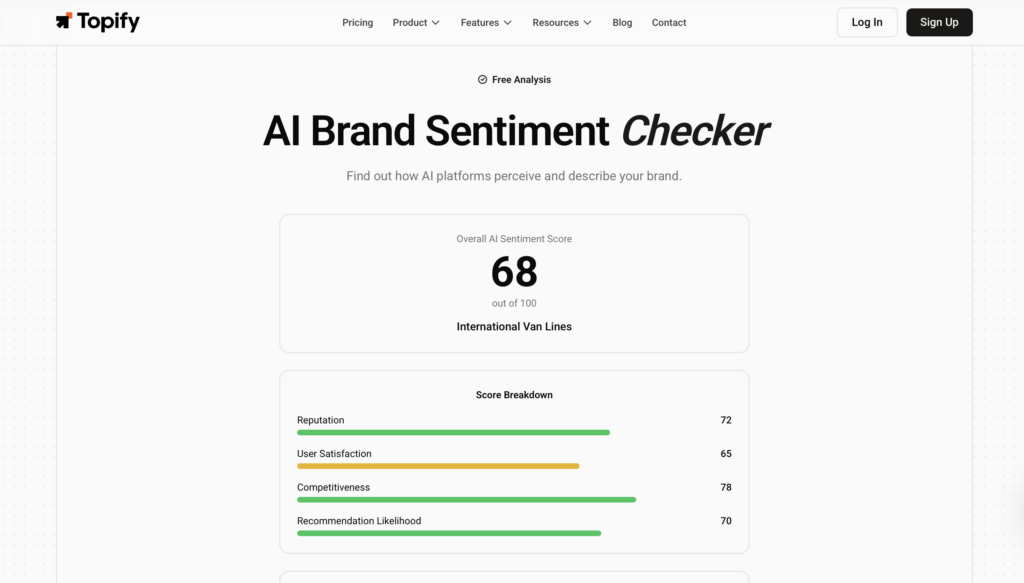
What the Brand Sentiment Checker Reveals About Your Moving Company
The moving industry runs on trust. People hand over everything they own to strangers, and AI search platforms know this. When someone asks “best movers near me,” AI doesn’t just pull a list. It evaluates how it feels about each brand based on the sentiment signals it has absorbed from across the web.
Here’s what the Brand Sentiment Checker actually measures.
The Sentiment Dimensions That Decide If AI Recommends Your Mover
Each dimension maps to a specific trust concern that moving customers have.
| Sentiment Dimension | What It Measures | What It Means for Moving Companies |
|---|---|---|
| Overall Sentiment Score | AI’s net positive/negative impression of your brand | Below neutral: AI actively steers customers away from you |
| Strengths Identified | Positive attributes AI associates with your company | Missing “reliable,” “on-time,” or “careful with belongings” = AI won’t recommend you for high-value moves |
| Weaknesses Flagged | Negative attributes or concerns AI highlights | If “hidden fees” or “damaged items” appears here, it overrides years of positive service |
| Competitive Positioning | How your sentiment compares to category norms | Neutral isn’t enough. AI recommends brands with clearly positive sentiment signals |
A moving company could have a 4.6 Google rating but still show a weak sentiment score in AI. That happens when a small cluster of detailed negative reviews contains keywords AI weighs heavily, like “broken antiques” or “no-show on moving day.” The Sentiment Checker makes this mismatch visible.
Three Scenarios Where Movers Get Surprised by Their AI Sentiment
Scenario 1: The “Fixed It Two Years Ago” Problem. Your company had a rough summer in 2023 with a few high-profile complaints. You’ve since overhauled your crew training and added real-time GPS tracking. But AI still describes your brand with caution language pulled from those old reviews. The Sentiment Checker shows you exactly which negative signals are still active in AI’s memory.
Scenario 2: The “Great Service, Zero Signal” Gap. You have hundreds of happy customers, but most of them never left a review. Your sentiment isn’t negative. It’s nearly nonexistent. When AI can’t find enough positive signals, it defaults to recommending brands with louder, more consistent sentiment trails.
Scenario 3: The “Wrong Category” Mislabel. AI thinks you’re a local-only mover when you actually cover 12 states. Or it associates your brand with “budget moves” when you specialize in white-glove relocation. These category mismatches show up in the strengths and weaknesses breakdown, and they directly affect which prompts trigger your brand as a recommendation.
How to Run Your Moving Brand Through the Checker
The process takes under a minute.
- Go to the Brand Sentiment Checker and enter your moving company name or domain.
- Review your overall sentiment score, the specific strengths AI associates with you, and the weaknesses it flags.
- Compare the AI’s perception against your actual service quality. The gaps you find are your optimization targets.
No account needed. No credit card. You’ll have a clear picture of how AI models describe your moving company to potential customers.
The AI Prompts Your Future Customers Are Already Typing
75% of consumers say they’re using AI search tools more than they did a year ago. In the moving industry, that shift is accelerating. 21% of Americans plan to move in 2026, the highest rate in four years, and over 4 in 10 planned movers aged 45-65 say they’ll use AI to research their options.
Here’s what those AI conversations actually look like.
| AI Prompt Example | Platform | Search Intent | What It Reveals About Your Brand |
|---|---|---|---|
| “Best moving companies in [city] with good reviews” | ChatGPT | Purchase decision | Whether AI recommends you at all in your service area |
| “Is [brand] a reliable mover or a scam?” | Perplexity | Trust verification | The exact sentiment AI attaches to your brand name |
| “Most affordable long-distance movers for a 2-bedroom” | Gemini | Price comparison | Whether AI positions you as budget, mid-range, or premium |
| “Moving company comparison: who handles fragile items best?” | ChatGPT | Specialty matching | Whether your specialties are even in AI’s knowledge base |
| “What should I look for when hiring a mover?” | Google AI Overview | Educational research | Whether your brand appears as an example of best practices |
Every one of these prompts triggers AI’s sentiment evaluation. If your brand’s sentiment profile is weak, neutral, or outdated, you don’t show up. It’s that simple.
What’s Actually Driving the Sentiment Gap for Moving Companies
AI’s Perception of Your Brand Doesn’t Match Your Actual Service Quality
This is the most common disconnect in the moving industry. 81% of consumers use Google reviews when choosing a local service provider. AI models pull from these same sources, plus Reddit, Trustpilot, BBB complaints, and industry forums. But here’s the thing: AI doesn’t just count stars. It reads the text of reviews and extracts sentiment keywords.
A moving company with a 4.5-star average might still trigger negative sentiment in AI if three detailed one-star reviews mention “damaged items” or “hidden charges.” AI weighs specificity. A vague five-star review saying “great service” carries less sentiment signal than a detailed one-star review describing exactly what went wrong.
The Brand Sentiment Checker surfaces this imbalance. You can see the exact strengths and weaknesses AI has extracted, and compare them to what your business actually delivers today.
Regional Movers Are Invisible Because Their Sentiment Signals Are Scattered
73% of users trust AI recommendations over traditional search results. But when someone in Phoenix asks ChatGPT for the best movers, AI tends to recommend national brands. Not because they’re better, but because their sentiment signals are concentrated and consistent across platforms.
Regional and local movers face a structural problem. Your reviews might be spread across Google, Yelp, Angi, the BBB, and a handful of local directories. Individually, each platform has a thin signal. AI models struggle to aggregate these scattered data points into a coherent brand sentiment profile.
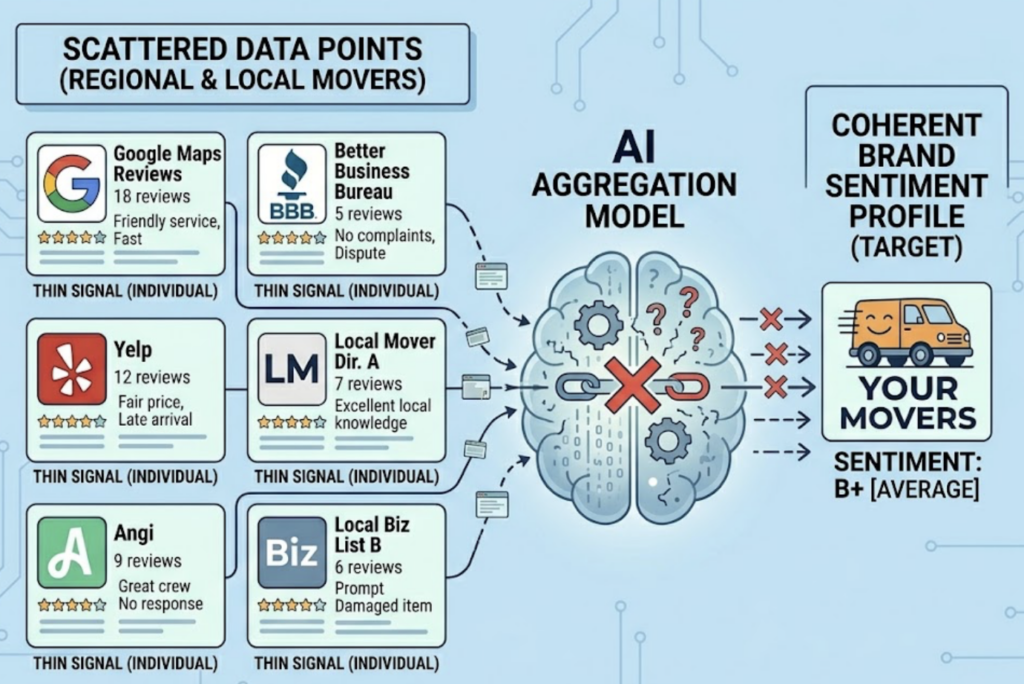
The result: a regional mover with 500 positive reviews across six platforms can lose to a national chain with 200 reviews concentrated on two major platforms. Volume matters, but signal concentration matters more for AI.
This isn’t a quality problem. It’s a visibility architecture problem. And it starts with knowing where your sentiment signals actually live, which the Brand Sentiment Checker maps for you.
Seasonal Spikes Create Sentiment Damage That Lingers in AI’s Memory
Moving is one of the most seasonal industries in the U.S. Summer months account for a disproportionate share of total moves, and they also produce the most complaints. Crews are stretched thin, timelines slip, and customer frustration peaks.
Here’s the issue: AI models don’t distinguish between a complaint filed during your busiest week and one filed during a normal month. A wave of negative reviews in July can shift your overall AI sentiment score downward, and that score may persist well into the fall and winter when your service quality returns to normal.
Worse, you might not know it happened. Without monitoring your AI sentiment over time, seasonal reputation damage compounds silently. By the time booking season starts again, AI has already deprioritized your brand based on last summer’s complaints.
This is why a one-time sentiment check is valuable but not sufficient. The seasonal pattern in moving means your AI reputation needs ongoing attention.
From a One-Time Sentiment Check to Ongoing AI Reputation Monitoring
Your Brand Sentiment Checker results show you where things stand right now. But AI models update continuously. New reviews get absorbed, old signals decay, and competitor sentiment profiles shift. A strong score today doesn’t guarantee the same score next quarter.
Topify‘s Comprehensive GEO Analytics dashboard picks up where the free tool leaves off. It tracks your sentiment, visibility, and citation trends continuously across ChatGPT, Perplexity, Gemini, and Google AI Overviews. You’ll see how your sentiment score moves over time, get alerts when negative signals appear, and receive specific recommendations for what to address.
Here’s how the free check compares to the full platform:
| Capability | Free Brand Sentiment Checker | Topify Platform |
|---|---|---|
| Check frequency | One-time snapshot | Continuous daily/weekly monitoring |
| AI platforms covered | Aggregated sentiment score | Per-platform sentiment breakdown (ChatGPT, Perplexity, Gemini, AI Overviews) |
| Historical trends | None | Full sentiment trend history with alerts |
| Competitor sentiment tracking | Not included | Real-time competitor benchmarking |
| Seasonal pattern detection | Not available | Tracks sentiment shifts tied to business cycles |
| Action recommendations | General insights | Specific, data-driven optimization steps |
Every plan starts with a 7-day free trial, no credit card required. The Starter plan begins at $99/month, covering 50 prompts per day and continuous monitoring for one brand.
Conclusion
The moving industry depends on trust more than almost any other service category. When 73% of consumers trust AI recommendations over traditional search, the question isn’t whether AI search matters for your business. It’s whether AI’s description of your brand actually reflects what you deliver.
Start with the free Brand Sentiment Checker. In 60 seconds, you’ll know exactly how AI perceives your moving company, which strengths it recognizes, and which weaknesses it’s flagging to your potential customers. From there, you can decide whether a one-time fix or ongoing monitoring fits your growth plan.
While you’re assessing your brand sentiment, a few other free checks can round out the picture. Topify’s GEO Score Checker evaluates whether AI crawlers can actually access and parse your site. The AI Visibility Report shows how often your brand gets mentioned across major AI platforms. And the Competitor Analysis tool reveals which moving companies AI currently favors in your category.
FAQ
Is the Brand Sentiment Checker free? Do I need to sign up?
Yes, it’s completely free with no signup required. Enter your brand name or domain at topify.ai/tools/brand-sentiment-checker and get your sentiment breakdown in under 60 seconds.
What’s the difference between the free tool and the Topify paid platform?
The free tool gives you a one-time sentiment snapshot. The Topify platform provides continuous monitoring, historical trends, competitor benchmarking, and actionable recommendations. Plans start at $99/month with a 7-day free trial.
How often should moving companies check their AI sentiment?
At minimum, check before and after peak moving season (May through September). Ideally, use continuous monitoring since AI models absorb new review data on a rolling basis, and a single wave of complaints can shift your sentiment score without warning.
Can a moving company with mostly positive Google reviews still have weak AI sentiment?
Absolutely. AI models weigh detailed, keyword-rich negative reviews more heavily than brief positive ones. A company with a 4.7 Google rating can still show weak AI sentiment if a handful of negative reviews mention specific issues like “damaged furniture” or “late arrival.” The Brand Sentiment Checker reveals these hidden gaps.
Leave a Reply