Category: ai-visibility-tool

  • AI Visibility Tools for Senior Care

    AI Visibility Tools for Senior Care

    A daughter in Dallas typed into ChatGPT: “What’s the most trusted memory care facility near me for a parent with early-stage Alzheimer’s?” The AI returned five recommendations. Her mother’s actual care community, rated 4.8 stars with 15 years of operation, wasn’t on the list. The problem isn’t the quality of care. It’s that AI doesn’t recognize the brand as an authority.

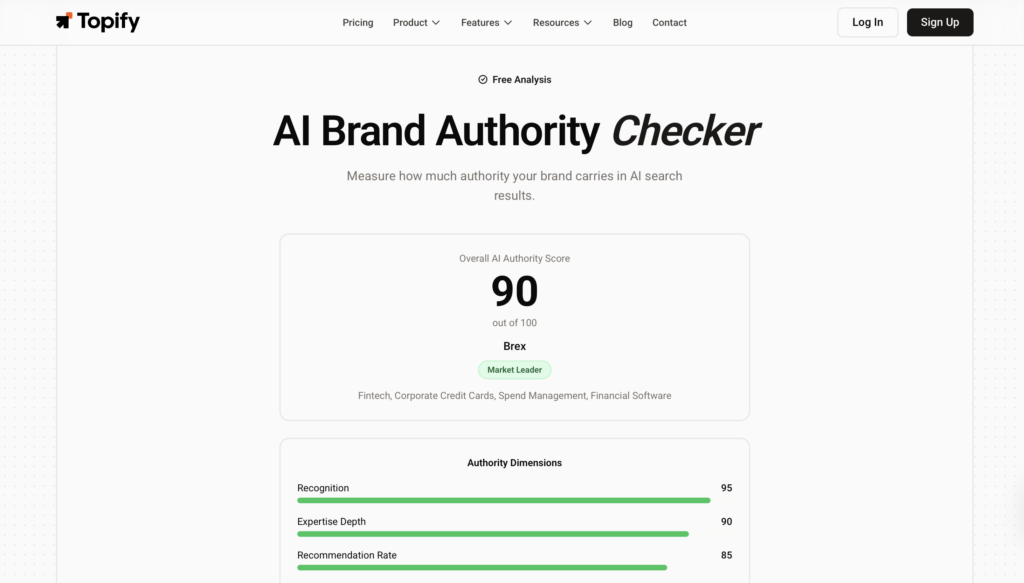
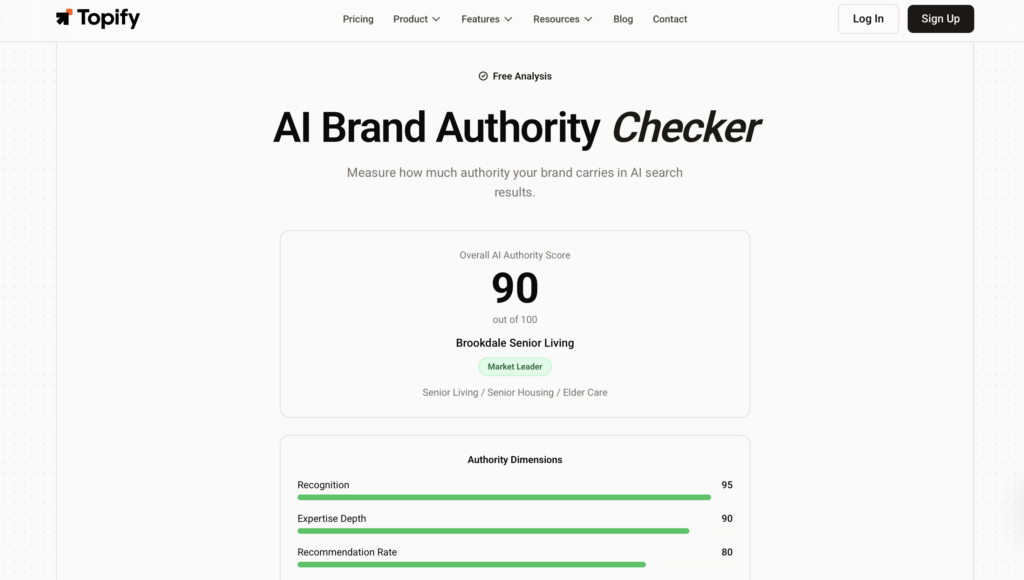
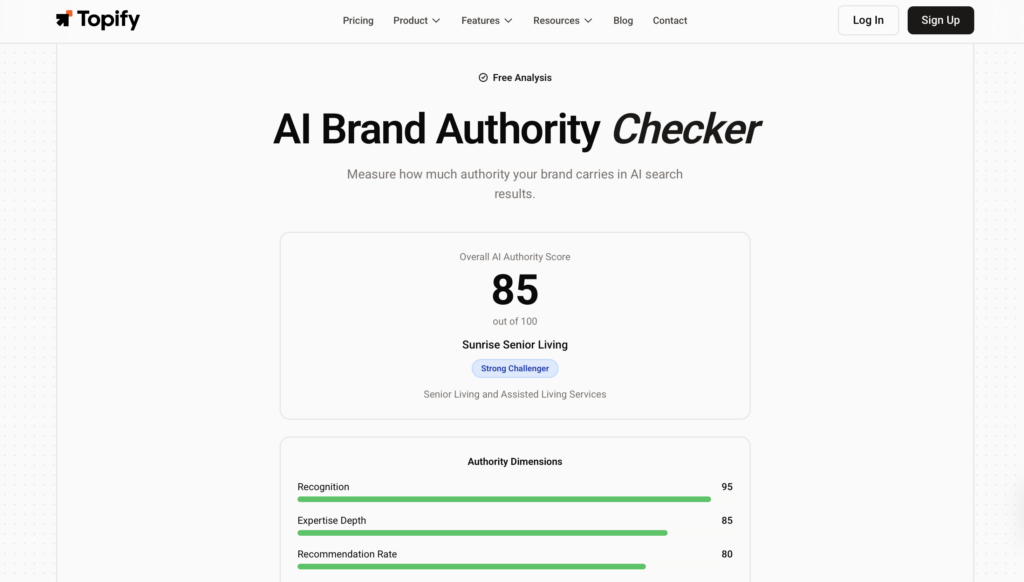
    There’s a way to see exactly where the disconnect is. Topify‘s Brand Authority Checker scores how AI models perceive your senior care brand’s authority across four dimensions that directly affect whether families find you in AI search results.

    ✅ Free ⚡ Results in 60 seconds 🔒 No signup required
    The Four Authority Scores That Determine If AI Trusts Your Senior Care Brand

    The Brand Authority Checker doesn’t give you a single pass/fail grade. It breaks AI’s perception of your brand into four measurable dimensions, each one tied to a specific challenge senior care providers face in AI search.

    What Each Score Means for Senior Care Providers

    MetricWhat It MeasuresWhat It Means for Senior Care
    Recognition (0-100)How often AI identifies your brand in your categoryBelow 40: AI doesn’t associate you with senior care, assisted living, or memory care
    Expertise Depth (0-100)How well AI understands your capabilitiesBelow 50: AI may describe your care specialties incorrectly or omit key services like telehealth integration
    Recommendation Rate (0-100)How often AI recommends you vs. alternativesBelow 30: families never see your name when asking “best senior care near me”
    Trust Signals (0-100)External validation AI detects (media, reviews, certifications)Below 40: AI can’t find enough third-party evidence to recommend you for a high-stakes care decision

    Here’s the thing: a senior living community with a Recognition score of 80 but a Trust Signals score of 25 has a very specific problem. AI knows the brand exists but doesn’t trust it enough to recommend it for something as high-stakes as elder care. That’s a gap you can close once you know it’s there.

    Three Scenarios Senior Care Brands Discover After Running a Check

    Scenario 1: The invisible veteran. Your community has been operating for two decades with strong local referrals. But your Recognition score is 28. AI simply doesn’t know you exist in the senior care category because your digital footprint is thin. The fix starts with structured data, not more brochures.

    Scenario 2: The misrepresented specialist. Your Expertise Depth score is 35, even though you offer specialized memory care programs. AI describes you as a “general assisted living facility” because your website content doesn’t communicate your specialties in a way AI can parse. Your clinical differentiators aren’t reaching the models.

    Scenario 3: The trusted but unrecommended. Your Trust Signals score is high at 75, but your Recommendation Rate sits at 20. AI respects your brand but recommends competitors more often. This typically means competitors have stronger content structures, more frequent third-party citations, or better AI-crawlable site architecture.

    How to Run Your Brand Authority Check

    Go to Brand Authority Checker, enter your senior care brand name or domain, and get your four-dimensional authority breakdown in under 60 seconds. No signup, no credit card. You’ll see exactly where AI ranks your authority and where the gaps are.

    The results page also shows how AI positions you relative to your category. If your scores are low in one dimension but strong in others, you have a targeted problem with a targeted fix.

    Senior Care Prompts AI Already Answers Without You

    Families aren’t typing two-word Google queries anymore. They’re asking AI detailed, conversational questions, and AI is giving them direct answers with specific brand recommendations. If your senior care brand isn’t part of those answers, families move forward without ever knowing you exist.

    Here are the types of prompts AI is already fielding in the senior care space:

    AI Prompt ExamplePlatformSearch IntentWhat It Reveals
    “Best memory care facilities near me with specialized Alzheimer’s programs”ChatGPTPurchase decisionWhether AI recommends your community for specialized care
    “Is home care better than assisted living for my 80-year-old mother?”PerplexityCare path evaluationWhether AI references your brand when comparing care models
    “Most trusted senior living communities in [city] with transparent pricing”GeminiTrust verificationWhether AI associates your brand with transparency and credibility
    “What should I look for when choosing assisted living for a parent with diabetes?”Google AI OverviewEducational researchWhether your content gets cited as an authoritative guide
    “Senior care cost comparison: assisted living vs. memory care 2026”ChatGPTBudget planningWhether AI includes your pricing and value proposition in the comparison

    89% of medical decision-makers now trust AI-generated healthcare information when selecting senior living and care providers. And 75% of these decisions are made by adult children, not the seniors themselves. The prompts above reflect how those adult children actually search. They’re specific. They’re conversational. And they expect AI to filter options for them.

    What the Data Tells Senior Care Marketers About AI Trust

    The People Making Senior Care Decisions Have Already Gone AI-First

    The typical senior care decision-maker isn’t a 75-year-old browsing Google. It’s a 45-to-60-year-old adult child juggling work, their own family, and the emotional weight of choosing care for a parent. This demographic is among the most active users of AI search tools.

    Roughly 50% of consumers across all demographics, including boomers, now intentionally use AI-powered search for purchasing decisions. For the adult children making 75% of senior care choices, that number skews even higher. They’re asking ChatGPT for recommendations during lunch breaks. They’re using Perplexity to compare memory care options at 11 PM after the kids are in bed.

    If your brand doesn’t appear in those AI-generated answers, you’re not even a candidate. The tour never gets booked. The phone never rings. And you won’t know why, because your traditional marketing metrics, website traffic, Google rankings, won’t show the gap.

    You can check right now whether AI considers your brand authoritative enough to recommend. Run your brand through the Brand Authority Checker and look at the Recommendation Rate score. That number tells you how often AI would suggest your community when a family member asks.

    Most Senior Care Brands Were Built for 2019 Google. AI Needs Something Different.

    Here’s the uncomfortable truth for senior care operators: the digital infrastructure most communities rely on was designed for a search environment that no longer dominates. Static service pages, PDF brochures, basic Google Business Profiles, and a handful of blog posts written for keyword rankings. That worked when Google was the only front door.
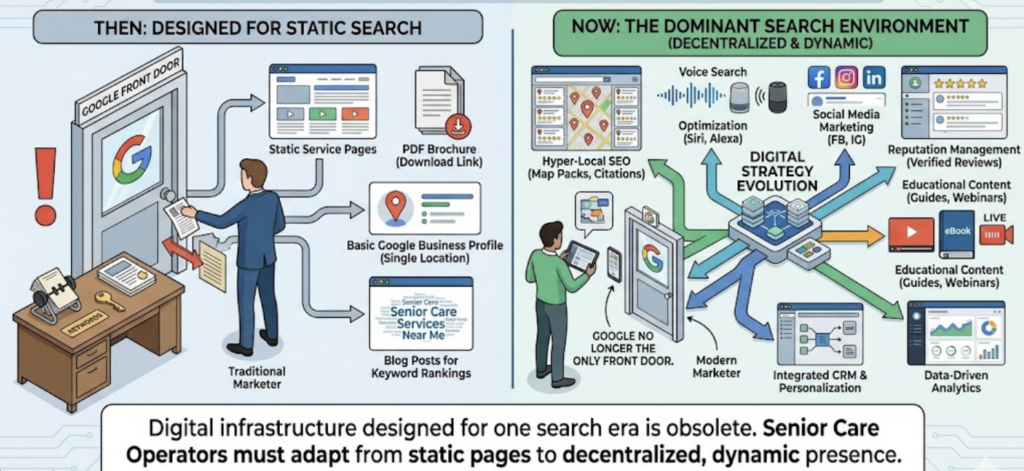
    AI search engines need different signals. They parse structured data, evaluate content depth, check for third-party citations, and assess whether AI crawlers (GPTBot, ClaudeBot, PerplexityBot) can even access your site. Many senior care websites block these crawlers entirely through outdated robots.txt configurations, making the brand completely invisible to AI platforms.

    The technical checklist for AI readiness looks different from traditional SEO:

    AI Readiness SignalWhat Most Senior Care Sites HaveWhat AI Search Requires
    Content structureService pages with marketing copyFAQ-rich, conversational content AI can extract and cite
    Structured dataBasic or noneSchema markup for healthcare providers, services, pricing
    AI crawler accessOften blocked by defaultExplicit GPTBot, ClaudeBot, PerplexityBot access in robots.txt
    Third-party signalsA few Google reviewsCitations across medical directories, media, review platforms
    Content freshnessUpdated annually or lessRegular updates reflecting current services, staff, pricing

    This isn’t about rebuilding your website from scratch. It’s about auditing the specific gaps that keep AI from recognizing your brand. And that audit starts with measuring where you stand today.

    One Authority Score Is a Snapshot. Tracking It Is the Strategy.

    Your Brand Authority Checker results show you where AI positions your senior care brand right now. But AI models update their training data, adjust ranking signals, and shift recommendations on a rolling basis. A Recognition score of 65 today could drop to 40 next quarter if a competitor publishes better-structured content or earns a major media citation.

    Topify‘s platform picks up where the free tool leaves off. The Comprehensive GEO Analytics dashboard tracks your authority, sentiment, and visibility scores continuously across ChatGPT, Perplexity, Gemini, and Google AI Overviews. You’ll see trend lines, get alerts when scores shift, and receive specific recommendations for what to fix.

    Here’s how the free check compares to the full platform:

    CapabilityFree Brand Authority CheckerTopify Platform
    Check frequencyOne-time snapshotContinuous daily/weekly monitoring
    AI platforms coveredAggregated scorePer-platform breakdown (ChatGPT, Perplexity, Gemini, AI Overviews)
    Historical trendsNoneFull trend history with alerts
    Competitor trackingNot includedReal-time competitor benchmarking
    Action recommendationsGeneralSpecific, one-click GEO optimization
    Team collaborationNoUnlimited team member seats

    Every plan starts with a 7-day free trial, no credit card required. The Starter plan begins at $99/month.

    Conclusion

    Senior care is one of the highest-trust decisions a family can make, and AI is now a gatekeeper in that process. If AI doesn’t recognize your brand as authoritative, families won’t find you during the research phase that determines their shortlist.

    Start with a single check. Run your brand through the Brand Authority Checker, see your four authority scores, and identify the specific gaps between your care quality and AI’s perception. From there, build a structured plan to close those gaps, or let Topify’s platform track and optimize your AI visibility continuously.

    Other Free Tools to Round Out Your AI Visibility Audit

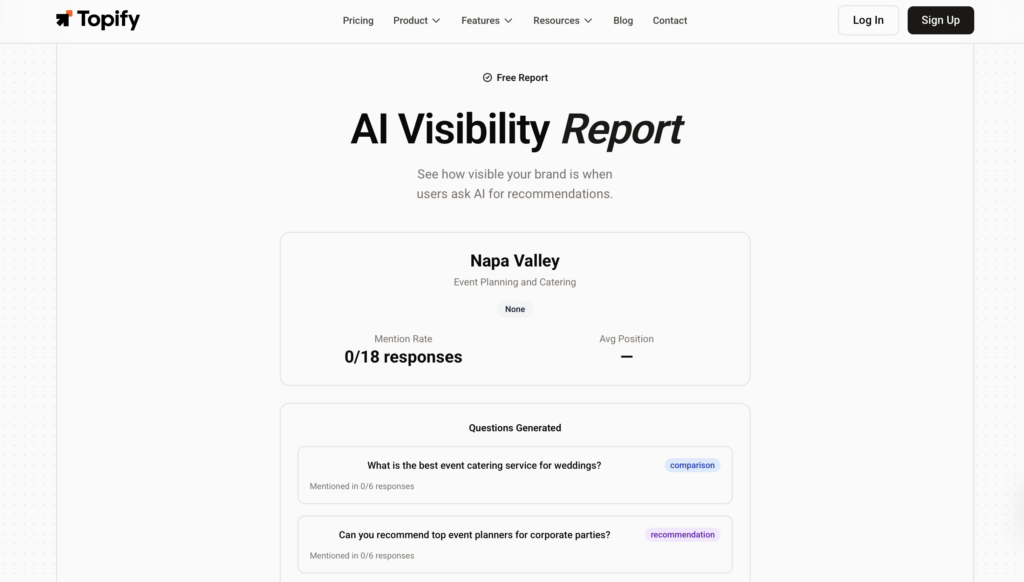
    While you’re assessing your brand authority, a few other free checks can fill in the picture. Topify‘s GEO Score Checkerevaluates whether your site’s technical setup (structured data, AI crawler access, content signals) supports AI visibility. The AI Visibility Report shows how often your brand gets mentioned across major AI platforms and where you rank. And the Knowledge Freshness Checker flags whether AI models are working with outdated information about your services or pricing.

    FAQ

    Is the Brand Authority Checker free? Do I need to create an account? 

    Yes, it’s completely free. No account, no signup, no credit card. Enter your brand name or domain and get your authority scores in under 60 seconds.

    What’s the difference between the free tool and Topify’s paid platform? 

    The free Brand Authority Checker gives you a one-time snapshot of your four authority scores. Topify’s platform provides continuous monitoring across all major AI platforms, historical trend tracking, competitor benchmarking, and actionable optimization recommendations. Plans start at $99/month with a 7-day free trial.

    How often should senior care brands check their AI visibility? 

    AI models update their knowledge and ranking signals regularly. A quarterly check with the free tool is a reasonable minimum. For brands actively optimizing their AI presence, weekly or daily monitoring through a dedicated platform gives you the data to spot drops early and respond before you lose visibility.

    Can a small, single-location senior care community compete with large chains in AI search? 

    Yes. AI doesn’t rank by company size. It ranks by authority signals: structured content, third-party citations, review quality, and content freshness. A single-location community with strong local media coverage, detailed service pages, and consistent reviews can outrank a national chain that relies on generic corporate content.
    Read More

  • AI Visibility Tools for Assisted Living

    AI Visibility Tools for Assisted Living

    Families Ask AI for Care Recommendations. Is Your Community in the Answer?

    A daughter types into ChatGPT at 11 p.m.: “Best assisted living near Portland for a parent with early-stage dementia.” Five communities come back. Yours, with 95% occupancy and a 30-year track record, isn’t one of them. The problem isn’t your care quality. It’s that AI doesn’t recognize your authority.

    There’s a way to find out exactly where the gap is. Topify‘s Brand Authority Checker scores how AI models perceive your community’s trustworthiness, broken down into four dimensions that directly influence whether you get recommended.

    ✅ Free ⚡ Results in 60 seconds 🔒 No signup required

    What the Brand Authority Checker Reveals About Your Community

    The Four Scores That Decide If AI Trusts Your Assisted Living Brand

    The Brand Authority Checker evaluates your community across four distinct dimensions. Each one maps to a specific way AI models decide whether to include you in a recommendation.

    Here’s what they measure and what they mean for assisted living operators:

    MetricWhat It MeasuresWhat It Means for Assisted Living
    Recognition ScoreHow often AI identifies your brand by nameLow score = AI doesn’t know your community exists in your metro area
    Expertise DepthHow well AI understands your services and specializationsLow score = AI may describe you as “general senior living” instead of highlighting your memory care program or rehab services
    Recommendation RateHow frequently AI recommends you when families askLow rate = families touring competitors before they ever hear your name
    Trust SignalsExternal validation AI detects (reviews, citations, media)Weak signals = AI treats your community as unverified, even with decades of operations

    Don’t assume a strong local reputation translates to a strong AI authority profile. AI models weigh structured data, indexed reviews, and third-party citations. A community with 200 recent Google reviews and a well-structured FAQ page can outrank a 30-year operator with thin online signals.

    Three Scenarios Every Assisted Living Operator Should Check For

    Scenario 1: High occupancy, low AI recognition. Your community runs at 90%+ occupancy through referral networks and hospital discharge partnerships. But when you run the Brand Authority Checker, your Recognition Score is below 40. AI simply doesn’t know you exist because your referral-driven model never required strong digital authority signals.

    Scenario 2: Outdated service descriptions in AI answers. You expanded your memory care wing and added a rehab program last year. But AI still describes your community based on a two-year-old profile. Your Expertise Depth score reflects what AI thinks you offer, not what you actually offer. Families get the wrong picture before they ever call.

    Scenario 3: Strong reviews, weak recommendation rate. Your Google rating is 4.6 stars. But your Recommendation Rate is still low. The issue: your reviews sit on one platform, and AI models pull trust signals from multiple sources. A single-channel review strategy doesn’t translate to broad AI authority.

    How to Run Your Community Through the Checker in 60 Seconds

    The process takes three steps:

    1. Go to the Brand Authority Checker and enter your community’s brand name.
    2. Review the four-dimensional authority breakdown. Note which scores fall below 50, since those are the dimensions where AI is most likely to skip your community.
    3. Compare your scores against the category benchmarks the tool provides. If your Recognition Score is high but your Recommendation Rate is low, AI knows you exist but doesn’t trust you enough to suggest you.

    No account needed. No credit card. You’ll have a clear read on your AI authority profile in under a minute.

    The AI Prompts That Decide Where Families Tour First

    Families researching assisted living don’t search the way they used to. Instead of typing “assisted living near me” into Google, they’re asking conversational questions to ChatGPT, Perplexity, and Google’s AI Overviews. And the answers they get shape which communities make the shortlist before a single phone call happens.

    Here are the prompts driving real decisions in this category:

    AI Prompt ExamplePlatformSearch IntentWhat It Reveals About Your Brand
    “Best assisted living for dementia near [city]”ChatGPTCare-specific recommendationWhether AI links your community to specialized memory care
    “Is $7,000/month for assisted living worth it?”PerplexityCost-value evaluationHow AI frames your pricing: justified or expensive
    “Assisted living vs. home care for aging parent”Google AI OverviewCare model comparisonWhether your community appears as a recommended alternative
    “Which assisted living facilities have the best reviews in [area]?”ChatGPTTrust verificationWhether AI sees enough review signals to include you
    “Signs my parent needs assisted living”PerplexityEarly-stage researchWhether your content appears as an educational authority
    “Assisted living with physical therapy programs”GeminiService-specific searchWhether AI understands the depth of your service offerings

    Aline’s 2026 Senior Living Benchmark Report found that older adults initiated more than half of senior living research in 2025. These aren’t just adult children searching on behalf of parents. Seniors themselves are asking AI for guidance. If your community isn’t in the AI answer for the prompts above, you’re invisible to both generations of decision-makers.

    What the Data Says About AI Authority and Assisted Living

    Strong Local Reputations Don’t Guarantee AI Visibility

    Here’s the thing: assisted living communities built on referral networks, hospital partnerships, and local physician relationships often have the weakest AI authority profiles. That’s because AI doesn’t measure reputation the way families and referral partners do.

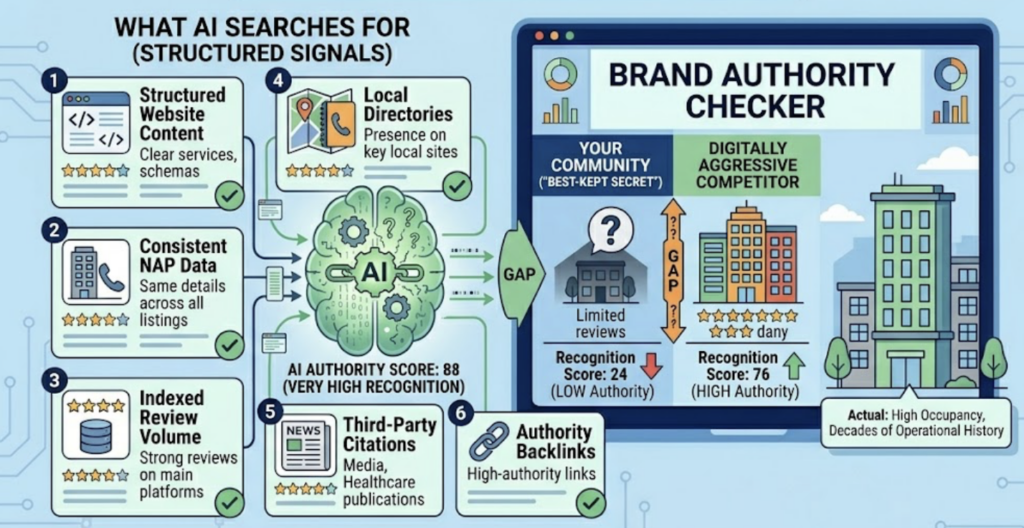
    AI models look for structured content on your website, consistent NAP (name, address, phone) data across directories, review volume on indexed platforms, and third-party citations in media or healthcare publications. A community that’s “the best-kept secret in town” is, to AI, literally a secret. The Brand Authority Checker makes this gap visible. You might discover that your Recognition Score is a fraction of what a newer, digitally aggressive competitor scores, despite your community having twice the occupancy and ten times the operational history.

    Industry data shows that AI tools actively scan public sentiment, review volume, and recency to assess credibility. Communities with steady, timely review responses and strong local reputation signals are more likely to appear in AI-generated recommendations. If you rely on word-of-mouth alone, AI has nothing to scan.

    Crisis-Driven Research Leaves Zero Room for Discovery

    Assisted living decisions often happen under pressure. A parent falls. A cognitive assessment comes back concerning. A hospital discharge coordinator says, “You need to find a community this week.”

    In that moment, the adult child opens ChatGPT and asks for recommendations. They don’t browse 15 websites. They don’t call 10 communities. They trust the AI’s top three to five answers and start scheduling tours.

    Assisted living inquiry-to-move-in conversion rates dropped 10% in 2025, even as independent living conversions jumped 16.7%. One explanation: the families reaching assisted living communities through traditional channels are less pre-qualified than they used to be, because the most motivated families are now following AI recommendations first. If your authority score is low, you’re not on that crisis shortlist. And in this category, there are no second chances.

    Rising Rates Make the Cost-Value Story AI Tells About You Even More Critical

    Assisted living asking rates rose 5.9% year-over-year in 2025, with some operators pushing 8-10% increases in 2026. When a family asks AI “Is assisted living worth $7,000 a month?”, the answer depends on how AI perceives your community’s expertise and trust profile.

    A high authority score means AI frames your rate as a reflection of quality care, specialized programming, and clinical depth. A low authority score means AI either ignores your community entirely or, worse, positions it as one of the “expensive options” without the context that justifies the price. In a market where rates are climbing and families are cost-conscious, the narrative AI builds around your brand directly affects whether a $7,000 inquiry converts into a $7,000 move-in.

    One Snapshot Isn’t Enough: Tracking Authority Over Time

    The Brand Authority Checker gives you a clear baseline. But AI search results shift as models update, new content gets indexed, and competitor signals change. A score you check today could look different in 30 days.

    Topify‘s Comprehensive GEO Analytics platform picks up where the free tool leaves off. It continuously tracks your community’s visibility, authority trends, and sentiment across ChatGPT, Perplexity, Gemini, and Google AI Overviews, all from a single dashboard. For assisted living operators, that means seeing how your authority scores shift after you publish new content, respond to reviews, or update your service pages.

    CapabilityFree Brand Authority CheckerTopify Platform
    Check frequencyOne-time snapshotContinuous daily/weekly monitoring
    AI platforms coveredSingle checkChatGPT + Perplexity + Gemini + AI Overviews
    Historical trendsNoFull trend history with alerts
    Competitor trackingNoReal-time competitor benchmarking
    Actionable next stepsManual interpretationOne-click GEO optimization recommendations
    Team collaborationNoShared dashboards for marketing + admissions teams

    Topify’s platform starts at $99/month with a 7-day free trial and no credit card required. For communities spending thousands on referral partnerships and traditional marketing, adding AI visibility tracking to the mix is a small line item with outsized impact. You can start a free trial and see your full authority trend data within minutes.

    Conclusion

    Assisted living is a trust-first category, and AI is now the first place families go to decide which communities deserve that trust. If your authority profile is weak, you don’t get considered. It’s that simple.

    Start with the Brand Authority Checker to see how AI perceives your community right now. Use the four-score breakdown to identify which dimensions need work. Then, if you need continuous tracking as your content strategy evolves, Topify’s platform keeps you in the loop across every major AI search provider.

    Other free tools worth running alongside the Brand Authority Checker:

    Your AI authority profile is only one piece of the puzzle. The GEO Score Checker evaluates whether AI crawlers can access your site’s content properly, a common issue for communities using older CMS platforms. The AI Visibility Reportshows how often your brand gets mentioned across major AI platforms, giving you a frequency baseline. And the Brand Sentiment Checker reveals how AI describes your community’s strengths and weaknesses, so you can see whether the narrative matches reality.

    FAQ

    Is the Brand Authority Checker free? Do I need to create an account? 

    Yes, it’s completely free with no signup required. Enter your community’s brand name and get your four-dimensional authority score in about 60 seconds.

    What’s the difference between the free tool and Topify’s paid platform? 

    The free Brand Authority Checker provides a one-time snapshot of your AI authority profile. Topify’s platform adds continuous monitoring, historical trend tracking, competitor benchmarking, and optimization recommendations across multiple AI search providers. Plans start at $99/month with a 7-day free trial.

    How often should an assisted living community check its AI visibility? 

    At minimum, after any major change: new service launches, website redesigns, review campaigns, or media coverage. For communities actively investing in content and SEO, monthly checks with the free tool or continuous monitoring through the platform give the most actionable data.

    My community has great reviews on Google. Why would my AI authority score be low? 

    AI models pull trust signals from multiple platforms and sources, not just Google. If your reviews are concentrated on a single platform, your overall authority profile can still be thin. AI also weighs content structure, media citations, and directory consistency. A high Google rating is a good foundation, but it’s not the whole picture.

    Read More

  • AI Visibility Tools for Moving Companies

    AI Visibility Tools for Moving Companies

    A family in Denver typed into ChatGPT: “Which moving companies are trustworthy for a cross-state move with fragile furniture?” The AI listed five names. Your company, with 15 years of service, an A+ BBB rating, and thousands of completed moves, wasn’t mentioned. The problem isn’t your track record. It’s how AI feels about your brand.

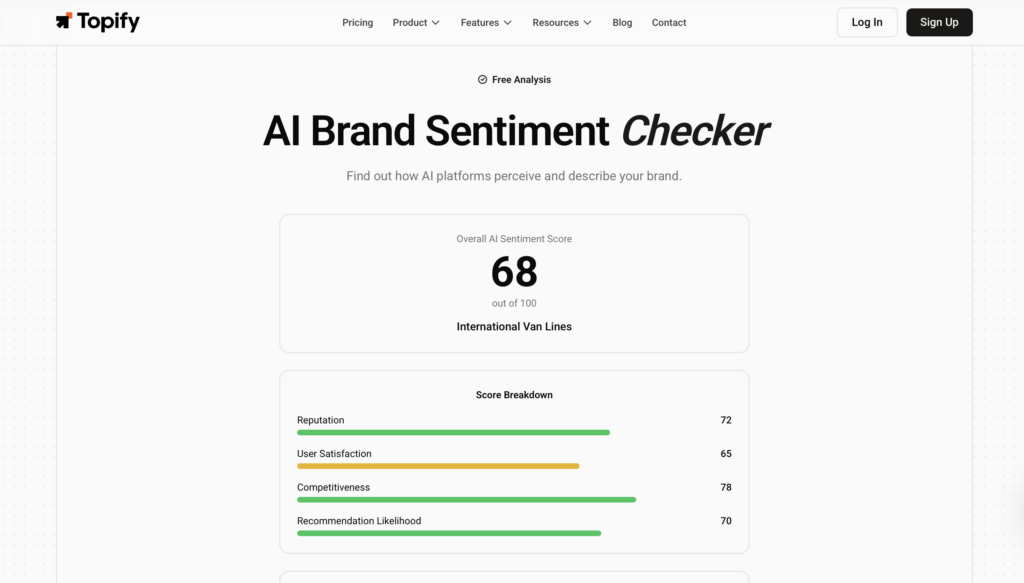
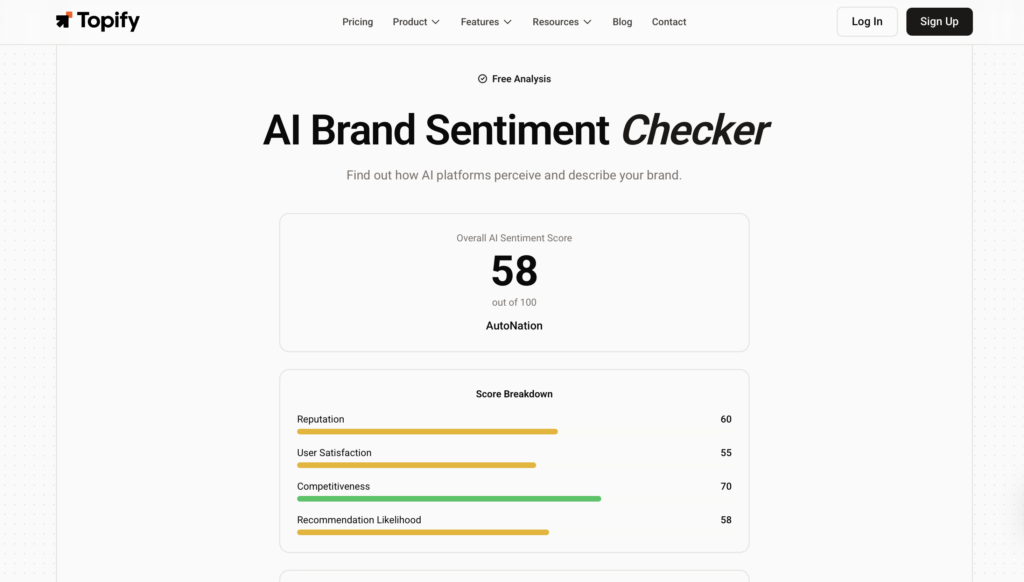
    You can see exactly what AI thinks of you right now. Topify‘s Brand Sentiment Checker analyzes how AI models perceive your moving company, surfaces the specific strengths and weaknesses they associate with your brand, and gives you an overall sentiment score.

    ✅ Free ⚡ Full sentiment breakdown in seconds 🔒 No signup required

    What the Brand Sentiment Checker Reveals About Your Moving Company

    The moving industry runs on trust. People hand over everything they own to strangers, and AI search platforms know this. When someone asks “best movers near me,” AI doesn’t just pull a list. It evaluates how it feels about each brand based on the sentiment signals it has absorbed from across the web.

    Here’s what the Brand Sentiment Checker actually measures.

    The Sentiment Dimensions That Decide If AI Recommends Your Mover

    Each dimension maps to a specific trust concern that moving customers have.

    Sentiment DimensionWhat It MeasuresWhat It Means for Moving Companies
    Overall Sentiment ScoreAI’s net positive/negative impression of your brandBelow neutral: AI actively steers customers away from you
    Strengths IdentifiedPositive attributes AI associates with your companyMissing “reliable,” “on-time,” or “careful with belongings” = AI won’t recommend you for high-value moves
    Weaknesses FlaggedNegative attributes or concerns AI highlightsIf “hidden fees” or “damaged items” appears here, it overrides years of positive service
    Competitive PositioningHow your sentiment compares to category normsNeutral isn’t enough. AI recommends brands with clearly positive sentiment signals

    A moving company could have a 4.6 Google rating but still show a weak sentiment score in AI. That happens when a small cluster of detailed negative reviews contains keywords AI weighs heavily, like “broken antiques” or “no-show on moving day.” The Sentiment Checker makes this mismatch visible.

    Three Scenarios Where Movers Get Surprised by Their AI Sentiment

    Scenario 1: The “Fixed It Two Years Ago” Problem. Your company had a rough summer in 2023 with a few high-profile complaints. You’ve since overhauled your crew training and added real-time GPS tracking. But AI still describes your brand with caution language pulled from those old reviews. The Sentiment Checker shows you exactly which negative signals are still active in AI’s memory.

    Scenario 2: The “Great Service, Zero Signal” Gap. You have hundreds of happy customers, but most of them never left a review. Your sentiment isn’t negative. It’s nearly nonexistent. When AI can’t find enough positive signals, it defaults to recommending brands with louder, more consistent sentiment trails.

    Scenario 3: The “Wrong Category” Mislabel. AI thinks you’re a local-only mover when you actually cover 12 states. Or it associates your brand with “budget moves” when you specialize in white-glove relocation. These category mismatches show up in the strengths and weaknesses breakdown, and they directly affect which prompts trigger your brand as a recommendation.

    How to Run Your Moving Brand Through the Checker

    The process takes under a minute.

    1. Go to the Brand Sentiment Checker and enter your moving company name or domain.
    2. Review your overall sentiment score, the specific strengths AI associates with you, and the weaknesses it flags.
    3. Compare the AI’s perception against your actual service quality. The gaps you find are your optimization targets.

    No account needed. No credit card. You’ll have a clear picture of how AI models describe your moving company to potential customers.

    The AI Prompts Your Future Customers Are Already Typing

    75% of consumers say they’re using AI search tools more than they did a year ago. In the moving industry, that shift is accelerating. 21% of Americans plan to move in 2026, the highest rate in four years, and over 4 in 10 planned movers aged 45-65 say they’ll use AI to research their options.

    Here’s what those AI conversations actually look like.

    AI Prompt ExamplePlatformSearch IntentWhat It Reveals About Your Brand
    “Best moving companies in [city] with good reviews”ChatGPTPurchase decisionWhether AI recommends you at all in your service area
    “Is [brand] a reliable mover or a scam?”PerplexityTrust verificationThe exact sentiment AI attaches to your brand name
    “Most affordable long-distance movers for a 2-bedroom”GeminiPrice comparisonWhether AI positions you as budget, mid-range, or premium
    “Moving company comparison: who handles fragile items best?”ChatGPTSpecialty matchingWhether your specialties are even in AI’s knowledge base
    “What should I look for when hiring a mover?”Google AI OverviewEducational researchWhether your brand appears as an example of best practices

    Every one of these prompts triggers AI’s sentiment evaluation. If your brand’s sentiment profile is weak, neutral, or outdated, you don’t show up. It’s that simple.

    What’s Actually Driving the Sentiment Gap for Moving Companies

    AI’s Perception of Your Brand Doesn’t Match Your Actual Service Quality

    This is the most common disconnect in the moving industry. 81% of consumers use Google reviews when choosing a local service provider. AI models pull from these same sources, plus Reddit, Trustpilot, BBB complaints, and industry forums. But here’s the thing: AI doesn’t just count stars. It reads the text of reviews and extracts sentiment keywords.

    A moving company with a 4.5-star average might still trigger negative sentiment in AI if three detailed one-star reviews mention “damaged items” or “hidden charges.” AI weighs specificity. A vague five-star review saying “great service” carries less sentiment signal than a detailed one-star review describing exactly what went wrong.

    The Brand Sentiment Checker surfaces this imbalance. You can see the exact strengths and weaknesses AI has extracted, and compare them to what your business actually delivers today.

    Regional Movers Are Invisible Because Their Sentiment Signals Are Scattered

    73% of users trust AI recommendations over traditional search results. But when someone in Phoenix asks ChatGPT for the best movers, AI tends to recommend national brands. Not because they’re better, but because their sentiment signals are concentrated and consistent across platforms.

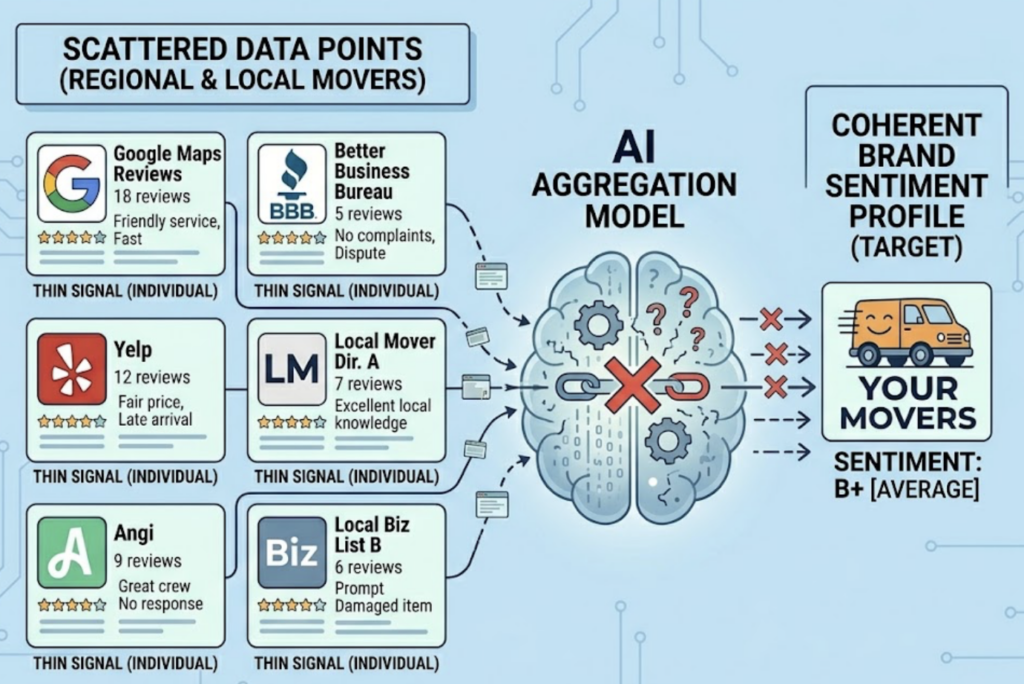
    Regional and local movers face a structural problem. Your reviews might be spread across Google, Yelp, Angi, the BBB, and a handful of local directories. Individually, each platform has a thin signal. AI models struggle to aggregate these scattered data points into a coherent brand sentiment profile.

    The result: a regional mover with 500 positive reviews across six platforms can lose to a national chain with 200 reviews concentrated on two major platforms. Volume matters, but signal concentration matters more for AI.

    This isn’t a quality problem. It’s a visibility architecture problem. And it starts with knowing where your sentiment signals actually live, which the Brand Sentiment Checker maps for you.

    Seasonal Spikes Create Sentiment Damage That Lingers in AI’s Memory

    Moving is one of the most seasonal industries in the U.S. Summer months account for a disproportionate share of total moves, and they also produce the most complaints. Crews are stretched thin, timelines slip, and customer frustration peaks.

    Here’s the issue: AI models don’t distinguish between a complaint filed during your busiest week and one filed during a normal month. A wave of negative reviews in July can shift your overall AI sentiment score downward, and that score may persist well into the fall and winter when your service quality returns to normal.

    Worse, you might not know it happened. Without monitoring your AI sentiment over time, seasonal reputation damage compounds silently. By the time booking season starts again, AI has already deprioritized your brand based on last summer’s complaints.

    This is why a one-time sentiment check is valuable but not sufficient. The seasonal pattern in moving means your AI reputation needs ongoing attention.

    From a One-Time Sentiment Check to Ongoing AI Reputation Monitoring

    Your Brand Sentiment Checker results show you where things stand right now. But AI models update continuously. New reviews get absorbed, old signals decay, and competitor sentiment profiles shift. A strong score today doesn’t guarantee the same score next quarter.

    Topify‘s Comprehensive GEO Analytics dashboard picks up where the free tool leaves off. It tracks your sentiment, visibility, and citation trends continuously across ChatGPT, Perplexity, Gemini, and Google AI Overviews. You’ll see how your sentiment score moves over time, get alerts when negative signals appear, and receive specific recommendations for what to address.

    Here’s how the free check compares to the full platform:

    CapabilityFree Brand Sentiment CheckerTopify Platform
    Check frequencyOne-time snapshotContinuous daily/weekly monitoring
    AI platforms coveredAggregated sentiment scorePer-platform sentiment breakdown (ChatGPT, Perplexity, Gemini, AI Overviews)
    Historical trendsNoneFull sentiment trend history with alerts
    Competitor sentiment trackingNot includedReal-time competitor benchmarking
    Seasonal pattern detectionNot availableTracks sentiment shifts tied to business cycles
    Action recommendationsGeneral insightsSpecific, data-driven optimization steps

    Every plan starts with a 7-day free trial, no credit card required. The Starter plan begins at $99/month, covering 50 prompts per day and continuous monitoring for one brand.

    Conclusion

    The moving industry depends on trust more than almost any other service category. When 73% of consumers trust AI recommendations over traditional search, the question isn’t whether AI search matters for your business. It’s whether AI’s description of your brand actually reflects what you deliver.

    Start with the free Brand Sentiment Checker. In 60 seconds, you’ll know exactly how AI perceives your moving company, which strengths it recognizes, and which weaknesses it’s flagging to your potential customers. From there, you can decide whether a one-time fix or ongoing monitoring fits your growth plan.

    While you’re assessing your brand sentiment, a few other free checks can round out the picture. Topify’s GEO Score Checker evaluates whether AI crawlers can actually access and parse your site. The AI Visibility Report shows how often your brand gets mentioned across major AI platforms. And the Competitor Analysis tool reveals which moving companies AI currently favors in your category.

    FAQ

    Is the Brand Sentiment Checker free? Do I need to sign up? 

    Yes, it’s completely free with no signup required. Enter your brand name or domain at topify.ai/tools/brand-sentiment-checker and get your sentiment breakdown in under 60 seconds.

    What’s the difference between the free tool and the Topify paid platform? 

    The free tool gives you a one-time sentiment snapshot. The Topify platform provides continuous monitoring, historical trends, competitor benchmarking, and actionable recommendations. Plans start at $99/month with a 7-day free trial.

    How often should moving companies check their AI sentiment? 

    At minimum, check before and after peak moving season (May through September). Ideally, use continuous monitoring since AI models absorb new review data on a rolling basis, and a single wave of complaints can shift your sentiment score without warning.

    Can a moving company with mostly positive Google reviews still have weak AI sentiment? 

    Absolutely. AI models weigh detailed, keyword-rich negative reviews more heavily than brief positive ones. A company with a 4.7 Google rating can still show weak AI sentiment if a handful of negative reviews mention specific issues like “damaged furniture” or “late arrival.” The Brand Sentiment Checker reveals these hidden gaps.

    Read More

  • AI Visibility Tools for Relocation

    AI Visibility Tools for Relocation

    Someone in your service area just asked ChatGPT, “What’s the best moving company for a family relocating from Austin to Denver?” The AI responded with five names. Your company, with 15 years of experience, an A+ BBB rating, and hundreds of five-star reviews, didn’t make the list.

    The issue isn’t your service record. It’s that AI doesn’t recognize your authority.

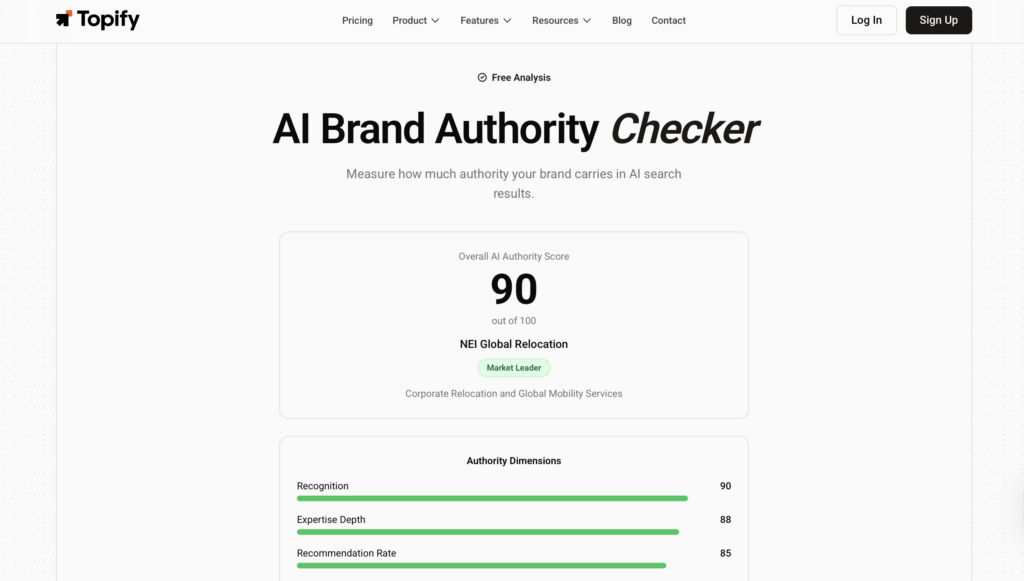
    There’s a way to see exactly where the disconnect is. Topify‘s Brand Authority Checker scores how AI models perceive your relocation brand’s credibility, broken down into four dimensions that directly affect whether you get recommended.

    ✅ Free ⚡ Results in 60 seconds 🔒 No signup required

    What Brand Authority Actually Means for a Moving Company

    AI doesn’t recommend movers the way Google ranks them. There’s no keyword bidding, no ad spend that buys you a top position. AI models evaluate brands on authority signals: how well-known you are in your category, how deeply AI understands your services, how often it recommends you over alternatives, and how much third-party validation it can find.

    For relocation companies, these signals carry outsized weight. People are handing their entire household to a company they found through a prompt. AI treats that trust threshold seriously.

    The Four Scores That Decide If AI Trusts Your Relocation Brand

    Each score from the Brand Authority Checker maps to a specific problem movers face in AI search.

    MetricWhat It MeasuresWhat It Means for Relocation Brands
    Recognition (0-100)How often AI identifies your brand in the moving categoryBelow 40: AI doesn’t associate you with relocation services in your region
    Expertise Depth (0-100)How well AI understands your service capabilitiesBelow 50: AI may not know you handle cross-country moves or corporate relocation
    Recommendation Rate (0-100)How often AI recommends you vs. alternativesBelow 30: you’re losing booked jobs to companies AI prefers
    Trust Signals (0-100)External validation AI detects (reviews, media, citations)Below 40: AI can’t find enough third-party evidence to vouch for your reliability

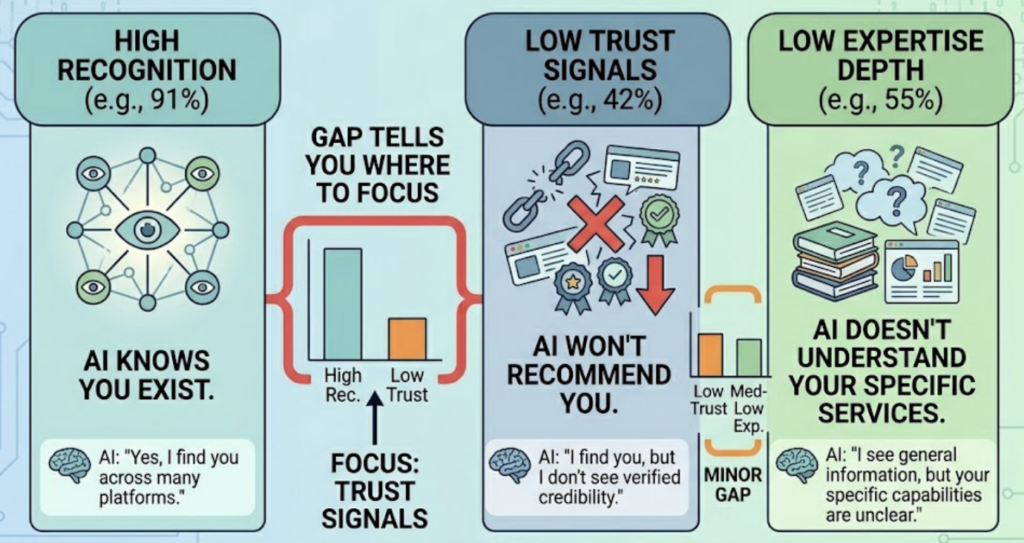
    A relocation company with a Recognition score of 80 but a Trust Signals score of 25 has a specific, fixable problem: AI knows who you are, but doesn’t trust you enough to recommend you. That gap typically means your reviews, media mentions, or directory listings aren’t structured in ways AI can access.

    Three Scenarios Where Movers Discover They’re Invisible

    Scenario 1: Strong local reputation, zero AI presence. A mover with 500+ Google reviews and a 4.8 rating runs the check and finds a Recognition score of 18. The AI simply doesn’t connect their brand to the relocation category. The likely cause: thin website content, no structured data, and minimal presence on platforms AI crawls beyond Google.

    Scenario 2: AI recommends you for the wrong service. A full-service corporate relocation firm discovers their Expertise Depth score is 35. When they test prompts like “best corporate relocation companies,” AI describes them as a local residential mover. The AI’s understanding of their capabilities is outdated or incomplete.

    Scenario 3: Competitor gets recommended despite lower ratings. A company with 4.9 stars notices a competitor with 4.2 stars consistently appears in AI answers. The Brand Authority Checker reveals the competitor’s Trust Signals score is 30 points higher, driven by mentions on Reddit, industry publications, and structured review data across multiple platforms.

    How to Run Your Brand Authority Check

    Go to Brand Authority Checker, enter your moving company’s brand name or domain, and get your four-dimensional authority breakdown in under 60 seconds. No signup, no credit card.

    Look at each score individually first. Then compare them against each other. The gap between your highest and lowest score tells you exactly where to focus. A high Recognition but low Trust Signals score means AI knows you exist but won’t recommend you. A high Trust Signals but low Expertise Depth means AI trusts you in general but doesn’t understand your specific services.

    Relocation Buyers Ask AI First. Here’s What They’re Typing.

    The prompts people type into AI platforms reveal what drives their moving decisions. These aren’t broad searches like “movers near me.” They’re specific, intent-heavy questions that force AI to make a recommendation.

    AI Prompt ExamplePlatformSearch IntentWhat It Reveals
    “Best moving company for a family move from Chicago to Phoenix”ChatGPTLong-distance purchase decisionWhether AI recommends you for specific routes
    “Most reliable movers for fragile and antique items”PerplexitySpecialty service trust verificationWhether AI understands your specialty capabilities
    “Compare corporate relocation companies for 200 employees”GeminiEnterprise vendor evaluationWhere you rank in B2B relocation comparisons
    “Affordable local movers in [city] with good reviews”ChatGPTBudget-conscious local decisionWhether your brand appears in price-sensitive queries
    “Is [your brand] licensed and insured for interstate moves?”PerplexityTrust and compliance verificationHow accurately AI describes your credentials

    Here’s the thing: each of these prompts can return a completely different set of recommended companies. Research on local business AI recommendations found that ChatGPT and Perplexity recommend almost entirely different businesses for the same query. Your brand might appear on one platform and be completely absent on the other.

    That gap is invisible unless you measure it.

    AI Recommendations Favor National Chains. Local Movers Are Fighting an Uphill Battle.

    National relocation brands dominate AI search results for a structural reason: they have larger digital footprints. More media coverage, more platform listings, more structured data, more Reddit threads, more everything that AI models use to build authority profiles.

    A regional mover serving three states with a flawless service record competes against national chains that have thousands of indexed pages, press releases in major outlets, and reviews spread across every platform AI crawls. The playing field isn’t level, and the Brand Authority Checker’s Recognition score makes this gap visible in hard numbers.

    This doesn’t mean local movers can’t win. It means they need to know the score before building a strategy. AI models weight review signals heavily: companies recommended by ChatGPT average 4.3 stars, while Perplexity recommendations average 4.1 stars. Brands below those thresholds get filtered out entirely.

    The action path for local and regional movers is specific:

    1. Run the Brand Authority Checker to see your baseline Recognition and Trust Signals scores
    2. Identify which dimensions are weakest (often Trust Signals for local companies)
    3. Build structured content and review distribution strategies that target the specific signals AI looks for

    A local mover with a Recognition score of 20 isn’t permanently invisible. That score tells you exactly how far the gap is and where to start closing it.

    Your Brand Authority Changes by City. Are You Checking Every Service Area?

    Unlike SaaS or e-commerce, relocation is hyper-local. A moving company serving the Dallas-Fort Worth metro, Houston, and San Antonio will have a different AI authority profile in each market. AI might recommend you in Dallas but have no idea you exist in San Antonio.

    This is because AI builds location-specific context from different signal clusters. Your Google Business Profile in one city, your Yelp reviews in another, your BBB listing in a third. If your digital presence is uneven across service areas, your AI visibility will be uneven too.

    The practical implication: a single brand authority check isn’t enough for multi-market movers. You need to test how AI perceives your brand in each service region. A company scoring 65 in its headquarters city might score 15 in a market it expanded into last year.

    Service Area FactorWhy It Affects AI AuthorityWhat to Check
    Local review volumeAI weights location-specific reviews for local queriesReview count and rating per city on Google, Yelp, BBB
    Local content pagesAI needs city-specific content to associate your brand with an areaWhether you have dedicated service pages per market
    Local directory listingsConsistent NAP data helps AI verify your presenceAccuracy across 20+ directories per service area
    Local media mentionsRegional press strengthens location-specific authorityWhether local outlets have covered your company

    This matters more as AI search behavior shifts toward longer, more specific queries. Ten-word queries trigger AI Overviews more than five times as often as single-word searches. “Best moving company in San Antonio for a three-bedroom house” is a real prompt that demands location-specific authority.

    One Snapshot Tells You Where You Stand. Continuous Tracking Keeps You There.

    Your Brand Authority Checker results show you today’s picture. But AI models update their training data, adjust ranking signals, and shift recommendations on a rolling basis. A score of 72 today could drop to 50 next quarter if a competitor builds stronger signals in your market, or if AI reweights the sources it trusts.

    Topify‘s platform picks up where the free tool leaves off. The Comprehensive GEO Analytics dashboard tracks your authority, sentiment, and visibility scores continuously across ChatGPT, Perplexity, Gemini, and Google AI Overviews. For relocation companies operating in multiple cities, this means monitoring brand authority per market without running manual checks every week.

    Here’s how the free check compares to the full platform:

    CapabilityFree Brand Authority CheckerTopify Platform
    Check frequencyOne-time snapshotContinuous daily/weekly monitoring
    AI platforms coveredAggregated scorePer-platform breakdown (ChatGPT, Perplexity, Gemini, AI Overviews)
    Historical trendsNoneFull trend history with alerts
    Competitor trackingNot includedReal-time competitor benchmarking
    Multi-market monitoringManual per-city checksAutomated per-market tracking
    Action recommendationsGeneral directionSpecific, prioritized optimization steps

    Every plan starts with a 7-day free trial, no credit card required. The Starter plan begins at $99/month.

    Conclusion

    AI is becoming the first filter for relocation decisions. Corporate HR managers, families planning cross-country moves, and individuals comparing local movers are all asking AI platforms for recommendations before they visit a single website. If your brand authority scores are low, you’re not in the conversation.

    Start with the Brand Authority Checker to get your baseline. Run it for your brand name, then test it against the specific service areas you cover. The scores will tell you exactly where AI trusts you and where it doesn’t.

    While you’re assessing your brand authority, a few other free checks can round out the picture. Topify‘s GEO Score Checker evaluates whether AI crawlers can actually access your site. The AI Visibility Report shows how often your brand gets mentioned across major AI platforms. And the Competitor Analysis tool reveals who AI considers your direct competitors in the relocation space.

    FAQ

    Is the Brand Authority Checker free? Do I need to create an account? 

    Yes, it’s completely free with no account required. Enter your brand name or domain and get your authority scores in about 60 seconds.

    What’s the difference between the free tool and the Topify platform? 

    The free Brand Authority Checker gives you a one-time snapshot of your four authority scores. The Topify platform adds continuous monitoring, historical trend tracking, per-platform breakdowns, competitor benchmarking, and actionable optimization recommendations.

    How often should a relocation company check its AI visibility? 

    At minimum, once per quarter. AI models update frequently, and your authority scores can shift based on new reviews, competitor activity, or changes in how AI weights its sources. Multi-market movers should check each service area separately.

    My moving company has great Google reviews but low AI authority. Why? 

    AI doesn’t only pull from Google. It aggregates signals from Yelp, BBB, Reddit, industry publications, directory listings, and your own website’s structured data. A strong Google profile with weak presence elsewhere creates a gap that AI notices. The Brand Authority Checker’s Trust Signals score reveals exactly how much third-party validation AI can find.

    Read More

  • AI Visibility Tools for Weddings: Get Found First

    AI Visibility Tools for Weddings: Get Found First

    Couples Ask AI Before They Google. Your Wedding Brand Isn’t in the Answer.

    A bride-to-be in Denver opened ChatGPT last Tuesday and typed: “Best wedding photographers in Denver with a documentary style.” She got five names back. Four of them were pulled from The Knot listings. The fifth was a Zola feature. Your studio, the one with 200+ five-star reviews and a decade of destination work, didn’t exist in that answer.

    The problem isn’t your portfolio. It’s that AI doesn’t know you’re there.

    You can find out in under a minute. Topify‘s AI Visibility Report shows how often your brand gets mentioned across ChatGPT, Perplexity, Gemini, and Google AI Overviews, with a full breakdown of mention rate, ranking position, and provider distribution.

    ✅ Free ⚡ Results in 60 seconds 🔒 No signup required

    What Your AI Visibility Report Actually Tells You About Your Wedding Brand

    The Metrics That Decide If Couples See Your Name

    The report doesn’t give you a single score and send you on your way. It breaks your AI presence into distinct metrics, each one tied to a specific part of how couples discover vendors through AI.

    Here’s what each metric means when you’re running a wedding business:

    MetricWhat It MeasuresWhat It Means for Wedding Vendors
    Mention RateHow frequently AI names your brand in relevant queriesBelow 5%: couples asking “best [your service] in [your city]” almost never see you
    Ranking PositionWhere you appear in AI’s recommendation orderPosition 4+: most couples stop reading after the first three names
    Provider BreakdownWhich AI platforms mention you (ChatGPT, Perplexity, Gemini, etc.)Missing from one platform = invisible to that platform’s entire user base
    Citation ContextHow AI describes your brand when it does mention youOutdated descriptions can misrepresent your pricing, style, or availability

    A venue with a high mention rate on Perplexity but zero presence on ChatGPT has a platform gap. A photographer who appears on ChatGPT but only in position six has a ranking problem. Each metric points to a different fix.

    Three Scenarios Wedding Vendors Discover When They Run This Check

    Scenario 1: The total blank. You enter your brand name and get zeros across the board. AI doesn’t mention you at all. According to the 5W Wedding Industry AI Visibility Index 2026, roughly 84% of individual wedding vendors fall into this category. You’re not alone, but you’re invisible.

    Scenario 2: The platform gap. You show up on one AI engine but not the others. This is common for vendors with strong Google SEO but no presence in the content sources that ChatGPT or Perplexity draw from. Your traditional search strategy isn’t translating to AI search.

    Scenario 3: The outdated profile. AI mentions you, but the description is wrong. It references a venue capacity you expanded two years ago, a photography style you’ve since evolved, or pricing from a previous season. You’re visible, but the version of you that AI knows is outdated.

    How to Run Your First AI Visibility Check

    The process takes three steps:

    1. Go to the AI Visibility Report page.
    2. Enter your brand name or domain. The tool scans ChatGPT, Perplexity, Gemini, and Google AI Overviews for mentions of your wedding business.
    3. Review your report: mention rate, ranking position, provider breakdown, and citation context.

    No account creation. No credit card. You’ll have a clear picture of your AI presence in about a minute.

    The AI Search Blind Spots Wedding Vendors Don’t Know They Have

    Most wedding vendors optimize for Google. They invest in SEO, claim their Google Business Profile, and list on directories. That playbook still matters. But it misses a growing channel entirely.

    36% of couples now use AI tools to help plan their weddings, double the rate from early 2025. Among Gen Z couples, who now make up 41-51% of the wedding market, AI search adoption is even higher. These couples don’t browse ten tabs of Google results. They ask a question and trust the shortlist AI gives them.

    Here’s what those questions look like, and what each one reveals about your visibility:

    AI Prompt ExamplePlatformSearch IntentWhat It Reveals About Your Brand
    “Best wedding photographers in [city] for candid shots”ChatGPTVendor discoveryWhether AI associates your name with your specialty and location
    “Affordable outdoor wedding venues near [region]”PerplexityBudget-conscious researchWhether your pricing and venue type are accurately represented
    “Wedding planner vs day-of coordinator, which do I need?”GeminiEducation / pre-purchaseWhether your brand appears as a trusted authority in the category
    “Top-rated florists for garden party weddings”Google AI OverviewStyle-specific searchWhether AI connects your brand to specific aesthetic niches
    “Wedding DJ with good reviews in [state]”ChatGPTReview-driven decisionWhether third-party reviews about you are reaching AI models

    If your brand doesn’t appear in these answers, it’s not a traffic problem. It’s a discovery problem. And traditional SEO metrics won’t flag it because they only measure Google rankings, not AI citations.

    The Visibility Window for Independent Wedding Vendors Is Closing

    Freshness Is the New Authority Signal

    Here’s the thing about AI visibility: it’s not static. AI models don’t lock in their knowledge once and leave it. They update training data, adjust ranking signals, and reshuffle recommendations on a rolling basis. 65% of AI bot traffic targets content published within the past year. That statistic tells you something critical about how AI decides who to recommend.

    A wedding planner featured in a regional magazine last month is more citable than one who earned a feature two years ago and hasn’t been mentioned since. The vendor who publishes a new blog post, earns a fresh review, or gets a recent media mention is more likely to appear in AI answers than the one with a stronger but older digital footprint.

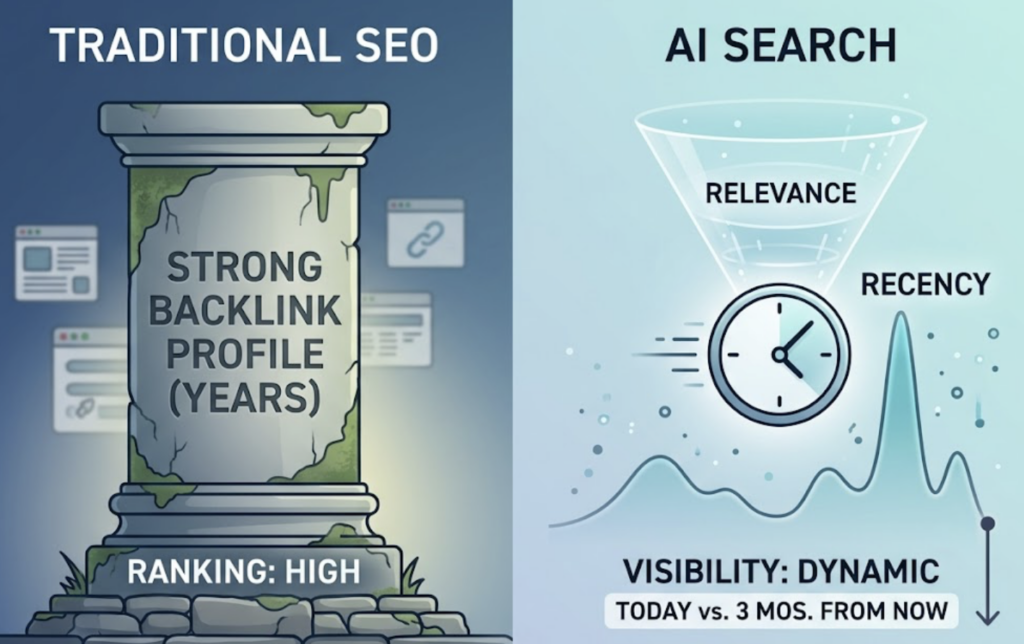
    This isn’t how traditional SEO works. In Google rankings, a strong backlink profile built over years holds value. In AI search, recency carries disproportionate weight. Your AI visibility score today could look completely different three months from now, even if you change nothing about your business.

    For wedding vendors, this creates both a problem and an opportunity. The problem: you can’t “set and forget” your AI presence. The opportunity: a consistent stream of fresh content, reviews, and mentions can move the needle faster than you’d expect.

    The Platform Play That’s Reshaping AI Wedding Search

    In February 2026, The Knot Worldwide launched the wedding industry’s first app inside ChatGPT and entered OpenAI’s advertising pilot. This wasn’t a minor product update. It was a structural shift in how AI wedding search works.

    Before that launch, AI engines pulled wedding vendor information from a mix of sources: directories, review sites, blogs, media coverage. The playing field, while uneven, was at least distributed. Now, The Knot has a direct integration with the most-used AI platform. Early data from the pilot shows couples using AI are “highly engaged and ready to book.”

    Three platforms already capture roughly 73% of wedding-planning AI responses. With The Knot’s ChatGPT integration, that concentration is likely to increase. For independent vendors who rely on being discovered outside platform intermediaries, the window to build direct AI visibility is narrowing.

    That doesn’t mean it’s closed. It means the cost of waiting is going up. Every month you don’t have an AI visibility baseline is a month you can’t measure whether you’re gaining or losing ground.

    One Check Tells You Where You Stand. Tracking It Keeps You Booked.

    The AI Visibility Report gives you today’s snapshot. You’ll know your mention rate, your ranking position, and which platforms see you. That’s the starting point.

    But AI search results shift as models update. A vendor who ranks third in ChatGPT’s recommendations this month might drop to seventh next month when new training data gets incorporated. A freshness signal you earned from a blog post in March loses weight by June.

    Topify‘s AI Visibility Checker picks up where the free report leaves off. It tracks your visibility continuously across ChatGPT, Perplexity, Gemini, and Google AI Overviews, with historical trend data, competitor benchmarking, and alerts when your scores shift.

    Here’s how the free check compares to the full platform:

    CapabilityFree AI Visibility ReportTopify Platform
    Check frequencyOne-time snapshotContinuous daily/weekly monitoring
    AI platforms coveredSingle aggregated checkChatGPT + Perplexity + Gemini + AI Overviews
    Historical trendsNoneFull trend history with alerts
    Competitor trackingNot includedReal-time competitor benchmarking
    Actionable next stepsManual interpretationSpecific optimization recommendations
    Team collaborationSingle userUnlimited team member seats

    Every plan starts with a 7-day free trial, no credit card required. The Starter plan begins at $99/month.

    Conclusion

    Couples are asking AI for wedding vendor recommendations before they open Google, and 84% of independent vendors aren’t in the answer. That gap is measurable, and it’s growing as major platforms deepen their AI integrations.

    Start with a free AI Visibility Report to see exactly where your wedding brand stands across AI search engines. If you need continuous tracking and competitor benchmarking, Topify’s platform turns that one-time check into an ongoing strategy.

    While you’re assessing your AI visibility, a few other free checks can round out the picture. Topify‘s GEO Score Checkerevaluates whether AI crawlers can actually access and parse your site. The Brand Sentiment Checker shows how AI describes your brand’s strengths and weaknesses. And the Prompts Researcher reveals the exact questions couples are asking AI in your market.

    FAQ

    Is the AI Visibility Report really free? Do I need to create an account? 

    Yes, it’s completely free with no account required. Enter your brand name or domain, get your full report in about 60 seconds. No credit card, no email gate.

    What’s the difference between the free report and Topify’s paid platform? 

    The free report is a one-time snapshot of your current AI visibility. The paid platform adds continuous monitoring, historical trends, competitor benchmarking, optimization recommendations, and alerts when your visibility changes. Plans start at $99/month with a 7-day free trial.

    How often should wedding vendors check their AI visibility? 

    At minimum, once a quarter. AI models update their training data regularly, and your visibility can shift without any changes on your end. If you’re actively building your digital presence through new content, reviews, or media coverage, checking monthly helps you measure whether those efforts are translating to AI visibility.

    My wedding business ranks well on Google. Does that mean I’m visible in AI search too? 

    Not necessarily. Google rankings and AI citations use different signals. A vendor with strong Google SEO can still have zero AI citation share if AI models haven’t incorporated their content into training data. The only way to know is to check both channels separately.

    Read More

  • AI Visibility Tools for Auto Dealerships

    AI Visibility Tools for Auto Dealerships

    Car Buyers Ask AI for Dealer Recommendations. Your Dealership Might Not Like the Answer.

    A first-time buyer typed into ChatGPT: “Best Honda dealer near me with honest pricing and good service reviews.” Five dealerships came back. Yours, with 600 Google reviews and a 4.8-star average, wasn’t one of them. The problem isn’t your reputation. It’s that AI built a different version of it.

    You can see that version right now. Topify‘s Brand Sentiment Checker analyzes how AI models describe your dealership’s strengths, weaknesses, and overall sentiment, then surfaces the specific language AI uses when buyers ask about you.

    ✅ Free ⚡ Full sentiment breakdown in seconds 🔒 No signup required

    What AI Actually Says About Your Dealership (And Where It Gets Its Data)

    Your Google Business Profile tells one story. AI tells another. The gap between the two is where you’re losing buyers who never call, never visit, and never show up on your CRM.

    The Brand Sentiment Checker breaks AI’s perception of your dealership into measurable dimensions. Here’s what each one means in automotive terms.

    Three Scores That Determine Whether AI Trusts Your Dealership

    Sentiment DimensionWhat It MeasuresWhat It Means for Your Dealership
    Overall Sentiment (Positive / Neutral / Negative)The net tone AI uses when describing your brandNegative sentiment = AI actively steers buyers away with language like “mixed reviews” or “some complaints”
    Strengths IdentifiedSpecific positives AI associates with your dealershipMissing strengths = AI doesn’t mention your certified pre-owned program, financing options, or service quality
    Weaknesses SurfacedSpecific negatives AI pulls from reviews, forums, newsOutdated weaknesses = AI still references a complaint from 2022 that you resolved two years ago

    A dealership with strong overall sentiment but zero identified strengths has a visibility gap. AI knows you exist but can’t articulate why a buyer should choose you. That’s a fixable problem, and now you can see exactly where the language breaks down.

    Two Scenarios Every Dealer Should Check For

    Scenario 1: The ghost complaint. Your service department had a string of negative Yelp reviews in 2021 after a staffing shortage. You’ve since hired a new service director, cut wait times by 40%, and earned hundreds of positive reviews. But when a buyer asks Perplexity “Is [your dealership] service department reliable?”, the AI response still references “some customers report long wait times.” The sentiment check surfaces this exact language so you know what to fix in your content strategy.

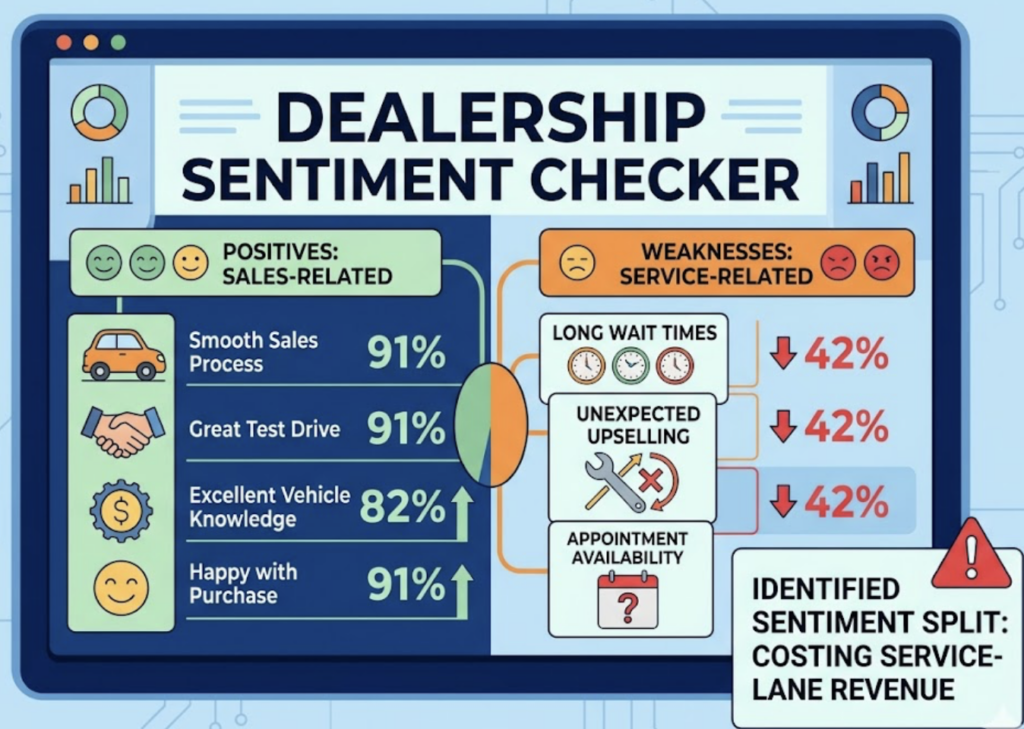
    Scenario 2: The split reputation. AI treats your sales floor and your service lane as separate entities. Your sales team gets described as “knowledgeable and low-pressure.” Your service department gets tagged with “upselling concerns.” In traditional SEO, these blend into one star rating. In AI search, they’re distinct sentiment signals that show up in different types of buyer queries. The Brand Sentiment Checker reveals this split so you can address each one independently.

    How to Run Your Dealership’s Sentiment Check

    The process takes about 60 seconds.

    Go to the Brand Sentiment Checker and enter your dealership name or domain. The tool scans how AI models currently describe your brand and returns a full sentiment breakdown: overall tone, specific strengths AI recognizes, and specific weaknesses AI surfaces. No account needed, no credit card, no data collected.

    Once you have your results, compare the strengths and weaknesses against what you’d actually want a buyer to hear about your dealership. The gap between those two lists is your optimization roadmap.

    The AI Prompts Your Buyers Are Already Typing

    Thirty percent of car buyers now use AI tools during their vehicle research. Among those who do, 68.4% use ChatGPT as their primary research tool. They’re not typing keywords. They’re asking full questions, and each question triggers a different type of AI evaluation.

    AI Prompt ExamplePlatformSearch IntentWhat It Reveals About Your Dealership
    “Best Toyota dealer near me with good reviews”ChatGPTPurchase decisionWhether AI recommends you or a competitor
    “Is [dealership name] trustworthy?”PerplexityTrust verificationThe exact sentiment language AI uses about you
    “Best dealership for first-time car buyers in [city]”GeminiNiche matchWhether AI associates you with specific buyer segments
    “Which dealer has the best service department in [area]?”ChatGPTService loyaltyHow AI separates your service reputation from sales
    “[Dealership] vs [competitor] reviews”PerplexityCompetitive comparisonWhere AI ranks your sentiment against alternatives
    “Best financing deals at car dealerships near me”Google AI OverviewFinancial decisionWhether AI links your name to competitive financing
    “Honest used car dealers [city] Reddit”PerplexitySocial proofWhat Reddit threads AI pulls your name from

    Here’s the thing. Eighty-four percent of dealership websites score below 60 out of 100 on AI visibility tests, and 48% actively block AI crawlers. That means nearly half the industry is invisible to the systems their buyers are already using.

    Five-Star Google Rating, Three-Star AI Reputation: Why the Gap Exists

    AI’s Sentiment Data Doesn’t Come From Where You Think

    Most dealer principals assume their Google review score is their reputation. In AI search, it’s one input among many. ChatGPT leans on business listings for nearly half its local source citations. Perplexity pulls heavily from Reddit and community forums. Gemini prioritizes official website content.

    That means a single unresolved Reddit thread from 2023 can carry more weight on Perplexity than 200 five-star Google reviews. A dealership that invested heavily in Google review management but ignored forum mentions and social sentiment is optimized for one channel and invisible, or worse, negatively represented, on the others.

    The Brand Sentiment Checker exposes these hidden signal sources. If AI lists “pushy sales tactics” as a weakness but your last 300 Google reviews say otherwise, you’ve found the disconnect. The negative signal is likely coming from an older forum post or news mention that AI hasn’t deprioritized.

    Your Service Drive and Your Showroom Have Separate AI Reputations

    This is something most dealerships don’t realize. When a buyer asks “best place to buy a car in [city],” AI evaluates sales-related sentiment. When they ask “reliable dealership for oil changes near me,” AI evaluates service sentiment separately.

    A dealership can have excellent sales sentiment and terrible service sentiment. Or the reverse. In a traditional Google search, both blend into your aggregate star rating. In AI search, they’re separate answers to separate questions.

    Run your dealership through the sentiment checker and look specifically at the weaknesses section. If the negatives cluster around service-related language (wait times, upselling, appointment availability) while the positives are all sales-related, you’ve identified a sentiment split that’s costing you service-lane revenue.

    A Negative AI Sentiment Tag Costs More Than a Bad Google Review

    When someone reads a one-star Google review, they also see your 4.8-star average and your management response. They have context. They make their own judgment.

    AI doesn’t work that way.

    When a buyer asks ChatGPT for a recommendation and your dealership comes back with “some customers report concerns about transparency in pricing,” that’s a verdict. There’s no star average next to it. No management response. No context. Ninety-seven percent of AI users say AI will influence their purchase decisions. A negative sentiment tag in an AI answer eliminates you from consideration before the buyer ever reaches your website.

    That’s why knowing your AI sentiment profile isn’t optional anymore. It’s the difference between being recommended and being filtered out.

    One Sentiment Snapshot Isn’t Enough When AI Updates Every Week

    The Brand Sentiment Checker gives you a clear picture of where you stand today. But AI models ingest new data continuously. A viral Reddit post next month, a local news story next quarter, or a competitor’s content campaign next week can shift how AI describes your dealership overnight. One check is a diagnosis. Staying visible requires ongoing monitoring.

    Topify‘s Comprehensive GEO Analytics dashboard picks up where the free tool leaves off. It tracks your sentiment, visibility, and authority scores continuously across ChatGPT, Perplexity, Gemini, and Google AI Overviews, with trend lines, alerts when scores shift, and specific recommendations for what to address next.

    Here’s how the free check compares to the full platform:

    CapabilityFree Brand Sentiment CheckerTopify Platform
    Check frequencyOne-time snapshotContinuous daily/weekly monitoring
    AI platforms coveredAggregated sentimentPer-platform breakdown (ChatGPT, Perplexity, Gemini, AI Overviews)
    Historical trendsNoneFull trend history with shift alerts
    Competitor sentiment trackingNot includedReal-time competitor benchmarking
    Actionable next stepsManual interpretationSpecific, prioritized optimization recommendations
    Team accessSingle userUnlimited team member seats

    Every plan starts with a 7-day free trial, no credit card required. The Starter plan begins at $99/month.

    Conclusion

    AI is already shaping which dealerships get foot traffic and which get overlooked. Thirty percent of buyers use AI during research, and that number is climbing. Your reputation in AI search is a measurable, trackable metric now, not a guess.

    Start with the Brand Sentiment Checker to see exactly how AI describes your dealership today. From there, build a monitoring routine that catches shifts before they cost you leads.

    While you’re at it, a few other free checks can round out the picture. Topify‘s GEO Score Checker evaluates whether AI crawlers can actually access your website, which matters when 48% of dealerships accidentally block them. The AI Robots Checker scans your robots.txt to flag exactly which AI bots you’re allowing or blocking. And the Prompts Researcher reveals the specific questions car buyers are asking AI in your market.

    FAQ

    Is the Brand Sentiment Checker really free? Do I need to create an account?

    Yes, it’s completely free. No account, no signup, no credit card. Enter your dealership name or domain, and you’ll get your full sentiment breakdown in under a minute.

    What’s the difference between the free tool and the Topify paid platform?

    The free tool gives you a one-time sentiment snapshot. The Topify platform provides continuous monitoring across all major AI platforms, historical trend tracking, competitor benchmarking, and prioritized optimization recommendations. Plans start at $99/month with a free 7-day trial.

    How often should a dealership check its AI visibility?

    At minimum, monthly. AI models update frequently, and external events (a new Reddit thread, a local news story, a competitor’s content push) can shift your sentiment profile without warning. Dealerships in competitive markets should consider weekly monitoring through the Topify platform.

    Can AI really send buyers to a competing dealership based on sentiment alone?

    Yes. When a buyer asks ChatGPT “best dealer near me,” AI synthesizes sentiment from reviews, forums, and web content to build its recommendation list. If your dealership has weaker AI sentiment than a competitor, even if your Google rating is higher, AI will recommend the competitor. The buyer never sees your listing, your reviews, or your response to any complaint.

    Read More

  • AI Visibility Tools for the Aftermarket Industry

    AI Visibility Tools for the Aftermarket Industry

    A car owner asked ChatGPT, “What are the best aftermarket brake pads for a 2021 Honda Civic?” The AI listed five brands. Yours wasn’t one of them. Your pads have 50,000 verified installs, 4.7-star reviews across major retailers, and full ACES fitment coverage. None of that mattered, because AI didn’t recognize your brand as authoritative in the category.

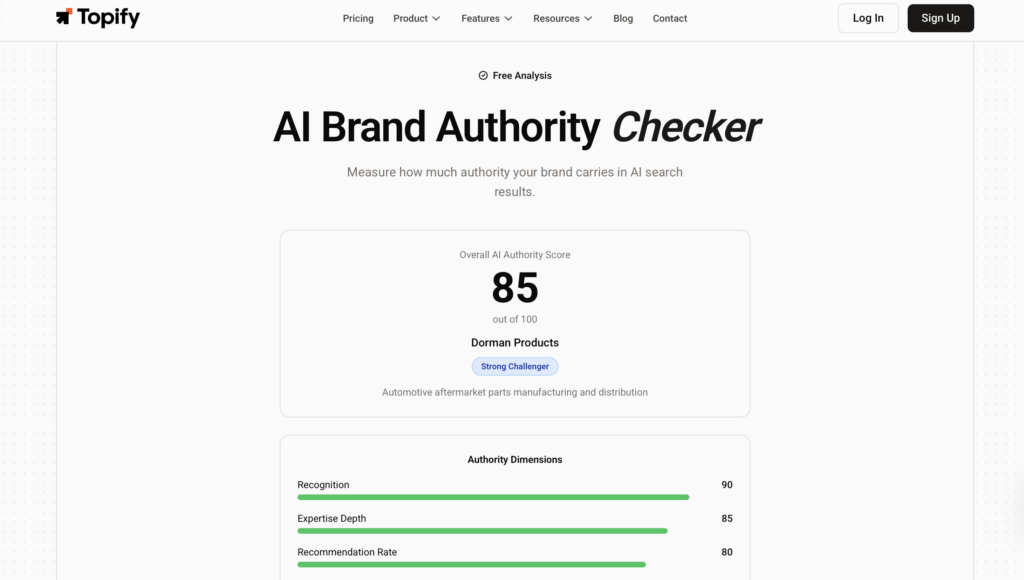
    The gap is measurable, and the check takes 60 seconds. Topify‘s Brand Authority Checker scores how AI models perceive your aftermarket brand’s authority across four dimensions that directly affect whether you get recommended. ✅ Free ⚡ Results in under a minute.

    The Four Trust Scores That Decide If AI Recommends Your Aftermarket Brand

    The aftermarket parts business runs on trust. Buyers need to believe your non-OEM part will perform, fit, and last. AI search engines apply that same trust logic when deciding which brands to recommend. The Brand Authority Checkerbreaks that logic into four measurable scores.

    What Each Score Means for Aftermarket Brands

    Each metric maps to a specific challenge aftermarket companies face in AI-generated answers.

    MetricWhat It MeasuresWhat It Means for Aftermarket Brands
    Recognition (0-100)How often AI identifies your brand in your categoryBelow 40: AI doesn’t associate you with your parts category (e.g., suspension, filters, exhaust)
    Expertise Depth (0-100)How well AI understands your capabilitiesBelow 50: AI may confuse your product line, list wrong fitment data, or miss key certifications
    Recommendation Rate (0-100)How often AI recommends you vs. alternativesBelow 30: buyers asking “best aftermarket [part] for [vehicle]” will never see your name
    Trust Signals (0-100)External validation AI detects (reviews, media, citations)Below 40: AI can’t find enough third-party evidence that your parts perform as claimed

    An aftermarket brand with a Recognition score of 80 but a Trust Signals score of 25 has a clear diagnosis: AI knows your brand exists but doesn’t trust it enough to recommend over OEM or better-cited competitors. That’s a gap you can close once you know it’s there.

    Where Aftermarket Brands Typically Get Flagged

    Three scenarios show up repeatedly when aftermarket companies run their first authority check.

    Scenario 1: High reviews, low recognition. You have thousands of positive ratings on Amazon and RockAuto, but AI doesn’t associate your brand with the correct parts category. This often happens when product pages lack structured data that AI crawlers can parse.

    Scenario 2: Strong expertise, weak trust signals. AI understands what you make and which vehicles your parts fit, but it can’t find enough third-party validation. Installer forums, independent review sites, and trade publications carry heavy weight here.

    Scenario 3: Brand confusion. AI mixes up your brand with a similarly named company or attributes a competitor’s recall to your product line. The Expertise Depth score is the first place this shows up.

    How to Run Your Check

    Go to Brand Authority Checker, enter your brand name or domain, and get your four-dimensional authority breakdown in under 60 seconds. No signup, no credit card required. Start with your primary brand, then run each sub-brand or product line separately if you operate across multiple aftermarket categories.

    What Aftermarket Buyers Actually Ask AI (And Whether Your Brand Shows Up)

    The shift from Google keyword searches to AI conversations changes what aftermarket buyers expect. A traditional search for “best air filter 2022 F-150” returns links. An AI query returns a recommendation, often with only two or three brand names. If your brand isn’t in that shortlist, you don’t get a second chance.

    Here’s what those prompts look like in practice:

    AI Prompt ExamplePlatformSearch IntentWhat It Reveals
    “Best aftermarket brake pads for daily driving a 2020 Camry”ChatGPTPurchase decisionWhether AI recommends your brand for common vehicle/use-case combos
    “Are aftermarket suspension kits safe for highway driving?”PerplexityTrust verificationHow AI describes aftermarket quality and which brands it cites as trustworthy
    “OEM vs aftermarket catalytic converter, which lasts longer?”GeminiComparative researchWhether your brand gets mentioned in the OEM vs aftermarket debate
    “Cheapest reliable aftermarket headlights for a 2019 Tacoma”ChatGPTPrice-sensitive purchaseIf AI considers your brand a value leader with acceptable quality
    “What aftermarket parts should I avoid putting on my car?”PerplexityRisk assessmentWhether AI names your category or brand in a negative context

    These aren’t hypothetical. Adobe’s Q1 2026 data showed AI-referred traffic to retail sites grew 393% year over year. A Capgemini report found roughly two-thirds of millennials and Gen Z have replaced traditional search engines with AI tools for product recommendations. The aftermarket isn’t exempt from this shift.

    Three Dynamics Reshaping Aftermarket AI Visibility

    AI Is Replacing the “Ask Your Mechanic” Recommendation

    For decades, aftermarket brand loyalty followed a simple path: a trusted mechanic or installer recommended a brand, and the vehicle owner bought it. That loop is breaking. Buyers now verify recommendations with AI before committing, and many skip the mechanic entirely for parts they plan to install themselves.

    Here’s the thing: AI doesn’t recommend brands the way a mechanic does. A mechanic draws on years of hands-on experience. AI draws on web content, structured data, user reviews, and third-party citations. If your brand has strong relationships with installers but weak digital authority signals, you’ll score well in the shop and poorly in ChatGPT.

    The Brand Authority Checker’s Recommendation Rate score tells you exactly where you stand in this new dynamic. A score below 30 means AI is actively choosing other brands over yours in purchase-intent prompts.

    Small Aftermarket Brands Can Compete Through AI Visibility

    One of the clearest signals from recent data: AI search doesn’t automatically favor the biggest brands. A case study published in May 2026 documented an aftermarket retailer that grew AI referral revenue by 344% in six months. The company started with under 1% AI visibility across 100 commercial-intent prompts. Six months later, they appeared in over 20% of tracked prompts.

    The company’s marketing manager put it directly: “They took a small brand like ours and put us in the same arena as brands 10 to 20x our size.”

    This matters for every mid-size aftermarket brand watching larger competitors dominate traditional search. AI recommendations are still forming. The brands that establish authority signals now, before the channel fully matures, will hold structural advantages as AI search volume scales.

    Fitment Data Is the Hidden Threshold for AI Recommendations

    Aftermarket parts have a complexity layer that most product categories don’t: vehicle-specific fitment. A shopper asking AI for “best aftermarket control arms for a 2018 Jeep Wrangler JL” expects the AI to return parts that actually fit that exact vehicle. If your product data doesn’t include machine-readable fitment information, AI can’t confidently recommend you.

    The Auto Care Association released ACES 5.0 and PIES 8.0 in 2026, specifically designed as machine-readable XML standards for exchanging fitment and product data. That phrase, “machine-readable,” signals where the industry is heading. AI shopping agents, including Google’s Universal Commerce Protocol, need structured fitment data to make accurate recommendations.

    Your Brand Authority Checker’s Expertise Depth score reflects this directly. A low score often traces back to incomplete or unstructured product data that AI can’t parse into accurate fitment conclusions.

    From a One-Time Check to Ongoing AI Visibility Tracking

    Your Brand Authority Checker results show you where you stand today. But AI models update their training data, adjust ranking signals, and shift recommendations continuously. A score of 72 this month could drop to 55 next quarter without any change on your end, simply because a competitor improved their authority signals or a model update re-weighted its trust criteria.

    Topify‘s platform picks up where the free tool leaves off. The Comprehensive GEO Analytics dashboard tracks your authority, sentiment, and visibility scores continuously across ChatGPT, Perplexity, Gemini, and Google AI Overviews. You’ll see trend lines, get alerts when scores shift, and receive specific recommendations for what to fix.

    Here’s how the free check compares to the full platform:

    CapabilityFree Brand Authority CheckerTopify Platform
    Check frequencyOne-time snapshotContinuous daily/weekly monitoring
    AI platforms coveredAggregated scorePer-platform breakdown (ChatGPT, Perplexity, Gemini, AI Overviews)
    Historical trendsNoneFull trend history with alerts
    Competitor trackingNot includedReal-time benchmarking against aftermarket rivals
    Action recommendationsGeneral directionSpecific, data-driven GEO optimization steps
    Team collaborationSingle userMulti-seat access for marketing and product teams

    Every plan starts with a 7-day free trial, no credit card required. The Starter plan begins at $99/month.

    Conclusion

    AI search is now part of how aftermarket buyers discover, evaluate, and choose parts brands. The brands that show up in AI recommendations aren’t necessarily the biggest or the oldest. They’re the ones with the strongest authority signals in the places AI actually looks.

    Start with a single check. Run your aftermarket brand through the Brand Authority Checker and see where AI ranks your recognition, expertise, recommendation rate, and trust signals. That baseline tells you exactly what to fix and where to focus.

    While you’re assessing your brand authority, a few other free checks can round out the picture. Topify’s GEO Score Checker evaluates whether AI crawlers can actually access and parse your site’s product and fitment data. The AI Visibility Report shows how often your brand gets mentioned across major AI platforms. And the Competitor Analysistool reveals which aftermarket brands AI considers your direct rivals and where they outperform you.

    FAQ

    Is the Brand Authority Checker really free? Do I need to create an account? 

    Yes, the tool is completely free with no registration required. Enter your brand name or domain, and you’ll get your four-dimension authority breakdown in under 60 seconds.

    What’s the difference between the free tool and the Topify platform? 

    The free Brand Authority Checker gives you a one-time snapshot of your current authority scores. The Topify platform provides continuous monitoring across multiple AI engines, historical trend data, competitor benchmarking, and specific action recommendations to improve your scores over time.

    How often should an aftermarket brand check its AI visibility? 

    At minimum, run a free check monthly. AI models update their training data and recommendation logic on rolling schedules, and aftermarket is a category where new product releases, fitment updates, and seasonal demand shifts can change your visibility quickly. For ongoing protection, continuous monitoring through the platform is the more reliable approach.

    Does fitment data quality actually affect AI recommendations? 

    Directly. AI shopping agents need structured, machine-readable product data (including ACES/PIES-compliant fitment information) to make accurate vehicle-specific recommendations. Brands with incomplete or poorly structured fitment data often see low Expertise Depth scores, which means AI either skips them or risks recommending the wrong part for a given vehicle.

    Read More

  • AI Visibility Tools for Game Dev Tools

    AI Visibility Tools for Game Dev Tools

    A game dev middleware startup ships a new real-time physics plugin for Unity. It gets traction on Hacker News, picks up a few hundred GitHub stars, and earns solid reviews in an indie dev Discord server. Then a studio lead asks ChatGPT, “What are the best physics tools for Unity game development?” The plugin doesn’t appear anywhere in the response.

    The gap is measurable, and the check takes 60 seconds. Topify‘s AI Visibility Report scans how often AI models mention your brand across ChatGPT, Perplexity, Gemini, and Google AI Overviews, then breaks down your ranking position and platform-by-platform visibility.

    ✅ Free ⚡ Results in under a minute 🔒 No signup required

    What AI Actually Tells Developers When They Search for Tools

    Developers don’t just Google “best game dev tools” anymore. They ask AI models directly, and those models return curated shortlists. The problem: AI recommendations in the game dev tools space are concentrated around a handful of names. If your tool isn’t on that shortlist, it’s functionally invisible to an increasingly large share of your target audience.

    The AI Visibility Report gives you the raw data behind this. Here’s what each metric tracks and why it matters for game dev tool companies specifically.

    Four Metrics That Decide If Developers Find Your Tool

    MetricWhat It MeasuresWhat It Means for Game Dev Tools
    Mention Rate (%)How often AI includes your brand when answering relevant promptsBelow 10%: AI doesn’t associate your tool with its category, even if developers use it daily
    Ranking Position (1-10)Where your brand appears in AI’s recommendation orderPosition 4+: most developers stop reading after the top three suggestions
    Provider BreakdownWhich AI platforms mention you (ChatGPT, Perplexity, Gemini, AI Overviews)Gaps here mean you’re visible on one platform but invisible on another, and developers use all of them
    Competitor ShareHow much of the AI recommendation space competitors occupyHigh competitor share with low own-share signals a positioning problem, not a product problem

    A game dev tool brand with a 35% mention rate on Perplexity but 4% on ChatGPT has a platform-specific visibility gap. That’s not a product issue. It’s a signal that the structured data, developer content, and community references feeding ChatGPT’s model aren’t strong enough to surface your brand.

    Where Game Dev Tool Brands Typically Get Blindsided

    Three patterns come up repeatedly when game dev tool companies run their first visibility report.

    Pattern 1: Category mismatch. Your tool is an AI-powered texture generator, but AI models categorize it as a “design tool” instead of a “game dev asset tool.” The result: you show up when artists search for design software, but not when game developers search for production pipelines.

    Pattern 2: Engine ecosystem invisibility. Your plugin works with both Unity and Unreal, but AI only mentions you in Unity-related prompts. Half your addressable market never sees you.

    Pattern 3: Feature lag. AI describes your tool based on outdated documentation. Your latest SDK version added real-time multiplayer support, but the AI still recommends you only for single-player prototyping.

    How to Run Your Visibility Check

    Head to the AI Visibility Report, enter your brand name or domain, and get your cross-platform visibility breakdown. The report shows exactly which AI platforms mention you, how you rank against alternatives, and where the gaps are. No account needed, no email required.

    The Prompts Game Developers Type Into AI (And Where Your Brand Lands)

    Game dev tool discovery through AI isn’t a single market. It’s a set of micro-markets, each defined by the specific prompt a developer types. Your brand might rank first for one prompt category and not exist for another.

    Here’s a sample of high-value prompts across the game development workflow. Each one triggers a different set of AI recommendations.

    AI Prompt ExampleDeveloper IntentWhat AI Typically Recommends
    “Best AI tools for game asset generation 2026”Production pipeline evaluationTools with strong visual portfolios and engine integrations
    “Unity plugins for procedural level design”Engine-specific tool searchOnly tools with documented Unity compatibility
    “Free game engine for indie developers”Budget-constrained engine selectionEngines with free tiers and active community forums
    “NPC behavior middleware for Unreal Engine”Middleware evaluation for AAA pipelinesTools with Unreal marketplace presence and enterprise docs
    “Best coding assistant for game development”Dev productivity tool searchGeneral-purpose AI assistants with game dev use cases documented
    “Audio tools for game sound design”Specialized audio pipeline searchTools with integration APIs and sample library features

    The developer asking about “Unity plugins for procedural level design” and the one asking about “best AI tools for game asset generation” are searching in completely different AI recommendation pools. Your visibility score in one tells you nothing about the other.

    This is why a single AI visibility check matters. It doesn’t just tell you whether AI knows your brand. It tells you which specific prompt categories you’re winning, which ones you’re losing, and which ones you don’t exist in at all.

    Three Patterns Shaping AI Visibility for Game Dev Tools

    Developers Use AI to Choose Tools the Way They Used to Use Google

    2024 Stanford and MIT study found that developers using AI coding assistants completed tasks up to 55% faster. That same behavior extends to tool discovery. Developers increasingly trust AI recommendations over traditional search results when evaluating which tools to adopt. 52% of game dev companies already use generative AI tools in production, and the number asking AI for tool recommendations is growing in parallel.

    If your game dev tool isn’t in ChatGPT’s top three responses for your category, you’re missing a growing share of your pipeline. That’s not a theoretical risk. It’s a measurable gap you can check with a single AI visibility report.

    AI Recommendations Fragment by Function, Not by Brand

    Game dev tools don’t compete in one AI recommendation pool. They compete across dozens of functional micro-categories: asset generation, NPC behavior, level design, QA automation, audio, analytics, and more. A tool like yours might dominate AI recommendations for “procedural terrain generation” but be completely absent from “AI testing tools for mobile games.”

    The fragmentation means a high overall brand awareness doesn’t guarantee broad AI visibility. You need to know your visibility score per prompt category, per AI platform. One check surfaces all of it.

    AI Visibility Has an Engine Binding Effect

    When developers ask AI, “Best tools for Unity game development,” the AI model doesn’t just rank tools by quality. It ranks them by perceived ecosystem fit. Tools with documented Unity integrations, Unity Asset Store presence, and Unity-specific tutorials get weighted heavily. The same tool with identical Unreal support might rank three positions lower in Unreal-related prompts simply because the signals feeding the model are weaker on that side.

    This means game dev tool companies need to track AI visibility by engine ecosystem, not just by brand name. Your Unity visibility score and your Unreal visibility score are two separate numbers, and they require two separate optimization strategies.

    From a One-Time Snapshot to Continuous Visibility Tracking

    The AI Visibility Report gives you a clear picture of where you stand today. But AI models retrain, update their data sources, and shift their recommendation patterns on a rolling basis. A mention rate of 40% this month could drop to 15% next quarter if a competitor publishes a wave of structured developer content.

    Topify‘s AI Visibility Checker picks up where the free report leaves off. It monitors your brand’s AI visibility continuously across ChatGPT, Perplexity, Gemini, and Google AI Overviews. You’ll see trend lines over time, get alerts when your rankings shift, and track how competitors move in and out of AI recommendations for your category.

    Here’s how the free tool compares to the full platform:

    CapabilityFree AI Visibility ReportTopify Platform
    Check frequencyOne-time snapshotContinuous daily/weekly monitoring
    AI platforms coveredAggregated cross-platform scorePer-platform breakdown with trend history
    Historical trendsNoneFull visibility history with change alerts
    Competitor trackingBasic competitor share metricReal-time benchmarking across all prompt categories
    Prompt-level visibilityNot includedPer-prompt ranking and recommendation tracking
    Action recommendationsGeneralSpecific optimization steps with one-click execution

    Every plan starts with a 7-day free trial, no credit card required. The Starter plan begins at $99/month.

    Conclusion

    Game developers are asking AI which tools to use. The brands that show up in those answers get evaluated. The brands that don’t get skipped entirely.

    Start with the data. Run your AI Visibility Report to see where your game dev tool stands across ChatGPT, Perplexity, Gemini, and Google AI Overviews. It takes under a minute and costs nothing.

    While you’re checking your visibility, a few other free tools from Topify can fill in the picture. The Competitor Analysistool shows who AI considers your direct competitors and how your positioning compares. The Prompts Researcherreveals the exact prompts developers are typing into AI platforms in your category. And the Brand Authority Checkerscores how much AI models trust your brand across four key dimensions.

    The first step is knowing where you stand. Everything else follows from that.

    FAQ

    Is the AI Visibility Report free? Do I need to sign up? Yes, it’s completely free. No account, no email, no credit card. Enter your brand name or domain and get your results in under 60 seconds.

    What’s the difference between the free tool and Topify’s paid platform? The free AI Visibility Report gives you a one-time snapshot. Topify’s platform provides continuous monitoring with historical trends, competitor benchmarking, prompt-level tracking, and actionable optimization recommendations. Plans start at $99/month with a 7-day free trial.

    How often should a game dev tool company check its AI visibility? At minimum, once per quarter. AI models update frequently, and your visibility can shift without any changes on your end. If you’re actively publishing developer content or launching new features, monthly checks help you track whether those efforts are translating into AI recommendations.

    Does AI visibility vary between Unity-related and Unreal-related searches? Yes. AI models treat engine-specific prompts as separate recommendation pools. A tool can rank highly for Unity-related prompts and be absent from Unreal-related ones, even if it supports both engines. Checking visibility by engine ecosystem gives you a much more accurate picture.

    Read More

  • AI Visibility Tools for Gaming

    AI Visibility Tools for Gaming

    A player typed into ChatGPT: “Best roguelike with base-building mechanics, 2025.” The AI listed five games. Yours, a critically acclaimed title with a 92% positive rating on Steam and 50,000 wishlists, didn’t make the cut. The problem isn’t your game. It’s that AI doesn’t know it exists.

    The gap is measurable, and the check takes 60 seconds. Topify‘s AI Visibility Report scans how often AI platforms mention your game or studio, where you rank in recommendations, and which AI providers include you in their answers.

    ✅ Free ⚡ Results in 60 seconds

    What AI Actually Sees When Players Ask for Game Recommendations

    The AI Visibility Report breaks your presence across AI search into three core metrics. Each one maps directly to a specific discoverability problem gaming studios face.

    Three Metrics That Decide If Your Game Gets Recommended

    MetricWhat It MeasuresWhat It Means for Gaming Studios
    Mention RateHow frequently AI includes your brand in relevant answersBelow 10%: AI doesn’t associate your game with its genre or category
    Ranking PositionWhere your game appears in the AI’s recommendation orderPosition 6+: players rarely scroll past the first five suggestions
    Provider BreakdownWhich AI platforms mention you (ChatGPT, Perplexity, Gemini, AI Overviews)Missing from one platform: you’re invisible to its entire user base

    A studio might see a mention rate of 35% on Perplexity but 0% on ChatGPT. That’s not a random gap. It tells you exactly which platform’s information pipeline is missing signals about your game, and where your optimization effort should go first.

    Here’s the thing: two studios in the same genre can have wildly different visibility profiles. One might dominate ChatGPT recommendations because of strong Reddit presence and YouTube coverage, while the other only shows up in Gemini because of structured Steam data. The report surfaces these asymmetries in seconds.

    Where Gaming Studios Typically Find Problems

    Scenario 1: New release with strong reviews, zero AI presence. You launched three months ago, earned 2,000 positive Steam reviews, and got coverage from mid-tier outlets. But AI platforms still recommend older titles in your genre. The AI Visibility Report confirms: your mention rate is under 5%. The likely cause is that AI training data hasn’t caught up, and the third-party sources AI relies on haven’t created enough recent content about your game.

    Scenario 2: Established studio, dropping recommendations. Your flagship title used to appear in “best strategy games” prompts. Now it doesn’t. The report shows your ranking position dropped from 3rd to 8th over the last quarter. The signal: a competitor released a major update, generating fresh coverage that pushed your game down in the AI’s relevance ranking.

    Scenario 3: Multi-title publisher with inconsistent visibility. You publish six games across four genres. Three show up in AI recommendations consistently. Three don’t appear at all. The provider breakdown reveals the invisible titles lack coverage on Reddit and YouTube, the two sources that contribute to roughly 48% of AI citations.

    How to Run Your First Check

    Go to the AI Visibility Report, enter your studio name or game title, and you’ll get a cross-platform visibility breakdown. No account required, no credit card, no setup. The output tells you three things: where you stand, where you’re missing, and which platforms to prioritize.

    The Prompts Players Are Typing Into AI Instead of Browsing Steam

    Around 20,000 new games shipped on Steam in 2025. About half received fewer than 10 reviews. The old discovery model of scrolling storefronts and watching 30-minute YouTube reviews is giving way to conversational search. A Bain & Company gaming survey found that 62% of gamers aged 18-34 use AI tools monthly, with game discovery ranking among the top use cases.

    Here’s what those prompts actually look like.

    AI Prompt ExamplePlatformSearch IntentWhat It Means for Studios
    “Best co-op games for two people who liked It Takes Two”ChatGPTPreference-based discoveryAI recommends based on similarity signals, not sales volume
    “Top indie roguelikes under $20 on Steam right now”PerplexityBudget-filtered purchase decisionPrice + platform + genre create a narrow recommendation window
    “Is Hollow Knight: Silksong worth the wait or should I play something else”GeminiAlternative-seekingAI surfaces competitors when players express doubt
    “Best open-world survival games 2025 with base building”ChatGPTFeature-specific searchAI matches mechanics descriptions, not marketing taglines
    “Games like Elden Ring but easier for casual players”AI OverviewAccessibility-adjusted discoveryDifficulty and accessibility language in reviews affects AI matching

    Each of these prompts represents a moment where a player is making a decision. And in each case, AI pulls from a specific set of sources: Steam reviews, Reddit threads, YouTube content, game journalism, and structured storefront data. If your game’s signal is weak across these inputs, it won’t appear in the output.

    AI Is the New Steam Front Page, and Only 10 Games Are on It

    The discovery funnel for games used to run through a predictable set of channels: press coverage, Steam featured placements, YouTube trailers, influencer campaigns, and word-of-mouth. That funnel is fracturing.

    ChatGPT reached 5.8 billion monthly visits by mid-2025. Perplexity crossed 100 million monthly visits by Q4 2024. Google now displays AI Overviews for an estimated 84% of informational queries, and gaming queries like “best roguelike 2025” or “games like Elden Ring” are heavily affected.

    Players aren’t replacing Steam entirely. But they’re increasingly starting their discovery on AI platforms and arriving at Steam, Epic, or console stores with a shortlist already formed. If your game isn’t in that shortlist, your Steam page traffic drops before your store optimization even gets a chance to work.

    The 80/20 problem is real. When players ask AI for game suggestions, the same 10 AAA titles appear in more than 80% of responses. That’s not because those are objectively the 10 best games. It’s because those titles have the densest web of signals AI models can pull from: thousands of reviews, deep Reddit discussion threads, extensive YouTube coverage, and structured data across multiple storefronts.

    For mid-size and indie studios, this creates a compounding disadvantage. Less coverage means fewer AI mentions, which means less player traffic, which means less coverage. Breaking into the AI recommendation loop requires understanding exactly what signals you’re missing, not just producing more content.

    That’s the gap the AI Visibility Report is built to diagnose. Run your studio’s name through it, see where you stand across platforms, and you’ll know whether the problem is recognition, ranking, or platform coverage.

    One Snapshot Shows the Problem. Continuous Tracking Solves It.

    Your AI Visibility Report tells you where you stand today. But AI search results shift constantly. Only 30% of brands stay visible from one AI answer to the next, and just 20% remain present across five consecutive queries. A game that shows up in “best survival horror 2025” today could drop out next month after a model update or a competitor’s content push.

    Topify‘s AI Visibility Checker picks up where the free report leaves off. It tracks your mention rate, ranking position, and provider breakdown continuously across ChatGPT, Perplexity, Gemini, and Google AI Overviews, with historical trend data and alerts when your visibility shifts.

    Here’s how the free check compares to the full platform:

    CapabilityFree AI Visibility ReportTopify Platform
    Check frequencyOne-time snapshotContinuous daily/weekly monitoring
    AI platforms coveredAggregated overviewPer-platform breakdown with trends
    Historical dataNoneFull trend history with change alerts
    Competitor trackingNot includedReal-time competitor benchmarking
    Action recommendationsGeneralSpecific, data-driven optimization steps
    Team collaborationNot availableMulti-seat access for marketing teams

    Every plan starts with a 7-day free trial, no credit card required. The Starter plan begins at $99/month.

    Conclusion

    The players who would love your game are already asking AI what to play next. The question is whether AI knows enough about your game to recommend it.

    Start with a free AI Visibility Report to see your baseline: where you’re mentioned, where you’re ranked, and which platforms are blind spots. From there, you can build a targeted strategy around the specific signals AI is missing.

    While you’re checking visibility, a few other free tools can round out the picture. Topify‘s Brand Sentiment Checkershows how AI describes your game’s strengths and weaknesses, so you’ll know if outdated reviews are shaping the narrative. The Prompts Researcher reveals the exact questions players are asking AI in your genre. And the Competitor Analysis tool shows which studios AI considers your direct competitors and where they have a signal advantage.

    FAQ

    Is the AI Visibility Report free? Do I need to sign up? Yes, it’s completely free. No account, no credit card, no signup required. Enter your studio or game name and get results in under 60 seconds.

    What’s the difference between the free report and Topify’s paid platform? The free report gives you a one-time snapshot of your current AI visibility. Topify’s platform adds continuous monitoring, historical trends, competitor benchmarking, and specific optimization recommendations. You can start a free trial to test the full feature set.

    How often should a gaming studio check its AI visibility? At minimum, after every major release, content update, or marketing campaign. AI models update their data regularly, and competitor activity can shift your ranking at any time. Continuous monitoring catches drops before they compound.

    Can indie studios compete with AAA titles in AI recommendations? Yes, but not by outspending them. AI recommendations are driven by signal density across specific sources: Steam reviews, Reddit discussions, YouTube content, and press coverage. Indie studios that concentrate their community-building efforts on these high-signal channels can break into AI recommendation lists for niche queries, even against larger publishers.

    Read More

  • AI Visibility Tools for the Data Industry

    AI Visibility Tools for the Data Industry

    A VP of Data Engineering typed into ChatGPT: “Best cloud data platform for real-time analytics with strong governance.” The AI listed five options. Your platform, with SOC 2 compliance, sub-second query latency, and 500+ enterprise customers, wasn’t mentioned. The problem isn’t your product. It’s that AI doesn’t recognize your authority in the category.

    There’s a way to measure that gap. Topify‘s Brand Authority Checker scores how AI models perceive your data brand across four dimensions: recognition, expertise depth, recommendation rate, and trust signals.

    ✅ Free ⚡ Results in 60 seconds 🔒 No signup required

    The Four Scores That Tell You If AI Trusts Your Data Brand

    The data industry runs on trust. Buyers don’t pick a data warehouse or analytics platform on impulse. They evaluate security posture, uptime guarantees, compliance certifications, and integration depth before signing a contract. AI models now compress that entire evaluation into a single generated response.

    Brand Authority Checker breaks down how AI perceives your brand into four measurable dimensions. Here’s what each one means for a data company.

    What Each Metric Means for Data Companies

    MetricWhat It MeasuresWhat It Means for Data CompaniesCommon Low-Score Cause
    Recognition ScoreHow consistently AI identifies your brand in the data categoryLow score = AI doesn’t associate you with data warehousing, analytics, or data engineeringLimited presence in non-gated industry publications
    Expertise DepthHow well AI understands your technical capabilitiesLow score = AI may describe you as a “BI tool” when you’re a full lakehouse platformTechnical docs locked behind login walls
    Recommendation RateHow often AI includes you in category recommendationsLow rate = buyers asking “best data platform for X” won’t see your nameWeak third-party citation signals (reviews, benchmarks, analyst reports)
    Trust SignalsExternal validation AI detects about your brandWeak signals = AI can’t verify your compliance claims or enterprise track recordFew structured references in media, G2, or industry benchmarks

    A data platform might score 85 on Recognition (AI knows you exist) but 40 on Expertise Depth (AI thinks you only handle structured SQL workloads when you actually support ML pipelines, streaming, and unstructured data). That mismatch costs deals before your sales team even gets a call.

    Three Scenarios Data Companies Discover After Running the Check

    Scenario 1: The “Wrong Category” Problem. Your platform supports real-time streaming analytics, but AI consistently describes you as a traditional data warehouse. The Expertise Depth score is low because AI’s training data references your 2022 product capabilities, not your current feature set.

    Scenario 2: The “Invisible Mid-Market” Problem. You’re a $50M ARR data platform with strong NPS and a growing enterprise customer base. But AI only recommends the top three names in the category (the ones with billions in revenue and massive content footprints). Your Recommendation Rate is near zero.

    Scenario 3: The “Trust Gap” Problem. You hold SOC 2 Type II and HIPAA BAA certifications, but AI doesn’t mention them when buyers ask about compliant data platforms. Your Trust Signals score reveals that AI can’t find structured evidence of your compliance posture.

    How to Run a Brand Authority Check

    The process takes less than a minute. Go to the Brand Authority Checker, enter your brand name and primary category (e.g., “cloud data platform” or “data analytics”), and review the four-dimensional score breakdown. No account creation, no credit card, no waiting period. You’ll see where AI rates your brand strong and where the gaps are.

    Data Buyers Ask AI These Questions. Where Does Your Brand Rank?

    The data industry’s buying process has shifted. 37% of product discovery queries now start in AI interfaces like ChatGPT and Perplexity. For enterprise data platform purchases, that number is likely higher. Data engineers and analytics leaders aren’t just googling “Snowflake vs Databricks” anymore. They’re asking AI to evaluate trade-offs, recommend architectures, and shortlist vendors.

    Here are the prompts that matter most for data companies:

    AI Prompt ExamplePlatformSearch IntentWhat a Low Authority Score Means
    “Best data platform for real-time analytics”ChatGPTPurchase shortlistingYour brand doesn’t appear in the initial recommendation set
    “Data warehouse vs lakehouse for ML workloads”PerplexityArchitecture decisionAI positions your brand on the wrong side of the debate
    “Most secure data platform for healthcare data”GeminiCompliance verificationAI can’t verify your HIPAA/SOC 2 claims
    “ETL tools comparison 2026”ChatGPTCompetitive evaluationYou’re listed below competitors with weaker products but stronger AI signals
    “Best data governance solution for mid-size companies”Google AI OverviewCategory researchAI doesn’t associate your brand with governance capabilities

    Each of these prompts represents a moment where AI is shaping a buyer’s shortlist. If your brand authority score is low in any of the four dimensions, you’re likely absent from these critical conversations.

    AI Is the New Analyst Report. Trust Is the Moat. And the Battleground Is a Prompt.

    Data industry buyers used to rely on Gartner analyst reports and Forrester evaluations to build vendor shortlists. That process took weeks. Now, a data architect can ask ChatGPT for a platform recommendation and get a structured comparison in 30 seconds.

    That’s the first shift: AI is the new analyst report.

    The implications are significant. Analyst firms evaluate vendors through structured methodologies, briefings, and reference checks. AI models evaluate brands through whatever signals they can find in their training data and live web access. Your positioning in an AI-generated answer depends on citation patterns, structured data, entity signals, and the volume and quality of third-party references.

    Here’s the thing: trust has always been the moat in data. Enterprise buyers won’t move their data infrastructure to a platform they don’t trust. But AI measures trust differently than humans do. A human buyer reads your compliance page, talks to a reference customer, and reviews your SOC 2 report. AI looks for external validation signals: are industry publications citing your compliance posture? Do benchmark reports include your platform? Are third-party review sites (G2, TrustRadius) consistently mentioning your security credentials?

    If those signals are weak or locked behind gated content, AI can’t detect them. Your brand may be highly trusted by existing customers but appear untrustworthy to AI.

    The third shift is about the battleground itself. Comparison prompts like “Snowflake vs Databricks” or “best data platform for AI workloads” are the highest-value AI search moments in the data industry. 74% of data consulting firms work with multiple platforms. When a buyer asks AI to compare options, the model’s framing of each brand determines the first impression. If AI describes your platform as “strong in traditional SQL workloads” while describing a competitor as “optimized for AI-native architectures,” that framing sticks.

    These three dynamics compound. AI acts as the analyst, evaluates trust through its own signal framework, and delivers its verdict in a single prompt response. Data brands that don’t measure and optimize their AI authority are losing influence at the exact moment buyers are forming opinions.

    One Score Is a Starting Point. Continuous Tracking Is the Strategy.

    The Brand Authority Checker gives you a clear snapshot of where your data brand stands in AI’s evaluation. But AI models update regularly, new content enters their training data, and competitor signals shift. A score that looks healthy today could drop next quarter after a model refresh.

    That’s where Topify’s Comprehensive GEO Analytics picks up. It turns a one-time authority check into a continuous monitoring system, tracking your brand’s recognition, expertise depth, recommendation rate, and trust signals across ChatGPT, Perplexity, Gemini, and Google AI Overviews, with historical trend data and automated alerts when scores shift.

    CapabilityBrand Authority Checker (Free)Topify Platform
    Check frequencyOne-time snapshotDaily / weekly continuous monitoring
    AI platforms coveredSingle checkChatGPT + Perplexity + Gemini + AI Overviews
    Historical trendsNot availableFull trend history with drift alerts
    Competitor trackingNot availableReal-time competitor authority benchmarking
    Actionable recommendationsManual interpretationAutomated GEO optimization suggestions
    Team collaborationIndividual useMulti-seat dashboard for data and marketing teams

    Plans start at $99/month with a 7-day free trial, no credit card required. For data companies managing visibility across multiple product lines or sub-brands, the Pro plan supports multi-brand tracking. You can start a free trial and see your continuous authority data within minutes.

    Conclusion

    Data buyers are making shortlist decisions inside AI chat interfaces before they visit your website. The brands that appear in those AI-generated answers are the ones that get evaluated. The ones that don’t appear get skipped entirely.

    Start with a baseline. Run your brand through the Brand Authority Checker and see how AI scores your recognition, expertise depth, recommendation rate, and trust signals. That single check will tell you whether AI is helping or hurting your pipeline.

    For a broader diagnostic, Topify’s free tools cover additional dimensions. The GEO Score Checker evaluates whether AI crawlers can access your site’s technical infrastructure. The Competitor Analysis tool shows how AI positions your brand relative to other data platforms. And the AI Visibility Report measures how often your brand gets mentioned across major AI platforms.

    FAQ

    Is the Brand Authority Checker free? Do I need to sign up? 

    Yes, it’s completely free and requires no account creation. Enter your brand name and category, and you’ll get your four-dimensional authority score in under 60 seconds.

    What’s the difference between the free tool and the Topify platform? 

    The free Brand Authority Checker gives you a one-time snapshot. The Topify platform provides continuous monitoring, historical trends, competitor benchmarking, and automated optimization recommendations across all major AI search platforms.

    How often should a data company check its AI authority score? 

    At minimum, after any major product launch, model update (GPT or Gemini refresh), or competitive shift. For continuous coverage, the Topify platform runs automated checks on your chosen schedule. Quarterly manual checks with the free tool are a reasonable starting point for teams not yet on the platform.

    Why might a well-known data platform still score low on AI authority? 

    Brand awareness in the traditional market doesn’t automatically translate to AI authority. Common causes include technical documentation locked behind login walls, limited third-party citations in non-gated content, outdated product descriptions in AI training data, and weak structured data signals on your public-facing pages.

    Read More