Category: ai-visibility-tool

  • AI Visibility Tools for MLOps Brands

    AI Visibility Tools for MLOps Brands

    An ML engineer typed into Perplexity: “Best experiment tracking platform for production ML at scale.” Five tools came back. Yours wasn’t one of them. Your platform handles 10,000+ experiments daily, ships with SOC 2 compliance, and has a Kubernetes-native deployment pipeline. None of that mattered, because AI didn’t know it existed.

    The gap is measurable, and the check takes 60 seconds. Topify‘s GEO Score Checker evaluates whether AI crawlers can access your site, how well your content is structured for AI comprehension, and how visible your brand actually is across AI platforms.

    ✅ Free ⚡ Results in 60 seconds 🔒 No signup required
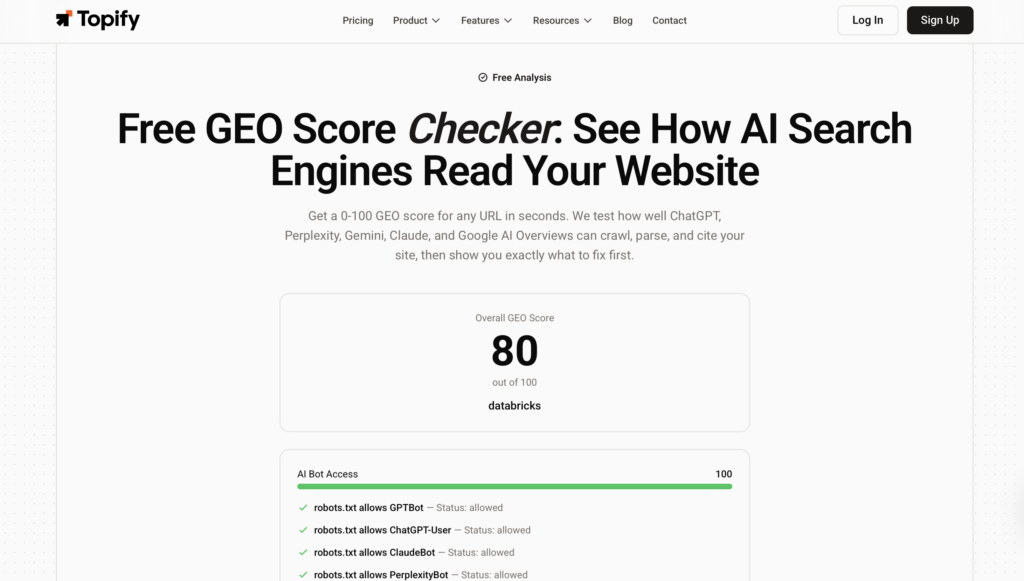
    What the GEO Score Checker Reveals About Your MLOps Platform

    Four Signals That Determine If AI Recommends Your MLOps Brand

    The GEO Score Checker returns a 0-100 composite score built from four dimensions. Each one maps to a specific problem MLOps brands face in AI search.

    SignalWhat It MeasuresWhat It Means for MLOps Brands
    Bot Access (0-100)Whether AI crawlers (GPTBot, ClaudeBot, PerplexityBot) can reach your contentBelow 50: your docs, tutorials, and changelogs are invisible to AI models
    Structured Data (0-100)Schema markup, metadata, and content organizationBelow 40: AI can’t parse your feature set or differentiate you from similar platforms
    Content Signals (0-100)Depth, authority indicators, and topical relevance of your pagesBelow 50: AI treats your platform as a minor player, even if your user base says otherwise
    Visibility Score (0-100)How often and prominently AI surfaces your brand in relevant queriesBelow 30: you’re not in the AI answer at all for your core category

    An MLOps platform with strong Content Signals but a Bot Access score of 25 has a clear diagnosis: the content is good, but AI literally can’t read it. That’s often a robots.txt misconfiguration blocking GPTBot or ClaudeBot. It’s fixable in minutes once you know it’s the problem.

    Three Issues MLOps Brands Typically Discover

    Your documentation is gated behind authentication. Many MLOps platforms require login to access API docs, SDK references, and integration guides. AI crawlers can’t authenticate. The result: AI models describe your product based on your marketing pages, not your actual capabilities.

    Your product positioning is ambiguous to AI. If your site talks about “data pipelines,” “model serving,” and “workflow orchestration” without clear MLOps framing, AI may classify you as a data engineering tool or a generic DevOps platform. You’ll show up in the wrong category or not at all.

    Your changelog and release notes aren’t crawlable. MLOps buyers care about recent updates. If AI can’t access your latest release notes, it’ll describe the version you shipped 18 months ago. Your new LLM deployment features, fine-tuning pipelines, or GPU optimization tools won’t exist in AI’s understanding.

    Run Your First Check in 60 Seconds

    Go to the GEO Score Checker, enter your domain, and get your four-dimensional breakdown. No account, no credit card, no sales call. The score tells you exactly which layer needs attention first, so you’re not guessing where to start.

    The AI Prompts Deciding Which MLOps Platforms Get Recommended

    ML engineers and data scientists don’t search for MLOps tools the way marketing teams expect. They ask AI specific, scenario-driven questions. The table below shows what those prompts look like and what they reveal about your visibility.

    AI Prompt ExamplePlatformSearch IntentWhat It Reveals
    “Best MLOps platform for LLM fine-tuning and deployment”ChatGPTPurchase evaluationWhether AI associates your brand with LLM-era capabilities
    “MLflow vs [your brand] for experiment tracking”PerplexityHead-to-head comparisonWhether AI has enough data to represent your platform accurately
    “Open-source MLOps tools for Kubernetes 2026”GeminiStack planningWhether AI categorizes you correctly (open-source vs. commercial, cloud vs. self-hosted)
    “MLOps platform with HIPAA compliance for healthcare”ChatGPTCompliance-driven selectionWhether AI knows about your security certifications and vertical capabilities
    “Which experiment tracking tool scales to 100K runs”PerplexityPerformance benchmarkingWhether AI can cite specific performance claims from your documentation

    Here’s the thing. If your GEO Score Checker results show low Bot Access or weak Structured Data, AI doesn’t have enough information to answer any of these prompts in your favor. The model defaults to the brands whose content it can actually read and parse.

    Gartner has projected that traditional search engine volume will drop 25% by 2026 due to AI platform adoption. For MLOps brands, the shift is already happening. Your buyers are the exact people building and using these AI systems. They’re not going to Google first.

    Three Visibility Gaps That Cost MLOps Brands Pipeline

    Open-Source Tools Dominate AI Recommendations. Commercial Platforms Get Left Out.

    Ask any major AI model to recommend MLOps tools, and you’ll get a predictable list: MLflow, Kubeflow, SageMaker, maybe Weights & Biases. The pattern isn’t random. Open-source projects generate massive volumes of crawlable content: GitHub repos, community forums, Stack Overflow threads, conference talks, academic papers. AI models train on all of it.

    Commercial MLOps platforms, by contrast, often keep their most valuable content behind login walls, gated demos, and sales-qualified funnels. The content that could differentiate them in AI search never makes it into the training data.

    A low GEO Score Checker result in Content Signals or Bot Access often points directly to this structural disadvantage. The fix isn’t to open-source your product. It’s to make your technical depth visible to AI in the same way open-source projects naturally are: public documentation, ungated tutorials, structured comparison pages, and crawlable API references.

    Category Misclassification Is the Silent Killer of MLOps Visibility

    AI models don’t have a fixed taxonomy for the MLOps market. They infer category placement from the signals your site sends. If your homepage leads with “accelerate your data pipeline” or “streamline infrastructure management,” AI may slot you into data engineering or DevOps, not MLOps.

    This matters because prompt-level visibility is category-specific. When someone asks “best MLOps platform for production ML,” AI pulls from its internal model of what belongs in the MLOps category. If your brand isn’t firmly in that bucket, you won’t surface, regardless of how strong your product is.

    The GEO Score Checker’s Content Signals dimension can flag this issue. A score that’s strong on general authority but weak on topical relevance suggests your site communicates expertise without specifying the right category.

    “Answer Inclusion” Is Replacing SERP Rankings as the MLOps Visibility KPI

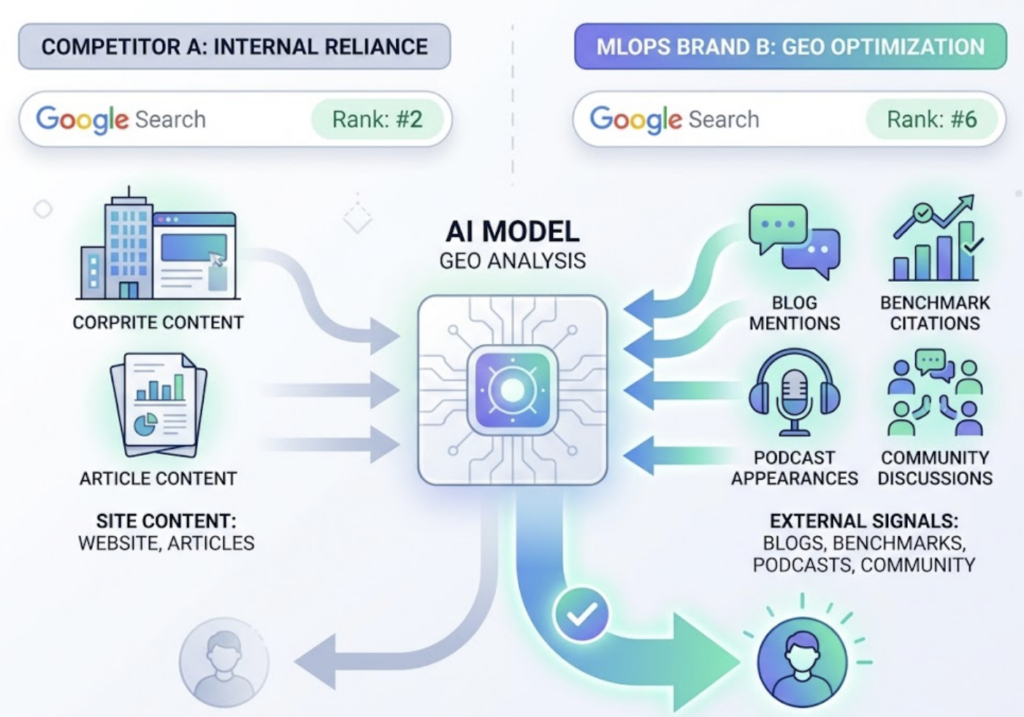
    Research from Edelman shows that up to 90% of citations driving brand visibility in LLMs come from earned media, not traditional SEO signals. For MLOps brands, this means ranking #3 on Google for “experiment tracking tools” doesn’t guarantee you’ll appear in the AI-generated answer.

    Answer Inclusion, whether your brand is named in the AI response at all, is the new metric. And it operates on different rules. AI models weigh semantic relevance, structural clarity, and third-party validation more heavily than domain authority alone.

    In practice, an MLOps brand with a moderate Google ranking but strong third-party coverage (blog mentions, benchmark citations, podcast appearances, community discussions) can outperform a higher-ranked competitor that relies primarily on its own site content. The GEO Score Checker gives you the baseline. From there, the optimization strategy shifts toward building the kind of external signals AI models actually trust.
    From a One-Time Score to Continuous AI Visibility

    Your GEO Score Checker result is a snapshot. It tells you where you stand today. But AI models update their training data, adjust their ranking signals, and reshuffle recommendations on a rolling basis. A score of 72 today could drop to 55 next quarter without any change on your end, simply because a competitor improved their structured data or published a wave of new technical content.

    Topify‘s Comprehensive GEO Analytics dashboard tracks your GEO score, visibility, and content signals continuously across ChatGPT, Perplexity, Gemini, and Google AI Overviews. You’ll see trend lines, get alerts when scores shift, and receive specific recommendations for what to fix next.

    Here’s how the free check compares to the full platform:

    CapabilityFree GEO Score CheckerTopify Platform
    Check frequencyOne-time snapshotContinuous daily/weekly monitoring
    AI platforms coveredAggregated single scorePer-platform breakdown (ChatGPT, Perplexity, Gemini, AI Overviews)
    Historical trendsNoneFull trend history with automated alerts
    Competitor trackingNot includedReal-time competitor benchmarking
    Action recommendationsGeneral score breakdownSpecific, prioritized optimization steps
    Team collaborationSingle userUnlimited team member seats

    Every plan starts with a 7-day free trial, no credit card required. The Starter plan begins at $99/month.

    Conclusion

    MLOps buyers are already asking AI which platforms to evaluate. If your brand isn’t in those answers, you’re losing pipeline before your sales team even gets a chance to talk.

    Start with the GEO Score Checker. Get your four-dimensional score. Fix the crawlability and content structure issues it surfaces. Then build a continuous monitoring practice so you’re not blindsided when AI models shift their recommendations.

    While you’re assessing your GEO score, a few other free checks can round out the picture. Topify‘s AI Robots Checkershows exactly which AI crawlers your robots.txt currently blocks, a critical first step for MLOps platforms that may have inadvertently locked out GPTBot or ClaudeBot. The Competitor Analysis tool reveals how AI positions your brand against alternatives in your category. And the AI Visibility Report gives you a cross-platform snapshot of how often your brand gets mentioned in AI-generated responses.

    FAQ

    Is the GEO Score Checker really free? Do I need to create an account? 

    Yes, it’s completely free with no signup required. Enter your domain and get your score in under 60 seconds. No credit card, no email, no strings attached.

    What’s the difference between the free GEO Score Checker and Topify’s paid platform? 

    The free tool gives you a one-time snapshot of your GEO readiness across four dimensions. The paid platform provides continuous monitoring, per-platform breakdowns, historical trend tracking, competitor benchmarking, and actionable optimization recommendations. Plans start at $99/month with a 7-day free trial.

    How often should MLOps brands check their AI visibility? 

    At minimum, after every major product release, documentation update, or website restructure. AI models re-index content on rolling schedules, so changes can take weeks to propagate. Continuous monitoring through the Topify platform catches shifts you’d otherwise miss.

    Why does my MLOps platform rank well on Google but not appear in AI answers? 

    AI models weight different signals than traditional search engines. They prioritize structured data, crawlability by AI-specific bots (GPTBot, ClaudeBot), semantic clarity, and third-party validation. A strong Google ranking doesn’t automatically translate to AI visibility, which is exactly what the GEO Score Checker helps you diagnose.
    Read More

  • AI Visibility Tools for Web3 Brands

    AI Visibility Tools for Web3 Brands

    A DeFi protocol with $200 million in total value locked asked Perplexity: “Best DeFi lending platforms for institutional borrowers.” Five protocols appeared in the answer. Theirs wasn’t one of them. They rank on Google’s first page for that exact query. AI search doesn’t care.

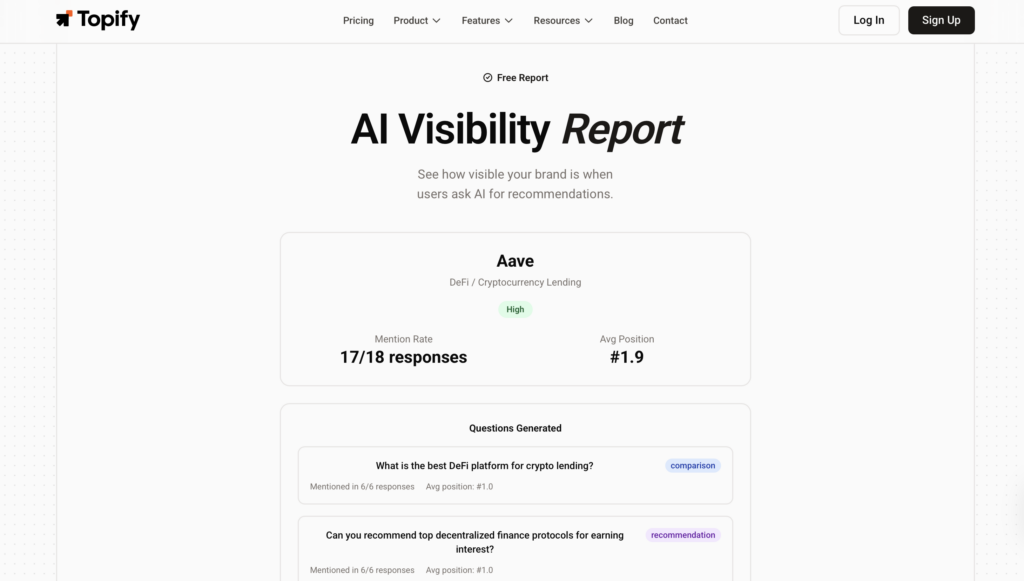
    The gap is measurable, and the check takes 60 seconds. Topify‘s AI Visibility Report scans how often your brand gets mentioned across ChatGPT, Perplexity, Gemini, and Google AI Overviews, then breaks down your mention rate, ranking position, and provider-by-provider performance.

    ✅ Free ⚡ Results in 60 seconds 🔒 No signup required

    What the AI Visibility Report Actually Tells You About Your Web3 Brand

    The report doesn’t give you a single vanity score. It breaks your AI presence into dimensions that map directly to how Web3 brands win or lose in AI-generated recommendations.

    Three Metrics, Decoded for Web3

    MetricWhat It MeasuresWhat It Means for Web3 Brands
    Mention RateHow frequently AI names your brand in category queriesBelow 10%: AI doesn’t associate your protocol with your core vertical (DeFi, L2, wallets, etc.)
    Ranking PositionWhere your brand appears in AI’s ranked recommendationsPosition 4+: You’re behind protocols that may have lower TVL but stronger content signals
    Provider BreakdownWhich AI platforms mention you and which don’tGaps reveal platform-specific blind spots, like being visible on Perplexity but absent from ChatGPT

    A Web3 project with a strong mention rate on Perplexity but zero presence on ChatGPT has a distribution problem, not a product problem. That’s the kind of insight the report surfaces immediately.

    Where Web3 Brands Typically Discover Problems

    Scenario 1: The “invisible protocol” problem. A Layer 2 chain has shipped 15 ecosystem partnerships and processes 2M daily transactions. AI search doesn’t mention it when users ask “fastest L2 for gaming.” The Visibility Report shows a mention rate of 3% and a ranking position outside the top 10 across all platforms.

    Scenario 2: Platform-specific gaps. A non-custodial wallet brand shows up consistently in Perplexity answers (which heavily index Reddit discussions) but is completely absent from ChatGPT and Gemini. The provider breakdown reveals the brand’s visibility relies entirely on community chatter, not structured, citable content.

    Scenario 3: Misrepresentation over invisibility. A DeFi protocol appears in AI answers, but the description references a deprecated version of their product. The report flags the mention, and the brand realizes that being mentioned incorrectly might be worse than not being mentioned at all.

    How to Run Your Web3 Brand Through the Report

    Step 1: Go to the AI Visibility Report and enter your brand name or protocol name.

    Step 2: Review your mention rate, ranking position, and provider breakdown. Note which AI platforms include you and which don’t.

    Step 3: Compare your results against your Google search rankings. The gap between traditional SEO performance and AI visibility is where the problem lives.

    The entire process takes under a minute. No account, no API key, no token gating.

    Web3 Buyers Ask AI Before They Ask Your Community

    Crypto research behavior has shifted. Investors, developers, and enterprise buyers increasingly type questions into AI assistants before visiting protocol documentation, Discord servers, or Twitter threads.

    Here’s what those queries look like, and what they reveal about your brand’s AI presence:

    AI Prompt ExamplePlatformSearch IntentWhat It Reveals About Your Brand
    “Best Layer 2 for gaming dApps”ChatGPTProtocol selectionWhether AI considers you a credible option in your vertical
    “Is [protocol] safe to stake on?”PerplexityTrust verificationHow AI describes your security track record and audit history
    “Most secure DeFi lending platforms 2026”GeminiPurchase/allocation decisionYour ranking against competitors in AI’s recommendation list
    “Cheapest blockchain for NFT minting”ChatGPTCost comparisonWhether AI has accurate, current data on your fee structure
    “Web3 wallet comparison for beginners”Google AI OverviewOnboarding decisionIf your product appears in the entry-level recommendation set

    73% of B2B buyers now use AI tools in their research process. In Web3, where due diligence is non-negotiable and trust thresholds are higher than in most industries, AI-generated answers carry even more weight.

    The problem compounds: AI search traffic converts at 14.2%, roughly five times the rate of traditional Google organic traffic. If your Web3 brand isn’t in the AI answer, you’re not just losing impressions. You’re losing the highest-converting traffic channel available.

    Google Rankings and AI Search Visibility Are Two Different Games

    Web3 brands assume that strong Google rankings translate into AI search presence. They don’t.

    A blockchain company can rank on page one for competitive keywords while remaining invisible inside ChatGPT, Perplexity, and Gemini. Research on AI-generated search experiences confirms that AI models retrieve and prioritize sources differently from traditional search rankings. In some cases, cited sources don’t even appear among the top classic search results.

    Here’s the thing: traditional search rewards pages optimized around keywords and backlinks. LLMs synthesize information from multiple sources at once. They prioritize corroborated claims, structured explanations, trusted publications, fresh reporting, and repeated brand mentions across the web.

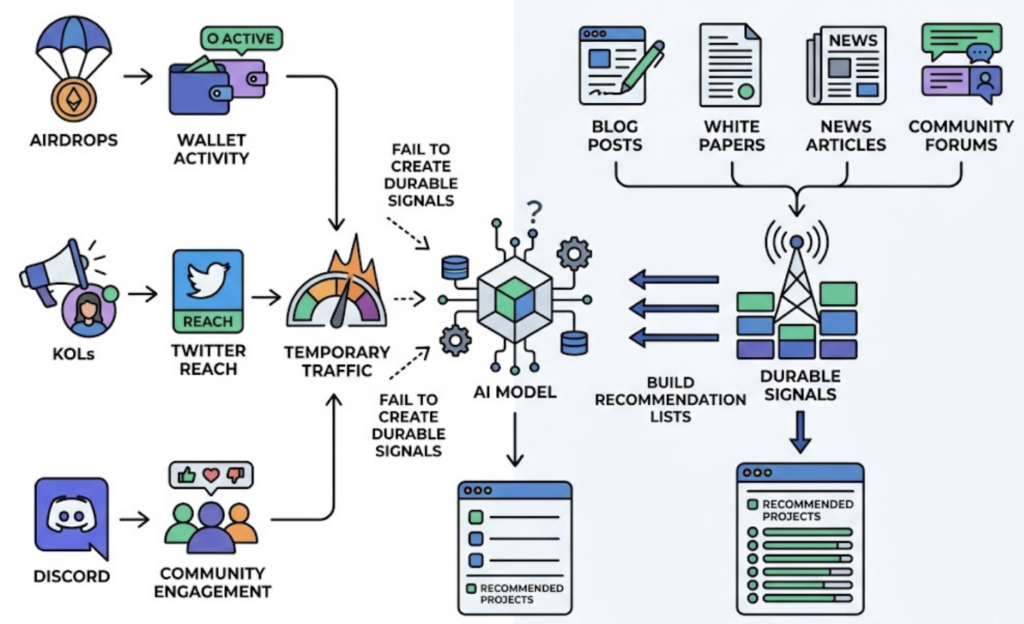
    For Web3 brands, this creates a specific vulnerability. Most crypto projects still rely on short-lived marketing cycles: airdrops to generate wallet activity, KOL partnerships for Twitter reach, Discord campaigns for community engagement. These tactics generate temporary traffic, but they fail to create the kind of durable, multi-source content signals that AI models use to build their recommendation lists.

    The AI Visibility Report makes this gap visible. Run your brand through it, and you’ll see exactly where Google performance and AI presence diverge. That divergence is your starting point.

    AI Applies Stricter Trust Filters to Crypto and Web3 Brands

    Not every industry faces the same bar for AI recommendations. Web3 faces a higher one.

    AI models have been trained on a web that includes years of crypto scams, rug pulls, Ponzi schemes, and regulatory enforcement actions. That history shapes how LLMs evaluate new queries about blockchain projects. When a user asks “Is [protocol] safe?”, AI doesn’t just check your website. It looks for audit reports cited by independent sources, media coverage from trusted publications, community sentiment across Reddit and forums, and consistency between what your brand claims and what third parties verify.

    A Web3 project with solid technology but thin external validation gets filtered out. In practice, this means that a newer DeFi protocol with a $50M TVL and two completed audits can still be invisible to AI if those audits aren’t cited in publications that LLMs trust, if Reddit discussions about the protocol are sparse, and if no independent comparison articles include it.

    The path forward isn’t more marketing spend. It’s building what AI models consider trustworthy signals: entity-level consistency across sources, structured content that LLMs can extract and cite, third-party validation from publications and review platforms, and a content footprint that persists beyond campaign cycles.

    This is where the shift from “event-driven marketing” to “entity building” becomes critical for Web3 brands. Airdrops don’t build entities. Consistent, structured, multi-source content does.

    One Snapshot Tells You Where You Stand. Continuous Tracking Tells You Where You’re Heading.

    The AI Visibility Report gives you a clear picture of your current AI search presence. But AI models update their training data, adjust recommendation signals, and shift rankings on a rolling basis. A protocol that shows up in ChatGPT’s DeFi recommendations today could disappear next month after a model update, with no change on the brand’s end.

    Web3 moves fast. Narratives shift from RWA tokenization to modular chains to AI agents in weeks. Your AI visibility score is tied to those shifts.

    Topify‘s AI Visibility Checker picks up where the free report leaves off. It tracks your mention rate, ranking position, and provider breakdown continuously across ChatGPT, Perplexity, Gemini, and Google AI Overviews. You’ll see trend lines, get alerts when visibility shifts, and benchmark your performance against competing protocols in real time.

    CapabilityFree AI Visibility ReportTopify Platform
    Check frequencyOne-time snapshotContinuous daily/weekly monitoring
    AI platforms coveredAggregated overviewPer-platform breakdown with trends
    Historical dataNoneFull visibility history with alerts
    Competitor trackingNot includedReal-time protocol benchmarking
    Action recommendationsManual interpretationSpecific optimization suggestions
    Team collaborationSingle userUnlimited team seats

    Every plan starts with a 7-day free trial, no credit card required. The Starter plan begins at $99/month.

    Conclusion

    Web3 brands are competing for attention in AI search whether they’ve optimized for it or not. The question isn’t whether your protocol should be visible in ChatGPT and Perplexity. It’s whether you even know your current status.

    Start with the free AI Visibility Report to see where your brand stands across AI platforms. Use the results to identify platform-specific gaps, trust signal weaknesses, and ranking positions that don’t match your product’s actual strengths. Then decide whether a one-time check is enough, or whether continuous monitoring through Topify’s platform fits your growth stage.

    While you’re checking your AI visibility, a few other free tools can round out the picture. Topify‘s GEO Score Checkerevaluates whether AI crawlers can actually access and parse your site’s content. The AI Trends Tracker surfaces which Web3 topics are trending across AI platforms right now. And the Brand Authority Checker scores how AI models perceive your brand’s expertise and trustworthiness in your category.

    FAQ

    Is the AI Visibility Report free? Do I need to sign up? 

    Yes, it’s completely free and requires no account, no email, and no credit card. Enter your brand name, get your report in under 60 seconds.

    What’s the difference between the free report and Topify’s paid platform? 

    The free report gives you a one-time snapshot of your AI visibility across platforms. The paid platform adds continuous monitoring, historical trend tracking, competitor benchmarking, optimization recommendations, and team collaboration. Plans start at $99/month with a 7-day free trial.

    How often should Web3 brands check their AI visibility? 

    At minimum, after every major product launch, narrative shift, or AI model update. In practice, weekly monitoring is ideal for Web3 because the space moves faster than most industries, and AI recommendation lists can change without warning.

    Why is my Web3 brand invisible in AI search if I rank well on Google? 

    Google rankings depend on keywords and backlinks. AI models prioritize corroborated claims, trusted publications, structured content, and multi-source brand mentions. Most Web3 brands optimize for the first set of signals but not the second, which is why Google performance and AI visibility often diverge.

    Read More

  • AI Visibility Tools for AI Infrastructure

    AI Visibility Tools for AI Infrastructure

    A VP of Engineering opens Perplexity and types: “Best GPU cloud provider for large-scale inference workloads in 2026.” Four brands show up. Yours isn’t one of them. That query just bypassed your sales team, your landing pages, and your entire demand gen funnel. The buyer moved on before you ever had a chance to pitch.

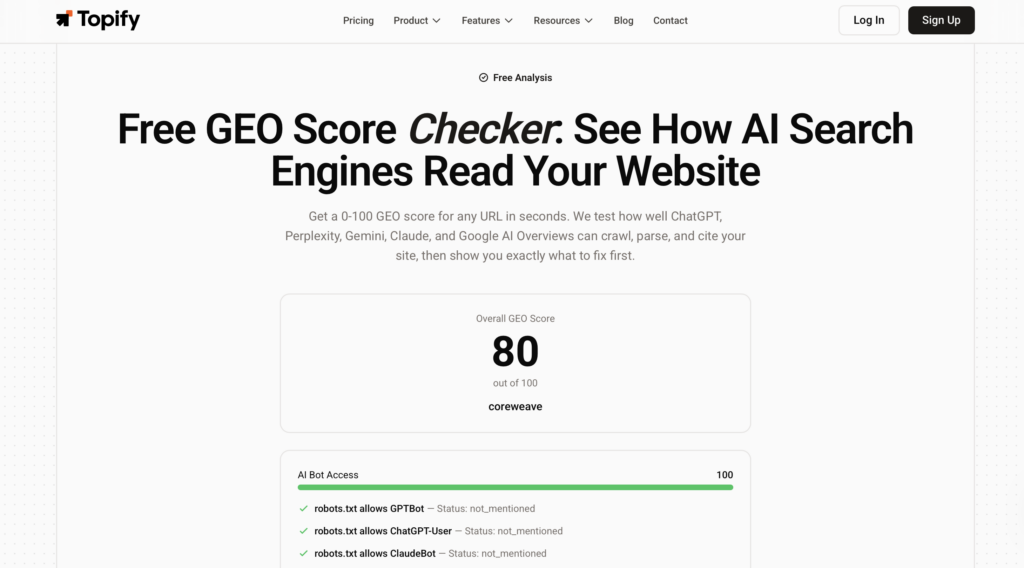
    Here’s the thing: you can check whether AI search engines can actually see your infrastructure brand right now. Topify’sGEO Score Checker runs a free audit on any URL and returns a 0-100 score across four dimensions: bot access, structured data, content signals, and visibility. ✅ Free, ⚡ results in 60 seconds, 🔒 no signup required.

    What the GEO Score Tells You About Your AI Infrastructure Website

    The Four Dimensions That Determine If AI Can Read Your Site

    Most AI infrastructure companies invest heavily in product documentation, benchmark reports, and technical whitepapers. But if AI crawlers can’t access, parse, and cite that content, none of it contributes to your AI search visibility.

    The GEO Score Checker evaluates your site across four dimensions. Each one maps directly to how AI models decide whether to include your brand in a recommendation.

    DimensionWhat It MeasuresWhat It Means for AI Infrastructure
    Bot AccessWhether AI crawlers (GPTBot, ClaudeBot, PerplexityBot) can reach your pagesMany infra sites block bots via robots.txt or serve content behind JavaScript rendering walls
    Structured DataSchema markup, JSON-LD, and machine-readable metadataAI models rely on structured data to understand product specs, pricing tiers, and deployment options
    Content SignalsCitability, clarity, and depth of on-page contentDense technical docs score well here, but only if they’re organized with clear headings and concise claims
    VisibilityHow often your brand appears in AI-generated responsesLow visibility means your competitors are getting the recommendations your content should earn

    A score of 70+ generally means AI models can find and reference your content. Below 50, and you’re likely invisible in most AI-generated answers about GPU clouds, networking hardware, or data center solutions.

    Three Scenarios Where AI Infrastructure Brands Fail the GEO Test

    Scenario 1: Your benchmark data lives in PDFs. You published a detailed MLPerf comparison showing your GPU cluster outperforms alternatives by 40%. But it’s locked in a downloadable PDF that AI crawlers can’t index. The GEO Score Checker flags this as a content signal gap.

    Scenario 2: Your robots.txt blocks AI bots. Your engineering team configured robots.txt to limit crawl load, and in the process blocked GPTBot and ClaudeBot entirely. Your bot access score drops to near zero, and AI platforms literally can’t see your site.

    Scenario 3: Your product pages lack structured data. You offer three GPU cloud tiers with different specs, pricing, and SLAs. But without schema markup, AI models can’t distinguish your offerings from a competitor’s. When a buyer asks “cheapest GPU cloud for fine-tuning,” AI has no structured way to recommend your starter tier.

    Run Your First GEO Audit in 60 Seconds

    The process is straightforward:

    1. Go to the GEO Score Checker and enter your homepage URL.
    2. Review your composite score and the breakdown across all four dimensions.
    3. Prioritize fixes based on which dimension scores lowest. Bot access issues typically have the fastest fix cycle. Content signal improvements take longer but compound over time.

    You don’t need a marketing agency to interpret the results. The score is designed to be readable by technical teams, which is exactly who runs the show at most AI infrastructure companies.

    The Prompts AI Infrastructure Buyers Are Typing Into ChatGPT

    Understanding what your buyers ask AI is the first step to showing up in those answers. Here are the prompt patterns that drive vendor discovery in this category.

    AI Prompt ExamplePlatformSearch IntentWhat It Reveals
    “Best GPU cloud for LLM training at scale”ChatGPTVendor shortlistingWhether AI recommends your platform for high-compute workloads
    “CoreWeave vs Lambda for inference”PerplexityCompetitive comparisonHow AI positions your brand against named alternatives
    “Most cost-effective AI infrastructure for startups”GeminiBudget-constrained purchaseWhether your pricing or starter tiers get cited
    “Best liquid cooling for high-density GPU racks”ChatGPTComponent researchWhether your cooling or hardware specs are visible to AI
    “What networking equipment do I need for a 1,000-GPU cluster”PerplexityTechnical planningWhether AI references your product documentation
    “AI data center providers near Virginia”Google AI OverviewLocation-based evaluationWhether your facilities appear in geo-specific AI results

    37% of product discovery queries now start in AI interfaces. In the AI infrastructure space, these queries tend to be highly specific and technical. That’s good news if your content is well-structured. It’s a problem if AI can’t parse your specs.

    The GEO Gaps Most AI Infrastructure Companies Don’t Know They Have

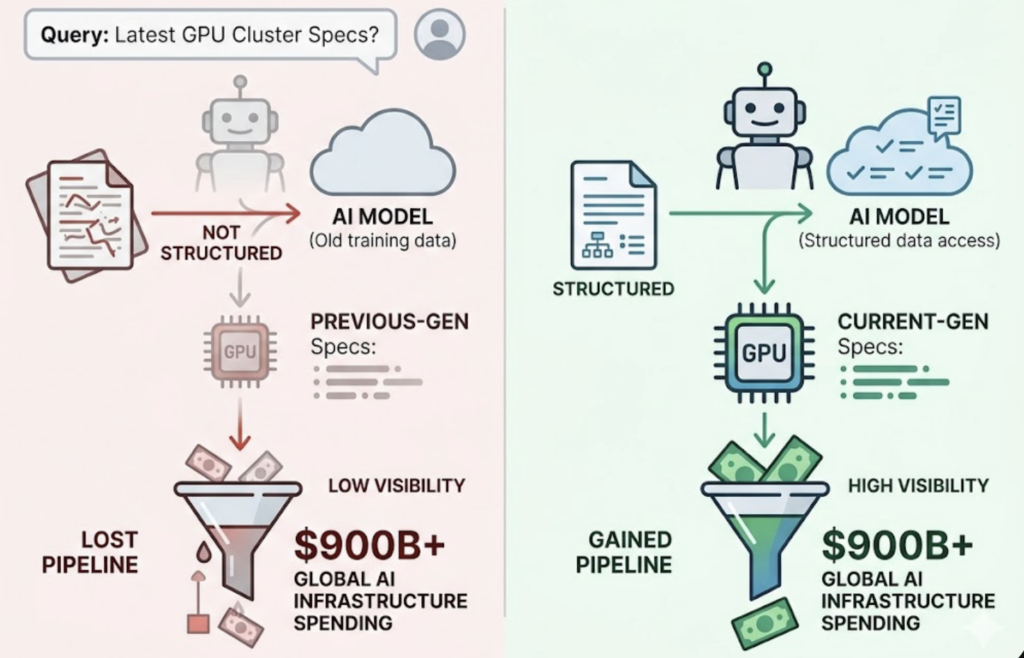
    AI Models Describe Your Product Using Information From Six Months Ago

    GPU architectures evolve on 6-to-12-month cycles. New cooling systems hit the market every quarter. Pricing changes constantly as supply and demand shift across regions.

    But AI models don’t update in real time.

    If your website content isn’t structured for AI citability, models will keep using whatever information they absorbed during their last training window. That means a buyer asking about your latest GPU cluster might get a description based on your previous-generation specs. In a market where global AI infrastructure spending is projected to exceed $900 billion by 2029, outdated AI descriptions don’t just cost you visibility. They cost you pipeline.

    The fix isn’t just publishing a blog post about your new product. It’s making sure your content architecture, schema markup, and entity signals are clear enough that AI models can absorb and re-surface updated information quickly.

    Your Competitors May Already Be Optimizing for AI Search While You’re Still Focused on Google Rankings

    Traditional SEO measures backlinks, keyword rankings, and organic traffic. GEO measures something entirely different: whether AI systems can read, understand, and cite your content.

    Only 11% of B2B brands have content that’s AI-discovery ready. In a category as competitive as AI infrastructure, the brands that invest in GEO first will build compounding advantages. AI models tend to reinforce what they already cite. If your competitor appears in responses consistently and you don’t, the gap widens with every model update.

    This isn’t a theoretical risk. 80% of tech industry buyers already use GenAI as much as or more than traditional search for vendor research. The switch has already happened.

    Your Website Needs to Be Machine-Readable, Not Just Human-Readable

    Gartner projects that by 2028, 90% of B2B purchasing will be intermediated by AI agents. AI infrastructure buyers are already among the most AI-native procurement teams in any industry. They’re using AI tools not just for research, but for building automated vendor evaluation pipelines.

    Your website’s GEO Score is a proxy for how well these systems can process your information. A high bot access score means AI agents can crawl your site. Strong structured data means they can extract your product specs programmatically. Good content signals mean they can cite your claims with confidence.

    50% of B2B buyers have already evaluated or purchased from a vendor they discovered exclusively through AI, with no prior brand awareness. In a market where new GPU cloud providers, networking vendors, and storage solutions launch monthly, being machine-readable is no longer optional.

    One Snapshot Won’t Keep You Visible. Here’s What Continuous GEO Monitoring Looks Like.

    The GEO Score Checker gives you a point-in-time assessment. That’s valuable as a starting point. But AI search results shift constantly. Models retrain, competitor content changes, and your own site evolves with new product launches and pricing updates. A score of 72 today could drop to 58 next month without any action on your part.

    Topify’s Comprehensive GEO Analytics turns that one-time snapshot into a continuous monitoring system. It tracks your GEO performance across ChatGPT, Perplexity, Gemini, and Google AI Overviews in a single dashboard, with trend history, citation tracking, sentiment analysis, and competitor benchmarking. When your score dips, you’ll know which dimension changed and why.

    CapabilityFree GEO Score CheckerTopify Platform
    Check frequencyOne-time snapshotContinuous daily/weekly monitoring
    AI platforms coveredSingle checkChatGPT + Perplexity + Gemini + AI Overviews
    Historical trendsNoFull trend history with alerts
    Competitor trackingNoReal-time competitor benchmarking
    Actionable next stepsManual interpretationOne-click GEO optimization recommendations
    Team collaborationNoUnlimited team member seats

    Plans start at $99/month with a 7-day free trial, no credit card required. For AI infrastructure companies managing multiple product lines or sub-brands, the Pro tier supports multi-brand tracking. You can start a free trial and see your full GEO analytics dashboard within minutes.

    Conclusion

    AI infrastructure is one of the fastest-moving B2B categories in the world. Your buyers are technical, AI-native, and increasingly relying on AI search to build vendor shortlists before they ever talk to sales. If your website isn’t optimized for AI readability, you’re invisible to the exact audience you’re trying to reach.

    Start with the GEO Score Checker to see where you stand. Fix the gaps it identifies. Then move to continuous monitoring so your visibility keeps pace with your product roadmap.

    Other Free Tools Worth Running

    Once you’ve benchmarked your GEO Score, a few additional checks can round out the picture:

    • AI Robots Checker: Verify whether your robots.txt is blocking GPTBot, ClaudeBot, PerplexityBot, and other AI crawlers. This is often the single fastest fix for AI infrastructure sites.
    • AI Visibility Report: See how often your brand gets mentioned across major AI platforms, with a breakdown by provider.
    • Competitor Analysis: Find out which competitors AI recommends in your category and how your positioning compares.

    FAQ

    Is the GEO Score Checker really free? Do I need to create an account? Yes, it’s completely free with no signup required. Enter any URL and get your score in about 60 seconds.

    What’s the difference between the free GEO Score Checker and the Topify platform? The free tool gives you a one-time score and dimensional breakdown. The platform adds continuous monitoring, historical trend tracking, competitor benchmarking, citation analysis, and one-click optimization recommendations across all major AI search engines.

    How often should an AI infrastructure brand check its AI visibility? At minimum, after every major product launch, pricing change, or website update. Ideally, you’d run continuous monitoring since AI model updates can shift your visibility without any changes on your end.

    Our site has extensive technical documentation. Doesn’t that automatically make us visible to AI? Not necessarily. Documentation depth helps your content signal score, but if AI crawlers are blocked by your robots.txt, or your content lacks structured data, that documentation won’t surface in AI-generated answers. The GEO Score Checker reveals exactly which dimensions need work.

    Read More

  • AI Visibility Tools for Clean Energy Companies

    AI Visibility Tools for Clean Energy Companies

    A corporate sustainability director typed into ChatGPT: “Best clean energy providers for a 50 MW corporate PPA in the Southeast.” Five companies came back. Yours, with 3 GW of installed capacity and contracts across 12 states, wasn’t on the list. The problem isn’t your track record. It’s that AI doesn’t recognize it.

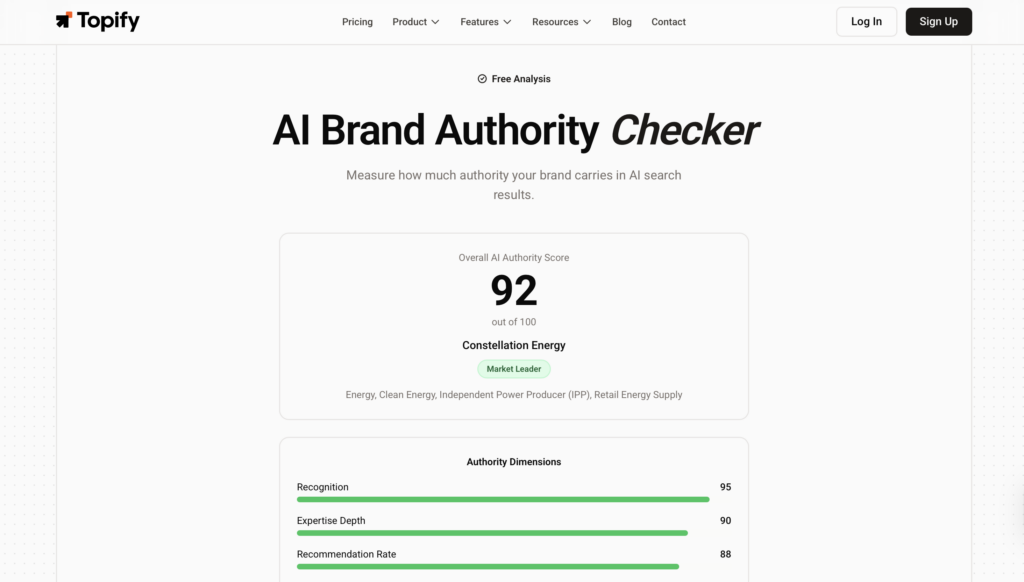
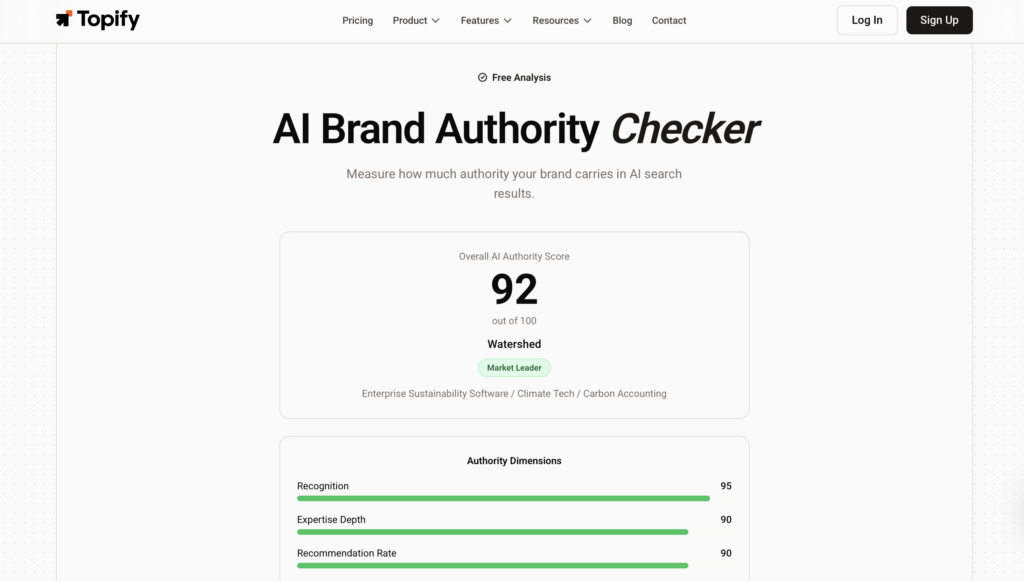
    There’s a way to see exactly where the disconnect is. Topify‘s Brand Authority Checker scores how AI models perceive your clean energy brand’s authority across four dimensions that directly affect whether you get recommended.

    ✅ Free ⚡ Results in 60 seconds 🔒 No signup required

    The Four Authority Scores That Determine If AI Trusts Your Clean Energy Brand

    Each Score, Translated for Clean Energy

    The Brand Authority Checker doesn’t give you a single number and send you on your way. It breaks AI’s perception of your brand into four distinct scores, each one mapping to a specific challenge clean energy companies face.

    MetricWhat It MeasuresWhat It Means for Clean Energy Brands
    Recognition (0-100)How often AI identifies your brand in your categoryBelow 40: AI doesn’t associate you with solar, wind, storage, or your core vertical
    Expertise Depth (0-100)How well AI understands your technical capabilitiesBelow 50: AI may not know about your latest product line, grid services, or PPA structures
    Recommendation Rate (0-100)How often AI recommends you vs. alternativesBelow 30: you’re being excluded from AI-generated shortlists that procurement teams rely on
    Trust Signals (0-100)External validation AI detects (media, reviews, citations)Below 40: AI can’t find enough third-party evidence to vouch for your credibility

    Here’s the thing. A clean energy company with a Recognition score of 80 but a Trust Signals score of 25 has a very specific problem: AI knows who you are, but doesn’t trust you enough to recommend you over alternatives. That’s a fixable gap, and now you know where to focus.

    A brand with strong Expertise Depth but low Recommendation Rate faces a different issue. AI understands what you do but still picks someone else, often because external validation is missing.

    Three Scenarios Clean Energy Brands Discover After Running the Check

    Scenario 1: The “Invisible Incumbent” You’ve deployed hundreds of megawatts. You have utility-scale references. But your Recognition score is 35. AI simply doesn’t connect your brand to the clean energy category. This typically happens when a company’s digital footprint is heavy on project-level documentation but light on brand-level content that AI can parse.

    Scenario 2: The “Outdated Expert” Your Expertise Depth sits at 45, even though you launched a next-gen battery storage platform six months ago. AI’s understanding of your capabilities is stuck in 2024. Your latest innovations aren’t reflected in what AI tells buyers about you.

    Scenario 3: The “Unverified Contender” Strong scores across Recognition and Expertise, but Trust Signals under 30. You’re doing the work, but the industry press, analyst reports, and review platforms haven’t caught up. AI notices that gap.

    How to Run Your Brand Authority Check

    Go to the Brand Authority Checker, enter your brand name or domain, and you’ll get a four-dimensional authority breakdown in under 60 seconds. No signup, no credit card, no email required.

    Once you have your scores, you’ll know exactly which dimension is holding back your AI visibility. That’s the starting point for a targeted optimization strategy.

    The AI Prompts That Shape Clean Energy Procurement Decisions

    Every day, procurement officers, sustainability directors, and energy consultants are asking AI platforms questions that directly influence which clean energy brands make it onto shortlists. The table below shows what those prompts look like and what they reveal about your visibility.

    AI Prompt ExamplePlatformSearch IntentWhat It Reveals
    “Best solar EPC companies for commercial rooftop projects”ChatGPTVendor selectionWhether AI recommends you for your core service
    “Most reliable battery storage providers for grid-scale”PerplexityTechnical evaluationHow AI rates your technical credibility
    “Compare clean energy companies for corporate PPA deals”GeminiCompetitive comparisonWhere you rank against alternatives in AI’s view
    “Which renewable energy companies have the strongest ESG ratings?”ChatGPTCompliance verificationWhether AI associates your brand with ESG leadership
    “Top EV charging infrastructure companies for fleet operations”PerplexityNiche specializationIf AI recognizes your presence in adjacent verticals
    “Is [your brand] a trusted partner for data center clean energy?”Google AI OverviewBrand-specific trust checkHow AI describes your reputation to a buyer who already knows your name

    If you’re not showing up in responses to these types of prompts, you’re not losing a marketing channel. You’re losing a seat at the procurement table before your sales team even gets a call.

    Enterprise Energy Buyers Are Being Pre-Screened by AI. Your Brand May Not Make the Cut.

    73% of B2B buyers now use AI tools in their purchase research process. In clean energy, where deal cycles are long and stakes are high, this shift is hitting harder than most sectors realize.

    Consider what a typical enterprise clean energy procurement process looks like in 2026. A sustainability director opens ChatGPT and types: “Which companies offer the best corporate PPA terms for renewable energy in Texas?” The AI returns five names. That list, generated in 12 seconds, becomes the starting shortlist for a deal worth tens of millions of dollars.

    Your brand, with a decade of Texas wind projects and 2 GW of operational capacity, isn’t on it. You don’t get a call. You don’t get an RFP. You don’t even know the opportunity existed.

    This is the new “pre-qualification” layer. AI is functioning as an unpaid analyst, and procurement teams trust its output. AI search traffic converts at 14.2% compared to Google organic’s 2.8%. When a buyer reaches your website through an AI recommendation, they’re already further down the decision funnel.

    The Brand Authority Checker gives you a direct read on whether your brand is clearing this AI pre-screen. A low Recommendation Rate score tells you that even when AI knows who you are, it’s not putting you forward. That’s the metric that maps most directly to lost pipeline.

    In practice, clean energy companies that run this check often discover a pattern: strong internal credentials, weak external signal. The fix isn’t more project announcements. It’s building the kind of third-party validation, structured content, and entity clarity that AI systems rely on to generate recommendations.

    Cross-Platform AI Visibility Gaps Hit Clean Energy Brands Harder Than Most

    Here’s a data point that should concern every clean energy marketer: only 11% of domains are cited by both ChatGPT and Perplexity. The overlap between platforms is razor-thin.

    For most consumer brands, platform fragmentation is an inconvenience. For clean energy companies, it’s a structural risk. Here’s why.

    Clean energy procurement decisions involve multiple stakeholders. A VP of Sustainability might use ChatGPT to build an initial vendor list. A CFO might check Perplexity for financial credibility data. A legal team might use Google AI Overview to verify regulatory compliance. If your brand shows up on one platform but not the others, you’re visible to one decision-maker and invisible to the rest.

    StakeholderLikely AI PlatformWhat They’re CheckingRisk If You’re Missing
    VP SustainabilityChatGPTVendor recommendations, ESG fitNot on the initial shortlist
    CFO / FinancePerplexityFinancial credibility, deal structurePerceived as financially unverified
    Legal / ComplianceGoogle AI OverviewRegulatory track record, certificationsFlagged as compliance risk
    Operations / EngineeringGeminiTechnical specs, grid integration capabilityExcluded from technical evaluation

    Research shows that citation volumes for the same brand can differ by 615x between platforms. A clean energy company might have strong visibility on ChatGPT from media coverage but zero presence on Perplexity because its content isn’t structured for citation-based retrieval.

    The Brand Authority Checker gives you an aggregated view, but the real question is whether your authority holds up across every platform your buyers use. That’s where a one-time check reaches its limits.

    One Snapshot Shows the Gap. Continuous Tracking Closes It.

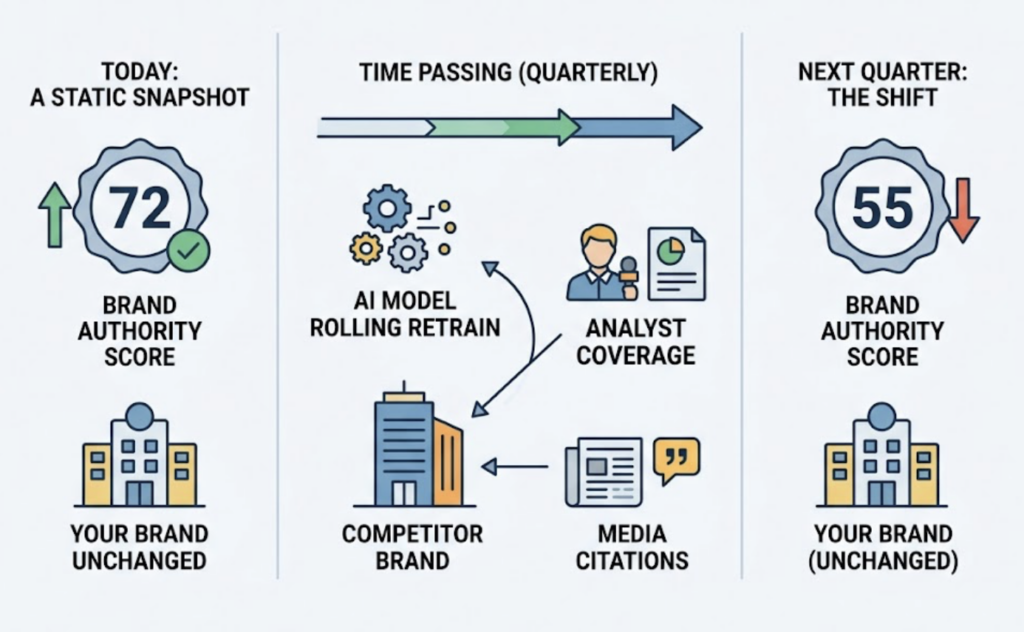
    Your Brand Authority Checker results tell you where you stand right now. But AI models retrain, adjust their ranking signals, and shift recommendations on a rolling basis. A score of 72 today could drop to 55 next quarter without any change on your end, simply because a competitor published a wave of analyst coverage or earned new media citations.

    Topify‘s platform picks up where the free tool leaves off. The Comprehensive GEO Analytics dashboard tracks your authority, sentiment, and visibility scores continuously across ChatGPT, Perplexity, Gemini, and Google AI Overviews. You’ll see trend lines, get alerts when scores shift, and receive specific recommendations for what to fix.

    Here’s how the free check compares to the full platform:

    CapabilityFree Brand Authority CheckerTopify Platform
    Check frequencyOne-time snapshotContinuous daily/weekly monitoring
    AI platforms coveredAggregated scorePer-platform breakdown (ChatGPT, Perplexity, Gemini, AI Overviews)
    Historical trendsNoneFull trend history with alerts
    Competitor trackingNot includedReal-time competitor benchmarking
    Action recommendationsGeneral directionSpecific, one-click GEO optimization
    Team collaborationSingle userUnlimited team member seats

    Every plan starts with a 7-day free trial, no credit card required. The Starter plan begins at $99/month.

    Conclusion

    Clean energy brands are winning contracts, securing funding, and building market share based on how AI perceives their authority. The shift is already here: 73% of B2B buyers research with AI, and the brands that show up in those results capture a disproportionate share of pipeline.

    Start with the Brand Authority Checker. In 60 seconds, you’ll know exactly how AI scores your brand across recognition, expertise, recommendation likelihood, and trust signals. From there, you can decide whether a one-time diagnostic is enough or whether continuous monitoring through Topify’s platform fits your growth strategy.

    While you’re assessing your brand authority, a few other free checks can round out the picture. Topify‘s GEO Score Checker evaluates whether AI crawlers can properly access and index your site. The AI Visibility Report shows how often your brand gets mentioned across major AI platforms. And the Competitor Analysis tool reveals which clean energy brands AI favors in your category and why.

    FAQ

    Is the Brand Authority Checker free? Do I need to sign up? 

    Yes, it’s completely free. No signup, no credit card, no email required. Enter your brand name or domain at topify.ai/tools/brand-authority-checker and get your scores in under 60 seconds.

    What’s the difference between the free tool and the Topify paid platform? 

    The free Brand Authority Checker gives you a one-time snapshot of your four authority scores. The Topify platform adds continuous monitoring, historical trends, per-platform breakdowns, competitor benchmarking, and actionable optimization recommendations. Plans start at $99/month with a 7-day free trial.

    How often should clean energy brands check their AI visibility? 

    AI models update their training data and ranking signals regularly. A quarterly check with the free tool is a reasonable minimum. Brands in active procurement cycles or competitive markets benefit from weekly or daily monitoring through the full platform.

    Why does my brand show up on ChatGPT but not Perplexity?

    Each AI platform pulls from different data sources and applies different ranking logic. Only 11% of domains get cited on both ChatGPT and Perplexity. Your content structure, third-party citations, and entity signals may be optimized for one platform’s retrieval method but not another’s. The Brand Authority Checker gives an aggregated score, while the full platform shows per-platform visibility.

    Read More

  • AI Visibility Tools for Climate Tech

    AI Visibility Tools for Climate Tech

    A VP of Sustainability opens ChatGPT and types: “Best carbon accounting platforms for mid-market companies.” The response lists five names. Your company, the one with SBTi-validated targets and a CDP A-rating, isn’t among them.

    This scenario plays out across climate tech every day. Procurement leads, ESG analysts, and sustainability officers are using AI search to build vendor shortlists before they ever speak to a sales rep. If your brand doesn’t show up in those AI-generated answers, you’re not losing a ranking. You’re losing pipeline.

    The gap between what your climate tech brand has earned and what AI models actually know about you is measurable. Topify‘s free Brand Authority Checker scores how AI platforms perceive your brand across four trust dimensions, giving you a concrete starting point instead of guesswork.

    Greenwashing Fears Are Rewriting AI’s Trust Algorithm

    Climate tech operates under a level of credibility scrutiny that most industries don’t face. A Stand.earth analysis of 154 climate-related claims found that 74% of statements about AI’s climate benefits lacked robust evidence. Only 26% cited peer-reviewed academic papers. That matters for your brand, even if you’re not making those specific claims.

    Here’s the thing. AI models absorb the broader trust environment of an industry. When greenwashing allegations dominate climate tech discourse, the models become more selective about which brands they recommend. They lean toward companies with strong, verifiable third-party signals: academic citations, regulatory filings, independent audits, and consistent media coverage from credible outlets.

    The European Commission found that 42% of green claims were exaggerated, false, or deceptive. That stat shapes how AI treats the entire sector. Your brand gets filtered through the same skepticism, regardless of whether your claims are legitimate.

    This is the new baseline for climate tech visibility. Being good isn’t enough. You need AI to recognize that you’re good.

    The Four Scores That Reveal Whether AI Trusts Your Climate Tech Brand

    The Brand Authority Checker evaluates your brand across four dimensions. Each one maps to a specific trust signal that matters in climate tech buyer decisions.

    Authority DimensionWhat It Means in Climate TechLow Score SignalHigh Score Signal
    RecognitionAI knows your category (carbon accounting vs. clean energy vs. climate adaptation)AI confuses your brand with adjacent sectors or doesn’t mention you at allAI correctly identifies your vertical, product category, and target market
    Expertise DepthAI perceives technical credibility in your domainGeneric descriptions, no mention of methodology or differentiationAI references your proprietary approach, technical framework, or research
    Recommendation RateFrequency of AI recommending you in relevant promptsBrand absent from “best tools for…” or “top platforms for…” responsesConsistently named in category-specific recommendation prompts
    Trust SignalsThird-party validation AI can verifyNo certifications, awards, or independent coverage detectedAI references SBTi targets, CDP ratings, peer-reviewed studies, or analyst coverage

    To run your own check, enter your brand name and domain at the Brand Authority Checker. The tool returns scores for each dimension plus a breakdown of what AI models currently say about your brand.

    Start by reading the Recognition score. If AI doesn’t even know what you do, the other three scores won’t matter. A carbon accounting platform that AI classifies as “a sustainability consulting firm” has a positioning problem that no amount of content can fix without first correcting the signal.

    Then look at Trust Signals. This is where the certification gap becomes visible.

    Your SBTi Targets and CDP Ratings Might Be Invisible to AI

    Many climate tech brands carry serious credentials. SBTi-validated targets. CDP A-ratings. B Corp certification. ISO 14064 compliance. These are hard-won signals that buyers actively look for.

    But AI models don’t always pick them up.

    The disconnect happens because certifications live in PDFs, registry databases, and gated reports that AI crawlers can’t easily access or index. Your CDP score might be public, but if the structured data on your website doesn’t reference it in a way AI can parse, the model won’t include it when evaluating your authority.

    This is the certification gap: a climate tech brand with strong third-party validation that scores lower than expected because the validation signals aren’t reaching AI models.

    Here’s what typically causes it. Certifications are mentioned only in footer badges or image-based logos, not in crawlable text. Methodology pages sit behind login walls. Research partnerships and peer-reviewed publications link to paywalled journals without summarizing findings on your own domain. Awards and recognitions appear in press releases that expire from news indexes after a few months.

    The fix isn’t complicated, but it does require deliberate action. Put your certifications in structured, crawlable HTML on key pages. Summarize your methodology in public-facing content. Reference your peer-reviewed work with enough context that an AI model can extract the claim without accessing the full paper.

    What Climate Tech Buyers Are Asking AI Right Now

    Understanding which prompts drive AI recommendations in your category is half the strategy. Climate tech buyers aren’t typing vague queries. They’re asking specific, procurement-oriented questions.

    AI PromptBuyer IntentAuthority Signal You Need
    “Best carbon accounting software for Scope 3 reporting”Vendor shortlisting for supply chain emissionsExpertise depth in Scope 3 methodology, integration partners
    “Top climate risk platforms for asset managers”Due diligence for investment decisionsTrust signals from financial analyst coverage, regulatory alignment
    “Compare carbon credit verification tools”Procurement evaluation for offset programsRecognition in carbon markets, third-party audit references
    “Which ESG reporting platforms support CSRD compliance”Regulatory compliance tool selectionExpertise depth in EU regulatory frameworks, compliance track record
    “Most trusted clean energy procurement platforms”Enterprise clean energy sourcingRecommendation rate in energy procurement prompts, case study references
    “AI tools for climate adaptation planning”Municipal or corporate resilience planningRecognition in adaptation category, government or NGO partnerships

    Each prompt represents a moment where your brand either appears or doesn’t. The Brand Authority Checker’s Recommendation Rate score tells you how often AI includes your brand in these types of queries.

    If your Recommendation Rate is low but your Expertise Depth is high, the problem is likely distribution, not substance. AI knows you’re credible but doesn’t associate you with the right buying prompts. That’s a content strategy issue, not a product issue.

    On the flip side, if both scores are low, you’ve got a foundational authority problem. AI doesn’t know enough about your brand to recommend it in any context.

    Turning a One-Time Check Into a Visibility Strategy

    The Brand Authority Checker gives you a snapshot. It tells you where you stand right now across those four dimensions. For many climate tech brands, that snapshot alone is enough to identify the most urgent gap and take action.

    But climate tech moves fast. New regulations (CSRD, SEC climate disclosure rules) shift what buyers search for. Competitor positioning changes quarterly. A single product launch or partnership announcement can move your authority scores in either direction.

    That’s where a one-time check reaches its limit.

    Topify’s Comprehensive GEO Analytics picks up where the free tool leaves off. It tracks your authority scores over time, shows trend lines, and alerts you when competitor brands gain ground in your category prompts.

    CapabilityFree Brand Authority CheckerTopify Platform (GEO Analytics)
    Authority score across 4 dimensionsOne-time snapshotContinuous tracking with historical trends
    Competitor authority comparisonNot includedReal-time benchmarking against named competitors
    Prompt-level visibilityNot includedTrack which prompts mention your brand, and which don’t
    Sentiment trackingNot includedMonitor how AI describes your brand over time
    Certification signal detectionCurrent state onlyTrack whether new certifications improve AI recognition
    Alert systemNot includedNotifications when authority scores shift

    The platform starts at $99/month with a 7-day free trial, no credit card required. For climate tech brands tracking visibility across ChatGPT, Perplexity, Gemini, and Google AI Overview, it consolidates what would otherwise be manual prompt-by-prompt checking into a single dashboard.

    You can start a free trial to see how your authority scores trend over the first week.

    Conclusion

    Climate tech brands face a trust filter that most industries don’t. Greenwashing concerns have made AI models more cautious about recommending companies in this space, which means your certifications, methodology, and third-party validation need to be visible to AI, not just to human reviewers.

    Start with the Brand Authority Checker. Run your brand, read the four scores, and identify which dimension needs the most attention. If Recognition is the gap, your positioning signals need work. If Trust Signals are low, your certifications aren’t reaching AI models.

    Two other free tools worth running alongside it: the GEO Score Checker evaluates whether AI crawlers can technically access your site, and the AI Visibility Report shows how often your brand gets mentioned across major AI platforms. Together, the three tools give you a full picture of your climate tech brand’s AI visibility in under ten minutes.

    The brands that win in climate tech aren’t just the ones doing the best science. They’re the ones whose science is visible where buyers are looking, and increasingly, buyers are looking in AI.

    FAQ

    How do AI models decide which climate tech brands to recommend?

    AI models pull from a mix of signals: structured website data, third-party mentions, media coverage, academic citations, and user reviews. In climate tech specifically, trust signals carry extra weight because the industry faces heightened greenwashing scrutiny. Brands with verifiable certifications, consistent expert coverage, and clear technical differentiation tend to score higher in AI recommendations than brands relying on self-reported claims alone.

    Does having SBTi or CDP certification automatically improve my AI visibility?

    Not automatically. Certifications improve AI visibility only if the signals are accessible to AI crawlers. If your SBTi validation lives in a PDF badge or your CDP score appears only in a gated annual report, AI models likely won’t detect them. You’ll need to surface these credentials in crawlable HTML on your homepage, about page, and product pages. The Brand Authority Checker can show whether AI currently recognizes your certifications under the Trust Signals dimension.

    Which climate tech subcategories have the strongest AI visibility right now?

    Carbon accounting and ESG reporting platforms tend to have the highest AI visibility because buyer search volume in those categories is large and growing, driven by regulatory pressure from CSRD and SEC disclosure rules. Climate adaptation, carbon credit verification, and clean energy procurement platforms often have lower AI visibility despite strong product-market fit. Running an AI Visibility Report for your brand can show exactly where you stand relative to your specific subcategory.

    How often should a climate tech brand check its AI authority scores?

    A quarterly check with the free Brand Authority Checker is a reasonable starting cadence. That said, if your company is going through a major event, like closing a funding round, launching a new product, publishing research, or earning a new certification, check within two to four weeks after the event to see if AI models have picked up the signal. For continuous monitoring, Topify’s platform tracks score changes automatically.

    Can a small climate tech startup compete with established brands in AI search?

    Yes, but through a different path. Startups rarely win on Recognition or Recommendation Rate early on. The faster lever is Expertise Depth. If you publish detailed methodology content, contribute to open-source climate data projects, or co-author research with credible institutions, AI models can pick up those signals quickly. A startup with two peer-reviewed papers and a well-structured technical blog can outscore a larger competitor that relies on brand awareness but has thin public-facing content.

    Does AI treat “clean energy” and “climate tech” as the same category?

    Not always. AI models often distinguish between subcategories like clean energy infrastructure, carbon management software, climate risk analytics, and sustainability consulting. If your brand spans multiple subcategories, AI might struggle to classify you accurately, which drags down your Recognition score. Use the Brand Authority Checker to see how AI currently categorizes your brand, and adjust your positioning signals if the classification doesn’t match your core market.

    Read More:

  • AI Visibility Tools for Recruiting Agencies

    AI Visibility Tools for Recruiting Agencies

    A VP of Talent Acquisition at a mid-market SaaS company typed into ChatGPT: “Best IT staffing agency in Dallas for senior engineers.” The AI returned three names, with descriptions of each firm’s specialization, placement speed, and client reviews. Your agency, with 15 years in the market and a 92% fill rate, wasn’t on the list.

    The problem isn’t your track record. It’s that AI doesn’t know about it.

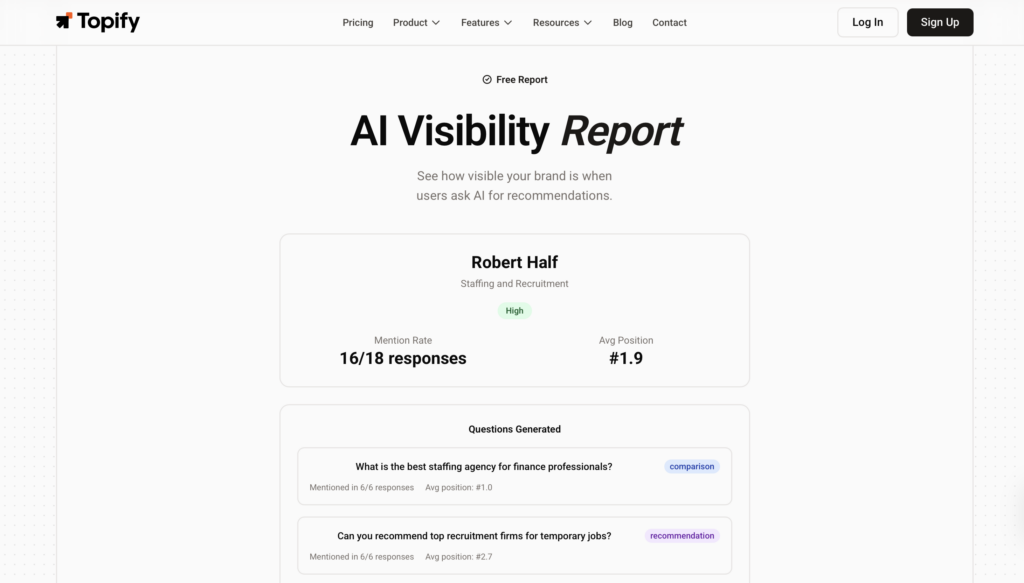
    You can find out in under a minute. Topify‘s AI Visibility Report scans how often your recruiting brand gets mentioned across ChatGPT, Perplexity, Gemini, and Google AI Overviews, then breaks down your mention rate, ranking position, and which AI providers include you in their answers.

    ✅ Free ⚡ Results in 60 seconds 🔒 No signup required

    Your Next Client Is Asking AI for a Recruiter. Here’s What AI Actually Returns.

    The AI Visibility Report doesn’t give you a vague “you’re doing fine” score. It returns specific, measurable data points that map directly to how recruiting agencies win or lose business in AI search.

    Four Metrics That Determine If AI Sends You Clients

    Each metric in the report corresponds to a real-world revenue signal for recruiting agencies.

    MetricWhat It MeasuresWhat It Means for Recruiting Agencies
    Mention RateHow frequently AI references your brand across platformsBelow 10%: hiring managers asking for agency recommendations rarely see your name
    Ranking PositionWhere you appear in AI’s recommendation orderPosition 4+: you’re below the fold of AI’s shortlist, and most users stop at three
    Provider BreakdownWhich AI platforms mention you (ChatGPT, Perplexity, Gemini)Missing from one platform: you’re invisible to that platform’s entire user base
    Competitor PresenceHow often competitors appear in the same AI responsesHigh overlap with low ranking: AI knows your category but prefers other agencies

    A staffing firm that shows a strong mention rate on Perplexity but zero presence on ChatGPT has a platform-specific gap. That’s not a branding problem. It’s a distribution problem, and the report pinpoints exactly where it sits.

    What Recruiting Agencies Typically Discover

    Three patterns come up repeatedly when staffing firms run their first AI Visibility Report.

    Pattern 1: The “Ghost Agency.” Your brand doesn’t appear in any AI responses for your core niche, despite ranking on page one of Google for the same keywords. Traditional SEO visibility and AI visibility are separate channels with different ranking signals.

    Pattern 2: The “Mispositioned Firm.” AI mentions your agency, but describes you as a generalist when you’re actually a specialist in healthcare IT or fintech hiring. The AI’s description doesn’t match your positioning, which means it recommends you for the wrong searches, or not at all for the right ones.

    Pattern 3: The “One-Platform Agency.” You show up on Gemini but not on ChatGPT or Perplexity. Since hiring managers don’t all use the same AI tool, a single-platform presence means you’re reaching a fraction of the market that’s shifted to AI search.

    How to Run Your Report

    Go to the AI Visibility Report, enter your agency’s brand name or domain, and get your cross-platform visibility breakdown in under 60 seconds. No account needed, no credit card, no commitments.

    Once you see the results, you’ll know which platforms to prioritize and where your AI presence has gaps.

    The Prompts Hiring Managers and Candidates Are Typing Into AI Right Now

    The shift isn’t theoretical. Hiring managers and job seekers are already using AI search to find, evaluate, and shortlist recruiting partners. 11.6% of U.S. workers surveyed by iHire in 2025 said they’ve used AI tools to research potential employers and recruiting firms. That number is growing fast.

    Here’s what those searches actually look like:

    AI Prompt ExampleWho’s AskingSearch IntentWhy It Matters for Your Agency
    “Best recruiting agency for DevOps engineers in Austin”Hiring managerVendor selectionDirect client acquisition opportunity
    “Top healthcare staffing firms with travel nurse specialization”HR directorNiche evaluationAI’s answer becomes the shortlist
    “Which recruitment agencies have the fastest time-to-fill?”VP of OperationsPerformance comparisonYour placement speed data needs to be visible to AI
    “Best recruiting firm for entry-level finance jobs in NYC”Job seekerAgency selectionCandidates choose agencies that AI recommends
    “Staffing agency reviews for tech hiring 2026”Procurement teamDue diligenceAI pulls from review signals you may not control
    “Recruiting firm that specializes in remote software engineers”Startup founderSpecialized searchNiche positioning directly drives AI recommendations

    Both sides of the recruiting market are converging on AI search. Hiring managers use it to find agencies. Candidates use it to choose which agency to register with. If your brand isn’t in the answer for either audience, you’re losing deal flow from two directions simultaneously.

    Three Dynamics Reshaping How AI Recommends Recruiting Firms

    AI’s “Short List” Is Replacing Google’s First Page

    When a hiring manager Googles “best recruiting agency for fintech,” they see ten blue links, paid ads, and a few directories. They might click through five sites. When the same person asks ChatGPT the same question, they get three to four names with explanations of why each one fits. That’s the entire consideration set.

    ChatGPT is actively recommending recruiting firms by name, with specific reasons why each agency is the right fit. By the time a prospect reaches your website from an AI referral, the AI has already pre-sold them. The conversion rate on these leads is unlike anything from traditional channels. But if you’re not on the list, someone else gets that lead before you even know it existed.

    The AI Visibility Report tells you whether you’re on that list or not. That’s the baseline every staffing firm needs before investing in any visibility strategy.

    Niche Agencies Have an Unfair Advantage in AI Search

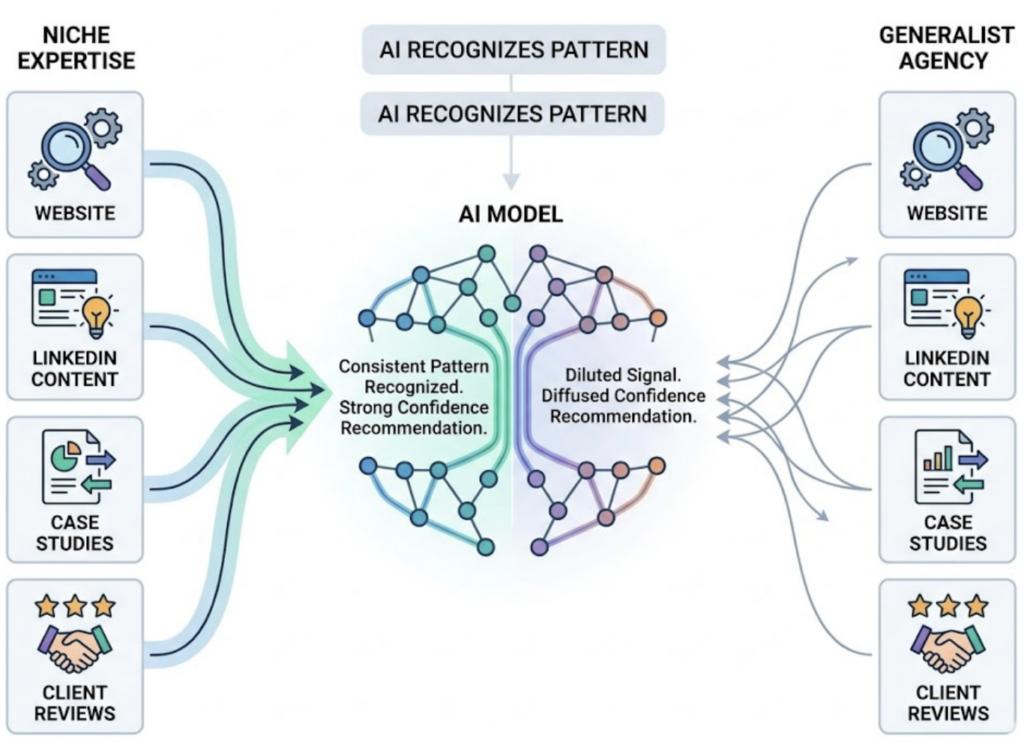
    AI models favor specificity. A recruiting agency that positions itself as “the healthcare IT staffing specialist in the Southeast” sends clearer signals to AI than a firm that says “we recruit across all industries.”

    Here’s why this matters. AI models build recommendations from structured data, content depth, and consistent topic signals. When your website, LinkedIn content, case studies, and client reviews all reinforce the same niche expertise, AI recognizes that pattern. Generalist agencies dilute their signal across too many categories, which makes it harder for AI to confidently recommend them for any single query.

    84% of talent leaders plan to use AI in recruiting in 2026. The agencies that show up in AI answers for specific, high-intent queries will capture a disproportionate share of inbound leads. The ones who don’t will compete on outbound alone.

    Candidates Pick Agencies Based on AI Answers Too

    Most recruiting agencies think about AI visibility from the client side: will hiring managers find us? But the candidate side is just as important. Job seekers are asking AI questions like “best recruiting agency for remote software jobs” or “which staffing firm is best for nurses in California.”

    When AI recommends your agency to a candidate, you’ve just acquired talent without spending a dollar on job board advertising. When it doesn’t, that candidate registers with whichever firm AI mentioned first. In a talent-short market, losing candidate supply because AI doesn’t mention you is a cost most agencies haven’t even measured yet.

    From a One-Time Snapshot to Continuous AI Visibility Tracking

    Your AI Visibility Report results show you where you stand today. But AI models don’t stand still. They update training data, adjust ranking weights, and shift recommendations on a rolling basis. An agency that appears in ChatGPT’s top three this month could drop out entirely next quarter, with no change on the agency’s end.

    Topify‘s platform picks up where the free tool leaves off. The AI Visibility Checker tracks your mention rate, ranking position, and competitor presence continuously across ChatGPT, Perplexity, Gemini, and Google AI Overviews. You’ll see trend lines, receive alerts when your visibility shifts, and get specific recommendations for what to fix.

    Here’s how the free report compares to the full platform:

    CapabilityFree AI Visibility ReportTopify Platform
    Check frequencyOne-time snapshotContinuous daily/weekly monitoring
    AI platforms coveredAggregated viewPer-platform breakdown (ChatGPT, Perplexity, Gemini, AI Overviews)
    Historical trendsNoneFull trend history with alerts
    Competitor trackingBasic presenceReal-time competitor benchmarking with ranking changes
    Action recommendationsGeneralSpecific, data-driven optimization steps
    Team accessSingle userUnlimited team members

    Every plan starts with a 7-day free trial, no credit card required. The Starter plan begins at $99/month.

    Conclusion

    Recruiting agencies have spent years building reputations through referrals, Google rankings, and industry events. None of that automatically translates into AI visibility. The hiring managers and candidates who now ask AI for agency recommendations operate on a different discovery channel, one where your traditional brand equity doesn’t carry over unless AI can see it.

    The first step is knowing where you stand. Run your agency through the AI Visibility Report and see which AI platforms mention you, where you rank, and where the gaps are. From there, you can decide whether to optimize on your own or track it continuously with Topify’s platform.

    While you’re checking your visibility, a few other free tools from Topify’s free tools can round out the picture. The Brand Authority Checker scores how AI models perceive your agency’s expertise and trustworthiness. The Prompts Researcherreveals the exact queries hiring managers and candidates are typing into AI in your niche. And the Competitor Analysistool shows which agencies AI recommends instead of you, and why.

    FAQ

    Is the AI Visibility Report free? Do I need to create an account?

    Yes, the AI Visibility Report is completely free to use. You don’t need to sign up, enter a credit card, or create any kind of account. Enter your brand name or domain, and you’ll get your cross-platform visibility data in under 60 seconds.

    What’s the difference between the free report and Topify’s paid platform?

    The free report gives you a one-time snapshot of your AI visibility. Topify’s platform provides continuous monitoring with historical trend data, real-time competitor benchmarking, per-platform breakdowns, and actionable optimization recommendations. Plans start at $99/month with a 7-day free trial.

    How often should a recruiting agency check its AI visibility?

    AI models update their recommendations regularly, so a monthly check is a reasonable minimum. Agencies in competitive niches (tech staffing, healthcare recruiting, executive search) should monitor weekly, since AI ranking shifts can happen quickly and directly affect inbound lead volume.

    Does AI visibility differ for specialist vs. generalist recruiting agencies?

    Yes, and it tends to favor specialists. AI models rely on consistent content signals, industry-specific data, and niche authority markers to build recommendations. A firm with deep content in one vertical typically scores higher in AI recommendations for that category than a generalist firm covering multiple industries with thinner coverage in each.

    Read More

  • AI Visibility Tools for Luxury Brands

    AI Visibility Tools for Luxury Brands

    A collector asked Perplexity, “What’s the best luxury watch brand for someone who values hand-finished movements?” The AI returned five names. A heritage maison with 180 years of horological expertise wasn’t on the list. The brand’s craftsmanship hadn’t changed. But AI’s ability to recognize it had never been tested.

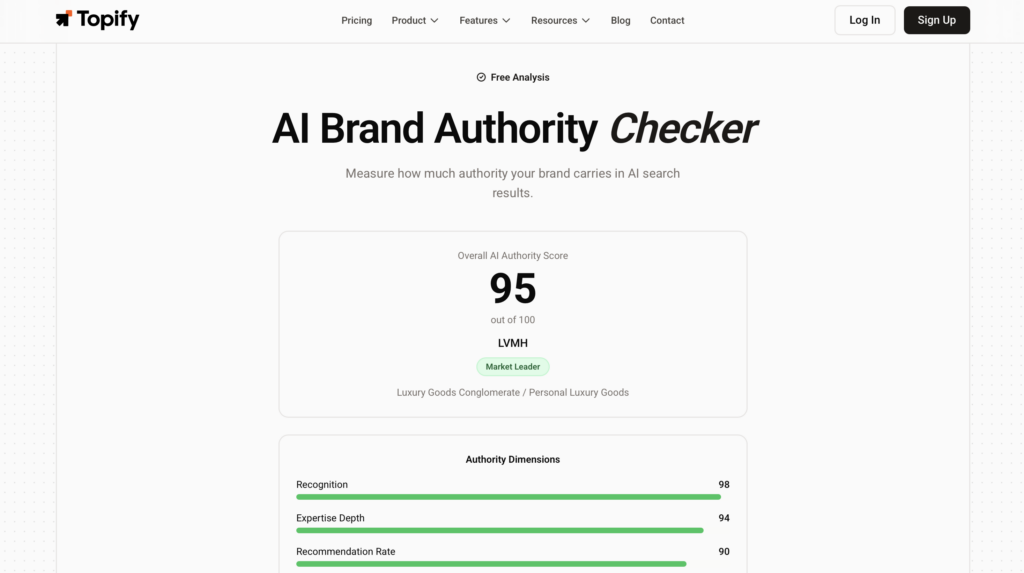
    There’s a way to find out exactly where the gap is. Topify‘s Brand Authority Checker scores how AI models perceive your brand’s authority across four dimensions that directly affect whether you get recommended in luxury purchase queries.

    ✅ Free ⚡ Results in 60 seconds 🔒 No signup required

    The Four Scores That Tell You If AI Trusts Your Luxury Brand

    The Brand Authority Checker doesn’t give you a single pass/fail grade. It breaks your brand’s AI authority into four distinct metrics, each measuring a different dimension of how AI models evaluate whether your brand deserves a recommendation.

    What Each Authority Metric Means for Luxury

    Here’s how those four scores translate into luxury-specific signals.

    MetricWhat It MeasuresWhat It Means for Luxury Brands
    Recognition ScoreHow consistently AI identifies your brand in its categoryLow score = AI doesn’t associate you with “luxury watches” or “high-end skincare” even if you’ve been in the category for decades
    Expertise DepthHow well AI understands your capabilities and differentiatorsLow score = AI can’t distinguish your hand-stitched leather goods from mass-market alternatives
    Recommendation RateHow often AI includes you when users ask for suggestionsLow rate = you’re absent from the shortlists high-net-worth buyers now generate through AI before visiting a boutique
    Trust SignalsExternal validation AI detects (media, reviews, certifications)Weak signals = AI doesn’t find enough third-party proof to confidently recommend a $5,000+ purchase from your brand

    A luxury brand might score 85 on Recognition but 40 on Expertise Depth. That pattern tells a specific story: AI knows you exist but can’t articulate what makes you different. For a category built on differentiation, that’s a serious problem.

    Three Scenarios Luxury Brands Typically Discover

    When luxury brands run this check for the first time, a few patterns come up repeatedly.

    Scenario 1: High heritage, low expertise depth. The brand has a long history and strong name recognition, but its website is image-heavy with minimal structured content about materials, processes, or craftsmanship. AI models can identify the brand but can’t explain why it’s worth the premium.

    Scenario 2: Strong owned media, weak third-party signals. The brand invests heavily in its own editorial content and campaign storytelling. But AI models weigh external validation (press coverage, independent reviews, forum discussions) more heavily than brand-owned narratives. The Trust Signals score reveals this imbalance.

    Scenario 3: Category leader offline, invisible online to AI. The brand dominates in-store and in print media but has minimal structured digital presence. AI models, which primarily crawl web content, simply don’t have enough material to build a confident recommendation.

    How to Run Your Brand Through the Checker

    The process takes three steps.

    First, go to the Brand Authority Checker and enter your brand name. Second, review your four-dimensional authority breakdown. Pay close attention to which scores are pulling the overall number down. Third, compare the AI’s perception against your actual brand positioning. The gaps between what you are and what AI thinks you are become your optimization roadmap.

    No account needed. No email required. You’ll have your scores in under a minute.

    Luxury Buyers Ask AI for Shortlists. Here’s What Gets You Left Off.

    The shift isn’t theoretical. BCG’s analysis of leading European brands found that LLM-driven traffic in luxury grew nearly 1,200%. McKinsey’s State of Fashion 2026 report stated it plainly: “AI chatbot responses are the new SEO.”

    Here’s what your buyers are actually typing into AI platforms.

    AI Prompt ExamplePlatformSearch IntentWhat It Reveals
    “Best luxury watches under $10,000 for everyday wear”ChatGPTPurchase shortlistWhether AI includes your brand in price-tier recommendations
    “Is [Brand] worth the price compared to [Category peer]?”PerplexityValue validationHow AI describes your brand’s value proposition and craftsmanship
    “Recommend a luxury hotel in Milan with a Michelin restaurant”GeminiExperience researchWhether your property appears in curated AI recommendations
    “Top luxury skincare brands for sensitive skin”ChatGPTCategory discoveryIf AI recognizes your brand’s expertise in a specific niche
    “Which luxury real estate developers in Dubai are most trusted?”PerplexityTrust verificationHow AI evaluates your brand’s authority signals in a high-stakes category

    Each of these prompts represents a high-intent buyer making a decision. Similarweb’s 2026 data shows 35% of consumers now use AI tools at the discovery stage. For luxury, where the average transaction value is high and the consideration set is small, being left off an AI-generated shortlist isn’t a minor inconvenience. It’s a lost sale you’ll never know about.

    Your Visual-First Strategy Is Working Against You in AI Search

    Luxury brands have always led with aesthetics. A Celine campaign page or a Patek Philippe product showcase is designed to evoke emotion, not deliver structured facts. That approach works for human visitors. It doesn’t work for AI crawlers.

    AI models can’t interpret a beautifully art-directed image. They need text: materials, dimensions, pricing context, production methods, design philosophy articulated in words. A 303.london analysis put it directly: luxury brand identity is built on emotion, heritage, and aspiration, qualities that are “notoriously difficult to encode in the kind of structured, quotable content that AI engines prefer to surface.”

    This is where the Brand Authority Checker’s Expertise Depth score becomes diagnostic. A low Expertise Depth score typically correlates with websites that prioritize visual storytelling over structured, crawlable content. The fix isn’t to abandon aesthetics. It’s to layer in the structured information that AI needs alongside the visual experience your audience expects.

    In practice, that means adding detailed product pages with specifications, publishing editorial content about craftsmanship and materials, and structuring FAQ content that answers the exact questions buyers ask AI. The brands doing this well don’t look less luxurious. They just give AI something to work with.

    AI Now Controls Your Brand’s First Impression

    For decades, luxury brands controlled every detail of the first encounter. The store’s architecture, the lighting, the staff’s demeanor, the tissue paper in the shopping bag. That level of control extended to digital through carefully curated websites and campaign microsites.

    That era is ending. When a high-net-worth buyer asks ChatGPT “Which luxury handbag brands offer the best craftsmanship?”, the AI produces a synthesized answer drawn from media coverage, reviews, forums, and web content. It has already decided which brands are worth mentioning. The buyer reads a paragraph, not a list of links. The brand’s carefully crafted homepage never enters the picture.

    BCG’s Luxury CX and AI Survey confirmed that luxury clients are “moving away from traditional online searches and viewing more conversational interactions with AI as a superior outcome.” The first impression is now written by the model, not the maison.

    The Brand Authority Checker’s Recognition Score quantifies this shift. It shows whether AI models consistently associate your brand with its category. A low Recognition Score means the AI doesn’t reliably connect your brand to “luxury watches” or “premium hospitality” when those topics come up. Your heritage and reputation exist in the real world but not in the model’s understanding.

    LLM Traffic in Luxury Grew 1,200%. Most Brands Aren’t Tracking It.

    BCG’s numbers are stark: LLM-driven referral traffic to luxury brands increased nearly 1,200% between 2024 and 2025. Yet only 22% of marketers currently track AI visibility at all.

    That’s a blind spot with real revenue implications. AI search traffic converts at 14.2% compared to Google organic’s 2.8%, a 5.1x advantage. For luxury brands with high average order values, even a small volume of AI-referred traffic can represent significant revenue. But you can’t optimize a channel you’re not measuring.

    The Brand Authority Checker gives you a starting point: a one-time snapshot of where your brand stands in AI’s perception. That snapshot tells you whether you have a visibility problem and where it’s concentrated. But AI models update regularly. Your competitors’ digital strategies evolve. The scores you see today could shift next quarter.

    From a One-Time Score to Ongoing Authority Tracking

    The Brand Authority Checker gives you a clear diagnostic. But AI search results aren’t static. Models retrain, new content gets indexed, and competitor strategies shift month to month. A score that looks solid today might erode by next quarter without any action on your part.

    That’s the gap between a one-time check and continuous monitoring. Topify’s Comprehensive GEO Analytics dashboard tracks your brand’s authority, visibility, sentiment, and citation trends across ChatGPT, Perplexity, Gemini, and Google AI Overviews on an ongoing basis. Instead of a snapshot, you get a trendline showing whether your AI presence is strengthening or weakening over time.

    Here’s how the free tool and the full platform compare.

    CapabilityFree Brand Authority CheckerTopify Platform
    Check frequencyOne-time snapshotContinuous daily/weekly monitoring
    Authority dimensions4-score breakdownFull authority tracking with historical trends
    AI platforms coveredSingle checkChatGPT + Perplexity + Gemini + AI Overviews
    Competitor benchmarkingNoReal-time competitor authority comparison
    Trend alertsNoAutomated alerts when scores shift
    Content optimizationManual interpretationOne-click GEO optimization recommendations

    Topify’s platform starts at $99/month with a 7-day free trial, no credit card required. For luxury brands where a single AI-referred conversion can represent thousands in revenue, the math tends to work out quickly. You can start a free trial to see the full picture.

    Conclusion

    Luxury brands have spent decades perfecting how the world perceives them. AI is now rewriting that perception based on signals most brands aren’t tracking. The gap between your brand’s real authority and AI’s understanding of it is measurable, and fixing it starts with seeing the numbers.

    Run your brand through the Brand Authority Checker to get your four-dimensional authority score. It’s free, takes 60 seconds, and requires no signup. From there, you’ll know exactly which dimensions need attention and whether continuous monitoring makes sense for your brand.

    Other free tools worth checking:

    Beyond brand authority, a few other Topify free tools can round out your AI visibility diagnostic. The Brand Sentiment Checker shows how AI describes your brand’s strengths and weaknesses in its own words. The Competitor Analysis tool reveals who AI considers your competition, which may not match your internal view. And the AI Visibility Report gives you a cross-platform snapshot of how often your brand gets mentioned across major AI engines.

    FAQ

    Is the Brand Authority Checker really free? Do I need to create an account? 

    Yes, it’s completely free with no registration required. Enter your brand name at topify.ai/tools/brand-authority-checker and you’ll have your four authority scores in under 60 seconds.

    What’s the difference between the free tool and Topify’s paid platform? 

    The free Brand Authority Checker gives you a one-time snapshot of your AI authority scores. Topify’s platform provides continuous monitoring across all major AI platforms, historical trend tracking, competitor benchmarking, and actionable optimization recommendations. Plans start at $99/month with a 7-day free trial.

    How often should a luxury brand check its AI visibility? 

    At minimum, quarterly. AI models retrain regularly and new content gets indexed constantly. Luxury brands launching new collections or entering new markets should check more frequently, as AI’s perception can shift within weeks of major announcements or media coverage cycles.

    Why does my luxury brand have high recognition but low recommendation rates in AI? 

    This is common in luxury. AI models may know your brand exists but lack enough structured, crawlable content to confidently recommend you. Luxury websites that rely on visuals and minimal text often score well on Recognition but poorly on Expertise Depth and Recommendation Rate. The fix is layering in structured content, detailed product information, and ensuring third-party coverage is accessible to AI crawlers.

    Read More

  • AI Visibility Tools for Food and Beverage Brands

    AI Visibility Tools for Food and Beverage Brands

    Your shopper just asked ChatGPT, “What’s the best low-sugar kombucha brand?” Five names came back. Yours wasn’t one of them.

    That’s not a hypothetical. U.S. ChatGPT users now generate over 84 million shopping-related queries every week, and a growing share of those queries involve food and beverage recommendations. “Best protein bar for gut health.” “Top organic baby food brands.” “Healthiest energy drinks with no artificial sweeteners.” These prompts don’t return ten blue links. They return a short list of brand names, and if your brand isn’t on it, you’ve lost the sale before the shopper even opens a browser tab.

    Here’s the thing. Most F&B brands still measure visibility by shelf placement, retail distribution, and Google rankings. None of that tells you whether AI recommends your product when a consumer asks for it by category, by dietary need, or by functional benefit.

    A second shelf has appeared. It’s invisible, it’s powered by large language models, and it’s already influencing purchase decisions. Topify offers a free tool that lets you see exactly how AI perceives your brand, in under 30 seconds. The Brand Sentiment Checker analyzes AI’s emotional and qualitative read on your brand: what it considers your strengths, where it flags weaknesses, and what overall sentiment score it assigns. For F&B brands navigating this shift, it’s the fastest way to find out if AI trusts you enough to recommend you.

    What AI Actually Thinks About Your F&B Brand (And How to Check in 30 Seconds)

    Traditional brand health trackers measure what consumers say in surveys. The Brand Sentiment Checker measures something different: what AI models believe about your brand based on everything they’ve ingested from the open web.

    You enter your brand name. The tool returns four things: an overall sentiment score, a list of perceived strengths, a list of perceived weaknesses, and the core narrative AI associates with your brand. No signup required.

    For F&B brands, this output is unusually revealing. Here’s why: AI models don’t evaluate your packaging design, your in-store displays, or your trade spend. They evaluate your digital footprint. That includes product reviews, Reddit threads, nutritional claims on your website, press coverage, and third-party mentions across industry publications.

    The table below breaks down each metric and what it means in an F&B context.

    MetricWhat It MeasuresF&B Example
    Overall Sentiment ScoreAI’s net positive/negative perception of your brandA plant-based protein brand scoring 72/100 vs. a legacy snack brand at 45/100
    Perceived StrengthsAttributes AI associates with your brand positively“Clean ingredients,” “transparent sourcing,” “strong community reviews”
    Perceived WeaknessesAttributes AI flags as concerns or gaps“Limited flavor variety,” “premium pricing questioned,” “few third-party endorsements”
    Core NarrativeThe story AI tells about your brand when prompted“A DTC functional beverage brand focused on gut health, popular among health-conscious millennials”

    What This Looks Like for an Organic Snack Brand vs. a Functional Beverage Startup

    Consider two brands running the same check.

    An established organic snack company might see high sentiment driven by years of press coverage and retail presence, but a core narrative that’s stuck in 2021. AI still describes them as “a family-friendly organic option” when the brand has since pivoted to high-protein, performance-focused positioning. That gap between current strategy and AI perception is a visibility liability.

    A newer functional beverage startup might see lower overall sentiment (less data available) but sharper strengths: “innovative adaptogen formulation,” “strong Reddit buzz,” “endorsed by registered dietitians.” The narrative is current, but the authority signals are thin.

    Both brands have work to do. But they can’t prioritize that work without first seeing the data.

    The F&B Prompts That Drive AI Recommendations

    AI visibility in food and beverage isn’t abstract. It comes down to specific prompts that real consumers type into ChatGPT, Perplexity, and Google’s AI Overview. Each prompt is a moment where AI either mentions your brand or doesn’t.

    The prompts fall into three buckets: functional need, dietary restriction, and category comparison. Here’s what that looks like in practice.

    Prompt ExampleIntent TypeBrand Visibility Opportunity
    “Best high-protein snacks for weight loss”Functional needBrands with strong nutritional claims + positive review sentiment
    “Healthiest sparkling water brands 2026”Category comparisonBrands with broad third-party mentions + clean ingredient narratives
    “Best baby formula for sensitive stomachs”Dietary restrictionBrands with expert endorsements + trust signals in AI’s training data
    “Top organic coffee brands with fair trade certification”Values-drivenBrands with structured sustainability data + media coverage
    “GLP-1 friendly snack options”Emerging health trendBrands already creating content around GLP-1 compatible nutrition
    “Best kombucha for gut health Reddit”Social proof seekingBrands with active Reddit presence + authentic user reviews

    The pattern is clear. AI doesn’t recommend brands based on ad spend or shelf placement. It recommends based on the information it can find, verify, and synthesize across the open web.

    If your brand hasn’t published content around these prompt themes, if your reviews don’t mention the functional benefits consumers search for, and if third-party sources haven’t covered your brand in the right context, you’re invisible to these queries. That’s not a marketing problem. It’s a discoverability problem.

    AI Doesn’t See Your Packaging. It Reads Your Digital Footprint.

    For decades, F&B brands invested in packaging design, shelf strategy, and in-store merchandising to win at the point of purchase. Those investments still matter in physical retail. But AI search operates on entirely different inputs.

    When a consumer asks Perplexity “what’s the best plant-based protein powder,” the AI doesn’t scan grocery aisles. It scans the web. And research shows that Perplexity references user reviews in 100% of its responses, while ChatGPT includes review content in 58% of answers.

    That means your reviews are now part of your AI packaging.

    Most F&B brands don’t think about reviews this way. They treat reviews as a customer service metric or a conversion rate optimizer on their DTC site. But in the AI search era, every review is a data point that shapes how language models describe, evaluate, and recommend your product.

    Here’s what AI actually pulls from when building a brand recommendation:

    Product reviews on your own site, Amazon, and third-party platforms. AI models synthesize these into sentiment signals. A brand with 2,000 reviews averaging 4.5 stars and frequent mentions of “great taste” and “clean ingredients” gets a very different AI profile than one with 200 reviews and complaints about texture.

    Reddit and Quora threads. These are among the highest-signal sources for LLM training data. If consumers are recommending your brand in r/HealthyFood or r/Supplements, that directly feeds AI’s perception. If they’re not, your competitors who do have that presence will get the mention instead.

    Industry publications and earned media. Coverage in Food Navigator, Food Dive, or niche nutrition outlets tells AI that your brand has category authority. Press releases on your own blog don’t carry the same weight.

    Structured data on your website. Product schema markup, nutritional information in structured format, FAQ content that answers common consumer questions. AI crawlers need machine-readable information to index your brand correctly.

    The gap between brands that invest in these signals and those that don’t is widening. Analysis from Ahrefs found that brands with the most web mentions appear up to 10 times more often in AI-generated search results than competitors in the same category.

    From Sentiment Score to Shelf Strategy: A Three-Step Playbook

    Knowing your AI sentiment score is the diagnostic. Acting on it is the strategy. Here’s a practical framework for F&B brands, starting with the Brand Sentiment Checker output.

    Step 1: Audit your AI narrative. Run your brand through the Brand Sentiment Checker and compare the core narrative against your current positioning. If AI describes you as “an affordable snack brand” and you’ve spent two years repositioning as a premium wellness brand, that mismatch tells you exactly where to focus. Update your website copy, product descriptions, and structured data to reflect your current story.

    Step 2: Close the review gap. Check whether your reviews mention the functional benefits and attributes that matter for AI search prompts in your category. If consumers search for “high protein” and none of your reviews mention protein content, you’re missing a key signal. Encourage post-purchase reviews that speak to specific product benefits, not just generic satisfaction.

    Step 3: Build third-party authority in AI-indexed sources. Identify the publications, forums, and community platforms that AI models draw from. Contribute expert content to industry outlets. Participate genuinely in Reddit communities relevant to your category. Secure earned media that covers your brand in the context of the trends consumers are searching for: gut health, clean labels, functional nutrition, sustainability.

    This isn’t a one-time fix. AI models update their knowledge bases continuously, and the brands that show up consistently across these signals are the ones that stay in the recommendation set.

    One Snapshot Is a Start. Continuous Tracking Is the Strategy.

    The Brand Sentiment Checker gives you a point-in-time read. That’s valuable for an initial audit. But F&B is a fast-moving category. Seasonal launches, reformulations, PR crises, competitor moves, and shifting health trends all change how AI perceives your brand week to week.

    This is where Topify’s full platform picks up. The table below shows what you get with the free tool vs. what continuous monitoring unlocks.

    CapabilityFree Brand Sentiment CheckerTopify Platform
    AI sentiment snapshotOne-time checkContinuous tracking with trend lines
    Competitive benchmarkingNot includedReal-time competitor sentiment + ranking comparison
    Prompt-level visibilityNot includedTrack your brand across specific high-value prompts
    Cross-platform coverageSingle model snapshotChatGPT, Perplexity, Gemini, Google AI Overview
    Historical trendsNot availableWeek-over-week sentiment and visibility changes
    Actionable alertsNot availableNotifications when sentiment shifts or competitors gain ground

    For F&B brands running seasonal campaigns, launching new SKUs, or managing a reformulation rollout, continuous tracking turns AI visibility from a guessing game into a managed channel. You can see whether your new “high-protein, low-sugar” positioning is actually changing how AI describes you, or if the old narrative is still sticky.

    Topify’s Comprehensive GEO Analytics dashboard brings sentiment, visibility scores, citation trends, and competitive benchmarking into a single view. Plans start at $99/month with a 7-day free trial, no credit card required. You can start a free trial and see your full AI visibility profile across platforms within minutes.

    Conclusion

    F&B brands are entering a period where AI search is becoming a legitimate product discovery channel. The majority of food shoppers haven’t made the switch yet, but the infrastructure is already built: agentic shopping tools from OpenAI, Google, and Perplexity are live, review data is being ingested at scale, and consumers who do use AI for food recommendations are acting on what they see.

    Your first step is simple. Run your brand through the Brand Sentiment Checker and see what AI actually says about you. It takes 30 seconds, costs nothing, and the answer might surprise you.

    From there, expand your audit. Use the AI Visibility Report to see how often your brand gets mentioned across major AI platforms. Check the Prompts Researcher to discover the exact questions your category’s consumers are asking AI. And run the AI Robots Checker to make sure AI crawlers can actually access your product pages.

    The brands that treat AI visibility as a channel now will own the second shelf when the rest of the market catches up.

    FAQ

    How do AI search engines decide which food and beverage brands to recommend?

    AI models like ChatGPT and Perplexity don’t rely on paid ads or shelf placement. They synthesize information from product reviews, Reddit discussions, industry publications, structured website data, and third-party mentions. Brands with stronger, more consistent signals across these sources are more likely to appear in AI-generated recommendations. Running a free Brand Sentiment Checker scan is the fastest way to see how AI currently perceives your brand.

    Do customer reviews actually affect whether AI recommends my product?

    Yes. Perplexity references user reviews in 100% of its product recommendations, and ChatGPT includes review content in 58% of its responses. For F&B brands, this means reviews that mention specific attributes like “clean ingredients,” “great taste,” or “good for gut health” directly shape AI’s perception and recommendation behavior.

    My brand has strong retail distribution. Doesn’t that mean AI already knows about us?

    Not necessarily. AI models don’t scan store shelves or track distribution data. They read your digital footprint: website content, schema markup, earned media, community discussions, and online reviews. A brand with wide retail presence but a thin digital footprint can still be invisible to AI search.

    How long does it take for AI models to update their perception of my brand?

    It varies by platform. Some AI models update their web-crawled data weekly, while others rely on training data with longer refresh cycles. In general, consistent improvements to your digital presence, such as new reviews, updated structured data, and fresh earned media, start influencing AI recommendations within a few weeks to a few months.

    Is AI visibility relevant for F&B brands that sell primarily through retail, not DTC?

    Yes. Even when the final purchase happens in a store, the discovery and consideration phase is shifting online. A consumer who asks ChatGPT “best organic granola brands” and gets a list of five names will look for those brands at their local grocery store. AI visibility influences which brands enter the shopper’s consideration set, regardless of where the transaction happens.

    Read More

  • AI Visibility Tools for Logistics SaaS

    AI Visibility Tools for Logistics SaaS

    Your TMS ranks on page one for “best transportation management system.” Your WMS content pulls steady organic traffic. Your domain authority is solid. Then a logistics manager asks ChatGPT, “What’s the best TMS for mid-market companies?” and gets a shortlist of five vendors. You’re not on it.

    That disconnect between Google rankings and AI recommendations is widening fast. 73% of B2B buyers now use AI tools like ChatGPT and Perplexity during purchase research. And the vendors AI recommends aren’t always the ones with the strongest backlink profiles.

    51% of Software Buyers Now Start in a Chatbot, Not Google

    The numbers have shifted faster than most logistics SaaS marketing teams realize.

    G2’s April 2026 study of 1,076 B2B software buyers found that 51% now begin their purchasing process in an AI chatbotrather than a traditional search engine. That’s up from 29% just twelve months earlier. Even more telling: 69% of buyers said an AI chatbot led them to select a different vendor than they initially planned.

    For logistics SaaS, this means the buyer evaluating freight audit platforms, route optimization tools, or warehouse management systems is increasingly forming a shortlist inside ChatGPT or Perplexity before ever visiting your website.

    One-third of buyers in the G2 study purchased from a vendor they’d never heard of before the AI surfaced it. That’s pipeline you can’t recover with retargeting ads, because the buyer never visited your site in the first place.

    Why Traditional SEO Metrics Don’t Explain AI Invisibility

    Brand web mentions correlate with AI citation at 0.664, while backlinks correlate at roughly 0.2. The backlink-heavy SEO playbook that worked for a decade is now a secondary signal for AI recommendation engines.

    AI search also isn’t one channel. Only 11% of domains are cited by both ChatGPT and Perplexity. Perplexity pulls roughly 46.7% of its top citations from Reddit. Gemini prioritizes pages that already rank well in traditional Google search. A logistics SaaS brand winning on one platform might be invisible on another.

    That fragmentation creates a specific problem for logistics SaaS companies. The category has narrower review coverage on platforms like G2 and Capterra compared to horizontal SaaS. The content tends to be technical and jargon-heavy. And most logistics brands haven’t built the kind of entity presence across community platforms that AI models weight heavily.

    13 Free AI Visibility Tools That Show Where Your Logistics Brand Stands

    The gap between “we think we’re visible” and “we’ve actually checked” is where most logistics SaaS teams get stuck. Topify offers 13 free tools that cover different dimensions of AI visibility, from baseline diagnostics to competitive intelligence. No signup required for any of them.

    Here’s how to use them, grouped by what they diagnose.

    Check Your Baseline Visibility

    Start here. These tools answer the first question: does AI even know your brand exists?

    The AI Visibility Report generates probe questions relevant to your category and queries ChatGPT, Gemini, and Perplexity. You’ll see mention rates, ranking positions, and which platforms include your brand. For a logistics SaaS company, this tells you whether AI recommends you when someone asks about TMS platforms, freight visibility tools, or supply chain software.

    The GEO Score Checker evaluates your site across four dimensions: AI bot access, structured data, content signals, and overall visibility. If your score is low, it pinpoints whether the issue is technical (AI crawlers can’t reach your content) or structural (your content isn’t formatted for extraction).

    The Brand Profile Checker shows how AI models describe your brand and who they list as your competitors. This is often where logistics SaaS companies get their first surprise: the AI might position you as a “startup-friendly tool” when your actual market is enterprise freight operations.

    Understand How AI Perceives Your Brand

    Visibility is binary: you’re either mentioned or you’re not. Perception is nuanced, and it’s where the real optimization opportunities hide.

    The Brand Sentiment Checker scores how positively or negatively AI models describe your brand. A logistics SaaS company with strong product capabilities but poor review coverage might see neutral or tepid sentiment, which translates to weaker recommendation positioning.

    The Brand Authority Checker measures recognition, expertise depth, recommendation rate, and trust signals across AI platforms. For logistics SaaS brands competing against incumbents like SAP or Oracle’s logistics modules, this tool reveals whether AI considers you an authority in your niche or just another name in a crowded list.

    The Knowledge Freshness Checker flags whether AI models are working with outdated information about your brand. If you launched a major feature update six months ago but AI still describes your product based on two-year-old data, your visibility score might be fine while your conversion potential isn’t.

    Find the Prompts That Actually Drive Pipeline

    Knowing you’re invisible is step one. Knowing which prompts matter is what makes the data actionable.

    The Prompts Researcher generates the exact questions users ask AI platforms about your category. For logistics SaaS, this surfaces prompts like “best WMS for e-commerce fulfillment,” “TMS comparison for LTL shipping,” or “freight audit software for 3PLs.” These are the prompts you need to appear in.

    The AI Search Volume Checker estimates how often specific prompts are searched across AI platforms. Not all prompts are equal. A prompt with high AI search volume in your category is worth more than one that sounds relevant but rarely gets asked.

    The Social Question Search finds real user questions from community platforms. Since Perplexity pulls heavily from Reddit, and AI models generally weight community discussion as a trust signal, understanding what logistics professionals actually ask on social platforms informs both your content strategy and your community presence.

    The AI Trends Tracker shows which topics are gaining traction in AI search. Logistics is moving fast right now. Agentic AI, autonomous freight, and AI-powered customs compliance are all trending categories. If your content doesn’t cover emerging topics, AI models have nothing to cite.

    Benchmark Against Competitors

    AI recommendations are relative. You’re not just trying to be visible, you’re trying to rank above the other four vendors in the response.

    The Competitor Analysis tool shows your top AI competitors, their strengths and weaknesses, and how they’re positioned relative to your brand. In logistics SaaS, you might discover that a smaller competitor with aggressive content marketing is outranking you in AI responses despite having a fraction of your market share.

    The User Review Echo aggregates real user reviews from across platforms. AI models weigh recent, authentic reviews heavily when forming recommendations. If your competitor has 50 fresh G2 reviews and you have 12 from 2024, that review gap likely explains a recommendation gap.

    Fix Technical Blockers

    Sometimes the issue isn’t your content or brand strength. It’s that AI crawlers literally can’t access your site.

    The AI Robots Checker shows which AI crawlers your robots.txt file allows or blocks, including GPTBot, ClaudeBot, and PerplexityBot. If you’re blocking these crawlers, which many logistics SaaS sites do by default, no amount of content optimization will help. This is a two-minute check that can uncover a foundational problem.

    A Step-by-Step AI Visibility Audit for Logistics SaaS

    Running all 13 tools at once generates a lot of data. Here’s a practical sequence that prioritizes the highest-impact checks first.

    Start with the AI Robots Checker. If AI crawlers are blocked, fix that before anything else. Then run the GEO Score Checker to get a composite view of your technical readiness. Next, pull your AI Visibility Report to see where you actually appear, and on which platforms.

    Once you have baseline data, use the Prompts Researcher to identify the 10-15 prompts most relevant to your logistics SaaS category. Check their AI search volume. Then run the Competitor Analysis to see who AI recommends instead of you on those prompts.

    The Brand Sentiment Checker and Brand Authority Checker tell you why you’re positioned where you are. The Knowledge Freshness Checker confirms whether AI is working with current information. And the User Review Echo highlights whether your review profile supports or undermines your authority.

    This full audit takes less than an hour. What you get is a clear map of where you stand, where the gaps are, and which gaps matter most for pipeline.

    From One-Time Audit to Continuous AI Visibility Monitoring

    Free tools give you a snapshot. But AI recommendations aren’t static. Models retrain, new content gets indexed, and competitor strategies shift. Research suggests that only about 30% of brands maintain consistent visibility across multiple regenerations of the same query.

    That’s where the diagnostic tools hit their ceiling. They tell you where you stand today, but they can’t tell you when a competitor overtakes you next month or when a model update drops your visibility overnight.

    Topify’s full platform tracks brand visibility continuously across ChatGPT, Perplexity, Gemini, DeepSeek, and AI Overviews. It monitors seven metrics in a single dashboard: visibility, sentiment, position, volume, mentions, intent, and CVR. For logistics SaaS teams where a single enterprise deal can be worth six figures, the cost of being invisible on one high-intent prompt far outweighs a monthly subscription.

    The practical path: start with the free tools. Run the audit. Identify the biggest gaps. If the data shows you’re losing pipeline to competitors who are visible in AI search, that’s the signal to move from periodic checks to continuous monitoring.

    Conclusion

    AI search traffic converts at roughly 5x the rate of traditional organic traffic. For logistics SaaS companies, where buyer intent is high and deal sizes are significant, that conversion advantage makes AI visibility a pipeline issue, not a marketing experiment.

    The 13 free tools covered here give you a clear starting point: check whether AI knows your brand, understand how it perceives you, identify the prompts that drive pipeline, and benchmark against competitors. That’s a lot of diagnostic power for zero cost and less than an hour of work. The logistics SaaS brands that treat AI visibility as a board-level priority now will own the category recommendations for years. The ones that keep measuring against 2023 dashboards will keep wondering why pipeline growth doesn’t match SEO performance.

    FAQ

    What is AI visibility for logistics SaaS?

    AI visibility measures how often your logistics SaaS brand appears in AI-generated responses when users ask platforms like ChatGPT, Perplexity, or Gemini about transportation management systems, warehouse software, freight tools, or supply chain platforms. It’s distinct from traditional SEO rankings because AI models use different signals to decide which brands to recommend.

    How do I check if my logistics SaaS brand appears in ChatGPT?

    The fastest way is to run Topify’s free AI Visibility Report. It queries multiple AI platforms with prompts relevant to your category and returns mention rates, ranking positions, and platform-by-platform breakdowns. You can also manually ask ChatGPT category-specific questions, but the free tool covers more ground in less time.

    Do backlinks still matter for AI search visibility?

    They matter less than you’d think. Research shows brand mentions correlate with AI citations at 0.664, while backlinks correlate at approximately 0.2. Unlinked brand mentions, structured entity content, and review presence tend to be stronger signals for AI recommendation engines than traditional link-building.

    How often should I audit my AI visibility?

    At minimum, quarterly. AI models retrain regularly, and competitor activity can shift your position between audits. For logistics SaaS companies in competitive categories like TMS or WMS, monthly checks using free tools are practical. Continuous monitoring through a platform like Topify is the most reliable approach for tracking changes in real time.

    Read More

  • AI Visibility Tools for Architecture Firms

    AI Visibility Tools for Architecture Firms

    A developer typed into Perplexity: “Best architecture firms for mixed-use development in Austin.” Five names came back. Your firm, with 30 years of commercial experience and a portfolio of LEED-certified projects, wasn’t on the list. The developer shortlisted those five firms and never searched further.

    The issue isn’t your track record. It’s that AI doesn’t recognize it.

    There’s a way to see exactly where the disconnect is. Topify‘s Brand Authority Checker scores how AI models perceive your architecture firm’s authority, broken down into four dimensions that directly affect whether you get recommended when a client, developer, or procurement officer asks AI for help.

    ✅ Free ⚡ Results in 60 seconds

    The Four Authority Scores, Translated for Architecture Firms

    The Brand Authority Checker doesn’t give you a single pass/fail rating. It breaks AI’s perception of your firm into four distinct scores, each mapping to a specific business development problem architecture practices face.

    MetricWhat It MeasuresWhat It Means for Architecture Firms
    Recognition (0-100)How often AI identifies your firm in your categoryBelow 40: AI doesn’t associate you with your core practice area (healthcare, hospitality, residential)
    Expertise Depth (0-100)How well AI understands your capabilitiesBelow 50: AI may describe your firm as “general practice” while ignoring your specialization in adaptive reuse or net-zero design
    Recommendation Rate (0-100)How often AI recommends you vs. alternativesBelow 30: you’re losing RFP shortlists before your BD team even knows the project exists
    Trust Signals (0-100)External validation AI detects (media, citations, reviews)Below 40: AI can’t find enough third-party evidence to vouch for your firm’s credibility

    Here’s the thing. A firm with a Recognition score of 80 but a Trust Signals score of 25 has a very specific problem: AI knows who you are, but doesn’t trust you enough to recommend you. That’s a different fix than a firm scoring low across all four.

    The gap between these scores tells you exactly where to focus your marketing and PR investment.

    Three Scenarios Architecture Firms Discover After Running the Check

    Scenario 1: The “Invisible Specialist” Your firm has won AIA Honor Awards for healthcare architecture. But AI only associates you with “commercial architecture” in general terms. The Expertise Depth score is 35, while Recognition sits at 70. AI knows your name but doesn’t understand what you actually do. This typically happens when a firm’s website and third-party profiles use broad language instead of specific project-type descriptions.

    Scenario 2: The “Outdated Portfolio” Your firm pivoted from residential to mixed-use development three years ago. AI still describes you as a residential practice. The Recognition score reflects the old identity, and the Recommendation Rate for mixed-use queries is near zero. AI models train on historical data, and without fresh, structured signals, the old identity persists.

    Scenario 3: The “Reputation Gap” Your firm has 25 years of editorial coverage in Architectural Record, Dezeen, and ArchDaily. But your Trust Signals score is 42. The problem: AI doesn’t weigh beautiful project photography or social followings. It weighs structured citations, third-party validation, and consistent editorial signals that it can parse and verify.

    How to Run Your Architecture Firm’s Authority Check

    The process takes less than a minute. Go to Brand Authority Checker, enter your firm’s name or domain, and you’ll get a four-dimensional authority breakdown. No signup required, no credit card, no strings attached.

    Once you have your scores, focus on the lowest dimension first. A firm with strong recognition but weak trust signals needs a different strategy than a firm that’s invisible across the board. The scores give you a diagnostic starting point, not just a number.

    Published Everywhere Except Where Clients Now Search

    Architecture firms have spent decades investing in the right places: competition entries, magazine features, conference presentations, and portfolio books. That investment built real reputations. But AI search operates on a different signal set entirely.

    The Designer AI Visibility Index, launched in May 2026 by 5W and Haute Living, audited how architects and designers appear across ChatGPT, Claude, and Perplexity. The finding was blunt: most of the most-published architects in the United States, including firms with seven-figure project pipelines and twenty years of editorial coverage, are functionally invisible inside AI answers.

    AI engines don’t pattern-match against portfolio images or Instagram grids. They pattern-match against credentialed editorial features, structured profiles, FAQ data, and authoritative third-party citations. That’s a fundamentally different signal set than what most architecture firms have been building.

    Here’s what your potential clients are actually asking AI right now:

    AI Prompt ExamplePlatformSearch IntentWhat It Reveals
    “Best architecture firm for sustainable office buildings in Denver”ChatGPTPurchase decisionWhether your firm gets named when a developer is shortlisting
    “Which architects specialize in adaptive reuse of industrial buildings?”PerplexityExpertise verificationWhether AI understands your niche specialization
    “Compare architecture firms for K-12 school design”GeminiCompetitive researchWhere you rank against firms AI considers authoritative
    “Recommend an architect for a net-zero mixed-use project”ChatGPTQualified lead queryWhether your sustainability credentials register with AI
    “Top hospitality architects for boutique hotel renovation”PerplexitySector-specific shortlistWhether AI places you in the right project-type category

    Each of these prompts represents a potential project. If your firm doesn’t appear, you’re not losing a ranking. You’re losing the meeting.

    What the Authority Gap Means for Your Firm’s Pipeline

    Award-Winning Doesn’t Mean AI-Visible

    The Designer AI Visibility Index confirmed what many architecture firms haven’t realized yet: editorial coverage and AI visibility are not the same thing. A firm featured in Architectural Digest, Dezeen, and ArchDaily for two decades can still score below 30 on AI authority metrics.

    Why? AI models evaluate authority through a completely different lens. Portfolio quality, design awards, and project photography carry almost zero weight in AI’s trust model. What AI looks for is structured data, consistent entity signals, third-party citations it can parse, and editorial content formatted in ways that AI crawlers can index and verify.

    Run your firm through the Brand Authority Checker and you’ll likely see the gap in real numbers. The Recognition score might be decent if your firm has been around long enough. But Expertise Depth and Trust Signals often tell a very different story.

    The Compounding Window Is Open Now

    The architecture category in AI search hasn’t been seriously competed for yet. Citation share is sitting in the open, and firms that build structured AI authority in 2026 will compound an advantage that late movers will spend years trying to close.

    AI engines have a recency bias toward authoritative sources that have produced consistent, structured coverage in the last 12 months. A firm that begins building that presence today creates a compounding signal loop: more structured authority leads to more AI citations, which leads to more visibility, which reinforces authority further.

    A firm that waits until 2028 to address AI visibility will face a category where competitors have already established citation dominance. The recovery timeline, based on patterns observed across other professional services categories, is typically two to three years of consistent effort just to catch up.

    Your Expertise Depth Is Probably Dangerously Narrow in AI

    This one is subtle and easy to miss. Your firm might be recognized by AI, it might even get recommended occasionally, but AI’s understanding of what you do could be incomplete or wrong.

    A firm known for healthcare architecture might find AI only associates it with hospital design, completely missing its expertise in outpatient clinics, research labs, or senior living facilities. A firm with a strong mixed-use portfolio might get pigeonholed as “residential” because that’s what most of its older, indexed content describes.

    The Brand Authority Checker’s Expertise Depth score surfaces this kind of misrepresentation. A score below 50 in this dimension means AI is either describing your capabilities incorrectly or incompletely. And every incomplete description is a project type you’re invisible for.

    One Score Is a Starting Point. Tracking It Over Time Is the Strategy.

    Your Brand Authority Checker results tell you where you stand right now. But AI models update their training data, adjust ranking signals, and shift recommendations on a rolling basis. A score of 72 today could drop to 55 next quarter without any change on your end.

    Topify‘s platform picks up where the free tool leaves off. The Comprehensive GEO Analytics dashboard tracks your authority, sentiment, and visibility scores continuously across ChatGPT, Perplexity, Gemini, and Google AI Overviews. You’ll see trend lines, get alerts when scores shift, and receive specific recommendations for what to fix.

    Here’s how the free check compares to the full platform:

    CapabilityFree Brand Authority CheckerTopify Platform
    Check frequencyOne-time snapshotContinuous daily/weekly monitoring
    AI platforms coveredAggregated scorePer-platform breakdown (ChatGPT, Perplexity, Gemini, AI Overviews)
    Historical dataNoneFull trend history with alerts
    Competitor comparisonNot includedReal-time benchmarking against other firms
    Action recommendationsGeneralSpecific, one-click GEO optimization
    Team collaborationNoUnlimited team member seats

    Every plan starts with a 7-day free trial, no credit card required. The Starter plan begins at $99/month.

    Conclusion

    Architecture firms have spent decades building reputations through design quality, editorial coverage, and word-of-mouth referrals. That investment is real. But the client discovery funnel has shifted, and AI search now sits at the top of it, particularly for high-value developer, corporate, and UHNW clients.

    The firms that diagnose their AI visibility gap now and build structured authority in 2026 will define who gets shortlisted in this new channel. The firms that wait will spend years catching up in a category that’s already been claimed.

    Start with a free check. Run your firm through the Brand Authority Checker and see exactly how AI perceives your authority today. Then decide whether a one-time snapshot is enough, or whether continuous monitoring through Topify’s platform fits your growth strategy.

    While you’re assessing your brand authority, a few other free checks can round out the picture. Topify‘s GEO Score Checker evaluates whether AI crawlers can actually access and index your firm’s website. The AI Visibility Report shows how often your firm gets mentioned across major AI platforms. And the Competitor Analysis tool reveals which firms AI considers your competitors and how you compare.

    FAQ

    Is the Brand Authority Checker really free? Do I need to create an account? 

    Yes, it’s completely free. You don’t need to sign up, provide an email, or enter a credit card. Enter your firm’s name or domain, and you’ll get your four-dimensional authority breakdown in under 60 seconds.

    What’s the difference between the free tool and Topify’s paid platform?

    The free Brand Authority Checker gives you a one-time snapshot of how AI perceives your firm’s authority right now. Topify’s platform (starting at $99/month) adds continuous monitoring, historical trend tracking, competitor benchmarking, per-platform breakdowns, and one-click optimization recommendations. The free tool tells you where you stand; the platform helps you improve over time.

    How often should an architecture firm check its AI visibility? 

    AI models update their training data and recommendation algorithms regularly. A quarterly check with the free tool is a reasonable minimum. Firms actively investing in content, PR, or website updates should monitor monthly or continuously through Topify’s platform to see how those investments translate into AI authority changes.

    Our firm has won multiple AIA awards and is featured in major publications. Why would we score low on AI authority? 

    AI models don’t evaluate authority the way industry peers do. Awards, portfolio photography, and social followings carry minimal weight in AI’s trust model. AI looks for structured data, parseable third-party citations, consistent entity signals, and editorial content formatted for AI crawlers. A firm can be highly respected in the profession and still invisible to AI because its authority signals aren’t structured in ways AI can read.

    Read More