Category: ai-visibility-tool

  • AI Visibility Tools for EdTech Companies

    AI Visibility Tools for EdTech Companies

    A district technology director typed into ChatGPT: “Best AI tutoring platform for middle school math.” Five brands came back. Yours wasn’t one of them. Your platform has 200,000 active students, FERPA compliance, and a peer-reviewed efficacy study. None of that mattered because AI didn’t recognize your authority.

    The gap is measurable, and the check takes 60 seconds. Topify‘s Brand Authority Checker scores how AI models perceive your EdTech brand’s authority across four dimensions: recognition, expertise depth, recommendation rate, and trust signals. Each one maps directly to whether AI recommends you or skips you entirely.

    ✅ Free ⚡ Results in 60 seconds
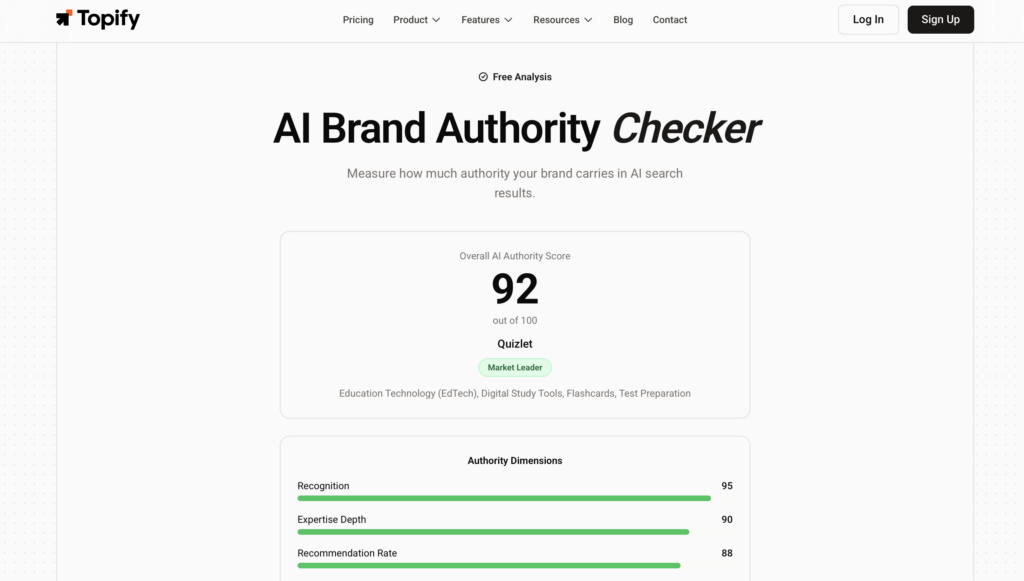
    The Four Scores That Tell You If AI Trusts Your EdTech Brand

    Every time an educator, parent, or procurement officer asks an AI model for a recommendation, the model makes a split-second judgment about which brands to surface. That judgment isn’t based on your Google ranking or ad spend. It’s based on authority signals the model has absorbed from training data, web structure, and third-party references.

    The Brand Authority Checker breaks that judgment into four scores. Here’s what each one means for EdTech.

    Each Metric, Translated for Education Technology

    MetricWhat It MeasuresWhat It Means for EdTech Brands
    Recognition (0-100)How often AI identifies your brand in your categoryBelow 40: AI doesn’t associate you with your product category when educators ask “best [tool type]” questions
    Expertise Depth (0-100)How well AI understands your capabilitiesBelow 50: AI may describe your platform’s features incorrectly or omit key differentiators like adaptive learning or LMS integrations
    Recommendation Rate (0-100)How often AI recommends you vs. alternativesBelow 30: you’re invisible in the consideration set before an RFP even gets written
    Trust Signals (0-100)External validation AI detects (research, reviews, media)Below 40: AI can’t find enough third-party evidence to back up a recommendation

    An EdTech brand with a Recognition score of 80 but a Trust Signals score of 25 has a specific problem: AI knows who you are, but won’t vouch for you. That’s the difference between appearing in a response and being recommended in one.

    What Your Scores Reveal About Your EdTech Brand’s AI Position

    Here’s what these scores look like when they hit real EdTech scenarios.

    Scenario 1: High recognition, low expertise depth. AI mentions your brand in answers about “online learning platforms” but describes you as a generic course marketplace. Your adaptive learning engine, your standards-aligned content library, your AI tutor feature: none of it shows up. The model has heard of you but doesn’t understand what you actually do.

    Scenario 2: Strong expertise depth, weak recommendation rate. AI accurately describes your features when asked directly, but never surfaces your brand in “best of” or comparison responses. You’re known but not preferred. This often means AI has found stronger trust signals for your competitors.

    Scenario 3: Low trust signals across the board. Your brand has thin external coverage: few third-party reviews, limited media mentions, no research citations. AI treats you as unverified. In EdTech, where procurement committees check multiple sources before shortlisting, this is a dealbreaker.

    How to Run Your Check

    Go to Brand Authority Checker, enter your brand name or domain, and get your four-dimensional authority breakdown in under 60 seconds. No signup, no credit card, no email required. The output gives you a specific starting point for every dimension, not a vague “improve your SEO” directive.

    EdTech Buyers Are Asking AI. Your Brand Isn’t in the Answer.

    The shift isn’t coming. It’s already here. Half of prospective graduate students now use AI tools weekly to research education programs and platforms. 82% are more likely to consider programs and tools that appear in their first search results. When AI is the first search, first results mean AI’s answer.

    Here’s what these searches actually look like:

    AI Prompt ExamplePlatformSearch IntentWhat It Reveals
    “Best AI tutoring app for high school students”ChatGPTPurchase decisionWhether your brand gets recommended to parents and students
    “Which LMS has the best FERPA compliance?”PerplexityTrust verificationHow AI evaluates your compliance and security posture
    “Top EdTech tools for personalized learning 2026”GeminiCompetitive researchWhere you rank against alternatives in AI’s mental model
    “Is [your brand] good for K-12 districts?”ChatGPTBrand validationWhat AI says about you when someone checks your name directly
    “Affordable online learning platforms for workforce training”Google AI OverviewBudget evaluationWhether you appear in cost-conscious buyer searches
    “Best alternatives to [competitor category]”PerplexitySwitching intentWhether AI positions you as a viable replacement option

    The pattern is consistent: when AI doesn’t recognize your brand’s authority in a category, you don’t appear in these answers. And 69% of Google searches now end without a click, with AI Overviews reducing clicks to the top-ranking page by 58%. If you’re not in the AI answer, there’s no second chance to be found through organic results.

    The Chegg Collapse, the Trust Gap, and the Technical Debt Most EdTech Brands Don’t Know They Have

    The Chegg warning is not hypothetical. Chegg’s entire business model depended on Google SEO routing students to paywalled homework help. ChatGPT delivered the same answers for free, and Google AI Overviews captured search intent before any click happened. The result: non-subscriber traffic dropped 49% year-over-year. Chegg cut 22% of staff in May 2025 and another 45% in October 2025. Over 636 positions gone in twelve months.

    Any EdTech company that relies on Google search traffic to fill its funnel is exposed to the same structural risk. The question isn’t whether AI will disrupt your acquisition channel. It’s whether you’ve measured how much it already has.

    Most EdTech brands don’t track the metrics that actually determine AI visibility. Recognition, expertise depth, recommendation rate, trust signals: these four dimensions are quantifiable. But the majority of EdTech companies monitor none of them. They track Google rankings, domain authority, and backlinks. Those metrics don’t tell you whether ChatGPT recommends you when a district IT director asks for options.

    Here’s the thing. The 5W EdTech AI Visibility Index tracked 60+ prompts across ChatGPT, Claude, Perplexity, and Google AI Overviews in Q1 2026. The top brands (Khanmigo, Duolingo, Coursera, MagicSchool) dominate citation share. Dozens of established brands, including Codecademy, edX, Skillshare, and Quizlet, fall into the long tail with minimal or zero citation presence. Brand age and user count don’t guarantee AI visibility.

    The technical foundation matters more than most EdTech marketers realize. Content with statistics, citations, and quotations achieves 30-40% higher visibility in AI responses. Pages updated within 60 days earn 28% more citations than older content. Websites with author schema are 3x more likely to appear in AI answers. And 80% of URLs cited by AI models don’t even rank in Google’s top 100 for the same query. That last data point is critical: traditional SEO rankings are not predictive of AI citation behavior.

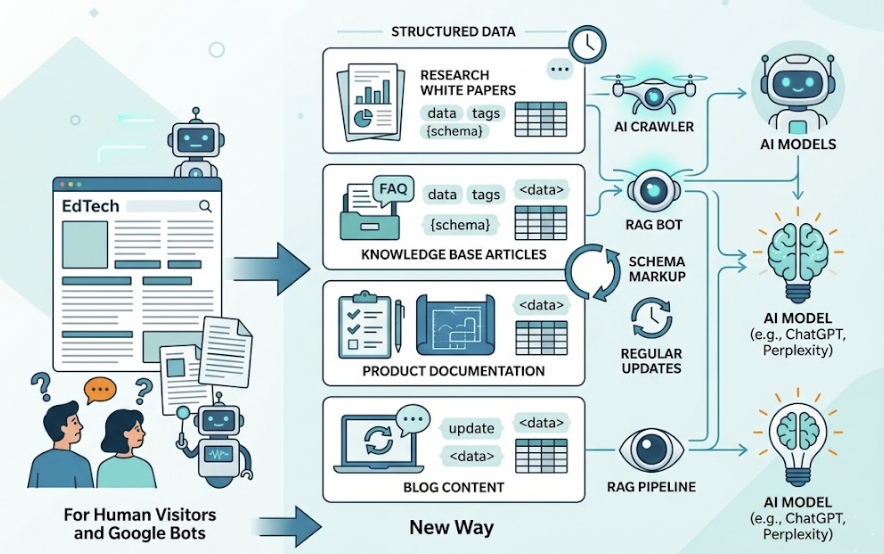
    For EdTech brands, this means your knowledge base articles, your research white papers, your product documentation, and your blog content all need structured data, regular updates, and schema markup to be readable by AI crawlers. Most EdTech websites were built for human visitors and Google bots, not for the retrieval-augmented generation pipelines that power ChatGPT and Perplexity.
    From a One-Time Score to Continuous AI Visibility Tracking

    Your Brand Authority Checker results give you a clear snapshot of where you stand today. But AI models update their training data, adjust ranking signals, and shift recommendations continuously. A Recognition score of 75 today could drop to 50 next quarter after a model update, without any change on your end.

    Topify‘s Comprehensive GEO Analytics dashboard tracks your authority, sentiment, and visibility scores across ChatGPT, Perplexity, Gemini, and Google AI Overviews on a continuous basis. You’ll see trend lines, get alerts when scores shift, and receive specific recommendations for what to fix. For EdTech brands managing long procurement cycles, this means you can catch a visibility drop before it costs you a district deal.

    Here’s how the free check compares to the full platform:

    CapabilityFree Brand Authority CheckerTopify Platform
    Check frequencyOne-time snapshotContinuous daily/weekly monitoring
    AI platforms coveredAggregated scorePer-platform breakdown (ChatGPT, Perplexity, Gemini, AI Overviews)
    Historical trendsNoneFull trend history with alerts
    Competitor trackingNot includedReal-time benchmarking against EdTech competitors
    Action recommendationsGeneral directionSpecific, data-driven optimization steps
    Team collaborationSingle userShare dashboards with marketing, product, and leadership

    Every plan starts with a 7-day free trial, no credit card required. The Starter plan begins at $99/month.

    Conclusion

    AI search is already the first filter EdTech buyers use. If your brand doesn’t pass the authority check that AI models run silently on every query, you don’t get recommended. And in a category where procurement decisions take months and involve multiple stakeholders, being invisible at any stage of that process means losing deals you never knew existed.

    Start with the data. Run your brand through the Brand Authority Checker and see exactly where AI positions you across recognition, expertise, recommendation rate, and trust signals. From there, you’ll know whether the problem is awareness, credibility, technical access, or all three.

    While you’re assessing your brand authority, a few other free checks can round out the picture. Topify’s GEO Score Checker evaluates whether AI crawlers can actually access and parse your site. The AI Visibility Report shows how often your brand gets mentioned across major AI platforms. And the Prompts Researcher reveals the exact questions educators, parents, and administrators are asking AI in your category.

    FAQ

    Is the Brand Authority Checker free? Do I need to sign up?

    Yes, it’s completely free. No account, no email, no credit card required. Enter your brand name or domain, and you’ll get your four-dimension authority score in under 60 seconds.

    What’s the difference between the free tool and the Topify platform?

    The free Brand Authority Checker gives you a one-time snapshot of your current authority scores. The Topify platformprovides continuous monitoring across all major AI platforms, historical trend data, competitor benchmarking, and actionable optimization recommendations. Think of the free tool as a diagnostic and the platform as an ongoing treatment plan.

    How often should EdTech brands check their AI visibility?

    At minimum, monthly. AI models update their training data and ranking signals regularly, and EdTech is a category where new tools and platforms launch frequently. If you’re in the middle of a major product launch, a rebranding, or a content push, checking weekly is worth the investment.

    Why does my EdTech brand rank well on Google but not get recommended by AI?

    Google rankings and AI recommendations use different signals. 80% of URLs cited by AI models don’t rank in Google’s top 100 for the same query. AI models prioritize structured data, content freshness, third-party validation, and entity recognition over traditional SEO factors like backlinks and keyword density. The Brand Authority Checker can show you exactly which authority signals you’re missing.
    Read More

  • AI Visibility Tools for Real Estate Platforms

    AI Visibility Tools for Real Estate Platforms

    A homebuyer in Austin opens ChatGPT and types: “Best brokerage for first-time buyers in central Texas.” Five names come back. Yours isn’t one of them. You closed 140 transactions last quarter, expanded into two new zip codes, and launched a buyer rebate program in January. None of that exists in the AI’s answer. It’s working off data from mid-2024.

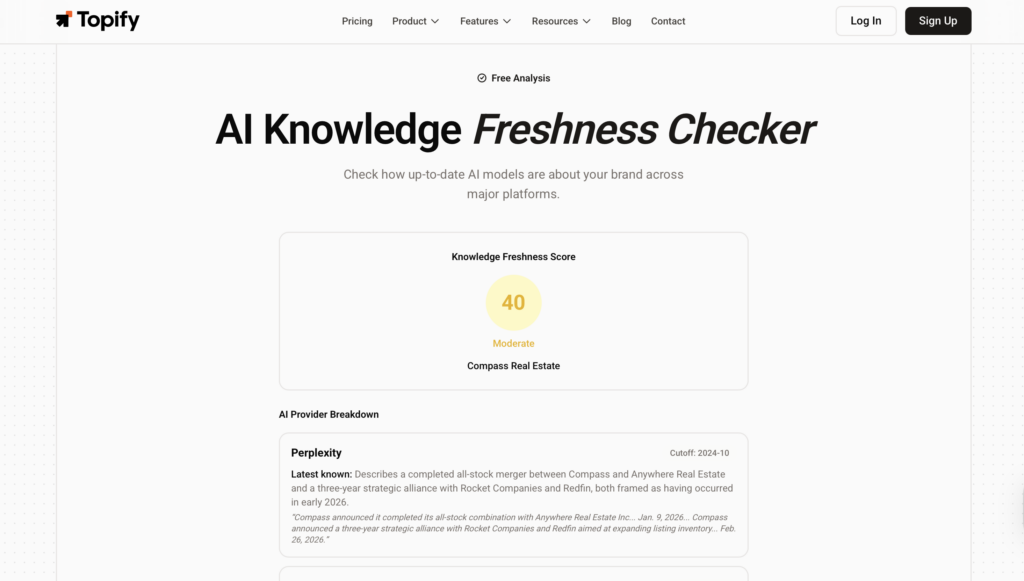
    The gap is measurable, and the check takes 60 seconds. Topify‘s Knowledge Freshness Checker scans what AI models currently know about your real estate brand and flags exactly where their information has gone stale. ✅ Free ⚡ Instant freshness audit 🔒 No signup required

    What the Knowledge Freshness Checker Actually Tells You About Your Real Estate Brand

    The Freshness Metrics That Matter for Property Platforms

    The Knowledge Freshness Checker doesn’t give you a single pass/fail score. It breaks down AI’s understanding of your brand into specific freshness dimensions, each one tied to a different type of outdated information that could be quietly costing you leads.

    Here’s how each metric maps to the real estate industry:

    MetricWhat It MeasuresWhat It Means for Real Estate Platforms
    Information CurrencyHow recent AI’s data about your brand isIf AI references your 2024 service area instead of your 2026 footprint, buyers in new markets won’t find you
    Factual AccuracyWhether AI’s claims about your brand are correctAI may cite old commission structures, discontinued programs, or previous brand affiliations
    Content CoverageHow much of your current offering AI reflectsNew features (rebate programs, AI-powered search, concierge services) may not exist in AI’s description
    Update Frequency AlignmentHow well AI keeps pace with your real-world changesReal estate data shifts weekly. AI models update on much slower cycles. This metric quantifies the lag

    A platform with strong Content Coverage but poor Information Currency has a specific problem: AI knows what you do, but describes the version from a year ago. That’s fixable once you know where the gap is.

    Three Scenarios Where Stale AI Data Costs You Leads

    Scenario 1: AI recommends your old service area. You expanded from three metro areas to seven this year, but when a buyer asks Perplexity about brokerages in your new markets, your brand doesn’t surface. AI still maps you to your original geography.

    Scenario 2: AI cites outdated fee structures. Your platform switched to a flat-fee model six months ago, but ChatGPT still describes your pricing as percentage-based. Buyers who are comparison-shopping rule you out before ever visiting your site.

    Scenario 3: AI misses your recent technology upgrades. You launched 3D virtual tours and an AI-powered home valuation tool in Q1 2026. Gemini doesn’t mention either when a buyer asks what your platform offers. You look like a legacy player when you’re not.

    Each of these scenarios is invisible until you check. The damage happens in conversations you never see.

    How to Run a Freshness Check in Three Steps

    Running the check is straightforward:

    1. Go to Knowledge Freshness Checker and enter your brand name or domain.
    2. The tool scans multiple AI models and returns a freshness breakdown within 60 seconds.
    3. Review each metric to identify where AI’s knowledge is outdated, then prioritize updates based on which gaps affect buyer-facing queries most.

    No signup. No credit card. You’ll have a clear picture of where AI is stuck in the past before your next meeting.

    Real Estate Has the Worst AI Visibility of Any Industry. Here’s What Buyers Are Actually Asking.

    Here’s a number that should reframe how you think about lead generation: real estate has a 0.14% AI Overview trigger rate. That’s the lowest of any tracked industry. Health sits at 13%. Finance at 4.2%. Retail at 2.1%. Real estate is dead last.

    And yet, 82% of Americans already use AI for housing market information. The demand is there. The supply of accurate, branded real estate content inside AI answers is not.

    This table shows the types of prompts your potential buyers and sellers are already typing into AI platforms:

    AI Prompt ExamplePlatformSearch IntentWhat It Reveals
    “Best real estate agent in [city] for first-time buyers”ChatGPTAgent selectionWhether AI recommends your brokerage or defaults to a portal
    “Is it a good time to buy in [metro] 2026?”PerplexityMarket timingWhether AI cites your market insights or generic national data
    “Compare home values in [neighborhood A] vs [neighborhood B]”GeminiNeighborhood researchWhether your platform appears as a data source
    “Best luxury brokerage in [metro area]”ChatGPTHigh-value purchaseWhether AI knows your luxury segment positioning
    “How much are closing costs in [state]?”Google AI OverviewTransaction planningWhether your content gets cited as an authority

    58% of property searches now generate AI-powered answers without the user ever clicking through to a website. If your brand isn’t in those answers, you’re not losing a ranking position. You’re losing the entire interaction.

    Why Stale Data Is the Root Cause of Real Estate’s AI Visibility Crisis

    AI Is Describing Your Brand Based on Last Year’s Information

    Real estate operates on a timeline that AI can’t keep up with. Listings go live and expire in days. Market conditions shift month to month. Agents switch brokerages. Platforms rebrand, merge, or expand into new markets.

    AI models don’t update on that schedule.

    A 2026 benchmark report found that 91% of U.S. real estate agents are effectively invisible in the AI search engines their buyers now use first. That invisibility isn’t random. In many cases, it’s because AI’s training data about those agents and their brokerages is months or years out of date. The agents exist. Their digital footprints exist. But the AI’s version of them is frozen in time.

    Between October 2025 and March 2026, every major real estate portal shipped AI-powered search: Zillow’s ChatGPT app, Homes.com Smart Search, Redfin’s conversational assistant, Realtor.com’s ChatGPT integration, Zillow AI Mode. Buyers are already using these interfaces. The question is whether the information they return about your brand is current.

    That’s exactly what the Knowledge Freshness Checker is built to answer.

    Buyer Trust Dropped 14 Points in One Year. Accuracy Is the Way Back.

    Trust in AI to help find a home fell from 30% in 2025 to 16% in 2026, according to Cotality’s global survey. That 14-point drop didn’t happen because buyers stopped using AI. It happened because AI gave them bad answers.

    The same survey found that 75% of buyers expect AI to be embedded in the homebuying process. They assume it’s there. They just don’t trust it yet. And tolerance for AI errors is low: only 22% of Gen Z and 19% of millennials say they’re tolerant of mistakes.

    Here’s the thing: that trust gap is an opportunity for brands that fix their AI-facing information first. If your competitors’ data in AI is stale and yours is current, you don’t just rank higher in AI answers. You become the brand that AI gets right. In a low-trust environment, accuracy is a competitive advantage.

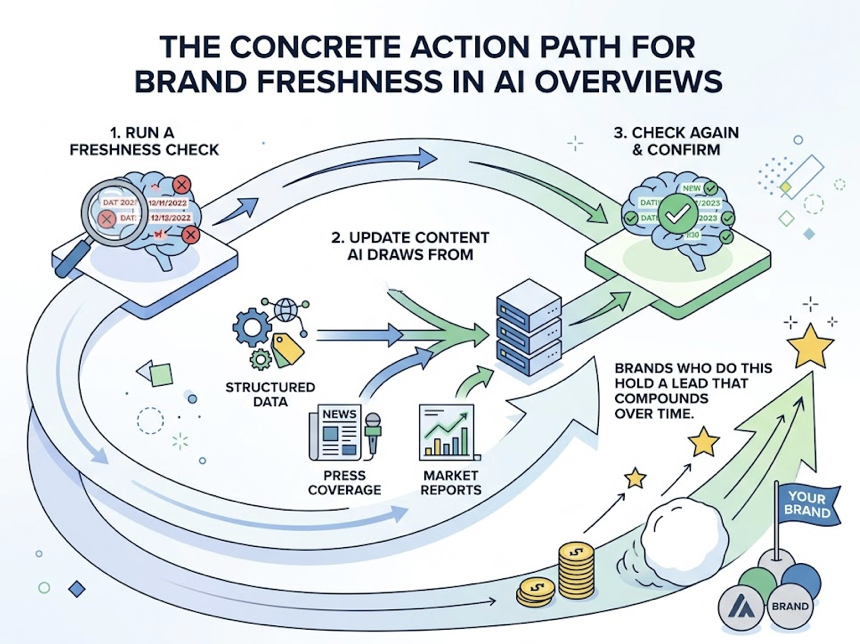
    The action path is concrete. Run a freshness check to identify where AI’s information about your brand is outdated. Update the content AI draws from: your website’s structured data, your press coverage, your market reports. Then check again to confirm the changes propagated. Brands that do this before the rest of the industry catches up will hold a lead that compounds over time.

    One Snapshot Isn’t Enough When Markets Move This Fast

    The Knowledge Freshness Checker gives you a clear baseline: here’s what AI knows about you today, and here’s what’s stale. But real estate data doesn’t sit still. Model updates, new training data, and competitor activity shift AI’s perception of your brand on a rolling basis. A freshness check from May could be irrelevant by July.

    Topify‘s platform picks up where the free tool leaves off. The Reverse-Engineer AI Citations feature goes deeper: it analyzes which sources AI models are actually citing when they mention your brand (or your competitors), identifies citation gaps, and shows you exactly where to publish or update content to stay fresh in AI’s knowledge base.

    Here’s how the free check compares to the full platform:

    CapabilityFree Knowledge Freshness CheckerTopify Platform
    Check frequencyOne-time snapshotContinuous daily/weekly monitoring
    AI platforms coveredAggregated freshness checkChatGPT + Perplexity + Gemini + AI Overviews
    Historical trendsNoneFull trend history with shift alerts
    Citation source analysisNot includedReverse-engineer which sources AI cites
    Competitor freshness comparisonNot includedReal-time benchmarking against competitors
    Action recommendationsManual interpretationSpecific update priorities with one-click execution

    Every plan starts with a 7-day free trial, no credit card required. The Starter plan begins at $99/month, covering 50 prompts per day and continuous monitoring across all major AI platforms.

    Conclusion

    Real estate platforms are caught in a paradox: 82% of buyers use AI for housing decisions, but the industry has the lowest AI visibility of any sector. A major driver of that gap is freshness. AI’s information about your brand, your markets, and your services is often months behind reality, and buyers are forming trust judgments based on those stale answers.

    Start with the free Knowledge Freshness Checker to see where AI is stuck in the past. Fix the gaps. Then move to continuous monitoring with Topify’s platform to make sure you stay current as models update.

    The brands that solve the freshness problem first will hold a structural advantage in AI search for the next two to three years. The window is open now.

    While you’re assessing your knowledge freshness, a few other free checks can round out the picture. Topify‘s GEO Score Checker evaluates whether AI crawlers can actually access and index your site properly. The AI Visibility Report shows how often your brand gets mentioned across major AI platforms. And the Prompts Researcher reveals the exact real estate questions buyers are asking AI in your market.

    FAQ

    Is the Knowledge Freshness Checker really free? Do I need to sign up? 

    Yes, it’s completely free with no registration required. Enter your brand name or domain, and you’ll get your freshness breakdown in under 60 seconds. There’s no credit card and no trial expiration on the free tool.

    What’s the difference between the free tool and the Topify paid platform? 

    The free tool gives you a one-time freshness snapshot. The Topify platform provides continuous monitoring, historical trend tracking, citation source analysis, competitor benchmarking, and actionable update recommendations across ChatGPT, Perplexity, Gemini, and Google AI Overviews. Plans start at $99/month with a 7-day free trial.

    How often should a real estate platform check its AI visibility freshness? 

    Given how fast real estate data changes, a monthly freshness check is the minimum. Platforms with frequent listing updates, market reports, or expansion activity should check bi-weekly or move to continuous monitoring via the full platform. Major events (mergers, rebrands, new market launches) warrant an immediate check.

    Why does real estate have worse AI visibility than other industries? 

    Real estate data is highly local, time-sensitive, and fragmented across thousands of brokerages and platforms. AI models struggle to keep up with weekly market shifts, and the industry has historically invested less in structured data and AI-facing content than sectors like healthcare or finance. The result: a 0.14% AI Overview trigger rate, the lowest of any tracked industry.

    Read More

  • AI Visibility Tools for MedTech Companies

    AI Visibility Tools for MedTech Companies

    A procurement director at a regional hospital system typed into ChatGPT: “Best patient monitoring devices for ICU with FDA clearance and EHR integration.” The AI listed five brands. Your device, with three FDA clearances and integration partnerships across 40 health systems, didn’t make the list. The problem isn’t your product portfolio. It’s that AI doesn’t recognize your authority in the category.

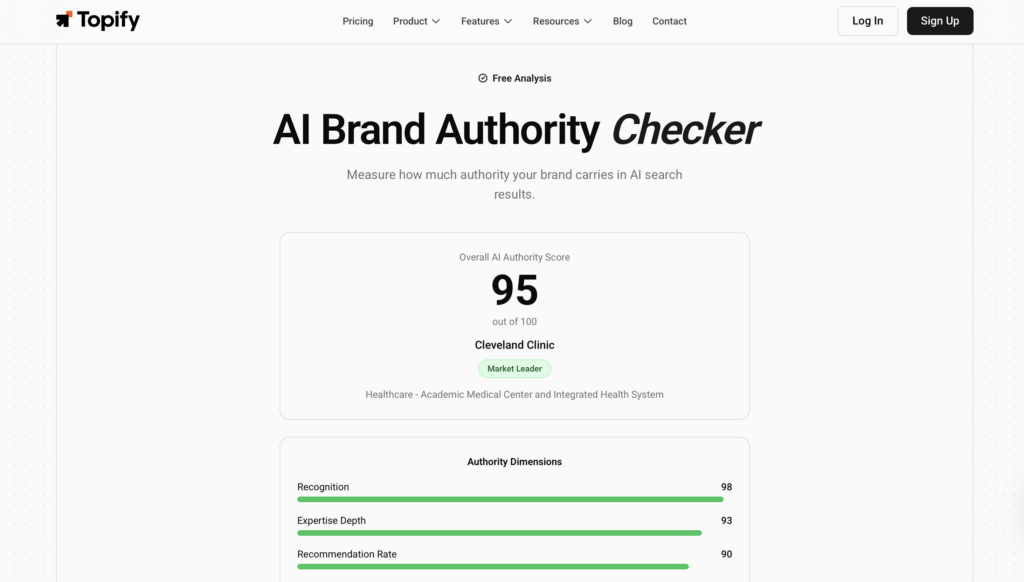
    The gap is measurable, and the check takes 60 seconds. Topify‘s Brand Authority Checker scores how AI models perceive your MedTech brand’s authority across four dimensions: recognition, expertise depth, recommendation rate, and trust signals. Each score maps directly to whether AI includes you in clinical and procurement recommendations.

    ✅ Free ⚡ Results in 60 seconds 🔒 No signup required

    The Four Scores That Tell You If AI Trusts Your MedTech Brand

    Each Metric, Translated for Medical Device Companies

    The Brand Authority Checker doesn’t give you a single number and walk away. It breaks your brand’s AI perception into four distinct dimensions, each with a specific meaning for MedTech.

    MetricWhat It MeasuresWhat It Means for MedTech Brands
    Recognition (0-100)How often AI identifies your brand in your device categoryBelow 40: AI doesn’t associate you with your core therapeutic area or device type
    Expertise Depth (0-100)How well AI understands your technical capabilitiesBelow 50: AI may misrepresent your FDA clearance status, clinical evidence, or integration capabilities
    Recommendation Rate (0-100)How often AI recommends you when buyers askBelow 30: procurement teams and clinicians using AI for shortlisting never see your brand
    Trust Signals (0-100)External validation AI detects from media, clinical studies, and reviewsBelow 40: AI can’t find enough third-party evidence to back up your claims

    Here’s the thing. A MedTech brand with a Recognition score of 80 but a Trust Signals score of 25 has a very specific problem: AI knows your name but doesn’t trust you enough to recommend you over alternatives. That pattern is common among mid-size device manufacturers with strong sales teams but limited peer-reviewed coverage or media presence.

    On the flip side, a brand with high Trust Signals but low Expertise Depth typically has good press coverage but poor structured content. AI sees the validation but can’t parse exactly what you do.

    What MedTech Brands Typically Discover

    Three patterns show up repeatedly when MedTech companies run this check.

    Pattern 1: Strong regulatory portfolio, weak AI recognition. You have multiple FDA clearances and CE marks, but your Recognition score is below 50. This usually means your regulatory achievements live in PDF submissions and press releases that AI crawlers can’t easily index. The clinical evidence exists, but it’s trapped in formats AI doesn’t parse well.

    Pattern 2: Known brand, misrepresented capabilities. AI mentions your company but describes outdated product lines or attributes capabilities to the wrong division. This shows up as a gap between Recognition (high) and Expertise Depth (low). It’s particularly common among MedTech conglomerates with multiple business units.

    Pattern 3: Invisible to purchase-intent queries. Your Recommendation Rate is significantly lower than your Recognition score. AI knows you exist but doesn’t recommend you when someone asks “best [device type] for [clinical scenario].” This often signals that your content answers informational queries but fails to position your products as solutions to specific clinical problems.

    How to Run Your MedTech Brand Check

    Go to the Brand Authority Checker, enter your brand name or domain, and get your four-dimensional authority breakdown in under a minute. No account creation, no credit card, no sales call. You’ll see exactly which dimension is dragging down your AI visibility, and that tells you where to focus your content and PR strategy first.

    Clinicians and Procurement Teams Are Asking AI These Questions. Are You in the Answers?

    Over 50% of healthcare professionals now use AI-powered search tools like ChatGPT in their professional roles, with two-thirds of those users under age 45. That number is only going up. And the questions they’re asking carry real purchasing weight.

    AI Prompt ExamplePlatformSearch IntentWhat It Reveals About Your Brand
    “Best surgical robotics systems for orthopedic procedures 2026”ChatGPTCategory evaluationWhether AI includes you in the top-tier shortlist for your device category
    “Compare patient monitoring platforms with EHR integration”PerplexityHead-to-head comparisonHow AI positions your features against alternatives
    “Is [Brand] FDA-cleared for cardiac imaging?”GeminiTrust verificationWhether AI accurately represents your regulatory status
    “Most cost-effective diagnostic equipment for community hospitals”ChatGPTBudget-constrained procurementWhether AI recommends you for value-focused buyers
    “Digital therapeutics for diabetes management with clinical evidence”PerplexityEvidence-based purchasingWhether AI cites your clinical trials and outcomes data

    These aren’t hypothetical. McKinsey’s research on gen AI in MedTech found that over half of MedTech organizations have already deployed gen AI across commercial workflows, including marketing, insight generation, and customer interactions. The buyers on the other side of those interactions are increasingly using the same tools to evaluate your products.

    If your brand doesn’t appear when a hospital procurement team asks ChatGPT for recommendations in your device category, you’re not losing a ranking position. You’re losing a seat at the table before your sales team ever gets a call.

    Three Visibility Gaps MedTech Brands Can’t Afford to Ignore

    HCPs Are Using AI to Choose Devices, But AI Doesn’t Recognize Your Authority

    The generational shift in healthcare is real. Research from early 2026 shows that adoption of AI search among HCPs is driven heavily by the 25-34 age group. These are residents, fellows, and early-career specialists who’ll be making purchasing and prescribing decisions for decades. They’re not waiting for a rep to walk them through a product brochure. They’re typing clinical scenarios into AI tools and trusting the answers.

    For MedTech brands, this means your authority in AI systems isn’t a future concern. It’s a current revenue issue. If your Brand Authority Checker score shows low Recognition or low Recommendation Rate in your device category, you’re already invisible to the fastest-growing segment of clinical decision-makers.

    Being “Mentioned” by AI Isn’t the Same as Being Recommended

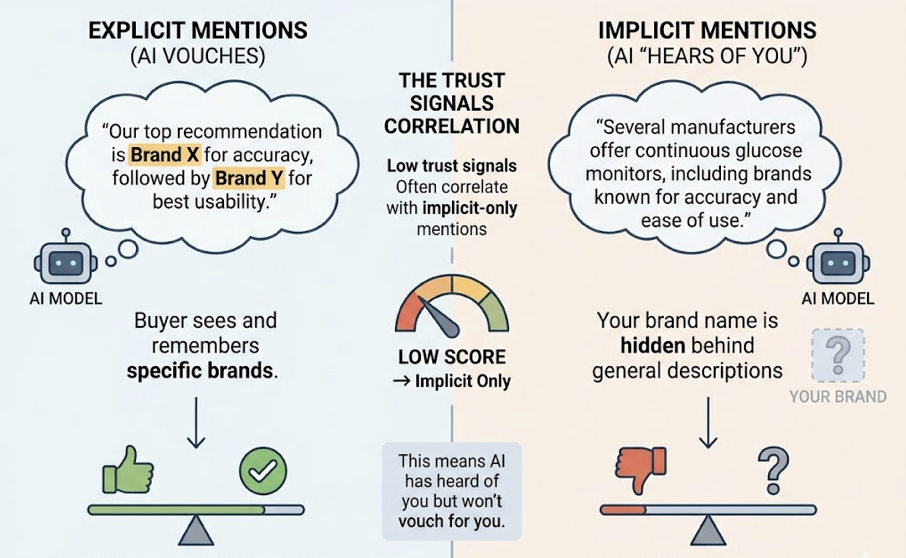
    There’s a critical difference between implicit mentions and explicit citations in AI-generated responses. Analysis of major MedTech brands found that even leading device manufacturers appear mostly as implicit references in AI answers, with citation scores as low as 3.16%. That means AI may reference your brand in passing but never formally recommends or credits you.

    In practice, this looks like: “Several manufacturers offer continuous glucose monitors, including brands known for accuracy and ease of use.” Your name might be behind that description, but the buyer reading the response doesn’t see it. They see the brand that AI names explicitly. The Brand Authority Checker’s Trust Signals score directly reflects this gap. Low trust signals often correlate with implicit-only mentions, telling you that AI has heard of you but won’t vouch for you.

    Your Competitors May Be Gaining AI Ground While You’re Focused on Traditional Channels

    MedTech marketing budgets still skew heavily toward trade shows, journal advertising, and KOL engagement. Those channels matter. But they don’t feed the AI systems that are increasingly shaping initial shortlists.

    While you’re investing in conference booths, a competitor with a stronger structured data strategy, more indexable clinical evidence, and better entity clarity could be climbing the AI recommendation ladder in your category. The competitive dimension of AI visibility isn’t visible through traditional analytics. You won’t see it in your Google rankings or your website traffic. You’ll see it in the Brand Authority Checker results, where your Recommendation Rate sits next to what AI models actually tell buyers about your category.

    When a One-Time Snapshot Isn’t Enough: Continuous Authority Tracking

    Your Brand Authority Checker results show you where your MedTech brand stands right now. But AI models retrain, update their data sources, and shift recommendations on a rolling basis. A Recommendation Rate of 65 today could drop to 40 next quarter if a competitor publishes a major clinical trial that AI picks up, or if your latest product launch content isn’t structured for AI crawlers.

    Topify‘s Comprehensive GEO Analytics dashboard picks up where the free tool leaves off. It tracks your authority, sentiment, and visibility scores continuously across ChatGPT, Perplexity, Gemini, and Google AI Overviews. You’ll see trend lines over time, get alerts when scores shift, and receive specific recommendations for what to fix. For MedTech teams reporting to a VP of Marketing or CMO, the dashboard translates AI visibility into the metrics leadership actually cares about.

    CapabilityFree Brand Authority CheckerTopify Platform
    Check frequencyOne-time snapshotContinuous daily/weekly monitoring
    AI platformsAggregated scorePer-platform breakdown (ChatGPT, Perplexity, Gemini, AI Overviews)
    Historical dataNoneFull trend history with alerts
    Competitor comparisonNot includedReal-time benchmarking against MedTech rivals
    Action recommendationsGeneral directionSpecific, prioritized GEO optimization steps
    Team collaborationIndividual useMulti-seat access for marketing, regulatory, and product teams

    Every plan starts with a 7-day free trial, no credit card required. The Starter plan begins at $99/month.

    Conclusion

    MedTech purchasing decisions are shifting to AI-assisted workflows, and the brands that show up in those AI-generated recommendations will capture the shortlist. The ones that don’t will keep wondering why qualified leads are drying up despite strong clinical evidence and regulatory approval.

    Start with a free Brand Authority Checker scan. See which of the four authority dimensions is holding your MedTech brand back, and use that data to prioritize your content and PR strategy for AI visibility.

    While you’re assessing your brand authority, a few other free checks can round out the picture. Topify’s GEO Score Checker evaluates whether AI crawlers can actually access and parse your site’s clinical content. The AI Visibility Reportshows how often your brand gets mentioned across major AI platforms. And the Competitor Analysis tool reveals which MedTech brands AI currently favors in your device category.

    FAQ

    Is the Brand Authority Checker really free? Do I need to create an account? 

    Yes, it’s completely free. No account, no email, no credit card. Enter your brand name or domain and get your scores in under 60 seconds.

    What’s the difference between the free tool and the Topify platform? 

    The free Brand Authority Checker gives you a one-time snapshot of your four authority scores. The Topify platform adds continuous monitoring, historical trends, competitor benchmarking, per-platform breakdowns across ChatGPT, Perplexity, Gemini, and AI Overviews, and actionable optimization recommendations. Plans start at $99/month with a 7-day free trial.

    How often should MedTech brands check their AI visibility? 

    At minimum, after every major product launch, FDA clearance, clinical trial publication, or competitor announcement. AI models update their knowledge bases on a rolling schedule, so what’s true today may shift in weeks. For serious monitoring, continuous tracking through the Topify platform catches changes before they impact your pipeline.

    Does FDA clearance automatically improve my AI authority score? 

    Not directly. AI models don’t pull from FDA databases in real time. Your clearance information needs to be structured, indexable, and referenced by third-party sources (media coverage, clinical publications, industry reviews) before AI systems incorporate it into their recommendations. The Brand Authority Checker’s Trust Signals score reflects how well that external validation is reaching AI.

    Read More

  • AI Visibility Tools for Healthcare Brands

    AI Visibility Tools for Healthcare Brands

    A hospital procurement officer typed into ChatGPT: “Best EHR system for mid-size hospitals with telehealth integration.” The AI recommended five providers. Your system, with Joint Commission accreditation and 12,000 active users, wasn’t on the list. The issue isn’t your product. It’s that AI doesn’t recognize your authority.

    You can find out exactly where the gap is in under a minute. Topify‘s Brand Authority Checker scores how AI models perceive your healthcare brand’s authority across four dimensions that directly affect whether you get recommended.

    ✅ Free ⚡ Results in 60 seconds

    Patients Ask AI Before They Call Your Clinic. Here’s How to Check If You’re in the Answer.

    Over 40 million Americans use ChatGPT daily for healthcare questions. One in four of the platform’s 800 million weekly users submits a health-related prompt every week. And 89% of health queries now trigger AI Overviews on Google.

    That’s a massive volume of patient decisions happening before anyone picks up the phone or fills out an intake form. If your brand doesn’t show up in those AI-generated answers, you’re not losing a ranking position. You’re losing the patient entirely.

    The Brand Authority Checker gives you a starting point. It breaks down AI’s perception of your healthcare brand into four measurable scores, so you can see exactly where the disconnect is between your real-world credentials and how AI models describe you.

    Each Score, Translated for Healthcare

    Every score maps to a specific problem healthcare brands face in AI search.

    MetricWhat It MeasuresWhat It Means for Healthcare Brands
    Recognition (0-100)How often AI identifies your brand in your categoryBelow 40: AI doesn’t associate you with your core specialty or service line
    Expertise Depth (0-100)How well AI understands your capabilitiesBelow 50: AI may misrepresent your clinical services, certifications, or specialties
    Recommendation Rate (0-100)How often AI recommends you vs. alternativesBelow 30: you’re losing patient acquisition before your outreach team ever makes contact
    Trust Signals (0-100)External validation AI detects (media, reviews, citations)Below 40: AI can’t find enough third-party evidence to vouch for your clinical authority

    A healthcare system with a Recognition score of 80 but a Trust Signals score of 25 has a very specific problem: AI knows who you are, but it doesn’t trust you enough to recommend you. That’s not a branding failure. It’s a citation gap, and now you know exactly where to focus.

    Three Scenarios Healthcare Brands Discover After Running the Check

    Scenario 1: High credentials, low recognition. A multi-location orthopedic practice with board-certified surgeons and published research runs the check. Recognition score: 35. AI simply doesn’t associate the brand with orthopedics in its category. The fix isn’t more content on the website. It’s building the external signals (directory listings, media mentions, structured data) that AI uses to map brands to specialties.

    Scenario 2: Known brand, outdated expertise profile. A regional hospital system scores 70 on Recognition but 40 on Expertise Depth. AI still describes the system based on service lines from three years ago. The telehealth platform launched last year doesn’t exist in the AI’s understanding. The fix is updating the digital footprint that AI crawlers actually read.

    Scenario 3: Strong trust, weak recommendations. A behavioral health provider scores 75 on Trust Signals thanks to strong patient reviews and media coverage, but only 20 on Recommendation Rate. AI trusts the brand but doesn’t surface it when patients ask for recommendations. The gap is usually structural: the content doesn’t answer the specific prompts patients are typing into AI.

    How to Run Your Brand Authority Check

    The process takes three steps.

    First, go to Brand Authority Checker and enter your brand name or domain.

    Second, review your four-dimensional authority breakdown. Look for the lowest score first. That’s where AI’s perception diverges most from reality.

    Third, cross-reference your lowest score against the scenarios above. Each score gap points to a different category of action: entity building, content restructuring, or external signal development.

    No signup required. No credit card. The full report generates in under 60 seconds.

    What Healthcare Brands Are Missing in AI Search

    The volume of healthcare prompts flowing through AI platforms is staggering, and most healthcare marketers aren’t tracking any of it.

    Three in five U.S. adults have used AI tools for healthcare questions in the past three months. Fifty-five percent used AI to check symptoms. Forty-eight percent used it to decode medical terms. Over 40% explored treatment options through a chatbot. These aren’t casual searches. They’re decision-making moments that determine which provider gets the call.

    Here’s what those prompts look like in practice, and what each one reveals about your brand’s visibility:

    AI Prompt ExamplePlatformSearch IntentWhat It Reveals
    “Best urgent care near me that accepts Aetna”ChatGPTProvider selection + insurance matchWhether AI associates your facility with specific payers
    “Top cardiologist near me with good reviews”PerplexitySpecialty + reputation checkWhether your physician profiles carry enough trust signals
    “Is telehealth as good as in-person for anxiety?”GeminiTreatment comparisonWhether AI cites your telehealth content as a credible source
    “Best EHR system for mid-size hospitals”ChatGPTB2B procurementWhether your product appears in AI’s enterprise recommendation set
    “Which hospital is best for robotic-assisted hip replacement?”AI OverviewProcedure-specific researchWhether AI recognizes your surgical capabilities and outcomes

    Each of these prompts represents a patient or buyer forming a preference before they ever visit your website. If your brand doesn’t appear in the answer, you’re not competing for that decision. You’re invisible to it.

    The gap between the volume of AI health queries and the number of healthcare brands actively tracking their AI visibility is enormous. That gap is where patient acquisition is quietly shifting.

    After-Hours AI Conversations Are Shaping Your Brand. You’re Not in the Room.

    70% of health conversations on ChatGPT happen outside clinical hours. That’s evenings, weekends, and holidays, when patients are researching providers, comparing treatment options, and making care decisions. Your marketing team isn’t monitoring those interactions. Your physicians aren’t available to correct misrepresentations. And AI is answering on your behalf, accurately or not.

    This is where Brand Authority Checker data becomes critical. Your Trust Signals score reflects whether AI has enough third-party validation to describe your brand correctly when no one from your organization is present. A low score doesn’t just mean you’re less visible. It means AI may be actively misdescribing your services during the hours when patients are most actively researching.

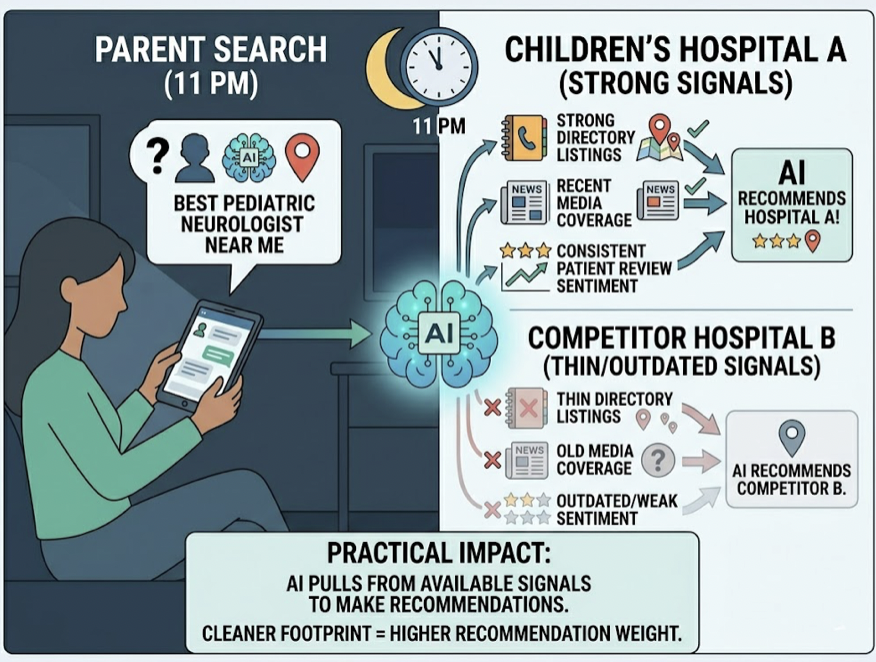
    Consider the practical impact. A parent searches ChatGPT at 11 PM: “Best pediatric neurologist near me.” AI pulls from whatever signals it can find. If your children’s hospital has strong directory listings, recent media coverage, and consistent patient review sentiment, AI recommends you. If those signals are thin or outdated, AI recommends the competitor whose digital footprint is cleaner.

    The Brand Authority Checker gives you a baseline for exactly this scenario. Run the check, look at your Trust Signals and Recommendation Rate scores, and you’ll see whether your brand can survive the after-hours AI conversation without you in the room.

    Your AI Visibility Varies by Platform. One Score Doesn’t Tell the Full Story.

    Healthcare AI traffic isn’t evenly distributed. According to Conductor’s 2026 data, ChatGPT captures 64-84% of health AI traffic, Gemini accounts for 21.5%, Perplexity holds 7.8%, and Copilot sits at 4.7%. Each platform uses different ranking signals, citation patterns, and source preferences.

    A healthcare brand can score well on ChatGPT and be completely absent from Perplexity. The reverse is also true. Perplexity tends to favor citation-heavy, recently published sources. Gemini leans on Google’s existing knowledge graph. ChatGPT weighs a broader mix of authority signals including reviews, media mentions, and structured data.

    This means a single Brand Authority Checker snapshot, while valuable as a starting point, captures an aggregated view. The per-platform differences matter, especially in healthcare, where the stakes of a misrepresentation are higher than in most industries.

    Here’s the thing: AI-referred leads in healthcare convert at 27% compared to 2.1% from traditional organic search. That’s a 13x conversion gap. If your brand is visible on ChatGPT but invisible on Perplexity, you’re capturing only a fraction of a channel that converts at 13 times the rate of your existing organic traffic. And you probably don’t even know it’s happening.

    One Score Is a Starting Point. Tracking It Over Time Is the Strategy.

    Your Brand Authority Checker results tell you where you stand right now. But AI models update their training data, adjust ranking signals, and shift recommendations continuously. A Trust Signals score of 72 today could drop to 50 next quarter if a competitor publishes a wave of clinical research that AI picks up.

    Topify‘s platform picks up where the free tool leaves off. The Comprehensive GEO Analytics dashboard tracks your authority, sentiment, and visibility scores continuously across ChatGPT, Perplexity, Gemini, and Google AI Overviews. You’ll see per-platform breakdowns, trend lines, alerts when scores shift, and specific recommendations for what to fix.

    Here’s how the free check compares to the full platform:

    CapabilityFree Brand Authority CheckerTopify Platform
    Check frequencyOne-time snapshotContinuous daily/weekly monitoring
    AI platformsAggregated scorePer-platform breakdown (ChatGPT, Perplexity, Gemini, AI Overviews)
    Historical dataNoneFull trend history with alerts
    Competitor comparisonNot includedReal-time benchmarking against healthcare competitors
    Action recommendationsGeneral authority gapsSpecific, data-driven GEO optimization steps
    Team collaborationSingle userUnlimited team seats for marketing + clinical leadership

    Every plan starts with a 7-day free trial, no credit card required. The Starter plan begins at $99/month.

    Conclusion

    AI is now a primary channel for patient discovery. Over 40 million people ask ChatGPT healthcare questions daily, and the brands that show up in those answers are capturing patients at a conversion rate 13x higher than traditional search. The brands that don’t show up aren’t just missing traffic. They’re missing the decision entirely.

    Start with a free Brand Authority Checker scan to see exactly how AI perceives your healthcare brand’s authority. Use those scores to identify the specific gaps between your real-world credentials and AI’s understanding of them. Then build a tracking system that keeps you visible as models evolve.

    If you’re ready for continuous monitoring, start a free trial to track your authority, sentiment, and visibility across every major AI platform.

    Other Free Tools Worth Running

    While you’re assessing your brand authority, a few other free checks can round out the picture. Topify’s AI Visibility Report shows how often your healthcare brand gets mentioned across major AI platforms. The Knowledge Freshness Checker flags whether AI models are working with outdated information about your services or credentials. And the Prompts Researcher reveals the exact healthcare questions patients are asking AI in your category.

    FAQ

    Is the Brand Authority Checker free? Do I need to sign up? 

    Yes, the tool is completely free. No signup, no credit card, no account required. Enter your brand name or domain and get your four-score authority breakdown in under 60 seconds.

    What’s the difference between the free tool and the Topify platform? 

    The free Brand Authority Checker gives you a one-time snapshot of AI’s perception of your brand. The Topify platform provides continuous monitoring across ChatGPT, Perplexity, Gemini, and AI Overviews, with historical trends, competitor benchmarking, and actionable optimization recommendations. Plans start at $99/month with a 7-day free trial.

    How often should healthcare brands check their AI visibility? 

    AI models update frequently, and a single check can become outdated within weeks. For healthcare brands, where clinical accuracy and trust signals are critical, monthly checks with the free tool are a minimum. Continuous monitoring through the platform is the more reliable approach, especially for multi-location health systems.

    Can AI visibility actually affect patient acquisition? 

    Yes. AI-referred leads in healthcare convert at 27% compared to 2.1% from traditional organic search. Brands cited in AI Overviews earn 35% more organic clicks and 91% more paid clicks. As more patients use AI to choose providers, AI visibility is becoming a direct driver of patient volume.

    Read More

  • AI Visibility Tools for Legal Services

    AI Visibility Tools for Legal Services

    A potential client typed into ChatGPT: “Who’s the best employment attorney in Austin for wrongful termination?” The AI returned three firms with brief descriptions and contact details. Your firm, with 20 years of employment law experience and a 94% case resolution rate, wasn’t mentioned. The client never visited your website. Never saw your track record. Never knew you existed.

    The issue isn’t your expertise. It’s that AI can’t verify it.

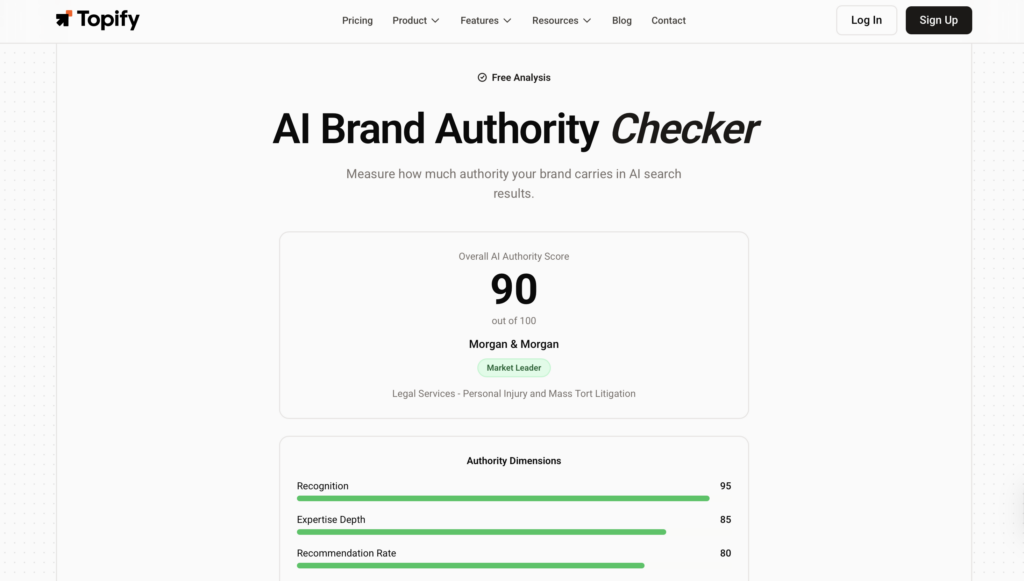
    There’s a way to see exactly where the disconnect is. Topify‘s Brand Authority Checker scores how AI models perceive your firm’s authority across four dimensions that directly determine whether you get recommended when someone asks AI for a lawyer.

    ✅ Free ⚡ Results in 60 seconds 🔒 No signup required

    The Four Scores That Tell You If AI Trusts Your Law Firm

    The Brand Authority Checker doesn’t give you a single vague number. It breaks your firm’s AI-perceived authority into four distinct metrics, each mapping to a specific vulnerability in legal services.

    What Each Metric Means for Law Firms

    MetricWhat It MeasuresWhat It Means for Law Firms
    Recognition (0-100)How often AI identifies your firm in your practice areaBelow 40: AI doesn’t associate your firm with your core practice area at all
    Expertise Depth (0-100)How well AI understands your capabilities and specializationsBelow 50: AI may describe your firm generically or misrepresent your practice focus
    Recommendation Rate (0-100)How often AI recommends your firm vs. alternativesBelow 30: prospective clients asking AI for referrals will never see your name
    Trust Signals (0-100)External validation AI detects (directory listings, reviews, peer recognition)Below 40: AI can’t find enough third-party evidence to confidently recommend you

    Here’s the thing. A firm with a Recognition score of 80 but a Trust Signals score of 25 has a very specific problem: AI knows who you are, but doesn’t trust you enough to recommend you. That gap between recognition and trust is where client acquisition breaks down in AI search.

    Three Scenarios You’ll Likely Discover

    Scenario 1: High expertise, low recognition. Your attorneys have bar certifications, published articles, and case results across multiple jurisdictions. But your website doesn’t present that information in a way AI crawlers can parse. The expertise exists offline. AI just can’t see it.

    Scenario 2: Strong reviews, weak recommendation rate. You’ve got 200 five-star Google reviews. But your directory listings across Avvo, Martindale-Hubbell, and FindLaw have inconsistent NAP (Name, Address, Phone) data. AI can’t confidently connect those reviews to your firm, so it recommends competitors with fewer but more consistent signals.

    Scenario 3: Broad practice areas, no depth signal. Your website lists 12 practice areas. AI reads that as “generalist” and skips you when someone asks for a specialist. The Expertise Depth score will flag this immediately.

    How to Run Your Check

    Go to Brand Authority Checker, enter your firm name or domain, and you’ll get your four-dimensional authority breakdown in under 60 seconds. No account, no credit card, no sales pitch. Just data.

    Once you have your scores, focus on the lowest one first. That’s where AI’s perception of your firm is weakest, and it’s likely the reason you’re not showing up in recommendations.

    Legal Clients Are Already Asking AI for Referrals. Here’s What They’re Typing.

    The prompts below represent real search patterns that Gartner predicted would drive a 25% decline in traditional search volume by 2026. That prediction is largely on track. For legal services, the shift is even more pronounced because legal questions naturally lend themselves to conversational AI queries.

    AI Prompt ExamplePlatformSearch IntentWhat Determines Your Firm’s Inclusion
    “Best divorce attorney for high-net-worth cases in [city]”ChatGPTSpecialist referralExpertise Depth + jurisdiction-specific case signals
    “Do I need a lawyer for a commercial lease dispute?”PerplexityLegal guidance + referralTrust Signals + content authority on commercial real estate law
    “Compare top IP lawyers in [region] for startup patents”GeminiCompetitive evaluationRecommendation Rate + peer recognition in IP law
    “What should I look for in an immigration attorney?”ChatGPTCriteria research + eventual hireExpertise Depth + bar credentials + client review patterns
    “Affordable personal injury lawyer near me with good reviews”Google AI OverviewLocal referral with price sensitivityTrust Signals + review volume + directory consistency

    Each of these prompts triggers a different combination of authority signals. Your firm doesn’t need to rank for all of them. But if your Brand Authority Checker scores are low in the dimensions that matter for your practice area, you’re invisible to the clients asking those exact questions.

    According to recent reporting, roughly 60% of Google searches now end without a click. The client makes a decision based on what AI surfaces. If your firm isn’t in the answer, you’re not in the running.

    What Your Authority Score Actually Tells You (and What to Do About It)

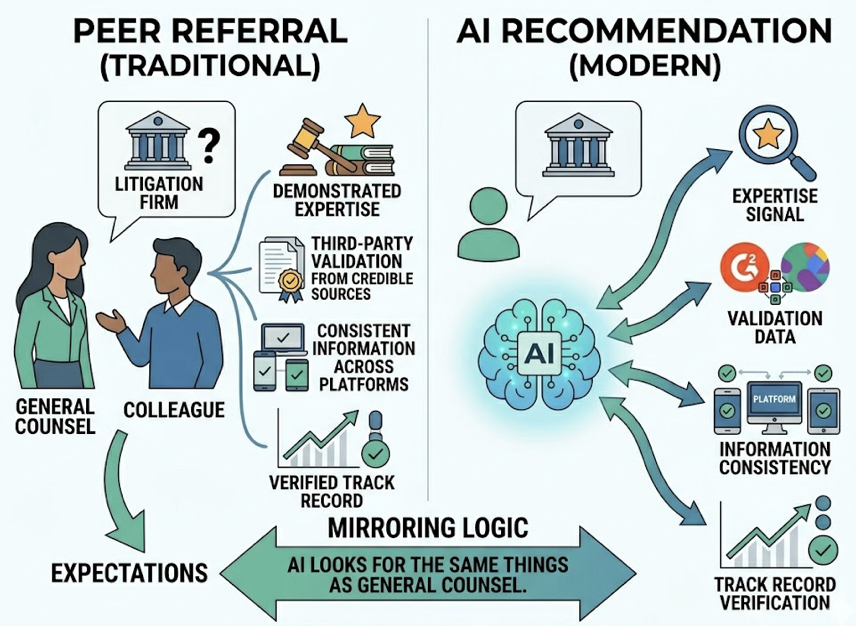
    AI Evaluates Law Firms the Same Way Clients Pick a Referral

    The logic AI uses to recommend attorneys mirrors how peer referrals have always worked. A general counsel asking a colleague for a litigation firm expects the same things AI looks for: demonstrated expertise in the relevant area, third-party validation from credible sources, consistent information across platforms, and a track record that can be verified.

    The difference is scale. A human referral network covers dozens of contacts. AI scans thousands of data points across directories, review platforms, bar association records, published content, and news mentions. If your trust signals are scattered or contradictory, AI treats your firm the same way a cautious colleague would: it recommends someone else.

    The Brand Authority Checker’s four scores map directly to this referral logic. Recognition is “does AI know you practice in this area?” Expertise Depth is “does AI understand your specialization?” Recommendation Rate is “would AI refer you?” Trust Signals is “can AI verify your credibility from independent sources?”

    Your Credentials Are Already There. AI Just Can’t Read Them.

    Most law firms don’t have an authority problem. They have a visibility problem. Your partners have bar certifications, peer awards, Super Lawyers selections, and notable case outcomes. Your firm has been practicing for years. None of that matters if the information isn’t structured for machine consumption.

    79% of legal professionals now use AI tools in their own workflows. The same AI models that help lawyers draft motions are the ones clients use to find lawyers. If your credentials aren’t machine-readable, you’re invisible to the very systems your own team relies on daily.

    Here’s the action path. Run your Brand Authority Checker results, then cross-reference them with your directory listings. Is your firm’s name, address, and specialization consistent across Avvo, Martindale-Hubbell, FindLaw, and Justia? Are your attorneys’ bar numbers, jurisdictions, and practice areas explicitly listed with structured data? If not, that’s why your Trust Signals score is low.

    Niche Authority Beats Firm Size in AI Recommendations

    AI doesn’t sort law firms by headcount or revenue. It sorts by signal density in a specific practice area. A three-attorney immigration boutique with deep, consistent content on visa categories, verifiable case outcomes, and active bar association participation can outperform an AmLaw 100 firm in AI recommendations for immigration queries.

    This is the hidden advantage for small and mid-size firms. You don’t need to compete on brand awareness. You need to compete on signal clarity. The Brand Authority Checker’s Expertise Depth score reflects this directly: it measures how well AI understands what you actually do, not how big your firm is.

    A firm with an Expertise Depth of 85 in “startup IP law” will consistently appear in AI answers for that niche, even if its overall Recognition score is modest. In practice, the firms winning AI visibility in legal are the ones with the tightest match between their actual expertise and the signals AI can verify.

    One Score Is a Starting Point. Tracking It Over Time Is the Strategy.

    Your Brand Authority Checker results tell you where you stand right now. But AI models update their training data, adjust recommendation logic, and shift citations on a rolling basis. A score of 72 today could drop to 55 next quarter without any change on your end, simply because a competitor strengthened their signals or a directory updated its data.

    Topify‘s platform picks up where the free tool leaves off. The Comprehensive GEO Analytics dashboard tracks your authority, sentiment, and visibility scores continuously across ChatGPT, Perplexity, Gemini, and Google AI Overviews. You’ll see trend lines, get alerts when scores shift, and receive specific recommendations for what to fix.

    Here’s how the free check compares to the full platform:

    CapabilityFree Brand Authority CheckerTopify Platform
    Check frequencyOne-time snapshotContinuous daily/weekly monitoring
    AI platforms coveredAggregated scorePer-platform breakdown (ChatGPT, Perplexity, Gemini, AI Overviews)
    Historical trendsNoneFull trend history with alerts
    Competitor trackingNot includedReal-time competitor benchmarking
    Action recommendationsGeneral directionSpecific, one-click GEO optimization
    Team collaborationSingle userUnlimited team member seats

    Every plan starts with a 7-day free trial, no credit card required. The Starter plan begins at $99/month.

    Conclusion

    AI is already the first place many prospective clients turn when they need a lawyer. The firms that show up in those answers aren’t there by accident. They’ve built the kind of authority signals that AI can verify, cite, and recommend.

    Start with the data. Run your firm through the Brand Authority Checker and see exactly how AI perceives your practice. It takes 60 seconds, it’s free, and it’ll tell you whether the problem is recognition, expertise depth, recommendation frequency, or trust signals. Then you’ll know exactly where to focus.

    While you’re assessing your brand authority, a few other free checks can round out the picture. Topify‘s GEO Score Checker evaluates whether AI crawlers can actually access your site’s content. The Prompts Researcher reveals the exact legal questions your potential clients are asking AI in your practice area. And the AI Visibility Report shows how often your firm gets mentioned across major AI platforms.

    FAQ

    Is the Brand Authority Checker really free? Do I need to create an account? 

    Yes, it’s completely free. No account, no email, no credit card. Enter your firm name or domain and get your scores in under 60 seconds.

    What’s the difference between the free tool and the Topify platform? 

    The free Brand Authority Checker gives you a one-time snapshot of your AI-perceived authority. The Topify platform provides continuous monitoring, historical trend data, competitor benchmarking, and actionable optimization recommendations across all major AI platforms.

    How often should a law firm check its AI visibility? 

    At minimum, quarterly. AI models update their data and recommendation logic frequently. A firm that scored well three months ago may have dropped without any change to its own website. Firms in competitive practice areas like personal injury or family law should monitor monthly or use continuous tracking.

    Can a small law firm actually compete with large firms in AI search? 

    Yes. AI doesn’t rank by firm size. It ranks by signal clarity and authority density in a specific practice area. A boutique firm with consistent directory data, strong peer recognition, and deep content in a niche area can outperform larger firms that spread their signals across too many practice areas.

    Read More

  • AI Visibility Tools for Fintech: A Free Brand Authority Audit

    AI Visibility Tools for Fintech: A Free Brand Authority Audit

    Your SOC 2 Badge Doesn’t Mean AI Trusts You

    A CFO typed into Perplexity: “What’s the most trusted expense management tool for a 200-person fintech?” Five brands came back. Yours, with SOC 2 certification and 10,000 enterprise users, wasn’t on the list.

    The issue isn’t your credentials. It’s that AI doesn’t recognize them.

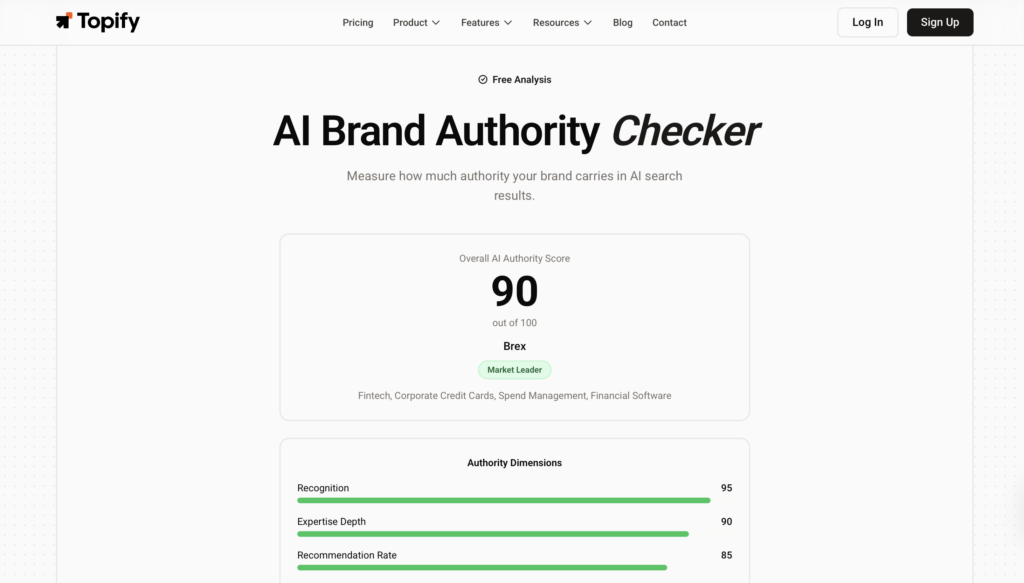
    There’s a way to see exactly where the disconnect is. Topify‘s Brand Authority Checker scores how AI models perceive your brand’s authority across four dimensions that directly affect whether you get recommended in financial services queries.

    ✅ Free ⚡ Results in 60 seconds 🔒 No signup required

    The Four Scores That Tell You If AI Trusts Your Fintech Brand

    Each Score, Translated for Financial Services

    The Brand Authority Checker doesn’t give you a single number and send you on your way. It breaks your brand’s AI-perceived authority into four distinct dimensions, each mapping to a specific problem fintech companies face in AI search.

    MetricWhat It MeasuresWhat It Means for Fintech Brands
    Recognition (0-100)How often AI identifies your brand in your categoryBelow 40: AI doesn’t associate you with your core product category, even if you process billions in transactions
    Expertise Depth (0-100)How well AI understands your capabilitiesBelow 50: AI may misrepresent your compliance certifications or fee structures
    Recommendation Rate (0-100)How often AI recommends you vs. alternativesBelow 30: you’re losing enterprise deals before your sales team talks to the prospect
    Trust Signals (0-100)External validation AI detects (media, reviews, citations)Below 40: AI can’t find enough third-party evidence to vouch for your brand’s reliability

    Here’s the thing: these four scores often tell a very different story than your internal brand perception. A fintech brand with a Recognition score of 85 but a Trust Signals score of 30 has a specific, fixable problem. AI knows who you are but doesn’t trust you enough to recommend you. That gap is where deals disappear.

    Three Signals That Should Worry a Fintech CMO

    High recognition, low recommendation. AI identifies your brand when users ask about your category, but consistently recommends others. This typically means your product information is visible but your third-party validation is weak. AI models in financial services weight external signals like analyst coverage, review platforms, and media mentions heavily before putting a brand on a shortlist.

    Low expertise depth in a regulated category. If AI can’t accurately describe what your product does, including its compliance posture, integration capabilities, and pricing model, it won’t recommend you for specific use cases. In fintech, where buyers ask precise questions like “Which payment processor supports PCI DSS Level 1 for marketplace transactions?”, a shallow expertise profile means you’re filtered out before the conversation starts.

    Declining trust signals after a product pivot. Fintech companies that rebrand, merge, or launch new product lines often see trust signals drop. The reason: AI models rely on a consensus of external sources. If your old product still dominates the media landscape while your new offering has thin coverage, AI will describe the version of your brand that no longer exists.

    Run Your Brand Through the Checker in 60 Seconds

    The process is straightforward. Go to the Brand Authority Checker, enter your brand name or domain, and get your four-dimensional authority breakdown. No account creation, no credit card, no strings. You’ll see exactly which of the four scores is dragging your AI visibility down and where to focus your effort.

    Fintech Buyers Ask AI Before They Call Sales. Here’s What AI Tells Them.

    58% of B2B technology buyers now use AI-powered search tools as part of their initial vendor research, up from 17% in 2023. In fintech, where switching costs are high and procurement cycles are long, the AI’s answer often determines which brands make the shortlist and which ones never get a meeting.

    The prompts these buyers type are specific, comparison-driven, and high-intent. Here’s what that looks like in practice:

    AI Prompt ExamplePlatformSearch IntentWhat It Reveals
    “Best payment processor for SaaS startups with PCI DSS compliance”ChatGPTPurchase decisionWhether your brand gets recommended for compliance-sensitive use cases
    “Is [brand] SOC 2 certified for enterprise payment processing?”PerplexityTrust verificationHow accurately AI describes your security posture
    “Compare embedded finance providers for marketplace apps”GeminiCompetitive researchWhere you rank against alternatives in AI’s assessment
    “Most trusted lending platform for small businesses 2026”ChatGPTCategory researchWhether AI considers you a category leader
    “Which regtech platform handles KYC for mid-size banks?”PerplexitySpecific capability matchWhether AI understands your product’s niche capabilities

    Each of these prompts represents a real moment where a buyer is forming a shortlist. If your brand isn’t in the AI’s response, you’re not on that list.

    Organic traffic in finance is down 7.4% year over year, while AI referral traffic to top sites surged 357%. The shift isn’t coming. It’s already here.

    The Credentials Gap: Why Your SOC 2 and Your AI Authority Score Don’t Match

    Most fintech brands assume that their real-world credentials, regulatory licenses, SOC 2 certifications, millions of users, translate directly into AI search authority. They don’t.

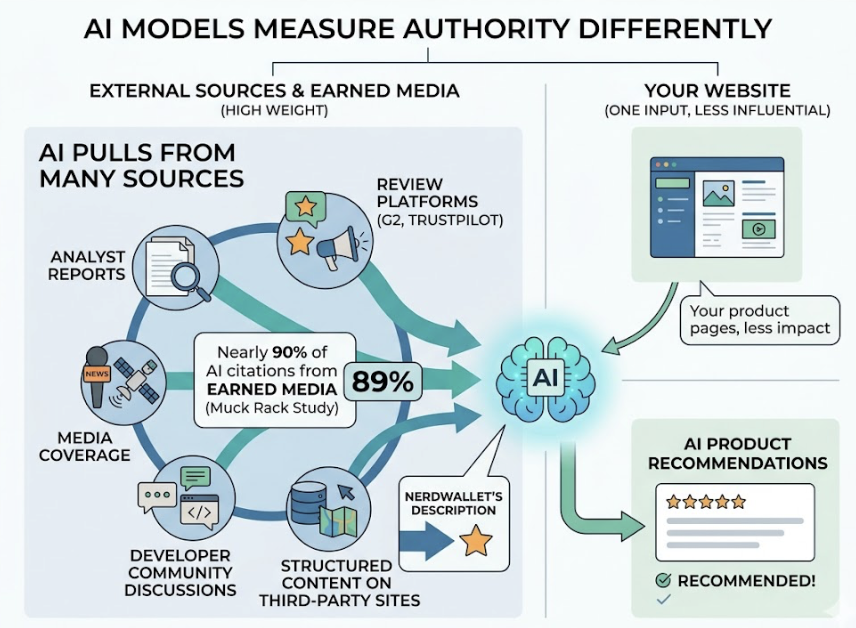
    AI models measure authority differently. They pull from external sources: analyst reports, review platforms like G2 and Trustpilot, media coverage, developer community discussions, and structured content on third-party sites. Your own website is one input among many, and often not the most influential one. Nearly 90% of AI citations come from earned media, according to a Muck Rack study. That means NerdWallet’s description of your product carries more weight in AI’s recommendation than your own feature page.

    This creates a specific problem for fintech brands. You may have invested heavily in compliance documentation, security audits, and product capabilities, but if those credentials aren’t reflected in the external sources AI trusts, the models won’t surface them.

    The Brand Authority Checker makes this gap visible. When your Trust Signals score is 30 points below your Recognition score, you’re looking at a brand that AI knows about but doesn’t trust enough to recommend. That’s the gap between what you’ve built and what the AI ecosystem can verify.

    AI Search Is Reshaping the Top of the Fintech Acquisition Funnel Right Now

    This isn’t a 2028 problem.

    Buyers arriving via AI citations convert at 5.1 times the rate of traditional search traffic. ChatGPT referrals convert at roughly 15.9%, Perplexity at 10.5%, compared to Google’s 1.8%. These aren’t vanity metrics. They reflect that AI-referred buyers arrive with higher intent and a pre-built shortlist.

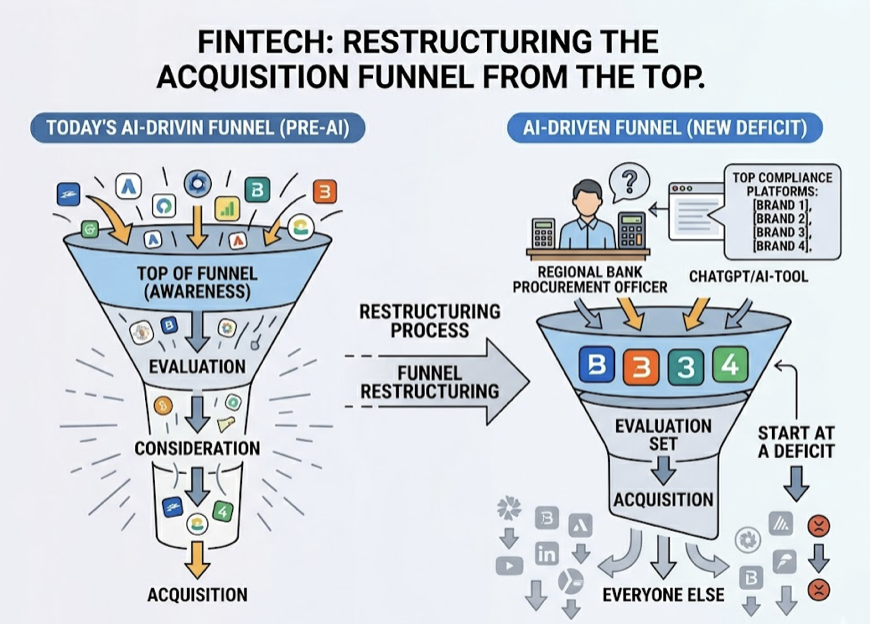
    For fintech companies, this means the acquisition funnel is being restructured from the top. When a procurement officer at a regional bank asks ChatGPT to compare compliance platforms, the three or four brands in the response become the evaluation set. Everyone else starts at a deficit.

    The financial impact compounds. In fintech, where average contract values run into six or seven figures and switching costs lock in relationships for years, losing the initial shortlist doesn’t just cost you one deal. It costs you the entire lifetime value of that customer relationship.

    Fintech brands with structured, data-rich content are 3.5 times more likely to receive unprompted AI citations in procurement-related queries. The pattern is clear: brands that make their expertise accessible and verifiable in formats AI can parse are the ones that show up. Brands that bury their best information in PDFs and gated whitepapers don’t.

    Your Brand Authority Checker score is the fastest way to see which side of that divide you’re on.

    One Authority Score Is a Starting Point. Tracking It Is the Strategy.

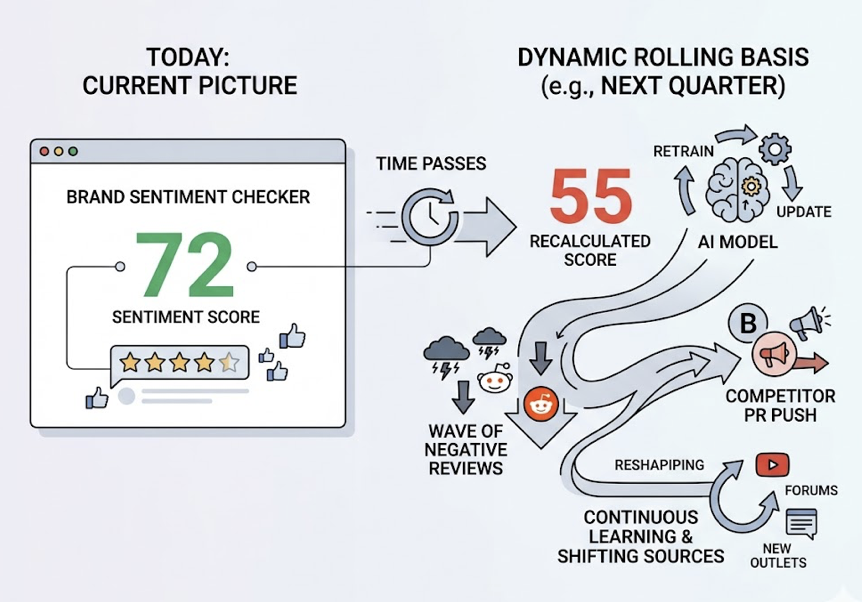
    Your Brand Authority Checker results tell you where you stand right now. But AI models update their training data, adjust ranking signals, and shift recommendations on a rolling basis. A Trust Signals score of 72 today could drop to 55 next quarter without any change on your end.

    Topify‘s platform picks up where the free tool leaves off. The Comprehensive GEO Analytics dashboard tracks your authority, sentiment, and visibility scores continuously across ChatGPT, Perplexity, Gemini, and Google AI Overviews. You’ll see trend lines, get alerts when scores shift, and receive specific recommendations for what to fix.

    Here’s how the free check compares to the full platform:

    CapabilityFree Brand Authority CheckerTopify Platform
    Check frequencyOne-time snapshotContinuous daily/weekly monitoring
    AI platforms coveredAggregated scorePer-platform breakdown (ChatGPT, Perplexity, Gemini, AI Overviews)
    Historical trendsNoneFull trend history with shift alerts
    Competitor trackingNot includedReal-time competitor benchmarking
    Action recommendationsGeneralSpecific, one-click GEO optimization
    Team collaborationNoUnlimited team member seats

    Every plan starts with a 7-day free trial, no credit card required. The Starter plan begins at $99/month.

    Conclusion

    AI search is already deciding which fintech brands make the shortlist and which ones stay invisible. The gap between your real-world credentials and your AI-perceived authority is measurable, and closing it starts with knowing your score.

    Run your brand through the Brand Authority Checker to see exactly where AI trusts you and where it doesn’t. Then use what you learn to build a visibility strategy that matches the way your buyers actually research financial products in 2026.

    For a complete picture, a few other free checks from Topify’s free tools can round out your diagnosis. The GEO Score Checker evaluates whether your site is technically optimized for AI crawlers. The AI Visibility Report shows how often your brand gets mentioned across major AI platforms. And the Competitor Analysis tool reveals who AI recommends instead of you, and why.

    FAQ

    Is the Brand Authority Checker really free? Do I need to create an account? 

    Yes, it’s completely free with no registration required. Enter your brand name or domain and get your four-score authority breakdown in under 60 seconds.

    What’s the difference between the free tool and the Topify paid platform? 

    The free tool gives you a one-time snapshot of your brand’s AI authority. The Topify platform provides continuous monitoring, historical trends, competitor benchmarking, and actionable optimization recommendations across all major AI platforms.

    How often should a fintech brand check its AI visibility? 

    At minimum, monthly. AI models update their training data and ranking signals regularly. A quarterly review is the bare minimum for regulated industries where accuracy of AI descriptions carries compliance implications.

    Can AI really misrepresent my fintech product’s compliance status? 

    Yes. AI models synthesize information from multiple sources, and outdated or conflicting data can lead to inaccurate descriptions of your certifications, fee structures, or regulatory standing. In fintech, this isn’t just a brand risk, it’s a potential legal exposure.

    Read More

  • AI Visibility Tools for DTC Brands in 2026

    AI Visibility Tools for DTC Brands in 2026

    Your customer just asked ChatGPT, “What’s the best sustainable sneaker brand under $150?” The AI responded with three recommendations, detailed pros and cons for each, and a confident verdict. Your brand, the one with 4.8-star reviews and a carbon-neutral supply chain, didn’t make the list. Worse, a competitor with fewer reviews and a higher price point did.

    The gap isn’t your product. It’s how AI perceives your brand.

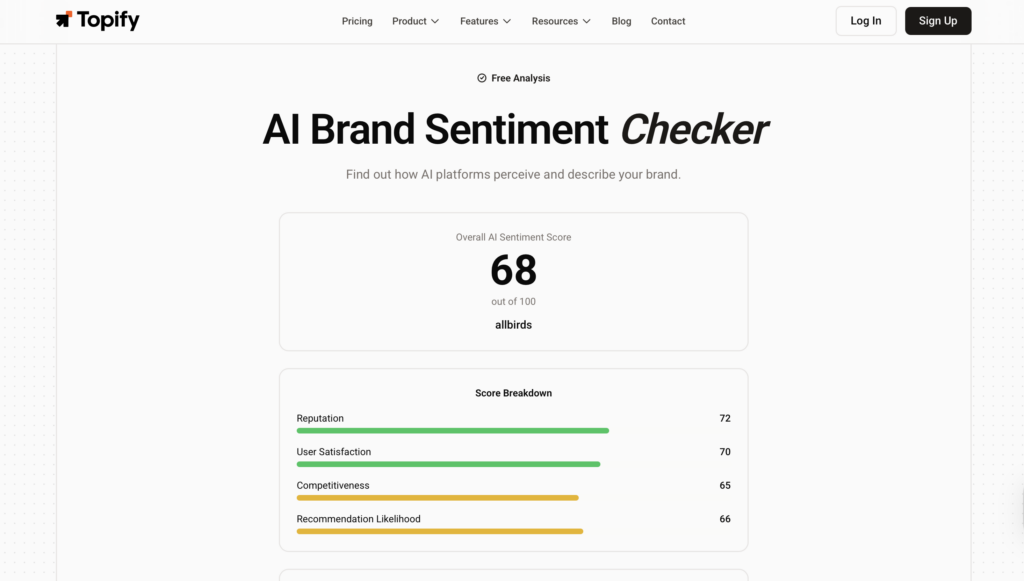
    Topify‘s Brand Sentiment Checker shows you exactly what AI models think about your DTC brand, broken down by strengths, weaknesses, and an overall sentiment score that directly affects whether you get recommended or warned against.

    ✅ Free ⚡ Full sentiment breakdown in seconds 🔒 No signup required

    What the Brand Sentiment Checker Actually Tells You About Your DTC Brand

    Most DTC teams track NPS, Trustpilot scores, and social mentions. None of those tell you what AI models are saying about your brand when a shopper asks for a recommendation. That’s a different data layer entirely.

    The Brand Sentiment Checker bridges that gap. It analyzes how AI systems describe your brand and translates the output into actionable dimensions.

    Three Scores That Decide Whether AI Recommends or Warns Against You

    Each dimension maps to a specific risk for DTC brands competing in AI-driven product discovery.

    Sentiment DimensionWhat It MeasuresWhat It Means for DTC Brands
    Overall Sentiment Score (0-100)Net positive vs. negative tone AI associates with your brandBelow 50: AI is attaching caveats or warnings when mentioning your products
    Strengths DetectedSpecific positive attributes AI highlightsShows which product claims AI actually believes and repeats to shoppers
    Weaknesses FlaggedSpecific negative attributes AI surfacesReveals outdated complaints or misconceptions AI is still circulating

    A DTC skincare brand might score 75 overall but discover that AI consistently flags “fragrance irritation” as a weakness. If that formula was reformulated two years ago, you’ve found the exact disconnect costing you AI recommendations.

    That single insight is worth more than a month of keyword research.

    When AI Sentiment Doesn’t Match Your Current Product

    Here’s the pattern that hits DTC brands hardest: you ship V2 of your product, but AI still describes V1.

    AI models pull sentiment from reviews, articles, Reddit threads, and third-party comparisons. If the loudest signals in that mix are two-year-old complaints about sizing, durability, or shipping speed, the AI’s description of your brand is frozen in time. Your product improved. The AI’s opinion didn’t.

    This plays out in three common scenarios for DTC brands:

    Scenario 1: The fixed flaw. Early reviews mentioned a quality issue. You fixed it 18 months ago. AI still references it when shoppers ask about your category.

    Scenario 2: The missing upgrade. You launched a new product line or feature. AI doesn’t know it exists because the third-party content hasn’t caught up.

    Scenario 3: The sentiment mismatch. Your owned channels emphasize sustainability and premium quality. AI describes you as “budget-friendly but inconsistent.” The positioning you built isn’t the positioning AI learned.

    The Brand Sentiment Checker surfaces all three. You don’t need to guess which scenario applies to your brand.

    How to Run Your Brand Sentiment Check

    Three steps, under 60 seconds:

    1. Go to Brand Sentiment Checker
    2. Enter your brand name or domain
    3. Get your sentiment breakdown: overall score, specific strengths AI recognizes, and specific weaknesses AI flags

    No account needed. No credit card. You’ll see exactly how AI describes your brand to the shoppers asking about your category right now.

    The AI Prompts DTC Shoppers Are Already Using to Find (or Skip) Your Products

    37% of consumers now start their search journey with AI tools instead of Google. For DTC brands, that means your next customer might never visit a search engine at all. They’ll ask an AI assistant, get a direct answer, and buy.

    The table below shows how real DTC shoppers are prompting AI, and what each query reveals about your brand’s visibility.

    AI Prompt ExamplePlatformSearch IntentWhat It Reveals About Your Brand
    “Best DTC protein powder for women over 40”ChatGPTPurchase decisionWhether AI recommends you in your target demographic
    “Is [brand] worth the price compared to alternatives?”PerplexityTrust verificationHow AI frames your value proposition vs. competitors
    “Sustainable sneaker brands under $150”GeminiCategory discoveryWhether your brand appears in AI’s curated shortlist
    “What do people say about [brand] quality?”ChatGPTSentiment checkThe exact language AI uses to describe your product quality
    “Best dog food brands for allergies 2026”Google AI OverviewSpecific need matchWhether AI associates your brand with the right use case

    Each of these prompts triggers an AI response that either includes your brand or doesn’t. And when it does include you, the sentiment attached to your mention determines whether the shopper clicks through or moves on.

    DTC brands like Pawco have already reported that customers are discovering them through AI searches for terms like “best food for dogs with allergies.” The channel is real. The question is whether AI’s description of your brand helps or hurts when those queries happen.

    Two Shifts DTC Brands Can’t Afford to Ignore in AI Search

    AI Sentiment Is Stuck on Your Old Reviews. Your Product Has Moved On.

    A DTC bedding brand reformulates its pillow fill after early complaints about firmness. New reviews are overwhelmingly positive. But when a shopper asks Perplexity, “Is [brand] pillow too firm?”, the AI answers with a qualified yes, citing language patterns from reviews that are now two years old.

    This isn’t a hypothetical. AI models synthesize sentiment from everything published about your brand online, and they don’t weight recency the way a human reviewer would. A Criteo study tracking 28 fashion brands across ChatGPT, Gemini, and Claude found that AI recommendations correlated with consistent, specific positioning across all published content, not with the most recent content alone.

    For DTC brands that iterate fast, this creates a structural disadvantage. You ship improvements quarterly. AI updates its perception on a much slower cycle.

    The Brand Sentiment Checker makes this gap visible. Run your brand through the tool, and compare the weaknesses AI flags against your current product. If there’s a mismatch, you’ve identified exactly which narratives need to be updated across review platforms, PR, and third-party content.

    Ad Spend Doesn’t Buy AI Recommendations. Sentiment Signals Do.

    DTC growth has historically been a budget game. Bid higher on Meta, scale spend on Google, win more customers. The median DTC brand now spends $130 to $156 to acquire a single customer through those channels.

    AI search works on entirely different rules. You can’t bid your way into a ChatGPT recommendation.

    What determines whether AI recommends your brand? The signals it can verify: review quality, third-party citations, brand positioning consistency, and structured product data. In an analysis of over 5,000 ChatGPT shopping carousels, an online-only DTC brand most shoppers had never heard of appeared in nearly 30% of triggered results, while a globally recognized retailer appeared in fewer than 2%. The difference wasn’t brand awareness or ad spend. It was data quality and sentiment signals.

    This is the shift DTC teams need to internalize. AI referral traffic already converts at 11.4% compared to 5.3% for organic search. The channel is higher-intent, higher-converting, and completely inaccessible through traditional paid media.

    48% of AI citations come from community platforms like Reddit, review sites, and forums. That means your brand’s AI sentiment isn’t shaped by what you publish on your own site. It’s shaped by what others say about you on platforms you don’t control.

    The starting point is knowing what AI currently thinks. That’s what the Brand Sentiment Checker gives you in 60 seconds, for free.

    One Sentiment Snapshot vs. Continuous Brand Monitoring

    The Brand Sentiment Checker gives you a clear picture of where your brand stands right now. But AI models don’t stay static. They retrain, update their retrieval sources, and shift recommendations on a rolling basis. A sentiment score of 72 today could drop to 55 next quarter if a wave of negative reviews hits Reddit or a competitor’s PR push reshapes your category narrative.

    For DTC brands running product launches, seasonal campaigns, or responding to PR issues, a one-time check isn’t enough. You need to know when AI’s perception of your brand changes, not discover it after sales dip.

    Topify‘s Comprehensive GEO Analytics dashboard picks up where the free tool leaves off. It tracks your sentiment, visibility, and authority scores continuously across ChatGPT, Perplexity, Gemini, and Google AI Overviews. You’ll get trend data, alerts when scores shift, and specific recommendations for what to fix.

    Here’s how the free check compares to the full platform:

    CapabilityFree Brand Sentiment CheckerTopify Platform
    Check frequencyOne-time snapshotContinuous daily/weekly monitoring
    AI platforms coveredAggregated scorePer-platform breakdown (ChatGPT, Perplexity, Gemini, AI Overviews)
    Historical trendsNoneFull trend history with shift alerts
    Competitor sentiment trackingNot includedReal-time competitor benchmarking
    Action recommendationsGeneralSpecific, one-click GEO optimization
    Team collaborationNoUnlimited team member seats

    Every plan starts with a 7-day free trial, no credit card required. The Starter plan begins at $99/month.

    Conclusion

    DTC brand discovery is moving to AI, and it’s moving fast. Referral traffic from AI chatbots to US retailers grew 760% year-over-year in late 2025. Your customers are asking AI what to buy. The sentiment AI attaches to your brand in those answers determines whether you get the click or get passed over.

    Start with a free Brand Sentiment Checker scan. See what AI actually says about your products. Then build a plan to close the gap between your brand’s reality and AI’s perception of it.

    For ongoing monitoring, start a free trial of Topify’s platform to track sentiment shifts across every major AI platform.

    Other Free Tools to Round Out Your AI Visibility Audit

    While you’re checking your brand sentiment, a few other free tools can fill in the picture. Topify‘s GEO Score Checkerevaluates whether AI crawlers can access and understand your site’s structure. The AI Visibility Report shows how often your brand gets mentioned across major AI platforms. And the Prompts Researcher reveals the exact product questions DTC shoppers are asking AI in your category.

    FAQ

    Is the Brand Sentiment Checker free? Do I need to sign up? 

    Yes, it’s completely free. No signup, no credit card, no email required. Enter your brand name or domain and get your sentiment breakdown in under 60 seconds.

    What’s the difference between the free tool and the Topify platform? 

    The free Brand Sentiment Checker gives you a one-time snapshot of AI sentiment. The Topify platform provides continuous monitoring across ChatGPT, Perplexity, Gemini, and Google AI Overviews, with historical trends, competitor benchmarking, and actionable optimization recommendations. Plans start at $99/month with a 7-day free trial.

    How often should DTC brands check their AI sentiment? 

    At minimum, after every major product launch, reformulation, or PR event. AI models update their knowledge on irregular cycles, so a quarterly manual check with the free tool is a reasonable baseline. For brands in competitive categories or running frequent product updates, continuous monitoring through the platform is the more practical approach.

    Can AI sentiment actually affect DTC sales? 

    Yes. ChatGPT-referred visits convert at 11.4% compared to 5.3% for organic search. When AI attaches negative sentiment or outdated complaints to your brand, shoppers who discover you through AI start with a negative impression, or skip your brand entirely. The sentiment AI associates with your brand is increasingly a direct driver of purchase decisions.

    Read More

  • AI Visibility Tools for E-Commerce Brands

    AI Visibility Tools for E-Commerce Brands

    A shopper typed into ChatGPT: “Compare running shoes under $150 with good arch support.” Your brand appeared in the response, but with a caveat: “some users report inconsistent sizing.” That sizing issue was resolved two product lines ago. The AI doesn’t know that.

    You can see exactly how AI describes your brand right now. Topify‘s Brand Sentiment Checker analyzes the sentiment AI models attach to your brand, surfaces specific strengths and weaknesses AI associates with your products, and shows you where perception doesn’t match reality.

    ✅ Free ⚡ Full sentiment breakdown in seconds 🔒 No signup required

    What AI Actually Says About Your Brand When Shoppers Ask

    Your product pages tell one story. AI tells another. When a consumer asks ChatGPT, Perplexity, or Gemini for a product recommendation, the AI doesn’t pull your marketing copy. It synthesizes reviews, forum discussions, media coverage, and third-party evaluations to construct a description of your brand. That description includes a sentiment layer, and it directly affects whether AI recommends you or steers shoppers elsewhere.

    The Brand Sentiment Checker breaks down AI’s perception of your brand into specific, measurable dimensions. Here’s what each one tells you in an e-commerce context.

    The Scores That Decide If AI Recommends or Warns

    MetricWhat It MeasuresWhat It Means for E-Commerce Brands
    Overall Sentiment ScoreNet positive/negative/neutral tone AI uses to describe your brandBelow neutral: AI is actively cautioning shoppers about your products
    Strengths IdentifiedSpecific positive attributes AI associates with your brandFew strengths: AI has no compelling reason to recommend you over alternatives
    Weaknesses FlaggedSpecific negative attributes or concerns AI highlightsActive weaknesses: AI may add caveats like “some users report issues with…”
    Sentiment GapDifference between how AI describes you vs. how customers actually rate youLarge gap: AI is working with outdated or skewed information

    A brand with strong sales and a 4.6-star average on its own site can still carry a negative sentiment score in AI. That disconnect is the problem the checker is built to surface.

    When “Fixed Two Years Ago” Still Shows Up in AI Answers

    Here’s where e-commerce brands run into trouble. AI models don’t update their understanding of your brand in real time. They synthesize from a broad content ecosystem, and that ecosystem has a long memory.

    Scenario 1: The ghost review. Your brand had a batch of defective units in 2023. You issued a recall, improved QC, and moved on. But the Reddit threads, blog reviews, and forum complaints from that period are still indexed. AI picks up “quality control issues” as a recurring theme and mentions it when shoppers ask about your category.

    Scenario 2: The outdated comparison. A popular review site published a head-to-head comparison 18 months ago where your product scored lower on durability. You’ve since launched a redesigned version. AI still references the old comparison because no updated content has replaced it in the training ecosystem.

    Scenario 3: The sentiment mismatch. Your Trustpilot score is 4.5 with 3,000+ reviews, but AI describes your brand as “mixed reviews.” The reason: a cluster of negative reviews from a single incident weighs disproportionately in AI’s synthesis because those reviews generated the most discussion and backlinks.

    Running your brand through the checker exposes which of these patterns are affecting you.

    Run Your Brand Through the Checker in 60 Seconds

    Go to the Brand Sentiment Checker, enter your brand name or domain, and get your full sentiment breakdown. You’ll see the exact strengths AI associates with your brand, the specific weaknesses it flags, and your overall sentiment score. No account, no credit card, no waiting.

    The whole process takes under a minute, and the output tells you exactly where AI’s description of your brand diverges from reality.

    The AI Prompts Driving E-Commerce Decisions Right Now

    64% of consumers plan to use AI chatbots for shopping in 2026. That’s not a projection. It’s survey data from over 1,000 consumers. And among daily AI users, 70% have already used AI for shopping, spending an average of $540 across 9 transactions in 2025.

    The prompts these shoppers use aren’t vague. They’re specific, comparison-driven, and high-intent. Here’s what they look like in practice.

    AI Prompt ExamplePlatformSearch IntentWhat It Reveals About Your Brand
    “Best wireless earbuds under $100 for running”ChatGPTPurchase decisionWhether AI recommends your product or flags comfort/durability concerns
    “Compare organic skincare brands for sensitive skin”PerplexityCompetitive comparisonHow your sentiment stacks up against alternatives in the same category
    “Most reliable laptop brand for remote workers”GeminiTrust verificationWhether AI describes your brand as “reliable” or adds qualifiers
    “Which DTC mattress has the best return policy?”ChatGPTPolicy-driven decisionWhether AI accurately reflects your current policies or cites outdated info
    “Top-rated coffee makers under $200, 2026”PerplexityCategory researchWhether your brand appears at all, and with what sentiment

    Each of these prompts represents a moment where AI either recommends your brand with confidence or adds a caveat that sends the shopper elsewhere. The sentiment AI attaches to your brand in these responses isn’t random. It’s a direct reflection of what the content ecosystem says about you.

    On Black Friday 2025, shoppers arriving from ChatGPT converted on Amazon at 1.7x the rate of Google-referred shoppers, with 11% higher average order value. The channel is already converting. The question is whether your brand shows up in it with the right sentiment.

    AI’s Perception of Your Brand Is Built on Third-Party Reviews, Not Your Website

    Here’s the thing most e-commerce teams miss: the content that shapes AI’s sentiment about your brand isn’t on your website. It’s on Trustpilot, Reddit, YouTube reviews, niche blogs, and comparison sites. AI models weight third-party, user-generated content far more heavily than brand-owned marketing copy when forming sentiment judgments.

    This is a fundamental shift from traditional SEO. In Google rankings, you can control a significant portion of the narrative through on-page optimization, content marketing, and link building. In AI search, the narrative is shaped by what others say about you, and AI is very good at detecting patterns in that external conversation.

    A practical example: if your brand has a 4.7-star average across 5,000 reviews on your own site, but your Trustpilot score sits at 3.8 with 800 reviews and active negative threads on Reddit, AI will lean toward the Trustpilot and Reddit signals. Not because those platforms are more accurate, but because AI treats independent sources as more credible for sentiment synthesis.

    The data supports this pattern. 78% of consumers say reviews increase their trust in AI recommendations, and 98% verify AI’s suggestions by checking external sources. AI models anticipate this verification behavior and front-load sentiment signals from the same sources consumers will check.

    What This Means for Your Sentiment Strategy

    Review SourceAI WeightingWhy It Matters for E-Commerce
    Trustpilot / Google ReviewsHighPrimary sentiment signal for consumer brands
    Reddit threads and commentsHighAI treats candid user discussion as high-trust signal
    YouTube product reviewsMedium-HighVideo review sentiment gets synthesized into text descriptions
    Niche comparison blogsMediumCategory-specific authority influences AI’s competitive framing
    Brand-owned website copyLowAI discounts self-reported claims in favor of external validation

    This isn’t about gaming reviews. It’s about understanding which parts of your review ecosystem are actually shaping how AI describes you, and making sure that ecosystem reflects your current product quality, not last year’s problems.

    Outdated Negative Reviews Are Costing You AI Recommendations Right Now

    AI models don’t have a “recency” filter the way you’d expect. When ChatGPT or Perplexity synthesizes information about your brand, it pulls from the entire content history available to it. A negative review from 2022 that generated significant discussion carries roughly the same weight as a positive review from last month, sometimes more, because older content often has more backlinks and cross-references.

    For e-commerce brands, this creates a specific problem: product improvements don’t automatically update AI’s perception. You may have redesigned your packaging, upgraded your materials, or overhauled your customer service process. If the content ecosystem still has more volume and engagement around the old problems than the new solutions, AI keeps surfacing the old narrative.

    The Brand Sentiment Checker helps you identify exactly which negative signals AI is still picking up. Once you see the specific weaknesses AI flags, you can trace them back to their source and build a content strategy that addresses them directly. That might mean publishing updated comparison content, encouraging recent customers to leave reviews on high-weight platforms, or creating case studies that directly counter the outdated narrative.

    Only 16% of brands currently track their AI search performance systematically. That means the majority of e-commerce brands don’t know what AI is saying about them. In a channel where AI-referred traffic converts 42% better than non-AI traffic, that blind spot has a direct revenue impact.

    One Sentiment Check Is a Snapshot. Tracking It Is the Strategy.

    Your Brand Sentiment Checker results tell you where you stand right now. But AI models update their training data, ingest new content, and shift how they describe brands on a rolling basis. A positive sentiment score today doesn’t guarantee the same result next quarter, especially if a competitor launches a review campaign or a negative thread goes viral in your category.

    Topify‘s platform picks up where the free tool leaves off. The Comprehensive GEO Analytics dashboard tracks your sentiment, visibility, and authority scores continuously across ChatGPT, Perplexity, Gemini, and Google AI Overviews. You’ll see trend lines over time, get alerts when sentiment shifts, and receive specific recommendations for what to fix.

    Here’s how the free check compares to the full platform:

    CapabilityFree Brand Sentiment CheckerTopify Platform
    Check frequencyOne-time snapshotContinuous daily/weekly monitoring
    AI platforms coveredAggregated sentiment scorePer-platform breakdown (ChatGPT, Perplexity, Gemini, AI Overviews)
    Historical trendsNoneFull trend history with shift alerts
    Competitor sentimentNot includedReal-time competitor sentiment benchmarking
    Actionable next stepsGeneral insightSpecific, data-driven optimization recommendations
    Team collaborationNoUnlimited team member seats

    Every plan starts with a 7-day free trial, no credit card required. The Starter plan begins at $99/month.

    Conclusion

    AI shopping isn’t a future channel. ChatGPT processes roughly 50 million shopping queries per day, and the consumers using it convert at significantly higher rates than those arriving from traditional search. For e-commerce brands, the question isn’t whether AI matters. It’s whether AI describes your brand accurately and favorably when shoppers ask.

    Start with the free Brand Sentiment Checker to see exactly what AI says about your brand today. If the sentiment doesn’t match your current product quality and customer experience, you’ve found the gap. From there, Topify’s platform gives you the continuous monitoring and optimization tools to close it.

    Other Free Tools to Round Out the Picture

    While you’re assessing brand sentiment, a few other free checks can cover additional dimensions. Topify‘s GEO Score Checker evaluates whether AI crawlers can access and interpret your product pages properly. The AI Visibility Reportshows how often your brand gets mentioned across major AI platforms. And the Competitor Analysis tool reveals which brands AI considers your direct competitors and how you stack up.

    FAQ

    Is the Brand Sentiment Checker free? Do I need to sign up? 

    Yes, it’s completely free with no signup, no login, and no credit card required. Enter your brand name or domain and get your sentiment breakdown in under 60 seconds.

    What’s the difference between the free tool and Topify’s paid platform? 

    The free tool gives you a one-time sentiment snapshot. The paid platform adds continuous monitoring, per-platform breakdowns, historical trend tracking, competitor benchmarking, and actionable optimization recommendations. Plans start at $99/month with a 7-day free trial.

    How often should e-commerce brands check their AI sentiment?

     At minimum, once a month. If you’re running active campaigns, launching new products, or recovering from a PR issue, check bi-weekly. Significant changes in your review ecosystem, like new Trustpilot reviews, Reddit threads, or media coverage, can shift AI sentiment within weeks.

    Can AI sentiment actually affect my e-commerce revenue?

     Directly. AI-referred traffic to retail sites converts 42% better than non-AI traffic in 2026, and 64% of consumers plan to use AI for shopping this year. If AI describes your brand with negative sentiment or outdated caveats, those high-converting shoppers are going to your competitors instead.

    Read More

  • AI Visibility Tools for B2B Software

    AI Visibility Tools for B2B Software

    A VP of Procurement typed into ChatGPT: “Best project management software for enterprise teams with Salesforce integration.” Five brands came back. Yours wasn’t one of them. That VP didn’t search Google next. They didn’t visit your website. They shortlisted the five names AI gave them and moved on.

    This is happening at scale. 51% of B2B software buyers now start their research with an AI chatbot more often than with Google. And 69% end up choosing a different vendor than they originally planned, based on what the chatbot recommended.

    The question isn’t whether your product is good. It’s whether AI knows that.

    Topify‘s Brand Profile Checker shows you exactly how AI models perceive your brand: what category they place you in, which competitors they associate you with, and how much your positioning overlaps with theirs. ✅ Free ⚡ Results in 60 seconds 🔒 No signup required.

    What AI Actually Thinks About Your B2B Software Brand

    Most B2B software companies assume AI understands their positioning because their website does a good job explaining it. That assumption is wrong more often than you’d expect.

    AI models build their own brand portraits based on training data, citations, reviews, and content signals. The Brand Profile Checker surfaces that portrait and breaks it into three dimensions you can act on.

    The Three Dimensions That Shape Your AI Identity

    Each dimension maps to a specific risk for B2B software brands.

    DimensionWhat It RevealsWhat It Means for B2B Software
    Brand PortraitHow AI describes your product, category, and positioningIf AI calls your enterprise platform a “small business tool,” every recommendation goes to the wrong buyer segment
    Competitor DiscoveryWhich brands AI associates as your direct competitorsAI may compare you to brands outside your actual competitive set, diluting your positioning
    Competitive Overlap ScoreHow much your brand identity overlaps with each competitorHigh overlap with the wrong competitor means AI can’t differentiate you when buyers ask “which one should I pick”

    A B2B analytics platform with a strong Brand Portrait but high overlap with a general BI tool has a specific problem: AI recognizes what you do, but can’t articulate why you’re different. That’s the gap where deals get lost.

    Three AI Positioning Errors That Cost B2B Software Companies Pipeline

    Here’s what the Brand Profile Checker typically uncovers for B2B software brands.

    Wrong category placement. Your product serves mid-market and enterprise buyers, but AI categorizes you alongside SMB tools. Every time a buyer asks for “enterprise-grade” options, you’re filtered out before the answer is generated.

    Stale feature narrative. You launched a major platform update six months ago, but AI still describes capabilities from two versions back. Buyers comparing features through AI get an outdated picture of what you offer.

    Competitor mismatch. AI associates you with brands you don’t consider competitors. When a buyer asks “How does [your brand] compare to [unexpected competitor]?”, the comparison framework works against you because AI has grouped you incorrectly.

    How to Run Your Brand Profile Check

    Go to the Brand Profile Checker, enter your brand name or domain, and get your full AI brand portrait in under 60 seconds. You’ll see the exact language AI uses to describe you, the competitors it associates with you, and the overlap scores that show where differentiation is weak. No account, no credit card, nothing to install.

    The Prompts Your Buyers Type Before They Ever Visit Your Website

    B2B software buyers don’t type keywords into AI. They describe their exact situation, constraints, and requirements. These prompts are increasingly where shortlists get built.

    G2’s 2026 research found that 71% of B2B software buyers rely on AI chatbots somewhere in their research process. The prompts below represent the types of questions that determine whether your brand makes the cut.

    AI Prompt ExamplePlatformBuyer IntentWhat Determines If You Show Up
    “Best CRM for mid-market B2B with Salesforce integration”ChatGPTVendor shortlistingWhether AI places you in the CRM category for that company size
    “Compare [Category] tools for healthcare compliance”PerplexityFeature comparisonWhether AI accurately describes your compliance capabilities
    “What project management software do 500-person tech companies use?”GeminiSocial proof validationWhether AI associates your brand with that company profile
    “Is [Your Brand] good for enterprise teams?”ChatGPTDirect brand evaluationHow AI describes your strengths, weaknesses, and ideal customer
    “Top analytics platforms under $50K/year for B2B”PerplexityBudget-filtered discoveryWhether AI knows your pricing tier and positions you correctly
    “Which [Category] tool has the best API and integrations?”ClaudeTechnical evaluationWhether AI has indexed your technical documentation and partner ecosystem

    Notice the pattern. These aren’t keyword searches. They’re full buying scenarios. And AI assembles its answer based on how well it understands your brand’s profile, not just whether your website ranks for a given term.

    AI Is the New Front Door to B2B Software Discovery

    The shift is no longer emerging. It’s measurable and accelerating.

    73% of B2B buyers now use AI tools in their purchase research process. Among B2B software buyers specifically, the number starting with AI over Google jumped from 29% to 51% in just 11 months. This isn’t a niche behavior pattern. It’s the new default.

    Here’s the thing: AI doesn’t generate a page of ten links. It generates a single answer with three to five recommendations. If you’re not in that answer, you don’t get a second chance on “page two.” There is no page two.

    The pipeline impact is direct. AI search traffic converts at 14.2% compared to Google organic’s 2.8%. Buyers who arrive through AI recommendations are further along in their decision process and more likely to convert. But only 22% of marketers currently track AI visibility at all.

    The math is uncomfortable. The channel with the highest conversion rate is the one almost nobody is monitoring.

    DerivateX benchmark of 50 B2B SaaS companies found the average AI Presence Score is 56.9 out of 100, with 44% scoring below 50. The gap between the top scorer (89) and the bottom (2) is 87 points. Both companies had active marketing teams. The difference wasn’t marketing effort. It was whether AI could find, classify, and recommend them.

    Running your brand through the Brand Profile Checker is the fastest way to see which side of that gap you’re on.

    Your Real Competitors in AI Search Might Not Be Who You Think

    Most B2B software companies have a well-defined competitive set. You know who shows up in RFPs, who your sales team loses deals to, and who appears on G2 comparison pages.

    AI has its own competitive map. And it doesn’t always match yours.

    AI models construct competitive relationships based on content co-occurrence, citation patterns, review site associations, and training data signals. If a series of blog posts and analyst reports consistently mention your brand alongside a company you’ve never considered a competitor, AI will treat that association as real. When a buyer asks “How does [your brand] compare to [that company]?”, AI will generate a detailed comparison, whether or not the comparison makes sense.

    This creates two problems. First, you may be getting compared against brands that serve a different market segment, making your product look like a poor fit for the buyer’s needs. Second, the brands you actually compete with may not show up in AI’s competitive frame at all, meaning buyers never see the comparison you’d actually win.

    The Brand Profile Checker’s competitor discovery feature shows you exactly which brands AI associates with yours. The competitive overlap scores tell you how differentiated AI thinks you are from each one. If your overlap with the wrong competitor is 80%, that’s a positioning problem you can fix. But you have to see it first.

    On the flip side, low overlap with your actual competitors could mean AI isn’t even placing you in the right competitive conversation. Both scenarios require different strategies, and both start with knowing what AI currently sees.

    From a One-Time Brand Check to Continuous Competitive Intelligence

    Your Brand Profile Checker results show you a snapshot. It’s valuable, but it’s a snapshot of a moving target.

    AI models update their training data, re-index content, and adjust recommendation patterns continuously. A competitor publishes a wave of thought leadership content, and their overlap score with your brand shifts. A product review site updates its rankings, and AI’s competitive map reorganizes. Your brand portrait today may not be your brand portrait next quarter.

    Topify‘s Dynamic Competitor Benchmarking picks up where the free check leaves off. It tracks your brand’s competitive positioning across ChatGPT, Perplexity, Gemini, and Google AI Overviews on an ongoing basis, alerting you when competitive dynamics shift and giving you specific recommendations on how to respond.

    CapabilityFree Brand Profile CheckerTopify Platform
    Check frequencyOne-time snapshotContinuous daily/weekly monitoring
    Competitor discoveryAI-identified competitors at one point in timeOngoing competitor tracking with new entrant alerts
    Overlap scoringStatic scoreTrend lines showing overlap changes over time
    AI platforms coveredAggregated resultPer-platform breakdown (ChatGPT, Perplexity, Gemini, AI Overviews)
    Positioning alertsNoneAutomated alerts when AI changes how it describes you
    Action recommendationsManual interpretationSpecific, prioritized optimization steps

    Every plan starts with a 7-day free trial, no credit card required. The Starter plan begins at $99/month.

    Conclusion

    B2B software buying starts in AI now. Over half of buyers open a chatbot before they open Google, and most of them follow the recommendation they get. If AI doesn’t recognize your brand, place it in the right category, or differentiate it from competitors, you’re losing pipeline before your sales team has a chance to engage.

    Start with what you can see. Run your brand through the Brand Profile Checker and find out how AI perceives your positioning today. Then decide whether a one-time check is enough, or whether continuous monitoring through Topify’s platform is what your competitive landscape requires.

    Other Free Tools Worth Running

    While you’re checking your brand profile, a few other free checks can round out the picture. Topify‘s Competitor Analysistool shows you how AI ranks your brand against specific competitors on strengths, weaknesses, and market positioning. The AI Visibility Report gives you a cross-platform snapshot of how often your brand gets mentioned across major AI platforms. And the Prompts Researcher reveals the exact questions buyers in your category are asking AI, so you can align your content to the prompts that drive shortlists.

    FAQ

    Is the Brand Profile Checker free? Do I need to create an account? 

    Yes, it’s completely free. No account, no signup, no credit card. Enter your brand name or domain and get results in under 60 seconds.

    What’s the difference between the free tool and the Topify platform? 

    The free Brand Profile Checker gives you a one-time snapshot of your AI brand portrait and competitor associations. The Topify platform provides continuous monitoring, historical trend data, per-platform breakdowns, automated alerts, and actionable optimization recommendations. Plans start at $99/month with a 7-day free trial.

    How often should B2B software companies check their AI visibility? 

    At minimum, after any major product launch, pricing change, or competitive shift. AI models update frequently, and your brand’s positioning can change without any action on your end. Companies in fast-moving categories benefit from weekly or daily monitoring through the full platform.

    Can AI visibility actually impact B2B software pipeline? 

    Yes. AI search traffic converts at 5.1x the rate of traditional organic search, and 69% of B2B software buyers have changed their vendor choice based on an AI chatbot’s recommendation. Brands that are visible and correctly positioned in AI answers enter the consideration set earlier and more often.

    Read More

  • AI Visibility Tools for SaaS Companies

    AI Visibility Tools for SaaS Companies

    A VP of Marketing at a mid-stage SaaS company typed “best project management tool for 50-person startups” into ChatGPT last week. Her product has 4.7 stars on G2, ranks on page one of Google, and processes 10,000 active accounts. It didn’t appear in the AI’s answer. Three competitors she’d never tracked showed up instead.

    That gap between Google rankings and AI recommendations is where SaaS pipeline quietly disappears. And it’s measurable.

    Topify‘s Competitor Analysis tool shows you exactly who AI recommends instead of you, how your positioning compares, and where the overlap sits across your category. ✅ Free ⚡ Results in 60 seconds 🔒 No signup required

    What AI’s Competitive Map Looks Like for Your SaaS Category

    Most SaaS teams track competitors through G2 grids, analyst reports, and win/loss interviews. None of those sources reflect how AI search engines rank and recommend your category. The Competitor Analysis tool surfaces AI’s actual view of your competitive position, broken into dimensions that directly affect whether you get recommended.

    The Metrics That Tell You Who’s Winning in AI Search

    Each metric maps to a specific competitive dynamic SaaS brands face in AI-generated answers.

    MetricWhat It MeasuresWhat It Means for SaaS Brands
    Competitive Overlap (0-100)How much AI sees you and a competitor as interchangeableAbove 70: AI treats you as a direct substitute, meaning you’re competing for the same recommendation slots
    Strengths vs WeaknessesHow AI describes each brand’s advantages and gapsMisaligned descriptions mean AI is telling buyers the wrong story about your product
    Market PositioningWhere AI places you in the category hierarchyIf AI positions you as “mid-market” when you serve enterprise, your ICP never sees you
    AI Perception SummaryThe narrative AI builds about your brand vs competitorsPerception gaps reveal where third-party content is shaping AI’s view more than your own messaging

    A SaaS brand might discover that AI perceives its strongest competitor as a company it doesn’t even track in its competitive intelligence deck. That’s the kind of blind spot this tool exposes.

    Three Scenarios SaaS Brands Discover After Running This Check

    Your real AI competitors aren’t who you think. A CRM platform tracking five known competitors discovers that AI recommends three entirely different brands, two of which are smaller startups with strong Reddit presence and third-party editorial coverage. Traditional market share doesn’t predict AI recommendations.

    AI describes your strengths differently than your positioning. Your messaging emphasizes enterprise security and compliance. AI describes you as “affordable and easy to set up.” That disconnect means enterprise buyers filtering for security-first solutions never see your name. The Competitor Analysis tool surfaces exactly how AI frames your strengths versus how it frames your competitors’.

    You’re visible on one platform but invisible on another. Only 11% of domains get cited by both ChatGPT and Perplexity. Your competitor might dominate ChatGPT recommendations while you own Perplexity, and neither of you knows it without checking.

    How to Run Your Competitive Analysis in 60 Seconds

    Step 1: Go to Competitor Analysis and enter your brand name or domain.

    Step 2: The tool identifies who AI considers your competitors and scores the overlap, positioning, and perception for each.

    Step 3: Review the breakdown. Look for competitors you didn’t expect, positioning mismatches, and gaps in how AI describes your strengths versus theirs.

    No account needed. No credit card. You’ll have a full competitive picture in under a minute.

    The Prompts SaaS Buyers Type Into AI Before They Ever Visit Your Site

    94% of B2B buyers now use AI search during their purchasing process, and generative AI has surpassed vendor websites and sales reps as the most-cited information source. For SaaS, the prompts buyers type follow predictable patterns.

    AI Prompt ExamplePlatformSearch IntentWhat It Reveals
    “Best [category] software for startups”ChatGPTPurchase shortlistWhether AI includes you in the top 3-5 recommendations
    “[Your product] vs [competitor] for enterprise”PerplexityHead-to-head comparisonHow AI frames your strengths and weaknesses against a specific rival
    “Top alternatives to [competitor]”GeminiCompetitive replacementWhether you appear when buyers actively leave a competitor
    “[Category] tools comparison 2026”ChatGPTMarket overviewYour position in AI’s category hierarchy
    “Most secure [category] platform for regulated industries”PerplexityUse-case filteringWhether AI associates you with specific buyer requirements
    “What do people say about [your brand] on Reddit”PerplexitySocial proof checkHow community sentiment shapes AI’s trust in your brand

    Here’s the thing: these prompts generate a shortlist of 3-5 brands. Buyers open tabs only for those brands. If you’re not on that list, your SEO, paid ads, and outbound sequences are all fighting for attention from prospects who’ve already made their shortlist without you.

    Your Google Rankings and AI Recommendations Live in Different Worlds

    SaaS marketing teams spend months optimizing for Google. The assumption is that ranking on page one translates to visibility everywhere buyers search. It doesn’t.

    Only 12% of URLs cited by AI tools overlap with Google’s top 10 results. A SaaS company dominating Google for “best project management software” can be completely absent when a buyer asks ChatGPT the same question. The reason is structural: AI platforms pull from different source pools. ChatGPT leans on Wikipedia and established authority sites. Perplexity indexes Reddit threads and community discussions. Google AI Overviews pull from YouTube and multi-modal content.

    This means a competitor with a fraction of your SEO authority could outrank you in every AI-generated answer, simply because they have stronger presence on the platforms AI actually cites.

    2026 benchmark study of 50 B2B SaaS brands across 1,400 buyer-intent prompts found an 87-point gap between the most and least visible companies in identical categories. The average score was 56.9 out of 100, and 44% of brands scored below 50. Running Topify’s free Competitor Analysis is the fastest way to see whether you’re on the winning or losing side of that gap.

    AI Search Has Its Own Market Share Map, and It Doesn’t Match Yours

    Traditional competitive intelligence tracks market share by revenue, customer count, or analyst rankings. AI search has its own hierarchy, and it often looks nothing like the one you’re used to.

    Small SaaS brands with active Reddit communities, strong third-party editorial coverage, and structured documentation regularly outperform larger competitors in AI recommendations. 85% of brand mentions in AI-generated answers originate from third-party pages, not from brand-owned domains. 48% of citations come from community platforms like Reddit and YouTube.

    That’s a different game than most SaaS marketing teams are playing. If your competitive strategy focuses on outranking rivals on Google while they’re building citation equity on Reddit and industry publications, the AI recommendations gap will keep widening.

    On the flip side, this creates an opportunity. A SaaS brand that understands AI’s source preferences can build competitive visibility faster than traditional SEO timelines allow. But first, you need to know the current score. That’s what the Competitor Analysis tool delivers in a single check.

    93% of SaaS Marketers Know This Matters. Only 14% Are Doing Something About It.

    A 2026 survey of 169 B2B SaaS marketers found that 93% say AI search visibility is critically important. Only 14% have a mature strategy to address it.

    The gap isn’t about awareness. It’s about knowing where to start.

    Most teams are still measuring success with traditional SEO dashboards: rankings, impressions, organic traffic. Those metrics don’t show whether ChatGPT recommended you last week. They don’t tell you which competitors are taking your AI recommendation slots. And they don’t flag when your AI visibility drops because a model update shifted the source weights.

    The lowest-cost first step is a single competitive check. Run your brand through Topify’s Competitor Analysis, see who AI recommends instead of you, and use that data to decide whether AI visibility deserves a seat at your next planning meeting. For most SaaS brands, the answer becomes obvious the moment they see the results.

    One Snapshot Shows the Gap. Continuous Tracking Closes It.

    The Competitor Analysis tool tells you where you stand right now. But AI recommendations shift constantly. Models update their training data, source weights change, and new competitors build citation equity every week. Only 30% of brands stay visible from one AI answer to the next, and across five consecutive runs, that drops to 20%.

    Topify‘s Dynamic Competitor Benchmarking picks up where the free tool leaves off. It tracks your competitive position continuously across ChatGPT, Perplexity, Gemini, and Google AI Overviews, alerts you when a competitor gains or loses ground, and shows you the specific content changes driving the shift.

    CapabilityFree Competitor AnalysisTopify Platform
    Check frequencyOne-time snapshotContinuous daily/weekly monitoring
    AI platforms coveredAggregated viewPer-platform competitive breakdown
    Historical trendsNoneFull trend history with alerts
    Competitor trackingCurrent state onlyReal-time shifts and ranking changes
    Action recommendationsManual interpretationSpecific, data-driven next steps
    Team collaborationIndividual useShared dashboards with unlimited seats

    Every plan starts with a 7-day free trial, no credit card required. The Starter plan begins at $99/month.

    Conclusion

    SaaS buyers are building vendor shortlists inside AI search before they ever visit your website, and 44% of B2B SaaS brands are scoring below the visibility threshold where AI recommends them. The gap between traditional SEO performance and AI recommendations is real, measurable, and growing.

    Start with a single check. Run your brand through Topify’s Competitor Analysis to see who AI recommends instead of you, where your positioning mismatches, and which competitors you didn’t know you had. Then decide whether continuous tracking through the Topify platform makes sense for your team.

    While you’re checking your competitive position, a few other free tools can round out the picture. Topify’s GEO Score Checker evaluates whether AI crawlers can actually access and interpret your site. The AI Visibility Report shows how often your brand gets mentioned across major AI platforms. And the Brand Profile Checker reveals how AI describes your brand’s identity and where perception doesn’t match reality.

    FAQ

    Is the Competitor Analysis tool really free? Do I need to create an account? 

    Yes, it’s completely free. No signup, no credit card, no account required. Enter your brand name or domain and get your competitive breakdown in under 60 seconds.

    What’s the difference between the free tool and Topify’s paid platform? 

    The free tool gives you a one-time snapshot of your AI competitive standing. The paid platform (starting at $99/month) tracks your competitive position continuously, sends alerts when rankings shift, and provides actionable recommendations across ChatGPT, Perplexity, Gemini, and Google AI Overviews.

    How often should SaaS brands check their AI competitive position? 

    AI models update source weights and training data regularly, so competitive positions can shift week to week. A monthly manual check with the free tool catches major changes. For brands in crowded SaaS categories where AI recommendations directly affect pipeline, weekly or continuous tracking through the platform provides the resolution needed to respond in time.

    My SaaS ranks well on Google. Do I still need to worry about AI visibility? 

    Yes. Only 12% of URLs cited by AI tools overlap with Google’s top 10 results. Strong Google rankings don’t predict AI recommendations. A 2026 benchmark found that 44% of B2B SaaS companies with solid traditional SEO score below 50 on AI visibility. The only way to know your actual AI competitive position is to check it directly.

    Read More