Category: ai-visibility-tool

  • AI Visibility Tools for Commercial Real Estate

    AI Visibility Tools for Commercial Real Estate

    An institutional investor typed into Perplexity: “Top commercial real estate firms for industrial acquisitions in the Southeast.” Your brokerage closed $2.1 billion in industrial deals last year. You weren’t in the answer. The investor never called.

    The problem isn’t your deal record. It’s that AI’s information about your firm is stale.

    There’s a way to find out exactly how outdated it is. Topify‘s Knowledge Freshness Checker scans what AI models currently know about your CRE brand and flags every piece of information that’s behind the curve, from old portfolio descriptions to discontinued service lines.

    ✅ Free ⚡ Freshness audit in 60 seconds
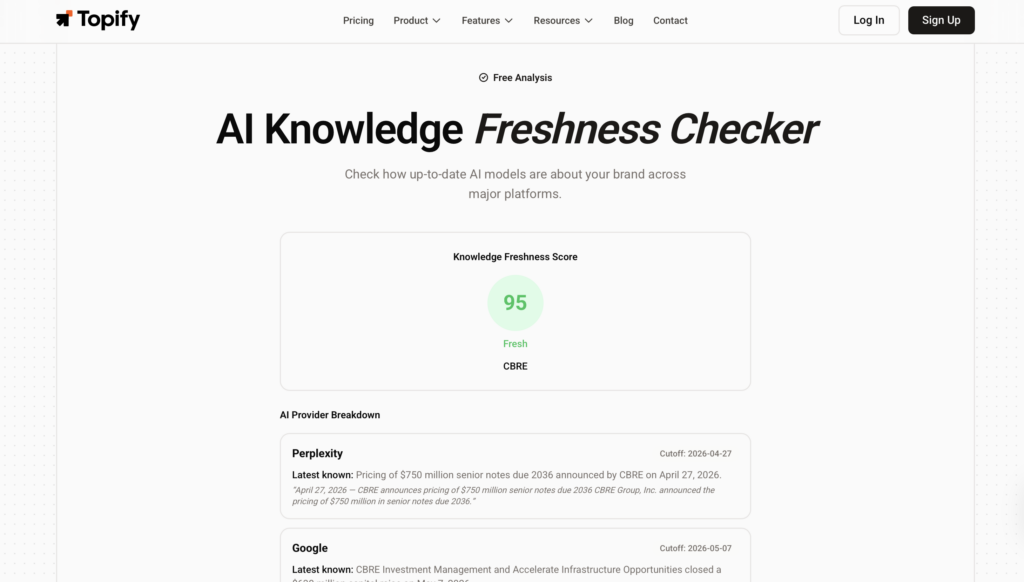
    What the Knowledge Freshness Checker Reveals About Your CRE Brand

    The tool doesn’t just tell you whether AI knows your name. It tells you whether AI knows the right version of your name.

    The Freshness Dimensions, Decoded for CRE

    Each dimension of the freshness audit maps to a specific risk that CRE firms face when AI models rely on outdated training data.

    Freshness DimensionWhat It ChecksWhat It Means for CRE Brands
    Brand Description AccuracyWhether AI’s summary of your firm matches your current positioningIf your firm pivoted from retail to industrial 18 months ago, AI may still describe you as a retail specialist
    Service Line CurrencyWhether AI lists your current capabilitiesA development firm that added debt advisory in 2025 might not show that service in AI answers
    Market Focus AccuracyWhether AI associates you with your active marketsIf you exited the Denver office market last year, AI may still recommend you for Denver deals
    Leadership and Team DataWhether AI references current leadershipA new CEO or managing director won’t appear in AI recommendations if the model’s data is stale
    Recent Activity RecognitionWhether AI reflects your recent deals, publications, or thought leadershipClosed a landmark deal last quarter? AI may not know about it yet

    A CRE firm that scores well on Brand Description Accuracy but poorly on Recent Activity Recognition has a specific problem: AI knows who you were, but not who you are now. That’s the kind of gap that sends investor inquiries to your competitors.

    Three Scenarios Where Stale AI Data Costs CRE Firms Deals

    Scenario 1: The ghost portfolio. A multifamily investor asks ChatGPT to recommend asset managers with experience in Class A multifamily in the Sun Belt. Your firm manages 12,000 units across six Sun Belt markets. But AI’s training data still references a portfolio you divested two years ago, and it misses the 4,000 units you acquired since. You don’t appear in the recommendation.

    Scenario 2: The wrong specialization. A developer searching Perplexity for “CRE brokers specializing in life sciences lab space” gets a list that doesn’t include your firm. You launched a dedicated life sciences practice 14 months ago. AI still categorizes you under general office leasing.

    Scenario 3: The outdated market narrative. An LP asks Gemini about top CRE investment firms in logistics and warehousing. AI references your firm’s 2023 market outlook, not your 2025 report that identified cold storage as a major growth vertical. The LP sees a firm that’s behind the curve, not ahead of it.

    Each of these scenarios is detectable. And each starts with running a single check.

    How to Run Your CRE Brand’s Freshness Audit

    The process takes less than a minute. Go to the Knowledge Freshness Checker, enter your firm name or domain, and get your freshness breakdown. No signup required, no credit card, no strings. You’ll see exactly where AI’s version of your brand has fallen behind reality.

    The AI Blind Spots Costing CRE Firms Leads and Deals

    CRE buyers, investors, and tenants are asking AI questions that directly influence where capital flows. Here’s what those queries look like across platforms.

    AI Prompt ExamplePlatformSearch IntentWhat It Reveals About Your Visibility
    “Best CRE firms for NNN lease investments”ChatGPTInvestment decisionWhether AI recommends your firm for your core product type
    “Top property management companies for Class A office”PerplexityVendor selectionWhether AI associates you with premium asset classes
    “What’s the average cap rate for industrial in [metro]?”GeminiMarket researchWhether AI cites your market reports or your competitor’s
    “Commercial real estate firms specializing in 1031 exchange”ChatGPTTax strategyWhether AI connects your advisory capabilities to buyer-side tax needs
    “Best markets for multifamily investment 2026”Google AI OverviewCapital allocationWhether AI surfaces your thought leadership when LPs are deciding where to deploy

    The data behind this shift is hard to ignore. A joint report by 5WPR and Haute Residence found that real estate ranks last among all industries in AI search visibility. 82% of agents use AI daily, but almost none are optimizing to be found by AI. That’s a disconnect with real financial consequences.

    The buyer discovery path has already shifted. The same report documents a new five-stage funnel: AI query, AI synthesis, click-through, agent contact, tour and offer. CRE firms that aren’t visible in step one don’t exist in step two through five.

    Research from Starmorph shows AI referral traffic grew 527% year-over-year in 2025 and converts at 4.4 to 5x the rate of traditional organic search. The volume is still smaller than Google, but the intent is sharper. When someone asks ChatGPT for a CRE firm recommendation, they’re closer to a transaction than someone browsing a directory.

    CRE Firms Spend Millions on AI Adoption but Zero on AI Visibility

    Here’s the thing. 76% of CRE firms are exploring or implementing AI, according to Deloitte’s 2026 CRE Outlook. That spending goes toward lease abstraction, underwriting automation, deal pipeline management, and property operations. 92% of commercial real estate occupiers and investors have started or plan to start AI pilots.

    Almost none of that investment addresses a basic question: when a buyer, investor, or tenant asks an AI search engine about your market, does AI know who you are?

    The asymmetry is striking. Firms deploy AI internally to gain an edge in operations, but they’re invisible to the AI systems their clients use to find them. A brokerage using AI to generate lease abstracts in minutes still loses the deal if the investor never discovered them in the first place, because Perplexity recommended a competitor instead.

    The Knowledge Freshness Checker makes this asymmetry visible. If AI’s description of your firm references a fund you closed two years ago, a market you’ve exited, or a service line you’ve sunset, you now have a specific data point to act on.

    CRE’s Knowledge Freshness Problem Is Structural, Not Incidental

    Most industries have a knowledge freshness challenge with AI. CRE has it worse.

    The reason is structural. CRE information lives in places AI crawlers struggle to reach: proprietary databases like CoStar, password-protected deal rooms, PDF-based offering memorandums, and fragmented MLS systems. Unlike SaaS companies that publish pricing pages and feature updates on their website, CRE firms store their most valuable information behind walls that AI can’t penetrate.

    That creates a compounding problem. When AI models update, they pull from what’s publicly available. For a CRE brokerage, that often means a two-year-old press release, an outdated LinkedIn company page, or a third-party directory listing that hasn’t been refreshed since 2024. The result: AI’s portrait of your firm drifts further from reality with each update cycle.

    On the flip side, this structural gap creates an opportunity. CRE firms that publish structured, crawlable content about their current capabilities, markets, and deal activity are building a moat. AI systems favor fresh, authoritative sources. In an industry where most firms give AI nothing current to work with, even basic freshness improvements can shift your position in AI recommendations.
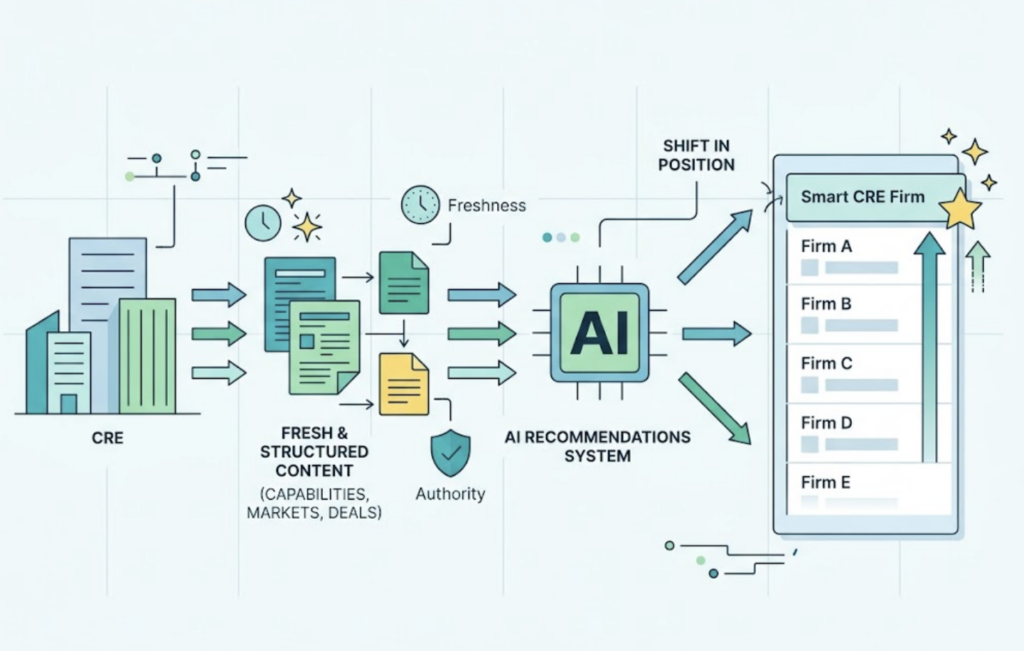
    Research on AI citations backs this up. By February 2026, only 38% of AI-cited URLs came from the organic top 10 in Google, down from 76% in July 2025. AI is actively seeking out authoritative content from across the entire web, not just repeating what ranks first on Google. A mid-size CRE firm with fresh, well-structured content can win AI citations without dominating traditional search rankings.

    Start by checking what AI currently knows. The Knowledge Freshness Checker shows you the gap between your firm’s reality and AI’s perception. That gap is your action plan.

    From a One-Time Freshness Audit to Continuous AI Visibility

    Your Knowledge Freshness Checker results give you a snapshot. But AI models don’t stand still. They update training data, adjust citation signals, and shift recommendations on a rolling basis. A freshness score that looks acceptable today could deteriorate next quarter without any change on your end.

    Topify‘s platform picks up where the free tool leaves off. The Reverse-Engineer AI Citations feature goes deeper: it identifies the specific sources AI models are pulling from when they describe your firm, flags citation gaps, and shows you exactly which content needs updating to keep your AI profile current.

    Here’s how the free check compares to the full platform:

    CapabilityFree Knowledge Freshness CheckerTopify Platform
    Check frequencyOne-time snapshotContinuous daily/weekly monitoring
    AI platforms coveredAggregated freshness scorePer-platform breakdown (ChatGPT, Perplexity, Gemini, AI Overviews)
    Historical trendsNoneFull trend history with alerts
    Citation source analysisNot includedIdentifies exact sources AI cites about your brand
    Competitor trackingNot includedReal-time competitor benchmarking
    Action recommendationsGeneral freshness flagsSpecific content update priorities

    Every plan starts with a 7-day free trial, no credit card required. The Starter plan begins at $99/month.

    Conclusion

    CRE firms are spending heavily on AI to optimize internal operations. The firms that pull ahead will be the ones that also optimize for how AI sees them from the outside. When an investor, tenant, or LP asks an AI search engine about your market, the answer is only as good as the data AI has about you. If that data is stale, you’re losing deals you never knew existed.

    Start with the free Knowledge Freshness Checker to see exactly where AI’s version of your firm has fallen behind. Then build a strategy to keep it current.

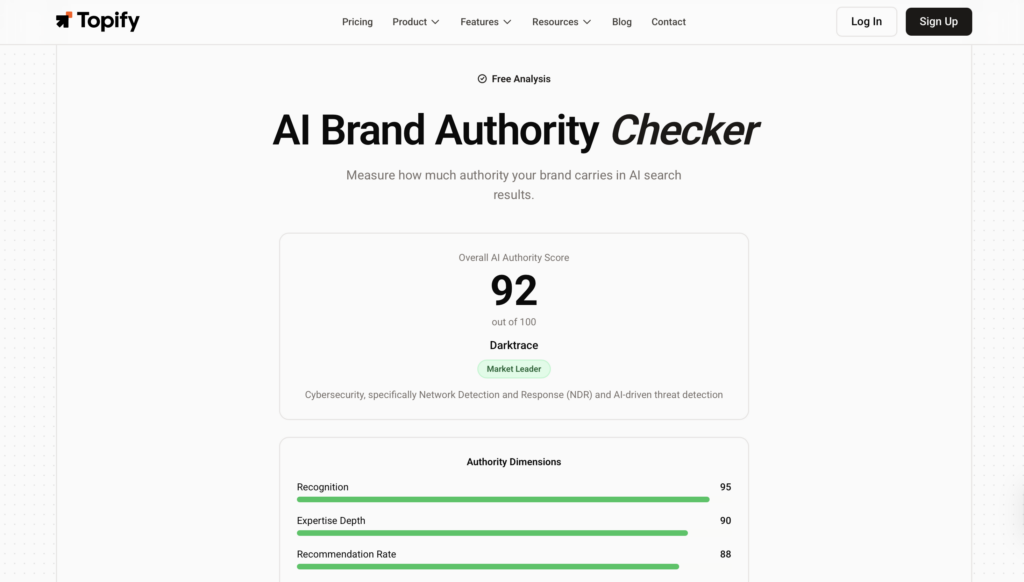
    While you’re assessing your freshness, a few other free checks can round out the picture. Topify’s AI Visibility Reportshows how often your CRE brand gets mentioned across major AI platforms. The Brand Authority Checker scores how AI models perceive your firm’s expertise and trustworthiness. And the Competitor Analysis tool reveals which firms AI recommends instead of yours, and why.

    FAQ

    Is the Knowledge Freshness Checker really free? Do I need to create an account? 

    Yes, it’s completely free. No account, no signup, no credit card. Enter your brand name or domain and get your results in under 60 seconds.

    What’s the difference between the free tool and Topify’s paid platform? 

    The free tool gives you a one-time freshness snapshot. Topify’s platform provides continuous monitoring across ChatGPT, Perplexity, Gemini, and Google AI Overviews, with historical trends, citation source analysis, competitor benchmarking, and specific action recommendations. Plans start at $99/month with a 7-day free trial.

    How often should a CRE firm check its AI visibility? 

    AI models update regularly, and CRE data changes faster than most industries (new deals, market shifts, personnel changes). A quarterly manual check with the free tool is a minimum. For firms actively marketing to investors or tenants, continuous monitoring through a platform provides the most reliable signal.

    Why does CRE have a bigger AI freshness problem than other industries? 

    CRE data is disproportionately locked behind proprietary databases, PDF deal documents, and password-protected platforms. AI crawlers can’t easily access or update this information, so AI’s knowledge about CRE firms degrades faster than in industries where information is more publicly available.
    Read More

  • AI Visibility Tools for Management Consulting

    AI Visibility Tools for Management Consulting

    A VP of Operations typed into ChatGPT: “Best management consulting firms for post-merger integration in healthcare.” Three firms came back by name, with specific credentials and case summaries. Your firm, with 15 years of M&A experience and a dozen successful integrations, wasn’t mentioned. The problem isn’t your track record. It’s that AI doesn’t recognize it.

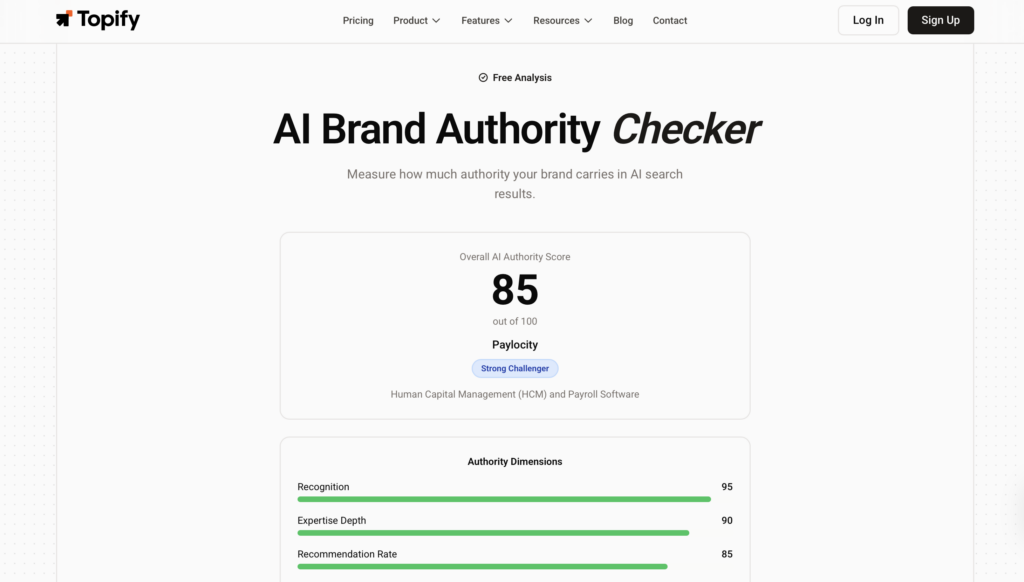
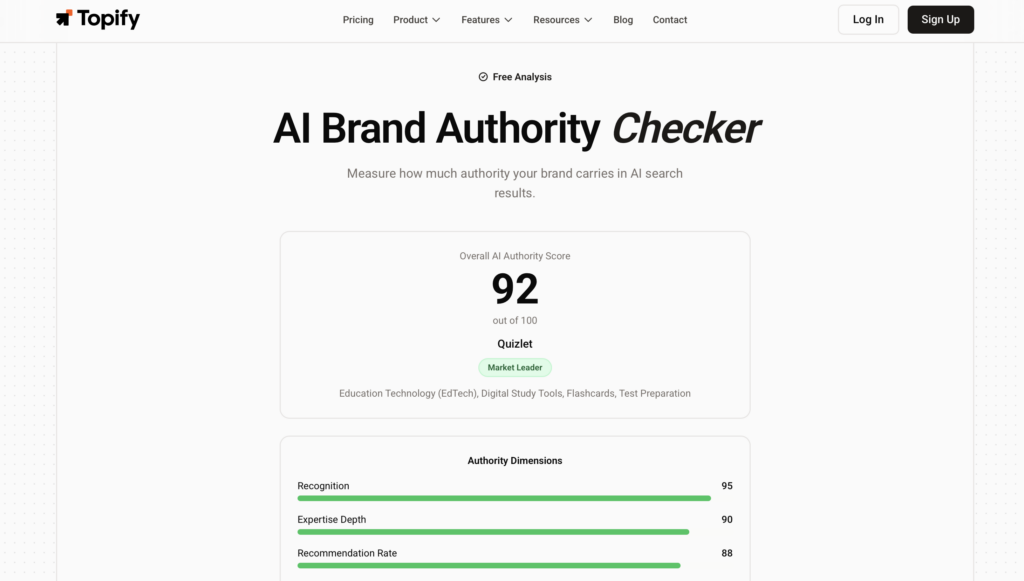
    You can find out exactly where the gap is in under a minute. Topify‘s Brand Authority Checker scores how AI models perceive your consulting firm’s authority across four dimensions that directly determine whether you get recommended.

    ✅ Free ⚡ Results in 60 seconds 🔒 No signup required

    The Four Authority Scores AI Uses to Judge Your Consulting Firm

    The Brand Authority Checker doesn’t give you a single number and send you on your way. It breaks your firm’s AI-perceived authority into four distinct scores, each one mapping to a specific problem consulting firms face when clients research them through AI.

    What Each Score Means for a Consulting Practice

    MetricWhat It MeasuresWhat It Means for Consulting Firms
    Recognition (0-100)How often AI identifies your firm in your categoryBelow 40: AI doesn’t associate your firm with your core practice area
    Expertise Depth (0-100)How well AI understands your capabilities and specializationsBelow 50: AI may describe your firm in generic terms, missing your differentiators
    Recommendation Rate (0-100)How often AI recommends you vs. alternativesBelow 30: you’re losing RFP shortlist spots before your BD team even knows the opportunity existed
    Trust Signals (0-100)External validation AI detects (media, reviews, citations)Below 40: AI can’t find enough third-party evidence to vouch for your expertise

    Here’s the thing. A consulting firm with a Recognition score of 75 but a Trust Signals score of 25 has a very specific diagnosis: AI knows your name, but it doesn’t trust you enough to recommend you. That’s not a branding problem. It’s a third-party validation gap, and now you know exactly where to focus.

    Three Scenarios Where Consulting Firms Get Blindsided

    Scenario 1: The niche expert no one can find. Your firm has deep expertise in supply chain optimization for mid-market manufacturers. You’ve published case studies and spoken at conferences. But AI recommends a generalist firm instead, because your website describes you as “a full-service management consulting firm” without structuring your specialization in a way AI can parse.

    Scenario 2: The credentials that don’t register. You hold ISO certifications, have former Big Four partners on your team, and maintain long-term client relationships. None of this shows up in your Authority score, because AI evaluates trust through third-party signals like media mentions, review platforms, and independent citations, not self-reported credentials.

    Scenario 3: The thought leader AI doesn’t credit. Your managing partner publishes regularly in industry journals and speaks at major events. But AI attributes the insights to the publication or conference, not to your firm. Your Expertise Depth score stays flat despite consistent content output.

    How to Run Your Authority Check

    Go to Brand Authority Checker, enter your firm name or domain, and get your four-score authority breakdown in under 60 seconds. No account creation, no credit card, no email required. You’ll see exactly how AI perceives your firm’s authority right now.

    The AI Prompts Your Prospective Clients Are Already Asking

    94% of B2B buyers used generative AI tools during their purchase process in 2025, according to 6sense’s Buyer Experience Report. For consulting, this means your prospective clients are forming shortlists inside ChatGPT, Perplexity, and Gemini before they ever visit your website or ask for a referral.

    The table below shows what those conversations actually look like.

    AI Prompt ExamplePlatformSearch IntentWhat It Reveals
    “Best management consulting firms for digital transformation”ChatGPTVendor shortlistingWhether your firm gets named when buyers start their search
    “Top strategy consultants for mid-sized manufacturers”PerplexityNiche expertise matchHow well AI connects your firm to a specific vertical
    “Management consulting firm with change management expertise”GeminiCapability verificationWhether AI understands your service lines accurately
    “Who should I hire for post-merger integration consulting?”ChatGPTHigh-intent purchaseWhether AI recommends you for high-value engagements
    “Consulting firms specializing in operational efficiency”Google AI OverviewComparison shoppingWhere you rank against alternatives in AI’s synthesis
    “Best financial advisory consulting for Series B startups”PerplexityStage-specific needWhether AI maps your firm to the buyer’s growth stage

    Each of these prompts represents a real buying signal. If your firm doesn’t appear in the response, you’re not losing a click. You’re losing a conversation you never knew happened.

    The Invisible Funnel: 60% of the Decision Happens Before You Hear From the Client

    Management consulting has always been a long-cycle business. Prospects research for months before scheduling an initial call. What’s changed is where that research starts.

    73% of B2B buyers now use AI tools like ChatGPT and Perplexity during the purchase research process. Forrester’s 2025 survey of 4,000+ buyers found that 61% of the buying journey completes before the buyer contacts a vendor. And 6sense’s data shows that 80% of deals are won by the vendor already on the buyer’s shortlist before first contact.

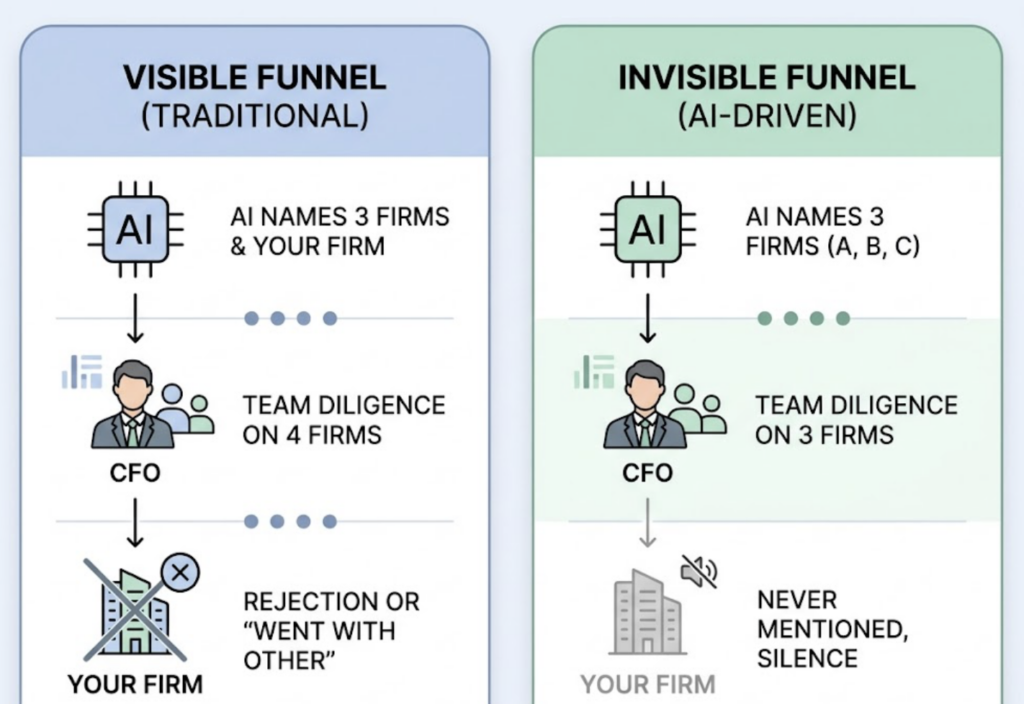
    For consulting firms, this creates an invisible funnel. A CFO asks AI for recommendations. AI names three firms. The CFO’s team does deeper diligence on those three. Your firm, which wasn’t named, never enters the picture. You don’t get a rejection. You don’t get a “we went with someone else.” You get silence, and you attribute it to a slow quarter.

    The Brand Authority Checker exposes whether you’re inside or outside this funnel. A low Recognition or Recommendation Rate score is a direct signal that AI isn’t placing you on the shortlists your prospects are building without you.

    Your Thought Leadership Exists. AI Doesn’t Know It Belongs to You.

    55% of C-suite executives have made business decisions based on thought leadership, according to Edelman-LinkedIn research. Most consulting firms know this and invest heavily in publishing: white papers, blog posts, conference talks, webinar series. The content exists. The problem is attribution.

    AI models build knowledge through entity relationships. They scan the web to answer a specific question: “How is this consulting firm connected to this expertise area?” If your thought leadership lives on third-party platforms without clear entity linkage back to your firm, AI credits the insight to the publication, not to you.

    This shows up in Brand Authority Checker results as a gap between content volume and Expertise Depth score. Your firm publishes regularly on operational efficiency, but AI’s understanding of your capabilities remains shallow. The content is doing work for the topic, not for your brand.

    The fix isn’t more content. It’s structural. Your website needs to clearly define expertise areas with specific methodology descriptions, quantified results, and explicit vertical focus. AI needs signals it can parse, not paragraphs it has to interpret.

    In practice, a consulting firm that restructures its site to explicitly state “We specialize in post-merger integration for healthcare organizations, with 23 completed integrations averaging 18% cost reduction in the first year” gives AI far more to work with than “We help organizations navigate complex transitions.”

    The Early Mover Window Is Open. It Won’t Stay Open.

    Here’s a data point that should change how you prioritize this: only 22% of marketers currently track AI visibility, and fewer than 26% plan to start. In consulting, a relationship-driven industry that’s been slow to adopt digital marketing in general, that number is likely even lower.

    This creates a genuine first-mover advantage. AI recommendation patterns tend to consolidate over time. The firms that build strong authority signals now will become the default recommendations as AI models continue to train on these patterns. Latecomers will face a much harder climb.

    The parallel to early SEO adoption is instructive. Consulting firms that invested in search visibility in 2010-2015 locked in organic traffic advantages that persist today. AI visibility is following the same trajectory, but the window is compressing faster. AI models update more frequently than search algorithms, and the competitive landscape is less crowded right now.

    Running a Brand Authority Checker scan gives you a baseline. It tells you where you stand today, across all four authority dimensions, so you can act before the window narrows.

    One Authority Score Is a Starting Point. Tracking It Over Time Is the Strategy.

    Your Brand Authority Checker results show where you stand right now. But AI models update their training data, adjust ranking signals, and shift recommendations on a rolling basis. A score of 72 today could drop to 55 next quarter without any change on your end.

    Topify‘s platform picks up where the free tool leaves off. The Comprehensive GEO Analytics dashboard tracks your authority, sentiment, and visibility scores continuously across ChatGPT, Perplexity, Gemini, and Google AI Overviews. You’ll see trend lines, get alerts when scores shift, and receive specific recommendations for what to fix.

    Here’s how the free check compares to the full platform:

    CapabilityFree Brand Authority CheckerTopify Platform
    Check frequencyOne-time snapshotContinuous daily/weekly monitoring
    AI platforms coveredAggregated scorePer-platform breakdown (ChatGPT, Perplexity, Gemini, AI Overviews)
    Historical trendsNoneFull trend history with alerts
    Competitor trackingNot includedReal-time competitor benchmarking
    Action recommendationsGeneralSpecific, one-click GEO optimization
    Team collaborationSingle userUnlimited team member seats

    Every plan starts with a 7-day free trial, no credit card required. The Starter plan begins at $99/month.

    Conclusion

    Management consulting runs on trust, expertise, and reputation. AI search is now where those qualities get evaluated first. If AI doesn’t recognize your firm’s authority, your prospective clients won’t find you during the most critical phase of their buying journey.

    Start with the free Brand Authority Checker to see exactly how AI perceives your firm today. Use those scores to identify specific gaps in recognition, expertise depth, recommendation rate, or trust signals. Then build a sustained optimization strategy with Topify’s platform to track and improve those scores over time.

    While you’re assessing your brand authority, a few other free checks can round out the picture. Topify’s Competitor Analysis tool shows which firms AI recommends instead of yours and why. The Prompts Researcher reveals the exact questions your potential clients are asking AI in your category. And the AI Visibility Report gives you a cross-platform snapshot of how often your brand gets mentioned across major AI platforms.

    FAQ

    Is the Brand Authority Checker really free? Do I need to create an account? Yes, it’s completely free. No account, no email, no credit card. Enter your brand name or domain, and you’ll get your four-score authority breakdown in about 60 seconds.

    What’s the difference between the free tool and the Topify platform? The free Brand Authority Checker gives you a one-time snapshot of your AI authority scores. The Topify platform adds continuous monitoring, historical trend tracking, competitor benchmarking, per-platform breakdowns, and actionable optimization recommendations. Plans start at $99/month with a 7-day free trial.

    How often should a consulting firm check its AI visibility? AI models update regularly, so a quarterly check with the free tool is a minimum. For firms actively investing in thought leadership or undergoing repositioning, monthly monitoring through the platform gives you the feedback loop you need to measure impact.

    Can a small or mid-size consulting firm actually compete with Big Four firms in AI search? Yes. AI doesn’t default to the biggest firm. It evaluates authority, expertise depth, and trust signals. A boutique firm with deep vertical specialization, strong third-party validation, and structured digital presence can outperform a generalist brand in niche AI queries. The Brand Authority Checker shows you exactly where you have an edge and where you don’t.

    Read More

  • AI Visibility Tools for Pet Care Brands

    AI Visibility Tools for Pet Care Brands

    A dog owner typed into ChatGPT: “Best joint supplement for my 10-year-old golden retriever with hip dysplasia.” The AI listed three brands. Yours, the one with vet-endorsed formulations and 4.8 stars across 12,000 reviews, wasn’t mentioned. The problem isn’t your product. It’s that AI doesn’t recognize your authority in this category.

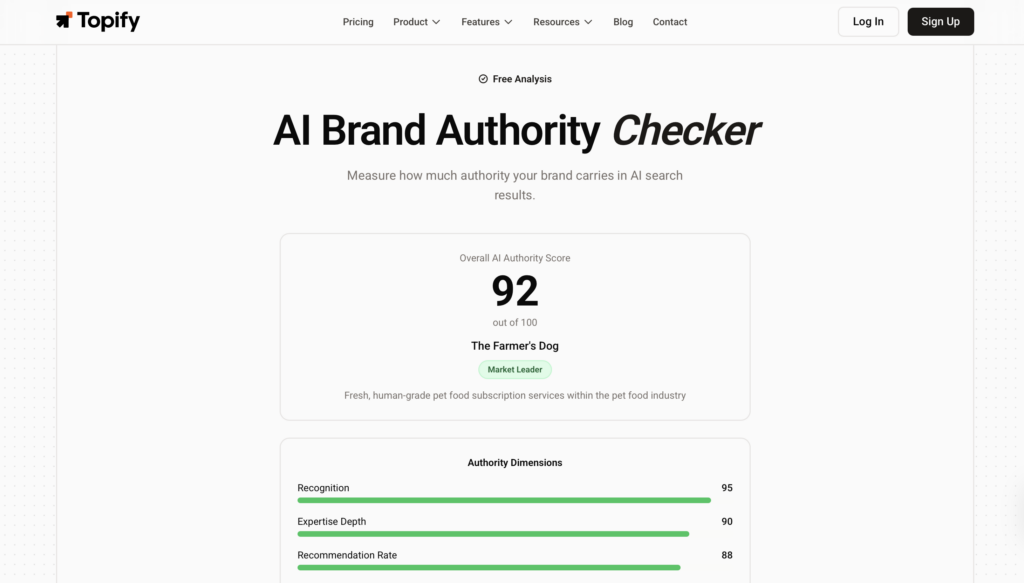
    The gap is measurable, and the check takes 60 seconds. Topify‘s Brand Authority Checker scores how AI models perceive your pet care brand’s authority across four dimensions that directly determine whether you get recommended or filtered out.

    ✅ Free ⚡ Results in 60 seconds

    The Four Scores That Tell You If AI Trusts Your Pet Care Brand

    Each Metric, Translated for Pet Care

    The Brand Authority Checker doesn’t give you a single vague number. It breaks your brand’s AI authority into four distinct scores, each mapping to a specific challenge pet care brands face when AI decides who to recommend.

    MetricWhat It MeasuresWhat It Means for Pet Care Brands
    Recognition (0-100)How often AI identifies your brand in pet care queriesBelow 40: AI doesn’t associate you with your product category (food, supplements, grooming, etc.)
    Expertise Depth (0-100)How well AI understands your formulations, certifications, and specializationsBelow 50: AI may describe your products inaccurately or miss key health claims
    Recommendation Rate (0-100)How often AI recommends you vs. alternativesBelow 30: you’re invisible in purchase-decision prompts like “best dog food for allergies”
    Trust Signals (0-100)External validation AI detects (vet endorsements, reviews, media citations)Below 40: AI can’t find enough third-party evidence to confidently recommend you

    A pet supplement brand with a Recognition score of 80 but a Trust Signals score of 25 has a very specific problem: AI knows you exist, but it doesn’t trust you enough to recommend you over brands with stronger external validation. That’s a fixable gap, and now you know exactly where to focus.

    What You Might Discover When You Run Your Pet Care Brand

    Here’s the thing: most pet care brands assume their offline reputation translates to AI visibility. It often doesn’t.

    A premium dog food brand with AAFCO-certified formulations and vet clinic partnerships might find a low Expertise Depth score. The likely cause: AI can’t parse your nutritional claims because your site lacks structured data around ingredient profiles and feeding guidelines.

    A pet insurance company with competitive premiums and fast claim processing might see a strong Recognition score but a weak Recommendation Rate. AI knows you exist but keeps recommending the same two or three incumbents because their review volume and editorial coverage dwarf yours.

    A grooming product line with loyal customers on Instagram might discover near-zero Trust Signals. Social media engagement doesn’t translate to the kind of third-party validation AI models weigh: think veterinary journal mentions, independent product reviews on established pet media, and Reddit discussion threads.

    How to Run Your Check

    Go to Brand Authority Checker, enter your brand name or domain, and get your four-dimensional authority breakdown in under 60 seconds. No signup, no credit card required.

    Look at the gap between your highest and lowest scores first. That spread tells you whether your problem is awareness, trust, or something else entirely.

    What Pet Owners Actually Ask AI (and Why Your Brand Gets Filtered Out)

    Pet owners aren’t typing simple keywords into AI anymore. They’re asking highly specific, conversational questions that force AI to make judgment calls about which brands deserve to be in the answer.

    SimilarWeb reports a 300% year-over-year increase in pet care prompts on ChatGPT alone. And these prompts are getting more specific by the month.

    AI Prompt ExamplePlatformSearch IntentWhat AI Evaluates
    “Best grain-free food for a senior lab with joint issues”ChatGPTPurchase decision (filtered by breed, age, condition)Ingredient specificity, breed/age targeting, health claim accuracy
    “Is freeze-dried raw food safe for puppies?”PerplexityTrust verificationVet endorsements, AAFCO compliance signals, safety data
    “Compare pet insurance plans that cover hip dysplasia”GeminiCompetitive comparisonCoverage detail depth, claim processing reputation, review sentiment
    “What supplements does my vet recommend for a dog with allergies?”ChatGPTAuthority-based recommendationVeterinary association citations, clinical evidence, expert mentions
    “Best automatic feeder for two cats with different diets”Google AI OverviewProduct-specific decisionProduct detail depth, user review specificity, feature documentation

    Here’s what’s happening behind the scenes: AI doesn’t just match keywords. It evaluates whether a brand has enough authority signals to be included in a health-adjacent recommendation. Pet care sits at the intersection of consumer goods and animal health. AI models treat it more like healthcare than retail, which means trust thresholds are higher than most pet brands expect.

    When a consumer asks “best dog food for allergies,” AI isn’t surfacing every brand that mentions “hypoallergenic” on its website. It’s looking for brands with veterinary backing, transparent ingredient sourcing, and a dense footprint of independent reviews. If your brand doesn’t clear that bar, you’re filtered out before the consumer ever sees the answer.

    Three Shifts That Are Rewriting the Rules for Pet Care Brands in AI

    AI Is Replacing the Vet Recommendation as the First Discovery Channel

    Pet product discovery used to follow a predictable path: vet recommendation, word-of-mouth, in-store browsing, or online retailer search. That sequence is breaking.

    Pet owners now ask AI for nutrition advice, product comparisons, and health guidance before they consult a vet or visit a store. PetfoodIndustry.com notes that consumers ask AI questions as specific as “What is the best freeze-dried food for my Labrador retriever, and I’m on a strict budget?” AI then narrows its suggestions based on that conversation, eliminating brands that don’t match the criteria. Your brand doesn’t get a second chance to make the list.

    The Brand Authority Checker can tell you whether AI currently considers your brand authoritative enough to appear in these filtered results. If your Recommendation Rate is low, AI is making the decision for consumers, and it’s not choosing you.

    A Handful of Giants Own Most AI Pet Recommendations

    AI recommendations in pet care are concentrated at the top. Research from early 2026 shows that Chewy alone holds roughly 30,000 monthly AI citations, while the next largest retailer has about 5,700. On the manufacturer side, Mars Petcare and Nestlé Purina dominate product-level recommendations across food, treats, and supplements.

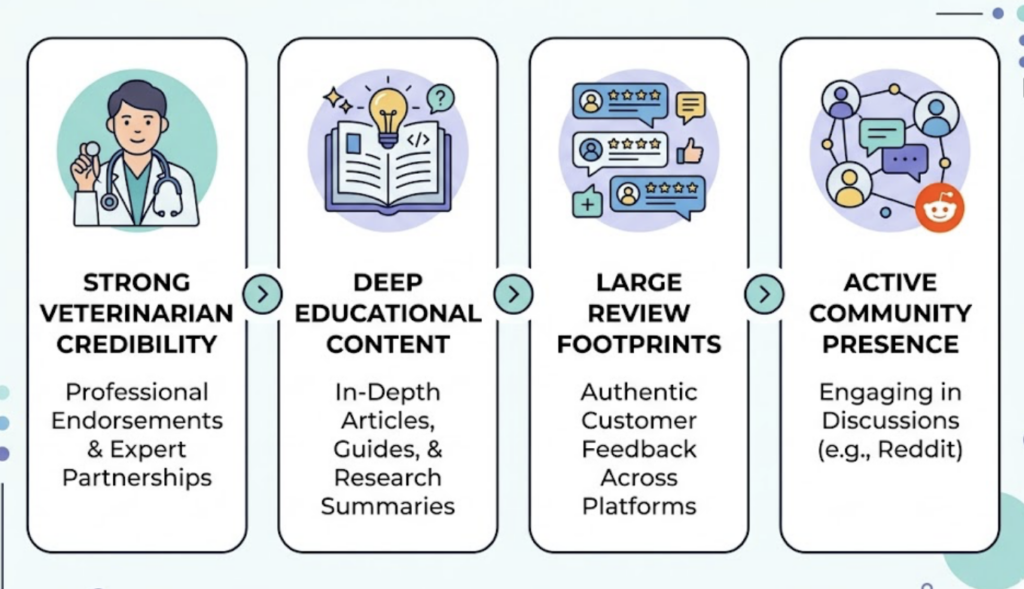
    This doesn’t mean mid-size and DTC pet brands can’t break through. It means the path requires deliberate authority-building in the dimensions AI actually measures. The 5W Pet Industry AI Visibility Index 2026 found that AI engines consistently favored brands with strong veterinarian credibility, deep educational content, large review footprints, and active community discussion presence (particularly on Reddit).

    Running your brand through the Brand Authority Checker shows you which of these dimensions you’re strong in and where the gap is relative to what AI values.

    AI Is Becoming a Shopping Platform, Not Just an Information Source

    The shift from “AI answers questions” to “AI processes transactions” is already underway. Industry sources report that ChatGPT is rolling out instant checkout capabilities in 2026, and Gemini is developing equivalent features. Sponsored placements within AI conversations are expected to follow.

    For pet care brands, this means AI visibility isn’t just about awareness anymore. Brands that don’t appear in AI recommendations will miss an entire new commerce channel. When a pet owner asks “order the best probiotic for my German shepherd” and AI completes the purchase without the owner ever visiting a website, the brands not in the recommendation set lose the sale completely.

    That makes measuring your current AI authority a baseline requirement, not an optional exercise.

    From a One-Time Check to Continuous AI Monitoring

    One Score Is a Starting Point. Tracking It Over Time Is the Strategy.

    Your Brand Authority Checker results tell you where you stand right now. But AI models update their training data, adjust ranking signals, and shift recommendations on a rolling basis. A score of 72 today could drop to 55 next quarter without any change on your end. A competitor that publishes a string of vet-reviewed content pieces could leapfrog you in AI recommendations within weeks.

    Topify‘s platform picks up where the free tool leaves off. The Comprehensive GEO Analytics dashboard tracks your authority, sentiment, and visibility scores continuously across ChatGPT, Perplexity, Gemini, and Google AI Overviews. You’ll see trend lines, get alerts when scores shift, and receive specific recommendations for what to fix.

    Here’s how the free check compares to the full platform:

    CapabilityFree Brand Authority CheckerTopify Platform
    Check frequencyOne-time snapshotContinuous daily/weekly monitoring
    AI platformsAggregated scorePer-platform breakdown (ChatGPT, Perplexity, Gemini, AI Overviews)
    Historical dataNoneFull trend history with alerts
    Competitor comparisonNot includedReal-time benchmarking against pet care competitors
    Action recommendationsGeneral directionSpecific, data-driven GEO optimization steps
    Team collaborationSingle userUnlimited team member access

    Every plan starts with a 7-day free trial, no credit card required. The Starter plan begins at $99/month.

    Conclusion

    Pet owners are asking AI for food recommendations, supplement advice, insurance comparisons, and grooming tips before they consult any other source. The brands that appear in those AI answers capture the consideration set. The brands that don’t, regardless of product quality, lose the opportunity before they know it existed.

    Start with a free Brand Authority Checker scan to see how AI currently perceives your pet care brand. Identify which of the four authority dimensions needs attention. Then decide whether you need a one-time fix or ongoing monitoring to stay visible as AI models evolve.

    While you’re assessing your brand authority, a few other free checks can round out the picture. Topify‘s GEO Score Checker evaluates whether AI crawlers can actually access your site and parse your content. The Prompts Researcherreveals the exact pet care questions your target audience is asking AI. And the AI Visibility Report shows how often your brand gets mentioned across major AI platforms.

    FAQ

    Is the Brand Authority Checker really free? Do I need to sign up? 

    Yes, it’s completely free with no signup required. Enter your brand name or domain, and you’ll get your four-score authority breakdown in about 60 seconds.

    What’s the difference between the free tool and the Topify platform? 

    The free Brand Authority Checker gives you a one-time snapshot of your AI authority scores. The Topify platform provides continuous monitoring, historical trend data, competitor benchmarking, per-platform breakdowns, and actionable optimization recommendations.

    How often should a pet care brand check its AI visibility? 

    At minimum, once per quarter. AI models update their training data and ranking signals frequently. Brands in competitive pet care categories (food, supplements, insurance) should consider continuous monitoring, as recommendation rankings can shift within weeks.

    Does ingredient transparency on my website affect my AI authority score? 

    Directly. AI models evaluate structured data around ingredient profiles, nutritional claims, and health certifications when deciding whether to recommend pet food and supplement brands. Brands with detailed, well-structured product pages tend to score higher on Expertise Depth and Trust Signals.

    Read More

  • AI Visibility Tools for Supply Chain

    AI Visibility Tools for Supply Chain

    A logistics manager typed into ChatGPT: “Best cold chain logistics providers in the Midwest with real-time tracking.” Five brands came back. Yours wasn’t one of them. Not because your fleet is smaller or your coverage is worse. Because AI doesn’t know you well enough to recommend you.

    73% of B2B buyers now use AI tools like ChatGPT and Perplexity during their procurement research. For supply chain companies, that means your next RFP might start inside an AI chatbot, not a Google search bar.

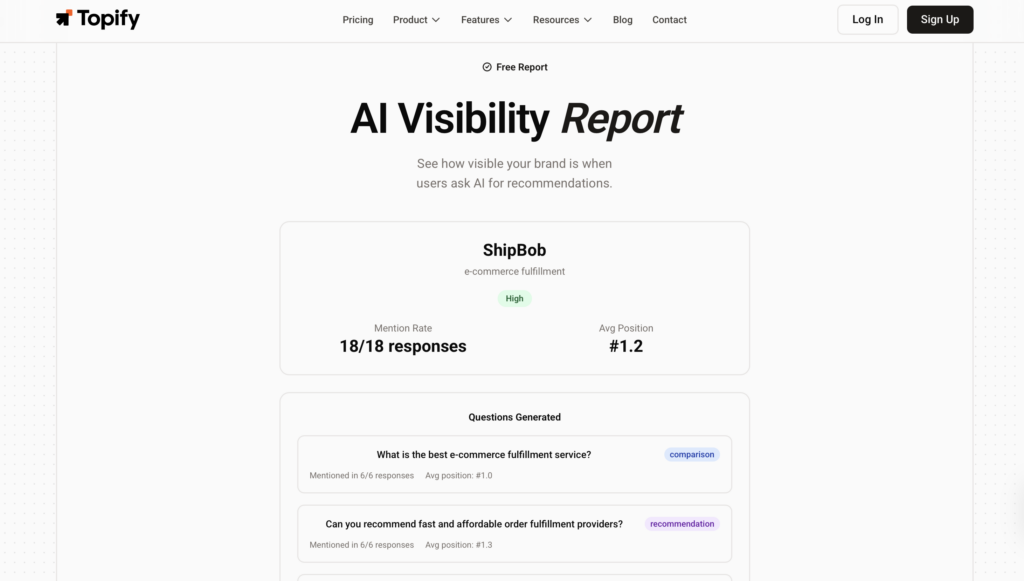
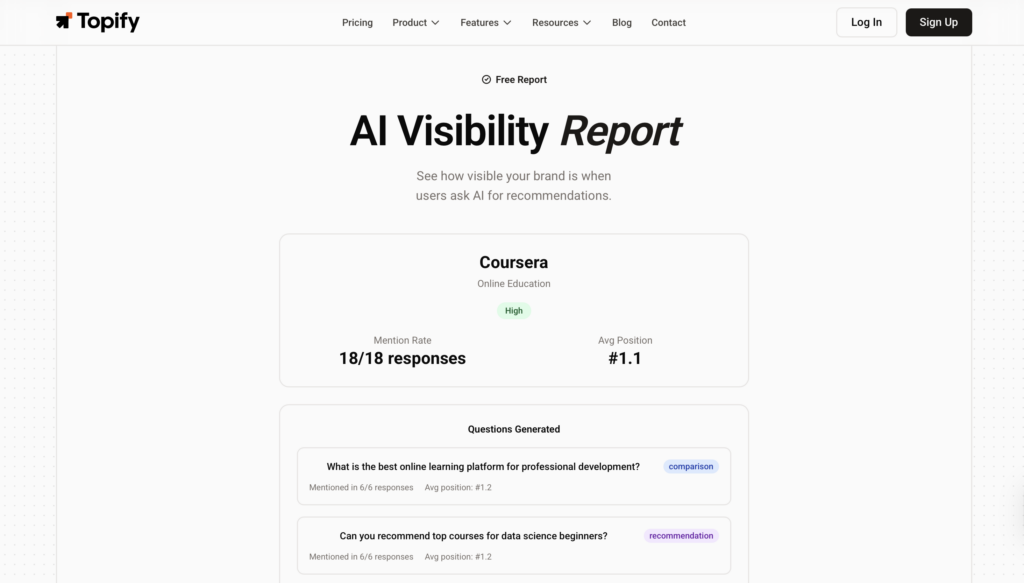
    There’s a free way to see where you stand. Topify‘s AI Visibility Report shows how often your brand gets mentioned across major AI platforms, where you rank, and which providers surface you most. ✅ Free ⚡ Results in 60 seconds

    div data-topify-widget=”visibility-report”>

    Five Brands Own 80% of AI Recommendations in Your Supply Chain Category

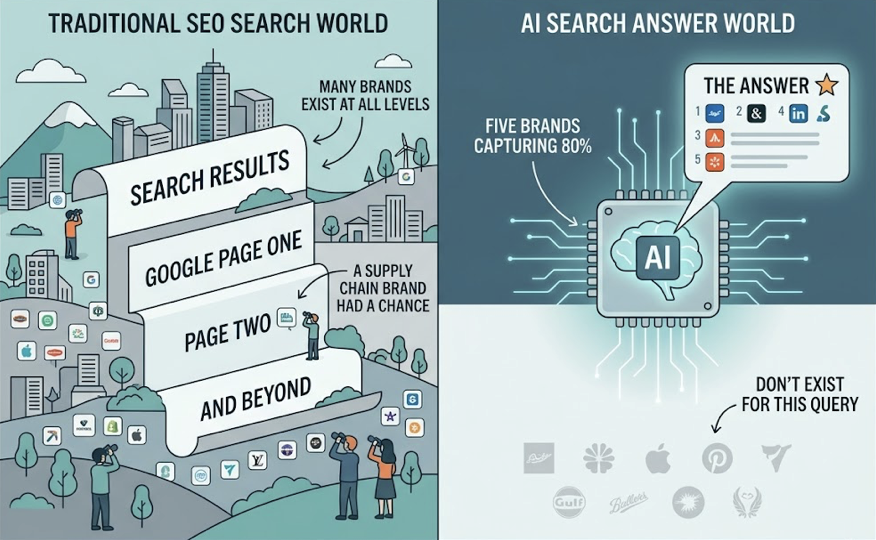
    Here’s what most supply chain marketers don’t realize: AI doesn’t return a list of 50 results the way Google does. It returns a short, confident answer with five to seven names. Research from Magenta Associates found that just five brands capture 80% of top AI-generated responses for any given B2B category. If you’re a 3PL, freight forwarder, or WMS provider not in that top five, you’re invisible to a growing share of your market.

    The AI Visibility Report breaks this problem into measurable signals. Instead of guessing whether AI knows your brand, you get a cross-platform snapshot with specific metrics.

    What Each Metric Tells You About Your Supply Chain Brand

    MetricWhat It MeasuresSupply Chain TranslationRed Flag
    Mention RateHow often AI includes your brand in responsesFrequency of appearing in procurement-related AI answersBelow 10% in your category
    Ranking PositionWhere you appear in AI’s recommendation orderWhether you’re first-choice or afterthought for logistics buyersConsistently ranked 4th or lower
    Provider BreakdownWhich AI platforms mention youGaps between ChatGPT, Perplexity, Gemini, and AI OverviewsMissing entirely from one or more platforms
    Category RelevanceHow accurately AI associates you with your nicheWhether AI knows you’re a cold chain specialist vs. a general 3PLMisclassified or described with outdated capabilities

    A freight brokerage might discover it ranks well on Perplexity but doesn’t appear in ChatGPT at all. A warehouse automation vendor might find that AI describes its product line from three years ago. A 3PL with strong regional coverage might learn that AI only mentions it for national shipments. Each of these gaps points to a different fix.

    Where Supply Chain Brands Typically Find Problems

    Scenario 1: The “ghost brand” problem. You’ve been in business for 15 years, but AI treats you like a startup. Your mention rate is near zero because your digital footprint is concentrated in trade directories and PDF whitepapers that AI models can’t easily parse.

    Scenario 2: The misclassification gap. AI recommends you for general freight, but your actual specialty is hazmat or temperature-controlled logistics. Your revenue-generating service lines are invisible in the prompts that matter most.

    Scenario 3: The platform blind spot. You appear consistently in Google AI Overviews because of strong SEO, but ChatGPT and Perplexity don’t mention you. Procurement teams using those platforms never see your name.

    Run Your Brand Through the Report in Three Steps

    1. Go to the AI Visibility Report and enter your brand name plus your primary supply chain category (e.g., “Acme Logistics, cold chain”).
    2. Review the cross-platform breakdown. Note which AI providers mention you and which don’t.
    3. Check your ranking position against the top five names AI recommends. If you’re not in that group, you’ve identified the gap.

    The whole process takes under a minute, costs nothing, and requires no account creation.

    The Prompts Your Procurement Buyers Are Typing Into AI Right Now

    Supply chain procurement has specific language patterns. Buyers don’t type vague queries. They ask detailed, decision-ready questions that AI answers with confident recommendations.

    AI Prompt ExampleBuyer IntentWhat It Reveals About Your Visibility
    “Best 3PL for e-commerce fulfillment in the Southeast”Vendor shortlisting by region + verticalWhether AI associates you with the right geography and specialty
    “Compare TMS platforms for mid-size shippers 2026”Head-to-head evaluationWhere you rank against category alternatives
    “Most reliable cold chain logistics provider for pharma”Trust and compliance verificationHow AI rates your reliability and industry certifications
    “Warehouse automation vendors with same-day integration”Technical capability matchingWhether AI understands your tech stack and implementation speed
    “Affordable freight audit software for companies under 500 employees”Budget-conscious procurementIf AI positions you correctly on pricing and company size fit
    “Which supply chain visibility platforms have real-time tracking”Feature-specific searchWhether your product features are accurately represented in AI answers

    Each of these prompts represents a real procurement decision where AI is shaping the shortlist. If your brand doesn’t appear for the prompts most relevant to your business, you’re losing deals before your sales team even knows the opportunity existed.

    That matters more than it used to. Forrester’s 2025 research found that 61% of the B2B buying journey completes before a buyer contacts any vendor. When AI fills that pre-contact research window, the brands it recommends get a structural advantage.

    The Supply Chain AI Visibility Gap No One Is Tracking

    Two forces are colliding in supply chain procurement, and most suppliers are caught in the middle.

    Force 1: AI recommendations are becoming the new shortlist. G2’s March 2026 survey of 1,076 B2B buyers found that 69% chose a different vendor than originally planned based on AI chatbot guidance. One-third purchased from a vendor they’d never heard of before. In supply chain, where switching costs are high and relationships run deep, that’s a disruptive shift. A procurement manager who discovers a new WMS through Perplexity’s recommendation might bypass the incumbent entirely.

    Five brands capturing 80% of AI recommendations isn’t just a statistic. It’s the new competitive structure. In traditional search, a supply chain brand on page two of Google still had a chance. In AI search, if you’re not in the answer, you don’t exist for that query. The concentration is more extreme than anything SEO ever produced.

    Force 2: AI search converts at 5.1x the rate of traditional organic, but almost nobody in supply chain is measuring it. AI search traffic converts at 14.2% compared to Google organic’s 2.8%. Yet only 22% of B2B marketers currently track AI visibility. In supply chain specifically, where marketing teams tend to be lean and focused on trade shows and direct outreach, the tracking gap is likely even wider.

    This is the first-mover window. The supply chain brands that start measuring and optimizing their AI visibility now will build compounding advantages. AI models learn from the signals available today. Brands that strengthen their digital footprint, structured data, and content authority in 2026 will be harder to displace in 2027 and beyond. Those that wait will face steeper barriers as the top five positions in each category become more entrenched.

    85% of buyers aged 25-34 already use AI for supplier research. As these younger procurement professionals advance into senior decision-making roles, AI visibility won’t be a marketing experiment. It’ll be a prerequisite for staying in the consideration set.

    From a One-Time Snapshot to Continuous Visibility Monitoring

    The AI Visibility Report gives you a clear picture of where you stand today. But AI search results aren’t static. Models update, competitor content shifts, and your ranking position can change from one month to the next. A strong mention rate in May doesn’t guarantee the same result in July.

    That’s the gap between a one-time check and ongoing visibility management. Topify’s AI Visibility Checker turns that snapshot into continuous monitoring. It tracks your brand’s mention rate, ranking position, and competitor movements across ChatGPT, Perplexity, Gemini, and Google AI Overviews on a daily and weekly basis. When your visibility drops or a competitor overtakes you, you get alerted before the impact reaches your pipeline.

    CapabilityFree AI Visibility ReportTopify Platform
    Check frequencyOne-time snapshotContinuous daily/weekly monitoring
    AI platforms coveredSingle checkChatGPT + Perplexity + Gemini + AI Overviews
    Historical trendsNot availableFull trend history with change alerts
    Competitor trackingNot availableReal-time competitor benchmarking
    Actionable recommendationsManual interpretationData-driven GEO optimization suggestions
    Team collaborationNot availableMulti-user access with shared dashboards

    Plans start at $99/month with a 7-day free trial, no credit card required. For supply chain companies managing multiple brands or divisions, the Pro plan supports multi-brand tracking. You can start a free trial and connect your brand in under five minutes.

    Conclusion

    Supply chain procurement is moving into AI. The brands that get recommended win the first look. The brands that don’t get recommended are fighting an uphill battle they may not even know about.

    Start with the data. Run your brand through the AI Visibility Report and see where you actually stand across the AI platforms your buyers are using. It’s free, takes 60 seconds, and gives you a concrete baseline to act on.

    Beyond visibility tracking, a few other Topify free tools can round out your diagnostic:

    • Brand Authority Checker: See how AI rates your brand’s authority and trust signals, critical for supply chain where reliability is everything.
    • Prompts Researcher: Discover the exact procurement prompts buyers are asking AI in your supply chain category.
    • Competitor Analysis: Find out which supply chain brands AI considers your competitors and how you compare.

    FAQ

    Is the AI Visibility Report really free? Do I need to create an account? 

    Yes, it’s completely free and requires no registration. Enter your brand name and category, and you’ll get a cross-platform visibility report in about 60 seconds.

    What’s the difference between the free report and the Topify paid platform? 

    The free report gives you a one-time snapshot of your current AI visibility. The paid platform adds continuous monitoring, historical trend tracking, competitor benchmarking, and actionable optimization recommendations. Think of the free report as a health check and the platform as ongoing care.

    How often should a supply chain brand check its AI visibility? 

    At minimum, monthly. AI models update frequently, and competitor content changes can shift your ranking position. If you’re actively running content campaigns or launching new service lines, weekly checks give you faster feedback.

    Does AI visibility actually affect supply chain procurement outcomes? 

    The data says yes. 73% of B2B buyers use AI during procurement research, and 69% end up choosing a different vendor than planned based on AI recommendations. For supply chain companies, where contracts are large and switching costs are high, being in or out of AI’s top recommendations has direct revenue implications.

    Read More

  • AI Visibility Tools for Insurance Tech

    AI Visibility Tools for Insurance Tech

    A procurement manager at a mid-size employer typed into ChatGPT: “Best digital insurance platforms for small business group health coverage.” Five brands showed up. Yours, with state-of-the-art underwriting automation and partnerships across 30 states, wasn’t one of them. The problem isn’t your product. It’s that AI doesn’t trust your brand enough to recommend it.

    The gap is measurable, and the check takes 60 seconds. Topify‘s Brand Authority Checker scores how AI models perceive your InsurTech brand’s authority across four dimensions that directly determine whether you get recommended or skipped.

    ✅ Free ⚡ Results in 60 seconds

    What AI Actually Knows About Your InsurTech Brand

    The Brand Authority Checker doesn’t give you a single number and leave you guessing. It breaks your AI-perceived authority into four distinct metrics, each one mapping to a specific challenge InsurTech companies face in AI-driven discovery.

    The Four Authority Scores, Translated for InsurTech

    MetricWhat It MeasuresWhat It Means for InsurTech
    Recognition (0-100)How consistently AI identifies your brand in your categoryBelow 40: AI doesn’t associate you with your core insurance vertical (P&C, life, health, embedded)
    Expertise Depth (0-100)How well AI understands your capabilities and differentiatorsBelow 50: AI may describe your underwriting model or claims process incorrectly
    Recommendation Rate (0-100)How often AI includes you when users ask for optionsBelow 30: you’re losing distribution opportunities before your sales team even gets a chance
    Trust Signals (0-100)External validation AI detects from media, reviews, and citationsBelow 40: AI can’t find enough third-party evidence to vouch for your compliance or reliability

    Here’s the thing. An InsurTech brand with a Recognition score of 80 but a Trust Signals score of 25 has a very specific problem: AI knows you exist, but it doesn’t have enough external validation to recommend you over an established carrier. That’s a common pattern for InsurTech companies that invest heavily in product but underinvest in third-party visibility.

    What You Might Discover When You Run Your Brand

    A digital-first P&C InsurTech might find that AI describes its product as a “comparison tool” instead of a licensed carrier. That’s an Expertise Depth problem. The AI hasn’t ingested enough structured content to understand the difference between an aggregator and an underwriter.

    An embedded insurance startup could see a high Recognition score (AI knows the brand) but near-zero Recommendation Rate. The likely cause: AI recognizes the company from funding news and press coverage, but can’t find enough product-level detail to recommend it for specific coverage questions.

    A claims automation platform might score well on Expertise Depth but poorly on Trust Signals. AI understands what the product does, but can’t locate independent reviews, analyst reports, or regulatory filings that validate the claims.

    How to Run Your Check

    Go to the Brand Authority Checker, enter your brand name or domain, and get your four-dimensional authority breakdown in under 60 seconds. No signup, no credit card. Read the per-metric scores, note which ones fall below 50, and you’ll have a clear map of where AI perception doesn’t match reality.

    The Insurance Questions AI Gets Asked Every Day

    Insurance buyers don’t search the way they used to. J.D. Power found that 41% of consumers already use AI tools when shopping for or researching insurance, and 80% said the experience was helpful. That traffic converts at a 6x higher ratethan traditional search, because AI has already pre-vetted the brands it recommends.

    The prompts your buyers are typing into AI platforms are specific, high-intent, and often product-category-level. Here’s what that looks like for InsurTech:

    AI Prompt ExamplePlatformSearch IntentWhat Your Brand Needs
    “Best digital insurance platform for small business health coverage”ChatGPTPurchase decisionHigh Recommendation Rate + Expertise Depth in group health
    “Is [InsurTech brand] licensed in California?”PerplexityTrust verificationAccurate Trust Signals + structured regulatory data
    “Embedded insurance API for e-commerce checkout”GeminiTechnical evaluationDeep Expertise Depth in embedded distribution
    “Compare cyber insurance for startups under 50 employees”ChatGPTCompetitive comparisonRecognition in the cyber insurance sub-category
    “Claims automation platform with fastest payout time”PerplexityFeature-specific researchExpertise Depth that reflects actual processing speed

    Each of these prompts is a decision point. If AI doesn’t mention your brand in the answer, you’re not losing a click. You’re losing a warm lead that was ready to buy.

    Different AI Platforms Recommend Different InsurTech Brands

    This is where most InsurTech marketing teams get it wrong. They check one platform, see a decent result, and assume the job is done.

    It doesn’t work that way. Brandlight data from Q1 2026 shows that Perplexity had a 60% brand mention rate for insurance-related queries, while Google AI Overviews mentioned brands only 35% of the time. On the same customer support queries, Aetna dominated Perplexity while UnitedHealthcare led on Google AIO. ChatGPT offered the most balanced representation across the competitive set.

    The same divergence applies to InsurTech. Your embedded insurance product might appear consistently in ChatGPT answers (which tends to surface brands with clear product documentation) but be completely absent from Perplexity (which leans heavily on citation-rich sources and analyst coverage). Or you might rank well in Google AI Overviews thanks to strong traditional SEO, yet get zero mention from Gemini.

    That’s why a single-platform check isn’t a strategy. It’s a coin flip.

    The Brand Authority Checker gives you an aggregated view, but the pattern it reveals, especially the gap between Recognition and Recommendation Rate, often signals platform-level inconsistency. If AI knows your brand but won’t recommend it, the friction is usually concentrated on specific platforms where your external signals are weakest.

    The practical move: run the Brand Authority Checker to identify your weakest dimension, then map that weakness to the platforms where your buyers are most active. If your InsurTech primarily serves enterprise buyers, ChatGPT and Perplexity matter most. If you’re in direct-to-consumer P&C, Google AI Overviews and Gemini carry more weight.

    Your Compliance Investment Is Invisible to AI

    InsurTech companies spend enormous resources on regulatory compliance. State-by-state licensing. SOC 2 certifications. NAIC model bulletin alignment. Over 30 states have now adopted some form of the NAIC AI governance guidelines, and InsurTech companies that operate across multiple jurisdictions have compliance infrastructures that rival major carriers.

    Here’s the disconnect. AI doesn’t know any of that unless it can find the evidence.

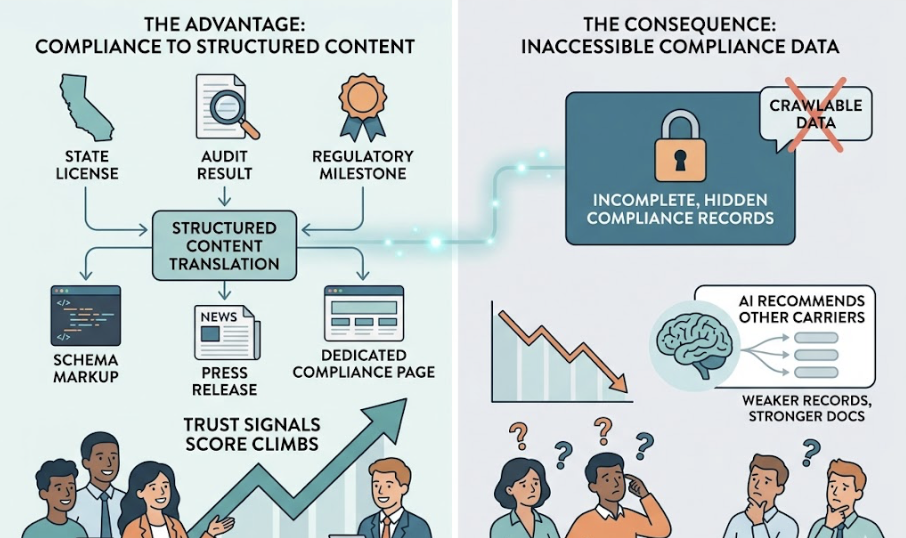
    LLMs don’t read your compliance dashboard. They don’t check state DOI filings. They build trust profiles from what’s publicly available: structured data on your website, third-party mentions in industry publications, regulator press releases, and independent reviews. If your compliance achievements live exclusively in internal documentation and PDF filings that AI crawlers can’t access, your Trust Signals score will reflect a brand with no verifiable compliance story.

    This is where InsurTech brands have an underused advantage. Every state license, every audit result, every regulatory milestone is a trust signal waiting to be surfaced. The companies that translate compliance into publicly indexed, structured content (schema markup for licenses, press releases for regulatory approvals, dedicated compliance pages with crawlable data) will see their Trust Signals scores climb. The ones that don’t will keep wondering why AI recommends carriers with weaker compliance records but stronger public-facing documentation.

    Run your brand through the Brand Authority Checker and look specifically at the Trust Signals dimension. If it’s significantly lower than your other scores, compliance visibility is likely the gap.

    One Score Is a Starting Point. Tracking It Over Time Is the Strategy.

    Your Brand Authority Checker results tell you where you stand today. But AI models update their training data, adjust ranking signals, and shift recommendations on a rolling basis. A score of 72 today could drop to 55 next quarter without any change on your end. Model updates from OpenAI, Google, and Anthropic happen regularly, and each one can reshuffle which InsurTech brands get recommended.

    Topify‘s platform picks up where the free tool leaves off. The Comprehensive GEO Analytics dashboard tracks your authority, sentiment, and visibility scores continuously across ChatGPT, Perplexity, Gemini, and Google AI Overviews. You’ll see trend lines, get alerts when scores shift, and receive specific recommendations for what to fix.

    Here’s how the free check compares to the full platform:

    CapabilityFree Brand Authority CheckerTopify Platform
    Check frequencyOne-time snapshotContinuous daily/weekly monitoring
    AI platforms coveredAggregated scorePer-platform breakdown (ChatGPT, Perplexity, Gemini, AI Overviews)
    Historical trendsNoneFull trend history with alerts
    Competitor trackingNot includedReal-time InsurTech competitor benchmarking
    Action recommendationsGeneralSpecific, one-click GEO optimization
    Team collaborationNoMulti-seat access for marketing + compliance teams

    Every plan starts with a 7-day free trial, no credit card required. The Starter plan begins at $99/month.

    Conclusion

    AI is already influencing how buyers, employers, and brokers choose insurance products. The InsurTech brands that show up in those AI-generated answers will capture high-intent leads at 6x the conversion rate of traditional search. The ones that don’t will keep competing on channels where their advantages are harder to demonstrate.

    Start with a free Brand Authority Checker scan to see where AI perception doesn’t match your actual capabilities. Focus on the lowest-scoring dimension first, whether that’s Recognition, Expertise Depth, Recommendation Rate, or Trust Signals.

    While you’re assessing your brand authority, a few other free checks can round out the picture. Topify‘s AI Visibility Report shows how often your brand gets mentioned across major AI platforms. The Competitor Analysis tool reveals who AI considers your competition, which may not match your internal competitive set. And the AI Robots Checker confirms whether AI crawlers can actually access your site’s content.

    FAQ

    Is the Brand Authority Checker free? Do I need to create an account?

    Yes, it’s completely free. No account, no signup, no credit card. Enter your brand name or domain and get your authority breakdown in under 60 seconds.

    What’s the difference between the free tool and the Topify platform?

    The free Brand Authority Checker gives you a one-time snapshot of your four authority scores. The Topify platformprovides continuous monitoring across all major AI platforms, historical trend data, competitor benchmarking, and actionable optimization recommendations. Plans start at $99/month with a 7-day free trial.

    How often should InsurTech brands check their AI visibility?

    At minimum, after every major product launch, funding announcement, or regulatory milestone. AI models update frequently, and your visibility can shift without any change on your end. For continuous coverage, the Topify platform monitors daily.

    Can strong traditional SEO rankings guarantee AI visibility for InsurTech?

    No. AI visibility and Google rankings operate on different signals. AI platforms prioritize entity authority, structured data, third-party validation, and content clarity over traditional backlink profiles. An InsurTech brand ranking first on Google for a target keyword can still be absent from ChatGPT’s recommendations for the same query.

    Read More

  • AI Visibility Tools for Wellness Brands

    AI Visibility Tools for Wellness Brands

    A shopper opened ChatGPT and typed, “Best probiotic for gut health after antibiotics.” The AI responded with three brand recommendations, dosage guidance, and links to clinical studies. Your probiotic, the one with NSF certification and 12,000 five-star reviews, wasn’t mentioned. Not ranked low. Not mentioned at all.

    The issue isn’t your product. It’s that AI doesn’t recognize your brand’s authority in the way it needs to in order to recommend you.

    The gap is measurable, and the check takes 60 seconds. Topify‘s Brand Authority Checker scores how AI models perceive your wellness brand’s authority across four dimensions that directly determine whether you get recommended or filtered out.

    ✅ Free ⚡ Results in 60 seconds

    Wellness Buyers Ask AI for Recommendations. Your Authority Score Decides If You’re in the Answer.

    Health and wellness sits in a category AI treats differently from almost everything else. Google classifies health content as YMYL (Your Money or Your Life), and AI engines inherit that scrutiny. That means every recommendation an AI makes about supplements, fitness programs, or functional foods passes through an additional trust filter before it reaches the consumer.

    The Brand Authority Checker breaks your brand’s AI-perceived authority into four scores. Each one maps to a specific challenge wellness brands face.

    The Four Scores That Tell You If AI Trusts Your Wellness Brand

    MetricWhat It MeasuresWhat It Means for Wellness Brands
    Recognition (0-100)How often AI identifies your brand in your categoryBelow 40: AI doesn’t associate you with your product category, even if you’ve been selling for a decade
    Expertise Depth (0-100)How well AI understands your formulations and claimsBelow 50: AI may misrepresent your ingredients, certifications, or clinical backing
    Recommendation Rate (0-100)How often AI recommends you vs. alternativesBelow 30: you’re invisible at the exact moment a buyer is making a purchase decision
    Trust Signals (0-100)External validation AI detects (reviews, media, expert citations)Below 40: AI can’t find enough third-party evidence to clear the YMYL trust bar

    A supplement brand with a Recognition score of 80 but Trust Signals at 25 has a specific, fixable problem: AI knows the brand exists, but doesn’t have enough external validation to feel safe recommending it for a health-related query. That’s the YMYL filter in action.

    Where Wellness Brands Typically Find Gaps

    Supplement brands often discover strong Recognition but weak Expertise Depth. AI knows the brand name, but can’t accurately describe the difference between their magnesium glycinate and magnesium citrate products. The result: generic mentions without specific product recommendations.

    Functional beverage companies tend to see the reverse pattern. Expertise Depth scores well because ingredient innovation generates media coverage, but Recommendation Rate stays low because AI doesn’t connect the brand to the buying prompts consumers actually use.

    Yoga studios and wellness practitioners frequently score below 30 across all four metrics. Local and service-based wellness businesses generate minimal structured data for AI to consume, making them nearly invisible in AI-driven discovery.

    How to Run Your Check

    Go to Brand Authority Checker, enter your brand name or domain, and get your four-dimensional authority breakdown in under 60 seconds. No signup, no credit card.

    Look at the gap between your highest and lowest scores first. That spread tells you where AI’s perception of your brand breaks down.

    The Prompts Wellness Consumers Type Into AI, and What Your Score Reveals

    The prompts people use when asking AI about wellness products aren’t casual. They’re high-intent, decision-stage queries that carry real purchasing power. Here’s what those prompts look like, and what AI evaluates before answering.

    AI Prompt ExamplePlatformWhat AI EvaluatesAuthority Signal Required
    “Best magnesium supplement for sleep”ChatGPTThird-party testing, clinical evidence, user reviewsTrust Signals above 60
    “Is ashwagandha safe to take daily?”PerplexityMedical citations, expert consensus, brand credibilityExpertise Depth above 55
    “Top-rated collagen powder that actually works”GeminiReview volume, ingredient transparency, repeat-purchase dataRecommendation Rate above 40
    “Wellness brands recommended by doctors”Google AI OverviewPractitioner endorsements, clinical partnerships, media authorityTrust Signals above 70
    “Best probiotic for IBS, doctor recommended”ChatGPTClinical trial data, FDA compliance signals, practitioner citationsAll four metrics above 50

    Notice the pattern. Every wellness-related prompt triggers YMYL evaluation. AI isn’t just matching keywords. It’s checking whether your brand has enough authority signals to justify a health recommendation.

    A brand scoring below 40 on Trust Signals won’t appear in any of these results, regardless of how good the product is. That’s the invisible filter most wellness brands don’t know exists.

    YMYL Is the Invisible Filter Wellness Brands Can’t See

    Here’s the thing. In categories like fashion or home decor, a brand with moderate authority can still get mentioned in AI answers. The stakes are lower, so the trust bar is lower. Wellness doesn’t get that flexibility.

    YMYL classification means AI engines apply a higher standard before recommending anything related to health, nutrition, or physical wellbeing. If a supplement brand’s Trust Signals score sits at 35, AI treats that as insufficient evidence to risk a health-related recommendation. The brand gets filtered out before the ranking even happens.

    Research from Moz’s 2026 analysis found that 88% of AI Mode citations don’t overlap with the organic top-10 search results. For wellness brands, this disconnect is even more pronounced. You might rank on page one of Google for “best vitamin D supplement” and still be completely absent from ChatGPT’s answer to the same question.

    The practical impact is measurable. Health and wellness products convert at 4.68% from AI-referred traffic. That’s the second-highest conversion rate across all ecommerce categories. And 74% of users follow AI recommendations without checking alternatives. When your brand isn’t in the AI answer, the sale goes to whoever is, with no second chance.

    Consumers Are Already Using AI to Make Health Decisions. Most Brands Haven’t Caught Up.

    A Vitamin Shoppe-commissioned survey of 2,000 U.S. adults found that 35% of Americans already use AI to manage or learn about their health and wellness. Not for general browsing. For actual purchasing decisions. 63% said they find AI reliable for health guidance, and a quarter use AI to fact-check advice from their own doctors.

    This isn’t a future trend. It’s current behavior.

    And the numbers skew harder with younger demographics. One in six adults aged 18-29 uses AI tools several times a week. For wellness brands targeting millennial and Gen Z consumers, the AI discovery channel is already as important as Instagram or Google.

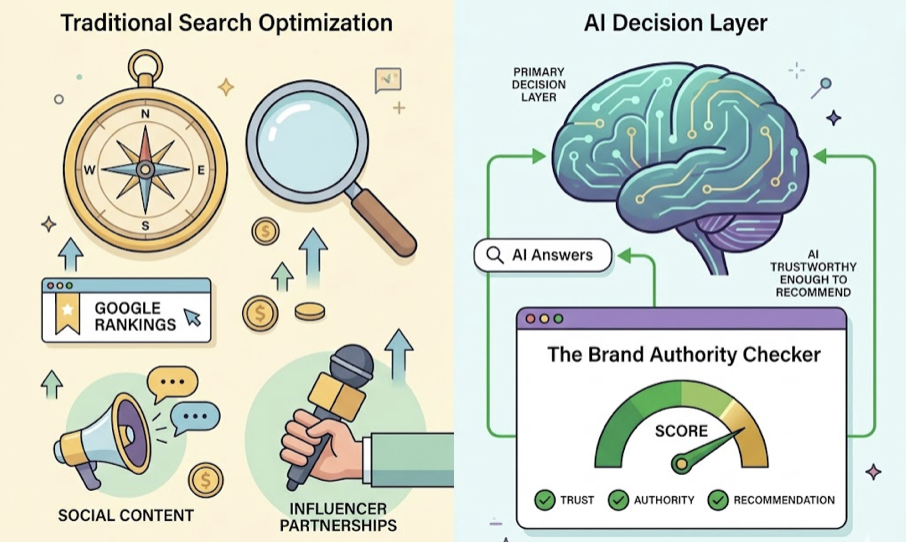
    On the flip side, most wellness brands are still optimizing exclusively for traditional search. They’re investing in Google rankings, social content, and influencer partnerships while AI quietly becomes the primary decision layer. The Brand Authority Checker gives you a 60-second read on whether AI considers your brand trustworthy enough to recommend. If your scores are low, no amount of SEO investment will put you in those AI answers.

    You can check your brand’s authority score right now and see exactly where the gap is.

    One Score Is a Starting Point. Tracking It Over Time Is the Strategy.

    Your Brand Authority Checker results tell you where you stand today. But AI models update their training data, adjust ranking signals, and shift recommendations on a rolling basis. A score of 72 this month could drop to 55 next quarter without any change on your end. A competitor’s new clinical study or a wave of negative reviews about your brand on Reddit could shift your position overnight.

    Topify‘s platform picks up where the free tool leaves off. The Comprehensive GEO Analytics dashboard tracks your authority, sentiment, and visibility scores continuously across ChatGPT, Perplexity, Gemini, and Google AI Overviews. You’ll see trend lines, get alerts when scores shift, and receive specific recommendations for what to fix.

    Here’s how the free check compares to the full platform:

    CapabilityFree Brand Authority CheckerTopify Platform
    Check frequencyOne-time snapshotContinuous daily/weekly monitoring
    AI platforms coveredAggregated scorePer-platform breakdown (ChatGPT, Perplexity, Gemini, AI Overviews)
    Historical dataNoneFull trend history with shift alerts
    Competitor comparisonNot includedReal-time competitor benchmarking
    Action recommendationsGeneral directionSpecific, data-driven GEO optimization
    YMYL signal trackingNot includedOngoing trust signal monitoring

    Every plan starts with a 7-day free trial, no credit card required. The Starter plan begins at $99/month.

    Conclusion

    Wellness consumers are asking AI which brands to trust with their health. The YMYL filter means AI won’t recommend you unless it has enough evidence that you’re credible. Most wellness brands don’t know their authority scores, and they’re losing high-converting traffic to competitors who do.

    Start with the Brand Authority Checker. It takes 60 seconds, it’s free, and it shows you exactly how AI perceives your brand’s trustworthiness. If the scores reveal gaps, you’ll know precisely where to focus.

    While you’re assessing your brand authority, a few other free checks can round out the picture. Topify‘s GEO Score Checker evaluates whether AI crawlers can actually access your site’s wellness content. The AI Visibility Report shows how often your brand gets mentioned across major AI platforms. And the Brand Sentiment Checker reveals whether AI describes your products positively or flags outdated concerns.

    FAQ

    Is the Brand Authority Checker free? Do I need to create an account? 

    Yes, it’s completely free. You don’t need to sign up, provide an email, or enter payment information. Just enter your brand name or domain and get results in under 60 seconds.

    What’s the difference between the free tool and the Topify platform? 

    The free Brand Authority Checker gives you a one-time snapshot of your current authority scores. The Topify platform provides continuous monitoring across all major AI platforms, historical trend data, competitor benchmarking, and actionable optimization recommendations. Think of the free tool as a diagnostic, and the platform as ongoing treatment.

    How often should a wellness brand check its AI visibility? 

    Given the YMYL sensitivity of health content, wellness brands should check at minimum once per quarter. AI models update their training data frequently, and a single negative review cluster or a competitor’s new clinical partnership can shift your scores. Brands running active campaigns or launching new products should monitor weekly.

    Why does my brand rank well on Google but not appear in AI answers? 

    AI engines and traditional search use different ranking signals. Google relies heavily on backlinks and on-page SEO. AI engines prioritize authority signals, cross-source consistency, and editorial citations. Moz’s 2026 analysis found 88% of AI citations don’t overlap with Google’s top 10 results. Your Google rankings and your AI visibility are essentially separate channels.

    Read More

  • AI Visibility Tools for Recruitment

    AI Visibility Tools for Recruitment

    An HR director typed into ChatGPT: “Best recruitment agencies for senior engineering roles in Austin.” Five firms showed up. Yours, with 15 years of tech placements and a 92% fill rate, wasn’t one of them. The problem isn’t your track record. It’s that AI doesn’t recognize it.

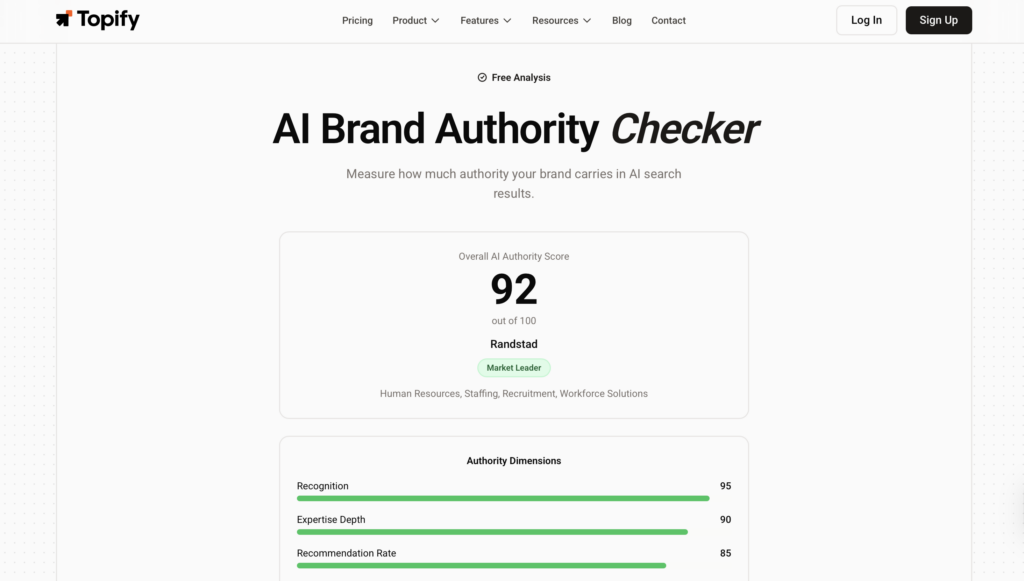
    The gap is measurable, and the check takes 60 seconds. Topify‘s Brand Authority Checker scores how AI models perceive your recruitment brand’s authority across four dimensions that directly determine whether you get recommended when candidates and hiring managers ask AI for help.

    ✅ Free ⚡ Results in 60 seconds 🔒 No signup required

    What the Brand Authority Checker Reveals About Recruitment Firms

    The Four Scores, Translated for Recruitment

    Each score maps to a specific challenge recruitment brands face in AI search. Here’s what they mean for your agency or employer brand.

    MetricWhat It MeasuresWhat It Means for Recruitment Brands
    Recognition (0-100)How often AI identifies your brand in your categoryBelow 40: AI doesn’t associate you with your core specialization (e.g., tech hiring, executive search)
    Expertise Depth (0-100)How well AI understands your capabilitiesBelow 50: AI may describe your industry focus incorrectly or reference outdated service lines
    Recommendation Rate (0-100)How often AI recommends you vs. alternativesBelow 30: you’re losing client and candidate inquiries before your BD team even picks up the phone
    Trust Signals (0-100)External validation AI detects (media, reviews, citations)Below 40: AI can’t find enough third-party evidence to vouch for your placement quality

    A recruitment firm with a Recognition score of 80 but a Trust Signals score of 25 has a very specific problem: AI knows you exist, but it doesn’t trust you enough to recommend you. That’s not a branding failure. It’s a signal gap, and now you know exactly where to focus.

    Three Scenarios That Show Up in Your Results

    Scenario 1: High Recognition, Low Recommendation. AI identifies your firm in the staffing category but rarely includes you in its top picks. This typically means AI sees you as a known player but lacks enough positive external signals to rank you above competitors. The fix is usually outside your website: media mentions, client testimonials on third-party platforms, and industry award citations.

    Scenario 2: Low Expertise Depth. AI describes your firm as a “general staffing agency” when you’ve specialized in fintech recruitment for the past five years. This happens when your online content still references old verticals, or when third-party directories haven’t been updated. The Expertise Depth score pinpoints this disconnect.

    Scenario 3: Weak Trust Signals across the board. Your Glassdoor profile has 12 reviews from 2019. Your last industry press mention was 18 months ago. AI models weigh recency and volume of external validation heavily. A low Trust Signals score tells you that AI simply can’t find enough current, third-party proof that your firm delivers.

    How to Run Your Check

    Go to the Brand Authority Checker, enter your recruitment brand name or domain, and get your four-dimensional authority breakdown in under a minute. No account creation, no credit card, no email required.

    Once you have your scores, you’ll know which dimension is dragging down your AI visibility. That’s the starting point for a targeted action plan.

    The AI Prompts That Decide Which Recruitment Brands Get Recommended

    AI visibility for recruitment isn’t abstract. It comes down to specific prompts that real candidates, hiring managers, and HR leaders type into ChatGPT, Perplexity, and Gemini every day.

    AI Prompt ExamplePlatformSearch IntentWhat It Reveals
    “Best recruitment agencies for tech hiring in [city]”ChatGPTVendor selectionWhether your firm gets recommended for your core specialty
    “Is [your agency] good for executive search?”PerplexityTrust verificationHow AI describes your reputation and track record
    “Top staffing firms for remote engineering roles 2026”GeminiCompetitive researchWhere you rank against other agencies in AI’s answer
    “Which recruitment companies specialize in healthcare?”ChatGPTNiche discoveryWhether AI recognizes your vertical expertise
    “Best companies to work for in fintech”PerplexityEmployer researchHow AI presents your employer brand to candidates

    Here’s the thing. These prompts don’t return 10 pages of results like Google. AI typically recommends 3 to 5 brands. If you’re not in that short list, you’re invisible to every candidate and client who asked.

    iHire’s 2025 survey found that 11.6% of US job seekers already use AI tools to research potential employers. Built In’s CEO predicts that within five years, candidates will start and finish their entire job search inside LLMs. The shift isn’t theoretical. It’s happening now, and the recruitment firms that show up in those AI answers are capturing pipeline that others don’t even know they’re losing.

    What These Patterns Mean for Your Recruitment Brand

    AI Recommendation Rankings and Industry Reputation Don’t Match

    Many recruitment firms with decades of industry experience, strong client relationships, and high fill rates are completely absent from AI’s recommendation lists. The disconnect is structural. AI doesn’t measure reputation through handshake deals, conference presence, or referral networks. It measures authority through structured data, third-party citations, and online signals that it can crawl, parse, and verify.

    A firm that’s been the go-to IT staffing partner in Chicago for 20 years might score below a three-year-old agency that publishes weekly industry reports, maintains active Glassdoor and G2 profiles, and gets cited in HR media. The Brand Authority Checker makes this gap visible. If your Recognition score is high but your Recommendation Rate is low, AI knows you but doesn’t trust you enough to suggest you. That’s the precise point where traditional reputation and AI perception diverge.

    AI Authority Is Built on Third-Party Signals, Not Your Own Website

    In traditional SEO, your website is your strongest asset. In AI search, external validation carries more weight. AI models assess recruitment brand authority by scanning Glassdoor reviews, industry media mentions, LinkedIn thought leadership, G2 ratings, and forum discussions. Your own careers page and service descriptions matter, but they’re not the primary input.

    This creates a specific challenge for recruitment firms. If your Glassdoor profile hasn’t been updated in two years, if your last press mention was from a 2023 industry roundup, or if your principals aren’t publishing on LinkedIn, your Trust Signals score will reflect that gap. The action path is clear: invest in the external signals that AI actually weighs.

    Signal TypeWhere AI LooksAction for Recruitment Firms
    Client/candidate reviewsGlassdoor, G2, Google ReviewsRequest fresh reviews quarterly, respond to existing ones
    Industry mediaHR publications, staffing trade pressContribute expert commentary, publish placement data
    Professional visibilityLinkedIn, industry conferencesRegular thought leadership posts from senior recruiters
    Directory listingsStaffing directories, business profilesEnsure consistent, current information across all listings

    The Winner-Take-All Dynamic Is Reshaping Recruitment Competition

    Traditional search returns dozens of results across multiple pages. AI returns a short list, typically 3 to 5 names, with brief explanations of why each is recommended. There is no page two.

    For mid-size recruitment firms, this creates an existential visibility problem. If AI recommends three agencies for “best healthcare recruiters in Dallas,” every candidate and client who asks that prompt will see only those three. Your firm, ranked sixth or seventh by AI’s internal scoring, doesn’t exist in that answer.

    The Recommendation Rate score from the Brand Authority Checker directly predicts whether you’re in that top tier. A score below 30 means AI consistently prefers other brands in your category. A score above 60 means you’re regularly included in recommendations. The difference between 29 and 61 isn’t incremental improvement. It’s the difference between visibility and invisibility.

    One Authority Score Is a Starting Point. Tracking It Over Time Is the Strategy.

    Your Brand Authority Checker results show where you stand right now. But AI models update their training data, adjust ranking signals, and shift recommendations on a rolling basis. A Recommendation Rate of 65 today could drop to 40 next quarter if a competitor publishes a wave of industry content or earns a cluster of new client reviews.

    Topify‘s Comprehensive GEO Analytics dashboard tracks your authority, sentiment, and visibility scores continuously across ChatGPT, Perplexity, Gemini, and Google AI Overviews. You’ll see trend lines, receive alerts when scores shift, and get specific recommendations for what to fix, all in one place.

    Here’s how the free check compares to the full platform:

    CapabilityFree Brand Authority CheckerTopify Platform
    Check frequencyOne-time snapshotContinuous daily/weekly monitoring
    AI platforms coveredAggregated scorePer-platform breakdown (ChatGPT, Perplexity, Gemini, AI Overviews)
    Historical trendsNoneFull trend history with alerts
    Competitor trackingNot includedReal-time competitor benchmarking
    Action recommendationsGeneralSpecific, one-click GEO optimization
    Team collaborationSingle userUnlimited team member seats

    Every plan starts with a 7-day free trial, no credit card required. The Starter plan begins at $99/month.

    Conclusion

    AI is becoming the first filter for both candidates researching employers and hiring managers evaluating recruitment partners. The firms that show up in those AI answers will capture pipeline that invisible firms never even know existed.

    Start with a free Brand Authority Checker scan to see where AI ranks your recruitment brand today. Use the scores to identify which dimension needs attention, then build a plan around the signals AI actually weighs. For ongoing monitoring, Topify’s platform turns a one-time diagnosis into a continuous optimization strategy.

    Other Free Tools to Round Out Your AI Visibility Audit

    While you’re assessing your brand authority, a few other free checks can complete the picture. Topify‘s AI Visibility Report shows how often your brand gets mentioned across major AI platforms and where you rank relative to other recruitment firms. The Prompts Researcher reveals the exact questions candidates and HR leaders are asking AI about recruitment services in your niche. And the Brand Sentiment Checker analyzes whether AI describes your firm positively, neutrally, or with caveats that could cost you business.

    FAQ

    Is the Brand Authority Checker really free? Do I need to create an account? 

    Yes, it’s completely free with no account required. Enter your brand name or domain, and you’ll get your four-dimensional authority score in under 60 seconds. No email, no credit card, no strings.

    What’s the difference between the free tool and the Topify paid platform? 

    The free Brand Authority Checker gives you a one-time snapshot of your AI authority scores. The Topify platform provides continuous monitoring across ChatGPT, Perplexity, Gemini, and Google AI Overviews, plus historical trend data, competitor benchmarking, and actionable optimization recommendations. Plans start at $99/month with a 7-day free trial.

    How often should recruitment firms check their AI visibility? 

    AI models update their training data and ranking signals regularly. A quarterly check with the free tool is a good baseline. For firms actively investing in content and employer branding, monthly monitoring through the platform gives you the data to see what’s working and catch drops early.

    Can AI visibility actually affect our candidate pipeline and client acquisition? 

    Yes. With 11.6% of job seekers already using AI to research employers and recruitment firms, and that number growing fast, AI recommendations directly influence which agencies candidates and hiring managers consider. If AI doesn’t recommend your firm, you’re not part of the conversation for a growing share of your market.

    Read More

  • AI Visibility Tools for HR Tech Companies

    AI Visibility Tools for HR Tech Companies

    A Head of HR Operations asked ChatGPT, “What’s the best HRIS for mid-market companies with global payroll and SOC 2 compliance?” The AI returned five platform recommendations. Your product, with 8,000 enterprise clients and a G2 score of 4.7, wasn’t one of them. The issue isn’t your product. It’s that AI doesn’t recognize your authority in the category.

    The gap is measurable, and the check takes 60 seconds. Topify‘s Brand Authority Checker scores how AI models perceive your brand’s authority across four dimensions that directly determine whether you get recommended.

    ✅ Free ⚡ Results in 60 seconds 🔒 No signup required

    The Four Authority Scores That Decide If AI Recommends Your HR Platform

    Each score maps to a specific problem HR tech brands face in AI search. Here’s the thing: AI doesn’t recommend platforms because they rank on Google. It recommends them because it trusts them. And trust, in AI’s framework, breaks down into four measurable dimensions.

    What Each Metric Means for HR Tech

    MetricWhat It MeasuresWhat It Means for HR Tech Brands
    Recognition (0-100)How often AI identifies your brand in your categoryBelow 40: AI doesn’t associate you with your core sub-vertical (HRIS, ATS, HCM)
    Expertise Depth (0-100)How well AI understands your capabilitiesBelow 50: AI may misrepresent your compliance certifications or integration ecosystem
    Recommendation Rate (0-100)How often AI recommends you vs. alternativesBelow 30: you’re losing deals before your sales team talks to a single prospect
    Trust Signals (0-100)External validation AI detects (media, reviews, analyst citations)Below 40: AI can’t find enough third-party evidence to vouch for your platform

    An HRIS vendor with a Recognition score of 80 but a Trust Signals score of 25 has a specific problem: AI knows who you are, but it doesn’t trust you enough to recommend you over platforms with stronger external validation. That’s not a branding failure. It’s a signal gap, and now you know exactly where to focus.

    Industry Scenarios That Expose the Gap

    Scenario 1: The invisible compliance story. Your platform holds SOC 2 Type II and supports GDPR-compliant payroll across 30 countries. But AI describes your security posture using language from two product versions ago. Your Expertise Depth score reveals why: AI hasn’t absorbed your updated compliance documentation because your site’s JS-heavy architecture blocks its crawlers.

    Scenario 2: The sub-vertical mix-up. You’ve built a strong reputation in applicant tracking, but AI keeps recommending you for performance management queries you don’t target. Your Recognition score is high in the wrong category. This misclassification dilutes your authority where it actually matters.

    Scenario 3: The review gap. Your G2 profile has 400 reviews, but most say “great HR software” without specifying company size, industry, or use case. AI can’t learn anything from generic praise. Your Trust Signals score reflects exactly that: high volume, low specificity.

    How to Run Your Check

    Go to Brand Authority Checker, enter your brand name or domain, and get your four-dimensional authority breakdown in under 60 seconds. No signup, no credit card, no strings attached.

    Look at which scores are below 50 first. Those are the dimensions where AI is either ignoring you or misrepresenting you. Then cross-reference: if Recognition is high but Recommendation Rate is low, AI knows you exist but actively prefers other platforms. That’s a different fix than being invisible altogether.

    HR Tech Buyers Ask AI Questions Google Can’t Handle

    71% of HR technology buyers now use AI assistants during initial vendor discovery, before contacting any vendor directly. Among mid-market buyers (100-500 employees), that number climbs to 79%. These aren’t simple searches. HR tech evaluation involves multiple stakeholders: HR leadership, finance, IT, and often legal. The prompts they use reflect that complexity.

    AI Prompt ExamplePlatformBuyer IntentAuthority Signal AI Looks For
    “Best HRIS for mid-market companies with global payroll”ChatGPTShortlisting vendorsExpertise Depth in payroll + compliance
    “Which ATS handles high-volume recruiting at enterprise scale”PerplexityCapacity evaluationRecognition in ATS sub-vertical + Trust Signals from enterprise case studies
    “Compare performance management platforms for remote teams 2026”GeminiFeature comparisonRecommendation Rate + Expertise Depth in remote work features
    “HRIS platforms with Workday integration and SOC 2 certification”ChatGPTTechnical fit checkTrust Signals from compliance documentation + integration mentions
    “What’s the best HR analytics tool for a 2,000-person healthcare company”PerplexityIndustry-specific matchRecognition in analytics + Expertise Depth in healthcare vertical

    These prompts are multi-conditional. A buyer isn’t asking “best HR software.” They’re specifying company size, industry, compliance requirements, integration needs, and use case in a single question. AI’s answer depends on whether it associates your brand with enough of those conditions to recommend you. That’s not SEO. That’s authority.

    Your Authority Score Doesn’t Transfer Across HR Tech Sub-Verticals

    HR tech is not one market. It’s a collection of sub-verticals, each with its own AI answer ecosystem: HRIS, HCM, ATS, performance management, workforce analytics, compensation management, learning and development. Your brand authority in one sub-vertical doesn’t carry over to another.

    This matters because the HR tech market is deeply fragmented. HRIS vs. HCM, ATS vs. CRM-for-recruiting, performance management vs. engagement platforms: each category has its own competitive map in AI’s recommendation engine. A platform that scores 80 in HRIS Recognition might score below 30 in workforce analytics, even if it ships both modules. AI evaluates these as separate authority domains.

    On the flip side, this fragmentation creates opportunity. You don’t need to dominate every sub-vertical. You need to own the ones where your buyers are asking questions. Run your brand through the Brand Authority Checker and pay attention to which category AI places you in. If it’s not the one you’re targeting, that’s your first fix.

    The Long Sales Cycle Problem: Miss the AI Answer, Miss the Entire Deal

    HR tech purchases take weeks to months. A typical HRIS evaluation involves demos, compliance reviews, security assessments, and committee sign-offs. But the vendor shortlist gets formed in the first 48 hours of research.

    92% of CHROs anticipate that AI will be further integrated into their workforce this year. That integration isn’t limited to internal HR processes. It extends to how HR leaders evaluate and procure the technology they use. When a CHRO or VP of People Operations opens ChatGPT to build an initial vendor list, the platforms that appear in that first answer have a structural advantage through the rest of the evaluation cycle.

    The brands that don’t appear? They’re not just missing one touchpoint. They’re missing the entire deal funnel.

    Here’s the thing: AI models update on a rolling basis. A platform that appears in ChatGPT’s HRIS recommendations in Q1 might disappear in Q2 because a competitor published better compliance documentation, earned more specific G2 reviews, or got cited in a Gartner analysis that entered the model’s training window. The competitive map in AI search isn’t static. It shifts with every model update, every new citation, every fresh review.

    That’s why a one-time check isn’t a strategy. It’s a starting point.

    One Score Is a Starting Point. Tracking It Over Time Is the Strategy.

    Your Brand Authority Checker results tell you where you stand right now. But AI models update their training data, adjust ranking signals, and shift recommendations on a rolling basis. A score of 72 today could drop to 55 next quarter without any change on your end, simply because a competitor published a SOC 2 whitepaper that entered ChatGPT’s training window.

    Topify‘s platform picks up where the free tool leaves off. The Comprehensive GEO Analytics dashboard tracks your authority, sentiment, and visibility scores continuously across ChatGPT, Perplexity, Gemini, and Google AI Overviews. You’ll see trend lines, get alerts when scores shift, and receive specific recommendations for what to fix next.

    Here’s how the free check compares to the full platform:

    CapabilityFree Brand Authority CheckerTopify Platform
    Check frequencyOne-time snapshotContinuous daily/weekly monitoring
    AI platforms coveredAggregated scorePer-platform breakdown (ChatGPT, Perplexity, Gemini, AI Overviews)
    Historical trendsNoneFull trend history with alerts
    Competitor trackingNot includedReal-time competitor benchmarking
    Sub-vertical breakdownSingle categoryAuthority scores per HR tech sub-vertical
    Action recommendationsGeneralSpecific, one-click GEO optimization

    Every plan starts with a 7-day free trial, no credit card required. The Starter plan begins at $99/month.

    Conclusion

    HR tech buyers are already asking AI for vendor recommendations. The question isn’t whether AI search matters for your category. It’s whether AI trusts your brand enough to recommend it when a CHRO, HR ops lead, or procurement team asks.

    Start with the free Brand Authority Checker to see exactly how AI perceives your platform’s authority. Identify which of the four scores is holding you back. Then decide whether a one-time snapshot is enough or whether continuous tracking makes sense for your sales cycle.

    While you’re assessing your brand authority, a few other free checks can round out the picture. Topify‘s AI Robots Checker reveals whether your site’s robots.txt is blocking AI crawlers from accessing your content. The Knowledge Freshness Checker flags outdated product information that AI models might still be citing. And the Competitor Analysistool shows how AI positions your brand relative to others in your sub-vertical.

    FAQ

    Is the Brand Authority Checker really free? Do I need to sign up?

    Yes, it’s completely free with no signup or credit card required. Enter your brand name or domain at topify.ai/tools/brand-authority-checker and get your full authority score breakdown in about 60 seconds.

    What’s the difference between the free tool and the Topify platform?

    The free Brand Authority Checker gives you a one-time snapshot of your current authority scores. The Topify platform provides continuous monitoring across ChatGPT, Perplexity, Gemini, and Google AI Overviews, with historical trend data, competitor benchmarking, and specific optimization recommendations. Plans start at $99/month with a 7-day free trial.

    How often should HR tech brands check their AI visibility?

    At minimum, quarterly. HR tech is a fast-moving category with frequent product launches, compliance updates, and model training refreshes. If you’re in an active sales cycle or recently shipped a major feature, monthly checks are more appropriate. Continuous monitoring through the full platform catches drops before they cost you pipeline.

    My brand ranks well on G2 and Google. Why would I be invisible in AI search?

    AI search and traditional SEO operate on different signals. AI models weigh brand authority, expertise depth, and external trust signals differently than Google weighs backlinks and keywords. Many HR tech vendors with strong G2 profiles and Google rankings are completely absent from ChatGPT and Perplexity answers because AI can’t parse their JS-heavy sites, their compliance content is outdated, or their reviews lack the specificity AI needs to make category-level associations.

    Read More

  • AI Visibility Tools for Cybersecurity Brands

    AI Visibility Tools for Cybersecurity Brands

    A CISO typed into ChatGPT: “Best XDR platform for a mid-market company with hybrid cloud workloads.” Five vendors appeared in the response. Yours wasn’t one of them. Your product has SOC 2 Type II certification, covers 50,000+ endpoints, and won a Gartner Peer Insights award last year. None of that mattered. AI didn’t recognize your authority.

    The gap is measurable, and the check takes 60 seconds. Topify‘s Brand Authority Checker scores how AI models perceive your cybersecurity brand’s authority across four dimensions that directly influence whether you get recommended or ignored.

    ✅ Free ⚡ Results in 60 seconds 🔒 No signup required

    The Four Authority Scores That Decide Whether AI Recommends Your Security Brand

    What Each Score Means for a Cybersecurity Vendor

    The Brand Authority Checker breaks your AI-perceived authority into four measurable dimensions. Each one maps to a specific failure mode in cybersecurity vendor selection.

    MetricWhat It MeasuresWhat It Means for Cybersecurity Vendors
    Recognition (0-100)How often AI identifies your brand in your categoryBelow 40: AI doesn’t associate you with your core security category, even if you dominate Google rankings
    Expertise Depth (0-100)How well AI understands your technical capabilitiesBelow 50: AI may misrepresent your detection methodology, compliance certifications, or platform coverage
    Recommendation Rate (0-100)How often AI recommends you over alternativesBelow 30: you’re losing CISO shortlist placements to vendors AI considers more credible
    Trust Signals (0-100)External validation AI detects from third partiesBelow 40: AI can’t find enough analyst mentions, peer reviews, or media coverage to vouch for you

    Here’s the thing. A cybersecurity vendor with a Recognition score of 80 but a Trust Signals score of 25 has a very specific problem: AI knows who you are, but doesn’t trust you enough to recommend you to a CISO evaluating options. That’s a gap you can close once you know it exists.

    Three Signals That Tell You AI Doesn’t Trust Your Brand Enough to Recommend It

    Not every low score means the same thing. In cybersecurity, three patterns show up repeatedly.

    Pattern 1: Strong product, weak third-party coverage. Your product genuinely outperforms in independent testing, but AI models don’t see enough analyst reports, G2 reviews, or media mentions to validate that claim. The Trust Signals score exposes this.

    Pattern 2: Category confusion. You’ve expanded from endpoint security into XDR and cloud security, but AI still categorizes you as an endpoint-only vendor. The Expertise Depth score catches misalignment between what you do and what AI thinks you do.

    Pattern 3: Invisible to buyer-intent queries. You rank well for technical queries like “how does SIEM work” but disappear when someone asks “best SIEM for mid-market.” The Recommendation Rate score reveals whether AI includes you in purchase-decision conversations.

    How to Run Your Check

    Go to Brand Authority Checker, enter your brand name or domain, and get your four-dimensional authority breakdown in under 60 seconds. No signup, no credit card.

    Look at which dimension scores lowest. That’s your starting point. A low Trust Signals score calls for a different fix than a low Recognition score, and knowing the difference saves months of misallocated marketing effort.

    73% of Cybersecurity Vendors Get Zero AI Citations. Here’s What Their Buyers Are Actually Asking.

    A 2026 benchmark analyzed 100 cybersecurity companies across six AI platforms using 250 buyer-intent prompts. The result: 73% of vendors received zero citations from ChatGPT when buyers asked for vendor recommendations in their category. Not low citations. Zero.

    The prompts driving this aren’t obscure. They’re the exact questions CISOs and IT leaders type into AI every day.

    AI Prompt ExamplePlatformSearch IntentWhat It Reveals
    “Best XDR platform for mid-market companies”ChatGPTPurchase shortlistWhether AI includes you in the initial vendor set
    “CrowdStrike vs Palo Alto for endpoint protection”PerplexityCompetitive comparisonHow AI positions you against named competitors
    “Most trusted SIEM for financial services compliance”GeminiTrust verificationWhether AI considers your compliance credentials credible
    “Alternatives to CrowdStrike for cloud security”ChatGPTVendor switchingWhether you appear when buyers actively seek options
    “Best cybersecurity vendor for zero trust implementation”PerplexityArchitecture decisionWhether AI links your brand to specific frameworks

    The concentration effect is severe. AI responses for cybersecurity queries typically cite only 2 to 7 vendors per answer. Compare that to Google’s 10 blue links. The bar for inclusion is dramatically higher, and the penalty for exclusion is total invisibility in that buyer’s research flow.

    On the flip side, the vendors who do appear capture disproportionate value. AI-referred sessions convert at 5.1 times the rate of traditional organic traffic, with conversion rates reaching 14.2% compared to 2.8% from standard Google search. For cybersecurity vendors, where a single enterprise deal can exceed six figures, each missed AI citation carries real pipeline cost.

    Your Google Rankings Don’t Transfer to AI. That’s the Core Problem.

    One enterprise cybersecurity firm with over 50,000 monthly Google visitors received zero ChatGPT citations when buyers searched for their category. A competitor with a fraction of that organic traffic appeared consistently across multiple AI platforms.

    This disconnect is structural, not accidental. 48% of ChatGPT’s top cited sources are Wikipedia, roughly 11% come from Reddit, and established tech outlets fill most of the remaining slots. Vendor-owned content, the blogs and product pages that drive traditional SEO, almost disappears in buyer-intent queries.

    In practice, this means a cybersecurity brand that invested years in domain authority, backlink profiles, and keyword rankings may have built zero AI authority. The two systems evaluate credibility on different signals. Google cares about links and page structure. AI cares about whether third-party sources independently validate your claims.

    The Brand Authority Checker’s Trust Signals dimension directly measures this gap. If your score is low, it tells you that AI models can’t find enough external evidence, analyst mentions, G2 reviews, Reddit discussions, media coverage, to recommend you with confidence. That’s actionable information, because the fix isn’t more blog posts. It’s more earned media.

    CISOs Are Building Shortlists in AI. If You’re Not There, You Don’t Exist.

    CISOs and IT leaders are using ChatGPT, Claude, and Perplexity to scope vendor shortlists, draft RFP requirements, and benchmark vendor claims before any analyst inquiry call. This isn’t a fringe behavior. 73% of B2B buyers now use AI tools like ChatGPT and Perplexity in their purchase research process.

    The implication is straightforward: if AI doesn’t recommend you, you don’t make the first cut. 78% of B2B buyers only shortlist vendors they already recognize. When AI becomes the recognition layer, absence from AI responses is functionally identical to not existing in the buyer’s mind.

    And the traffic numbers confirm this shift is accelerating. AI-referred sessions to B2B websites jumped 527% in the first five months of 2025 alone. Gartner predicts that organic search traffic will decline by over 50% by 2028 as buyers adopt AI-driven discovery. For cybersecurity, where purchase decisions are high-stakes and committee-driven, the evaluation starts before your sales team even knows the buyer exists.

    The Window Is Closing. First Movers Lock In Citation Patterns That Compound.

    AI search is still early enough that cybersecurity brands who move now can establish citation patterns that compound over time. Here’s why timing matters.

    AI models learn from patterns. When a vendor consistently appears across analyst mentions, peer reviews, and structured comparison content, AI treats that vendor as a default recommendation for the category. Early citation presence creates a feedback loop: more citations lead to more visibility, which generates more third-party mentions, which reinforces the citations.

    The reverse is also true. Vendors who wait will find it progressively harder to break into AI recommendations as incumbent citation patterns solidify. The window for establishing AI authority in cybersecurity is open right now, but the number of “slots” in each AI response is limited to 2 to 7 vendors.

    SignalCurrent StateWhat It Means for Your Timing
    AI-referred B2B traffic growth527% increase in 5 months (2025)AI is already a primary discovery channel
    B2B buyers using AI for research73% and risingMajority of your buyers are already there
    Cybersecurity vendors with zero AI citations73%Most competitors haven’t moved yet
    Organic search traffic decline forecast50%+ drop by 2028 (Gartner)Traditional SEO alone won’t sustain pipeline
    AI traffic conversion rate advantage5.1x over organic searchEvery AI citation captured converts at higher rates

    The first step is measuring where you stand. Run your brand through the Brand Authority Checker, see which of the four dimensions needs work, and build from there.

    One Authority Score Is a Starting Point. Tracking It Over Time Is the Strategy.

    Your Brand Authority Checker results tell you where you stand right now. But AI models update their training data, adjust ranking signals, and shift recommendations on a rolling basis. A score of 72 today could drop to 55 next quarter without any change on your end.

    Topify‘s platform picks up where the free tool leaves off. The Comprehensive GEO Analytics dashboard tracks your authority, sentiment, and visibility scores continuously across ChatGPT, Perplexity, Gemini, and Google AI Overviews. You’ll see trend lines, get alerts when scores shift, and receive specific recommendations for what to fix.

    Here’s how the free check compares to the full platform:

    CapabilityFree Brand Authority CheckerTopify Platform
    Check frequencyOne-time snapshotContinuous daily/weekly monitoring
    AI platforms coveredAggregated scorePer-platform breakdown (ChatGPT, Perplexity, Gemini, AI Overviews)
    Historical dataNoneFull trend history with automated alerts
    Competitor comparisonNot includedReal-time benchmarking against security competitors
    Action recommendationsGeneral directionSpecific, prioritized optimization steps
    Team collaborationSingle userUnlimited team member seats

    Every plan starts with a 7-day free trial, no credit card required. The Starter plan begins at $99/month.

    Conclusion

    Cybersecurity buyers are making shortlists in AI before they ever talk to your sales team. 73% of vendors in your space are completely invisible to those conversations. The question isn’t whether AI visibility matters for security brands. It’s whether you’ll measure your baseline before your competitors do.

    Start with a free Brand Authority Checker scan. See your four authority dimensions. Identify the weakest signal. Then decide whether a one-time snapshot is enough, or whether continuous tracking through the Topify platform fits your strategy better.

    While you’re assessing your brand authority, a few other free checks can round out the picture. Topify’s GEO Score Checker evaluates whether AI crawlers can actually access and understand your site’s content. The AI Visibility Reportshows how often your brand gets mentioned across major AI platforms. And the Competitor Analysis tool reveals who AI considers your top competitors and where they outperform you in AI recommendations.

    FAQ

    Is the Brand Authority Checker free? Do I need to create an account? 

    Yes, it’s completely free. You don’t need to sign up, log in, or provide a credit card. Enter your brand name or domain and get results in about 60 seconds.

    What’s the difference between the free tool and the Topify paid platform? 

    The free Brand Authority Checker gives you a one-time snapshot of your AI-perceived authority across four dimensions. The Topify platform provides continuous monitoring, historical trend tracking, competitor benchmarking, per-platform breakdowns, and specific action recommendations. Plans start at $99/month with a 7-day free trial.

    How often should a cybersecurity brand check its AI visibility? 

    AI models update their training data and ranking signals on a rolling basis. A quarterly manual check with the free tool catches major shifts, but weekly or daily monitoring through the platform is more appropriate for brands in competitive cybersecurity categories where citation positions change frequently.

    Why does my brand rank well on Google but get zero AI citations? 

    Google and AI search engines evaluate credibility differently. Google weighs backlinks, page authority, and on-page SEO. AI models weigh third-party validation: analyst mentions, peer reviews, Wikipedia entries, Reddit discussions, and media coverage. A strong Google presence doesn’t automatically translate to AI authority, which is exactly what the Brand Authority Checker measures.

    Read More

  • AI Visibility Tools for Education

    AI Visibility Tools for Education

    46% of Students Ask AI Where to Apply. Is Your School in the Answer?

    A high school junior opens ChatGPT and types: “Best nursing programs in California with clinical rotations.” The AI lists five schools. Yours isn’t one of them. Not because your program is weak, but because the model doesn’t surface it.

    This is happening across higher ed right now. 46% of high school students used AI in their college search by late 2025, up from 26% just months earlier. And most institutions have no idea how AI platforms describe, rank, or ignore them.

    There’s a fast way to find out. Topify‘s AI Visibility Report shows how often your institution gets mentioned across ChatGPT, Perplexity, Gemini, and Google AI Overviews, with a breakdown by platform, ranking position, and mention rate.

    ✅ Free ⚡ Results in 60 seconds 🔒 No signup required

    What Your Institution’s AI Visibility Report Actually Reveals

    The Three Metrics That Define Your AI Presence

    The AI Visibility Report doesn’t give you a single vanity score. It breaks your institution’s AI presence into three dimensions that map directly to how prospective students discover you.

    Here’s what each metric means in an education context:

    MetricWhat It MeasuresWhat It Means for Education Brands
    Mention RateHow often AI includes your brand in relevant answersLow rate = students asking “best online MBA programs” never see your name
    Ranking PositionWhere you appear within AI-generated listsPosition 4-5 gets scanned. Position 8+ gets ignored. Not listed = invisible
    Provider BreakdownWhich AI platforms mention you and which don’tYou might show up in Gemini but be completely absent from ChatGPT, where most students search

    These three numbers tell you something your Google Analytics dashboard can’t: whether AI is sending students toward you or away from you before they ever visit your website.

    Three Scenarios Where the Report Exposes Hidden Problems

    Scenario 1: The “strong brand, weak AI signal” gap. Your institution has solid U.S. News rankings, a 90%+ placement rate, and thousands of alumni. But when someone asks Perplexity “best online programs for working adults,” you don’t appear. The report shows a mention rate near zero on that platform, revealing a gap between your offline reputation and your AI footprint.

    Scenario 2: The platform blind spot. Your marketing team optimized for Google. You rank on page one for your target keywords. But AI Overviews pull from different signals than organic search. The Provider Breakdown might show strong Gemini visibility but zero presence in ChatGPT, where 28% of Gen Z users launch their first search.

    Scenario 3: The inaccurate recommendation. AI mentions your institution, but for programs you discontinued two years ago. Or it places you in the wrong state. The report flags that you’re being mentioned, but further investigation reveals the mentions are doing more harm than good.

    How to Run Your First Report

    Getting your baseline takes three steps:

    1. Go to the AI Visibility Report tool page.
    2. Enter your institution’s brand name (e.g., “Northeastern University” or “Western Governors University”).
    3. Review the output: mention rate, ranking position across platforms, and provider-level breakdown.

    The whole process takes under a minute. What you do with the data is where the real work begins.

    The Prompts Prospective Students Are Typing Into ChatGPT

    Students don’t type your institution’s name into AI. They type questions. And the answer AI gives is often the first filter in their decision process.

    EAB’s survey of over 5,000 high school students found that 62% of those using AI did so to find colleges that fit their needs. About half used it to discover schools they hadn’t heard of before. These are non-branded, intent-driven queries, and they’re the ones that determine whether you make the shortlist.

    Here’s a sample of what education-related AI prompts look like:

    AI Prompt ExampleSearch IntentIf You Don’t Appear
    “Best online MBA programs for working professionals 2026”Program comparisonStudent builds a shortlist without you on it
    “Cheapest accredited nursing programs in Texas”Cost-driven decisionPrice-sensitive students default to whichever schools AI recommends
    “Is [your institution] worth the tuition?”Trust verificationAI may give a vague or outdated answer that pushes the student elsewhere
    “Top computer science programs with co-op opportunities”Outcome-driven researchHigh-value applicants never discover your program
    “Best colleges for first-generation students with financial aid”Fit-based discoveryUnderserved students miss institutions specifically built for them

    Each of these prompts is a moment where AI either includes your institution or doesn’t. The AI Visibility Report lets you check which of these conversations you’re part of, and which ones you’re missing entirely.

    What the Data Says About AI and Enrollment Decisions

    Students Remove Schools from Their List Based on AI Answers

    This is the stat that should keep enrollment leaders up at night: 18% of high school students have removed a college from their list because of an AI-generated response. On the flip side, 34% said AI increased their interest in a particular institution.

    That’s not a minor influence. That’s a shortlist filter.

    And it’s getting worse for schools that aren’t visible. A quarter of students are now having ongoing, multi-turn conversations with AI about their college search. They’re not browsing ten tabs. They’re talking to one chatbot and trusting its output.

    If your institution isn’t in that conversation, you’ve lost the student before your admissions team even knows they exist.

    Ad Spend Can’t Buy an AI Recommendation

    Here’s a data point that illustrates the disconnect: 5WPR’s Online Universities AI Visibility Index found that Western Governors University leads with roughly 14% AI citation share. University of Phoenix, despite category-leading paid search spending, captures just 1.5%.

    AI doesn’t care about your media budget. It cares about content structure, third-party authority signals, and whether your information is accurate and extractable. Institutions pouring money into Google Ads and display campaigns are fighting a war on the wrong battlefield. The new battleground is whether your program pages, faculty credentials, and outcome data are structured in a way AI models can parse, trust, and cite.

    Most Institutions Don’t Know Their AI Visibility Score

    Ask your enrollment marketing team how you rank on Google for “best online MBA.” They’ll probably know. Ask them how often ChatGPT recommends your institution when a student asks that same question. Silence.

    Research from UPCEA and Search Influence confirms that most institutions aren’t tracking AI citation frequency or brand mentions in AI-generated answers. They’re measuring clicks, impressions, and CPC, but none of those metrics capture the moment a student asks AI for a recommendation and your school doesn’t appear.

    The AI Visibility Report exists to close that gap. It takes 60 seconds to run. And it gives you a baseline that no amount of Google Analytics data can replicate.

    From a One-Time Snapshot to Continuous AI Monitoring

    The AI Visibility Report gives you a clear picture of where you stand today. But AI search results aren’t static. Models update, content freshness signals shift, and your competitors’ visibility changes week to week. A strong mention rate today doesn’t guarantee the same result next month.

    That’s where Topify’s AI Visibility Checker picks up. It turns the one-time snapshot into a continuous monitoring system: daily tracking across ChatGPT, Perplexity, Gemini, and Google AI Overviews, with historical trend data, automated alerts, and side-by-side competitor benchmarking.

    CapabilityFree AI Visibility ReportTopify Platform
    Check frequencyOne-time snapshotContinuous daily/weekly monitoring
    AI platforms coveredSingle checkChatGPT + Perplexity + Gemini + AI Overviews
    Historical trendsNoFull trend history with change alerts
    Competitor trackingNoReal-time competitor benchmarking
    Actionable recommendationsManual interpretationData-driven optimization suggestions
    Team collaborationNoShared dashboards for enrollment + marketing teams

    Plans start at $99/month with a 7-day free trial and no credit card required. For institutions managing multiple program brands or campuses, the Pro and Enterprise tiers offer multi-brand tracking and dedicated support. You can start a free trial to see how continuous monitoring compares to a single report.

    Conclusion

    Prospective students are making enrollment decisions inside AI conversations that most institutions can’t see, measure, or influence. The data is clear: nearly half of high school students use AI in their college search, and one in five has already dropped a school from their list based on what a chatbot told them.

    The first step is knowing where you stand. Run your institution through the AI Visibility Report to see your mention rate, ranking position, and platform coverage. It’s free, takes under a minute, and gives you a baseline that traditional analytics can’t provide.

    Once you have that baseline, a few other Topify free tools can round out your diagnosis:

    • The Brand Authority Checker scores how AI models perceive your institution’s credibility across recognition, expertise, and trust dimensions.
    • The Prompts Researcher reveals the exact questions prospective students are asking AI in the education category.
    • The Knowledge Freshness Checker flags whether AI is working with outdated information about your programs, tuition, or accreditation.

    FAQ

    Is the AI Visibility Report free? Do I need to create an account? 

    Yes, it’s completely free and requires no signup. Enter your institution’s name, get your report in under 60 seconds.

    What’s the difference between the free report and Topify’s paid platform? 

    The free report is a one-time snapshot. The paid platform provides continuous monitoring, historical trends, competitor benchmarking, and optimization recommendations. Plans start at $99/month with a 7-day free trial.

    How often should an education brand check its AI visibility? 

    At minimum, once per enrollment cycle. Ideally, you’d monitor continuously since AI models update frequently, and your visibility can shift without warning. The free report is a good starting point. Continuous tracking through the platform is the long-term play.

    Can AI visibility actually affect enrollment numbers? 

    The evidence points that direction. When 34% of students say AI increased their interest in a school and 18% say AI caused them to remove a school from their list, AI visibility is directly tied to the top of your enrollment funnel.

    Read More