A daughter in Dallas typed into ChatGPT: “What’s the most trusted memory care facility near me for a parent with early-stage Alzheimer’s?” The AI returned five recommendations. Her mother’s actual care community, rated 4.8 stars with 15 years of operation, wasn’t on the list. The problem isn’t the quality of care. It’s that AI doesn’t recognize the brand as an authority.
There’s a way to see exactly where the disconnect is. Topify‘s Brand Authority Checker scores how AI models perceive your senior care brand’s authority across four dimensions that directly affect whether families find you in AI search results.
✅ Free ⚡ Results in 60 seconds 🔒 No signup required
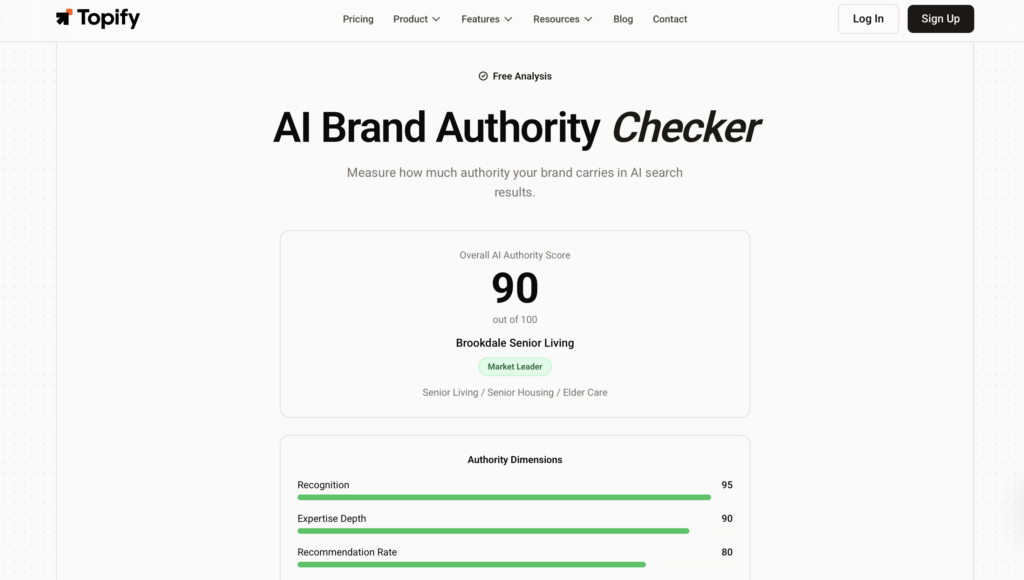
The Four Authority Scores That Determine If AI Trusts Your Senior Care Brand
The Brand Authority Checker doesn’t give you a single pass/fail grade. It breaks AI’s perception of your brand into four measurable dimensions, each one tied to a specific challenge senior care providers face in AI search.
What Each Score Means for Senior Care Providers
| Metric | What It Measures | What It Means for Senior Care |
|---|---|---|
| Recognition (0-100) | How often AI identifies your brand in your category | Below 40: AI doesn’t associate you with senior care, assisted living, or memory care |
| Expertise Depth (0-100) | How well AI understands your capabilities | Below 50: AI may describe your care specialties incorrectly or omit key services like telehealth integration |
| Recommendation Rate (0-100) | How often AI recommends you vs. alternatives | Below 30: families never see your name when asking “best senior care near me” |
| Trust Signals (0-100) | External validation AI detects (media, reviews, certifications) | Below 40: AI can’t find enough third-party evidence to recommend you for a high-stakes care decision |
Here’s the thing: a senior living community with a Recognition score of 80 but a Trust Signals score of 25 has a very specific problem. AI knows the brand exists but doesn’t trust it enough to recommend it for something as high-stakes as elder care. That’s a gap you can close once you know it’s there.
Three Scenarios Senior Care Brands Discover After Running a Check
Scenario 1: The invisible veteran. Your community has been operating for two decades with strong local referrals. But your Recognition score is 28. AI simply doesn’t know you exist in the senior care category because your digital footprint is thin. The fix starts with structured data, not more brochures.
Scenario 2: The misrepresented specialist. Your Expertise Depth score is 35, even though you offer specialized memory care programs. AI describes you as a “general assisted living facility” because your website content doesn’t communicate your specialties in a way AI can parse. Your clinical differentiators aren’t reaching the models.
Scenario 3: The trusted but unrecommended. Your Trust Signals score is high at 75, but your Recommendation Rate sits at 20. AI respects your brand but recommends competitors more often. This typically means competitors have stronger content structures, more frequent third-party citations, or better AI-crawlable site architecture.
How to Run Your Brand Authority Check
Go to Brand Authority Checker, enter your senior care brand name or domain, and get your four-dimensional authority breakdown in under 60 seconds. No signup, no credit card. You’ll see exactly where AI ranks your authority and where the gaps are.
The results page also shows how AI positions you relative to your category. If your scores are low in one dimension but strong in others, you have a targeted problem with a targeted fix.
Senior Care Prompts AI Already Answers Without You
Families aren’t typing two-word Google queries anymore. They’re asking AI detailed, conversational questions, and AI is giving them direct answers with specific brand recommendations. If your senior care brand isn’t part of those answers, families move forward without ever knowing you exist.
Here are the types of prompts AI is already fielding in the senior care space:
| AI Prompt Example | Platform | Search Intent | What It Reveals |
|---|---|---|---|
| “Best memory care facilities near me with specialized Alzheimer’s programs” | ChatGPT | Purchase decision | Whether AI recommends your community for specialized care |
| “Is home care better than assisted living for my 80-year-old mother?” | Perplexity | Care path evaluation | Whether AI references your brand when comparing care models |
| “Most trusted senior living communities in [city] with transparent pricing” | Gemini | Trust verification | Whether AI associates your brand with transparency and credibility |
| “What should I look for when choosing assisted living for a parent with diabetes?” | Google AI Overview | Educational research | Whether your content gets cited as an authoritative guide |
| “Senior care cost comparison: assisted living vs. memory care 2026” | ChatGPT | Budget planning | Whether AI includes your pricing and value proposition in the comparison |
89% of medical decision-makers now trust AI-generated healthcare information when selecting senior living and care providers. And 75% of these decisions are made by adult children, not the seniors themselves. The prompts above reflect how those adult children actually search. They’re specific. They’re conversational. And they expect AI to filter options for them.
What the Data Tells Senior Care Marketers About AI Trust
The People Making Senior Care Decisions Have Already Gone AI-First
The typical senior care decision-maker isn’t a 75-year-old browsing Google. It’s a 45-to-60-year-old adult child juggling work, their own family, and the emotional weight of choosing care for a parent. This demographic is among the most active users of AI search tools.
Roughly 50% of consumers across all demographics, including boomers, now intentionally use AI-powered search for purchasing decisions. For the adult children making 75% of senior care choices, that number skews even higher. They’re asking ChatGPT for recommendations during lunch breaks. They’re using Perplexity to compare memory care options at 11 PM after the kids are in bed.
If your brand doesn’t appear in those AI-generated answers, you’re not even a candidate. The tour never gets booked. The phone never rings. And you won’t know why, because your traditional marketing metrics, website traffic, Google rankings, won’t show the gap.
You can check right now whether AI considers your brand authoritative enough to recommend. Run your brand through the Brand Authority Checker and look at the Recommendation Rate score. That number tells you how often AI would suggest your community when a family member asks.
Most Senior Care Brands Were Built for 2019 Google. AI Needs Something Different.
Here’s the uncomfortable truth for senior care operators: the digital infrastructure most communities rely on was designed for a search environment that no longer dominates. Static service pages, PDF brochures, basic Google Business Profiles, and a handful of blog posts written for keyword rankings. That worked when Google was the only front door.
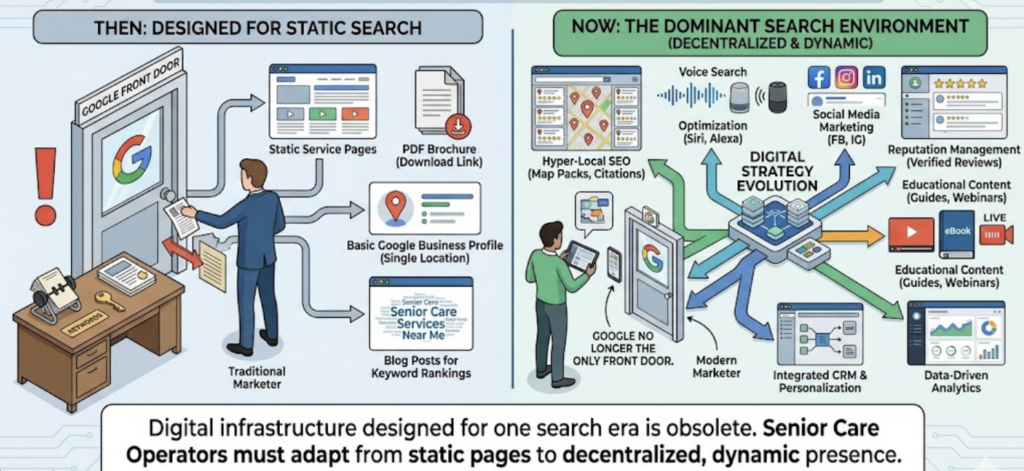
AI search engines need different signals. They parse structured data, evaluate content depth, check for third-party citations, and assess whether AI crawlers (GPTBot, ClaudeBot, PerplexityBot) can even access your site. Many senior care websites block these crawlers entirely through outdated robots.txt configurations, making the brand completely invisible to AI platforms.
The technical checklist for AI readiness looks different from traditional SEO:
| AI Readiness Signal | What Most Senior Care Sites Have | What AI Search Requires |
|---|---|---|
| Content structure | Service pages with marketing copy | FAQ-rich, conversational content AI can extract and cite |
| Structured data | Basic or none | Schema markup for healthcare providers, services, pricing |
| AI crawler access | Often blocked by default | Explicit GPTBot, ClaudeBot, PerplexityBot access in robots.txt |
| Third-party signals | A few Google reviews | Citations across medical directories, media, review platforms |
| Content freshness | Updated annually or less | Regular updates reflecting current services, staff, pricing |
This isn’t about rebuilding your website from scratch. It’s about auditing the specific gaps that keep AI from recognizing your brand. And that audit starts with measuring where you stand today.
One Authority Score Is a Snapshot. Tracking It Is the Strategy.
Your Brand Authority Checker results show you where AI positions your senior care brand right now. But AI models update their training data, adjust ranking signals, and shift recommendations on a rolling basis. A Recognition score of 65 today could drop to 40 next quarter if a competitor publishes better-structured content or earns a major media citation.
Topify‘s platform picks up where the free tool leaves off. The Comprehensive GEO Analytics dashboard tracks your authority, sentiment, and visibility scores continuously across ChatGPT, Perplexity, Gemini, and Google AI Overviews. You’ll see trend lines, get alerts when scores shift, and receive specific recommendations for what to fix.
Here’s how the free check compares to the full platform:
| Capability | Free Brand Authority Checker | Topify Platform |
|---|---|---|
| Check frequency | One-time snapshot | Continuous daily/weekly monitoring |
| AI platforms covered | Aggregated score | Per-platform breakdown (ChatGPT, Perplexity, Gemini, AI Overviews) |
| Historical trends | None | Full trend history with alerts |
| Competitor tracking | Not included | Real-time competitor benchmarking |
| Action recommendations | General | Specific, one-click GEO optimization |
| Team collaboration | No | Unlimited team member seats |
Every plan starts with a 7-day free trial, no credit card required. The Starter plan begins at $99/month.
Conclusion
Senior care is one of the highest-trust decisions a family can make, and AI is now a gatekeeper in that process. If AI doesn’t recognize your brand as authoritative, families won’t find you during the research phase that determines their shortlist.
Start with a single check. Run your brand through the Brand Authority Checker, see your four authority scores, and identify the specific gaps between your care quality and AI’s perception. From there, build a structured plan to close those gaps, or let Topify’s platform track and optimize your AI visibility continuously.
Other Free Tools to Round Out Your AI Visibility Audit
While you’re assessing your brand authority, a few other free checks can fill in the picture. Topify‘s GEO Score Checkerevaluates whether your site’s technical setup (structured data, AI crawler access, content signals) supports AI visibility. The AI Visibility Report shows how often your brand gets mentioned across major AI platforms and where you rank. And the Knowledge Freshness Checker flags whether AI models are working with outdated information about your services or pricing.
FAQ
Is the Brand Authority Checker free? Do I need to create an account?
Yes, it’s completely free. No account, no signup, no credit card. Enter your brand name or domain and get your authority scores in under 60 seconds.
What’s the difference between the free tool and Topify’s paid platform?
The free Brand Authority Checker gives you a one-time snapshot of your four authority scores. Topify’s platform provides continuous monitoring across all major AI platforms, historical trend tracking, competitor benchmarking, and actionable optimization recommendations. Plans start at $99/month with a 7-day free trial.
How often should senior care brands check their AI visibility?
AI models update their knowledge and ranking signals regularly. A quarterly check with the free tool is a reasonable minimum. For brands actively optimizing their AI presence, weekly or daily monitoring through a dedicated platform gives you the data to spot drops early and respond before you lose visibility.
Can a small, single-location senior care community compete with large chains in AI search?
Yes. AI doesn’t rank by company size. It ranks by authority signals: structured content, third-party citations, review quality, and content freshness. A single-location community with strong local media coverage, detailed service pages, and consistent reviews can outrank a national chain that relies on generic corporate content.
Leave a Reply