You can see every keyword ranking shift, every backlink gained, every SERP position change. But ask a simple question: which domains did ChatGPT cite the last time someone searched for your product category? Most SEO dashboards return nothing.
That’s because traditional analytics weren’t designed to track what AI models choose to reference. And the gap between what you can measure in Google and what you can’t measure in LLM responses is where competitors are quietly gaining ground.
What an LLM Citation Tracking Dashboard Actually Measures
An LLM citation tracking dashboard is an analytics interface that systematically queries AI platforms to log whether, how, and where a domain or brand is cited in AI-generated responses. Think of it as the SEO dashboard equivalent for the AI search layer.
But the terminology gets muddled fast, so here’s what each layer actually tracks:
| Tracking Type | What It Monitors | Example |
|---|---|---|
| Citation Tracking | Specific URLs or domains an AI engine cites as sources to verify its response | Perplexity links to your blog post as a footnote |
| Visibility (Mention) Tracking | Whether the LLM references your brand name in the response text, even without a hyperlink | ChatGPT says “brands like [yours] offer this feature” |
| Backlink Tracking | External sites linking to your domain (traditional SEO) | Ahrefs shows a new link from TechCrunch |
The distinction matters more than most teams realize. An LLM can pull data from your content without ever naming your brand. Industry researchers call these “Ghost Citations,” where your domain supports a competitor’s narrative because the AI used your data in retrieval but credited someone else in the response text.
A proper LLM citation tracking dashboard captures all three layers. If yours only shows brand mentions, you’re missing the citation and backlink context. If it only shows backlinks, you’re blind to how AI models actually use your content.
Why Traditional SEO Dashboards Can’t Track LLM Citations
Google Search Console, Ahrefs, and SEMrush are built for index-based search. They measure link equity, domain authority, and keyword rankings against relatively stable SERPs. None of that translates to how LLMs select sources.
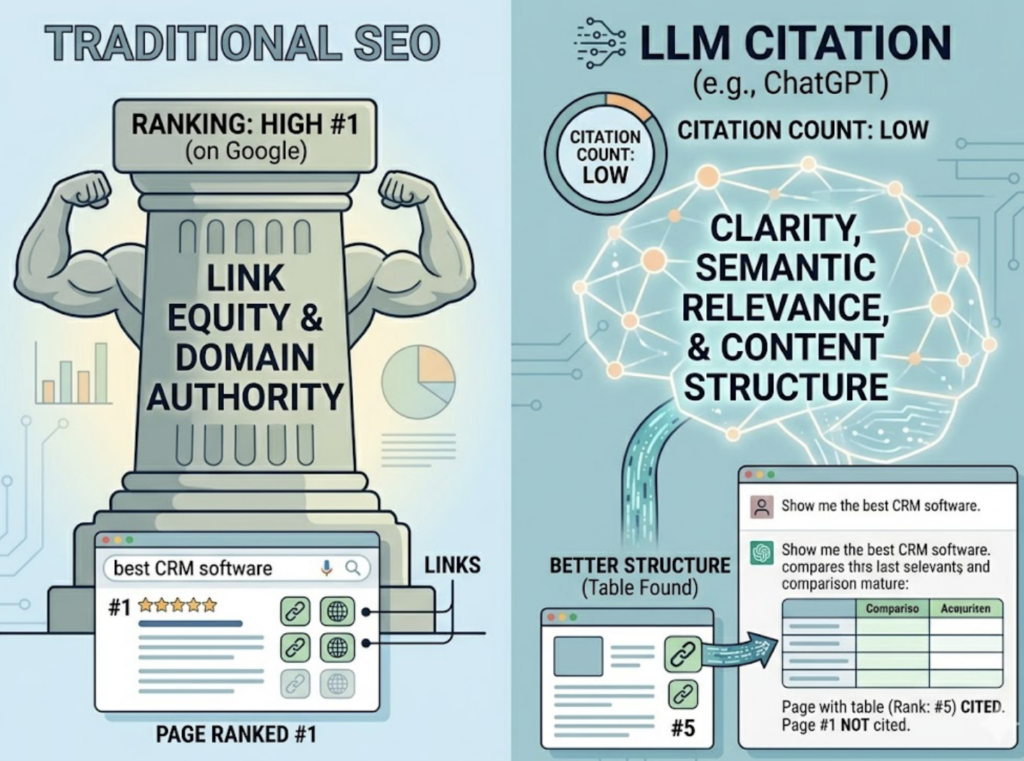
Here’s the core disconnect: traditional SEO prioritizes link equity and domain authority. LLMs prioritize clarity, semantic relevance, and content structure for the specific prompt. A page ranking #1 on Google for “best CRM software” might not get cited once in ChatGPT’s answer to the same question, because the AI found a better-structured comparison table on a lower-ranking page.
There’s also a fundamental architectural difference. LLM outputs are stochastic. They’re generated dynamically and can vary by user, context, and even time of day. Traditional tools assume a SERP is a fixed entity you can snapshot. AI responses aren’t fixed. They shift every time the model updates, the knowledge base refreshes, or the retrieval pipeline re-indexes.
That’s why a dedicated LLM citation tracking dashboard isn’t a “nice to have” layered onto your existing SEO stack. It’s a parallel measurement system for a parallel search channel, and real-time ChatGPT tracking software is the engine that powers it.
5 Metrics Your LLM Citation Tracking Dashboard Should Show
Not all dashboards measure the same things. Here are the five KPIs that separate a useful dashboard from a vanity metrics display:
| Metric | What It Tells You | Why It Matters |
|---|---|---|
| Citation Share | Your domain’s citation frequency vs. competitors for target prompts | Measures your market dominance in AI search results |
| Source Distribution | Breakdown of all domains the AI cites in your category | Reveals which publishers the AI “trusts” most |
| Citation Position | Whether your citation appears in the first, middle, or footer section of the response | Higher position correlates with higher user click-through |
| Citation Trend | Change in citation frequency over weeks and months | Detects whether content updates are actually driving visibility gains |
| Cross-Platform Consistency | How your citation performance compares across ChatGPT, Gemini, and Perplexity | Identifies platform-specific indexing gaps you’d otherwise miss |
Citation Share is typically the headline number. But Source Distribution often delivers more actionable insight. If you can see which domains are consistently cited instead of yours, you’ve got a hit list of content gaps to close.
Cross-Platform Consistency is the metric most teams skip, and it’s the one that catches the most surprises. A brand cited frequently by Perplexity (which leans on real-time retrieval) might be completely absent from ChatGPT’s responses (which rely more on parametric memory). One platform’s “win” doesn’t transfer automatically.
How Real-Time ChatGPT Tracking Software Fits into the Dashboard
“Real-time” in the LLM citation context doesn’t mean millisecond updates. It means high-frequency periodic sampling, where the system queries AI platforms on a recurring schedule and flags changes between snapshots. That’s the realistic standard, because LLM responses are generated on demand, not stored as static pages.
Why does sampling frequency matter? LLM citation patterns shift when models update, when knowledge bases refresh, and when retrieval pipelines re-index new content. A dashboard that checks once a month will miss these shifts entirely. A dashboard with weekly or more frequent sampling catches the volatility and lets you trace cause and effect: “We published a new FAQ page on Tuesday, and ChatGPT started citing it by Thursday.”
The data fragmentation problem makes this harder. ChatGPT, Perplexity, Gemini, and DeepSeek each use different RAG architectures. A cohesive dashboard needs to normalize data across all of them into a single view. Otherwise, you’re toggling between tabs and trying to mentally reconcile inconsistent data.
Topify is built around this exact problem. It tracks brand visibility and citations across ChatGPT, Gemini, Perplexity, DeepSeek, and other major AI platforms from a single dashboard. Its Source Analysis feature reverse-engineers which domains and URLs each AI platform cites, so you can see exactly where your content is being used as a source and where competitors are getting the nod instead. The platform also layers in Sentiment, Position, and Volume data, which means you’re not just seeing citations in isolation. You’re seeing them in the context of how AI talks about your brand.
4 Mistakes Teams Make with LLM Citation Dashboards
Having a dashboard doesn’t mean you’re using it well. These are the patterns that undermine most implementations:
Mistake 1: Ignoring the mention layer. Some teams focus exclusively on citation links and miss whether the AI actually identifies their brand in the response text. A “Ghost Citation” situation, where your content gets used but your brand doesn’t get named, is only visible if you’re tracking both layers simultaneously.
Mistake 2: Single-engine blindness. Relying on one AI model’s output creates a false sense of confidence. Perplexity, which is research-oriented, behaves very differently from ChatGPT, which is conversational. Citation patterns vary significantly across platforms, and a win on one doesn’t guarantee visibility on another.
Mistake 3: No action workflow. The dashboard shows your Citation Share dropped 15% last month. Then what? Without a defined process for turning data into content strategy, like updating pages based on Source Gap analysis or restructuring content to match AI-preferred formats, the dashboard becomes a passive reporting tool.
Mistake 4: Static monitoring. Running a baseline audit once and never refreshing it means your data becomes stale after every model update or knowledge base refresh. LLM citation tracking is a continuous process, not a quarterly check-in.
A Practical Strategy for Building Your Citation Tracking Workflow
Here’s a four-step workflow that turns dashboard data into measurable optimization:
Step 1: Define your prompt clusters. Start by identifying 20 to 50 high-intent prompts your target audience is likely asking AI, like “best [product] for [industry]” or “how to choose [category].” These are your monitoring targets, and they should map directly to your core business categories.
Step 2: Establish your baseline. Run initial queries across all tracked platforms to benchmark your current Citation Share, Source Distribution, and Citation Position. This first snapshot is what every future improvement gets measured against.
Step 3: Run a Source Gap analysis. Look at which domains are consistently cited instead of yours. These are your “outrankable” competitors, domains where better-structured content (FAQ blocks, comparison tables, expert quotes) could shift the AI’s citation preference toward your pages.
Step 4: Optimize and monitor continuously. Adjust page structure based on dashboard insights, then watch for Citation Trend improvements. The cycle repeats: publish, monitor, identify gaps, optimize.
Topify’s High-Value Prompt Discovery feature handles Step 1 automatically, surfacing the prompts that matter most to your brand as AI recommendations evolve. Its competitor benchmarking tools cover Step 3, showing exactly who’s being cited in your place and why.
What LLM Citation Tracking Dashboards Cost in 2026
Pricing in this category typically follows a tiered model based on prompt volume, platform coverage, and reporting depth:
| Tier | Typical Price | What You Get |
|---|---|---|
| Basic | ~$99/mo | Limited prompt tracking, often single-engine support, basic citation metrics |
| Pro | ~$199/mo | Multi-platform tracking, competitive benchmarking, trend analysis |
| Enterprise | $499+/mo | API access, custom entity tracking, advanced reporting, dedicated support |
Topify’s pricing follows this structure: the Basic plan at $99/mo includes ChatGPT, Perplexity, and AI Overviews tracking with 100 prompts and 9,000 AI answer analyses. The Pro plan at $199/mo expands to 250 prompts, 22,500 analyses, and more seats. Enterprise plans start at $499/mo with dedicated account management. Full details are on the Topify pricing page.
The pricing question most teams should ask isn’t “what does the tool cost?” but “what’s the cost of not knowing which content AI is citing instead of ours?” For context, a single high-intent prompt in a competitive SaaS category can drive thousands of AI-assisted research sessions per month. If a competitor’s content is being cited there and yours isn’t, that’s a visibility gap with real revenue implications.
Conclusion
The teams that build a systematic LLM citation tracking workflow now are the ones that’ll own the AI search layer in their category 12 months from now. The shift from “we rank well on Google” to “we know exactly what AI cites, where, and why” is the same kind of measurement leap that happened when teams went from guessing about SEO to using analytics dashboards a decade ago.
Start with your core prompts. Build a baseline. Watch the trends. And make sure you’re not just counting mentions. Track the citations.
FAQ
Q: What is an LLM citation tracking dashboard?
A: It’s an analytics platform that monitors which domains and URLs AI models like ChatGPT, Perplexity, and Gemini cite as sources in their responses. Unlike traditional SEO tools that track Google rankings, an LLM citation tracking dashboard shows you how AI systems reference your content when answering user prompts.
Q: How does an LLM citation tracking dashboard work?
A: The dashboard systematically queries AI platforms using predefined prompts, then logs which sources the AI cites in each response. It samples these responses on a recurring schedule (weekly or more frequently) to track changes over time, normalize data across multiple AI engines, and surface trends in citation patterns.
Q: What’s the difference between citation tracking and AI visibility tracking?
A: Citation tracking monitors the specific URLs or domains an AI engine references as sources. AI visibility tracking is broader, measuring whether your brand is mentioned by name in the response text, regardless of whether a source link is provided. Both layers matter. A “Ghost Citation” happens when your content is used as a source but your brand isn’t named.
Q: How much does an LLM citation tracking dashboard cost?
A: In 2026, pricing typically ranges from around $99/mo for basic single-engine tracking to $499+/mo for enterprise-grade platforms with API access and custom reporting. Mid-tier plans at around $199/mo generally offer multi-platform coverage and competitive benchmarking, which is the minimum most marketing teams need for actionable data.
Leave a Reply