You’re spending $3,500 a month on SEO. Your rankings are stable. Your backlink profile is growing. But when a prospect asks ChatGPT, “What’s the best platform for [your category]?” your brand doesn’t appear in the answer.
That’s not a ranking problem. It’s a visibility gap that traditional SEO was never designed to close, and it’s widening every quarter. The question isn’t whether generative engine optimization deserves a line in your budget. It’s how much that line should be, and what you’re actually paying for.
Your SEO Spend Doesn’t Cover Where Buyers Are Looking Now
The median monthly retainer for traditional SEO services in 2026 sits at $3,500. For mid-market brands, that number often lands between $3,000 and $7,500. Enterprise programs can run $10,000 to $50,000 or more.
That investment buys you keyword rankings, backlink growth, technical audits, and content clusters. All still valuable. But here’s what it doesn’t buy: any insight into whether AI search engines are mentioning your brand at all.
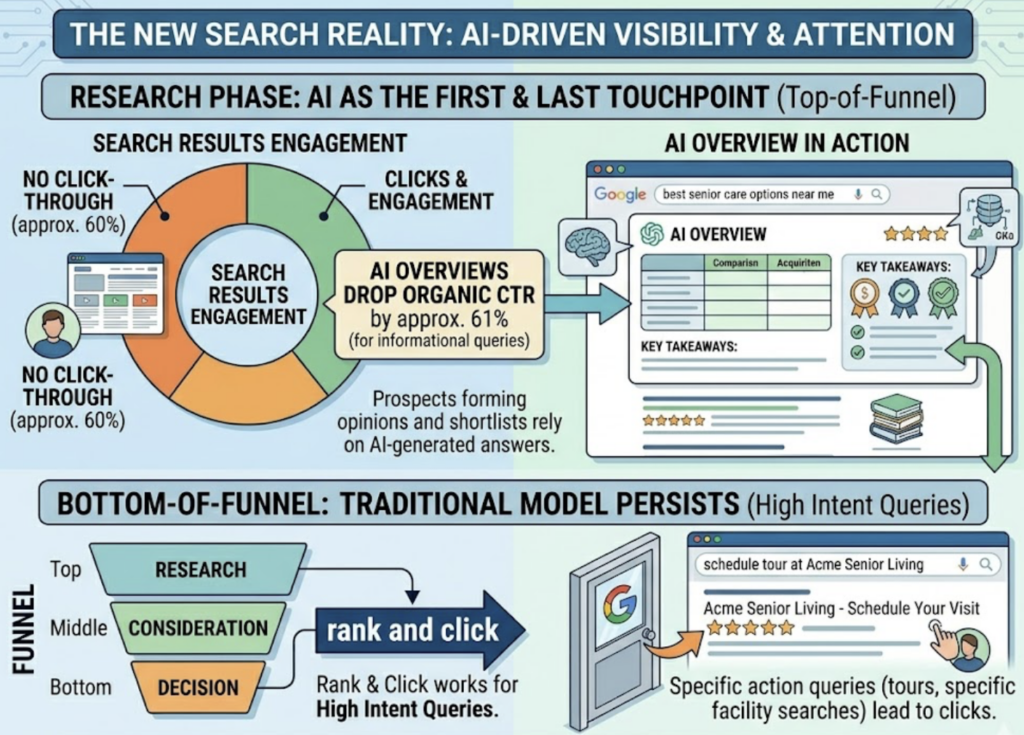
About 60% of searches now end without the user clicking a single link. When AI Overviews appear on a Google results page, organic CTR for informational queries drops by roughly 61%. The traditional “rank and click” model still works for bottom-of-funnel, high-intent queries. For the research phase, where prospects are forming opinions and shortlists, AI-generated answers are increasingly the first (and sometimes only) touchpoint.
Traditional SEO tools measure rankings, CTR, and domain authority. They weren’t built to tell you whether Perplexity cited your competitor’s whitepaper instead of yours, or whether ChatGPT describes your product accurately. That blind spot has a cost, even if it doesn’t show up in your current analytics dashboard.
What Generative Engine Optimization Actually Costs
GEO pricing hasn’t standardized the way SEO pricing has over two decades. But the market is settling into two clear categories.
Agency Services
Professional GEO agencies typically charge $2,000 to $10,000 per month for mid-market brands. Project-based work, like an AI visibility audit, runs $2,000 to $8,000. More complex engagements, such as restructuring content for LLM readability, can reach $8,000 to $15,000.
These numbers sound comparable to traditional SEO retainers. The difference is scope. A GEO agency focuses on how AI models interpret, summarize, and cite your brand, not on keyword rankings or link building.
AI Visibility Platforms
The more cost-efficient path for most teams is a dedicated AI search optimization platform. Entry-level plans typically start at $99 per month. Growth and advanced tiers range from $250 to $900+ per month, covering competitive tracking, entity mapping, and automated citation monitoring.
Topify, for example, starts at $99/mo for its Basic plan (100 prompts, 9,000 AI answer analyses across ChatGPT, Perplexity, and AI Overviews). The Pro tier at $199/mo scales to 250 prompts and 22,500 analyses. Enterprise plans start at $499/mo with custom configurations.
That’s a fraction of what most brands spend on traditional SEO tooling alone, before agency fees even enter the picture.
The Pricing Comparison: GEO vs SEO Side by Side
Numbers tell the story faster than paragraphs. Here’s how the two stack up across the cost dimensions that actually matter:
| Cost Dimension | Traditional SEO | Generative Engine Optimization |
|---|---|---|
| Monthly Platform/Tools | $100 – $500 (Ahrefs, Semrush, etc.) | $99 – $900+ (AI visibility platforms) |
| Agency Retainer | $3,000 – $50,000+ | $2,000 – $10,000 |
| Content Production | $2,000 – $10,000/mo (blog, landing pages) | $1,000 – $5,000/mo (entity-optimized content) |
| Team Hours/Month | 20 – 80 hrs (strategist + writer + dev) | 10 – 30 hrs (analyst + content strategist) |
| Time to Measurable ROI | 4 – 12 months | 2 – 6 months |
| Coverage | Google organic rankings | ChatGPT, Gemini, Perplexity, AI Overviews |
One pattern stands out. Traditional SEO requires a heavier team investment because the workflow is manual: keyword research, content briefs, writing, publishing, link outreach, technical fixes, repeat. GEO platforms compress much of that cycle by automating prompt discovery, citation tracking, and competitive benchmarking.
The hidden cost in traditional SEO is tool sprawl. Most teams run three to five separate subscriptions (rank tracker, backlink monitor, technical crawler, content optimizer, analytics). A dedicated AI visibility platform like Topify consolidates AI search analytics into a single dashboard with seven core metrics: visibility, sentiment, position, volume, mentions, intent, and CVR.
AI Search Visibility: The Metric Your SEO Dashboard Can’t Show You
Domain authority is 70. Keyword rankings are solid. But neither metric answers the question your CMO is about to ask: “Are we showing up when someone asks ChatGPT about our category?”
Traditional SEO metrics were built for a ranked-list paradigm. AI search doesn’t work that way. There’s no position #1 in a ChatGPT response. There’s “mentioned,” “cited,” “described accurately,” or “not there at all.”
AI Overviews now trigger on roughly 25% of all Google searches, up from 13% in early 2025. That growth rate means the share of queries influenced by generative engines is approaching 25 to 40% across platforms. Tracking performance in this environment requires a fundamentally different set of AI search analytics:
AI Answer Presence Rate: the percentage of target prompts where your brand gets mentioned. Citation Rate: how often AI responses link back to your content. Sentiment Score: whether the AI describes your brand the way you’d want it to. Narrative Alignment: whether AI-generated descriptions match your actual positioning, pricing, and differentiators.
Topify’s AI search intelligence platform tracks all of these across ChatGPT, Gemini, Perplexity, DeepSeek, and other major AI engines. Its Reverse-Engineer AI Citations feature shows the exact domains and URLs that AI platforms reference, so you can see whether your content or your competitor’s content is driving the narrative.
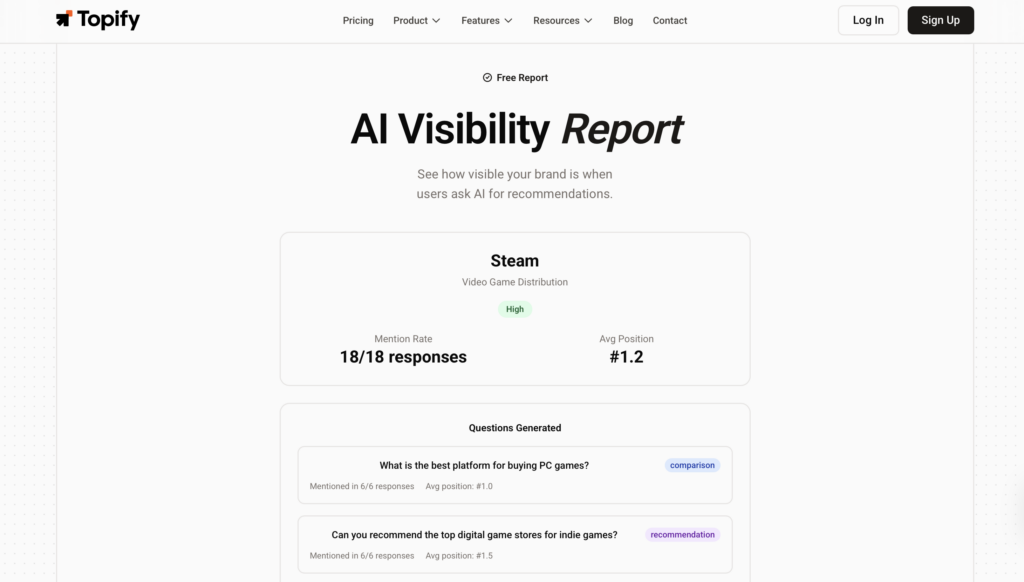
That’s the gap most traditional SEO dashboards still can’t see.
When to Invest in GEO vs Double Down on Traditional SEO
This isn’t an either/or decision. The question is ratio, and the right ratio depends on where your brand sits.
Scenario A: 70% SEO, 30% GEO. Best for early-stage companies that still need direct-intent traffic and domain authority. SEO builds the foundation. A smaller GEO allocation establishes baseline entity presence in AI models so you’re not invisible when prospects start researching.
Scenario B: 50% SEO, 50% GEO. Best for growth-stage SaaS and B2B brands where the research phase increasingly happens inside AI interfaces. You maintain existing organic traffic while actively securing cited positions in AI summaries. This is where most mid-market teams should be heading in 2026.
Scenario C: 30% SEO, 70% GEO. Best for mature brands in competitive informational niches: finance, legal, software, healthcare. Direct clicks are becoming scarce in these categories. Protecting brand sentiment and “source of truth” status in AI models is the priority.
73% of SEO agencies now include some form of AI-assisted deliverables in their standard packages. But “some form” often means surface-level. A dedicated AI visibility platform provides the depth of tracking and execution that bundled add-ons typically lack.
How to Start Generative Engine Optimization Without Overspending
You don’t need a $10,000/month agency contract to get started. Here’s a practical path.
Step 1: Assess your current AI visibility for free. Topify offers a free GEO score check that doesn’t require signup. It tells you where your brand stands across major AI platforms in under three minutes. You can also explore a set of free AI visibility tools to get a baseline reading before committing any budget.
Step 2: Start with a platform, not an agency. At $99/mo, Topify’s Basic plan gives you 100 tracked prompts, 9,000 AI answer analyses, competitor detection, and coverage across ChatGPT, Perplexity, and Google AI Overviews. That’s enough data to identify your biggest AI search gaps and prioritize action.
Step 3: Let the data decide your next move. If the platform shows your brand is well-cited and accurately described, your GEO investment can stay lean. If it reveals blind spots, misaligned narratives, or competitors dominating AI recommendations in your category, that’s your signal to scale up, whether through Topify’s Pro plan, its one-click AI agent execution, or a dedicated GEO service engagement.
The bottom line: start with data, not assumptions. The brands that overspend on GEO are the ones that skip the assessment phase. The brands that underspend are the ones that never look.
Conclusion
Traditional SEO isn’t going anywhere. It still drives direct-intent traffic, builds domain authority, and supports conversion-focused content. But it was built for a world where search meant “ten blue links,” and that world now accounts for a shrinking share of how buyers discover and evaluate brands.
Generative engine optimization fills the layer that traditional SEO can’t reach: AI-generated answers, citations, sentiment, and brand narratives across ChatGPT, Gemini, Perplexity, and the growing list of AI search platforms. The pricing gap between the two is narrower than most teams assume, and the cost of ignoring AI search visibility compounds with every quarter.
Start with a free assessment. Let the data show you where the gaps are. Then allocate accordingly.
FAQ
Q: Is generative engine optimization more expensive than traditional SEO? A: Not necessarily. GEO platform pricing starts at $99/mo, while traditional SEO retainers average $3,500/mo. Agency-led GEO services range from $2,000 to $10,000/mo, which overlaps with mid-market SEO budgets. The real cost difference is in what each covers: SEO tracks rankings and clicks, while GEO tracks AI mentions, citations, and brand sentiment.
Q: Can I do generative engine optimization without replacing my SEO strategy? A: Yes, and you should. GEO and SEO are complementary. Most 2026 strategists recommend allocating 30 to 70% of your search budget to GEO depending on your brand maturity, with the remainder going to traditional SEO. The two share a common goal (visibility) but operate on different surfaces.
Q: What’s the minimum budget for AI search optimization? A: You can start for free with tools like Topify’s GEO score check. For ongoing tracking and optimization, entry-level AI visibility platforms start at $99/mo. A realistic minimum for a brand that wants continuous AI search analytics and basic optimization is $100 to $300/mo in tooling, plus 5 to 10 hours of team time per month.
Q: How long before generative engine optimization shows ROI? A: Most brands see measurable changes in AI search visibility within 2 to 6 months. That’s faster than traditional SEO (typically 4 to 12 months) because AI models update their citation patterns more frequently than Google updates its organic rankings. The key is tracking the right metrics from day one: AI answer presence rate, citation share, and sentiment score.
Leave a Reply