You’ve got your LLM citation tracking tool set up. You know ChatGPT mentioned your brand four times last week. Perplexity cited a competitor’s page instead of yours for three high-value prompts. The numbers are there, sitting in a spreadsheet or a dashboard tab you check every Monday.
But here’s the part most teams skip: what do those numbers actually tell you? Knowing you were cited isn’t the same as understanding why, where the citation came from, or what to change in your content so it happens more often. That gap between raw citation data and strategic action is exactly where LLM citation tracking analytics lives.
Most Brands Track LLM Citations. Few Know What the Data Means.
There’s a fundamental misunderstanding in how most marketing teams approach LLM citation tracking. They treat it as a utility: set up the tracker, count the mentions, report the number. That’s tracking. It’s necessary, but it’s not analytics.
Analytics requires context. It means answering questions like: which specific URLs did the AI pull into its context window to generate that citation? Is your citation volume trending up or decaying over a rolling 30-day window? And why does the LLM cite a competitor for “Query A” but skip your domain entirely, even though your content covers the same topic?
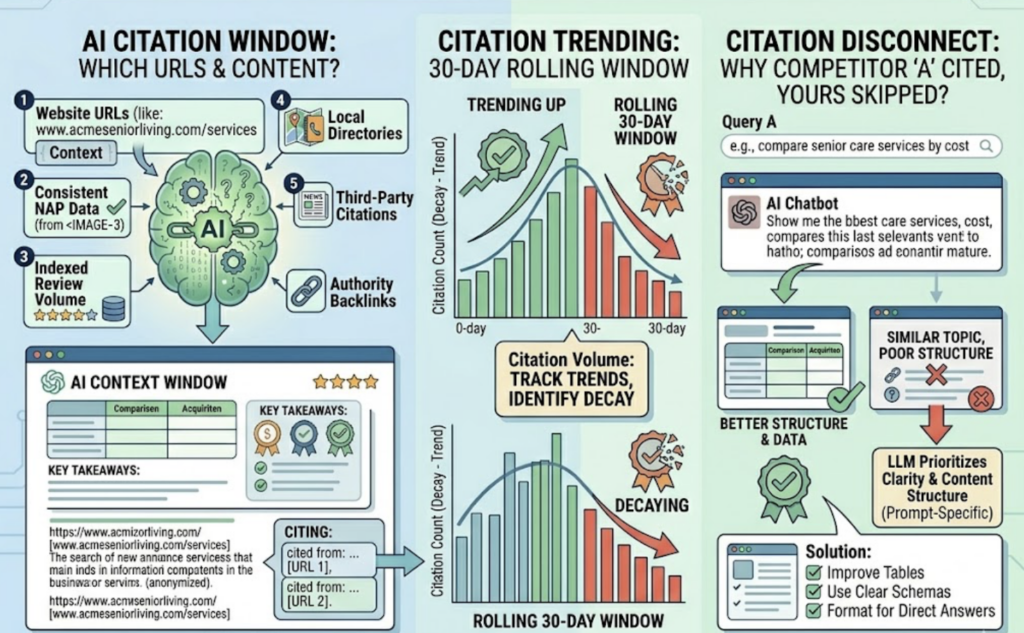
Tracking tells you “we were cited.” LLM citation tracking analytics tells you “we need to restructure our technical content to capture more citations next month.” One is observation. The other is optimization.
What LLM Citation Tracking Analytics Actually Measures
Not all citation data carries the same weight. To move past vanity metrics, it helps to organize LLM citation tracking analytics into five core dimensions, each tied to a specific strategic purpose.
| Dimension | What It Tracks | Why It Matters |
|---|---|---|
| Citation Frequency and Trend | Volume over time, per prompt | Identifies seasonality, topical decay, and growth patterns |
| Source Attribution | The domain and page origin of each citation | Reveals which content types and formats LLMs prefer to pull from |
| Position and Context | Where the citation appears in the AI response | Measures AI trust level: first mention vs. footnote |
| Competitive Citation Share | Head-to-head citation frequency against rivals | Benchmarks your domain authority within AI answers |
| Sentiment Within Citations | Tone and framing of the attributed content | Ensures brand alignment: are you cited as a primary solution or a neutral alternative? |
The first two dimensions, frequency and source attribution, tend to get the most attention from LLM citation tracking software providers. They’re the easiest to measure. But the last three, position, competitive share, and sentiment, are where the real strategic value sits. They tell you not just if you’re cited, but how you’re perceived.
AI Trackers vs Traditional Tracking Tools: Where the Gap Is
If you’re coming from a traditional SEO background, you might assume your existing analytics stack already covers LLM citations. It doesn’t.
Traditional SEO tools like Ahrefs and SEMrush were built for a link-based web. They track backlinks, keyword rankings, SERP positions, and organic traffic. Their goal is click-through rate optimization. LLM citation tracking analytics, on the other hand, is built for a knowledge-based web. It tracks how AI models retrieve, attribute, and present information from your domain inside their generated answers.
Here’s the comparison in practice:
| Feature | Traditional SEO Tools | LLM Citation Tracking Platform |
|---|---|---|
| Primary Metric | Backlinks, keyword ranking, organic traffic | Citation frequency, source attribution, AI trust |
| Data Source | SERP snapshots, crawl data | LLM inference outputs, prompt-based analysis |
| Goal | Drive clicks to your website | Build brand visibility and authority inside AI responses |
| Actionability | Optimize meta tags, build links, fix technical SEO | Refine content structure, optimize for RAG retrieval |
These two toolsets aren’t mutually exclusive. Traditional SEO optimizes for the ten blue links. LLM citation tracking analytics optimizes for the answer engine experience. But running only the first one means you’re blind to a growing share of how users discover brands.
The difference matters most when you realize that a page ranking #1 on Google might not appear in a single AI-generated answer. And a page with moderate SEO authority might dominate LLM citations because its structure aligns with how retrieval-augmented generation systems pull data.
5 LLM Citation Tracking Metrics That Drive Content Decisions
Having the right LLM citation tracking system in place is step one. Knowing which metrics to prioritize is step two. Here are five that consistently translate into content strategy decisions.
1. Citation Volume by Platform
If ChatGPT cites your brand consistently but Perplexity doesn’t, the issue often isn’t content quality. It’s format. Different AI platforms use different retrieval-augmented generation architectures, and what works for one may not surface in another. Tracking citation volume per platform tells you where to adjust.
2. Source Domain Concentration
High concentration, where one page receives most of your citations, signals a “hero page” strategy. That’s fine until that page goes stale. Low concentration suggests your site-wide authority is fragmented. Neither extreme is ideal; the metric helps you spot the imbalance.
3. Citation Trend Velocity
A sudden drop in citation velocity for a high-value prompt is an early warning. It typically means your content is becoming obsolete relative to fresher sources, or a competitor published something more structured. Catching this in week one, rather than month three, changes the response time entirely.
4. Competitive Citation Gap
The delta between your citation count and your top competitor’s count for shared prompts determines your AI Share of Voice. This metric is the LLM equivalent of SERP market share, and it’s the single most useful number for prioritizing which prompts to optimize first.
5. Sentiment Shift
This one’s often overlooked. An LLM might cite your brand frequently but frame it as a “budget option” when your positioning is premium. Sentiment tracking within citations catches these narrative misalignments before they compound across millions of AI interactions.
What a Full LLM Citation Tracking Dashboard Looks Like
Individual metrics are useful. A unified LLM citation tracking dashboard is where they become a workflow.
Topify offers one of the more complete implementations of this concept. Its platform combines visibility tracking, source analysis, sentiment scoring, position monitoring, and competitor benchmarking into a single interface, covering AI models including ChatGPT, Gemini, Perplexity, DeepSeek, and others.
Here’s what a typical workflow looks like for a content marketing manager using an LLM citation tracking solution like Topify:
Visibility check. Open the dashboard and see citation frequency across multiple AI platforms in one view. No switching between tabs or tools.
Reverse-engineer the citation. Drill into a specific prompt and identify the exact URLs the AI retrieved to build its answer. Topify’s Source Analysis feature maps citations back to specific domains and pages at scale.
Spot the content gap. Compare your cited pages against competitors’. If a rival’s page is getting cited because it includes structured data or fact-dense snippets that yours lacks, you now know what to fix.
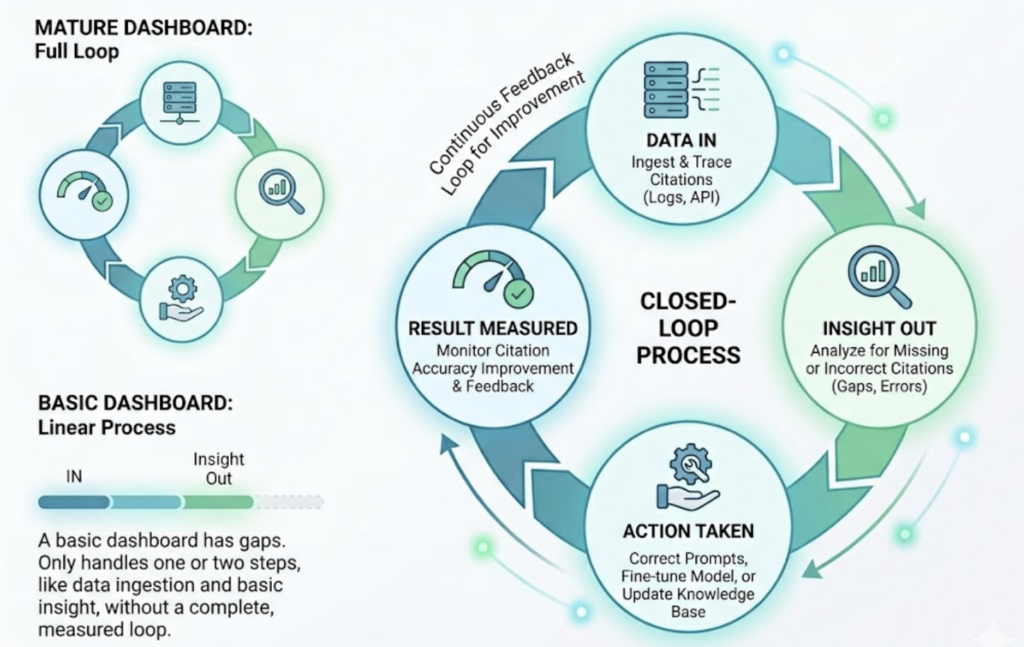
Act and measure. Deploy updated content, then track whether citation share shifts in the following weeks. Topify’s prompt-level tracking makes this feedback loop tight enough to iterate on a bi-weekly cadence.
What separates a mature LLM citation tracking dashboard from a basic one is this closed loop. Data in, insight out, action taken, result measured. Most LLM citation tracking tools handle the first step. Fewer handle all four.
How to Get Started with LLM Citation Tracking Analytics
You don’t need to overhaul your entire analytics stack on day one. Here’s a practical starting sequence.
Start with a prompt inventory. Identify 10 to 20 high-value queries that directly relate to your core offerings. These are the prompts where a citation, or lack of one, has real business impact.
Establish a baseline. Use an LLM citation tracking platform like Topify to record your current citation rates for these prompts across ChatGPT, Perplexity, Gemini, and other platforms your audience uses. Without a baseline, you can’t measure improvement.
Set a review cadence. Bi-weekly works for most teams. The key is looking for volatility in citation volume, not just static snapshots. A prompt that cited you consistently for three weeks and then stopped is more actionable than one that never cited you at all.
Iterate based on source data. Use Source Attribution analytics to identify which of your pages are “AI-friendly,” meaning they get cited repeatedly. Study their formatting, structure, and data density. Then apply those patterns to underperforming content.
Integrate with your existing SEO workflow. LLM citation tracking analytics doesn’t replace your Google Search Console or Ahrefs setup. It adds a layer. The brands that move fastest are the ones treating AI citation data as a parallel input to their content calendar, not a separate initiative.
Conclusion
The difference between brands that track LLM citations and brands that analyze them is the difference between having data and making decisions. Citation tracking tells you what happened. Citation analytics tells you what to do next.
If you’re already tracking whether AI platforms mention your brand, you’ve cleared the first hurdle. The next step is building an analytics layer that connects citation patterns to content strategy: which pages to update, which prompts to prioritize, and where your competitors are gaining citation share.
Start with 10 high-value prompts. Baseline your citation data. Review it every two weeks. That’s enough to shift from reactive monitoring to proactive optimization.
FAQ
Q: What’s the difference between LLM citation tracking and LLM citation tracking analytics?
A: LLM citation tracking records whether and how often AI platforms cite your brand or content. LLM citation tracking analytics goes deeper: it examines the source attribution, trend velocity, competitive share, and sentiment of those citations to produce actionable insights for content strategy. Tracking is the data layer. Analytics is the intelligence layer.
Q: Which LLM citation tracking software covers the most AI platforms?
A: Coverage varies significantly. Some tools only monitor ChatGPT. Topify currently tracks citations across ChatGPT, Gemini, Perplexity, DeepSeek, Doubao, Qwen, and other major AI platforms, which makes it one of the broader options for teams that need multi-platform visibility.
Q: How often should I review LLM citation tracking analytics data?
A: Bi-weekly reviews tend to be the most practical cadence for most marketing teams. AI citation patterns can shift within days when a competitor publishes new content or an AI model updates its retrieval behavior, so monthly reviews often miss critical volatility windows.
Q: Can LLM citation tracking analytics replace traditional SEO analytics?
A: No. They serve different purposes. Traditional SEO analytics optimizes for search engine rankings and organic traffic. LLM citation tracking analytics optimizes for brand visibility inside AI-generated answers. The most effective approach treats them as complementary data streams feeding the same content strategy.
Leave a Reply