
You can see your Google rankings. You can count your backlinks. But can you tell which domains ChatGPT or Perplexity actually cited the last time someone asked about your product category? For most SEO teams, that answer is no. Traditional tools like Ahrefs and SEMrush track links built through editorial processes, not the dynamic source selection that LLMs perform in real time. And that gap is widening fast: Perplexity alone references an average of 5 to 8 sources per query, meaning if your domain isn’t in that shortlist, you’re invisible in the fastest-growing search channel.
That’s the layer LLM citation tracking trackers are built to cover.
What an LLM Citation Tracking Tracker Actually Measures
First, a distinction that trips up most teams: visibility tracking and citation tracking aren’t the same thing.
Visibility tracking monitors whether AI mentions your brand name or keywords in its response. Citation tracking goes a level deeper. It monitors whether the AI creates a functional link or explicit source reference, a URL or domain, pointing back to your content. AI can mention you without citing you, and only the latter drives referral traffic.
Here’s the thing. Traditional SEO tools were built for a world where humans decide which pages to link to. LLMs don’t follow that logic. They select sources based on training data, retrieval-augmented generation (RAG) pipelines, and real-time search integrations. None of that shows up in a backlink report.
An LLM citation tracking tracker fills that gap by telling you exactly which domains and URLs are being referenced when AI platforms answer queries relevant to your business.
How an LLM Citation Tracking Tracker Works
The technical process behind these trackers is more systematic than most people expect. They essentially act as automated “AI users” that interact with LLM interfaces at scale. The workflow typically follows four steps:
Step 1: Prompt injection. The tool feeds a curated set of industry-relevant, high-intent queries into multiple AI platforms.
Step 2: Generative capture. It records the full output, including footnotes, sidebar citations, and in-line source references.
Step 3: Entity resolution. The tool extracts and normalizes every domain and URL mentioned in the response.
Step 4: Trend aggregation. Data gets organized into dashboards so you can see how often specific domains appear for specific query clusters, over time.
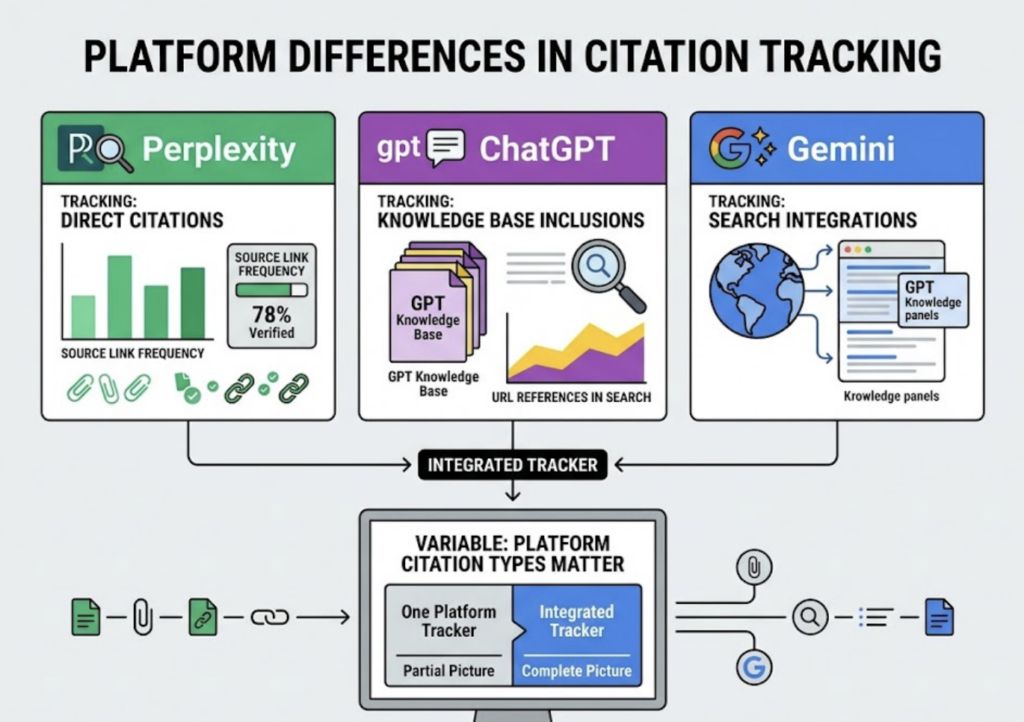
One variable that matters more than most teams realize: platform differences. Perplexity provides clear, clickable citations, so trackers monitor source link frequency directly. ChatGPT and Gemini often rely on internal knowledge or implicit citations, which means trackers need to look for branded knowledge base inclusions or URL references surfaced through their built-in search integrations. A tracker that only covers one platform gives you a partial picture at best.
5 Metrics That Separate a Useful LLM Citation Tracker from a Dashboard of Noise
Not all tracker dashboards are equally useful. The difference between actionable data and vanity metrics comes down to what’s being measured. Here are the five metrics that matter most:
| Metric | What It Measures | Why It Matters |
|---|---|---|
| Citation Share | % of total citations your domain captures for a given query set | Your “AI market share” for that topic |
| Source Diversity | Number of distinct pages from your domain being cited | Flags over-reliance on a single “hero” page |
| Citation Trend | Change in citation frequency over 30, 60, or 90 days | Reveals whether AI algorithms are shifting preference |
| Cross-Platform Coverage | Tracking scope across ChatGPT, Perplexity, Gemini, AI Overviews | Prevents optimizing for one LLM silo |
| Competitor Citation Gap | How often competitors get cited vs. you, per prompt | Pinpoints specific content gaps to close |
If a tracker doesn’t give you at least these five dimensions, you’re likely looking at a reporting tool, not an optimization tool.
Topify vs Profound: What Each LLM Citation Tracker Covers
When evaluating the best tools for LLM citation tracking, the market splits into two camps: holistic AI visibility platforms with execution layers, and market intelligence tools focused on trends and reporting.
| Dimension | Topify | Profound |
|---|---|---|
| Core Focus | AI visibility tracking + execution | Market intelligence + trend analysis |
| AI Platform Coverage | ChatGPT, Gemini, Perplexity, DeepSeek, Doubao, Qwen | General LLM benchmarks |
| Citation Granularity | URL-level citation depth | Domain and brand mention depth |
| Actionability | High: one-click content strategy and optimization | Medium: insights and reporting |
| Prompt Discovery | Built-in high-value prompt identification | Limited |
| Pricing | From $99/mo (Basic) to $199/mo (Pro) | Varies by engagement |
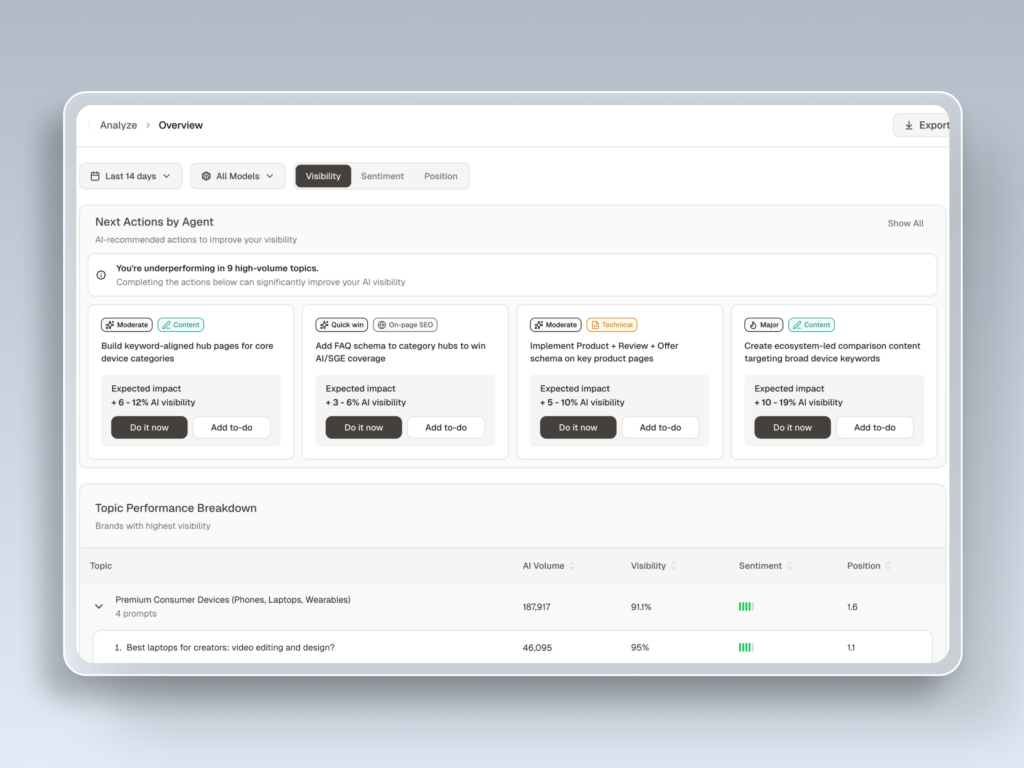
Topify bridges the gap between tracking and acting. Its Source Analysis feature maps exactly which domains and URLs AI platforms are citing for your target queries, at URL-level depth. That means you don’t just see that a competitor is getting cited more often. You see which specific pages are winning the citation, and which of your own pages are being overlooked.
The High-Value Prompt Discovery feature adds another layer. Instead of guessing which queries to track, Topify surfaces the prompts that are actually triggering AI responses in your niche, then maps citation patterns to those specific intents. For teams running GEO across multiple AI platforms, the one-click execution layer turns citation gaps into content briefs without a separate strategy meeting.
Profound is generally positioned as a market research tool. It’s strong at identifying broad trends and sentiment shifts within LLM outputs. But it offers fewer in-the-trenches SEO execution features. If your primary need is understanding where the market is heading, Profound has value. If you need to know which page to rewrite next and why, the execution gap becomes noticeable.
5 Mistakes That Tank Your LLM Citation Tracking Results
Most teams that invest in an LLM citation tracker still see disappointing results. It’s typically not the tool’s fault. It’s how they use it.
Mistake 1: Confusing visibility with citations. Seeing your brand name in an AI response feels good. But if the AI didn’t link to your domain, that mention doesn’t drive traffic. Track citations, not just mentions.
Mistake 2: Covering only one AI platform. A site might get cited heavily in Perplexity but be completely ignored by Gemini. AI search is fragmented, and single-platform tracking gives you a dangerously incomplete picture.
Mistake 3: Treating citation tracking like a quarterly audit. LLMs update their training weights and search tool integrations frequently. Weekly or bi-weekly tracking is the current industry standard. Monthly snapshots miss the shifts that matter.
Mistake 4: Collecting data without an action layer. A dashboard full of charts doesn’t improve your citation share if it doesn’t tell you which pages to rewrite, which topics to cover next, or which content formats AI prefers. This is where platforms with built-in execution, like Topify’s one-click optimization, outperform pure reporting tools.
Mistake 5: Ignoring competitor citation patterns. Your citation share doesn’t exist in a vacuum. If a competitor’s domain suddenly starts capturing 40% of citations for your core queries, that’s a signal. Not tracking it means you won’t know until the gap is too wide to close quickly.
A Step-by-Step Checklist for Your LLM Citation Tracker
Getting started doesn’t require a six-month project plan. But it does require a structured approach. Here’s a four-phase framework:
Phase 1: Discovery. Define your “Golden Query” set. These are the 20 to 50 prompts that matter most to your business, the questions your ideal customers are asking AI. Topify’s High-Value Prompt Discovery can automate this step by surfacing prompts with real AI search volume in your niche.
Phase 2: Baseline. Run a 30-day audit across at least three AI platforms. Document which domains currently own the citation share for your target queries. This baseline becomes your benchmark for every future optimization cycle.
Phase 3: Optimization. Use your tracker to identify the types of content AI prefers to cite. Does it lean toward data-heavy tables? Concise definitions? Long-form guides? Match your content format to what’s already winning citations.
Phase 4: Action. Update your top-performing assets to reinforce the points AI already references. Create new content where competitors are out-citing you. Then run the cycle again in 30 days.
The pattern is straightforward: discover, track, understand, act, measure. Repeat.
Conclusion
The SEO playbook that got your domain to page one of Google won’t tell you whether ChatGPT is citing your content or your competitor’s. LLM citation tracking trackers exist to close that gap, giving you visibility into the source-selection layer that AI search engines use to decide who gets referenced.
The key is choosing a tracker that goes beyond dashboards. You need citation-level granularity, cross-platform coverage, and an execution layer that turns data into content action. For teams ready to start, Topify’s platform offers a structured path from prompt discovery through citation optimization, with URL-level depth across ChatGPT, Perplexity, Gemini, and more.
FAQ
Q: What is an LLM citation tracking tracker?
A: It’s a specialized analytics platform that monitors which domains and URLs AI models (ChatGPT, Perplexity, Gemini, etc.) cite as sources when generating answers. Unlike traditional backlink tools, it tracks the dynamic source selection that happens inside LLM pipelines, not manual editorial links.
Q: How much does an LLM citation tracking tracker cost?
A: Pricing varies by platform and scope. Topify’s plans start at $99/month for basic tracking (covering ChatGPT, Perplexity, and AI Overviews with 100 prompts) and go up to $199/month for pro-level coverage with 250 prompts and expanded team seats. Enterprise pricing is available from $499/month for custom needs.
Q: How do I improve my LLM citation tracking results?
A: Start by tracking the right prompts, not just your brand name. Focus on high-intent queries your audience actually asks AI. Then optimize the content formats AI prefers to cite (data tables, structured definitions, original research). Review citation trends weekly, not monthly, and use a platform with an execution layer so insights translate into content updates.
Q: Can you give examples of LLM citation tracking in action?
A: A SaaS company tracking 200 prompts across four AI platforms over 30 days might discover that Perplexity cites their pricing page heavily but ChatGPT ignores it entirely. That insight leads to a ChatGPT-specific content optimization. Or a brand manager notices their competitor’s blog post captures 60% of citations for “best project management tool” and creates a competing asset that matches the content format AI favors.
Leave a Reply