Author: Elsa Ji

  • How to Build an AI Search Monitoring System

    How to Build an AI Search Monitoring System

    Your marketing team spent the last quarter optimizing landing pages, earning backlinks, and climbing Google rankings. Then someone asked ChatGPT, “What’s the best tool in your category?” and got five recommendations. Your brand wasn’t one of them. You wouldn’t have known if you hadn’t checked manually, and by the time you did, the algorithm had already moved on.

    That’s the gap between checking and monitoring. One gives you a snapshot that’s already stale. The other gives you a system that catches shifts before they cost you pipeline.

    Most Brands Check ChatGPT Once and Call It Monitoring

    Here’s the thing about manual spot-checks: they feel productive but produce almost nothing usable. A marketing director runs a prompt in ChatGPT, screenshots the result, drops it in a Slack thread, and moves on. That’s not monitoring. That’s a one-time observation with zero statistical value.

    LLMs don’t stay still. Researchers from Stanford and Berkeley found that over just three months, an LLM’s response accuracy on standardized tasks dropped from 85% to 50%. In brand visibility terms, tracking data across 2,500 prompts on Google AI Mode and ChatGPT showed that 40% to 60% of cited sources change on a month-to-month basis. The answer your brand appeared in last Tuesday might not include you by Friday.

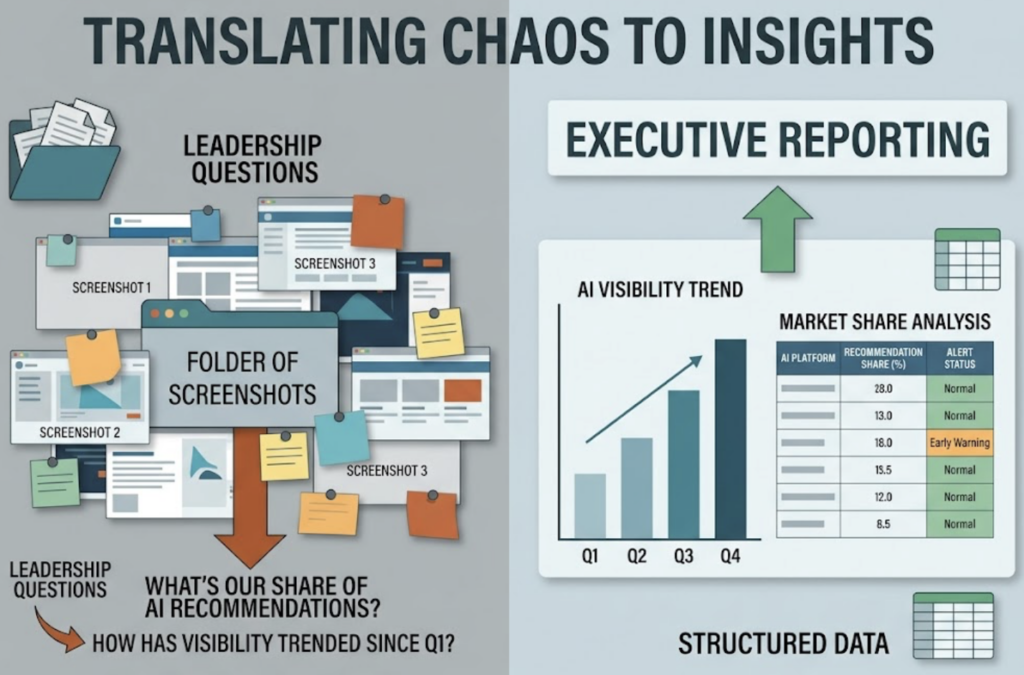
    The real damage shows up in executive reporting. When leadership asks “What’s our share of AI recommendations?” or “How has visibility trended since Q1?”, a folder of screenshots can’t answer that. You can’t calculate market share from disorganized images, and you can’t detect early warning signs of algorithmic exclusion across thousands of potential prompts.
    This isn’t hypothetical. In one documented case, a brand called “AcmeCloud” vanished entirely from Perplexity’s recommendations, replaced by smaller competitors who had stronger structured data on third-party review networks. No alert. No warning. Just gone.

    What an AI Search Monitoring System Actually Tracks

    A functioning AI search monitoring system isn’t a single tracker for keyword placement. It’s a multidimensional intelligence layer designed to reverse-engineer how Retrieval-Augmented Generation (RAG) pipelines decide which brands to mention.

    When you track brand visibility in ChatGPT, you’re not measuring one thing. You’re measuring at least seven interconnected variables that collectively define whether your brand exists in AI-generated answers.

    MetricWhat It MeasuresWhy It Matters
    Visibility Score% of tracked prompts where the brand appearsExecutive-level benchmark, replaces traditional impression share
    Position RankOrdinal placement within the generated responseIn zero-click interfaces, first mention carries exponentially more weight
    Sentiment ScoreAlgorithmic evaluation (0-100) of how the model frames the brandEarly warning for reputational drift in AI narratives
    Citation SourceSpecific URLs the LLM retrieved to build its answerReverse-engineers which third-party sites influence the algorithm
    AI Search VolumeEstimated monthly frequency of a specific prompt across AI platformsPrioritizes high-traffic, high-intent queries
    Brand MentionsRaw count of brand name appearances across all tracked responsesMeasures footprint expansion regardless of prompt alignment
    CVREstimated probability that a generated response drives brand conversionBridges visibility and revenue attribution in zero-click environments

    Why Visibility Score and Position Rank Are the Foundation

    Traditional SERPs offer a gradient. Ranking on page two still provides peripheral exposure. LLMs don’t work that way. When someone queries ChatGPT, there’s no page two. Your brand either exists within the generated narrative, or it’s invisible.

    Visibility Score quantifies how often you show up. Position Rank determines how prominently. On Perplexity, this matters even more: 86% of recommended brand mentions land in position five or earlier. That’s an incredibly tight shortlist with almost no room for late entries.

    AI Sentiment Isn’t Social Media Sentiment

    Many teams confuse these two, but they serve fundamentally different purposes. Social media sentiment analyzes human emotional output after someone uses a product. It’s reactive. AI sentiment evaluates how the model itself frames your brand during the discovery phase. It’s proactive. It shapes prospect perceptions before they ever become customers.

    Current data shows LLMs generally default to positive framing: Gemini runs roughly 96% positive sentiment with only 0.3% negative, and ChatGPT sits at 94% positive. Perplexity holds the highest neutral share at 11%, reflecting a more journalistic posture. Any undetected degradation in these scores is an immediate red flag for underlying data drift.

    How to Track Brand Visibility in ChatGPT, Step by Step

    Moving from concept to execution requires a strict three-step rollout. Here’s how to build a monitoring system that actually produces usable data, using the capabilities of a unified platform like Topify.

    Step 1: Define your prompt matrix.

    Forget traditional keyword lists. AI engines synthesize complex conversational inputs, not exact-match keyword strings. Your monitoring scope needs to be built around prompt-level architecture.

    Instead of tracking “CRM software,” you need to discover and ingest thousands of long-tail variations like “What is the most cost-effective CRM for a remote marketing team of 50 people integrating with HubSpot?” Topify’s High-Value Prompt Discovery algorithm continuously surfaces these high-intent prompts as AI recommendations evolve.

    You also need to define your competitive perimeter. Track not just your own mentions, but which brands appear when yours doesn’t. This establishes “Share of Model,” the metric that tells you how often your brand dominates a response relative to industry rivals.

    Step 2: Establish your baseline.

    With your prompt matrix set, the system runs an initial crawl across target platforms to produce your first quantified AI Visibility Score. During this phase, the monitoring system executes prompts via API, parses the output using semantic analysis, detects your brand name, maps surrounding context, evaluates ordinal position, and computes initial sentiment scores.

    Simultaneously, run a GEO technical audit on your own digital assets. This covers four pillars: Technical GEO (can AI bots find your content?), Content GEO (can AI extract it?), Entity GEO (does AI know who you are?), and Brand Authority GEO (does AI trust you?). Check E-E-A-T signals, JSON-LD schema markup, crawlability, and entity definitions. Topify’s free GEO tools can help you run this initial audit before committing to a full platform.

    Step 3: Configure high-frequency polling and alerts.

    Monthly monitoring is inadequate. AI models undergo silent updates, continuous data integration, and real-time retrieval adjustments. Data decays fast.

    Set your system to execute tracking loops weekly at minimum, daily for highly competitive sectors. Topify tracks all seven metrics automatically and logs variance across cycles. The standard alert threshold: trigger a notification when any visibility metric drops more than 10% week-over-week. When a critical prompt drops 15% in visibility, your team gets notified, logs in, isolates the platform where degradation occurred, and traces the shift back to specific citation changes.

    Why Single-Platform Tracking Gives You a False Picture

    Limiting your monitoring to ChatGPT alone is one of the most common architectural mistakes teams make. ChatGPT processes over 800 million weekly users, but it’s not a universal proxy for all AI search behavior.

    Different LLMs have distinct structural foundations, divergent training data, and fundamentally different “editorial personas.” They recommend different brands for the exact same query.

    The numbers make this concrete. BrightEdge’s AI Catalyst research shows Gemini operates with an authority-to-UGC ratio of 130 to 1, drawing heavily from .gov domains (13% of sources) and .org domains (23%). Its top 10 most-cited domains account for 26.3% of all references. It’s an institutional recommender.

    ChatGPT operates differently. Its top 10 domains represent only 18.5% of total citations, reflecting a much flatter, more diverse source distribution. Brands with widespread mentions across mid-tier industry journals often find significantly higher visibility in ChatGPT than in Gemini.

    Perplexity is another story entirely. It concentrates roughly 30% of its citations across academic, medical, encyclopedic, and government domains, with the highest share of .edu citations (3.2%) in the market.

    A cross-engine test for “best Spanish sneaker brands” produced 12 different brand recommendations across four engines’ top-three lists, with zero overlap.

    Even within the same parent company, engines diverge. Google Gemini shares 39% citation overlap with ChatGPT, but only 27% overlap with Google’s own AI Mode. If your dashboard shows a top-tier ranking in ChatGPT but you’re being excluded from Google AI Overviews, which currently intercepts at least 16% of all traditional search traffic, you’ve got a massive blind spot.

    Topify differentiates here by providing global engine coverage across ChatGPT, Google Gemini, Perplexity, Google AI Overviews, DeepSeek, Doubao, and Qwen. That’s where most Western-centric tools fall short.

    Turning AI Search Monitoring Data into Action

    A dashboard full of metrics is useless without an execution pathway. The real value of an AI search monitoring system is its ability to drive direct strategic action when the data signals a problem.

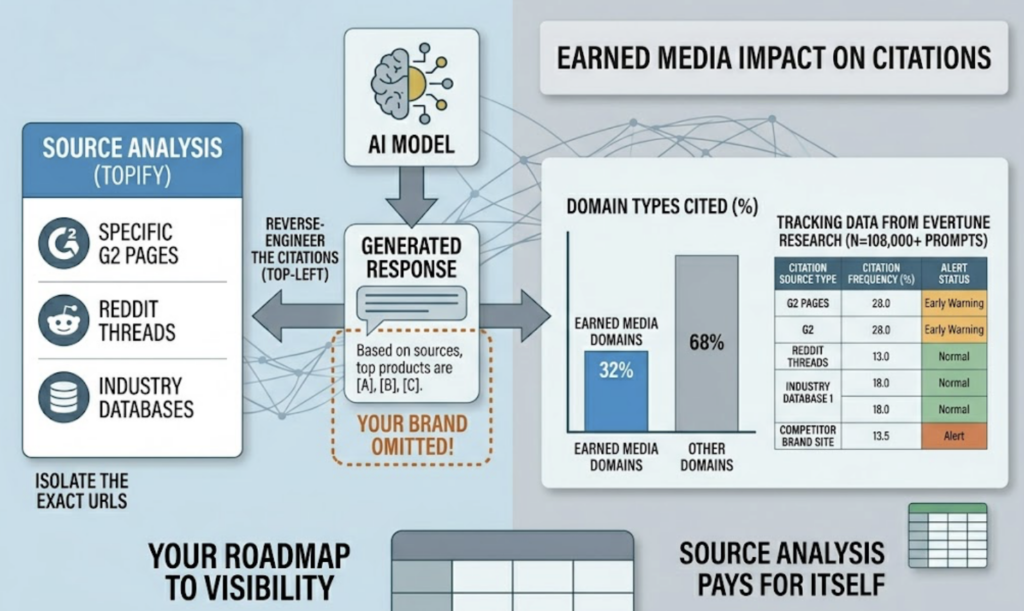
    Reverse-engineer the citations. When your brand is omitted from an AI response, Topify’s Source Analysis lets you isolate the exact URLs the model used to build the answer that excluded you. If the AI repeatedly cites specific G2 pages, Reddit threads, or industry databases, you now have a definitive roadmap. Tracking data from Evertune Research analyzing over 108,000 unique product prompts shows that earned media domains account for approximately 32% of all domains cited by AI models. Knowing which earned media domains trigger citations is where Source Analysis pays for itself.
    Benchmark against competitors. Track Share of Model across platforms to understand where you stand dynamically. If a competitor is gaining ground in Gemini while you’re stagnant, audit their recent PR or structured data deployments. Topify’s Competitor Monitoring spots emerging rivals in real time and shows exactly what’s driving their gains.

    Structure content for machine synthesis. Academic research from Princeton University and Georgia Tech demonstrated that integrating specific structural elements, like statistics, authoritative citations, and data-driven formatting, can boost AI citation visibility by 30% to 40%. The monitoring system closes the loop: you apply optimizations, then track subsequent polling cycles to see if the model adjusts its weights.

    Execute without friction. Topify’s One-Click Agent bridges the gap between insight and action. When the system identifies a content gap or a dropping visibility score, the agent parses high-performing competitor citations, drafts structurally optimized content strategies tailored to LLM recommendation algorithms, and lets your team deploy with a single click. Define goals in plain English, review the strategy, approve. No spreadsheet handoffs. Get started with Topifyto see this workflow in action.

    Tools to Track Brand Visibility in ChatGPT and Beyond

    The AI monitoring vendor landscape is expanding fast. Enterprise AI tool usage has grown nearly 600%, exceeding 3.1 billion monthly transactions in cloud environments. Here’s how the current options stack up.

    ToolAI Engines CoveredCore StrengthStarting Price
    TopifyChatGPT, Gemini, Perplexity, Google AIO, DeepSeek, Doubao, QwenFull-stack telemetry, citation mapping, one-click execution$99/mo
    NightwatchChatGPT, Perplexity, Google AIOTraditional SERP + LLM sentiment integration~$99/mo
    LebesgueChatGPT, Perplexity, Google AIOZero-click attribution via first-party pixel tracking~$59/mo
    Semrush AI ToolkitGoogle AIO, ChatGPT (limited)Bolted-on AI metrics within legacy SEO suite$139/mo+
    Ahrefs AI VisibilityGoogle AIO, ChatGPT (beta)Backlink-centric model of AI citation retrieval$129/mo+

    Topify stands out for two reasons. First, platform coverage: it’s the only tool in this list that natively tracks non-Western engines like DeepSeek, Doubao, and Qwen. Second, execution: most tools stop at data. Topify unites monitoring, strategy, and automated content deployment into a single platform. For teams that need to track visibility in ChatGPT and actually do something about the results, that closed-loop matters.

    Conclusion

    The gap between manually checking ChatGPT once a month and running a real AI search monitoring system is the gap between guessing and knowing. LLMs shift cited sources 40% to 60% month over month, different engines recommend entirely different brands for the same query, and a visibility drop can happen without a single alert if you’re not set up to catch it.

    The path forward is straightforward. Define your prompt universe around bottom-of-funnel conversions. Establish a multi-engine baseline. Configure weekly polling with automated alerts. Then use a unified platform like Topify to close the loop from data to action. Brands that build this infrastructure now will see the shifts coming. The ones that don’t will keep finding out from screenshots that are already three weeks old.

    FAQ

    Q: What’s the difference between AI search monitoring and traditional SEO tracking?

    A: Traditional SEO tracking measures static domain rankings on search result pages, heavily relying on backlinks and domain authority. AI search monitoring evaluates how a brand is synthesized into conversational responses generated by LLMs. It tracks entirely different metrics designed for zero-click environments, like Share of Model visibility, algorithmic sentiment, and citation overlap, because LLMs don’t index pages. They synthesize probability-based answers using retrieval-augmented generation.

    Q: How often should I check my brand’s visibility in ChatGPT?

    A: At minimum, weekly. Research shows 40% to 60% of cited sources change month over month, and model accuracy can degrade rapidly due to agent drift and ongoing safety updates. Best practice is to set up automated polling with alerts triggered by any visibility drop exceeding 10% week-over-week. Manual monthly checks simply can’t keep pace with how fast these models shift.

    Q: Can I track brand visibility in ChatGPT for free?

    A: You can establish an initial baseline using free entry points. Topify maintains a suite of free GEO tools that let you run preliminary visibility checks, estimate AI search volume, and gauge baseline performance before committing to a paid tier. That said, sustaining long-term automated tracking across hundreds of prompts, managing historical data drift, and deploying content optimization at scale requires a paid platform.

    Q: What AI platforms should an AI search monitoring system cover?

    A: At minimum, ChatGPT, Google Gemini, Perplexity, and Google AI Overviews. These engines process training data differently and recommend different brands for the same query. A brand highly visible in Gemini may be entirely absent from ChatGPT. Advanced global systems like Topify also cover emerging engines like DeepSeek, Doubao, and Qwen, which is increasingly important as non-Western AI platforms gain user share.
    Read More

  • AI Answer Tracking Service: How to Monitor Your Brand

    AI Answer Tracking Service: How to Monitor Your Brand

    You’ve checked ChatGPT manually three times this week, typing in the same prompts to see if your brand shows up. Sometimes it does. Sometimes it doesn’t. And you have no idea what changed between Tuesday and Thursday. Multiply that across Claude, Perplexity, Gemini, and Google AI Overviews, and manual checking falls apart fast. The brands pulling ahead in AI search aren’t the ones checking manually. They’re the ones running an AI answer tracking service that monitors every response, every day, across every platform that matters.

    What an AI Answer Tracking Service Actually Measures

    An AI answer tracking service does something no traditional SEO tool was built to do: it monitors how AI platforms talk about your brand in real time, across every response they generate.

    That’s not a small distinction. By 2026, over 50% of traditional search volume has shifted to AI-native interfaces like ChatGPT, Claude, Perplexity, and Google AI Overviews. When someone asks an LLM “what’s the best project management tool for remote teams,” the answer isn’t a list of ten blue links. It’s a curated paragraph, sometimes with a ranked list, sometimes with citations, sometimes with none.

    A proper tracking service captures what happens inside those responses. Specifically, it tracks five core dimensions:

    • Visibility Score: how often your brand appears across a diverse set of prompts relevant to your category.
    • Position Rank: where your brand sits in an AI-generated recommendation list, if it appears at all.
    • Sentiment Score: whether the AI describes your brand positively, neutrally, or negatively.
    • Citation Share: the percentage of AI responses citing your domain versus competitors.
    • CVR (Conversion Visibility Rate): the likelihood that an AI response directs a user toward your brand’s conversion-ready content.

    The key word here is “service,” not “tool.” A one-time check tells you what happened today. A tracking service tells you what’s changing over weeks and months, and why.

    Why Your SEO Dashboard Can’t Show You AI Rankings

    If you’re relying on Ahrefs, SEMrush, or Moz to understand your AI search performance, you’re looking at the wrong dashboard.

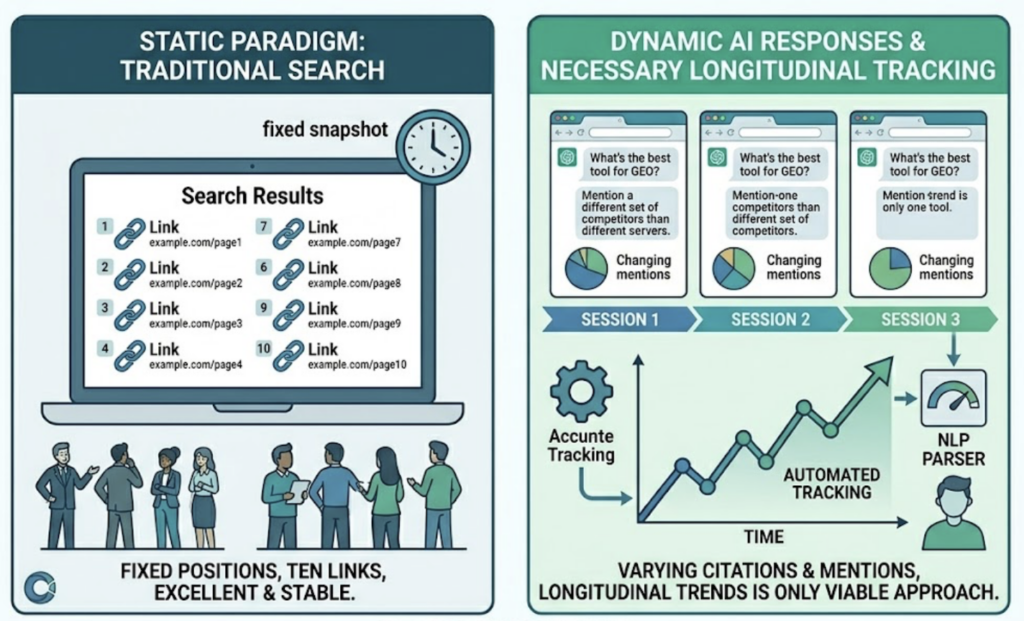
    These platforms were built for a static paradigm: ten blue links, fixed positions, crawlable URLs. They’re excellent at what they do. But AI responses don’t work that way. Research into AI search behavior shows that even identical prompts can produce varying citations and brand mentions across different sessions within the same geographic region. That makes automated, longitudinal tracking the only viable approach at scale.

    Here’s where legacy tools specifically fall short:

    LimitationWhat It Means
    No LLM prompt simulationThey can’t execute the multi-turn, conversational queries real users type into ChatGPT or Claude
    No contextual sentimentThey track URL rankings, not how a brand is described inside a generated paragraph
    No citation source mappingTraditional crawlers can’t identify which specific sources an LLM prioritized to build its response

    That last gap is the one that matters most for content strategy. If you don’t know which sources AI platforms are citing, you can’t reverse-engineer how to get cited yourself. An AI answer tracking service fills that gap by tracking the best online LLM rank tracker metrics that SEO dashboards were never designed to capture.

    The Five Metrics That Separate Good Tracking from Useless Dashboards

    Not every platform that claims to track AI answers actually measures what matters. The industry has converged on a framework with five non-negotiable metrics, each tied to a specific business outcome:

    MetricWhat It Tells YouWhy It Matters
    Visibility ScoreHow often your brand shows up across diverse AI promptsMeasures top-of-funnel brand awareness in AI ecosystems
    Citation ShareWhat percentage of AI responses cite your domain vs. competitorsDetermines brand authority and content effectiveness
    Sentiment ScoreWhether AI describes your brand positively, neutrally, or negativelyEssential for reputation management and narrative control
    Position RankYour specific placement in AI-generated recommendation listsCorrelates directly with click-through from AI answers
    CVRLikelihood of AI directing users to a conversion-ready assetLinks AI visibility directly to marketing ROI

    Here’s the thing: most tracking dashboards stop at Visibility Score and maybe Position Rank. That’s like measuring your SEO performance with keyword rankings alone and ignoring traffic, bounce rate, and conversions.

    A complete tracking service measures all five. If a platform can’t show you Citation Share and Sentiment alongside visibility data, it’s giving you half the picture.

    Best Online ChatGPT Rank Tracker and LLM Rank Tracker: What to Look for in 2026

    When marketing teams search for the best online ChatGPT rank tracker or the best online LLM rank tracker, they typically want one thing: a single platform that monitors brand rankings across multiple AI engines without requiring separate tools for each.

    The evaluation criteria that matter most, based on enterprise tracking benchmarks:

    1. Platform breadth: Does it cover the “Big Five”? That means ChatGPT, Claude, Perplexity, Gemini, and Google AI Overviews. Anything less means blind spots.
    2. Prompt-level granularity: Category-level tracking (e.g., “project management tools”) is too broad. You need prompt-level data that mirrors actual user intent.
    3. Update frequency: AI responses shift as models update. Daily or near-real-time monitoring is the baseline.
    4. Actionable insights: Raw data isn’t enough. The platform should tell you why your ranking changed, not just that it did.
    5. Execution capability: Can the service close the loop between insight and action?

    Topify checks every box on that list, and it’s the platform that tends to stand out for teams serious about AI search optimization.

    Topify covers ChatGPT, Gemini, Perplexity, DeepSeek, Doubao, Qwen, and Google AI Overviews, which goes well beyond the Big Five. Its High-Value Prompt Discovery feature continuously surfaces new prompts relevant to your brand as AI recommendations evolve, so you’re not stuck monitoring a static list of queries you picked six months ago.

    What separates Topify from simpler tracking tools is the depth of its analytics matrix. You get Visibility Score, Sentiment Score, Position Rank, Citation Share, and CVR in a single dashboard, built by a team that includes founding researchers from OpenAI and champion Google SEO practitioners. The algorithm was designed for precision: prompt-level tracking, not category-level estimates.

    For teams that need the best online Claude rank tracker or the best online AI Overviews rank tracker specifically, Topify’s multi-engine coverage is the differentiator. You’re not stitching together three separate tools to get a complete picture. One platform, all AI engines, all metrics.

    Pricing starts at $99/month for the Basic plan (100 prompts, 9,000 AI answer analyses, ChatGPT/Perplexity/AI Overviews tracking) and scales to $199/month for Pro (250 prompts, 22,500 analyses, 8 projects). Enterprise plans start from $499/month with a dedicated account manager.

    How to Evaluate an AI Answer Tracking Service Before You Commit

    Before signing up for any platform, run it through these five questions. They map directly to the evaluation framework used by enterprise marketing teams:

    1. How many AI platforms does it actually cover? Some tools only track ChatGPT. That’s a problem when your audience is split across Perplexity, Claude, and AI Overviews. If the service doesn’t cover at least four major AI engines, you’re building strategy on incomplete data.

    2. Does it track at the prompt level or category level? Prompt-level tracking simulates real user queries. Category-level tracking groups broad topics together and averages the data. The difference is like comparing “you rank #3 for this specific question” versus “you’re somewhere in the top 10 for this topic.” One is actionable. The other isn’t.

    3. How often does the data update? AI models update their responses as training data shifts. A service that checks once a week misses the fluctuations that daily monitoring catches. Real-time or daily updates are the baseline for any serious tracking service.

    4. Does it explain why rankings changed, or just show that they did? This is where most platforms drop the ball. Showing you a position change from #2 to #5 is information. Showing you that a competitor published a new comparison article that three AI engines started citing is an insight. One gives you a number. The other gives you a next step.

    5. Can it close the loop between data and execution? The most advanced AI answer tracking services don’t just monitor. They help you act. Look for features like automated content recommendations, citation gap analysis, and direct execution workflows that push optimizations to your content stack.

    From Tracking to Action: What Happens After the Dashboard

    The real value of an AI answer tracking service isn’t the dashboard itself. It’s what you do with the data.

    The most successful marketing teams use AI answer tracking as a feedback loop. They identify which citations competitors are using to win specific prompts, then update their own content strategy to match or surpass those sources. That’s the shift from passive monitoring to active Generative Engine Optimization, or GEO.

    Topify’s approach to this is its One-Click Agent Execution. You define your optimization goals in plain English. The system proposes a strategy. You review it and deploy with a single click. No manual content workflows, no waiting on dev cycles. The platform’s AI agent continuously monitors, reasons, and acts on your behalf.

    In practice, this reduces the time-to-market for GEO adjustments from weeks to hours. That speed matters because AI engines don’t wait for your next quarterly content review to change their recommendations.

    The brands that treat AI answer tracking as an ongoing service, not a quarterly audit, are the ones building durable visibility across ChatGPT, Claude, Perplexity, and every other AI platform their audience uses. If you haven’t started tracking, the sooner you set up a system, the less ground you’ll have to make up.

    Conclusion

    AI search has moved past the point where manual spot-checking counts as a strategy. The platforms generating answers for your potential customers are changing their recommendations constantly, pulling from different sources, and describing brands in ways no one on your team may even be aware of.

    Continuous AI answer tracking gives you the cross-platform visibility that traditional SEO tools were never built to deliver. The brands investing in this capability now are setting the baseline that competitors will have to catch up to later. Start with a platform that covers every major AI engine, tracks at the prompt level, and doesn’t stop at data, one that actually helps you act on what it finds.

    FAQ

    Q: What is an AI answer tracking service? A: It’s a service that continuously monitors how AI platforms like ChatGPT, Claude, Perplexity, and Google AI Overviews mention, rank, and describe your brand. Unlike one-time manual checks, it tracks metrics like Visibility Score, Position Rank, Sentiment, Citation Share, and CVR over time across multiple AI engines.

    Q: What’s the best online ChatGPT rank tracker in 2026? A: The best online ChatGPT rank tracker should offer prompt-level granularity, daily updates, and multi-platform coverage beyond just ChatGPT. Topify is a strong option because it tracks ChatGPT alongside Gemini, Perplexity, Claude, AI Overviews, and several other AI engines in a single dashboard with full GEO analytics.

    Q: Can I track my brand’s ranking in Claude and Google AI Overviews? A: Yes. Platforms like Topify support tracking across Claude, Google AI Overviews, and other major AI engines. This is important because your audience doesn’t use just one AI platform, and your brand’s visibility can vary significantly from one engine to another.

    Q: How often should an AI answer tracking service update its data? A: Daily updates are the minimum standard. AI models shift their responses as training data and source indexing change, so weekly or monthly snapshots miss critical fluctuations. The best services offer daily or near-real-time monitoring to catch ranking changes as they happen.

    Read More

  • AI Answer Tracking Tracker: What It Measures

    AI Answer Tracking Tracker: What It Measures

    You’ve probably done it yourself: typed your brand name into ChatGPT, scanned the response, and either felt relief or dread. That manual spot check felt productive. But it told you almost nothing. You didn’t capture what Perplexity said, what Gemini recommended, or how any of those answers changed a week later. The gap between “checking AI answers” and actually tracking them is where most marketing teams lose visibility they don’t even know they had.

    AI answer tracking trackers exist to close that gap. They turn scattered, one-off queries into structured, cross-platform intelligence you can act on.

    Your Brand Shows Up in AI Answers, But You Can’t Prove It

    An AI answer tracking tracker is a platform built specifically to monitor how brands appear inside AI-generated responses. Unlike traditional SEO tools designed around web crawling and indexation, these trackers focus on what happens after a user asks ChatGPT, Perplexity, Gemini, or DeepSeek a question.

    Traditional rank trackers tell you where your page sits in a list of ten blue links. An AI answer tracking tool tells you something different: whether your brand was mentioned at all, in what context, with what sentiment, and how often the AI cited your content as a source.

    That distinction matters. AI platforms function as answer engines that synthesize, summarize, and weight sources based on proprietary LLM logic rather than PageRank alone. A brand can hold a top-three Google ranking for a keyword and still be completely absent from the ChatGPT response for the same query. Traditional SEO tools simply weren’t designed to detect that kind of visibility gap.

    The shift is sometimes called “Zero-Click visibility.” The brand gets recommended or cited before a user ever clicks a link. And without an AI answer tracking system in place, you have no way to measure it.

    What an AI Answer Tracking Tracker Actually Measures

    Not all AI answer tracking software tracks the same things. But the platforms worth considering typically cover six to seven core dimensions. Here’s what each one captures and why it matters:

    MetricWhat It TracksWhy It Matters
    Visibility ScorePercentage of prompts where your brand appearsMeasures top-of-funnel brand awareness in AI
    Position RankOrder or prominence of your brand in an AI responseDirectly impacts whether users notice you first
    Sentiment ScoreEmotional tone: positive, neutral, or negativeCatches AI hallucinations or reputation risks
    Citation FrequencyHow often a specific URL is cited as a sourceSignals trust and authority to the AI platform
    Competitive BenchmarkingFrequency and sentiment vs. key rivalsIdentifies Share of Voice leaks to competitors
    Prompt-Level IntentTracks across informational, commercial, and transactional queriesConnects tracking to specific revenue goals
    Volume and TrendHow often users ask prompts in your categoryReveals demand shifts before they hit Google

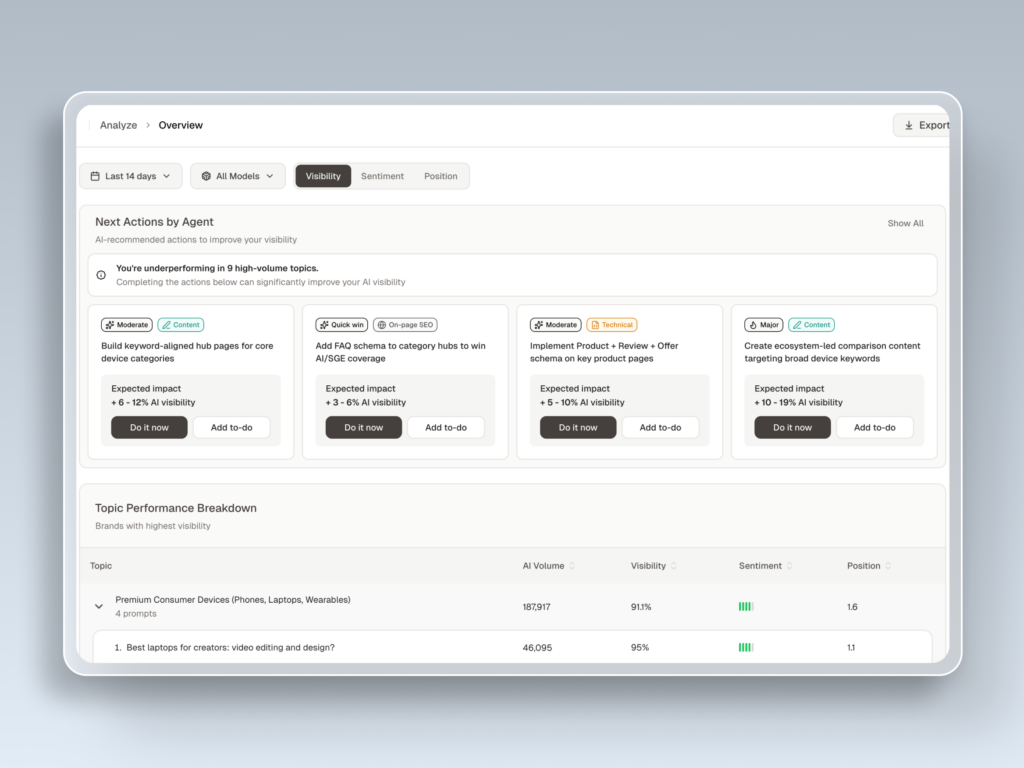
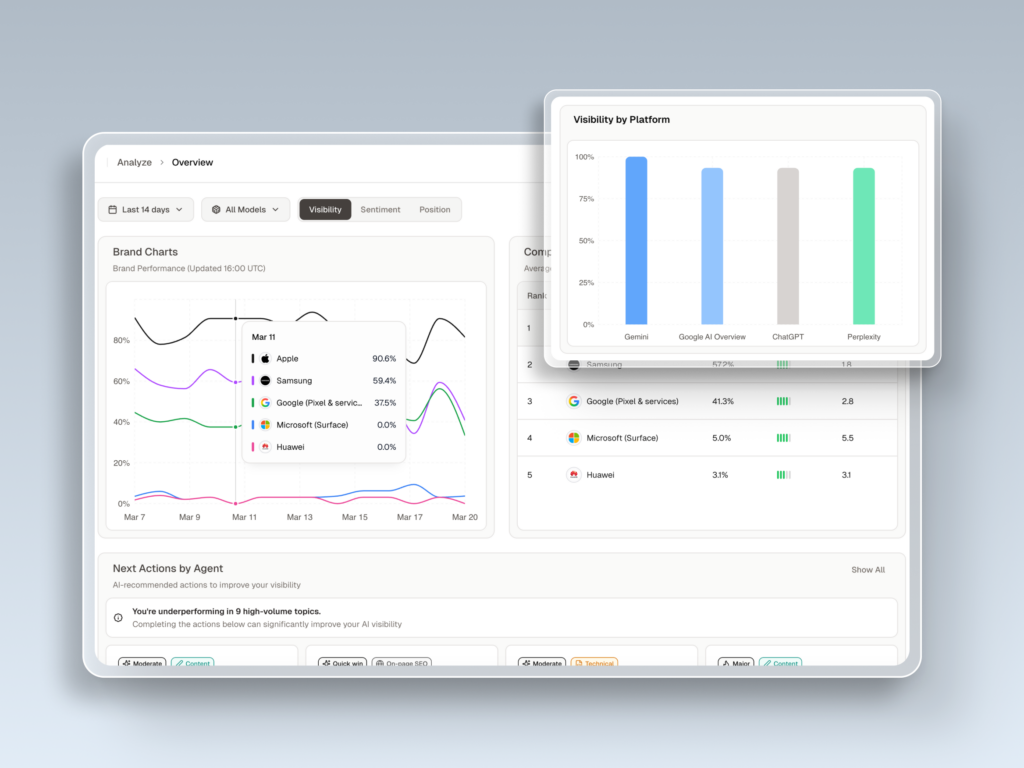
    Topify covers all seven through a single AI answer tracking dashboard, adding a CVR (Conversion Visibility Rate) metric that estimates the likelihood of an AI response driving a user toward your brand.

    The key insight: visibility alone isn’t enough. A brand that appears in 80% of relevant prompts but with negative sentiment is worse off than a brand that appears in 40% with consistently positive framing. That’s why the best AI answer tracking platforms treat sentiment and position as equal to raw mention counts.

    How an AI Answer Tracking System Works

    The technical workflow behind a professional AI answer tracking tracker follows four stages. Understanding them helps you evaluate whether a tool is doing real tracking or just surface-level keyword monitoring.

    Stage 1: Prompt-Level Monitoring. Instead of tracking keywords the way a traditional SERP tool does, the system executes a set of “seed prompts” representing high-value user queries across multiple LLMs. You’re not asking “where does my page rank?” You’re asking “when someone types this exact question into ChatGPT, does the AI mention my brand?”

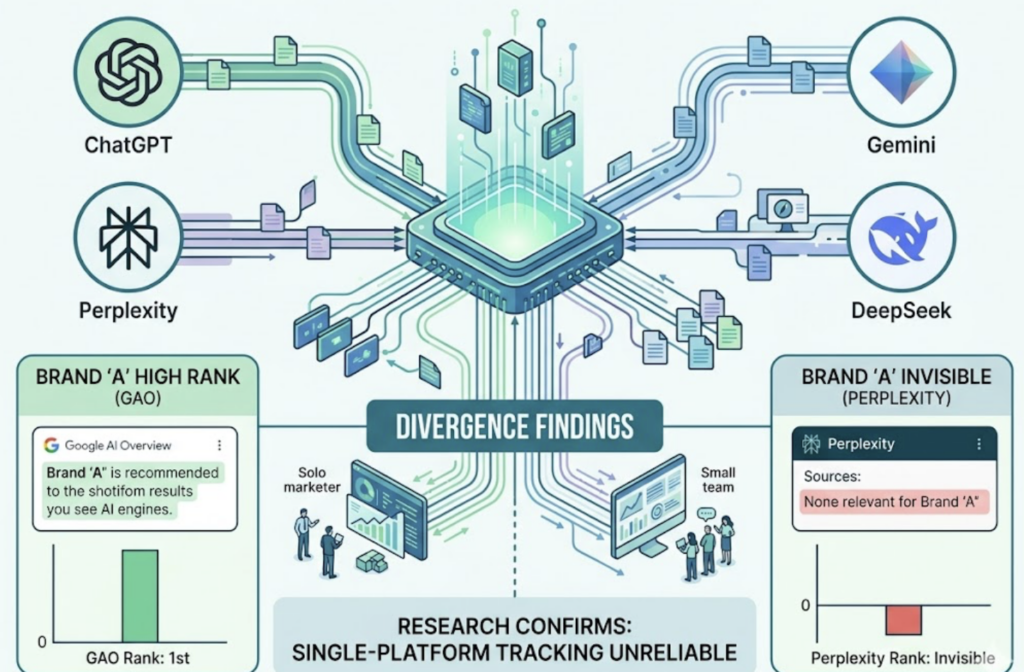
    Stage 2: Cross-Platform Collection. The system aggregates output from ChatGPT, Perplexity, Gemini, DeepSeek, and other AI platforms, accounting for their unique retrieval algorithms. This is where platform divergence becomes visible. Research confirms that a brand may rank highly in Google AI Overviews but remain invisible in Perplexity, making single-platform tracking unreliable.

    Stage 3: Metric Calculation. Natural Language Processing (NLP) parses each AI output to identify brand mentions, attribute them to specific URLs, and score sentiment. This is the layer that separates an AI answer tracking solution from a glorified screenshot tool.

    Stage 4: Trend and Gap Analysis. Data is visualized over time to correlate content updates, such as publishing a new FAQ page or updating schema markup, with changes in citation frequency or visibility score.

    Topify’s approach adds a fifth layer: High-Value Prompt Discovery, which continuously surfaces new prompts your audience is asking before competitors start tracking them.

    5 Mistakes That Make AI Answer Tracking Useless

    Collecting data isn’t the same as using it. These are the patterns that turn a perfectly good AI answer tracking tracker into shelf-ware.

    Mistake 1: Only tracking one AI platform. Monitoring just Google AI Overviews while ignoring the rapid growth of answer-first platforms like Perplexity and ChatGPT Search leaves massive blind spots. Each platform retrieves and weights sources differently. What works on Gemini may fail on DeepSeek.

    Mistake 2: Tracking your brand name but not your category. If someone asks “best project management software” and your brand doesn’t show up, that’s the acquisition funnel you’re missing. Brand-name monitoring catches reputation issues. Category-prompt monitoring catches revenue opportunities.

    Mistake 3: Ignoring sentiment. Assuming visibility is always good is a trap. If the AI hallucinates or provides negative context, high visibility can actually damage brand equity. A tracker without sentiment analysis is only giving you half the picture.

    Mistake 4: Monthly reporting instead of weekly review. AI answers shift faster than organic rankings. A monthly cadence means you might discover a visibility drop four weeks after it happened. Weekly review cycles catch sudden changes while there’s still time to respond.

    Mistake 5: No action framework. The most common failure. Teams collect dashboards full of data but have no Standard Operating Procedure to update content, adjust schema, or address negative findings. Data without a workflow is just noise.

    What Separates a Useful AI Answer Tracking Dashboard from a Vanity Panel

    When evaluating an AI answer tracking platform, five dimensions separate tools that drive decisions from tools that just display charts.

    Platform coverage. The tracker should cover every AI engine your audience uses. Topify monitors ChatGPT, Gemini, Perplexity, DeepSeek, Doubao, Qwen, and others, covering every major market where your customers search.

    Metric depth. Look for trackers that go beyond visibility counts. Position rank, sentiment scoring, citation source analysis, and competitive benchmarking should all be native, not add-ons.

    Competitive intelligence. You need to see who the AI is recommending instead of you. Dynamic Competitor Benchmarking, the kind Topify provides, auto-detects emerging rivals and shows exactly how to outrank them.

    Source-level analysis. Knowing you’re visible is one thing. Knowing which URLs the AI is citing, and whether those are your pages or a competitor’s, is the layer that drives content strategy. Reverse-engineering AI citations at scale turns reactive tracking into proactive optimization.

    Actionability. The dashboard should connect directly to execution. Topify’s One-Click Agent Execution lets you define goals in plain English, review the proposed strategy, and deploy it without manual workflows. That’s the difference between a tracking tool and an AI answer tracking solution that actually moves metrics.

    On pricing, the range varies. Topify’s plans start at $99/month for 100 prompts and 9,000 AI answer analyses, scaling to $199/month for 250 prompts and 22,500 analyses. Enterprise plans start from $499/month with custom configurations.

    How to Build an AI Answer Tracking Strategy from Scratch

    A tracker is only as useful as the strategy behind it. Here’s a five-step framework for getting from zero to operational.

    Step 1: Define your seed prompts. Build a library of 50 to 100 high-intent questions your customers actually ask. Categorize these into informational, comparison, and buying intent. Don’t just track “your brand name + review.” Track the category questions that drive new customer acquisition.

    Step 2: Establish a baseline. Run an initial audit across platforms to capture your starting Visibility Score, Position Rank, and Sentiment. This baseline is what every future improvement gets measured against. Topify’s free GEO score check gives you a starting point without requiring a paid plan.

    Step 3: Set competitive benchmarks. Identify three to five direct competitors and track their visibility in the same prompt set. You’re not just measuring whether you appear. You’re measuring whether you appear more often, higher, and more positively than the alternatives.

    Step 4: Adopt a weekly review cadence. Assign someone to review AI tracking data every week. Look for sudden drops in visibility, shifts in competitor sentiment, or new prompts where your brand is absent. Weekly beats monthly because AI answers change faster than organic rankings.

    Step 5: Feed data back into content. This is where most teams stall. The tracking data should directly inform your content calendar. If you’re missing from “best X for Y” prompts, that’s a content gap. If sentiment dipped after a product update, that’s a messaging fix. Integrate tracking output into your content team’s backlog so every insight becomes an action item.

    The brands that win in AI search aren’t the ones with the fanciest dashboards. They’re the ones that close the loop between tracking and doing.

    Conclusion

    The gap between “occasionally checking ChatGPT” and running a systematic AI answer tracking tracker is the difference between guessing and knowing. Every week your brand goes unmonitored in AI responses, competitors fill that space with their own visibility, citations, and narrative.

    The tools exist. The metrics are well-defined. The only variable left is whether your team builds the workflow to act on what the data reveals. Start with a free GEO score check to see where your brand stands today, then decide how deep you need to go.

    FAQ

    Q: What is an AI answer tracking tracker? 

    A: An AI answer tracking tracker is a platform that monitors how your brand appears in AI-generated responses across engines like ChatGPT, Perplexity, and Gemini. It tracks visibility, position, sentiment, citations, and competitive benchmarking at the prompt level, giving you structured data instead of manual spot checks.

    Q: How do you measure AI answer tracking performance? 

    A: The core metrics include Visibility Score (how often your brand appears), Position Rank (where you appear relative to competitors), Sentiment Score (whether AI frames your brand positively), and Citation Frequency (how often your URLs get referenced). Effective measurement requires tracking all of these across multiple AI platforms simultaneously.

    Q: What does AI answer tracking tracker pricing typically look like? 

    A: Pricing varies by platform coverage and prompt volume. Entry-level plans with cross-platform tracking generally start around $99/month. Mid-tier plans covering 250+ prompts and 20,000+ AI answer analyses typically run $199/month. Enterprise configurations with dedicated support start from $499/month.

    Q: Can an AI answer tracking tool work alongside existing SEO dashboards? 

    A: Yes. AI answer tracking doesn’t replace traditional SEO monitoring. It adds a layer that traditional tools can’t cover. The most effective setup runs both in parallel: SERP tracking for organic rankings and an AI answer tracking system for generative search visibility. Some platforms, like Topify, are designed to integrate AI tracking data into your existing analytics workflow.

    Read More

  • AI Answer Tracking Platforms That Actually Work

    AI Answer Tracking Platforms That Actually Work

    You’ve probably done it yourself: typed your brand name into ChatGPT, scanned the response, and moved on. Maybe you checked Perplexity too. But that manual spot-check tells you what one AI said at one moment for one prompt. It doesn’t tell you what Gemini said last Tuesday, what Google’s AI Overview cited this morning, or whether your competitor just overtook you in Perplexity’s recommended list for your highest-value keyword.

    Traditional SEO dashboards can’t answer any of those questions. They weren’t built to. And the gap between what your leadership team expects to see in a quarterly report and what your current tools can deliver is widening every month.

    Most AI Answer Tracking Platforms Only Cover Half the Picture

    Here’s the first thing that trips up teams shopping for an AI answer tracking platform: coverage claims that sound comprehensive but aren’t.

    Some tools only monitor ChatGPT. Others track two or three engines but skip Google AI Overviews entirely, which is a problem when AI Overviews now appear on roughly 48% of search queries. A platform that ignores AIO is missing nearly half the AI-influenced search picture.

    Then there’s the metrics gap. Counting how many times an AI mentions your brand is a start, but it’s not enough to drive decisions. What you actually need is a layered view: citation frequency, sentiment accuracy, position relative to competitors, and which source URLs the AI is pulling from. Without that depth, you’re staring at a dashboard full of numbers with no way to act on them.

    The 23x conversion lift observed in AI-influenced search traffic makes this more than an awareness play. When someone clicks through from an AI-generated answer, they’ve already been filtered by intent. Tracking whether your brand shows up in that answer, and how it shows up, directly impacts pipeline.

    Top AI Answer Tracking Platforms Compared

    Before diving into each platform, here’s a side-by-side snapshot of the leading AI answer tracking platforms in 2026.

    PlatformAI Platforms CoveredKey MetricsGoogle AIO TrackingBest For
    TopifyChatGPT, Gemini, Perplexity, DeepSeek, Google AIO, Doubao, QwenVisibility, Sentiment, Position, Volume, Mentions, Intent, CVRYesFull-spectrum GEO analytics + execution
    ProfoundClaude, Grok, Meta AI, othersLog-level crawler dataLimitedTeams needing raw log-level AI analytics
    ZipTieChatGPT, Perplexity, Google AIOScreenshot evidence, technical auditsYesEvidence-based reporting and audits
    SE RankingGoogle AIO, ChatGPTIntegrated SEO/GEO workflowYesTeams transitioning from traditional SEO
    Peec AIChatGPT, Gemini, Perplexity, ClaudeSOV analysis, unlimited seatsLimitedLarge teams needing broad seat access

    The differences aren’t just in which AI engines each platform covers. They’re in what each platform does with the data once it collects it.

    Topify: Full-Spectrum AI Answer Tracking Across Every Major Platform

    Topify stands out in this space for a specific reason: it doesn’t stop at monitoring.

    Most AI answer tracking platforms give you a dashboard. Topify gives you a dashboard, a diagnosis, and an execution layer. Its seven-dimension metric system covers visibility, sentiment, position, volume, mentions, intent, and CVR (Conversion Visibility Rate), which estimates how likely an AI answer is to drive a user toward your brand. That last metric, CVR, is something most competitors don’t offer at all.

    On platform coverage, Topify tracks ChatGPT, Gemini, Perplexity, DeepSeek, Google AI Overviews, Doubao, Qwen, and other regional engines. For teams operating across global markets, that breadth matters. A brand that’s visible on ChatGPT in the U.S. might be completely absent from Doubao in China, and Topify surfaces that gap.

    The Source Analysis feature reverse-engineers which domains and URLs each AI platform cites. You can see whether the AI is pulling from your product page, a competitor’s blog post, or a Reddit thread. That’s where google ai overview checking tools functionality gets practical: instead of guessing why your brand didn’t show up in an AIO result, you can trace the citation chain back to specific content gaps.

    Topify’s High-Value Prompt Discovery continuously surfaces new prompts that your target audience is asking across AI platforms. Rather than guessing which queries matter, you get data on where real search demand lives. And when you find an opportunity, the One-Click Agent lets you define a strategy in plain English and deploy it without manual workflows.

    The team behind the platform includes a GEO Strategy Lead with 10+ years of Fortune 500 SEO experience, an LLM Algorithm Researcher from Stanford with 2,000+ citations, and a Growth Operator who’s scaled companies from zero to $20M. That’s relevant because GEO algorithms are still evolving fast, and the quality of the underlying data model matters more than the UI.

    Pricing starts at $99/month for the Basic plan, which includes ChatGPT, Perplexity, and AI Overviews tracking, 100 prompts, and 9,000 AI answer analyses. The Pro plan at $199/month scales to 250 prompts and 22,500 analyses. For teams ready to get started, the Basic plan is enough to validate whether AI answer tracking moves the needle before scaling up.

    Other AI Answer Tracking Platforms Worth Knowing

    Profound takes a different approach by focusing on log-level crawler data. If your team needs granular access to raw AI crawl patterns, including which pages AI models are visiting and how often, Profound is built for that use case. Its coverage extends to Claude, Grok, and Meta AI, though its Google AIO tracking is more limited.

    ZipTie emphasizes evidence-based reporting. Every AI answer it tracks comes with a screenshot, which is useful for stakeholders who want visual proof rather than dashboards. ZipTie also offers technical audit features that flag structural issues on your site that may reduce AI crawlability.

    SE Ranking is the pick for teams that aren’t ready to abandon their traditional SEO workflow. It integrates GEO monitoring into a familiar SEO interface, covering Google AIO and ChatGPT. The trade-off is narrower AI platform coverage compared to dedicated GEO tools.

    Peec AI targets larger teams with unlimited seat access and Share of Voice analysis across ChatGPT, Gemini, Perplexity, and Claude. If your priority is getting every team member into the same dashboard without per-seat pricing pressure, Peec AI addresses that.

    What Google AI Overview Checking Tools Actually Measure

    Google AI Overviews deserve their own section because they’re the intersection where traditional SEO and AI answer tracking collide. When 48% of search queries trigger an AI Overview, your brand’s presence in those answers directly affects whether searchers ever see your blue link.

    The best google ai overview checking tools track three things.

    First, citation presence: does the AI Overview cite your domain? Not your homepage, necessarily, but the specific URL that answers the query. Citation quality matters here. If the AI is pulling from a low-value landing page instead of your authoritative guide, that’s a content architecture problem you can fix.

    Second, sentiment accuracy. AI Overviews sometimes describe products incorrectly, using outdated pricing, wrong feature descriptions, or positioning that contradicts your brand message. According to Meltwater’s research on LLM brand mentions, inaccurate AI descriptions are a major source of brand trust erosion. Catching these early requires automated monitoring, not quarterly manual checks.

    Third, contextual association. Which competitors appear alongside your brand in the same AI Overview? If Google’s AI consistently groups you with budget alternatives when your positioning is premium, that’s a narrative drift that won’t show up in any traditional SEO report.

    Topify covers all three dimensions within its AI Overviews tracking module, making it one of the more complete google ai overview checking tools available. You can monitor citation sources, flag sentiment inaccuracies, and track which competitors the AI pairs with your brand, all from the same dashboard.

    How to Pick the Right AI Answer Tracking Platform for Your Team

    The right platform depends on what you’re optimizing for.

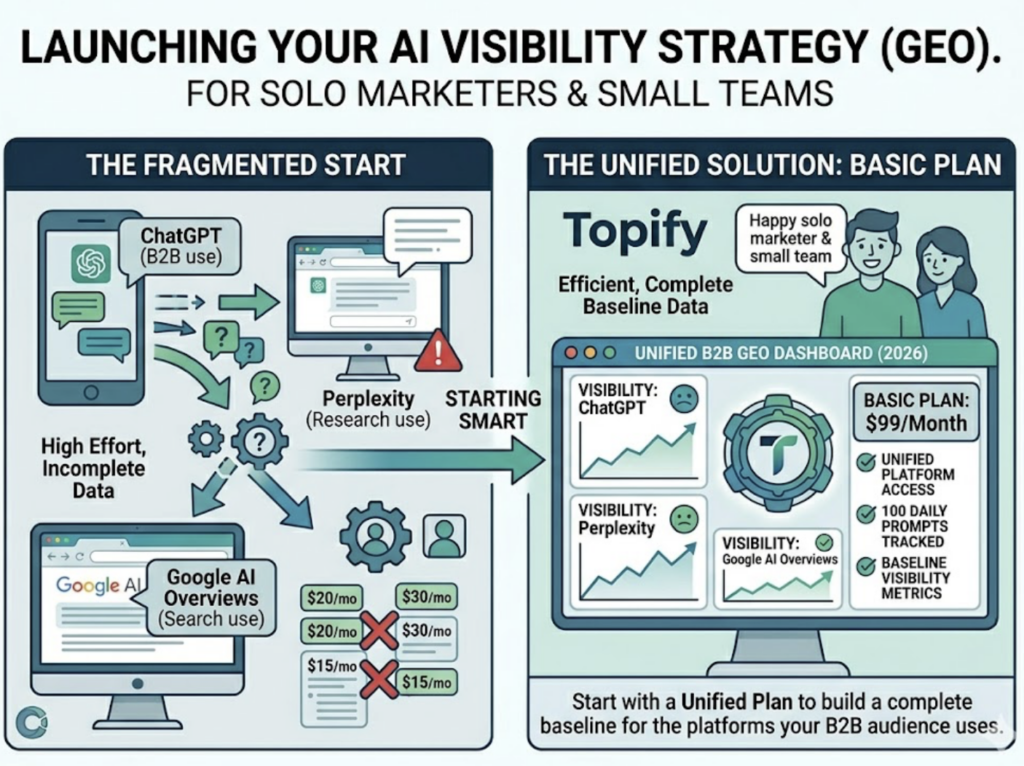
    If you’re a solo marketer or small team just entering the GEO space, start with a platform that covers the AI engines your audience actually uses. For most B2B brands in 2026, that means ChatGPT, Perplexity, and Google AI Overviews at minimum. Topify’s Basic plan at $99/month covers all three plus 100 tracked prompts, which is enough to build a baseline.

    If you’re an agency managing multiple clients, look for multi-project support and white-label reporting. Topify’s Pro and Enterprise tiers support 8+ projects and 10+ seats, which maps to a typical agency workload without per-client pricing surprises.

    If your priority is raw data and crawl-level analytics, Profound’s log-level approach may fit better. And if your team is deeply embedded in a traditional SEO workflow, SE Ranking’s hybrid interface reduces the learning curve.

    A few non-negotiable criteria regardless of team size:

    Cross-platform coverage. An AI answer tracking platform that only covers one engine is a point solution, not a platform. Your audience doesn’t use one AI exclusively, and neither should your tracking.

    Actionable metrics. Visibility counts are table stakes. You need sentiment scoring, position tracking relative to competitors, and ideally some measure of conversion potential. The Adobe LLM Optimizer framework calls this the shift from “vanity metrics” to “decision-making metrics.”

    Source-level attribution. Knowing you were mentioned is good. Knowing which URL the AI cited, and whether it was the right one, is what lets you actually improve.

    If you’re exploring the space before committing to a paid tool, Topify also offers a set of free AI visibility tools that can give you a quick baseline of where your brand stands.

    Conclusion

    AI answer tracking isn’t optional anymore for marketing teams that report on brand visibility. The shift from manual spot-checks to platform-level monitoring is the same leap SEO made from checking Google by hand to using Ahrefs and SEMrush. The only difference is the timeline: AI search is moving faster, and waiting six months to pick a platform means six months of invisible brand erosion.

    For teams that need coverage across every major AI engine, actionable metrics beyond simple mentions, and a direct path from data to execution, Topify is the strongest option on the market right now. Start with a baseline, track what matters, and let the data tell you where to optimize.

    FAQ

    Q: What is an AI answer tracking platform?

    A: An AI answer tracking platform monitors how your brand appears in AI-generated responses across engines like ChatGPT, Perplexity, Gemini, and Google AI Overviews. It tracks metrics like visibility frequency, sentiment, citation sources, and competitive positioning, giving marketing teams data they can’t get from traditional SEO tools.

    Q: What are the best google ai overview checking tools?

    A: The best google ai overview checking tools in 2026 include Topify (full-spectrum tracking with citation source analysis), ZipTie (screenshot-based evidence), and SE Ranking (hybrid SEO/GEO). The key differentiator is whether the tool tracks citation quality and sentiment accuracy, not just whether your brand appears.

    Q: How often should you check AI answers for brand mentions?

    A: Weekly at minimum. AI-generated answers change frequently as models update their training data and citation patterns. Monthly checks miss narrative drifts and competitor incursions. Platforms like Topify automate this with continuous monitoring across multiple AI engines.

    Q: Can AI answer tracking replace traditional SEO monitoring?

    A: No. AI answer tracking and traditional SEO monitoring measure different things. Google rankings still drive organic traffic, while AI answer tracking measures brand visibility in generated responses. The two complement each other. In practice, teams running both often discover that strong SEO authority increases the likelihood of AI citations, but the correlation isn’t automatic.

    Read More

  • AI Answer Monitoring Solutions That Actually Work

    AI Answer Monitoring Solutions That Actually Work

    Your marketing team tracks keyword rankings, organic traffic, and domain authority every month. The reports look solid. Then someone on the leadership team asks, “What’s ChatGPT saying about us?” and nobody has an answer.

    That’s not a minor gap. Gartner projects that by 2026, traditional search engine volume will drop by 25% as AI chatbots and generative search take over. The brands that show up in those AI answers will capture the attention. The ones that don’t will lose ground they can’t measure with legacy SEO tools.

    The problem isn’t awareness. Most marketing teams know AI search matters. The problem is finding an AI answer monitoring solution that actually closes the loop between data and action.

    Most AI Answer Monitoring Tools Only Show You Half the Picture

    Here’s what typically happens. A team signs up for an AI answer monitoring tool, runs a few queries, and gets a report saying the brand was “mentioned” 12 times across ChatGPT last week. That sounds useful until you realize the report doesn’t say whether those mentions were positive or negative, which competitors showed up first, or which sources triggered the mentions in the first place.

    That’s half a picture, and it’s the norm across most AI answer monitoring software on the market today.

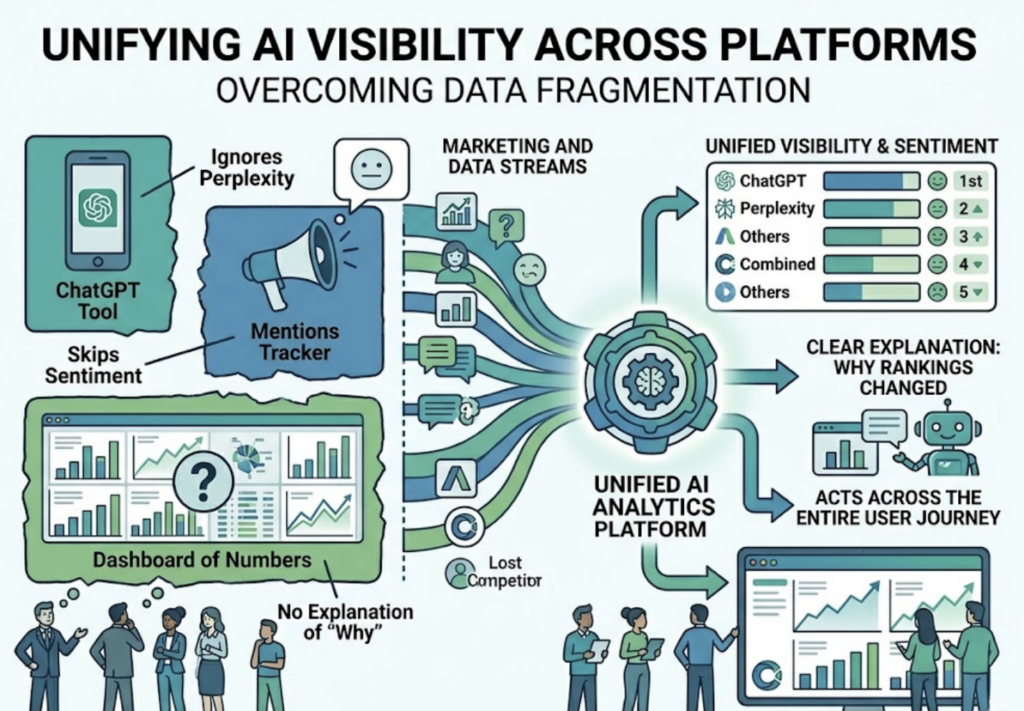
    The deeper issue is fragmentation. One tool covers ChatGPT but ignores Perplexity. Another tracks mentions but skips sentiment. A third gives you a dashboard full of numbers with no explanation of what changed or why. Marketing leaders are now shifting budget from traditional rank tracking to AI answer monitoring analytics, but many are finding that the tools they’ve chosen can’t unify data across the platforms their audiences actually use.

    A complete AI answer monitoring solution doesn’t just count mentions. It tells you where you rank, how you’re described, who’s beating you, and what you can do about it.

    What a Complete AI Answer Monitoring Platform Needs to Cover

    Not all monitoring is equal. Research into the AI visibility space points to seven core dimensions that separate surface-level tracking from strategic intelligence:

    DimensionWhat It Tells You
    VisibilityHow often your brand appears in AI responses across platforms
    SentimentWhether AI describes you as “recommended” or “budget alternative”
    PositionWhere you rank in AI-generated lists, because #1 and #5 aren’t the same
    VolumeHow frequently your brand surfaces across high-intent AI queries
    SourceWhich citations and domains trigger AI to include or exclude your brand
    CompetitorHow your AI presence stacks up against rivals in real time
    CVRWhether AI appearances actually translate to traffic or leads

    Most AI answer monitoring tools cover two or three of these. A platform that covers all seven gives you the full picture.

    Topify is one of the few AI answer monitoring platforms built around this seven-metric framework. It tracks brand performance across ChatGPT, Gemini, Perplexity, DeepSeek, Doubao, Qwen, and other major AI engines, consolidating all seven dimensions into a single dashboard. For teams tired of stitching together partial data from multiple tools, that consolidation tends to be the deciding factor.

    The AI Answer Monitoring Dashboard Marketing Teams Actually Use

    A dashboard is only useful if it changes what your team does on Monday morning.

    The typical AI answer monitoring dashboard shows graphs and percentages. That’s a start. But the workflow that actually moves the needle looks different: you log in, spot a visibility drop on Perplexity for a high-intent prompt, trace it back to a competitor’s new blog post that AI is now citing, and launch an optimization campaign to reclaim that citation slot.

    That’s the kind of closed-loop workflow Topify’s dashboard is designed for. It combines High-Value Prompt Discovery, which surfaces the AI prompts that matter most to your brand, with real-time visibility tracking across every major AI platform. When something shifts, you don’t just see a number change. You see what caused it and what to do next.

    For marketing teams managing AI answer monitoring analytics across multiple brands or products, the multi-project structure means each brand gets its own tracking environment. No cross-contamination, no manual filtering.

    Why Position and Sentiment Data Change Everything for AI Answer Monitoring

    Here’s a scenario most AI answer monitoring software misses entirely.

    Your brand gets mentioned in a ChatGPT response about “best CRM tools.” That looks like a win in the Visibility column. But the mention reads: “Brand X is a traditional, high-cost solution that larger enterprises sometimes consider.” You’re mentioned, yes. You’re also being positioned as expensive and old-school.

    That’s why sentiment tracking isn’t optional in a real AI answer monitoring solution. An AI might include your brand but frame it in a way that actively pushes users toward your competitor. Without sentiment data parsed at the phrase level, you’d never know.

    Position data is equally telling. Unlike traditional search where position #10 still gets some clicks, AI answers often truncate after the first two or three recommendations. If your brand consistently shows up at position #4 or #5, you’re technically visible but practically invisible. The users reading those AI answers rarely scroll past the initial response.

    Topify’s Position Tracking and Sentiment Analysis work together here. The Sentiment Score (0-100) tells you how favorably AI describes your brand. The Position Rank tells you where you sit relative to competitors. Combined, they answer the question that a simple mention count never can: is AI actually helping or hurting your brand?

    How Top GEO Companies Approach AI Answer Monitoring at Scale

    For enterprise brands managing dozens of products across multiple markets, the monitoring challenge multiplies fast. A single-brand AI answer monitoring system won’t cut it when you’re tracking visibility for 15 product lines across 6 AI platforms in 4 languages.

    This is where the conversation around top GEO companies, including those presenting at events like CES, gets practical. The enterprises leading in generative engine optimization aren’t just running spot checks. They’re deploying structured AI answer monitoring platforms with multi-project management, regional benchmarking, and dedicated reporting pipelines.

    Topify’s Enterprise plan (starting at $499/month) is built for this scale. It includes a dedicated account manager, custom reporting, and the ability to spin up separate tracking projects per product line or region. For teams that need to present AI visibility data in quarterly business reviews, the reporting layer matters as much as the data itself.

    The strategic play at this level goes beyond monitoring. Data-driven enterprises are using AI answer monitoring analytics to reverse-engineer which brand assets (whitepapers, PR placements, product reviews) LLMs prioritize when generating responses. That insight feeds directly into content strategy, turning monitoring data into a competitive moat.

    From AI Answer Monitoring Software to Actual Optimization

    The primary failure of most AI answer monitoring tools is where they stop. They show you the problem. They don’t help you fix it.

    Consider the workflow: your AI answer monitoring dashboard reveals that Perplexity’s “best CRM” response doesn’t include your brand. Now what? With most tools, you export the data, schedule a meeting, brief your content team, develop new assets, distribute them, and wait weeks to see if anything changed.

    Topify takes a different approach with its One-Click Agent Execution. You define your optimization goal in plain English, review the proposed strategy, and deploy it with a single click. The AI agent handles the execution, from content generation to distribution, without the manual workflows that slow most teams down.

    That’s the gap between an AI answer monitoring system and an actual AI answer monitoring solution. Monitoring tells you what’s happening. A solution helps you change it.

    For teams ready to move beyond passive tracking, getting started with Topify means running your first visibility audit in minutes, not weeks.

    Conclusion

    The brands that treat AI answer monitoring as a checkbox will keep getting partial data from partial tools. The ones that treat it as a strategic function, covering visibility, sentiment, position, source, competitor, and conversion data across every major AI platform, will know exactly where they stand and what to do about it.

    The question isn’t whether your brand needs an AI answer monitoring solution. It’s whether the one you’re using actually closes the loop. Start with the seven dimensions. If your current tool can’t cover them, it’s time to look at one that can.

    FAQ

    Q: What’s the difference between AI answer monitoring and traditional brand monitoring?

    A: Traditional brand monitoring tracks mentions across news, social media, and web search results. AI answer monitoring specifically tracks how large language models like ChatGPT, Gemini, and Perplexity describe, recommend, or omit your brand in their generated responses. The data sources, metrics, and optimization strategies are fundamentally different.

    Q: How many AI platforms should an AI answer monitoring solution cover?

    A: At minimum, your solution should cover ChatGPT, Gemini, and Perplexity, as these represent the largest share of AI-driven search. For global brands, platforms like DeepSeek, Doubao, and Qwen also matter. The more platforms you track, the more complete your visibility picture becomes.

    Q: Can AI answer monitoring tools track competitor brands too?

    A: Yes. Competitive benchmarking is one of the seven core dimensions of effective AI monitoring. Platforms like Topify automatically detect competitors in AI responses and let you compare visibility, sentiment, and position data side by side.

    Q: How often should you check your AI answer monitoring dashboard?

    A: AI responses can shift weekly as models update their training data and citation patterns. For active campaigns, daily or weekly checks are recommended. For ongoing brand health tracking, a bi-weekly review with monthly reporting tends to work well for most marketing teams.

    Read More

  • AI Answer Monitoring Platforms: What They Track and How to Pick One

    AI Answer Monitoring Platforms: What They Track and How to Pick One

    Your team tracks Google rankings every week. You’ve got domain authority reports, keyword position updates, and a content calendar built around search volume data. Then someone on the leadership team asks, “Are we showing up when people ask ChatGPT about our category?” and nobody has an answer.

    That gap between traditional SEO reporting and AI search visibility is where most brands are stuck right now. AI-driven search traffic has surged 527% year-over-year, and over 60% of Google queries now end without a click as AI Overviews serve consolidated answers directly. The brands that can’t measure their presence in these AI-generated responses aren’t just missing data. They’re missing customers.

    What an AI Answer Monitoring Platform Actually Does

    An AI answer monitoring platform is a SaaS tool built to track, analyze, and optimize how your brand appears inside generative AI responses. That includes ChatGPT, Perplexity, Google AI Overviews, Gemini, and increasingly, newer models like DeepSeek and Claude.

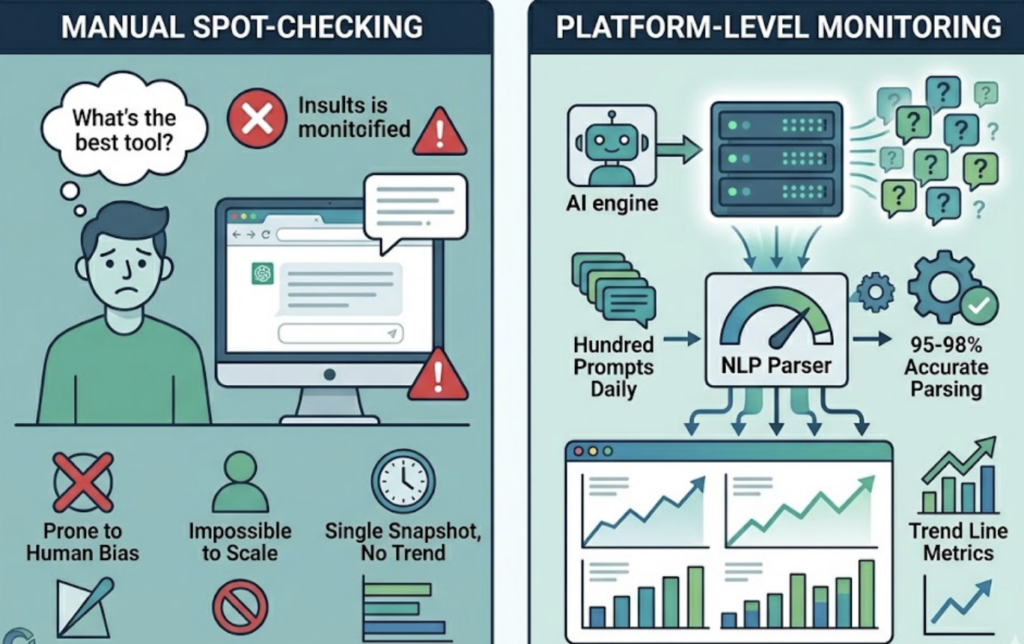
    This isn’t the same as manually asking ChatGPT “What’s the best [your category] tool?” once a quarter. Manual spot-checking is prone to human bias, impossible to scale, and gives you a single snapshot rather than a trend line. Platform-level monitoring runs hundreds or thousands of prompts daily, parses each response with NLP at 95-98% accuracy, and turns the results into metrics you can actually act on.

    The core capabilities typically include four things: visibility tracking (are you mentioned?), sentiment analysis (what does the AI say about you?), competitive benchmarking (who else gets mentioned in the same responses?), and source attribution (which domains is the AI citing when it talks about your category?).

    That last one matters more than most teams realize. If you don’t know which sources the AI trusts, you can’t influence what it says.

    The 5 Metrics That Separate Useful Platforms from Dashboards Full of Noise

    Not every AI answer monitoring platform measures the same things. The ones that drive real decisions tend to track five core metrics:

    Visibility Score. How often your brand appears across AI engines for a set of tracked prompts. This is the baseline. If you’re not showing up, nothing else matters.

    Sentiment Score. Whether the AI describes your brand positively, neutrally, or inaccurately. A mention isn’t valuable if ChatGPT calls your enterprise product “a budget option for small teams.”

    Position Rank. Where your brand falls in the AI’s recommendation list. Being mentioned fifth in a list of ten isn’t the same as being the first name the model suggests. Top chatgpt rank trackers focus on this metric specifically, and it’s one of the clearest indicators of competitive positioning in AI search.

    Citation Sources. The external domains the AI pulls from when generating answers about your category. This is where AI answer monitoring intersects with content strategy. If the AI cites your competitor’s blog but not yours, that’s a content gap you can close.

    AI Search Volume. The number of prompts triggering AI-generated responses related to your brand or category. This tells you where the demand is, not just where you rank.

    Traffic from AI-cited sources converts at an average rate of 14.2%, compared to 2.8% for traditional organic search. That means each of these five metrics isn’t just a vanity number. It’s tied directly to revenue.

    How AI Answer Monitoring Platforms Work Under the Hood

    The technical architecture behind these platforms follows a consistent pattern, even though each vendor implements it differently.

    It starts with prompt sampling. The platform executes a set of industry-relevant prompts across multiple LLMs (ChatGPT, Gemini, Perplexity, and others) at high frequency, often daily or hourly. These aren’t random queries. They’re structured around the prompts your target audience actually uses.

    Next comes response capture. The raw generative text from each AI engine gets stored as a data point. Unlike traditional SEO where you’re parsing web pages, here you’re parsing conversational text that changes every time the model updates its knowledge base.

    Then the NLP layer kicks in. Named Entity Recognition (NER) isolates brand mentions. Sentiment analysis scores the linguistic polarity of each mention. Attribution mapping extracts cited URLs to reconstruct the “knowledge graph” the AI relied on for that specific answer.

    Finally, all of this feeds into metric computation, where raw data gets normalized into visibility scores, sentiment trends, and position rankings that account for traffic potential across different platforms.

    The key insight here: AI responses aren’t static web pages. They shift as models get retrained, as RAG systems pull fresh sources, and as competitors publish new content. A one-time audit tells you where you stood. Continuous monitoring tells you where you’re heading.

    4 Mistakes That Tank Your AI Answer Monitoring Before It Starts

    Most teams that invest in AI answer monitoring still get disappointing results. The problem usually isn’t the tool. It’s how they use it.

    Tracking only one AI platform. This is the most common mistake. A brand’s visibility on ChatGPT can look completely different from its visibility on Perplexity or Google AI Overviews. Each model has different training data, different citation preferences, and different response structures. Monitoring just one engine is like tracking your Google rankings but ignoring Bing, Yahoo, and every other channel your customers use.

    Fixating on visibility without checking sentiment. Being mentioned is only half the story. If the AI describes your SaaS product as “outdated” or “limited compared to [competitor],” that mention is actively hurting you. Teams that only track whether they appear, without analyzing how they’re described, miss the most actionable data.

    Ignoring competitor gaps. The platform shows you that a competitor gets cited for a high-value prompt and you don’t. Too many teams note this and move on. The real question is: what source did the AI cite for that competitor, and can you create something better? Without digging into the citation layer, competitor data is just noise.

    Choosing a dashboard without an action layer. Some platforms give you charts and graphs but no path from insight to execution. The data shows you’re invisible for 40% of your tracked prompts. Then what? The platforms that drive results connect visibility gaps to specific content recommendations, source strategies, and optimization workflows.

    What to Check Before You Buy: The AI Answer Monitoring Platform Checklist

    Here’s what to evaluate before committing to a platform:

    CriteriaWhat to Look ForWhy It Matters
    Multi-platform coverageChatGPT, Perplexity, Gemini, Google AIO, DeepSeek in one viewAI users spread across platforms; single-engine data misleads
    Data frequencyDaily or real-time updatesRAG engines refresh sources constantly; weekly data is stale
    Metric completenessVisibility + Sentiment + Position + Citations + VolumeMissing any one metric creates blind spots
    Competitor monitoringAuto-detection and benchmarkingYou need relative performance, not just absolute scores
    Action layerContent recommendations tied to visibility gapsData without execution is just expensive reporting
    Pricing transparencyClear per-prompt or per-project pricingHidden costs erode ROI fast

    How Topify Covers Each Item on This List

    Topify stands out in this space for its hybrid approach: it integrates traditional SEO data (like Google Search Console metrics) with AI-specific citation tracking, giving teams both legacy context and forward-looking AI visibility data in a single platform.

    On multi-platform coverage, Topify tracks brand performance across ChatGPT, Gemini, Perplexity, DeepSeek, Doubao, Qwen, and Google AI Overviews. That’s broader than most competitors in the category.

    For metric completeness, the platform monitors seven key dimensions: visibility, sentiment, position, volume, mentions, intent, and CVR (Conversion Visibility Rate). The CVR metric is particularly useful. It estimates the likelihood that an AI response will drive a user toward your brand, which is the closest proxy to conversion attribution most teams can get in AI search right now.

    The action layer is where Topify diverges from pure-monitoring tools. Its AI agent lets you define optimization goals in plain English, review a proposed strategy, and deploy with one click. That closes the gap between “we see the problem” and “we’re fixing it.”

    On competitor monitoring, Topify auto-detects competitors and provides side-by-side benchmarking on visibility, sentiment, and position. You don’t have to guess who’s outranking you in AI answers. The platform shows you exactly who, for which prompts, and why.

    Pricing starts at $99/month for the Basic plan (100 prompts, 9,000 AI answer analyses, 4 projects) and scales to $199/month for Pro (250 prompts, 22,500 analyses, 10 seats). Enterprise plans start at $499/month with dedicated account management. You can get started with a 30-day trial on the Basic plan.

    A 30-Day Plan to Get Real Value from Your AI Answer Monitoring Platform

    Buying the platform is step one. Here’s how to make sure it pays for itself within the first month.

    Week 1: Set up your prompt universe and competitor baseline. Identify 50-100 prompts your target audience uses when searching for your category. Load them into the platform. Add 3-5 direct competitors. Run the first full scan and document your starting visibility score, sentiment, and position for each prompt.

    Week 2: Analyze trends and spot the gaps. Look for prompts where competitors appear but you don’t. Check sentiment for any mentions that mischaracterize your product. Identify the citation sources the AI favors in your category. This week is about understanding the terrain, not taking action yet.

    Week 3: Close citation gaps with targeted content. For every high-value prompt where you’re invisible, check which sources the AI cites for your competitors. Create or optimize content that directly addresses those topics, using the format and depth that AI models tend to reference. This is where the “action layer” earns its keep.

    Week 4: Generate your first AI visibility report. Pull your visibility, sentiment, and position data into a report your team can use. Compare Week 4 numbers to your Week 1 baseline. Highlight the prompts where you gained ground and the ones that still need work. Set monthly benchmarks going forward.

    That’s it. Four weeks from zero monitoring to a structured, repeatable AI visibility workflow.

    Conclusion

    The shift from ranking on Google to being recommended by AI isn’t hypothetical. It’s already happening, and the brands that track it will outperform the ones that don’t. An AI answer monitoring platform gives you the data layer you’re currently missing: who the AI recommends, why, and what you can do about it.

    If your monthly report still can’t answer “how are we doing in AI search,” that’s the gap to close first. Start with the checklist above, evaluate based on what your team actually needs, and get your first baseline scan running this week.

    FAQ

    Q: What is an AI answer monitoring platform?

    A: It’s a SaaS tool that tracks how your brand appears in AI-generated responses across platforms like ChatGPT, Perplexity, and Google AI Overviews. It measures metrics like visibility, sentiment, position ranking, citation sources, and AI search volume to help you understand and improve your brand’s presence in AI search.

    Q: How does an AI answer monitoring platform work?

    A: The platform runs industry-relevant prompts across multiple AI engines at high frequency, captures the generative text responses, and uses NLP techniques (named entity recognition, sentiment analysis, attribution mapping) to extract structured data about your brand mentions, tone, and cited sources.

    Q: What’s the difference between AI answer monitoring and traditional SEO rank tracking?

    A: Traditional SEO tracks your website’s position in blue-link search results. AI answer monitoring tracks whether and how AI models mention your brand in conversational responses. The data sources, metrics, and optimization strategies are fundamentally different. Traffic from AI-cited sources converts at roughly 14.2%, compared to 2.8% for traditional organic search.

    Q: How much does an AI answer monitoring platform cost?

    A: Pricing varies by vendor. For example, Topify’s Basic plan starts at $99/month for 100 tracked prompts and 9,000 AI answer analyses. Pro plans run $199/month with expanded capacity. Enterprise plans with dedicated support typically start at $499/month or higher depending on scale.

    Read More

  • AI Answer Monitoring Software: What It Does, How to Choose

    AI Answer Monitoring Software: What It Does, How to Choose

    Your team’s SEO dashboard looks solid. Rankings are stable, organic traffic is trending up, and your quarterly report has all the right charts. Then your CMO asks a question nobody on the team can answer: “When someone asks ChatGPT which product to buy in our category, do we even show up?”

    You check manually. You type a few prompts. Your brand doesn’t appear. Or it does, but it’s described as a “budget option” when your positioning is premium. The problem isn’t that your SEO failed. It’s that AI search runs on a completely different set of signals, and traditional tools weren’t built to see them.

    That’s where AI answer monitoring software comes in.

    What AI Answer Monitoring Software Actually Tracks

    AI answer monitoring software is a category of analytics tools built to audit how a brand, product, or service appears inside AI-generated responses. Instead of tracking blue links on a results page, these tools simulate real-world user prompts across platforms like ChatGPT, Perplexity, and Gemini, then analyze what the AI actually says.

    The difference from traditional SEO monitoring isn’t incremental. It’s structural.

    DimensionTraditional SEO ToolAI Answer Monitoring Software
    Visibility unitOrganic ranking position (1-100)Mention rate and position in synthesized answer
    Output typeURL/linkNatural language summary with source citations
    Evaluation focusKeyword volume, CTRSentiment, authority, brand erasure risk
    Underlying dataCrawled search resultsRAG (Retrieval-Augmented Generation) inputs

    Here’s the thing: AI models don’t “rank” brands the way Google does. They synthesize. They pull from training data, retrieval pipelines, and citation sources to construct a narrative. Your brand is either part of that narrative or it isn’t.

    Recent academic work on what researchers call the “Optimization Stack” (spanning AEO, GEO, and AgO) suggests that AI agents prioritize information based on “epistemic effort,” meaning how easily they can verify and synthesize a source. AI answer monitoring software tracks whether your brand functions as a trusted source or gets excluded entirely.

    5 Metrics Your AI Answer Monitoring Software Should Measure

    Not all monitoring tools measure the same things. Before you compare platforms, you need to know what the core metrics actually mean, especially if your team is also evaluating top Perplexity rank trackers alongside broader AI visibility platforms.

    Visibility/Mention Rate. How often your brand appears across a representative set of high-intent prompts. This is the baseline. If you’re not being mentioned, nothing else matters.

    Sentiment Score. Being mentioned isn’t always good. If Gemini describes your product as “outdated” or associates it with a recalled feature, that mention is doing more harm than silence. Sentiment scoring tells you how the AI talks about your brand, not just whether it does.

    Position Rank. In platforms like Perplexity that produce cited lists, your placement in the “reference cluster” matters. Showing up fifth in a list of five isn’t the same as being the first recommendation.

    Citation Sources. Which third-party domains (or your own) is the AI pulling from when it mentions your brand? This metric reveals whether your content assets are being used as source material or ignored entirely.

    AI Search Volume. This is the opportunity gap: queries where your brand should appear based on relevance and authority, but currently doesn’t. Think of it as the AI equivalent of “unranked keywords” in traditional SEO, except you can’t see these gaps without purpose-built monitoring.

    For teams evaluating how to measure AI answer monitoring software performance, these five metrics form the minimum viable dashboard. Anything less, and you’re flying partially blind.

    Where Most Teams Go Wrong with AI Answer Monitoring

    The tools are new, and so are the mistakes. Four patterns show up repeatedly when teams start monitoring AI answers without a clear framework.

    The “One-Model” Fallacy. Checking your brand on ChatGPT doesn’t tell you what Perplexity or Gemini are saying. Different LLMs pull from different training data and RAG pipelines. A brand that ranks well in one model’s responses can be completely absent from another. Cross-platform coverage isn’t a nice-to-have. It’s a prerequisite.

    Ignoring Sentiment and Hallucinations. Some teams celebrate when they see their brand mentioned, without reading what was actually said. A mention that associates your product with negative reviews, outdated specs, or a competitor’s use case can do more damage than being omitted. Monitor what the AI says, not just that it says it.

    Static, Manual Spot-Checks. Typing a prompt into ChatGPT once a month and screenshotting the result isn’t monitoring. GenAI models update their outputs dynamically. What the AI said about your brand last Tuesday might differ from what it says today. Intermittent auditing produces stale strategy data.

    Treating AI Visibility Like SEO. Applying link-building metrics and keyword density rules to AI responses doesn’t work. AI models prioritize “semantic groundedness” and “authoritative entity mapping” over backlink profiles. The signals that make you visible to AI are different from the ones that rank you on Google.

    How to Choose AI Answer Monitoring Software: A Practical Checklist

    The market for AI answer monitoring software is still forming, which means feature sets vary widely between platforms. Use this checklist to separate tools that offer real visibility intelligence from those that only provide surface-level mention counts.

    CapabilityWhat to look forWhy it matters
    Cross-platform coverageChatGPT, Perplexity, Gemini, Claude, and regional modelsYour audience doesn’t use just one AI platform
    Monitoring frequencyAutomated daily or real-time auditing of core promptsAI outputs shift constantly; weekly checks miss the changes
    Competitor benchmarkingSide-by-side brand vs. competitor visibility dataYou can’t improve what you can’t compare
    Metric depthVisibility, sentiment, position, citation sources, volumeMention rate alone doesn’t tell the full story
    Reporting and exportDashboard + CSV/API for BI integrationAI visibility data needs to reach stakeholders beyond the SEO team
    Pricing transparencyClear per-prompt or per-project pricingAvoid tools that lock core metrics behind enterprise-only tiers

    If a tool only covers one AI platform, or only tells you whether you were mentioned without scoring sentiment and position, it’s not solving the full problem.

    Top AI Answer Monitoring Software to Consider in 2026

    Topify

    Topify is built specifically for AI search optimization, combining monitoring, analytics, and execution into a single platform. It covers ChatGPT, Perplexity, Gemini, DeepSeek, and other major AI engines, tracking seven core metrics: visibility, sentiment, position, volume, mentions, intent, and CVR (Conversion Visibility Rate).

    For teams looking for top Perplexity rank trackers, Topify’s Position Tracking is worth noting. It monitors where your brand lands in Perplexity’s cited reference lists relative to competitors, so you can see whether you’re the first recommendation or buried at the bottom.

    What sets it apart is the closed-loop approach. Most platforms stop at dashboards. Topify’s Source Analysis shows exactly which domains and URLs the AI is citing, so you can trace a visibility drop back to a specific content asset that fell out of the model’s citation pipeline. Its Competitor Monitoring auto-detects rival brands and benchmarks your visibility, sentiment, and position against them in real time.

    The platform also surfaces high-volume AI prompts relevant to your brand, revealing opportunity gaps where you should be cited but aren’t. For teams ready to act on the data, Topify’s one-click agent execution lets you define GEO goals in plain English and deploy optimization strategies without manual workflows.

    Pricing starts at $99/month for the Basic plan (100 prompts, 9,000 AI answer analyses, 4 projects) and scales to $199/month for Pro (250 prompts, 22,500 analyses). Enterprise plans start at $499/month with custom configurations. Details are on the Topify pricing page.

    Other Tools in the Category

    Google Search Console + AI Overviews. Google has started surfacing limited AI Overview data within Search Console. It’s free and useful as a supplemental signal, but it only covers Google’s own AI layer, not ChatGPT, Perplexity, or any other LLM.

    Custom GPT-Based Auditing Scripts. Some technical teams build internal tools using the OpenAI or Anthropic APIs to simulate prompts and log responses. This works for narrow, one-off audits but requires engineering resources to maintain and doesn’t provide competitive benchmarking, sentiment scoring, or cross-platform coverage out of the box.

    Manual Monitoring Workflows. Spreadsheet-based tracking where a team member types prompts and records results. It’s free, but the data is always stale, the coverage is limited to whatever one person has time to check, and it doesn’t scale.

    FeatureTopifyGoogle Search ConsoleCustom API ScriptsManual Tracking
    Cross-platform AI coverageChatGPT, Perplexity, Gemini, DeepSeek, othersGoogle AI Overviews onlyDepends on API accessWhatever you manually check
    Sentiment analysisYes (0-100 score)NoRequires custom buildSubjective
    Position trackingYesLimitedRequires custom buildManual
    Competitor benchmarkingAuto-detectedNoRequires custom buildManual
    Citation source analysisYesNoPartialNo
    Effort to maintainLow (SaaS)LowHigh (engineering)High (time)

    How to Improve Your AI Answer Monitoring Over Time

    Installing the software is step one. Getting value from it requires a strategy that evolves beyond the initial setup.

    Expand your prompt coverage systematically. Start with 20-30 core “decision-making queries” your target audience actually types into AI assistants. “Best [category] for [use case]” and “Compare [your brand] vs [competitor]” are typical starting points. Over 30 days, review which prompts generate the most volatile results and prioritize those for daily monitoring.

    Feed citation data back into content strategy. The Source Analysis report tells you which of your content assets the AI trusts enough to cite. Double down on those assets: update them, add structured data, expand their depth. At the same time, identify content that’s being ignored or leading to incorrect brand associations. Pruning or rewriting those pages can shift what the AI says about you.

    Establish monthly AI visibility reviews. Treat this the same way you’d treat an SEO performance review, but with different metrics. Benchmark your brand’s visibility, sentiment, and position against your top three competitors. When visibility drops, treat it as a brand equity risk, not a technical glitch. AI-generated answers influence purchase decisions, and a single quarter of declining visibility can compound into lost market share.

    The teams that get the most from AI answer monitoring software are the ones that close the loop: monitor, analyze, act, and re-monitor. The data is only useful if it changes what your team does next. Get started with Topify to see where your brand stands across AI platforms today.

    Conclusion

    The question your CMO asked, “Are we showing up in AI search?”, isn’t going away. It’s becoming a standard KPI for marketing teams that take AI-driven discovery seriously. AI answer monitoring software gives you the infrastructure to answer that question with data instead of guesswork.

    Start with the metrics that matter: visibility, sentiment, position, citation sources, and volume. Avoid the common traps of single-platform monitoring and manual spot-checks. Pick a tool that covers the platforms your audience actually uses and gives you enough depth to act on the data, not just stare at a dashboard.

    The brands that build this capability now will have a 12-month head start on the ones still relying on traditional SEO metrics to measure a fundamentally different channel.

    FAQ

    Q: What is AI answer monitoring software? 

    A: AI answer monitoring software tracks how your brand appears in AI-generated responses across platforms like ChatGPT, Perplexity, and Gemini. It measures whether your brand is mentioned, what the AI says about it, where it ranks relative to competitors, and which sources the AI cites. It’s a distinct category from traditional SEO tools, which were designed for search engine results pages, not synthesized AI answers.

    Q: How does AI answer monitoring software work? 

    A: These tools simulate real-world user prompts at scale, send them to multiple AI platforms, and analyze the resulting responses. They extract metrics like mention rate, sentiment score, position rank, and citation sources. The best tools run these audits automatically on a daily basis, so you’re tracking changes over time rather than relying on one-off manual checks.

    Q: How much does AI answer monitoring software cost? 

    A: Pricing varies by platform coverage and prompt volume. Topify’s plans start at $99/month for 100 monitored prompts and scale to $199/month for 250 prompts. Enterprise plans with custom configurations start at $499/month. Some teams start with free manual auditing, but the time cost and data staleness typically justify a dedicated platform within the first quarter.

    Q: Can AI answer monitoring software track Perplexity rankings? 

    A: Yes, if the tool supports Perplexity as a monitored platform. Topify, for example, tracks Position Rank specifically in Perplexity’s cited reference lists, showing you where your brand appears relative to competitors. This is a key capability for teams evaluating top Perplexity rank trackers, since Perplexity’s citation-heavy format makes position data particularly actionable.

    Read More

  • How to Track Perplexity Rankings and Improve Your Brand’s AI Search Visibility

    How to Track Perplexity Rankings and Improve Your Brand’s AI Search Visibility

    You’ve got a DA of 70, solid keyword positions, and a content calendar that runs like clockwork. Then you type your category prompt into Perplexity and get back a list of five recommendations. Your brand isn’t one of them. You check again next week with a slightly different prompt. Still nothing. The worst part? You don’t know if this has been happening for months, because nothing in your SEO stack was built to catch it.

    Perplexity ranking doesn’t show up in any traditional dashboard. And the gap between “manually spot-checking AI answers” and “systematically tracking your brand’s position” is where most marketing teams are stuck right now.

    Why Perplexity Ranking Works Nothing Like Google’s Top 10

    Google gives you a static list. Ten blue links, ranked by a crawlable algorithm, measurable with dozens of established tools. Perplexity doesn’t work that way.

    Perplexity operates on a Retrieval-Augmented Generation (RAG) architecture. It queries the live web, retrieves relevant documents in real time, and uses a large language model to synthesize those documents into a direct, cited answer. There’s no fixed index. There’s no static position #1. The “ranking” is the model’s real-time decision about which sources to prioritize, cite, and weave into the response.

    That’s a fundamentally different game.

    In practice, Perplexity’s output has three distinct layers. First, there’s the recommendation position: whether your brand appears in the body text as a named suggestion. Second, there are citations, the numbered footnote links ($[1], [2], [3]$) that point readers to verification sources. Third, there are brand mentions, natural language references to your company within the summary, often without any direct link attached.

    Here’s the thing: tools like Ahrefs and Semrush were designed to crawl indexable SERPs. They can’t simulate the dynamic reasoning behavior of a RAG system or capture the source-selection logic that determines which domains get cited. That’s why your current stack has a blind spot the size of an entire search platform.

    What Actually Influences Your Perplexity Ranking

    Perplexity’s Sonar models don’t evaluate content the way Google’s crawlers do. The ranking signals are different, and some of them shift faster than most teams expect.

    Content structure matters more than you’d think. RAG models favor what researchers call “extractable” content: pages built with clear H1-H3 headers, bulleted lists, and concise summary blocks (think TL;DR sections at the top). If your page buries the answer in paragraph seven of a 3,000-word essay, the model often skips it entirely.

    Recency is arguably the single biggest lever. Perplexity’s models heavily weight recently updated content. Field data from GEO practitioners suggests that resources older than roughly three months often lose priority in citation selection. Content decay isn’t just a Google problem anymore. It’s accelerated in AI search.

    Traditional domain authority still plays a role. Strong E-E-A-T signals and established Google rankings act as a prerequisite. Models tend to favor domains already recognized as authoritative for specific queries. But authority alone isn’t enough if the content is stale or poorly structured.

    Data-driven content gives you an edge. Original research, specific statistics, and expert quotes significantly increase the probability of being cited. Perplexity’s model is looking for claims it can attribute. Give it something worth attributing.

    How to Track Your Brand’s Perplexity Ranking Step by Step

    Moving from manual spot-checks to systematic tracking requires a structured approach. Here’s a four-step framework that works.

    Step 1: Define your prompt universe. Identify the 30 to 50 most critical prompts for your brand. These should mirror the questions your target audience actually types into Perplexity, not your internal keyword list. Think “best project management tool for remote teams” rather than “project management software.”

    Step 2: Run a baseline audit. Execute each prompt in a clean browser environment (no personalization, no cookies) and document where your brand stands. Are you cited? Mentioned? Recommended first, third, or not at all? This baseline is your starting point.

    Step 3: Set up continuous tracking. This is where manual effort hits a wall. Running 50 prompts weekly across Perplexity, ChatGPT, and Gemini isn’t sustainable by hand. Platforms like Topify automate this by monitoring brand visibility, citation sources, and position rank across multiple AI engines from a single dashboard. Topify’s Position Tracking shows exactly where your brand sits relative to competitors for each tracked prompt, while its Source Analysis reveals which domains Perplexity is citing most frequently.

    Step 4: Close the feedback loop. Integrate tracking data with your content pipeline. Use gap analysis to identify the prompts where your brand is consistently absent, then produce structured, data-dense content specifically designed to fill those voids. Topify’s High-Value Prompt Discovery continuously surfaces new prompt opportunities as AI recommendation patterns evolve.

    That’s not a one-time project. It’s an ongoing system.

    Perplexity Citations vs. Brand Mentions: What Each Metric Actually Tells You

    These two signals often get lumped together, but they measure different things and require different optimization strategies.

    Perplexity citations are the explicit footnote links in the response. When your domain appears as $[3]$ in a Perplexity answer, it means the model treated your page as a primary authority for a specific fact or claim. The strategic value is high: citations drive direct traffic, validate your expertise, and signal to the model that your content is trustworthy enough to verify claims against.

    Perplexity brand mentions are different. These happen when the model references your brand by name in the narrative (“The top players in this space include X, Y, and Z”) without necessarily linking to your site. The value here is market salience. Mentions build brand recall, signal that you’re part of the “consideration set,” and increase the likelihood that users will search for you directly afterward.

    A brand with high citations but low mentions typically has strong content authority but weak brand recognition in AI contexts. A brand with high mentions but low citations has the opposite problem: the model knows who you are but doesn’t trust your content enough to cite it as a source.

    Tracking both metrics separately is what makes the difference. Topify’s analytics break down visibility into these distinct layers, so you can diagnose whether your Perplexity SEO problem is a content problem, a brand awareness problem, or both.

    The Perplexity SEO Playbook: 5 Moves That Shift Your Ranking

    Knowing how Perplexity ranking works is step one. Here are five specific actions that tend to move the needle.

    1. Turn static pages into living documents. Perplexity’s recency bias means your content has a shelf life. Establish a rotating schedule to refresh core pillar pages every 8 to 12 weeks. Update statistics, add new examples, and revise outdated sections. The goal is to keep your best content within that freshness window.

    How to verify: check the “last updated” date on your top 10 pages. If any are older than 90 days, they’re likely losing Perplexity citation priority.

    2. Optimize for extractability. Every high-value page should open with what GEO practitioners call a “direct summary block”: a concise, factual paragraph or bulleted list that answers the core query in the first 150 words. This is what the RAG model lifts into the response box.

    How to verify: read your page’s opening. If you can’t extract a standalone, quotable answer in under 30 seconds, the model probably can’t either.

    3. Implement structured data. Use explicit schema markup (FAQ schema, HowTo schema, Organization schema) to help AI models understand entities and their relationships. This is table stakes for Perplexity SEO, not a differentiator, but skipping it puts you at a disadvantage.

    4. Build third-party presence. Models use authoritative third-party sources as “cross-reference” validation. Being mentioned in industry reports, comparison sites, and expert roundups increases the probability that Perplexity will include your brand in its synthesized answers. This is the Perplexity brand mentions strategy that most teams underinvest in.

    5. Drive early engagement signals. Perplexity tracks content performance signals to validate that users find cited content useful. Leverage social media, email campaigns, and community channels to drive high initial traffic and dwell time to newly published content. The first 48 hours matter.

    What’s the Best Tool to Check Perplexity Rankings

    This is the most common question brands ask once they realize traditional SEO tools can’t help.

    There are three approaches, and they’re not equal.

    Manual spot-checks are where most teams start. Open Perplexity, type your prompts, screenshot the results. It works for a handful of queries, but it doesn’t scale, doesn’t track changes over time, and is subject to personalization bias.

    General SEO platforms like Semrush or Ahrefs have started adding AI search features, but their core architecture is built around crawlable SERPs. Perplexity citation tracking and brand mention monitoring typically aren’t part of their standard workflow.

    Dedicated AI visibility platforms are purpose-built for this problem. Among them, Topify stands out for several reasons. It tracks visibility across Perplexity, ChatGPT, Gemini, DeepSeek, and other major AI platforms from a single dashboard. It provides citation-level data, showing exactly which URLs are cited for specific prompts. And it bridges the gap between detection and action with a content optimization workflow powered by its AI agent, so you’re not just seeing problems but fixing them.

    Tracking MethodPerplexity CoverageCitation DataMulti-EngineAutomated
    Manual Spot-ChecksPartialNoNoNo
    Traditional SEO ToolsLimitedNoPartialYes
    TopifyFullYesYes (7+ engines)Yes

    Topify’s pricing starts at $99/month for the Basic plan (100 prompts, 9,000 AI answer analyses) and $199/month for Pro (250 prompts, 22,500 analyses). For brands serious about Perplexity ranking, the Basic plan typically covers the initial monitoring needs.

    Conclusion

    Perplexity ranking isn’t a future concern. It’s a current blind spot. Every week your brand goes untracked in AI search is a week where competitors may be capturing the visibility, citations, and brand mentions that should be yours.

    The shift from manual spot-checks to systematic monitoring doesn’t require a massive budget or a new team. It requires the right framework (prompts, baseline, tracking, feedback loop) and a tool that can actually see what’s happening inside AI-generated answers. Start with your top 30 prompts, run a baseline audit, and build from there.

    FAQ

    Q: How often do Perplexity rankings change?

    A: Frequently. Because Perplexity uses RAG to query the live web in real time, rankings can shift with every query execution. In practice, most brands see meaningful position changes on a weekly basis, with content freshness being the primary driver of short-term fluctuations.

    Q: Can I track Perplexity rankings for free?

    A: You can manually search your target prompts and document the results, but this doesn’t scale beyond a few queries. For systematic, automated tracking with historical data, you’ll need a dedicated platform. Topify offers a free GEO Score check as a starting point.

    Q: Does Perplexity SEO require different content than Google SEO?

    A: Mostly yes. While strong domain authority helps on both platforms, Perplexity rewards extractable content structure (summary blocks, clear headers, data-rich claims) and penalizes content decay more aggressively than Google does. The optimal approach is to optimize for both, starting with structure and freshness.

    Q: How long does it take to improve your Perplexity ranking?

    A: It depends on your starting position. Brands that already have strong domain authority and well-structured content can see citation improvements within 4 to 6 weeks of targeted optimization. Brands starting from low visibility typically need 2 to 3 months of consistent content updates and third-party presence building.

    Read More

  • AI Answer Monitoring Tools: How They Work and Which to Pick

    AI Answer Monitoring Tools: How They Work and Which to Pick

    Your SEO dashboard says everything’s fine. Rankings are stable, organic traffic is up, domain authority keeps climbing. Then your VP asks a simple question: “What does ChatGPT say when someone asks for a product like ours?” You check. Your brand isn’t mentioned. Neither is your top-ranking blog post. The 57-page content strategy you built for Google has zero influence on what AI tells your potential customers.

    That’s the gap traditional SEO tools can’t close. They weren’t built to track what AI chooses to say.

    What an AI Answer Monitoring Tool Actually Tracks

    An AI answer monitoring tool is a specialized platform that tracks how a brand, product, or topic is represented across large language model interfaces. Think ChatGPT, Perplexity, Gemini, Google AI Overviews, and other AI-driven search experiences. Instead of monitoring keyword rankings on a results page, these tools monitor the AI’s synthesized response itself.

    The core tracking dimensions typically include four layers:

    DimensionWhat It Answers
    VisibilityDoes the AI mention your brand at all?
    PositionWhere does your brand appear relative to competitors in the response?
    SentimentIs the AI describing your brand positively, neutrally, or negatively?
    Citation SourcesWhich URLs is the AI referencing as its “evidence”?

    Here’s a distinction worth noting. A keyword AI overview checker focuses specifically on whether your brand shows up in Google’s AI Overview snippets. That’s useful, but narrow. A full AI answer monitoring tool spans multiple platforms, tracking the quality and context of mentions across the entire AI ecosystem.

    That scope difference matters. Your brand might rank well in AI Overviews but be completely invisible in Perplexity or ChatGPT, where a growing share of your audience is asking purchase-intent questions.

    How AI Answer Monitoring Tools Work Under the Hood

    The technical workflow behind these tools follows a structured pipeline, not a single keyword lookup.

    Step 1: Prompt-level tracking. Instead of tracking keywords the way traditional SEO tools do, AI answer monitoring tools track prompts: the actual conversational queries users type into AI models. “What’s the best project management tool for remote teams?” is a prompt. “Project management tool” is a keyword. The difference in specificity changes what the AI returns entirely.

    Step 2: Cross-platform aggregation. Tools query multiple LLM APIs at scale, including GPT-4, Gemini, Perplexity, and others, using a predefined set of high-intent brand or topic prompts. Each platform has different weighting mechanisms, different training data, and different citation behaviors. Monitoring just one gives you a partial picture at best.

    Step 3: Structured analysis. Using NLP and LLM-based categorization, the raw unstructured text from AI responses gets converted into structured data: brand mentions mapped, sentiment scores assigned, citation behavior tracked over time.

    One technical detail that often gets overlooked: accuracy depends heavily on sampling frequency. LLMs are non-deterministic and undergo rapid model updates. A weekly snapshot might miss a shift that happened on Tuesday and reverted by Thursday. High-frequency monitoring, daily or even more frequent, is what separates reliable data from stale reports.

    The Metrics That Separate Useful Data from Dashboard Noise

    Not every number on a monitoring dashboard deserves your attention. The metrics that actually drive decisions tend to fall into a clear hierarchy.

    Visibility Score answers the most basic question: does the AI know your brand exists? If your Visibility Score across ChatGPT and Perplexity is near zero, nothing else matters yet. This is where you start.

    Sentiment Score tells you how the AI frames your brand. A brand can be visible but poorly described. If Gemini calls your premium product “a budget option,” that’s a Sentiment problem, not a Visibility problem. Tracking sentiment on a 0-100 scale helps you catch narrative drift before it solidifies.

    Citation Share measures how often AI platforms reference your domain versus competitor domains. This is the metric that connects AI monitoring back to content strategy. If a competitor’s blog post is being cited 4x more than yours for the same prompt, you know exactly where to focus your content investment.

    AI Search Volume maps the popularity of specific prompts. Not all prompts are equal. A prompt that generates 10,000 AI searches per month is worth more monitoring attention than one that gets 50.

    One metric that’s still evolving is Position Rank. Because AI responses aren’t linear like a search results page, “position” often refers to the order of citation or the amount of the response dedicated to a brand. It’s useful directionally, but treat it as a trend indicator rather than an absolute ranking.

    For marketing teams tracking visibility across multiple AI platforms, Topify combines all seven of these dimensions, including visibility, sentiment, position, volume, mentions, intent, and CVR, into a single dashboard. In practice, this means you can spot a drop in ChatGPT mentions and trace it back to a specific source that stopped citing your brand, all without switching between tools.

    5 Mistakes That Make AI Answer Monitoring Useless

    Most teams that try AI answer monitoring don’t fail because they picked the wrong tool. They fail because of how they use it.

    Mistake 1: Monitoring only one AI platform. ChatGPT is the most visible, so it’s where most teams start and stop. But Perplexity weights real-time web sources differently than Gemini, which leans into its own ecosystem integration. A brand that’s cited heavily in ChatGPT might be completely absent in Perplexity. Cross-platform coverage isn’t optional.

    Mistake 2: Using SEO keywords instead of real user prompts. “CRM software” is a keyword. “What’s the best CRM for a 20-person sales team that uses Slack?” is a prompt. AI models respond to conversational queries with very different answers than they do to keyword-style inputs. If your monitoring is built around keywords, you’re tracking the wrong inputs.

    Mistake 3: Only checking if you’re mentioned. Visibility without context is misleading. A brand that’s mentioned but described as “outdated” or “overpriced” is worse off than one that isn’t mentioned at all. Sentiment analysis isn’t a nice-to-have. It’s core to understanding what monitoring data actually means.

    Mistake 4: No competitive baseline. Monitoring your own brand in isolation tells you nothing about whether you’re gaining or losing ground. Without competitor benchmarking, you can’t tell if a visibility drop is specific to your brand or a broader shift in the AI model’s behavior.

    Mistake 5: Monitoring too infrequently. AI models update their training data and system prompts regularly. A single model update can overnight change your brand’s visibility for key prompts. Monthly check-ins miss these shifts entirely. Daily or weekly monitoring is the minimum frequency for catching meaningful changes.

    A Practical Checklist for Choosing the Right AI Answer Monitoring Tool

    When evaluating tools, here’s what to weigh:

    Evaluation CriteriaWhat to Look For
    Platform CoverageDoes it track ChatGPT, Perplexity, Gemini, AI Overviews, and regional models?
    Prompt CapacityHow many prompts can you monitor? 50 is a demo. 200+ is operational.
    Metric DepthDoes it go beyond visibility to include sentiment, position, citation share?
    Competitor MonitoringCan you benchmark against competitors automatically?
    Execution LayerDoes it just report data, or does it help you act on it?
    Pricing ModelUsage-based vs. flat rate? Does it scale with your needs?

    Most tools in this space stop at the reporting layer. They show you dashboards but leave the “what do I do about it” to you.

    Topify takes a different approach. Beyond tracking across ChatGPT, Gemini, Perplexity, DeepSeek, and other major AI platforms, it includes a one-click execution layer. You define your optimization goals in plain English, review the proposed strategy, and deploy it. The system handles prompt discovery, competitive benchmarking, and citation analysis in one workflow.

    On pricing, Topify’s plans start at $99/month for the Basic tier (100 prompts, 9,000 AI answer analyses, 4 projects) and scale to $199/month for Pro (250 prompts, 22,500 analyses, 10 seats). Enterprise plans start at $499/month with dedicated account management. You can check the full breakdown on the Topify pricing page.

    The question to ask isn’t just “which tool has the most features.” It’s which tool connects monitoring data to action without requiring your team to build the bridge manually.

    How to Build an AI Answer Monitoring Strategy That Compounds

    Buying a tool is step one. Making it compound over time is where the real value shows up.

    Start with your prompt library. Don’t monitor every possible query. Start with 20-30 high-intent prompts that your customers actually ask: product comparisons, use-case questions, “best tool for X” queries. These are the prompts where AI visibility directly influences purchase decisions.

    Establish a baseline. Run a comprehensive audit before you change anything. Document your Visibility Score, Sentiment, and Citation Share across all tracked platforms. This is your day-zero snapshot, and every future optimization will be measured against it.

    Set up competitor benchmarking. Identify 3-5 direct competitors and track the same prompts for their brands. Topify’s Dynamic Competitor Benchmarking automatically detects competitors and provides side-by-side comparisons on visibility, sentiment, and position. Knowing that a competitor gets cited 3x more for a specific prompt tells you exactly where to focus.

    Close the optimization loop. This is where monitoring turns into growth. When data shows “the AI doesn’t associate our brand with sustainable packaging,” the action is clear: create or strengthen content on that topic across your owned channels. Update your key landing pages. Build entity associations that AI models can pick up.

    Then validate. Measure the change in Citation Share and Sentiment after your content adjustments go live. If Citation Share climbs but Sentiment stays flat, your content is getting referenced but the messaging needs work. If both move, you’ve closed the loop.

    The teams that get compounding returns aren’t the ones with the fanciest dashboards. They’re the ones running this cycle, monitor, diagnose, act, validate, every two to four weeks.

    Conclusion

    The gap between what traditional SEO tools measure and what AI models actually say about your brand is only getting wider. An AI answer monitoring tool doesn’t replace your existing analytics stack. It fills the blind spot that no keyword tracker, rank checker, or traffic dashboard can cover.

    Start with a focused set of high-intent prompts. Establish your baseline across platforms. Build the optimization loop. The brands that figure this out early won’t just be visible to AI. They’ll be the ones AI recommends first.

    FAQ

    Q: What is an AI answer monitoring tool? 

    A: An AI answer monitoring tool is a platform that tracks how your brand appears in AI-generated responses across models like ChatGPT, Perplexity, and Gemini. It monitors visibility, sentiment, positioning, and citation sources to show you what AI is telling your potential customers about your brand.

    Q: How does an AI answer monitoring tool work? 

    A: These tools operate through a three-step pipeline. First, they track specific conversational prompts across multiple AI platforms. Then they aggregate the AI-generated responses. Finally, they use NLP to convert unstructured AI answers into structured data: brand mentions, sentiment scores, citation patterns, and visibility trends over time.

    Q: How much do AI answer monitoring tools typically cost? 

    A: Pricing varies by platform and scale. Entry-level plans for comprehensive tools like Topify start around $99/month for 100 tracked prompts and 9,000 AI answer analyses. Mid-tier plans run $199/month with higher prompt limits and team seats. Enterprise options with dedicated support typically start at $499/month.

    Q: Can I use an AI answer monitoring tool alongside traditional SEO tools? 

    A: Yes, and you should. Traditional SEO tools track how you rank in search results. AI answer monitoring tools track how you’re represented in AI-generated answers. They measure different things. Using both gives you full visibility across both traditional and AI-driven search channels.

    Read More

  • AI Answer Monitoring: How It Works and How to Start

    AI Answer Monitoring: How It Works and How to Start

    You checked ChatGPT last Tuesday, searched your brand’s category, and saw your name in the response. You checked again on Friday. Gone. Replaced by a competitor you’ve never heard of. The problem isn’t that AI answers change. It’s that most marketing teams have no system to track when they change, why they change, or what to do about it.

    AI search traffic has grown 527% year-over-year, and traditional search volume is projected to drop by 25% as AI-driven answer engines absorb more informational queries. The brands that treat AI answer monitoring as a structured discipline, not an occasional manual check, are the ones controlling how they show up.

    What AI Answer Monitoring Actually Measures

    AI answer monitoring is the systematic process of tracking how a brand appears inside AI-generated responses across platforms like ChatGPT, Google AI Overviews, Perplexity, and Microsoft Copilot. It’s not a single metric. It’s a framework that covers whether you’re mentioned, how you’re described, where you rank, and what sources the AI pulls from.

    That’s a fundamentally different challenge than traditional SEO.

    SEO tracks blue links and SERP positions. AI answer monitoring tracks citations, sentiment, and conversational authority. In traditional search, you’re competing for clicks. In AI search, you’re competing for a recommendation inside a single generated answer, one that often determines the user’s decision before they visit any website. With zero-click behavior now exceeding 60% on traditional Google and reaching 80-93% on AI-native platforms, the answer itself is the battleground.

    Two metrics define success here: Citation Share, which measures how often AI recommends you relative to competitors, and Sentiment Accuracy, which captures whether the AI describes your value proposition correctly. A brand that’s mentioned frequently but positioned as “budget-friendly” when its actual positioning is premium has a monitoring problem, not a visibility win.

    The 5 Metrics That Define Effective AI Answer Monitoring

    If you’re only counting whether your brand name appears, you’re missing four-fifths of the picture. Here’s what a complete AI answer monitoring system actually tracks.

    MetricWhat It MeasuresWhy It Matters
    Visibility ScoreFrequency of prompts where your brand appearsMeasures your brand’s reach inside the AI-native discovery funnel
    Sentiment ScoreTone and accuracy of AI’s brand description (0-100)Catches misrepresentation before it shapes buyer perception
    Position RankOrder in which your brand is cited or recommendedDirectly correlates with user trust and click-through likelihood
    Citation SourcesSpecific domains and URLs the AI cites when mentioning youReveals the trust signals AI relies on, informing your content and PR strategy
    AI VolumeFrequency of high-intent topics surfacing in AI platformsPrioritizes content efforts based on where AI search activity is highest

    Each metric answers a different question. Visibility tells you if you’re in the room. Sentiment tells you what’s being said. Position tells you where you stand relative to competitors. Citation Sources tell you why AI chose to include you. And AI Volume tells you which conversations matter most.

    Tracking all five together is what separates teams running real AI answer monitoring from teams who are just spot-checking ChatGPT once a month.

    How to Set Up AI Answer Monitoring Step by Step

    Most teams start with a manual approach: type your brand category into ChatGPT, screenshot the result, share it in Slack. That works once. It doesn’t work at scale, and it doesn’t work when AI models update their responses every few weeks.

    Here’s a more sustainable strategy for ai answer monitoring that holds up over time.

    Step 1: Define your prompt universe. Don’t just monitor your brand name. Users typically search for problems (“how to fix X”), categories (“best CRM for small teams”), or comparisons (“Tool A vs Tool B”). Your brand needs to appear as the solution to those prompts. Use tools with prompt discovery features, like Topify’s High-Value Prompt Discovery, to surface the exact queries your audience is asking across AI platforms.

    Step 2: Prioritize your platforms. Focus on the “Big Four” that cover distinct user behaviors: ChatGPT Search for research and synthesis, Google AI Overviews for transactional and local queries, Perplexity for professional research, and Copilot for enterprise and workplace contexts. Each platform pulls from different source signals and updates on different cadences.

    Step 3: Establish a baseline. Measure your current visibility, sentiment, and position against your top two competitors across the same prompt sets. Without a baseline, you can’t measure improvement or diagnose a sudden drop.

    Step 4: Automate and iterate. Move from one-time audits to continuous tracking. Topify’s platform, for instance, lets you monitor 100 to 250+ prompts across ChatGPT, Perplexity, and AI Overviews simultaneously, with automated alerts when your visibility shifts. The goal is to move from tracking to optimization: updating your content architecture to be citation-ready, meaning structured, modular, and fact-dense.

    Best AI Overviews Checking Tools for 2026

    The market for ai overviews checking tools has matured significantly. What used to be basic rank trackers now span full-spectrum AI visibility platforms. But the range is wide, and picking the wrong tool means paying for dashboards that don’t answer your actual questions.

    Here’s how the current landscape breaks down.

    Topify stands out as a comprehensive mid-market platform that combines monitoring and execution in a single workflow. It tracks brand performance across ChatGPT, Gemini, Perplexity, DeepSeek, and Google AI Overviews via seven core metrics: visibility, sentiment, position, volume, mentions, intent, and CVR. What sets it apart from monitoring-only dashboards is its execution layer. Topify’s One-Click Agent lets you define optimization goals in plain English and deploy a GEO strategy without manual workflows. Its Prompt Discovery feature continuously surfaces high-volume AI queries relevant to your brand, so you’re not guessing which prompts to track. Citation analysis goes deep: you can see the exact domains and URLs that AI platforms cite when mentioning your brand or competitors, then act on those insights directly. Pricing starts at $99/mo for 100 prompts and 9,000 AI answer analyses, scaling to $199/mo (250 prompts) and custom enterprise plans from $499/mo. Get started with Topify to run your first AI visibility audit.

    For teams already embedded in traditional SEO ecosystems, Semrush and Ahrefs have both added AI visibility features as extensions of their existing keyword and rank tracking tools. These are solid options if your primary workflow already runs through those platforms, though their AI monitoring depth tends to be narrower than purpose-built tools.

    ZipTie.dev has earned attention for its UI simulation tracking approach, which renders AI answers in an actual browser environment rather than relying solely on API calls. This produces results closer to what a real user sees, plus built-in screenshot capture for reporting.

    For niche requirements, options like LLMRefs serve teams with heavy keyword volumes on tighter budgets.

    FeatureTopifySEO-Integrated ToolsZipTie.dev
    AI Platform CoverageChatGPT, Gemini, Perplexity, DeepSeek, AI OverviewsVaries (typically 1-2)ChatGPT, Perplexity
    Core Metrics7 (visibility, sentiment, position, volume, mentions, intent, CVR)2-3 (visibility, position)3-4 (visibility, position, screenshots)
    Execution/OptimizationOne-Click Agent + content strategyLimited recommendationsContent optimization suggestions
    Starting Price$99/moBundled with SEO suiteVaries

    The right ai overviews checking tool depends on your team’s priorities. If you need both monitoring and execution in one platform, Topify covers the full loop. If you’re extending an existing SEO stack, the integrated options make sense. If visual proof and screenshot reporting matter most, ZipTie.dev fills that gap.

    5 Mistakes That Tank Your AI Answer Monitoring Results

    Knowing what to monitor is half the equation. The other half is avoiding the errors that make your data misleading or your efforts wasted.

    Mistake 1: Monitoring only one platform. ChatGPT is the default for most teams, but Google AI Overviews, Perplexity, and Copilot each serve different user intents and pull from different source signals. A brand that’s visible in ChatGPT but absent from AI Overviews is missing the transactional queries that drive purchase decisions.

    Mistake 2: Using the wrong prompts. Testing only your brand name is like checking if your phone number works by calling yourself. Real users search for problems, categories, and comparisons. “Best project management tool for remote teams” tells you more about your AI visibility than “What is [Brand Name]?” ever will.

    Mistake 3: Tracking mentions but ignoring sentiment. A mention that describes your product as “outdated” or “overpriced” does more damage than no mention at all. Sentiment monitoring catches misrepresentation before it shapes buyer perception at scale.

    Mistake 4: Treating monitoring as a one-time audit. AI models update their training data, citation patterns, and response formats on a rolling basis. What was true last month may not hold this month. Continuous tracking with automated alerts is the only way to catch shifts before they compound.

    Mistake 5: No human review loop. Automated dashboards flag changes. Humans interpret whether those changes require action. A drop in visibility could mean a competitor published stronger content, or it could mean the AI model shuffled its citation preferences temporarily. Without human judgment in the loop, teams either overreact to noise or miss real signals.

    Your AI Answer Monitoring Checklist

    Here’s a condensed, actionable checklist you can use to audit your current monitoring setup or build one from scratch.

    Setup Phase

    Map 50-100 high-intent prompts your target audience actually uses across AI platforms. Prioritize category queries and problem-solution queries over branded searches. Identify the top 2-3 competitors to benchmark against. Choose a monitoring tool that covers at least ChatGPT, Google AI Overviews, and Perplexity.

    Ongoing Monitoring

    Track all five core metrics weekly: visibility, sentiment, position, citation sources, and AI volume. Set automated alerts for any visibility drop greater than 10% week-over-week. Review citation sources monthly to identify which domains are helping (or hurting) your AI presence. Compare your sentiment score against your actual brand positioning to catch misrepresentation early.

    Optimization

    Update your content architecture to be citation-ready: structured data, modular sections, and fact-dense paragraphs that AI can easily extract. Run prompt discovery monthly to catch new high-volume queries. Feed monitoring insights back into your content and PR strategy. Measure improvement against your original baseline every 30 days.

    If you don’t have a monitoring tool yet, start with Topify’s platform to establish your baseline across multiple AI engines in one dashboard.

    Conclusion

    AI answer monitoring isn’t a nice-to-have analytics feature. It’s the foundation for every brand visibility decision in a search environment where AI generates the answer, not just the link. The teams that build a structured monitoring system now, with the right metrics, the right prompts, and continuous tracking, are the ones who’ll control how AI represents their brand in 2026 and beyond.

    The first step is simple: stop checking manually and start measuring systematically.

    FAQ

    Q: What is AI answer monitoring? 

    A: AI answer monitoring is the systematic process of tracking how your brand, product, or service appears inside AI-generated responses across platforms like ChatGPT, Google AI Overviews, Perplexity, and Copilot. It covers visibility (whether you’re mentioned), sentiment (how you’re described), position (where you rank), and citations (what sources AI references).

    Q: How does AI answer monitoring work? 

    A: Monitoring tools track a defined set of prompts across multiple AI platforms, then analyze each response for brand mentions, tone, ranking order, and cited sources. Results are aggregated into dashboards that show trends over time, flag changes, and surface optimization opportunities.

    Q: What are the best tools for AI answer monitoring? 

    A: The leading options in 2026 include Topify (comprehensive monitoring + execution), Semrush and Ahrefs (AI features integrated into existing SEO suites), and ZipTie.dev (UI simulation with screenshot capture). The right choice depends on whether you need monitoring only, monitoring plus optimization, or an extension of your existing SEO workflow.

    Q: How much does AI answer monitoring cost? 

    A: Pricing varies widely. Purpose-built platforms like Topify start at $99/mo for 100 prompts and 9,000 AI answer analyses, with Pro plans at $199/mo. SEO-integrated tools bundle AI monitoring into their existing subscription tiers. Enterprise solutions with dedicated support typically start at $499/mo and scale based on prompt volume and platform coverage.

    Read More