Author: Elsa Ji

  • Best Visibility Tracking Tools for AI Response Monitoring

    Best Visibility Tracking Tools for AI Response Monitoring

    Search “best visibility tracking tools” and every platform on the first page says the same thing: track your brand across ChatGPT, Perplexity, and Google AI Overviews. What none of them tell you upfront is what they actually measure. Some count how many times your name appears. Others stop at a citation link. Very few show you how the model describes you, where you rank against competitors, or why a rival keeps getting recommended instead. So you end up comparing dashboards that look identical and price differently, with no clear way to tell which one answers the question that matters: not whether AI mentions you, but how it talks about you.

    Why Mention Counts Aren’t AI Response Monitoring

    Most teams start by counting mentions. They run their brand name through ChatGPT a few times, see it show up, and call it a win. That number feels reassuring, and it tells you almost nothing.

    A mention only confirms the model knows you exist. It doesn’t tell you whether you were recommended first or buried in a footnote, whether the description matched your positioning, or whether the AI linked to your site as the source. HubSpot’s guide to AI citation tracking draws the same line: a mention reflects recall, while a citation attributes information directly to your domain and is becoming the trust signal that counts.

    AI response monitoring is the systematic version of that distinction. Instead of asking “how often does my name appear,” it asks how language models represent your brand across the prompts your buyers actually type.

    That representation has three moving parts. Position, or whether you’re the top pick or an afterthought. Sentiment, or whether the model frames you as a leader or a legacy option. And citation, or whether it trusts your content enough to link to it.

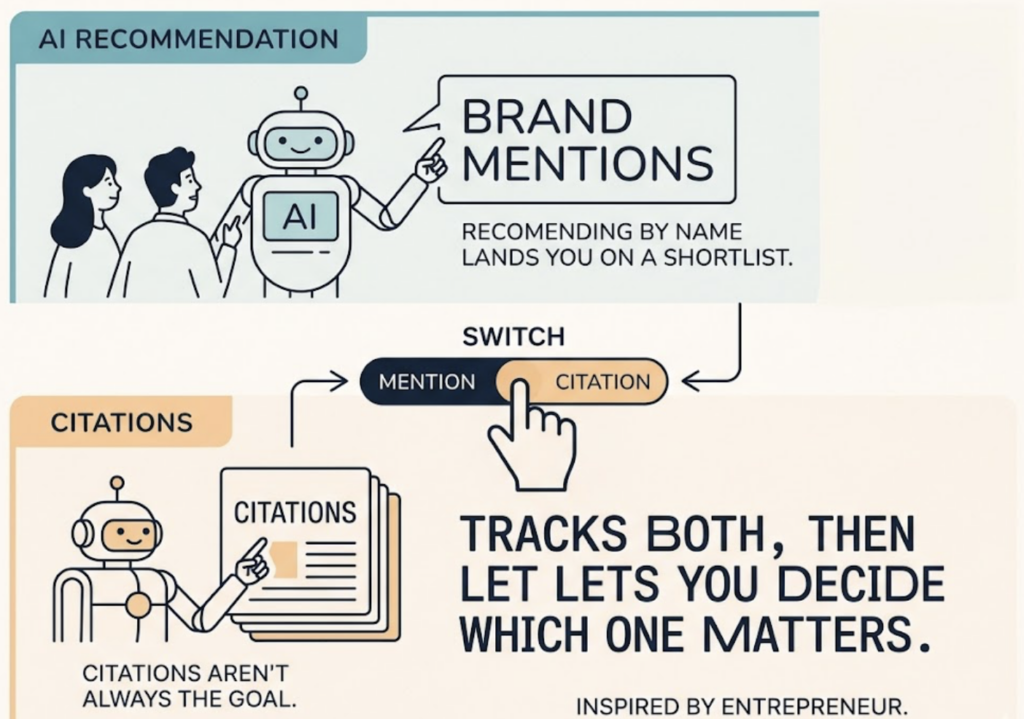
    Here’s the catch most comparison lists miss. Citations aren’t always the goal. In many commercial contexts, Entrepreneur argues that brand mentions move the needle more than citations, because the AI recommending you by name is what lands you on a shortlist. The right tool tracks both, then lets you decide which one matters for a given prompt.
    This shift isn’t optional anymore. Roughly 60% of searches now end without a click, and 31% of Gen Z users start their queries inside AI tools rather than a search bar. If you’re not watching what those answers say, you’re flying blind on a channel that’s already shaping demand.

    How AI Response Monitoring Works in Practice

    The method that separates real monitoring from spot-checking is prompt-level tracking. You don’t track keywords. You track a fixed set of prompts that mirror real buyer intent, run on a schedule.

    Built In describes the same approach: build prompt clusters grouped by intent, such as product comparisons or “best tool for X,” then run them consistently across ChatGPT, Perplexity, Google AI Overviews, and Gemini.

    The reason cadence matters is that AI answers are non-deterministic. Ask the same question twice and you can get two different brand lists. A single screenshot proves nothing. What you need is the probability that you appear over dozens of runs, tracked over weeks.

    That’s the gap most brands still can’t see.

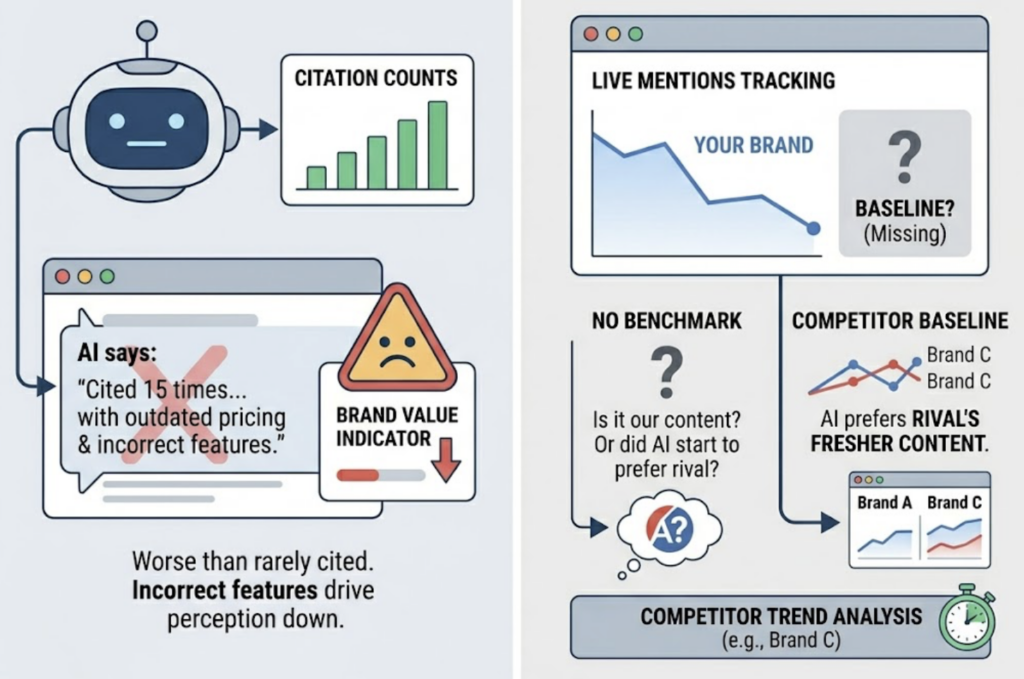
    Once you’re capturing responses at scale, the analysis becomes about displacement: spotting the moment a competitor enters an answer where you used to be, then tracing it back to the source that shifted.

    The Best Visibility Tracking Tools for AI Response Monitoring

    Here’s how the current crop of platforms stacks up. The dividing line isn’t features, it’s depth: how many engines they cover, and whether they go past mention counts into position, sentiment, and citation source.

    ToolEngine coverageTracks beyond mentionsStarting priceBest for
    TopifyChatGPT, Gemini, Perplexity, AI Overviews, plus DeepSeek, Doubao, QwenPosition, sentiment, citation source, competitor benchmarking, CVR$99/moTeams that want monitoring plus execution
    LebesgueMajor AI enginesVisibility tied to traffic and conversionVariesEcommerce and high-intent brands
    ConductorChatGPT, Gemini, PerplexitySEO rankings plus AEO in one viewEnterpriseEnterprise SEO-to-AEO teams
    AllmondMultiple LLMs, 60+ countriesPrompt-level monitoring at country scaleVariesAgencies and multi-brand teams
    Otterly AIChatGPT, Perplexity, AI OverviewsShare of voice, prompt monitoringVariesGEO-focused single brands

    Now the detail behind the ranking.

    Topify: Built for AI Response Monitoring and the Action After It

    Most tools stop at the dashboard. They show you a number and leave the next step to you. Topify is built around the assumption that monitoring is only useful if it leads somewhere.

    On the monitoring side, it tracks your brand across ChatGPT, Gemini, Perplexity, and Google AI Overviews, and extends into engines most platforms skip, including DeepSeek, Doubao, and Qwen. For brands with audiences outside the US, that coverage matters more than it sounds.

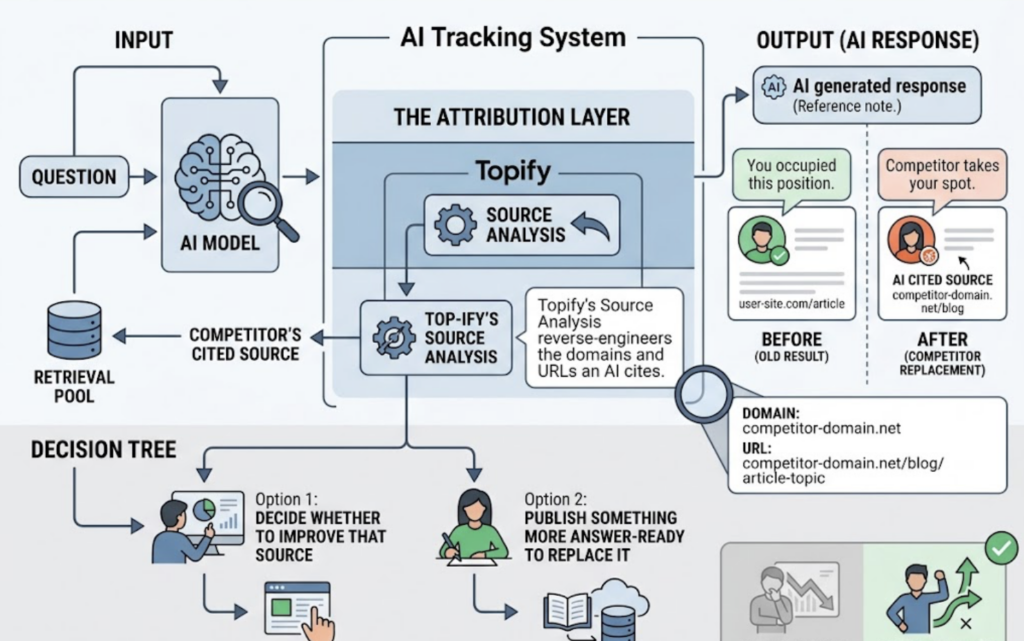
    What makes it a full response-monitoring tool, not a mention counter, is the metric set. Visibility Tracking shows how often you appear. Position Tracking shows where you rank against competitors inside a given answer. Sentiment Analysis scores how the model describes you on a 0 to 100 scale. Source Analysis reverse-engineers the exact domains AI cites, so you can see whether your content or a competitor’s is feeding the answer.
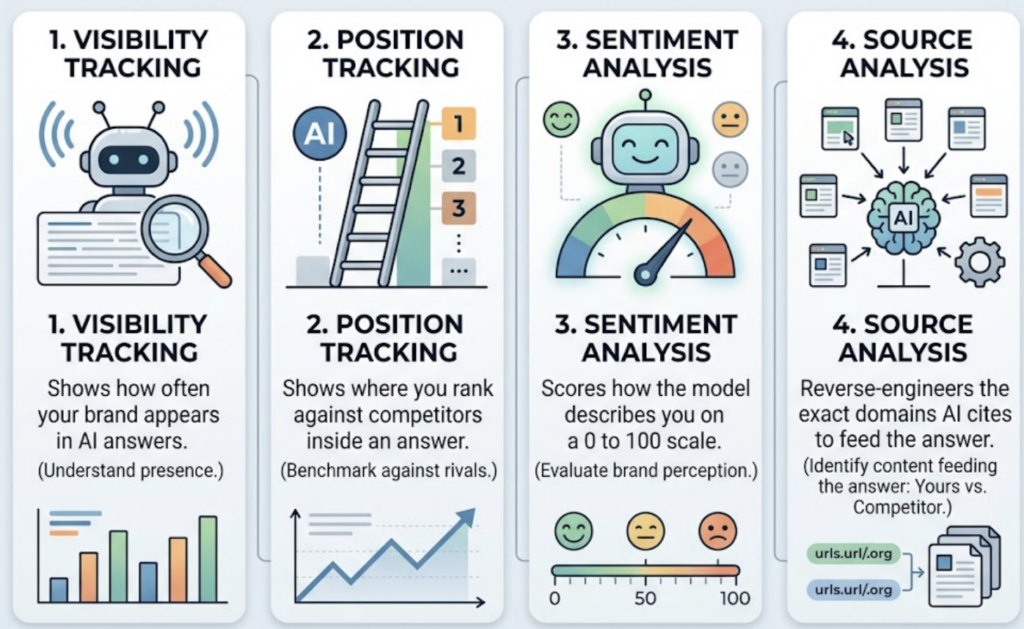
    Here’s where it gets practical. Say your ChatGPT mentions drop one week. With most tools, you’d see the dip and start guessing. With Topify’s combined view, you can trace it to a specific source that stopped citing you, check whether a competitor took your position, and read how the sentiment shifted, all in the same dashboard.

    Competitor Monitoring runs alongside this, detecting rivals automatically and benchmarking your visibility, sentiment, and position against theirs in real time.

    Then there’s the part that separates it from pure analytics. One-Click Execution lets you state a goal in plain English, review the proposed GEO strategy, and deploy it without building a manual workflow. The monitoring data feeds the action, and the action feeds the next round of monitoring.

    On pricing, the Basic plan starts at $99 per month and covers ChatGPT, Perplexity, and AI Overviews tracking with 100 prompts and a 30-day trial. Pro runs $199 per month for 250 prompts, and Enterprise starts at $499 with dedicated support. For a team replacing manual prompt checks, that tends to pay for itself in the hours it saves.

    It’s a reasonable fit for marketing teams, SEO professionals moving into GEO, and agencies reporting AI visibility to clients. You can get started with a trial before committing.

    Other Visibility Tracking Tools Worth Knowing

    No single tool wins for every team. A few alternatives are worth a look depending on your priorities.

    Lebesgue leans toward ecommerce, tying AI visibility to downstream traffic and conversion data, which suits high-intent retail brands. Conductor is built for enterprise teams that want traditional SEO rankings and answer-engine optimization bridged inside one dashboard.

    Allmond handles prompt-level monitoring across 60-plus countries and multiple LLMs, which makes it a fit for agencies juggling several brands. Otterly AI focuses on generative engine optimization with prompt monitoring designed to mimic how real users query AI interfaces. Peec AI emphasizes source identification and competitor benchmarking, with granular data on why specific sources earn citations.

    Each does one thing well. The question is whether you need that one thing, or a platform that connects monitoring to action.

    How to Choose the Right AI Response Monitoring Tool

    Start with your use case, not the feature list. The best visibility tracking tool for a solo founder running monthly checks is rarely the same one an agency needs.

    Run through a short checklist before you commit:

    • Does it cover every engine your audience uses, or just ChatGPT? Single-platform tracking leaves blind spots.
    • Does it go past mentions into position, sentiment, and citation source? If it only counts names, it’s a vanity metric in a nicer wrapper.
    • Does it monitor on a recurring schedule, or rely on one-off snapshots? Non-deterministic answers demand repeated sampling.
    • Does it connect to action, or hand you a dashboard and walk away?
    • Can you cancel monthly? The space moves fast, and annual lock-in without proven value is a real risk.

    If you manage one brand and check quarterly, a lighter tool may be enough. If you report to clients or a leadership team, you’ll want multi-engine coverage, competitor benchmarking, and a number you can defend.

    Common Mistakes That Make AI Response Monitoring Useless

    Even with a good tool, teams undercut themselves in predictable ways. Entrepreneur catalogs several of the most common, and they line up with what the data shows.

    The volume trap is first. Chasing mention counts over citation authority feels productive, but presence without trust doesn’t win recommendations.

    Static monitoring is second. A single screenshot ignores the non-deterministic nature of AI. You need the probability of appearance over time, not one lucky result.

    Treating GEO and SEO as separate silos is third. AI engines weigh the same trust signals, including reviews, editorial mentions, and technical authority, that traditional search rewards. Splitting the two wastes effort.

    Ignoring localized context is fourth. AI responses vary by region, so global-only reporting hides how you perform in the markets that matter.

    And the quiet one: tracking performance with dashboard numbers that don’t connect to anything real. If your visibility score can’t be tied to traffic, pipeline, or a specific action, it’s decoration.

    Conclusion

    AI response monitoring isn’t about gaming an algorithm. It’s about knowing, with evidence, how language models describe and recommend your brand, then acting on what you find.

    The tool you pick should match how your team works: enough engine coverage to avoid blind spots, metrics that go past mention counts, and a path from insight to action. Start by defining the prompts your buyers actually ask, run them on a schedule, and watch position and sentiment, not just whether your name shows up. The brands that treat this as a measurable channel, not a curiosity, are the ones AI keeps recommending.

    FAQ

    Q: What is AI response monitoring? 

    A: It’s the systematic tracking of how AI engines like ChatGPT, Perplexity, and Gemini represent your brand across a fixed set of prompts. Instead of counting how often your name appears, it measures position, sentiment, and whether the AI cites your content, giving you a picture of how models actually talk about you over time.

    Q: How do you measure and improve AI response monitoring? 

    A: Measure it with prompt-level tracking: run consistent buyer-intent prompts across multiple engines on a recurring schedule, and watch share of voice, position, and citation source. To improve it, strengthen the trust signals AI relies on, including authoritative content, editorial mentions, and clear entity information, then re-run your prompts to confirm the shift.

    Q: How much do AI response monitoring tools cost? 

    A: Pricing ranges widely. Entry-level platforms start around $99 per month for limited prompts and a few engines, mid-tier plans run $199 to $500 for more prompts and competitor tracking, and enterprise tiers climb higher with dedicated support. Match the plan to your prompt volume and the number of brands you track.

    Q: What’s an example of AI response monitoring in action? 

    A: A SaaS team tracks the prompt “best project management tool for remote teams” weekly across four engines. One week their brand drops out of ChatGPT’s answer. The tool shows a competitor took the slot and traces it to a review site that stopped citing them, which tells the team exactly where to focus next.
    Read More

  • What AI Response Monitoring Analytics Really Track

    What AI Response Monitoring Analytics Really Track

    Your team can tell you exactly how many people clicked through from Google last quarter. You can pull bounce rates, session duration, and conversion paths down to the individual page. But ask a simpler question, what does ChatGPT say about your brand when a buyer asks for a recommendation in your category, and the dashboard goes quiet.

    That gap isn’t a reporting oversight. Traditional analytics were built to measure what happens after someone lands on your site. The decision that sends them there, or doesn’t, now often happens inside an AI answer you never see. AI response monitoring analytics exist to close that blind spot.

    What AI Response Monitoring Analytics Actually Measure

    AI response monitoring analytics is the practice of turning unstructured LLM outputs into structured, trackable data points. Instead of guessing how AI assistants describe you, you measure it.

    Here’s the key distinction. Traditional analytics measure outbound traffic: clicks, sessions, conversions. AI monitoring measures inbound influence: presence, context, and authority. It doesn’t track your position in a list of blue links. It tracks whether your brand entity exists inside the model’s working knowledge, and how the model chooses to surface you when answering a real prompt.

    That’s a different unit of measurement than anything in your current stack. You’re no longer asking “did they visit,” but “did the AI mention us, frame us accurately, and recommend us before a competitor.”

    How AI Response Monitoring Analytics Work, Step by Step

    Monitoring a generative system is harder than scraping a search results page, because the output isn’t fixed. Ask the same question twice and the wording shifts. So the work depends on continuous sampling, not one-time checks.

    Most monitoring pipelines run four stages:

    1. Baseline construction. Teams build a “golden set” of 50 to 200 prompts that mirror real high-intent buyer queries, like “What are the best enterprise CRMs for small teams?”
    2. Cross-platform sampling. Automated systems feed those prompts into multiple engines at once, typically ChatGPT, Perplexity, Claude, Gemini, and Google AI Overviews.
    3. Natural language parsing. The responses get processed with NLP to extract brand and competitor entity mentions.
    4. Signal aggregation. The raw mentions are normalized into metrics so you can watch drift over time as models retrain or change their citation patterns.

    That last point matters more than it sounds. Models update often, sometimes weekly, so a brand can lose visibility overnight without any change on its own site.

    The Metrics That Make AI Visibility Monitoring Useful

    The fastest way to waste a monitoring budget is to count total mentions and call it a day. Effective AI visibility monitoring tracks a small set of metrics that each answer a specific business question.

    MetricThe question it answers
    Visibility ScoreAre we showing up in our core category conversations at all?
    Mention RateHow consistently do we land in the AI’s recommendation list?
    Citation ShareIs the AI trusting us enough to link to us as a source?
    First-Mention PositionAre we the top pick, or a footnote near the end?
    Sentiment IndexIs the AI describing us accurately and favorably?
    Entity AccuracyIs the AI hallucinating basic facts, like our founding date or pricing?

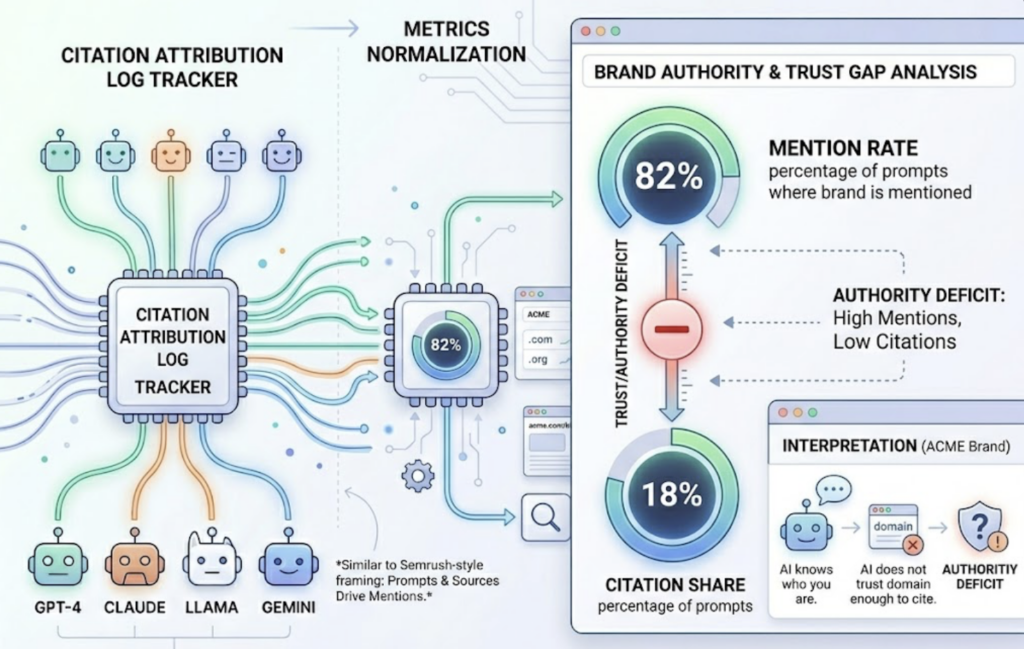
    The gap between Mention Rate and Citation Share is often the most revealing number. High mentions with low citations point to an authority deficit: the AI knows who you are, but doesn’t trust your domain enough to cite it.

    That’s the signal most brands miss. They celebrate being named while quietly losing the source layer to a competitor.

    Common Mistakes in AI Response Monitoring Analytics

    Knowing how to measure AI response monitoring analytics is only half the job. The other half is avoiding the errors that make the data misleading.

    Four mistakes show up again and again.

    The vanity mention trap. Counting mentions without context. A mention inside a negative comparison isn’t a win, it’s a reputational risk you’re miscounting as success.

    Snapshot bias. Judging AI performance from a single audit. Because models shift constantly, a one-time check tells you about one moment, not a trend.

    Siloed reporting. Treating AI data as unrelated to SEO. In practice they’re interdependent, since AI models often pull from the same high-authority content your SEO program already works to strengthen.

    Ignoring the citation-to-mention gap. Tracking mentions but never checking whether the AI actually links to you. That gap is where authority quietly leaks to competitors.

    How to Improve and Measure AI Response Monitoring Analytics

    Improving your numbers means shifting from keyword optimization to entity and source optimization. The strategy is less about ranking for a phrase and more about becoming a source the model trusts.

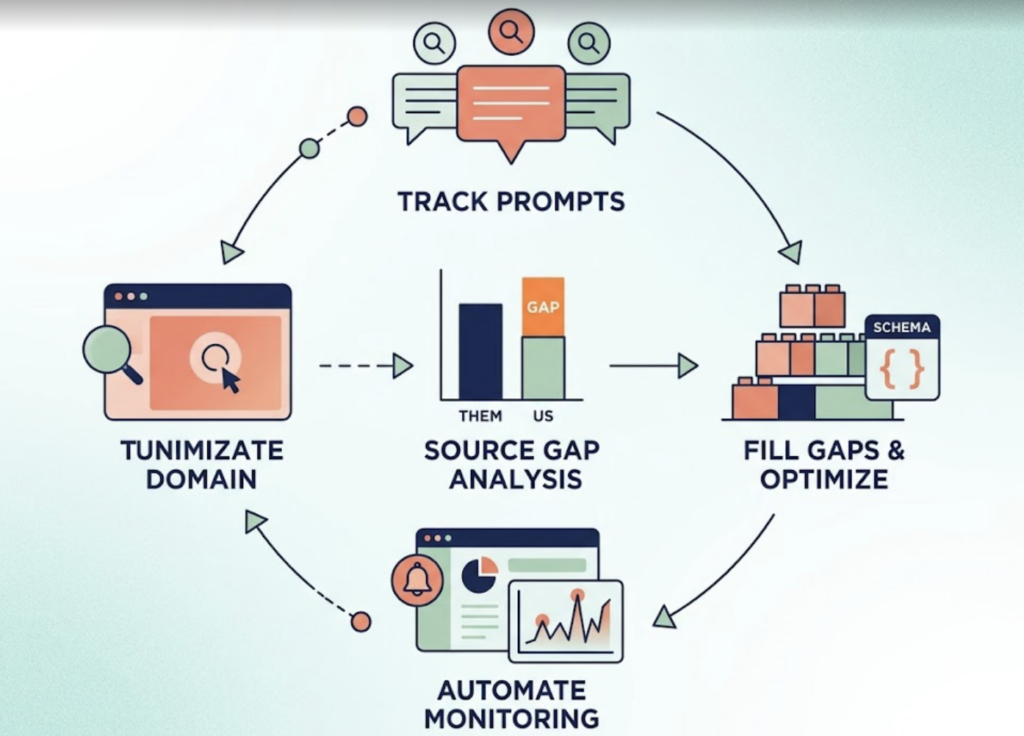
    A practical sequence works like this. Start by tracking your north-star prompts, the queries that define your category. Then run a source gap analysis: identify the domains the AI cites instead of you, and shape your content roadmap to fill those gaps. Make your information easy to extract with clean schema markup and answer-first summaries. Finally, automate the monitoring so anomalies surface on their own instead of waiting for a quarterly review.

    This is where a dedicated platform earns its place. For teams tracking influence across several engines, Topify tends to stand out by folding Visibility, Sentiment, Position, and Citation data into a single view through its comprehensive GEO analytics. In practice, that means you can spot a drop in ChatGPT mentions and trace it to a specific source that stopped citing your brand, all in one dashboard.

    It also leans on its Source Analysis to reverse-engineer which exact domains and URLs each engine cites, so the source gap stops being guesswork. With one-click execution, a flagged anomaly like a falling citation share can route straight into a content action instead of a backlog ticket.

    Best Tools for AI Response Monitoring Analytics, Compared

    When you evaluate AI search visibility monitoring tools, three capabilities separate useful platforms from dashboards that just look busy.

    Multi-platform coverage comes first. Monitoring only ChatGPT gives you a skewed view, since your audience also asks Perplexity, Gemini, and AI Overviews. Second is citation-layer analysis, the ability to see the precise URLs an engine cites. Third is automated alerting, so a sentiment shift or visibility drop reaches you in real time rather than at quarter’s end.

    Pricing for AI visibility monitoring tools generally scales with prompt depth and update frequency. Entry-level tracking starts around $99 per month, while enterprise systems for global brands begin near $499 per month. Here’s how Topify’s tiers map to those capabilities, with full detail on its pricing page:

    CapabilityBasic, $99/moPro, $199/moEnterprise, from $499/mo
    Prompts tracked100250Custom
    Engine coverageChatGPT, Perplexity, AI Overviews4+ enginesMulti-engine, custom
    Analytics depthVisibility and mentionsSentiment and citationFull source gap analysis
    ExecutionManual reviewGuided actionsDedicated account manager

    Other categories of tools handle parts of this well. Some focus on a single engine, others on alerting alone. The trade-off is coverage versus depth, and the right pick depends on how many engines and prompts your category actually demands.

    A Quick Checklist Before You Start Monitoring

    Before you commit to a tool, a short setup pass prevents most of the mistakes above.

    • Define intent. Pick 50 to 100 prompts drawn from real search data, not an internal brainstorm.
    • Set cadence. Match monitoring frequency to your industry’s volatility, weekly for fast-moving tech, monthly for stable B2B.
    • Identify peers. Define a competitor baseline so you can measure your Share of Model, not just your own mentions.
    • Integrate. Connect the AI monitoring dashboard to your existing SEO reporting stack so the two data streams inform each other.

    Run through this before you get started and your first month of data will be a usable baseline rather than noise.

    Conclusion

    The blind spot is real: your analytics stack can describe everything that happens on your site and nothing about the AI answer that decides whether buyers ever reach it. AI response monitoring analytics is how you make that invisible layer measurable.

    Start small. Build a prompt baseline, monitor across more than one engine, and watch the gap between mentions and citations. Once those signals are stable, layer in source analysis and competitor benchmarking to turn the data into action. Track it, understand why the AI recommends what it does, then close the gaps.

    FAQ

    Q: What is AI response monitoring analytics? 

    A: It’s the practice of quantifying your brand’s presence, authority, and narrative framing inside the generated responses of LLMs like ChatGPT, Perplexity, and Gemini. It converts unstructured AI answers into trackable metrics such as visibility, sentiment, and citation share.

    Q: Can you give examples of AI response monitoring analytics in action? 

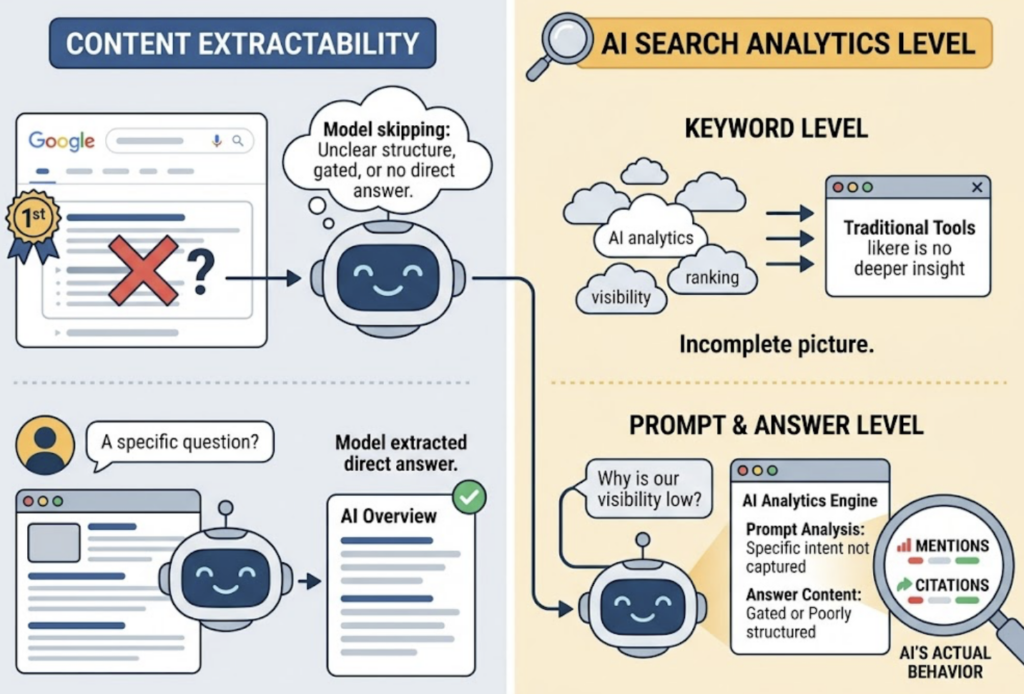
    A: A common one: a brand ranks #1 on Google for “best CRM” but is never recommended by ChatGPT, because the model keeps citing a competitor’s comparison guide instead. Monitoring surfaces that gap, so the team knows to publish a more authoritative guide and recover the citation.

    Q: How much does AI response monitoring analytics cost? 

    A: Pricing usually scales with the number of prompts tracked and how often they’re refreshed. Entry-level tools start around $99 per month, mid-tier plans land near $199 per month, and enterprise systems for global brands begin at $499 per month or more.

    Q: How is this different from traditional web analytics? 

    A: Traditional analytics measure what happens after a user leaves the search engine and reaches your site. AI monitoring measures what happens before they even know your brand exists, at the moment the AI is synthesizing an answer to their question.

    Read More

  • What an AI Response Monitoring Solution Should Track

    What an AI Response Monitoring Solution Should Track

    You can pull up your SERP rankings in seconds. You know which keywords moved, which pages gained traffic, and where you sit against competitors. Then a buyer opens ChatGPT, asks for the best option in your category, and gets five recommendations. None of them are you. Nothing in your analytics stack flagged it, because those tools watch the list of links, not the answer the model hands people directly. That blind spot has a name now, and an AI response monitoring solution exists to close it. The hard part is knowing what to actually watch.

    What an AI Response Monitoring Solution Actually Is

    Traditional rank trackers measure your position in a static list of links. An AI response monitoring solution measures something different: how language models describe, cite, or ignore your brand inside their generated answers.

    The discipline breaks into three layers. Presence is whether you get mentioned at all. Narrative is how you’re framed, “market leader” versus “expensive alternative.” Authority is whether the engine trusts you enough to cite you as a source.

    Most teams can see SERP movement but have no read on any of these. As one breakdown of what AI search monitoring should track puts it, presence in the answer is now its own surface, separate from the ranked page. That’s the gap most analytics setups can’t see.

    How AI Response Monitoring Software Reads What Models Say

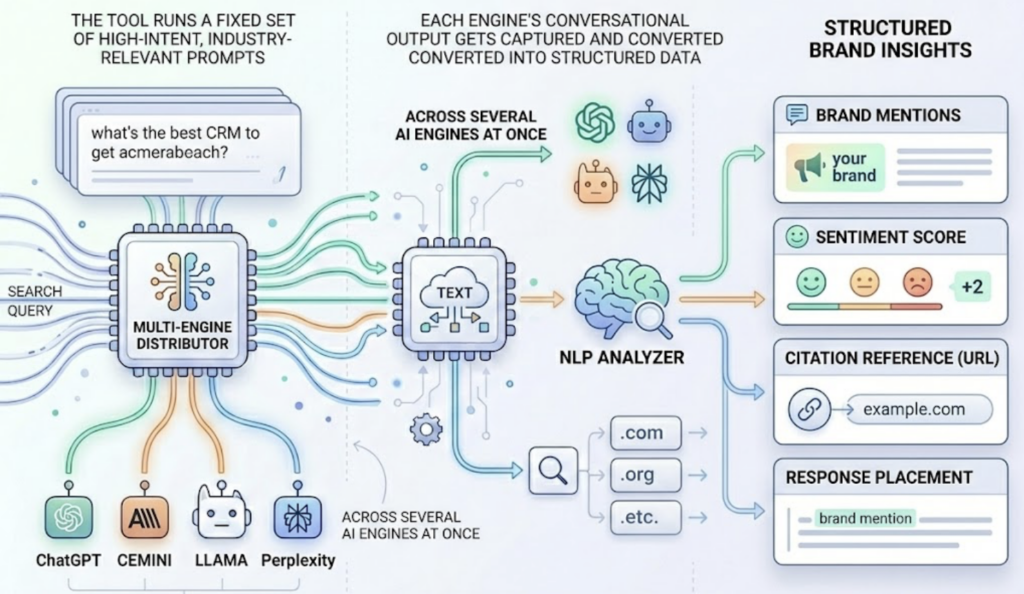
    AI response monitoring software works through a synthetic sampling pipeline built to mirror how real users ask questions.

    It starts with prompt injection: the tool runs a fixed set of high-intent, industry-relevant prompts across several AI engines at once. Each engine’s conversational output gets captured and converted into structured data through natural language processing. From there, the system parses brand mentions, scores sentiment, identifies the exact URL cited as a reference, and records where in the answer your brand appears.

    Frequency is the part teams underestimate. AI models are non-deterministic and they drift as they get updated, so a one-time snapshot ages fast. Continuous, high-frequency sampling is what catches the moment an engine swaps its preferred sources for your category. Weekly sampling is a reasonable floor for stable categories. Daily makes sense for fast-moving, competitive ones.

    The Signals a Good AI Response Monitoring Tool Should Capture

    A useful AI response monitoring tool moves past vanity mentions and tracks signals that map to a business question. Counting how often you show up means little if you don’t know whether the engine trusts you or what it says about you.

    Here’s how the core signals translate into something a marketing lead can act on:

    SignalWhat it tells you
    Visibility ScoreOverall brand health across the AI-search ecosystem
    Mention RateTop-of-mind status inside the model’s working knowledge
    Citation ShareHow much the engine trusts your content as a source of truth
    First-Mention PositionA predictor of trust and click-through, since the first source cited tends to win attention
    Sentiment AccuracyCatches hallucinations or misaligned descriptions that damage reputation

    Citation Share and First-Mention Position are the two most teams overlook. Getting mentioned tenth, after three competitors and two review sites, is not the same win as being the first name the model reaches for. Semrush’s guidance on measuring AI search visibility makes a similar point: report on trust and prominence, not raw mention counts.

    Why a Platform Beats a Patchwork of Point Tools

    Plenty of teams try to manage this with manual queries or a few disconnected point tools. That patchwork breaks down for three reasons, and they’re worth naming.

    First, platform divergence. ChatGPT, Gemini, and Perplexity weight signals differently, so you might be the top pick on Perplexity and invisible on Gemini. A single-engine view gives you a skewed read of where you actually stand.

    Second, attribution. Knowing you lost visibility isn’t enough. An integrated AI response monitoring system adds source-gap analysis: it tells you which specific domains the engine is citing instead of yours, which is the difference between a problem you can see and a problem you can fix.

    Third, actionability. Data with no loop back to your content is just a number that went down.

    ApproachCoverageAttributionAction loop
    Point tools / manual queriesUsually one engineMention spotted, cause unknownManual, ad hoc
    Integrated platformMultiple engines in one viewSource-gap analysis built inAnomaly triggers a content task

    The takeaway isn’t that point tools are useless. It’s that a connected platform turns scattered observations into a system you can run a quarter on.

    Turning Monitoring Into a Dashboard You’ll Actually Use

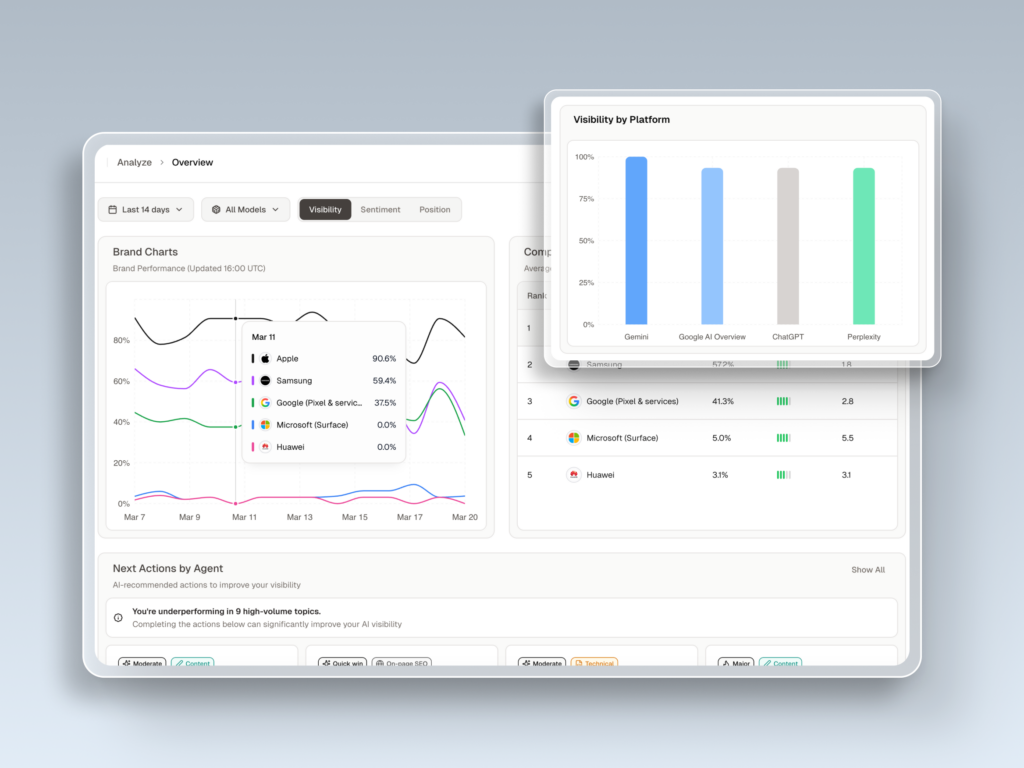
    Raw monitoring data sits there. A dashboard makes it move. The goal of any AI response monitoring dashboard is a closed loop: an anomaly like a drop in citation share should surface clearly and point to a specific fix, such as a stale statistic or missing schema on a page the engine used to cite.

    Strong AI response monitoring analytics do the connective work for you. They tie a visibility dip on ChatGPT back to the source that stopped referencing you, then frame it as a task instead of a chart. That’s the line between a tool that reports and a system that drives action. If you want a deeper look at how a single-pane view comes together, this walkthrough of an AI search monitoring dashboard covers the layout in practice.

    Where Topify Fits

    For teams tracking presence across several engines at once, Topify tends to stand out by pulling Visibility, Sentiment, Position, and Source data into one view rather than four exports.

    In practice, that means you can spot a drop in ChatGPT mentions and trace it, in the same dashboard, to the exact domain that stopped citing your brand. Its coverage spans ChatGPT, Gemini, Perplexity, DeepSeek, and other major engines, so you’re not reading a single-platform slice and calling it your AI presence. Competitor Monitoring runs alongside it, tracking your citation share against your top three rivals as the engines shift.

    The setup mirrors the strategic baseline most teams should start with anyway: define a golden set of 50 to 100 category-defining prompts, then watch citing, not just ranking. You can pressure-test where you stand first with free GEO tools, then get started on continuous tracking once you’ve found the gaps.

    Conclusion

    The blind spot is real: most teams can see their SERP position and almost nothing about what AI says when a buyer asks directly. Closing it doesn’t start with buying the flashiest dashboard. It starts with deciding what to track, presence, citation share, first-mention position, and sentiment, then sampling it often enough to catch the drift. Build the baseline, watch citing over ranking, and treat a misaligned AI narrative as the reputation issue it is. The brands that measure this now are the ones that won’t get quietly written out of the answer later.

    FAQ

    Q: What’s the best tool for tracking brand visibility in ChatGPT? 

    A: The strongest option is one with multi-platform coverage rather than a ChatGPT-only view, since monitoring a single engine gives a skewed read of your overall AI-search presence. Look for a tool that reports citation share and sentiment, not just mention counts.

    Q: How is AI response monitoring different from traditional SEO tracking? 

    A: Traditional SEO tracks your rank on a list of links. AI response monitoring tracks your presence, authority, and narrative framing inside the answer itself, which is where AI users increasingly make decisions.

    Q: How often should an AI response monitoring system refresh data? 

    A: Weekly sampling is the practical minimum for stable categories. Daily sampling is the better call for competitive, fast-moving markets, since models update and shift their preferred sources frequently.

    Q: Can one platform monitor multiple AI engines at once? 

    A: Yes. Integrated platforms now use API-based access to the leading models, letting you see your performance on ChatGPT, Gemini, Perplexity, and others in a single dashboard instead of querying each one by hand.

    Read More

  • What an AI Response Monitoring Tool Actually Tracks

    What an AI Response Monitoring Tool Actually Tracks

    Your team hit page one for the keywords that matter. Rankings are stable, traffic is steady, the dashboard looks healthy. Then a buyer opens ChatGPT, types a plain question about your category, and reads back a confident answer that recommends three competitors and never names you. None of your SEO reports flagged it, because they were built to measure where you sit on a results page, not what an AI assistant decides to say. That blind spot has a name now, and an AI response monitoring tool is what’s built to close it.

    What an AI Response Monitoring Tool Is, and Why SEO Tools Miss It

    An AI response monitoring tool tracks how large language models describe, recommend, and cite your brand inside the answers they generate. Not where you rank on a results page. What the model actually says when someone asks a question in your category.

    That distinction matters because the two measure different things. Traditional SEO tools track keyword position and clicks, which are outbound signals about user behavior. AI monitoring tracks mention, framing, and citation, which are signals about how much authority the engine assigns you. The shift is from traffic-focused metrics to influence-focused ones, and it changes what “doing well” even means.

    Here’s the gap most teams run into. You can hold page-one rankings for your core terms and still be absent from the synthesized answer a buyer reads first. The results page and the AI response are now two separate surfaces. One you’ve optimized for years. The other you probably haven’t measured at all.

    So this isn’t a rank tracker with a new label. It watches a moving, conversational output instead of a static list. That’s a different problem, and it needs different instrumentation.

    How an AI Response Monitoring Tool Works

    The mechanism is less about keywords and more about prompts. These tools simulate the questions real users ask, then read what the model answers back.

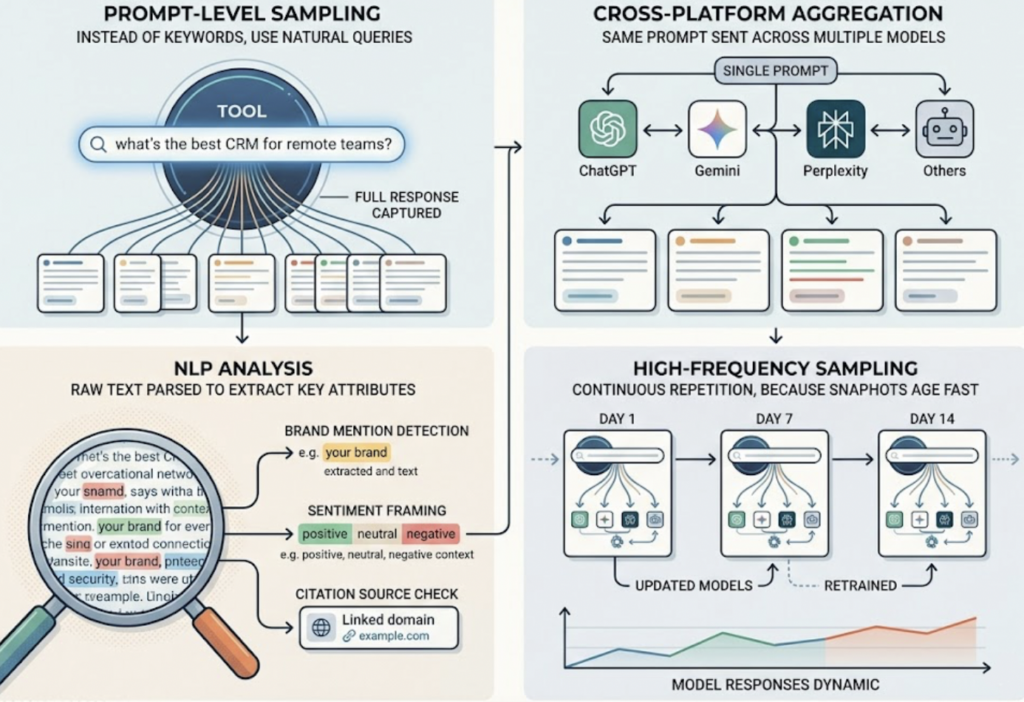
    A typical pipeline runs in four steps. First, prompt-level sampling: instead of tracking a keyword, the tool runs a set of natural queries like “what’s the best CRM for remote teams” and captures the full response. Second, cross-platform aggregation: the same prompts get sent across ChatGPT, Gemini, Perplexity, and others, since each model answers differently. Third, NLP analysis: the raw text gets parsed to extract whether your brand appears, how it’s framed, and whether it’s cited as a source. Fourth, high-frequency sampling, because models get updated and retrained, so a single snapshot ages fast.

    That last point is the one teams underestimate. AI answers aren’t deterministic. Ask the same question twice and the wording, and sometimes the recommendation, shifts. Run it next week after a model update and it can shift again.

    This is why monitoring one platform once tells you almost nothing. You’re auditing one corner of a store and calling it inventory. Real monitoring means repeated sampling, across engines, over time, so you can separate noise from an actual change in how the model treats your brand.

    How to Measure AI Response Monitoring: The Metrics That Matter

    The fastest way to waste a monitoring tool is to track total mentions and stop there. Mention count is a vanity metric. It tells you the AI said your name, not whether that helped you.

    These are the dimensions worth watching:

    MetricThe question it answers
    Visibility ScoreIs your brand present in your category’s AI conversations at all?
    Mention RateHow consistently does the model reference you across different queries?
    SentimentHow does the AI frame you, premium choice or budget alternative?
    Citation ShareDoes the AI trust your domain enough to link it as a source?
    PositionAre you the top recommendation or a footnote at the end of the list?

    The interplay between these matters more than any single number. A high mention rate with low citation share, for example, means the model knows you exist but doesn’t trust your content enough to point back to you. That’s a content and authority problem, not a visibility one, and you’d never see it if you only counted mentions.

    Position is the other underused signal. Being named tenth in a list of ten is technically a mention. It’s also functionally invisible to a user who reads the first two.

    AI Response Monitoring in Practice: Three Examples

    Abstract metrics get clearer with concrete situations. Here are three patterns these tools surface that teams rarely catch on their own.

    A category recommendation with no mention. A buyer asks ChatGPT for the top tools in your space and gets five names. Yours isn’t one. Visibility Score and Mention Rate flag this right away, and the absence is the whole story.

    A sentiment mismatch. You’ve positioned as enterprise-grade, but Perplexity describes you as “a good option for small teams.” The mention is there, so a mention counter says you’re fine. Sentiment analysis says your narrative is drifting away from your positioning.

    A competitor owning the citation. The AI answers a question your content should own, but it cites a rival’s domain as the source. Citation Share and source analysis catch this, and it points to a specific fix: a page or topic where a competitor is being trusted and you aren’t.

    Each example maps to a different metric. That’s the point. You can’t see all three with one number.

    Common Mistakes That Make AI Response Monitoring Useless

    Most monitoring setups fail in predictable ways. Several of these mistakes quietly erode visibility before anyone notices.

    The vanity mention trap. Counting total mentions without reading context. A mention as “a competitor to avoid” looks identical to a glowing recommendation in a raw count, and the two mean opposite things.

    The static snapshot. Pulling a monthly or quarterly report and treating it as current. Model behavior can shift in days, so a delayed report produces delayed decisions.

    The SEO and GEO silo. Running AI visibility separately from on-site content. The schema, summaries, and structure that help models cite you live in your SEO work, and ignoring that link leaves citations on the table.

    The citation-to-mention gap. Seeing high mentions, assuming success, and missing that citation share is near zero.

    Track the wrong thing consistently and you still end up blind.

    A Checklist and Strategy for AI Response Monitoring

    Monitoring tells you where you stand. A strategy tells you what to do about it. Here’s a working checklist to improve AI response monitoring results, not just collect them.

    1. Baseline audit. Establish a visibility score against a fixed set of category-relevant prompts before changing anything.
    2. Entity accuracy. Make sure core facts like founding, mission, and product line stay consistent across LinkedIn, Crunchbase, and other third-party sources the models cross-reference.
    3. Structured content. Add JSON-LD schema so models can parse your organizational data cleanly.
    4. Answer-first formatting. Move concise, high-value tables and lists into the first 150 words of key pages.
    5. Authority building. Earn mentions in high-authority publications, since models validate trust through external signals.
    6. Continuous benchmarking. Compare citation share against named competitors to find source opportunities, the domains that cite your peers but not you.

    This is where a platform earns its place. Topify runs this loop across major AI engines and reports on seven dimensions, including Visibility, Sentiment, Position, and source analysis, in one view. In practice that means you can watch a drop in ChatGPT mentions and trace it to a specific source that stopped citing you, without stitching together exports from four tools.

    Choosing a Tool: Features, Coverage, and Pricing

    When you compare tools for AI response monitoring, four things separate useful platforms from dashboards full of numbers.

    Platform coverage. A tool that only watches ChatGPT misses how Gemini and Perplexity treat you. Multi-engine coverage isn’t optional.

    Metric depth. Mentions alone aren’t enough. You want sentiment, position, and citation share, because those are what actually drive a decision.

    Source analysis. The ability to reverse-engineer which domains the AI cites tells you exactly where to compete for trust.

    Acted on, not just reported. Data that sits in a dashboard changes nothing. The better tools connect monitoring to a next step.

    Topify covers ChatGPT, Gemini, Perplexity, and other engines, layers Competitor Monitoring and CVR on top of the core metrics, and lets you move from insight to action without manual workflows. Pricing starts at $99/month on the Basic plan, with Pro at $199/month and Enterprise from $499/month, and you can see the full breakdown on the Topify pricing page. For a deeper look at how these tools are built and which to pick, this guide to AI answer monitoring tools is a useful next read.

    If you want to see where your brand stands today, you can get started with Topify and run a baseline in a few minutes.

    Conclusion

    The visibility gap is simple to state and easy to miss: you can rank well and still be invisible in the answers buyers read first. An AI response monitoring tool exists to close that gap by tracking what models say, how they frame you, and whether they cite you, across engines and over time.

    Start with a baseline audit. Watch sentiment and citation share, not just mentions. And treat AI visibility as a continuous signal, since the models change faster than any monthly report can keep up with. The brands that measure this now are the ones AI will recommend later.

    FAQ

    Q: What is an AI response monitoring tool? 

    A: It’s a platform that tracks how large language models like ChatGPT, Gemini, and Perplexity mention, describe, and cite your brand inside their generated answers. Unlike an SEO rank tracker, it monitors the synthesized response itself rather than your position on a results page.

    Q: How do you improve AI response monitoring results?

    A: Start with a baseline audit, keep brand facts consistent across third-party sources, add schema markup, format key pages answer-first, and benchmark citation share against competitors. Improvement comes from acting on the gaps the tool surfaces, not from collecting more reports.

    Q: How much does an AI response monitoring tool cost? 

    A: It varies by platform and coverage. Topify, for example, starts at $99/month for Basic, $199/month for Pro, and from $499/month for Enterprise, with prompt volume and platform coverage scaling by tier.

    Q: How is this different from a rank tracker? 

    A: A rank tracker measures where a URL sits on a static search results page. An AI response monitoring tool measures a moving, conversational output, including whether you’re mentioned, how you’re framed, and whether the model trusts your domain enough to cite it.

    Read More

  • ChatGPT Visibility Tracker: What It Is and How to Use It

    ChatGPT Visibility Tracker: What It Is and How to Use It

    Your keyword rankings look healthy. Your domain authority climbed all year. Then a buyer types “best tool in your category” into ChatGPT, reads the three names it recommends, and picks one. Your brand wasn’t in the answer, and nothing in your analytics stack flagged it.

    That’s the blind spot most marketing teams are carrying right now.

    Google rankings tell you where you sit on a page of links. They say nothing about whether an AI model mentions you, trusts you, or quietly sends a buyer to a competitor instead.

    What a ChatGPT Visibility Tracker Actually Measures

    A ChatGPT visibility tracker monitors how often, in what context, and with what authority your brand shows up inside ChatGPT’s answers. Instead of a position on a results page, it measures your presence inside synthesized, conversational responses.

    The distinction matters more than it sounds. Traditional SEO tracks a URL’s rank against a keyword. AI visibility tracks whether the model names you at all when someone asks a question your business should own.

    These are distinct ecosystems, not the same channel measured twice. A page can rank first on Google and still go uncited by ChatGPT, because the model isn’t ranking links. It’s deciding which brands to fold into a single recommendation.

    So the question shifts. Less “where do I rank for this keyword,” more “does the AI mention me, and does it trust my content enough to cite it.”

    How a ChatGPT Visibility Tracker Works

    Tracking a non-deterministic system means you can’t just check one query once. ChatGPT’s answers vary, and its citation patterns drift as models update. Measurement has to be structured and continuous.

    Most trackers run on the same core loop:

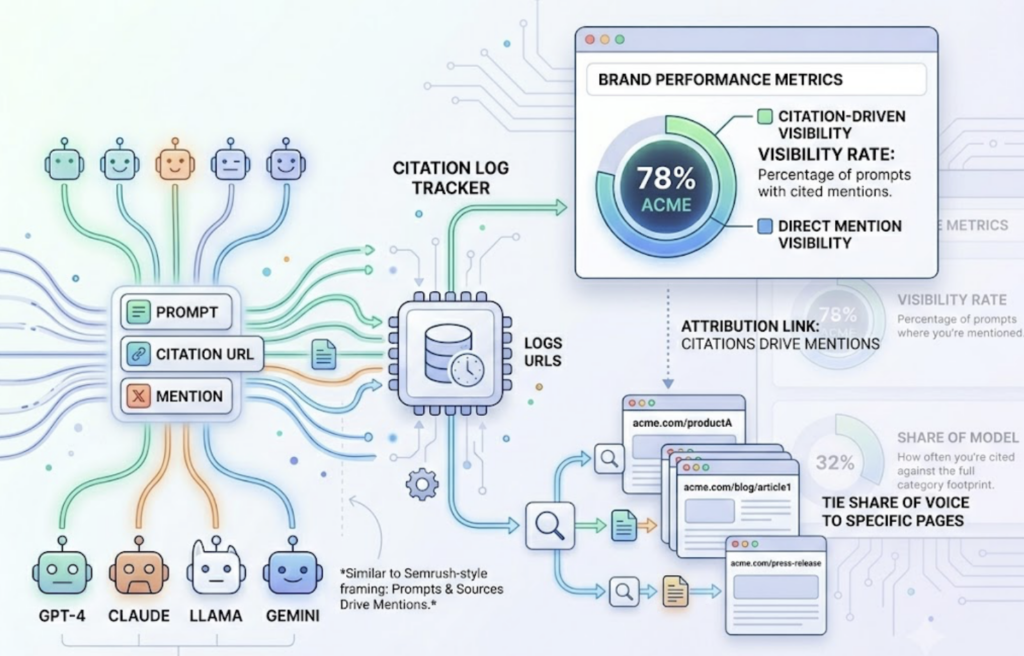
    Prompt sampling. The tool runs hundreds or thousands of industry-relevant prompts through ChatGPT, mimicking how real buyers actually ask. One query tells you nothing. A standing set of prompts tells you a pattern.

    Answer capture and parsing. Each response gets captured and scanned for brand mentions. Better tools layer in entity recognition and sentiment scoring, so a mention isn’t just counted but judged as positive, neutral, or negative.

    Citation attribution. When ChatGPT surfaces sources, the tracker logs which URLs were cited. That lets you tie your share of voice back to specific pages on your site, the same way Semrush frames ChatGPT visibility tracking around the prompts and sources that actually drive mentions.

    Continuous monitoring. Because model behavior shifts, often every few weeks, last month’s snapshot is already stale. Visibility is a trend line, not a one-time audit.

    The Metrics Behind ChatGPT Visibility Tracking

    Counting mentions is the floor, not the whole picture. A useful ChatGPT visibility tracking setup reports a few metrics together, because each answers a different question.

    MetricWhat it measuresWhy it matters
    Visibility ScoreA 0-100 index of your presence relative to competitorsA fast health check across the whole prompt set
    Mention RateThe share of tracked prompts where your brand appearsShows how consistently AI surfaces you
    Citation ShareYour links in citations versus competitors’Signals whether the model treats your content as a source of truth
    SentimentThe tone of each mention, positive to negativeFlags reputational risk before it spreads
    PositioningWhere you land in the answer, lead recommendation or footnoteTop placement carries far more trust than a passing mention

    Read in isolation, any one of these can mislead. A high mention rate paired with negative sentiment isn’t a win. A strong visibility score with near-zero citation share means the model talks about you but doesn’t cite you, which is fragile the moment a better-sourced competitor shows up.

    That’s the gap a single number can’t show you.

    How to Improve Your ChatGPT Visibility

    Improvement comes down to two things: making your content easy for the model to extract, and making your brand worth trusting.

    Start with structure. LLMs favor concise, extractable data, so lead with answer-first formatting. Put the key takeaway in the first 150 words, use clear headers, and break dense points into tables or short lists the model can lift cleanly.

    Then check technical access. An outdated robots.txt that blocks GPTBot or PerplexityBot makes you invisible to retrieval-augmented systems no matter how good your content is. JSON-LD schema markup helps the model resolve your entities, like Organization, FAQ, and Person, with less ambiguity.

    Authority does the rest. AI models lean on primary sources, so unique data, proprietary statistics, and genuine expert insight are harder for the model to skip or hallucinate around. Off-page signals count too, since models cross-reference how you’re discussed on Reddit, review sites, and industry press before recommending you.

    If you want a low-cost starting point, a set of free GEO tools can cover the first audit before you commit to a paid platform.

    What to Look for in a ChatGPT Visibility Tracking Tool

    The market is crowded, and the tools don’t measure the same things. Roundups like Yotpo’s LLM monitoring list show how wide the range gets, from single-platform mention counters to full optimization suites. A few criteria separate the useful ones.

    CriterionWhat good looks likeWhy it matters
    Platform coverageTracks ChatGPT plus Perplexity, Gemini, and othersBuyers don’t use one AI engine
    Citation depthReports the exact domains and URLs citedTells you what to fix, not just that you’re missing
    Competitor benchmarkingCompares your mentions and position against rivalsContext turns a number into a target
    ActionabilityConnects findings to next stepsA dashboard that doesn’t change behavior is overhead

    This is where a dedicated platform tends to pull ahead of a spreadsheet and a handful of manual prompts. Topify treats ChatGPT visibility as an AI optimization service rather than a static report, tracking your brand across ChatGPT, Perplexity, Gemini, and other engines from one view. Its Visibility Tracking measures how often you surface across hundreds of monitored prompts, while Source Analysis reverse-engineers the exact domains and URLs ChatGPT cites, so you can see whether your pages or a competitor’s are feeding the answer. Competitor Monitoring then benchmarks your mention rate and position against rivals in the same prompts, and the CVR metric estimates how likely those answers are to push a reader toward your brand. The result reads less like a wall of numbers and more like a map of where to act next.

    ChatGPT Visibility Tracker Pricing: What to Expect

    Pricing usually scales with three things: how many prompts you track, how many AI platforms you cover, and how many seats and projects your team needs. A solo founder watching one product has very different needs than an agency reporting on a dozen clients.

    As a reference point, Topify’s pricing starts at $99 a month for a Basic plan covering ChatGPT, Perplexity, and AI Overviews, 100 tracked prompts, and a 30-day trial. The Pro tier runs $199 a month with 250 prompts and more seats, and Enterprise begins around $499 a month with a dedicated account manager.

    The trade-off to weigh isn’t sticker price. It’s prompt volume against coverage. A cheap tool that only watches ChatGPT leaves the rest of the AI answer surface unmonitored, which is often where the visibility gap actually lives.

    Common Mistakes in ChatGPT Visibility Tracking

    Most failures aren’t strategic. They’re small oversights that quietly tank your results, and AEO Vision catalogs the same recurring ones.

    The first is blocking AI crawlers. A stale robots.txt rule against GPTBot removes you from the retrieval layer entirely, and you’ll never see why your mention rate flatlined.

    The second is inconsistent entity data. When your founding date, name, or category differs across your site, LinkedIn, and Crunchbase, the model loses confidence in your brand entity and hedges by leaving you out.

    The third is ignoring freshness. Models favor current information, so dated stats and untouched pages read as obsolete.

    And the fourth is treating AI visibility as a footnote under Google organic. They’re separate systems, and a strong SERP position is no guarantee of an AI citation. Folding ChatGPT visibility tracking into your existing SEO report without giving it its own metrics is how the gap stays invisible.

    Conclusion

    ChatGPT doesn’t rank links. It chooses brands. A ChatGPT visibility tracker exists to show you whether you’re one of them, how consistently, and what’s driving the answer when you’re not.

    Start by measuring your current mention rate and citation share, fix the technical and entity basics, then watch the trend over time rather than chasing a single snapshot. If you’d rather see your baseline across ChatGPT and other engines in one place, you can get started with Topify and check where your brand stands before your next planning cycle.

    FAQ

    Q: What is a ChatGPT visibility tracker? A: It’s a tool that monitors how often and in what way your brand appears in ChatGPT’s answers. Instead of tracking a page’s rank against a keyword, it measures your presence, sentiment, and citation share inside the AI’s synthesized responses.

    Q: What’s an example of ChatGPT visibility tracking in practice? A: A SaaS brand runs 200 buying-intent prompts through ChatGPT each week, tracks how often it’s named versus three competitors, and notices its mention rate dropping after a source page it relied on stopped citing the brand. That trend, caught early, is the kind of signal these tools surface.

    Q: How is a ChatGPT visibility tracker different from a rank tracker? A: A rank tracker reports your position in a list of links for a keyword. A visibility tracker reports whether an AI model mentions and cites you at all. High Google rankings don’t guarantee AI citations, since the two run on different logic.

    Q: How often should I check my ChatGPT visibility? A: Continuously, not occasionally. Citation patterns shift with model updates, sometimes within weeks, so a monthly trend line is far more reliable than a one-time audit.

    Read More

  • AI Mention Tracking Tracker: What It Is and How It Works

    AI Mention Tracking Tracker: What It Is and How It Works

    Your team spent two quarters building content, earning links, and pushing rankings up. Then a buyer opened ChatGPT, asked for the best option in your category, and got a tidy list of five names. Yours wasn’t one of them. Nothing in your SEO dashboard explains why, because those tools were built to measure a page’s position, not whether an AI decided to say your name at all. The fix starts with seeing what’s actually being said about you inside the answer.

    What an AI Mention Tracking Tracker Actually Tracks

    An AI mention tracking tracker is a diagnostic tool that monitors how a brand shows up inside generative AI outputs. It doesn’t watch a results page. It watches the answer itself.

    The mechanic is different from rank tracking. A keyword tracker measures your position on a static SERP. An AI mention tracker uses synthetic prompting, querying models like ChatGPT, Gemini, and Perplexity on a schedule with high-intent customer questions, then reading the unstructured response that comes back.

    That matters more every quarter. By 2026, 64.82% of Google searches end without a click, which means a growing share of buyers form opinions inside an answer they never leave. If you can’t see that answer, you can’t manage it.

    A good tracker reports on four things:

    • Presence: how often your brand surfaces for category prompts.
    • Narrative context: how the AI frames you, whether as an industry leader, a budget option, or a risky pick.
    • Citation authority: which exact URL the model used as its evidence.
    • Positioning: where you land in a recommendation, first versus fifth.

    Here’s the core distinction. Traditional SEO tracks rank, your slot in a list. AI tracking measures inclusion, whether you exist in the model’s reasoning at all. You can hold position one on Google and be invisible to ChatGPT in the same week.

    How Does an AI Mention Tracking Tracker Work

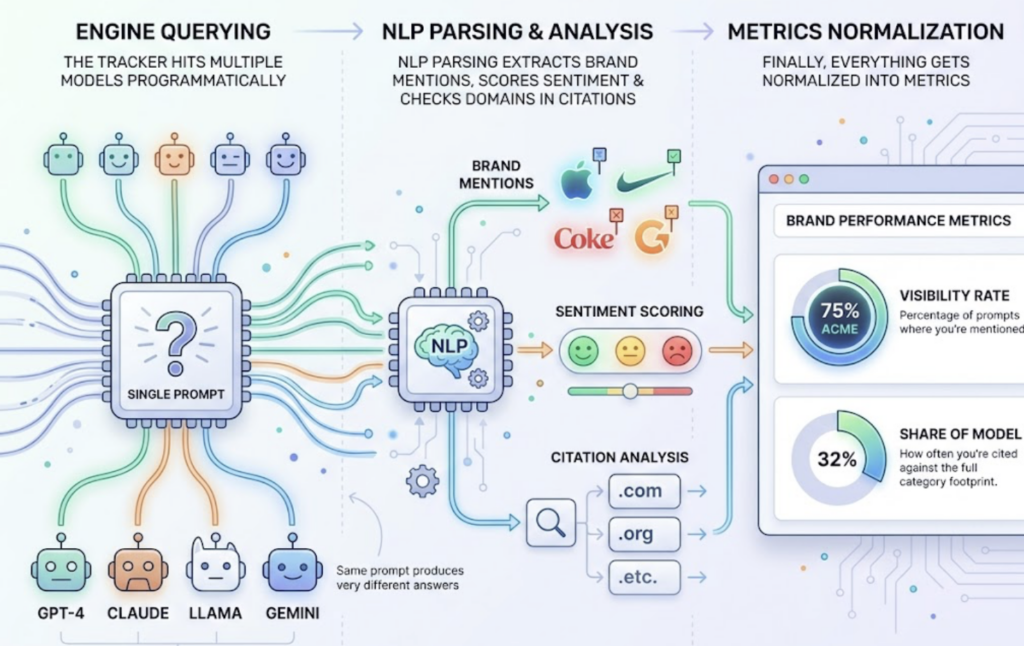
    Most AI engines run on retrieval-augmented generation. They pull from different indexes and score sources with different logic, so a tracker can’t just ask once and call it done. It runs a repeatable pipeline.

    It starts with canonical prompts. The system fixes a set of questions that mirror real buyer journeys, things like “what is the best CRM for small business,” then reuses them so results stay comparable over time.

    Next comes engine querying. The tracker hits multiple models programmatically, because the same prompt produces very different answers depending on who you ask. Then NLP parsing extracts the brand mentions, scores sentiment, and checks which domains appear in the citations. Finally, everything gets normalized into metrics like Visibility Rate, the percentage of prompts where you’re mentioned, and Share of Model, how often you’re cited against the full category footprint.

    The reason this has to repeat is volatility. AI platforms cite sources in ways that barely overlap. Only 11% of domainsare cited by both ChatGPT and Perplexity for the same query, and 71% of all cited sources show up on just one platform. A one-off check on a single engine tells you almost nothing.

    How to Measure AI Mention Tracking: The Metrics That Matter

    Raw mention counts don’t move a strategy. To make the data useful, teams report on a small set of KPIs that track presence, accuracy, and competitive position.

    MetricWhat it measuresWhy it matters
    Visibility Score% of tracked prompts where your brand appearsOverall mindshare in AI answers
    Citation Share% of category citations your brand capturesA proxy for topical authority in the model’s eyes
    Position IndexAverage placement in AI-generated listsSignals prominence and trust
    Sentiment AccuracyThe tone the AI uses to describe youEarly warning for hallucinated or negative claims
    CVR (AI-referred)Conversion rate from AI-cited trafficTies visibility back to revenue

    Numbers alone won’t survive a leadership meeting, though. Semrush makes the point that you should translate platform data into outcome language: instead of reporting “we appear in 42% of responses for prompt set A,” say “AI now recommends us in nearly half of all answers when someone compares options in our category.” Stakeholders don’t need retrieval mechanics. They need to know whether you’re visible and whether AI describes you the way you want.

    A quick checklist for a report worth reading: it should show visibility over time, position against named competitors, the specific URLs being cited, and any sentiment drift. If your dashboard only shows a single mention count, it’s measuring the easy thing, not the useful one.

    How to Improve Your AI Mention Rate

    Improving visibility is less about writing more and more about writing in a way AI engines can extract and trust. Three levers do most of the work.

    First, source and citation optimization. When a competitor gets cited instead of you, find the exact URL the model pulled. If it’s a third-party review site or directory, your job is to improve your presence on that specific page, not just your own domain. The citation often lives somewhere you don’t control yet.

    Second, structural extractability. Models favor content that’s dense, well-structured, and easy to parse: clear headers, schema markup, and direct question-and-answer blocks that resolve a prompt in one or two sentences.

    Third, prompt coverage. Map your content to intent clusters like “best X for Y,” “alternatives to X,” and “compare X vs Y.” If you’re absent for those prompt types, the AI fills the gap with sources that aren’t.

    There’s a timing argument here too. 78% of marketing teams have no AI visibility tracking at all, which leaves a first-mover window for brands that start measuring now. If you want a no-cost way to begin, this list of free GEO tools covers audits and spot checks before you commit to a platform.

    Top LLM Rank Trackers and the Best Tools for AI Mention Tracking

    The market for trackers splits into single-platform spot checkers and multi-engine monitors. The gap between them is wide, and the wrong choice creates blind spots that look like good news.

    Use these dimensions to compare your options:

    CapabilityWhy it’s non-negotiable
    Multi-engine coverageSingle-platform tools hide where you’re actually losing
    Source attributionSeeing the cited URL lets you reverse-engineer a rival’s visibility
    Competitive benchmarkingA visibility number means nothing without context
    Sentiment alertingCatches hallucinated or negative claims before they spread
    Position trackingTells you if you’re the first recommendation or the footnote

    Among the top LLM rank trackers, Topify is built around all five. It tracks brand presence across ChatGPT, Gemini, Perplexity, DeepSeek, and other major engines, so you’re not optimizing for one model while going dark on the rest.

    Its Visibility Tracking measures how often you surface for the prompts that matter, while Position Tracking shows where you land relative to competitors in each answer. That second piece is what most rank trackers skip. Knowing you’re mentioned is useful. Knowing you’re mentioned fifth, behind two rivals, is what changes the work.

    The Source Analysis feature reverse-engineers citations, showing the exact domains and URLs the models pull from. If a competitor keeps winning a prompt, you can see which page is feeding the model and decide whether to compete for it. Competitor Monitoring runs the benchmarking automatically, and CVR estimates how likely AI-cited visibility is to turn into an actual interaction, which is the metric finance teams care about.

    On pricing, Topify starts at $99/month for the Basic plan, covering 100 prompts and tracking across ChatGPT, Perplexity, and AI Overviews. Pro runs $199/month for 250 prompts and more seats, and Enterprise starts at $499/month with a dedicated account manager. You can start with Topify without committing to the top tier and scale once the data proves its value.

    Plenty of teams also run general SEO suites with bolt-on AI modules. Those work for a quick pulse check. They tend to fall short on cross-platform depth and source-level attribution, which is exactly where the harder questions live.

    Common Mistakes in AI Mention Tracking

    The most common mistake is tracking one platform and assuming it represents the rest. With most cited sources appearing on a single engine, ChatGPT data tells you nothing about Perplexity, and a clean report can mask a real problem.

    Second, teams watch mention counts and ignore position and sentiment. Being mentioned last, or being called a “budget alternative” when you sell premium, is a visibility problem that a raw count hides.

    Third, treating tracking as a one-off audit. Citation patterns shift in weeks, so last month’s snapshot is already stale. Continuous, scheduled tracking is the only version that holds up.

    The fourth is measuring yourself in a vacuum. A visibility score with no competitive benchmark is just a number. The question that matters isn’t whether you appear, but whether you appear instead of the rival your buyer is also considering.

    Conclusion

    The shift from links to answers means your brand is now being described, ranked, and recommended in places your old tools can’t see. An AI mention tracking tracker closes that gap by showing where you appear, how you’re framed, and which sources the models trust to make the call.

    Start simple. Pick a tracker that covers multiple engines, set a fixed prompt list that mirrors how buyers actually search, and report on visibility, position, and citations together. The brands measuring this now are building an advantage that gets more expensive to catch later.

    FAQ

    Q: What is an AI mention tracking tracker? 

    A: It’s a tool that monitors how often and how favorably your brand appears inside AI-generated answers across platforms like ChatGPT, Perplexity, and Gemini. Unlike a rank tracker, it measures inclusion in the answer rather than position on a results page.

    Q: How much does AI mention tracking cost? 

    A: Pricing varies by platform and prompt volume. Topify starts at $99/month for 100 prompts, with a Pro tier at $199/month and Enterprise from $499/month. Free GEO tools can cover basic spot checks before you commit to a paid plan.

    Q: What’s an example of AI mention tracking in action? 

    A: A SaaS brand sets 50 canonical prompts like “best project tool for remote teams,” runs them weekly across four AI engines, and tracks how often it’s named, where it ranks in each answer, and which review sites the models cite. A drop in mentions traces back to a competitor capturing a key citation source.

    Q: What should be on an AI mention tracking checklist? 

    A: Multi-engine coverage, a fixed canonical prompt set, visibility and position metrics, source-level citation data, sentiment monitoring, and competitor benchmarking. If a tool misses source attribution or only covers one platform, it leaves the most important questions unanswered.

    Read More

  • AI Mention Tracking Dashboards: 7 SEO Tools Ranked

    AI Mention Tracking Dashboards: 7 SEO Tools Ranked

    Your keyword rankings are holding. Your domain authority looks healthy. Then a prospect opens Perplexity, types your category, and gets back three named tools. None of them is yours. Your SEO stack tracked everything except the one thing that just decided the deal: whether an AI model names your brand when someone asks. That signal doesn’t live in a rank tracker. It lives inside the answers themselves, across engines that rewrite their reasoning every few weeks. The tools built to catch it are new, uneven, and easy to pick wrong.

    Why Most “SEO Tools for Perplexity” Miss the Mention Layer

    Traditional SEO tools were built for a web of indexed links and fixed SERP positions. AI engines don’t work that way. They run on retrieval-augmented generation, pulling sources into a reasoning chain and synthesizing one answer. If your brand isn’t part of that reasoning, you’re absent, no matter how strong your backlink profile is.

    The numbers explain the urgency. 64.82% of Google searches now end without a click, up from 50% in 2019. In Google’s AI Mode, one analysis of 25.1 million impressions found 93% of queries produce zero outbound clicks. For B2B, AI Overviews now trigger on 82% of tech queries, up from 36% a year earlier.

    Clicks stopped being a reliable proxy for visibility.

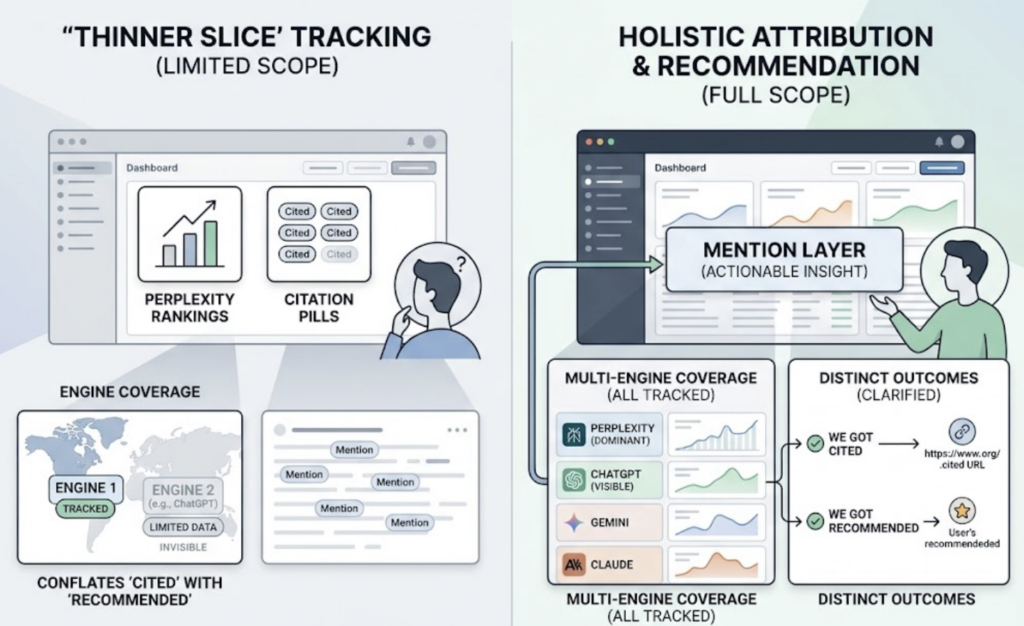
    So a tool that only reports Perplexity rankings or citation pills is tracking a thinner slice than it admits. Two gaps show up again and again. First, most platforms cover one engine well and the rest poorly, when a brand can be dominant in Perplexity and invisible in ChatGPT. Second, they conflate “we got cited” with “we got recommended,” which are different outcomes. The mention layer, the actual sentence where an AI names you, is what a dashboard has to capture.

    What an AI Mention Tracking Dashboard Should Actually Measure

    An AI mention tracking dashboard earns its place when it turns raw answers into something you can act on, not a wall of numbers. Five metrics separate a useful one from a vanity panel.

    Brand Presence. Does your brand appear in the answer at all, and how often across a set of tracked prompts. This is the category-relevance baseline.

    Citation Share. What percentage of the sources an AI pulls from point to you versus your competitive set. It’s the closest proxy for how much authority a model assigns your content.

    Visibility Depth. Whether the AI mentions you in passing or builds you into its recommended solution. A mention and a recommendation are not the same, and a good dashboard tells them apart.

    Entity Stability. How consistently AI engines recognize and describe your brand correctly over time. Drift here is an early warning for hallucination and narrative slip.

    AI Referral Traffic. The clicks that do come through from AI platforms. Small in volume, but they tend to convert well, since the user already read a summary before clicking. One dataset found AI search visitors convert at 23x the rate of traditional search visitors.

    The trade-off is coverage versus depth. Some tools track many engines shallowly. Others go deep on one. The right pick depends on where your buyers actually ask.

    The 7 Tools, Ranked at a Glance

    Here’s how the field compares on the dimensions that decide whether a dashboard is worth the seat cost.

    ToolAI engines coveredMention-level trackingSource / citation analysisCompetitor benchmarkingStarting price
    1. TopifyChatGPT, Gemini, Perplexity, DeepSeek, and moreYes, prompt-levelYes, domain and URL levelYes, automatic$99/mo
    2. ProfoundChatGPT, Perplexity, othersYesPartialYesCustom / enterprise
    3. Peec AIChatGPT, Perplexity, GeminiYesLimitedYesMid-tier
    4. Otterly.AIChatGPT, Perplexity, Google AIOYesBasicBasicLower tier
    5. Semrush AI toolkitAI Overviews, ChatGPTPartialPartialYesBundled with suite
    6. Ahrefs Brand RadarAI Overviews, ChatGPTMention-focusedPartialLimitedBundled with suite
    7. DaydreamMulti-engineYesLimitedYesCustom

    The table flattens a lot of nuance, so the sections below add the context the columns can’t.

    #1 Topify: Cross-Engine Brand Visibility in ChatGPT and Perplexity

    Topify lands at the top for a specific reason: it treats the mention as the unit of measurement, then connects it back to the source that produced it, across engines, in one view. That’s the combination most other tools split apart.

    In practice, it works like this. Topify monitors a set of high-intent prompts at the prompt level across ChatGPT, Gemini, Perplexity, DeepSeek, and other major engines. Its Visibility Tracking shows where your brand surfaces and how often. When a ChatGPT mention drops, Source Analysis lets you trace it to the exact domain or URL that stopped citing you, so you know what content to fix rather than guessing.

    That source visibility matters because AI engines often favor third-party pages over your own. If a competitor’s blog post is the model’s preferred reasoning node, you can see it and decide whether to match the topic, outpublish it, or earn the citation at the source.

    For teams that need ai seo tools for brand visibility in chatgpt without stitching three subscriptions together, the appeal is the single workflow. Competitor Monitoring flags who the AI recommends alongside or instead of you, Position Tracking shows your order relative to rivals in the answer, and Sentiment Analysis scores how the model describes you on a 0 to 100 scale. CVR, the conversion visibility rate, estimates how likely an answer is to push a reader toward you.

    Pricing starts at $99/mo on the Basic plan, which covers ChatGPT, Perplexity, and AI Overviews tracking with 100 prompts and four projects. That’s a meaningful gap below the enterprise pricing common among AI-only visibility platforms, and it makes the tool reachable for in-house teams and agencies running several client brands.

    The trade-off is honest to name. Topify is built for ongoing GEO operations, not a one-time audit, so the value compounds over weeks of tracked data rather than a single report. You can get started with Topify on a trial before committing.

    How Topify Tracks Brand Visibility in ChatGPT and Perplexity

    The mechanics are straightforward. You define 20 to 50 customer prompts, the kind real buyers type, and Topify runs them across engines on a schedule. Because AI answers are non-deterministic, repeated synthetic prompting builds a trend line instead of a single snapshot. The merged view means you stop tab-switching between a Perplexity tool and a ChatGPT tool, and you start seeing one brand picture.

    #2 to #7: Where the Other Tools Fit

    The rest of the field is capable, with sharper edges in specific use cases.

    Profound is strong on enterprise-grade answer analytics and custom prompt tracking, and it’s a common pick for large teams. Pricing tends to sit at the enterprise level, which prices out smaller operators.

    Peec AI focuses on multi-engine visibility reporting with clean dashboards, and it suits teams that want fast setup. Source-level attribution is lighter than a citation-first tool.

    Otterly.AI is approachable and budget-friendly, covering ChatGPT, Perplexity, and Google AI Overviews. It’s a reasonable entry point, though competitor and source depth are basic.

    Semrush’s AI toolkit wins when you already live in Semrush and want AI visibility folded into an existing SEO workflow. Engine coverage is narrower than dedicated GEO tools.

    Ahrefs Brand Radar leans into brand-mention detection inside AI answers and AI Overviews, useful if Ahrefs is your home base. Competitor benchmarking is limited.

    Daydream offers multi-engine tracking with an automation bent, fitting teams that want monitoring plus workflow. Citation analysis is less developed.

    None of these is wrong. They’re tuned for different priorities.

    How to Choose the Best SEO Tools for Perplexity and ChatGPT

    Picking the best seo tools for perplexity and ChatGPT comes down to three questions, not a feature checklist.

    First, how many engines do your buyers use. If your audience splits across Perplexity, ChatGPT, and Gemini, single-engine coverage leaves blind spots, so favor a tool that merges them.

    Second, do you need to know why, not just what. If you only need a presence score, a lighter tool works. If you need to trace a drop to a source and fix it, you need citation-level analysis.

    Third, who’s paying and how often you’ll look. Agencies and in-house teams checking weekly get more from a per-seat subscription with competitor benchmarking than from an enterprise contract built for a quarterly report.

    Match the tool to the answer you need to give your boss or your client. That’s the filter.

    Conclusion

    The gap that opened this piece, a prospect getting three AI recommendations and none of them yours, is now measurable. The brands that close it aren’t tracking more keywords. They’re tracking prompts, across engines, at the mention level, and tracing each result back to a source they can influence. Start by listing the 20 to 50 prompts your buyers actually ask, decide which engines matter for your market, then choose a dashboard that covers both presence and the reason behind it. The reporting follows from there.

    FAQ

    Q: What is an AI mention tracking dashboard? 

    A: It’s a tool that monitors how often and how AI engines like ChatGPT, Perplexity, and Gemini name your brand in their answers, then reports presence, citation share, sentiment, and competitive position in one view. Unlike a rank tracker, it measures the answer itself, not a SERP position.

    Q: What are the best SEO tools for Perplexity in 2026? 

    A: Tools that cover Perplexity well alongside other engines, track mentions at the prompt level, and attribute citations to source domains. Single-engine tools tend to undercount, since a brand visible in Perplexity can be absent in ChatGPT.

    Q: How do I track brand visibility in ChatGPT? 

    A: Define a set of high-intent prompts, run them across ChatGPT on a schedule using synthetic prompting, and log how often your brand appears, in what position, and which sources the model cites. Repeating this over time turns volatile single answers into a usable trend.

    Q: Are AI SEO tools for ChatGPT visibility worth it in 2026? 

    A: With AI Overviews triggering on 82% of B2B tech queries and most AI searches ending without a click, traditional click metrics now miss most of your exposure. For teams whose buyers research through AI, a visibility dashboard captures performance that rank trackers can’t see. A free tool audit is a low-risk way to start; see this list of free GEO tools.

    Read More

  • AI Mention Tracking System: How to Choose the Right One

    AI Mention Tracking System: How to Choose the Right One

    Search “AI mention tracking system” and you’ll find a dozen products that all promise the same thing: they’ll tell you when your brand shows up in AI answers. Look closer and they diverge fast. Some only watch ChatGPT. Some report raw mention counts with no context. And the citation patterns they’re tracking shift every few weeks, so last month’s report is already half-stale. The hard part isn’t finding a tracker. It’s figuring out which one measures what actually moves your brand’s standing in AI search, across every engine your buyers are using.

    What an AI Mention Tracking System Actually Does

    An AI mention tracking system does more than scan the web for your brand name. It periodically queries AI engines with the same high-intent questions your customers ask, then records whether your brand shows up, how it’s described, and which sources the model leaned on to build its answer.

    That method has a name: synthetic prompting. Instead of scraping public APIs the way legacy social listening tools do, the system runs category-specific prompts against ChatGPT, Perplexity, Gemini, and Google AI Overviews, then logs three things. Presence frequency, or how often you’re mentioned. Narrative framing, or whether the AI casts you as a leader, a challenger, or a budget option. And citation authority, or whether the model treats your domain as a primary source.

    Here’s why that matters now. With over 64% of informational queries ending in zero-click interactions, page rankings and organic traffic no longer tell you whether your brand is winning the moment a buyer asks an AI for a recommendation. A page ranking first in Google can be ignored by an LLM, while a lower-ranked but well-structured page gets cited as the authority.

    That’s the gap most dashboards still can’t see.

    Why a Single-Platform AI Mention Tracking Tool Falls Short

    Most teams start with a single-platform AI mention tracking tool, usually one that watches ChatGPT and nothing else. It feels like enough until you realize each engine builds answers differently.

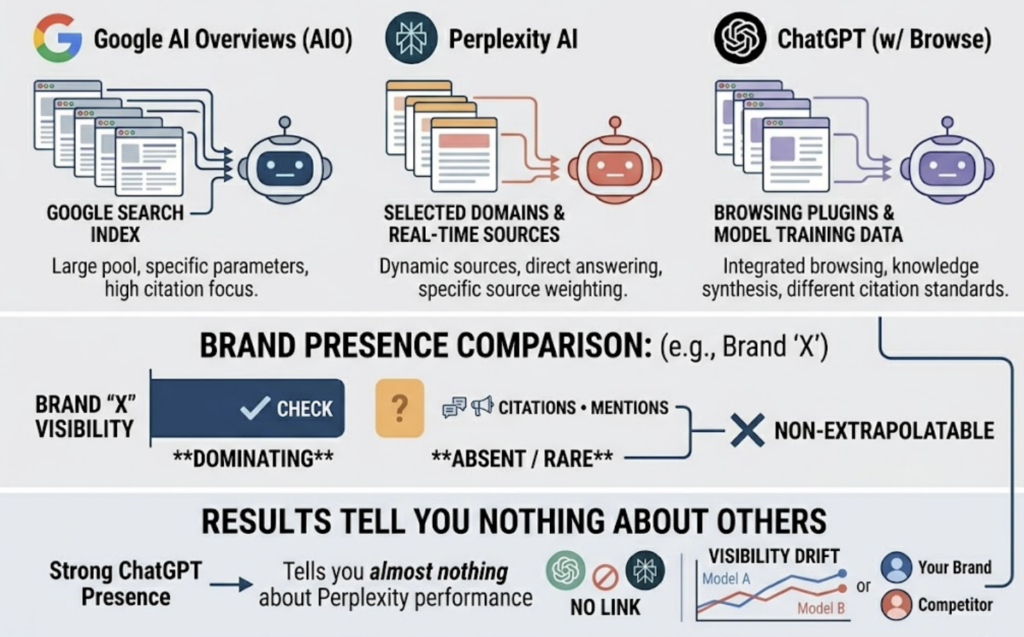
    Different models use different retrieval-augmented generation patterns. Your brand might dominate Google AI Overviews and stay completely absent from Perplexity, because the two pull from different source pools and weight authority differently. You can’t extrapolate one platform’s results to another. A strong ChatGPT presence tells you almost nothing about how you’re doing in Perplexity.

    Single-platform tools share two other blind spots. They report that you were mentioned without explaining why the AI picked the sources it did. And they rarely connect mention data to anything downstream, so you’re left with a vanity count instead of a signal you can act on.

    Knowing an AI cited a competitor because of a third-party review site, not a better product page, is the kind of context that actually changes what you do next.

    AI Mention Tracking Software vs a Real Tracking Platform

    The words get used interchangeably, but there’s a practical difference between AI mention tracking software and a full tracking platform. Software tends to do one job well: detect and count mentions. A platform integrates that detection with attribution, competitor benchmarking, and a path to action.

    The split looks like this in practice.

    DimensionSingle-point softwareFull tracking platform
    Platform coverageOne engine, usually ChatGPTChatGPT, Perplexity, Gemini, AI Overviews
    AttributionMention count onlyShows why a source was cited
    Competitor viewNone or manualAutomated benchmarking against rivals
    Business correlationVanity countsTies visibility to branded search and assisted conversions
    WorkflowExport and DIYConnects to content and SEO actions

    The trade-off is real. Point software is cheaper and faster to set up. A platform costs more but answers the question that point tools can’t: not just whether your mentions changed, but what to fix when they drop.

    What to Look for in an AI Mention Tracking Solution

    If you’re evaluating an AI mention tracking solution for 2026, five criteria separate the useful from the merely busy. Each one maps to a question you can ask a vendor in a demo.

    CriterionWhat to ask
    Model breadthDo you track Google AI Overviews, ChatGPT, Perplexity, and Claude natively?
    Source attributionCan you show why the AI selected a given source, not just that it did?
    Comparative intelligenceDo you benchmark my brand against my top three to five competitors automatically?
    Sentiment and accuracyWill you alert me to hallucinated claims or a negative shift in how I’m described?
    Actionable workflowDoes the data connect to my content planning or SEO process?

    Model breadth is the one teams underweight most. The whole point of a system, as opposed to a tool, is that it watches every engine your audience uses, not the one that was easiest to integrate. If a vendor covers a single platform, you’re buying back the blind spot you were trying to close.

    Source attribution is the second filter. A mention count tells you the score. Attribution tells you how the game is being played, which is the only thing that helps you change the outcome.

    The AI Mention Tracking Dashboard and Analytics That Matter

    A crowded AI mention tracking dashboard can hide more than it shows. The job of good AI mention tracking analytics is to answer “why did this change,” not just “how much did it change.” A few metrics carry most of that weight, and they line up with the AI visibility metrics practitioners now treat as core.

    Citation Share is the first. It’s your percentage of the sources an AI cites in your category, measured against the competitive set. It reframes visibility as a contest for the evidence pool, not a raw tally.

    Position Index measures prominence. Being named first in an answer carries more weight than appearing as a footnote, and a dashboard that flattens both into “1 mention” is lying to you by omission.

    Then there’s Drift, or volatility. AI descriptions of your brand change as models retrain and content refreshes, and tracking how often that framing shifts tells you whether your narrative is stable or quietly eroding. Entity Salience rounds it out: the degree to which an AI links your brand to your core category terms, which is the closest thing to topical authority in the generative era.

    Vanity dashboards stop at mention counts. The analytics that matter explain the movement.

    Bringing Mention Tracking Together with Topify

    For teams that want all of this in one view rather than stitched across five tabs, Topify is built around exactly the layers above. Its Visibility Tracking watches how often your brand surfaces across ChatGPT, Gemini, Perplexity, and other engines, so you’re measuring mentions where your buyers actually search rather than on a single platform.

    The attribution layer is where a tracking system earns its keep. Topify’s Source Analysis reverse-engineers the domains and URLs an AI cites, so when a competitor takes your spot you can see the exact reference behind it and decide whether to improve that source or publish something more answer-ready to replace it in the retrieval pool. That’s the difference between knowing you slipped and knowing what to do about it.

    Competitor Monitoring handles the benchmarking criterion automatically, tracking your Citation Share and Position against rivals and flagging new challengers as they emerge. Sentiment scoring catches narrative drift before it hardens, and CVR estimates how likely an AI answer is to push a reader toward a brand interaction, which connects visibility to something closer to revenue than a mention count ever could.

    You can start tracking across platforms and see where your brand stands within a few minutes. Plans begin at $99 per month, so you can validate the data before committing to a wider rollout.

    Conclusion

    The question was never whether to track AI mentions. It’s which system gives you signal instead of noise. Start with the five criteria: model breadth, source attribution, competitor benchmarking, sentiment alerting, and a workflow you’ll actually use. Then weight coverage heavily, because a tracker that only watches one engine reproduces the blind spot you’re paying to remove. Pick the system that explains why your mentions move, not just that they did, and you’ll spend your time fixing the source instead of refreshing a dashboard.

    FAQ

    Q: What’s the best Perplexity mention tracker? A: The strongest option is one that tracks Perplexity alongside ChatGPT, Gemini, and AI Overviews in the same view, because Perplexity uses its own retrieval pattern and your results there won’t match other engines. Look for source attribution specifically, since Perplexity surfaces citations openly and a good tracker should tell you which domains it pulled from.

    Q: What’s the best ChatGPT mentions tool? A: A ChatGPT mentions tool is most useful when it pairs presence tracking with framing and citation data, so you learn not just that you were named but how you were described and why. A standalone ChatGPT-only tool leaves you blind to the other engines your buyers use, so a multi-platform system is generally the safer pick.

    Q: How is AI mention tracking different from traditional brand monitoring? A: Traditional brand monitoring scans published content and social posts for your name. AI mention tracking uses synthetic prompting to query AI engines directly, measuring how you appear inside generated answers. The first watches what people say. The second watches what the AI says, which is increasingly what buyers see first.

    Q: Does an AI mention tracking system update in real time? A: Most systems run on a scheduled cadence rather than true real time, since synthetic prompting means actively querying engines on an interval. Weekly prompt audits are a common rhythm, often enough to catch competitive shifts while keeping query costs reasonable. The right interval depends on how fast your category’s AI narratives change.

    Read More

  • AI Mention Tracking: What It Is and How to Measure It

    AI Mention Tracking: What It Is and How to Measure It

    Your boss asks a simple question in Monday standup: “Are we showing up when people ask ChatGPT about our category?” You’ve got Google rankings, a traffic dashboard, and a content calendar. None of them answer her. That blank space is the actual problem. Search has quietly moved from a list of blue links to a synthesized answer, and most teams have no way to see what that answer says about them, whether it cites them, or whether it recommends a competitor instead.

    So before you can fix your position in AI search, you need to see it. That’s what AI mention tracking is for.

    What AI Mention Tracking Actually Measures

    AI mention tracking is the practice of monitoring how your brand, product, or service gets referenced, cited, or recommended inside the answers that large language models generate. It’s not social listening. Social listening scrapes public feeds. AI mention tracking interrogates the synthesized output of a model that never shows its work.

    The reason teams get confused early is that “mention” isn’t one thing. It’s three.

    A brand mention is a raw textual reference to your name, with or without a link. It builds recall and tells the model your brand is a real entity in the category. A summarization presence is when your brand gets woven into the narrative of the answer itself, which signals topical authority. A citation is an explicit link the AI provides back to your domain, which is the strongest signal of all because it treats your content as a verifiable source.

    Tracking only one of these gives you a distorted view. A brand mentioned often but never cited has recall without authority. A brand cited often but described inaccurately has authority working against it.

    How AI Mention Tracking Works Behind the Scenes

    Generative engines don’t pull up a ranked page the way classic search does. They run Retrieval-Augmented Generation, or RAG. The system retrieves snippets from a large indexed corpus, filters them using signals like site authority, content structure, and recency, then rewrites the result into a single direct answer.

    That mechanism is why keyword rank tracking falls apart here. AI responses are variable, shifting with session context, location, and how the prompt is phrased. They’re also synthetic. The model doesn’t rank your page in isolation, it extracts and recombines fragments from many sources.

    The practical consequence is blunt. If your content isn’t extractable, because it’s poorly structured, gated, or never directly answers a specific question, the model will skip it even when you rank first on Google. Good AI search analytics work at the prompt and answer level, not the keyword level, because that’s the only layer where the model’s actual behavior shows up.

    Why AI Mention Tracking Matters More Than Your Google Rank

    Around 64% of informational queries now end without a click. The answer is the destination. When the AI summarizes your category and your brand isn’t in that summary, you don’t lose a ranking position, you lose the entire impression before the user ever reaches a search results page.

    This is the gap that breaks legacy reporting. Domain authority, keyword positions, and organic sessions all measure a world where users click through to read. AI search visibility measures a world where they often don’t. A brand can hold the number one organic spot for a term and still be invisible in the AI answer that now sits above it.

    Page rank tells you where you stand in a list. It says nothing about whether the AI knows you exist.

    How to Measure AI Mention Tracking the Right Way

    Measuring this well means moving past a single vanity number. “We got mentioned 12 times” is meaningless without context: out of how many relevant prompts, on which platforms, framed how, and against whom. A useful measurement framework tracks a handful of metrics together.

    MetricWhat It MeasuresWhy It Matters
    Share of VoicePercentage of category-relevant AI answers that mention your brandRelative mindshare against competitors
    Citation Inclusion RateHow often your domain is cited as a sourceTechnical and content authority
    Sentiment FramingThe descriptive tone the AI uses about youCatches narrative drift and brand damage
    Position IndexWhere you appear in the answer, first mention versus footnoteDrives user trust and prominence
    Hallucination RateHow often the AI states wrong facts about youBrand integrity and risk

    Here’s a concrete example of what this looks like in practice. You run the prompt “best project management tool for remote teams” across three engines daily for 30 days. Your share of voice is 18% on Perplexity but 3% on ChatGPT, your sentiment is positive everywhere except one engine that still lists a discontinued pricing tier, and a competitor holds the first-mention position in 70% of answers. That single view tells you exactly where to act, which is what good AI search intelligence should deliver.

    The Mistakes That Make Mention Data Useless

    Most teams stumble because they apply old SEO instincts to a new system. Four mistakes show up again and again.

    The first is platform monoculture. Tracking only Google AI Overviews while ignoring ChatGPT and Perplexity hides most of your exposure, since each engine uses a different retrieval mechanism and cites different sources. The second is the keyword trap, fixating on search volume instead of how customers actually ask. People type conversational prompts like “what’s a good X for a small team,” and if you aren’t tracking prompt-level behavior, your data describes a search world that no longer exists.

    The third is neglecting sentiment. Teams obsess over citation counts while ignoring what the AI says. A brand cited often with outdated pricing or wrong features is in worse shape than one rarely cited at all. The fourth is skipping a competitor baseline. If your mentions drop and you have no benchmark, you can’t tell whether something broke on your end or the AI simply started preferring a rival’s fresher content.

    Counting mentions without context isn’t measurement. It’s noise with a number attached.

    Turning Mention Data Into a Visibility Strategy

    Tracking is a diagnostic, not the cure. The point is to feed what you find back into a strategy that changes the AI’s answer next month. A workable Generative Engine Optimization loop has four moves.

    Start with prompt-level mapping, a curated set of 20 to 40 high-intent prompts spanning informational, comparative, and instructional questions, run consistently so you see trends rather than snapshots. Then work on structural optimization for extractability, using clear headings, direct question-and-answer formats, and schema so models can ingest your content. Build third-party authority next, since AI engines weigh reviews, industry coverage, and community discussion heavily, often more than on-page tweaks. Finally, treat inaccurate descriptions like a PR issue and publish authoritative content that directly overwrites the claim the AI keeps repeating.

    Running this loop by hand across three or four engines, dozens of prompts, and a rotating set of competitors gets unmanageable fast. This is where a dedicated AI visibility platform earns its place. Topify is built for exactly this workflow: its Visibility Tracking watches how often your brand surfaces across ChatGPT, Gemini, Perplexity, and AI Overviews, Source Analysis reverse-engineers which domains the engines cite so you can see who’s being read instead of you, and Competitor Monitoring keeps a live baseline so a drop in mentions reads as signal, not mystery. In practice that means you can spot a fall in ChatGPT mentions, trace it to a third-party page that stopped citing you, and know what to fix, all in one view. For AI SEO and broader AI search optimization, having mention data, sentiment, and citation sources in a single dashboard is what turns reporting into action.

    Your AI Mention Tracking Checklist

    If you’re starting from zero, keep the first pass simple and run these five steps in order.

    1. Audit. Write down the top 20 questions your customers ask during their research phase, in their words, not your keywords.
    2. Baseline. Run those prompts across ChatGPT, Perplexity, and Google AI Overviews and record who gets mentioned and cited.
    3. Analyze. Identify which sources the AI cites instead of you, and where competitors hold the first-mention spot.
    4. Optimize. Update your content, or the third-party source being cited, to be more concise, factual, and answer-shaped.
    5. Monitor. Set a recheck cadence and watch how the AI’s description of your brand shifts as your content changes.

    You can run a rough version of steps two and three manually before committing to any tool. A set of free GEO toolscovers the basic audit, and when you’re ready to track continuously rather than spot-check, you can get started with Topifyon a single project.

    Conclusion

    The question your boss asked, whether you show up in AI answers, isn’t going away, and Google rank won’t answer it. AI mention tracking gives you the visibility layer that legacy SEO metrics were never built to capture: who the AI mentions, who it cites, and how it frames you against competitors. Start with 20 real customer prompts and a baseline across three engines. Once you can see the answer the AI is giving, you can start changing it.

    FAQ

    Q: What are the best tools for AI mention tracking? 

    A: The strongest options track multiple engines at once, measure share of voice and citations rather than raw mention counts, include sentiment, and maintain a competitor baseline. Single-platform trackers and keyword-volume tools tend to miss most of your real exposure. Look for a platform that covers ChatGPT, Perplexity, Gemini, and AI Overviews together.

    Q: How can I improve my AI mention tracking results? 

    A: Improve the inputs, not just the dashboard. Map 20 to 40 high-intent prompts, make your content extractable with clear Q&A structure and schema, build third-party authority through reviews and industry coverage, and publish content that directly corrects any inaccurate claims the AI keeps repeating about you.

    Q: What does AI mention tracking pricing usually look like? 

    A: Pricing typically scales with how many prompts, projects, and AI platforms you monitor, plus how often you refresh the data. Entry plans tend to start around the cost of a standard SEO tool, with higher tiers adding more prompts, seats, and content credits. You can compare tiers on the Topify pricing page.

    Q: Can you give an example of AI mention tracking in action? 

    A: Say you track “best CRM for small teams” daily across three engines for a month. You learn your share of voice is 20% on Perplexity but 4% on ChatGPT, one engine still cites a competitor’s outdated comparison page, and you hold a first mention in only 1 of 10 answers. That tells you precisely which engine and which source to target next.

    Read More

  • AI Search Optimization: Your Competitor Blind Spot

    AI Search Optimization: Your Competitor Blind Spot

    Your AI search dashboard looks healthy. Brand mentions are up, ChatGPT cites you on a few queries, and the monthly report finally has an “AI visibility” line. Then a prospect asks an AI assistant to compare your category, and the answer ranks a competitor first, calls them “better value,” and never explains why.

    You didn’t see it coming, because your tracking only watches your own name. That’s the blind spot in most AI search optimization programs: they measure the brand you own and stay blind to the competitors AI keeps recommending instead.

    Most AI Search Optimization Stops at Your Own Brand

    Marketing teams tend to treat AI search optimization as an extension of traditional SEO. They watch their own mentions, their own citations, their own sentiment, and call it a program. The problem is that large language models don’t work that way. They synthesize and compare, then hand the user a single recommendation.

    So when an AI consistently frames a rival as the safe pick and you as the also-ran, that isn’t a ranking gap you can see in a self-only dashboard. It’s a narrative gap that forms before the user clicks anything.

    Self-tracking tells you how you’re doing. It says nothing about whether you’re losing.

    This matters more every quarter, because the click is disappearing. Roughly 64.82% of Google searches now end without a click, and on AI-native engines the rate is far higher: around 93% on Perplexity and 82% on ChatGPT Search. Buyers are getting their shortlist inside the answer. If you can’t see how that answer treats your competitors, you’re optimizing half the picture.

    AI Search Visibility Is Measurable. So Is Your Competitor’s

    AI search visibility measures whether AI engines mention you, where they place you, and how they describe you. The useful insight is that every one of those measurements applies just as cleanly to the brands you’re up against.

    Tracking AI brand visibility for yourself and your top three rivals on the same prompts turns a vanity number into a competitive read. Here’s the stack worth monitoring:

    MetricWhat it measures
    Share of VoiceThe percentage of category answers that name you versus competitors
    Citation ShareThe slice of total citations in a topic cluster your brand captures
    Recommendation RateHow often AI explicitly suggests you on “best,” “top,” or “alternatives” prompts
    Position IndexWhether you appear first or fourth in the AI’s list
    Sentiment GapThe difference between how AI describes you and how it describes a rival

    Position and sentiment are where most surprises live. You can hold a respectable share of voice and still lose, because the model names you last and frames the competitor as the default. This is also the layer that separates AI search visibility from Google rankings, where a strong domain authority tells you nothing about what AI chooses to say.

    The Competitor GEO Performance Layer AI SEO Tools Miss

    Generative engine optimization is dynamic and comparative in a way classic AI SEO tools rarely capture. The engine doesn’t just read your copy. It interrogates your data, pulls quantifiable attributes like specs and pricing, and pits them against rivals in real time.

    Two signals decide a lot of this. The first is co-citation: being named alongside category leaders marks your brand as a coherent entity for that use case. If you’re never cited next to competitors on your core queries, the model tends to treat your entity as irrelevant there.

    The second is source trust. Models lean heavily on third-party validation, so a competitor can capture your visibility simply by showing up more often in the review sites AI engines trust. Search Engine Land’s reporting on how brand depth shapes what AI systems recommend points the same direction: presence and consistency across trusted sources drive the recommendation.

    The gap is that most AI SEO tools only render your own scorecard. To track competitor GEO performance, you need the comparative view: the same prompts, run across the same engines, scored side by side.

    What AI Tells Buyers About Competitor Pricing

    Pricing isn’t just a number on your site anymore. It’s a label an AI assigns you in front of a buyer.

    AI engines routinely surface pricing and value framing pulled from third-party sources. If an assistant keeps calling a competitor “better value” while tagging you “enterprise-only,” that framing reaches the buyer whether or not it reflects your actual value. Competitor pricing tracking in AI search optimization exists to catch this drift early.

    The response is a content one. When the model’s value label is wrong, the fix is usually structured “vs.” pages that clarify the comparison with clean, machine-readable data, so the engine has an accurate source to cite. You can’t correct a narrative you can’t see, which is why pricing signal monitoring belongs in the workflow rather than in a quarterly audit.

    Turning AI Search Analytics Into a Competitive Workflow

    The point of AI search analytics is to move from passive observation to strategic response. A mature AI search intelligence workflow runs on three loops: prompt-level benchmarking across the major engines, pricing and sentiment signal tracking on competitors, and source attribution that tells you which domains are feeding a rival’s recommendation.

    For teams that want this comparison built in rather than bolted on, Topify treats AI search optimization as a comparative discipline from the start. Its Competitor Monitoring auto-detects the rivals AI engines name in your category, then benchmarks them next to you across seven metrics: visibility, sentiment, position, volume, mentions, intent, and CVR. Position Tracking shows whether you’re cited first or fourth on high-intent prompts, while Source Analysis reverse-engineers the exact domains driving a competitor’s mentions. In practice, you can spot a rival winning a “best of” citation, trace it to the third-party page behind it, and hand your content team a specific target, all in one view.

    That last step is the difference between knowing you’re behind and knowing what to do about it.

    Choosing an AI Visibility Platform That Tracks Rivals

    Not every tool labeled for AI visibility actually handles competitors. When you evaluate an AI visibility platform for competitive tracking, the capabilities below separate a real intelligence engine from a self-only dashboard.

    CapabilityWhy it matters for competitive tracking
    Multi-engine coverageRivals win on different platforms, so ChatGPT, Gemini, Perplexity, Claude, and Copilot all need monitoring
    Prompt-level simulationRunning the same competitor prompts at scale is what surfaces trends instead of snapshots
    Granular attributionTracing answers back to specific domains and pages shows where a competitor’s authority comes from
    Automated competitive alertsYou want a notification the moment a rival takes a “best of” citation or sentiment shifts, not a month later

    A platform that checks these boxes turns competitor tracking into a standing process. One that doesn’t leaves you watching your own reflection while the market moves around you.

    Conclusion

    AI search optimization isn’t only about getting mentioned. It’s about being the logical conclusion of the buyer’s research, which means knowing exactly how AI frames, prices, and ranks everyone else in your category. Start with 20 to 30 high-intent prompts, score yourself and your top rivals on the same metrics, and watch the position and sentiment gaps first. The brands that treat competitor visibility as core to their AI strategy will see where their narrative is eroding while there’s still time to fix it.

    FAQ

    Q: How do you track competitor GEO performance in AI search? 

    A: Run the same high-intent prompts your buyers use across ChatGPT, Gemini, Perplexity, and Claude, then score each competitor on the same metrics you track for yourself: share of voice, citation share, recommendation rate, and position. Platforms with built-in competitor detection automate this so you see relative movement, not just your own numbers.

    Q: Can you see competitor pricing in AI answers? 

    A: Often, yes. AI engines surface pricing and value framing pulled from third-party sources, so a competitor can appear labeled “better value” even when your specs are stronger. Competitor pricing tracking flags these labels so you can correct the narrative with structured comparison content.

    Q: What’s the difference between AI search analytics and traditional SEO analytics? 

    A: Traditional SEO analytics measures clicks, rankings, and traffic to your own pages. AI search analytics measures whether AI engines mention, cite, and recommend you, and how that compares to competitors, often on queries that never produce a click at all.

    Q: How do I start competitive AI search intelligence without a big team? 

    A: Pick a focused set of high-intent prompts, run them across the major AI engines, and log which brands get named and how. From there, an AI visibility platform can scale the monitoring and alert you when a rival’s position shifts. You can get started with Topify to automate the tracking.

    Read More