Author: Topify_admin

  • AI Citation Tracking Tools: What They Measure, Why It Matters, and How to Choose One

    AI Citation Tracking Tools: What They Measure, Why It Matters, and How to Choose One

    Your domain authority is solid. Your backlink profile is clean. Your top pages rank in position one for keywords that matter. Then a prospect opens Perplexity and types the exact question your product answers, and your brand isn’t in the response.

    Traditional SEO tools can’t explain this. They weren’t built to. They track HTML hyperlinks, not the probabilistic logic that determines what a language model synthesizes into an answer. That’s the gap AI citation tracking tools are designed to close.

    Your Backlink Profile Tells You Nothing About AI Citations

    For two decades, marketers treated domain authority as a universal proxy for visibility. High DA meant high rankings. High rankings meant traffic. The logic was linear.

    AI search has broken that chain.

    Research shows that Domain Authority has a measured correlation of just r=0.18r=0.18 with AI citation frequency, explaining less than 4% of variance in AI visibility. In practice, this means a brand with a DA of 80 can be completely absent from a ChatGPT or Perplexity response while a niche industry blog with DA 30 gets cited consistently. The reason is structural: traditional search engines rank based on link equity and domain age, while AI systems use probabilistic, retrieval-augmented generation (RAG) to synthesize answers from semantically dense sources.

    The business stakes are real. An AI Overview reduces the click-through rate for the first organic position by as much as 34.5% to 61%. At the same time, when a brand is cited inside an AI response, it sees organic clicks increase by 35% and paid clicks by 91% compared to queries where the brand is absent. Visibility has shifted from “ranking” to “winning the citation.” These are not the same thing, and they don’t respond to the same tools.

    What Is an AI Citation Tracking Tool?

    An AI citation tracking tool is a software platform that monitors, measures, and analyzes which URLs, domains, and brands generative AI systems reference when answering user queries.

    The distinction between a “mention” and a “citation” is worth being precise about. A mention is when an AI includes your brand name in its text without attribution. A citation is an explicit reference to a source URL or domain. Tracking mentions tells you about brand awareness. Tracking citations tells you whether AI is actually directing users to your content.

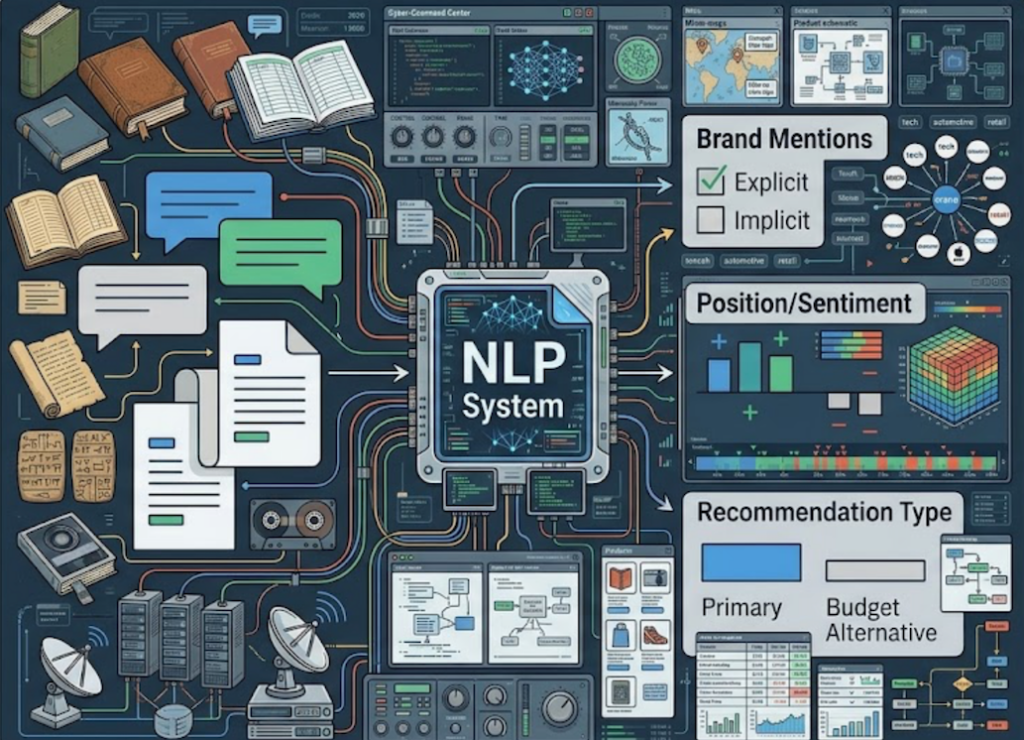
    What makes this category different from traditional analytics is the mechanism. These tools send structured prompts to AI platforms like ChatGPT, Perplexity, and Gemini, parse the returned responses, and extract the source attribution data. Over time, they aggregate this into visibility metrics: how often your domain appears, on which platforms, for which topic clusters, and how that compares against your top competitors.

    This is what’s meant by “AI citation tracking tool” in practice: it’s less a single feature and more a monitoring architecture built around the behavioral logic of AI answer engines.

    How AI Citation Tracking Tools Work

    Most tools follow a three-step process: send a standardized prompt to an AI platform, parse the response, and extract the source attribution data.

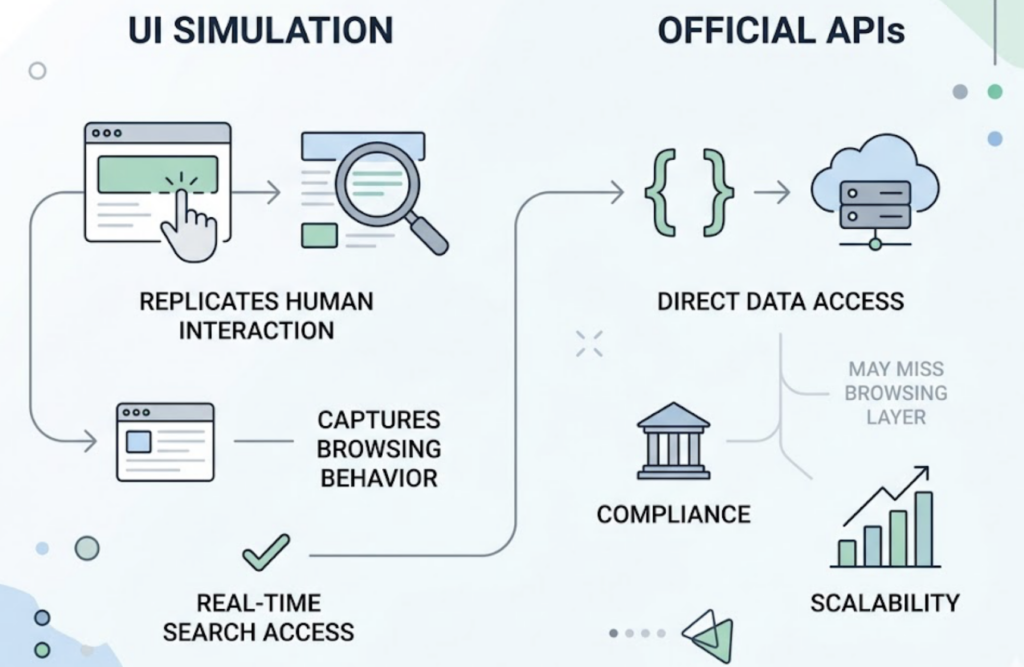
    Where tools differ is in how they access that data. Some use UI simulation, essentially replicating a human user’s interaction with the web interface of ChatGPT or Perplexity. This captures the full browsing and real-time search behavior that often isn’t available in raw API calls. Others use official APIs, which offer better scalability and compliance but may miss the “web browsing” layer that shapes real user responses.
    The tracking itself operates at three levels of precision. Domain-level tracking tells you whether your site is being cited at all. URL-level attribution tells you which specific pages are driving those citations. Topic-level mapping tells you the types of queries where you appear versus where you don’t. Only the last two levels give you anything actionable.

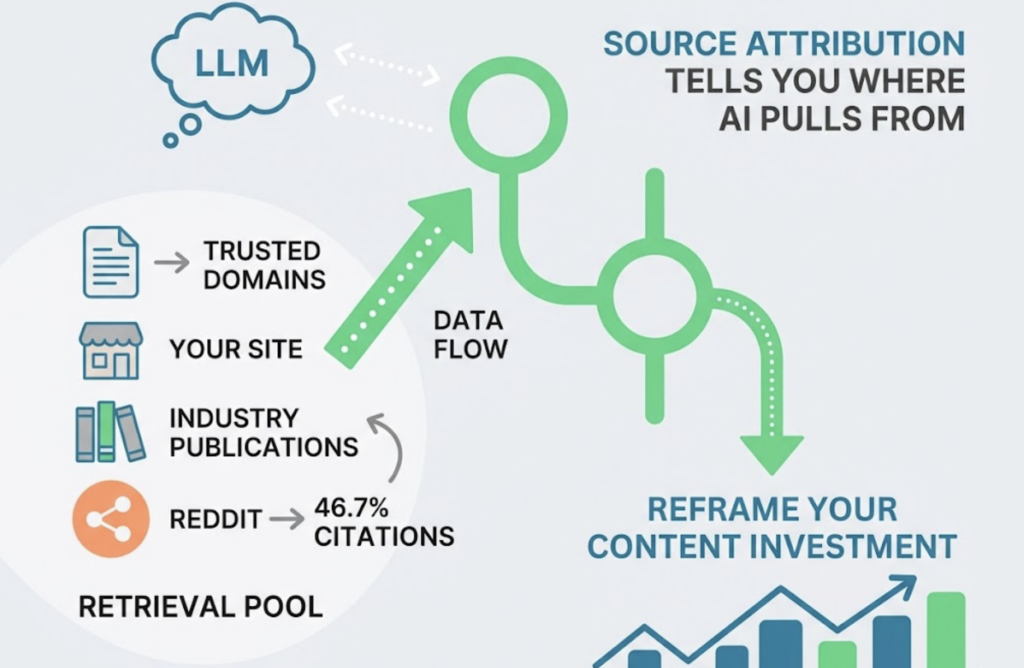
    One data point that surprises most teams: only 11% of domains are cited by both ChatGPT and Perplexity for the same set of queries. “AI” is not a monolithic audience. Perplexity averages 21.87 citations per question, about 2.8x more than ChatGPT, and draws heavily from Reddit (46.7% of its citations). ChatGPT answers 60% of queries from pre-trained parametric knowledge without triggering a web search at all. Google AI Overviews cite an average of 35.2 sources per complex query and overlap strongly with the top 10 organic results (93.67% of the time). Tracking one platform and calling it done isn’t a strategy.

    5 Signs a Citation Tracking Tool Is Actually Worth Using

    Most tools promise “AI visibility.” Fewer deliver the intelligence needed to act on it. Here’s what separates useful tools from dashboard noise.

    Platform breadth. A tool that only tracks ChatGPT misses the majority of the AI search landscape. Look for coverage across ChatGPT, Perplexity, Gemini, and emerging platforms. Model version matters too: citation behavior varies between “instant” and “reasoning” model variants.

    URL-level attribution. Domain-level reporting tells you whether your site exists in the AI’s world. URL-level attribution tells you which article is doing the work, and more importantly, which articles aren’t. This is the data you need to make content decisions.

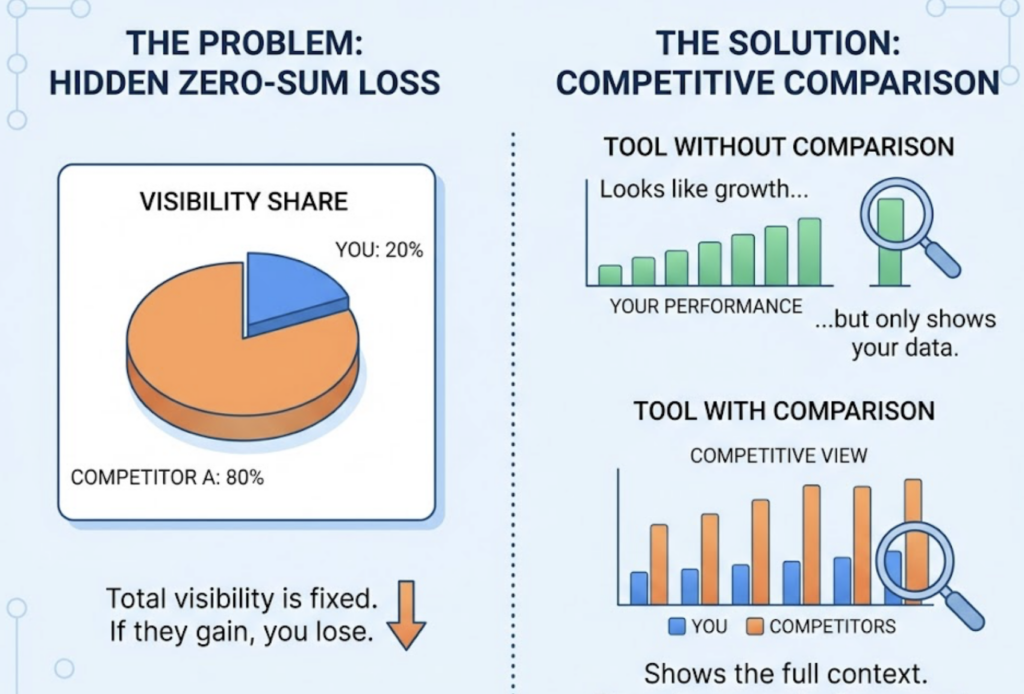
    Competitive share of voice. In generative search, visibility is zero-sum. If a competitor appears in 80% of relevant AI responses and you appear in 20%, you’re losing ground even if your absolute numbers look stable. A tool without side-by-side competitive comparison is giving you half the picture. Tools like Profound and others in the market offer this; the question is the depth and granularity of what they surface.
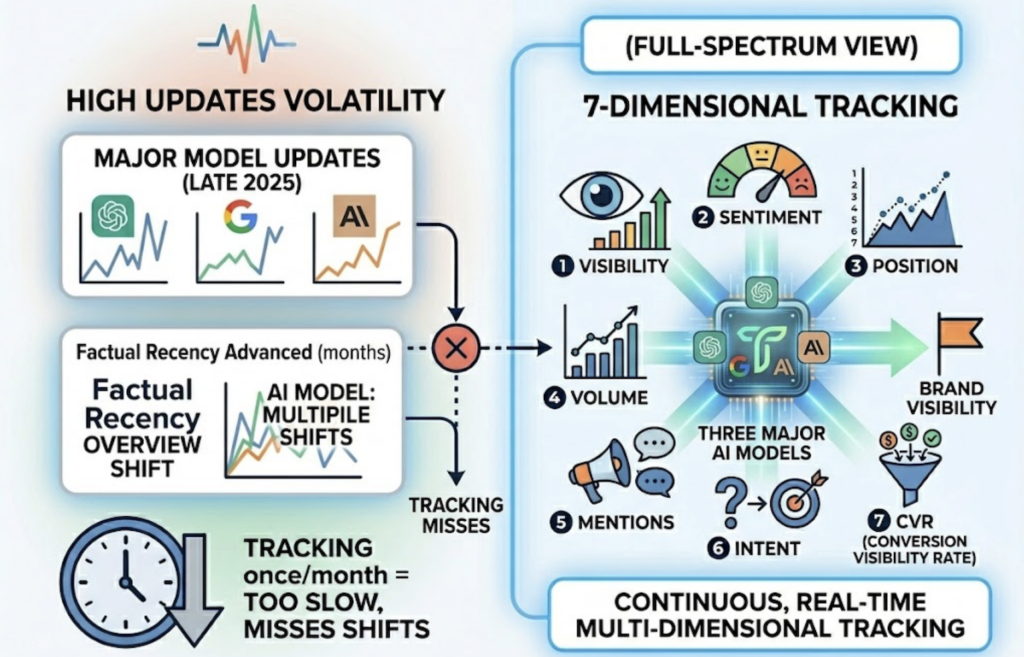
    Historical trend data. AI citation patterns are more volatile than they appear. BrightEdge research indicates that 96.8% of citations are stable week-to-week, but when they shift, they tend to shift completely: domains go from cited to not cited in a single model update cycle. Without historical data, you can’t tell whether a drop is noise or a signal.

    Topic and intent mapping. A brand may be cited consistently for “technical specifications” but never for “pricing comparisons.” Tools that connect citations to specific prompt types help teams prioritize optimization for queries that actually sit in the buyer’s journey, not just the traffic-heavy terms.

    Common Mistakes Teams Make When Tracking AI Citations

    The most common mistake is treating brand mentions as citations. An AI can say your company name a dozen times in a response without creating any path for a user to reach your website. AI models disagree on the same query 54.5% of the time, which means mention count is an unreliable signal to begin with. Citation count, tied to a specific URL, is the metric worth tracking.

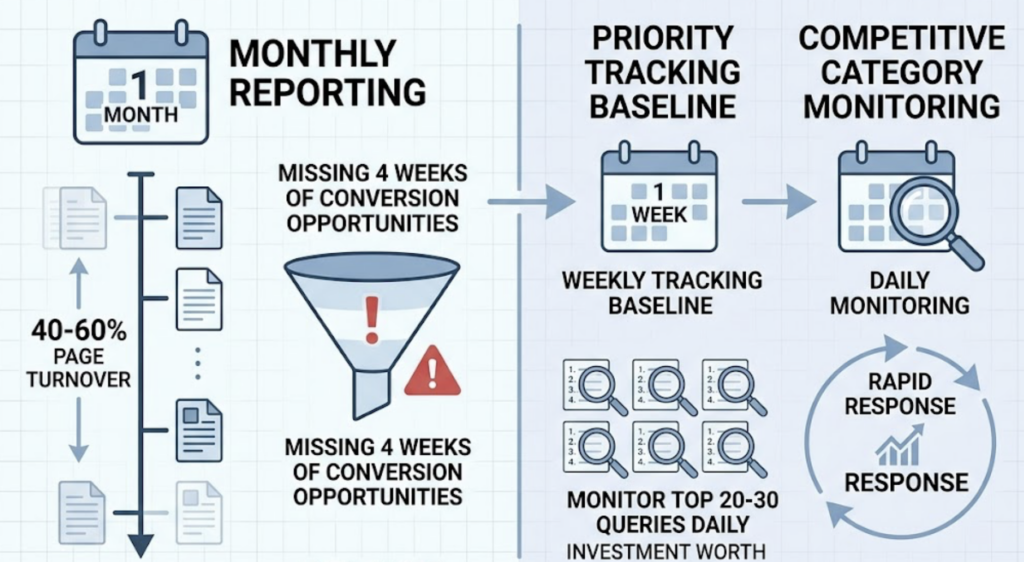
    The second mistake is the single-audit approach. Teams run a one-time check of their AI visibility, document the results, and file them away. In practice, AI citation patterns shift every few weeks as models update their retrieval parameters. Successful teams build citation tracking into their continuous monitoring workflows, not their quarterly reporting cycle.

    Third: ignoring competitor source data. The most actionable insight from citation tracking often isn’t about your own pages at all. If a competitor is consistently cited through third-party comparison sites or industry roundups, the implication is that publishing more content on your own domain won’t fix the gap. The fix is a digital PR strategy to win mentions on those external sources.

    Finally, over-optimization. The research is clear: keyword stuffing reduces the likelihood of being cited by AI systems. Adding statistics, on the other hand, improves AI citation visibility by up to 41%. Original research and first-party data generate 4.31x more citation occurrences per URL than generic blog posts. The optimization lever isn’t keyword density. It’s evidence density.

    How Topify’s Source Analysis Handles AI Citation Tracking

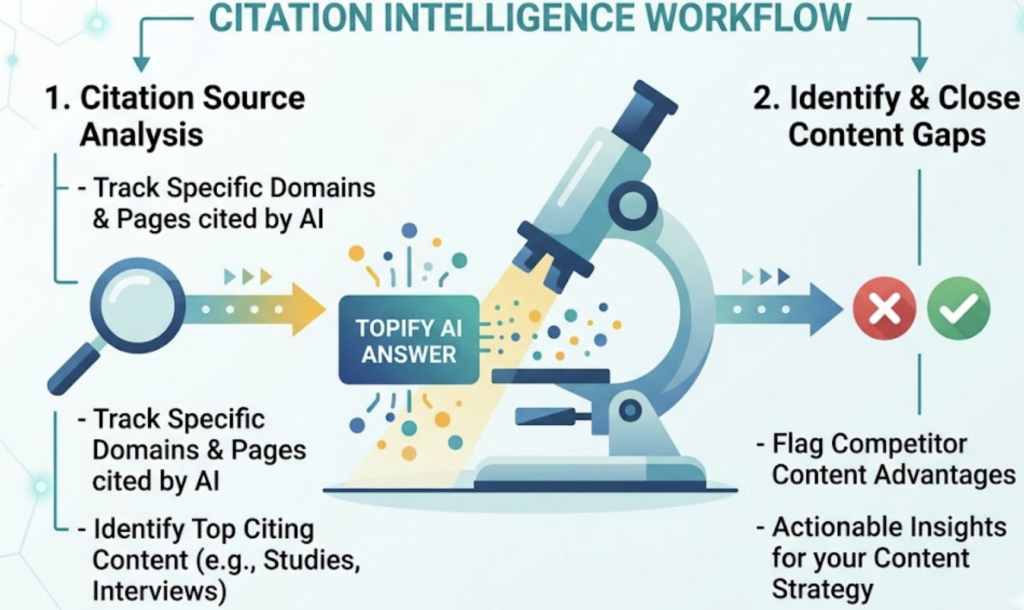
    Most visibility tools answer the question “Is your brand appearing in AI responses?” Topify is built to answer the more useful question: “What content is driving those appearances, and where are the gaps?”

    The Source Analysis feature maps which domains and specific URLs AI platforms cite in response to your tracked prompts. You can see your own citation footprint and your competitors’ at the same time: which third-party sources are giving them authority, which topics you’re missing coverage on, and where adding a single well-structured page could shift your citation share measurably.

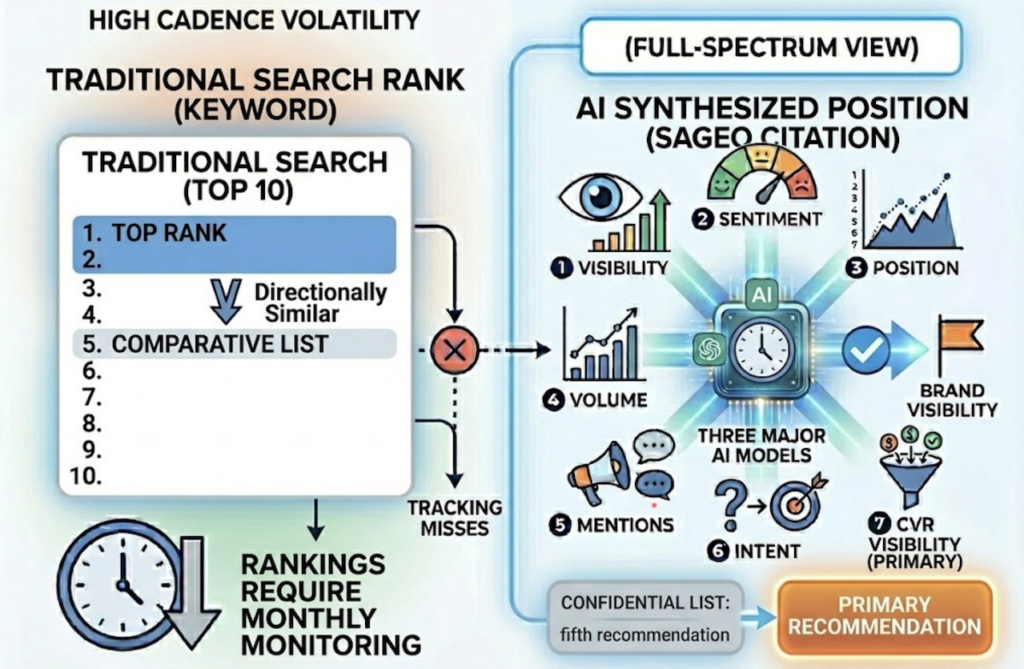
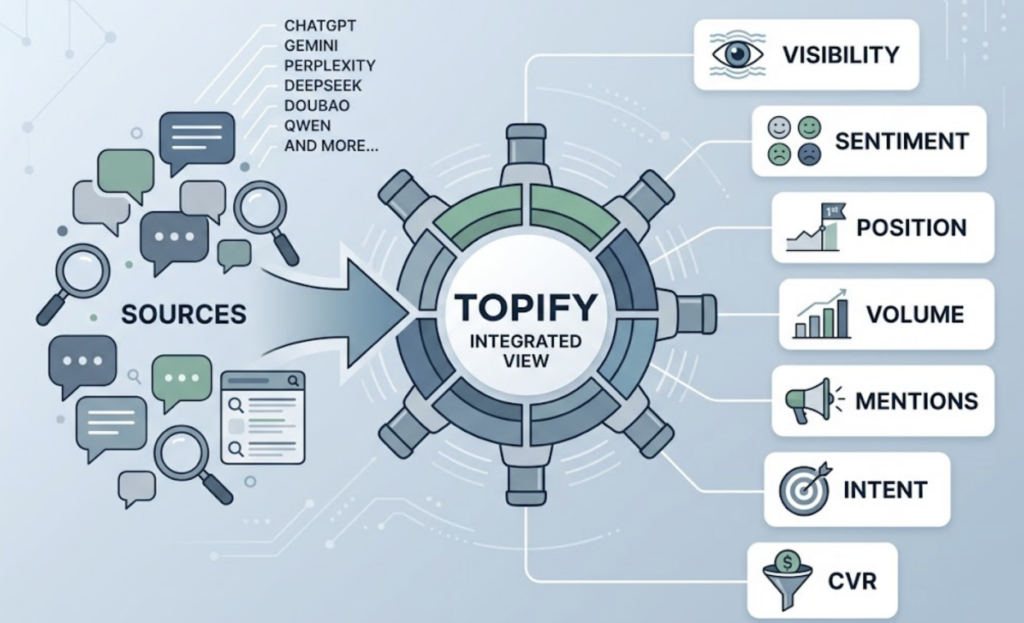
    Topify covers ChatGPT, Gemini, Perplexity, DeepSeek, and other platforms, which matters given how differently those platforms behave. Its tracking architecture also connects to seven core GEO metrics: visibility, sentiment, position, volume, mentions, intent, and CVR. This means citation data doesn’t sit in isolation. It connects to the broader picture of how AI systems are representing your brand relative to your category.

    For teams that need to move quickly without a five-figure enterprise contract, Topify’s Basic plan starts at $99/mo, covering 100 tracked prompts and 9,000 AI answer analyses across four projects. The Pro plan at $199/mo expands to 250 prompts and 22,500 analyses. Both include a 30-day trial to establish a baseline before committing to a monitoring cadence.

    The market has several other options worth being aware of. Enterprise platforms like Profound focus on compliance and large-scale simulation, making them a fit for global brands with formal reporting requirements and security needs like SOC 2 Type II. Lighter tools serve startups that need basic sentiment snapshots at lower cost. The mid-tier, where Topify sits, is built for content and SEO teams that need actionable intelligence on a working cadence, not just quarterly audits.

    A Practical Checklist for Setting Up AI Citation Tracking

    Getting from “we should be tracking this” to an operational system doesn’t require months of configuration. Here’s a framework that moves fast.

    Step 1: Define your core query set. Identify 20-40 prompts that map to your buyer’s awareness and consideration stages. These are the questions where you need to appear. Start with “What is…” and “Best… for…” formats before moving to transactional terms.

    Step 2: Inventory your target URLs. List the specific pages on your domain intended to answer those queries. These become your “citation candidates” and the pages you’ll prioritize for GEO optimization.

    Step 3: Establish a multi-platform baseline. At minimum, set up tracking across ChatGPT and Perplexity before expanding. Document your starting share of voice against three to five competitors. You need a baseline before you can measure movement.

    Step 4: Audit competitor citation sources. Before optimizing your own content, identify which external domains the AI is citing for your target queries. If those are third-party review sites or aggregators, your content roadmap needs to include an outreach strategy, not just on-site publishing.

    Step 5: Review citation trends monthly. Weekly is better for volatile categories. Monthly is the floor. When citation share drops, correlate the change with model update dates and recent competitor content activity.

    Step 6: Execute targeted content updates. Based on gap analysis, update existing pages with statistics, structured Q&A sections, and clear heading hierarchies. Implementing FAQPage and HowTo schema increases citation inclusion likelihood by 20-30%. These are measurable changes you can test against a control group of prompts.

    Step 7: Connect citation data to traffic. Monitor referral traffic from perplexity.ai and chat.openai.com in GA4 to close the loop between citation share and business outcomes. This turns citation tracking from an SEO vanity metric into a revenue-attributable signal.

    Conclusion

    Traditional SEO gave you a ranking. AI search gives you a citation, or it doesn’t. The difference determines whether a user reaches your content at all, and the data shows that brands inside AI responses see up to 91% more clicks than brands that aren’t.

    The tools exist to track, measure, and systematically improve your citation footprint across the platforms where your buyers are actually searching. The starting point is knowing where you stand: which domains are winning citations in your category, which of your own pages are doing the work, and where the gaps are. From there, the optimization is methodical. If you’re ready to establish that baseline, Topify’s 30-day trial is a practical place to start.


    FAQ

    Q: What is an AI citation tracking tool? A: It’s a software platform that monitors which URLs, domains, and brands generative AI systems like ChatGPT, Perplexity, and Gemini reference when responding to user queries. Unlike traditional analytics, it tracks explicit source attribution inside AI-generated answers, not just brand mentions.

    Q: How does AI citation tracking differ from traditional backlink monitoring? A: Backlink monitoring tracks HTML hyperlinks between web pages. AI citation tracking monitors which content sources language models reference in their synthesized answers. The two systems have almost no correlation: Domain Authority explains less than 4% of variance in AI citation frequency.

    Q: What’s the best AI citation tracking tool for small teams? A: It depends on what your team needs. For teams that want actionable source intelligence without enterprise pricing, Topify’s Basic plan at $99/mo covers the core tracking workflow. For teams that primarily need brand mention monitoring at low volume, lighter-tier tools may suffice. The deciding factor is whether you need URL-level attribution and competitor comparison, or just a snapshot of brand presence.

    Q: How often should I review my AI citation data? A: Monthly is the minimum for most teams. AI models update their retrieval behavior regularly, and citation patterns can shift quickly. If you’re in a competitive category or actively running content optimization sprints, weekly monitoring lets you catch drops before they compound.
    Read More

  • AI SEO in 2026: Why Traditional Optimization No Longer Tells the Full Story

    AI SEO in 2026: Why Traditional Optimization No Longer Tells the Full Story

    Your domain authority is 72. You’re ranking on page one for a dozen commercial keywords. Monthly organic traffic is trending up. Then a potential customer opens Perplexity, types a 60-word question about your product category, and gets a detailed recommendation that doesn’t include your brand once.

    Traditional SEO metrics can’t detect that gap. They weren’t built to.

    Your Rankings Are Solid. Your AI Search Visibility Might Not Be.

    31% of Gen Z consumers now start their search queries on AI platforms rather than traditional engines. That number is growing. And the queries they’re running look nothing like what Google was built for. The average Google search is 3.4 words. The average ChatGPT prompt in 2026 is approximately 60 words, with context, constraints, and nuance that requires a synthesized answer, not a list of links.

    The result is a quiet redistribution of buyer intent. Google still handles the majority of queries. But the “discovery” and “research” phases of the buyer journey, the moments that shape brand consideration, are increasingly happening on answer engines.

    That’s the part traditional AI SEO dashboards miss entirely.

    What “AI SEO” Actually Means (and What It Doesn’t)

    AI SEO is the practice of optimizing your brand’s presence in AI-generated answers across platforms like ChatGPT, Gemini, Perplexity, and DeepSeek. It’s not a replacement for traditional SEO. It’s a separate discipline with a different unit of success.

    In classic search, you win by getting a URL into the top ten results. In AI search, there are no “results” in that sense. The model synthesizes an answer and either includes your brand or doesn’t. The shift is from ranking to recognition.

    The formal framework for this is called Generative Engine Optimization (GEO), first defined by researchers at Princeton, Georgia Tech, and IIT Delhi in late 2023. It focuses on making content citable by language models, not just crawlable by bots. The core logic is simple: AI models don’t rank pages. They extract “chunks” of information that are factually dense, structurally clear, and semantically matched to the user’s intent. Page authority has been replaced by what researchers call “Chunk Authority.”

    Traditional SEOAI Search Optimization
    Focus on keyword phrasesFocus on topical comprehensiveness
    Measure position rankings (1-10)Measure citation frequency and presence rate
    Trust signal: link volume / PageRankTrust signal: entity consistency / corroboration
    Outcome: capture a user’s clickOutcome: capture a machine’s citation

    The 5 Metrics That Actually Matter in AI Search Analytics

    Tracking “rank” doesn’t translate to AI search. The performance metrics have been rebuilt from scratch.

    AI Visibility Score is a composite index (typically 0-100) that blends mention rate, citation quality, and prominence within generated responses. This is your baseline. Without it, you’re navigating blind.

    Citation Rate measures how often AI platforms attribute information directly to your domain. A high visibility score with a low citation rate is a red flag: the model knows of you but doesn’t trust your content as primary evidence.

    Share of Voice (SOV) puts your AI search performance in competitive context. It compares your mentions against your top competitors across 100+ representative prompts. This is where brand gaps become visible.

    Sentiment Framing tracks the tone and adjectives AI uses to describe your brand. Words like “reliable” or “leading” build what researchers call “probabilistic confidence,” making the model more likely to cite you in subsequent runs. Negative or vague framing compounds over time.

    AI Search Volume tells you how often real users are prompting about your category across AI platforms. This is the demand signal that traditional keyword tools can’t capture.

    Together, these five metrics form the core of AI search intelligence. Platforms like Topify track all of them in a unified dashboard, alongside position tracking and conversion visibility rate (CVR), giving teams a complete picture instead of scattered data points.

    Why Brand Vulnerability Is AI SEO’s Biggest Blind Spot

    Here’s the finding that tends to stop marketing teams cold: 62% of enterprise brands are effectively invisible to generative models, according to research from Fuel Online in early 2026. Of those invisible brands, 94% had strong traditional SEO foundations.

    Strong Google rankings don’t transfer to AI search visibility. The two systems operate on different trust logic.

    This is what practitioners call “GEO brand vulnerability”: the specific prompts and topic clusters where your competitors are being recommended and you’re absent. It’s not a single problem. It’s a map of gaps. A brand might have solid AI visibility for its core category but zero presence in adjacent queries that feed buyer intent earlier in the funnel.

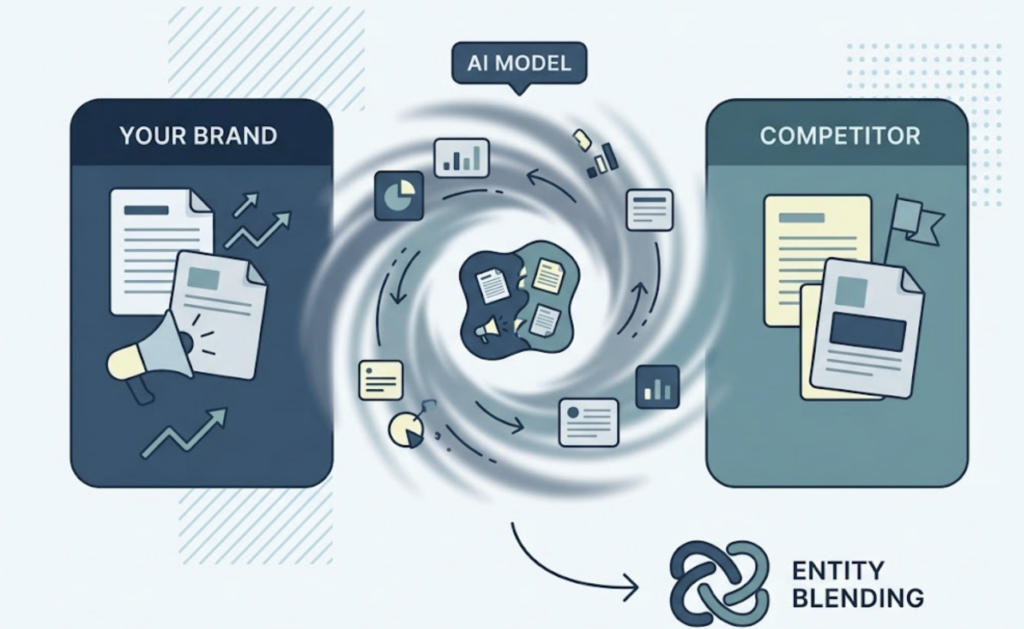
    The causes are varied. Some brands suffer from what researchers call “entity blending,” where inconsistent information across the web causes models to merge your brand with a similarly named competitor. Others hit the “PR-AI disconnect”: a major feature in a top publication goes unrecognized because that site has blocked AI crawlers via robots.txt, so the model never learns about the win. The brand’s actual authority grows while its perceived authority in the AI layer stagnates.

    The fix isn’t just more content. Brands mentioned in 15 credible external sources are cited 6.5 times more frequently by AI than those relying solely on their own domain. Source diversity matters more than domain authority in this new context.

    Identifying vulnerability requires prompt-level visibility data. You need to know which specific queries return competitors, not you, and how that distribution compares across ChatGPT, Gemini, and Perplexity. That’s where AI search optimization GEO brand vulnerability platforms come in: they automate the discovery process across hundreds of prompts that no team can manually track at scale.

    How to Build an AI Search Optimization Strategy That Moves Numbers

    The GEO research from Princeton and IIT Delhi gives a clear, empirical starting point. Across 10,000+ analyzed queries, specific content changes produced measurable citation gains:

    • Adding quotations from credible sources: +41% visibility boost
    • Adding statistics with source attribution: +35-40%
    • Citing external sources within the content: +30-40%
    • Content updated within the last 60 days: 1.9x more likely to be cited by RAG systems

    These are not design choices. They’re structural changes to how information is packaged.

    In practice, a working AI SEO strategy runs on three steps.

    Audit first. Before optimizing anything, establish your current AI visibility baseline across the platforms your audience uses. Track your brand against the 20-30 prompts most relevant to your category. This gives you a “Visibility Score” to measure against, not just impressions and clicks.

    Find the vulnerability gaps. Cross-reference your visibility data with AI search volume for those prompts. High-volume prompts where your brand scores zero are your highest-priority targets. These are the “existence gaps” where competitors are capturing consideration that should include you.

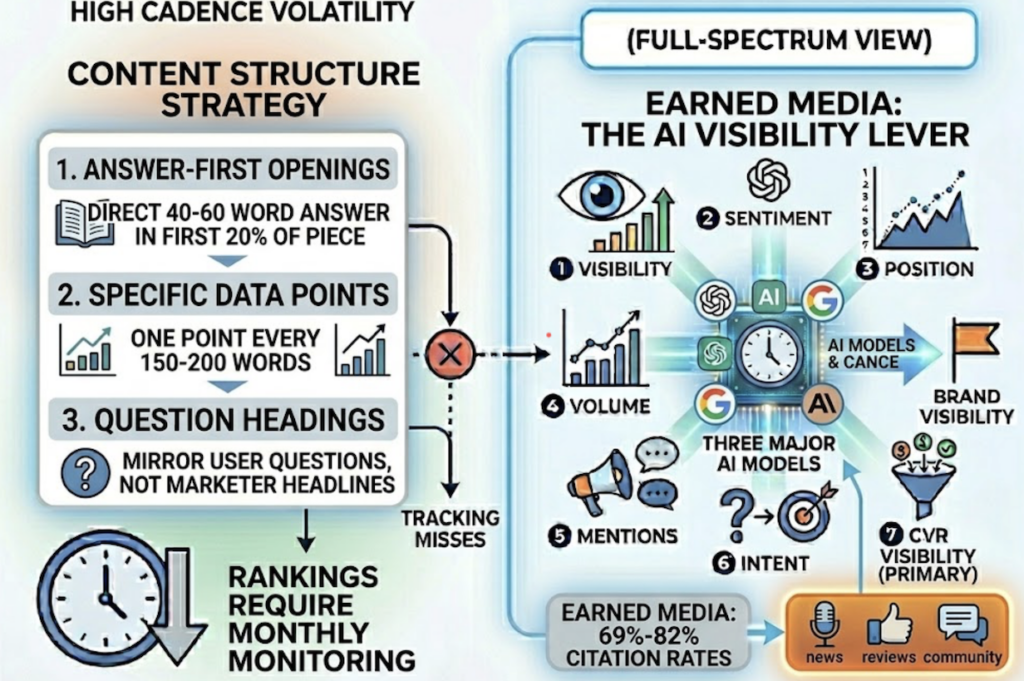
    Optimize for machine extraction. Structure content with answer-first openings (a direct 40-60 word answer in the first 20% of the piece), one specific data point every 150-200 words, and headings that mirror how users ask questions, not how marketers write headlines. AI platforms cite earned media (third-party reviews, news coverage, community discussions) at rates between 69% and 82%, which means outbound content strategy is now a core AI visibility lever.

    Topify’s One-Click Execution takes this framework and automates the execution layer. You define your goals, review the proposed strategy, and deploy. The platform handles prompt discovery, competitor benchmarking, and source gap analysis continuously, so the strategy stays current as AI recommendation patterns shift.

    What an AI Visibility Platform Does That Spreadsheets Can’t

    Many teams start their AI SEO audit the same way: manually searching their brand and competitors on ChatGPT, copying the outputs into a spreadsheet, and trying to spot patterns. It’s a reasonable first step. It doesn’t scale past the first month.

    AI answers are non-deterministic. Ask the same question twice and you get different results. A single snapshot is not a trend. And a spreadsheet tracking five platforms, 30 prompts, and 4 competitors generates data volume that quickly outpaces manual analysis.

    An AI visibility platform solves three specific problems that spreadsheets can’t. First, coverage: tracking brand performance across ChatGPT, Gemini, Perplexity, DeepSeek, and others simultaneously, not sequentially. Second, frequency: running queries at regular intervals to detect shifts in AI recommendation patterns before they compound into lost share. Third, structure: converting unstructured AI outputs into comparable metrics, so a drop in Perplexity sentiment can be traced back to a specific source domain that stopped citing your brand.

    Topify covers all major AI platforms including ChatGPT, Gemini, Perplexity, DeepSeek, Doubao, and Qwen, tracking seven performance dimensions per query. The Basic plan starts at $99/month, which includes 100 prompts and 9,000 AI answer analyses across 4 projects. For teams managing multiple brands or client portfolios, the Pro plan at $199/month scales to 250 prompts and 22,500 analyses. The platform was built by founding researchers from OpenAI and Google SEO practitioners, which shows in the depth of the citation analysis layer, specifically the ability to identify which source domains are driving competitor visibility and how to displace them.

    Bottom line: if you’re serious about AI brand visibility, you need data at a cadence and scale that manual tracking can’t provide. The platform cost is the easy part. The alternative is not knowing where you stand while competitors are actively building AI search consensus.

    Conclusion

    Traditional SEO is still necessary. Technical health, crawlability, and backlink authority remain the foundation. But they only tell half the story now, and it’s the easier half to measure.

    The other half is whether AI systems recognize your brand, trust your content, and include you in the answers that increasingly shape buying decisions before a user ever visits your website. That half requires different metrics, different content strategies, and tools built specifically for how AI search works.

    Start with an AI visibility audit. Find where your brand has zero presence in high-intent prompts. Fix the source gaps and content structure issues that create that absence. Then measure the shift in visibility score, citation rate, and share of voice over 60 to 90 days. The data from AI-referred traffic is clear: visitors from ChatGPT and Perplexity spend 68% more time on site and convert at 4.4 times the rate of standard organic visitors. The audience being shaped by AI search is worth reaching. The question is whether your brand shows up when they ask.


    FAQ

    Q: What is the difference between SEO and AI SEO?

    A: Traditional SEO optimizes web pages to rank in Google’s link-based results. AI SEO, often called Generative Engine Optimization (GEO), focuses on making your brand visible and citable within AI-generated answers on platforms like ChatGPT, Perplexity, and Gemini. The core difference is the unit of success: SEO targets a position in a ranked list; AI SEO targets inclusion in a synthesized answer. Both disciplines are necessary in 2026, but they require different content strategies and measurement frameworks.

    Q: How do I know if my brand has AI search visibility gaps?

    A: The most direct method is a prompt-level visibility audit. Run the 20-30 queries most relevant to your category on ChatGPT, Perplexity, and Gemini, and record whether your brand is mentioned, how prominently, and what competitors appear instead. Platforms like Topify automate this process at scale across hundreds of prompts and multiple AI engines, making it possible to identify GEO brand vulnerability patterns that manual spot-checks would miss.

    Q: Which AI platforms should I prioritize for AI SEO?

    A: By early 2026, ChatGPT holds approximately 60-68% of AI search market share, making it the highest-priority platform for most brands. Google Gemini has grown to 15-21% and is particularly important for mobile and productivity users. Perplexity (2-6.6%) punches above its weight for high-intent research queries, especially among high-income and academic users. If your audience skews toward enterprise or B2B, Microsoft Copilot’s 13-14% share is also worth tracking. The right starting point is wherever your target buyers are doing their research.

    Q: Is AI SEO the same as GEO (Generative Engine Optimization)?

    A: They’re closely related but not identical. GEO is the specific academic and technical framework for optimizing content to be cited by generative models, formalized by researchers at Princeton, Georgia Tech, and IIT Delhi. AI SEO is the broader practice that encompasses GEO alongside platform-specific strategies, entity management, earned media optimization, and AI visibility analytics. Think of GEO as the content architecture layer within a larger AI SEO strategy.


    Read More

  • What Is an AI Visibility Platform and Why Your Brand Can’t Afford to Ignore It

    What Is an AI Visibility Platform and Why Your Brand Can’t Afford to Ignore It

    Your brand ranks on the first page of Google. Your content team has been publishing for years. Your domain authority is solid.

    Then someone opens ChatGPT and asks, “What’s the best tool for [your category]?” and gets a confident, four-paragraph answer, complete with three recommended brands. Yours isn’t one of them.

    That gap, between where you rank on Google and where you appear in AI answers, is what AI visibility platforms are built to close. And right now, most brands don’t even know the gap exists.

    Your Google Rankings Don’t Tell You What AI Is Saying About You

    Here’s the uncomfortable truth: only 12% of citations in AI-generated answers overlap with the top 10 results in traditional organic search. That means nearly nine out of ten brands that dominate Google rankings are invisible inside the AI answer.

    The reason is structural. Google crawls pages and ranks them in a list. AI engines like ChatGPT, Gemini, and Perplexity don’t return a list. They synthesize sources into a direct narrative answer. That changes everything about what “visibility” means.

    Traditional SEO tools were built to track your position in a list. They can’t tell you whether Perplexity is recommending your competitor or whether Gemini is describing your product accurately. That’s a different data problem entirely.

    And it’s growing fast. Gartner projects a 25% drop in traditional search volume by 2026 as users migrate to AI-powered interfaces. For brands unprepared for that shift, the estimated traffic loss from traditional channels ranges from 20% to 50%.

    What Is an AI Visibility Platform, Exactly?

    An AI visibility platform (AIVP) is a specialized intelligence tool that tracks, measures, and optimizes how often and how accurately a brand is mentioned, cited, or recommended in the narrative responses generated by AI search engines and large language models.

    Think of it as a monitoring layer for a world where users don’t click, they consume answers.

    Where a traditional SEO tool tracks your rank on a results page, an AI visibility platform tracks your presence inside the synthesized paragraph. The metrics are different too. Instead of tracking click-through rate and keyword position, you’re tracking citation rate, sentiment score, and share of voice within AI-generated narratives.

    DimensionTraditional SEO ToolsAI Visibility Platforms
    Primary targetSearch Engine Results PageAI-generated narratives
    Core mechanismPage ranking (1-100)Citation and mention influence
    Data sourcesKeyword volume, backlinksPrompts, RAG retrieval, training data
    Key metricsCTR, organic traffic, keyword positionCitation rate, sentiment, share of voice
    User behaviorClick-through to websiteZero-click information consumption

    Most AIVPs perform four core functions: visibility tracking across AI platforms, sentiment and narrative analysis of how the AI describes your brand, competitor monitoring to benchmark your share of voice, and source attribution to identify which third-party URLs the AI is pulling to form its answers.

    How an AI Visibility Platform Actually Works

    To understand what these platforms measure, it helps to understand how AI search engines generate their answers.

    Modern AI search engines like Perplexity and ChatGPT operate through a process called Retrieval-Augmented Generation (RAG). When you submit a prompt, the engine doesn’t recall an answer from static memory. It runs sub-queries across a live index, retrieves and scores relevant content chunks, then synthesizes those chunks into a narrative response with citations.

    The critical factor is what researchers call “extractability”: the ability of your content to be cleanly chunked and incorporated into that narrative. Content that is promotional, verbose, or buried in complex scripts tends to be skipped. Concise, structured text with clear factual claims tends to win.

    What makes this harder is that each AI engine has different citation behaviors. Google Gemini pulls brand-owned websites for over 52% of its citations, rewarding strong E-E-A-T signals. Claude cites user-generated content and reviews at two to ten times the rate of other models, meaning your Reddit presence matters as much as your blog. Perplexity favors well-structured pages with clear factual claims and niche expertise.

    An AI visibility platform runs systematic prompts across all these engines, collects the generated responses, extracts brand mentions and citations, and feeds the results into a structured dashboard. The output is a set of metrics your team can actually act on.

    5 Things You Can Actually Measure with an AI Visibility Platform

    The best platforms in this category turn AI answers into structured data. Here’s what that looks like in practice.

    Visibility Rate is the percentage of tracked prompts where your brand appears in the AI response. Research suggests that mature brands typically target a rate above 30% for their core prompt sets. If you’re below that, the AI isn’t finding you credible enough to cite.

    Sentiment Score measures how the AI describes you, not just whether it mentions you. An AI might cite your brand frequently while characterizing your product as “a budget option” or “missing enterprise features.” A sentiment score above 70% positive is generally the baseline to protect.

    Position Ranking tracks where in the narrative your brand appears. Being cited first carries meaningful weight, even without a click. AI users tend to treat the first-mentioned brand as the implicit recommendation.

    Source Attribution tells you which third-party domains the AI is using to form its narrative about your brand. This reveals whether your story is being shaped by your own site, by a G2 review from 2022, or by a Reddit thread you’ve never read.

    CVR (Conversion Visibility Rate) connects the loop to revenue. AI-referred traffic converts at 4.4 times the rate of traditional organic traffic because the AI acts as a pre-filtering mechanism. Users who arrive from an AI recommendation have already been “sold” on the category. Being cited isn’t just a visibility win. It’s a conversion advantage.

    When AI SEO Hits a Wall: Common Mistakes Brands Make

    Most brands that start tracking AI visibility make the same four errors.

    The first is what researchers call “ChatGPT-only verification.” A marketing manager opens ChatGPT, searches for their brand, and assumes that result is representative. It isn’t. Only 30% of brands maintain consistent visibility from one AI response to the next, because AI outputs are non-deterministic. What you see in one session may differ from what a customer sees in the next. And Gemini, Perplexity, and Claude often reach completely different conclusions about the same brand.

    The second mistake is treating visibility data as a vanity metric. Knowing your citation share is low is only useful if it connects to a specific action: identifying which third-party sources are driving competitor citations, and building content that earns a place in those same sources.

    The third error is optimizing only for brand-name queries. AI users don’t ask “What is [your brand]?” They ask scenario-based questions: “Best CRM for a remote sales team,” “Which project management tool works offline?” These “dark queries” often carry zero traditional search volume, but they’re where actual purchase decisions happen. Brands that focus exclusively on branded terms miss these high-intent moments entirely.

    The fourth mistake is treating AI visibility as a one-time audit rather than an ongoing channel. AI citation patterns shift weekly as models retrain or update their retrieval layers. A snapshot from three months ago is already stale.

    How Topify Turns AI Visibility Data Into Action

    Most AI visibility platforms stop at data. Topify is designed to close the loop between insight and execution.

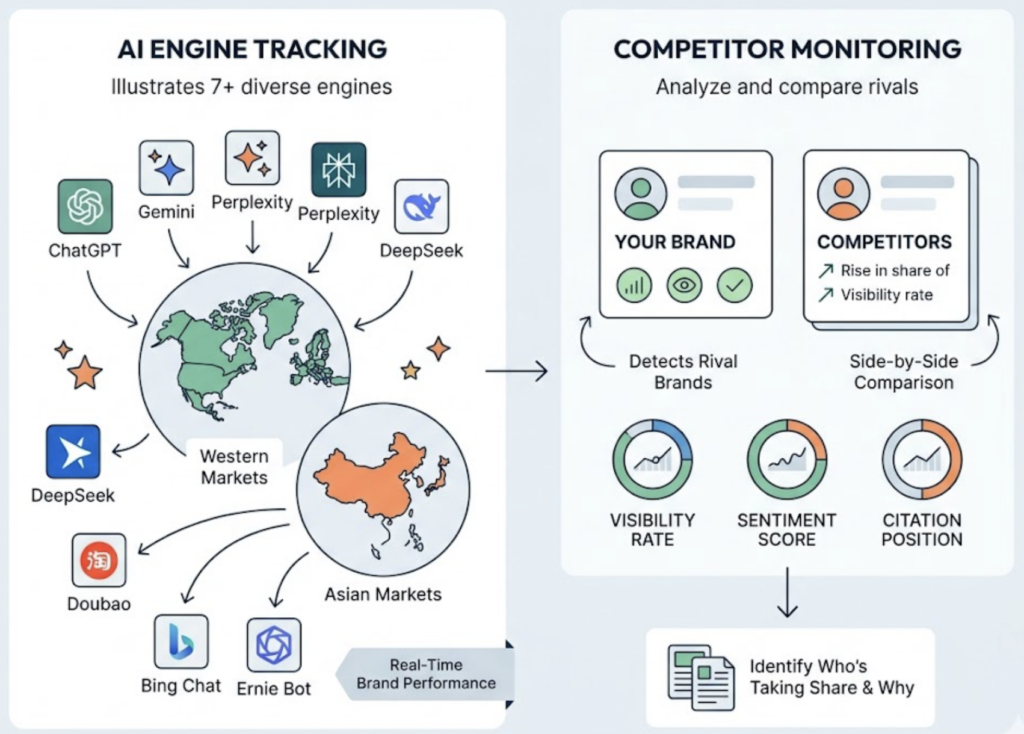
    The platform tracks brand performance across 7+ AI engines in real time, including ChatGPT, Gemini, Perplexity, DeepSeek, and Doubao, covering both Western and Asian markets where enterprise brands increasingly operate. For marketing teams managing multiple product lines or geographies, this breadth of coverage matters.

    The competitor monitoring layer automatically detects which rival brands are being recommended across the same prompt sets, then surfaces a side-by-side comparison of visibility rate, sentiment score, and citation position. In practice, this means you can see not just that you’re losing share of voice, but exactly which competitors are taking it, and which sources are being used to justify those citations.

    Source analysis goes a level deeper. Topify reverse-tracks which third-party URLs the AI platforms are citing when they recommend a competitor, revealing specific content gaps: the G2 page you haven’t updated, the industry publication that keeps citing your rival, the FAQ structure that’s easier for AI engines to extract than your own.

    What sets the platform apart for teams that don’t have a dedicated GEO strategist is the one-click execution layer. Rather than delivering a report that sits in a shared drive, Topify translates analytical findings into actionable GEO tasks and deploys them without requiring manual workflows. You define the goal, the system handles the execution.

    Topify is trusted by 50+ enterprises and startups, and pricing starts at $99 per month for the Basic plan, which covers 100 prompts across 4 major AI platforms with daily refreshes, enough to establish a credible baseline for most scaling brands.

    PlanPriceBest For
    Basic$99/moScaling brands, 100 prompts, 4 AI platforms
    Pro$199/moAgencies, 250 prompts, 8 projects
    Enterprise$499+/moEnterprise teams, API access, dedicated strategist

    How to Choose the Right AI Search Intelligence Tool for Your Team

    The AIVP market is growing fast enough that the selection criteria matter more than brand names. Here’s a practical checklist before you commit budget.

    Platform coverage. A tool that only monitors ChatGPT gives you a partial picture. Gemini, Perplexity, and Claude have meaningfully different citation behaviors. Look for at least five major models covered, with bonus points for DeepSeek and Grok as emerging platforms gain traction.

    Update frequency. AI citation patterns can shift in a matter of weeks. Monthly snapshots are close to useless for active optimization. Daily or weekly refresh rates are the baseline for teams that want to act on data rather than just report it.

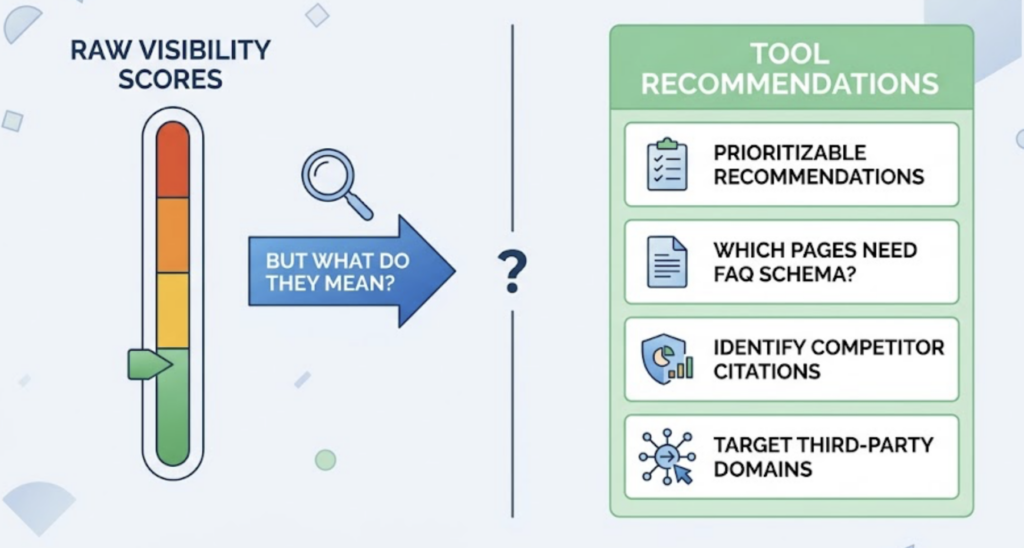
    Path from data to action. Raw visibility scores don’t tell your content team what to do. The best tools surface specific, prioritizable recommendations: which pages need FAQ schema, which dark queries are driving competitor citations, which third-party domains you should be targeting for coverage.

    Pricing model predictability. Some platforms charge per prompt, which makes budgeting unpredictable at scale. Flat-rate or tiered seat-based pricing is generally easier to plan around, especially for agencies managing multiple client brands.

    A few other platforms worth knowing about: Profound targets enterprise teams at higher price points with strong compliance features. LLMrefs uses weighted statistical rankings to reduce noise from AI output volatility. AppearOnAI offers a low-cost entry point for one-time visibility audits.

    The honest trade-off is that most tools built for enterprise scale don’t offer the execution layer that makes data actionable for in-house teams. That gap is where platforms like Topify tend to differentiate.

    Conclusion

    Google visibility and AI visibility are no longer the same thing. They measure different phenomena, they’re tracked by different tools, and they’re influenced by different factors. A brand can be number one on Google and functionally invisible to the AI engines that more than 50% of consumers now use for information and purchase research.

    The brands that are moving now are doing three things: establishing a baseline across multiple AI platforms, identifying specific prompt sets where they’re losing share of voice to competitors, and restructuring content to be more extractable for AI synthesis. None of this requires a complete overhaul of your existing SEO strategy. It requires adding a measurement layer that traditional tools simply aren’t built to provide.

    Get started with Topify to run a baseline audit and see exactly where your brand stands across the AI engines your customers are already using.


    FAQ

    Q: What is an AI visibility platform? A: An AI visibility platform is a marketing technology that tracks, measures, and optimizes how often and how accurately your brand is mentioned or recommended in the narrative responses generated by AI search engines like ChatGPT, Gemini, and Perplexity. Unlike traditional SEO tools that track page rankings, these platforms track citation rate, sentiment, and share of voice within AI-generated answers.

    Q: How is an AI visibility platform different from traditional SEO tools like Semrush or Ahrefs? A: Traditional SEO tools track your position in a list of search results. AI visibility platforms track your presence inside the synthesized paragraph that AI engines generate. The metrics are fundamentally different: SEO tracks rank and click-through rate, while AI visibility platforms track how often you’re cited, how the AI describes you, and how you stack up against competitors within the same prompt set.

    Q: How do I measure my brand’s AI search visibility? A: Measurement typically involves running a set of scenario-based prompts across multiple AI platforms and analyzing the responses for brand mentions, sentiment, and citation position. Platforms like Topify automate this by providing a structured Visibility Score based on systematic prompt tracking across 7+ AI engines, so you’re not relying on manual, non-deterministic spot-checks.

    Q: What’s a realistic budget for an AI visibility platform? A: It depends on scale. Brands just getting started can establish a baseline with tools like Topify at $99 per month. Mid-market teams and agencies typically work within the $199 to $499 range. Enterprise teams managing hundreds of prompts across multiple brands or geographies tend to invest $499 to $1,500 per month for deeper analytics, API access, and strategic support.


    Read More

  • Your Brand Ranks on Google. ChatGPT Has Never Heard of You. Here’s How AI Visibility Score Analytics Fixes That

    Your Brand Ranks on Google. ChatGPT Has Never Heard of You. Here’s How AI Visibility Score Analytics Fixes That

    You’re ranking on page one. Traffic looks stable. The quarterly report shows green.

    But when a potential customer asks ChatGPT “what’s the best [your category] tool?”, your brand doesn’t appear. Not on the first response. Not on the third. Not at all.

    That’s not a content problem. That’s a measurement problem, and AI visibility score analytics is how you start solving it.

    What AI Visibility Score Analytics Actually Measures (And Why It’s Not a Single Number)

    AI visibility score analytics is a multi-dimensional tracking system that measures how often your brand appears in AI-generated answers, how prominently it’s placed, and what the surrounding narrative says about you.

    It’s not a single ranking. It’s a composite index built from several interconnected signals, each telling a different part of the story.

    This distinction matters because the underlying mechanics of AI search are fundamentally different from traditional search. AI search tools captured between 12% and 15% of global search market share by end of 2025, up from roughly 5% at the start of that year. Google’s share dipped below 90% for the first time in a decade. The platforms driving this shift don’t work like search engines. They synthesize.

    A traditional search engine points. A generative model answers.

    That shift is why your Google rank stops being a reliable proxy for AI presence. Up to 80% of sources cited by ChatGPT don’t appear anywhere in Google’s top 100 results. The two ecosystems are running on different selection criteria.

    The 7 Metrics Behind a Complete Brand Visibility Generative Search Score

    Topify‘s seven-metric framework gives a full picture of where a brand actually stands in the generative search landscape:

    Visibility: The percentage of sampled AI queries that include your brand in the response. Industry analysts suggest investigating if this falls below 5% on your core queries.

    Sentiment: The tone of AI language when it mentions you. A 0-100 score that tracks whether you’re being recommended, described neutrally, or quietly undermined. Remediation is typically needed if more than 20% of mentions carry negative framing.

    Position: Where your brand lands within the response relative to competitors. First mention carries meaningfully more conversion weight.

    Volume: The estimated density of AI search queries relevant to your brand category, based on actual AI search behavior rather than inferred keyword data.

    Mentions: Raw frequency of brand references across platforms. Useful for trend-spotting even when Visibility is stable.

    Intent: The type of prompt your brand is appearing in. Being cited in “I need to solve X” prompts is a different signal than appearing in “what is X” queries.

    CVR (Conversion Visibility Rate): The estimated likelihood that an AI answer is directing users toward a branded interaction. AI referral visitors convert at 4.4x the rate of traditional organic search visitors, and in B2B SaaS contexts that multiplier can reach 23x.

    No single metric tells the full story. A brand with high Visibility and poor Sentiment is getting mentioned and quietly buried.

    Most Brands Are Flying Blind on Generative Search Metrics

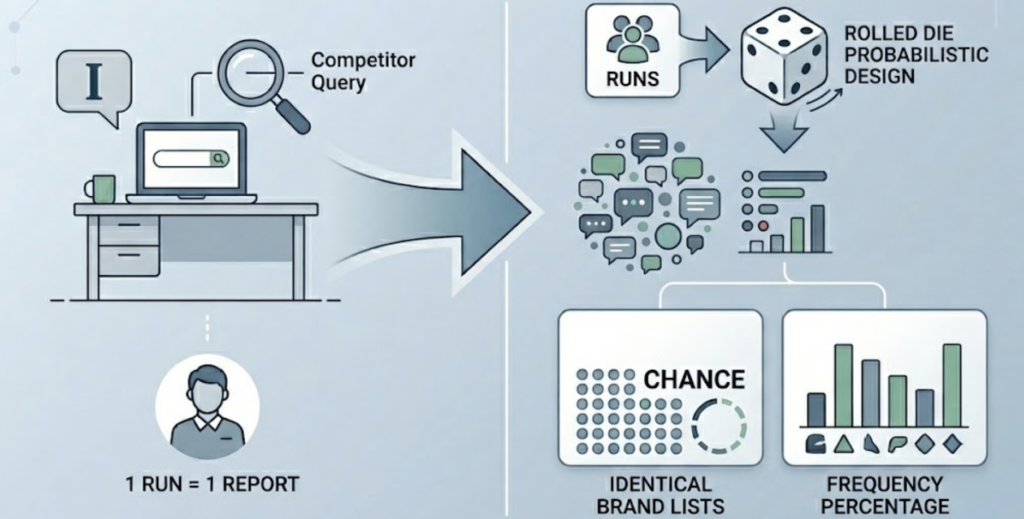
    The standard approach is still a spot check. Someone on the team opens ChatGPT, types a competitor query, and reports back at the next standup.

    That’s not analytics. It’s anecdote.

    Here’s why it fails: AI responses are probabilistic by design. Research conducted across more than 2,900 AI runs found there is less than a 1-in-100 chance of receiving an identical list of brand recommendations in successive prompts. The model calculates the next token based on weighted probability, which means your brand’s “ranking” isn’t a fixed position. It’s a frequency percentage across a large sample.

    If you appear in 45 out of 100 relevant prompts, your AI visibility is 45%. If you appear in 3, it’s 3%. You won’t know which one you are from a single query.

    The second blind spot is attribution. GA4 typically categorizes AI referral traffic as generic “Referral,” mixing high-intent ChatGPT visitors with random forum links. Without custom channel configuration, you can’t isolate what AI is actually driving, which means you can’t measure the ROI of any GEO effort you make.

    How to Measure AI Visibility Score Analytics: A 4-Step Framework

    Step 1: Define your core prompt set. These are the specific questions your ideal customer would ask an AI when looking for your solution. Not just “[brand name]” queries. Category queries: “best [category] tool for [use case],” “how do I solve [problem].” Start with 30 to 50 prompts.

    Step 2: Run those prompts across multiple platforms. ChatGPT, Gemini, Perplexity, and DeepSeek each operate on different training data and weight different signals. A brand that dominates on Perplexity can be invisible on Gemini. Topify covers all major AI platforms including ChatGPT, Gemini, Perplexity, and DeepSeek, logging every response at scale.

    Step 3: Establish your baseline and benchmark against competitors. Your raw visibility number is only useful relative to something. Topify’s competitor monitoring lets you track your position against rivals in real time, so you know whether a visibility dip is absolute or relative.

    Step 4: Run the cycle continuously, not monthly. AI models update their weighting frequently. A content refresh from a competitor, a new Reddit thread gaining traction, a model retraining cycle: any of these can shift your score. AI Overviews usage grew 4x in under a year. The measurement cadence needs to keep pace.

    5 Mistakes That Tank Your AI Visibility Score Analytics

    Tracking only your brand name. Your brand name is the easiest query to win. It tells you almost nothing. The queries that matter are category-level: “project management tool for remote teams,” “affordable CRM for SMBs.” If you’re not appearing there, you’re losing buyers who’ve never heard of you.

    Using one platform as a proxy for all. The correlation between branded web mentions and AI visibility is 0.664, compared to 0.218 for backlinks. But that relationship plays out differently across platforms. Don’t generalize from one AI’s behavior to others.

    Treating AI visibility like keyword rank. Traditional rank is relatively stable. AI responses are stochastic. The list order alone has approximately a 1-in-1,000 chance of repeating across successive runs. Measuring visibility as a point-in-time rank is statistically invalid.

    Monthly reporting cycles. In traditional SEO, a monthly report often captures enough signal. In generative search, where zero-click rates have climbed to 93% in Google’s AI Mode, the window between a model shift and a traffic change is measured in days, not weeks.

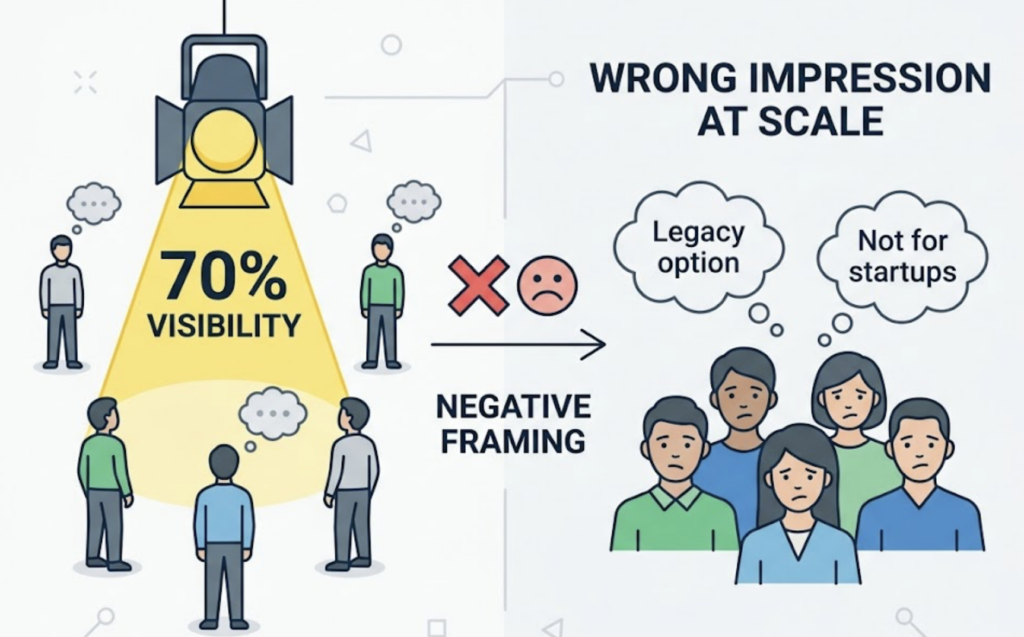
    Ignoring Sentiment in favor of Visibility. Appearing in 70% of relevant prompts sounds strong. It’s actually a liability if the AI is consistently describing you as “the legacy option” or “better for enterprise, not startups.” High visibility with negative framing accelerates the wrong impression at scale.

    The Tools That Actually Track AI Visibility Score Analytics in 2026

    The AI visibility software market has seen over $120 million in investment as of 2026, producing a wide range of platforms built for different team sizes and use cases.

    For teams that need comprehensive analytics with execution built in, Topify covers all seven core metrics (visibility, sentiment, position, volume, mentions, intent, CVR) across ChatGPT, Gemini, Perplexity, DeepSeek, and other major platforms. Its Source Analysis feature reverse-engineers the exact domains AI is citing so you can identify content gaps and act on them. The AI agent handles continuous monitoring and strategy execution from a single prompt, no manual workflows required.

    Here’s how the current tooling landscape breaks down:

    ToolBest ForPlatform CoverageStarting Price
    TopifyFull-funnel analytics + executionChatGPT, Gemini, Perplexity, DeepSeek, and more$99/mo
    ProfoundEnterprise compliance10+ engines~$4,000/mo
    ZipTieContent optimization workflowsAIO, ChatGPT, Perplexity$69/mo
    Otterly.aiStartup baseline trackingChatGPT, Perplexity, AIO$29/mo
    SE RankingSEO + GEO blendedAIO, Perplexity, Gemini$119/mo
    RankscaleExecutive reportingMulti-engine$20/mo

    The biggest trap is selecting a tool based on price alone without checking query set stability (does it track the same prompts consistently?) and whether it captures citation-level data, not just mentions.

    How to Improve Your AI Visibility Score: A Strategy Checklist

    These are the levers that actually move the needle, in priority order:

    Content architecture first. 44.2% of all LLM citations come from the first 30% of a document. Put your direct answer within the first 60 words of every page targeting AI visibility.

    Build structured content assets. Tables, numbered lists, and comparison blocks are extracted significantly more often than dense prose. Format for machine comprehension, not just human readability.

    Prioritize factual density. Specific data points and cited research make content “citable.” Vague benefit claims don’t survive the AI synthesis process.

    Fix your E-E-A-T signals. E-E-A-T remains the primary positive ranking activity for 66.3% of search professionals. Clear author credentials, linked professional profiles, and cited external sources build trust with LLMs, especially in competitive categories.

    Expand your third-party footprint. AI models aggregate consensus across the web. A mention in a reputable trade publication or an active Reddit discussion carries more AI visibility weight than a new landing page. Branded web mentions correlate with AI visibility at 0.664, three times stronger than backlinks.

    Audit your “dark prompts” weekly. These are category-level buyer questions your customers ask AI but never search on Google. Test them manually or use Topify’s prompt discovery to surface the ones worth tracking.

    Track AI referral traffic separately in GA4. Use a regex channel group to isolate AI platforms from generic referral traffic. AI sessions run 68% longer and view 50% more pages per session than standard organic. Losing that signal in an aggregated bucket means losing your ROI story.

    Run competitor benchmarking monthly. Visibility is relative. Topify’s competitor monitoring flags when a rival gains share so you can identify what changed in their content strategy.

    Monitor Sentiment as a leading indicator. A dip in Sentiment often precedes a Visibility drop by several weeks. Catching it early gives you time to correct the narrative before the AI’s weighting shifts.

    Set a visibility floor and alert on it. If your score drops more than 10% month-over-month, that’s typically a signal that a competitor has published more citable content or a model has retrained. Don’t wait for the monthly report to find out.

    Conclusion

    AI visibility score analytics isn’t a replacement for SEO. It’s a parallel measurement system built for a different discovery environment.

    The brands that will lead in the next two years aren’t necessarily the ones with the highest domain authority or the most backlinks. They’re the ones that figured out, early, that a different kind of authority was being built in the AI layer, and started measuring it before their competitors did.

    Start with your prompt set. Pick a tool that tracks across platforms. Build the baseline. The data will tell you where to go next.


    FAQ

    What is AI visibility score analytics? AI visibility score analytics is a measurement framework that tracks how often and how well a brand appears in AI-generated responses across platforms like ChatGPT, Gemini, and Perplexity. It combines metrics like mention rate, sentiment, citation quality, and position into a composite view of brand presence in generative search.

    How does AI visibility score analytics work? The system runs a predefined set of relevant prompts across multiple AI platforms, records whether and how the brand appears in each response, and aggregates those results into percentage-based scores over time. Because AI responses are probabilistic, a statistically valid score requires running hundreds of prompts rather than spot-checking a few.

    How do I measure AI visibility score analytics? Define your core prompt library, run those prompts at consistent intervals across all major AI platforms, establish a competitor benchmark, and track score changes over time rather than snapshots. Tools like Topify automate this process at scale.

    What are the best tools for AI visibility score analytics? The right tool depends on your scale and goals. Topify covers the broadest range of AI platforms with a full seven-metric analytics suite and built-in execution capabilities. For enterprise compliance needs, Profound offers deep multi-engine coverage. For early-stage monitoring, Otterly.ai provides a lower-cost entry point.

    What does AI visibility score analytics cost? Pricing varies by tool and team size. Topify starts at $99/month for the Basic plan (100 prompts, 4 platforms, 4 seats) and scales to $199/month for the Pro plan (250 prompts, 10 seats). Enterprise plans start at $499/month with custom configuration and a dedicated account manager.


    Read More

  • Your Brand Has an AI Visibility Score. Here’s How to Actually Measure and Improve It

    Your Brand Has an AI Visibility Score. Here’s How to Actually Measure and Improve It

    Your brand ranks #1 on Google. You’ve earned it. But when someone asks ChatGPT to recommend the best tool in your category, your name doesn’t come up once.

    That’s not bad luck. It’s a measurement gap.

    In 2026, brands operate in what researchers are calling the “synthesis economy,” where AI engines like ChatGPT, Gemini, and Perplexity don’t return a list of links. They return a synthesized answer, with a handful of cited brands, and everyone else is simply invisible. The question is no longer “where do we rank?” It’s “do we exist in the AI answer at all?”

    That’s exactly what an AI visibility score solution is built to answer.

    Most Brands Are Flying Blind on Their AI Visibility Score

    ChatGPT now has 800 million weekly active users, doubling from 400 million in early 2025. Google Gemini logged 1.2 billion visits in October 2025 alone. Perplexity quietly crossed 60 million monthly active users. These aren’t niche tools anymore. They’re primary discovery channels.

    And yet most brands have zero data on how they appear inside them.

    The scale of the problem becomes clearer when you look at what’s happening to traditional search. AI Overviews now appear on over 50% of all Google queries, a 670% growth rate in under a year. Zero-click searches account for 58.5% of U.S. searches and 59.7% in the EU. When AI Overviews appear, position-one organic CTR drops by as much as 58% to 79%.

    Here’s the flip side: visitors arriving from AI platforms view 50% more pages per session and convert at rates 4 to 23 times higher than traditional organic traffic. The traffic is smaller. The intent is much higher.

    That’s the gap most brands still can’t see, let alone measure.

    What Actually Goes Into an AI Visibility Score Solution

    An AI visibility score (AVS) is a composite index, typically normalized from 0 to 100, that quantifies how often and how prominently a brand appears inside AI-generated answers.

    It’s not a single number pulled from thin air. A professional AI visibility score solution aggregates multiple underlying signals:

    Visibility (Mention Frequency): The raw percentage of prompts where your brand appears across a defined set of category-relevant queries. This is your baseline.

    Position (Prominence): Where you appear within the response matters enormously. A mention in the opening paragraph as a primary recommendation carries far more weight than a footnote in a five-brand list.

    Sentiment (Contextual Perception): AI platforms don’t just mention brands. They describe them. Being cited as “a trusted option” vs. “a legacy, expensive tool” is a meaningful difference that raw mention counts completely miss.

    Source Citation: When an AI engine links directly to your domain as a reference, it signals higher trust than a mention alone. This is the citation layer, and it’s where authority compounds.

    Volume (Share of Discovery): The estimated AI-driven impressions your brand receives for a given topic set. Think of it as share of voice, but measured in AI answers instead of ad placements.

    widely used mathematical model weights these dimensions as: AVS=(SIR×wSIR)+(AMV×wAMV)+(SOV×wSOV)+(S×wS)AVS=(SIR×wSIR​)+(AMV×wAMV​)+(SOV×wSOV​)+(S×wS​), where SIR is your summarization inclusion rate, AMV is mention velocity over time, SOV is share of voice against competitors, and S is your normalized sentiment score.

    The score itself is just a dashboard reading. The dimensions underneath it are where the actual work happens.

    How to Measure Your AI Visibility Score: A Practical Framework

    You don’t need a fully built AI visibility score platform to start. But you do need a structured approach, because unstructured sampling produces noise, not insight.

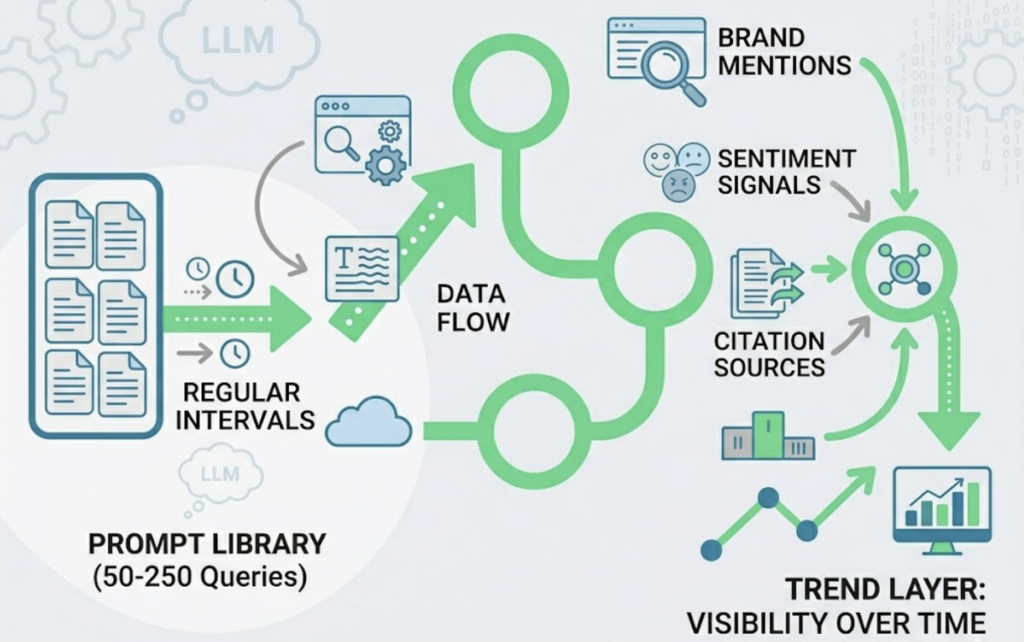
    Step 1: Build a prompt library. A reliable measurement requires 50 to 150 prompts mapped to four categories: definitional (“What is the best [category] tool?”), comparative (“X vs Y alternatives”), use-case specific (“Best software for [workflow]”), and price-intent (“How much does [category] cost?”). These mirror how real users actually query AI systems.

    Step 2: Cover multiple platforms. Data collected from a single AI engine is structurally misleading. A brand may score well on ChatGPT due to its training data presence but be invisible on Perplexity, which relies heavily on live web crawling. Research shows AI engines diverge on source selection in 38% to 42% of cases. You need at minimum ChatGPT, Gemini, and Perplexity.

    Step 3: Establish a baseline and benchmark against competitors. Once you’ve run your first sampling round, normalize results and identify “shortlisting gaps,” the specific topics or categories where competitors appear consistently but your brand doesn’t. This tells you exactly where to focus.

    Step 4: Monitor continuously, not periodically. AI model updates shift citation behavior quickly. Brands that review scores weekly or bi-weekly catch competitive shifts before they compound.
    Here’s a counterintuitive finding worth understanding: research into AI citation behavior shows that AI engines frequently bypass top-ranked Google results if the content is poorly structured, instead citing sites from position 11 or lower that provide clear tables, lists, or direct definitions. This “Page 2 Anomaly” means smaller brands with well-structured content can outperform established players in AI visibility even without dominant backlink profiles.

    That changes the optimization calculus significantly.

    5 Signals That Your AI Visibility Score Solution Is Working

    Structural content improvements take time to register in AI systems. Expect a 4 to 8-week window before changes in your AI visibility score reflect real optimizations. Here’s what you’re watching for:

    1. Rising mention rate on target prompts. Your brand starts appearing in a higher percentage of the category queries you’re tracking. This is the most direct indicator.

    2. Positional advancement. You move from appearing fifth in a comparative list to being introduced as a primary recommendation. Position matters inside synthesized answers in a way that’s directionally similar to, but mechanically different from, traditional keyword ranking.

    3. Sentiment shift. The language AI engines use to describe your brand changes from generic or neutral to authority-signaling. Words like “trusted,” “widely used,” or “recommended for” indicate positive momentum in how LLMs classify your entity.

    4. Citation ownership. AI platforms begin linking directly to your domain for specific claims, statistics, or definitions rather than routing through third-party review sites. This is the clearest signal that your content is now seen as a primary source.

    5. Attributable referral traffic. While still a fraction of total traffic, inbound visits from Perplexity, ChatGPT, and Google AI Overviews trend upward with high engagement metrics. High pages-per-session from AI-referred visitors is a strong indicator of intent alignment.

    None of these signals are meaningful in isolation. Tracked together on an AI visibility score dashboard, they tell a coherent story about brand trajectory in the generative discovery layer.

    The Tools That Power a Real AI Visibility Score Dashboard

    The market for AI visibility score software has sorted itself into three tiers.

    Single-platform trackers give you one engine’s data. Lightweight and affordable, but structurally limited given the 38-42% cross-engine divergence rate.

    Multi-dimensional analytics suites cover multiple platforms and track several dimensions simultaneously. This is where most serious marketing teams operate.

    Full-stack solutions combine tracking, analysis, and execution into one workflow. These handle measurement and act on it.

    Here’s how the leading options compare:

    ToolPrice/MonthEngine CoverageStrongest Use Case
    Topify$99-$1997+ PlatformsSaaS teams needing intent, citation, and sentiment analytics
    BrightEdge CatalystCustomAIO, ChatGPT, PerplexityFortune 500 teams on existing BrightEdge infrastructure
    SE Ranking$189 (Core)ChatGPT, Gemini, PerplexityAll-in-one SEO teams adding AI visibility tracking
    Peec AI~$105Multi-modelStartups focused on citation and sentiment monitoring

    Topify runs its AI visibility score analytics across ChatGPT, Gemini, Perplexity, DeepSeek, Doubao, Qwen, and others, covering the major markets where enterprise and consumer discovery actually happens. Its seven-dimension tracking index measures visibility, sentiment, position, volume, mentions, intent, and CVR simultaneously, not as separate reports but as an integrated view.

    Two features differentiate it at the platform level. The AI Volume Analytics module estimates conversational query volume based on actual AI platform usage patterns rather than traditional keyword search volume, which tends to significantly undercount AI-native intent. The Source Analysis feature tracks which third-party domains AI engines are citing for your category, making content gap identification systematic rather than guesswork.

    For teams that need more than data, Topify’s one-click execution layer lets you define optimization goals in plain English and deploy the strategy without manual workflows. Pricing starts at $99/mo for the Basic plan (30-day trial, 100 prompts, 4 projects), $199/mo for Pro (250 prompts, 10 seats), and Enterprise from $499/mo with dedicated support.

    5 Mistakes That Tank Your AI Visibility Score Before You Even Start

    Most brands don’t fail at AI visibility optimization because of bad strategy. They fail because of structural errors in how they measure and approach the problem.

    Tracking only one platform. Optimizing solely for ChatGPT creates a systematic blind spot. AI engines diverge on source selection 38% to 42% of the time. A brand invisible on Perplexity is missing a real audience, regardless of its ChatGPT score.

    Running one-time audits instead of continuous monitoring. A single measurement tells you where you stood on a specific day. AI models update frequently, and competitive shifts happen between audits. Visibility only becomes strategically useful as a trendline.

    Ignoring sentiment. A brand appearing in 70% of prompts with consistently negative framing (“the expensive legacy option”) has a high mention rate and a damaged position. The AI visibility score analytics layer must include sentiment as a core dimension, not an afterthought.

    Assuming Google rank predicts AI rank. Research on 15 brands across competitive categories found that top-10 Google results appear in ChatGPT responses only 62% of the time. The correlation between Google position and AI mention position is essentially zero (0.034). These are separate signals requiring separate optimization strategies.

    Blocking AI crawlers or using JavaScript-heavy rendering. If PerplexityBot or ChatGPT-User can’t access your pages, you don’t exist in their index. Technical accessibility is table stakes for any AI visibility score solution to actually work.

    That last one is the most common mistake, and the cheapest to fix.

    Conclusion

    An AI visibility score solution isn’t a nice-to-have analytics feature. In 2026, it’s the measurement infrastructure for a traffic channel that’s growing faster than any brand’s current strategy accounts for.

    The brands that will maintain relevance in the synthesis economy are the ones treating AI visibility as an operational function: measurable, tracked continuously, and tied to real business outcomes. That means a structured prompt library, multi-platform coverage, and a platform that tracks not just mentions but position, sentiment, citation, and intent together.

    The goal isn’t to rank on a page. It’s to be the entity an AI cites when someone asks a question in your category.


    FAQ

    What is an AI visibility score solution? An AI visibility score solution is a combination of technology and methodology used to measure how often and how prominently a brand appears in generative AI answers across platforms like ChatGPT, Gemini, and Perplexity. It moves beyond traditional SEO to quantify a brand’s share of voice in the conversational discovery layer.

    How is an AI visibility score calculated? It’s typically a weighted index from 0 to 100 that aggregates mention frequency, position within the AI response, sentiment, citation share, and estimated volume of AI queries for your category. Advanced systems apply different weights to each dimension based on strategic priorities.

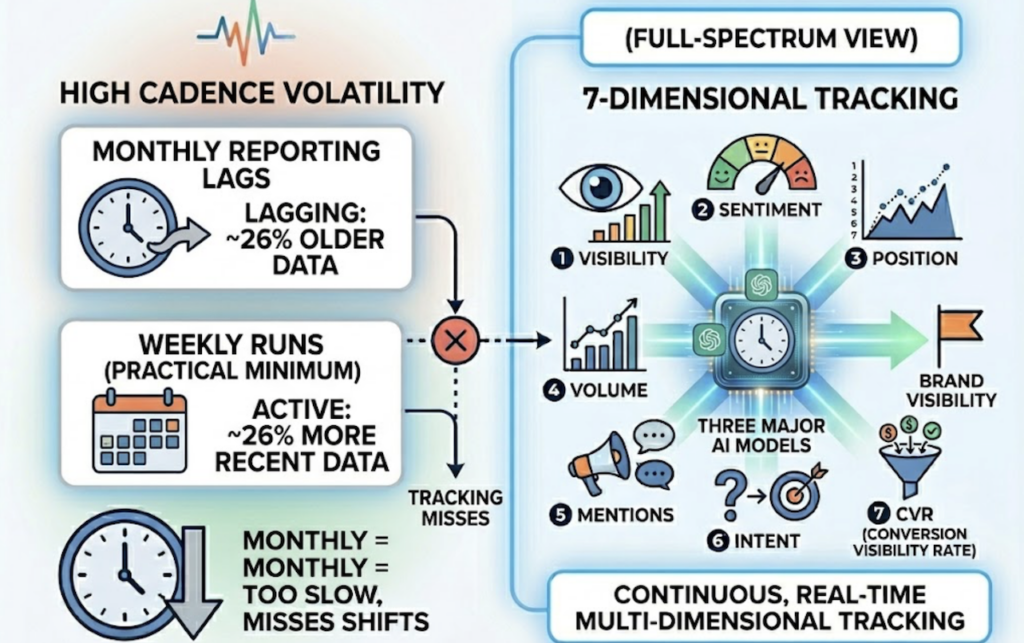
    How often should I check my AI visibility score? For stable industries, monthly monitoring is a reasonable floor. For competitive or fast-moving categories, weekly or bi-weekly reviews are recommended to detect model updates and competitive shifts before they compound.
    What’s the difference between AI visibility score and SEO rank? SEO rank measures your URL’s position in a list of links for a keyword. AI visibility score measures how an LLM classifies and cites your brand within a synthesized prose answer. They use different signals and respond to different optimization levers.

    How much does an AI visibility score solution cost? Entry-level tools start around $89 to $105 per month for basic tracking. Professional tiers range from $199 to $499 per month. Enterprise-grade solutions with custom data pipelines can exceed $1,500 per month. Topify starts at $99/mo with a 30-day trial.

    What’s the fastest way to improve my AI visibility score? Add original statistics and unique data to your content, use clear heading hierarchies (H1 through H3), place direct answers in the first 100 words of key pages, and ensure your brand has a presence on authoritative third-party sites like industry review platforms and Wikipedia. Site speed matters too: pages with a First Contentful Paint under 0.4 seconds are cited at roughly 3 times the rate of slower pages.

    Is there a checklist for AI visibility optimization? Yes. Optimize for FCP under 0.4 seconds, implement schema markup (Organization, Article, Person), update content at least every 90 days, structure pages with short sections of 100 to 150 words that lead with direct answers, and ensure AI crawlers like PerplexityBot are not blocked in your robots.txt.


    Read More

  • AI Visibility Score Software: What It Measures, How It Works, and Why Most Dashboards Get It Wrong

    AI Visibility Score Software: What It Measures, How It Works, and Why Most Dashboards Get It Wrong

    You searched “best AI visibility tracking tool,” spent an hour reading landing pages, and ended up with five browser tabs open. Each tool promises a “score.” None of them explains what the score actually measures, how it’s calculated, or what you’re supposed to do when it drops.

    That’s not a you problem. It’s a market problem. Most AI visibility score software was built to show data, not to diagnose visibility gaps. And in a landscape where McKinsey projects $750 billion in U.S. revenue will flow through AI-powered search by 2028, “showing data” isn’t enough.

    Here’s how to tell the difference.

    Most “AI Visibility” Dashboards Show Activity, Not a Score — Here’s the Difference

    A mention count is not a score. Knowing your brand appeared in 12 out of 50 ChatGPT responses this week tells you something, but it doesn’t tell you whether that’s good, whether it’s improving, or what’s causing it.

    Real AI visibility score software translates raw AI behavior into a weighted, multi-dimensional index. It tells you not just if you appeared, but where in the response, how you were described, and why a competitor consistently outranks you. That’s the gap most teams still can’t see.

    The stakes are concrete. Only 16% of brands have implemented systematic tracking for AI search performance, even as consumer behavior has already shifted. Brands without a structured score aren’t flying blind by choice; they simply don’t know the instrument panel exists.

    What Is AI Visibility Score Software, and How Does It Actually Work

    AI visibility score software measures how often, how prominently, and how favorably your brand appears in AI-generated answers across platforms like ChatGPT, Gemini, Perplexity, and others.

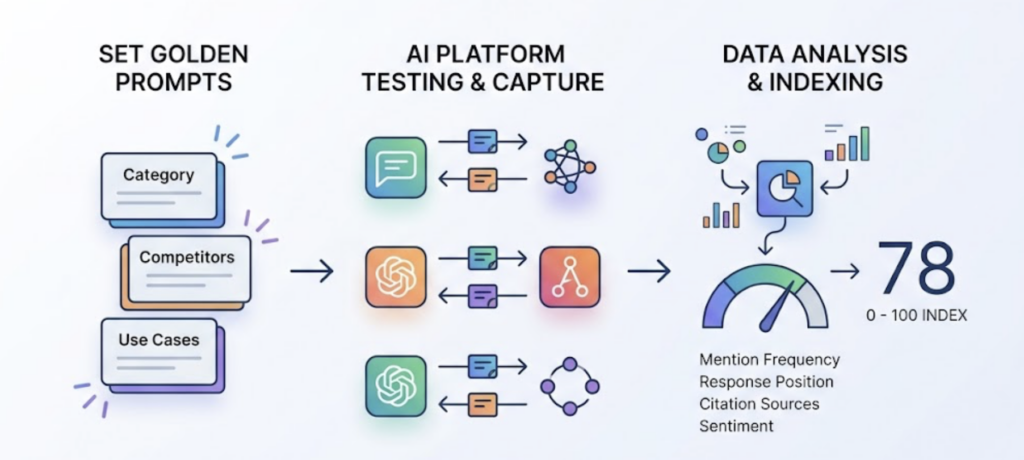
    The mechanics work like this: the software defines a set of “golden prompts” tied to your category, competitor comparisons, and audience use cases. It then fires those prompts repeatedly across multiple AI platforms, captures the responses, and analyzes where your brand lands. That raw data gets normalized into a 0–100 index using a weighted formula that combines mention frequency, position in the response, citation sources, and sentiment.

    What makes this technically different from SEO tracking is that AI responses are probabilistic, not static. The same prompt can produce a different answer on two consecutive runs. So the score is directional, not a hard count. Repeated sampling reveals stable patterns that tell you what the AI “believes” about your brand.

    ChatGPT alone processes over 2.5 billion prompts daily with an 80.49% market share in the AI chatbot sector. The volume of invisible brand-relevant conversations happening right now, without your knowledge, is the actual reason a score matters.

    The 7 Metrics That Actually Matter in an AI Visibility Score

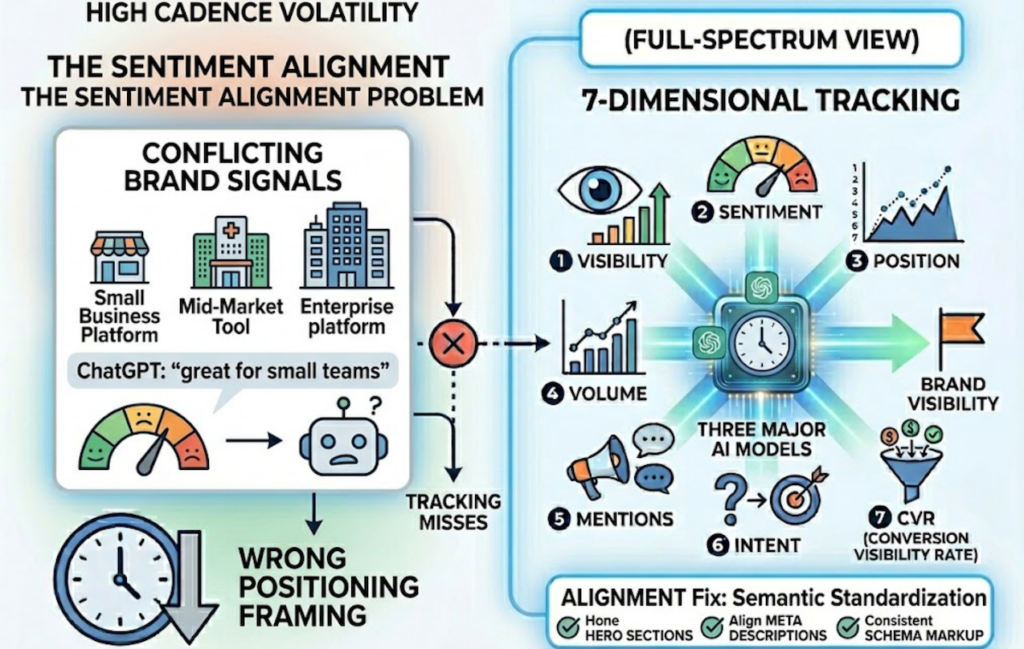
    A well-built AI visibility score isn’t a single number. It’s a composite. Here are the seven dimensions that serious software should measure to give you an accurate picture of your brand visibility in AI-generated answers:

    MetricWhat It MeasuresWhy It Matters
    Visibility% of prompts where your brand appearsBaseline presence across AI conversations
    SentimentPositive vs. negative language used to describe youAI may be recommending you with caveats you’ve never seen
    PositionWhere in the response your brand ranksFirst-mentioned brands get “direct-answer” language; later mentions get “also consider” framing
    VolumeNumber of high-intent prompts relevant to your categoryDetermines the size of your opportunity, not just your current share
    MentionsRaw count of brand name appearances per responseTracks frequency and co-occurrence with competitors
    IntentThe user goal behind the prompt (informational, purchase, comparison)High-intent mentions drive pipeline; informational mentions drive awareness
    CVR (Conversion Visibility Rate)Estimated likelihood an AI answer drives user action toward your brandThe bridge between AI mentions and business outcomes

    Topify is one of the few platforms that tracks all seven dimensions in a single dashboard, which matters because a brand can score high on visibility but low on sentiment, and the combined picture tells a very different story than either metric alone.

    A Practical Checklist Before You Choose AI Visibility Score Software

    Not all tools are built the same. Here’s what to verify before committing:

    Platform coverage. Does it track ChatGPT, Gemini, Perplexity, and regional platforms like DeepSeek or Qwen? As of early 2026, the AI chatbot landscape is fragmented. A tool that only covers ChatGPT is missing a significant portion of AI-referred discovery.

    Score transparency. Can you see how the score is calculated? A number without a methodology is a marketing claim, not a measurement.

    Competitor benchmarking. Can you track your position relative to competitors, not just in absolute terms? AI responses are zero-sum at the top. Knowing you appeared in 40% of responses means nothing if your closest competitor appeared in 70%.

    Prompt representativeness. Does the tool use prompts based on real user behavior, or canned queries written by the vendor? Tiny changes in phrasing produce different AI outputs. Scripted prompts can inflate scores that real-world searches won’t replicate.

    Citation-level data. Does it show you which sources the AI is citing to support mentions of your brand? A brand can appear in an AI response but get zero traffic because the citation links to a scraper or an outdated third-party directory, not your site. This is called source hijacking, and most dashboards that rely on API-only data miss it entirely.

    Update frequency. AI citation patterns shift. 76.4% of ChatGPT’s top-cited pages were updated within the last 30 days. A tool that refreshes monthly is reporting on a reality that has already changed.

    How to Improve Your AI Visibility Score: 4 Levers That Actually Move the Number

    Improving your score is an engineering problem, not a content volume problem. Here are the four levers that produce measurable changes:

    1. Fix what the AI is citing about you. Research from NVIDIA shows that page-level content chunking achieves the highest AI retrieval accuracy (0.648), and roughly 90% of ChatGPT citations come from pages beyond the first two pagesof traditional search results. That means your most AI-cited content may not be what you think. Use source analysis to find what the AI is actually pulling from, then optimize those specific pages, not your homepage.

    2. Correct how the AI describes you. Sentiment analysis often surfaces surprises. If ChatGPT describes your enterprise platform as “great for small teams,” that’s not a compliment. It’s a positioning signal that’s leaking into AI answers and reaching buyers with the wrong frame. The fix is semantic standardization: align your hero sections, meta descriptions, and schema markup around a single, consistent entity definition. AI models that encounter conflicting signals across your web presence default to a generalized description, which tends to favor whoever has cleaner, more consistent signals.

    3. Target high-volume, high-intent prompts. Not all prompts are equal. A brand that appears in a high-intent comparison query (“best [category] for enterprise teams”) is generating pipeline. A brand that appears in a general informational query (“what is [category]”) is building awareness. Topify’s High-Value Prompt Discovery continuously surfaces the prompts driving the most AI search volume in your category, so you’re optimizing for questions that actually move the needle.

    4. Track competitor position shifts weekly. AI recommendations aren’t static. A competitor can go from second-mention to first-mention in three weeks based on a content update or a new press mention that AI retrieval picks up. Dynamic competitor benchmarking lets you spot these shifts before they compound. One B2B SaaS team using a structured GEO framework increased their AI citation rate from 8% to 24% in 90 days, generating 47 qualified leads at 2.8x higher conversion than previous channels.
    3 Common Mistakes Brands Make When They First Start Tracking AI Visibility Scores

    Mistake 1: Tracking only one platform. Teams default to ChatGPT because it’s the most visible. But Google AI Overviews reaches 2 billion monthly users, and Perplexity has become the default research tool for a significant segment of high-income professionals and senior decision-makers. A score that reflects only one platform is a partial view of a multi-platform reality.

    Mistake 2: Treating “mentioned” as “recommended.” There’s a meaningful difference between being mentioned fifth in a list and being the first brand recommended with a direct-answer framing. AI visibility score software that only counts mentions without tracking position and sentiment is systematically under-reporting what matters. Position 1 in an AI response correlates directly with the “direct-answer language” that triggers user action. Position 4 and beyond gets “other options” framing.

    Mistake 3: Setting and forgetting the prompt set. The prompts your audience uses to find brands in your category change. New use cases emerge. Competitor campaigns shift the vocabulary. AI citation patterns exhibit a strong freshness bias — AI-cited content is on average 368 days newer than traditionally ranked content. If you defined your tracking prompts six months ago and haven’t updated them, you’re measuring a market that has already evolved.

    AI Visibility Score Software Pricing: What You Should Expect to Pay

    Pricing in this category is typically structured around three variables: the number of prompts tracked, the number of AI platforms covered, and the number of seats or projects.

    Entry-level tools start around $29 to $89 per month and generally cover one or two platforms with a limited prompt set. They’re useful for initial exploration but often lack the diagnostic depth to explain why your score is what it is.

    Mid-tier platforms in the $99 to $399 range tend to offer multi-platform coverage and competitor benchmarking. This is where most in-house marketing teams and mid-sized agencies operate.

    Topify’s pricing sits at this tier with more depth than most: the Basic plan starts at $99/month (annual) and includes 100 prompts, tracking across ChatGPT, Perplexity, and AI Overviews, 9,000 AI answer analyses, and 4 projects. The Pro plan at $199/month scales to 250 prompts, 22,500 analyses, and 10 seats. Enterprise plans start at $499/month and include dedicated account management and custom configurations.

    The ROI math is worth running. AI-referred traffic converts at 14.2% versus 2.8% for organic search, with average engagement time nearly four times longer. For a B2B team generating even 10 AI-referred leads per month at a higher close rate, the math on a $199/month tool closes quickly.

    Conclusion

    Most brands don’t have an AI visibility problem. They have a measurement problem. Without a structured score tracking multiple dimensions across multiple platforms, you’re making optimization decisions based on incomplete information in a channel that’s already influencing purchase decisions at scale.

    The shift from “ranking” to “being cited” requires different infrastructure. A real AI visibility score software doesn’t just tell you your number. It tells you why the number is what it is, which sources the AI trusts, how competitors are positioned relative to you, and which prompts are worth winning. That’s what separates a diagnostic tool from a dashboard.

    Get started with Topify to see where your brand stands across the major AI platforms today.


    FAQ

    Q: What is AI visibility score software? A: It’s a category of tools that measures how often, how prominently, and how favorably your brand appears in AI-generated answers across platforms like ChatGPT, Gemini, and Perplexity. It works by firing a defined set of prompts across AI platforms, capturing the responses, and normalizing the data into a weighted score across dimensions like visibility, sentiment, position, and citation sources.

    Q: How do I measure my brand’s AI visibility score? A: The most reliable method is using dedicated AI visibility score software that runs repeated sampling across multiple platforms. You define a prompt set tied to your category and use cases, the software executes those prompts, and the resulting data is aggregated into a score. Single-run checks in ChatGPT don’t produce reliable data because AI responses are probabilistic and vary across sessions.

    Q: How often should I check my AI visibility score? A: Weekly tracking is the practical standard for most marketing teams. AI citation patterns can shift in two to three weeks based on content updates, new competitor press mentions, or changes in how platforms weight sources. Monthly reporting is a reasonable cadence for leadership summaries, but weekly data is necessary to catch early changes before they compound.
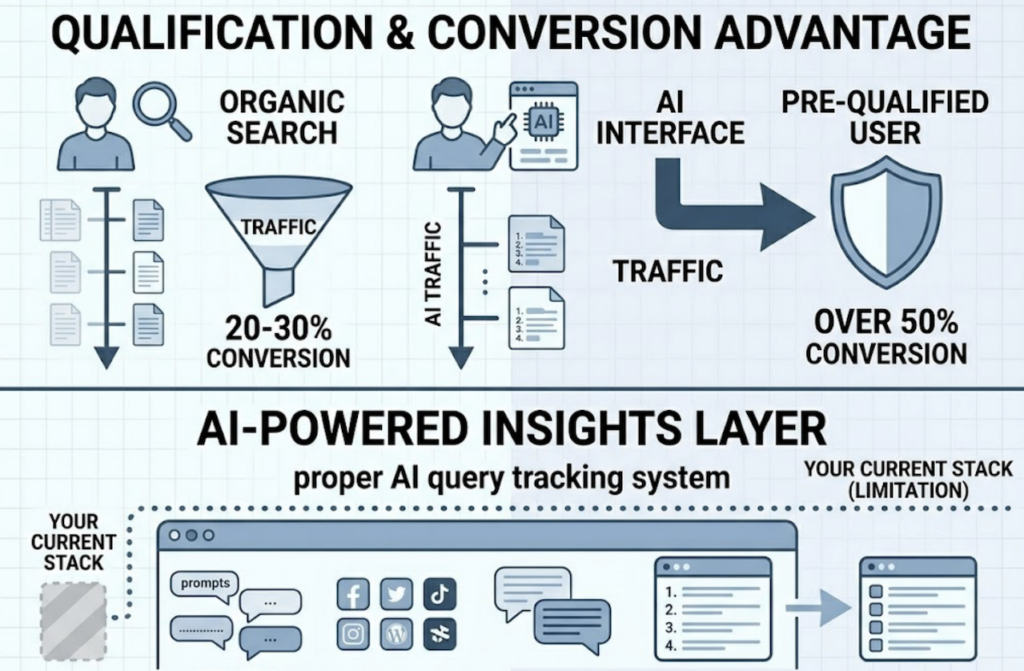
    Q: What’s a good AI visibility score benchmark? A: Benchmarks vary by category competitiveness and platform. A general rule: appearing in more than 30% of relevant prompts is a solid baseline for established brands in low-to-mid competition categories. In highly competitive SaaS or B2B categories, top performers typically appear in 50 to 70% of prompts. More important than the absolute score is your position relative to direct competitors and your trend over the past 30 to 90 days.


    Read More

  • AI Query Tracking Tracker: What It Actually Measures and Why Most Brands Get It Wrong

    AI Query Tracking Tracker: What It Actually Measures and Why Most Brands Get It Wrong

    Your brand has solid SEO rankings. Your content team publishes consistently. But when leadership asks, “Are we showing up in ChatGPT when someone searches our category?” most teams go quiet.

    You could open ChatGPT, type a few queries, and screenshot the results. But that’s not tracking. It’s a one-time snapshot with no repeatability, no trend data, and no way to tell whether you’re gaining or losing ground against competitors.

    That’s the gap an AI query tracking tracker is built to close.

    What Is an AI Query Tracking Tracker (and What It Isn’t)

    An AI query tracking tracker is a system that monitors how — and how often — your brand appears in AI-generated answers across platforms like ChatGPT, Gemini, and Perplexity. It works by sending a defined set of prompts to AI engines on a recurring basis, parsing the responses, and recording whether your brand was mentioned, how it was described, and where it ranked relative to competitors.

    That’s fundamentally different from what most teams are doing today.

    Manually searching your brand name on ChatGPT doesn’t constitute an AI query tracking tool. Research shows that running the same question 100 times produces a completely identical response list less than 1% of the time. Without a structured system running consistent prompts at regular intervals, there’s no trend, no baseline, and no signal — just browsing.

    Also worth clarifying: AI query tracking software is not the same as traditional SEO monitoring. SEO tools track keyword rankings and backlink profiles. An AI query tracking platform tracks what AI systems actually say about your brand — the natural language, the context, the sentiment, and the competitive positioning baked into every answer.

    How an AI Query Tracking System Actually Works

    Most AI engines use a process called Retrieval-Augmented Generation (RAG). When a user submits a question, the system breaks it into multiple sub-queries, pulls from several sources simultaneously, and synthesizes the results into a single answer. That process has direct implications for how tracking needs to work.

    An AI query tracking system operates by defining a prompt library — typically 50 to 250 queries covering your category, use cases, and competitive comparisons. These prompts are sent to each AI platform at regular intervals, and the responses are parsed for brand mentions, sentiment signals, citation sources, and ranking position. Over time, this builds a trend layer that shows whether your visibility is improving or declining — and why.

    Scale matters here. A single prompt run tells you very little. Running 100 prompts across four platforms every week gives you data you can actually act on.

    Different AI platforms also behave differently. ChatGPT citations lean heavily toward media publishers and community content — Reddit contributes roughly 40% of ChatGPT’s citation sources. Perplexity draws more from brand websites and research content, while YouTube accounts for around 16% of Perplexity citations. Research indicates that different platforms show citation preference divergence of up to 86%, which means an AI query tracking solution that only covers one platform is missing most of what’s actually happening across your audience.

    5 Metrics a Real AI Query Tracking Dashboard Should Show

    Not all AI query tracking dashboards are built the same. Here’s what a complete setup should measure, and what many tools still skip.

    MetricWhat It MeasuresWhy It Matters
    Visibility Rate% of relevant queries where your brand appearsCore benchmark for AI presence across platforms
    Position / RankingWhere your brand appears relative to competitors in AI answersBeing first vs. fifth carries meaningfully different weight
    Sentiment ScoreWhether AI describes your brand positively, neutrally, or negativelyAI can introduce brand narratives you’ve never approved
    Query Volume TrendHow the frequency of specific prompts changes over timeIdentifies which topics are gaining or losing traction
    Source AttributionWhich domains AI platforms cite when mentioning your brandShows where your content authority is — and where it’s missing

    Most entry-level tools surface visibility rate and maybe position. The ones that skip sentiment and source attribution are leaving out the metrics that actually explain why your numbers look the way they do.

    For established brands, a visibility rate above 50% signals a healthy AI presence. Below 20% is worth investigating. Sentiment scores above 80% positive tend to be stable — brands landing in the 75-82% range typically see noticeably more volatility in their AI visibility data over time.

    Common Mistakes That Break AI Query Tracking

    Getting a tracking setup in place is step one. Getting it right is a separate challenge. Here are the mistakes that cost teams the most.

    Tracking only your brand name. Category-level queries — “best project management tool for remote teams” or “top CRM for startups” — are where most AI-driven discovery actually happens. Limiting your prompt library to direct brand mentions means missing the queries that reach audiences who don’t know you yet.

    Covering only one AI platform. ChatGPT currently holds around 60% of the AI search market, but Perplexity accounts for roughly 15% of AI referral traffic and attracts a research-oriented, higher-intent audience. Gemini is integrated across Google’s ecosystem for 2 billion monthly active users. A single-platform AI query tracking system produces a partial picture, and partial pictures lead to bad strategy calls.

    Running queries too infrequently. AI search results aren’t static. Citation patterns shift every few weeks as models update and new content enters the training pipeline. Monthly reporting is already lagging. Weekly runs are the practical minimum for a tracking cadence that means anything. AI-cited content tends to be about 26% more recent than what traditional search surfaces, which means your data needs to move at a similar pace.

    Ignoring competitor data. Knowing your own visibility score without knowing your competitors’ is like knowing your revenue without knowing your market share. The gap between your Visibility Rate and a direct competitor’s is where the real strategic signal lives.

    Skipping baseline establishment. The first four weeks of tracking should focus on building a reference point, not acting on the data. Without a baseline, there’s no way to tell whether a change is meaningful or just statistical noise.

    Strategy for Building an Effective AI Query Tracking Tracker

    A solid AI query tracking strategy follows a clear sequence. Here’s how to build one that generates usable data from week one.

    Step 1: Build your prompt library. Start with three query categories: category-level prompts (“best tools for [your use case]”), competitive comparison prompts (“X vs. Y”), and brand-specific prompts including name variants. Target 50 to 100 prompts initially, then expand. The most effective AI query tracking trackers handle this automatically — platforms like Topify use prompt discovery to continuously surface high-value queries your audience is actually asking, so you’re not starting from a blank spreadsheet.

    Step 2: Select your platforms. At minimum, cover ChatGPT, Perplexity, and Gemini. These three account for the vast majority of AI-driven referral traffic. If your audience spans international markets or specific verticals, extend to DeepSeek, Copilot, or other regional platforms.

    Step 3: Set your tracking cadence. Weekly is the recommended frequency for most teams. Anything slower than bi-weekly produces data that’s too lagged to respond to in time.

    Step 4: Establish your baseline. Collect data for the first four weeks before drawing conclusions or making content changes. This reference point is what every future measurement gets compared against.

    Step 5: Set alert thresholds. Once you have a baseline, define the triggers that prompt action — for instance, a Visibility Rate drop of 10 percentage points or a Sentiment Score shift below 75%. Proactive alerts turn passive tracking into a real-time competitive tool.

    This is also where the right AI query tracking platform separates itself. Topify tracks seven core metrics — visibility, sentiment, position, volume, mentions, intent, and CVR — across ChatGPT, Gemini, Perplexity, DeepSeek, and other major AI engines, all in one dashboard. The prompt discovery feature continuously identifies new high-volume queries relevant to your brand as AI recommendation patterns shift. You don’t have to chase the landscape manually — the platform surfaces it.

    Best AI Query Tracking Tools in 2026

    The market for AI query tracking software has matured quickly. Here’s how the main options compare on the dimensions that matter most for marketing and SEO teams.

    ToolAI PlatformsKey StrengthStarting Price
    TopifyChatGPT, Gemini, Perplexity, DeepSeek + others7-metric tracking, automated prompt discovery, one-click GEO execution$99/mo
    ProfoundChatGPT, Perplexity, othersHigh-volume enterprise tracking (10K+ daily prompts), SOC 2 certified$5,000+/mo
    SE RankingChatGPT, Perplexity, AI Overviews“Uncited” brand analysis, local AI search tracking by ZIP code$150-240/mo
    Ahrefs Brand RadarMultiple platformsIntegrates 250M+ real user prompt data, covers TikTok, Reddit, YouTube$828+/mo

    Topify‘s Basic plan at $99/mo includes 100 prompts and 9,000 AI answer analyses per month across four projects — enough for most growing brands to establish a complete tracking baseline. The Pro plan at $199/mo scales to 250 prompts and 22,500 analyses, built for teams managing multiple brands or competitive categories. Enterprise starts at $499/mo with custom configurations and a dedicated account manager.

    The economic case for investing in an AI query tracking solution is worth spelling out. Research indicates that AI referral traffic converts at around 14.2%, compared to roughly 2.8% for traditional organic search. Visitors arriving from AI platforms also tend to spend 38% longer on-site, bounce 27% less, and carry roughly 4.4x the visitor value of traditional search traffic. That traffic is already flowing. The question is whether you’re measuring what’s driving it, or finding out about it secondhand.

    You can explore how brands are currently building AI visibility strategies and understand the deeper mechanics of how GEO reshapes brand visibility in AI search to build more context around where tracking fits in the broader strategy.

    Conclusion

    The brands performing well in AI search right now aren’t necessarily the ones with the largest content libraries. They’re the ones that know exactly which prompts trigger AI recommendations in their category, and which ones don’t.

    An AI query tracking tracker makes that visible. Without one, you’re relying on anecdotal spot-checks to understand a channel that’s already influencing purchase decisions at scale. Traditional search engine query volume is forecast to decline around 25% by the end of 2026 as AI-driven answers absorb more of the demand. That shift is already underway.

    The practical starting point: define 50 core prompts, cover at least three AI platforms, and spend the first four weeks building a baseline. Get started with Topify to automate prompt discovery and track your AI visibility across all major platforms from day one.


    FAQ

    Q: What is an AI query tracking tracker?

    A: An AI query tracking tracker is a tool that systematically monitors how and where your brand appears in AI-generated answers across platforms like ChatGPT, Gemini, and Perplexity. It runs a defined prompt library at regular intervals and records brand mentions, sentiment, position, and citation sources over time — producing trend data rather than one-off snapshots.

    Q: How does an AI query tracking tracker work?

    A: The system sends a library of prompts to AI platforms on a scheduled basis, parses each AI response for brand mentions and competitive data, and aggregates the results into dashboards with trend visibility. Advanced platforms also automate prompt discovery, identifying new high-value queries relevant to your brand as AI recommendation patterns evolve — without requiring manual input to keep the library current.

    Q: How do I measure the effectiveness of my AI query tracking?

    A: Start with Visibility Rate (the percentage of relevant queries where your brand appears) and Sentiment Score. Track both weekly over a minimum of four weeks to establish a reliable baseline, then measure changes relative to that reference point. A Visibility Rate above 50% and a Sentiment Score above 80% positive are generally considered healthy benchmarks for established brands.

    Q: What’s the difference between AI query tracking software and traditional SEO tools?

    A: Traditional SEO tools track keyword rankings, backlinks, and organic traffic — metrics built for search engines that return a list of links. AI query tracking software tracks what AI systems actually say about your brand in natural language responses, including sentiment, competitive positioning, and citation sources. The two measure fundamentally different things, and in 2026, you need both.


    Read More

  • Your Brand Shows Up in Google. But Which AI Queries Actually Trigger It?

    Your Brand Shows Up in Google. But Which AI Queries Actually Trigger It?

    Your keyword rankings are solid. Your domain authority is holding.
    Then someone on your team types your category into Perplexity and
    finds three competitors in the answer. Your brand isn’t there. Your
    analytics show nothing unusual, because traditional tools weren’t
    built to see what AI is doing with your brand.

    That’s the blind spot AI query tracking analytics is designed to close.

    AI Query Tracking vs. Keyword Tracking: They Measure Completely Different Things

    Traditional SEO tracking has a simple logic: a keyword maps to a
    ranked URL, a ranked URL earns clicks. You optimize the page,
    you move up the list. Clear cause and effect.

    AI query tracking doesn’t work that way at all.

    When a user asks ChatGPT or Perplexity a question, the model
    synthesizes a narrative answer using Retrieval-Augmented Generation
    (RAG). It’s not returning a ranked list of pages. It’s deciding
    which brands, facts, and sources to include in a generated response.
    Your Google ranking position has almost no bearing on that decision.

    The data makes this concrete: approximately 70% of the domains
    cited in AI-generated responses don’t appear in Google’s top
    organic results for the same queries. Being indexed isn’t a
    prerequisite for being mentioned by AI.

    Here’s what the two systems are actually tracking:

    FeatureTraditional SEO TrackingAI Query Tracking Analytics
    Primary MetricRanking Position (1–100)Brand Mention Rate & Citation Frequency
    Unit of AnalysisShort/mid-tail keywordsConversational prompts & intent maps
    Output FormatOrdered list of URLsSynthesized narrative text
    Visibility LogicAlgorithmic ranking factorsSemantic relevance & information gain
    Traffic NatureClick-dependentOften zero-click / impression-heavy

    The conversion case for AI traffic is worth noting. In sectors like
    SaaS and retail, AI-referred visitors convert at over 50%, compared
    to the 20–30% typical of organic search. By the time someone clicks
    an AI citation, the AI has already done the qualification work
    upstream. The impression matters even when there’s no click.

    A proper AI query tracking system tells you which specific prompts
    trigger your brand exposure, on which platforms, with what narrative,
    and against which competitors. That’s a data layer your current
    stack almost certainly can’t see.

    5 Metrics That Separate a Useful AI Query Tracking Dashboard from a Vanity Report

    Most AI tracking software shows you a mention count.

    That’s not enough.

    Here’s what a professional AI query tracking dashboard actually
    needs to surface, and why each metric carries distinct business value.

    Visibility: Share of Voice across platforms

    Visibility measures how often your brand appears in AI-generated
    answers for a defined prompt set. The key nuance is cross-platform:
    there’s only an 11% overlap between the domains ChatGPT cites and
    those Perplexity cites for the same queries. A brand with 60%
    visibility on ChatGPT for “enterprise security” prompts may have
    15% on Perplexity. You need both numbers to understand actual exposure.

    Position: Where in the narrative your brand lands

    In AI answers, “mentioned” and “recommended first” are completely
    different outcomes. Position tracking distinguishes whether your
    brand is the primary recommendation, a secondary mention, or a
    footnote citation. Mention volume without position data tells you
    almost nothing about influence.

    Volume: AI prompt-level search demand

    Not all queries are worth tracking. Volume data shows which
    prompts are gaining real traction in generative AI responses,
    not estimated keyword counts from a traditional tool. Topify
    surfaces this through its High-Value Prompt Discovery feature,
    which automatically identifies the queries already driving
    impressions in AI Overviews, even when those queries aren’t
    yet generating clicks.

    Sentiment: How the AI actually describes your brand

    This one gets overlooked most often. An AI might mention your
    brand in 80% of relevant responses while consistently describing
    your pricing as “complex” or your product as “better suited for
    small teams.” That’s negative visibility, and it compounds quietly.
    A sentiment index built on NLP classifies the tone of every
    mention so your team catches narrative drift before it becomes
    a positioning problem.

    Source: Which domains the AI is citing when it mentions you

    LLMs don’t generate information from nothing. They pull from a
    retrieval pool of trusted domains. Source attribution tells you
    whether the AI is pulling from your own site, industry publications,
    or community platforms. Perplexity, for instance, draws nearly
    46.7% of its top citations from Reddit. That single data point
    completely reframes where your content investment should go.

    Five metrics. Five different levers. A dashboard that only shows
    mentions is leaving four of them dark.

    Guest Posts Don’t Just Build Backlinks Anymore. They Seed AI Citation Pools.

    For years, guest posting was primarily a PageRank play. Publish on
    a high-DA site, earn a backlink, pass authority to your domain.
    The strategy was Google-first, link-first, click-first.

    Generative search has shifted the logic entirely.

    AI models use RAG to build answers from sources they consider
    authoritative. When Perplexity or ChatGPT retrieves content to
    answer a query, it favors third-party earned media over your own
    site for informational and comparative prompts. If your website
    calls your product “the fastest in the category,” an AI may treat
    it as a marketing claim. If a respected trade publication says the
    same thing in a guest post, the AI is significantly more likely to
    cite it as verified fact. Research into Generative Engine
    Optimization shows that content with expert quotes and third-party
    citations can boost brand visibility in AI responses by up to 40%.

    This is exactly where AI discoverability guest post tracking tools
    change the workflow for content teams. The process becomes specific
    and measurable:

    1. Use Source Analysis to identify which third-party domains the
      AI is already citing for your target queries.
    2. Prioritize guest post outreach to those exact domains.
    3. After publishing, track whether your visibility score for
      those prompts improves and whether the AI is now citing
      that article directly.

    Topify’s Source Analysis makes this loop
    traceable. You’re not guessing which publications matter to AI
    citation models. You look at the data, target accordingly, then
    validate the result with the next tracking cycle.

    The strategic reframe here is worth stating plainly: guest posts
    are no longer just a backlink tactic. They’re a seeding mechanism
    for AI knowledge graphs. The off-site “billboard” effect matters
    in a world where your goal is to be mentioned in the AI answer,
    regardless of whether anyone clicks through to your site.

    From Zero to Baseline: Your First AI Query Tracking System in 5 Days

    The setup barrier is lower than most teams expect. Here’s a
    structured five-step process that takes an AI query tracking system
    from nothing to an operational baseline inside a week.

    Day 1–2: Build a Prompt Library

    Don’t start with a keyword list. Start with natural-language
    prompts that reflect how real users talk to AI assistants. Industry
    practice suggests a starting set of 25 to 100 high-value queries,
    organized by intent: informational (“How does X work?”),
    comparative (“Brand A vs. Brand B”), and transactional (“Best
    solution for Y”). Topify’s High-Value Prompt Discovery automates
    this step by surfacing queries already generating AI Overview
    impressions for your category, so you’re not guessing which
    prompts actually matter.

    Day 2–3: Deploy across platforms

    Because ChatGPT and Perplexity have almost no citation overlap,
    single-platform tracking produces a systematically distorted
    picture. Your baseline deployment should cover at minimum ChatGPT,
    Gemini, Claude, and Perplexity. Each has different source
    preferences and citation logic.

    Day 3–4: Document your baseline

    For each prompt in your library, record three things: Is your
    brand mentioned? Where in the response does it appear? What’s the
    sentiment? This becomes your “AI market share” snapshot — the
    number every future content action gets measured against.

    Day 4–5: Bind content actions to tracking nodes

    Every tactic needs a measurement point. Publishing a guest post?
    Flag the date and the target query set. Updating a product page?
    Same process. This binding is what turns an AI query tracking
    solution from a passive reporting tool into an optimization loop.

    Day 6–7: Set KPIs and reporting cadence

    Shift your team away from click-based KPIs. The metrics that matter
    now: AI Mention Rate (what percentage of category queries mention
    your brand), Primary Source Rate (how often your own content is the
    top citation), and Share of Voice movement week over week. Weekly
    reporting cycles work well for most teams. The goal isn’t data
    volume — it’s detecting signal fast enough to act.

    4 Gaps Most AI Query Tracking Platforms Won’t Tell You About

    87% of enterprises plan to increase their AI visibility budgets in

    1. A lot of that spending is about to go toward tools that
      weren’t built for the job.

    Legacy SEO platforms have started bolting on “AI features.” Most
    of them are surface additions — a mention counter, maybe a
    sentiment label — layered on infrastructure that wasn’t designed
    for prompt-level tracking. Here’s what to check before committing
    to any AI query tracking software.

    Multi-platform coverage

    A tool that only monitors ChatGPT is monitoring one slice of an
    increasingly fragmented AI search landscape. A professional AI
    query tracking platform needs real coverage across ChatGPT,
    Gemini, Claude, and Perplexity at minimum. Each platform has
    different source preferences and different brand treatment patterns.
    Tracking one is not a proxy for the others.

    Prompt-level granularity

    Aggregate mention volume isn’t actionable. You need to know which
    specific prompt triggered the mention, what narrative surrounded
    it, and whether the response changed when the query was rephrased.
    Tools that only surface total mention counts give you the illusion
    of intelligence without the data to act on.

    Source URL diagnosis

    The most operationally useful feature in any AI query tracking
    tool is the ability to trace citations back to specific domains
    and URLs. Topify integrates with Google Search Console data to
    surface query-URL pairs — showing exactly which pages on your
    site or on external sites are triggering AI mentions. That’s the
    input your content and PR teams actually need to prioritize work.

    Real-time competitive benchmarking

    In zero-click AI search, competitive visibility is the new keyword
    difficulty. Your AI query tracking platform should show where
    rivals hold narrative dominance — for example, consistently
    appearing as the “easiest to implement” option in comparison
    prompts — so your team can identify positioning gaps and address
    them directly.

    Here’s how the current market compares across these four requirements:

    PlatformBest ForCore AdvantagePrice
    TopifyIn-house teams & agenciesGSC integration + Source URL diagnosis + multi-platform trackingFrom $99/mo
    BrightEdge CatalystEnterprise SEOExecutive-ready governance reportingCustom
    AuthoritasAgencies / SaaSUI-crawled tracking for real-world accuracyCredit-based
    Scrunch AIGrowth teamsPersona-based tracking across 7+ platforms$300+/mo
    GetMintPR / ReputationSource diagnosis for outdated citations€99+/mo

    The practical decision is straightforward. If you need prompt-level
    granularity, source attribution, and competitive benchmarking in a
    single AI query tracking dashboard without enterprise-tier pricing,
    Topify covers what most of the market doesn’t.

    Conclusion

    Google rankings and AI visibility have decoupled. With AI search
    traffic up nearly 800% over two years and roughly 60% of queries
    ending without a click, your brand’s real exposure increasingly
    lives inside AI-generated narratives that traditional analytics
    can’t measure.

    The starting point is smaller than it sounds. Pick 25 to 50
    high-value prompts in your category. Run them across ChatGPT,
    Gemini, and Perplexity. Document what the AI says about you,
    where you appear, and what it’s citing. That baseline is the
    foundation everything else is built on.

    Get started with Topify to run that
    first audit. The High-Value Prompt Discovery feature handles
    most of the prompt identification automatically, so you’re not
    guessing which queries matter.

    FAQ

    Q1: What’s the difference between AI query tracking and traditional keyword rank tracking?

    A: Traditional keyword tracking measures the numerical position of a URL on a search results page. AI query tracking measures how often a brand appears in generated answers, where it sits within the narrative, how the AI describes it, and which sources the AI is citing. The unit of analysis shifts from “keyword to rank” to “prompt to generated narrative to brand mention.”

    Q2: Which AI platforms should I include in my AI query tracking system?

    A: At minimum: ChatGPT, Gemini, Claude, and Perplexity. Each uses different source preferences — Perplexity draws nearly half its top citations from Reddit, while ChatGPT leans more on brand domains and established publications. Research shows only an 11% overlap between the domains these platforms cite for the same queries, so single-platform tracking gives you a misleading picture.

    Q3: How do guest posts improve AI discoverability, and how do I measure the impact?

    A: AI models use RAG to pull facts from third-party domains they consider authoritative. A guest post on a high-authority industry site places your brand’s claims inside that citation pool. To measure the impact, use Source Analysis to first identify which domains the AI is already citing for your target queries, publish on those domains, then track whether your visibility score for those prompts increases in the following weeks.

    Q4: How many AI queries should I track when starting out?

    A: 25 to 100 prompts is the recommended range for an initial prompt library. Organize them by three intent categories: informational, comparative, and transactional. This gives you a meaningful baseline without the data noise of tracking hundreds of long-tail variations simultaneously. You can always expand the library once you’ve established your first baseline.

    Read More

  • What an AI Query Tracking System Actually Does

    What an AI Query Tracking System Actually Does

    Your domain authority is solid. Your keyword rankings haven’t moved in months. But when someone opens Perplexity and asks, “What’s the best tool for [your category]?” your brand isn’t in the answer. Not because you’re irrelevant. Because the system tracking your visibility was never built to measure what happens inside an AI conversation.

    That gap is exactly what an AI query tracking system is designed to close.

    Most Brands Are Tracking the Wrong Queries in AI Search

    Traditional keyword tracking tools were built for a different world. They measure where a page ranks on a results page. AI search doesn’t work that way.

    When a user types a question into ChatGPT or Perplexity, the model doesn’t match keywords to URLs. It reasons through the query, synthesizes information from its training data and real-time sources, and generates a direct answer. The brand that appears in that answer isn’t necessarily the one with the highest domain authority. It’s the one the model associates most strongly with the intent behind the question.

    AI search queries average more than 7 words. Users tend to ask complex, scenario-specific questions like “which CRM offers the best automation workflow for a remote startup team?” Traditional SEO tools have no way to capture these conversations, let alone tell you whether your brand appeared in the response.

    That’s the problem. And it’s why tracking the right queries, across the right platforms, with a system built for AI matters more than most marketing teams currently recognize.

    What Is an AI Query Tracking System?

    An AI query tracking system is a technology infrastructure that monitors, collects, and analyzes how users interact with large language models, specifically to measure how often a brand appears in AI-generated answers, where it appears, and with what sentiment.

    It’s less about “where do we rank” and more about “are we even in the conversation.” The system tracks brand mentions across AI platforms, maps the prompts that trigger those mentions, and traces the sources AI engines pull from when constructing responses.

    The difference from traditional SEO software comes down to three things. First, the input: AI tracking works with natural language prompts, not keywords. Second, the output: it measures share of model (SoM) and mention position, not page rankings. Third, the data type: AI responses are probabilistic and shift constantly, meaning static monthly snapshots miss most of what’s actually happening.

    How an AI Query Tracking System Works: The 4-Layer Architecture

    A professional AI query tracking system runs on four layers, each solving a different part of the measurement problem.

    Layer 1: Prompt Library Construction. The system starts by building a library of high-value prompts reflecting how real users talk to AI. This goes beyond brand-name queries. It covers category questions (“best analytics platform for SaaS”), competitive comparisons (“alternatives to [competitor]”), and scenario queries (“how to improve lead scoring with AI”). Advanced platforms also detect “dark queries,” the sub-queries AI models silently generate to gather information when answering a broader question. These rarely show up in Google search data but drive significant AI citation behavior.

    Layer 2: Cross-Platform Response Collection. The system simulates real user queries across ChatGPT, Perplexity, Gemini, and other major AI platforms, then captures the full generated responses at scale. Different models have different citation behaviors, and the overlap in sources cited between platforms typically falls below 25%. A brand visible on ChatGPT may be essentially absent from Perplexity’s answers to the same question.

    Layer 3: Brand Mention Detection. This is where NLP does the heavy lifting. The system scans collected responses for explicit brand mentions, tracks position, detects sentiment, and flags cases where the brand is cited as a primary recommendation versus a “budget alternative.” It also identifies implicit citations, cases where AI references a concept or dataset that originated with a brand even without naming the brand directly.

    Layer 4: Analytics and Reporting. All that raw data gets aggregated into a dashboard showing trends over time, competitor comparisons, and actionable signals. The goal isn’t a report. It’s a direct feed into the content optimization workflow.

    Key Metrics an AI Query Tracking Dashboard Should Show

    An AI query tracking dashboard that only shows whether a brand appears is leaving most of the value on the table.

    The metrics that actually drive decisions are: Visibility Rate (what percentage of tracked prompts return a brand mention), Mention Position (first mention vs. buried reference has a meaningful impact on conversion), Sentiment Score(is the brand being actively recommended or just passively acknowledged), Query Volume (how often specific prompts are being asked across AI platforms), and Source Coverage (which domains AI is pulling from to build answers about the brand).

    Leading brands tend to score above 65 out of 100 on composite AI visibility scores. For most brands starting from zero, reaching a consistent 30-40% visibility rate on core category prompts is a strong first milestone.

    Citation behavior varies significantly by platform. Perplexity cites external sources in over 96% of responses. ChatGPT cites in roughly 50% of cases. Claude cites in almost none. That difference shapes where content investment should go first.

    Also worth watching: around 80% of brand mentions in AI responses are neutral statements rather than active recommendations. Moving even a fraction of those into the “recommended” category is where AI query tracking analytics earns its ROI.

    The 3 Most Common Mistakes in AI Query Tracking Setup

    Most teams that build AI monitoring for the first time make at least one of these mistakes. The result is a dashboard full of data that doesn’t reflect competitive reality.

    Mistake 1: Only tracking brand-name queries. If you’re only asking “does AI mention [brand name]?”, you’re missing where most AI decisions actually happen. Category-level queries like “best project management tool for remote teams” or “what software helps with SOC 2 compliance” are where brand associations get built. A well-structured tracking setup puts roughly 70% of its prompts on category and scenario queries, not brand-name lookups. Over-indexing on brand terms hides the visibility losses happening at the top of the acquisition funnel.

    Mistake 2: Monitoring only one platform. ChatGPT holds around 77.97% of the AI search market, which makes it an obvious starting point. But Perplexity attracts a different user profile, researchers and technical professionals who spend an average of 9 to 23 minutes per session. Gemini is deeply embedded in Google Workspace and Android. Each platform has its own citation logic and source preferences. Only monitoring one is like running SEO for a single search engine while ignoring all others. The brands winning in AI search today are tracking across at least three platforms simultaneously.

    Mistake 3: Running monthly reports. AI citation patterns change fast. The pages AI platforms pull from turn over at a rate of 40-60% per month. By the time a monthly report catches a visibility drop, a brand may have missed four weeks of conversion opportunities. For high-priority prompts, weekly tracking is the baseline. In competitive categories, daily monitoring of the top 20 to 30 queries is worth the investment.

    A Practical Strategy for Building Your AI Query Tracking System

    Here’s a five-step framework that works for teams at any size, whether you’re starting from scratch or replacing a manual spot-check process.

    Step 1: Build your intent matrix. Start with 30 to 100 prompts that map directly to your revenue-driving use cases. Include category-level queries, competitor comparison queries, and specific scenario questions. Don’t try to track everything at once. Focus on the prompts where you’re most likely to lose a deal to a competitor.

    Step 2: Choose an AI query tracking platform with prompt discovery built in. Manual prompt selection will always miss the queries that matter most. You need an AI query tracking software that automatically surfaces high-value prompts, including the dark queries competitors haven’t identified yet, and that tracks across at least ChatGPT, Perplexity, and Gemini.

    Step 3: Establish a baseline. Before optimizing anything, record your current visibility rate, sentiment scores, and mention positions across your full prompt set. That first week of data becomes your reference point for measuring whether content changes actually move the needle. Without a baseline, you’re flying blind.

    Step 4: Set reporting frequency based on competitive intensity. Weekly is the standard. If you’re in a fast-moving category like AI tools, cybersecurity, or fintech, move to daily tracking for your top 20 prompts.

    Step 5: Feed tracking data directly into content updates. When the system shows a visibility drop on a specific query, that’s a content action item. Find out what source AI is now citing instead of yours, then update or create content to reclaim that citation path. The feedback loop between AI query tracking analytics and content execution is what separates brands that improve over time from those that just watch the numbers.

    Topify handles much of this workflow automatically. Its one-click execution feature lets teams define optimization goals in plain English, review the proposed strategy, and deploy without building a manual process from scratch.

    How to Choose the Right AI Query Tracking Tool for Your Team

    The criteria that matter most aren’t the ones most tools lead with. Platform coverage and dashboard design are table stakes. What separates useful AI query tracking solutions from expensive data exports is whether they tell you what to do next.

    Here’s how the main options compare:

    ToolBest ForCore StrengthStarting Price
    TopifySMBs, SaaS brands, agile teamsPrompt discovery, 7-metric tracking, one-click execution$99/mo
    ProfoundLarge enterprises, global brandsDeep data, geo and persona simulation~$400-500/mo
    SE RankingSEO agenciesCitation format analysis, historical data$129/mo
    Otterly.aiSolo founders, limited budgetsBasic sentiment monitoring$29/mo
    Ahrefs Brand RadarExisting Ahrefs usersSEO data integrationAdd-on pricing

    For most teams building an AI query tracking system for the first time, Topify offers the right balance between capability and cost. The Basic plan at $99/month covers 100 prompts and 9,000 AI answer analyses, tracks across ChatGPT, Perplexity, and AI Overviews, and includes High-Value Prompt Discovery that automatically surfaces dark queries.

    The Pro plan at $199/month scales to 250 prompts and 22,500 AI answer analyses, with 10 seats and 8 projects. For agencies managing multiple brands, the per-project structure makes reporting cleaner.

    The more meaningful difference is what Topify does with the data. Most AI query tracking platforms stop at monitoring. Topify is built around execution. When visibility drops on a key prompt, the system identifies the content actions most likely to recover it and helps deploy them. For teams without a dedicated GEO strategist in-house, that closed loop is the difference between a dashboard and an actual growth channel.

    Topify tracks seven core metrics: visibility, sentiment, position, volume, mentions, intent, and CVR. That last metric, estimated conversion visibility rate, is something most AI query tracking dashboards still don’t surface. Knowing a brand appears in AI answers is useful. Knowing which appearances are actually driving users toward a purchase decision is a different level of intelligence entirely.

    Get started with Topify to set up your first prompt library and see where your brand stands across major AI platforms within a few minutes.

    Conclusion

    The brands that treat AI query tracking as a bolt-on to their existing SEO stack will consistently underperform the ones that build it as a primary measurement system. Traditional organic search traffic has already declined 15 to 25% for many categories as users shift to AI-generated answers. That trend isn’t reversing.

    Start with a focused set of 30 to 50 high-intent prompts. Track across multiple platforms. Move to weekly reporting on your core queries. And choose an AI query tracking solution that closes the loop between data and execution, not one that just adds another dashboard to ignore. The gap between brands that appear in AI answers and those that don’t is widening faster than most teams realize. The time to build the system is before that gap shows up in revenue.


    FAQ

    Q: What is an AI query tracking system?

    A: An AI query tracking system monitors how users interact with AI platforms like ChatGPT, Perplexity, and Gemini, specifically tracking whether and how often a brand appears in AI-generated responses. It measures share of model (SoM), mention position, sentiment, and the sources AI platforms reference when constructing brand-related answers.

    Q: How does an AI query tracking system work?

    A: The system simulates real user queries across major AI platforms, captures the full generated responses, and uses NLP to extract brand mentions, analyze sentiment, and identify citation sources. It then aggregates this data into an AI query tracking dashboard showing trends, competitor comparisons, and content optimization signals over time.

    Q: What metrics should an AI query tracking dashboard show?

    A: The core metrics are visibility rate (how often a brand appears across tracked prompts), mention position (where in the response the brand appears), sentiment score (recommended vs. neutral vs. negative), query volume (how frequently specific prompts are asked across AI platforms), and source coverage (which domains AI pulls from when generating brand-related answers).

    Q: What’s the difference between an AI query tracking tool and traditional SEO software?

    A: Traditional SEO software tracks keyword rankings and backlinks on indexed web pages. An AI query tracking tool measures brand visibility inside AI-generated conversational answers. The inputs are natural language prompts rather than keywords, the outputs are probabilistic metrics like SoM and citation frequency, and the data changes fast enough that monthly reporting is too slow to be useful.


    Read More

  • Your Brand Shows Up on Google. But Does It Show Up When Someone Asks ChatGPT?

    Your Brand Shows Up on Google. But Does It Show Up When Someone Asks ChatGPT?

    Your domain authority is solid. Your keyword rankings haven’t moved in months. But when a potential customer opens ChatGPT and asks, “What’s the best [your category] for a mid-sized team?”, your brand doesn’t come up. A competitor does, three times in a row.

    That’s not a ranking problem. Traditional SEO tools can’t detect it, report on it, or explain why it’s happening. AI platforms don’t pass referral headers. They don’t leave footprints in GA4. They synthesize an answer, recommend a brand, and move on.

    AI query tracking software was built to close that gap.


    What AI Query Tracking Software Actually Does (And Why It’s Not Just Another Analytics Tool)

    AI query tracking software is a category of marketing intelligence tools designed to monitor how brands are mentioned, positioned, and described within the generative responses of AI platforms. The key word is “generative.” Unlike GA4 or Search Console, which track what users do after they arrive at your site, AI query tracking focuses on what the AI said before a user ever clicked anything.

    The difference matters more than it looks. Traditional web analytics are reactive: they capture footprints users leave behind. AI query tracking is proactive: it audits what AI models are recommending in real time.

    MetricTraditional Analytics (GA4)AI Query Tracking Software
    Primary unitClicks and sessionsMentions and citations
    Visibility metricSearch rank (1–100)Share of Voice (SoV)
    Data sourceUser referrer headersBatch prompt ingestion
    Core question“What did the user click?”“What did the AI say?”

    The reason this gap exists is structural. A meaningful share of sessions originating from ChatGPT land as “(not set)” or “Direct” in GA4, because AI platforms often don’t pass standard referral data. Without a dedicated AI query tracking tool, that traffic is invisible, even when it’s converting at rates that should raise flags.

    How AI Query Tracking Software Works Under the Hood

    The core mechanism is batch prompting. Instead of waiting for users to mention your brand, AI query tracking software proactively sends large volumes of conversational prompts to AI platforms via their APIs, then analyzes the responses.

    The technical workflow breaks into three steps. First, the software injects hundreds of prompts: category queries, comparison questions, use-case scenarios. Second, it parses the AI’s text responses using NLP to extract brand mentions and competitor references. Third, it categorizes each mention across three dimensions: Visibility (how often the brand appears), Position (where in the response, since primacy bias means first-mentioned brands receive significantly higher click-through intent), and Sentiment (what qualifiers the AI attaches, like “cost-effective but limited” versus “the most trusted option in the market”).

    Tracking frequency matters just as much as what you track. AI models are probabilistic, and their outputs shift with training data changes, knowledge cutoff updates, and retrieval source adjustments. In late 2025, major model updates from OpenAI, Google, and Anthropic occurred within weeks of each other, each advancing factual recency by months and shifting citation preferences across categories. A brand’s AI visibility can change significantly after any of those updates.

    One-off audits don’t catch this. Continuous tracking does.

    5 Signs Your Marketing Team Needs an AI Query Tracking Solution Right Now

    You don’t always know you have an AI visibility problem until you see one of these patterns.

    You rank #1 on Google but don’t appear in ChatGPT results. Google authority and AI citation authority are built on different signals. Google rewards backlinks and technical health. AI models prioritize “citable authority”: factual, well-structured content that’s easily extracted and referenced by a retrieval system. Many top-ranking pages are effectively invisible to AI.

    You’re seeing unexplained “Direct” traffic that converts unusually well. Visitors arriving from AI platforms convert at roughly 14.2% compared to around 2.8% for traditional organic search. They also spend 68% longer on site and bounce 27% less. If your “Direct” bucket is growing with high-converting sessions you can’t explain, AI is likely sending them. Without an AI query tracking platform, you can’t confirm it or replicate it.

    The AI is describing your brand in ways you don’t recognize. Narrative misalignment is common. If an AI describes your enterprise software as “a budget-friendly option for freelancers,” it’s pulling that framing from third-party sources you haven’t addressed. An AI query tracking system surfaces these discrepancies before they erode top-of-funnel positioning.

    You can’t answer your CMO’s question: “What’s our AI search presence?” Teams without an AI query tracking dashboard are forced to offer manual screenshots or anecdotal evidence. That’s not a sustainable answer in 2026, when stakeholders are increasingly asking for standardized metrics like Share of Voice and Answer Inclusion Rate.

    Your content strategy doesn’t account for how AI retrieves information. AI models favor direct, factual formats: data tables, structured comparisons, “answer nuggets.” Long-form prose without that structure often won’t get cited. If your team is producing content without tracking which formats the AI actually pulls from, you’re optimizing blind.

    What a Strong AI Query Tracking Platform Should Be Able to Do: A Practical Checklist

    Not all tools in this category are equal. A dashboard that only counts brand mentions won’t get your team very far. Here’s what a mature AI query tracking platform needs to cover:

    CapabilityWhy It Matters
    Multi-platform coverage (ChatGPT, Gemini, Perplexity, DeepSeek, Claude, Google AIO)User behavior varies by platform. Single-platform tracking creates blind spots.
    Batch prompt simulation (100+ prompts/day)Provides statistical confidence in probabilistic AI environments. One-time tests aren’t reliable.
    Citation source analysisIdentifies which specific URLs and domains the AI uses to form its answers. Lets you reverse-engineer competitor advantages.
    Competitor benchmarkingShows your visibility versus competitors for the same query set. Surfaces category gaps before they cost you pipeline.
    Historical trend trackingMeasures whether your GEO efforts are actually working over time, and whether model updates are helping or hurting you.
    Sentiment polarity scoringDistinguishes between positive mentions and reputation risks embedded in how the AI qualifies your brand.

    Bottom line: if the tool can’t tell you why the AI is recommending a competitor, it’s not giving you enough to act on.

    How Topify Turns AI Query Tracking Into a Measurable Growth Channel

    Topify was built specifically around the architecture described above. It covers ChatGPT, Gemini, Perplexity, DeepSeek, Grok, and Google AI Overviews natively, plus regional models including Doubao and Qwen for brands operating in Asian markets where AI-driven consumer behavior is evolving along its own trajectory.

    What separates it from basic monitoring tools is the Prompt Discovery engine. Most teams start AI tracking by monitoring their own brand name. That’s reputation management, not growth. Topify’s system continuously surfaces “dark queries”: the category-level, comparison, and use-case prompts that users are actually asking AI models when they’re in discovery mode, before they’ve formed any brand preference. These are the queries where market share is won or lost.

    The Citation Intelligence feature goes a layer deeper. It reverse-engineers which specific domains and pages the AI draws from to construct its answers. If a competitor is being cited because of a particular data study or expert interview, Topify surfaces that source and flags the content gap. That’s the difference between knowing you’re losing ground and knowing exactly why.

    Topify tracks across seven core dimensions: Visibility, Sentiment, Position, Volume, Mentions, Intent, and CVR. The platform was built by a team that includes former OpenAI researchers and veteran Google SEO practitioners, which gives it depth in both the LLM retrieval mechanics and the content optimization strategy required to act on the data.

    PlanPricePromptsAI Answer Analyses
    Basic$99/mo1009,000/mo
    Pro$199/mo25022,500/mo
    EnterpriseFrom $499/moCustomCustom

    See the full breakdown at Topify’s pricing page, or get started with a 30-day trial on the Basic plan.

    3 Common Mistakes Teams Make When Setting Up AI Query Tracking Analytics

    Even with the right AI query tracking software in place, most teams make at least one of these errors in how they configure it.

    Tracking only brand queries. Searching “[Your Brand] alternatives” tells you about consideration. It doesn’t tell you about discovery. The real competitive intelligence sits in category queries: “best [category] for [specific use case].” These are the prompts where a potential customer hasn’t formed a preference yet. If the AI excludes your brand there, you lose the customer before they ever reach the validation stage.

    Running one-off tests and treating the result as fact. AI outputs are probabilistic. A brand might have 80% visibility across a week’s worth of prompt batches, but 0% on a single Tuesday after a model update. Basing strategy on a snapshot is like checking your Google ranking once and assuming it never changes. Continuous batch testing, run daily, is the only way to get statistically valid AI visibility data.

    Measuring presence without measuring sentiment. Appearing in an AI response isn’t inherently good. If the AI qualifies your brand as “the most expensive option in the category” or “better suited for legacy environments,” that mention is actively working against your positioning. An AI query tracking analytics setup that only counts appearances creates a false sense of security.

    What the AI says about you matters as much as whether it mentions you at all.

    Conclusion

    By late 2025, 50% of consumers were already using AI to guide buying decisions, and 84% of brands have no systematic way to track what those AI systems are actually saying about them. That gap is getting more expensive every quarter.

    Traditional SEO tools were built for a world where every search produces a ranked link list. That world still exists, but it’s no longer the full picture. AI query tracking software fills the measurement gap between what you’ve built and what AI models are currently recommending.

    Start with category-level queries, not just brand queries. Measure sentiment alongside visibility. Track continuously, not episodically. Use source analysis to understand why the AI cites what it cites. That’s how you stop optimizing for clicks and start optimizing for citations.

    Get started with Topify to see exactly where your brand stands in AI search today.


    FAQ

    Q: What is AI query tracking software?

    A: AI query tracking software is a category of marketing analytics tools that monitor how your brand is mentioned, positioned, and described within the responses generated by AI platforms like ChatGPT, Gemini, and Perplexity. It measures Share of Voice in conversational AI interfaces rather than search rank in traditional link-based results.

    Q: How does AI query tracking software work?

    A: These tools send large batches of conversational prompts to AI platforms via API, then analyze the text responses to identify brand mentions, competitor references, and sentiment. The output covers three core dimensions: Visibility (how often you appear), Position (where in the response), and Sentiment (the qualifiers and framing the AI uses to describe you).

    Q: What’s the difference between AI query tracking and traditional SEO analytics?

    A: Traditional SEO tools like Google Search Console track clicks from link-based search results to your website. AI query tracking measures mentions within AI-generated answers, often before a user clicks anything. It focuses on what the AI recommends, not what the user navigates to.

    Q: How much does AI query tracking software cost?

    A: Pricing varies by scale. Entry-level plans start around $29 to $99/month for basic mention tracking. Professional platforms typically range from $99 to $199/month for growing teams, with enterprise tiers starting at $499/month for custom prompt volumes and dedicated support. Topify’s pricing page has a full breakdown.


    Read More