Category: Comparisons

  • Best Keyword Research Tools in 2026: A Hands-On Comparison

    Best Keyword Research Tools in 2026: A Hands-On Comparison

    Search “best keyword research tools” and you’ll find dozens of platforms all claiming to help you find the right terms. The problem is that most of them are answering the wrong question. They’ll tell you a keyword gets 40,000 monthly Google searches. They won’t tell you how many times that same intent is satisfied inside a ChatGPT session or a Perplexity research thread, with zero clicks and zero referrer data showing up in your analytics.

    That’s the gap most keyword stacks still can’t see.

    In 2026, the SEO specialists getting the clearest picture of their search presence aren’t just using better traditional tools. They’re using a different kind of tool entirely for a different layer of discovery.

    What Changed in Keyword Research Between 2024 and 2026

    Gartner projected a 25% decline in traditional search volume by 2026. That number has largely materialized. Users increasingly turn to AI-native platforms for research-intensive and evaluative tasks because the result is immediate, synthesized, and conversational.

    ChatGPT now handles over 2 billion queries daily. Organic click-through rates for Google’s top positions have dropped 61% when AI Overviews appear. And 70.6% of AI-driven referral traffic arrives without referrer headers, meaning it shows up as “direct” in GA4 and disappears from your attribution model entirely.

    The consequence isn’t just lost traffic. It’s lost measurement.

    High organic rankings no longer guarantee visibility if your brand is omitted from the AI-generated summary occupying the top thousand pixels of the screen. The primary KPI has shifted: from keyword ranking to what researchers now call “Share of Model,” the percentage of relevant AI responses in which your brand appears as a recommended answer.

    Traditional keyword tools weren’t built for this. They remain essential for building the foundational authority that AI crawlers rely on, but they don’t see into the “dark AI” layer where buying decisions increasingly get made.

    The 2026 Keyword Research Toolkit at a Glance

    The keyword research stack in 2026 runs on two distinct layers: the Foundation Layer (traditional SEO) and the AI Discovery Layer (GEO/AEO). Effective strategy requires both. Here’s how the leading platforms compare across the dimensions that matter most this year.

    PlatformPrimary LayerGEO/AEO SupportStarting PriceIdeal ForStandout Feature
    TopifyAI DiscoveryComprehensive (7-metric)$99/moSaaS, Multi-platform teamsAI Volume Analytics + One-Click Execution
    AhrefsFoundationModerate (Brand Radar add-on)$129/moAgencies, Technical Analysts243M+ prompt database, backlink precision
    SEMrushFoundation + MarketingModerate (AI Toolkit add-on)$139.95/moEnterprise, All-in-one teams25.5B keyword database, intent classification
    Moz ProFoundationBasic (intent metrics)$99/moSMBs, BeginnersDomain Authority scoring, Priority Score
    Google Keyword PlannerSearch BaselineNoneFreePPC, Initial ResearchDirect Google source data

    The table above makes the tradeoff visible: traditional tools are strong where AI tools are blind, and vice versa. The platforms that cover both worlds fully don’t exist yet as a single product. That’s why the 2026 stack is a combination play.

    #1 Topify: Where Keyword Research Meets GEO

    Topify doesn’t replace your keyword tool. It covers the part your keyword tool can’t reach.

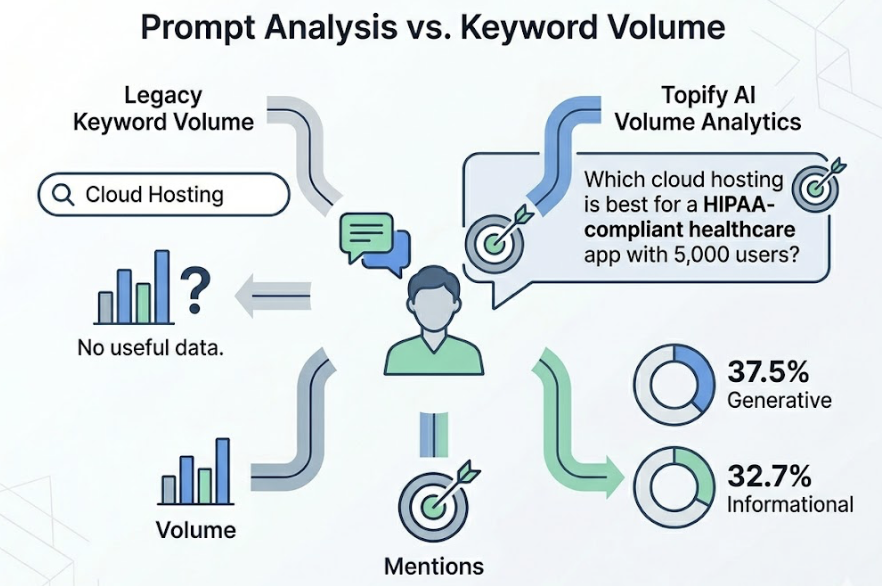
    The core distinction is the shift from keywords to prompts. Legacy tools report search volume for “cloud hosting.” Topify’s AI Volume Analytics identifies the specific conversational queries people are asking inside ChatGPT, such as “Which cloud hosting is best for a HIPAA-compliant healthcare app with 5,000 users?” Analysis of over 50 million prompts shows that 37.5% are generative and 32.7% are informational. These are the prompt categories where traditional volume metrics tell you nothing useful.
    That’s where Topify starts.

    Seven metrics, one visibility picture. Topify tracks brand performance across ChatGPT, Gemini, Perplexity, and DeepSeek through seven core indicators that redefine what “search performance” means in 2026:

    • Visibility Score: How often your brand appears across a defined prompt set. Appearing in 30% of relevant AI answers often delivers more pipeline impact than a #1 Google ranking with zero clicks.
    • Sentiment Quotient (0-100): Whether AI engines describe your brand positively, neutrally, or negatively. This matters because AI referral traffic converts at an average of 14.2%, roughly five times higher than Google organic. The quality of what AI says about you directly affects conversion.
    • Relative Positioning: Where your brand appears in a list of recommendations. Being mentioned first in a Perplexity summary confers a “first-mover” authority that compounding brand recognition builds on over time.
    • AI Search Volume: The estimated frequency of specific prompt triggers across major LLMs. This is the GEO equivalent of keyword search volume.
    • Mention Density: Your brand’s absolute frequency across varied prompts, indicating topical authority within the model’s knowledge graph.
    • Intent Alignment: Whether AI engines are framing your brand in evaluative, recommendatory, or educational contexts.
    • Attributed CVR: The estimated conversion rate of traffic originating from AI citations.

    Source Analysis: reverse-engineering what AI trusts. The hardest question in modern search is “To be recommended by AI, where do I need to appear?” Only 14% of URLs cited in Google’s AI Mode appear in the top 10 traditional search results. Ranking doesn’t predict citation.

    Topify’s Source Analysis identifies the specific Reddit threads, niche publications, and industry blogs that AI platforms are currently pulling from. This turns Digital PR and community engagement from a guesswork activity into a prioritized, measurable effort.

    Execution, not just data. Most monitoring tools stop at the dashboard. When Topify detects a citation gap or a visibility drop, its AI agent proposes specific content variants or schema updates deployable with one click. No manual workflow required.

    Topify’s Basic Plan starts at $99/month, covering 100 prompts and up to 9,000 AI answer analyses monthly. The Pro Plan ($199/month) extends to 250 prompts and 22,500 analyses, with advanced competitor benchmarking. For teams managing multiple clients or brands, Enterprise plans start at $499/month.

    The Traditional Heavy Hitters, Ranked by What They Can’t Do in 2026

    These tools remain core to any foundation-layer strategy. Their limitations in AI search aren’t reasons to abandon them. They’re reasons to understand what role they play.

    #2 Ahrefs. Still the industry leader for backlink data purity and technical site auditing. The Brand Radar feature indexes 243 million real-world prompts and monitors visibility across 6+ AI platforms including YouTube and Reddit. Its Parent Topic clustering is particularly useful for identifying content that can simultaneously rank in Google and serve as citation material for LLMs. The trade-off: full access to AI index data requires add-ons that can push total subscription costs past $600/month for agencies.

    #3 SEMrush. The most comprehensive multi-channel suite available. Its 25.5 billion keyword database and intent classification are the strongest in the traditional layer. The Unified SEO + AI Visibility dashboard is effective for teams that need to consolidate legacy rankings and generative presence into a single report. The limitation: AI features are often gated behind paid add-ons at $99/user, and teams that only need focused AI monitoring often pay for functionality they don’t use.

    #4 Moz Pro. Moz has maintained relevance by focusing on the “Neighborhood of Trust” through Domain Authority and Page Authority metrics, which AI models still use to evaluate source credibility. The Priority Score system is particularly strong for SMBs: it weights keyword potential by DA, CTR, and difficulty to surface niches where smaller sites can realistically compete. Deep multi-LLM prompt tracking is not available.

    #5 Google Keyword Planner. Not a comprehensive SEO tool, but irreplaceable for one thing: validating ground-truth Google search demand. It’s the only platform with direct access to Google’s source data. Seasonal trend forecasting and organic competition metrics remain accurate and free. For AI search, it offers nothing.

    What AEO Actually Means for Keyword Strategy in 2026

    AEO (Answer Engine Optimization) has moved from a tactical experiment to a strategic requirement. With 69% of Google searches now ending without a click, the primary objective of content is no longer to be visited. It’s to be extracted.

    AI models use Retrieval-Augmented Generation (RAG) to synthesize answers. This process favors content that leads with a direct answer in 40-60 words, followed by supporting data, and ends with contextual nuance. The structure that humans find easy to skim turns out to be exactly what AI systems prefer to cite.
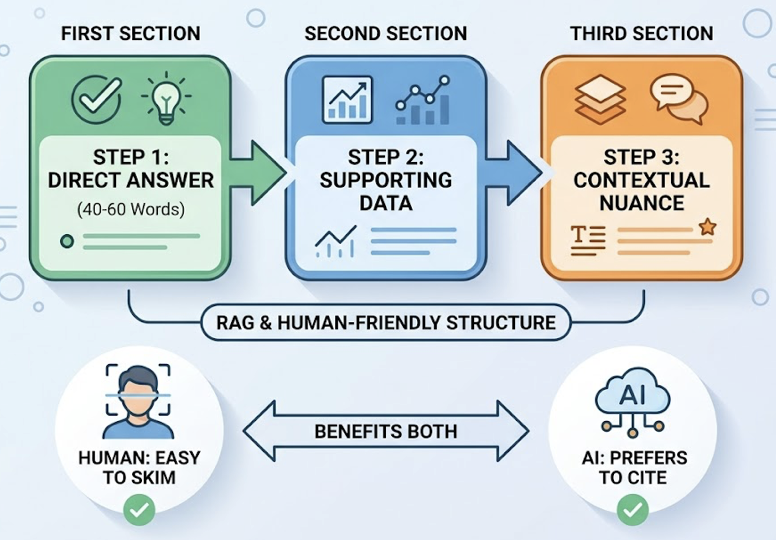
    Here’s how to do AEO in 2026, in three concrete steps:

    Step 1: Identify high-value AI prompts. Move beyond keyword lists. Use Topify’s AI Volume Analytics to find the conversational prompts triggering AI summaries in your category, both for your brand and your competitors. These prompts are the GEO equivalent of seed keywords.

    Step 2: Optimize content for modular extraction. AI systems parse content by section, not by page. Each H2 or H3 heading must function as a standalone unit: a complete thought that can be independently cited without surrounding context.

    Step 3: Monitor and influence your Neighborhoods of Trust. In 2026, 85% of brand mentions in AI search originate on third-party pages. Your domain authority matters, but it doesn’t determine what AI says about you. Topify’s Source Analysis shows exactly which external domains AI platforms are citing in your category so you can prioritize earned media accordingly.

    The business case is concrete. NerdWallet reported a 35% revenue increase in 2024 despite a 20% traffic decline, demonstrating that being cited as the trusted authority captures higher-intent users at the decision stage, regardless of organic click volume.

    GEO vs. SEO Keywords: The Divergence of Search Intent

    The same term means different things depending on the discovery engine.

    Search “project management software” on Google and the intent is navigational. The user knows what they want and is heading somewhere. Ask ChatGPT the same query and the interaction shifts to “Which tool do you recommend for a 15-person remote team with a $200/month budget?” That’s a completely different intent signal, with explicit constraints, a specific context, and a direct invitation for a recommendation.

    This is the core difference between SEO keyword strategy and GEO keyword strategy:

    DimensionTraditional SEO KeywordGEO/AEO Prompt
    User PhrasingShort fragments (“project management software”)Conversational with constraints (“best PM tool for remote team, under $200/mo”)
    Intent SignalLow, inferred from queryHigh, explicitly stated
    Content GoalRank on page oneBecome the recommended solution for specific scenarios
    Primary MetricVolume and DifficultyVisibility Score and Citation Rate

    GEO tools like Topify make the “prompt space” a trackable and optimizable channel. Rather than guessing which prompts AI engines associate with your brand, you see exactly how often you appear, in what context, with what sentiment, and against which competitors. That’s Share of Model tracking. And in 2026, it’s replacing keyword ranking as the north star for brands where AI-driven discovery contributes meaningfully to revenue.

    How to Build a 2026 Keyword Stack That Covers Both Worlds

    No single tool provides 360-degree visibility in 2026. The high-performing teams have settled on a three-layer configuration:

    Layer 1: Foundation (Traditional SEO). Ahrefs or SEMrush for keyword research, backlink analysis, and technical auditing. This layer builds the authority that makes AI engines consider you a credible source.

    Layer 2: AI Discovery (GEO/AEO). Topify for prompt monitoring, visibility tracking, source analysis, and one-click execution. This layer tells you what’s happening in the AI search layer that Layer 1 can’t see.

    Layer 3: Validation (Free). Google Keyword Planner for ground-truth Google volume. Google Search Console for owned-site performance data.

    The budget allocation most teams are landing on: 60-70% of resources to the foundation layer, 20-30% to AI discovery optimization.

    If your traffic is still 80%+ from Google Search, Ahrefs or SEMrush remains the priority. If your goal is to enter the AI recommendation loop for high-intent research queries, Topify’s prompt-level monitoring and execution layer is where the leverage is. If you’re on a constrained budget, start with Topify’s Basic Plan at $99/month to validate the AI search opportunity before scaling up.

    These aren’t competing investments. They’re complementary layers covering different parts of how your audience actually finds you.

    Conclusion

    Keyword research isn’t obsolete in 2026. It’s bifurcated. The brands maintaining strong visibility have built stacks that cover both the Google layer they’ve always optimized for and the AI conversation layer where the highest-converting discovery is increasingly happening.

    Traditional tools like Ahrefs and SEMrush remain the foundation of any credible search strategy. But they were built for a world where search engines matched text to links. That world is still real. It’s just no longer the whole picture.

    Topify fills the part of the picture legacy tools can’t render: what AI says about your brand, who it recommends instead, and what content and sources you’d need to influence to change that. Get started with Topify to see where your brand stands in AI search today.


    FAQ

    Q: What’s the difference between SEO keyword tools and GEO tools?

    A: Traditional SEO tools measure keyword rankings, search volume, and backlinks within search engines like Google. GEO (Generative Engine Optimization) tools track brand visibility, sentiment, and citation rates inside AI platforms like ChatGPT and Perplexity. The data is fundamentally different: SEO tools report positions on a list, while GEO tools report how often and how favorably AI engines recommend your brand in response to conversational queries.

    Q: How do you do AEO in 2026?

    A: AEO (Answer Engine Optimization) centers on three steps. First, use a tool like Topify’s AI Volume Analytics to identify the high-value conversational prompts triggering AI summaries in your category. Second, restructure content with answer-first blocks under each heading, written as standalone units that AI systems can extract without surrounding context. Third, monitor and build presence on the third-party sources (Reddit, niche publications, media) that AI platforms cite most frequently in your category. The goal is extraction probability, not just ranking position.

    Q: Can Topify replace Ahrefs or SEMrush?

    A: No, and it’s not designed to. Topify is a specialized layer for AI search optimization. It complements traditional tools by providing visibility into the AI discovery layer that Ahrefs and SEMrush can’t track. The foundational authority those tools help you build is still what makes AI engines consider your brand a credible source. The two layers work together.

    Q: Which keyword research tool is best for AI search optimization?

    A: For most teams, Topify provides the strongest combination of prompt discovery, multi-platform visibility tracking, and execution capability. It covers ChatGPT, Gemini, Perplexity, and DeepSeek with seven core metrics and a one-click content deployment layer. For teams that already have Ahrefs, the Brand Radar add-on is a useful research starting point, though it functions as a research tool rather than a full execution platform.
    Read More

  • AI Keyword Research: 7 Ways It Outperforms Manual Methods

    AI Keyword Research: 7 Ways It Outperforms Manual Methods

    Your SEO team just spent three days building a keyword list. Clean data, solid volume numbers, competitive difficulty scores. The content calendar is set.

    Then someone types a question into ChatGPT, and your brand doesn’t appear once.

    That’s not a content problem. That’s a research problem. The keywords you found were never the ones people use when they talk to AI.

    Manual Keyword Research Has a Blind Spot Nobody Talks About

    Traditional tools like Google Search Console, Ahrefs, and Semrush were built to track one thing: what people type into a Google search bar. Short phrases. Fragmented queries. “Best CRM.” “Project management software.” Keywords designed for a list of blue links.

    AI search doesn’t work that way.

    Users interacting with ChatGPT, Perplexity, or Gemini don’t type keywords. They ask questions. The average AI-driven query runs 7.2 words, compared to 4.0 words for a traditional Google search. More importantly, the intent is completely different: instead of browsing options, users are asking for a synthesized answer to a specific problem.

    The result? Content teams optimize for phrases that rank on Google but never trigger a mention in any AI-generated response. And with Google’s AI Overviews now appearing in roughly 55% of searches, organic CTR on those queries has dropped 34.5%. The traffic that manual keyword research was built to capture is shrinking fast.

    That’s the structural failure at the center of the manual approach.

    Way 1: AI Keyword Research Captures Prompts, Not Just Phrases

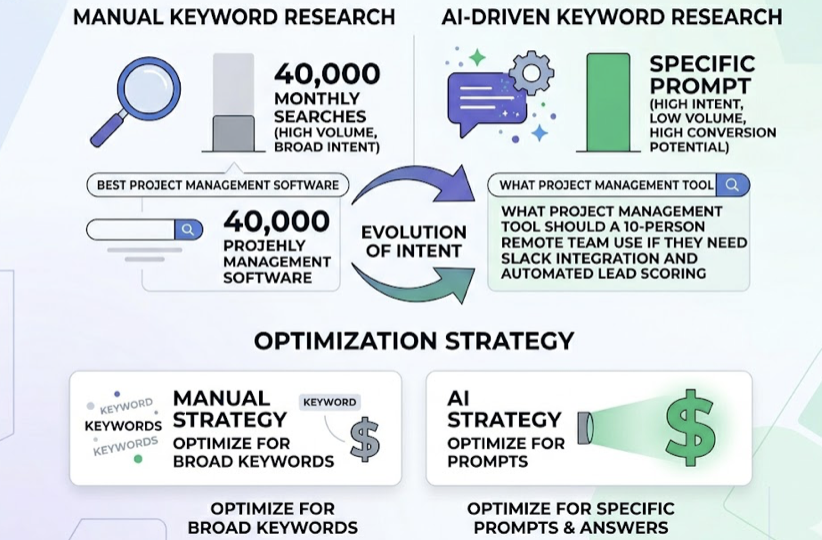
    Manual tools capture “what people search.” AI keyword research captures “what people actually ask.”

    That distinction changes everything for Answer Engine Optimization (AEO). A manual tool surfaces “best project management software” with 40K monthly searches. AI keyword research surfaces prompts like “what project management tool should a 10-person remote team use if they need Slack integration and automated lead scoring.”

    These aren’t the same user. They’re not even in the same stage of decision-making.

    AI systems use Retrieval-Augmented Generation (RAG) to find content that can be directly extracted into a synthesized answer. To appear in that answer, your content needs to match the full conversational structure of the prompt. Optimizing for a 4-word phrase won’t get you there.

    The Princeton GEO study found that adding statistics and direct-answer formatting can boost AI visibility by up to 40%. That kind of optimization only makes sense once you know the actual prompts you’re targeting.

    Way 2: It Covers Platforms Manual Tools Can’t See

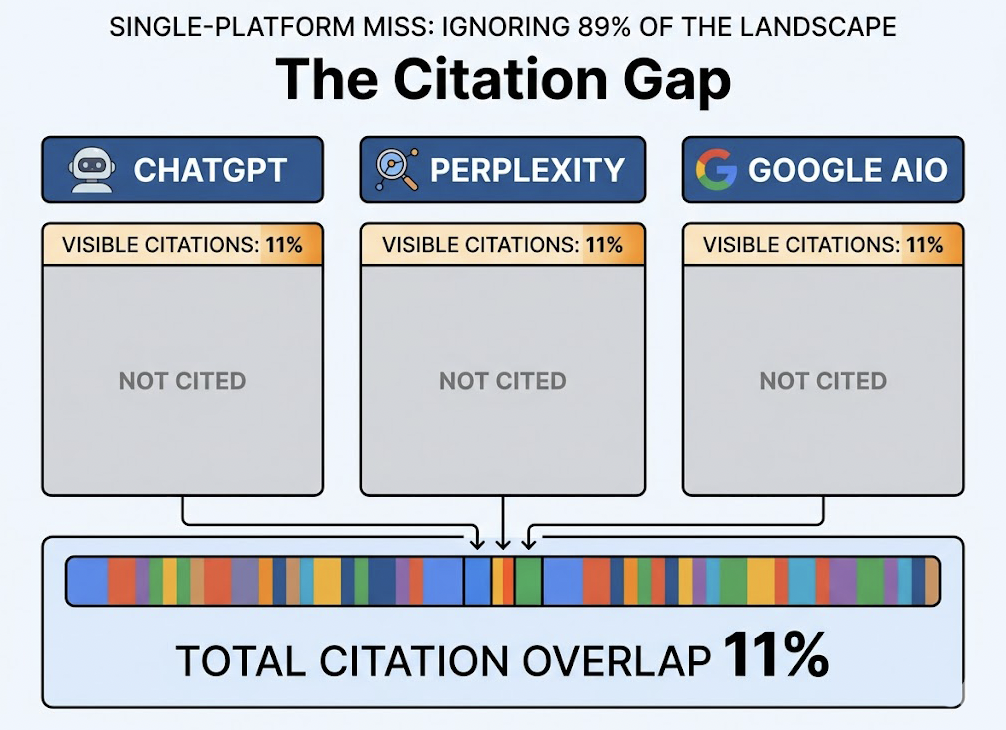
    Here’s a number that should change how you think about keyword strategy: only 11% of domains are cited by both ChatGPT and Perplexity for the same query. 71% of all cited sources appear on exactly one platform.

    Visibility isn’t universal. It’s platform-specific.

    Manual keyword research is anchored to Google’s database. But if you’re trying to appear in AI-generated answers across ChatGPT, Gemini, Perplexity, and DeepSeek, you’re flying blind without platform-specific data. ChatGPT heavily favors Wikipedia (47.9% citation share) and editorial sites. Perplexity leans toward Reddit (46.7%) and niche forums. Google AI Overviews prioritize YouTube content and structured data.

    This is why GEO (Generative Engine Optimization) requires multi-platform keyword intelligence. A single-platform approach doesn’t account for where your actual audience is finding answers.

    A “Search Everywhere” strategy starts with knowing what each platform rewards, and that’s not something any manual Google-centric tool can tell you.

    Way 3: Real-Time Discovery vs. Stale Databases

    Legacy keyword tools typically update monthly or quarterly. By the time a trending query appears in Ahrefs, AI platforms have already crawled and indexed the authoritative early sources. The citation loop is essentially closed before you even see the opportunity.

    AI-driven research tools process real-time SERP data and monitor emerging prompt patterns continuously. In fast-moving categories like SaaS, fintech, or AI tools themselves, the window between a prompt trending and a brand capturing that visibility can be hours, not weeks.

    The time-to-action gap is significant. Manual keyword research takes 8 to 16 hours. AI-powered research takes under 15 minutes. Content strategy development drops from 5 to 10 days to under an hour.

    That’s not a marginal improvement. That’s a different operating model.

    AI keyword research also enables predictive discovery: brands can identify emerging topics two to four months before they peak in traditional search volume. By the time a keyword appears in a manual tool, someone else has already built the citation authority.

    Way 4: It Tells You Why a Keyword Matters for AEO

    Traditional tools give you two numbers: Volume and Difficulty. Both measure the same thing: potential for clicks.

    That model breaks down when 93% of interactions in Google’s AI Mode result in zero clicks. High volume doesn’t mean high AI visibility. High difficulty doesn’t predict whether a competitor is dominating that prompt in ChatGPT’s answer.

    AI keyword research introduces influence-oriented metrics. The core one is AI Visibility Percentage: how often your brand appears in AI answers across your tracked prompts. Instead of knowing “we rank #3 for this keyword,” you know “we appear in 34% of AI answers for this intent cluster, and our main competitor appears in 61%.”

    That’s a gap you can actually act on.

    Sentiment analysis adds another layer. AI tools don’t just mention your brand; they describe it. Monitoring how ChatGPT or Perplexity characterizes your product, compared to competitors, is qualitative competitive intelligence that manual research can’t produce at scale.

    Way 5: Competitive Intelligence Reveals the 91% Most Brands Ignore

    Manual competitive research looks at what competitors publish: their pages, their rankings, their backlinks. But in the GEO era, that’s only 9% of the picture.

    Research shows that 91% of brand mentions in AI-generated responses come from third-party sources. A competitor’s own website accounts for less than one-tenth of their AI visibility. The rest comes from Reddit threads, G2 reviews, comparison articles, industry blogs, and forum discussions.

    Web-wide brand mentions correlate with AI citation at r=0.664. Backlink volume correlates at r=0.100. That means brand mentions are more than six times more predictive of AI visibility than the backlinks manual SEO has been optimizing for years.

    AI keyword research exposes where competitors are building this third-party presence. Which directories mention them. Which communities discuss them. Which comparison tables consistently surface their name. That intelligence is the foundation of a GEO strategy that actually moves the needle.

    Way 6: Volume That Reflects Actual AI Search Behavior

    Google’s Keyword Planner measures demand for Google searches. It has no correlation with prompt volume in AI environments.

    AI Volume Analytics tracks the actual frequency of specific intent-based prompts within AI search tools. And the downstream data makes a strong case for why this matters more than Google volume.

    Traffic from AI platforms converts at roughly 14.6%, compared to 1.7% for traditional SEO. AI visitors have already used the tool to research and narrow their options before clicking through. They’re buyers, not browsers. That’s a 4.4x conversion uplift compared to standard search traffic.

    Optimizing for AI prompt volume doesn’t just improve visibility. It improves the quality of every visitor who reaches you.

    For brands building content strategy, using AI volume data to prioritize topics is more accurate than using Google volume for the same purpose. The audiences have different behaviors, different intents, and different conversion profiles.

    Way 7: It Connects Keyword Discovery Directly to Execution

    Traditional workflow: find keywords, write briefs, hand off to content, publish, wait months for rankings. Every step is a manual handoff. Every handoff introduces delay and misalignment.

    AI keyword research platforms close that loop.

    Topify, the AI search optimization platform built by founding researchers from OpenAI and Google SEO practitioners, is built specifically for this workflow. It surfaces high-value prompts where your brand is missing from AI answers, then gives you the data to act immediately — no tool-switching, no manual audits.

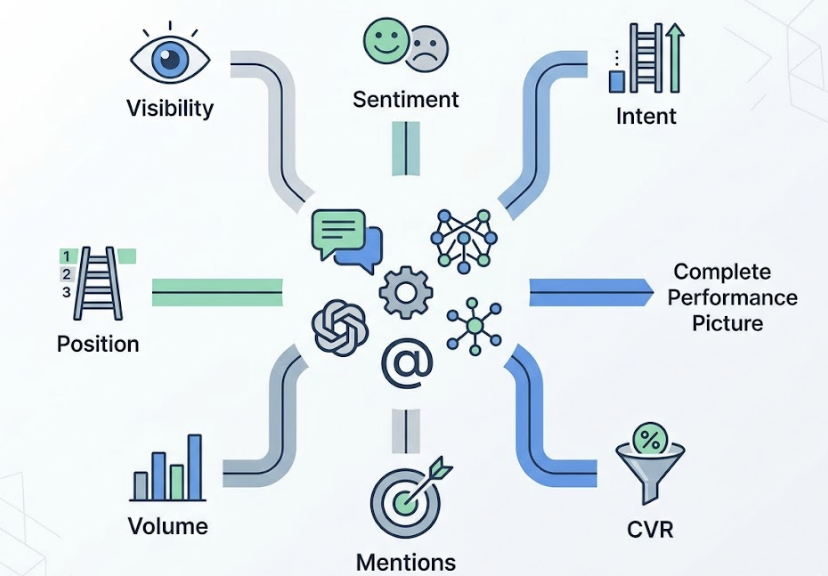
    The platform tracks seven core metrics across ChatGPT, Gemini, Perplexity, and other major AI engines: Visibility, Sentiment, Position, Volume, Mentions, Intent, and CVR. Together, they give you a complete picture of where you stand in the citation economy and what’s driving your competitors’ performance.

    Topify’s One-Click Execution model means you can go from discovering a prompt gap to deploying a GEO content strategy without rebuilding a workflow from scratch. For teams managing multiple brands or clients, that operational efficiency compounds quickly.

    Plans start at $99/month, with a 30-day trial on the Basic tier covering 100 prompts and 9,000 AI answer analyses across ChatGPT, Perplexity, and AI Overviews.

    Where This Is All Heading

    By 2028, market analysts project AI platforms will send more qualified traffic than traditional search engines. Over 40% of all searches already run through AI tools. The “traffic flip” isn’t hypothetical.

    The brands that will win aren’t the ones with the most backlinks. They’re the ones that understood early that the prompt box replaced the search bar, and adjusted their research methods accordingly.

    Manual keyword research made sense when the goal was a top-three position on a SERP. That goal is increasingly irrelevant. The new goal is citation authority in AI-generated answers, and you can’t build that with tools designed for a different era.

    Conclusion

    The gap between manual keyword research and AI keyword research isn’t closing. It’s widening.

    Manual tools miss 7.2-word conversational prompts. They can’t see across platforms where 71% of citations are platform-exclusive. They update too slowly to capture emerging AI search patterns. They measure clicks in a zero-click environment. They ignore the 91% of brand visibility that lives on third-party sites.

    AI keyword research addresses all seven of these gaps. For SEO teams, content strategists, and GEO practitioners, the transition from keywords to prompts isn’t optional. It’s the prerequisite for remaining visible in the search environments your audience actually uses.

    FAQ

    What’s the difference between AI keyword research and traditional SEO keyword research?

    Traditional keyword research identifies short phrases people type into Google, optimized for SERP rankings. AI keyword research captures full conversational prompts used in ChatGPT, Perplexity, and Gemini, optimized for citation frequency in AI-generated answers. The two approaches serve different channels and require different tools.

    How do I start doing AEO keyword research?

    Start by auditing your current AI visibility: which prompts are returning answers in your category, and which of those answers include your brand? Map the intent clusters behind those prompts, then restructure your content to lead with direct answers, supported by statistics and structured data. Tools like Topify automate the discovery and monitoring steps.

    What are the best AI keyword research tools for GEO?

    The most effective GEO tools provide cross-platform coverage (not just Google), real-time prompt discovery, sentiment tracking, and third-party source analysis. Topify’s platform covers all of these, tracking brand performance across ChatGPT, Gemini, Perplexity, DeepSeek, and others from a single dashboard.

    How does AI keyword research support a GEO strategy?

    GEO depends on knowing which prompts your brand needs to appear in and why your competitors are already there. AI keyword research provides both: the prompt map and the competitive intelligence. Without that data, GEO strategy is guesswork.

    Is AI keyword research replacing manual keyword research entirely?

    For traditional SEO, manual research still has a role. But for any brand that wants to appear in AI-generated answers, AI keyword research isn’t a supplement. It’s the foundation. The two channels require different research methodologies, and treating them as interchangeable is one of the most common mistakes GEO practitioners encounter.

    Read More

  • 5 Most Interesting Claude Code Forks Already on GitHub

    5 Most Interesting Claude Code Forks Already on GitHub

    On March 31, 2026, Anthropic shipped Claude Code v2.1.88 with a 59.8MB JavaScript source map accidentally bundled into the npm package. That single file exposed roughly 512,000 lines of TypeScript across nearly 1,900 files, including the core query engine, tool-call logic, multi-agent orchestration patterns, and 44 unreleased feature flags.

    Anthropic pulled it fast. The community mirrored it faster.

    Within days, developers had reverse-engineered the architecture and started building. What’s emerged since isn’t just a collection of hacks. It’s a map of where agentic infrastructure is actually heading.

    Here are the five forks worth paying attention to.

    Before You Dig In: Why These Forks Reveal More Than the Official Docs

    The leaked code made one thing clear: Claude Code was never just a coding assistant. At its core, the QueryEngine.tsmodule binds LLM reasoning to local execution environments (terminal, file system, Git) through a modular tool system. Each tool has a strict input schema, a permission model, and isolated execution logic.

    That architecture turns out to be extremely forkable.

    BashTool runs arbitrary shell commands. AgentTool spawns recursive sub-agents. MCPTool calls external MCP servers, including GitHub APIs and web search. The moment developers saw this, they stopped thinking “coding assistant” and started thinking “execution kernel.”

    The forks below are the result.

    Fork #1: Everything Claude Code (ECC) — 28 Agents Where There Was One

    Everything Claude Code (ECC), maintained by Affaan Mustafa, has crossed 100,000 GitHub stars as of March 2026. The number makes sense once you see what it actually does.

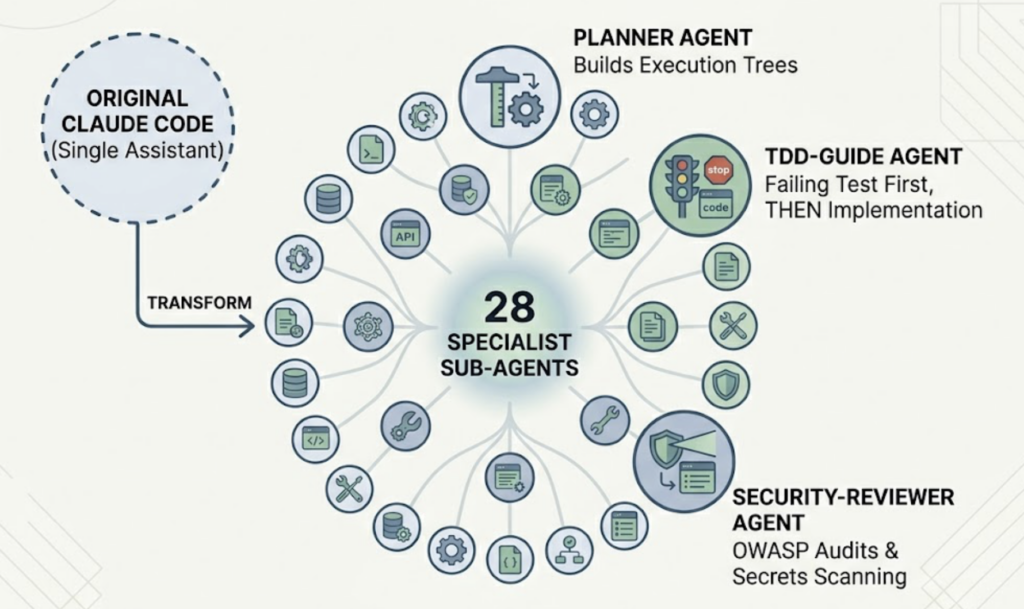
    ECC doesn’t copy Claude Code. It rebuilds it as a specialist agent cluster. The original single assistant gets replaced by 28 purpose-built sub-agents, each with fine-tuned prompts and restricted tool permissions. A planner agent builds execution trees before any code is written. A tdd-guide agent enforces test-first workflows and won’t let the model write implementation code until a failing test exists. A security-reviewer agent runs OWASP audits and auto-scans for hardcoded secrets like sk- and ghp_ prefixes.

    The result is a measurably higher task completion rate on complex projects. Each agent does less, which means it does its specific thing much better.

    What really separates ECC is its persistent learning system. The original Claude Code forgets everything between sessions. ECC uses pre- and post-tool hooks to extract knowledge after every tool call, converting patterns into “instincts” scored by confidence (0.3-0.9). When three or more instincts accumulate in the same category, the system prompts you to run /evolve, locking them into permanent “skill” modules.

    Over time, the agent learns your team’s specific architecture decisions and style conventions.

    ECC also uses a cross-platform adapter pattern (DRY Adapter) so the same configuration works across Claude Code, Cursor, OpenCode, and Codex. One ruleset, consistent behavior everywhere.

    Fork #2: Claude SEO — From Code Generation to AEO and GEO

    This one caught the marketing world off guard.

    Claude SEO, built by AgriciDaniel, takes Claude Code’s agentic engine and routes it entirely toward content and search optimization. The project includes 19 sub-skills and 12 dedicated agents. The pitch: replace a $5,000-10,000/month agency retainer with an automated audit and optimization system.

    The /seo audit command runs multi-agent parallel audits across an entire website. The /seo programmatic module auto-generates scaled page templates while actively preventing index bloat. The /seo google module pulls live Google Search Console metrics, PageSpeed data, and GA4 traffic in real time.

    The more interesting angle is the /seo geo module.

    AI-driven search now accounts for 45% of first-touch queries, and traditional organic click-through rates drop roughly 80% when AI summaries appear above organic results. Claude SEO’s GEO module generates content specifically optimized for ChatGPT, Perplexity, and Gemini visibility, applying an E-E-A-T quality gate based on Google’s September 2025 Quality Rater Guidelines.

    But generating content and tracking whether it actually surfaces in AI answers are two different problems.

    That’s where Topify comes in. Claude SEO integrates with Topify’s monitoring API to give marketers a real feedback loop: the agent generates GEO-optimized content, and Topify tracks whether that content is translating into measurable Share of Voice and Citation Rate inside AI answers across ChatGPT, Perplexity, Gemini, and others. Without that tracking layer, you’re essentially publishing into a black box.

    If you’re thinking about AI search visibility as a growth channel, get started with Topify to close the loop between content execution and AI performance data.

    Fork #3: Ruflo — Enterprise Swarm Orchestration With Byzantine Fault Tolerance

    Ruflo, originally called Claude Flow and developed by rUv, sits at the opposite end of the complexity spectrum from ECC. It’s not a configuration system. It’s a full orchestration layer for agent swarms.

    Ruflo supports over 60 specialized agent types, organized into dynamic swarms with a Queen agent that holds 3x voting weight over worker agents for faster decisions. That’s not a metaphor: Ruflo implements actual distributed consensus algorithms for multi-agent decision-making.

    Critical architectural decisions use Byzantine Fault Tolerance, requiring a 2/3 majority threshold to proceed. Regular tasks like code review use simple majority voting. Security patches run through BFT regardless. The framework was designed for use cases like full microservice migration or large-scale security hardening, where an incorrect sub-agent decision cascades badly.

    The performance story is also unusual. Ruflo ships a Rust-compiled WASM kernel called Agent Booster that handles simple code transformations locally, without making any LLM API calls. That’s 352 times faster than routing the same task through the API, which matters when you’re running dozens of agents in parallel.

    The system’s internal vector database (RuVector, built on PostgreSQL) enables sub-millisecond pattern retrieval across the swarm. Every agent has shared context access, which eliminates the “thought drift” problem where different agents in a cluster develop inconsistent views of the same codebase.

    Ruflo is overkill for individual developers. For engineering teams running multi-day autonomous tasks, it’s currently the most architecturally serious option in the ecosystem.

    Fork #4: Claudeck and CodePilot — Giving the Terminal a Dashboard

    Not every interesting fork adds capability. Sometimes the useful move is removing friction.

    Claudeck, built by Hamed Farag, is a browser-based local web app. Its headline feature is a 2×2 parallel mode: four independent Claude sessions running simultaneously on the same screen. For long-running tasks that involve separate concerns (frontend, backend, tests, docs), this alone changes the workflow significantly.

    The more practical feature is real-time cost tracking. Claudeck connects to a local SQLite billing analyzer that displays token consumption and dollar spend live, per session. Most developers don’t have a clear intuition for what their agentic workflows cost until the monthly API bill arrives. Claudeck surfaces that data at the moment it matters.

    There’s also a Telegram integration for remote approval: when Claude is about to execute a bash command, a notification fires to your phone. You approve or reject it with a tap. That makes unattended long-session agents actually viable, since you’re not locked to the keyboard.

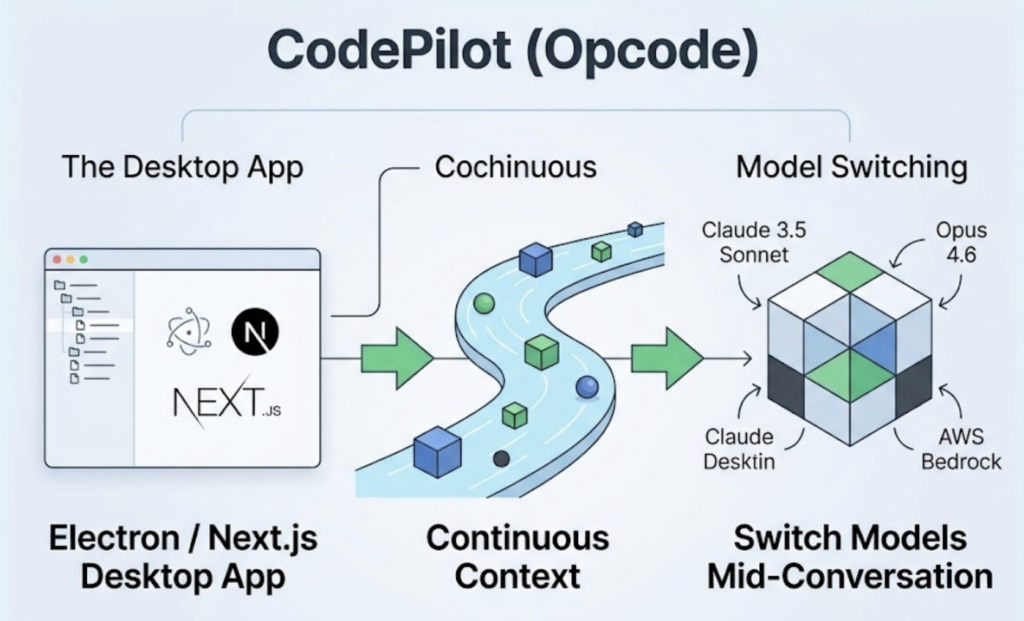
    CodePilot (also known as Opcode) takes a heavier approach with an Electron and Next.js desktop app, IDE-style file tree sidebar, and full session rewind capability. Its standout feature is mid-conversation model switching: you can start a session on Claude Sonnet 4.5, realize you need deeper reasoning, and switch to Opus 4.6 or even AWS Bedrock without losing context.

    Both projects reflect the same underlying insight: the CLI works great if you’re already comfortable in a terminal. A large portion of the people who could benefit from agentic AI tooling are not.

    Fork #5: OpenClaw — From Fork to Deployed Product

    OpenClaw is the most commercially minded project in this list. It’s not a configuration system or a UI wrapper. It’s a deployment framework for running Claude Code agents in production, on your own infrastructure, with security isolation baked in.

    The security architecture is the notable part. Every agent operation runs inside a Sysbox container with restricted network permissions and a read-only filesystem. The host machine can’t be touched by an agent executing a script, even if that script tries. API keys never live on the VPS: OpenClaw routes requests through a Cloudflare Worker that injects credentials at the edge. If the server gets compromised, the attacker gets an authorization token, not the actual API key.

    OpenClaw also bridges the agent into Telegram, Discord, and Feishu, which means the agent isn’t a terminal-only tool. It’s accessible from wherever your team communicates.

    The cost angle is worth noting. Claude’s current API pricing runs from $1/M tokens for Haiku 4.5 on simple tasks up to $5/$25 (input/output) for Opus 4.6 on complex reasoning. OpenClaw’s intelligent routing algorithm automatically selects the right model based on task complexity. The project claims 75% API cost reduction in production deployments by routing low-complexity tasks to Haiku instead of defaulting everything to the most expensive model.

    That cost-aware architecture is arguably what makes this viable as an actual product rather than a proof of concept.

    Conclusion

    The March 2026 source map leak accelerated something that was already in motion. Claude Code’s architecture, built around modular tools, recursive agent spawning, and MCP extension, turns out to be an extremely flexible foundation for use cases Anthropic didn’t design it for.

    ECC proves that configuration alone can drive enterprise-grade coding performance. Ruflo shows that agent swarms can operate with distributed consensus at scale. Claude SEO demonstrates that the same architecture powering code generation can power content strategy and AI search optimization. Claudeck and CodePilot show that the terminal is optional. OpenClaw shows that it’s possible to ship a product on top of all of this.

    The through-line across all five: agentic AI is moving from assistant to infrastructure. The forks that understand that are the ones worth watching.


    FAQ

    Q: Are Claude Code forks legal to use? 

    A: It depends. Since many forks were built from the leaked source map, Anthropic has been issuing DMCA takedown notices for repositories that reproduce the original code directly. Projects built around configuration frameworks and prompts rather than the source code itself occupy a different legal position. For commercial use, consult a lawyer familiar with software copyright before deploying anything in this space.

    Q: What’s the difference between AEO and GEO? 

    A: Answer Engine Optimization (AEO) focuses on getting your content cited by AI systems that answer questions directly, like ChatGPT or Perplexity. Generative Engine Optimization (GEO) is the broader practice of optimizing brand presence across all AI-generated responses. In practice, they overlap heavily, and tools like Topify track both through visibility, sentiment, and citation metrics.

    Q: Do I need to be a developer to use any of these forks? 

    A: Not for all of them. Claudeck and CodePilot were specifically built to remove the terminal dependency. Both offer web or desktop interfaces where you manage agents through a GUI. Claude SEO also has a command-based interface that marketing teams can use without writing any code.

    Q: How does Claude Code handle context across long tasks? 

    A: The original Claude Code doesn’t. That’s one of the core problems ECC and Ruflo were built to solve. ECC’s persistent learning system stores session knowledge as scored instincts between sessions. Ruflo’s RuVector database gives an entire agent swarm shared, sub-millisecond access to project context so different agents don’t drift out of sync.


    Read More

  • What Most Brands Miss When Setting Up an AI Answer Monitoring System

    What Most Brands Miss When Setting Up an AI Answer Monitoring System

    Your brand holds top-three rankings for high-intent keywords. Traffic from organic search is solid. But when you type “best [your category] tools” into ChatGPT, your competitors get named first, described in detail, and linked with confidence. Your brand doesn’t appear at all.

    That’s not a content quality problem. It’s a monitoring infrastructure problem.

    Most marketing teams don’t have a systematic way to track what AI platforms are saying about their brand. They run manual checks once a month, look at one platform, and call it done. Meanwhile, AI-driven referral traffic is converting at rates up to 15.9% on ChatGPT alone, meaning every omission is a qualified lead going to a competitor.

    The fix starts with understanding what an AI answer monitoring system actually is, and what separates a professional setup from a glorified manual search.

    Most Brands Are “Checking” AI. They’re Not Monitoring It.

    There’s a meaningful difference between the two.

    Checking is what most teams do: open ChatGPT, type a question, see if your brand appears, close the tab. It’s better than nothing. But it’s not monitoring.

    A systematic AI answer monitoring system does something different. It queries multiple AI platforms at scale using a curated set of prompts, captures the outputs, parses them for brand mentions, rankings, sentiment, and citation sources, and tracks all of that data over time. The goal isn’t a snapshot. It’s a trend line.

    Why does this matter? Because LLMs are non-deterministic. A study of 2,961 identical prompts found that ChatGPT, Google AI, and Claude return the same brand list less than 1% of the time. A single manual check tells you almost nothing. Weekly, structured sampling tells you everything.

    The other problem: 83% of global AI usage happens inside mobile apps, which traditional SEO tools can’t index. That’s dark traffic, and it’s where a large portion of your AI brand narrative is being written without you knowing.

    What an AI Answer Monitoring System Actually Tracks

    The most common misconception is that AI monitoring is just “mention tracking.” Count how many times the brand appears. Done.

    That’s the floor, not the ceiling.

    A professional-grade AI answer monitoring system captures five distinct dimensions of brand performance across generative platforms.

    The 5 Metrics a Reliable AI Answer Monitoring Dashboard Should Cover

    Visibility Rate is the percentage of relevant queries in which your brand is included in the AI’s response. In competitive categories, category leaders typically achieve mention rates of 30% to 50% for high-intent queries. Below that, you’re losing consideration before the conversation starts.

    Sentiment Score quantifies how the AI describes your brand, typically on a 0-100 scale. An AI can mention your brand while framing it as “a budget alternative” or “better suited for small businesses,” even when your internal positioning is enterprise. That disconnect is invisible without a sentiment tracking layer.

    Position Rank measures where your brand appears in AI recommendation lists. The first recommendation receives 1.5 to 2x more consideration than the third. Tracking rank tells you whether you’re winning the shortlist or just making it onto the list.

    Prompt Volume maps which questions users are actually asking. Are they asking informational “What is?” queries, or commercial “Is [Brand] better than [Competitor]?” queries? A brand might dominate educational prompts but be completely absent from transactional ones, which is a funnel alignment problem.

    Source and Citation Coverage is the most actionable metric of the five. It identifies the specific URLs the AI uses as evidence when describing your brand or your competitors. If you’re missing from an answer, this tells you exactly which third-party domain filled the gap.

    These five dimensions map directly onto what platforms like Topify track across their seven-metric GEO analytics framework: visibility, sentiment, position, volume, mentions, intent, and CVR (Conversion Visibility Rate). The CVR layer goes one step further, projecting the conversion impact of AI visibility, which turns monitoring data into ROI modeling.

    Common Mistakes in AI Answer Monitoring Analytics

    Most brands aren’t just under-monitoring. They’re monitoring wrong.

    Mistake 1: Single-platform coverage. Most teams focus exclusively on ChatGPT and ignore the rest of the landscape. The problem is that only 11% of cited domains overlap between ChatGPT, Perplexity, and Google AI Overviews. Each platform uses a different retrieval architecture: ChatGPT leans on Bing, Claude on Brave Search, Gemini on Google. A brand can be highly visible on one and completely absent on others.

    Mistake 2: Tracking mentions without tracking how. A brand mention in an AI answer isn’t always a positive signal. If the AI is consistently describing your product as a “cheaper alternative” or “best for beginners,” that narrative is shaping buying decisions in real time. Sentiment monitoring catches this. Mention counting doesn’t.

    Mistake 3: Monthly monitoring cadence. Research across 2,500 prompts in Google AI Mode and ChatGPT found that 40% to 60% of cited sources change on a monthly basis. Monthly checks create a false sense of stability. Weekly or bi-weekly monitoring is the minimum required to distinguish a fluke omission from a systematic trend.

    Mistake 4: No competitive baseline. Monitoring your own brand in isolation misses the point. The metric that matters is Share of Voice: your mention rate compared to competitors for the same category prompts. Without that comparison, a 35% visibility rate looks fine until you realize your main competitor is at 62%.

    Mistake 5: Ignoring citation sources. 99.3% of LLM citations come from open-access sources, and Reddit alone powers up to 46.7% of citations on Perplexity and 27% of answers on ChatGPT. If you’re not tracking which external domains the AI is using to build its brand descriptions, you’re missing the most actionable data in the entire monitoring stack.

    How to Build an AI Answer Monitoring Strategy That Works

    Moving from reactive checking to proactive optimization requires a structured approach. Here’s a five-step framework.

    Step 1: Build your Prompt Matrix. Start with 25 to 100 “money prompts” that cover the full buyer journey. Category prompts (“Best [product type] for [industry]”), comparison prompts (“[Brand] vs [Competitor]”), problem-solution prompts (“How to solve [pain point]”), and trust prompts (“Is [Brand] reliable for enterprise?”). This matrix is the foundation. Everything else is built on top of it.

    Step 2: Run your baseline. The first monitoring cycle creates your reference point. Capture Visibility Rate, Sentiment, Position, and Source Coverage for your brand and your top three competitors. This baseline turns all future data into signal rather than noise.

    Step 3: Run a Source Gap Analysis. For every prompt where you’re missing, identify what the AI is citing instead. That list of domains becomes your “Source Target Backlog.” A G2 review page that consistently appears in competitive answers is a higher priority content target than a page on your own blog.

    Step 4: Audit technical accessibility. Cloudflare has changed default configurations to block AI bots, meaning many brands have unintentionally shut off their AI crawl traffic. Check your robots.txt for AI bot exclusions, and verify that key product pages aren’t JavaScript-rendered, since most AI crawlers can’t process client-side content.

    Step 5: Connect monitoring to content execution. The output of monitoring isn’t a report. It’s a prioritized content backlog. Citation gap data tells you which prompts to target, source gap data tells you which channels to focus on, and sentiment data tells you which brand narratives need correction.

    An AI answer monitoring tool like Topify handles steps 1 through 5 as an integrated workflow. The prompt library management, cross-platform scanning, source gap detection, and one-click content execution all sit in a single platform, so insights don’t get lost in translation between analytics and strategy.

    What Topify’s AI Answer Monitoring Platform Covers in Practice

    Most AI answer monitoring software stops at data collection. You get a dashboard, a visibility score, and a list of mentions. What you do with that data is your problem.

    That’s the gap Topify closes.

    Topify is built as an end-to-end AI search optimization platform, covering the full cycle from monitoring to execution. Here’s what that looks like in practice.

    Multi-platform AI answer monitoring: Automated scanning across ChatGPT, Gemini, Perplexity, DeepSeek, Doubao, Qwen, and other major platforms. Cross-platform discrepancies, where your brand ranks well on one engine and disappears on another, are surfaced automatically rather than discovered by accident.

    Source Analysis: Topify identifies the specific third-party domains the AI is using to form its brand descriptions. This is the “reverse-engineering the RAG pipeline” function that most tools don’t offer. If a niche industry publication is consistently cited in answers that mention your competitor, that’s your next content target.

    Dynamic Competitive Benchmarking: Competitive monitoring isn’t a static list. New entrants appear in AI recommendation lists all the time. Topify’s system automatically detects when a new competitor shows up alongside your brand and benchmarks their visibility against yours in real time.

    One-Click Execution: Once monitoring data identifies a citation gap or a content opportunity, Topify’s AI agent can generate and deploy optimized content with a single action. The monitoring loop and the execution loop are connected, not separated by a strategy meeting.

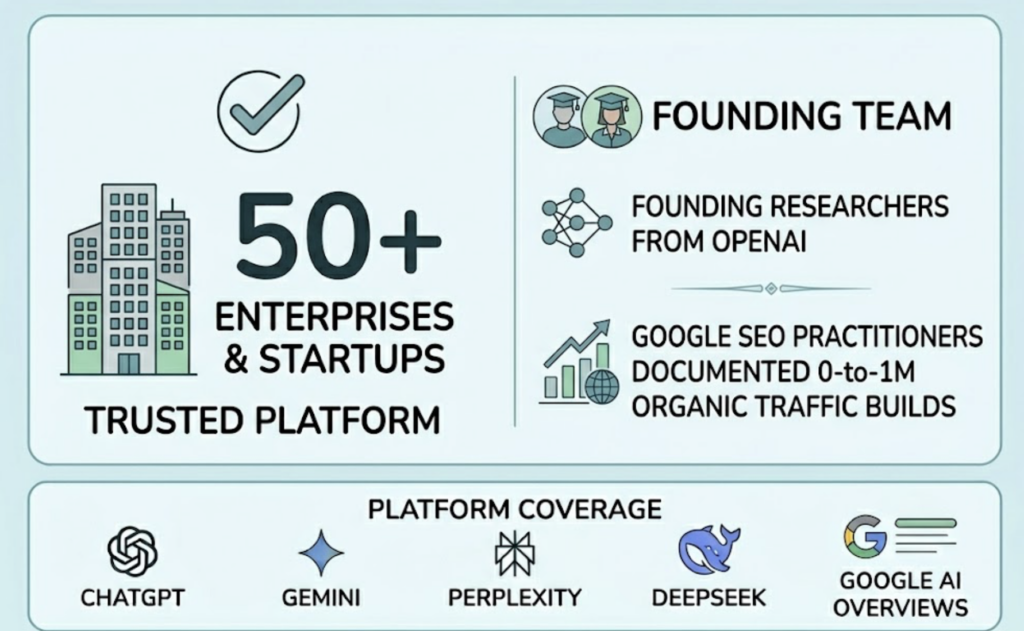
    The platform is trusted by 50+ enterprises and startups, and the team behind it includes founding researchers from OpenAI and Google SEO practitioners with documented 0-to-1M organic traffic builds. That combination of LLM research depth and practical SEO experience is reflected in the accuracy and actionability of the monitoring data.

    AI Answer Monitoring Analytics Pricing: What You’re Actually Paying For

    Before evaluating any AI answer monitoring solution, it’s worth understanding what the real cost comparison looks like.

    Manual monitoring of 100 prompts across five AI platforms takes an average of 3.6 hours per week per employee. At a fully-loaded cost of $60 to $80 per hour for a mid-level marketing manager, that’s $225 to $300 per week, or roughly $12,000 to $15,000 per year, for coverage that is still statistically unreliable due to the non-deterministic nature of LLM outputs.

    Automated platforms typically run at a fraction of that cost and return data that no human process can replicate at scale.

    Topify’s pricing is structured around usage volume:

    PlanPriceWhat You Get
    Basic$99/mo100 prompts, 9,000 AI answer analyses, 4 platforms, 4 seats
    Pro$199/mo250 prompts, 22,500 analyses, 8 projects, 10 seats
    Enterprisefrom $499/moCustom prompt sets, dedicated account manager, advanced API

    The economics are straightforward. A Pro plan at $199 per month covers 250 prompts across multiple platforms with statistical sampling that a manual process can’t replicate. The ROI threshold is low.

    Businesses that adopt AI automation for marketing processes report 50% faster processing times and a 30% reduction in operational costs. In the context of AI answer monitoring, that translates to faster competitive response cycles and more hours redirected toward strategy and execution rather than manual data collection.

    Conclusion

    The brands winning in AI search in 2026 aren’t necessarily the ones with the best products. They’re the ones that know exactly where they stand in the AI answer ecosystem, and why.

    An AI answer monitoring system gives you that knowledge. Not through occasional manual checks, but through structured, multi-platform tracking of visibility, sentiment, position, prompt volume, and citation sources. The data tells you where you’re losing mindshare, which specific third-party domains are shaping your brand narrative, and exactly what to do about it.

    The gap between manual checking and systematic monitoring is the gap between operating blind and operating with competitive intelligence. For most brands, closing that gap starts with setting up the right infrastructure.

    Topify provides that infrastructure, from prompt management and cross-platform scanning to source gap analysis and one-click content execution, all in a single platform designed for teams that need to move fast.


    FAQ

    What is AI answer monitoring analytics?

    AI answer monitoring analytics is the systematic practice of tracking how a brand is mentioned, described, and cited across generative AI platforms like ChatGPT, Gemini, and Perplexity. It measures frequency (visibility rate), tone (sentiment score), competitive positioning (rank), and citation sources to give marketing teams a structured view of their brand’s narrative health in conversational search.

    How does an AI answer monitoring system work?

    The system programmatically queries multiple AI models using a curated “Prompt Matrix” of high-intent user questions. It parses each AI response to extract brand mentions, competitive rankings, and the specific source URLs the AI used as evidence. That data is then aggregated into a dashboard to track trends over time. Platforms like Topify automate this entire process across ChatGPT, Gemini, Perplexity, DeepSeek, and other major engines.

    What are examples of AI answer monitoring analytics in practice?

    Three concrete examples: (1) AI Visibility Score, a weighted metric combining inclusion rate and position rank; (2) Share of Voice, your mention rate versus competitors for a specific category; (3) Source Recurrence, tracking which third-party domains are most frequently cited in answers relevant to your brand. These three alone cover the core of a working monitoring program.

    Is there a checklist for AI answer monitoring analytics?

    A working 2025/2026 checklist should include: build a prompt set covering the full buyer journey; monitor at least five platforms (ChatGPT, Gemini, Perplexity, Claude, Copilot); audit technical accessibility (robots.txt configuration, JavaScript rendering); analyze citation sources to identify third-party influence targets; track sentiment alignment between AI descriptions and your brand positioning; and establish competitive Share of Voice benchmarks.

    What are the best tools for AI answer monitoring analytics?

    Topify is the strongest option for teams that need integrated monitoring and execution in one platform. It covers seven metrics across all major AI engines and connects monitoring data directly to content strategy and deployment. For teams with more specific needs, GetMint is useful for tracing AI outputs back to specific source URLs, while enterprise teams needing geographic and historical reporting depth may also evaluate other platforms.


    Read More

  • Why Most AI Visibility Products Miss the Citation Layer: LLM Citation Tracking, Compared

    Why Most AI Visibility Products Miss the Citation Layer: LLM Citation Tracking, Compared

    Search “best AI visibility tool” and you’ll get a dozen platforms, each promising to show you exactly where your brand stands in AI search. Most of them will. But here’s the gap: knowing your brand was mentioned is not the same as knowing your brand was cited. One tells you the AI recognized your name. The other tells you whether the AI trusted your content enough to use it as evidence.

    That distinction is where most platforms stop short, and where the real optimization opportunity lives.

    LLM Citation Tracking Is Not the Same as Mention Tracking

    When an AI recommends your brand, two separate algorithmic decisions happened. The first is the “recommendation check”: should this brand be named? The second is the “evidence check”: should this source be linked as proof?

    These decisions are made independently, and they diverge more than most marketers expect. Research shows that only 28% of LLM responses include brands that were both mentioned and cited. A brand is three times more likely to earn a citation alone than to earn both at the same time.

    The practical consequence is significant. A competitor can win citations on your best content, using your research to substantiate their recommendation. You’ll show up in the data as a source. They’ll show up in the AI’s answer as the solution.

    That’s the gap LLM citation tracking is built to close.

    What AI Visibility Products Actually Track: A Breakdown

    Before comparing platforms, it helps to understand what “AI visibility” can actually mean at a technical level. There are five distinct dimensions, and most tools only cover two of them.

    DimensionWhat It MeasuresCoverage by Most Tools
    Brand Mention FrequencyIs your brand named in the response?✅ Standard
    Citation Source AnalysisWhich URLs/domains does the AI cite?⚠️ Limited
    Multi-Model CoverageDoes tracking span ChatGPT, Gemini, Perplexity, etc.?⚠️ Varies
    Sentiment & Narrative FramingHow does the AI describe your brand?✅ Common
    Competitive Citation GapWhat % of total citations go to you vs. competitors?❌ Rare

    The platforms that stay at dimensions 1 and 4 give you brand health data. The platforms that reach dimensions 2 and 5 give you a content strategy.

    The Citation Source Dimension: Why It’s Technically Hard

    LLMs don’t retrieve sources the way a search engine does. They use a multi-stage process: the query gets decomposed into sub-queries, vector embeddings find semantically similar content chunks, and a re-ranking layer asks whether a given fragment actually provides evidence for the claim. Content below a confidence threshold of roughly 0.75 gets discarded entirely.

    On top of that, citation patterns vary dramatically across platforms: there’s only an 11% citation overlap between ChatGPT and Perplexity. Tracking one model and extrapolating to the others isn’t a strategy. It’s a guess.

    How Profound Actions Handles AI Visibility: Strengths and Gaps

    Profound has positioned itself as the enterprise-grade solution for AI visibility, backed by Sequoia, and its technical architecture justifies some of that positioning.

    Its standout capability is the Conversation Explorer, which draws on licensed data from consumer panels to estimate real search volume for specific prompts across LLMs. This addresses one of the industry’s core blind spots: brands previously had no way to quantify how many people were actually asking about their category in a chat interface.

    Equally notable is Agent Analytics. Via CDN integrations (Cloudflare or Akamai), Profound can identify when an AI crawler like GPTBot or ClaudeBot visits a website, then correlate that activity with subsequent citation appearances. This creates a direct feedback loop between content consumption and AI output.

    On data accuracy, Profound’s “Direct Browser Capture” approach captures the actual consumer-facing UI rather than relying on API responses, which often omit real-time formatting and links. They report a 95-97% accuracy rate in reproducing ChatGPT’s shopping behavior.

    That said, several gaps matter depending on your team’s size and setup.

    Profound AI visibility products data accuracy is strong at the response level but limited at the website analytics level: brands without complex CDN configurations have less granular visibility into their own crawl data. Profound AI visibility products model coverage is genuinely broad at 10+ engines, but full coverage is locked behind custom-priced enterprise tiers. The Lite plan at $499/month covers only four platforms.

    On the execution side, Profound Conversation Explorer AI visibility products competitor analysis is informative but not always actionable. Users consistently note that dashboards surface gaps without guiding the content or technical response. The “Opportunities” section in growth plans is often limited to a handful of items at a time.

    How Other AI Visibility Products Compare: GAIO.tech, Hotwire, and More

    The broader competitive landscape splits into methodology-led platforms and narrative-focused tools, each addressing a different part of the same problem.

    GAIO.tech takes a framework approach, built around a 5-pillar model: GEO (technical content readability), SEO (traditional authority foundation), AEO (answer engine optimization), GO (geographic nuance), and E-E-A-T (trust signal development). Their core metric is a weighted AI Share of Voice formula that divides brand mentions by total industry mentions. This auditable structure appeals to CMOs who need to present AI strategy to a board. The tradeoff is that it’s more of a strategic diagnostic than an operational tool.

    Hotwire Spark approaches AI visibility from the communications side. Rather than tracking citation URLs, it focuses on which trade media, high-impact blogs, and analyst voices are shaping what LLMs understand about a category. Their Hotwire Radiate tool adds a content layer: upload a press release or case study, and it generates an “AI-citability score” along with an optimized version. AI systems often extract only 1-3 sentences from any given source, so the focus on “quotability” at the sentence level is well-grounded technically.

    Neither platform focuses heavily on reverse-engineering competitor citation sources, which is where the practical content strategy work tends to live.

    PlatformCore FocusCitation Source AnalysisModel CoverageBest For
    ProfoundEnterprise intelligencePartial (CDN-dependent)10+ enginesLarge teams, governance use cases
    GAIO.techStrategy / Share of VoiceIndirectCore platformsCMOs, board-level reporting
    Hotwire SparkPR / Narrative influenceContent-level (Radiate)Core platformsComms and PR teams
    TopifyPerformance + citation gapsURL-level reverse engineeringChatGPT, Gemini, Perplexity, DeepSeekGrowth teams, content strategists

    How Topify Tracks LLM Citations Across AI Platforms

    Topify was built around the citation layer specifically. Rather than starting with brand mention tracking and adding citations as a secondary feature, the platform’s Source Analysis function identifies the specific domains and URLs that AI engines cite for high-intent queries.

    The practical output is a Citation Share metric: the percentage of prompts where a given domain is linked. Research suggests Citation Share is a more accurate predictor of referral traffic than brand mention rate, which makes it a more direct input to content investment decisions.

    What makes this operationally useful is the reverse-engineering workflow. If a competitor is being cited more frequently, Topify traces the specific URL. Analysis might reveal the AI prefers that page because it contains a BLUF answer of 40-60 words, or a well-structured data table. Those are structural decisions the content team can reproduce.

    Cross-model consensus adds another layer. If ChatGPT, Gemini, and Perplexity all cite the same external source, that source has high cross-model authority, making it the highest-priority target for displacement or outreach. Topify surfaces this pattern across the “Core 4” platforms that drive the majority of commercial AI search volume.

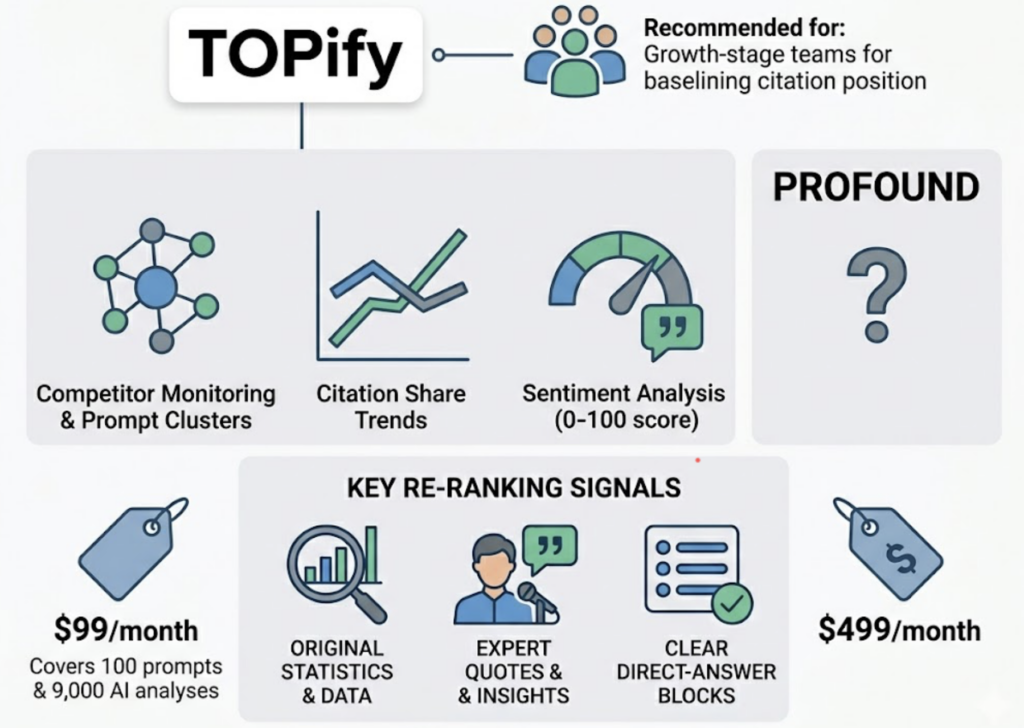
    For teams tracking competitive position alongside citations, Topify’s Competitor Monitoring automatically detects rivals appearing in the same prompt clusters and shows how citation share shifts over time. Paired with Sentiment Analysis (0-100 scoring), you can tell whether a citation gain came with a favorable framing or not.

    On pricing, Topify starts at $99/month, covering 100 prompts and 9,000 AI answer analyses, compared to Profound’s $499/month entry tier. For growth-stage teams that need to baseline their citation position before committing to an enterprise contract, the cost structure makes early adoption a reasonable decision.

    3 SEO Strategies That Work When You Can See the Citation Layer

    Understanding citation tracking data is most useful when it drives a specific content action. Three strategies tend to generate the clearest return.

    Strategy 1: Source displacement through content quality. Using citation data, identify the top domains that appear instead of your brand for high-intent prompts. The information density formula for citation selection rewards content with more unique entities and verifiable data points per word. If a competitor’s page is winning citations because it has a tight, fact-dense answer block, that’s a reproducible content structure. Dense listicles earn AI citations roughly 25% of the time versus 11% for thinner opinion pieces. That’s not a style preference; it’s a structural signal.

    Strategy 2: Connecting citation tracking to revenue. AI citation click-through rates are typically below 1%, which makes it easy to deprioritize citation work. The counterargument is conversion quality. Users who do click from an AI citation convert at 4.4x the rate of traditional organic search visitors, because the AI has already completed the research phase for them. Integrating Topify’s citation data with GA4 lets teams track whether citation gains correlate with branded search volume spikes, the most common downstream signal of AI-driven awareness.

    Strategy 3: Freshness cycling to maintain retrieval strength. AI visibility is volatile: only 30% of brands maintain consistent presence across consecutive queries, and 65% of AI bot crawl activity targets content published within the past year. A freshness cycling approach, updating key pages every 30-90 days with new statistics, updated schema dates, and additional FAQs, sustains “retrieval strength” without requiring a full content overhaul. Tools like Topify’s AI Volume Analytics surface which prompts are generating the most crawl activity, so freshness effort can be concentrated where it matters.

    Conclusion

    The difference between AI visibility tools isn’t primarily about dashboards or pricing tiers. It’s about whether the platform reaches the citation layer, the specific URLs the AI trusts as evidence, or stops at brand mentions.

    For teams that need board-level reporting and deep enterprise integration, Profound covers more ground, at a higher cost and setup overhead. For comms and PR functions, Hotwire’s narrative focus makes more sense. For growth teams that need to turn citation data into content decisions quickly, Topify’s URL-level reverse engineering at a $99/month entry point is a practical starting place.

    The immediate action: audit what your current tool actually measures. If it doesn’t show you which URLs the AI is citing, you’re optimizing for awareness without touching the trust layer. Get started with Topify to baseline your citation share before your competitors do.


    FAQ

    Q: What is LLM citation tracking and why does it matter for SEO? A: LLM citation tracking monitors which external URLs and domains AI systems use to support their answers. It matters because traditional organic traffic is projected to decline significantly as AI Overviews expand, and citations are currently the primary mechanism for earning referral traffic and trust signals in generative search environments.

    Q: How do Profound AI visibility products handle data accuracy for citation analysis? A: Profound uses direct browser capture rather than API polling, which means it reproduces the actual consumer-facing interface including real-time source links that APIs sometimes omit. However, their website-level citation analytics depend on CDN integrations like Cloudflare or Akamai, which limits accuracy for smaller brands without that infrastructure in place.

    Q: What’s the difference between AI visibility tracking and LLM citation tracking? A: AI visibility tracking covers the full range of brand presence: mentions, sentiment, position, and share of voice. LLM citation tracking specifically targets the “evidence layer,” identifying which websites the AI uses as factual grounding. A brand can have strong mentions and zero citations, which creates a trust gap and limits referral traffic regardless of how often the AI recommends the brand by name.

    Q: Which AI visibility products offer the best model coverage for generative engine optimization? A: Profound leads on raw coverage with 10+ engines, including niche models like Rufus and DeepSeek, though full access requires enterprise pricing. Topify focuses on the core commercial platforms (ChatGPT, Gemini, Perplexity, DeepSeek) that generate the majority of high-intent queries, which is sufficient for most growth-stage teams evaluating citation strategy.


    Read More