Category: GEO Score Checker

  • GEO Score Checker for Luxury Goods: Why AI Skips Your Maison

    GEO Score Checker for Luxury Goods: Why AI Skips Your Maison

    A collector with serious budget opens ChatGPT and asks for the best heritage watchmakers for a first investment-grade piece. The answer names four houses, describes their movements, and links to a few editorial sources. Your maison, with a century of craft behind it, isn’t in the reply. Not ranked low. Absent.

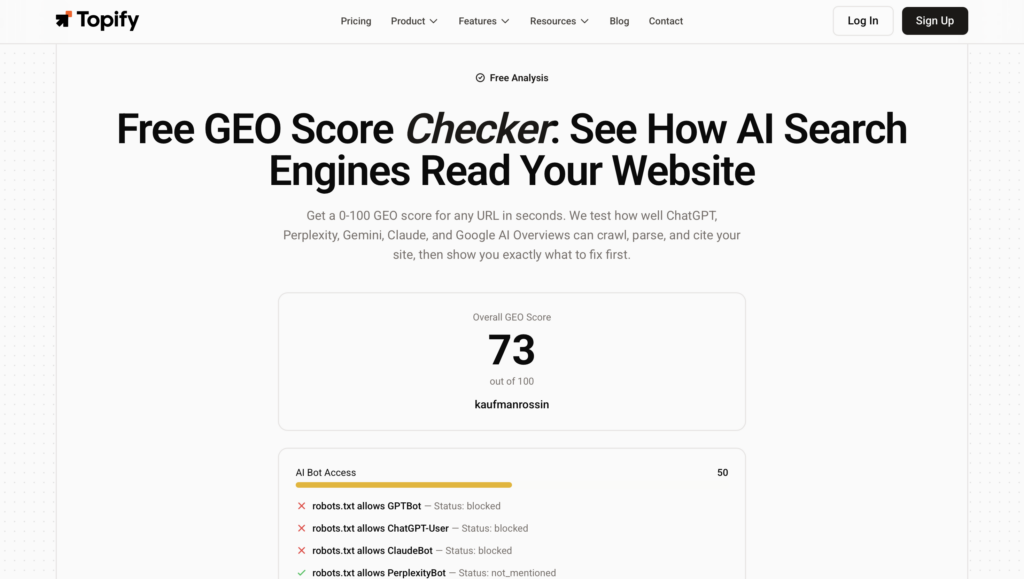
    This usually isn’t a brand problem. It’s a technical visibility gap. AI systems couldn’t read, verify, or trust your site clearly enough to include you. You can see exactly where that breaks down with the GEO Score Checker from Topify.

    ✅ Free ⚡ Results in 60 seconds 🔒 No signup required
    The Four Numbers Behind Why AI Overlooks Your Luxury Brand

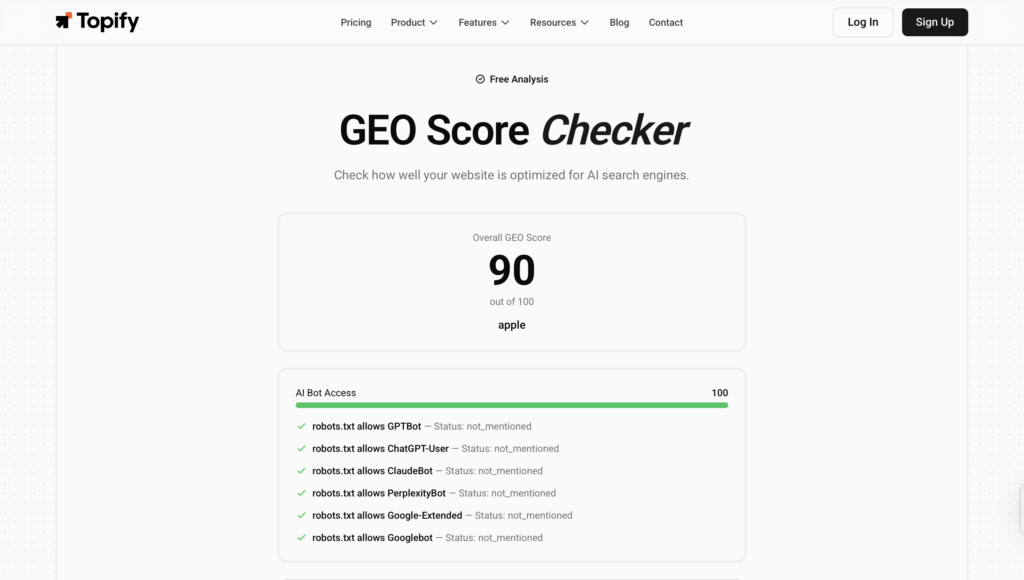
    The GEO Score Checker gives your domain a single 0-100 score, then breaks it into four dimensions. For luxury brands, each one maps to a specific way the category tends to lose ground in AI answers.

    Score DimensionWhat It MeasuresLuxury Goods Impact
    Bot AccessWhether AI crawlers like GPTBot, ClaudeBot, and PerplexityBot can reach your pagesImage-heavy, JavaScript-rendered sites often block or starve crawlers, so AI never sees the collection
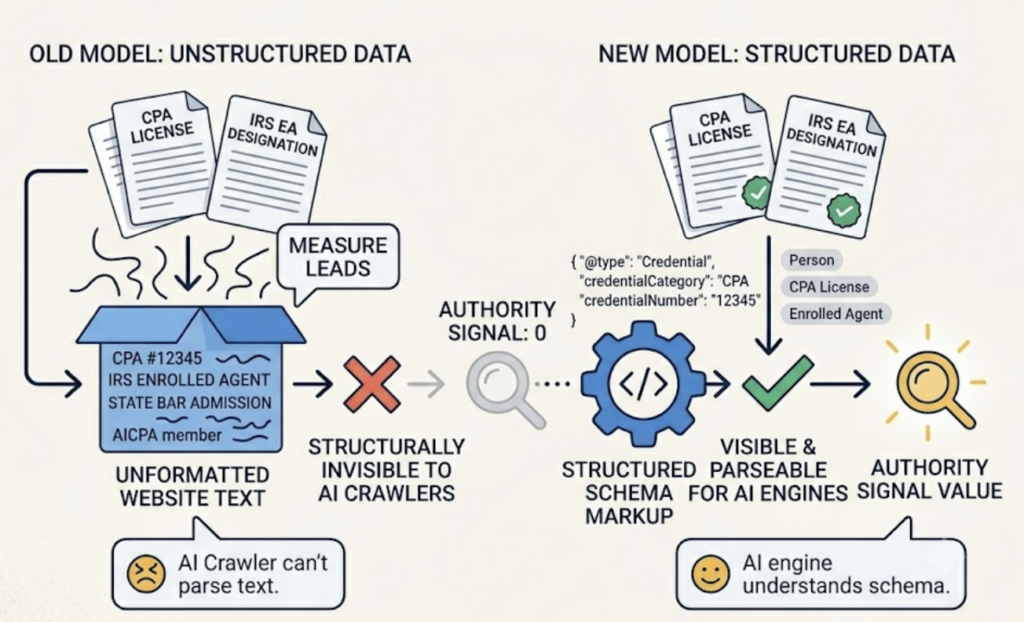
    Structured DataWhether Product, Organization, and FAQ schema describe your content in machine-readable formCraft, provenance, and pricing live in lookbooks and PDFs, not in markup AI can parse
    Content SignalsDepth, semantic relevance, and authority signals AI reads as expertiseMinimal copy and visual-first storytelling leave little text for AI to extract
    Visibility ScoreHow often your brand actually surfaces across ChatGPT, Perplexity, Gemini, and AI OverviewsA house can be present on one platform and effectively invisible on another

    Here’s the thing about luxury sites. They’re often built as art objects: full-bleed imagery, sparse copy, heavy front-end frameworks. Beautiful for a human. Close to unreadable for a crawler.

    Scenario 1: The Site That Reads Like a Gallery, Not a Page

    A jewelry maison runs a stunning single-page experience. Large video loops, a few poetic lines, products loaded through JavaScript. The GEO Score Checker returns Bot Access in the low 30s and Content Signals under 40. AI tools can render the homepage as a name, but they can’t tell what you sell, in what materials, at what tier. So when a buyer asks for high jewelry houses known for emerald settings, the model has nothing concrete to cite.

    Scenario 2: Heritage Buried in a PDF

    A fashion house keeps its archive, atelier story, and craftsmanship details inside downloadable lookbooks. That narrative is your strongest authority signal. AI can’t index a 40MB PDF the way it indexes a structured page. Content Signals stays flat even though the underlying expertise is real.

    Scenario 3: Strong on One Platform, Gone on Another

    A leather goods brand shows up in ChatGPT for “best Italian bag makers” but never appears in Perplexity for the same query. The aggregate Visibility Score looks mediocre, which hides the fact that one platform sees you clearly and another doesn’t see you at all.

    Running the check takes a minute. Open the GEO Score Checker, enter your domain, and you’ll get all four dimension scores in about 60 seconds. Compare them, and your weakest number tells you where to start.

    What Luxury Buyers Actually Type Into AI Before They Ever Walk In

    In luxury, AI is rarely the place where the purchase closes. Jewelry and high-value goods are among the least common categories for direct AI checkout, with roughly 28% of shoppers using AI for jewelry purchases. But that statistic misses the real shift. Affluent buyers use AI earlier, to research provenance, compare houses, and build a shortlist before they ever contact a boutique.

    That shortlist stage is where your visibility is decided. These are the kinds of prompts driving it.

    AI Prompt ExamplePlatformSearch IntentWhat It Reveals
    “Best heritage watchmakers for a first investment piece”ChatGPTShortlist buildingWhich houses AI treats as category authorities
    “Quietly luxury handbag brands that hold resale value”PerplexityComparison with proofWhether third-party resale and review data names you
    “Sustainable high jewelry brands using recycled gold”GeminiValues-based filteringIf your sustainability claims are structured and verifiable
    “Compare [Maison A] and [Maison B] for craftsmanship”ChatGPTDirect head-to-headHow AI characterizes you against a named rival
    “Where do collectors buy rare vintage timepieces”PerplexityChannel and trust researchWhether trusted editorial sources cite your name

    Two patterns matter here. First, more than 70% of consumers now reach for generative AI over traditional search for product research, and around 65% use it specifically before buying. Second, AI leans hard on third-party proof. Studies found Perplexity references reviews in 100% of responses and ChatGPT in 58%, and brands rated below the category average were often dropped from recommendations entirely.
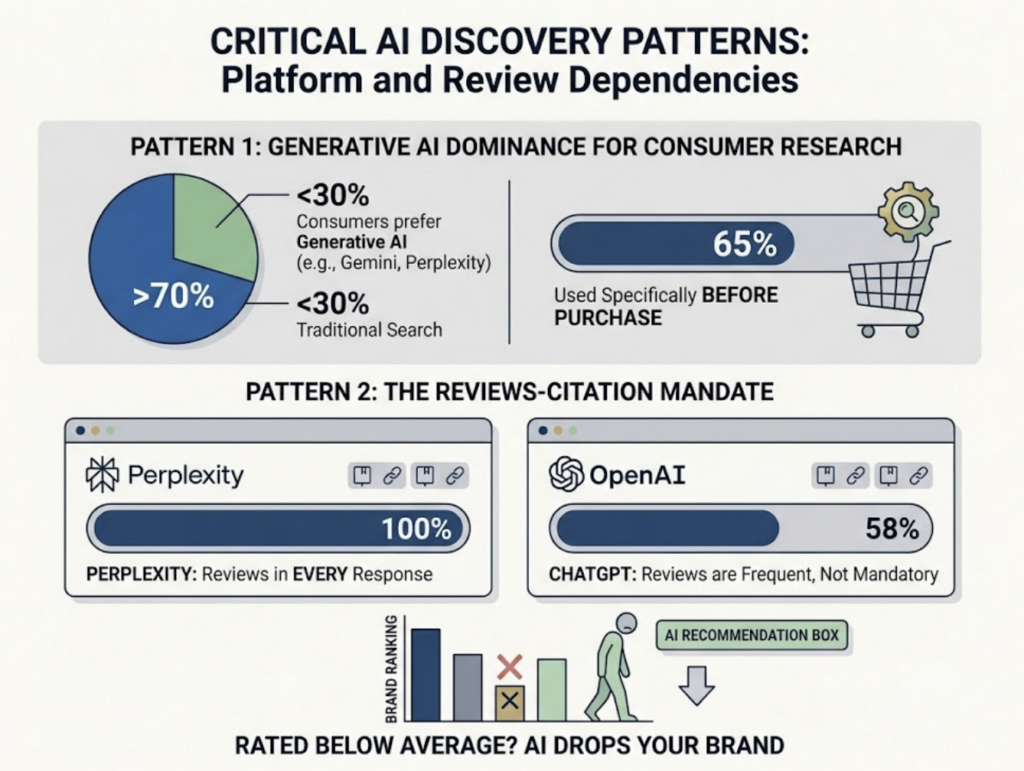
    If your maison isn’t in that early answer, you’re cut from the consideration set before a single human conversation happens. And you won’t see it in any analytics dashboard.

    Where Heritage Brands Quietly Bleed GEO Points

    Luxury brands tend to lose AI visibility in three predictable places. Each one shows up in a different part of the GEO score.

    The website is built for the eye, not the crawler. This is the most common and most fixable problem. When a site renders products through client-side JavaScript and carries almost no descriptive text, AI sees a shell. Bot Access and Content Signals both suffer. The craft is there. The machine-readable evidence of it isn’t.

    Your authority lives outside your control, and it’s inconsistent. AI doesn’t take your word for your standing. It cross-references Wikipedia, editorial coverage, retailer listings, and specialist directories to decide whether you’re safe to recommend. Luxury houses often have fragmented third-party footprints: a different brand name on a marketplace, an outdated founding date in one directory, missing entity links in another. That inconsistency makes AI less confident citing you, even when the press coverage exists.

    Platform fragmentation hides the gap. A brand can look fine if you only check ChatGPT. The danger is the platform you’re not watching. Perplexity crawls the live web and weights fresh, well-cited pages differently than ChatGPT does. A house with strong editorial history might dominate one and vanish from the other. Looking at a single platform gives you false comfort.

    Luxury ScenarioGEO Score SignalLikely CauseDirection to Fix
    Products invisible in AI answersBot Access below 30JS-rendered catalog, blocked crawlersOpen crawler access, server-render key pages
    Craft story not citedContent Signals below 40Narrative trapped in PDFs and imageryMove provenance into structured page copy
    Inconsistent brand descriptionStructured Data below 40Missing or conflicting schema and entity dataAdd Organization and Product schema, align directories
    Present in one platform onlyVisibility Score unevenPlatform-specific data and freshness gapsTrack each platform separately, not as one number

    That last point is the one most teams underestimate. A single blended score can look acceptable while one platform shows you at zero.

    From a One-Time Score to Tracking Every Mention Over Time

    The GEO Score Checker tells you where you stand today. That’s the right first move. But AI visibility isn’t static. Models retrain, competitors publish, editorial coverage shifts, and your scores move with them.

    A single score tells you where you stand. Continuous monitoring tells you which direction you’re moving.

    That’s the gap Comprehensive GEO Analytics is built to close.

    CapabilityFree GEO Score CheckerTopify Platform
    Check frequencyOne-time snapshotContinuous monitoring
    Dimensions tracked4 GEO scoresFull GEO analytics plus sentiment and citations
    Historical trendsNoneFull trend history with alerts
    Competitor benchmarkingNot includedReal-time competitor tracking
    Platform breakdownAggregatedPer-platform (ChatGPT, Perplexity, Gemini, AI Overviews)
    Optimization actionsDirectional guidanceSpecific, prioritized execution steps

    For luxury brands fighting platform fragmentation, the per-platform view is the part that earns its keep. You can start a free trial with no credit card, and the pricing scales from a single house to multi-brand groups.

    Conclusion

    For luxury goods, AI visibility is less about how refined your brand looks and more about whether machines can read, verify, and trust what you’ve built. The craft is rarely the problem. The technical signals around it usually are.

    Start with the number. Run your domain through the GEO Score Checker and see which of the four dimensions is dragging you down. If Bot Access is low, the AI Robots Checker helps you dig into what your robots.txt is actually telling crawlers. If you suspect your third-party authority is thin, the Brand Authority Checker shows how AI weighs your standing, and the AI Visibility Report gives you a cross-platform snapshot of where you appear.

    Frequently Asked Questions

    Why would a famous luxury brand score low on the GEO Score Checker? 

    Recognition among humans doesn’t translate to machine readability. A maison can be world-famous yet score low because its site blocks crawlers, hides product details in JavaScript, or lacks structured data. AI grades the signals it can parse, not your reputation. The GEO Score Checker shows which signals are missing.

    Does it matter if buyers don’t actually purchase luxury goods through AI? 

    Yes. Affluent buyers use AI for research and shortlisting long before they buy, and roughly 65% use it before a purchase. If your brand isn’t in that early shortlist, you’re filtered out at the start of the journey, well before any boutique conversation happens.

    Why does my brand appear in one AI platform but not another? 

    Each platform uses different data sources and freshness rules. Perplexity crawls the live web and weights recent, well-cited pages, while ChatGPT relies more on training data and retrieval. A brand strong in one can be absent in the other, which is why per-platform tracking in Comprehensive GEO Analytics matters more than a single blended figure.

    How is GEO different from the SEO my agency already does? 

    Traditional SEO optimizes for ranking position in a list of links. GEO optimizes for being mentioned and accurately described inside a single AI-generated answer where there’s no second page. The skills overlap, but GEO puts more weight on structured data, third-party authority, and machine-readable content.

    Read More
  • GEO Score Checker for Gaming: Why AI Skips Your Game

    GEO Score Checker for Gaming: Why AI Skips Your Game

    A player opens ChatGPT and types, “I want a cozy co-op game my partner and I can finish in a weekend, something like It Takes Two.” The model returns five titles. Your game fits that description better than three of them. It isn’t on the list.

    That gap isn’t a quality problem. Your game might review well, sell steadily, and have a loyal Discord. The problem is technical: AI systems can’t see, parse, or trust your brand the way they see the titles they recommend. That’s a Generative Engine Optimization issue, and it’s measurable.

    You can check exactly where you stand with the free GEO Score Checker from Topify, which scores your AI visibility from 0 to 100 across four dimensions.

    ✅ Free ⚡ Results in 60 seconds 🔒 No signup required

    The Four Numbers That Tell You Why AI Skips Your Studio

    Game discovery through AI is intent-driven, not keyword-driven. Players don’t search your title. They describe a feeling, a session length, or a game they already love, and the model decides what to surface. Whether your game shows up depends on four technical signals.

    Score DimensionWhat It MeasuresGaming Impact
    Bot AccessWhether AI crawlers like GPTBot, ClaudeBot, and PerplexityBot can reach your pagesA blocked store page, wiki, or devlog means your game’s details never enter what AI can recommend
    Structured DataWhether AI can parse the meaning of your contentGenre, platform, player count, and tags buried in images or trailers stay invisible to models
    Content SignalsWhether AI treats your content as authoritativeThin official pages lose to forums and aggregators when the model decides who to trust
    Visibility ScoreHow often your game appears across AI platformsLow frequency means players asking for “games like yours” get competitors instead

    Each number maps to a real failure mode studios run into. Here are the three most common.

    Your Store Page and Wiki Are Closed to AI Crawlers

    Many studios route everything through platforms and CDNs that, by default, restrict automated access. If GPTBot or PerplexityBot can’t crawl your pages, your game’s description, mechanics, and reviews never reach the models. A Bot Access score under 30 usually points here.

    Your Genre and Vibe Live in Trailers, Not Text

    A roguelike deckbuilder with tight 20-minute runs is exactly what a player might ask for. But if that pitch only exists in a YouTube trailer and a key art banner, AI can’t read it. Structured data is how you tell a model what kind of experience you actually deliver.

    You’re Loud on Reddit, Quiet Everywhere Official

    Plenty of indie games have active communities and weak official content signals. AI may know your game exists from forum chatter but won’t recommend it confidently without authoritative, well-structured pages to anchor the citation. That’s a Content Signals gap.

    Running the check takes under a minute:

    • Open the GEO Score Checker and enter your game’s domain or brand name
    • Get four-dimension scores plus an overall number in about 60 seconds
    • Compare the four scores to find your weakest signal
    • Start fixing the lowest one first, since it’s dragging the rest down

    What Players Actually Type Into AI Before They Buy

    Gaming prompts look nothing like product searches. They’re about mood, similarity, and context. Here’s the kind of language players use, and what each prompt reveals about whether your game has a chance of appearing.

    AI Prompt ExamplePlatformSearch IntentWhat It Reveals
    “Games like Hades but on mobile”ChatGPTFind a similar experience on a specific platformWhether AI maps your game to a known reference title
    “Best co-op games for two people 2026”PerplexityCurrent shortlist for a social contextWhether your freshness and review signals are strong enough to surface
    “Cozy farming sim I can play 30 minutes a night”GeminiMatch by session length and toneWhether your structured tags describe pacing and mood
    “What roguelike should I try after Balatro”ChatGPTSequential recommendation off a hitWhether AI associates you with the right genre cluster
    “Indie horror game with good story under $20”PerplexityFilter by genre, quality, and priceWhether your metadata and community reviews are parseable

    The behavioral shift is real and well documented. Around 62% of gamers aged 18 to 34 now use AI tools at least monthly, with game discovery among the top use cases. Meanwhile Steam is on pace to release over 16,000 titles in 2026, and AI tends to default to a narrow list of legacy hits when asked broad questions.

    Here’s the consequence. Every prompt where your game should appear but doesn’t is a player who never sees you, never wishlists, never downloads.

    Where Gaming Brands Lose GEO Points That ASO Never Measured

    App store optimization and wishlist campaigns don’t touch the signals AI reads. Three blind spots show up again and again for studios.

    The first is the semantic gap between keywords and intent. Your ASO might rank you for “puzzle platformer,” but a player asks for “a relaxing game with a sad story.” If your content doesn’t carry that semantic meaning in text AI can parse, you lose the match. Content Signals and Structured Data scores expose this directly.

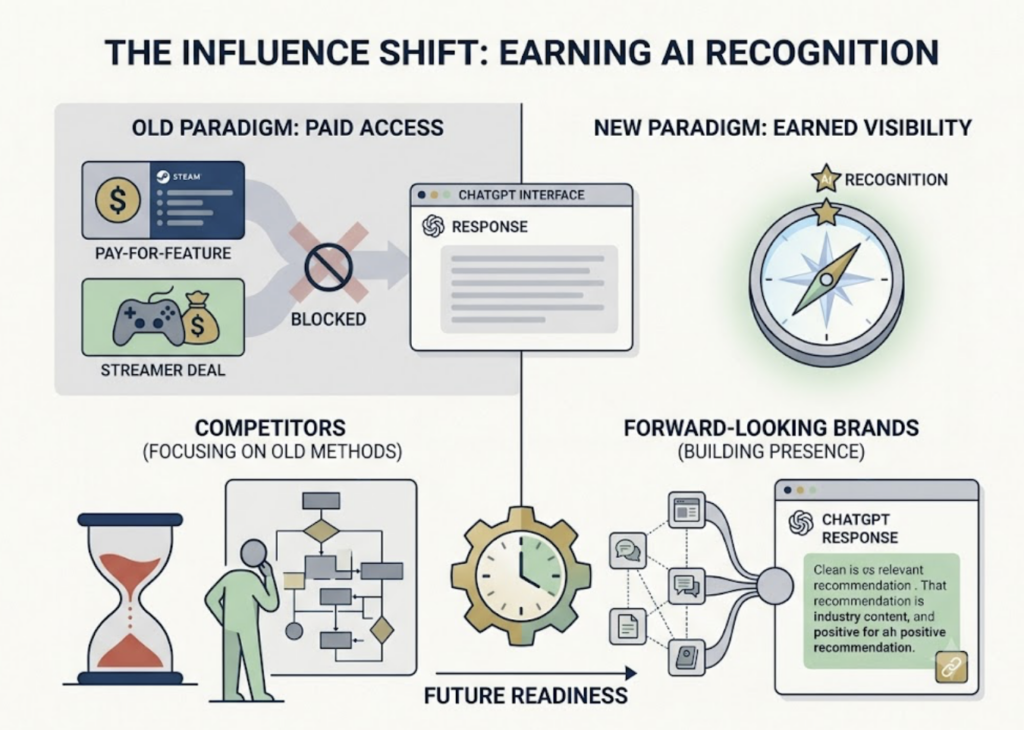
    The second is that you can’t buy your way in. There’s no ad slot in ChatGPT for games. You can’t sponsor a Perplexity recommendation. AI visibility is earned entirely through web presence, which is a different optimization problem than paying for a Steam feature or a streamer deal. The brands building that presence now, while competitors stay focused on storefront algorithms, are the ones AI will know how to recommend later.

    You don’t pay for AI visibility. You earn it, or you stay invisible.

    The third blind spot is platform divergence, and it hits gaming harder than most categories. Across recent large-scale studies, only about 11% of domains were cited by both ChatGPT and Perplexity. Perplexity leans heavily on community sources like Reddit, where gaming discussion is dense. ChatGPT leans toward authoritative and encyclopedic sources. A single visibility number averages these into something close to meaningless.

    Gaming ScenarioGEO Score SignalLikely CauseWhere to Look
    Strong on Perplexity, absent on ChatGPTVisibility Score split across platformsCommunity-rich, authority-light footprintBuild structured official content
    Game never matched to similar titlesContent Signals under 40Genre and tone not described in parseable textAdd semantic detail to official pages
    Recent patch or DLC not reflected in answersVisibility Score laggingStale content, no freshness signalsRefresh pages on a regular cycle

    That gap between platforms is exactly why one score, checked once, can mislead you.

    From a One-Time Score to Tracking Every Patch and Launch

    The GEO Score Checker gives you a snapshot. For a game, that snapshot ages fast. Launches, patches, seasonal events, and review surges all shift how AI sees you, and each platform reacts on its own schedule.

    A single score tells you where you stand today. Continuous monitoring tells you which direction you’re moving, per platform, over time.

    CapabilityFree GEO Score CheckerTopify Platform
    Check frequencyOne-time snapshotContinuous monitoring
    Dimensions tracked4 GEO scoresFull GEO analytics, sentiment, citations
    Historical trendsNoneFull trend history with alerts
    Competitor benchmarkingNot includedReal-time competitor tracking
    Platform breakdownAggregatedPer-platform (ChatGPT, Perplexity, Gemini, AI Overviews)
    Optimization actionsDirectional guidanceSpecific, prioritized steps

    Comprehensive GEO Analytics tracks all four GEO signals across every major platform and shows you how they trend through each release cycle. You can start a free trial with no credit card, and see full plan details on the pricing page.

    Conclusion

    For a game studio in 2026, AI visibility isn’t a marketing nice-to-have. It’s the discovery channel you can’t pay into and can’t ignore. The players asking AI what to play next are the same ones who used to scroll Steam, and right now most of them aren’t hearing your game’s name.

    Start with the free GEO Score Checker to see your four scores in under a minute. If Bot Access comes back low, the AI Robots Checker helps you trace the exact crawler rules blocking you. To dig into how trustworthy AI considers your official content, the Brand Authority Checker goes deeper, and the AI Visibility Report gives you a cross-platform snapshot of where your brand surfaces.

    Frequently Asked Questions

    Why does AI recommend older games instead of my new release? 

    AI tends to surface titles with the most established, parseable web presence, which often means legacy hits. A new game usually has thin structured content and few authoritative pages early on. Running the GEO Score Checker shows whether weak Content Signals or Structured Data scores are holding your launch back.

    Can I pay to get my game recommended by ChatGPT or Perplexity? 

    No. There are no ad slots for game recommendations inside these models. Visibility is earned through web presence, structured content, and authority signals AI can read. That’s why it’s a technical optimization problem, not a media buy.

    My game is popular on Reddit but never shows up in ChatGPT. Why? 

    Different platforms pull from different sources. Perplexity weighs community discussion heavily, while ChatGPT favors authoritative and encyclopedic content. A strong community footprint with weak official pages can leave you visible on one platform and absent on another, which is why per-platform tracking matters.

    How is GEO different from ASO for games? 

    ASO optimizes how your game ranks inside an app store’s own search. GEO optimizes whether AI models understand and recommend your game when players ask in natural language across ChatGPT, Perplexity, and others. The two measure different things, and strong ASO does not guarantee AI visibility.

    Read More:

  • GEO Score Checker for Web3: Why Your Protocol Is Invisible to AI

    GEO Score Checker for Web3: Why Your Protocol Is Invisible to AI

    A crypto investor opens ChatGPT and types: “What are the safest DeFi lending protocols right now?” They get a confident, structured answer — three protocol names, a brief safety assessment, and a recommendation. Your protocol isn’t one of them. Not because it’s unsafe. Not because it lacks TVL. Because the AI has no reliable way to read your site, parse your documentation, or verify your authority signals.

    That gap is measurable. Run your protocol through the GEO Score Checker — a free tool that evaluates your AI search readiness across four dimensions in under 60 seconds, no signup required.

    ✅ Free   ⚡ Results in 60 seconds   🔒 No signup required


    The Four GEO Scores That Expose Your Web3 Brand’s AI Blind Spots

    Web3 projects face a specific structural problem: the content that proves your credibility — whitepapers, tokenomics pages, audit reports, technical documentation — is often the content that AI systems can’t access, parse, or trust. The GEO Score Checker surfaces exactly where those failures happen.

    Score DimensionWhat It MeasuresWeb3 / Crypto Impact
    Bot AccessWhether AI crawlers (GPTBot, ClaudeBot, PerplexityBot) can reach your siteToken pages rendered in JavaScript, PDF whitepapers, and wallet-gated content are typically invisible to AI crawlers
    Structured DataWhether your content is marked up in a way AI can interpretMost DeFi protocol sites lack Schema markup; AI can’t distinguish your tokenomics page from a generic finance article
    Content SignalsWhether your content meets the authority thresholds AI uses to evaluate trustAudit report summaries, security track records, and technical depth are all content signals — but only if they’re formatted for AI indexing
    Visibility ScoreHow often your brand surfaces across ChatGPT, Perplexity, Gemini, and Google AI OverviewsA protocol can rank on page one of Google and score near zero in AI platform visibility — these are completely separate measures

    A score of 0-40 means AI systems are largely unable to recognize or recommend your protocol. 41-60 means basic crawlability, but competitors with better structured signals have a clear advantage. 61-80 is solid but leaves real recommendation opportunities on the table. 81-100 puts you in the tier AI actively draws from when answering protocol questions.

    Token Pages That Block the Bots Meant to Recommend Them

    Most token landing pages are built for visual impact: animated backgrounds, wallet connect prompts, JavaScript-rendered price data. Those design choices make sense for human visitors. They’re a systematic problem for AI crawlers.

    GPTBot and PerplexityBot are not browsers. They can’t execute JavaScript, connect wallets, or wait for dynamic content to load. If your token page renders its core content in JS, those crawlers see a blank page — or close to it. A low Bot Access score on the GEO Checker is often the first signal that this is happening.

    Whitepapers AI Can’t Read

    The whitepaper is the single most credibility-dense document a crypto project produces. It contains tokenomics, security models, protocol mechanics, governance structures. It’s also, in most cases, a PDF hosted on a subdomain or IPFS link — two formats that AI crawlers either can’t access or won’t prioritize.

    A whitepaper that no AI system can read is a whitepaper that contributes zero to your Structured Data or Content Signals score. The content exists. The authority signal doesn’t.

    Authority Trapped in the Wrong Format

    Tier-one crypto media coverage — CoinDesk, Cointelegraph, The Block — is genuinely valuable authority signal. The problem is how most projects use it: a press page with logo tiles, or a “As Seen In” strip with no actual links or structured context.

    AI systems don’t infer authority from logo placement. They look for structured signals: cited mentions, schema-tagged content, clean entity relationships between your brand and the publications covering it. If those signals aren’t present, the coverage doesn’t register as trust.

    How to run the check:

    1. Go to the GEO Score Checker
    2. Enter your protocol’s domain or brand name
    3. Get four dimension scores in under 60 seconds
    4. Identify the lowest-scoring dimension — that’s your first fix

    What Crypto Buyers and Investors Actually Ask AI

    The shift is already underway. Retail investors, institutional allocators, developers evaluating infrastructure, and founders researching competitors — they’re all using AI platforms as a first-pass research layer before they read a whitepaper or visit your site.

    Here’s what those queries look like in practice:

    AI Prompt ExamplePlatformSearch IntentWhat It Reveals
    “What are the most audited DeFi lending protocols?”ChatGPTSecurity due diligenceProjects with audit reports in AI-readable format get cited; PDF-only audits are ignored
    “Compare Layer-2 rollup solutions for low transaction fees”PerplexityTechnical evaluationProtocols with structured comparison content and clear technical documentation surface first
    “Which DEXs have the best liquidity for altcoin pairs?”GeminiTrading researchVisibility Score determines whether your DEX appears in this answer at all
    “Is [protocol name] safe to use for yield farming?”ChatGPTTrust and safety checkContent Signals score directly predicts whether AI can answer this question about your brand
    “What Web3 wallets support Solana and EVM chains?”PerplexityProduct discoveryBot Access failures mean wallet features never reach the AI’s knowledge base
    “Explain the tokenomics of [project] before I invest”ChatGPTInvestment researchIf your tokenomics page is JS-rendered or PDF-gated, AI can’t answer — and users move on

    A 2025 analysis of TON ecosystem DeFi protocols found that ChatGPT failed to mention any of them in 87% of DeFi-related queries — despite strong Google rankings and genuine TVL.

    That’s not a content quality problem. It’s a GEO infrastructure problem.


    Why Strong Google Rankings Don’t Protect You in AI Search

    This is the assumption that costs Web3 teams the most time. A protocol builds solid backlinks, ranks on page one for its core keywords, and assumes that means AI platforms will surface it too. They typically don’t — and the reasons are structural.

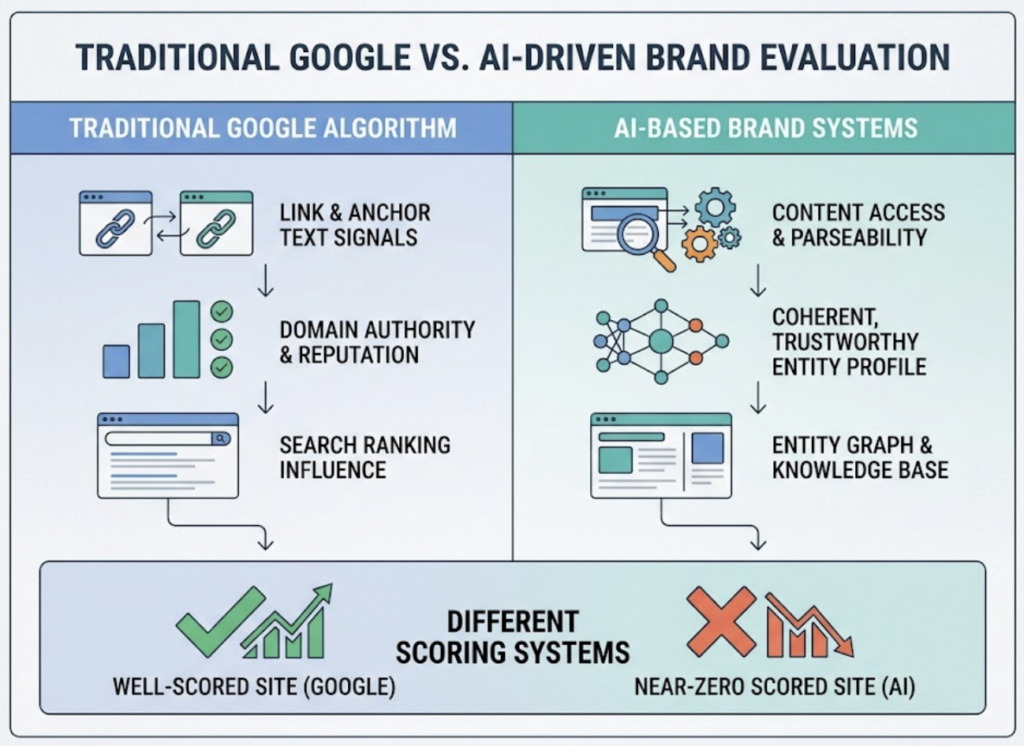
    Google’s algorithm evaluates links, anchor text, and domain authority. AI systems evaluate whether they can physically access your content, whether it’s marked up in a parseable way, and whether the signals around your brand form a coherent, trustworthy entity profile. A site can score well on one system and near-zero on the other.

    The disconnect is especially sharp in Web3 for three reasons.

    First, most crypto projects optimize their content for token discussion — price action, community sentiment, launch announcements. That content drives social engagement and short-term traffic. It does very little for Content Signals score, which rewards technical depth, protocol-specific authority, and E-E-A-T structure.

    Second, the security and audit information that would most improve an AI’s ability to recommend your protocol is typically buried in PDFs, GitHub READMEs, or third-party security platforms — none of which contribute to your site’s Structured Data score.

    Third, platform fragmentation is common and almost never measured. A protocol that earned coverage in Perplexity’s training data may surface there while being completely absent from ChatGPT responses. Without checking Visibility Score across platforms, you have no way to know which gaps exist or where to address them first.

    Web3 ScenarioGEO Score SignalLikely CauseDirection
    Protocol ranks on Google but isn’t cited in ChatGPT DeFi answersVisibility Score: below 35AI hasn’t indexed enough structured brand signalsBuild structured content pages (not PDFs) around protocol mechanics
    Audit report exists but AI can’t reference your security recordContent Signals: below 40Audit is PDF-only, no HTML summary with schemaConvert audit summary to structured web content
    Token page looks great but Bot Access score is lowBot Access: below 30JavaScript rendering blocking AI crawlersAdd server-side rendering or static HTML fallback for core pages
    Covered by CoinDesk but Structured Data is near zeroStructured Data: below 35No schema markup connecting brand entity to coverageAdd Organization schema and structured citation markup

    From One Score to Continuous Protocol Monitoring

    The GEO Score Checker gives you a snapshot: where your protocol stands across four AI visibility dimensions, right now. That’s genuinely useful — especially if you’ve never measured it before.

    The snapshot has one limitation. GEO signals don’t stay fixed. AI platforms update their knowledge bases, competitor protocols publish new structured content, and your Visibility Score shifts as citation patterns change across ChatGPT, Perplexity, and Gemini. A score you checked last month may not reflect where you stand today.

    Topify‘s Comprehensive GEO Analytics is built for that ongoing layer. Where the free checker gives you a one-time read, the platform tracks all four GEO dimensions continuously, with trend history, per-platform breakdowns, and competitor benchmarking.

    CapabilityFree GEO Score CheckerTopify Platform
    Check frequencyOne-time snapshotContinuous monitoring
    Dimensions tracked4 GEO scoresFull GEO analytics + sentiment + citations
    Historical trendsNoneFull trend history with alerts
    Competitor benchmarkingNot includedReal-time competitor tracking
    Platform breakdownAggregatedPer-platform (ChatGPT, Perplexity, Gemini, AI Overviews)
    Optimization actionsDirectional guidanceSpecific, prioritized execution steps

    For protocols in active growth phases — fundraising, mainnet launches, ecosystem expansion — the difference between a snapshot and continuous tracking is the difference between knowing where you stood and knowing where you’re moving.

    Plans start at $99/month. All plans include a 7-day free trial, no credit card required. See full pricing details.


    Conclusion

    Web3 projects spend months on tokenomics design, security audits, and community building. Most spend zero time checking whether AI systems can actually read any of it. That’s the gap the GEO Score Checker closes in 60 seconds.

    Check your protocol’s GEO score now — free, no signup, results in under a minute.

    Frequently Asked Questions

    Why does my Web3 project rank on Google but not appear in AI answers?

    Google and AI search systems evaluate different signals. Google measures backlinks, anchor text, and domain authority. AI platforms look for crawlable content, structured markup, and parseable entity signals. A JavaScript-heavy token page or a PDF whitepaper can rank well in Google while contributing nothing to your AI visibility — because AI crawlers can’t read them the same way Googlebot can.

    What’s the most common GEO weakness for DeFi and crypto projects?

    Bot Access and Structured Data tend to score lowest for Web3 sites. Token pages built with heavy JavaScript frameworks often block AI crawlers entirely. Whitepapers in PDF format don’t contribute to structured data scores. Fixing those two dimensions — server-side rendering for key pages and converting core documentation to structured HTML — typically produces the fastest GEO improvement.

    Is GEO Score the same as SEO score?

    No. GEO Score measures AI search readiness across four specific dimensions: crawler access, structured data quality, content authority signals, and AI platform visibility. These are distinct from traditional SEO metrics like domain authority or keyword rankings. A site can score highly on SEO tools and still have a GEO Score below 40, particularly common in Web3 where content architecture prioritizes visual design over AI indexability.

    How often should a crypto project re-check its GEO Score?

    At minimum, after any major site change — a redesign, new documentation section, or whitepaper update. In practice, AI platform citation patterns shift regularly as these platforms update their knowledge bases and competitors publish new structured content. For protocols in active growth phases, continuous GEO monitoring gives a more accurate picture than periodic manual checks.

    Read More:


  • GEO Score Checker for Insurance: Why AI Skips Your Brand

    GEO Score Checker for Insurance: Why AI Skips Your Brand

    A prospective policyholder opens ChatGPT and types: “What’s the best homeowners insurance for first-time buyers in Texas?” The AI returns three names. Yours isn’t one of them.

    The products you offer are competitive. Your rates are fair. Your customer reviews are solid. But the AI never mentioned you, because the problem isn’t your product. It’s that your website speaks fluent compliance and poor AI.

    Run your GEO Score in 60 seconds, no signup required, and you’ll see exactly which technical signals are keeping your brand off AI shortlists.

    ✅ Free   ⚡ Results in 60 seconds   🔒 No signup required

    The Four Numbers That Tell You Why AI Skips Your Insurance Brand

    Insurance websites tend to score poorly across all four GEO dimensions, but not for the reasons most marketing teams expect. The compliance layer that protects the brand legally often actively degrades AI readability. Here’s what each dimension reveals in this industry:

    Score DimensionWhat It MeasuresInsurance Impact
    Bot AccessWhether AI crawlers (GPTBot, ClaudeBot, PerplexityBot) can access your siteMany insurance sites block bots via robots.txt or WAF rules originally designed to stop scrapers, inadvertently blocking AI indexers
    Structured DataWhether AI can parse the meaning of your contentCoverage terms, deductible tiers, exclusion clauses, and eligibility rules need schema markup (InsurancePolicy, FAQPage, Organization) to be reusable by LLMs
    Content SignalsWhether AI judges your content as authoritativeLong-form policy documents score low on semantic clarity; E-E-A-T signals like author credentials and cited sources are often absent
    Visibility ScoreHow often your brand is cited across ChatGPT, Perplexity, Gemini, and AI OverviewsAn insurer can appear consistently in Perplexity and be completely absent from ChatGPT, representing a major transactional gap

    Score range reference: 0-40 means AI largely can’t recognize or recommend you; 41-60 puts you behind most competitors; 61-80 is decent but patchwork; 81-100 is where AI starts recommending you without prompting.

    Your Compliance Stack May Be Blocking AI Crawlers

    Most insurance IT teams set bot-blocking rules years ago to prevent data scraping and competitive pricing intelligence gathering. Those same rules now block GPTBot, ClaudeBot, and PerplexityBot. The result is a Bot Access score below 30, which means AI platforms can’t crawl your site in real time and fall back to older, cached, or third-party versions of your brand information.

    If your Bot Access score is low, it’s typically not a content problem. It’s a server configuration problem that your marketing team didn’t know existed.

    Coverage Details AI Can’t Parse

    An insurer’s homepage might explain auto, home, renters, and life products in thorough detail. But if that content isn’t wrapped in InsurancePolicy schema or FAQPage markup, AI systems treat it as unstructured prose. They can’t safely extract your deductible ranges, state-specific exclusions, or eligibility conditions and insert them into a generative answer.

    LLMs avoid citing brands they can’t verify. If your coverage details aren’t structured, AI won’t risk repeating them.

    Informational Presence, Transactional Absence

    Here’s the thing about Visibility Score in insurance: most mid-size carriers appear in informational queries (“how does term life insurance work”) but score near zero on transactional ones (“which term life insurer should I choose for a 40-year-old non-smoker”). Research from LLMClicks found that GEICO’s AI visibility was 37% informational and nearly 0% transactional. That’s the gap that costs you quotes.

    How to run your check:

    1. Go to GEO Score Checker
    2. Enter your domain or brand name
    3. Get your four-dimension score in under 60 seconds
    4. Identify which dimension is dragging down your overall score

    What Insurance Buyers Actually Ask AI Before Requesting a Quote

    Insurance buyers don’t search AI the way they search Google. They’re not hunting keywords. They’re asking for a recommendation and expecting a shortlist. The prompts below represent real high-intent queries your prospective customers are submitting right now:

    AI Prompt ExamplePlatformSearch IntentWhat It Reveals
    “Best auto insurance for a new driver with one minor accident”ChatGPTPurchase decisionBrands without structured risk-tier content get skipped
    “Compare homeowners insurance in Florida for older homes”PerplexityComparison shoppingBrands absent in Perplexity miss a high-intent research moment
    “Which health insurance plans cover mental health without referrals?”GeminiCoverage specificsAI cites brands whose policy details are schema-marked and crawlable
    “Cheapest renters insurance for apartment under $500/mo”ChatGPTPrice-sensitive decisionBrands without structured pricing content don’t appear
    “What life insurance do financial advisors typically recommend?”PerplexityAuthority-driven researchContent Signals score determines whether AI treats you as an expert source
    “Is [insurer name] good for small business liability coverage?”Google AI OverviewBrand validationVisibility Score and third-party mentions determine the answer

    Research across 4,000 insurance-related AI queries found that Perplexity now leads healthcare and insurance brand mentions at a 60% brand mention rate. Google AI Overview sits at 35% for the same queries. That 25-point gap means your Perplexity visibility isn’t optional.

    The brands that show up in these answers don’t necessarily have better products. They have better GEO signals.

    The Compliance-Visibility Trap: Where Insurance Brands Lose GEO Points

    Insurance brands operate under a unique constraint: content must satisfy regulators, legal teams, and compliance officers before it reaches a web page. That process tends to produce content that is legally precise but AI-illegible.

    The content problem. Policy documents written for regulatory filing use dense, passive-voice prose with heavy legal qualifiers. AI systems interpret hedged, disclaimer-heavy text as low authority. Your terms and conditions page, which is one of the most visited pages on your site, often generates the weakest Content Signals score of any page on your domain.

    The structured data gap. Industry data shows that 71% of pages cited by ChatGPT use schema markup, and proper structured data raises AI Overview selection rates by 73%. Most insurance carriers have zero InsurancePolicy schema in production. The technical implementation isn’t complex, but it sits in a gap between marketing and engineering that no one owns.

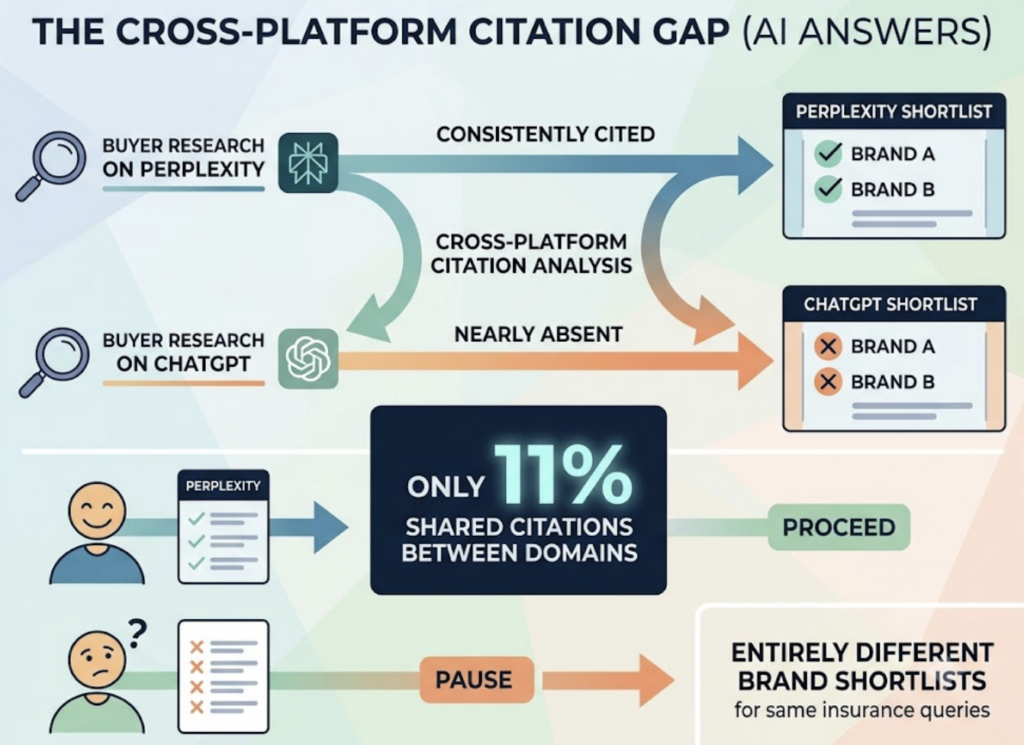
    The cross-platform inconsistency problem. A brand can appear consistently on Perplexity and be nearly absent from ChatGPT, or vice versa. Cross-platform citation analysis found that only 11% of domains are cited by both ChatGPT and Perplexity. For insurance brands, this means a buyer who starts their research on one platform and migrates to another may encounter entirely different brand shortlists.

    The brands consistently recommended across platforms are the ones whose AI crawler access, structured data, and content authority signals are strong across the board, not optimized for one channel.

    Insurance ScenarioGEO Score SignalLikely CauseAction Direction
    Site not indexed in real-time AI answersBot Access: below 30WAF or robots.txt blocking GPTBot/ClaudeBotAudit bot access rules, create AI-specific allowlist
    Coverage details absent from AI responsesStructured Data: below 40No InsurancePolicy or FAQPage schemaImplement JSON-LD schema for all product pages
    Brand cited for info queries, not quote queriesVisibility Score: split by intentContent skews educational, not transactionalBuild intent-specific landing pages with conversion signals
    Present on Perplexity, absent from ChatGPTVisibility Score: platform gapRetrieval logic differs by platformDiversify content types: Reddit threads, reviews, third-party citations

    From a One-Time GEO Score to Continuous Insurance Visibility Monitoring

    The GEO Score Checker gives you a diagnostic snapshot: four scores, one URL, 60 seconds. That’s enough to identify your weakest dimension and prioritize your first fix.

    The challenge is that GEO signals shift constantly. AI platforms update their retrieval logic. Competitors improve their structured data. A new schema requirement rolls out. A single snapshot can’t track any of that.

    That’s the gap Topify‘s platform is built to close.

    CapabilityFree GEO Score CheckerTopify Platform
    Check frequencyOne-time snapshotContinuous monitoring
    Dimensions tracked4 GEO scoresFull GEO analytics + sentiment + citations
    Historical trendsNoneFull trend history with alerts
    Competitor benchmarkingNot includedReal-time competitor tracking
    Platform breakdownAggregatedPer-platform: ChatGPT, Perplexity, Gemini, AI Overviews
    Optimization actionsDirectional guidanceSpecific, prioritized execution steps

    Comprehensive GEO Analytics tracks all four GEO dimensions over time, shows you how competitor brands are moving, and surfaces which prompt categories your brand is winning or losing. For insurance brands managing multiple product lines across multiple states, that granularity is what turns a diagnostic into a strategy.

    Plans start at $99/month. A 7-day free trial is available with no credit card required. Full pricing details are on the Topify site.

    Conclusion

    Insurance brands don’t lose AI visibility because of weak products or thin content. They lose it because compliance-optimized websites, unstructured policy data, and legacy bot-blocking rules were built for a search environment that no longer exists.

    The starting point is a score. Run your GEO Score now and you’ll know within 60 seconds which of the four dimensions is costing you the most AI citations.

    Frequently Asked Questions

    Why does my insurance website score poorly on Bot Access even though it isn’t blocked for regular users? 

    Bot Access measures whether AI-specific crawlers like GPTBot, ClaudeBot, and PerplexityBot can access your site, not whether general visitors can. Many insurance sites have web application firewall rules or robots.txt entries that block non-browser user agents, which includes AI crawlers. These rules were typically set to prevent pricing scrapes, not to block AI indexing. The AI Robots Checker can show you exactly which bots are being blocked.

    What structured data schema does an insurance site actually need to improve its GEO score? 

    The most impactful schema types for insurance are InsurancePolicy, Organization, FAQPage, and Review. InsurancePolicy markup lets AI systems extract coverage tiers, deductibles, and exclusions in a structured format they can safely cite. FAQPage schema on your coverage explainer pages significantly raises the chance of your content appearing in AI-generated answers. Most insurance sites have none of these implemented.

    Is GEO optimization different from traditional SEO for insurance brands? 

    Yes, in two important ways. Traditional SEO optimizes for click-through on a ranked result. GEO optimizes for citation inside an AI-generated answer, which often has no click at all. The buyer gets the recommendation from the AI and then searches for your brand directly. For insurance, this matters especially in transactional queries: if AI doesn’t name you when someone asks who to get a quote from, that buyer may never visit your site.

    Why does my brand appear on Perplexity but not ChatGPT? 

    Each AI platform uses different retrieval logic, citation sources, and weighting for authority signals. Perplexity draws heavily from real-time web results and review platforms. ChatGPT leans on its training data, structured pages, and high-authority third-party sources. A brand strong in one channel but weak in another typically has uneven Bot Access or inconsistent structured data across page types. The Visibility Score dimension of the GEO Score Checker will flag this divergence directly.

    Read More:

  • GEO Score Checker for Logistics: When AI Picks Your Competitor’s Freight Quote

    GEO Score Checker for Logistics: When AI Picks Your Competitor’s Freight Quote

    A procurement manager at a mid-sized manufacturer opens ChatGPT and types: “What are the best 3PLs for temperature-controlled freight in the Southeast?” The AI responds with three names. Yours isn’t one of them.

    That’s not a pricing problem. It’s not a service problem. It’s a GEO problem.

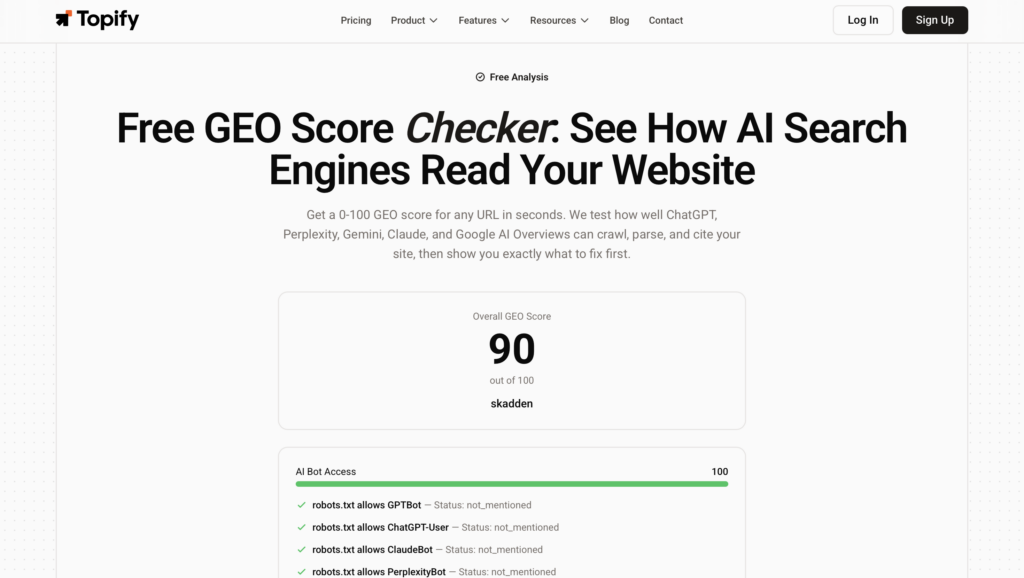
    The content on your website — coverage maps, SLA benchmarks, integration specs, cold chain certifications — exists. The issue is that it’s structured in formats AI systems treat as noise. And if AI can’t read it, it can’t cite you. Run your domain through the GEO Score Checker right now to see exactly where the gap is.

    ✅ Free   ⚡ Results in 60 seconds   🔒 No signup required

    When a Shipper Asks AI for a 3PL, Your Brand Isn’t in the Answer

    Logistics is a B2B category where the shortlisting stage is everything. By the time a procurement team issues an RFP, the vendor list is largely set. AI is now shaping that list before a single human conversation happens.

    Here’s what that looks like in practice.

    Scenario 1: Global Coverage, Invisible to AI

    A freight forwarder with 40 offices across 18 countries runs a technically rich website. Service pages detail port-to-port transit times, customs brokerage capabilities, and hazmat handling protocols. None of it reaches AI systems because the site’s robots.txt inadvertently blocks GPTBot and ClaudeBot. The forwarder scores below 25 on Bot Access. Every time a shipper asks an AI platform to recommend a global freight forwarder, that brand doesn’t exist.

    Scenario 2: Strong Technical Docs, Wrong Format

    A TMS vendor publishes detailed integration documentation: ERP connectors, carrier API specs, EDI compatibility guides. It’s exactly the content supply chain decision-makers want when evaluating platforms. The problem: it lives in gated PDFs and behind login walls. AI crawlers see a login prompt and stop. The vendor’s Content Signals score sits at 34. Its competitors with publicly accessible HTML documentation get cited instead.

    Scenario 3: Perplexity Yes, ChatGPT No

    A regional 3PL has invested in content marketing. Blog posts, case studies, a carrier network overview — all indexed and visible. Perplexity cites them regularly. ChatGPT doesn’t. The reason: ChatGPT weights structured data markup and domain authority signals differently from Perplexity’s citation model. The 3PL’s Structured Data score is 29. On the platform where most enterprise procurement teams start their research, this brand is absent.

    These aren’t edge cases. They’re the default state for most logistics companies that haven’t specifically optimized for AI visibility.

    The Four GEO Scores That Reveal Your Logistics Brand’s AI Blind Spots

    The GEO Score Checker evaluates your domain across four dimensions. Each one maps directly to how AI systems decide whether to surface your logistics brand when a shipper, procurement lead, or supply chain consultant asks for recommendations.

    Score DimensionWhat It MeasuresLogistics Impact
    Bot AccessWhether AI crawlers (GPTBot, ClaudeBot, PerplexityBot) can access your siteFreight portals, carrier networks, and TMS platforms often gate content behind logins or block bots via robots.txt — making service pages invisible to AI
    Structured DataQuality of Schema markup and JSON-LDLogistics sites rarely implement Organization, Service, or FAQPage schema, so AI can’t interpret what services you offer, where you operate, or what certifications you hold
    Content SignalsDepth, semantic authority, and E-E-A-T signals in your contentCase studies, white papers, and capability decks buried in PDFs don’t register as AI-readable content authority
    Visibility ScoreHow often your brand appears in ChatGPT, Perplexity, Gemini, and AI OverviewsMost logistics brands appear in one or two AI platforms, not all four — creating blind spots exactly where their buyers research

    Score interpretation for logistics brands:

    • 0–40: AI systems have no reliable way to identify or recommend you. Procurement teams using AI tools won’t see your name.
    • 41–60: You appear in some AI contexts, but competitors with stronger signals consistently outrank you in recommendation outputs.
    • 61–80: Solid baseline visibility. Gaps in one or two dimensions are limiting your reach in specific AI platforms.
    • 81–100: AI systems can read, understand, and recommend you with high confidence across platforms.

    How to run your check:

    1. Go to the GEO Score Checker
    2. Enter your domain or brand name
    3. Get your four-dimension score in under 60 seconds
    4. Identify your lowest-scoring dimension — that’s where AI is losing you

    What Supply Chain Buyers Actually Ask AI Before Issuing an RFP

    The shortlisting stage happens earlier than most logistics marketers realize. Procurement teams and supply chain managers are using AI to generate vendor lists, compare capabilities, and validate service claims — often weeks before they reach out to a sales team.

    These are the actual prompts circulating in logistics procurement workflows right now:

    AI Prompt ExamplePlatformSearch IntentWhat It Reveals
    “Best 3PLs for e-commerce fulfillment with same-day delivery capability”ChatGPTVendor shortlistingBrands without structured service schema won’t appear
    “Compare freight forwarders for air cargo from Asia to Europe”PerplexityCapability comparisonBrands absent from earned media citations are invisible
    “Which TMS platforms integrate with SAP and support multimodal routing?”GeminiTechnical evaluationIntegration documentation needs to be in AI-readable HTML format
    “Find cold chain logistics providers certified for pharmaceutical transport”ChatGPTCompliance verificationCertification data buried in PDFs doesn’t surface in AI answers
    “What are the top last-mile delivery solutions for high-density urban markets?”PerplexitySolution discoveryLow Content Signals scores mean competitors with more crawlable content win
    “Recommend a customs brokerage firm with experience in EU trade compliance”AI OverviewsSpecialist sourcingBrands blocked by Bot Access issues are completely excluded

    For freight carriers, logistics providers, and supply chain technology vendors, the shift to AI-mediated procurement creates a binary environment: suppliers are either algorithmically visible or effectively invisible to growing market segments.

    That gap between visible and invisible isn’t decided by your service quality. It’s decided by four technical signals.

    Why Logistics Content Scores Low on AI Signals (And It’s Not the Content Itself)

    Most logistics companies have more content than they realize. The problem isn’t quantity. It’s format, structure, and access.

    PDF-heavy documentation is the biggest culprit. Capability decks, carrier scorecards, lane rate sheets, compliance certifications — the materials that procurement teams actually want are almost universally stored as PDFs. AI crawlers can extract some text from PDFs, but they can’t reliably interpret structured relationships, hierarchies, or context. A freight forwarder’s 40-page capability document might as well not exist from an AI visibility standpoint.

    Gated content blocks AI at the threshold. Logistics platforms routinely gate their best content: integration docs, API references, case studies, SLA calculators. These require a login, a form submission, or a demo request. From a buyer experience perspective, that’s reasonable. From an AI visibility perspective, it means your most authoritative content is invisible to every AI crawler that would surface it to a procurement team.

    robots.txt configurations inherited from pre-AI SEO strategies are still blocking AI bots. Many logistics companies set up their robots.txt years ago to manage Google’s crawl budget. Those configurations often block entire subdirectories — including the service pages and technical documentation that AI systems need to understand what you do and where you do it.

    Logistics ScenarioGEO SignalLikely CauseAction Direction
    3PL not appearing in “cold chain provider” queriesBot Access: <30robots.txt blocking GPTBot/ClaudeBot on key service pagesAudit robots.txt and explicitly allow AI crawler access to service directories
    TMS vendor absent from integration comparison answersContent Signals: <35Integration docs behind login wall or in PDF formatPublish key integration capability content in accessible HTML format
    Freight forwarder visible on Perplexity, absent from ChatGPTStructured Data: <30Missing Service and Organization schema markupImplement JSON-LD schema on service pages with coverage areas and certifications
    Supply chain software brand not cited in vendor roundupsVisibility Score: <40Insufficient earned media presence and third-party citationsBuild citation footprint through industry publications and partner sites

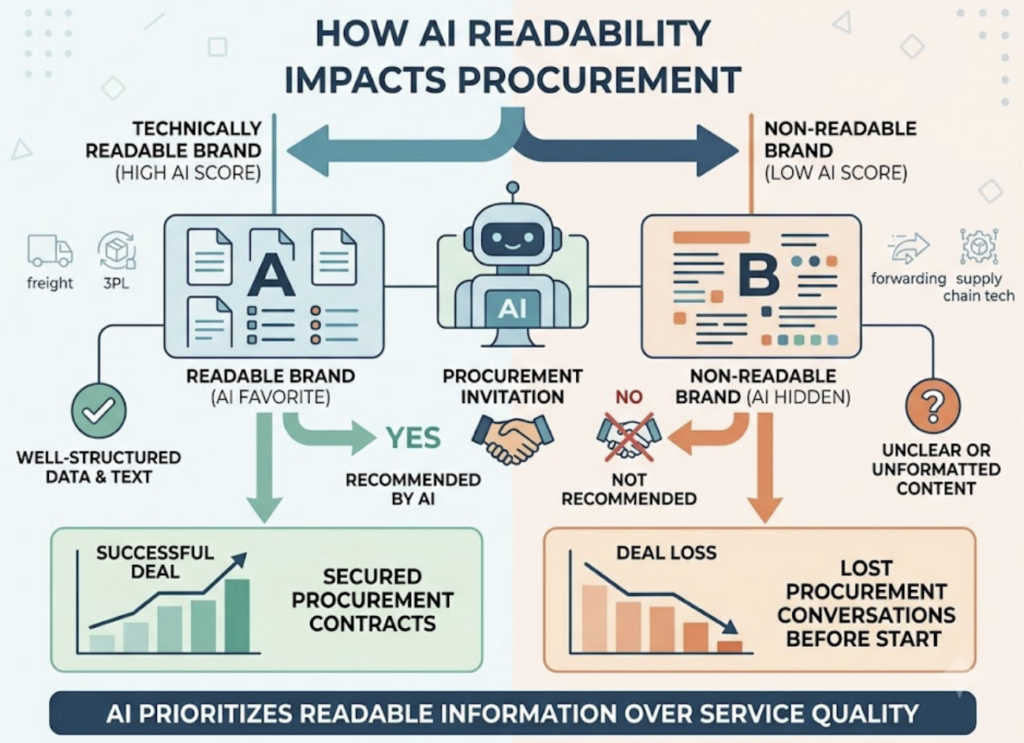
    The pattern holds across freight, 3PL, forwarding, and supply chain tech. Brands that score below 50 on these dimensions are losing procurement conversations before they start. AI recommends the brand that’s technically readable — not necessarily the one with better service.

    From a One-Time Score to Continuous Freight Brand Monitoring

    The GEO Score Checker gives you a clear starting point: four scores, instantly, no account required. That snapshot tells you where you stand today.

    The challenge is that AI visibility isn’t static. New competitors publish content. Platform citation algorithms update. Your own content expands as you enter new lanes or markets. A score from this month may not reflect your position in three months.

    That’s where Comprehensive GEO Analytics picks up. Instead of a single diagnostic, it tracks all four GEO dimensions continuously — showing you how your visibility moves across ChatGPT, Perplexity, Gemini, and Google AI Overviews over time, with alerts when signals shift and competitive benchmarks to show where gaps are opening.

    CapabilityFree GEO Score CheckerTopify Platform
    Check frequencyOne-time snapshotContinuous monitoring
    Dimensions tracked4 GEO scoresFull GEO analytics + sentiment + citation tracking
    Historical trendsNoneFull trend history with alerts
    Competitor benchmarkingNot includedReal-time competitor visibility tracking
    Platform breakdownAggregated scorePer-platform (ChatGPT, Perplexity, Gemini, AI Overviews)
    Optimization actionsDirectional guidanceSpecific, prioritized execution steps

    The checker gives you a snapshot. Topify‘s platform tracks the trajectory.

    For logistics brands managing multiple service lines, geographies, or carrier networks, continuous tracking means knowing which content changes actually moved your AI visibility — and which ones didn’t. Plans start at $99/month. You can review pricing or start a free 7-day trial — no credit card required.

    Conclusion

    AI has become the first stop in logistics procurement research. The brands that show up consistently aren’t necessarily the largest or the most established. They’re the ones that removed the technical barriers between their content and the AI systems their buyers are using.

    Check your four GEO scores today with the GEO Score Checker. It takes 60 seconds, costs nothing, and tells you exactly which dimension is costing you procurement conversations.

    If you want to go deeper, the AI Robots Checker shows you precisely which AI crawlers your robots.txt is currently blocking. The Brand Authority Checker surfaces the earned media gaps limiting your Visibility Score. And the Knowledge Freshness Checker tells you how current AI models’ understanding of your brand actually is.

    Frequently Asked Questions

    What does a low Bot Access score mean for a logistics company? 

    It means AI crawlers — GPTBot, ClaudeBot, PerplexityBot — can’t access the pages on your website that describe your services, coverage areas, and capabilities. This typically happens because of robots.txt configurations set up for traditional SEO that inadvertently block AI bots. The result: even if your content is strong, AI platforms can’t read it, so they can’t recommend you. The AI Robots Checker can identify exactly which bots you’re blocking.

    My logistics company has detailed content on its website. Why is my Content Signals score still low? 

    Content format matters as much as content quality. Case studies in PDF format, capability decks behind login walls, and integration specs in gated portals don’t register as AI-readable content authority — even if the information is excellent. AI systems need your content in accessible HTML, with clear semantic structure and demonstrable expertise signals, to treat it as authoritative. Publishing a representative sample of your technical content in open, structured HTML format typically produces measurable score improvement.

    How is GEO Score different from traditional SEO ranking for a 3PL or freight tech brand? 

    Traditional SEO measures where you rank in a list of links. GEO Score measures whether AI systems can identify, understand, and recommend your brand when someone asks a direct question. A freight forwarder can rank on page one of Google and still score below 40 on AI visibility — because the two systems use fundamentally different signals. Google reads keywords and backlinks. AI platforms read structured data, semantic authority, and crawlable content. The gap between them is where most logistics brands are currently losing ground.

    Does fixing GEO scores actually affect which freight vendors procurement teams consider? 

    Yes, in a specific and measurable way. AI systems are now used in the pre-RFP shortlisting stage. When a procurement manager asks ChatGPT or Perplexity to generate a vendor list, the brands that appear are those with sufficient Bot Access, Structured Data, Content Signals, and Visibility Score. Brands below threshold simply don’t appear — regardless of their actual service quality. Improving GEO scores doesn’t guarantee a recommendation, but scoring below 40 on any dimension typically means exclusion from AI-generated shortlists in that gap area.

    Read More:

  • GEO Score Checker for EdTech: Why AI Skips Your Course Platform

    GEO Score Checker for EdTech: Why AI Skips Your Course Platform

    A parent types “best online math tutor for 5th graders” into ChatGPT. Three brand names appear. Yours isn’t one of them.

    It’s not because your curriculum is weaker. It’s not because your pricing is off. It’s because the technical signals AI needs to verify your credibility simply aren’t there. No bot access. No structured data. No content authority signals that a language model can parse and trust.

    That’s a GEO problem, not a product problem.

    Check your EdTech platform’s GEO score in under 60 seconds, no signup required.

    ✅ Free   ⚡ Results in 60 seconds   🔒 No signup required


    EdTech Buyers Ask AI First. Your Platform Isn’t in the Answer.

    The EdTech decision journey has shifted. Parents research tutoring apps on Perplexity. Students ask ChatGPT which coding bootcamp is worth it. HR managers query Gemini for the best upskilling platforms before they ever open a vendor’s website.

    The parent looking for a math tutor

    A parent of a struggling 7th grader asks ChatGPT: “What’s the best adaptive math platform for middle school students?” The model responds with three platforms, each supported by structured content, schema-tagged instructor credentials, and verified curriculum alignment data. Your platform, which has comparable features, doesn’t appear. Not because it’s worse. Because its course pages are built for human readers, not AI retrieval systems.

    The HR manager sourcing upskilling tools

    An L&D director at a 500-person company asks Perplexity: “Which online learning platforms have the best ROI data for employee upskilling?” Perplexity pulls from review platforms, third-party reports, and sites with structured outcome statistics. If your platform buries completion rates in a PDF or gates case studies behind a form, that evidence doesn’t exist for AI.

    The student picking a coding bootcamp

    A college sophomore asks Gemini: “Is [Your Platform] a good coding bootcamp or should I use something else?” Gemini checks your domain for schema markup, looks for instructor bio pages with structured credentials, and evaluates whether your content signals expertise. A low Structured Data score means Gemini can’t verify the basics, so it defaults to brands that made the answer easy.

    That gap is measurable. And fixable.


    The Four GEO Scores Every EdTech Brand Needs to Understand

    Topify’s GEO Score Checker evaluates your platform across four dimensions, each mapped to how AI engines decide whether to recommend you. Here’s what they mean in EdTech terms:

    Score DimensionWhat It MeasuresEdTech Impact
    Bot AccessWhether AI crawlers (GPTBot, ClaudeBot, PerplexityBot) can access your siteCourse pages, curriculum PDFs, and gated content that block AI crawlers won’t be indexed or cited
    Structured DataQuality of schema markup and JSON-LD on your pagesInstructor credentials, course duration, learning outcomes, and accreditation data need structured markup to be AI-readable
    Content SignalsDepth, semantic authority, and E-E-A-T signals in your contentAI evaluates whether your platform demonstrates pedagogical expertise — thin landing pages score poorly even with strong product features
    Visibility ScoreHow often your brand appears across ChatGPT, Perplexity, Gemini, and AI OverviewsA score below 40 means AI platforms rarely cite your brand, regardless of your actual market presence

    Score benchmarks to know:

    • 0–40: Severely undervisible. AI can’t reliably identify or recommend your platform.
    • 41–60: Baseline presence, but competitors with better GEO signals have a clear advantage.
    • 61–80: Solid visibility with room to improve.
    • 81–100: High probability of consistent AI recommendation.

    When your courseware blocks the crawlers that would recommend you

    Many EdTech platforms serve their best content behind authentication walls: course modules, lesson previews, instructor bios. That’s reasonable for paying users. But when GPTBot hits a login redirect or a robots.txt that blocks indexing, your Bot Access score drops sharply. AI platforms can’t recommend content they’ve never seen.

    Credential pages with no structured data — invisible to AI

    An instructor with 15 years of experience and a Harvard PhD means a lot to a human reader. To an AI engine without JSON-LD markup, that credential is unstructured text it can’t reliably extract or trust. Your Content Signals score reflects this directly. EdTech brands that treat instructor bios as marketing copy rather than structured authority signals lose ground to competitors who’ve marked up the same information properly.

    Strong blog presence, zero Visibility Score

    It’s possible to have solid Bot Access, decent Structured Data, and good Content Signals, and still score low on Visibility. This happens when your content earns zero citations across AI platforms. In practice, it means your articles haven’t been picked up by the sources that AI platforms trust as references. Third-party reviews, accreditation body mentions, and industry press coverage all feed the Visibility Score.

    How to run the check (4 steps):

    1. Go to GEO Score Checker
    2. Enter your brand name or domain
    3. Get your four-dimensional score in 60 seconds
    4. Identify your weakest dimension and prioritize there first

    What Learners and Buyers Are Actually Asking AI

    The prompts that matter aren’t generic. EdTech buyers ask specific, intent-driven questions that AI platforms answer with citations. Here’s what that looks like in practice:

    AI Prompt ExamplePlatformSearch IntentWhat It Reveals
    “Best adaptive learning platform for K-12 students in 2026”ChatGPTProduct discoveryPlatforms with structured course data and curriculum alignment markup dominate citations
    “Which online MBA programs have the best career outcomes?”PerplexityComparison researchPerplexity pulls from review sites and outcome reports — brands without third-party data citations get skipped
    “Is [Platform Name] accredited and recognized by employers?”GeminiCredential verificationGemini checks for schema-tagged accreditation data; missing markup = unverifiable
    “Affordable coding bootcamps with job placement guarantee”ChatGPTHigh-intent purchaseOutcome statistics need to be in structured, crawlable format to appear in AI responses
    “What upskilling platform should my company use for data skills?”PerplexityB2B procurementPerplexity favors community sources and industry reports; EdTech brands absent from G2 or TrustRadius lose here
    “Compare Coursera vs [Your Platform] for professional certificates”GeminiDirect comparisonWithout structured content signals, your platform loses every head-to-head comparison AI is asked to make

    According to 5W’s EdTech AI Visibility Index Q1 2026, the top 5 EdTech brands capture a disproportionate share of AI citations across 60+ tracked prompts. Every consumer, parent, teacher, and HR buyer decision in this category now routes through an AI answer engine before any brand gets a click.

    Only 22% of EdTech marketing teams currently track AI visibility, according to Yext’s 2025 companion report. That’s the gap your competitors haven’t closed yet.


    Where EdTech GEO Scores Actually Break Down

    Most EdTech brands don’t have a content problem. They have a content structure problem.

    Course content formats that AI can’t parse

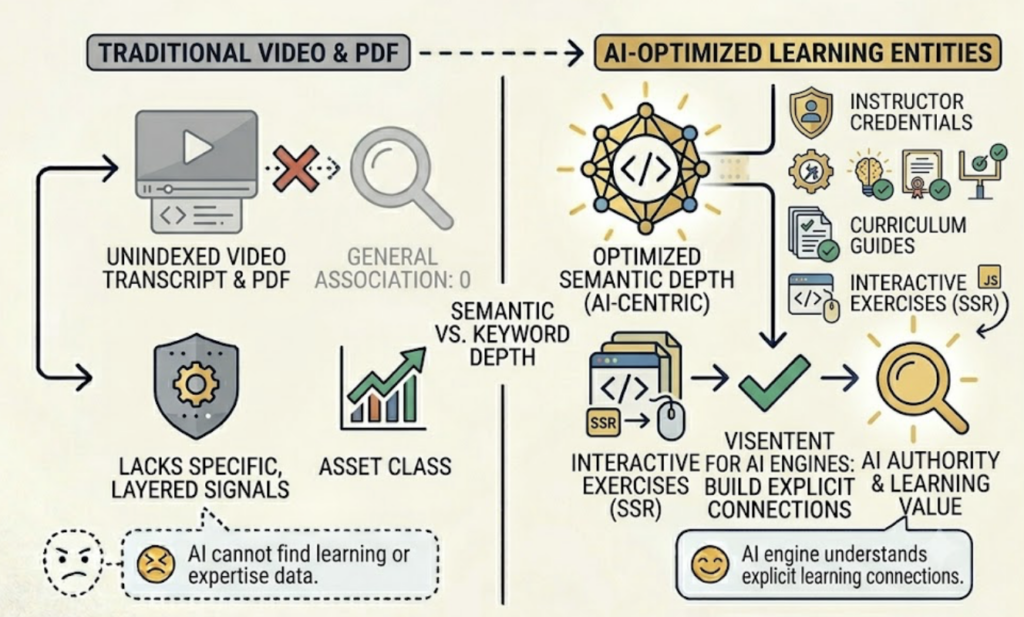
    Video-heavy platforms face a specific challenge. A 90-minute course video contains hours of expertise — but if the transcript isn’t indexed, the learning objectives aren’t marked up in schema, and the instructor credentials aren’t in JSON-LD, that expertise is invisible to AI. The same applies to PDF lesson plans, gated curriculum guides, and interactive exercises that render in JavaScript without server-side fallbacks for crawlers.

    Bot Access scores below 40 in EdTech almost always trace back to one of three causes: robots.txt rules that block AI crawlers by default, authentication walls on content that should be partially public, or JavaScript-rendered pages that GPTBot can’t fully parse.

    Accreditation and authority signals that aren’t structured

    EdTech credibility rests on proof: accreditation bodies, instructor qualifications, employer partnerships, completion and placement rates. These signals matter enormously to human readers. But AI platforms rely on structured markup to extract and verify this information.

    A platform with a Structured Data score below 40 typically lacks Course schema, Person schema on instructor pages, or Review schema on testimonials — the exact signals an AI needs to answer questions like “is this platform legitimate?” with confidence.

    Inconsistent visibility across platforms

    Here’s a pattern that GEO scores reveal clearly: an EdTech brand appears consistently in Perplexity responses but rarely in ChatGPT or Gemini. This happens because different AI platforms source information differently. Perplexity weights recent web content and community discussions. ChatGPT relies more on broad corpus authority and multi-source corroboration. Gemini favors brand-owned pages with schema.

    EdTech ScenarioGEO SignalLikely CauseAction Direction
    Platform not cited in any ChatGPT responseBot Access < 30AI crawlers blocked or no indexable contentAudit robots.txt, expose key pages to GPTBot
    Instructor credentials never mentionedStructured Data < 40No Person or Course schema on instructor/course pagesAdd JSON-LD markup to bio and course pages
    Absent from comparison promptsContent Signals < 45Thin authority content, no third-party citationsBuild case studies, earn coverage on education review sites
    Visible on Perplexity, invisible on ChatGPTVisibility Score < 50Platform fragmentation, single-source citationsDiversify content distribution across multiple authoritative sources

    A single GEO score check surfaces which of these patterns applies to your platform. It takes 60 seconds.


    From a One-Time Score to Continuous GEO Monitoring

    The GEO Score Checker gives you a clear picture of where your platform stands today. That snapshot is genuinely useful — it tells you whether your weakest link is bot access, structured data, content authority, or platform visibility.

    But GEO signals shift. A competitor updates their schema markup. A new accreditation body mentions them in a structured press release. An AI platform updates its citation preferences. Your snapshot from today may not reflect your position in 90 days.

    The checker gives you a snapshot. Topify’s platform tracks the trajectory.

    CapabilityFree GEO Score CheckerTopify Platform
    Check frequencyOne-time snapshotContinuous monitoring
    Dimensions tracked4 GEO scoresFull GEO analytics + sentiment + citations
    Historical trendsNoneFull trend history with alerts
    Competitor benchmarkingNot includedReal-time competitor tracking
    Platform breakdownAggregatedPer-platform (ChatGPT, Perplexity, Gemini, AI Overviews)
    Optimization actionsDirectional guidanceSpecific, prioritized execution steps

    EdTech brands in growth mode need to know not just where they stand, but whether they’re gaining or losing ground relative to competitors. That requires ongoing tracking, not a one-time check.

    Plans start at $99/month. All plans include a 7-day free trial, no credit card required. See full pricing details.


    Conclusion

    Most EdTech brands are invisible to AI not because their product is weak, but because the technical signals AI needs to verify credibility aren’t in place. Bot Access failures, unstructured credential pages, and missing authority content are problems you can diagnose in 60 seconds and fix systematically.

    Start with a GEO Score Checker run on your platform today. The score will tell you exactly which dimension to fix first.

    If you want to go deeper, the AI Robots Checker lets you audit your robots.txt rules against specific AI crawlers. The Brand Authority Checker gives you a focused view of how AI platforms evaluate your domain authority. And the Knowledge Freshness Checker shows how current AI models’ knowledge about your brand actually is.

    FAQ

    What is a GEO score for an EdTech platform?

    A GEO score is a 0–100 composite rating that measures how visible and credible your EdTech platform appears to AI search engines like ChatGPT, Perplexity, Gemini, and Google AI Overviews. It evaluates four dimensions: whether AI crawlers can access your site (Bot Access), whether your content is properly structured for AI parsing (Structured Data), whether your content signals genuine expertise (Content Signals), and how frequently your brand appears in AI-generated responses (Visibility Score). A score below 40 typically means AI platforms can’t reliably identify or recommend your platform.

    Why would an EdTech brand score low on GEO even if it has strong content?

    Strong content isn’t the same as AI-readable content. Many EdTech platforms produce excellent curriculum materials, instructor videos, and blog posts — but serve them in formats that AI crawlers struggle to parse: gated course modules, JavaScript-rendered pages, PDF lesson plans, or video content without structured transcripts. A low GEO score in this case usually points to Bot Access or Structured Data failures rather than content quality issues. The fix is technical, not editorial.

    How does GEO affect EdTech sales and enrollment?

    When a parent, student, or HR manager asks an AI platform for learning recommendations, the AI generates an answer from its training data and real-time sources. Brands with higher GEO scores appear in those answers more consistently. Brands with low scores are invisible in that moment — and that moment is increasingly where buying decisions begin. According to 5W’s EdTech AI Visibility Index Q1 2026, every consumer, parent, and enterprise buyer decision in the EdTech category now routes through an AI answer engine before any brand gets a click.

    Read More:

  • GEO Score Checker for Commercial Real Estate: Why AI Skips Your Firm

    GEO Score Checker for Commercial Real Estate: Why AI Skips Your Firm

    A prospective tenant types into ChatGPT: “Which commercial real estate firms handle Class A office leasing in Austin?”Three names come back. Yours isn’t one of them.

    It’s not because you lack inventory. It’s not because your track record is thin. It’s because the AI evaluating that query can’t read your market reports, can’t parse your property data, and doesn’t have enough structured signals to associate your firm with that specific request.

    That’s a GEO problem, not a product problem. And you can measure it today with the GEO Score Checker, a free tool that returns a 0–100 AI visibility score in under 60 seconds.

    ✅ Free ⚡ Results in 60 seconds 🔒 No signup required


    The Deal You Didn’t Know You Lost

    Commercial real estate decisions move slowly, but AI-assisted research happens fast. A capital markets advisor evaluating industrial acquisition targets. A corporate tenant scout comparing office leasing firms in three metros. A private equity LP screening CRE operators before a first call. All of them are now starting with an AI query, not a Google search.

    According to research tracked across real estate properties, AI referral traffic grew over 500% year-over-year in 2025 and converts at 4–5x the rate of traditional organic search. That’s not a trend worth watching. That’s a shift worth responding to.

    Most CRE firms haven’t responded yet. Their expertise sits in pitch decks, PDF market reports, and broker bios that AI crawlers either can’t access or can’t interpret. The result is a firm with deep institutional knowledge that registers as a blank to the AI platforms now shaping deal flow.

    That gap is measurable.


    The Four Numbers CRE Firms Keep Getting Wrong

    The GEO Score Checker evaluates your firm’s AI visibility across four dimensions. Each one maps directly to a failure mode common in commercial real estate.

    Score DimensionWhat It MeasuresCommercial Real Estate Impact
    Bot AccessWhether AI crawlers (GPTBot, ClaudeBot, PerplexityBot) can access your siteCRE sites with gated portals, PDF-heavy pages, or restrictive robots.txt block the crawlers that would otherwise index your expertise
    Structured DataQuality of schema markup and JSON-LD signalsProperty listings, transaction data, and service area details need structured markup to be parsed correctly by AI
    Content SignalsDepth, semantic richness, and E-E-A-T authority of your web contentExpertise locked in downloadable reports doesn’t count; AI reads what’s on the page, not what’s in the attachment
    Visibility ScoreHow often your brand surfaces across ChatGPT, Perplexity, Gemini, and AI OverviewsA firm may dominate Google for “[city] commercial real estate” and register near-zero on AI platforms

    Scores below 40 signal near-complete AI invisibility. Scores between 41–60 mean you’re present but competitively disadvantaged. Most CRE firms running the check for the first time land in that 30–55 range.

    Scenario 1: Market Reports Locked in PDFs, AI Gets Nothing

    A mid-size industrial brokerage publishes quarterly submarket reports. These reports are thorough, data-rich, and downloaded hundreds of times per quarter. They’re also completely invisible to AI.

    PDFs aren’t indexed the same way HTML pages are. GPTBot and PerplexityBot can’t reliably extract content from documents hosted behind a form or a download gate. The result: a Bot Access score in the 20–35 range, and a Visibility Score that doesn’t reflect the firm’s actual market knowledge.

    The fix isn’t to stop publishing reports. It’s to mirror that content on crawlable web pages.

    Scenario 2: Strong Rankings, Zero AI Citations

    A multifamily development firm ranks on page one of Google for several high-intent keywords. Their SEO is solid. Their AI visibility score is 38.

    The disconnect comes from Structured Data. Google crawls and indexes HTML content well without schema. AI platforms rely more heavily on structured signals to understand what a page is about, who the author is, what property types are referenced, and what geography is covered. Without that markup, the content exists but can’t be cited with confidence.

    A Structured Data score below 40 typically explains this exact pattern.

    Scenario 3: Expert Content Written for Humans, Not Machines

    A CRE advisory firm has a blog with genuine insight: cap rate analysis, lease negotiation breakdowns, market cycle commentary. The writing is sharp. The Content Signals score is still 32.

    Here’s the thing: authority in AI is built differently than authority in traditional SEO. Semantic depth matters. Entity associations matter. Whether the content explicitly connects the firm’s name to specific asset classes, transaction types, and geographies matters. Content written for a general business reader often lacks the specific, layered signals that AI uses to build entity associations.

    Good content and AI-optimized content aren’t the same thing.

    How to Run the Check in Four Steps

    1. Go to GEO Score Checker
    2. Enter your firm’s domain or brand name
    3. Wait 60 seconds for your four-dimension score
    4. Identify the lowest-scoring dimension — that’s your highest-priority fix

    What CRE Buyers Actually Ask AI Before They Call a Broker

    The prompts that matter aren’t generic. CRE buyers ask AI with deal-stage specificity. Here’s what that looks like across platforms:

    AI Prompt ExamplePlatformSearch IntentWhat It Reveals
    “Best commercial real estate firms for industrial leasing in the Inland Empire”ChatGPTBroker shortlistingWhich firms have crawlable, authoritative content linked to this submarket and property type
    “What cap rates are typical for Class B office in suburban Chicago right now?”PerplexityMarket intelligence / vendor vettingWhether your firm’s published research is structured for AI citation
    “Which CRE advisory firms specialize in sale-leaseback transactions?”GeminiService-specific qualificationWhether your structured data ties your firm’s name to this transaction type
    “Top retail property management companies in the Southeast”ChatGPTVendor evaluationWhether your content has geographic + service-type entity associations
    “Who are reliable commercial real estate developers for mixed-use projects?”PerplexityDeveloper sourcingWhether your firm appears across multiple citation-worthy sources, not just your own site

    Five prompts, five different entry points into your deal pipeline. If your firm doesn’t appear in the answers, you’re not losing to a competitor with a better website. You’re losing to a competitor whose website is better structured for AI.

    That’s a fixable problem.


    Where CRE Brands Consistently Bleed GEO Points

    Commercial real estate has structural characteristics that make AI visibility harder to build than in most other industries. Understanding the specific failure modes helps explain why a firm’s GEO Score Checker results often look worse than expected.

    The PDF expertise problem. CRE firms produce high-quality research: market outlooks, vacancy trend analyses, investment memos. The industry norm is to package this as downloadable PDFs. That norm directly conflicts with how AI platforms consume content. GPTBot doesn’t download your Q1 market report. It indexes the page it lands on. If that page is a one-paragraph description with a download button, that’s all the AI sees.

    Firms that migrate even a portion of their research content to crawlable HTML pages see measurable gains in Content Signals scores.

    The structured data gap in property information. AI platforms use schema markup to understand the relationship between entities: firm name, property type, geography, transaction role. Most CRE websites are built for visual presentation, not semantic parsing. There’s no LocalBusiness schema, no ProfessionalService markup, no property-type entity associations. The AI has to guess what you do and where you do it. It often guesses wrong by defaulting to the most visible firm with the clearest markup.

    The cross-platform consistency problem. A firm with decent Perplexity visibility may be nearly absent from ChatGPT. This isn’t random. Different AI platforms weight different signal types: Perplexity prioritizes recently crawled, cited sources; ChatGPT relies more on training data entity associations; Gemini draws heavily from Google’s knowledge graph. A firm that appears in Perplexity submarket queries may still be invisible in ChatGPT deal-sourcing conversations because its entity associations in the training corpus are weak.

    CRE ScenarioGEO Score SignalLikely CauseAction Direction
    Firm doesn’t appear in broker recommendation queriesVisibility Score: below 30Low training corpus entity presence, no third-party citationsBuild citeable web content; pursue industry publication mentions
    Research content not cited by PerplexityBot Access: below 35PDFs gated or robots.txt blocking crawlersMirror key research content as crawlable HTML pages
    AI can’t associate firm with specific asset classStructured Data: below 40Missing schema markup for service type and geographyAdd ProfessionalService + LocalBusiness schema with explicit property type associations
    Content reads well but scores low on AI authorityContent Signals: below 45Expertise not structured for entity associationsRestructure content with explicit firm-asset class-geography-transaction type linkages

    From Snapshot to Signal: Tracking Your GEO Score Over Time

    The GEO Score Checker gives you a precise starting point. You’ll know which dimension is weakest, whether that’s bot access, structured data, content authority, or platform visibility. That’s genuinely useful diagnostic information.

    The checker gives you a snapshot. Topify‘s platform tracks the trajectory.

    GEO signals shift continuously. A competitor adds structured data markup and moves up in AI recommendation sets. A Google AI Overview starts citing a new industry source that includes their name. Your submarket report gets referenced in an industry publication that Perplexity indexes. None of these changes are visible in a one-time score check.

    CapabilityFree GEO Score CheckerTopify Platform
    Check frequencyOne-time snapshotContinuous monitoring
    Dimensions tracked4 GEO scoresFull GEO analytics + sentiment + citations
    Historical trendsNoneFull trend history with alerts
    Competitor benchmarkingNot includedReal-time competitor tracking
    Platform breakdownAggregatedPer-platform (ChatGPT, Perplexity, Gemini, AI Overviews)
    Optimization actionsDirectional guidanceSpecific, prioritized execution steps

    Comprehensive GEO Analytics gives you the full picture: visibility trends across all AI platforms, citation tracking, sentiment analysis, and per-platform breakdowns. For a CRE firm managing multiple service lines or geographies, that level of detail matters.

    Plans start at $99/month with a 7-day free trial, no credit card required. See full pricing options to find the right tier.


    Conclusion

    CRE firms with strong track records are losing AI-driven deal inquiries to competitors with better-structured digital signals. That’s the core problem the GEO Score Checker surfaces, and it’s more common than most firms expect.

    Run your GEO Score Checker now to see exactly where your firm stands across all four dimensions. It takes 60 seconds and costs nothing.

    If bot access or structured data comes back as your weakest dimension, the AI Robots Checker lets you audit your robots.txt in detail. The Brand Authority Checker helps you understand how AI platforms currently perceive your firm’s authority signals. And the Knowledge Freshness Checker shows how current AI models’ understanding of your brand actually is.

    Frequently Asked Questions

    What is a GEO Score for a commercial real estate firm?

    A GEO Score is a 0–100 composite rating that measures how visible your CRE firm is to AI platforms like ChatGPT, Perplexity, and Gemini. It evaluates four dimensions: whether AI crawlers can access your site, whether your content is properly structured for machine parsing, whether your pages carry sufficient authority signals, and how often your brand actually surfaces in AI-generated responses. A score below 40 typically means AI platforms can’t reliably identify or recommend your firm, even for queries directly relevant to your services.

    Why would a CRE firm with strong Google rankings score low on GEO?

    Google and AI platforms use different signals. Google indexes HTML content effectively without requiring structured markup. AI platforms rely more heavily on schema data, entity associations, and semantic richness to understand what a firm does, where it operates, and what asset classes it handles. A firm can rank on page one for “Chicago industrial leasing” while registering near-zero on AI recommendation queries for the same topic, simply because the underlying page structure doesn’t communicate those associations to AI in a parseable way.

    Does the GEO Score Checker work for regional or boutique CRE firms, not just global brokerages?

    Yes, and in practice it’s often more useful for mid-size and regional firms. Large global brokerages tend to have some baseline AI visibility by default because of their training corpus presence. Boutique firms and regional specialists are more likely to have genuine GEO blind spots, particularly around Bot Access and Structured Data, because their sites are built for client presentation rather than AI indexing. The checker gives any firm a precise read on where those gaps actually are.

    How often should a CRE firm check its GEO Score?

    A one-time check is a useful starting point. But GEO signals shift as competitors update their content, as AI platforms retrain on new data, and as industry publications publish new citations. Checking once per quarter gives you a directional read. If you’re actively optimizing — adding schema markup, migrating PDF research to HTML, building third-party citation volume — you’ll want more frequent checks to track whether the changes are registering. That’s where continuous monitoring via Topify’s platform becomes relevant.

    Which GEO dimension matters most for CRE firms?

    It depends on the specific failure mode. Bot Access is the floor: if AI crawlers can’t reach your pages, the other dimensions don’t matter. Structured Data is the most common gap for CRE firms specifically, because the industry defaults to visual-first website design that lacks ProfessionalService and LocalBusiness schema. Content Signals tend to underperform when expertise lives in PDFs rather than crawlable pages. Visibility Score is the output of the other three: fix the upstream signals, and platform presence follows. Run the checker to see which dimension is lowest — that’s where to start.

    Read More:

  • GEO Score Checker for Cybersecurity: Why CISOs Can’t Find You in AI Search

    GEO Score Checker for Cybersecurity: Why CISOs Can’t Find You in AI Search

    A CISO opens ChatGPT. She types: “What are the best EDR solutions for a mid-market company without a dedicated SOC?” Within seconds, she gets a shortlist of three vendors, each with a brief rationale. Your product isn’t on it.

    That’s not a brand awareness problem. It’s a GEO problem.

    Your SEO ranking doesn’t travel into AI search. Your Google traffic doesn’t tell you whether ChatGPT knows your product exists. And the technical content you’ve invested in — threat intelligence reports, CVE advisories, compliance documentation — may be formatted in ways that AI engines can’t parse, cite, or trust.

    Check your GEO score in under 60 seconds. No signup required.

    ✅ Free    ⚡ Results in 60 seconds    🔒 No signup required


    The CISO’s AI Research Session That Didn’t Include You

    A February 2026 benchmark by GrackerAI tested 100 cybersecurity vendors across six AI platforms using 250 buyer-intent prompts. The result: 73% of those vendors received zero citations from ChatGPT when buyers searched for their category.

    Not a low ranking. Zero citations.

    What made the finding harder to ignore: the invisible vendors weren’t weak brands. Several had strong domain authority, active blogs, and 50,000+ monthly Google visitors. One enterprise security firm with dominant organic rankings received zero ChatGPT citations, while a competitor with far less traffic appeared consistently across multiple platforms because their content was structured for AI consumption.

    The disconnect comes down to how AI search works differently from keyword search. Buyers in Google search for brand names and product categories. Buyers in AI search ask questions: “Which SIEM is easiest to deploy for a company with three IT staff?” “What’s the difference between XDR and MDR for retail?” These are use-case-driven, role-specific prompts that most cybersecurity vendors never wrote content to answer — at least not in a format AI can extract and cite.

    That gap is measurable. That’s exactly what the GEO Score Checker diagnoses.

    The Four GEO Scores That Decide If AI Recommends Your Security Brand

    Topify‘s GEO Score Checker evaluates your site across four dimensions, each one scoring a different layer of your AI visibility. For cybersecurity brands, each dimension maps to a specific structural problem that’s common in the industry.

    Score DimensionWhat It MeasuresCybersecurity Impact
    Bot AccessWhether AI crawlers (GPTBot, ClaudeBot, PerplexityBot) can access your siteMany security vendors restrict crawlers in robots.txt as a security posture — inadvertently blocking AI indexing
    Structured DataQuality of schema markup and JSON-LD for AI comprehensionCVE pages, product datasheets, and compliance docs often lack the structured markup AI needs to extract key claims
    Content SignalsDepth, semantic relevance, and E-E-A-T authority signalsTechnical whitepapers are authoritative but often formatted as dense PDFs — formats that AI can’t reliably cite
    Visibility ScoreActual presence and citation frequency across ChatGPT, Perplexity, Gemini, and AI OverviewsA vendor may appear in Perplexity but be absent in ChatGPT, a platform-specific gap most audits never surface

    Scores run from 0 to 100. In practice, a score below 40 means AI engines can’t reliably identify or recommend your brand. A score between 41 and 60 means you’re discoverable but likely losing ground to competitors with better-structured content. Above 61, you’re in a position to start capturing AI-referred traffic consistently.

    Bot Access: Your CVE Pages Might Be Blocking GPTBot

    Cybersecurity teams often restrict external crawlers by default. It’s a reasonable instinct from a security standpoint. But GPTBot, ClaudeBot, and PerplexityBot are not threats — they’re the agents that decide whether your content gets cited. If your robots.txt blocks them, your entire site is invisible to the AI index.

    This is one of the most common Bot Access failures in the security sector. A vendor can publish detailed research and threat analysis, but if the crawler can’t reach the page, the content doesn’t exist from the model’s perspective.

    Structured Data: Compliance Docs That AI Can’t Parse

    Most cybersecurity brands produce content that looks authoritative: SOC 2 audit summaries, NIST framework alignments, penetration testing methodologies. The problem is format. These documents are frequently published as PDFs, image-heavy HTML, or plain text without structured markup.

    AI engines rely on schema markup and JSON-LD to understand what a piece of content is about. Without it, a detailed comparison of two firewall architectures looks identical to a blog post about company culture. The content authority is there. The signal isn’t.

    Content Signals: Technical Depth Doesn’t Equal AI-Readable Authority

    Security vendors produce deep, expert content. That’s not the issue. The issue is that depth written for a human expert reads differently than depth structured for AI extraction. Semantic relevance, E-E-A-T signals, clear entity definitions, and FAQ-style answer structures all improve how AI models evaluate and cite content.

    A threat intelligence report that starts with methodology context, clearly defines the adversary group being analyzed, and includes structured comparison tables will outperform an equally rigorous report that buries its key claims in paragraphs of narrative.

    Visibility Score: ChatGPT and Perplexity Are Different Problems

    Each AI platform cites content differently. ChatGPT leans on Wikipedia, established tech outlets, and broad authority signals. Perplexity surfaces detailed comparison content and expert reviews. Gemini tends to favor brand-owned content that’s clearly structured.

    A security vendor might score well in Perplexity by publishing detailed product comparisons but have near-zero presence in ChatGPT because their content doesn’t appear in the authoritative third-party sources ChatGPT relies on. The Visibility Score dimension in the GEO Score Checker surfaces this platform-level gap — something a single-platform audit can’t show.

    Here’s how to run the check:

    1. Go to the GEO Score Checker
    2. Enter your brand name or domain
    3. Get your four-dimensional score in under 60 seconds
    4. Identify the lowest-scoring dimension — that’s where your AI visibility is breaking down first

    How Cybersecurity Buyers Actually Use AI to Evaluate Vendors

    The buyers using AI search in cybersecurity aren’t asking vague questions. They’re asking the kinds of questions they used to ask a trusted peer or a Gartner analyst. Role-specific, use-case-driven, and often comparison-focused.

    AI Prompt ExamplePlatformSearch IntentWhat It Reveals
    “Best EDR for a 500-person company with no dedicated SOC”ChatGPTVendor shortlistingBuyers filter by org size and team capacity before they ever visit a website
    “XDR vs MDR for retail financial data protection”PerplexityCategory evaluationComparison intent — vendors absent here lose before the demo request
    “Which SIEM tools have native SOAR integration?”GeminiFeature-specific researchTechnical buyers validating product claims through AI before talking to sales
    “SOC 2 Type II certified endpoint security vendors for healthcare”ChatGPTCompliance filteringCompliance requirements are used as a first-pass filter; if your content doesn’t surface it, you’re out
    “Alternatives to [category leader] for a company under 1,000 employees”PerplexityCompetitive displacementHigh-intent buyers actively looking to switch — and AI is now the starting point

    According to Forrester’s 2026 State of Business Buying report, generative AI has become the top buyer research interaction, ahead of Google and peer referrals. And Bain research found that 95% of B2B purchases go to a vendor already on the buyer’s initial shortlist.

    The AI response determines the shortlist. If your brand isn’t in the answer, you’re not in the evaluation.

    Where Cybersecurity GEO Scores Consistently Break Down

    The two most common GEO failure modes in cybersecurity both trace back to content format, not content quality.

    The first is the PDF problem. Security vendors produce genuinely authoritative material: compliance guides, threat landscape reports, architecture whitepapers. These are exactly the kinds of documents AI models would cite — if they could access and parse them. But PDFs are structurally opaque to AI crawlers. The text may be extractable, but the context, hierarchy, and semantic relationships that schema markup provides are absent. A whitepaper published as an HTML page with proper Article schema and FAQPage markup will outperform the same content as a PDF nearly every time.

    The second failure is the crawler restriction pattern. Unlike most industries, cybersecurity vendors have operational reasons to be cautious about external bots. But AI search crawlers aren’t threat actors — and blanket restrictions in robots.txt that were set years ago may still be blocking GPTBot, ClaudeBot, and PerplexityBot today. Most teams haven’t audited this.

    Cybersecurity ScenarioGEO Score SignalLikely CauseAction Direction
    Threat intelligence reports not cited by PerplexityContent Signals: below 40Reports published as PDFs without HTML versions or schema markupConvert key reports to HTML with Article schema and FAQ sections
    Product pages absent from ChatGPT shortlistsBot Access: below 30GPTBot blocked in robots.txtAudit robots.txt and explicitly allow AI crawlers
    Compliance certifications not surfaced in buyer queriesStructured Data: below 40Certification claims in plain text, not structured with schemaAdd Organization and Product schema with certification details
    Strong Perplexity presence, zero ChatGPT citationsVisibility Score: unevenContent earns expert citations but lacks broad third-party distributionBuild presence in established security publications and analyst coverage

    There’s also a platform-consistency gap that’s specific to cybersecurity. Because security vendors often focus their content marketing on Google rankings, they optimize for keyword density and backlinks — signals that don’t translate cleanly to AI citations. A vendor can have 10,000 backlinks and still not appear in a ChatGPT response if those links come from sources the model doesn’t weight as authoritative for a buyer-intent query.

    That’s the structural misalignment the GEO Score Checker surfaces. Strong SEO doesn’t predict strong GEO.

    From a One-Time Score to Continuous GEO Monitoring

    The GEO Score Checker gives you a snapshot. A fast, useful one — but a snapshot.

    GEO signals change. A competitor publishes a well-structured threat report and starts capturing ChatGPT citations in your category. An algorithm update shifts how Perplexity weights security content. Your own site’s structured data breaks after a template migration. A one-time score won’t catch any of that.

    That’s the gap Comprehensive GEO Analytics is built to close. It tracks all four GEO dimensions continuously, monitors citation trends across platforms, and flags changes before they compound into visibility losses.

    CapabilityFree GEO Score CheckerTopify Platform
    Check frequencyOne-time snapshotContinuous monitoring
    Dimensions tracked4 GEO scoresFull GEO analytics + sentiment + citations
    Historical trendsNoneFull trend history with alerts
    Competitor benchmarkingNot includedReal-time competitor tracking
    Platform breakdownAggregatedPer-platform (ChatGPT, Perplexity, Gemini, AI Overviews)
    Optimization actionsDirectional guidanceSpecific, prioritized execution steps

    The checker tells you where you stand. The platform tracks which direction you’re moving.

    Plans start at $99/month with a 7-day free trial and no credit card required. See pricing or start a free trial to set up continuous monitoring across all four GEO dimensions.

    Conclusion

    Cybersecurity brands that rank well in Google are routinely invisible in AI search — not because their content is weak, but because it’s structured for the wrong audience. The CVE advisories, compliance documentation, and technical whitepapers that demonstrate real expertise are often locked in formats that AI crawlers can’t access, can’t parse, or can’t cite.

    That’s a solvable problem. But you can’t solve what you haven’t measured.

    Start with the GEO Score Checker. It takes 60 seconds, costs nothing, and shows you exactly which of the four GEO dimensions is holding your brand back from AI search visibility.

    Frequently Asked Questions

    What is a GEO Score for cybersecurity vendors?

    A GEO Score is a 0-100 composite rating that measures how visible your cybersecurity brand is to AI search engines like ChatGPT, Perplexity, and Gemini. It evaluates four dimensions: whether AI crawlers can access your site (Bot Access), whether your content has structured markup AI can interpret (Structured Data), whether your content carries the authority signals AI models trust (Content Signals), and how frequently your brand actually appears in AI-generated responses (Visibility Score). A score below 40 typically means AI engines can’t reliably recommend you, regardless of your Google rankings.

    Why do cybersecurity vendors often score low on GEO, even with strong SEO?

    Two structural reasons. First, many security teams restrict external crawlers in robots.txt as a default security posture — unintentionally blocking GPTBot, ClaudeBot, and PerplexityBot. Second, the content assets cybersecurity brands invest most in — compliance documentation, CVE advisories, threat intelligence reports — are frequently published as PDFs or plain HTML without schema markup. AI engines can’t extract structured claims from these formats the way they can from properly marked-up web pages. Strong SEO rankings don’t solve either problem.

    Does my cybersecurity brand need to appear on all AI platforms?

    Yes, and each platform requires a different approach. ChatGPT leans on Wikipedia, established tech media, and broad authority signals. Perplexity surfaces detailed comparison content and expert reviews. Gemini tends to favor brand-owned content that’s clearly structured. A security vendor might appear consistently in Perplexity but receive zero citations in ChatGPT — a platform-specific gap that a single-platform audit won’t surface. The GEO Score Checker’s Visibility Score dimension measures your aggregated cross-platform presence and helps identify where the gaps are largest.

    Can I improve my GEO score without rebuilding my entire content strategy?

    Often, yes. The highest-impact fixes in cybersecurity are technical, not editorial. Auditing and updating robots.txt to allow AI crawlers, converting key PDF assets into structured HTML pages, and adding Article and FAQPage schema markup to existing content can meaningfully improve Bot Access and Structured Data scores without requiring new content production. Content Signals improvements typically require more editorial work — restructuring technical content to lead with clear definitions, comparison tables, and direct answers — but the structural fixes alone can produce measurable GEO score gains.

    Read More:

  • GEO Score Checker for HR Tech: Why AI Skips Your Vendor Page

    GEO Score Checker for HR Tech: Why AI Skips Your Vendor Page

    A CHRO at a 2,000-person financial services firm opens ChatGPT and types: “What are the best mid-market HR outsourcing providers for compliance-heavy industries?” Within seconds, she gets a shortlist of three vendors with reasoning attached. Your brand isn’t one of them.

    You have the case studies. You have the compliance documentation. You have a thought leadership library that took years to build. But AI didn’t read any of it — not because the content wasn’t good, but because the technical signals that tell AI platforms “this source is authoritative” were never there.

    That’s the gap the GEO Score Checker was built to surface.

    ✅ Free   ⚡ Results in 60 seconds   🔒 No signup required


    HR Buyers Ask AI First. Your Brand Isn’t Always in the Answer.

    The vendor discovery process in HR tech has shifted faster than most marketing teams realize. According to Forrester’s 2026 Buyers’ Journey Survey, the proportion of buyers using AI in their purchase process reached 94% in 2026, and generative AI ranked as the top research source — ahead of vendor websites, peer referrals, and product experts.

    HR and HRO buyers aren’t an exception. CHROs, HR Operations leads, and Procurement Managers are typing specific, high-intent questions into ChatGPT, Perplexity, and Gemini before they ever visit a vendor’s website. By the time a buyer fills out a contact form, an AI-assembled shortlist has already filtered the consideration set.

    If your HR tech brand isn’t visible in those AI-generated answers, you’re not in the room before the conversation starts.

    The painful part: most HR tech and HRO providers have no idea where they stand. They’ve never measured their AI visibility with any precision. The GEO Score Checker changes that in 60 seconds — giving you a 0-100 composite score built from four dimensions that directly predict whether AI platforms recommend you or skip you.


    The Four GEO Scores That Reveal Your HR Tech Brand’s AI Blind Spots

    The checker evaluates your site across four dimensions. Each one maps directly to a failure mode that’s common in HR tech content.

    Score DimensionWhat It MeasuresHR Tech / HRO Impact
    Bot AccessCan AI crawlers (GPTBot, ClaudeBot, PerplexityBot) actually access your site?Compliance microsites, gated resource hubs, and subdomain structures commonly block AI bots while passing standard SEO audits
    Structured DataDoes your content have Schema markup and JSON-LD that tells AI what it means?HR tech product pages and service descriptions often lack Service, FAQPage, and Organization schema — so AI can’t interpret your offering
    Content SignalsDoes AI treat your content as authoritative?Deep compliance guides and white papers signal expertise to humans but often aren’t formatted for semantic AI indexing
    Visibility ScoreHow often does your brand appear across ChatGPT, Perplexity, Gemini, and AI Overviews?HR tech brands frequently appear in one platform’s results but are absent from others — a cross-platform gap that’s invisible until you measure it

    Score benchmarks: 0-40 means AI is essentially unable to identify or recommend your brand; 41-60 is baseline visibility with competitors holding clear advantage; 61-80 is solid but with room to close the gap; 81-100 means AI actively surfaces your brand.

    When Your Compliance Documentation Blocks the Crawlers Reading It

    Many HR outsourcing firms build dedicated compliance hubs — dedicated subdomains or gated portals housing their EU AI Act guidance, EEOC compliance frameworks, and pay transparency documentation. These sections are exactly what a compliance-focused buyer wants to see. They’re also frequently misconfigured in robots.txt to block AI crawlers.

    The result: a Bot Access score below 30. AI platforms can’t read the content that would make your brand look credible. The content exists; the visibility doesn’t.

    When Your Case Studies Earn Trust but Not AI Citations

    HR tech case studies tend to follow a predictable structure: client background, challenge, solution, results. Human readers find this persuasive. AI citation engines look for something different — structured claims, quantified outcomes with proper markup, and semantic context that connects the case study to a specific service category.

    Without CaseStudy or Article schema, without JSON-LD that ties a result (“reduced time-to-hire by 34%”) to a specific HR function, the content is readable but not citable. Content Signals scores in the 30-45 range often trace back to exactly this pattern.

    When You Rank in Perplexity but Disappear in ChatGPT

    Perplexity rewards structured, source-heavy content — the kind of material HR tech firms already produce. ChatGPT’s recommendation engine weights something different: brand recall signals, third-party mentions, and the density of authoritative external citations pointing to your domain.

    A Visibility Score in the checker’s aggregate reflects both. An HR outsourcing firm might score 65 on Perplexity-style visibility and 28 on ChatGPT-style brand mention frequency. The composite score tells you there’s a platform gap; the dimension breakdown tells you where to fix it.

    How to Run Your Check

    1. Go to GEO Score Checker
    2. Enter your brand name or domain
    3. Get your four-dimension score in under 60 seconds
    4. Identify your lowest-scoring dimension — that’s your highest-priority gap

    What HR and HRO Buyers Actually Type Into AI Platforms

    The prompts below reflect real decision-stage queries from HR tech and HRO buyers. These aren’t awareness queries — they’re evaluation-stage questions where AI is assembling a shortlist.

    AI Prompt ExamplePlatformSearch IntentWhat It Reveals
    “Best HR outsourcing providers for mid-market companies with multi-state compliance needs”ChatGPTVendor shortlistingTests brand recall and third-party mention density
    “Which HR tech platforms have strong payroll and benefits integration for 500-2,000 employees?”PerplexityFeature comparisonRewards structured product schema and citable feature claims
    “What should I look for in an HRO provider for a company scaling from 300 to 1,000 employees?”GeminiCriteria-settingSurfaces content authority and educational depth signals
    “Compare HR outsourcing vs. in-house HR for a fintech company with EU operations”ChatGPTDecision-framingTests whether your content appears in multi-format citations
    “Which HRIS vendors are compliant with the EU AI Act requirements for HR processes?”PerplexityCompliance filteringDirectly tests structured compliance content and schema markup
    “Top HR tech companies for manufacturing workforce management 2026”AI OverviewsCategory discoveryRewards entity authority and consistent cross-platform presence

    According to Forrester’s 2026 research, twice as many buyers named generative AI as their most meaningful research source compared to any other — outranking vendor websites and sales representatives. In HR tech, where procurement cycles can stretch six to twelve months, early AI visibility determines whether your brand gets evaluated at all.

    Your brand’s absence from these answers isn’t a content problem. It’s a GEO signal problem.


    Why HR Tech Content Consistently Scores Below Expectations

    HR tech and HRO firms tend to produce a large volume of genuinely valuable content: compliance guides, workforce analytics reports, implementation case studies, and regulatory update bulletins. The irony is that this content type is particularly prone to low GEO scores.

    Here’s why.

    Compliance-heavy content is written for legal rigor, not AI consumption. A 40-page EU AI Act readiness guide with dense footnotes and careful qualifications signals credibility to a human reader and a procurement committee. To an AI crawler, it looks like an unstructured wall of text with no FAQPage schema, no HowTo markup, and no JSON-LD connecting the document to a specific service category. Content Signals scores for this content tend to land in the 30-45 range — not because the content isn’t authoritative, but because it’s never been formatted for AI to interpret that authority.

    There’s a second pattern specific to HR outsourcing providers. HRO firms often rely on client trust and referral pipelines built over years. Their web presence is secondary to their relationship-based sales motion. As a result, their domains tend to have thin structured data, minimal third-party citation infrastructure, and — critically — no consistent entity presence across the third-party publications AI platforms treat as authoritative sources.

    Ahrefs’ analysis of ChatGPT citation behavior found that 65.3% of ChatGPT’s top-cited pages come from domains with DR80 or higher. HRO providers sitting at DR40-55 with thin external citation profiles face a structural disadvantage in AI-generated shortlists that no amount of content volume will fix.

    The GEO Score Checker surfaces these gaps across all four dimensions in a single run. The Bot Access score tells you if your site is even reachable. The Structured Data score tells you if AI understands what you offer. The Content Signals score tells you if your content is being treated as authoritative. And the Visibility Score tells you where you’re winning and where you’re invisible across platforms.

    That’s the diagnostic picture most HR tech marketing teams have never had.


    From a One-Time Score to Continuous GEO Monitoring

    The GEO Score Checker gives you an accurate snapshot of where your AI visibility stands today. That snapshot is genuinely useful — most HR tech brands discover at least one dimension below 40 on their first run.

    But GEO signals aren’t static. A competitor publishes a well-structured compliance guide. A new AI model update shifts how ChatGPT weights brand mentions. Your structured data gets overwritten in a CMS migration. Any of these changes your score without you knowing.

    That’s where Comprehensive GEO Analytics from Topify closes the gap.

    CapabilityFree GEO Score CheckerTopify Platform
    Check frequencyOne-time snapshotContinuous monitoring
    Dimensions tracked4 GEO scoresFull GEO analytics + sentiment + citations
    Historical trendsNoneFull trend history with alerts
    Competitor benchmarkingNot includedReal-time competitor tracking
    Platform breakdownAggregatedPer-platform (ChatGPT, Perplexity, Gemini, AI Overviews)
    Optimization actionsDirectional guidanceSpecific, prioritized execution steps

    The checker tells you where you stand. The platform tracks which direction you’re moving — and flags when a competitor’s score starts climbing.

    For HR tech and HRO firms operating on long sales cycles, that trajectory visibility matters. A CHRO who doesn’t see your brand in an AI answer today may run the same query in three months. The question is whether you’ve closed the gap by then.

    Topify’s Standard plan starts at $199/month with a 7-day free trial, no credit card required. See the full breakdown on the pricing page.

    Conclusion

    HR tech and HRO buyers are building their vendor shortlists in AI platforms before your sales team hears their name. Your compliance documentation, your case studies, your thought leadership library — none of it converts to AI visibility unless the underlying GEO signals are in place.

    Start with the data. Run your domain through the GEO Score Checker and find out which of the four dimensions is holding your AI visibility back.

    If your Bot Access score is low, the AI Robots Checker helps you trace the exact robots.txt configuration blocking your crawlers. If your Content Signals score needs work, the Brand Authority Checker surfaces the entity authority gaps that are limiting AI citations. And if you want a full cross-platform picture before you start optimizing, the AI Visibility Report gives you a structured baseline across ChatGPT, Perplexity, Gemini, and AI Overviews.


    Frequently Asked Questions

    What is a GEO score and why does it matter for HR tech companies?

    A GEO score (Generative Engine Optimization score) is a 0-100 composite measure of how well your website is configured for AI platforms to find, read, and recommend your brand. For HR tech and HRO companies, it matters because buyers are now using ChatGPT, Perplexity, and Gemini to shortlist vendors before visiting any website. A low GEO score means your brand is filtered out before the evaluation even begins.

    Why would an HR outsourcing provider score low on Bot Access if their SEO is healthy?

    Standard SEO audits check whether Googlebot can crawl your site — they don’t check for AI-specific crawlers like GPTBot, ClaudeBot, or PerplexityBot. Many HR firms have robots.txt rules that block these bots explicitly or accidentally, particularly on compliance resource hubs and gated content subdomains. You can pass a standard technical SEO audit and still score below 30 on Bot Access.

    How is a GEO score different from a Google search ranking?

    Google rankings reflect where your pages appear in a list of links. A GEO score reflects whether AI platforms treat your brand as a trustworthy, citable source when synthesizing answers. The two don’t move together. An HR tech firm can hold strong Google rankings for competitive keywords while being entirely absent from AI-generated vendor shortlists — because the signals AI engines weight (structured data, entity authority, cross-platform citation frequency) are different from what Google’s ranking algorithm prioritizes.

    What’s typically the lowest-scoring dimension for HR tech and HRO websites?

    Content Signals is the most commonly underperforming dimension in this space. HR firms produce substantial content — compliance guides, white papers, case studies — but it’s almost never formatted for AI semantic indexing. No FAQPage or HowTo schema, no JSON-LD connecting service descriptions to specific HR functions, no structured citations tying outcomes to service categories. The content is authoritative; the markup that tells AI it’s authoritative is missing.

    How often should an HR tech brand re-run its GEO score check?

    At minimum, after any major site change: CMS migrations, content hub redesigns, new subdomain launches, or significant robots.txt updates. In practice, GEO signals shift whenever a competitor publishes well-structured content, when AI model updates change citation weighting, or when third-party publications that reference your brand get indexed or removed. A one-time check gives you a baseline. Continuous monitoring — available through Topify’s platform — is what tells you whether that baseline is improving or eroding.

    Read More:

  • GEO Score Checker for Accounting and Tax: Why AI Skips Your Firm’s Credentials

    GEO Score Checker for Accounting and Tax: Why AI Skips Your Firm’s Credentials

    A prospective client needs help with an IRS audit. They open ChatGPT and type: “Which accounting firms specialize in IRS audit representation for real estate investors in Austin?” A list of three firms appears. Yours isn’t one of them.

    It’s not because your firm lacks the expertise. It’s because your website was built for Google crawlers from 2015, not the AI engines clients use in 2026.

    That gap is measurable. Topify’s GEO Score Checker runs a free diagnostic on your firm’s website and returns four scores that explain exactly why AI platforms skip your credentials, even when those credentials are real and strong.

    ✅ Free   ⚡ Results in 60 seconds   🔒 No signup required

    Your Credentials Are Invisible. Here’s What the GEO Checker Finds.

    Most CPA and tax advisory firms have earned genuine authority: state licenses, AICPA membership, IRS Enrolled Agent designations, decades of client work in specific niches. That authority matters to clients. It matters to AI engines too, but only when it’s machine-readable.

    Here’s where most firms discover the problem.

    Scenario 1 — CPA License Buried in a Partner Bio

    A firm’s managing partner has 20 years of experience in international tax treaties. The bio page lists her CPA license number, her credentials, and her publication history. It’s all there.

    But the page has no structured data markup. GPTBot crawls it, sees unformatted text, and can’t parse which terms are credentials versus descriptive copy. The AI moves on to a competitor whose simpler site has clean JSON-LD schema. According to research tracking AI recommendations for accounting firms in 2026, firms recommended by ChatGPT share one consistent trait: entity data that AI crawlers can read without guessing.

    Scenario 2 — Tax Specialty Pages Blocking AI Crawlers

    A mid-size firm rebuilt its website in 2023. The developer added Disallow: / for several bots to improve page speed. One of those bots was GPTBot. The firm’s entire practice area content, including detailed pages on R&D tax credits, estate planning, and multistate nexus issues, became invisible to ChatGPT.

    Bot Access is the first GEO score the checker evaluates. A score below 30 here means no amount of content quality will save your AI visibility.

    Scenario 3 — Strong Google Presence, Zero ChatGPT Visibility

    This is the most common pattern in accounting. A firm ranks on page one of Google for “small business CPA Chicago.” Their Google Business Profile has 80 reviews. But when clients ask Perplexity or ChatGPT for CPA recommendations, the firm doesn’t appear.

    Google rankings and AI recommendations are built on different signals. Google indexes pages. AI engines recommend entities. Those are two different technical problems.

    The Four GEO Scores That Expose Your Firm’s AI Blind Spots

    Run your firm’s website through the GEO Score Checker and you’ll get four scores. Here’s what each one means in the context of accounting and tax services.

    Score DimensionWhat It MeasuresAccounting & Tax Impact
    Bot AccessWhether AI crawlers (GPTBot, ClaudeBot, PerplexityBot) can access your siteCredential pages, practice area content, and team bios are only useful if AI can read them
    Structured DataQuality of schema markup and JSON-LD on your siteCPA credentials, service types, and AccountingService schema determine whether AI understands your firm’s specializations
    Content SignalsDepth and authority of your written contentFAQ pages answering IRS audit questions, tax planning guides, and niche specialty content signal E-E-A-T to AI
    Visibility ScoreHow often your brand appears in AI platform responsesMeasures whether ChatGPT, Perplexity, Gemini, and Google AI Overviews are actively recommending your firm

    Score benchmarks to keep in mind:

    • 0-40: AI effectively can’t identify or recommend your firm
    • 41-60: Basic visibility, but most competitors with structured data have a clear edge
    • 61-80: Good foundation, meaningful gaps remain
    • 81-100: AI has a strong basis to recommend you proactively

    How to run the check:

    1. Go to the GEO Score Checker
    2. Enter your firm’s domain name
    3. Get four scores within 60 seconds
    4. Identify your weakest dimension, that’s your starting point

    Most accounting firms find their lowest score in Structured Data. It’s the most fixable, and it’s the one with the most direct connection to whether AI understands what your firm actually does.

    How Clients Actually Use AI to Find a Tax Advisor

    Clients aren’t typing “CPA near me” into Google anymore, or not exclusively. A growing share are asking AI full questions and booking whoever gets named in the answer.

    The prompts they use carry high commercial intent. They’re specific, service-focused, and often include niche qualifiers that favor specialized firms.

    AI Prompt ExamplePlatformSearch IntentWhat It Reveals
    “Best CPA for S-corp tax planning in Denver”ChatGPTService + location + entity typeFirms with entity-specific content and local schema get named; generalist sites don’t
    “Who handles IRS audit representation for real estate investors?”PerplexityNiche specialty + problem typeContent authority in that niche is the deciding factor
    “Compare tax advisory firms for cross-border US-UK income”GeminiMulti-country expertiseStructured credential data and published international tax content drive recommendations
    “Which accounting firm is best for startup equity compensation?”ChatGPTIndustry-specific financial complexityFirms with case studies, published guides, or schema-tagged service pages win
    “Find me a bookkeeping service for e-commerce businesses under $5M revenue”PerplexityIndustry + size qualifierService page specificity and crawlable pricing/scope content determine visibility

    If your firm handles any of these queries in real client work but your website doesn’t answer them in structured, crawlable language, you’re not in the running.

    That gap has real consequences. According to a January 2026 Deloitte study, 63% of finance organizations have deployed AI, and their clients are increasingly using AI tools to identify and hire professionals. The window to fix this is open. It won’t stay open indefinitely.

    Where Accounting Firms Consistently Lose GEO Points

    The accounting industry has a specific set of structural problems that make AI visibility harder than it needs to be.

    Credentials exist but aren’t structured. CPA license numbers, AICPA section memberships, IRS Enrolled Agent designations, state bar admissions for tax attorneys — these are legitimate authority signals that AI engines actively look for. The problem is that most accounting firm websites have zero structured data, so those credentials exist as unformatted text that AI crawlers can’t parse as authoritative signals.

    The fix isn’t complex. AccountingService schema, ProfessionalService markup, and hasCredential properties on team pages are standard JSON-LD implementations. But most firms haven’t done it.

    Compliance-heavy content blocks crawlers by accident. Many tax and accounting firms added bot-blocking rules years ago for legitimate security and compliance reasons, often without realizing those same rules now prevent AI crawlers from accessing the site. A low Bot Access score in the GEO Checker is frequently the result of a robots.txt entry made in 2021 that nobody reviewed.

    Content depth is shallow on the pages that matter. Tax planning is a service category where clients want to know the advisor understands their specific situation before they book a call. Thin service pages (“We handle business tax returns. Contact us for a quote.”) don’t generate Content Signal scores. Detailed, niche-specific content — written to answer the exact questions clients ask AI — does.

    Common Accounting Firm ScenarioLikely GEO Score SignalProbable CauseAction Direction
    Firm doesn’t appear in ChatGPT searchesBot Access: below 30GPTBot blocked in robots.txtAudit robots.txt, allow AI crawlers explicitly
    Credentials visible on site but AI ignores themStructured Data: below 40No AccountingService or hasCredential schemaAdd JSON-LD markup to team and service pages
    General practice appears, not niche specialtiesContent Signals: below 50Specialty pages lack depth and semantic structureBuild Q&A-style content for each niche practice area
    Appears in Perplexity but not ChatGPTVisibility Score: inconsistentPlatform-level citation gapsRun AI Visibility Report across platforms to identify gaps

    Cross-platform inconsistency is more common than most firms realize. A firm might appear consistently in Perplexity (which weights recent web content heavily) but remain invisible in ChatGPT (which relies more on structured entity signals). That’s a platform-specific gap, not a general visibility problem, and it requires a platform-specific fix.

    From a One-Time Score to Continuous Visibility Monitoring

    The GEO Score Checker gives you a snapshot. Four scores, one moment in time. That’s genuinely useful for diagnosing where your firm stands right now.

    The problem is that AI visibility isn’t static. A competitor updates their schema markup. A new accounting platform publishes a guide that AI starts citing. Your firm’s Content Signals drop when a batch of old blog posts stops getting indexed. These changes happen continuously, and a single score check from three months ago won’t catch them.

    That’s where Topify’s Comprehensive GEO Analytics picks up. It monitors all four GEO dimensions across ChatGPT, Perplexity, Gemini, and Google AI Overviews on an ongoing basis, with historical trend data, sentiment tracking, and competitor benchmarking built in.

    CapabilityFree GEO Score CheckerTopify Platform
    Check frequencyOne-time snapshotContinuous monitoring
    Dimensions tracked4 GEO scoresFull GEO analytics + sentiment + citations
    Historical trendsNoneFull trend history with alerts
    Competitor benchmarkingNot includedReal-time competitor tracking
    Platform breakdownAggregatedPer-platform (ChatGPT, Perplexity, Gemini, AI Overviews)
    Optimization actionsDirectional guidanceSpecific, prioritized execution steps

    For accounting firms managing client relationships over years, not weeks, the ability to track whether AI recommendation patterns are improving or eroding over time is the difference between reactive and proactive visibility management. Start a free trial to see what your firm’s trajectory looks like, or review Topify’s pricing plans before committing.

    Conclusion

    Your firm’s reputation was built in conference rooms, courtrooms, and client files. AI engines don’t have access to any of that unless you structure it for them.

    The starting point is understanding where your site actually stands. Run your firm through the GEO Score Checker and get four scores in under 60 seconds — no signup, no cost. The weakest number tells you where to start.

    From there, tools like the AI Robots Checker can pinpoint exactly which crawlers your current robots.txt blocks, the Brand Authority Checker surfaces how AI currently perceives your firm’s expertise signals, and the Knowledge Freshness Checker shows whether AI models are working from current or outdated information about your practice.

    The firms showing up in AI recommendations for high-intent accounting searches aren’t necessarily the most credentialed. They’re the ones whose credentials AI can actually read.

    FAQ

    What is a GEO Score for an accounting firm, and how is it calculated?

    A GEO Score is a 0-100 composite rating that measures how visible and accessible your firm is to AI search engines like ChatGPT, Perplexity, and Gemini. The GEO Score Checker evaluates four dimensions: whether AI crawlers can access your site (Bot Access), whether your content is marked up in machine-readable schema (Structured Data), whether your published content carries enough topical authority (Content Signals), and whether your firm actually appears in AI-generated answers (Visibility Score). Each dimension is scored independently, so you can see exactly which layer is dragging your overall number down.

    My firm ranks well on Google. Why would AI visibility be different?

    Google ranks pages based on links, keywords, and on-page signals. AI engines recommend entities based on structured data, crawlability, and content authority. A firm can rank on page one of Google for “small business CPA” while being completely absent from ChatGPT recommendations for the same query. The underlying technical requirements are different. Google doesn’t need AccountingService JSON-LD schema to rank your site; ChatGPT relies on it to understand what your firm does and who it serves. That’s why many firms discover their GEO Score is low despite strong Google performance.

    Which GEO Score dimension should accounting firms fix first?

    It depends on your scores, but Bot Access issues are the most urgent. If AI crawlers can’t access your site, the other three scores are effectively capped regardless of how good your content or schema is. After Bot Access, Structured Data tends to produce the fastest visibility improvement in accounting specifically, because CPA credentials, AccountingService schema, and hasCredential markup are well-supported by major AI platforms. Content Signals take longer to improve but have the highest long-term impact on niche recommendations.

    Does the GEO Score Checker work for small CPA firms, not just large practices?

    Yes. The checker works on any domain, and firm size doesn’t determine your score. A solo practitioner with a well-structured, crawlable website that clearly signals a specialty can outscore a regional firm with a bloated, bot-blocking site. In practice, smaller firms often have an advantage here because they can update their technical setup faster without navigating internal IT approvals. The four GEO dimensions apply equally regardless of headcount.

    Read More