Category: GEO Score Checker

  • GEO Score Checker for Management Consulting: Why AI Skips Your Firm

    GEO Score Checker for Management Consulting: Why AI Skips Your Firm

    A senior procurement director at a Fortune 500 company opens ChatGPT and types: “Which boutique strategy consulting firms specialize in supply chain transformation?” The AI responds with three names. None of them are yours — even though you’ve published twelve thought leadership pieces on exactly that topic in the past year.

    That’s not a reputation problem. It’s a GEO problem.

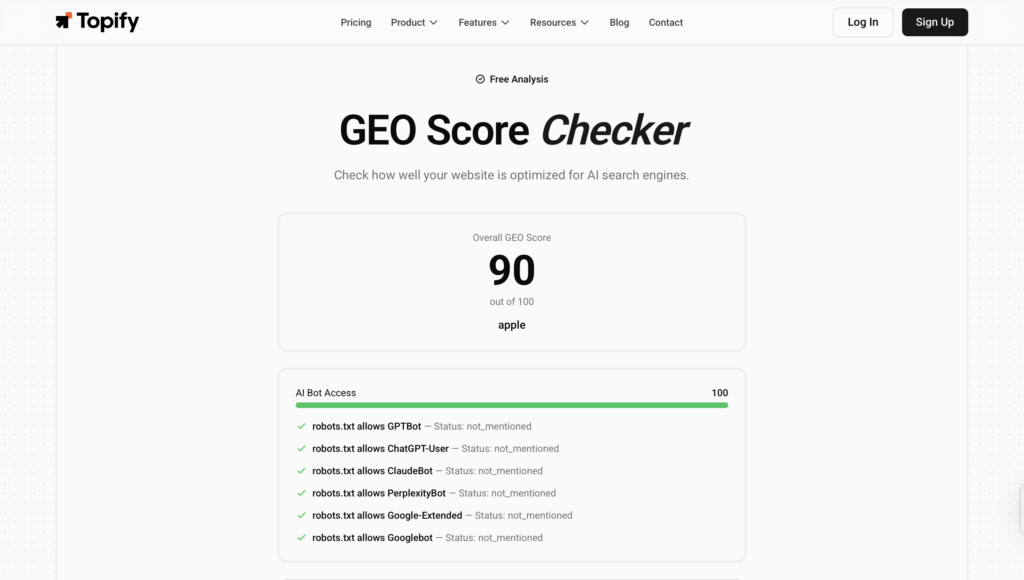
    Your content exists. Your expertise is real. But the structural signals that AI engines use to discover, parse, and recommend consulting firms are broken at the technical level. The GEO Score Checker from Topify surfaces exactly where those signals break down — in 60 seconds, no signup required.

    ✅ Free   ⚡ Results in 60 seconds   🔒 No signup required
    The Firm With Award-Winning Case Studies That AI Has Never Read

    Management consulting firms live and die by thought leadership. The business case for publishing is clear: demonstrate expertise, attract inbound interest, build authority. The problem is that most consulting content is structured for human readers and PDF downloads — not AI crawlers.

    Scenario 1: Gated Thought Leadership, Blocked Crawlers

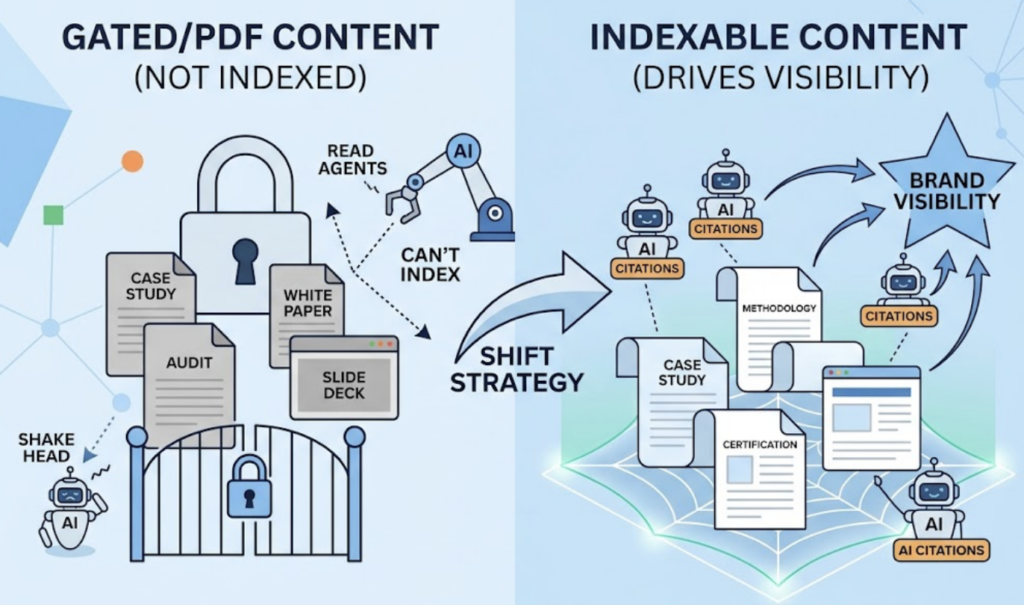
    A mid-size operations consulting firm publishes a 40-page supply chain resilience report. It’s genuinely good research. It goes behind a form gate on the website. Within 48 hours, GPTBot, ClaudeBot, and PerplexityBot attempt to index it. They hit a robots.txt disallow rule set up years ago to protect premium content. The report is invisible to every AI engine from day one.

    This is far more common than most firms realize. A low Bot Access score in the GEO Checker is often the first signal that a consulting firm’s most valuable content has been quietly excluded from AI training and retrieval pipelines.

    Scenario 2: Expert Profiles With No Structured Schema

    A consulting firm’s website lists its partners: names, bios, practice areas, speaking engagements. It reads well. But without Person schema markup and JSON-LD, AI engines can’t reliably connect “Sarah Chen, Managing Director, Digital Transformation” to the domain expertise that schema would confirm. When a buyer asks Perplexity for a “digital transformation expert with manufacturing experience,” Sarah’s profile doesn’t surface as a structured entity — it surfaces as unattributed text, if at all.

    Structured Data quality is where consulting websites consistently underperform. Most firm websites were built for visual credibility, not machine readability.

    Scenario 3: Strong Perplexity Presence, Zero ChatGPT Visibility

    Platform fragmentation hits consulting firms harder than most B2B categories. Perplexity favors community sources, expert reviews, and third-party citations — the kind of signals that consulting firms naturally generate through conference appearances and media coverage. ChatGPT leans heavily on direct source authority and structured content. A firm that scores well on Perplexity because of its published research can still have near-zero ChatGPT visibility if its own website blocks crawlers or lacks entity-level schema.

    That gap is measurable. The GEO Checker surfaces it.

    The Four GEO Scores That Expose Your Consulting Firm’s AI Blind Spots

    Run your firm’s domain through the GEO Score Checker and you’ll receive four scores. Here’s what each one means in the context of a consulting practice:

    Score DimensionWhat It MeasuresManagement Consulting Impact
    Bot AccessWhether AI crawlers (GPTBot, ClaudeBot, PerplexityBot) can access your siteGated whitepapers, login-walled case studies, and legacy robots.txtrules that silently exclude your best content from AI indexing
    Structured DataQuality of schema markup and JSON-LD across your pagesWithout Organization, Person, and Article schema, AI engines can’t reliably associate your partners’ expertise or case study outcomes with your firm as an entity
    Content SignalsDepth, semantic relevance, and E-E-A-T authority signals in your contentLong-form PDFs and gated reports don’t contribute to on-page content signals; ungated, structured web content does
    Visibility ScoreHow often your brand surfaces in responses from ChatGPT, Perplexity, Gemini, and AI OverviewsThe direct measure of whether procurement teams and C-suite buyers encounter your firm when they ask AI for vendor recommendations

    Score interpretation:

    • 0-40: AI engines largely can’t identify or recommend your firm
    • 41-60: Partial visibility, but competitors with stronger signals are getting the shortlist spots
    • 61-80: Solid foundation, meaningful gaps remain
    • 81-100: AI engines have enough signal to proactively surface your firm

    To run the diagnostic:

    1. Go to GEO Score Checker
    2. Enter your firm’s domain or brand name
    3. Get your four-dimension score in under 60 seconds
    4. Identify which dimension is your biggest gap — that’s where to start

    What Procurement Teams and C-Suite Buyers Ask AI Before They Call You

    Consulting buyers have always done research before engaging a firm. What’s changed is where that research happens. A growing share of initial shortlisting now happens in AI chat interfaces — before any website visit, before any RFP.

    According to a March 2026 analysis covering 680 million AI citations, 73% of B2B buyers now use AI tools in their purchase research process. AI-referred traffic converts at 5.1x the rate of Google organic. The buyer who arrives at your website via an AI recommendation is already further along in the decision process.

    Here are the prompts those buyers are actually running:

    AI Prompt ExamplePlatformSearch IntentWhat It Reveals
    “Best boutique strategy consulting firms for post-merger integration”ChatGPTVendor shortlistingWhether your firm’s PMI practice area is structured for AI entity recognition
    “Which consulting firms have published research on supply chain resilience in 2025?”PerplexityThought leadership discoveryWhether your ungated content is crawlable and citable by AI engines
    “Top management consultants for digital transformation in financial services”GeminiExpertise + vertical matchingWhether your sector pages have the schema and content depth to surface as authoritative
    “Consulting firms with experience in AI governance and compliance frameworks”ChatGPTSpecialized practice discoveryWhether new service lines are indexed with sufficient content signals to be recommended
    “Who are the leading independent management consultants for organizational restructuring?”PerplexityIndividual expert discoveryWhether partner profiles are structured with Person schema and third-party validation

    Each of these prompts has a decision on the other side. If your firm isn’t in the answer, you’re not on the shortlist.

    Where Consulting Firms Consistently Lose AI Visibility Points

    The two core reasons consulting firms underperform on GEO aren’t strategy failures — they’re structural patterns that developed before AI search mattered.

    The PDF trap is real. Consulting firms invest heavily in research reports, white papers, and case studies. In many cases, that content represents the highest-quality signal available to prove expertise to an AI engine. But the default distribution model — gate the content behind a form, measure leads captured — makes that content structurally invisible to AI crawlers. GPTBot doesn’t fill out forms. PerplexityBot doesn’t accept cookies. The result: your most authoritative content generates zero AI citation value.
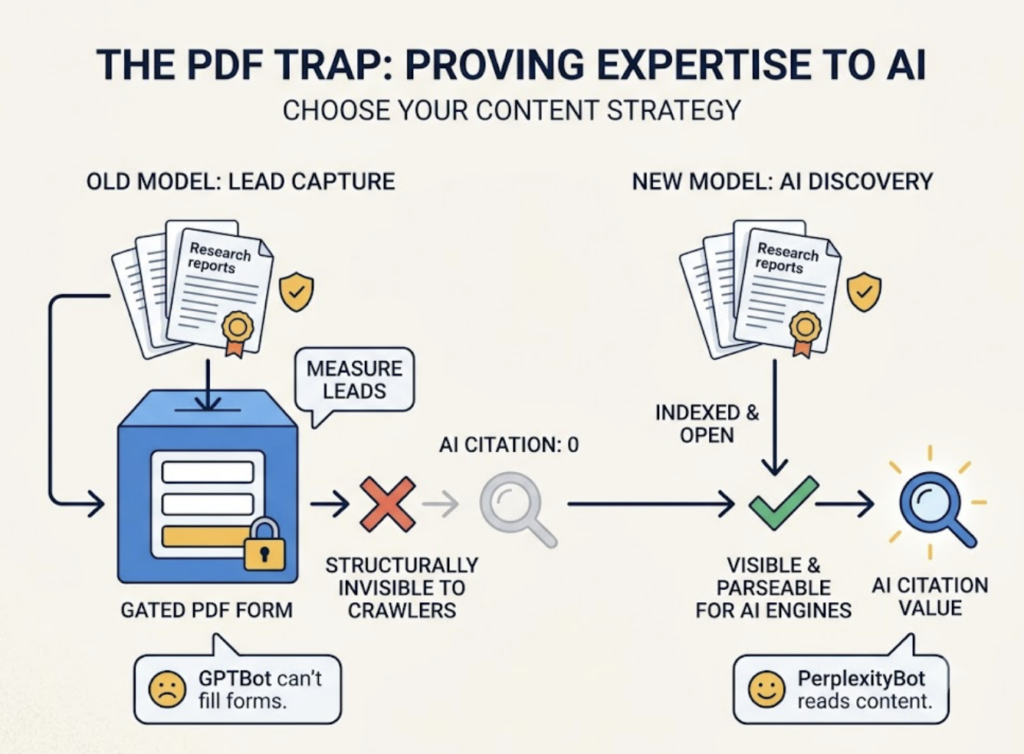
    That’s the gap between a Bot Access score of 25 and a score of 75.

    Trust signals are unstructured. The factors that make a consulting firm credible to a human reader — partner credentials, client outcomes, methodology descriptions, published research — are exactly what AI engines need to recommend that firm in response to a buyer query. But most consulting websites present those signals as flowing prose and visual design, not machine-readable schema. A case study that says “we reduced operating costs by 23% for a global manufacturer” is powerful to a reader. Without structured markup connecting it to an industry, a service line, and an outcomes type, it’s largely noise to an AI retrieval system.

    Consulting ScenarioGEO SignalLikely CauseAction Direction
    Firm not appearing in “top strategy consultants” queriesVisibility Score: <30Low third-party citations; no entity-level brand presence in AI training dataIncrease ungated content, build external citations via PR and industry publications
    Thought leadership indexed by Google but not cited by AIContent Signals: <40Content lives in PDFs behind gates; ungated pages lack semantic depthConvert key reports to ungated HTML pages with structured headings and entity markup
    Partner expertise not surfacing in specialist queriesStructured Data: <35Missing Person schema on partner profiles; no sameAs links to LinkedIn or speaking profilesImplement Person and Article JSON-LD across all partner and practice pages
    Visible in Perplexity, absent in ChatGPTBot Access: variablerobots.txt blocking GPTBot while allowing other crawlersAudit bot-specific access rules; selectively open key content to GPTBot and ClaudeBot

    Platform fragmentation is the quiet multiplier. A consulting firm might get reasonable Perplexity visibility because of third-party coverage in industry publications. That same firm can have a Visibility Score near zero in ChatGPT if its own web properties are structurally blocked or content-thin. Since only 11% of domains are cited by both ChatGPT and Perplexity, optimizing for one platform doesn’t transfer automatically to another.

    From a One-Time Score to a Firm-Wide AI Visibility Program

    The GEO Score Checker gives you a snapshot of where your firm stands right now. That’s genuinely useful — most consulting firms have never seen these four numbers for their own domain.

    But GEO signals shift. You publish new content. Competitors build citation profiles. AI models update their retrieval logic. A score you ran in January tells you nothing about where you stand in June.

    That’s what Comprehensive GEO Analytics is built for. It tracks all four GEO dimensions continuously, surfaces citation trends across ChatGPT, Perplexity, Gemini, and Google AI Overviews, and lets you benchmark your firm against competitors in real time.

    CapabilityFree GEO Score CheckerTopify Platform
    Check frequencyOne-time snapshotContinuous monitoring
    Dimensions tracked4 GEO scoresFull GEO analytics + sentiment + citations
    Historical trendsNoneFull trend history with alerts
    Competitor benchmarkingNot includedReal-time competitor tracking
    Platform breakdownAggregatedPer-platform (ChatGPT, Perplexity, Gemini, AI Overviews)
    Optimization actionsDirectional guidanceSpecific, prioritized execution steps

    The checker gives you a snapshot. Topify’s platform tracks the trajectory.

    For consulting firms serious about AI visibility, start a free trial — 7 days, no credit card required. If you want to evaluate plan options first, the pricing page breaks down what each tier covers.

    Conclusion

    Management consulting firms have spent years building content credibility. The problem in 2026 isn’t the quality of that content — it’s that AI engines were never given structural permission to read it.

    A low GEO score in Bot Access or Structured Data isn’t a judgment on your expertise. It’s a technical gap with a technical fix. And you can’t fix what you haven’t measured.

    Start with a GEO Score Checker run on your firm’s domain. The four numbers you get back will tell you exactly where your AI visibility breaks down.

    For deeper diagnosis, the AI Robots Checker maps which specific bots your robots.txt is blocking. The Brand Authority Checker surfaces how AI engines currently perceive your firm’s domain authority. And the Knowledge Freshness Checkertells you how current the AI models’ information about your firm actually is.

    The shortlist starts before the first website visit. Make sure your firm is on it.

    Frequently Asked Questions

    Why does my consulting firm rank on Google but still score low on the GEO Checker?

    Google and AI engines use fundamentally different authority signals. Google rewards backlinks, page speed, and keyword relevance. AI engines weight structured data quality, bot accessibility, and whether your content is directly citable as a source — not just indexable. A firm can hold page-one Google rankings for “management consulting” while scoring below 40 on AI Visibility because its website blocks GPTBot or lacks the entity-level schema that AI retrieval systems rely on. The two channels require separate optimization strategies.

    Does ungating our research reports actually make a difference for AI visibility?

    It’s one of the highest-impact changes a consulting firm can make. Gated content contributes zero to Bot Access scores and minimal to Content Signals — AI crawlers don’t fill out forms. Ungating a well-structured, in-depth report and publishing it as an HTML page with proper headings and schema markup can meaningfully improve both dimensions. That said, you don’t have to ungate everything. Prioritize the content that best demonstrates your practice area expertise and is most likely to be cited in response to buyer queries. Run the GEO Score Checker before and after to measure the delta.

    How often should we re-check our GEO score?

    The free checker is useful for point-in-time audits — after a website migration, after ungating a batch of content, or after implementing schema changes. For ongoing tracking, a one-time score isn’t sufficient. AI models update their retrieval logic, competitors build citation profiles, and your own content mix shifts over time. Comprehensive GEO Analyticshandles continuous monitoring so you’re not flying blind between manual checks.

    Our firm appears in some AI responses already. Does that mean our GEO score is fine?

    Not necessarily. Appearing in AI responses for branded queries — someone searching your firm by name — is a different signal than appearing in category queries like “top strategy consultants for healthcare.” Most firms have some branded visibility. The GEO score measures whether you’re surfacing for the non-branded, high-intent queries that drive actual new business. A firm can score 70+ on Visibility Score for branded searches while scoring below 30 for competitive category queries. The Checker’s four-dimension breakdown tells you which type of visibility you actually have.

    Read More:
  • GEO Score Checker for Fintech: Why AI Skips Your Brand

    GEO Score Checker for Fintech: Why AI Skips Your Brand

    A CFO at a mid-sized logistics company opens ChatGPT and types: “What’s the best embedded payments platform for B2B invoicing?” The AI responds with three names. Yours isn’t one of them.

    It’s not a product problem. Your platform handles the use case. It’s a GEO problem — your site holds the regulatory credentials, the compliance documentation, and the product depth that AI models are supposed to trust. But the technical signals required to communicate that trust are missing, misconfigured, or inaccessible to the crawlers that feed those AI responses.

    Check your GEO score in under 60 seconds. No signup. No cost.

    ✅ Free    ⚡ Results in 60 seconds    🔒 No signup required


    Your Compliance Credentials Mean Nothing If AI Can’t Read Them

    Fintech brands operate in the highest-scrutiny category for AI search: YMYL (Your Money or Your Life). That means AI models apply their strictest verification standards before citing a financial services brand. The brands that get cited aren’t always the most credentialed. They’re the ones whose credentials are structurally accessible to AI crawlers.

    That gap is measurable.

    Scenario 1: A Licensed Lender Blocked by Its Own Robots.txt

    A B2B lending platform carries a full NMLS license, publishes quarterly compliance reports, and maintains a detailed FAQ on regulatory coverage. Its Bot Access score: 18 out of 100.

    Why? A misconfigured robots.txt file blocks GPTBot and PerplexityBot from crawling the compliance section entirely. From the AI’s perspective, the lending credentials don’t exist. A competitor with weaker regulatory standing but an open crawl path gets cited instead.

    Scenario 2: Schema Markup That Doesn’t Speak Finance

    A payments infrastructure provider has deployed basic Organization schema. But its product pages lack FinancialProduct schema, LoanOrCredit schema for its credit facilities, or any JSON-LD fields encoding riskLevel, regulatoryBody, or licenseNumber. The Structured Data score reads 29.

    AI models can see the product exists. They can’t verify what it is, what regulatory body oversees it, or how it compares to alternatives. In a YMYL context, that ambiguity is disqualifying.

    Scenario 3: Visible on ChatGPT, Absent on Perplexity

    A wealthtech platform ranks well in ChatGPT responses because it’s been cited in American Banker and Banking Dive, sources that ChatGPT weights heavily. But on Perplexity, which leans toward community sources like Reddit’s r/personalfinance and r/fintech, the brand has no footprint. Its Visibility Score reflects the split: strong on one platform, invisible on others.

    This is a platform distribution problem, not a content problem. And it won’t show up in your Google Analytics.


    The Four GEO Scores That Decide If AI Recommends Your Fintech Brand

    Topify’s GEO Score Checker runs a four-dimension diagnostic on any fintech domain. Each score targets a different layer of AI citation readiness. Here’s what each one means in fintech terms:

    Score DimensionWhat It MeasuresFintech Impact
    Bot AccessWhether AI crawlers (GPTBot, ClaudeBot, PerplexityBot) can access your siteCompliance pages, product specs, and licensing data become invisible if bots are blocked — even partially
    Structured DataQuality and completeness of schema markupFintech requires FinancialProduct, LoanOrCredit, and Organization schema with regulatory metadata; generic schema fails YMYL verification
    Content SignalsSemantic authority and E-E-A-T signals in your contentNamed credentialed authors (CFA, CFP), inline disclaimers, and source-attributed claims determine citability in financial queries
    Visibility ScoreHow frequently your brand appears across ChatGPT, Perplexity, Gemini, and Google AI OverviewsA high score on one platform masks absence on others — fintech buyers research across multiple AI engines before a procurement decision

    Scores below 40 in any dimension indicate that AI models have a structural reason to skip your brand, regardless of product quality.

    How to run your diagnostic in four steps:

    1. Go to GEO Score Checker
    2. Enter your brand name or domain
    3. Receive your four-dimension scores within 60 seconds
    4. Identify the lowest score — that’s where your citation gap is largest

    The scores are comparable across competitors. If your Bot Access reads 22 and a rival fintech reads 74, you’re not competing on equal footing in AI search, regardless of your actual product capabilities.


    What Fintech Buyers Actually Ask AI Before Signing a Contract

    Procurement-grade fintech queries are already flowing through AI platforms at scale. According to a March 2026 analysiscovering 680 million AI citations, 73% of B2B buyers now use AI tools in their research process. In fintech, where deal sizes average $50K–$500K+, a single missing citation can cost a qualified pipeline entry.

    These are the prompts your buyers are typing:

    AI Prompt ExamplePlatformSearch IntentWhat It Reveals
    “Best payment orchestration platform for enterprise SaaS”ChatGPTVendor shortlistingAI prioritizes brands with technical depth indexed in trade publications
    “Which embedded lending APIs are PCI DSS compliant?”PerplexityCompliance verificationPerplexity checks community sources; brands absent from r/fintech lose citation weight
    “Compare fraud detection tools for neobanks in 2026”GeminiCompetitive evaluationGemini favors website-native content with clear comparison structure and schema
    “What compliance certifications should a B2B payments provider have?”ChatGPTRisk assessment.gov references, FINRA mentions, and inline disclaimers in content drive citation authority
    “Best treasury management software for mid-market companies”PerplexityActive procurementPerplexity surfaces brands cited in Banking Dive, American Banker, and LinkedIn content
    “Is [your brand] regulated by the FCA?”Google AI OverviewsTrust verificationAI Overviews pulls from structured regulatory data — missing Organization schema means no answer

    If your brand doesn’t appear in responses to these prompts, you’re not losing awareness. You’re losing active buyers who have already decided to purchase and are now choosing between vendors.


    Where Fintech Brands Consistently Lose GEO Points

    Fintech has a specific GEO problem that most other industries don’t: compliance teams slow content production, and that structural bottleneck compounds over time.

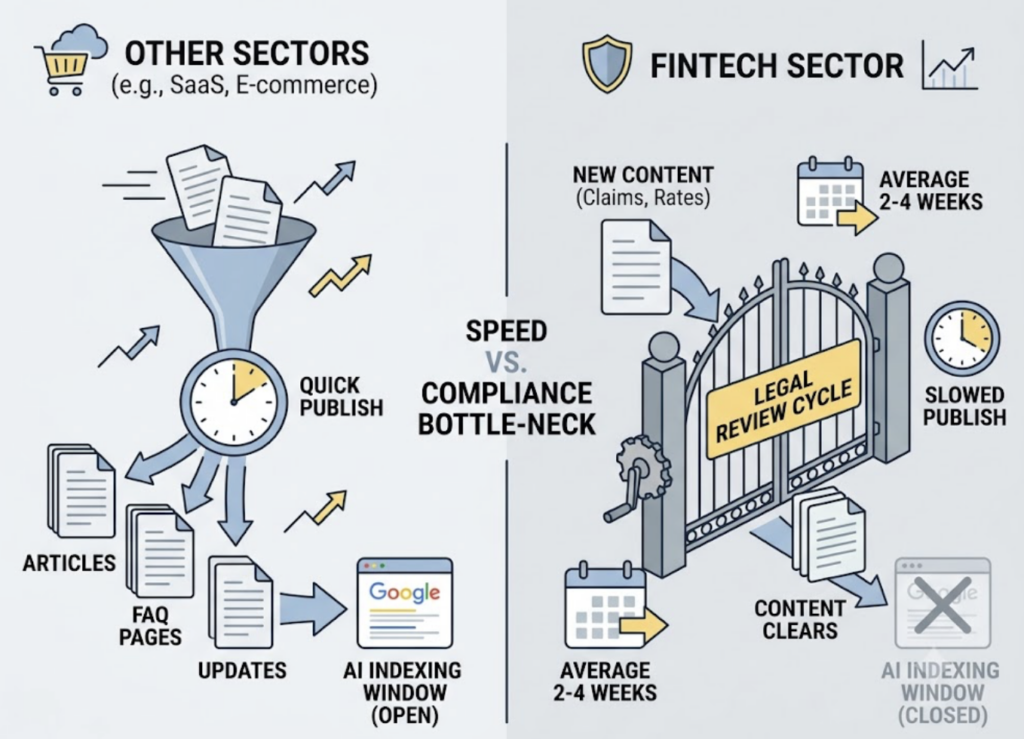
    In sectors like SaaS or e-commerce, brands fix GEO issues by accelerating content output — more articles, more FAQ pages, faster publishing cycles. Fintech can’t do that cleanly. Every piece of content that touches product claims, rate disclosures, or regulatory coverage goes through legal review. That review cycle averages two to four weeks in most mid-sized fintech organizations. By the time content clears compliance, the AI indexing window for a trending financial query has often closed.

    The result: technically weaker competitors that have invested in structured data infrastructure — proper schema markup, open bot access, clean entity signals — consistently win citations over more credentialed brands with slower content pipelines.

    That’s not a content quality problem. It’s a GEO infrastructure problem.

    The other pattern is YMYL authority decay. Financial content that was authoritative in 2023 often lacks the inline disclaimers, source attribution, and named author credentials that 2025-2026 AI models now require for citation consideration. A product page that reads “rates starting from 8.9% APR” without a regulatory source embedded in the same sentence scores lower on Content Signals than a page that reads “rates starting from 8.9% APR per the Key Fact Statement required under FCA guidelines.” Same product information. Different citability.

    Fintech ScenarioGEO Score SignalLikely CauseAction Direction
    Compliance pages not indexed by AIBot Access: <30GPTBot/PerplexityBot blocked in robots.txt or via Cloudflare rulesAudit bot-specific crawl permissions separately from Google
    Product pages missing from AI comparisonsStructured Data: <40No FinancialProduct or LoanOrCredit schema; generic Organization schema onlyAdd financial-specific JSON-LD fields including regulatory metadata
    Cited on ChatGPT, absent on PerplexityVisibility Score: splitBrand presence concentrated in publications ChatGPT favors; no Reddit/community footprintBuild citation presence across r/fintech, Banking Dive, and LinkedIn thought leadership
    Content exists but doesn’t get citedContent Signals: <45Inline disclaimers absent, no named credentialed authors, rate data not source-attributedEmbed regulatory source references within the same sentence as financial claims

    From a One-Time Score to Continuous GEO Monitoring

    The GEO Score Checker gives you a diagnostic snapshot. It tells you where your fintech brand stands today across four dimensions.

    That snapshot matters. But fintech AI visibility changes continuously. Regulatory updates shift AI trust signals. A competitor earns a citation in American Banker, moves up in Perplexity’s weighting, and displaces your brand from a vendor shortlist query. Your compliance team publishes new risk disclosures that, if properly structured, could lift your Content Signals score by 15–20 points.

    A one-time score doesn’t catch any of that.

    Topify’s Comprehensive GEO Analytics tracks all four GEO dimensions continuously, with per-platform breakdowns and competitor benchmarking. For fintech brands where a single enterprise contract can run $200K+, knowing which direction your AI visibility is trending — not just where it sits today — changes how you prioritize GEO investments.

    CapabilityFree GEO Score CheckerTopify Platform
    Check frequencyOne-time snapshotContinuous monitoring
    Dimensions tracked4 GEO scoresFull GEO analytics + sentiment + citations
    Historical trendsNoneFull trend history with alerts
    Competitor benchmarkingNot includedReal-time competitor tracking
    Platform breakdownAggregatedPer-platform (ChatGPT, Perplexity, Gemini, AI Overviews)
    Optimization actionsDirectional guidanceSpecific, prioritized execution steps

    Plans start at $99/month with a 7-day free trial, no credit card required. See full pricing details to compare tiers.


    Conclusion

    In fintech, trust is the product. AI models apply that same logic: they cite brands whose technical signals demonstrate verifiable authority, not just brands with the best products or the largest marketing budgets. If your Bot Access is blocking compliance crawls, your schema markup is missing financial-specific fields, or your content lacks inline regulatory attribution, your GEO score reflects that — and so do your AI citations.

    Start with a free GEO score check. Four scores, 60 seconds, no account required. You’ll see exactly which dimension is creating your largest citation gap.

    From there, use Topify’s AI Robots Checker to audit which bots can actually reach your compliance and product pages, and the Brand Authority Checker to see how AI models currently assess your financial authority signals. For a cross-platform visibility snapshot, the AI Visibility Report shows where you stand across ChatGPT, Perplexity, Gemini, and Google AI Overviews in a single view.

    Frequently Asked Questions

    What is a GEO score, and why does it matter for fintech brands?

    A GEO score is a 0-100 composite rating that measures how well your website is optimized for AI search engines like ChatGPT, Perplexity, and Google AI Overviews. For fintech brands, it matters because AI models apply YMYL (Your Money or Your Life) standards to financial content — the bar for citation is higher than in most industries. A low GEO score means AI can’t verify your regulatory authority, structured product data, or content credibility, so it skips your brand in favor of competitors whose signals are cleaner.

    Why would a fintech site score low on Bot Access?

    The most common causes are robots.txt rules that inadvertently block AI-specific crawlers like GPTBot, ClaudeBot, or PerplexityBot, and Cloudflare or WAF configurations that rate-limit or challenge non-browser traffic. These rules are often inherited from security policies designed to block scraping, but they don’t distinguish between malicious bots and legitimate AI crawlers. The result: your compliance pages, product specs, and licensing data become invisible to the AI models your buyers are using.

    Does having good Google SEO mean a high GEO score?

    Not necessarily. Google SEO optimizes for ranking signals — backlinks, keyword density, page authority. GEO optimizes for citation signals — structured data quality, bot accessibility, content authority markers like named authors and inline disclaimers. A fintech brand can rank on page one of Google while scoring below 40 on GEO, particularly on Structured Data and Content Signals, because financial-specific schema (FinancialProduct, LoanOrCredit) and YMYL compliance formatting aren’t standard SEO priorities.

    How often should a fintech brand check its GEO score?

    A point-in-time check with the GEO Score Checker is useful as a baseline diagnostic. That said, fintech AI visibility shifts with regulatory updates, competitor content moves, and changes in how individual AI platforms weight citation sources. In practice, monthly spot checks catch most significant drops. For brands in active growth phases or regulated market expansion, continuous monitoring via a platform like Comprehensive GEO Analytics gives a more accurate picture of where citations are being won or lost.

    Which GEO score dimension is hardest to fix for fintech companies?

    Content Signals tends to take the longest to improve in regulated fintech environments. Fixing Bot Access is largely a technical configuration task. Structured Data can be addressed by a developer in days. But improving Content Signals requires updating existing content with named credentialed authors, inline regulatory source attribution, and compliant risk disclosures — and every piece of updated content typically needs legal review before publishing. That review cycle is the structural bottleneck. It’s fixable, but it requires coordination between marketing, legal, and compliance teams that most fintech brands haven’t built yet.

    Read More:

  • GEO Score Checker for Legal Services: Why AI Skips Your Firm

    GEO Score Checker for Legal Services: Why AI Skips Your Firm

    A potential client is going through a contract dispute. They open ChatGPT at 10 p.m. and type: “What’s the best business litigation firm in Chicago?” They get three names. Yours isn’t one of them.

    Your firm has the track record. You’ve won the cases. You have the testimonials. But AI didn’t mention you.

    That’s not a reputation problem. It’s a GEO problem — and it’s measurable.

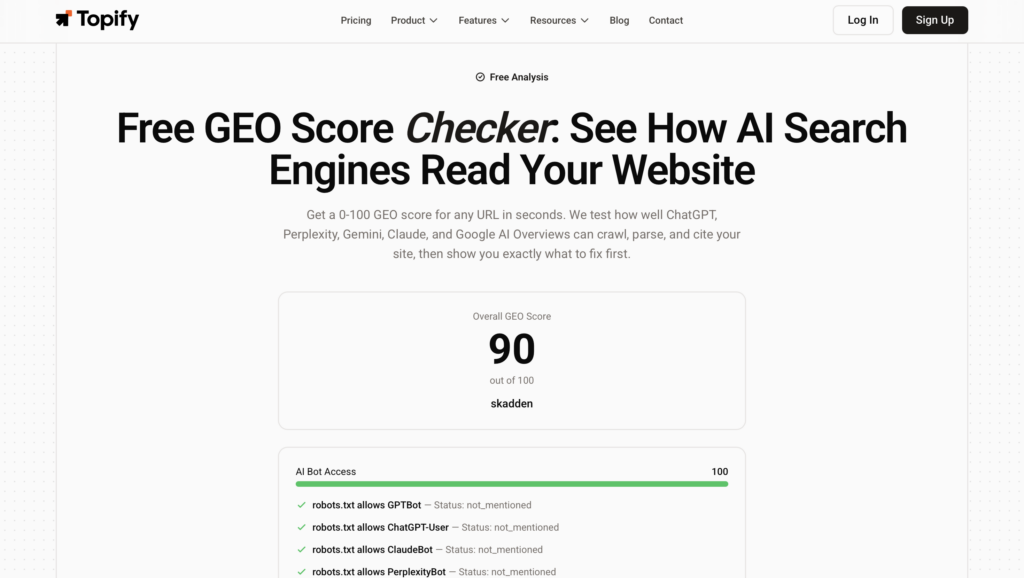
    Run your firm’s GEO Score Checker right now. You’ll have your score in under 60 seconds, no signup needed.

    ✅ Free   ⚡ Results in 60 seconds   🔒 No signup required

    Your Firm Has the Credentials. AI Has No Idea.

    Law firms lose AI recommendations not because their expertise is lacking, but because AI crawlers can’t access or interpret the credentials sitting behind the website. That’s the structural reality most practices haven’t confronted yet.

    Legal clients asking AI for attorney recommendations get answers shaped by structured data and third-party citations, not by the firm’s actual track record or case history. A firm with 40 years of M&A experience can score lower than a newer competitor simply because its website blocks GPTBot, uses no attorney schema markup, and has published content that reads fluently to humans but carries almost no semantic signal for AI models.

    Compliance-heavy legal content compounds the issue. Ethics disclaimers, jurisdiction caveats, and “this is not legal advice” footers are professionally necessary. But when poorly implemented, they can inadvertently suppress Bot Access scores by triggering crawler restrictions or signaling to AI systems that the content is non-authoritative.

    The gap between what your firm actually is and what AI can verify about you is exactly what the GEO Score Checkermeasures.

    Scenario 1: Strong Practice Area Page, Zero AI Citations

    A mid-size IP firm has well-written patent litigation pages ranking on page one of Google. But its robots.txt blocks all AI crawlers by default — a legacy setting from a 2021 site rebuild. ChatGPT can’t read the page. Perplexity returns competitors instead. The Bot Access score: 22.

    Scenario 2: Attorney Bio Blocked to AI Crawlers

    A partner’s bio page includes peer awards, bar admissions across four states, and 15 years of published case summaries. The page loads behind a JavaScript-heavy accordion layout that AI crawlers can’t parse. The Structured Data score reads 18. From the AI’s perspective, that partner barely exists.

    Scenario 3: Perplexity Visible, ChatGPT Absent

    A boutique employment law firm appears in Perplexity results for “wrongful termination lawyer NYC” because it’s been cited in a few HR publications. But it has no presence in ChatGPT or Google AI Overviews for the same query. Content Signals score: 34. The content is there — it just hasn’t been structured for cross-platform AI indexing.

    The Four GEO Scores That Expose Your Firm’s AI Blind Spots

    The GEO Score Checker evaluates your firm across four dimensions. Each one maps directly to a structural decision your web team made, often years ago, that’s now costing you client discovery.

    Score DimensionWhat It MeasuresLegal Services Impact
    Bot AccessWhether AI crawlers (GPTBot, ClaudeBot, PerplexityBot) can access your siteFirms blocking bots through robots.txt or JS-heavy layouts are invisible to AI regardless of content quality
    Structured DataQuality of schema markup and JSON-LDAttorney schema, practice area markup, and bar admissions data tell AI systems what your firm actually specializes in
    Content SignalsDepth, semantic relevance, and E-E-A-T signalsCase studies, named attorney content, and jurisdiction-specific articles drive AI authority recognition
    Visibility ScoreHow often your firm appears in ChatGPT, Perplexity, Gemini, and AI OverviewsMeasures actual AI recommendation frequency — the number that matters most to client acquisition

    Score guide: 0-40 means AI can barely recognize your firm. 41-60 is partial visibility with notable competitor advantages. 61-80 is solid but improvable. 81-100 puts you in regular AI recommendation rotation.

    How to run it:

    1. Go to GEO Score Checker
    2. Enter your firm’s name or domain
    3. Get your four-dimensional score in 60 seconds
    4. Identify which dimension is weakest — that’s your first fix

    What Legal Clients Actually Ask AI Before They Call a Lawyer

    The discovery moment has moved. Clients aren’t typing keywords anymore. They’re asking AI assistants full questions, often late at night, often in emotionally charged moments. The firm that appears in that answer gets the call.

    AI Prompt ExamplePlatformSearch IntentWhat It Reveals
    “Best employment lawyers for wrongful termination in Texas”ChatGPTHigh-intent attorney searchWhether your firm’s practice area pages have sufficient content depth and named-attorney authority
    “What should I look for in a corporate M&A attorney?”PerplexityEvaluation criteria researchWhether your thought leadership content is structured for AI extraction
    “Top immigration law firms for EB-2 NIW applications”GeminiSpecialty service lookupWhether your niche practice areas have schema markup and third-party citations
    “How do I choose between mediation and litigation for a contract dispute?”ChatGPTDecision-stage researchWhether your educational content positions your firm as the logical next step
    “Which law firms handle data privacy compliance for startups?”PerplexityB2B specialty searchWhether your firm appears in the tech and startup publication ecosystem AI pulls from

    According to BrightEdge’s 2025 analysis, around 68% of legal-related queries in the US now trigger AI-generated overviews. A firm absent from those overviews is absent from the first touchpoint most clients have.

    That gap doesn’t close on its own.

    Why Legal Firms Consistently Bleed GEO Points

    Legal websites have specific structural patterns that consistently underperform in AI scoring. Understanding where the points go is half the fix.

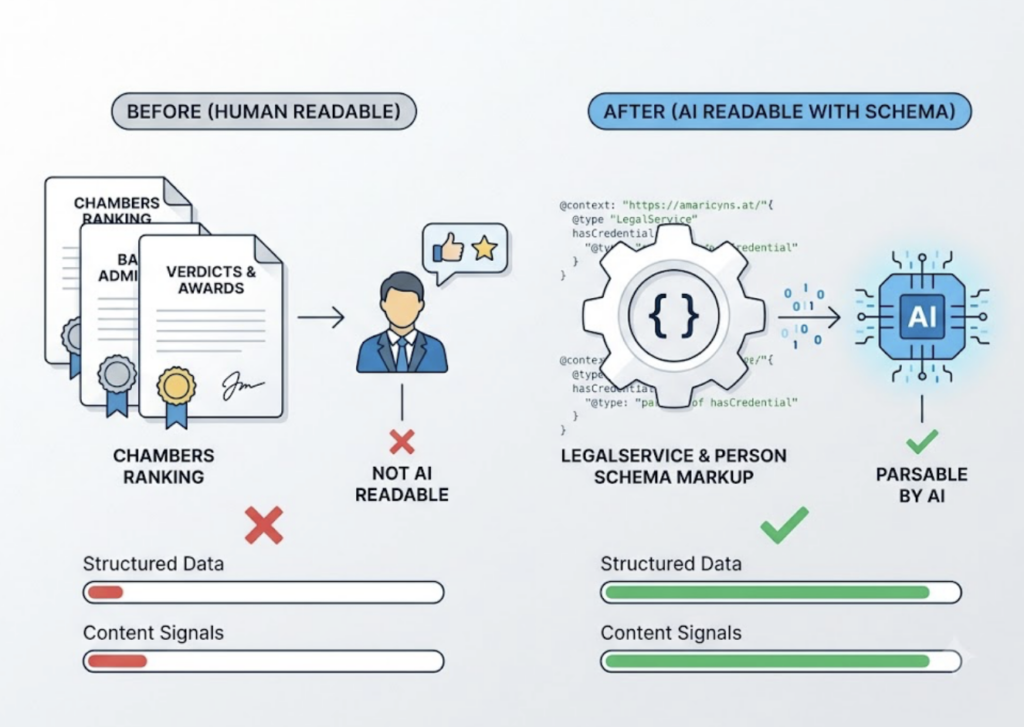
    Attorney credentials don’t translate without schema. A partner’s Chambers ranking, bar admissions, and published verdicts are powerful trust signals — for human readers. For AI systems, that information needs to be encoded in LegalService and Person schema markup to be parseable. Most law firm websites don’t have it. That’s a direct hit to both Structured Data and Content Signals scores.

    Compliance language suppresses authority signals. Legal ethics rules require firms to include disclaimers, jurisdiction notices, and “results may vary” language. When that language dominates a page’s text — especially when it appears before substantive content — AI models score the page lower on E-E-A-T (Experience, Expertise, Authoritativeness, Trustworthiness) signals. The fix isn’t removing the disclaimers. It’s structuring the page so substantive expertise content leads and disclaimers follow.

    Cross-platform inconsistency is the rule, not the exception. A firm may appear in Perplexity results because it’s been cited in a few HR or legal tech publications. But that same firm is absent from ChatGPT and Google AI Overviews because it hasn’t built the broader citation ecosystem those platforms draw from. The Visibility Score dimension captures this asymmetry precisely.

    The diagnostic table below shows common patterns:

    Legal ScenarioGEO SignalLikely CauseDirection
    Strong Google rankings, no AI citationsBot Access: below 35Crawlers blocked or JS-heavy layoutAudit robots.txt, render-test key pages
    Named attorneys not appearing in AI answersStructured Data: below 40No Person/LegalService schemaAdd JSON-LD attorney markup sitewide
    Educational content present but not citedContent Signals: below 45Content depth insufficient, no author credentials marked upAdd named authorship, expand semantic depth
    Appearing in one AI platform onlyVisibility Score: below 50Narrow citation footprintExpand to legal directories, trade publications, bar association content

    From a One-Time Score to Continuous GEO Monitoring

    The GEO Score Checker gives you a snapshot of where your firm stands today. That’s the right place to start.

    The challenge is that GEO signals don’t stay static. A competitor earns a Chambers citation. A new practice area page goes live with proper schema. A legal tech publication runs a roundup that includes three firms in your space — and none of them is yours. Each of these events shifts the AI recommendation landscape, and a one-time score won’t catch them.

    That’s the gap Topify’s Comprehensive GEO Analytics fills.

    CapabilityFree GEO Score CheckerTopify Platform
    Check frequencyOne-time snapshotContinuous monitoring
    Dimensions tracked4 GEO scoresFull GEO analytics + sentiment + citations
    Historical trendsNoneFull trend history with alerts
    Competitor benchmarkingNot includedReal-time competitor tracking
    Platform breakdownAggregatedPer-platform (ChatGPT, Perplexity, Gemini, AI Overviews)
    Optimization actionsDirectional guidanceSpecific, prioritized execution steps

    The checker tells you where you stand. Topify’s platform tracks which direction you’re moving.

    For firms actively building AI visibility, the Standard plan at $199/month covers 100 daily prompts, 30 blog posts, and full cross-platform tracking. All plans start with a 7-day free trial — no credit card required. Full pricing details here.

    Conclusion

    Most law firms aren’t invisible to AI because their work isn’t good enough. They’re invisible because the technical and structural signals AI needs to recognize them were never put in place.

    The first step is knowing your number. Run your GEO Score Checker now — it takes 60 seconds and costs nothing.

    Once you have your four scores, you’ll know exactly which dimension to address first: whether that’s fixing crawler access, adding attorney schema, deepening your content authority signals, or building a broader citation footprint.

    For deeper diagnostics, pair the GEO Score Checker with the AI Robots Checker to audit exactly which bots your site is blocking, the Brand Authority Checker to assess third-party citation depth, and the Knowledge Freshness Checker to see how current AI models’ understanding of your firm actually is.

    Frequently Asked Questions

    What is a GEO Score for a law firm?

    A GEO Score is a 0-100 rating that measures how visible your firm is to AI search engines like ChatGPT, Perplexity, and Google AI Overviews. It evaluates four dimensions: whether AI crawlers can access your site, how well your structured data communicates your practice areas, how authoritative your content appears to AI models, and how often your firm actually surfaces in AI-generated recommendations.

    Why would a well-known law firm score low on GEO?

    Brand reputation and GEO score don’t always align. A firm can have decades of experience and strong Google rankings while still scoring poorly on GEO because of technical barriers — a robots.txt that blocks AI crawlers, missing attorney schema markup, or JavaScript-heavy page layouts that AI bots can’t parse. The GEO Score Checker measures technical accessibility and AI readability, not prestige.

    Does adding legal disclaimers hurt AI visibility?

    It can, if not implemented carefully. Ethics disclaimers and jurisdiction caveats are professionally required, but when they appear before substantive content or are embedded in ways that dominate the page’s semantic signal, AI models may deprioritize the page’s authority. The fix is structural: lead with expertise content, position disclaimers below the fold or in footers, and ensure your practice area pages carry meaningful E-E-A-T signals.

    Why does my firm appear in Perplexity but not in ChatGPT?

    Each AI platform draws from different data sources and citation ecosystems. Perplexity may surface your firm because you’ve been cited in a few industry publications it indexes. ChatGPT and Google AI Overviews require a broader citation footprint — legal directories, bar association content, trade press, and consistent entity data across the web. A low Visibility Score in the GEO Score Checker often reflects this cross-platform inconsistency.

    Read More

  • GEO Score Checker for SaaS: Why AI Skips Your Trial Page

    GEO Score Checker for SaaS: Why AI Skips Your Trial Page

    A prospect opens ChatGPT and types: “What’s the best project management tool for remote engineering teams?” ChatGPT returns three names. Yours isn’t one of them.

    It’s not because your product is weaker. It’s because AI engines can’t find you, can’t read you, or don’t trust you enough to cite you. That’s a GEO problem, not a product problem.

    Run your GEO Score Checker now to see exactly where your SaaS website stands. No signup needed. Results in 60 seconds.

    ✅ Free   ⚡ Results in 60 seconds   🔒 No signup required


    The AI Recommendation Your Competitor Just Got (And You Didn’t)

    The B2B SaaS buying journey has shifted. 73% of B2B buyers now use AI tools like ChatGPT and Perplexity in their research process. They’re not browsing G2 listings or clicking Google ads first. They’re asking AI to build their shortlist.

    AI-referred traffic converts at 14.2%, compared to Google organic’s 2.8%. That’s a 5x+ advantage on traffic that’s already ready to evaluate.

    Here’s the part most SaaS teams haven’t processed yet: only 18% of brands have an active AI visibility strategy. The other 82% are invisible by default, and their standard dashboards don’t measure it, so they don’t know it’s happening.

    That gap is measurable. And it starts with four numbers.


    The Four GEO Scores That Decide If AI Recommends Your SaaS Product

    The GEO Score Checker evaluates your website across four dimensions, each one mapped to a specific reason AI engines skip your brand. Here’s what each score means in SaaS terms:

    Score DimensionWhat It MeasuresSaaS Impact
    Bot AccessWhether AI crawlers (GPTBot, ClaudeBot, PerplexityBot) can access your siteIf your trial page or pricing page blocks bots, AI engines never see your most conversion-relevant content
    Structured DataWhether AI can interpret your product category and feature setWithout SoftwareApplication schema, AI treats your SaaS product like a generic webpage, not a tool to recommend
    Content SignalsWhether your content is authoritative enough for AI to citeThin feature pages and marketing copy score low; comparison guides, use-case articles, and original data score high
    Visibility ScoreHow often your brand appears in AI-generated answers across ChatGPT, Perplexity, Gemini, and AI OverviewsThe aggregate output: is AI recommending you or your competitors when buyers ask category questions?

    Score benchmarks to know:

    • 0-40: AI largely can’t identify or recommend you
    • 41-60: Baseline visibility, but competitors with stronger signals have a clear edge
    • 61-80: Good standing with room to improve on specific dimensions
    • 81-100: AI is likely recommending you unprompted in relevant queries

    Bot Access: Are GPTBot and PerplexityBot Actually Crawling Your Trial Pages?

    Most SaaS teams configure robots.txt for Google. They don’t think about GPTBot, ClaudeBot, or PerplexityBot as separate entities with separate access rules.

    If your trial page, pricing page, or feature comparison page blocks AI crawlers, those pages don’t exist to AI. A bot access score below 30 often means your highest-converting pages are invisible to the engines your buyers are using most.

    Structured Data: Does AI Know Your Tool Is a CRM (and Not a Blog)?

    This is the most overlooked GEO problem in SaaS. Most SaaS websites have no SoftwareApplication schema, or only generic Organization markup that tells AI nothing about product category, use case, or pricing tier.

    AI engines that crawl live content (Perplexity, Google AI Mode) rely on structured data to categorize and cite tools accurately. Without it, even a well-ranked SaaS brand gets misclassified or omitted entirely from category queries.

    Content Signals: Your Feature Page vs. a Competitor’s Comparison Article

    A feature page that says “Streamline your workflow with powerful automation” does not give AI anything citable. A competitor article that says “Here’s how [Tool] reduced onboarding time by 40% for mid-market SaaS teams” does.

    Content Signals measures semantic depth, E-E-A-T indicators, and whether your content contains the kind of specific, verifiable claims AI engines actually quote. Marketing copy fails this test almost every time.

    Visibility Score: Where You Rank When Buyers Ask AI to Recommend a Tool

    This is the output dimension, the one that reflects whether all the other signals are working. A low Visibility Score doesn’t just mean lost brand awareness. It means buyers are completing their shortlisting process without ever seeing your name.

    How to Run Your GEO Score in 60 Seconds

    1. Go to GEO Score Checker
    2. Enter your brand name or domain
    3. Receive your four-dimension score within 60 seconds
    4. Identify your weakest dimension and start there

    What SaaS Buyers Actually Type Into ChatGPT Before They Start a Trial

    The prompts below represent real buying-intent queries your prospects are running across AI platforms right now. Each one is a potential recommendation slot for your brand, or your competitor’s.

    AI Prompt ExamplePlatformSearch IntentWhat It Reveals
    “What’s the best project management tool for a remote engineering team of 20?”ChatGPTVendor shortlistingBuyers want named recommendations, not search results
    “Compare Notion vs. [Tool] for product teams”PerplexityCompetitive evaluationPerplexity cites sources; if your comparison content is thin, you lose the citation
    “Which CRM integrates best with HubSpot for early-stage SaaS?”GeminiIntegration-specific selectionStructured data about integrations directly affects whether AI can answer this accurately
    “Is there a free project tracking tool that works for solo founders?”ChatGPTUse-case discoveryContent Signals score determines if your free plan page gets cited here
    “What do people think of [Your Brand] vs [Competitor]?”PerplexitySocial proof validationThird-party citations and review site presence feed this response
    “Best SaaS tools for customer success teams in 2026”GeminiCategory researchBrands with strong Visibility Scores dominate these category list queries

    Notice the pattern: none of these queries ask for a website to visit. They ask AI to decide.

    If your GEO scores are low, AI doesn’t have enough reliable signal to include you. The buyer makes their shortlist without you ever appearing.


    Three GEO Blind Spots That Are Specific to SaaS Websites

    SaaS sites share a set of structural patterns that consistently produce low GEO scores. These aren’t content quality problems. They’re technical and architectural gaps that are easy to miss because they don’t show up in traditional SEO audits.

    Blind Spot 1: Trial and pricing pages are built for conversion, not for AI consumption.

    Your trial page is probably your highest-intent page. It’s also likely your lowest GEO-scoring page. Why? It’s optimized for human psychology: short copy, a prominent CTA, minimal text. AI engines see a page with no structured data, no semantic context, and nothing citable. Bot Access and Structured Data scores for these pages tend to be the lowest on a SaaS domain.

    Blind Spot 2: The measurement gap means you’re flying blind.

    Most SaaS marketing teams track keyword rankings, organic traffic, and conversion rates. None of those metrics tell you whether ChatGPT mentioned your product 200 times this week or zero. The 2026 B2B AI visibility data shows that teams without active AI monitoring are making roadmap decisions without knowing a channel that converts 5x better than Google is either working for them or against them.

    That’s not a reporting problem. That’s a strategic blind spot.

    Blind Spot 3: Cross-platform fragmentation.

    AI search has fractured. ChatGPT held 89% of B2B AI referrals in mid-2025. By early 2026, that share dropped to 63%, with Claude, Gemini, and Perplexity absorbing the rest. A SaaS brand can score well in Perplexity through strong third-party citations while being nearly invisible in ChatGPT due to bot access blocks. Optimizing for one engine isn’t a strategy anymore.

    The Visibility Score dimension in the GEO Score Checker surfaces this fragmentation. A low aggregate score often masks a specific platform gap that’s entirely fixable once you know it exists.

    SaaS ScenarioGEO Score SignalLikely CauseDirection
    Pricing page not cited in ChatGPTBot Access: below 35GPTBot blocked in robots.txtUpdate crawler access rules
    AI recommends competitors for your categoryStructured Data: below 40No SoftwareApplication schemaAdd JSON-LD product schema
    Strong Google rankings, weak AI presenceContent Signals: below 45Content optimized for keywords, not authorityAdd case studies, original data, cited comparisons
    Visible in Perplexity, absent in ChatGPTVisibility Score: below 50Platform-specific crawl or citation gapAudit per-platform visibility separately

    One Score Is a Snapshot. Continuous Monitoring Is Strategy.

    The GEO Score Checker gives you a clear picture of where you stand today. That’s a useful starting point.

    GEO signals change. A competitor updates their schema. A new AI model shifts citation patterns. Your trial page gets reconfigured and accidentally re-blocks GPTBot. The snapshot you took last month may no longer reflect your actual AI visibility.

    That’s the gap Comprehensive GEO Analytics fills.

    CapabilityFree GEO Score CheckerTopify Platform
    Check frequencyOne-time snapshotContinuous monitoring
    Dimensions tracked4 GEO scoresFull GEO analytics + sentiment + citation tracking
    Historical trendsNoneFull trend history with alerts
    Competitor benchmarkingNot includedReal-time competitor tracking
    Platform breakdownAggregatedPer-platform (ChatGPT, Perplexity, Gemini, AI Overviews)
    Optimization actionsDirectional guidanceSpecific, prioritized execution steps

    The checker tells you where you stand. The platform tells you which direction you’re moving, and when something changes.

    Topify offers a 7-day free trial, no credit card required. Plans start at $99/month. See the full pricing breakdown, or start your free trial directly.


    Conclusion

    SaaS brands with strong products are losing AI recommendations to competitors with better-structured websites. It’s not a feature gap. It’s a GEO gap, and it’s measurable.

    Start with your four scores. Run the GEO Score Checker now and find out which dimension is costing you the most.

    What is a GEO Score for SaaS?

    A GEO Score is a 0-100 rating that measures how visible your SaaS brand is to AI engines like ChatGPT, Perplexity, and Gemini. It evaluates four dimensions: whether AI crawlers can access your site (Bot Access), whether AI can understand your product category (Structured Data), whether your content is authoritative enough to cite (Content Signals), and how often your brand actually appears in AI-generated answers (Visibility Score). For SaaS companies, a low GEO Score typically means competitors are capturing the AI recommendations your buyers see first.

    Why is my SaaS website invisible to AI even though it ranks well on Google?

    Google SEO and AI visibility measure different things. Google ranks pages based on keyword relevance and backlinks. AI engines decide what to cite based on structured data, content authority, and crawler access. A SaaS site can hold a top-3 Google ranking while scoring below 40 on Bot Access because GPTBot is blocked in robots.txt, or score poorly on Structured Data because there’s no SoftwareApplication schema telling AI what category the product belongs to. Strong Google rankings don’t transfer to AI visibility automatically.

    Which pages on a SaaS site hurt GEO scores the most?

    Trial pages and pricing pages are typically the lowest-scoring pages on SaaS domains. They’re built for conversion: short copy, prominent CTAs, minimal explanatory text. That same design makes them nearly unreadable to AI crawlers. They often lack structured data, provide no citable content, and in some cases actively block AI bots through JavaScript rendering or robots.txt rules. These are also the pages that matter most for buyer decisions, which makes the gap particularly costly.

    Does fixing structured data alone improve AI visibility?

    Structured data (Structured Data score) is one of four dimensions, and improving it alone won’t guarantee better AI visibility. A 2026 experiment tracking 319 prompts over five months found that schema implementation had a measurable effect on Google AI Overviews but limited isolated impact on ChatGPT citation rates. The most consistent GEO improvements come from addressing all four dimensions together: crawler access, schema quality, content authority signals, and cross-platform visibility monitoring.

    Read More:

    For deeper diagnostics beyond your GEO score, the AI Robots Checker walks through your robots.txt line by line to identify which crawlers you’re blocking. The Brand Authority Checker surfaces how AI platforms assess your domain credibility. And the Knowledge Freshness Checker shows whether AI models are working from current or outdated information about your product.

    Your GEO score is waiting. The buyers running those AI queries aren’t.

  • GEO Score Checker for Business Services: Why AI Skips Your Firm When Buyers Ask

    GEO Score Checker for Business Services: Why AI Skips Your Firm When Buyers Ask

    A procurement lead at a mid-sized logistics company just typed into ChatGPT: “Best HR outsourcing firms for a 300-person company with multi-state compliance needs.” Five names came back. Your firm, with 12 years of experience and a library of published case studies, wasn’t one of them.

    The problem isn’t your track record. It’s that AI can’t read it.

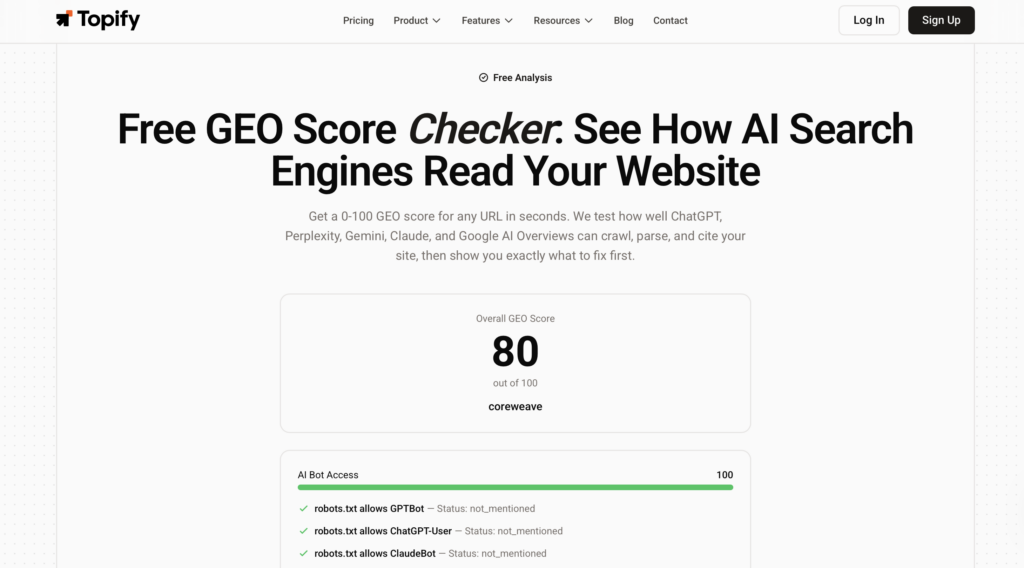
    Topify‘s GEO Score Checker diagnoses exactly where that disconnect happens. It scores your business services website across four technical dimensions that determine whether AI models can find, understand, and recommend your firm, all in under 60 seconds.

    ✅ Free ⚡ Results in 60 seconds 🔒 No signup required

    The Four GEO Scores That Diagnose Your Business Services Brand

    Business service firms tend to invest heavily in reputation-building: case studies, whitepapers, client testimonials, thought leadership content. The gap between that investment and AI visibility is almost always technical, not strategic. The GEO Score Checker surfaces that gap across four dimensions.

    Score DimensionWhat It MeasuresBusiness Services Impact
    Bot Access (0-100)Whether AI crawlers can access your websiteGPTBot, ClaudeBot, and PerplexityBot are blocked on many professionally designed firm sites without the team knowing it
    Structured Data (0-100)Whether AI can parse the meaning of your contentService pages built as marketing copy don’t give AI the structured facts it needs to describe what you do
    Content Signals (0-100)Whether AI treats your content as authoritativeThought leadership PDFs and gated case studies are invisible to AI; only crawlable, indexed pages count
    Visibility Score (0-100)How often your brand appears across AI platformsA firm present on Perplexity may score near-zero on ChatGPT for the same service category query

    A score below 40 in any dimension typically means AI is either skipping your site entirely or misrepresenting your services when buyers ask. The distribution of low scores tells you exactly which layer to fix first.

    Bot Access: Is Your Firm’s Website Actually Reachable by AI?

    This is where the most counterintuitive findings show up. A consulting firm with a polished, fast-loading website and strong Google rankings runs the checker and finds a Bot Access score of 22.

    The cause is almost always infrastructure, not intent. Cloudflare security rules set to block unknown bots, a robots.txt file that hasn’t been updated since 2022, or a JavaScript-heavy frontend that renders content client-side, where AI crawlers can’t reach it. GPTBot and ClaudeBot look like generic bots to many security configurations. They get blocked automatically.

    A low Bot Access score means AI platforms are working from incomplete or outdated information about your firm, regardless of how much content you’ve published.

    Structured Data: Can AI Parse What You Actually Do?

    Business service firms typically describe what they do in persuasive, narrative language. “We partner with growing companies to build high-performing teams.” That sentence works for a human reader. It gives AI almost nothing to work with.

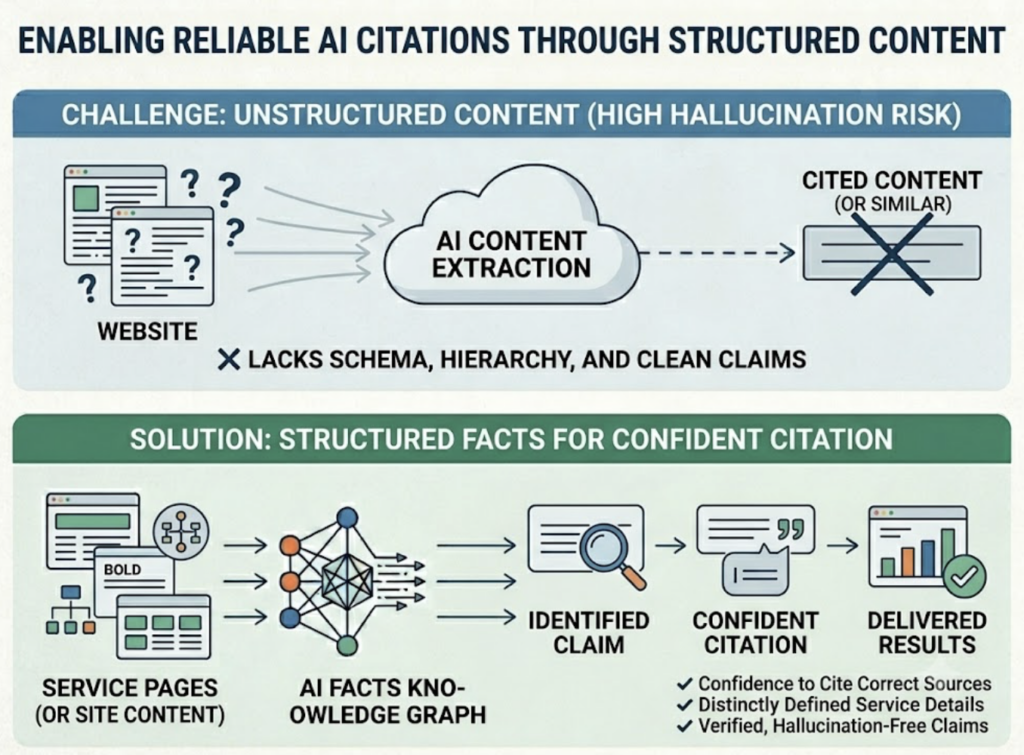
    AI models need structured facts to cite a source confidently. When your service pages lack JSON-LD schema markup, clear header hierarchies, and directly answerable statements, AI systems skip your content because citing it creates hallucination risk. They can’t extract a clean claim about what you do, who you serve, or what results you deliver.

    A Structured Data score below 50 typically means your services, locations, and credentials aren’t formatted in ways AI can read and relay accurately.

    Content Signals: Does AI Trust Your Expertise Claims?

    Here’s the thing. Most business service firms have genuinely strong expertise. They’ve published research, presented at conferences, been quoted in trade press. But AI citation behavior rewards content that is structured for extraction, not content that’s structured for persuasion.

    Pages with organized headings, direct answer sections, statistics, and expert attribution are 2.8x more likely to earn citations in AI search results. A Content Signals score below 40 often means your most credible assets, case studies, service methodology pages, and expert bios, are either behind a form, buried in PDFs, or written in a format that AI treats as brand copy rather than citable expertise.

    Visibility Score: Are You in the Shortlist or Filtered Out?

    The Visibility Score reflects how often your firm appears when AI platforms answer queries in your service category. A score below 40 means you’re being filtered out before the buyer’s shortlist forms.

    That filtering happens silently. You won’t see it in your Google Analytics or your CRM. You’ll only see it in your pipeline, when deals you should have been in never start.

    How to run your check in three steps:

    1. Go to the GEO Score Checker and enter your firm’s domain or brand name
    2. Wait 60 seconds for your four-dimensional score to load
    3. Compare the dimensions: the gap between your highest and lowest score tells you exactly which layer is limiting your AI visibility

    What Business Buyers Type Into AI When They’re Shortlisting Vendors

    The prompts buyers use in AI search are different from what they typed into Google. They’re longer, more specific, and comparison-ready. Each one forces AI to make a recommendation.

    AI Prompt ExamplePlatformSearch IntentWhat It Reveals
    “Best IT managed services firms for a 500-person manufacturing company”ChatGPTVendor shortlistingWhether AI associates your firm with a specific company size and industry
    “Which accounting firms specialize in multi-state tax compliance for e-commerce?”PerplexitySpecialty service matchWhether AI understands your specific service capability, not just your category
    “Compare HR outsourcing providers for companies with union and non-union workforce”GeminiCompetitive evaluationWhere your firm ranks when AI builds a comparison set
    “Is [your firm name] experienced in post-merger integration consulting?”ChatGPTTrust and capability verificationHow accurately AI can describe your specific expertise
    “Top business process outsourcing companies with SOC 2 compliance”PerplexityCompliance-driven vendor researchWhether your certifications are structured in ways AI can verify and cite

    73% of B2B buyers now use AI tools during their purchase research process, and 51% start their vendor research in an AI chatbot more often than Google. Each of the prompts above represents a buying decision in progress. If your firm isn’t in the response, you’re not losing a click. You’re losing a conversation you never knew happened.

    Three GEO Blind Spots That Affect Most Business Service Firms

    Business services has a specific AI visibility problem that’s distinct from product-led categories. It’s not that firms lack credibility. It’s that credibility in this sector is stored in formats AI can’t reach.

    Blind Spot 1: Your most authoritative content is locked away from AI crawlers.

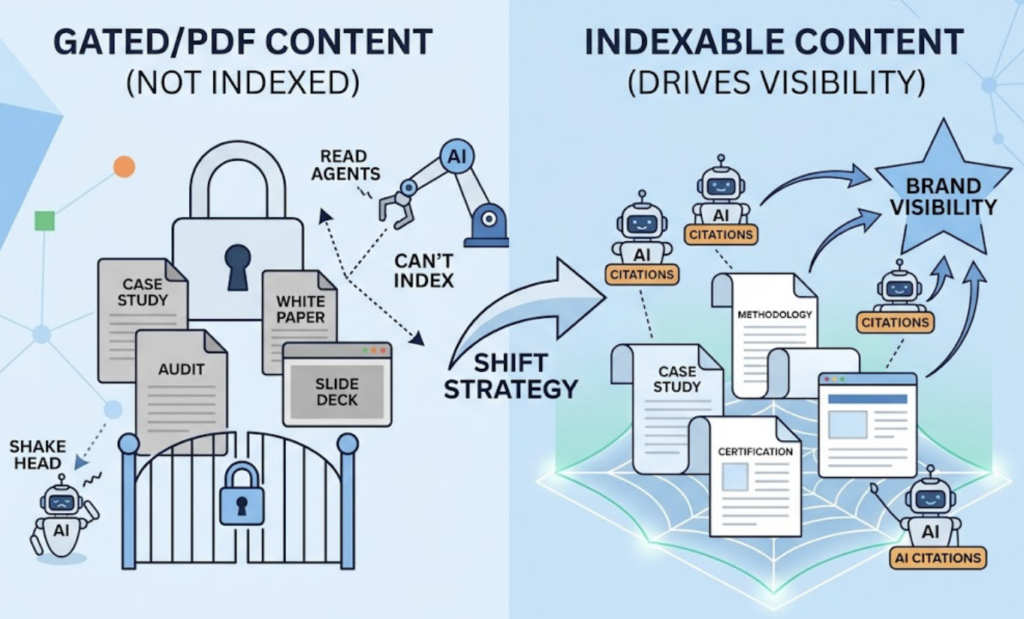
    The average business service firm’s most credible assets, case studies demonstrating 40% cost reduction for a client, methodology white papers, third-party audit certifications, live in PDFs, gated download pages, and slide decks. 90% of AI citations driving brand visibility originate from earned and owned media that AI can actually crawl and index. Content behind a form, or rendered as a PDF, doesn’t count.

    AI treats your firm’s authority as equal to its publicly crawlable, structured content. Nothing more.

    Blind Spot 2: Service pages are written to convert, not to be cited.

    A page that says “We help Fortune 500 companies optimize their supply chain operations” reads well to a human. It gives AI nothing specific enough to relay. AI models need direct, factual statements: what services you provide, in what geographies, for what company types, with what certifiable outcomes.

    The average B2B company scores 28 out of 100 on AI visibility assessments. For business service firms, that low score almost always traces back to service pages optimized for human persuasion and ignored by AI extraction.

    Blind Spot 3: You’re visible on one AI platform and invisible on another.

    Only 11% of domains are cited by both ChatGPT and Perplexity for the same queries. A firm that appears in Perplexity results for “IT consulting for mid-market companies” may be completely absent when the same buyer asks ChatGPT.

    This fragmentation is invisible without measurement. The GEO Score’s Visibility dimension gives you the aggregate signal. But the platform-level gap only becomes actionable when you know which platforms you’re missing.

    Business Services ScenarioGEO Score SignalLikely CauseAction Direction
    Strong Google rankings, absent from AI answersBot Access: below 30AI crawlers blocked by Cloudflare or outdated robots.txtAudit robots.txt for GPTBot, ClaudeBot, PerplexityBot
    AI describes services incorrectly or vaguelyStructured Data: below 40No JSON-LD schema on service pages; narrative-only copyAdd Service schema with specific capabilities, geographies, client types
    Published extensively, rarely cited by AIContent Signals: below 35Content in PDFs, gated forms, or non-crawlable formatsConvert key assets to indexed, structured HTML pages
    Known brand, low AI recommendation rateVisibility Score: below 45Present on one AI platform but absent on othersIdentify platform-specific citation gaps and build targeted content

    A Score Tells You Where You Stand. The Platform Tracks Where You’re Going.

    Your GEO Score is a diagnostic snapshot. It tells you where your firm is today across four dimensions. That’s useful, but business services is a category where your competitors are actively improving their GEO signals. A score of 65 today can drop to 48 next quarter if a competitor restructures their service pages, earns a major media mention, or unlocks AI crawler access they’d been inadvertently blocking.

    The checker gives you a baseline. Topify‘s Comprehensive GEO Analytics tracks what happens after that.

    CapabilityFree GEO Score CheckerTopify Platform
    Check frequencyOne-time snapshotContinuous daily/weekly monitoring
    Dimensions tracked4 GEO scoresFull GEO analytics: visibility, sentiment, citations, trends
    Historical trendsNoneFull trend history with change alerts
    Competitor benchmarkingNot includedReal-time competitor GEO tracking
    Platform breakdownAggregated scorePer-platform: ChatGPT, Perplexity, Gemini, AI Overviews
    Optimization actionsDirectional guidanceSpecific, prioritized execution steps

    For business service firms managing multiple practice areas or service lines, the platform lets you monitor GEO performance by segment, not just at the brand level. You’ll know whether your IT consulting practice is gaining AI visibility while your HR advisory practice is losing ground.

    Plans start at $99/month, with a 7-day free trial and no credit card required. If you want to see how the platform works before committing, you can start a free trial or explore the pricing tiers.

    Conclusion

    Business service firms earn trust through years of client relationships, published expertise, and demonstrated results. AI doesn’t see any of that unless it’s structured, crawlable, and consistently formatted across platforms. A GEO score below 40 in any dimension is a signal that your firm’s credibility isn’t reaching the buyers who are forming shortlists inside AI chat interfaces right now.

    Run your GEO score check in 60 seconds to see which of the four dimensions is limiting your AI visibility. No signup required.

    If your Bot Access score flags a crawler issue, the AI Robots Checker will show you exactly which AI bots your site is blocking. If your Content Signals score is unexpectedly low, the Knowledge Freshness Checker can reveal whether AI models are working from outdated information about your firm. And the Brand Authority Checker gives you a second layer of diagnosis on how AI models perceive your firm’s expertise and trustworthiness across four authority dimensions.

    Frequently Asked Questions

    What is a GEO score for business services firms? 

    A GEO score is a 0-100 rating that measures how well your business services website is optimized for AI search platforms like ChatGPT, Perplexity, and Gemini. It breaks down into four dimensions: Bot Access, Structured Data, Content Signals, and Visibility Score. Each dimension maps to a specific reason why AI may be skipping your firm when buyers search for services in your category.

    Why would a business services firm score low on Bot Access? 

    Bot Access scores drop when AI crawlers like GPTBot, ClaudeBot, or PerplexityBot are blocked at the infrastructure level. This happens more often than firms expect. Cloudflare security configurations, outdated robots.txt files, and JavaScript-heavy frontends are the most common causes. A professionally designed, fast-loading website can still score below 30 on Bot Access if the underlying configuration hasn’t been updated to allow AI crawler access.

    Does having strong Google rankings mean my firm is visible in AI search? 

    Not necessarily. Research from Brandlight found that the overlap between top Google-ranked pages and AI-cited sources has dropped below 20%. A firm can rank on page one of Google and be completely absent from ChatGPT or Perplexity results for the same query. GEO optimization addresses a different set of signals than traditional SEO.

    Why does AI describe my firm’s services inaccurately? 

    This is typically a Structured Data problem. When service pages are written as marketing narrative rather than structured factual statements, AI models can’t extract clean, citable claims about what you do. Without JSON-LD schema markup and direct answer sections, AI either skips your content or paraphrases it inaccurately because it can’t verify the specific details.

    How often should a business services firm check its GEO score? 

    The free GEO Score Checker gives you a point-in-time diagnostic, which is a useful starting baseline. That said, GEO signals shift as competitors improve their content, AI platforms update their training data, and your own site changes. For firms actively working on AI visibility, monitoring on a monthly basis captures meaningful movement. Topify’s Comprehensive GEO Analytics automates continuous monitoring so you don’t have to run manual checks.

    Is GEO optimization different for professional services versus product companies? 

    Yes. Product companies can rely on structured product schema, review platforms, and pricing data to give AI something concrete to cite. Business service firms have to work harder to make their expertise legible to AI. That means converting case studies from PDFs to indexed pages, adding service schema with specific capability and geography data, and ensuring credentials and certifications are structured in crawlable formats rather than locked in documents.

    Read More: