Blog

  • AI Mention Tracking: What It Is and How to Measure It

    AI Mention Tracking: What It Is and How to Measure It

    Your boss asks a simple question in Monday standup: “Are we showing up when people ask ChatGPT about our category?” You’ve got Google rankings, a traffic dashboard, and a content calendar. None of them answer her. That blank space is the actual problem. Search has quietly moved from a list of blue links to a synthesized answer, and most teams have no way to see what that answer says about them, whether it cites them, or whether it recommends a competitor instead.

    So before you can fix your position in AI search, you need to see it. That’s what AI mention tracking is for.

    What AI Mention Tracking Actually Measures

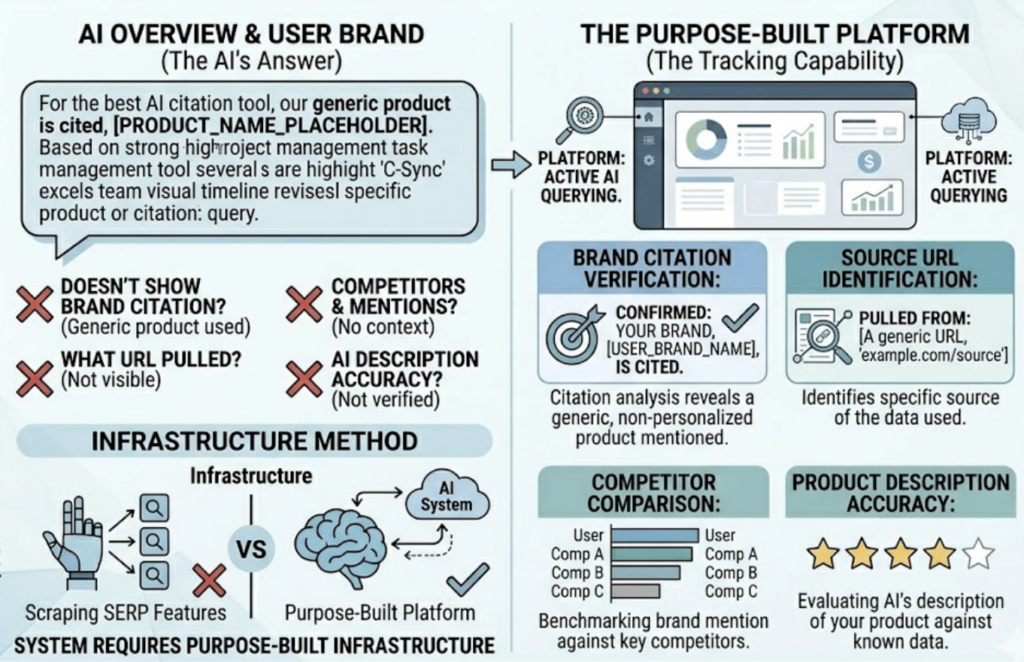
    AI mention tracking is the practice of monitoring how your brand, product, or service gets referenced, cited, or recommended inside the answers that large language models generate. It’s not social listening. Social listening scrapes public feeds. AI mention tracking interrogates the synthesized output of a model that never shows its work.

    The reason teams get confused early is that “mention” isn’t one thing. It’s three.

    A brand mention is a raw textual reference to your name, with or without a link. It builds recall and tells the model your brand is a real entity in the category. A summarization presence is when your brand gets woven into the narrative of the answer itself, which signals topical authority. A citation is an explicit link the AI provides back to your domain, which is the strongest signal of all because it treats your content as a verifiable source.

    Tracking only one of these gives you a distorted view. A brand mentioned often but never cited has recall without authority. A brand cited often but described inaccurately has authority working against it.

    How AI Mention Tracking Works Behind the Scenes

    Generative engines don’t pull up a ranked page the way classic search does. They run Retrieval-Augmented Generation, or RAG. The system retrieves snippets from a large indexed corpus, filters them using signals like site authority, content structure, and recency, then rewrites the result into a single direct answer.

    That mechanism is why keyword rank tracking falls apart here. AI responses are variable, shifting with session context, location, and how the prompt is phrased. They’re also synthetic. The model doesn’t rank your page in isolation, it extracts and recombines fragments from many sources.

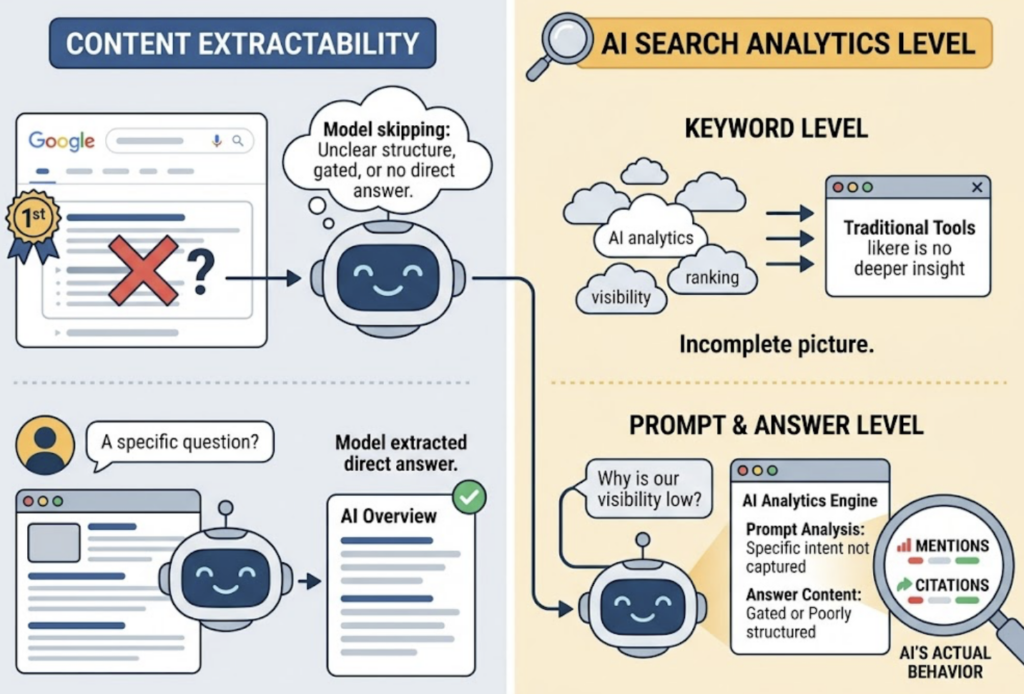
    The practical consequence is blunt. If your content isn’t extractable, because it’s poorly structured, gated, or never directly answers a specific question, the model will skip it even when you rank first on Google. Good AI search analytics work at the prompt and answer level, not the keyword level, because that’s the only layer where the model’s actual behavior shows up.
    Why AI Mention Tracking Matters More Than Your Google Rank

    Around 64% of informational queries now end without a click. The answer is the destination. When the AI summarizes your category and your brand isn’t in that summary, you don’t lose a ranking position, you lose the entire impression before the user ever reaches a search results page.

    This is the gap that breaks legacy reporting. Domain authority, keyword positions, and organic sessions all measure a world where users click through to read. AI search visibility measures a world where they often don’t. A brand can hold the number one organic spot for a term and still be invisible in the AI answer that now sits above it.

    Page rank tells you where you stand in a list. It says nothing about whether the AI knows you exist.

    How to Measure AI Mention Tracking the Right Way

    Measuring this well means moving past a single vanity number. “We got mentioned 12 times” is meaningless without context: out of how many relevant prompts, on which platforms, framed how, and against whom. A useful measurement framework tracks a handful of metrics together.

    MetricWhat It MeasuresWhy It Matters
    Share of VoicePercentage of category-relevant AI answers that mention your brandRelative mindshare against competitors
    Citation Inclusion RateHow often your domain is cited as a sourceTechnical and content authority
    Sentiment FramingThe descriptive tone the AI uses about youCatches narrative drift and brand damage
    Position IndexWhere you appear in the answer, first mention versus footnoteDrives user trust and prominence
    Hallucination RateHow often the AI states wrong facts about youBrand integrity and risk

    Here’s a concrete example of what this looks like in practice. You run the prompt “best project management tool for remote teams” across three engines daily for 30 days. Your share of voice is 18% on Perplexity but 3% on ChatGPT, your sentiment is positive everywhere except one engine that still lists a discontinued pricing tier, and a competitor holds the first-mention position in 70% of answers. That single view tells you exactly where to act, which is what good AI search intelligence should deliver.

    The Mistakes That Make Mention Data Useless

    Most teams stumble because they apply old SEO instincts to a new system. Four mistakes show up again and again.

    The first is platform monoculture. Tracking only Google AI Overviews while ignoring ChatGPT and Perplexity hides most of your exposure, since each engine uses a different retrieval mechanism and cites different sources. The second is the keyword trap, fixating on search volume instead of how customers actually ask. People type conversational prompts like “what’s a good X for a small team,” and if you aren’t tracking prompt-level behavior, your data describes a search world that no longer exists.

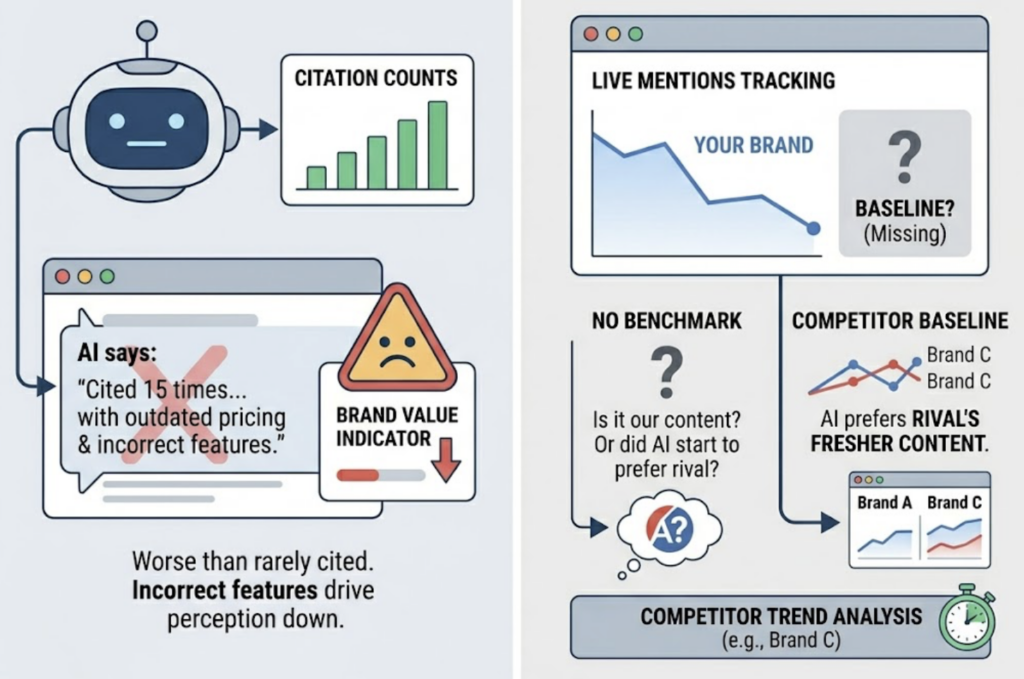
    The third is neglecting sentiment. Teams obsess over citation counts while ignoring what the AI says. A brand cited often with outdated pricing or wrong features is in worse shape than one rarely cited at all. The fourth is skipping a competitor baseline. If your mentions drop and you have no benchmark, you can’t tell whether something broke on your end or the AI simply started preferring a rival’s fresher content.
    Counting mentions without context isn’t measurement. It’s noise with a number attached.

    Turning Mention Data Into a Visibility Strategy

    Tracking is a diagnostic, not the cure. The point is to feed what you find back into a strategy that changes the AI’s answer next month. A workable Generative Engine Optimization loop has four moves.

    Start with prompt-level mapping, a curated set of 20 to 40 high-intent prompts spanning informational, comparative, and instructional questions, run consistently so you see trends rather than snapshots. Then work on structural optimization for extractability, using clear headings, direct question-and-answer formats, and schema so models can ingest your content. Build third-party authority next, since AI engines weigh reviews, industry coverage, and community discussion heavily, often more than on-page tweaks. Finally, treat inaccurate descriptions like a PR issue and publish authoritative content that directly overwrites the claim the AI keeps repeating.

    Running this loop by hand across three or four engines, dozens of prompts, and a rotating set of competitors gets unmanageable fast. This is where a dedicated AI visibility platform earns its place. Topify is built for exactly this workflow: its Visibility Tracking watches how often your brand surfaces across ChatGPT, Gemini, Perplexity, and AI Overviews, Source Analysis reverse-engineers which domains the engines cite so you can see who’s being read instead of you, and Competitor Monitoring keeps a live baseline so a drop in mentions reads as signal, not mystery. In practice that means you can spot a fall in ChatGPT mentions, trace it to a third-party page that stopped citing you, and know what to fix, all in one view. For AI SEO and broader AI search optimization, having mention data, sentiment, and citation sources in a single dashboard is what turns reporting into action.

    Your AI Mention Tracking Checklist

    If you’re starting from zero, keep the first pass simple and run these five steps in order.

    1. Audit. Write down the top 20 questions your customers ask during their research phase, in their words, not your keywords.
    2. Baseline. Run those prompts across ChatGPT, Perplexity, and Google AI Overviews and record who gets mentioned and cited.
    3. Analyze. Identify which sources the AI cites instead of you, and where competitors hold the first-mention spot.
    4. Optimize. Update your content, or the third-party source being cited, to be more concise, factual, and answer-shaped.
    5. Monitor. Set a recheck cadence and watch how the AI’s description of your brand shifts as your content changes.

    You can run a rough version of steps two and three manually before committing to any tool. A set of free GEO toolscovers the basic audit, and when you’re ready to track continuously rather than spot-check, you can get started with Topifyon a single project.

    Conclusion

    The question your boss asked, whether you show up in AI answers, isn’t going away, and Google rank won’t answer it. AI mention tracking gives you the visibility layer that legacy SEO metrics were never built to capture: who the AI mentions, who it cites, and how it frames you against competitors. Start with 20 real customer prompts and a baseline across three engines. Once you can see the answer the AI is giving, you can start changing it.

    FAQ

    Q: What are the best tools for AI mention tracking? 

    A: The strongest options track multiple engines at once, measure share of voice and citations rather than raw mention counts, include sentiment, and maintain a competitor baseline. Single-platform trackers and keyword-volume tools tend to miss most of your real exposure. Look for a platform that covers ChatGPT, Perplexity, Gemini, and AI Overviews together.

    Q: How can I improve my AI mention tracking results? 

    A: Improve the inputs, not just the dashboard. Map 20 to 40 high-intent prompts, make your content extractable with clear Q&A structure and schema, build third-party authority through reviews and industry coverage, and publish content that directly corrects any inaccurate claims the AI keeps repeating about you.

    Q: What does AI mention tracking pricing usually look like? 

    A: Pricing typically scales with how many prompts, projects, and AI platforms you monitor, plus how often you refresh the data. Entry plans tend to start around the cost of a standard SEO tool, with higher tiers adding more prompts, seats, and content credits. You can compare tiers on the Topify pricing page.

    Q: Can you give an example of AI mention tracking in action? 

    A: Say you track “best CRM for small teams” daily across three engines for a month. You learn your share of voice is 20% on Perplexity but 4% on ChatGPT, one engine still cites a competitor’s outdated comparison page, and you hold a first mention in only 1 of 10 answers. That tells you precisely which engine and which source to target next.
    Read More

  • AI Search Optimization: Your Competitor Blind Spot

    AI Search Optimization: Your Competitor Blind Spot

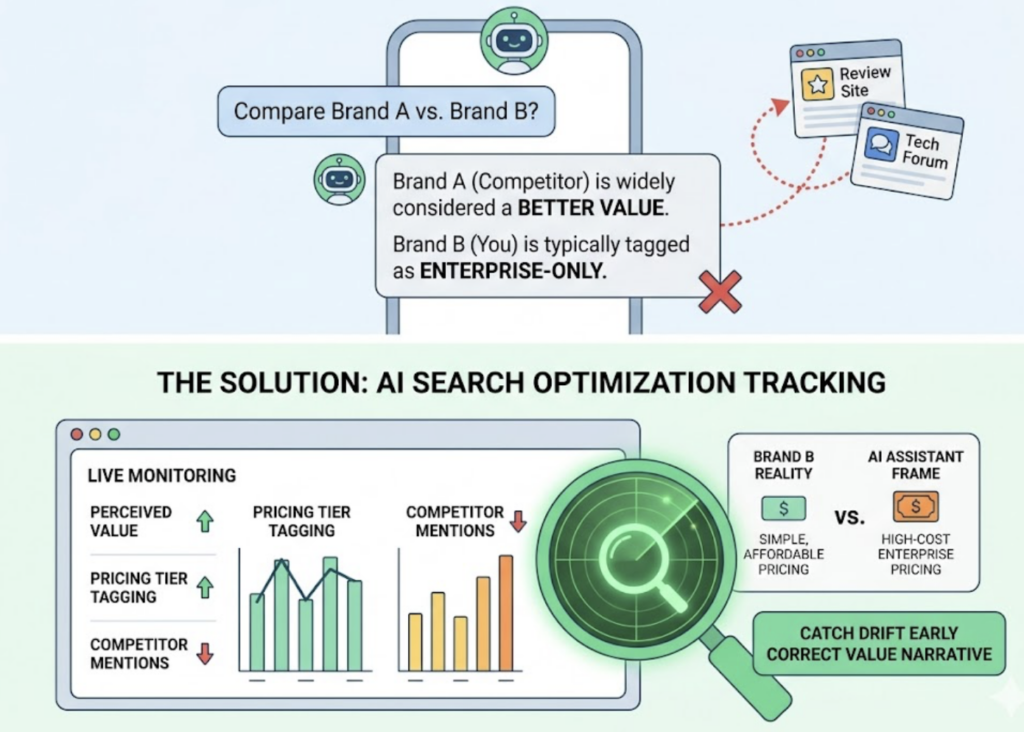
    Your AI search dashboard looks healthy. Brand mentions are up, ChatGPT cites you on a few queries, and the monthly report finally has an “AI visibility” line. Then a prospect asks an AI assistant to compare your category, and the answer ranks a competitor first, calls them “better value,” and never explains why.

    You didn’t see it coming, because your tracking only watches your own name. That’s the blind spot in most AI search optimization programs: they measure the brand you own and stay blind to the competitors AI keeps recommending instead.

    Most AI Search Optimization Stops at Your Own Brand

    Marketing teams tend to treat AI search optimization as an extension of traditional SEO. They watch their own mentions, their own citations, their own sentiment, and call it a program. The problem is that large language models don’t work that way. They synthesize and compare, then hand the user a single recommendation.

    So when an AI consistently frames a rival as the safe pick and you as the also-ran, that isn’t a ranking gap you can see in a self-only dashboard. It’s a narrative gap that forms before the user clicks anything.

    Self-tracking tells you how you’re doing. It says nothing about whether you’re losing.

    This matters more every quarter, because the click is disappearing. Roughly 64.82% of Google searches now end without a click, and on AI-native engines the rate is far higher: around 93% on Perplexity and 82% on ChatGPT Search. Buyers are getting their shortlist inside the answer. If you can’t see how that answer treats your competitors, you’re optimizing half the picture.

    AI Search Visibility Is Measurable. So Is Your Competitor’s

    AI search visibility measures whether AI engines mention you, where they place you, and how they describe you. The useful insight is that every one of those measurements applies just as cleanly to the brands you’re up against.

    Tracking AI brand visibility for yourself and your top three rivals on the same prompts turns a vanity number into a competitive read. Here’s the stack worth monitoring:

    MetricWhat it measures
    Share of VoiceThe percentage of category answers that name you versus competitors
    Citation ShareThe slice of total citations in a topic cluster your brand captures
    Recommendation RateHow often AI explicitly suggests you on “best,” “top,” or “alternatives” prompts
    Position IndexWhether you appear first or fourth in the AI’s list
    Sentiment GapThe difference between how AI describes you and how it describes a rival

    Position and sentiment are where most surprises live. You can hold a respectable share of voice and still lose, because the model names you last and frames the competitor as the default. This is also the layer that separates AI search visibility from Google rankings, where a strong domain authority tells you nothing about what AI chooses to say.

    The Competitor GEO Performance Layer AI SEO Tools Miss

    Generative engine optimization is dynamic and comparative in a way classic AI SEO tools rarely capture. The engine doesn’t just read your copy. It interrogates your data, pulls quantifiable attributes like specs and pricing, and pits them against rivals in real time.

    Two signals decide a lot of this. The first is co-citation: being named alongside category leaders marks your brand as a coherent entity for that use case. If you’re never cited next to competitors on your core queries, the model tends to treat your entity as irrelevant there.

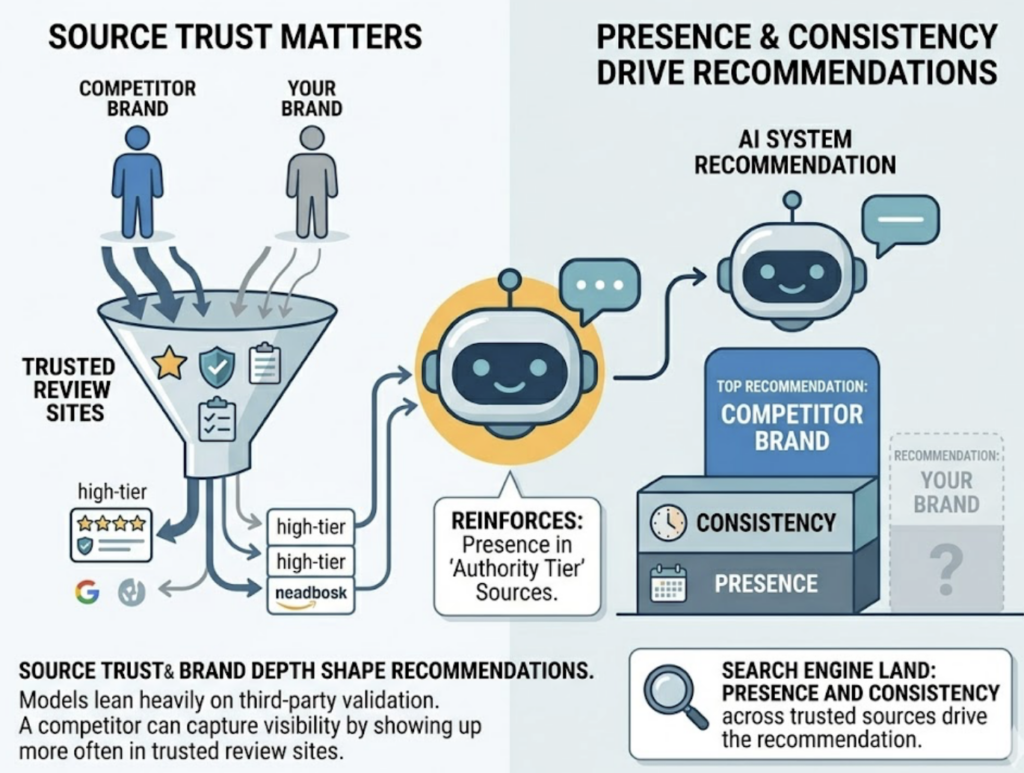
    The second is source trust. Models lean heavily on third-party validation, so a competitor can capture your visibility simply by showing up more often in the review sites AI engines trust. Search Engine Land’s reporting on how brand depth shapes what AI systems recommend points the same direction: presence and consistency across trusted sources drive the recommendation.

    The gap is that most AI SEO tools only render your own scorecard. To track competitor GEO performance, you need the comparative view: the same prompts, run across the same engines, scored side by side.

    What AI Tells Buyers About Competitor Pricing

    Pricing isn’t just a number on your site anymore. It’s a label an AI assigns you in front of a buyer.

    AI engines routinely surface pricing and value framing pulled from third-party sources. If an assistant keeps calling a competitor “better value” while tagging you “enterprise-only,” that framing reaches the buyer whether or not it reflects your actual value. Competitor pricing tracking in AI search optimization exists to catch this drift early.

    The response is a content one. When the model’s value label is wrong, the fix is usually structured “vs.” pages that clarify the comparison with clean, machine-readable data, so the engine has an accurate source to cite. You can’t correct a narrative you can’t see, which is why pricing signal monitoring belongs in the workflow rather than in a quarterly audit.

    Turning AI Search Analytics Into a Competitive Workflow

    The point of AI search analytics is to move from passive observation to strategic response. A mature AI search intelligence workflow runs on three loops: prompt-level benchmarking across the major engines, pricing and sentiment signal tracking on competitors, and source attribution that tells you which domains are feeding a rival’s recommendation.

    For teams that want this comparison built in rather than bolted on, Topify treats AI search optimization as a comparative discipline from the start. Its Competitor Monitoring auto-detects the rivals AI engines name in your category, then benchmarks them next to you across seven metrics: visibility, sentiment, position, volume, mentions, intent, and CVR. Position Tracking shows whether you’re cited first or fourth on high-intent prompts, while Source Analysis reverse-engineers the exact domains driving a competitor’s mentions. In practice, you can spot a rival winning a “best of” citation, trace it to the third-party page behind it, and hand your content team a specific target, all in one view.

    That last step is the difference between knowing you’re behind and knowing what to do about it.

    Choosing an AI Visibility Platform That Tracks Rivals

    Not every tool labeled for AI visibility actually handles competitors. When you evaluate an AI visibility platform for competitive tracking, the capabilities below separate a real intelligence engine from a self-only dashboard.

    CapabilityWhy it matters for competitive tracking
    Multi-engine coverageRivals win on different platforms, so ChatGPT, Gemini, Perplexity, Claude, and Copilot all need monitoring
    Prompt-level simulationRunning the same competitor prompts at scale is what surfaces trends instead of snapshots
    Granular attributionTracing answers back to specific domains and pages shows where a competitor’s authority comes from
    Automated competitive alertsYou want a notification the moment a rival takes a “best of” citation or sentiment shifts, not a month later

    A platform that checks these boxes turns competitor tracking into a standing process. One that doesn’t leaves you watching your own reflection while the market moves around you.

    Conclusion

    AI search optimization isn’t only about getting mentioned. It’s about being the logical conclusion of the buyer’s research, which means knowing exactly how AI frames, prices, and ranks everyone else in your category. Start with 20 to 30 high-intent prompts, score yourself and your top rivals on the same metrics, and watch the position and sentiment gaps first. The brands that treat competitor visibility as core to their AI strategy will see where their narrative is eroding while there’s still time to fix it.

    FAQ

    Q: How do you track competitor GEO performance in AI search? 

    A: Run the same high-intent prompts your buyers use across ChatGPT, Gemini, Perplexity, and Claude, then score each competitor on the same metrics you track for yourself: share of voice, citation share, recommendation rate, and position. Platforms with built-in competitor detection automate this so you see relative movement, not just your own numbers.

    Q: Can you see competitor pricing in AI answers? 

    A: Often, yes. AI engines surface pricing and value framing pulled from third-party sources, so a competitor can appear labeled “better value” even when your specs are stronger. Competitor pricing tracking flags these labels so you can correct the narrative with structured comparison content.

    Q: What’s the difference between AI search analytics and traditional SEO analytics? 

    A: Traditional SEO analytics measures clicks, rankings, and traffic to your own pages. AI search analytics measures whether AI engines mention, cite, and recommend you, and how that compares to competitors, often on queries that never produce a click at all.

    Q: How do I start competitive AI search intelligence without a big team? 

    A: Pick a focused set of high-intent prompts, run them across the major AI engines, and log which brands get named and how. From there, an AI visibility platform can scale the monitoring and alert you when a rival’s position shifts. You can get started with Topify to automate the tracking.

    Read More

  • AI Brand Monitoring Tracker: Best LLM Visibility Tools

    AI Brand Monitoring Tracker: Best LLM Visibility Tools

    Your social listening dashboard lights up every time someone mentions your brand on X or Reddit. It stays quiet when ChatGPT tells a buyer your competitor is the smarter pick. That conversation never hits a public feed, so your monitoring stack never logs it. And it’s happening at scale: 64.82% of Google searches now end without a click, with more of that intent flowing into AI assistants that answer the question outright. The problem isn’t that your brand looks bad inside AI answers. It’s that nobody’s watching what AI says about you at all.

    Why Most Brand Monitoring Tools Can’t See What AI Says

    Traditional brand monitoring was built for a web of links. Crawlers index public pages, social APIs pull public posts, and the tool counts mentions. That model assumes the conversation is observable. AI answers break that assumption.

    When someone asks Perplexity or Gemini for a recommendation, the model doesn’t hand back ten blue links. It synthesizes one answer. If your brand isn’t in that synthesis, you’re not ranked lower. You’re absent. And absence leaves no footprint a crawler can find.

    In an AI answer, there’s no position four. There’s in, or there’s out.

    There’s also a quieter failure mode. A brand can rank first on Google and still never get cited by ChatGPT, because AI platforms run their own retrieval and pull from a narrower set of sources. Your strong SEO performance is a leading indicator, not a guarantee of AI citation. On top of that, models can misstate your pricing, mislabel your positioning, or invent features you don’t ship. Keyword-based listening tools scan for brand names, so these silent hallucinations slip past them entirely.

    That gap is what an AI brand monitoring tracker exists to close. It’s a diagnostic layer that watches the one surface your current stack can’t reach: the generated answer itself.

    What an AI Brand Monitoring Tracker Actually Measures

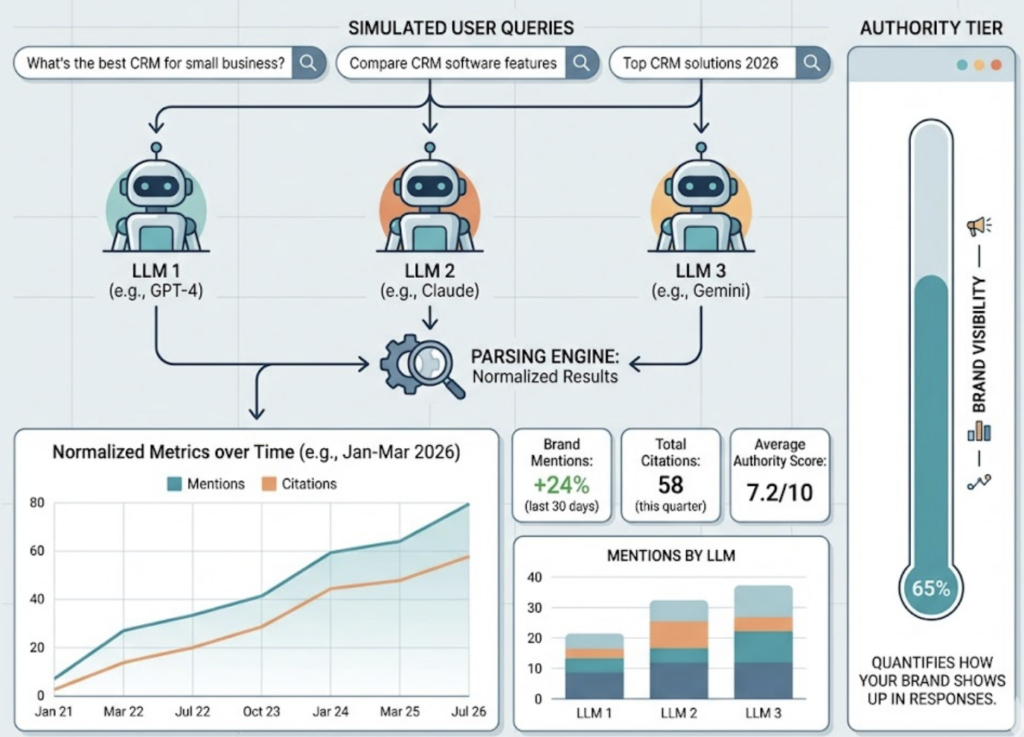
    An AI brand monitoring tracker simulates how real users query AI assistants, then quantifies how your brand shows up in the responses. The mechanics are consistent across serious tools. The system runs a curated set of industry prompts (informational and comparison queries like “what’s the best CRM for small business”) across multiple LLMs, parses each unstructured answer for mentions and citations, and normalizes the results into metrics you can track over time.

    The reason this works is that it measures AI on its own terms. As Nightwatch’s framework for measuring LLM visibilityputs it, your brand either appears in the answer or it doesn’t, in a specific position, described a specific way, cited or uncited. Visibility is the sum of those outcomes across every prompt that matters to your category.

    Most teams ask how to measure it. These are the metrics that count:

    • AI Share of Voice: the percentage of category-relevant answers that mention or cite your brand.
    • Citation source: which exact URLs and domains the model used to back up the mention.
    • Position: how prominent the mention is, first paragraph versus a closing footnote.
    • Sentiment: whether you’re framed as the solution, the cautionary tale, or a neutral option.
    • Hallucination rate: how often the model states something factually wrong about you.

    Here’s the line that separates the best LLM visibility tools from the weak ones: tracking happens at the prompt level, not the keyword level. Keyword tracking tells you where a page ranks. Prompt tracking tells you what the AI actually said when a buyer asked.

    Best LLM Visibility Tracking Tools, Ranked

    Coverage is the first filter. A tool that only watches one model gives you a partial picture, because the Big Four (ChatGPT, Perplexity, Gemini, and Claude) each cite a different mix of sources. The second filter is explanation: does the tool just show you a number drop, or does it tell you which source stopped citing you.

    These tools are ranked on coverage breadth, source-level explainability, and whether the output points to a next action.

    ToolModel coverageSource / citation analysisCompetitor benchmarkingSentimentStarting price
    TopifyChatGPT, Gemini, Perplexity, DeepSeek, and moreYes, URL-levelYes, automaticYes, 0-100$99/mo
    ProfoundMulti-modelYesYesYesEnterprise / on request
    NightwatchChatGPT, Perplexity, Gemini, ClaudeYesYesYesMid-tier add-on
    LLMrefsChatGPT, AI Mode, AI Overviews, PerplexityPartialYesLimitedBudget
    Otterly.AIChatGPT, Perplexity, AI OverviewsPartialYesLimitedBudget
    PromptwatchPrompt-level, multi-modelPartialYesYesMid-tier

    Specialized AI visibility tools often start at $300 to $500 a month and climb from there, which is why where a tool lands in this table depends as much on what it explains as on what it costs.

    #1 Topify: All-in-One LLM Visibility Software

    Most tools stop at the data. They show you a visibility score dropped and leave you to guess why. Topify closes that loop, which is why it leads this list as a piece of LLM visibility software rather than a dashboard.

    It pulls seven metrics into a single view: visibility, sentiment, position, volume, mentions, intent, and CVR. In practice, that means you can spot a drop in ChatGPT mentions, trace it to a specific source domain that stopped citing your brand, and see whether sentiment shifted at the same time, all without switching screens. The diagnosis and the cause live next to each other.

    The source analysis is where this earns its keep. Topify reverse-engineers the exact domains and URLs that AI platforms cite for your category, so you can see whether your own content or a competitor’s is feeding the answer. That turns “we lost visibility” into “we lost the citation that was driving it,” which is a problem you can actually fix.

    Competitor benchmarking runs in parallel. You see who the engines recommend alongside you, when a new rival starts surfacing, and how your position moves against theirs over time. Coverage spans ChatGPT, Gemini, Perplexity, DeepSeek, and other major engines, so the picture isn’t skewed by a single model’s habits.

    There’s also an execution layer most trackers skip. State a goal in plain English, review the proposed strategy, and deploy it with one click through Topify’s agent. The CVR metric ties the whole thing back to revenue by estimating how likely an AI answer is to push a user toward a brand interaction, not just a mention count.

    Pricing starts at $99 a month and includes tracking across ChatGPT, Perplexity, and AI Overviews, 100 prompts, and competitor monitoring, with a 30-day trial. You can check the full plans or get started and run a visibility baseline before committing.

    The Other LLM Visibility Tools Worth Knowing

    No single tool fits every team. These cover the rest of the field.

    Profound is an enterprise-grade platform built around RAG-focused insights, with deeper integration into partnership and revenue automation systems. It suits large organizations that need that level of pipeline tooling and have the budget to match.

    Nightwatch pairs traditional SEO rank tracking with LLM visibility monitoring in one interface, which is useful if your team wants AI data sitting next to classic rankings. It tends to fit SEO-led teams expanding into GEO rather than brand-led ones.

    LLMrefs is a budget option focused on share of voice and citations across ChatGPT, AI Mode, AI Overviews, and Perplexity. It’s a reasonable entry point for solo operators who want directional data without enterprise pricing.

    Otterly.AI is another lightweight tracker covering the major engines. It’s serviceable for quick checks, though its source and sentiment depth is thinner than the heavier platforms.

    Promptwatch leans into prompt-level tracking with daily refreshes and real-time alerts, which makes it a fit for teams that care most about being notified the moment a competitor overtakes them.

    How to Choose Your AI Brand Monitoring Tracker: A Checklist

    Before you commit, run any candidate through this checklist:

    • Model coverage: Does it track the Big Four, or just one engine? Single-model coverage is a partial answer.
    • Source attribution: Can it tell you why the AI cited a source, and which URL it pulled from? A number without a cause isn’t actionable.
    • Competitor context: Does it benchmark rivals alongside you, so a share-of-voice shift has meaning?
    • Sentiment and accuracy alerts: Will it flag negative framing or a hallucination spike fast enough to respond?
    • Action, not just data: Does the output prescribe a next step, or hand you a chart and walk away?

    A few common mistakes sink these rollouts. Teams track only ChatGPT and miss that Perplexity is recommending a competitor. They watch the visibility number and ignore the source layer, so they never learn what’s driving the change. And they treat AI visibility as an extension of SEO, when commercial keywords rarely trigger AI answers and informational content is where citations are won.

    On pricing: the question isn’t the monthly fee, it’s the cost of staying blind. With 85% of consumers placing at least some trust in AI shopping recommendations and nearly 40% having bought an AI-recommended product in the past six months, an undetected misrepresentation in AI answers is a revenue leak. A $99 tracker that catches it pays for itself the first time it does.

    Conclusion

    The brands that stay visible in AI search aren’t the ones with the loudest social presence. They’re the ones who know, prompt by prompt, what the models are saying and why. The first move is small: run a baseline. Track a handful of category prompts across the major engines, see where you appear and where you vanish, and find out which sources are feeding the answers. Once you can see the gap, you can close it. Until then, you’re optimizing for a search experience your buyers have already left behind.

    FAQ

    What is an AI brand monitoring tracker? It’s a tool that simulates real user queries inside AI assistants like ChatGPT, Perplexity, and Gemini, then measures how your brand appears in the generated answers. Unlike social listening, which scans public posts, it watches the synthesized AI response, the surface where most modern buyers now get recommendations.

    How does an AI brand monitoring tracker work, and how do you measure it? It runs a curated set of prompts across multiple LLMs, parses each answer for brand mentions and citations, and normalizes the output into metrics. You measure it through AI share of voice, citation sources, position within the answer, sentiment, and hallucination rate, tracked at the prompt level rather than the keyword level.

    What are common mistakes when choosing one? The big three: tracking only one AI platform, watching the visibility score without the underlying source data, and assuming Google rankings guarantee AI citations. Each leaves you reacting to symptoms instead of causes.

    How much does an AI brand monitoring tracker cost? Pricing ranges widely. Many specialized platforms start at $300 to $500 a month, while entry-level options like Topify begin at $99 a month with multi-platform tracking and a 30-day trial. The right spend depends on how many prompts and competitors you need to monitor.

    Read More

  • What an AI Brand Monitoring System Actually Tracks

    What an AI Brand Monitoring System Actually Tracks

    You ask ChatGPT to recommend a tool in your category. It names five competitors and skips you entirely. You pull up Google’s AI Overview for your own brand and find a description that’s half wrong: outdated pricing, a feature you deprecated last year. None of this shows up in your social listening dashboard or your rank tracker, because neither was built to watch what AI says. The conversations that shape buying decisions are moving inside AI answers, and most brands have no idea what’s being said about them there.

    What an AI Brand Monitoring System Is

    An AI brand monitoring system is a structured way to track how AI engines mention, rank, cite, and describe your brand across ChatGPT, Gemini, Perplexity, and Google AI Overviews. It’s brand monitoring rebuilt for a web where the answer, not the link, is the destination.

    The distinction matters. Social listening watches public posts and reviews. Rank tracking watches where your pages land in blue-link results. Neither can see inside an AI-generated answer, which is exactly where a growing share of buying research now happens.

    That’s the gap most brands still can’t see.

    AI assistants now field over 1.5 billion daily queries, according to Scope’s 2026 analysis of consumer search behavior. Yet roughly 60% of small and mid-sized businesses have no awareness of whether their brand appears in those answers at all. They’re optimizing for a results page their customers increasingly skip.

    A monitoring system closes that blind spot. It tells you, on a recurring basis, whether AI engines know your brand exists, how they describe it, and whether they recommend you or a rival when someone asks.

    How an AI Brand Monitoring System Works

    The core shift is from keyword-level tracking to prompt-level tracking. Instead of watching a search term, you watch the actual questions a customer asks an AI during research, like “what’s the best CRM for a small team.”

    Here’s the basic loop. You define a set of prompts that map to your customer journey. The system queries multiple LLMs with those prompts on a schedule. It parses each answer for brand mentions, sentiment, position in the response, and which sources the AI cited. Then it scores those results over time so you can see movement.

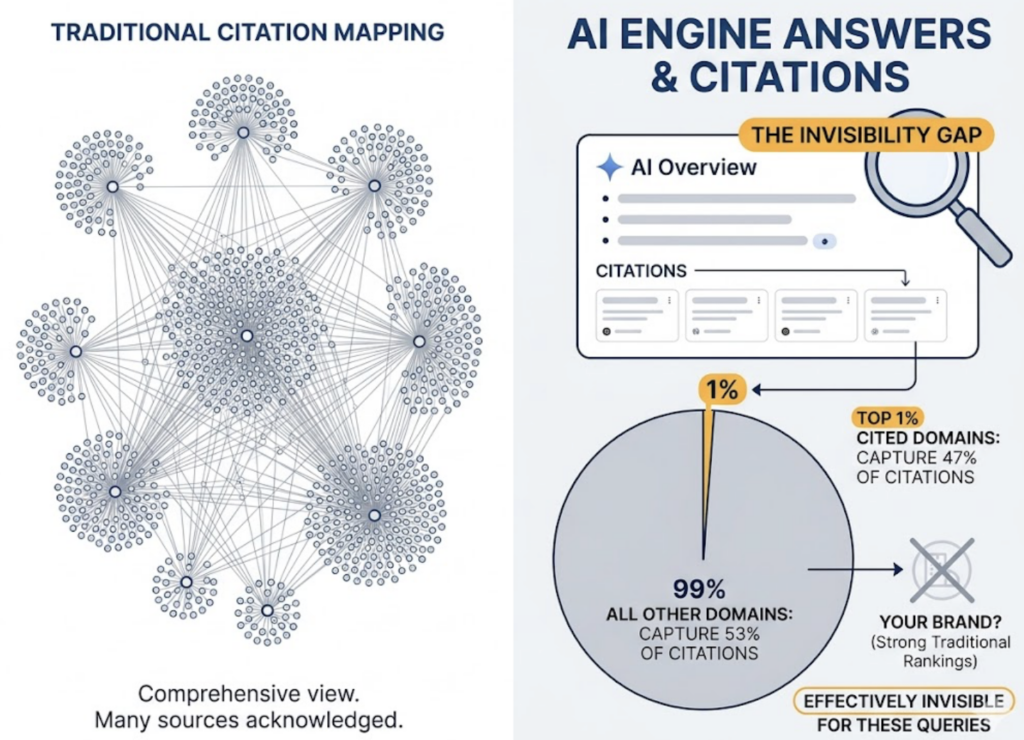
    Citation mapping is the part traditional tools never touched. When an AI engine answers a question, it tends to pull from a small pool of sources it treats as authoritative. A 2026 study by Digital Applied that analyzed 1,000 AI Overviews found the top 1% of cited domains captured 47% of all citations. If your brand isn’t in that authority tier, you’re effectively invisible for those queries, no matter how strong your traditional rankings look.

    Cross-engine tracking is the other non-negotiable. Google AI Overviews and Perplexity cite the same URLs only 13.7% of the time, per the same body of research. Watching one engine tells you almost nothing about the others.

    How to Measure an AI Brand Monitoring System

    You can’t manage what you can’t quantify, and AI visibility needs its own KPI stack. Five metrics do most of the work.

    MetricWhat it measuresWhy it matters
    Visibility RateShare of tracked prompts where your brand is mentioned or citedTells you if AI knows you exist
    Citation ShareYour portion of total citations in a competitive setProxy for topical authority
    Sentiment ScoreThe tone AI uses to describe your brandEarly warning for false or negative claims
    Position IndexWhere you land in the answer, first mention or fifthMeasures prominence in short summaries
    CVRConversion rate from AI-referred trafficConnects visibility to revenue

    Sentiment deserves extra attention. Hallucination rates across top models still run between 15% and 27%, based on 2026 figures from SQ Magazine and LLM Pulse. That means roughly one in five AI answers about your brand could carry a confident, incorrect claim about your pricing, features, or history. Most ai overviews tracking software flags mentions but skips this layer, which is where quiet brand damage builds up.

    The point of measurement isn’t a prettier dashboard. It’s catching a sentiment drop or a citation loss while you can still act on it.

    Where AI Overviews Tracking Fits In

    Google AI Overviews is its own surface, and it behaves differently from chat assistants. It sits at the top of the results page, summarizes an answer, and often resolves the query before anyone clicks. In 2026, informational queries on Google hit a 64.82% zero-click rate. If you’re not cited inside that summary, you don’t exist for most of those searchers.

    This is why aio tracking has become a category of its own. An ai overviews tracking tool watches which domains Google’s summary pulls from for your target questions, so you can see whether you’re feeding the answer or watching a competitor do it.

    A few things separate the best ai overviews tracking tools from noisy ones:

    • Source-level detail, not just “you appeared” but which URL got cited
    • Coverage of the same prompts across other engines, so AIO data sits in context
    • Competitor citation tracking, since the 47% concentration at the top means you’re fighting for a finite pool of citation slots

    The strongest setups treat AI Overviews tracking software as one input into the broader monitoring system, not a standalone report. The whole value is seeing AIO, ChatGPT, and Perplexity side by side.

    What to Look For in the Tools

    Most ai overviews tracking tools and brand monitoring platforms claim the same thing. The differences show up in what they actually capture. Five dimensions sort the field.

    CapabilityWhy it matters
    Multi-engine coverageOne engine is a blind spot, given 13.7% cross-citation overlap
    Source and citation analysisTells you where AI authority comes from
    Competitor benchmarkingCitation share only means something against rivals
    Sentiment trackingCatches hallucinated claims before customers do
    Execution, not just dataInsight you can’t act on is a report, not a system

    This is where Topify fits for teams that want the full picture in one place. Its Visibility Tracking follows brand mentions across ChatGPT, Gemini, Perplexity, Google AI Overviews, and others, while Source Analysis reverse-engineers the exact domains and URLs those engines cite. In practice, that means you can spot a drop in ChatGPT mentions and trace it back to a source that stopped citing you, inside the same view.

    Competitor Monitoring rounds it out by showing which brands AI recommends ahead of you and how that ordering shifts week to week. For brands chasing the citation tier, that benchmarking is the difference between guessing and knowing.

    One structural signal is worth acting on regardless of tool: schema. A 2026 study found schema-marked pages get cited 2.3× more often than unstructured equivalents. Good monitoring tells you where you’re losing citations. Structured content is often how you win them back.

    Common Mistakes That Quietly Break the System

    A monitoring system can technically run and still tell you nothing useful. The failure modes tend to repeat. Use this as a quick checklist.

    • Tracking one engine. With only 13.7% citation overlap between AIO and Perplexity, single-platform data is a partial view sold as a full one.
    • Keyword-level instead of prompt-level. Customers ask AI full questions, not keywords. Track the questions.
    • Ignoring sentiment. A mention isn’t a win if the description is wrong. With hallucination rates near 15% to 27%, tone needs its own metric.
    • No competitor baseline. A 30% visibility rate means nothing until you know whether the leader sits at 35% or 80%.
    • Skipping the citation layer. If you track mentions but not sources, you’ll never learn how to improve your standing.

    Fixing these is most of how to improve an ai brand monitoring system. The upgrade is rarely a fancier dashboard. It’s covering more engines, dropping to the prompt level, and adding the source and sentiment layers you skipped.

    Building Your Strategy and What It Costs

    A working strategy for an AI brand monitoring system follows a simple sequence. Define the prompts your buyers actually ask. Set a baseline across engines. Track on a schedule. Benchmark against competitors. Then act on the gaps, usually by strengthening the sources AI cites in your category.

    An example makes it concrete. A B2B SaaS brand might track 100 buying-intent prompts across four engines, discover it’s cited in 22% of them versus a rival’s 41%, find that most rival citations trace back to three review sites, and prioritize getting placed and accurately described on those sources. That’s a full loop: measure, diagnose, act.

    On ai brand monitoring system pricing, dedicated tools generally run from under $100 a month for small teams up to several hundred for higher prompt volumes and seats. Topify pricing starts at $99 a month on the Basic plan, which covers ChatGPT, Perplexity, and AI Overviews tracking with 100 prompts. Pro runs $199 a month for 250 prompts and more seats, and Enterprise starts at $499. You can get started with Topify on a trial before committing.

    The honest framing: the cost of a tool is small next to the cost of a competitor owning your category in AI answers while you’re not looking.

    Conclusion

    The brands that get described accurately and recommended often in AI answers aren’t lucky. They’re watching. An AI brand monitoring system turns a black box into something you can measure, benchmark, and improve, the same way you already manage traditional SEO.

    Start small. Pick 20 to 50 prompts your customers actually ask, run them across the major engines, and see where you stand today. The first baseline is usually a wake-up call. From there, the work is steady: track, diagnose, act, repeat.

    FAQ

    Q: What is an AI brand monitoring system? 

    A: It’s a structured process for tracking how AI engines like ChatGPT, Perplexity, and Google AI Overviews mention, cite, rank, and describe your brand, then measuring those results over time so you can improve them.

    Q: What’s an example of an AI brand monitoring system in action? 

    A: A SaaS brand tracks 100 buying-intent prompts across four AI engines, finds it’s cited in 22% of answers versus a competitor’s 41%, traces the gap to a few review sites, and works to get accurately represented there. Visibility climbs as those sources start citing it.

    Q: What’s a quick checklist for an AI brand monitoring system? 

    A: Cover multiple engines, track at the prompt level, measure visibility plus citation share plus sentiment plus position, set a competitor baseline, and analyze which sources AI cites. Missing any one of these leaves a blind spot.

    Q: How much does AI brand monitoring cost? 

    A: Tools generally range from under $100 a month for small teams to several hundred for larger prompt volumes. Topify starts at $99 a month, with Pro at $199 and Enterprise from $499.

    Read More

  • AI Brand Monitoring Solutions, Ranked

    AI Brand Monitoring Solutions, Ranked

    Search “AI brand monitoring solution” and you’ll find a dozen dashboards, each promising to track how your brand shows up in ChatGPT or Perplexity. Half of them only cover one platform. The other half show you mention counts with no context on why your brand got cited, or why it didn’t.

    Meanwhile, AI search engines now account for 10 to 15% of discovery queries, and that number is climbing every quarter. The real challenge isn’t finding a monitoring tool. It’s finding one that tells you something your existing SEO stack can’t.

    Most AI Brand Monitoring Tools Only Track What You Already Know

    Here’s the gap most brand teams don’t see coming: traditional brand monitoring tools were built for social media mentions, review sites, and Google SERPs. None of those data sources tell you what ChatGPT says when a potential customer asks, “What’s the best project management tool for remote teams?”

    AI search operates on a completely different layer. There are no keyword rankings. No click-through rates. AI models decide what to recommend based on their own retrieval pipelines, training data, and source-weighting algorithms, and those algorithms vary wildly from platform to platform.

    That matters more than most teams realize. Perplexity exhibits a 93% zero-click rate, and Google AI Mode isn’t far behind at 88%. If your brand isn’t showing up in the AI response itself, there’s often no second chance to earn visibility through organic links below it.

    A single-platform tracker won’t cut it either. A brand may rank well in Perplexity, which tends to favor primary research sources, but get completely overlooked by ChatGPT, which relies on different web indices. True AI brand monitoring requires multi-platform coverage that accounts for these divergences.

    What the Best Software for AI Visibility Actually Measures

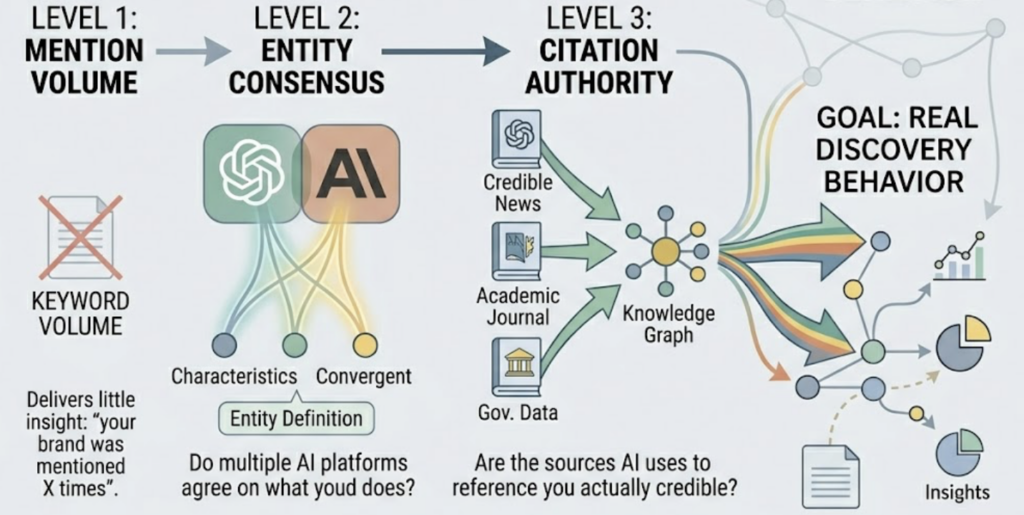
    The software for AI search visibility that actually delivers insight goes well beyond “your brand was mentioned X times.” According to recent industry analysis, the shift is toward two higher-order concepts: Entity Consensus (do multiple AI platforms agree on what your brand does?) and Citation Authority (are the sources AI uses to reference you actually credible?).

    Here’s a practical framework. Evaluate any AI brand monitoring solution against these five metrics:

    MetricWhat It TracksWhy It Matters
    Brand PresenceHow often your brand appears in AI responsesYour market share in AI discovery
    Citation QualityWhich sources AI uses to reference youDetermines recommendation credibility
    Sentiment AccuracyWhether AI describes your brand correctlyCatches reputation risk early
    Citation ShareYour mentions vs. competitors in the same promptsCompetitive positioning benchmark
    Prompt CoverageWhich query types trigger your brandReveals funnel-stage visibility gaps

    On top of these, best-rated software for AI visibility typically layers in a three-tier capability model:

    1. Monitoring: real-time mention and sentiment tracking across LLMs.
    2. Benchmarking: side-by-side competitor comparison on citation share and positioning.
    3. Execution: automated content optimization and agent-driven strategy deployment.

    Most tools stop at tier one. The ones worth paying for reach tier three.

    Top AI Brand Monitoring Solutions for 2026

    Here’s a quick comparison of the leading platforms in this space, ranked by depth of coverage and actionability.

    RankPlatformAI Platforms CoveredCore StrengthStarting PriceBest For
    1TopifyChatGPT, Gemini, Perplexity, DeepSeek, Doubao, Qwen + moreFull-spectrum monitoring + GEO execution$99/moMarketing teams, agencies, brand managers
    2Semrush AI ToolkitChatGPT, Perplexity, Google AI OverviewsIntegration with existing SEO workflowsBundled with Semrush plansSEO teams expanding into AI visibility
    3BrandwatchChatGPT, limited AI coverageSocial + AI mention correlationCustom pricingEnterprise social monitoring teams
    4BirdeyeChatGPT, Google AI OverviewsLocal business AI visibilityCustom pricingMulti-location businesses
    5Alhena AIChatGPT, GeminiBrand visibility analysis with AI insightsCustom pricingMid-market brands starting AI monitoring

    #1 Topify: Full-Spectrum AI Brand Monitoring and GEO Execution

    Topify stands out in this category for one reason: it doesn’t stop at monitoring. While most platforms give you a dashboard of mention counts, Topify delivers a seven-metric intelligence layer (visibility, sentiment, position, volume, mentions, intent, and CVR) across every major AI platform, including ChatGPT, Gemini, Perplexity, DeepSeek, Doubao, and Qwen.

    That breadth matters. With 85% of users now following a “hybrid journey” where they discover via AI but verify on traditional search, monitoring only one or two platforms leaves significant blind spots in your brand’s discovery funnel.

    Here’s what sets Topify apart from the rest of this list:

    Source Analysis digs into the exact domains and URLs that AI platforms cite when mentioning your brand, or your competitors. Instead of guessing why your visibility dropped, you can trace it back to a specific citation source that stopped being referenced.

    Dynamic Competitor Benchmarking automatically detects competing brands in your category and provides real-time side-by-side comparison on visibility, sentiment, and position. You don’t have to manually set up competitor tracking. The system surfaces rivals you might not have been watching.

    One-Click Agent Execution takes Topify into tier-three territory. Define your optimization goals in plain English, review the proposed strategy, and deploy with a single click. No manual content workflows. The AI agent continuously monitors, reasons, and acts on your behalf.

    CVR (Conversion Visibility Rate) is Topify’s proprietary metric that estimates the likelihood an AI response will drive a user toward brand interaction. It’s the closest thing the market has to a “conversion” metric for AI search.

    Pricing starts at $99/mo for the Basic plan (100 prompts, 9,000 AI answer analyses, 4 projects). The Pro plan at $199/mo scales to 250 prompts and 22,500 analyses. For teams that need managed GEO execution, Topify also offers a full-service tier starting at $3,999/mo.

    The platform was built by a team with deep roots in the space: a GEO strategy lead with 10+ years of Fortune 500 SEO experience, an LLM algorithm researcher from Stanford with publications at NeurIPS and ICLR, and a growth operator who’s scaled companies from zero to $20M in revenue.

    Get started with Topify to see where your brand stands across AI platforms.

    #2 Through #5: Other AI Brand Monitoring Software Worth Considering

    #2 Semrush AI Toolkit. If your team already lives inside Semrush for traditional SEO, their AI visibility features offer a natural extension. Coverage includes ChatGPT, Perplexity, and Google AI Overviews. The trade-off is that AI visibility metrics are layered on top of an SEO-first architecture, so the depth of AI-specific analysis tends to be thinner than dedicated platforms. It works well for SEO teams that want a unified dashboard without adding another vendor.

    #3 Brandwatch. Known for social listening, Brandwatch has added AI mention tracking to its enterprise suite. The strength is correlating traditional social sentiment with AI-generated brand mentions. The limitation is narrower AI platform coverage. It’s a fit for enterprise teams already using Brandwatch for social monitoring who want incremental AI visibility without switching platforms.

    #4 Birdeye. Birdeye focuses on local and multi-location businesses, tracking how brands appear in AI recommendations at the local level. If your use case is “Does ChatGPT recommend our Denver location when someone asks for the best coffee shop nearby?”, Birdeye covers that well. For broader brand-level AI monitoring across multiple platforms, the coverage is more limited.

    #5 Alhena AI. A newer entrant offering brand visibility analysis across ChatGPT and Gemini. Alhena provides basic mention tracking and competitive insights. It’s a reasonable starting point for mid-market brands testing the waters of AI monitoring, though it currently lacks the multi-platform depth and execution layer of more mature platforms.

    Choosing the Right Software for AI Search Visibility

    The right AI brand monitoring solution depends on where your team falls in the monitoring-to-execution spectrum.

    If you’re a small marketing team or solo brand manager just starting to track AI visibility, a lightweight tool that covers ChatGPT and Google AI Overviews may be enough to establish a baseline. But don’t stay there too long. With roughly 20% of businesses already using AI operationally and adoption climbing fast in information and finance sectors, the window for early-mover advantage is narrowing.

    For agencies managing multiple client brands, the non-negotiable is multi-platform coverage plus competitive benchmarking. Your clients will ask, “How are we doing in AI search?” and you need a dashboard that answers that question across ChatGPT, Perplexity, Gemini, and beyond, not just one platform at a time.

    For mid-to-large brands with dedicated marketing ops, the leading software for AI visibility and generative engine optimization goes beyond monitoring into execution. The three-tier framework is useful here: Can the tool diagnose whyyou’re invisible (content gap, authority gap, or data structure gap), and does it offer a technical path to resolution? That’s the line between a dashboard and a strategy platform.

    The broader trend is clear. AI brand monitoring is evolving from a reactive tracking activity into a proactive GEO function. The economic shift in 2026, as industry analysts have noted, is the movement from clicks to citations. Brands that treat AI monitoring as a standalone reporting exercise will fall behind those who connect it to an optimization engine.

    Conclusion

    The AI brand monitoring solution you choose today will shape whether your brand gets recommended, or gets overlooked, in the fastest-growing discovery channel of 2026. Mention counts alone won’t tell you what’s happening. You need multi-platform coverage, citation-level analysis, and ideally, an execution layer that turns data into action.

    Start by establishing a baseline: track your brand across at least three AI platforms, benchmark against your top competitors, and identify the prompts where you’re invisible. That first audit often reveals gaps that traditional SEO metrics never surface.

    FAQ

    Q: What’s the difference between traditional brand monitoring and AI brand monitoring?

    A: Traditional brand monitoring tracks mentions across social media, news sites, and review platforms. AI brand monitoring tracks how AI models like ChatGPT, Perplexity, and Gemini describe, recommend, and cite your brand in their responses. The data sources, metrics, and optimization levers are fundamentally different.

    Q: How often should I check my brand’s AI search visibility?

    A: Weekly at minimum. AI platforms update their citation patterns and source weighting frequently. A brand that was visible in Perplexity last month may drop out after a source index refresh. Continuous monitoring tools like Topify’s Visibility Tracking catch these shifts in real time.

    Q: Can AI brand monitoring tools track competitor mentions too?

    A: Yes. The best software for AI search visibility includes competitive benchmarking, comparing your citation share, sentiment, and positioning against rivals across the same prompt sets. Topify’s Competitor Monitoring feature automates this by detecting competing brands in your category without manual setup.

    Q: What is the best software for AI search visibility for small teams?

    A: For small teams, look for a platform that balances coverage and simplicity. Topify’s Basic plan ($99/mo) covers ChatGPT, Perplexity, and AI Overviews with 100 tracked prompts and 9,000 AI answer analyses, enough to establish a visibility baseline and identify your highest-priority gaps.

    Read More

  • AI Brand Monitoring Tools That Track What Google Can’t

    AI Brand Monitoring Tools That Track What Google Can’t

    Your brand ranks on page one for every target keyword. Your Brandwatch dashboard shows steady sentiment. Then a prospect asks ChatGPT, “What’s the best tool for [your category]?” and gets five recommendations. You’re not on the list.

    The gap between what traditional monitoring tools see and what AI search engines actually recommend is where brands are losing deals they never knew existed. And with over 56% of global search volume now flowing through AI answer engines, that gap is growing every quarter.

    Most AI Brand Monitoring Tools Were Built for a World That No Longer Exists

    Traditional brand monitoring platforms like Brandwatch and Brand24 were designed to crawl social media posts, news articles, blogs, and forums. They track Share of Voice, backlinks, and post-discovery sentiment. That model worked when Google’s blue links were the primary discovery channel.

    It doesn’t work for AI search.

    ChatGPT, Perplexity, and Gemini don’t crawl pages and rank them. They synthesize answers from diverse sources using Retrieval-Augmented Generation (RAG), pulling from reviews, forums, podcasts, and structured data. The output isn’t a list of links. It’s a conversational recommendation, often with a ranked shortlist of brands.

    That’s a fundamentally different monitoring challenge.

    Traditional tools capture what people say about your brand after they’ve found you. An AI brand monitoring tool captures whether AI recommends your brand before the user even visits a website. 65% of informational queries now resolve without a single click, which means the AI’s answer is the entire user experience for most discovery moments.

    Top AI Brand Monitoring Tools in 2026: A Side-by-Side Look

    Here’s how the leading ai rank trackers compare across the dimensions that matter most for brand monitoring:

    ToolAI Platforms CoveredBrand Mention TrackingPosition TrackingSentiment AnalysisCompetitor MonitoringStarting Price
    TopifyChatGPT, Gemini, Perplexity, DeepSeek, Doubao, Qwen + moreYes (Share of Model)YesYes (0-100)Auto-detection + benchmarking$99/mo
    ProfoundChatGPT, PerplexityYesLimitedYes (NSS)Manual setupCustom pricing
    OtterlyAIChatGPT, Perplexity, GeminiYesYesYes (NSS)Basic comparisonCustom pricing
    BrandViz.AIChatGPT, GeminiYesNoLimitedNoFree tier available
    AIOverview.comGoogle AI Overviews onlyYesNoNoNoFree

    The differences aren’t subtle. Platform coverage, automated competitor detection, and the depth of sentiment scoring vary widely, and those gaps determine whether you’re seeing the full picture or just a slice of it.

    #1 Topify: Full-Stack AI Brand Monitoring Across Every Major Platform

    Where most tools cover two or three AI engines, Topify tracks brand visibility across ChatGPT, Gemini, Perplexity, DeepSeek, Doubao, Qwen, and other regional platforms. For global brands or teams managing multi-market campaigns, that coverage isn’t optional.

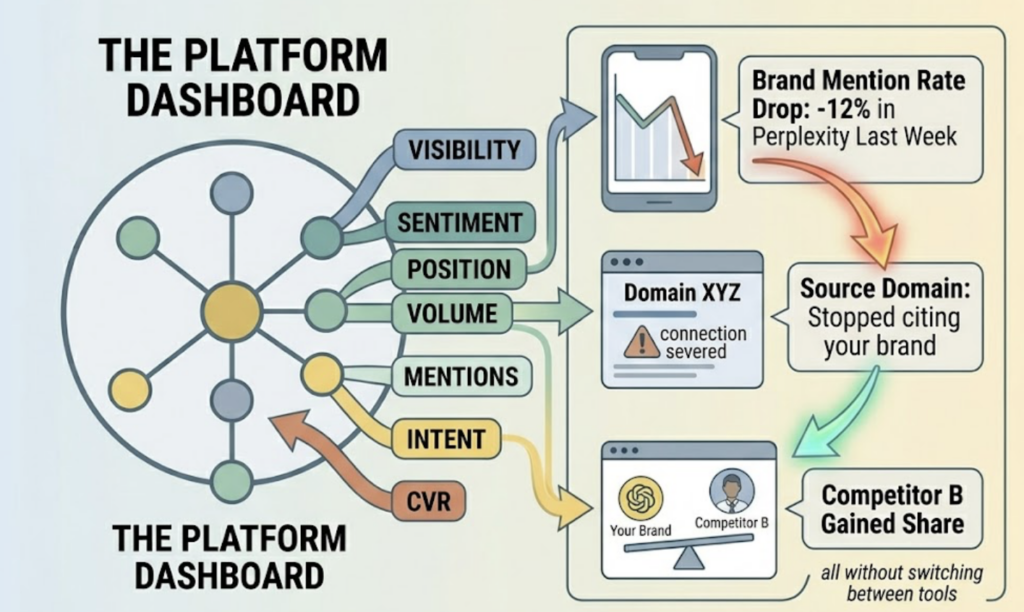
    The platform’s core strength is combining seven analytics dimensions into a single dashboard: visibility, sentiment, position, volume, mentions, intent, and CVR (Conversion Visibility Rate). In practice, this means you can see that your brand’s mention rate dropped 12% in Perplexity last week, trace it to a specific source domain that stopped citing you, and identify which competitor gained that share, all without switching between tools.

    Competitor Monitoring deserves a closer look. Topify auto-detects competitors based on the prompts you’re tracking, so you don’t need to manually build a watchlist. When a new brand starts appearing in AI recommendations for your category, you’ll know.

    The Source Analysis feature reverse-engineers the exact domains and URLs that AI platforms cite when generating answers. This is the “new backlink profile” for AI search. If a competitor is being cited from a source you’re not present on, that’s a content gap you can act on.

    Topify also offers a One-Click Agent: define your optimization goals in plain English, review the proposed strategy, and deploy it with a single click. No manual workflows required.

    Pricing starts at $99/mo for the Basic plan (100 prompts, 9,000 AI answer analyses, 4 projects). The Pro plan at $199/mo scales to 250 prompts and 22,500 analyses.

    #2 Through #5: Other Best AI Rank Trackers Worth Knowing

    Profound focuses on AI citation analysis with a strong emphasis on net sentiment scoring. It covers ChatGPT and Perplexity, and its NSS model measures the emotional context of brand mentions on a -100 to +100 scale. The trade-off: limited platform coverage and no automated competitor detection. It tends to suit teams that prioritize deep sentiment analysis over breadth.

    OtterlyAI offers AI visibility tracking across ChatGPT, Perplexity, and Gemini with a technical deep-dive approach to sentiment. Its position tracking and mention frequency tools are solid for teams already familiar with AI monitoring. Competitor comparison is available but requires more manual configuration than Topify’s auto-detection.

    BrandViz.AI provides a lightweight entry point for teams just starting with AI brand monitoring. It covers ChatGPT and Gemini with basic mention tracking and a free tier. Position tracking and competitor monitoring aren’t available, so it’s best suited for initial exploration rather than ongoing strategy.

    AIOverview.com is a single-purpose tool focused exclusively on Google AI Overviews. It tracks whether your brand appears in Google’s AI-generated summaries. Useful as a supplementary data source, but it doesn’t cover the broader AI search ecosystem where most buyer-intent discovery happens.

    How to Pick the Right AI Rank Tracker for Brand Mentions

    The “right” tool depends on what you’re trying to monitor and who’s doing the monitoring.

    Brand managers typically need breadth: visibility across multiple AI platforms, sentiment tracking, and enough competitor data to report to leadership. Topify’s combination of auto-detected competitors, cross-platform coverage, and CVR scoring fits this profile. The dashboard is built to answer “How are we performing vs. competitors in AI search?” without requiring a data team to interpret the output.

    SEO teams expanding into GEO often care most about source analysis. They want to know which domains AI engines are citing, where their content gaps are, and how to build an “AI backlink” strategy. Topify’s Source Analysis and Position Tracking address this directly.

    Agencies managing multiple client brands need scalability. Topify’s project-based structure (4 projects on Basic, 8 on Pro) lets agencies run separate monitoring dashboards for each client.

    If your only concern is Google AI Overviews and you don’t need cross-platform data, AIOverview.com is a free starting point. But for any team treating AI search as a serious brand channel, a full-stack ai rank tracker for brand mentions is the minimum viable setup.

    3 Metrics Your AI Brand Monitoring Tool Must Track (or It’s Missing the Point)

    Visibility Score: Are You Even in the Room?

    Visibility Score measures how often your brand appears in AI-generated responses for high-intent queries in your category. Think of it as Share of Model, the AI equivalent of Share of Voice.

    If your brand doesn’t appear in the initial AI response, you’re effectively invisible. Few users ask follow-up questions to surface more options. The first answer is the shortlist.

    Position Rank: Where You Show Up Matters as Much as Whether You Show Up

    AI models often present brands in a ranked list or a prioritized narrative. Being mentioned first carries disproportionate weight, similar to “position zero” in traditional SEO but applied to conversational output.

    Topify‘s Position Tracking monitors this across platforms, so you can see whether you’re consistently first-mentioned in ChatGPT but buried in Perplexity, and then dig into why.

    Sentiment Score: What AI Says About You Shapes How Buyers Perceive You

    A brand can be visible and still lose. If ChatGPT describes your product as “budget-friendly” when your positioning is premium, that’s a brand narrative problem happening at scale, in thousands of AI-generated responses per day.

    Sentiment Score (often measured on a 0-100 or -100 to +100 scale) quantifies the emotional context of AI mentions. Is your brand described as “reliable” or “outdated”? “Innovative” or “complex”? Tracking this over time reveals whether your content strategy is actually shaping AI perception, or losing ground.

    Conclusion

    Traditional brand monitoring tools were built to track social chatter and news mentions. They still do that well. But they weren’t designed for a world where over half of search volume runs through AI engines that generate recommendations without ever linking to your website.

    An AI brand monitoring tool fills that gap: tracking whether your brand is cited, where it ranks, and how AI describes it to potential buyers. The brands that treat AI monitoring as a core channel, not an experiment, are the ones building the visibility that compounds.

    If you haven’t audited your brand’s AI search presence yet, start with Topify and run your first visibility report. The data tends to be clarifying.

    FAQ

    Q: What’s the difference between traditional brand monitoring and AI brand monitoring? 

    A: Traditional brand monitoring tracks mentions across social media, news outlets, and forums. AI brand monitoring tracks how AI search engines like ChatGPT, Perplexity, and Gemini recommend, rank, and describe your brand in their generated responses. The key difference is timing: traditional tools capture reactions after discovery, while AI monitoring captures the recommendation layer where buyer shortlists are formed.

    Q: How do ai rank trackers for brand mentions actually work? 

    A: AI rank trackers send structured prompts to AI engines (e.g., “What are the best tools for [category]?”) and analyze the responses for brand presence, position, sentiment, and cited sources. This process runs on a scheduled basis, building a time-series dataset of how your brand’s AI visibility changes over weeks and months.

    Q: Can AI brand monitoring tools track competitor mentions too? 

    A: Yes. Most AI brand monitoring tools include some form of competitor tracking. Topify auto-detects competitors based on the prompts you monitor, so new entrants are flagged automatically. Other tools require you to manually specify competitor names, which means emerging rivals can go unnoticed.

    Q: How often should you check your brand’s AI search visibility? 

    A: Weekly monitoring is the minimum for most brands. AI models update their responses frequently, and a source that cited your brand last month may no longer be referenced. Teams in competitive categories (SaaS, fintech, e-commerce) often benefit from daily tracking to catch visibility shifts early.

    Read More

  • How to Build an AI Visibility Analytics Strategy

    How to Build an AI Visibility Analytics Strategy

    You’ve got a dashboard tracking your brand’s mentions in ChatGPT. Maybe a spreadsheet logging Perplexity citations. Your team pulls the numbers every month, nods at the charts, and moves on. Three quarters later, the data hasn’t changed anything. Your competitors still show up first, your visibility score hasn’t moved, and the CMO is asking why all that tracking didn’t translate into results.

    That’s the gap most marketing teams fall into. Collecting AI visibility data isn’t the same as having an AI visibility analytics strategy. Only 16% of brands actively track their AI search presence today. Among those that do, the vast majority are recycling traditional SEO frameworks that weren’t built for generative engines. The shift from passive tracking to strategic execution requires a different foundation: the right metrics, the right AI visibility analytics tool, and a reporting cadence fast enough to keep pace with models that rewrite their citation sources every few weeks.

    Most Brands Confuse AI Tracking with AI Strategy. Here’s the Difference.

    Traditional SEO is deterministic. You optimize a page, earn backlinks, track keyword rankings. The inputs and outputs follow a predictable logic. Generative Engine Optimization (GEO) doesn’t work that way. AI answer engines use probabilistic reasoning: they pull from training data, query vector databases for semantic relevance, evaluate source authority, and synthesize a direct response. The signals that matter are fundamentally different.

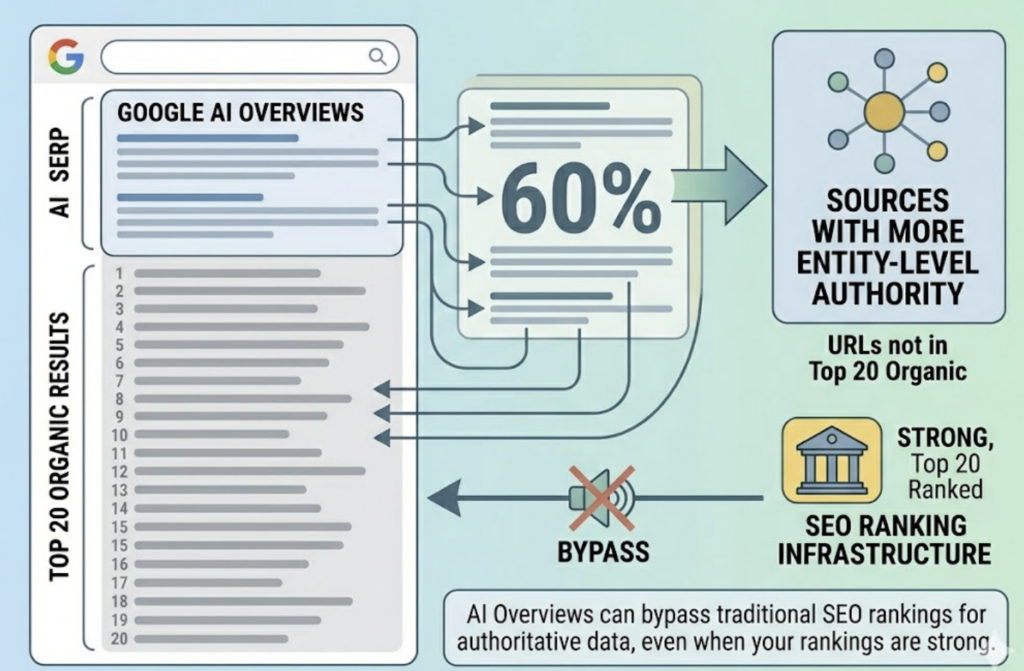
    Here’s one data point that illustrates the disconnect. Roughly 60% of citations in Google AI Overviews come from URLs that don’t even rank in the top 20 organic search results. That means your entire SEO ranking infrastructure can be strong, and AI engines will still bypass you for sources that carry more entity-level authority.

    The result? Organic click-through rates on AI-triggered queries have dropped from 1.76% to 0.61%, a 62% decline. Brands that treat their AI visibility analytics dashboard as just another SEO report are optimizing for a system that no longer drives the majority of discovery behavior.

    A real strategy does three things legacy tracking can’t: it defines which metrics actually reflect generative influence, it connects those metrics to execution workflows, and it runs at a cadence that matches how fast AI models shift their citation patterns.

    The 7 Metrics Your AI Visibility Analytics Dashboard Needs to Track

    A complete AI visibility analytics strategy measures conversational influence from the initial prompt to the final conversion. The seven-metric framework, as operationalized by platforms like Topify, covers the full spectrum.

    Visibility Rate tracks how often your brand appears in category-level AI responses, not just branded queries. A brand might have 90% visibility when someone searches its name, but near-zero for non-branded prompts like “best workflow automation tool for enterprise finance.” Topify data shows the average e-commerce brand sits at a 0.8% visibility rate, while leaders command 6.2%. In SaaS, the average is 2.1% and leaders reach 11.8%.

    That gap is the total addressable market you’re losing.

    Sentiment Score evaluates how AI frames your brand on a 0-to-100 scale. High visibility with low sentiment is worse than invisibility. If an AI engine relies on outdated forum data and describes your product as “overpriced compared to competitors,” that narrative actively deters conversions.

    Position Rank captures where your brand lands in the synthesized response. First position captures disproportionate trust and click-through due to the primacy effect. Third position is a footnote.

    AI Search Volume measures how many users query generative platforms about topics in your category. This diverges significantly from traditional keyword volume because conversational prompts are longer, more specific, and structured as problem statements rather than keyword fragments.

    Brand Mentions and Source Citations track which external domains AI models reference when constructing answers about your brand. An Ahrefs study of 75,000 brands found a 0.664 correlation between external web mentions and visibility in Google AI Overviews. Traditional backlinks? Only 0.218. Third-party mentions are the new machine reputational vote.

    Intent Coverage maps your presence across the buyer journey: informational (“what is X”), comparative (“X vs Y”), and transactional (“best pricing for X”). Many brands achieve strong informational visibility but disappear entirely on comparative and transactional prompts where purchase decisions happen.

    Conversion Visibility Rate (CVR) bridges generative presence and revenue. AI-referred visitors convert at 14.2%, compared to 2.8% for standard organic search. They also spend 68% more time on-site. If you’re invisible on transactional queries, you’re missing the highest-converting traffic channel available today.

    Which Metrics to Prioritize Depends on Your Business Goal

    You don’t optimize all seven simultaneously. That diffuses resources.

    For brand awareness, narrow the focus to Visibility Rate and AI Volume. Maximize how often your entity gets extracted across high-demand conversational prompts.

    For competitive defense, shift weight to Position Rank and Brand Mentions. Reverse-engineer the third-party URLs driving a competitor’s primary recommendation slot and systematically acquire presence on those citation nodes.

    For conversion optimization, prioritize CVR, Intent Coverage, and Sentiment Score. A sentiment drop on transactional prompts, like an AI surfacing old customer complaints during a pricing comparison, will sever the conversion pathway instantly.

    How to Choose an AI Visibility Analytics Platform

    Evaluating an AI visibility analytics software stack requires scrutiny across four dimensions: multi-platform AI coverage, metric depth, competitive benchmarking, and the presence of an execution layer.

    Platform coverage matters because user bases are fragmented. ChatGPT commands over 80% of the AI chatbot market, but Perplexity dominates academic and technical research, DeepSeek serves as a primary gateway in Asian markets, and Google AI Overviews intercept standard browser behavior. An AI visibility analytics solution that only tracks one platform leaves blind spots.

    The most severe differentiator, though, is the execution layer. Most AI visibility analytics software functions as an observation deck: it identifies gaps but relies entirely on manual intervention to fix them.

    PlatformAI Engine CoveragePrimary StrengthKnown LimitationBest For
    TopifyChatGPT, Perplexity, Gemini, DeepSeek, AI OverviewsSeven-metric framework + One-Click GEO ExecutionNot suited for passive-only reporting teamsEnd-to-end strategy from insight to execution
    ProfoundChatGPT natively; multi-engine at Enterprise tierConversation Explorer with 400M+ real interactionsPure intelligence layer, no execution featuresEnterprise brands needing deep passive intelligence
    QuattrMulti-engine + Google Search ConsoleGIGA agent for CMS-ready HTML generationHigh complexity, custom enterprise pricingLarge B2B SaaS with massive content repositories
    Semrush AI ToolkitCore engines + AI OverviewsDistinguishes brand mentions from cited page attributionAnchored to traditional SEO workflowsSEO teams transitioning into GEO
    Scrunch AICore engines (AXP Focus)Persona-based monitoring across user types$250/mo entry cost limits mid-market accessBrand safety and hallucination monitoring

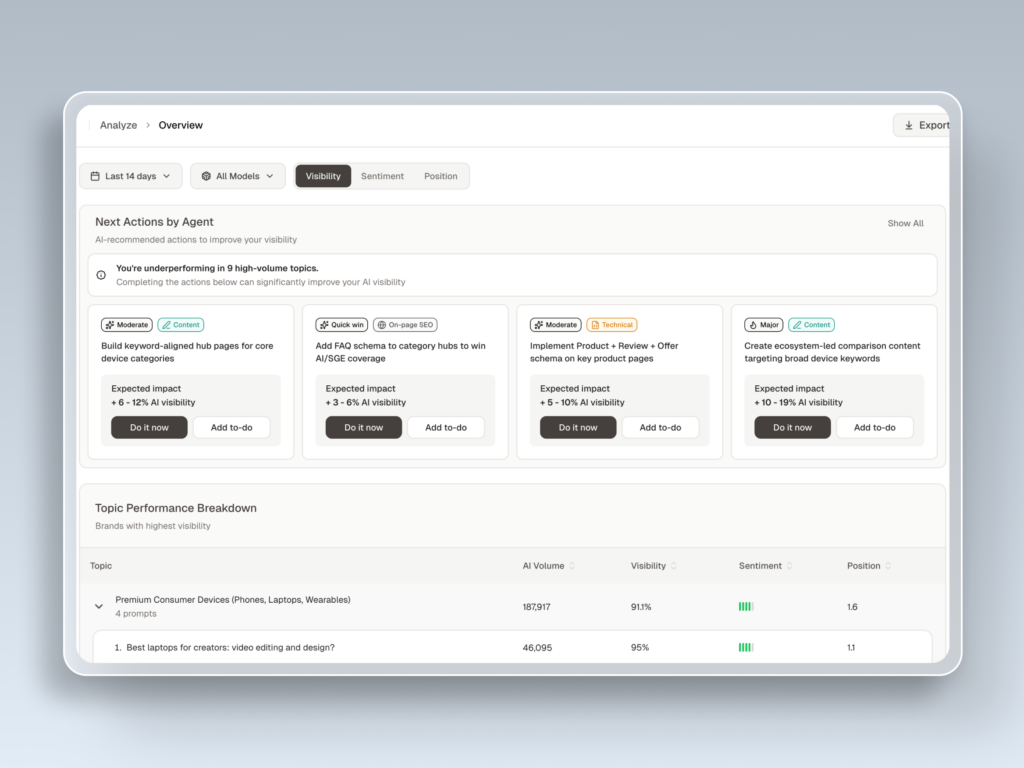
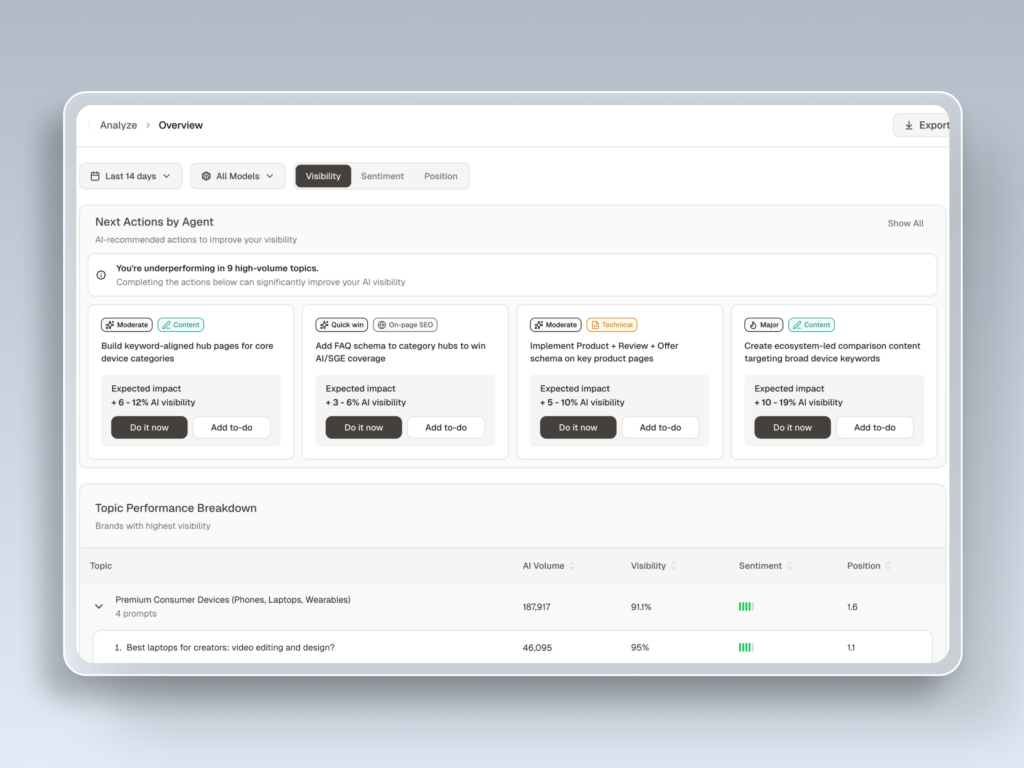
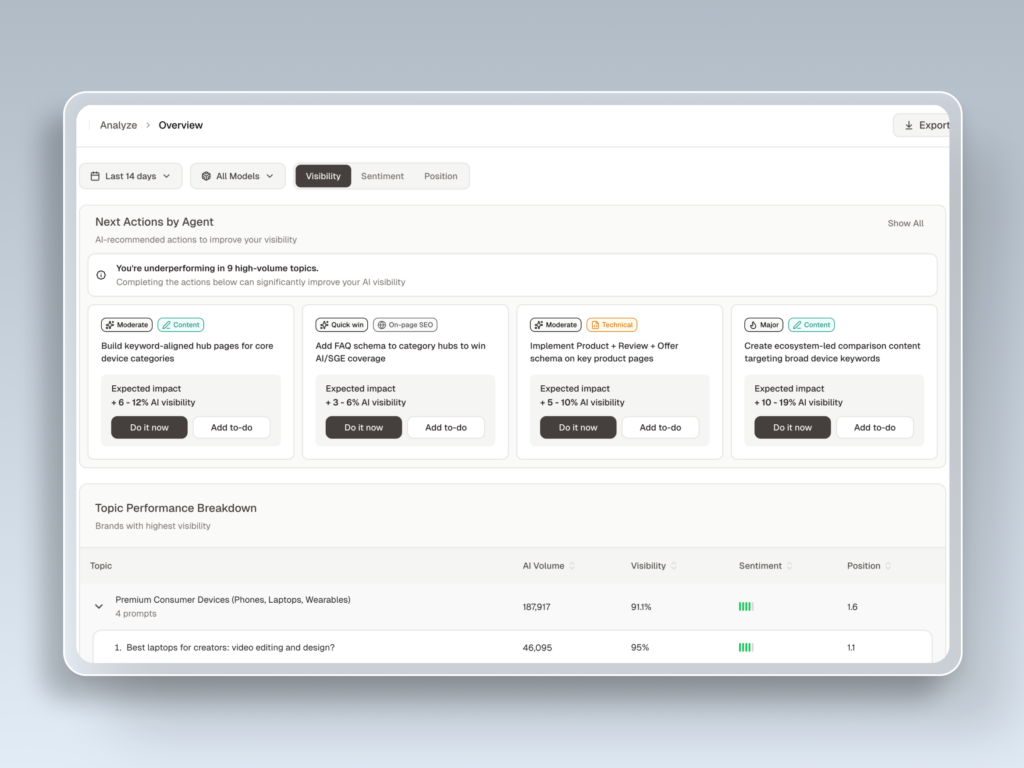
    For teams that need to move from data to action without a data science team in between, Topify’s architecture stands out. Its system continuously analyzes visibility data to generate prioritized, AI-driven action feeds, and its citation mapping lets you reverse-engineer exactly which third-party URLs are driving competitor visibility.

    Building Your AI Visibility Analytics Strategy in 4 Steps

    Step 1: Define the Tracking Perimeter

    Don’t track every conceivable query. Identify your “Golden Query” set: the 20 to 50 high-value prompts with strong commercial intent that align with your ideal customer profile.

    Traditional keyword research tools can’t do this because they measure search engine indexing, not conversational language. Topify’s High-Value Prompt Discovery automates this scoping by scoring prompts on four weighted factors: AI Query Volume (30%), Visibility Gap (25%), Commercial Intent (25%), and Content Readiness (20%). This narrows the perimeter to prompts with the highest downstream conversion probability.

    A good starting point for teams without a paid tool: Topify’s free GEO audit tools can give you an initial visibility snapshot before you commit to a full platform.

    Step 2: Establish the Baseline

    Run your Golden Prompts across ChatGPT, Perplexity, Gemini, and Claude. Record the current visibility score, position rank, and sentiment for each platform. This is your Share of Model.

    During this phase, audit your entity infrastructure. AI systems build knowledge graphs that associate companies with expertise signals. If your brand is described inconsistently across your website, LinkedIn, Google Business Profile, and industry directories, the model interprets that ambiguity as a lack of authority. Inconsistency breaks AI entity recognition.

    Step 3: Set Competitor Benchmarks and Map Citations

    Generative search is zero-sum. Your visibility gain displaces a competitor. Configure your AI visibility analytics system to track rivals across the same Golden Query set.

    This step relies heavily on citation mapping. A Q1 2026 audit found that Wikipedia and Reddit together account for over 25% of all ChatGPT citations in the US. Review platforms like G2 and Capterra provide a 3x multiplier to citation rates. By identifying exactly which domains cite your competitors, you establish precise targets for digital PR and content syndication.

    Step 4: Set the Execution and Reporting Cadence

    Static monthly reports are obsolete before they reach an executive desk. AI models update retrieval databases and shift context windows continuously.

    Daily or weekly analytics are the minimum functional frequency. More importantly, reporting must be linked to execution. When a visibility gap shows up in a weekly review, the workflow should dictate an immediate response. Topify’s One-Click Execution closes this gap: when the platform detects a drop, its AI agent generates a prioritized action feed and lets the team deploy the fix instantly.

    What Breaks Most AI Visibility Analytics Systems After 90 Days

    Most teams that deploy an AI tracking strategy see it break within the first quarter. The failure is almost never technological. It’s methodological.

    Treating GEO as a one-time checklist. Deploying FAQ schema and formatting content as “answer-first” can yield initial visibility gains within 30 to 60 days, but the effect decays fast. Research shows 65% of AI bots prioritize pages updated within the past year, and 79% reference content refreshed within two years. Princeton data reveals that keyword stuffing degrades AI visibility by 10%, while inline citations boost it by 115.1%. Publish-and-forget strategies always lose to teams that continuously refresh.

    Ignoring the external source stack. The University of Toronto found that AI search engines return 81.9% earned media compared to only 18.1% brand-owned content. One B2B SaaS company wrote six extensive blog posts and got zero AI citations. When they shifted to securing 12 third-party mentions through newsletters, podcasts, and reviews, their AI-sourced demo bookings jumped from 7% to 19%. A Stacker pilot across 87 stories achieved a 239% median citation lift through syndication alone.

    Dashboard paralysis. Teams review dashboards weekly but deploy zero content updates or PR initiatives. The fix is straightforward: connect your analytics directly to an execution layer. Topify’s automated action feed forces the transition from observation to deployment.

    Health CheckFailure IndicatorCorrective Action
    Citation Volatility40%+ drop in source frequency over 30 daysLaunch external PR syndication targeting high-cited domains
    Sentiment DecayScore falls below 50Audit negative mentions; update owned content with corrected facts
    Intent MisalignmentHigh informational visibility, zero transactionalDeploy pricing schema and comparative content
    Freshness PenaltySteady month-over-month position declineRefresh core pages; update statistics to trigger re-indexing
    Entity AmbiguityVisibility drops across multiple platforms simultaneouslyClean up entity profiles across Wikipedia, LinkedIn, Google Business

    Conclusion

    Collecting AI visibility data and having an AI visibility analytics strategy are two different things. The gap between them is execution.

    A durable strategy rests on three pillars: a seven-metric framework that captures the full generative influence spectrum, an AI visibility analytics platform capable of multi-engine tracking and automated optimization, and a reporting cadence measured in days rather than months. The starting point is defining your golden query perimeter, establishing the baseline Share of Model, and running the first cycle of optimization. For teams ready to close the gap between tracking and action, Topify provides the infrastructure to move from raw data to measurable results.

    FAQ

    Q: What is an AI visibility analytics strategy?

    A: It’s a systematic framework for monitoring, measuring, and actively influencing how often and how positively your brand appears in AI search engines like ChatGPT, Gemini, and Perplexity. It goes beyond passive tracking by combining a multi-metric dashboard with continuous competitor benchmarking and an execution protocol that optimizes content for language model extraction.

    Q: What’s the best AI visibility analytics tool for tracking brand visibility in ChatGPT?

    A: Topify is a strong option for tracking ChatGPT visibility alongside other generative platforms. It combines a seven-metric framework with a One-Click Execution layer, so teams can track visibility and deploy optimizations from the same dashboard. Profound offers deep conversation data for enterprise intelligence, while Semrush provides a familiar interface for SEO teams transitioning into GEO.

    Q: How often should you review your AI visibility analytics dashboard?

    A: Weekly at minimum. Research shows that 40% to 60% of cited sources in AI responses change month to month. Monthly reviews miss algorithmic shifts, sentiment decay, and competitor displacement events. Daily monitoring is ideal for brands in competitive categories.

    Q: Can you track brand visibility across multiple AI search platforms at once?

    A: Yes. Modern AI visibility analytics platforms like Topify natively track performance across ChatGPT, Perplexity, Gemini, Google AI Overviews, and regional platforms like DeepSeek. This consolidated, cross-platform view is necessary because a brand can dominate one engine while remaining invisible on another due to differing citation sources.

    Read More

  • AI Visibility Analytics Tracking: A Guide for 2026

    AI Visibility Analytics Tracking: A Guide for 2026

    Your SEO dashboard says traffic is steady. Your domain authority is climbing. Your keyword rankings haven’t budged. But when a potential buyer asks ChatGPT for the best solution in your category, your brand doesn’t show up in the answer. That disconnect isn’t a glitch. It’s a structural blind spot built into every traditional analytics tool on the market. In 2025, 58.5% of U.S. searches ended without a single click to an external website, and AI Overviews alone drove organic click-through rate declines of up to 61% for previously top-ranking pages. The queries didn’t disappear. They moved to places your current stack can’t see.

    What AI Visibility Analytics Tracking Actually Measures

    AI visibility analytics tracking is a cross-platform methodology designed to monitor, quantify, and analyze how often, and in what context, a brand gets mentioned, recommended, or cited by AI interfaces. That’s a fundamentally different job than what traditional SEO analytics do.

    Legacy tools track a URL’s position in a linear index. They report whether a landing page sits at position one or position ten, along with the corresponding impressions and clicks. AI visibility analytics tracking evaluates the presence and framing of a conceptual entity. When a buyer prompts ChatGPT with a complex, natural-language question about the best software for a specific use case, the model doesn’t return a list of clickable links. It generates a narrative answer, synthesizing data from dozens of sources to recommend a curated shortlist.

    The user base driving this shift is massive and accelerating. By March 2026, Comscore data showed ChatGPT at 33.86 million U.S. desktop unique visitors, an 18.9% month-over-month increase. Anthropic’s Claude surged 130.1% month-over-month to 2.66 million unique desktop users. Across seven major consumer AI chatbot platforms, the combined total reached 44.4 million U.S. desktop users. That’s a rapidly expanding surface area for brand discovery operating entirely outside the traditional Google SERP ecosystem.

    Here’s the core problem: up to 93% of AI Mode search sessions end without a website visit. A brand could dominate the conversation inside ChatGPT or Perplexity, heavily influencing buyer shortlists, while traditional analytics dashboards report zero corresponding traffic. The marketing team concludes the campaign is failing. In reality, the campaign is working in a channel their tools can’t measure.

    Why Google AI Overviews Trackers Are Only Part of the Picture

    When marketing teams search for the best Google AI Overviews trackers, they’re addressing a real and important channel. But they’re inadvertently treating one platform as the whole picture.

    Google AI Overviews are undeniably disruptive. Data aggregating 21.9 million queries from early 2026 shows AI Overviews triggering on roughly 25.11% of all search queries, up from the 16% trigger rate in late 2025. For pure informational queries, the trigger rate climbs to 99.9% in some benchmarks. The impact on organic traffic has been severe: AI Overviews reduce organic CTR by 34.5% on average, with certain high-volume queries experiencing drops of up to 64.4%. Since the widespread rollout, 44% of technology brands, 43% of travel and hospitality brands, and 35% of retail e-commerce brands have reported significant traffic declines.

    That said, optimizing for and tracking only Google AI Overviews ignores fundamental algorithmic differences across the broader generative ecosystem.

    ChatGPT, Perplexity, Gemini, Claude, and DeepSeek each run on distinct retrieval-augmented generation pipelines with independent citation behaviors. A brand might achieve strong visibility in a Google AI Overview because of its legacy domain authority and backlink profile, yet remain completely absent from a ChatGPT recommendation for the exact same query. The reason is structural: Google AI Overviews function largely as a summarization layer for top-ranking web pages, while independent LLMs use multi-stage retrieval systems that don’t adhere to traditional SEO authority metrics.

    When a user enters a query into ChatGPT, the system often executes a process called query fan-out, rewriting the single prompt into multiple thematic variations. It retrieves candidate sources, then uses Reciprocal Rank Fusion to merge results, rewarding pages that appear consistently across query variations rather than those ranking highly for just one phrase. Empirical studies found that top-ten Google results previously accounted for 76% of ChatGPT citations. That correlation has dropped to just 38%. And 90% of pages cited by certain AI platforms now rank at position 21 or lower on Google’s traditional index.

    A comprehensive analysis of 6.8 million AI citations from 1.6 million responses also revealed that platforms from Google, OpenAI, and Perplexity actively use a consumer’s physical location as a primary context variable for business-related queries. Citation patterns shift significantly based on the geographic origin of the prompt.

    Bottom line: a report showing strong visibility on Google AI Overviews while the brand is systematically excluded from ChatGPT and Perplexity is a report with a dangerous blind spot.

    The 7 Metrics That Make AI Visibility Analytics Tracking Work

    Understanding how AI visibility analytics tracking works requires moving beyond impressions and clicks to a new set of performance indicators. Platforms like Topify organize this intelligence into seven interconnected metrics.

    MetricWhat It MeasuresWhy It Matters
    Visibility ScoreWhether the brand appears in a model’s response to a specific promptThe baseline: does the AI even know you exist for this query?
    Sentiment ScoreHow the model describes and frames the brand (0-100 scale)Inclusion with negative framing can be worse than absence
    Position RankWhere the brand appears in the narrative relative to competitorsFirst mention in the opening paragraph vs. a passing reference at the end
    AI VolumePopularity and trending velocity of specific promptsPrioritize optimization for prompts generating 10,000 monthly inquiries, not 50
    MentionsFrequency, context, and semantic clusters of brand occurrencesPrimary recommendation vs. alternative vs. sub-feature mention
    IntentThe underlying objective of the conversational queryGoogle AI Overviews trigger at 99.9% for informational intent but just 13.94% for transactional
    CVRDownstream conversion attribution from AI visibilityAI-referred traffic converts at rates 31% higher than traditional organic search

    That last metric deserves emphasis. Adobe Digital Insights data shows AI-referred traffic converting 31% higher than non-AI organic traffic, with some technical software sectors seeing four to five times the standard conversion rate. Visibility without attribution is a vanity exercise. CVR connects the tracking data to actual pipeline generation.

    The following table maps each traditional SEO metric to its AI visibility counterpart:

    Traditional SEO MetricAI Visibility EquivalentCore Distinction
    Search VolumeAI Prompt VolumeShort-tail keywords vs. complex natural language questions
    URL Ranking (1-10)Position Rank & Share of VoiceStatic placement vs. proportional narrative inclusion
    ImpressionsVisibility ScoreRendering a link vs. active semantic inclusion in a generated answer
    Click-Through RateCitation Frequency / Source AnalysisUser clicking a link vs. AI autonomously selecting a brand’s data as evidence
    Backlink ProfileEntity Association / Co-occurrenceRaw link equity vs. semantic associations on trusted third-party platforms
    On-Page Keyword DensitySentiment ScoreKeyword placement vs. qualitative framing of the brand by the model

    How to Set Up AI Visibility Analytics Tracking in Practice

    For teams looking to build a repeatable strategy for AI visibility analytics tracking, implementation breaks down into four stages.

    Step 1: Define the Tracking Scope

    Select the platforms to monitor: ChatGPT, Perplexity, Google AI Overviews, Gemini, Claude. Base the selection on target audience demographics and industry adoption rates. Then move beyond short-tail keywords. Curate an expansive library of high-intent prompts that reflect actual user conversations, not fragmented keyword strings.

    Topify’s prompt discovery feature analyzes real user interactions to surface the exact questions consumers are asking AI models about a specific category. The tracking scope should also incorporate geographic nuance, since models use physical location to alter citation patterns. Multi-country configurations ensure local search intent is accurately captured.

    Step 2: Establish a Generative Baseline

    Execute an initial scan across all selected engines to snapshot the brand’s current generative footprint. This baseline reveals the unvarnished truth: Is the brand absent from ChatGPT’s recommendation logic? Is sentiment in Perplexity skewed negative due to a hallucination? Are Google AI Overviews citing the brand’s proprietary research, or pulling exclusively from competitors?

    Standard setups typically allocate quotas of 50 to 100 tracked prompts daily, analyzing thousands of AI replies per month to build a statistically significant baseline.

    Step 3: Configure Dynamic Competitor Monitoring

    In generative search, visibility is effectively zero-sum. A recommendation for a competitor is an active dismissal of your brand. Rather than only tracking known legacy competitors, Topify’s dynamic competitor discovery identifies which new entities the language models are currently favoring. If ChatGPT consistently recommends an unknown startup for a category prompt, the system flags it immediately.

    The setup should facilitate side-by-side comparison across visibility, sentiment, and position, allowing teams to reverse-engineer a competitor’s citation profile and identify exactly which directories, review aggregators, or PR placements are feeding the model.

    Step 4: Set Reporting Cadence and Action Loops

    LLMs are non-deterministic systems subject to continuous micro-updates. A monthly reporting cadence is functionally useless: by the time a visibility drop gets flagged, a competitor has already entrenched their narrative. Weekly or daily reporting is the minimum.

    Raw data must flow directly into action. When the analytics platform flags a drop in citations for a core product category, that should trigger an immediate response: generating content briefs, updating AEO content, deploying richer schema markup, or publishing statistically dense research designed to reclaim the model’s attention.

    5 Mistakes That Undermine Your AI Visibility Analytics Tracking

    Even with the right infrastructure, strategic misalignments can render monitoring efforts ineffective.

    1. Only tracking branded prompts. Brand name monitoring is useful for reputation management but completely ignores the primary acquisition mechanism: unbranded, solution-oriented category prompts. If tracking only covers mentions of the exact brand name, the brand stays invisible in the mid-funnel and bottom-funnel comparative queries that drive net-new revenue.

    2. Treating visibility as a static metric. The same prompt can yield different brand recommendations on Tuesday than it did on Monday, due to shifts in temperature parameters, retrieval thresholds, or fresh data ingestion. Tracking must be continuous to identify sustained trend lines and smooth out the stochastic noise of generated outputs.

    3. Ignoring source and citation analysis. Researchers at Princeton, Georgia Tech, and IIT Delhi demonstrated that specific on-page tactics, including factual statistics, expert quotations, and authoritative source citations, can boost visibility in generative engine responses by 30% to 40%. Without deep source analysis identifying exactly which URLs and domains the model relies on, marketing teams can’t execute targeted optimization. They’re left guessing at causal relationships.

    4. Operating in a competitive vacuum. Celebrating a 40% visibility score means nothing if a primary competitor holds 85% for the same prompt cluster. Generative search is comparative synthesis: models actively weigh competing entities against one another. Without continuous competitor benchmarking, an organization can’t detect when it’s being displaced.

    5. Disconnecting visibility data from ROI. Tracking holds zero value if it doesn’t drive strategic action. Visibility data must connect to referral traffic, lead velocity, and pipeline generation. Isolated dashboards that never reach revenue operations are budget line items waiting to get cut.

    Choosing the Right AI Visibility Analytics Tracking Platform

    Selecting the best tools for AI visibility analytics tracking means evaluating platforms against five core dimensions: engine coverage breadth, metric depth, competitor monitoring sophistication, action-to-insight speed, and pricing scalability.

    FeatureTopifyOmniaNightwatch
    Primary Use CaseMulti-platform tracking, automated content generation, 7-dimensional analyticsRapid content brief generation and quick-action execution loopsTraditional ranking analysis integrated with AI overview monitoring
    AI Engines TrackedChatGPT, Perplexity, Google AI Overviews, Gemini, ClaudeChatGPT, Perplexity, Google AI Overviews, Google AI ModeGoogle AI Overviews, ChatGPT, Gemini, Claude, Perplexity
    Core MetricsVisibility, Sentiment, Position, Volume, Mentions, Intent, CVRVisibility mapping, AI Sentiment, Citation IntelligenceAI Visibility Score, Sentiment, Citations, Local Rankings
    Execution CapabilitiesBuilt-in AI article generation, AI replies, multi-country benchmarkingStructured content briefs, placement pitch recommendationsLocalized ZIP-code tracking, traditional SERP-to-AI data bridge
    Pricing Entry$99/mo€79/mo$99/mo
    Team SeatsUnlimited across all commercial tiersScales with plan tierScales with prompt volume

    Topify’s primary differentiation lies in its seven-dimensional analysis matrix combined with global engine coverage. It doesn’t just flag when a brand is mentioned. It continuously processes generated text to calculate visibility, sentiment, position, volume, mentions, intent, and conversion correlation within a single interface. When a marketing analyst detects a drop in ChatGPT mentions, they can trace that drop to a specific third-party citation that lost authority, then execute a corrective content strategy without switching tools. The built-in one-click agent execution bridges the gap between monitoring a deficit and creating the semantic content required to repair it.

    On pricing, Topify’s AI visibility analytics tracking pricing follows a prompt-volume model:

    • Starter at $99/mo: 50 daily tracked prompts, 5,000 monthly credits, 15 article generations, tracking across ChatGPT, Perplexity, Gemini, and Google AI Overviews.
    • Standard at $199/mo: 100 daily prompts, 12,000 monthly credits, 30 article generations, unlimited team seats.
    • Pro and Enterprise from $399/mo: 300+ daily prompts, multi-brand tracking, expanded Claude integration, API access, dedicated support.

    Omnia excels at converting tracking data into actionable content briefs for agile growth teams. Nightwatch remains strong for localized, ZIP-code level rank correlation. But for organizations that need comprehensive multi-platform coverage, deep analytics, and execution capability in a single platform, Topify’s pricing-to-feature ratio and unlimited seats make it the strongest option in this category.

    Conclusion

    The shift from traditional search navigation to generative AI synthesis is the most significant disruption to digital marketing in two decades. Relying on legacy impression shares and organic click-through rates while 58.5% of searches yield zero clicks and AI platforms autonomously recommend competitors to high-intent buyers is a strategy with a clear expiration date.

    AI visibility analytics tracking gives marketing teams the ability to measure what their existing tools structurally cannot: how AI models perceive, frame, and recommend their brand. The organizations that build this capability now, establishing baselines, configuring multi-platform tracking, and connecting visibility data to revenue outcomes, will define the competitive landscape for the next several years. The ones that wait will keep optimizing for a channel that’s shrinking while the real conversations happen somewhere their dashboards can’t reach.

    Get started with Topify to build your generative baseline today.

    FAQ

    Q: What is AI visibility analytics tracking?

    A: It’s a systematic methodology for monitoring, measuring, and analyzing how often and in what context a brand gets mentioned and recommended by generative AI models like ChatGPT, Perplexity, and Google AI Overviews in response to user prompts. Unlike traditional SEO analytics that track URL positions, it evaluates a brand’s semantic presence within conversational AI outputs.

    Q: How does AI visibility analytics tracking work?

    A: Tracking platforms continuously query multiple LLM APIs using curated lists of natural-language prompts. They then use NLP to analyze the unstructured conversational output, extracting structured data to score a brand across seven metrics: Visibility, Sentiment, Position, Volume, Mentions, Intent, and CVR.

    Q: What’s the difference between AI visibility tracking and traditional SEO analytics?

    A: Traditional SEO analytics track URL rankings, impressions, and clicks within a linear search index. AI visibility tracking measures whether a brand entity was synthesized into a conversational answer, evaluates the qualitative tone of that inclusion, and traces the source citations the AI used as evidence. They measure fundamentally different things.

    Q: How much does AI visibility analytics tracking cost?

    A: Platforms typically operate on a prompt-volume pricing model. Entry-level plans start around $99/mo for fundamental daily monitoring. Mid-market plans range from $199 to $279/mo. Enterprise packages with custom API integrations and multi-brand support scale from $399 to $499/mo and above, depending on tracking volume and seat requirements.

    Read More

  • AI Visibility Analytics Dashboard: A Guide

    AI Visibility Analytics Dashboard: A Guide

    You’re pulling screenshots from ChatGPT, copying Perplexity answers into a spreadsheet, and manually checking whether Gemini mentions your brand this week. That’s not analytics. That’s a scavenger hunt. And it’s costing your team hours every reporting cycle while the data goes stale before it reaches a slide deck.

    The gap isn’t awareness. Most marketing teams already know AI search matters. The gap is measurement infrastructure: a single view that turns scattered AI responses into structured, trackable data. That’s what an AI visibility analytics dashboard is built to solve.

    What an AI Visibility Analytics Dashboard Actually Tracks

    An AI visibility analytics dashboard is a centralized interface that monitors how AI platforms mention, describe, and rank your brand in their generated responses. It’s not a traditional SEO dashboard with a new label.

    Traditional SEO dashboards track keyword positions on Google, organic traffic, and backlink profiles. An AI visibility analytics dashboard tracks something fundamentally different: how language models synthesize information about your brand across ChatGPT, Perplexity, Gemini, AI Overviews, and DeepSeek.

    The distinction matters because AI search behavior doesn’t follow the same rules. Zero-click interactions now account for 60 to 93% of activity on major AI platforms. Users don’t scroll through ten blue links. They read one synthesized answer and move on. If your brand isn’t in that answer, you’re invisible.

    Here’s the other shift most teams underestimate: AI responses aren’t static. The same prompt can produce different answers depending on conversation context, model version, and trending data. That makes point-in-time rank checks almost useless. Modern AI visibility measurement relies on large-scale prompt sampling, running hundreds or thousands of queries to derive statistically significant recommendation rates.

    That’s why traditional SEO tools can’t simply add an “AI tab” and call it done. The entire measurement model is different.

    The 7 Metrics Every AI Visibility Analytics Dashboard Needs

    To answer the three questions every executive eventually asks, “Do we have a problem? How big is it? Are we making progress?”, your dashboard needs to track seven core metrics.

    MetricWhat It MeasuresWhy It Matters
    Visibility Score% of relevant queries where your brand appearsBaseline for brand recognition in AI answers
    Sentiment ScorePolarity of how AI describes your brand (positive/neutral/negative)Detects framing issues: “budget” vs. “premium”
    Position RankWhere your brand appears in the answer sequenceFirst mention typically captures the most engagement
    AI Search VolumeEstimated query volume for AI-intent keywordsQuantifies market size of AI-native discovery
    Mention CountTotal frequency of brand appearancesRaw volume baseline across platforms
    Intent MatchHow well AI’s description aligns with the user’s promptMeasures “content-product fit” for AI synthesis
    CVRDownstream conversion impact from AI referralsLinks visibility to revenue

    Position Rank deserves extra attention if you’re tracking AI Overviews specifically. Among top AI overviews rank trackers, the ability to monitor where your brand lands in Google’s AI-generated snippets, not just ChatGPT or Perplexity, is what separates actionable data from vanity metrics.

    Most dashboards show you three or four of these. The ones that cover all seven give you something rare: a full picture of how AI sees your brand, not just whether it mentions you.

    5 Mistakes That Make AI Visibility Dashboards Useless

    Tracking AI visibility without the right structure creates a false sense of control. Here are the patterns that quietly undermine most setups.

    Tracking only one platform. ChatGPT gets the attention, but Perplexity serves research-heavy queries, Gemini handles Android-native search, and AI Overviews intercepts transactional intent on Google. A dashboard locked to one platform misses how different AI engines recommend differently.

    Counting mentions without sentiment. Your brand might appear in 40% of relevant queries. That sounds great until you discover the AI consistently frames you as “complex to set up” or “better suited for small teams.” Mention count without sentiment analysis is half the story.

    No competitor benchmarks. A 35% visibility score means nothing without context. Is that good? Bad? Declining? Without competitor data layered alongside your own, dashboards produce numbers that can’t inform strategy.

    Monthly manual checks instead of automated monitoring. AI answers shift with every model update and data refresh. Checking once a month misses the dynamic drift that can quietly erode your position over weeks.

    Ignoring content structure. Sites that aren’t built for machine readability, missing schema markup, poor heading hierarchy, or answers buried deep in long pages, get consistently overlooked by AI models regardless of their domain authority.

    How to Build an AI Visibility Analytics Dashboard That Works

    Setting up a dashboard that produces actionable data, not just charts, follows a four-step process.

    Step 1: Define your tracking scope. Start with your buyer personas and map the prompts they’d realistically type into ChatGPT, Perplexity, or Google. A B2B SaaS brand might track 50 to 100 high-intent prompts across product categories. An ecommerce brand might focus on comparison and recommendation queries. The goal is coverage that mirrors real discovery behavior, not keyword volume.

    Step 2: Choose a platform that covers multiple AI engines. This is where most teams hit a wall. You need a tool that automates structured probing, running thousands of daily queries across multiple LLMs to simulate real user discovery. Topify covers ChatGPT, Gemini, Perplexity, DeepSeek, and several other major AI platforms from a single dashboard. It tracks all seven metrics listed above: visibility, sentiment, position, volume, mentions, intent, and CVR. For teams evaluating top AI overviews rank trackers specifically, Topify includes AI Overviews tracking alongside LLM-native platforms.

    In practice, this means you can spot a drop in ChatGPT mentions and trace it back to a specific source that stopped citing your brand, all within the same interface. The platform also auto-detects competitors and benchmarks their visibility against yours, which solves the “numbers without context” problem.

    Step 3: Build competitor benchmarks from day one. Don’t wait until month three to add competitors. Layer their data from the start so every metric has a reference point. Topify’s Competitor Monitoring automatically identifies relevant competitors in your category and tracks their visibility, sentiment, and position alongside yours.

    Step 4: Set a monitoring cadence. Daily automated scans for high-priority prompts. Weekly reviews for trend shifts. Monthly deep-dive audits for strategic adjustments. AI visibility is not a set-and-forget dashboard. It requires governance.

    What the Market Data Says About AI Visibility Analytics Dashboards

    AI search traffic has grown 527% year-over-year as of 2026. That’s not a trend on the horizon. It’s already the primary discovery channel for a growing share of users.

    The downstream impact is measurable. Gartner projects that 30% of digital marketing budgets will shift toward AI-focused optimization by 2027. At the same time, informational query traffic for non-branded sites is projected to decline by 35% over the same period.

    The brands investing in AI visibility analytics dashboards now aren’t doing it because it’s novel. They’re doing it because the data shows that traditional search traffic is contracting while AI-driven discovery is expanding. An AI visibility analytics dashboard isn’t an add-on to your existing analytics stack. It’s becoming the primary lens for understanding how your audience finds you.

    For teams ready to start, Topify offers plans starting at $99/month for 100 tracked prompts across ChatGPT, Perplexity, and AI Overviews, scaling to $199/month for 250 prompts and broader team access. Enterprise plans with dedicated account management start at $499/month.

    Conclusion

    The shift from tracking clicks to tracking AI citations isn’t theoretical. It’s already reshaping how marketing teams measure brand performance. The teams still cobbling together manual checks and single-platform snapshots are working with incomplete data, and they know it.

    An AI visibility analytics dashboard built around the right metrics, covering the right platforms, with competitor benchmarks baked in, turns that fragmented picture into a clear signal. Start with the seven metrics. Choose a tool that automates multi-platform tracking. And treat AI visibility as a daily discipline, not a quarterly curiosity.

    FAQ

    Q: What is an AI visibility analytics dashboard? A: It’s a centralized platform that tracks how AI search engines like ChatGPT, Perplexity, and Google AI Overviews mention, describe, and rank your brand in generated responses. Unlike traditional SEO dashboards, it measures AI-specific metrics like visibility score, sentiment, position rank, and citation sources.

    Q: How does an AI visibility analytics dashboard work? A: It works by running large-scale automated queries (structured probing) across multiple AI platforms, then analyzing the responses for brand mentions, sentiment, positioning, and source citations. The data is aggregated into a single view with trend tracking and competitor benchmarks.

    Q: How much does an AI visibility analytics dashboard cost? A: Pricing varies by platform and scope. Topify’s plans start at $99/month for basic tracking across three AI platforms with 100 prompts, and scale to $199/month (Pro) and $499+/month (Enterprise) for higher prompt volumes, more projects, and dedicated support.

    Q: What are examples of AI visibility analytics dashboard metrics? A: The core seven include Visibility Score (% of queries where you appear), Sentiment Score (how AI frames your brand), Position Rank (where you land in the answer), AI Search Volume, Mention Count, Intent Match, and CVR (conversion impact from AI referrals).

    Read More

  • Best AI Overview Tracking Tools in 2026

    Best AI Overview Tracking Tools in 2026

    Your keyword rankings look solid. Your domain authority keeps climbing. But Google’s AI Overview now sits above every organic result for over half the queries your team tracks, and your SEO dashboard can’t tell you whether your brand is being cited in that answer, or whether your competitor is.

    That gap between what traditional tools report and what actually drives clicks in 2026 is where most teams lose ground without realizing it.

    Most AI Overview Tracking Tools Only Show You the Tip

    Here’s the thing about the current AI overview tracking software market: most tools stop at detection. They’ll flag that an AI Overview appeared on a SERP. That’s it. No data on whether your domain was cited, which URL the AI pulled from, or how your brand’s mention compares to a competitor’s.

    That’s a problem when AI Overviews now appear in roughly 47 to 64% of search queries. And when those overviews are present, the traditional #1 organic position sees its CTR drop to just 8 to 12%, compared to 28 to 34% on non-AIO queries.

    The real capability gap breaks down into three tiers:

    TierWhat It DoesWho Offers It
    DetectionFlags whether a SERP triggers an AI OverviewSemrush, Ahrefs, most legacy SEO tools
    TrackingMonitors if your brand or domain is cited in the AI responseZipTie AI, some newer platforms
    AnalyticsScores visibility, analyzes sentiment, attributes source URLs, benchmarks competitors across multiple AI platformsTopify, AWR

    If your current tool only handles detection, you’re seeing the surface. You know AI Overviews exist on your target queries, but you don’t know what they’re saying about you, or if they’re saying anything at all.

    Best AI Overview Tracking Tools, Ranked by What They Actually Measure

    Not all AI overview tracking tools deliver the same depth. Here’s how the leading options compare across the dimensions that matter most for an AI visibility analytics platform:

    ToolAI Platform CoverageCitation DepthSentiment AnalysisCompetitor BenchmarkingStarting Price
    TopifyGoogle AIO, ChatGPT, Gemini, Perplexity, DeepSeekSource URL attributionYes (0-100 score)Auto-detected competitors$99/mo
    ZipTie AIGoogle AIO, ChatGPT, PerplexityCitation auditingYes (AI Success Score)Manual setupContact for pricing
    AWRUnified SEO + AI visibilityURL-level trackingLimitedEnterprise dashboardsCustom pricing
    SemrushGoogle AIO only (detection)SERP feature flag onlyNoTraditional SERP-level only$139.95/mo

    The gap between the top tier and the rest isn’t subtle. Detection-only tools leave you guessing. Analytics-tier platforms tell you what to do next.

    Topify: The AI Visibility Analytics Platform Built for Action

    Most AI overview tracking tools were bolted onto existing SEO platforms as an afterthought. Topify was built from the ground up as a full-spectrum AI visibility analytics platform, covering Google AI Overviews, ChatGPT, Gemini, Perplexity, and DeepSeek in a single dashboard.

    What sets it apart isn’t just coverage. It’s what happens after the data comes in.

    Topify’s Source Analysis traces exactly which domains and URLs each AI platform cites when mentioning your brand or category. That means you can identify content gaps: if Perplexity keeps citing a competitor’s blog post instead of yours, you know precisely which page to optimize or create.

    The Visibility Score normalizes performance across different AI architectures, so you’re not comparing apples to oranges when benchmarking ChatGPT mentions against Google AIO citations. Pair that with Sentiment Analysis (a 0-100 score reflecting how positively or negatively AI describes your brand) and Position Tracking (where your brand ranks relative to competitors in AI-generated lists), and you’ve got a full picture, not just a data point.

    Where Topify Pulls Ahead in AI Overview Tracking

    The one-click execution layer is where Topify diverges from every other tool on this list. Once you spot a visibility drop or a competitor gaining ground, you can define your optimization goal in plain English, review the proposed strategy, and deploy it, all within the same platform. No exporting CSVs, no switching tabs.

    For teams managing AI visibility across multiple products or clients, Topify supports up to 8 projects on the Pro plan ($199/mo), with 250 tracked prompts and 22,500 AI answer analyses per month. The Basic plan starts at $99/mo with 100 prompts and 4 projects.

    Built by founding researchers from OpenAI and champion Google SEO practitioners, the platform’s algorithm is designed for precision in an environment where AI responses shift weekly.

    Other AI Overview Tracking Software Worth a Look

    ZipTie AI focuses on precise citation auditing with its proprietary “AI Success Score,” which synthesizes brand mentions, citations, and sentiment into a single metric. It’s particularly strong at showing exactly what end users see in AI responses across ChatGPT and Perplexity. A solid choice if your priority is granular citation-level auditing rather than cross-platform analytics.

    Advanced Web Ranking brings enterprise-grade scale to AI visibility. Unlike platforms that added AI tracking as a feature, AWR integrated it as a core module alongside its traditional SERP tracking engine. It offers unified reporting across thousands of search engines and strong API extensibility for teams with custom data pipelines.

    Semrush and Ahrefs remain essential for traditional SEO workflows (backlink profiles, keyword research, technical audits). Their AI overview tracking is currently limited to detecting whether an AIO appears on a given SERP. For teams already embedded in the Semrush ecosystem, this provides baseline awareness, but not the citation-level depth that dedicated AI visibility platforms offer.

    Semrush AI Overview Tracking vs. Dedicated AI Visibility Platforms

    This is the question most SEO teams are asking right now: “Can I just use Semrush for AI overview tracking, or do I need something else?”

    The honest answer: it depends on what “tracking” means to your team.

    Semrush excels at traditional SEO. Its SERP feature tracking will tell you which of your target keywords trigger an AI Overview. That’s detection, and it’s useful for understanding the landscape.

    But it won’t tell you whether your brand was cited in that overview, what URL the AI pulled from, how your mention compares to competitors, or whether the AI’s description of your product is accurate. These are tracking and analytics capabilities that require purpose-built infrastructure, platforms that actively query AI systems rather than scrape SERP features.

    CapabilitySemrushDedicated Platform (e.g., Topify)
    AIO detection on SERPsYesYes
    Brand citation monitoringNoYes
    Source URL attributionNoYes (Source Analysis)
    Sentiment scoringNoYes (0-100)
    Multi-platform (ChatGPT, Perplexity)NoYes
    Competitor benchmarking in AI responsesNoYes
    Optimization executionNoYes (One-click agent)

    The practical recommendation for most teams: keep Semrush for what it does well (technical SEO, keyword research, backlinks), and layer a dedicated AI visibility analytics platform on top for the AI search layer. They’re complementary, not competing.

    How to Pick the Right AI Overview Tracking Tool for Your Team

    The best AI overview tracking software 2026 depends less on features and more on how your team operates:

    Agencies managing multiple clients need white-labeling, high-frequency monitoring, and multi-project dashboards. Topify and AWR both fit this profile, with Topify offering up to 8 projects and 10 seats on the Pro plan.

    In-house SEO teams typically benefit from a combination approach: retain Semrush or Ahrefs for technical SEO infrastructure, and add a specialized platform like Topify for AI visibility analytics. This avoids ripping out your existing stack while closing the AI tracking gap.

    Solo marketers and consultants need the highest insight-per-dollar ratio. Topify’s Basic plan at $99/mo includes sentiment analysis, source tracking, and competitor monitoring, which is the analytics tier, not just detection. For a single practitioner, that’s the difference between reporting “AI Overviews exist” and reporting “here’s exactly how our brand appears in AI search and what to fix.”

    Bottom line: the best google AI overview tracking tool is the one that matches your team’s workflow and gives you data you can act on, not just observe.

    Conclusion

    AI Overviews aren’t a feature to watch. They’re the new default for how searchers encounter brands. When over half of Google queries trigger an AI-generated answer that sits above every organic listing, the question isn’t whether to track them. It’s whether your tracking gives you anything actionable.

    The tools that stop at detection will tell you the wave exists. The platforms that go deeper, into citation sources, sentiment shifts, and cross-platform visibility, will tell you how to ride it. Start with Topify if you want both the data and the next move in one place.

    FAQ

    Q: What’s the best Google AI overview tracking tool in 2026? 

    A: For teams that need more than SERP detection, Topify offers the deepest AI overview tracking combined with multi-platform coverage (ChatGPT, Gemini, Perplexity), sentiment analysis, and source URL attribution. ZipTie AI and AWR are also strong options depending on your specific needs.

    Q: Can Semrush track AI Overviews? 

    A: Semrush can detect whether an AI Overview appears on a given SERP, but it doesn’t currently offer citation-level tracking, sentiment analysis, or multi-platform AI visibility monitoring. For those capabilities, you’d need a dedicated AI visibility analytics platform alongside Semrush.

    Q: What’s the difference between AI overview tracking and AI visibility analytics? 

    A: AI overview tracking typically refers to monitoring whether your brand appears in AI-generated answers. AI visibility analytics goes further: it scores your visibility, analyzes how AI describes your brand (sentiment), traces which sources AI cites, benchmarks you against competitors, and provides optimization recommendations.

    Q: How much does AI overview tracking software cost? 

    A: Pricing varies widely. Semrush includes basic AIO detection in its plans starting at $139.95/mo. Dedicated platforms like Topify start at $99/mo for analytics-tier tracking including sentiment and source analysis. Enterprise-grade solutions like AWR typically require custom pricing.

    Read More