
A content team exports hundreds of buyer questions from sales calls, site search, support tickets, and AI prompt research. The spreadsheet looks productive until planning begins. Ten prompts may describe one decision in different words, while two nearly identical prompts may require completely different evidence. Group too loosely and the cluster becomes meaningless. Split too aggressively and the calendar fills with duplicate pages.
AI prompt clustering solves this only when the grouping preserves the reason a buyer asks. The goal is not to create tidy folders. It is to build stable units for testing visibility, comparing competitors, and deciding whether one page can satisfy a family of questions.
AI Prompt Clustering Starts With Decisions, Not Shared Words
AI prompt clustering is the practice of grouping conversational queries that express the same underlying decision, evidence need, and expected answer shape. Wording similarity helps, but it is not the final rule.
Consider two prompts that both contain “best CRM for a small business.” One asks for the easiest system for a five-person sales team. The other requires HIPAA support, audit logs, and a migration deadline. The category and several words match, but the second prompt introduces procurement and risk evidence that the first answer may never need.
The reverse also happens. “Which CRM gives clients portal access?” and “What software lets an agency share project status with customers?” use different vocabulary, yet both may represent the same client-collaboration decision.
OpenAI’s research on how people use ChatGPT separates conversations into broad intents such as Asking and Doing. That is a useful starting layer. Editorial clustering needs a more operational layer: the job, constraints, evidence, and action the answer must support.
A Good Cluster Preserves Four Kinds of Meaning
A defensible cluster should be coherent across four dimensions. If one dimension changes the likely answer, the prompt may belong in a separate subgroup.
| Dimension | Question to ask | Keep prompts together when | Split prompts when |
|---|---|---|---|
| Decision | What is the user trying to decide? | The same choice or action is required | One asks to learn and another asks to select |
| Constraints | What conditions change the answer? | Differences are cosmetic or minor | Budget, role, region, compliance, or compatibility changes the shortlist |
| Evidence | What proof would satisfy the user? | The same sources and page type can answer both | One needs pricing, technical docs, reviews, or original data the other does not |
| Answer shape | What should a useful response look like? | Both need the same format, such as a checklist | One needs a comparison and another needs a step-by-step workflow |
This framework stops a common mistake: treating semantic similarity as intent equivalence. A clustering model can tell you that two sentences are close in meaning. It cannot decide by itself whether your company needs one page, two sections, a product document, or no new asset at all.
Use machine grouping to accelerate review, not to outsource the editorial decision.
Normalize Prompts Before You Measure Similarity
Raw prompt sets contain noise. Brand names, locations, model names, punctuation, and one-off details can dominate similarity even when they are not strategically important. Normalize the dataset while preserving the original prompt in a separate field.
Start with five fields:
- Canonical task: the job expressed as a short verb phrase, such as compare platforms or troubleshoot indexing.
- Entity or category: the product, service, or problem space.
- Intent stage: learn, evaluate, choose, implement, or diagnose.
- Constraints: role, company type, geography, budget, integrations, risk, and exclusions.
- Expected evidence: definitions, feature proof, pricing, third-party validation, technical documentation, or measured results.
Do not rewrite the source prompt and discard its language. Keep both the original and the normalized representation. The original lets you rerun a test exactly; the normalized fields make clustering explainable.
Google says its generative search features can use query fan-out, issuing related searches to build an answer. That makes evidence fields especially important. One conversational request may fan out into product compatibility, pricing, implementation, and risk questions even when the visible prompt mentions the category only once.
Build Clusters in Two Passes
The most reliable workflow separates discovery from validation. The first pass proposes groups at speed. The second asks whether those groups still make sense as editorial and measurement units.
Pass one: create candidate groups
Group by canonical task and intent stage first. Within each group, use wording similarity, shared entities, and recurring constraints to propose subclusters. Give every cluster a human-readable label such as “budget comparison for small teams,” not an opaque ID.
Set aside prompts that mix several decisions. A prompt asking for a definition, implementation plan, pricing comparison, and vendor recommendation may need to be decomposed for analysis, even if it remains unchanged for live testing.
Pass two: challenge the boundaries
Review prompts at the edge of each group. Ask whether one credible answer could satisfy all of them without becoming vague. Then test controlled variants in which only one constraint changes.
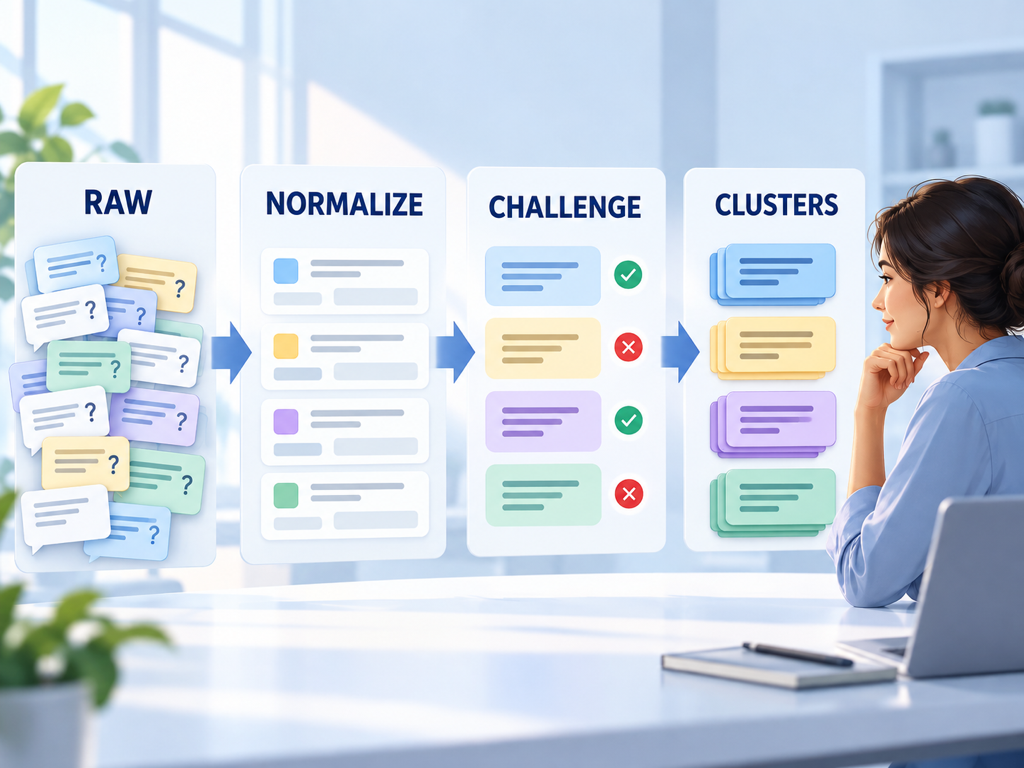
If changing a constraint repeatedly changes the brands, sources, or content types in the answer, promote that constraint to a cluster boundary. If the answer stays materially the same, keep the prompts together and store the constraint as an attribute.
Score a Cluster Before It Enters the Content Calendar
Not every coherent cluster deserves a page. Some are useful for monitoring only, some belong in product documentation, and some expose an evidence gap that content cannot solve.
Score each cluster on four practical questions:
- Demand: Do customers or prompt-research signals show that the decision occurs often enough to matter?
- Visibility gap: Are competitors recommended or cited where your brand is absent?
- Evidence readiness: Can you support a useful answer with current, verifiable evidence?
- Distinct intent: Would the asset serve a decision not already covered by an existing page?
Topify’s Prompt Discovery currently frames opportunity through prompt demand, visibility gaps, commercial intent, competition, and content readiness. Those signals can prioritize the review queue, but they should not automatically create URLs. A high-opportunity cluster may call for a pricing clarification, integration page, or independent review strategy instead of another blog post.
The editorial decision comes after the measurement signal.
Know When to Merge, Split, or Hold a Cluster
Cluster boundaries become clearer when you compare the consequences of each choice.
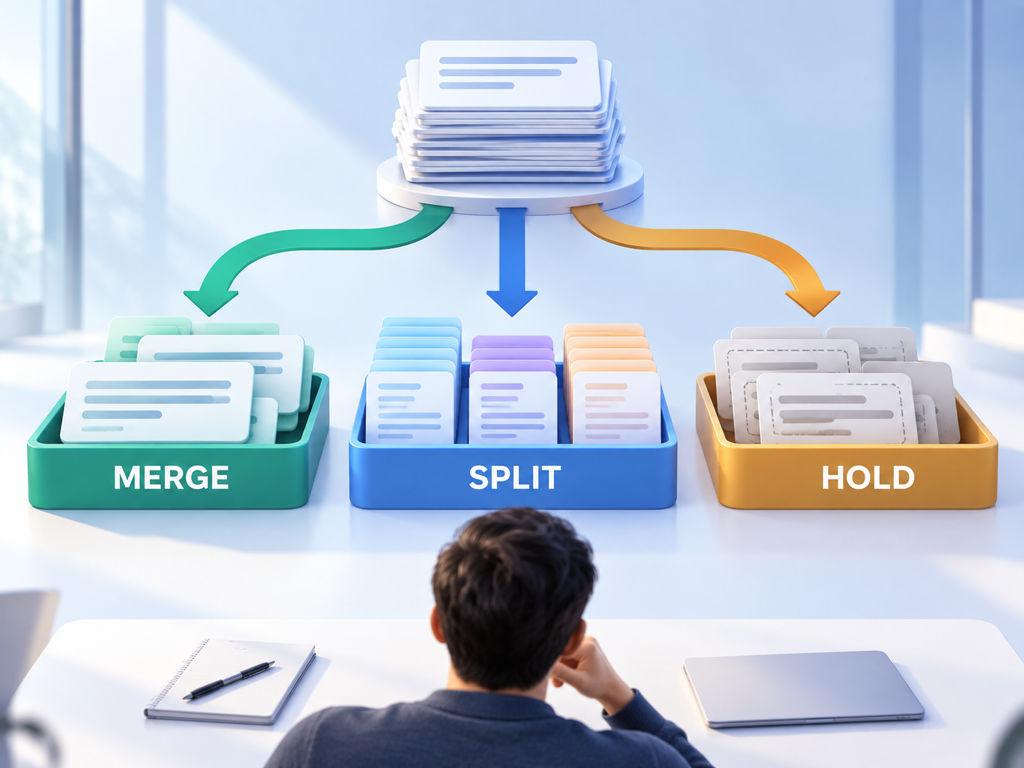
Merge prompts when they lead to the same decision, require the same evidence, and produce substantially similar answer sets. Keep wording variants as test cases inside the cluster.
Split when a recurring constraint changes the shortlist, source requirements, or answer format. For example, “for healthcare” may deserve a separate risk-focused subgroup if compliance evidence consistently changes recommendations.
Hold when volume is uncertain, the prompts are too mixed, or the evidence does not support a useful response. A holding queue is better than forcing weak prompts into whichever cluster is closest.
Do not split solely because platforms phrase responses differently. ChatGPT, Perplexity, and Google AI experiences may cite different sources for the same decision. Platform is usually a measurement dimension unless user behavior or answer requirements genuinely diverge.
Measure Clusters With Stable Prompts and Versioned Rules
A cluster becomes a measurement unit only when it remains stable. Store the exact prompts, language, region, platform, date, and grouping rule. Record when a prompt enters, leaves, or changes clusters.
Track results at two levels. The cluster view shows whether visibility and recommendation share improve for the decision. The prompt view shows whether one wording, constraint, or platform is producing the difference.
Useful cluster metrics include:
- brand inclusion rate across the prompt set;
- explicit recommendation rate;
- average or median recommendation position when ordered lists exist;
- competitor overlap;
- citation-source coverage;
- result volatility across repeated observations.
Avoid interpreting ten paraphrases as ten independent demand signals. They are observations of one decision pattern. Weighting every wording equally can make a heavily expanded cluster look more important than a smaller but commercially meaningful one.
Use Topify to Keep Discovery and Tracking Connected
Topify can support the operating loop after your team defines its clustering rules. Begin with Prompt Discovery to identify candidate questions and visibility gaps. Normalize the prompts outside or inside your planning workflow, then organize stable sets by decision, funnel stage, or market.
Use the same prompt versions for recurring monitoring. Compare brand visibility, competitors, position, sentiment, and citation sources within each cluster, while keeping new discoveries in a separate intake queue until they pass review.
This separation matters. Adding new prompts directly to a baseline changes the denominator and can make a trend move even when AI answers did not. Version the cluster first, then compare like with like.
When a cluster exposes a gap, inspect the evidence behind the winning answers. The next action might be a new comparison, clearer product documentation, a source-authority effort, or no content change at all. Clustering is valuable because it narrows the decision, not because it guarantees another article.
Conclusion
AI prompt clustering works when it preserves why a buyer asks, what constraints shape the answer, and what evidence resolves the decision. Shared words and vector similarity can propose useful groups, but they cannot define your editorial architecture alone.
Start with the canonical task, intent stage, constraints, and expected evidence. Build candidate clusters, challenge their boundaries with controlled variants, and version the final prompt sets before tracking them. The result is a smaller, more defensible map of buyer decisions that supports content planning without creating duplicate pages or misleading measurement.
FAQ
What is AI prompt clustering?
AI prompt clustering groups conversational queries by shared decision, constraints, evidence needs, and expected answer type so teams can analyze and track them as one meaningful unit.
Is semantic similarity enough to cluster AI prompts?
No. Similar wording can hide different purchase constraints, while different wording can express the same job. Semantic similarity should propose clusters that a human validates against decision and evidence requirements.
How many prompts should be in one cluster?
There is no universal number. Use enough prompts to represent the important wording and constraint variations without over-weighting paraphrases of the same question.
When should a prompt cluster become a new article?
Only when it represents a distinct, recurring decision and the required evidence is not already covered by an existing page. Some clusters are better handled by product documentation or monitoring.
Leave a Reply