Author: Elsa Ji

  • Agentic Commerce Is Here. Is Your Product Data Ready?

    Agentic Commerce Is Here. Is Your Product Data Ready?

    A shopper asks ChatGPT for waterproof trail runners under $150. The assistant pulls a shortlist, shows price and stock, and lets the shopper check out without ever opening your site. Your product might be in that shortlist. Or it might not, and nobody on your team would know why. Traditional product feeds were built for Google Shopping and human eyes. AI shopping agents read differently, and most catalogs weren’t designed with that in mind.

    Why Your Product Feed Wasn’t Built for Agentic Commerce

    Agentic commerce means an AI agent discovers, compares, and completes a purchase on a shopper’s behalf, often without the shopper ever landing on your site. This isn’t a pilot program anymore. ChatGPT’s Instant Checkout has been live since September 2025, serving hundreds of millions of weekly users, and Google has since rolled out its own competing infrastructure with major retail partners backing it.

    That’s the shift most feed strategies haven’t caught up with. A search engine indexes your page and shows a human a link. An agent has to parse your data, trust it, and act on it in real time, sometimes completing the transaction itself. If a field is missing or a value is stale, the agent doesn’t guess. It skips you.

    What Structured Data Actually Means for Agentic Commerce

    Schema.org’s Product vocabulary works as the shared language that lets AI shopping systems interpret your cataloginstead of relying on how your page renders visually. This matters more than it used to, because AI crawlers like GPTBot and PerplexityBot typically don’t execute JavaScript. Your JSON-LD needs to be server-side rendered directly into the HTML, not injected after the page loads.

    There’s also a parsing preference worth knowing. When an agent needs a high-stakes value like price or stock status, it tends to trust structured JSON-LD over natural-language text parsed from a paragraph, because deterministic data doesn’t introduce interpretation errors.

    At minimum, every SKU needs a baseline of core attributes: title, description, brand, GTIN, MPN, category, price, sale price, availability, condition, image URL, and product URL. Most retailers already have this if they’re shipping to Google Shopping. Agents just need it complete on every single SKU, not just your top sellers.

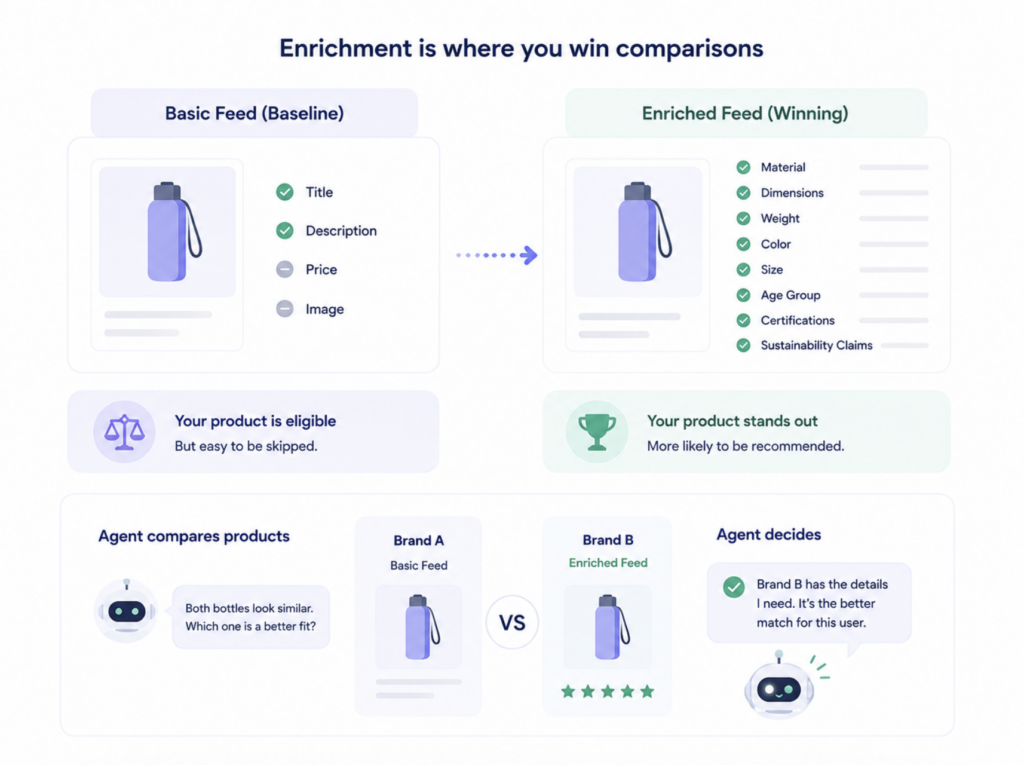
    Past that baseline, enrichment is where you actually win comparisons. Attributes like material, dimensions, weight, color, size, age group, certifications, and sustainability claims get weighed heavily when an agent is choosing between two similar products.
    The Metadata Fields AI Agents Check First

    Not every field carries equal weight. Agents prioritize a specific handful when deciding whether to surface or skip a listing:

    • Price and currency, kept current and matched exactly to what a shopper would pay at checkout
    • Availability and stock status, since agents won’t recommend something they can’t confirm is in stock
    • GTIN or SKU, the identifier agents use to disambiguate your product from near-duplicates
    • Return policy and shipping cost, both of which agents weigh alongside price and rating when ranking comparable products
    • Review rating and count, which builds the trust signal an agent needs before recommending you over a competitor

    One underused field deserves a callout: additionalProperty. It structures any characteristic that doesn’t fit a standard schema field, like certifications or country of origin. Products using it with five or more structured characteristics saw a 28% lift in AI citations on specialized queries in early 2026 analysis. For boolean fields, an explicit false beats a blank value every time. Agents treat missing data as a reason to skip, not a reason to assume.

    APIs and Protocols: The Difference Between Being Listed and Being Transactable

    Structured data gets you discovered. It doesn’t get you paid. That’s where the API layer comes in, and right now there are two major standards competing for merchant adoption.

    OpenAI and Stripe co-built the Agentic Commerce Protocol to power ChatGPT’s checkout experience. It works through three flows: ChatGPT calls your endpoints to create a checkout session, your system validates the order and calculates tax, and you accept or decline before ChatGPT shows the confirmation. You stay the merchant of record throughout, meaning you keep the customer relationship, handle fulfillment, and process payment through your existing provider.

    Google took a broader approach with the Universal Commerce Protocol, an open standard for the full shopping journey from discovery through post-purchase support. It’s built to interoperate with the Agent Payments Protocol (AP2), which uses cryptographically signed “mandates” to authorize an agent’s purchase within limits a shopper sets in advance, creating a tamper-proof record of the transaction.

    For your engineering team, this translates into concrete requirements: a machine-readable feed refreshed on a regular cadence (daily is standard for most integrations), REST checkout endpoints that can accept and confirm an order, and webhooks for shipping, refunds, and fulfillment events. None of it requires replatforming. It does require someone on your team to actually own the integration, because a missing webhook or an incorrect tax calculation is enough to break a transaction mid-checkout.

    The Product Data Readiness Checklist

    Use this as your working list. Most teams find they’re missing pieces across all three columns, not just one.

    Structured DataAPI & ProtocolMetadata & Media
    JSON-LD Product schema, server-side renderedMachine-readable feed (CSV or JSON), refreshed dailyMultiple images per SKU with descriptive alt text
    Core fields: title, brand, GTIN, MPN, categoryACP or UCP-compatible checkout endpointsEnrichment attributes: material, dimensions, size, color
    Offer fields: price, priceCurrency, availabilityWebhooks for shipping, refunds, fulfillmentadditionalProperty for certifications, origin, features
    AggregateRating and Review schemaDelegated payment flow (Stripe, Adyen, or compatible)Accurate, current return policy and shipping cost text
    Explicit boolean values, never left blankOrder acceptance and decline logic in placeConsistent naming across feed, schema, and product page

    How to Know AI Agents Are Actually Reading Your Data Correctly

    Publishing the fields is step one. The harder question is whether an agent is actually parsing them the way you intend, and whether you’d even notice if it wasn’t.

    This is where most teams hit a blind spot. You can validate your JSON-LD against a schema checker and still have no idea whether ChatGPT is citing your product at the right price, or whether Perplexity is quietly recommending a competitor because your stock field returned stale data last Tuesday. Structured data compliance and AI visibility are two different things, and only one of them shows up in a validator.

    That’s the gap Topify was built to close. Its Source Analysis feature tracks the exact domains and pages AI platforms cite when answering a shopping query, so you can see whether your product data is actually surfacing, and whether it’s being represented accurately. Pair that with Conversion Visibility Rate, which estimates how likely an AI answer is to route a shopper toward an actual purchase, and you get a way to measure agentic commerce performance instead of just guessing at it. In practice, that means catching a dropped citation or a mispriced listing before it costs you a quarter’s worth of agent-driven traffic, not after.
    Conclusion

    Structured data, API compliance, and clean metadata aren’t a one-time project. Feeds go stale, schema drifts out of date, and new fields get added to protocols every few months. Treat your product data the way you’d treat inventory: something that needs regular auditing, not something you fix once and forget. The brands that stay visible in agentic commerce will be the ones that keep verifying, not just the ones that shipped the checklist first.

    FAQ

    Q: What’s the difference between agentic commerce and regular AI search visibility? 

    A: AI search visibility is about your brand appearing in an AI-generated answer. Agentic commerce goes further: it means an AI agent can also complete the transaction on the shopper’s behalf, which requires API and checkout infrastructure on top of structured content.

    Q: Do I need to support both ACP and UCP? 

    A: Most retailers can’t bet on just one. ChatGPT runs on ACP, while Google’s ecosystem runs on UCP, and both are gaining merchant adoption. Prioritize based on where your traffic already comes from, but plan for both eventually.

    Q: Is schema markup enough, or do I also need an API integration? 

    A: Schema gets your product discovered and cited. It doesn’t let an agent complete a purchase inside the conversation. If you want to support in-chat checkout, you need the API and payment layer on top of structured data.

    Q: How do I check if AI agents are reading my product data correctly? 

    A: Validate your JSON-LD with a schema testing tool first, then monitor whether AI platforms are actually citing your products accurately over time. Tools like Topify’s Source Analysis track which domains and pages get cited so you can spot gaps a validator won’t catch.
    Read More

  • Agentic Commerce vs Traditional Ecommerce: What Changes for Brands

    Agentic Commerce vs Traditional Ecommerce: What Changes for Brands

    AI-referred shoppers convert roughly 42% better than shoppers who arrive through traditional search, according to Adobe’s Q1 2026 data. That’s the kind of number that gets a CMO’s attention. But most brands still can’t see where those shoppers came from, what they were told about the product, or why they bought.

    That’s the real story of agentic commerce. It’s not a faster version of ecommerce. It’s a different buyer, moving through a different path, and most of that path is invisible to the tools brands have relied on for the last two decades.

    Agentic Commerce Isn’t AI-Assisted Shopping. It’s a Different Buyer.

    Traditional ecommerce assumes a human is doing the browsing. They search, compare tabs, read reviews, and click “buy.” Every step leaves a trace your analytics stack can read.

    Agentic commerce changes who’s doing the browsing. An AI agent, acting on a person’s behalf, handles some or all of that journey: finding products, comparing options, and in a growing number of cases, completing the purchase. 45% of consumers already use AI for some part of their buying journey, per a January 2026 IBM Institute for Business Value study.

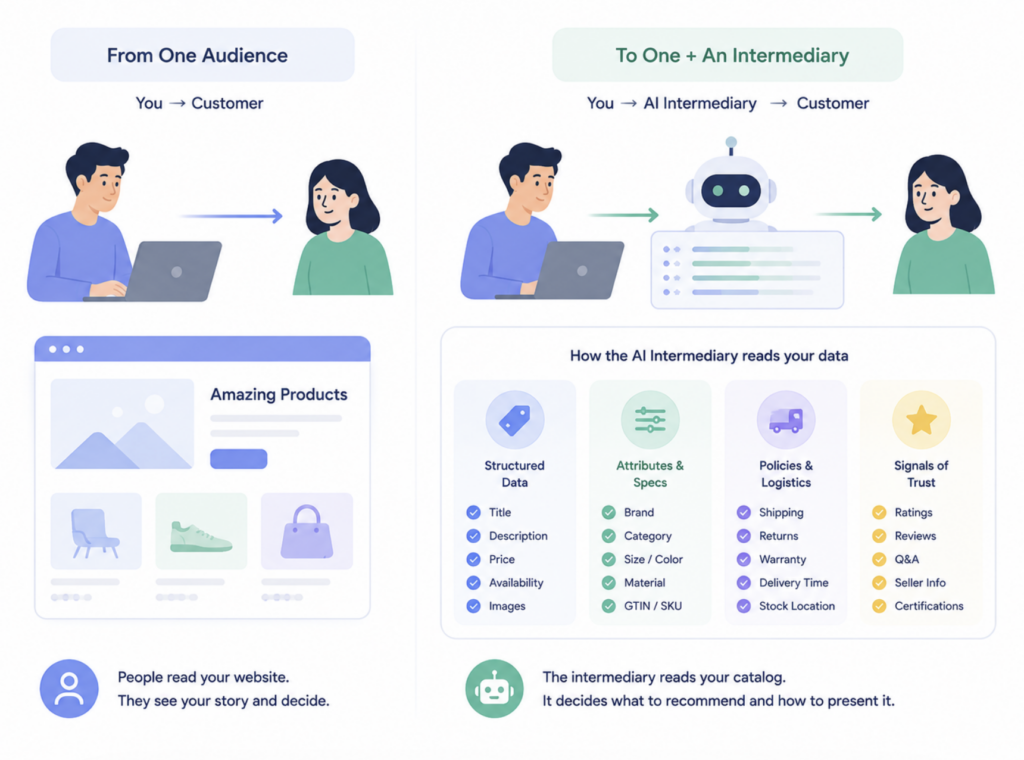
    The shift matters because your audience of one just became an audience of one plus an intermediary. That intermediary reads your product data differently than a person reads your website. It doesn’t care about your hero banner. It cares about whether your catalog is structured well enough to answer its question.

    Traditional Ecommerce vs Agentic Commerce, Side by Side

    The differences aren’t cosmetic. They touch discovery, comparison, decision-making, and checkout at the same time.

    DimensionTraditional EcommerceAgentic Commerce
    DiscoverySEO, ads, social, direct site visitsStructured product feeds read by AI agents
    ComparisonMultiple browser tabs, manual researchOne conversation, agent-driven ranking
    Decision-makerThe shopperThe shopper’s agent, working from delegated preferences
    CheckoutBrand-controlled page and flowTokenized, permission-based transaction inside the agent
    Persuasion surfaceLanding pages, promotions, designData completeness, pricing accuracy, attribute depth
    VisibilityWeb analytics, session dataAgent citation and recommendation data

    That last row is the one most brands haven’t reckoned with yet. In traditional ecommerce, you can watch a customer’s session end to end. In agentic commerce, the parts that used to be visible, browsing, comparing, hesitating, now happen inside someone else’s model.

    Discovery No Longer Happens on Your Website

    In search-driven ecommerce, discovery meant ranking well and building a site people wanted to land on. In agentic commerce, the agent doesn’t land anywhere. It queries.

    The Product Feed Becomes the Storefront

    Structured data is doing the job your homepage used to do. The Agentic Commerce Protocol, launched by OpenAI and Stripe, requires merchants to submit structured feeds to a central index so agents can pull accurate product, price, and inventory data on demand. Google’s newer Universal Commerce Protocol takes a different approach, letting merchants host their own data and expose it through standardized endpoints instead of submitting to a central platform.

    Underneath both sits the Model Context Protocol, which handles how agents actually connect to and read that data in the first place.

    None of this is optional in practice. Merchants that connect to more than one protocol see roughly 40% more agentic traffic than single-protocol adopters, according to Elogic’s 2026 analysis. Skip the feed work, and an agent can still find you by scraping your site, but with thinner data and weaker placement than competitors who did the integration.

    Merchant adoption is still catching up to consumer interest. Checkout.com’s 2026 research found that only about 3% of transactions currently involve an AI agent, even though 89% of merchants say they’re actively preparing for it. In practice, that gap is a window. Brands that get their feeds protocol-ready now are positioning for a channel that’s still forming, not one that’s already saturated.

    Comparison Shopping Now Happens Inside One Conversation

    A shopper used to open five tabs to compare five products. Now they ask once, and an agent does the comparing. 63% of European shoppers already use AI to compare brands and models rather than doing it manually.

    This collapses your persuasion window. In traditional ecommerce, a strong landing page, a well-timed discount banner, or a trust badge could tip a close decision. Inside an agent’s comparison, none of that surface material gets read. What gets read is your attribute completeness, your pricing accuracy, and whether your data conflicts with what’s listed elsewhere.

    Brand persuasion is moving from the page to the feed. That’s a hard adjustment for teams built around campaign creative.

    Checkout Is No Longer a Page. It’s a Permission.

    Traditional checkout is a flow you design: cart, shipping, payment, confirmation. Agentic checkout is a permission you’re granted, executed through tokenized payment infrastructure like Stripe’s Shared Payment Tokens, which let an agent initiate a transaction without ever touching raw card data.

    Consumers are still working out how much they trust this. Only about 14% trust an AI agent to place an order autonomously, even though 65% trust one to compare prices, based on Axis Intelligence’s 2026 trust gap index. The conditions consumers set before they’ll delegate a purchase are specific: spending caps, instant revocation, and easy cancellation top the list, and 75% of merchants agree that real-time permission control is critical to adoption.

    That’s the trade-off. Brands give up direct control over the checkout experience. In exchange, a transaction can complete in one step, with no cart abandonment funnel to optimize, because there’s no funnel left to see.

    There’s also a ceiling on what agents get to spend without asking first. Consumers say they’re comfortable letting an AI agent spend around $233 per purchase in the US without extra approval, and considerably less in other markets. Below that line, agentic checkout can move fast. Above it, a human still has to sign off, which means brands selling higher-ticket items should expect a hybrid flow for a while yet, not a fully autonomous one.

    The Metrics That Used to Matter Don’t Work Here

    This is where most brands get stuck. Website sessions, page-level conversion rate, and SEO rank all assume the customer’s decision-making happened somewhere you could measure it.

    In agentic commerce, the behavioral data stream often starts at the add-to-cart moment. Everything before that, the browsing, the refined preferences, the comparison, happened inside a conversation you never saw. That’s a big part of why some merchants report conversion running 86% worse than affiliate channels, not because agent-driven shoppers are lower intent, but because merchant infrastructure wasn’t built to capture or respond to agent traffic in the first place. The gap isn’t demand. It’s visibility.

    That’s the tension brands are sitting in right now: strong upside in the data when infrastructure is ready, and a real cost when it isn’t. Traditional CVR can’t tell you which side of that line you’re on, because it only measures what happens after a visitor lands on your site. It says nothing about whether an agent considered you and moved on before that ever happened.

    This is the specific gap Topify’s Conversion Visibility Rate is built to close. Instead of waiting for a session to start, CVR estimates how likely an AI answer is to actually drive a user toward your brand, based on how often and how favorably you show up in agent responses in the first place. Paired with Source Analysis, which tracks the exact domains and feeds agents cite when recommending products, and Competitor Monitoring, which flags when a rival starts getting picked over you, it gives brands a way to see the part of the funnel that agentic commerce made invisible.

    Conclusion

    Agentic commerce isn’t traditional ecommerce running faster. The buyer changed, the comparison process changed, and checkout changed from a page you control to a permission you’re granted. Brands that treat this as an SEO update will miss most of it.

    The practical starting point is straightforward: get your product data structured and protocol-ready, understand which of ACP, UCP, and MCP actually applies to your channels, and put a measurement layer in place that can see what’s happening inside agent conversations, not just what happens after someone lands on your site.

    FAQ

    Is agentic commerce the same as AI-powered ecommerce? 

    Not quite. AI-powered ecommerce typically means AI features layered onto a traditional flow, like a chatbot or a recommendation widget. Agentic commerce means an AI agent independently handles discovery, comparison, and in some cases the transaction itself, on the shopper’s behalf.

    Do I need to support all three protocols, ACP, UCP, and MCP? 

    Not all at once, but ignoring them isn’t a safe default either. MCP is the connective layer most agents already rely on to read data. ACP and UCP handle different parts of discovery and checkout, and multi-protocol merchants are already seeing meaningfully more agentic traffic than single-protocol ones.

    How do brands measure performance in agentic commerce? 

    Traditional metrics like site traffic and page-level CVR only capture what happens after a shopper lands on your site, which is often too late in an agent-mediated journey. Metrics built around AI citation frequency, source visibility, and recommendation likelihood, like Topify’s Conversion Visibility Rate, are designed to measure the part of the funnel that now happens before a website visit ever occurs.

    Read More

  • What Is Agentic Commerce, and Why Your Brand May Be Invisible

    What Is Agentic Commerce, and Why Your Brand May Be Invisible

    Someone opens ChatGPT and types “find me running shoes under $150 in size 10.” The agent searches, compares, and either checks out on the spot or hands the shopper straight to a merchant. No browser tabs. No scrolling through search results. No side-by-side comparison of ten websites.

    That’s agentic commerce. And it’s already live.

    What “Agentic Commerce” Actually Means

    Agentic commerce is when autonomous AI agents research, compare, and purchase products on behalf of a human buyer. It’s a step beyond conversational commerce, where a chatbot just assists a human shopper. Here, the AI system takes over decision-making and, in a growing number of cases, the transaction itself.

    The shopper states intent. The agent handles discovery, comparison, and either checkout or a seamless handoff to the merchant. That’s the entire shift in one sentence.

    This isn’t a future scenario. McKinsey projects the global agentic commerce opportunity will hit $3 trillion to $5 trillion by 2030, and Morgan Stanley estimates $190 billion to $385 billion of U.S. e-commerce spending will run through agentic shoppers by that same year. Bain puts the U.S. market even higher, at $300 billion to $500 billion, or 15% to 25% of e-commerce.

    Why This Is Different From Ranking on Google or Being Cited by ChatGPT

    Traditional SEO solves for “being found.” GEO solves for “being mentioned.” Agentic commerce solves for something harder: being selected and paid for, without a human ever seeing the alternatives you lost to.

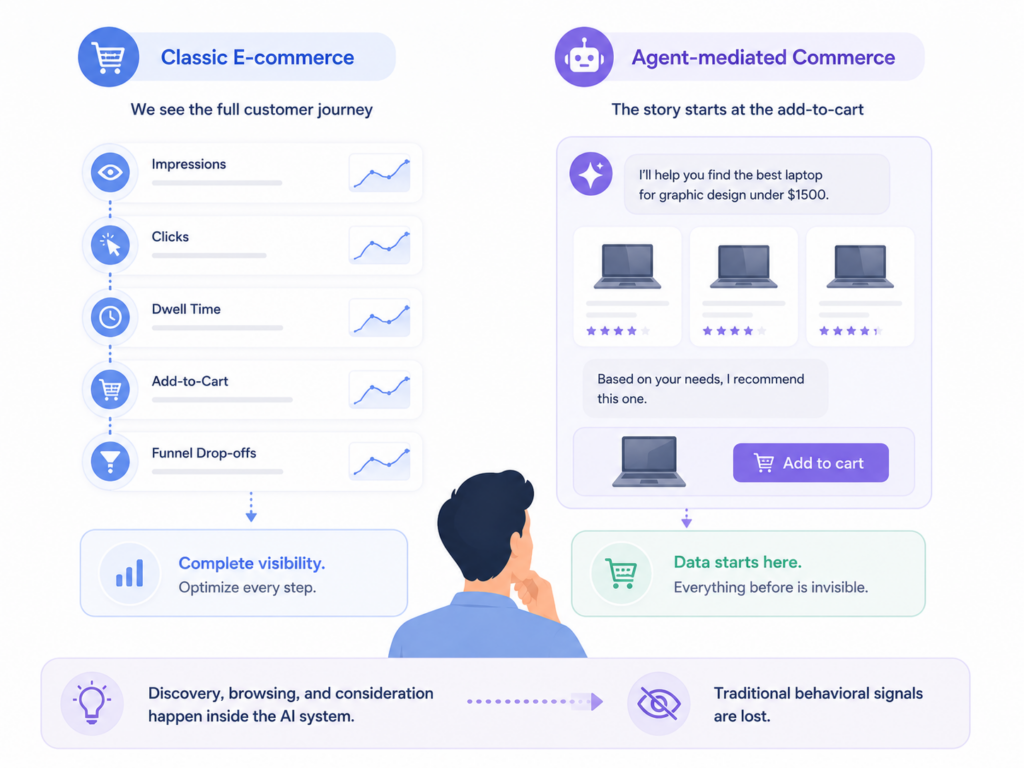
    In classic e-commerce, retailers see impressions, clicks, dwell time, add-to-cart events, and funnel drop-offs. In agent-mediated commerce, that entire story disappears. The behavioral data stream starts at the add-to-cart moment, while the discovery, browsing, and consideration all happen inside the AI system.

    That’s not a small detail. It means a brand can lose a customer during the comparison stage and never know it happened.

    The scale backs this up. Shopify reported AI-driven traffic to its stores grew 8x year over year in Q1 2026, with orders from AI-powered search up nearly 13x. Those orders also carried 14% higher average order values compared to organic search. Brands catching this wave aren’t seeing marginal gains. They’re seeing a new channel outperform the old one.

    Where Brands Are Already Going Invisible

    Here’s the part most marketing teams miss. AI agents don’t crawl your website the way Google does. They read a feed.

    The OpenAI Product Feed acts as the single source of truth for a merchant’s product data, including titles, prices, stock, and media, and powers search, discovery, and checkout inside ChatGPT. Critically, this data isn’t crawled. Merchants push a structured file directly to OpenAI’s endpoint. No feed, no listing, no matter how well your site ranks on Google.

    If you’re not in the feed, you don’t exist to the agent.

    The numbers on structured data make the stakes concrete. Pages with structured data are cited 3.1x more frequently than pages without it. And the honest state of most catalogs isn’t good. Google’s Universal Commerce Protocol launched in January 2026 with Shopify, Wayfair, Target, Etsy, and Walmart as founding partners, and OpenAI’s Agentic Commerce Protocol already powers ChatGPT’s Instant Checkout. The infrastructure exists. The real question is whether a given merchant’s product data is in a format agents can read, trust, and act on, and for most stores today the honest answer is no.

    What Determines Whether an AI Agent Picks Your Brand

    Agents don’t judge a brand by tone of voice or homepage design. They judge it by data completeness.

    The minimum bar is low but strict. Every product record needs an ID, title, description, price, availability, URL, and image, with 25 or more additional structured attributes recommended for discovery quality. Fields like GTIN coverage per SKU are called out as the single highest-leverage fix for Perplexity and ChatGPT discoverability. Marketing copy actually hurts you here. ChatGPT rejects feeds that use promotional language in the description field, and mismatched pricing between the feed and the live product page is one of the leading reasons feeds get rejected outright.

    Consumer behavior adds another layer. 73% of consumers already use AI somewhere in their shopping journey, mostly for getting product ideas, summarizing reviews, and comparing prices. But trust hasn’t caught up to comfort. 70% say they’re at least somewhat comfortable with an AI agent making a purchase on their behalf, yet only 4% trust an AI to buy without a final human review. That gap is exactly why the brands that show up clearly, with clean data and credible signals, win the moment a shopper does let the agent decide.

    That’s the practical difference between traditional visibility and agentic visibility.

    Traditional SEO / GEOAgentic Commerce
    What’s trackedRankings, citations, mentionsSelection and transaction completion
    Data source for AICrawled web pagesMerchant-pushed structured feed
    Update frequencyDays to weeksAs often as every 15 minutes
    Failure modeLower ranking, fewer clicksTotal absence from the agent’s candidate set

    How to Check If Your Brand Is Visible to Shopping Agents

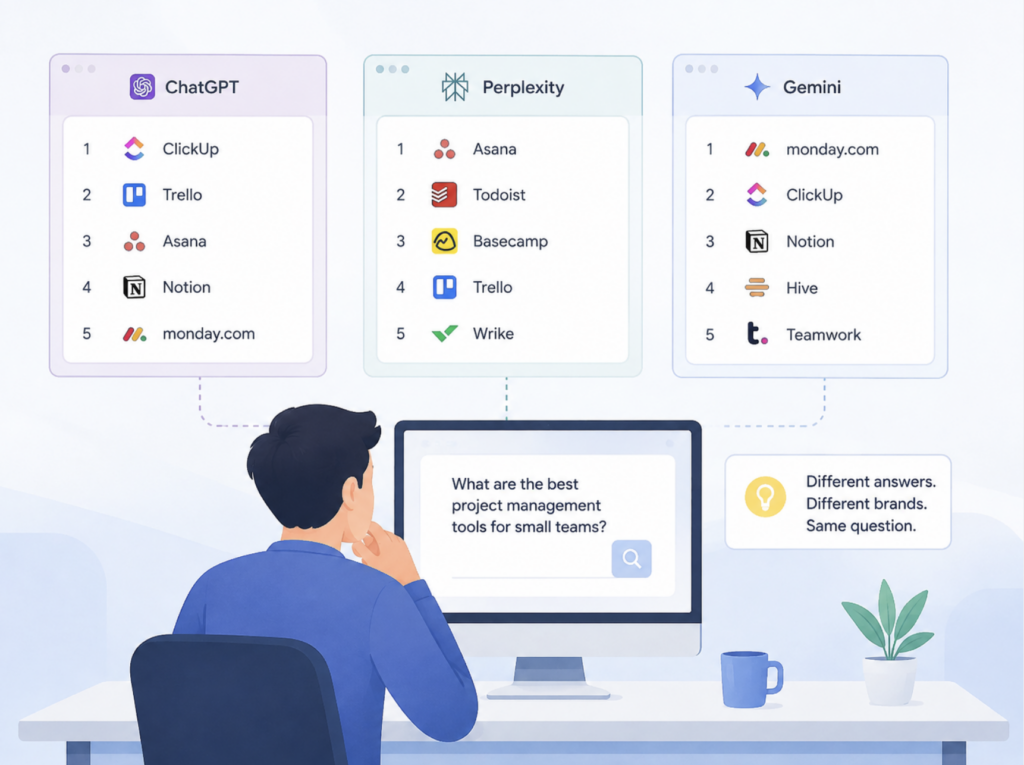
    The fastest test costs nothing. Open ChatGPT, Perplexity, or Gemini and run the exact prompts your customers would use to shop your category. Note whether your brand shows up, in what position, and against which competitors. Do this across a handful of real purchase-intent prompts, not just your brand name.

    That manual check tells you where you stand today. It won’t tell you where you’re losing ground next month, or which competitor just improved their feed and jumped ahead of you.

    This is where Topify’s Comprehensive GEO Analytics becomes useful. It tracks brand performance across major AI platforms through seven metrics: visibility, sentiment, position, volume, mentions, intent, and CVR, the last of which estimates how likely an AI answer is to actually drive a real interaction or purchase rather than just a mention. For agentic commerce specifically, CVR matters more than any single citation count, because being named by an agent means nothing if the agent never routes the shopper toward you. Topify’s Dynamic Competitor Benchmarking layers on top of that, showing who the agent recommends instead of you and how that ranking shifts as your feed and content change.

    Checking once tells you your current score. Checking continuously tells you whether you’re gaining or losing ground as protocols like ACP and UCP keep expanding what agents can do.

    What Brands Can Do Before Agentic Commerce Scales Further

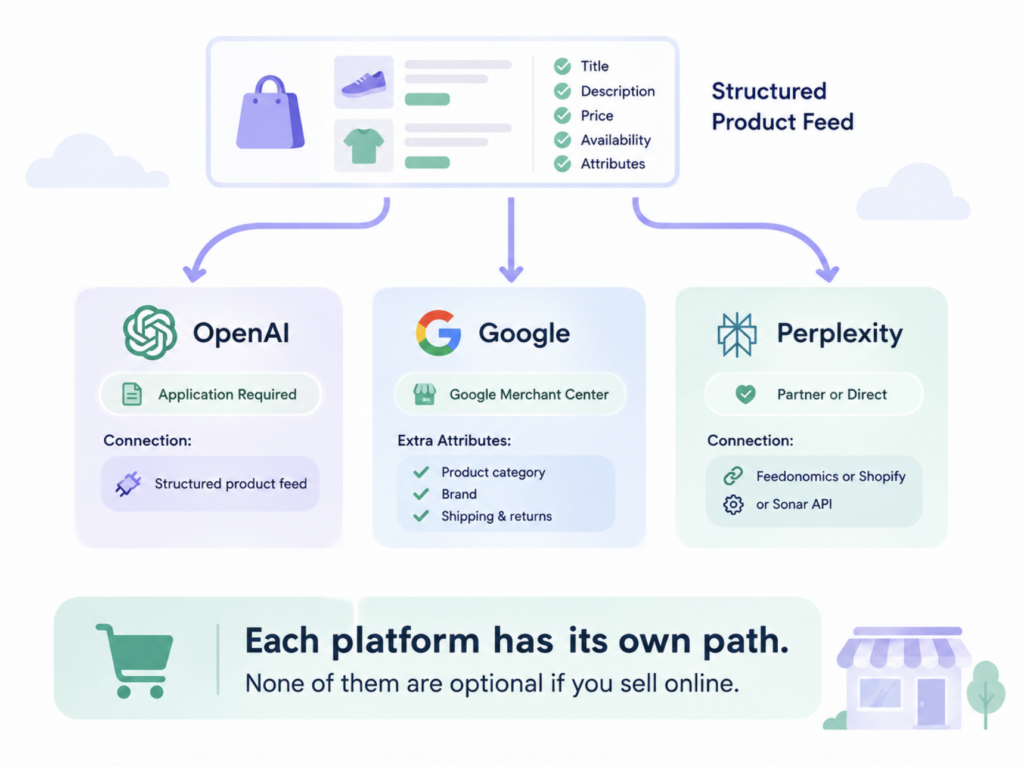
    Start with the feed, not the marketing copy. OpenAI requires an application and a structured product feed, Google runs through Google Merchant Center with extra attributes, and Perplexity connects through partners like Feedonomics or Shopify, or directly via its Sonar API. Each platform has its own path, and none of them are optional if you sell online.

    Audit before you rebuild. If your Google Merchant Center feed is already clean and your images meet a 1,500×1,500 resolution standard, you’re roughly 60% of the way to being ready across surfaces. That’s a lower lift than most teams assume.

    Fraud and trust infrastructure is catching up too. 78% of financial institutions expect fraud to spike specifically from AI shopping agents, which means authentication standards for distinguishing real agents from bots will keep tightening this year. Brands that get their structured data and merchant verification in order now won’t be scrambling when those standards become gatekeepers.

    Being invisible to an agent isn’t a ranking problem. It’s a data completeness problem, and it’s fixable in weeks, not quarters.

    Conclusion

    Agentic commerce isn’t a distant trend to plan for next year. It’s a live channel already redirecting traffic, orders, and average order value away from brands that haven’t structured their data for it. The brands showing up in agent-driven results aren’t necessarily the ones with the best product. They’re the ones an agent can actually read.

    Check where your brand stands with an AI agent today, before a competitor’s cleaner feed makes that decision for you.

    FAQ

    What is agentic commerce? 

    It’s AI-agent-driven shopping, where an autonomous system researches, compares, and completes a purchase for a human buyer instead of the human clicking through search results themselves.

    How is agentic commerce different from traditional e-commerce?

     Traditional e-commerce puts the human through every step: search, compare, click, buy. Agentic commerce delegates discovery and comparison, and increasingly checkout itself, to the AI system.

    How do I know if AI shopping agents can see my brand? 

    Run real purchase-intent prompts through ChatGPT, Perplexity, and Gemini for your product category, or track it continuously with a tool built for AI visibility monitoring.

    Do I need a product feed to appear in ChatGPT Shopping? 

    Yes. ChatGPT indexes a structured feed pushed directly by the merchant rather than crawling your website, so without a feed submission your products generally won’t surface in shopping results.

    Read More

  • We Analyzed 200 AI Prompts to See How Brands Stack Up

    We Analyzed 200 AI Prompts to See How Brands Stack Up

    A SaaS brand we looked at sat at position two on Google for its main category keyword. Solid rankings, solid backlink profile, years of SEO work behind it. When we ran the same query set through ChatGPT, that brand didn’t show up once. Its closest competitor, ranked seven spots lower on Google, got mentioned in nearly a third of the AI responses.

    That’s the kind of gap you only find by actually testing it. So we did, using Topify’s competitor analysis tool to track how a set of brands performed across roughly 200 AI prompts, and the results didn’t match what most SEO playbooks would predict.

    Why We Ran This Analysis

    Competitor analysis used to be simple. Check rankings, check backlinks, check who shows up on page one. That framework worked when search meant a list of blue links.

    It doesn’t work the same way anymore. AI engines don’t return ten ranked results. They synthesize an answer and decide, on their own logic, which two or three brands are worth naming. That’s a different kind of competition, and most brands are still analyzing it with the wrong toolkit.

    We wanted to know: if you actually run an AI visibility competitor analysis instead of a traditional SEO audit, what shows up that a Google-first view would completely miss?

    How We Set Up the Test

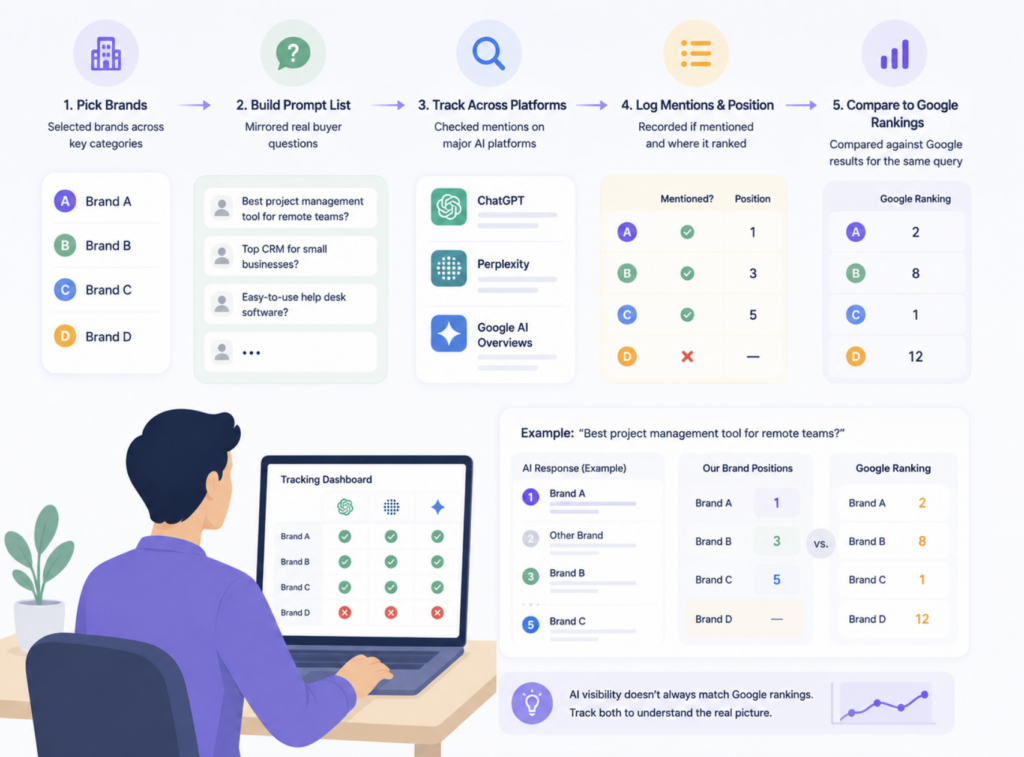
    We picked a set of brands across a few categories, built a prompt list that mirrored real buyer questions, and tracked mentions across ChatGPT, Perplexity, and Google AI Overviews. For each brand, we logged whether it got mentioned, where it landed in the response, and how that compared to its Google ranking for the same query.

    This is close to what Topify’s Dynamic Competitor Benchmarking does automatically. Instead of a one-time snapshot, it keeps running the comparison so you catch shifts as AI engines update their answers, not months after the fact.

    The goal wasn’t to prove a point. It was to see what the data actually showed.

    Finding #1: Ranking #1 on Google Buys You Less Than You’d Think

    This is the finding that should worry anyone treating SEO rank as a proxy for AI visibility. A large-scale study of 150 SaaS companies across 120 keywords found that <cite index=”3-1″>ChatGPT cited study brands 686 times across all keywords, and only 128 of those mentions overlapped with a brand’s Google top-10 ranking</cite>. Put differently, roughly 44% of the brands with strong Google positions were nowhere to be found in ChatGPT’s answers.

    Separate research looking at the reverse angle found something just as stark. Among brands that ChatGPT actively recommended, <cite index=”1-1″>81% didn’t rank in Google’s top 10 for the matching query</cite>.

    That’s not a small discrepancy. It’s two different visibility systems running in parallel, and most brands are only measuring one of them.

    Finding #2: The Gap Isn’t Even Across Categories

    Here’s where it gets more useful. The size of that citation gap depends heavily on the category you’re in.

    CategoryGoogle-to-ChatGPT Citation GapLikely Driver
    Marketing Automation53%Heavy reliance on paid placement and brand SEO over third-party discussion
    Dev Tools18%Strong documentation and community content, exactly what AI models train on
    SaaS (overall average)44%Mixed content ecosystems, inconsistent third-party coverage

    The pattern researchers pointed to lines up with what we saw in our own sample. <cite index=”3-1″>Categories with better documentation and more community discussion tend to have narrower citation gaps</cite>, because that’s the type of content generative engines actually pull from.

    If your category leans on brand-controlled marketing content rather than independent reviews, forums, and comparison articles, expect your gap to run wider than average.

    Finding #3: Bing Might Matter More Than Your SEO Team Realizes

    This is the finding that surprised us the most. A separate case study tracking hotel brand mentions across ChatGPT responses found that <cite index=”4-1″>Bing rank strongly predicts ChatGPT citations, with 87% alignment to Bing’s top results</cite>.

    Not Google. Bing.

    The same case study illustrated how sharp this effect can get. One boutique hotel appeared in <cite index=”4-1″>just 1.5% of trials</cite>, while a similarly positioned competitor showed up far more often and got cited in a meaningfully higher share of responses.

    That’s a hard thing to catch with a traditional SEO audit. Nobody’s checking their Bing rankings in 2026. But if ChatGPT is quietly leaning on Bing’s index to decide who gets named, ignoring it means missing a real lever.

    What Correlates and What Doesn’t

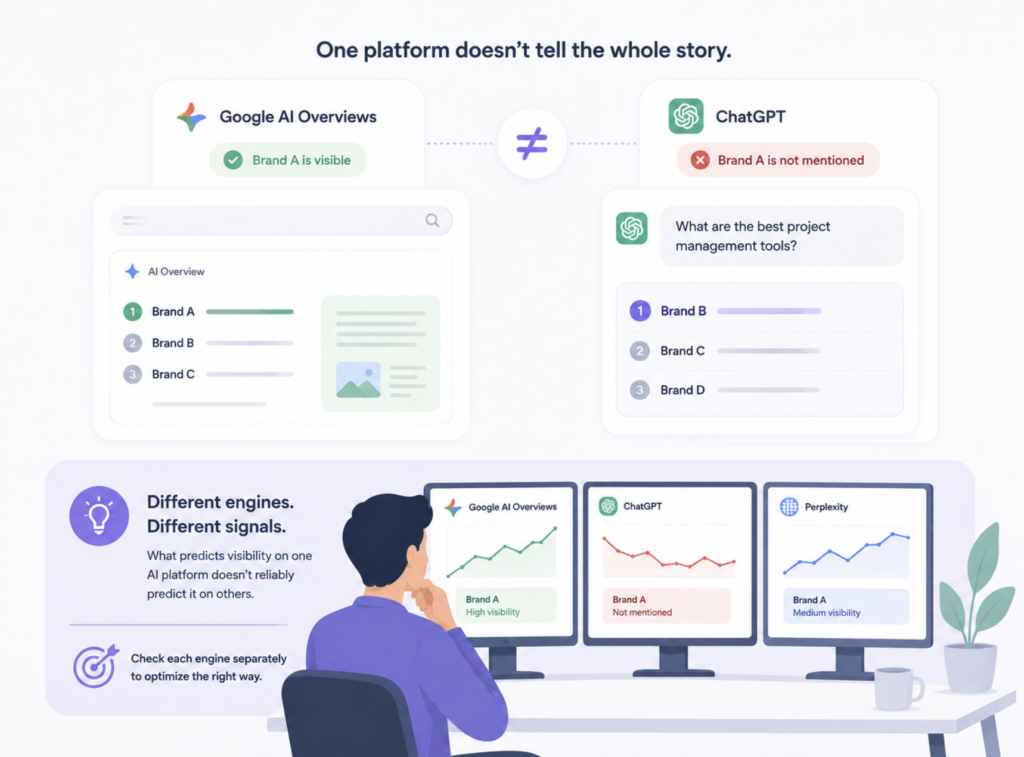
    Not every AI platform plays by the same rules, which is part of why a single-platform check gives you an incomplete picture. Analysis of branded web mentions across roughly 75,000 websites found a clear pattern: <cite index=”6-1″>branded web mentions were the strongest correlating factor for Google AI Overview visibility</cite>. But that same signal barely moved the needle elsewhere. <cite index=”6-1″>Perplexity showed a weak correlation with branded mentions, and ChatGPT an even weaker one</cite>.

    That’s the core problem with running a competitor analysis on just one AI platform. What predicts visibility on Google AI Overviews doesn’t reliably predict visibility on ChatGPT. You need to check each engine separately, or you’re optimizing for the wrong signal.

    What This Means If You’re Running Your Own Competitor Analysis

    A few things worth acting on if you’re setting this up for your own brand:

    Don’t stop at Google rankings. They tell you almost nothing about whether ChatGPT or Perplexity will mention you. Pull actual AI responses and check for yourself.

    Segment by category before you panic. A 50% citation gap in marketing automation isn’t the same red flag as a 50% gap in dev tools. Know your category’s baseline first.

    Check Bing, even if you’ve ignored it for years. It’s quietly become a bigger input into ChatGPT’s answers than most teams assume.

    Track this continuously, not once. AI answers shift as models update and as competitors publish new content. A one-time competitor snapshot goes stale fast. This is exactly what Topify’s Competitor Monitoring is built for: it keeps checking your position against competitors across platforms so you’re not rerunning a manual audit every quarter.

    The trade-off is time. Manually running 200 prompts across three AI platforms, logging every mention, and cross-referencing Google rank takes days if you’re doing it by hand. Automating that comparison is less about convenience and more about being able to catch a shift before a competitor quietly takes your spot in AI answers.

    Conclusion

    The brand we mentioned at the start wasn’t losing to a competitor with better content or a bigger budget. It was losing to a competitor that happened to align better with the signals AI engines actually weigh, consensus across sources, Bing visibility, and category-specific content patterns that have nothing to do with traditional rank.

    Running an AI visibility competitor analysis isn’t about replacing your SEO process. It’s about seeing the part of the competitive landscape that SEO tools were never built to measure.

    FAQ

    What is a competitor analysis for AI visibility? 

    It’s the process of tracking how your brand and your competitors show up across AI platforms like ChatGPT, Perplexity, and Google AI Overviews, measuring mention rate, position, and sentiment rather than traditional search rank.

    How many prompts do you need for a reliable analysis? 

    It depends on your category, but most reliable studies use somewhere between 100 and 250 prompts spread across a range of buyer intents. Fewer than that and you risk drawing conclusions from noise.

    Do I need to check every AI platform, or is one enough? 

    Check more than one. Correlation between traditional SEO signals and AI visibility varies significantly by platform, so a competitor analysis limited to one engine will miss how you’re performing elsewhere.

    Does ranking well on Google still matter for AI visibility? 

    It helps, but it’s not sufficient on its own. It’s the foundation, not the ceiling.

    Read More

  • How SaaS Brands Use AI Competitor Monitoring to Win Back Market Share

    How SaaS Brands Use AI Competitor Monitoring to Win Back Market Share

    Your competitor didn’t outrank you. They out-cited you.

    That distinction sounds small. It isn’t. Search rankings and AI citations run on different logic, and most SaaS marketing teams are still measuring the wrong one.

    Here’s what’s actually happening. A buyer opens ChatGPT or Perplexity and asks something like “best project management software for a distributed team.” The AI doesn’t return ten blue links. It returns three to five vendors, already filtered, already reasoned about. Forrester’s 2026 Buyers’ Journey Survey found that 94% of B2B buyers used AI tools during their most recent purchase process, and AI assistants are now the single most influential source across discovery and comparison. By the time your sales team hears about the account, the shortlist is already set.

    That’s the gap most SaaS teams still can’t see.

    Why SaaS Competitor Analysis Breaks in AI Search

    Traditional competitor analysis tools track keyword rankings and backlink profiles. Those metrics built the last two decades of SEO strategy, and they’re weak predictors of who gets cited in an AI answer.

    An Ahrefs study across 75,000 brands found that branded web mentions correlate with AI visibility at 0.664, while backlinks land at just 0.218. Domain rating tells a similar story: one analysis found it explains roughly 3% of the variation in whether a brand gets cited at all. The signals that used to guarantee a Google ranking are now tiebreakers, not foundations.

    SaaS makes this worse. Products in the same category tend to look alike on paper, so AI models lean harder on third-party review sites, community threads, and structured comparison content to decide who’s worth recommending. A competitor with a thinner backlink profile than yours can still dominate the prompts that matter, because AI isn’t counting links. It’s counting mentions, context, and consistency across platforms.

    If your competitor tracking still runs through a rank tracker built for Google, you’re watching the wrong scoreboard.

    The Market Share You’re Losing Without Knowing It

    Here’s where it gets expensive. G2’s 2026 survey of 1,076 B2B decision-makers found that 51% of software buyers now start their research inside an AI chatbot rather than a search engine, up from 29% just twelve months earlier. Sixty-nine percent said the chatbot led them to pick a different vendor than they’d originally planned. One in three bought from a brand they’d never heard of before the AI surfaced it.

    You don’t lose that deal in a competitive evaluation. You never make the shortlist.

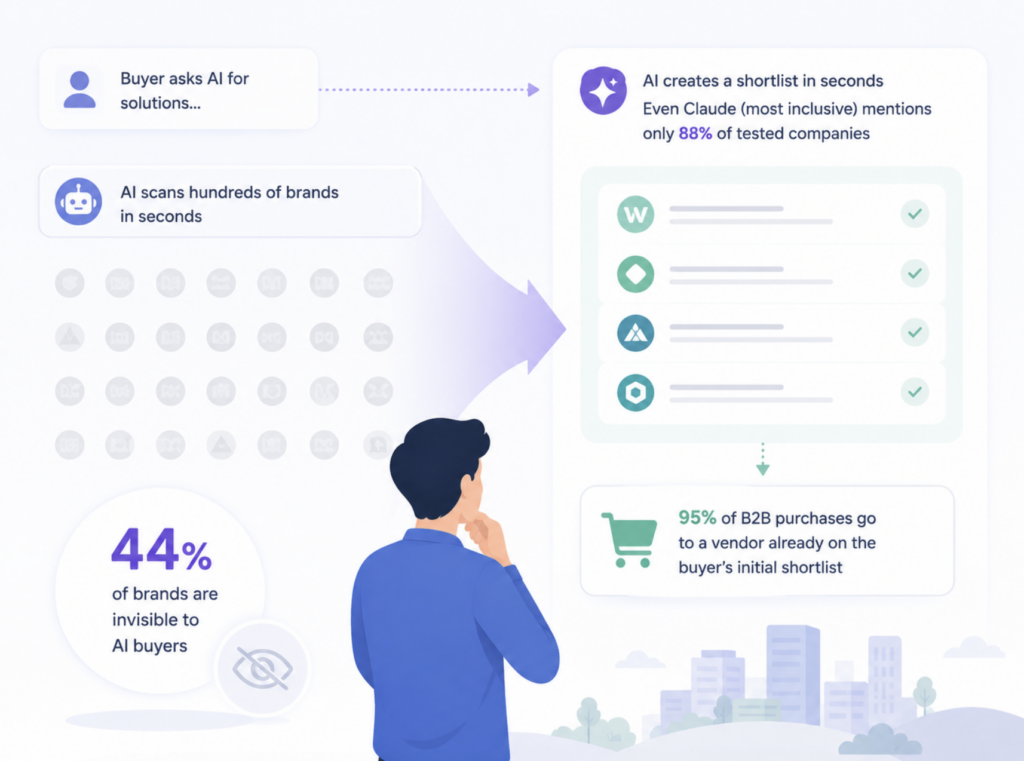
    One 2026 benchmark of 50 B2B SaaS companies across 1,400 buyer-intent prompts found that 44% of tested brands were functionally invisible to AI buyers, with even Claude, the most inclusive platform in the study, mentioning only 88% of the companies tested. That invisibility compounds. Research from Bain shows 95% of B2B purchases go to a vendor already on the buyer’s initial shortlist. If AI builds that shortlist in seconds and your name isn’t in it, no amount of downstream sales effort recovers the deal.

    None of this shows up in a traffic dashboard. There’s no bounce rate spike, no ranking drop to flag. The prospect simply never hears your name.

    What AI Competitor Monitoring Actually Measures

    Traditional competitor analysis compares two things: rank position and traffic estimates. AI competitor monitoring has to answer a different set of questions.

    DimensionTraditional SEO ToolsAI Competitor Monitoring
    What it tracksKeyword rank, backlinks, organic trafficMention frequency, position in AI answers, sentiment
    Data sourceSearch engine indexLive prompts run across ChatGPT, Perplexity, Gemini, and more
    Update cadenceWeekly or monthly crawlNear real-time, prompt by prompt
    What it tells youWhere you rank on a results pageWhether you get recommended, and how you’re described

    The dimension most teams skip is sentiment. Two competitors can both get mentioned in an AI answer, but one gets described as the reliable enterprise option and the other as a budget alternative. That framing shapes a buyer’s decision before they’ve clicked anything. Static rank reports have no way to capture it, because it’s not a position, it’s a judgment the model is making on the fly.

    Add prompt-level nuance and the picture gets more complicated. The same competitor can dominate one buyer-intent prompt and disappear from another, depending on who’s asking and what they’re comparing against. A single snapshot report can’t hold that much variance. Monitoring has to run continuously, across a defined set of high-value prompts, not as a one-time audit.

    How SaaS Teams Rebuild Visibility Through Competitor Benchmarking

    Winning back market share starts with a narrower question than most teams ask. Not “how do we rank higher,” but “which prompts is our category being decided on, and who’s winning them right now.”

    The workable sequence looks like this. First, map the high-intent prompts your buyers actually type, not the keywords your old SEO tool tracked. Second, track how often you and your named competitors show up across those prompts, and in what order. Third, trace the sources the AI is pulling from when it favors a competitor. Fourth, close the specific content gap that’s costing you the mention.

    That third step is usually where teams get stuck manually. Finding out which domain, review, or forum thread an AI model leaned on to recommend a competitor takes running the same prompts repeatedly and comparing outputs by hand. Topify’s competitor analysis tool automates that detection, surfacing which competitors are showing up across your tracked prompts and how your visibility, sentiment, and position compare to theirs.

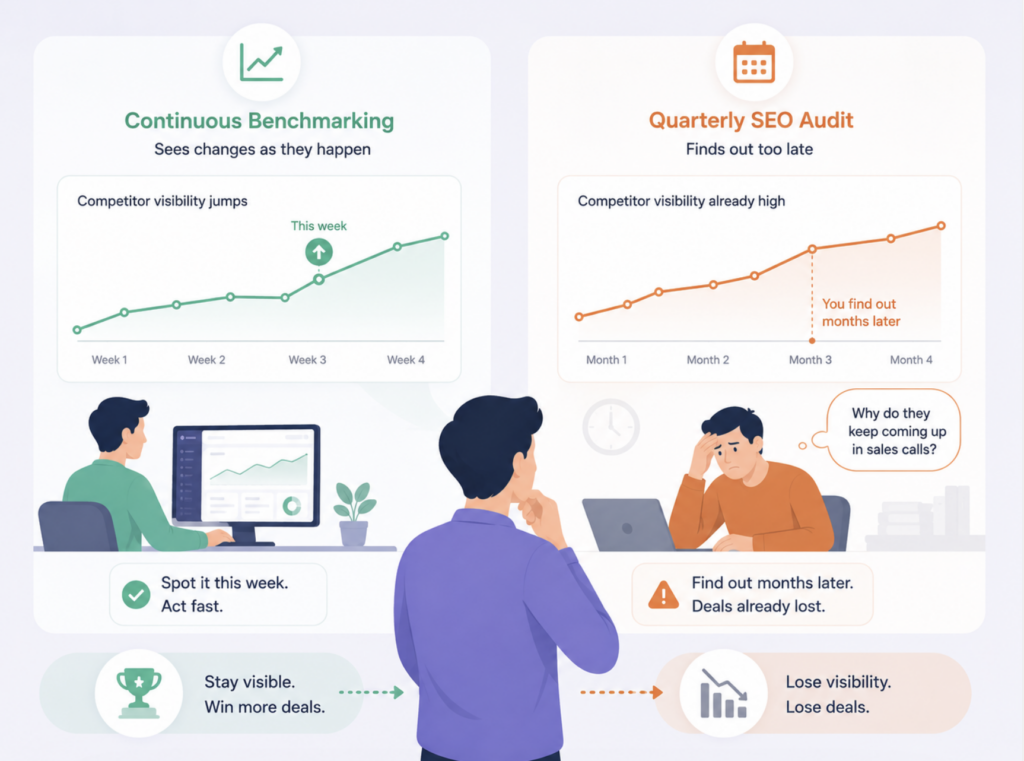
    The practical difference shows up in timing. When a competitor’s visibility jumps in a specific prompt cluster, a team using continuous benchmarking sees it that week. A team relying on a quarterly SEO audit finds out months later, usually after a few lost deals prompt someone to ask why a rival keeps coming up in sales calls.

    From Watching Competitors to Winning Prompts

    Monitoring is the diagnostic step, not the fix. Seeing that a competitor dominates a prompt tells you where the gap is. Closing it takes the same content and structural work that earns citations in the first place: clearer comparison pages, more third-party mentions, content that answers the specific question the AI is fielding.

    That’s the loop Topify’s broader GEO analytics is built around. Monitor where competitors are winning, understand why through source and sentiment data, then act on the content gap before the next buying cycle starts. Treated as a one-time check, competitor monitoring is trivia. Treated as a recurring input into content and PR planning, it’s a mechanism that compounds every quarter you run it.

    FAQ

    What is AI competitor monitoring for SaaS brands?
    It’s the practice of tracking how often your brand and named competitors get mentioned, ranked, and described across AI platforms like ChatGPT, Perplexity, and Gemini, for the specific prompts your buyers actually use during evaluation.

    How is AI visibility competitor analysis different from traditional SEO competitor tools?
    Traditional tools compare keyword rankings and backlink counts. AI competitor monitoring tracks mention frequency, position within generated answers, and sentiment, none of which a rank tracker built for search engines can see.

    How often should SaaS teams check competitor visibility in AI search?
    Continuously, not quarterly. AI answers shift as models update and as competitors publish new content, so a snapshot from three months ago often no longer reflects who’s winning a given prompt today.

    Can small SaaS teams do AI competitor monitoring without an agency?
    Yes. Running the same set of buyer-intent prompts on a regular schedule and logging who gets mentioned is a starting point any team can do manually, and tools built for this task remove the manual repetition as the prompt set grows.

    Read More

  • AI Visibility Competitor Analysis Across ChatGPT, Gemini, Perplexity

    AI Visibility Competitor Analysis Across ChatGPT, Gemini, Perplexity

    A SaaS brand ranks first on Google for its category. Ask ChatGPT the same question, and a competitor two spots below them on Google gets named first, described favorably, and linked as the recommended pick. The brand isn’t losing on Google. It’s losing somewhere Google metrics can’t see.

    That’s the gap most teams still can’t measure. Traditional competitor analysis tracks backlinks, keyword rankings, and organic traffic share. None of that tells you who ChatGPT recommends when a buyer asks for options in your category.

    Your Google Rank Doesn’t Tell You Who’s Winning in AI Search

    AI platforms don’t return a list you can scroll through. They generate a single answer, and that answer either includes your brand or it doesn’t. There’s no page two to fall back on.

    This changes what “competitor analysis” even means. You’re not comparing domain authority anymore. You’re comparing whether a model chooses to mention you at all, and if it does, how it talks about you next to everyone else in the answer.

    That’s a fundamentally different discipline than link building or keyword gap analysis.

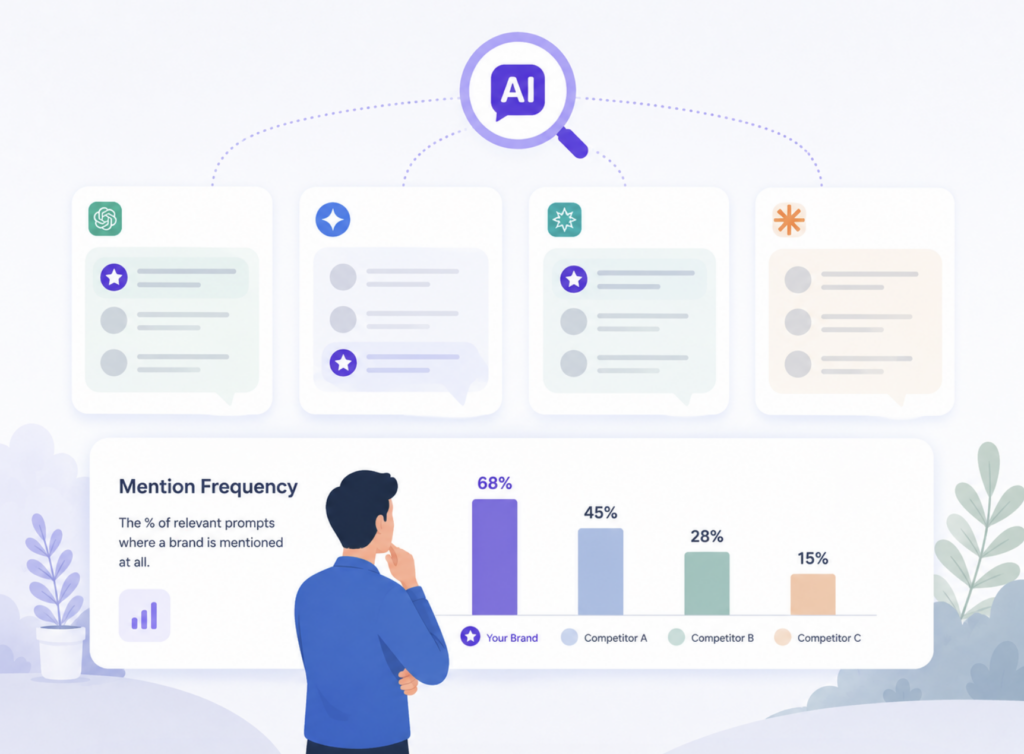
    Mention Frequency: Are They Even in the Conversation

    Mention frequency is the starting point. It’s the percentage of relevant prompts where a competitor shows up at all, and it functions as the AI equivalent of share of voice. Comparing how often your brand is mentioned against competitors for the same query category is the clearest competitive benchmark available in AI search.

    Manually checking this doesn’t scale. A handful of prompts run by hand once a month tells you almost nothing, because AI answers drift on a weekly basis, and one-off snapshots make a benchmark look productive while actually measuring nothing.

    You need a fixed prompt set run repeatedly across platforms, not a spot check. That’s the baseline layer. Everything else builds on top of it.

    Sentiment: How AI Talks About Them, Not Just Whether It Does

    Getting mentioned isn’t the same as getting recommended. A competitor can show up in an answer and still come across poorly, and the reverse is just as common. A positive recommendation carries more weight than a neutral listing, which is why sentiment and positioning both need tracking inside the response itself.

    This matters more than most teams assume. A brand mentioned only in the context of problems or complaints technically has visibility, but not the right kind. If a competitor’s mentions skew negative while yours skew neutral, that’s a real advantage, even if their raw mention count is higher.

    Sentiment turns a mention count into something you can actually act on.

    Position: Who Gets Named First When AI Compares Options

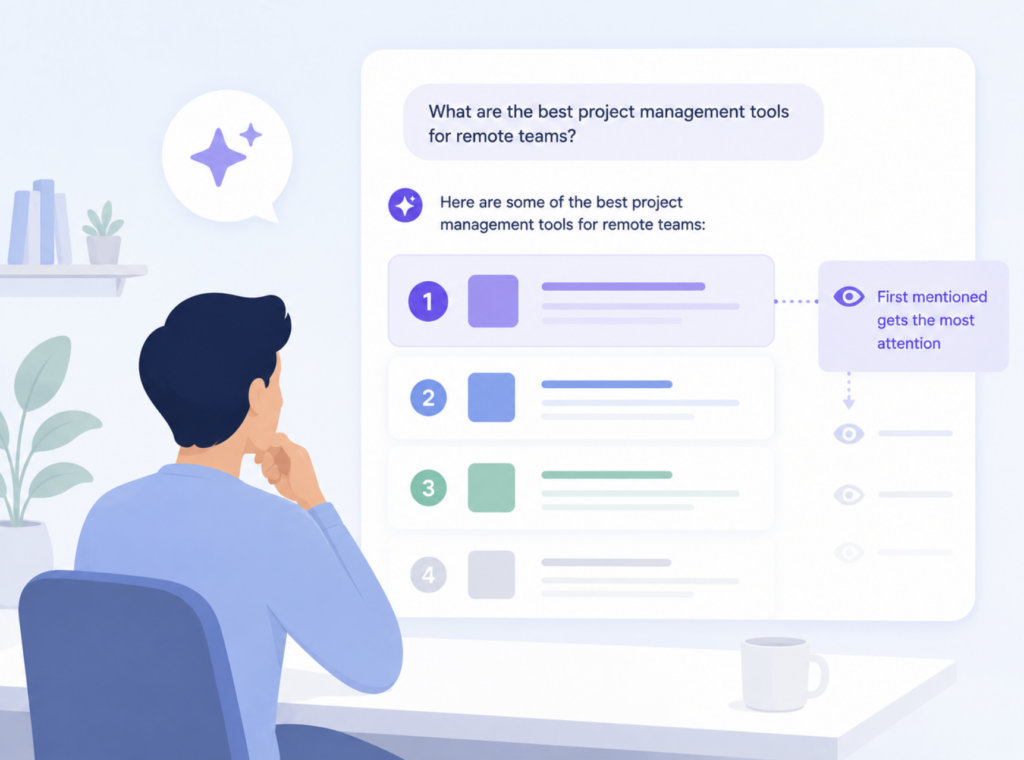
    Order matters inside an AI answer the same way it matters on a results page. First-mentioned brands tend to receive disproportionate user attention, similar to position-one bias in traditional search.

    That means two brands can have identical mention frequency and still be in very different competitive positions. One gets named first in “best tools for X” answers. The other gets tacked on at the end, or buried inside a longer list.

    Position shifts often before mention frequency does. Watching it lets you catch a competitor gaining ground before they overtake you outright.

    Source Overlap: Where Competitors Are Getting Cited From

    Every AI answer pulls from somewhere. When a competitor gets cited consistently, there’s usually a specific set of pages the model keeps pulling from, and that’s the most actionable data point in the whole framework.

    Surfacing the citation gap, meaning which sources are feeding a competitor’s mentions that are absent from your own footprint, tells teams exactly what to fix to get recommended more often. That’s not a guess. It’s a direct map from a specific competitor advantage to a specific content gap.

    Here’s the thing: platforms don’t all pull from the same kind of sources. Perplexity tends to respond fastest because of its recency bias, while ChatGPT and Google’s AI systems take longer to shift because they weight established authority signals that build over months. A source overlap that closes your gap on Perplexity this week might take months to move the needle on ChatGPT.

    Putting It Together: A Simple Competitor Tracking Workflow

    A workable process looks like this. Fix a prompt set that mirrors how your buyers actually phrase questions. Run it across ChatGPT, Gemini, and Perplexity on a set schedule, not once. Score mention frequency, sentiment, and position for you and named competitors on every run. Then pull source overlap on whichever prompts show the widest gap.

    Doing that by hand across three or more platforms, on a recurring basis, with consistent scoring, isn’t realistic for most teams. Prompts drift, model versions update mid-quarter, and a spreadsheet built in January is stale by March. That’s less about effort and more about the format. A tracker needs to run automatically to be worth trusting.

    This is exactly the gap Topify‘s competitor analysis tool is built to close. It runs your prompt set across major AI platforms on a schedule, scores mention frequency, sentiment, and position for each named competitor, and surfaces the citation sources feeding their mentions, so the benchmark updates itself instead of going stale between manual checks.

    Conclusion

    AI visibility competitor analysis comes down to four things: how often a competitor gets mentioned, how AI talks about them when they do, where they land in the answer, and which sources keep feeding their citations. None of that shows up in a Google rank tracker. Building a recurring process around all four, instead of an occasional manual check, is what separates teams that catch competitive shifts early from teams that find out after a rival has already taken the top spot.

    FAQ

    How often should I track AI visibility competitors? 

    Weekly at minimum. Model updates and content changes shift AI answers often enough that a monthly check will miss most of the movement.

    Is AI visibility competitor analysis different from SEO competitor research? 

    Yes. SEO competitor research compares rankings, backlinks, and keywords. AI visibility competitor analysis compares whether and how a model mentions each brand inside a generated answer, which follows a different logic entirely.

    Does ChatGPT show the same answer to everyone? 

    Not reliably. Answers can vary by phrasing, account history, and model version, which is why tracking needs a fixed, repeated prompt set rather than a single spot check.

    Which AI platforms matter most for competitor tracking? 

    ChatGPT and Perplexity typically come first, since they’re most often used for direct comparison questions. Gemini matters more if your traffic already leans on Google organic search.

    Read More

  • 5 Blind Spots Traditional Competitor Analysis Misses in AI Search

    5 Blind Spots Traditional Competitor Analysis Misses in AI Search

    Your competitor dashboard says you’re winning. Higher domain authority, more ranking keywords, a bigger share of voice than the brand you’ve been tracking for years. Then someone on your team asks ChatGPT which brand to pick in your category, and it recommends the competitor you just beat on every SEO metric. That gap isn’t a glitch. AI visibility competitor analysis runs on a different set of signals than the research most teams still rely on, and the tools built for blue links were never designed to see it.

    Your Competitor Report Still Thinks Rankings Are Everything

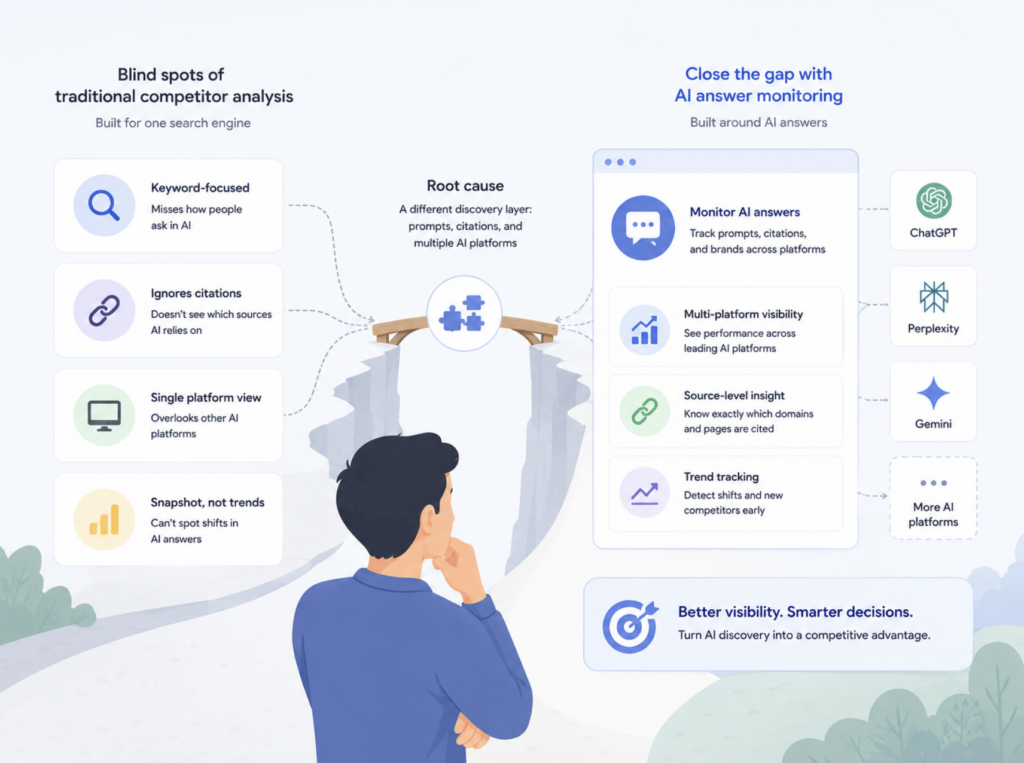
    The logic behind most competitor analysis hasn’t changed in a decade: track keyword rankings, count backlinks, compare SERP share. That logic assumes being findable means being seen. In AI search, that assumption breaks. Roughly 93% of AI search sessions now end without a single click, which means the entire premise of “who ranks higher” stops mattering the moment a user asks an AI system for a recommendation instead of a link.

    Here’s the harder part: your competitor might be losing the keyword race and still winning the conversation that actually decides the sale. Ranking on page one means nothing if the AI never mentions you.

    Blind Spot 1: They Track Search Rank, Not Answer Inclusion

    Traditional tools answer one question well: where do you sit in the SERP. AI search asks a different question entirely: did the model choose to mention you at all. Those aren’t the same metric, and treating them as interchangeable is where most competitor analysis for AI search visibility falls apart.

    The emerging metric hierarchy looks different from anything in a classic rank tracker. Analysts now recommend starting with mention frequency as a baseline, then layering in citation quality and relative share against competitors. A brand can dominate organic rankings and still register a mention frequency near zero across the prompts that matter most to its category. That’s the blind spot a keyword-first competitor report simply can’t surface.

    Blind Spot 2: They Miss the Prompt-Level Battlefield

    Competition used to happen at the keyword level. It now happens at the prompt level, and the difference is bigger than it sounds. A single topic can fan out into dozens of differently worded prompts, and each one can produce a completely different set of brands in the answer.

    Traditional competitor analysis tools were built to monitor a finite keyword list, not an open-ended set of natural language questions. That’s a structural mismatch, not a feature gap you can patch with more keywords. Without prompt-level tracking, you’re comparing yourself to competitors on a battlefield that no longer represents how buyers actually search.

    Blind Spot 3: They Can’t See Which Sources AI Actually Cites

    AI answers don’t come from nowhere. They’re built on sources the model has learned to trust and cites when it responds, and those sources shift constantly. Recent tracking found that 40% to 60% of cited sources change month to month across major AI platforms, which makes citation share one of the most volatile competitive metrics in AI search today.

    Traditional competitor analysis looks at a competitor’s own domain authority and backlink profile. It has no visibility into whether that competitor has quietly captured the third-party sources an AI model actually pulls from, like review sites, forums, or comparison pages. Once a domain becomes a regularly cited source, the volatility gap between it and rarely cited domains can run as high as 70x, meaning early movers in citation share get progressively harder to dislodge.

    Blind Spot 4: They Ignore How AI Talks About Your Competitor

    Traditional competitor analysis produces neutral data points: traffic, rankings, keyword overlap. None of that captures tone. When an AI system recommends a brand, it often frames it with implicit judgment, calling one option “industry-leading” and another “a budget pick” for the exact same query.

    That framing shapes buyer perception before a click ever happens, and it’s invisible to a tool built to count rankings. Two competitors with identical visibility scores can walk away with very different outcomes if one gets described as the premium choice and the other doesn’t get described at all.

    Blind Spot 5: They’re Blind to Multi-Platform Fragmentation

    Competitive position in one AI engine tells you almost nothing about your position in another. Visibility on ChatGPT doesn’t predict visibility on Perplexity or Claude, and multi-platform monitoring is the only way to get the complete competitive picture. The scale gap between platforms adds to the problem. ChatGPT alone processes roughly 2 billion queries a day and holds over 60% of the AI platform market, while Perplexity handles more than 30 million daily queries with its own distinct citation patterns.

    Winning in ChatGPT doesn’t mean you’re winning in Perplexity. Most competitor analysis workflows still center on a single search engine, which leaves entire categories of AI-driven competition completely unmonitored.

    How Closed-Loop Competitor Monitoring Closes These Gaps

    Each of these blind spots points to the same root cause: competitor analysis built for a single search engine can’t account for a discovery layer that runs on prompts, citations, and multiple AI platforms at once. Closing that gap takes a different kind of monitoring, one built around AI answers instead of search results.

    Topify’s competitor analysis tool approaches this by tracking Dynamic Competitor Benchmarking across ChatGPT, Perplexity, Gemini, and other major AI platforms at once. In practice, that means you can see which competitors are gaining mention frequency on prompts you thought you owned, and catch a new rival emerging in AI answers before it shows up anywhere in your traditional SEO reports.

    The same system layers in Source Analysis, which reveals the domains AI platforms are actually citing for your category, and Sentiment Analysis, which tracks how AI language frames your brand relative to competitors. Instead of comparing rankings after the fact, teams get a live view of where the competitive gap is opening and which specific prompt or source is driving it. Only 14% of brands currently run any kind of AI visibility strategy, which means most competitor analysis workflows haven’t caught up to where the competition has already moved.

    Conclusion

    Traditional competitor analysis was built to measure a search engine that ranks links. AI search recommends answers instead, and that shift changes what “winning” against a competitor actually looks like. Teams that keep measuring rank position, backlinks, and SERP share will keep missing the mention frequency, citation sources, and cross-platform gaps where the real competitive battle is happening. Closing those five blind spots starts with expanding what you track, not just how often you check it.

    FAQ

    Q: How is AI search competitor analysis different from traditional SEO competitor analysis? 

    A: Traditional SEO competitor analysis compares rankings, backlinks, and organic traffic share. AI search competitor analysis compares mention frequency, citation sources, and sentiment across AI platforms like ChatGPT and Perplexity, where search rank often has little bearing on whether a brand gets mentioned at all.

    Q: Why does my competitor rank lower in Google but appear more often in ChatGPT? 

    A: AI platforms pull from a different mix of sources than classic search rankings reward, including forums, review sites, and third-party comparison content. A competitor can be weaker on domain authority while still being more frequently cited across the sources an AI model actually trusts.

    Q: Do I need to track competitors on every AI platform, or is one enough? 

    A: One platform tends to give an incomplete picture. Visibility on ChatGPT doesn’t reliably predict visibility on Perplexity, Gemini, or Claude, so a full competitive view generally requires monitoring across the platforms your audience actually uses.

    Q: How often does competitive positioning change in AI search compared to traditional SEO? 

    A: AI search tends to move faster. Cited sources can shift from month to month, and mention frequency for a given prompt can change as AI platforms update their models or discover new content, making competitive monitoring closer to a continuous process than a quarterly check-in.

    Read More

  • How to Run a Competitor Analysis for AI Search, Not Just Google

    How to Run a Competitor Analysis for AI Search, Not Just Google

    Your brand ranks second on Google for your category’s biggest keyword. You’ve checked Ahrefs, you’ve checked Search Console, everything looks fine. Then someone on your team asks ChatGPT the exact same question, and your brand doesn’t show up at all. A competitor with a thinner backlink profile gets recommended instead.

    That gap isn’t a fluke. It’s a measurement problem, and it’s the reason most competitor analysis frameworks built for Google don’t transfer to AI search.

    Your Google Competitors Aren’t Your AI Competitors

    Traditional competitor analysis runs on a handful of metrics: domain rating, referring domains, keyword overlap, share of voice in organic rankings. Those numbers still matter for classic SEO. They tell you almost nothing about who AI engines actually recommend.

    A large-scale correlation study cited by Digital Applied found that branded web mentions correlate with AI visibility at roughly 0.66, while backlink counts correlate at just 0.22, about a third as strong. Domain rating fares slightly better at 0.33, still less than half the pull of brand mentions. The signal that used to define competitive strength in Google barely registers in AI answers.

    There’s a second layer to this. AI engines don’t share a source pool the way Google’s top 10 is a single shared list. Research from Authority Tech analyzing 680 million citations found only 11% domain overlap between ChatGPT and Perplexity. A separate 300,000-citation study of six B2B SaaS brands found citation volume for the same brand varied by up to 615x between platforms. Your ChatGPT competitor and your Perplexity competitor might not even be the same company.

    That’s the gap most brands still can’t see.

    Step 1: Find Out Who AI Actually Recommends

    Start the way you’d start any competitor analysis: figure out who shows up. But the method has to change.

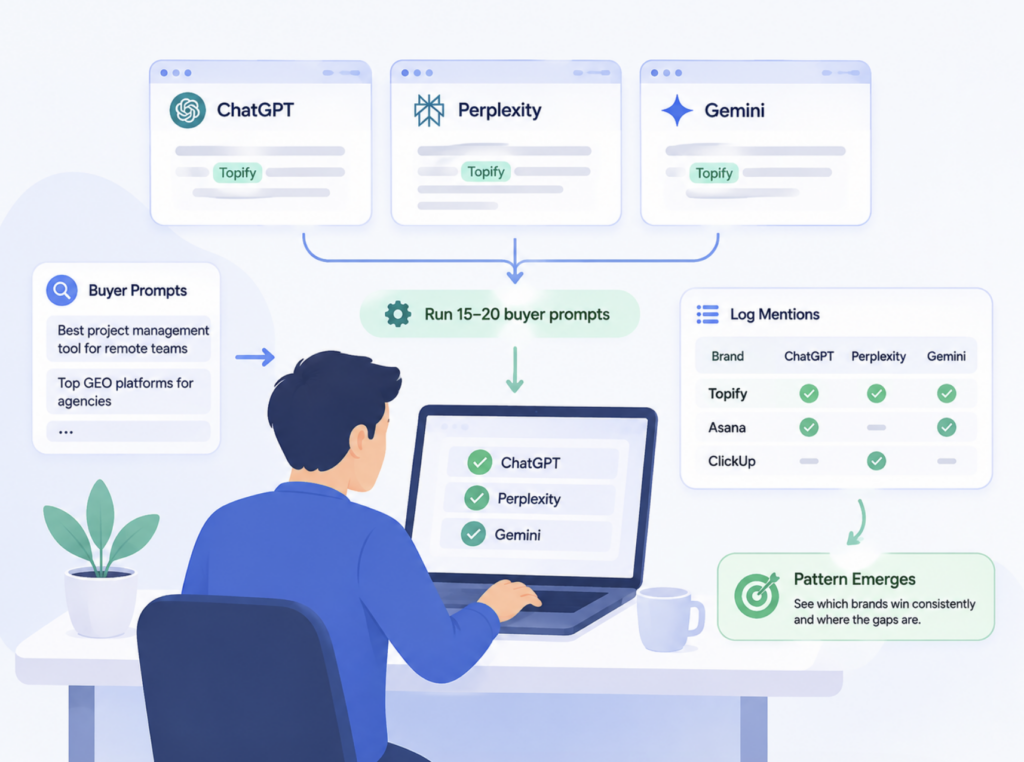
    The manual version looks like this: open ChatGPT, Perplexity, and Gemini, run the prompts a buyer would actually type (“best project management tool for remote teams,” “top GEO platforms for agencies”), and log which brands get mentioned. Do this for 15 or 20 prompts and a pattern starts to form.

    The problem is scale. A handful of manual prompts gives you a snapshot, not a trend line, and AI answers shift as models update, as source pools rotate, and as competitors publish new content. Ahrefs’ Brand Radar research tracked 75,000 brands to get a reliable read on what predicts citation, a scale no manual process reaches.

    This is where automated competitor monitoring earns its keep. Topify’s Competitor Monitoring tracks which brands AI engines mention against a running prompt set, across platforms, without you retyping the same 20 questions every week.

    Step 2: Compare Across the Metrics That Actually Matter

    Once you know who’s showing up, the next question is how they’re showing up. A single mention count flattens a lot of useful detail.

    MetricWhat it tells youManual processAutomated process
    VisibilityHow often a brand appears across promptsSpot-check a handful of queriesContinuous tracking across the full prompt set
    SentimentWhether the mention is positive, neutral, or negativeRead each answer individuallyScored automatically per response
    PositionWhere a brand lands in a list of recommendationsHard to judge consistently by eyeTracked over time, per platform
    MentionsRaw frequency across platformsLimited to what you manually testCovers ChatGPT, Perplexity, Gemini, and more

    Position matters more than it looks. One analysis of Perplexity responses found 86% of brand mentions land in position five or earlier, while ChatGPT tends to produce longer, more exhaustive lists. A brand that gets mentioned but buried at position nine is functionally invisible to a user who reads the first three recommendations and moves on.

    Sentiment is the metric most manual audits skip entirely, and it’s the one that separates a real competitive win from a hollow one. Getting mentioned isn’t the same as getting recommended.

    Step 3: Reverse-Engineer What Content Gets Competitors Cited

    This is the step that turns competitor analysis into a content plan instead of a scoreboard.

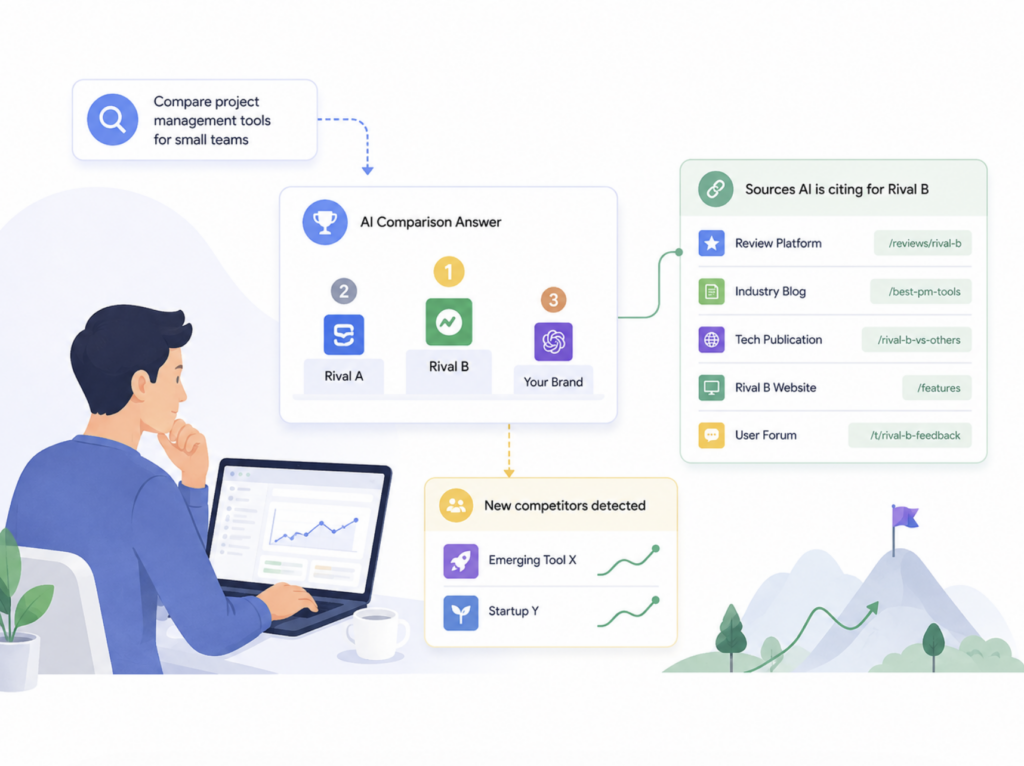
    For every competitor that outranks you in AI answers, trace the citation back to its source. Which specific page did the AI engine pull from? Is it a comparison article, a product page, a Reddit thread, a review site? A meta-analysis synthesizing 54 studies found that editorial blog content accounts for over half of all AI citations, while press releases account for a vanishing fraction, near zero. If your competitor’s advantage traces back to a single well-structured comparison page, that’s a specific, fixable gap, not an abstract brand problem.

    This is the step most teams skip, and it’s the one most worth doing.

    Topify’s Reverse-Engineer AI Citations feature automates this trace, surfacing the exact domains and URLs AI platforms pull from when they cite a competitor instead of you.

    Step 4: Track Position Changes Over Time, Not Just a Snapshot

    A single competitor analysis is a photo. AI rankings move more like weather.

    Model updates shift what gets cited. Source pools change, sometimes abruptly: Perplexity’s Reddit citations reportedly dropped 86% after a 2025 scraping dispute, with YouTube partially filling the gap. A competitor that dominated your category’s AI answers in January can lose ground by June, and you won’t know unless you’re watching continuously.

    The fix is a fixed, repeatable prompt set, tested on a regular cadence rather than once per quarter. Topify’s Position Tracking handles this automatically, flagging when a competitor moves up or down relative to your brand across the same prompts, on the same schedule, every time.

    Common Mistakes When Analyzing AI Search Competitors

    A few patterns show up again and again in teams doing this for the first time.

    Testing one platform and calling it done. With domain overlap between ChatGPT and Perplexity sitting around 11%, a ChatGPT-only audit misses most of the competitive picture.

    Treating a one-time screenshot as an ongoing benchmark. AI answers aren’t static. A snapshot from three months ago tells you almost nothing about today’s competitive landscape.

    Counting mentions without checking sentiment. A competitor mentioned ten times with lukewarm framing isn’t necessarily beating a brand mentioned five times with a strong recommendation.

    Turning Competitor Analysis Into an Action Plan

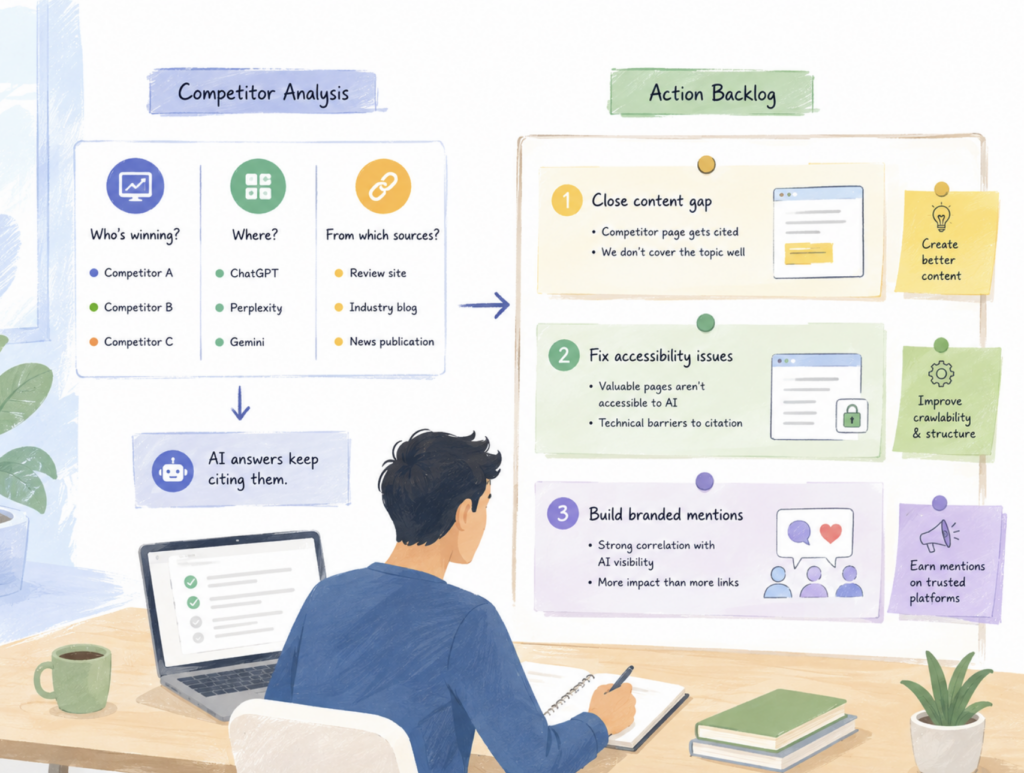
    The output of a good competitor analysis isn’t a report, it’s a backlog. Once you know which competitors are winning, on which platforms, and from which sources, the next moves are specific: close the content gap on the topics where a competitor’s page keeps getting cited, fix accessibility issues on pages that should be citable but aren’t, and build the branded mentions that correlate far more strongly with AI visibility than another round of link building.

    You can run this whole workflow, competitor detection, metric comparison, and source tracing, through Topify’s Competitor Analysis tool. Enter your brand and a shortlist of competitors, and it maps out where you stand across the platforms that matter, in minutes rather than a week of manual prompting.

    Conclusion

    Google competitor analysis and AI search competitor analysis are not the same exercise wearing different clothes. The metrics that used to signal competitive strength, backlinks, domain rating, don’t carry the same weight when an AI engine decides who to recommend. Brands that win in AI search are the ones tracking mentions, sentiment, and citation sources across platforms, on a schedule, not the ones with the biggest link profile.

    FAQ

    How do I analyze competitors in ChatGPT specifically? 

    Run a consistent set of buyer-intent prompts through ChatGPT and log which brands get mentioned, at what position, and with what sentiment. Repeat on a fixed schedule since ChatGPT’s citation pool shifts with model updates.

    Is the AI search competitive landscape the same as Google’s? 

    No. Domain overlap between major AI engines runs as low as 11%, and correlation studies show backlinks and domain rating matter far less than branded mentions for AI citation. Treat AI search as a separate competitive map, not an extension of your Google rankings.

    What is GEO competitor benchmarking? 

    It’s the practice of tracking a brand’s visibility, sentiment, and position against named competitors across AI platforms like ChatGPT, Perplexity, and Gemini, typically automated since manual prompt testing doesn’t scale to multiple platforms and a regular cadence.

    How often should I re-run a competitor analysis for AI search? 

    At minimum monthly. AI citation pools shift with model updates and source pool changes, so a quarterly or one-time check will miss meaningful competitive movement.

    Read More

  • The AI Visibility Battle: Why Your Competitor Analysis Falls Short

    The AI Visibility Battle: Why Your Competitor Analysis Falls Short

    Your quarterly competitive review probably has a slide for search rankings, one for backlink growth, and one for social share of voice. None of them show what ChatGPT told a prospect who asked for a recommendation in your category last week. That gap doesn’t show up in a rank tracker, and it won’t show up until someone on your team happens to ask the same question a customer already asked an AI. By then, the answer that mattered already happened, and it probably favored someone else.

    Your Competitor Analysis Probably Stops Before It Gets to AI Search

    Most competitive intelligence stacks were built for a world with ten blue links. They track keyword rankings, backlink velocity, paid search spend, and social mentions. None of those dimensions tell you whether an AI platform is recommending you or your competitor when a buyer asks for options.

    That blind spot is common. Only 14% of marketers currently track how their brand shows up in AI-generated answers at all. Everyone else is running competitor analysis on a channel that’s shrinking in influence while ignoring the one that’s growing.

    The disconnect gets worse the closer you look. Pages that rank well on Google used to be a reliable predictor of AI citation. Not anymore. The overlap between top-10 Google rankings and the sources AI Overviews actually cite has dropped from roughly 76% to 38% in under a year. Your rank tracker and your AI visibility are answering two different questions now.

    What AI Visibility Competitor Analysis Actually Means

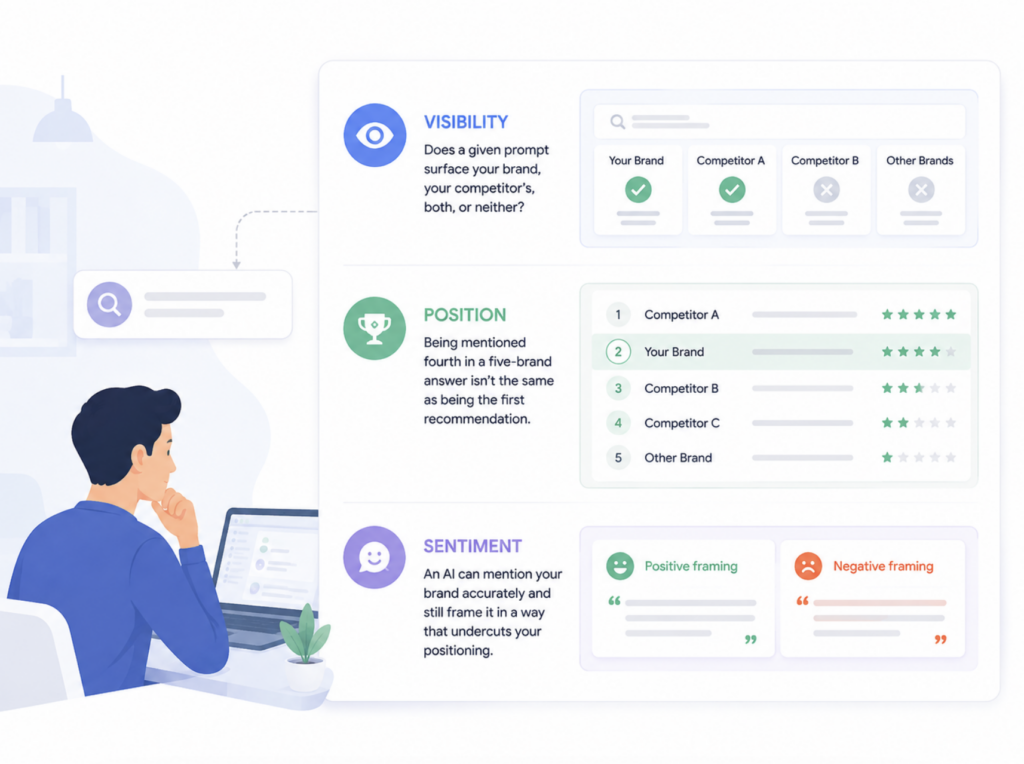
    AI visibility competitor analysis isn’t “check if we rank higher than them.” It’s a comparison across three separate layers: whether you’re mentioned at all, where you land relative to competitors when you are, and how the AI describes you when it does.

    Visibility is the baseline. Does a given prompt surface your brand, your competitor’s, both, or neither? Position matters once you clear that bar. Being mentioned fourth in a five-brand answer isn’t the same as being the first recommendation. Sentiment is the layer most teams skip entirely. An AI can mention your brand accurately and still frame it in a way that undercuts your positioning.

    Run all three side by side against your top two or three competitors, across the prompts your buyers actually use, and you get a real picture of where you stand. Run just one, and you’re guessing.

    The Gap Most Brands Never See

    Here’s the part that doesn’t show up in a monthly report: the brands winning AI visibility aren’t necessarily the ones winning search.

    Top-performing SaaS brands earn 8.4x more AI citations than the median brand in their category, and the gap is widening. Part of the reason is that AI platforms pull the vast majority of what they say about you from somewhere other than your own website. Roughly 79% of AI citations come from third-party domains rather than vendor pages.

    That means your competitor could be losing the SEO fight on paper and still be winning the narrative in ChatGPT, simply because a review site, a comparison article, or a forum thread is doing the talking for them. Your existing competitor analysis has no way to catch that.

    Think about how this plays out in practice. Your team ranks on page one for your category’s main keyword. Your top competitor ranks on page two. On paper, you’re ahead. But a G2 comparison page and a handful of Reddit threads happen to favor your competitor’s positioning, and those are exactly the kinds of pages AI platforms lean on for third-party validation. Ask ChatGPT for a recommendation, and your competitor shows up first. Your rank tracker never flags this, because it isn’t measuring the same thing anymore.

    This is also why B2B discovery is shifting faster than most teams have adjusted for. AI-driven answers now account for 17% of B2B SaaS discovery, up from just 4% a year earlier. A channel growing that quickly deserves its own line in a competitive review, not a footnote under “emerging trends.”

    How to Run a Real AI Visibility Competitor Analysis

    Start with the prompts, not the platforms. Build a list of 15 to 30 real buyer questions: category questions (“best tools for X”), comparison questions (“X vs Y”), and problem-based questions (“how do I solve Z”). These are the moments where AI answers actually shape a purchase decision.

    Run that prompt set across ChatGPT, Perplexity, and Gemini at minimum. Citation behavior and sentiment can shift dramatically depending on the platform, and relying on a single one gives you an incomplete, sometimes misleading picture. Then compare your brand against the same competitors on each of the three layers: visibility, position, and sentiment.

    The last step is tracing citations back to source. If a competitor consistently outranks you in AI answers, find out which domains AI is pulling that recommendation from. That tells you exactly where to focus outreach or content work, instead of guessing.

    Keep a simple scorecard while you do this. For each prompt, log which brands appeared, in what order, and whether the framing was positive, neutral, or negative. After a few rounds, patterns show up fast. Maybe a competitor dominates “best for beginners” prompts but disappears entirely from “enterprise” ones. Maybe your brand shows up consistently but always described with a qualifier that undersells you, like “budget option” when your positioning is premium. Those patterns are the actual output of an AI visibility competitor analysis, and they’re specific enough to act on immediately.

    Don’t skip the sentiment column to save time. A brand that’s mentioned often but described unfavorably isn’t actually winning, even though a visibility-only view would suggest otherwise.

    Where Competitor Monitoring Tools Fit In

    Doing this manually, prompt by prompt, platform by platform, works for a one-time snapshot. It doesn’t scale to weekly or monthly tracking, and AI answers change often enough that a snapshot goes stale fast.

    Topify built Dynamic Competitor Benchmarking specifically for this gap. It automatically detects who’s competing with you across AI platforms, even competitors you haven’t manually added, and tracks Visibility, Sentiment, and Position for all of them side by side. Pair that with Reverse-Engineer AI Citations, which surfaces the exact domains and URLs feeding your competitors’ AI mentions, and you get the source-level detail that a manual prompt audit can’t easily produce at scale.

    If you want to see where you stand against a specific competitor right now, Topify’s AI visibility competitor analysis tool runs that comparison directly, without needing to set up prompt tracking from scratch first.

    Reading the Results Without Overreacting

    One important caveat before you act on any of this: AI answers move.

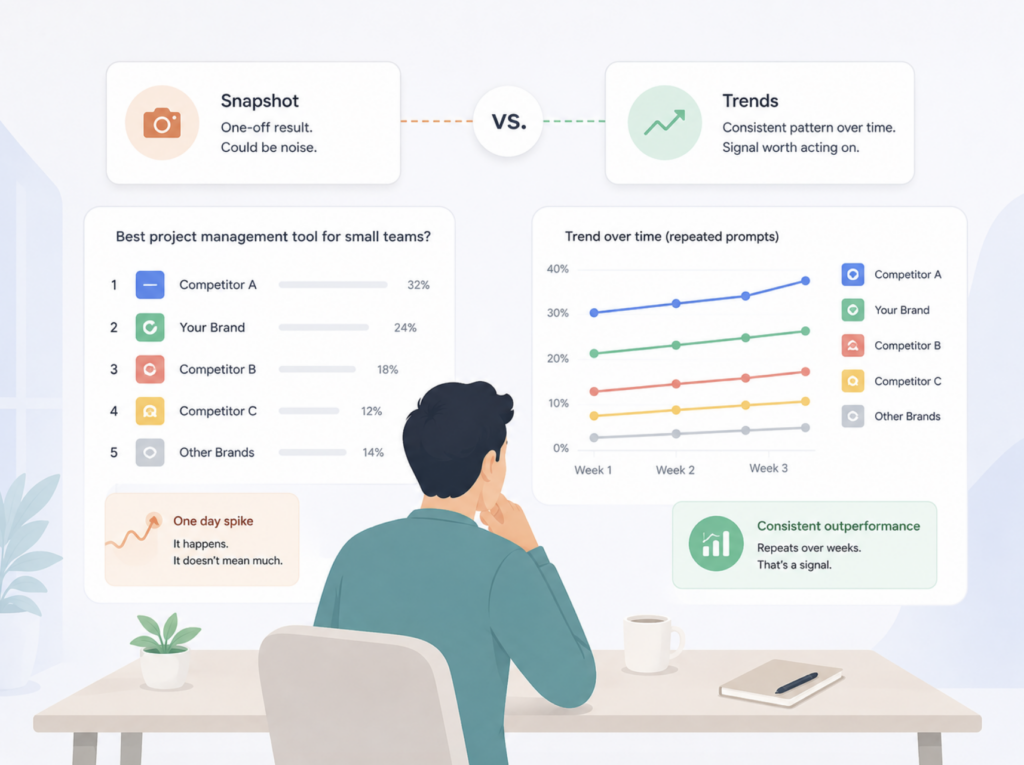
    Citation rates and sentiment can vary by up to 615x depending on the platform, and only about 30% of brands stay visible across back-to-back runs of the exact same query. A single check where a competitor outranks you isn’t proof of a permanent gap. It might just be that day’s answer.

    That’s the real reason to track trends instead of snapshots. If a competitor consistently outperforms you across two or three weeks of repeated prompts, that’s a signal worth acting on. If it’s a one-off, it’s noise.

    Brands that show up both mentioned and cited by name tend to hold their position better over time than brands that only get cited without a direct mention. That’s a useful marker to watch as you build out your own tracking, since it points to which competitors have durable AI visibility and which are just having a good week.

    Conclusion

    The traditional competitor analysis playbook, rankings, backlinks, and social mentions, was never built to answer the question buyers are now asking an AI directly. Closing that gap starts with treating AI visibility as its own dimension of competitive intelligence, tracked across visibility, position, and sentiment, not folded into an SEO report where it doesn’t fit. Start with a handful of real buyer prompts this week, check where you and your top two competitors land, and build the habit of repeating it before the next quarterly review catches you off guard again.

    FAQ

    Q: How is AI visibility competitor analysis different from a traditional competitor analysis? 

    A: Traditional competitor analysis compares rankings, backlinks, and traffic. AI visibility competitor analysis compares whether, where, and how favorably each brand is mentioned inside AI-generated answers, which increasingly draws on a different set of sources than classic search rankings.

    Q: How often should I run this kind of analysis? 

    A: Weekly or biweekly, if possible. AI answers can shift noticeably from one run to the next, so a single check tells you less than a repeated pattern over two or three weeks.

    Q: Which AI platforms should I actually track? 

    A: At minimum, ChatGPT, Perplexity, and Gemini. Citation behavior and sentiment differ enough between platforms that tracking only one can give you a misleading sense of where you actually stand.

    Q: Can a small team without a dedicated SEO person do this? 

    A: Yes. A manual version works fine for an initial check: pick 15 to 20 real buyer prompts, run them across the major AI platforms, and note who gets mentioned and how. Scaling that into ongoing tracking is where a monitoring tool becomes worth the time saved.

    Read More

  • Your Rivals Are Already Winning on ChatGPT. You Just Can’t See It.

    Your Rivals Are Already Winning on ChatGPT. You Just Can’t See It.

    Your Google Analytics dashboard says everything’s fine. Traffic is steady, rankings haven’t moved, and the SEO report looks the same as it did last quarter.

    ChatGPT disagrees.

    Somewhere between your last board meeting and this one, a buyer typed a question into ChatGPT, Perplexity, or Google AI Mode about your category. An answer came back. A brand got named. There’s a decent chance it wasn’t yours, and there’s an even better chance nobody on your team knows that happened. This is what an AI visibility competitor analysis is built to catch, and most brands are running one for the first time only after they’ve already lost ground.

    The Traffic Numbers That Are Lying to You

    Your analytics stack was built to measure clicks. It counts visits, sessions, and conversions from people who landed on your site. What it can’t count is the answer a user got before they ever searched for you, or didn’t.

    That gap is widening fast. ChatGPT alone now handles an estimated <cite index=”2-1″>2.8 billion queries per day, and product research and shopping is its fastest growing use case, up 89% year over year</cite>. Separately, roughly <cite index=”7-1″>37% of consumers say they now start their searches with an AI tool instead of a traditional search engine</cite>. None of that shows up as “traffic” until a user clicks through, and a large share of them never do.

    Here’s the uncomfortable part: this isn’t a tool failing to do its job. Google Analytics was never designed to see inside an AI-generated answer. The blind spot is structural, not accidental.

    What “AI Visibility Competitor Analysis” Actually Means

    Most teams hear “competitor analysis” and think keyword rankings. In AI search, the unit of comparison isn’t a keyword. It’s a prompt, and how your brand fares inside the answer that prompt generates.

    A real analysis breaks that answer into three separate questions:

    DimensionWhat It MeasuresWhy It Matters
    MentionsDoes the AI name your brand at all when a relevant question is askedIf you’re not mentioned, nothing else matters
    PositionWhere you land relative to competitors when multiple brands are namedFirst-mentioned brands get disproportionate trust
    SentimentThe tone the AI uses when it does mention youA neutral or negative mention can be worse than silence

    Run the same buyer-intent prompt across ChatGPT, Perplexity, and Gemini, and you’ll often see three different rosters of brands. That inconsistency is the whole point of doing this analysis by hand at least once: it shows you the gap between what you assume AI says about your category and what it actually says.

    Three Signs Your Competitor Is Already Ahead

    You don’t need a full audit to spot early warning signs. A few patterns tend to show up before anyone notices the bigger trend.

    Sign one: they’re the answer to “X vs Y.” Comparison-style prompts are where AI visibility gets decided. Research on B2B citation behavior found that <cite index=”10-1″>comparison queries produced a 54% citation rate compared to just 18% for how-to queries</cite>. If a competitor’s content is built around head-to-head comparisons and yours is built around educational how-tos, they’re winning the exact moment a buyer is deciding between vendors.

    Sign two: they’re being cited, not just mentioned. There’s a meaningful gap between an AI naming a brand and an AI actually linking to it. One retail study found <cite index=”11-1″>a beverage brand mentioned in 92% of AI responses but cited in only 3% of them</cite>, with the citation traffic instead flowing to third-party review sites. A competitor showing up in the citation layer, not just the mention layer, is capturing the click you’re missing.

    Sign three: you’ve never been evaluated at all. This is the quiet, dangerous one. An audit of B2B purchase-intent prompts found that <cite index=”16-1″>comparison, alternatives, product-fit, and price questions named the audited brand in exactly zero of thirty-four cases</cite>. Not a bad mention. No mention. If your competitor is even showing up as a footnote and you’re not showing up at all, that’s the real gap to close first.

    How to Run a Competitor Analysis for AI Search

    You can do a first pass manually, and you should, at least once, to understand what you’re dealing with.

    1. Build a prompt list. Write out 15 to 20 questions a real buyer would type into ChatGPT when evaluating your category. Mix in comparison prompts (“best X for Y”), alternative prompts (“X vs Y”), and problem-first prompts (“how do I solve Z”).
    2. Run each prompt across platforms. Test the same list on ChatGPT, Perplexity, and Google AI Mode. Note who gets named, in what order, and what tone the AI uses.
    3. Trace the citations. For every answer that includes a link, record the domain. This tells you whose content the AI actually trusts enough to point to.
    4. Repeat on a schedule. AI answers shift as models update and as competitors publish new content. A one-time check tells you where things stand today, not where they’ll be next month.

    The catch is scale. Multiply 20 prompts by three platforms by a monthly cadence, and you’re looking at hours of manual testing every cycle, and that’s before you factor in tracking new competitors who show up out of nowhere.

    Where Automated Competitor Tracking Fits In

    This is exactly the workload Topify’s competitor analysis tool is built to take off your plate. Instead of manually running prompts across platforms, you set your competitor list once and let it track Visibility, Sentiment, and Position continuously across ChatGPT, Perplexity, Gemini, and other major AI engines.

    The part most teams find most useful isn’t the score itself. It’s the ability to reverse-engineer why a competitor is winning. If a rival keeps showing up in comparison-style answers, Topify surfaces the exact domains and URLs the AI is citing to get there, so you can see whether it’s their own site, a review platform, or a third-party publication doing the work. It also flags new competitors as they start appearing in your prompt set, which matters because the AI visibility landscape moves faster than most brand-tracking spreadsheets get updated.

    For a broader view beyond just competitors, this pairs with Topify’s Comprehensive GEO Analytics, which scores your own AI visibility across seven metrics including mentions, sentiment, and estimated conversion visibility rate.

    What to Do Once You See the Gap

    Finding out you’re behind isn’t the end of the exercise. It’s the starting point.

    If your competitor is winning comparison prompts, look at whether your content actually answers comparison-style questions, or whether it’s still written for keyword rankings instead of AI-readable evaluation. If they’re getting cited and you’re not, check whether your pages carry the structural signals AI systems look for: clear dates, extractable text, and named authorship. Industry-wide analysis found that of thousands of pages checked, <cite index=”14-1″>36% were too thin or non-extractable for AI systems to use, and 77% carried no visible date at all</cite>, which is often the simplest fix on the list.

    This isn’t a one-time project. Treat it the way you’d treat rank tracking: a recurring check that tells you whether the gap is closing or widening.

    Conclusion

    The scoreboard for AI visibility competitor analysis doesn’t run on the same clock as your SEO dashboard. Rankings can hold steady for months while the AI layer above them shifts week to week. The brands treating this as a continuous practice, not a one-off audit, are the ones showing up when it counts: the exact moment a buyer asks AI which brand to choose.

    FAQ

    What’s the difference between SEO competitor analysis and AI visibility competitor analysis? 

    SEO competitor analysis compares keyword rankings and backlink profiles. AI visibility competitor analysis compares how often and how favorably brands are named inside AI-generated answers, which doesn’t always correlate with search rankings at all.

    How often should I run a competitor analysis for ChatGPT? 

    Monthly is a reasonable baseline for most brands, though fast-moving categories with frequent content publishing from competitors often benefit from checking every two weeks.

    Can I track competitors across multiple AI platforms at once? 

    Yes. Manual testing means running the same prompts separately on each platform. Automated tools consolidate ChatGPT, Perplexity, Gemini, and other engines into a single view so you’re not stitching results together by hand.

    Do I need my competitor’s permission to track their AI mentions? 

    No. You’re only observing publicly generated AI answers to questions you’re asking, not accessing any private or gated data belonging to the competitor.

    Read More