Author: Elsa Ji

  • AI Search Monitoring: What It Tracks and Why It Matters

    AI Search Monitoring: What It Tracks and Why It Matters

    Your domain authority is 70. Your keyword rankings are solid across every target term. But none of that tells you whether Perplexity is recommending your competitor instead of you. Traditional rank trackers were built for a world where search results were a list. That world is changing fast, and the monitoring gap it’s created is costing brands visibility they don’t even know they’re losing.


    Your Rank Tracker Has a Blind Spot

    Google Search Console and conventional rank tracking tools were designed for the “ten blue links” paradigm. They monitor SERP positions. They track clicks from a structured results page. That model worked when search meant a list.

    AI search engines don’t return lists. Perplexity, ChatGPT, and Gemini generate dynamic paragraphs synthesized from dozens of sources. There’s no “position #1” in the traditional sense. There’s “cited” or “not cited,” “recommended” or “ignored.”

    The gap this creates is real. A brand can rank #1 on Google for a target keyword and be completely absent from the AI-generated answer to the same query. Traditional tools will show green across the board while the actual visibility problem goes undetected.

    This is the core challenge AI search monitoring is built to solve.


    What AI Search Monitoring Actually Covers

    AI search monitoring is the practice of systematically tracking how your brand appears, how it’s described, and how it ranks within AI-generated responses, across multiple AI platforms over time.

    It’s not a single metric. It’s a framework built around five core dimensions:

    MetricWhat It Measures
    Visibility RateThe percentage of high-intent prompts where your brand appears in the AI response
    Position RankWhether your brand is the primary mention, a secondary reference, or buried in a list
    Citation Source AuthorityThe specific domains AI models cite when referencing your brand (the “backlink” equivalent for AI)
    Sentiment ScoreThe qualitative framing of your brand: positive, neutral, or negative context
    Share of VoiceYour brand’s presence relative to direct competitors across identical prompts

    These five metrics replace what “keyword rank” used to mean. Being mentioned is step one. Where you’re mentioned, how you’re described, and whether the sources AI cites include your content are what determine whether that mention drives results.


    Why Perplexity Needs Its Own Tracking Strategy

    Not all AI platforms behave the same way, and a rank tracking tool built for Perplexity looks different from one built for ChatGPT.

    Perplexity operates on explicit, real-time web retrieval. It surfaces citations visibly and attributes them to specific URLs. That means your content either earns a citation link or it doesn’t, and you can trace which domains are winning those citations in your category.

    ChatGPT’s Search integration pulls from real-time web results too, but citation behavior is less consistent. Gemini layers in Google’s own index authority. Each platform has a different weighting logic, and a visibility win in one doesn’t translate automatically to the others.

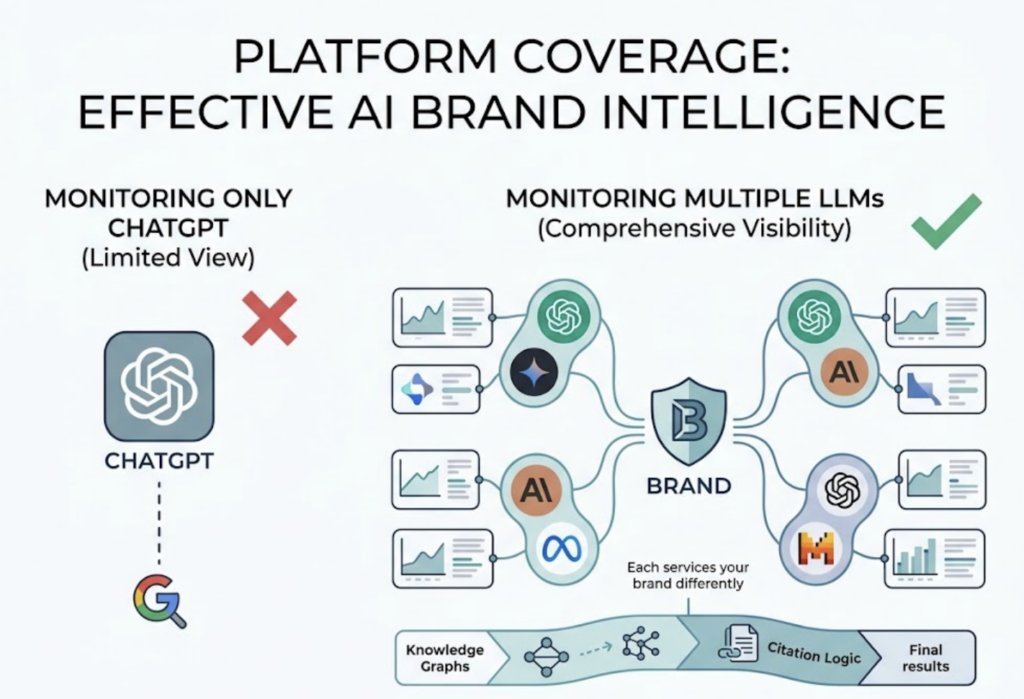
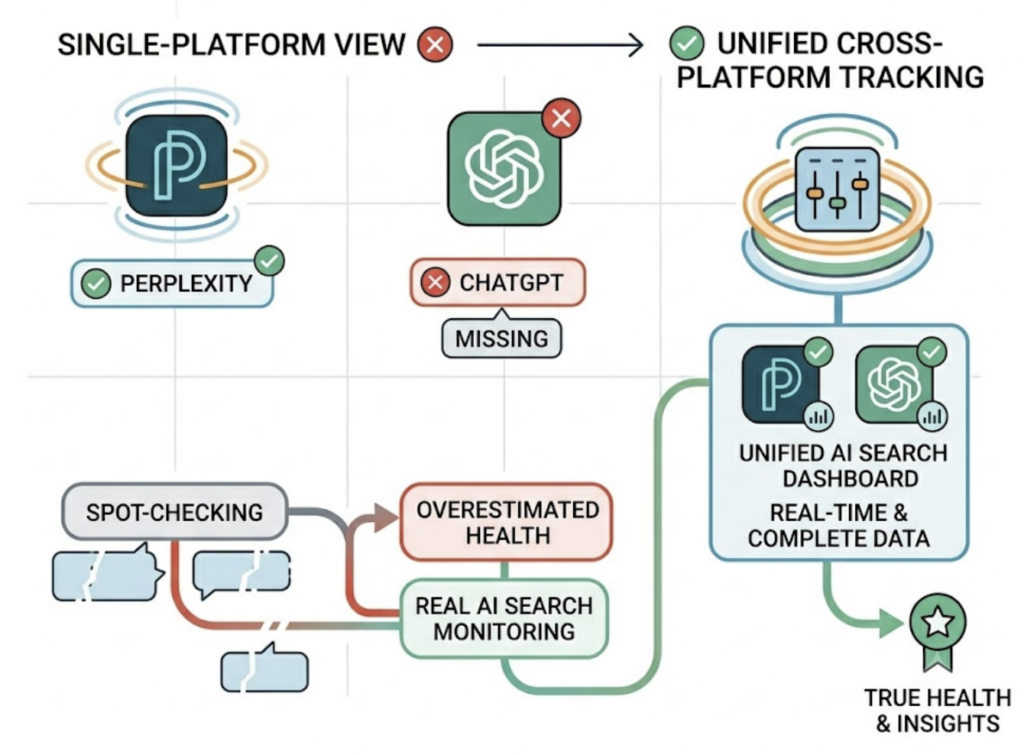
    Teams that monitor only one AI platform typically overestimate their overall AI search health. A brand that performs well in Perplexity’s research mode may be entirely absent from ChatGPT’s category recommendations. Unified cross-platform tracking is what separates real AI search monitoring from spot-checking.

    How AI Search Monitoring Works, Step by Step

    Professional AI monitoring moves beyond manual queries. Here’s what a systematic approach looks like:

    Step 1: Build a prompt matrix. Identify 50–100 high-intent prompts that reflect how your target buyers actually search. This means category discovery queries (“best [software] for [use case]”), comparison queries (“[your brand] vs [competitor]”), and problem-framing queries (“how do I solve [problem your product addresses]”). Branded prompts alone are insufficient because they miss the discovery phase entirely.

    Step 2: Automate execution across platforms. Programmatically trigger these prompts against ChatGPT, Perplexity, Gemini, and other relevant platforms on a scheduled cadence, typically daily or weekly. Manual querying introduces inconsistency and can’t generate the longitudinal data you need.

    Step 3: Parse and normalize the outputs. Use LLM-based parsers to extract brand mentions, identify citation sources, and score sentiment from unstructured text responses. This is where structured data replaces screenshots.

    Step 4: Track changes over time. Map results against a baseline. When visibility shifts, you need enough historical data to correlate the change with specific content updates, PR coverage, or competitor activity.

    That last step is where most teams underinvest. AI answers aren’t static. Citation patterns shift as models update and as the web changes around them. Trend data is what turns monitoring into a usable optimization signal.


    5 Mistakes That Make AI Monitoring Useless

    Most teams that start AI search monitoring fall into at least one of these traps:

    Tracking only branded queries. Monitoring “What is [your brand]?” tells you nothing about discovery. Buyers evaluating your category don’t start with your brand name. They start with a problem or a category, and that’s where the visibility gap tends to be widest.

    Ignoring competitor intelligence. Knowing you’re not mentioned isn’t enough. You need to know which competitors the AI is citing, what content they’ve published that’s earning those citations, and how their sentiment scores compare to yours. That’s the intelligence that drives action.

    Treating platforms as interchangeable. A monitoring strategy that only checks one AI platform creates a false sense of coverage. Platform heterogeneity is a structural feature of the current AI ecosystem, not a temporary condition.

    No temporal data. AI answers change frequently. A single snapshot tells you your current state. A time series tells you whether your optimization efforts are working. Without longitudinal data, you’re flying blind on whether anything you’re doing is moving the needle.

    Using screenshots instead of structured records. Screenshots can’t be queried, aggregated, or used to calculate trend lines. AI search monitoring requires a database, not a folder of images.


    Tools Built for AI Search Monitoring

    The core requirement for a credible AI monitoring tool is cross-platform coverage with automated execution and structured data output. A tool that only covers one or two platforms, or that requires manual query runs, can’t support the kind of trend analysis that makes monitoring actionable.

    Topify is currently one of the most complete platforms in this space. Its monitoring stack covers seven metrics simultaneously: Visibility, Sentiment, Position, Volume, Mentions, Intent, and CVR (Conversion Visibility Rate). That breadth matters because visibility and sentiment are correlated but distinct: a brand can have high visibility with negative framing, which is worse than low visibility.

    For teams focused on citation-layer intelligence, Topify’s Source Analysis feature identifies the specific domains and URLs that AI platforms cite when referencing brands in a category. This is the equivalent of backlink analysis for AI search. Knowing which sources are earning AI citations in your space directly informs where to build content authority.

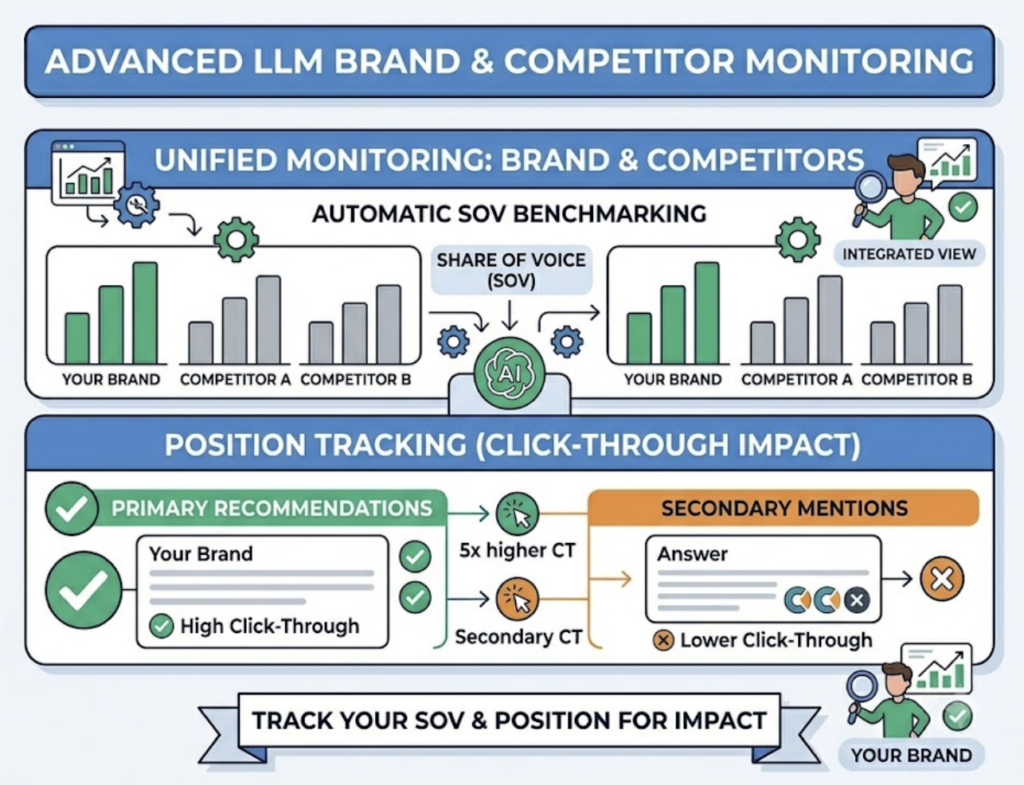
    Competitor Monitoring runs automatically alongside brand tracking, so you can benchmark your Share of Voice without running separate analyses. Position Tracking shows whether your brand appears as a primary recommendation or a secondary mention, which carries significant weight for click-through behavior in AI-generated responses.
    On pricing, Topify’s Basic plan at $99/mo covers 100 prompts across core platforms with 9,000 AI answer analyses per month, which is sufficient for single-brand monitoring. The Pro tier at $199/mo expands to 250 prompts and adds full competitor benchmarking. Enterprise starts at $499/mo for custom prompt engineering and deeper entity-level tracking.


    Building a Practical AI Search Monitoring Strategy

    The goal isn’t just monitoring. It’s building a feedback loop between what AI says about your brand and what your content strategy does next.

    Start with a content audit oriented around citation-worthiness. AI models tend to cite sources that provide direct, clear answers to category-level questions. If your content is optimized for keyword density rather than answer quality, it’s less likely to earn citations regardless of your domain authority.

    Set a baseline in the first 30 days. Measure Visibility Rate, Sentiment Score, and Share of Voice across your core prompt matrix before you make any changes. Without a baseline, you can’t attribute improvement to specific actions.

    Review citation source data monthly. Which domains are AI platforms pulling from when they answer questions in your category? If those domains aren’t yours, that’s your content gap. Publishing direct-answer content on those topics, or earning coverage on the sites AI consistently cites, is how you close it.

    The brands that will build durable AI search visibility aren’t waiting to see how things develop. They’re measuring now, so they know which direction things are moving.


    Conclusion

    AI search monitoring isn’t a replacement for SEO. It’s the layer your current analytics stack doesn’t cover. Your rank tracker shows what Google thinks of your content. AI search monitoring shows what ChatGPT, Perplexity, and Gemini say about your brand when someone asks for a recommendation.

    Those two signals are increasingly divergent. The gap between them is where brand visibility is either being built or quietly eroding. Get started with Topify to establish your baseline before your competitors do.


    FAQ

    Q: What is AI search monitoring?

    A: AI search monitoring is the systematic practice of tracking how your brand appears in AI-generated search responses across platforms like ChatGPT, Perplexity, and Gemini. It covers metrics including visibility rate, position rank, citation source domains, sentiment framing, and share of voice relative to competitors, measured over time through automated prompt execution.

    Q: How does AI search monitoring work?

    A: At a technical level, it involves building a matrix of high-intent prompts that reflect buyer search behavior, running those prompts automatically against major AI platforms on a scheduled basis, parsing the outputs for brand mentions and citation data, and tracking results longitudinally to identify trends. The data is structured into a database rather than captured manually, which is what makes trend analysis possible.

    Q: What’s the difference between AI search monitoring and traditional rank tracking?

    A: Traditional rank trackers monitor SERP positions in link-based search results. AI search monitoring tracks brand presence in generated paragraphs, which don’t have positions in the traditional sense. The relevant signals are citation inclusion, mention context, sentiment framing, and source authority, not keyword rank. The two tools measure different things and neither replaces the other.

    Q: How much does AI search monitoring typically cost?

    A: Entry-level AI monitoring tools typically start around $99/month for core brand tracking across major platforms. Mid-tier plans covering full competitor benchmarking and sentiment analysis typically run $150–$250/month. Enterprise-grade solutions with custom prompt engineering and API access start at $499/month and scale with usage. Topify’s pricing follows this structure across its Basic, Pro, and Enterprise tiers.
    Read More

  • AI Search Monitoring Tracker: Track Your Rankings

    AI Search Monitoring Tracker: Track Your Rankings

    Your Google rankings look fine. But open Perplexity and ask “best [your category] tools”—your brand might not appear at all. That’s the visibility gap most marketing teams haven’t accounted for yet.

    Traditional rank trackers were built for a world where search returns a list of links. AI search doesn’t do that. It synthesizes an answer, recommends a handful of brands, and moves on. If you’re not in that answer, no amount of SERP optimization tells you why.

    This guide covers what AI search monitoring actually measures, how to track keyword rankings on Perplexity specifically, and how to build a monitoring workflow that doesn’t break down after the first report.

    Your Rank Tracker Can’t See What AI Search Does

    Traditional SEO tools measure one thing well: where your URL appears in a ranked list of links. That’s not how AI search works.

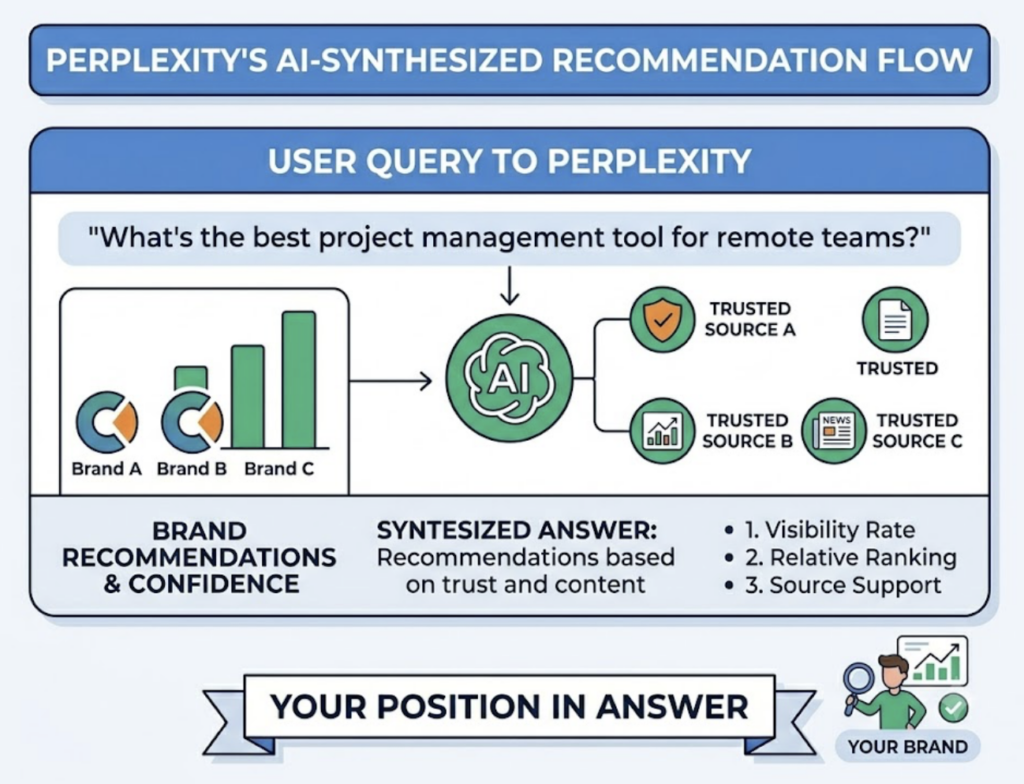
    When a user asks Perplexity “what’s the best project management tool for remote teams,” the platform doesn’t return ten blue links. It synthesizes a recommendation using sources it trusts, mentions two or three brands by name, and assigns each an implicit level of confidence. Your position in that answer depends on your visibility rate, how you rank relative to other mentioned brands, and whether the sources Perplexity pulls from support your brand or your competitor’s.

    Search Console data doesn’t capture any of that. Backlink indices don’t either. The gap between “we rank #3 on Google” and “we’re not mentioned in 80% of relevant AI answers” is the visibility gap—and it’s growing.

    That’s the gap an AI search monitoring tracker is designed to close.

    What AI Search Monitoring Actually Measures

    Effective AI search monitoring isn’t about replacing your existing analytics stack. It’s about tracking the five metrics that determine brand presence in AI-generated answers.

    Visibility Rate measures the percentage of high-intent prompts where your brand gets mentioned at all. A brand can rank #1 on Google and have a 20% visibility rate on Perplexity. Those are independent outcomes.

    Position Rank tracks your relative order when multiple brands are mentioned. Being cited first versus fourth in the same AI answer carries very different conversion weight.

    Citation Source Mapping identifies which domains AI platforms rely on to support claims about your brand. If Perplexity cites a two-year-old review site article every time it mentions you, that’s a content vulnerability. If a competitor dominates G2 citations, that explains their position advantage.

    Sentiment Score captures the qualitative tone of the AI’s recommendation—whether it describes your brand positively, neutrally, or with caveats. An 80% visibility rate with neutral-to-negative sentiment doesn’t drive conversions.

    Share of Voice compares your visibility against primary competitors across the same prompt set. This is the competitive benchmark that traditional SEO tools have never been able to provide for AI search.

    How to Track Keyword Rankings on Perplexity

    Tracking rankings on Perplexity requires a different process than traditional keyword monitoring. There’s no “keyword position” in the conventional sense—you’re tracking whether your brand appears, where it appears, and how it’s described across a library of prompts.

    Here’s a practical step-by-step framework.

    Step 1: Build a Prompt Matrix

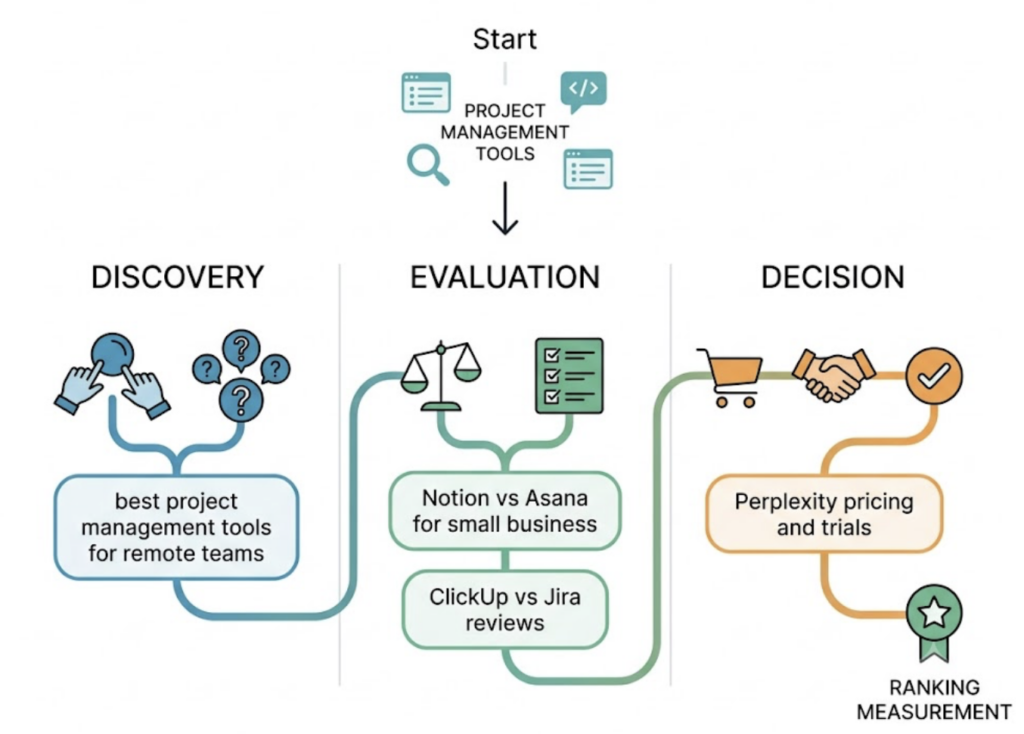
    Don’t track generic keywords. Translate them into the actual queries a buyer would type into Perplexity. “Project management tools” becomes “best project management tools for remote teams” and “Notion vs Asana for small business.” Aim for 50 to 100 prompts covering discovery, evaluation, and decision stages of the buyer journey. This prompt matrix is the foundation of every AI ranking measurement you’ll do.

    Step 2: Execute Prompts Systematically

    Run each prompt and record whether your brand appears, at what position, what sources Perplexity cites, and how the brand is described. Manual execution across 50+ prompts is time-consuming and prone to inconsistency. AI responses are stochastic—the same prompt can yield meaningfully different answers on different runs. You need repeated sampling, not a single snapshot, to build a statistically valid baseline.

    Step 3: Parse and Log the Results

    For each prompt execution, capture: brand mention (yes/no), position in the answer (1st, 2nd, 3rd, or not mentioned), cited URLs, and sentiment. Without structured logging, you can’t identify trends over time or diagnose why your visibility rate dropped.

    Step 4: Set a Monitoring Cadence

    AI answers evolve faster than Google rankings. A citation source gets updated, a new review appears on a consensus domain, a competitor publishes content that gets picked up—any of these can shift your AI rankings within days. Weekly monitoring is the minimum viable cadence for most teams. Daily monitoring makes sense for competitive categories or high-stakes brand moments.

    Step 5: Automate

    Manual execution doesn’t scale. Topify automates this entire pipeline—prompt execution across Perplexity, ChatGPT, and Gemini, response parsing, brand mention detection, citation URL extraction, and sentiment scoring—on your defined cadence without manual workflows.

    Track AI Rankings Across Platforms, Not Just Perplexity

    Perplexity-only monitoring is one of the most common pitfalls teams fall into when they start tracking AI rankings. Different AI platforms draw different user segments, reference different source types, and produce meaningfully different brand recommendations.

    A brand that appears first in ChatGPT’s recommendations for a given prompt might not appear at all in Perplexity’s answer to the same query. That’s not a data anomaly—it reflects different training emphasis, different citation preferences, and different user intent profiles across platforms. Users at different stages of the buying journey increasingly default to different AI tools.

    Cross-platform coverage isn’t optional if you want an accurate picture of your AI search visibility.

    Topify monitors brand performance across ChatGPT, Perplexity, Gemini, DeepSeek, and other major AI platforms simultaneously. Its seven-metric system—visibility, sentiment, position, volume, mentions, intent, and CVR—provides a unified view across platforms rather than requiring separate monitoring setups for each.

    The Position Tracking feature specifically shows your brand’s relative rank compared to competitors across the same prompt set, on each platform. That’s the data that tells you whether a Perplexity visibility problem is platform-specific or a broader AI search visibility issue.

    Build a Monitoring Workflow That Actually Scales

    Having a prompt matrix and a tracking tool is the start. The harder problem is building a workflow that generates actionable data consistently, not just a one-time audit.

    Structure your prompt library by intent stage. Discovery-stage prompts (“what tools help with X”) surface brand awareness gaps. Evaluation-stage prompts (“X vs Y,” “best X for Z use case”) show competitive positioning. Decision-stage prompts (“[brand name] review,” “is [brand] worth it”) reveal how AI handles bottom-of-funnel queries about your brand directly. Each stage requires different optimization responses.

    Set competitive baselines from day one. Tracking your own brand in isolation tells you very little. The meaningful number is your share of voice relative to the three or four brands you actually compete against. If your visibility rate is 45% but the category leader is at 78%, that gap is your optimization target.

    Flag citation fragility early. One of the risks the external research identifies is “citation fragility”—being cited by only one unstable source. If Perplexity consistently references one domain when it mentions your brand and that domain goes offline or updates its content, your AI rankings can drop significantly. Topify’s Source Analysis feature maps the domains AI platforms rely on to support your brand, so you can identify and address this before it becomes a problem.

    Assign clear ownership. AI search monitoring data needs an owner. Someone on the team should review the weekly report, flag sentiment shifts, and translate citation source gaps into content briefs. The monitoring workflow generates the intelligence; execution is still human.

    What Good AI Search Monitoring Data Tells You

    A reliable AI search monitoring tracker gives you three things a traditional SEO tool can’t.

    First, it tells you whether you have a visibility problem or a position problem. A low visibility rate means AI isn’t surfacing you for relevant prompts—a content and citation coverage issue. A high visibility rate with poor position means AI mentions you but ranks competitors ahead—a sentiment and source authority issue. These require different responses.

    Second, it tells you where competitor advantage comes from. Topify’s Competitor Monitoring feature tracks visibility, position, and sentiment for your competitors across the same prompt set. When a competitor consistently outranks you, the citation source data usually explains why. They’re getting cited by a domain you’re not present on, or their G2 reviews are more recent.

    Third, it gives you a feedback loop. AI rankings shift more dynamically than Google rankings. A content update, a new citation source, or a change in how an industry forum discusses your brand can move your visibility rate within weeks. That feedback loop—monitor, identify gap, execute, remeasure—is what turns AI search monitoring from a reporting exercise into a growth channel.

    Topify’s Basic plan starts at $99/month and covers ChatGPT, Perplexity, and AI Overviews tracking across 100 prompts with 9,000 AI answer analyses. The Pro plan at $199/month adds competitive benchmarking and deeper sentiment analysis across 250 prompts. For teams managing multiple brands or clients, the Enterprise plan starts at $499/month with custom configuration.

    Conclusion

    AI search monitoring isn’t a nice-to-have extension of your SEO stack. It’s the only way to know whether your brand is being recommended, how it’s being described, and why a competitor keeps appearing ahead of you in AI-generated answers.

    The core workflow is straightforward: build a prompt matrix, execute and parse results systematically, track visibility and position over time, and use citation source data to drive content decisions. The hard part is doing it at scale, across platforms, on a cadence that catches ranking shifts before they compound.

    That’s what a purpose-built AI search monitoring tracker is for.


    FAQ

    How do I track keyword rankings on Perplexity specifically?

    Perplexity doesn’t expose a public rankings API, so tracking requires executing prompts directly and recording the output. You translate your target keywords into natural-language prompts, run them against Perplexity, and log whether your brand appears, at what position, and which sources are cited. Automated tools like Topify handle this at scale, executing a full prompt library on a defined cadence and parsing results without manual effort.

    Is AI search monitoring different from traditional SEO tracking?

    Yes, fundamentally. Traditional rank trackers measure URL position in a SERP—a deterministic list. AI search monitoring measures brand presence in synthesized natural language answers, which is probabilistic, context-dependent, and varies by platform. The metrics are different (visibility rate, position rank, citation sources, sentiment), the data collection method is different (prompt execution vs. crawl-based), and the optimization levers are different (content authority and citation coverage vs. on-page optimization and backlinks).

    How often do AI rankings change?

    More frequently than Google rankings. AI platforms update their knowledge synthesis in response to new content, updated citation sources, and changes in how consensus domains discuss a brand. For competitive categories, AI recommendations can shift meaningfully within days. Weekly monitoring is the minimum viable cadence; daily monitoring makes sense for high-stakes brand or product categories.

    Can I track competitors’ AI search rankings?

    Yes. Most AI search monitoring platforms, including Topify, support competitor monitoring as a core feature. You set up the same prompt matrix and track visibility rate, position, and citation sources for your competitors alongside your own brand. This is how you identify whether a competitor’s AI ranking advantage comes from better sentiment, stronger citation coverage, or simply more prompt coverage.

    What’s the difference between visibility rate and position rank?

    Visibility rate measures how often your brand appears in AI answers at all—across your full prompt library. Position rank measures where you appear when you do get mentioned. A brand can have high visibility but poor position (mentioned frequently, always second or third). Both metrics matter, but they point to different optimization responses.


    Read More

  • AI Search Monitoring Analytics: Tools, Metrics and Strategy

    AI Search Monitoring Analytics: Tools, Metrics and Strategy

    Your brand ranks #1 on Google. You’ve optimized every meta tag, earned the backlinks, and the organic traffic is solid. Then someone asks ChatGPT to recommend a solution in your category, and your brand doesn’t appear once.

    That’s not a fluke. It’s a structural gap that traditional analytics can’t even detect.

    AI search monitoring analytics is the discipline built to close that gap. It tracks how AI models mention, cite, and position your brand across platforms like ChatGPT, Perplexity, and Gemini, giving you the data layer that Google Search Console was never designed to provide.

    What AI Search Monitoring Analytics Actually Measures

    Traditional SEO focuses on a single dimension: where does your page rank for a given query? AI search analytics operates on a completely different model.

    When an AI engine generates a response, it synthesizes information from across its training data and live sources. Your “position” in that output isn’t a URL slot. It’s whether your brand gets mentioned at all, where in the response it appears, and what the AI says about you.

    That requires a different set of metrics. Five of them matter most:

    Visibility Rate tracks how often your brand appears across a standardized library of high-intent industry prompts. Think of it as share of answer, not share of SERP.

    Position Rank measures where in the AI response your brand appears. The first cited source captures significantly higher trust than the third or fourth mention buried in a list.

    Sentiment Score evaluates tone. Being mentioned as “the expensive, slow option” in a comparison is technically a mention. It’s not a win. AI models synthesize attitude, not just facts.

    Citation Source Authority monitors which domains the AI consistently cites alongside your brand. LLMs pull from “consensus” across the web, not just the highest-authority single source.

    AI Search Volume (Proxy) estimates the downstream impact of AI visibility on brand-driven search behavior. Since LLM environments are largely zero-click, tracking spikes in branded Google searches is the most reliable proxy for AI-driven intent.

    Why Your LLM Rank Tracker Tool Is Probably Missing Half the Picture

    Most teams that want a rank tracker tool for LLM visibility make the same mistake: they apply their existing SEO toolset and expect it to work.

    It doesn’t.

    Traditional rank trackers are built to scrape SERP positions for specific keywords. They pull a URL, find a ranking, log a number. That logic breaks completely in a generative environment where there are no blue links, no SERP slots, and no concept of “page 1.”

    A standard rank tracker won’t tell you whether ChatGPT mentioned your brand in response to a category-level question. It won’t detect that Perplexity is recommending a competitor while your brand is absent. It won’t flag that the AI’s description of your product is outdated by 18 months.

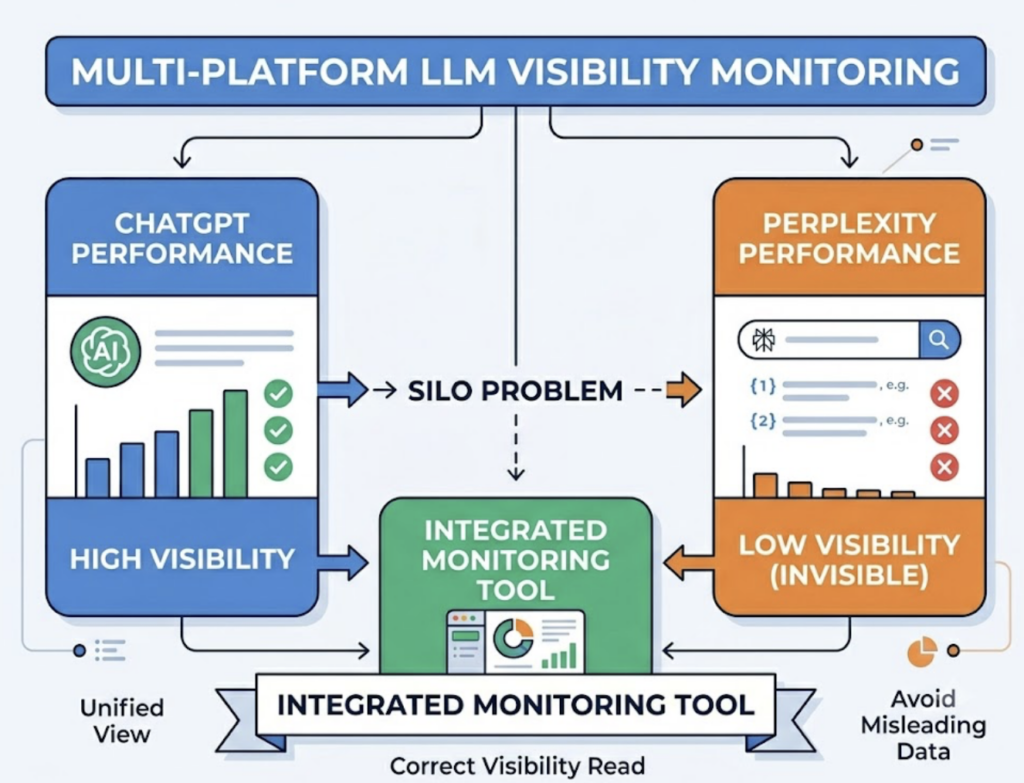
    There’s also the platform silo problem. A brand might perform well in ChatGPT responses but be nearly invisible in Perplexity, which pulls from different data sources and weights citations differently. A tool that only monitors one engine gives you a misleading read on your actual LLM visibility.

    The measurement gap is real, and it’s widening. Every week that passes without proper AI search monitoring is a week of compounding missed data.

    How AI Search Monitoring Analytics Works, Step by Step

    Understanding the technical pipeline helps you evaluate whether a tool is actually doing the job or just showing you a dashboard.

    Step 1: Prompt Simulation. The system engineers a library of questions that represent how your target audience actually searches in AI environments. These aren’t keyword lists. They’re natural language prompts like “What’s the best project management tool for remote teams?” or “Which CRM is recommended for B2B SaaS companies?” A good library runs 50 to 100 prompts covering both branded and unbranded category queries.

    Step 2: LLM Response Parsing. The platform executes those prompts via API or headless interaction and extracts the raw AI responses. This is where the actual data is captured: who got mentioned, in what order, with what language.

    Step 3: Cross-Platform Aggregation. The same prompts run across multiple models. GPT-4o, Gemini, Perplexity, Claude, and others each have different training data, different citation behaviors, and different “personalities.” Aggregating across platforms gives you a real picture, not a single-engine snapshot.

    Step 4: Trend Analysis. The system maps visibility, sentiment, and citation sources over time. This is where monitoring becomes actionable. If you publish a new article, earn coverage in a major publication, or update your structured data, you need to know whether any of it actually shifted the AI’s response about your brand.

    This pipeline can’t be replicated with manual spot-checks. The scale and frequency required make automation non-negotiable.

    5 Common Mistakes Brands Make When Monitoring AI Search

    Most of the teams that struggle with AI search monitoring aren’t missing resources. They’re applying the wrong mental model.

    Mistake 1: Only monitoring branded queries. Searching for your own brand name tells you how AI describes you to people who already know you exist. It misses the discovery phase entirely, the moment someone asks “what’s the best tool for X” and AI either includes or excludes you.

    Mistake 2: Assuming Google rank equals AI visibility. If your page isn’t structured in a way that’s easy for an LLM to extract and quote directly, the model will skip it even if it’s ranking #1. AI engines value clarity, conciseness, and factual extraction. A page optimized for click-through rate isn’t the same as a page optimized for citation.

    Mistake 3: Ignoring sentiment. Appearing in an AI comparison list as “suitable for users on a budget who don’t need advanced features” is a brand problem dressed up as a visibility win. Monitoring mentions without monitoring tone gives you incomplete data.

    Mistake 4: The platform silo trap. Brands often check one AI engine and extrapolate. In practice, different LLMs cite different sources, pull from different data vintages, and weight consensus signals differently. A multi-platform read is the only accurate read.

    Mistake 5: No competitor benchmarking. Knowing your own visibility score in isolation tells you very little. The relevant question is always relative: are you appearing more or less often than the two competitors your audience is also considering?

    A Practical Checklist for AI Search Monitoring Analytics

    If you’re building or auditing an AI search monitoring setup, use this as a baseline:

    • Prompt library maintained at 50-100 queries, covering both branded and unbranded category questions
    • Multi-platform coverage across at least ChatGPT, Perplexity, and Gemini
    • Visibility rate tracked weekly, not just at campaign milestones
    • Sentiment score logged for each major prompt cluster, not just averaged across all queries
    • Citation audit running monthly, identifying which third-party domains (forums, review sites, industry publications) are consistently cited when AI discusses your category
    • Competitor benchmarking active for at least two direct competitors, with position tracking to detect shifts
    • Content structured for extractability on high-priority pages, leading with a direct “quotable” answer rather than a long preamble
    • Schema markup in place to help LLMs explicitly connect your brand to your products, use cases, and industry

    This isn’t a one-time setup. AI models update. Citation patterns shift. A monitoring system that isn’t refreshed becomes stale faster than most teams expect.

    The Best Tool for LLM Visibility: What to Look For (and Where Topify Fits)

    The market for LLM visibility tools has grown quickly, and the quality gap between them is significant. The right tool for LLM visibility needs to do more than count mentions.

    Here’s what actually matters:

    CapabilityWhy It Matters
    Multi-platform coverageSingle-engine tools produce misleading data
    Prompt simulation at scaleManual spot-checks don’t scale to 100+ prompts
    Sentiment analysisMentions without tone context are incomplete
    Competitor benchmarkingAbsolute scores without relative context aren’t actionable
    Citation source trackingUnderstanding why AI cites certain domains drives content strategy
    Trend data over timePoint-in-time snapshots don’t show whether your actions are working

    Topify is built around all six of these. The platform runs seven core metrics: visibility, sentiment, position, volume, mentions, intent, and CVR (Conversion Visibility Rate). It covers ChatGPT, Gemini, Perplexity, DeepSeek, and several other major AI platforms, including non-English ones relevant to global brands.

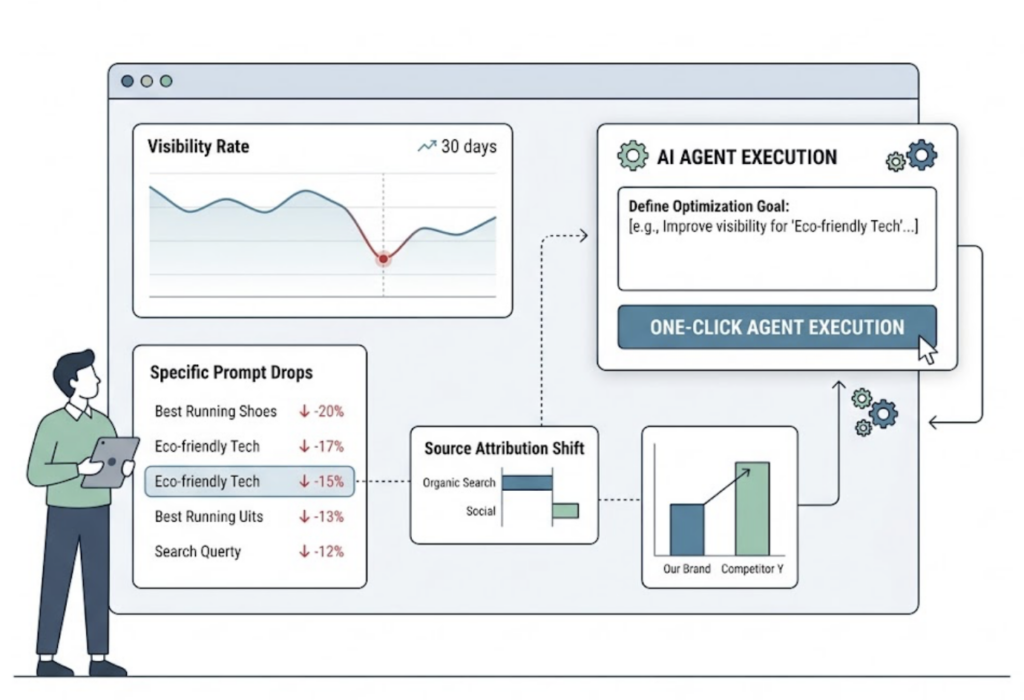
    Where Topify separates from simpler monitoring tools is in the execution layer. Most platforms stop at data. Topify’s One-Click Execution lets you define a GEO goal in plain English, review the proposed strategy, and deploy it without manual workflows. The platform’s Source Analysis also reverse-engineers the exact domains and URLs AI platforms cite, so you can identify whether your brand or your competitors dominate those references.

    It’s not a passive dashboard. It’s a monitoring and action system.

    AI Search Monitoring Analytics Pricing: What to Expect

    Entry-level AI search monitoring tools typically start around $99/month. That’s roughly where the basic tier of a purpose-built platform begins to make economic sense for a marketing team running active brand monitoring.

    Here’s how Topify’s tiers map to common use cases:

    PlanPriceBest For
    Basic$99/moStartups and small teams running 100 prompts across 4 projects
    Pro$199/moGrowth teams needing 250 prompts, 10 seats, and deeper competitive analysis
    Enterprisefrom $499/moLarge brands requiring custom coverage, dedicated account management, and API access

    The $99 Basic plan covers ChatGPT, Perplexity, and AI Overviews tracking with 9,000 AI answer analyses per month. That’s sufficient for a single brand in a focused category. Teams managing multiple brands or clients need the Pro tier, which expands to 22,500 answer analyses across 8 projects.

    See the full breakdown on Topify’s pricing page.

    One practical note: the ROI calculation on AI search monitoring isn’t complicated. If AI-influenced purchase decisions are growing in your category (and in most B2B and high-consideration B2C categories, they are), the cost of not monitoring is real and compounding. A month of missed data is a month of optimization you can’t recover.

    Conclusion

    Google rank is no longer the complete picture. As AI search becomes a primary discovery channel for high-intent buyers, the brands that build systematic monitoring now will have a structural advantage over those who add it reactively later.

    The discipline of AI search monitoring analytics isn’t complex. It requires the right metrics, multi-platform coverage, a consistent prompt library, and tools that can turn data into action. If you’re starting from zero, get started with Topify and run a baseline visibility check across your core category prompts. The data will tell you more about your actual competitive position than your current SEO dashboard can.

    FAQ

    Q: What is AI search monitoring analytics? 

    A: It’s the practice of tracking how AI models like ChatGPT, Perplexity, and Gemini mention, cite, and characterize your brand in their responses. It measures visibility rate, sentiment, position, and citation sources across a standardized prompt library, giving you the equivalent of rank tracking for LLM environments.

    Q: How do you measure AI search monitoring analytics? 

    A: The core measurement framework uses five metrics: visibility rate (how often your brand appears across high-intent prompts), position rank (where in the response you’re cited), sentiment score (what tone the AI uses), citation source audit (which domains the AI pulls from), and competitor benchmarking (your visibility relative to direct rivals). Platforms like Topify automate all five.

    Q: How to improve AI search monitoring analytics results? 

    A: The highest-leverage actions are restructuring key pages to lead with a direct, extractable answer (sometimes called the “atomic answer” format), building citations on third-party sources like industry publications and review sites that LLMs treat as consensus signals, and implementing entity-focused schema markup to help AI systems accurately associate your brand with your category and use cases.

    Q: What are examples of AI search monitoring analytics in practice? 

    A: A SaaS company runs weekly prompt simulations across 80 category queries and discovers their brand appears in 34% of ChatGPT responses but only 11% of Perplexity responses. They identify that Perplexity heavily cites a review aggregator where their profile is outdated. They update the profile, earn two new industry publication mentions, and Perplexity visibility moves to 28% over the following six weeks. That’s the monitoring-to-action loop working correctly.

    Read More

  • Perplexity Ranking Tracker: How It Works and What to Use

    Perplexity Ranking Tracker: How It Works and What to Use

    Perplexity now processes over 780 million queries every month. That’s not a rounding error; it’s a search surface you can’t afford to be invisible on.

    But here’s the problem: most brands have no data on whether they’re showing up. They know Perplexity exists. They might even use it themselves. What they don’t have is a systematic way to track visibility, citations, or how AI answers position them against competitors.

    That’s exactly what a Perplexity ranking tracker is built to solve.

    Why Perplexity Ranking Is Nothing Like Google Ranking

    In Google, ranking means position. You’re number one, number five, or off the first page.

    In Perplexity, that framework breaks down entirely. Perplexity is a Retrieval-Augmented Generation (RAG) system: it crawls the web, synthesizes the most relevant information, and delivers a direct answer with citations. There’s no list of blue links. There’s an answer, and your brand is either in it or it isn’t.

    The “zero-click” dynamic makes this even sharper. Users get what they need without visiting a website. Which means the only visibility that counts is visibility inside the answer, specifically as a cited source, a named recommendation, or a referenced comparison.

    Traditional rank tracking tools can’t measure any of that.

    What a Perplexity Ranking Tracker Actually Measures

    A purpose-built AI ranking tracker monitors five core signals:

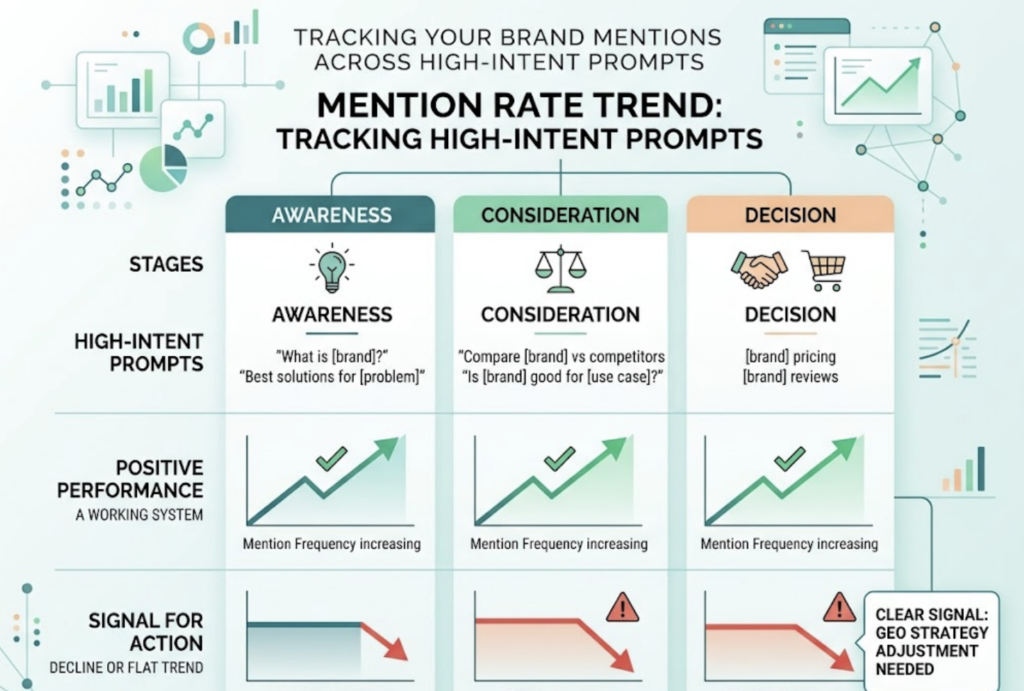
    Mention Rate: The percentage of relevant prompts where your brand appears in Perplexity’s response. This is your baseline presence metric. If you’re running 100 category-specific prompts and you show up in 18, your mention rate is 18%.

    Source Citations: Which specific domains (and URLs) Perplexity pulls when discussing your brand or category. Being mentioned in the text is one thing. Being cited as a source is a stronger signal of authority, and it’s what drives referral traffic.

    Position in Answer: The order in which brands appear. First citation isn’t just a vanity metric; it carries disproportionate user attention and trust.

    Sentiment Context: Not all mentions are equal. An AI ranking tracker analyzes whether Perplexity is recommending you, describing you neutrally, or surfacing criticism. The same mention rate with different sentiment profiles means entirely different things for your brand.

    Share of Voice: How often your brand appears versus direct competitors across the same prompt set. This is your competitive baseline.

    How a Perplexity Ranking Tracker Works

    The core workflow has four stages.

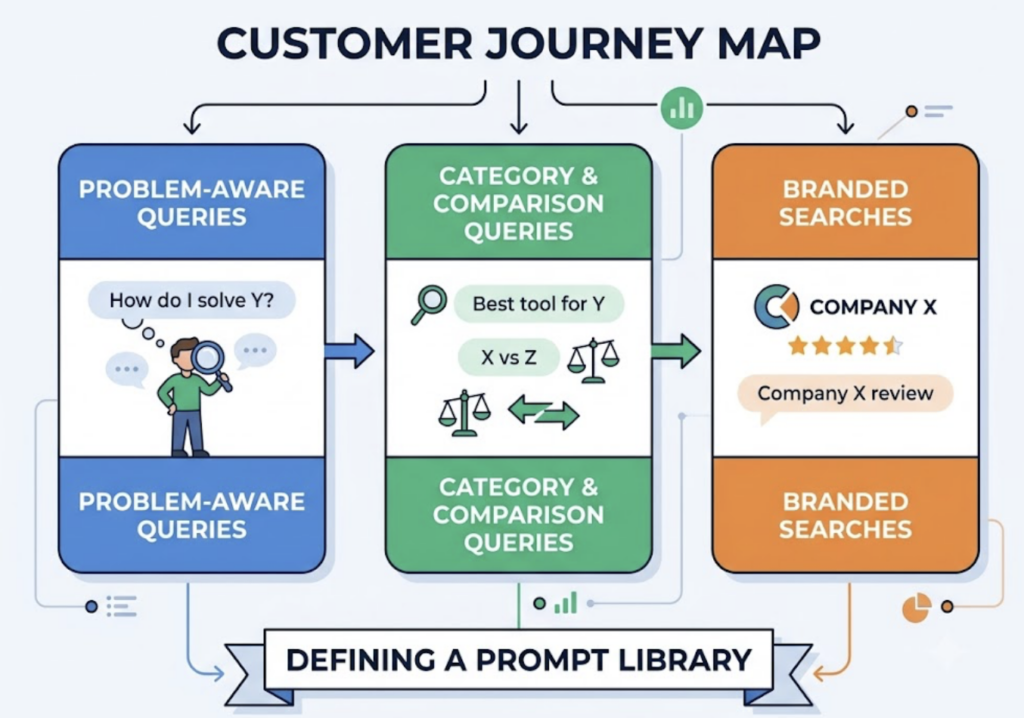
    First, you define a prompt library: a curated set of queries that map your customer journey. These aren’t just branded searches like “Company X review.” They include category queries (“best tool for Y”), comparison queries (“X vs. Z”), and problem-aware queries (“how do I solve Y”). The prompts you choose determine what you see, which is why prompt engineering is half the job.

    Second, the tracker runs those prompts automatically against Perplexity on a scheduled basis, daily, weekly, or in real time.

    Third, it parses the outputs: identifying brand mentions, extracting citation URLs, noting position, and reading sentiment context.

    Fourth, it aggregates that data over time into trend views, so you can see whether your visibility is improving, declining, or shifting in response to content changes.

    That last part matters. Trend data is what separates a tracking tool from a one-time snapshot. Snapshots tell you where you are. Trends tell you whether what you’re doing is working.

    5 Mistakes That Undermine Perplexity Tracking

    Most brands that attempt Perplexity tracking make at least one of these errors.

    Tracking brand keywords only. If every prompt you run contains your brand name, you’re not measuring discovery. You’re measuring confirmation. The more valuable data comes from category and comparison prompts, where buyers are still evaluating options and you either show up or you don’t.

    Ignoring competitor tracking. Your mention rate means nothing in isolation. A 20% mention rate looks strong until you find out your main competitor is at 60%. Understanding why a competitor is cited, whether it’s a G2 review, an industry publication, or a Reddit thread, gives you a roadmap.

    Manual logging. Screenshots and spreadsheets can capture a moment. They can’t surface a trend. If your mention rate dropped 12 points over three weeks after a competitor published a new comparison post, you’ll never know from a spreadsheet.

    Treating mentions as endorsements. A brand mention in a Perplexity answer where the AI says “some users report limitations with X” is not a win. Sentiment context tells you the difference between being recommended and being cited as a cautionary example.

    Not tracking source citations. This is the most underused signal. The domains Perplexity pulls from are the domains with authority in its training and retrieval patterns. If your competitors dominate those citation sources, you need to know which ones and pursue coverage there.

    A Strategy That Actually Moves the Needle

    Tracking without a feedback loop is just reporting. The goal is to turn data into action.

    Start with prompt architecture. Organize your prompt library by customer journey stage: discovery prompts (“what is the best X for Y”), evaluation prompts (“X vs. Z comparison”), and decision prompts (“is X worth it”). Each stage tells you something different about where your brand falls out of the funnel.

    Set a competitive baseline before you optimize anything. Run your full prompt set, measure your mention rate and Share of Voice against two or three direct competitors, and document it. This is your benchmark.

    Then focus on source diversification. Use your tracker’s citation data to identify which domains Perplexity consistently pulls from in your category. Those are the platforms worth prioritizing for coverage: industry publications, review sites, subreddits, and forums that carry real authority with AI systems.

    Implement structured data and direct answer architecture on your owned content: concise answers near the top of pages, schema markup that clarifies entity relationships, and content that’s updated regularly across related topics. AI systems reward topical consistency.

    Then re-run your prompts in 30 days and compare. The loop closes when your content changes reflect in citation data.

    Best AI Ranking Tracker for Perplexity in 2026

    The tool that handles this end-to-end is Topify.

    Topify is an AI search optimization platform that tracks brand visibility across ChatGPT, Perplexity, Gemini, and other major AI engines simultaneously. For Perplexity specifically, it covers all five tracking dimensions: Visibility Tracking (mention rate), Position Tracking (order of appearance), Source Analysis (which domains are being cited), Sentiment Analysis (tone of brand mentions), and Competitor Monitoring (Share of Voice against named competitors).

    What sets it apart is the action layer. Most AI ranking trackers stop at the dashboard. Topify’s One-Click Execution lets you define optimization goals in plain language, review the proposed strategy, and deploy it without building a manual workflow. The platform also runs continuous prompt discovery, surfacing new high-intent queries you should be tracking as AI recommendation patterns shift.

    Pricing starts at $99/month (Basic plan), which includes 100 prompts, 9,000 AI answer analyses, ChatGPT and Perplexity tracking, and 4 projects. The Pro plan at $199/month expands to 250 prompts and 22,500 analyses. Enterprise starts at $499/month with dedicated account management and custom configurations.

    For teams that need managed execution alongside tracking, Topify’s service plans run from $3,999/month and include content production, Reddit visibility, and GEO prompt coverage.

    Perplexity Ranking Tracker Checklist

    Use this to evaluate whether your current setup is actually giving you complete data:

    •  Automated prompt execution: runs on a schedule, not manually triggered
    •  Prompt library by journey stage: includes discovery, evaluation, and decision queries (not just branded terms)
    •  Competitor benchmarking: tracks at least 2-3 direct competitors across the same prompt set
    •  Source citation tracking: identifies which domains are being cited, not just whether your name appears
    •  Sentiment analysis: distinguishes positive mentions from neutral descriptions and negative associations
    •  Historical trend data: at least 30 days of data to identify directional patterns
    •  Multi-platform coverage: tracks Perplexity alongside ChatGPT and Google AI Overviews for full AI search picture

    If you’re missing more than two of these, you’re working with partial visibility data.

    FAQ

    What is a Perplexity ranking tracker? 

    A Perplexity ranking tracker is a tool that automates monitoring of how and whether a brand appears in Perplexity AI’s generated answers. It measures mention rate, source citations, position in answer, sentiment context, and Share of Voice against competitors across a defined set of prompts.

    How do I improve my Perplexity ranking? 

    Focus on three things: publish content that directly answers high-intent category questions, build coverage on the domains Perplexity consistently cites in your space (use Source Analysis to find them), and maintain topical consistency across your owned content. Structured data and frequent content updates also help AI systems form a clearer picture of your brand entity.

    How much does a Perplexity ranking tracker cost? 

    Entry-level AI ranking trackers like Topify start at $99/month. That tier covers 100 prompts and tracking across Perplexity, ChatGPT, and AI Overviews. More comprehensive plans with higher prompt volumes and multi-seat access range from $199 to $499+/month depending on team size and usage.

    Can I track competitors on Perplexity? 

    Yes, and you should. Competitor Monitoring lets you run the same prompt set against multiple brands and compare mention rates, sentiment, and citation sources side by side. Your own data means little without knowing where you stand relative to the brands Perplexity is currently recommending instead of you.

    Read More

  • Generative Engine Optimization: The Complete Guide

    Generative Engine Optimization: The Complete Guide

    Your domain authority is solid. Your keyword rankings are holding. But when someone asks ChatGPT for a tool in your category, your brand isn’t in the answer. Not buried, not ranked third. Just absent.

    That’s the core problem with applying traditional SEO instincts to AI search. The two systems run on different logic, and optimizing for one doesn’t move the needle on the other. Generative engine optimization is what bridges that gap.

    What Is Generative Engine Optimization?

    Generative engine optimization (GEO) is the practice of making your brand visible, citable, and recommendable within AI-generated answers across platforms like ChatGPT, Perplexity, Google AI Overviews, Gemini, and others.

    The key word is “synthesis.” When a user types a question into an AI search engine, the model doesn’t return a ranked list of links. It pulls relevant information from its training data and real-time retrieval sources, then constructs a direct answer. GEO ensures your brand is part of what gets pulled.

    That’s fundamentally different from traditional SEO, which optimizes for crawler indexing and link-based ranking signals. GEO optimizes for entity authority and content extraction within a Retrieval-Augmented Generation (RAG) framework.

    Why Your SEO Rankings Don’t Protect You in AI Search

    A brand can rank #1 on Google for a target keyword and still be completely invisible in AI search. This isn’t a bug. It’s a structural mismatch.

    Traditional SEO prioritizes signals like backlink profiles, keyword density, and site authority to determine which pages rank highest in a list. AI search engines work differently. They use RAG to retrieve “chunks” of content that provide direct, extractable answers to a query, then synthesize those chunks into a coherent response.

    The result: pages optimized purely for keyword ranking often get bypassed. LLMs prioritize information density, factual clarity, and E-E-A-T signals — not the same variables that determine position in a SERP. What ranks doesn’t always get cited.

    This is what researchers call the “ranking-mention separation”: your position within an AI answer may follow some traditional SEO logic, but whether your brand gets mentioned at all depends on a different set of factors entirely.

    How Generative Engine Optimization Actually Works

    GEO operates on three core mechanisms that differ from standard AI SEO approaches.

    Structured Clarity. AI engines extract content in chunks. Pages with clear headings, concise paragraphs, and machine-readable formatting (including JSON-LD structured data) are more likely to be accurately parsed and cited. Dense walls of text optimized for keyword frequency tend to perform poorly in this environment.

    Authority Signals Across the Web. LLMs are trained to weight information from high-authority sources. Building what practitioners call “Entity Authority” — consistent, credible mentions across third-party publications, academic sources, industry directories, and review platforms — matters more than on-page optimization alone. Your brand needs to exist in the information ecosystem that AI systems draw from, not just on your own domain.

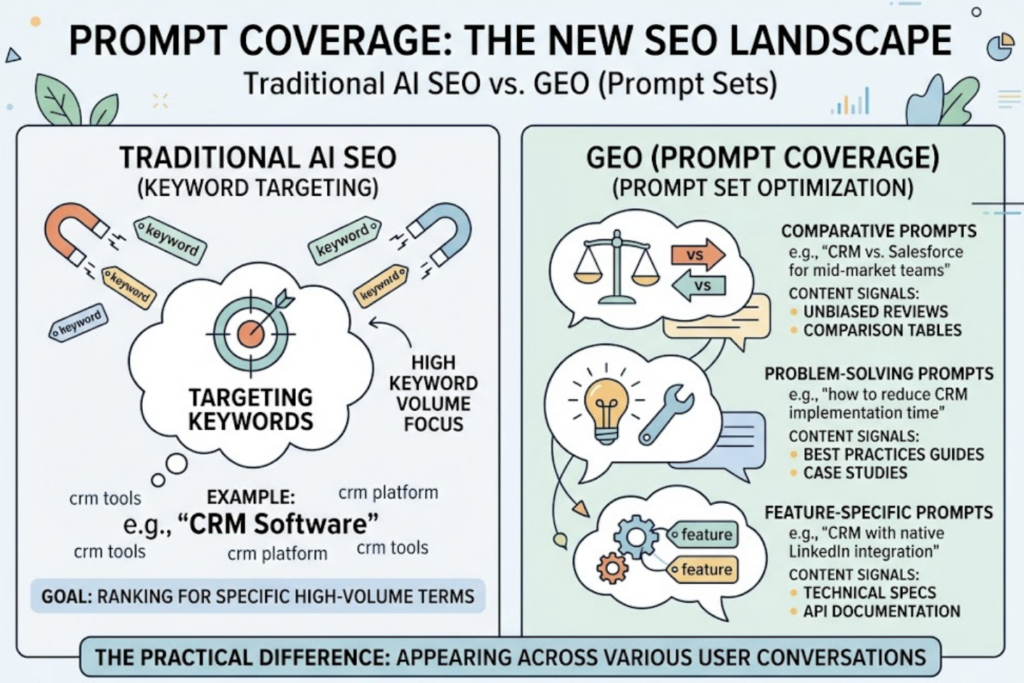
    Prompt Coverage. Traditional AI SEO targets keywords. GEO optimizes for prompt sets. The practical difference is significant: instead of ranking for “CRM software,” you’re ensuring your brand appears across comparative prompts (“CRM vs. Salesforce for mid-market teams”), problem-solving prompts (“how to reduce CRM implementation time”), and feature-specific prompts (“CRM with native LinkedIn integration”). Each prompt type requires a different content and authority signal.

    How to Measure Generative Engine Optimization

    Standard metrics like organic sessions and SERP CTR don’t capture AI search performance. The industry has shifted toward a five-pillar measurement framework, as documented by Blue Compass:

    MetricWhat It MeasuresWhy It Matters
    Visibility Rate% of target prompts where the brand is mentionedBaseline awareness across AI channels
    Citation RateHow often the AI names or links the brand as a sourceTrust and information authority
    Sentiment ScoreTone of AI-generated brand descriptionsBrand reputation within AI “memory”
    Position RankWhere the brand appears in list-style answersCompetitive prominence
    Source AttributionWhich URLs the AI cites when referencing the brandIdentifies citation clusters driving visibility

    Topify extends this framework with seven tracked metrics — adding AI Volume Analytics and CVR (Conversion Visibility Rate) to the standard five. The Volume metric quantifies actual AI search demand for prompts in your category, which is useful for prioritizing which prompt sets to optimize first. CVR estimates how likely an AI answer is to drive a user toward a brand interaction.

    Tracking these metrics at the prompt level matters. Aggregate “AI visibility” scores obscure where you’re winning and where competitors are taking share. The actionable unit is the individual prompt, not the platform average.

    A Practical GEO Strategy: From Audit to Execution

    Search Engine Land and other AI search intelligence sources converge on a four-step operational cycle for teams building a GEO program.

    Step 1: Audit your prompt universe. Map the full set of queries your target audience is using across AI platforms. This isn’t identical to your keyword list. It includes comparative prompts, problem-framing prompts, and category-exploration prompts that users would never type into a traditional search bar but ask AI assistants regularly.

    Step 2: Identify competitive gaps. Find the prompts where competitors appear in AI answers but you don’t. This is where the visibility gap is costing you. Prompt-level competitor analysis is the starting point for prioritizing content and authority-building efforts.

    Step 3: Optimize content for AI citation. Update existing content and create new assets with structured clarity in mind: clear factual statements, organized headings, authoritative citations, and schema markup. For authority building, focus on earning mentions in sources that AI platforms tend to cite in your category, typically industry publications, review platforms, and high-domain-authority third-party sites.

    Step 4: Monitor and iterate. AI systems update their retrieval sources frequently. A prompt where your brand appeared last month may show different results today. Weekly tracking is the practical minimum for brands in competitive categories.

    Topify’s One-Click Execution feature is designed to compress Steps 3 and 4. After identifying gaps through Source Analysis (which tracks the exact domains AI platforms cite in your category), the platform proposes a content and distribution strategy and deploys it without requiring manual coordination across tools. For teams managing GEO alongside traditional SEO workloads, that automation gap is where most programs stall.

    5 Mistakes That Kill Your AI Search Visibility

    Most GEO failures aren’t from bad strategy. They’re from applying the wrong assumptions, sourced from traditional SEO playbooks.

    Treating GEO as a keyword exercise. Keyword density signals that work in SERP ranking often register as low-value noise to LLMs. AI search intelligence isn’t about stuffing; it’s about creating content that an AI would actually extract and cite as an authoritative source.

    Tracking mentions without tracking sentiment. A brand mentioned in an AI answer as “a cheaper alternative” or “less suitable for enterprise use cases” is worse than not being mentioned at all. Sentiment monitoring is a non-negotiable part of any GEO program.

    Ignoring multi-platform coverage. Different AI platforms cite different sources and weight authority signals differently. A GEO strategy that only tracks ChatGPT misses Perplexity, Gemini, Google AI Overviews, DeepSeek, and regional platforms where your audience may be just as active.

    No competitive benchmarking at the prompt level. It’s not enough to know your overall AI visibility score. You need to know which specific prompts your competitors own that you don’t.

    Static monitoring. AI retrieval sources shift constantly as models update. A “set it and forget it” approach gives you a snapshot, not a strategy. The brands building durable AI search visibility treat it as an ongoing operational discipline, not a one-time audit.

    GEO Tools and Pricing: What to Expect

    The GEO tooling market has bifurcated into three tiers based on capability and team size.

    TierPrice RangeBest For
    Entry-Level$99–$250/moSmall businesses establishing a baseline
    Mid-Market Platforms$200–$1,000/moTeams needing prompt-level tracking + multi-platform coverage
    Enterprise / Managed$2,000–$25,000+/moFull-service retainers with digital PR and ongoing content execution

    Topify sits at the mid-market tier with three platform plans: Basic at $99/mo (100 prompts, ChatGPT/Perplexity/AI Overviews tracking, 9,000 AI answer analyses), Pro at $199/mo (250 prompts, 22,500 analyses, 10 seats), and Enterprise from $499/mo with dedicated account management. For teams that need managed execution, Topify’s service plans start at $3,999/mo and include article production, Reddit visibility posts, and SEO keyword coverage alongside the platform data.

    What to Look for in a GEO Platform

    Four criteria separate effective AI visibility platforms from dashboards that look useful but don’t move anything.

    Prompt-level tracking. Platform-level aggregates are decorative. You need to know which specific prompts your brand appears in, where it ranks within those answers, and how that changes week over week.

    Multi-platform coverage. At minimum: ChatGPT, Perplexity, Google AI Overviews, and Gemini. Broader coverage matters if your audience includes international markets.

    Competitor benchmarking. Visibility data without competitive context is hard to act on. The question isn’t just “are we visible?” It’s “are we more visible than the alternatives AI is recommending?”

    Content and source recommendations. The best platforms close the loop between “what’s the gap” and “what do we do about it” without requiring you to manually interpret raw data into a content plan.

    Conclusion

    The transition from traditional SEO to generative engine optimization isn’t about abandoning what works. It’s about recognizing that AI search surfaces brands through a different mechanism — one that rewards entity authority, content clarity, and prompt coverage rather than link profiles and keyword density.

    AI search intelligence is now a measurable channel. The brands building systematic visibility programs today will have a compounding advantage as AI search continues to displace traditional SERP traffic. The practical starting point is a prompt audit: map where you appear, where your competitors appear, and where the gaps are. From there, the optimization playbook follows the data.

    Get started with Topify to run your first AI visibility audit across ChatGPT, Perplexity, and Google AI Overviews.

    FAQ

    Q: What are examples of generative engine optimization in practice?

    A: A SaaS brand auditing which AI prompts its competitors appear in, then updating its comparison pages and earning coverage in industry publications to close the gap. A consumer brand discovering that AI platforms describe its product inaccurately and systematically updating third-party listings and structured data to correct the narrative. A marketing agency building monthly GEO reports for clients using prompt-level visibility data instead of generic traffic numbers.

    Q: Is there a GEO checklist I can follow to get started?

    A: A practical starting checklist: (1) Map your target prompt universe across comparative, problem-solving, and feature-specific query types. (2) Run a baseline visibility audit to see where your brand currently appears. (3) Audit competitor visibility in the same prompt set. (4) Review your top pages for structured clarity — clear headings, factual density, and schema markup. (5) Identify three to five high-authority external sources in your category that AI platforms cite regularly, and develop a plan to earn coverage there. (6) Set up weekly monitoring so you can track shifts as AI retrieval sources update.

    Q: How is GEO different from AEO (Answer Engine Optimization)?

    A: The terms are often used interchangeably, but there’s a useful distinction. AEO typically refers to optimizing for featured snippets and direct answers in traditional search results — it predates the LLM era. GEO is specifically oriented toward LLM-based answer engines (ChatGPT, Perplexity, Gemini) and the RAG retrieval mechanisms they use. GEO encompasses AEO’s goals and extends them to cover prompt coverage, entity authority building, and multi-platform AI search analytics that AEO frameworks weren’t designed for.

    Q: How long does generative engine optimization take to show results?

    A: Faster than traditional SEO in some dimensions, slower in others. Prompt-level visibility tracking can show meaningful data within days of setup. Content and authority-building changes typically take four to eight weeks to influence AI citation patterns, depending on how frequently the AI platforms update their retrieval sources and how competitive the prompt space is. Sentiment improvements, which require consistent off-site narrative management, often take three to six months to stabilize.

    Read More

  • AI Brand Intelligence Analytics: A Practical Guide

    AI Brand Intelligence Analytics: A Practical Guide

    Your brand might rank #1 on Google and still not exist inside a ChatGPT answer.

    That’s the gap AI brand intelligence analytics is designed to close. It’s not a repackaged version of social listening or SEO reporting. It’s a distinct discipline: measuring how AI systems perceive, describe, and recommend your brand across the platforms where your buyers now go for answers.

    If you don’t measure it, you can’t manage it.

    What “Mentioned by AI” Actually Means

    When someone asks ChatGPT “What’s the best project management tool for remote teams?” and your brand doesn’t appear, you haven’t lost a keyword ranking. You’ve lost a recommendation.

    Traditional brand monitoring tools like Brandwatch or Sprout Social track social media streams and news mentions. AI brand intelligence analytics tracks something different: how an LLM synthesizes information about your brand when it forms an answer. The AI isn’t returning a list of links. It’s making a judgment call.

    This creates two structural shifts in how you measure brand presence. First, citation rate and sentiment consistency replace click-through rate as the meaningful KPIs. Second, the “zero-click” experience is now the default: the user gets their answer and moves on, with no visible traffic signal for you to track.

    Why Your Current Brand Monitoring Misses This

    Most marketing teams are still applying 2012 SEO logic to a 2026 environment.

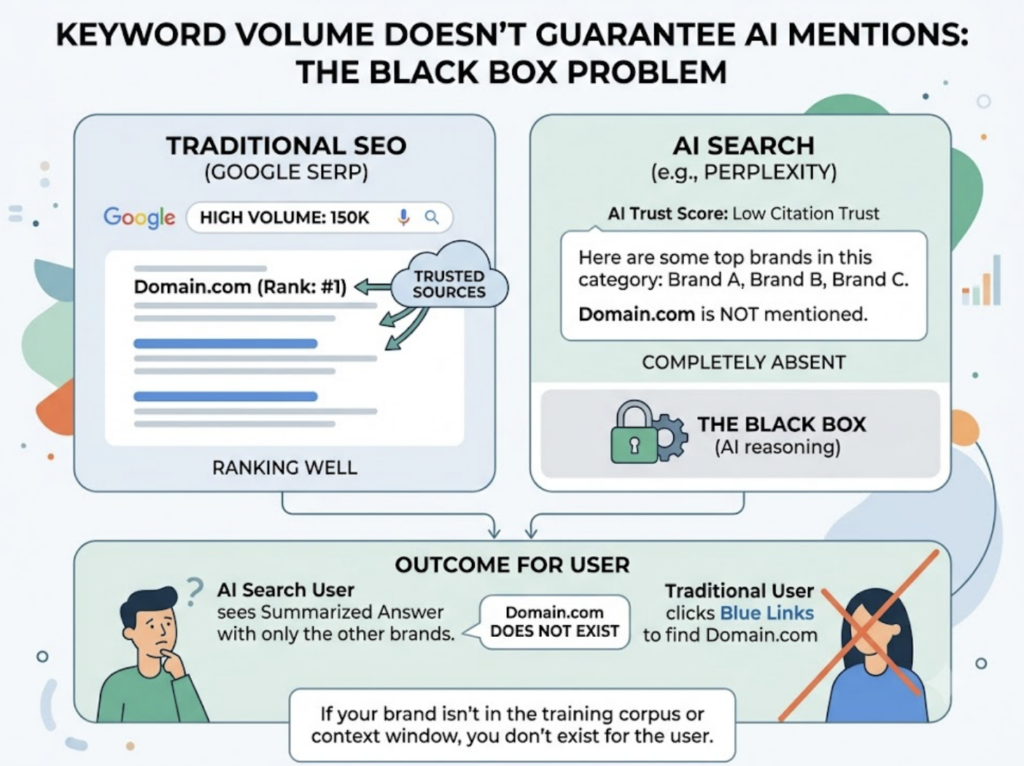
    Keyword volume doesn’t correlate with AI mention rate. A domain that ranks well in Google’s SERP can be completely absent from Perplexity’s answers if the AI doesn’t trust the sources that cite it. That’s the “black box” problem: unlike a blue-link index, AI search is a curated, summarized answer. If your brand isn’t in the training corpus or the retrieved context window, you effectively don’t exist for that user.

    The strategic shift this requires is real. You’re not chasing positions anymore. You’re earning citations.

    The 5 Metrics That Define AI Brand Intelligence Analytics

    An AI brand intelligence system needs to track five distinct data points. Anything less is incomplete.

    MetricWhat It MeasuresWhy It Matters
    Visibility Rate% of commercial-intent queries where your brand is mentionedBaseline for entity awareness in AI
    Sentiment ScoreEmotional tone AI ascribes to your brand (positive/neutral/negative)Detects hallucinations and legacy negative associations
    Position RankWhere your brand appears in AI-generated lists vs. competitorsDrives impact on decision-stage queries
    Source AttributionSpecific URLs/domains AI cites when referencing your brandIdentifies which content the model treats as authoritative
    Prompt CoverageBreadth of queries that trigger a brand mentionMeasures depth of entity authority across the category

    Each metric answers a different question. Visibility tells you if you’re in the room. Position tells you where you’re seated. Sentiment tells you how you’re being introduced. Source attribution tells you why. Prompt coverage tells you how consistently all of the above hold across different user queries.

    A real AI brand intelligence analytics system tracks all five. A dashboard that only shows mention count is giving you one variable out of five.

    3 Mistakes That Undermine Your AI Brand Intelligence Data

    Most teams that start measuring AI brand intelligence make one of three errors early on. They’re worth naming directly.

    Mistake 1: Counting mentions without auditing sentiment. A brand can have 100 AI mentions and still be losing. If 90 of those mentions are framed negatively, or if the AI is surfacing outdated, low-trust information, higher visibility is actively damaging. An AI brand intelligence tool should flag sentiment anomalies, not just mention totals.

    Mistake 2: Measuring one model and calling it done. ChatGPT is not the full picture. Different LLMs weight training data differently. A brand that leads in Gemini might not appear at all in Perplexity. Your AI brand intelligence analytics strategy needs multi-platform coverage from day one.

    Mistake 3: Optimizing for keywords instead of entity authority. AI engines don’t rank keywords. They prioritize factual accuracy and authoritative source clusters. Trying to “force-rank” for a phrase the way you would in traditional SEO won’t move your AI brand intelligence metrics. Building structured, citable, authoritative content will.

    How to Build an AI Brand Intelligence Analytics Strategy

    The operational framework here is straightforward. Four steps, run continuously.

    Step 1: Define Your Prompt Universe

    Build a database of high-intent prompts that match how your buyers actually search. Think “What are the best [industry] tools for [use case]?” and “Compare [your brand] vs. [competitor].” These become your tracking anchors. Without a defined prompt set, you’re measuring a random sample, not your market.

    Step 2: Set Baseline Metrics

    Before you optimize anything, audit your current state across all major AI platforms. Establish a share-of-voice baseline for each key category. This is your starting line. Everything you do from here should move these numbers.

    Step 3: Track Weekly Across Platforms

    LLMs update their retrieval sources continuously. A brand’s position can shift overnight if a key citation source loses its authority or a competitor secures better coverage. Weekly tracking is the minimum cadence that lets you catch changes before they compound.

    Topify‘s Visibility Tracking monitors brand performance across ChatGPT, Gemini, Perplexity, and other major AI platforms automatically, running prompt batches and surfacing week-over-week changes without manual prompt testing.

    Step 4: Act on Source Attribution Data

    This is where most teams stop reading the data and start actually using it. When the AI cites a competitor instead of you, the source attribution data tells you why: better structured data, recent authoritative press, links from sources the AI favors. Topify’s Source Analysis identifies the exact domains AI platforms cite, so you can close the authority gap rather than guess at it.

    AI Brand Intelligence Tools: What the Market Looks Like

    The tooling market for AI brand intelligence analytics currently breaks into three tiers:

    Tier 1: Manual / In-house ($0/mo + labor). Scripts, manual prompt testing, spreadsheets. Cheap to start, but high labor cost, no historical depth, and inconsistent tracking across platforms. Works for initial exploration, doesn’t scale.

    Tier 2: Dedicated AI brand intelligence platforms ($99 to $499/month). This is where purpose-built tools like Topifyoperate. Topify automates prompt runs across multiple LLMs, tracks all five core metrics in a single AI brand intelligence dashboard, and surfaces competitor gaps in real time. The Competitor Monitoring feature benchmarks your visibility, sentiment, and position against rivals automatically. The Sentiment Analysis module runs a 0-100 scoring model that flags tone shifts before they become reputation problems.

    The key differentiator at this tier isn’t just reporting. It’s execution. Topify’s One-Click Execution lets you define a strategy goal in plain English and deploy it without building manual workflows.

    Tier 3: Enterprise agency suites ($500 to $2,000+/month). Full-service management including monitoring, content production, and PR strategy. Appropriate for brands with complex multi-market needs. For most mid-sized businesses, a dedicated AI brand intelligence software platform offers better ROI by staying focused on the metrics that matter.

    According to BlastX Consulting’s 2026 research, the biggest gap in this category isn’t data collection. It’s the gap between AI insight and organizational action. The tool matters less than whether your team can actually use what it surfaces.

    AI Brand Intelligence Analytics Pricing: What to Budget

    Pricing in this category follows the three-tier structure above.

    If you’re building in-house, the real cost is labor: typically 10 to 20 hours per month of analyst time to run prompts manually, compile reports, and attempt cross-platform normalization. At standard agency rates, that’s $1,500 to $3,000/month in hidden cost with no structured output.

    Purpose-built AI brand intelligence platforms start at around $99/month (Topify’s Basic plan includes 100 prompts, 9,000 AI answer analyses, and tracking across ChatGPT, Perplexity, and AI Overviews). The Pro tier at $199/month expands to 250 prompts and 22,500 analyses. Enterprise plans start at $499/month with dedicated account management and custom configuration.

    For teams evaluating AI brand intelligence solutions, the calculation isn’t platform cost vs. zero. It’s platform cost vs. labor cost vs. the revenue impact of being absent from AI recommendations while competitors aren’t.

    Conclusion

    AI brand intelligence analytics isn’t a future concern. Brands that don’t measure their AI search presence in 2026 are making decisions without roughly half their data.

    The framework is clear: track visibility, sentiment, position, source attribution, and prompt coverage. Avoid the three measurement mistakes most teams make early. Build a prompt universe, set baselines, track weekly, and act on source data.

    The tools to do this exist. The question is whether your team is using them.


    FAQ

    What is AI brand intelligence analytics?

    AI brand intelligence analytics is the practice of measuring and managing how AI systems perceive and recommend a brand. It tracks metrics like visibility rate, sentiment score, position rank, and source attribution across AI platforms like ChatGPT, Perplexity, and Gemini.

    How does AI brand intelligence analytics work?

    A defined set of commercial-intent prompts is run across multiple AI platforms on a recurring basis. The system records whether the brand is mentioned, how it’s described, where it ranks among competitors, and which external sources the AI cited. These data points are aggregated into a dashboard for tracking and action.

    How do I measure AI brand intelligence analytics?

    Start by defining your prompt universe, then establish baseline metrics across your key AI platforms. Track the five core metrics weekly: visibility rate, sentiment score, position rank, source attribution, and prompt coverage. Tools like Topify automate this process across platforms.

    How to improve AI brand intelligence analytics scores?

    Improvement comes from closing authority gaps. When source attribution data shows the AI citing competitors, analyze which domains it trusts and why. Produce structured, citable content on those platforms, secure authoritative coverage, and ensure your brand’s information is consistently accurate across AI-retrievable sources.

    Read More

  • AI Brand Intelligence Dashboard: What It Tracks

    AI Brand Intelligence Dashboard: What It Tracks

    Your domain authority is solid. Your keyword rankings are holding. But none of that tells you whether ChatGPT is recommending your competitor instead of you. The shift to AI-generated answers has created a visibility gap that traditional analytics tools weren’t built to close. An AI brand intelligence dashboard is built for exactly that gap.

    Your SEO Rankings Don’t Tell the Whole Story Anymore

    Traditional search analytics measure clicks, sessions, and SERP position. Those metrics still matter, but they measure navigation. AI search doesn’t work that way.

    When someone asks ChatGPT “what’s the best [your category] tool,” the engine synthesizes an answer. Your brand either gets mentioned or it doesn’t. No click happens either way. Standard attribution models fail to capture this, which is why most monthly reports have a blind spot where AI visibility data should be.

    The core conflict is this: SEO prioritizes getting a user to your page. GEO prioritizes being the source the AI trusts enough to cite. A brand can rank #1 on Google and be completely absent from AI answers, and most teams won’t notice until a competitor is already solidly positioned.

    That’s the gap an AI brand intelligence dashboard is designed to expose.

    What an AI Brand Intelligence Dashboard Actually Tracks

    The metrics that matter in AI search are fundamentally different from traditional KPIs. Here’s what a well-built AI brand intelligence dashboard covers:

    Visibility Rate measures the percentage of commercial-intent queries where your brand gets mentioned. It’s the baseline number that tells you whether AI systems have enough context to include you at all.

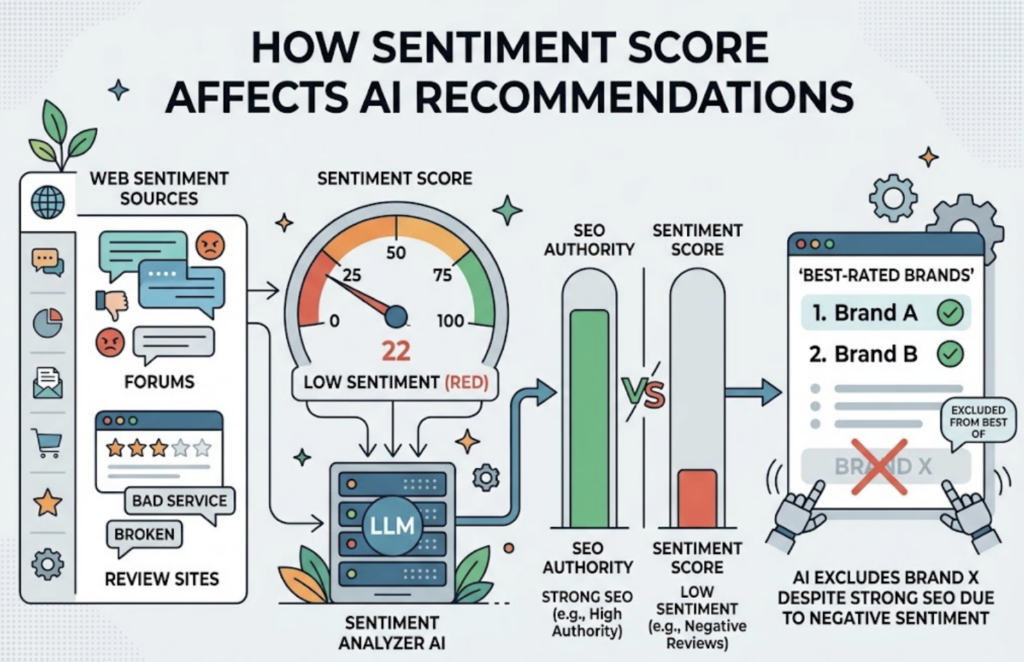
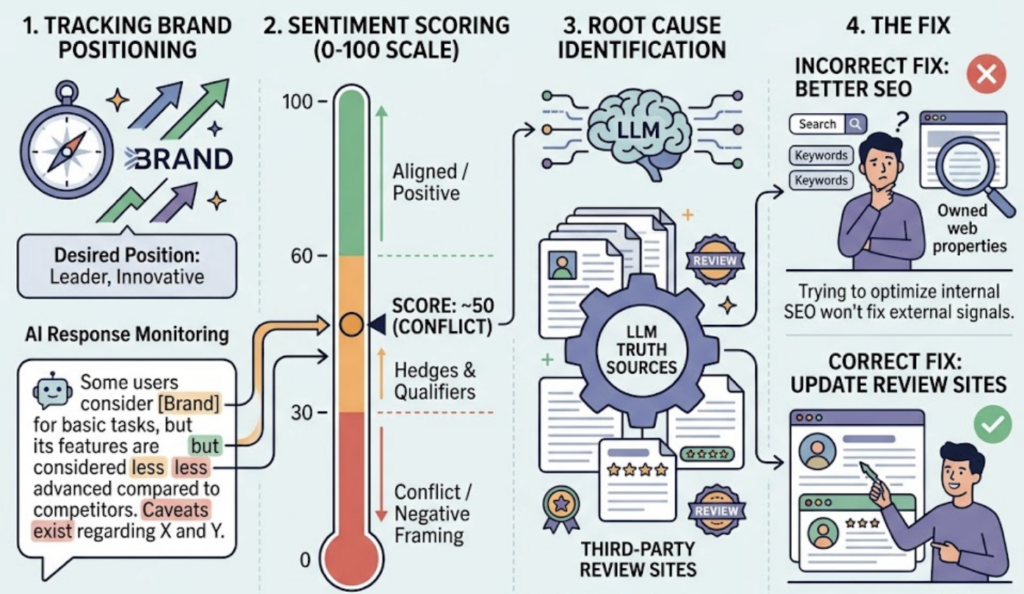
    Sentiment Score tracks the emotional tone of how AI describes your brand, typically on a 0-100 scale. This matters because LLMs aggregate sentiment from the web. If forums and review sites skew negative, the model may quietly exclude your brand from “best of” recommendations, even if your SEO authority is strong.

    Position Tracking shows where your brand appears relative to competitors in AI answers. Being mentioned fifth in a recommendation list is very different from being the first suggestion.

    Source Attribution identifies the specific domains and URLs the AI cites when referencing your brand. This tells you which content the AI currently trusts, and where your gaps are.

    Competitor Monitoring surfaces which brands the AI recommends alongside or instead of yours, including newly emerging competitors you may not be tracking.

    AI Volume Analytics quantifies how frequently your target prompts are being asked across AI platforms, giving you a sense of which topics have real traffic potential.

    CVR (Conversion Visibility Rate) estimates how likely an AI recommendation is to drive actual user engagement toward your brand.

    Together, these seven metrics replace a single vanity number with a full-spectrum view of your brand’s health inside AI systems.

    How to Read Your Dashboard Without Getting Lost

    More data isn’t automatically useful. The goal of an AI brand intelligence dashboard is clarity, not comprehensiveness.

    Start with Visibility Rate. If your brand isn’t appearing in a meaningful percentage of relevant queries, everything else is secondary. A low visibility rate means the AI doesn’t have enough reliable signal to include you, and that’s a content and authority problem to solve before optimizing Sentiment or Position.

    Once visibility is established, shift attention to Sentiment Score. According to research on AI brand visibility tracking, models can suppress brands from positive recommendations when training data contains widespread negative signals from forums or review platforms. A visibility rate of 60% paired with a declining sentiment score is a warning sign worth catching early.

    Source Attribution deserves a weekly review. AI platforms don’t announce when they change which sources they rely on. Monitoring citation domains is often the first signal that something has shifted in how the model perceives your brand authority.

    A practical weekly review process: check Visibility Rate for significant drops, scan Sentiment for directional changes, and review Source Attribution for any domains that stopped citing you. That three-step check catches most meaningful changes before they compound.

    5 Blind Spots That Standard Analytics Tools Won’t Show You

    Most marketing teams are currently operating with significant gaps in their AI brand intelligence. These are the most common ones.

    Single-platform monitoring. Tracking only ChatGPT leaves out Perplexity, Gemini, and other AI engines that are growing as primary search surfaces. Each platform has different citation patterns and recommendation logic. A brand that appears consistently in ChatGPT may be largely absent from Perplexity.

    No sentiment tracking. Mention volume and sentiment move independently. A brand can be mentioned frequently while being framed negatively (“frequently criticized for poor customer support”) or neutrally excluded from “best of” lists. Sentiment Score separates those outcomes.

    Static reporting. AI model outputs shift based on web crawls, training updates, and citation changes. A quarterly report is already stale by the time it’s delivered. Continuous monitoring is the only way to catch changes before they affect recommendations in your favor or against you.

    Mentions without position data. Being mentioned in an AI answer is not the same as being recommended first. If your brand consistently appears as the third or fourth option after two competitors, you have an AI brand intelligence gap that mention-count metrics won’t surface.

    No source-level analysis. Knowing that Perplexity is recommending a competitor is useful. Knowing which specific domains Perplexity cites when recommending that competitor is actionable. Source attribution is where insight becomes strategy.

    How Topify’s AI Brand Intelligence Dashboard Works in Practice

    Topify is built around the exact metrics above, pulling them into a single AI brand intelligence dashboard that covers ChatGPT, Perplexity, Gemini, and other major platforms simultaneously.

    The dashboard organizes visibility, sentiment, position, volume, mentions, intent, and CVR into a structured view per prompt and per platform. In practice, this means a marketing team can open Monday morning, see that visibility dropped 8 points on Perplexity over the past week, trace the drop to a specific source that stopped citing them, and have a content response queued by end of day.

    Competitor Monitoring surfaces newly emerging rivals automatically. You don’t have to manually add every brand to a watchlist; the platform detects who AI engines are recommending alongside your category and tracks their position changes relative to yours.

    Source Analysis shows the exact URLs AI platforms are currently citing in answers that mention your brand. This is the mechanism that reverse-engineers AI citations at scale, so you can prioritize earning coverage on the domains that actually influence model recommendations.

    For teams that want to move from data to action, Topify’s One-Click Execution lets you define goals in plain language and deploy a GEO strategy without manually building workflows. The AI agent monitors, reasons, and acts on your behalf on an ongoing basis.

    Topify’s Basic plan starts at $99/month, which includes tracking across ChatGPT, Perplexity, and AI Overviews, 100 prompts, and 9,000 AI answer analyses per month. The Pro plan at $199/month expands to 250 prompts and 22,500 analyses. Enterprise plans start at $499/month for custom configurations. All plans include a 30-day trial.

    AI Brand Intelligence Dashboard Pricing: What to Expect

    The tooling market has split into two segments with different value propositions.

    Lightweight tools in the $50-$150/month range typically offer basic mention tracking and rudimentary sentiment analysis, often restricted to a single platform. They’re useful for getting initial signal but struggle to support the kind of cross-platform, source-level analysis that actually drives strategic decisions.

    Enterprise platforms in the $400-$1,000+/month range provide comprehensive dashboards, historical trend analysis, competitive benchmarking, and multi-LLM source attribution. The additional cost is usually justified for brands where AI search visibility has a direct commercial impact on pipeline or revenue.

    One underrated evaluation criterion: the ability to export response history. Understanding why an AI chose a competitor over your brand on a specific prompt is more strategically valuable than the metric itself. Platforms that only show current snapshots leave you guessing about causation.

    Topify sits in the enterprise range while starting at a price point that makes it accessible for mid-market teams. The $99/month entry tier covers the core AI brand intelligence dashboard functionality that most teams need before they’re ready to scale prompt coverage.

    Common Mistakes Teams Make With Brand Intelligence Dashboards

    Getting a dashboard is step one. Actually using it effectively is different.

    Setting it up once and not monitoring continuously. AI citation patterns shift with model updates and web crawls. A brand that was well-positioned in February may be cited less frequently by April without anyone noticing. Continuous monitoring isn’t optional once AI search becomes a meaningful traffic and acquisition channel.

    Tracking visibility but ignoring sentiment. Visibility Rate tells you if you’re in the conversation. Sentiment Score tells you whether the AI is recommending you or just mentioning you. The difference between “Brand X is popular in this category” and “Brand X is frequently recommended by experts” is a sentiment gap that affects conversion.

    Focusing only on your own brand. Competitor Monitoring often surfaces the most actionable intelligence. Understanding which sources a competitor has earned coverage on, and which prompts they appear in that you don’t, is faster to act on than guessing at your own gaps.

    Treating AI brand intelligence as a reporting tool rather than an optimization input. The output of a dashboard should drive content decisions, source acquisition strategy, and sentiment management. Teams that generate weekly reports without changing their GEO strategy are leaving the value on the table.

    Conclusion

    An AI brand intelligence dashboard doesn’t replace your existing analytics stack. It fills the specific gap between what traditional tools can see and where your potential customers are actually making decisions.

    The brands building visibility in AI search now are establishing citation patterns that will compound over time. Waiting until AI search is a clearly dominant channel means competing against brands that have already earned the trust signals that matter. Starting with a structured dashboard, even a basic one, puts you in a position to act on the data rather than explain the gap.

    Get started with Topify to see where your brand stands in AI answers today.


    FAQ

    Q: What is an AI brand intelligence dashboard? 

    A: An AI brand intelligence dashboard is a monitoring and analytics platform that tracks how your brand appears across AI search engines like ChatGPT, Perplexity, and Gemini. Unlike traditional SEO tools, it measures metrics specific to AI-generated answers: visibility rate, sentiment score, position relative to competitors, and the sources that AI systems cite when referencing your brand.

    Q: How does an AI brand intelligence dashboard work? 

    A: The platform runs structured queries across AI engines and analyzes the responses. It extracts where and how your brand appears, what sentiment the AI associates with it, which competitors appear alongside or instead of you, and which domains the AI is citing as sources. Over time, it builds a trend view that reveals how your AI brand intelligence metrics are shifting.

    Q: How do I measure AI brand intelligence dashboard performance? 

    A: The core KPIs to track are Visibility Rate (what percentage of relevant prompts include your brand), Sentiment Score (whether the AI frames your brand positively or neutrally), Position (where you appear relative to competitors), and Source Attribution (which domains the AI trusts for your category). A meaningful benchmark is comparing these metrics across platforms and tracking week-over-week trends rather than point-in-time snapshots.

    Q: What should I look for in an AI brand intelligence tool? 

    A: Prioritize multi-platform coverage (not just ChatGPT), source-level attribution (not just mention tracking), sentiment analysis beyond simple positive/negative labels, and the ability to monitor competitor positioning. Also look for continuous monitoring rather than on-demand snapshots, since AI citation patterns shift frequently. Pricing typically ranges from $50-$150/month for lightweight tools to $400-$1,000+/month for full AI brand intelligence platforms.


    Read More

  • What Is an AI Brand Intelligence System?

    What Is an AI Brand Intelligence System?

    Your domain authority is solid. Your content is ranking. But when someone asks ChatGPT, “What’s the best [tool/service] in your category?” your brand either isn’t mentioned, or it’s described in a way that doesn’t match your positioning at all.

    Traditional analytics can’t catch this. They weren’t designed to. That gap is exactly what an AI brand intelligence system is built to close.

    Your Brand Has a Reputation Inside AI. You Just Can’t See It Yet.

    AI search engines like ChatGPT, Gemini, and Perplexity don’t just retrieve links. They synthesize answers based on what they’ve indexed, weighted by RAG (Retrieval-Augmented Generation) outcomes, entity authority, and source consensus.

    The result: your brand has a reputation inside these models, shaped by thousands of data points you’ve never audited. That reputation determines whether you’re recommended, ignored, or mislabeled.

    Most brands have no visibility into this layer at all. And because AI search is now a primary discovery channel for buyers across SaaS, finance, healthcare, and retail, that blind spot has direct revenue consequences.

    What an AI Brand Intelligence System Actually Covers

    An AI brand intelligence system is a software architecture designed to interface directly with LLMs, simulating real buyer queries to measure how AI engines perceive, validate, and position your brand.

    It’s not a social listening tool. It’s not a media monitoring dashboard. The data source is fundamentally different: instead of crawling static web content, it runs prompt-based simulations against live AI models and analyzes the outputs.

    A complete AI brand intelligence system covers five core components:

    ComponentWhat It MeasuresBusiness Problem Solved
    Visibility Rate% of category-intent queries where your brand appearsDiagnoses if buyers even know to consider you
    Sentiment ScoreTone and framing of AI responses about your brandPrevents “budget alternative” labeling when you’re aiming for premium
    Position RankingSequential order of brand placement in recommendationsAddresses the Top-3 bias: most buyers don’t convert on entries past the first few
    Source AttributionWhich third-party domains AI uses to validate your brandReveals the trust ecosystem you actually need to build
    CVR (Conversion Visibility Rate)Correlation between AI mentions and downstream acquisitionBridges brand awareness to hard ROI

    Each component answers a different business question. Visibility without sentiment tells you you’re mentioned, not how. Sentiment without source attribution tells you there’s a problem, not where it originates.

    How It Differs from Traditional Brand Monitoring

    The distinction matters more than most teams realize. Traditional monitoring and AI brand intelligence aren’t competing versions of the same thing. They serve different strategic purposes.

    FeatureTraditional MonitoringAI Brand Intelligence System
    Data SourceStatic public web (social, news, blogs)Dynamic RAG outputs (ChatGPT, Gemini, Perplexity)
    MethodologyKeyword-based crawlingPrompt-based simulation
    Core ValueTracking existing public opinionManaging future buyer discovery
    Primary MetricShare of Voice (mentions)Share of AI Voice (recommendation rate)
    Key Question“What are people saying?”“How are we being recommended?”

    Traditional tools are backward-looking. They tell you what’s already been published. An AI brand intelligence tool or platform is forward-looking. It tells you what buyers will encounter the next time they ask an AI for a recommendation in your category.

    That’s not a small distinction. It’s the difference between monitoring reputation and actively managing buyer discovery.

    4 Signals That Tell You If Your System Is Working

    Deploying an AI brand intelligence solution is only useful if you know what to measure over time. Four signals indicate whether your system is generating actionable value:

    1. Mention Rate Trend Track how often your brand appears across high-intent prompts at each stage of the buyer journey: awareness, consideration, decision. A working system shows upward movement in mention frequency. A flat or declining trend in high-intent prompts is a clear signal that your GEO strategy needs adjustment.

    2. Sentiment Velocity AI models drift. A brand that’s positively framed this month can shift to neutral or negative framing over weeks as models update their retrieval sources. Tracking sentiment direction, not just a static score, tells you whether your narrative is holding or eroding.

    3. Citation Domain Coverage This one’s often overlooked. The authority of the domains AI cites when validating your brand matters as much as the volume of citations. A working AI brand intelligence analytics layer should show increasing citations from high-authority industry domains, not just your own site.

    4. Relative Position Delta Where are you in the recommendation list compared to your top three competitors? A shift from position #4 to #1 across key buyer-intent prompts is the clearest indicator that your GEO optimization strategy is working. Position without context is noise. Position relative to competitors is signal.

    Common Mistakes That Break the Whole System

    Most brands that attempt AI brand intelligence monitoring underinvest in a few critical areas. These are the patterns that consistently show up:

    Monitoring only one AI platform. ChatGPT, Perplexity, Gemini, and DeepSeek use different retrieval sources and weighting logic. A brand that leads on one platform can be invisible on another. Limiting your AI brand intelligence dashboard to a single engine gives you a sample, not a picture.

    Tracking visibility but ignoring sentiment. Being mentioned is not the same as being recommended correctly. A brand frequently cited as a “cost-effective option” when its positioning is premium has a visibility quality problem, not a volume win. This is the “Sentiment Blindness” trap, and it’s more common than most teams expect.

    Neglecting the source attribution layer. Many brands optimize their primary website and stop there. But AI engines validate brand authority through the ecosystem of third-party domains they trust. If those domains don’t reference your brand accurately and consistently, your entity authority stays low, regardless of how strong your own site is.

    Treating traditional SEO rank as a proxy for AI visibility. This is the most widespread mistake. AI models prioritize entity authority and source consensus over traditional link-building signals. Strong SERP rankings don’t guarantee AI recommendations. The two systems respond to fundamentally different inputs.

    How to Build One Without Starting from Scratch

    Building internal infrastructure for AI brand intelligence is resource-intensive. It requires continuous prompt-library maintenance, cross-model API integration, and sentiment scoring models. For most teams, the build route is impractical.

    Commercial platforms are the faster path. Topify offers an integrated AI brand intelligence platform that covers all five measurement components and connects visibility data to actionable execution, without requiring you to build the underlying data infrastructure.

    In practice, Topify runs prompt simulations across ChatGPT, Gemini, Perplexity, DeepSeek, and regional engines like Qwen and Doubao, then surfaces Visibility, Sentiment, Position, and Source Attribution data in a unified dashboard. You can see where your brand stands across platforms in a single view, not six separate reports.

    What separates a full AI brand intelligence platform from a basic monitoring tool is the execution layer. Topify’s AI agent translates visibility data into specific content and citation workflows automatically. You define the goal, the system handles the strategy execution.

    For teams starting out, the recommended sequence is:

    1. Audit: Run baseline prompts across the top AI engines for your category.
    2. Benchmark: Map your position against your top three competitors.
    3. Optimize: Focus on the citation sources your competitors are winning on that you’re not.
    4. Automate: Use an AI brand intelligence analytics platform to track drift and execute adjustments continuously.

    Topify’s Basic plan starts at $99/month, which covers 100 prompts and 9,000 AI answer analyses across ChatGPT, Perplexity, and Google AI Overviews. For teams managing multiple brands or needing broader platform coverage, the Pro plan at $199/month expands to 250 prompts and 8 projects.

    Conclusion

    An AI brand intelligence system isn’t a replacement for existing analytics. It’s the layer that existing analytics were never built to cover: how AI engines perceive, validate, and recommend your brand to buyers who never visit a search results page.

    The brands building this infrastructure now are the ones that will hold AI recommendation positions when the market catches up. The ones waiting are handing that ground to competitors who aren’t.

    If you don’t know your current mention rate, sentiment direction, or citation coverage across the major AI platforms, that’s the starting point. Run a baseline audit. The data tends to be more surprising than most teams expect.


    FAQ

    Q: What is an AI brand intelligence system? 

    A: An AI brand intelligence system is a software platform that interfaces directly with large language models to measure how AI engines like ChatGPT, Gemini, and Perplexity perceive, position, and recommend a brand. Unlike traditional social monitoring, it uses prompt-based simulation to analyze RAG outputs, tracking metrics like visibility rate, sentiment score, position ranking, source attribution, and conversion visibility rate.

    Q: How does an AI brand intelligence system work? 

    A: The system runs a library of buyer-intent prompts across multiple AI platforms and captures the outputs. It analyzes which brands are mentioned, in what order, with what sentiment framing, and citing which third-party sources. Over time, it tracks how these signals change, giving marketing teams a continuous view of their brand’s standing inside AI-generated recommendations.

    Q: How do I measure whether my AI brand intelligence system is effective? 

    A: Track four signals over time: mention rate trend across buyer-intent prompts, sentiment velocity, citation domain coverage (the quality and authority of sources AI uses to validate your brand), and relative position delta against competitors. Improvement across all four indicates a working GEO strategy. A flat or declining trend in any one of them typically points to a specific gap in your content or citation ecosystem.

    Q: What does AI brand intelligence system pricing typically look like? 

    A: Commercial platforms vary widely. Topify’s Basic plan starts at $99/month, covering 100 prompts and 9,000 AI answer analyses. The Pro plan runs $199/month for larger teams. Enterprise pricing starts at $499/month for custom configurations. Building internal infrastructure from scratch is significantly more expensive when factoring in prompt library maintenance, API integration, and ongoing model monitoring costs.


    Read More

  • AI Brand Intelligence Software: What It Tracks and Why

    AI Brand Intelligence Software: What It Tracks and Why

    Your domain authority is solid. Your Google rankings are holding. But someone just asked ChatGPT for a recommendation in your category, and your brand wasn’t mentioned once. Traditional monitoring tools can’t catch that gap, because they weren’t built to measure what AI chooses to say. That’s exactly the problem AI brand intelligence software was designed to solve.

    Your Brand Might Be Invisible to AI. Here’s What That Costs

    Most brand monitoring stacks today cover social mentions, news coverage, and search rankings. None of those channels tell you whether Perplexity is recommending your competitor or whether Gemini describes your product in a way that contradicts your positioning.

    The shift is structural. AI models like ChatGPT, Gemini, and Perplexity operate through what researchers call Retrieval-Augmented Generation (RAG): they synthesize answers from authoritative external sources rather than ranking blue links. If your brand isn’t woven into those sources, you don’t just rank lower. You don’t exist in the answer at all.

    That’s the AI Visibility Gap. And it’s growing faster than most marketing teams realize.

    What AI Brand Intelligence Software Actually Does

    AI brand intelligence software is a category of tools built specifically to track, measure, and analyze how AI systems represent your brand in generated responses. It’s distinct from social listening or traditional brand monitoring in one fundamental way: it focuses on what AI says, not what humans post.

    A capable AI brand intelligence platform tracks five core dimensions:

    MetricWhat It MeasuresWhy It Matters
    Visibility Rate% of relevant prompts where your brand is mentionedMeasures your “Share of AI Voice” in your category
    Sentiment ScoreAI’s descriptive tone toward your brand (0–100)Reveals whether AI frames you as a leader or a “budget alternative”
    Position RankingYour brand’s order in AI recommendation listsPlacement in the first three results drives most downstream intent
    Source AttributionDomains and URLs the AI cites to validate your brandIdentifies which external “trust anchors” are fueling AI confidence in you
    Conversion Visibility Rate (CVR)Correlation between AI visibility and traffic or lead generationConnects AI presence to actual business outcomes

    These aren’t vanity metrics. They’re the operational layer that tells you whether your brand is being recommended, how it’s being described, and what’s driving those outcomes.

    Why Traditional Tools Can’t Fill This Role

    It’s tempting to assume that a well-configured social listening tool or a standard SEO platform covers enough ground. In practice, the gap is significant.

    Social listening tools crawl human-generated content: posts, reviews, news articles. They’re designed to catch what people say about your brand. AI brand intelligence systems track what AI engines say, which is a fundamentally different input set based on entity authority, third-party citations, and cross-platform synthesis patterns.

    The cross-platform fragmentation problem makes this worse. A brand might appear consistently in ChatGPT responses but be almost entirely absent from Perplexity or Gemini, because each model relies on different training data and RAG retrieval sources. Without a system that monitors all three simultaneously, that fragmentation is invisible.

    One fact worth internalizing: if an AI model synthesizes a recommendation and your brand isn’t cited in the synthesis, you’re effectively invisible to that user at that moment. No impression. No option to click through. The “zero-click” reality of AI search means absence isn’t a ranking problem. It’s a presence problem.

    What Separates a Solid AI Brand Intelligence Tool from a Shallow Dashboard

    Not all AI brand intelligence solutions are built the same. The difference between a useful platform and a shallow dashboard usually comes down to four criteria.

    Platform coverage. Monitoring only ChatGPT is like tracking your SEO on one search engine and ignoring the rest. An effective AI brand intelligence system covers multiple LLM architectures simultaneously, because each surfaces your brand differently based on its own knowledge graph and citation logic.

    Prompt-level granularity. Broad category tracking isn’t enough. The AI brand intelligence analytics that actually drive decisions are built at the prompt level: specific buyer-intent queries like “best [product] for [industry] in 2026.” That’s where conversion intent lives, and that’s where you need to know your position.

    An actionable execution loop. This is where most tools fall short. A dashboard that surfaces an invisibility gap without telling you what to do about it is just a more expensive report. The difference between a monitoring tool and an intelligence platform is whether it closes the loop from insight to action.

    Historical drift tracking. Brand sentiment in AI models isn’t static. Model updates, changes in your digital footprint, and shifts in third-party coverage all affect how AI represents your brand over time. Longitudinal tracking is what separates a snapshot from a strategy.

    Common Mistakes in AI Brand Intelligence Software Adoption

    Industry analysis points to four patterns that consistently undermine AI brand intelligence programs.

    The SEO-Only fallacy. Assuming that a #1 Google ranking protects you in AI outputs is one of the most expensive assumptions a marketing team can make. AI models prioritize entity authority and third-party expert consensus, not keyword density. Your Google performance and your AI visibility are increasingly decoupled.

    Fragmented entity data. If your brand’s product descriptions, leadership details, or positioning language differ across platforms, AI models develop what researchers call “entity confusion.” The model may exclude your brand from recommendations to avoid surfacing inaccurate information. Consistency across your digital footprint isn’t just good hygiene. It’s a visibility prerequisite.

    Ignoring the citation ecosystem. Many brands over-optimize their own website while neglecting the sources AI actually pulls from: industry publications, review platforms, knowledge bases, and structured databases. Those “middle-man” sources are often where AI forms its opinion of your brand.

    Treating sentiment data as a vanity metric. If Perplexity consistently describes your brand with negative qualifiers or wrong positioning language, that’s a content strategy signal, not a reporting footnote. The brands that gain from AI brand intelligence analytics are the ones that feed sentiment data back into their content programs and update the external sources AI is pulling from.

    How Topify Approaches AI Brand Intelligence

    Topify is built around what it calls a GEO Matrix: seven dimensions of brand performance tracked across AI engines simultaneously. Those dimensions are Visibility, Sentiment, Position, Volume, Mentions, Intent, and CVR.

    The platform covers ChatGPT, Gemini, Perplexity, DeepSeek, Doubao, Qwen, and other major AI engines, which matters because fragmentation across models is one of the most common and least-tracked problems in AI brand intelligence today. You don’t get a complete picture from any single platform.

    What distinguishes the Topify approach from standard AI brand intelligence dashboards is the execution layer. The platform’s One-Click Agent Execution feature lets teams define a visibility goal in plain English, review the proposed strategy, and deploy with a single click. That closes the loop between identifying a gap and actually doing something about it, which is where most AI brand intelligence tools stall.

    On pricing, Topify’s Basic plan starts at $99/month, covering 100 prompts, 9,000 AI answer analyses, and tracking across ChatGPT, Perplexity, and AI Overviews. The Pro plan at $199/month expands to 250 prompts and 22,500 AI answer analyses. Enterprise plans start from $499/month with custom configurations. You can review current tiers on the Topify pricing page.

    For teams that want to see what the platform measures before committing, Topify’s free GEO score checker is a useful starting point.

    Conclusion

    AI brand intelligence software isn’t an add-on to your existing monitoring stack. It’s a separate layer of infrastructure for a channel that traditional tools were never built to measure.

    The brands that move early on this have a straightforward advantage: they know how AI describes them, where they’re invisible, and which external sources are driving their AI reputation. That’s information their competitors don’t have yet. The gap closes as adoption grows, but for now, it’s one of the more actionable edges available in a crowded marketing stack.

    Get started with Topify to see where your brand stands in AI search today.

    FAQ

    Q: What is AI brand intelligence software?

    A: AI brand intelligence software is a category of analytics tools that tracks how AI systems like ChatGPT, Gemini, and Perplexity represent your brand in generated responses. Unlike traditional brand monitoring, which covers social mentions and news coverage, AI brand intelligence platforms measure visibility rate, sentiment score, position ranking, source attribution, and conversion visibility across AI engines.

    Q: How does AI brand intelligence software work?

    A: These platforms run structured prompts across major AI engines at regular intervals, capture how the AI responds to brand-relevant queries, and analyze patterns in visibility, sentiment, and position. More advanced AI brand intelligence systems also identify which external domains the AI is citing to validate brand claims, enabling teams to optimize the sources that drive AI recommendations.

    Q: How do I measure the effectiveness of an AI brand intelligence solution?

    A: The core metrics are visibility rate (share of relevant prompts where your brand appears), sentiment score trends over time, position ranking versus key competitors, and correlation between AI visibility and downstream traffic or leads (CVR). A credible AI brand intelligence analytics platform should show movement across all five dimensions, not just mention counts.

    Q: What should I expect from AI brand intelligence software pricing?

    A: Pricing in this category varies by prompt volume and platform coverage. Entry-level AI brand intelligence tools typically start around $49–$99/month for basic tracking across one or two AI engines. Mid-market platforms with multi-engine coverage and prompt-level analytics generally run $99–$299/month. Enterprise plans with custom configurations and dedicated support typically start from $499/month and scale with usage.

    Read More

  • AI Brand Intelligence: A Brand Manager’s Playbook

    AI Brand Intelligence: A Brand Manager’s Playbook

    You’ve spent two years positioning your product as the premium option in your category. Then you discover ChatGPT describes it as “a budget-friendly alternative.” Gemini calls it “great for small teams.” Neither reflects your messaging, and nobody on your team knew it was happening.

    That’s not a content problem or a PR problem. It’s an AI brand intelligence gap — and for brand managers operating in 2026, it’s becoming one of the most consequential blind spots in the entire marketing stack.

    Your Brand May Be Invisible Where Buyers Now Search

    Search behavior has split into two parallel tracks. Consumers use Google for browsing; they use AI for deciding.

    When someone asks ChatGPT “What’s the best CRM for a 50-person sales team?” or Perplexity “Which skincare brand is actually worth the price?”, the AI doesn’t pull up a ranked list of links. It synthesizes a narrative from its training data and real-time retrieval — and it picks winners.

    The problem is structural. Traditional SEO is built on Retrieval: crawling, indexing, ranking. AI search runs on Synthesis: LLMs interpret, validate, and recommend brands within conversational interfaces. A brand can dominate Google and be completely absent from a ChatGPT shopping recommendation in the same afternoon.

    That gap is where AI brand intelligence starts.

    What AI Brand Intelligence Actually Measures

    AI brand intelligence is the discipline of auditing and optimizing how AI models represent, recommend, and describe your brand. It replaces the gut-check (“let me Google ourselves on ChatGPT”) with structured, continuous measurement across five dimensions:

    Visibility Rate: Your Share of AI Voice

    Visibility Rate measures how often your brand appears in relevant AI responses, expressed as a percentage across a defined prompt set. If you’re tracking 200 purchase-intent prompts in your category and your brand appears in 40 of them, your AI search visibility rate is 20%.

    This is the foundational metric — your brand’s “Share of AI Voice” — and it’s typically the first number that surprises brand managers who assumed their SEO footprint would carry over.

    Sentiment Score: Advocate or Detractor

    The AI mentioning your brand isn’t enough. The framing matters. Does the model describe you as “the industry standard” or “a budget alternative”? Does it lead with your strengths or immediately add caveats?

    Sentiment scoring tracks the qualitative framing of AI responses on a 0-100 scale, flagging when a model consistently positions your brand with hedges or qualifiers that conflict with your positioning. According to the research framework used in AI brand intelligence: if the AI consistently frames your brand with caveats, the fix isn’t better SEO — it’s updating the content on the third-party review sites that LLMs treat as truth sources.

    Position Ranking: The Order That Drives Clicks

    When the AI returns a list of five recommendations, position matters. Being mentioned fifth in a “best project management tools” response is functionally different from being mentioned first. Position Ranking tracks where your brand appears in AI-generated recommendation lists relative to competitors — the closest equivalent to SERP rankings in traditional AI SEO.

    Source Attribution: The Citation Ecosystem

    LLMs don’t fabricate recommendations in a vacuum. They draw from authoritative third-party sources — G2, Capterra, industry publications, Wikipedia, high-trust review sites — that function as “truth anchors.”

    Source Attribution identifies which external domains are currently driving AI recommendations for your brand. This is where the AI citation tracking layer of brand intelligence gets operationally important: if G2 reviews from two years ago are driving your current AI sentiment, you need to know that.

    Competitor Share: Who’s Winning the Recommendation Slot

    No brand operates in isolation. Competitor Share maps how often rival brands appear in the same prompts as yours, and what reasons the AI cites for recommending them over you. It’s competitive AI search analytics — not just “are we showing up,” but “who’s beating us and why.”

    5 Strategies Brand Managers Use to Improve AI Shopping Visibility

    These aren’t theoretical. They map directly to where AI recommendation algorithms are pulling their signals from.

    Strategy 1: Map purchase-intent prompts, not just keywords.

    The buyer’s journey in AI search doesn’t look like keyword clusters. It looks like questions: “Best [product category] for [use case],” “[Brand] vs. [Competitor],” “Is [Brand] worth it for [specific need]?” Your content architecture needs to directly and explicitly answer these prompts — not optimize around them. AI models reward direct, confident answers over keyword-dense pages.

    Strategy 2: Rebuild your citation ecosystem.

    AI models rely on consensus across authoritative sources. If your brand isn’t verified and well-represented on the platforms LLMs treat as trust sources — industry publications, G2/Capterra, Wikipedia, high-DA review sites — you’re invisible to the citation layer. Audit which sources currently drive AI mentions for your competitors, then systematically close the gaps.

    Strategy 3: Correct the AI’s narrative at the source.

    If a model consistently describes your brand with inaccurate framing, the fix is upstream. Identify which third-party content is feeding that narrative, then update or augment that content to shift the AI’s source material. This is sentiment management for the AI search optimization era — less about press releases, more about citation-worthy content placed on the right platforms.

    Strategy 4: Track competitors at the prompt level.

    Don’t just monitor whether competitors appear in AI responses — track the reasons the AI cites for recommending them. “Competitors consistently win on price positioning” is an actionable insight. “Competitor X shows up more” is not. AI search intelligence at the prompt level gives you the “why” behind the recommendation gap.

    Strategy 5: Integrate AI visibility into your monthly reporting cadence.

    AI brand data can’t sit in a separate tab that gets checked quarterly. It needs to sit alongside organic, paid, and social data in the same monthly review. The brands building durable AI search presence aren’t doing one-time audits — they’re tracking weekly, because AI citation patterns shift with model updates and competitive content moves.

    How to Track This at Scale

    Manual prompt-checking is unscalable. Running 50 queries across ChatGPT, Perplexity, and Gemini by hand every week produces inconsistent data, misses shifts, and gives you no benchmarking against competitors.

    Topify was built specifically for this problem. The platform tracks brand visibility across major AI engines — ChatGPT, Gemini, Perplexity, DeepSeek, and others — monitoring thousands of prompts simultaneously and returning structured data across all five intelligence dimensions.

    In practice, this means a brand manager can see their Visibility Rate trend over 30 days, identify which specific prompts the brand dropped from, trace those drops to source attribution shifts, and surface which competitor gained ground — all from a single dashboard. The AI visibility platform also includes one-click agent execution: you define the optimization goal in plain English, and the system handles the execution without manual workflows.

    For teams managing multiple brands or product lines, Topify’s competitor monitoring layer continuously detects which brands AI engines are favoring in your category and logs the reasons cited — giving you the raw material for counter-strategy without hours of manual research.

    Pricing starts at $99/month for the Basic plan, which includes 100 prompts and 9,000 AI answer analyses across 4 projects. That’s enough for most mid-size brand teams to start getting real signal on where they stand.

    The AI Brand Intelligence Scorecard for Monthly Reporting

    Brand managers who’ve integrated AI intelligence into their reporting use a dashboard structure built around four questions — not raw traffic numbers:

    MetricQuestion to Answer
    AI Visibility TrendAre we appearing in more relevant prompts month-over-month?
    Citation HealthWhich external sources are currently driving our AI recommendations, and are they authoritative?
    Sentiment ShiftHas the AI’s framing of our brand moved in the direction of our positioning?
    Category Share of VoiceAre we the default recommendation for our core product category, or is a competitor holding that slot?

    These four metrics are what a monthly AI brand intelligence report should answer. Everything else — prompt volume, platform breakdown, competitor detail — is supporting data.

    The shift is from “how much traffic did we get” to “how often does AI recommend us, and what does it say when it does.”

    Conclusion

    The brands that built early SEO authority in the 2010s had a compounding advantage for years. The same dynamic is playing out in AI search now — but the underlying logic is different. It’s not about link equity or keyword density. It’s about entity authority: how consistently, authoritatively, and positively your brand is represented across the sources AI models trust.

    Brand managers who start tracking AI brand intelligence now will have data — trend lines, competitive benchmarks, source maps — while competitors are still running manual spot checks. That data advantage compounds.

    Get started with Topify to run your first AI brand visibility audit and see where your brand actually stands across ChatGPT, Perplexity, and Gemini.


    FAQ

    Q: What’s the difference between AI brand intelligence and social listening?

    A: Social listening tracks what humans are saying about your brand in forums, reviews, and social media. AI brand intelligence tracks how AI models — ChatGPT, Perplexity, Gemini — interpret, validate, and recommend your brand based on the sum total of your digital footprint. The audience is different (humans vs. AI systems), and so is the data source. Social listening captures public sentiment; AI brand intelligence captures what the model has synthesized as “the truth” about your brand.

    Q: How often should brand managers check AI search visibility?

    A: Weekly tracking is the practical standard. Unlike brand surveys or quarterly audits, AI recommendation behavior is dynamic — models update their training, citation sources shift in authority, and competitor content moves. A brand that’s well-represented in ChatGPT responses in January may have dropped significantly by March due to changes in which sources the model is citing. Monthly reviews can catch major shifts; weekly data is needed to diagnose why they happened.

    Q: Does AI brand intelligence apply to e-commerce brands specifically?

    A: Yes — and the stakes are arguably higher for e-commerce. AI is increasingly functioning as a shopping assistant: consumers ask Perplexity “what’s the best running shoe under $150” and buy from whatever the model recommends. Being surfaced in shopping-intent prompts often correlates directly with purchase consideration. For e-commerce brand managers, AI brand intelligence strategies to improve AI shopping visibility aren’t optional — they’re where the next wave of product discovery is being decided.

    Q: What’s the first thing a brand manager should do to improve AI brand intelligence?

    A: Run a baseline audit across 20-30 purchase-intent prompts in your category. Track which ones mention your brand, which mention competitors, and what the AI says when it does reference you. That baseline — your current Visibility Rate and a rough Sentiment read — is the starting point for every strategy decision that follows. Without it, you’re optimizing blind.


    Read More