Author: Elsa Ji

  • AI Visibility Tools for Logistics SaaS

    AI Visibility Tools for Logistics SaaS

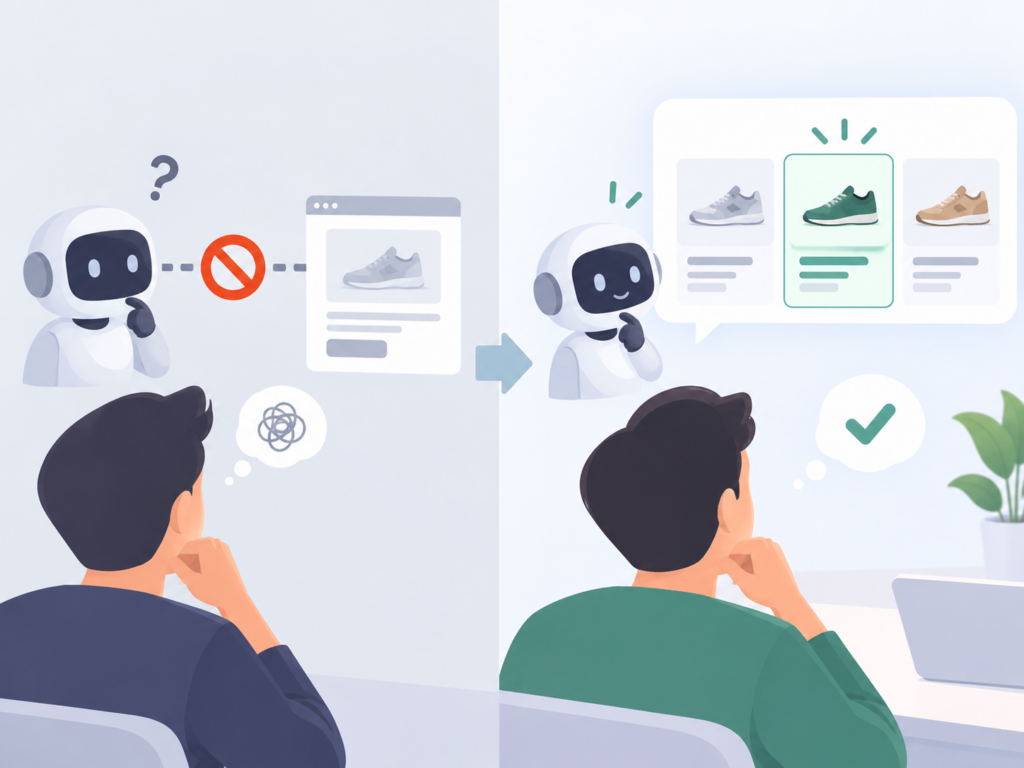
    Your TMS ranks on page one for “best transportation management system.” Your WMS content pulls steady organic traffic. Your domain authority is solid. Then a logistics manager asks ChatGPT, “What’s the best TMS for mid-market companies?” and gets a shortlist of five vendors. You’re not on it.

    That disconnect between Google rankings and AI recommendations is widening fast. 73% of B2B buyers now use AI tools like ChatGPT and Perplexity during purchase research. And the vendors AI recommends aren’t always the ones with the strongest backlink profiles.

    51% of Software Buyers Now Start in a Chatbot, Not Google

    The numbers have shifted faster than most logistics SaaS marketing teams realize.

    G2’s April 2026 study of 1,076 B2B software buyers found that 51% now begin their purchasing process in an AI chatbotrather than a traditional search engine. That’s up from 29% just twelve months earlier. Even more telling: 69% of buyers said an AI chatbot led them to select a different vendor than they initially planned.

    For logistics SaaS, this means the buyer evaluating freight audit platforms, route optimization tools, or warehouse management systems is increasingly forming a shortlist inside ChatGPT or Perplexity before ever visiting your website.

    One-third of buyers in the G2 study purchased from a vendor they’d never heard of before the AI surfaced it. That’s pipeline you can’t recover with retargeting ads, because the buyer never visited your site in the first place.

    Why Traditional SEO Metrics Don’t Explain AI Invisibility

    Brand web mentions correlate with AI citation at 0.664, while backlinks correlate at roughly 0.2. The backlink-heavy SEO playbook that worked for a decade is now a secondary signal for AI recommendation engines.

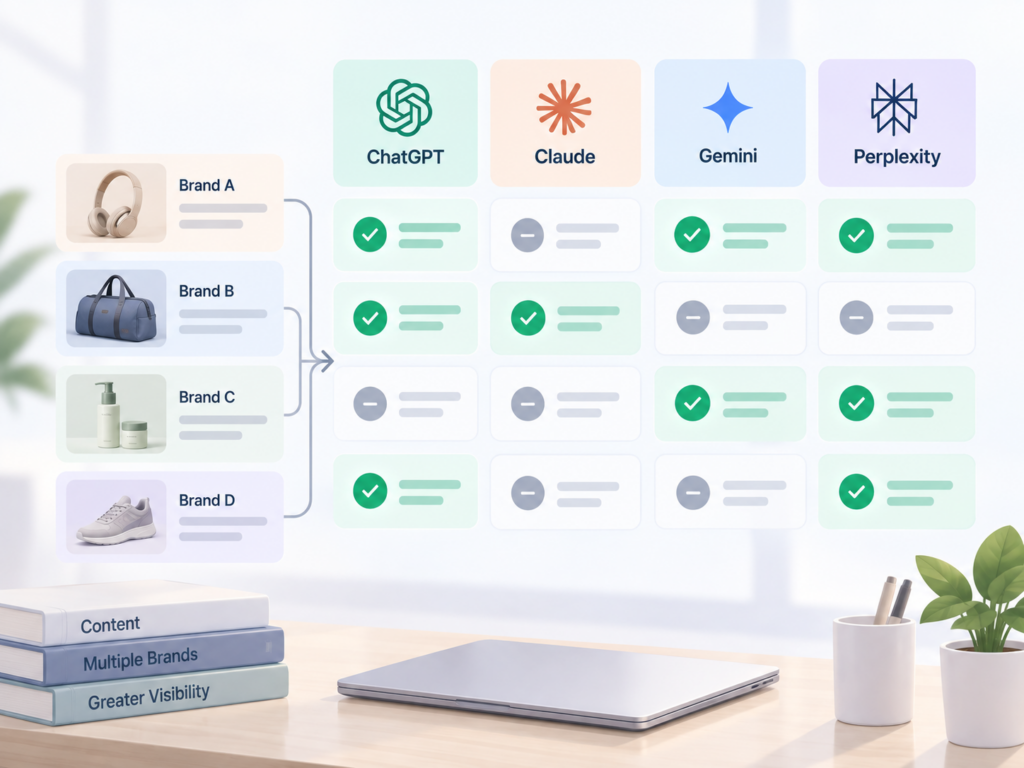
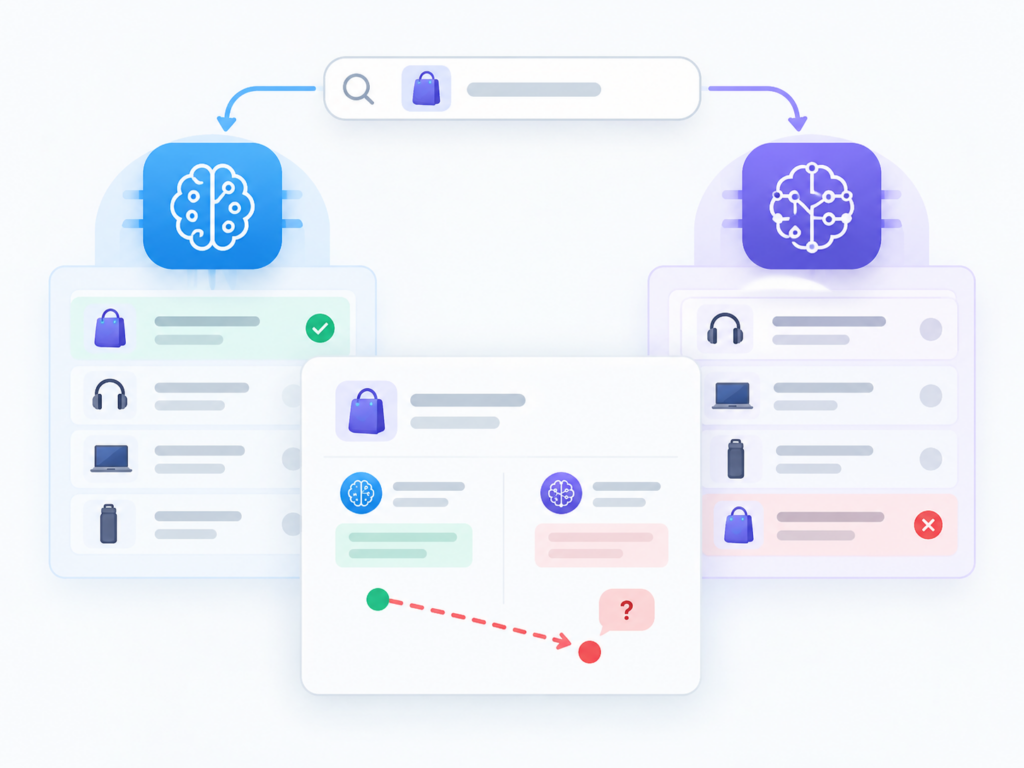
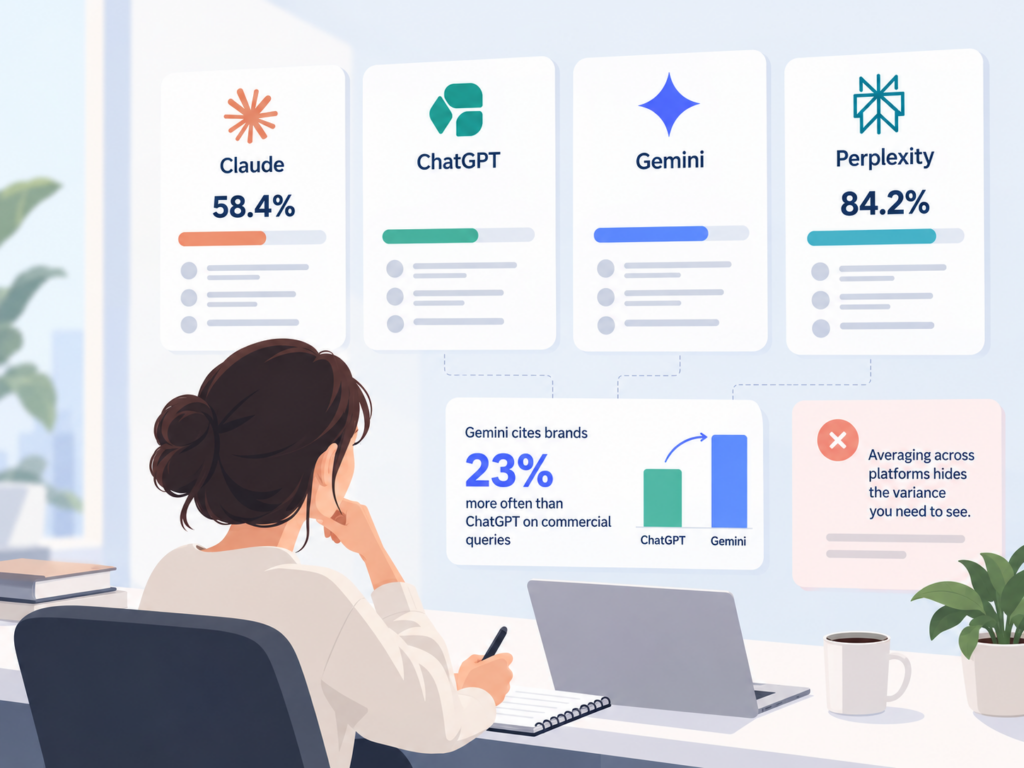
    AI search also isn’t one channel. Only 11% of domains are cited by both ChatGPT and Perplexity. Perplexity pulls roughly 46.7% of its top citations from Reddit. Gemini prioritizes pages that already rank well in traditional Google search. A logistics SaaS brand winning on one platform might be invisible on another.

    That fragmentation creates a specific problem for logistics SaaS companies. The category has narrower review coverage on platforms like G2 and Capterra compared to horizontal SaaS. The content tends to be technical and jargon-heavy. And most logistics brands haven’t built the kind of entity presence across community platforms that AI models weight heavily.

    13 Free AI Visibility Tools That Show Where Your Logistics Brand Stands

    The gap between “we think we’re visible” and “we’ve actually checked” is where most logistics SaaS teams get stuck. Topify offers 13 free tools that cover different dimensions of AI visibility, from baseline diagnostics to competitive intelligence. No signup required for any of them.

    Here’s how to use them, grouped by what they diagnose.

    Check Your Baseline Visibility

    Start here. These tools answer the first question: does AI even know your brand exists?

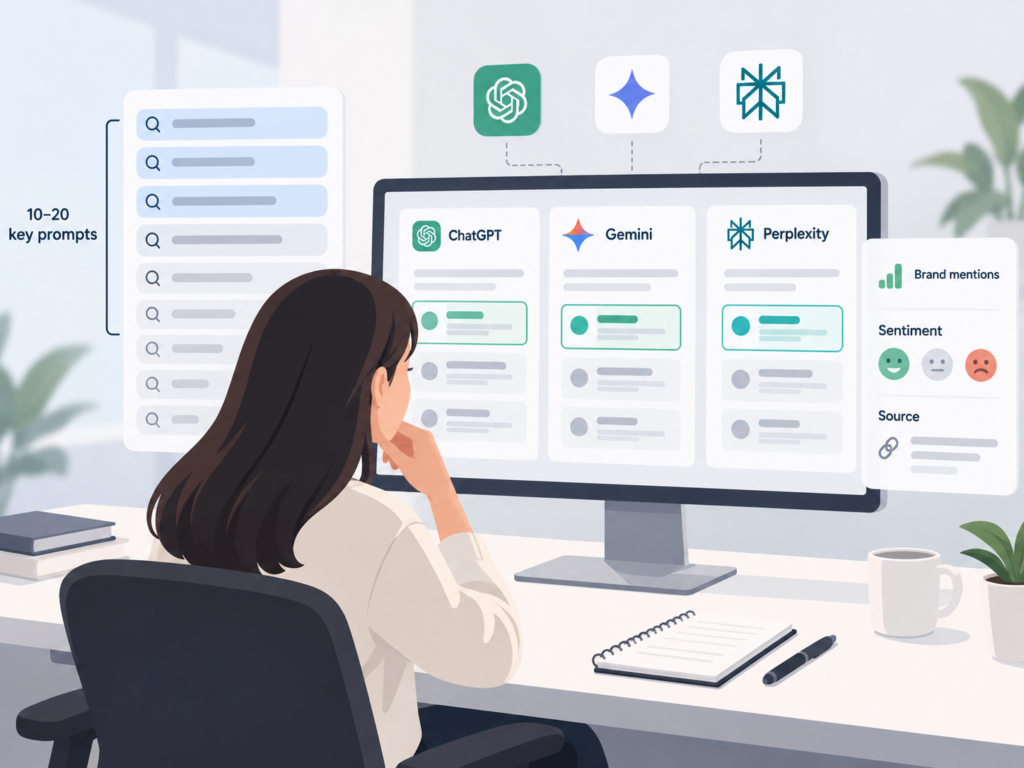
    The AI Visibility Report generates probe questions relevant to your category and queries ChatGPT, Gemini, and Perplexity. You’ll see mention rates, ranking positions, and which platforms include your brand. For a logistics SaaS company, this tells you whether AI recommends you when someone asks about TMS platforms, freight visibility tools, or supply chain software.

    The GEO Score Checker evaluates your site across four dimensions: AI bot access, structured data, content signals, and overall visibility. If your score is low, it pinpoints whether the issue is technical (AI crawlers can’t reach your content) or structural (your content isn’t formatted for extraction).

    The Brand Profile Checker shows how AI models describe your brand and who they list as your competitors. This is often where logistics SaaS companies get their first surprise: the AI might position you as a “startup-friendly tool” when your actual market is enterprise freight operations.

    Understand How AI Perceives Your Brand

    Visibility is binary: you’re either mentioned or you’re not. Perception is nuanced, and it’s where the real optimization opportunities hide.

    The Brand Sentiment Checker scores how positively or negatively AI models describe your brand. A logistics SaaS company with strong product capabilities but poor review coverage might see neutral or tepid sentiment, which translates to weaker recommendation positioning.

    The Brand Authority Checker measures recognition, expertise depth, recommendation rate, and trust signals across AI platforms. For logistics SaaS brands competing against incumbents like SAP or Oracle’s logistics modules, this tool reveals whether AI considers you an authority in your niche or just another name in a crowded list.

    The Knowledge Freshness Checker flags whether AI models are working with outdated information about your brand. If you launched a major feature update six months ago but AI still describes your product based on two-year-old data, your visibility score might be fine while your conversion potential isn’t.

    Find the Prompts That Actually Drive Pipeline

    Knowing you’re invisible is step one. Knowing which prompts matter is what makes the data actionable.

    The Prompts Researcher generates the exact questions users ask AI platforms about your category. For logistics SaaS, this surfaces prompts like “best WMS for e-commerce fulfillment,” “TMS comparison for LTL shipping,” or “freight audit software for 3PLs.” These are the prompts you need to appear in.

    The AI Search Volume Checker estimates how often specific prompts are searched across AI platforms. Not all prompts are equal. A prompt with high AI search volume in your category is worth more than one that sounds relevant but rarely gets asked.

    The Social Question Search finds real user questions from community platforms. Since Perplexity pulls heavily from Reddit, and AI models generally weight community discussion as a trust signal, understanding what logistics professionals actually ask on social platforms informs both your content strategy and your community presence.

    The AI Trends Tracker shows which topics are gaining traction in AI search. Logistics is moving fast right now. Agentic AI, autonomous freight, and AI-powered customs compliance are all trending categories. If your content doesn’t cover emerging topics, AI models have nothing to cite.

    Benchmark Against Competitors

    AI recommendations are relative. You’re not just trying to be visible, you’re trying to rank above the other four vendors in the response.

    The Competitor Analysis tool shows your top AI competitors, their strengths and weaknesses, and how they’re positioned relative to your brand. In logistics SaaS, you might discover that a smaller competitor with aggressive content marketing is outranking you in AI responses despite having a fraction of your market share.

    The User Review Echo aggregates real user reviews from across platforms. AI models weigh recent, authentic reviews heavily when forming recommendations. If your competitor has 50 fresh G2 reviews and you have 12 from 2024, that review gap likely explains a recommendation gap.

    Fix Technical Blockers

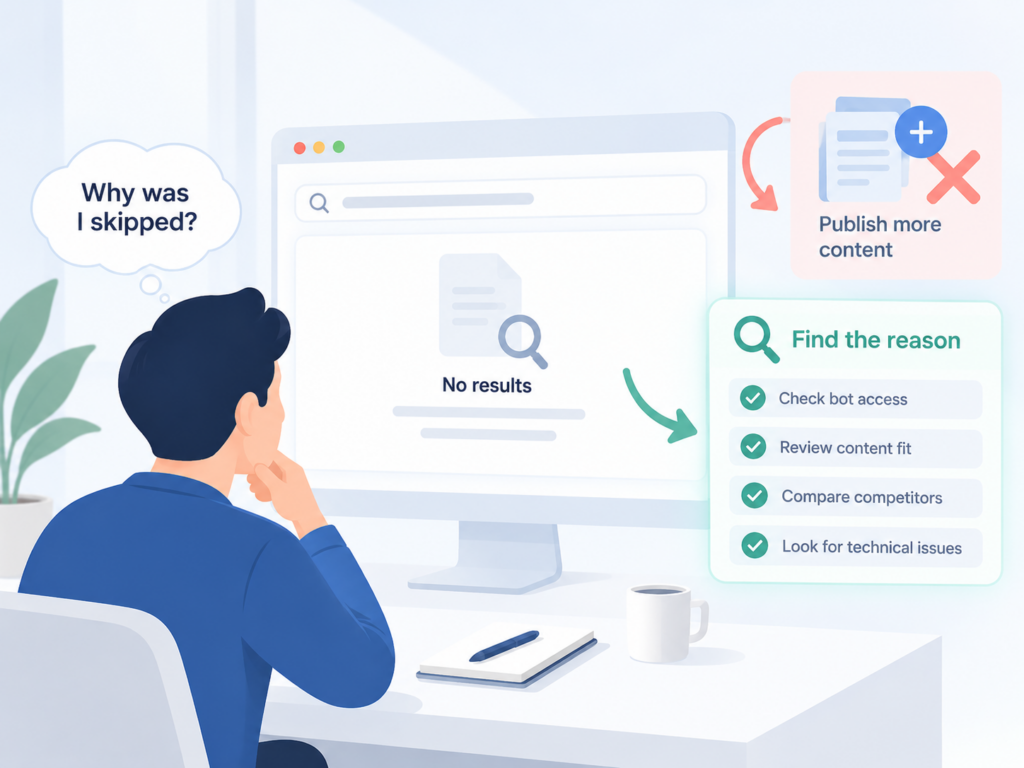
    Sometimes the issue isn’t your content or brand strength. It’s that AI crawlers literally can’t access your site.

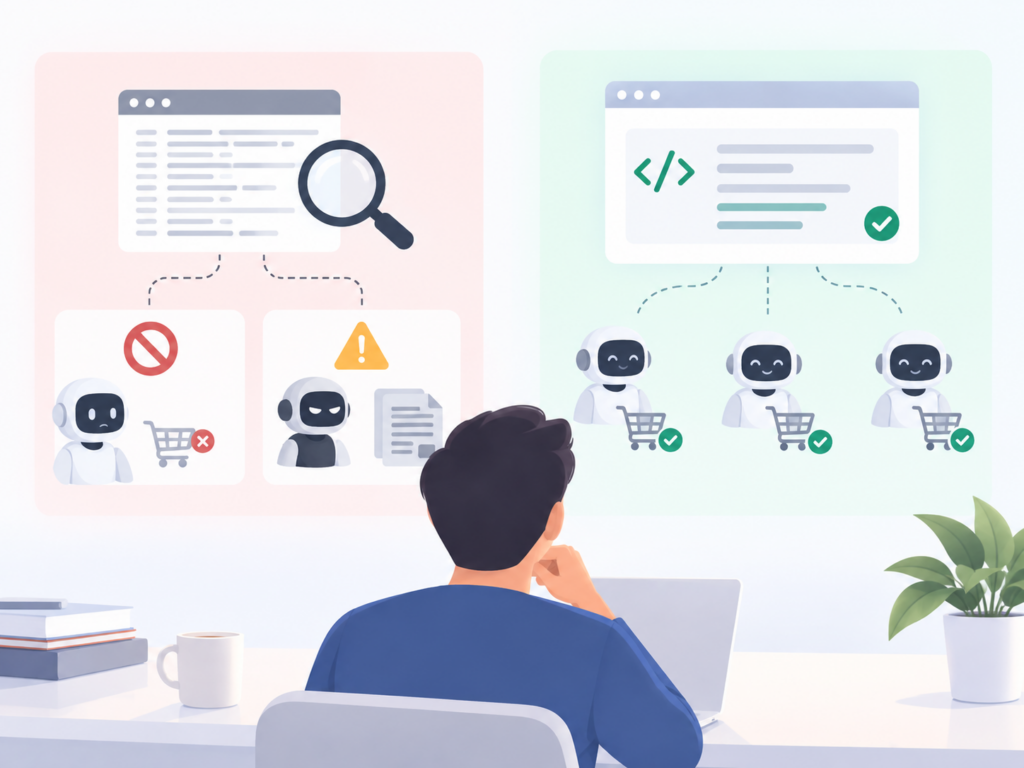
    The AI Robots Checker shows which AI crawlers your robots.txt file allows or blocks, including GPTBot, ClaudeBot, and PerplexityBot. If you’re blocking these crawlers, which many logistics SaaS sites do by default, no amount of content optimization will help. This is a two-minute check that can uncover a foundational problem.

    A Step-by-Step AI Visibility Audit for Logistics SaaS

    Running all 13 tools at once generates a lot of data. Here’s a practical sequence that prioritizes the highest-impact checks first.

    Start with the AI Robots Checker. If AI crawlers are blocked, fix that before anything else. Then run the GEO Score Checker to get a composite view of your technical readiness. Next, pull your AI Visibility Report to see where you actually appear, and on which platforms.

    Once you have baseline data, use the Prompts Researcher to identify the 10-15 prompts most relevant to your logistics SaaS category. Check their AI search volume. Then run the Competitor Analysis to see who AI recommends instead of you on those prompts.

    The Brand Sentiment Checker and Brand Authority Checker tell you why you’re positioned where you are. The Knowledge Freshness Checker confirms whether AI is working with current information. And the User Review Echo highlights whether your review profile supports or undermines your authority.

    This full audit takes less than an hour. What you get is a clear map of where you stand, where the gaps are, and which gaps matter most for pipeline.

    From One-Time Audit to Continuous AI Visibility Monitoring

    Free tools give you a snapshot. But AI recommendations aren’t static. Models retrain, new content gets indexed, and competitor strategies shift. Research suggests that only about 30% of brands maintain consistent visibility across multiple regenerations of the same query.

    That’s where the diagnostic tools hit their ceiling. They tell you where you stand today, but they can’t tell you when a competitor overtakes you next month or when a model update drops your visibility overnight.

    Topify’s full platform tracks brand visibility continuously across ChatGPT, Perplexity, Gemini, DeepSeek, and AI Overviews. It monitors seven metrics in a single dashboard: visibility, sentiment, position, volume, mentions, intent, and CVR. For logistics SaaS teams where a single enterprise deal can be worth six figures, the cost of being invisible on one high-intent prompt far outweighs a monthly subscription.

    The practical path: start with the free tools. Run the audit. Identify the biggest gaps. If the data shows you’re losing pipeline to competitors who are visible in AI search, that’s the signal to move from periodic checks to continuous monitoring.

    Conclusion

    AI search traffic converts at roughly 5x the rate of traditional organic traffic. For logistics SaaS companies, where buyer intent is high and deal sizes are significant, that conversion advantage makes AI visibility a pipeline issue, not a marketing experiment.

    The 13 free tools covered here give you a clear starting point: check whether AI knows your brand, understand how it perceives you, identify the prompts that drive pipeline, and benchmark against competitors. That’s a lot of diagnostic power for zero cost and less than an hour of work. The logistics SaaS brands that treat AI visibility as a board-level priority now will own the category recommendations for years. The ones that keep measuring against 2023 dashboards will keep wondering why pipeline growth doesn’t match SEO performance.

    FAQ

    What is AI visibility for logistics SaaS?

    AI visibility measures how often your logistics SaaS brand appears in AI-generated responses when users ask platforms like ChatGPT, Perplexity, or Gemini about transportation management systems, warehouse software, freight tools, or supply chain platforms. It’s distinct from traditional SEO rankings because AI models use different signals to decide which brands to recommend.

    How do I check if my logistics SaaS brand appears in ChatGPT?

    The fastest way is to run Topify’s free AI Visibility Report. It queries multiple AI platforms with prompts relevant to your category and returns mention rates, ranking positions, and platform-by-platform breakdowns. You can also manually ask ChatGPT category-specific questions, but the free tool covers more ground in less time.

    Do backlinks still matter for AI search visibility?

    They matter less than you’d think. Research shows brand mentions correlate with AI citations at 0.664, while backlinks correlate at approximately 0.2. Unlinked brand mentions, structured entity content, and review presence tend to be stronger signals for AI recommendation engines than traditional link-building.

    How often should I audit my AI visibility?

    At minimum, quarterly. AI models retrain regularly, and competitor activity can shift your position between audits. For logistics SaaS companies in competitive categories like TMS or WMS, monthly checks using free tools are practical. Continuous monitoring through a platform like Topify is the most reliable approach for tracking changes in real time.

    Read More

  • AI Visibility Tools for Architecture Firms

    AI Visibility Tools for Architecture Firms

    A developer typed into Perplexity: “Best architecture firms for mixed-use development in Austin.” Five names came back. Your firm, with 30 years of commercial experience and a portfolio of LEED-certified projects, wasn’t on the list. The developer shortlisted those five firms and never searched further.

    The issue isn’t your track record. It’s that AI doesn’t recognize it.

    There’s a way to see exactly where the disconnect is. Topify‘s Brand Authority Checker scores how AI models perceive your architecture firm’s authority, broken down into four dimensions that directly affect whether you get recommended when a client, developer, or procurement officer asks AI for help.

    ✅ Free ⚡ Results in 60 seconds

    The Four Authority Scores, Translated for Architecture Firms

    The Brand Authority Checker doesn’t give you a single pass/fail rating. It breaks AI’s perception of your firm into four distinct scores, each mapping to a specific business development problem architecture practices face.

    MetricWhat It MeasuresWhat It Means for Architecture Firms
    Recognition (0-100)How often AI identifies your firm in your categoryBelow 40: AI doesn’t associate you with your core practice area (healthcare, hospitality, residential)
    Expertise Depth (0-100)How well AI understands your capabilitiesBelow 50: AI may describe your firm as “general practice” while ignoring your specialization in adaptive reuse or net-zero design
    Recommendation Rate (0-100)How often AI recommends you vs. alternativesBelow 30: you’re losing RFP shortlists before your BD team even knows the project exists
    Trust Signals (0-100)External validation AI detects (media, citations, reviews)Below 40: AI can’t find enough third-party evidence to vouch for your firm’s credibility

    Here’s the thing. A firm with a Recognition score of 80 but a Trust Signals score of 25 has a very specific problem: AI knows who you are, but doesn’t trust you enough to recommend you. That’s a different fix than a firm scoring low across all four.

    The gap between these scores tells you exactly where to focus your marketing and PR investment.

    Three Scenarios Architecture Firms Discover After Running the Check

    Scenario 1: The “Invisible Specialist” Your firm has won AIA Honor Awards for healthcare architecture. But AI only associates you with “commercial architecture” in general terms. The Expertise Depth score is 35, while Recognition sits at 70. AI knows your name but doesn’t understand what you actually do. This typically happens when a firm’s website and third-party profiles use broad language instead of specific project-type descriptions.

    Scenario 2: The “Outdated Portfolio” Your firm pivoted from residential to mixed-use development three years ago. AI still describes you as a residential practice. The Recognition score reflects the old identity, and the Recommendation Rate for mixed-use queries is near zero. AI models train on historical data, and without fresh, structured signals, the old identity persists.

    Scenario 3: The “Reputation Gap” Your firm has 25 years of editorial coverage in Architectural Record, Dezeen, and ArchDaily. But your Trust Signals score is 42. The problem: AI doesn’t weigh beautiful project photography or social followings. It weighs structured citations, third-party validation, and consistent editorial signals that it can parse and verify.

    How to Run Your Architecture Firm’s Authority Check

    The process takes less than a minute. Go to Brand Authority Checker, enter your firm’s name or domain, and you’ll get a four-dimensional authority breakdown. No signup required, no credit card, no strings attached.

    Once you have your scores, focus on the lowest dimension first. A firm with strong recognition but weak trust signals needs a different strategy than a firm that’s invisible across the board. The scores give you a diagnostic starting point, not just a number.

    Published Everywhere Except Where Clients Now Search

    Architecture firms have spent decades investing in the right places: competition entries, magazine features, conference presentations, and portfolio books. That investment built real reputations. But AI search operates on a different signal set entirely.

    The Designer AI Visibility Index, launched in May 2026 by 5W and Haute Living, audited how architects and designers appear across ChatGPT, Claude, and Perplexity. The finding was blunt: most of the most-published architects in the United States, including firms with seven-figure project pipelines and twenty years of editorial coverage, are functionally invisible inside AI answers.

    AI engines don’t pattern-match against portfolio images or Instagram grids. They pattern-match against credentialed editorial features, structured profiles, FAQ data, and authoritative third-party citations. That’s a fundamentally different signal set than what most architecture firms have been building.

    Here’s what your potential clients are actually asking AI right now:

    AI Prompt ExamplePlatformSearch IntentWhat It Reveals
    “Best architecture firm for sustainable office buildings in Denver”ChatGPTPurchase decisionWhether your firm gets named when a developer is shortlisting
    “Which architects specialize in adaptive reuse of industrial buildings?”PerplexityExpertise verificationWhether AI understands your niche specialization
    “Compare architecture firms for K-12 school design”GeminiCompetitive researchWhere you rank against firms AI considers authoritative
    “Recommend an architect for a net-zero mixed-use project”ChatGPTQualified lead queryWhether your sustainability credentials register with AI
    “Top hospitality architects for boutique hotel renovation”PerplexitySector-specific shortlistWhether AI places you in the right project-type category

    Each of these prompts represents a potential project. If your firm doesn’t appear, you’re not losing a ranking. You’re losing the meeting.

    What the Authority Gap Means for Your Firm’s Pipeline

    Award-Winning Doesn’t Mean AI-Visible

    The Designer AI Visibility Index confirmed what many architecture firms haven’t realized yet: editorial coverage and AI visibility are not the same thing. A firm featured in Architectural Digest, Dezeen, and ArchDaily for two decades can still score below 30 on AI authority metrics.

    Why? AI models evaluate authority through a completely different lens. Portfolio quality, design awards, and project photography carry almost zero weight in AI’s trust model. What AI looks for is structured data, consistent entity signals, third-party citations it can parse, and editorial content formatted in ways that AI crawlers can index and verify.

    Run your firm through the Brand Authority Checker and you’ll likely see the gap in real numbers. The Recognition score might be decent if your firm has been around long enough. But Expertise Depth and Trust Signals often tell a very different story.

    The Compounding Window Is Open Now

    The architecture category in AI search hasn’t been seriously competed for yet. Citation share is sitting in the open, and firms that build structured AI authority in 2026 will compound an advantage that late movers will spend years trying to close.

    AI engines have a recency bias toward authoritative sources that have produced consistent, structured coverage in the last 12 months. A firm that begins building that presence today creates a compounding signal loop: more structured authority leads to more AI citations, which leads to more visibility, which reinforces authority further.

    A firm that waits until 2028 to address AI visibility will face a category where competitors have already established citation dominance. The recovery timeline, based on patterns observed across other professional services categories, is typically two to three years of consistent effort just to catch up.

    Your Expertise Depth Is Probably Dangerously Narrow in AI

    This one is subtle and easy to miss. Your firm might be recognized by AI, it might even get recommended occasionally, but AI’s understanding of what you do could be incomplete or wrong.

    A firm known for healthcare architecture might find AI only associates it with hospital design, completely missing its expertise in outpatient clinics, research labs, or senior living facilities. A firm with a strong mixed-use portfolio might get pigeonholed as “residential” because that’s what most of its older, indexed content describes.

    The Brand Authority Checker’s Expertise Depth score surfaces this kind of misrepresentation. A score below 50 in this dimension means AI is either describing your capabilities incorrectly or incompletely. And every incomplete description is a project type you’re invisible for.

    One Score Is a Starting Point. Tracking It Over Time Is the Strategy.

    Your Brand Authority Checker results tell you where you stand right now. But AI models update their training data, adjust ranking signals, and shift recommendations on a rolling basis. A score of 72 today could drop to 55 next quarter without any change on your end.

    Topify‘s platform picks up where the free tool leaves off. The Comprehensive GEO Analytics dashboard tracks your authority, sentiment, and visibility scores continuously across ChatGPT, Perplexity, Gemini, and Google AI Overviews. You’ll see trend lines, get alerts when scores shift, and receive specific recommendations for what to fix.

    Here’s how the free check compares to the full platform:

    CapabilityFree Brand Authority CheckerTopify Platform
    Check frequencyOne-time snapshotContinuous daily/weekly monitoring
    AI platforms coveredAggregated scorePer-platform breakdown (ChatGPT, Perplexity, Gemini, AI Overviews)
    Historical dataNoneFull trend history with alerts
    Competitor comparisonNot includedReal-time benchmarking against other firms
    Action recommendationsGeneralSpecific, one-click GEO optimization
    Team collaborationNoUnlimited team member seats

    Every plan starts with a 7-day free trial, no credit card required. The Starter plan begins at $99/month.

    Conclusion

    Architecture firms have spent decades building reputations through design quality, editorial coverage, and word-of-mouth referrals. That investment is real. But the client discovery funnel has shifted, and AI search now sits at the top of it, particularly for high-value developer, corporate, and UHNW clients.

    The firms that diagnose their AI visibility gap now and build structured authority in 2026 will define who gets shortlisted in this new channel. The firms that wait will spend years catching up in a category that’s already been claimed.

    Start with a free check. Run your firm through the Brand Authority Checker and see exactly how AI perceives your authority today. Then decide whether a one-time snapshot is enough, or whether continuous monitoring through Topify’s platform fits your growth strategy.

    While you’re assessing your brand authority, a few other free checks can round out the picture. Topify‘s GEO Score Checker evaluates whether AI crawlers can actually access and index your firm’s website. The AI Visibility Report shows how often your firm gets mentioned across major AI platforms. And the Competitor Analysis tool reveals which firms AI considers your competitors and how you compare.

    FAQ

    Is the Brand Authority Checker really free? Do I need to create an account? 

    Yes, it’s completely free. You don’t need to sign up, provide an email, or enter a credit card. Enter your firm’s name or domain, and you’ll get your four-dimensional authority breakdown in under 60 seconds.

    What’s the difference between the free tool and Topify’s paid platform?

    The free Brand Authority Checker gives you a one-time snapshot of how AI perceives your firm’s authority right now. Topify’s platform (starting at $99/month) adds continuous monitoring, historical trend tracking, competitor benchmarking, per-platform breakdowns, and one-click optimization recommendations. The free tool tells you where you stand; the platform helps you improve over time.

    How often should an architecture firm check its AI visibility? 

    AI models update their training data and recommendation algorithms regularly. A quarterly check with the free tool is a reasonable minimum. Firms actively investing in content, PR, or website updates should monitor monthly or continuously through Topify’s platform to see how those investments translate into AI authority changes.

    Our firm has won multiple AIA awards and is featured in major publications. Why would we score low on AI authority? 

    AI models don’t evaluate authority the way industry peers do. Awards, portfolio photography, and social followings carry minimal weight in AI’s trust model. AI looks for structured data, parseable third-party citations, consistent entity signals, and editorial content formatted for AI crawlers. A firm can be highly respected in the profession and still invisible to AI because its authority signals aren’t structured in ways AI can read.

    Read More

  • AI Visibility Tools for Commercial Real Estate

    AI Visibility Tools for Commercial Real Estate

    An institutional investor typed into Perplexity: “Top commercial real estate firms for industrial acquisitions in the Southeast.” Your brokerage closed $2.1 billion in industrial deals last year. You weren’t in the answer. The investor never called.

    The problem isn’t your deal record. It’s that AI’s information about your firm is stale.

    There’s a way to find out exactly how outdated it is. Topify‘s Knowledge Freshness Checker scans what AI models currently know about your CRE brand and flags every piece of information that’s behind the curve, from old portfolio descriptions to discontinued service lines.

    ✅ Free ⚡ Freshness audit in 60 seconds

    What the Knowledge Freshness Checker Reveals About Your CRE Brand

    The tool doesn’t just tell you whether AI knows your name. It tells you whether AI knows the right version of your name.

    The Freshness Dimensions, Decoded for CRE

    Each dimension of the freshness audit maps to a specific risk that CRE firms face when AI models rely on outdated training data.

    Freshness DimensionWhat It ChecksWhat It Means for CRE Brands
    Brand Description AccuracyWhether AI’s summary of your firm matches your current positioningIf your firm pivoted from retail to industrial 18 months ago, AI may still describe you as a retail specialist
    Service Line CurrencyWhether AI lists your current capabilitiesA development firm that added debt advisory in 2025 might not show that service in AI answers
    Market Focus AccuracyWhether AI associates you with your active marketsIf you exited the Denver office market last year, AI may still recommend you for Denver deals
    Leadership and Team DataWhether AI references current leadershipA new CEO or managing director won’t appear in AI recommendations if the model’s data is stale
    Recent Activity RecognitionWhether AI reflects your recent deals, publications, or thought leadershipClosed a landmark deal last quarter? AI may not know about it yet

    A CRE firm that scores well on Brand Description Accuracy but poorly on Recent Activity Recognition has a specific problem: AI knows who you were, but not who you are now. That’s the kind of gap that sends investor inquiries to your competitors.

    Three Scenarios Where Stale AI Data Costs CRE Firms Deals

    Scenario 1: The ghost portfolio. A multifamily investor asks ChatGPT to recommend asset managers with experience in Class A multifamily in the Sun Belt. Your firm manages 12,000 units across six Sun Belt markets. But AI’s training data still references a portfolio you divested two years ago, and it misses the 4,000 units you acquired since. You don’t appear in the recommendation.

    Scenario 2: The wrong specialization. A developer searching Perplexity for “CRE brokers specializing in life sciences lab space” gets a list that doesn’t include your firm. You launched a dedicated life sciences practice 14 months ago. AI still categorizes you under general office leasing.

    Scenario 3: The outdated market narrative. An LP asks Gemini about top CRE investment firms in logistics and warehousing. AI references your firm’s 2023 market outlook, not your 2025 report that identified cold storage as a major growth vertical. The LP sees a firm that’s behind the curve, not ahead of it.

    Each of these scenarios is detectable. And each starts with running a single check.

    How to Run Your CRE Brand’s Freshness Audit

    The process takes less than a minute. Go to the Knowledge Freshness Checker, enter your firm name or domain, and get your freshness breakdown. No signup required, no credit card, no strings. You’ll see exactly where AI’s version of your brand has fallen behind reality.

    The AI Blind Spots Costing CRE Firms Leads and Deals

    CRE buyers, investors, and tenants are asking AI questions that directly influence where capital flows. Here’s what those queries look like across platforms.

    AI Prompt ExamplePlatformSearch IntentWhat It Reveals About Your Visibility
    “Best CRE firms for NNN lease investments”ChatGPTInvestment decisionWhether AI recommends your firm for your core product type
    “Top property management companies for Class A office”PerplexityVendor selectionWhether AI associates you with premium asset classes
    “What’s the average cap rate for industrial in [metro]?”GeminiMarket researchWhether AI cites your market reports or your competitor’s
    “Commercial real estate firms specializing in 1031 exchange”ChatGPTTax strategyWhether AI connects your advisory capabilities to buyer-side tax needs
    “Best markets for multifamily investment 2026”Google AI OverviewCapital allocationWhether AI surfaces your thought leadership when LPs are deciding where to deploy

    The data behind this shift is hard to ignore. A joint report by 5WPR and Haute Residence found that real estate ranks last among all industries in AI search visibility. 82% of agents use AI daily, but almost none are optimizing to be found by AI. That’s a disconnect with real financial consequences.

    The buyer discovery path has already shifted. The same report documents a new five-stage funnel: AI query, AI synthesis, click-through, agent contact, tour and offer. CRE firms that aren’t visible in step one don’t exist in step two through five.

    Research from Starmorph shows AI referral traffic grew 527% year-over-year in 2025 and converts at 4.4 to 5x the rate of traditional organic search. The volume is still smaller than Google, but the intent is sharper. When someone asks ChatGPT for a CRE firm recommendation, they’re closer to a transaction than someone browsing a directory.

    CRE Firms Spend Millions on AI Adoption but Zero on AI Visibility

    Here’s the thing. 76% of CRE firms are exploring or implementing AI, according to Deloitte’s 2026 CRE Outlook. That spending goes toward lease abstraction, underwriting automation, deal pipeline management, and property operations. 92% of commercial real estate occupiers and investors have started or plan to start AI pilots.

    Almost none of that investment addresses a basic question: when a buyer, investor, or tenant asks an AI search engine about your market, does AI know who you are?

    The asymmetry is striking. Firms deploy AI internally to gain an edge in operations, but they’re invisible to the AI systems their clients use to find them. A brokerage using AI to generate lease abstracts in minutes still loses the deal if the investor never discovered them in the first place, because Perplexity recommended a competitor instead.

    The Knowledge Freshness Checker makes this asymmetry visible. If AI’s description of your firm references a fund you closed two years ago, a market you’ve exited, or a service line you’ve sunset, you now have a specific data point to act on.

    CRE’s Knowledge Freshness Problem Is Structural, Not Incidental

    Most industries have a knowledge freshness challenge with AI. CRE has it worse.

    The reason is structural. CRE information lives in places AI crawlers struggle to reach: proprietary databases like CoStar, password-protected deal rooms, PDF-based offering memorandums, and fragmented MLS systems. Unlike SaaS companies that publish pricing pages and feature updates on their website, CRE firms store their most valuable information behind walls that AI can’t penetrate.

    That creates a compounding problem. When AI models update, they pull from what’s publicly available. For a CRE brokerage, that often means a two-year-old press release, an outdated LinkedIn company page, or a third-party directory listing that hasn’t been refreshed since 2024. The result: AI’s portrait of your firm drifts further from reality with each update cycle.

    On the flip side, this structural gap creates an opportunity. CRE firms that publish structured, crawlable content about their current capabilities, markets, and deal activity are building a moat. AI systems favor fresh, authoritative sources. In an industry where most firms give AI nothing current to work with, even basic freshness improvements can shift your position in AI recommendations.

    Research on AI citations backs this up. By February 2026, only 38% of AI-cited URLs came from the organic top 10 in Google, down from 76% in July 2025. AI is actively seeking out authoritative content from across the entire web, not just repeating what ranks first on Google. A mid-size CRE firm with fresh, well-structured content can win AI citations without dominating traditional search rankings.

    Start by checking what AI currently knows. The Knowledge Freshness Checker shows you the gap between your firm’s reality and AI’s perception. That gap is your action plan.

    From a One-Time Freshness Audit to Continuous AI Visibility

    Your Knowledge Freshness Checker results give you a snapshot. But AI models don’t stand still. They update training data, adjust citation signals, and shift recommendations on a rolling basis. A freshness score that looks acceptable today could deteriorate next quarter without any change on your end.

    Topify‘s platform picks up where the free tool leaves off. The Reverse-Engineer AI Citations feature goes deeper: it identifies the specific sources AI models are pulling from when they describe your firm, flags citation gaps, and shows you exactly which content needs updating to keep your AI profile current.

    Here’s how the free check compares to the full platform:

    CapabilityFree Knowledge Freshness CheckerTopify Platform
    Check frequencyOne-time snapshotContinuous daily/weekly monitoring
    AI platforms coveredAggregated freshness scorePer-platform breakdown (ChatGPT, Perplexity, Gemini, AI Overviews)
    Historical trendsNoneFull trend history with alerts
    Citation source analysisNot includedIdentifies exact sources AI cites about your brand
    Competitor trackingNot includedReal-time competitor benchmarking
    Action recommendationsGeneral freshness flagsSpecific content update priorities

    Every plan starts with a 7-day free trial, no credit card required. The Starter plan begins at $99/month.

    Conclusion

    CRE firms are spending heavily on AI to optimize internal operations. The firms that pull ahead will be the ones that also optimize for how AI sees them from the outside. When an investor, tenant, or LP asks an AI search engine about your market, the answer is only as good as the data AI has about you. If that data is stale, you’re losing deals you never knew existed.

    Start with the free Knowledge Freshness Checker to see exactly where AI’s version of your firm has fallen behind. Then build a strategy to keep it current.

    While you’re assessing your freshness, a few other free checks can round out the picture. Topify’s AI Visibility Reportshows how often your CRE brand gets mentioned across major AI platforms. The Brand Authority Checker scores how AI models perceive your firm’s expertise and trustworthiness. And the Competitor Analysis tool reveals which firms AI recommends instead of yours, and why.

    FAQ

    Is the Knowledge Freshness Checker really free? Do I need to create an account? 

    Yes, it’s completely free. No account, no signup, no credit card. Enter your brand name or domain and get your results in under 60 seconds.

    What’s the difference between the free tool and Topify’s paid platform? 

    The free tool gives you a one-time freshness snapshot. Topify’s platform provides continuous monitoring across ChatGPT, Perplexity, Gemini, and Google AI Overviews, with historical trends, citation source analysis, competitor benchmarking, and specific action recommendations. Plans start at $99/month with a 7-day free trial.

    How often should a CRE firm check its AI visibility? 

    AI models update regularly, and CRE data changes faster than most industries (new deals, market shifts, personnel changes). A quarterly manual check with the free tool is a minimum. For firms actively marketing to investors or tenants, continuous monitoring through a platform provides the most reliable signal.

    Why does CRE have a bigger AI freshness problem than other industries? 

    CRE data is disproportionately locked behind proprietary databases, PDF deal documents, and password-protected platforms. AI crawlers can’t easily access or update this information, so AI’s knowledge about CRE firms degrades faster than in industries where information is more publicly available.

    Read More

  • AI Visibility Tools for Management Consulting

    AI Visibility Tools for Management Consulting

    A VP of Operations typed into ChatGPT: “Best management consulting firms for post-merger integration in healthcare.” Three firms came back by name, with specific credentials and case summaries. Your firm, with 15 years of M&A experience and a dozen successful integrations, wasn’t mentioned. The problem isn’t your track record. It’s that AI doesn’t recognize it.

    You can find out exactly where the gap is in under a minute. Topify‘s Brand Authority Checker scores how AI models perceive your consulting firm’s authority across four dimensions that directly determine whether you get recommended.

    ✅ Free ⚡ Results in 60 seconds 🔒 No signup required

    The Four Authority Scores AI Uses to Judge Your Consulting Firm

    The Brand Authority Checker doesn’t give you a single number and send you on your way. It breaks your firm’s AI-perceived authority into four distinct scores, each one mapping to a specific problem consulting firms face when clients research them through AI.

    What Each Score Means for a Consulting Practice

    MetricWhat It MeasuresWhat It Means for Consulting Firms
    Recognition (0-100)How often AI identifies your firm in your categoryBelow 40: AI doesn’t associate your firm with your core practice area
    Expertise Depth (0-100)How well AI understands your capabilities and specializationsBelow 50: AI may describe your firm in generic terms, missing your differentiators
    Recommendation Rate (0-100)How often AI recommends you vs. alternativesBelow 30: you’re losing RFP shortlist spots before your BD team even knows the opportunity existed
    Trust Signals (0-100)External validation AI detects (media, reviews, citations)Below 40: AI can’t find enough third-party evidence to vouch for your expertise

    Here’s the thing. A consulting firm with a Recognition score of 75 but a Trust Signals score of 25 has a very specific diagnosis: AI knows your name, but it doesn’t trust you enough to recommend you. That’s not a branding problem. It’s a third-party validation gap, and now you know exactly where to focus.

    Three Scenarios Where Consulting Firms Get Blindsided

    Scenario 1: The niche expert no one can find. Your firm has deep expertise in supply chain optimization for mid-market manufacturers. You’ve published case studies and spoken at conferences. But AI recommends a generalist firm instead, because your website describes you as “a full-service management consulting firm” without structuring your specialization in a way AI can parse.

    Scenario 2: The credentials that don’t register. You hold ISO certifications, have former Big Four partners on your team, and maintain long-term client relationships. None of this shows up in your Authority score, because AI evaluates trust through third-party signals like media mentions, review platforms, and independent citations, not self-reported credentials.

    Scenario 3: The thought leader AI doesn’t credit. Your managing partner publishes regularly in industry journals and speaks at major events. But AI attributes the insights to the publication or conference, not to your firm. Your Expertise Depth score stays flat despite consistent content output.

    How to Run Your Authority Check

    Go to Brand Authority Checker, enter your firm name or domain, and get your four-score authority breakdown in under 60 seconds. No account creation, no credit card, no email required. You’ll see exactly how AI perceives your firm’s authority right now.

    The AI Prompts Your Prospective Clients Are Already Asking

    94% of B2B buyers used generative AI tools during their purchase process in 2025, according to 6sense’s Buyer Experience Report. For consulting, this means your prospective clients are forming shortlists inside ChatGPT, Perplexity, and Gemini before they ever visit your website or ask for a referral.

    The table below shows what those conversations actually look like.

    AI Prompt ExamplePlatformSearch IntentWhat It Reveals
    “Best management consulting firms for digital transformation”ChatGPTVendor shortlistingWhether your firm gets named when buyers start their search
    “Top strategy consultants for mid-sized manufacturers”PerplexityNiche expertise matchHow well AI connects your firm to a specific vertical
    “Management consulting firm with change management expertise”GeminiCapability verificationWhether AI understands your service lines accurately
    “Who should I hire for post-merger integration consulting?”ChatGPTHigh-intent purchaseWhether AI recommends you for high-value engagements
    “Consulting firms specializing in operational efficiency”Google AI OverviewComparison shoppingWhere you rank against alternatives in AI’s synthesis
    “Best financial advisory consulting for Series B startups”PerplexityStage-specific needWhether AI maps your firm to the buyer’s growth stage

    Each of these prompts represents a real buying signal. If your firm doesn’t appear in the response, you’re not losing a click. You’re losing a conversation you never knew happened.

    The Invisible Funnel: 60% of the Decision Happens Before You Hear From the Client

    Management consulting has always been a long-cycle business. Prospects research for months before scheduling an initial call. What’s changed is where that research starts.

    73% of B2B buyers now use AI tools like ChatGPT and Perplexity during the purchase research process. Forrester’s 2025 survey of 4,000+ buyers found that 61% of the buying journey completes before the buyer contacts a vendor. And 6sense’s data shows that 80% of deals are won by the vendor already on the buyer’s shortlist before first contact.

    For consulting firms, this creates an invisible funnel. A CFO asks AI for recommendations. AI names three firms. The CFO’s team does deeper diligence on those three. Your firm, which wasn’t named, never enters the picture. You don’t get a rejection. You don’t get a “we went with someone else.” You get silence, and you attribute it to a slow quarter.

    The Brand Authority Checker exposes whether you’re inside or outside this funnel. A low Recognition or Recommendation Rate score is a direct signal that AI isn’t placing you on the shortlists your prospects are building without you.

    Your Thought Leadership Exists. AI Doesn’t Know It Belongs to You.

    55% of C-suite executives have made business decisions based on thought leadership, according to Edelman-LinkedIn research. Most consulting firms know this and invest heavily in publishing: white papers, blog posts, conference talks, webinar series. The content exists. The problem is attribution.

    AI models build knowledge through entity relationships. They scan the web to answer a specific question: “How is this consulting firm connected to this expertise area?” If your thought leadership lives on third-party platforms without clear entity linkage back to your firm, AI credits the insight to the publication, not to you.

    This shows up in Brand Authority Checker results as a gap between content volume and Expertise Depth score. Your firm publishes regularly on operational efficiency, but AI’s understanding of your capabilities remains shallow. The content is doing work for the topic, not for your brand.

    The fix isn’t more content. It’s structural. Your website needs to clearly define expertise areas with specific methodology descriptions, quantified results, and explicit vertical focus. AI needs signals it can parse, not paragraphs it has to interpret.

    In practice, a consulting firm that restructures its site to explicitly state “We specialize in post-merger integration for healthcare organizations, with 23 completed integrations averaging 18% cost reduction in the first year” gives AI far more to work with than “We help organizations navigate complex transitions.”

    The Early Mover Window Is Open. It Won’t Stay Open.

    Here’s a data point that should change how you prioritize this: only 22% of marketers currently track AI visibility, and fewer than 26% plan to start. In consulting, a relationship-driven industry that’s been slow to adopt digital marketing in general, that number is likely even lower.

    This creates a genuine first-mover advantage. AI recommendation patterns tend to consolidate over time. The firms that build strong authority signals now will become the default recommendations as AI models continue to train on these patterns. Latecomers will face a much harder climb.

    The parallel to early SEO adoption is instructive. Consulting firms that invested in search visibility in 2010-2015 locked in organic traffic advantages that persist today. AI visibility is following the same trajectory, but the window is compressing faster. AI models update more frequently than search algorithms, and the competitive landscape is less crowded right now.

    Running a Brand Authority Checker scan gives you a baseline. It tells you where you stand today, across all four authority dimensions, so you can act before the window narrows.

    One Authority Score Is a Starting Point. Tracking It Over Time Is the Strategy.

    Your Brand Authority Checker results show where you stand right now. But AI models update their training data, adjust ranking signals, and shift recommendations on a rolling basis. A score of 72 today could drop to 55 next quarter without any change on your end.

    Topify‘s platform picks up where the free tool leaves off. The Comprehensive GEO Analytics dashboard tracks your authority, sentiment, and visibility scores continuously across ChatGPT, Perplexity, Gemini, and Google AI Overviews. You’ll see trend lines, get alerts when scores shift, and receive specific recommendations for what to fix.

    Here’s how the free check compares to the full platform:

    CapabilityFree Brand Authority CheckerTopify Platform
    Check frequencyOne-time snapshotContinuous daily/weekly monitoring
    AI platforms coveredAggregated scorePer-platform breakdown (ChatGPT, Perplexity, Gemini, AI Overviews)
    Historical trendsNoneFull trend history with alerts
    Competitor trackingNot includedReal-time competitor benchmarking
    Action recommendationsGeneralSpecific, one-click GEO optimization
    Team collaborationSingle userUnlimited team member seats

    Every plan starts with a 7-day free trial, no credit card required. The Starter plan begins at $99/month.

    Conclusion

    Management consulting runs on trust, expertise, and reputation. AI search is now where those qualities get evaluated first. If AI doesn’t recognize your firm’s authority, your prospective clients won’t find you during the most critical phase of their buying journey.

    Start with the free Brand Authority Checker to see exactly how AI perceives your firm today. Use those scores to identify specific gaps in recognition, expertise depth, recommendation rate, or trust signals. Then build a sustained optimization strategy with Topify’s platform to track and improve those scores over time.

    While you’re assessing your brand authority, a few other free checks can round out the picture. Topify’s Competitor Analysis tool shows which firms AI recommends instead of yours and why. The Prompts Researcher reveals the exact questions your potential clients are asking AI in your category. And the AI Visibility Report gives you a cross-platform snapshot of how often your brand gets mentioned across major AI platforms.

    FAQ

    Is the Brand Authority Checker really free? Do I need to create an account? Yes, it’s completely free. No account, no email, no credit card. Enter your brand name or domain, and you’ll get your four-score authority breakdown in about 60 seconds.

    What’s the difference between the free tool and the Topify platform? The free Brand Authority Checker gives you a one-time snapshot of your AI authority scores. The Topify platform adds continuous monitoring, historical trend tracking, competitor benchmarking, per-platform breakdowns, and actionable optimization recommendations. Plans start at $99/month with a 7-day free trial.

    How often should a consulting firm check its AI visibility? AI models update regularly, so a quarterly check with the free tool is a minimum. For firms actively investing in thought leadership or undergoing repositioning, monthly monitoring through the platform gives you the feedback loop you need to measure impact.

    Can a small or mid-size consulting firm actually compete with Big Four firms in AI search? Yes. AI doesn’t default to the biggest firm. It evaluates authority, expertise depth, and trust signals. A boutique firm with deep vertical specialization, strong third-party validation, and structured digital presence can outperform a generalist brand in niche AI queries. The Brand Authority Checker shows you exactly where you have an edge and where you don’t.

    Read More

  • AI Visibility Tools for Pet Care Brands

    AI Visibility Tools for Pet Care Brands

    A dog owner typed into ChatGPT: “Best joint supplement for my 10-year-old golden retriever with hip dysplasia.” The AI listed three brands. Yours, the one with vet-endorsed formulations and 4.8 stars across 12,000 reviews, wasn’t mentioned. The problem isn’t your product. It’s that AI doesn’t recognize your authority in this category.

    The gap is measurable, and the check takes 60 seconds. Topify‘s Brand Authority Checker scores how AI models perceive your pet care brand’s authority across four dimensions that directly determine whether you get recommended or filtered out.

    ✅ Free ⚡ Results in 60 seconds

    The Four Scores That Tell You If AI Trusts Your Pet Care Brand

    Each Metric, Translated for Pet Care

    The Brand Authority Checker doesn’t give you a single vague number. It breaks your brand’s AI authority into four distinct scores, each mapping to a specific challenge pet care brands face when AI decides who to recommend.

    MetricWhat It MeasuresWhat It Means for Pet Care Brands
    Recognition (0-100)How often AI identifies your brand in pet care queriesBelow 40: AI doesn’t associate you with your product category (food, supplements, grooming, etc.)
    Expertise Depth (0-100)How well AI understands your formulations, certifications, and specializationsBelow 50: AI may describe your products inaccurately or miss key health claims
    Recommendation Rate (0-100)How often AI recommends you vs. alternativesBelow 30: you’re invisible in purchase-decision prompts like “best dog food for allergies”
    Trust Signals (0-100)External validation AI detects (vet endorsements, reviews, media citations)Below 40: AI can’t find enough third-party evidence to confidently recommend you

    A pet supplement brand with a Recognition score of 80 but a Trust Signals score of 25 has a very specific problem: AI knows you exist, but it doesn’t trust you enough to recommend you over brands with stronger external validation. That’s a fixable gap, and now you know exactly where to focus.

    What You Might Discover When You Run Your Pet Care Brand

    Here’s the thing: most pet care brands assume their offline reputation translates to AI visibility. It often doesn’t.

    A premium dog food brand with AAFCO-certified formulations and vet clinic partnerships might find a low Expertise Depth score. The likely cause: AI can’t parse your nutritional claims because your site lacks structured data around ingredient profiles and feeding guidelines.

    A pet insurance company with competitive premiums and fast claim processing might see a strong Recognition score but a weak Recommendation Rate. AI knows you exist but keeps recommending the same two or three incumbents because their review volume and editorial coverage dwarf yours.

    A grooming product line with loyal customers on Instagram might discover near-zero Trust Signals. Social media engagement doesn’t translate to the kind of third-party validation AI models weigh: think veterinary journal mentions, independent product reviews on established pet media, and Reddit discussion threads.

    How to Run Your Check

    Go to Brand Authority Checker, enter your brand name or domain, and get your four-dimensional authority breakdown in under 60 seconds. No signup, no credit card required.

    Look at the gap between your highest and lowest scores first. That spread tells you whether your problem is awareness, trust, or something else entirely.

    What Pet Owners Actually Ask AI (and Why Your Brand Gets Filtered Out)

    Pet owners aren’t typing simple keywords into AI anymore. They’re asking highly specific, conversational questions that force AI to make judgment calls about which brands deserve to be in the answer.

    SimilarWeb reports a 300% year-over-year increase in pet care prompts on ChatGPT alone. And these prompts are getting more specific by the month.

    AI Prompt ExamplePlatformSearch IntentWhat AI Evaluates
    “Best grain-free food for a senior lab with joint issues”ChatGPTPurchase decision (filtered by breed, age, condition)Ingredient specificity, breed/age targeting, health claim accuracy
    “Is freeze-dried raw food safe for puppies?”PerplexityTrust verificationVet endorsements, AAFCO compliance signals, safety data
    “Compare pet insurance plans that cover hip dysplasia”GeminiCompetitive comparisonCoverage detail depth, claim processing reputation, review sentiment
    “What supplements does my vet recommend for a dog with allergies?”ChatGPTAuthority-based recommendationVeterinary association citations, clinical evidence, expert mentions
    “Best automatic feeder for two cats with different diets”Google AI OverviewProduct-specific decisionProduct detail depth, user review specificity, feature documentation

    Here’s what’s happening behind the scenes: AI doesn’t just match keywords. It evaluates whether a brand has enough authority signals to be included in a health-adjacent recommendation. Pet care sits at the intersection of consumer goods and animal health. AI models treat it more like healthcare than retail, which means trust thresholds are higher than most pet brands expect.

    When a consumer asks “best dog food for allergies,” AI isn’t surfacing every brand that mentions “hypoallergenic” on its website. It’s looking for brands with veterinary backing, transparent ingredient sourcing, and a dense footprint of independent reviews. If your brand doesn’t clear that bar, you’re filtered out before the consumer ever sees the answer.

    Three Shifts That Are Rewriting the Rules for Pet Care Brands in AI

    AI Is Replacing the Vet Recommendation as the First Discovery Channel

    Pet product discovery used to follow a predictable path: vet recommendation, word-of-mouth, in-store browsing, or online retailer search. That sequence is breaking.

    Pet owners now ask AI for nutrition advice, product comparisons, and health guidance before they consult a vet or visit a store. PetfoodIndustry.com notes that consumers ask AI questions as specific as “What is the best freeze-dried food for my Labrador retriever, and I’m on a strict budget?” AI then narrows its suggestions based on that conversation, eliminating brands that don’t match the criteria. Your brand doesn’t get a second chance to make the list.

    The Brand Authority Checker can tell you whether AI currently considers your brand authoritative enough to appear in these filtered results. If your Recommendation Rate is low, AI is making the decision for consumers, and it’s not choosing you.

    A Handful of Giants Own Most AI Pet Recommendations

    AI recommendations in pet care are concentrated at the top. Research from early 2026 shows that Chewy alone holds roughly 30,000 monthly AI citations, while the next largest retailer has about 5,700. On the manufacturer side, Mars Petcare and Nestlé Purina dominate product-level recommendations across food, treats, and supplements.

    This doesn’t mean mid-size and DTC pet brands can’t break through. It means the path requires deliberate authority-building in the dimensions AI actually measures. The 5W Pet Industry AI Visibility Index 2026 found that AI engines consistently favored brands with strong veterinarian credibility, deep educational content, large review footprints, and active community discussion presence (particularly on Reddit).

    Running your brand through the Brand Authority Checker shows you which of these dimensions you’re strong in and where the gap is relative to what AI values.

    AI Is Becoming a Shopping Platform, Not Just an Information Source

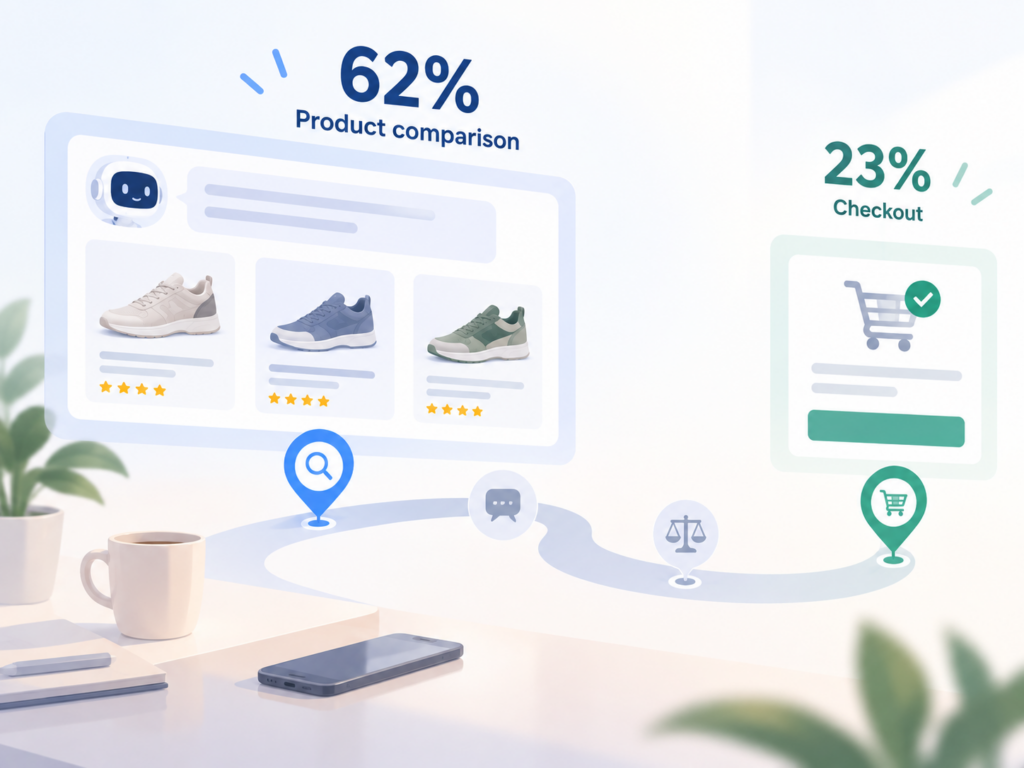
    The shift from “AI answers questions” to “AI processes transactions” is already underway. Industry sources report that ChatGPT is rolling out instant checkout capabilities in 2026, and Gemini is developing equivalent features. Sponsored placements within AI conversations are expected to follow.

    For pet care brands, this means AI visibility isn’t just about awareness anymore. Brands that don’t appear in AI recommendations will miss an entire new commerce channel. When a pet owner asks “order the best probiotic for my German shepherd” and AI completes the purchase without the owner ever visiting a website, the brands not in the recommendation set lose the sale completely.

    That makes measuring your current AI authority a baseline requirement, not an optional exercise.

    From a One-Time Check to Continuous AI Monitoring

    One Score Is a Starting Point. Tracking It Over Time Is the Strategy.

    Your Brand Authority Checker results tell you where you stand right now. But AI models update their training data, adjust ranking signals, and shift recommendations on a rolling basis. A score of 72 today could drop to 55 next quarter without any change on your end. A competitor that publishes a string of vet-reviewed content pieces could leapfrog you in AI recommendations within weeks.

    Topify‘s platform picks up where the free tool leaves off. The Comprehensive GEO Analytics dashboard tracks your authority, sentiment, and visibility scores continuously across ChatGPT, Perplexity, Gemini, and Google AI Overviews. You’ll see trend lines, get alerts when scores shift, and receive specific recommendations for what to fix.

    Here’s how the free check compares to the full platform:

    CapabilityFree Brand Authority CheckerTopify Platform
    Check frequencyOne-time snapshotContinuous daily/weekly monitoring
    AI platformsAggregated scorePer-platform breakdown (ChatGPT, Perplexity, Gemini, AI Overviews)
    Historical dataNoneFull trend history with alerts
    Competitor comparisonNot includedReal-time benchmarking against pet care competitors
    Action recommendationsGeneral directionSpecific, data-driven GEO optimization steps
    Team collaborationSingle userUnlimited team member access

    Every plan starts with a 7-day free trial, no credit card required. The Starter plan begins at $99/month.

    Conclusion

    Pet owners are asking AI for food recommendations, supplement advice, insurance comparisons, and grooming tips before they consult any other source. The brands that appear in those AI answers capture the consideration set. The brands that don’t, regardless of product quality, lose the opportunity before they know it existed.

    Start with a free Brand Authority Checker scan to see how AI currently perceives your pet care brand. Identify which of the four authority dimensions needs attention. Then decide whether you need a one-time fix or ongoing monitoring to stay visible as AI models evolve.

    While you’re assessing your brand authority, a few other free checks can round out the picture. Topify‘s GEO Score Checker evaluates whether AI crawlers can actually access your site and parse your content. The Prompts Researcherreveals the exact pet care questions your target audience is asking AI. And the AI Visibility Report shows how often your brand gets mentioned across major AI platforms.

    FAQ

    Is the Brand Authority Checker really free? Do I need to sign up? 

    Yes, it’s completely free with no signup required. Enter your brand name or domain, and you’ll get your four-score authority breakdown in about 60 seconds.

    What’s the difference between the free tool and the Topify platform? 

    The free Brand Authority Checker gives you a one-time snapshot of your AI authority scores. The Topify platform provides continuous monitoring, historical trend data, competitor benchmarking, per-platform breakdowns, and actionable optimization recommendations.

    How often should a pet care brand check its AI visibility? 

    At minimum, once per quarter. AI models update their training data and ranking signals frequently. Brands in competitive pet care categories (food, supplements, insurance) should consider continuous monitoring, as recommendation rankings can shift within weeks.

    Does ingredient transparency on my website affect my AI authority score? 

    Directly. AI models evaluate structured data around ingredient profiles, nutritional claims, and health certifications when deciding whether to recommend pet food and supplement brands. Brands with detailed, well-structured product pages tend to score higher on Expertise Depth and Trust Signals.

    Read More

  • AI Citation Tracking Software: What Actually Matters

    AI Citation Tracking Software: What Actually Matters

    Your team just spent three months building a content hub, earning backlinks, and watching your domain authority climb. Then someone on the growth team typed a product comparison prompt into ChatGPT and Perplexity. Three competitors showed up with clickable source links. Your brand didn’t.

    You know AI citations matter. You’ve probably even tried the manual route: typing prompts one by one, scanning for your domain, pasting results into a spreadsheet. But generative AI responses are probabilistic. They can shift by 40% to 60% across sessions for the exact same prompt. A brand might appear as the top cited vendor on Tuesday morning and vanish by Wednesday afternoon. Manual tracking isn’t just tedious. It’s statistically unreliable.

    The gap between knowing citations matter and actually measuring them at scale is where AI citation tracking software comes in.

    Most AI Citation Data Is Invisible Until You Track It with Software

    A backlink is a static HTML connection between two pages. It sits on the web permanently, gets crawled by bots, and shows up in any standard SEO dashboard. An AI citation is fundamentally different. It’s generated dynamically, in real time, based on a user’s prompt, the model’s training weights, and whatever retrieval architecture the engine uses at that moment.

    That distinction creates a massive blind spot. Because generative models operate inside closed conversational interfaces, they often don’t pass standard referral headers to analytics platforms like GA4. A B2B software brand might get cited hundreds of times a day in ChatGPT product comparisons, but that traffic shows up as generic “direct” visits in traditional dashboards.

    The scale of this blind spot is growing fast. ChatGPT now processes over 3 billion prompts monthly with 900 million weekly active users, a figure that doubled from 400 million in just one year. Perplexity handles over 780 million monthly queries with 200% year-over-year growth. Google AI Overviews trigger on roughly 30% of all US desktop searches, scaling to nearly 57% in complex B2B sectors like technology and education.

    Here’s the commercial kicker: visitors arriving through AI citations convert at 14.2%, roughly five times the 2.8% rate from traditional Google organic search. The AI model acts as a pre-qualifying intermediary. By the time someone clicks a cited source, they’ve already been walked through the comparison. Without an AI citation tracking tool to monitor this ecosystem, you’re invisible in the highest-converting segment of the modern funnel.

    What AI Citation Tracking Software Actually Measures

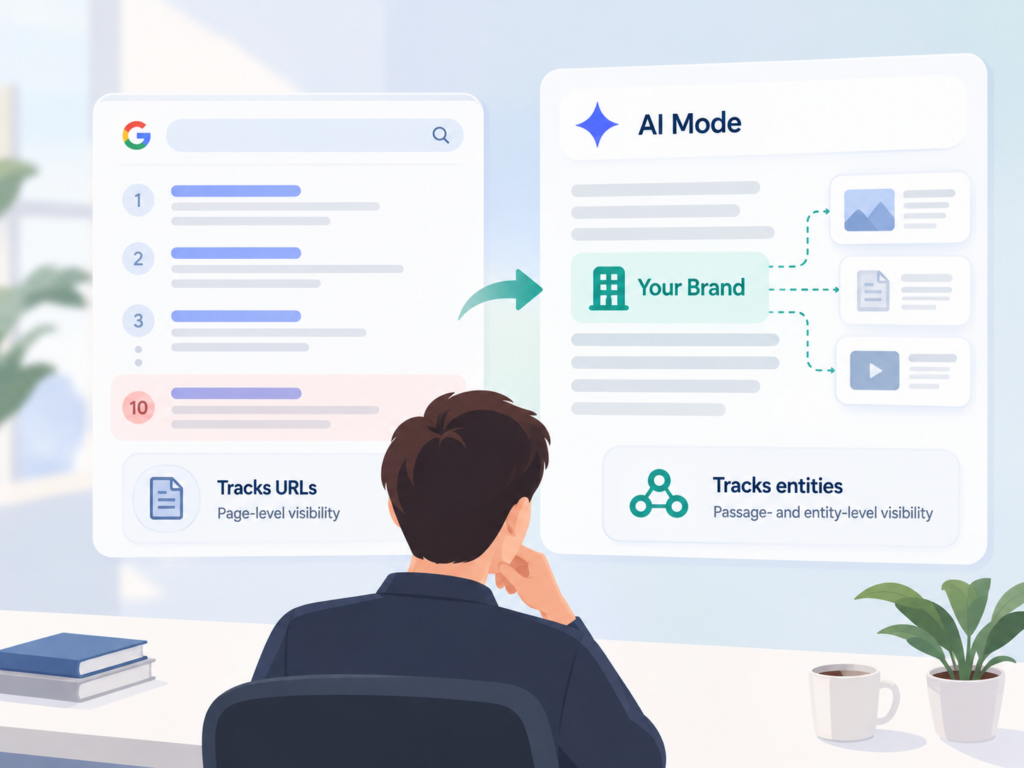
    Traditional rank tracking checks a URL’s static position on a search results page. AI citation tracking software deconstructs the anatomy of a probabilistically generated answer, where models typically cite only two to seven domains per response. Here are the core metrics that professional AI citation tracking platforms evaluate.

    Citation Share. This is the generative equivalent of market share. If an AI citation tracking tool runs a prompt 100 times across a week and your brand appears in 35 of those responses, your Citation Share is 35%. Because LLM outputs are volatile, this metric smooths out session-to-session noise and provides a reliable average.

    Source Domain Frequency. This measures how broadly an AI engine trusts your entire domain versus pulling from a single optimized page. High frequency signals strong “Entity Authority,” meaning the model treats your brand as a topical authority across the category, not a one-hit reference.

    Citation Position. The first citation in an AI response typically captures more than 60% of the total click share for that answer. Advanced AI citation tracking analytics monitor this positioning over time and flag when a competitor’s newly published asset pushes your content down the citation order.

    Prompt-Level vs. Brand-Level: The Granularity That Matters

    Brand-level tracking monitors how often an AI engine mentions a company name across a broad dataset. It’s useful for high-level sentiment analysis, but it won’t tell your demand gen team which specific content assets are winning high-intent buyer prompts.

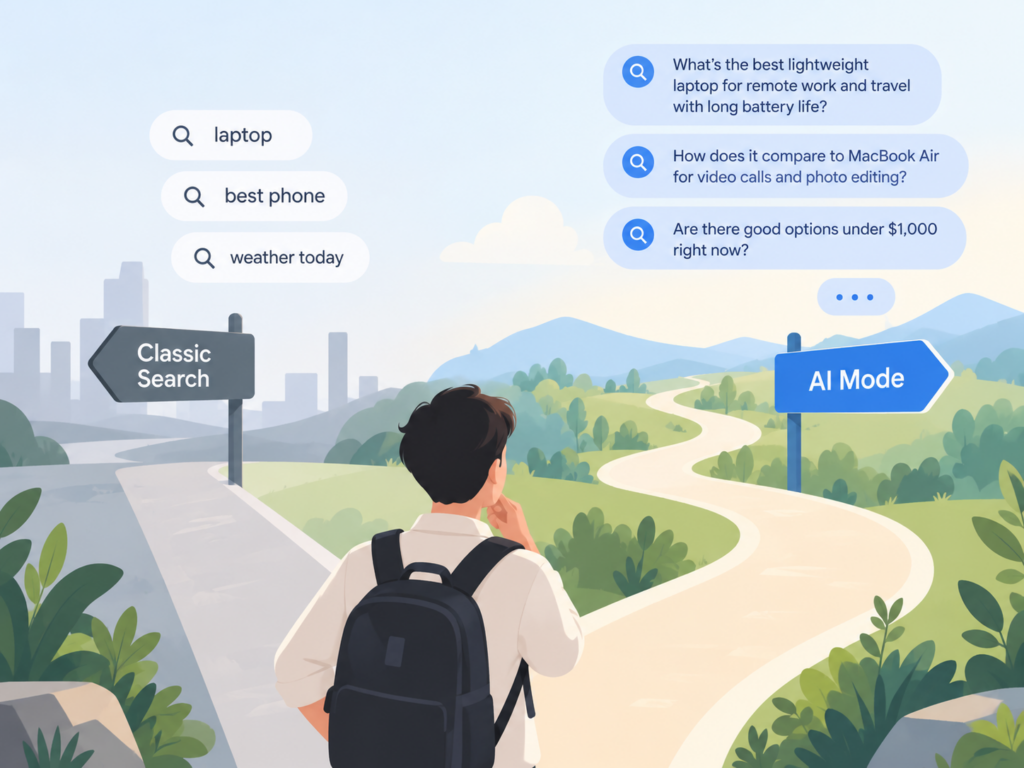
    Prompt-level tracking mirrors how real users actually interact with LLMs. Traditional search queries averaged around 3.4 words. The average AI prompt spans approximately 60 words, reflecting detailed, scenario-specific questions. An effective AI citation tracking solution records exactly which URL was selected to answer that specific long-tail prompt, letting you map content assets to buyer questions.

    Why One AI Engine Isn’t Enough

    Different AI platforms cite radically different sources. Reddit accounts for 46.7% of Perplexity’s top citations, while Wikipedia dominates 47.9% of ChatGPT’s top 10. Google AI Overviews lean heavily on YouTube, which captures roughly 23.3% of its citations, with 54% of its references overlapping with traditional top-20 organic results. ChatGPT also cites competitor brand domains 11.1 percentage points more frequently than Google search does.

    An AI citation tracking dashboard that only covers one engine gives you a dangerously partial picture.

    EngineTop Citation SourcesCitation Style
    ChatGPTWikipedia, Reddit, Competitor SitesEmbedded hyperlinks, reference cards
    PerplexityReddit (46.7%), Wikipedia, YouTubeNumbered footnotes tied to claims
    Google AI OverviewsYouTube (~23.3%), Reddit, WikipediaExpandable source chips, carousels

    5 Things That Separate Useful AI Citation Tracking Analytics from Dashboard Noise

    As more tools enter this space, the market is filling with surface-level dashboards that estimate AI visibility rather than measuring hard citation data. Here’s what separates the signal from the noise.

    Cross-platform coverage. Only 11% of domains are cited simultaneously by both ChatGPT and Perplexity, and up to 91% of AI citations appear in only a single engine. An AI citation tracking tool that monitors just one platform misses the vast majority of your generative footprint.

    Prompt-level granularity. If a tool only lets you input “CRM software” and returns a generic score, it fails to capture how AI search actually works. Professional tools track complex, intent-heavy conversational prompts because that’s where high-intent buyers research and where models rely on specialized citations.

    URL-level source decomposition. Being “mentioned” 50 times a week means nothing if you don’t know which URLs triggered those citations. Roughly 85% of brand mentions in AI search come from third-party pages like Reddit threads, G2 reviews, or publisher listicles rather than the brand’s own domain. A professional AI citation tracking system reveals the exact source URLs.

    Competitive benchmarking. If an AI model cites a direct competitor 23 times for a specific prompt cluster and cites your brand 3 times, your software should highlight that gap explicitly. Citation gap analysis is the foundation of any actionable GEO strategy.

    Prescriptive actionability. Data without a path to execution is dashboard noise. The strongest AI citation tracking analytics identify content gaps, flag decaying citation share in real time, and recommend structural changes, like adding comparison tables or restructuring paragraphs into 40-60 word answer blocks that LLMs favor during retrieval.

    How Topify‘s AI Citation Tracking System Maps Every Source AI Cites

    A common architectural flaw in basic AI trackers is their reliance solely on official AI platform APIs. While APIs provide fast data, they often return sanitized or truncated outputs that don’t match the rich, multimodal results real users see in web interfaces.

    Topify’s Source Analysis engine works differently. The platform uses browser-based simulation to replicate actual human queries across varied geographic locations, browser states, and device environments. It then parses the live HTML of the generative output, extracting citation cards, embedded links, and numbered footnotes exactly as an end-user would see them.

    Once the data is extracted, the AI citation tracking solution maps every identified URL against your content assets and designated competitor domains. This creates a visual “citation gap” view. For example, a marketing team analyzing their presence in a product category can instantly see that a competitor’s newly published whitepaper is capturing 80% of citations for a specific prompt in Perplexity, while their own domain is virtually absent.

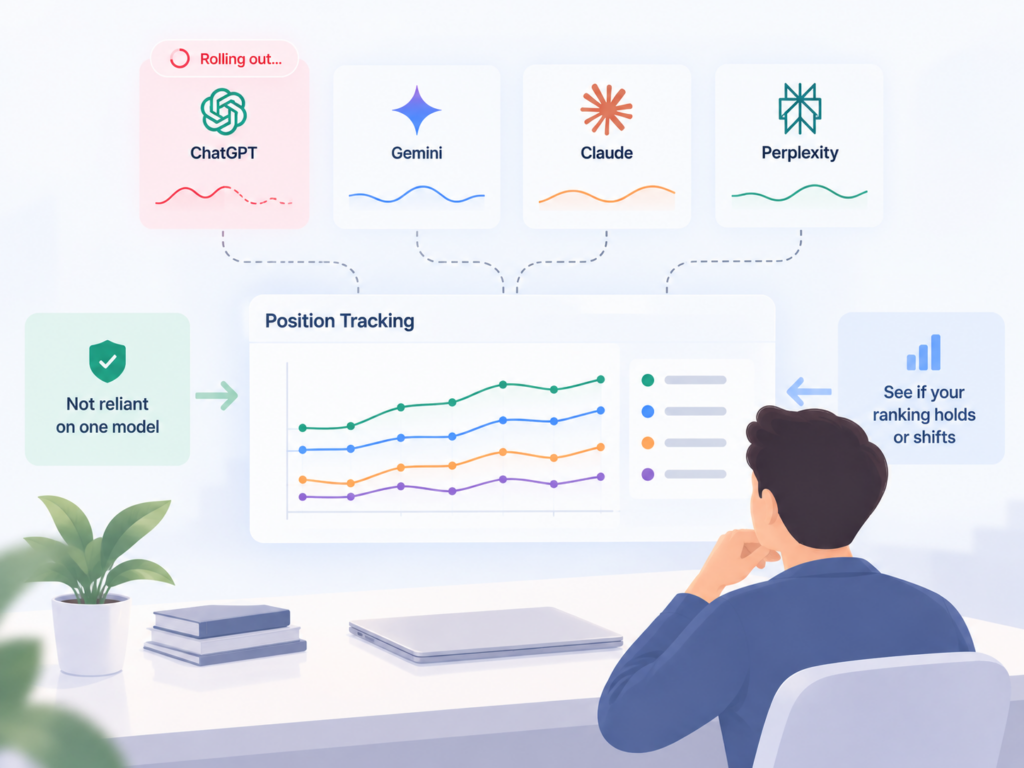
    Topify links this Source Analysis directly to a proprietary Visibility Score and real-time Position Tracking across ChatGPT, Perplexity, Gemini, DeepSeek, Doubao, Qwen, and other major platforms. When your citation share for a tracked prompt drops, the platform flags it automatically, whether the cause is stale content, a model update, or a competitor publishing a more authoritative asset.

    From a pricing perspective, Topify’s Basic plan starts at $99/month, covering up to 100 tracked prompts with 9,000 AI answer analyses and 4 project slots. The Pro plan at $199/month expands to 250 prompts, 22,500 analyses, and 8 projects. Both tiers include multi-seat access, making it accessible for smaller teams to establish a baseline and prove ROI before scaling. Enterprise plans start from $499/month with custom configurations and a dedicated account manager. Full details are on the Topify pricing page.

    Common Mistakes Teams Make with AI Citation Tracking Software

    Even with premium AI citation tracking software in place, teams frequently undermine their results with a few structural errors.

    Tracking only one AI engine. The citation overlap between ChatGPT and Perplexity is just 11%. A content strategy built to dominate Google AI Overviews might leave your brand completely invisible in Perplexity, which biases heavily toward real-time Reddit discussions and community validation. Configure your tracking to cover every engine your audience uses.

    Confusing mentions with citations. A mention is when an LLM includes your brand name in text. A citation is a clickable attribution, a footnote or hyperlinked domain tied to a specific URL. Mentions build awareness. Citations drive the 14.2% conversion rates. Your AI citation tracking dashboard needs to isolate clickable references from passive text mentions, or you’ll overestimate your actual referral potential.

    Running monthly reports in a volatile ecosystem. Traditional SEO ranking shifts slowly. AI citations don’t. Research shows 40% to 60% monthly variance in AI citation patterns, with only 30% of brands maintaining visibility from one answer to the next and a mere 20% surviving across five consecutive runs of the same prompt. Monthly snapshots are already obsolete by the time they’re generated. Configure daily or on-demand refreshes.

    Ignoring competitor citation data. AI models establish authority through triangulation. If ChatGPT consistently cites three competing vendors and all three have highly structured “Alternative To” comparison pages, you’ve just found the architectural blueprint you need to force the model to include you in the consideration set.

    A 30-Day Checklist for AI Citation Tracking Software

    Week 1: Define the tracking scope. Identify which AI engines matter most for your audience. Curate 50 to 100 conversational, high-intent prompts that mirror real buyer questions. Input 3 to 5 direct competitors to enable gap analysis from day one.

    Week 2: Establish the baseline. Run daily simulations to calculate your starting Citation Share. Analyze whether your visibility relies on your own domain, third-party review sites like G2 or Trustpilot, or community hubs like Reddit. Calibrate your dashboard to isolate clickable citations from passive mentions.

    Week 3: Run competitive gap analysis. Review the prompts where competitors consistently earn the top citation position, which captures over 60% of click share. Examine their content structures: are they using dense statistical data, answer blocks, or specific entity schema? Research shows content with consistent heading levels is 40% more likely to be cited.

    Week 4: Build the action plan. Identify pages that receive mentions but no hard citations, then restructure them with front-loaded answers, clear heading hierarchies, and verifiable statistics. If the data reveals massive citation gaps for comparison queries, brief your content team to create structured “Alternative To” pages. Set up automated alerts for citation share drops so your team can react before the gap widens.

    For teams ready to start, Topify’s free trial lets you build this baseline without a long-term commitment.

    Conclusion

    The shift from static search rankings to probabilistic AI citations isn’t a future trend. It’s the current reality, with 3 billion monthly prompts flowing through ChatGPT alone and AI-driven visitors converting at five times the rate of traditional organic traffic.

    The brands that win in this environment aren’t the ones with the most backlinks. They’re the ones with the most structured, credible, and consistently cited content across multiple AI engines. AI citation tracking software is what makes that visibility measurable, the gaps visible, and the optimization actionable. Start with a baseline, track across platforms, benchmark against competitors, and iterate weekly. That’s the playbook.

    FAQ

    Q: What is AI citation tracking software?

    A: AI citation tracking software monitors how generative AI platforms like ChatGPT, Perplexity, and Google AI Overviews reference specific brands, domains, or URLs in their generated responses. Unlike traditional SEO tools that track static backlinks, these platforms run real prompts across AI engines and extract dynamically generated footnotes, embedded links, and reference cards, providing analytics on citation share, source frequency, and competitive positioning.

    Q: How much does AI citation tracking software cost?

    A: Pricing varies by feature depth and prompt volume. Entry-level tools start around $29 to $39/month for basic monitoring. Mid-market platforms like Topify offer a Basic plan at $99/month and a Pro plan at $199/month with advanced Source Analysis and multi-project capabilities. Enterprise solutions typically start at $499/month and scale based on custom requirements like dedicated APIs and high-volume query processing.

    Q: How do you measure AI citation tracking performance?

    A: Focus on three core metrics: Citation Share (the percentage of tracked prompts where your brand receives a clickable reference), Citation Position (whether your URL appears first in the response, which captures over 60% of clicks), and Source Domain Frequency (how broadly the AI trusts your domain across topics). Layer in competitive gap analysis to benchmark these numbers against rivals across ChatGPT, Perplexity, and other engines.

    Q: What are the best tools for AI citation tracking in 2026?

    A: Topify is strong for URL-level Source Analysis and cross-platform browser simulation. Botric offers multi-LLM tracking with AI-agent automation. Profound targets enterprise teams needing deep conversational prompt analytics. For lightweight baseline monitoring, Otterly AI provides an affordable entry point. Traditional SEO platforms like Semrush are adding AI overview tracking, but currently offer less granular prompt-level citation intelligence than purpose-built GEO platforms.

    Read More

  • AI Citation Tracking: 7 Perplexity Rank Trackers That Show What AI Is Actually Citing

    AI Citation Tracking: 7 Perplexity Rank Trackers That Show What AI Is Actually Citing

    Your SEO dashboard says everything’s fine. Domain authority is climbing. Keyword rankings are stable. Then your CMO asks, “Are we showing up in Perplexity?” and you realize none of those numbers answer that question. Perplexity processed over 435 million monthly search queries by the end of 2025, grew to 45 million monthly active users, and is targeting one billion weekly queries by the end of 2026. That’s high-intent search traffic your current tools can’t see.

    The gap isn’t just a missing platform. It’s a missing measurement layer: AI citation tracking, the practice of identifying which URLs and domains generative engines actually reference when they build an answer.

    Most Perplexity Rank Trackers Only Show Half the Picture

    There’s a structural problem with how most “AI-ready” tracking tools work. They’ll tell you whether your brand was mentioned first, second, or third in a generated response. That’s position tracking. What they don’t reveal is which source the AI read, trusted, and cited to produce that response in the first place.

    That distinction matters more than it sounds.

    Perplexity doesn’t rank pages the way Google does. It runs a real-time retrieval-augmented generation system that bypasses traditional ranking signals in favor of entity clarity, factual density, schema completeness, and content freshness. Perplexity averages 7.1 citations per answer, pulling from 5 to 12 sources with explicit numbered references. Compare that to ChatGPT’s 2.8 and Gemini’s 4.2. Every answer is a live editorial decision, and the sources it selects are the ones that shape brand perception.

    Here’s where it gets urgent: content decay on Perplexity is aggressive. Content updated within the last two hours gets cited 38% more often than similar content published a month earlier. For time-sensitive queries, visible decay begins within just two to three days.

    If your tracking tool only confirms that your brand was mentioned but can’t tell you which URL earned that mention, you’re flying blind. You won’t know if the AI cited your product page, a competitor’s comparison article, or a three-year-old forum thread.

    Tools that only monitor Perplexity also miss the broader picture. ChatGPT, Gemini, DeepSeek, and Qwen all have different citation behaviors. A complete AI citation tracking protocol needs to bridge all of them.

    7 Best Perplexity Rank Tracking Tools for AI Citation Tracking

    Not all tracking platforms are built equally. Some cover a single model. Others reverse-engineer the full citation graph across multiple generative engines. Here’s a quick comparison of the leading perplexity rank tracking tools on the market.

    Tool NameAI Platform CoverageCitation TrackingPosition TrackingStarting Price
    TopifyPerplexity, ChatGPT, Gemini, DeepSeek, Doubao, Qwen, AI OverviewsYesYes$99/mo
    OmniaPerplexity, ChatGPT, Google AI Overviews, Google AI ModeYesYes€79/mo
    Scrunch AI8 Major Platforms including Perplexity, Claude, ChatGPTYesYes$250/mo
    Peec AIPerplexity, ChatGPT, Gemini, DeepSeek (115+ languages)YesYes$95/mo
    RankabilityPerplexityYesYes$199/mo
    Keyword.com10+ Models including Perplexity and MistralYesYes$24.50/mo
    Semrush (Add-on)Perplexity + 5 other platformsYesYes$99/mo add-on

    #1 Topify

    Topify is built specifically to reverse-engineer how large language models select, trust, and cite sources. It natively tracks Western models (ChatGPT, Gemini, Perplexity, Google AI Overviews) and Chinese models (DeepSeek, Doubao, Qwen), giving global brands a single pane of glass across the entire generative search ecosystem.

    The platform’s core advantage is its Source Analysis Engine. When a generative platform builds a response, Topify decomposes the citations to show which structural elements satisfied the model’s retrieval threshold: embedded comparison tables, hyper-specific data points, or semantic paragraph structures that matched the query. This goes well beyond checking whether a brand name appeared in the output.

    Topify organizes this data into a 7-Dimension Metric System: Visibility Score (mention frequency per 1,000 queries), Sentiment Quotient (brand framing on a 0 to 100 scale), Relative Positioning, Generative Search Volume, Mention Density, Intent Alignment, and Attributed Conversion Rate. You don’t just know if you’re mentioned. You know whether the AI positioned you as a top recommendation or a footnote alternative.

    On the action side, Topify’s Competitor Monitoring flags instances where rival brands are cited and yours isn’t, generating a quantified Visibility Gap score. Its One-Click Execution Layer proposes content improvements based on that gap data, so teams can move from insight to action without manual spreadsheet workflows.

    Pricing starts at $99 per month for 100 prompts across 9,000 AI answer analyses. For teams that need both the diagnostic depth and the execution layer, it’s the most comprehensive option on this list.

    #2 Omnia

    Omnia focuses on fast-growing startups and active content teams, starting at €79 per month. It tracks Perplexity, ChatGPT, and Google AI Overviews on a daily schedule with unlimited country and language support. Its standout feature is a strategic action layer that converts raw citation data into prioritized content tasks, bridging the gap between tracking and execution.

    #3 Scrunch AI

    Built for enterprise-grade security, Scrunch AI starts at $250 per month and holds SOC 2 Type II compliance with a zero data retention architecture. It monitors eight generative platforms using browser automation and APIs. Its unique Agent Traffic tracking correlates autonomous crawler activity (like PerplexityBot visits) on your site with subsequent citation shifts, offering diagnostic insight into how your content structure directly affects recommendations.

    #4 Peec AI

    Peec AI serves global brands needing multilingual coverage, executing daily synthetic prompts across more than 115 languages for $95 per month. It mechanically separates mere brand mentions from direct source citations, distinguishing between content that “informed” a model’s output and content that secured a clickable URL link. Native Google Looker Studio integration makes it agency-friendly for client reporting.

    #5 Rankability

    At $199 per month, Rankability targets SEO agencies looking to connect traditional metrics with generative visibility. Its Perplexity Analyzer logs citation lists and runs Citation Gap Analysis to highlight pages referencing competitors but omitting your brand. It bundles tracking with built-in content execution tools, including an autonomous writer and content optimizer.

    #6 Keyword.com

    Keyword.com offers the lowest entry point at $24.50 per month on a credit-based system. It monitors over ten models simultaneously, including Mistral alongside Perplexity. Its key differentiator is timestamped full-response snapshots, providing verifiable proof of when citations appeared and how surrounding sentiment shifted over time.

    #7 Semrush AI Visibility Toolkit

    For teams already using Semrush for traditional SEO, the AI Visibility Toolkit adds generative tracking as a $99 per month add-on. It monitors Perplexity alongside five other platforms and leverages Semrush’s 261-million prompt database for competitive benchmarking. It also includes a site audit feature designed to ensure your robots.txt and server configurations aren’t accidentally blocking AI retrieval crawlers.

    What Perplexity Rank Tracking Software Actually Measures

    Traditional SEO tools evaluate a linear output: where does a URL sit in a static list of blue links? Generative tracking measures something different: a probabilistic process that synthesizes sources in real time. Here are the four core dimensions the best perplexity rank tracker software captures.

    Position Rank tracks the exact order in which a brand appears within a synthesized response. Users overwhelmingly trust the first recommendation an AI provides. A brand buried under “other options” at the end of a paragraph is functionally invisible.

    Citation Share measures how often a generative model links to your specific domain or URL as a factual source. The distribution is steep: research into Google AI Overviews found that the top 1% of cited domains capture 47% of all citations. Pages using structured schema markup (FAQ, Article, HowTo) achieve a 2.3x higher citation inclusion rate than unstructured content.

    Visibility Score quantifies your brand’s total presence across a defined set of prompts. Benchmarking data tracked by Topify shows the average B2B software brand holds a visibility score of just 2.1%, while top performers reach 11.8%. Financial services brands average 14.1%. Healthcare sits at a low 1.2% due to algorithmic caution around medical claims.

    Sentiment Score evaluates whether the AI frames your brand positively, neutrally, or negatively on a 0 to 100 scale. High visibility with low sentiment (the model references your product but cites complaints or controversies) is arguably worse than low visibility.

    The Economic Case for AI Citation Tracking

    These metrics aren’t vanity numbers. Generative referral traffic converts at drastically higher rates than traditional organic search.

    An Ahrefs internal analysis found that generative visitors accounted for 0.5% of total sessions but drove 12.1% of signups, a 23x conversion rate. The Opollo 2026 Benchmark, covering 312 tech firms, reported generative referrals converting at 14.2% versus traditional search’s 2.8%. Microsoft Clarity data shows Copilot referrals convert B2B subscriptions at 17x the direct traffic baseline, while Perplexity drives 7x higher sign-up conversion. These visitors are 33% less likely to bounce and spend 45% more time on site.

    That’s why precise AI citation tracking is a revenue protection strategy, not a reporting exercise.

    How to Track Your Brand’s Perplexity Rankings in 3 Steps

    Step 1: Map Your Core Prompts

    Generative search runs on conversational queries, not two-word keyword fragments. The first step is identifying the exact prompts your target audience types into Perplexity and other AI platforms.

    Tools like Topify’s High-Value Prompt Discovery feature surface these prompts and score them using an Opportunity Score weighted by estimated query volume (30%), visibility gaps (25%), commercial intent signals (25%), and existing content readiness (20%). The goal is building a prompt matrix that covers every stage of the buyer’s journey, from “What is generative engine optimization?” to “Topify vs Semrush for AI search tracking.”

    Step 2: Establish a Baseline and Map Citation Gaps

    Once your prompt targets are set, run a diagnostic sweep to establish your current Visibility Score, Sentiment Quotient, and Citation Share across Perplexity and other models.

    The most valuable output here is the Citation Gap Analysis: identifying high-value commercial queries where competitors are cited but your brand is completely absent. Research shows that 52% of generative citations come from listicles, review articles, and structured product pages. If your brand is missing from a major industry roundup that AI models trust, that gap will show up clearly in the baseline data.

    Step 3: Monitor Continuously and Benchmark Competitors

    Static reports are useless in generative search. Roughly 80% of all citations come from content published within the last two to three years, and Perplexity’s algorithmic decay for time-sensitive topics kicks in within 72 hours.

    Configure your tracking tool for daily or weekly automated prompt execution. Platforms like Topify automate this loop, alerting your team if a competitor displaces your brand in a citation slot. If their frequency spikes, continuous monitoring lets you trace whether the cause was new schema data, fresh backlinks, or a press campaign, so you respond strategically instead of reactively.

    Why AI Citation Tracking Matters More Than Perplexity Rankings Alone

    Position rank tells you where you appeared. Citation tracking tells you why.

    When a user submits a prompt to Perplexity, the system doesn’t pull from a pre-indexed list. It decomposes the query into sub-intents, sweeps its real-time index, reads and reranks retrieved content, then synthesizes an answer with a citation attached to every verifiable claim. If a competitor’s content has better factual density, fresher timestamps, or stronger structural markup, the algorithm cites them instead. Your brand gets displaced regardless of traditional keyword rankings.

    The data backs this up. An Ahrefs analysis of 4 million URLs found that only 38% of URLs cited in AI Overviews also appeared in the top 10 organic results for the same query. BrightEdge reported an even lower overlap of roughly 17%. Domains with a Domain Authority of 60 or higher get cited four times more frequently, but even high-authority sites get skipped if their content lacks the entity clarity and structured data that models need for extraction.

    That’s the core argument for citation tracking over rank tracking. A rank tracker tells you that your brand disappeared from a response. A citation tracker tells you that the model replaced your outdated whitepaper with a competitor’s freshly published, schema-optimized data study. One observation is passive. The other is actionable.

    Conclusion

    The shift from static search rankings to AI-generated answers is the largest structural change in digital discovery in two decades. Traditional rank trackers can’t identify the source URLs, sentiment framing, or content decay cycles that define how Perplexity and its peers construct answers.

    To stay visible, adopt a full AI citation tracking protocol. Measure citation share. Monitor sentiment. Map prompt visibility gaps. Start with Perplexity, but don’t stop there. Platforms like Topify provide cross-platform coverage spanning ChatGPT, Gemini, DeepSeek, and beyond, so your brand earns the citations that keep it visible.

    FAQ

    Q: What is the best free perplexity rank tracker tool?

    A: Enterprise-grade AI citation tracking typically requires paid infrastructure for large-scale synthetic prompt execution. That said, accessible starting points exist. Omnia offers a 14-day free trial on its Growth plan (no credit card required) plus a free AI Visibility Checker that runs 40 prompts across four generative engines. Topify provides a free real-time AI Visibility Checker that returns mention frequencies and sentiment breakdowns without upfront cost. For budget-conscious teams, Keyword.com starts at $24.50 per month on a credit-based model.

    Q: How often should I check my Perplexity rankings?

    A: At minimum, daily. Perplexity heavily rewards content recency, with visible algorithmic decay for time-sensitive queries starting within two to three days. Content updated within the last two hours is cited 38% more often than similar content published a month prior. Brands in competitive or fast-moving sectors should configure automated daily monitoring to catch citation shifts before visibility collapses.

    Q: Can traditional SEO tools track Perplexity rankings?

    A: Some can, with limitations. Semrush offers an AI Visibility Toolkit ($99/mo add-on) and Ahrefs has a Brand Radar feature ($199/mo). But these are built on databases designed for traditional SERP scraping and often rely on proxy metrics to estimate LLM behavior. For URL-level citation analysis, sentiment tracking, and autonomous optimization, purpose-built perplexity rank tracking tools deliver more actionable data.

    Q: What’s the difference between AI citation tracking and rank tracking?

    A: Rank tracking measures the ordinal position of a brand in a generated response (listed first, third, or fifth). AI citation tracking traces the specific source material the model used to generate that response: the exact URL, domain, or data point it referenced. A site can hold the number one organic ranking but have zero citation share if the model prefers a competitor’s structured, extractable content.

    Read More

  • AI Search Presence: What It Means and How to Build It

    AI Search Presence: What It Means and How to Build It

    Your domain authority is solid. Your keywords rank on page one. Your marketing team is confident the top-of-funnel is covered.

    Then a prospect opens ChatGPT, asks for the best solution in your category, and the model generates a detailed, multi-paragraph recommendation. Five brands get named. Yours isn’t one of them.

    That’s the gap most teams don’t see until it’s already costing them pipeline. Google rankings measure how well a crawler indexes your pages. They say nothing about whether a Large Language Model chooses to mention your brand when a buyer asks a direct question. And with Gartner projecting a 25% decline in traditional search engine volume by the end of 2026, the audience that used to find you through blue links is migrating fast.

    Why Google Rankings Don’t Tell You If AI Knows Your Brand

    Traditional SEO metrics, like Domain Authority, backlink profiles, and keyword rankings, were built to measure crawler behavior. A search engine retrieves a ranked list of documents matching keyword strings and uses external signals like domain age and inbound links to determine placement. Success means earning a click-through to your website.

    AI search works on a completely different architecture. When a user queries ChatGPT or Perplexity, the model doesn’t retrieve a list of links. It accesses foundational training data, queries vector databases for semantic relevance, fetches multiple sources, evaluates them for factual density, and synthesizes a new conversational response. Your brand either gets selected into that response, or it doesn’t. Keyword density alone won’t get you there. The model needs semantic richness, factual grounding, and third-party validation.

    The migration numbers make this urgent. By February 2026, ChatGPT reported 900 million weekly active users, up from 300 million in December 2024. Monthly visits stabilized above 5.35 billion, and 92% of Fortune 500 companies actively use the platform. Perplexity AI reached roughly 45 million monthly active users by early 2026, processing about 780 million queries per month.

    Here’s what that means in practice: when a buyer gets a full, synthesized answer inside the AI interface, they don’t click through to a traditional search result. If your brand isn’t part of that answer, you’ve effectively disappeared for that segment of the market.

    What AI Search Presence Actually Measures

    AI search presence is the degree to which a brand gets mentioned, cited, accurately positioned, and recommended within AI-generated answers to relevant queries. It’s a shift from measuring clicks to measuring conversational influence. The discipline built around this measurement is called Generative Engine Optimization (GEO), and the analytical layer supporting it is AI search analytics.

    Topify has formalized this into a seven-metric framework that captures the full picture of generative visibility:

    Visibility measures the cross-platform mention rate: what percentage of category-level queries include your brand in the output. Sentiment evaluates how the AI frames you, scored on a scale where 50 is neutral. Being mentioned negatively is worse than not being mentioned at all.

    Position tracks where your brand lands in comparative lists. Because of the serial position effect in human cognition, appearing as the first recommendation in the opening paragraph carries exponentially more commercial weight than being buried in a list of alternatives. AI Volume measures how many users are actually asking AI platforms about topics relevant to your brand, distinct from traditional search volume.

    The deeper differentiators are Source Coverage (which domains the AI cites when discussing your brand), Intent Alignment (whether the AI matches your brand to the correct buyer persona), and Conversion Visibility Rate (CVR), which estimates downstream commercial impact. AI-referred visitors convert at 14.2%, compared to 2.8% from traditional organic search. That’s a 5x difference that most marketing teams aren’t tracking yet.

    DimensionTraditional SEOAI Search Presence (GEO)
    Primary ObjectiveSecure top SERP rankings, drive clicksEarn mentions, recommendations, and citations inside AI answers
    Core MeasurementKeyword Rank, DA, CTRVisibility Rate, Position Index, Sentiment Score, Intent Alignment
    Algorithmic FocusKeyword density, crawlability, backlinksSemantic entity coverage, fact density, RAG authority
    Content StrategyTargeting isolated keyword volumesSemantic mapping for conversational prompts
    Authority SignalsInbound links from other websitesFact-density, structured schema, multi-source consensus
    Success OutputUser clicks through to your websiteUser receives a trusted recommendation directly from the AI

    5 Signals That Your AI Search Presence Is Weak

    Most marketing teams assume their SEO dominance carries over to AI search. It doesn’t. These five signals indicate a systemic gap in your AI visibility strategy.

    Signal 1: You’re Missing from Category Recommendations

    Open ChatGPT, Gemini, and Claude. Type a broad, early-stage buyer question for your category. If your brand doesn’t appear in the primary recommendation list across multiple generations, the model lacks the semantic associations to connect your brand entity to the category entity. Build a matrix of 10-15 buyer questions and test systematically.

    Signal 2: AI Describes Your Brand Wrong

    Your brand gets mentioned, but the AI hallucinates your value proposition. A premium enterprise platform gets described as a “budget tool for freelancers.” This means your owned content lacks the structural clarity required for accurate extraction, or outdated external chatter is overpowering your current messaging. Prompt the AI with specific questions about your features and target audience, then compare the output against your positioning documents.

    Signal 3: Competitors Dominate the Conversation

    AI visibility is functionally zero-sum for Share of Voice. If comparative queries produce multi-paragraph analyses of a competitor’s features while your brand gets a single vague sentence, they’ve built superior AI authority. This typically happens when competitors have denser integrations on review platforms or higher engagement on consensus nodes like Reddit.

    Signal 4: AI Never Cites Your Actual Website

    The AI recommends your brand but exclusively cites Reddit threads, Wikipedia articles, or review aggregators, never your actual domain. This means your website lacks the answer-first formatting, FAQ structures, or structured data markup needed for RAG ingestion. Test this on Perplexity (which shows sources) with specific factual prompts about your product.

    Signal 5: Zero AI Volume on Topics You Own

    You launch a major feature. AI analytics register zero related queries. The digital ecosystem doesn’t have enough conversational triggers to prompt user inquiries about it. Cross-reference your product launches against AI prompt volume data. Silence in the AI ecosystem means your top-of-funnel seeding strategy needs immediate recalibration.

    How to Build AI Search Presence from Scratch

    Fixing these gaps requires a four-step methodology: Audit, Monitor, Optimize, Scale. No shortcuts, no singular patches.

    Step 1: Run a Baseline Audit

    Before changing anything, establish your current Share of Model. Query your category, brand name, and primary competitors across ChatGPT, Perplexity, Gemini, and Claude using a matrix of early-buyer intent questions. Document where you appear, the sentiment of each appearance, and which third-party URLs the AI cites. If ChatGPT consistently relies on a specific set of Reddit threads to answer category queries, those domains become immediate targets for your digital PR team.

    Step 2: Set Up Continuous AI Search Monitoring

    Manual audits are static. AI search results are not. A brand’s citation share can sit at 60% one week and collapse to 10% the next if a platform changes its data sourcing, a phenomenon observed when Reddit’s citation share on ChatGPT dropped sharply in late 2025.

    This is where AI search intelligence platforms become non-negotiable. Topify automates continuous tracking across the full seven-metric framework, across multiple engines, geographies, and languages. Sudden algorithmic shifts or competitor moves get flagged instantly, not weeks after the damage. Checking these metrics less than bi-weekly leaves your team strategically blind.

    Step 3: Optimize Content for AI Extraction

    Earning AI citations requires content re-engineered for machine scannability. The foundational GEO study from Princeton University evaluated 10,000 queries and proved that traditional keyword stuffing actively harmed AI visibility, causing a 10% degradation. LLMs prioritize dense, logically structured, well-cited content.

    The tactics that actually work:

    Authoritative citations are the single most powerful lever. Princeton’s data showed a 115.1% visibility lift for lower-ranked pages that added inline references to third-party sources. Statistics addition, meaning specific, attributed numerical data injected into the text, dramatically improves performance in factual categories. Answer-first formattingmatters because AI synthesis models prioritize the top of a document: provide direct, factual answers within the first 40 to 60 words, backed by FAQ schema markup.

    Step 4: Scale Beyond Your Own Domain

    Optimizing owned content is necessary but not enough. A 2025 University of Toronto study found that AI search engines returned 81.9% earned media compared to just 18.1% brand-owned content. AI engines are trust proxies. They’re inherently skeptical of self-published marketing claims.

    The 5W Citation Source Audit of Q1 2026 quantified this further: Wikipedia and Reddit together account for over 25% of all ChatGPT citations in the US, outperforming traditional media outlets. YouTube visibility correlates at 0.737 with overall AI visibility. Scaling means establishing active presences on Reddit, review platforms like G2 and Capterra (which provide a 3x multiplier to citation rates), and YouTube, then extending that optimized presence across multiple AI platforms simultaneously.

    What an AI Visibility Platform Should Track for You

    The complexity of multi-engine tracking, regional variation, and real-time RAG volatility makes manual GEO execution unsustainable at scale. Traditional SEO tools weren’t built for this. You need a purpose-built AI visibility platform.

    The difference between basic tools and full-stack platforms:

    CapabilityBasic AI Visibility ToolsFull-Stack Platforms like Topify
    Tracking ScopeManual spot-checks, single engineAutomated tracking across 5+ engines
    Metric DepthBinary appearance (Yes/No)7-metric framework (Visibility, Sentiment, Position, Volume, Mentions, Intent, CVR)
    Citation IntelligenceNot includedSource Analysis: reverse-engineers exact URLs driving AI citations
    Competitive BenchmarkingStatic, single brandDynamic competitor tracking with real-time Share of Voice
    ActionabilityManual interpretationOne-Click Execution: generates schema-rich content blocks from identified gaps

    Topify’s Source Analysis is the feature that separates tracking from intelligence. Knowing you were mentioned isn’t enough. Topify maps exactly which third-party domains the AI relied on for that mention: a specific Reddit thread, a G2 review, an industry journal. Combined with Competitor Monitoring, if a rival is dominating Share of Voice, you can see exactly which external sources are driving their success and mount a targeted response.

    The platform also bridges analytics and execution. When a visibility gap surfaces, Topify’s One-Click Execution generates optimized, schema-rich content blocks (answer-first FAQs, statistics-dense proof points tailored for RAG systems) and pushes them toward your CMS or content pipelines.

    On pricing, Topify’s structure reflects how teams actually scale AI search optimization. The Basic plan starts at $99/month, covering ChatGPT, Perplexity, and AI Overviews tracking with 100 prompts and 9,000 AI answer analyses. The Pro plan at $199/month expands to 250 prompts and 22,500 analyses. Enterprise pricing starts at $499/month with custom configuration. This makes continuous daily monitoring, the only real defense against generative engine volatility, financially viable for teams at every stage.

    Ready to see where your brand stands? Get started with Topify and run your first AI visibility audit today.

    Conclusion

    The shift from indexing to conversational synthesis isn’t a future trend. It’s the current state. With ChatGPT at 900 million weekly users and traditional search volume in structural decline, relying on Domain Authority and keyword rankings alone is a direct path to invisibility.

    AI search presence is the core of modern top-of-funnel discovery. LLMs favor dense, statistically grounded, structured content. They heavily weight earned media over brand-owned claims. Building presence means auditing your current AI visibility, deploying continuous monitoring across the seven core metrics, re-engineering content for machine extraction, and scaling your footprint on the platforms AI actually trusts. Start the audit. Shift from clicks to citations. The brands that move now will be the ones AI recommends tomorrow.

    FAQ

    Q: What’s the difference between AI search presence and traditional SEO rankings?

    A: Traditional SEO rankings measure how well a web crawler indexes a page and places it within a list of blue links, using keyword matching and backlink profiles. AI search presence measures whether a generative model retrieves your brand’s data, understands its semantic relevance, and actively synthesizes it into a conversational answer. SEO optimizes for human clicks. GEO optimizes for machine extraction and AI citations.

    Q: How often should I monitor my brand’s AI search presence?

    A: AI models fetch information in real-time through RAG architecture and continuously update their weights, making citation patterns inherently volatile. For priority commercial topics, tracking should happen daily or at minimum bi-weekly. Monthly or quarterly spot-checks leave teams blind to rapid algorithmic shifts. AI visibility platforms like Topify automate this continuous monitoring across multiple engines.

    Q: How much does AI search optimization cost?

    A: GEO costs split between software tracking and execution. Entry-level AI visibility tools start around $99/month (Topify’s Basic tier covers 100 prompts with content generation credits). Mid-tier plans run $199/month for expanded prompt tracking and analysis capacity. Enterprise solutions with custom LLM tracking operate on custom pricing from $499/month. Execution costs depend on internal resources needed to restructure content and the PR investment required to earn third-party citations on trusted platforms like Reddit, G2, and industry publications.

    Q: Which AI platforms should I track for AI search presence?

    A: At minimum, monitor ChatGPT (the volume leader at 900M weekly active users), Perplexity (the leading dedicated AI search engine at 45M MAU), Google’s Gemini and AI Overviews, and Anthropic’s Claude. If your brand operates globally or targets Asian markets, track regional LLMs like DeepSeek, Doubao, and Qwen. Topify covers all major platforms in a single dashboard.

    Read More

  • ChatGPT SEO Rank Tracking: 5 Tools That Show Where You Actually Stand

    ChatGPT SEO Rank Tracking: 5 Tools That Show Where You Actually Stand

    Your domain authority is 70. Your keyword rankings look solid. But when a prospect asks ChatGPT, “What’s the best tool in your category?” your brand doesn’t show up. Not on position five. Not mentioned at all.

    That’s the gap most SEO teams can’t quantify yet. 80% of the URLs that ChatGPT and other LLMs cite don’t even rank in Google’s top 100 results for the same query. And with ChatGPT now reaching 900 million weekly active users, up 125% from 400 million just a year earlier, the audience your brand is invisible to is growing fast.

    Most ChatGPT SEO Rank Trackers Don’t Actually Track Rankings

    Search “ChatGPT SEO tool” and you’ll find dozens of platforms marketing themselves as AI-powered SEO solutions. Here’s the problem: the vast majority of them are content generation wrappers. They use OpenAI’s API to draft blog posts or rewrite meta descriptions. They don’t track whether ChatGPT actually mentions your brand when someone asks a relevant question.

    That distinction matters more than it sounds.

    Traditional SEO rank tracking scrapes a search results page and tells you where your link sits in a list. ChatGPT SEO rank tracking is fundamentally different. There’s no “Page 2” in a generative answer. Your brand is either cited in the response, or it’s completely invisible to the user.

    The data backs this up. Pages ranking first on Google capture 27.5% of human clicks but only a 10% citation rate from ChatGPT. Pages buried at position 10, which get a negligible 2.5% of clicks, still manage a 4% ChatGPT citation rate. Google rankings and LLM citations follow different logic entirely.

    What makes this even harder to manage is citation drift. A 17-week study analyzing 82,619 prompts across six markets found that ChatGPT replaces 74% of its cited domains every single week. The platform typically cites only 3 to 4 sources per response, so that weekly rotation creates extreme instability. If your brand is cited today, it’s statistically likely to disappear from that answer within weeks unless your content is actively maintained.

    That’s the core case for dedicated chatgpt seo rank tracking tools: not just knowing you’re visible, but catching the moment you stop being visible before it hits your pipeline.

    What Separates a Real ChatGPT SEO Rank Tracking Tool from a Dashboard with AI Labels

    Not every platform that claims “AI visibility” is actually measuring what matters. To find the best chatgpt seo rank tracking software, you’ll want to evaluate vendors against five specific capabilities.

    AI platform coverage. ChatGPT isn’t the only place your audience searches. Developers use Perplexity and Claude. General consumers hit Google AI Overviews and Gemini. Here’s the kicker: Google AI Mode and ChatGPT Search cite entirely different domains 87.5% of the time for the same prompt. A tool that only covers one platform gives you a dangerously incomplete picture.

    Prompt-level tracking. Users don’t type keywords into ChatGPT. They write detailed, multi-constraint prompts like “What’s the best CRM for a 15-person agency that integrates with Slack?” Your chatgpt seo rank tracking software needs to simulate and monitor these natural language queries at scale, not just track static keywords.

    Position vs. mention. Being mentioned and being recommended first are very different outcomes. A binary “mentioned / not mentioned” metric misses competitive nuance. The tool should calculate your position rank relative to competitors within each response.

    Citation source analysis. Knowing that ChatGPT recommended your brand is the starting point. Understanding why is the optimization lever. The tracker should reverse-engineer the AI’s footnotes to identify which third-party domains (G2 reviews, Reddit threads, niche directories) fed the LLM its information.

    Update frequency. With 74% of ChatGPT’s sources rotating weekly, a tool that refreshes monthly is delivering stale data. Daily or weekly tracking is the minimum viable cadence for catching visibility drops before they compound.

    One more data point worth noting: over 76% of ChatGPT’s top-cited pages were updated within the last 30 days. Freshness isn’t optional in this space.

    #1 Topify: Full-Spectrum ChatGPT SEO Tracking Across 7+ AI Platforms

    Topify was built from the ground up as a Generative Engine Optimization platform, not retrofitted from a traditional SEO tool. That architectural difference shows up in how it handles tracking, analysis, and execution.

    The platform monitors brand visibility across ChatGPT, Perplexity, Google Gemini, Google AI Overviews, DeepSeek, Doubao, Qwen, and Claude. It translates unstructured LLM responses into four trackable signals:

    Visibility Score calculates the percentage of AI responses that mention your brand across category-relevant prompts. The average unoptimized brand sits at roughly 0.3% AI visibility. Optimized brands push that to 12% or higher.

    Position Rank maps where your brand lands in the AI’s recommendation sequence. First recommendation versus fourth alternative, tracked over time.

    Sentiment Score (0-100) runs secondary NLP processing on the AI’s description of your brand. If ChatGPT mentions you but describes your product as “expensive and difficult to implement,” Topify flags the perception issue so your content team can correct the narrative.

    AI Volume estimates monthly query frequency for specific topics across AI platforms, giving you the generative equivalent of traditional search volume.

    How Topify Tracks ChatGPT Rankings at the Prompt Level

    Unlike keyword-based tools, Topify’s tracking simulates the way real users interact with LLMs. Consider a B2B SaaS company tracking visibility for project management software. Instead of monitoring the keyword “project management,” you’d input prompts like, “Act as a CTO for a 50-person remote agency. What’s the best project management tool that integrates with Slack and GitHub?”

    Topify deploys these prompts to ChatGPT, parses the response in real time, extracts recommended entities, maps footnote citations, and plots your positional ranking over time. You can see exactly when your brand dropped out, which competitor replaced you, and which underlying source triggered the shift.

    The execution side is where Topify pulls ahead of pure-tracking platforms. Once you spot a visibility gap, the One-Click GEO Execution feature analyzes the URLs that LLMs are currently citing and generates the specific content (comparison tables, structured data, definitional paragraphs) needed to fill the semantic gap. Review it, deploy it, done.

    Pricing starts at $99/month for the Basic plan (100 prompts, 9,000 AI answer analyses, 4 projects) and $199/month for Pro (250 prompts, 22,500 analyses). Enterprise plans with managed execution start from $499/month. You can get started here.

    #2 to #5: Other ChatGPT SEO Rank Tracking Tools Worth Knowing

    While Topify offers the most complete tracking-to-execution loop, several other platforms serve specific use cases well.

    #2 Semrush AI Search Visibility Checker. Semrush has integrated AEO tracking into its existing platform, pulling from a database of over 200 million prompts across ChatGPT, Gemini, Perplexity, Copilot, Grok, and AI Overviews. The biggest draw is ecosystem integration: if your team already lives in Semrush for traditional SEO, blending SERP data with AI visibility metrics happens in one workflow. Plans start around $139 to $165/month. The trade-off is that actionable GEO recommendations tend to stay surface-level compared to dedicated platforms.

    #3 Profound. An enterprise-grade analytics platform tracking visibility across 10+ LLMs, including ChatGPT, Perplexity, Google AI Mode, Gemini, Copilot, Meta AI, Grok, DeepSeek, and Claude. It offers unique features like prompt fanout analysis and shopping-specific ChatGPT query tracking. Starts at $99/month for ChatGPT-only; multi-engine tracking pushes to $399/month and up. Built for large organizations managing complex, multi-brand data sets.

    #4 Peec AI. A streamlined citation tracker focused on ChatGPT, Perplexity, and Google AI Overviews. It delivers polished competitor benchmarking reports and sentiment analysis at an accessible price point (starting at €89/month for 25 prompts). The catch: it’s tracking-only, with no built-in content optimization or GEO execution features.

    #5 Athena (AthenaHQ). Designed for marketing agencies offering GEO as a client service. Tracks ChatGPT, Perplexity, AI Overviews, Gemini, Claude, and Grok with an integrated “Action Center” for content briefs and strategic recommendations. Starts at $295/month with no free trial. Lacks prompt volume data, which limits prioritization.

    PlatformStarting PriceChatGPT TrackingAI OptimizationBest For
    Topify$99/moYesFull execution and schemaGrowth teams, brands
    Semrush AIO$139/moYesSurface-level briefsExisting Semrush users
    Profound$99/moYesContent agentsEnterprise orgs
    Peec AI€89/moYesNone, tracking onlyStartups, beginners
    Athena$295/moYesContent briefsMarketing agencies

    How to Start Tracking Your ChatGPT SEO Rankings Today

    You don’t need to overhaul your entire content strategy on day one. Start with these four steps.

    Step 1: Map your core prompts. Identify 50 to 100 natural language queries your target buyers would type into ChatGPT. Focus on MOFU, comparative prompts (“Compare pricing and features of Brand X versus Brand Y”) rather than broad informational queries. These high-intent prompts are where visibility translates directly into pipeline.

    Step 2: Run a baseline audit. Input those prompts into a tracking platform and categorize the results: prompts where your brand is invisible, prompts where you’re in the volatile citation carousel, and prompts where you’re anchored in the stable core. This baseline tells you exactly where to focus.

    Step 3: Set up continuous monitoring. A one-time audit isn’t enough when ChatGPT rotates 74% of its sources weekly. Configure daily or weekly tracking so your team gets alerted the moment your recommendation position slips.

    Step 4: Analyze citation sources and act. When visibility drops, dig into which domains the AI started citing instead of yours. If a competitor published a statistics-heavy guide that displaced your content, you’ll know exactly what to build. Research from Princeton, Georgia Tech, and IIT Delhi found that specific GEO methods, like adding statistical data, expert quotations, and answer-first content architecture, can improve AI visibility by up to 40%.

    Visitors arriving through AI citations tend to convert at roughly 4x the rate of traditional organic traffic. The ROI case for tracking isn’t theoretical.

    For teams looking to audit their current AI visibility without a subscription, Topify’s free GEO tools offer a useful starting point.

    Conclusion

    The gap between Google rankings and ChatGPT visibility isn’t closing. It’s widening. Gartner projects a 25% decline in traditional search query volume by end of 2026, and the data already shows that 80% of what LLMs cite has nothing to do with your SERP position.

    ChatGPT SEO rank tracking isn’t a nice-to-have analytics layer. It’s the only way to know whether nearly a billion weekly users can find your brand when they ask an AI for a recommendation. Pick a tool that tracks at the prompt level, covers multiple AI platforms, and gives you the execution path to act on what the data reveals. The brands that build this feedback loop now won’t just maintain visibility. They’ll compound it.

    FAQ

    Q: What is ChatGPT SEO rank tracking?

    A: It’s the process of monitoring how often and in what position your brand appears in ChatGPT’s generated answers. Unlike traditional SEO, which tracks your link position on a search results page, ChatGPT rank tracking measures AI visibility (share of voice), recommendation position, sentiment (how positively the AI describes you), and citation sources (which websites informed the AI’s answer).

    Q: Can you actually track your brand’s position in ChatGPT answers?

    A: Yes. GEO platforms like Topify simulate hundreds of industry-relevant prompts against ChatGPT daily, then use NLP to parse the response, extract brand entities, and calculate where your brand landed in the recommendation sequence relative to competitors.

    Q: What’s the best chatgpt seo rank tracking software for small teams?

    A: Topify ($99/month) tends to offer the strongest balance of prompt-level tracking and built-in GEO execution for small teams. Its One-Click Execution feature helps teams that don’t have dedicated GEO specialists draft the structured content needed to improve rankings. Peec AI (€89/month) is a more affordable, tracking-only option for teams that just need basic citation monitoring.

    Q: How often do ChatGPT rankings change?

    A: Frequently. A 17-week study of 82,619 prompts found that ChatGPT rotates 74% of its cited domains every week. That means your brand can disappear from a recommendation within days if the underlying content goes stale. Continuous tracking and regular content refreshes (product pages monthly, data guides quarterly) are the only reliable way to maintain stable AI visibility.

    Read More

  • AI Answer Optimization: 7 ChatGPT Rank Trackers Tested

    AI Answer Optimization: 7 ChatGPT Rank Trackers Tested

    Your domain authority is solid. Your keyword rankings haven’t budged in months. Then you ask ChatGPT for a recommendation in your own category, and your brand doesn’t appear anywhere in the answer. You run the same prompt again two days later, and this time you’re mentioned, but buried below a competitor you’ve never heard of.

    That gap between what Google says about your visibility and what AI actually says about your brand is where most optimization efforts break down. Without a way to measure what’s happening inside generative responses, you’re shipping fixes into a system that can’t tell you if anything changed.

    Most AI Answer Optimization Starts Without a Baseline. That’s the First Mistake.

    The most common failure in AI answer optimization isn’t bad content or weak authority. It’s skipping the measurement step entirely.

    Most teams jump straight into restructuring entity data, updating schema markup, and rewriting product pages for LLM extractability. Three months later, they’ve got no historical data to prove whether any of it worked. That’s not a strategy. It’s guesswork.

    The stakes are higher than most realize. Roughly 80% of consumers now rely on AI-generated results for at least 40% of their queries, and 60% of all searches currently end without a single click to a website. When AI overviews appear, organic click-through rates drop by 61%. Operating without a baseline in this environment means you can’t calculate ROI on any optimization campaign, period.

    There’s a subtler problem, too. Cross-platform tracking reveals that approximately 73% of AI citations link to a domain without ever naming the brand in the response text. The AI extracts your data but delivers zero brand equity back to you. Without a baseline, you can’t even tell whether your ghost citation rate sits at a manageable 40% or a critical 85%.

    The correct starting point is a closed loop: track, optimize, verify. Before rewriting a single page, deploy a ChatGPT rank tracker to calculate your exact probability of inclusion across high-value prompts.

    What AI Answer Optimization Actually Means in 2026

    AI answer optimization has matured into an independent discipline. It’s no longer a tactical bolt-on to traditional SEO. It requires its own performance indicators, its own technical frameworks, and a fundamentally different understanding of how search works.

    Traditional SEO operated on a deterministic model: a query returned a ranked list of documents. The goal was securing a fixed position. AI answer engines work differently. They synthesize answers from multiple sources, evaluate competing claims, and dynamically assemble responses based on probabilistic reasoning. Winning here means engineering content for extractability, verifiability, and contextual clarity.

    That shift creates three distinct visibility tiers. At the lowest level, you’re “Mentioned,” where your domain shows up as a citation footnote but your brand name doesn’t appear in the text. The middle tier is “Recommended,” where the AI explicitly names your brand and compares it favorably to alternatives. The top tier is “Top Recommended,” where the AI anchors its entire response around your brand’s expertise.

    To navigate these tiers, the industry has moved toward multidimensional tracking. Topify, for example, structures AI answer optimization around several core dimensions: Visibility (how often your brand appears across industry-specific prompts), Position (where you sit in the response hierarchy), Sentiment (whether the AI frames your brand positively or negatively), and Citation Source tracking (which third-party domains the AI trusts as ground truth). Data shows that 85% of AI citations originate from third-party sources like Wikipedia, review platforms, and industry forums, not from a brand’s own domain. Understanding that source stack is where real optimization begins.

    The ChatGPT Rank Tracking Problem Nobody Talks About

    Here’s the thing most vendor comparisons skip: ChatGPT doesn’t return the same answer twice.

    Submit the exact same prompt on a Tuesday, and you might appear as the top recommendation. Run it again Thursday, and you’re gone. That’s not a bug. It’s how LLMs work. Generative models reconstruct responses from scratch each time, shifting citations, reordering recommendations, and adjusting tone based on subtle changes in token probability weights and context windows.

    This non-determinism makes traditional rank tracking software useless. Legacy tools that take daily snapshots of a search results page can’t process synthesized text that changes with every query. Expecting 40% to 60% monthly variance in AI citations is standard.

    A controlled study on healthcare facility recommendations illustrates the gap perfectly. One institution appeared in 97% of generated answers across a large prompt sample. Sounds dominant. But it was positioned as the top recommendation in only 35% of those responses. High visibility didn’t equal recommendation stability.

    That’s why modern chatgpt rank tracker tools need a fundamentally different architecture. The evaluation criteria for serious chatgpt rank tracking software must include multi-sampling (running the same prompt dozens of times to smooth out noise), cross-prompt clustering (mapping thematic visibility, not just keyword matches), historical time-trend archiving (measuring impact over months, not snapshots), and multi-platform coverage (tracking across ChatGPT, Perplexity, Gemini, and Claude simultaneously).

    7 Best ChatGPT Rank Tracking Tools, Compared

    The market has expanded fast, but capabilities vary drastically. Some legacy SEO platforms have bolted on rudimentary AI visibility tabs. Purpose-built chatgpt rank tracking software is engineered specifically to parse probabilistic outputs. Here’s how the seven leading tools stack up in 2026.

    PlatformCore DifferentiatorAI Platforms CoveredStarting PriceBest For
    TopifyOne-Click Optimization AgentsChatGPT, Claude, Perplexity, Gemini, AI Overviews$99/moGEO execution and growth teams
    AthenaHQSource Intelligence + Sentiment ParsingChatGPT, Gemini, Claude, Perplexity, Copilot$270-$295/moEnterprise PR and brand intelligence
    RankabilityAgency client reporting + SPI scoringChatGPT, Perplexity, Gemini, Grok, Claude$99-$149/moMulti-client SEO agencies
    GeoptieFlat-rate multi-prompt scaleChatGPT, Gemini, Perplexity, Claude, Copilot, Grok$41-$49/moMid-market agencies managing multiple brands
    Otterly AILarge URL audit volumesChatGPT, Perplexity, AI Overviews, Copilot, Gemini$29/moStartups entering the GEO space
    MorningscoreVisual proof screenshotsChatGPT (primary focus)$69/moNon-technical teams and local businesses
    Brandi AIDeep AI Share of Voice trackingChatGPT, Gemini, Perplexity, Claude, AI Overviews~$350/moEnterprise-scale visibility mapping

    Topify: Full-Spectrum AI Answer Optimization + Rank Tracking

    Topify stands out because it doesn’t stop at reporting. While most chatgpt rank tracker tools function as diagnostic dashboards, Topify operates as a continuous execution engine, looping multi-sampled tracking data directly into automated optimization protocols.

    Starting at $99/month for its Basic tier, the platform tracks across ChatGPT, Perplexity, Google AI Overviews, and the Anthropic Claude family (Haiku, Sonnet, and Opus). Its Position Tracking doesn’t measure static links. It tracks your brand’s relative prominence and recommendation strength within the synthesized text of each AI response.

    The Source Analysis layer is where things get tactical. Topify reverse-engineers AI citations to identify the exact third-party domains (specific Reddit threads, Wikipedia articles, review platforms) that foundational models rely on as ground truth. Pair that with AI Volume Analytics, which automatically surfaces high-value conversational prompts real users are typing into LLMs, and you’ve got a prompt discovery engine that goes well beyond traditional keyword volume.

    Topify’s most significant differentiator is its One-Click Agent Execution. When the platform identifies a visibility gap, a ghost citation, or an outdated entity narrative, it deploys automated agents to generate deployable fixes. You define the goal, review the strategy, and ship structural content updates without manual workflows. Teams ready to integrate tracking directly into execution can get started at app.topify.ai.

    Other ChatGPT Rank Trackers Worth Knowing

    AthenaHQ is a premium enterprise platform founded by former Google Search and DeepMind engineers. It differentiates through deep Sentiment Analysis and Source Intelligence, parsing the ratio of positive to negative framing in AI responses and tracing which citations drive outbound clicks. At $270-$295/month, it covers 60+ countries and suits multinational brands monitoring complex share-of-voice metrics.

    Rankability is built for SEO agencies managing 5 to 50+ client portfolios. Its proprietary SPI (Search Performance Indicator) scores quantify a brand’s overall health in generative environments, blending traditional metrics with AI rank tracking. White-labeled client reports visualize historical AI ranking shifts. Pricing runs $99-$149/month.

    Geoptie targets mid-market agencies with flat-rate pricing starting at $41-$49/month. It tracks across ChatGPT (GPT-4o and GPT-5), Perplexity, Claude, Gemini, Copilot, and Grok. Higher tiers cost significantly less than enterprise competitors, making it a strong fit for teams running high-volume prompt monitoring across multiple brands.

    Otterly AI offers an accessible entry point at $29/month, with tracking across ChatGPT, Perplexity, AI Overviews, and Copilot. Its GEO audits allow up to 1,000 URL assessments per month, making it practical for startups exploring AI visibility for the first time.

    Morningscore prioritizes visual proof. When it detects a brand mention in ChatGPT, it captures the actual output and highlights the mention in green text. At $69/month, it’s built for non-technical users and agencies needing concrete visual evidence of AI inclusion.

    Brandi AI focuses on enterprise-scale AI Share of Voice at roughly $350/month. It measures brand inclusion frequency, prompt-level performance, and citation rates across major platforms, turning fragmented visibility data into actionable roadmaps for CMOs and digital teams.

    How to Build an AI Answer Optimization Workflow with Rank Tracking

    Having the right chatgpt rank tracking tool is only half the equation. You need a structured workflow that turns data into action.

    Step 1: Audit and establish the baseline. Build a canonical prompt matrix crossing your target buyer personas with industry intents (informational, comparative, transactional). Run that library through your tracker’s multi-sampling engine to calculate your exact Share of Voice and baseline recommendation position. Quantify your ghost citation rate from day one.

    Step 2: Identify visibility gaps. Isolate the exact prompts where you’re absent or where a competitor holds the top spot. Use Source Analysis to reverse-engineer why. The diagnosis often reveals structural vulnerabilities: 98.8% of local businesses are completely invisible in AI recommendations due to inconsistent entity data across directories.

    Step 3: Optimize content for AI extractability. Structure content around “Atomic Facts,” self-contained sentences of 6-20 words that tie your brand name directly to a proprietary insight. Testing shows branded atomic facts survive LLM summarization 3x more often than sprawling prose. Inject Organization and Article JSON-LD markup. Keep content fresh: data not updated within 30 days suffers a 3.2x citation penalty.

    Step 4: Monitor citation velocity. There’s always a lag between publishing optimized content and seeing it reflected in AI responses. Use automated recurring monitoring to track how quickly the AI integrates your updates. Flag anomalies like model updates or competitor GEO campaigns immediately.

    Step 5: Iterate and expand. GEO isn’t set-and-forget. As user queries grow more complex, your prompt library must expand to capture new long-tail intents. Route tracking data back into the optimization loop. Validate whether ghost citations converted into named brand recommendations. Scale what works.

    Free vs Paid: What the Best Free ChatGPT Rank Tracker Tool Can and Can’t Do

    Free tools serve a purpose, but their limitations are architectural, not just cosmetic.

    A typical free chatgpt rank tracker runs a single, real-time query and parses the immediate response for brand mentions. That’s useful for a quick pulse-check. It’s statistically meaningless for long-term reporting, given the 40-60% variance in generative outputs. Free tiers also restrict you to a single AI platform, cap your prompt count, and don’t store historical data. Without archiving, you can’t graph trends or prove campaign ROI.

    Paid chatgpt rank tracking software operates on a different plane entirely. Market data puts the average cost of professional tracking tools at roughly $337/month, with the strongest value-to-feature ratios in the $79-$149 range. At that tier, platforms like Topify ($99/month Basic) offer automated recurring checks, variance-aware multi-sampling, simultaneous competitor tracking, and cross-platform monitoring across GPT-4o, Claude, Gemini, and Perplexity.

    The real gap is in actionability. Paid tools reverse-engineer citation sources, parse contextual sentiment, and provide execution workflows that suggest structural fixes. Free tools can’t do any of that.

    If you’re evaluating budget before committing, starting with a free GEO score check gives you a foundational read on your current standing. But scaling AI answer optimization to a defensible, repeatable process requires the historical depth and cross-platform coverage that only paid infrastructure delivers.

    Conclusion

    Operating in generative search without a measurement baseline is flying blind. Traditional metrics like page position, backlink velocity, and organic CTR are no longer reliable proxies for whether AI actually recommends your brand.

    AI answer optimization is a continuous cycle: track your visibility, diagnose gaps, optimize for extractability, monitor citation velocity, and iterate. The brands that build this loop into their workflow will establish durable authority inside LLMs. The ones still relying solely on legacy SEO will find themselves increasingly invisible to the next generation of search users.

    Start by picking a chatgpt rank tracker that matches your scale, establish that baseline, and treat every data point as fuel for the next optimization cycle.

    FAQ

    Q: What is AI answer optimization?

    A: AI answer optimization (also called GEO or AEO) is the process of structuring your brand’s digital content and entity data so that LLMs like ChatGPT, Perplexity, and Gemini can extract, verify, and cite your brand in their synthesized responses. It focuses on information density, schema structuring, and contextual relevance rather than traditional link-based ranking.

    Q: How does a ChatGPT rank tracker work?

    A: A ChatGPT rank tracker establishes a set of predefined prompts and queries the ChatGPT API on a recurring, automated schedule. Advanced trackers use repeat multi-sampling to smooth out LLM variability. The software then parses each response using natural language processing, detecting brand mentions, analyzing sentiment, tracking competitor recommendations, and identifying which external URLs the AI cited.

    Q: Can I track my brand’s ranking in ChatGPT for free?

    A: Yes. Several platforms offer a best free chatgpt rank tracker tool that lets you run singular live queries to check if your brand appears in a specific AI response. Topify and Geoptie both provide free GEO score checks. That said, free tools generally lack automated recurring tracking, multi-prompt scaling, and historical variance smoothing, all of which are necessary for professional-grade GEO campaigns.

    Q: How often should I check my AI search rankings?

    A: At minimum, weekly. Weekly automated checks let you identify reliable visibility trends while filtering out daily hallucinatory noise and model drift. For high-stakes brands in competitive categories, daily multi-sampling provides even tighter signal, though that typically requires a paid tier with sufficient API capacity.

    Read More