Author: Elsa Ji

  • Is Your Robots.txt Ready for GPT-6 Astra’s Browsing Agents?

    Is Your Robots.txt Ready for GPT-6 Astra’s Browsing Agents?

    Your SEO team spent years fine-tuning robots.txt rules for GPTBot and OAI-SearchBot, and that felt like enough. Then OpenAI shipped GPT-6 Astra on September 3, 2026, a model that scores 72.6% on OSWorld 2.0 by clicking buttons, filling forms, and opening multiple tabs like a person, not indexing pages like a bot. The rules you wrote for a crawler may not mean much to an agent that reads your site the way a hired researcher would.

    When Browsing Stops Being Crawling

    A classic crawler walks URLs and builds an index. It grabs the HTML, follows links, and moves on. GPTBot still works this way, which is why OpenAI documents it separately from its other agents.

    GPT-6 Astra doesn’t fit that model. OpenAI describes it as state of the art in computer use, meaning it operates browsers directly: it clicks, scrolls, compares tables across tabs, and can run for roughly 40 minutes on a single task. That’s a jump from 65.7% to 72.6% on OSWorld 2.0 versus GPT-5.6 Sol, a benchmark built to measure computer-operating skill, not text generation.

    Here’s the practical shift. When someone asks ChatGPT to compare two service providers, Astra doesn’t settle for three retrieved snippets. It opens your page, maybe your competitor’s too, checks pricing tables, and scrolls past the fold.
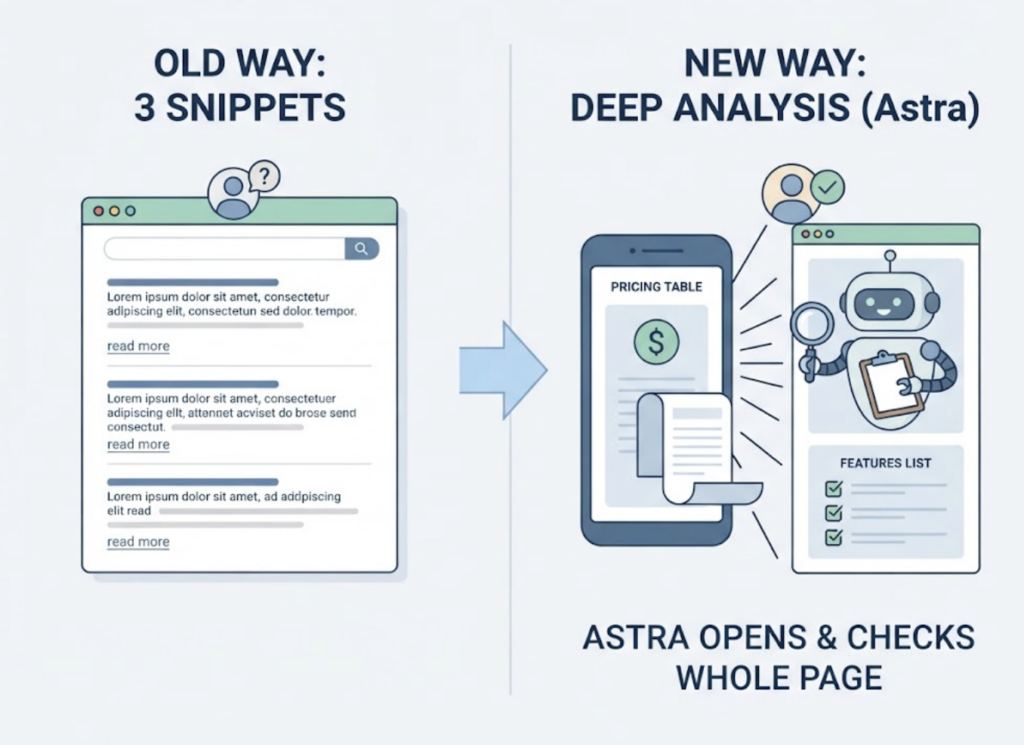
    Your content is being read by an agent that behaves like a person, not summarized by an indexer. That changes what robots.txt is actually protecting you from.

    What Robots.txt Actually Controls, and What It Doesn’t

    Robots.txt is a request, not a lock. It tells well-behaved bots what you’d prefer they do, and compliant bots follow it voluntarily.

    OpenAI currently documents three separate user agents: GPTBot for training data collection, OAI-SearchBot for ChatGPT’s search feature, and ChatGPT-User for pages a person asks ChatGPT to visit directly. Each can be allowed or disallowed independently, which is exactly why so many sites get this wrong. A site can block GPTBot to opt out of training while still allowing OAI-SearchBot to appear in search answers, but teams often write one blanket rule and assume it covers everything.

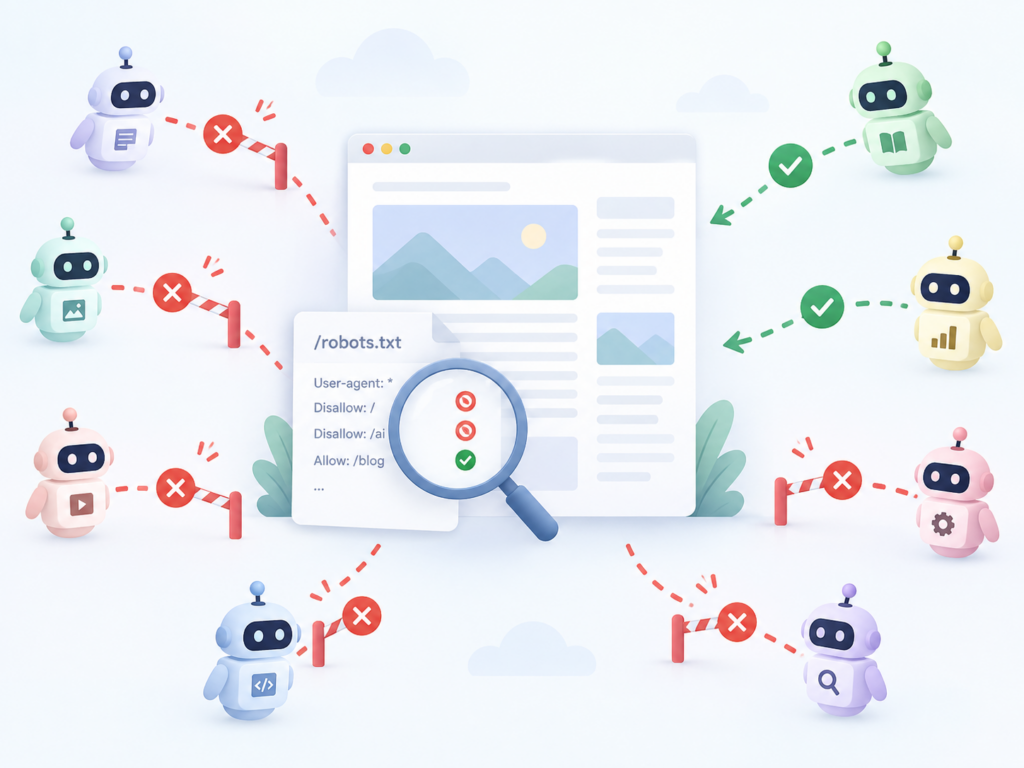
    The more common failure is simpler. A robots.txt file with a full browser string like GPTBot/1.3 pasted into the User-agent line, instead of the plain token GPTBot, matches nothing at all, and the site owner has no idea the rule never applied.

    Does GPT-6 Astra Follow the Same Robots.txt Rules?

    Astra’s browsing behavior sits closer to ChatGPT-User than to GPTBot, since it acts on a person’s request rather than crawling on its own schedule. But identity verification for agentic traffic is moving past user-agent strings entirely.

    Cloudflare and Google are behind a proposed IETF standard called Web Bot Auth, which has agents sign every request with a cryptographic key instead of a header that anyone can copy. Cloudflare’s Bot Management update introduced a dedicated Verified AI Agent category, and by mid-2026 it covered 19 agents including ChatGPT Atlas, Claude in Chrome, and Perplexity’s browser.

    A user-agent string alone no longer proves who’s visiting.

    OpenAI enabled signed requests for GPTBot by default on May 28, 2026, and Cloudflare reported expecting to verify or block roughly 18 billion AI crawler requests a day in the first month of enforcement. If your site still leans on IP allowlists or plain user-agent matching, you’re checking a credential that agents are actively moving away from.

    The Blind Spot: Allowed Access Doesn’t Mean Visible Results

    Say you get the robots.txt rules right, the signatures verify, and Astra’s requests come through cleanly. You’ve solved access. You haven’t solved visibility.

    Robots.txt tells you whether a request was allowed. It tells you nothing about what the agent actually did with your page once it got there: which section it cited, which competitor it compared you against, or whether it skipped your pricing table entirely. Most teams only find out their brand dropped out of an AI answer when someone happens to ask the same question and notices.
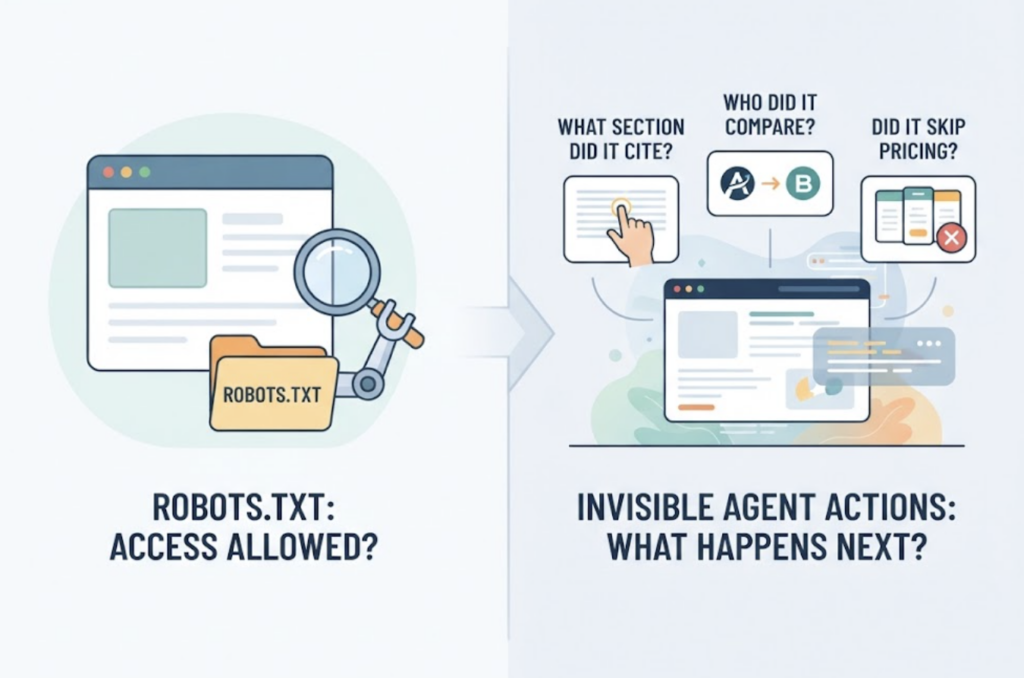
    This is the layer Topify‘s Source Analysis tracks: the specific domains and URLs AI platforms actually cite, so you can see whether your access permissions are translating into real citations. Pair that with AI Volume Analytics, which surfaces which prompts and pages draw the most agent traffic in the first place, and you know where a robots.txt audit is worth your time this week, instead of guessing across the whole site.

    A Five-Point Robots.txt Check for the GPT-6 Astra Era

    Run through this the next time you touch your robots.txt file.

    1. Check tokens, not full strings. Confirm every User-agent line uses the plain token (GPTBot, ChatGPT-User) and not a copy-pasted browser string.
    2. Separate training from browsing. Decide independently whether GPTBot should be excluded from training data while ChatGPT-User or Astra’s browsing traffic still gets through.
    3. Move past UA-only verification. If your CDN or WAF supports Web Bot Auth or signature validation, turn it on rather than trusting the User-agent header alone.
    4. Structure your highest-value pages for a reader, not a scanner. Astra scrolls, compares tables, and reads context, so pricing pages and comparison content should hold up under that kind of scrutiny.
    5. Verify the rule actually fired. A robots.txt file that looks correct and blocks nothing is a common failure mode. Check server logs or a linting tool to confirm the rule matched anything.

    That fifth point is the one most teams skip, and it’s usually where the real gap sits.

    Conclusion

    Robots.txt is still the first gate, but it was never built to answer whether an agent like GPT-6 Astra found, trusted, or cited your content once it got through. The access question and the visibility question are separate problems now, and treating them as one is how brands end up invisible in an AI answer without ever noticing the block. Audit the file this week, then check what’s actually being cited on the other side of it with a free source-level scan.

    FAQ

    Q: Does GPT-6 Astra use a different user agent than GPTBot? 

    A: OpenAI hasn’t published a separate crawler token specifically for Astra’s browsing behavior. It’s expected to operate closer to the existing ChatGPT-User agent, which handles requests triggered by a person’s ask, though verification is shifting toward signed requests rather than user-agent strings alone.

    Q: Should I block AI agents in robots.txt to protect my content? 

    A: For most sites, no. Blocking agents that power AI citations, like ChatGPT-User or OAI-SearchBot, tends to remove your brand from AI-generated answers entirely. Blocking makes more sense for paywalled or clearly sensitive content, not general marketing pages.

    Q: How do I know if my robots.txt rules are actually working? 

    A: Checking the file for correct syntax isn’t enough. Review server logs for the relevant user agents, or run a linting tool against your rules, since a single misformatted line can silently match nothing.

    Q: What’s the difference between robots.txt and Web Bot Auth? 

    A: Robots.txt is a voluntary, unauthenticated request that any bot can choose to ignore. Web Bot Auth is a cryptographic signature standard that lets a site verify an agent’s identity, closing the gap that user-agent spoofing leaves open.
    Read More

  • Why GPT-6’s 1M-Token Window Is Raising the Bar on Content Depth

    Why GPT-6’s 1M-Token Window Is Raising the Bar on Content Depth

    Your team just shipped a 900-word explainer that ranked on page one for six months. Then GPT-6 launched with a 1,050,000-token context window, and that same page now gets read alongside a dozen competitor documents in a single request instead of on its own. Length was never the real problem. What’s changing is how much surrounding evidence a model can hold before it decides which source actually answers the question.

    What GPT-6’s Context Window Actually Changed

    OpenAI’s GPT-6 Astra shipped on September 3, 2026 with a 1.05 million token context window and standard pricing of $10 per million input tokens and $50 per million output tokens. The model’s official page also lists a 128,000-token output cap and a knowledge cutoff of April 30, 2026, which matters more than it sounds. A model can hold a million tokens of input and still return a fairly short answer, so the window is about how much it reads, not how much it writes.

    This isn’t an isolated jump. Earlier in 2026, GPT-5.6 Sol, Terra, and Luna already reached 1 million token context windows on Amazon Bedrock, built for tasks like reading full codebases and multi-turn agent histories in one pass. GPT-6 pushed the same ceiling into the flagship tier and made it standard.

    GPT-5.6 SolGPT-6 Astra
    Context window1,050,000 tokens1,050,000 tokens
    Max output128,000 tokens128,000 tokens
    Standard pricing$4 / $20 per 1M tokens$10 / $50 per 1M tokens
    AvailabilityBedrock, CodexFlagship API tier

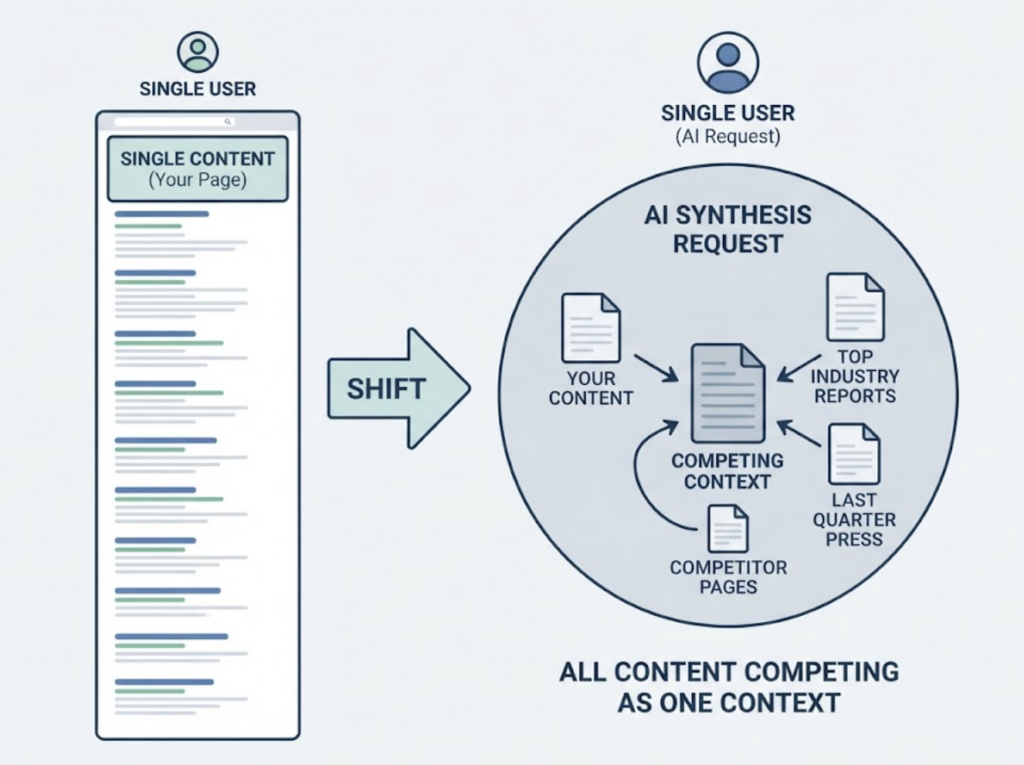
    The trend line is clear even if the exact number keeps shifting between model families. Content built for a single skim no longer competes on its own terms. It competes inside a request that can also hold your competitors’ pages, your industry’s top three reports, and last quarter’s press coverage, all at once.

    Why a Bigger Window Means AI Reads More of You at Once

    A larger context window changes what “getting cited” requires. The model isn’t choosing between your page and a blank slate anymore. It’s choosing between your page and everything else it was handed in that same request.

    Research backs this up directly. BrightEdge’s analysis of AI Overview citations found that 82.5% went to deep pages, not homepages, with roughly 0.5% citing homepages at all. Depth already mattered before GPT-6. A bigger window just raises how much depth counts as competitive.

    Content that answers a query in isolation used to be enough. Content that answers a query while sitting next to ten other sources making the same claim is a different bar entirely.

    The shift shows up in how differently the major AI engines behave once they’re holding more context. ChatGPT tends to cite fewer sources per answer but lean on them more heavily, while Perplexity often cites ten or more sources per prompt but absorbs each one more shallowly. Gemini sits in between. That means the same page can carry a lot of weight in one engine’s answer and barely register in another’s, depending on how each model allocates attention across a crowded context.

    What doesn’t vary across engines is the preference for content that does its own synthesis. AI citation studies consistently show that content aggregators and encyclopedic sites get pulled in as raw material but rarely credited by name, while original analysis with clear attribution tends to get named directly. A bigger window means a model can hold more raw material at once. It still has to decide which source did the actual thinking, and that decision hasn’t gotten any easier to win by accident.

    The Content Depth Gap Most Brands Don’t Know They Have

    Most content libraries were built for keyword coverage, not for standing up inside a crowded context window. That gap doesn’t show up in traditional SEO metrics, because rankings and backlinks never measured whether a page could out-argue nine competitors an AI just read in the same breath.

    AI engines cite long-form content in the 2,500 to 4,000-plus word range roughly three times more often than short posts, and models tend to prefer one comprehensive source over several shallow ones covering the same ground. A 500-word overview and a 2,500-word deep dive on the same topic aren’t really competing. The model just picks the one that already did the synthesis work.

    A bigger window doesn’t reward more content. It rewards more complete content.

    That distinction matters because brands often respond to “AI needs more depth” by publishing more pages, not deeper ones. Fragmented content spread across five shallow posts is still fragmented, no matter how many of them exist.

    A Bigger Window Doesn’t Fix Lost in the Middle

    Here’s the part most coverage of GPT-6 skips. A million-token window doesn’t mean the model reads every token with equal attention.

    Researchers first documented a “lost in the middle” effect where LLM accuracy drops for information positioned in the center of a long context, while facts near the start or end get recalled far more reliably. A separate study found performance can degrade by more than 30% when relevant information shifts from the start or end of a document toward the middle. The effect has held up across model families and context sizes since it was first identified.

    That means a 4,000-word article buried in the middle of your site, with the actual answer three paragraphs down, is competing at a structural disadvantage even if the content itself is excellent. Depth without structure is not the same as depth AI can use.

    The practical takeaway: lead with the direct answer, keep it self-contained, and don’t rely on the model to dig through the middle of a long page to find your best point.

    This is where a lot of “just write longer” advice quietly falls apart. Adding a million tokens of window capacity doesn’t cancel out an architectural bias that’s been reproduced across six different model families, from GPT-3.5 and GPT-4 to Claude and open-weight models like MPT-30B. Depth still matters. It just has to be depth that’s organized so a model scanning quickly can find the answer without depending on it reading your fifth paragraph as carefully as your first.

    How Topify Helps You Close That Gap

    None of this is something a content team can eyeball. Knowing whether your pages are getting read, skipped, or absorbed alongside competitor sources inside a model’s expanding context window requires actually seeing what’s being cited and what isn’t.

    Topify built Source Analysis for exactly that gap. It tracks the exact domains and URLs that AI platforms cite, so you can see whether your content is showing up in the same conversations as your competitors’ or getting quietly passed over. In practice, that means you can pull up a query in your category, see which five sources ChatGPT or Perplexity actually pulled from, and find out in minutes whether your deep-dive page made the cut or your competitor’s did instead.

    Comprehensive GEO Analytics sits alongside it, tracking visibility, sentiment, position, and citation volume across platforms, so you can tell whether restructuring a page for depth and answer-first framing actually moved the needle, rather than guessing.

    How to Start Auditing Your Content Depth

    • Pull your five highest-traffic pages and check whether the core answer appears in the first two sentences, or whether it’s buried mid-page where lost-in-the-middle effects hit hardest.
    • Compare your longest, most-cited competitor page against your equivalent page and look for what it covers that yours doesn’t, not just how long it is.
    • Run your category’s top queries through Topify’s Source Analysis to see which domains are actually getting pulled into AI answers right now.

    Conclusion

    GPT-6’s 1.05 million token window didn’t change what good content looks like. It changed how much company your content keeps every time an AI answers a question, and how little tolerance there is for pages that only half-answer it. Brands that treat this as a prompt to write more will keep publishing into the noise. Brands that treat it as a prompt to write more completely, with the answer up front and the evidence to back it, are the ones that show up when the model is choosing between a dozen open tabs at once.

    FAQ

    Does GPT-6’s bigger context window mean shorter content gets ignored? 

    Not automatically, but short content that only partially answers a query is easier for the model to pass over once it has several fuller sources in the same context. Length isn’t the signal. Completeness is.

    Is content depth the same as word count? 

    No. A long page that buries its answer in the middle can perform worse than a shorter page that states the answer clearly up front, especially given how the lost-in-the-middle effect degrades recall for mid-document information.

    Do I need to rewrite everything now that GPT-6 has a 1M-token window? 

    Start with your highest-traffic and highest-intent pages first. Check whether they lead with a direct answer and whether they cover the topic as thoroughly as the sources currently getting cited in your category.

    How do I know if my content is actually being cited by AI models? 

    You need visibility into which domains and URLs AI platforms are pulling from for your category’s queries. Tools like Topify’s Source Analysis surface this directly instead of leaving you to guess from traffic data alone.

    Read More

  • GPT-6 Astra and the Shift From Ranking to Being Recommended

    GPT-6 Astra and the Shift From Ranking to Being Recommended

    Your team spent the last two quarters climbing Google rankings for your category’s top keywords. Then someone on the sales side mentioned that a prospect had asked ChatGPT which vendor to use, and your brand wasn’t in the answer. No warning, no ranking drop to explain it. Just absence.

    That gap is about to get wider. GPT‑6 Astra, OpenAI’s newest flagship model, launched on September 3, 2026, and it’s built to hand people finished answers instead of a page of options to sort through. Every jump in model capability is also a jump in how confidently AI systems now decide who gets recommended, and who gets left out.

    When a Model Gets This Good, Nobody Reads a List of Ten Links

    Astra ships with roughly a 1 million token context window and a jump in computer-use performance, scoring 72.6% on OSWorld 2.0 versus 65.7% for its predecessor. It’s also the first OpenAI model to cross the “Critical” threshold for cybersecurity capability under the company’s own Preparedness Framework.

    None of those numbers are about search directly. But they describe a model that can hold more context, weigh more sources, and act more autonomously on a user’s behalf. That’s exactly the kind of system that makes “browse and compare” behavior disappear.

    The user-facing effect is already visible. Google’s AI Overviews cut click-through rates for top-ranking results by 58%, and in AI Mode, 93% of searches now end without a single click. People aren’t scanning links anymore. They’re reading an answer and moving on.

    Ranking Was Never the Real Goal. It Was a Proxy for Being Chosen

    Search rankings measured something useful once: the probability that a page would get seen. But a rank was never the destination. It was a stand-in for “will someone pick this.”

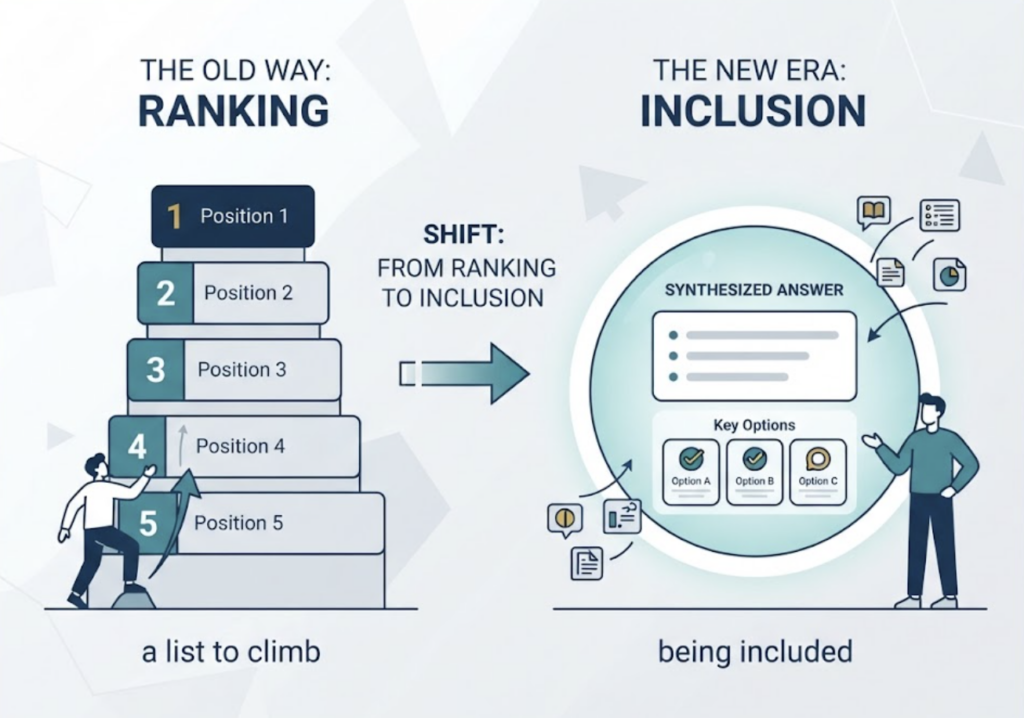
    AI systems removed the stand-in. There’s no list to climb because there’s no list. The model synthesizes one answer and names a handful of options, sometimes just one. As one industry breakdown puts it, the shift is from ranking to inclusion: there’s nothing to climb, only being in the answer or being left out of it.

    That changes what “optimization” even means. Traditional SEO tools track keyword position, organic traffic, and click volume. None of those metrics exist inside a generated answer. What exists instead is whether the model mentioned you, how it described you, and whether it trusted your source enough to cite it.

    Traditional SearchAI Recommendation
    OutputRanked list of linksOne synthesized answer
    Core metricKeyword rank, clicksMentions, citations, sentiment
    Source selectionRanks pages individuallyCites a handful of trusted sources
    Win conditionTop of page oneNamed in the answer at all

    What GPT-6 Astra Changes About Who Gets Named

    A more capable model doesn’t just answer questions faster. It gets pickier about what it cites, because it can afford to be. Roughly 85% of brand mentions in AI search now come from third-party pages, not brand-owned websites, and brands are about 6.5 times more likely to get cited through someone else’s content than their own. Your marketing site was never the deciding factor. Your reputation across the web is.

    This matters more, not less, as models like Astra move toward acting on a user’s behalf rather than just answering their questions. In a retail simulation run by Andon Labs, Astra ran an autonomous store and out-earned rival models while sticking to fair pricing. That’s a preview of agentic commerce: a system that doesn’t just recommend a product, it might also be the one placing the order. If a model is choosing suppliers and vendors on a user’s behalf, the cost of not being in its consideration set stops being theoretical.

    The practical takeaway for marketing teams: the brands that show up in Astra’s answers next quarter probably aren’t the ones with the best-optimized landing page. They’re the ones with a citation footprint spread across review sites, comparison content, forums, and trade coverage that the model already trusts.

    The Metrics That Actually Matter Now

    Rank tracking has nothing left to track. What replaced it is a small set of signals that behave more like reputation metrics than SEO metrics.

    Citation frequency alone accounts for about 35% of whether a brand gets included in an AI answer at all. But that number moves constantly. Citation patterns can drift 40 to 60% month over month across AI platforms, so a brand that appeared in answers in August can quietly vanish by October with no alert to explain why.

    The upside for brands that do get named is real. Similarweb found that visitors were 2.5 times more likely to visit a company’s site within seven days after an AI recommendation, and 56% of those visits still arrived through a search engine. Being recommended by AI doesn’t replace search traffic. It feeds it.

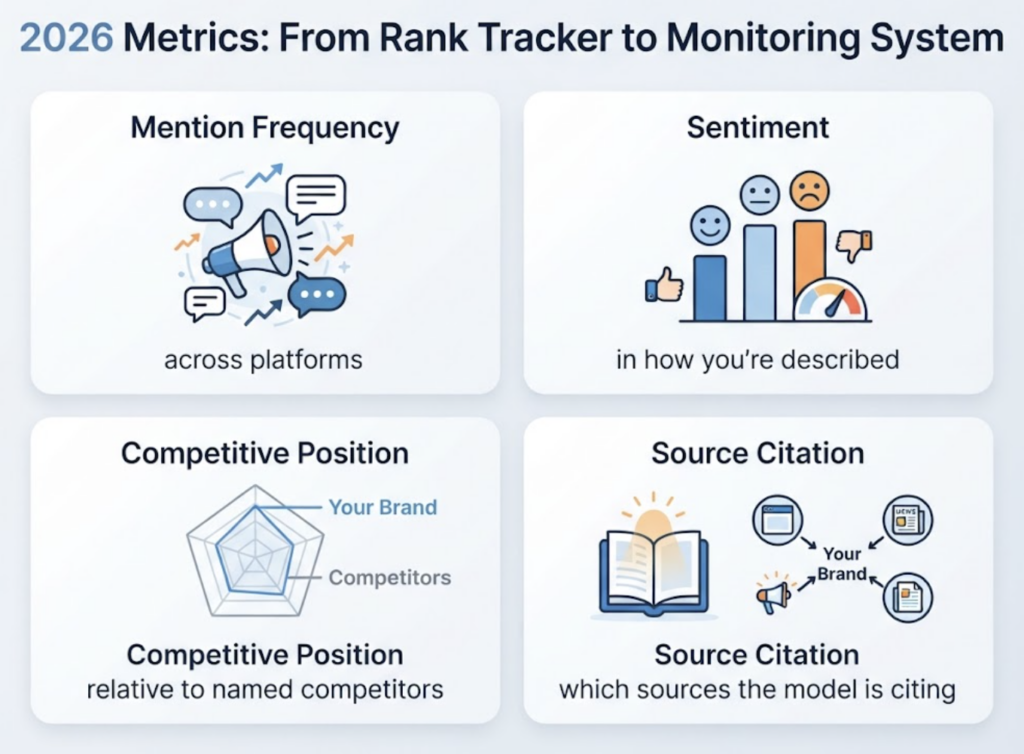
    So the working metric set for 2026 looks less like a rank tracker and more like a monitoring system: mention frequency across platforms, sentiment in how you’re described, position relative to named competitors, and which sources the model is actually citing when it talks about you.

    Where a Tracking Layer Fits Into This Shift

    Once ranking stops being the scoreboard, teams need something that shows what replaced it. That’s a monitoring problem, not a content problem: you need visibility into which prompts surface your brand, how sentiment is trending, and which third-party sources the models are pulling from.

    This is the gap Topify was built to close. Its Comprehensive GEO Analytics tracks seven metrics across ChatGPT, Gemini, and Perplexity at once: visibility, sentiment, position, volume, mentions, intent, and a conversion visibility score that estimates how likely an AI answer is to drive real engagement. In practice, that means a brand manager can spot a mention drop on one platform and trace it back to the exact source that stopped citing them, all in the same dashboard.

    Two other pieces matter for the Astra-era landscape specifically. Dynamic Competitor Benchmarking shows who a model recommends instead of you, which is the closest thing to a new leaderboard. Reverse-Engineer AI Citations shows the exact domains and pages models are pulling from, so a content team can go fix the actual gap rather than guessing at it. Plans start at $99 a month, with wider platform coverage and prompt volume as teams scale.

    Conclusion

    GPT-6 Astra isn’t the reason ranking stopped mattering. It’s the clearest signal yet of how far that shift has already gone. As models get better at holding context and acting autonomously, the gap between brands that get named and brands that get skipped will keep widening, not narrowing. The teams that start tracking mentions, sentiment, and citation sources now will have a real head start over the ones still waiting for their next Google Search Console report to explain a traffic drop it was never built to explain.

    FAQ

    Q: Does GPT-6 Astra directly change SEO rankings? 

    A: No. Astra doesn’t touch Google’s ranking algorithm. What it changes is how confidently AI systems synthesize a single answer instead of surfacing a list, which reduces the practical relevance of page rank as a visibility metric.

    Q: What replaces keyword rank as a metric in AI search? 

    A: Brand mention frequency, sentiment in how a model describes you, your position relative to named competitors, and which third-party sources the model actually cites.

    Q: Why do third-party sources matter more than my own website for AI visibility? 

    A: Roughly 85% of brand mentions in AI answers trace back to third-party pages rather than brand-owned sites, since models tend to trust independent coverage, reviews, and comparisons more than a company’s own marketing copy.

    Q: How often does AI citation data change? 

    A: Citation patterns can shift 40 to 60% month over month, which is why point-in-time checks are far less useful than ongoing tracking.

    Read More

  • AI Visibility Checker Test: 5 Tools, Same Domain, Different Reports

    AI Visibility Checker Test: 5 Tools, Same Domain, Different Reports

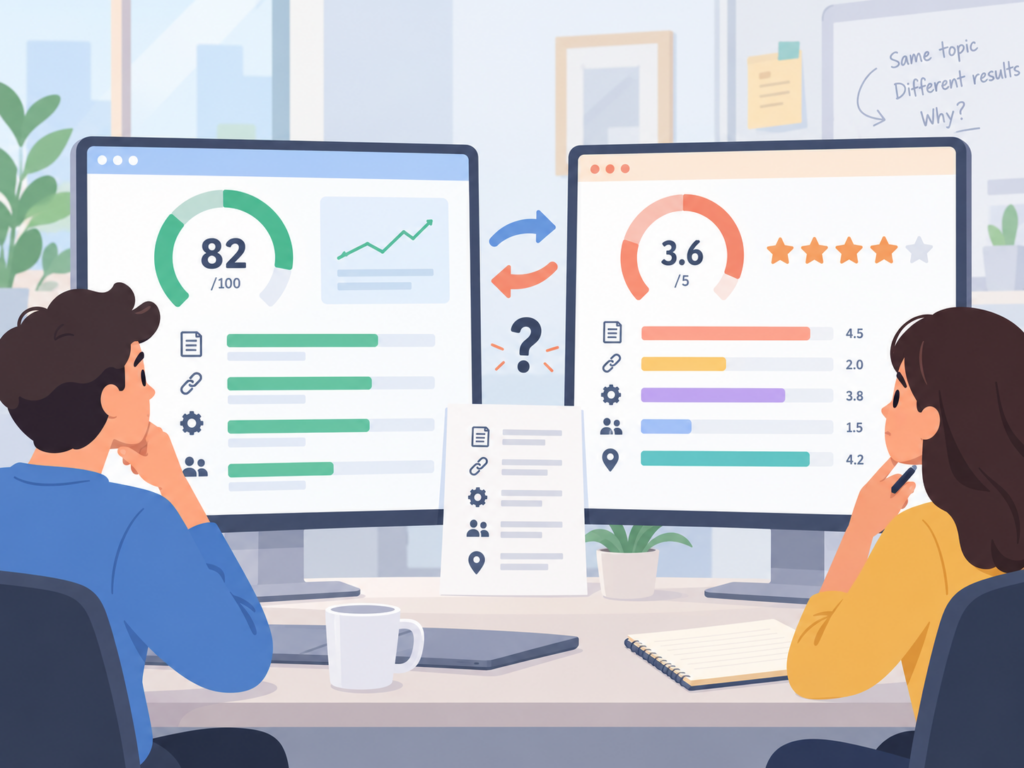
    Your marketing lead runs your domain through an AI visibility checker on Monday. Your SEO contractor runs a different one on Wednesday. The two reports don’t agree on almost anything: one says you show up in 40% of ChatGPT answers, the other says 22%. Nobody touched your website in between.

    That gap isn’t a bug in either tool. It’s the default outcome when five different vendors each define “visibility” their own way, then hand you a single number and call it a score.

    Why the Same Domain Gets Five Different Scores

    Most people assume an AI visibility checker measures one fixed thing: how often your brand shows up when someone asks ChatGPT, Gemini, or Perplexity about your category. In practice, that’s where the agreement ends.

    A recent methodology audit examined how major platforms define their core visibility metric, and the results were not reassuring. The audit found that several leading vendors define the same metric in contradictory ways within their own documentation, sometimes describing visibility as brand mentions divided by all tracked responses, and elsewhere as mentions divided only by responses that already contain a brand name. Those are two different denominators. They produce two different scores from the exact same raw data.

    Some vendors get this right. The audit noted that a handful of platforms keep a single, consistent definition across their public materials. But consistency within one tool doesn’t help you when you’re comparing across tools, which is exactly what happens the moment two people on your team run two different checkers.

    We Ran the Same Domain Through Five AI Visibility Checkers

    Here’s the pattern that shows up almost every time someone lines up multiple checkers side by side. The tools don’t just report different numbers, they report on different things entirely.

    Topify runs a free version of this check called the AI Visibility Report, which generates probe questions and queries ChatGPT, Gemini, and Perplexity directly. It’s a useful first move if you want to see where your own domain stands before comparing it against anything else, since you’ll have a real baseline rather than someone else’s screenshot.

    Run that same domain through four other well-known checkers and the differences show up fast. Coverage alone varies widely. Some tools track 15 or more platforms including ChatGPT, Claude, Gemini, and Perplexity, while others stop at three. A domain that looks strong on a three-platform tool can look thin on a fifteen-platform one, simply because the second tool is sampling a wider, noisier set of AI surfaces.

    Pricing and access shape the picture too. Free options range from a limited one-time snapshot to a genuinely free tier, while several enterprise tools sit behind a demo request with no self-serve number at all. That means the “five tools” in any real test rarely have equal depth to begin with.

    Where the Numbers Actually Diverge

    Three specific design choices explain almost all the disagreement between checkers, and none of them are about data quality.

    The competitor set is rarely open. Share of voice is a ratio, and the denominator matters as much as the numerator. If a tool asks you to name your competitors before it runs the check, your score reflects visibility inside a pool you built, not the pool AI actually produced. Independent research on this metric points out that the denominator must stay openfor the number to mean anything comparable across tools or time.

    Mentions and citations get lumped together. An AI answer can name your brand in prose without linking to your site, or cite your URL without saying your name out loud. Treating those as the same event inflates or deflates a score depending on which one a given tool prioritizes.

    A single run is not a measurement. Language models sample from a probability distribution, so running an identical prompt twice on the same day can return a different brand order both times. Research on this variance found that the chance of two independent runs producing an identical ranked list is very low, and that response variance is highest on exactly the competitive ranking questions marketers care about most.

    Design choiceEffect on your score
    Closed competitor set defined upfrontScore reflects a pool you chose, not what AI actually surfaces
    Mentions and citations counted as one metricHides whether AI is naming you or actually linking to you
    Single prompt run, single dayScore can shift meaningfully on a re-run with zero real-world change
    Platform coverage limited to 2 to 3 enginesMisses gaps on engines the tool doesn’t track at all

    What a Single Score Can’t Tell You

    One number hides more than it reveals.

    A domain can dominate ChatGPT, get cited occasionally by Perplexity, and be functionally invisible on Gemini, all at the same time. Averaging those three outcomes into a single visibility percentage erases the exact detail a marketing team needs to act on.

    Free checkers tend to compound this problem, not because they’re inaccurate, but because they’re built for a one-time snapshot. Comparison data across use cases consistently shows the same gap: free tools offer a single check with no historical trend, while paid platforms add continuous daily or weekly monitoring, per-platform breakdown, and competitor benchmarking over time. A snapshot answers “where do I stand today.” It can’t tell you whether that position is improving, decaying, or about to flip after your competitor ships new content.

    That’s the real risk in treating any single checker’s output as a verdict. It’s a data point, not a diagnosis.

    How Topify Makes Sense of the Same Data

    The fix isn’t finding the one checker with the “right” number. It’s using a measurement approach that keeps its definitions consistent across every platform it touches, so a change in your score reflects a change in AI behavior rather than a change in methodology.

    Topify’s Comprehensive GEO Analytics tracks brand performance across major AI platforms through seven metrics at once, including visibility, sentiment, position, and mentions, all measured the same way regardless of which engine produced the answer. That consistency is what lets you trust a week-over-week trend line instead of squinting at two incompatible snapshots.

    The competitor problem gets solved the same way. Dynamic Competitor Benchmarking doesn’t ask you to lock in a competitor list upfront. It tracks who AI engines actually recommend alongside you, and flags emerging rivals as they show up in real answers rather than in a list you typed into a form six months ago.

    For teams that want to see the citation layer specifically, Reverse-Engineer AI Citations analyzes the exact domains and URLs AI platforms pull from when they mention a brand, which separates the mention question from the citation question instead of blending them into one score. Getting started with the full platform starts with the same domain check you’d run for free, just extended into something you can track over time.

    How to Read Any AI Visibility Report Without Getting Misled

    Before you trust a number from any checker, three quick checks tell you how much weight it deserves.

    First, look for a published definition of the core metric. If a tool can’t tell you whether its denominator is all responses or only brand-containing responses, treat the score as directional, not exact.

    Second, check platform coverage against where your buyers actually are. A tool that skips Gemini isn’t wrong, it’s incomplete, and incomplete is fine as long as you know it going in.

    Third, ask whether the number came from one prompt run or many, on one day or averaged over time. A score built from a single run on a single day tells you about that run, not about your brand.

    Conclusion

    Five checkers on the same domain rarely disagree because one of them is broken. They disagree because visibility, share of voice, mentions, and citations are five related but distinct things, and most tools blend them into one headline number. Start with a free baseline check to see where you stand today, then decide whether the gaps you find are worth tracking continuously rather than guessing at from a single snapshot next quarter.

    FAQ

    Q: Why do AI visibility checkers give different scores for the same brand? 

    A: They typically use different denominators, different platform coverage, and different rules for what counts as a mention versus a citation, so the same underlying AI answers get scored differently by each tool.

    Q: Which AI visibility checker is the most accurate? 

    A: Accuracy depends less on the vendor and more on whether the tool publishes a clear, consistent definition of its metrics and covers the platforms your buyers actually use. A tool with a transparent methodology and narrower coverage often beats one with broad claims and no documentation.

    Q: How often should I check my AI visibility? 

    A: A single check gives you a baseline. Weekly tracking tends to match how often AI-generated answers shift in practice, since daily checks can be noisy and monthly checks lose too much signal between runs.

    Q: Is a free AI visibility checker enough, or do I need a paid platform? 

    A: A free checker is a solid starting point for a one-time snapshot. If you need historical trends, competitor benchmarking, or alerts when your visibility drops, that requires continuous monitoring, which free tools generally don’t provide.

    Read More

  • From GEO Score to Action: The Three Fixes That Move the Number Most

    From GEO Score to Action: The Three Fixes That Move the Number Most

    You ran the GEO score check. The report came back with a number, a list of a dozen issues tagged high, medium, and low priority, and no clear answer to the one question that actually matters: what do you fix first? Most teams stall right here. They stare at a 40 out of 100, forward the report to whoever manages the website, and nothing changes for weeks because nobody agreed on which three items actually move the number.

    Your GEO Score Is a Diagnosis, Not a To-Do List

    A GEO score compresses dozens of technical and content signals into one number, which is exactly why it’s frustrating to look at on its own. If you haven’t run one yet, Topify’s free GEO Score Checker returns a 0 to 100 grade in under 30 seconds and tags each finding by priority instead of dumping a flat checklist. Even a good checker can’t decide for you which three fixes are worth doing this week versus which twelve are worth ignoring for now.

    That’s the gap most teams fall into.

    Across the domains Topify has scanned, most sites block at least one major AI crawler or ship no structured data at all, which means the same three problems show up again and again regardless of industry. Once you know what those three are, the report stops being a wall of findings and turns into an order of operations.

    Fix 1: Unblock the AI Crawlers Reading Your Site

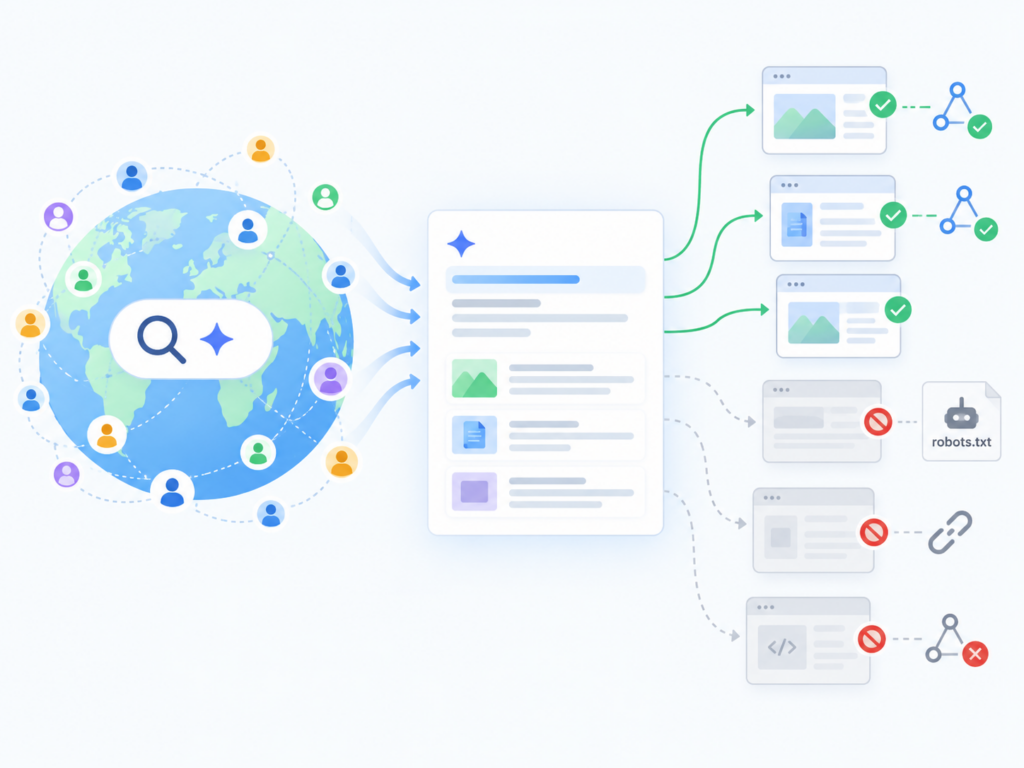
    Before anything else on the report matters, the AI engines have to be able to reach your pages. GPTBot, PerplexityBot, ClaudeBot, and Google-Extended all respect robots.txt, and a surprising number of sites still block one or more of them, often without anyone deciding to.

    This is usually the fastest fix on the list. Technical audits of AI-readiness consistently rank unblocking AI crawlers as the highest-impact, lowest-effort change a site can make, often closer to ten minutes of work than a full sprint.

    It’s also the one fix that gates everything else. Schema markup, clean answer formatting, and fast page loads don’t help if the crawler never gets past robots.txt in the first place. Check this one first, not because it’s glamorous, but because every other fix on your list depends on it.

    Checking it doesn’t require any tooling. Open your robots.txt file directly and look for user-agent lines matching GPTBot, PerplexityBot, ClaudeBot, or Google-Extended, then confirm none of them carry a blanket disallow. Teams that inherited their robots.txt from an agency or a CMS default are the ones most likely to find a surprise here, since older configurations sometimes blocked “unknown bots” as a blanket security measure long before AI crawlers existed.

    Fix 2: Give AI Something Structured to Quote

    Once crawlers can reach your pages, the next question is whether they can tell what those pages are actually about. Schema.org markup, particularly Article, FAQPage, and Organization types, turns loose prose into labeled facts a model can lift directly into an answer.

    Sites that skip this step tend to have the same gap. Analysis of AI search readiness across a large set of domains found that missing Organization and Person structured data was the single biggest difference between sites that get cited and sites that don’t. Adding FAQ or HowTo schema to your key pages is often the next lever after that.

    One caveat worth flagging, since a lot of GEO advice treats it as mandatory: llms.txt. It’s a reasonable file to have, but it’s not the priority its popularity suggests. A review of over 500 million AI bot traffic events found that AI search crawlers almost never fetch llms.txt in practice, and separate research reached the same conclusion after removing it as a variable from a citation-prediction model with no drop in accuracy. Ship it if you have a spare hour. Don’t let it push robots.txt and schema down your list.

    Schema itself doesn’t need to be complicated to matter. A single FAQPage block on your pricing or product page, listing the three questions prospects actually ask, is often enough to start showing up as a direct answer rather than a buried mention. Organization schema on your homepage does something similar at the brand level, giving AI models a clean, unambiguous record of who you are before they try to guess from unstructured text.

    Fix 3: Rewrite for Answer-First Extraction

    Why Paragraph Order Decides Whether You Get Cited

    The last fix is the one that has nothing to do with code. AI systems tend to pull from the part of a page that answers the question most directly, which usually means the first sentence or two after a heading, not a conclusion buried in paragraph four.

    Rewriting your key pages so each section leads with its answer, one idea at a time, is a content edit, not a technical one. Guides on technical GEO frame this the same way: front-loading answers and keeping one idea per heading is an ongoing habit, and it’s what decides whether a section gets extracted at all.

    In practice, this often means moving your best paragraph to the top and cutting the throat-clearing that came before it. A page that opens with three sentences of company history before answering “what does this product do” reads fine to a human skimming for context. A model looking to extract a citable answer will often quote whatever comes first, history included, which is rarely the sentence you wanted surfaced.

    The payoff shows up faster than most teams expect. Sites that ship these fixes together commonly move from a 30 to a 70 GEO score within two weeks, largely because the three problems compound. Unblocking crawlers gets you seen, schema gets you understood, and answer-first formatting gets you quoted.

    How to Know the Fixes Actually Worked

    A GEO score isn’t a one-time grade. It shifts as AI engines re-crawl your site, so the only way to confirm a fix landed is to check again after you ship it, not to assume it worked because the change looked right in a code review.

    For a handful of pages, re-running a free checker every week or two is manageable. It gets harder once you’re tracking dozens of pages across multiple AI platforms, watching for a schema change that quietly breaks, or trying to tell whether a competitor’s content update is why your citations dropped. That’s the kind of ongoing tracking platforms like Topify’s Comprehensive GEO Analytics are built around, scoring visibility, sentiment, position, and four other signals across ChatGPT, Gemini, and Perplexity so you’re not re-running a manual check every time you want an answer. If that sounds like where you’re headed, it’s worth taking a look at what a full GEO tracking setup involves.

    Conclusion

    A GEO score tells you where you stand. It doesn’t tell you what to do Monday morning, and that’s the part most reports leave out. Unblock the crawlers first, since nothing else counts until they can reach your pages. Add structured data second, so what they find is actually quotable. Rewrite your key pages third, so the answer they pull is the one you meant to give. Do those three in order, recheck the score, and you’ll usually see the number move within weeks rather than quarters.

    FAQ

    Q: How often does a GEO score actually update? 

    A: It updates whenever the underlying signals change, which mostly means whenever AI crawlers re-index your site after you ship a fix. There’s no fixed schedule, so re-running a checker a few days after a change is a reasonable way to confirm it landed.

    Q: Do these three fixes have to happen in order? 

    A: Not strictly, but unblocking crawlers first makes the biggest difference, since schema and content changes on a page AI can’t reach won’t register in your score at all.

    Q: Is llms.txt worth setting up before the other three fixes? 

    A: It’s low-cost to add, but current data shows AI crawlers rarely fetch it, so it shouldn’t come before unblocking crawlers or adding schema on your priority list.

    Q: My GEO score went up. What should I check next? 

    A: Whether the higher score is translating into actual citations and mentions across the AI platforms your audience uses, which is a different metric than the technical score itself and usually needs ongoing tracking rather than a one-time check.

    Read More

  • GEO Visibility Checker vs Rank Tracker: Two Different Questions

    GEO Visibility Checker vs Rank Tracker: Two Different Questions

    Your team’s dashboard says you’re ranking on page one for your category’s biggest keyword. Then someone pastes a screenshot of ChatGPT recommending three competitors, and your brand isn’t one of them. Both things are true at the same time. A rank tracker and a GEO visibility checker are built to answer two different questions, and mixing them up is why so many teams feel blindsided the first time they actually look.

    What a Rank Tracker Actually Answers

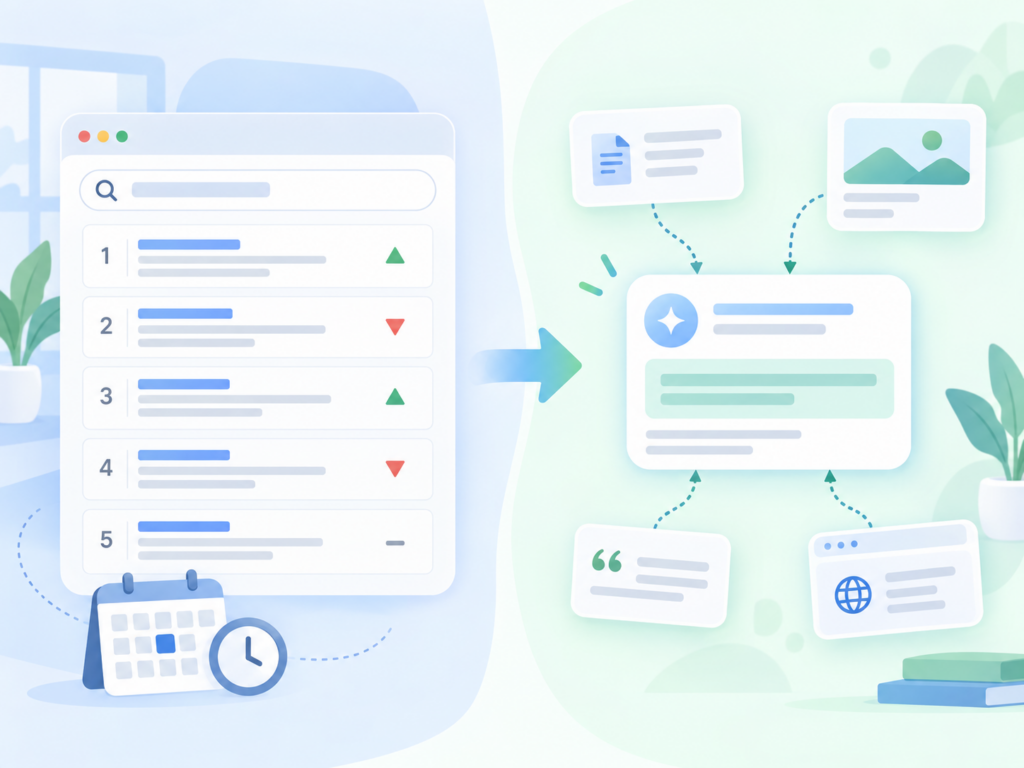
    A rank tracker checks where a specific URL sits for a defined list of keywords inside Google’s organic results, refreshed daily or weekly depending on the plan. It’s built around one assumption: that a search results page is a stable, ordered list, and your job is to climb it.

    That assumption answers a narrow but useful question: where do we sit on page one for the terms we’ve chosen to watch? For years, that number was a fair proxy for visibility, because ranking well and getting seen were basically the same thing.

    They aren’t anymore. The overlap between what shows up in Google’s AI Overviews and what ranks in the organic top ten has dropped sharply, from roughly three-quarters down to somewhere between 17% and 54%, depending on the query set. A page one ranking no longer guarantees you show up where the answer actually gets read.

    Most rank trackers were built during an era when a search results page was a fixed grid, and a single crawl a day was enough to catch any real movement. That design still works well for its original job: telling a content team whether a new page is gaining or losing ground against a defined competitor set. It just wasn’t designed to look inside an AI-generated answer, because that answer isn’t a ranked list at all.

    What a GEO Visibility Checker Actually Answers

    A GEO visibility checker runs a different test entirely. Instead of tracking a position, it evaluates whether a brand gets mentioned, cited, or recommended when AI platforms answer a question, looking at signals like bot accessibility, structured data, and content that AI models can parse and trust.

    The question it answers is closer to: does AI bring us up at all, and how often? That’s a probabilistic outcome, not a fixed slot on a list. Repeated prompt runs on the same topic rarely return the same brand lineup in the same order, and fewer than 1 in 1,000 prompt runs produce an identical result. Rank, in the traditional sense, isn’t really the mechanism at play.

    You can check where your own site currently stands using Topify’s free GEO Score Checker, which takes under a minute and needs no signup. It’s worth running before deciding whether ongoing tracking is even necessary for your brand.

    The signals it’s reading are also different from a standard SEO checklist. Branded web mentions correlate far more strongly with AI Overview appearances than backlinks do, 0.664 compared with 0.218. That’s a meaningfully different set of levers than the ones most rank-tracking dashboards were ever built to show.

    A GEO score typically rolls up four separate signal groups rather than one number: whether AI crawlers and bots can actually access your pages, whether structured data exists for models to parse, whether the content itself answers the kind of question an AI would be asked, and how often your brand actually turns up across a sample of AI-generated answers. A weak result in any one group can drag the whole score down, even if the other three look fine, which is exactly why a single Google ranking can’t stand in for it.

    Side by Side: What Each Tool Actually Measures

    The clearest way to see the difference is to put both tools next to each other.

    Rank TrackerGEO Visibility Checker
    Core questionWhere do we rank for this keyword?Does AI mention or recommend us at all?
    Data sourceGoogle’s organic search resultsChatGPT, Perplexity, Gemini, Google AI Overviews, and similar
    Primary metricPosition, from #1 to #100Visibility score, citation rate, sentiment
    Update cadenceDaily or weeklyOne-time snapshot or continuous, depending on the tool
    What a good result meansYou appear near the top of a results pageYour brand shows up inside the answer itself

    Neither column replaces the other. A brand can rank first for its category and still be absent from every AI-generated answer on the same topic, and the reverse happens too.

    Why Teams End Up Needing Both

    Most teams still budget for only one side of that table. Only 14% of marketers currently track AI and LLM citation visibility, even though 43% already name AI search optimization as a core priority for the year.

    That gap between priority and practice is where visibility quietly leaks away.

    Teams that only run a rank tracker often miss the leak entirely, because the traffic numbers can look fine while brand credit disappears underneath them. A large share of AI brand mentions are what’s known as ghost citations, links that point to your site without naming your brand, and that pattern shows up in an estimated 73% of AI citations. You get the click. You don’t get remembered as the source.

    The opposite failure happens too. A team that runs one GEO check, sees a decent score, and stops there has no way to tell whether that score is improving, slipping, or getting overtaken by a competitor’s last content push. A snapshot is a fact about today. It isn’t a trend line.

    Picture a mid-size SaaS brand with stable page one rankings for its core keywords and a rank tracker dashboard that’s stayed green for months. Nobody on the team has a reason to look elsewhere. Then a competitor ships a round of structured FAQ content, starts showing up in ChatGPT’s answers for the exact category the brand thought it owned, and the first sign of trouble isn’t a ranking drop at all. It’s a sales rep noticing that a prospect mentioned a competitor’s name first, on a call where the brand’s own website ranked higher in Google the whole time.

    From a One-Time Score to Ongoing Tracking

    Once a GEO Score Checker confirms there’s a real gap worth closing, the next question is whether the work is actually paying off week over week. A single snapshot can’t answer that, because it has no memory of what your score looked like last month.

    This is the point where teams typically move from a free, point-in-time check to a dashboard that tracks visibility, sentiment, position, and citation source over time, across every major AI platform at once, rather than re-running a manual check on a recurring calendar reminder. Topify’s Comprehensive GEO Analytics is built for exactly that handoff: the same four signals the free checker samples once, monitored continuously, with alerts when a competitor starts showing up where you used to.

    The upgrade tends to pay for itself fast. Visitors who arrive through an AI citation convert at roughly 14.2% compared with 2.8% for standard search traffic, which means losing that channel quietly costs more than losing an equivalent amount of organic search traffic would.

    Conclusion

    A rank tracker and a GEO visibility checker were never meant to compete with each other. One tells you where you stand in a list of blue links. The other tells you whether an AI system chose to mention you at all. If your team only has an answer to the first question, run a free GEO score check this week and see how the second one looks.

    FAQ

    Q: Is a GEO visibility checker the same thing as a rank tracker? 

    A: No. A rank tracker measures your position in Google’s organic results for chosen keywords. A GEO visibility checker measures whether AI platforms mention, cite, or recommend your brand when answering a related question, which is a separate signal entirely.

    Q: Can I just use my existing rank tracker to cover AI search too? 

    A: Not fully. Some rank tracking platforms have added AI monitoring modules, but the underlying data source and metric are different from organic rank data, so a standalone GEO check still catches gaps a rank tracker’s dashboard won’t surface.

    Q: How often should I check my GEO visibility score? 

    A: A one-time check is a useful starting point, but AI answers shift as models update and competitors publish new content. Teams that treat AI visibility as a real channel typically move to continuous tracking rather than checking manually once and moving on.

    Q: What does a GEO visibility checker actually measure?

    A: It typically evaluates a mix of signals, including whether AI crawlers can access and parse your site, whether your content includes structured data AI models can read, and how often your brand appears across sampled AI-generated answers.

    Read More

  • What a Website GEO Checker Can and Can’t Tell You About AI Visibility

    What a Website GEO Checker Can and Can’t Tell You About AI Visibility

    You run your domain through a free GEO checker. Sixty seconds later you’ve got a score, a color, and a list of fixes. It feels like an answer.

    It’s a snapshot, not a strategy. A GEO checker tells you whether AI crawlers can reach your pages and whether your markup is readable. It doesn’t tell you what ChatGPT actually says about your brand next week, or whether a competitor just took the spot you were sitting in yesterday.

    That gap between “diagnosed” and “understood” is where most GEO efforts stall. Here’s what a checker like Topify’s GEO Score Checker can genuinely tell you, what it can’t, and why the difference matters more than the score itself.

    What a GEO Score Actually Measures

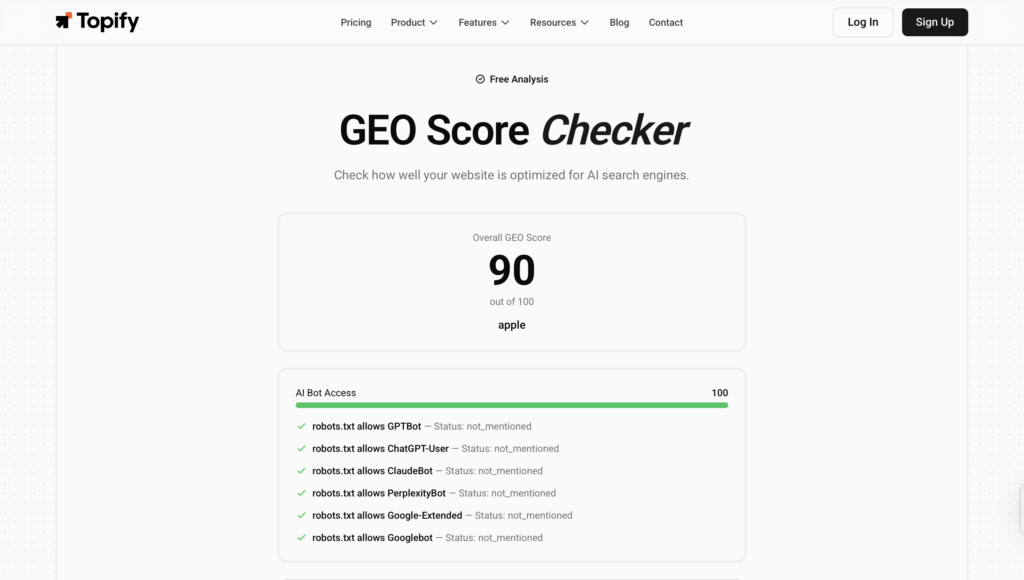
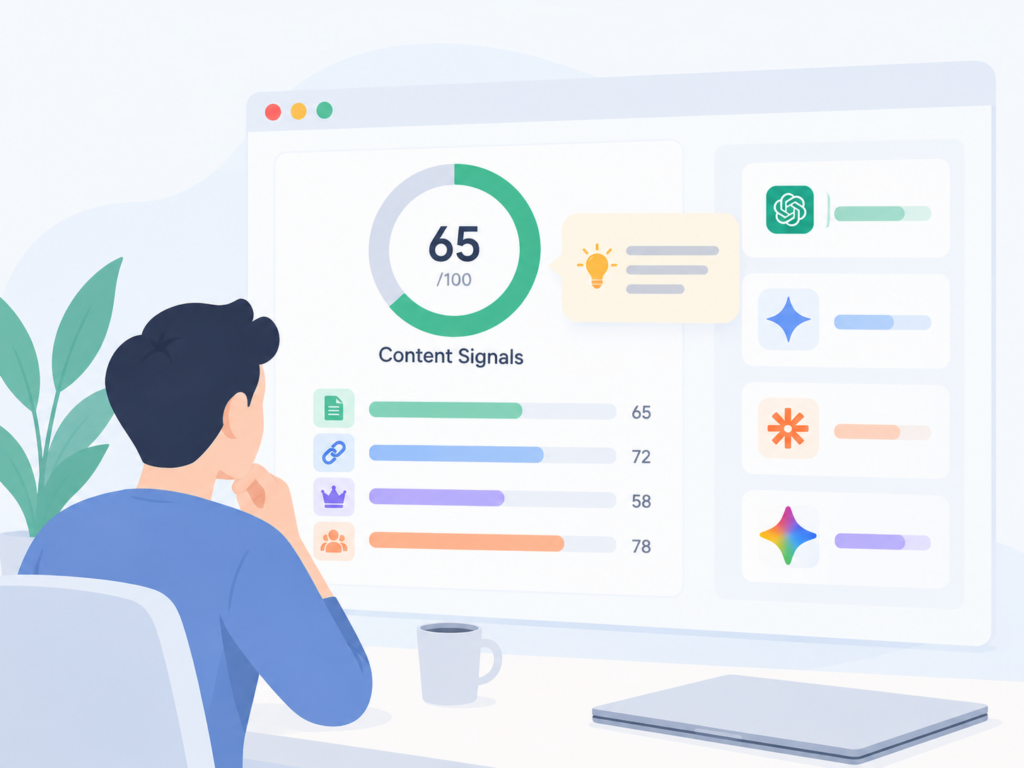
    Run a URL through a GEO checker and you typically get a 0-100 composite score built from four underlying signals.

    Score DimensionWhat It MeasuresWhat a Low Score Usually Means
    Bot AccessWhether GPTBot, ClaudeBot, PerplexityBot, and Google-Extended can crawl your pagesRobots.txt rules, JavaScript rendering, or CDN configs are quietly blocking AI crawlers
    Structured DataWhether schema markup and JSON-LD exist and parse correctlyAI models can’t confidently extract facts about your product, pricing, or entity
    Content SignalsHow authoritative and semantically clear your content reads to a language modelThin pages, vague claims, or missing depth on the topics you want to be cited for
    Visibility ScoreHow often your brand actually surfaces across AI platformsYou’re technically crawlable but not showing up in the answers that matter

    That table is the honest, useful part of any checker. It’s specific, it’s actionable, and it typically takes under a minute to generate. Check your GEO score for a domain and you’ll usually know within seconds whether the problem is technical access, content depth, or something else entirely.

    That’s the “can” list. It’s shorter than most vendors imply, and shorter than the “can’t” list below.

    Three Things a One-Time Score Genuinely Tells You

    It tells you if you’re invisible for a fixable reason. Plenty of sites with strong content still score under 40 because a robots.txt rule written years ago for a different bot policy is silently blocking GPTBot. That’s a five-minute fix once you know it’s there.

    It tells you if your structured data is doing its job. Missing or malformed schema doesn’t just hurt traditional search. It makes it harder for a language model to extract a clean fact about who you are, what you sell, or what you’re known for.

    It tells you where you stand relative to a benchmark, right now. A score of 65 on Content Signals means something specific: your pages are semantically legible but probably light on the depth or specificity that gets cited over a competitor’s.

    Those are real, verifiable diagnostics. They’re also, by definition, a photograph of a single moment.

    Four Things No Single Checker Can Tell You

    It can’t tell you what changed since last week. AI models retrain, re-crawl, and re-weight sources constantly. A score from Tuesday says nothing about Thursday. One recent audit of free AI visibility tools noted that most free checkers return sampled data with rate limits on free tiers, which is another way of saying: useful for a spot check, not for tracking.

    It can’t tell you why a competitor is winning the answer you wanted. A composite score doesn’t show which domains ChatGPT or Perplexity actually cited, or which competitor’s case study got pulled into the answer instead of yours. That requires watching the citations themselves, not just your own crawlability.

    It can’t tell you how sentiment shifts. Being mentioned isn’t the same as being recommended. A brand can appear in an AI answer framed neutrally, favorably, or with a caveat that quietly kills the deal. A point-in-time score has no concept of tone.

    It can’t tell you the platform-by-platform picture. One analysis of AI visibility tooling pointed out that different checkers cover different engines, and that a brand strong on one platform may be invisible on another. A single blended score can hide a brand that’s solid on ChatGPT and completely absent from Perplexity, which matters if your buyers lean on one platform over the other.

    Why the Same Site Can Score Differently Two Weeks Apart

    Here’s the part that surprises most people the first time they run a repeat check: the number moves, and not always because you changed anything.

    Language models update their retrieval and ranking behavior on their own schedule. Structured data that parsed cleanly last month can start failing silently after a platform changes how it reads JSON-LD. A page that was cited last week can drop out of an answer this week because a competitor published something more specific.

    None of that shows up in a single audit. It only shows up if you’re checking again, and again, on a schedule you control.

    AI Prompt ExamplePlatformWhat a One-Time Score Misses
    “best [category] tools 2026”ChatGPTWhether you were cited last month and dropped this month
    “is [brand] worth it”PerplexityThe exact sentiment of how you’re described, not just that you appear
    “[brand] vs [competitor]”GeminiWhich domain the model actually cited to make the comparison
    “alternatives to [brand]”ChatGPTWhether a competitor’s new content is now outranking yours in the answer
    “[category] pricing comparison”PerplexityWhether your pricing page is even in the citation pool anymore

    Research on AI search adoption backs up why this matters at scale. AI search now touches close to 1 billion users, with more than a quarter of consumers using AI for a meaningful share of their internet searches, and a large share of sites remain invisible to AI crawlers without knowing it because of outdated robots.txt rules or missing structured data.

    Free Snapshot vs. Continuous Monitoring

    A checker answers “where do I stand right now.” Continuous monitoring answers “where am I heading, and who’s catching up.” Both have a place. The mistake is treating the first as a substitute for the second.

    CapabilityFree GEO Score CheckerTopify Platform
    Check frequencyOne-time snapshotContinuous monitoring
    Dimensions tracked4 GEO scoresFull GEO analytics plus sentiment and citation tracking
    Historical trendsNoneFull trend history with alerts
    Competitor benchmarkingNot includedReal-time competitor tracking
    Platform breakdownAggregatedPer-platform view across ChatGPT, Perplexity, Gemini, and AI Overviews
    Optimization actionsDirectional guidanceSpecific, prioritized execution steps

    The checker gives you a snapshot. Topify’s platform tracks the trajectory. A single score tells you where you stand. Continuous monitoring tells you which direction you’re moving, and how fast a competitor is closing the gap.

    If the diagnostic side of this resonates, start a free trial and see the same four dimensions tracked over time instead of once. Full plan details, including the Standard tier most teams start with, are worth a look before you commit either way.

    Conclusion

    A GEO checker is the right first move, not the last one. It’s fast, it’s free, and it will genuinely tell you if AI crawlers can reach your site and if your structured data is doing its job. What it can’t do is tell you what’s happening next Tuesday, or which competitor just took the citation you were counting on.

    Run your GEO score to get the baseline. Once you know where the gaps are, tools like the AI Robots Checker and Brand Authority Checker can help you dig into specific issues before you decide whether ongoing tracking is worth the investment.

    Frequently Asked Questions

    Is a GEO score the same as a Google ranking? 

    No. A GEO score measures how well AI crawlers can access and interpret your site, and how often you surface in AI-generated answers. It’s a separate signal from traditional search rank, though the two often correlate.

    Why did my GEO score change without me editing anything? 

    AI platforms regularly adjust how they crawl, parse, and cite content. A shift in Bot Access or Content Signals can happen even with no changes on your end, which is why a single check only reflects that moment.

    What’s the most common reason for a low Bot Access score? 

    Outdated robots.txt rules are the usual culprit. Many sites unintentionally block GPTBot, ClaudeBot, or PerplexityBot while leaving traditional search crawlers untouched, which keeps them ranking on Google while staying invisible to AI answers.

    Do I need continuous monitoring if I already ran a free check? 

    It depends on how much AI-driven traffic matters to your business. A free check is enough for a one-time audit. If competitors, content, or platform behavior are moving fast, a single snapshot goes stale quickly, and that’s the gap continuous tracking is built to close.

    Read More

  • Free GEO Checkers Compared: Where They Measure Differently

    Free GEO Checkers Compared: Where They Measure Differently

    You ran your site through three different free GEO checkers last week. One gave you a 41. Another said 78. The third didn’t score you at all, it just flagged twelve robots.txt lines and called it a day. None of them agreed on what “good” looks like, and the report you now have to explain to your team doesn’t tell a coherent story. That’s not because one tool is wrong. It’s because none of them are measuring the same thing.

    What a Free GEO Checker Actually Claims to Measure

    Most tools in this category test some mix of four signals: whether AI crawlers can reach your pages, whether your structured data is readable, whether your content carries authority signals, and whether you already show up in AI answers. The catch is that no two checkers weight these four the same way, and some only test one of them.

    Bot access alone is messier than it looks. A crawl across 1,744 sites found that 9.9% block GPTBot outright, and 13.7% block at least one AI crawler through robots.txt. A separate live-fetch test found the gap runs deeper than policy files suggest: on real page loads, GPTBot’s pass rate sits at 44.4%, a 33-point drop from a normal browser request. A checker that only reads your robots.txt file and one that actually fetches the page like a crawler would will often hand you two different verdicts on the same site.

    That’s the first place free tools disagree, and you haven’t even opened a dashboard yet.

    If you want to see where your own site lands on that layer without guessing which checker to trust, Topify‘s GEO Score Checker runs all four signals in one pass and returns a single snapshot in under a minute, no signup required.

    Quick Comparison: What Each Type of Free Checker Actually Scores

    Free GEO checkers generally fall into a handful of categories, and each one is built to answer a narrower question than “how visible am I to AI.”

    Checker TypeWhat It Actually ScoresWhat It Tends to Miss
    Bot-access scannersWhich AI crawlers are disallowed in robots.txtWhether the blocked bot is a training crawler or a live-answer bot, which changes the risk entirely
    Multi-platform site crawlersCitability across several AI platforms from a full site crawl, sometimes checking a dozen or more crawler types at onceDoesn’t separate live-fetch access from bulk training-crawl access, so the two get blended into one number
    Dashboard-style visibility checkersA per-model score alongside schema completeness and entity recognitionOne aggregated headline number can hide which specific platform you’re actually losing
    Workflow-embedded gradersStructural extraction and content-side signals, since these tools live inside content platforms built for writersWeak on the technical crawler-access layer, since that’s not what the tool was designed to catch
    Four-dimension composite checkersBot access, structured data, content authority signals, and platform visibility together, in one scoreNothing structurally, this is the category built to close the gap the others leave open

    None of these tools is measuring the same thing, so lining up two scores side by side is closer to comparing apples to crawler logs than comparing the same test twice.

    Where the Disagreements Actually Come From

    The first mismatch is crawler scope. A checker that reports on GPTBot and ClaudeBot, the bots used mainly for training, will show a different number than one that reports on ChatGPT-User and Claude-User, the bots used to answer a live question. In the same census of top sites, live-fetch bots were blocked at roughly a third the rate of bulk training crawlers. Two checkers that each measure “bot access” honestly can land on opposite conclusions about the exact same site, depending on which bot list they check.

    The second mismatch is schema depth. Some checkers grade structured data as a single completeness percentage. Others break it into FAQ schema, Organization schema, and product schema separately, then average unevenly across the three. A site with strong Organization markup and no FAQ schema can score high on one tool and mediocre on another, for the exact same page.

    That gap isn’t a bug in either tool. It’s two different definitions of “complete.”

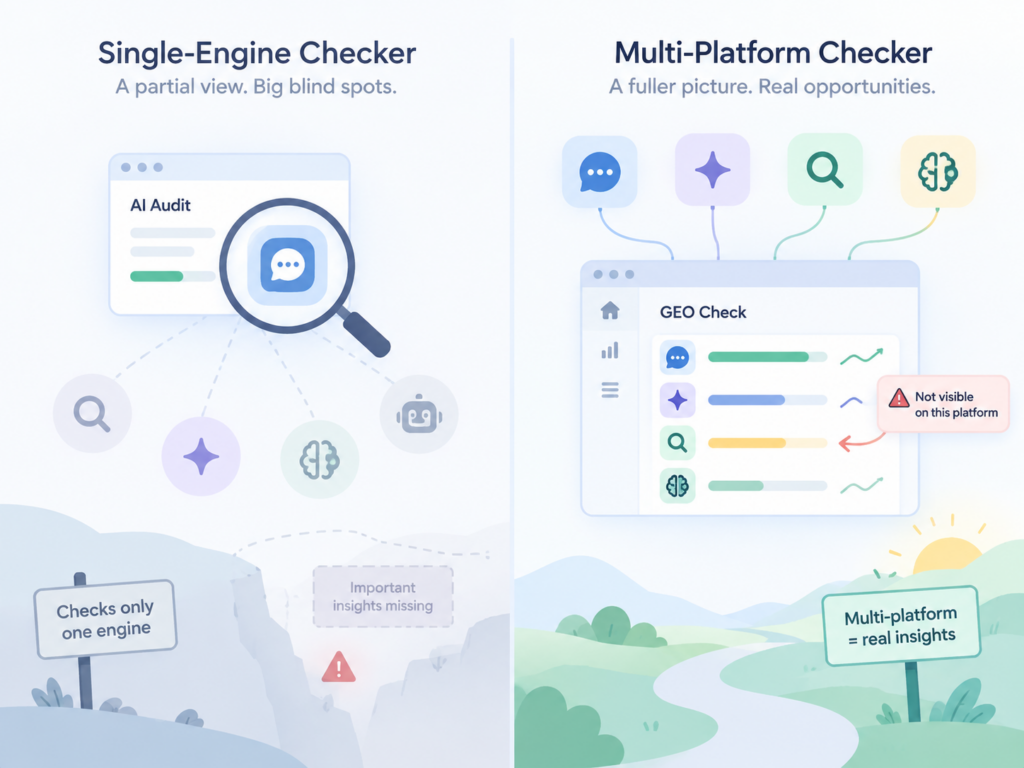
    The third mismatch is platform weighting. A checker built around a single AI engine treats a gap on a different platform as a footnote. A checker built to test several platforms at once treats that same gap as a core finding. Since AI referral traffic and citation behavior vary sharply by platform, a tool that only samples one engine is, by design, blind to the others.

    From a One-Time Score to Continuous Monitoring

    A free checker answers one question: where do you stand today. It doesn’t tell you whether last month’s schema fix actually moved your visibility on a specific platform, or whether a competitor’s content update just pushed you out of an answer you used to own.

    CapabilityFree GEO CheckerTopify Platform
    Check frequencyOne-time snapshotContinuous monitoring
    Dimensions trackedBot access, schema, or visibility, rarely all four togetherFull GEO analytics plus sentiment and citation tracking
    Historical trendNoneFull trend history with alerts
    Competitor benchmarkingNot includedReal-time competitor tracking
    Platform breakdownAggregated or partialPer-platform, across ChatGPT, Perplexity, Gemini, and AI Overviews
    Optimization actionsDirectional guidanceSpecific, prioritized execution steps

    The checker tells you where you stand. Comprehensive GEO Analytics tells you which direction you’re moving, and why.

    Most teams run the free score first to confirm there’s a real gap worth closing, then start a free trial or check Topify’s pricing once they decide the gap needs ongoing attention rather than a one-time fix.

    Conclusion

    The scores disagree because the tools disagree on what to measure, not because one of them got your site wrong. A bot-access checker and a schema checker can both be accurate and still tell you completely different things. Use a free checker to establish your baseline, then decide whether the gap it found is a one-time fix or an ongoing drift. Run the free GEO checker once to see where you stand today, and treat that number as the reason to keep watching, not the end of the conversation.

    Frequently Asked Questions

    Why do free GEO checkers give different scores for the same website? 

    Each checker tests a different combination of signals, such as bot access, schema, or platform visibility, and weights them differently. A tool that only reads robots.txt will disagree with one that scores several AI platforms individually. Neither score is wrong, they’re measuring different layers of the same problem.

    Which free GEO checker should I trust? 

    No single one, on its own. A checker that covers bot access, structured data, content signals, and platform visibility together, like Topify’s GEO Score Checker, gives you one consistent baseline instead of stitching together three partial reports that don’t agree.

    How is a GEO score different from a traditional SEO score? 

    An SEO score typically measures keyword rankings and backlink authority in classic search results. A GEO score measures whether AI crawlers can access your content, whether your structured data is machine-readable, and whether AI platforms actually cite or recommend your brand in generated answers.

    What’s the real difference between a free checker and a paid GEO platform? 

    A free checker gives you a one-time snapshot. A platform like Topify tracks the same dimensions continuously, benchmarks you against competitors, and flags when your visibility shifts on a specific platform, instead of asking you to rerun a manual check every few weeks to catch drift.

    Read More

  • GEO Score Came Back Low? Here’s How to Read the Breakdown

    GEO Score Came Back Low? Here’s How to Read the Breakdown

    You ran the check. The number came back somewhere in the 30s or 40s. Now you’re staring at it, trying to figure out if this is a five-minute fix or a five-month rebuild.

    That’s the trap of a single GEO score. A number by itself doesn’t tell you what’s broken. It just tells you that something is. The useful information lives one layer down, in the four dimensions that number is built from.

    Check your GEO score and you’ll see that breakdown instead of just the total. It’s free, takes about 60 seconds, and doesn’t require signup.

    A Low Number Doesn’t Tell You What’s Broken

    Here’s the mistake most teams make: they treat a low GEO score like a single grade on a single test. It isn’t. It’s an average of four separate signals, and those signals don’t move together.

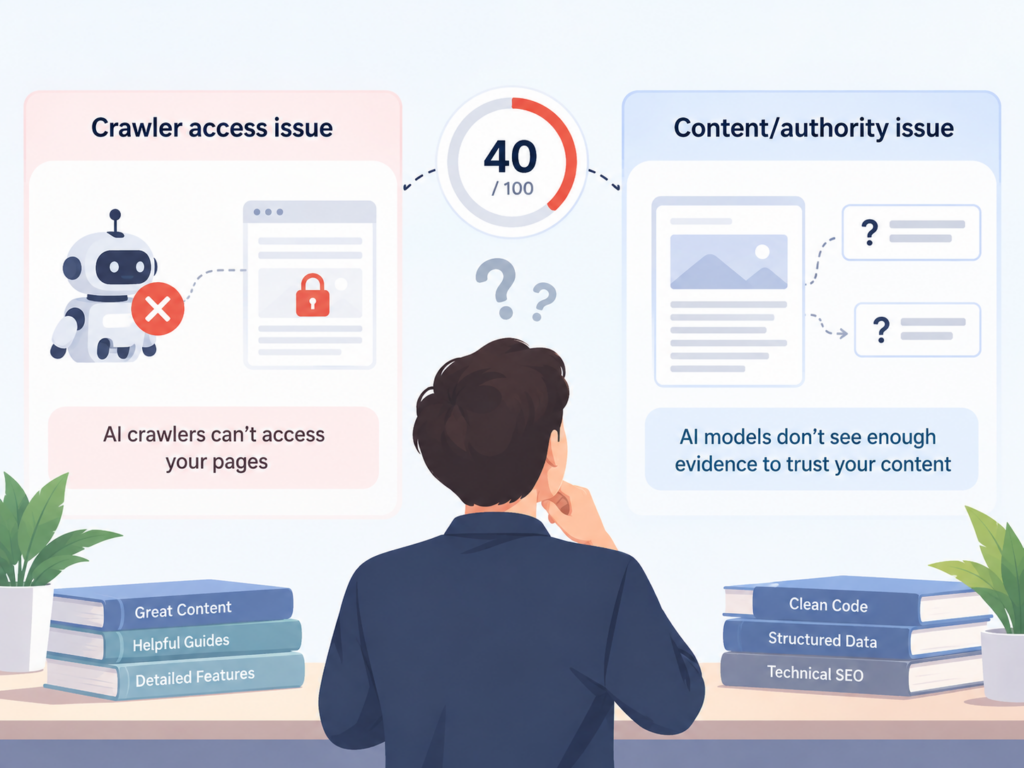
    A brand can have excellent content and still score low, because the problem sits at the crawler level, not the writing level. Or a brand can have flawless technical setup and still score low, because AI models don’t see enough evidence to trust what’s on the page. Same number, completely different fix.

    That’s not something you can diagnose ahead of time based on complaints or hunches. The GEO Score Checker gives you the four numbers underneath the total, which is the part that actually points you somewhere.

    The Four Numbers Hiding Inside Your One Score

    Every GEO score is really four scores compressed into one. Each answers a different question about how AI systems interact with your site.

    Score DimensionWhat It MeasuresWhat a Low Number Usually Means
    Bot AccessWhether AI crawlers can reach and read your pagesRobots.txt, firewall rules, or JavaScript rendering are blocking access
    Structured DataWhether your content is machine-readableSchema markup, JSON-LD, or clear entity structure is missing or broken
    Content SignalsWhether your content reads as authoritativeThin content, weak sourcing, or no clear expertise signals
    Visibility ScoreHow often your brand actually shows up in AI answersLow presence across ChatGPT, Perplexity, Gemini, and AI Overviews

    Once you see the split, the low total stops being a mystery. Here’s how to check it against your own site:

    1. Run your domain through the GEO Score Checker
    2. Get your score across all four dimensions in under a minute
    3. Line up each dimension against the table above
    4. Fix the lowest one first, not the one that feels most obvious

    That last step matters more than it sounds. Teams tend to jump straight to content, because that’s the dimension they have the most control over. But if Bot Access is the weak point, no amount of rewriting fixes anything. The crawler never sees the new content either.

    Reading the Gap Between Dimensions

    The most useful signal isn’t the low score itself. It’s the gap between dimensions.

    A brand scoring 80 on Bot Access and 25 on Content Signals has a different problem than a brand scoring 25 on Bot Access and 80 on Content Signals. The first team needs to fix what they’re saying. The second team needs to fix whether anyone can read it at all.

    That gap is measurable, and it’s the piece most low-score conversations skip past.

    Why Brands With Good Content Still Score Low

    Bot Access is the dimension that surprises people most, because it has nothing to do with content quality. It’s a technical access question, and a lot of sites fail it without knowing they’re failing it.

    A Q3 2026 crawl of nearly 1,750 sites found that 9.9% block GPTBot outright in robots.txt, and 13.7% block at least one AI crawler entirely. More telling: 84.2% of sites have no AI crawler policy set up at all, which means most low Bot Access scores aren’t a deliberate choice. They’re a default nobody reviewed.

    Structured Data tends to fail for a quieter reason. Plenty of sites have solid content but no schema markup, no clear entity definitions, and no JSON-LD to tell an AI model what it’s looking at. The information is there. It’s just not labeled in a way a model can parse quickly.

    Content Signals scores low most often when a page answers a question technically correct but without the specificity that makes AI models trust it, named sources, concrete numbers, clear authorship. Generic explainer content tends to underperform here even when it’s accurate.

    What a Low Visibility Score Actually Costs You

    Visibility Score is the dimension that turns a diagnostic exercise into a business conversation, because it’s the one your buyers actually experience.

    Forrester’s 2026 Buyers’ Journey Survey, covering close to 18,000 global buyers, found that 94% of B2B decision-makers used a large language model somewhere in their purchase process in 2025, up from 89% the year before. G2’s Answer Economy report puts it more specifically: 51% of B2B software buyers now start their research with an AI chatbot more often than Google, and 71% rely on one somewhere in the process.

    If your Visibility Score sits low, that’s not a hypothetical gap. It’s a real share of buyers asking a question in ChatGPT or Perplexity and getting a competitor’s name back instead of yours.

    That’s the part a one-time score can flag but can’t fix on its own. It tells you where you stand today. It doesn’t tell you whether tomorrow’s answer changes.

    From a One-Time Score to Knowing Why It Changes

    A GEO score is a snapshot. The four dimensions behind it move independently and keep moving, crawler access rules get updated, competitors publish new content, AI platforms shift how they weight sources. A single check tells you where you are right now. It doesn’t tell you which direction things are heading.

    That’s the gap Comprehensive GEO Analytics is built to close. Instead of a one-time read, it tracks all four dimensions on an ongoing basis and layers in competitor visibility so you can see whether a low score is improving or quietly getting worse.

    CapabilityFree GEO Score CheckerTopify Platform
    Check frequencyOne-time snapshotContinuous monitoring
    Dimensions tracked4 GEO scoresFull GEO analytics plus sentiment and citations
    Historical trendsNoneFull trend history with alerts
    Competitor benchmarkingNot includedReal-time competitor tracking
    Platform breakdownAggregatedPer-platform, ChatGPT, Perplexity, Gemini, AI Overviews
    Optimization actionsDirectional guidanceSpecific, prioritized execution steps

    The checker gives you a snapshot. The platform tracks the trajectory. If your score comes back low and you want to know whether your fixes are actually moving the needle, that’s the part a single check can’t answer on its own. You can start a free trial or look at pricing if you’re ready to move past the one-time read.

    Conclusion

    A low GEO score isn’t a verdict. It’s a starting point that only means something once you see which of the four dimensions is actually pulling the total down. Bot Access, Structured Data, Content Signals, and Visibility Score each point to a different fix, and mixing them up wastes time on the wrong one.

    Run your domain through the GEO Score Checker again once you’ve made a change, and compare the new breakdown against the old one. If Bot Access keeps coming back as the weak spot, the AI Robots Checker will help you trace the exact rule that’s blocking access. If Content Signals is the gap, the Brand Authority Checker digs further into what’s missing.

    Frequently Asked Questions

    What counts as a good GEO score? 

    Scores above 80 generally mean AI platforms can access, understand, and cite your content with confidence. 61 to 80 is workable but leaves room to improve. Anything under 60 usually means at least one dimension has a real gap worth fixing.

    How fast can a low GEO score improve? 

    It depends on which dimension is dragging the score down. Bot Access fixes, like updating robots.txt, can show up within days. Content Signals and Visibility Score tend to move slower, often over several weeks, since AI platforms need to recrawl and reassess your pages.

    Is GEO score the same thing as an SEO score? 

    No. SEO scores measure ranking factors for traditional search results. GEO score measures whether AI platforms can access, understand, and choose to cite your content in generated answers, which is a different set of signals entirely.

    What’s the difference between the free checker and the full platform? 

    The GEO Score Checker gives you a one-time snapshot across four dimensions. Comprehensive GEO Analytics tracks those same dimensions continuously, adds competitor benchmarking, and flags when something changes.

    Read More

  • Running a GEO Check on Your Site: A 5-Minute Walkthrough

    Running a GEO Check on Your Site: A 5-Minute Walkthrough

    Ask ChatGPT a question about your own industry and see what comes back. If you run a project management tool, ask it what small teams should use. If you sell skincare, ask it what to try for sensitive skin. There’s a decent chance you’ll get three or four brand names, and yours might not be one of them.

    That’s not a ranking problem. It’s a visibility problem, and it’s one most sites have never actually tested for. You’ve probably run an SEO audit at some point. You’ve likely never run a GEO check, which is a different question entirely: can AI systems even access, parse, and trust your site well enough to mention it at all.

    Run a free GEO check and you’ll have an answer in under a minute. No signup, no credit card, just a score.

    ✅ Free ⚡ Results in 60 seconds 🔒 No signup required

    Most Sites Have Never Actually Been Checked for AI Visibility

    SEO audits check things like keyword targeting, backlinks, and page speed. A GEO check asks a narrower set of questions: can AI crawlers reach this page, is the content structured in a way machines can parse, and does the site show up when someone actually asks an AI platform about this topic.

    Those questions matter more than most site owners realize. Publishers now block AI crawlers at roughly five times the rate of the open web, and ClaudeBot alone is disallowed by about 35% of top sites according to a June 2026 robots.txt audit. Some of that blocking is intentional. A lot of it isn’t.

    That’s the gap a GEO check is built to close. You can’t fix what you haven’t measured, and most teams have never measured this at all.

    What a GEO Check Actually Measures

    A proper GEO check isn’t a single number pulled out of thin air. It breaks your site down into four dimensions, each one answering a specific question about how AI systems experience your pages.

    Score DimensionWhat It MeasuresWhy It Matters
    Bot AccessWhether AI crawlers like GPTBot, ClaudeBot, and PerplexityBot can actually reach your pagesIf the bots can’t get in, nothing else on this list matters
    Structured DataWhether your content has schema markup AI systems can parseMachines extract meaning from labeled data far more reliably than plain text
    Content SignalsWhether your content reads as authoritative, specific, and well-sourcedThis is what AI weighs when deciding which brand to name
    Visibility ScoreHow often your brand actually shows up across ChatGPT, Perplexity, Gemini, and AI OverviewsThe outcome metric that ties the other three together

    Scores run 0 to 100. Under 40 usually means AI systems can barely see the site. 41 to 60 is a foothold, but competitors likely have an edge. 61 to 80 is solid, with room to close specific gaps. 81 and up means AI has a real reason to recommend the brand on its own.

    Step-by-Step: Running Your Own Check

    1. Open the GEO Score Checker and enter your domain
    2. Wait about 60 seconds while it pulls the four scores
    3. Compare the dimensions against each other, not just the total. A 75 total can hide a Bot Access score of 20
    4. Note which single dimension is dragging the average down. That’s where you start

    What People Are Actually Asking AI About Your Category

    Here’s the part that makes the score feel less abstract. AI chatbots are already the front door for a lot of purchase research. Nearly half of all ChatGPT usage is people asking for recommendations and advice, not writing help or code. And more than 59% of AI users say they’ve discovered a new brand through a chatbot recommendation.

    That means the prompts below are already happening, right now, in your category:

    AI Prompt ExamplePlatformSearch IntentWhat It Reveals
    “Best project management tool for a 5-person startup”ChatGPTComparison, no brand namedWhether AI names your brand unprompted
    “Is [competitor] worth it for small teams”PerplexityValidation of a known optionWhether your brand shows up as an alternative
    “What’s a good CRM for solo founders”ChatGPTEarly-stage discoveryWhether your content is specific enough to get cited
    “Compare pricing for [category] tools”GeminiBottom-funnel decisionWhether your pricing page is structured enough to parse
    “What should I use instead of [older tool]”PerplexitySwitching intentWhether your migration or comparison content exists at all

    A low score on any single dimension usually explains why a brand is absent from prompts like these. Bot Access problems mean AI never even reads the page. Content Signals problems mean it reads the page and still doesn’t trust it enough to name it.

    Where Sites Lose Points, and Why It’s Not Always Obvious

    The Bot Access and Structured Data gaps are the two that catch people off guard, mostly because they’re invisible unless you go looking.

    On structured data specifically, adoption looks healthy at first glance. A 2026 audit of 5,000 production sites found that 71% deploy at least one schema type, but only 22% pass a clean validation check across every type they emit. That 49-point gap between “deployed” and “valid” is exactly the kind of thing a GEO check surfaces that a standard SEO audit misses.

    It matters because AI platforms lean on that markup to decide what to cite. Separate research on AI-cited pages found that 65% of pages cited by Google’s AI Mode and 71% cited by ChatGPT include structured data, well above the average site.

    On the crawler side, the story is similar. Plenty of teams assume their site is fully open to AI bots because nobody touched robots.txt on purpose. But default settings from a CDN, an old security rule, or a plugin can quietly disallow GPTBot or ClaudeBot without anyone noticing. That’s a Bot Access score problem hiding behind a site that otherwise looks fine.

    One Check Tells You Where You Stand. It Doesn’t Tell You Where You’re Heading

    A GEO check is a snapshot. It’s accurate the moment you run it, and then AI platforms keep updating what they know, who they cite, and what they recommend. Your score today doesn’t stay fixed.

    That’s the honest limit of a free, one-time tool, and it’s worth being upfront about.

    CapabilityFree GEO Score CheckerTopify Platform
    Check frequencyOne-time snapshotContinuous monitoring
    Dimensions tracked4 GEO scoresFull GEO analytics, sentiment, and citation tracking
    Historical trendsNoneFull trend history with alerts
    Competitor benchmarkingNot includedReal-time competitor tracking
    Platform breakdownAggregatedPer-platform view across ChatGPT, Perplexity, Gemini, and AI Overviews
    Optimization actionsDirectional guidanceSpecific, prioritized execution steps

    The checker tells you where you stand today. Comprehensive GEO Analytics tracks the trajectory, so a dip in Bot Access or a competitor gaining ground in Perplexity shows up before it costs you visibility. If the one-time score already found something worth fixing, it’s worth starting a free trial to see how it trends over the next few weeks. Pricing starts well below what most teams expect for this kind of tracking.

    Conclusion

    A GEO check takes five minutes and answers a question most sites have never asked: can AI systems actually see us. Run your own GEO check and read the four scores side by side rather than just the total.

    If Bot Access comes back low, the AI Robots Checker will help you find exactly which crawler is being blocked and where. If Content Signals looks weak, the Brand Authority Checker digs into that dimension specifically. Either way, the five minutes it takes to run the first check is the cheapest audit you’ll do this quarter.

    Frequently Asked Questions

    How often should I run a GEO check? 

    Once as a baseline, then again after any major site change, like a CMS migration or a new CDN setup. AI platforms update frequently, so a quarterly recheck is a reasonable cadence for most teams.

    Is a GEO check the same as an SEO audit? 

    No. An SEO audit focuses on rankings, backlinks, and keyword targeting. A GEO check focuses on whether AI crawlers can access your site, whether your markup is machine-readable, and whether AI platforms actually mention your brand.

    What’s the difference between the free checker and the full platform? 

    The free GEO Score Checker gives you a one-time snapshot across four dimensions. Comprehensive GEO Analytics tracks those same dimensions continuously, adds competitor benchmarking, and flags changes as they happen.

    My score came back low. What should I fix first? 

    Start with whichever dimension scored lowest, not the total. A low Bot Access score means nothing else can improve until crawlers can reach the page, so that’s almost always the first fix.

    Read More