Author: Elsa Ji

  • Free GEO Audit: The 4 Signals That Tell You If AI Can Find Your Brand

    Free GEO Audit: The 4 Signals That Tell You If AI Can Find Your Brand

    Your team spent the last two quarters building content, earning backlinks, and climbing Google rankings. Then someone asked ChatGPT what to buy in your category, and your brand wasn’t in the answer. 73% of B2B buyers now use tools like ChatGPT and Perplexity somewhere in their research process, which means a growing slice of your audience is making decisions in a place Google Analytics can’t see.

    The metrics that told you SEO was working don’t answer a different question: can an AI model actually read, understand, and recommend you. That question has a name. It’s called a free GEO audit, and it breaks down into four specific signals.

    Why Ranking Well on Google Doesn’t Mean AI Can See You

    Search and AI answers run on different logic. Google indexes pages and ranks them against a query. An AI model reads a smaller set of sources, decides which ones it trusts, and writes an answer in its own words.

    That gap is already showing up in the numbers. AI referral traffic to websites grew 16 times over from 2024 to 2026, and the sessions that do arrive convert differently than organic search ever did. ChatGPT-referred visits convert at roughly 15.9%, against 1.76% for Google organic.

    Fewer visits, but a much higher-intent visitor. That’s the trade-off a GEO audit is built to measure.

    A free geo audit exists to answer one question directly: not “do you rank,” but “can AI reach, parse, and trust what’s on your site.” Four signals make up that answer.

    Signal 1: Whether AI Bots Can Even Reach Your Site

    This is the most basic gate, and it’s the one teams check least often. If GPTBot, PerplexityBot, or ClaudeBot are disallowed in robots.txt, none of your content ever reaches the model in the first place. It doesn’t matter how good the page is.
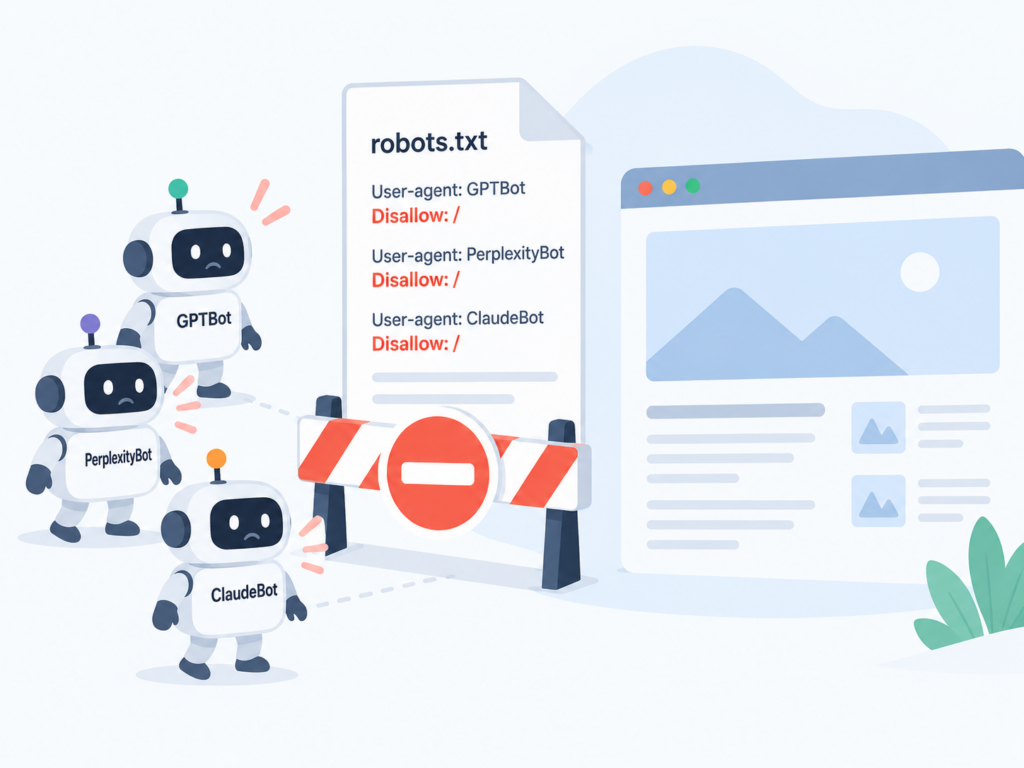
    This happens more than most teams assume. One 2026 crawl of nearly 1,750 sites found 9.9% block GPTBot outright, and 84.2% have no AI crawler policy at all, often because a developer copied a blanket disallow rule years ago and nobody revisited it.

    Blocking isn’t always accidental. A meaningful share of enterprise sites choose a hybrid setup on purpose, letting bots crawl public marketing pages while keeping account and admin paths closed. That’s a reasonable policy. An unreviewed one, inherited from an old CMS default, isn’t.

    The fix is usually a single line change. Checking which specific bots are allowed or blocked, by name, is step one of any audit worth running.

    Signal 2: Whether Your Content Has a Shape AI Can Parse

    Structured data gets treated as a magic switch in a lot of SEO advice, and the reality is messier. A controlled test of 1,885 pages that added JSON-LD schema found close to zero lift in AI citations: +2.2% on ChatGPT, +2.4% on AI Mode, and a slight decline on Google AI Overviews. Adding FAQPage markup to a page that AI already ignores won’t suddenly get it cited.

    That doesn’t mean schema is pointless. It just does a different job than most people assume.

    Where structured data earns its keep is at the parsing stage, not the citation stage. It helps a model correctly identify what a page is, who wrote it, and how the pieces relate, especially on pages the model hasn’t seen before. Think of it as making your content legible, not persuasive.

    Layering Organization, Article, and FAQPage schema on the same page gives a model several ways to extract the same information. That’s worth doing. Just don’t expect it to move a brand from invisible to recommended on its own.

    Signal 3: Whether Your Content Signals Are Strong Enough to Get Picked

    This is where the basics still carry weight: a clear page title, a real meta description, a proper H1, structured H2s underneath it, a canonical URL, and enough actual content depth to be worth citing.

    None of this is exotic. It’s the same hygiene good SEO has rewarded for a decade. The difference is what it’s now being read by. A model deciding whether to cite a page is effectively asking the same question a skimming reader would: does this page clearly say what it’s about, and does it say enough to be useful.

    Thin pages lose on both counts. So do pages where the heading structure doesn’t match the actual content, because a model that can’t map your H2s to your paragraphs has a harder time pulling a clean answer out of them.

    Signal 4: Whether AI Actually Recognizes and Recommends You

    The first three signals are technical: can a bot reach the page, can it be parsed, is it substantial enough to matter. The fourth signal is different. It asks whether the model, once it has read your content, actually thinks of your brand as a real answer.

    This is the layer a purely technical crawl can’t reach, because it requires probing the model itself rather than the site. Does it recognize the brand name. Does it describe it accurately. Does it recommend it in the same breath as competitors, or leave it out entirely.

    It’s also the layer with the most at stake. As AI referral sessions convert at multiples of organic search, being technically crawlable but never actually recommended is close to the worst outcome: fully visible to the bots, invisible in the answers that matter.

    Run a Free GEO Audit in Under a Minute

    Checking all four signals by hand means digging through robots.txt, running a schema validator, auditing on-page content, and somehow probing an LLM’s actual opinion of your brand. Most teams don’t have a spare afternoon for that.

    You can run a free GEO audit from Topify, a platform built for AI search optimization, and get a composite score back in under a minute. No signup, no credit card.

    The score breaks down by category, not just a single number. AI Bot Access, Structured Data, and Content Signals each get scored out of 100, with the specific pass and miss items listed underneath, so you can see exactly which bot is blocked or which schema type is missing rather than guessing.

    What a Low GEO Audit Score Actually Means

    A score under 50 usually means something structural is broken: a blocked crawler, missing structured data, or content too thin to cite. These are binary problems with binary fixes, and fixing even one can move the number fast.

    A score between 50 and 74 means the fundamentals are mostly there, but the pass and miss list still has real gaps. Adding FAQ schema to your highest-traffic page or unblocking one crawler can often move the score 10 to 20 points on its own.

    Above 75, you’re in reasonably good shape. At that point the main risk isn’t a broken signal, it’s a competitor closing the gap while you’re not watching.

    That last part is the reason a one-time free geo audit isn’t the finish line. Scores change as sites update, as crawlers change policy, and as competitors fix their own gaps. Teams that want to track that Signal 4 layer over time, the part a technical scan can’t see on its own, typically move from the free check into ongoing AI visibility monitoring once they’ve cleared the first three signals.

    Conclusion

    A high Google ranking used to be proof that a brand was easy to find. It no longer covers the whole picture. AI Bot Access, Structured Data, Content Signals, and AI Visibility are four separate gates, and a brand can pass three of them while still being invisible in the answers that increasingly decide who a prospect calls first.

    Running a free GEO audit doesn’t fix anything by itself. It tells you which of the four gates is actually closed, so you’re not guessing where to start.

    FAQ

    Q: What is a GEO audit, exactly? 

    A: It’s a check of how AI-ready a website is across a specific set of signals, typically whether AI crawlers can access the site, whether the content is structured clearly, whether it has enough depth to be worth citing, and whether AI models recognize the brand at all.

    Q: Is a free GEO audit actually free, or is there a catch? 

    A: The technical layer, covering crawler access, structured data, and content signals, is genuinely free to run with no signup required. Deeper, ongoing tracking of how AI models talk about a brand over time is typically where paid monitoring comes in.

    Q: How often should I run a GEO audit? 

    A: Monthly is reasonable for most brands, since crawler policies and content change often enough to shift a score. Anyone actively fixing issues from a first audit should re-run it after each fix to confirm it worked.

    Q: Does a high GEO audit score guarantee AI will recommend my brand? 

    A: No. A high score on the technical signals means AI can reach and read your content, which is a precondition for being recommended, not a guarantee of it. Recognition and recommendation depend on the fourth signal, AI Visibility, which reflects how models actually talk about a brand rather than whether they can technically access it.

    Read More

  • Searches for GEO Agency Are Up 17x. Most Brands Don’t Need One

    Searches for GEO Agency Are Up 17x. Most Brands Don’t Need One

    You’ve gotten two or three GEO agency proposals this quarter, and every one of them quotes a monthly retainer your CFO won’t approve without proof it’s necessary. Meanwhile your competitor keeps showing up in ChatGPT answers and you don’t. The proposals promise citation tracking and content overhauls, the same things a piece of software already does for a fraction of the price. Nobody on the sales call mentioned that part.

    Why GEO Agency Searches Are Spiking

    The search behavior isn’t manufactured hype. Search interest in the phrase geo agency has jumped by as much as 23x year over year, with the related term “generative engine optimization agency” close behind. Other trackers put the increase nearer 17x, but every estimate points the same direction: brands suddenly believe they need outside help to show up in AI answers.

    That belief isn’t wrong. It’s just incomplete.

    The trigger is real. Gartner has projected a 25% drop in traditional search engine volume as more queries move to ChatGPT, Gemini, and Perplexity instead of Google’s blue links. When a channel that big starts shifting, marketing teams panic, and panic buying defaults to “hire someone.” That’s the same reflex that built the SEO agency industry a decade ago, just compressed into months instead of years.

    Here’s the part the search volume doesn’t capture: most of what a GEO agency sells as a service is now something software does on its own. The question isn’t whether you need to act on AI visibility. It’s whether you need a team of people to act on it for you.

    What a GEO Agency Actually Sells You

    Strip away the pitch decks and a typical GEO retainer covers four things: citation tracking across AI platforms, content built to be quoted by those platforms, competitor benchmarking, and a monthly report that turns the first three into something a CMO can present upward.

    Pricing reflects how new and uncommoditized the category still is. Global GEO retainers run from $1,500 to $25,000 a month, with mid-market engagements clustering between $3,000 and $8,000. Enterprise-tier agency programs often land in the $25,000 to $50,000-plus range for more complex scopes, stretched across a six-month minimum before either side can measure results.

    Compare that to what the DIY side of the market charges for the same visibility layer. AI visibility tracking software typically runs $50 to $1,000 a month, with fuller platforms extending into four figures for larger teams. That’s not a rounding difference. It’s the gap between paying for a dashboard and paying for a team of humans to read the dashboard for you.

    None of this makes agencies a bad deal by definition. It means the price you’re quoted is mostly a labor cost, not a technology cost, and labor is exactly the part software has gotten good at replacing.

    There’s a second detail buried in most proposals: the minimum commitment. Agencies typically ask for three to six months before they’ll commit to results, because content and citation building takes time to show up in AI answers. Over that window, an entry-level six-month program can run $14,000 to $32,000 in total, and a mid-market one $32,000 to $56,000, according to published GEO program cost estimates. That’s the number that should be on the table before your CFO asks for it, not after.

    The Real Question Isn’t Agency or Not

    Before signing anything, it’s worth separating what you’re actually missing into three buckets: monitoring, execution, and judgment.

    Monitoring is the ability to see, in real time, whether ChatGPT, Perplexity, or Google AI Overviews are mentioning your brand and how. Execution is turning that data into content changes, schema updates, and citation-worthy assets. Judgment is the strategic call on which battles matter, which competitors to worry about, and how to prioritize limited resources.

    Most brands searching “geo agency” today are missing the first two. Almost none of that requires a human retainer anymore. Monitoring is a data pipeline problem, and execution, at least the repetitive parts of it, is a workflow-automation problem. Judgment is the one bucket that still benefits from a person, and it’s the smallest of the three for most mid-market brands.

    This is where the framework gets useful. If your gap is monitoring or execution, a generative engine optimization tool closes it directly. If your gap is judgment, specifically judgment across dozens of client accounts at once, an agency or in-house strategist still earns their fee.

    Run a quick self-check before any proposal call. Ask whether your team currently knows, this week, how often your brand gets mentioned across ChatGPT, Perplexity, and Google AI Overviews. Ask whether anyone has traced a citation drop back to a specific source that stopped referencing you. Ask whether you’ve identified the high-volume AI prompts in your category that you’re not showing up in at all. If the answer to all three is no, that’s a monitoring and execution gap, not a strategy gap, and it’s the cheaper problem to solve.

    Why Software Now Covers What Agencies Used to Sell

    This is exactly the gap Topify was built to close. Instead of a monthly retainer for a team to check dashboards and write reports, Topify’s Comprehensive GEO Analytics tracks visibility, sentiment, position, volume, mentions, intent, and CVR across ChatGPT, Gemini, Perplexity, and other major AI platforms in one place.

    The execution layer is where the labor-cost comparison gets sharper. Agencies bill for the hours it takes a strategist to translate data into action. Topify’s One-Click Execution flips that order: you state the goal in plain English, review the proposed strategy, and deploy it without a back-and-forth email thread or a monthly reporting cycle standing between insight and action.

    In practice, that means a marketing team can spot a drop in AI citations, trace it to a specific source that stopped referencing the brand, and act on the fix the same day, not after the next scheduled agency check-in. High-Value Prompt Discovery adds the piece most retainers charge extra for: surfacing new high-volume prompts in your category as AI recommendations shift, so the team isn’t reacting to last month’s data.

    None of this requires replacing every human in the loop. It requires being honest about which parts of the “geo agency” pitch were ever about strategy, and which parts were really just software wearing a service wrapper.

    When You Still Might Need an Agency

    There’s a real exception, and it’s worth naming instead of glossing over. Marketing agencies managing GEO across a dozen or more client brands do have a judgment problem at scale that a single dashboard doesn’t solve on its own. So do teams with zero internal marketing bandwidth and no appetite to run even a self-serve tool.

    For those cases, the smarter question isn’t agency versus software. It’s whether the agency you’re evaluating is layering strategy on top of a real GEO analytics platform, or reselling manual dashboard-checking at a markup. Ask to see the tool behind the retainer before you sign.

    Conclusion

    The 17x to 23x jump in “geo agency” searches is a real signal that AI search visibility now matters enough to act on. It’s not a signal that action requires hiring out. Most brands searching for an agency this quarter are missing monitoring and execution, not judgment, and both of those are now things a platform like Topify handles directly. Before the next proposal lands in your inbox, run the three-bucket check first. It’ll tell you whether you’re about to pay for strategy or pay for a login you could have had yourself.

    FAQ

    Q: How much does a GEO agency typically cost? 

    A: Global retainers generally range from $1,500 to $25,000 a month, with most mid-market engagements clustering between $3,000 and $8,000. Enterprise-scale programs with heavier content and PR components can run $25,000 to $50,000-plus monthly.

    Q: Do I need a GEO agency or can I do this myself? 

    A: Most brands are missing monitoring and execution capability, not strategic judgment. A self-serve GEO analytics tool typically covers both at a fraction of agency pricing, unless you’re managing GEO across many client accounts at once.

    Q: What’s the difference between GEO agency services and GEO software? 

    A: Agencies bundle monitoring, content execution, and reporting into a human-delivered retainer. Software delivers the same monitoring and execution capability directly, without the labor markup, though it puts more of the judgment call back on your team.

    Q: Why are “geo agency” searches increasing so quickly? 

    A: Traditional search volume is shifting toward AI platforms like ChatGPT, Gemini, and Perplexity, and brands are realizing their existing SEO metrics don’t capture whether they’re being recommended in those answers. That urgency is driving a rush toward the most familiar solution, hiring someone, before evaluating whether software already solves it.

    Read More

  • GEO Agency vs. GEO Platform: How to Choose in 2026

    GEO Agency vs. GEO Platform: How to Choose in 2026

    You asked three GEO agencies for a quote and got three completely different numbers, anywhere from $1,500 a month to $35,000. Then a coworker forwarded a link to a $99 dashboard that claims to track the same thing. Nobody on the sales calls explained why the gap is that wide, and nobody mentioned what happens if you pick the wrong model for your team. The confusion isn’t about whether AI search visibility matters. It’s about which approach actually gets you there without wasting six months and a chunk of budget on the wrong bet.

    The Real Question Isn’t Agency or Platform. It’s What You’re Buying.

    Most teams frame this as a single choice: hire people or buy software. That framing is why the decision feels harder than it should.

    A GEO agency and a GEO platform solve different halves of the same problem. One produces the content, entity signals, and strategy that get you cited by AI systems. The other measures whether any of that is working, in something close to real time. Treating them as competing options is how teams end up either overpaying an agency for reporting they could get from a $99 tool, or buying a platform and then having no one to act on what it shows them.

    What You Actually Get From a GEO Agency

    A GEO agency is a team of people managing your AI search presence: content production, schema and entity work, competitor research, and a monthly report.

    Pricing swings hard depending on scope. Small businesses running a basic GEO program typically pay $1,500 to $5,000 a month, while mid-market and enterprise engagements climb to $25,000 to $50,000 or more once you add multilingual content, competitor tracking, and dedicated account management. Project-based work, like a one-time GEO audit or migration, tends to run $5,000 to $50,000 per project, and hourly consulting lands around $50 to $300 an hour.

    Here’s the thing most comparison guides skip: most GEO agencies don’t publish their prices, which is exactly why you got three wildly different quotes. Pricing gets set on the discovery call based on what you disclose about your budget and competitors, not on a fixed rate card. That’s not necessarily a red flag, but it means you’re negotiating blind unless you push for a scope breakdown before signing anything.

    What You Actually Get From a GEO Platform

    A GEO platform is software you log into. It crawls or samples AI answers across ChatGPT, Perplexity, Gemini, and Google AI Overviews, then shows you where your brand shows up, how it’s described, and who’s beating you.

    DIY GEO tools and platforms generally cost $10 to $1,000 or more a month, a fraction of agency retainer pricing. That gap exists because a platform is selling you data and dashboards, not headcount. You still have to act on what the data tells you, whether that’s rewriting a page, fixing a schema gap, or briefing your own content team.

    This is where the math starts to matter. AI Overviews now surface in roughly 48% of Google searches, and traffic that does come through an AI citation converts at a notably higher rate than a standard organic click. A platform that shows you this shift weekly, or daily, is a different tool than a monthly PDF from an agency.

    GEO Agency vs. GEO Platform: Cost, Speed, and Control Side by Side

    FactorGEO AgencyGEO Platform
    Typical monthly cost$1,500 to $50,000+$10 to $1,000+
    Who does the workAgency teamYour team, using the tool
    Data refreshMonthly report, in most casesReal-time or daily, depending on the tool
    TransparencyCustom quotes, pricing rarely publishedPublished tiers, self-serve signup
    Best forContent production at scale, no internal teamOngoing monitoring, fast iteration
    Multi-client useNot applicableCommon, especially for agencies managing several brands

    The trade-off is straightforward once you see it laid out. An agency buys you execution capacity. A platform buys you visibility into what’s happening, on your schedule, not theirs.

    When a GEO Agency Still Makes Sense

    If you have no internal team to write content, build schema, or chase entity mentions, an agency’s headcount is the actual product you’re paying for. That’s a legitimate reason to spend more.

    Agencies also tend to have relationships and playbooks built from running the same GEO program across dozens of clients, which can shortcut the trial-and-error phase. If your brand operates across multiple languages or markets, the coordination overhead of managing that in-house often outweighs the premium you’d pay an agency to handle it end to end.

    When a GEO Platform Is the Better Call

    If you already have a marketing or content team and just lack visibility into how AI systems are describing your brand, a platform closes that gap without adding a retainer to your budget. You get the data, your team decides what to do with it.

    Platforms also make sense the moment you’re managing more than one brand or client. A comprehensive GEO analytics approach that pulls visibility, sentiment, position, and competitor data into a single dashboard lets a lean team monitor several accounts without hiring proportionally. For an in-house marketer, that means catching a drop in ChatGPT mentions the same week it happens instead of finding out in next month’s report. For a marketing agency, it means finally having something concrete to show a client when they ask how their AI visibility compares to a competitor’s, instead of guessing.

    The one-click execution model that some platforms now offer pushes this further: you state a visibility goal in plain language, review the suggested strategy, and deploy it, which narrows some of the gap between “we have the data” and “someone acted on it.”

    Why the Smartest Teams Run Both

    The agency-versus-platform framing breaks down once you notice that agencies themselves are increasingly buying platforms to manage their own client reporting. A GEO agency without visibility software is running on the same guesswork it’s charging clients to eliminate.

    In practice, the pairing that works looks like this: a platform handles ongoing monitoring, competitor benchmarking, and alerting, while either an internal team or an agency handles the content and technical execution that the data points to. You’re not choosing between insight and action. You’re deciding who does the action, and a platform is what tells both sides whether it’s working.

    Conclusion

    The decision isn’t agency versus platform. It’s whether you already have people who can act on GEO data, and how many brands or clients you need to track at once. If you have execution capacity but no visibility, start with a platform, the cost is a rounding error next to a single agency retainer. If you have visibility but no one to act on it, that’s when an agency’s headcount earns its price. Most teams that get this right end up running a platform first, then adding agency support for the specific gaps the data exposes.

    FAQ

    Q: Is a GEO agency worth it for a small brand? 

    A: Usually not as a first step. Small business GEO programs run $1,500 to $3,000 a month at the low end, and that budget often goes further on a platform plus a few hours of internal content work than on a minimal agency retainer.

    Q: How much does GEO cost in 2026? 

    A: Tools and platforms typically run $10 to $1,000+ a month. Agency retainers range from about $1,500 a month for small businesses to $50,000+ a month for enterprise programs, depending on scope and content volume.

    Q: Can I use a GEO platform without hiring an agency? 

    A: Yes. A platform gives you the visibility and competitor data. Whether you act on it with an internal team or bring in outside help is a separate decision, not a requirement of using the tool.

    Q: What’s the difference between a GEO agency and a traditional SEO agency? 

    A: A traditional SEO agency optimizes for search engine rankings and backlinks. A GEO agency focuses on how AI systems like ChatGPT and Google AI Overviews cite, describe, and recommend your brand, which often calls for different content structures and entity signals than classic SEO.

    Read More

  • How a GEO Agency Runs Multiple Clients Without Losing Its Mind

    How a GEO Agency Runs Multiple Clients Without Losing Its Mind

    It’s Friday afternoon and your team is still cross-checking ChatGPT mentions for client number eight. Client number nine already messaged asking where this week’s report is. Nobody planned for this. Somewhere between client three and client eight, the process that worked fine stopped working, and nobody noticed until the backlog showed up.

    That moment is where most GEO agencies end up. Not because they’re bad at generative engine optimization. Because the operations behind it never got redesigned for what happens after client number five.

    Why GEO Agencies Hit a Wall Around Client Number Five

    Demand for GEO services isn’t slowing down. Searches for the term geo agency have jumped 2,300% year over year, according to LLM Pulse, and brands are actively looking for someone to handle this for them.

    That’s good news for the agency’s growth. It’s less good news for the ops team.

    The first four clients usually run on a shared spreadsheet, a couple of manual ChatGPT checks each week, and whoever on the team has bandwidth that day. That setup holds together through sheer effort, not process. Past client five, the math stops working. Each new account adds its own tracking sheet, its own reporting cadence, and its own private definition of what “visibility” even means.

    The agency didn’t get worse at GEO. It just never built a system that assumes there will be a client number twenty.

    This is also why so many agencies now treat GEO the way they once treated SEO: as a service line that only survives past a handful of accounts if it’s built on shared infrastructure, not individual effort.

    The Real Cost of Manual GEO Reporting

    Manual, multi-platform reporting isn’t just tedious. It’s expensive in ways that don’t show up on the invoice.

    Constantly switching between ChatGPT, Perplexity, Gemini, and whatever spreadsheet holds last week’s numbers eats into the workday. Context switching between separate tools alone consumes close to 9% of an employee’s time, translating to an estimated $10,000 to $11,000 in lost productivity per employee each year.

    Past roughly 15 to 20 manually reported clients, assembling reports can eat a full work-week a month, according to a multi-client SEO maturity assessment. That’s a week of billable time spent copying numbers instead of doing the work clients are actually paying for.

    The inconsistency compounds the time cost. When each client’s data lives in a different tool with a different tracking method, mentions counted one way for client A and another way for client B start to disagree with each other. Clients notice. Trust erodes before anyone explains why.

    That’s the gap most agencies don’t see until a client asks about it directly.

    Tracking a single client across five AI engines already means checking dozens of prompts by hand every week. As Superlines has pointed out, fifty tracked keywords across five engines works out to 250 manual searches weekly for one account alone. Multiply that by a real client roster and the arithmetic explains why margins disappear before the strategy work even starts.

    What a Scalable GEO Agency Workflow Actually Looks Like

    A workflow that survives past client twenty usually rests on three layers: one shared metric framework, one dashboard that spans every account, and one onboarding process that doesn’t change client to client.

    The framework matters most. If visibility means something different for every client’s spreadsheet, nothing rolls up into a portfolio view, and account managers can’t spot patterns across their book of business. A single set of metrics, tracked the same way for every client, is what turns a pile of individual reports into an actual operation instead of a collection of side projects.

    Onboarding is the second piece agencies skip. Client one through five typically get a careful kickoff. Client twelve often gets a rushed call because the team is mid-report for someone else. Nobody decides to lower the bar. It erodes one skipped step at a time, and by client twenty the onboarding checklist that used to take a week takes an afternoon, with gaps nobody catches until a report comes back wrong.

    Building One Dashboard Instead of Ten Spreadsheets

    This is where a platform like Topify changes the math. Its Comprehensive GEO Analytics tracks seven metrics, covering visibility, sentiment, position, volume, mentions, intent, and CVR, across every major AI engine from a single dashboard. Instead of ten spreadsheets speaking ten different languages, the whole client roster reports through the same seven numbers.

    Topify’s own use case for agencies lays out the problem plainly. Clients start asking why competitors show up in ChatGPT and Gemini while they don’t, and checking each platform by hand for every account is impossible to maintain once the roster grows past a handful of names. A shared dashboard is what turns that answer into something repeatable instead of a one-off scramble every time a client asks.

    Automated reporting tools built for agency use can cut the time spent compiling performance data by up to 75%. That reclaimed time is what goes back into the strategic work clients are actually billed for, not the assembly work behind it.

    The plan structure matters here too. An agency running four accounts and one running twenty need different amounts of tracking capacity, not a different tool. Topify’s tiers scale from 4 projects and 4 seats on its Basic plan up to 8 projects and 10 seats on Pro, with custom project and seat limits on Enterprise, so the same dashboard can grow with the client roster instead of forcing a tool switch halfway through the year.

    Where Automation Should Replace Manual Work, and Where It Shouldn’t

    Not every part of a GEO engagement should run on autopilot. Data collection should. Judgment shouldn’t.

    Pulling AI visibility numbers across five engines for fifty tracked prompts a week is a mechanical task, the kind that’s identical whether it’s client two or client twenty-two. Doing it by hand doesn’t scale, and it doesn’t need a strategist’s time to do it well.

    Topify’s One-Click Execution is built for exactly that layer. State the goal in plain English, review the proposed strategy, and deploy it without a manual workflow sitting behind every step.

    What still needs a person is the interpretation. Why did a client’s sentiment score drop three points this month. Which competitor started showing up in a high-value prompt cluster, and does that change the content plan for next quarter. Automation should shrink your reporting time. It shouldn’t replace your judgment.

    Signs Your GEO Agency Is Scaling the Wrong Way

    A few patterns tend to show up before an agency admits it has an operations problem, not a headcount problem.

    Every new client requires hiring someone new, instead of adding capacity to existing tools and processes. Report formats differ by account because each one was built ad hoc rather than off a shared template. Team members can’t say with confidence who still has access to which client’s accounts after someone leaves. And most tellingly, nobody on the team can answer a simple question: across the whole client roster, is AI visibility trending up or down this quarter.

    Agencies commonly hit a ceiling somewhere between ten and twenty clients, where each new account creates about as much operational stress as it generates in revenue, based on findings from Agency Dashboard. Past that point, growth stops paying for itself, no matter how good the underlying strategy is.

    The unit economics get worse before they get better, too. Per-client GEO tooling costs that look manageable at five accounts can break down once a roster grows into the dozens, which is exactly why the shared-dashboard model matters more as the client count climbs, not less.

    Retention risk follows the same curve. Clients rarely leave because an agency’s GEO strategy was wrong. They leave because reporting went quiet, questions took too long to answer, or a competitor’s mention started showing up in an AI answer with no explanation attached. None of that requires better strategists to fix. It requires a system that catches the drop the same week it happens, for every client, not just the ones who complain first.

    Conclusion

    Running GEO for multiple clients without losing your mind isn’t about working harder or hiring faster. It’s about deciding, before client number five shows up, that every account will run through the same metrics, the same dashboard, and the same onboarding checklist.

    Agencies that make that call early spend their time on strategy instead of spreadsheets. The ones that don’t spend client number twenty’s onboarding call apologizing for a report that’s already late.

    FAQ

    How many clients can a GEO agency manage with one tool? 

    It depends more on the workflow than the headcount. Agencies running a shared dashboard and standardized reporting typically manage far more accounts per team member than agencies still tracking each client by hand.

    What’s the biggest operational mistake agencies make when scaling GEO services? 

    Treating each new client as a one-off setup instead of plugging them into a repeatable system. That’s usually what causes reporting time to balloon and quality to slip once the roster passes ten or fifteen accounts.

    Do GEO agency tools replace the need for strategists? 

    No. Tools handle data collection and reporting at scale. Strategy, client communication, and reading what the numbers actually mean still need a person on the account.

    Is GEO agency demand still growing in 2026? 

    Yes. Search interest in the term has grown sharply over the past year, and brands increasingly expect their agency to already have an answer for how visible they are in AI search.

    Read More

  • How to Tell If a GEO Agency Actually Knows What They’re Doing

    How to Tell If a GEO Agency Actually Knows What They’re Doing

    Most marketing teams start vetting a GEO agency by asking how many AI platforms it covers. That question gets a confident answer almost every time, because reciting a list of engines takes no real expertise. The harder question, the one that actually separates agencies who understand retrieval from agencies that renamed their SEO deck, rarely comes up in the first meeting. By the time a brand notices the difference, three or four months of retainer fees are already gone, and the report on file still doesn’t say whether ChatGPT mentions the brand any more often than it did on day one.

    Most GEO Agency Reports Can’t Survive a Second Look

    A typical GEO agency report reads like a status update. It lists content published, audits completed, and a general sense that “AI visibility is trending up.” What it usually skips is a number you could check yourself.

    That gap isn’t rare. 78% of marketers aren’t tracking AI visibility at all, which means most brands paying a GEO agency have no independent baseline to compare that agency’s claims against. The report becomes the only version of reality anyone sees.

    That’s the real risk. Not that the agency is doing nothing, but that nobody outside the agency can confirm what it’s actually doing.

    Why So Many GEO Agencies Are Just Rebranded SEO Shops

    The GEO agency market grew fast, and speed attracted opportunists. The global GEO services market reached roughly $1.48 billion in 2026, and a large share of the agencies chasing that budget are traditional SEO shops that added a service page.

    The data backs this up in an unflattering way. Across the agency ecosystem, 54.8% of agencies fold GEO into their existing SEO retainers rather than offer it as its own defined service, while only 27.1% treat it as standalone work with its own methodology and deliverables.

    Folding GEO into an SEO retainer isn’t automatically dishonest. SEO and GEO share real overlap, and a lot of what earns citations also helps rankings. The problem shows up when an agency can’t explain what changed in its process to account for how generative engines actually select and cite sources.

    That’s the tell. If a GEO agency’s deliverables still look like keyword density reports and backlink counts with “AI Overviews” pasted on top, the methodology never changed, only the label did.

    What a Real GEO Agency Should Be Able to Prove

    A competent GEO agency should be able to answer a handful of specific questions without stalling. Vague, confident answers are the exact pattern that lets weak agencies survive a sales call.

    Ask for a before-and-after citation baseline across specific engines, not a general trend line. A real agency samples the actual prompts your buyers type into ChatGPT, Perplexity, and Gemini, records who gets cited today, and treats that as the number every later report gets measured against.

    Ask how their process differs by platform. Different engines pull from different sources and weigh authority signals differently, so an answer that treats “AI search” as one undifferentiated channel is a shortcut, not expertise.

    Ask what happens when a citation drops. A methodology-driven agency can trace a mention loss back to a specific source that stopped citing you or a competitor that displaced you in a specific answer. An activity-driven agency will point to more blog posts instead.

    Ask about entity and schema work too. Structured data and entity clarity are part of how a generative engine decides what a page means and whether it’s safe to cite. An agency that treats schema as a separate technical task for someone else to handle usually hasn’t done the retrieval-side work that makes GEO different from SEO in the first place.

    None of this is academic. Nearly half of B2B buyers now say AI is part of how they find vendors, which means an agency’s inability to show real citation movement isn’t just a reporting gap. It’s a direct hit to pipeline.

    You Don’t Need a Better GEO Agency. You Need Independent Data.

    Here’s the uncomfortable part: even a genuinely skilled GEO agency benefits from a client who can check its work.

    Academic research on what actually moves AI citations backs up why this matters. A Princeton and Georgia Tech studyfound that citing external sources lifted visibility by up to 115% for lower-ranked content, a concrete, measurable effect that any legitimate GEO strategy should be able to reproduce and show you, not just claim.

    This is where an independent layer of data changes the relationship. Topify tracks brand visibility, sentiment, position, and citation sources across ChatGPT, Gemini, Perplexity, and other major AI platforms directly, which means you don’t have to take an agency’s monthly PDF as the only source of truth.

    In practice, that looks like pulling up your own citation history before a quarterly review call and checking whether it matches the story your agency is telling. If your agency claims a content push increased mentions in a category, Topify’s citation tracking lets you trace exactly which sources AI platforms are pulling from and confirm whether your brand’s presence actually moved. If it claims you’re outranking a competitor in AI recommendations, competitor benchmarking shows you that comparison directly instead of asking you to trust a slide.

    This works whether you keep the agency, replace it, or decide to run GEO in-house. The point isn’t to eliminate agencies. It’s to stop being the only party in the relationship who can’t see the underlying numbers.

    What This Looks Like When You Actually Check

    Picture a mid-size SaaS brand paying a retainer to a GEO agency that reports monthly on “AI visibility improvements.” The reports read well. Mentions of momentum, content shipped, audits completed.

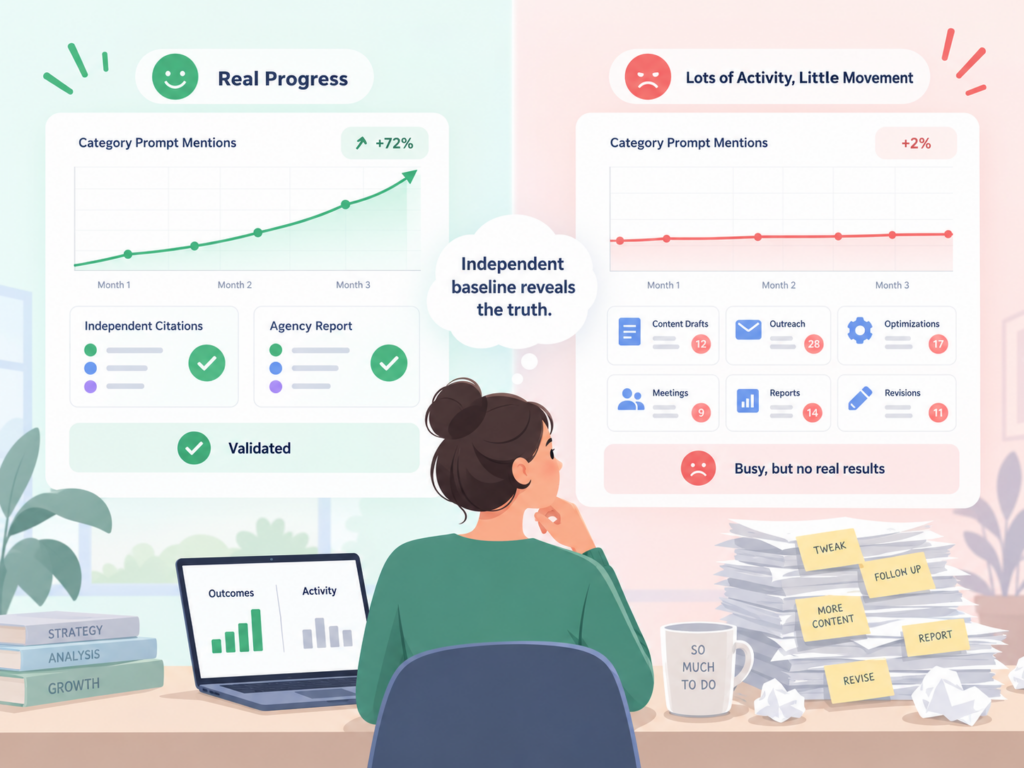
    When the marketing lead pulls an independent citation baseline, two outcomes are equally common. Sometimes the number confirms the story: mentions in category-specific prompts did climb, and the agency’s work holds up under scrutiny. Other times the baseline shows almost no movement across three months of prompts, revealing that the agency’s reports described activity, not outcomes.

    Either way, the brand walks into its next agency conversation with a fact instead of a feeling. That single shift, from trusting the report to checking the report, changes what an agency relationship actually holds anyone accountable for.

    It also changes the tone of the conversation itself. A team that shows up with its own citation numbers isn’t asking an agency to justify its invoice in the abstract. It’s asking about one specific, shared dataset, which tends to shorten the meeting and sharpen the answers on both sides.

    How to Start Vetting Your GEO Agency This Week

    You don’t need a new agency to start this process. You need three things in place before your next check-in.

    First, pull your own baseline. Run 20 to 30 of the prompts your buyers are most likely to type into ChatGPT and Perplexity, and record who gets mentioned today, independent of anything an agency has told you.

    Second, bring specific questions to your next agency call, not general ones. Ask which sources are currently cited when your category comes up, and ask them to name the platform-by-platform differences in their approach rather than describing “AI optimization” as one thing.

    Third, set a cadence for comparing your baseline against their next report. If the two stories match, you’ve found a GEO agency worth keeping. If they don’t, you’ve found that out before another quarter of budget goes toward activity nobody can verify.

    Conclusion

    The GEO agency market is young enough that credentials don’t mean much yet, and confident-sounding methodology is cheap to fake in a sales call. The only reliable filter is proof you can check yourself: a real citation baseline, a platform-specific process, and a report that survives comparison against independent data. Whether you keep your current agency, switch, or bring GEO in-house, that habit of checking is what actually protects the budget.

    FAQ

    Q: How much should a GEO agency cost? 

    A: Pricing varies widely by scope, from a few thousand dollars a month for a single-service engagement to five-figure monthly retainers at agencies bundling GEO with full-service SEO and content. Price alone doesn’t signal competence, since rebranded SEO shops charge premium rates too.

    Q: How long before GEO results show up? 

    A: Timelines differ by platform. Perplexity mentions often shift within a few weeks of a content or schema change, while ChatGPT citation changes typically take 60 to 180 days because of how its training and retrieval process works. Any agency promising results across all platforms in 30 days is overpromising.

    Q: Can I do GEO without an agency? 

    A: Yes. Many in-house marketing and SEO teams run GEO themselves using tools that track citations, sentiment, and competitor positioning across AI platforms, which removes the reporting-gap problem entirely since the team sees the raw data directly.

    Q: What’s the biggest red flag when evaluating a GEO agency? 

    A: A guarantee of specific rankings or citations. Nobody controls what a large language model chooses to cite, so any agency promising a fixed outcome on a fixed timeline is selling confidence, not methodology.

    Read More

  • GEO Agencies Charge $3K to $12K a Month. Do You Need One?

    GEO Agencies Charge $3K to $12K a Month. Do You Need One?

    Three GEO agencies. Three proposals. The lowest quote is $3,200 a month. The highest is $11,800 for what looks, on paper, like the same scope: monthly reporting, content updates, and “AI visibility tracking.” Nobody on your team can explain the $8,600 gap, and the agencies aren’t volunteering the answer. That gap, not the sticker price, is the actual story.

    What a GEO Agency Retainer Actually Includes

    Published pricing guides put GEO agency work anywhere from $1,500 to $50,000 a month, with the range breaking down roughly by business size: small businesses around $1,500 to $5,000, mid-market brands $5,000 to $25,000, and enterprise programs climbing past $25,000. One buyer’s guide narrows the mid-market band further, putting typical retainers between $7,000 and $15,000 a month for 4 to 8 pages of content restructuring, ongoing citation building, and a monthly prompt report.

    Strip out the jargon and a $3K to $12K retainer usually buys four things: technical fixes (schema, crawlability), content restructuring for AI extraction, off-site citation building, and monitoring. Off-site citation work tends to be the biggest recurring line item, not content or tech. That’s worth remembering when you get a quote that’s mostly a content calendar with a small monitoring add-on.

    The Part of the Job That’s Just Monitoring

    Here’s the thing agencies don’t put on the invoice line: a meaningful chunk of a GEO retainer is someone on their team checking a dashboard.

    Agencies argue this monitoring work justifies their fee because comprehensive AI visibility tracking requires content teams, technical specialists, and data analysts that most brands can’t justify hiring in-house for one function. That’s true if you’re building the monitoring infrastructure from scratch.

    But the infrastructure itself is cheap. Agencies serving multiple clients typically run on an AI visibility monitoring platform costing under $100 a month per client, plus a crawlability tool and their existing SEO stack. The tooling cost is small. What you’re paying $3K to $12K for is mostly the labor of someone reading that tool’s output and writing it up.

    When You Actually Need Human Judgment, and When a Tool Is Enough

    Not every part of GEO benefits from a human in the loop. Some of it does.

    Needs human judgmentA tool handles it fine
    Entity and reputation strategy in sensitive sectorsDaily citation tracking across ChatGPT, Perplexity, Gemini
    Original research or PR to earn new citationsCompetitor share-of-voice monitoring
    Deciding which prompts matter for your categoryBaseline and trend reporting
    Cross-team alignment (SEO, content, PR as one program)Finding which domains AI engines are citing

    The pattern holds across most guidance on this: agencies genuinely add value on strategy, reputation management in regulated industries, and cross-functional coordination. Tracking, baselining, and source discovery are mechanical. That’s not a knock on agencies. It’s just where the $8,600 gap in the opening example probably lives, in whether a vendor is billing for judgment or for a dashboard they could hand you directly.

    What a Tool Covers That Most Agencies Charge Extra For

    For teams tracking brand visibility across multiple AI platforms, Topify covers the exact monitoring layer that eats a large share of an agency retainer. It measures seven metrics in one dashboard: visibility, sentiment, position, volume, mentions, intent, and CVR (conversion visibility rate).

    That matters because most agency reports bundle two things that don’t need to travel together: measurement and execution. Topify’s High-Value Prompt Discovery surfaces the specific prompts driving traffic in your category, continuously, instead of a monthly snapshot someone compiled by hand. Its Dynamic Competitor Benchmarking shows who AI engines are actually recommending right now and tracks how your position shifts against them. And its Reverse-Engineer AI Citations feature does the source-domain analysis, showing which URLs ChatGPT and Perplexity are pulling from, so you can see whether your content or a competitor’s is winning the citation.

    In practice, this means a small team can run the measurement half of GEO itself, at a fraction of a retainer’s cost, and reserve agency or in-house strategist time for the parts that actually need a person: deciding what content to build next, whether a PR push is worth the spend, or how to handle a sentiment problem in a regulated category. Plans start at $99 a month, which is closer to the DIY-tool end of the market than the agency end.

    If You Do Hire an Agency, Ask These Questions First

    If your situation genuinely calls for an agency, not every agency in this young category is worth the invoice.

    Ask how they measure results. A credible answer names specific prompts, specific engines, and a comparison against named competitors. A vague answer that points to “your dashboard” without naming a method is a sign they’re reporting Google traffic and calling it GEO.

    Walk away from any guarantee of a specific AI ranking or citation. Nobody controls what a model writes in response to a given prompt, and a guaranteed placement in ChatGPT is a promise no agency can actually keep.

    Check whether they baselined your current visibility before pitching a plan. Skipping the baseline means they can’t prove they moved anything later, because there’s nothing to measure against.

    And watch for proprietary black-box scoring. If progress only shows up inside the agency’s own index and you can’t reproduce or export it, you have no way to tell real improvement from invoice justification.

    Conclusion

    The honest answer to “do you need a GEO agency” is: probably not for the monitoring, possibly yes for the strategy. If your brand needs original research, reputation work in a regulated category, or a coordinated content and PR push, that’s where the $3K to $12K buys something real. If what you actually need is to know whether ChatGPT and Perplexity mention your brand, and how that compares to your competitors, a tool gets you there for a fraction of the cost, and you can always add an agency later for the parts a dashboard can’t do.

    FAQ

    Q: How much does a GEO agency typically charge per month?
    A: Most published pricing guides put GEO agency retainers between $1,500 and $25,000 a month, with mid-market engagements commonly landing between $3,000 and $12,000. Enterprise programs with original research and multi-market coverage can run past $25,000.

    Q: What’s the difference between a GEO agency and a GEO tool?
    A: An agency bundles strategy, content production, and monitoring, delivered by people. A tool handles the monitoring, tracking, and reporting piece, letting you or an in-house team manage strategy and content decisions directly.

    Q: Can I do GEO without hiring an agency?
    A: Yes, for the tracking and measurement half of the work. A visibility monitoring tool covers citation tracking, competitor benchmarking, and prompt discovery. What a tool can’t replace is original research, PR-driven citation building, or reputation strategy in sensitive industries.

    Q: When does it actually make sense to hire a GEO agency instead of a tool?
    A: When your brand needs original research to earn new citations, cross-team coordination between SEO, content, and PR, or reputation management in a regulated sector like finance or health. For pure tracking and reporting, a tool is usually enough.

    Read More

  • Should Your Agency Build GEO In-House, or Outsource It?

    Should Your Agency Build GEO In-House, or Outsource It?

    Your client asks, “How are we doing in AI search?” and you realize there’s nothing in your monthly report that answers that question. You’ve got two options on the table: post a job for a GEO specialist, or call a fulfillment partner who says they already do this. Neither answer feels obviously right, and every week you wait, another client asks the same question.

    What It Costs to Build a GEO Agency Practice From Scratch

    Hiring for GEO isn’t like hiring a junior SEO analyst. Job data from mid-2026 shows advertised base pay for GEO specialists in the US usually falls between $65,000 and $120,000, with manager-level roles climbing well past that. Freelance rates run higher still: experienced GEO specialists command $150 to $300 an hour, which prices out a lot of retainer-based agency work before the first deliverable ships.

    The bigger problem isn’t the salary line. It’s supply. AI-skilled talent overall is scarce enough that demand outpaces qualified candidates by roughly 3.2 to 1 across key roles, and that scarcity shows up directly in pay. SEO roles that mention AI search or GEO skills carry a median salary of $117,500, a 20.5% premium over roles that don’t. Mentions of GEO in job postings have more than doubled in the past six months, which means the candidates who actually know what they’re doing have their pick of offers.

    That’s the gap most agencies underestimate. You’re not just budgeting a salary. You’re budgeting a search that competes against banks, retailers, and AI companies themselves for the same small pool of people.

    Even after you hire, there’s a ramp-up period. New GEO hires need time to learn your client roster, your reporting cadence, and how LLM citation behavior differs from Google rankings. Meanwhile, only 14% of brands currently have any defined AI visibility strategy, so most new hires are building the playbook as they go, not executing an established one.

    The Hidden Price of Handing GEO to Someone Else

    Outsourcing looks like the fast fix. You partner with a fulfillment provider, keep the client relationship, and mark up the invoice. The economics can actually look good on paper. Agencies running SEO fully in-house often land margins of 15% to 30% once overhead and management time are counted, while white-label arrangements frequently produce 40% to 60% margins, since the provider absorbs delivery costs and the agency just marks up the finished work. Standard reseller markups run 2x to 3x wholesale cost, landing gross margins in the 45% to 60% range.

    Here’s the trade-off those numbers don’t show. A fulfillment partner serving twenty agencies is running the same playbook for every client in your category. Your GEO reporting starts looking identical to your competitor’s GEO reporting, because it’s coming from the same backend. That’s fine for commodity work. It’s a problem when the client is paying you for a differentiated point of view on their AI visibility, not a templated dashboard with your logo swapped in.

    The other risk is control. When execution sits outside your walls, you’re one contract renewal away from losing the capability entirely. If the provider changes pricing, gets acquired, or deprioritizes your account tier, your GEO service line disappears with it. That’s not a hypothetical. It’s the standard risk of any resold service where the fulfillment layer isn’t yours.

    The Middle Path: A GEO Agency Stack Instead of a GEO Agency Hire

    The build-versus-outsource framing assumes only two paths exist. There’s a third one most agencies haven’t priced out yet: keep the team you already have, and give them a platform that handles the parts that normally require a dedicated LLM researcher.

    This is where a tool like Topify changes the math. Your existing SEO or content team doesn’t need to understand how ChatGPT weighs citation sources or how Perplexity ranks entities. Topify’s Comprehensive GEO Analytics tracks visibility, sentiment, and position across major AI platforms in one view, so the diagnostic work that used to require a specialist happens inside a dashboard instead of inside someone’s head.

    The execution side works the same way. Instead of hiring someone who can manually test prompts across four AI engines, One-Click Execution lets your team state a goal in plain English and deploy a strategy without building the workflow from scratch. High-Value Prompt Discovery surfaces which AI queries actually matter for a client’s category, which replaces the guesswork a junior GEO hire would otherwise spend months learning.

    For client-facing work, Dynamic Competitor Benchmarking gives your account managers something concrete to put in front of clients. Instead of telling a client “we’re working on AI visibility,” you can show them exactly where they rank against named competitors inside ChatGPT and Perplexity responses, and what’s driving the gap.

    The economics land differently than either pure option. You’re not paying $65,000 to $120,000 in salary for a role that takes months to fill, and you’re not handing your margin and your client relationship to a fulfillment partner serving your competitors. You keep the delivery in-house, keep the client-facing story yours, and reduce the specialized-headcount problem to a tool subscription your current team can get started with in a fraction of the time it takes to hire.

    A Simple Framework to Decide

    Not every agency needs the same answer. The right call depends on four things: what your current team can already do, how big your client accounts are, how fast you need to launch, and whether GEO is a long-term line of business or a one-off ask.

    SignalLeans Build (Team + Platform)Leans Pure Outsource
    Existing team capabilityYou already have SEO or content staff who can learn a new dashboardNo marketing staff at all, purely a referral arrangement
    Client size and budgetMid-market to enterprise clients who expect a dedicated point of viewOne-off small clients where margin matters less than speed
    Speed to launchYou need a working service line in weeks, not a hiring cycleYou need something live tomorrow with zero setup
    Long-term intentGEO is becoming a core, recurring service lineYou’re testing demand before committing resources

    In practice, most agencies that plan to keep GEO as a real service line land in the first column. The tool-plus-existing-team model tends to win on both speed and margin once you factor in how long a specialized hire takes to find, and how much control a pure fulfillment arrangement gives away.

    Conclusion

    The build-or-outsource framing misses the option that actually solves the problem: keep your team, remove the parts that used to require a specialist. Hiring a dedicated GEO expert is slow and expensive in a market where demand for that skill set outpaces supply by more than three to one. Outsourcing protects your time but rents out your margin and your differentiation to whoever else the provider serves. A platform that turns tracking, diagnosis, and execution into something your current team can run closes that gap without asking you to choose between speed and control.

    FAQ

    Q: How long does it typically take an agency to build a GEO service in-house from a hiring standpoint?
    A: Specialized GEO hiring through dedicated talent platforms can take under two weeks for freelance placement, but full-time hires competing against enterprise and AI-company salaries often take longer, especially at the manager level where compensation climbs well above standard SEO roles.

    Q: What’s a realistic GEO agency pricing model for a new service line?
    A: Most agencies price GEO similarly to existing SEO retainers, layering it as an add-on rather than a standalone product, then adjusting scope based on how many AI platforms and prompts the client wants tracked.

    Q: Is white label GEO a good option for agencies just starting out?
    A: It can work as a short-term bridge while you validate demand, but it comes with the commoditization risk of reselling the same playbook other agencies are also reselling, which weakens differentiation over time.

    Q: How long does it take to see results from an in-house GEO service, whether built with staff or with a platform?
    A: Early visibility and sentiment signals typically show up within the first reporting cycle, though meaningful position shifts against competitors tend to take a few months as content and citation signals accumulate.

    Read More

  • GEO Pricing: $5,000 a Month Still Won’t Guarantee Visibility

    GEO Pricing: $5,000 a Month Still Won’t Guarantee Visibility

    Your GEO retainer renews in three weeks. The invoice says $5,000 a month, same as it did last quarter. What that invoice can’t tell you is whether ChatGPT mentioned your brand once last month or fifty times. That’s the real problem with GEO pricing: the number on the contract has almost nothing to do with the number that actually matters.

    Why GEO Pricing Doesn’t Track With AI Visibility

    GEO pricing borrows an old assumption from SEO retainers: more budget buys more work, and more work buys more results. Agency pricing in 2026 ranges from roughly $1,500 a month for a light package up to $50,000 or more for enterprise engagements, with most mid-market brands landing somewhere between $5,000 and $10,000 a month, according to an analysis of 20 GEO agencies.

    That range describes scope, not outcomes. It tells you how many articles get written, how many hours a strategist logs against your account, how often someone audits a batch of prompts. None of that is the same thing as your brand actually showing up when a potential customer asks ChatGPT for a recommendation.

    The gap widens at the bottom of the market. A $1,500 to $2,000 monthly retainer typically covers 15 to 20 hours of junior-level work once agency margin is subtracted, and it almost never includes citation tracking, the one deliverable that would actually confirm whether the work is landing.

    Higher price doesn’t fix this on its own. It just buys a bigger version of the same activity-based model.

    What a $5,000 GEO Contract Actually Buys You

    A $5,000-a-month contract usually sits in the middle of the market, not near the top. Spend benchmarks tied to company stage put a B2B SaaS company at roughly $50,000 in monthly recurring revenue spending $6,000 to $9,000 a month on GEO, while an ecommerce brand doing about $500,000 a month in revenue often spends less, closer to $4,000 to $7,000.

    Budget tierTypical monthly spendWhat it usually includes
    Entry$3,000–$5,000Technical foundation, 3–5 articles a month, light off-site work, basic reporting
    Mid-market$5,000–$10,000Fuller content cadence, standard off-site placements, quarterly strategy check-ins
    Premium / Enterprise$10,000–$20,000+Dedicated strategist, earned-media and PR work, cross-platform sentiment monitoring

    Every tier above describes deliverables. None of them guarantee that a specific prompt moves from zero brand mentions to five.

    That’s the part most contracts leave out.

    The Metrics That Actually Predict AI Visibility

    If price isn’t the signal, something else has to be. Research into what actually drives citations across ChatGPT, Perplexity, and Gemini breaks the predictive weight down roughly like this: referring domains account for about 30 percent, brand search volume for 25 percent, community presence on Reddit and Quora for 20 percent, content depth for 15 percent, and freshness for the remaining 10 percent.

    Brand mentions across the open web correlate with AI citation at r = 0.664, according to an analysis of more than 75,000 brands. Backlinks, the metric most traditional SEO retainers still optimize for, correlate at just 0.218.

    None of these numbers show up on an invoice.

    The disconnect runs deeper than any single budget line. An analysis of nearly 40,000 queries found that 88 percent of Google AI Mode citations come from outside the traditional top 10 organic results. A brand ranking first on Google can be completely absent from ChatGPT, Perplexity, and Gemini answers, while a lower-ranked competitor gets cited consistently. Ranking well and getting recommended by AI are two different games, played with different signals.

    Where Most Pricing Models Miss This

    A flat monthly fee rarely covers the measurement layer that would surface any of this. Tracking that actually matters reports on six distinct signals: mention rate, citation rate, share of voice against named competitors, sentiment, source diversity, and referral traffic from AI platforms. Most retainers report on one or two of these, usually mention rate paired with a qualitative summary written by the same team doing the content work.

    That setup makes it hard to tell whether the strategy is working or whether the reporting is just describing effort.

    How Topify Turns GEO Pricing Into Measurable Visibility

    The alternative to guessing is tying spend directly to the signals that predict visibility, not to hours logged or articles delivered. Topify‘s Comprehensive GEO Analytics tracks seven metrics across ChatGPT, Perplexity, Google AI Overview, and Gemini: visibility, sentiment, position, volume, mentions, intent, and CVR, the last one estimating how likely a given AI answer is to send someone toward your brand rather than a competitor’s.

    In practice, that means a marketing team can spot a drop in ChatGPT mentions and trace it back to the specific source that stopped citing the brand, inside the same dashboard used to plan the next round of content. The connection between spend and outcome becomes something you can point to, not something you have to take on faith.

    Topify’s pricing is structured around usage rather than a flat retainer. The Starter plan runs $99 a month on an annual commitment, covering 50 tracked prompts a day and 5,000 credits a month. Standard runs $199 a month annually with 100 prompts tracked daily, and Pro runs $399 a month annually with 300 prompts a day plus dedicated support. Enterprise pricing is custom, with unlimited volume and a dedicated account manager for teams that need it. Every plan includes a free trial, so the cost of finding out whether tracking surfaces anything useful is close to zero.

    That’s a different kind of pricing question than the one most GEO contracts ask you to answer. Instead of “how many articles do I get,” it’s “how many prompts, across how many platforms, tracked how often.”

    Conclusion

    GEO invoices will keep climbing as long as brands keep paying for scope instead of outcomes. Before renewing a $5,000-a-month contract or signing a new one, ask a single question: which of the metrics that actually predict AI visibility does this price include, and which ones will you still be guessing about six months from now.

    If the answer is none, the contract is priced for effort, not for visibility, and no dollar amount fixes that on its own.

    FAQ

    Q: How much does GEO pricing typically run per month?
    A: Agency retainers generally range from $1,500 to $50,000+ a month depending on scope, with most mid-market brands paying $5,000 to $10,000. Usage-based software platforms often start well under $200 a month.

    Q: Does paying more for GEO guarantee better AI visibility?
    A: Not directly. Price tracks deliverables like article volume and hours worked, not citation frequency, which depends more on off-site brand mentions, content freshness, and community presence than on budget size.

    Q: What should any GEO pricing package include?
    A: A measurement layer reporting mention rate, citation rate, share of voice, sentiment, source diversity, and AI referral traffic, not just a summary of content that got published.

    Q: How does Topify’s pricing differ from a typical GEO retainer?
    A: It’s priced by tracked prompts and credits rather than by hours or article counts, with plans starting at $99 a month on an annual commitment and a free trial available on every tier.

    Read More

  • GEO Pricing Isn’t Tools vs Agencies. It’s What You Pay to Measure.

    GEO Pricing Isn’t Tools vs Agencies. It’s What You Pay to Measure.

    You’ve got three GEO quotes sitting in your inbox. One’s a $99-a-month dashboard subscription. Another is a $6,000-a-month agency retainer. The third is a $15,000 project quote with a scope document attached. None of them use the same units, so lining them up side by side tells you almost nothing about which one actually buys more visibility. That’s the trap. The tools vs agencies framing makes it look like you’re choosing a category, when you’re really choosing how much of your brand’s AI presence gets measured, and how often.

    Why “Tools vs Agencies” Is the Wrong Comparison

    Every GEO quote, no matter how it’s packaged, is billing you for some combination of the same three things: how many prompts get checked, how many AI engines those prompts run against, and how often the check happens. A $99 subscription and a $6,000 retainer both convert into a number of tracked queries per month. The packaging just decides whether you see that number or not.

    This is exactly why measurement stays broken even when spending goes up. Semrush’s 2026 AI Visibility Index found that 45% of marketing leaders can’t accurately measure their brand’s visibility in AI-generated answers, and only 9% have tools that cover every platform they need. That gap doesn’t close by picking “agency” over “tool.” It closes by knowing what unit you’re actually buying.

    What GEO Pricing Actually Charges For

    Strip away the branding and every GEO price tag maps to four variables: prompts tracked, engines covered, check frequency, and output volume (articles, replies, reports). Change any one of those and the price moves, regardless of whether a human or a dashboard is doing the work.

    Topify‘s pricing makes this unusually explicit. The Starter plan runs $99 a month for 50 prompts tracked daily across ChatGPT, Perplexity, Google AI Overviews, and Gemini, plus 15 article generations and 50 AI replies. Standard moves to $199 a month for 100 prompts. Pro sits at $399 a month for 300 prompts and adds multi-project support. Each prompt gets checked against up to five AI providers a day, so the real unit you’re paying for isn’t “a subscription.” It’s prompt-provider-checks per month, and you can do the math yourself.

    Agency quotes rarely break down this cleanly, but the same math is running underneath. A $3,000-a-month “basic” GEO package is still built around a fixed number of tracked queries and content pieces. The retainer just bundles the tracking cost with the labor cost of acting on it.

    The Per-Prompt Math Most Buyers Never Run

    Once you know the unit, you can run a real comparison. At Topify’s Standard tier, $199 a month for 100 prompts checked daily works out to roughly $2 per tracked prompt per month, covering four AI engines. DIY AI visibility software generally runs $50 to $1,000+ a month depending on how many prompts and platforms it covers, which lands in a similar range once you account for scope.

    Agency retainers look completely different on the surface, ranging from $1,500 to $50,000+ a month, but the tracking component inside that retainer is usually a fraction of the total. The rest pays for strategy, content production, and PR outreach for citations, none of which shows up if you only compare headline prices.

    What you’re comparingSoftware subscriptionAgency retainer
    Tracking unit costTransparent, priced per prompt/tierBundled, rarely itemized
    Typical monthly range$50 – $1,000+$1,500 – $50,000+
    What’s included beyond trackingContent generation credits, AI reply draftsStrategy, content production, PR/citation building
    Who does the optimization workYour team, using the dataAgency team, on your behalf

    Where Agency Retainers Hide the Same Line Items

    None of this is a knock on agencies. A team without in-house bandwidth genuinely needs someone to act on tracking data, not just receive it, and that labor has a real cost. The point is that the labor and the measurement are two separate expenses even when a single invoice combines them.

    Some agencies have started pricing this way explicitly. Ranking analyses of GEO agencies in 2026 note that at least one firm has moved to a results-as-a-service model with fees tied directly to four measurable AI visibility metrics, rather than a flat monthly retainer. That’s the same shift Topify’s per-prompt structure represents, just applied to a service model instead of a software one. Hourly and project-based engagements show the same pattern: $50 to $300 an hour, or $5,000 to $50,000 per project, scaling with the number of queries and platforms the engagement actually covers.

    A Framework for Comparing Any GEO Quote

    Before you compare a price tag to another price tag, pull out the unit underneath each one. A short checklist works for almost any quote:

    • How many prompts or queries does this actually track per month?
    • How many AI engines does that cover, and does coverage change by tier?
    • How often does tracking run: daily, weekly, or only when someone remembers to check?
    • Do unused credits or capacity roll over, or do you lose them at renewal?
    • What’s the marginal cost to add 50 more tracked prompts next quarter?

    That last question matters more than it looks. A vendor whose price scales cleanly with usage tells you they’re pricing the measurement itself. A vendor whose price jumps in large steps with vague justification is probably pricing something else, like a sales team’s quota.

    How Topify Makes the Unit Economics Visible

    The reason this framework works at all is that some platforms are built to show their unit economics instead of hiding them. Topify’s credit system is a useful reference point precisely because it doesn’t ask you to trust a black box. Credits tied to research and prompt tracking roll over month to month rather than resetting, so unused capacity from a slow month carries into the next one instead of disappearing.

    For a marketing team deciding how much AI visibility tracking to buy, that transparency turns the Starter, Standard, and Pro tiers into a straightforward scaling decision: 50, 100, or 300 prompts tracked daily, at a per-prompt cost that stays roughly consistent across tiers. That’s a very different starting point from an agency proposal that asks you to trust a bundled number, and it’s also a very different question from “software or agency.” It’s “how many prompts do I need tracked, across how many engines, and what does that actually cost me.” Teams that need someone to act on the data, not just see it, can start with a free trial and layer an agency or in-house effort on top once the tracking baseline is clear.

    Conclusion

    The next GEO quote you get won’t use the same format as the last one, and that’s fine. What matters is translating it into prompts tracked, engines covered, and check frequency before you compare it to anything else. Once you do that, “tools vs agencies” stops being the decision. The decision becomes how much measurement your brand actually needs this quarter, and what that costs per unit, not per invoice.

    FAQ

    Q: Is a GEO software subscription always cheaper than hiring an agency?
    A: Not necessarily once you account for scope. A subscription usually covers tracking only, while an agency retainer often bundles tracking with strategy and content production. Compare the tracking cost specifically before assuming one is cheaper.

    Q: What’s a reasonable number of prompts to track when starting out?
    A: Most teams start meaningfully with 50 to 100 prompts tracked daily across the two or three AI platforms their buyers actually use, then expand once they see which prompts drive the most brand mentions.

    Q: Do unused tracking credits or prompt slots ever carry over?
    A: It depends on the vendor. Some reset unused capacity every billing cycle, while others let it accumulate. This detail can change the effective cost per prompt significantly over a year.

    Q: Should I track AI engines beyond ChatGPT?
    A: Generally yes. Citation behavior differs meaningfully across ChatGPT, Perplexity, Gemini, and Google AI Overviews, so tracking only one engine tends to miss a large share of where your brand actually gets mentioned or omitted.

    Read More

  • GEO Pricing by Plan Tier: What $99 vs $5,000 Buys

    GEO Pricing by Plan Tier: What $99 vs $5,000 Buys

    Search “GEO pricing” and you’ll find quotes anywhere from $10 a month to $50,000 a month for what’s technically the same category of service. That’s not a typo. Generative engine optimization has grown fast enough that pricing hasn’t settled into a predictable ladder yet.

    Most teams don’t need to understand the whole spread. They need to know what changes as they move up it, and at what point they’re paying for something fundamentally different rather than just more of the same thing.

    What $99/Month Actually Gets You

    At the entry tier, you’re buying a monitoring tool, not a strategy. Topify’s Starter plan sits right at this price point: 50 tracked prompts a day, 15 AI-generated articles a month, one project, and multi-platform tracking across the major AI engines. That’s a fair snapshot of what $99 buys across the category. A buyer’s guide from MarketerHire puts pure GEO tracking tools generally in the $200 to $2,000 a month range, with entry tiers priced closer to the bottom of that band.

    Fifty prompts sounds like a lot until you map it against how buyers actually search. A single product category can generate hundreds of realistic prompt variations once you account for different phrasings, comparison questions, and regional language. At this tier, you’re sampling your visibility, not covering it.

    That’s fine for a specific use case: a small team validating whether GEO matters for their category before committing budget. It’s not enough for a team that already knows it needs to compete on AI visibility and wants to actually move the needle.

    Here’s the tier’s real limit. DIY software tools for GEO typically run $10 to $1,000 or more a month, but the software is only half the job. Someone still has to read the prompt data, decide which pages to update, and check whether the changes worked.

    The $200–$2,000 Middle Tier: Where Most Teams Actually Land

    This is where the market gets crowded, and where the pricing logic finally starts to make sense. Move from Topify’s Starter to its Standard plan at $199/month and prompt tracking doubles to 100 a day, article generation goes from 15 to 30, and AI reply monitoring doubles too. Jump to Pro at $399/month and you’re at 300 prompts, multiple projects, and dedicated support.

    The pattern holds across competitors too. Profound’s plans run from roughly $99 to $399 or more a month, and Surfer SEO’s AI visibility tier runs $79 to nearly $1,000, both mapping the same rough shape: price scales with prompt volume, project count, and how much content the tool generates for you, not with some vague “premium features” upsell.

    What you’re actually buying more of at this tier:

    • Prompt coverage. More prompts means you can track a full buyer journey (informational, comparison, and bottom-of-funnel questions) instead of a handful of guesses.
    • Content output. Article generation credits turn visibility data into the pages that actually earn citations.
    • Multi-project support. Agencies and multi-brand teams need this just to operate; single-brand teams usually don’t hit this ceiling until Pro.

    The trade-off doesn’t disappear, though. You still need someone internal who can turn a visibility report into a content calendar. That’s the ceiling of the software-only model, and it’s the same ceiling whether you’re paying $199 or $999.

    What Changes at $5,000/Month

    At $5,000, you’ve crossed from buying a tool into buying a team. Agency-style GEO retainers for small and mid-sized businesses run $1,500 to $5,000 a month for a basic strategy, and $5,000 to $25,000 or more for advanced, multi-channel work. Five thousand dollars sits right at the seam between those two bands, which is exactly why it’s a useful anchor point.

    What that money buys isn’t more dashboard access. It’s execution capacity: a strategist who reviews the prompt data, a writer who produces the pages, someone who monitors whether competitors are gaining ground, and a report that ties visibility back to leads or revenue. A typical agency budget in this range covers strategy, implementation, and tracking from one partner rather than a self-serve tool.

    This is a single-sentence fact worth sitting with: at $5,000 a month, you’re not paying for better software. You’re paying for someone else’s time.

    That distinction matters because the underlying visibility data isn’t proprietary to any one price tier. The same AI engines answer the same prompts regardless of who’s tracking them. What differs is who acts on what the data shows.

    The Real Variable Isn’t Price, It’s Who Does the Work

    Strip away the feature lists and the pricing spread comes down to one variable: execution ownership. A GEO budget breakdown from WebFX frames it as three distinct choices rather than a single price ladder: software-only, service with software included, and service plus separate software, each suited to a different level of internal capacity.

    Software-only works when you already have people who can turn a prompt gap into a published page. Service-included works when you don’t, and you’d rather pay for outcomes than manage the process. Neither is objectively better. They’re matched to different team structures.

    That’s also why comparing a $99 tool to a $5,000 retainer on features alone misses the point. The tool gives you visibility. The retainer gives you visibility plus the labor to respond to it. If your team already has that labor available in-house, you’re paying twice for it at the higher tier.

    Worth noting: the market itself is still catching up to how fast this decision needs to get made. GEO is projected to grow from roughly $1.09 billion in 2026 to $17.15 billion by 2034, and the average AI visibility tool costs around $337 a month today, meaning most teams are already paying above the entry tier without necessarily getting the execution support that comes with a full retainer.

    A Simple Framework for Picking Your Tier

    Before picking a number, answer three questions.

    Do you have someone who can act on visibility data? If yes, a software-only tier in the $99–$400 range covers most needs. If no, you’re really shopping for a service, not a tool, regardless of what the price tag says.

    How many prompts actually matter to your business? A single-product company might genuinely need only 50–100 prompts tracked well. A multi-category retailer needs several hundred, which pushes the math toward Pro-level plans or above.

    What’s your real bottleneck: seeing the gap, or closing it? Visibility tools solve the first problem. Agencies and managed services solve the second. Plenty of teams buy visibility tools when their actual problem is a content production bottleneck that no dashboard fixes.

    For teams that land in the middle, a platform like Topify’s Standard or Pro tier is built around exactly that gap: Comprehensive GEO Analytics tracks visibility, sentiment, position, and citation sources across ChatGPT, Gemini, and Perplexity, while the built-in article generation gives you a starting point for closing gaps without a separate content team. It won’t replace a $5,000 agency retainer’s dedicated strategist, but it closes a meaningful chunk of the distance between $99 and $5,000 without requiring either budget.

    Conclusion

    The $99-to-$5,000 spread in GEO pricing isn’t arbitrary, and it isn’t really about features. At the low end, you’re buying a sample of your AI visibility. In the middle, you’re buying enough prompt coverage and content output to act on what you see. At the top, you’re buying someone else’s time to do that acting for you.

    Pick based on whether your team already has execution capacity, not based on which tier has the longest feature list.

    FAQ

    Is a $5,000/month GEO plan worth it? 

    It depends on whether you have internal capacity to act on visibility data. If you don’t, and you need dedicated strategy, content production, and reporting, the retainer often costs less than hiring that capacity in-house. If you already have a content team, you may be paying for labor you don’t need.

    What’s typically included in enterprise GEO pricing? 

    、Enterprise tiers usually add custom prompt volume, API access, dedicated account management, and unlimited or near-unlimited content generation, on top of everything in the mid-tier plans.

    Why do GEO tools price around prompt volume instead of a flat fee? 

    Prompt tracking is the underlying cost driver: every tracked prompt gets checked against multiple AI platforms on a recurring basis, so more prompts means more ongoing compute and monitoring work for the vendor.

    Can a $99/month tool replace an agency retainer? 

    Not directly. A software-only tool tells you where you stand. An agency retainer includes the labor to change where you stand. Teams sometimes use both: a tool for ongoing monitoring, paired with project-based agency work for a specific push.

    Read More