Author: Topify_admin

  • What Is an AI Agent for GEO? A New Era of Search

    What Is an AI Agent for GEO? A New Era of Search

    Your domain authority is solid. Your keyword rankings hold. But none of that tells you whether Perplexity is recommending your competitor instead of you.

    That’s the gap most SEO teams discover too late. A brand can rank first on Google for “best customer data platform” and still be completely absent from the synthesized answer ChatGPT delivers for the same query. These are two different systems operating on two different logics. And closing the second gap requires a different kind of tool: a GEO Agent.

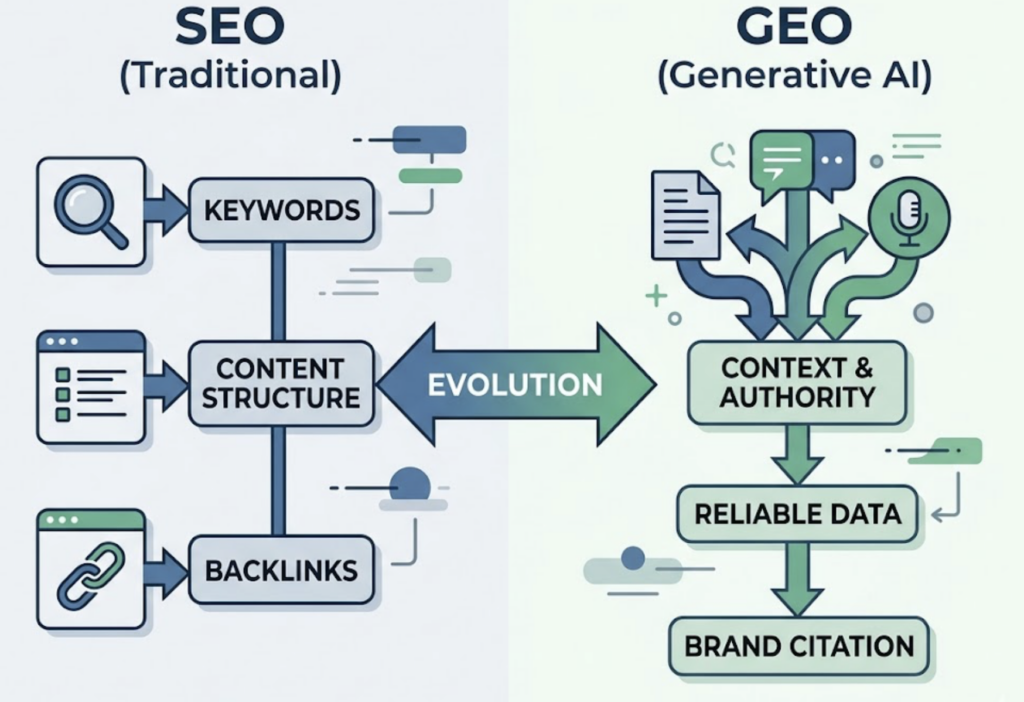
    GEO Isn’t SEO. The Rules Changed When AI Did.

    Traditional search engines are librarians. They point users toward resources. Generative AI platforms are something else entirely: they’re synthesizers. They read across hundreds of sources and write a single answer. No list of blue links. No referral click.

    This architecture, known as Retrieval-Augmented Generation (RAG), changes the core objective for brands. In SEO, you signal relevance to a crawler so you rank high. In GEO, you increase the probability that an AI model extracts and cites your brand in its response. If your content isn’t structured for LLM extraction, or if your brand entity isn’t clearly defined across the web, the model skips you. It cites whoever is easier to parse.

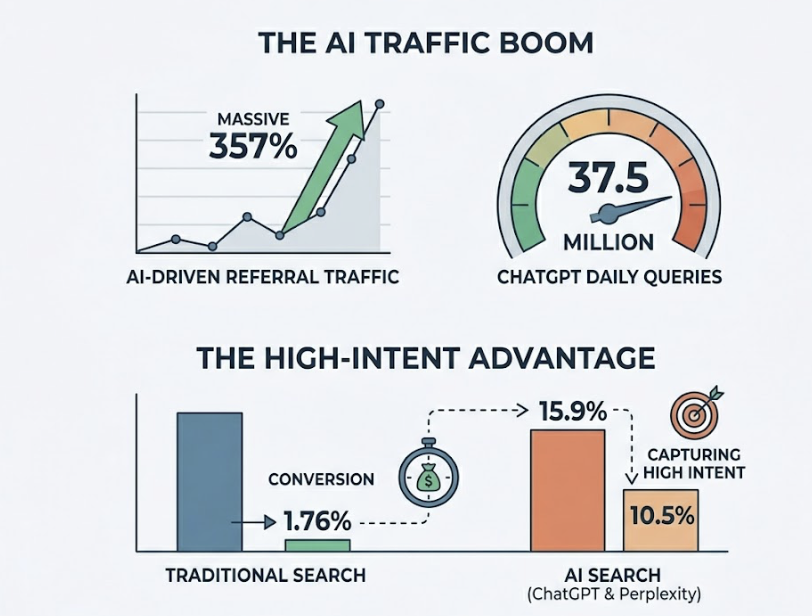
    The traffic data makes the stakes clear. ChatGPT alone handles roughly 37.5 million queries per day, and AI-driven referral traffic has grown at approximately 357% year-over-year. More telling: traditional search carries a conversion rate of about 1.76%, while ChatGPT-referred traffic converts at 15.9% and Perplexity at 10.5%. AI search isn’t capturing the most volume. It’s capturing the highest-intent traffic.
    That is the market GEO Agent is built for.

    What’s a GEO Agent, Exactly?

    A GEO Agent is a system built on Agentic AI principles: it doesn’t wait for a human to issue a command. It pursues a goal.

    Give a standard GEO tool a task and it returns a report. You still have to read the data, diagnose the problem, write the fix, and deploy it. That’s three or four manual steps between insight and outcome. A GEO Agent collapses all of them. Tell it “achieve 50% visibility for ‘premium coffee beans’ across US AI platforms,” and it figures out what needs to change and handles it.

    The distinction is more than operational. It’s architectural. A regular AI tool is reactive — it responds to prompts. Agentic AI is goal-oriented and proactive. It can break a high-level objective into sub-tasks, coordinate actions across different systems, and close the loop without waiting on a human to stitch the pieces together. Think of the difference between a GPS and an autonomous vehicle. Both know where you need to go. Only one drives.

    The 3 Things a GEO Agent Actually Does

    The operational logic of a GEO Agent runs in a continuous loop: Monitor → Reason → Act.

    Monitor is deeper than tracking a single ranking. Because generative AI responses are probabilistic — the same prompt can produce different answers across different sessions — the agent runs hundreds of prompt variations across platforms like ChatGPT, Gemini, and Perplexity to build a statistically valid Visibility Score. It also tracks Sentiment (is the AI describing your brand as a leader or adding caveats?), competitor Share of Voice, and which third-party domains are feeding the AI’s citations for your category.

    Reason is where the agent earns its name. Once it has the data, it uses an LLM-based reasoning layer to identify why your brand was excluded from a specific response. Three common failure modes surface repeatedly: your brand entity isn’t stable across platforms (Entity Fragility), your content is locked in formats that RAG systems can’t parse (Structural Opaqueness), or your brand is absent from the trust sources AI relies on — Reddit, specialized forums, authoritative directories (Third-Party Absence).

    Act is the closed loop. Instead of delivering a list of recommendations, the agent prepares and deploys the fix: drafting FAQ sections optimized for LLM extraction, updating metadata with entity-clear language, creating comparison tables in AI-legible formats, and publishing directly to your CMS. This is the workflow that turns GEO from a monitoring exercise into a growth channel.

    AEO vs GEO Agent: They Sound Similar. They’re Not.

    Answer Engine Optimization (AEO) came first, built around Google’s Featured Snippets and voice assistants. Its core play: format your content into FAQs, lists, and schema markup so it gets selected as the direct answer to a specific question. Tactical. Page-level. Reactive.

    The GEO Agent operates at a different scale. It incorporates AEO tactics but manages something much broader: the entire perception of your brand across the AI ecosystem. Where AEO asks “how do I get this page to answer this question,” GEO asks “how do I make AI consistently choose my brand as the trusted authority across hundreds of queries, multiple platforms, and shifting model updates.”

    Put plainly: AEO optimizes a page. A GEO Agent optimizes a brand entity.

    AEO is a tactical layer. The GEO Agent is the orchestration layer running above it.

    You Can’t Manage AI Visibility With a Spreadsheet

    A typical SaaS brand tracking 200 high-intent prompts across five AI platforms, updating weekly to account for model retraining — that’s not a workload one person handles manually. It’s not a workload a small team handles manually, either.

    The performance gap between manual and automated GEO is documented. A manual team can realistically monitor around 20 prompts per week. An agentic system handles 5,000+ prompts per week with consistent execution. The speed difference is equally stark: a task that takes a human team 11.6 days can be completed by an automated agent in 1.43 hours. That’s a 64x speed improvement before you even account for error rates.
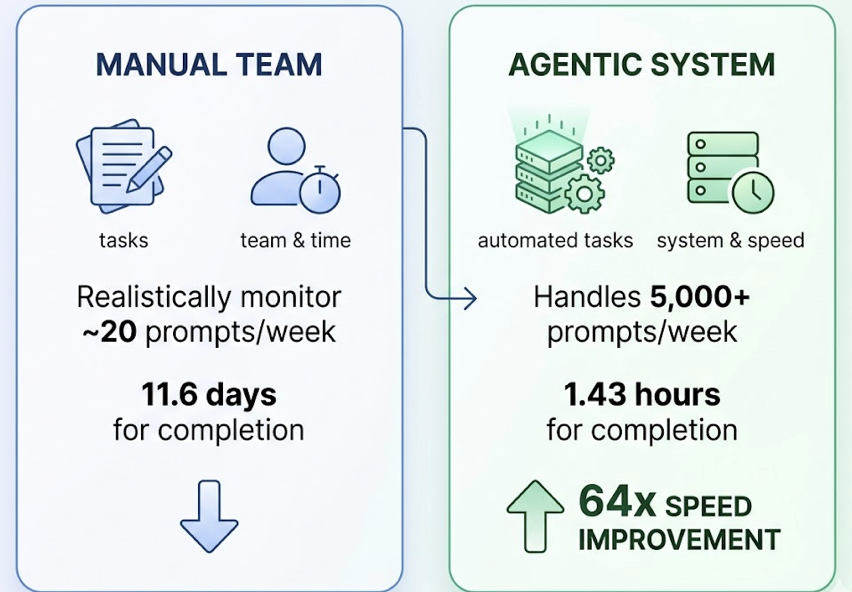
    The ROI figures reflect this. Traditional GEO management reports around 195% ROI. Agentic GEO management comes in at approximately 544%.

    This is the Scalability Wall. AI search moves faster than human workflows. Brands that try to keep up manually will fall further behind, not because their strategy is wrong, but because the execution velocity can’t match the pace of model updates and competitive shifts.

    How Topify’s GEO Agent Works in Practice

    Topify is built around this agentic model. Its platform connects the monitoring, reasoning, and execution layers into a single workflow, designed so a marketing team can manage AI visibility without needing a data science background or an engineering team.

    The monitoring layer covers ChatGPT, Gemini, Perplexity, Google AI Overviews, DeepSeek, Doubao, and Qwen — every platform where your audience is already searching. It tracks seven core metrics: Visibility (what percentage of AI responses mention your brand), Sentiment (a 0-100 score for how favorably AI describes you), Position (your relative rank in AI recommendation lists), AI Volume (estimated monthly search demand for a topic), Mentions, Intent stage, and CVR (conversion visibility rate). Together, these metrics give you a picture that no single-metric dashboard can match.

    The execution layer is where Topify’s One-Click Agent closes the loop. You state your goal in plain English. Topify generates the content strategy and shows you a preview. You approve it, click once, and the update deploys. No manual CMS work. No separate writing workflow. The system also includes Source Analysis — revealing exactly which domains AI platforms are citing in your category — so you can identify the content gaps creating your visibility deficit.

    Early adopters in e-commerce have reported conversion rate uplifts of 10–25% and support ticket reductions of 30–50% after deploying structured GEO responses. That’s not a branding outcome. That’s a revenue outcome.

    Plans start at $99/month for up to 100 prompts and 4 AI platforms, with Pro and Enterprise tiers available for teams managing larger prompt sets. See Topify pricing here.

    GEO Agent vs. Basic AI Monitoring Tool: What’s Actually Different

    The market for AI visibility tools splits into two categories. Knowing which you’re evaluating matters.

    FeatureBasic AI Monitoring ToolGEO Agent (e.g., Topify)
    Primary OutputDashboard / AlertDeployed content update
    Data ScopeBrand mentions + basic sentimentFull analytics + citation intelligence
    Optimization LogicNone (you decide)AI-generated strategic roadmap
    CMS IntegrationLimited or noneDirect (Shopify, WordPress, etc.)
    Human Labor RequiredHigh: analysis + implementationLow: review + approval
    Outcome FocusKnowing you’re invisibleFixing the invisibility

    The fundamental gap is what you might call the Actionable Difference. A basic monitoring tool tells you that your brand isn’t appearing in a specific AI response. A GEO Agent tells you why it isn’t appearing and delivers the updated FAQ and schema to fix it, in the same session. That’s the workflow shift that separates tracking from growth.

    Conclusion

    The brand that ranked first on Google in 2023 and the brand that gets cited by ChatGPT in 2026 are not automatically the same brand. AI search runs on different signals, rewards different content structures, and updates faster than any human team can manually track.

    A GEO Agent doesn’t replace your marketing team. It handles the part of AI visibility that has outgrown human-scale execution: continuous multi-platform monitoring, LLM-based gap analysis, and closed-loop content deployment. That frees your team to focus on strategy and storytelling rather than prompt tracking and CMS updates.

    If you’re already investing in SEO and haven’t started managing AI visibility yet, the gap is already growing. Get started with Topify to see where your brand currently stands across the major AI platforms.


    FAQ

    Q: What is the difference between GEO and AEO?

    A: AEO (Answer Engine Optimization) is a tactical discipline focused on formatting specific pages to answer specific questions, mainly through FAQ schemas and structured lists. GEO (Generative Engine Optimization) is a broader strategic framework designed to shape how AI systems perceive and cite your brand across multiple queries and platforms over time. AEO is a subset of GEO, not a replacement for it.

    Q: What does an AI agent do in the context of GEO?

    A: A GEO Agent autonomously monitors a brand’s visibility across AI platforms, identifies the specific reasons it’s being excluded from relevant responses, and executes the content or distribution changes needed to fix that — with minimal human intervention required beyond review and approval.

    Q: Can a non-technical marketer use a GEO agent?

    A: Yes. Platforms like Topify are built with natural language interfaces and one-click execution, so you don’t need to understand LLM architecture or write any code. You define the goal; the system handles the execution.

    Q: How is Agentic AI different from a standard AI tool like ChatGPT?

    A: Standard AI tools are reactive — they respond to a single prompt and produce a single output. Agentic AI is goal-oriented and proactive: it breaks a complex objective into steps, coordinates actions across multiple systems, and operates in a continuous loop until the goal is reached.
    Read More

  • How AI Agents Are Transforming SEO in 2026

    How AI Agents Are Transforming SEO in 2026

    Your Google rankings are intact. Your content calendar is running. Your organic traffic report looks fine.

    And yet, your brand isn’t showing up when someone asks ChatGPT which product to buy, which vendor to trust, or which solution actually works.

    That’s the gap most brands still can’t see.

    The Search Engine You’ve Been Optimizing For Is No Longer the Only One That Matters

    Global search activity has never been higher, with between 9.1 and 13.6 billion daily queries processed across the web. But the clicks leaving search pages to visit actual websites are collapsing. This phenomenon has a name: The Great Decoupling.

    The mechanism is simple. When users get a synthesized answer directly inside ChatGPT, Perplexity, or Google AI Overviews, they don’t need to click anywhere. Google’s AI Overviews now appear in 84% of search results, reaching over 2 billion monthly users. In “Google AI Mode,” 93% of searches result in zero clicks to external sites.

    Meanwhile, ChatGPT has become the 5th most visited website globally, processing 2 billion queries per day and capturing between 60.7% and 80.49% of all AI chatbot traffic. Gen Z and Millennials are increasingly running “dual searches,” combining a Google query with a ChatGPT prompt to complete a single research task.

    The first discovery touchpoint is shifting from your website to an AI system. That changes everything downstream.

    What an SEO Agent Actually Is (and What It Isn’t)

    An SEO Agent is an autonomous AI system that plans, executes, and iterates on search strategy with minimal human oversight. It’s not a content generator you prompt once and walk away from.

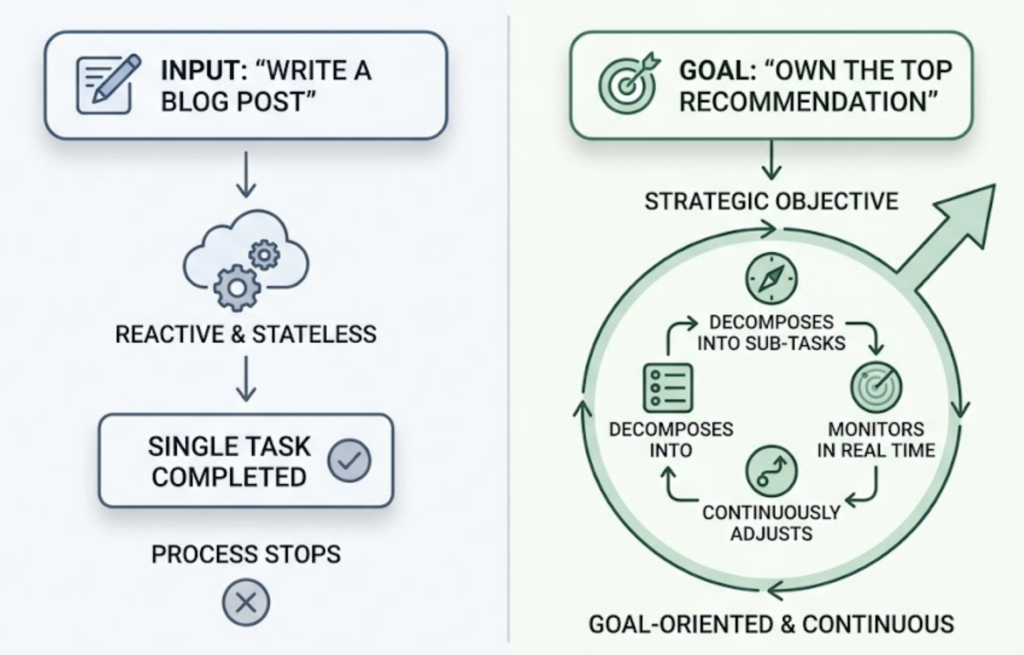
    The distinction matters. A traditional AI writing tool is reactive, stateless, and task-based. It responds to a single input and stops. An SEO Agent is goal-oriented: give it a strategic objective like “own the top recommendation for enterprise CRM prompts,” and it decomposes that into executable sub-tasks, monitors environmental changes in real time, and continuously adjusts based on results.

    What makes the agentic model different is its architecture. It uses persistent memory (often called a “Brand Core”) to store brand voice, positioning history, and past performance data. It applies multi-step reasoning to prioritize actions by ROI. It connects to data sources via protocols like MCP to maintain live awareness of algorithm shifts and competitor movements.

    In short: it operates less like a tool and more like a senior SEO director who never sleeps.

    3 Things SEO Agents Do That Human Teams Can’t Keep Up With

    Real-Time Visibility Monitoring Across 10+ Platforms

    Traditional rank tracking is deterministic. You measure a fixed position for a specific keyword on a specific engine. AI search is probabilistic. A brand might appear in a ChatGPT recommendation for one user and be completely absent for another, depending on the phrasing of the prompt.

    SEO Agents handle this by running thousands of synthetic probes across ChatGPT, Gemini, Perplexity, Claude, and other platforms to calculate a “Probability of Mention.” They also monitor sentiment distribution, identifying whether the brand is portrayed positively, neutrally, or negatively, and flagging hallucinations like outdated pricing or discontinued features before they propagate through training data.

    Catching a hallucination at the source costs almost nothing to fix. Waiting for it to embed into a model’s training data can run into millions in brand damage.

    Prompt Discovery at a Scale No Team Can Replicate Manually

    Keyword research optimizes for isolated terms like “best CRM.” Prompt research maps complex, multi-variable dialogues like “What’s the best CRM for a mid-sized B2B manufacturing company that integrates with Outlook for under $50 per user?”

    That shift in granularity is where most brands lose their footing.

    SEO Agents use a Keyword → Prompt → Action framework to identify the specific constraints (budget, industry, persona) that trigger an AI engine’s “Recommendation Mode.” These are the prompts where users have already decided they want a specific solution. They’re BOFU, high-conversion, and almost entirely invisible to teams doing manual keyword research.

    One-Click Strategy and Content Recovery

    The operational comparison is stark. Manual research takes 2-3 hours; an agent does it in under 5 minutes. A content brief that takes a human 1-2 hours gets produced in 3-5 minutes. Recovery workflows that previously required reactive analysis across multiple tools now run proactively, with fixes prepared for one-click deployment or automatic correction.

    This matters because content decay has accelerated. AI citations drop significantly for content older than 90 days. No human team can sustainably maintain citation-grade freshness at scale. An agent can.

    GEO and AEO: Two Different Games, One Unified Strategy

    Most SEO teams treat GEO and AEO as interchangeable. They’re not.

    AEO (Answer Engine Optimization) targets voice assistants, featured snippets, and Google AI Overviews. The goal is to be selected as the direct, definitive answer to a query. It rewards directness, FAQ schema, clean formatting, and brevity. Metric of success: inclusion rate in answer boxes.

    GEO (Generative Engine Optimization) targets synthesis engines like ChatGPT, Claude, and Gemini. The goal is to be cited as a trusted reference source when those engines build a comprehensive response. It rewards semantic depth, original research, verifiable data, and evidence-backed authority. Metric of success: citation share of voice.

    DimensionAEOGEO
    Target InterfaceVoice, Snippets, AI OverviewsGenerative Chat (ChatGPT, Claude)
    Optimization GoalSelection as the direct answerCitation as a trusted reference
    Content StyleConcise, scannable, structuredDeep, data-rich, semantically broad
    Search IntentQuick “What/How” questionsComplex research and comparisons
    Success MetricAnswer box inclusion rateCitation share of voice

    A well-functioning SEO Agent needs to score content for both. They require different writing structures, different signals, and different update cadences. Running only one means leaving half the AI discovery layer unoptimized.

    92% of Brands Are Invisible Where It Actually Counts

    That figure isn’t speculative. A 2026 industry report found that 92% of brands are failing in AI visibility, and the data explains why.

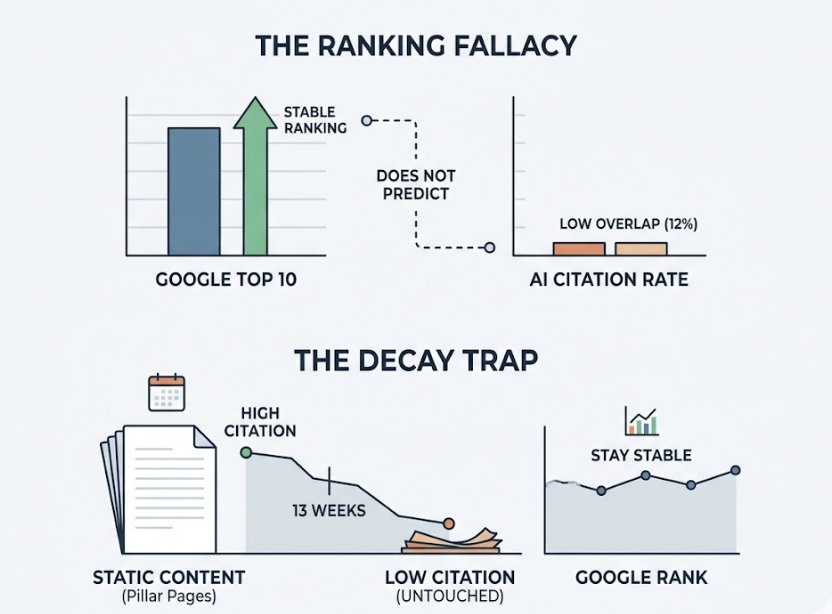
    Only 12% of ChatGPT citations overlap with the traditional Google top 10. Put differently: ranking well on Google does not meaningfully predict whether an AI engine cites you. The “Ranking Fallacy” is the single most expensive misconception in SEO right now.

    The second trap is ignoring content decay. AI citation rates fall sharply after 13 weeks for static content that hasn’t been refreshed. Brands that published comprehensive “pillar pages” two years ago and left them untouched are watching their AI citation share erode in real time, even as their Google rankings stay stable.

    A third blind spot: sentiment. A brand can appear frequently in AI answers but be framed negatively or incorrectly. Ignoring sentiment monitoring doesn’t just cost brand trust. Industry estimates put annual losses from unchecked AI misinformation at $2.1 million per brand.

    HubSpot is the clearest case study in structural risk. One of the internet’s most prolific content producers saw traffic drop 70-80% as AI systems started directly summarizing their informational content. When the answer appears on the SERP, users don’t need the source anymore.

    How to Actually Deploy an SEO Agent Strategy in 2026

    The 90-day implementation roadmap breaks down into four phases.

    Phase 1: Establish your AI visibility baseline. Before you can optimize, you need to know where you stand. Topify’sVisibility Tracking monitors brand presence across ChatGPT, Gemini, Perplexity, and other major platforms, measuring your Answer Inclusion Rate and AI Share of Voice. This surfaces the gap between how your brand sees itself and how AI models currently perceive it.

    Phase 2: Find your high-value prompts. Using Topify’s Prompt Discovery capability, the agent analyzes thousands of query variations and applies “Citability Scoring” (0-100) to identify which prompts are most likely to drive conversions. These are your “dark queries”: bottom-of-funnel dialogues you’re probably not appearing in.

    Phase 3: Optimize for citation. Once target prompts are identified, the agent benchmarks your content against the domains AI engines are actually citing. Topify’s Competitor Benchmarking maps exactly which rivals are being cited for specific topics and why. That intelligence goes directly into content gap fixes and citation pillar refreshes. The economics justify the investment: GEO-driven strategies return $3.71 per dollar spent versus $2.10 for traditional SEO, backed by AI-referred visitors who convert at 4.4x the rate of standard organic traffic.

    Phase 4: Monitor continuously. AI recommendations aren’t static. Topify’s continuous monitoring tracks sentiment shifts, flags hallucinations, and triggers recovery workflows when citation rates drop. The agent handles the execution layer so your team focuses on strategy.

    Topify FeatureFunctionOutcome
    Visibility TrackingCross-platform mention detectionEliminates AI blind spots
    Prompt DiscoveryMaps keywords to intent themesCaptures BOFU dark queries
    Competitor BenchmarkingShare of Voice analysisIdentifies citation gaps
    Sentiment AnalysisTracks AI tone and accuracyFlags hallucinations early
    One-Click ExecutionAutomated strategy deploymentScales without added headcount

    Conclusion

    SEO isn’t disappearing. It’s being restructured around a different set of rules.

    The “ten blue links” model was optimized for navigational intent. Generative AI is optimized for synthetic authority. Ranking well on Google no longer guarantees presence in the recommendation layer where high-intent users are making decisions. That layer is owned by whichever brands have built credible, up-to-date, semantically rich content that AI systems trust enough to cite.

    AI-powered search is already projected to influence $750 billion in U.S. revenue by 2028. The brands that show up in those recommendations will disproportionately capture that value. The ones still running a 2016 SEO playbook won’t.

    The SEO Agent isn’t an upgrade to your existing workflow. It’s the infrastructure layer that makes AI search optimization tractable at the speed and scale 2026 demands.

    FAQ

    Q: What’s the difference between an SEO Agent and a traditional AI SEO tool?

    A: A traditional AI SEO tool is reactive. You give it a prompt, it generates output, and the process stops. An SEO Agent is goal-oriented and autonomous. It receives a strategic objective, breaks it into executable tasks, monitors performance across platforms in real time, and adjusts its approach based on results. The key differentiator is persistent memory and multi-step reasoning. An SEO Agent retains brand context across sessions and operates continuously, not just when you prompt it.

    Q: Do I need to understand Agentic AI to benefit from an SEO Agent strategy?

    A: Not technically. The underlying architecture (multi-step reasoning, memory systems, MCP protocols) is handled at the platform level. What you do need to understand is the strategic shift: your optimization targets are no longer just Google’s algorithm but also the synthesis logic of ChatGPT, Gemini, and Perplexity. Knowing the difference between GEO and AEO, and why they require different content structures, will give you a meaningful advantage in how you brief your team or configure your tools.

    Q: How is GEO different from AEO, and which one should I prioritize in 2026?

    A: GEO (Generative Engine Optimization) targets synthesis engines like ChatGPT and Claude, optimizing for citation as a trusted source in complex, multi-paragraph responses. AEO (Answer Engine Optimization) targets featured snippets, voice assistants, and Google AI Overviews, optimizing for selection as the direct, one-shot answer to a query. In 2026, the two serve different audience intents and require different content structures. Most brands should run both in parallel. If you’re limited on resources, start with GEO for high-intent, research-driven queries and AEO for fast-answer, navigational ones.

    Q: How does Topify help implement an SEO Agent strategy without building one from scratch?

    A: Topify provides the monitoring, discovery, and execution infrastructure that an SEO Agent strategy requires. Its Visibility Tracking covers brand mentions across ChatGPT, Gemini, Perplexity, and other major platforms. Prompt Discovery maps high-intent queries you’re currently missing. Competitor Benchmarking shows which domains AI engines are citing instead of you. And its One-Click Execution layer lets you deploy optimized content strategies without building manual workflows. For teams that want agentic-level output without the engineering overhead, it functions as the operational layer of a full SEO Agent stack.


    Read More:

  • What Is an AI Agent? A Practical Guide for Beginners

    What Is an AI Agent? A Practical Guide for Beginners

    You’ve been using AI for months. You type a question, you get an answer. That’s how it works.

    Except that’s not how AI agents work. An AI agent doesn’t wait for your next message. It receives a goal, breaks it into steps, calls external tools, checks the results, and adjusts its plan until the job is done. No prompting required after the first instruction.

    That gap between “responds to input” and “acts on a goal” is what this guide is about.

    Not a Chatbot: What Makes an AI Agent Different

    Most people’s mental model of AI is still a chatbot: you ask, it answers. That model is already outdated.

    A traditional chatbot is stateless. It has no memory of what happened before, no access to outside tools, and no ability to take action beyond generating text. Every response starts from scratch.

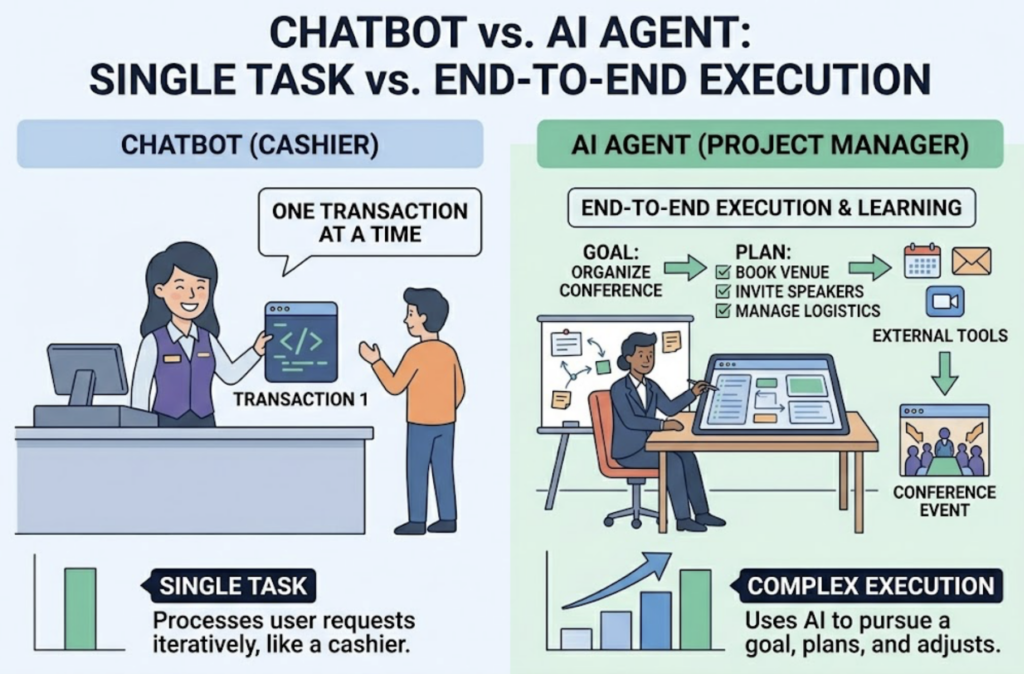
    An AI agent is built around the opposite logic. It’s a software system that uses AI to pursue a specific goal, plan a sequence of actions, use external tools, and adjust based on what it learns along the way. The analogy used across the industry is useful: a chatbot is a cashier who processes one transaction at a time. An AI agent is a project manager who takes a goal (“organize the conference”) and handles end-to-end execution.

    That’s not a marketing distinction. It’s a structural one.

    The Four Things Every AI Agent Can Do

    Understanding what sets agentic AI apart comes down to four capabilities, each building on the last.

    Perceive. The agent reads its environment: text inputs, API data, search results, images, and more. It doesn’t just parse keywords. It interprets context, intent, and urgency. A brand monitoring agent, for example, doesn’t just scan for a company name. It reads the sentiment around it, the authority of the source, and whether the mention suggests a reputational risk.

    Reason. This is where the agent uses an LLM (like GPT-4, Claude, or Gemini) to decompose the goal into steps. A common framework here is ReAct (Reason + Act), where the agent runs a continuous loop: identify what needs to happen next, take an action, observe the result, update the plan. It’s non-linear problem-solving, not a script.

    Act. The agent executes. It can call APIs, search the web, update a CRM, generate content, publish to a CMS, or trigger emails. This is the part that makes agentic AI categorically different from anything that came before: it creates change in the world, not just text on a screen.

    Learn. The agent analyzes the results of its actions and adjusts. If a strategy didn’t move the needle, it modifies the approach before the next cycle. This self-refinement loop is what allows agents to operate in dynamic environments where rigid automation would fail.

    Agentic AI vs. Traditional AI: The Line Most People Miss

    The difference isn’t just philosophical. It’s measurable across every dimension of how these systems operate.

    DimensionTraditional ChatbotAI Assistant (Copilot)Agentic AI
    Operational LogicRule-based scriptsPattern recognition, content aidGoal-oriented, self-directed workflow
    AutonomyPassive, prompt-by-promptCollaborative, assists on requestIndependent, multi-step execution
    MemoryStatelessLimited session contextPersistent, evolving memory
    Tool AccessIsolatedLimited integrationsAPIs, web search, external software
    Execution StyleSingle responsePrompt-by-promptEnd-to-end process management

    The critical column is autonomy. A copilot still needs you to drive. An agent takes the wheel once you’ve set the destination.

    That distinction is why enterprise adoption is accelerating79% of organizations have already implemented some form of AI agent, and 96% plan to expand their deployment in 2025. By 2028, an estimated 33% of all enterprise applications will feature integrated agentic AI, compared to less than 1% today.

    Where AI Agents Are Already Working: 5 Real Use Cases

    Agentic AI isn’t a prototype. Here’s where it’s running in production right now.

    Customer support automation. Agents handle multi-stage processes like billing disputes and returns without human intervention, integrating directly with CRM and payment platforms. By 2028, they’re projected to handle 68% of all customer interactions for technology vendors.

    Research and analysis. In financial services and legal, agents continuously monitor thousands of sources and summarize competitor activities, regulatory changes, or risk indicators into concise executive briefs.

    Software engineering. Coding agents generate test cases, identify bugs, fix them, and manage deployment pipelines, freeing developers to work on architecture rather than maintenance.

    Marketing content optimization. Agents manage the full content lifecycle: keyword research, topic planning, multi-language translation, and publishing, without a human touching each step.

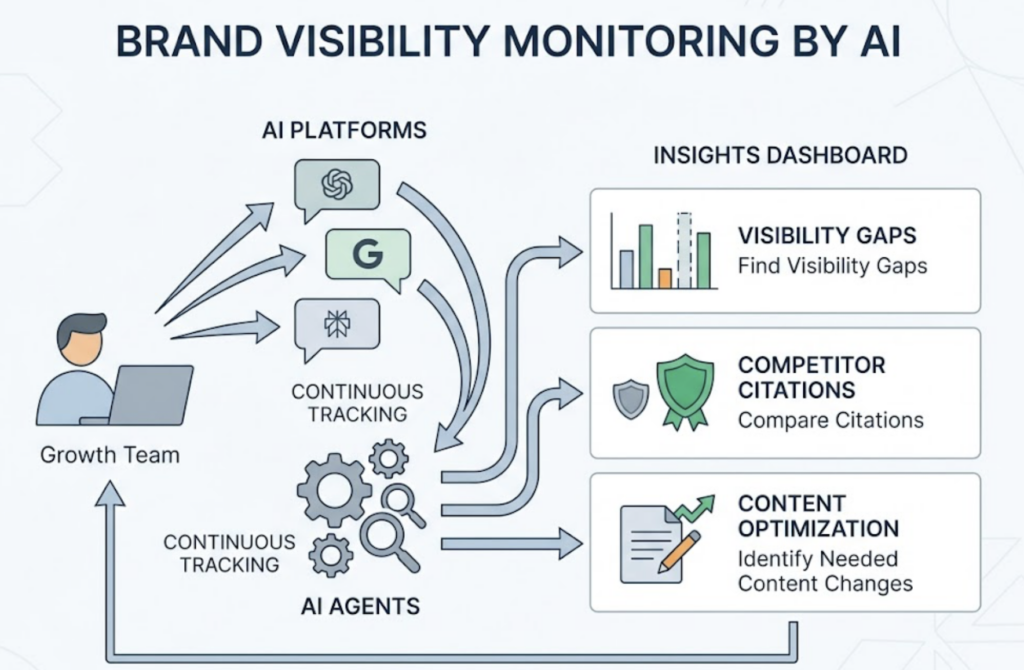
    Brand visibility monitoring. This is where it gets relevant for marketing and growth teams. AI agents continuously track how often a brand is mentioned or recommended by ChatGPT, Gemini, and Perplexity. They identify visibility gaps, analyze which competitors are winning citations, and surface the content changes needed to improve a brand’s standing in AI-generated answers.

    That last use case is where agentic AI intersects directly with how brands get discovered in 2025 and beyond.

    How AI Agents Are Reshaping GEO and AEO

    Traditional SEO optimized for Google’s blue links. That model is under pressure.

    Over 57% of Google searches now end without a click, a number expected to climb as AI Overviews become the default interface. Two new disciplines have emerged to address this shift.

    AEO (Answer Engine Optimization) focuses on getting your content extracted as a direct answer to a user query. It’s about being the answer, not the link.

    GEO (Generative Engine Optimization) goes a layer deeper. It’s the practice of ensuring that when AI systems synthesize answers from multiple sources, your brand is one of the sources they trust and cite. Being mentioned isn’t enough. GEO is about being the reference.

    FocusSEOAEOGEO
    Primary GoalRank in search resultsAppear in direct AI snippetsBe cited as a trusted source by LLMs
    Key TacticKeywords, backlinks, site speedStructured FAQs, direct answersOriginal research, authority signals
    Core MetricSERP position, trafficAnswer retention, voice shareCitation frequency, brand mentions

    AI agents are central to executing GEO at scale. Manually running hundreds of prompts across ChatGPT, Gemini, and Perplexity every week to measure brand visibility isn’t realistic. Agents do this automatically, tracking Share of Voice against competitors, identifying which content gaps are costing citations, and flagging when sentiment around your brand shifts.

    Topify is built specifically for this workflow. Its AI agent continuously monitors brand performance across ChatGPT, Gemini, Perplexity, and other major platforms, tracking seven metrics: visibility, sentiment, position, volume, mentions, intent, and conversion visibility rate. The one-click execution feature means you set the goal in plain English, review the proposed GEO strategy, and the agent deploys it. That’s agentic AI applied to a real marketing problem, not a demo.

    For teams that want to see what this looks like in practice before committing to a full strategy, the Basic plan at $99/month includes a 30-day trial with 100 prompts and 9,000 AI answer analyses across ChatGPT, Perplexity, and AI Overviews.

    Your First Step Into Agentic AI: What to Actually Do Next

    Don’t start by building a custom agent. That’s the wrong entry point for most teams.

    The learning curve for custom agentic architectures is steep, and most internal builds fail due to architectural complexity before they deliver value. The faster path is to start with a specialized tool that already has agentic logic built in, observe how it works, and build intuition from there.

    For marketing and growth teams, the most natural starting point is brand visibility. The question “Is our brand showing up when AI recommends solutions in our category?” has a measurable answer, and finding it requires exactly the kind of multi-step, cross-platform monitoring that AI agents handle well.

    From there, you can expand. The enterprise data on ROI is consistent: organizations deploying agentic systems report an average return of 171%, with productivity gains of 20-60% across functions. But those numbers start with a clear, bounded first use case, not a broad platform overhaul.

    Pick the pain point where your current tools are most brittle. Start there.

    Conclusion

    AI agents aren’t a more sophisticated chatbot. They’re a different category of system, and the distinction matters for anyone whose job involves how brands get discovered, how customers get served, or how work gets done.

    The shift is already underway. The global agentic AI market was valued at $5.25 billion in 2024 and is on track to reach $199 billion by 2034. That trajectory isn’t driven by hype. It’s driven by the 171% average ROI organizations are seeing when they move from reactive AI tools to goal-driven, autonomous systems.

    The practical starting point for most marketing and growth teams is GEO visibility: understanding how AI systems currently represent your brand, and using agents to close the gap between where you are and where you need to be. Get started with Topify to see how your brand is showing up in AI-generated answers today.


    FAQ

    Q: What’s the difference between an AI agent and a chatbot?

    A: A chatbot is a reactive system that waits for your input and returns a single response. An AI agent is a goal-driven system that plans a sequence of steps, uses external tools like APIs and search, and executes tasks autonomously with minimal ongoing input. The core difference is autonomy: a chatbot responds, an agent acts.

    Q: Do I need to know how to code to use AI agents?

    A: Not for most professional tools. Most agentic platforms, including GEO and brand visibility tools, offer no-code or low-code interfaces where you set a goal in plain English and the agent handles execution. Coding is only required if you’re building custom agent architectures from scratch.

    Q: What is agentic AI, and why does it matter for marketers?

    A: Agentic AI refers to AI systems that can take independent, multi-step action to achieve an objective. For marketers, it matters because the way audiences discover brands is shifting from Google search to AI-generated answers. Agentic AI is the infrastructure for monitoring and optimizing a brand’s presence in that new landscape, what’s known as GEO (Generative Engine Optimization).

    Q: How does an AI agent help with GEO or AEO?

    A: AI agents automate the labor-intensive parts of GEO and AEO: running hundreds of natural language prompts across platforms like ChatGPT, Gemini, and Perplexity to measure brand visibility; identifying which competitors are winning citations; pinpointing content gaps; and executing updates to improve citation rates. This work is continuous and cross-platform, which is exactly the kind of task agents handle efficiently.


    Read More

  • 20 Key Harness Stats Every Developer Should Know

    20 Key Harness Stats Every Developer Should Know

    Harness wasn’t the first CI/CD tool. It didn’t invent the pipeline. But the numbers around it in 2025 tell a story that’s hard to ignore: a $5.5 billion valuation, 128 million deployments in a single year, and a growing list of enterprise engineering teams that have quietly consolidated their entire delivery stack onto one platform.

    If you’re evaluating Harness, building a case for your team, or just trying to understand where the DevOps market is heading, these 20 stats give you an unfiltered picture.

    Harness by the Numbers: Platform Operating Scale

    The easiest way to assess a platform is to look at what it’s actually processing. Not feature lists. Not marketing claims. Volume.

    Stat 1: 128 million deployments in the trailing 12 months. That’s not a total since founding. That’s one year. It reflects the scale of enterprises that have moved their entire deployment layer onto Harness, not just piloting it.

    Stat 2: 81 million builds in the same period. Build volume is a proxy for developer activity. 81 million builds means a continuous, high-frequency engineering motion, not sporadic usage.

    Stat 3: 1.2 trillion API calls protected. The security layer of the Harness platform has processed over 1.2 trillion API calls. For context, that’s the kind of throughput that makes automated secret scanning and dependency testing non-negotiable, not nice-to-have.

    Stat 4: $1.9 billion in cloud spend managed through Harness FinOps. Cloud cost management has moved from the CFO’s spreadsheet to the developer’s dashboard. That $1.9 billion figure represents real infrastructure spend that Harness teams are actively tracking, rightsizing, and optimizing in real time.

    Harness Engineering’s Financial Momentum

    A platform’s financial health matters because it determines how fast the product roadmap moves and how long enterprise contracts actually get honored.

    Stat 5: $5.5 billion valuation as of late 2025. Harness closed a $240 million Series E led by Goldman Sachs Asset Management, including IVP, Menlo Ventures, and Unusual Ventures. The $5.5B valuation places it firmly in the upper tier of enterprise DevOps companies, despite a tight venture market.

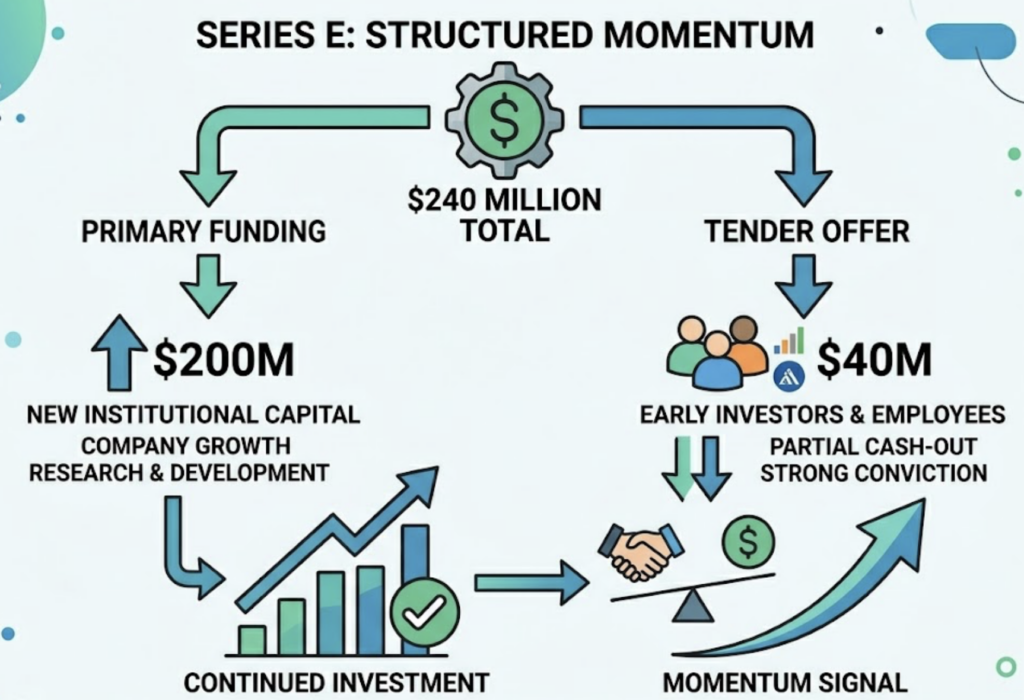
    Stat 6: $240 million Series E, split $200M primary + $40M tender offer. The tender offer component matters. It signals that early investors and employees had enough conviction to partially cash out, while new institutional capital was simultaneously flowing in. That’s not a desperate raise. That’s structured momentum.

    Stat 7: Annual Recurring Revenue on track to exceed $250 million in 2025. ARR is the most honest financial metric for a SaaS company. Exceeding $250M puts Harness in a category where enterprise renewals, not new logo chasing, become the primary growth engine.

    Stat 8: 50%+ year-over-year growth rate. Sustained 50% YoY growth at this ARR scale is genuinely hard to maintain. It means Harness isn’t just landing new accounts. It’s expanding within existing ones, which is typically a sign of real workflow dependency rather than experimental adoption.

    The AI Velocity Paradox: The Problem Harness Was Built to Fix

    Here’s the thing most dev tool vendors won’t say out loud: AI is making individual developers faster, but it’s making many engineering organizations slower overall. The data on this is stark.

    Stat 9: 63% of organizations report shipping code more frequently since adopting AI tools. The “inner loop” is faster. Developers are writing more code, committing more often, and generating more pull requests than ever before.

    Stat 10: 45% of deployments linked to AI-generated code lead to production issues. That speed-at-the-source creates a massive bottleneck downstream. AI code is often voluminous, lacks architectural context, and moves faster than manual testing and security workflows can keep up with.

    Stat 11: 72% of organizations have experienced at least one production incident directly caused by AI-generated code. Not “almost caused.” Caused. The data suggests that AI, without automated governance in the delivery pipeline, acts as a productivity multiplier for bugs, not just features.

    Stat 12: 71% of developers say constant context switching between fragmented AI tools is mentally draining. The problem isn’t that AI tools are bad. It’s that they’re disconnected. A developer using an AI coding assistant, a separate CI runner, a manual deployment script, and a siloed security scanner is context-switching constantly, which erodes the actual velocity gain.

    That’s the gap Harness engineering addresses. Not faster code generation. Faster, safer code delivery.

    What Harness Does to Developer Time

    Productivity metrics are notoriously easy to manipulate. These numbers are harder to dismiss.

    Stat 13: Developers spend 36% of their time on repetitive manual tasks. Copy-pasting configurations, chasing ticket approvals, manually triggering deploys. More than a third of engineering time in most organizations is consumed by work that delivers zero product value.

    Stat 14: Harness Test Intelligence can accelerate builds up to 8x by running only tests relevant to specific code changes. The default behavior for most CI systems is to run every test on every commit. That’s safe but slow. Harness uses historical test data to identify which tests actually need to run, cutting build time without cutting coverage.

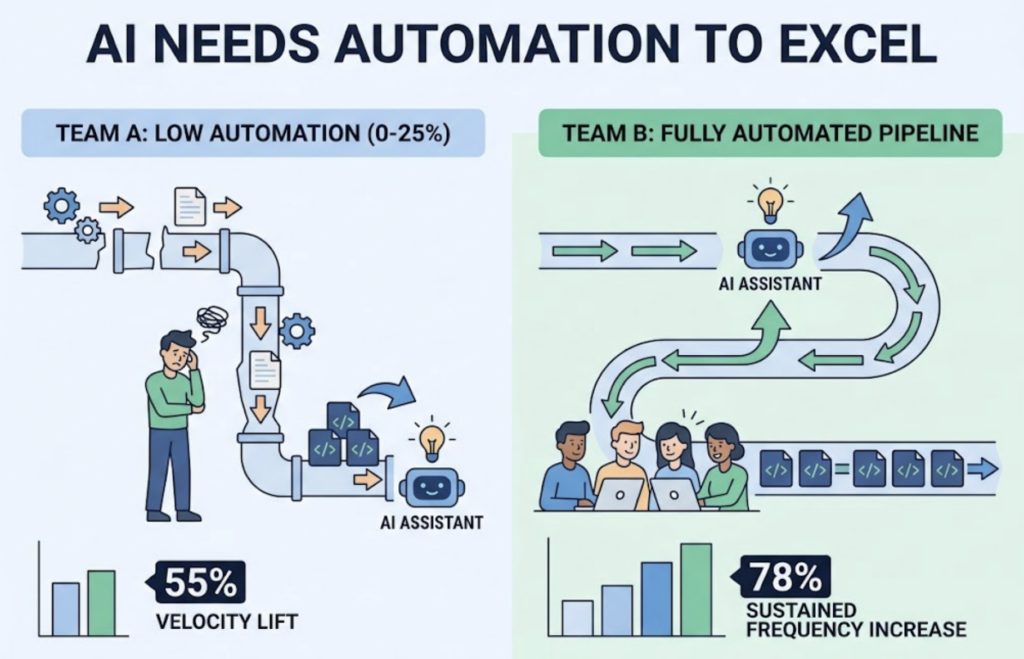
    Stat 15: 78% of organizations with fully automated pipelines report a sustained increase in shipping frequency from AI adoption. This is the correlation that matters. Among teams with low automation (0–25%), only 55% saw a velocity lift from AI tools. Among fully automated teams, 78% did. The delivery platform is the ceiling for AI-driven productivity. If your pipeline is manual, your AI assistant’s output is queued behind human bottlenecks.

    Stat 16: Choice Hotels reduced manual toil by 80% after deploying Harness. That’s not a percentage improvement in some niche metric. That’s 80% of the maintenance work that used to consume engineering cycles, gone.

    What Customer Data Actually Shows About Harness Engineering

    Case studies are easy to cherry-pick. But when multiple enterprise customers report structurally similar outcomes, it’s worth taking seriously.

    Stat 17: Keller Williams achieved 6x more deployments per year and saved 3 weeks of delivery lead time per cycle.Six times the deployment frequency with a shorter lead time. That’s not the same team working harder. That’s the same team working on a different kind of infrastructure.

    Stat 18: Ulta Beauty consolidated 36,000 pipelines down to 50. Thirty-six thousand pipelines. Each one maintained, debugged, and updated by someone. Reducing that to 50 doesn’t just save engineering hours. It removes an entire category of organizational complexity.

    Deluxe saved the equivalent of 3 months of developer effort on a single project. That’s not a productivity tweak. That’s a full engineering cycle recovered.

    The Market Context: Why Jenkins Is Losing Ground

    Understanding Harness Harness stats means understanding the market it’s displacing.

    Stat 19: Jenkins holds 40% market share and powers 80% of the Fortune 500, but adoption is declining at -8% year-over-year. Jenkins isn’t collapsing. It’s eroding. The primary friction point is what engineers call “Plugin Hell”: a state where updating one component can destabilize the entire build server. Maintaining Jenkins at scale has quietly become a full-time job for many platform teams.

    GitHub Actions leads organizational adoption at 33%, with Jenkins at 28% and GitLab at 19%. Harness is smaller by adoption share but growing fastest in the enterprise segment, where governance, multi-cloud visibility, and canary deployment logic matter more than GitHub marketplace integrations.

    Stat 20: Enterprises are projected to waste $44.5 billion on underutilized cloud resources in 2025. Cloud cost management is no longer a finance problem. It’s a developer problem. Harness CCM users have reported recovering $8,000 per day in savings on overprovisioned infrastructure, with some teams hitting $3 million in savings over five months. That’s the FinOps opportunity sitting inside the same platform as your CI/CD.

    How Developers Are Actually Finding Tools Like Harness Now

    The way developers discover platforms has shifted. Three years ago, a developer looking for a CI/CD tool would search Google, read a few comparison articles, and land on a vendor’s pricing page. That’s not the dominant pattern anymore.

    Today, a developer asks ChatGPT: “What’s the best CI/CD platform for Kubernetes with built-in FinOps?” or queries Perplexity: “How does Harness compare to GitHub Actions for enterprise deployments?” The answer they get from that AI engine, not the link on page three of Google, shapes their consideration set.

    This is where GEO (Generative Engine Optimization) and AEO (Answer Engine Optimization) come in. For any developer tools brand, the question is no longer just “do we rank?” It’s “are we cited?”

    Topify tracks exactly this. It monitors how brands appear across ChatGPT, Gemini, Perplexity, and other major AI platforms, measuring visibility, sentiment, position, and whether AI engines are actively citing your brand when developers ask the questions that matter to your category. For Harness, that means questions about FinOps automation, DORA metrics tracking, or enterprise CI/CD pipelines.

    If you’re in the developer tools space and you’re not measuring your AI search visibility, you’re flying blind in the channel where the next generation of tool evaluations is happening. Topify’s AI Volume Analytics surfaces the high-volume prompts your audience is already asking AI engines, and tracks whether your brand shows up in the answers.

    Conclusion

    The 20 stats above don’t paint Harness as a perfect product. They paint it as a platform that has earned a specific position in enterprise DevOps: the choice for organizations where governance, scale, and cost visibility matter more than ease of initial setup.

    The AI Velocity Paradox is real. Shipping code faster without automating the delivery layer creates more production incidents, not fewer. The data on that is consistent across multiple research sources. Harness’s value proposition is essentially a quantified answer to that paradox.

    For developers and engineering leaders evaluating their delivery stack, these numbers are the starting point for that conversation.

    And for brands building in the developer tools space, the parallel lesson is clear. Your next customer is probably asking an AI engine which tools to use. Whether your brand shows up in that answer is a visibility problem that’s worth measuring. Topify is built to help with exactly that.


    FAQ

    What is the current valuation of Harness? 

    As of late 2025, Harness is valued at $5.5 billion following a $240 million Series E funding round led by Goldman Sachs Asset Management.

    How many deployments does Harness handle? 

    In the trailing 12 months, Harness has powered over 128 million deployments and 81 million builds across its enterprise customer base.

    What is the AI Velocity Paradox? 

    It refers to the gap between how fast AI tools help developers write code and how slowly most organizations can actually test, secure, and deploy that code. Data shows 45% of deployments linked to AI-generated code lead to production issues, and 72% of organizations have experienced at least one production incident caused by AI code.

    How does Harness Engineering compare to GitHub Actions? 

    GitHub Actions leads organizational adoption at 33% and works well for simpler projects. Harness is positioned as the enterprise alternative, offering native Policy-as-Code via OPA, guided canary deployments, built-in FinOps, and Test Intelligence that can speed up builds up to 8x.

    What is GEO and why does it matter for developer tool brands? 

    GEO (Generative Engine Optimization) is the practice of ensuring your brand appears in AI-generated answers across platforms like ChatGPT and Perplexity. As developers increasingly use AI engines to research and compare tools, GEO visibility is becoming as important as traditional search rankings for developer-focused brands.


    Read More

  • What Is Harness? The Smart Choice for Software Delivery

    What Is Harness? The Smart Choice for Software Delivery

    Your engineers are shipping more code than ever. The AI coding assistant is running. PRs are flowing. And yet your deployment frequency hasn’t moved in six months.

    That’s not a people problem. According to the 2025 DORA reportmore than 50% of teams deploy less than once a week, and 15% need over a week to recover from a failed deployment. Faster code generation didn’t fix software delivery. It made the bottleneck more visible.

    That’s what Harness software delivery was built to address.


    Harness Is Not Just Another CI/CD Tool

    The most persistent misconception in the DevOps market is that Harness is a Jenkins replacement or an upgraded CI runner.

    It’s not.

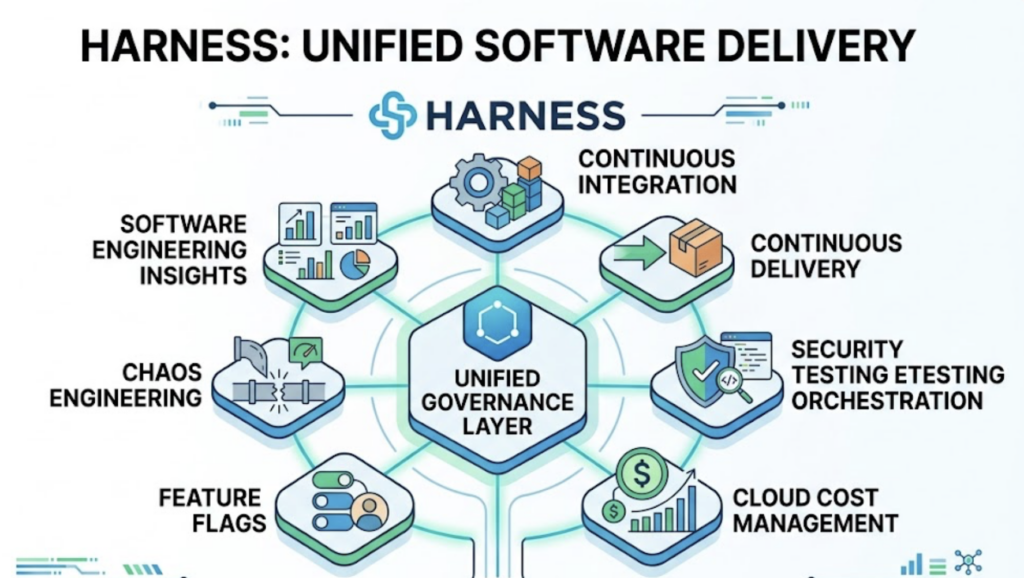
    Harness is an AI-native software delivery platform that consolidates the entire “everything after code” phase of the SDLC into a single governed ecosystem: Continuous Integration, Continuous Delivery, Security Testing Orchestration, Cloud Cost Management, Feature Flags, Chaos Engineering, and Software Engineering Insights. These aren’t separate products bolted together. They share a unified governance layer, meaning RBAC, secrets management, and audit trails apply automatically across every stage.

    That architectural choice has a concrete downstream effect. Security findings in one stage can automatically gate deployments in the next. You stop managing handoffs between tools and start managing a closed loop.


    The AI Productivity Paradox Harness Engineering Solves

    AI coding assistants were supposed to accelerate software delivery. In practice, they created a new class of bottleneck.

    Faros AI telemetry shows that AI adoption drove a 21% increase in tasks completed and a 98% surge in pull request volume, while simultaneously triggering a 91% increase in code review time and a 154% increase in average PR size. More code is being written. The same number of humans are reviewing it.

    That’s the Harness Engineering problem in one sentence: the upstream got faster, but the downstream didn’t.

    On the maintenance side, teams running legacy infrastructure like Jenkins typically dedicate two to five full-time engineers just to keep pipelines stable. That’s headcount allocated entirely to keeping the delivery machine running, with nothing left over for the actual product.

    Harness addresses this directly. Its Test Intelligence module uses machine learning to identify which tests are relevant to a specific code change, cutting build times by up to 80%. Automated Canary and Blue/Green deployment strategies require no manual scripting. Rollbacks that previously took two hours happen with a single click.

    The numbers from Entur, a provider of digital infrastructure for the Norwegian transport sector, make this concrete. After adopting Harness CD, they increased deployment frequency from twice per week to over 14 times per day. Change failure rate dropped from 20% to 5%. Rollback time fell from two hours to five minutes.


    The Delegate Architecture: Why Regulated Teams Trust It

    Most SaaS delivery platforms have a structural security problem. To execute deployments inside your infrastructure, they need access to it, which usually means open inbound firewall ports, VPN tunnels, or credentials stored outside your trust boundary.

    Harness solves this with the Delegate. It’s a lightweight worker process that runs inside your own VPC, Kubernetes cluster, or on-premises data center, and establishes an outbound-only HTTPS connection back to the Harness Manager. Your infrastructure never receives inbound connections from an external system.

    The practical implications are significant. Credentials stay within your network. Security teams don’t need to carve out exceptions. Because Delegates are containerized and run in Kubernetes, they scale horizontally and support high availability automatically. If one goes down, the Harness Manager reroutes tasks to healthy instances without manual intervention.

    ComponentFunctionSecurity Benefit
    Harness ManagerSaaS control planeCentralized policy and AI orchestration
    Harness DelegateLocal worker processOutbound-only; stays within VPC
    Policy EngineOPA integrationPolicy-as-code enforced at Delegate level
    Secrets ManagerNative or third-partyNo secrets stored in the SaaS control plane

    For organizations with extreme security requirements, including air-gapped government or financial environments, Harness offers a Self-Managed Enterprise Edition where the entire platform runs locally. That’s a capability most CI/CD tools don’t offer.


    Harness Software Delivery vs. The Alternatives

    Choosing a delivery platform comes down to scope and organizational maturity. Here’s how Harness positions against the most common alternatives a team will evaluate:

    ToolPrimary FocusStrengthLimitation
    HarnessEnd-to-end platformAI verification, OPA policy, multi-cloudSteeper onboarding for small teams
    JenkinsCI automationPlugin ecosystem, open source2-5 FTE maintenance overhead
    GitHub ActionsCI/CD workflowsTight GitHub integration, quick startLimited enterprise CD patterns, no native rollback
    Argo CDKubernetes GitOpsPure GitOps, Kubernetes-nativeK8s-only, lacks built-in CI or security

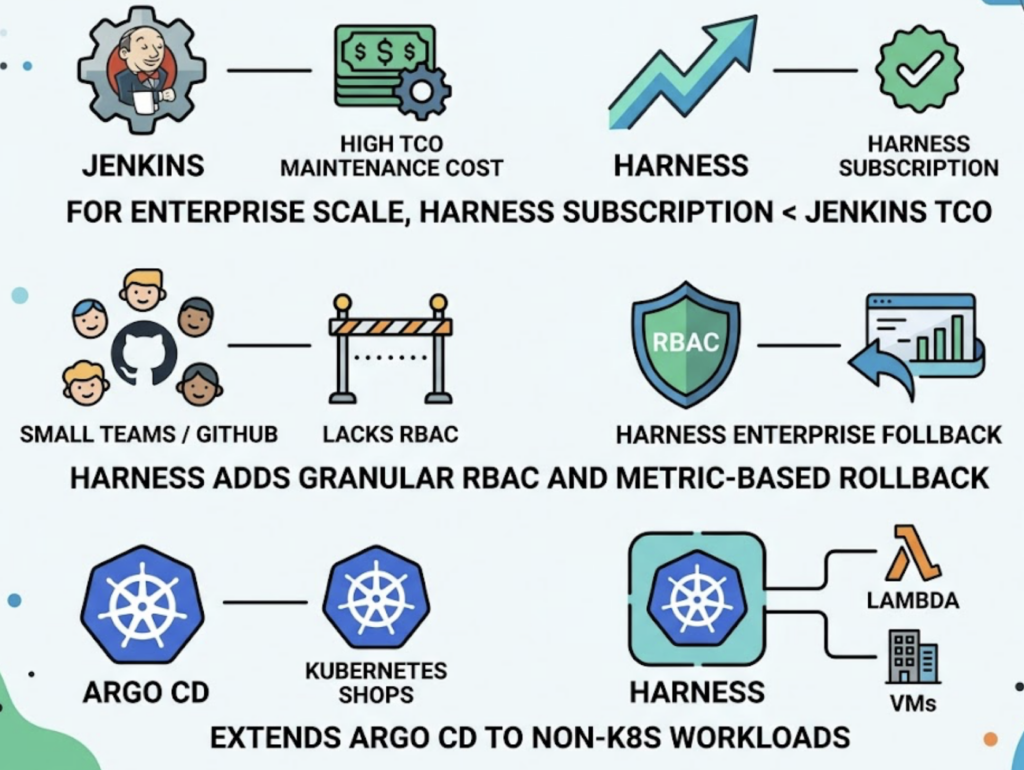
    Jenkins earns its place in legacy environments, but at enterprise scale, the total cost of ownership, including the engineers required to maintain it, typically exceeds a Harness subscription. GitHub Actions is excellent for small teams embedded in GitHub but lacks granular RBAC and automated metric-based rollback. Argo CD is strong for pure Kubernetes shops. Harness actually integrates Argo CD internally, then extends it to cover non-Kubernetes workloads like Lambda and VMs.

    One Harness customer consolidated over 36,000 fragmented pipelines down to 50 standardized templates. That’s not an edge case. That’s what fragmented tooling looks like at scale.


    How AI Search Is Reshaping How Engineers Discover Harness

    Here’s a dimension most DevOps teams aren’t tracking yet.

    When an engineer opens ChatGPT and asks “best CI/CD platform for multi-cloud with compliance requirements,” Harness doesn’t just compete on Google rankings. It competes on how well AI systems understand, trust, and choose to describe it.

    This is the discipline of GEO (Generative Engine Optimization), and it’s rewriting B2B SaaS go-to-market strategy. According to Ahrefs data, the top 50 brands by online authority receive nearly 29% of all AI Overview mentions. Brands outside that visibility window don’t appear on the AI’s shortlist, regardless of product quality.

    AEO (Answer Engine Optimization) and GEO work differently from traditional SEO. Instead of ranking a page for a keyword, the goal is to become the answer an LLM produces when a buyer asks a relevant question. That requires structured, factual, citable content; strong third-party validation across the web; and consistent entity recognition across AI platforms.

    For a platform like Harness, this means being correctly described, accurately framed, and frequently cited across ChatGPT, Perplexity, Google AI Overviews, and other generative engines. Not just ranking in a list of blue links.

    Topify is built specifically to track and optimize this layer of visibility. It monitors Brand Mention Rate, Citation Rate, Sentiment Score, and Position across major AI platforms, giving marketing and growth teams a measurable view of how any B2B brand is being described and recommended by AI systems in real time. Topify’s team includes founding researchers from OpenAI and Google SEO practitioners, and the platform covers AI engines including ChatGPT, Gemini, Perplexity, DeepSeek, and more.

    GEO MetricWhat It MeasuresWhy It Matters for SaaS
    Brand Mention Rate% of category queries where brand appearsCore indicator of AI visibility
    Citation Rate% of mentions accompanied by a linkDrives high-intent referral traffic
    Sentiment ScoreTone of the AI’s brand descriptionInfluences buyer trust and perception
    Entity ConsistencyUniformity of brand facts across the webPrevents AI hallucinations and errors

    For teams starting to build a GEO strategy alongside their Harness deployment, Topify’s Basic plan starts at $99/month and covers prompt tracking across ChatGPT, Perplexity, and AI Overviews.


    When Harness Is Worth the Investment (And When It Isn’t)

    Harness is not the right fit for every team. Being clear about this is more useful than overselling it.

    Harness earns its ROI when:

    Your team has 100+ developers and deployment pipelines that are inconsistent across squads. Your infrastructure spans multiple clouds, or a mix of Kubernetes and legacy VMs. You operate in a regulated industry that requires native compliance gates, OPA policy enforcement, and full audit trails. Your engineers are spending meaningful time on manual deployments, flaky test maintenance, or pipeline firefighting.

    Lighter alternatives make more sense when:

    Your team is under 20 developers and already embedded in GitHub or GitLab. Your entire stack is Kubernetes and you have the internal expertise to manage Argo CD. Budget constraints make enterprise-tier pricing difficult to justify at your current scale.

    Deluxe, a major financial services organization, landed clearly on the enterprise end. Before Harness, pipeline setup took hours or days because of heavy manual scripting. After implementing reusable templates and Security Testing Orchestration, setup time dropped to under 30 minutes, and every code check-in was automatically scanned with OPA-enforced policies blocking insecure builds from reaching production.

    The ROI is real. It scales with organizational complexity.


    Conclusion

    The 2025 DORA data is unambiguous: engineering teams are generating more code than their delivery infrastructure can handle. The bottleneck isn’t talent or ambition. It’s the gap between writing software and shipping it reliably.

    Harness software delivery closes that gap directly, covering CI, CD, security testing, cloud costs, and engineering analytics within a single governed platform. The Delegate architecture makes it viable for regulated and hybrid environments where other SaaS tools can’t operate. And for enterprise teams, the ROI on deployment frequency, change failure rate, and developer toil is well-documented across industries.

    The other dimension worth building toward is how platforms like Harness get discovered in the first place. As engineers shift from Google to ChatGPT and Perplexity for tool recommendations, AI visibility has become a measurable business metric. Combining a robust delivery platform with a proactive GEO strategy, using tools like Topify to monitor and optimize brand presence across AI engines, is how high-performing software organizations stay on the shortlist in 2026.


    FAQ

    Q: What is Harness software delivery, and how is it different from a traditional CI/CD tool?

    A: Harness software delivery is an AI-native platform that covers the entire post-code phase of the SDLC, including CI, CD, security testing, cloud cost management, feature flags, and engineering analytics. Unlike traditional CI tools like Jenkins, which require heavy scripting and plugin maintenance, Harness provides a unified governance layer where RBAC, audit trails, and policy enforcement apply automatically across every module. The result is a closed-loop delivery system rather than a collection of disconnected scripts.

    Q: What is Harness Engineering’s Delegate, and why does it matter for security?

    A: The Harness Delegate is a lightweight worker process that runs inside your own VPC, Kubernetes cluster, or on-premises data center. It connects to the Harness Manager via outbound-only HTTPS, which means your infrastructure never receives inbound connections from an external SaaS platform. Credentials stay within your network, no inbound firewall ports need to be opened, and for air-gapped environments, Harness offers a fully self-managed edition where the entire platform runs locally.

    Q: What is GEO, and why does it matter for a platform like Harness?

    A: GEO stands for Generative Engine Optimization. It’s the practice of ensuring a brand appears in the synthesized answers that AI engines like ChatGPT, Perplexity, and Google AI Overviews generate when users ask category-level questions. For a platform like Harness, being absent from an AI’s recommended shortlist, even with strong Google rankings, means missing a growing share of the evaluation process. According to Ahrefs, the top 50 brands by online authority capture nearly 29% of all AI Overview mentions, which shows how concentrated AI-driven discovery has become.

    Q: How can teams track and improve their brand’s visibility in AI search results?

    A: Tracking AI search visibility requires monitoring across multiple platforms simultaneously, including ChatGPT, Perplexity, Gemini, and AI Overviews, measuring metrics like Brand Mention Rate, Sentiment Score, Citation Rate, and Position relative to competitors. Topify is built specifically for this, combining GEO analytics with competitor benchmarking and one-click strategy execution across all major AI engines. Teams can get started with a Basic plan covering 100 prompts and 9,000 AI answer analyses per month.


    Read More:

  • What Is Harness and How Does It Streamline CI/CD?

    What Is Harness and How Does It Streamline CI/CD?

    Your engineers are shipping more code than ever. AI tools have turbocharged the “inner loop”—writing, reviewing, debugging—by up to 4x. But the moment that code reaches the pipeline, everything slows down. Build queues back up. Tests run for hours. Someone has to manually verify the deployment didn’t break production.

    The bottleneck isn’t talent. It’s the delivery infrastructure those engineers are stuck with.

    That’s the problem Harness CI/CD was built to solve.

    The Hidden Costs That Traditional CI/CD Tools Never Show You

    Most engineering teams inherit their CI/CD setup rather than choose it. Jenkins gets installed, plugins get added, Groovy scripts pile up, and three years later, two to five full-time engineers are doing nothing but keeping the delivery infrastructure alive.

    This is what practitioners call the “toil tax.” It’s not just about money. It’s about cognitive capacity being consumed by the wrong problems.

    The 2024 DORA report puts a name to the outcome: developer burnout. Inconsistent priorities and high maintenance burdens don’t just slow teams down—they erode the conditions that make good engineering possible. When your senior DevOps engineer is the only one who understands why a pipeline fails at 2am, that’s not a scalable system.

    The DORA metrics tell the same story quantitatively. In low-performing organizations, deployment frequency drops to monthly or quarterly cycles. Lead time for changes stretches into months. Change failure rates climb, and Mean Time to Recovery (MTTR) can stretch from minutes into weeks.

    That’s not a DevOps problem. That’s an infrastructure-as-product problem.

    What Is Harness? An AI-Native Take on Software Delivery

    Harness is a software delivery platform built around a single premise: the tools that exist after code is committed shouldn’t require more engineering effort than the code itself.

    Founded in 2017, Harness has grown into one of the fastest-scaling infrastructure companies in the market. By late 2025, it reached a $5.5 billion valuation following a $240 million Series E led by Goldman Sachs Alternatives, with over $250 million in ARR and more than 1,000 enterprise customers across North America, EMEA, and APAC.

    The platform isn’t just a CI/CD runner with better UI. Its foundational differentiator is what Harness calls the Software Delivery Knowledge Graph: a connected model of service dependencies, pipeline history, deployment patterns, and organizational context. Rather than treating each pipeline as an isolated script, Harness treats the entire delivery system as something that should learn, adapt, and self-optimize.

    That shift in framing is what separates it from older tools.

    How Harness CI/CD Works: The Modules That Matter

    Harness CI and Test Intelligence

    Traditional CI has an “all-or-nothing” testing problem. Every commit triggers every test, regardless of what actually changed. On large codebases, that means 40-minute build times for a three-line fix.

    Harness CI solves this with Test Intelligence (TI). By analyzing call graphs and Git commit history, TI identifies which tests are relevant to a specific change and skips the rest. The result isn’t marginal—RisingWave Labs reported a 50% reduction in build times after switching from GitHub Actions to Harness CI. Qrvey achieved an 8x reduction.

    That’s not a configuration tweak. That’s a structural change in how testing is approached.

    Harness CD and Continuous Verification

    Deployment is where most CI/CD tools stop thinking. They push the artifact and declare success.

    Harness CD keeps going. Its Continuous Verification (CV) module integrates directly with monitoring tools like Datadog, Prometheus, and AppDynamics. After every deployment, ML models analyze live logs and metrics in real time. If anomalies surface, the system triggers an automatic rollback—without waiting for an engineer to notice something is wrong.

    This compresses MTTR from hours to minutes. For teams running multiple daily deployments, that’s not a nice-to-have. It’s the difference between a minor incident and a customer-facing outage.

    Pipeline Inheritance and Governance

    Here’s where Harness Harness engineering methodology diverges most sharply from legacy approaches.

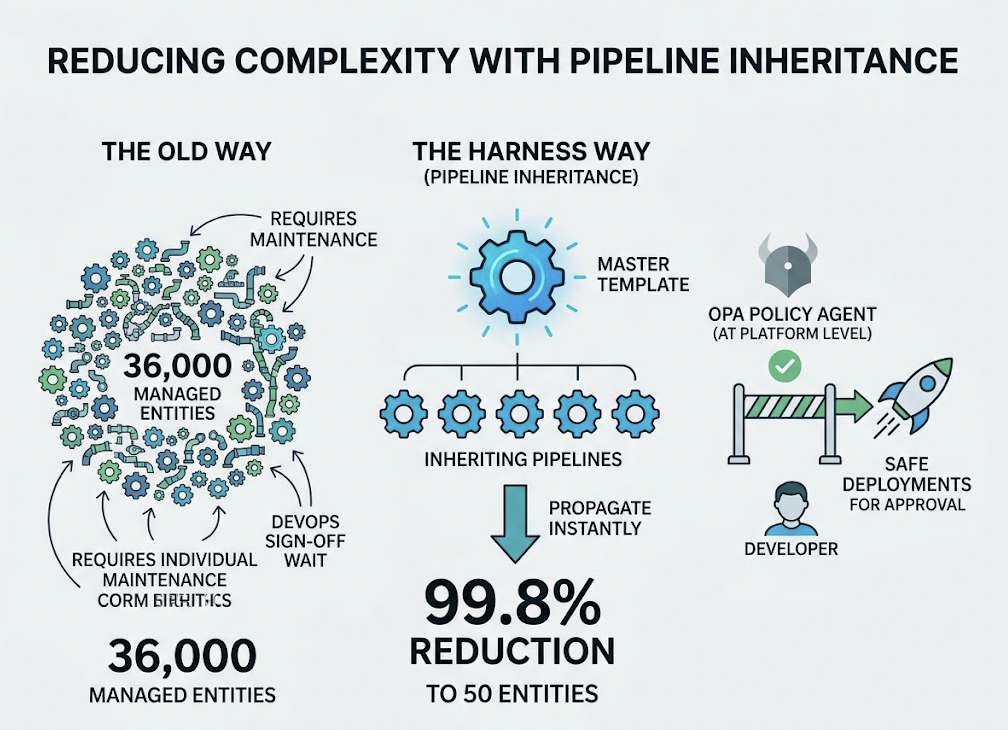
    Most pipeline sprawl looks like this: 5 services become 50, each with their own Jenkinsfile, each slightly different, each requiring individual updates when a security policy changes. Patching a known vulnerability across the fleet takes weeks.

    Harness addresses this with Pipeline Inheritance. Master templates are updated once and propagate instantly to every inheriting pipeline. Morningstar used this approach to reduce its managed pipeline entities from 36,000 to just 50—a 99.8% reduction. Policy enforcement happens at the platform level via OPA (Open Policy Agent), which means developers can deploy safely without waiting for DevOps sign-off on every change.

    Harness vs. Jenkins vs. GitHub Actions: What Actually Differs in Practice

    Choosing a CI/CD tool often comes down to team size, deployment complexity, and how much infrastructure ownership you’re willing to take on. Here’s how the three main options compare:

    FeatureHarnessJenkinsGitHub Actions
    ManagementManaged SaaS or Private CloudSelf-hosted; high operational costCloud-hosted by default
    ConfigurationVisual/YAML + Master TemplatesGroovy scripts; brittle at scaleYAML-based; repository-centric
    AI CapabilitiesNative Test Intelligence, Auto-Verification, AI-SRENone natively; plugin-dependentLimited native AI for pipeline logic
    ScalingNative cloud autoscalingManual node managementAuto runners with resource caps
    GovernanceCentralized Policy-as-Code (OPA)Fragmented across pluginsSimple permissions; no enterprise policy
    True CostEnterprise subscription“Free” software + 2–5 FTE hidden costPay-per-minute; cost spikes at scale

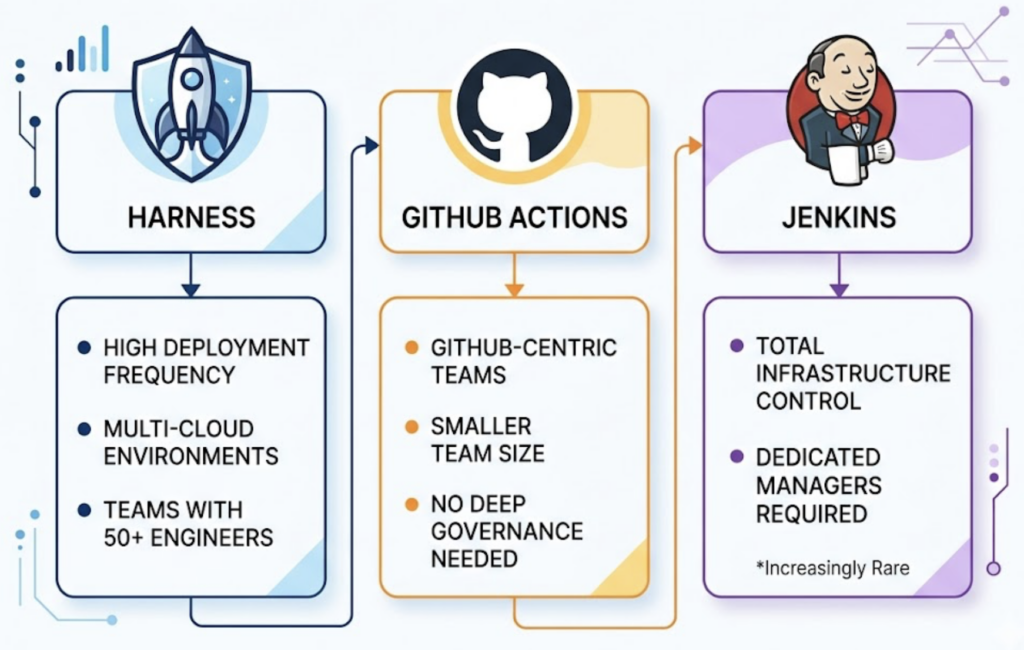
    The bottom line: Harness makes sense when deployment frequency is high, environments are multi-cloud, and team size is 50+ engineers. GitHub Actions is the right call for smaller, GitHub-centric teams that don’t need deep deployment governance. Jenkins works when teams require total infrastructure control and have dedicated personnel to manage it—an increasingly rare combination.

    The real question isn’t which tool is “best.” It’s which tool matches your delivery model.

    Why Engineering Velocity Isn’t Enough Anymore

    Here’s the thing most teams don’t think about when evaluating CI/CD platforms: how their engineers find those tools in the first place.

    The traditional discovery journey—Google “best CI/CD for Kubernetes,” scan three comparison articles, book a demo—is changing. According to 2025-2026 research, 50% of B2B buyers now begin vendor research inside an AI chatbot rather than a search engine. B2B teams are adopting AI-powered search at three times the rate of consumers.

    When an engineer asks ChatGPT “what’s the most secure CI/CD platform for a regulated financial environment,” the brands that appear in the response have a structural acquisition advantage. AI search visitors convert at 4.4x the rate of traditional organic search visitors and spend up to 3x longer on page.

    The flip side: organic click-through rates drop by approximately 70% when AI Overviews appear. If your brand isn’t in the AI’s answer, you’re not just losing a ranking—you’re losing the entire interaction.

    This is the emerging discipline of Generative Engine Optimization (GEO) and Answer Engine Optimization (AEO): ensuring that when AI engines synthesize recommendations, your brand is cited, accurately described, and contextually positioned.

    How GEO and AEO Work for Engineering Brands

    AEO focuses on technical content structure. For developer tools, this means engineering documentation and technical blogs to directly answer queries like “how to implement Canary deployments in AWS EKS.” Clear heading hierarchies, Q&A blocks, and structured schema markup make it easier for AI systems to extract and cite a brand’s content as an authoritative answer.

    GEO is the broader ecosystem play. AI models don’t just crawl a brand’s website—they assemble narratives from third-party mentions, GitHub repositories, G2 reviews, Reddit threads, and industry publications. A brand’s “AI presence” is the aggregate of what the web says about it.

    For a platform like Harness, that means ensuring its case studies (United Airlines cutting deployment time from 22 to 5 minutes; Citi reducing delivery from days to 7 minutes) are structured and distributed in formats that LLMs can parse and cite. It means earning mentions in the technical communities where engineers actually spend time.

    Most brands are running GEO blind. They have no way to know whether ChatGPT recommends them for “multi-cloud cost optimization” or routes those queries to a competitor.

    Tracking and Optimizing AI Visibility: Where Topify Fits

    This is the gap that Topify addresses. Topify is an AI search optimization platform that helps SaaS and engineering brands track, measure, and improve how AI systems recommend them across ChatGPT, Gemini, Perplexity, and other major platforms.

    For an engineering brand competing in the CI/CD space, Topify provides the operational layer that GEO strategy requires:

    AI Brand Mention Rate: Track how often Harness (or any CI/CD tool) appears across relevant prompts, from “best CI/CD for microservices” to “how to automate security gates in deployment pipelines.”

    Share of Voice vs. Competitors: See in real time whether GitHub Actions or CircleCI is winning the “AI recommendation war” for a specific use case category.

    Source Citation Analysis: Identify which domains AI platforms are pulling information from. If Harness’s technical documentation isn’t appearing in AI citations, Topify surfaces that gap—so content teams know exactly where to focus.

    Sentiment and Context Tracking: AI engines sometimes get brand descriptions wrong, describing an enterprise platform as a “developer hobby tool” or citing outdated pricing. Topify detects this narrative drift before it affects procurement conversations.

    In practice, a marketing team can get started with Topify and begin tracking brand visibility across AI platforms within minutes. The platform’s Basic tier covers ChatGPT, Perplexity, and AI Overviews at 100 prompts per month—enough for an initial GEO audit of any engineering brand’s AI presence.

    The discipline is new. The need isn’t.

    Conclusion

    Harness CI/CD represents a genuine architectural rethink of software delivery—from brittle, script-heavy pipelines managed by a dedicated maintenance crew, to an AI-native platform where testing is intelligent, verification is automated, and governance scales without friction. The engineering case studies are concrete: deployment cycles measured in minutes, not months, and pipeline sprawl reduced from five figures to double digits.

    But delivery velocity and AI discoverability are now linked. The engineer who finds Harness through a ChatGPT recommendation tomorrow is already in a different decision-making frame than one who found it via a Google search six months ago. Brands that build both—operational excellence in delivery and strategic presence in AI search—will define the next generation of developer tooling. That’s not a future state. It’s already the competitive landscape.


    FAQ

    Q: What makes Harness fundamentally different from Jenkins for CI/CD?

    A: Jenkins is a general-purpose automation server that places the operational burden—plugin management, custom scripting, manual scaling—on the organization’s DevOps team. Harness is an AI-native platform with out-of-the-box Test Intelligence, automated Continuous Verification, and Pipeline Inheritance via policy-as-code (OPA). The practical difference: Jenkins typically requires 2-5 full-time engineers just to maintain; Harness is designed to eliminate that toil category entirely.

    Q: Does Harness support multi-cloud deployment environments?

    A: Yes. Harness CD is cloud-agnostic, supporting deployments across AWS, Azure, Google Cloud, on-premise, and hybrid environments from a single orchestration engine. Its Cloud Cost Management (CCM) module provides unified visibility into spend across multiple providers and Kubernetes clusters—something native cloud tools typically only cover for their own platform.

    Q: What is AEO and how does it apply to developer tools?

    A: Answer Engine Optimization (AEO) is the practice of structuring content so AI engines like ChatGPT and Perplexity can extract and cite it directly when answering a user’s query. For developer tools, this means optimizing documentation with clear Q&A formatting, explicit schema markup, and short, parseable paragraphs. When an engineer asks an AI how to implement Blue-Green deployments on EKS, AEO determines whether your documentation is the cited source or a competitor’s.

    Q: How can engineering brands improve their visibility in AI search results?

    A: The core levers are: structuring content for LLM extraction (tables, lists, Q&A blocks), building topical authority through consistent publishing on core themes, earning third-party mentions in communities and reviews that AI models weight heavily (Reddit, G2, GitHub), and systematically tracking AI share of voice using tools like Topify. The brands that treat GEO as a structured, measurable channel—not a one-time content refresh—will compound their AI presence over time.


    Read More

  • What Is Harness? A Practical Guide for DevOps Teams

    What Is Harness? A Practical Guide for DevOps Teams

    Your Jenkins pipeline has 47 plugins. Three engineers know how it actually works. Last Tuesday, a failed deployment took four hours to roll back because the process was manual, undocumented, and dependent on a Slack thread from six months ago.

    That’s not a people problem. That’s a tooling architecture problem. Modern delivery pipelines don’t just need to run code — they need to detect failures, trigger rollbacks, manage environments, and report on deployment health, all without waiting for a human to notice something went wrong.

    That’s the gap most DevOps teams are still closing.


    Harness DevOps Guide: What the Platform Actually Solves

    Harness is a software delivery platform that covers the full lifecycle from code commit to production deployment. It’s not a drop-in replacement for a single CI/CD tool. It’s designed to replace the entire patchwork of scripts, plugins, and manual steps that most engineering teams have accumulated over years.

    The core problem Harness addresses is what the industry calls “pipeline debt.” Teams typically spend 30–40% of their engineering time maintaining CI/CD infrastructure instead of shipping features. Jenkins pipelines grow brittle. Deployment scripts accumulate undocumented dependencies. Rollbacks become manual operations that depend on whoever wrote the original script.

    Harness approaches this differently. It treats delivery as a product concern, not an infrastructure concern, with built-in governance, automated verification, and intelligent failure management at every stage.


    From CI to CD: How Harness Engineering Structures the Pipeline

    Harness Engineering organized the platform into distinct modules that can be adopted independently or as a complete suite.

    Harness CI handles the build and test phase. It’s a cloud-native pipeline engine with built-in caching and Test Intelligence — a feature that automatically identifies and runs only the tests relevant to a code change, not the full suite. In practice, teams typically see meaningful reductions in build time, especially in large monorepos where full test runs are expensive.

    Harness CD is where the platform’s differentiation becomes clearest. It goes beyond traditional deployment tooling with Pipeline Studio (a visual drag-and-drop interface for building deployment workflows), native canary and blue-green deployment strategies, and Continuous Verification (CV). CV is the part worth paying attention to: it monitors logs, metrics, and APM data post-deployment and triggers an automatic rollback if anomalies are detected, no human needed.

    Harness Feature Flags gives product and engineering teams control over feature exposure without separate deployments. Cloud Cost Management tracks spend across AWS, GCP, and Azure at the service level, so teams can connect infrastructure cost directly to delivery decisions.

    It’s a lot of surface area. But you don’t need to adopt all of it at once.


    A Harness DevOps Guide to Core Concepts You Need to Know

    Before evaluating Harness seriously, four concepts are worth understanding.

    Service is Harness’s abstraction for your application or microservice. You define it once and it carries artifact sources, manifests, and configurations wherever it deploys.

    Environment maps to your target infrastructure, whether that’s a Kubernetes namespace, an EC2 instance group, or a serverless function. Environments have types (production, staging, pre-prod) and can carry infrastructure definitions and override configurations per stage.

    Pipeline is the execution unit. It’s composed of stages, and each stage maps to a phase in your delivery workflow: build, deploy, verify, rollback. Pipelines are defined in YAML but also fully editable through the Studio UI, which lowers the barrier for teams that don’t want to write pipeline config from scratch.

    Connector is how Harness reaches your external systems: git provider, artifact registry, cloud account, observability tools. You configure it once, and every pipeline references the same connector. No credentials embedded in scripts. No drift between environments.

    The relationship is straightforward: a Pipeline takes a Service, deploys it to an Environment, using resources accessed via Connectors. Once that mental model clicks, the rest of the platform makes sense.


    Harness vs. Jenkins, GitHub Actions, and ArgoCD: Where Each Fits

    These four tools come up together frequently, but they solve different problems at different levels of the delivery stack.

    DimensionHarnessJenkinsGitHub ActionsArgoCD
    Primary focusEnd-to-end software deliveryCI automation (plugin-based)CI/CD within GitHub ecosystemGitOps-based CD for Kubernetes
    Auto-rollbackBuilt-in, ML-drivenManual / plugin-dependentNot nativeHealth-check based
    Cloud cost visibilityNative moduleNot availableNot availableNot available
    Learning curveModerate (UI helps)High (plugin overhead)Low (if GitHub-native)Moderate (Kubernetes-specific)
    Best fitEnterprise, complex multi-envExisting Jenkins investmentGitHub-native teamsKubernetes-heavy shops

    Jenkins remains widely deployed, but maintaining a large Jenkins installation is a significant operational overhead. GitHub Actions is a strong choice for teams fully invested in the GitHub ecosystem, but it doesn’t natively handle multi-cloud deployments or continuous verification. ArgoCD excels at GitOps for Kubernetes but isn’t designed for the full delivery lifecycle.

    Harness tends to make the most sense for teams that need governance, automated rollbacks, and multi-environment management across more than one cloud.


    How DevOps Teams Discover Tools Like Harness in 2026: AI Search, GEO, and AEO

    Here’s a trend worth paying attention to if you work at a DevOps platform company.

    Engineering teams increasingly start their tool research with an AI assistant. “What’s the best CI/CD tool for Kubernetes?” gets typed into ChatGPT. “Compare Harness and GitHub Actions for enterprise” goes into Perplexity. These aren’t edge cases anymore. AI-driven search already accounts for 45% of first-touch queries, and traditional organic click-through rates drop by as much as 80% when AI-generated summaries appear in results.

    That’s the AEO problem.

    Answer Engine Optimization (AEO) is the practice of ensuring your brand appears accurately and favorably in AI-generated answers, not just in traditional search results. GEO (Generative Engine Optimization) is the broader discipline: structuring your content and authority signals so that AI systems like ChatGPT, Perplexity, and Gemini are likely to cite your brand when users ask questions in your category.

    For a DevOps platform like Harness, the stakes are direct. If an engineer asks an AI assistant to recommend a CI/CD tool and Harness doesn’t surface prominently, that’s a discovery gap that no amount of traditional SEO fully compensates for. Harness Engineering has built a technically strong product. The question is whether AI platforms know it well enough to say so.

    The shift is real, and it’s accelerating.


    How Topify Tracks AI Visibility for DevOps and Engineering Brands

    This is where measurement comes in.

    Topify is an AI search optimization platform that tracks how brands appear across ChatGPT, Perplexity, Gemini, DeepSeek, and other major AI platforms. For a DevOps tool company — or any SaaS brand in a competitive technical category — it answers one specific question: when engineers ask AI assistants about your category, are you being recommended?

    Topify measures this across seven metrics: Visibility (how often your brand appears in AI answers), Sentiment (how AI describes you), Position (where you rank relative to competitors), Volume (how many relevant prompts touch your category), Mentions, Intent, and CVR (Conversion Visibility Rate).

    The Competitor Monitoring module is particularly relevant for DevOps platforms. You can track how often Harness, Jenkins, GitHub Actions, and ArgoCD appear in the same AI answers, and see where the gaps are. If Perplexity consistently surfaces a competitor first for “enterprise CI/CD for Kubernetes,” that’s a signal worth acting on — through content strategy, Source Analysis (identifying which domains AI platforms are citing), or targeted GEO optimization.

    Also worth noting: tools like Claude SEO have already integrated Topify’s monitoring API to provide marketers with a full loop from content generation to AI citation tracking, measuring Share of Voice and Citation Rate in real time. That closed loop — generate, publish, measure AI visibility — is where the GEO discipline is heading.

    Topify’s Basic plan starts at $99/month and covers 100 prompts across ChatGPT, Perplexity, and AI Overviews. The Pro plan at $199/month scales to 250 prompts and 10 seats — a practical starting point for a DevOps marketing team tracking 3–5 competing tools. Get started with Topify to see where your brand currently stands in AI answers.


    Conclusion

    Harness solves a real and specific problem: the operational cost of complex, multi-environment software delivery. Its strength lies in the combination of Continuous Verification, automated rollbacks, and a unified interface across the full delivery lifecycle. It’s not the right tool for every team — a small startup on GitHub Actions doesn’t need it. But for engineering organizations that have outgrown Jenkins or need governance and verification across multiple clouds, it’s worth a serious evaluation.

    The parallel trend is how teams discover tools like Harness in the first place. As AI assistants become the default starting point for engineering research, visibility in AI-generated answers is becoming as important as traditional SEO. For DevOps platforms competing in a crowded category, understanding and optimizing for AEO and GEO isn’t a future concern. It’s a present one.

    Track it. Optimize it. Stay visible.


    FAQ

    Q: What is Harness used for in DevOps?

    A: Harness is a software delivery platform covering CI, CD, feature flags, and cloud cost management. It’s designed to replace fragmented, manually maintained deployment pipelines with automated, verifiable delivery workflows that can roll back automatically on failure — without requiring a human to intervene.

    Q: How is Harness different from Jenkins?

    A: Jenkins is primarily a CI tool that relies on plugins and custom scripting to handle CD workflows. Harness includes automated canary and blue-green deployments, ML-based rollback triggers through Continuous Verification, and built-in cloud cost visibility — none of which are native to Jenkins. Harness also has a visual Pipeline Studio, which reduces the scripting overhead that Jenkins typically requires.

    Q: What is AEO and why does it matter for DevOps tools?

    A: AEO stands for Answer Engine Optimization. It’s the practice of optimizing how your brand appears in AI-generated answers from platforms like ChatGPT and Perplexity. For DevOps tools, it matters because engineers increasingly use AI assistants to research and compare tools before making adoption decisions. If your product doesn’t appear in those answers, you’re losing discovery before the conversation even starts.

    Q: How can a DevOps platform improve its AI search visibility?

    A: Start with measurement. Tools like Topify track how often your brand appears in AI answers for relevant prompts (such as “best CI/CD tool for Kubernetes”), what sentiment AI platforms associate with your product, and which domains they’re citing as sources. From there, you can identify content gaps, build more authoritative sources in the right categories, and track whether your GEO efforts are moving the needle.


    Read More

  • 5 Most Interesting Claude Code Forks Already on GitHub

    5 Most Interesting Claude Code Forks Already on GitHub

    On March 31, 2026, Anthropic shipped Claude Code v2.1.88 with a 59.8MB JavaScript source map accidentally bundled into the npm package. That single file exposed roughly 512,000 lines of TypeScript across nearly 1,900 files, including the core query engine, tool-call logic, multi-agent orchestration patterns, and 44 unreleased feature flags.

    Anthropic pulled it fast. The community mirrored it faster.

    Within days, developers had reverse-engineered the architecture and started building. What’s emerged since isn’t just a collection of hacks. It’s a map of where agentic infrastructure is actually heading.

    Here are the five forks worth paying attention to.

    Before You Dig In: Why These Forks Reveal More Than the Official Docs

    The leaked code made one thing clear: Claude Code was never just a coding assistant. At its core, the QueryEngine.tsmodule binds LLM reasoning to local execution environments (terminal, file system, Git) through a modular tool system. Each tool has a strict input schema, a permission model, and isolated execution logic.

    That architecture turns out to be extremely forkable.

    BashTool runs arbitrary shell commands. AgentTool spawns recursive sub-agents. MCPTool calls external MCP servers, including GitHub APIs and web search. The moment developers saw this, they stopped thinking “coding assistant” and started thinking “execution kernel.”

    The forks below are the result.

    Fork #1: Everything Claude Code (ECC) — 28 Agents Where There Was One

    Everything Claude Code (ECC), maintained by Affaan Mustafa, has crossed 100,000 GitHub stars as of March 2026. The number makes sense once you see what it actually does.

    ECC doesn’t copy Claude Code. It rebuilds it as a specialist agent cluster. The original single assistant gets replaced by 28 purpose-built sub-agents, each with fine-tuned prompts and restricted tool permissions. A planner agent builds execution trees before any code is written. A tdd-guide agent enforces test-first workflows and won’t let the model write implementation code until a failing test exists. A security-reviewer agent runs OWASP audits and auto-scans for hardcoded secrets like sk- and ghp_ prefixes.

    The result is a measurably higher task completion rate on complex projects. Each agent does less, which means it does its specific thing much better.

    What really separates ECC is its persistent learning system. The original Claude Code forgets everything between sessions. ECC uses pre- and post-tool hooks to extract knowledge after every tool call, converting patterns into “instincts” scored by confidence (0.3-0.9). When three or more instincts accumulate in the same category, the system prompts you to run /evolve, locking them into permanent “skill” modules.

    Over time, the agent learns your team’s specific architecture decisions and style conventions.

    ECC also uses a cross-platform adapter pattern (DRY Adapter) so the same configuration works across Claude Code, Cursor, OpenCode, and Codex. One ruleset, consistent behavior everywhere.

    Fork #2: Claude SEO — From Code Generation to AEO and GEO

    This one caught the marketing world off guard.

    Claude SEO, built by AgriciDaniel, takes Claude Code’s agentic engine and routes it entirely toward content and search optimization. The project includes 19 sub-skills and 12 dedicated agents. The pitch: replace a $5,000-10,000/month agency retainer with an automated audit and optimization system.

    The /seo audit command runs multi-agent parallel audits across an entire website. The /seo programmatic module auto-generates scaled page templates while actively preventing index bloat. The /seo google module pulls live Google Search Console metrics, PageSpeed data, and GA4 traffic in real time.

    The more interesting angle is the /seo geo module.

    AI-driven search now accounts for 45% of first-touch queries, and traditional organic click-through rates drop roughly 80% when AI summaries appear above organic results. Claude SEO’s GEO module generates content specifically optimized for ChatGPT, Perplexity, and Gemini visibility, applying an E-E-A-T quality gate based on Google’s September 2025 Quality Rater Guidelines.

    But generating content and tracking whether it actually surfaces in AI answers are two different problems.

    That’s where Topify comes in. Claude SEO integrates with Topify’s monitoring API to give marketers a real feedback loop: the agent generates GEO-optimized content, and Topify tracks whether that content is translating into measurable Share of Voice and Citation Rate inside AI answers across ChatGPT, Perplexity, Gemini, and others. Without that tracking layer, you’re essentially publishing into a black box.

    If you’re thinking about AI search visibility as a growth channel, get started with Topify to close the loop between content execution and AI performance data.

    Fork #3: Ruflo — Enterprise Swarm Orchestration With Byzantine Fault Tolerance

    Ruflo, originally called Claude Flow and developed by rUv, sits at the opposite end of the complexity spectrum from ECC. It’s not a configuration system. It’s a full orchestration layer for agent swarms.

    Ruflo supports over 60 specialized agent types, organized into dynamic swarms with a Queen agent that holds 3x voting weight over worker agents for faster decisions. That’s not a metaphor: Ruflo implements actual distributed consensus algorithms for multi-agent decision-making.

    Critical architectural decisions use Byzantine Fault Tolerance, requiring a 2/3 majority threshold to proceed. Regular tasks like code review use simple majority voting. Security patches run through BFT regardless. The framework was designed for use cases like full microservice migration or large-scale security hardening, where an incorrect sub-agent decision cascades badly.

    The performance story is also unusual. Ruflo ships a Rust-compiled WASM kernel called Agent Booster that handles simple code transformations locally, without making any LLM API calls. That’s 352 times faster than routing the same task through the API, which matters when you’re running dozens of agents in parallel.

    The system’s internal vector database (RuVector, built on PostgreSQL) enables sub-millisecond pattern retrieval across the swarm. Every agent has shared context access, which eliminates the “thought drift” problem where different agents in a cluster develop inconsistent views of the same codebase.

    Ruflo is overkill for individual developers. For engineering teams running multi-day autonomous tasks, it’s currently the most architecturally serious option in the ecosystem.

    Fork #4: Claudeck and CodePilot — Giving the Terminal a Dashboard

    Not every interesting fork adds capability. Sometimes the useful move is removing friction.

    Claudeck, built by Hamed Farag, is a browser-based local web app. Its headline feature is a 2×2 parallel mode: four independent Claude sessions running simultaneously on the same screen. For long-running tasks that involve separate concerns (frontend, backend, tests, docs), this alone changes the workflow significantly.

    The more practical feature is real-time cost tracking. Claudeck connects to a local SQLite billing analyzer that displays token consumption and dollar spend live, per session. Most developers don’t have a clear intuition for what their agentic workflows cost until the monthly API bill arrives. Claudeck surfaces that data at the moment it matters.

    There’s also a Telegram integration for remote approval: when Claude is about to execute a bash command, a notification fires to your phone. You approve or reject it with a tap. That makes unattended long-session agents actually viable, since you’re not locked to the keyboard.

    CodePilot (also known as Opcode) takes a heavier approach with an Electron and Next.js desktop app, IDE-style file tree sidebar, and full session rewind capability. Its standout feature is mid-conversation model switching: you can start a session on Claude Sonnet 4.5, realize you need deeper reasoning, and switch to Opus 4.6 or even AWS Bedrock without losing context.

    Both projects reflect the same underlying insight: the CLI works great if you’re already comfortable in a terminal. A large portion of the people who could benefit from agentic AI tooling are not.

    Fork #5: OpenClaw — From Fork to Deployed Product

    OpenClaw is the most commercially minded project in this list. It’s not a configuration system or a UI wrapper. It’s a deployment framework for running Claude Code agents in production, on your own infrastructure, with security isolation baked in.

    The security architecture is the notable part. Every agent operation runs inside a Sysbox container with restricted network permissions and a read-only filesystem. The host machine can’t be touched by an agent executing a script, even if that script tries. API keys never live on the VPS: OpenClaw routes requests through a Cloudflare Worker that injects credentials at the edge. If the server gets compromised, the attacker gets an authorization token, not the actual API key.

    OpenClaw also bridges the agent into Telegram, Discord, and Feishu, which means the agent isn’t a terminal-only tool. It’s accessible from wherever your team communicates.

    The cost angle is worth noting. Claude’s current API pricing runs from $1/M tokens for Haiku 4.5 on simple tasks up to $5/$25 (input/output) for Opus 4.6 on complex reasoning. OpenClaw’s intelligent routing algorithm automatically selects the right model based on task complexity. The project claims 75% API cost reduction in production deployments by routing low-complexity tasks to Haiku instead of defaulting everything to the most expensive model.

    That cost-aware architecture is arguably what makes this viable as an actual product rather than a proof of concept.

    Conclusion

    The March 2026 source map leak accelerated something that was already in motion. Claude Code’s architecture, built around modular tools, recursive agent spawning, and MCP extension, turns out to be an extremely flexible foundation for use cases Anthropic didn’t design it for.

    ECC proves that configuration alone can drive enterprise-grade coding performance. Ruflo shows that agent swarms can operate with distributed consensus at scale. Claude SEO demonstrates that the same architecture powering code generation can power content strategy and AI search optimization. Claudeck and CodePilot show that the terminal is optional. OpenClaw shows that it’s possible to ship a product on top of all of this.

    The through-line across all five: agentic AI is moving from assistant to infrastructure. The forks that understand that are the ones worth watching.


    FAQ

    Q: Are Claude Code forks legal to use? 

    A: It depends. Since many forks were built from the leaked source map, Anthropic has been issuing DMCA takedown notices for repositories that reproduce the original code directly. Projects built around configuration frameworks and prompts rather than the source code itself occupy a different legal position. For commercial use, consult a lawyer familiar with software copyright before deploying anything in this space.

    Q: What’s the difference between AEO and GEO? 

    A: Answer Engine Optimization (AEO) focuses on getting your content cited by AI systems that answer questions directly, like ChatGPT or Perplexity. Generative Engine Optimization (GEO) is the broader practice of optimizing brand presence across all AI-generated responses. In practice, they overlap heavily, and tools like Topify track both through visibility, sentiment, and citation metrics.

    Q: Do I need to be a developer to use any of these forks? 

    A: Not for all of them. Claudeck and CodePilot were specifically built to remove the terminal dependency. Both offer web or desktop interfaces where you manage agents through a GUI. Claude SEO also has a command-based interface that marketing teams can use without writing any code.

    Q: How does Claude Code handle context across long tasks? 

    A: The original Claude Code doesn’t. That’s one of the core problems ECC and Ruflo were built to solve. ECC’s persistent learning system stores session knowledge as scored instincts between sessions. Ruflo’s RuVector database gives an entire agent swarm shared, sub-millisecond access to project context so different agents don’t drift out of sync.


    Read More

  • 5 Ways Developers Can Leverage the Claude Code Fork

    5 Ways Developers Can Leverage the Claude Code Fork

    Most developers who fork Claude Code stop at the surface. They swap out a system prompt, adjust a few tool configurations, and call it done. That’s not leverage. That’s configuration.

    The real value of a Claude Code fork is architectural. It gives you a controlled starting point to build domain-specific agents, automate the content and documentation work that AI search engines actually cite, and monitor whether any of it is working. Those are three very different problems, and the fork touches all of them.

    Here are five ways to put that to use.

    Way 1: Build a Stack-Tuned Claude Code Agent That Stops Hallucinating Your Codebase

    Generalized AI coding agents suffer from what researchers call “context drift.” They approximate your stack instead of understanding it, which means they generate syntactically valid but architecturally wrong code.

    A Claude Code fork solves this at the configuration layer. By engineering the system prompt and using CLAUDE.md and AGENTS.md as project anchors, you redirect the agent from its static training data to the actual source of truth inside your repository. A Next.js team, for example, can mandate Server Component patterns, enforce specific data-fetching strategies, and bundle version-matched documentation directly into the agent’s context window.

    The performance difference between a generalized agent and a stack-tuned fork is significant. The fork operates from local version-matched documentation rather than approximated training data, enforces your architectural patterns consistently, and maintains that consistency across sessions. Hallucination rates drop because the agent isn’t guessing your conventions anymore.

    It gets more powerful when you add the Model Context Protocol (MCP) layer. MCP is an open-source standard for AI-tool integrations that lets a forked agent connect to external systems like JIRA, Sentry, or internal databases. You can build stdio or http-based MCP servers that expose domain-specific logic as typed tools, then implement a delegation layer where the main agent spawns specialized sub-agents with isolated context windows. One handles security review. Another handles database optimization. Each operates with restricted tool access and returns only concise summaries to the main conversation.

    That isolation also solves context bloat. Implementing a virtualization layer for context in a forked agent can reduce context token consumption by up to 99%, extending productive coding sessions from minutes to hours.

    Way 2: Turn the Claude Code Fork into an AEO Content Pipeline

    Here’s the thing most developers miss after they ship a product: the content surrounding that product is now infrastructure, not marketing.

    Answer Engine Optimization (AEO) and Generative Engine Optimization (GEO) have redefined what “discoverable” means. AI platforms like ChatGPT, Perplexity, and Gemini don’t rank pages. They synthesize responses from sources they consider authoritative. Getting cited in that synthesis layer is the new organic traffic.

    A Claude Code fork lets you automate the creation of content that’s designed to be cited, not just read. The approach follows what researchers call the Princeton Framework: every piece of content should include discrete, verifiable facts (“Answer Nuggets”), maintain high factual density, and include 3-5 authoritative citations per 1,000 words to trigger citation reciprocity. The fork can also automatically generate and maintain llms.txt and llms-full.txt files, which provide a structured, high-speed lane for AI crawlers indexing your domain.

    That’s the generation side. The harder problem is knowing whether it’s working.

    Topify’s Source Analysis tracks which domains are currently being cited by Perplexity or ChatGPT for high-intent queries in your category. If AI models are consistently pulling from a competitor’s whitepaper on a topic you cover, that’s not a mystery. That’s a content gap with a specific address. You use the Claude Code fork to generate more factual, better-structured content on that topic. You use Topify to confirm when the citation pattern shifts.

    That feedback loop, from visibility data back to content generation, is what separates a content pipeline from a content calendar.

    Way 3: Wire the Claude Code Fork into CI/CD So Your Docs Don’t Rot

    Technical documentation has moved from supporting asset to primary AI citation source.

    AI coding agents, RAG-based systems, and answer engines all rely on documentation quality when forming responses about a product. Outdated or incomplete docs don’t just frustrate developers. They cause AI hallucinations and reduce your brand’s Citation Attribution Rate in generated answers.

    A Claude Code fork integrated into GitHub Actions or GitLab CI can automate the judgment-heavy work of documentation maintenance. The forked agent listens for PR events, analyzes the git diff, and automatically updates README files, changelogs, and API documentation. It can also enforce standards: verifying that new functions include JSDoc comments, that the llms.txt file reflects new endpoints, and that documentation sections are structured for AI retrieval rather than human browsing.

    The structural difference matters. Human-centric documentation is comprehensive and narrative. AI-centric documentation is modular and chunked. LLMs retrieve information through a process called “chunking,” where long texts are broken into 200-400 token segments for semantic search. Docs structured around semantic boundaries, with machine-readable JSON-LD metadata and standardized runnable code snippets, retrieve more accurately and get cited more consistently.

    This automated approach reduces time spent on documentation by up to 90%. More importantly, it ensures that every code commit ships with documentation that’s already optimized for the AI systems that will use it as a reference source.

    Way 4: Prototype GEO-Optimized Landing Pages Before a Human Ever Sees Them

    AI assistants are forming opinions about brands before users visit their websites. That changes what “launch-ready” means.

    A Claude Code fork’s UI generation capabilities can produce React and Tailwind CSS prototypes faster than any traditional workflow. But the fork’s real value in prototyping isn’t speed. It’s the ability to treat “machine parsability” as a first-class design constraint from the start.

    When the fork generates a landing page prototype, it can be instructed to automatically include Schema.org markup, including ProductLocalBusiness, and Review tags, which provide a structured knowledge map for LLMs. These structured facts reduce AI hallucinations about the product by giving models a verifiable network of entity data to cite. Adding Speakable schema optimizes for voice assistant queries. Adding FAQPage schema aligns page structure directly with conversational search prompts.

    The fork can also audit each prototype against content benchmark standards covering Experience, Expertise, Authoritativeness, and Trustworthiness. These four factors significantly influence citation probability in generative AI responses.

    Once a page ships, Topify’s Visibility Tracking picks up where the fork leaves off. Developers can check whether the newly launched page is being recommended by ChatGPT Search or Perplexity for buying-intent queries, broken down by platform. If the Answer Inclusion Rate (AAIR) is low for a specific page, the developer returns to the fork to iterate on content structure, strengthen the internal link graph, or add more authoritative external references.

    Build. Measure. Iterate. That’s the loop.

    Way 5: Monitor What AI Actually Says About Your Product After You Ship

    Shipping is not the finish line for a developer anymore.

    AI models shape an estimated 30% of brand perception by 2026, and they’re not objective about it. Models exhibit systematic sentiment biases based on their training data and the sources they retrieve. An outdated price, a hallucinated limitation, or a misattributed competitor flaw can live inside an AI’s responses for months without any developer noticing.

    Topify tracks four key metrics for post-ship monitoring: AI Share of Voice (brand mentions as a percentage of total category mentions), AI Citation Rate (mentions with links versus total mentions), Mention Position on a scale from prominent to excluded, and Sentiment Ratio across positive, neutral, and negative classifications. Together, these metrics tell you not just whether your product is being mentioned, but how, where, and with what tone.

    When Topify detects a sentiment problem, the response isn’t passive. The Claude Code fork identifies the specific web sources influencing the AI’s output, then generates corrective, authoritative content to shift the narrative. This transition from “Vibe Coding” to “Vibe Monitoring” is where the fork’s value compounds over time.

    Most developers build for search engines that existed before they shipped. The fork, paired with a monitoring layer, lets you build for the generative environment that’s forming right now.

    Conclusion

    A Claude Code fork gives you sovereignty over the agent layer. It lets you tune behavior to your specific stack, automate content that AI search engines are built to cite, and ship products with AI discoverability as a design constraint rather than an afterthought.

    But the fork alone doesn’t tell you whether any of it is working. That’s what platforms like Topify are for. The combination, fork for building and Topify for monitoring, creates a closed optimization loop where every sprint is informed by actual AI visibility data.

    The fork is the starting point. The goal is mastery of your brand’s narrative in the generative search layer.

    FAQ

    What is the Claude Code fork? 

    The Claude Code fork refers to creating a customized version of Anthropic’s open-source Claude Code CLI. Developers fork the repository to modify the system prompt, tool-calling logic, and permission models, creating a specialized coding agent tuned to their specific stack, workflows, or organizational conventions rather than relying on the generalized out-of-the-box behavior.

    How does a Claude Code fork relate to GEO? 

    A Claude Code fork can automate the creation of GEO-optimized content by following structured frameworks for factual density, citation reciprocity, and semantic HTML structure. The fork handles generation. Platforms like Topify handle measurement, tracking whether the content is actually being cited by AI engines like ChatGPT and Perplexity.

    What is AEO and why should developers care? 

    Answer Engine Optimization (AEO) is the practice of structuring content so that AI answer engines cite it as an authoritative source. For developers, AEO means that technical documentation, landing pages, and product content need to be designed for machine retrieval, not just human reading. As AI-driven platforms account for a growing share of discovery traffic, being cited in AI-generated answers is a direct growth lever.

    Can the Claude Code fork integrate with CI/CD pipelines?

     Yes. A forked Claude Code agent can be wired into GitHub Actions or GitLab CI to automate documentation updates triggered by pull requests. The agent analyzes git diffs, updates README files and changelogs, and enforces documentation standards across every commit.

    How do I measure AI visibility after using a Claude Code fork to build? 

    Track it through a platform like Topify, which monitors brand mentions, citation rates, mention position, and sentiment across ChatGPT, Gemini, Perplexity, and other major AI platforms. The data from Topify feeds back into the Claude Code fork as context for the next iteration.

    Read More

  • Claude Code Gets Forked: The Open Source Community Moves Fast

    Claude Code Gets Forked: The Open Source Community Moves Fast

    On the morning of March 31, 2026, a misconfigured .npmignore file pushed a 59.8MB JavaScript source map to the npm registry alongside Claude Code version 2.1.88. Within 24 hours, the archived codebase had accumulated over 1,900 forks. What started as a build pipeline mistake became one of the most consequential moments in the short history of AI developer tooling.

    The community didn’t just copy the code. They started rewriting it.

    Claude Code Fork: What the Leak Actually Exposed

    Claude Code was already a commercially successful product before the incident. Anthropic had launched it as an agentic CLI in February 2025, reached general availability by May, and reported a 5.5x revenue increase by July of that year. It was a proprietary tool designed to let developers delegate complex coding tasks directly from the terminal.

    The accidental release changed the rules. The exposed source map enabled a complete reconstruction of over 512,000 lines of unobfuscated TypeScript. That codebase revealed sophisticated internal systems: a context entropy manager, multi-agent orchestration logic, and a background memory consolidation system called KAIROS that runs while the user is idle.

    That level of architectural detail doesn’t stay private for long. Within the first day, the archive hit 41,500+ forks on GitHub.

    Why Anthropic’s Strategy Made the Fork Race Inevitable

    Before the leak, Anthropic had maintained a deliberate boundary: keep the model API open, but lock the orchestration harness. The Model Context Protocol (MCP) had been partially opened in late 2024, but Claude Code itself remained proprietary. The strategy made sense commercially, but it also created suppressed demand.

    OpenAI had already moved in the opposite direction, releasing Codex CLI under an Apache-2.0 license to encourage third-party integration. That licensing choice signaled a different bet: that developer ecosystem breadth matters more than short-term harness lock-in.

    The leak effectively forced Anthropic into a similar position, but without a controlled rollout or licensing revenue to show for it.

    The 3 Forks Actually Worth Your Attention

    Not every fork survives. Most are mirrors. A few are genuinely different products.

    Here’s the short list of projects that have demonstrated sustained community investment, based on stars, commit frequency, and architectural differentiation:

    ProjectStarsPrimary UseModel Support
    Claude Code (Official)88,316Professional codingClaude-only
    OpenClaw246,000+Life automation (WhatsApp/Telegram)Model-agnostic
    ECC (Everything-Claude-Code)118,000+Enterprise workflow standardMulti-model
    claw-code44,500+Python/Rust reimplementationAPI-agnostic

    OpenClaw (formerly Clawdbot) is the most ambitious departure from the original design. It runs as a persistent background daemon that checks system status every 30 minutes, proactively notifying users about emails and calendar conflicts via messaging apps. It’s less a “coding tool” and more a personal AI employee.

    ECC takes the opposite approach. It stays focused on developer workflows but adds 30 specialized subagents, including a security-reviewer for OWASP compliance checks and a tdd-guide that enforces test-driven development. For enterprise teams, it’s become the de facto configuration layer.

    claw-code is the most legally contentious entry. It’s a clean-room reimplementation in Python and Rust, specifically designed to create distance from Anthropic’s intellectual property claims. Its existence raises questions that copyright law in the AI era isn’t fully equipped to answer.

    What This Means for AI Search Visibility: GEO and AEO in a Fragmented Ecosystem

    Here’s the visibility problem most brands haven’t caught yet.

    When a developer asks ChatGPT or Perplexity “what’s the best AI coding agent right now,” the answer engine doesn’t return a list of links. It synthesizes a single recommendation. And it’s increasingly pulling from GitHub activity, Reddit threads, and technical reviews, not just official product pages.

    This is where Generative Engine Optimization (GEO) and Answer Engine Optimization (AEO) become operational concerns, not theoretical ones. GEO shapes how AI systems understand and represent brand data. AEO optimizes content to be directly cited in AI-generated responses.

    The presence of OpenClaw at 246,000 stars versus Claude Code’s official 88,316 creates a measurable “citation gap.” AI models running Fan-Out searches (where a single user query triggers dozens of background cross-references) increasingly perceive the fork as the more active, more community-validated project. That perception translates directly into recommendation frequency, often called Share of Model (SoM).

    Sentiment shifts in AI model outputs typically precede traditional search volume changes by 2 to 3 months. By the time organic traffic metrics show a decline, the visibility damage has already been done.

    How Topify Tracks Brand Authority Across the Fork Explosion

    The challenge for any brand operating in this space isn’t awareness. It’s measurement. Traditional dashboards show backlinks and keyword ranks. Neither metric captures whether your product is the one ChatGPT recommends when a developer is choosing an AI coding agent at 11pm.

    Topify addresses this gap directly. Its Visibility Tracking system queries AI models across ChatGPT, Perplexity, Gemini, Google AI Overviews, and other platforms using thousands of prompt variations, then maps where a brand appears, where it doesn’t, and where it’s being misrepresented.

    The Prompt Discovery feature is particularly relevant for this category. A SaaS developer tool might be highly visible for “best tool for Python testing” but completely absent from “most secure coding agent.” Those are different queries with different intent, and both drive decisions.

    Topify currently works with 50+ enterprise clients and surfaces what it calls “citation gaps”: the specific high-intent queries where competitors or forks are mentioned and the original brand isn’t. Marketing teams can then build targeted content specifically to fill those gaps.

    MetricFormulaWhy It Matters
    AI Brand Mention Rate(Brand mentions ÷ Total responses) × 100Raw visibility across generative outputs
    AI Share of Voice(Brand mentions ÷ All brand mentions) × 100Competitive position benchmark
    AI Citation Rate(Mentions with citation link ÷ Total mentions) × 100Correlates with actual referral traffic
    Answer Inclusion Rate (AIR)% of queries where brand appears in the answerCore GEO performance indicator

    For a brand like Anthropic watching its community forks outpace it on GitHub, these metrics aren’t vanity numbers. They’re early warning signals.

    Open Source Velocity Is a GEO Signal

    The correlation between GitHub activity and AI citation rates isn’t theoretical. Research has confirmed a coefficient of 0.925 between GitHub stars and a repository’s perceived authority in search engine algorithms. Because Google is the primary referrer to GitHub, repositories that dominate topic pages like “ai agents” or “python automation” become the default candidates for AI retrieval.

    The mechanism follows a predictable pattern: constant commits signal freshness to web crawlers, topic dominance builds what researchers call “semantic density,” and as multiple AI models cross-reference the same high-authority sources (GitHub, Reddit, technical documentation), they converge on the same recommendation.

    For brands, this means open-source strategy is now part of the GEO stack.

    The financial math is direct. Moving from a 5% to a 25% AI citation rate in a market with 100,000 monthly AI queries generates 20,000 additional brand impressions monthly. At a Brand Awareness Value of $5 per impression in B2B SaaS, that’s $1.2 million in annual brand value. Not potential value. Measurable value.

    Three actions translate into citation authority:

    Own the canonical version. If your project is being forked, the original must maintain the highest commit velocity and community engagement. Forks win when the original stagnates.

    Build for machine consumption. Comparison matrices, structured FAQs, and entity-rich documentation aren’t just user-friendly. They’re the formats AI models parse most reliably when generating recommendations.

    Treat community as infrastructure. GitHub discussions, Reddit threads, and technical reviews are the “Confirmation” signals that AI systems use to validate brand authority. A brand with no community presence has no GEO foundation.

    Conclusion

    The Claude Code fork story isn’t really about a leaked file. It’s about what happens when a high-demand tool meets an ecosystem that wants to own its own stack.

    OpenClaw and ECC didn’t emerge because developers wanted to copy Anthropic’s work. They emerged because developers needed customization, cost control, and data sovereignty that proprietary tools don’t offer. That demand was always there. The leak just gave it a codebase to work from.

    For brands watching this play out, the practical lesson is about the shift from traditional SEO to GEO and AEO. In a world where AI assistants make category recommendations at scale, Share of Model is the metric that matters. And that metric is built through open-source velocity, structured content, and real-time visibility monitoring, not backlink counts.

    The fork race isn’t slowing down. The question is whether your brand shows up as the answer when someone asks an AI which tool to use.

    FAQ

    What is a Claude Code fork?

    A Claude Code fork is a derivative version of Anthropic’s agentic coding tool, typically created to add features, reduce costs, or enable fully local execution. Several major forks emerged following a source code exposure in March 2026.

    How does Claude Code differ from its forks?

    The official Claude Code is a proprietary, terminal-based tool focused strictly on professional coding tasks with enterprise-grade sandboxing. Forks like OpenClaw are model-agnostic and MIT-licensed, designed for broader life automation across messaging platforms.

    What is GEO and AEO in the context of AI tools? 

    Generative Engine Optimization (GEO) and Answer Engine Optimization (AEO) are strategies to improve how a brand appears in AI-generated responses from tools like ChatGPT and Perplexity. In a fragmented tool ecosystem, GEO and AEO determine which product an AI recommends.

    How can brands improve their visibility in AI coding tool recommendations? 

    Brands can improve visibility by increasing open-source activity on GitHub, structuring content in machine-readable formats (tables, FAQs, comparison matrices), and using monitoring platforms like Topify to identify and close citation gaps in AI responses.

    Read More