Author: Topify_admin

  • Why the Claude Code Leak Might Actually Be a Good Thing

    Why the Claude Code Leak Might Actually Be a Good Thing

    On March 31, 2026, a packaging error in Anthropic’s npm release pushed 512,000 lines of TypeScript source code into the public domain. A single 59.8MB source map file, left in the production build by a Bun bundler bug, reconstructed nearly 1,900 internal files within hours.

    The first wave of headlines treated it like a breach. It wasn’t.

    Here’s what the Claude Code leak actually was: an accidental stress test of the argument that AI transparency is worth more than AI secrecy. And the results aren’t what most people expected.

    The System Prompt Architecture Wasn’t What Anyone Expected to Find

    Most people assumed “leaked AI code” would mean exploitable vulnerabilities or stolen model weights. What developers actually found was a detailed blueprint of how Anthropic builds the reasoning layer that sits around the model.

    Claude Code is not a chat wrapper. It’s a full agentic harness that decouples reasoning from input/output through an asynchronous buffer called H2A, manages context through a three-layer memory system anchored by a lightweight MEMORY.md index, and integrates over 40 built-in tools with structured XML-style prompt segmentation.

    That’s a system architecture paper, not a security incident.

    The model itself is instructed to prioritize “technical accuracy over validating user beliefs” and to “keep solutions simple” without adding unsolicited features. Those aren’t vulnerabilities. They’re design decisions that the broader AI community has been debating in theory for years, now visible in production.

    Secrecy Was Already a Fragile Strategy

    The most revealing part of the disclosure wasn’t the code quality or the feature flags. It was a directive called “Undercover Mode,” which instructed the model to strip internal codenames and hide AI attribution from public commits.

    That’s a bet on secrecy as a security mechanism.

    It failed in one afternoon.

    The EU AI Act, which reaches full enforcement on August 2, 2026, has Article 50 mandating that AI outputs be machine-readable and detectable as AI-generated. California’s SB 942 mirrors this at the state level. Undercover Mode doesn’t just look ethically questionable in that context. It looks like a compliance liability that was one packaging error away from becoming a public record.

    The lesson isn’t that Anthropic made a mistake. It’s that any architecture built around “they’ll never see this” has already lost the argument.

    What the Leaked Prompt Structure Tells You About How AI Makes Decisions

    This is where it gets practically useful.

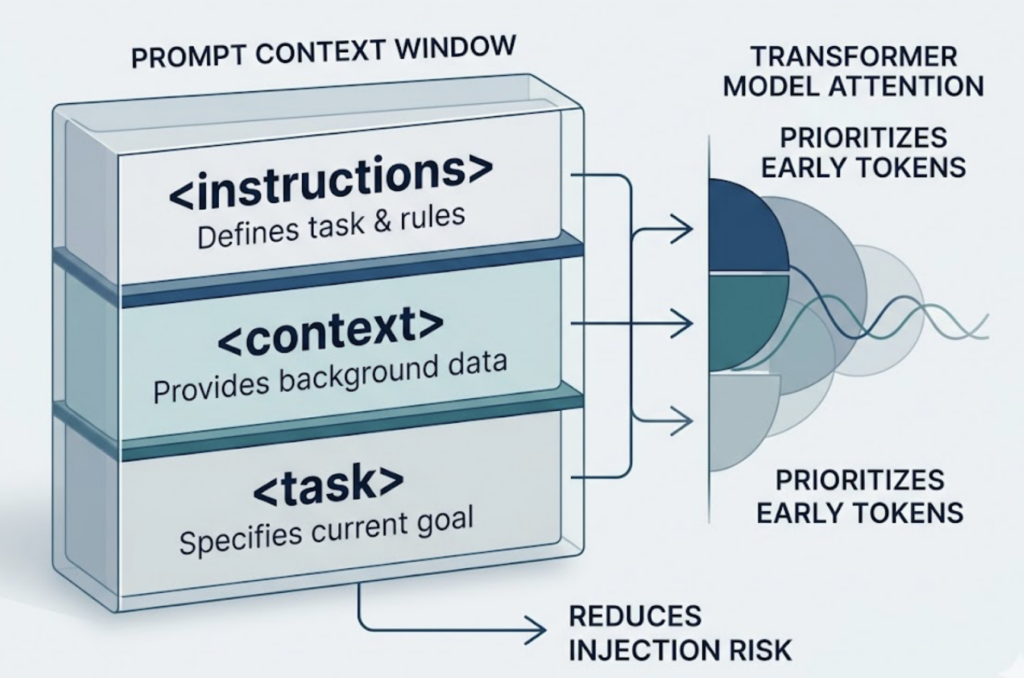
    Anthropic’s prompt architecture uses XML-style semantic separators, tags like <instructions><context>, and <task>, to create clear boundaries within the context window. The reasoning for this isn’t stylistic. It’s functional: structured segmentation reduces injection risk, isolates task constraints, and takes advantage of how transformer attention prioritizes earlier tokens.
    The model explicitly favors content with “concrete implementation steps” and “technical accuracy.” It’s calibrated to treat authoritative, structured information as higher-signal than vague or qualitative claims.

    That calibration isn’t unique to Claude Code. Research from Princeton, Georgia Tech, and IIT Delhi found that adding specific statistics boosts AI citation probability by 30-40%. Authoritative references lift visibility by up to 40%. Direct quotations add another 15-30%. These aren’t SEO tricks. They match the exact decision logic the leaked prompts confirmed.

    The “black box” just told you what it’s looking for.

    Developers Now Have a Real Benchmark, Not a Marketing Deck

    Before this, the only public information about how leading AI labs structure agentic systems came from blog posts and conference talks, usually six months after the decisions were made.

    The leaked codebase showed something more useful and more honest.

    The main.tsx entry point was nearly 1MB with 68 state hooks and over 460 eslint-disable comments. The project contained 50 deprecated functions still actively running in production. Internal codenames were hex-encoded to avoid build-time security scanners.

    The developer community’s reaction wasn’t “how embarrassing.” It was “this is exactly what our codebase looks like.”

    That matters. It resets the benchmark from “clean, modular, perfectly documented” to “functional under commercial velocity.” For teams building agentic systems, this disclosure removed the implicit assumption that the gap between their architecture and a frontier lab’s architecture was primarily technical. Often, it’s just time and budget.

    The autoDream Architecture Points to Where Agent Reliability Is Actually Going

    One of the more significant findings in the leak was an unreleased feature called KAIROS, containing a background process codenamed autoDream.

    The concept: while the user is idle, a forked sub-agent merges observations, resolves contradictions, and converts uncertain inferences into verified facts, without corrupting the main reasoning thread. The system also enforces “Strict Write Discipline,” prohibiting memory updates until file writes are confirmed, and instructs the model to treat its own recollections as hints to be verified, not facts to act on.

    This is a specific, testable architecture for solving context entropy in long-running agents. It’s also almost entirely absent from public literature.

    Before March 31, building a reliable multi-session agent meant guessing at this problem from first principles. Now there’s a reference design. That’s not a competitive threat for Anthropic. It’s a contribution to the field, whether intentional or not.

    What This Means If You’re Trying to Get Your Brand Recommended by AI

    The leaked system prompts confirm a structural shift in how AI assistants build answers. They don’t rank pages. They retrieve fragments from a multi-stage pipeline and assemble responses, prioritizing sources that signal domain authority, structured clarity, and factual density.

    For brands, that changes the optimization target entirely.

    Traditional SEO rewarded keyword matching. AI recommendation rewards what the Princeton study calls “Entity Authority”: a stable, independently verified identity across sources like Wikipedia, authoritative trade publications, and community platforms. The Claude Code prompts confirm this operationally. The model is calibrated against adversarial verbosity and trained to prefer precision.

    Monitoring where your brand stands in that system isn’t optional anymore. It’s not enough to publish content and assume distribution. You need to track whether your brand appears in AI answers for the prompts that matter to your category, how your sentiment scores compare to competitors, and which sources AI platforms are actually citing.

    Topify tracks brand visibility across ChatGPT, Gemini, Perplexity, and other major AI platforms, mapping not just whether you appear, but your position relative to competitors and the sentiment attached to those mentions. Its Source Analysis feature shows exactly which domains AI is pulling citations from, so you can identify gaps between what you’re publishing and what AI is using. That’s the operational version of what the leaked prompts confirmed theoretically.
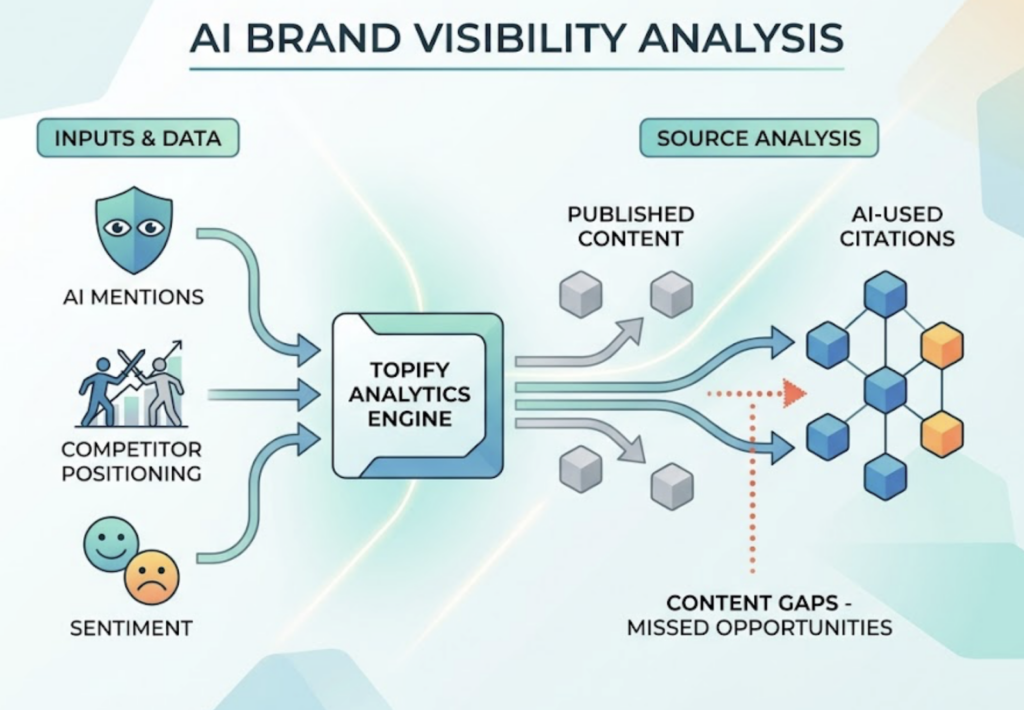
    The Claude Code leak essentially handed GEO practitioners a primary source. Using it to audit your content strategy is a no-brainer.

    Conclusion

    The instinct to treat this as a crisis was understandable. A $19 billion AI lab’s internal architecture sitting on a public npm registry is a legitimate governance failure. The security implications, particularly around parser differentials and YOLO permission classifiers, are real and being addressed.

    But the net effect on the industry is positive.

    The disclosure confirmed what the research already suggested: AI systems reward transparency, structured clarity, and verifiable authority. It showed that agentic reliability depends on skeptical memory and offline consolidation, not just raw model capability. It proved that secrecy-as-security collapses on contact with a packaging bug.

    The “glass box” was always coming. The EU AI Act and California’s transparency regulations were already drawing that line. What the Claude Code leak did was accelerate the reckoning by about 18 months, and do it with a concrete reference architecture instead of a policy document.

    That’s a contribution, even if no one asked for it.

    FAQ

    Q: What exactly was leaked in the Claude Code incident?

    A: A packaging error in version 2.1.88 of the @anthropic-ai/claude-code npm package accidentally included a 59.8MB JavaScript source map file. That file allowed developers to reconstruct approximately 512,000 lines of TypeScript source code across 1,906 files, including internal system prompts, memory architecture, tool definitions, and unreleased feature flags like KAIROS and autoDream.

    Q: Was this a cyberattack or a hack?

    A: No. It was a build process failure caused by a known bug in the Bun bundler, which included source maps in production despite explicit exclusion settings. No external party compromised Anthropic’s systems. The exposure happened through the public npm registry, not a breach.

    Q: How does the Claude Code leak opinion connect to GEO and brand visibility?

    A: The leaked system prompts confirmed that Claude models are calibrated to favor structured, factually dense, and authoritative content when generating answers. This directly validates the core mechanics of Generative Engine Optimization: brands that publish precise, well-cited content are more likely to be recommended by AI assistants than those relying on keyword density alone.

    Q: What should marketers actually take away from this Claude Code leak?

    A: Three things. First, audit your content against the signal types the leaked prompts favor: specific statistics, authoritative citations, and structural clarity. Second, build your brand’s Entity Authority across independent sources. Third, start tracking your AI visibility across platforms so you have a baseline before the August 2026 regulatory changes reshape how AI systems handle attribution.


    Read More
  • AI Answer Tracking Analytics: The Metric SEO Dashboards Can’t See

    AI Answer Tracking Analytics: The Metric SEO Dashboards Can’t See

    Your domain authority is solid. Your target keywords rank on page one. You’ve built the content machine everyone says you need.

    Then someone types a question into ChatGPT, and five competitors get recommended. Your brand isn’t there. And nothing in your current analytics stack can tell you why, or even that it happened.

    That’s not a content problem. It’s a measurement problem. AI answer tracking analytics exists specifically to fill this gap.


    What AI Answer Tracking Analytics Actually Measures (And Why It’s Not Your Existing Dashboard)

    Traditional SEO analytics tracks where your pages rank in a list. AI answer tracking analytics tracks whether your brand appears inside a synthesized response, what it says about you, and how that compares to competitors.

    The distinction matters more than it sounds. Zero-click searches now account for roughly 60% of all US searches as of mid-2025. That means the majority of search interactions never produce a click for anyone. The AI engine resolved the query on its own, and your ranking data recorded nothing useful.

    The architectural gap between the two approaches is significant:

    DimensionTraditional SEO DashboardAI Answer Tracking Analytics
    Primary UnitKeywords and URLsPrompts and Citations
    Success IndicatorSERP Ranking (Position 1–10)Share of Voice and Citation Rate
    Output EvaluatedFixed list of blue linksSynthesized text with inline references
    User Behavior SignalClick-Through RateBrand mention and LLM recommendation
    Visibility ScopeOwned domain onlyCross-platform (LLMs, Reddit, UGC)

    This also directly addresses the SEO AI-driven search differences debate that many marketing teams are still working through. It’s not that SEO stops mattering. It’s that SEO data and AI visibility data measure fundamentally different things, and confusing the two leads to blind spots.


    The 5 Core Metrics Every AI Answer Tracking Setup Should Capture

    Getting this right starts with understanding what you’re actually measuring. There are five metrics that matter most.

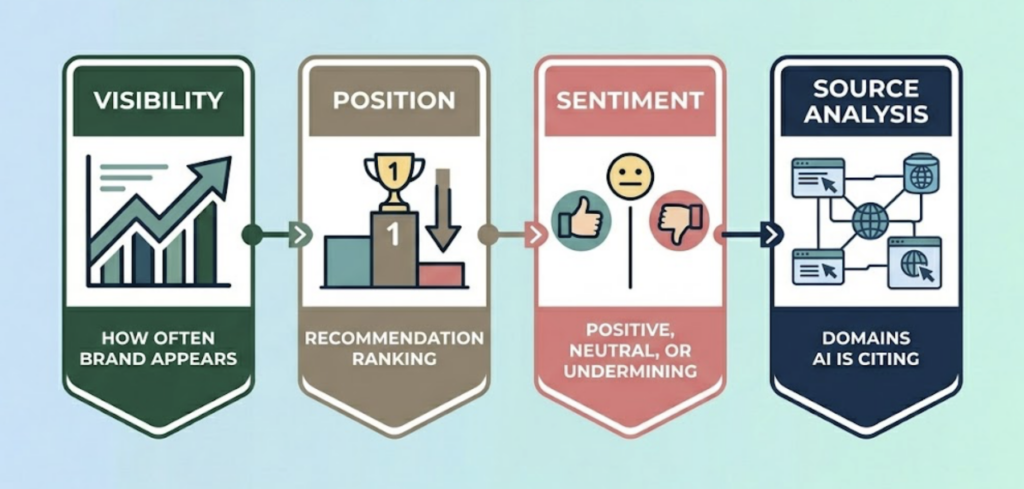
    Visibility (Share of Voice): The percentage of relevant prompts where your brand appears, compared to all brands mentioned. This is the closest equivalent to “market share” in AI search. It’s the single most important indicator of long-term brand authority in generative search.

    Sentiment Score: Whether the AI describes your brand positively, neutrally, or negatively. A brand can have high visibility but consistently negative framing. You won’t catch that without sentiment tracking.

    Position: Where in the AI response your brand appears. Being mentioned fifth in a “top alternatives” list is very different from being the primary recommendation. Most basic trackers don’t distinguish between the two.

    Source / Citation Rate: Which domains the AI is pulling from when it mentions your brand. This tells you what content is actually influencing how AI talks about you, and where the gaps are.

    AI Search Volume: The actual volume of AI-platform queries related to your category, product, or brand. Not Google search volume. These are often different numbers, and the difference tells you where user behavior is already shifting.

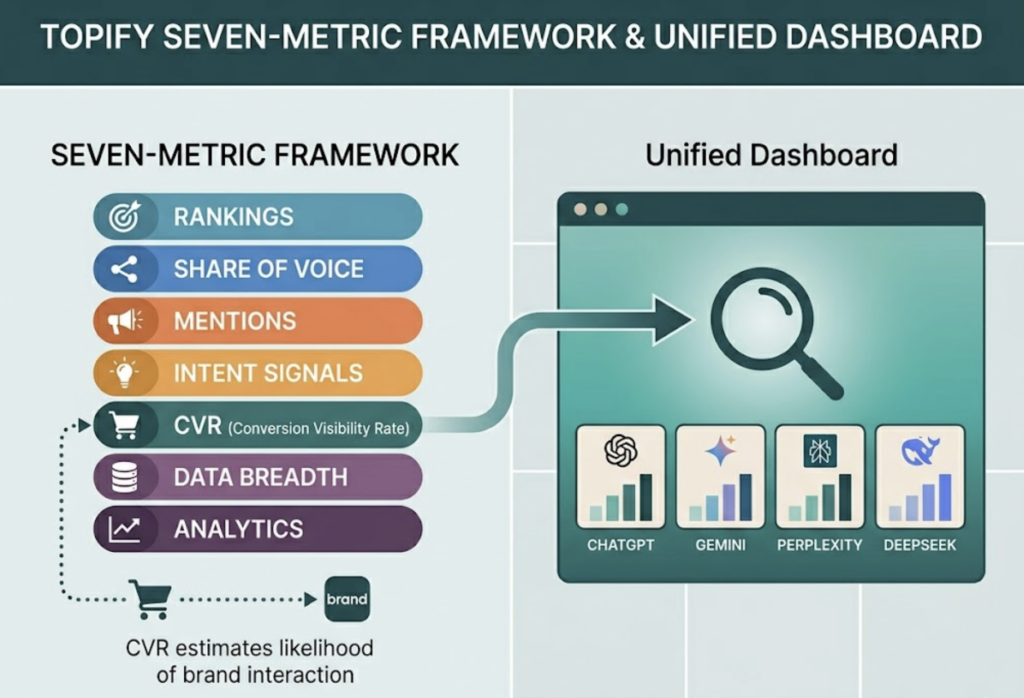
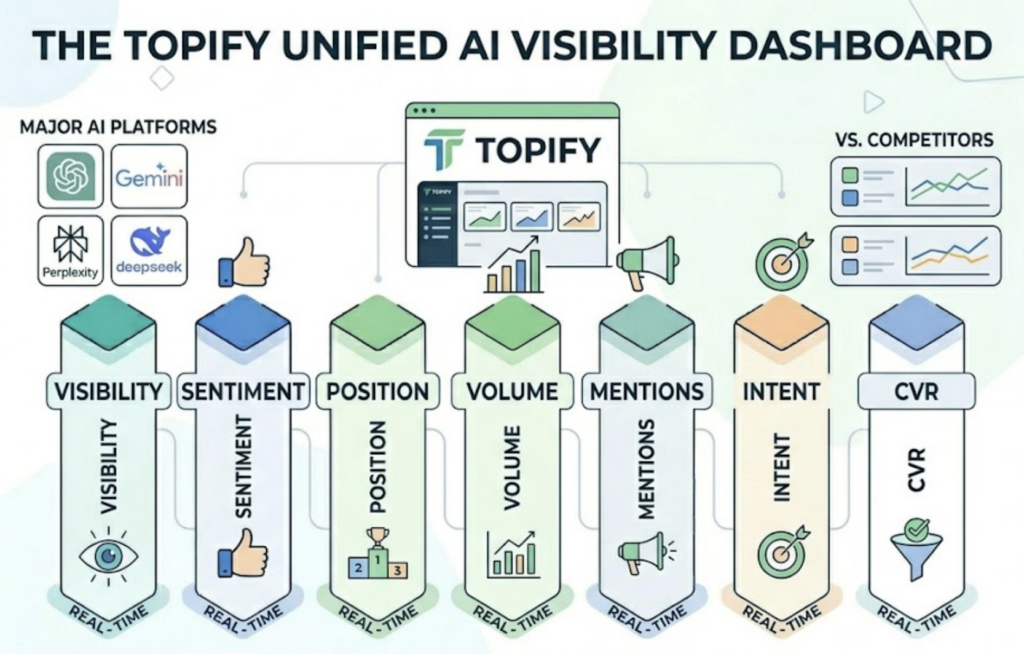
    Platforms like Topify extend this further with a seven-metric framework that also includes mentions, intent signals, and conversion visibility rate (CVR), which estimates the likelihood that an AI answer is driving users toward a brand interaction. For teams that need a single dashboard across ChatGPT, Gemini, Perplexity, and DeepSeek, that kind of breadth matters.


    How AI Answer Tracking Analytics Actually Works

    The technical logic behind AI answer tracking is worth understanding, because it explains why the data looks different from anything you’ve used before.

    Most commercial AI engines use a Retrieval-Augmented Generation (RAG) architecture. When a user submits a query, the engine retrieves relevant content chunks from its training data or the live web, evaluates credibility signals, and synthesizes a response. Visibility, at this level, is about being the most credible source retrieved for a given context, not about keyword matching.

    Tracking this involves three phases. First, query fan-out: a single keyword gets converted into dozens of related conversational prompts, then fired at multiple AI platforms simultaneously. Second, element-level parsing: the unstructured text response is analyzed to identify brand mentions, explicit recommendations, and URL citations. Third, sentiment analysis: an LLM evaluates the tone and accuracy of what was said about the brand.

    Here’s the thing: AI responses are non-deterministic. The same prompt submitted twice, from different sessions or geolocations, can produce meaningfully different answers. That’s why manual spot-checking (“I Googled us on ChatGPT this morning”) is not a measurement methodology. It’s a sample size of one from a system that doesn’t repeat itself.

    Reliable AI answer tracking analytics requires volume, persistence, and cross-platform coverage. Without those three, you’re not measuring anything you can act on.


    Why SEO Rankings and AI Visibility Tell Different Stories About Your Brand

    The clearest way to see the AI-driven search SEO differences is to look at what happened to brands that had strong SEO but no AI visibility strategy.

    HubSpot is the most documented example. A long-time leader in inbound content, HubSpot saw traffic decline between 70% and 80% between 2024 and 2025, with monthly organic visits dropping from an estimated 13.5 million to roughly 6 million. The core cause: a massive library of top-of-funnel informational content, which AI engines now synthesize directly without requiring a click. High rankings, zero visibility in the answer.

    The broader trend confirms this. On queries where AI Overviews appear, traditional organic CTR dropped 61%, falling from a 1.76% baseline in June 2024 to just 0.61% by September 2025. CNN and Forbes both reported traffic declines between 27% and 50% from the same dynamic.

    On the flip side, the traffic that does come through AI citations is higher quality than traditional organic. AI-referred visitors convert at 4.4 times the rate of standard organic traffic, with conversion rates around 14.2% versus a 2.8% baseline. They also spend 68% more time on-site.

    That’s the real picture: AI search is reducing volume but improving quality. Brands that track AI visibility can capture that quality traffic intentionally. Brands that only watch rankings will keep watching their numbers look fine while revenue quietly erodes.


    4 Mistakes That Make Your AI Answer Tracking Analytics Worthless

    Most teams make at least one of these. Some make all four.

    Tracking only your brand name. If you’re only monitoring when your brand gets mentioned by name, you’re missing every query where a customer was looking for a solution in your category and never heard your name at all. Category-level prompts and competitor-adjacent queries are often where the biggest visibility gaps live.

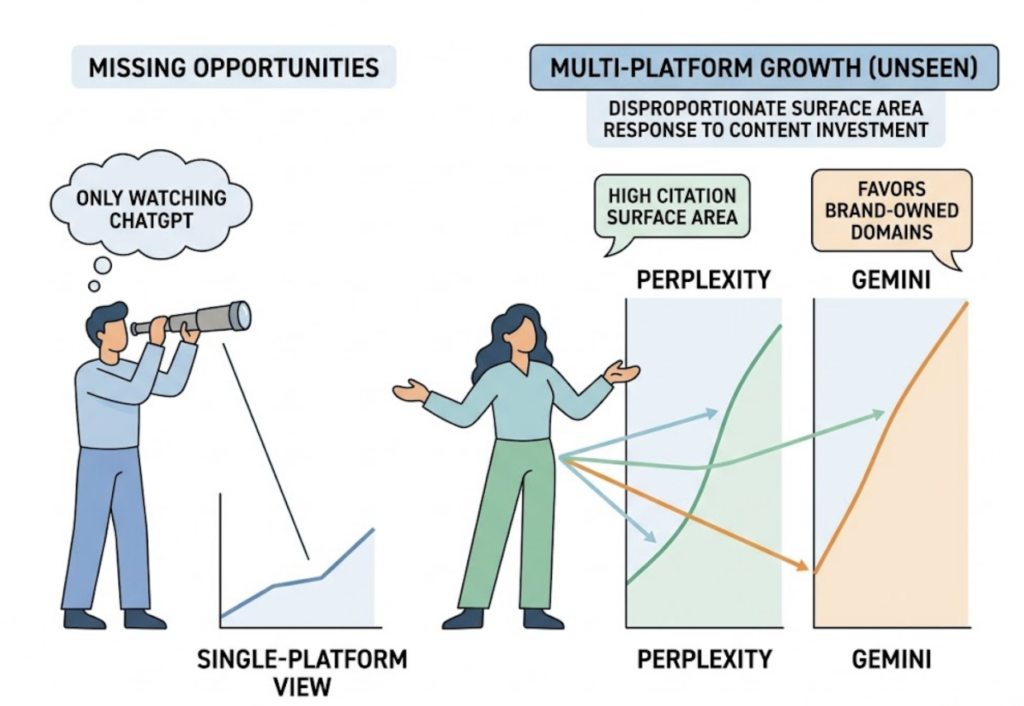
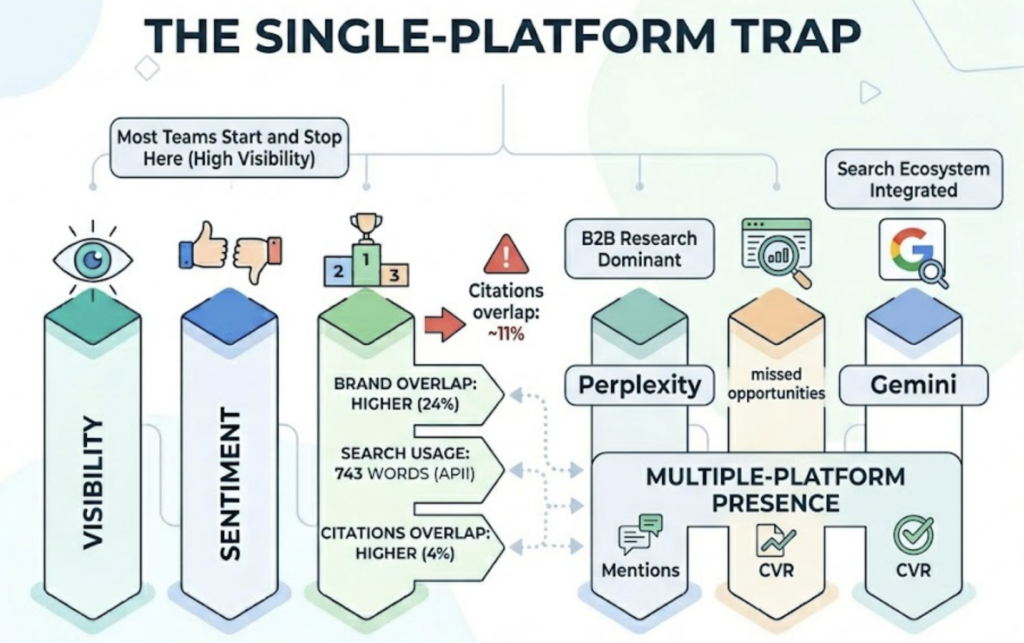
    Single-platform monitoring. ChatGPT’s citation patterns are not the same as Perplexity’s, and neither matches Gemini’s. A tool that only tracks one engine is giving you partial data and presenting it as complete. The Princeton, UPenn, and IIT Delhi GEO research found that citation behavior varies significantly by domain type and platform, which means coverage gaps translate directly into strategy gaps.

    Replacing systematic tracking with manual tests. Because AI responses are non-deterministic, a manual check produces a result that may not repeat. Structured AI answer tracking analytics requires running prompts at volume, across platforms, on a consistent schedule, and recording the variance. Spot-checking tells you what happened once, not what typically happens.

    Treating visibility as the only number that matters. A brand can appear in 80% of relevant AI responses and still be losing ground if the sentiment is neutral-to-negative and the position is always fifth on the list. Visibility without sentiment and position context is misleading data.


    A Practical Checklist for AI Answer Tracking Analytics

    This is adapted from the implementation framework used by teams making the transition from traditional SEO dashboards to AI visibility measurement.

    Phase 1: Baseline Setup (Month 1)

    •  Identify 20–30 high-intent prompts that represent how your target audience asks about your category
    •  Verify that key AI crawlers (GPTBot, PerplexityBot, ClaudeBot) are allowed in your robots.txt
    •  Run a manual baseline across ChatGPT and Perplexity to establish your current Share of Voice
    •  Audit your Organization and FAQ schema for machine-readability
    •  Map “zero-click” queries in Search Console that likely indicate AI summarization

    Phase 2: Content Optimization (Months 2–3)

    •  Add credible source citations to your top 10 priority pages (research shows this can improve citation rates by up to 115% for lower-ranked content)
    •  Implement the BLUF structure: put the direct, factual answer in the first 40–60 words of each section
    •  Add statistics and expert quotes to informational content
    •  Ensure content is served as static HTML, not JavaScript-rendered, for AI crawler accessibility

    Phase 3: Analytics Integration (Months 3–6)

    •  Deploy a dedicated AI answer tracking tool for automated daily or weekly reporting
    •  Connect AI visibility data to GA4 to correlate citation changes with revenue impact
    •  Set up competitor benchmarking on a monthly cadence
    •  Configure alerts for incorrect brand descriptions or outdated pricing in AI responses

    The checklist for AI answer tracking analytics is deliberately sequential. Phase 1 without Phase 3 gives you a one-time audit. Phase 3 without Phase 1 gives you data without a baseline to compare against. Both matter.


    Tools That Actually Do AI Answer Tracking Analytics

    The market for these tools is still maturing. Here’s what to look for and how the leading options compare.

    Three criteria separate useful tools from ones that produce dashboards full of noise: platform coverage (how many AI engines, not just ChatGPT), metric depth (visibility alone is insufficient), and update frequency (stale data in a non-deterministic environment is worse than no data).

    ToolPlatform CoverageKey DifferentiatorTarget User
    TopifyChatGPT, Gemini, Perplexity, DeepSeek, Doubao, Qwen + more7-metric framework + prompt discovery + one-click optimization executionMarketing teams and agencies
    ProfoundChatGPT, Perplexity, AI OverviewsEnterprise security, SOC 2 complianceFortune 500 and regulated industries
    LLMrefs11+ enginesWidest engine coverage; keyword-focused approachSMBs and startups
    Rankscale AI8 enginesPay-as-you-go credit modelBudget-conscious agencies
    Peec AIChatGPT, PerplexityActual prompt/response pair recordingCompetitive benchmarking
    Ahrefs Brand RadarSearch and webAdd-on to existing SEO toolsetTraditional SEOs expanding into AI

    For teams that need both measurement and action in the same platform, Topify tends to be the strongest fit. It covers the major AI platforms, tracks all five core metrics discussed above plus intent and CVR, and includes a prompt discovery feature that surfaces high-volume AI queries you may not be monitoring yet. The Basic plan starts at $99/month with a 30-day trial, covering 100 prompts and 9,000 AI answer analyses. Pro scales to 250 prompts and 22,500 analyses at $199/month.

    For enterprise teams with compliance requirements, the tradeoff between platform coverage and security certification is a real consideration. For teams just starting out, beginning with 20–30 well-chosen prompts on a mid-tier plan is typically more useful than broad coverage with shallow metrics.


    Conclusion

    Your SEO dashboard was built to answer questions that search engines used to answer with a list of links. That mechanism is being replaced, steadily and measurably, by synthesized responses that your current tools cannot see.

    AI answer tracking analytics isn’t a trend metric or a bonus KPI. It’s the baseline measurement layer for brand visibility in AI-driven search. Without it, you’re optimizing against data that describes a world that’s already changed.

    The practical starting point is smaller than most teams expect: 20–30 prompts, a baseline Share of Voice measurement across two or three platforms, and a tool that can run those prompts consistently. That first report tells you more about your actual competitive position in AI search than months of rank tracking data.


    FAQ

    Q: What is AI answer tracking analytics? 

    A: AI answer tracking analytics is the practice of measuring how often a brand appears in AI-generated responses (from platforms like ChatGPT, Perplexity, and Gemini), what those responses say about the brand, where the brand is positioned relative to competitors, and which sources the AI is citing. It fills the measurement gap left by traditional SEO dashboards, which track rankings but not AI-synthesized visibility.

    Q: How is AI answer tracking analytics different from traditional SEO analytics?

    A: Traditional SEO analytics measures where your pages rank in a list of blue links. AI answer tracking analytics measures whether your brand is included in a synthesized response, the sentiment of that inclusion, and the citation sources driving it. The two can diverge significantly: a brand can hold a first-page ranking while being entirely absent from AI answers in the same category.

    Q: How do I measure AI answer tracking analytics for my brand? 

    A: Start by defining 20–30 prompts that reflect how your target audience asks questions in your category. Run those prompts across at least two major AI platforms and record whether your brand is mentioned, at what position, and with what sentiment. For ongoing measurement, a dedicated tool like Topify automates this at scale and tracks changes over time.

    Q: What’s the typical pricing for AI answer tracking analytics tools? 

    A: Pricing varies by platform coverage and prompt volume. Entry-level plans from specialized tools typically start around $49–$99/month for a limited prompt set. Topify’s Basic plan is $99/month and includes 100 prompts and 9,000 AI answer analyses with a 30-day trial. Enterprise-grade platforms with compliance features start considerably higher, often from $499/month.


    Read More

  • AI Answer Tracking: The Metrics Enterprise Brands Actually Need to Monitor

    AI Answer Tracking: The Metrics Enterprise Brands Actually Need to Monitor

    Every day, millions of users ask ChatGPT, Perplexity, and Gemini which tools to use, which brands to trust, and which products to buy. The AI answers. Your brand either appears in that answer or it doesn’t.

    Most enterprise marketing teams don’t know which one is happening.

    According to Gartner, 51% of consumers have already changed their research habits due to generative AI. Traditional search volume is projected to decline 25% by 2026. The traffic doesn’t disappear — it migrates into conversational AI interfaces. And in those interfaces, there’s no page two. There’s only the answer.

    That’s the gap most brands still can’t see.

    Your SEO Dashboard Won’t Show You This

    The instinct to layer AI tracking onto existing SEO infrastructure makes sense, but it misses the fundamental difference between the two systems.

    Traditional SEO monitoring tracks URLs in a ranked list. The algorithm is deterministic: a page either ranks or it doesn’t, and crawlers can verify that. AI answer tracking works differently. Platforms like ChatGPT and Perplexity use Retrieval-Augmented Generation (RAG) to synthesize responses dynamically. The output is non-deterministic text, not a stable SERP link. There’s nothing for a standard crawler to index.

    The practical consequence: a brand can rank #1 on Google for a keyword and be completely absent from the AI summary for the same query. The AI might cite a third-party review site, a Reddit thread, or an industry whitepaper instead of the brand’s own page. SEO monitoring would show no problem. AI answer tracking would show a serious one.

    DimensionTraditional SEO MonitoringAI Answer Tracking
    Detection MethodWeb crawler / keyword indexReal-time prompt analysis
    Response TypeStatic, permanent SERP linksDynamic, non-deterministic text
    Primary GoalTraffic/clicks to owned siteCitations/authority within AI answers
    Visibility MetricKeyword ranking (1-100)Share of Model / Citation Rate
    Key VariableBacklinks and site speedEntity clarity and machine-scannable facts

    SEO asks: did I rank? AI answer tracking asks: how was my brand synthesized? Those are different questions, and they need different infrastructure to answer.

    The 5 Metrics That Tell You Where Your Brand Actually Stands in AI

    Building an AI visibility index requires moving past vanity metrics. Here’s what enterprise teams need to track, and what each metric actually tells you.

    Visibility Rate (Share of Model)

    This is your foundational KPI. Visibility Rate measures how often your brand appears in AI-generated responses across a defined universe of prompts. Because AI outputs are probabilistic, a single manual check is statistically meaningless. Research from SparkToro shows that if you ask an AI tool for brand recommendations 100 times, there’s less than a 1% chance you’ll get the same list in the same order twice.

    Visibility Rate is calculated at scale: divide the number of responses mentioning your brand by the total number of responses generated, across thousands of runs. That’s the only way to get a number you can actually act on.

    Sentiment Score

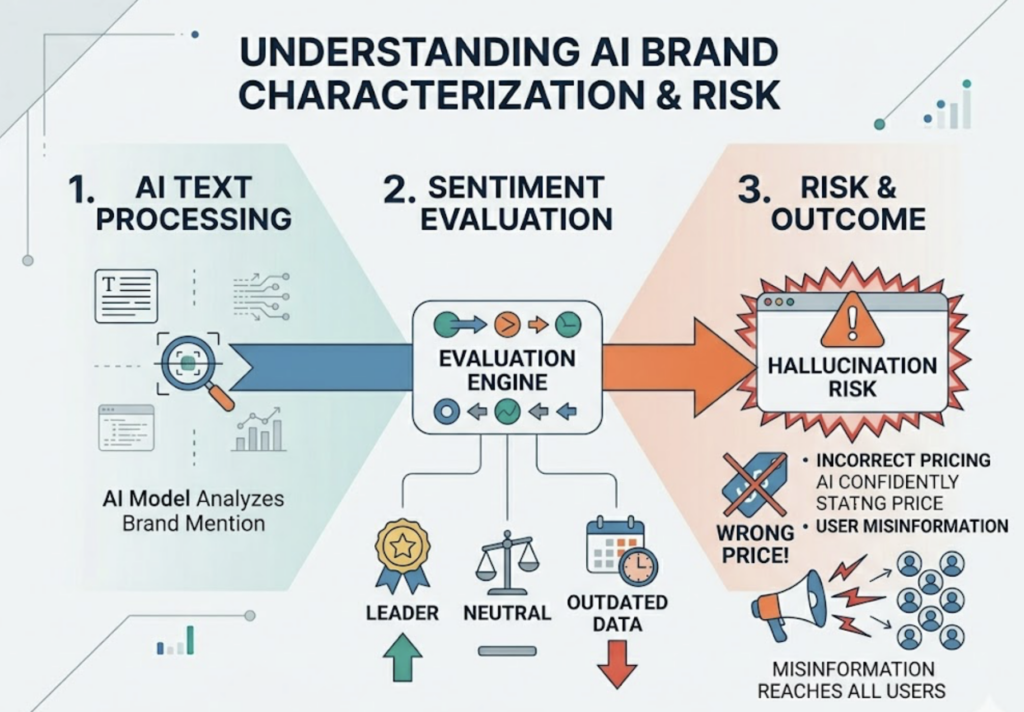
    AI doesn’t just mention brands — it characterizes them. Sentiment tracking evaluates whether the model describes your brand as a leader, lists it neutrally as one option among several, or (worst case) associates it with outdated data or incorrect pricing. The last scenario is what practitioners call “hallucination risk,” and it’s more common than most brands realize. If the AI confidently states the wrong price point for your enterprise plan, that misinformation reaches every user who asks.

    Position Rank

    In a conversational answer, the first brand mentioned typically carries the highest implied endorsement. Position Rank tracks where your brand sits relative to competitors across purchase-intent prompts. On queries like “best AI monitoring tool for large brands,” being third instead of first is a measurable competitive disadvantage.

    Source Attribution

    AI models don’t generate information from nothing. They pull from specific URLs and domains via RAG. Source Attribution identifies which sources the AI is actually citing when it mentions your brand. Often, it’s not your own website — it’s a G2 review, a Reddit thread, or an industry comparison post. Knowing which sources the model trusts tells you exactly where to invest in PR and content placement.

    Prompt Coverage

    This metric maps how broad your brand’s presence is across different user intents. Discovery prompts (“what are the best tools for X?”), educational prompts (“how do I solve Y?”), and transactional prompts (“compare Brand A and Brand B pricing”) each represent a different stage in the buyer journey. A brand that only appears in one category has a fragile visibility position.

    Why Monthly Reporting Is Too Slow for AI Visibility

    Most enterprise teams still run monthly AI visibility reports. That cadence made sense for SEO. It doesn’t work for AI.

    AI models are not static. Model retraining shifts how authority is weighted. RAG cache cycles mean new content may take days or weeks to appear in responses. Non-deterministic sampling means outputs vary even within the same day. The result: 40-60% of cited sources in AI answers change month-to-month.

    A monthly report gives you a single data point in a moving system. If a competitor publishes a strong comparison post on a Thursday and the AI starts favoring it by Friday, your monthly report in two weeks won’t tell you that. You’ll find out when you notice the pipeline has dried up.

    The standard for enterprise-grade monitoring is daily. Topify runs 9,000+ AI answer analyses continuously, using high-N sampling to calculate a statistically significant probability of visibility. That’s not a snapshot — it’s a trend line you can actually use to make decisions.

    One more thing worth flagging: AI referral traffic converts at 4.4x the rate of traditional organic search. The brands that track this channel daily are capturing high-intent pipeline. The ones doing monthly check-ins are consistently late.

    What Enterprise Brands Need That Lightweight Tools Can’t Deliver

    There’s a growing category of lightweight AI visibility tools that offer quick checks and basic snapshots. For small teams tracking a handful of prompts, that’s often enough. For enterprise brands, it typically isn’t.

    The reasons come down to three structural requirements.

    Multi-platform coverage. A brand’s visibility is rarely consistent across AI platforms. It’s common to dominate Perplexity while being absent from ChatGPT, or to appear in Gemini but be mischaracterized in Claude. Enterprise monitoring needs to cover the major platforms simultaneously: ChatGPT, Perplexity, Gemini, Claude, Copilot, and Google AI Overviews. Lightweight tools often track one or two of these. That leaves significant blind spots.

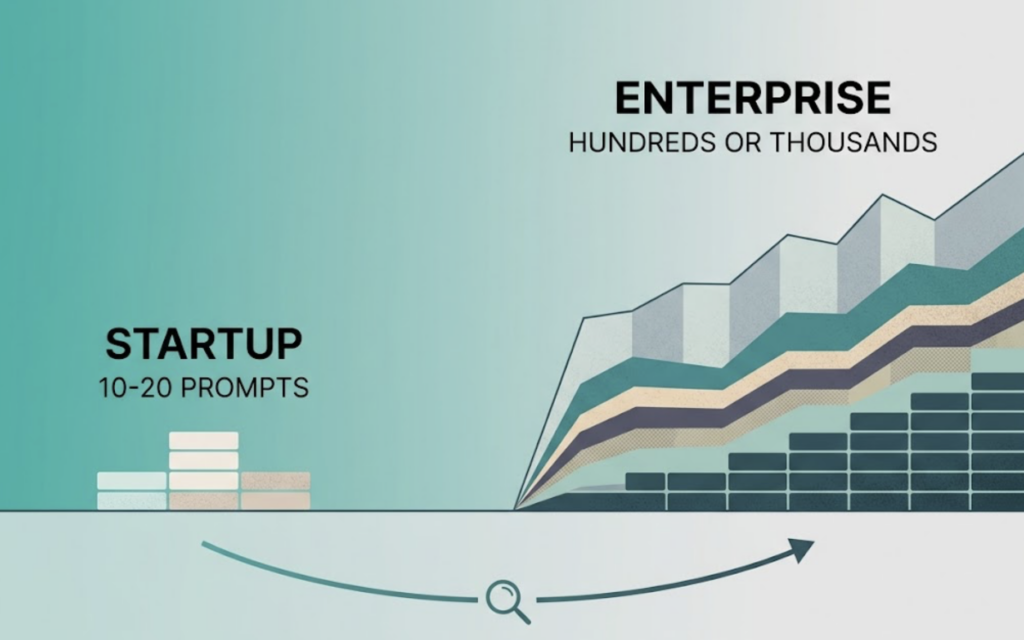
    Prompt scale. A startup might track 10 to 20 core prompts. An enterprise brand with multiple product lines, regional markets, and buyer segments needs to monitor hundreds or thousands of long-tail prompt variations. Topify’s AI visibility tracking tools for enterprise brands support up to 250 prompts in the Pro tier, with concurrent analysis across platforms to surface what the research calls “Dark Queries” — prompts where your brand should appear but currently doesn’t.

    Collaborative infrastructure. AI visibility tracking isn’t one team’s job. The PR team needs to monitor third-party citation health. The content team needs to track educational prompt coverage. The brand team watches sentiment. Topify provides team seats, shared dashboards, and role-appropriate views so each function sees what’s relevant to their work — without rebuilding reports from scratch every month.

    According to Gartner, 82% of consumers have already noticed AI-generated overviews in search results. The brands that will compete for those consumers’ attention are the ones with the infrastructure to monitor and respond at scale.

    A Workflow That Actually Scales: 6 Steps for AI Answer Monitoring

    Setting up a sustainable AI visibility monitoring program doesn’t require rebuilding your entire marketing stack. Here’s what a practical enterprise workflow looks like.

    Step 1: Define your prompt universe. Start by mapping your customer journey to conversational prompts. Brand-specific queries (“What do users say about [your brand]?”) and unbranded category queries (“Best enterprise AI tracking tools in 2025”) both belong in your baseline set. The target is covering discovery, educational, and transactional intent across each product line.

    Step 2: Establish your baseline. Before you optimize, you need to know where you stand. Run your full prompt set across all target platforms and generate an AI Visibility Score, a composite metric that accounts for mention frequency, sentiment, and position rank. This is your reference point for everything that follows.

    Step 3: Run a source and gap analysis. Identify which URLs the AI is actually citing when it mentions your brand (or your competitors). If a competitor is being cited more often, trace the source. Often it’s a specific review aggregator, a Reddit discussion, or a third-party comparison post. That source becomes your content or PR target.

    Step 4: Re-architect content for machine readability. Princeton GEO research found that incorporating quantifiable data points increases citation probability by 37%, adding attributed expert quotes boosts visibility by 30%, and referencing authoritative sources improves inclusion by 40%. These aren’t soft improvements — they’re structural changes to how your content gets picked up in RAG pipelines.

    Step 5: Set up automated alerts. Once your baseline is established, configure alerts for material changes: a Sentiment Score drop on a key product, a competitor displacing your brand in a high-value prompt, a new citation source appearing. You want to know about those shifts within hours, not weeks.

    Step 6: Report to the business, not just the marketing team. AI visibility data needs to connect to business outcomes. Track AI referral traffic in GA4. Tie Share of Model movement to pipeline impact. Topify generates reports that translate visibility metrics into executive-level KPIs — the kind of data that makes the case for GEO investment at the CMO or VP level.

    Conclusion

    AI answer tracking isn’t a new feature of SEO. It’s a parallel discipline with different mechanics, different metrics, and a different competitive landscape. Brands that treat it as an extension of their existing search monitoring will consistently operate with blind spots.

    The core framework is straightforward: track Visibility Rate, Sentiment, Position, Source Attribution, and Prompt Coverage — daily, across multiple platforms, at a scale that produces statistically meaningful data. Then close the gaps systematically.

    Topify is built for exactly this workflow. The platform covers major AI engines, runs 9,000+ analyses to filter model noise, and surfaces the specific content and citation gaps that explain why your brand is or isn’t appearing in the answers that matter.

    Gartner projects that by 2028, 60% of brands will use autonomous AI agents for direct customer interactions. Those agents will recommend brands they can verify. The brands building their AI visibility infrastructure today are the ones that will be in scope when that happens.

    The win isn’t the ranking anymore. It’s the citation.


    Read More:

  • What Your AI Search Monitoring Dashboard Should Actually Show

    What Your AI Search Monitoring Dashboard Should Actually Show

    Your domain authority is solid. Your keyword rankings are holding. But someone on your team asked ChatGPT for the top solutions in your category last week, and your brand wasn’t in the answer.

    That’s not an SEO problem. That’s a visibility gap your current tools can’t see, because they weren’t built to look there.

    Most Search Monitoring Tools Are Flying Blind in AI Search

    Traditional rank trackers measure what happens after a user reaches a search results page. They count clicks, track positions, and attribute traffic. That logic made sense when search returned a list of links.

    AI search doesn’t return links. It returns answers.

    Gartner forecasts that 25% of traditional search volume will decline by 2026 as users shift to AI chatbots, reaching 50% by 2028. Yet most marketing teams are still reporting on Google Analytics sessions and keyword positions, with no visibility into what ChatGPT, Perplexity, or Gemini is actually saying about their brand.

    The gap isn’t a minor measurement inconvenience. AI-referred visitors convert at roughly four times the rate of traditional search visitors, because they arrive with higher intent and more context. Missing that channel doesn’t just hurt visibility. It hits revenue.

    What an AI Search Monitoring Dashboard Actually Tracks

    An AI search monitoring dashboard is a specialized analytics platform that tracks brand visibility, citation frequency, and sentiment across generative AI engines. It doesn’t replace your SEO stack. It monitors a layer your SEO stack can’t reach.

    Where traditional analytics tracks URLs and clicks, an AI search monitoring dashboard tracks entity citations and narrative characterization. The unit of measurement isn’t the ranking. It’s the brand mention, and more importantly, how that mention is framed.

    A well-built dashboard covers seven core metrics:

    MetricWhat It Measures
    Visibility ScoreComposite brand presence across AI platforms and prompt types
    Citation Frequency (CFR)% of sampled queries where your brand is explicitly named
    Position (RPI)Weighted prominence (lead mention vs. body mention vs. footnote)
    AI VolumeMonthly search demand within AI tools for your category queries
    MentionsRaw frequency of brand references across monitored platforms
    IntentBuyer journey stage of the prompts where you’re cited
    CVRDownstream conversion likelihood attributed to AI citations

    Industry benchmarks for 2026 place B2B SaaS market leaders at a Citation Frequency Rate between 35% and 45%. If you’re just starting, a realistic initial target is 5% to 15%, with 10% quarter-over-quarter Visibility Score growth as a directional KPI.

    How to Set Up Your AI Search Monitoring Dashboard Step by Step

    Most teams approach setup backwards. They pick a tool first, then figure out what to track. The right sequence starts with defining your monitoring universe.

    Step 1: Choose your platform matrix. ChatGPT holds roughly 47% preference among B2B buyers, but Perplexity and Gemini capture meaningful shares of research-heavy and enterprise queries. A dashboard that only tracks ChatGPT gives you less than half the picture. Plan for multi-engine coverage from day one.

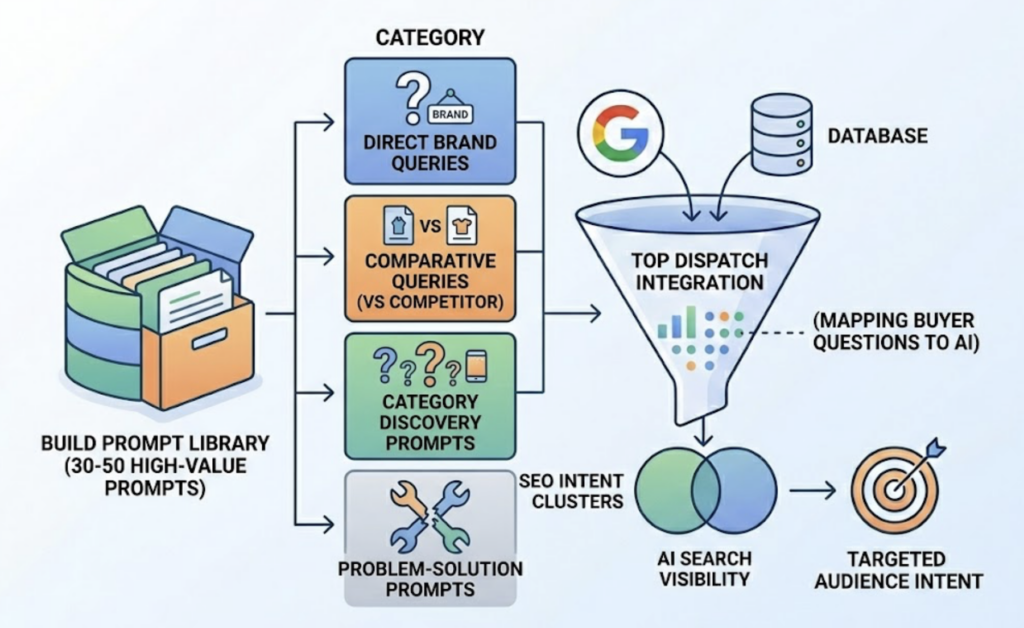
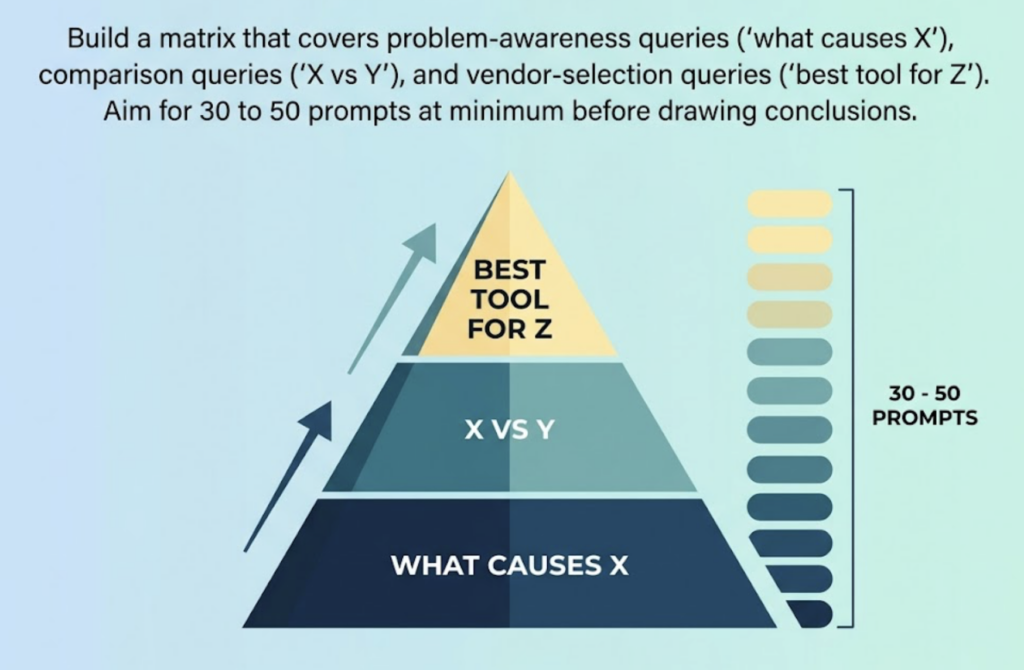
    Step 2: Build your Prompt Library. This is the most overlooked step. You’re not mapping keywords. You’re mapping the questions real buyers ask AI. Structure your prompt set across four categories: direct brand queries, comparative queries (your brand vs. a competitor), category discovery prompts (“What are the top tools for X?”), and problem-solution prompts (“How do I fix Y?”). A starting set of 30 to 50 high-value prompts is the industry-standard baseline.

    Step 3: Set competitive benchmarks. Identify three to five direct competitors and document their initial Citation Frequency Rate across your shared prompt set. Without a competitive baseline, you can’t tell whether your visibility is improving or just moving in line with the category.

    Step 4: Configure alert thresholds. Set automated alerts for visibility drops greater than 10% or sudden negative sentiment spikes. AI recommendations shift continuously. Waiting for a monthly report to catch a drop means you’re already six weeks behind.

    Topify‘s High-Value Prompt Discovery feature automates a significant part of this process, surfacing the conversational queries most likely to drive discovery-stage citations. Automating prompt discovery can reduce content research time by up to 80%, compared to manual prompt mapping.

    Using a Rank Tracker Tool for ChatGPT: What It Can and Can’t Do

    Here’s the thing most rank tracker tools won’t tell you: there’s no such thing as a fixed “position” in ChatGPT.

    Traditional rank tracking assumes a deterministic index. Type in a keyword, get a stable list. ChatGPT doesn’t work that way. Its output is probabilistic. The same prompt can yield different brand mentions in different sessions, depending on model temperature, conversation context, and the recency of the model’s training data.

    What you can track is entity stability: how consistently the model identifies your brand as a relevant solution for specific use cases. Advanced dashboards handle this by running multiple iterations of the same prompt and calculating a Confidence Score for the brand’s visibility. That’s the meaningful signal. A one-time mention in a single ChatGPT session isn’t data. A 78% citation rate across 200 prompt iterations is.

    The other limitation of ChatGPT-only monitoring is platform coverage. Each major AI engine uses different retrieval logic. ChatGPT rewards comprehensive topic clusters. Perplexity prioritizes factual density and verifiable data points. Gemini leans heavily on Google’s Knowledge Graph and structured data. A brand that performs well on ChatGPT can be nearly invisible on Perplexity if its content lacks external citations.

    Topify’s Position Tracking uses a weighted Response Position Index to quantify prominence across all major platforms, distinguishing between a lead mention (the highest-value placement) and a footnote citation. It’s a more accurate model of brand authority in AI search than any traditional rank tracker tool for ChatGPT alone.

    5 Things That Tank Your AI Search Monitoring Results

    1. Monitoring only one platform. This creates survivor bias. You look dominant in your dashboard, but you’re invisible on two of the three platforms your buyers actually use.

    2. Ignoring Sentiment. High visibility with negative characterization is worse than low visibility. If AI models consistently describe your product as a “budget alternative” when your positioning is enterprise-grade, your dashboard should be screaming. Most aren’t configured to catch this.

    3. No competitive baseline. Citation frequency without context is a vanity metric. If you’re at 22% CFR but your top competitor is at 41%, that’s not a dashboard success story. It’s a gap report.

    4. Monitoring too infrequently. Monthly AI search reviews are too slow. Model behavior and citation patterns shift weekly. The brands catching and responding to those shifts are the ones pulling ahead. Weekly tracking is the 2026 industry standard.

    5. Tracking prompts that don’t connect to revenue. If your prompt library is full of high-volume awareness queries but your product sells to mid-market procurement teams, you’re measuring the wrong thing. Prompts should map to buyer intent stages, not just search volume.

    The Tools Worth Using for AI Search Monitoring in 2026

    The market has matured enough to have distinct tiers. Here’s an honest breakdown:

    ToolCore AdvantagePlatform CoverageStarting Price
    Topify7-metric GEO analytics + One-Click execution + Prompt DiscoveryChatGPT, Gemini, Perplexity, DeepSeek, and more$99/mo
    ProfoundEnterprise SKU tracking and e-commerce depth10+ enginesFrom $499/mo
    NightwatchHybrid SEO/AI tracking; affordable entry pointMajor LLMs + Traditional SERPsFrom $32/mo
    Otterly.aiClean UI, multi-engine citation mapping6 platformsFrom $29/mo

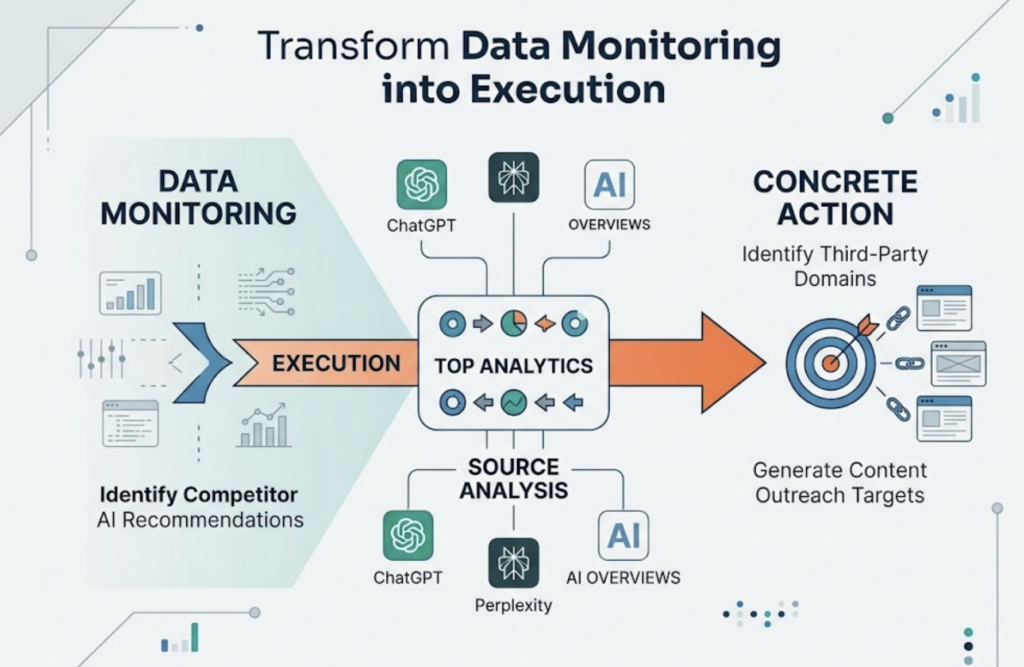
    For teams that need to move from monitoring to action, Topify stands out by combining data collection with execution. Its Source Analysis feature reverse-engineers which third-party domains are fueling AI recommendations for your competitors, giving you a concrete content outreach target rather than just a gap report. The Basic plan at $99/month covers 100 prompts, 9,000 AI answer analyses, and tracking across ChatGPT, Perplexity, and AI Overviews. The Pro plan at $199/month scales to 250 prompts and 10 seats for larger teams.

    For a deeper look at how GEO tools compare, the Topify blog on AI visibility metrics covers the share-of-voice model in detail.

    How to Know If Your Dashboard Is Actually Working

    Data collection is not the goal. The goal is a repeatable cycle: data → insight → action.

    The primary success signal is the Visibility Score trajectory across your priority prompt set. Look for sustained upward movement over four to six weeks, not single-session spikes. Correlate Visibility Score gains with branded search volume and direct traffic trends, because improvements in AI citations typically show up as increases in users searching for your brand by name.

    The secondary signal is your Citation Gap against competitors. If a competitor is consistently cited for a high-intent query where you’re absent, that’s not a brand problem. It’s a content structure problem. Audit their page’s factual density, external citations, and schema markup. Those are usually the gaps.

    Sentiment volatility is the signal most teams miss entirely. A sudden drop in Sentiment Score, even when Visibility stays flat, often traces back to a specific “seed source” influencing the model. Topify’s GEO Analytics lets you trace negative sentiment shifts back to the specific domains driving the characterization, whether that’s an outdated review, a Reddit thread, or a competitor’s comparison page.

    On the financial side, GEO initiatives typically lower cost per lead by 30% to 50% compared to paid advertising, once the AI visibility flywheel is running. That’s the ROI case for building this infrastructure now, not after your competitors have already claimed the citation share.

    A Practical Checklist for Your AI Search Monitoring Dashboard

    Use this as your setup and ongoing audit guide:

    Platform and Technical Readiness

    •  Verify that robots.txt allows access for ChatGPT-User, GPTBot, and PerplexityBot
    •  Deploy FAQ, Article, Organization, and Product JSON-LD schema on priority pages
    •  Confirm AI crawlers can read your HTML without executing complex JavaScript

    Dashboard Configuration

    •  Define a Prompt Pack of 30 to 50 high-value buyer prompts across Discovery, Comparison, and Problem-Solution intents
    •  Identify 3 direct competitors and document their initial Citation Frequency Rate
    •  Enable tracking for all 7 metrics: Visibility, Sentiment, Position, Volume, Mentions, Intent, and CVR
    •  Set automated alerts for visibility drops greater than 10% or negative sentiment spikes
    •  Set monitoring cadence to weekly

    Content and Strategy

    •  Restructure key content sections to lead with a direct 2 to 3 sentence answer suitable for AI extraction
    •  Include a verifiable statistic or data point every 150 to 200 words
    •  Engage in communities (Reddit, LinkedIn) that AI engines cite as trusted sources
    •  Refresh high-value content at least quarterly to address AI retrieval recency bias

    Measurement and Reporting

    •  Track Visibility Score trajectory week-over-week across priority prompts
    •  Monitor Citation Gap against top 3 competitors monthly
    •  Correlate Sentiment Score shifts with specific seed source domains
    •  Connect AI visibility improvements to branded search volume and direct traffic trends

    Conclusion

    Most brands don’t have an AI search problem. They have a visibility gap they can’t see because they’re looking at the wrong dashboard.

    The shift from click-based to citation-based brand discovery is already underway. An AI search monitoring dashboard isn’t optional infrastructure for 2026, it’s the minimum viable system for knowing whether your brand exists in the places where your buyers are now doing their research. Get started with Topify to track the 7 metrics that actually matter, across every major AI platform, with a prompt set built for your specific buyer journey.


    FAQ

    Q: What is an AI search monitoring dashboard? A: It’s a specialized analytics platform that tracks how your brand is cited, described, and positioned across generative AI engines like ChatGPT, Perplexity, and Gemini. It measures visibility, sentiment, position, and conversion signals that traditional SEO tools can’t capture.

    Q: How does a rank tracker tool for ChatGPT work? A: Unlike keyword rank trackers, ChatGPT monitoring works by running multiple iterations of the same prompt and measuring how consistently your brand appears in responses. The output is a Confidence Score or Citation Frequency Rate, not a static position number, because ChatGPT’s responses are probabilistic, not deterministic.

    Q: What metrics should I track in an AI search monitoring dashboard? A: The seven essential metrics are Visibility Score (overall presence), Citation Frequency Rate (how often you’re named), Response Position Index (lead mention vs. footnote), AI Volume (category search demand in AI tools), Mentions (raw frequency), Intent (buyer journey stage), and CVR (downstream conversion attribution).

    Q: How often should I update my AI search monitoring dashboard? A: Weekly is the 2026 industry standard. Daily monitoring tends to be too volatile for actionable insight, while monthly reviews are too slow to catch citation drift. A weekly cadence gives you enough signal to spot trends and enough time for content changes to register with AI crawlers.


    Read More

  • Perplexity SEO Tracker: What It Measures and How It Works

    Perplexity SEO Tracker: What It Measures and How It Works

    Your domain authority is 70. Your top pages rank in Google’s top three. But when a potential customer opens Perplexity and asks “What’s the best tool for [your category],” your brand isn’t in the answer. Not mentioned once. None of your traditional SEO metrics can tell you why, because none of them were built to measure this.

    That’s the gap a Perplexity SEO tracker is designed to close.

    Why Perplexity Doesn’t Play by Google’s SEO Rules

    Google functions as a pointer. It matches a query to a ranked list of documents based on authority signals, then hands the user a link to click. Perplexity works differently: it reads the web in real time, pulls factual chunks from multiple sources, and synthesizes a direct answer. No ranked links. No click required.

    This distinction matters because the inputs that determine visibility are completely different. Research shows only a moderate correlation between traditional domain authority and the probability of being cited by an AI engine. What Perplexity actually favors are “answer capsules,” concise passages that front-load a direct answer within the first 40 to 60 words, along with high factual density and source transparency.

    Being number one on Google doesn’t get you into Perplexity’s answer. That’s a separate game, with separate rules.

    The scale of this shift is significant. Perplexity’s daily query volume tripled from 230 million in mid-2024 to over 780 million by 2025, with monthly active users reaching between 33 and 45 million. A substantial slice of high-intent search traffic is now flowing through a channel your current toolkit can’t see.

    What a Perplexity SEO Tracker Actually Measures

    A Perplexity SEO tracker is a monitoring system that automates conversational prompts to Perplexity AI and measures how a brand appears, or doesn’t appear, in the generated answers.

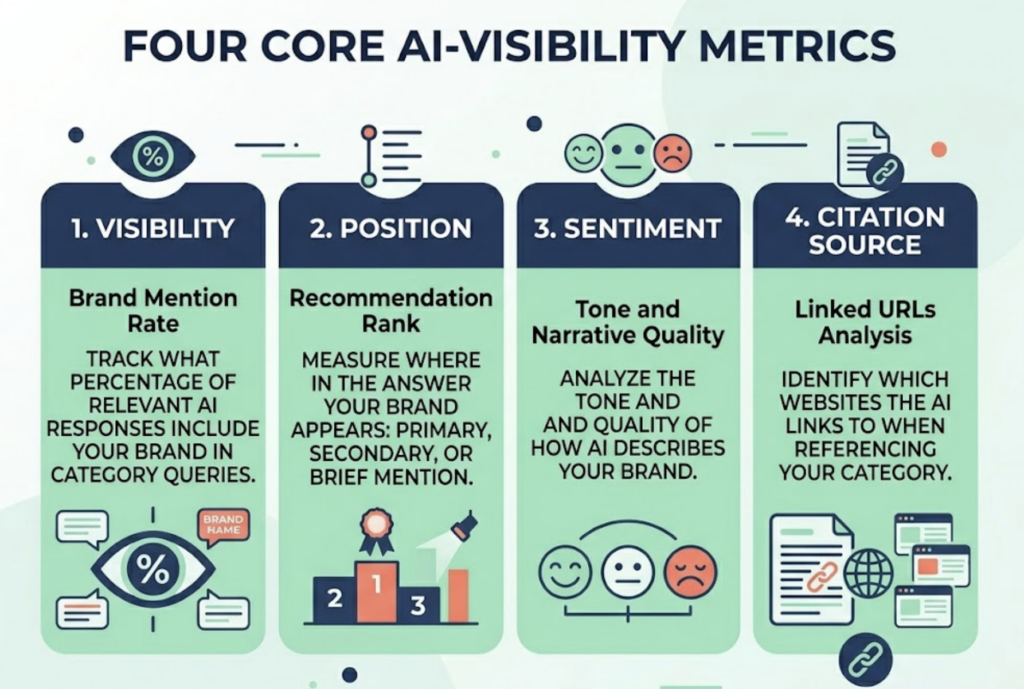
    The core metrics cover four dimensions. Visibility, or Brand Mention Rate, tracks what percentage of relevant AI-generated responses include your brand when category or commercial intent questions are asked. Position measures where in the answer your brand appears: as the primary recommendation, a secondary alternative, or a brief background mention. Sentiment analyzes the tone and narrative quality of how the AI describes your brand. Citation Source identifies which URLs the AI is actually linking to when it references your category.

    Each of these matters independently. A brand can have high visibility but poor sentiment, consistently appearing as “a reliable option for smaller teams” when the target audience is enterprise. That’s not a win. It’s a positioning problem that only shows up when you track narrative quality, not just presence.

    MetricWhat It MeasuresWhy It Matters
    Visibility (Mention Rate)% of responses that include the brandAre you in the conversation at all?
    Position (LCRS)Primary vs. secondary placement in the answerFirst mention vs. footnote
    Sentiment ScoreTone and favorability of the descriptionIs the AI helping or hurting your positioning?
    Citation SourceWhich domains the AI citesWhere to build content authority
    Share of Voice (SoV)Your mentions vs. competitors’Relative standing in your category

    How Does a Perplexity SEO Tracker Work

    The technical architecture follows a five-step pipeline. The tracker first dispatches a pre-defined library of conversational prompts, covering category queries, comparison queries, and brand-specific queries, to Perplexity at regular intervals. It captures the full generated response, including inline citations and related questions. Then it runs semantic enrichment to identify brand and competitor mentions and assesses sentiment. Citation mapping extracts the specific URLs cited, linking them back to the claims they support. Finally, the data flows into a dashboard showing visibility trends, sentiment shifts, and Share of Voice over time.

    One technical detail worth knowing: there’s a meaningful difference between API-based monitoring and browser-based scraping. Research found only a 4% overlap in citation sources between API and scraped results for the same prompt. Browser-based scanners capture the experience a real user sees, including citations and Related Questions, which account for 40% of platform queries. If your tracker is only hitting the API, it may be measuring a different experience than what your audience actually gets.

    Prompt quality also directly affects data quality. Tracking branded queries alone, like “Is [Brand] good?”, only measures reputation for users who already know you exist. The more valuable signal comes from category prompts: “What’s the best tool for enterprise marketing automation?” That’s where the AI acts as a first-touch discovery layer for users who’ve never heard of you.

    5 Metrics Your Perplexity SEO Tracker Checklist Must Include

    Most brands start by checking whether they appear at all. That’s necessary but not sufficient. Here are the five metrics that separate a functional Perplexity tracking setup from one that actually drives decisions.

    1. Brand Mention Rate across category prompts. Tracking branded queries tells you about reputation management. Tracking category prompts tells you whether you’re making the AI’s shortlist during the discovery phase, where most purchase decisions start.

    2. Position and consistency. In traditional SEO, top-three matters. In Perplexity, the goal is to be the primary recommendation. Consistency tracking is equally important: does your brand appear reliably across semantically similar prompts, like “best CRM for startups” and “top CRM alternatives for small businesses”? Inconsistency signals weak authority signals on that topic.

    3. Sentiment and narrative quality. A 0-100 sentiment score isn’t just a vanity metric. If Perplexity consistently describes your product as “budget-friendly” and your positioning is premium, the AI is actively working against your sales motion. Tracking narrative quality lets you identify and correct these gaps through targeted PR and content.

    4. Citation source analysis. This is the most actionable metric on the list. If Perplexity is citing Reddit threads or third-party review sites instead of your own domain, you know exactly where the gap is. It identifies what practitioners call “inclusion targets”: the sites the AI already trusts, where your brand needs to earn a presence.

    5. Competitive Share of Voice. In a zero-click environment, visibility is relative. An 80% mention rate sounds strong until you discover your main competitor has 95%. SoV shows you the real competitive picture across all the prompts that matter for your category.

    Topify organizes these into a seven-metric system covering Visibility, Sentiment, Position, AI Volume, Mentions, Intent, and CVR, giving teams a single view of AI search performance rather than isolated data points.

    Common Mistakes That Make Perplexity Tracking Useless

    Mistake 1: Only tracking branded prompts. This is the most common error. Queries like “Is [Brand] good?” only measure reputation among users who already know you. Research indicates that category and discovery prompts represent the majority of high-value AI search behavior. If you’re not tracking these, you’re blind to your most important exposure opportunities.

    Mistake 2: Single-platform tracking. A brand might have 80% visibility on Perplexity but near zero on ChatGPT. Because different LLMs use different retrieval architectures, Perplexity favors Reddit and real-time web sources while ChatGPT leans on Wikipedia and established news, a strong score on one platform doesn’t generalize. Cross-platform tracking reveals the full picture.

    Mistake 3: Treating sentiment as positive/negative. Sentiment in AI search is contextual. Being described positively but for the wrong persona, “great for small teams” when you’re targeting enterprise, is a strategic problem that a binary sentiment label won’t surface. Narrative-level analysis is what catches these mismatches.

    Mistake 4: Manual pulse-checking without historical data. Typing a prompt into Perplexity and noting the result isn’t tracking. It’s a snapshot. AI answers drift with model updates and refreshed web data. Without automated historical logging, you can’t tell whether your visibility is improving, declining, or whether that PR campaign last quarter actually moved the needle.

    That last point matters more than most teams realize. Trending direction is often more informative than the absolute number.

    From Perplexity to Claude and Beyond: Why You Need an LLM SEO Tracker Strategy

    Perplexity has captured nearly 20% of AI-driven web traffic in the United States, making it the second-most important AI platform for US-focused brands. But your audience doesn’t use a single AI.

    ChatGPT accounts for roughly 60-68% of AI search market share and skews toward general consumers. Perplexity at 5.8-8.2% attracts B2B researchers and analysts who favor real-time, citation-heavy answers. Claude pulls developers and technical writers. Gemini captures Google-ecosystem users. Microsoft Copilot dominates enterprise workflows.

    The same brand can be the top recommendation on Perplexity and invisible on ChatGPT. That gap isn’t random. It reflects the difference between “real-time web” signals, which Perplexity optimizes for, and “training-set” signals, which drive ChatGPT’s outputs.

    PlatformMarket Share (2026)Primary User PersonaCitation Preference
    ChatGPT60-68%General consumersWikipedia, established news, Bing
    Perplexity5.8-8.2%B2B researchers, analystsReddit, niche blogs, real-time web
    Gemini15-21%Google ecosystem usersYouTube, LinkedIn, Google properties
    Claude~2%Developers, writersTech documentation, clean prose
    Microsoft Copilot4.5-12.9%Enterprise workersMicrosoft Docs, LinkedIn, Bing

    A true best llm seo tracker strategy runs the same prompt library across all relevant platforms, generating what practitioners call a “Model Consensus Score.” If your brand is recommended by Perplexity and Claude but not ChatGPT, the data tells you exactly where to focus your content and citation-building efforts. Without that cross-platform view, you’re optimizing for one slice of the audience and calling it done.

    How Topify Tracks Your Brand Across Perplexity, Claude, ChatGPT, and More

    Topify approaches Perplexity tracking as one layer of a broader AI search measurement system. The platform supports ChatGPT, Gemini, Perplexity, DeepSeek, and regional platforms including Doubao and Qwen, covering the full distribution of where B2B and B2C audiences are searching.

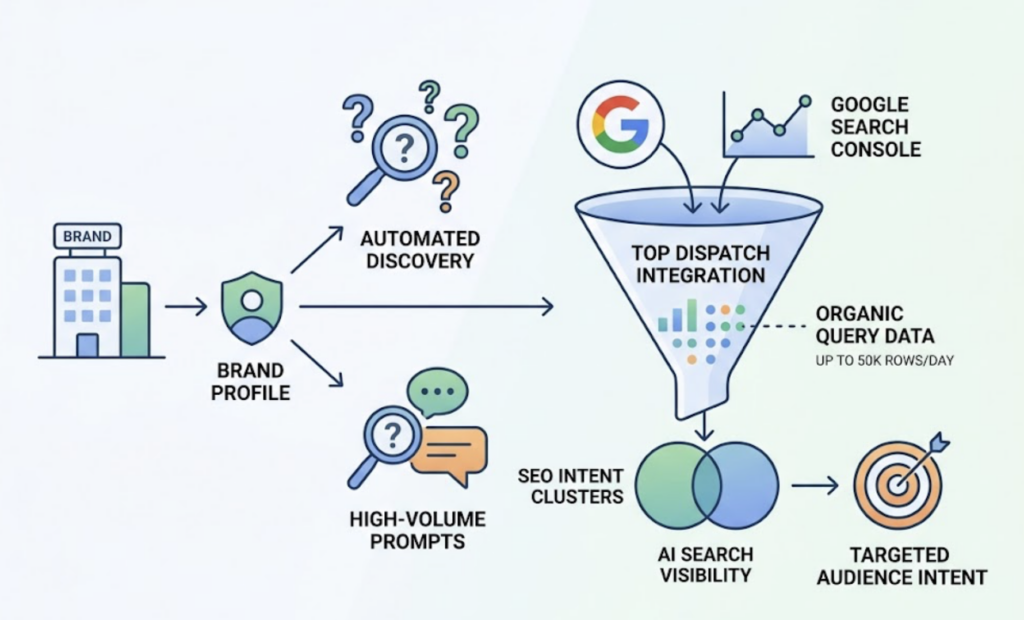
    On setup, Topify initializes a brand profile by name and URL, then triggers automated discovery of high-volume prompts relevant to the business. A notable differentiator: Topify integrates directly with Google Search Console to import up to 50,000 rows of organic query data per day. This lets teams correlate their traditional SEO intent clusters with AI search visibility, so they’re not optimizing for AI in a vacuum but targeting the same audience intent that already drives organic traffic.

    The dashboard surfaces the seven-metric system covering Visibility, Sentiment Score (0-100), Position, AI Volume, Mentions, Intent, and CVR in a single view. The Basic plan starts at $99/month, which includes 100 prompts and approximately 9,000 AI answer analyses per month, covering four projects and four seats. The Pro plan at $199/month scales to 250 prompts and 22,500 analyses. Enterprise plans start at $499/month with dedicated account management and custom configurations.

    For teams managing multiple brands or client accounts, the competitor monitoring layer automatically detects emerging rivals in AI answers and tracks relative position over time. That matters in categories where AI recommendations are shifting quickly and where last quarter’s data is already stale.

    Conclusion

    The SEO function is shifting from “rank a page” to “shape a narrative.” Perplexity and the broader class of AI search engines are now making first-touch recommendations for millions of B2B and consumer decisions, and traditional ranking metrics have no visibility into that process.

    A Perplexity SEO tracker doesn’t replace your existing SEO stack. It fills the blind spot that stack has always had. Start with the five core metrics: mention rate, position consistency, sentiment, citation sources, and Share of Voice. Then expand to a multi-platform strategy that includes a claude seo tracker and broader llm seo tracker coverage. The brands building this measurement infrastructure now will have compounding data advantages that are difficult to replicate later.


    FAQ

    Q: What is a Perplexity SEO tracker? A: It’s a specialized monitoring tool that automates conversational prompts to Perplexity AI to measure how often a brand appears in generated answers, the sentiment and narrative quality of those mentions, the position of the brand relative to competitors, and which domains the AI is citing as its sources.

    Q: How do I improve my visibility in Perplexity AI answers? A: Focus on structuring content into “answer capsules” that front-load direct answers within the first 40-60 words, increase factual density with data points every 150-200 words, use FAQ schema markup, and earn mentions on third-party sites like Reddit and niche authority blogs that Perplexity tends to cite heavily.

    Q: How is tracking Perplexity different from tracking Claude or ChatGPT? A: The underlying logic is the same, but citation bias varies significantly by platform. Perplexity is citation-first and favors real-time web sources. ChatGPT leans on its training data and Wikipedia. Claude emphasizes technical documentation and clean prose. A full llm seo tracker strategy runs the same prompt set across all three to identify where gaps are platform-specific versus category-wide.

    Q: What’s the pricing for a Perplexity SEO tracker tool? A: Entry-level tools start around $25/month for basic mention tracking. Mid-tier platforms like Topify start at $99/month for 100 prompts and 9,000 AI answer analyses. Enterprise-grade configurations with custom prompt libraries and dedicated account support typically start at $499/month and scale based on volume and platform coverage.


    Read More

  • Your Brand Might Be Mentioned in AI Answers Every Day. Without a Dashboard, You’ll Never Know.

    Your Brand Might Be Mentioned in AI Answers Every Day. Without a Dashboard, You’ll Never Know.

    You could rank #1 on Google and still be completely invisible to the 900 million weekly users asking ChatGPT for recommendations.

    That’s not a hypothetical. That’s how AI search works in 2026. Users ask a question, an AI synthesizes an answer from dozens of sources, and your brand either appears in that answer or it doesn’t. No click. No impression. No signal in your analytics. Just silence.

    An AI answer tracking dashboard changes that. It’s the infrastructure that makes the “answer layer” visible, measurable, and actionable.

    What an AI Answer Tracking Dashboard Actually Does

    An AI answer tracking dashboard is not a SEO rank tracker with a new coat of paint.

    Traditional SEO tools measure where your webpage sits on a results page. An AI answer tracking dashboard measures something fundamentally different: how large language models (LLMs) understand, extract, summarize, and recommend your brand when users ask questions in natural language.

    The distinction matters. A brand can hold the top organic spot on Google and still be absent from every ChatGPT, Perplexity, or Gemini answer about its own category. That’s the gap most teams still haven’t measured.

    A mature dashboard monitors your brand across the major AI platforms: ChatGPT (900M+ weekly users), Perplexity (which functions as an AI-native search engine with real-time citations), Google Gemini and AI Overviews, and emerging platforms like Claude and Grok. Each platform uses different training data and retrieval-augmented generation (RAG) mechanisms, which means your brand’s visibility can vary significantly from one platform to another. Coverage across all of them isn’t optional — it’s the baseline.

    The Metrics That Actually Matter (and the Ones That Mislead You)

    Most teams start by asking one question: “Is our brand showing up in AI answers?” That’s the wrong question.

    Presence alone tells you almost nothing. If your brand appears in an AI answer about why customers should avoid you, that’s worse than not appearing at all. The real value of a dashboard is in the depth of what it measures.

    There are seven metrics worth tracking:

    Visibility Rate measures the percentage of tracked prompts where your brand appears. It’s your baseline share of the AI answer ecosystem.

    Sentiment Score uses NLP to assess whether AI describes your brand positively, neutrally, or negatively. A brand mentioned in “avoid these companies” lists has a high visibility rate and a terrible sentiment score.

    Position Rank tracks where your brand appears within multi-brand recommendation lists. First position signals stronger algorithmic trust. Fifth position, even in a positive list, gets a fraction of the attention.

    Mention Volume captures total mentions across the AI ecosystem, giving you a broad-awareness baseline.

    Intent Alignment measures whether your brand shows up at the right stages of the buyer journey: research, comparison, and evaluation prompts. Showing up only in awareness-stage answers while competitors dominate “best option” queries is a conversion problem hiding inside a visibility metric.

    CVR matters more than most teams expect. Research indicates that users arriving from AI recommendations convert at roughly 4.4x the rate of traditional search visitors. They’ve been pre-sold by the AI before they click anything.

    Source Citations tracks whether AI platforms are linking to your domain when generating answers. These citations build the long-term traffic bridge between AI recommendations and your site.

    That’s the full picture. Teams that only track presence are flying with one instrument.

    How an AI Answer Tracking Dashboard Works Under the Hood

    The technical challenge is real, and understanding it helps you evaluate tools more accurately.

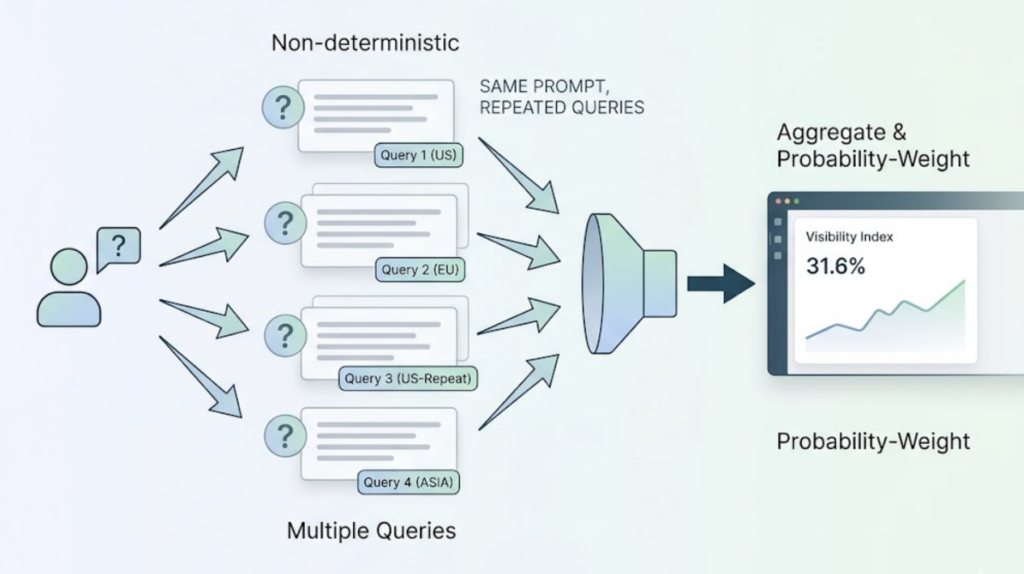
    LLMs are non-deterministic. Ask the same question twice and you’ll often get a different answer. This means a dashboard can’t just run a query once and call it data. It needs to run the same prompt dozens of times, across multiple geographic locations (some platforms surface different answers based on region), and aggregate the results into a probability-weighted visibility index.

    The workflow looks like this: a high-quality prompt corpus is built first, not keyword lists but context-rich questions that simulate actual user behavior. Those prompts are then executed through real browser environments simulating queries on each AI platform. The generated answers are parsed for entity names, citation links, position data, and sentiment signals. Finally, results across multiple runs are aggregated into a baseline metric.

    The key word is “aggregated.” Any single snapshot of an AI answer is noise. Only patterns across multiple samples reveal the true signal. Platforms like Topify handle this through trend-based analysis rather than point-in-time queries, which is how you get data you can actually make decisions with.

    5 Things That Tank Your Brand’s AI Visibility (and How to Spot Them)

    Teams deploying AI tracking dashboards for the first time tend to carry over SEO habits that don’t translate. Here are the five mistakes that show up most often.

    Treating prompts like keywords. A short keyword like “email marketing software” triggers broad, category-level AI answers that rarely include specific brand mentions. Effective tracking requires long-tail, context-rich prompts that simulate real buyer intent. “What’s the best email marketing tool for a 10-person SaaS team with under $500/month budget?” is a trackable prompt. “Email marketing software” is not.

    Ignoring machine-readable structure. AI systems don’t read content the way humans do. They extract from patterns, hierarchies, and structured signals. If your site lacks Schema markup or has broken heading hierarchies, even excellent content won’t register cleanly in AI citations, and your dashboard will show a gap that looks like a content problem when it’s actually a technical one.

    Skipping trust signals. AI models increasingly favor sources they “trust,” which in practice means sources with clear author credentials, consistent external references, and cross-domain validation. Teams focused purely on content volume and not on E-E-A-T signals tend to see their AI dashboard weights erode over time.

    Scaling low-quality AI-generated content. Mass-producing AI-written content that lacks original data, expert perspective, or genuine insight is what researchers call “slopware.” In the short term, it may increase raw mention volume. In the medium term, sentiment scores drop and AI platforms start treating your domain as a low-signal source.

    Running AI tracking in isolation. Visibility data that doesn’t connect to your PR pipeline, content calendar, and traditional SEO reporting is expensive noise. The teams getting real value from their dashboards are the ones who’ve integrated AI visibility as a channel alongside existing performance data.

    Turn Dashboard Data Into Growth: A 3-Step Strategy

    Data without action is just a report. Here’s how to build a closed-loop optimization process around your dashboard.

    Step 1: Identify the gaps. Audit which high-value prompt categories your brand is missing from entirely. Tools like Topify offer deep integration with Google Search Console, which makes it faster to surface prompts where you have near-top-5 organic potential but zero AI presence. That overlap is where the highest-ROI content investments live.

    Step 2: Benchmark against competitors. Use your dashboard’s Share of Voice (SOV) feature to understand why specific competitors are being cited over you. If a competitor keeps appearing because they have a detailed pricing comparison page or an original dataset, that’s a direct content brief. SOV gives you a number:

    SOV = (Brand Mentions / Total Category Mentions) × 100

    A 12% SOV in a category where the top competitor holds 38% is a gap you can close with targeted content.

    Step 3: Execute and close the loop. Once you know the gaps and the content playbook, execution speed matters. Topify’s one-click execution lets teams translate visibility gaps directly into technical and content adjustments without manual workflow overhead. The faster you deploy, the sooner you capture data from the next AI crawl cycle.

    Identify. Benchmark. Optimize. Repeat.

    Best Tools for AI Answer Tracking in 2026

    The market has matured significantly. Here’s a practical comparison of the tools worth evaluating.

    ToolCore StrengthBest ForNotable Limitation
    TopifyGSC integration, 7-metric GEO analytics, one-click executionGrowth-stage brands and e-commerce teamsNewer entrant vs. enterprise players
    OmniaAuto-generates content briefs from gap dataMid-size teams focused on execution speedLess depth on raw visibility data
    Peec AIClean UX, daily multi-engine monitoringSmall startups with limited budgetLimited strategic layer
    SE VisibleCombined SEO + GEO viewExisting SE Ranking usersNarrower AI engine coverage

    On the benchmark question: Perplexity.ai holds a G2 rating of 4.5/5, with users rating its ease of use at 95% and setup speed at 97%. That’s relevant because Perplexity represents high-intent, research-mode users — the exact audience that converts. Any tracking dashboard that can’t accurately capture brand performance on Perplexity is missing data from one of the highest-value AI audiences available.

    Topify covers Perplexity alongside ChatGPT, Gemini, DeepSeek, and others, which is what full-spectrum monitoring actually requires.

    What AI Answer Tracking Dashboards Actually Cost

    The pricing landscape is clearer than most teams expect.

    Topify’s plans are structured around how teams actually scale into the channel:

    • Basic at $99/month: 100 prompts, 9,000 AI answer analyses, coverage across ChatGPT, Perplexity, and AI Overviews. Practical for startups establishing baseline visibility.
    • Pro at $199/month: 250 prompts, 22,500 analyses, 10 seats. Built for teams running active competitive monitoring and content optimization cycles.
    • Enterprise from $499/month: Custom prompt volumes, API access, dedicated account management.

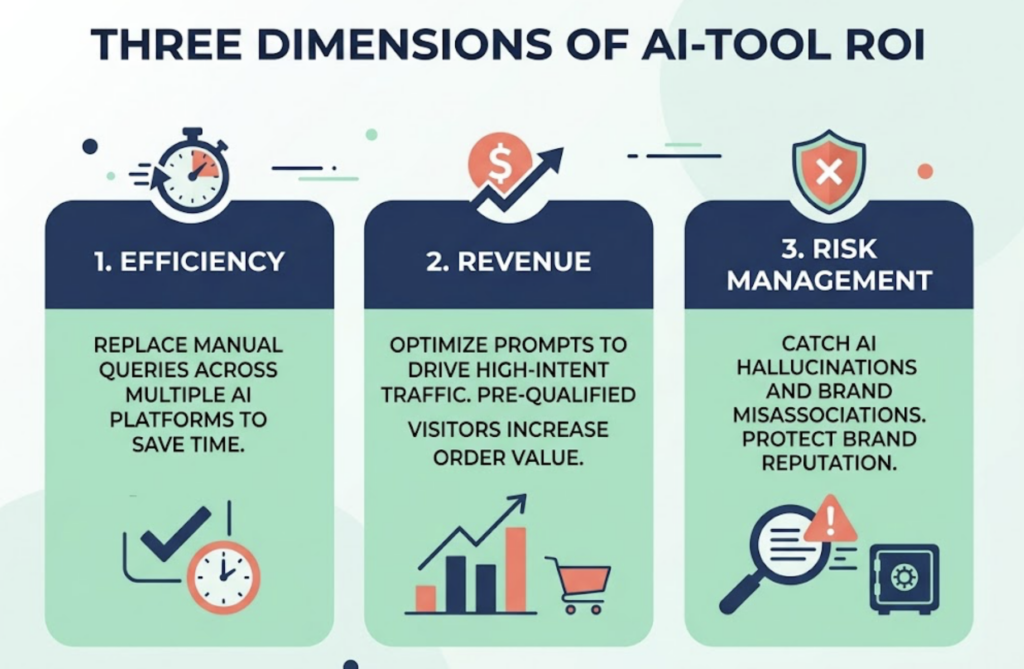
    The ROI question has three dimensions. First, efficiency: automated tracking replaces hours of weekly manual queries across multiple AI platforms. Second, revenue: optimizing for high-intent prompts drives more AI-referred traffic, and those visitors arrive pre-qualified, which tends to push average order value up. Third, risk: catching a case where AI is hallucinating a negative description of your brand or incorrectly associating your product with a competitor’s pricing tier is worth significantly more than the cost of the tool that flagged it.

    Bottom line: at $99/month, the question isn’t whether the ROI math works. It’s whether your team is ready to act on the data.

    Conclusion

    In 2026, an AI answer tracking dashboard isn’t an advanced capability reserved for enterprise marketing teams. It’s table stakes.

    The brands that treat AI visibility as a structured, measurable channel are already pulling ahead in prompts that drive real purchase intent. The ones still relying on traditional rank tracking and wondering where their organic traffic went are operating on incomplete information.

    A good dashboard doesn’t just show you where you stand. It tells you exactly what to fix, which competitors to study, and which prompts represent your highest-value content opportunities. Pair that with the right execution infrastructure, and AI search stops being a black box.

    It becomes your next growth channel.


    Read More

  • Your Brand Might Be Invisible to ChatGPT. An AI Answer Tracking System Can Tell You for Sure.

    Your Brand Might Be Invisible to ChatGPT. An AI Answer Tracking System Can Tell You for Sure.

    Your SEO dashboard looks fine. Rankings are solid. Organic traffic is holding steady. Then someone on your team types a product category question into ChatGPT, and your brand doesn’t appear once. Not in the answer. Not even as a mention.

    That’s not a content gap. It’s a measurement gap. A 2025 study by Chatoptic analyzing 1,000 queries across 15 brands found that Google’s first-page rankings and ChatGPT mentions have a correlation of just 0.034. Statistically, your Google ranking tells you almost nothing about whether AI systems are recommending you.

    An AI answer tracking system is what closes that gap.


    What an AI Answer Tracking System Actually Monitors

    An AI answer tracking system isn’t an extension of your existing SEO stack. It’s a separate measurement layer built specifically to monitor how AI-generated responses mention, position, and describe your brand over time.

    Where traditional tools track keyword rankings on static search result pages, an AI answer tracking tool monitors dynamic, probabilistic outputs. The same prompt can return different answers on different days, across different AI platforms, and with different brand outcomes. That variability is exactly what makes persistent tracking necessary.

    The core coverage of a reliable AI answer tracking platform spans four dimensions: visibility (whether your brand appears in relevant responses), position (where in the answer your brand is mentioned relative to competitors), sentiment(how AI models characterize your brand’s quality, pricing, or positioning), and source (which domains AI platforms are citing when they recommend or describe you).

    None of these signals are available in Google Search Console.


    Why Monthly SEO Reports Miss What’s Actually Happening Now

    The problem isn’t just that AI search is growing. It’s that AI search operates on a completely different trust logic than traditional search.

    Research by Seer Interactive analyzing 3,119 informational queries and 25.1 million organic impressions found that when AI Overviews appear at the top of search results, organic CTR drops by up to 65.2% for brands that aren’t cited in the AI answer. Brands that are cited still see a 49.4% organic CTR decline, but their paid CTR runs 91% higher than uncited competitors on the same page.

    That’s not a gradual shift. That’s a structural redistribution of traffic.

    Your monthly SEO report tracks impressions, rankings, and clicks. It doesn’t tell you whether you’re one of the cited brands or one of the invisible ones. Without an AI answer tracking analytics layer, you’re optimizing for a metric that no longer determines the outcome.

    What makes this harder is the drift problem. According to the same research landscape, 40% to 60% of the domains cited in AI answers change within a single month. A brand that was cited consistently in January may lose those citations by March, not because its content changed, but because an AI model updated its internal weighting. You can’t catch that kind of shift in a quarterly review.


    5 Metrics That Define a Reliable AI Answer Tracking System

    Not every AI answer tracking dashboard measures the same things. Here’s what a well-built system should actually track.

    Mention Rate is the baseline. It measures how often your brand name appears across a defined set of prompts relevant to your category. Think of it as your visibility score in AI-generated content: expressed as a percentage, it tells you how reliably AI platforms surface your brand when users ask about your space.

    Position in AI Answers goes a level deeper. Appearing in an AI response as the third option after two competitors is meaningfully different from being the primary recommendation. A position-weighted AI SOV (Share of Voice) formula gives first-position mentions full credit, second-position 50%, and third-position 33%. Mention rate alone flattens that distinction.

    Sentiment Score matters more in AI search than in traditional search because AI models describe brands, not just list them. A system that tracks whether ChatGPT calls your product “enterprise-grade” versus “a budget alternative” can catch positioning drift before it influences purchase decisions.

    Citation Source Coverage answers the question: why is AI saying what it’s saying about you? Every AI recommendation is downstream of a source. Knowing which domains drive your positive mentions, and which ones are getting cited without mentioning you at all, is what separates diagnostic data from a vanity dashboard.

    Cross-Platform Consistency rounds it out. Yext’s analysis of 6.8 million AI citations shows that Gemini draws over 52% of its citations from brand-owned domains, while ChatGPT pulls 48.7% from third-party directories like Yelp and TripAdvisor. A brand can be dominant on Gemini and nearly invisible on ChatGPT, or vice versa. Tracking each platform separately is not optional.

    How These Metrics Work Together as an AI Answer Tracking Dashboard

    Single metrics are interesting. Combined metrics are actionable.

    Here’s a scenario: your mention rate on Perplexity is 68%, which looks strong. But your sentiment score on the same platform is trending negative over six weeks, with AI descriptions shifting from “professional-grade” to “a solid option for smaller teams.” That’s a signal your content positioning needs work, and you’d only catch it with a dashboard that connects visibility and sentiment in the same view.

    Topify is built around exactly this kind of multi-metric visibility. Its AI answer tracking platform monitors seven core dimensions: visibility, sentiment, position, volume, mentions, intent, and CVR (Conversion Visibility Rate), all in a unified dashboard across ChatGPT, Gemini, Perplexity, DeepSeek, and other major AI platforms. Instead of switching between tools or manually sampling prompts, you get a single view that shows how your brand is performing, relative to competitors, in real time.


    How to Track Brand Performance in ChatGPT Responses Over Time

    Tracking brand performance in ChatGPT responses over time is harder than it sounds. ChatGPT’s outputs are non-deterministic, which means the same prompt can return different answers on different runs. One-time manual checks tell you almost nothing about trends.

    A systematic approach starts with prompt library definition. Not all prompts are equal. The most valuable prompts to track are the ones that mirror how your actual buyers search: category comparison questions (“What are the best tools for X?”), problem-based queries (“How do I solve Y?”), and brand-direct questions (“Is Z a good option for enterprise teams?”). Define 30 to 100 prompts that map to your highest-intent buying scenarios, and lock them in as your tracking set.

    From there, baseline capture is the next step. Run your full prompt library across your target AI platforms and record current mention rate, position, and sentiment scores. This is your week-zero benchmark. Without it, you have no reference point for whether future changes represent progress or regression.

    Tracking cadence matters more than most teams expect. Because AI citation patterns shift monthly, weekly tracking is the minimum viable frequency. After major model updates (GPT-4o, Gemini 2.0, Perplexity Sonar Pro releases), run an immediate off-cycle check. Model updates are the most common trigger for sudden drops in brand mention rate.

    Finally, closed-loop content attribution is what turns tracking into a growth system. When you publish a new piece of content optimized for a specific prompt cluster, record the publish date. Four to six weeks later, compare mention rate and sentiment scores for that prompt group against your baseline. Princeton University’s GEO research found that adding authoritative citations to content can lift AI visibility by up to 115.1%, while adding statistical data drives a 22% increase. Tracking gives you the before-and-after data to know if your content changes actually moved the needle.

    Topify’s platform automates this entire workflow. Its Basic plan supports 100 prompts tracked continuously across major AI platforms, with 9,000 AI answer analyses per month. The Pro plan scales to 250 prompts and 22,500 analyses. You can get started with Topify and have a tracking baseline running within the same day, rather than spending weeks setting up manual monitoring scripts.


    What Most Teams Get Wrong When Building an AI Answer Tracking Solution

    The most common mistake is treating AI answer tracking as a one-time audit.

    Teams run a batch of prompts, get a snapshot of where their brand stands, and file it as a Q3 project. Three months later, the data is already stale, because according to available research, citation domain turnover in AI answers runs at 40% to 60% per month. A June audit tells you almost nothing about what ChatGPT is saying in September.

    The second mistake is single-platform tracking. Because ChatGPT has the highest brand recognition in the AI space, many teams track only there. But Perplexity averages approximately 22 citations per response (significantly more than other platforms), which creates disproportionate surface area for mid-market and specialist brands. Gemini’s citation logic favors brand-owned domains, which responds directly to your content investment. A brand that only watches ChatGPT can be growing fast on Perplexity and Gemini without knowing it, or losing ground silently.

    The third mistake is confusing citation with recommendation. Research on AI citation behavior shows that brands are cited as supporting evidence approximately three times more often than they’re cited as a primary recommendation. Your brand URL may appear in a ChatGPT response as a reference that backs up a competitor’s recommendation. Without a tracking system that distinguishes citation type from mention type, you might interpret that as positive visibility when it’s actually the opposite.

    An AI answer tracking software worth using will surface all three of these distinctions, not just count how many times your brand name appears.


    Choosing the Right AI Answer Tracking Platform for Your Team

    The evaluation framework for AI answer tracking tools comes down to three practical questions.

    How many AI platforms does it cover? Tools that only track ChatGPT are giving you at best a partial picture. Look for platforms that cover ChatGPT, Gemini, Perplexity, and at least one or two emerging engines like DeepSeek or Doubao, depending on your market.

    Does it track continuously or only on demand? On-demand tools require your team to manually initiate tracking runs. Continuous platforms run automated checks on a fixed schedule and alert you when significant changes occur. For teams managing competitive categories, manual tracking doesn’t scale.

    Does it include competitor benchmarking? Your mention rate means more when you can see it relative to your top three competitors in the same prompt set. A 40% mention rate is a strong signal in a category where the category leader sits at 45%. It’s a warning sign if competitors average 70%.

    Topify checks all three. It covers the major global AI platforms including ChatGPT, Gemini, Perplexity, and DeepSeek, with continuous automated tracking rather than on-demand snapshots. Its competitor benchmarking feature automatically surfaces who AI platforms are recommending in your category, what position those competitors hold, and which source domains are driving their visibility.

    On pricing, the Basic plan runs at $99/month and includes tracking for up to 100 prompts across 4 projects, making it a reasonable starting point for in-house marketing teams. The Pro plan at $199/month supports 250 prompts and 8 projects, designed for teams managing multiple brand lines or reporting across business units. Enterprise plans start at $499/month for agencies and large organizations that need custom configuration and dedicated support. Full pricing details are available on Topify’s site.


    Conclusion

    Google rankings and AI visibility are no longer the same thing. A correlation coefficient of 0.034 between Google’s first page and ChatGPT recommendations means the two are effectively independent signals. Optimizing one without tracking the other leaves a significant portion of your brand’s search presence unmonitored.

    An AI answer tracking system doesn’t replace your SEO stack. It fills the measurement gap that your SEO stack was never designed to cover. The brands that build this tracking layer now, establish baselines, run continuous monitoring, and close the loop between content changes and AI visibility outcomes, are the ones that will have a compounding advantage as AI search handles an increasing share of high-intent buyer queries. By 2028, over $750 billion in consumer spending is projected to flow through AI search channels. That’s not a future trend to monitor. It’s a current infrastructure decision.

    Start by defining your prompt library. Build your baseline. Then track it the same way you’d track any channel that drives qualified traffic.


    FAQ

    Q: What’s the difference between AI answer tracking and traditional SEO monitoring?

    A: Traditional SEO monitoring measures how your website ranks in static search result pages based on keyword queries. AI answer tracking monitors how AI-generated responses, which are dynamic and synthesized rather than ranked, mention and describe your brand. A brand can hold strong Google rankings while being completely absent from ChatGPT or Perplexity recommendations. The two systems require separate measurement approaches.

    Q: How often should I run AI answer tracking for my brand?

    A: Weekly is the minimum viable cadence for category-level prompts. Brand-specific reputation queries (direct brand name searches) benefit from three checks per week, particularly in competitive categories where rivals may be actively optimizing to appear in your brand’s query space. After major AI model updates, run an off-schedule check immediately, since model updates are the most common trigger for sudden shifts in brand mention rate.

    Q: Can an AI answer tracking system help me understand why competitors rank higher in ChatGPT?

    A: Yes, and this is one of its most practical applications. A system with source analysis capabilities can show you which domains ChatGPT is citing when it recommends a competitor instead of you. That points directly to the content gaps or third-party authority signals you need to close. Competitor benchmarking within the same prompt set tells you not just that you’re behind, but by how much and in which specific query clusters.

    Q: How to track brand performance in ChatGPT responses over time without manual checking?

    A: The practical answer is a dedicated AI answer tracking platform that automates prompt execution on a fixed schedule. Manual checking is not repeatable at scale: ChatGPT’s non-deterministic outputs mean a single manual run doesn’t give you statistically reliable data, and running 100+ prompts weekly across multiple platforms is not a human-sustainable workflow. Platforms like Topify run this automatically, store historical data for trend analysis, and surface significant changes without requiring manual intervention from your team.


    Read More

  • What an AI Answer Tracking Solution Actually Measures

    What an AI Answer Tracking Solution Actually Measures

    Your content team spent months building pillar pages and earning editorial backlinks. Your domain authority is solid. Your core keywords rank on page one. Then someone opens ChatGPT, types in the exact question your buyers ask every week, and your brand isn’t in the answer. Not mentioned. Not compared. Just absent.

    That’s not a content problem. It’s a visibility gap that traditional analytics tools weren’t built to detect. An AI answer tracking solution exists specifically to close it.


    Rank in Google, Invisible in ChatGPT: The Gap an AI Answer Tracking Solution Fills

    Google rankings and AI search visibility operate on completely different logic. In traditional search, algorithms sort URLs by authority signals and keyword relevance. In generative engines like ChatGPT or Perplexity, the system synthesizes facts from across the web into a narrative answer, often without linking to a single result.

    The consequence is striking. Research shows only 11% to 12% of domains cited by AI overlap with traditional top-10 search results. Your Google ranking doesn’t transfer to AI answers. The two channels measure entirely different things.

    McKinsey estimates that roughly $750 billion in consumer spending will be influenced by AI-driven search by 2028. Yet only 16% of brands currently track their AI search performance in any systematic way. The gap between what’s happening in AI answers and what most brand teams actually know is wide, and widening fast.


    What Does an AI Answer Tracking Solution Actually Track?

    The short answer: a lot more than whether your brand name shows up.

    A mature AI answer tracking tool monitors at least four distinct dimensions. Visibility measures how often your brand appears across a defined set of test prompts. Position tracks whether you’re the first recommendation, listed in the middle, or mentioned as an afterthought. Sentiment analyzes how AI describes your brand, whether the language is positive, neutral, or quietly undermining. Source analysis maps which specific domains AI is actually citing when it forms an opinion about you.

    Each dimension tells you something different. High visibility with negative sentiment is worse than low visibility. First-position recommendations carry significantly more trust weight than mid-list appearances. And source analysis regularly reveals that AI is building its view of your brand from sources you’ve never thought to monitor: Reddit threads, G2 reviews, third-party listicles.

    An AI answer tracking analytics layer ties all four together. Your web dashboard can’t show you any of it.


    How an AI Answer Tracking Solution Works: The Technical Layer You Don’t See

    The mechanics matter here, because understanding them changes how you interpret the output.

    A tracking solution works by sending a library of test prompts to AI platforms on a scheduled basis, recording the full responses, and extracting brand mentions, position, sentiment signals, and cited sources. It’s not a one-time audit. It’s a continuous feedback loop.

    One critical design detail: the same prompt sent twice can produce different answers. AI responses are probabilistic, not deterministic. Reliable AI answer tracking software accounts for this by running multiple samples per prompt across different time windows and computing an averaged stability score. A single snapshot is a photo. A tracking system is a time-lapse.

    The prompt library itself is what separates useful data from misleading data. Tracking only your brand name captures one slice of reality. The real signals live in category-level prompts: “best tools for [use case],” “how do I solve [problem],” “which platform works better for [scenario].” Those are the prompts where you either win new consideration, or lose it to a competitor.


    5 Metrics Your AI Answer Tracking Dashboard Should Show (And 2 That Are Overrated)

    Not all metrics on an AI answer tracking dashboard deserve equal attention. Here’s how to prioritize.

    Share of Model (SoM) is the closest thing to a north star metric for AI search. It measures how often your brand appears across the full set of relevant prompts, relative to competitors. Think of it as market share, measured inside AI responses rather than in sales data.

    Citation Authority asks where AI is sourcing its claims about you. A mention backed by a Forbes feature or an industry benchmark carries different weight than one from a low-authority directory. According to BrightEdge, brands that appear consistently in AI Overviews tend to see a 19% lift in branded search volume, and citation quality is a major factor behind that consistency.

    Sentiment Polarity tracks the narrative tone. This is where AI answer tracking diverges most sharply from traditional SEO. A search engine ranks your page regardless of whether the content is favorable or critical. An LLM reads that content and incorporates its tone. If your brand is frequently cited as a cautionary example, your visibility score is working against you.

    Brand Association Accuracy measures whether AI describes your product the way you’d describe it yourself. If your positioning is enterprise-grade but ChatGPT consistently calls you “a solid option for small teams,” there’s a messaging gap worth investigating.

    Branded Search Lift closes the loop between AI visibility and downstream behavior. When AI repeatedly mentions your brand in category research contexts, Google-side branded queries tend to follow.

    The two overrated metrics: raw impression count and single-run rank. Appearing on a screen without being cited or recommended generates minimal commercial intent. And a single high-ranking response tells you nothing about consistency, which is the only form of visibility that compounds.


    Common Mistakes in AI Answer Tracking (Most Teams Make at Least 2 of These)

    73% of marketers are either tracking the wrong signals or misreading the data they already have. Here’s where it breaks down in practice.

    Single-platform focus. Most teams start with ChatGPT and stop there. Perplexity dominates B2B research workflows. Gemini is tightly integrated with Google’s broader search ecosystem. And since the citation overlap between platforms is only around 11%, a brand that looks strong in ChatGPT can be nearly invisible in Perplexity without anyone noticing.

    Tracking brand name only. If your brand appears every time someone searches your exact name but disappears when someone searches your category, you’re defending, not growing. Category-level prompt tracking is where growth signals actually live.

    Skipping competitor citation analysis. You need to know not just that a competitor outranks you, but why. Are they being pulled from a high-authority case study? A specific Reddit thread? A third-party benchmark report? Without understanding the citation path, you can’t identify what to build.

    Confusing visibility with favorability. High mention frequency paired with cautionary language is a brand risk, not a brand asset. Sentiment analysis isn’t optional. It’s the difference between knowing you exist in AI answers and knowing what AI is actually saying about you.

    That’s the gap most brands still can’t see.


    How to Build a Strategy Around Your AI Answer Tracking Solution

    Data only has value if it feeds a repeatable feedback loop. Here’s a three-step framework that works in practice.

    Step 1: Define your prompt library and establish a baseline. Start with 20 to 50 prompts that reflect how your actual buyers research problems, not just your product name. Run these across platforms for one to two weeks to record your baseline visibility scores, sentiment distribution, and source landscape. You can’t measure improvement without knowing where you started.

    Step 2: Identify citation gaps and rebuild content toward them. Find the prompts where competitors appear and you don’t. Then analyze what they’re being cited for: specific data points, structured comparisons, third-party media coverage. Those are your content gaps. Fill them with the kind of material AI models are trained to extract from: fact-dense, clearly structured, and sourced from domains the platforms already trust.

    Step 3: Set up continuous monitoring and a regular review cadence. AI engines update their citation behavior regularly. What worked three months ago may have already shifted. Topify provides a unified dashboard that tracks your brand across ChatGPT, Gemini, Perplexity, DeepSeek, and other major platforms simultaneously. Its seven-metric framework covers visibility, sentiment, position, volume, mentions, intent, and CVR in a single view, with competitor monitoring and source analysis built in.

    For teams building from scratch: Princeton researchers found that GEO-optimized content improves AI visibility by up to 40%. That’s a meaningful lift, but only measurable if you’re tracking both before and after.


    What to Look for in an AI Answer Tracking Solution: A Quick Checklist

    Before committing to any AI answer tracking platform, run through these criteria.

    Multi-model coverage. Does it track at least five major AI models? ChatGPT, Perplexity, Gemini, DeepSeek, and Claude express meaningfully different citation behaviors. A tool covering only one or two will consistently undercount your real exposure gaps.

    Prompt volume and sampling method. How many prompts can you run? How often are results refreshed? Single-run snapshots are not tracking. Look for multi-sample averaging to smooth out the probabilistic noise built into every AI response.

    Sentiment analysis depth. A basic positive/negative flag is a starting point. What you actually need is keyword-level extraction: which topics or phrases are triggering cautionary framing, and which prompt types generate your strongest endorsements.

    Citation path resolution. Can the platform identify the exact URLs and domains AI cites when describing your brand? This is what makes gap analysis and content strategy actionable.

    Competitor benchmarking. Relative data matters more than absolute scores. A 30% visibility rate means something very different if your closest competitor sits at 15% versus 60%.

    Pricing that fits your stage. Enterprise-tier AI monitoring tools often start above $5,000 per month. Topify’s Basic planstarts at $99/month, covering 100 prompts and up to 9,000 AI answer analyses per month. That’s a practical entry point for growth-stage teams building a GEO monitoring foundation without an enterprise budget.

    CriteriaWhat to Look For
    Platform Coverage5+ AI models (ChatGPT, Gemini, Perplexity, DeepSeek, Claude)
    Prompt Volume100+ prompts with multi-sample averaging
    Sentiment AnalysisKeyword-level extraction, not just positive/negative
    Citation PathExact URL and domain resolution
    Competitor MonitoringRelative visibility benchmarking vs. rivals
    PricingEntry plans under $200/mo for growth teams

    Conclusion

    ChatGPT now has 800 million weekly active users processing over a billion queries per day. 50% of consumers are already using AI tools for product research. The question isn’t whether AI is influencing your buyers’ decisions. It’s whether you know what AI is saying about your brand when those searches happen.

    An AI answer tracking solution gives you that visibility. Start with a prompt library that reflects real buyer intent. Establish a baseline. Use the data to identify citation gaps, then close them with content AI platforms are trained to trust. Get started with Topify to run your first cross-platform visibility report and find out where your brand actually stands in AI answers today.


    FAQ

    Q: What is an AI answer tracking solution?

    A: It’s a software system that monitors how your brand appears in AI-generated responses across platforms like ChatGPT, Perplexity, and Gemini. Unlike traditional SEO tools that track webpage rankings, an AI answer tracking solution measures citation frequency, sentiment, position, and source attribution inside AI-synthesized answers.

    Q: How do I measure the effectiveness of an AI answer tracking solution?

    A: Track two things in parallel. First, data depth: does it cover multiple AI platforms, multiple prompt types, and sentiment analysis? Second, downstream impact: as your AI visibility improves, are you seeing a corresponding lift in branded search volume and higher-intent referral traffic? Both should move together over a 4-to-8-week optimization cycle.

    Q: How is an AI answer tracking solution different from traditional SEO tools?

    A: Traditional SEO tools measure deterministic outputs. A URL either ranks at position 3 or it doesn’t. AI answer tracking software measures probabilistic outputs: a brand appears in 35% of relevant AI responses, with a 72% positive sentiment score. The data type is fundamentally different, which means the optimization strategy has to be different too.

    Q: What’s the typical pricing for an AI answer tracking solution?

    A: It varies significantly by capability and scale. Entry-level platforms like Topify start at $99/month for core tracking across major AI platforms. Mid-market solutions typically range from $300 to $500/month. Full-scale enterprise or agency platforms can run several thousand dollars per month depending on prompt volume, platform breadth, and reporting depth.


    Read More

  • Your SEO Dashboard Doesn’t Track What AI Actually Says About Your Brand. Here’s the Fix.

    Your SEO Dashboard Doesn’t Track What AI Actually Says About Your Brand. Here’s the Fix.

    Your domain authority is solid. Your keyword rankings are strong. But none of that tells you whether ChatGPT just recommended your competitor instead of you.

    That’s the gap traditional SEO tools weren’t built to cover. As AI-powered search platforms captured 12% to 15% of global market share by the end of 2025, up from just 5% at the start of that year, standard dashboards kept reporting impressions and clicks while missing the conversations that actually shape purchase decisions. AI answer tracking software fixes that blind spot directly.

    What AI Answer Tracking Software Actually Measures

    AI answer tracking software monitors how your brand appears inside AI-generated responses, not just whether your URL ranks on a results page.

    The distinction matters because AI search operates differently. When someone asks ChatGPT “what’s the best project management software for remote teams,” the platform doesn’t return ten blue links. It synthesizes an answer, names specific products, and explains why. Your brand either appears in that answer or it doesn’t. Traditional SEO tools have no way to capture this.

    A proper AI answer tracking solution measures several things at once: how often your brand gets mentioned across a defined set of prompts (visibility rate), where it appears in the AI’s response relative to competitors (position), how the AI describes your product in terms of tone and accuracy (sentiment), and which external sources the AI cited to support that description (source analysis).

    That’s a fundamentally different data layer than keyword rankings.

    How AI Answer Tracking Works: The Data Layer Behind the Dashboard

    The mechanics behind an AI answer tracking system come down to one core design choice: whether it pulls data from the actual user interface or from an API.

    This distinction is more consequential than most teams realize. A study of 1,000 prompt executions found that only 24% of brands identified in the real ChatGPT interface also appeared in API-based responses. For citations specifically, the overlap dropped to just 4%. Consumer-facing interfaces apply proprietary system prompts, trigger real-time web searches, and return responses averaging 743 words. API calls return 406 words on average and skip web search in roughly 23% of cases.

    The bottom line: if your AI answer tracking tool pulls from the API, you’re optimizing for an environment your customers never actually use.

    Quality AI answer tracking platforms simulate real user behavior instead. They send structured prompts to each AI platform’s consumer interface, parse the returned answers, extract brand mentions and citations, and aggregate the results into a dashboard that reflects what users genuinely see.

    The prompt set design also matters. Tracking too few prompts gives you an incomplete picture. Tracking the wrong prompts (brand name queries only, for example) tells you nothing about category-level visibility, which is where most purchase decisions actually start.

    5 Metrics Your AI Answer Tracking Dashboard Can’t Skip

    Not all dashboards surface the same data. Here are the five metrics that directly affect revenue, and why each one earns its place.

    Visibility Rate (Answer Share of Voice) measures how often your brand appears across your tracked prompt set. The formula is straightforward: prompts including your brand divided by total prompts tested, multiplied by 100. This becomes your baseline. Everything else is measured against it.

    Position tracks where your brand lands within the AI’s response. Being the first product mentioned versus the third carries real weight. Research shows that being cited within an AI summary drives 35% more organic clicks and 91% more paid clicks compared to queries where the AI ignores your brand entirely.

    Sentiment Score catches something visibility alone misses. An AI answer tracking analytics setup that only flags brand mentions without evaluating tone will let a problem go unnoticed. If ChatGPT is describing your enterprise product as “great for small teams on a budget,” high visibility is actually working against your positioning.

    Source Analysis is the most actionable metric for content teams. It shows which domains the AI cited to support its recommendations. If your competitors dominate those citation sources and you don’t appear on them, you’ve identified exactly where to focus next.

    Competitor Share provides context for all of the above. Your visibility rate at 40% means something different if competitors are sitting at 70% versus 15%.

    Topify tracks all five of these within a single dashboard, alongside Volume, Intent, and CVR, covering the full picture of how AI systems interact with your brand across ChatGPT, Gemini, Perplexity, DeepSeek, and others.

    Common Mistakes That Quietly Break Your AI Answer Tracking Strategy

    Most teams don’t get bad data from their AI answer tracking platform. They get bad data from how they use it.

    Tracking only one platform is the most common error. ChatGPT currently holds 60-68% of AI chatbot traffic share, which makes it the obvious starting point. But research consistently shows little overlap between what different AI engines cite. A brand that appears prominently in ChatGPT answers may be nearly invisible on Perplexity, which runs on a freshness and community-consensus model. Monitoring one platform gives you a partial picture and a false sense of security.

    Using API-based monitoring tools creates the accuracy problem described above. If the tool doesn’t replicate real user sessions in the actual interface, the data it returns reflects a version of the AI your customers never encounter.

    Ignoring sentiment while chasing visibility rate optimizes for the wrong outcome. A high mention rate paired with negative or inaccurate AI descriptions is worse than low visibility because it actively shapes perception before the user even visits your site.

    Treating AI answer tracking as a monthly report rather than ongoing monitoring misses the pace at which AI citation patterns shift. Platform algorithms update, new competitors enter the space, and source preferences change. Weekly visibility snapshots catch these shifts before they compound.

    Skipping source analysis removes the clearest signal for content prioritization. Without knowing which domains the AI trusts in your category, you’re improving content in the dark.

    A Practical Strategy for AI Answer Tracking: From Setup to Ongoing Optimization

    The goal of an AI answer tracking system isn’t to produce reports. It’s to create a feedback loop between what AI says about your brand and what your content team does next.

    Here’s how that loop works in practice.

    Start with prompt architecture. Your tracked prompt set should reflect how your target audience actually researches your category, not how you wish they’d describe it. Build a matrix that covers problem-awareness queries (“what causes X”), comparison queries (“X vs Y”), and vendor-selection queries (“best tool for Z”). Aim for 30 to 50 prompts at minimum before drawing conclusions.

    Establish a baseline in month one. Before optimizing anything, document your current visibility rate, position distribution, and sentiment scores across each platform. This becomes the benchmark everything is measured against.

    Run source gap analysis. Pull the domains your AI answer tracking tool surfaces as citation sources. Map these against your own content and backlink profile. The domains where competitors appear and you don’t are your highest-leverage content targets.

    Align content output to citation signals. Pages with a clear H1 to H2 to H3 hierarchy are 40% more likely to be cited by AI systems, and sections between 120 and 180 words see 70% more citations than thin content under 50 words. Structured, information-dense content isn’t just good writing practice. It’s a technical requirement for AI visibility.

    Review every two weeks, not every month. Well-structured pages can begin appearing in AI answers within 2 to 4 weeks of publication or update. Bi-weekly check-ins let you catch early wins and course-correct before a full reporting cycle ends.

    Topify‘s One-Click Execution feature closes the loop between analysis and action. You define your goals in plain English, review the proposed GEO strategy, and deploy without manual workflows. In practice, this compresses the gap between spotting a citation opportunity and acting on it.

    AI Answer Tracking Software Checklist: What to Look for Before You Commit

    Not all platforms in this category deliver the same value. Here’s what separates the tools worth paying for from those that produce noise.

    Evaluation CriterionWhy It MattersWhat to Look For
    Platform coverageDifferent AI engines cite different sourcesChatGPT, Perplexity, Gemini, and ideally DeepSeek
    Data source (UI vs API)API data is only 24% accurate vs real user experienceBrowser-based scraping, not API calls
    Prompt depthShallow prompt sets miss category-level visibility100+ prompts minimum; custom prompt builder
    Sentiment analysisHigh visibility with negative tone harms positioning0–100 sentiment scoring per platform
    Competitor monitoringContext for interpreting your own metricsAuto-detection of new competitors in AI answers
    Source analysisIdentifies content gaps and citation targetsDomain-level citation tracking with trend data
    ActionabilityData without direction doesn’t move the needleStrategy recommendations or automated execution

    Topify’s Basic plan at $99/month covers ChatGPT, Perplexity, and AI Overviews tracking with 100 prompts and 9,000 AI answer analyses per month. This is typically enough for a single brand establishing its first visibility baseline. The Pro plan at $199/month expands to 250 prompts and 22,500 analyses, which suits teams running parallel campaigns or managing multiple product lines. The 30-day trial on both plans means you can run a full baseline audit before committing.

    That’s worth noting because the first 30 days of AI answer tracking are almost entirely diagnostic. You’re not optimizing yet. You’re finding out where you actually stand.

    AI Answer Tracking Software Pricing: What Teams Actually Pay in 2026

    The pricing landscape for AI answer tracking platforms spans a wide range, and the right tier depends less on company size than on how many prompts you need to track and how many AI platforms matter to your audience.

    Entry-level tools like Otterly.ai start at $29/month and are useful for getting a directional sense of brand presence. At this tier, platform coverage and prompt limits are usually narrow. The data is a starting point, not a system.

    Mid-market platforms typically price between $79 and $199/month. Topify’s Pro plan at $199/month sits here, covering 250 prompts, 10 seats, and eight projects, with UI-based tracking rather than API-dependent data. This tier makes sense for in-house marketing teams or agencies managing a handful of client brands.

    Enterprise-grade tools carry a different cost structure. BrightEdge starts at $30,000 per year. Profound.ai, which raised $35 million in Series B funding, runs from approximately $499/month up to $5,000+ for larger organizations. At this level, you’re typically paying for compliance features, deep workflow integrations, and dedicated account management rather than fundamentally different tracking accuracy.

    One practical note on budget: organizations with 1,000 to 5,000 employees are spending an average of $90,000 to $110,000 per month on AI software broadly. AI answer tracking is a small line item within that context, but it’s the one that tells you whether the rest of the AI investment is showing up where buyers actually look.

    Topify’s usage-based pricing model is designed to reflect how teams actually use the product. Start with the prompt volume you need now. Expand as your GEO strategy matures and the data starts driving content decisions.

    Conclusion

    Traditional SEO dashboards were built for a world where visibility meant a URL near the top of a results page. That model still works for navigational queries. But 58.5% of US searches in 2025 were resolved without an external click, and AI Overviews push that zero-click rate to 83%. The question is no longer whether AI search affects your brand. It’s whether you’re tracking it.

    AI answer tracking software gives teams a structured way to answer that question. Start with the right data source (UI-based, not API), build a prompt set that reflects real user behavior, and establish a baseline before optimizing anything. The conversion upside is real: AI-referred traffic converts at 4.4 times the rate of standard organic search, because users who discover your brand through an AI answer have already been partially pre-qualified. Getting the tracking right is step one. Get started with Topify to run your first visibility audit in under 30 minutes.

    FAQ

    Q: What is AI answer tracking software?

    A: AI answer tracking software monitors how your brand appears inside AI-generated responses across platforms like ChatGPT, Perplexity, and Google AI Overviews. It tracks metrics like visibility rate, position, sentiment, and citation sources, data that traditional SEO dashboards aren’t designed to capture.

    Q: How do I measure the effectiveness of my AI answer tracking system?

    A: The primary metric is Answer Share of Voice (ASoV): the percentage of tracked prompts where your brand appears. Track this alongside position (where in the response your brand lands), sentiment score, and source citation coverage. Improvement across all four signals over 30 to 60 days indicates an effective tracking and optimization loop.

    Q: How much does AI answer tracking software cost?

    A: Entry-level tools start around $29/month with limited platform coverage. Mid-market platforms like Topify range from $99/month (100 prompts, 4 platforms) to $199/month (250 prompts, 10 seats). Enterprise platforms such as BrightEdge and Profound.ai run from $499/month to $100,000+ per year depending on scale and compliance requirements.

    Q: What’s the difference between an AI answer tracking tool and traditional SEO monitoring?

    A: Traditional SEO tools track keyword rankings, impressions, and click-through rates on search results pages. AI answer tracking tools track brand mentions inside synthesized AI responses, where there is no URL to rank and no click to measure. The two systems measure different things, and as zero-click AI search grows, the gap between them widens.

    Read More

  • AI Search Optimization: What It Is, Why Google Rankings Don’t Cover It, and How to Build a Real Strategy

    AI Search Optimization: What It Is, Why Google Rankings Don’t Cover It, and How to Build a Real Strategy

    Your domain authority is 68. Your top keyword is holding page one. Your technical SEO is clean. Then someone on your team searches Perplexity for a buying recommendation in your category, and you’re not in the response. Not buried. Just absent.

    That’s not an SEO problem. It’s an AI search optimization problem, and traditional metrics won’t tell you it exists.

    What AI Search Optimization Actually Is (and Why It’s Not Just SEO)

    AI search optimization is the practice of improving how often, how prominently, and how positively a brand appears in answers generated by AI platforms like ChatGPT, Perplexity, Google Gemini, and DeepSeek. It’s also referred to as Generative Engine Optimization (GEO), a term formalized through academic research published via Cornell’s ArXiv.

    The distinction from traditional SEO is structural. SEO influences which pages a search engine indexes and ranks. AI search optimization influences which information an LLM chooses to synthesize and cite when generating a direct answer. One moves you up a list. The other determines whether you’re in the answer at all.

    Traditional search engines act as directories: they hand users a list of links and let them decide where to go. Generative engines act as endpoints. They retrieve documents, synthesize the relevant parts, and deliver an answer directly. The user often never clicks through. When a Google AI Overview is triggered, click-through rates for top-ranking organic results drop by 34.5%. Ranking #1 on Google no longer guarantees visibility the way it once did.

    Why Your DA Score and Keyword Rankings Don’t Predict AI Search Visibility

    This is where most marketing teams hit a wall.

    The assumption is that strong SEO performance translates to AI search visibility. The data says otherwise. Only 12% to 20% of sources cited in generative AI responses overlap with URLs from Google’s top 10 organic results. For roughly 80% of AI-generated answers, the model draws from sources that traditional SEO would classify as secondary.

    Domain Authority, the metric that defined competitive strategy for years, explains less than 4% of the variance in AI citations (r² = 3.2%). Topical Authority, by contrast, shows a correlation of r=0.41 with citation frequency. Specialized sites that cover a subject in depth are 2.3 times more likely to be cited by an AI than a high-DA generalist site ranking #1 for the same query.

    The most consequential number: semantic completeness, the ability of a source to fully resolve a user’s query without requiring them to go elsewhere, correlates at r=0.87 with AI Overview rankings.

    AI doesn’t rank pages. It references information. If your content can’t end-to-end resolve a user’s question, you’re not competitive in this channel, regardless of your backlink profile.

    How AI Search Optimization Actually Works: The 3 Layers Behind Every Recommendation

    Most AI search platforms use a process called Retrieval-Augmented Generation (RAG). Understanding it is non-negotiable for building a real strategy.

    When a user submits a query, the engine doesn’t just pull from its training data. It reformulates the prompt into multiple background searches, retrieves the most semantically relevant documents, splits them into text chunks (typically 256 to 1024 tokens), and ranks those chunks by how well they match the user’s intent in vector space. The LLM then synthesizes the top-ranked chunks into a response and attributes sources.

    That process has three practical implications.

    Layer 1: Technical Scannability. AI crawlers (GPTBot, PerplexityBot, ClaudeBot) need to access and parse your content cleanly. That means server-side rendering, logical heading hierarchies, and chunk-friendly content where each section carries its own context. A growing best practice in 2026 is implementing an llms.txt file in your root directory, which acts as a curated sitemap specifically for LLMs.

    Layer 2: Semantic Relevance. AI search is conversational. A user doesn’t search “best CRM.” They ask “which CRM works best for a five-person agency that needs Slack integration under $50/month?” Your content needs to map the full semantic field: trade-offs, adjacent questions, and the follow-up queries an AI engine might run during its background fan-out process.

    Layer 3: Consensus Authority. LLMs don’t trust a single source. They look for information echoed across multiple credible platforms: industry publications, Reddit, Wikipedia, expert blogs. If your brand facts are consistent and widely referenced, the model’s confidence in citing you increases.

    That’s algorithmic trust, and it’s built through earned media, not owned content.

    A Strategy for AI Search Optimization That Actually Moves the Needle

    The starting point isn’t content. It’s prompt identification.

    You need to know which AI search queries are driving buying decisions in your category. By late 2025, AI Overviews appeared for 18% of commercial queries, up from 8% earlier that year. That shift is accelerating. 24% of consumersalready say they’re comfortable letting AI agents make purchasing decisions for them, rising to 32% among Gen Z.

    Once you’ve identified your 20 to 30 highest-priority prompts, run each one across ChatGPT, Perplexity, and Gemini. Run them 3 to 5 times per platform since AI responses are stochastic and vary between sessions. Track which brands appear, where your brand places, and what language the AI uses to describe you.

    That baseline is your strategy starting point.

    A strong AI search optimization strategy doesn’t set and forget. It runs as a cycle: discover high-value prompts, optimize content and authority signals for those prompts, measure AI visibility changes, feed insights back into the next content cycle. Brands that set it up once will find their AI visibility eroding within weeks. Citation patterns shift as platforms update their retrieval models.

    How to Improve AI Search Optimization: 5 Levers You Can Pull This Week

    1. Cover your topic with depth, not breadth. Topical authority beats domain authority consistently. A focused guide that exhaustively addresses every follow-up question on a single subject outperforms a high-DA blog that covers everything at surface level. Write for semantic completeness first.

    2. Add evidence that’s extractable. The ArXiv GEO-bench research quantified this directly across 10,000 diverse user queries: adding statistics to content produces a 37% boost in AI visibility. Citing authoritative external sources produces a 40% boost. Adding credible quotes from recognized sources delivers a 22% lift. These aren’t soft best practices. They’re documented mechanics of how LLMs evaluate citability.

    3. Build off-site consensus. Your owned content is the starting point, not the finish line. The AI also needs to see your brand referenced by third parties: industry media, community platforms like Reddit and Quora, and ideally Wikipedia. Visibility on your own domain alone isn’t enough to build the consensus graph that AI engines rely on for citation confidence.

    4. Lock down entity clarity. Implement Organization schema with sameAs attributes linking to your LinkedIn page, Wikidata entry, and other authoritative profiles. When an LLM can identify your brand as a clearly defined, consistently described entity, it’s more willing to cite you without ambiguity.

    5. Monitor and close the sentiment gap. AI doesn’t just cite you, it frames you. A brand might be mentioned frequently but described with neutral or slightly negative framing: “affordable but limited” instead of “focused and efficient.” Sentiment tracking catches these gaps before they compound into positioning problems.

    How to Measure AI Search Optimization: The Metrics That Traditional Dashboards Miss

    Clicks and impressions don’t capture AI search performance. You need a different set of signals.

    There are seven dimensions that reflect how an AI platform actually treats your brand. Visibility measures how often your brand appears across a defined set of prompts. Sentiment tracks the tone AI uses when it mentions you. Position shows where your brand ranks relative to competitors in AI responses. Volume reflects how many AI searches are happening in your category. Mentions count raw brand references across platforms. Intent scores qualify whether AI traffic is likely to convert. CVR (Conversion Visibility Rate) estimates how likely an AI referral is to turn into a real action.

    The conversion dimension deserves particular attention. Google still sends 345 times more traffic than all AI platforms combined. But AI referral users convert at dramatically different rates. They’ve already been pre-qualified by the AI’s synthesis process and click only when they’re ready to go deeper. Data puts AI search referrals at 23 times higher conversion rates than traditional search traffic.

    Lower volume. Much higher quality.

    Measuring all seven dimensions manually is impractical at any real scale. Topify is an AI search optimization platform that tracks all seven metrics across ChatGPT, Gemini, Perplexity, DeepSeek, and other major AI platforms in a single dashboard. For teams that need to understand not just if they’re appearing, but why, and what to do next, that visibility is what separates guessing from optimizing.

    Topify’s Basic plan starts at $99/month and covers 100 prompts with 9,000 AI answer analyses per month. The Pro plan at $199/month expands to 250 prompts and 22,500 analyses, designed for teams managing multiple brands. Enterprise starts at $499/month with custom configuration and a dedicated account manager.

    Best Tools for AI Search Optimization in 2026

    The tool category is new, and not all platforms are built the same. Before choosing, focus on four things: how many AI platforms are covered, how deep the metrics go, whether the platform can move from data to action, and whether pricing scales with actual usage.

    CapabilityWhat to Look For
    Platform CoverageChatGPT + Gemini + Perplexity at minimum; DeepSeek and regional models for global brands
    Metrics DepthVisibility, Sentiment, Position, Volume, Mentions, Intent, CVR
    Execution SupportStrategy recommendations and content optimization, not just dashboards
    Pricing TransparencyUsage-based plans, not inflated enterprise bundles

    Topify covers all four. It tracks seven key metrics across every major AI platform, surfaces the high-value prompts where your brand is absent, reverse-engineers which domains AI platforms cite most in your category, and includes a One-Click AI agent that translates dashboard insights into executable GEO strategies. The platform was built by a team including an LLM algorithm researcher with publications at NeurIPS and ICLR, and a GEO strategy lead with Fortune 500 SEO experience and a Google White-Hat championship.

    Other platforms in the space focus on specific slices: some cover only ChatGPT visibility, others produce reports without execution support. If you’re comparing options, the question to ask isn’t “does this tool track AI mentions?” It’s “does it tell me what’s driving the gap between me and my competitors, and does it help me close it?”

    A Practical Checklist for AI Search Optimization

    Audit Phase

    • [ ] Confirm GPTBot, PerplexityBot, and ClaudeBot are not blocked in your robots.txt
    • [ ] Check heading hierarchy: one H1, logical H2s and H3s, no gaps
    • [ ] Verify critical content is server-side rendered, not dependent on JavaScript
    • [ ] Implement llms.txt in your root directory
    • [ ] Run your 20 to 30 core prompts across ChatGPT, Perplexity, and Gemini (3 to 5 times each)
    • [ ] Document where your brand appears, its sentiment framing, and competitors’ positions

    Optimization Phase

    • [ ] Rewrite key pages for semantic completeness: each section should resolve the user’s question without external reference
    • [ ] Add original statistics, data tables, and authoritative citations to high-priority pages
    • [ ] Use question-led H2 and H3 headings that mirror how users phrase conversational queries
    • [ ] Implement Organization schema with sameAs links to LinkedIn, Wikidata, and authoritative profiles
    • [ ] Build off-site presence: Reddit participation, industry media mentions, community engagement

    Monitoring Phase

    • [ ] Track seven metrics (Visibility, Sentiment, Position, Volume, Mentions, Intent, CVR) across platforms
    • [ ] Re-run core prompts monthly to catch citation pattern shifts
    • [ ] Compare your source graph against competitors’ cited domains
    • [ ] Feed monitoring insights back into content planning for the next cycle

    Conclusion

    Traditional SEO built your foundation. It won’t sustain your visibility in a channel where the AI delivers the answer before the user ever reaches your page.

    The brands building durable AI search presence in 2026 aren’t doing anything complicated. They’re covering topics exhaustively, making their information structurally easy to extract, building credibility across third-party sources, and tracking seven performance dimensions instead of two. The gap between those teams and the ones still optimizing for Google alone is widening every month.

    Start by measuring. You can’t optimize what you can’t see. Get started with Topify to track your AI search visibility across platforms and find out exactly where your brand is showing up, how it’s being framed, and what’s putting competitors ahead of you.


    FAQ

    Q: What is the difference between AI search optimization and traditional SEO?

    A: Traditional SEO influences how a search engine ranks and indexes your pages. AI search optimization influences whether an LLM cites and recommends your brand when generating a direct answer. The two share some foundations, like content quality and technical accessibility, but diverge significantly on authority signals, content structure, and measurement. Domain authority explains less than 4% of AI citation variance, while topical depth and semantic completeness drive most of the signal.

    Q: How long does it take to see results from AI search optimization?

    A: Most teams see measurable shifts in visibility scores within 6 to 12 weeks of implementing content and technical changes. Building off-site consensus through earned media and community presence typically takes 3 to 6 months to meaningfully affect AI citation rates. Monitoring your core prompts from week one gives you the baseline you need to track progress accurately.

    Q: How do I know if my brand is appearing in AI search results?

    A: The only reliable method is systematic prompt tracking across multiple AI platforms, run repeatedly to account for response variability. Manual spot-checking gives you a snapshot, not a trend. Platforms like Topify automate this across ChatGPT, Gemini, Perplexity, DeepSeek, and other major AI platforms, so you’re tracking brand visibility and sentiment at scale rather than guessing from one-off searches.

    Q: What’s the typical cost for AI search optimization tools?

    A: Entry-level AI visibility platforms generally start between $49 and $99 per month for basic tracking. Mid-market plans covering multiple prompts and competitor monitoring run from $150 to $250 per month. Enterprise configurations with custom platform coverage and dedicated support typically start at $500 per month or above.


    Read More