Category: Knowledge

  • Your SERP Rank Is Fine. But Does AI Know Your Brand Exists?

    Your SERP Rank Is Fine. But Does AI Know Your Brand Exists?

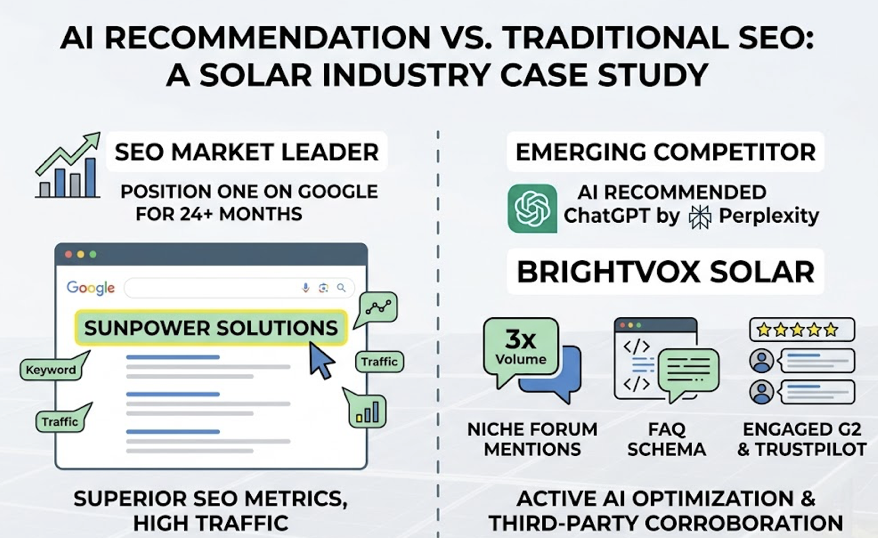
    Your brand holds a top-three Google ranking. Traffic looks healthy. Your SEO team is happy.

    Then someone searches “best [your category] tools” on ChatGPT, and your brand doesn’t appear once.

    That gap — between traditional search performance and AI visibility — is exactly what AI answer monitoring is designed to close. And for most marketing teams, it’s still completely untracked.

    The Search Behavior Shift No Ranking Tool Can See

    Consumer research behavior has changed faster than most marketing stacks have adapted.

    By mid-2025, 51% of consumers reported that generative AI had fundamentally changed how they research products and services, according to Gartner. Of those, 71% started phrasing queries more conversationally, going directly to ChatGPT, Perplexity, or Gemini before touching a traditional search engine.

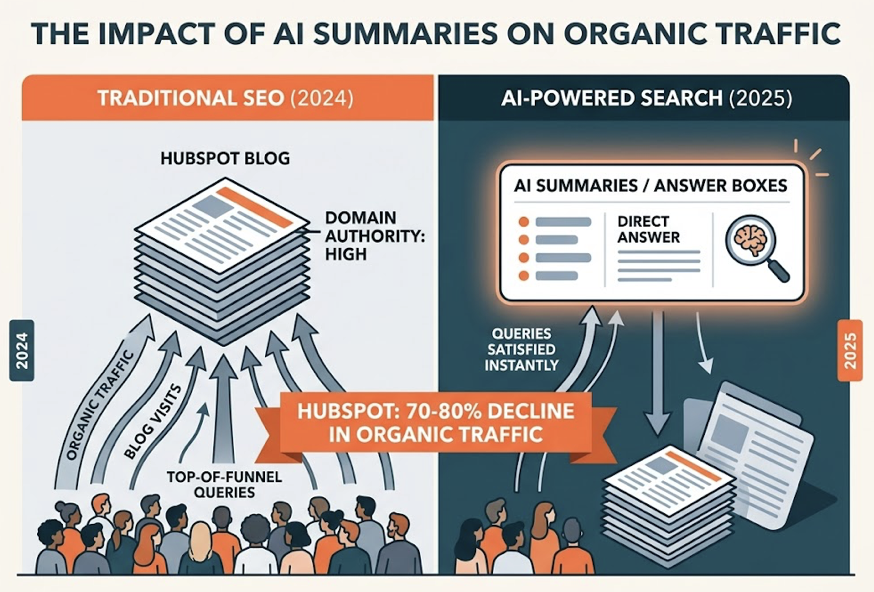
    The ripple effect on traditional SEO metrics is measurable. Zero-click queries have risen to roughly 60% of all searches in some categories. Click-through rates on organic results have dropped anywhere from 18% to 70% depending on the sector.

    Here’s the thing: none of that shows up in your Ahrefs dashboard.

    How AI Answer Monitoring Differs from Traditional SERP Tracking

    This is the question most teams ask first, and it’s worth answering precisely.

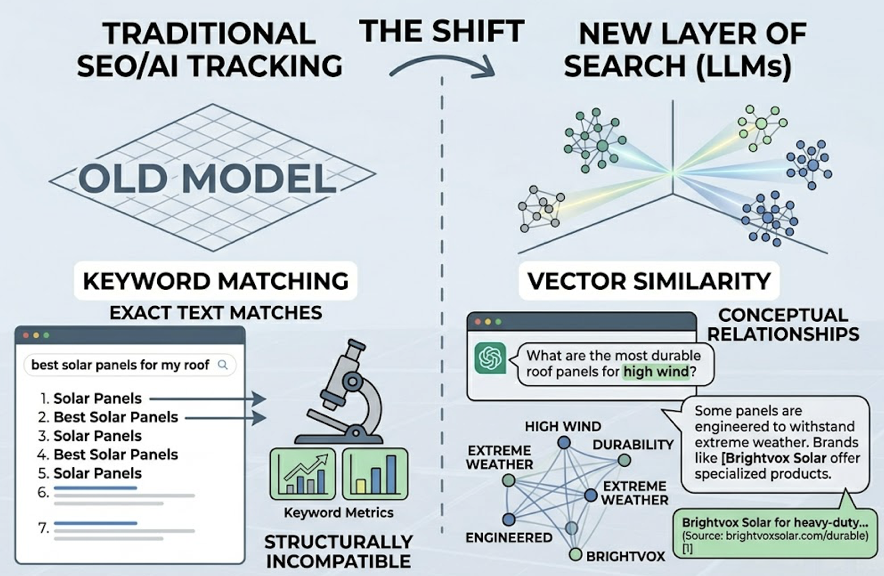
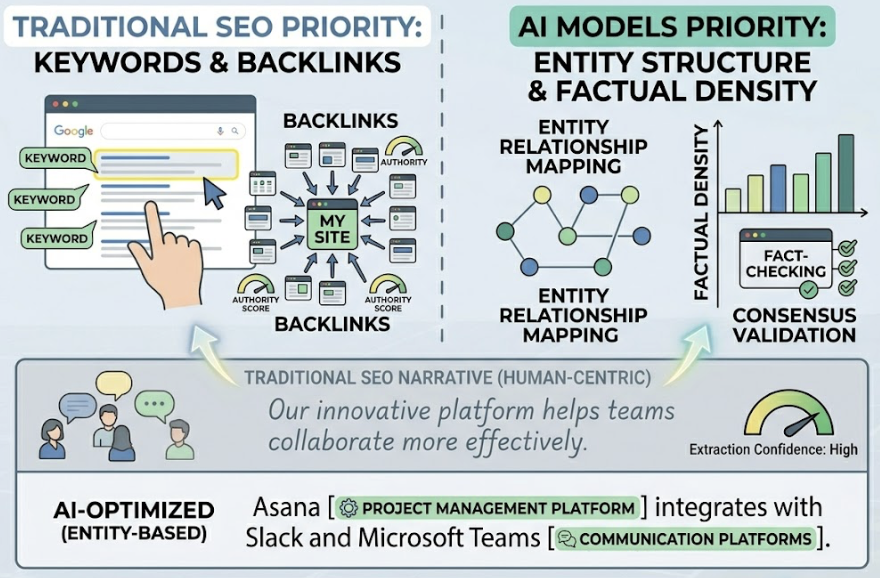
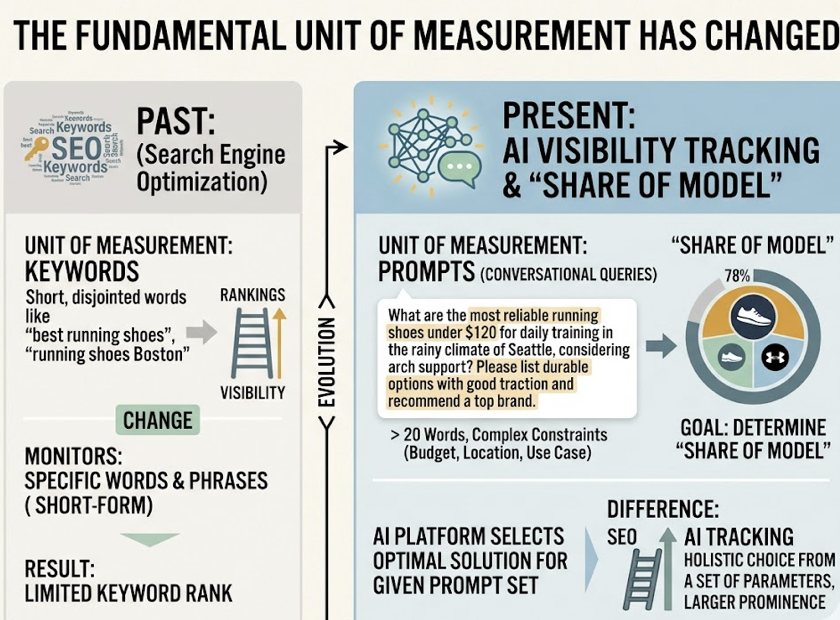
    Traditional SERP tracking watches where you rank for specific keywords on a static results page. The signals that matter are backlinks, on-page optimization, and crawl authority. The primary output is a rank number and a traffic estimate.

    AI answer monitoring tracks something structurally different.

    DimensionTraditional SERP TrackingAI Answer Monitoring
    What you’re trackingKeyword positions and trafficBrand mentions, sentiment, and citations in AI-generated answers
    Data sourceSearch engine indexLive model-generated outputs
    Competitive viewPosition on a results listShare of voice inside a narrative
    Optimization signalBacklinks and meta-tagsContent authority, entity recognition, source citations
    Primary metricClick-through rate (CTR)Brand mention rate and citation share

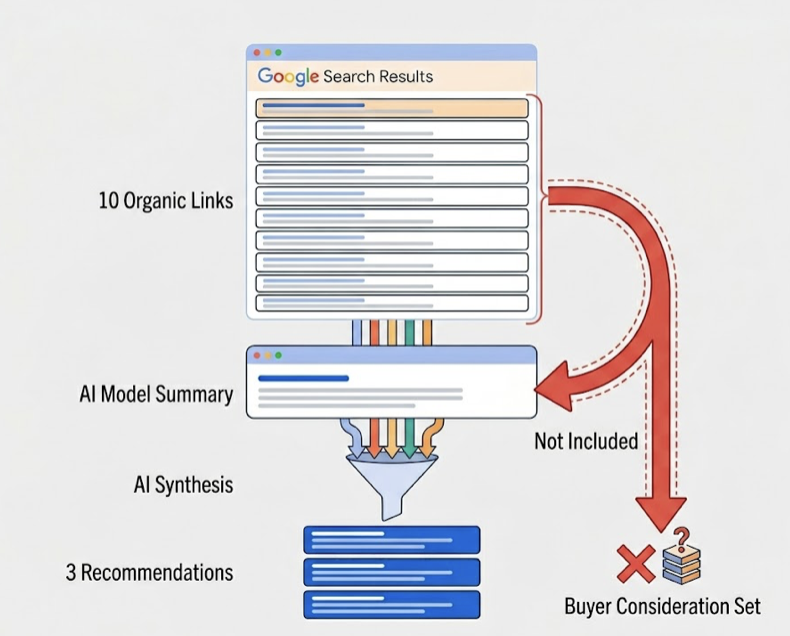
    The critical distinction: a traditional search engine ranks documents. An AI answer engine synthesizes a response. Your brand either gets included in that synthesis, or it doesn’t — and rank position has almost nothing to do with it.

    A study analyzing over 5.5 million AI responses found that holding a top-three organic ranking on Google offers only an 8% chance of being cited in a Google AI Overview. Even more striking: 80% of sources featured in AI-generated summaries don’t rank on the first page of traditional search results for the same query.

    Traditional SEO tracking can’t see any of that.

    Why Your #1 Ranking Doesn’t Guarantee AI Visibility

    The underlying reason is architectural.

    Google’s PageRank evaluates importance through link graphs. The more authoritative sites link to you, the higher you rank. It’s a voting system built on hyperlinks.

    AI platforms use Retrieval-Augmented Generation (RAG). Instead of counting links, the system encodes both the user’s question and available content into high-dimensional vector representations, then surfaces the passages that are semantically most relevant. The system is looking for unique, incremental value — what researchers call “Information Gain” — not aggregate link authority.

    The result: a brand with a modest backlink profile but deeply informative, structured content can consistently outperform a link-rich competitor in AI answers.

    Backlinks correlate with AI visibility at 0.218. Brand mentions correlate at 0.664. That’s not a minor difference — that’s a different game entirely.

    5 Signals a Proper AI Answer Monitoring Dashboard Should Show You

    If you’re building (or evaluating) an AI answer monitoring system, these are the five metrics that actually matter.

    1. Brand Mention Rate The percentage of tested prompts where your brand appears in the AI-generated response. This is your baseline visibility score. Most serious platforms, including Topify, test this across batches of 100+ prompts per category to establish a reliable baseline.

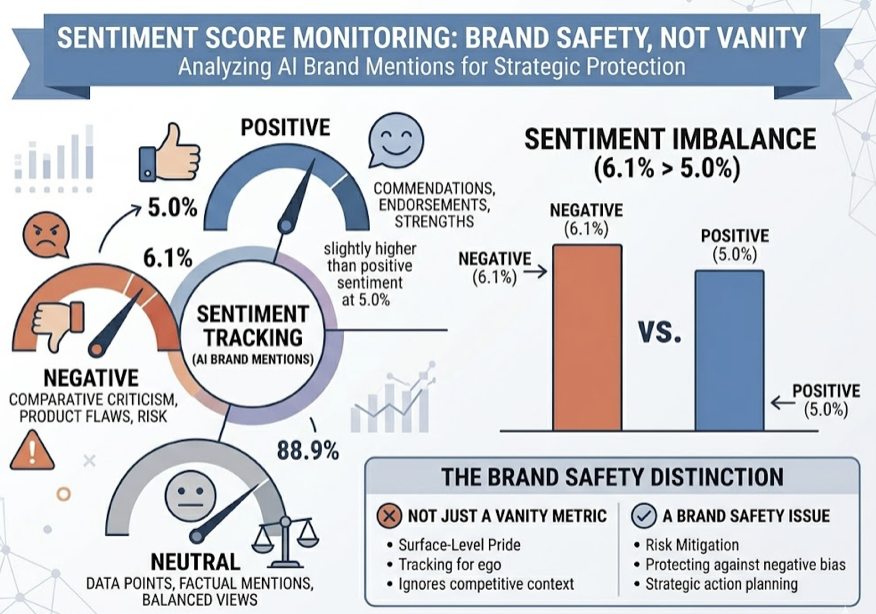
    2. Sentiment Score Not a binary positive/negative rating — that’s too blunt for AI responses. You need contextual sentiment: is the AI describing you as a “budget option,” a “reliable choice,” or an “innovative leader”? Only 25% of marketers report confidence that AI summaries accurately reflect their brand positioning. Monitoring sentiment shifts is how you catch narrative drift before it becomes a reputation problem.

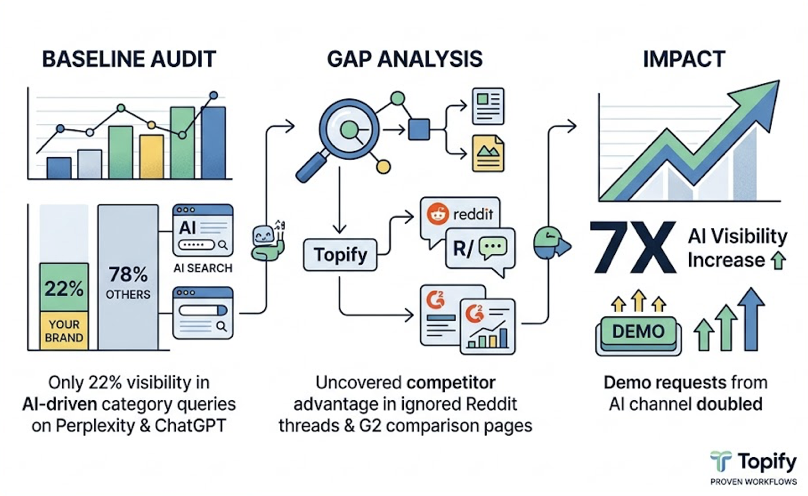
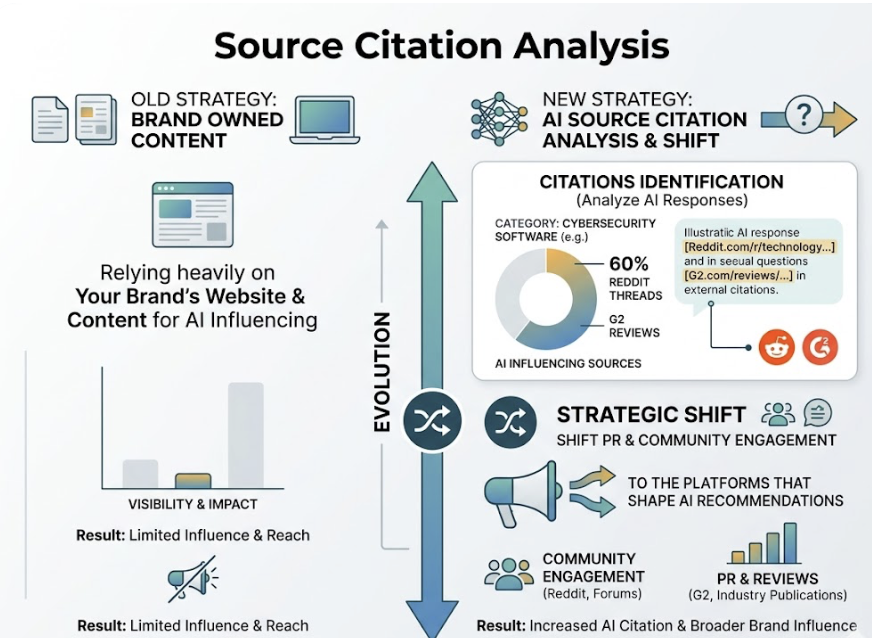
    3. Citation Source Mapping AI models don’t pull from your website alone. They synthesize from G2 reviews, Reddit threads, TechRadar articles, and dozens of other third-party sources. Citation mapping tells you which external domains are shaping your AI representation — and which ones you need to influence. Topify’s Source Analysis feature tracks the exact URLs and domains AI platforms cite when mentioning your brand.

    4. Position Within Recommendations In comparative queries (“What are the best project management tools for remote teams?”), the order in which brands appear correlates directly with user trust. Tracking your position relative to competitors — not just whether you appear — is how you measure competitive standing in AI answers.

    5. Prompt Coverage Are you surfacing across different intent stages, or only when someone searches your brand name directly? Effective monitoring requires testing 20 to 50 unique prompts per category, spanning informational, commercial, and comparison intent. Topify’s AI answer monitoring platform continuously surfaces new prompt opportunities as AI recommendation patterns evolve.

    From Raw Data to Action: What a Monitoring Workflow Actually Looks Like

    Data without a workflow is just noise.

    A professional AI answer monitoring workflow runs in three stages.

    Stage 1: Prompt Cluster Setup Organize prompts by intent type: informational (“What is zero-trust security?”), commercial (“Best endpoint security for remote teams”), and branded protection (“How does Brand A compare to Brand B?”). Test each cluster across ChatGPT, Gemini, Perplexity, and DeepSeek. Single-platform tracking misses too much — model behavior varies significantly across platforms, and so does your visibility.

    Stage 2: Mention Rate and Sentiment Monitoring Once tracking is live, watch for two things: drops in mention rate (which may signal a competitor has executed a successful GEO campaign or that a model update changed citation behavior) and sentiment shifts (which give you early warning when AI starts framing your brand differently than you intend).

    Stage 3: Citation Gap Analysis A citation gap is when an AI mentions a competitor but skips you for a relevant query. By analyzing which domains the AI does cite, you can identify what content you’re missing. If a competitor’s industry report is consistently getting cited, the tactical response is to publish a more current, more data-dense version of that content to capture the next retrieval cycle.

    Including specific named statistics can boost AI citation probability by up to 40%, according to research from Princeton and Semrush. That’s actionable. Most content teams just don’t know to target it.

    Picking an AI Answer Monitoring Tool That Actually Covers Your Landscape

    Not all platforms are equal, and the differences matter operationally.

    Three questions should anchor your evaluation:

    Does it cover the AI platforms your audience actually uses? Single-model tracking is a blind spot by design. Your audience isn’t using just ChatGPT — they’re using Gemini for some queries, Perplexity for research-heavy questions, and increasingly DeepSeek in certain markets.

    Can you see competitor data? Share-of-voice visibility — knowing how your brand stacks up against specific rivals in AI answers — is what turns monitoring from a reporting function into a competitive intelligence function.

    Does it give you source-level citation analysis? Knowing you’re mentioned is table stakes. Knowing which external URLs the AI is citing to describe you (and your competitors) is where optimization decisions get made.

    Topify is built around all three. The platform tracks brand performance across ChatGPT, Gemini, Perplexity, DeepSeek, and other major AI platforms via seven core metrics: visibility, sentiment, position, volume, mentions, intent, and conversion rate. The Basic plan starts at $99/month and includes 9,000 AI answer analyses — enough for a mid-sized team to run continuous monitoring across multiple prompt clusters without hitting capacity limits. For teams managing multiple brands or clients, the Pro plan scales to 22,500 analyses across 8 projects.

    What separates Topify from point-solution trackers is the execution layer. Beyond surfacing citation gaps, the platform’s AI agent can suggest content interventions and deploy strategies based on what the monitoring data shows — without requiring a separate workflow to act on the insights.

    FAQ

    How does AI search tracking differ from traditional SERP tracking?

    Traditional SERP tracking monitors keyword rankings on search engine results pages, using backlink data and traffic metrics as primary signals. AI search tracking monitors how and whether your brand appears in AI-generated answers across platforms like ChatGPT, Gemini, and Perplexity. The object of measurement is different — rank position versus mention rate and citation share — and the optimization levers are different too. AI visibility depends on content authority, entity recognition, and source citation patterns, not link graphs.

    What AI platforms should my monitoring tool cover?

    At minimum: ChatGPT, Google Gemini, and Perplexity. These three account for the largest share of AI-driven research behavior in most markets. Depending on your audience geography, DeepSeek and Grok coverage may also be relevant. Any tool that tracks only one or two platforms will systematically undercount your actual visibility gaps.

    How frequently should I run AI answer monitoring reports?

    Weekly cadence works for tracking long-term trends and quarterly strategy reviews. Daily monitoring is worth the investment in competitive categories where rivals are actively running GEO campaigns — a competitor’s visibility can shift meaningfully within days after a major content push or a model update.

    Conclusion

    The shift from traditional SERP tracking to AI answer monitoring isn’t a trend to watch. It’s an operational gap that’s already affecting brand visibility for most companies right now.

    Traditional ranking tools tell you where you are on Google. They don’t tell you whether ChatGPT recommends you, how Perplexity frames your brand relative to competitors, or which third-party domains are shaping your AI narrative. Those are different questions, and they require a different monitoring system.

    The brands that close this gap early — before it becomes a market share problem — will be the ones that treat AI visibility as a measurable, trackable growth channel. Not just something to “keep an eye on.”


    Read More

  • LLM Citation Tracking Strategy: A Step-by-Step Guide for 2026

    LLM Citation Tracking Strategy: A Step-by-Step Guide for 2026

    Your domain authority is solid. Your content ranks on the first page. Your team has published dozens of well-researched articles this quarter. Then a potential customer asks ChatGPT, “What’s the best tool for [your category]?” and gets a confident list of five recommendations. Your brand isn’t mentioned once.

    This isn’t a ranking problem. It’s a citation problem, and traditional SEO metrics won’t show it to you.

    What LLM Citation Tracking Actually Measures (and What Most Teams Get Wrong)

    LLM citation isn’t a synonym for backlinks. In traditional SEO, a link passes authority from one page to another. In generative search, a citation is something different: it’s an AI model selecting your content as a factual source worth surfacing in a synthesized answer.

    The mechanism behind this is called retrieval-augmented generation (RAG). When a user asks ChatGPT or Perplexity a question, the model first retrieves the most relevant text chunks from its indexed sources, then uses a probability model to determine which facts are trustworthy and directly answerable. If your content isn’t structured for extraction, it gets passed over, regardless of how authoritative your domain is.

    That last point is where most teams get blindsided. Research shows that around 90% of ChatGPT citations come from pages ranked 21 or lower in traditional search results. AI systems are looking for “micro-authority,” meaning content that delivers direct, structured answers, not pages that simply accumulate the most backlinks.

    Four other misconceptions tend to derail citation strategies before they start. Publishing more content doesn’t linearly increase citation rate. Standard analytics tools like GA4 or Ahrefs can’t capture AI-generated, non-deterministic outputs. And SEO and GEO, while related, operate on fundamentally different logic: SEO optimizes for keyword density and page performance, while GEO optimizes for semantic density and factual accuracy.

    The business case for treating these as separate disciplines is hard to ignore. AI search visitors convert at 4.4x the rate of traditional organic traffic. In one documented case, AI-referred traffic represented just 0.5% of total visits but accounted for 12.1% of signups, a conversion rate 23x higher than standard organic. A missed citation isn’t just a missed click. It’s a missed high-intent customer.

    The 4 Metrics at the Core of Any LLM Citation Tracking Strategy

    To measure what’s happening in AI-generated answers, you need metrics built specifically for that environment. Here are the four that form the foundation of any serious LLM citation tracking strategy.

    Citation Rate is the starting point: how often does your domain or URL appear as a cited source across a defined set of tracked prompts? For B2B SaaS, the industry average citation penetration sits around 0.41%, though that figure climbs to 1.22% for search result pages. This is your baseline visibility number.

    Citation Position tells you where in the answer your content appears. 70% of users read only the first three lines of an AI summary. A citation buried in the fifth footnote delivers a fraction of the value of a first-position mention. The click-through rate for a last-position citation is roughly one-quarter of what a first-position citation earns.

    Citation Share vs. Competitors is the AI equivalent of share of voice. When a user asks a decision-stage question like “What are the best project management tools?”, LLMs typically surface three to five brands. If your competitors consistently occupy more of those slots than you do, the model is actively building a “competitor-first” narrative in your target audience’s mind, without you even knowing it’s happening.

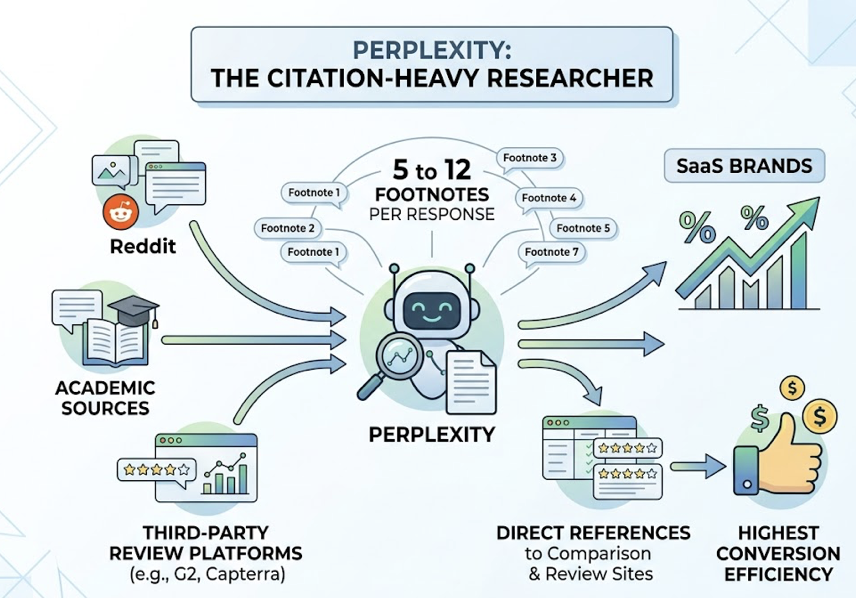
    Citation Consistency is the hardest metric to achieve and the most valuable. Only 11% of domains get cited by both ChatGPT and Perplexity on the same topic. The two platforms draw from very different source pools: Perplexity pulls 46.7% of its citations from Reddit, while ChatGPT draws only 11.3% from that source. Google AIO, on the other hand, overlaps 93.67% with traditional top-10 results. Achieving cross-platform citation coverage can increase your visibility in ChatGPT answers by 2.8x.

    How to Build Your LLM Citation Tracking Strategy: A 5-Step Framework

    Step 1: Design Your Prompt Corpus

    You can’t track everything, so you need a defined set of prompts that map to real business value. Structure your prompt library across three layers: brand and product queries (“What does [brand] do?”), mid-funnel decision queries (“What’s the best [category] tool?”), and top-funnel informational queries (“How do I solve [industry pain point]?”).

    Keep your prompt corpus between 50 and 100 prompts. Below that threshold, the data lacks statistical significance. Also worth noting: AI search users tend to type full sentences of seven or more words rather than keyword fragments, so build your prompts accordingly.

    Step 2: Establish a Baseline Citation Snapshot

    Before optimizing anything, document where you currently stand. Run your prompt corpus across at least ChatGPT, Perplexity, and Google AIO. Record which URLs are being cited, the context in which they’re cited (positive, neutral, or framed in a way that undermines your positioning), and which prompts are currently going entirely to competitors. This baseline is the reference point every future improvement gets measured against.

    Step 3: Audit the Structural Characteristics of Cited Content

    This is where the diagnostic work happens. Compare the content AI is selecting against the content it’s ignoring. Three structural factors consistently separate cited pages from uncited ones: semantic density (how many specific facts appear per paragraph), structural clarity (the presence of HTML tables, H3 subheadings, and FAQ schema), and external sourcing (whether the page references third-party research or expert data). Pages containing three or more specific data points are cited at 2.5x the rate of pages that don’t.

    Step 4: Identify Your Citation Gaps

    A citation gap is any topic where a competitor is getting cited and you’re not. These gaps typically fall into one of two categories: you don’t have content on that topic at all, or you have content that the AI can’t efficiently extract from. Prioritize gap-filling by conversion intent, not traffic volume. A gap in a decision-stage prompt is worth more than a gap in a broad informational query.

    Step 5: Track on a Bi-weekly Cadence

    Single-point snapshots are misleading. AI citation behavior drifts: 57% of brands that disappear from an AI answer in one query reappear in subsequent queries. Two-week tracking intervals give you enough frequency to distinguish temporary fluctuations from real trend shifts, without generating data faster than your team can act on it.

    3 Common Mistakes That Kill an LLM Citation Tracking Strategy

    Mistake 1: Tracking only ChatGPT. It’s the most visible platform, so teams default to it. But the source pools differ dramatically across platforms, and optimizing for one while ignoring others creates a defensive blind spot. A brand that dominates ChatGPT citations but is invisible on Perplexity is leaving a sizable audience segment unaddressed.

    Mistake 2: Measuring presence without measuring context. A citation isn’t always a positive signal. If ChatGPT consistently surfaces your brand in the context of “budget-friendly alternatives” and your positioning is premium, you have a sentiment problem that a citation rate dashboard won’t reveal. You need to track not just whether AI mentions you, but how it describes you. Fixing a negative framing often requires publishing specific content types: transparent pricing pages, direct comparison articles, or data-backed case studies that reframe the AI’s narrative.

    Mistake 3: Treating tracking reports as KPI summaries rather than action triggers. This is the most expensive mistake. Tracking data only has value when it connects directly to the content calendar. If you identify a high-intent prompt where a competitor is getting cited and you’re not, that gap should trigger an optimization task within days, not the following quarter.

    The Right LLM Citation Tracking Tool Changes What You Can Actually See

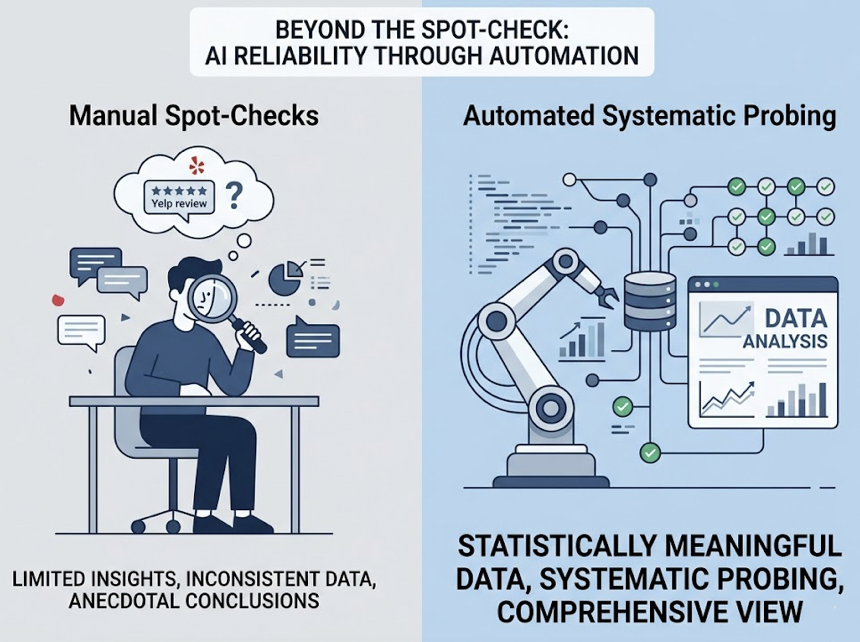
    The math on manual tracking doesn’t work at scale. At 100 prompts, four platforms, and a bi-weekly cadence, you’re looking at 800 manual queries per month. Manual tracking carries an error rate of around 30% and can’t produce the historical trend data that reveals whether a change you made last month actually moved the needle. Automated platforms reduce that operational cost by over 90%.

    Topify is the LLM citation tracking platform that most directly maps to the five-step framework above. Its Source Analysis function identifies not just whether your domain appears in AI answers, but which specific URLs are being cited and in what context, giving you the diagnostic clarity to understand what’s working at the content level, not just the domain level.

    Topify’s Visibility Tracking covers ChatGPT, Gemini, Perplexity, DeepSeek, and other major AI platforms in a single LLM citation tracking dashboard, which solves the cross-platform consistency problem most teams struggle with. The Competitor Monitoring feature runs citation comparisons within the same prompt report, so you’re not building a separate workflow to understand how your citation share compares to competitors on the same queries.

    For teams that need to move from tracking to action quickly, Topify’s One-Click Execution lets you define a GEO strategy in plain English and deploy it without manual workflow overhead. That’s the connection between citation data and content output that most LLM citation tracking solutions leave as a gap.

    Pricing for Topify’s LLM citation tracking system starts at $99/month, which includes 100 tracked prompts, coverage across major AI platforms, and a 30-day trial. For teams running 250 prompts across multiple projects, the Pro plan at $199/month extends that coverage with 22,500 AI answer analyses per month.

    PlanPricePromptsAI Answer Analyses
    Basic$99/mo1009,000/mo
    Pro$199/mo25022,500/mo
    EnterpriseFrom $499/moCustomCustom

    Other options in the LLM citation tracking software space include SE Ranking, which integrates AIO tracking with traditional rank monitoring for teams that want both in one place, and ZipTie.dev, which focuses on large-scale AIO data extraction.

    How to Turn Citation Data into Actual Content Improvements

    Citation data has one useful output: telling you what to change.

    Comparative listicles account for 52% of LLM citation share. Comprehensive guides with data tables earn a citation rate of 67%. FAQ and Q&A formats are cited 2.7x more often than narrative paragraphs. These aren’t style preferences. They’re structural signals that AI retrieval systems respond to consistently.

    When you find a citation gap, the decision path splits into two scenarios. If a competitor is being cited on a topic you also have content for, the fix is usually factual density: add specific data points at the start of paragraphs, introduce a data table, embed FAQ schema. If a competitor is being cited on a topic you don’t cover at all, you need new content, and Topify’s One-Click Execution can generate a content brief structured around the semantic patterns AI platforms are currently rewarding.

    One important attribution note: AI-driven brand awareness often flows through what’s called “dark traffic.” A user sees your brand in a ChatGPT answer, doesn’t click, then searches your brand name directly in Google an hour later. That visit shows up as branded organic search, with no AI attribution. Tracking the correlation between citation rate increases and branded search volume growth gives you a more complete picture of the real downstream value of your LLM citation tracking strategy.

    Conclusion

    The CTR signal that traditional SEO was built on is contracting fast. Since Google AIO launched in March 2024, top-ranked pages have seen average CTR drops of 34.5%. By December 2025, that figure had reached 58% for the number-one organic result. The traffic isn’t disappearing. It’s being filtered through AI, and only brands that show up as cited sources in those AI answers are capturing it.

    An LLM citation tracking strategy isn’t a replacement for SEO. It’s the layer you need to add now to understand where your content actually stands in the environment where your highest-intent customers are forming their decisions. Get started with Topify and build your baseline citation snapshot this week, before your competitors figure out the same gap you’re looking at right now.


    FAQ

    Q: What is an LLM citation tracking strategy?

    A: An LLM citation tracking strategy is a systematic process for monitoring, analyzing, and optimizing how large language models like ChatGPT and Gemini cite your brand’s content when generating answers. Unlike traditional SEO, it focuses on content extractability, factual density, and cross-platform citation consistency rather than keyword rankings or backlink counts.

    Q: How much does LLM citation tracking cost?

    A: Automated LLM citation tracking tools like Topify start at $99/month, which covers 100 tracked prompts and analysis across major AI platforms. Manual tracking might seem free, but given its 30% error rate and the hundreds of hours required at scale, the real cost is typically far higher. Enterprise-level citation tracking platforms with custom prompt volumes and dedicated support are available from $499/month.

    Q: What’s the difference between LLM citation tracking and traditional backlink tracking?

    A: Backlink tracking measures static links between web pages as a signal for search engine ranking. LLM citation tracking measures the probability that an AI model selects your content as a factual source when generating a live answer. LLM citations don’t require a click, they influence brand perception and purchase decisions directly within the AI interface.

    Q: How often should I update my LLM citation tracking strategy?

    A: A bi-weekly tracking cadence is the recommended minimum. AI citation behavior is non-deterministic: roughly 57% of brands that drop from an AI answer reappear in subsequent queries. Monthly or quarterly tracking can’t reliably distinguish genuine visibility trends from short-term fluctuations. High-competition categories like SaaS and fintech benefit from closer to real-time monitoring.


    Read More

  • AI Search Visibility: Why Your Google Rankings Don’t Tell the Full Story

    AI Search Visibility: Why Your Google Rankings Don’t Tell the Full Story

    Your team spent months building content, earning backlinks, and moving up Google’s rankings. Then a potential customer opened ChatGPT and typed, “What’s the best tool for [your category]?” and got five recommendations. Your brand wasn’t one of them.

    That’s the visibility gap. And right now, most brands don’t know it exists until it starts costing them.

    The Metric Your SEO Dashboard Can’t Show You: AI Search Visibility

    AI search visibility measures how often your brand appears, gets cited, or gets recommended in AI-generated responses across platforms like ChatGPT, Perplexity, and Gemini. It’s not a ranking. It’s a probability.

    That distinction matters. Traditional SEO is a hierarchical system: the highest-ranked URL captures the majority of clicks. AI search is a recommendation engine: it synthesizes information from dozens of sources and names specific brands in its answer. Your domain authority score plays almost no role in that decision.

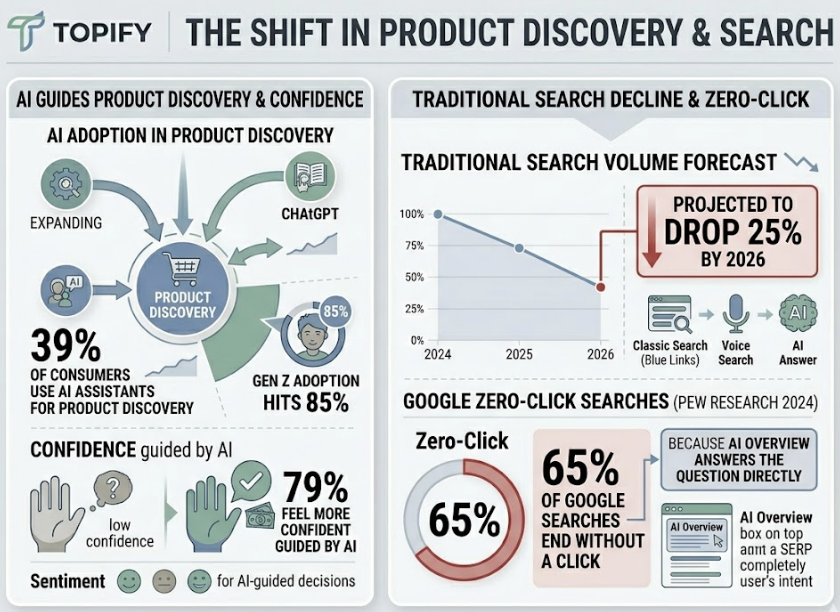
    The numbers behind this shift are harder to ignore every quarter. ChatGPT reached 800 million weekly active users by October 2025. Traditional search traffic is projected to fall 25% by 2026. Meanwhile, combined traffic to AI search platforms grew at an average monthly rate of 721% in the year leading into mid-2025. That’s not a trend. That’s a structural change.

    AI SEO, as a discipline, starts with accepting that ranking and being recommended are two separate outcomes that now require two separate strategies.

    Why AI Search Engines Recommend Some Brands and Ignore Others

    Here’s the part most marketers miss: only 12% of URLs cited by ChatGPT, Perplexity, and Copilot actually rank in Google’s top 10 for the same query. And 80% of citations in AI Overviews don’t rank organically in Google’s top 100 at all.

    AI retrieval doesn’t work like link-based ranking. Generative engines use a process called Retrieval-Augmented Generation (RAG), which pulls structured, extractable chunks of information from multiple sources and synthesizes them into a single answer. The brands that get cited are the ones whose content is easiest to parse, not necessarily the ones with the highest domain rating.

    Three factors tend to explain why brands disappear from AI results. First, their content isn’t structured for extraction, meaning it reads well for humans but isn’t modular enough for AI to pull clean, self-contained facts. Second, their off-site presence is thin. Research shows that off-site mentions on platforms like Reddit, Wikipedia, and industry review sites are 6.5 times more likely to drive AI citations than content hosted on a brand’s own domain. Third, the brand’s AI search intelligence is nonexistent, so nobody’s monitoring what the AI actually says when asked about the category.

    AI search optimization isn’t about gaming an algorithm. It’s about making sure AI can accurately understand and represent your brand.

    What AI Search Visibility Actually Measures: The 7 Signals That Matter

    A single “were we mentioned?” query on ChatGPT doesn’t give you AI search analytics. It gives you one data point from a non-deterministic system. Real measurement requires tracking across hundreds of prompts, across multiple platforms, over time.

    The framework that captures this has seven dimensions. Visibility tracks mention frequency: out of 100 relevant prompts, how many responses include your brand? Sentiment measures how the AI frames you, whether as a trusted leader, a budget option, or worse. Position captures where you appear in the response relative to competitors. Volume estimates how many AI searches are happening in your category. Mentions counts raw appearances. Intent maps which user intents your brand shows up for. And CVR estimates how likely an AI mention is to drive downstream conversion.

    Each of these signals tells a different part of the story. A brand can have high Visibility but low Sentiment, meaning it gets mentioned often but framed negatively. Or high Position but low Volume, meaning it dominates a niche that barely anyone is searching in AI. You need all seven to get an accurate picture of your AI brand visibility.

    Topify tracks all seven metrics across major AI platforms including ChatGPT, Gemini, Perplexity, and DeepSeek in a single dashboard, which is what makes it useful for teams that need to act on data rather than just collect it.

    Customer Praise and Adaptability: The Two Hidden Drivers of AI Search Visibility

    Most marketers assume that positive reviews help and negative reviews hurt. The reality, at least in AI search, is more nuanced.

    Research into Reddit citation patterns shows that citation rates for positive brand sentiment (5%) and negative sentiment (6.1%) are nearly identical in AI responses. AI models aren’t looking for praise. They’re looking for authentic evaluation. A brand discussed only in polished, marketing-approved language may actually be less visible to AI than a brand with honest, balanced discourse on community platforms.

    That’s the “customer praise and adaptability” dynamic that rarely appears in traditional SEO guides. Reddit content appears in 25% to 40% of AI results for trending topics, outpacing Wikipedia and YouTube for commercial evaluation queries. AI models treat community platforms as subject-matter experts on product experience, and they weight that signal heavily when answering questions like “Is this product actually worth it?”

    Adaptability matters for a related reason. AI platforms update their citation patterns regularly. A brand that was visible in ChatGPT responses six months ago may have lost ground as the model’s training data or retrieval behavior shifted. Brands with strong AI search visibility tend to monitor those changes and adjust content strategy accordingly, not once a quarter, but continuously.

    How Brands Can Monitor and Improve AI Search Visibility

    The operational framework comes down to three steps: know where you stand, understand why, then act.

    Step one is establishing a baseline. Query 20 to 30 core prompts across ChatGPT, Gemini, and Perplexity and record how often your brand appears, what position it holds, and how the AI frames it relative to competitors. Most teams doing this for the first time discover gaps they didn’t know existed.

    Step two is tracing the root cause. Low Visibility often traces back to thin off-site presence or content that isn’t structured for AI extraction. Low Sentiment typically reflects a pattern in third-party reviews or community discussions. Source analysis reveals which domains the AI is pulling from when it describes your category, and whether your owned content or third-party mentions are appearing there at all.

    Step three is execution. This is where most teams lose momentum. The analysis is clear, but acting on it, rewriting content for extractability, building community presence, chasing citations on authoritative sites, requires either significant manual effort or automation.

    Topify’s one-click agent execution is designed specifically for this gap. You define your goals in plain language, the platform proposes a GEO strategy across content, citations, and visibility, and you launch it with a single click. No manual workflows, no spreadsheet tracking across platforms. The system monitors, reasons, and executes on your behalf, which is what teams managing multiple brands or categories actually need.

    For teams that want to start with the analytics layer before committing to full execution, Topify’s Basic plan starts at $99/month, covering 100 prompts across ChatGPT, Perplexity, and AI Overviews.

    AI Search Visibility and Customer Service: Why Your Support Reputation Shapes AI Recommendations

    When someone asks an AI, “Does Brand X have good customer support?”, the model doesn’t pull from your support page. It pulls from the aggregate of reviews, forum discussions, and third-party evaluations that it associates with your brand.

    That has a direct impact on where you appear in recommendation queries. Research shows that a pattern of “unprofessional service” in reviews will override a high star rating in the model’s evaluation, leading it to exclude a brand from category recommendations entirely. On the flip side, companies with mature, responsive customer service tend to earn sentiment tags like “reliable” and “fast” in AI-generated comparisons, which positions them favorably in the AI’s output.

    The data supports the connection. Every 10-point increase in a brand’s NPS score has been shown to generate 3.2% revenue growth, a correlation that compounds when AI assistants pick up the brand as a “trusted” option for recommendation queries. Companies with mature AI implementations in customer service report 17% higher satisfaction scores and 8.5% better retention, outcomes that feed directly back into the brand signals AI models use.

    AI search visibility brands with strong customer service reputations don’t just perform better in surveys. They appear more often, ranked higher, and framed more positively when AI answers a question in their category.

    The implication is that managing your AI visibility requires managing your reputation, not just your content. Review recency signals to AI that a brand is active. Review sentiment influences how the AI frames your positioning. And review volume builds the kind of distributed authority that AI engines treat as consensus.

    Conclusion

    The gap between ranking on Google and being recommended by AI isn’t closing on its own. AI-mediated search is projected to influence up to $750 billion in retail revenue by 2028, and brands that fail to close the visibility gap risk losing 20% to 50% of search-driven traffic to competitors who appear in those AI answers instead.

    The upside is real too. Visitors referred from AI tools convert at 3.5 to 4.4 times the rate of traditional organic search, because the AI has already qualified their intent. The traffic is smaller, but it’s more likely to buy.

    Traditional SEO gets you found. AI search optimization gets you recommended. Both matter now, but only one of them is growing. Get started with Topify to establish your baseline visibility score and see exactly where your brand stands in the AI answers your customers are already reading.


    FAQ

    Q: What is AI search visibility and how is it different from SEO?

    A: AI search visibility measures how often and how favorably your brand appears in AI-generated responses across platforms like ChatGPT, Perplexity, and Gemini. Traditional SEO optimizes for keyword rankings and click-through rates on Google. AI search visibility focuses on citation rate, recommendation frequency, and sentiment in AI answers. The two have very little overlap: research shows only 12% of URLs cited by AI engines rank in Google’s top 10 for the same query.

    Q: How do AI search engines decide which brands to recommend?

    A: AI engines use a retrieval process that prioritizes content clarity, entity associations, and distributed authority across the web. Brands with structured, extractable content and strong off-site mentions on platforms like Reddit, Wikipedia, and industry review sites tend to get cited more frequently. Domain authority and backlink profiles, the traditional SEO signals, carry far less weight in this process.

    Q: How can I check my brand’s current AI search visibility?

    A: Start by querying 20 to 30 category-relevant prompts manually across ChatGPT, Gemini, and Perplexity. Record how often your brand appears, at what position, and how it’s framed. For ongoing monitoring across hundreds of prompts and multiple platforms, tools like Topify automate this process and provide visibility, sentiment, and position data in a structured dashboard.

    Q: Does customer sentiment actually affect AI search rankings?

    A: Yes, directly. AI models analyze review patterns, community forum discussions, and third-party evaluations to determine how to frame a brand in recommendation responses. A consistent pattern of negative support experiences in reviews can lead AI engines to omit a brand from “Top 10” lists, regardless of star rating. Positive, authentic sentiment, especially on platforms like Reddit, correlates with more frequent citation and stronger positioning in AI-generated comparisons.


    Read More

  • LLM Citation Tracking System: What It Is, How It Works, and Why Top AI Search Brands Already Have One

    LLM Citation Tracking System: What It Is, How It Works, and Why Top AI Search Brands Already Have One


    Your competitor’s URL is being recommended in ChatGPT right now. Not mentioned. Cited. That means a user searching for your category just received a synthesized answer that named another brand as the source of truth, and you weren’t even in the room.

    That’s the gap most marketing teams still can’t see.

    Organic click-through rates have dropped roughly 61% for queries that trigger an AI Overview, yet being cited in an AI answer now drives approximately 35% more organic clicks and 91% more paid clicks for the brands that make the cut. The math is simple: AI visibility is becoming winner-take-most. And the brands that are winning built a system to track and optimize their citations.

    This article breaks down what an LLM citation tracking system is, how it works technically, which metrics actually matter, and how to build a strategy that earns you more of those citation slots.

    LLM Citation Tracking Is Not the Same as Brand Monitoring

    Most teams assume their social listening stack already covers AI visibility. It doesn’t.

    Traditional monitoring tools track “mentions” — your brand name appearing somewhere in text. An LLM citation is structurally different. It’s when a model identifies a specific URL or domain as a verified source for a specific claim it’s making. One is passive recognition. The other is active endorsement.

    The data is stark: only 6% to 27% of the most frequently mentioned brands actually function as trusted citation sources in AI responses. You can be talked about constantly and still be invisible where it counts.

    The underlying mechanism explains why. Mentions typically come from the model’s parametric memory — information baked in during training. Citations come from Retrieval-Augmented Generation (RAG), where the model fetches live web content to ground its answers in verifiable sources. RAG-driven citations carry significantly higher authority and referral potential than anything pulled from training memory.

    Traditional SEO tools track keyword rankings on stable results pages. An LLM citation tracking system is built for a completely different environment: session-based, dynamic, operating at the URL level, not the keyword level.

    How an LLM Citation Tracking System Actually Works

    The core workflow moves through four sequential phases.

    Phase 1: Prompt Engineering and Intent Mapping. The system starts with a library of 20–50 natural language queries that reflect real buyer behavior across the full funnel — discovery, comparison, and problem-solving. This isn’t keyword research. It’s simulating how actual users talk to AI. Phrasing matters here: ChatGPT runs 3.5 times more sub-searches than Perplexity for the same query, so prompt variation is essential to capture the full citation picture.

    Phase 2: Multi-Platform Extraction. The system queries each AI engine simultaneously — ChatGPT, Perplexity, Gemini, and Google AI Overviews. This step is non-negotiable. Only 11% of domains earn citations from both ChatGPT and Perplexity for the same query. What works on one platform is often invisible on another.
    Phase 3: Source Domain Identification. Every URL in every response gets extracted and classified into three buckets: owned domains, competitor domains, and third-party authorities like Reddit, Wikipedia, or industry publications. This mapping tells you exactly who the AI trusts when it answers questions about your category.

    Phase 4: Brand Annotation and Sentiment Scoring. The system scores whether your brand was cited, mentioned, or omitted — and evaluates the sentiment context. Being cited as a cautionary example is categorically different from being cited as a recommended solution. Both need to be tracked.

    Why Reliable AI Search Brands Dominate the Citation Landscape

    Top AI search brands don’t just show up more often. They’ve engineered their content to match how LLMs retrieve and reproduce information.

    Brand search volume shows a 0.334 correlation with AI visibility — the strongest single predictor identified in recent research. Backlinks, by contrast, show a weak or neutral relationship. LLMs are trained to favor brands that users are already searching for directly. The more people look you up, the more the model treats you as a default authority.

    Platform sourcing behavior also varies more than most teams realize. Gemini prioritizes brand-owned content, drawing 52.15% of its citations from official websites. ChatGPT skews toward third-party consensus at 48.73%, favoring directories, Wikipedia, and user-generated platforms. Perplexity draws 46.7% of its top citations from Reddit and specialized industry blogs.

    There’s no universal citation strategy. There’s a platform-specific one.

    Once a brand crosses the initial citation threshold, a compounding effect takes hold. Citations drive 35% more organic clicks and 91% more paid clicks in Google AI Overviews. That engagement signals content quality back to the model, which increases the probability of being cited again. The first citation slot is the hardest to earn. After that, it tends to reinforce itself.

    5 Metrics That Define a Working LLM Citation Tracking System

    Meaningful tracking goes beyond counting brand appearances. Here are the five metrics that map to actual business outcomes.

    1. Citation Frequency. How often your brand is explicitly cited across your tracked prompt set. Aim for at least 30% on core commercial queries to maintain category relevance. Anything below that, and you’re ceding the narrative to whoever shows up instead.

    2. Citation Share of Voice (SOV). Your citations as a percentage of total citations across your competitive set. Because AI answers are often zero-sum — only 1–3 sources cited per claim — SOV is the most direct signal of competitive position. A weighted formula, where first-position citations score higher, gives the most accurate read.

    3. Source Domain Coverage. Which external domains is the AI citing when it doesn’t cite you? If ChatGPT is pulling a competitor’s comparison page to answer questions about your category, you’ve found a distribution gap. 100% coverage on your own trademark terms is a floor, not a ceiling.

    4. Citation Position. Users typically verify only the first two cited sources in an AI response. Being third or fourth is close to being omitted. Tracking average position — not just presence — is what separates tracking programs that generate action from ones that generate reports nobody reads.

    5. Sentiment Context. In health-related queries alone, only 40.4% of AI responses have complete citation support, which means hallucinated or misattributed claims are common across categories. Sentiment and faithfulness tracking catches cases where the AI is citing you inaccurately or in a negative context before those representations compound over time.

    MetricBusiness SignalTarget Benchmark
    Citation FrequencyPresence in AI answer set>30% for core queries
    Share of VoiceCompetitive dominance>20% within category
    Source Domain CoverageContent gap identification100% on trademark terms
    Citation PositionVisibility and click-throughTop 2 citation slots
    Sentiment ContextBrand trust and accuracy>0.7 positive score

    4 Mistakes That Quietly Kill Your LLM Citation Strategy

    Most citation programs fail not from lack of effort, but from structural errors in how they’re built.

    Mistake 1: Tracking mentions instead of sources. Knowing your brand was mentioned doesn’t tell you which URL the AI retrieved. Without source-level data, you can’t identify what content to improve or where to distribute more. Tracking must happen at the domain and URL level to produce anything actionable.

    Mistake 2: Only tracking ChatGPT. It’s the most recognizable platform, so teams default to it. But ChatGPT and Perplexity agree on citations only 11% of the time. A strategy calibrated for ChatGPT — which relies heavily on Wikipedia — will consistently miss Perplexity, which skews toward Reddit and niche blogs. Minimum viable coverage is four platforms.

    Mistake 3: Ignoring competitor citation patterns. A 30% citation frequency looks strong in isolation. If your primary competitor sits at 70%, you’re losing the category narrative by a wide margin. Competitive benchmarking turns a vanity metric into a real strategic signal.

    Mistake 4: Running monthly reports. Citation patterns are volatile. ChatGPT’s reliance on Reddit and Wikipedia shifted significantly in a single week in September 2025. By the time a monthly report reaches someone’s inbox, the sourcing landscape may have already moved. Weekly is the working standard. Daily is better for high-stakes categories.

    Build a Citation Strategy That Actually Moves the Numbers

    Once your tracking infrastructure is in place, the optimization layer breaks down into four steps.

    Step 1: Audit the citation landscape. Identify the top 10 domains being cited for your core product categories using your tracking tool. If you’re not among them, diagnose whether the gap is technical (AI crawlers blocked, JS rendering issues) or content-based (no structured formats, missing schema). Research shows that seeding content on Reddit and industry wikis delivers 2.8x higher citation likelihood compared to owned-media-only strategies.

    Step 2: Optimize for machine extractability. LLMs retrieve information in small chunks — sometimes a single sentence or table row. Lead with a 40–60 word direct answer to each core question. Break content into 50–150 word self-contained blocks. Add FAQPage and Product schema in JSON-LD. Use comparison tables wherever you’re contrasting options: tables increase citation rates by 2.5x. Listicle formats account for 50% of top AI citations.

    Step 3: Distribute beyond owned media. Your website alone isn’t enough. Active presence on high-authority third-party platforms is how AI models validate consensus. That means structured Reddit contributions, updates to relevant Wikipedia entries where appropriate, and placement in industry publications with established citation authority in your category.

    Step 4: Automate monitoring and close the feedback loop. Manual checking doesn’t scale. Platforms like Topifyautomate the discovery of citation gaps, competitive shifts, and source domain mapping across ChatGPT, Gemini, Perplexity, and others. The data feeds back into content and distribution decisions in real time, so your strategy adjusts as citation patterns shift — not 30 days after the fact.

    Strategy LayerTactical ActionMeasured Impact
    AuditIdentify top 10 citing domains per categoryBaseline for citation gaps
    DistributionSeed content on Reddit and industry wikis2.8x higher citation likelihood
    FormattingAdd comparison tables and FAQ schema2.5x increase in citation rate
    MonitoringWeekly SOV and sentiment trackingEarly detection of citation drift

    The Best Tools for LLM Citation Tracking

    Choosing a tool comes down to four variables: how many platforms it covers, how frequently data refreshes, whether it includes competitor benchmarking, and how granular the source-level analysis gets. That last point is where most tools fall short.

    Topify is purpose-built for source-level citation intelligence. Its Source Analysis feature tracks the specific URLs and domains AI platforms are citing, surfaces content gaps, and maps which competitor pages are capturing citations your brand isn’t. Competitor Monitoring provides real-time SOV comparisons across your direct rivals. Platform coverage spans ChatGPT, Gemini, Perplexity, DeepSeek, and Google AI Overviews — built by a team including founding researchers from OpenAI and Google SEO practitioners.

    PlanPriceWhat You Get
    Basic$99/moCore platform tracking, 100 prompts, citation frequency metrics, 4 projects, 4 seats
    Pro$199/moCompetitor benchmarking, sentiment analysis, 250 prompts, 22,500 AI answer analyses, 10 seats
    EnterpriseFrom $499/moAPI access, multi-brand support, dedicated account manager, custom prompt volume

    For teams just entering AI visibility, the Basic plan covers the core tracking use case. For marketing teams actively managing competitive categories, Pro adds the competitor benchmarking layer that turns citation data into a strategic advantage.

    Other tools serve adjacent needs. Otterly AI is an accessible entry point for budget-constrained teams doing basic monitoring. Ahrefs has added AI visibility features useful for teams already embedded in their SEO stack. Enterprise buyers focused on board-ready SOV dashboards will typically evaluate Topify alongside a few larger-scale platforms.

    Your LLM Citation Tracking Checklist for the First 30 Days

    Tracking Setup

    • [ ] Check server logs to confirm GPTBot, ClaudeBot, and PerplexityBot aren’t blocked by your robots.txt or firewall
    • [ ] Audit critical pages for JavaScript dependency — core brand and product content must be available in raw HTML
    • [ ] Build a prompt library of 20–30 high-intent queries mapped to the top, middle, and bottom of your funnel
    • [ ] Set up UTM parameters on all owned URLs to capture and attribute agentic referral traffic from AI responses

    Content Audit

    • [ ] Identify core pages that could be converted to listicle format or enriched with comparison tables
    • [ ] Flag authoritative content not updated in the past six months — recency is a direct citation signal
    • [ ] Implement JSON-LD FAQPage and Product schema across all relevant landing and product pages

    Competitive Benchmarking

    • [ ] Use your tracking tool to identify the top 3 competitors currently cited for your core commercial terms
    • [ ] Map whether those competitors are cited from platforms where you’re absent — specific subreddits, industry wikis, niche directories
    • [ ] Calculate your baseline weighted SOV across ChatGPT and Perplexity to establish a KPI for the next quarter

    Conclusion

    The shift from navigational search to generative attribution has changed what “visible” means for a brand. A citation is no longer just a backlink or a passing mention. It’s the AI saying: this source is what I trust when answering this question.

    LLM citation tracking systems give marketing teams the data infrastructure to operate in that environment intentionally, not reactively. The brands building these systems now — auditing source domains, closing content gaps, benchmarking competitor SOV in real time — are the ones that will hold the citation slots driving the next wave of high-intent traffic.

    The tools exist. The playbook is clear.

    The only variable is when you start.

    FAQ

    What is an LLM citation tracking system? An LLM citation tracking system is a monitoring platform that queries generative AI models like ChatGPT and Perplexity to identify when and where a brand’s URL or domain is cited as a source of truth. Unlike traditional brand monitoring, it operates at the source domain level, tracking the specific links AI engines use to ground their answers.

    How does an LLM citation tracking system work? These systems automate the process of querying multiple AI engines with a library of intent-mapped prompts. They extract cited URLs from each response, classify the source domains, measure citation frequency and position, and score the sentiment context of each brand appearance.

    What are the best tools for LLM citation tracking? Topify is highly regarded for its source-level detail, competitor monitoring, and broad platform coverage across ChatGPT, Gemini, Perplexity, and DeepSeek. For teams needing a lighter entry point, Otterly AI offers more accessible pricing. Enterprise-scale citation tracking typically requires platforms with API access and multi-brand support.

    How do I improve my LLM citation rate? Start with extractable content formats: 40–60 word direct answers, comparison tables, and FAQ schema. Then expand distribution to high-authority third-party platforms. Research shows that structured content with tables delivers 2.5x higher citation rates, and distribution on platforms like Reddit drives 2.8x higher citation likelihood compared to owned-media-only approaches.

    How much does an LLM citation tracking system cost? Entry-level monitoring tools start around $29–$99/month. Specialist platforms with source-level analysis and competitor benchmarking, like Topify, range from $99 to $499+/month depending on prompt volume and team size. Enterprise deployments with custom configurations and dedicated support typically start at $500/month.

    Read More

  • Your Brand Might Be Invisible to ChatGPT. Here’s What AI Search Visibility Actually Means.

    Your Brand Might Be Invisible to ChatGPT. Here’s What AI Search Visibility Actually Means.

    You rank first on Google. You’ve spent years earning it.

    But when a prospective buyer opens ChatGPT and asks “what’s the best CRM for small teams,” your brand isn’t mentioned once. A competitor you’ve never worried about gets cited three times.

    That’s not a ranking problem. That’s an AI search visibility problem, and fixing it starts with understanding what’s actually happening.

    The Gap Between Google Rankings and AI Answers

    Traditional SEO optimizes for a directory. You fight for a spot on a list of links, and users click through to decide. AI search works differently. ChatGPT, Perplexity, and Gemini don’t return a list of destinations. They synthesize an answer, pick a handful of sources, and deliver a verdict.

    In that environment, the objective shifts from “rank high” to “become an ingredient” in the final output.

    The divergence is already measurable. Research indicates that roughly 80% of the sources cited in Google’s AI Overviews don’t rank in the top 100 organic results for the same keyword. Traditional link-based authority and AI citation logic are running on different rails.

    Here’s how AI engines actually select which brands to mention. Some answers pull from parametric knowledge (what the model memorized during training), while others use Retrieval-Augmented Generation, or RAG, where the model runs a live search and synthesizes fresh results. Across both pathways, the model isn’t asking “which page is best?” It’s asking “which information is safest to repeat without being wrong?” That favors structured, verifiable, corroborated data over polished brand copy.

    AI search visibility (ASV) is the composite measure of how often your brand appears in AI answers, where it appears, and how it’s framed. Unlike a static SERP rank, it’s a living signal that shifts as models update, content ages, and competitors move.

    5 Numbers That Tell You Where You Actually Stand

    You can’t manage what you can’t measure. These five metrics define the core of any AI visibility audit.

    1. Visibility Rate. The percentage of relevant prompts where your brand is explicitly mentioned. For established brands, 25%+ is a healthy baseline. Emerging brands should target 5-10% as an initial benchmark.

    2. Sentiment Score. Presence means nothing if the framing is wrong. AI models describe brands as “leading solutions,” “budget alternatives,” or “cautionary examples,” and the difference matters. Scores are typically normalized on a 0-100 scale. Most successful brands land between 65 and 85. Below 60 is a warning sign worth investigating immediately.

    3. Response Position Index (RPI). Where in the answer does your brand appear? AI responses rarely cite more than 2-7 domains. A first-position mention carries far more implicit endorsement than a buried reference at the bottom. Position matters as much in AI answers as it does on a search results page.

    4. Share of Voice (SoV). Your brand mentions as a percentage of total mentions in a category. If your space generates 100 brand recommendations across 50 prompts and you collect 20, your SoV is 20%. In competitive SaaS and finance verticals, category leaders typically hold 35-45% SoV.

    5. Source Coverage. This one surprises most teams. Brands are cited 6.5 times more often through third-party sources than through their own websites. Source Coverage tracks how many independent domain types (media, reviews, forums, encyclopedic sources) are feeding the AI’s picture of your brand. Appearing across 4+ platform types is the baseline for model consensus and stable visibility.

    These five numbers are what a real AI visibility report looks like. A Topify dashboard tracks all of them across ChatGPT, Gemini, Perplexity, DeepSeek, and other major platforms simultaneously.

    3 Mistakes That Keep Brands Off AI’s Radar

    Most brands aren’t invisible because they did something wrong. They’re invisible because they applied the right SEO instincts to the wrong environment.

    Mistake 1: Owned-channel myopia. Pouring effort into your own website while ignoring your external footprint. Research puts 85% of brand mentions in AI answers as originating from external domains like Reddit, G2, YouTube, and industry publications. A perfectly optimized website that nobody else corroborates is easy for an AI to ignore.

    Mistake 2: Single-platform dependency. Tracking only ChatGPT and calling it done. Each AI engine runs a different retrieval pipeline. ChatGPT Search mode relies heavily on Bing’s index. Perplexity uses a proprietary index of roughly 200 billion URLs with a recency bias. Only 11% of cited domains overlap between the two for the same query. Optimizing for one platform provides almost no coverage on the others.

    Mistake 3: Treating visibility as a static asset. Pages updated in the last 60 days are nearly twice as likely to appear in AI-generated answers as older content. AI systems aren’t indexing a frozen snapshot of the web. They’re continuously recalibrating. Brands that set-and-forget their content are losing ground in real time to competitors who keep publishing.

    That last point is worth sitting with. You can do everything right, build real visibility, and watch it erode over 90 days without ever knowing why. That’s what Topify’s Visibility Tracking monitors continuously, not just in monthly reports.

    A Strategy That Moves the Number, Not Just the Report

    Tactics without a framework produce scattered results. The most durable approach to AI visibility operates on three layers.

    Layer 1: Source Coverage. The goal here is to cross the “corroboration threshold,” the point where enough independent, credible sources mention your brand that an AI commits to recommending it. This means editorial placements in Tier 1 publications, authentic participation in Reddit and community forums (brands with active community footprints are cited 3 times more often than those without), and getting onto the “Best of” and “Top 10” listicles that AI models habitually synthesize into their answers.

    Layer 2: Prompt Intent Alignment. AI users don’t type keywords. They ask questions. “What’s the best CRM for a 5-person team that integrates with Slack?” is a single query that fans out into multiple sub-questions the model tries to answer. Content needs to explicitly address those sub-questions to be retrievable. This means shifting from keyword-targeting to intent-cluster coverage.

    Layer 3: Sentiment Consistency. A brand that’s described differently across its website, LinkedIn, Wikipedia, G2, and Trustpilot creates ambiguity. AI models resolve ambiguity by going with the safer, more consistently described option. Aligning your positioning, your product specs, and your brand narrative across all platforms reduces the chance the model frames you in a way you didn’t intend.

    Topify’s One-Click Agent Execution connects all three layers. You define the goals, the system handles monitoring and execution across the full cycle.

    How to Improve AI Visibility Without Rebuilding Everything

    The good news: you probably don’t need to start over. Most brands have the raw material. The gap is in how it’s formatted and where it lives.

    A landmark 2024 study by researchers at Princeton and Georgia Tech identified concrete formatting techniques that shift citation rates. Adding verifiable statistics increases AI visibility by 41%. Content that cites its own external sources is 39.6% more likely to be retrieved by a generative engine. Leading each section with a direct answer, rather than a contextual warm-up, improves retrieval rates by 32.8%. AI models extract from the first one or two sentences of a paragraph. If you start with context, the model moves on.

    Structured formats help too. Tables, numbered steps, and listicles are 17 times easier for AI models to parse than dense narrative prose.

    On the competitive side, there’s a tactic worth prioritizing: reverse-engineering your competitors’ citations. Find the queries where competitors are being recommended. Identify which sources the AI is pulling from to justify those mentions. If a competitor is cited because of a G2 review thread or a mention in a specific industry blog, getting your brand into that same source becomes a concrete, actionable target rather than a vague “improve your content” suggestion.

    Topify’s Source Analysis surfaces exactly this data, which domains AI platforms are citing for you and your competitors, so you can prioritize outreach with actual evidence rather than guesswork.

    Tools That Track This, and What They Cost

    The monitoring market for AI search visibility has developed quickly. At a high level, the options fall into three tiers.

    Starter/self-serve tools ($30-$150/mo) are designed for SMBs and startups that need core visibility scores, competitor benchmarking, and citation analysis without enterprise overhead.

    SEO toolkit extensions ($100-$300/mo) integrate AI visibility modules into existing platforms like Semrush and Ahrefs, letting teams track AI presence alongside traditional rankings in one workflow.

    Enterprise platforms (€400-€2,000+/mo) offer SOC 2 compliance, statistical rigor at scale (some running up to 50,000 prompts), and board-ready reporting for regulated industries.

    Topify sits in the starter-to-mid tier with a pricing model designed for teams that want real coverage without inflated enterprise bundles:

    PlanMonthly PriceKey Limits
    Basic$99/mo100 prompts, 9,000 AI answer analyses, 4 projects
    Pro$199/mo250 prompts, 22,500 AI answer analyses, 8 projects
    EnterpriseFrom $499/moCustom prompts, dedicated account manager

    All plans cover ChatGPT, Perplexity, Gemini, and AI Overviews tracking. The Pro tier adds significantly more prompt volume, which matters once you’re running weekly competitor benchmarking alongside your own brand monitoring.

    For teams evaluating tools, the practical differentiator isn’t the dashboard. It’s whether the platform can tell you why AI recommends a competitor, not just that it does. Topify’s competitor monitoring and source analysis are built specifically for that second question.

    AI Search Visibility Checklist: 8 Things to Audit This Week

    Run this audit before touching any strategy. You need a baseline.

    1. Run brand queries across three platforms. Ask ChatGPT, Gemini, and Perplexity “What is [your brand]?” and “Is [your brand] a good choice for [your use case]?” Document what each says and how it frames you.
    2. Identify your Visibility Rate. Test 20 non-branded prompts your customers realistically ask. Note how often your brand appears vs. competitors.
    3. Check your Sentiment. In responses where you do appear, what language does the model use? “Leading solution” or “one option among many”?
    4. Map your source footprint. Which external domains is the AI pulling from when it mentions your brand? Are G2, Reddit, and industry media represented, or is it all your own site?
    5. Cross-platform comparison. Do your ChatGPT and Perplexity results match? If not, the gap reveals which platform’s retrieval logic you haven’t addressed.
    6. Find your prompt gaps. Which high-volume prompts in your category are competitors dominating that you don’t appear in at all? These become your content and PR priority list.
    7. Audit your third-party content assets. When did a Tier 1 publication last mention you? Are you active in the Reddit threads your customers actually read?
    8. Set a baseline, schedule a recheck. AI visibility shifts faster than organic rankings. A 30-day recheck cadence is the minimum. Weekly is better if you’re in a competitive category.

    Conclusion

    AI search visibility isn’t an extension of SEO. It runs on different logic, rewards different signals, and requires different tools to measure.

    The brands that figure this out early will hold a compounding advantage. As AI-powered search traffic is projected to overtake organic referrals by 2028, the question isn’t whether to care about AI visibility. It’s whether you’re measuring it now or catching up later.

    Start with the audit above. Get your baseline numbers. Then you’ll know exactly what to fix, and in what order.


    Read More

  • LLM Citation Tracking: The Missing Piece in Your AI Share of Voice Strategy

    LLM Citation Tracking: The Missing Piece in Your AI Share of Voice Strategy

    Search “AI share of voice tools” and you’ll find a dozen platforms claiming to track how often your brand appears in AI answers. Most of them measure the same thing: how frequently your brand name shows up across a set of tracked prompts. That’s useful, but it’s not the full picture.

    The layer most teams are missing is citation. Not just whether your brand gets mentioned, but whether AI engines are actually citing your content as a source. Those are two very different signals, and confusing them leads to strategies that optimize for awareness while leaving referral traffic and authority on the table.

    Your Share of Voice Numbers Are Missing a Signal Layer

    Traditional search volumes are projected to decline by 25% by the end of 2026 as users shift to conversational AI interfaces. At the same time, organic click-through rates for informational queries have already dropped by an estimated 34.5% year-over-year. Brands that built their visibility strategy on rankings and impressions are watching those metrics decouple from actual influence.

    In AI search, visibility is volatile by nature. Only 30% of brands typically remain visible from one AI answer to the next for the same prompt. A mere 20% maintain their presence across five consecutive runs.

    That’s not a rankings problem. That’s a citation problem.

    What LLM Citation Tracking Actually Measures

    LLM citation tracking is the practice of monitoring whether, and how often, AI engines cite your domain or specific URLs as source material when generating their responses.

    A brand mention and a brand citation are not the same thing. A mention is when an AI tool includes your brand name in its response text. A citation is when it explicitly references your content as the source, typically with a link or footnote. The distinction matters because citations are what drive referral traffic from AI responses back to your domain.

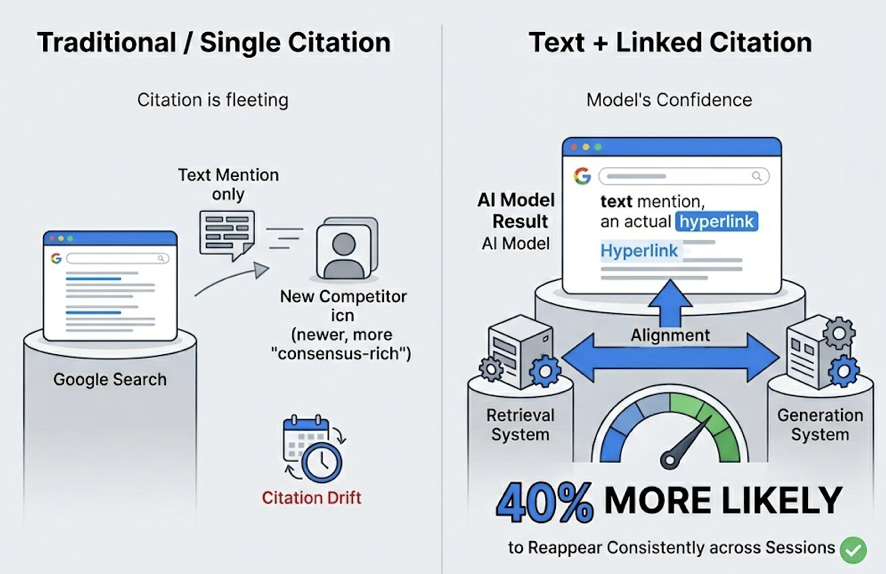
    Research shows that brands cited in AI Overviews earn 35% more organic clicks than brands that are merely mentioned. More importantly, brands that earn both a mention and a linked citation are 40% more likely to reappear in subsequent answers for the same prompt. That’s the difference between a random one-off appearance and a durable visibility position.

    This is what most share of voice models don’t capture yet.

    The Share of Voice Model Has a New Layer: Citation Inclusion Rate

    The traditional share of voice model measured ad spend or media mentions. The AI-era version tracks how often your brand appears across a set of prompts compared to competitors. That’s a real improvement.

    But there’s a third layer: Citation Inclusion Rate (CIR), which measures how often your brand’s content is used as “ground truth” by AI engines when generating their responses.

    Here’s how the three metrics stack up:

    MetricWhat It MeasuresPrimary Signal
    AI Brand Mention RateBrand name appears in AI response textAwareness & mindshare
    AI Share of Voice (SOV)Your mentions vs. total category mentionsCompetitive benchmarking
    Citation Inclusion Rate (CIR)Your content cited as source materialStrategic authority & traffic

    A high mention rate with a low CIR means AI engines know your brand exists but don’t trust your content enough to reference it. That’s an authority gap, not a visibility gap, and it requires a completely different fix.

    The AI share of voice model is most useful when it tracks all three layers together. Share of visibility tells you how wide your presence is. Citation rate tells you how deep your authority goes.

    Platform-by-Platform Citation Behavior: Why One Strategy Won’t Cover All

    One reason LLM citation tracking is technically difficult is that every major AI engine uses a fundamentally different retrieval architecture. There’s currently only an 11% domain overlap across platforms for the same set of queries. Content that earns citations on Perplexity may be completely invisible to ChatGPT’s retrieval pipeline.

    The citation volume gap across platforms is significant:

    AI EngineAvg Citations Per ResponsePrimary Citation Driver
    Perplexity21.87Content freshness (under 30 days)
    Google AI Mode17.93E-E-A-T and Knowledge Graph entities
    ChatGPT7.92Brand popularity and proper noun density
    Claude5.67Detailed, nuanced sourcing

    Google AI Overviews pull 76% to 93% of their citations from the top 10 organic search results, so traditional SEO authority still matters there. ChatGPT behaves differently: 90% of the pages it cites rank at position 21 or below on Google. The model prioritizes contextually extractable content over keyword-optimized landing pages, and brand popularity correlates more strongly with ChatGPT citations (.542) than any traditional SEO metric.

    That’s a structural divergence. If your LLM citation tracking solution only monitors one platform, you’re missing most of the picture.

    How Topify Solves LLM Citation Tracking Across Platforms

    Most AI visibility tools stop at mention counting. Topify goes a layer deeper with Source Analysis: a feature that identifies which specific domains and URLs are being cited by AI platforms in your category, then shows you how your coverage compares to competitors.

    In practice, this means a SaaS marketing team can log in and see that Perplexity is citing a competitor’s documentation pages 3x more frequently than their own, while ChatGPT is pulling from third-party review sites that haven’t featured their brand in 18 months. That’s not just a data point. That’s a prioritized action list.

    Topify tracks LLM citation behavior across ChatGPT, Gemini, Perplexity, DeepSeek, Doubao, Qwen, and other major AI platforms, with seven core metrics per brand: visibility, sentiment, position, volume, mentions, intent, and CVR. The multi-platform coverage matters because citation patterns diverge so sharply across engines. A single-platform dashboard gives you a partial view at best.

    For teams that need to move from data to action, Topify’s One-Click Execution lets you state your goals in plain English and deploy an optimization strategy without building out manual workflows. The Basic plan starts at $99/month, with coverage for 100 prompts and 9,000 AI answer analyses across four projects. You can get started here.

    Share of Voice Tracking Tools for AI Platforms: Where Citation Depth Matters

    The AI share of voice tool market has expanded quickly, but not all platforms track at the same depth. Here’s how the current landscape breaks down:

    ToolFocus AreaCitation Depth
    TopifyFull-stack GEO platformSource analysis + cross-platform citation tracking
    Peec AIMulti-engine monitoringGranular gap scoring and intent tagging
    ProfoundEnterprise brand intelligenceSentiment + competitive benchmarking
    Otterly.aiCitation monitoringBudget-friendly multi-engine mention coverage
    RankabilityGEO content analysisAI keyword research and content briefs

    When evaluating any ai share of voice tool, three criteria separate citation-capable platforms from mention-counters:

    1. Citation-level tracking vs. mention tracking. Can the tool distinguish between a brand reference and an actual sourced citation? This is the core capability gap in the market.

    2. Cross-platform coverage. Given that domain overlap across AI engines is only 11%, single-platform tools produce systematically incomplete data for any share of visibility analysis.

    3. Actionable gap analysis. Raw citation data is only useful if it maps to a content or outreach action. The most effective platforms for AI search optimization GEO surface not just where you’re missing, but which third-party domains you need to earn mentions on.

    On that last point, the data is clear: brand mentions in third-party sources correlate 0.664 with AI visibility, while traditional backlinks correlate only 0.218. The implication for any AI visibility platform share of voice strategy is that earned media and digital PR carry more citation weight than your own domain’s link profile.

    Close the Citation Gap with the DEEP Framework

    For teams ready to move from tracking to action, the DEEP framework provides a structured approach to citation gap analysis for AI search optimization.

    Discover your AI revenue surface first. Identify the 20 to 50 high-intent prompts that most directly influence buyer decisions in your category: discovery queries, competitor comparisons, and specific use-case questions. These are the prompts where your citation presence matters most.

    Evaluate the gap between mentions and citations for each prompt cluster. A brand that appears frequently but rarely gets cited has an authority gap, not a visibility gap. The fix is different for each.

    Execute on two fronts simultaneously. On-site, restructure content into modular “Fact Blocks” with direct definitional sections and 19 or more data points per page. Research shows that pages with 19+ data points receive twice as many AI citations as those with fewer. On third-party sites, prioritize the domains your AI engine already trusts. Getting updated data or expert quotes placed on those high-cited publishers is often faster than building citation authority from scratch.

    Plan for volatility. Half of cited domains in any category can change within a single month. Citation gap analysis isn’t a one-time audit. It requires a monthly or bi-weekly cadence to catch shifts in model behavior before competitors do.

    One more number worth anchoring to: pages that ranked at position 5 in organic search saw a 115% increase in AI visibility after applying GEO optimization. The AI citation landscape is not yet locked in by incumbents. Mid-market brands that move early on citation strategy have a structural window that won’t stay open indefinitely.

    Conclusion

    Your AI share of voice score tells you how often your brand shows up. Your citation rate tells you whether AI engines actually trust your content. Both metrics matter, and tracking only one leads to strategies that build awareness without authority.

    The practical starting point is simpler than most teams expect: audit your citation coverage across the two or three AI platforms your audience uses most, identify the third-party domains driving competitor citations in your category, and run those gaps against your content calendar. The teams doing this systematically today are building visibility positions that will be difficult to displace once the AI citation landscape stabilizes. The window is open. It won’t stay that way.


    FAQ

    Q: What is LLM citation tracking and why does it matter for SEO?

    A: LLM citation tracking monitors whether AI engines are citing your domain or specific pages as source material in their generated responses. It matters because citations drive referral traffic from AI answers back to your site, and brands cited in AI Overviews earn roughly 35% more organic clicks than those that are only mentioned by name.

    Q: How is AI share of voice different from traditional share of voice?

    A: Traditional share of voice typically measured advertising spend or media coverage relative to competitors. AI share of voice tracks how often your brand appears in AI-generated responses across a set of prompts, compared to your competitive set. The more advanced version also layers in Citation Inclusion Rate, which measures how often your content is used as ground truth, not just referenced.

    Q: Which AI platforms should I prioritize for LLM citation tracking?

    A: It depends on your audience, but most B2B and SaaS brands should track at minimum ChatGPT, Perplexity, and Google AI Mode. These three platforms have meaningfully different citation behaviors: Perplexity averages 21.87 citations per response and rewards fresh content, while ChatGPT cites an average of 7.92 sources and correlates more with brand popularity than organic rankings.

    Q: How does Topify measure citation-level share of voice?

    A: Topify’s Source Analysis feature identifies which specific domains and URLs are being cited by AI platforms within your category, and benchmarks your coverage against competitors. Combined with its Visibility Tracking across ChatGPT, Gemini, Perplexity, DeepSeek, and other major platforms, it lets teams see both their mention rate and citation rate in a single dashboard, then act on the gap with One-Click Execution.


    Read More

  • Your Competitor Shows Up in Every ChatGPT Answer. AI Citation Tracking Tells You Why.

    Your Competitor Shows Up in Every ChatGPT Answer. AI Citation Tracking Tells You Why.

    Your domain authority is 72. Your keyword rankings are solid across three dozen commercial terms. But when someone types “best tool for [your category]” into ChatGPT or Gemini, your brand doesn’t appear once. A competitor with half your backlink profile does.

    This isn’t a fluke. It’s what happens when traditional SEO metrics stop explaining AI search behavior. Understanding the gap requires a different framework entirely: AI citation tracking.

    What AI Citation Tracking Actually Measures (And Why It’s Not SEO)

    AI citation tracking is the practice of monitoring which specific domains and URLs are referenced by generative AI platforms when answering user queries. It measures source selection, not link hierarchy.

    That distinction matters more than it sounds. In traditional search, a high-DA site might rank first because of historical backlink volume. But the same site can be invisible in an AI answer if its content is buried behind a paywall, lacks structural clarity, or doesn’t provide a direct extractable response to what the model is trying to prove.

    The correlation data makes this concrete. Backlinks have a strong correlation with Google rankings (r > 0.70) but show low correlation with AI citation rates (r = 0.218). By contrast, topical authority depth correlates at r = 0.41 with AI visibility, and roughly 65% of AI citations go to content published within the past year. Structure and freshness beat popularity.

    There’s also a critical distinction between brand mentions and website citations. A brand mention occurs when an AI names your company in its response. A citation is when it links to your URL as a source of evidence. The gap between these two states, often called the Mention-Citation Gap, is where most brands quietly lose. You’re recognized, but not trusted as a source.

    Closing that gap is the actual goal of any serious AI citation tracking service.

    How AI Citation Tracking Service Works: The Mechanics Behind the Data

    Most AI citation tracking services work by reverse-engineering the retrieval-augmented generation (RAG) pipeline that modern AI platforms use to generate answers.

    When a user submits a prompt, the AI doesn’t just pull from memory. It runs a multi-step process: expanding the query into search terms, retrieving candidate documents from an index (Bing for ChatGPT, Google Search for Gemini), re-ranking those candidates by relevance and clarity, then synthesizing an answer while citing the specific chunks it used.

    An AI citation tracking service replicates this process systematically. Step one: submit a library of representative prompts across the buyer journey, from “what is X” to “best X for Y.” Step two: parse the responses to identify every cited URL and brand mention. Step three: aggregate which domains are winning share of voice across your prompt set. Step four: compare your citation footprint against competitors to find the specific source gaps where you should have been cited but weren’t.

    Platform-specific behavior adds another layer of complexity. Gemini tends to prioritize brand-owned websites and official domains. ChatGPT leans toward directories and third-party consensus sources like Yelp or industry listings. Perplexity favors niche expertise and specialist publications. Claude relies heavily on community and user-generated content like Reddit and forums.

    This means a brand that tracks only one platform is likely misreading its actual AI visibility position.

    5 Signals That Your AI Citation Strategy Needs a Fix

    For most teams, AI citation problems don’t show up in dashboards. They show up as quiet losses you can’t explain.

    Signal 1: The competitive frequency imbalance. Your competitors appear in AI answers 3x more often than your brand across the same set of industry prompts, even when your organic rankings are comparable. The AI has decided their content is more citable, typically because it’s better structured for extraction by a RAG system.

    Signal 2: Legacy citing beats your new content. The AI keeps citing a competitor’s three-year-old article while ignoring your comprehensive, recently updated piece. This usually means your new content lacks the signals that help AI re-rankers justify it as an authoritative source, such as original statistics, expert quotes, or clear direct-answer blocks.

    Signal 3: High-traffic pages with zero citations. Your top organic articles are pulling solid traffic but have a citation rate near zero. The content is “AI-opaque.” It may be too long-winded, structured for human reading rather than chunk extraction, or missing the direct-answer format that AI crawlers prioritize.

    Signal 4: Third parties describing your product better than you do. Gemini is citing Reddit threads and directories to explain your own product while your official website gets ignored. This signals a failure in schema markup or a lack of verifiable, structured data on owned content.

    Signal 5: No change after optimization. You restructured content with FAQ blocks and direct answers, but AI citation rates haven’t moved after 60 days. Your tracking granularity is likely too coarse. You’re either monitoring the wrong prompts, not covering enough platforms, or the tracking cycle is too short to detect the slow re-ranking shifts.

    That last one is worth sitting with.

    How to Measure AI Citation Tracking: Metrics That Actually Matter

    A single snapshot of AI visibility is nearly meaningless. The value is in tracking trends and competitive share over time.

    Citation Frequency is the baseline: the percentage of tracked prompts where your domain is cited. Think of it as your “at-bat rate” in AI answers.

    Citation Share of Voice (C-SOV) is more diagnostic. It’s your brand’s citation count divided by all citations in a given prompt set. A C-SOV of 5-10% is healthy in general categories. In highly competitive niches, 1-5% is realistic. This is the metric that tells you whether you’re growing relative to the category, not just in isolation.

    Citation Prominence adds depth. A citation placed in the first paragraph of an AI response or at the top of a sources list drives meaningfully higher click-through than one buried at the end. Some tracking platforms now apply prominence scoring to weight these positions.

    Citation Velocity measures the change in citation frequency over 30-day cycles. Citation losses tend to be binary, either you’re cited or you’re not. A sudden drop in velocity is an early warning that the AI has re-ranked away from your content, often triggered by a competitor’s recent optimization or a freshness issue on your side.

    The CTR stakes are real. When a brand is cited in an AI Overview, organic CTR holds relatively stable. When a brand is present in a search but not cited, organic CTR drops roughly 46%. That’s not a soft signal. That’s a measurable revenue gap.

    A Practical Checklist for AI Citation Tracking Setup

    Getting the infrastructure right before you start tracking saves a lot of false signal interpretation later.

    • Define a core prompt set of at least 50 questions spanning informational, comparative, and transactional intents
    • Cover ChatGPT, Gemini, and Perplexity at minimum (each uses different retrieval logic)
    • Establish a citation baseline for at least 3 direct competitors before you start optimizing
    • Verify that AI crawlers like OAI-SearchBot and GPTBot are not blocked in your robots.txt
    • Set tracking frequency to weekly or bi-weekly (daily is too volatile; monthly is too slow)
    • Map citations back to specific URLs and content formats to identify what’s actually working

    The Best AI Citation Tracking Tools in 2026: What to Look for Before You Commit

    Not every tool marketed as an “ai visibility tracker” actually gives you the source-level data you need to act. Before committing, look for three things: multi-platform coverage (at least ChatGPT, Gemini, Perplexity), competitor source benchmarking, and the ability to trace citations back to specific URLs rather than just brand mentions.

    Here’s how the main options compare:

    ToolStarting PriceKey AdvantageBest For
    Topify$99/moSource Analysis + 7-platform coverageMarketing teams, agencies
    ZipTie$69/moReal screenshots + CTR analysisSEO teams focused on AIO
    Profound$399/mo10+ engines + enterprise complianceLarge enterprises
    Otterly AI$29/moAffordable multi-platform entrySmall teams, early-stage

    For teams that need a best ai visibility tracker with genuine depth, Topify tends to stand out for a specific reason: its Source Analysis function lets you reverse-engineer exactly which domains and URLs the AI is citing in your category, including which sources are driving your competitors’ visibility. In practice, this means you can see that Perplexity is consistently citing a specific industry publication instead of your content, identify what that publication is doing structurally, and close the gap.

    Topify covers ChatGPT, Gemini, Perplexity, DeepSeek, and several other major platforms, which matters if your audience is global. The platform tracks seven core metrics: visibility, sentiment, position, volume, mentions, intent, and CVR. For teams managing multiple brands or clients, it also includes one-click competitor monitoring and prompt discovery.

    The Basic plan starts at $99/month and includes 100 tracked prompts and 9,000 AI answer analyses across 4 projects. The Pro plan at $199/month scales to 250 prompts and 22,500 analyses. For enterprise needs with dedicated support, pricing starts at $499/month. Full details are on the Topify pricing page.

    On the flip side, if your primary need is tracking Gemini visibility specifically, a gemini visibility tracker with screenshot capture (like ZipTie) may be useful for visual documentation. But if your goal is understanding why the AI cites what it cites and how to change it, source-level analysis is non-negotiable.
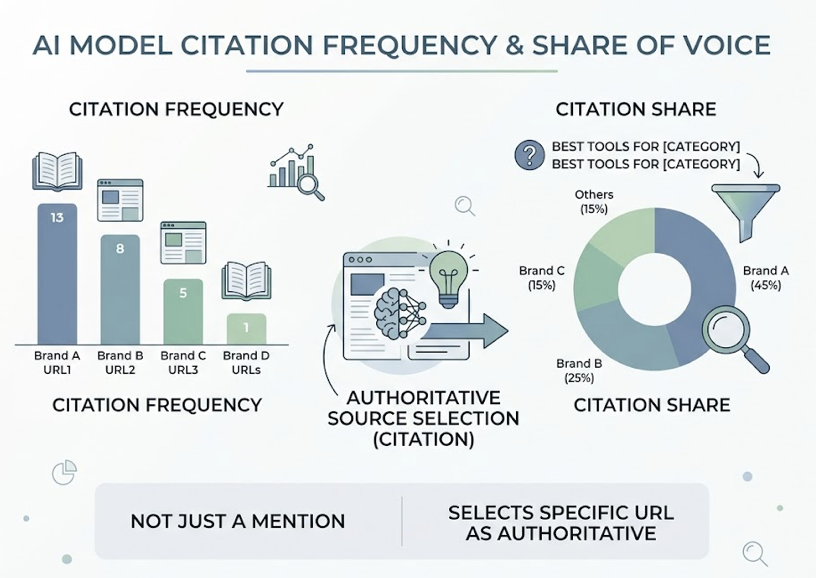
    A 90-Day Strategy to Improve Your AI Citation Tracking Results

    The brands improving their AI citation rates aren’t publishing more content. They’re publishing content that AI systems can actually extract from.

    Days 1-30: Establish the baseline. Run your core prompt set across at least three platforms. Identify the top 5 domains that are being cited instead of you. Audit their content structure, not their DA. Note whether they use direct-answer introductions, comparison tables, original statistics, or FAQ blocks. That’s your optimization target, not their backlink profile.

    Also do the technical basics: verify crawler access, implement Organization and FAQPage schema, and check whether your brand is properly represented in knowledge bases that AI engines use for parametric grounding.

    Days 31-60: Run content experiments. Research from the Generative Engine Optimization (GEO) study points to three high-impact interventions. Adding expert quotes to content correlates with roughly a 41% visibility increase. Including clear statistics correlates with a 22% lift. Converting paragraphs into comparison tables and numbered lists increases the likelihood of AI Overview citation by around 47%.

    Rewrite your top 20 pages to open with a 40-60 word direct answer. Match H2 headers to the exact phrasing of user prompts, not your internal topic taxonomy.

    Days 61-90: Validate and scale. Compare your current citation rates against the Phase 1 baseline. Identify which content formats drove the biggest lift. Look for any “binary losses,” prompts where you were previously cited but have been pruned. These usually indicate a freshness gap or a competitor who recently optimized for that specific prompt.

    Then replicate what worked. The goal is a documented content structure that consistently earns citations, not a one-time spike.

    Conclusion

    AI citation tracking isn’t a niche analytics exercise. It’s the mechanism that determines whether your brand shows up in the answers your buyers are reading right now.

    Traditional SEO tells you how you rank in a list. AI citation tracking tells you whether you’re the evidence behind an answer. As generative discovery continues to reshape how buyers research decisions, with some projections pointing to 50% of search interactions running through AI engines by 2028, the brands that built systematic tracking infrastructure early will have a compounding advantage. Get started with Topify to see where your brand stands in AI answers today.


    FAQ

    Q: What is an AI citation tracking service? A: It’s a platform that systematically queries AI tools like ChatGPT, Gemini, and Perplexity to monitor which brands and URLs are referenced as sources. Unlike traditional SEO tools, it measures your presence inside synthesized AI answers, not just link rankings.

    Q: How much does AI citation tracking cost? A: Pricing varies widely by use case. Entry-level tools start around $29/month for basic multi-platform tracking. Mid-market platforms with source analysis and competitor benchmarking typically run $99-$250/month. Enterprise solutions with custom prompt volumes and dedicated support start at $399-$499/month and scale from there.

    Q: Can you give examples of AI citation tracking in practice? A: A SaaS brand tracking the prompt “best project management tool for remote teams” across three months might find that ChatGPT consistently cites a competitor’s comparison article rather than their own product page. The source analysis reveals the competitor’s article uses a structured feature table and a direct 50-word summary at the top, neither of which the brand’s page has. That’s a specific, actionable content gap, not a vague “we need better content” conclusion.

    Q: How is AI citation tracking different from traditional backlink monitoring? A: Backlink monitoring tracks permanent HTML links between sites for SEO authority. AI citation tracking monitors real-time, algorithmically generated references that an AI uses to verify a specific claim. Backlinks correlate strongly with Google rankings. They show much weaker correlation with AI citation rates, where content structure and data clarity are the primary drivers.


    Read More

  • Google AI Overviews Tracking Tools in 2026: Most Show You Ranks, Not Why You’re Cited

    Google AI Overviews Tracking Tools in 2026: Most Show You Ranks, Not Why You’re Cited


    Your keyword still ranks #1. Same position it’s held for two years. But organic traffic from that term has dropped 40% over the last six months, and nothing in your current reporting explains it.

    The issue isn’t your ranking. Google AI Overviews now appear in nearly half of all search queries, and the AI generating those summaries isn’t necessarily pulling from your top-ranked page. It’s often citing a competitor sitting at position #23 who published a sharper statistic last month. Your rank tracking tool didn’t catch that, because it wasn’t built to.

    That’s the gap most SEO teams are still flying blind on.


    Most Google AIO Monitoring Tools Still Think in Keywords. That’s a Problem.

    There’s a distinction that most tool comparisons gloss over: google aio rank tracking and AI citation tracking are two different measurements with very different strategic implications.

    Rank tracking tells you where your URL sits in the list of organic results beneath the AI Overview box. Citation tracking tells you whether the AI’s synthesized answer is actually pulling content from your pages and linking back to you as a source.

    These two things don’t correlate the way you’d expect. Research from early 2026 shows the overlap between top-10 organic results and AIO citations has dropped from 76% in mid-2025 to somewhere between 17% and 38% today. That means roughly six out of ten sources the AI cites don’t appear on the first page of traditional search at all.

    A tool built around keyword positions will miss up to 62% of the visibility opportunities where your brand is appearing or failing to appear as an AI source.

    That’s not a minor blind spot.


    6 AI Citation Tracking Solutions for Google AI Overviews, Compared

    Before diving into individual tools, here’s a quick overview of the leading options in 2026. The table reflects AI platform coverage, citation depth, and entry pricing.

    ToolAI Platforms CoveredCitation DepthStarting Price
    TopifyChatGPT, Gemini, Perplexity, DeepSeek, AIOURL-level, 7 core metrics$99/mo
    SE RankingAIO, Gemini, ChatGPT, PerplexitySource intelligence + brand mention$129/mo (AI module extra)
    RankscaleAIO, ChatGPT, Claude, PerplexityCredit-based, evidence trails€20/mo
    Otterly.AIAIO, ChatGPT, Perplexity, GeminiHigh-level sentiment + trend$29/mo
    OmniaAIO, AI Mode, ChatGPT, PerplexityCitation-to-content brief€79/mo
    Profound10+ LLMsDeep sentiment, implicit mentions$2,000+/mo

    The right pick depends on whether you need single-platform AIO monitoring or a cross-platform citation tracking strategy. More on that below.


    #1 Topify: The AI Citation Tracking Solution Built Around Source Analysis

    Topify is the platform that consistently comes up when SEO teams move from “we should monitor Google AI Overviews” to “we need to know exactly why our competitor is getting cited and we’re not.”

    The core differentiator is its Source Analysis engine. Most google ai overviews tracking tools detect whether a brand is mentioned somewhere in an AI response. Topify extracts the specific URLs and footnotes the AI used to generate that response — not just that your competitor appeared, but which of their pages the AI treated as authoritative and for which sub-topic.

    That distinction matters in practice. It lets content teams map exactly which pages are earning citations and reverse-engineer what a competitor did to earn theirs. That’s a different order of actionability than a brand mention count.

    Topify covers ChatGPT, Gemini, Perplexity, DeepSeek, and Google AI Overviews from a single dashboard, tracking seven core metrics: AI Answer Inclusion Rate, Citation Rate, AI Share of Voice, Sentiment Polarity, Position Tracking, Information Gain Gap, and Referring Domain Baseline. For teams running google aio monitoring alongside multi-platform tracking, the unified view eliminates the manual work of stitching together data from separate tools.

    Competitor citation benchmarking is built in. You see which competitors appear in AI Overviews for your target prompts, how often they’re cited, and which URLs are driving that citation share. Monitoring becomes executable strategy rather than a reporting exercise.

    Topify’s Basic plan starts at $99/mo with a 30-day trial, covering 100 prompts and 9,000 AI answer analyses across 4 projects. The Pro plan ($199/mo) scales to 250 prompts and 22,500 analyses. For agencies managing multiple clients or in-house teams that need a complete AI citation tracking solution rather than a feature add-on, the coverage-to-price ratio is hard to argue with.


    #2 SE Ranking: Worth Considering If You’re Not Ready to Leave Traditional SEO

    SE Ranking is the strongest option for teams that still depend heavily on conventional rank tracking and want to layer in google ai overviews tracking without switching platforms entirely. Its AI Overview Tracker sits inside the core SEO suite, so keyword positions and AIO citation data share the same interface.

    The “Source Intelligence” feature is genuinely useful for competitive research. It identifies which domains are most frequently cited across a target keyword set, making it easier to spot where a specific competitor or industry publication has locked in citation dominance. International coverage is solid too — SE Ranking tracks AIO across all countries where the feature is live.

    The pricing structure is where things get complicated. The base platform runs $129/mo, but adding the AI Search module can push total cost past $270/mo for teams tracking 1,000 prompts. If you’re already a SE Ranking customer looking to add AIO coverage incrementally, that’s a reasonable upgrade. Starting fresh purely for AI citation tracking, the value case is weaker.


    #3 Rankscale: The Low-Cost Entry Point for Focused AIO Monitoring

    Rankscale is designed for smaller teams or agencies that want to test google aio tracking before committing to a larger platform. At €20/mo with a credit-based model, the entry point is genuinely accessible.

    Its standout feature is “Evidence Trails” — archived snapshots of the full AI response text and linked citations at the time of the query. This is more useful than it sounds. AI responses are non-deterministic: the same prompt can produce a different answer at 10am versus 2pm. A timestamped record makes it possible to show stakeholders what the AI actually said and when. In independent testing by Coalition Technologies, Rankscale achieved near 100% accuracy across 2,700 prompt pulls — strong performance for a budget-tier tool.

    The constraint worth noting: Rankscale is more narrowly focused on Google’s AI experiences than on a full multi-platform ecosystem. For teams whose primary objective is to track Google AIO for specific keyword sets, that focus is a feature. For teams that need ChatGPT and Perplexity data in the same view, it’s a limitation.

    For Rankscale alternatives with Google AI Overviews tracking that also extend to multi-platform AI search, Topify and SE Ranking are the natural next steps up.


    #4 Otterly.AI: Entry-Level Brand Monitoring for Teams Just Starting Out

    Otterly.AI covers Google AIO, ChatGPT, Perplexity, and Gemini at $29/mo, making it the most affordable paid option in this category. It’s well suited for small brands or solo practitioners getting their first read on where they stand in AI-generated answers.

    The trade-off is citation depth. Otterly tells you that you’re mentioned. It doesn’t tell you which URL was cited, why the AI chose that source over yours, or how citation frequency shifts week over week. For initial discovery that’s fine. For content strategy decisions, you’ll eventually need more granularity.


    #5 Semrush and Ahrefs: Legacy Suites Adding AI Layers

    Semrush’s “AI Visibility Toolkit” tracks brand mentions and citations across ChatGPT, Gemini, and Google AIO, integrating that data with its existing PPC and social media tools. It’s most valuable for large agencies already running Semrush across multiple channels where consolidation has operational value.

    Ahrefs takes a more measured approach with its “Brand Radar,” focusing on backlink correlation with AI citation patterns. The underlying data is worth taking seriously: according to Ahrefs research, 76.1% of URLs cited in AI Overviews also rank in the top 10, confirming that traditional authority still plays a foundational role. That said, the 24% that don’t rank in the top 10 — and the 62% of citations that don’t appear on page one at all — are precisely where dedicated citation tracking tools outperform legacy suites.

    Both are reasonable additions for teams already in those ecosystems. Neither was designed from the ground up for citation tracking.


    4 Things a Real Google AIO Tracking Solution Has to Do in 2026

    Running through the tools above, four capabilities separate genuine google ai overviews tracking tools from platforms that added an “AI” label to a traditional rank tracker.

    URL-level citation extraction. Knowing your brand was “mentioned” isn’t enough. AI-referred visitors convert at 14.2%— roughly five times higher than traditional organic — because they’ve already consumed a synthesized summary and arrive pre-qualified. Protecting that traffic requires knowing exactly which URLs are generating it, not just that the brand appeared somewhere.

    Multi-platform coverage. Citation overlap between Google AI Overviews and ChatGPT is only 12%. What earns you citations in AIO may do nothing for your Perplexity or ChatGPT visibility. A complete best google ai overviews tracking tool for 2026 needs to cover all three simultaneously, because your audience is already splitting their research across all of them.

    Competitor citation benchmarking. Being cited in an AI response comes with a 35% boost in organic CTR and 91% more paid clicks compared to brands that are present on the page but ignored by the AI. Knowing which competitor pages are earning that premium — and for which prompts — is the starting point for any content response.

    Time-series data and evidence archiving. 70% of cited pages have been updated within the last 12 months, and in competitive sectors, the citation set can rotate weekly. Single snapshots miss that volatility entirely. Effective google aio tracking requires a moving average of citation appearances over time, not a one-off audit your team pulls manually each quarter.


    Conclusion

    The gap between ranking and being cited has never been wider. Organic CTR for informational queries where an AI Overview appears has dropped to 0.61%, down from 1.76% just two years prior. Holding a #1 position is no longer a reliable proxy for search visibility.

    The teams gaining ground are the ones tracking citations — not just positions. That means knowing which URLs the AI is using, which competitors have locked in citation share, and which prompts are driving high-converting traffic that doesn’t appear in a standard analytics dashboard.

    Start with an audit of your citation coverage across your top 20 target prompts. Get started with Topify and you’ll have that data within the first session. From there, the content strategy becomes a lot more obvious.


    FAQ

    Q: What’s the difference between Google AIO rank tracking and AI citation tracking?

    A: Rank tracking measures where your URL appears in the organic list beneath the AI Overview. Citation tracking measures whether the AI’s generated summary is actually using your content as a source and linking back to your page. In 2026, a site can rank #1 but have zero citation share, or rank #50 and be the AI’s primary reference for a sub-topic. Research shows the overlap between top-10 organic rankings and AIO citations now sits between 17% and 38%, down from 76% in mid-2025.

    Q: Can I use Topify to track only Google AI Overviews, or does it require a multi-platform setup?

    A: Topify supports campaign-specific tracking, so you can focus on Google AI Overviews for targeted projects. That said, given that citation overlap between Google AIO and ChatGPT is only 12%, a multi-platform view typically surfaces a more complete picture of where your brand is and isn’t being cited.

    Q: Are there free google ai overviews tracking tools available?

    A: Some platforms offer limited free tiers. Aiso allows tracking for up to three topics at no cost, and LLMRankings offers a free plan for 10 keywords. Professional-grade monitoring with daily refreshes, competitor benchmarking, and archived evidence trails typically starts at $29/mo (Otterly.AI) or $99/mo for Topify’s Basic plan, which includes a 30-day trial.

    Q: How often does Google AI Overviews update its citation sources?

    A: Frequently. Research shows 70% of cited pages have been updated within the last 12 months, and in fast-moving sectors like SaaS and news, the citation set can rotate weekly or daily. One-time audits don’t capture that volatility. Time-series tracking — a moving average of citation appearances over days and weeks — is the more reliable signal for strategy decisions.


    Read More

  • AI Citation Tracking Platforms in 2026: Which Tools Actually Show What ChatGPT, Perplexity, and Claude Are Citing

    AI Citation Tracking Platforms in 2026: Which Tools Actually Show What ChatGPT, Perplexity, and Claude Are Citing

    Search “best LLM SEO trackers” and you’ll find dozens of platforms claiming to monitor AI search visibility. Most of them show you the same thing: how often your brand name appears in an AI-generated answer. That’s useful on paper, but it doesn’t answer the question most SEO teams are actually asking: which specific URLs is Perplexity pulling when it recommends your category? And why is ChatGPT citing your competitor’s comparison page instead of yours?

    The gap between brand mention tracking and AI citation tracking is where most tools stop short. Closing that gap is what separates a visibility report from an actual content strategy.

    Most LLM SEO Trackers Measure Mentions. AI Citation Tracking Is a Different Problem.

    There’s a distinction that gets glossed over in nearly every tool comparison in this space: the difference between a brand being mentioned in an AI answer and a brand’s content being cited as a source.

    Brand mention tracking tells you your name appeared in a response. Citation source tracking tells you which URL the AI pulled from to construct that response. Those are two completely different signals.

    Here’s why the difference matters in practice. Your brand might show up in a ChatGPT answer, but the citation backing the claim could link to a competitor’s blog or a third-party review site. You got the name-drop; someone else got the authority signal and the referral traffic.

    The reverse is equally important. If your content is frequently cited as a source, even when your brand name isn’t explicitly mentioned, you’re still building domain authority with the AI model. That matters because AI search traffic converts at roughly 14.2% compared to 2.8% for traditional Google search. Citation placement drives that conversion gap.

    Most perplexity seo trackers and best chatgpt seo trackers on the market today are built around mention frequency. A much smaller subset can actually parse the citation layer. That’s the distinction worth paying attention to in 2026.

    5 AI Citation Tracking Platforms, Ranked by What They Actually Measure

    Here’s how the leading platforms stack up across the dimensions that matter for citation-level analysis:

    PlatformCross-Platform CoverageURL-Level Citation TrackingSentiment AnalysisStarting PriceBest For
    TopifyChatGPT, Perplexity, Gemini, Claude, DeepSeek, Qwen, Doubao + moreYes (core feature)Enhanced$99/moMarketing teams, SEO agencies
    Profound10+ engines incl. Grok, Meta AIPartialDeep$499/moFortune 500, enterprise brand safety
    Otterly.AIChatGPT, Perplexity, AI OverviewsBasicBasic$29/moSolo SEOs, small teams
    Peec AICore B2B enginesYesStandard€89/moGlobal brands, multilingual tracking
    OmniaChatGPT, Perplexity, Google AI ModeYesSupported€79/moCross-border e-commerce, startups

    #1 Topify: URL-Level Citation Analysis Across Every Major AI Platform

    Topify is the only platform in this category that treats citation source tracking as a core feature rather than an add-on. Most tools tell you your brand appeared in an AI response. Topify tells you which specific page the AI pulled from, how often that page is cited across different prompts, and where it sits in the citation order.

    That last point carries more weight than it sounds. The first citation in an AI answer typically captures more than 60% of citation click share. Position within the citation list isn’t random, and tracking it over time is how you identify whether your content is gaining or losing ground with AI models.

    How Topify’s Source Analysis Works

    Topify doesn’t rely solely on official AI platform APIs, which can return data inconsistent with what real users see. Instead, it uses browser-based simulation to replicate actual user queries across geographic locations and device environments.

    From there, it extracts citation cards, numbered footnotes, and embedded links from AI-generated outputs. Each URL is mapped against your own content assets and your competitors’ domains. The output is a “citation gap” view: which competitor pages is AI citing in your category, and do you have comparable content that could take that position?

    When your citation share for a tracked prompt drops, the platform flags it automatically. It typically signals that your content has gone stale relative to what AI models currently prefer, or that a competitor has published something that’s pulled citation priority away.

    This is the operational difference between best-in-class perplexity seo trackers and everything else in the market.

    Coverage and Pricing

    Topify’s platform coverage spans ChatGPT (79.98% global market share, roughly 2 billion daily queries), Perplexity (the highest citation density of any major AI engine), Gemini, Claude, DeepSeek, Qwen, and Doubao. For brands operating across multiple regions, that last tier matters.

    Pricing is structured around actual usage:

    • Basic at $99/mo: 100 prompts, 9,000 AI answer analyses, 4 projects, 4 seats, 30-day trial included
    • Pro at $199/mo: 250 prompts, 22,500 AI answer analyses, 8 projects, 10 seats, full Source Analysis
    • Enterprise from $499/mo: dedicated account manager, custom prompt volumes, API access, enterprise compliance support

    You can get started with a 30-day trial on the Basic plan before committing to a higher tier.

    #2–#4: Other AI Citation Trackers Worth Knowing

    Profound sits at the enterprise end of the market, typically starting at $499/mo. Its strength is breadth: 10+ AI engines including Grok and Meta AI, plus a Conversation Explorer feature designed to catch brand hallucinations and inaccurate AI-generated claims. For Fortune 500 teams where brand governance is a compliance requirement, Profound covers the risk management layer. On the active SEO execution side, its optimization recommendations tend to be lighter compared to tools built for content teams doing iterative work.

    Otterly.AI at $29/mo is the entry point for teams getting a first read on AI visibility. It covers ChatGPT, Perplexity, and AI Overviews, and its GEO audit tool surfaces basic structured data recommendations. What it doesn’t offer is URL-level source parsing or meaningful citation depth analysis. It’s a reasonable starting point for establishing a brand visibility baseline, not for running optimization cycles based on citation data.

    Peec AI at €89/mo addresses a specific gap: multilingual citation tracking across 115+ languages. It also makes a distinction that most tools ignore, separating content the AI “used” from content it explicitly “cited” with a link. That difference matters for brands trying to understand uncredited content usage patterns. For global brands with significant non-English market exposure, Peec’s language coverage is hard to match at this price point.

    How to Choose the Right AI Citation Tracking Platform for Your Needs

    The right choice depends less on feature lists and more on what you’re actually trying to do with the data.

    If you’re building citation authority from scratch, start with Otterly.AI for a baseline read on where you stand, then move to Topify once you have enough content assets to optimize. Tracking citations before you have a content strategy to act on doesn’t generate actionable signal.

    If Perplexity is your primary channel (common for B2B companies targeting research-driven buyers), you need URL-level tracking. Perplexity’s citation logic is more explicit than ChatGPT’s, which makes source analysis both more actionable and more necessary. Topify’s Source Analysis is built specifically for this use case.

    If you’re managing multiple clients or brands, Topify’s multi-project structure and reporting capabilities are designed for agency workflows. Profound is an alternative if your clients are enterprise-scale and brand risk management is on the agenda.

    If your audience is non-English-speaking, Peec AI’s multilingual support is worth the trade-off in citation depth. For brands operating primarily in English-language markets, Topify’s platform coverage is more relevant.

    The best tools for ai citation tracking platform evaluation all come down to one core question: do you need to know that your brand appeared, or do you need to know which URL the AI is using to justify its answer? For teams running active content strategy, it’s the second question that determines results.

    What a Good AI Citation Tracking Strategy Looks Like in Practice

    Having access to citation data is half the work. The other half is a workflow that turns that data into specific content decisions.

    Here’s a four-step framework that works across team sizes.

    Step 1: Build a prompt library that reflects real user behavior. Don’t just track branded queries. Build four categories: brand prompts (“Is [your brand] reliable?”), category prompts (“What are the best [product category] tools in 2026?”), comparison prompts (“[your brand] vs [competitor]: which is better?”), and problem prompts (“How do I solve [industry pain point]?”). Run these consistently across ChatGPT, Perplexity, and Claude to establish a citation baseline. Topify’s prompt monitoring automates this across all tracked platforms simultaneously.

    Step 2: Identify your citation gaps. Once you have source data, look at which competitor pages AI is citing when answering your tracked prompts. If Perplexity keeps pulling a competitor’s comparison table when answering “how to choose [your category],” that’s not a ranking problem. It’s a content structure problem. You need a better comparison module that AI can extract from more cleanly. That’s a specific, fixable thing.

    Step 3: Optimize for AI readability. Content that gets cited tends to share structural features: clear H2 and H3 headers, FAQ sections with direct question-answer pairs, and explicit definitions of key terms. Schema markup for Entity and Product types also helps AI engines map your content to specific knowledge domains more reliably. Citation data gives you direct evidence of which pages are already doing this effectively, and which aren’t.

    Step 4: Run a two-week audit cycle. AI models update their citation preferences more frequently than traditional search indices do. A two-week cadence gives you enough time to see whether a content update shifted your citation position, without overreacting to daily noise. Use Topify’s real-time monitoring to flag drops in citation share between full audit cycles.

    This strategy for ai citation tracking platform optimization works because it closes the loop between what AI engines are doing and what your content team produces. Without citation data, that loop stays open indefinitely.

    Conclusion

    The shift from keyword rankings to citation authority isn’t a future trend. It’s already the operating reality for brands in AI-heavy search categories.

    In Google’s AI Mode, 93% of searches end without a click to any external site. The brands that extract value from AI search aren’t necessarily the ones with the highest keyword rankings. They’re the ones whose content is being selected as source material inside AI-generated answers.

    That distinction is what an ai citation tracking platform is built to reveal. If you’re still relying on tools that only report brand mentions, you’re working with half the picture. The other half is knowing which URLs are doing the actual work inside AI-generated answers, and whether those URLs belong to you or to your competitors.

    Topify gives you that visibility across every major AI platform in 2026. You can start a 30-day trial on the Basic plan and have your first citation audit running within the hour.

    FAQ

    Q: What is an AI citation tracking platform?

    A: It’s a specialized tool that monitors which specific URLs or domains AI engines like ChatGPT, Perplexity, and Claude cite when generating answers to user queries. Unlike traditional SEO tools that track keyword rankings in static search results, an AI citation tracking platform analyzes dynamic, AI-generated outputs to show you which content is being selected as evidence and where.

    Q: How does AI citation tracking work differently from traditional SEO tracking?

    A: Traditional SEO tracking measures your position in a ranked list of search results. AI citation tracking measures whether your content is selected as a source when an AI synthesizes an answer from scratch. You can rank first in Google and still not appear in AI-generated responses. The reverse is also possible: pages with modest traditional rankings can become high-frequency AI citations if their structure and content quality match what AI models look for.

    Q: What’s the difference between the best Perplexity SEO trackers and ChatGPT SEO trackers?

    A: Each AI engine has different citation preferences. Perplexity favors real-time, factual, and structured sources, and it has the highest citation density of any major platform. ChatGPT tends to weight high-authority domains from its pre-training data, like established publications and Wikipedia. The best claude seo trackers need to account for Claude’s preference for long-form, analytically structured content. The best perplexity seo trackers need real-time citation parsing. Topify builds platform-specific tracking logic to surface these differences rather than averaging them together.

    Q: How much does an AI citation tracking platform cost?

    A: Pricing varies significantly by capability. Entry-level mention tracking tools like Otterly.AI start at $29/mo. Professional citation-level platforms like Topify run $99 to $199/mo depending on prompt volume and project count. Enterprise tools like Profound typically start at $499/mo and scale with team size and platform breadth. You can see a current breakdown at Topify’s pricing page.

    Read More

  • AI Search Visibility: How to Track Your Rankings on ChatGPT and AI Overviews Over Time

    AI Search Visibility: How to Track Your Rankings on ChatGPT and AI Overviews Over Time

    Your keyword rankings are solid. Domain authority looks healthy. But when your CEO asks, “Are we showing up in ChatGPT when people ask about us?” — nothing in your current reporting stack can answer that.

    That’s the gap. AI search visibility requires a completely different tracking approach, and most teams are still figuring out where to start.

    Why Tracking AI Search Visibility Is Not Like Tracking Google Rankings

    Traditional SEO tools track a binary state: a page is either ranking or it isn’t. AI search doesn’t work that way.

    When ChatGPT or Google AI Overviews answers a query, it doesn’t rank your page. It decides whether your brand is credible enough to cite, include, or recommend. That’s a citation decision, not a ranking decision, and it operates on entirely different logic.

    The gap in outcomes is measurable. For queries where an AI Overview is present but your brand isn’t cited, organic CTR collapses by 65.2% year-over-year. Even when you are cited, you’re still looking at a 49.4% decline in organic CTR compared to pre-AIO baselines. The brands that do earn citations see a 35% boost in organic clicks and a 91% lift in paid clicks compared to competitors on the same query.

    That gap is what AI search visibility tracking is designed to close.

    Metric DimensionTraditional SEOAI Search Visibility
    Primary GoalRank #1-10 for keywordsBe cited in a synthesized answer
    Success MetricOrganic traffic / CTRShare of Voice, Sentiment, Citation Rate
    LogicRetrieval & RankingRetrieval-Augmented Generation
    StabilityHigh (fixed index updates)Volatile (model updates, source rotation)

    What AI Search Visibility Actually Measures

    Before you track anything, you need to know what you’re tracking. AI search visibility isn’t a single number.

    Visibility Rate is how often your brand appears in AI-generated answers for a defined set of prompts. Think of it as your AI Share of Voice. If an engine surfaces three to five brands per answer, this metric tells you whether you’re in that shortlist.

    Position tracks where in the response your brand appears. Being the first brand mentioned carries more weight than being fifth. Advanced frameworks use weighted position scoring where early mentions count proportionally more.

    Sentiment captures how the AI describes you, not just whether it mentions you. “Most affordable option” and “complex to implement” are both mentions. They’re not the same thing.

    Source Citations shows which URLs the AI is pulling from to build its answer. Most AI engines use retrieval-augmented generation to reduce hallucinations, so being a cited source is the most direct way to ensure your content actually shapes the output.

    For teams that need a fuller picture, Topify tracks seven indicators across these dimensions: visibility, sentiment, position, volume, mentions, intent, and CVR. That last one matters more than most people expect. AI-referred traffic converts at 4.4 to 5 times the rate of traditional organic search traffic, which means visibility improvements have a direct revenue connection, not just a branding one.

    How to Track Your AI Overviews Rankings Over Time

    As of late 2025, approximately 15.69% of all Google queries trigger an AI Overview, rising to 25.11% in high-intent sectors like healthcare and science. For marketers in competitive categories, AIO tracking isn’t optional.

    Here’s a workflow that holds up over time.

    Step 1: Build a Prompt Matrix, Not a Keyword List

    AI Overviews are triggered by conversational and question-based queries. Question-based queries have a 57.9% AIO trigger rate. Long-tail queries of seven or more words trigger at 46.4%. “Reason” queries starting with “Why” come in at 59.8%.

    Your prompt list should cover the Why, How, and What of your category. “Why is [problem] happening” and “How do I choose between [category options]” will generate AIO results far more reliably than exact-match branded terms.

    Step 2: Set Your Tracking Frequency

    40 to 60% of AIO cited sources rotate monthly. That’s not gradual drift. That’s significant churn.

    Weekly tracking is the practical minimum. Monthly snapshots will miss the shifts that actually matter.

    Step 3: Log More Than Presence

    Recording “yes/no” for whether you appeared is the most common setup mistake. You need position (first mention vs. buried toward the end), the exact phrasing the AI used to describe your brand, and which source domains were cited alongside your mention.

    Step 4: Always Track Competitors in Parallel

    Visibility is relative. If you appear in 30% of relevant AIO responses but your top competitor appears in 70%, that 30% figure tells a very different story.

    Doing this manually is feasible for a small prompt set. Scaling across 50 to 100 prompts, multiple competitors, and a weekly cadence is where Topify’s Visibility Tracking becomes practical. The platform automates prompt monitoring across ChatGPT, Gemini, AI Overviews, and Perplexity, capturing all four core metrics with historical trend data included.

    Key AI Search Analytics Metrics to Log for AI Overviews

    • Prompt Coverage: Out of your tracked prompts, how many include your brand in the AIO response?
    • Citation Sources: Which domains does the AIO consistently pull from? Is your domain in that pool?
    • Position Trend: Are you moving earlier or later in responses over time?

    How to Track Your ChatGPT Rankings Over Time

    ChatGPT operates on different logic than AIO, and your tracking setup needs to reflect that.

    ChatGPT has 800 million weekly active users and processes over 2.5 billion prompts per day. It’s a standalone destination, not a search add-on, which means the prompts users send are more varied and less predictable than Google queries. There are no fixed trigger keywords.

    Design a Multi-Seed Prompt Set

    A user might ask “best CRM for a remote team,” “alternatives to Salesforce,” or “how do I manage sales leads without spreadsheets.” Your prompt set needs to cover the full range of natural language your target audience actually uses. Start with three prompt categories: direct category queries, competitor comparison queries, and problem-framing queries.

    Track Across Model Versions

    GPT-4 and GPT-4o don’t always give the same recommendations. Different versions have different knowledge cutoffs and reasoning patterns. If you only track one model, you’re missing visibility gaps that matter to part of your audience.

    Monitor Third-Party Source Influence

    Here’s the part most teams miss: approximately 48.73% of ChatGPT’s citations come from third-party directories and review platforms like G2, Yelp, and TripAdvisor. Your ChatGPT AI search visibility is partially determined by your presence and ratings on platforms you don’t own.

    Tracking ChatGPT AI rankings, then, includes auditing what those intermediary platforms say about you, not just your own domain.

    Topify separates out platform-specific visibility data across ChatGPT and other major AI engines, so you can see exactly where you’re strong and where there’s a gap, without manually querying each platform yourself.

    Building a Long-Term AI Search Intelligence Baseline

    Single data points don’t tell you much. Trends do.

    The goal of long-term AI search optimization isn’t a one-time audit. It’s establishing a baseline, then tracking what moves it.

    Content Freshness matters more than most teams expect. Pages that aren’t updated at least every three months are 3 times more likely to lose AI citations. LLMs have a recency bias, and stale content gets deprioritized in favor of newer, more accurate sources.

    Off-site credibility now outweighs backlinks. Brand mentions on Wikipedia, Reddit, and LinkedIn carry a 0.664 correlation with AI visibility, compared to just 0.218 for traditional backlinks. A wave of Reddit discussions mentioning your brand can lift ChatGPT recommendations faster than publishing a new page on your own site.

    Competitor activity creates invisible displacement. If a rival brand earns coverage from sources your AI engines trust, they may push you out of the citation pool with no visible change to your own content or rankings.

    Source Analysis is what makes sense of all this. By tracking which domains AI engines consistently pull from, you can reverse-engineer the trust layer of your industry. If Perplexity consistently cites a specific niche publication, earning a mention there becomes more valuable than another generic backlink.

    Topify’s Source Analysis surfaces these citation patterns automatically, showing which domains AI platforms favor for your tracked prompts, so you can prioritize the content placements that actually influence AI search intelligence.

    4 Mistakes That Make AI Visibility Tracking Data Useless

    Most teams don’t fail because they picked the wrong tool. They fail because they set up the tracking wrong from the start.

    Mistake 1: Tracking Only One Platform

    Different AI engines trust different signals. Gemini tends to favor brand-owned content. ChatGPT leans on third-party directories. Perplexity prioritizes niche expert sources and community reviews. Optimizing based on ChatGPT data alone can actively hurt your Perplexity performance if the signals point in different directions.

    Mistake 2: Using Prompts That Are Too Broad

    “Best tools” produces noisy, unstable data. Effective AI search analytics use specific, constrained prompts: “best CRM for under $100 for a remote team” will give you far more reliable trend data than any category-level query.

    Mistake 3: Not Tracking Competitors

    Knowing you appear 30% of the time is meaningless without the denominator. Track every brand the AI mentions in response to your prompt set. That’s the only way to measure true AI Share of Voice.

    Mistake 4: Monthly Snapshots

    With 40 to 60% of AIO sources rotating monthly, monthly tracking means you’re essentially measuring a new baseline every time. You’ll miss the week a competitor displaced you, and you won’t know which content update moved you up.

    Topify addresses all four directly: multi-platform coverage across ChatGPT, Gemini, Perplexity, and AI Overviews; intelligent prompt suggestions; automatic competitor detection; and continuous monitoring. The Basic plan starts at $99/month, covering 100 prompts and 9,000 AI answer analyses across platforms.

    Conclusion

    Traditional SEO tells you how Google treats your brand. AI search visibility tells you how AI treats your brand. In 2026, those are two different reputations, and only one of them is growing in influence.

    The starting point is simpler than most teams expect. Build a prompt list that reflects how your audience actually asks about your category. Establish a baseline across at least two or three AI platforms. Track weekly, not monthly. Get started with Topify to set that baseline up in under an hour, then watch which changes in your content, PR, and third-party presence actually move the numbers.

    The brands that own AI search visibility today will own the discovery phase of the buyer’s journey tomorrow.


    FAQ

    Q: How do I track AI Overviews rankings over time?

    A: Build a set of conversational, question-based prompts that reflect your audience’s real queries. Track weekly because 40 to 60% of AIO cited sources rotate monthly. Log position, brand description, and source URLs for each prompt, not just whether your brand appeared. Tools like Topify automate this and provide historical trend data across prompts.

    Q: How do I track ChatGPT rankings over time?

    A: Design a multi-seed prompt set covering category queries, comparison queries, and problem-framing queries. Track across GPT-4 and GPT-4o since different model versions give different answers. Also monitor your presence on third-party review platforms, as nearly 49% of ChatGPT citations come from directories like G2 and Yelp.

    Q: What is AI search visibility and why does it matter for AI SEO?

    A: AI search visibility measures how often, where, and how positively your brand appears in AI-generated answers across ChatGPT, Google AI Overviews, and Perplexity. Cited brands see a 35% boost in organic clicks versus non-cited competitors, and AI-referred traffic converts at 4 to 5 times the rate of traditional organic traffic.

    Q: How often should I check my AI search visibility?

    A: Weekly is the minimum. Because AI citation sources rotate frequently and model behavior shifts with updates, monthly checks miss too much. For brands in active optimization campaigns or competitive categories, daily monitoring is worth considering.


    Read More