Category: Knowledge

  • What Is Topify AI Agent and How Does It Boost Your Content?

    What Is Topify AI Agent and How Does It Boost Your Content?

    Most AI visibility tools stop at the dashboard. They show you where your brand appears, which platforms mention you, and how sentiment trends over time. Then they hand the work back to you.

    Topify AI Agent is built around a different premise. Instead of delivering a report and waiting, the agent monitors your AI search performance, reasons through the data, and executes strategy on your behalf. That shift, from insight to action, is what separates an agentic system from a tracking tool.

    What Topify AI Agent Actually Is

    The term “AI agent” gets applied to a lot of things in 2026, from simple chatbots to fully autonomous workflows. Topify AI Agent sits firmly in the latter category.

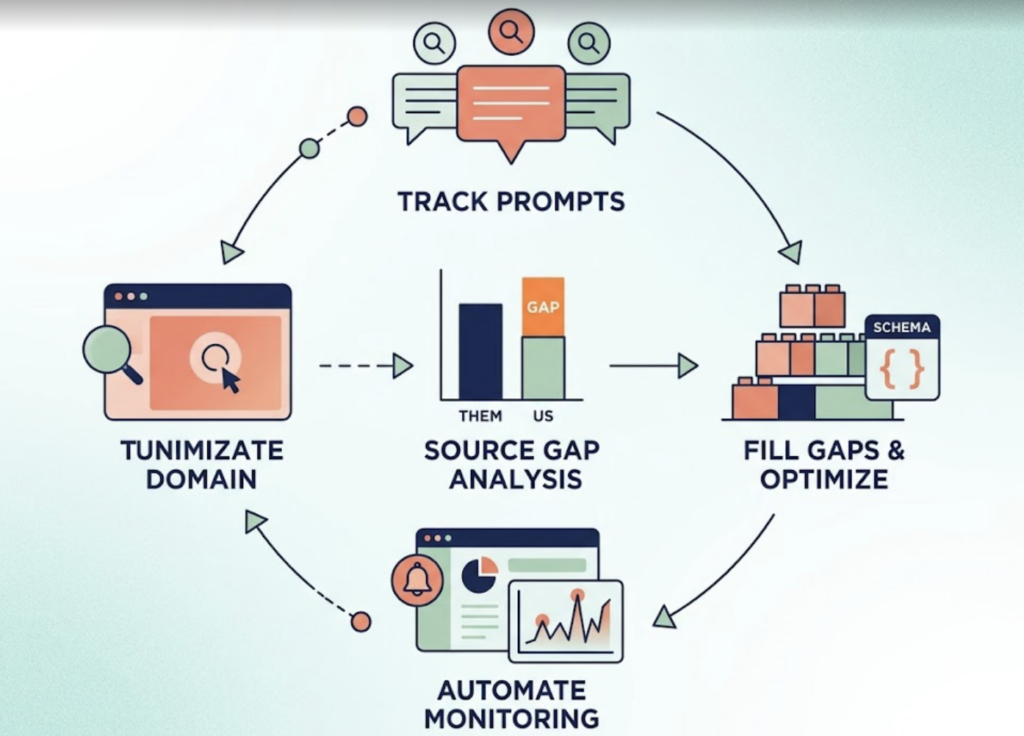
    At its core, it runs a continuous loop: monitor brand performance across AI platforms, analyze what the data means for your visibility, and execute GEO and AEO strategies without requiring manual input at every step. You define the goal in plain English. The agent handles the rest.

    That’s a meaningful distinction. Most teams using GEO tools spend hours translating data into action. Topify AI Agent compresses that cycle into a single operation.

    The Search Environment That Made This Necessary

    To understand why an agentic approach matters, it helps to see what the search landscape actually looks like right now.

    ChatGPT now exceeds 900 million weekly active users, and Google AI Overviews appear in over 25% of all searches. More telling: approximately 65% of all searches now end without a click. The user got their answer directly from the AI, and no one’s website got the visit.

    Traditional organic conversion rates run around 2.8%. Visitors arriving via LLM citations convert at 14.2%, roughly five times higher. LLM referral traffic is up 357% year over year.

    The math is clear. The question is how to consistently appear in those AI answers at scale.

    How Topify AI Agent Works: Monitor, Reason, Act

    The agent operates on a three-stage cycle that runs continuously in the background.

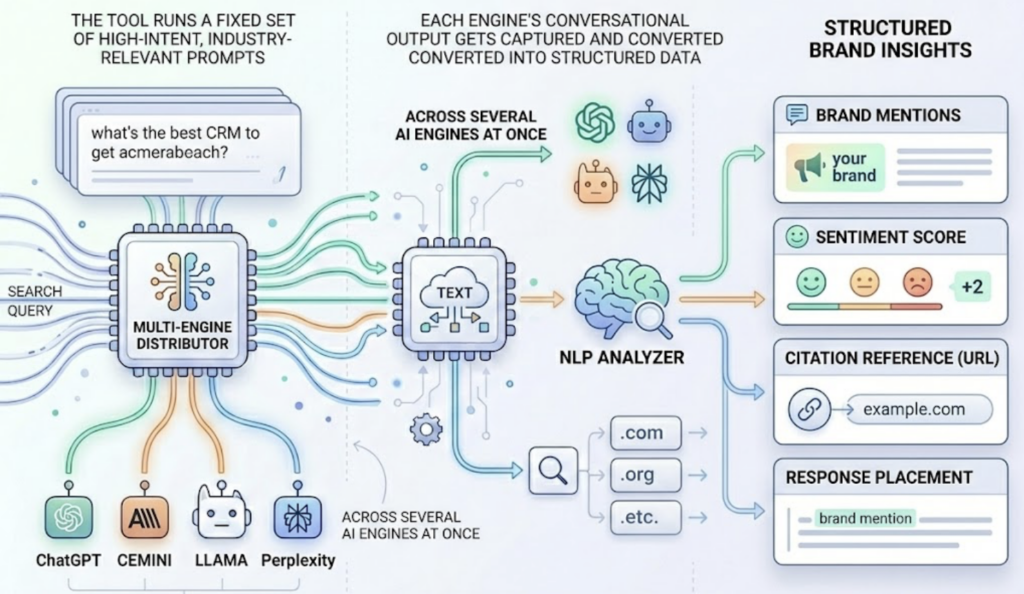
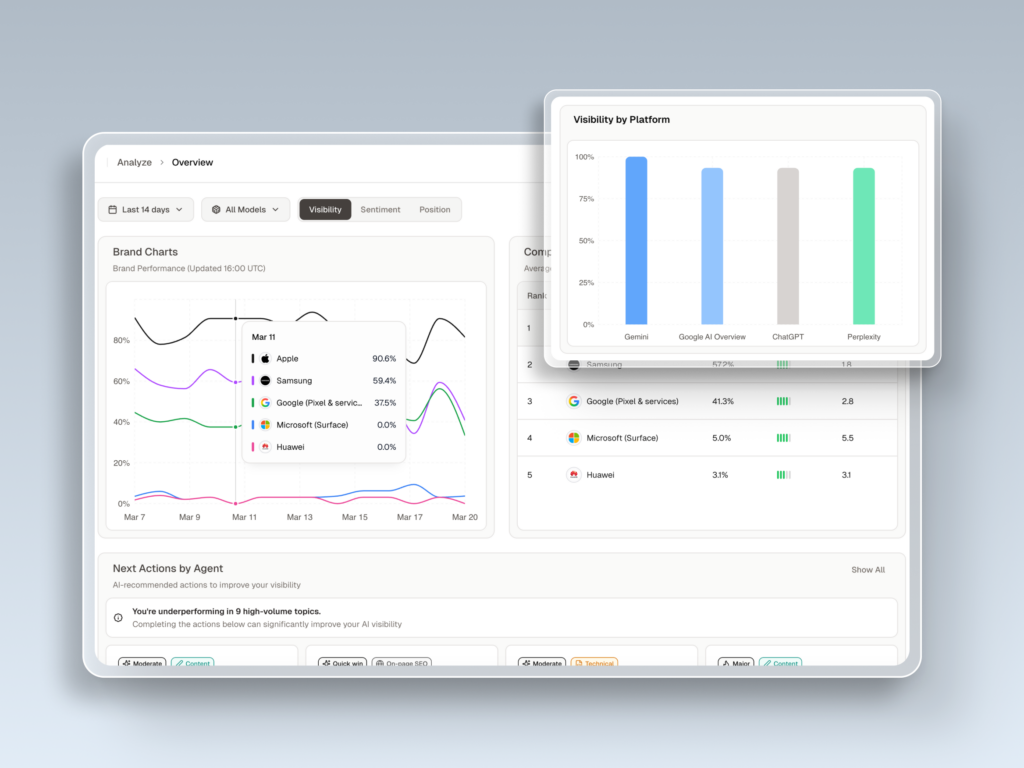
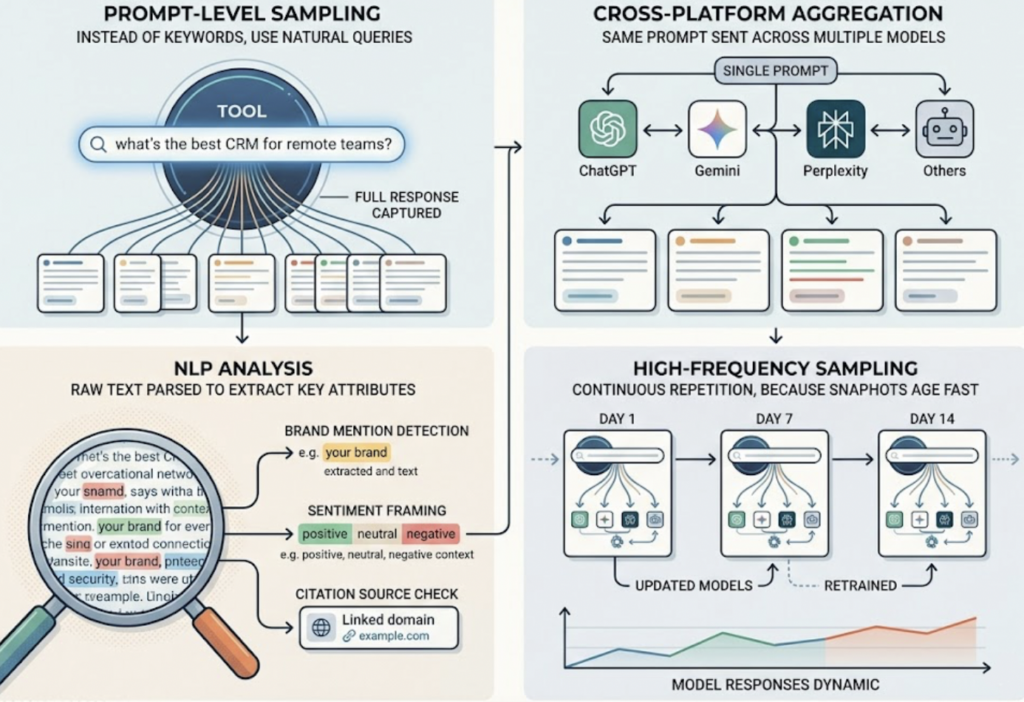
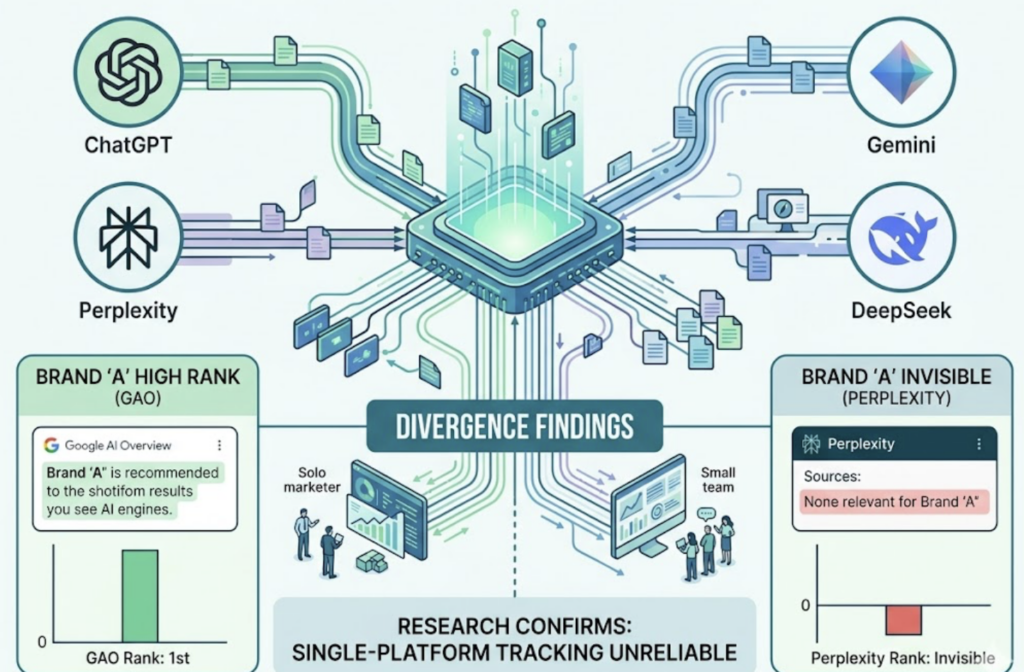
    Monitor. Topify tracks brand performance across ChatGPT, Gemini, Perplexity, DeepSeek, Doubao, Qwen, and Google AI Overviews. It measures seven core metrics: visibility, sentiment, position, volume, mentions, intent, and CVR. The agent systematically sends prompts across these platforms and captures how each one responds to queries in your category.

    Reason. Raw data gets processed through Topify’s analytics layer. One key capability here is Dark Query discovery. These are high-intent conversational prompts that users type into AI engines but that don’t appear in tools like Semrush or Ahrefs. Research shows that AI visibility correlates far more strongly with brand mentions (0.664) than with traditional backlinks (0.218). Dark queries are often where the real visibility gap lives.

    Act. Once the agent identifies content gaps, citation opportunities, or competitive threats, it generates an execution plan and deploys it. You review the proposed strategy and launch with one click. No manual workflow required.

    Most tools give you the first two stages. Topify AI Agent closes the loop on the third.

    5 Ways Topify AI Agent Boosts Your Content

    The agent’s impact on content is specific. Here’s where it shows up in practice.

    Prompt Discovery That Surfaces What You’re Missing

    The agent continuously uncovers high-volume AI prompts in your category that you’re not currently winning. It runs a 10-step query fan-out pipeline, from multi-seed research to a 0-100 citability score, to prioritize which opportunities deliver the most visibility gain. This is especially useful for catching dark queries before competitors do, since those queries won’t show up in any traditional keyword research tool.

    Source Analysis to Close Citation Gaps

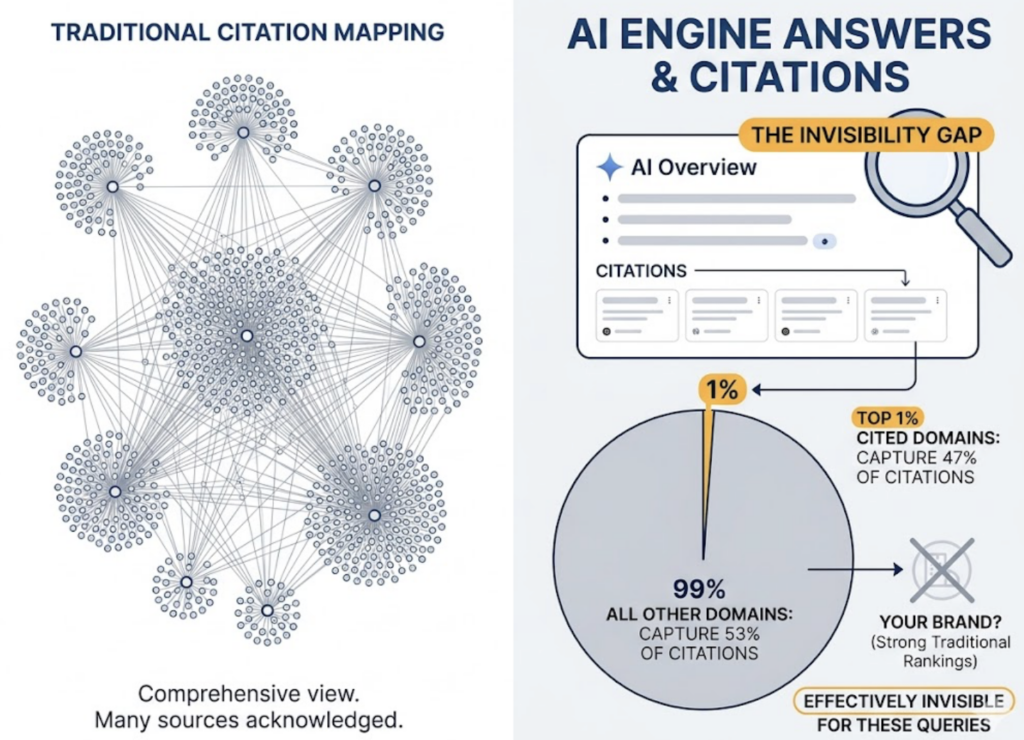
    Topify tracks exactly which domains AI platforms cite when they answer questions in your category. If your site isn’t among them, the agent identifies what content you’d need to produce or update to become citable. Sites with over 32,000 referring domains are 3.5x more likely to be cited by ChatGPT than those with fewer than 200. Source analysis tells you where you stand and what to fix first.

    Competitor Benchmarking in Real Time

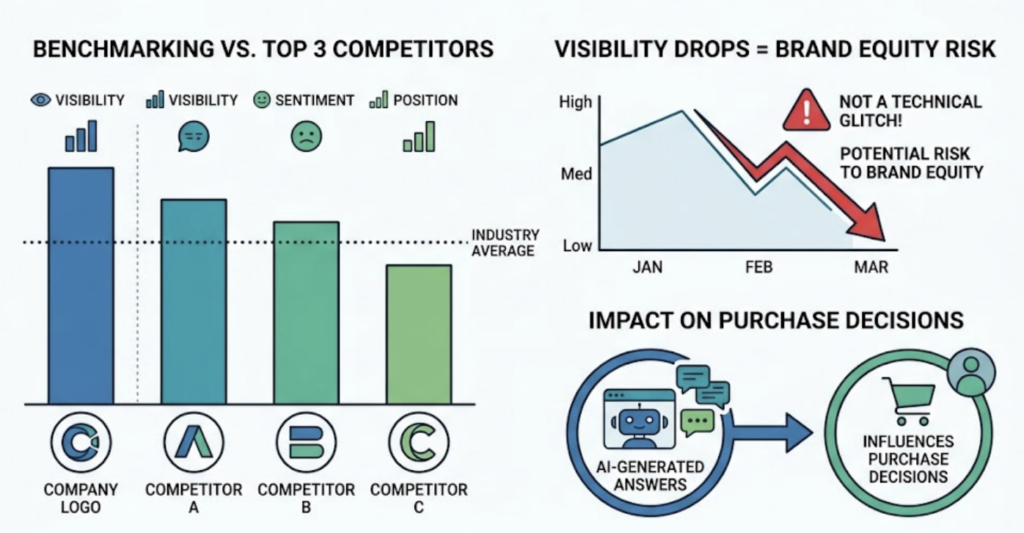
    The agent monitors which competitors are being recommended in your category, how their sentiment scores compare to yours, and how their position is shifting week over week. You don’t have to go looking for this. If a competitor gains ground in a specific prompt cluster, you’ll know.

    Content Generation Tied to GEO Data

    Content created through Topify is generated from actual AI visibility data, not generic topic research. That means the articles, FAQ entries, and structured data it produces are designed to address the specific prompts where your brand needs to appear.

    The cost difference is significant. AI content engines bring per-article costs down to roughly $8-12, compared to the $1,100-$2,000 range for in-house production. A team producing three articles per week through the platform invests around five hours total, versus 25-36 hours through traditional processes. One thing worth noting: pages not updated within 14 days show a 23% decline in AI citation frequency. Content velocity matters here more than it does in traditional SEO.

    Seven-Metric Performance Tracking

    Topify measures what actually matters in AI search: AI Brand Mention Rate, AI Share of Voice, AI Citation Rate, Answer Inclusion Rate, Sentiment Distribution, Dark Query Capture, and LLM Visitor Conversion Rate. These go well beyond what any traditional rank tracker provides and give teams a real performance signal tied to business outcomes, not proxy metrics.

    AEO vs. GEO: What Topify AI Agent Optimizes For

    These two strategies are often conflated, but they target different outcomes.

    GEO (Generative Engine Optimization) focuses on long-term citation presence in AI-generated answers. The academic definition, developed by researchers at Princeton and Georgia Tech, emphasizes content depth, accuracy, and citation-worthiness. It’s about shaping how AI models synthesize your brand across future responses, not just capturing a snapshot ranking.

    AEO (Answer Engine Optimization) is faster and more tactical. It targets featured snippets, voice assistant responses, and zero-click results. AEO content uses Q&A pairs, direct answer sections, and structured schema to make it easy for AI to select your content as the primary source for a given query.

    Topify AI Agent works across both simultaneously. It optimizes for immediate citation inclusion through AEO-style content structure, while building the authority and content depth that determines long-term generative visibility through GEO. The two strategies reinforce each other. As of early 2026, 94% of enterprise digital leaders plan to increase their AEO/GEO investments, with around 12% of digital marketing budgets now going toward AI visibility.

    Who Gets the Most Out of Topify AI Agent

    The agent scales differently depending on how you use it, but three profiles tend to see the clearest returns.

    Marketing agencies managing multiple client brands benefit from the agent’s ability to run parallel monitoring and execution across accounts. Instead of manually querying AI platforms for each client, the agent handles it from a single platform with consistent methodology.

    In-house marketing and growth teams without dedicated GEO analysts can use the agent to close the expertise gap. You don’t need a team of specialists to run a structured AI visibility program. The agent replaces a significant amount of the analytical and execution labor that would otherwise require hiring or outsourcing.

    SaaS and AI product companies competing for discovery in a crowded category need consistent presence in AI recommendations. The agent ensures your product appears in the prompts where buyers are making decisions, not just in traditional search results where you’ve already invested.

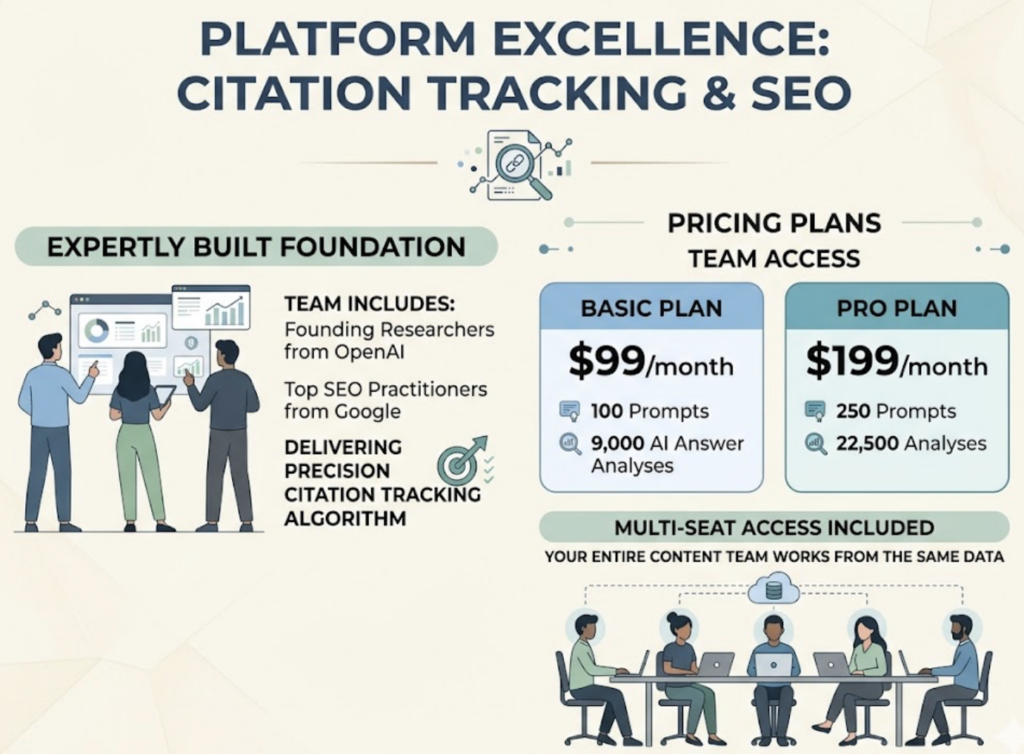
    Topify’s plans start at $99/month for the Basic tier, which includes 100 prompts, tracking across ChatGPT, Perplexity, and AI Overviews, 50 content generations, and 4 seats. The Pro plan at $199/month scales to 250 prompts and 100 content generations for larger teams. Enterprise plans start at $499/month and include dedicated account management and custom configurations.

    Conclusion

    Most content strategies stall not at the insight stage, but at execution. You know what AI platforms are saying about your brand. You see where competitors are being cited instead of you. Then comes the manual work of translating that into content, distribution, and tracking, which rarely keeps up with how fast AI recommendation patterns shift.

    Topify AI Agent is designed to close that gap. By running the monitor-reason-act cycle continuously, it turns AI visibility data into deployed strategy without requiring a team to manage every step. In a landscape where 65% of searches end without a click and LLM conversion rates outpace organic by 5x, that execution speed is the actual competitive advantage.

    Get started with Topify to see where your brand currently stands in AI search.


    FAQ

    Q: What’s the difference between Topify AI Agent and a standard AI content tool?

    A: Most AI content tools generate text from a prompt you provide. Topify AI Agent starts by monitoring how AI platforms respond to queries in your category, identifies where your brand is missing or underrepresented, and then generates content specifically designed to close those gaps. The input is AI visibility data, not a blank brief.

    Q: Does Topify AI Agent support AEO optimization specifically?

    A: Yes. The agent optimizes for both AEO and GEO at the same time. On the AEO side, it helps structure content for direct inclusion in featured snippets and zero-click results using Q&A formats and structured schema. On the GEO side, it builds the citation authority and content depth that shapes long-term inclusion in generative responses.

    Q: Which AI platforms does Topify AI Agent monitor?

    A: Topify tracks brand performance across ChatGPT, Gemini, Perplexity, DeepSeek, Doubao, Qwen, and Google AI Overviews, covering the major platforms where target audiences are searching across global markets.

    Q: How quickly does Topify AI Agent show results?

    A: AEO improvements, such as structured schema and direct-answer content, typically show up in AI responses within days to a few weeks. GEO results, which involve building citation authority across the broader web, tend to compound over one to three months. The agent’s continuous monitoring means you’ll see signal changes as they happen rather than waiting for a monthly report.


    Read More

  • What Is an AI Agent? Why Most Teams Are Still Getting This Wrong

    What Is an AI Agent? Why Most Teams Are Still Getting This Wrong


    Everyone on your team has heard the phrase “AI Agent” at least once in the last six months. Most people nod along. Few can actually explain what makes an agent different from the ChatGPT tab they already have open.

    That confusion isn’t just a vocabulary problem. It’s a strategic one. Companies are reorganizing workflows, reallocating budgets, and making hiring decisions based on what AI agents can supposedly do, while the underlying technology remains poorly understood at the team level. The gap between assumption and reality is wide enough to stall real adoption.


    Most People Think AI Agents Are Just Smarter Chatbots. Here’s the Actual Difference.

    The standard chatbot operates on a simple logic: one input, one output, no memory of what came before. Every conversation starts from zero. You write the prompt, it writes the response. The system doesn’t carry context, doesn’t track goals, and doesn’t do anything you didn’t explicitly ask for.

    An AI agent works differently. You give it a goal, not a prompt. The agent plans the steps, calls external tools, checks its own work, adjusts when something goes wrong, and keeps going until the task is done.

    Here’s a concrete example. Ask ChatGPT to “schedule next week’s meetings” and it’ll draft a polite email you can send yourself. Give the same instruction to an AI agent and it reads your calendar, checks attendee availability via API, sends the invites, and updates the reminders when someone responds. Same words. Completely different result.

    That’s not a performance upgrade. That’s a different category of tool.

    Traditional ChatbotAI Agent
    Interaction modelOne prompt, one responseGoal-driven, self-directed execution
    Task complexitySingle-step Q&AMulti-step, cross-system workflows
    MemoryNo memory across sessionsShort-term context + long-term knowledge
    Tool useText generation onlyAPIs, browsers, databases, code execution
    Error handlingGenerates a response regardlessSelf-evaluates and corrects course

    How an LLM Agent Actually Works: The 4-Layer Structure

    The autonomy of an AI agent isn’t arbitrary. It comes from a specific four-layer architecture that extends what a language model can do on its own.

    Perception is the entry point. The agent reads its environment: your instructions, API responses, document contents, web pages, even sensor data. In a competitive research task, this layer pulls raw information from industry databases and competitor websites before the agent writes a single word.

    Reasoning is where the real work happens. A high-performance LLM, like GPT-4o or Claude 3.5 Sonnet, breaks down a vague goal into a concrete sequence of steps using chain-of-thought logic. It also checks itself: “Did step two give me what I needed to do step three?”

    Action is the execution layer. The agent calls APIs, runs scripts, navigates browsers through automation tools like Playwright, and writes to databases. This takes it out of the chat window and into your actual business systems, updating a CRM record, committing code, or publishing an article, all without a human confirming each move.

    Memory is what makes it coherent over time. Short-term memory tracks what happened in the current session. Long-term memory, often powered by vector databases, stores past task outcomes, user preferences, and domain knowledge so the agent doesn’t start from scratch every time.

    Put the four layers together and you get what researchers call “agentic AI”: a system that perceives, reasons, acts, and remembers, rather than one that simply responds.


    One Intelligent Agent Is Fine. Multiple Agents Working Together Is a Different Game.

    Single agents handle focused, linear tasks well. Scale to complex workflows across multiple systems and a single agent starts to strain under the cognitive load, and error rates climb.

    That’s the logic behind multi-agent systems (MAS). Instead of one agent doing everything, you have multiple specialized agents working in parallel: one searches, one drafts, one fact-checks, one publishes. Each handles what it’s built for.

    The output quality improves because agents can challenge each other’s work, catch errors the original agent missed, and run subtasks simultaneously instead of in sequence.

    Three frameworks dominate how enterprises are building these systems right now:

    FrameworkCore philosophyBest for
    LangGraphGraph-based orchestration (nodes and edges)Finance, healthcare: deterministic logic and compliance
    CrewAIRole-based team collaborationMarketing automation, content pipelines, customer support
    AutoGenConversation-centric collaborationSoftware engineering, iterative research and code tasks

    CrewAI has the lowest ramp time for non-technical teams. LangGraph wins on stability and auditability when the task can’t tolerate a wrong output. The right choice depends on how much determinism your workflow requires.


    What AI Agents Can Actually Do in a Business Right Now

    This isn’t speculative. According to a 2025 PwC survey, 79% of organizations have adopted AI agents in some form, and 43% are allocating more than half of their AI budget to agent systems (Multimodal, 2025). Gartner projects that by end of 2026, 40% of enterprise software will integrate task-specific AI agents.

    Here’s where the actual work is happening today.

    Sales teams are using AI SDR agents that research leads, personalize outreach, and update CRM records around the clock. Companies using AI agents for lead nurturing report 4 to 7 times higher conversion rates compared to traditional methods, according to Landbase data.

    Customer service is one of the highest-ROI deployments. Gartner projects AI agents will autonomously resolve 80% of routine support tickets by 2029, cutting operational costs by 30%. Reddit’s internal deployment cut support case resolution time by 84%.

    Content and marketing teams are using agents to automate research, draft SEO-optimized copy, and schedule publishing. At Seattle Children’s Hospital, agents helped the content team improve editing speed by 32% and overall creation speed by 46%.

    Security and DevOps teams run agents for round-the-clock threat monitoring and auto-remediation. In documented deployments, vulnerability risk dropped by 70% and average incident response time was cut by half.

    The global average ROI across enterprise AI agent deployments sits at 171%. For U.S. companies specifically, that number reaches 192% (Landbase, 2025).


    AI Agent vs. Copilot: Two Very Different Philosophies

    Both use large language models. Both are sold as productivity accelerators. The similarity ends there.

    A Copilot lives in your sidebar. It waits for you to trigger it, generates a suggestion, and waits for you to decide what to do with it. Every step requires your involvement. Microsoft 365 Copilot and GitHub Copilot are the most common examples: useful, widely deployed, and fundamentally dependent on a human in the loop.

    An agent doesn’t wait. You set the goal and the guardrails, then step back. Salesforce’s Agentforce, for instance, doesn’t just suggest a follow-up email. It executes the entire follow-up workflow inside the CRM without you touching it.

    AI AgentCopilot
    Trigger mechanismGoal/event-drivenStep-by-step human trigger
    Autonomy levelHigh, self-planningLow, requires human confirmation per step
    MemoryLong-term, cross-sessionCurrent document or conversation window
    Representative toolsAgentforce, AutoGPT, DevinMicrosoft 365 Copilot, GitHub Copilot
    Core valueReplaces repetitive multi-step workflowsAccelerates individual task completion

    The practical question isn’t which is better. It’s which one your workflow actually needs. Copilots are the right tool for augmenting creative or high-judgment tasks. Agents are the right tool for automating structured processes that don’t need a human confirming every loop.


    Will AI Agents Replace Human Workers? A More Precise Question to Ask.

    The honest answer: agents are replacing tasks, not jobs.

    High-repetition, rule-based work is already being taken over. Data entry, lead qualification, report generation, routine code changes. These don’t require judgment. They require execution at scale, and agents do that better.

    What’s actually happening to people is more nuanced. GitHub research found that developers using AI tools complete tasks 55% faster. But that efficiency gain isn’t evenly distributed. Entry-level workers in high-AI-exposure roles, specifically ages 22 to 25, saw employment rates drop by 13% in affected categories. Senior engineers, by contrast, are spending less time on boilerplate and more time on architecture, security review, and agent orchestration.

    That’s the consistent pattern. Agents raise the floor on what competent execution looks like, which raises the baseline skill requirement for human contributors.

    The Stanford AI Index reported that engineers with demonstrated AI tool proficiency earn $20,000 to $50,000 more per year than peers without it. The labor market is already pricing in the skill premium.

    AI agents won’t replace software developers. They will make developers who can’t use them competitively irrelevant.


    AI Agents Are Changing How Brands Get Discovered. Most Marketing Teams Haven’t Priced This In.

    When a user types a query into traditional search, SEO determines whether your brand appears on page one. That logic still holds for a shrinking share of search behavior.

    Increasingly, users are asking AI systems directly: “What’s the best project management tool for a 10-person remote team?” The AI responds with a short list. If your brand isn’t cited, the user moves on. You didn’t rank lower. You didn’t exist.

    When AI Overviews appear in search results, organic click-through rates drop by an average of 61%. As AI agents become the primary interface for research, shopping, and software selection, the question shifts from “do we rank?” to “does AI recommend us?”

    This is the core problem that Generative Engine Optimization (GEO) addresses. It’s also the reason platforms like Topifyexist. Topify tracks how often your brand is cited across ChatGPT, Gemini, Perplexity, DeepSeek, and other major AI platforms, measuring not just whether you appear, but where you rank relative to competitors, how AI describes your brand, and which sources AI is pulling from when it does.

    Built by founding researchers from OpenAI and champion Google SEO practitioners, Topify turns AI visibility into a structured, measurable growth channel — the same way analytics platforms did for web traffic a decade ago.

    For marketing teams operating now, AI visibility isn’t optional. It’s the new SEO.


    Conclusion

    AI agents aren’t a smarter version of the chatbot you already use. They’re a distinct category of software: autonomous systems that perceive context, reason through multi-step problems, execute across real business tools, and retain memory between sessions.

    The teams that understand this early have a real operational advantage. Start by mapping the high-repetition, multi-step processes in your workflow that don’t require human judgment at each step. Those are your first agent candidates. Then ask a harder question: when your customers use AI agents to find tools, vendors, or services in your category, is your brand in the answer? Get started with Topify to find out exactly where you stand.


    FAQ

    Q: What does “Agentic AI” mean?

    A: Agentic AI refers to AI systems that don’t just generate content but independently plan and execute complex tasks. “Agentic” describes the degree of autonomy: the system selects its own tools, manages multi-step processes, and adjusts based on feedback without human intervention at each step. It’s less about the model’s raw capability and more about how that capability is deployed.

    Q: How do you build your own AI Agent?

    A: Building an agent typically involves four steps: selecting a core LLM (GPT-4o, Claude, or similar), defining the perception and memory layers through RAG and a vector database, configuring the action tools the agent can call (APIs, scripts, internal systems), and using an orchestration framework like CrewAI or LangGraph to manage the logic and guardrails. Most teams start with CrewAI for its lower barrier to entry, then migrate to LangGraph as workflow complexity increases.

    Q: What are the best AI Agent tools and platforms in 2025?

    A: For developers building custom agents, LangGraph, CrewAI, and AutoGen are the dominant frameworks. For enterprise deployment, Salesforce Agentforce leads in CRM workflows and Devin has become the benchmark for AI software engineering. For teams that need to monitor whether their brand is being recommended by AI agents in customer-facing contexts, Topify tracks brand visibility and citation patterns across the major AI platforms your buyers are already using.

    Q: What are the biggest AI Agent trends heading into 2025 and 2026?

    A: The clearest shift is from single-agent pilots to multi-agent systems deployed at workflow scale. Enterprises that ran isolated experiments in 2024 are now building full agentic pipelines across sales, support, and content operations. Alongside this, GEO (Generative Engine Optimization) is emerging as a distinct marketing discipline focused on brand visibility inside AI-generated answers rather than traditional search rankings. Agent cost optimization and safety guardrails are becoming critical infrastructure as deployments mature and regulatory scrutiny increases.


    Read More

  • 20 Key Stats About AI Agents You Need to Know

    20 Key Stats About AI Agents You Need to Know

    AI agents are no longer a research project. They’re handling the workload of entire teams, reshaping how consumers discover brands, and quietly making purchasing decisions on behalf of millions of users.

    Here are 20 stats that show exactly where the shift is happening, and what it means for how your brand gets found.

    AI Agents Are Already Making Decisions, Not Just Answering Questions

    Before the numbers, a quick distinction worth making: AI agents aren’t chatbots with a better interface. Traditional chatbots match patterns and return responses. Agentic AI reasons through goals, builds multi-step plans, and executes tasks using real tools, including CRMs, databases, and payment systems, often without a human in the loop.

    That architecture difference changes everything.

    Stat 1: Some enterprises are already running AI agents that handle work previously requiring 3 full-time employees, executing complex workflows end-to-end.

    Stat 2: AI agents’ task complexity doubles approximately every 213 days. This isn’t linear improvement. It’s compounding capability.

    Stat 3: During Cyber Monday 2025, AI agents influenced roughly 20% of global orders, contributing over $67 billion in sales. That’s not AI assisting shoppers. That’s AI acting as the shopper.

    These three numbers establish the baseline: agentic AI has moved from prototype to production.

    The Market Is Moving Fast: AI Agent Adoption Stats

    The investment data confirms what the enterprise deployments already suggest. This market isn’t building slowly.

    Stat 4: The core AI agent market is projected to grow from $7.84 billion in 2025 to $52.62 billion by 2030, a CAGR of 46.3%.

    Stat 5: When you expand to the full agentic AI ecosystem, including infrastructure, tooling, and adjacent services, the numbers are even more striking. Gartner projects growth from $15.04 billion (2024) to $752.73 billion by 2029, a 118.73% CAGR.

    That 50x expansion in five years is not a forecast built on optimism. It’s built on enterprise adoption curves that are already visible.

    Stat 6: North America currently holds 39.63% of the global AI agent market share, with financial services, healthcare, and manufacturing leading deployment.

    Stat 7: According to Microsoft’s February 2026 report, over 80% of Fortune 500 companies are now running active AI agents built on low-code/no-code platforms. This is no longer a pilot program statistic. It’s a baseline.

    Stat 8: 92% of enterprises plan to increase AI budgets over the next three years. The spending isn’t slowing down. It’s accelerating.

    What Agentic AI Is Actually Doing Inside Companies

    Adoption rates only tell part of the story. The more useful question is: what are these agents actually doing, and what’s changing as a result?

    Stat 9: In customer service, AI agents are projected to handle 80% of interactions by 2026, reducing operational costs by approximately 30% while cutting required human interventions by 65%.

    Klarna’s deployment puts a concrete face on that number. In its first month, the company’s AI assistant handled 2.3 million conversations, equivalent to the output of 700 full-time employees. Average resolution time dropped from 11 minutes to 2 minutes, with no measurable drop in customer satisfaction.

    Stat 10: In software engineering, 75% of engineering teams have integrated AI agents, resulting in a 43% increase in code commits.

    Stat 11: In IT and cybersecurity, adoption sits at 53%, with incident response times reduced by 30%.

    Stat 12: In healthcare, AI agents are projected to save the industry $150 billion annually by 2026, primarily by handling administrative workload and reducing staffing gaps.

    Stat 13: In manufacturing, AI-coordinated warehouse systems have improved delivery speed by 25% and overall efficiency by 25%.

    The pattern across industries is consistent: agents aren’t replacing strategy. They’re absorbing execution.

    How AI Agents Are Reshaping Search and Why AEO Matters Now

    Here’s where the impact on brand visibility becomes direct.

    AI agents don’t just do work inside companies. They’ve also become the primary interface through which millions of people find products, compare options, and make purchase decisions. That shift has broken the traditional search funnel.

    Stat 14: 60% of Google searches now end without a single click. When AI Overviews are triggered, that number climbs to 83%.

    This is what researchers are calling “the great decoupling”: search volume is still growing, but traffic to brand websites is falling. If your brand isn’t part of the AI-generated summary, you’re not part of the decision.

    Stat 15: ChatGPT now has 800 million weekly active users, and accounts for 77% of AI-referred traffic across major platforms.

    Stat 16: Google AI Overviews appear in 87% of queries. Gemini has 750 million monthly active users. Perplexity’s monthly active user base grew 89% in Q3 2025 alone.

    These aren’t niche platforms anymore. They’re the front page of the internet for a large and growing share of users.

    That’s why Answer Engine Optimization (AEO) has moved from a technical curiosity to a core marketing discipline. AEO is the practice of structuring content so AI systems select it as the authoritative answer and cite it as a source. If SEO was about ranking on page one, AEO is about being the answer that gets read aloud.

    Stat 17: AI-referred traffic converts at 23x the rate of traditional organic search. The economic value per AI-referred user is 4.4x that of a standard organic visitor.

    That’s not a marginal improvement. It’s a different category of traffic quality.

    Brand Visibility in AI: Stats That Show the GEO Gap

    The data on AI citations reveals a structural problem most marketing teams haven’t addressed yet.

    Stat 18: Brand-owned websites account for only 5% to 10% of what AI systems actually cite. The other 90% comes from third-party publishers, Reddit, Wikipedia, and review platforms.

    This means your website’s domain authority matters far less than your brand’s presence across the broader information ecosystem. The entities AI trusts are not necessarily the ones you control.

    Stat 19: Web mentions (the volume and breadth of references to your brand across the open web) correlate with AI visibility at a coefficient of 0.664. Traditional backlink quality? Just 0.218.

    That’s a meaningful gap. The inputs that drove SEO performance for two decades are significantly less predictive of AI visibility than raw brand mention coverage.

    Stat 20: 89% of AI Overview citations come from pages ranked outside the traditional top 100 search results. Meanwhile, 26% of brands currently have zero mentions in AI-generated search responses.

    That last number is the one that should drive urgency. More than one in four brands is effectively invisible to the AI systems that are now intermediating consumer decisions.

    The brands that are investing in Generative Engine Optimization (GEO) are seeing compounding returns. Brands cited in Google AI Overviews report 35% more organic clicks and 91% more paid clicks compared to those that aren’t. IDC projects that by 2029, enterprise GEO investment will be 5x that of traditional search optimization.

    What These AI Agent Stats Mean for Your Brand’s Discovery Strategy

    The 20 stats above point to one conclusion: AI agents have become the primary discovery layer for a large and growing share of commercial decisions. If your brand doesn’t appear when AI systems synthesize answers, you’ve dropped off the shortlist before any human even starts evaluating.

    That’s the gap most brands still can’t see. Because traditional analytics don’t capture it.

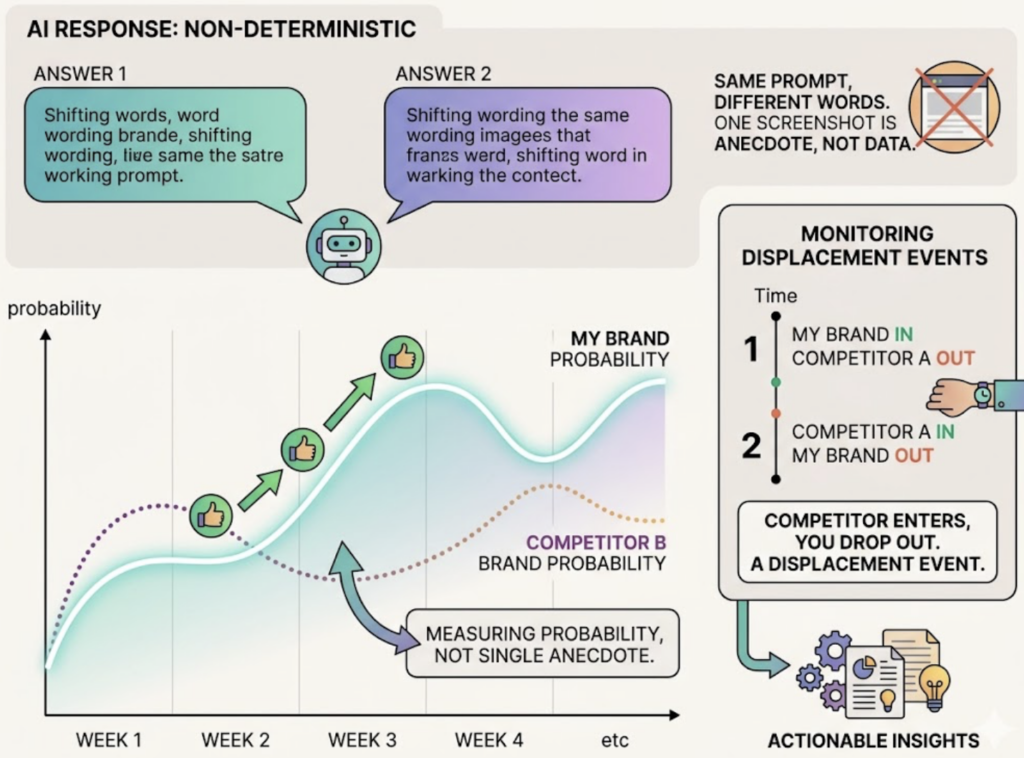
    AI responses are non-deterministic. They vary by platform, by query phrasing, by user location, and by the moment in time they’re generated. Standard SEO tools can’t track what ChatGPT says about your brand compared to a competitor. They can’t tell you which high-intent queries you’re missing, or what sentiment Perplexity attaches to your product category.

    Topify is built for exactly this measurement gap. The platform simulates thousands of real user queries across ChatGPT, Gemini, Perplexity, DeepSeek, and other major AI systems, tracking seven core metrics: visibility, sentiment, position, volume, mentions, intent, and conversion visibility rate. It also reverse-engineers which domains and URLs AI platforms are actually citing, so teams can identify where competitors are winning and why.

    For brands that want to act on the data rather than just read it, Topify’s one-click execution layer lets teams deploy GEO strategies directly from the platform. No manual workflow, no separate toolchain. Some brands using the platform have achieved 196% growth in AI citations within three months.

    The window for first-mover advantage in AI visibility is still open. But it won’t stay open indefinitely.

    Conclusion

    The 20 stats in this article tell a consistent story. AI agents are scaling faster than most organizations’ strategies have adapted. They’re handling enterprise workflows, reshaping how consumers discover products, and in some cases making purchase decisions with minimal human oversight.

    The brands that will win in this environment aren’t necessarily the ones with the biggest marketing budgets. They’re the ones that understand where AI systems look for information, what they cite, and how to become part of that process.

    Track it. Optimize it. Measure it.


    FAQ

    What is an AI agent in simple terms? 

    An AI agent is a software system that uses a large language model to set goals, build multi-step plans, and take real actions, like sending emails, querying databases, or completing purchases, without requiring human input at every step. Unlike a chatbot that answers questions, an AI agent completes tasks.

    What’s the difference between an AI agent and Agentic AI?

    An AI agent refers to a specific system executing a defined task. Agentic AI describes the broader architectural paradigm: the underlying capability set that includes autonomous reasoning, planning, and tool use. Agentic AI is what makes AI agents possible.

    How do AI agents affect brand visibility? 

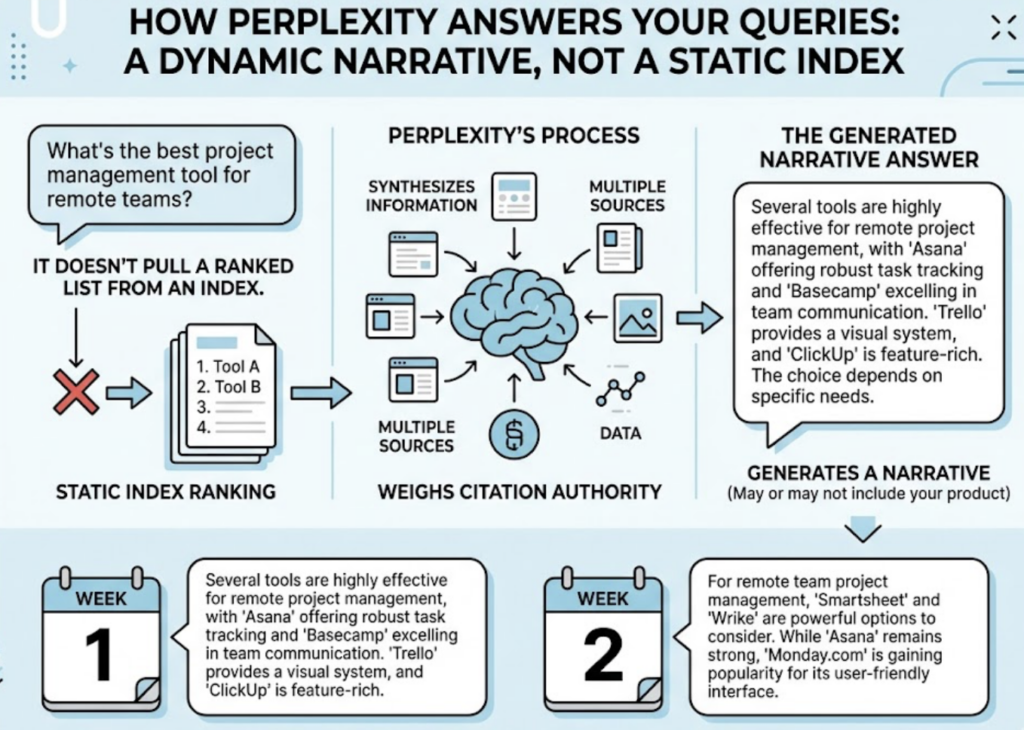
    AI agents synthesize answers from multiple sources rather than returning a ranked list of links. Brands that aren’t cited in those synthesized answers effectively disappear from the decision path. Visibility now depends on how well AI systems understand and trust a brand’s entity across the information ecosystem.

    What is AEO and how is it different from GEO? 

    AEO (Answer Engine Optimization) focuses on structuring content to be extracted as a direct answer by AI systems, typically for simple, factual queries. GEO (Generative Engine Optimization) is broader: it covers optimizing a brand’s presence, authority, and sentiment across the full generative AI ecosystem, including complex conversations and deep research contexts. AEO is tactical; GEO is strategic.

    What AI Agent stats are most important for marketers to know? 

    The most actionable stats are: 26% of brands have zero AI mentions; AI-referred traffic converts at 23x the rate of organic search; and brand-owned websites account for only 5-10% of AI citations. Together, they define both the size of the problem and the size of the opportunity.


    Read More

  • What Is an AI Agent for GEO? A New Era of Search

    What Is an AI Agent for GEO? A New Era of Search

    Your domain authority is solid. Your keyword rankings hold. But none of that tells you whether Perplexity is recommending your competitor instead of you.

    That’s the gap most SEO teams discover too late. A brand can rank first on Google for “best customer data platform” and still be completely absent from the synthesized answer ChatGPT delivers for the same query. These are two different systems operating on two different logics. And closing the second gap requires a different kind of tool: a GEO Agent.

    GEO Isn’t SEO. The Rules Changed When AI Did.

    Traditional search engines are librarians. They point users toward resources. Generative AI platforms are something else entirely: they’re synthesizers. They read across hundreds of sources and write a single answer. No list of blue links. No referral click.

    This architecture, known as Retrieval-Augmented Generation (RAG), changes the core objective for brands. In SEO, you signal relevance to a crawler so you rank high. In GEO, you increase the probability that an AI model extracts and cites your brand in its response. If your content isn’t structured for LLM extraction, or if your brand entity isn’t clearly defined across the web, the model skips you. It cites whoever is easier to parse.

    The traffic data makes the stakes clear. ChatGPT alone handles roughly 37.5 million queries per day, and AI-driven referral traffic has grown at approximately 357% year-over-year. More telling: traditional search carries a conversion rate of about 1.76%, while ChatGPT-referred traffic converts at 15.9% and Perplexity at 10.5%. AI search isn’t capturing the most volume. It’s capturing the highest-intent traffic.

    That is the market GEO Agent is built for.

    What’s a GEO Agent, Exactly?

    A GEO Agent is a system built on Agentic AI principles: it doesn’t wait for a human to issue a command. It pursues a goal.

    Give a standard GEO tool a task and it returns a report. You still have to read the data, diagnose the problem, write the fix, and deploy it. That’s three or four manual steps between insight and outcome. A GEO Agent collapses all of them. Tell it “achieve 50% visibility for ‘premium coffee beans’ across US AI platforms,” and it figures out what needs to change and handles it.

    The distinction is more than operational. It’s architectural. A regular AI tool is reactive — it responds to prompts. Agentic AI is goal-oriented and proactive. It can break a high-level objective into sub-tasks, coordinate actions across different systems, and close the loop without waiting on a human to stitch the pieces together. Think of the difference between a GPS and an autonomous vehicle. Both know where you need to go. Only one drives.

    The 3 Things a GEO Agent Actually Does

    The operational logic of a GEO Agent runs in a continuous loop: Monitor → Reason → Act.

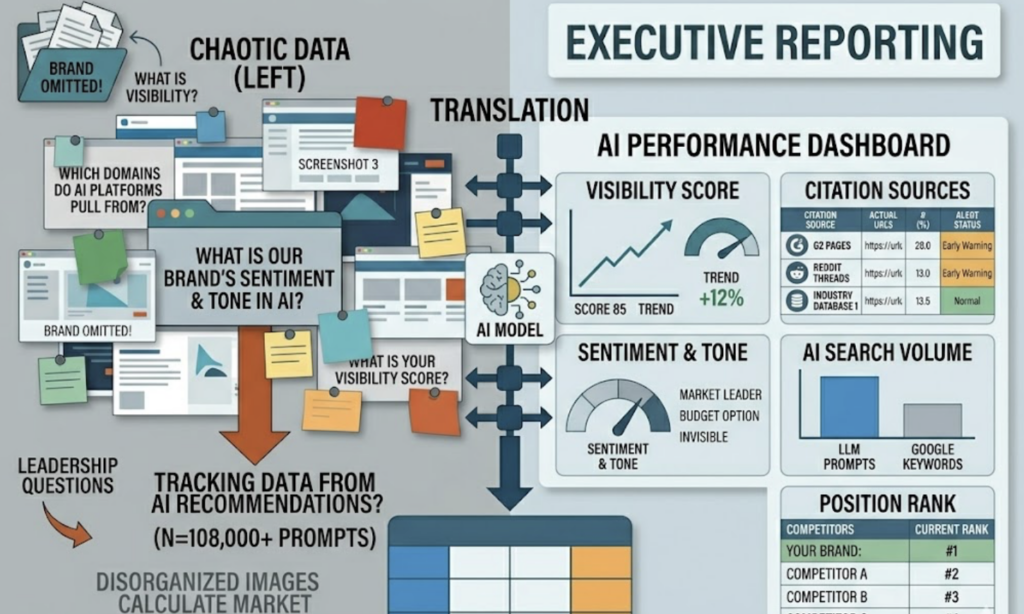
    Monitor is deeper than tracking a single ranking. Because generative AI responses are probabilistic — the same prompt can produce different answers across different sessions — the agent runs hundreds of prompt variations across platforms like ChatGPT, Gemini, and Perplexity to build a statistically valid Visibility Score. It also tracks Sentiment (is the AI describing your brand as a leader or adding caveats?), competitor Share of Voice, and which third-party domains are feeding the AI’s citations for your category.

    Reason is where the agent earns its name. Once it has the data, it uses an LLM-based reasoning layer to identify why your brand was excluded from a specific response. Three common failure modes surface repeatedly: your brand entity isn’t stable across platforms (Entity Fragility), your content is locked in formats that RAG systems can’t parse (Structural Opaqueness), or your brand is absent from the trust sources AI relies on — Reddit, specialized forums, authoritative directories (Third-Party Absence).

    Act is the closed loop. Instead of delivering a list of recommendations, the agent prepares and deploys the fix: drafting FAQ sections optimized for LLM extraction, updating metadata with entity-clear language, creating comparison tables in AI-legible formats, and publishing directly to your CMS. This is the workflow that turns GEO from a monitoring exercise into a growth channel.

    AEO vs GEO Agent: They Sound Similar. They’re Not.

    Answer Engine Optimization (AEO) came first, built around Google’s Featured Snippets and voice assistants. Its core play: format your content into FAQs, lists, and schema markup so it gets selected as the direct answer to a specific question. Tactical. Page-level. Reactive.

    The GEO Agent operates at a different scale. It incorporates AEO tactics but manages something much broader: the entire perception of your brand across the AI ecosystem. Where AEO asks “how do I get this page to answer this question,” GEO asks “how do I make AI consistently choose my brand as the trusted authority across hundreds of queries, multiple platforms, and shifting model updates.”

    Put plainly: AEO optimizes a page. A GEO Agent optimizes a brand entity.

    AEO is a tactical layer. The GEO Agent is the orchestration layer running above it.

    You Can’t Manage AI Visibility With a Spreadsheet

    A typical SaaS brand tracking 200 high-intent prompts across five AI platforms, updating weekly to account for model retraining — that’s not a workload one person handles manually. It’s not a workload a small team handles manually, either.

    The performance gap between manual and automated GEO is documented. A manual team can realistically monitor around 20 prompts per week. An agentic system handles 5,000+ prompts per week with consistent execution. The speed difference is equally stark: a task that takes a human team 11.6 days can be completed by an automated agent in 1.43 hours. That’s a 64x speed improvement before you even account for error rates.

    The ROI figures reflect this. Traditional GEO management reports around 195% ROI. Agentic GEO management comes in at approximately 544%.

    This is the Scalability Wall. AI search moves faster than human workflows. Brands that try to keep up manually will fall further behind, not because their strategy is wrong, but because the execution velocity can’t match the pace of model updates and competitive shifts.

    How Topify’s GEO Agent Works in Practice

    Topify is built around this agentic model. Its platform connects the monitoring, reasoning, and execution layers into a single workflow, designed so a marketing team can manage AI visibility without needing a data science background or an engineering team.

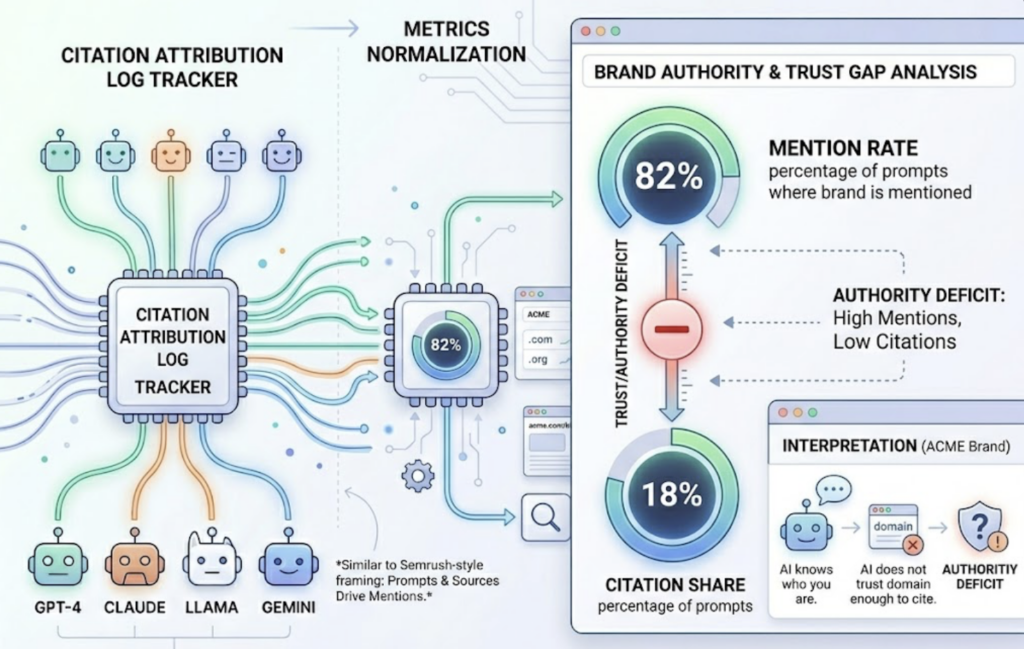
    The monitoring layer covers ChatGPT, Gemini, Perplexity, Google AI Overviews, DeepSeek, Doubao, and Qwen — every platform where your audience is already searching. It tracks seven core metrics: Visibility (what percentage of AI responses mention your brand), Sentiment (a 0-100 score for how favorably AI describes you), Position (your relative rank in AI recommendation lists), AI Volume (estimated monthly search demand for a topic), Mentions, Intent stage, and CVR (conversion visibility rate). Together, these metrics give you a picture that no single-metric dashboard can match.

    The execution layer is where Topify’s One-Click Agent closes the loop. You state your goal in plain English. Topify generates the content strategy and shows you a preview. You approve it, click once, and the update deploys. No manual CMS work. No separate writing workflow. The system also includes Source Analysis — revealing exactly which domains AI platforms are citing in your category — so you can identify the content gaps creating your visibility deficit.

    Early adopters in e-commerce have reported conversion rate uplifts of 10–25% and support ticket reductions of 30–50% after deploying structured GEO responses. That’s not a branding outcome. That’s a revenue outcome.

    Plans start at $99/month for up to 100 prompts and 4 AI platforms, with Pro and Enterprise tiers available for teams managing larger prompt sets. See Topify pricing here.

    GEO Agent vs. Basic AI Monitoring Tool: What’s Actually Different

    The market for AI visibility tools splits into two categories. Knowing which you’re evaluating matters.

    FeatureBasic AI Monitoring ToolGEO Agent (e.g., Topify)
    Primary OutputDashboard / AlertDeployed content update
    Data ScopeBrand mentions + basic sentimentFull analytics + citation intelligence
    Optimization LogicNone (you decide)AI-generated strategic roadmap
    CMS IntegrationLimited or noneDirect (Shopify, WordPress, etc.)
    Human Labor RequiredHigh: analysis + implementationLow: review + approval
    Outcome FocusKnowing you’re invisibleFixing the invisibility

    The fundamental gap is what you might call the Actionable Difference. A basic monitoring tool tells you that your brand isn’t appearing in a specific AI response. A GEO Agent tells you why it isn’t appearing and delivers the updated FAQ and schema to fix it, in the same session. That’s the workflow shift that separates tracking from growth.

    Conclusion

    The brand that ranked first on Google in 2023 and the brand that gets cited by ChatGPT in 2026 are not automatically the same brand. AI search runs on different signals, rewards different content structures, and updates faster than any human team can manually track.

    A GEO Agent doesn’t replace your marketing team. It handles the part of AI visibility that has outgrown human-scale execution: continuous multi-platform monitoring, LLM-based gap analysis, and closed-loop content deployment. That frees your team to focus on strategy and storytelling rather than prompt tracking and CMS updates.

    If you’re already investing in SEO and haven’t started managing AI visibility yet, the gap is already growing. Get started with Topify to see where your brand currently stands across the major AI platforms.


    FAQ

    Q: What is the difference between GEO and AEO?

    A: AEO (Answer Engine Optimization) is a tactical discipline focused on formatting specific pages to answer specific questions, mainly through FAQ schemas and structured lists. GEO (Generative Engine Optimization) is a broader strategic framework designed to shape how AI systems perceive and cite your brand across multiple queries and platforms over time. AEO is a subset of GEO, not a replacement for it.

    Q: What does an AI agent do in the context of GEO?

    A: A GEO Agent autonomously monitors a brand’s visibility across AI platforms, identifies the specific reasons it’s being excluded from relevant responses, and executes the content or distribution changes needed to fix that — with minimal human intervention required beyond review and approval.

    Q: Can a non-technical marketer use a GEO agent?

    A: Yes. Platforms like Topify are built with natural language interfaces and one-click execution, so you don’t need to understand LLM architecture or write any code. You define the goal; the system handles the execution.

    Q: How is Agentic AI different from a standard AI tool like ChatGPT?

    A: Standard AI tools are reactive — they respond to a single prompt and produce a single output. Agentic AI is goal-oriented and proactive: it breaks a complex objective into steps, coordinates actions across multiple systems, and operates in a continuous loop until the goal is reached.


    Read More

  • What Is an AI Agent? A Practical Guide for Beginners

    What Is an AI Agent? A Practical Guide for Beginners

    You’ve been using AI for months. You type a question, you get an answer. That’s how it works.

    Except that’s not how AI agents work. An AI agent doesn’t wait for your next message. It receives a goal, breaks it into steps, calls external tools, checks the results, and adjusts its plan until the job is done. No prompting required after the first instruction.

    That gap between “responds to input” and “acts on a goal” is what this guide is about.

    Not a Chatbot: What Makes an AI Agent Different

    Most people’s mental model of AI is still a chatbot: you ask, it answers. That model is already outdated.

    A traditional chatbot is stateless. It has no memory of what happened before, no access to outside tools, and no ability to take action beyond generating text. Every response starts from scratch.

    An AI agent is built around the opposite logic. It’s a software system that uses AI to pursue a specific goal, plan a sequence of actions, use external tools, and adjust based on what it learns along the way. The analogy used across the industry is useful: a chatbot is a cashier who processes one transaction at a time. An AI agent is a project manager who takes a goal (“organize the conference”) and handles end-to-end execution.

    That’s not a marketing distinction. It’s a structural one.

    The Four Things Every AI Agent Can Do

    Understanding what sets agentic AI apart comes down to four capabilities, each building on the last.

    Perceive. The agent reads its environment: text inputs, API data, search results, images, and more. It doesn’t just parse keywords. It interprets context, intent, and urgency. A brand monitoring agent, for example, doesn’t just scan for a company name. It reads the sentiment around it, the authority of the source, and whether the mention suggests a reputational risk.

    Reason. This is where the agent uses an LLM (like GPT-4, Claude, or Gemini) to decompose the goal into steps. A common framework here is ReAct (Reason + Act), where the agent runs a continuous loop: identify what needs to happen next, take an action, observe the result, update the plan. It’s non-linear problem-solving, not a script.

    Act. The agent executes. It can call APIs, search the web, update a CRM, generate content, publish to a CMS, or trigger emails. This is the part that makes agentic AI categorically different from anything that came before: it creates change in the world, not just text on a screen.

    Learn. The agent analyzes the results of its actions and adjusts. If a strategy didn’t move the needle, it modifies the approach before the next cycle. This self-refinement loop is what allows agents to operate in dynamic environments where rigid automation would fail.

    Agentic AI vs. Traditional AI: The Line Most People Miss

    The difference isn’t just philosophical. It’s measurable across every dimension of how these systems operate.

    DimensionTraditional ChatbotAI Assistant (Copilot)Agentic AI
    Operational LogicRule-based scriptsPattern recognition, content aidGoal-oriented, self-directed workflow
    AutonomyPassive, prompt-by-promptCollaborative, assists on requestIndependent, multi-step execution
    MemoryStatelessLimited session contextPersistent, evolving memory
    Tool AccessIsolatedLimited integrationsAPIs, web search, external software
    Execution StyleSingle responsePrompt-by-promptEnd-to-end process management

    The critical column is autonomy. A copilot still needs you to drive. An agent takes the wheel once you’ve set the destination.

    That distinction is why enterprise adoption is accelerating79% of organizations have already implemented some form of AI agent, and 96% plan to expand their deployment in 2025. By 2028, an estimated 33% of all enterprise applications will feature integrated agentic AI, compared to less than 1% today.

    Where AI Agents Are Already Working: 5 Real Use Cases

    Agentic AI isn’t a prototype. Here’s where it’s running in production right now.

    Customer support automation. Agents handle multi-stage processes like billing disputes and returns without human intervention, integrating directly with CRM and payment platforms. By 2028, they’re projected to handle 68% of all customer interactions for technology vendors.

    Research and analysis. In financial services and legal, agents continuously monitor thousands of sources and summarize competitor activities, regulatory changes, or risk indicators into concise executive briefs.

    Software engineering. Coding agents generate test cases, identify bugs, fix them, and manage deployment pipelines, freeing developers to work on architecture rather than maintenance.

    Marketing content optimization. Agents manage the full content lifecycle: keyword research, topic planning, multi-language translation, and publishing, without a human touching each step.

    Brand visibility monitoring. This is where it gets relevant for marketing and growth teams. AI agents continuously track how often a brand is mentioned or recommended by ChatGPT, Gemini, and Perplexity. They identify visibility gaps, analyze which competitors are winning citations, and surface the content changes needed to improve a brand’s standing in AI-generated answers.

    That last use case is where agentic AI intersects directly with how brands get discovered in 2025 and beyond.

    How AI Agents Are Reshaping GEO and AEO

    Traditional SEO optimized for Google’s blue links. That model is under pressure.

    Over 57% of Google searches now end without a click, a number expected to climb as AI Overviews become the default interface. Two new disciplines have emerged to address this shift.

    AEO (Answer Engine Optimization) focuses on getting your content extracted as a direct answer to a user query. It’s about being the answer, not the link.

    GEO (Generative Engine Optimization) goes a layer deeper. It’s the practice of ensuring that when AI systems synthesize answers from multiple sources, your brand is one of the sources they trust and cite. Being mentioned isn’t enough. GEO is about being the reference.

    FocusSEOAEOGEO
    Primary GoalRank in search resultsAppear in direct AI snippetsBe cited as a trusted source by LLMs
    Key TacticKeywords, backlinks, site speedStructured FAQs, direct answersOriginal research, authority signals
    Core MetricSERP position, trafficAnswer retention, voice shareCitation frequency, brand mentions

    AI agents are central to executing GEO at scale. Manually running hundreds of prompts across ChatGPT, Gemini, and Perplexity every week to measure brand visibility isn’t realistic. Agents do this automatically, tracking Share of Voice against competitors, identifying which content gaps are costing citations, and flagging when sentiment around your brand shifts.

    Topify is built specifically for this workflow. Its AI agent continuously monitors brand performance across ChatGPT, Gemini, Perplexity, and other major platforms, tracking seven metrics: visibility, sentiment, position, volume, mentions, intent, and conversion visibility rate. The one-click execution feature means you set the goal in plain English, review the proposed GEO strategy, and the agent deploys it. That’s agentic AI applied to a real marketing problem, not a demo.

    For teams that want to see what this looks like in practice before committing to a full strategy, the Basic plan at $99/month includes a 30-day trial with 100 prompts and 9,000 AI answer analyses across ChatGPT, Perplexity, and AI Overviews.

    Your First Step Into Agentic AI: What to Actually Do Next

    Don’t start by building a custom agent. That’s the wrong entry point for most teams.

    The learning curve for custom agentic architectures is steep, and most internal builds fail due to architectural complexity before they deliver value. The faster path is to start with a specialized tool that already has agentic logic built in, observe how it works, and build intuition from there.

    For marketing and growth teams, the most natural starting point is brand visibility. The question “Is our brand showing up when AI recommends solutions in our category?” has a measurable answer, and finding it requires exactly the kind of multi-step, cross-platform monitoring that AI agents handle well.

    From there, you can expand. The enterprise data on ROI is consistent: organizations deploying agentic systems report an average return of 171%, with productivity gains of 20-60% across functions. But those numbers start with a clear, bounded first use case, not a broad platform overhaul.

    Pick the pain point where your current tools are most brittle. Start there.

    Conclusion

    AI agents aren’t a more sophisticated chatbot. They’re a different category of system, and the distinction matters for anyone whose job involves how brands get discovered, how customers get served, or how work gets done.

    The shift is already underway. The global agentic AI market was valued at $5.25 billion in 2024 and is on track to reach $199 billion by 2034. That trajectory isn’t driven by hype. It’s driven by the 171% average ROI organizations are seeing when they move from reactive AI tools to goal-driven, autonomous systems.

    The practical starting point for most marketing and growth teams is GEO visibility: understanding how AI systems currently represent your brand, and using agents to close the gap between where you are and where you need to be. Get started with Topify to see how your brand is showing up in AI-generated answers today.


    FAQ

    Q: What’s the difference between an AI agent and a chatbot?

    A: A chatbot is a reactive system that waits for your input and returns a single response. An AI agent is a goal-driven system that plans a sequence of steps, uses external tools like APIs and search, and executes tasks autonomously with minimal ongoing input. The core difference is autonomy: a chatbot responds, an agent acts.

    Q: Do I need to know how to code to use AI agents?

    A: Not for most professional tools. Most agentic platforms, including GEO and brand visibility tools, offer no-code or low-code interfaces where you set a goal in plain English and the agent handles execution. Coding is only required if you’re building custom agent architectures from scratch.

    Q: What is agentic AI, and why does it matter for marketers?

    A: Agentic AI refers to AI systems that can take independent, multi-step action to achieve an objective. For marketers, it matters because the way audiences discover brands is shifting from Google search to AI-generated answers. Agentic AI is the infrastructure for monitoring and optimizing a brand’s presence in that new landscape, what’s known as GEO (Generative Engine Optimization).

    Q: How does an AI agent help with GEO or AEO?

    A: AI agents automate the labor-intensive parts of GEO and AEO: running hundreds of natural language prompts across platforms like ChatGPT, Gemini, and Perplexity to measure brand visibility; identifying which competitors are winning citations; pinpointing content gaps; and executing updates to improve citation rates. This work is continuous and cross-platform, which is exactly the kind of task agents handle efficiently.


    Read More

  • What Is Harness? The Smart Choice for Software Delivery

    What Is Harness? The Smart Choice for Software Delivery

    Your engineers are shipping more code than ever. The AI coding assistant is running. PRs are flowing. And yet your deployment frequency hasn’t moved in six months.

    That’s not a people problem. According to the 2025 DORA reportmore than 50% of teams deploy less than once a week, and 15% need over a week to recover from a failed deployment. Faster code generation didn’t fix software delivery. It made the bottleneck more visible.

    That’s what Harness software delivery was built to address.


    Harness Is Not Just Another CI/CD Tool

    The most persistent misconception in the DevOps market is that Harness is a Jenkins replacement or an upgraded CI runner.

    It’s not.

    Harness is an AI-native software delivery platform that consolidates the entire “everything after code” phase of the SDLC into a single governed ecosystem: Continuous Integration, Continuous Delivery, Security Testing Orchestration, Cloud Cost Management, Feature Flags, Chaos Engineering, and Software Engineering Insights. These aren’t separate products bolted together. They share a unified governance layer, meaning RBAC, secrets management, and audit trails apply automatically across every stage.

    That architectural choice has a concrete downstream effect. Security findings in one stage can automatically gate deployments in the next. You stop managing handoffs between tools and start managing a closed loop.


    The AI Productivity Paradox Harness Engineering Solves

    AI coding assistants were supposed to accelerate software delivery. In practice, they created a new class of bottleneck.

    Faros AI telemetry shows that AI adoption drove a 21% increase in tasks completed and a 98% surge in pull request volume, while simultaneously triggering a 91% increase in code review time and a 154% increase in average PR size. More code is being written. The same number of humans are reviewing it.

    That’s the Harness Engineering problem in one sentence: the upstream got faster, but the downstream didn’t.

    On the maintenance side, teams running legacy infrastructure like Jenkins typically dedicate two to five full-time engineers just to keep pipelines stable. That’s headcount allocated entirely to keeping the delivery machine running, with nothing left over for the actual product.

    Harness addresses this directly. Its Test Intelligence module uses machine learning to identify which tests are relevant to a specific code change, cutting build times by up to 80%. Automated Canary and Blue/Green deployment strategies require no manual scripting. Rollbacks that previously took two hours happen with a single click.

    The numbers from Entur, a provider of digital infrastructure for the Norwegian transport sector, make this concrete. After adopting Harness CD, they increased deployment frequency from twice per week to over 14 times per day. Change failure rate dropped from 20% to 5%. Rollback time fell from two hours to five minutes.


    The Delegate Architecture: Why Regulated Teams Trust It

    Most SaaS delivery platforms have a structural security problem. To execute deployments inside your infrastructure, they need access to it, which usually means open inbound firewall ports, VPN tunnels, or credentials stored outside your trust boundary.

    Harness solves this with the Delegate. It’s a lightweight worker process that runs inside your own VPC, Kubernetes cluster, or on-premises data center, and establishes an outbound-only HTTPS connection back to the Harness Manager. Your infrastructure never receives inbound connections from an external system.

    The practical implications are significant. Credentials stay within your network. Security teams don’t need to carve out exceptions. Because Delegates are containerized and run in Kubernetes, they scale horizontally and support high availability automatically. If one goes down, the Harness Manager reroutes tasks to healthy instances without manual intervention.

    ComponentFunctionSecurity Benefit
    Harness ManagerSaaS control planeCentralized policy and AI orchestration
    Harness DelegateLocal worker processOutbound-only; stays within VPC
    Policy EngineOPA integrationPolicy-as-code enforced at Delegate level
    Secrets ManagerNative or third-partyNo secrets stored in the SaaS control plane

    For organizations with extreme security requirements, including air-gapped government or financial environments, Harness offers a Self-Managed Enterprise Edition where the entire platform runs locally. That’s a capability most CI/CD tools don’t offer.


    Harness Software Delivery vs. The Alternatives

    Choosing a delivery platform comes down to scope and organizational maturity. Here’s how Harness positions against the most common alternatives a team will evaluate:

    ToolPrimary FocusStrengthLimitation
    HarnessEnd-to-end platformAI verification, OPA policy, multi-cloudSteeper onboarding for small teams
    JenkinsCI automationPlugin ecosystem, open source2-5 FTE maintenance overhead
    GitHub ActionsCI/CD workflowsTight GitHub integration, quick startLimited enterprise CD patterns, no native rollback
    Argo CDKubernetes GitOpsPure GitOps, Kubernetes-nativeK8s-only, lacks built-in CI or security

    Jenkins earns its place in legacy environments, but at enterprise scale, the total cost of ownership, including the engineers required to maintain it, typically exceeds a Harness subscription. GitHub Actions is excellent for small teams embedded in GitHub but lacks granular RBAC and automated metric-based rollback. Argo CD is strong for pure Kubernetes shops. Harness actually integrates Argo CD internally, then extends it to cover non-Kubernetes workloads like Lambda and VMs.

    One Harness customer consolidated over 36,000 fragmented pipelines down to 50 standardized templates. That’s not an edge case. That’s what fragmented tooling looks like at scale.


    How AI Search Is Reshaping How Engineers Discover Harness

    Here’s a dimension most DevOps teams aren’t tracking yet.

    When an engineer opens ChatGPT and asks “best CI/CD platform for multi-cloud with compliance requirements,” Harness doesn’t just compete on Google rankings. It competes on how well AI systems understand, trust, and choose to describe it.

    This is the discipline of GEO (Generative Engine Optimization), and it’s rewriting B2B SaaS go-to-market strategy. According to Ahrefs data, the top 50 brands by online authority receive nearly 29% of all AI Overview mentions. Brands outside that visibility window don’t appear on the AI’s shortlist, regardless of product quality.

    AEO (Answer Engine Optimization) and GEO work differently from traditional SEO. Instead of ranking a page for a keyword, the goal is to become the answer an LLM produces when a buyer asks a relevant question. That requires structured, factual, citable content; strong third-party validation across the web; and consistent entity recognition across AI platforms.

    For a platform like Harness, this means being correctly described, accurately framed, and frequently cited across ChatGPT, Perplexity, Google AI Overviews, and other generative engines. Not just ranking in a list of blue links.

    Topify is built specifically to track and optimize this layer of visibility. It monitors Brand Mention Rate, Citation Rate, Sentiment Score, and Position across major AI platforms, giving marketing and growth teams a measurable view of how any B2B brand is being described and recommended by AI systems in real time. Topify’s team includes founding researchers from OpenAI and Google SEO practitioners, and the platform covers AI engines including ChatGPT, Gemini, Perplexity, DeepSeek, and more.

    GEO MetricWhat It MeasuresWhy It Matters for SaaS
    Brand Mention Rate% of category queries where brand appearsCore indicator of AI visibility
    Citation Rate% of mentions accompanied by a linkDrives high-intent referral traffic
    Sentiment ScoreTone of the AI’s brand descriptionInfluences buyer trust and perception
    Entity ConsistencyUniformity of brand facts across the webPrevents AI hallucinations and errors

    For teams starting to build a GEO strategy alongside their Harness deployment, Topify’s Basic plan starts at $99/month and covers prompt tracking across ChatGPT, Perplexity, and AI Overviews.


    When Harness Is Worth the Investment (And When It Isn’t)

    Harness is not the right fit for every team. Being clear about this is more useful than overselling it.

    Harness earns its ROI when:

    Your team has 100+ developers and deployment pipelines that are inconsistent across squads. Your infrastructure spans multiple clouds, or a mix of Kubernetes and legacy VMs. You operate in a regulated industry that requires native compliance gates, OPA policy enforcement, and full audit trails. Your engineers are spending meaningful time on manual deployments, flaky test maintenance, or pipeline firefighting.

    Lighter alternatives make more sense when:

    Your team is under 20 developers and already embedded in GitHub or GitLab. Your entire stack is Kubernetes and you have the internal expertise to manage Argo CD. Budget constraints make enterprise-tier pricing difficult to justify at your current scale.

    Deluxe, a major financial services organization, landed clearly on the enterprise end. Before Harness, pipeline setup took hours or days because of heavy manual scripting. After implementing reusable templates and Security Testing Orchestration, setup time dropped to under 30 minutes, and every code check-in was automatically scanned with OPA-enforced policies blocking insecure builds from reaching production.

    The ROI is real. It scales with organizational complexity.


    Conclusion

    The 2025 DORA data is unambiguous: engineering teams are generating more code than their delivery infrastructure can handle. The bottleneck isn’t talent or ambition. It’s the gap between writing software and shipping it reliably.

    Harness software delivery closes that gap directly, covering CI, CD, security testing, cloud costs, and engineering analytics within a single governed platform. The Delegate architecture makes it viable for regulated and hybrid environments where other SaaS tools can’t operate. And for enterprise teams, the ROI on deployment frequency, change failure rate, and developer toil is well-documented across industries.

    The other dimension worth building toward is how platforms like Harness get discovered in the first place. As engineers shift from Google to ChatGPT and Perplexity for tool recommendations, AI visibility has become a measurable business metric. Combining a robust delivery platform with a proactive GEO strategy, using tools like Topify to monitor and optimize brand presence across AI engines, is how high-performing software organizations stay on the shortlist in 2026.


    FAQ

    Q: What is Harness software delivery, and how is it different from a traditional CI/CD tool?

    A: Harness software delivery is an AI-native platform that covers the entire post-code phase of the SDLC, including CI, CD, security testing, cloud cost management, feature flags, and engineering analytics. Unlike traditional CI tools like Jenkins, which require heavy scripting and plugin maintenance, Harness provides a unified governance layer where RBAC, audit trails, and policy enforcement apply automatically across every module. The result is a closed-loop delivery system rather than a collection of disconnected scripts.

    Q: What is Harness Engineering’s Delegate, and why does it matter for security?

    A: The Harness Delegate is a lightweight worker process that runs inside your own VPC, Kubernetes cluster, or on-premises data center. It connects to the Harness Manager via outbound-only HTTPS, which means your infrastructure never receives inbound connections from an external SaaS platform. Credentials stay within your network, no inbound firewall ports need to be opened, and for air-gapped environments, Harness offers a fully self-managed edition where the entire platform runs locally.

    Q: What is GEO, and why does it matter for a platform like Harness?

    A: GEO stands for Generative Engine Optimization. It’s the practice of ensuring a brand appears in the synthesized answers that AI engines like ChatGPT, Perplexity, and Google AI Overviews generate when users ask category-level questions. For a platform like Harness, being absent from an AI’s recommended shortlist, even with strong Google rankings, means missing a growing share of the evaluation process. According to Ahrefs, the top 50 brands by online authority capture nearly 29% of all AI Overview mentions, which shows how concentrated AI-driven discovery has become.

    Q: How can teams track and improve their brand’s visibility in AI search results?

    A: Tracking AI search visibility requires monitoring across multiple platforms simultaneously, including ChatGPT, Perplexity, Gemini, and AI Overviews, measuring metrics like Brand Mention Rate, Sentiment Score, Citation Rate, and Position relative to competitors. Topify is built specifically for this, combining GEO analytics with competitor benchmarking and one-click strategy execution across all major AI engines. Teams can get started with a Basic plan covering 100 prompts and 9,000 AI answer analyses per month.


    Read More:

  • What Is Harness and How Does It Streamline CI/CD?

    What Is Harness and How Does It Streamline CI/CD?

    Your engineers are shipping more code than ever. AI tools have turbocharged the “inner loop”—writing, reviewing, debugging—by up to 4x. But the moment that code reaches the pipeline, everything slows down. Build queues back up. Tests run for hours. Someone has to manually verify the deployment didn’t break production.

    The bottleneck isn’t talent. It’s the delivery infrastructure those engineers are stuck with.

    That’s the problem Harness CI/CD was built to solve.

    The Hidden Costs That Traditional CI/CD Tools Never Show You

    Most engineering teams inherit their CI/CD setup rather than choose it. Jenkins gets installed, plugins get added, Groovy scripts pile up, and three years later, two to five full-time engineers are doing nothing but keeping the delivery infrastructure alive.

    This is what practitioners call the “toil tax.” It’s not just about money. It’s about cognitive capacity being consumed by the wrong problems.

    The 2024 DORA report puts a name to the outcome: developer burnout. Inconsistent priorities and high maintenance burdens don’t just slow teams down—they erode the conditions that make good engineering possible. When your senior DevOps engineer is the only one who understands why a pipeline fails at 2am, that’s not a scalable system.

    The DORA metrics tell the same story quantitatively. In low-performing organizations, deployment frequency drops to monthly or quarterly cycles. Lead time for changes stretches into months. Change failure rates climb, and Mean Time to Recovery (MTTR) can stretch from minutes into weeks.

    That’s not a DevOps problem. That’s an infrastructure-as-product problem.

    What Is Harness? An AI-Native Take on Software Delivery

    Harness is a software delivery platform built around a single premise: the tools that exist after code is committed shouldn’t require more engineering effort than the code itself.

    Founded in 2017, Harness has grown into one of the fastest-scaling infrastructure companies in the market. By late 2025, it reached a $5.5 billion valuation following a $240 million Series E led by Goldman Sachs Alternatives, with over $250 million in ARR and more than 1,000 enterprise customers across North America, EMEA, and APAC.

    The platform isn’t just a CI/CD runner with better UI. Its foundational differentiator is what Harness calls the Software Delivery Knowledge Graph: a connected model of service dependencies, pipeline history, deployment patterns, and organizational context. Rather than treating each pipeline as an isolated script, Harness treats the entire delivery system as something that should learn, adapt, and self-optimize.

    That shift in framing is what separates it from older tools.

    How Harness CI/CD Works: The Modules That Matter

    Harness CI and Test Intelligence

    Traditional CI has an “all-or-nothing” testing problem. Every commit triggers every test, regardless of what actually changed. On large codebases, that means 40-minute build times for a three-line fix.

    Harness CI solves this with Test Intelligence (TI). By analyzing call graphs and Git commit history, TI identifies which tests are relevant to a specific change and skips the rest. The result isn’t marginal—RisingWave Labs reported a 50% reduction in build times after switching from GitHub Actions to Harness CI. Qrvey achieved an 8x reduction.

    That’s not a configuration tweak. That’s a structural change in how testing is approached.

    Harness CD and Continuous Verification

    Deployment is where most CI/CD tools stop thinking. They push the artifact and declare success.

    Harness CD keeps going. Its Continuous Verification (CV) module integrates directly with monitoring tools like Datadog, Prometheus, and AppDynamics. After every deployment, ML models analyze live logs and metrics in real time. If anomalies surface, the system triggers an automatic rollback—without waiting for an engineer to notice something is wrong.

    This compresses MTTR from hours to minutes. For teams running multiple daily deployments, that’s not a nice-to-have. It’s the difference between a minor incident and a customer-facing outage.

    Pipeline Inheritance and Governance

    Here’s where Harness Harness engineering methodology diverges most sharply from legacy approaches.

    Most pipeline sprawl looks like this: 5 services become 50, each with their own Jenkinsfile, each slightly different, each requiring individual updates when a security policy changes. Patching a known vulnerability across the fleet takes weeks.

    Harness addresses this with Pipeline Inheritance. Master templates are updated once and propagate instantly to every inheriting pipeline. Morningstar used this approach to reduce its managed pipeline entities from 36,000 to just 50—a 99.8% reduction. Policy enforcement happens at the platform level via OPA (Open Policy Agent), which means developers can deploy safely without waiting for DevOps sign-off on every change.

    Harness vs. Jenkins vs. GitHub Actions: What Actually Differs in Practice

    Choosing a CI/CD tool often comes down to team size, deployment complexity, and how much infrastructure ownership you’re willing to take on. Here’s how the three main options compare:

    FeatureHarnessJenkinsGitHub Actions
    ManagementManaged SaaS or Private CloudSelf-hosted; high operational costCloud-hosted by default
    ConfigurationVisual/YAML + Master TemplatesGroovy scripts; brittle at scaleYAML-based; repository-centric
    AI CapabilitiesNative Test Intelligence, Auto-Verification, AI-SRENone natively; plugin-dependentLimited native AI for pipeline logic
    ScalingNative cloud autoscalingManual node managementAuto runners with resource caps
    GovernanceCentralized Policy-as-Code (OPA)Fragmented across pluginsSimple permissions; no enterprise policy
    True CostEnterprise subscription“Free” software + 2–5 FTE hidden costPay-per-minute; cost spikes at scale

    The bottom line: Harness makes sense when deployment frequency is high, environments are multi-cloud, and team size is 50+ engineers. GitHub Actions is the right call for smaller, GitHub-centric teams that don’t need deep deployment governance. Jenkins works when teams require total infrastructure control and have dedicated personnel to manage it—an increasingly rare combination.

    The real question isn’t which tool is “best.” It’s which tool matches your delivery model.

    Why Engineering Velocity Isn’t Enough Anymore

    Here’s the thing most teams don’t think about when evaluating CI/CD platforms: how their engineers find those tools in the first place.

    The traditional discovery journey—Google “best CI/CD for Kubernetes,” scan three comparison articles, book a demo—is changing. According to 2025-2026 research, 50% of B2B buyers now begin vendor research inside an AI chatbot rather than a search engine. B2B teams are adopting AI-powered search at three times the rate of consumers.

    When an engineer asks ChatGPT “what’s the most secure CI/CD platform for a regulated financial environment,” the brands that appear in the response have a structural acquisition advantage. AI search visitors convert at 4.4x the rate of traditional organic search visitors and spend up to 3x longer on page.

    The flip side: organic click-through rates drop by approximately 70% when AI Overviews appear. If your brand isn’t in the AI’s answer, you’re not just losing a ranking—you’re losing the entire interaction.

    This is the emerging discipline of Generative Engine Optimization (GEO) and Answer Engine Optimization (AEO): ensuring that when AI engines synthesize recommendations, your brand is cited, accurately described, and contextually positioned.

    How GEO and AEO Work for Engineering Brands

    AEO focuses on technical content structure. For developer tools, this means engineering documentation and technical blogs to directly answer queries like “how to implement Canary deployments in AWS EKS.” Clear heading hierarchies, Q&A blocks, and structured schema markup make it easier for AI systems to extract and cite a brand’s content as an authoritative answer.

    GEO is the broader ecosystem play. AI models don’t just crawl a brand’s website—they assemble narratives from third-party mentions, GitHub repositories, G2 reviews, Reddit threads, and industry publications. A brand’s “AI presence” is the aggregate of what the web says about it.

    For a platform like Harness, that means ensuring its case studies (United Airlines cutting deployment time from 22 to 5 minutes; Citi reducing delivery from days to 7 minutes) are structured and distributed in formats that LLMs can parse and cite. It means earning mentions in the technical communities where engineers actually spend time.

    Most brands are running GEO blind. They have no way to know whether ChatGPT recommends them for “multi-cloud cost optimization” or routes those queries to a competitor.

    Tracking and Optimizing AI Visibility: Where Topify Fits

    This is the gap that Topify addresses. Topify is an AI search optimization platform that helps SaaS and engineering brands track, measure, and improve how AI systems recommend them across ChatGPT, Gemini, Perplexity, and other major platforms.

    For an engineering brand competing in the CI/CD space, Topify provides the operational layer that GEO strategy requires:

    AI Brand Mention Rate: Track how often Harness (or any CI/CD tool) appears across relevant prompts, from “best CI/CD for microservices” to “how to automate security gates in deployment pipelines.”

    Share of Voice vs. Competitors: See in real time whether GitHub Actions or CircleCI is winning the “AI recommendation war” for a specific use case category.

    Source Citation Analysis: Identify which domains AI platforms are pulling information from. If Harness’s technical documentation isn’t appearing in AI citations, Topify surfaces that gap—so content teams know exactly where to focus.

    Sentiment and Context Tracking: AI engines sometimes get brand descriptions wrong, describing an enterprise platform as a “developer hobby tool” or citing outdated pricing. Topify detects this narrative drift before it affects procurement conversations.

    In practice, a marketing team can get started with Topify and begin tracking brand visibility across AI platforms within minutes. The platform’s Basic tier covers ChatGPT, Perplexity, and AI Overviews at 100 prompts per month—enough for an initial GEO audit of any engineering brand’s AI presence.

    The discipline is new. The need isn’t.

    Conclusion

    Harness CI/CD represents a genuine architectural rethink of software delivery—from brittle, script-heavy pipelines managed by a dedicated maintenance crew, to an AI-native platform where testing is intelligent, verification is automated, and governance scales without friction. The engineering case studies are concrete: deployment cycles measured in minutes, not months, and pipeline sprawl reduced from five figures to double digits.

    But delivery velocity and AI discoverability are now linked. The engineer who finds Harness through a ChatGPT recommendation tomorrow is already in a different decision-making frame than one who found it via a Google search six months ago. Brands that build both—operational excellence in delivery and strategic presence in AI search—will define the next generation of developer tooling. That’s not a future state. It’s already the competitive landscape.


    FAQ

    Q: What makes Harness fundamentally different from Jenkins for CI/CD?

    A: Jenkins is a general-purpose automation server that places the operational burden—plugin management, custom scripting, manual scaling—on the organization’s DevOps team. Harness is an AI-native platform with out-of-the-box Test Intelligence, automated Continuous Verification, and Pipeline Inheritance via policy-as-code (OPA). The practical difference: Jenkins typically requires 2-5 full-time engineers just to maintain; Harness is designed to eliminate that toil category entirely.

    Q: Does Harness support multi-cloud deployment environments?

    A: Yes. Harness CD is cloud-agnostic, supporting deployments across AWS, Azure, Google Cloud, on-premise, and hybrid environments from a single orchestration engine. Its Cloud Cost Management (CCM) module provides unified visibility into spend across multiple providers and Kubernetes clusters—something native cloud tools typically only cover for their own platform.

    Q: What is AEO and how does it apply to developer tools?

    A: Answer Engine Optimization (AEO) is the practice of structuring content so AI engines like ChatGPT and Perplexity can extract and cite it directly when answering a user’s query. For developer tools, this means optimizing documentation with clear Q&A formatting, explicit schema markup, and short, parseable paragraphs. When an engineer asks an AI how to implement Blue-Green deployments on EKS, AEO determines whether your documentation is the cited source or a competitor’s.

    Q: How can engineering brands improve their visibility in AI search results?

    A: The core levers are: structuring content for LLM extraction (tables, lists, Q&A blocks), building topical authority through consistent publishing on core themes, earning third-party mentions in communities and reviews that AI models weight heavily (Reddit, G2, GitHub), and systematically tracking AI share of voice using tools like Topify. The brands that treat GEO as a structured, measurable channel—not a one-time content refresh—will compound their AI presence over time.


    Read More

  • What Is Harness? A Practical Guide for DevOps Teams

    What Is Harness? A Practical Guide for DevOps Teams

    Your Jenkins pipeline has 47 plugins. Three engineers know how it actually works. Last Tuesday, a failed deployment took four hours to roll back because the process was manual, undocumented, and dependent on a Slack thread from six months ago.

    That’s not a people problem. That’s a tooling architecture problem. Modern delivery pipelines don’t just need to run code — they need to detect failures, trigger rollbacks, manage environments, and report on deployment health, all without waiting for a human to notice something went wrong.

    That’s the gap most DevOps teams are still closing.


    Harness DevOps Guide: What the Platform Actually Solves

    Harness is a software delivery platform that covers the full lifecycle from code commit to production deployment. It’s not a drop-in replacement for a single CI/CD tool. It’s designed to replace the entire patchwork of scripts, plugins, and manual steps that most engineering teams have accumulated over years.

    The core problem Harness addresses is what the industry calls “pipeline debt.” Teams typically spend 30–40% of their engineering time maintaining CI/CD infrastructure instead of shipping features. Jenkins pipelines grow brittle. Deployment scripts accumulate undocumented dependencies. Rollbacks become manual operations that depend on whoever wrote the original script.

    Harness approaches this differently. It treats delivery as a product concern, not an infrastructure concern, with built-in governance, automated verification, and intelligent failure management at every stage.


    From CI to CD: How Harness Engineering Structures the Pipeline

    Harness Engineering organized the platform into distinct modules that can be adopted independently or as a complete suite.

    Harness CI handles the build and test phase. It’s a cloud-native pipeline engine with built-in caching and Test Intelligence — a feature that automatically identifies and runs only the tests relevant to a code change, not the full suite. In practice, teams typically see meaningful reductions in build time, especially in large monorepos where full test runs are expensive.

    Harness CD is where the platform’s differentiation becomes clearest. It goes beyond traditional deployment tooling with Pipeline Studio (a visual drag-and-drop interface for building deployment workflows), native canary and blue-green deployment strategies, and Continuous Verification (CV). CV is the part worth paying attention to: it monitors logs, metrics, and APM data post-deployment and triggers an automatic rollback if anomalies are detected, no human needed.

    Harness Feature Flags gives product and engineering teams control over feature exposure without separate deployments. Cloud Cost Management tracks spend across AWS, GCP, and Azure at the service level, so teams can connect infrastructure cost directly to delivery decisions.

    It’s a lot of surface area. But you don’t need to adopt all of it at once.


    A Harness DevOps Guide to Core Concepts You Need to Know

    Before evaluating Harness seriously, four concepts are worth understanding.

    Service is Harness’s abstraction for your application or microservice. You define it once and it carries artifact sources, manifests, and configurations wherever it deploys.

    Environment maps to your target infrastructure, whether that’s a Kubernetes namespace, an EC2 instance group, or a serverless function. Environments have types (production, staging, pre-prod) and can carry infrastructure definitions and override configurations per stage.

    Pipeline is the execution unit. It’s composed of stages, and each stage maps to a phase in your delivery workflow: build, deploy, verify, rollback. Pipelines are defined in YAML but also fully editable through the Studio UI, which lowers the barrier for teams that don’t want to write pipeline config from scratch.

    Connector is how Harness reaches your external systems: git provider, artifact registry, cloud account, observability tools. You configure it once, and every pipeline references the same connector. No credentials embedded in scripts. No drift between environments.

    The relationship is straightforward: a Pipeline takes a Service, deploys it to an Environment, using resources accessed via Connectors. Once that mental model clicks, the rest of the platform makes sense.


    Harness vs. Jenkins, GitHub Actions, and ArgoCD: Where Each Fits

    These four tools come up together frequently, but they solve different problems at different levels of the delivery stack.

    DimensionHarnessJenkinsGitHub ActionsArgoCD
    Primary focusEnd-to-end software deliveryCI automation (plugin-based)CI/CD within GitHub ecosystemGitOps-based CD for Kubernetes
    Auto-rollbackBuilt-in, ML-drivenManual / plugin-dependentNot nativeHealth-check based
    Cloud cost visibilityNative moduleNot availableNot availableNot available
    Learning curveModerate (UI helps)High (plugin overhead)Low (if GitHub-native)Moderate (Kubernetes-specific)
    Best fitEnterprise, complex multi-envExisting Jenkins investmentGitHub-native teamsKubernetes-heavy shops

    Jenkins remains widely deployed, but maintaining a large Jenkins installation is a significant operational overhead. GitHub Actions is a strong choice for teams fully invested in the GitHub ecosystem, but it doesn’t natively handle multi-cloud deployments or continuous verification. ArgoCD excels at GitOps for Kubernetes but isn’t designed for the full delivery lifecycle.

    Harness tends to make the most sense for teams that need governance, automated rollbacks, and multi-environment management across more than one cloud.


    How DevOps Teams Discover Tools Like Harness in 2026: AI Search, GEO, and AEO

    Here’s a trend worth paying attention to if you work at a DevOps platform company.

    Engineering teams increasingly start their tool research with an AI assistant. “What’s the best CI/CD tool for Kubernetes?” gets typed into ChatGPT. “Compare Harness and GitHub Actions for enterprise” goes into Perplexity. These aren’t edge cases anymore. AI-driven search already accounts for 45% of first-touch queries, and traditional organic click-through rates drop by as much as 80% when AI-generated summaries appear in results.

    That’s the AEO problem.

    Answer Engine Optimization (AEO) is the practice of ensuring your brand appears accurately and favorably in AI-generated answers, not just in traditional search results. GEO (Generative Engine Optimization) is the broader discipline: structuring your content and authority signals so that AI systems like ChatGPT, Perplexity, and Gemini are likely to cite your brand when users ask questions in your category.

    For a DevOps platform like Harness, the stakes are direct. If an engineer asks an AI assistant to recommend a CI/CD tool and Harness doesn’t surface prominently, that’s a discovery gap that no amount of traditional SEO fully compensates for. Harness Engineering has built a technically strong product. The question is whether AI platforms know it well enough to say so.

    The shift is real, and it’s accelerating.


    How Topify Tracks AI Visibility for DevOps and Engineering Brands

    This is where measurement comes in.

    Topify is an AI search optimization platform that tracks how brands appear across ChatGPT, Perplexity, Gemini, DeepSeek, and other major AI platforms. For a DevOps tool company — or any SaaS brand in a competitive technical category — it answers one specific question: when engineers ask AI assistants about your category, are you being recommended?

    Topify measures this across seven metrics: Visibility (how often your brand appears in AI answers), Sentiment (how AI describes you), Position (where you rank relative to competitors), Volume (how many relevant prompts touch your category), Mentions, Intent, and CVR (Conversion Visibility Rate).

    The Competitor Monitoring module is particularly relevant for DevOps platforms. You can track how often Harness, Jenkins, GitHub Actions, and ArgoCD appear in the same AI answers, and see where the gaps are. If Perplexity consistently surfaces a competitor first for “enterprise CI/CD for Kubernetes,” that’s a signal worth acting on — through content strategy, Source Analysis (identifying which domains AI platforms are citing), or targeted GEO optimization.

    Also worth noting: tools like Claude SEO have already integrated Topify’s monitoring API to provide marketers with a full loop from content generation to AI citation tracking, measuring Share of Voice and Citation Rate in real time. That closed loop — generate, publish, measure AI visibility — is where the GEO discipline is heading.

    Topify’s Basic plan starts at $99/month and covers 100 prompts across ChatGPT, Perplexity, and AI Overviews. The Pro plan at $199/month scales to 250 prompts and 10 seats — a practical starting point for a DevOps marketing team tracking 3–5 competing tools. Get started with Topify to see where your brand currently stands in AI answers.


    Conclusion

    Harness solves a real and specific problem: the operational cost of complex, multi-environment software delivery. Its strength lies in the combination of Continuous Verification, automated rollbacks, and a unified interface across the full delivery lifecycle. It’s not the right tool for every team — a small startup on GitHub Actions doesn’t need it. But for engineering organizations that have outgrown Jenkins or need governance and verification across multiple clouds, it’s worth a serious evaluation.

    The parallel trend is how teams discover tools like Harness in the first place. As AI assistants become the default starting point for engineering research, visibility in AI-generated answers is becoming as important as traditional SEO. For DevOps platforms competing in a crowded category, understanding and optimizing for AEO and GEO isn’t a future concern. It’s a present one.

    Track it. Optimize it. Stay visible.


    FAQ

    Q: What is Harness used for in DevOps?

    A: Harness is a software delivery platform covering CI, CD, feature flags, and cloud cost management. It’s designed to replace fragmented, manually maintained deployment pipelines with automated, verifiable delivery workflows that can roll back automatically on failure — without requiring a human to intervene.

    Q: How is Harness different from Jenkins?

    A: Jenkins is primarily a CI tool that relies on plugins and custom scripting to handle CD workflows. Harness includes automated canary and blue-green deployments, ML-based rollback triggers through Continuous Verification, and built-in cloud cost visibility — none of which are native to Jenkins. Harness also has a visual Pipeline Studio, which reduces the scripting overhead that Jenkins typically requires.

    Q: What is AEO and why does it matter for DevOps tools?

    A: AEO stands for Answer Engine Optimization. It’s the practice of optimizing how your brand appears in AI-generated answers from platforms like ChatGPT and Perplexity. For DevOps tools, it matters because engineers increasingly use AI assistants to research and compare tools before making adoption decisions. If your product doesn’t appear in those answers, you’re losing discovery before the conversation even starts.

    Q: How can a DevOps platform improve its AI search visibility?

    A: Start with measurement. Tools like Topify track how often your brand appears in AI answers for relevant prompts (such as “best CI/CD tool for Kubernetes”), what sentiment AI platforms associate with your product, and which domains they’re citing as sources. From there, you can identify content gaps, build more authoritative sources in the right categories, and track whether your GEO efforts are moving the needle.


    Read More

  • Claude Code Gets Forked: The Open Source Community Moves Fast

    Claude Code Gets Forked: The Open Source Community Moves Fast

    On the morning of March 31, 2026, a misconfigured .npmignore file pushed a 59.8MB JavaScript source map to the npm registry alongside Claude Code version 2.1.88. Within 24 hours, the archived codebase had accumulated over 1,900 forks. What started as a build pipeline mistake became one of the most consequential moments in the short history of AI developer tooling.

    The community didn’t just copy the code. They started rewriting it.

    Claude Code Fork: What the Leak Actually Exposed

    Claude Code was already a commercially successful product before the incident. Anthropic had launched it as an agentic CLI in February 2025, reached general availability by May, and reported a 5.5x revenue increase by July of that year. It was a proprietary tool designed to let developers delegate complex coding tasks directly from the terminal.

    The accidental release changed the rules. The exposed source map enabled a complete reconstruction of over 512,000 lines of unobfuscated TypeScript. That codebase revealed sophisticated internal systems: a context entropy manager, multi-agent orchestration logic, and a background memory consolidation system called KAIROS that runs while the user is idle.

    That level of architectural detail doesn’t stay private for long. Within the first day, the archive hit 41,500+ forks on GitHub.

    Why Anthropic’s Strategy Made the Fork Race Inevitable

    Before the leak, Anthropic had maintained a deliberate boundary: keep the model API open, but lock the orchestration harness. The Model Context Protocol (MCP) had been partially opened in late 2024, but Claude Code itself remained proprietary. The strategy made sense commercially, but it also created suppressed demand.

    OpenAI had already moved in the opposite direction, releasing Codex CLI under an Apache-2.0 license to encourage third-party integration. That licensing choice signaled a different bet: that developer ecosystem breadth matters more than short-term harness lock-in.

    The leak effectively forced Anthropic into a similar position, but without a controlled rollout or licensing revenue to show for it.

    The 3 Forks Actually Worth Your Attention

    Not every fork survives. Most are mirrors. A few are genuinely different products.

    Here’s the short list of projects that have demonstrated sustained community investment, based on stars, commit frequency, and architectural differentiation:

    ProjectStarsPrimary UseModel Support
    Claude Code (Official)88,316Professional codingClaude-only
    OpenClaw246,000+Life automation (WhatsApp/Telegram)Model-agnostic
    ECC (Everything-Claude-Code)118,000+Enterprise workflow standardMulti-model
    claw-code44,500+Python/Rust reimplementationAPI-agnostic

    OpenClaw (formerly Clawdbot) is the most ambitious departure from the original design. It runs as a persistent background daemon that checks system status every 30 minutes, proactively notifying users about emails and calendar conflicts via messaging apps. It’s less a “coding tool” and more a personal AI employee.

    ECC takes the opposite approach. It stays focused on developer workflows but adds 30 specialized subagents, including a security-reviewer for OWASP compliance checks and a tdd-guide that enforces test-driven development. For enterprise teams, it’s become the de facto configuration layer.

    claw-code is the most legally contentious entry. It’s a clean-room reimplementation in Python and Rust, specifically designed to create distance from Anthropic’s intellectual property claims. Its existence raises questions that copyright law in the AI era isn’t fully equipped to answer.

    What This Means for AI Search Visibility: GEO and AEO in a Fragmented Ecosystem

    Here’s the visibility problem most brands haven’t caught yet.

    When a developer asks ChatGPT or Perplexity “what’s the best AI coding agent right now,” the answer engine doesn’t return a list of links. It synthesizes a single recommendation. And it’s increasingly pulling from GitHub activity, Reddit threads, and technical reviews, not just official product pages.

    This is where Generative Engine Optimization (GEO) and Answer Engine Optimization (AEO) become operational concerns, not theoretical ones. GEO shapes how AI systems understand and represent brand data. AEO optimizes content to be directly cited in AI-generated responses.

    The presence of OpenClaw at 246,000 stars versus Claude Code’s official 88,316 creates a measurable “citation gap.” AI models running Fan-Out searches (where a single user query triggers dozens of background cross-references) increasingly perceive the fork as the more active, more community-validated project. That perception translates directly into recommendation frequency, often called Share of Model (SoM).

    Sentiment shifts in AI model outputs typically precede traditional search volume changes by 2 to 3 months. By the time organic traffic metrics show a decline, the visibility damage has already been done.

    How Topify Tracks Brand Authority Across the Fork Explosion

    The challenge for any brand operating in this space isn’t awareness. It’s measurement. Traditional dashboards show backlinks and keyword ranks. Neither metric captures whether your product is the one ChatGPT recommends when a developer is choosing an AI coding agent at 11pm.

    Topify addresses this gap directly. Its Visibility Tracking system queries AI models across ChatGPT, Perplexity, Gemini, Google AI Overviews, and other platforms using thousands of prompt variations, then maps where a brand appears, where it doesn’t, and where it’s being misrepresented.

    The Prompt Discovery feature is particularly relevant for this category. A SaaS developer tool might be highly visible for “best tool for Python testing” but completely absent from “most secure coding agent.” Those are different queries with different intent, and both drive decisions.

    Topify currently works with 50+ enterprise clients and surfaces what it calls “citation gaps”: the specific high-intent queries where competitors or forks are mentioned and the original brand isn’t. Marketing teams can then build targeted content specifically to fill those gaps.

    MetricFormulaWhy It Matters
    AI Brand Mention Rate(Brand mentions ÷ Total responses) × 100Raw visibility across generative outputs
    AI Share of Voice(Brand mentions ÷ All brand mentions) × 100Competitive position benchmark
    AI Citation Rate(Mentions with citation link ÷ Total mentions) × 100Correlates with actual referral traffic
    Answer Inclusion Rate (AIR)% of queries where brand appears in the answerCore GEO performance indicator

    For a brand like Anthropic watching its community forks outpace it on GitHub, these metrics aren’t vanity numbers. They’re early warning signals.

    Open Source Velocity Is a GEO Signal

    The correlation between GitHub activity and AI citation rates isn’t theoretical. Research has confirmed a coefficient of 0.925 between GitHub stars and a repository’s perceived authority in search engine algorithms. Because Google is the primary referrer to GitHub, repositories that dominate topic pages like “ai agents” or “python automation” become the default candidates for AI retrieval.

    The mechanism follows a predictable pattern: constant commits signal freshness to web crawlers, topic dominance builds what researchers call “semantic density,” and as multiple AI models cross-reference the same high-authority sources (GitHub, Reddit, technical documentation), they converge on the same recommendation.

    For brands, this means open-source strategy is now part of the GEO stack.

    The financial math is direct. Moving from a 5% to a 25% AI citation rate in a market with 100,000 monthly AI queries generates 20,000 additional brand impressions monthly. At a Brand Awareness Value of $5 per impression in B2B SaaS, that’s $1.2 million in annual brand value. Not potential value. Measurable value.

    Three actions translate into citation authority:

    Own the canonical version. If your project is being forked, the original must maintain the highest commit velocity and community engagement. Forks win when the original stagnates.

    Build for machine consumption. Comparison matrices, structured FAQs, and entity-rich documentation aren’t just user-friendly. They’re the formats AI models parse most reliably when generating recommendations.

    Treat community as infrastructure. GitHub discussions, Reddit threads, and technical reviews are the “Confirmation” signals that AI systems use to validate brand authority. A brand with no community presence has no GEO foundation.

    Conclusion

    The Claude Code fork story isn’t really about a leaked file. It’s about what happens when a high-demand tool meets an ecosystem that wants to own its own stack.

    OpenClaw and ECC didn’t emerge because developers wanted to copy Anthropic’s work. They emerged because developers needed customization, cost control, and data sovereignty that proprietary tools don’t offer. That demand was always there. The leak just gave it a codebase to work from.

    For brands watching this play out, the practical lesson is about the shift from traditional SEO to GEO and AEO. In a world where AI assistants make category recommendations at scale, Share of Model is the metric that matters. And that metric is built through open-source velocity, structured content, and real-time visibility monitoring, not backlink counts.

    The fork race isn’t slowing down. The question is whether your brand shows up as the answer when someone asks an AI which tool to use.

    FAQ

    What is a Claude Code fork?

    A Claude Code fork is a derivative version of Anthropic’s agentic coding tool, typically created to add features, reduce costs, or enable fully local execution. Several major forks emerged following a source code exposure in March 2026.

    How does Claude Code differ from its forks?

    The official Claude Code is a proprietary, terminal-based tool focused strictly on professional coding tasks with enterprise-grade sandboxing. Forks like OpenClaw are model-agnostic and MIT-licensed, designed for broader life automation across messaging platforms.

    What is GEO and AEO in the context of AI tools? 

    Generative Engine Optimization (GEO) and Answer Engine Optimization (AEO) are strategies to improve how a brand appears in AI-generated responses from tools like ChatGPT and Perplexity. In a fragmented tool ecosystem, GEO and AEO determine which product an AI recommends.

    How can brands improve their visibility in AI coding tool recommendations? 

    Brands can improve visibility by increasing open-source activity on GitHub, structuring content in machine-readable formats (tables, FAQs, comparison matrices), and using monitoring platforms like Topify to identify and close citation gaps in AI responses.

    Read More

  • Why the Claude Code Leak Might Actually Be a Good Thing

    Why the Claude Code Leak Might Actually Be a Good Thing

    On March 31, 2026, a packaging error in Anthropic’s npm release pushed 512,000 lines of TypeScript source code into the public domain. A single 59.8MB source map file, left in the production build by a Bun bundler bug, reconstructed nearly 1,900 internal files within hours.

    The first wave of headlines treated it like a breach. It wasn’t.

    Here’s what the Claude Code leak actually was: an accidental stress test of the argument that AI transparency is worth more than AI secrecy. And the results aren’t what most people expected.

    The System Prompt Architecture Wasn’t What Anyone Expected to Find

    Most people assumed “leaked AI code” would mean exploitable vulnerabilities or stolen model weights. What developers actually found was a detailed blueprint of how Anthropic builds the reasoning layer that sits around the model.

    Claude Code is not a chat wrapper. It’s a full agentic harness that decouples reasoning from input/output through an asynchronous buffer called H2A, manages context through a three-layer memory system anchored by a lightweight MEMORY.md index, and integrates over 40 built-in tools with structured XML-style prompt segmentation.

    That’s a system architecture paper, not a security incident.

    The model itself is instructed to prioritize “technical accuracy over validating user beliefs” and to “keep solutions simple” without adding unsolicited features. Those aren’t vulnerabilities. They’re design decisions that the broader AI community has been debating in theory for years, now visible in production.

    Secrecy Was Already a Fragile Strategy

    The most revealing part of the disclosure wasn’t the code quality or the feature flags. It was a directive called “Undercover Mode,” which instructed the model to strip internal codenames and hide AI attribution from public commits.

    That’s a bet on secrecy as a security mechanism.

    It failed in one afternoon.

    The EU AI Act, which reaches full enforcement on August 2, 2026, has Article 50 mandating that AI outputs be machine-readable and detectable as AI-generated. California’s SB 942 mirrors this at the state level. Undercover Mode doesn’t just look ethically questionable in that context. It looks like a compliance liability that was one packaging error away from becoming a public record.

    The lesson isn’t that Anthropic made a mistake. It’s that any architecture built around “they’ll never see this” has already lost the argument.

    What the Leaked Prompt Structure Tells You About How AI Makes Decisions

    This is where it gets practically useful.

    Anthropic’s prompt architecture uses XML-style semantic separators, tags like <instructions><context>, and <task>, to create clear boundaries within the context window. The reasoning for this isn’t stylistic. It’s functional: structured segmentation reduces injection risk, isolates task constraints, and takes advantage of how transformer attention prioritizes earlier tokens.

    The model explicitly favors content with “concrete implementation steps” and “technical accuracy.” It’s calibrated to treat authoritative, structured information as higher-signal than vague or qualitative claims.

    That calibration isn’t unique to Claude Code. Research from Princeton, Georgia Tech, and IIT Delhi found that adding specific statistics boosts AI citation probability by 30-40%. Authoritative references lift visibility by up to 40%. Direct quotations add another 15-30%. These aren’t SEO tricks. They match the exact decision logic the leaked prompts confirmed.

    The “black box” just told you what it’s looking for.

    Developers Now Have a Real Benchmark, Not a Marketing Deck

    Before this, the only public information about how leading AI labs structure agentic systems came from blog posts and conference talks, usually six months after the decisions were made.

    The leaked codebase showed something more useful and more honest.

    The main.tsx entry point was nearly 1MB with 68 state hooks and over 460 eslint-disable comments. The project contained 50 deprecated functions still actively running in production. Internal codenames were hex-encoded to avoid build-time security scanners.

    The developer community’s reaction wasn’t “how embarrassing.” It was “this is exactly what our codebase looks like.”

    That matters. It resets the benchmark from “clean, modular, perfectly documented” to “functional under commercial velocity.” For teams building agentic systems, this disclosure removed the implicit assumption that the gap between their architecture and a frontier lab’s architecture was primarily technical. Often, it’s just time and budget.

    The autoDream Architecture Points to Where Agent Reliability Is Actually Going

    One of the more significant findings in the leak was an unreleased feature called KAIROS, containing a background process codenamed autoDream.

    The concept: while the user is idle, a forked sub-agent merges observations, resolves contradictions, and converts uncertain inferences into verified facts, without corrupting the main reasoning thread. The system also enforces “Strict Write Discipline,” prohibiting memory updates until file writes are confirmed, and instructs the model to treat its own recollections as hints to be verified, not facts to act on.

    This is a specific, testable architecture for solving context entropy in long-running agents. It’s also almost entirely absent from public literature.

    Before March 31, building a reliable multi-session agent meant guessing at this problem from first principles. Now there’s a reference design. That’s not a competitive threat for Anthropic. It’s a contribution to the field, whether intentional or not.

    What This Means If You’re Trying to Get Your Brand Recommended by AI

    The leaked system prompts confirm a structural shift in how AI assistants build answers. They don’t rank pages. They retrieve fragments from a multi-stage pipeline and assemble responses, prioritizing sources that signal domain authority, structured clarity, and factual density.

    For brands, that changes the optimization target entirely.

    Traditional SEO rewarded keyword matching. AI recommendation rewards what the Princeton study calls “Entity Authority”: a stable, independently verified identity across sources like Wikipedia, authoritative trade publications, and community platforms. The Claude Code prompts confirm this operationally. The model is calibrated against adversarial verbosity and trained to prefer precision.

    Monitoring where your brand stands in that system isn’t optional anymore. It’s not enough to publish content and assume distribution. You need to track whether your brand appears in AI answers for the prompts that matter to your category, how your sentiment scores compare to competitors, and which sources AI platforms are actually citing.

    Topify tracks brand visibility across ChatGPT, Gemini, Perplexity, and other major AI platforms, mapping not just whether you appear, but your position relative to competitors and the sentiment attached to those mentions. Its Source Analysis feature shows exactly which domains AI is pulling citations from, so you can identify gaps between what you’re publishing and what AI is using. That’s the operational version of what the leaked prompts confirmed theoretically.

    The Claude Code leak essentially handed GEO practitioners a primary source. Using it to audit your content strategy is a no-brainer.

    Conclusion

    The instinct to treat this as a crisis was understandable. A $19 billion AI lab’s internal architecture sitting on a public npm registry is a legitimate governance failure. The security implications, particularly around parser differentials and YOLO permission classifiers, are real and being addressed.

    But the net effect on the industry is positive.

    The disclosure confirmed what the research already suggested: AI systems reward transparency, structured clarity, and verifiable authority. It showed that agentic reliability depends on skeptical memory and offline consolidation, not just raw model capability. It proved that secrecy-as-security collapses on contact with a packaging bug.

    The “glass box” was always coming. The EU AI Act and California’s transparency regulations were already drawing that line. What the Claude Code leak did was accelerate the reckoning by about 18 months, and do it with a concrete reference architecture instead of a policy document.

    That’s a contribution, even if no one asked for it.

    FAQ

    Q: What exactly was leaked in the Claude Code incident?

    A: A packaging error in version 2.1.88 of the @anthropic-ai/claude-code npm package accidentally included a 59.8MB JavaScript source map file. That file allowed developers to reconstruct approximately 512,000 lines of TypeScript source code across 1,906 files, including internal system prompts, memory architecture, tool definitions, and unreleased feature flags like KAIROS and autoDream.

    Q: Was this a cyberattack or a hack?

    A: No. It was a build process failure caused by a known bug in the Bun bundler, which included source maps in production despite explicit exclusion settings. No external party compromised Anthropic’s systems. The exposure happened through the public npm registry, not a breach.

    Q: How does the Claude Code leak opinion connect to GEO and brand visibility?

    A: The leaked system prompts confirmed that Claude models are calibrated to favor structured, factually dense, and authoritative content when generating answers. This directly validates the core mechanics of Generative Engine Optimization: brands that publish precise, well-cited content are more likely to be recommended by AI assistants than those relying on keyword density alone.

    Q: What should marketers actually take away from this Claude Code leak?

    A: Three things. First, audit your content against the signal types the leaked prompts favor: specific statistics, authoritative citations, and structural clarity. Second, build your brand’s Entity Authority across independent sources. Third, start tracking your AI visibility across platforms so you have a baseline before the August 2026 regulatory changes reshape how AI systems handle attribution.


    Read More