Blog

  • 7 Generative Engine Optimization Trackers, Ranked

    7 Generative Engine Optimization Trackers, Ranked

    Open any list of GEO trackers and you’ll see the same promise a dozen times: track your brand’s visibility across AI search. The pitch sounds identical. What’s underneath isn’t. Some tools only watch ChatGPT. Others report whether you got mentioned but never explain which source taught the model to recommend a competitor instead. And AI engines keep shifting their citation patterns every few weeks, so last month’s snapshot is already stale.

    The hard part isn’t finding a generative engine optimization tracker. It’s telling which one measures what actually moves your share of AI answers.

    Most Generative Engine Optimization Trackers Watch One Engine. That’s the Trap.

    The market has split into two camps. Legacy SEO suites bolt an “AI visibility” module onto an existing dashboard, and many of them still can’t reliably tell an LLM synthesis apart from an old featured snippet. Dedicated GEO platforms go the other way, specializing in citation analysis and sentiment across fragmented chat and search environments.

    The problem with most single-engine trackers is that AI discovery doesn’t live in one place. A brand can dominate Perplexity and stay invisible in Gemini, because each model treats source attribution differently and pulls from a different information hierarchy.

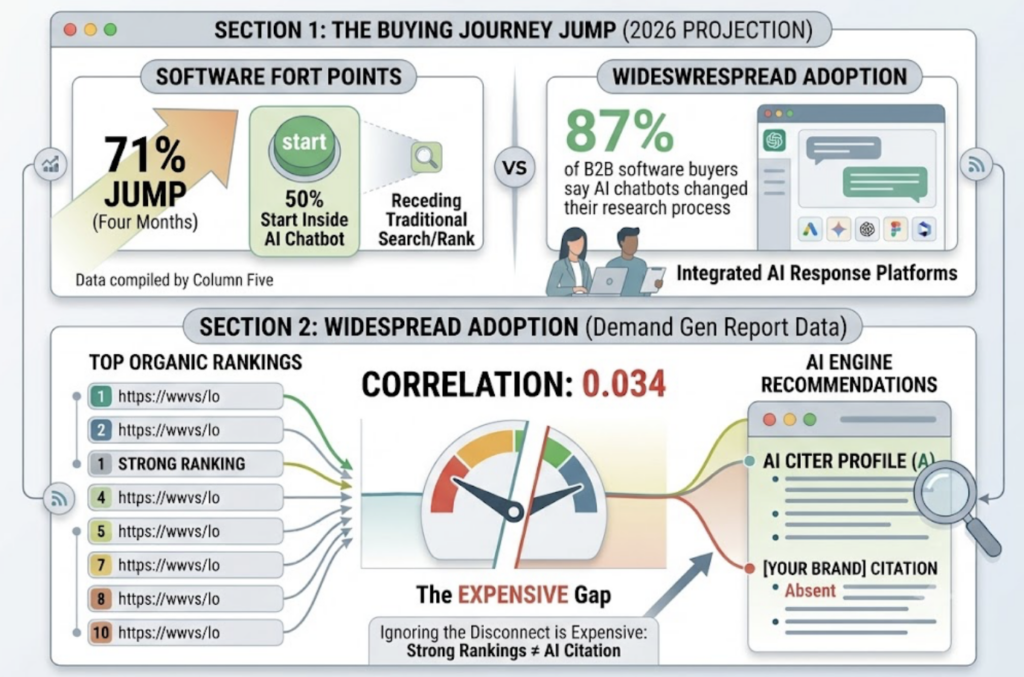
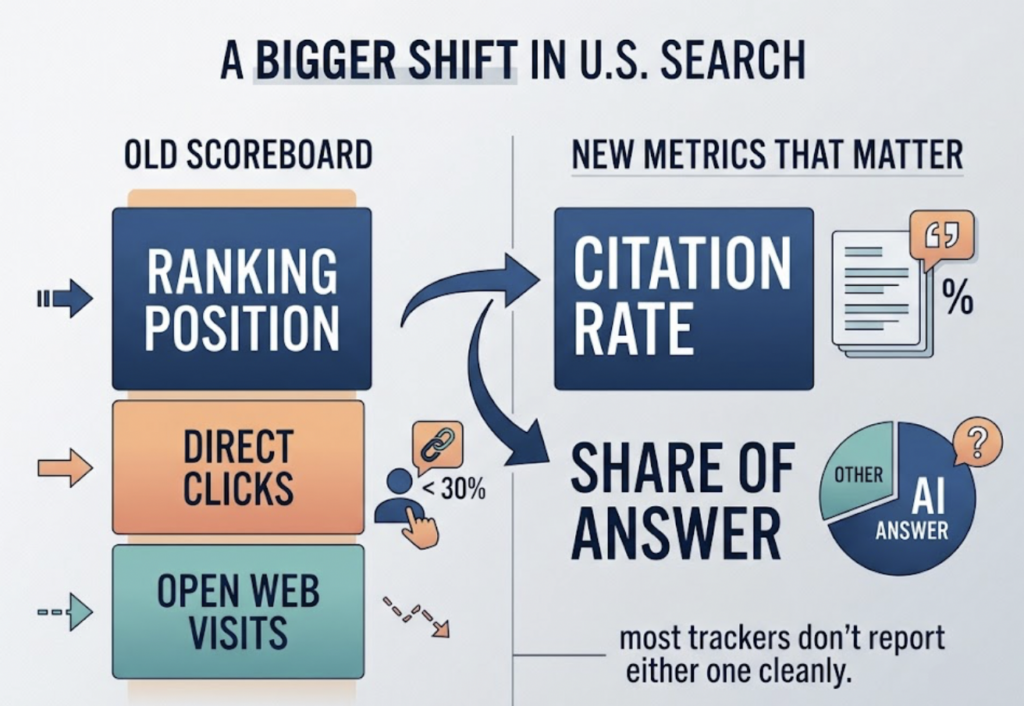
    There’s a bigger shift underneath all of this. Fewer than 30% of U.S. searches now end in a direct click to the open web, which means an AI answer is often the only impression a buyer ever forms of your category. Ranking position stopped being the scoreboard. The metrics that matter now are citation rate and share of answer, and most trackers don’t report either one cleanly.
    That’s the gap most brands still can’t see.

    What a Real Generative Engine Optimization Tracker Has to Measure

    Before ranking anything, it helps to agree on the scoring axis. A tracker worth paying for has to cover six things, not one.

    Engine coverage breadth. Does it watch both browser-based AI search like Perplexity and Google AI Overviews, and chat-native interfaces like ChatGPT, Claude, and Gemini? Coverage gaps hide problems.

    Citation velocity and quality. Not just whether you’re mentioned, but where in the response and why. The useful part is reverse-engineering the semantic patterns that led to the citation in the first place.

    Competitor benchmarking. Your share of answer only means something next to rivals, measured topic cluster by topic cluster.

    Sentiment and positioning. Tone matters. There’s a real difference between an AI calling you a category leader and calling you a budget alternative.

    Actionable execution. Good generative engine optimization metrics tell you the score. A good tool also tells you how to rewrite a page so it’s more likely to get cited next time.

    Direct attribution. Can it link AI-referred traffic to pipeline and revenue, not just session counts?

    Here’s the thing. Most comparison lists rank tools on a single vanity number. The six pillars above are how you separate a real generative engine optimization tracker from a dashboard that just counts mentions.

    The 7 Generative Engine Optimization GEO Trackers at a Glance

    The 2026 market for GEO tools is crowded, so this list focuses on platforms with genuine feature depth across those six pillars. Here’s how the seven generative engine optimization GEO trackers compare at a glance.

    ToolEngine coverageCore strengthCompetitor benchmarkingCitation analysisBuilt for
    TopifyChatGPT, Gemini, Perplexity, DeepSeek, Doubao, QwenFull-funnel GEO analyticsYes, real-timeYes, source-levelFull-stack teams and enterprise
    AthenaHQMulti-engineMonitoring-to-execution workflowYesPartialMid-to-large teams
    Rankscale AIBroad multi-engineCross-platform visibilityYesLimitedAgencies
    Semrush AI ToolkitMajor enginesSEO suite integrationYesPartialExisting SEO teams
    HallLLM chat interfacesReal-time mention alertsLimitedNoBrand monitoring teams
    Answer SocratesSearch-intent focusedKeyword and cluster discoveryNoNoContent marketers
    Mangools AI GraderSnapshot coverageEntry-level visibility scoreNoNoSMBs and solo founders

    The pattern is clear once you line them up. A few tools cover the full lifecycle, most cover one slice of it well, and entry-level options give you a baseline reading and little else.

    Topify: Full-Funnel Generative Engine Optimization Tracking

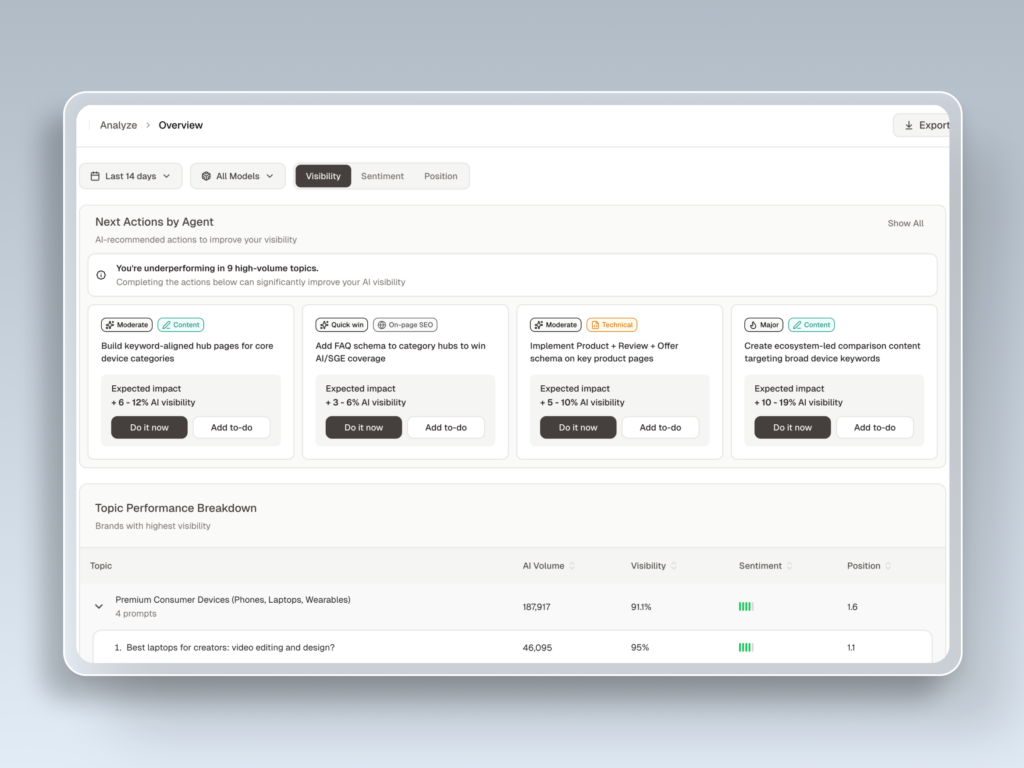
    Topify lands at the top here because it’s built around the whole GEO lifecycle, not a single metric. Where most trackers stop at “you were mentioned,” it reports across seven dimensions in one view: visibility, sentiment, position, volume, mentions, intent, and CVR.

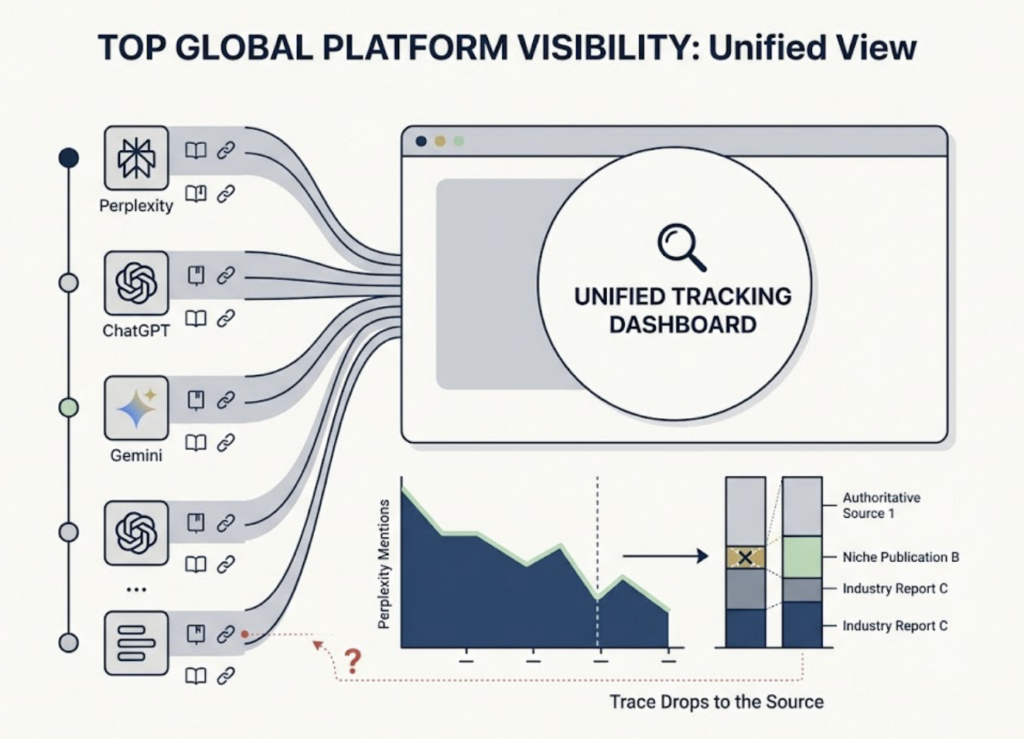
    That combination matters in practice. You can spot a drop in ChatGPT mentions, trace it to a specific source domain that stopped citing your brand, and check whether your position slipped in Perplexity at the same time, all without switching tabs.

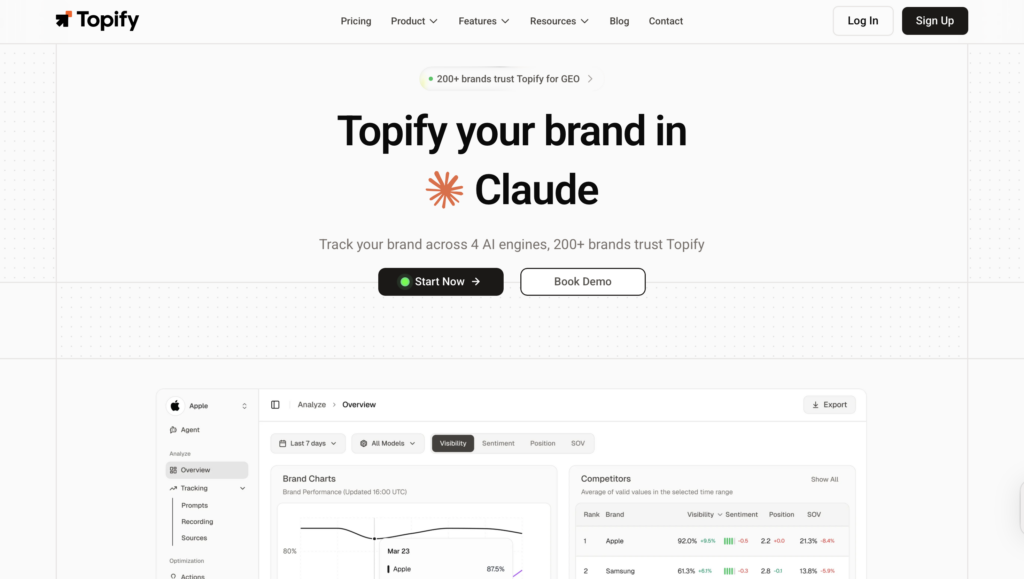
    Coverage is the second reason it ranks first. Topify tracks brand presence across ChatGPT, Gemini, Perplexity, DeepSeek, Doubao, and Qwen, which covers both the Western and Asian engines where most teams have blind spots. Single-engine tools simply can’t see a Gemini-versus-Perplexity gap, because they’re only looking at one side of it.

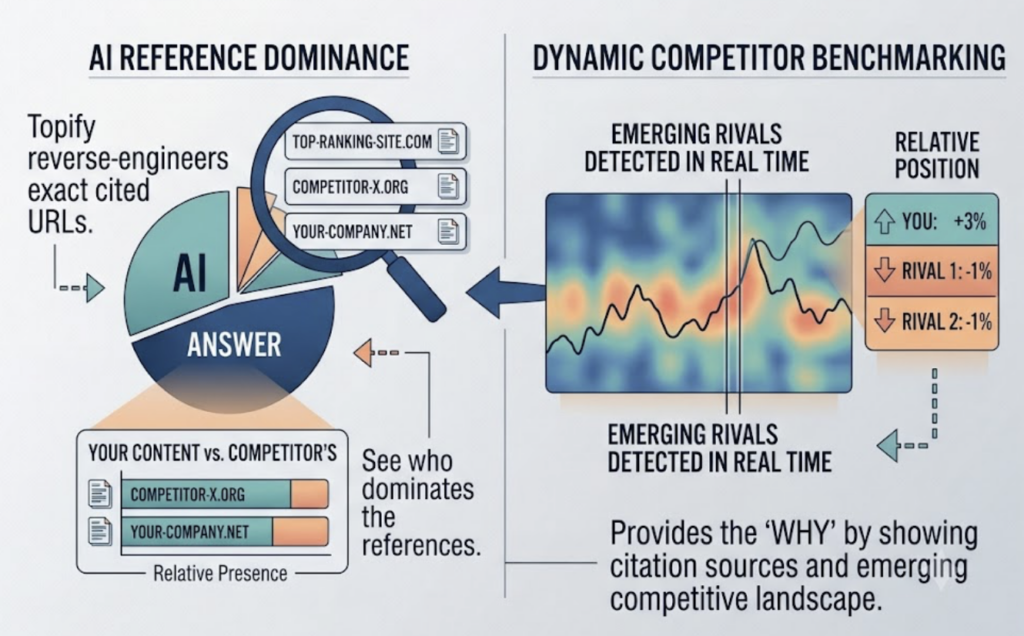
    Then there’s the citation layer, which is where the depth shows. Topify reverse-engineers the exact domains and URLs that AI platforms cite, so you can see whether your content or a competitor’s dominates the references behind an answer. Pair that with dynamic competitor benchmarking, which detects emerging rivals in real time and shows your relative position, and you get the “why,” not just the “what.”
    Most tools stop at data. Topify adds one-click execution on top of the analytics. You state a goal in plain English, review the proposed GEO strategy, and deploy it without building a manual workflow. For a marketing lead who’s tired of exporting numbers into a separate content brief, that closes the loop between insight and action.

    On price, plans start at $99/mo for the Basic tier with a 30-day trial, $199/mo for Pro, and from $499/mo for Enterprise with a dedicated account manager. The usage-based structure is designed around how teams actually scale, so you can start small and expand as the value gets obvious. If you want to see your own numbers first, you can get started with Topify on the trial before committing.

    Who it’s not for: a solo founder who only needs a quick monthly visibility reading will find the seven-metric depth more than they’ll use. That’s a fit problem, not a flaw.

    How the Other GEO Trackers Stack Up

    Each of the remaining tools earns its place for a specific use case.

    AthenaHQ is the closest peer on lifecycle coverage. It’s built for the monitoring-to-execution path and works well for mid-to-large teams that want an end-to-end GEO workflow without assembling one from parts.

    Rankscale AI leans into broad cross-platform visibility, which makes it a sensible pick for agencies juggling many client brands at once. Its strength is breadth of engine coverage more than citation depth.

    Semrush AI Toolkit is the natural choice if your team already lives inside Semrush. It extends share-of-answer and sentiment reporting into AI models while keeping your existing SEO reporting in one place, so you avoid spinning up a separate data silo.

    Hall focuses on real-time LLM mention monitoring. For a brand team that mainly wants fast alerts when AI tools start talking about them differently, it does that job cleanly, though it’s lighter on competitor and citation analysis.

    Answer Socrates isn’t a full tracker so much as a discovery tool. It’s genuinely useful for content marketers mapping cluster-level intent and finding the prompts worth optimizing for before they invest in monitoring.

    Mangools AI Grader is the entry point. It gives SMBs and founders a basic visibility score to establish a baseline, which is a reasonable first step before committing to enterprise-grade spend.

    How to Pick a Generative Engine Optimization Tracker for Your Stack

    The right tool depends less on the leaderboard and more on what your team already does.

    If you’re an SEO-heavy team, staying inside the Semrush AI Toolkit usually beats adding a fragmented data source, since you keep your workflows intact. If you’re a first-mover brand that needs granular citation analysis and execution in one place, Topify or AthenaHQ are the platforms built for that non-linear search reality. And if you’re resource-constrained, start with Mangools AI Grader for a baseline, layer in Answer Socrates to understand your clusters, then graduate to a full tracker once the spend is justified.

    The mistake to avoid is buying on engine count alone. A tracker that watches six engines but never tells you why you lost a citation leaves you exactly where you started, just with more charts.

    Conclusion

    GEO and SEO are now different disciplines, and the tool you choose should reflect that. The trackers that matter in 2026 don’t just confirm you exist in an AI answer. They tell you where you sit, why, against whom, and what to change next.

    Map your needs to the six pillars first, then pick the platform that covers the ones you’re weakest on. If full-funnel coverage and source-level citation analysis are the gaps, that’s where a generative engine optimization tracker like Topify earns its slot. Run a real query on your own brand before you decide. The data usually settles the debate faster than another comparison table will.

    FAQ

    Q: What is a generative engine optimization tracker? 

    A: It’s a tool that monitors how AI engines like ChatGPT, Perplexity, and Gemini mention, cite, and position your brand in their answers. Unlike a traditional rank tracker, it measures share of answer and citation rate instead of blue-link position.

    Q: What are the best generative engine optimization GEO trackers in 2026? 

    A: It depends on your stack. Full-funnel platforms like Topify and AthenaHQ suit teams that need citation analysis plus execution, Semrush AI Toolkit fits SEO-heavy teams, and Mangools AI Grader works as an entry-level baseline. Match the tool to the six pillars your team is weakest on.

    Q: Why isn’t Google ranking enough to measure AI visibility? 

    A: Because fewer than 30% of U.S. searches now end in a click to the open web, and AI engines synthesize answers from sources differently than Google ranks pages. You can rank well on Google and still be absent from the AI answer a buyer actually reads.

    Q: How often should I check my AI search visibility? 

    A: AI engines update citation patterns every few weeks, so monthly snapshots tend to lag reality. Real-time or weekly monitoring catches drops while you can still trace and fix the cause.

    Read More

  • AI Prompt Tracking Solution: What to Track and Why

    AI Prompt Tracking Solution: What to Track and Why

    Your team opens ChatGPT, types in your category’s top question, and screenshots whether your brand shows up. Then Perplexity. Then Gemini. Then again next week, because the answers keep moving. Tracking even 50 prompts across three AI platforms this way burns dozens of hours a week, and the spreadsheet you’re building is stale before you finish it.

    The harder problem isn’t checking once. It’s knowing whether what you saw was a real trend or just model noise.

    What an AI Prompt Tracking Solution Actually Monitors

    Start with the word “prompt,” because it confuses people. An AI prompt tracking solution has nothing to do with prompt engineering or writing instructions for a model. It tracks the outputs of real user queries, the high-intent questions buyers actually ask AI tools, like “best [category] software” or “[your brand] vs [competitor].”

    The job is to audit how the AI answers those questions, at scale, over time.

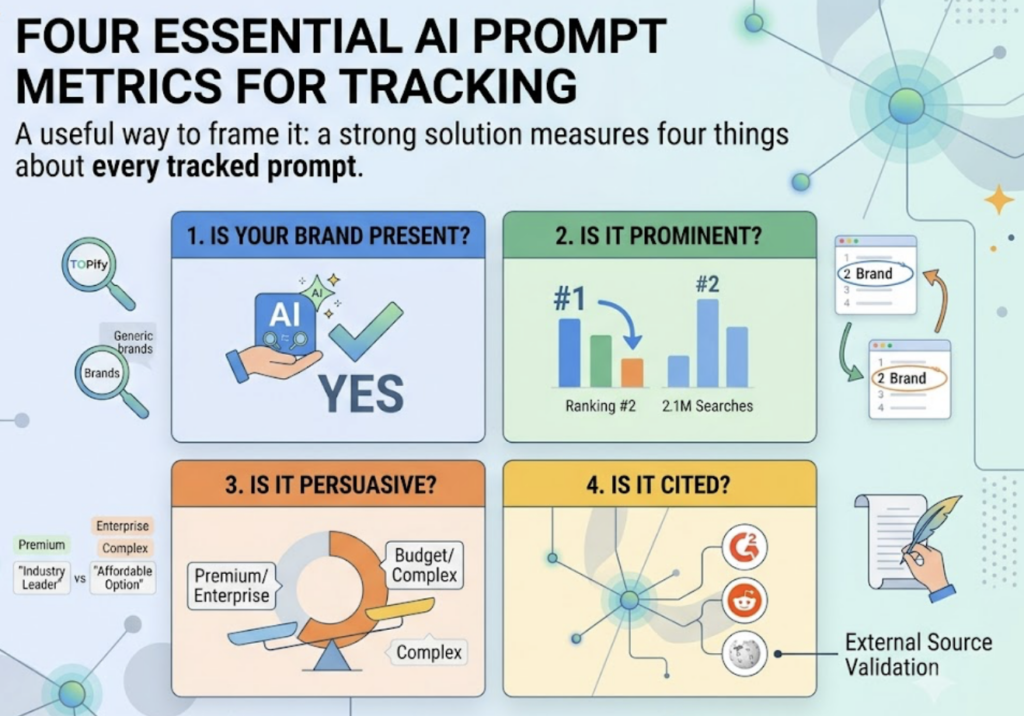
    A useful way to frame it: a strong solution measures four things about every tracked prompt. Is your brand present in the answer at all? Is it prominent, meaning where does it land in the list? Is it persuasive, meaning how does the model frame you, premium or budget, enterprise or complex? And is it cited, meaning which external sources, like G2, Reddit, or Wikipedia, does the AI lean on to validate the recommendation?

    That fourth dimension is the one most teams skip. It’s also where the leverage is.

    Why Manual AI Prompt Tracking Falls Apart Fast

    Manual, spreadsheet-based tracking hits three walls that no amount of effort fixes.

    The first is volatility. LLMs are probabilistic, not deterministic. Even with temperature pinned low, responses still drift between runs, so a single manual spot-check captures one data point when actual visibility is a distribution. You need a rolling average, a 7- or 30-day window, to separate a meaningful shift from random variance.

    The second is scale. Checking a modest cluster of 50 prompts across three engines, every week, eats dozens of hours of senior marketing time. That’s expensive labor spent copying answers into cells.

    The third is the snapshot trap. AI platforms update their indexes and reasoning logic constantly, so today’s screenshot is often obsolete within days.

    Treat AI performance like a static SEO rank and you’ll spend your time chasing noise instead of driving growth.

    That’s the gap a real system is built to close.

    What a Real AI Prompt Tracking Tool Has to Measure

    Most dashboards reduce AI visibility to a single number. A serious AI prompt tracking tool refuses to do that, because one number hides everything you’d actually act on.

    Here’s what the analytics layer has to break out.

    Visibility, Position, and Sentiment in One View

    Visibility rate is the share of relevant AI answers that mention your brand at all. It’s the baseline, not the finish line.

    Position, or salience, is the order of mention. This one matters more than it looks. AI models tend to weight the first 30 to 40% of an answer most heavily, so being named last in a list of seven is closer to invisible than it feels.

    Sentiment, or framing, is the qualitative read: does the model call you “the enterprise option” or “a cheaper alternative”? Two brands can share the same visibility rate while one gets described in language that quietly kills deals.

    Source-Level Analytics, Not Just a Dashboard Number

    Then there’s source attribution, the citation supply chain. This tracks which domains feed the AI’s answer about your category.

    It reframes the whole problem. If an AI cites a specific review site or industry journal when recommending tools in your space, your real optimization target isn’t only your own domain. It’s earning presence on the sources the model already trusts. A dashboard that shows your visibility score but hides which sources moved it leaves you optimizing blind.

    From Dashboard to Platform: What a Complete AI Prompt Tracking System Does

    Measurement is table stakes. The reason to graduate from a basic tool to a full AI prompt tracking platform is execution, turning the data into a decision you can ship the same day.

    This is where Topify is built differently. Instead of stopping at rows in a database, it runs a closed loop from discovery to action.

    It starts with High-Value Prompt Discovery. Rather than asking you to guess which 50 prompts to track, the system surfaces high-volume questions in your category where your brand is currently dark, then keeps surfacing new ones as AI recommendation patterns shift. You’re not maintaining a static prompt library by hand.

    From there, the analytics run across seven dimensions, visibility, sentiment, position, volume, mentions, intent, and CVR, so a drop in ChatGPT mentions can be traced to a specific cause rather than logged as a mystery.

    Competitor benchmarking sits in the same view. You see your share of voice against rivals at the individual prompt level, which is far more useful than a category-wide average, plus emerging competitors as AI starts naming them.

    The source layer is what ties it together. The platform reverse-engineers the exact domains and URLs the AI cites, so if a competitor is being referenced by a publication that ignores you, the gap maps straight to a content target. From there, you can move on a strategy with one-click execution instead of routing findings through three more meetings.

    For a marketing team, the practical difference is simple. A monitoring dashboard tells you that you’re losing. A complete system tells you where, why, and what to publish next.

    You can get started with Topify on a 30-day trial that covers ChatGPT, Perplexity, and Google AI Overviews tracking.

    Build Your Own AI Prompt Tracking System or Buy One?

    If you have engineers, building an in-house AI prompt tracking software stack looks tempting. Query a few model APIs, parse the responses, store the results. How hard could it be?

    Harder than it looks, and the cost is mostly hidden. The build versus buy math rarely favors building once you account for ongoing maintenance rather than the first prototype.

    FactorSelf-built systemSpecialized platform
    Data integrityFragile APIs, growing maintenance debtScalable, high-availability architecture
    Engine coverageHard to sustain across 5+ platformsCross-platform sync out of the box
    Hidden costsEngineering time, API spend, cloud overheadPredictable subscription
    ActionabilityOften ends as data silosBuilt-in gap and content analysis

    The pattern most teams hit is the data-silo trap. The pipeline works, the numbers land in a database, and then nobody has time to turn rows into decisions because they’re busy keeping the pipeline alive.

    Bottom line: for most teams, buying frees you to spend your hours applying the data, citation building, content pruning, repositioning, instead of repairing infrastructure.

    Conclusion

    AI visibility is the new baseline, and you can’t manage what you only glance at once a week. The path forward is concrete: define a library of 25 to 50 decision-stage prompts, measure where your brand is currently invisible, audit which sources feed the AI’s recommendations, then move to a tool-based system so you’re watching trends instead of snapshots.

    The goal isn’t a prettier dashboard. It’s knowing, with enough confidence to act, exactly where your brand stands the next time a buyer asks an AI for a recommendation.

    FAQ

    Q: What are the best tools for monitoring brand visibility in AI search results? 

    A: Look for a tool that tracks across multiple engines (ChatGPT, Perplexity, Gemini, Google AI Overviews) rather than one, breaks visibility into position and sentiment instead of a single score, and shows the sources behind each answer. Platforms like Topify combine prompt-level tracking with source analysis and competitor benchmarking in one place.

    Q: What are AI search optimization tools? 

    A: They’re platforms that measure and improve how AI engines represent your brand in their answers, often called GEO (Generative Engine Optimization) or AEO tools. Unlike traditional SEO software focused on Google rankings, they track mentions, citations, and framing inside generative responses.

    Q: What are the best tools for monitoring generative AI search results? 

    A: The strongest options monitor a defined prompt set continuously, use rolling averages to filter out model noise, and connect findings to action, like flagging which content or citations to build next. Continuous monitoring matters more than a one-time audit because generative answers shift week to week.

    Q: What are the best AI search optimization tools for improving brand visibility? 

    A: Prioritize tools that close the loop between data and execution. Tracking alone shows where you’re invisible; the ones that move the needle also surface high-value prompts, map citation gaps to specific sources, and let you act on a strategy quickly rather than just exporting a report.

    Read More

  • AI Prompt Tracking Tool: What It Is and How It Works

    AI Prompt Tracking Tool: What It Is and How It Works

    Your keyword rankings held steady all quarter. Domain authority’s up. Organic traffic looks fine on the dashboard. Then a prospect types “best tool for my category” into ChatGPT, reads the three names it recommends, and yours isn’t one of them. Nothing in your SEO stack flagged it, because rank trackers were built to watch a results page, not the inside of an AI answer. That blind spot is where a different kind of tracking comes in, one that measures what models actually say about you when nobody’s watching the SERP.

    What an AI Prompt Tracking Tool Actually Tracks

    An AI prompt tracking tool monitors how a brand shows up inside AI-generated answers, measured at the level of individual prompts. A prompt is the real question a user asks an assistant, like “what’s the best CRM for a small sales team.” The tool watches whether your brand appears in the response to that prompt, where it lands, and how it’s described.

    That’s a different unit of measurement than traditional SEO. A keyword rank tracker tells you your page sits at position 4 for a search term. It says nothing about whether ChatGPT names you when someone asks for a recommendation. The link and the answer are separate worlds now.

    The shift is big enough to matter. AI-driven search jumped from under 10% of interactions in 2023 to roughly 30% by 2026. And according to Similarweb, searches ending without a click rose from 56% to 69% once AI answers started landing at the top of results. When the answer is the destination, being named inside it is the new front page.

    So at the prompt level, these tools typically track four things: how often you’re mentioned, where you sit in the answer, how the model frames you, and which sources it cites to back the claim. Put simply, it answers a question your SEO reports can’t. When AI talks about your category, does it mention you, and what does it say?

    How an AI Prompt Tracking Tool Works Under the Hood

    Under the hood, prompt tracking runs a loop. It starts with a prompt library, a curated set of questions that mirror how real buyers research. These aren’t keywords. They’re full questions like “X vs Y” or “best solution for this use case,” because that’s how people actually talk to assistants.

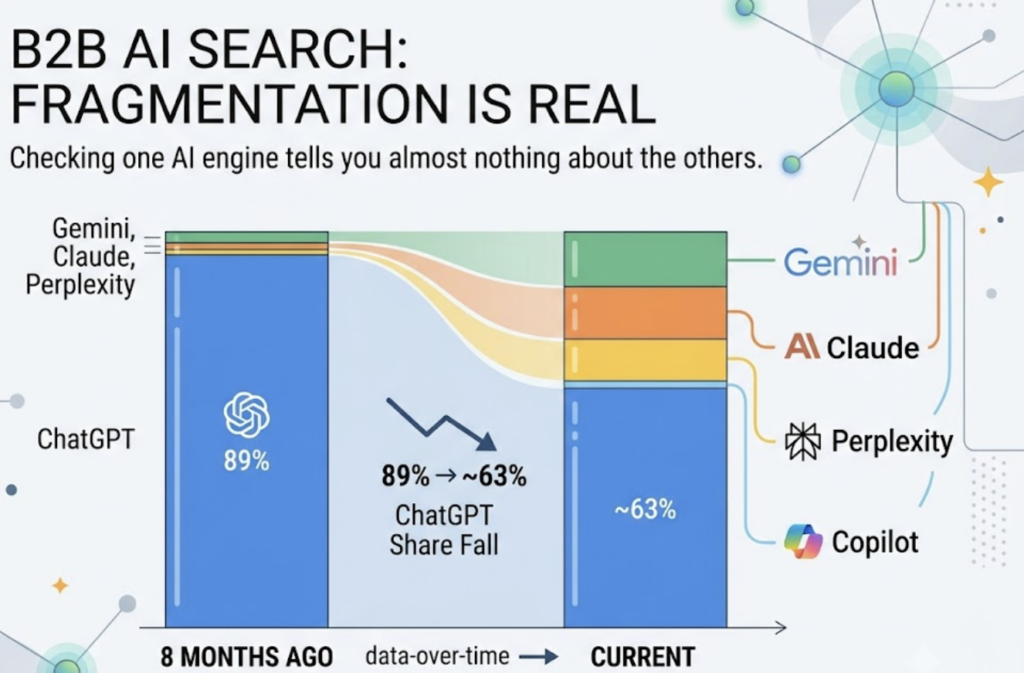
    Next, the tool runs those prompts across multiple engines on a schedule. ChatGPT, Perplexity, Gemini, and Copilot each retrieve and rank information differently, so checking one tells you almost nothing about the others. The fragmentation is real. ChatGPT’s share of B2B AI referrals fell from 89% to about 63% in roughly eight months as Gemini, Claude, and Perplexity absorbed the rest.

    Track one platform and you’re measuring a third of the picture.

    Then it parses the output. Using language processing, the tool pulls out brand mentions and, just as important, the citation chain, the source URLs the model leaned on to build its answer. Those citations are the closest thing GEO has to a backlink graph.

    Here’s the part that trips people up. AI answers aren’t deterministic. The same prompt can return different results across sessions because of model updates, memory features, and randomness in how text gets generated. A single check is a snapshot of noise. So a decent tool computes a rolling average over 7 to 30 days, which is what turns scattered readings into a trend you can act on.

    The Metrics That Tell You If You’re Visible or Invisible

    Raw mentions feel satisfying, but one number rarely tells the truth. Knowing how to measure AI search performance means watching a few metrics together.

    Visibility rate is the starting point: the percentage of your tracked prompts where the brand shows up at all. Share of voice puts that in context by comparing your presence against direct competitors for the same prompts. You can be mentioned 40% of the time and still be losing if a rival hits 70%.

    Position matters too, and it’s where the idea of an ai visibility rank tracker becomes literal. Being named last in a list of eight, or buried under a “you might also consider” aside, isn’t the same as being the first recommendation. Salience inside the answer is the new ranking.

    Then there’s sentiment, or framing. A model can mention you accurately and still cast you as the budget option when you sell premium. And citation strength tells you which sources the AI trusts to talk about you, because fixing those sources is often how you move the other numbers.

    The trap is measuring any one of these alone. A visibility spike means little if sentiment is sliding or a competitor’s share of voice is climbing faster. Read them as a set.

    What Most Teams Get Wrong When They Start Tracking

    Most early GEO programs fail in predictable ways.

    The first is treating prompts like keywords. Teams port their old keyword list straight into the prompt library, either too broad (“CRM”) or too granular to match how anyone actually asks an assistant. Prompts are conversations, not search strings.

    The second is single-platform bias. Monitoring only ChatGPT ignores the citation-first behavior that drives Perplexity and the integrated answers inside Gemini and Google AI Overviews, which now surface on a large share of informational queries. Different engines, different rules.

    Third is static monitoring. Checking once a month feels efficient and produces garbage data, because models update and citation patterns drift on a scale of weeks, not quarters.

    And fourth is the attribution gap. Plenty of teams watch AI visibility rise and never connect it to branded search volume or organic traffic, so the work never earns its budget. Roughly 25% of B2B buyers now use generative AI for vendor research before they build a shortlist. If you can’t tie visibility to that pipeline, you can’t defend the spend.

    Best AI Prompt Tracking Tools and What Separates Them

    Search “AI prompt tracking tool” and you’ll find two broad types, and they’re not interchangeable. Before comparing names, it helps to know what actually separates them: engine coverage, whether the tool finds high-value prompts for you or makes you guess them, depth of citation analysis, and whether it stops at a dashboard or helps you act.

    That last point is the real divide. Lightweight monitors tell you what happened. Comprehensive platforms tell you what to do next.

    ApproachEngine coverageWhat it surfacesWorkflow
    Monitoring-only toolsOften one or two enginesMention and visibility snapshotsReporting stops at the dashboard
    Comprehensive GEO platforms, like TopifyChatGPT, Gemini, Perplexity, and morePrompts, citations, competitor gapsMonitor, analyze, then act

    Topify sits in the second group. It tracks brand performance across major engines through seven metrics, visibility, sentiment, position, volume, mentions, intent, and CVR, so you’re not stitching separate readings together. Its prompt discovery surfaces the high-volume questions worth tracking instead of leaving you to guess them. And its source analysis reverse-engineers the exact domains and URLs an engine cites, so when your visibility drops you can trace it to a specific citation that stopped pointing your way, then fix the content or earn the mention. For a sense of the free diagnostics available for this kind of work, Topify keeps a public reference of GEO free tools.

    Other monitoring tools cover the basics well and can be the right call for a small team testing the water. The difference shows up when you need to move a number, not just watch it.

    A Checklist for Choosing and Improving Your Setup

    If you’re setting this up from scratch, a simple sequence keeps it useful.

    1. Build a prompt library of 50 to 100 questions that mirror the buyer journey: comparisons, pain-point queries, and category research. Map them to how people actually ask, not to your keyword sheet.
    2. Set a baseline. Track visibility and share of voice for 30 days across ChatGPT, Perplexity, and Google AI Overviews before you judge any movement.
    3. Audit citations. Find the authority domains, review sites, forums, industry publications, that engines lean on for your top prompts. These are your targets.
    4. Close the gaps. Use the tool’s gap analysis to restructure landing pages so a model can parse them as the definitive source, not a maybe.
    5. Watch the competition. Track your top three rivals so you can see how their framing differs from yours and where they’re winning prompts you aren’t.

    Improving the numbers follows from the audit. If a competitor owns a prompt because three review sites cite them and none cite you, the strategy is earning those citations, not rewriting your homepage for the tenth time. When you’re ready to run this as a live loop rather than a one-off check, you can get started with a tracked prompt set and expand from there.

    What an AI Prompt Tracking Tool Costs

    Pricing in this category follows the work the tool does, not a flat rate. Most vendors meter on prompt volume, tracked engines, seats, and analysis depth, which is why two tools with similar dashboards can sit a tier apart.

    Across a survey of 34 AI search visibility tools, entry plans cluster around a $79 median while the top public tier lands near $400, and prompt volume is the single biggest reason a plan steps up. Pure monitoring tools tend to run cheaper than platforms that also handle execution. A separate analysis of 20 tools puts the practical range for most teams at $79 to $149 a month, with sticker prices stretching from $20 to several thousand at the enterprise end.

    For reference, Topify’s Basic plan runs $99 a month and covers ChatGPT, Perplexity, and AI Overviews tracking with 100 prompts and a 30-day trial, while Pro at $199 lifts that to 250 prompts. Full tiers sit on the Topify pricing page. The sensible approach is the one buyers use across the category: start small, confirm that visibility moves real traffic, then scale the prompt count as the value shows up.

    Conclusion

    Traditional rank trackers still do their job. They just can’t see the layer where more and more buying decisions now start, inside an AI answer where your brand is either named or invisible. An AI prompt tracking tool fills that gap by measuring what models say about you, across engines, over time.

    The practical first step is small. Pick 50 prompts that match how your buyers ask, track them for a month across the engines they use, and see where you actually stand. You can’t improve a number you’ve never measured.

    FAQ

    Q: What is an AI prompt tracking tool, in plain terms? 

    A: It’s an analytics tool that checks whether AI assistants mention and recommend your brand when users ask real questions. Instead of measuring where your link ranks on Google, it measures how you show up inside the answer ChatGPT, Perplexity, or Gemini generates.

    Q: How is an AI prompt tracking tool different from an SEO rank tracker? 

    A: A rank tracker watches your position on a search results page. A prompt tracker watches your presence inside an AI-generated response: whether you’re mentioned, where you sit in the answer, how you’re framed, and which sources the model cites. One looks at the list of links, the other looks at what replaced the list.

    Q: How do you measure success with one? 

    A: Watch a few metrics together rather than chasing a single count. Visibility rate shows how often you appear, share of voice compares you to competitors, position shows where you land in the answer, and sentiment shows how you’re described. A rise in one means little if another is falling.

    Q: How much does an AI prompt tracking tool cost? 

    A: Most teams land in the $79 to $149 a month range, with entry plans commonly near a $79 median and enterprise tiers running several hundred and up. Pricing usually scales with prompt volume and engine coverage, so a small tracked set costs far less than monitoring hundreds of prompts across every platform.

    Read More

  • AI Response Monitoring Strategy: A Practical Guide

    AI Response Monitoring Strategy: A Practical Guide

    Your CEO asks a simple question in the Monday standup: “How are we showing up when someone asks ChatGPT or Perplexity for a recommendation in our category?” You pull a couple of screenshots from last week. By the time you’ve answered, the data’s already stale. Large language models are non-deterministic, so the same prompt can surface a different set of brands in more than 38% of consecutive runs. Spot-checking by hand can’t keep pace with that kind of variance. What you need isn’t another screenshot. It’s a repeatable way to measure where your brand stands, across platforms, on a cadence you can actually report against.

    Why AI Response Monitoring Strategy Can’t Be an Afterthought

    AI search stopped being an experiment a while ago. By February 2026, ChatGPT alone passed 900 million weekly active users, and roughly 37% of consumers now start product research inside an AI tool rather than a search box.

    The bigger shift is behavioral. About 58.5% of search sessions now end without a single click to an external site. The answer happens inside the model. If your brand isn’t in that answer, the customer often never learns you exist.

    That’s the gap most dashboards still can’t see.

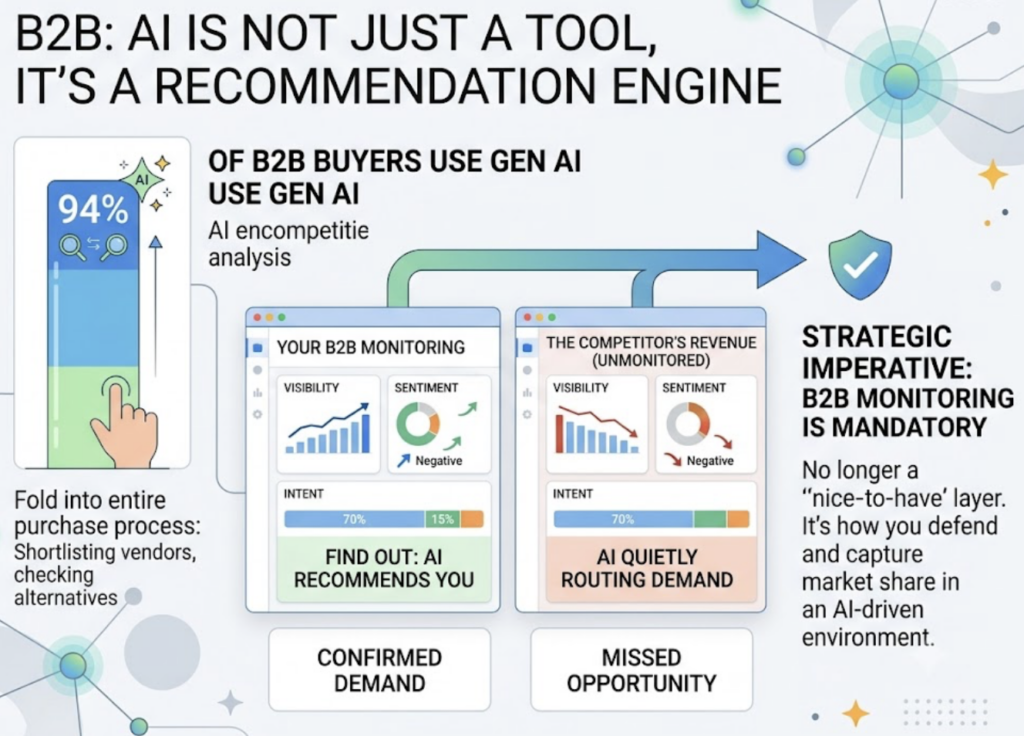
    For B2B teams the stakes are sharper. Around 94% of buyers now fold generative AI into their purchase process somewhere, from shortlisting vendors to checking alternatives. A monitoring strategy isn’t a nice-to-have reporting layer anymore. It’s how you find out whether AI is recommending you or quietly routing demand to a competitor.

    What an AI Response Monitoring Strategy Actually Tracks

    Most teams start and stop at “did we get mentioned.” That’s a binary that hides almost everything useful. A mature AI response monitoring strategy tracks four dimensions, and each one answers a different question.

    Mention and visibility rate. How often your brand shows up across the high-intent prompts that matter to revenue. This is the baseline, but it’s only the floor.

    Positioning and salience. Being named tenth in a list is not the same as being the top recommendation. Position matters more than most teams assume: a brand in the first slot of an AI answer is about 3.1× more likely to drive a click-through than one buried further down.

    Sentiment and context. How the model frames you. There’s a real difference between “a solid budget option” and “a premium enterprise platform.” If AI consistently describes your product in language that fights your positioning, a mention can work against you.

    Source authority. The upstream domains the model leans on when it builds an answer, think Reddit, G2, Wikipedia, industry roundups. If your brand is missing from those nodes, the model has fewer reasons to cite you, no matter how good your own site is.

    Track one dimension and you get noise. Track all four and you get a strategy.

    How to Build an AI Response Monitoring Strategy in 5 Steps

    Here’s a framework you can stand up without a data science team. The point is to turn ad-hoc checking into something systematic.

    Step 1: Build a prompt library. Curate 50 to 150 revenue-critical prompts, the questions real buyers ask. Think “best [category] alternatives,” “[your brand] vs [competitor],” and “tools for [specific use case].” These prompts are your measurement instrument, so they need to reflect actual intent, not vanity queries.

    Step 2: Cover multiple engines. ChatGPT, Perplexity, and Google’s AI Overviews each pull from different retrieval indexes. Optimizing for one tells you almost nothing about the others. Multi-engine coverage isn’t optional if you want a real picture.

    Step 3: Set a metric baseline. Standardize on a single AI Visibility Score that rolls presence, position, and sentiment into one number you can trend over time. Without a baseline, every report becomes a fresh argument about what “doing well” means.

    Step 4: Pick a cadence that filters noise. Daily readings swing wildly because of model variance. Use 7-day or 30-day rolling averages instead, so you’re reacting to genuine movement rather than the model’s mood that morning.

    Step 5: Close the loop. Monitoring that doesn’t feed action is just expensive curiosity. When visibility drops on a prompt, correlate it with a content gap or a missing third-party mention, fix that, and watch whether the score recovers. Measure. Diagnose. Act.

    How to Track Brand Mentions in Perplexity

    Perplexity deserves its own playbook, and here’s why: only about 25% of cited domains overlap between ChatGPT and Perplexity for the same query. A strategy tuned for ChatGPT will miss most of what’s happening on Perplexity.

    Perplexity is citation-first by design. It shows its sources right alongside the answer, which means to track brand mentions in Perplexity you’re really watching two things at once: whether you’re named in the synthesized response, and whether your domain made it into the citation list underneath.

    You can do this by hand. Run your prompt library through Perplexity, log every mention, note the position, and check the source list each time. The problem is scale and decay. Manual checks can’t cover 100 prompts across multiple engines on a weekly rhythm, and the data goes stale within days as citation patterns shift.

    That’s where automation earns its place. Tracking mention rate, citation inclusion, and source overlap on a schedule turns a one-off audit into a living signal you can act on.

    Where AI Response Monitoring Strategies Quietly Fail

    Plenty of teams set up monitoring and still end up flying blind. The failure modes are predictable.

    The one-engine trap. Optimizing only for ChatGPT ignores Perplexity’s research-heavy, citation-led audience entirely. Different engine, different game.

    Treating every mention as a win. If the model keeps attaching negative qualifiers to your brand, you may be losing buyers before they ever reach your site. Sentiment isn’t a vanity metric.

    No attribution. When AI mentions get logged as generic impressions instead of pre-click signals, you miss the link between visibility spikes and the branded search volume that follows. The teams that win track that correlation deliberately.

    Manual inefficiency. Relying on human auditors builds in a 48 to 72 hour lag between a market shift and your response. At enterprise scale, that delay is the whole ballgame.

    Turning Monitoring Data Into Action With Topify

    The hard part of an AI response monitoring strategy isn’t collecting data. It’s connecting a drop in visibility to the specific reason behind it, fast enough to do something about it. That’s the gap Topify is built to close.

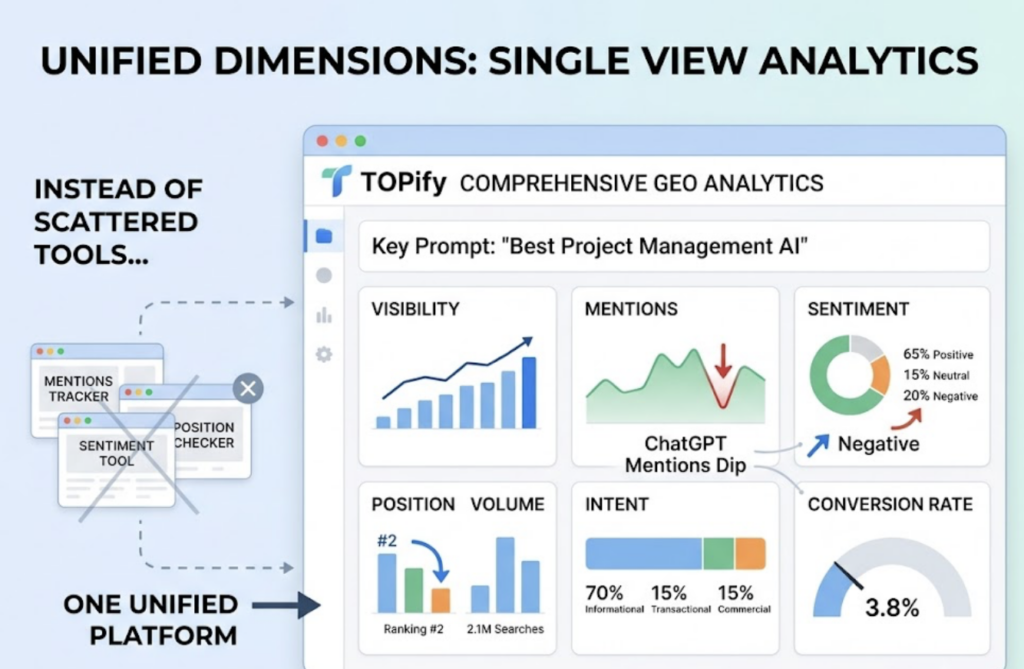
    Instead of stitching together screenshots and spreadsheets, Topify’s Comprehensive GEO Analytics aggregates performance across seven dimensions in one view: visibility, mentions, sentiment, position, volume, intent, and conversion rate. So when ChatGPT mentions dip on a key prompt, you see the position change and the sentiment shift in the same place, not three separate tools.

    Source Analysis handles the citation supply chain. It reverse-engineers the exact domains and URLs the models cite, which lets you see whether competitors are pulling authority from review sites or forums you’re absent from. That’s usually where lost visibility actually originates.

    Competitor Monitoring rounds it out by flagging where rivals consistently outrank you in comparison queries, so you can prioritize the content gaps that move the needle rather than guessing. The payoff isn’t just tidier reporting. AI-referred traffic converted about 31% higher than traditional search referrals over the 2025 holiday season, which means visibility in these answers tends to reach buyers with sharper intent. You can get started with Topify and run your prompt library across all three major engines from a single dashboard.

    Conclusion

    AI answers are becoming the place buying decisions start, and the brands that show up are the ones measuring it on purpose. You don’t need to boil the ocean to begin. Build a prompt library around your highest-intent queries, cover ChatGPT and Perplexity at minimum, and commit to a weekly or monthly cadence with a real feedback loop. Strategy beats spot-checking every time. Get those three things running, then layer in source and competitor analysis once the baseline is stable.

    FAQ

    How do I track brand mentions in Perplexity? 

    Run your high-intent prompts through Perplexity and log two things each time: whether your brand appears in the answer, and whether your domain shows up in the source citations beneath it. Because Perplexity is citation-first, the source list matters as much as the mention itself. For ongoing tracking, automate it so you’re capturing changes weekly rather than auditing by hand.

    How to track brand mentions in Perplexity without checking manually? 

    Use a monitoring platform that runs your prompt set against Perplexity on a schedule and records mention rate, position, and citation inclusion automatically. This removes the 48 to 72 hour lag that manual auditing introduces and lets you spot citation shifts as they happen.

    How often should I run AI response monitoring? 

    Use 7-day or 30-day rolling averages rather than daily checks. Model output varies enough that daily readings create false alarms. Rolling windows normalize that variance so you respond to real trends.

    What metrics matter most in an AI response monitoring strategy? 

    Four: mention rate, position, sentiment, and source authority. Mention rate is the floor, position drives clicks, sentiment shapes perception, and source authority explains why the model cites you or doesn’t. Tracking only one gives you a misleading picture.

    Read More

  • ChatGPT Ranking: How It Works and How to Improve It

    ChatGPT Ranking: How It Works and How to Improve It

    Your team spent six months building content, earning backlinks, and climbing Google. Then a prospect opened ChatGPT and asked for the best tool in your category. The answer named five brands. Yours wasn’t one of them. Nothing in your SEO dashboard explains why, because none of those metrics measure what an AI model decides to say. ChatGPT ranking runs on a different logic than Google ranking, and the brands winning it aren’t always the ones sitting at #1 in search results.

    What Is ChatGPT Ranking, Really

    ChatGPT ranking isn’t a list of blue links. It’s whether an AI model includes your brand in its answer, and where that mention lands.

    In practice, it breaks into two measurable things. The first is visibility, or mention rate: how often your brand shows up when someone asks ChatGPT a category or comparison question. The second is position, or salience: whether you’re named as the recommended leader, buried mid-list, or cited only as a footnote source.

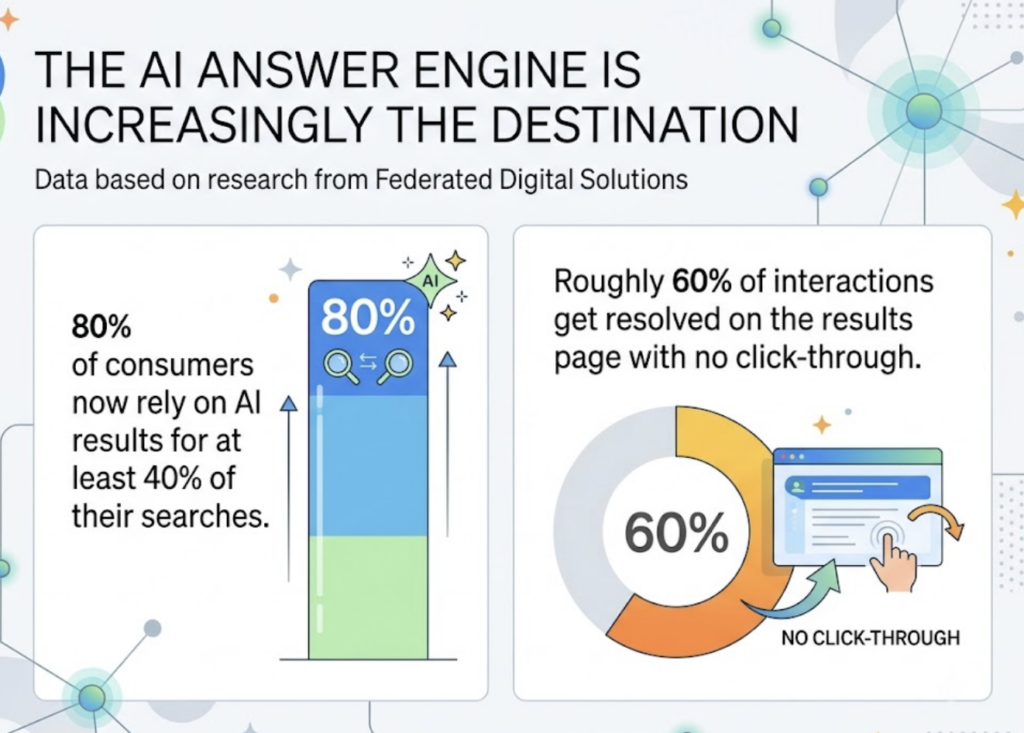
    This matters because the answer engine increasingly is the destination. Research on AI search behavior from Federated Digital Solutions found that 80% of consumers now rely on AI-generated results for at least 40% of their searches, and roughly 60% of those interactions get resolved on the results page with no click through to any website.

    That’s the gap most brands still can’t see.

    How Does ChatGPT Ranking Work

    ChatGPT doesn’t rank pages in a vacuum the way a search index does. It uses Retrieval-Augmented Generation, pulling from trusted sources across the web and synthesizing them into one confident answer. If your brand isn’t part of that synthesized consensus, you effectively don’t exist for the person asking.

    A few signals drive whether you make it into that consensus.

    Multi-source corroboration is the big one. Models favor content patterns that repeat across diverse, authoritative domains like G2, industry publications, and Reddit. When the same claim about your brand appears in several reputable places, it creates a trust cascade that tells the model you’re a real entity in your category.

    Structural clarity is the second. AI models prefer content they can extract cleanly. According to the 7 Pillars of LLM Visibility from Limy.ai, pages with clear H1 to H3 headers, bulleted lists, and answer-first summaries can see up to a 40% increase in citation rates over unstructured prose.

    The third is something traditional SEO undervalues: unlinked mentions. Google leans heavily on backlink equity. LLMs treat an unlinked mention on a reputable third-party platform as a strong signal of relevance on its own.

    Why Google Rankings Don’t Translate

    Here’s the part SEO teams keep missing.

    A high domain authority and solid keyword positions don’t guarantee anything in AI search. Marketing.org.nz makes the case plainly in its work on why traditional SEO isn’t enough: the answer engine optimizes for synthesis and entity association, not link hierarchy. The numbers back it up. Only 12% of AI Overviews link to the #1 organic ranking result, which means your Google position is no longer a reliable proxy for whether AI knows you exist.

    How to Measure ChatGPT Ranking

    The instinct is to open ChatGPT, ask the question, and see if you show up. That single check tells you almost nothing.

    AI results are non-deterministic. The same prompt can return different answers in back-to-back sessions, because models use a temperature setting to introduce conversational variety. Visiblie’s research on whether ChatGPT gives everyone the same answer points to a second variable: personalization. Chat history, saved memory, and custom instructions all shape the response, so what you see isn’t what your customer sees.

    So a single good mention is a proof of concept, not a metric. Reliable measurement means aggregating results across many fresh sessions, then watching the trend instead of reacting to one lucky or unlucky output.

    That’s the core reason manual checking falls apart at scale, and where a dedicated tool earns its place.

    Using an LLM Ranking Checker

    An LLM ranking checker runs your category prompts across AI platforms repeatedly, then turns the noisy output into a stable visibility and position score you can track over time.

    For teams measuring this across more than one engine, Topify tends to stand out by combining Visibility and Position tracking into a single view spanning ChatGPT, Perplexity, and Google AI Overviews. In practice, that means you can watch your mention rate for a key prompt, see whether you’re climbing or slipping against a competitor, and catch a drop the week it happens rather than a quarter later. It’s the difference between guessing and knowing where you actually stand.

    How to Improve Your ChatGPT Ranking

    Improving your ChatGPT ranking is less about keywords and more about entity authority. Three moves do most of the work.

    Build source authority. LLMs index high-trust platforms heavily, so placements on sites like G2 and respected industry journals feed directly into the consensus they synthesize. Reverse-engineering which domains the AI already cites for your category tells you exactly where to earn presence. Topify’s Source Analysis surfaces the exact domains and URLs AI platforms pull from, so you can see whether you or a competitor owns those references.

    Format answer-first. Put the direct answer to a likely prompt inside the first 40 to 60 words of a page, then support it with structure the model can lift cleanly. This single habit lifts extractability more than almost any other on-page change.

    Benchmark against competitors continuously. If a rival gets cited for a feature you also offer, the problem usually isn’t the feature. It’s that your content structure is stopping the model from making the connection. Topify’s competitor benchmarking shows who AI engines recommend and where the gaps sit, which turns a vague strategy into a specific content to-do list.

    The throughline of any real strategy for ChatGPT ranking: measure first, then fix what the data points to.

    Common Mistakes That Tank Your ChatGPT Ranking

    Most brands lose visibility for predictable reasons.

    The first is treating Google rankings as the scoreboard. With only 12% of AI Overviews pointing to the top organic result, that assumption quietly misleads the whole strategy.

    The second is checking one platform and calling it done. Your audience moves across ChatGPT, Perplexity, and AI Overviews, and your position can differ on each.

    The third is the one-off check. A single fresh session can’t separate signal from the model’s built-in randomness, so teams celebrate a mention that won’t repeat, or panic over an absence that wasn’t real.

    The last is ignoring sentiment. Federated Digital Solutions notes that 78% of users visit a retail site after an AI recommendation, which means a negative or off-brand AI summary can cost you the customer before they ever reach your page. How AI describes you matters as much as whether it mentions you.

    Conclusion

    ChatGPT ranking comes down to two questions: does AI mention your brand, and does it put you where it counts. The brands winning aren’t the ones with the highest domain authority. They’re the ones being measured, monitored, and corrected as AI answers shift week to week. With 58% of product research now running through AI tools, per Federated Digital Solutions, that visibility is no longer a side metric.

    Start by getting an honest baseline of where you stand across the major AI engines, then work the gaps the data exposes. You can get started with Topify to track your AI search position in one place.

    FAQ

    Q: What are the best tools for ChatGPT ranking? 

    A: The right tool tracks more than one AI platform, runs prompts across many fresh sessions to control for randomness, and reports both mention rate and position. Platforms built for this, like Topify, also tie in source and sentiment data so you can act on what you find rather than just watch a number.

    Q: Is there a checklist for ChatGPT ranking? 

    A: A simple checklist for ChatGPT ranking: earn mentions on high-authority third-party sites, format pages answer-first within the first 40 to 60 words, use clear H1 to H3 structure, monitor multiple AI platforms, and track sentiment alongside visibility. Review the data on a recurring schedule, not once.

    Q: Can you give an example of ChatGPT ranking in action? 

    A: A common example of ChatGPT ranking: you ask ChatGPT “best [your category] tool” and it returns five brands in a ranked list. Whether you appear, and at which position, is your ChatGPT ranking for that prompt. Run the same prompt across 20 sessions and the aggregate placement is your real score.

    Q: How much does ChatGPT ranking tracking cost? 

    A: Pricing for ChatGPT ranking tools varies by prompt volume and platform coverage. Topify’s plans start at $99 per month for tracking across ChatGPT, Perplexity, and AI Overviews, with higher tiers adding more prompts, projects, and seats. You can review current Topify pricing for the full breakdown.

    Read More

  • GEO Score Checker for Sports and Fitness: The 4 AI Visibility Gaps

    GEO Score Checker for Sports and Fitness: The 4 AI Visibility Gaps

    A lifter opens ChatGPT and types “best pre-workout for endurance athletes on a budget.” Back come three brand names, each with a short reason. None of them is yours, even though your formula is cleaner and your reviews are stronger.

    That gap isn’t a product problem. It’s a technical one, and it’s measurable.

    In sports and fitness, AI assistants now compress an entire category into a shortlist of three to five brands. Getting onto that shortlist depends less on how good your product is and more on whether AI can crawl, parse, and trust your brand. The fastest way to see where you stand is to run a free GEO Score Checker scan from Topify and read the four numbers it returns.

    ✅ Free ⚡ Results in 60 seconds 🔒 No signup required

    The Four Numbers That Tell You Why AI Skips Your Fitness Brand

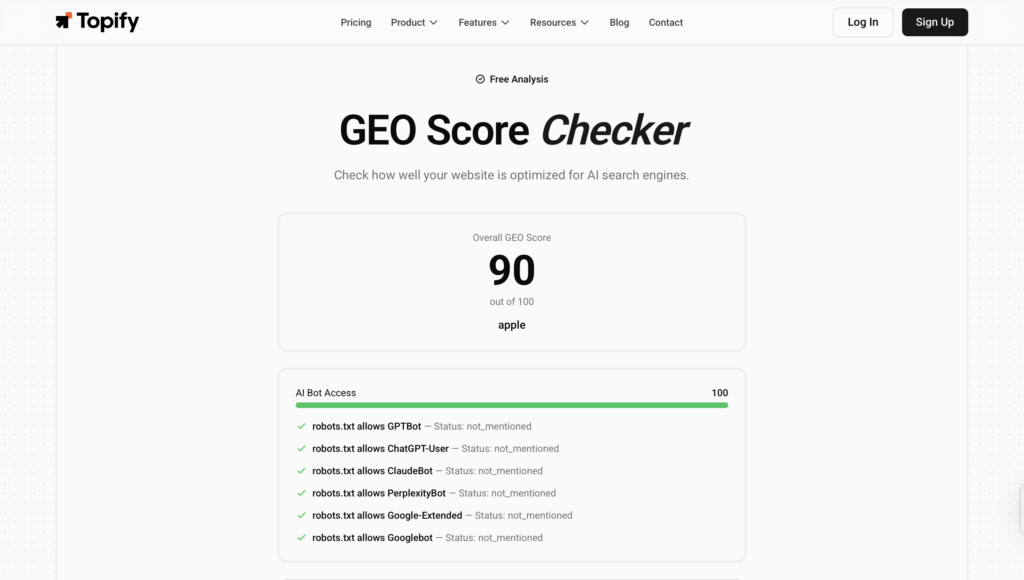
    The GEO Score Checker grades your domain 0-100 across four dimensions. Each one maps to a specific reason AI either surfaces or skips a sports and fitness brand.

    Score DimensionWhat It MeasuresSports & Fitness Impact
    Bot AccessWhether AI crawlers like GPTBot, ClaudeBot, and PerplexityBot can reach your siteMany fitness sites block crawlers at the CDN or app layer, so workout libraries and product pages never enter the model’s index
    Structured DataWhether your content carries schema and JSON-LD AI can readProduct specs, ingredient panels, class schedules, and review markup go unread without it
    Content SignalsWhether AI judges your content authoritative enough to citeHealth-adjacent claims need proof, citations, and depth, not marketing copy
    Visibility ScoreHow often your brand actually appears across ChatGPT, Perplexity, Gemini, and AI OverviewsTells you if the first three signals are translating into real recommendations

    A score under 40 means AI can barely identify you. Between 41 and 60, you’re visible but losing the shortlist to competitors. Here’s how that plays out in practice.

    A supplement brand with clinical data and no recommendations

    You have third-party lab results and a peer-reviewed study behind your creatine. Yet AI keeps naming other brands. Run the scan and the Content Signals score often sits low because that evidence lives in a PDF or an image, not in crawlable, structured text. AI weighs clinical proof and certifications like NSF or USP heavily for anything ingestible. It can only weigh what it can read.

    A gear brand that praises itself and no one else does

    Your equipment pages call the product the strongest, lightest, and most durable. The problem is that AI wants corroboration before it puts your name forward. When the proof lives only on your own domain, your Content Signals and Visibility scores both stay flat.

    A studio that shows up in one platform and vanishes in another

    You appear when someone asks Perplexity for a yoga studio nearby, but ChatGPT never mentions you. That’s a Visibility Score split, usually traced to inconsistent local data and thin structured markup that one platform tolerates and another ignores.

    Running the check takes about a minute:

    1. Open the GEO Score Checker and enter your brand name or domain.
    2. Wait roughly 60 seconds for the four-dimension breakdown.
    3. Find your lowest score. That’s your starting point.
    4. Compare it against the 0-100 bands to gauge how far you are from the recommendation threshold.

    What Fitness Buyers Actually Type Into AI Before They Buy

    Sports and fitness buyers ask AI long, specific, high-intent questions. These aren’t keywords. They’re decisions in progress.

    AI Prompt ExamplePlatformSearch IntentWhat It Reveals
    “best whey isolate under $40 for lactose sensitivity”ChatGPTReady to buy, narrow constraintsBrand absence here is a lost sale, not a lost click
    “compare two adjustable dumbbell sets for a small apartment”PerplexityLate-stage comparisonAI is building the shortlist you need to be on
    “is this running shoe good for flat feet and marathon training”GeminiValidation before checkoutRequires structured product detail AI can parse
    “affordable yoga studio with prenatal classes near downtown”ChatGPTLocal, immediateDecided by local data and review signals
    “creatine brand with third-party testing and no fillers”PerplexityTrust-driven, proof-seekingCitations and certifications decide inclusion
    “best budget fitness app for strength training at home”ChatGPTCategory discoveryPositioning clarity determines if you appear at all

    The scale is real. Roughly 68% of supplement shoppers now use AI tools before deciding what to buy, and AI Overviews have climbed to appear in close to half of all Google searches.

    Here’s the part that stings. When AI answers one of these prompts without you, the buyer rarely notices you were ever an option.

    Where Sports & Fitness Brands Consistently Lose GEO Points

    Three patterns show up again and again when fitness brands score below the recommendation threshold.

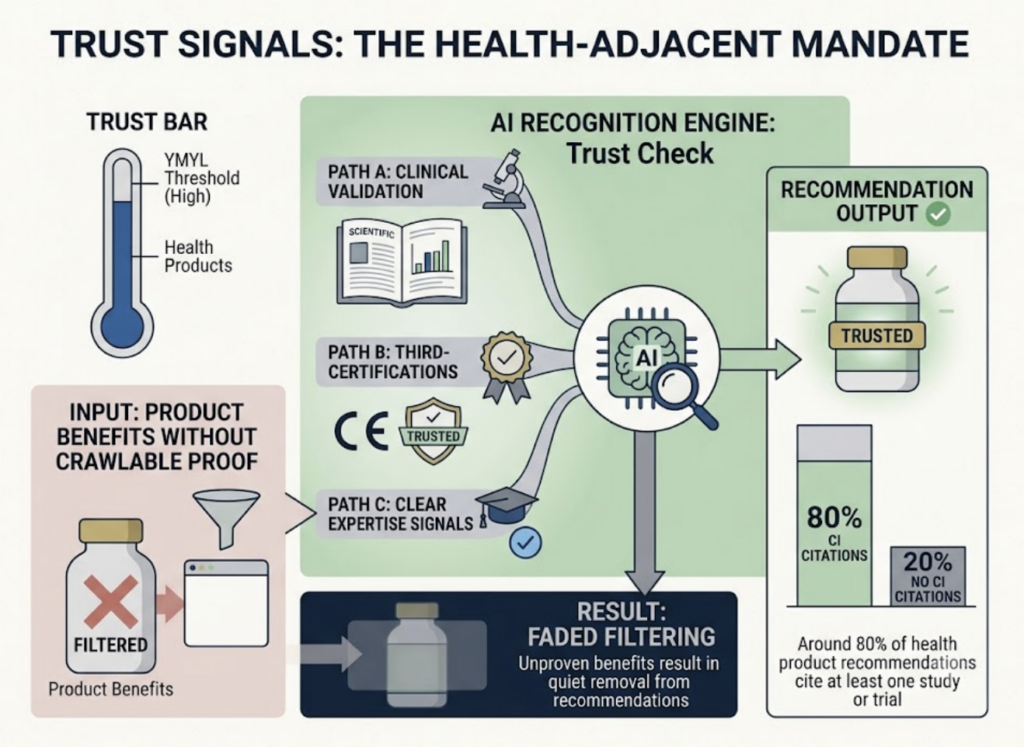
    The health-adjacent trust bar is higher than you think. Anything ingestible or tied to physical outcomes gets treated as Your Money or Your Life content. AI leans on clinical validation, third-party certifications, and clear expertise signals before recommending. Around 80% of AI-generated health product recommendations cite at least one study or trial. A brand that asserts benefits without crawlable proof tends to get filtered out quietly, no matter how good the product is.

    AI trusts other people more than it trusts you. This is the gap most fitness brands underestimate. AI pulls recommendations from third-party lifestyle publishers, retailer pages, and community consensus far more than from brand sites. One athleisure visibility study of more than 1,100 AI responses found consumer publishers like Men’s Health carried more weight than industry trades, and that mentions rarely linked back to the brand’s own site. Reviews matter too. One analysis found ChatGPT references reviews in 58% of responses and Perplexity in nearly all of them. If your external proof is thin, your Content Signals score reflects it.

    Being mentioned is not the same as being recommended. A 2026 sports nutrition benchmark made this distinction sharp: brands appeared in AI answers as factual references far more often than they earned an actual recommendation, and citation architecture decided which side of that line they landed on. You can show up in the text and still never make the shortlist.

    SymptomGEO Score SignalLikely CauseWhere to Look
    Clinical claims ignored by AIContent Signals under 40Proof locked in PDFs or imagesStructured Data + Content depth
    Named as a fact, never recommendedVisibility Score under 40No third-party corroborationExternal citation building
    Present in one platform onlyVisibility Score splitInconsistent local or schema dataBot Access + Structured Data

    From a One-Time Score to Continuous GEO Monitoring

    A single scan tells you where you stand today. It doesn’t tell you which way you’re moving.

    That matters in fitness because AI visibility shifts constantly. Models update, competitors publish, reviews accumulate, and a brand that was on the shortlist in March can drop off by June. The checker gives you a snapshot. Tracking the trajectory is a different job.

    CapabilityFree GEO Score CheckerTopify Platform
    Check frequencyOne-time snapshotContinuous monitoring
    Dimensions tracked4 GEO scoresFull GEO analytics plus sentiment and citations
    Historical trendsNoneFull trend history with alerts
    Competitor benchmarkingNot includedReal-time competitor tracking
    Platform breakdownAggregatedPer-platform (ChatGPT, Perplexity, Gemini, AI Overviews)
    Optimization actionsDirectional guidanceSpecific, prioritized steps

    That’s the bridge from the free tool to Comprehensive GEO Analytics, which tracks all four signals over time across platforms. You can start a free trial without a credit card, and the pricing scales from a single brand to multi-brand agencies.

    Conclusion

    In sports and fitness, AI doesn’t reward the best product. It rewards the brand it can crawl, parse, trust, and corroborate. Those are the four numbers the checker hands you.

    Start by running your domain through the GEO Score Checker and finding your weakest dimension. If Bot Access comes back low, the AI Robots Checker shows exactly which crawlers your robots.txt is turning away. If the issue is whether AI sees you as a credible source, the Brand Authority Checker digs into that, and the AI Visibility Report gives you a cross-platform snapshot of where you currently appear.

    Frequently Asked Questions

    Why does AI recommend competitors when my supplement has better clinical data? 

    Usually because the data isn’t readable. AI weighs clinical proof and certifications heavily for ingestible products, but only when that evidence sits in crawlable, structured text rather than a PDF or image. If your Content Signals score is low, start there before adding more studies.

    My gym ranks well on Google but never shows up in ChatGPT. Why? 

    Traditional rankings and AI visibility are separate systems. AI assistants pull local recommendations from business profile data, reviews, and local citations, then weigh consistency across them. A strong Google rank doesn’t guarantee the structured, corroborated signals AI needs to recommend you.

    What’s the difference between being mentioned by AI and being recommended? 

    A mention is AI referencing your brand as a fact. A recommendation is AI actively putting you on the shortlist when someone asks what to buy. Citation quality and third-party corroboration decide which one you get, which is why two brands with similar products can land on opposite sides.

    How is the free checker different from continuous monitoring? 

    The GEO Score Checker gives you a one-time score across four dimensions. Comprehensive GEO Analytics tracks those signals over time, breaks them down per platform, and benchmarks you against competitors, since fitness AI visibility shifts week to week.

    Read more:

  • GEO Score Checker for Luxury Goods: Why AI Skips Your Maison

    GEO Score Checker for Luxury Goods: Why AI Skips Your Maison

    A collector with serious budget opens ChatGPT and asks for the best heritage watchmakers for a first investment-grade piece. The answer names four houses, describes their movements, and links to a few editorial sources. Your maison, with a century of craft behind it, isn’t in the reply. Not ranked low. Absent.

    This usually isn’t a brand problem. It’s a technical visibility gap. AI systems couldn’t read, verify, or trust your site clearly enough to include you. You can see exactly where that breaks down with the GEO Score Checker from Topify.

    ✅ Free ⚡ Results in 60 seconds 🔒 No signup required

    The Four Numbers Behind Why AI Overlooks Your Luxury Brand

    The GEO Score Checker gives your domain a single 0-100 score, then breaks it into four dimensions. For luxury brands, each one maps to a specific way the category tends to lose ground in AI answers.

    Score DimensionWhat It MeasuresLuxury Goods Impact
    Bot AccessWhether AI crawlers like GPTBot, ClaudeBot, and PerplexityBot can reach your pagesImage-heavy, JavaScript-rendered sites often block or starve crawlers, so AI never sees the collection
    Structured DataWhether Product, Organization, and FAQ schema describe your content in machine-readable formCraft, provenance, and pricing live in lookbooks and PDFs, not in markup AI can parse
    Content SignalsDepth, semantic relevance, and authority signals AI reads as expertiseMinimal copy and visual-first storytelling leave little text for AI to extract
    Visibility ScoreHow often your brand actually surfaces across ChatGPT, Perplexity, Gemini, and AI OverviewsA house can be present on one platform and effectively invisible on another

    Here’s the thing about luxury sites. They’re often built as art objects: full-bleed imagery, sparse copy, heavy front-end frameworks. Beautiful for a human. Close to unreadable for a crawler.

    Scenario 1: The Site That Reads Like a Gallery, Not a Page

    A jewelry maison runs a stunning single-page experience. Large video loops, a few poetic lines, products loaded through JavaScript. The GEO Score Checker returns Bot Access in the low 30s and Content Signals under 40. AI tools can render the homepage as a name, but they can’t tell what you sell, in what materials, at what tier. So when a buyer asks for high jewelry houses known for emerald settings, the model has nothing concrete to cite.

    Scenario 2: Heritage Buried in a PDF

    A fashion house keeps its archive, atelier story, and craftsmanship details inside downloadable lookbooks. That narrative is your strongest authority signal. AI can’t index a 40MB PDF the way it indexes a structured page. Content Signals stays flat even though the underlying expertise is real.

    Scenario 3: Strong on One Platform, Gone on Another

    A leather goods brand shows up in ChatGPT for “best Italian bag makers” but never appears in Perplexity for the same query. The aggregate Visibility Score looks mediocre, which hides the fact that one platform sees you clearly and another doesn’t see you at all.

    Running the check takes a minute. Open the GEO Score Checker, enter your domain, and you’ll get all four dimension scores in about 60 seconds. Compare them, and your weakest number tells you where to start.

    What Luxury Buyers Actually Type Into AI Before They Ever Walk In

    In luxury, AI is rarely the place where the purchase closes. Jewelry and high-value goods are among the least common categories for direct AI checkout, with roughly 28% of shoppers using AI for jewelry purchases. But that statistic misses the real shift. Affluent buyers use AI earlier, to research provenance, compare houses, and build a shortlist before they ever contact a boutique.

    That shortlist stage is where your visibility is decided. These are the kinds of prompts driving it.

    AI Prompt ExamplePlatformSearch IntentWhat It Reveals
    “Best heritage watchmakers for a first investment piece”ChatGPTShortlist buildingWhich houses AI treats as category authorities
    “Quietly luxury handbag brands that hold resale value”PerplexityComparison with proofWhether third-party resale and review data names you
    “Sustainable high jewelry brands using recycled gold”GeminiValues-based filteringIf your sustainability claims are structured and verifiable
    “Compare [Maison A] and [Maison B] for craftsmanship”ChatGPTDirect head-to-headHow AI characterizes you against a named rival
    “Where do collectors buy rare vintage timepieces”PerplexityChannel and trust researchWhether trusted editorial sources cite your name

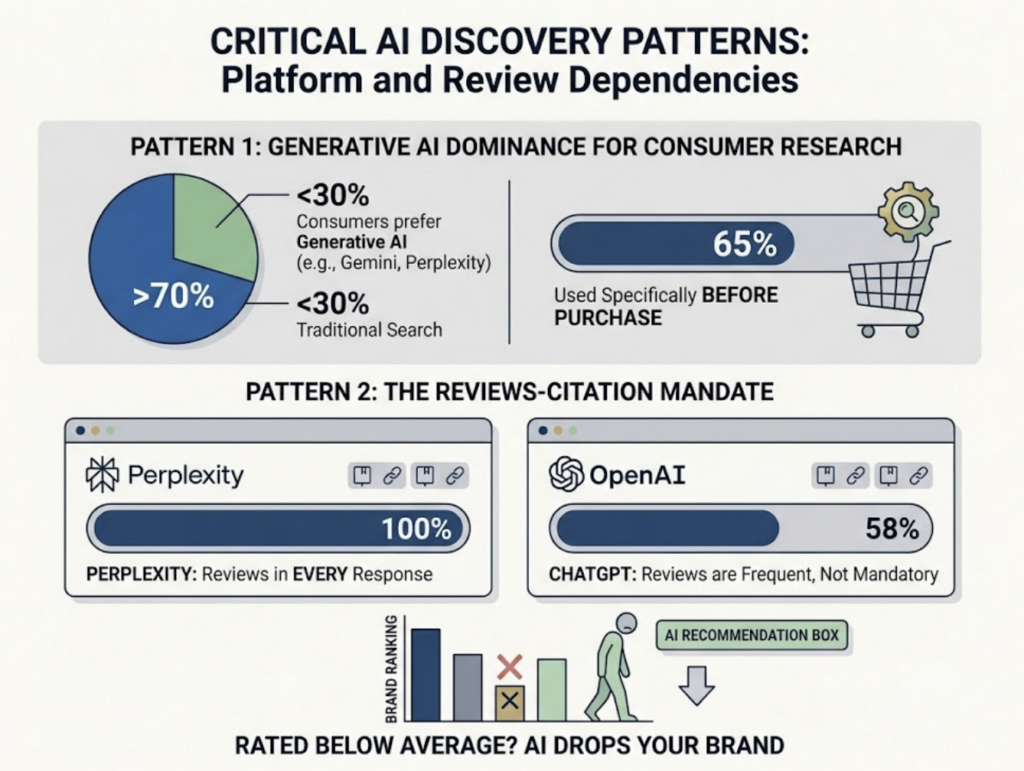
    Two patterns matter here. First, more than 70% of consumers now reach for generative AI over traditional search for product research, and around 65% use it specifically before buying. Second, AI leans hard on third-party proof. Studies found Perplexity references reviews in 100% of responses and ChatGPT in 58%, and brands rated below the category average were often dropped from recommendations entirely.

    If your maison isn’t in that early answer, you’re cut from the consideration set before a single human conversation happens. And you won’t see it in any analytics dashboard.

    Where Heritage Brands Quietly Bleed GEO Points

    Luxury brands tend to lose AI visibility in three predictable places. Each one shows up in a different part of the GEO score.

    The website is built for the eye, not the crawler. This is the most common and most fixable problem. When a site renders products through client-side JavaScript and carries almost no descriptive text, AI sees a shell. Bot Access and Content Signals both suffer. The craft is there. The machine-readable evidence of it isn’t.

    Your authority lives outside your control, and it’s inconsistent. AI doesn’t take your word for your standing. It cross-references Wikipedia, editorial coverage, retailer listings, and specialist directories to decide whether you’re safe to recommend. Luxury houses often have fragmented third-party footprints: a different brand name on a marketplace, an outdated founding date in one directory, missing entity links in another. That inconsistency makes AI less confident citing you, even when the press coverage exists.

    Platform fragmentation hides the gap. A brand can look fine if you only check ChatGPT. The danger is the platform you’re not watching. Perplexity crawls the live web and weights fresh, well-cited pages differently than ChatGPT does. A house with strong editorial history might dominate one and vanish from the other. Looking at a single platform gives you false comfort.

    Luxury ScenarioGEO Score SignalLikely CauseDirection to Fix
    Products invisible in AI answersBot Access below 30JS-rendered catalog, blocked crawlersOpen crawler access, server-render key pages
    Craft story not citedContent Signals below 40Narrative trapped in PDFs and imageryMove provenance into structured page copy
    Inconsistent brand descriptionStructured Data below 40Missing or conflicting schema and entity dataAdd Organization and Product schema, align directories
    Present in one platform onlyVisibility Score unevenPlatform-specific data and freshness gapsTrack each platform separately, not as one number

    That last point is the one most teams underestimate. A single blended score can look acceptable while one platform shows you at zero.

    From a One-Time Score to Tracking Every Mention Over Time

    The GEO Score Checker tells you where you stand today. That’s the right first move. But AI visibility isn’t static. Models retrain, competitors publish, editorial coverage shifts, and your scores move with them.

    A single score tells you where you stand. Continuous monitoring tells you which direction you’re moving.

    That’s the gap Comprehensive GEO Analytics is built to close.

    CapabilityFree GEO Score CheckerTopify Platform
    Check frequencyOne-time snapshotContinuous monitoring
    Dimensions tracked4 GEO scoresFull GEO analytics plus sentiment and citations
    Historical trendsNoneFull trend history with alerts
    Competitor benchmarkingNot includedReal-time competitor tracking
    Platform breakdownAggregatedPer-platform (ChatGPT, Perplexity, Gemini, AI Overviews)
    Optimization actionsDirectional guidanceSpecific, prioritized execution steps

    For luxury brands fighting platform fragmentation, the per-platform view is the part that earns its keep. You can start a free trial with no credit card, and the pricing scales from a single house to multi-brand groups.

    Conclusion

    For luxury goods, AI visibility is less about how refined your brand looks and more about whether machines can read, verify, and trust what you’ve built. The craft is rarely the problem. The technical signals around it usually are.

    Start with the number. Run your domain through the GEO Score Checker and see which of the four dimensions is dragging you down. If Bot Access is low, the AI Robots Checker helps you dig into what your robots.txt is actually telling crawlers. If you suspect your third-party authority is thin, the Brand Authority Checker shows how AI weighs your standing, and the AI Visibility Report gives you a cross-platform snapshot of where you appear.

    Frequently Asked Questions

    Why would a famous luxury brand score low on the GEO Score Checker? 

    Recognition among humans doesn’t translate to machine readability. A maison can be world-famous yet score low because its site blocks crawlers, hides product details in JavaScript, or lacks structured data. AI grades the signals it can parse, not your reputation. The GEO Score Checker shows which signals are missing.

    Does it matter if buyers don’t actually purchase luxury goods through AI? 

    Yes. Affluent buyers use AI for research and shortlisting long before they buy, and roughly 65% use it before a purchase. If your brand isn’t in that early shortlist, you’re filtered out at the start of the journey, well before any boutique conversation happens.

    Why does my brand appear in one AI platform but not another? 

    Each platform uses different data sources and freshness rules. Perplexity crawls the live web and weights recent, well-cited pages, while ChatGPT relies more on training data and retrieval. A brand strong in one can be absent in the other, which is why per-platform tracking in Comprehensive GEO Analytics matters more than a single blended figure.

    How is GEO different from the SEO my agency already does? 

    Traditional SEO optimizes for ranking position in a list of links. GEO optimizes for being mentioned and accurately described inside a single AI-generated answer where there’s no second page. The skills overlap, but GEO puts more weight on structured data, third-party authority, and machine-readable content.

    Read More

  • GEO Score Checker for Gaming: Why AI Skips Your Game

    GEO Score Checker for Gaming: Why AI Skips Your Game

    A player opens ChatGPT and types, “I want a cozy co-op game my partner and I can finish in a weekend, something like It Takes Two.” The model returns five titles. Your game fits that description better than three of them. It isn’t on the list.

    That gap isn’t a quality problem. Your game might review well, sell steadily, and have a loyal Discord. The problem is technical: AI systems can’t see, parse, or trust your brand the way they see the titles they recommend. That’s a Generative Engine Optimization issue, and it’s measurable.

    You can check exactly where you stand with the free GEO Score Checker from Topify, which scores your AI visibility from 0 to 100 across four dimensions.

    ✅ Free ⚡ Results in 60 seconds 🔒 No signup required

    The Four Numbers That Tell You Why AI Skips Your Studio

    Game discovery through AI is intent-driven, not keyword-driven. Players don’t search your title. They describe a feeling, a session length, or a game they already love, and the model decides what to surface. Whether your game shows up depends on four technical signals.

    Score DimensionWhat It MeasuresGaming Impact
    Bot AccessWhether AI crawlers like GPTBot, ClaudeBot, and PerplexityBot can reach your pagesA blocked store page, wiki, or devlog means your game’s details never enter what AI can recommend
    Structured DataWhether AI can parse the meaning of your contentGenre, platform, player count, and tags buried in images or trailers stay invisible to models
    Content SignalsWhether AI treats your content as authoritativeThin official pages lose to forums and aggregators when the model decides who to trust
    Visibility ScoreHow often your game appears across AI platformsLow frequency means players asking for “games like yours” get competitors instead

    Each number maps to a real failure mode studios run into. Here are the three most common.

    Your Store Page and Wiki Are Closed to AI Crawlers

    Many studios route everything through platforms and CDNs that, by default, restrict automated access. If GPTBot or PerplexityBot can’t crawl your pages, your game’s description, mechanics, and reviews never reach the models. A Bot Access score under 30 usually points here.

    Your Genre and Vibe Live in Trailers, Not Text

    A roguelike deckbuilder with tight 20-minute runs is exactly what a player might ask for. But if that pitch only exists in a YouTube trailer and a key art banner, AI can’t read it. Structured data is how you tell a model what kind of experience you actually deliver.

    You’re Loud on Reddit, Quiet Everywhere Official

    Plenty of indie games have active communities and weak official content signals. AI may know your game exists from forum chatter but won’t recommend it confidently without authoritative, well-structured pages to anchor the citation. That’s a Content Signals gap.

    Running the check takes under a minute:

    • Open the GEO Score Checker and enter your game’s domain or brand name
    • Get four-dimension scores plus an overall number in about 60 seconds
    • Compare the four scores to find your weakest signal
    • Start fixing the lowest one first, since it’s dragging the rest down

    What Players Actually Type Into AI Before They Buy

    Gaming prompts look nothing like product searches. They’re about mood, similarity, and context. Here’s the kind of language players use, and what each prompt reveals about whether your game has a chance of appearing.

    AI Prompt ExamplePlatformSearch IntentWhat It Reveals
    “Games like Hades but on mobile”ChatGPTFind a similar experience on a specific platformWhether AI maps your game to a known reference title
    “Best co-op games for two people 2026”PerplexityCurrent shortlist for a social contextWhether your freshness and review signals are strong enough to surface
    “Cozy farming sim I can play 30 minutes a night”GeminiMatch by session length and toneWhether your structured tags describe pacing and mood
    “What roguelike should I try after Balatro”ChatGPTSequential recommendation off a hitWhether AI associates you with the right genre cluster
    “Indie horror game with good story under $20”PerplexityFilter by genre, quality, and priceWhether your metadata and community reviews are parseable

    The behavioral shift is real and well documented. Around 62% of gamers aged 18 to 34 now use AI tools at least monthly, with game discovery among the top use cases. Meanwhile Steam is on pace to release over 16,000 titles in 2026, and AI tends to default to a narrow list of legacy hits when asked broad questions.

    Here’s the consequence. Every prompt where your game should appear but doesn’t is a player who never sees you, never wishlists, never downloads.

    Where Gaming Brands Lose GEO Points That ASO Never Measured

    App store optimization and wishlist campaigns don’t touch the signals AI reads. Three blind spots show up again and again for studios.

    The first is the semantic gap between keywords and intent. Your ASO might rank you for “puzzle platformer,” but a player asks for “a relaxing game with a sad story.” If your content doesn’t carry that semantic meaning in text AI can parse, you lose the match. Content Signals and Structured Data scores expose this directly.

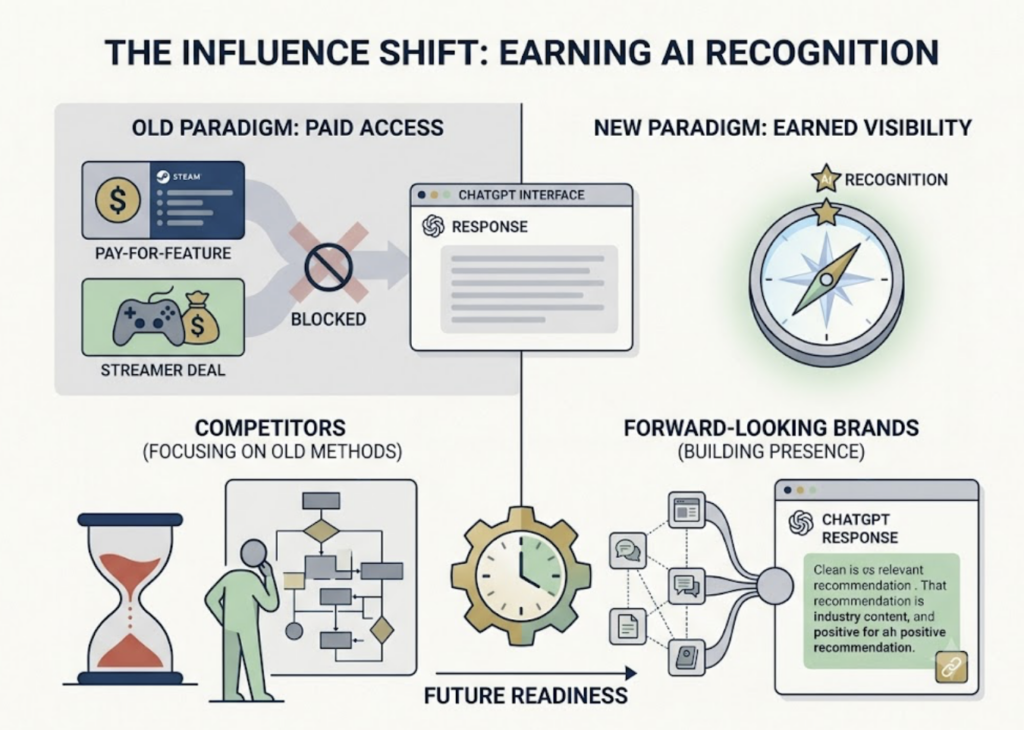
    The second is that you can’t buy your way in. There’s no ad slot in ChatGPT for games. You can’t sponsor a Perplexity recommendation. AI visibility is earned entirely through web presence, which is a different optimization problem than paying for a Steam feature or a streamer deal. The brands building that presence now, while competitors stay focused on storefront algorithms, are the ones AI will know how to recommend later.

    You don’t pay for AI visibility. You earn it, or you stay invisible.

    The third blind spot is platform divergence, and it hits gaming harder than most categories. Across recent large-scale studies, only about 11% of domains were cited by both ChatGPT and Perplexity. Perplexity leans heavily on community sources like Reddit, where gaming discussion is dense. ChatGPT leans toward authoritative and encyclopedic sources. A single visibility number averages these into something close to meaningless.

    Gaming ScenarioGEO Score SignalLikely CauseWhere to Look
    Strong on Perplexity, absent on ChatGPTVisibility Score split across platformsCommunity-rich, authority-light footprintBuild structured official content
    Game never matched to similar titlesContent Signals under 40Genre and tone not described in parseable textAdd semantic detail to official pages
    Recent patch or DLC not reflected in answersVisibility Score laggingStale content, no freshness signalsRefresh pages on a regular cycle

    That gap between platforms is exactly why one score, checked once, can mislead you.

    From a One-Time Score to Tracking Every Patch and Launch

    The GEO Score Checker gives you a snapshot. For a game, that snapshot ages fast. Launches, patches, seasonal events, and review surges all shift how AI sees you, and each platform reacts on its own schedule.

    A single score tells you where you stand today. Continuous monitoring tells you which direction you’re moving, per platform, over time.

    CapabilityFree GEO Score CheckerTopify Platform
    Check frequencyOne-time snapshotContinuous monitoring
    Dimensions tracked4 GEO scoresFull GEO analytics, sentiment, citations
    Historical trendsNoneFull trend history with alerts
    Competitor benchmarkingNot includedReal-time competitor tracking
    Platform breakdownAggregatedPer-platform (ChatGPT, Perplexity, Gemini, AI Overviews)
    Optimization actionsDirectional guidanceSpecific, prioritized steps

    Comprehensive GEO Analytics tracks all four GEO signals across every major platform and shows you how they trend through each release cycle. You can start a free trial with no credit card, and see full plan details on the pricing page.

    Conclusion

    For a game studio in 2026, AI visibility isn’t a marketing nice-to-have. It’s the discovery channel you can’t pay into and can’t ignore. The players asking AI what to play next are the same ones who used to scroll Steam, and right now most of them aren’t hearing your game’s name.

    Start with the free GEO Score Checker to see your four scores in under a minute. If Bot Access comes back low, the AI Robots Checker helps you trace the exact crawler rules blocking you. To dig into how trustworthy AI considers your official content, the Brand Authority Checker goes deeper, and the AI Visibility Report gives you a cross-platform snapshot of where your brand surfaces.

    Frequently Asked Questions

    Why does AI recommend older games instead of my new release? 

    AI tends to surface titles with the most established, parseable web presence, which often means legacy hits. A new game usually has thin structured content and few authoritative pages early on. Running the GEO Score Checker shows whether weak Content Signals or Structured Data scores are holding your launch back.

    Can I pay to get my game recommended by ChatGPT or Perplexity? 

    No. There are no ad slots for game recommendations inside these models. Visibility is earned through web presence, structured content, and authority signals AI can read. That’s why it’s a technical optimization problem, not a media buy.

    My game is popular on Reddit but never shows up in ChatGPT. Why? 

    Different platforms pull from different sources. Perplexity weighs community discussion heavily, while ChatGPT favors authoritative and encyclopedic content. A strong community footprint with weak official pages can leave you visible on one platform and absent on another, which is why per-platform tracking matters.

    How is GEO different from ASO for games? 

    ASO optimizes how your game ranks inside an app store’s own search. GEO optimizes whether AI models understand and recommend your game when players ask in natural language across ChatGPT, Perplexity, and others. The two measure different things, and strong ASO does not guarantee AI visibility.

    Read More:

  • How to Track Perplexity Brand Mentions in AI Search

    How to Track Perplexity Brand Mentions in AI Search

    Your domain authority is climbing. Your target keywords sit on page one. Traffic from Google looks healthy. Then you open Perplexity, ask the exact question your best customers ask, and watch it recommend three competitors by name without naming you once.

    Your SEO dashboard registered nothing, because it was never built to see what an answer engine decides to say. Tracking your Perplexity brand mentions is the only way to know how often this happens, for which questions, and what’s pulling the answer toward someone else.

    Why Perplexity Brand Mentions Matter More Than Rankings

    A Google ranking is binary. You’re position four or you’re not. A Perplexity mention is probabilistic. The model decides, answer by answer, whether your brand earns a sentence in its response or gets left out entirely.

    That difference is now expensive to ignore. By 2026, around 50% of software buying journeys start inside an AI chatbot, a jump of roughly 71% in four months, according to data compiled by Column Five. Demand Gen Report puts the share of B2B software buyers who say AI chatbots changed their research process at 87%.

    Here’s the part most SEO teams miss. Ranking and getting mentioned are nearly unrelated. One industry analysis found the correlation between Google organic position and AI citation probability runs as low as 0.034, which is effectively noise.

    You can hold the top organic spot and still be absent from the answer your buyer actually reads.

    Perplexity SEO Is Not the Same as Google SEO

    Classic SEO instincts (chase keywords, build backlinks, climb the SERP) don’t carry over cleanly. Perplexity doesn’t rank a list of links. It retrieves sources in real time, synthesizes an answer, then footnotes the pages it leaned on.

    So Perplexity SEO is less about domain backlinks and more about two things: whether your content is extractable, and whether the wider web agrees on what your brand is. A page can rank first in Google and still get skipped if it loads only through JavaScript or buries its answer ten paragraphs down.

    The evidence for this gap is hard to wave away. An Ahrefs study found 28% of ChatGPT’s most-cited pages have zero organic visibility on Google. Separately, roughly 12% of URLs cited by Perplexity rank in Google’s top 10 for the same query, per a 2026 analysis from WP SEO AI.

    Different engine. Different rules. Different scoreboard.

    The Three Signals to Track: Mentions, Ranking, and Citations

    Perplexity visibility isn’t one number. It’s three, and each tells you something the others can’t.

    Tracking Perplexity Brand Mentions

    A mention is the simplest signal: does the answer name your brand in its natural-language text? This is your awareness layer. It tells you whether the model considers you a relevant option for a given question at all.

    The trick is coverage. Tracking mentions for branded queries (people already searching your name) flatters you. The real test is category and comparison queries, where a buyer who’s never heard of you is deciding who to shortlist.

    Tracking Perplexity Ranking

    Mentions tell you if you showed up. Perplexity ranking tells you where. Being named in the first sentence of an answer carries far more recall and click intent than a passing reference in the last paragraph.

    Order also signals how the model weighs you against rivals named alongside you. If a competitor consistently leads the answer and you trail, that’s a positioning gap, not a volume gap.

    Tracking Perplexity Citations

    Citations are the footnoted links Perplexity attaches to its answers, and they drive the actual referral traffic. They matter more here than on most engines: Perplexity supplies an average of 6.61 citations per answer, compared with ChatGPT’s 2.62, based on 2026 research from Evergreen Media.

    Watching Perplexity citations also exposes content gaps a traditional SEO tool would never flag. If the answer keeps citing a competitor’s comparison page or a third-party review instead of your site, you’ve found exactly what to build next.

    How to Set Up Perplexity Tracking Step by Step

    You don’t need a data science team to start. You need a repeatable process, because manual spot-checks go stale fast.

    Step 1: Build your prompt set. Define a golden set of 50 to 100 high-intent queries spanning category questions, comparisons, and problem-based prompts. This is the universe you’ll measure against.

    Step 2: Standardize the environment. Run queries in clean browser profiles or through an API so personalization and session history don’t skew results. Guidance from Rankability stresses this point: without a controlled setup, you’re measuring your own search history, not the model’s default answer.

    Step 3: Track on a cadence. Citation models shift constantly, and one-off audits produce false signals. A weekly or bi-weekly run lets you catch citation drift before it becomes a trend.

    Step 4: Act on the gaps. For every query where you’re absent, record which sources the answer cited instead. That list is your content roadmap.

    Run this for a month and the limits of doing it by hand become obvious. A hundred prompts, across multiple engines, every week, is not a spreadsheet job.

    What a Good Perplexity Tracking Tool Actually Does

    So what separates a tool worth paying for from a dashboard full of numbers? Three things, matching the three signals above: it should measure mention frequency, position within the answer, and the exact sources being cited, then track all of it over time across more than one engine.

    Topify is built around that exact structure. Its Visibility Tracking surfaces how often your brand is named across your prompt set, while Position Tracking shows where you land relative to competitors in each answer. For the citation layer, Source Analysis reverse-engineers the specific domains and URLs Perplexity pulls from, so you can see whether your pages or a rival’s are feeding the response.

    Coverage is the other piece that matters. Buyers rarely use one engine, and citation overlap between platforms can be as low as 11 to 12%, so a Perplexity-only view misses most of the picture. Topify tracks the same prompts across Perplexity, ChatGPT, Gemini, and other major models in a single view, which means a drop in Perplexity mentions can be traced back to the source that stopped citing you without switching tools.

    Plans start at $99 a month and include Perplexity, ChatGPT, and Google AI Overviews tracking with room for 100 prompts, which lines up almost exactly with the golden set most teams need. You can get started and load your first prompt set in an afternoon.

    Common Mistakes When Tracking Perplexity Brand Mentions

    Three patterns trip up teams new to this.

    The first is checking once. A single audit captures one roll of the dice from a non-deterministic model. Without a cadence, you can’t tell a real change from normal variance.

    The second is tracking only branded prompts. Of course Perplexity names you when someone types your company name. The questions that grow pipeline are the category ones, where you’re competing to be mentioned at all.

    The third is watching mentions while ignoring citations. Mentions tell you the model knows you exist. Citations tell you which content earned that trust, and they’re the lever you can actually pull. Skip them and you’re tracking a symptom, not the cause.

    Conclusion

    Your Google rankings can stay perfectly healthy while Perplexity quietly recommends someone else. That gap won’t show up in any traditional SEO report, which is the whole reason tracking matters.

    Start small. Define a tight prompt set, measure mentions, ranking, and citations together, and run it on a schedule rather than as a one-off. Once you can see which sources Perplexity trusts, fixing your visibility stops being guesswork and becomes a content decision you can actually make.

    FAQ

    Q: What’s a good tool to track Perplexity brand mentions? 

    A: Look for one that measures three things together: how often you’re mentioned, where you rank inside the answer, and which sources Perplexity cites, ideally across several engines. Topify covers all three and tracks Perplexity alongside ChatGPT and Gemini, so you’re not stitching together separate tools.

    Q: How is Perplexity SEO different from regular SEO? 

    A: Perplexity SEO optimizes for being retrieved and cited inside a synthesized answer, not for ranking a link. It rewards extractable, answer-first content and consistent brand entity signals across the web, which is why a top Google ranking doesn’t guarantee a Perplexity mention.

    Q: How often should I check my Perplexity ranking and citations? 

    A: Weekly or bi-weekly. Perplexity weights freshness and its citation behavior shifts with model updates, so a one-time audit gives a false read. A regular cadence lets you spot citation drift early.

    Q: Can my brand be mentioned without being cited? 

    A: Yes, and it’s common. Perplexity can describe your brand in its answer text without linking to your site as a source. Mentions build awareness, citations drive referral traffic, and a full strategy tracks both.

    Read More

  • AI Response Monitoring Dashboard: What to Track

    AI Response Monitoring Dashboard: What to Track

    Your team checks ChatGPT on Monday, Perplexity on Wednesday, and Gemini whenever someone remembers. Each answer gets pasted into a spreadsheet nobody trusts by Friday. One week your brand shows up in the recommendation. The next week it’s gone, and no one can say what changed. Checking AI answers by hand scales badly, and it tells you almost nothing about the trend underneath. The problem was never running the checks. It’s seeing all of them in one place, over time, with enough detail to act on. That’s what an AI response monitoring dashboard is supposed to do, and where most fall short.

    What AI Response Monitoring Software Actually Tracks

    AI response monitoring software tracks how AI models describe and recommend your brand, not where a page ranks. Rank tracking answers “where do I appear in the list.” AI response monitoring answers a different question: does the model mention you at all, how does it describe you, and is the sentiment in your favor.

    That distinction matters more than it sounds. AI engines synthesize one answer from many sources. You’re either inside that synthesized answer or you’re not. There’s no position 7 to climb toward.

    This is where a lot of teams get caught. Research on the B2B buying journey found that 94% of B2B buyers now use AI answer engines like ChatGPT, Perplexity, and Gemini as a primary research channel. Yet the correlation between Google rankings and AI citation probability runs as low as 0.034, close to none. A brand can hold strong organic rankings and still be absent from every AI recommendation in its category.

    Call it the invisibility gap. Your SEO dashboard says you’re winning. The AI answer your buyer actually reads never names you.

    How an AI Response Monitoring Dashboard Works

    AI search is non-deterministic. The same prompt returns different answers depending on context, model version, and session history. That’s why a single manual check tells you so little. One analysis found citation overlap between platforms can sit as low as 11 to 12%, so a spot check on one engine, on one day, is closer to a coin flip than a measurement.

    A monitoring dashboard replaces the spot check with a system. The pipeline usually runs in three stages.

    First, prompt universe mapping. You define a golden set of high-intent prompts that mirror how buyers actually query AI: category questions, comparison questions, and problem-based questions.

    Second, cross-platform sampling. The system runs those prompts across engines on a schedule, not when someone remembers.

    Third, entity parsing. Natural language processing pulls structured data out of the unstructured answers: whether you’re mentioned, how you’re positioned against competitors, and which third-party domains the model cited as proof.

    The output is the part that matters. Instead of a spreadsheet of pasted text, you get a trend line for each metric, per engine, over time. That’s the difference between knowing your mention rate dropped and guessing that it might have.

    The Metrics That Separate Noise From Real Signal

    Counting mentions is where most dashboards stop. It’s also where they go wrong. A mention with no sentiment or position attached can hide the fact that you’re being described as the expensive option or the last resort.

    Useful AI response monitoring analytics track seven dimensions, not one:

    MetricWhat it tells you
    Visibility / mention rateShare of prompts where your brand shows up
    PositioningWhether you’re the primary pick or a footnote
    SentimentThe tone of the description, leader vs. expensive
    Share of voiceYour mentions vs. competitors in category answers
    Citation source authorityWhich domains the AI trusts to validate you
    Intent alignmentWhether the answer matches a high-intent buyer stage
    Conversion likelihoodA proxy for whether the citation drives real traffic

    This is the model Topify built its dashboard around. Its Comprehensive GEO Analytics view consolidates visibility, sentiment, position, volume, mentions, intent, and a conversion visibility rate into one screen. In practice, that means you can watch your mention rate drop on Perplexity and trace it to a specific source domain that stopped citing you, without leaving the dashboard.

    The metric you skip is usually the one that explains the number you care about.

    Where Most AI Response Monitoring Tools Fall Short

    Plenty of tools claim to monitor AI answers. The gap shows up in what they ignore.

    Single-engine blindness is the most common. A tool that only watches ChatGPT misses the distinct sourcing behavior of other engines. Perplexity leans on community signals. Gemini leans institutional. Watch one and you’ve measured a third of the picture.

    Mention counting without context is the next trap. A rising mention count looks like progress, right up until you read the sentiment and find the model calls you a budget alternative.

    Then there’s the stale snapshot problem. Citation patterns drift week to week. A tool that samples occasionally catches the drift only after it’s already cost you pipeline.

    And the one teams ignore most: citation sources. AI models recommend based on consensus across third-party domains. Skip your reputation on the sites the model trusts, like G2 or industry media, and you starve it of the data it needs to recommend you.

    How to Choose an AI Response Monitoring Solution

    A good AI response monitoring solution earns its place against a short checklist, not a long feature list. Five things matter.

    RequirementWhy it matters
    Engine coverageAt least 4 major platforms, or you’re measuring a fraction
    Metric depthSentiment and position, not just a yes/no mention
    Citation analysisShows which domains drive your citations
    Competitive benchmarkingTracks rivals in the same prompt set
    ActionabilityTurns data into a clear next step, not a log to read

    The last row is where most platforms stop short. A dashboard full of numbers and no instruction on what to do next still leaves the work to you.

    This is the line Topify draws between data and action. Beyond the seven-metric view, it benchmarks competitors in real time across your prompt set and analyzes the exact domains and URLs each engine cites, so you can see whether you or a rival owns those references. Its one-click execution then turns a finding into a deployed GEO strategy, stated in plain English and launched without a manual workflow.

    For a marketing team, the test is simple. Can the tool tell you not just that your visibility dropped, but what to change and on which platform?

    What AI Response Monitoring Software Costs

    AI response monitoring software pricing tends to track three things: how many prompts you monitor, how many engines you cover, and how many AI answers the platform analyzes each month.

    Topify’s pricing starts at $99 a month on the Basic plan, which covers ChatGPT, Perplexity, and AI Overviews tracking, 100 prompts, and 9,000 AI answer analyses, with a 30-day trial. The Pro plan at $199 a month raises that to 250 prompts and 22,500 answer analyses. Enterprise starts at $499 a month with a dedicated account manager.

    The math worth running isn’t the subscription. It’s the cost of staying invisible while 94% of your buyers research in AI. A plan that surfaces one prompt where a competitor replaced you can pay for itself in a single recovered deal.

    You can get started and scale once the value is clear.

    Conclusion

    The manual approach, checking each engine by hand and hoping the spreadsheet holds up, doesn’t fail because teams aren’t diligent. It fails because AI answers shift faster than anyone can track them one screenshot at a time. An AI response monitoring dashboard fixes the problem at its root: it watches every engine on a schedule, structures what they say, and shows you the trend with enough detail to act. Start by mapping the prompts your buyers actually ask, baseline your share of voice, then watch what moves. The brands that win in AI search are the ones measuring it before their pipeline tells them to.

    FAQ

    Q: How do you improve AI response monitoring results?
    A: Start with a baseline scan to find prompts where competitors are mentioned and you’re not. Then refine the content AI parses for those topics, using structured data, FAQ-style answers, and clear statistics, and build authority on the third-party domains the engines already cite. Re-monitor each cycle to confirm the change moved your share of voice.

    Q: What’s an example of AI response monitoring software in action?
    A: A team notices its mention rate on Perplexity fell over two weeks. The dashboard traces it to a review site that stopped citing the brand. They prioritize that domain, the citation returns, and the mention rate recovers on the next sampling cycle. The dashboard turned an invisible drop into a fixable task.

    Q: What should be on an AI response monitoring checklist?
    A: Coverage of at least four engines, metric depth beyond binary mentions, citation source analysis, competitor benchmarking in the same prompt set, and a clear action layer that tells you what to change.

    Q: What’s a good strategy for AI response monitoring?
    A: Treat monitoring as the diagnostic half of a cycle: baseline your share of voice, run a gap analysis against competitors, refine content and authority on the domains AI trusts, then re-monitor to measure impact. Monitoring without a strategy loop is just watching the number move.

    Read More