Blog

  • Most AI Rank Checkers Give You a Number That Means Nothing

    Most AI Rank Checkers Give You a Number That Means Nothing

    Your weekly report says “AI rank: #3.” Last week it said #5. Your VP asks the obvious question: what did we do right?

    You don’t have an answer. Not because you didn’t do the work, but because the AI rank checker that produced the number can’t tell you which prompts it tested, how often it sampled, or why the position moved. The number exists. Its meaning doesn’t.

    This isn’t a tooling inconvenience. It’s a measurement model imported from a world that no longer applies. Here’s why the single-score approach breaks down in AI search, and what a rank actually needs to include before you can act on it.

    The Number on Your AI Rank Checker Dashboard Is an Average of Averages

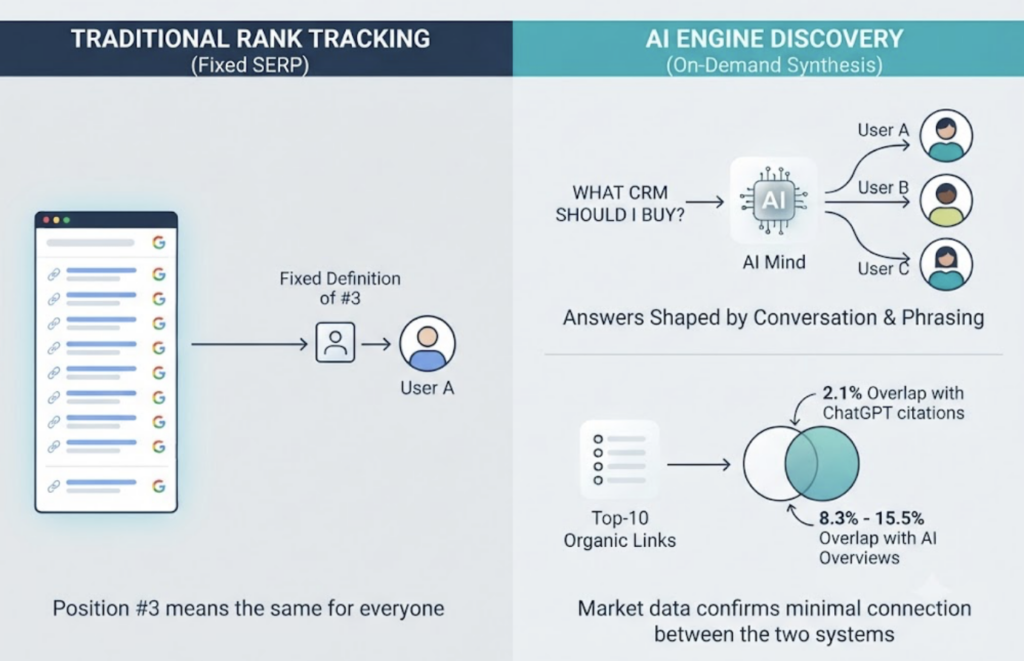
    Traditional rank trackers were built for a deterministic system. Google returned ten blue links, your URL sat in one position, and that position was defensible and repeatable. Ask again tomorrow, get roughly the same answer.

    AI search doesn’t work like that. Large language models are probabilistic systems built on retrieval-augmented generation. Temperature settings, parallel GPU processing, and real-time index refreshes mean the same prompt can produce different answers within the same hour. Research from Equal Experts on LLM non-determinism confirms what anyone who’s re-run a ChatGPT query already suspects: generation isn’t exactly reproducible, by design.
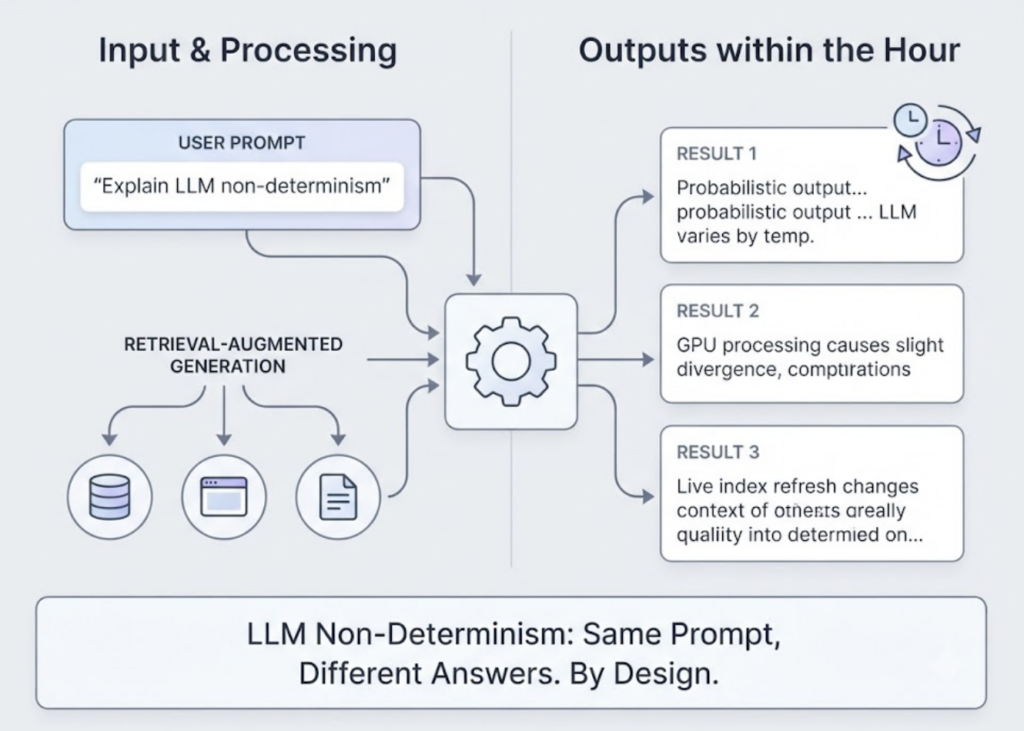
    The instability runs deeper than answer wording. According to a 2026 Digital Authority Partners analysis, only 10.6% of URLs cited by AI engines persist across a 28-day window. Put differently, 89% of AI visibility wins are gone within a month. Citation behavior is a flow, not a stock.

    Now consider what most AI rank checkers do with that volatility. They query a small, static set of prompts, at a handful of sampling times, on one or two platforms. Then they compress everything into a single number.

    That number is noise wearing the costume of a metric.

    A “rank #3” snapshot can convince a team they’re winning while the brand is absent from 80% of relevant variations of the same query. The tool isn’t lying. It’s just answering a question nobody should be asking: “where did we rank in one sample, at one moment, on one phrasing?”

    Ranking Position and Getting Mentioned Are Two Different Games

    Here’s the structural shift most rank trackers miss entirely. In traditional SEO, ranking and visibility were the same thing: if you weren’t in the top 10, you were invisible. In AI search, they’ve split into two separate questions.

    The first question is whether you appear at all. Mention rate, the percentage of relevant prompts where AI names your brand, is the gating metric. The second question is where you appear when you do. Position only matters after inclusion is solved.

    A single rank score collapses these into one number, and the collapse hides the failure mode that matters most. A brand can hold “position #2” on the three prompts a tool happens to test while being completely absent from the dozens of adjacent prompts real buyers actually ask.

    There’s a second split hiding inside the first: mentioned is not the same as cited. Yext’s research across 17.2 million citations shows AI engines treat naming a brand in text and linking to it as a source as distinct behaviors. An AI answer can rank your brand #2 in a listicle-style response without citing your website once. If the goal is traffic or authority signals, that’s a zero-click event your rank checker records as a win.

    Track it. Decompose it. Then decide what to fix.

    Three Things a Single Score Can’t Tell You

    Even a statistically clean score would still be an abstraction. Three performance drivers disappear inside it.

    Which prompts the number came from

    Appearing first for 100 low-intent research queries is mathematically great for a rank checker and commercially worthless for you. Prompt intent isn’t a nuance here, it’s the whole game.

    Research on citation stability shows the pattern clearly. Discovery prompts carry the highest volatility, because AI engines experiment with options. Comparison prompts are more stable, since AI leans on structured comparison data. Validation prompts are the harshest of all: AI prioritizes proven, authoritative, fact-checked sources when a user is confirming a decision.

    The strategic implication is uncomfortable. A brand can post a strong average rank built entirely on volatile discovery prompts while failing to appear in the validation prompts where purchase decisions actually get made. The dashboard shows green. The pipeline shows nothing.

    Why the number moved

    A score change is an effect, not a cause. When an AI engine drops your brand, it’s typically because it found a fresher or more authoritative source for the same claim. The cause lives in the citation layer: which domains the AI pulls from, and whether yours got displaced.

    Rank checkers report the score changed. They rarely tell you the source was overtaken. Without source attribution, every fluctuation triggers the same unproductive ritual: someone asks why, nobody knows, everyone waits to see if next week’s number recovers on its own.

    How AI describes you when it does mention you

    Position captures where you appear. It says nothing about the frame. An AI answer can rank your product #1 while describing it as “a low-cost budget alternative,” which is a quiet disaster if you’ve spent two years positioning as enterprise-grade.

    This narrative layer, what some researchers call the brand’s narrative footprint, is invisible to any tool that reduces AI presence to a coordinate. Sentiment and framing determine whether a mention builds your positioning or erodes it.

    What a Meaningful AI Rank Actually Requires

    Strip away the single-score abstraction and a workable measurement framework has five requirements. None of them is exotic. All of them are absent from most AI rank checkers.

    RequirementWhat it means in practiceWhat the single score hides
    Prompt-level granularityEvery data point traces to a specific, visible promptWhether the prompts tested carry any buyer intent
    Mention rate before positionInclusion tracked separately from orderingAbsence across the majority of relevant prompts
    Longitudinal samplingRepeated tests that smooth out non-determinismWhether a rank is signal or single-sample noise
    Citation source attributionWhich domains the AI cites, and when yours is displacedThe cause behind every score movement
    Sentiment and framingHow the AI characterizes the brand in each answerNarrative drift that contradicts your positioning

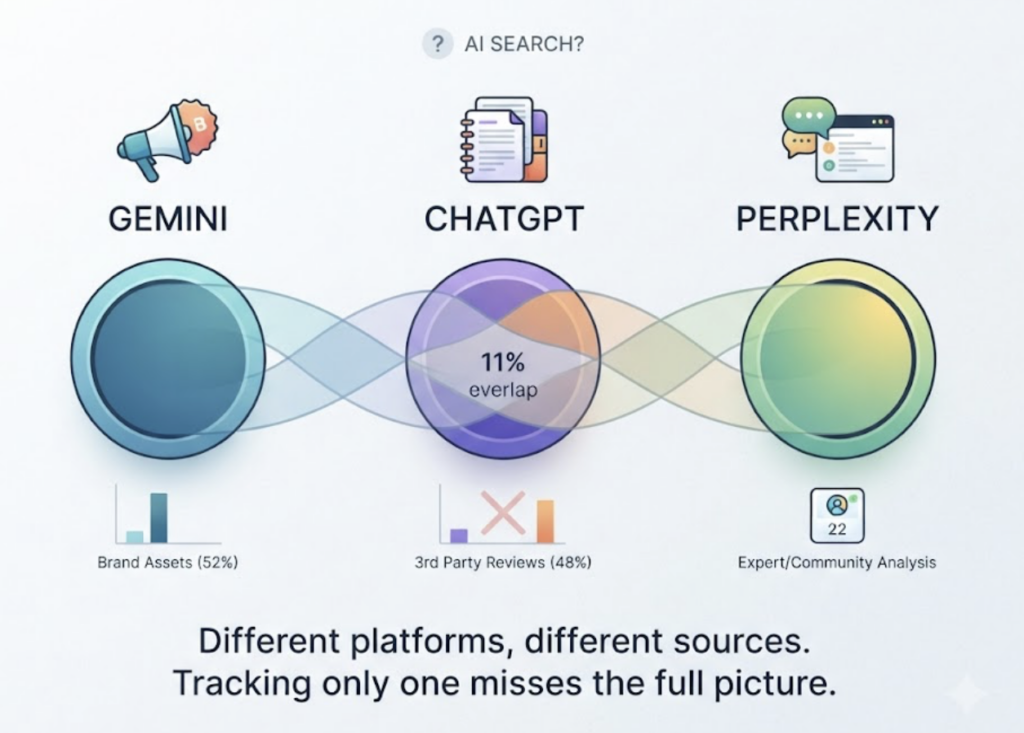
    Add one more dimension across all five: platform heterogeneity. ChatGPT, Perplexity, Gemini, and Google AI Overviews cite differently and rarely agree. A number averaged across platforms, or worse, sampled from just one, tells you almost nothing about the others.
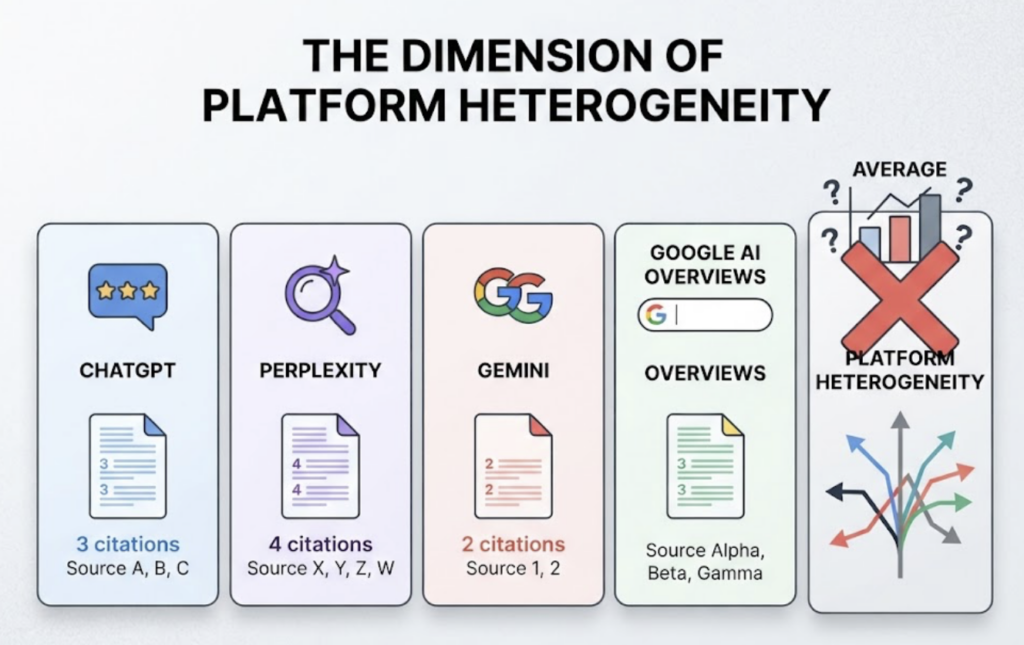
    This is the bar. A tool that clears it gives you answerable questions instead of a floating number.

    How Topify Turns a Meaningless Number into Seven Answerable Questions

    Once you’ve accepted that “rank” needs to be decomposed, the practical question is what to decompose it into. Topify approaches this with a seven-metric matrix inside its Comprehensive GEO Analytics: visibility, sentiment, position, volume, mentions, intent, and CVR. Each metric maps to one of the failure modes above.

    Position Tracking handles ranking the way AI search actually requires: at the prompt level, relative to named competitors, sampled repeatedly rather than snapshotted. Instead of “your rank is #3,” you see which specific prompts place you where, and against whom. That’s the difference between a score and a diagnosis.

    Source Analysis answers the “why did it move” question directly. It tracks the exact domains and URLs each AI platform cites for your prompt set, so when your mention rate drops, you can see which source displaced yours instead of guessing. Given that roughly nine in ten cited URLs churn within a month, this layer is where most of the actionable signal lives.

    AI Volume Analytics addresses the intent problem. It surfaces which prompts carry real query volume and buyer intent, so you’re not optimizing your average by winning prompts nobody commercially relevant is asking. Sentiment scoring runs alongside, flagging when AI engines frame your brand in ways that contradict your positioning.

    Coverage spans ChatGPT, Gemini, Perplexity, Google AI Overviews, DeepSeek, and other major engines, which matters because cross-platform disagreement is the norm, not the exception. The Basic plan runs $99/month with 100 tracked prompts and 9,000 AI answer analyses, and there’s a 30-day trial if you’d rather validate against your own prompt set before committing. For teams still earlier in the process, this open reference list of free GEO tools is a reasonable place to benchmark what free checkers can and can’t see.

    The point isn’t that more metrics are automatically better. It’s that these specific seven correspond to questions a VP will actually ask, and a single rank number answers none of them.

    How to Audit the AI Rank Checker You’re Already Using

    You don’t need to switch tools to start fixing this. Start by auditing the one you have against five questions:

    1. Can you see the exact prompts behind every number? If the prompt set is hidden or fixed, the score is untraceable.
    2. Does it separate mention rate from position? If one number covers both, you can’t tell absence from low ranking.
    3. Does it distinguish mentions from citations? A brand named in text without a linked source is a zero-click event, not a traffic win.
    4. How often does it sample? Point-in-time snapshots can’t smooth out LLM non-determinism. Look for repeated, longitudinal testing.
    5. Which platforms does it cover? Performance is rarely consistent across ChatGPT, Perplexity, Gemini, and AI Overviews. One platform is an anecdote.

    If your current tool fails three or more of these, the number it gives you each week isn’t measuring your AI visibility. It’s measuring the tool’s sampling artifacts.

    Conclusion

    The next time someone asks what your AI rank means, you should be able to answer in specifics: which prompts, what mention rate, which sources, what framing, across which platforms. If your tool can’t support that answer, the number on the dashboard was never information. It was decoration.

    Start with the five-question audit above. Then rebuild your reporting around mention rate and citation sources first, position second. The teams treating AI visibility as a decomposable system, rather than a single score to celebrate or panic over, are the ones who’ll know what they did right when the number moves.

    FAQ

    Q: What is an AI rank checker?
    A: An AI rank checker is a tool that tracks where a brand appears in AI-generated answers across platforms like ChatGPT, Perplexity, and Google AI Overviews. Basic checkers output a single position or score. More complete platforms decompose that into prompt-level position, mention rate, citation sources, and sentiment.

    Q: Why do AI rankings change every time I check?
    A: LLMs are non-deterministic by design. Temperature settings, parallel processing, and continuous index updates mean identical prompts produce varying answers. Research shows only about 10.6% of AI-cited URLs persist across 28 days, so single-sample rankings are largely noise. Repeated longitudinal sampling is the only way to separate signal from variance.

    Q: What’s the difference between AI search ranking and brand mentions?
    A: They’re independent metrics. Mention rate measures how often your brand appears at all across relevant prompts, while ranking measures your position when you do appear. A brand can rank #2 on a few tested prompts while being absent from most others. Mention rate is the gating metric; position matters only after inclusion.

    Q: What does an AI visibility score mean?
    A: On its own, usually very little. A visibility score is an aggregate abstraction that compresses prompt selection, sampling frequency, platform coverage, and citation behavior into one number. It becomes meaningful only when you can trace it back to specific prompts, mention rates, and cited sources.
    Read More

  • AI Rank Checker: How to Track Your Rank in AI Search

    AI Rank Checker: How to Track Your Rank in AI Search

    Your rank tracker shows you sitting at #2 for your money keyword. Then your VP asks where you land when a buyer asks ChatGPT for a recommendation in your category, and you have nothing. You open the dashboard you’ve used for years, and there’s no column for it. That tool was built to watch Google’s ten blue links. AI search doesn’t work that way, and the distance between what your tracker measures and what buyers actually do is widening every quarter.

    Why Your Rank Tracker Can’t See AI Search

    Traditional rank tracking assumes a stable, ordered list of URLs. You rank #3 today, maybe #2 next week, and the tool logs the movement. That logic falls apart the moment an answer gets generated instead of listed.

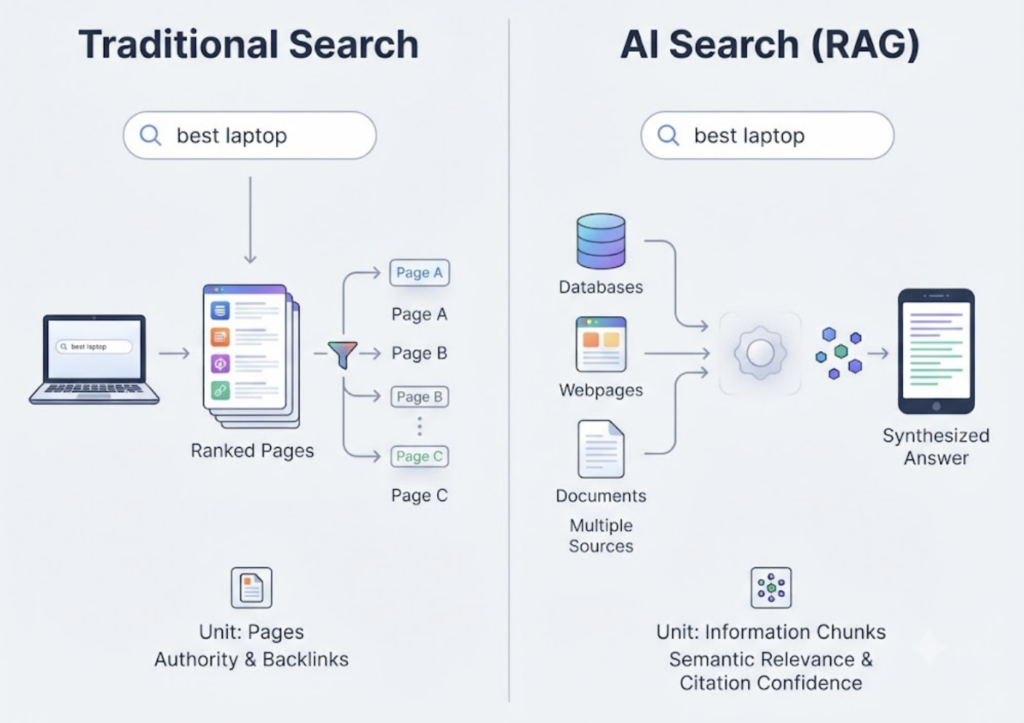
    AI search engines use Retrieval-Augmented Generation. Instead of returning ranked pages, they pull information chunks from multiple sources and synthesize a single answer. Google ranks entire pages on authority and backlinks. AI models rank pieces of information on semantic relevance and citation confidence. Different unit, different game.

    There’s also the zero-click problem. When the answer appears inside the interface, nobody clicks through, so “position #1” stops correlating with traffic or revenue.

    And the output isn’t even stable. Ask the same question twice and you can get different citations, depending on the model’s settings, the conversation history, or a fresh index pull. A conventional AI rank checker built on fixed positions has nothing to hold onto.

    That’s the gap most SEO teams still can’t see.

    What “Rank” Even Means in ChatGPT, Perplexity, and AI Overviews

    In AI search, rank isn’t a number from 1 to 10. It’s a measure of influence, and it shows up in three tiers.

    The strongest is direct citation, where your brand is named and linked as a source. Below that is entity association, where the AI recommends your product as a solution without a link. The baseline is topic authority, where the model reliably pulls your data or perspective when the subject comes up. A useful AI rank checker has to account for all three, not just whether a blue hyperlink appeared.

    The selection mechanics matter here. AI engines run a multi-stage pipeline: they parse a conversational query (often 20-plus words), retrieve candidates using both vector similarity and keyword matching, then run an L3 re-ranking pass that scores those candidates on factual density and answer completeness before writing the response. The technical breakdown from Mersel.ai maps this out in detail. The takeaway for anyone checking their AI rank: you’re not competing for a position, you’re competing to be the chunk the model trusts enough to quote.

    The three platforms also behave differently. ChatGPT leans generative and synthesizes across sources. Perplexity is citation-first and shows its references openly. Google AI Overviews sits on top of search and pulls from a mix. Checking one and assuming the others match is a fast way to get a wrong read.

    How to Check Your AI Rank Manually (Step-by-Step)

    You can get a real baseline by hand before you automate anything. Here’s the process.

    Step 1: Build a Prompt List That Mirrors Real Buyer Questions

    Don’t start with keywords. Start with the questions your buyers actually type. Pull them from sales call transcripts and support tickets, then build a taxonomy of 50 to 100 core prompts. These should sound conversational and task-oriented (“what’s the best tool for tracking brand mentions in AI answers”), not like short-tail search terms. The prompt list is the foundation of every AI rank check that follows, so it’s worth doing carefully.

    Step 2: Run the Same Prompts Across ChatGPT, Perplexity, and AI Overviews

    Take each prompt and run it, unchanged, on all three engines. Same wording, same session-clean conditions where possible. You’re looking to compare apples to apples, because the point is to see how your ChatGPT ranking differs from your Perplexity ranking for the identical question. Run each prompt more than once. A single pass tells you almost nothing given how much the output moves.

    Step 3: Log Whether You’re Mentioned, Where, and Who Beats You

    For every result, record three things. Were you mentioned at all? Where did you land in the sequence of citations or recommendations? And who showed up ahead of you? Note the tone too: positive, neutral, or a comparison that frames a competitor as the safer pick. That last column is where the real intelligence lives. Being mentioned fifth behind two rivals is a different problem than not being mentioned at all.

    Why Manual Checks Break Down Fast

    The manual method works for a baseline. It doesn’t survive contact with the real pace of AI search.

    The freshness demand alone is brutal. AuthorityTech’s 2026 citation research found that 88% of Google AI citations come from pages outside the traditional organic top 10, and separate analysis showed 76.4% of the pages Perplexity cited heavily had been updated within the previous 30 days. Manual spot-checks can’t keep up with a system that rewards content refreshed weeks ago.

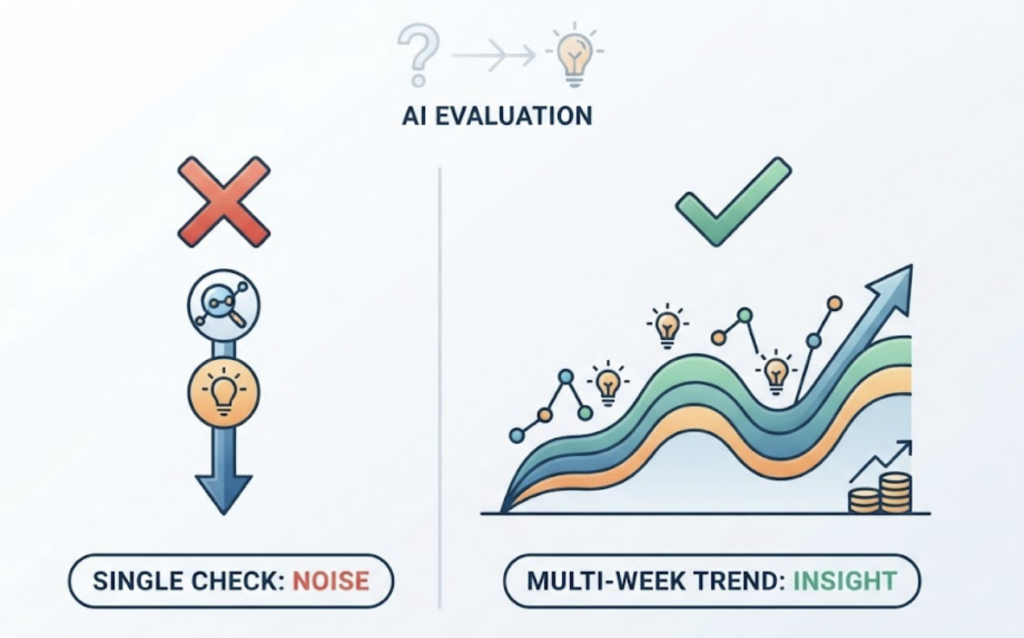
    Then there’s randomness. Models rotate citations to avoid repeating themselves, so a one-off check gives you a snapshot, never a trend line. You need repeated sampling over time to separate signal from noise.

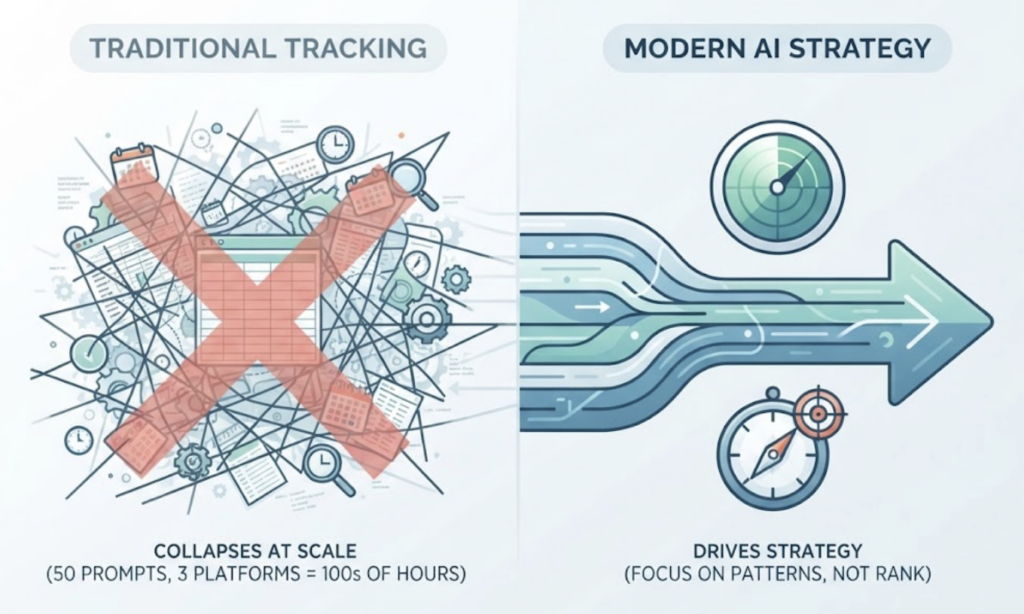
    And the workload compounds. Fifty prompts, three platforms, multiple runs each, logged and tallied by hand, every week. By the time you finish, the data’s already stale.

    Using an AI Rank Checker to Automate the Whole Thing

    Once the manual method proves the concept, the job becomes turning a one-time audit into a running measurement. That’s where a purpose-built AI rank checker earns its place.

    For teams tracking rank across multiple engines, Topify approaches this by running your prompt set continuously across ChatGPT, Gemini, Perplexity, Google AI Overviews, and other major platforms, then rolling the results into one view. In practice, its Position Tracking tells you where you sit relative to competitors in AI answers, Visibility Tracking shows how often you’re mentioned at all, and Source Analysis reverse-engineers which domains and URLs the AI actually cited. So when your ranking drops, you can trace it to a specific source that stopped referencing your brand, inside the same dashboard.

    That last point closes the loop the manual method leaves open. A hand-logged spreadsheet can tell you that you slipped. It rarely tells you why. Pairing Position data with Source data answers both in one place.

    The measurement also spans the full definition of rank. Rather than checking a single hyperlink, the platform tracks visibility, sentiment, position, and citation sources together, which is closer to how AI search actually distributes influence. If you want to test the surface of this before committing, Topify’s free GEO tools reference is a reasonable place to start, and you can run a full trial to see your own prompt set scored across engines.

    Common Mistakes When Checking AI Rank

    A few errors show up over and over, and each one quietly corrupts the data.

    Checking one platform and generalizing is the most common. ChatGPT, Perplexity, and AI Overviews cite differently, so a strong Perplexity showing tells you little about ChatGPT.

    Running each prompt once is the second. Non-deterministic output means a single pass is closer to a coin flip than a measurement.

    Tracking position while ignoring mention is the third, and the most expensive. If your brand never enters the answer, there’s no rank to improve. Visibility comes before position, always.

    The last one is subtle: testing with your own brand name instead of the buyer’s real question. Searching “is [your brand] good” almost guarantees a mention. It also has nothing to do with how an actual prospect discovers you.

    Conclusion

    The uncomfortable truth is that your Google rank and your AI rank are now two separate things, and only one of them shows up in your current tracker. That gap won’t close on its own. AI search keeps growing, citation patterns shift by the week, and every quarter you wait is a quarter of missing baseline data. Start with a manual audit to see where you stand across ChatGPT, Perplexity, and AI Overviews. Then move to continuous tracking before the volatility outpaces your ability to measure it by hand. The brands that establish an AI rank baseline now will be the ones who can prove movement later.

    FAQ

    Q: Is there a free AI rank checker? 

    A: You can run a basic manual check for free by polling ChatGPT, Perplexity, and AI Overviews with your own prompt list and logging the results. Some platforms also offer free entry-level GEO tools to test visibility on a small scale before you commit to full tracking.

    Q: Does AI search actually have rankings like Google? 

    A: Not in the same way. Google returns an ordered list of URLs. AI search synthesizes answers and “ranks” you by whether you’re cited, where you appear in the sequence, and how favorably you’re framed. It’s better understood as citation probability than position.

    Q: How often does AI ranking change? 

    A: Frequently, and for two reasons. Models rotate citations to avoid repetition, so results shift between runs, and they favor recently updated content, with a large share of cited pages refreshed within the prior month. This is why a single check is unreliable and repeated sampling matters.

    Q: ChatGPT vs Perplexity: is the ranking the same? 

    A: No. Perplexity is citation-first and surfaces its sources openly, while ChatGPT leans generative and synthesizes across references. The same prompt can rank you well on one and omit you entirely on the other, which is why cross-engine checking is essential.

    Read More

  • ChatGPT Runs Ads, Perplexity Won’t: AI Rank Checker Impact

    ChatGPT Runs Ads, Perplexity Won’t: AI Rank Checker Impact

    You run your category prompt through ChatGPT and a competitor shows up in the answer. Six months ago, that meant one thing: the model’s retrieval layer picked them organically. Now it might mean something else entirely. They could have paid for that placement. Your traditional rank tracker has one column for “position.” AI search just split into two ranking systems, paid and organic, and most tools can’t tell you which one you’re looking at. That’s the gap an ai rank checker has to close in 2026.

    Two AI Platforms Just Split the Definition of Ranking

    In the span of five weeks, the two most-watched AI search companies took opposite bets on the same question: should answers carry ads?

    OpenAI moved first. The company announced ChatGPT advertising on January 16, 2026, with the US rollout starting in early February for users on the Free and $8/month Go tiers. Plus, Pro, Team, and Enterprise subscribers stay ad-free. Sponsored units appear alongside responses, matched to conversation context rather than keyword bids.

    Perplexity went the other way. On February 18, 2026, the company abandoned advertising entirely and committed to a subscription-only model. This wasn’t a company that never tried ads. Perplexity was among the first to test sponsored placements back in 2024, then spent a year phasing them out. One executive put the reasoning bluntly: “the challenge with ads is that a user would just start doubting everything.”

    The result is a structural fork. “Ranking” in ChatGPT now means two different things depending on whether money changed hands. Ranking in Perplexity means exactly one thing: the retrieval system judged your brand worth citing.

    Your measurement stack has to handle both realities at once.

    Inside ChatGPT’s Ad Machine and What an AI Rank Checker Sees

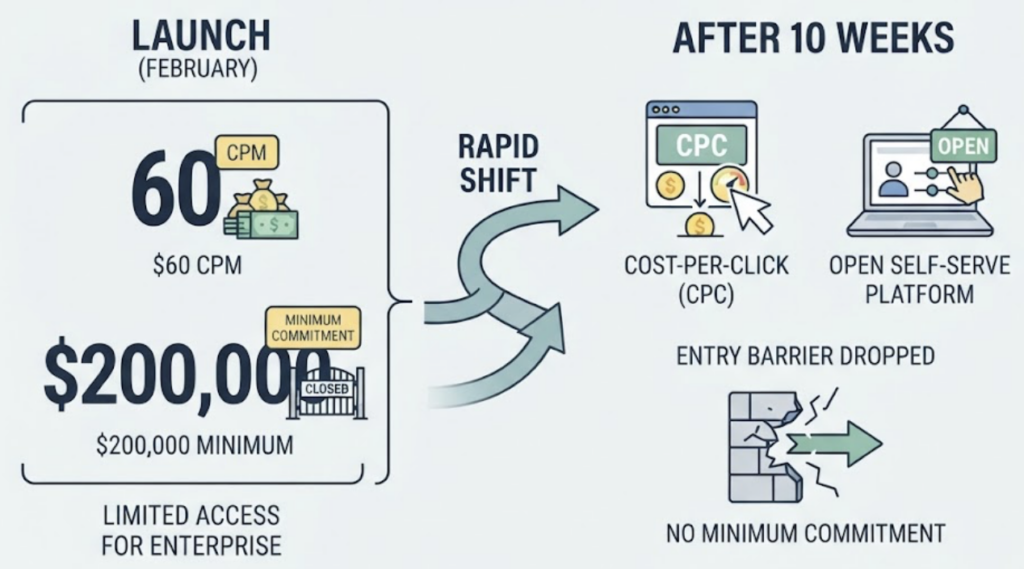
    The speed of ChatGPT’s ad expansion caught most marketing teams flat-footed. The February launch started at $60 CPM with a $200,000 minimum commitment, pricing that limited buyers to a narrow set of enterprise brands. Within ten weeks, OpenAI shifted to cost-per-click bidding, opened a self-serve platform, and dropped the entry barrier entirely.

    Penetration followed. By late May 2026, monitoring data put ads in 49.1% of US ChatGPT responses, with CPCs running $3 to $5 for general categories and $8 to $18 for software and finance. For comparison, that US ad rate is roughly 24 times Google’s classic SERP rate.

    Here’s what this means for anyone checking AI rankings. The same prompt now produces different visible results depending on who’s asking. A free-tier user sees sponsored units a paid subscriber never encounters. A brand that “appears in ChatGPT” might be renting that presence week to week, while its organic mention rate sits at zero.

    OpenAI maintains that ads don’t influence the actual answers. Take that at face value, and the implication is still sharp: paid slots and organic mentions are separate inventory, governed by separate rules.

    Why Paid Placement Isn’t the Ranking You Should Track

    A paid slot is a lease. It lasts as long as the budget does, it’s visible to only part of the user base, and it disappears the moment a competitor outbids you.

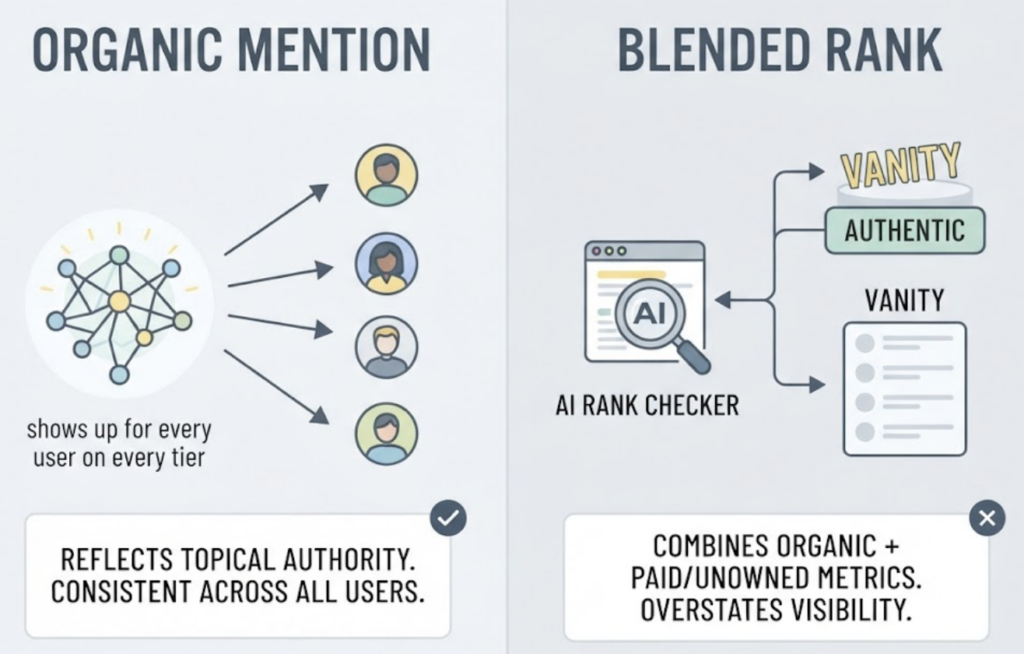
    An organic mention is different. It reflects what the model’s retrieval and synthesis layers concluded about your topical authority, and it shows up for every user on every tier. When an ai rank checker reports your position, the number only means something if it’s measuring this second category. Blending the two produces a vanity metric that overstates visibility you don’t actually own.

    Perplexity’s Zero-Ad Bet Makes Organic Rank the Only Rank

    Perplexity’s retreat looks less risky once you see the numbers behind it. Advertising never became meaningful revenue for the company; the business runs on subscriptions ranging from $20 to $200 per month, and leadership has said usage-based subscriptions represent the right long-term model for AI.

    That subscriber base skews toward exactly the audience B2B marketers struggle to reach: professionals in finance, legal, healthcare, and consulting who pay for accuracy. There is no sponsored path in front of them. Every brand that appears in a Perplexity answer earned the citation through content the engine deemed authoritative.

    On a zero-ad platform, citation share is the entire game.

    This changes what tracking should measure. Position still matters, but the deeper signal is which domains and URLs Perplexity pulls into its synthesis, how often your brand appears across a prompt set, and whether the surrounding sentiment helps or hurts. A negative citation on a trust-first platform can do more damage than absence.

    How to Rebuild Your AI Rank Checking Stack for a Split Market

    Traditional rank trackers were built for deterministic results: one query, one ordered list, one position per domain. Generative answers break every one of those assumptions, and the ad split breaks them further. A stack built for 2026 needs four capabilities.

    Platform-specific tracking. ChatGPT and Perplexity now run on different commercial logic, so their numbers can’t be averaged into one score. You need separate baselines per engine, plus visibility into how ad-supported and ad-free ChatGPT tiers differ.

    Paid versus organic segregation. Any tool that can’t tell a sponsored unit from an organic mention will inflate your visibility data. This distinction should be a first-class field in every report, not a footnote.

    Citation intelligence. The focus shifts from “what position” to “which sources.” Knowing that Perplexity cites a competitor’s comparison page in 40% of category prompts tells you exactly what content to build.

    Sentiment and context. Presence without favorable framing is a liability. Tracking has to capture how the model describes you, not just whether it does.

    For teams putting this into practice, Topify covers all four layers in one platform. Its Position Tracking monitors where your brand lands in AI answers relative to competitors, measured on the organic side rather than the rented one. Visibility Tracking runs the same prompt sets across ChatGPT, Perplexity, Gemini, and other engines so the platform-by-platform divergence becomes visible instead of averaged away. Source Analysis reverse-engineers the exact domains AI platforms cite, which is the practical answer to winning Perplexity’s zero-ad environment. And Competitor Monitoring shows whether a rival’s sudden ChatGPT presence comes from earned authority or an ad budget, which determines whether you should respond with content or with spend.

    If you want to gauge the problem before committing to a platform, a set of free GEO tools can establish a quick baseline of where your brand currently stands.

    What This Split Means for Your 2026 Visibility Budget

    The temptation is to treat ChatGPT ads as the fast lane and skip the slower organic work. The economics argue against that as a standalone strategy.

    AI referral traffic is still a small slice of total web traffic, but industry benchmark studies through 2026 have measured conversion rates around 14.2% for IT and B2B services from AI referrals, versus roughly 2.8% from traditional Google organic. High intent, small volume, outsized value per visit. Paid slots capture some of that intent, but only on one platform, only for ad-tier users, and only while you keep paying.

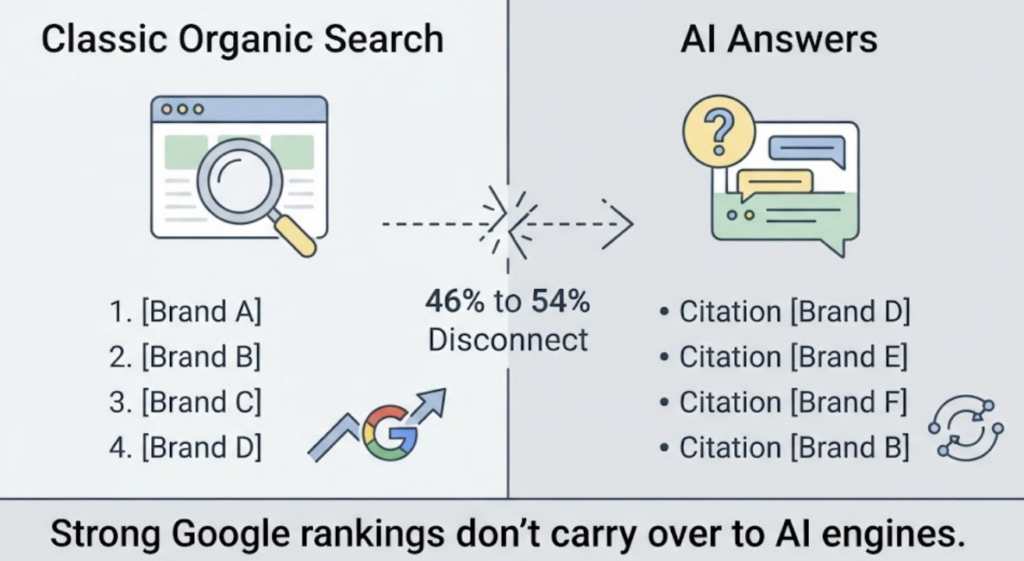
    Meanwhile, the same benchmark research points to a 46% to 54% disconnect between brands cited in classic organic search and brands cited in AI answers for identical queries. Strong Google rankings don’t carry over. AI engines tend to favor structured, extractable content: question-based headers, schema markup, self-contained comparisons.

    So the rational budget is a dual strategy. Use paid ChatGPT placements tactically for a handful of high-intent prompts where immediate presence justifies the CPC. Put the durable investment into GEO, the content and authority work that earns organic citations across every engine, including the ones where visibility can’t be bought.

    The more ad inventory floods ChatGPT, the more scarce and valuable the organic slot becomes.

    Conclusion

    The ChatGPT-Perplexity split isn’t a temporary divergence. It’s two viable business models pulling AI search in opposite directions, and it permanently forked the meaning of “ranking.” From here on, an AI visibility number without a paid-or-organic label is incomplete data.

    The practical first step costs nothing: baseline your current organic presence across both platforms, per prompt, before spending a dollar on placements. Start with a free visibility check, identify where competitors are earning citations you’re not, and let that gap set your content priorities for the next quarter.

    FAQ

    Q: What does an ai rank checker track in ChatGPT versus Perplexity?
    A: In ChatGPT, it should track organic mentions and positions separately from sponsored units, since roughly half of US responses now carry ads. In Perplexity, where no ads exist, it tracks citation frequency, position relative to competitors, and the source URLs the engine pulls from.

    Q: Do ChatGPT ads affect the organic recommendations in answers?
    A: OpenAI states that sponsored units don’t influence the answer content itself. Ads appear as labeled units alongside responses. Organic mentions are still determined by the model’s retrieval and synthesis process, which is why the two need separate measurement.

    Q: How do I check my brand’s AI search ranking for free?
    A: Start with manual spot checks across your top 10 to 20 category prompts on both platforms, then use free GEO tools to establish a baseline before investing in continuous monitoring. Manual checks miss volatility, so treat them as a snapshot rather than a tracking system.

    Q: Is a Perplexity ranking more valuable now that the platform has no ads?
    A: For high-intent professional audiences, often yes. Perplexity’s subscribers pay $20 to $200 monthly for accuracy, and every brand appearance is organically earned. A consistent citation there signals topical authority that no budget can replicate.

    Read More

  • Listicles Win 40% of AI Citations: An AI Rank Checker Guide

    Listicles Win 40% of AI Citations: An AI Rank Checker Guide

    You published a 3,000-word guide last quarter. It ranks on page one, the backlinks are solid, and traffic looks healthy. Then you run your core industry prompt through Perplexity and watch it cite a competitor’s 7-step listicle instead. Three times in a row.

    The frustrating part is that nothing in your analytics explains why. Google Search Console shows impressions and clicks. It doesn’t show that an AI engine scanned your page, couldn’t extract a clean answer, and moved on.

    That gap has a structural cause, and it’s fixable. The fix comes in two parts: rebuild your content around formats AI engines actually cite, then verify the change with an AI rank checker instead of guessing.

    Listicles and How-Tos Pull Up to 40% of AI Citations. Here’s Why.

    The numbers on format are hard to ignore. According to Wix AI Search Lab research, listicles and comparative content account for 21 to 60% of all AI citations depending on query type. For commercial queries, the kind that start with “best software for” or “top tools to,” listicle citation rates reach up to 40%.

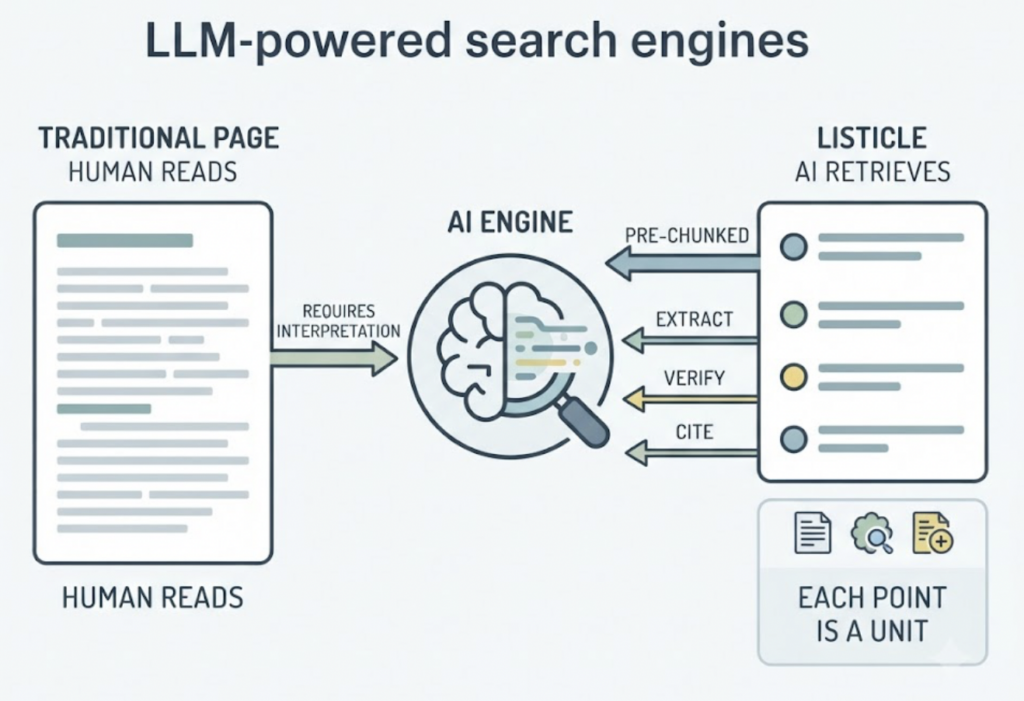
    This isn’t because AI engines have a taste for numbered headlines. It’s mechanical. LLM-powered answer engines don’t read pages the way humans do. They retrieve chunks, and a listicle is essentially a pre-chunked document. Each list item functions as a discrete, self-contained unit the model can extract, verify, and cite with high confidence.

    Narrative long-form works differently. The argument builds across sections, the payoff lands in paragraph twelve, and no single block stands alone. A human reader follows the thread. A retrieval system sees a wall of interdependent text and picks the competitor’s cleaner source instead.

    The stakes are bigger than ego. With AI answer engines now influencing over 65% of search queries, and research from Seer Interactive and Ahrefs showing AI-referred traffic converting at up to 23x the rate of standard organic visits, citation share is becoming the metric that decides who gets the buyer.

    Structure is the entry ticket.

    What an AI Rank Checker Actually Measures

    Before restructuring anything, it helps to understand what you’re optimizing toward, because the measurement unit has changed.

    A traditional rank tracker reports a URL’s position on a static list, 1 through 100. An AI rank checker tracks something messier: whether your brand appears inside a synthesized answer, where it sits relative to competitors, and which specific URLs the engine cited to build that answer.

    MetricTraditional SEO TrackerAI Rank Checker
    ObjectiveKeyword rank on a results pagePresence in the AI answer
    Data unitURL positionCitation, mention, share of voice
    StabilityRelatively consistentVolatile, session-dependent
    Core valueClick-through rateBrand trust and influence

    The two systems also disagree more than most teams expect. The Digital Bloom’s 2026 AI Citation Report found roughly a 76% overlap between Google’s top 10 and AI citations, which sounds reassuring until you flip it: about a quarter of what AI cites doesn’t come from the top of Google at all. A page can rank #1 and never get cited if it’s too dense, lacks H2/H3 hierarchy, or buries its answers.

    That’s why format work and measurement have to run as one loop. You restructure, the engines re-retrieve, and the AI rank checker tells you whether the change registered. Skip the measurement half and you’re editing blind.

    How to Structure a Listicle That Wins AI Citations

    A citation-ready listicle follows rules that have little to do with what makes a listicle pleasant to skim. Three of them do most of the work.

    Front-Load the Answer in Every List Item

    AI systems scan the first 30% of a page for roughly 44% of their citations. The same top-heavy logic applies inside each list item: the first sentence should deliver the verdict, with context after.

    Compare “Tool X has been around since 2019 and has grown steadily…” with “Tool X is the strongest pick for agencies managing 10+ client brands, starting at $99/month.” The second version is quotable on its own. Pages built on this pyramid structure, summary first and expansion later, show a 17.46% higher inclusion rate in AI summaries.

    Keep Each Item Extractable on Its Own

    Every entry should carry its own definition, one concrete data point, and a use-case sentence. If a list item only makes sense after reading the item above it, it can’t be cited independently, and independence is the whole advantage of the format.

    Add a comparison table near the top. Structured data tables with specific values deliver a 2.5x citation multiplier over unstructured content, because a table gives the model pre-verified value pairs it can lift directly into an answer.

    Anchor Claims to Outside Evidence

    AI models lean on trust clusters. Content citing authoritative sources, industry stats, government data, or peer-reviewed research is 3.2x more likely to be cited than content making unsupported claims. Generic “top 10” pages with no external corroboration are exactly what models have learned to distrust.

    How to Structure a How-To Guide AI Engines Cite

    How-to content is the other format inside that 40% citation block, and its rules are stricter because the model needs to reproduce a sequence, not just a fact.

    Number every step, and open each one with a verb. “Step 3: Export the citation report as CSV” gives the engine an unambiguous action unit. Vague step titles like “Getting things ready” give it nothing to anchor.

    Embed specifics inside each step. Time estimates, tool names, exact settings, and thresholds all raise extraction confidence. “Wait 30 days before re-running your prompt set” is citable. “Wait a while and check again” isn’t. Detail reads as authority to both humans and retrieval systems.

    Two more structural moves compound the effect. Write H2 and H3 headers that mirror real queries (“How long until AI citations update?”) so the semantic hierarchy matches how people prompt. Then close with an FAQ block backed by FAQPage schema, which hands the model labeled question-answer pairs it can map straight onto conversational queries.

    3 Structural Mistakes That Cost You AI Citations

    The buried verdict. The conclusion arrives in the fifth paragraph after extensive throat-clearing. Since engines weight the opening third of the page so heavily, an answer that shows up late often doesn’t show up at all in the retrieval window.

    Suspense headers. Section titles like “The Surprising Truth” or “What We Learned” carry zero semantic information. The model can’t tell what the section answers, so it can’t match the section to a query. Curiosity-gap headlines are a human engagement tactic that actively hurts machine retrieval.

    The unbroken wall. No tables, no lists, paragraphs running six-plus sentences. AI systems struggle to chunk long unbroken text, and content that can’t be chunked can’t be cited. Blocks of 2 to 3 sentences with clear subheads are the reliable ceiling.

    Notice what’s not on this list: content quality. Plenty of genuinely excellent pages fail all three tests. That’s the uncomfortable part of the citation gap, and also the reason it’s fixable in an afternoon of editing rather than a quarter of rewriting.

    Verify Your Structure Works with an AI Rank Checker

    Restructuring without measurement is where most teams stall. AI answers are volatile by nature, shifting with model updates and retrieval weights, so a single manual ChatGPT check tells you almost nothing. You need a baseline, a change, and a tracked delta.

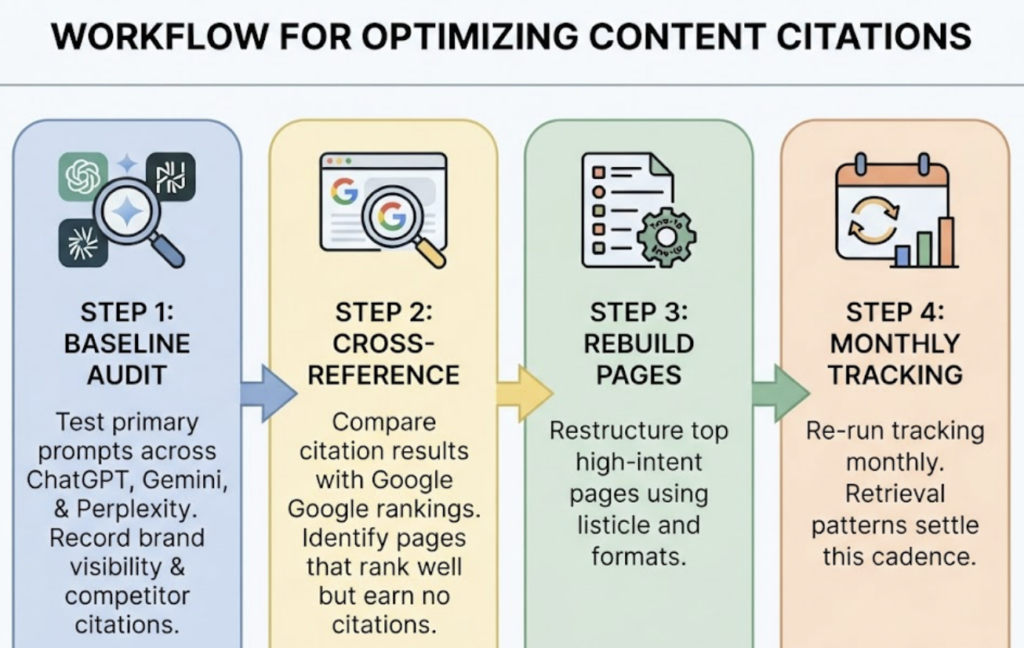
    The workflow looks like this. First, run a baseline audit: test your primary industry prompts across ChatGPT, Gemini, and Perplexity, and record whether your brand appears and which competitor URLs get cited instead. Second, cross-reference against Google rankings to isolate pages that rank well but earn no citations. Those are your restructuring candidates. Third, rebuild your top high-intent pages using the listicle and how-to rules above. Fourth, re-run tracking monthly, because that’s roughly the cadence at which retrieval patterns settle.

    This is the loop Topify was built to close. Its Source Analysis reverse-engineers the exact domains and URLs that AI platforms cite for your prompt set, so after a restructure you can see whether engines started pulling from your new listicle or kept citing the competitor. Position Tracking layers on where you sit in the answer relative to rivals, and coverage spans ChatGPT, Gemini, Perplexity, DeepSeek, and other major engines, which matters given how differently each platform retrieves.

    In practice, that means you can publish a restructured page, wait a retrieval cycle, and trace a new citation back to the specific section that earned it. The Basic plan runs $99/month with 100 tracked prompts and 9,000 AI answer analyses, which covers a monthly measurement cadence for a mid-size content library. If you want to scope the space before committing, this GEO free tools reference collects no-cost checkers worth testing first.

    Conclusion

    The citation gap isn’t a quality problem. It’s a packaging problem, and the data is consistent: listicles and how-tos win up to 40% of commercial-query citations because they’re pre-chunked, front-loaded, and independently extractable.

    Start small. Pick two or three pages that rank well on Google but never surface in AI answers, restructure them with answer-first list items, a data table, and query-mirroring headers, then let an ai rank checker confirm whether citations follow over the next 30 days. Track it. Adjust it. Repeat monthly. Getting a baseline in place takes minutes, and it turns format strategy from guesswork into a measurable loop.

    FAQ

    Q: What’s the difference between an AI rank checker and a traditional rank tracker?
    A: A traditional tracker reports your URL’s position on a search results page. An AI rank checker measures whether your brand appears inside AI-generated answers, how often, in what position relative to competitors, and which URLs the engine cited as sources.

    Q: How long does it take to see citation changes after restructuring content?
    A: Typically one retrieval cycle, which in most cases means 2 to 6 weeks depending on the platform. Because AI answers fluctuate with model updates, monthly tracking is the minimum cadence for judging whether a structural change actually moved citation frequency.

    Q: Do listicles work for every industry or topic?
    A: They dominate commercial and comparison queries, where citation rates reach up to 40%. For definitional or technical queries, answer-first explainers with strong H2/H3 hierarchy and FAQ schema tend to perform better. Match format to query intent rather than defaulting to lists everywhere.

    Q: Can I check AI rankings across ChatGPT, Gemini, and Perplexity at once?
    A: Yes. Multi-engine coverage is the main argument for dedicated tooling over manual spot checks, since each platform retrieves and cites differently. Platforms like Topify run your prompt set across all major engines and consolidate mentions, positions, and citations in one view.

    Read More

  • AI Rank Checker vs Rank Tracker: Why Google No.1 Means Nothing

    AI Rank Checker vs Rank Tracker: Why Google No.1 Means Nothing

    Your keyword rankings are solid. Domain authority sits in the 70s, the monthly SERP report is mostly green, and your rank tracker refreshes positions every 24 hours like clockwork. Then someone on the leadership team asks what ChatGPT says when a buyer requests recommendations in your category, and there’s no row in the spreadsheet for that.

    Here’s the uncomfortable part: the data you need isn’t a missing column in your current tool. It’s a different measurement system entirely. Rank trackers and AI rank checkers sound like siblings. They measure different universes, and knowing where one stops and the other starts is what separates teams that adapt from teams that keep reporting stale wins.

    Your Rank Tracker Says #1. ChatGPT Has Never Heard of You.

    The core problem is that a #1 Google position and an AI recommendation are produced by two systems that barely agree. When Ahrefs compared ChatGPT’s citations against search results, the links generated by ChatGPT’s fan-out queries matched only 6.82% of Google’s top 10 results. Your page can dominate the SERP and still never surface when an AI assistant composes its answer.

    Meanwhile, the SERP itself is sending fewer people your way. In the first four months of 2026, 68.01% of US Google searches ended without a single click, up from 60.45% in 2024. More of the buying journey now happens inside generated answers, on Google and off it.

    That’s the gap a traditional rank tracker was never built to see.

    What a Traditional Rank Tracker Actually Measures

    A rank tracker answers one question with precision: for a fixed keyword, where does a specific URL sit on the results page? The output is a deterministic position from 1 to 100, refreshed on a schedule, comparable week over week.

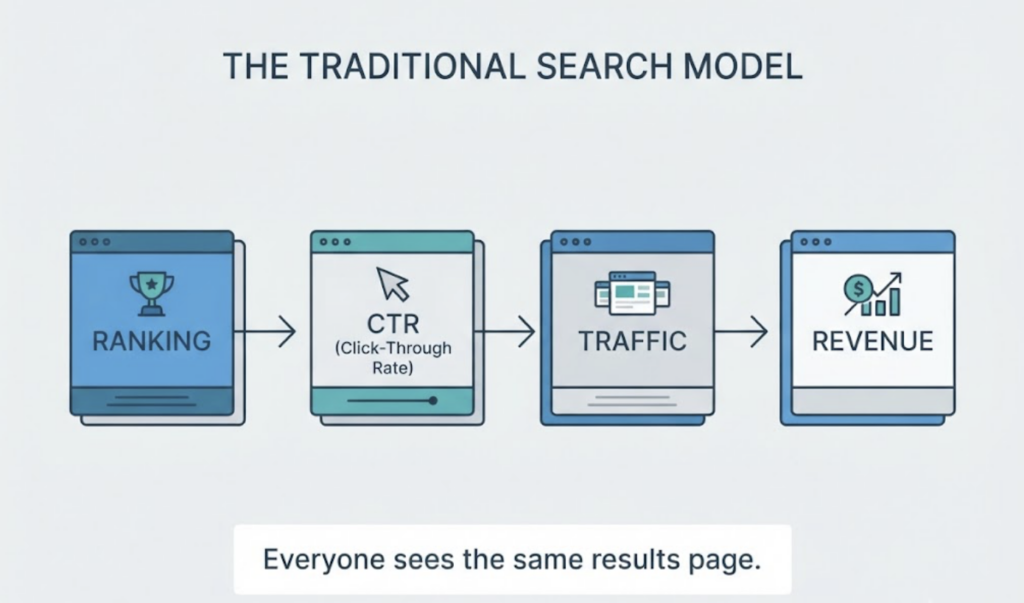
    That model rests on an assumption that held for two decades. Everyone searching “best CRM software” saw roughly the same results page, so a single tracked position represented what your audience actually saw. Rankings mapped to click-through rates, CTR mapped to traffic, and traffic mapped to revenue.

    None of that is wrong today. Google still drives the majority of referral traffic for most sites, and SERP positions still matter for the queries that produce clicks. The limitation is scope, not accuracy. A rank tracker tells you nothing about whether Perplexity mentions your brand, what position you hold inside a ChatGPT answer, or which sources the models trust instead of you.

    What an AI Rank Checker Measures Instead

    An AI rank checker tracks how AI platforms answer real prompts, and whether your brand shows up when they do. The measurement unit shifts from URL positions to brand-level signals: presence, position within the generated answer, sentiment, and the sources cited to justify the recommendation.

    There’s a second structural difference that trips up most SEO teams. AI answers are probabilistic. Ask the same question in two sessions and you’ll often get two different brand lists, which means a single spot-check tells you almost nothing. A useful AI rank checker samples the same prompt repeatedly over time and reports rates, not one-off screenshots.

    Here’s how the two tool categories compare side by side:

    DimensionTraditional Rank TrackerAI Rank Checker
    Measurement objectFixed keyword, SERP positionPrompt-level mention, citation, sentiment
    Data unitURL rank 1-100Presence rate, answer position, share of voice
    Result stabilityConsistent between crawlsVolatile by session, requires sampling
    Competitive viewWho outranks you on a keywordWhich brands AI recommends before yours
    Optimization leverBacklinks, on-page SEO, CTRCitations, entity clarity, third-party sources

    The strategic difference sits in the last row. Traditional rank tracking optimizes for clicks. AI rank checking optimizes for influence, meaning whether the model trusts your brand enough to name it when nobody clicks anything at all.

    Why the Two Datasets Diverge: Rankings vs Mentions

    AI engines don’t rank pages. They retrieve information, filter it through their own selection layer, and synthesize an answer. That extra processing is where your #1 position gets lost.

    The research on this is consistent and blunt. A 2026 academic study found that GPT-4o’s cited domains overlap with Google’s top 10 by a mean of just 4.0%, with a median of 0%. For more than half of the queries tested, not a single domain appeared in both lists.

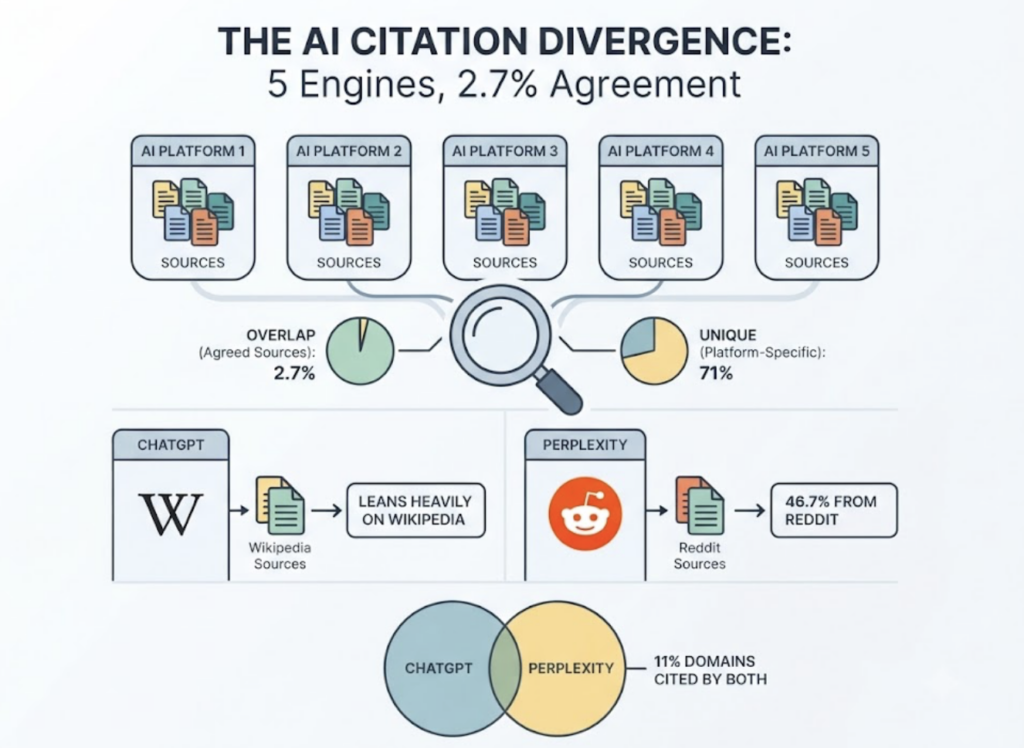
    The divergence doesn’t stop between Google and AI. It runs between the AI platforms themselves. A study of 127,198 citations across five engines found they agreed on only 2.7% of sources, with 71% of cited sources appearing on just one platform. ZipTie’s analysis shows the flavor of that split: ChatGPT leans heavily on Wikipedia while Perplexity pulls 46.7% of its top citations from Reddit, and only 11% of domains get cited by both for the same query.

    The takeaway: being visible on one AI platform predicts almost nothing about the others. Any tool that checks a single engine, or checks each prompt once, is measuring noise.

    Running an AI Rank Checker in Practice: What Topify Tracks

    Given the volatility and platform fragmentation above, a working AI rank checker needs three things: prompt-level tracking at scale, coverage across multiple AI engines, and a competitive baseline so a “yes, you’re mentioned” actually means something relative to rivals.

    Topify is built around exactly that model. Its Position Tracking monitors where your brand lands inside AI answers relative to competitors, which is the closest analog to a traditional “rank” in the AI context. That sits within a broader set of seven metrics covering visibility, sentiment, position, volume, mentions, intent, and CVR, so a position drop can be read alongside sentiment shifts or citation changes rather than in isolation.

    Coverage matters because of the 2.7% cross-engine agreement problem. Topify tracks brand performance across ChatGPT, Gemini, Perplexity, DeepSeek, and other major AI platforms, which lets you see the model-specific gaps a single-engine checker would hide.

    In practice, the workflow looks like this: you notice your Perplexity position slipping on a high-intent prompt like “best project management tool for agencies.” Topify’s citation analysis shows which domains Perplexity started citing instead, and you trace the drop to a comparison site that stopped listing your product. That’s an actionable fix, not just a red number on a dashboard.

    Pricing starts at $99/month for the Basic plan, which includes 100 tracked prompts and around 9,000 AI answer analyses per month, enough to run statistically meaningful sampling on a focused prompt set. If you want to test the water before committing to monitoring, there’s a free GEO tools reference that covers no-cost checkers for baseline audits.

    Other tools exist in this category, and some do single-platform tracking well. The evaluation question is whether a tool samples repeatedly, covers the engines your buyers use, and connects position data to the citations driving it.

    You Still Need Both. Here’s How the Stack Fits Together.

    This isn’t a replacement decision. It’s a stack decision.

    Traffic still overwhelmingly flows through Google, and your rank tracker plus Search Console remain the right instruments for it. But the traffic arriving from AI platforms behaves differently: Seer Interactive’s case study measured ChatGPT-referred traffic converting at 15.9% against 1.76% for Google organic. Small volume, disproportionate value. Ignoring the layer that produces it means ignoring your highest-intent channel.

    A practical dual-stack setup takes an afternoon:

    1. Baseline. List your top 20 high-intent prompts, the “best [category] software” and “[problem] solution” questions your buyers actually ask AI.
    2. Trace. Run them through an AI rank checker and record presence rate, average position, and which competitors appear ahead of you. Get started with Topify to automate the sampling instead of screenshotting sessions manually.
    3. Optimize and re-measure. Where you’re absent, audit the citations the AI does trust, strengthen your presence on those third-party sources, tighten your semantic HTML, and check whether your presence rate moves over the next 30 days.

    Keep your GA4 channel groupings updated to isolate AI referrals, and report both datasets side by side. SERP position tells you about clicks. AI position tells you about recommendations. Your leadership team needs both numbers.

    Conclusion

    A #1 Google position answers half the visibility question, and the half it answers is shrinking as zero-click behavior climbs and buyers delegate research to AI assistants. The other half, whether models mention, trust, and recommend your brand, requires an AI rank checker because the two systems agree on sources in the low single digits.

    The pragmatic move isn’t panic or a platform migration. It’s a baseline: pick 20 prompts, measure your presence across the major AI engines this week, and decide where to invest based on what the data shows. Teams that establish that baseline now will be optimizing while their competitors are still explaining to leadership why the green SERP report doesn’t match reality.

    FAQ

    Q: What is an AI rank checker? 

    A: An AI rank checker is a tool that tracks whether and where your brand appears in AI-generated answers across platforms like ChatGPT, Perplexity, and Gemini. Instead of URL positions on a results page, it measures prompt-level presence, answer position, sentiment, and the sources AI engines cite.

    Q: Can my existing rank tracker check AI rankings? 

    A: Generally no. Traditional rank trackers query search engine results pages, which are deterministic and URL-based. AI answers are probabilistic and brand-based, so they require repeated sampling of the same prompts across multiple engines, a fundamentally different data collection method.

    Q: How do I check my brand ranking in ChatGPT? 

    A: Manually, you can ask ChatGPT your target prompts in fresh sessions and record whether your brand appears. But answers vary between sessions, so a reliable read requires sampling each prompt many times. Dedicated tools like Topify automate this and report presence rates and positions over time.

    Q: How often should I track rankings in AI answers? 

    A: Continuously, or at least weekly. AI citation patterns shift as models update their retrieval sources, and studies show cross-session answer variance is high. Monthly spot-checks tend to miss both drops and wins, so ongoing sampling is the only way to see real trends.

    Read More

  • AI Query Tracking Service: How It Works and What It Costs

    AI Query Tracking Service: How It Works and What It Costs

    Spend an afternoon researching AI query tracking services and you’ll hit the same wall most marketing leads do: every vendor defines the category differently. One platform tracks 50 prompts on ChatGPT only. Another promises “full LLM coverage” without saying what that means. Pricing runs from $49 to over $4,000 a month, and the feature lists don’t map to each other, so you can’t compare quotes side by side.

    The confusion isn’t your fault. The category is barely three years old, and vendors are still inventing the vocabulary. But underneath the marketing noise, these services all do the same fundamental job, and once you understand that job, evaluating them takes an hour instead of a week.

    What an AI Query Tracking Service Actually Tracks

    An AI query tracking service monitors what large language models say about your brand when users ask buying-intent questions. It sends a defined set of prompts to platforms like ChatGPT, Perplexity, and Gemini on a schedule, then parses each response to record whether your brand appeared, where it ranked, how it was described, and which sources the AI cited.

    That sounds like rank tracking with extra steps. It isn’t.

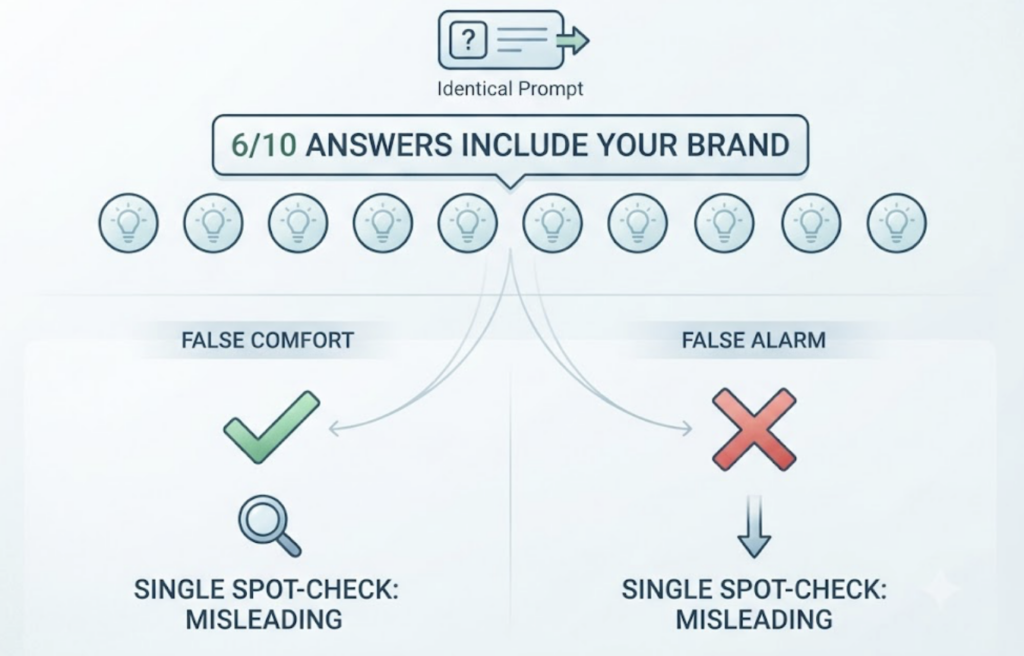
    Traditional rank trackers monitor a static page of results: keyword in, ten blue links out, same for everyone. AI answers are non-deterministic. LLMs are stochastic by design, which means the identical prompt can produce different responses depending on model updates, temperature settings, and the platform’s retrieval process. A single manual check tells you almost nothing. Professional services solve this with multi-sample polling: querying the same prompt repeatedly over time to establish a statistically meaningful visibility baseline instead of a lucky (or unlucky) snapshot.

    This is the core distinction to hold onto during vendor evaluations. If a tool can’t explain its sampling methodology, it’s a screenshot generator, not a tracking service.

    How Does an AI Query Tracking Service Work? The 4-Step Pipeline

    Under the hood, most professional platforms run the same pipeline. Here’s what happens between “add your brand” and “view your dashboard,” using a fictional CRM startup as the running example.

    Step 1: Prompt Set Design

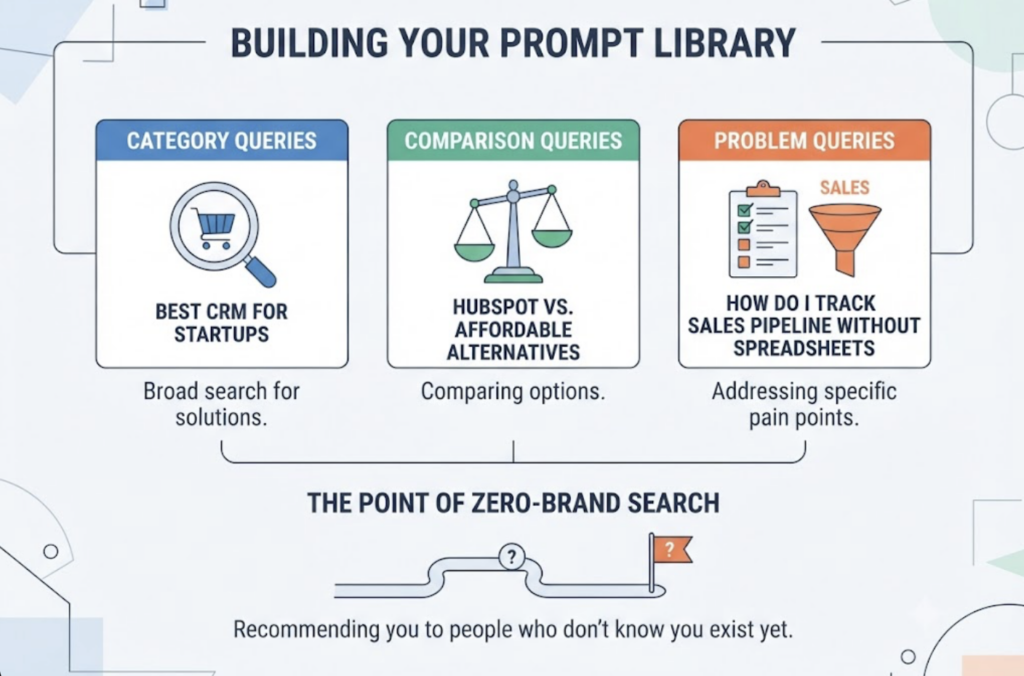
    The service builds a library of prompts that mirror the buyer journey. For the CRM startup, that includes category queries (“best CRM for startups”), comparison queries (“HubSpot vs. affordable alternatives”), and problem queries (“how do I track sales pipeline without spreadsheets”). The brand name appears in almost none of them, which is the point. You’re testing whether AI recommends you to people who don’t know you exist yet.

    Step 2: Multi-Engine Polling

    The platform queries each prompt across major engines on a recurring schedule, typically daily or weekly. Coverage matters here because ecosystems behave differently: Perplexity leans heavily on citations, ChatGPT on training data plus browsing, Gemini on Google’s index. A brand can be visible on one engine and absent on another.

    Step 3: Semantic Parsing

    Each raw response gets parsed for four signals: mention frequency (did the brand appear), salience (did it land in the top portion of the answer, the prime real estate users actually read), sentiment (positive, neutral, or negative framing), and citation mapping (which URLs the AI referenced as evidence).

    Step 4: Trend Aggregation

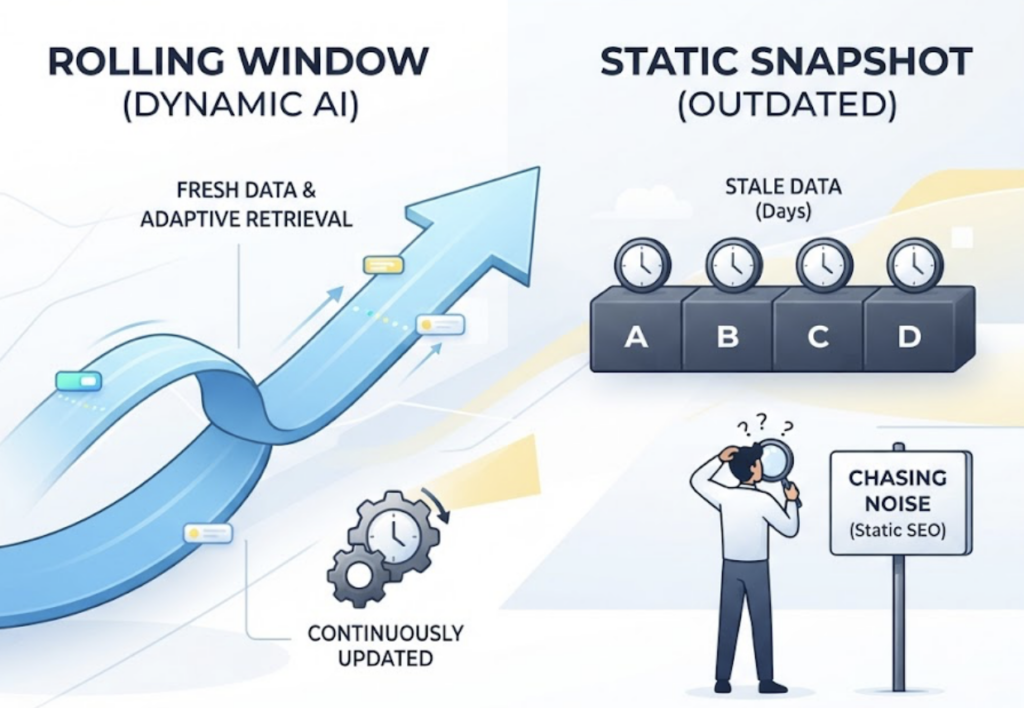
    Individual samples get normalized into rolling averages, usually over 30 days, to filter model-induced noise from genuine shifts. If the CRM startup’s visibility drops 15 points in a week, aggregation tells you whether that’s random variance or a competitor’s new content pulling citations away.

    How to Measure Results: The 5 Metrics That Matter

    Once tracking runs, the question becomes what “good” looks like. These are the core AI visibility metrics that answer-engine optimization teams have standardized around, with rough health benchmarks.

    MetricWhat It MeasuresHealth Signal
    Visibility Rate% of tracked prompts where your brand is mentionedAbove 40% on category-specific queries
    Average PositionWhere your brand appears in the recommendation listTop 3 for high-intent queries
    Sentiment ScoreThe tone of your brand’s descriptionNeutral to positive; negative framing signals content gaps
    Citation Share% of responses citing a given source (your blog, G2, etc.)Higher share means the AI treats that source as authoritative
    Conversion SignalBranded search or traffic lift after AI mentionsShould correlate with visibility spikes

    One practical note: citation share is the metric teams most often ignore and most often regret ignoring. It tells you which third-party sites are feeding the AI’s opinion of your category. That’s actionable in a way raw mention counts aren’t, because you can pitch, publish, or partner your way into those sources.

    Why an Enterprise LLM Visibility Platform Differs from a Basic Tracker

    The market splits into two tiers, and the gap between them is wider than the pricing pages suggest.

    Basic trackers, typically $49 to $150 per month, monitor mention frequency across one or two platforms. For a solo founder checking whether ChatGPT knows their product exists, that’s often enough.

    An enterprise LLM visibility platform solves a different problem. Larger organizations need multi-brand and multi-market support, API access to pipe data into existing BI dashboards, team seats with role permissions, and automated competitor detection rather than manually maintained lists. The defining enterprise capability is citation gap analysis: reverse-engineering which sources make your competitors visible, so you know exactly which publications or review sites to target.

    Here’s how the tiers compare in practice:

    CapabilityBasic TrackerEnterprise LLM Visibility Platform
    Engine coverage1-2 platforms4+ platforms, including regional engines
    Prompt volume50-100/monthCustom, often 250+
    Competitor trackingManual or noneAutomated detection and benchmarking
    Citation analysisMention counts onlyFull citation supply chain mapping
    Team workflowsSingle userMulti-seat, multi-project, API access

    The honest guidance: don’t buy enterprise capabilities you won’t use. But if you manage more than one brand, operate in multiple markets, or report to stakeholders who ask “why did this change,” the basic tier will frustrate you within a quarter.

    Best Tools for AI Query Tracking in 2026

    The vendor field has grown crowded enough that roundups of AI search monitoring tools now cover a dozen or more options, ranging from lightweight mention counters to full optimization suites. Rather than list everything, it’s more useful to look at what a complete platform includes, using one as the reference case.

    Topify covers the full pipeline described above and adds the layers that basic trackers skip. It tracks prompt-level visibility across ChatGPT, Gemini, Perplexity, and DeepSeek, plus regional engines like Doubao and Qwen, which matters for brands with audiences outside North America. Monitoring spans seven metrics: visibility, sentiment, position, volume, mentions, intent, and conversion visibility rate.

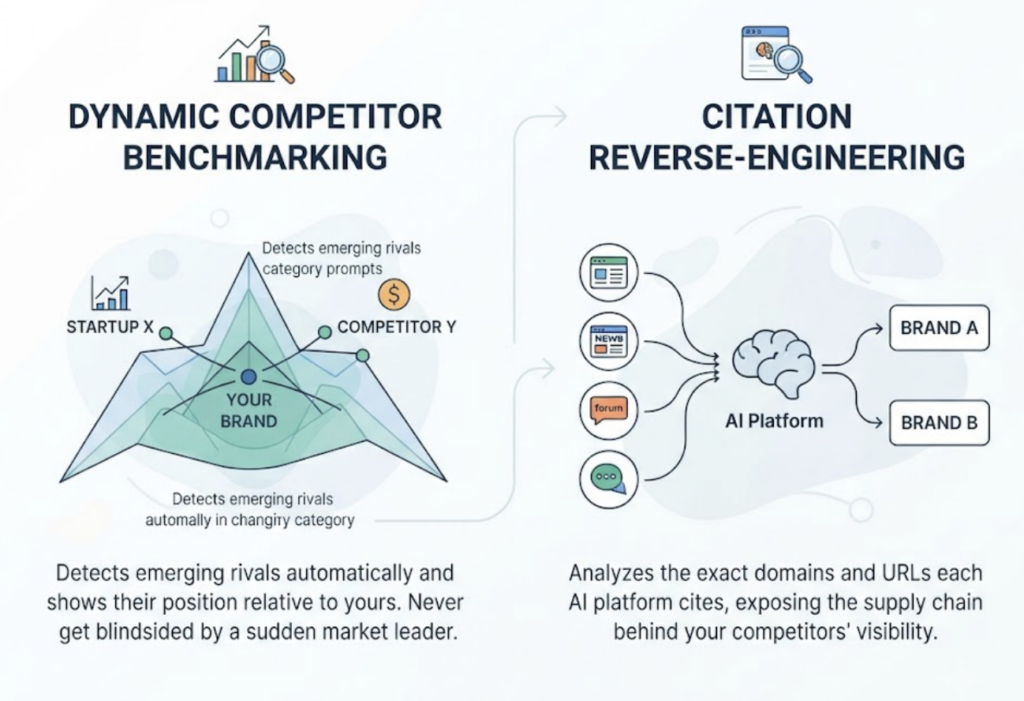
    Two capabilities stand out for teams past the “are we visible” stage. Dynamic competitor benchmarking detects emerging rivals automatically and shows their position relative to yours, so you’re not blindsided by a startup that suddenly dominates your category prompts. And citation reverse-engineering analyzes the exact domains and URLs each AI platform cites, exposing the supply chain behind your competitors’ visibility.

    For teams that want execution alongside measurement, the platform’s agent can propose and deploy GEO strategies from plain-English goals. That’s a meaningful difference from tools that stop at dashboards.

    Other tools in the category serve narrower needs well: some focus purely on Google AI Overviews, others on single-engine mention alerts at lower price points. The fit depends on how many engines your audience uses and whether you need the citation layer.

    A 7-Point Checklist Before You Buy

    Run every vendor demo against this list. It compresses the evaluation from weeks to a single call.

    1. Engine coverage. Does it track every platform your audience actually uses, including regional ones if you sell internationally?
    2. Prompt quota. How many prompts per month, and what does expansion cost? Under 100 is tight for most mid-size brands.
    3. Sampling frequency. Daily or weekly polling with aggregation, not one-off snapshots.
    4. Competitor tracking. Automated detection, or a manual list you’ll forget to update?
    5. Citation analysis. Can you see which sources drive AI answers, or just whether you were mentioned?
    6. Data access. Export, API, or dashboard-only? Dashboard-only becomes a bottleneck once leadership wants the numbers in their own reports.
    7. Pricing transparency. Published tiers you can budget against, or “book a call” pricing that hides the real cost?

    If a vendor fails on points 3 or 5, keep looking. Those two separate measurement from guesswork.

    Common Mistakes That Skew Your Tracking Data

    Even with the right tool, three errors reliably corrupt AI visibility programs.

    The single-sample bias. Someone on the team asks ChatGPT about the category once, screenshots the answer, and the screenshot becomes strategy. Model volatility makes any single response unreliable. Always work from aggregated data across multiple samples.

    Tracking only brand-name queries. If every prompt contains your brand name, your visibility rate will look great and mean nothing. The revenue-relevant queries are category ones (“best cloud accounting software”) where you should appear but the user never typed your name.

    The SEO-to-AEO fallacy. Teams assume Google logic transfers: build links, watch AI mentions rise. It doesn’t work that way. Strong domain authority and backlink profiles often coexist with zero AI mentions, because LLMs weigh semantic authority, clear Q&A structure, and third-party social proof over link density. Your rank tracker and your query tracker will regularly disagree, and both will be right about what they measure.

    That third mistake is the expensive one. It leads teams to spend another quarter on link building when the actual gap is structural content and citation coverage.

    AI Query Tracking Service Pricing: What You’ll Actually Pay

    Pricing has coalesced around prompt volume and engine coverage, with three consistent tiers across the market:

    • Entry level ($49-$199/mo): 50-100 prompts, often single-engine focus. Fine for validation, limiting for strategy.
    • Professional ($200-$500/mo): Multi-engine coverage, sentiment analysis, basic competitor tracking.
    • Enterprise ($500-$4,000+/mo): Custom prompt volume, API access, agency workspaces, dedicated support.

    As a concrete reference point, Topify’s pricing runs Basic at $99/month (100 prompts, ChatGPT, Perplexity, and AI Overviews tracking, 4 projects), Pro at $199/month (250 prompts, 10 seats), and Enterprise from $499/month with a dedicated account manager. Multi-engine tracking and competitor benchmarking are included below the $200 line, which undercuts the market’s typical professional tier.

    Budget guidance: start where your prompt volume actually sits. A focused brand tracking 100 high-intent prompts learns more than a sprawling program tracking 500 vague ones.

    How to Improve Your Numbers: A 90-Day Strategy

    Tracking without action is just expensive anxiety. Here’s the strategy sequence that turns data into visibility gains.

    Days 0-30: Baseline. Audit your top 100 high-intent prompts across major engines. Record your visibility rate, average position, and sentiment against your top three competitors. Resist optimizing anything yet; you need clean baseline data first.

    Days 31-60: Citation gap analysis. Map the citation supply chain. If competitors keep getting cited by specific review sites or industry publications that ignore you, those sites are your target list. Prioritize content partnerships, PR outreach, or review-platform presence there.

    Days 61-90: Structural optimization. Restructure key pages to be answer-friendly: clear FAQ sections, transparent pricing tables, expert author bylines. Then watch the next tracking cycle for movement. Visibility shifts typically lag content changes by weeks, so aggregated trend data (not daily checks) tells you whether it worked.

    Then the cycle repeats: expand the prompt set, refine, remeasure.

    Conclusion

    The vendor confusion that makes this category hard to shop is mostly surface-level. Every AI query tracking service does the same core job: sample AI answers systematically, parse them for brand signals, and aggregate the noise into trends. The real differences live in engine coverage, citation analysis depth, and whether pricing scales with your prompt volume.

    Run the 7-point checklist against any shortlist and the decision usually makes itself. If you want to see what prompt-level tracking looks like on your own brand before committing budget, you can start with Topify and have baseline data within the first tracking cycle.

    FAQ

    Q: What is an AI query tracking service?
    A: It’s a platform that repeatedly sends buying-intent prompts to AI engines like ChatGPT, Perplexity, and Gemini, then parses the responses to measure whether your brand is mentioned, where it ranks, how it’s described, and which sources the AI cites.

    Q: How much does an AI query tracking service cost?
    A: Entry-level plans run $49-$199/month for limited prompts, professional tiers $200-$500/month with multi-engine coverage, and enterprise plans $500-$4,000+/month. Topify starts at $99/month with multi-engine tracking included.

    Q: How is an enterprise LLM visibility platform different from a basic tracker?
    A: Enterprise platforms add multi-brand support, API access, automated competitor detection, team workflows, and citation gap analysis. Basic trackers typically count mentions on one or two engines.

    Q: How often should AI queries be sampled?
    A: Daily or weekly, then aggregated over a rolling window such as 30 days. AI responses are non-deterministic, so single checks produce unreliable data.

    Read More

  • AI Query Tracking Solution: What It Is and How It Works

    AI Query Tracking Solution: What It Is and How It Works

    Your keyword rankings look fine. Your domain authority hasn’t moved. But when a buyer asks ChatGPT for recommendations in your category, you have no idea whether your brand shows up, where it lands, or how the AI describes you. That blind spot is getting expensive: as of 2026, over 60% of information-seeking queries resolve inside the AI interface without a single click. The dashboards you’ve relied on for a decade weren’t built to measure any of this.

    What an AI Query Tracking Solution Actually Tracks

    An AI query tracking solution is a system that audits how your brand appears inside the generative outputs of AI platforms like ChatGPT, Perplexity, Gemini, and Google AI Overviews. Instead of monitoring where a URL ranks on a results page, it monitors whether your brand gets mentioned, recommended, or cited when someone asks an AI a buying question.

    The distinction matters because the two systems behave differently. Traditional rank tracking watches a deterministic list: your page either holds position #4 or it doesn’t. AI answers are probabilistic. Models use temperature settings and contextual awareness, so the same prompt can return different brand recommendations across consecutive sessions.

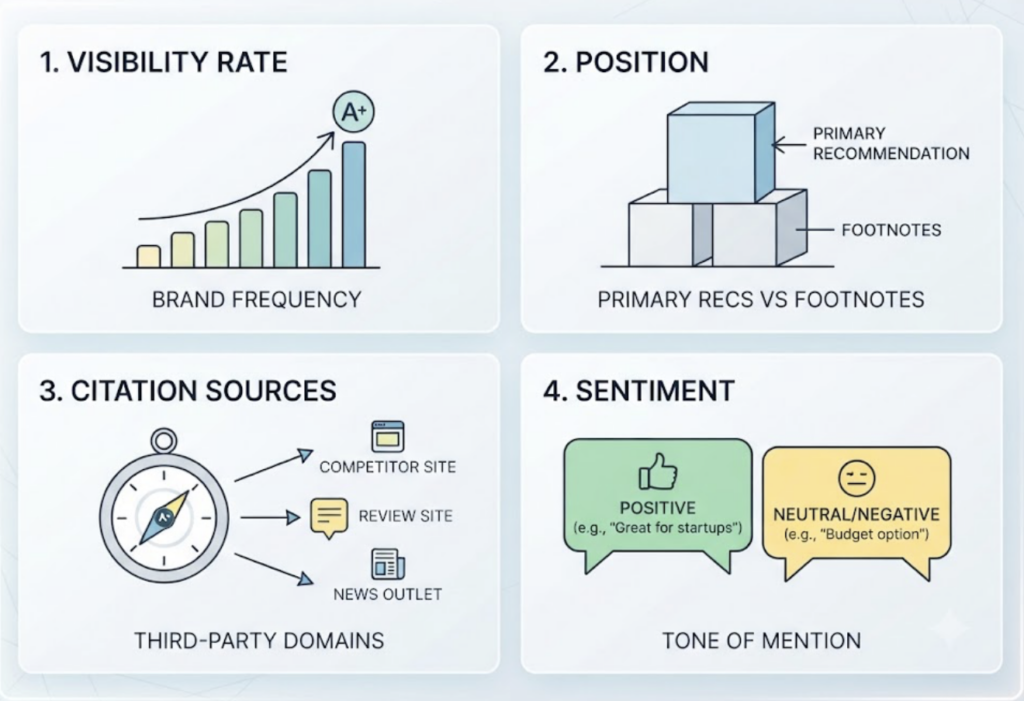
    In practice, a solid tracking setup measures four things: how often your brand appears for a given prompt (visibility rate), whether you’re the primary recommendation or a footnote (position), which third-party domains the AI cites as evidence (citation sources), and the tone of the mention (sentiment). “Great for startups” and “a budget option” are both mentions. They’re not the same outcome.

    Rank Trackers Told You Where You Stood. AI Answers Don’t Work That Way.

    Tools built for the SERP era have started bolting on AI features. A rank ranger AI Overviews tracker, for example, treats Google’s AI Overviews as another SERP feature to monitor, similar to a featured snippet or an image pack. That’s genuinely useful if your goal is defending Google click-through.

    It’s also where the coverage stops.

    The SERP-first approach runs into three walls. First, platform blindness: it ignores conversational engines like Perplexity and ChatGPT, where the discovery journey starts and ends outside of Google entirely. Second, it detects whether a link exists but not what the answer says. It can’t tell you if the AI calls your product “expensive” or “premium,” and that semantic difference shapes buyer perception more than the link itself. Third, it assumes stability. SERP positions hold steady for days; AI visibility shifts between sessions, which means a single snapshot is closer to a coin flip than a measurement.

    None of this makes SERP trackers obsolete. It makes them incomplete. They answer “where do I rank on Google” while the newer question is “what does AI say about me everywhere.”

    How an AI Query Tracking Solution Works, Step by Step

    Most professional systems follow the same four-step cycle, repeated on a schedule.

    Step 1: Build a prompt library. Tracking starts with queries that mirror real buyer journeys, like “best [product] for [industry]” or “alternatives to [competitor].” Generic prompts produce generic data. Decision-stage prompts produce data you can act on.

    Step 2: Sample across engines. The system runs those prompts on ChatGPT, Perplexity, Gemini, and AI Overviews on a daily or weekly cadence. Because outputs vary, one pass means nothing. Repeated sampling across platforms reveals where the engines agree about your category and where they diverge.

    Step 3: Parse the responses. NLP-based analysis converts raw answer text into structured data: mentions, position, sentiment, and the specific sources cited. This is the step that separates a tracking solution from someone manually pasting prompts into a chat window.

    Step 4: Attribute the gaps. When visibility is zero, the system should tell you why. Sometimes the cause is weak topical authority on your own site. More often, it’s absence from the third-party platforms the AI actually trusts, like review sites, forums, or trade publications.

    Platforms like Topify run this cycle across seven metrics (visibility, sentiment, position, volume, mentions, intent, and CVR), which means a drop in ChatGPT mentions can be traced back to a specific source that stopped citing your brand, inside the same dashboard.

    How to Measure Whether Your AI Query Tracking Is Working

    Raw answer data becomes useful when it’s compressed into a few KPIs your team can review weekly. Four have emerged as the industry standard:

    Mention rate is the existence metric. If a prompt triggers your category and your brand isn’t in the answer, you have an inclusion gap, and nothing else matters until it’s closed.

    Average position measures salience. Being recommended first versus fifth changes both perception and the probability a user acts on it.

    Citation share tracks how often your owned or earned assets appear as the evidence behind an AI’s claim. This is the metric SERP tools skip entirely.

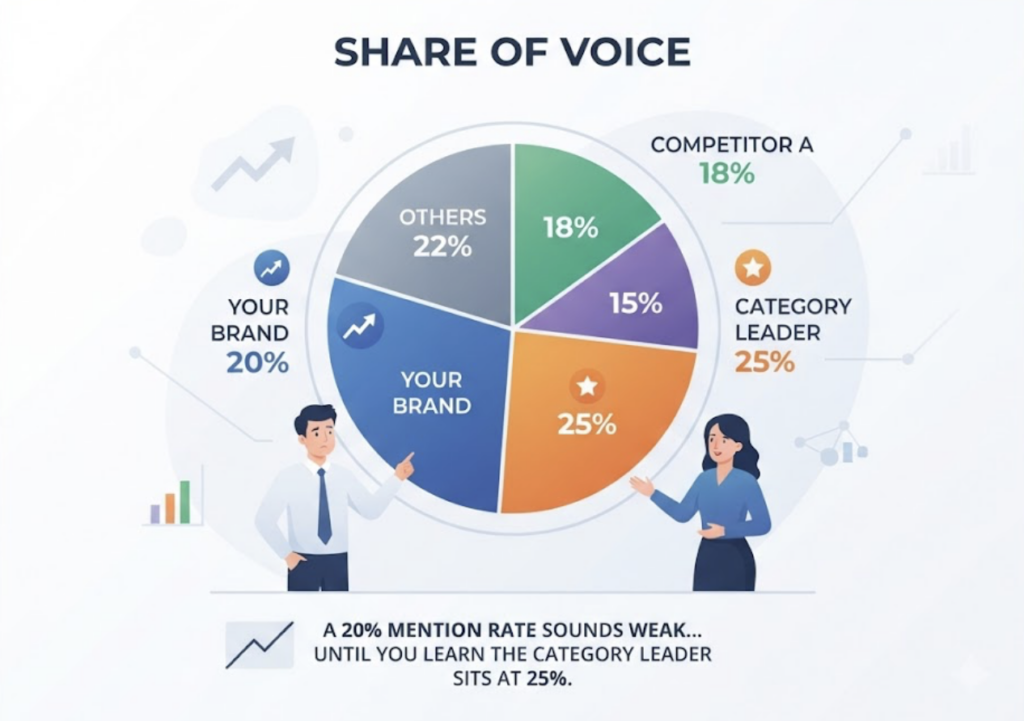
    Share of voice puts your presence in context against competitors within the same prompt cluster. A 20% mention rate sounds weak until you learn the category leader sits at 25%.

    Measure all four against a baseline, then review the trend over a rolling window rather than reacting to any single day’s output.

    Best Tools for an AI Query Tracking Solution in 2026

    The market splits into two camps: SERP-first tools that added AI features, and AI-first platforms that treat the LLM as the primary surface.

    ToolFocusPricingBest For
    TopifyCross-platform AI visibility, citation analysis, executionFrom $99/moBrands needing prompt-level insights and citation gap analysis
    Rank Ranger AI Overviews trackerGoogle SERP + AIO monitoringTieredTeams optimizing primarily for Google SERP features
    General SERP suites with AI add-onsRank tracking with partial AIO dataVariesTeams not yet ready to track conversational platforms

    Topify is the strongest fit for teams that want the full loop rather than another report. It tracks brand mentions at the prompt level across ChatGPT, Gemini, Perplexity, DeepSeek, and other major engines, then layers on the citation analysis piece: reverse-engineering the exact domains and URLs each platform cites when answering questions in your category.

    That citation layer is where it pulls ahead in day-to-day use. If a competitor keeps getting validated by G2 or a niche trade journal and your brand doesn’t appear there, Topify maps that specific missing link, effectively telling your team where to aim PR and content effort to teach the AI your brand is an authority. Tracking tells you the score. Source gaps tell you the next move.

    Pricing starts at $99/mo on the Basic plan, which covers ChatGPT, Perplexity, and AI Overviews tracking with 100 prompts and 9,000 AI answer analyses, enough to run the “Core 50” strategy below with room to spare. Plans scale by usage rather than enterprise bundles, so you can start small and expand as the data proves out.

    The rank ranger AI Overviews tracker approach still makes sense as a complement if Google remains your dominant channel. Just don’t mistake AIO coverage for AI coverage.

    Common Mistakes That Undermine an AI Query Tracking Solution

    Trusting a single sample. Running one manual query and treating the answer as truth is the most common failure. AI outputs vary by session. Use a rolling average, typically a 30-day window, before drawing conclusions.

    Ignoring the citation supply chain. Teams optimize their own site while the AI pulls its evidence from third-party review platforms. If you’re invisible on the sources the AI trusts, you’ll stay invisible in the answer, no matter how good your on-site content gets.

    Writing for keyword density. LLMs parse intent, not keyword counts. Content stuffed with “SEO-ese” reads as low-trust. Clear definitions, concise headings, and authoritative data tables perform better because they’re easier for models to extract and cite.

    Freezing the prompt set. Buyer language shifts, and so do the prompts that matter. A tracking setup that never adds new queries slowly measures yesterday’s market.

    A quick checklist before you trust your data: 50+ decision-stage prompts, at least three platforms sampled, weekly cadence minimum, citation sources logged, and a competitor set defined for share of voice.

    Conclusion

    The gap between “my rankings are fine” and “AI never mentions my brand” is the defining measurement problem of this search era, and it won’t show up in any dashboard built for blue links. The fix is straightforward to start. Define your Core 50 high-intent prompts. Sample them across ChatGPT, Perplexity, and AI Overviews for 30 days to establish a baseline. Then audit the sources AI cites for your competitors and close the gaps one by one. If you’d rather not build that pipeline manually, you can get started with Topify and have baseline data within the first week.

    FAQ

    Q: What is an AI query tracking solution?
    A: It’s a system that monitors how a brand appears in AI-generated answers across platforms like ChatGPT, Perplexity, and Google AI Overviews. It measures mention rate, position, sentiment, and citation sources at the individual prompt level, rather than tracking URL rankings on a results page.

    Q: How much does an AI query tracking solution cost?
    A: Entry pricing typically starts around $99/mo for prompt-level tracking across major platforms, with usage-based tiers as prompt volume grows. SERP-first tools with AI Overviews add-ons use tiered pricing that varies by plan, but they generally don’t cover conversational platforms.

    Q: Is a rank ranger AI Overviews tracker enough for AI search monitoring?
    A: It covers one surface: AI Overviews inside Google. It won’t show how ChatGPT or Perplexity describe your brand, and it detects link presence rather than sentiment or salience. Most teams pair SERP tracking with an AI-first platform for full coverage.

    Q: How often should you sample AI answers?
    A: Weekly at minimum, daily for competitive categories. Because AI outputs are probabilistic, judge trends on a rolling 30-day average rather than any single query result.

    Read More

  • AI Query Tracking Platform: What It Is and How It Works

    AI Query Tracking Platform: What It Is and How It Works

    Your domain rating is solid. Your keyword rankings haven’t moved. And yet none of that data can tell you what happened yesterday when 800 people asked ChatGPT for a recommendation in your category. Traditional SEO tools measure positions on a results page. An AI query tracking platform measures something different: whether generative engines mention you at all, where they place you, and which sources they trust when they decide.

    That gap between what your dashboard shows and what AI actually says is now where deals are quietly won or lost.

    What an AI Query Tracking Platform Actually Measures

    An AI query tracking platform systematically monitors how AI engines like ChatGPT, Perplexity, Gemini, and Google AI Overviews respond to the prompts your buyers actually type. Instead of tracking a keyword’s rank on a results page, it audits the AI’s synthesized answer: is your brand present, how prominently, and in what tone.

    The shift matters because the underlying behavior has changed. AI search traffic has grown more than 500% year-over-year, and over 60% of information-seeking queries now resolve without a single click to an external website. When the answer is the destination, the answer is what you need to measure.

    One clarification worth making early: query tracking isn’t prompt engineering. You’re not writing instructions for the AI. You’re auditing its outputs for high-intent queries like “best CRM for small agencies” or “your brand vs. competitor” to see how the model characterizes you.

    A useful mental model comes down to four questions. Is the brand present in the answer? Is it prominent, meaning early in the response rather than buried? Is it persuasive, framed positively rather than as a budget afterthought? And is it cited, backed by sources the AI treats as authoritative?

    Inside the Mechanics: Why One Query Proves Nothing

    Here’s the part most teams get wrong on day one. They open ChatGPT, type their category query, screenshot the answer, and treat it as ground truth.

    LLMs are probabilistic, not deterministic. Research shows that even at zero temperature settings, responses still vary between runs. Your brand might appear in 6 out of 10 answers to the identical prompt. A single spot-check captures one data point from a distribution, which is why manual tracking tends to produce false alarms and false comfort in equal measure.

    A proper AI query tracking platform handles this with a repeatable pipeline:

    1. Prompt library design. Define the 25 to 50 decision-stage queries that matter for your category.
    2. Scheduled multi-platform sampling. Run each prompt repeatedly across ChatGPT, Perplexity, Gemini, and other engines on a fixed cadence.
    3. Answer parsing. Detect brand mentions, extract position within the response, and score sentiment.
    4. Citation extraction. Log which domains the AI referenced to justify its recommendations.
    5. Longitudinal aggregation. Roll results into 7-day or 30-day windows so you’re reading trends, not noise.

    The rolling window is the piece manual workflows can’t replicate. AI models update their indexes and retrieval logic frequently, so snapshots go stale within days. As one analyst at ROI·DNA put it, treating AI performance like a static SEO rank means chasing noise instead of driving strategy.

    The Four Metrics That Separate Signal from Vanity

    Knowing how to measure an AI query tracking platform’s output starts with four core dimensions.

    Visibility rate. The percentage of relevant AI responses that include your brand. This is your baseline: a brand at 12% visibility for its core prompts has a discovery problem, not a conversion problem.

    Position, or salience. Where you appear in the answer. AI-generated responses concentrate attention heavily, and models tend to prioritize the first 30 to 40% of content, so a mention in position seven is worth a fraction of a mention in position two.

    Sentiment and framing. How the AI describes you. “Enterprise-grade” and “a cheaper alternative” are both mentions, but they send buyers in different directions.

    Source attribution. The domains fueling the AI’s answers. This is the upstream layer most teams miss: if Perplexity consistently cites G2 and an industry journal for your category, your visibility on those third-party sources matters as much as your own site. In practice, platforms like Topify operationalize this by tracking all four dimensions plus volume, intent, and a conversion visibility rate at the individual prompt level, so a drop in ChatGPT mentions can be traced back to the specific source that stopped citing you.

    Five Mistakes That Turn Tracking Data into Noise

    Even teams that buy the right tooling often undermine it in the setup phase. The recurring failures:

    Trusting single samples. One query, one screenshot, one conclusion. Variance makes this meaningless.

    Tracking only one AI platform. ChatGPT, Perplexity, and Gemini pull from different retrieval systems and cite different sources. Coverage on one says little about the others.

    Monitoring branded queries instead of category queries. “What is [your brand]” flatters you. “Best [category] tool” is where buying decisions happen and where you’re most likely invisible.

    Keeping the prompt library too small. Ten prompts can’t represent a category. Tracking a modest cluster of 50 prompts across three platforms manually already consumes dozens of hours weekly, which is exactly why teams under-sample.

    Using SEO rank as a proxy. Ranking position and AI mention behavior are correlated at best. Plenty of page-one brands never appear in generated answers.

    Avoid these five and even a basic setup starts producing decisions instead of dashboards.

    Leading AI Visibility Optimization Tools, Compared

    Once the framework is clear, the practical question becomes build versus buy. Some engineering-heavy teams consider scraping AI answers themselves, but the build-versus-buy math rarely favors building: fragile APIs, constant maintenance debt across five or more engines, and hidden cloud costs typically exceed a subscription within the first quarter.

    Among the leading AI visibility optimization tools, the differences show up in engine coverage, metric depth, and whether the platform helps you act on the data or just look at it.

    PlatformEngine CoverageMetric DepthExecution LayerStarting Price
    TopifyChatGPT, Gemini, Perplexity, AI Overviews, DeepSeek, Doubao, Qwen7 metrics per promptOne-click strategy deployment$99/mo
    Self-built systemDepends on engineering capacityRaw mentions onlyNone, data siloEngineering time + API costs
    Generic brand monitoring toolsUsually 1-2 AI enginesMention alertsNoneVaries

    Topify covers the widest engine set in this group, including Chinese platforms like DeepSeek and Qwen, which matters for any brand with international buyers. Its analytics track visibility, sentiment, position, volume, mentions, intent, and CVR for every prompt in your library, and its prompt discovery engine surfaces high-value queries where your brand is currently dark, so the library grows with the market instead of freezing at setup.

    The execution layer is the less obvious differentiator. Most tools stop at reporting. Topify maps citation gaps to content strategy and lets teams deploy an optimization plan in one click, which closes the loop between “we found a problem” and “we did something about it.”

    Other tools in the category tend to focus on a narrower slice, often ChatGPT-only monitoring or citation alerts without competitive benchmarking. They can work for single-platform needs, but cross-engine coverage is where most category buyers end up.

    A 30-Day Checklist to Build Your Baseline

    A workable strategy for an AI query tracking platform rollout fits in one month:

    • Week 1: Define 25 to 50 decision-stage prompts. Prioritize category queries and comparison queries over branded ones.
    • Week 1: Select at least three AI platforms to sample. Match them to where your audience actually asks questions.
    • Weeks 1-4: Let the platform sample continuously. Resist reading daily fluctuations; the 30-day rolling average is your baseline.
    • Week 2: Run competitor benchmarking. Share of voice at the prompt level shows exactly which queries you’re losing.
    • Week 3: Audit the citation supply chain. List the domains AI engines cite for your category and check your presence on each.
    • Week 4: Convert gaps into a content plan. Missing citations and dark prompts become your editorial queue.

    That’s the whole playbook. Baseline first, optimization second.

    What AI Query Tracking Platform Pricing Looks Like in 2026

    Pricing in this category generally scales with three variables: how many prompts you track, how many engines you cover, and how often answers are re-sampled.

    Topify’s pricing is a representative reference point. Basic runs $99/month for 100 tracked prompts and 9,000 AI answer analyses across ChatGPT, Perplexity, and AI Overviews, with a 30-day trial. Pro is $199/month for 250 prompts and 22,500 analyses across 8 projects. Enterprise starts at $499/month with a dedicated account manager. Annual billing saves roughly 17%.

    The sizing logic is straightforward: count your decision-stage prompts, add headroom for discovery, and pick the tier that fits. A brand with 60 core queries doesn’t need an enterprise contract on day one. Usage-based tiers exist precisely so you can start small and expand once the baseline data proves its value.

    Compare that against the self-built alternative, where engineering hours and API usage costs are unpredictable and the output is often just rows in a database. Predictable subscription pricing is part of what you’re buying.

    Conclusion

    The dashboard you’ve relied on for a decade measures a channel that’s shrinking in relative importance. An AI query tracking platform measures the one that’s growing: the synthesized answers where 60% of queries now end. The brands building baselines today will have twelve months of trend data when their competitors are still taking screenshots.

    Start with a 50-prompt library, sample across at least three engines for 30 days, and audit the sources feeding the answers. The gap between knowing and guessing has never been cheaper to close.

    FAQ

    Q: What is an AI query tracking platform?
    A: It’s software that repeatedly samples how AI engines like ChatGPT, Perplexity, and Gemini respond to a defined set of user prompts, then measures whether a brand appears, where it’s positioned, how it’s framed, and which sources the AI cites.

    Q: What are examples of AI query tracking platform use cases?
    A: Common examples include monitoring share of voice for “best [category]” prompts against competitors, detecting when an AI engine starts describing a premium product as “budget,” and identifying third-party sites whose citations drive AI recommendations.

    Q: How do I improve results from an AI query tracking platform?
    A: Expand your prompt library beyond branded queries, act on citation gaps by building presence on the domains AI engines trust, and review 30-day rolling trends monthly instead of reacting to single-day changes.

    Q: How often should AI answers be sampled?
    A: Continuously, on an automated cadence. Because LLM outputs vary between identical runs, visibility is a distribution, and 7-day or 30-day rolling windows are the minimum for separating real trend shifts from model noise.

    Read More

  • AI Search Monitoring Tool: What It Is and How to Choose

    AI Search Monitoring Tool: What It Is and How to Choose

    Your domain rating is 72. Your core keywords sit on page one. By every metric your SEO stack reports, the brand looks healthy. Then a prospect asks ChatGPT for the top platforms in your category, and the answer lists three competitors, cites a review site you never optimized for, and skips you entirely. None of your current tools flagged it, because none of them were built to look.

    That blind spot is exactly what an AI search monitoring tool exists to close. Understanding what these platforms measure, how they work, and what they cost is the difference between buying a dashboard and buying an advantage.

    What an AI Search Monitoring Tool Actually Tracks

    An AI search monitoring tool systematically audits what generative AI platforms like ChatGPT, Perplexity, Gemini, and Google AI Overviews say about your brand. Instead of tracking where a URL ranks on a results page, it tracks whether and how a brand appears inside synthesized AI answers.

    The shift matters because the answers are replacing the links. AI search traffic has grown by more than 500% year over year, and over 60% of information-seeking queries now resolve without a single click to an external website. When the answer is the destination, presence inside that answer becomes the metric.

    In practice, a monitoring platform evaluates four things for every tracked prompt. Is the brand present in the response at all? Is it prominent, meaning early in the list rather than buried at the end? Is it persuasive, framed with language that matches your positioning? And is it cited, backed by sources like G2, Reddit, or industry publications that the model treats as authoritative?

    Traditional rank trackers can’t answer any of those questions. There’s no fixed position 1 through 10 in a ChatGPT response, no official reporting API, and no guarantee the same question returns the same answer twice.

    How Does an AI Search Monitoring Tool Work Behind the Dashboard

    The mechanics follow a consistent pipeline. The tool starts with a prompt library, a set of high-intent queries your buyers actually ask, such as “best [category] software” or “[Brand] vs. [Competitor].” It then runs those prompts against each AI platform on a schedule, parses every response for brand mentions, position, sentiment, and cited sources, and aggregates the results into trend lines.

    The scheduling part is not a convenience feature. It’s the whole point.

    LLMs are probabilistic, not deterministic. Research shows that even at zero temperature settings, responses still vary between runs. A single manual check captures one data point from what is actually a distribution, which is why serious tools sample repeatedly and report rolling 7-day or 30-day averages instead of snapshots.

    That’s also why spreadsheet-based tracking collapses at scale. Monitoring even a modest cluster of 50 prompts across three AI platforms consumes dozens of manual hours every week, and the resulting snapshots go stale within days as models update their indexes. As the ROI·DNA team puts it, treating volatile AI performance like a static SEO rank means chasing noise instead of driving strategy.

    Why an AI Overview Monitoring Tool Belongs in the Same Stack

    Google AI Overviews and standalone AI assistants are two different battlegrounds, but they demand one unified measurement approach. An ai overview monitoring tool tracks when Google’s generative summaries appear for your target queries, whether your brand or domain gets cited inside them, and how that placement shifts over time.

    The stakes are asymmetric. An AI Overview sits above every organic result, so even a page-one ranking can lose most of its clicks to a summary that cites someone else. Meanwhile, ChatGPT and Perplexity operate on entirely different citation logic, often pulling from review platforms and community discussions rather than your own domain.

    Monitoring only one surface means seeing half the picture.

    This is why platform coverage should be the first filter in any tool evaluation. A tool that tracks ChatGPT but ignores AI Overviews misses the surface with the largest search volume. A tool that only watches Google misses the assistants where high-intent product research increasingly starts.

    How to Measure Results From an AI Search Monitoring Tool

    Raw mention counts are vanity metrics. A useful measurement framework tracks four dimensions that map directly to business questions.

    Visibility rate answers “how often do we show up.” It’s the percentage of relevant AI responses that include your brand, tracked per prompt cluster and per platform.

    Position answers “how early do we show up.” This matters more than most teams expect, because AI models concentrate attention on the first 30-40% of a response, making early mentions disproportionately valuable for consideration.

    Sentiment answers “how are we framed.” An AI describing your enterprise product as “budget-friendly” is a positioning problem no traffic report will surface.

    Source attribution answers “why does the AI say this.” Tracking which domains fuel AI answers reveals the upstream supply chain. If ChatGPT cites G2 to validate recommendations in your category, your G2 presence matters as much as your own website.

    The measurement sequence matters as much as the metrics: establish a baseline first, watch trends over rolling windows, then attribute changes to specific citation or content shifts. Platforms like Topify formalize this into seven tracked dimensions, adding volume, intent, and conversion visibility rate on top of the core four, so a drop in ChatGPT mentions can be traced to the specific source that stopped citing you.

    The Checklist for Picking the Best AI Search Monitoring Tool

    The market is crowded and the demos all look similar. This checklist separates tools that measure from tools that merely display.

    1. Cross-platform coverage. ChatGPT, Gemini, Perplexity, and Google AI Overviews at minimum. Single-platform tools produce single-platform blind spots.
    2. Prompt capacity that fits your funnel. You’ll want room for at least 25-50 decision-stage prompts per brand, with headroom to expand.
    3. Sampling frequency and rolling averages. Daily or near-daily sampling with 7/30-day trend views, not one-off snapshots.
    4. Competitor benchmarking. Share of voice at the prompt level, not just your own numbers in isolation.
    5. Citation and source analysis. The tool should show which domains AI engines cite, and where competitors are cited but you aren’t.
    6. A path from data to action. Insights that connect to content strategy, not rows in a database.
    7. Transparent pricing. Per-prompt and per-platform costs you can calculate before the sales call.

    There’s also a build-versus-buy question worth settling early. Some engineering-heavy teams consider scraping AI platforms themselves, but the economics rarely work out: fragile APIs, ongoing maintenance debt, and cloud costs typically exceed a commercial subscription, and the output is often a data silo nobody acts on.

    Against this checklist, Topify tends to stand out as the option built for the full loop rather than just the monitoring step. It tracks brand presence across ChatGPT, Gemini, Perplexity, DeepSeek, and other major engines, benchmarks share of voice against auto-detected competitors, and reverse-engineers the exact URLs each platform cites, mapping the gap between sources that mention your rivals and sources that ignore you.

    The differentiating layer is execution. Instead of exporting findings into a separate workflow, you can define a goal in plain English, review the proposed strategy, and deploy it with one click. For teams whose real constraint is time rather than data, that closed loop is the difference between a report and a result. You can get started with a 30-day trial to establish a baseline before committing.

    Common Mistakes That Waste Your Monitoring Budget

    Even with the right tool, teams sabotage their own data in predictable ways.

    Judging from a single check. One query, one answer, one conclusion. AI responses vary run to run, so any decision made from a single sample is a decision made from noise. Fix: only act on rolling multi-week trends.

    Building a prompt library that’s too narrow. Ten branded prompts tell you nothing about the category conversations where buyers actually discover alternatives. Fix: weight the library toward unbranded, decision-stage queries.

    Counting mentions while ignoring framing. Showing up as “a cheaper alternative to [Competitor]” is not the same as showing up as the recommended pick. Fix: review sentiment and position alongside visibility rate.

    Monitoring without acting. Dashboards that never change a content calendar are an expense, not an investment. Fix: tie every monthly review to at least one citation-building or content action.

    Forgetting AI Overviews. Teams fixated on ChatGPT routinely miss the generative surface sitting on top of their existing Google traffic. Fix: treat AI Overview tracking as non-negotiable scope.

    AI Search Monitoring Tool Pricing: What You’ll Actually Pay

    Most commercial platforms cluster into three bands. Entry plans run roughly $99-199 per month, mid-tier plans with larger prompt capacity and more seats land around $200-500, and enterprise plans with dedicated support start at $500 and climb from there.

    Topify’s pricing follows a usage-based structure designed to start small and expand with proven value:

    PlanPriceWhat’s included
    Basic$99/mo, save 17% yearly30-day trial, ChatGPT, Perplexity and AI Overviews tracking, 100 prompts, 9,000 AI answer analyses, 4 projects, 4 seats
    Pro$199/mo, save 17% yearly250 prompts, 22,500 AI answer analyses, 8 projects, 10 seats
    EnterpriseFrom $499/mo, save 16% yearlyDedicated account manager, custom scope

    The smarter comparison isn’t monthly price. It’s cost per tracked prompt per platform. A $99 plan covering 100 prompts across three engines works out to roughly $0.33 per prompt-platform per month, a fraction of what the equivalent manual tracking hours would cost in salary. Bottom line: price the coverage, not the sticker.

    Conclusion

    The gap this article opened with, a healthy SEO dashboard next to an invisible AI presence, doesn’t close on its own. AI visibility is now a distinct metric system with its own volatility, its own citation supply chain, and its own tooling.

    The practical path is short: define 25-50 decision-stage prompts, measure your baseline presence across ChatGPT, Perplexity, and AI Overviews, audit which sources feed the answers, and move to tool-based tracking before the manual hours pile up. Monitoring is the starting point. What you change because of it is the strategy.

    FAQ

    Q: What is an AI search monitoring tool? 

    A: It’s a platform that automatically queries AI engines like ChatGPT, Perplexity, Gemini, and Google AI Overviews with buyer-relevant prompts, then measures whether your brand appears, where it’s positioned, how it’s framed, and which sources the AI cites. It replaces manual spot-checks with longitudinal trend data.

    Q: How do I improve the results my AI search monitoring tool reports? 

    A: Work upstream. Use source attribution data to find the domains AI engines cite in your category, then build presence there through reviews, contributed content, and structured, cite-able pages on your own site. Improvements typically show in visibility trends over 30-90 days, not overnight.

    Q: What are examples of what an AI search monitoring tool catches? 

    A: Typical finds include a competitor entering the top three recommendations for your core prompt, Perplexity describing your premium product as “budget,” a review site becoming the dominant citation source in your category, or your brand disappearing from AI Overviews after a model update.

    Q: What’s a good starting strategy for AI search monitoring? 

    A: Start with a focused library of 25-50 decision-stage prompts, sample across at least three platforms, and let a 30-day baseline accumulate before making changes. Then run a monthly loop: review trends, identify one citation gap, act on it, and measure the shift in the next cycle.

    Read More

  • AI Recommendation Tracking: A Practical Guide for Brands

    AI Recommendation Tracking: A Practical Guide for Brands

    Your SEO dashboard looks great. Keyword rankings are stable, impressions sit at an all-time high, and the monthly report practically writes itself. Yet qualified leads keep slipping, quarter after quarter. Then your CMO asks a question nobody in the room can answer: “If our SEO is this good, does ChatGPT actually recommend us when someone asks about our category?”

    Silence.

    Nothing in a traditional marketing stack measures what AI assistants say about your brand. The instinct is to blame an algorithm update or a soft market. In most cases the real cause is quieter: the recommendation layer of buying decisions has moved, and nobody was watching where it went.

    What Is AI Recommendation Tracking and Why Brands Suddenly Need It

    The shift is measurable. As of Q1 2026, visits to AI search and assistant tools grew 42.8% year over year, with query volume jumping from 15.6 billion to 27.4 billion. Around 37% of consumers now start their research and brand comparisons inside an AI tool instead of a search engine. On the commercial end, 64% of consumers plan to use AI chatbots as a primary shopping aid in 2026, and shoppers who’ve already tried AI-assisted buying have completed an average of $408 in purchases through it.

    The behavioral pattern matters more than the raw numbers. Buyers increasingly ask an AI assistant to digest hundreds of reviews and spec sheets, then hand back a shortlist of two or three names. Traditional search gets demoted to a verification layer: people use it to find the pricing page of a brand the AI already picked. If you’re not in that shortlist, your SEO traffic pool never enters the conversation.

    That’s the gap AI recommendation tracking exists to close.

    AI recommendation tracking is the practice of continuously monitoring and quantifying how often your brand appears in the recommendation answers generated by AI assistants like ChatGPT, Perplexity, Gemini, and Google AI Overviews, plus where it ranks in those answers, how it’s described, and which sources the AI leaned on to say it.

    It’s tempting to treat this as rank tracking with a new coat of paint. It isn’t. Rank tracking assumes a fixed SERP where position #3 means the same thing for every searcher. AI engines don’t have a SERP. Answers are generated on demand, shaped by conversation context and phrasing. The two systems have effectively decoupled: analysis of 2026 market data found only a 2.1% overlap between top-10 organic results and the sources ChatGPT actually cites in its answers. Even Google AI Overviews, which sits closest to traditional search, overlaps with top-10 organic rankings just 8.3% to 15.5% of the time.

    Bottom line: a #1 Google ranking tells you almost nothing about whether AI recommends you. You need a separate measurement system.

    How AI Recommendation Tracking Works Under the Hood

    Understanding how AI recommendation tracking works explains why manual spot checks fail. A production-grade tracking system runs a four-stage pipeline on a continuous loop.

    Stage 1: Prompt sampling. Instead of short keywords, the system builds a prompt library that mirrors how real buyers actually ask. Not “CRM software,” but “What’s the best CRM for a European fintech startup that needs strict data compliance, and how does Brand A compare to Brand B?” A serious setup samples hundreds of these high-intent conversational prompts.

    Stage 2: Multi-platform querying. The system pushes those prompts to every major AI engine on a schedule, under controlled conditions: normalized locations, cleared session memory, consistent configurations. Without that control, the data isn’t comparable across platforms or time.

    Stage 3: Answer parsing. AI answers are unstructured text, so traditional crawlers are useless here. NLP and entity-disambiguation models extract four things from each answer: whether your brand was mentioned, where it appeared in the recommendation order, the sentiment and framing of the description, and which URLs the AI’s retrieval layer cited to justify the recommendation.

    Stage 4: Aggregation over time. This is the step most teams skip, and it’s the one that makes the data trustworthy.

    Here’s the thing: LLM output is non-deterministic. The same prompt asked Monday morning and Wednesday afternoon can return different brand lists, because models sample probabilistically and platforms retune their retrieval indexes constantly. In active commercial categories, the domains cited in AI answers drift 40% to 60% month over month. A single screenshot isn’t a data point. It’s survivorship bias with a timestamp.

    Real visibility only emerges from repeated sampling and 7-day or 30-day rolling averages that smooth out the probabilistic noise.

    The Metrics That Actually Matter in an AI Recommendation Tracking System

    Raw parsed answers become useful only when they’re organized into metrics that answer a business question. If you’re figuring out how to measure AI recommendation tracking, this framework covers what to watch and what each signal actually tells you. It maps closely to the seven-metric system used by Topify, which tracks visibility, sentiment, position, volume, mentions, intent, and CVR in a single view.

    MetricWhat to Look AtWhat It Explains
    Visibility rate% of tracked prompts where your brand appearsWhether you’re in the AI’s consideration set at all
    PositionWhere you rank within the recommendation orderAttention capture; first mentions absorb most of the trust
    Sentiment and framingHow the AI describes you, scored 0-100Whether AI positioning matches your actual positioning
    Citation sourcesThe URLs and domains the AI relied onYour action map: which pages to fix or influence
    Share of voiceYour mentions vs. competitors’ on the same promptsCompetitive standing, independent of category growth

    A few of these deserve unpacking.

    Visibility rate is the entry ticket. A 2% score means that in 100 high-intent conversations about your category, you were absent from 98. Position determines whether presence converts: a brand mentioned first in the answer and a brand tacked onto the final “other options include” sentence both count as mentions, but only one of them influences the buying decision.

    Sentiment catches a subtler failure mode. If AI recommends your enterprise-grade platform first but frames it as “a simple entry-level option for small teams,” you’ll attract the wrong leads and lose the right ones. Positioning drift is invisible without tracking.

    Citation source analysis is where data turns into action. AI doesn’t prefer brands on a whim; it synthesizes from sources. If Perplexity keeps recommending your competitor because of one third-party review article, you now know exactly which URL to address.

    Share of voice keeps you honest. In a category where AI mentions are growing across the board, your visibility can rise while your competitive position quietly erodes. If a rival’s SoV jumps from 35% to 50%, your improving absolute numbers are masking a loss.

    Common Mistakes That Make AI Recommendation Tracking Data Useless

    Teams that move early on AI tracking often burn budget on data that misleads more than it informs. Three mistakes account for most of the damage.

    Mistake 1: Tracking only one AI platform. For many marketers, ChatGPT has become shorthand for AI search. The data says otherwise. When ChatGPT and Perplexity answer the same commercial question, their cited domains overlap just 11%. Each platform plays a structurally different game: Gemini cites brand-owned domains in 52.15% of its references, ChatGPT pulls 48.73% of citations from third-party directories, review roundups, and Wikipedia, and Perplexity averages nearly 22 citations per answer with a strong tilt toward expert analysis and communities like Reddit. Track only ChatGPT and you might conclude your official site content is worthless in AI search, then abandon the exact assets that win on Gemini and AI Overviews.

    Mistake 2: Counting mentions while ignoring position and framing. Impressions-era thinking treats every mention as equal. In a linear AI answer, the brand dissected in the opening paragraph and the brand mentioned in a closing caveat (“Brand X also exists, though it lags on integrations”) get the same tally in a crude tracking tool. One is a recommendation. The other is reputational damage counted as a win.

    Mistake 3: Treating a single query as a stable state. SEO habits die hard. A page that ranks #1 on Google tends to stay there for weeks, so teams assume one end-of-month AI check represents the month. It doesn’t. With citation drift running 40% to 60% monthly in active categories, the platform that recommends you first on Tuesday may omit you entirely on Thursday. Only automated, continuous sampling with rolling averages produces a trend line you can act on. A monthly snapshot can hide a visibility collapse for weeks.

    Choosing an AI Recommendation Tracking Tool: What Separates Platforms

    The market for AI recommendation tracking software has split into two tiers: tools that detect mentions, and platforms that explain them and help you act. Whether a given tool, platform, or dashboard deserves your budget comes down to four criteria: how many AI engines it covers, whether it tracks at the prompt level with real conversational queries, whether it benchmarks competitors dynamically, and whether it closes the loop from insight to content action.

    Among dedicated AI recommendation tracking platforms, Topify is built around that full loop. It was developed by founding researchers from OpenAI alongside veteran Google SEO practitioners, and the pedigree shows in how it handles measurement.

    On the core visibility and position tracking use case, Topify runs high-frequency concurrent queries across ChatGPT, Gemini, Perplexity, DeepSeek, and Google AI Overviews, measuring whether your brand lands the lead recommendation or gets buried at the end of the list for real buyer-intent prompts. The dashboard converts volatile generated answers into smoothed rolling averages and a 0-100 sentiment score, so a marketing team can spot the business impact of a model update without needing a data scientist to interpret it.

    What separates it from detection-only tools is the pairing of Competitor Benchmarking with Source Analysis. The platform doesn’t just report that you’re missing from a high-value prompt; it identifies which competitor took that slot and reverse-engineers which specific review article, wiki page, or forum thread the AI weighted to make that call. That turns tracking output into a concrete task list: which URL to update, which citation gap to fill. There’s also an agent-driven execution layer that generates LLM-optimized structured content from those findings, so analysis and action live in one system rather than three tools and a spreadsheet.

    On pricing, basic mention-monitoring tools cluster around a $79 median, while deep-audit platforms run into the hundreds or thousands per month. Topify’s pricing starts at $99/month for the Basic plan, which covers 100 tracked prompts across platforms with full sentiment and source analysis, and $199/month for Pro with 250 prompts and multi-project support for teams and agencies. For a system that includes the execution layer, that lands on the affordable end of the category.

    Other tools serve narrower needs. Semrush offers basic AI Overviews detection for teams still centered on traditional search. ZipTie specializes in fine-grained citation auditing. Profound targets large regulated enterprises with compliance-integrated setups. For most B2B and B2C marketing teams that need both insight depth and execution, a purpose-built closed-loop GEO platform is the more practical solution.

    Building Your AI Recommendation Tracking Strategy in Four Steps

    A tool without a framework produces dashboards, not growth. This four-step sequence doubles as a working checklist for building a durable AI recommendation tracking strategy.

    Step 1: Define a buyer-intent prompt set. Drop the keyword list. Build an initial library of 50 to 100 prompts written the way buyers actually talk, weighted toward mid-funnel and bottom-funnel intent: category exploration (“best cloud ERP for mid-size precision manufacturers”), pain-driven consideration (“which database architecture handles Black Friday traffic spikes”), and direct comparison (“your brand vs. competitor on API quality, pricing, and support”). High-intent prompts are what connect tracking data to revenue.

    Step 2: Establish a baseline and tolerate the noise. For the first 30 days, resist the urge to change anything. Let the system sample continuously across platforms and record visibility, position, and sentiment. The rolling average at day 30 is your baseline snapshot, and it becomes the yardstick for every optimization ROI calculation that follows. You can’t improve a number you never measured cleanly.

    Step 3: Run gap analysis and source attribution. Find the dead prompts: high-volume, high-intent questions where you’re invisible. Use competitor benchmarking to see who owns those slots, then use source analysis to learn why. Is the competitor’s site serving clean FAQ structure and Schema markup that AI can parse? Did one authoritative third-party comparison swing the model’s judgment? Turn the findings into a prioritized fix list.

    Step 4: Execute and close the loop. Restructure existing high-authority pages before writing new ones: add JSON-LD Schema (FAQPage, Product, Organization), reorganize content into direct question-and-answer heading structures, and convert vague promotional copy into extractable bullet points and tables. Reinforce entity signals on the third-party domains AI actually cites. Then keep watching the metrics. The results can move fast: one B2B SaaS company lifted its AI visibility score from 12 to 50 within six weeks of adding structured data and AI-parseable formatting, a 317% gain. A fintech startup grew its category share of voice 3.1x in eight weeks by building out a structured knowledge hub.

    Track, diagnose, fix, verify. Then repeat.

    Conclusion

    The uncomfortable answer to that CMO question is that most brands genuinely don’t know whether AI recommends them, because nothing in their stack was built to check. Meanwhile 37% of consumers have already moved their research and comparison behavior into AI tools, and the shortlists those tools produce are deciding deals before your website ever loads.

    You can’t optimize what you can’t measure. Stop spot-checking ChatGPT for reassurance. Define a high-intent prompt library, set up systematic tracking, build a 30-day baseline, and let source-level data tell you exactly where to act. The brands that map their position in AI answers now will be the ones the next wave of buyers actually sees.

    FAQ

    Q1: What is AI recommendation tracking?

    A: AI recommendation tracking is the ongoing monitoring of how AI assistants like ChatGPT, Gemini, Perplexity, and Google AI Overviews mention and recommend your brand in generated answers. It measures appearance frequency, recommendation position, sentiment, and the sources behind each recommendation. Unlike SEO rank tracking, it monitors dynamically generated conversational answers rather than fixed search result pages.

    Q2: How much does AI recommendation tracking cost?

    A: Pricing depends on prompt capacity, platform coverage, and analysis depth. Basic mention-monitoring tools cluster around $79/month, while mid-tier systems with competitor benchmarking and citation analysis typically run $79 to $149. Topify’s Basic plan is $99/month with cross-platform tracking and source analysis, and Pro is $199/month with 250 prompts and multi-project support.

    Q3: How often should you check AI recommendations?

    A: Continuously, not monthly. AI answers are non-deterministic, and cited domains in active categories drift 40% to 60% per month. Best practice is automated daily or high-frequency sampling with 7-day or 30-day rolling averages, which filters probabilistic noise and produces a trend you can actually act on.

    Q4: Can you track AI recommendations manually?

    A: Not reliably. Manual checks can’t sample across platforms at scale, can’t neutralize the randomness in model outputs, can’t parse sentiment and citations from large volumes of text, and can’t build a baseline over time. Individual queries carry heavy survivorship bias, which makes them risky inputs for business decisions. Dedicated tracking software is the only way to get statistically meaningful data.

    Read More