Blog

  • AI Visibility Score System: What It Measures and Why

    AI Visibility Score System: What It Measures and Why

    Run the same brand through three AI visibility checkers and you’ll get three different numbers. One says 72. Another says 41. A third says 88. None of them explains why, and none of them agrees on what “visible” even means. Your keyword rankings and domain authority won’t help you here, because they weren’t built to measure what ChatGPT decides to say. When leadership asks for a single, defensible number, you’re stuck defending a black box.

    The problem isn’t the score. It’s that most scores have no system behind them, no consistent sampling, no benchmark, no way to trace a number back to an actual AI answer. Once you understand what a real AI visibility score system measures, the three-conflicting-numbers problem disappears.

    A Score Without a System Is Just a Number

    An AI visibility score system is not a single metric. It’s a four-layer architecture: a fixed prompt universe (typically 100+ buyer-intent queries relevant to your category), multi-engine sampling across ChatGPT, Gemini, Perplexity, and DeepSeek, a weighted scoring logic that balances frequency, sentiment, and position, and a benchmarking layer that normalizes your score against named competitors.
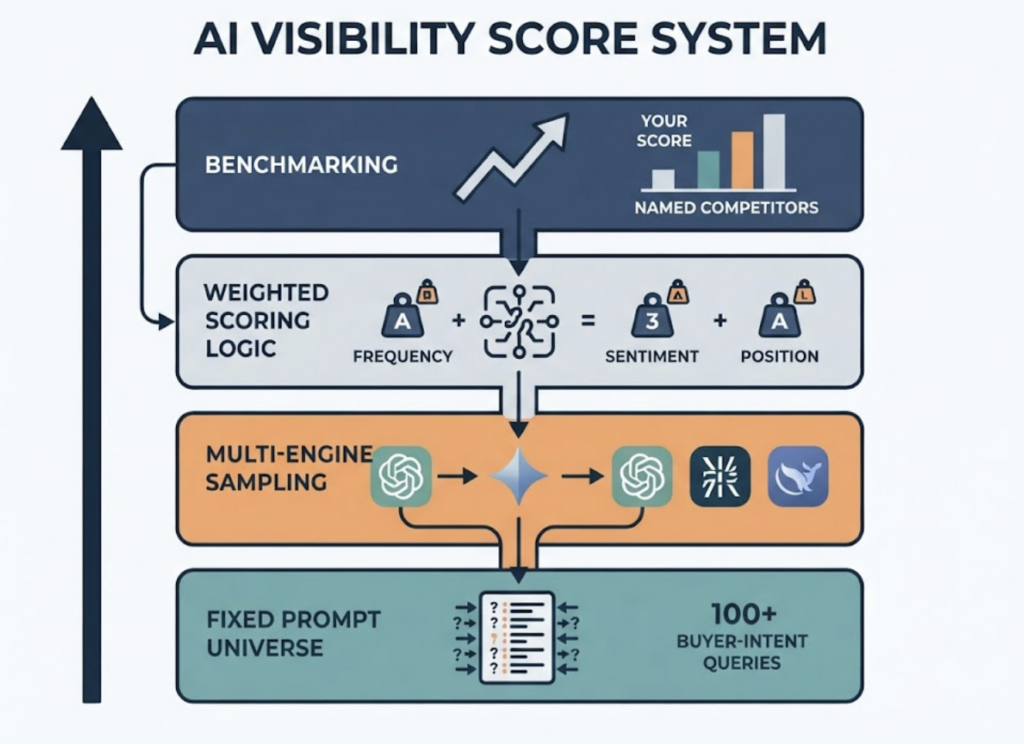
    Strip away any one of those layers and the number stops meaning anything. A score built on ad-hoc queries can’t be reproduced next week. A score sampled from one engine ignores where half your buyers actually ask questions. A score without competitor context can’t tell you whether 62 is winning or losing.

    Volatility makes the system layer non-negotiable. AI citation patterns shift weekly, and the recency bias is measurable: content updated within the last 90 days earns a 3.2x citation multiplier, and 76.4% of ChatGPT’s most-cited pages were updated within the past 30 days, according to 2026 citation research. A scoring system that refreshes monthly is reporting history, not visibility.

    That’s why two tools can score the same brand 41 and 88 in the same week. Different prompt universes, different sampling cadence, different math.

    The Seven Metrics an AI Visibility Score System Should Track

    A composite score only becomes actionable when you can decompose it. In practice, a professional-grade system tracks seven dimensions, each answering a distinct business question.

    MetricBusiness QuestionHow It’s Measured
    Visibility RateAre we appearing in the answer at all?Multi-engine prompt sampling
    Mention FrequencyHow often do we capture buyer intent?Historical trend analysis
    PositionAre we the first recommendation or an afterthought?Entity recognition and rank scoring
    SentimentHow is the brand being framed?NLP tone classification
    Citation ShareAre we the source AI actually cites?Domain and URL attribution
    Prompt VolumeWhich high-intent queries are we missing?Buyer-intent prompt mapping
    Conversion SignalDo mentions drive clicks and leads?Integrated attribution data

    The separation between these metrics matters more than most teams expect. A brand can hold strong Google rankings and still be invisible in AI answers: up to 80% of AI citations don’t rank in Google’s top 10 organic results for the same query, based on SparkToro’s 2026 attribution studies. Visibility Rate and Citation Share measure something your SEO dashboard structurally cannot see.

    Benchmarks give the composite number context. Per Foglift’s Q1 2026 industry data, top-quartile SaaS and B2B performers score between 73 and 84 on a 100-point scale. If your score sits at 62 with no benchmark attached, you don’t know whether to celebrate or panic.

    Tool, Dashboard, or Platform: Why the Naming Actually Matters

    The market uses AI visibility score tool, software, platform, and solution almost interchangeably. The labels actually map to three distinct capability tiers, and buying the wrong tier is the most common procurement mistake in this category.

    TierWhat It DoesWhere It Breaks Down
    The Checker (tool)One-off, single-query spot checksHigh volatility, statistically insignificant, can’t support strategy
    The Reporter (dashboard)Aggregates and visualizes score data over timeShows what changed, rarely explains why or what to do
    The System (platform / solution)Persistent monitoring, competitor benchmarking, source attribution, executionHigher cost, requires workflow integration

    A spot-check tool has real uses. It’s how most teams first discover they have an AI visibility problem, and it costs nothing to run. But a single query against a probabilistic model is one dice roll. Ask the same question tomorrow and the answer may change.

    An AI visibility score dashboard solves the reporting problem. It won’t solve the strategy problem, because a visualization layer without source-gap analytics can show you a 12-point drop without ever telling you which citation you lost.

    Here’s the pattern that repeats across enterprise buying cycles: teams search for a tool, then discover their actual requirement is a system. The moment someone asks “why did the score change” or “what do we do about it,” they’ve outgrown the checker tier. AI visibility score analytics only pays for itself when the data connects to an action.

    Five Checks Before You Trust Any AI Visibility Score

    Before committing to any AI visibility score software, run it against five credibility benchmarks.

    1. Engine coverage. Does it sample the models your customers actually use? A platform that only tracks ChatGPT misses Gemini’s integration with Google’s ecosystem and Perplexity’s research-heavy user base. If your market includes China or developer audiences, DeepSeek coverage stops being optional.

    2. Sample stability. Is the score built on a consistent, high-volume prompt set, or on whatever queries happened to run that week? Unstable samples produce scores that swing 20 points with no underlying change in your visibility.

    3. Explainability. Can you click into a score and see the exact AI answers, citations, and sentiment classifications that produced it? If the vendor can’t show the receipts, the number is marketing, not measurement.

    4. Competitive relative-scoring. Raw scores mislead. A 55 in a category where your top rival scores 40 is a different situation than a 55 against a rival at 80. Normalization against named competitors is what turns a metric into intelligence.

    5. Actionability loop. The system should close the distance between diagnosis and fix, telling you, for instance, that adding structured data to your pricing page would recover visibility on “vs” queries. This one compounds: brands with full answer-engine schema score on average 23 points higher on visibility benchmarks than those relying on standard SEO metadata, so a system that surfaces schema gaps is pointing at your highest-leverage fix.

    Fail any one of the five and the score becomes something worse than useless. It becomes confidently wrong.

    How Topify Turns Seven Metrics into One Actionable Score

    For teams that need the full system rather than a spot-check, Topify maps almost one-to-one onto the architecture above. Its Comprehensive GEO Analytics tracks the same seven dimensions covered earlier, visibility, sentiment, position, volume, mentions, intent, and CVR, across ChatGPT, Gemini, Perplexity, DeepSeek, Doubao, Qwen, and other major engines. In practice, that means you can spot a drop in ChatGPT mentions, trace it to a specific domain that stopped citing your brand, and see which competitor picked up that citation, all inside the same view.

    The competitor layer runs continuously rather than on demand. Dynamic Competitor Benchmarking detects emerging rivals as AI engines start recommending them, so your relative score stays normalized against the market as it exists this week, not the one you defined at onboarding.

    Where Topify diverges from dashboard-tier products is the execution loop. Instead of exporting a gap report for someone to act on later, its One-Click Execution takes a plain-English goal, proposes a strategy, and deploys it after your review. The distance from “score dropped” to “fix shipped” is a single approval.

    Pricing starts at $99 per month for 100 tracked prompts and 9,000 AI answer analyses, with plan details here. You can get started with a 30-day trial to establish a baseline before committing.

    Platforms like Profound and Peec AI compete in the same monitoring space, and both handle multi-engine tracking competently. The trade-off tends to appear at the execution stage, where most tools stop at data and hand the fixing back to your team.

    What a Visibility Score Looks Like in a Niche Market

    Vertical markets change the math. In veterinary care, prompts like “emergency vet near me” are low-volume but extremely high-intent, and AI answers are driven heavily by entity signals: Google Business Profile accuracy, local review sentiment, and answer-first content such as clearly stated emergency hours.
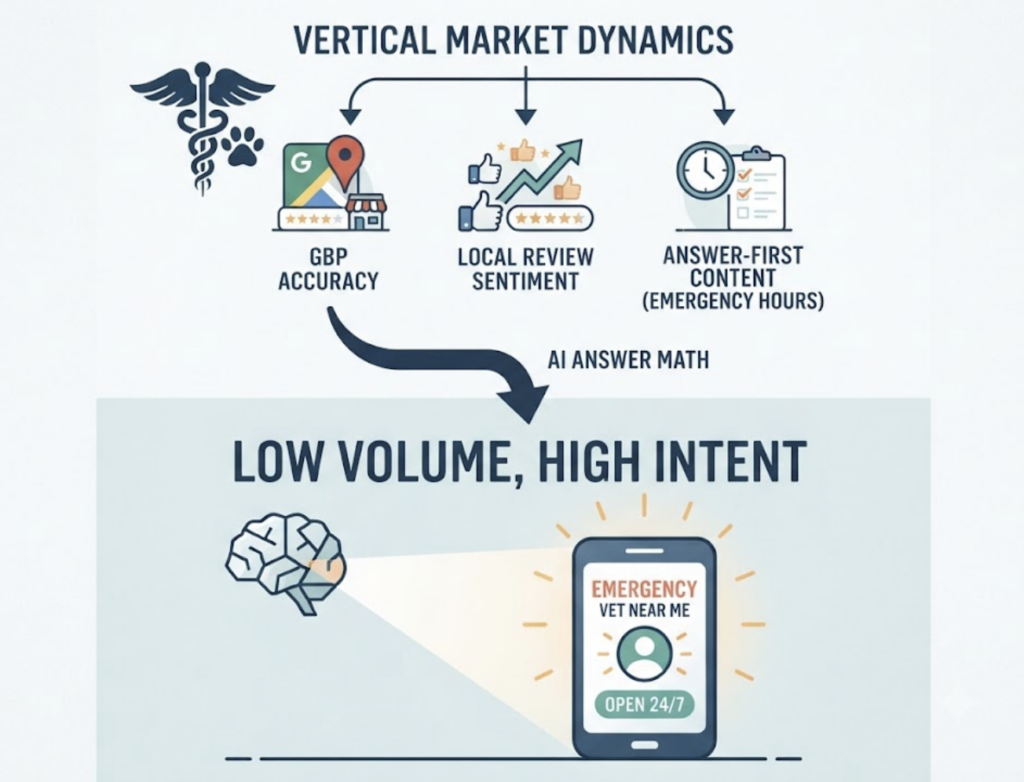
    That shifts what the score system needs to weight. Citation Share matters less than local entity accuracy. Sentiment pulls directly from review platforms. And a small movement in Visibility Rate translates to booked appointments rather than abstract impressions.

    It also changes who runs the system. Specialized agencies like InTouch Vet, which markets exclusively for veterinary practices, sit between the scoring system and the clinic owner. When an agency can show a clinic that a competitor is winning AI recommendations for “emergency vet care” because of cleaner structured data, the visibility score stops being an abstraction and becomes a line item tied to appointment volume. For agencies managing dozens of clinic clients, per-client score tracking against local competitors is quickly becoming the report clients ask for by name.

    The lesson generalizes beyond vet care. The smaller and more local the market, the more a score system’s value depends on competitive relative-scoring rather than the raw number.

    Conclusion

    Three tools, three scores, zero explanations. That situation isn’t a data problem, it’s a systems problem, and it resolves the moment you demand the four layers that make a score reproducible: a stable prompt universe, multi-engine sampling, decomposable metrics, and competitor benchmarks.

    Start by auditing whatever you’re using today against the five credibility checks. If it fails on explainability or benchmarking, treat its scores as directional at best. Then establish a proper baseline, because in a market where citation patterns rotate weekly, the brands that measure systematically are the ones that catch the drop before their competitors’ names replace theirs in the answer.

    FAQ

    Q: How is an AI visibility score calculated? 

    A: Mature systems run a fixed set of buyer-intent prompts (usually 100 or more) across multiple AI engines on a recurring schedule, then apply a weighted algorithm across dimensions like appearance rate, answer position, sentiment, and citation share. The weighting varies by vendor, which is why two tools can produce very different scores for the same brand.

    Q: What’s the difference between an AI visibility score and a Google ranking? 

    A: They measure different systems with surprisingly little overlap. Up to 80% of AI citations don’t appear in Google’s top 10 for the same query, so a strong SERP position doesn’t guarantee AI visibility. Rankings measure where your page sits in a list; a visibility score measures whether AI engines mention, recommend, and cite your brand when generating answers.

    Q: How do niche businesses like veterinary practices compare AI search scores against competitors, for example clients of agencies like InTouch Vet? 

    A: Vertical agencies typically track a shared local prompt set (“emergency vet in [city]”, “best vet for exotic pets near me”) across engines for each clinic and its named local rivals, then report relative scores rather than raw ones. The competitive delta, not the absolute number, is what correlates with appointment bookings.

    Q: Is there a free way to check an AI visibility score before buying software? 

    A: Yes. Free checkers are a reasonable way to confirm you have a visibility gap before investing in continuous monitoring. This reference list of free GEO toolscovers no-signup options for a first baseline. Just treat single-query results as directional, since one probabilistic sample isn’t a trend.
    Read More

  • AI Visibility Score Platform: What It Measures and Why

    AI Visibility Score Platform: What It Measures and Why

    Your CMO asks a simple question in the quarterly review: what’s our AI visibility score? You have screenshots of ChatGPT answers. You have a spreadsheet of Perplexity spot-checks from three weeks ago. What you don’t have is a number.

    That gap isn’t a reporting problem. It’s a measurement problem. AI answers change between sessions, engines, and even phrasings of the same question, so a handful of manual checks can’t be turned into a metric anyone should trust. And traditional rank trackers won’t save you, because ranking in Google and getting mentioned by AI turn out to be two different things. Getting to a defensible score starts with understanding what goes into one.

    A Single Score Sounds Simple. The Math Behind It Isn’t.

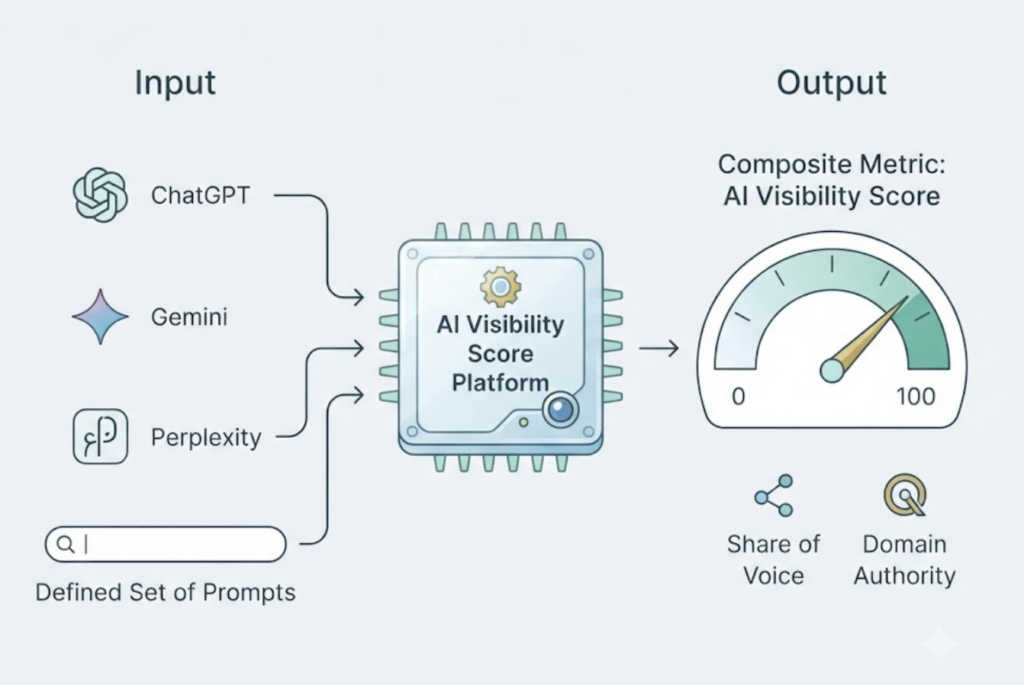
    An AI visibility score platform is software that converts scattered AI answer data into one trackable, composite metric: how frequently and how prominently AI engines mention your brand across a defined set of prompts. Most platforms normalize it on a 0 to 100 scale so teams can report it the way they’d report share of voice or domain authority.

    The hard part is that AI search is probabilistic. Ask ChatGPT the same question twice and you can get two different brand lists. A 2026 statistical framework on arXiv makes the point directly: a single spot-check of an AI answer is a sample of one, and it fails to account for the stochastic nature of LLM outputs.

    One prompt, on one engine, on one day, is not a score. It’s an anecdote.

    A credible AI visibility score tool solves this with volume: repeated sampling across a fixed prompt universe, multiple engines, and time. The score becomes a distribution with confidence intervals, not a snapshot. That’s the difference between a metric your leadership can track quarter over quarter and a screenshot that’s stale by Friday.

    How an AI Visibility Score Platform Works, Input by Input

    Under the hood, most AI visibility score systems follow the same pipeline: define a prompt set, sample answers across engines at high frequency, detect brand mentions, weight each signal, and roll everything into a composite. The formula typically looks like a weighted sum, where each signal gets a weight and a score, summed into the final number.

    What varies between platforms is which signals feed the score. The research consensus points to five core components:

    Mention frequency. The percentage of prompts in your universe where the brand appears at all. This is the reach layer.

    Prominence. Not all mentions are equal. A brand named as the primary recommendation in the answer’s main narrative carries more weight than one buried in a “see also” list.

    Citation support. Whether the AI backs the mention with an attributable source link. Cited mentions signal that the engine treats your brand as evidence-backed, not incidental.

    Entity resolution accuracy. How reliably the AI identifies your brand, its category, and its value propositions. A mention that miscategorizes your product counts against you in practice, even if it counts toward raw visibility.

    Cross-engine consistency. Stability of presence across GPT-4o, Gemini, Perplexity, DeepSeek, and other models. A brand that only surfaces in one engine has a fragile position.

    A score you can’t take apart is a score you can’t act on.

    That’s the black-box test for any AI visibility score analytics layer. If the platform shows you a 62 but can’t tell you whether the drag comes from low mention rate, weak positioning, or missing citations, the number is a vanity metric. Topify structures its scoring around seven decomposable metrics for exactly this reason: visibility, sentiment, position, volume, mentions, intent, and CVR, each traceable on its own.

    What Separates a Real AI Visibility Score Tool from a Repackaged Rank Tracker

    Several legacy SEO vendors have bolted an “AI visibility” tab onto their rank trackers. The problem is that SERP data is a lagging indicator for AI answers, and the research shows why.

    Studies on ranking–mention separation confirm that a page can rank #1 on Google as a blue link and remain completely invisible in the AI-synthesized answer above it. AI systems weight entity authority and structured extraction, things like tables, definitions, and explicit comparisons, over the backlink counts that drive traditional rankings. Brands with modest domain authority routinely earn “trusted default” status in AI answers because their content is answer-first and schema-backed.

    So if a vendor’s AI visibility score software is just re-scoring your existing keyword data, it’s measuring the wrong layer. Here’s what to check instead:

    Evaluation dimensionRepackaged rank trackerPurpose-built AI visibility score platform
    Engine coverageGoogle AI Overviews onlyChatGPT, Gemini, Perplexity, DeepSeek, and more
    Sampling modelDaily SERP snapshotRepeated probabilistic sampling with confidence intervals
    Score decompositionSingle opaque numberMention rate, position, sentiment, citation share broken out
    Competitor scoringKeyword overlapSame prompt universe, head-to-head, auto-detected rivals
    Citation attributionBacklink dataThe actual domains AI engines cite when mentioning you
    Actionability“Rankings dropped”“This source stopped citing you on these 14 prompts”

    The citation attribution row deserves emphasis. Knowing which third-party domains trigger your mentions is often more valuable than the score itself, because it tells you where to invest next. That’s a data layer rank trackers were never built to capture.

    Where Topify Fits: A Score You Can Take Apart

    For teams that need a reportable number backed by decomposable data, Topify’s Comprehensive GEO Analytics is built as a scoring engine first. It monitors brand performance across ChatGPT, Gemini, Perplexity, DeepSeek, Doubao, Qwen, and other major engines, then rolls seven metrics into a view you can drill into: visibility, sentiment, position, volume, mentions, intent, and CVR.

    In practice, the workflow looks like this. Your AI visibility score dashboard shows a 12-point drop this month. You open the citation layer and see that a comparison article on a high-authority review site stopped mentioning your brand after an update. You trace exactly which prompts lost coverage, and you know precisely what to fix. Diagnosis to root cause, inside one dashboard, without exporting anything to a spreadsheet.

    Competitor context comes standard. Because an AI visibility score is only meaningful relative to your category, Topify auto-detects rivals and scores them against the same prompt universe, so a 58 stops being abstract and becomes “6 points behind the category leader, driven by their Perplexity citation share.”

    Then there’s execution. Most tools stop at the diagnosis. Topify’s agent layer takes a plain-English goal, proposes a strategy, and deploys it with one click, closing the loop between the score and the actions that move it. If you want to test the measurement side before committing, Topify also maintains a set of free GEO tools for quick checks.

    How to Improve Your AI Visibility Score Without Gaming It

    Once you can measure the score, the next question is how to move it. The research points to four levers, and none of them involve keyword density.

    Rebuild content answer-first. AI models lift concise, declarative statements. Rewriting page intros so the direct answer comes before the context measurably increases the odds of being synthesized into a response.

    Structure your comparisons. LLMs handle “vs” and “alternative” queries constantly, and they favor content with explicit comparison tables and spec breakdowns. Give the model structured evidence and it can recommend you with confidence.

    Close third-party source gaps. AI engines synthesize heavily from authoritative external domains: G2, Reddit, niche forums, specialized industry publications. Monitoring which of these domains cite your competitors but not you tends to be higher-leverage than another post on your own blog.

    Ship machine-readable signals. Implementing LLMs.txt files and Organization, Product, and Person schema markup significantly raises the probability that AI crawlers resolve your entity correctly, which feeds directly into the entity-accuracy component of your score.

    One warning: don’t optimize for a single engine’s quirks. Model updates reshuffle citation behavior every few weeks, so tactics tuned to one engine’s current pattern tend to decay. Optimize the inputs, not the number.

    Common Mistakes That Make Your Score Meaningless

    Even teams with a real AI visibility score solution in place undermine it with measurement errors. Four patterns show up repeatedly.

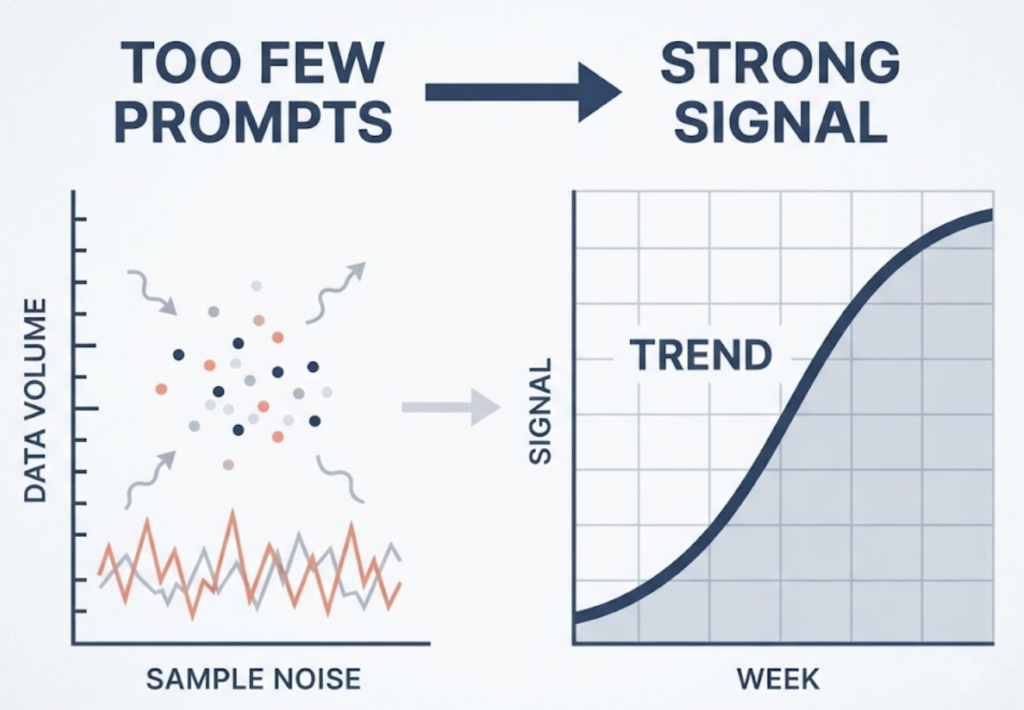
    Sample noise read as trend. Too few prompts creates the illusion of movement where there’s only variance. The emerging standard is a prompt universe of at least 100 category-relevant queries before treating week-over-week changes as signal.

    Single-engine bias. Tracking only ChatGPT misses how differently other engines behave. Perplexity, for instance, leans heavily on real-time search and cites different source types, so a ChatGPT-only score tells you nothing about a third of your buyers’ AI touchpoints.

    Ignoring sentiment. A mention inside a comparison that favors your competitor still counts toward raw visibility. Without a sentiment layer, your score can rise while your actual authority falls.

    Cadence errors. Citation patterns shift with every model update. Monthly checks can’t capture that volatility. Bi-weekly sampling is the floor, and high-frequency sampling is becoming the standard for teams that report the score as a KPI.

    Each of these is a solved problem at the platform level. Which is the honest argument for buying software instead of building a spreadsheet.

    What an AI Visibility Score Platform Costs in 2026

    Pricing for AI visibility score platforms generally scales on three variables: prompt volume, engine coverage, and seats. Entry tiers across the category tend to run from double digits to a few hundred dollars per month, with enterprise plans climbing well past that once agencies or multi-brand teams need volume.

    Topify’s tiers map cleanly to team size. The Basic plan at $99/month includes 100 tracked prompts, 9,000 AI answer analyses, and coverage across ChatGPT, Perplexity, and AI Overviews, with a 30-day trial. Pro at $199/month raises that to 250 prompts and 22,500 analyses across 8 projects. Enterprise starts at $499/month with a dedicated account manager.

    The buying advice is the same regardless of vendor: start with a prompt set that matches the questions your actual buyers ask, not a generic keyword export. A 100-prompt universe built from real buyer questions produces a more decision-ready score than 500 prompts of keyword filler. Expand once the score starts driving decisions.

    Conclusion

    The next time leadership asks for your AI visibility score, the goal isn’t just to have a number. It’s to have a number you can defend: sampled across engines, decomposed into mention rate, position, sentiment, and citations, and benchmarked against the competitors AI actually recommends in your category.

    The test for any platform is decomposition. If you can’t peel the score back to the specific prompts, engines, and sources driving it, keep looking. If you want to see what a decomposable score looks like on your own brand, you can start with Topify’s trial and have a baseline within the first sampling cycle.

    FAQ

    Q: What is an AI visibility score platform?
    A: It’s software that measures how often and how prominently AI engines like ChatGPT, Gemini, and Perplexity mention your brand across a defined set of prompts, then converts that data into a composite 0 to 100 score you can track over time and benchmark against competitors.

    Q: How does an AI visibility score platform work?
    A: The platform samples AI answers repeatedly across a fixed prompt universe and multiple engines, detects brand mentions, and weights signals like mention frequency, position, sentiment, and citation support into a composite score. Because AI outputs are probabilistic, credible platforms calculate the score as a distribution rather than a single snapshot.

    Q: Can you calculate an AI visibility score manually?
    A: You can approximate one with a spreadsheet, but the statistics work against you. Stable measurement requires 100+ prompts sampled repeatedly across several engines at bi-weekly or faster cadence, which quickly becomes thousands of answer analyses per cycle. Manual tracking can’t sustain that volume or catch citation shifts between checks.

    Q: What’s a good AI visibility score?
    A: There’s no universal benchmark, because the score is relative to your category. A 55 in a crowded SaaS niche where the leader sits at 60 is a strong position; a 55 where the leader holds 85 is a visibility gap. Competitor-relative scoring matters more than the absolute number.

    Read More

  • AI Search Visibility: How to Monitor It Without Otterly

    AI Search Visibility: How to Monitor It Without Otterly

    Your domain authority is solid. Your keyword rankings haven’t moved in months. By every metric in your SEO dashboard, things look fine. Then someone asks Perplexity for the top tools in your category, and your brand isn’t in the answer.

    None of your existing metrics can explain why, because none of them were built to measure what an AI chooses to say. There’s no position eleven in an AI answer. You’re either cited or you’re invisible, and most SEO stacks can’t tell you which one you are right now.

    What AI Search Visibility Actually Measures

    AI search visibility measures how often, and how prominently, your brand appears in AI-generated answers across engines like ChatGPT, Google AI Overviews, Gemini, and Perplexity. It’s a fundamentally different quantity from a Google ranking.

    Traditional search is a list. Position 3 still gets clicks, position 8 still gets scraps, and you can trade positions week to week without falling off the map. AI search is a synthesis. The engine reads its sources, composes one answer, and cites a handful of brands. Everyone else gets nothing.

    That’s the core mechanical difference: rankings measure position, AI visibility measures the probability of being mentioned at all.

    The two don’t move together as much as most SEO teams assume. Research on ranking and mention behavior shows that traditional SEO signals predict where you appear inside an AI answer better than whether you appear in it. Strong domain authority helps you rank higher once you’re cited. It doesn’t guarantee the citation happens.

    Here’s how the pipeline works in practice. A user types a prompt. The engine retrieves candidate sources, weighs them by topical fit, entity consistency, and extractability, then synthesizes an answer that cites a small subset. Your visibility is decided at that retrieval-and-citation step, not on a results page.

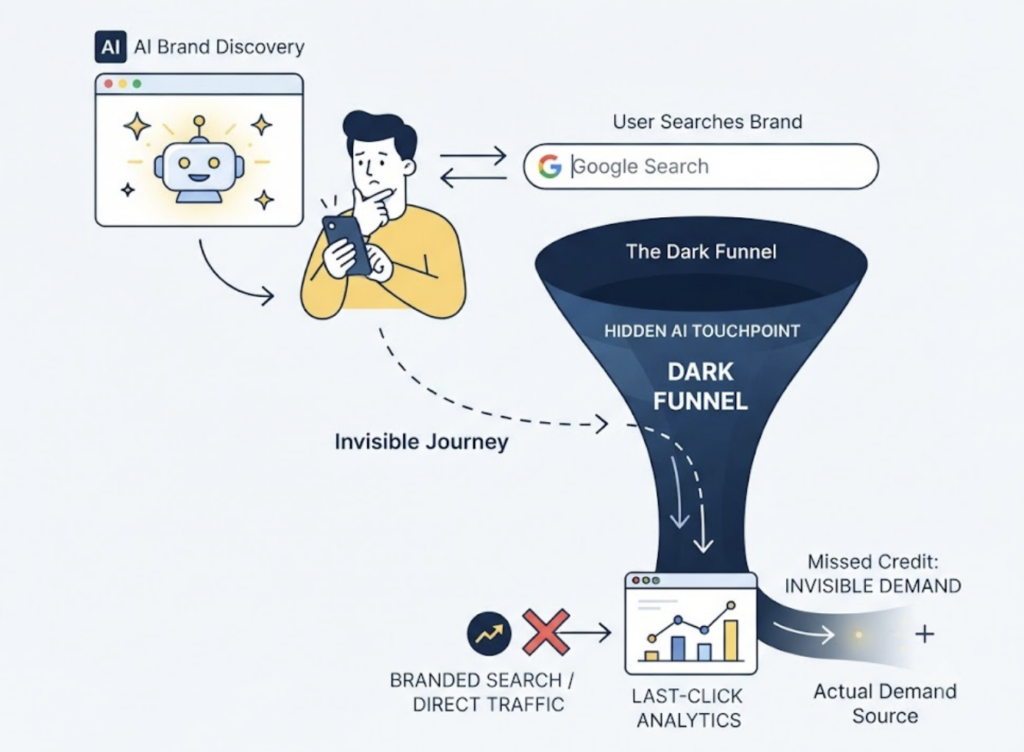
    There’s also an attribution problem hiding underneath. Users often encounter a brand inside an AI answer first, then Google the brand by name later. Last-click analytics logs that as branded search or direct traffic. The AI touchpoint that actually created the demand never shows up in your reports. Industry researchers call this the dark funnel, and it’s the reason AI visibility rarely gets credit inside standard dashboards.

    How to Measure AI Search Visibility

    The first instinct most teams have is to open ChatGPT, type their category keyword, and see if they show up. That single check is close to meaningless.

    AI outputs are stochastic. The same prompt can return different brands on different days, because large language models compose answers probabilistically rather than pulling from a fixed index. Citation volatility studies from Passionfruit found that roughly 68% of queries generating citations in one month fail to generate them the next. One spot-check tells you about one roll of the dice.

    Measuring AI search visibility properly requires three things: a fixed prompt set, multi-engine coverage, and time-series data. In concrete terms, that looks like tracking 100 buyer-relevant prompts across four AI engines over 30 days, then reading the trend rather than the snapshot.

    Once the methodology is in place, these are the metrics that matter:

    MetricWhat it tells you
    Mention rateHow often your brand appears across your prompt set
    PositionWhether you’re in the answer body or buried in a citation list
    SentimentWhether the AI recommends you, qualifies you, or stays neutral
    Citation shareThe percentage of category answers citing your domain
    Prompt coverageWhether you show up across the full buyer journey, not just one query type
    Source authorityWhich third-party domains the AI trusts when discussing your category
    Competitor gapHow you perform against rivals on identical prompts

    Mention rate alone is a vanity number. A brand mentioned frequently but described as “a budget option” in a premium category has a sentiment problem that raw counts will never surface. The framework only works when the dimensions are read together.

    Why Teams Monitor AI Search Without Otterly

    Otterly.AI was one of the earlier entrants in this category, and plenty of teams started their AI monitoring journey there. A meaningful number of them are now searching for how to monitor AI search without Otterly, and the reasons tend to cluster around three gaps rather than any single failure.

    The first is engine coverage. Answer engines differ significantly in citation logic. A brand can dominate Perplexity answers while being absent from Gemini, so a tool that skews toward a subset of engines produces a partial picture. With ChatGPT alone serving over 900 million weekly active users and Google AI Mode crossing 1 billion monthly users according to Similarweb data, partial coverage means missing where most of the volume actually lives.

    The second is depth past the mention count. Knowing your score dropped is diagnosis-free data. Teams increasingly want source-level analysis: which specific domain the AI pulled from when it cited a competitor, and which of their own pages stopped earning citations.

    The third is the gap between data and action. A dashboard that reports a visibility decline but suggests nothing is a reporting tool, not an optimization tool.

    None of this makes any single platform a bad product. It does define the evaluation checklist for whatever you monitor AI search with instead: simultaneous coverage of ChatGPT, Gemini, Perplexity, and Google AI Overviews, citation-source analysis, longitudinal tracking built for volatile outputs, and a feedback loop that turns findings into content moves.

    A Full-Stack Way to Track AI Search Visibility

    For teams that want all four criteria in one place, Topify tends to be the strongest fit, largely because it was built around the measurement framework above rather than a single metric.

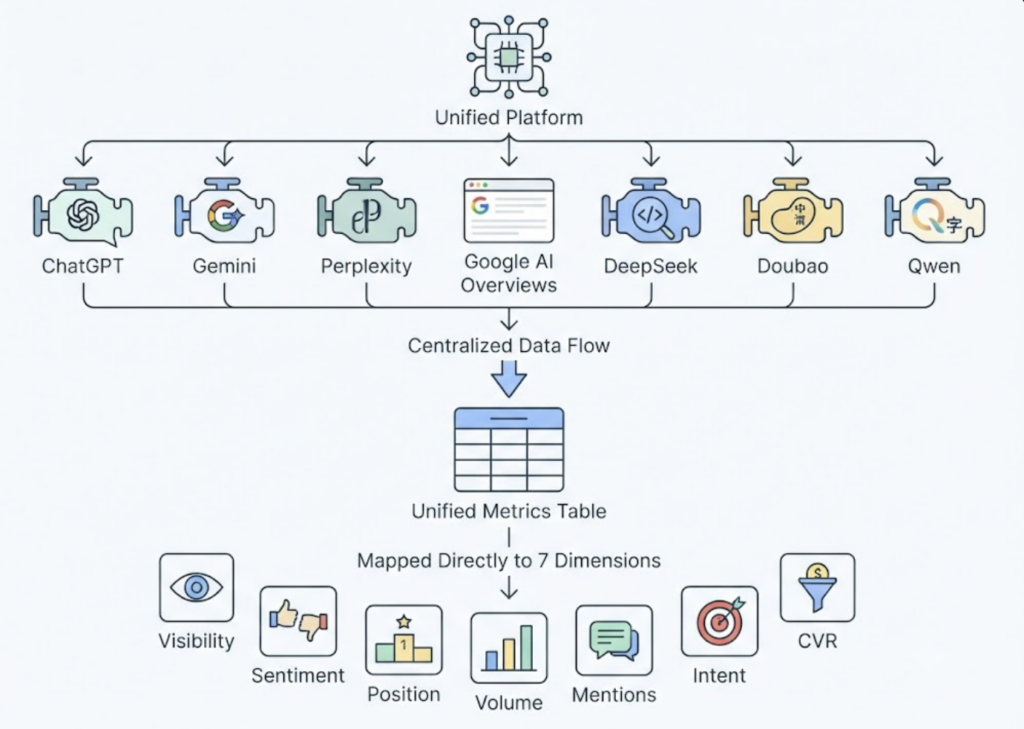
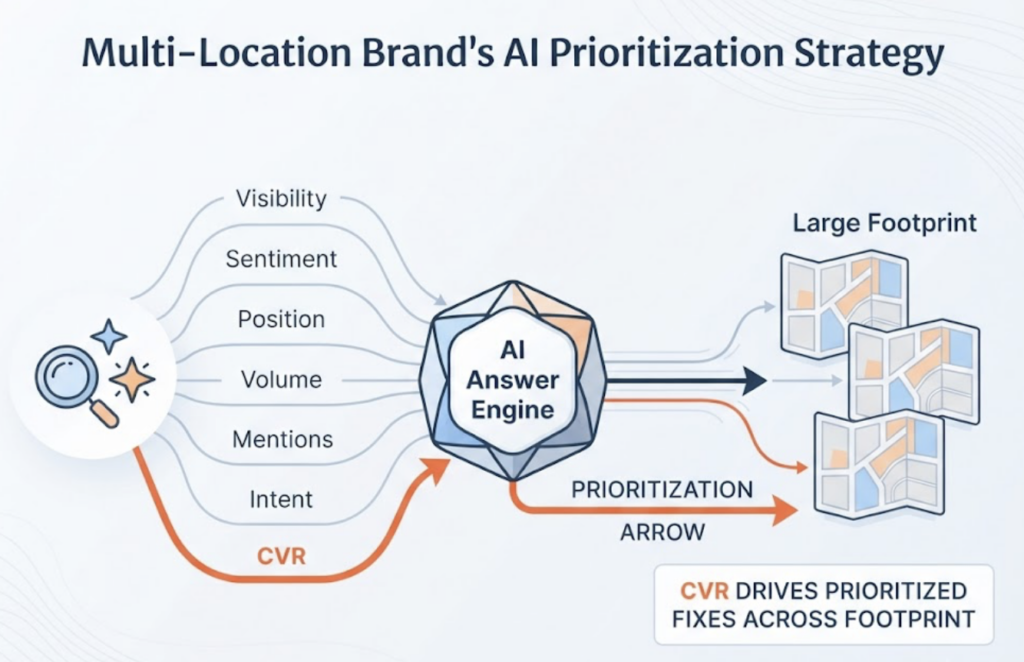
    The platform tracks brands across ChatGPT, Gemini, Perplexity, Google AI Overviews, and DeepSeek, plus regional engines like Doubao and Qwen for brands with international audiences. Every prompt in your set is scored across seven dimensions: visibility, sentiment, position, volume, mentions, intent, and CVR, a conversion-oriented estimate of how likely an AI answer is to route users toward your brand. That maps one-to-one onto the metrics table from the measurement section, which means you’re not stitching together partial views from multiple tools.

    The source layer is where diagnosis happens. Topify’s citation analysis reverse-engineers the exact domains and URLs each AI engine pulled from. In practice, that means you can watch your ChatGPT mention rate dip, trace it to a specific review site that stopped citing your product, and know precisely which third-party relationship to repair. Without that layer, a visibility drop is just a number that went down.

    Competitor benchmarking runs on the same prompt set, so you see who the engines recommend instead of you and which sources earned them that slot.

    The execution side closes the loop. You state a goal in plain English, review the proposed strategy, and deploy it in one click. Monitoring that ends in a PDF report is where most tools stop. Plans start at $99/month with a 30-day trial covering 100 tracked prompts and 9,000 AI answer analyses, with full details on the pricing page.

    How to Improve AI Search Visibility: A Working Checklist

    Monitoring tells you where you stand. Improving the number requires changing what AI engines can find, extract, and trust. This checklist covers the moves with the strongest evidence behind them.

    Structure content for extraction. AI models favor atomic content blocks: clear headings, declarative answers, FAQ formatting. Conductor’s benchmarks found that around 44% of AI citations are drawn from the first 30% of a page. Bury your answer in paragraph twelve and you’ve functionally opted out.

    Invest in third-party presence. This is the single biggest lever most teams underweight. Brands are 6.5x more likely to be cited in AI responses through third-party media, review sites, directories, and industry publications, than through their own content. Your G2 profile and your press coverage are now retrieval surfaces.

    Build comparison content. AI engines lean heavily on “vs.” and “alternative” style sources when synthesizing high-intent answers. Objective comparison pages that evaluate your brand against competitors are among the most reliably cited formats in the category.

    Keep entity signals consistent. If your site says enterprise-grade and a directory says budget-friendly, the AI resolves that conflict for you, and not always in your favor. Audit how your brand is described everywhere it appears.

    Track prompts, not keywords. Discover the actual questions buyers ask AI engines and cover them directly. Topify’s prompt discovery surfaces high-volume AI prompts in your category as they emerge, and this curated set of free GEO tools covers lighter-weight ways to start.

    Avoid the common mistakes. The recurring failure patterns are checking one engine and generalizing, treating a single spot-check as data, using Google rankings as a proxy for AI visibility, and optimizing owned content while ignoring the third-party sources engines actually cite.

    Re-measure on a cycle. Given 68% month-over-month citation volatility, a strategy set once and left alone decays quietly. Monthly baseline comparisons are the minimum viable cadence.

    Conclusion

    The metrics that defined a decade of SEO reporting weren’t built to answer the question your leadership is now asking: what does AI say about us? Rankings measure position on a page. AI search visibility measures whether you exist in the answer at all, and the gap between those two numbers is where competitors quietly win category recommendations.

    The starting move is unglamorous but concrete: define a fixed set of high-intent prompts, measure your baseline across every major engine, and only then decide what to optimize. You can get started with Topify and have that baseline within a day, or build a manual version first. Either way, measure before you guess.

    FAQ

    Q: What are examples of AI search visibility? 

    A: A project management tool appearing in ChatGPT’s answer to “best project management software for remote teams” is AI visibility. So is a skincare brand cited in a Google AI Overview for “how to treat dry skin,” or a fintech company named in Perplexity’s response to “Stripe alternatives.” In each case, the brand earned a slot inside a synthesized answer rather than a ranked link.

    Q: How much do AI search visibility tools cost? 

    A: Most platforms in this category run between roughly $99 and $500+ per month depending on prompt volume and engine coverage. Topify’s Basic plan starts at $99/month with 100 tracked prompts, 9,000 AI answer analyses, and a 30-day trial, with Pro at $199/month and Enterprise tiers from $499/month.

    Q: Can I monitor AI search without Otterly? 

    A: Yes. The capability that matters isn’t any specific vendor, it’s the framework: multi-engine coverage, a fixed prompt set, source-level citation analysis, and time-series tracking. Any platform that delivers those four, Topify included, gives you a complete monitoring setup.

    Q: How often should I measure AI search visibility? 

    A: Continuously, with monthly baseline reviews at minimum. Since roughly 68% of citing queries change month to month, quarterly checks miss most of the movement. Daily or weekly automated tracking with a monthly strategic review is the cadence most teams settle into.

    Read More

  • AI Visibility Score Tool: How It Works and How to Use It

    AI Visibility Score Tool: How It Works and How to Use It

    Your quarterly review has a slide for rankings, a slide for traffic, and a slide for conversions. Then someone asks how the brand is performing in AI search, and the deck goes quiet. You’ve asked ChatGPT about your category a few times, taken screenshots, and noticed the answers change week to week. That’s not a metric. That’s anecdote collection.

    The uncomfortable part: your brand already has a measurable presence in AI answers, whether you’re tracking it or not. Perplexity, Gemini, and ChatGPT are recommending someone in your category every day. An AI visibility score tool turns those scattered, non-deterministic answers into a single number you can report, benchmark, and improve. Here’s what that number actually contains, and how to move it.

    Your Brand Has an AI Visibility Score. You Just Can’t See It Yet.

    An AI visibility score tool is software that measures how often, where, and in what context your brand appears in AI-generated answers, then compresses that data into a composite benchmark, typically on a 0 to 100 scale. Think of it as the AI-era equivalent of a keyword rank tracker, with one core difference: rankings measure position on a page, while a visibility score measures the probability and quality of being mentioned at all.

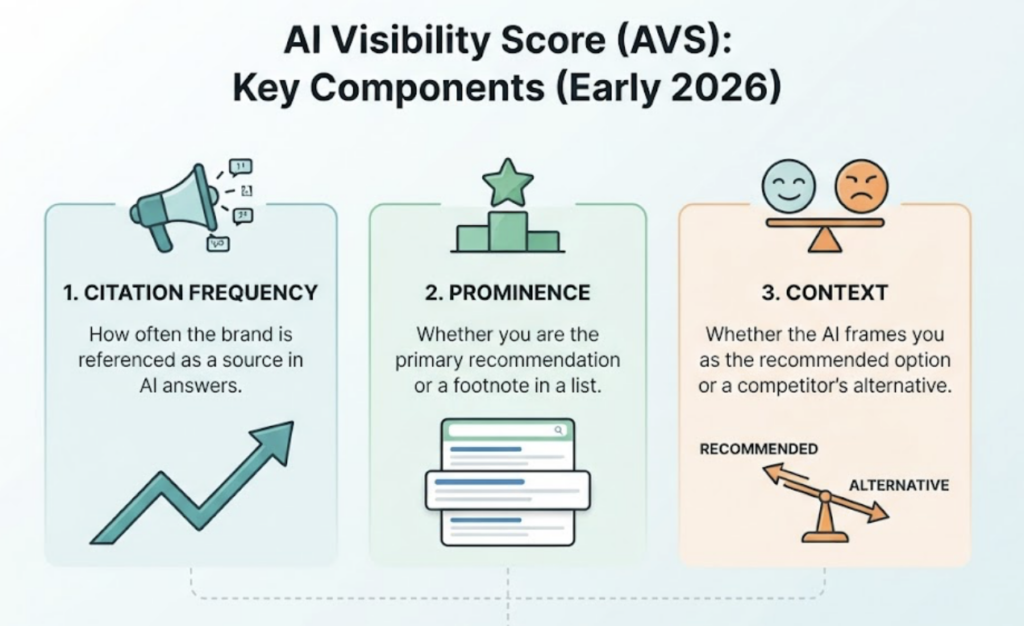
    According to industry research from early 2026, an AI Visibility Score (AVS) synthesizes three things: citation frequency (how often the brand is referenced as a source), prominence (whether you’re the primary recommendation or a footnote in a list), and context (whether the AI frames you as the recommended option or a competitor’s alternative).

    Examples of AI visibility score tools range from free single-scan checkers, which grade one domain against GEO readiness criteria, to full monitoring platforms that run hundreds of prompts across multiple AI engines daily. The free checkers answer “where do I stand today.” The platforms answer “what changed, why, and what do I do about it.”

    That distinction matters more than most buyers realize.

    How Does an AI Visibility Score Tool Work

    Manual spot-checking fails for a structural reason: AI answers are non-deterministic. Ask the same question twice and you can get different brand lists. Citation patterns shift with model updates, training data refreshes, and even minor changes in prompt phrasing. One screenshot tells you what one model said one time. It can’t tell you your baseline.

    Professional tools solve this with scale. The typical pipeline runs in three steps:

    1. Prompt universe sampling. The tool builds a set of high-intent queries that mirror your customer journey, things like “best enterprise software for X” or “alternatives to Y for small teams.” A meaningful sample usually starts around 100 tracked prompts. For scale reference, entry-level plans on platforms like Topify analyze roughly 9,000 AI answers per month against 100 prompts.
    2. Platform aggregation. The tool queries ChatGPT, Perplexity, Gemini, Google AI Overviews, and increasingly DeepSeek and other regional engines simultaneously, then parses each response for brand mentions, citations, and positioning.
    3. Metrics synthesis. Raw mentions get converted into structured scores: visibility rate, sentiment, competitive share of voice, and position within answers, tracked over time so you can separate signal from model noise.

    Repetition is the whole point. A score built from thousands of sampled answers is stable enough to benchmark. A score built from five manual chats is a coin flip.

    How to Measure an AI Visibility Score: 7 Metrics That Matter

    If you’re evaluating what a score should contain, the 2026 research consensus points to four core dashboard metrics: citation rate (the percentage of relevant AI queries that cite your brand), share of model (your voice versus top competitors in AI synthesis), response position (how prominent your mention is within the answer), and entity signal consistency (whether the AI correctly identifies what your products actually do).

    In practice, the more complete measurement frameworks expand this into seven dimensions. Topify’s Comprehensive GEO Analytics, for instance, scores brands across visibility, mentions, position, sentiment, volume, intent, and CVR (Conversion Visibility Rate, an estimate of how likely an AI answer is to drive users toward your brand).

    Why seven instead of one raw mention count? Because mentions without context mislead. A brand can be mentioned frequently but framed as “the budget option” in a premium category. Another can appear rarely but always as the first recommendation for high-intent buying prompts. Sentiment and position separate those two situations. Volume and intent tell you whether the prompts you’re winning actually matter commercially.

    This is also where brand optimization for AI answers starts to become concrete rather than abstract. Once you can see that your sentiment score dropped on Perplexity while your citation rate held steady, you’re no longer guessing what to fix. You’re diagnosing.

    One number to report upward. Seven dimensions to act on.

    How to Improve Your AI Visibility Score

    Improving the score requires shifting from “rank-ready” content to answer-ready content. The strategies with the strongest evidence behind them in 2026:

    Structure for extraction. AI models favor content they can lift cleanly: 40 to 60 word answer blocks, FAQ sections, and comparison tables. If your key claims are buried in 300-word paragraphs, models tend to cite whoever chunked the same information better.

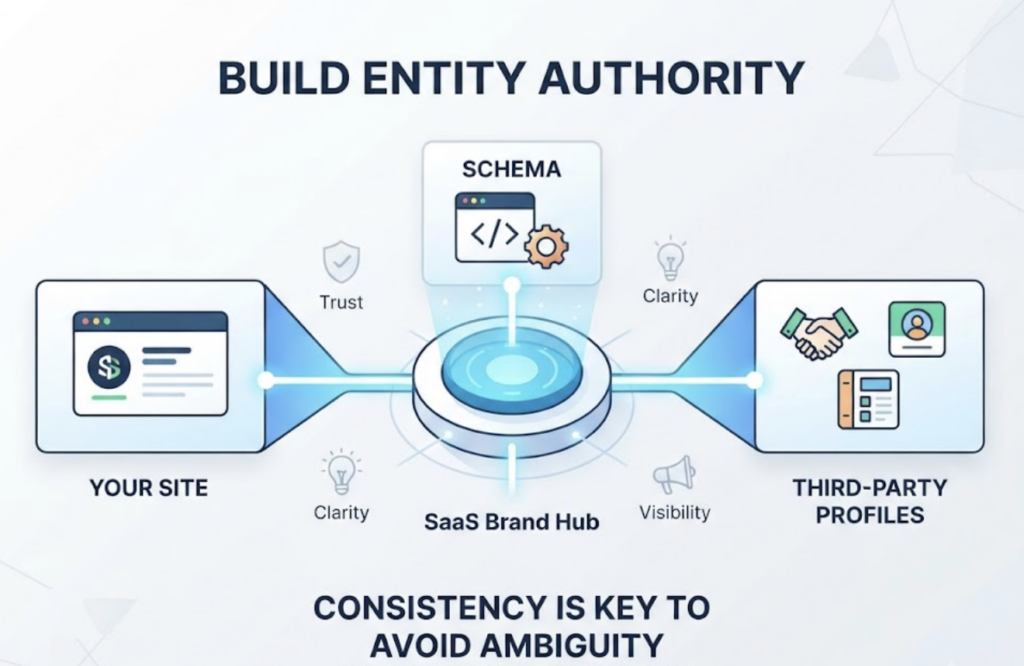
    Build entity authority. Keep brand, product, and service descriptions consistent across your site, schema markup, and third-party profiles. Entity signal consistency is a scored metric precisely because AI engines penalize ambiguity: if the model isn’t sure what you do, it won’t recommend you for it.

    Earn third-party consensus. AI engines triangulate trust signals across sources. Research indicates that mentions on Reddit, review platforms like G2 and Capterra, and authoritative industry publications now move AI citations more effectively than traditional backlink building. This is the biggest single mindset shift for teams coming from classic SEO.

    Don’t ignore technical foundations. Core Web Vitals still gate crawling. Pages with poor performance (LCP above 2.5 seconds) are reported to be 72% less likely to be cited by AI engines.

    Close the loop with citation analysis. Improvement compounds when you can see which domains and URLs the AI actually cites for your target prompts. Tools that reverse-engineer AI citations show you whether your content, or your competitor’s, dominates those source lists, which turns “publish more content” into “publish the specific asset that fills this citation gap.” A good starting point for building this workflow on a budget is this reference list of free GEO tools, which maps free checkers to each stage of the process.

    Common Mistakes That Keep Your Score Flat

    Four patterns show up repeatedly in teams whose scores don’t move:

    Platform siloing. Measuring only ChatGPT and assuming the result generalizes. Each engine has different citation behavior and different source preferences. A brand can score 60 on ChatGPT and 15 on Perplexity for identical prompts.

    Ranking proxy bias. Assuming strong Google rankings imply AI visibility. The data says otherwise: roughly 88% of URLs cited by AI engines don’t appear in Google’s top 10 organic results for the same query. SEO and AI visibility have decoupled. Treating one as a proxy for the other is the fastest way to be surprised in a quarterly review.

    Sentiment blindness. Celebrating mention counts while the AI consistently positions you as “a cheaper alternative to [competitor].” Volume without favorable framing can actively reinforce the wrong narrative.

    Static auditing. Running one audit, fixing the findings, and moving on. Citation patterns are volatile by design; models retrain and platforms update. Scores need continuous monitoring, not annual checkups.

    Each of these mistakes shares a root cause: treating AI visibility like a snapshot instead of a stream.

    Best Tools for Tracking Your AI Visibility Score

    Before comparing platforms, it’s worth being clear on why the investment case exists at all. Brands cited in AI-generated answers earn a 35% higher organic CTR and a 91% higher paid CTR than uncited competitors, and Ahrefs data from 2025 to 2026 shows AI-sourced visitors converting at up to 23x the rate of traditional organic traffic. Visibility in AI answers isn’t a vanity metric. It’s a channel.

    When evaluating tools, four criteria matter most: platform coverage (how many AI engines are tracked), metric depth (mentions only, or the full sentiment/position/intent picture), competitive benchmarking (a score without competitor context is hard to interpret), and execution support (whether the tool stops at dashboards or helps you act).

    For teams that want measurement and execution in one place, Topify covers ChatGPT, Gemini, Perplexity, DeepSeek, and other major engines, scores brands across the seven-metric framework described above, and pairs the analytics with one-click strategy execution: you define the goal in plain English, review the proposed GEO strategy, and deploy it without manual workflows. Competitor benchmarking is built in, so your score always reads relative to who AI engines are actually recommending in your category.

    On pricing, plans start at $99 per month for 100 tracked prompts and 9,000 monthly AI answer analyses, with a 30-day trial, which puts a full baseline within reach before any long-term commitment. Full plan details are on the Topify pricing page.

    Other platforms in the category tend to specialize: some focus narrowly on citation monitoring, others on single-engine tracking. They’re workable choices if your needs are narrow, though most teams outgrow single-platform data quickly.

    If you just want a baseline number today, running a first scan takes a few minutes and gives you something concrete to bring to the next review.

    Conclusion

    The question that opened this article, “how are we doing in AI search,” has an answerable form now. An AI visibility score tool converts non-deterministic AI answers into a stable, benchmarkable number, and the seven metrics underneath it tell you exactly where the gaps are: citation frequency, position, sentiment, or entity clarity.

    The practical sequence is short. Establish a baseline score across at least three AI platforms. Identify which prompts and which engines you’re losing. Fix the highest-impact gaps first, usually citation sources and answer-ready structure. Then keep measuring, because in a channel this volatile, the score you don’t monitor is the score that quietly drops.

    FAQ

    Q: What is an AI visibility score tool?

    A: It’s software that measures how often and how favorably your brand appears in AI-generated answers across platforms like ChatGPT, Perplexity, and Gemini, then converts that data into a composite 0 to 100 score. Unlike rank trackers, it measures whether AI systems mention and recommend you at all, not where a page sits in a list of links.

    Q: What should be on your checklist before choosing an AI visibility score tool?

    A: Four items: coverage of at least three major AI platforms, metrics beyond raw mentions (sentiment, position, and intent at minimum), built-in competitor benchmarking so the score has context, and some path from insight to action, whether that’s citation-gap reports or automated execution. If a tool only shows mention counts on one engine, it’s a spot-checker, not a scoring system.

    Q: How much does an AI visibility score tool cost?

    A: Free single-scan checkers exist for establishing a rough baseline. Continuous monitoring platforms typically start around $99 to $199 per month depending on prompt volume and seats, with enterprise tiers from roughly $499 per month. Managed GEO services that combine tracking with content execution run significantly higher, generally $4,000 or more per month.

    Q: What’s the best strategy for using an AI visibility score tool?

    A: Treat it as a loop, not a report. Baseline your score, benchmark against your top three competitors, diagnose whether gaps come from citation sources, content structure, or entity inconsistency, ship targeted fixes, and re-measure monthly. Teams that fold the score into their existing marketing dashboard, next to rankings and traffic, tend to sustain improvement; teams that audit once tend to plateau.

    Read More

  • AI Visibility Score: How It Works and How to Raise Yours

    AI Visibility Score: How It Works and How to Raise Yours

    Your marketing dashboard tracks domain authority, keyword rankings, backlinks, and organic traffic. Not one of those numbers tells you whether ChatGPT recommends your brand when a buyer asks for options in your category. Most marketers assume that presence in AI answers can’t be quantified, that it’s too fluid to pin down. It isn’t. An AI visibility score turns your brand’s presence across generative engines into a single trackable number, the same way domain authority once made link equity legible. Once you can see the number, you can move it.

    Your Dashboard Has 20 Metrics. None of Them Measure AI

    An AI visibility score is a composite metric, typically on a 0 to 100 scale, that measures how frequently, how prominently, and in what context your brand appears in AI-generated answers across platforms like ChatGPT, Gemini, and Perplexity.

    The comparison to domain authority is useful but imperfect. Domain authority estimates how likely a page is to rank based on link equity. An AI visibility score measures something different: whether an AI system considers your brand worth mentioning at all. One measures position in a list. The other measures selection into an answer.

    That distinction matters more than it sounds. Research compiled by seoClarity and Conductor in 2026 found that roughly 88% of URLs cited by AI engines don’t appear in Google’s top 10 organic results for the same query. Rankings and AI citations have decoupled. A brand can dominate page one and still be absent from the answer layer where a growing share of buyers now start their research.

    This is the scoreboard problem that generative search optimisation exists to solve. GSO, often called GEO, is the practice of earning presence in AI answers. The visibility score is how you know whether that practice is working.

    How Does an AI Visibility Score Actually Work

    There’s no industry-standard formula yet, which is worth knowing before you compare scores across tools. That said, most professional methodologies share the same four-step architecture.

    Step 1: Prompt sampling. The system defines a representative set of 20 to 50 high-intent queries that real buyers ask, such as “best expense management software for startups.” These prompts, not head keywords, are the unit of measurement.

    Step 2: Answer collection. Each prompt runs against multiple AI platforms on a recurring schedule, capturing the full generated response rather than a link list.

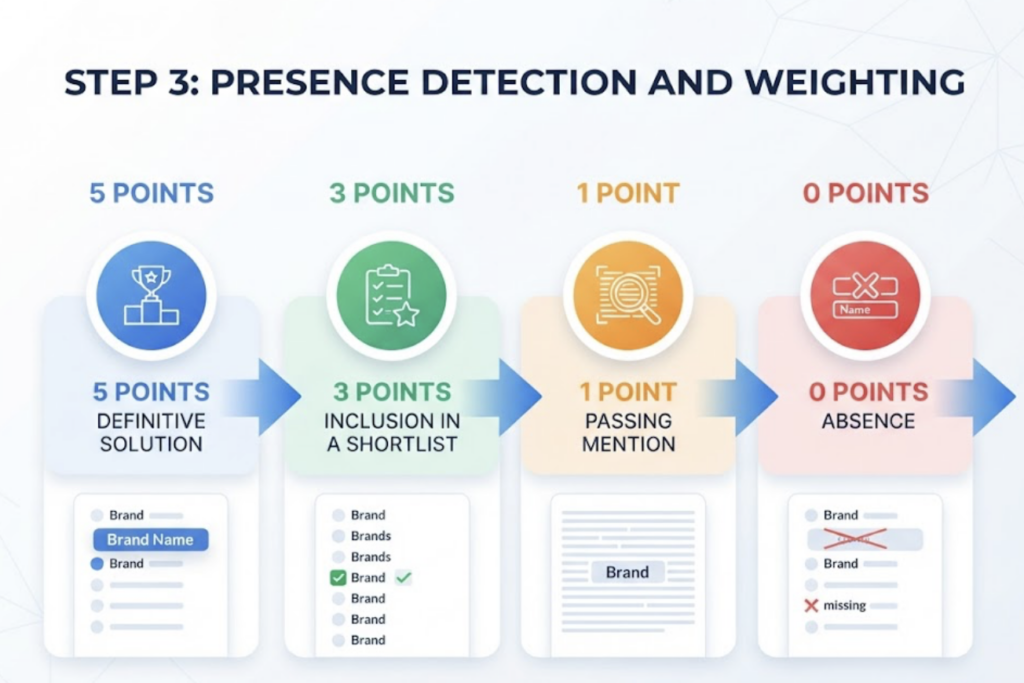
    Step 3: Presence detection and weighting. Methodologies like the one documented by Campaign Creators score each appearance on a tiered scale: a brand named as the definitive solution earns 5 points, inclusion in a shortlist earns 3, a passing mention earns 1, and absence earns 0.

    Step 4: Normalization. Raw points are converted to a percentage of the maximum possible score, averaged across platforms to smooth out model-specific biases.

    The output is one number. Behind it sit dozens of prompt-level observations you can drill into.

    One caveat: because vendors weight these steps differently, a 42 in one tool isn’t comparable to a 42 in another. Pick one methodology and track your trend within it.

    How to Measure AI Visibility Score Without Guesswork

    The tempting shortcut is manual spot-checking. Ask ChatGPT ten questions about your category, count your mentions, note the result in a spreadsheet.

    That approach fails for a specific, measurable reason. seoClarity’s 2026 citation volatility research found that platform-level citation rates on ChatGPT can swing by up to 40% within a single month, driven by model updates rather than anything you did. A Tuesday spot-check might show you in 80% of answers; the following Tuesday, 20%. Neither snapshot means much on its own.

    Reliable measurement needs four things: a fixed prompt set, multi-platform coverage, time-series data instead of snapshots, and a competitor baseline so you can tell platform noise from genuine share shifts.

    That’s a systems problem, not a spreadsheet problem. This is where a platform like Topify fits. Its GEO analytics engine tracks brand presence across ChatGPT, Gemini, Perplexity, DeepSeek, and other major engines through seven metrics: visibility, sentiment, position, volume, mentions, intent, and CVR. In practice, that structure answers the question a single score can’t: not just “what’s my number” but “which component moved, on which platform, and why.”

    If you want a baseline before committing to anything, a free GEO score check takes a few minutes and gives you a defensible starting number to report against.

    How to Improve Your AI Visibility Score: 5 Moves That Compound

    Raising the score isn’t traditional SEO with new vocabulary. The drivers are different, and the research is starting to quantify them.

    1. Publish original data. Academic work on generative engine optimisation out of Princeton found that content containing unique statistics, benchmarks, and citable frameworks is 30 to 40% more likely to be cited by LLMs. AI systems synthesizing an answer need concrete facts to anchor on. Generic advice gives them nothing to quote.

    2. Structure for retrieval. AI engines pull “chunkable” passages, not whole pages. Content that answers the question directly within the first 60 words of a section, under a clear heading, consistently outperforms narrative copy that builds to a conclusion.

    3. Build third-party consensus. Citations are heavily shaped by what AI models see beyond your own site. Brands consistently discussed on Reddit, G2, and industry publications get prioritized in synthesis because independent repetition reads as consensus. Your owned content alone can’t manufacture that signal.

    4. Keep entity signals consistent. Same brand name, same category framing, same core claims across every surface. Conflicting descriptions fragment the entity model AI systems build about you, and fragmented entities get skipped.

    5. Monitor and iterate on a cadence. There’s a compounding effect worth knowing about: 2026 research points to a “circular authority” loop in which strong AI visibility strengthens the entity signals feeding Google’s own systems. Improving your score in Perplexity isn’t a side quest from SEO. Increasingly, it feeds back into it.

    None of these moves requires a big budget to start. A number of free utilities cover the basics, and this GEO free tools reference is a practical starting list.

    Common Mistakes That Quietly Tank Your Score

    Four patterns show up repeatedly in teams whose scores stall or mislead them.

    Platform siloing. Measuring only ChatGPT, or only Google AI Overviews, and treating that as your AI visibility. Cross-platform consensus is the actual signal; single-platform data mostly captures one model’s quirks.

    Ranking proxy bias. Assuming strong Google rankings will carry over. The 88% decoupling figure says otherwise, and teams that lean on this assumption tend to discover the gap only when a competitor starts owning the answers.

    Counting mentions, ignoring context. A rising mention rate looks like progress until you read the answers and find the AI describing you as “a budget option with limited support.” Frequency without sentiment tracking is a vanity metric.

    Static keyword sets. Porting your high-volume SEO keywords into prompt tracking. AI users ask long, specific, high-intent questions. If your prompt set doesn’t reflect that language, your score measures the wrong conversation.

    The common thread: each mistake produces a number that looks fine while the underlying position erodes.

    What an AI Visibility Score Looks Like in Practice

    Abstract scores become useful when you know what the ranges mean. The tiering used in current AVS methodologies breaks down like this:

    StageScore rangeWhat it means in practice
    Pre-visibility0 to 8AI effectively doesn’t know your brand exists; entity signals are missing
    Early traction8 to 25Sporadic mentions, often on one platform or in passing context
    Category presence25+Your brand recurs as a recognized option in category-level answers

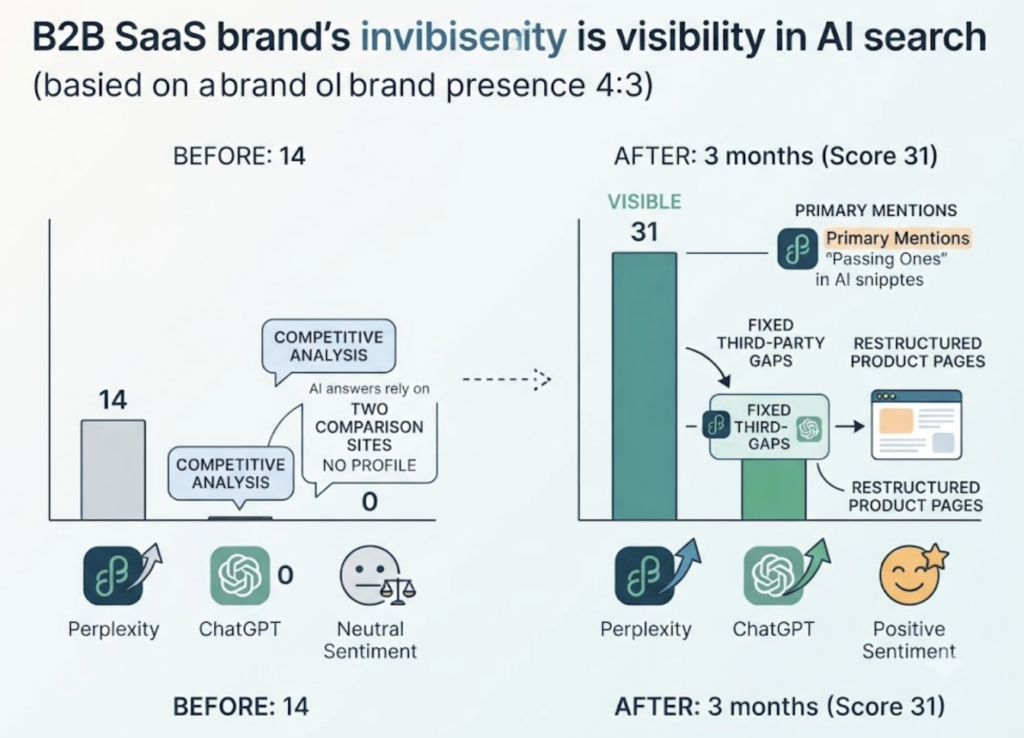
    Here’s how that plays out. A B2B SaaS brand starts at 14: decent Perplexity presence, near-zero on ChatGPT, sentiment neutral. Citation analysis shows ChatGPT’s answers in their category lean on two comparison sites where the brand has no profile. Three months after fixing those third-party gaps and restructuring their product pages for retrieval, the score sits at 31, with primary-mention appearances replacing passing ones.

    The score didn’t cause that improvement. It made the gap findable and the progress reportable. Competitor benchmarking sharpens this further, because a score of 31 means one thing when your closest rival sits at 18 and something else entirely when they’re at 55.

    Conclusion

    The metrics on your current dashboard were built for a discovery model where users clicked through lists. AI answers skip the list. An AI visibility score closes that measurement gap: it tells you whether generative engines select your brand, how prominently, and in what tone, and it turns generative search optimisation from guesswork into a trackable practice.

    The practical first step is cheap. Establish a baseline score this week, even with free tooling, and start tracking against a fixed prompt set. You can’t raise a number you’ve never measured.

    FAQ

    Q: What are the best tools for AI visibility score tracking?
    A: Look for four capabilities: multi-platform coverage, time-series tracking, sentiment and position data alongside raw mentions, and competitor benchmarking. Topify covers all four through its seven-metric GEO analytics, with a free GEO score checker for baseline measurement. Several point solutions handle single platforms, which works for early experiments but hits the platform-siloing problem at scale.

    Q: How much does AI visibility score tracking cost?
    A: Free checkers give you a one-time baseline at no cost. Continuous monitoring platforms typically start around $99 per month for tracking roughly 100 prompts across major engines, scaling up with prompt volume, platform coverage, and seats. Managed GEO services that combine tracking with content execution run considerably higher.

    Q: Is there a standard checklist for an AI visibility score audit?
    A: A workable six-point audit: define 20 to 50 high-intent prompts, run them across at least three AI platforms, score each appearance by prominence tier, log sentiment for every mention, benchmark two or three competitors on the same prompts, and repeat monthly to build a trend line.

    Q: How is an AI visibility score different from generative search optimisation?
    A: The score is the measurement; GSO is the practice. Generative search optimisation covers everything you do to earn presence in AI answers, from content structure to third-party consensus building. The AI visibility score tells you whether that work is moving the needle.

    Read More

  • AI Query Tracking Strategy: How to Build One That Works

    AI Query Tracking Strategy: How to Build One That Works

    Every Monday, someone on your team asks ChatGPT the same five questions about your category, screenshots the answers, and drops them into a Slack channel. Two weeks in, the answers have changed, nobody remembers the original wording, and the screenshots can’t be compared or reported. Recent research suggests that more than 50% of the sources cited in AI answers can shift within a single month. Against that kind of volatility, spot-checking isn’t measurement. It’s noise collection. What you need is a repeatable system: defined queries, a fixed cadence, consistent metrics, and a feedback loop that turns data into action.

    Manual Spot Checks Aren’t an AI Query Tracking Strategy

    An AI query tracking strategy is a documented system for monitoring how AI platforms answer the questions that matter to your business. It has four pillars: a defined prompt universe, a tracking cadence, a unified metric system, and an iterative optimization loop. Miss any one of them, and you’re back to screenshots.

    The reason this needs to be systematic, not casual, is that LLM outputs are non-deterministic. The same prompt can surface your brand today and omit it tomorrow, because answers are synthesized on the fly rather than pulled from a stable index. Tracking AI-driven search requires a fundamentally different approach than watching a rankings column.

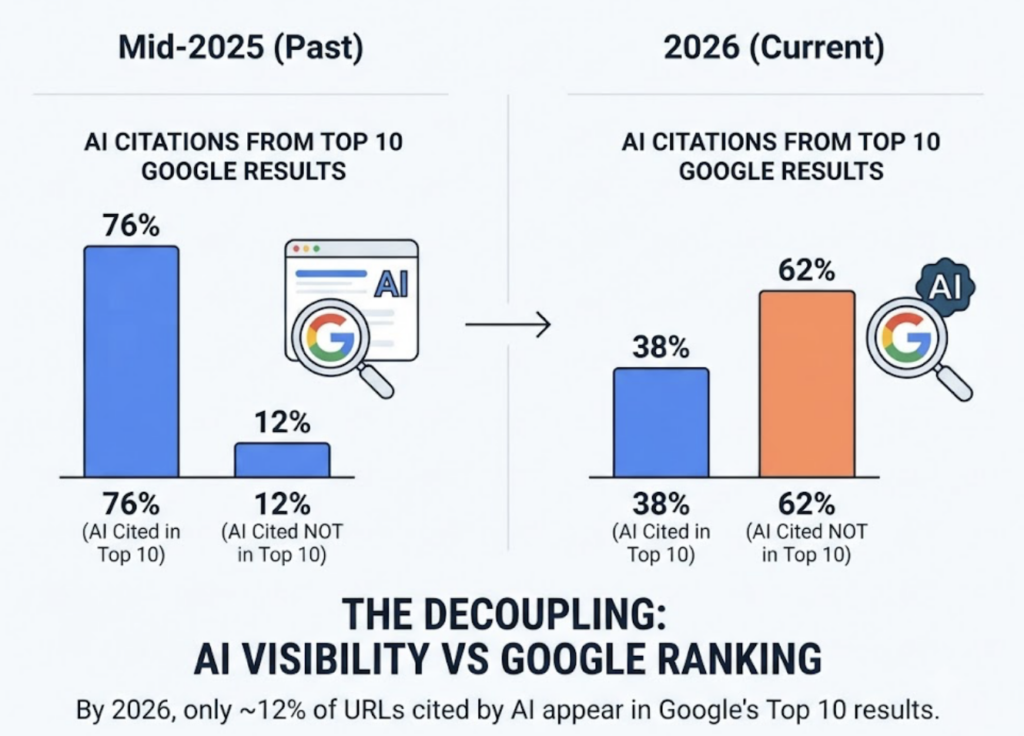
    Here’s the part most teams underestimate: AI visibility and Google rankings are actively decoupling. Industry data from 2026 indicates that only about 12% of URLs cited by AI appear in Google’s top 10 organic results for the same query. Pages ranking in Google’s top 10 accounted for roughly 76% of AI citations in mid-2025. By 2026, that figure had dropped to around 38%.

    Your SEO dashboard can’t see this shift. A tracking strategy can.

    Step 1: Choose the Queries That Actually Drive Revenue

    Query selection is where most programs quietly fail before they start. Teams either track too few prompts to be statistically useful, or they copy their SEO keyword list and call it done. Neither reflects how people actually talk to AI.

    A working prompt universe maps to the customer journey, typically in three layers. Informational queries capture early research (“how does X category work”). Comparative queries capture evaluation (“best AI query tracking tool for agencies”). Transactional queries capture decision moments (“is [brand] worth it”). High-value prompts mirror buying intent, not raw search volume.

    There’s a second reason journey coverage matters. Users increasingly follow a hybrid path: they discover options through AI, then verify through Google. If your brand is absent at the discovery stage, the odds of being searched at the verification stage drop sharply. The queries you track should cover the discovery moments where that filtering happens.

    If you’re not sure which prompts carry weight in your category, this is one place tooling helps early. Topify includes a prompt discovery function that surfaces high-volume AI queries relevant to your brand, which tends to be faster than brainstorming a list and hoping it matches real user behavior.

    Start with 20 to 50 core queries. You can expand later. You can’t retroactively build a baseline.

    Step 2: Set a Tracking Cadence That Matches AI Volatility

    A single snapshot of an AI answer is statistically meaningless. With half of cited sources potentially rotating within a month, the value is in the trend line, not the data point.

    The practical cadence is tiered. High-value queries, the comparative and transactional prompts closest to revenue, deserve daily or weekly runs. Long-tail informational queries can run monthly, enough to catch model drift without drowning your team in data. And before you react to anything, establish a 30-day baseline. A brand dropping out of one Tuesday’s answer is noise. A brand trending downward across four weeks is signal.

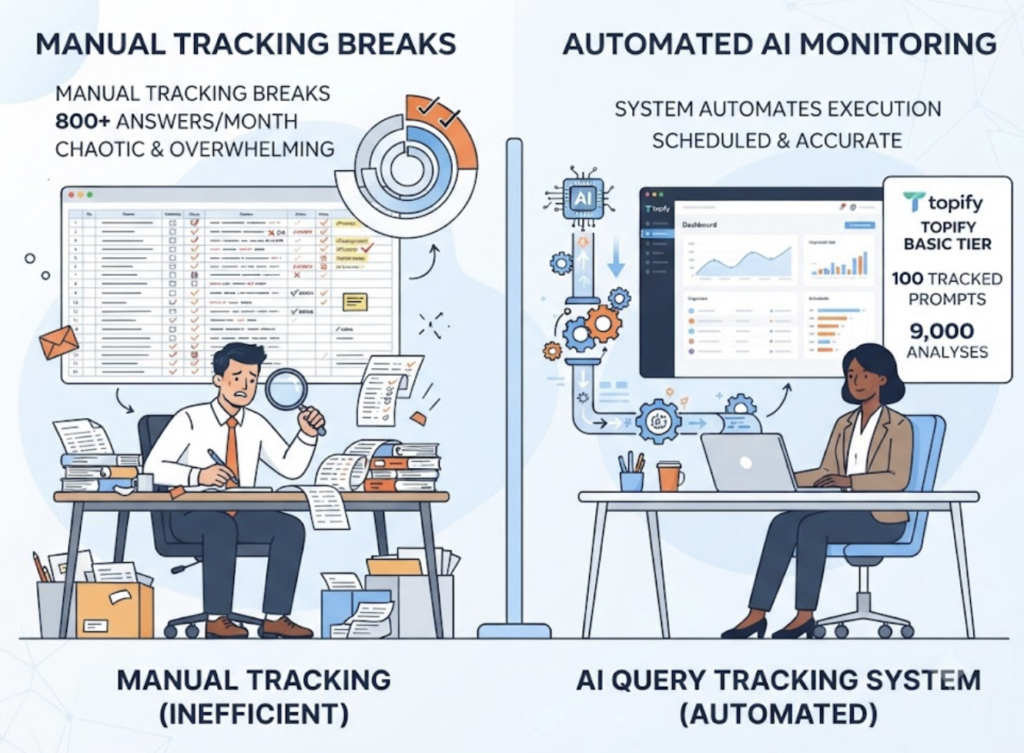
    This is also where manual tracking mathematically breaks. Running 50 queries weekly across four AI platforms means 800+ answer checks a month, each needing consistent capture and scoring. An AI query tracking system worth the name automates this batch execution on schedule. For reference, an entry-level plan like Topify’s Basic tier covers 100 tracked prompts and 9,000 AI answer analyses per month, which gives a sense of the volume a serious program actually processes.

    Step 3: Measure What Matters in an AI Query Tracking Dashboard

    Counting brand mentions is the shallow end of measurement. A mention in position seven of a lukewarm list is not the same as being the first recommendation with a positive framing. A useful AI query tracking dashboard separates four distinct signals.

    MetricWhat It Tells YouWhy Mentions Alone Miss It
    Visibility scoreHow often you appear across tracked promptsFrequency without context
    PositioningWhere you fall in the answer’s recommendation orderFirst pick vs. footnote
    SentimentHow the AI describes you: positive, neutral, or competitive framingA mention can be a warning
    Citation sourceWhich pages the AI attributes to your brandReveals which assets earn AI trust

    These four interact in ways a single number hides. You can hold steady visibility while your position slips from first to fourth, which usually precedes disappearing entirely. You can gain mentions while sentiment shifts toward “budget alternative,” which is a positioning problem, not a visibility win. And citation source is the diagnostic layer underneath everything: when your visibility moves, the citation data tells you which page started or stopped carrying you. That’s why platforms like Topify consolidate visibility, sentiment, position, and citation data into a single analytics view rather than reporting mentions in isolation.

    One more metric deserves a seat: zero-click rate, the share of queries resolved entirely inside the AI interface. As that number climbs, your strategy’s goal shifts from earning clicks to shaping the answer itself.

    Step 4: Turn Tracking Data into GEO Actions

    Tracking without action is an expensive hobby. The optimization loop starts with citation gap analysis: for each query where a competitor appears and you don’t, identify which sources the AI cited for them. Those sources are the map of what you’re missing.

    The fixes usually fall into two buckets. The first is content structure. AI models favor extractive content, and pages that deliver a direct, concise answer within the first 60 words tend to get cited more. Front-load the answer, then elaborate.

    The second is entity authority. AI systems weigh co-occurrence: whether your brand shows up alongside the problems you solve in authoritative third-party contexts, not just on your own domain. Review sites, industry publications, and community discussions carry citation weight your homepage can’t replicate.

    Then close the loop. Ship the fix, keep tracking, and confirm the change moved the metric. Tools with source analysis shorten this cycle considerably. Topify’s citation reverse-engineering shows the exact domains and URLs AI platforms cite for any tracked query, so the gap analysis takes minutes instead of a manual afternoon, and its agent can deploy the resulting strategy without hand-built workflows.

    Common Mistakes That Quietly Break Your Tracking Program

    Most failed programs die from a handful of predictable errors.

    Relying on Google Search Console as a proxy. GSC doesn’t capture LLM behavior, and with only around 12% of AI-cited URLs overlapping Google’s top 10, it’s measuring a different game.

    Assuming rank one on Google equals AI visibility. The 76%-to-38% citation drop is the clearest evidence yet that these channels have split.

    Tracking a single AI platform. ChatGPT, Perplexity, Google AI Overviews, and DeepSeek cite different sources and describe brands differently. One platform’s data generalizes poorly.

    Counting mentions without position or sentiment. You’ll report growth while your actual standing erodes.

    Freezing the query set. Buying language evolves, and last quarter’s prompt universe slowly stops representing your market.

    Ignoring off-site presence. Reddit threads, review platforms, and trusted media often outweigh your own pages in citation decisions.

    None of these mistakes announces itself. That’s what makes them expensive.

    The Tool Stack: What AI Query Tracking Software Should Cover

    The category has grown crowded, and most AI query tracking software looks similar in screenshots. The differences show up in five capabilities.

    CapabilityWhat to Verify
    Multi-platform coverageChatGPT, Perplexity, AI Overviews at minimum; ideally Gemini, DeepSeek, and regional engines
    Prompt-level trackingScheduled batch runs against your defined query set, not ad hoc lookups
    Competitor benchmarkingSide-by-side visibility, position, and sentiment against named rivals
    Citation analysisSource-level data explaining why answers cite what they cite
    Execution layerA path from insight to action, not just another report

    Topify covers all five in one AI query tracking platform. Its visibility tracking runs your prompt universe across ChatGPT, Gemini, Perplexity, DeepSeek, and other major engines on schedule, scoring each answer across seven metrics including visibility, sentiment, position, and CVR. Competitor monitoring auto-detects rivals and benchmarks your standing in real time, and the citation analysis maps every source domain behind the answers. What separates it from report-only tools is the execution end: you state a goal in plain English, review the proposed strategy, and deploy it in one click. Pricing starts at $99/month for 100 tracked prompts, which puts a systematic program within reach of a single marketer, not just enterprise teams.

    If budget is zero for now, there’s still no excuse for guessing. This reference list of free GEO tools covers no-cost options for baseline checks while you build the case for a full AI query tracking solution.

    A 10-Point Checklist Before You Call It a Strategy

    1. Prompt universe documented, 20 to 50 core queries minimum
    2. Queries layered by intent: informational, comparative, transactional
    3. Every stage of the customer journey covered by at least one query
    4. Tracking cadence assigned per tier: daily or weekly for high-value, monthly for long-tail
    5. At least three AI platforms monitored
    6. 30-day baseline captured before any optimization decision
    7. Dashboard tracks visibility, position, sentiment, and citation source separately
    8. Named competitor set benchmarked on the same queries
    9. Citation gap review scheduled monthly
    10. Every optimization shipped gets a follow-up measurement window

    If you can’t check all ten, you have a monitoring habit, not a strategy.

    Conclusion

    The screenshot-in-Slack era of AI monitoring is ending for the same reason gut-feel SEO ended: the channel got too volatile and too valuable to manage by intuition. With AI citations rotating monthly and the overlap with Google rankings shrinking fast, the brands that win are the ones measuring systematically while competitors spot-check.

    Start small and start now. Define 20 to 50 revenue-relevant queries, capture a 30-day baseline, and let the trend lines tell you where to act. If you’d rather not build the pipeline by hand, you can get started with Topify and have your first tracked prompts running the same day.

    FAQ

    Q: What is an AI query tracking strategy?
    A: It’s a documented system for monitoring how AI platforms like ChatGPT and Perplexity answer questions relevant to your brand. It combines four elements: a defined set of tracked queries, a fixed monitoring cadence, a unified metric system covering visibility, position, sentiment, and citations, and an optimization loop that acts on the data.

    Q: How does an AI query tracking strategy work in practice?
    A: You define 20 to 50 high-intent queries, run them on schedule across multiple AI platforms, and score each answer for brand presence, position, and framing. After a 30-day baseline, you use citation gap analysis to find where competitors get cited instead of you, fix the underlying content or authority gaps, and confirm the change in the next tracking cycle.

    Q: How much does AI query tracking cost?
    A: Dedicated platforms typically run from around $99 to $500+ per month depending on prompt volume and platform coverage. Topify’s entry plan starts at $99/month with 100 tracked prompts, while free tools can handle basic one-off checks before you commit to a paid AI query tracking solution.

    Q: What are examples of an AI query tracking strategy?
    A: A SaaS team might track “best [category] software” weekly across four platforms and use citation data to prioritize review-site coverage. An agency might run per-client prompt sets monthly and report visibility trends alongside SEO metrics. An ecommerce brand might track product recommendation queries daily during peak season to catch positioning drops before they cost revenue.

    Read More

  • AI Rank Checker for Local and Multi-Location Brands

    AI Rank Checker for Local and Multi-Location Brands

    Your rank tracker says everything is fine. Fifty cities, solid local pack positions, map grids mostly green. Then a regional manager forwards you a screenshot: someone asked ChatGPT for “the best urgent care in Denver,” and your clinic, the one holding position 2 in the local pack there, isn’t in the answer. You check three more cities. You’re in one, missing from two, and described as “a budget option” in the third. Your reporting stack has no column for any of this. The tools that track your rankings were built to watch a results page, not to read an answer. What you need now is a different kind of rank checking, one that looks inside AI responses, city by city.

    Your Local Pack Rankings Don’t Predict What ChatGPT Recommends

    The gap between traditional local visibility and AI visibility is not a rounding error. SOCi’s 2026 Local Visibility Index analyzed nearly 350,000 locations across 2,751 multi-location brands and found that ChatGPT recommended only 1.2% of locations, Gemini 11%, and Perplexity 7.4%. Those same brands appeared in Google’s local 3-pack 35.9% of the time.

    In other words, AI visibility can be up to 30 times harder to earn than a local pack spot.

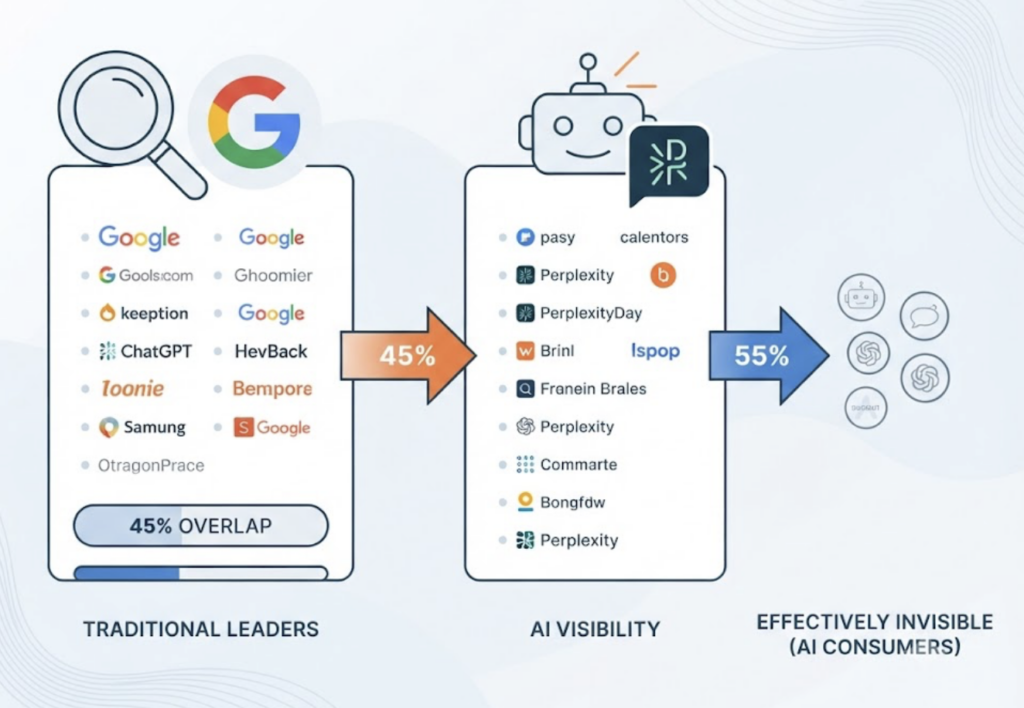
    Strong traditional performance doesn’t carry over, either. In retail, only 45% of brands leading in traditional local search also ranked among the most recommended in AI results. More than half of the winners on Google are effectively invisible to consumers who ask an AI assistant instead.

    And those consumers are no longer an edge case. AI-referred sessions grew 527% year over year, and Semrush found that AI search visitors convert at 4.4x the rate of traditional organic visitors. The channel is small in absolute terms, but it’s the highest-intent traffic most local brands aren’t measuring.

    What an AI Rank Checker Actually Measures

    An AI rank checker monitors how AI assistants answer buying-intent questions about your category, then records whether your brand appears, where it sits in the recommendation list, and how it’s described. That’s a different job from checking a SERP.

    The core difference: AI answers are probabilistic. As Rand Fishkin’s research made clear, asking an AI tool the same question 100 times can produce 100 different answers. So an AI rank checker doesn’t report a single fixed position. It samples repeatedly and reports frequency: how often you’re mentioned, and your average position when you are.

    DimensionTraditional local rank trackerAI rank checker
    What it queriesGoogle SERP / local pack / map gridPrompts sent to ChatGPT, Gemini, Perplexity
    Result formatRanked list of linksSynthesized answer with 3-5 recommendations
    Position metricFixed rank (1, 2, 3…)Mention rate (%) + average position across samples
    Competitive viewSame 10 results for everyoneCompetitor set shifts per prompt and city
    Descriptive layerNoneSentiment and framing (“premium” vs “budget”)

    For local and multi-location brands, one more dimension matters: every metric above has to be tracked per location. A brand-level mention rate hides exactly the failures you need to find.

    Why Location Changes Everything in AI Answers

    Swap the city name in a prompt and the AI’s recommendation set can change completely. Each market has its own review density, local press coverage, and community discussion, so the trust signals AI models weigh are rebuilt from scratch for every geography.

    The spread between winners and everyone else is stark. In the restaurant category, SOCi found visibility concentrated among a handful of leaders: Culver’s reached AI recommendation rates of 30.0% on ChatGPT and 45.8% on Gemini, while most competitors barely registered. A brand can be the default answer in one metro and absent in the next, with no signal in its SEO dashboard explaining why.

    Now do the math on manual checking. A 60-location brand tracking 10 prompt variants across 3 AI platforms needs 1,800 query checks for a single snapshot, and because answers vary run to run, each check should be sampled multiple times. Weekly.

    That’s not a spreadsheet task. That’s a monitoring system.

    How to Check AI Rankings Across Every Location

    The workflow that works in practice has four steps, and each one maps to a tooling requirement.

    Step 1: Build a location-modified prompt library. Start from your highest-value buying questions (“best [category] in [city],” “affordable [service] near [neighborhood]”) and generate variants for every market you operate in. This is where prompt discovery beats guesswork: the phrasings customers actually use rarely match your keyword list.

    Step 2: Run the prompts across platforms on a schedule. Each AI engine weighs sources differently, so ChatGPT, Gemini, and Perplexity results diverge. One platform is not a proxy for the others.

    Step 3: Record position per city, not just mentions. Being listed fifth behind four competitors is a different business outcome than being the first name the AI offers.

    Step 4: Track change over time and trace it to sources. A position drop usually has a cause you can act on, typically a source that stopped citing you or started citing a competitor.

    This is the use case Topify is built around. Its Position Tracking monitors where your brand ranks inside AI answers relative to competitors, prompt by prompt, across ChatGPT, Gemini, Perplexity, and other major engines. High-Value Prompt Discovery surfaces the location-modified queries with real AI search volume, so a 60-location brand isn’t guessing which of its 1,800 prompt-city combinations deserve monitoring budget. Competitor Monitoring auto-detects who you’re actually up against in each market, which matters because your rival in Phoenix often isn’t your rival in Seattle. In practice, this means you can spot your Austin locations sliding from position 2 to position 5 on ChatGPT, then trace it back to a local listicle that dropped you, all in one view.

    The platform tracks seven metrics per prompt: visibility, sentiment, position, volume, mentions, intent, and CVR. For a multi-location brand, that last one estimates which cities’ AI answers are most likely to drive actual customer action, which is how you prioritize fixes across a large footprint.

    If you’d rather validate the gap before committing, run a handful of your own city prompts through a free trial and compare the results against your local pack report. Topify also maintains a reference list of free GEO tools if you want to benchmark with lighter-weight checks first.

    The Sources AI Trusts for Local Recommendations

    Checking your AI rank tells you where you stand. Improving it requires knowing which sources the models lean on, and the data here is specific.

    Review signals set a hard floor. Locations recommended by ChatGPT averaged 4.3 stars, while brands near 3.4 stars with review response rates below 5% were effectively invisible in AI recommendations. In traditional local search, a middling location can still rank on proximity. In AI answers, it typically gets excluded outright.

    Community platforms carry outsized weight. Semrush’s research found Quora is the most commonly cited website in Google AI Overviews, with Reddit in second place, because AI systems treat forum threads as a proxy for genuine human consensus. If nobody on Reddit has ever recommended your Portland location, that silence is a ranking signal.

    Data accuracy is quietly leaking visibility too. SOCi found business profile information was only about 68% accurate on ChatGPT and Perplexity, compared with 100% on Gemini, which grounds its answers in Google Maps. Wrong hours or an outdated address at even a few locations reads as risk to a model, and models handle risk by leaving you out.

    This is where citation-level analysis earns its keep. Topify’s Source Analysis reverse-engineers the exact domains and URLs each AI platform cites for your category prompts, per market. Instead of a generic “get more reviews” plan, you get a target list: the two local publications, one Reddit community, and one aggregator that actually feed the answers in each city.

    Common Mistakes Multi-Location Brands Make in AI Search

    Auditing only flagship cities. The markets where you’re strongest are the least informative. AI visibility failures cluster in mid-tier locations with thinner review and citation footprints, exactly where nobody checks.

    Treating one AI platform as representative. Gemini’s grounding in Google Maps makes it the friendliest engine for brands with clean GBP data, which is why it recommended 11% of locations while ChatGPT recommended 1.2%. Reading only Gemini results tends to overstate your real coverage.

    Assuming GBP optimization covers AI. Listings hygiene is necessary but not sufficient. Models synthesize your entire footprint, including reviews, forums, and press, so a perfect profile with a weak citation footprint still loses.

    Ignoring prompt phrasing variants. “Best,” “cheapest,” and “most reliable” pull different recommendation sets. Tracking one phrasing per city undercounts both your wins and your losses.

    Reporting brand averages to stakeholders. A 40% overall mention rate can hide ten cities at zero. Location-level reporting is the whole point.

    Conclusion

    The definition of rank checking has changed underneath local brands. Your local pack positions still matter, but they no longer predict whether an AI assistant will name you when a customer asks, and the 1.2% ChatGPT recommendation rate for multi-location brands says most are losing that moment by default.

    The fix starts smaller than it sounds. Pick your 10 highest-value location prompts, run them across three AI platforms, and record where you stand. That baseline, tracked weekly with an AI rank checker that measures position and mention rate per city, turns an invisible problem into an ordinary reporting line. The brands doing this now are setting the defaults everyone else will be trying to displace.

    FAQ

    Q: What is an AI rank checker? 

    A: An AI rank checker is a tool that monitors AI-generated answers from platforms like ChatGPT, Gemini, and Perplexity to see whether a brand appears, what position it holds in the recommendation list, and how it’s described. Because AI answers vary between runs, it reports mention frequency and average position rather than a single fixed rank.

    Q: How do I check my brand’s ranking in ChatGPT for a specific city? 

    A: Manually, you’d ask ChatGPT a buying-intent prompt with the city name (“best [category] in Austin”) multiple times and log whether and where your brand appears. At multi-location scale, a platform like Topify automates this by running location-modified prompts on a schedule and tracking position per market.

    Q: How is AI rank checking different from local rank tracking? 

    A: Local rank trackers monitor fixed positions in Google’s SERP and local pack. AI rank checking monitors synthesized answers where results are probabilistic, competitor sets change by city, and visibility is measured as recommendation frequency plus position. Strong local pack rankings often coexist with zero AI visibility.

    Q: How many prompts should a multi-location brand track? 

    A: Start with 5-10 core buying-intent prompts per priority market, covering your main category terms and at least two phrasing variants (such as “best” and “affordable”). Expand based on prompt discovery data showing which queries carry real AI search volume in each city.

    Read More

  • One Brand, Two Realities: Why AI Rank Checkers Disagree

    One Brand, Two Realities: Why AI Rank Checkers Disagree

    It’s Monday morning and you’re building the visibility report. Your AI rank checker says your brand sits at #2 in ChatGPT answers for your core buying prompt. The same tool, same prompt, same day, shows you at #6 on Perplexity. Your client asks the obvious question: which number is real?

    Neither number is wrong. That’s the uncomfortable part.

    If you’re evaluating an ai rank checker right now, or doubting the one you already pay for, this divergence is the single most important thing to understand. It’s not a measurement bug. It’s the natural output of two AI systems that retrieve, weigh, and assemble evidence in fundamentally different ways. Once you see why, you’ll read AI rank data very differently, and you’ll stop chasing a “true rank” that doesn’t exist.

    Your AI Rank Checker Isn’t Broken. The Platforms Just Don’t Agree.

    Every AI answer is the end product of a retrieval-augmented generation pipeline: the model pulls sources, weighs them, and writes a response. Two platforms running two different pipelines will produce two different answers, and two different brand rankings, from the identical prompt.

    How different? According to the Generative Visibility Benchmarks 2026 report, cross-platform citation overlap between ChatGPT and Perplexity for the same intent-based query is often below 25%. The two engines aren’t ranking the same list in a different order. Three-quarters of the time, they’re not even reading the same sources.

    That single statistic reframes the entire problem. When your dashboard shows #2 on one platform and #6 on another, you’re not looking at one reality measured twice. You’re looking at two realities, each internally consistent, each built on a different evidence pool.

    The rest of this article breaks down the three structural causes: divergent retrieval, the gap between ranking and mention, and plain statistical noise.

    ChatGPT and Perplexity Retrieve From Different Worlds

    ChatGPT leans heavily on parametric memory, the knowledge baked into its training data, and supplements it with real-time Bing search when needed. Its generation logic favors coherence and narrative flow. If your brand built a strong footprint in the content that shaped the model’s training, you can rank well in ChatGPT even with a modest current web presence.

    Perplexity works the other way around. It’s a search-native engine that prioritizes real-time indexing, dense citations, and fresh sources. Its retrieval pipeline tends to reward news outlets and recently updated domains over legacy authority.

    In practice, this means the same brand is being judged by two different juries reading two different case files. A five-year-old cornerstone guide might carry your ChatGPT visibility while doing almost nothing for Perplexity, where last month’s comparison article from an industry publication wins the citation instead.

    Here’s the thing: this isn’t a flaw to be engineered away. It’s a permanent feature of a multi-model search world, and your measurement approach has to absorb it rather than average it out.

    Ranking Isn’t the Same Thing as Being Mentioned

    Traditional rank trackers taught us to think in positional lists: you’re #1, #3, or #9, but you’re always somewhere on the list. AI search breaks that assumption in two ways.

    First, a brand can be mentioned in the narrative text of an answer without being cited as a linked source, or cited without a meaningful mention. Research published in the Journal of Generative Analytics treats citation counts and ranking positions as two distinct GEO pillars precisely because they move independently.

    Second, and more consequentially, a brand can simply be absent. You might appear in the answer text on ChatGPT with a high mention rate while Perplexity omits you entirely. At that point, comparing “ranks” across the two platforms isn’t just misleading. It’s mathematically impossible, because one platform has no rank to report.

    Most single-score AI rank checkers flatten this distinction into one number and hide the absences.

    That’s the gap that costs brands real pipeline. Being #6 in answers where you appear is a position problem. Not appearing at all in 60% of relevant prompts is a visibility problem, and the two demand completely different fixes.

    Sampling Noise: Why the Same Prompt Gives Different AI Ranks

    Even inside a single platform, your rank isn’t a fixed value. LLMs are probabilistic systems. Temperature settings, plus the shifting order of retrieved search results, mean the same prompt can produce a different answer an hour later.

    The AI Observability Consortium’s 2026 research on the probabilistic nature of LLM rankings found that variance can exceed 40% in high-competition topics. Their reliability threshold: at least 3 to 5 samples per prompt per day before a ranking figure becomes statistically meaningful.

    Now consider what most free or single-snapshot checkers actually do. One query, one platform, one moment in time. That’s not a measurement. That’s a coin flip with a dashboard attached.

    The practical implication is simple. Any AI rank number worth reporting has to come from repeated sampling over time, tracked as a trend line rather than quoted as a point. A single check can tell you a brand appeared once. Only a sampled series can tell you whether it reliably appears, where it typically lands, and whether that’s improving.

    How to Read AI Rank Data Without Fooling Yourself

    Once you accept that platforms diverge structurally, the reporting framework follows. Three rules cover most of it.

    Isolate platforms. Never average rankings across ChatGPT, Perplexity, and Gemini into one score. Each platform serves different user intent: Perplexity skews toward research and fact-checking, ChatGPT toward conversational product advice. A drop on one may require no action on the other.

    Read mention rate before position. If your brand shows up in only 20% of relevant prompts, celebrating a #2 position inside that 20% is vanity reporting. Presence comes first, position second.

    Attribute movements to sources. When a rank shifts, the cause usually lives at the citation layer: a competitor refreshed their content, or the platform’s grounding index updated. Without source-level data, every fluctuation is a black box.

    The capability gap between tool categories maps directly onto these rules:

    CapabilitySingle-Snapshot CheckerMulti-Platform Monitoring
    Data basisSingle query, single platformRepeated, cross-platform sampling
    Metric focusAbstract rank scoreMention rate, position, sentiment
    AttributionNoneSource-level analysis
    Strategic utilityVanity reportingActionable GEO strategy

    Bottom line: a snapshot tells you where you stood once. A monitoring system tells you why you moved, and what to do about it.

    Tracking One Brand Across Many AI Realities

    If the diagnosis is “two platforms, two realities, plus sampling noise,” the tooling requirement writes itself: per-platform tracking, repeated sampling, mention and position measured separately, and citation-level attribution.

    This is where Topify fits the problem cleanly. Its Position Tracking monitors where your brand lands relative to competitors on each AI platform separately, ChatGPT, Perplexity, Gemini, Google AI Overviews, and others, so you’re never averaging incompatible numbers. Visibility Tracking measures mention rate independently of position, which surfaces the “absent on Perplexity, ranked on ChatGPT” pattern that single-score tools hide. And Source Analysis maps the exact domains each platform cites, letting you trace a Perplexity rank drop back to a specific source that stopped referencing your brand.

    The platform’s seven-metric model, covering visibility, sentiment, position, volume, mentions, intent, and CVR, mirrors the KPI framework GEO practitioners are converging on: presence first, framing second, position third, and revenue correlation last.

    Pricing scales with usage rather than enterprise bundles. The Basic plan runs $99/month with 100 tracked prompts and 9,000 AI answer analyses, which at daily sampling covers the 3-to-5-samples-per-prompt threshold the reliability research calls for. You can start a free trial and establish per-platform baselines before committing. For teams still comparing options, this curated GEO free tools reference is a useful starting point for testing what different checkers actually measure.

    Conclusion

    Back to Monday morning’s question: which number is real, the #2 or the #6? Both are. ChatGPT and Perplexity retrieve from evidence pools that overlap less than 25% of the time, treat mention and citation as separate events, and add 40%-level sampling variance on top. Expecting them to agree was the error, not the data.

    The action item is a mindset shift. Stop searching for your one true AI rank. Start building platform-specific baselines: track mention rate and position separately on each engine, sample repeatedly instead of checking once, and attribute every movement to the citation layer. Teams that make that shift turn AI rank data from a confusing vanity number into a working growth channel.

    FAQ

    Q: Why does my AI rank differ between ChatGPT and Perplexity?
    A: The two platforms run different retrieval pipelines. ChatGPT blends training-data memory with Bing search and favors narrative coherence, while Perplexity prioritizes real-time indexing and citation density. Their source overlap for the same query is often under 25%, so their rankings are built from different evidence.

    Q: How often should an ai rank checker sample AI answers?
    A: Research from the AI Observability Consortium suggests at least 3 to 5 samples per prompt per day, since answer variance can exceed 40% in competitive topics. Anything less is a point-in-time snapshot, not a reliable measurement.

    Q: Is a free ai rank checker accurate enough for reporting?
    A: It’s useful for spot checks and initial audits, but most free tools run single queries on single platforms. For client or executive reporting, you need repeated sampling, per-platform separation, and mention-rate data alongside position.

    Q: Can I improve my rank on one AI platform without hurting another?
    A: Generally, yes. Because the platforms draw from largely separate source pools, optimizing for Perplexity typically means earning fresh, citation-dense coverage, while ChatGPT visibility rewards durable authoritative content. The strategies are additive more often than they conflict.

    Read More

  • Free AI Rank Checkers 2026: What Bing and HubSpot Miss

    Free AI Rank Checkers 2026: What Bing and HubSpot Miss

    Search “free AI rank checker” in 2026 and you’ll run into an odd situation. Microsoft now hands out official AI citation data inside Bing Webmaster Tools. HubSpot grades your brand’s AI perception at no cost. Both tools are free, both come from credible platforms, and neither answers the question you actually typed: where does my brand rank when a buyer asks ChatGPT for a recommendation?

    One counts citations. The other scores perception. The word “rank” appears in neither product, and that’s not an accident. Understanding what each free tool measures, and what it deliberately avoids measuring, is the difference between a useful baseline and a misleading report to your boss.

    The Free AI Rank Checker Boom Started with Platforms, Not Startups

    For years, checking your AI search visibility meant scraping answers or paying a third-party tool to run prompt panels. In 2026, the platforms themselves entered the game.

    Microsoft moved first. In February 2026, Bing Webmaster Tools launched its AI Performance dashboard in public preview, showing publishers how often their content is cited across Copilot, Bing’s AI summaries, and partner integrations. Then on June 16, 2026, Microsoft added four preview capabilities: Intents, Topics, Citation Share, and Compare. Industry coverage tracked the rollout closely, with ALM Corp noting that Citation Share is the first metric from a major platform to show your slice of citations for a query rather than a raw count.

    HubSpot took a different route. After acquiring XFunnel, it launched the free AEO Grader in April 2026, a one-time diagnostic that scores how ChatGPT, Perplexity, and Gemini represent your brand.

    Platform-native tools entering GEO is a signal worth taking seriously. It means AI visibility is now an official discipline with official metrics. But official doesn’t mean complete, and free doesn’t mean sufficient.

    What Bing’s AI Performance Metrics Actually Measure

    The AI Performance dashboard gives you four original metrics plus the June additions. Total Citations counts how many times your content appeared as a source in AI-generated answers during a selected period. Average Cited Pages shows the daily average of unique URLs referenced. Grounding Queries reveal the reformulated search phrases the AI generated internally to retrieve your content, which are not the prompts users actually typed.

    Grounding queries are the most valuable and most misunderstood metric in the set. When someone asks Copilot “how do I improve my marketing team’s productivity,” the system rewrites that into retrieval queries like “marketing team productivity strategies 2026.” You’re seeing the machine’s shopping list, not the customer’s question.

    The June update layered on interpretation. Intents classify grounding queries into buckets like Informational, Commercial, and Research. Topics group related queries into themes. Compare overlays a previous time period onto your current chart. And Citation Share, the headline feature, shows the percentage of total citations your site owns for a specific grounding query. If an AI answer drew on 10 citations and 3 came from your site, your Citation Share for that query is 30%.

    Why Citation Counts Aren’t Rankings

    Here’s where the “rank checker” framing breaks down. Microsoft explicitly states that Citation Share is an observational metric, not a ranking system. It doesn’t expose competitor domains, doesn’t represent traffic share, and doesn’t indicate whether your link was the primary source or a footnote buried at the bottom of the response.

    In practice, that means a page with a 40% Citation Share could be the lead source shaping the entire answer, or a supporting reference nobody notices. The dashboard can’t tell you which. Bing’s data confirms you’re in the running for a query. It stays silent on where you finish.

    HubSpot’s AEO Grader: A Brand Snapshot, Not an AI Rank Checker

    HubSpot’s free tool approaches the problem from the brand side. Enter your company name, location, industry, and product description, and the AEO Grader queries ChatGPT, Perplexity, and Gemini about how they characterize your brand, then returns a composite score out of 100.

    The weighting tells you what HubSpot thinks matters. Sentiment Results carries 40 points, measuring how AI models characterize your brand. Presence Quality and Brand Recognition take 20 points each, covering mention depth and how specifically the models can discuss you. Share of Voice and Market Competition round out the last 20, capturing citation frequency relative to competitors and whether AI classifies you as a Leader, Challenger, or Niche Player.

    That’s genuinely useful for spotting narrative gaps. If Gemini describes your premium product as “a budget alternative,” you have a positioning problem no traditional SEO tool would surface.

    The limitation is structural: it’s a one-time snapshot based on training data and current inference. Run it today and you get today’s perception. There’s no longitudinal tracking, no prompt-level detail, no way to see whether last month’s content push moved anything. The $50/month paid tier adds tracking for 25 prompts, but reviewers point to missing pieces like competitor citation benchmarking and aggregate citation-trend analysis. ContentMonk’s comparison of HubSpot AEO against dedicated GEO platforms reaches a similar conclusion: it’s a perception audit with light monitoring attached, not a competitive rank tracking system.

    Where Free AI Rank Checkers Go Blind

    Put the two free tools side by side and a pattern emerges. Each one measures a real thing well, and both skip the same three things entirely.

    CapabilityBing AI PerformanceHubSpot AEO Grader FreeDedicated AI Rank Tracking
    Primary goalOperational citation visibilityBrand perception scoreCompetitive ranking and CVR
    Platform coverageBing, Copilot, partner AIChatGPT, Gemini, PerplexityCross-platform, LLM agnostic
    Rank or position dataNo, Citation Share onlyNo, perception score onlyYes, relative position
    Data natureAggregated, longitudinalOne-time snapshotContinuous, prompt-level
    Competitor dataLimited, aggregatedBasic, manually configuredDynamic, auto-detected
    PriceFreeFreePaid

    Blind spot one is platform coverage. Bing’s report covers the Microsoft ecosystem and stops there, missing the 70%+ of AI search activity happening on ChatGPT, Gemini, and Perplexity. HubSpot covers those three engines but only as a point-in-time perception check.

    Blind spot two is position. Neither tool tells you whether you’re the first brand named in a recommendation list or the seventh. For a buyer-intent prompt like “best CRM for small agencies,” that difference is most of the commercial value.

    Blind spot three is competitors. Citation Share won’t show you which domains own the rest of the pie. The Grader’s competitive dimension classifies you into broad categories rather than tracking a named rival prompt by prompt.

    Free tools tell you that you were cited. They don’t tell you where you rank.

    Closing the Gap: From Free Snapshots to Prompt-Level AI Rank Tracking

    Once the free tools have shown you the outline of the problem, the next question is operational: how do you track your relative position, against named competitors, on the prompts your buyers actually use, across every major AI engine?

    That’s the layer where dedicated platforms earn their keep. Topify approaches AI rank checking the way marketers expect a rank tracker to work: you define the prompts that matter to your business, and the platform continuously samples AI answers across ChatGPT, Gemini, Perplexity, DeepSeek, and other engines to record whether your brand appears, in what position, and relative to which competitors. Position Tracking addresses the exact gap Bing and HubSpot leave open, showing your brand’s ordering within AI recommendations rather than a bare citation count or a perception grade. Because LLM answers are non-deterministic, repeated sampling matters; a single query proves little, while trends across hundreds of sampled answers reveal your true standing. The data rolls up into seven metrics covering visibility, sentiment, position, volume, mentions, intent, and CVR, so a drop in ChatGPT mentions can be traced to the specific source that stopped citing you.

    The two approaches also compound each other. Export your grounding queries from Bing Webmaster Tools and feed them into your tracked prompt set, and you’ve turned Microsoft’s free operational data into targeting input for cross-platform rank tracking.

    Pricing follows a usage model rather than enterprise bundles. The Basic plan runs $99 per month with 100 tracked prompts and 9,000 AI answer analyses, and includes a 30-day trial you can start without a sales call.

    A Free-First Workflow for Checking AI Rankings in 2026

    You don’t need to choose between free and paid on day one. A sensible sequence uses each tool for what it’s built for.

    Step one, verify your site in Bing Webmaster Tools and open the AI Performance report. Expect a 48 to 72 hour delay before data appears. Look at which pages earn citations and which grounding queries trigger them. Pages with strong grounding activity are your proven AI-ready assets.

    Step two, run the HubSpot AEO Grader on your brand and one or two competitors. It takes about two minutes and requires no account. Flag any sentiment or positioning mismatch between how AI describes you and how you actually position yourself.

    Step three, decide based on the gaps. If the free data shows you’re barely cited, fix content structure and entity clarity first. If you’re cited but can’t see position or competitors, that’s the signal to move to prompt-level tracking. A maintained reference list of free GEO tools is worth bookmarking for this audit stage, since the free tier of this market keeps expanding.

    Bottom line: use free tools to find out whether you have a visibility problem, and dedicated tracking to find out whether you’re winning.

    Conclusion

    The 2026 free tool boom is real progress. Official citation data from Microsoft and a no-cost perception audit from HubSpot would have seemed unlikely two years ago. But neither is an AI rank checker in the sense marketers mean the phrase. One measures citation frequency inside a single ecosystem, the other grades brand perception at a single moment.

    Run both this week. They cost nothing and take under an hour combined. Then look at what they can’t show you, your position against named competitors on high-intent prompts across every major engine, and decide whether that blind spot is one your brand can afford to keep.

    FAQ

    Q: Is there a truly free AI rank checker in 2026? 

    A: There are free AI visibility checkers, but no free tool currently reports rank position. Bing’s AI Performance report shows citation counts and Citation Share within the Microsoft ecosystem, and HubSpot’s AEO Grader scores brand perception across ChatGPT, Perplexity, and Gemini. Neither reveals where your brand sits relative to competitors within an answer.

    Q: What’s the difference between Bing’s Citation Share and an actual AI ranking? 

    A: Citation Share is your percentage of the citations shown for a grounding query, calculated as your citations divided by total citations across all sites. Microsoft frames it as observational. An AI ranking, by contrast, records the order in which brands or sources appear within the generated answer itself, which Citation Share doesn’t capture.

    Q: Does HubSpot’s AEO Grader track rankings over time? 

    A: No. The free Grader is a one-time snapshot of how AI models currently characterize your brand. The $50/month HubSpot AEO tier adds ongoing tracking for 25 prompts, but it centers on visibility and sentiment rather than competitive position benchmarking.

    Q: How do I check my brand’s ranking in ChatGPT specifically? 

    A: You need prompt-level tracking: define the buyer questions that matter, sample ChatGPT’s answers repeatedly to account for answer variation, and record whether and where your brand appears versus competitors. Platforms like Topify automate this sampling across ChatGPT and other engines and report position trends over time.

    Read More

  • Your AI Rank Can Drop 35% in Five Weeks. Catch It Early

    Your AI Rank Can Drop 35% in Five Weeks. Catch It Early

    Three weeks ago, ChatGPT recommended your brand second in its answer to your category’s biggest buying question. This Monday, a prospect ran the same prompt and you weren’t in the answer at all. Your Google rankings didn’t move. Search Console looks normal. Nothing in your stack flagged the change, because nothing in your stack was built to watch it.

    That’s not an edge case. Research tracking 3.5 million citation events across 120,000+ domains found that AI citation activity drops by half in roughly 4.5 weeks. On ChatGPT, the churn is even faster: 3.4 weeks. A 35% loss inside five weeks isn’t a disaster scenario. It’s close to the statistical default for brands that publish once and stop watching.

    AI Rankings Don’t Decay. They Collapse.

    Google rankings erode. A page slips from position 3 to position 5 over a quarter, you notice it in your monthly report, and you have time to react. AI rankings don’t work that way. They move in step functions: your brand is in the answer, then it isn’t.

    One practitioner who logged AI citations weekly for nine weeks watched them peak at week three, then fall by more than half by week six. His Google Search Console clicks for the same pages stayed flat the entire time. Two completely different clocks, running on the same content.

    Three mechanics drive the collapse pattern:

    Citation pool resets. When LLMs retrain or adjust retrieval thresholds, they refresh the set of URLs they pull from. AI-cited domains turn over 40 to 60 percent every month. Your brand can vanish overnight without a single change on your side.

    Youth bias. AI engines are optimized for information currency. As the citation pool refreshes, older content gets swapped for fresher, more contextually dense sources, even when the older content has higher domain authority.

    Non-determinism. AI answers are probabilistic. The same prompt can return different citations depending on model updates and context. A single manual check tells you almost nothing. Only longitudinal sampling produces a rank that means anything.

    That last point is the one most teams miss. If your monitoring method is “someone asks ChatGPT about us once a month,” you’re not measuring a trend. You’re rolling a die.

    Why an AI Rank Checker Isn’t a Rank Tracker With Extra Steps

    The obvious move is to extend your existing rank tracker to AI platforms. The problem is that the two tools measure structurally different things.

    DimensionTraditional Rank TrackerAI Rank Checker
    Primary metricSERP position (1-100)Mention rate and citation probability
    Underlying logicDeterministic (links, keywords)Probabilistic (retrieval, semantic authority)
    Decay patternGradual, linearStep-function collapse
    Core dependencyDomain authority, backlinksEntity clarity, topical authority
    Useful check frequencyMonthlyWeekly

    There’s also a distinction traditional tools can’t see at all: the gap between being mentioned and being cited. An AI answer can name your brand in text without linking your domain as a source, or cite your domain without recommending you. A rank tracker collapses both into a single number. An AI rank checker has to treat mention rate as the leading indicator and citation as a separate authority event.

    The measurement gap is industry-wide. Semrush’s 2026 AI Visibility Index, built on 126 million real US AI search prompts, found that 45% of marketing leaders can’t accurately measure their brand’s visibility in AI answers, and only 9% have tools that track all relevant metrics across platforms. In the same study, only 36 brands worldwide held top-100 visibility across all four major AI platforms in every month of the analysis. Everyone else fluctuated.

    If global brands with dedicated teams can’t hold their AI rank steady, assuming yours is stable without checking is a bet, not a strategy.

    The Three Early Signals of a Rank Drop

    By the time your position falls, the drop already happened weeks earlier in metrics you probably weren’t watching. Position loss is a lagging indicator. These three signals lead it.

    Signal 1: Mention Rate Slips Before Position Does

    Before a brand gets dropped from an AI answer, it typically gets demoted inside the model’s internal entity list. In practice, a 10% decline in mention rate across a consistent prompt set is a statistically meaningful warning that citation loss is coming.

    This is why mention rate, not position, should be the first number on your dashboard. Position tells you where you stand today. Mention rate tells you where you’ll stand next month.

    Signal 2: A Citation Source Goes Quiet

    AI engines lean on a small set of preferred sources per topic, and they switch between primary and secondary sources as confidence shifts. If your domain is being swapped out for a competitor’s in more than 20% of occurrences on a given prompt, the model is signaling reduced confidence in your content, even if you’re still appearing.

    Watch the sources, not just the answers. A review site that stopped updating its listicle, or a comparison page that dropped you in its last refresh, often explains a rank drop weeks before it registers.

    Signal 3: A Competitor Starts Splitting Your Prompts

    Collapse rarely starts on head terms. It starts on long-tail, sub-intent prompts: the specific buyer questions you used to own outright. As a competitor improves their GEO, they capture those first. Your share of voice fragments quietly at the edges before the head-term drop makes it visible.

    If a new name keeps showing up next to yours on prompts where you used to be the only recommendation, that’s not noise. That’s the opening move.

    How to Set Up Weekly AI Rank Monitoring

    Catching a 35% drop early is a process problem, not a talent problem. The setup takes an afternoon.

    Step 1: Define your prompt taxonomy. Pick 20-50 core, high-intent buyer questions. Source them from sales call transcripts and support tickets, not just keyword volume tools. These are the prompts your revenue actually depends on.

    Step 2: Fix your platform set. ChatGPT, Perplexity, and Google AI Overviews at minimum. Platforms cycle sources at different speeds: ChatGPT refreshes fastest at 3.4 weeks, Perplexity holds citations nearly 70% longer at 5.8 weeks. A drop on one platform doesn’t predict the others.

    Step 3: Sample weekly, not monthly. Google rankings tolerate monthly checks. AI rankings don’t, because half-lives are measured in weeks and single samples are noise. Weekly runs across the same prompt set smooth out non-determinism and give you a real trend line.

    Step 4: Set alert thresholds. Two rules cover most cases: flag any position loss greater than 2 places on key discovery prompts, and flag any drop in total mention frequency above 10% over a rolling 4-week window.

    Running this manually across 30 prompts, three platforms, and weekly sampling means roughly 400 checks a month, before you even start attributing causes. This is the point where tooling stops being optional. Topify was built around exactly this loop: its Position Tracking monitors where your brand ranks relative to competitors inside AI answers, while Visibility, Sentiment, and Mention metrics run alongside it in the same view. When something slips, Source Analysis shows you which cited domains changed, so a drop comes with a probable cause instead of a mystery. The Basic plan covers 100 prompts and 9,000 AI answer analyses per month across ChatGPT, Perplexity, and AI Overviews at $99/month, which maps neatly onto the 20-50 prompt taxonomy above with room for expansion. You can start a free trialand have your baseline in the first week. If you want to test the waters before committing to a platform, this GEO free tools reference collects no-cost checkers worth bookmarking.

    One week of data is a snapshot. Four weeks is a baseline. Eight weeks is the difference between guessing and knowing.

    What to Do in the First Week After a Drop

    A five-week collapse window means your response clock runs in days, not quarters. When an alert fires, work through four questions in order.

    Is it platform-wide or brand-specific? Check whether competitors on the same prompts also moved. If everyone shuffled, it’s likely a model update. If only you dropped, it’s about your content or your sources.

    Which source went quiet? Pull the citation data for the affected prompts. In most brand-specific drops, a third-party source stopped citing you: a stale listicle, an updated comparison, a review roundup that refreshed without you.

    Did a competitor make a move? Look at what’s being cited in your former slot. A recently published, tightly structured piece from a rival usually means they’re running their own GEO play, and your long-tail prompts are next.

    Refresh what the model dropped. Given ChatGPT’s 3.4-week source cycle, content targeting it generally needs updates on a biweekly-to-monthly cadence. Prioritize the pages tied to your highest-intent prompts, and pitch updates to the third-party sources that went quiet.

    Teams that run this loop tend to recover within one or two citation cycles. Teams that discover the drop from a quarterly traffic report start the same process five weeks late, after the pipeline damage is already booked.

    Conclusion

    The uncomfortable math: with a median citation half-life of 4.5 weeks, your next AI rank drop isn’t a possibility, it’s a schedule. What’s optional is whether you find out in week one or week five, after prospects have spent a month hearing a competitor’s name in the answers you used to own.

    Start this week. Pull 20 buyer questions from your last ten sales calls, run them across three AI platforms, and log what comes back. That’s your baseline. Everything after that is just keeping the loop running before the next reset hits.

    FAQ

    Q: How often do AI rankings actually change? 

    A: Faster than most teams expect. Median citation activity drops by half in about 4.5 weeks across platforms, with ChatGPT cycling sources in roughly 3.4 weeks. Google rankings can be checked monthly; AI rankings need weekly sampling to catch changes inside the response window.

    Q: Can I use a free AI rank checker instead of a paid platform? 

    A: For a one-time baseline, yes. Free checkers can tell you whether you appear on a handful of prompts today. What they typically can’t do is run consistent weekly sampling across a full prompt set, alert on threshold breaches, or attribute a drop to specific citation sources, which is where early detection actually happens.

    Q: Why did my brand disappear from ChatGPT answers overnight? 

    A: Most likely a citation pool reset. When models retrain or adjust retrieval thresholds, they refresh their source sets, and AI-cited domains turn over 40-60% monthly. Check whether the third-party pages that previously cited you were updated or replaced. That’s the cause in most brand-specific cases.

    Q: Does a strong Google ranking protect my AI rank? 

    A: No. AI visibility runs on entity clarity and topical authority, not backlink profiles, and the two move independently. Documented cases show AI citations halving while Google Search Console traffic for the same pages stayed completely flat. You need to measure both separately.

    Read More