Blog

  • ChatGPT 5.6 and Agentic Search: The New Rules of B2B Brand Visibility

    ChatGPT 5.6 and Agentic Search: The New Rules of B2B Brand Visibility

    Your next enterprise buyer might never visit your website. Not because they found a competitor first, but because they never searched at all. They handed the entire vendor research project to an AI agent, walked away for an hour, and came back to a finished shortlist.

    If your brand isn’t on that shortlist, you didn’t lose the deal. You were never in it.

    That’s the scenario the ChatGPT 5.6 launch just made real for B2B marketers. On July 9, 2026, OpenAI shipped ChatGPT Work, an autonomous agent powered by the new GPT-5.6 model family. It doesn’t answer questions. It completes projects. And vendor research is exactly the kind of project it’s built for.

    What the ChatGPT 5.6 Launch Actually Ships

    ChatGPT Work is an agent with built-in Codex that can complete multi-step tasks across web, mobile, and desktop, pulling context from a user’s connected apps and files. It can run for hours on a single goal, use a built-in browser to research the open web, and produce reports, spreadsheets, and presentations without a human touching the intermediate steps.

    The engine underneath is GPT-5.6, released in three tiers: Sol for the most demanding work, Terra for everyday balance, and Luna for speed and cost. OpenAI says the new family is 54% more token efficient on agentic coding, and API pricing starts at $1 per million input tokens for Luna, scaling up to $5 for Sol.

    Two details matter more than the benchmarks. First, ChatGPT Work connects directly to Slack, Gmail, Google Drive, Microsoft Teams, and CRM tools, which means agent recommendations land inside the buyer’s actual workflow. Second, an ultra mode coordinates four agents in parallel for demanding tasks, so a single research request can fan out into dozens of retrieval passes.

    This isn’t a model upgrade. It’s a change in who does the searching.

    Agentic Search Isn’t Search. It’s Delegated Research.

    Traditional search puts a human in the loop at every step: type a query, scan results, click, read, repeat. Even standard AI chat keeps a single query-response rhythm. Agentic search breaks both patterns.

    An agent performs iterative, multi-step research. It reformulates queries based on what it finds, drills into vendor qualifications, and adapts its strategy mid-task. If you want a visual breakdown of how autonomous agents differ from traditional AI in planning and execution, this comparison of agentic vs. traditional AI covers the core mechanics.

    Three differences reshape brand discovery:

    DimensionTraditional SearchAgentic Search
    Who queriesHuman types 1-2 searchesAgent runs dozens of retrieval passes per task
    What the buyer seesA results page with 10 linksA synthesized report or shortlist
    How brands winRank high, earn the clickGet cited inside the agent’s reasoning

    The zero-click reality is the sharpest edge. The agent does the reading on the buyer’s behalf, so click-through metrics stop describing anything real. If your brand isn’t in the agent’s final reasoning output, it effectively doesn’t exist for that buyer.

    There’s no page two in agentic search. There’s the shortlist, and there’s invisible.

    Why B2B Brands Are More Exposed Than B2C in This Shift

    B2B buying is research-intensive by nature. Vendor comparisons, RFP analysis, security reviews, pricing breakdowns: these are exactly the long-horizon tasks ChatGPT Work was designed to absorb. Industry research from Deloitte Digital and SaaStr suggests up to 90% of B2B purchases could involve AI agents within three years.

    The workflow integration makes the exposure worse. When an agent can weigh your public reputation against a company’s internal procurement history and existing tech stack, the recommendation it produces carries context no landing page can override. The shortlist arrives pre-validated.

    And the economics are unforgiving. A B2C brand missing from one AI answer loses a $40 purchase. A B2B brand missing from an agent-generated vendor shortlist loses a six-figure contract and a multi-year relationship, without ever knowing the evaluation happened.

    That last part is the trap. The deal doesn’t die in your pipeline. It dies before your pipeline.

    What GPT-5.6 Agents Actually Read Before They Recommend You

    Agents don’t browse the way humans do, and they don’t rank the way Google does. Traditional SEO signals like keyword density and backlink volume show limited correlation with how likely an agent is to cite a brand in its synthesis. The signals that do move the needle look different:

    Reference rates. The probability of being cited as a solution across an agent’s retrieval passes. Agents running in ultra mode coordinate parallel workstreams, so a brand with thin coverage across sources gets averaged out of the final answer.

    Machine-readability. Structured product documentation, comparison-ready feature matrices, and clear pricing pages give agents something to extract. Ambiguous marketing copy tends to get skipped, not interpreted.

    Third-party authority. Agents pull from diverse, authoritative sources to validate claims. Consistent mentions in niche-expert journals, review platforms, and peer communities raise your reference probability far more than another self-published blog post.

    Live integrations. Deep links into platforms like Salesforce or ServiceNow let agents fetch current vendor data directly, which increasingly functions as a trust signal in its own right.

    Here’s the thing: your Google rank can be excellent while your agent visibility is zero. The two systems read the web differently, and optimizing for one no longer guarantees the other.

    You Can’t Optimize What You Can’t See

    Agentic search creates a measurement blackout. Agent retrieval doesn’t generate referral traffic, so your analytics dashboard shows nothing. No impressions, no clicks, no sessions. A buyer’s agent could evaluate and reject your brand fifty times this quarter, and Google Analytics would report business as usual.

    Closing that gap starts with visibility tracking. Topify monitors how often your brand appears in AI answers across ChatGPT, Gemini, Perplexity, and other major platforms, measuring visibility, sentiment, position, and mentions in one view. Because agents behave as a black box, tracking which models see you and which don’t is the only reliable way to diagnose where visibility gaps live. In practice, that means you can spot that your brand surfaces in responses on one platform but drops out of procurement-style prompts on another, then trace the gap to specific sources that never cite you.

    Source analysis handles the second half of the diagnosis. Topify reverse-engineers the exact domains and URLs AI platforms cite, so you can see whether your content, or your competitor’s, dominates the references agents actually pull from. Pair that with competitor benchmarking, which shows who the AI engines recommend for your category’s buying prompts, and the black box starts producing answers instead of anxiety.

    Track it. Diagnose it. Then optimize with evidence instead of guesses.

    A 30-Day Playbook for the ChatGPT Work Era

    You don’t need a full GEO strategy on day one. You need a baseline and a direction.

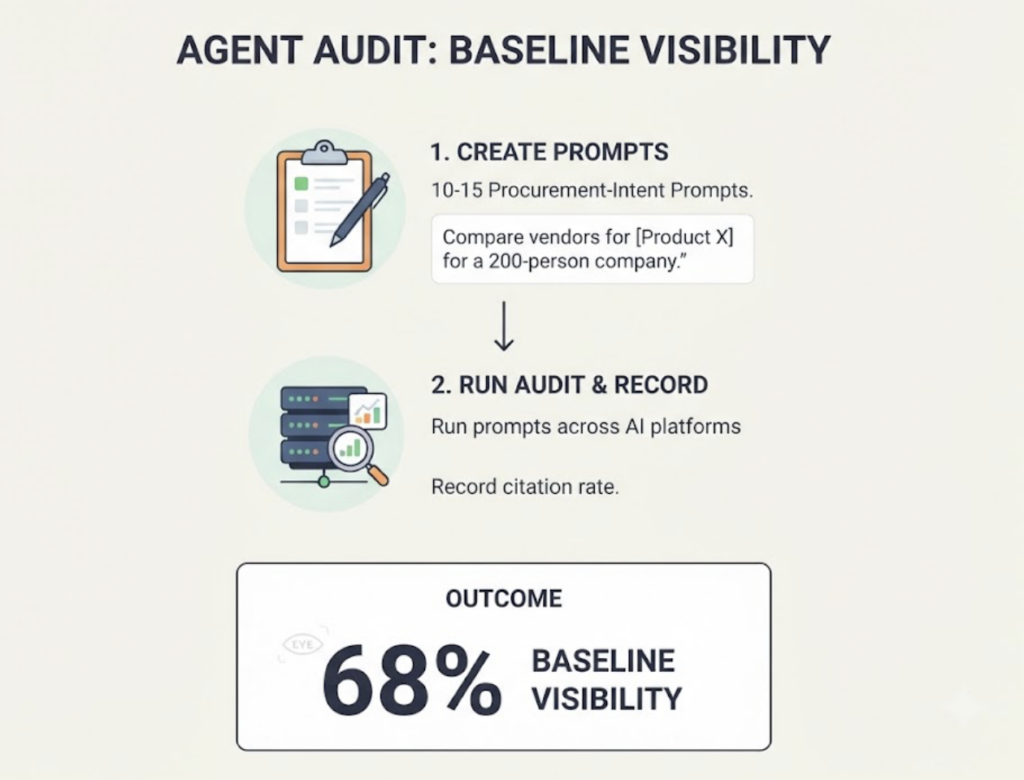
    Week 1: Run an agent audit. Write 10-15 procurement-intent prompts your real buyers would delegate. Think “compare top vendors for X and recommend one for a 200-person company,” not “what is X.” Run them across AI platforms and record your citation rate. This is your baseline visibility number.
    Week 2: Audit your sources. Identify which domains AI answers cite for your category. Check whether you’re present on those domains, then flag the gaps where competitors appear and you don’t. This becomes your earned-media target list.

    Week 3: Fix machine-readability. Add structured data, build comparison-ready feature matrices, and publish documentation agents can parse. Prioritize the pages that answer buying questions directly.

    Week 4: Set up continuous monitoring. Agent behavior shifts every time models update, and GPT-5.6 just proved how fast that happens. Get started with ongoing tracking so a visibility drop shows up in your dashboard the week it happens, not the quarter after deals go quiet.

    Conclusion

    The ChatGPT 5.6 launch didn’t just give buyers a better chatbot. It gave them a researcher who works for free, never gets tired, and never clicks your ads. In that environment, brand visibility stops being a marketing metric and becomes a survival condition for B2B pipelines.

    The brands that adapt first will treat agent visibility the way they once treated search rankings: measured weekly, benchmarked against competitors, and tied to revenue. Start with the baseline audit. You can’t win a shortlist you can’t see.

    FAQ

    Q: What is ChatGPT Work and how is it different from regular ChatGPT? 

    A: ChatGPT Work is an autonomous agent launched by OpenAI on July 9, 2026. Unlike the chat interface, it executes multi-step projects over hours, connects to apps like Slack, Gmail, and CRMs, and uses a built-in browser to research and produce finished deliverables such as reports and vendor shortlists.

    Q: Does GPT-5.6 change how AI recommends B2B brands? 

    A: Yes. GPT-5.6 powers longer, more autonomous research runs, including an ultra mode that coordinates four parallel agents. That means more retrieval passes per buying question and more weight on consistent, well-sourced brand coverage rather than any single high-ranking page.

    Q: How do I know if AI agents mention my brand? 

    A: Agent activity doesn’t show up in web analytics, so you need direct measurement. Run procurement-intent prompts across AI platforms to establish a baseline citation rate, or use an AI visibility platform like Topify to track mentions, sentiment, and cited sources continuously.

    Q: What is agentic search optimization? 

    A: It’s the practice of improving your brand’s probability of being cited in AI agent research outputs. Core levers include machine-readable content, comparison-ready documentation, third-party authority signals, and continuous visibility tracking across AI models.
    Read More

  • GPT 5.6 Sol vs Terra vs Luna: Which Model Shapes AI Search and GEO

    GPT 5.6 Sol vs Terra vs Luna: Which Model Shapes AI Search and GEO

    Ask ChatGPT a question about your product category today, and the answer depends on something most marketing teams never check: which model is actually doing the answering. A free user, a Plus subscriber, and a developer calling the API can each get responses generated by different models, with different reasoning depth and different citation habits. Your brand might appear in one answer and vanish from the next, for the exact same prompt. If your visibility reports still treat “ChatGPT” as a single engine, you’re now measuring an average of three.

    Your Customers Aren’t All Talking to the Same ChatGPT

    With GPT-5.6, OpenAI formalized something that had been true informally for a while: ChatGPT is a family of models, not one model. In the new naming system, the number identifies the generation, while Sol, Terra, and Luna identify durable capability tiers that advance on their own schedules.

    Sol is the flagship, built for complex reasoning, research, and long-running work. Terra is the balanced everyday model, positioned as competitive with GPT-5.5 at roughly half the cost. Luna is the fast, low-cost tier for high-volume tasks.

    Here’s the part that matters for marketers. According to OpenAI’s Help Center, Sol powers the Medium, High, and Extra High reasoning options on eligible paid ChatGPT plans, while GPT-5.5 Instant remains the default for fast everyday responses. Terra and Luna aren’t selectable in standard ChatGPT conversations at all. They serve ChatGPT Work, Codex, and the API, where free and Go users get Terra and paid users choose among all three.

    Your customers are distributed across that entire matrix. And each cell of the matrix can describe your brand differently.

    GPT-5.6 Sol, Terra, and Luna at a Glance

    The family moved from limited preview to general availability in early July 2026, and it’s already rolling out across third-party surfaces like GitHub Copilot. Here’s how the three tiers compare on the dimensions a GEO team actually cares about.

    DimensionSolTerraLuna
    PositioningFlagship, frontier reasoningBalanced everyday workFast and cost-efficient
    API pricing per 1M tokens$5 input / $30 output$2.50 input / $15 output$1 input / $6 output
    Where users meet itChatGPT reasoning modes on paid plans, API, CodexChatGPT Work free tiers, Codex, APIHigh-volume API workloads, latency-sensitive apps
    Typical query typeComplex research, comparisons, due diligenceEveryday professional questionsQuick lookups, embedded assistants
    GEO implicationDeep source cross-referencing, harder to earn a citationThe baseline for most professional brand queriesLeans on top-ranked sources and probabilistic memory

    Two details from the launch are worth flagging. Sam Altman told CNBC the new flagship is 54% more token efficient on agentic coding, which signals OpenAI is optimizing for models that read more and generate less filler. And tier labels don’t guarantee behavior on any single task: on Terminal-Bench 2.1, Luna actually outscored Terra despite sitting a tier below it.

    That second point is the whole story in miniature. Tier names describe an average trade-off, not a promise about how any specific query gets answered.

    Why Model Tiers Reshape Your Brand’s AI Search Visibility

    Brand visibility in AI search isn’t a static ranking anymore. It’s a dynamic outcome of the model’s reasoning architecture, and the three GPT-5.6 tiers reason differently.

    Research into LLM behavior suggests that higher-reasoning models like Sol show a greater tendency to cross-reference multiple sources before committing to a claim. Efficiency-optimized models like Luna lean more heavily on probabilistic memory and top-ranked search results. The practical consequence: if your brand dominates traditional search but lacks deep, authoritative documentation, you’re more likely to be cited by Luna and ignored by Sol.

    The reverse pattern exists too. A niche brand with rigorous technical content but weak conventional SEO can surface in Sol’s carefully reasoned answers while staying invisible in Luna’s fast ones.

    That’s the gap a single “ChatGPT visibility” number can’t show you.

    There’s also a generational effect. Every model rollout updates the underlying weights, which creates what amounts to a visibility baseline reset. Training preferences shift, sometimes away from high-authority aggregator sites and toward high-relevancy niche expert content. GPT-5.6 also shows improved intent interpretation, which tends to reward brands publishing clear problem-solution content over pages built on generic keyword density.

    What Happens to Brand Mentions When the Model Updates

    The transition from GPT-5.5 to 5.6 is exactly the kind of moment where brand mentions drift without anyone on your team touching a single page.

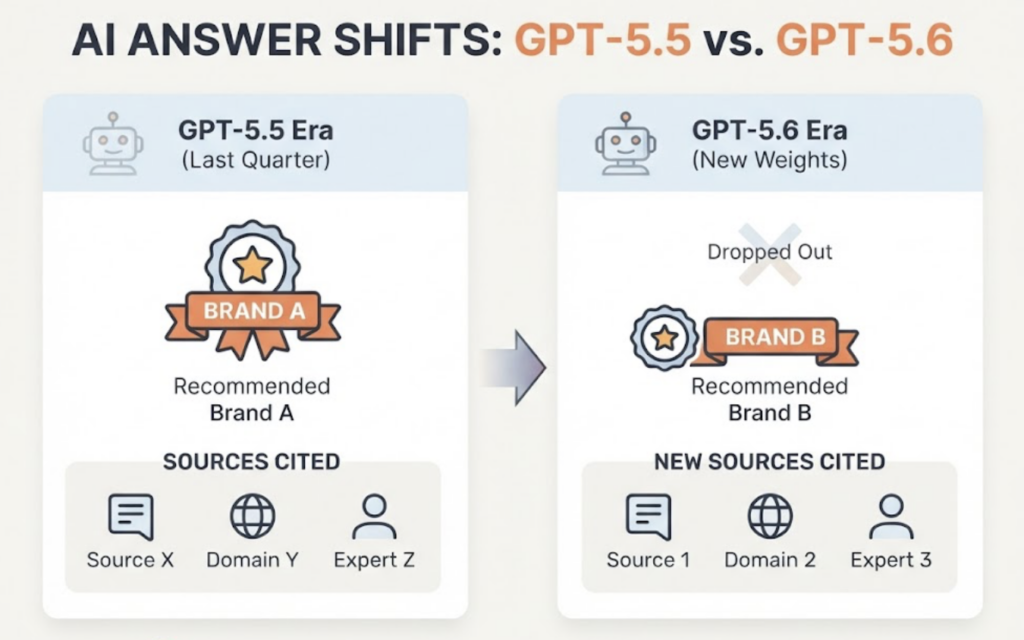
    A brand that GPT-5.5 reliably recommended can drop out of GPT-5.6 answers because the new weights favor different source categories. The citations behind AI answers shift too: domains that AI models cited last quarter may stop appearing, while new expert sources take their place. None of this registers in Google Search Console, because none of it happens in Google.

    What makes the 5.6 transition different from previous updates is fragmentation. Because Sol, Terra, and Luna can return different sources for the exact same prompt, measuring brand visibility without segmenting by model produces misleading data. An aggregate mention rate might look stable while your presence in Sol, the tier your highest-value enterprise buyers reach through paid plans and the API, quietly erodes.

    The black box didn’t just get a new version. It split into three boxes.

    How to Track Your Visibility Across GPT-5.6 Sol, Terra, and Luna

    The capability you need now is prompt-level, model-aware monitoring: the ability to run the same set of high-intent prompts on a recurring schedule and see how mentions, positions, and cited sources differ across models and change over time.

    For teams building that capability, Topify approaches the problem as a matrix rather than a single feed. Its Visibility Tracking measures how often your brand appears in AI answers across ChatGPT, Gemini, Perplexity, DeepSeek, and other major platforms, so a shift inside one engine doesn’t get averaged away by stability in another. Position Tracking shows where you land relative to competitors when you do appear, which matters because a move from first mention to fourth is invisible in a simple mention count.

    The layer most relevant to a model transition is Source Analysis. It reverse-engineers the exact domains and URLs that AI platforms cite, so when your mention rate dips after a rollout, you can trace it to the specific sources that stopped carrying your brand and target replacements. In practice, that turns “our AI visibility dropped” from a mystery into a content brief.

    If you want to gauge your starting point before committing to continuous tracking, Topify also maintains a set of free GEO tools that cover quick checks like GEO scoring and visibility snapshots.

    A 3-Step GEO Playbook for the GPT-5.6 Transition

    Model transitions reward teams that move early, because the baseline you capture now becomes the reference point for every drift measurement later.

    Step 1: Establish a multi-model benchmark. Run a snapshot audit across the tiers your audience actually uses, built on 50 to 100 high-intent category-level prompts. Record your citation rate, average position, and cited sources for each. This is your pre-drift baseline.

    Step 2: Map your content gaps by tier. Look for asymmetries. Present in high-volume answers but missing from complex ones usually means your content lacks the technical depth a flagship reasoning model wants before it cites you. The fix tends to be documentation-grade content: methodology pages, original data, detailed comparisons.

    Step 3: Monitor for drift continuously. One audit is a photo; GEO needs video. Track the statistical decline or gain in mentions after each model update, and feed what you learn back into your schema and content pillars. Teams that get started with ongoing tracking before the next generation ships will know exactly what changed. Teams that don’t will be guessing.

    Conclusion

    GPT-5.6 ends the era of optimizing for “ChatGPT” as a single destination. Sol, Terra, and Luna reason differently, cite differently, and reach different segments of your audience, from free-tier users on Terra to enterprise buyers running Sol through the API. Your brand’s reputation is now being synthesized by three distinct compute classes at once.

    The strategic response isn’t complicated, but it is urgent: establish a per-model visibility baseline now, find the tiers where your brand goes missing, and put continuous monitoring in place before the next weight update resets the board again. Don’t optimize for the search engine. Optimize for the reasoner.

    FAQ

    Q: What’s the difference between GPT-5.6 Sol, Terra, and Luna? 

    A: They’re capability tiers within one generation. Sol is the flagship for complex reasoning at $5/$30 per million tokens, Terra is the balanced everyday model at $2.50/$15, and Luna is the fast, low-cost tier at $1/$6. The generation number advances together; each tier evolves on its own cadence.

    Q: Does GPT-5.6 change how ChatGPT recommends brands? 

    A: It can. New model weights shift source preferences and citation patterns, and GPT-5.6’s improved intent interpretation tends to favor clear problem-solution content. Brands often see mention rates move after a rollout even when their own content hasn’t changed.

    Q: Which GPT-5.6 model do most ChatGPT users actually encounter? 

    A: In standard ChatGPT conversations, Sol powers the reasoning modes on eligible paid plans while GPT-5.5 Instant remains the fast default. Terra serves free and Go users in ChatGPT Work and Codex, and all three tiers are available through the API.

    Q: How do I track my brand’s visibility in ChatGPT 5.6? 

    A: Run a fixed set of high-intent prompts on a recurring schedule and measure mentions, positions, and cited sources over time, segmented by model where possible. Platforms like Topify automate this across ChatGPT, Perplexity, Gemini, and other engines, with source-level analysis to explain why visibility changed.

    Read More

  • How to Track Your Brand Mentions in ChatGPT 5.6 and GPT’s New Models

    How to Track Your Brand Mentions in ChatGPT 5.6 and GPT’s New Models

    The mention baseline your team built over the past year of GPT-5.5 monitoring stopped meaning anything on July 9, 2026. That’s when OpenAI publicly released GPT-5.6 after a two-week government review period, replacing a single model with three tiers named Sol, Terra, and Luna. Different retrieval behavior, a refreshed knowledge base, and a new user distribution across tiers mean the question “does ChatGPT mention my brand” now has at least three different answers. This guide walks through how to rebuild your tracking system for the new model family, starting today.

    GPT-5.6 Just Reset Your Brand’s AI Visibility Baseline

    Model generation changes don’t just improve text quality. They reshuffle training data, retrieval strategies, and recommendation logic, which are the exact mechanisms that decide whether your brand gets named in an AI answer.

    The GPT-5.6 rollout came with unusual friction. OpenAI launched a limited preview on June 26 restricted to government-approved partners, then received clearance for a full public release after additional testing by the Department of Commerce. Fourteen days later, the models reached everyone.

    Your GPT-5.5 mention data is now a historical record, not a benchmark.

    What makes this generation different for brand tracking is the tier structure. GPT-5.6 isn’t one interface. It’s three models with different reasoning depth and different cost profiles, per pricing confirmed by OpenAI:

    ModelPositioningInput Cost per 1M TokensOutput Cost per 1M Tokens
    GPT-5.6 SolFlagship, maximum reasoning, built for long-horizon agentic work and complex analysis$5.00$30.00
    GPT-5.6 TerraBalanced default, performance comparable to GPT-5.5 at roughly half the cost$2.50$15.00
    GPT-5.6 LunaLow-latency, lowest-cost tier for high-volume basic tasks$1.00$6.00

    Pricing shown is subject to change; refer to OpenAI’s official pricing page for current rates.

    An enterprise buyer running deep research through Sol and a free user getting a quick summary from Terra are querying two different neural networks. Your brand’s visibility can diverge sharply between them.

    What Changed in ChatGPT 5.6 That Affects Brand Mentions

    The naming system itself changes who sees what. The number marks the generation, while Sol, Terra, and Luna mark persistent capability tiers. Free and Go users default to Terra. Plus, Pro, Business, and Enterprise subscribers can select Sol at medium and higher reasoning effort, with a Sol Pro option reserved for Pro and Enterprise plans.

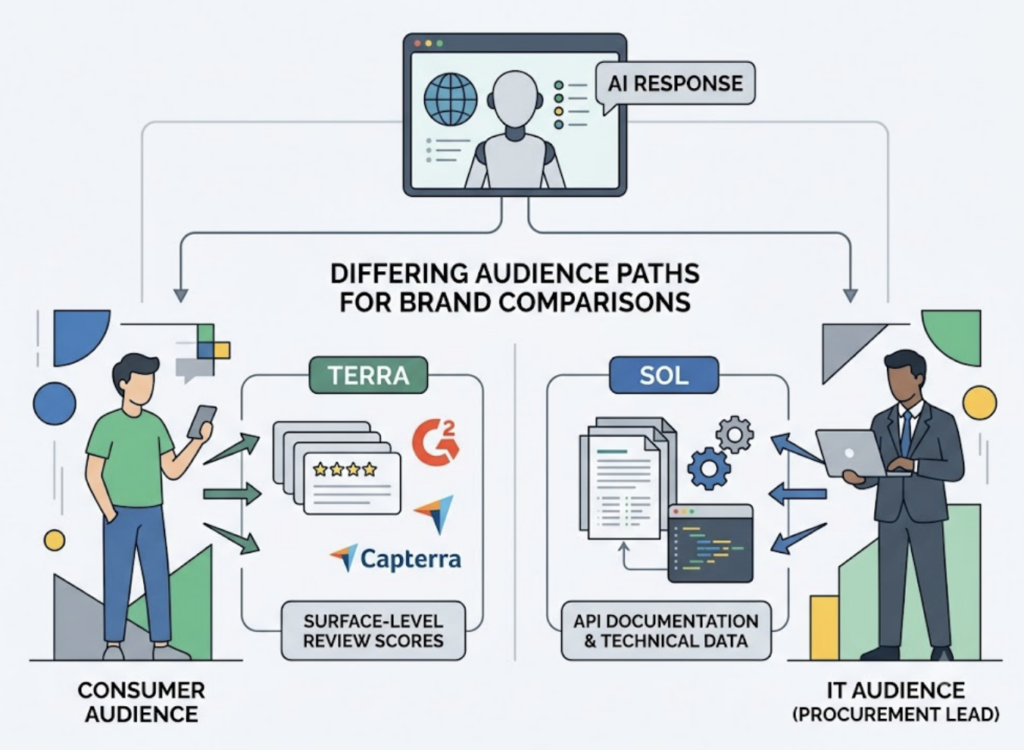
    In practice, that splits your audience. When a consumer and an IT procurement lead ask ChatGPT the same brand comparison question, Sol may dig through your API documentation and recent technical discussions, while Terra tends to synthesize surface-level review scores from sites like G2 or Capterra.

    Terra’s economics create a second-order effect that matters even more. Because Terra roughly matches GPT-5.5 performance at half the API cost, third-party applications, CRMs, and vertical SaaS platforms have a strong incentive to migrate their language layer to it. Your brand’s exposure surface extends well beyond the ChatGPT interface into every product that embeds the API.

    There’s also a shift in what a “mention” even is. GPT-5.6 powers a new agent that works across connected apps and filesto produce documents, spreadsheets, and presentations. Sam Altman told CNBC the model is 54% more token efficient on agentic coding tasks, which gives it room to compare more options, fetch more sources, and verify claims before writing. If an agent drafting a 30-page vendor evaluation skips your brand because your data isn’t extraction-friendly, that lost mention never shows up in any chat log you can spot-check.

    Step 1: Establish Your New Mention Baseline Across Sol, Terra, and Luna

    Start by defining a prompt universe that reflects how buyers actually ask, not how your brand describes itself. Three categories cover most commercial intent.

    Category queries test unprompted recall: “recommend a scalable expense platform for a fast-growing B2B software team.” Comparison queries test head-to-head framing: “compare Competitor A and Competitor B for high-concurrency workloads,” where the useful signal is whether the model introduces your brand as a third option. Pain-point queries map directly to buying triggers: “how do I fix database sync failures caused by cross-region latency, and what enterprise tools handle this.”

    A working set runs 100 to 250 prompts. Then comes the part most teams underestimate: every prompt needs to run against all three tiers, because the same question produces materially different answers at different reasoning depths.

    Luna, constrained by minimal reasoning budget, tends to output the most conservative, high-frequency brand lists. Terra balances name recognition against feature fit. Sol, especially at higher effort settings, pulls recent technical reviews and community discussions into its answer, consistent with the deep-retrieval behavior OpenAI describes in its Sol preview documentation.

    LLM outputs are also non-deterministic, so a single run per prompt proves nothing. At the scale of hundreds of prompts, multiple samples, three tiers, and a weekly cadence, manual checking is arithmetic you lose. Platforms like Topify handle this with automated Visibility Tracking, parsing thousands of AI answers per month (up to 9,000 on the entry plan) so the noise averages out and a statistically usable baseline emerges.

    Step 2: Compare Pre- and Post-5.6 Visibility Data

    With a fresh baseline in hand, run it against your GPT-5.5 era numbers. The comparison needs four dimensions, not one.

    Visibility rate tells you whether the brand entered the model’s consideration set at all. Position tells you whether you’re the lead recommendation or an afterthought at the end of a list, and the commercial gap between those two placements is enormous. Sentiment decodes the framing around your mention: endorsement, neutral description, or a caveat. Citation share reveals which sources produced the mention in the first place.

    If your mention rate dropped 20% overnight, the model changed, not your brand.

    That distinction matters because the instinct after a data cliff is internal blame: the content team, the last PR cycle, the product page. Generation changes are the more likely cause, and the fix is different.

    Here’s how the layered view plays out. Suppose an enterprise finance platform led most GPT-5.5 comparisons as “the most comprehensive option.” After the switch to Sol, Position Tracking shows it slipping to second while Sentiment Analysis flags a decline. Digging into the answer context reveals Sol picked up developer forum threads about API latency and started appending a caveat: strong feature set, but a potential concern for high-frequency API users. That’s a specific, fixable narrative problem. You can update technical documentation and address the community discussion before the caveat hardens into machine consensus. Without tier-level position and sentiment data, you’d never know which thread to pull.

    Step 3: Trace Which Sources GPT-5.6 Actually Cites

    Mention changes have causes, and the causes live in the citation layer. New model generations typically refresh both the training corpus (GPT-5.6’s knowledge reportedly extends to February 2026) and the weighting of live retrieval sources.

    Traditional SEO signals won’t guide you here. Industry analyses of citation behavior suggest the domains LLMs cite overlap very little with Google’s first page, with ChatGPT’s overlap against top-10 organic results reported as low as roughly 2%, and even search-leaning Perplexity around a third. Holding your SERP position is not a strategy for holding AI visibility.

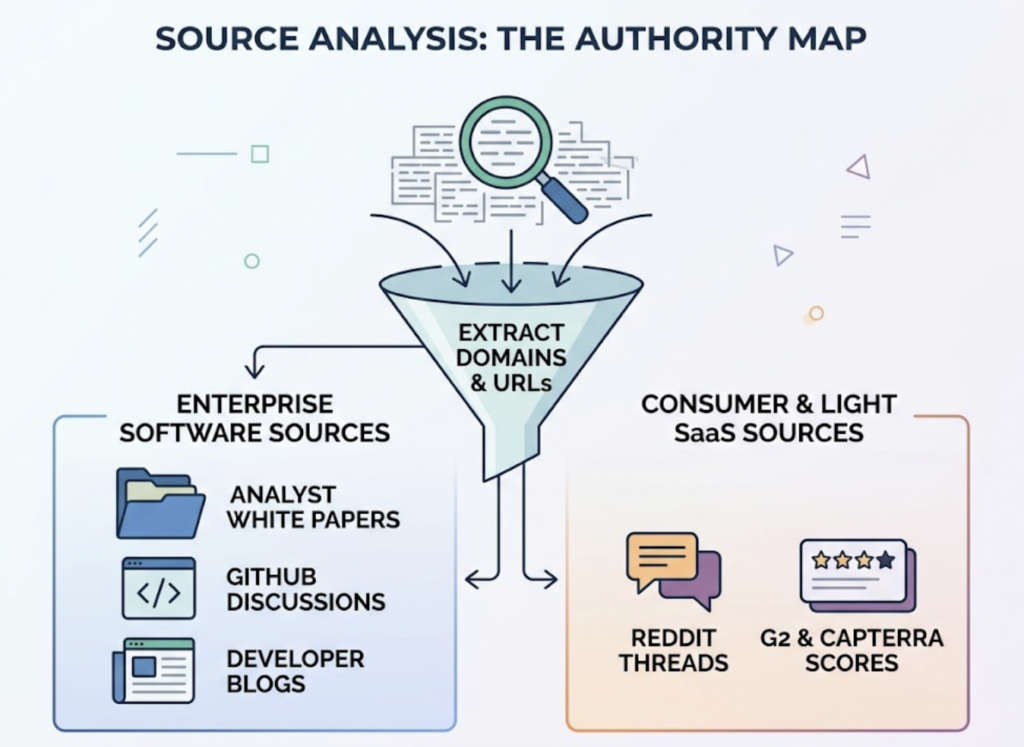
    Source Analysis inverts the problem. Instead of guessing what the model reads, you extract the actual domains and URLs behind each brand mention. The pattern that emerges is usually a new authority map: for enterprise software, GPT-5.6 tends to weight GitHub discussions, analyst white papers, and in-depth developer blogs. For consumer and lightweight SaaS categories, Reddit threads and structured review scores on G2 or Capterra often do the heavy lifting.

    Once the map is visible, budget allocation gets simple. If Terra’s answers for your core category query lean on five specific review sites and you appear on two, the next quarter’s priority isn’t more blog volume. It’s closing the three missing placements through outreach, partnerships, or fresher data those sites can use. Cover the sources the model trusts, and the next retrieval cycle works in your favor.

    Common Mistakes When Tracking Brand Mentions in a New Model

    Three failure patterns show up repeatedly when teams respond to a model transition.

    The first is testing only the flagship tier. Sol’s benchmark results are impressive (Sol Ultra scores 91.9% on Terminal-Bench 2.1), and it’s tempting to treat it as the definitive judge of your brand. But Terra carries the free-user base and the third-party API ecosystem. A brand that wins Sol’s deep analysis while staying invisible in Terra’s everyday answers has won a small audience of power users and lost the mainstream.

    The second is replacing continuous monitoring with a one-time audit. A big launch-week test produces a satisfying report, and then the tracking stops. Model outputs drift constantly as OpenAI fine-tunes, caches reset, and competitors publish. Without a time series, you can’t tell whether next week’s ranking dip is random noise or a real share shift caused by a competitor’s PR push.

    The third is misattributing drops to your own content quality. When visibility shrinks on key prompts, the reflex is to question the content team’s output. More often, the new model has reweighted its sources, demoting a press release site you relied on and promoting a developer forum you’ve ignored. Unless you connect the mention drop to a specific citation change, the internal blame cycle burns morale and points optimization at the wrong target.

    Why Manual Spot-Checks Break Down at GPT-5.6 Scale

    The old habit of opening a few browser tabs and typing your category keywords worked, barely, when there was one model behind one interface. The math no longer allows it.

    A minimally useful monitoring program covers 100 prompts. Non-determinism requires around 5 samples per prompt. Three tiers multiply that again, and a weekly cadence adds the time axis. That’s tens of thousands of long-form answers per month to collect, read, and score for position, sentiment, and hidden citations. No team does that by hand.

    This is where structured monitoring platforms earn their place. Topify’s Comprehensive GEO Analytics breaks every AI answer into seven metrics: Visibility, Mentions, Position, Sentiment, Volume, Intent, and CVR, which estimates how likely an answer is to drive actual brand engagement. Instead of a raw mention count, you get a profile of how the algorithm perceives your brand and where the leverage points are.

    Coverage matters as much as depth. Buyer journeys don’t stay inside one model family, and Topify tracks the GPT-5.6 lineup alongside Gemini, Perplexity, DeepSeek, and Doubao from a single dashboard. That cross-platform view is often where teams find arbitrage: a category where competitors dominate ChatGPT but nobody has claimed Perplexity yet.

    The entry cost is modest relative to the stakes. The Basic plan runs $99 per month with 100 tracked prompts, 9,000 monthly AI answer analyses, and a 30-day trial, which is enough to run the full three-step process in this guide before committing budget. You can get started here and have a Sol-Terra-Luna baseline within the trial window.

    Conclusion

    GPT-5.6 isn’t an incremental update for brand teams. The Sol, Terra, and Luna split means AI visibility is now tier-specific, the third-party migration to Terra extends your exposure surface beyond ChatGPT itself, and agent workflows turn mentions into something that happens inside documents you’ll never see.

    The response is a process, not a panic: rebuild your prompt baseline across all three tiers this week, compare the four core metrics against your GPT-5.5 history, and trace mention changes back to specific citation shifts before touching your content budget. Teams that establish the new baseline in the first month of a model generation get a reference point their competitors won’t have.

    FAQ

    Q: Does GPT-5.6 use different sources than GPT-5.5? 

    A: Yes, and the difference is significant. Beyond the refreshed knowledge cutoff, GPT-5.6’s upgraded retrieval and tool-calling behavior favors technically substantive, well-structured sources with independent verification signals over thin marketing pages. The citation set that earned your brand mentions under GPT-5.5 may be largely replaced, which is why source-level analysis should come before any content changes.

    Q: Which GPT-5.6 model should I track first, Sol, Terra, or Luna? 

    A: Track Sol and Terra in parallel. Sol drives the recommendations that paid subscribers, executives, and research agents see. Terra serves free users and the growing set of third-party apps built on its cheaper API. Missing either one gives you a distorted picture. Luna is a secondary check for latency-sensitive, high-volume use cases.

    Q: How often should I check brand mentions after a model update? 

    A: Run high-density sampling for roughly the first two weeks after a major release to establish the new baseline, then shift to weekly monitoring. Because model outputs are stochastic, single spot-checks carry no statistical weight; trend lines over time are what separate real ranking shifts from noise.

    Q: Can I track brand mentions in ChatGPT for free? 

    A: You can query ChatGPT manually at no cost, but manual checks can’t control for context, can’t sample at volume, and can’t reach Sol if you’re on a free plan. For decision-grade data across tiers, a platform trial is the practical free option; Topify’s Basic plan includes a 30-day trial covering position, sentiment, and citation tracking.

    Read More

  • ChatGPT 5.6 vs Claude Fable: Which AI Cites Your Brand More?

    ChatGPT 5.6 vs Claude Fable: Which AI Cites Your Brand More?

    Your team spent the last year building domain authority and defending page-one rankings. Then on July 9, OpenAI shipped ChatGPT 5.6, and every assumption baked into those rankings quietly reset. A model generation change isn’t a feature update. It’s a reshuffle of which sources get trusted, which brands get named, and which get filtered out of the buyer’s consideration set entirely. Most teams won’t notice until high-intent traffic dips weeks later, with nothing in their SEO dashboard to explain why.

    GPT-5.6 Just Dropped. Your Brand’s AI Visibility May Have Already Shifted.

    On July 9, 2026, OpenAI moved GPT-5.6 to general availability across ChatGPT, Codex, and the API. Instead of a single model, it’s a three-tier family: Sol, the flagship for complex reasoning and long-horizon agent workflows; Terra, a balanced everyday model that matches GPT-5.5 performance at roughly half the cost; and Luna, a speed-focused variant priced around $1 per million input tokens. All three carry a one-million-token context window and a refreshed knowledge cutoff of February 2026.

    For marketers, the headline isn’t the benchmarks. It’s what the architecture implies about sourcing.

    Sol introduces a max reasoning effort setting and an Ultra mode that coordinates multiple sub-agents on deep research tasks. A model that spends more compute verifying facts behaves less like a summarizer and more like an analyst. It cross-references technical documentation, structured datasets, and dense third-party evaluations rather than skimming marketing copy. If your brand’s footprint in those machine-readable sources is thin, your visibility in GPT-5.6’s long-form answers has likely already slipped, whether or not anyone on your team has checked.

    How ChatGPT 5.6 and Claude Fable Decide Which Brands to Cite

    GPT-5.6 and Anthropic’s Claude Fable 5 sit at the top of the same market, but they hold different philosophies about what counts as a trustworthy source. That difference, more than any benchmark score, determines which brands each model names.

    What GPT-5.6 Pulls From the Web

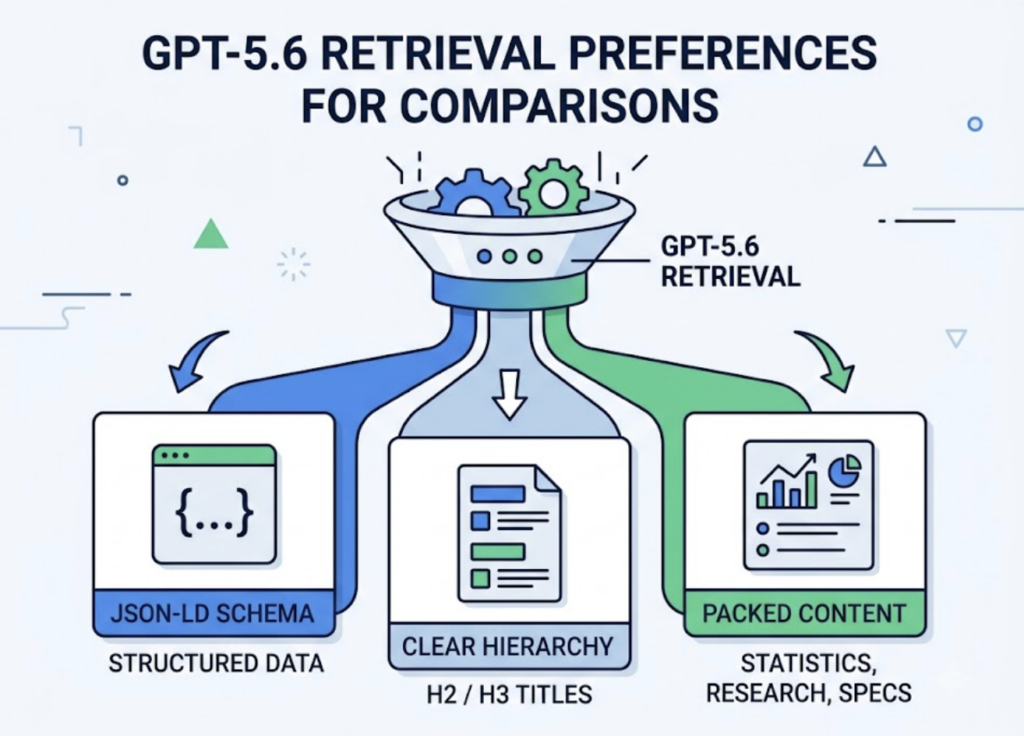
    When a prompt involves brand comparisons or product recommendations, GPT-5.6 shows a strong appetite for structured, official, high-density information. Its retrieval behavior favors pages with clean JSON-LD markup (FAQPage, Product, Article schemas), clear H2/H3 hierarchies, and content packed with specific statistics, recent research, and precise specifications.

    In practice, this rewards brands whose sites read like reference material. A pricing page that answers “how much does it cost” in one extractable sentence beats a persuasion-heavy landing page. Content built on keyword volume alone, without factual anchors an agent can lift and verify, tends to get scored as low-information and dropped from the synthesis.

    How Claude Fable Handles Brand Mentions

    Claude Fable 5 leans the opposite way. Anthropic’s flagship runs with adaptive thinking enabled by default and some of the strictest safety alignment in the industry, which translates into visible skepticism toward commercially biased content, including a brand’s own marketing pages.

    The data backs this up. Yext’s Q4 2025 analysis of 17.2 million AI citations found that Claude relies on user-generated content, reviews and social media the study classifies as “limited control” sources, at rates 2 to 4 times higher than competing models across every sector studied. In food and beverage, limited-control sources reached 24.4% of Claude’s citations. In business services, 15.89%, more than double the peer average.

    Ask Claude Fable how an enterprise tool actually performs, and it tends to route around the vendor’s homepage entirely, pulling instead from G2 threads, Reddit discussions, and independent reviewers. Verified crowd consensus reads as safer than a single company’s claims.

    There’s a deeper pattern underneath both behaviors, one that recent academic work on generative AI and brand visibility calls the ranking-mention separation. Studies of AI citation behavior suggest a large majority of cited sources come from outside Google’s top ten results, with traditional organic ranking showing near-zero correlation with citation probability. Ranking well is not the same as getting cited. Getting cited is not the same as getting named as the recommendation.

    That’s the gap most brands still can’t see.

    The Citation Gap: Same Question, Different Brands

    Feed both models the same high-intent prompt, something like “compare the top customer success platforms for a fast-scaling startup,” and the outputs split along predictable lines. Neither model hallucinates. They just trust different corners of the internet.

    DimensionGPT-5.6 SolClaude Fable 5
    Preferred sourcesOfficial docs, analyst reports, schema-rich reviewsG2/TrustRadius aggregates, Reddit threads, independent blogs
    Brands surfaced4-5 brands in a structured grid by size and feature set2-3 brands with the strongest community consensus, analyzed in depth
    What wins position oneHigh fact density on owned pages, recent coverage in major outletsBroad validation in communities, with complaints limited to non-fatal flaws
    Sentiment styleNeutral, capability-focused statementsDirect relay of user praise and pain points, clearly polarized

    Two of these rows deserve extra attention. First, position rank barely transfers between systems: a brand that GPT-5.6 puts first can be absent from Claude’s answer entirely, because the SEO moat that impresses one model is invisible to the other. Second, Claude’s sentiment behavior creates what you might call a negative visibility trap. A brand that gets mentioned often but framed by community complaints can be worse off than a brand that isn’t mentioned at all.

    You Can’t Optimize for a Model You’re Not Measuring

    The most common response to all this is also the least useful one: a marketer types their brand name into ChatGPT a few times, sees something positive, and closes the tab reassured. Ad-hoc spot checks can’t capture how answers shift with temperature, prompt phrasing, retrieval cache refreshes, or model updates. One sample is not a signal.

    Systematic, cross-model measurement is the actual prerequisite. Buyers move between ChatGPT, Claude, Perplexity, and Google AI Overviews within a single research cycle, so a brand’s real AI presence is the composite across all of them. This is where a platform like Topify fits: it tracks visibility, sentiment, and position across major AI engines from one dashboard, then reverse-engineers the source domains each model is actually citing.

    Here’s what that looks like in practice. Your team loads 100 high-intent prompts into Topify, things like “best alternatives to [category leader]” or “[your product] security concerns.” The system samples answers across platforms on a schedule. One morning the dashboard flags a divergence: visibility in GPT-5.6 is holding at 85%, but your recommendation position in Claude Fable dropped out of the top three overnight. Source Analysis traces it to a niche industry forum, one of those limited-control sources Claude weights heavily, where a pricing change sparked a wave of negative threads 48 hours earlier. Now you know exactly where to respond, and why it moved one model but not the other.

    That level of diagnosis rests on a handful of core metrics: visibility rate (how often you appear across your prompt set), citation share (whether AI links your own domain or talks about you secondhand), sentiment score, competitive share of voice, position rank, source attribution, and drift over time. Topify’s Basic plan covers this kind of continuous multi-engine tracking from $99 per month, which puts systematic measurement within reach of teams that were previously guessing.

    Drift is the metric to watch right now. A volatility spike in the days after a release like GPT-5.6 is your signal to run a gap analysis before the new patterns harden.

    What to Do in the First 30 Days After a Model Release

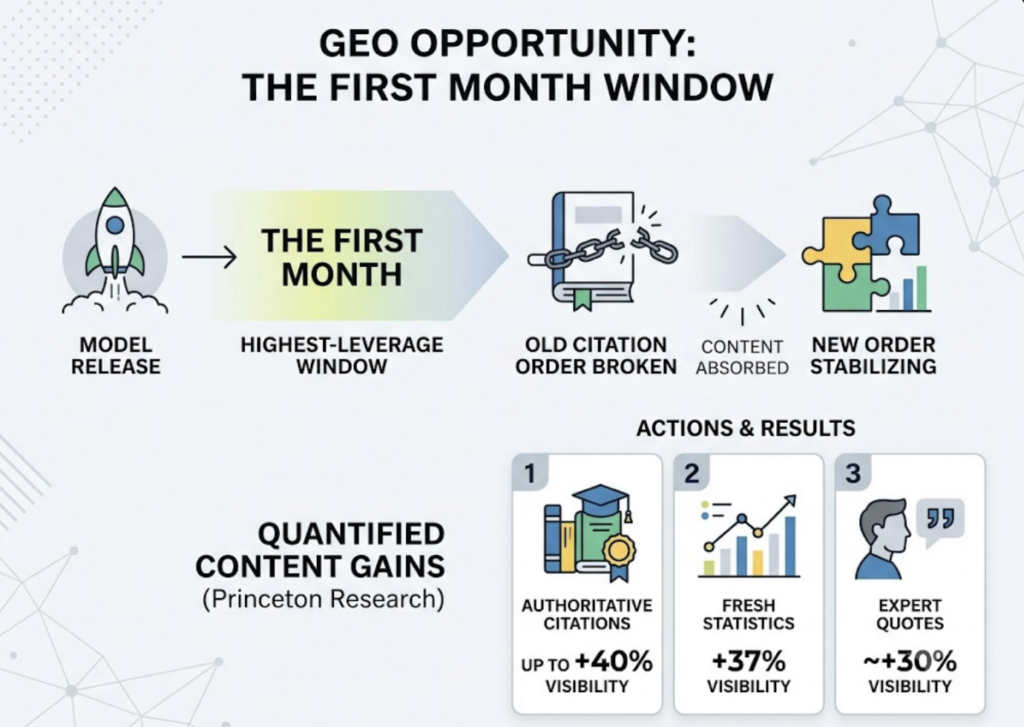
    The first month after a major model release is the highest-leverage window in GEO. The old citation order is broken, the new one hasn’t fully set, and content changes made now get absorbed as the model’s retrieval patterns stabilize. Princeton’s research on generative engine optimization quantifies what those changes are worth: adding authoritative citations lifted visibility in AI answers by up to 40%, adding fresh statistics by 37%, and adding expert quotes by around 30%.

    Here’s a sprint plan that fits the window:

    DaysFocusWhat to do
    1-7Baseline measurementRun 50-200 core prompts against GPT-5.6, the prior model, and Claude Fable. Record all metrics. Change nothing yet, so the baseline stays clean.
    8-14Source gap analysisCompare source attribution across old and new models. Which competitors did GPT-5.6 promote? Which sources that used to cite you got dropped, and is the cause missing schema or stale content?
    15-21Fact and data injectionRefresh statistics, specs, and pricing on owned pages with 2026 data. Add extractable answer blocks and FAQ modules so facts can be lifted cleanly. This targets GPT-5.6’s structured-data appetite.
    22-30Cross-model alignmentAddress Claude’s social layer. Audit recent Reddit and G2 discussions about your brand, respond officially where warranted, and publish clarifying content that third-party communities can absorb before Claude’s next retrieval pass.

    The logic behind the sequence matters more than the exact dates. Measure before you touch anything, find the gap before you fill it, and feed each model the source types it actually eats.

    Conclusion

    So which model cites your brand more, GPT-5.6 or Claude Fable? There’s no universal answer, and anyone selling you one is skipping the hard part. The outcome depends on your industry, how your digital footprint is distributed between owned pages and community discussion, and the prompts your buyers actually type. B2B brands with dense technical documentation tend to fare better in GPT-5.6’s structured retrieval. Consumer and reputation-driven categories live or die by the community sources Claude Fable weights most.

    What is universal: you can’t answer the question for your own brand without measuring both models, on the same prompts, at the same time. The ranking-mention separation means your Google position won’t tell you. Start with a baseline this week, while the post-release window is still open, and let the data decide where your optimization effort goes. You can set up your first prompt set in Topify in a few minutes.

    FAQ

    Q: Does GPT-5.6 cite brands differently from GPT-5.5? 

    A: Yes, and the shift is structural. The Sol/Terra/Luna tiering plus deeper reasoning modes means GPT-5.6 verifies more aggressively than GPT-5.5’s comparatively static extraction. It favors sources with rigorous schema markup, current statistics, and expert commentary, which pushes thin, keyword-driven pages further to the margins.

    Q: How do I track my brand’s mentions in Claude Fable? 

    A: Traditional backlink tools won’t help, because Claude leans on reviews, forums, and social discussion rather than link graphs. You need an AI response monitoring setup: a library of buyer-intent prompts sampled against Claude on a schedule, with sentiment scoring and source attribution to identify which communities are shaping the model’s framing of your brand.

    Q: Which AI platform matters more for my industry? 

    A: It follows your buyers’ behavior. Technical B2B and research-heavy categories tend to see more influence from GPT-5.6 and Perplexity, while consumer services and experience-driven categories are shaped more by Claude Fable and Google AI Overviews, which aggregate community sentiment. Run a cross-platform baseline and let measured visibility, not intuition, allocate your effort.

    Q: How often should I re-check AI visibility after a model update? 

    A: During the first 30 days after a generational release like GPT-5.6, weekly at minimum, and every 48 hours for your highest-value prompts, since retrieval patterns are still settling. After the window closes, biweekly or monthly tracking with drift alerts is generally enough to catch competitor moves and quiet model adjustments.

    Read More

  • ChatGPT 5.6 Is Here: What It Means for Your AI Search Visibility

    ChatGPT 5.6 Is Here: What It Means for Your AI Search Visibility

    You spent months building a stable brand presence in ChatGPT’s answers. Structured data, entity building, content restructuring. By late June, your mention rate finally looked predictable.

    Then OpenAI swapped out the engine underneath.

    On July 9, 2026, GPT-5.6 rolled out across ChatGPT, Codex, and the API, replacing the model that generated most of the AI answers your prospects have been reading. The citation logic, source preferences, and entity weighting your GEO strategy was calibrated against no longer exist in their previous form.

    Your GEO baseline from last month may already be obsolete.

    Unlike traditional search, which runs on a relatively stable index and link graph, generative engines are probabilistic synthesizers. Every major model generation rewrites attention patterns, training data weighting, and retrieval preferences. This article breaks down what shipped in ChatGPT 5.6, why it reshuffles brand visibility, and how to re-audit your AI search presence during the reset window.

    What Actually Shipped in ChatGPT 5.6: Sol, Terra, and Luna

    This wasn’t a routine version bump. GPT-5.6 restructures the entire model lineup, the agent workflow, and the naming system.

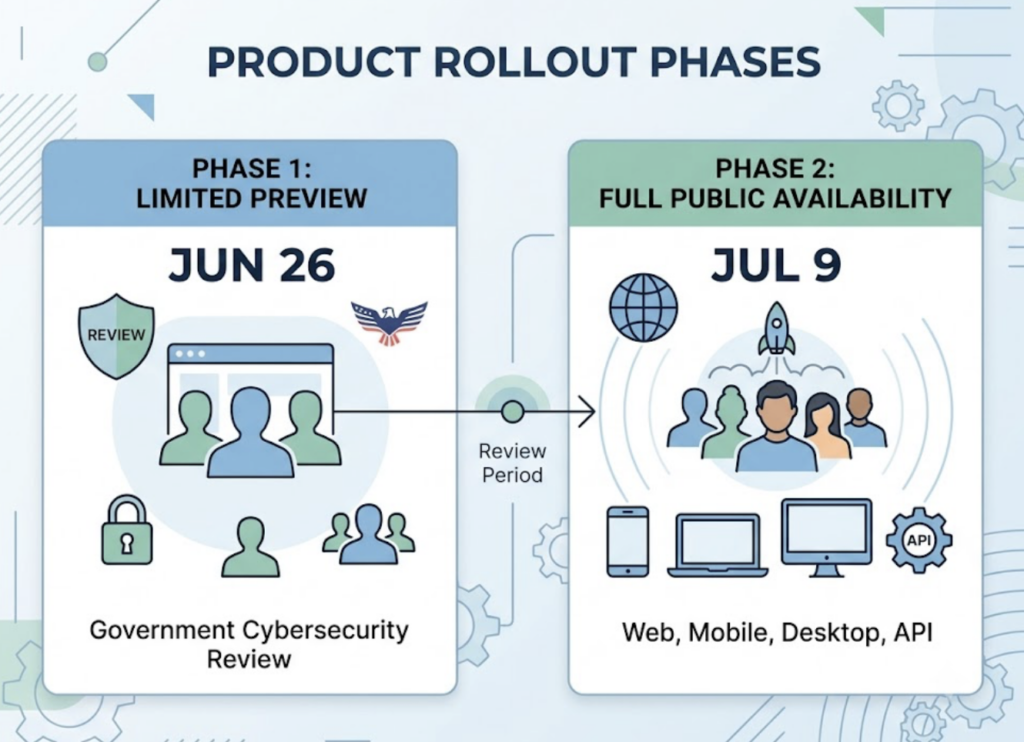
    The rollout came in two phases. OpenAI opened a limited preview on June 26 at the request of the U.S. government, which asked for a cybersecurity review period before broad release. Full public availability followed on July 9, covering web, mobile, desktop, and the API. A two-week government-coordinated review is itself a signal: this generation crosses a meaningful capability threshold in autonomous, agentic work.

    The naming system also changed. The number now marks the generation, while three durable tiers, Sol, Terra, and Luna, identify capability levels that can evolve on their own cadence.

    Model tierPositioningAPI pricing per 1M tokens, input/outputDefault usage
    SolFlagship. Complex reasoning, agentic coding, long-horizon knowledge work. Exclusive ultra mode.$5.00 / $30.00Default advanced model for Pro and Enterprise plans
    TerraBalanced. Everyday professional output at roughly half the cost of the previous flagship.$2.50 / $15.00Default model for Free and Go users
    LunaSpeed-focused. High-volume classification and extraction at the lowest cost.$1.00 / $6.00API and enterprise routing for bulk tasks

    Pricing shown reflects the OpenAI Help Center listing at launch and may change.

    On efficiency, OpenAI reports Sol is 54% more token efficient on agentic coding tasks than its predecessor. All three tiers support a context window of roughly 1.05 million tokens, which changes how much source material the model can hold and compare when synthesizing an answer.

    Two workflow additions matter as much as the models themselves. A new ultra mode lets the system spin up parallel sub-agents that divide work, cross-check each other, and merge conclusions. And ChatGPT Work, a new agent released alongside GPT-5.6, moves beyond the chat box entirely: it operates across desktop apps, connected files, and third-party tools to produce documents, spreadsheets, and research deliverables on its own.

    Why a Model Update Can Reshuffle Your Brand’s AI Search Visibility

    Generative engine optimization rests on one premise: you understand how the model retrieves, weighs, and synthesizes information. A generation change breaks that premise.

    In traditional SEO, volatility comes from algorithm tweaks to link weighting or page experience signals. In AI search, volatility comes from something deeper: a full reallocation of the model’s internal feature space. New training data. New RLHF alignment. New retrieval preferences in the RAG pipeline. All of it, replaced at once.

    The most immediate shift is at the consumer scale. Hundreds of millions of free-tier users just got hard-switched to Terra as their default answer engine. Terra’s compression logic, its tolerance for long-form content, and its preferred data sources all differ statistically from the model it replaced. The generation logic behind most consumer-facing AI answers changed overnight.

    That’s not a theoretical risk.

    Cross-platform tracking data shows that model transitions routinely produce swings beyond normal variance. In competitive software and professional service categories, shifts in source preference have moved citation gaps of up to 34% between rivals during a single model transition. And the disconnect between traditional SEO strength and AI visibility is well documented: in large-scale tracking, 88% of URLs cited by AI engines didn’t appear in the top 10 organic results for the same queries, with a correlation coefficient of just 0.034 between organic rank and AI citation.

    Betting your GPT-5.6 visibility on your Google rankings is betting on a relationship that barely exists. When millions of buyers ask Terra or Sol for a shortlist this week, a fresh set of judgment criteria decides who makes it.

    Three Shifts in GPT-5.6 That Matter for GEO

    Beyond the engine swap, three capability changes reshape how brands get cited and recommended.

    Design Judgment and Computer Use Change What Gets Cited

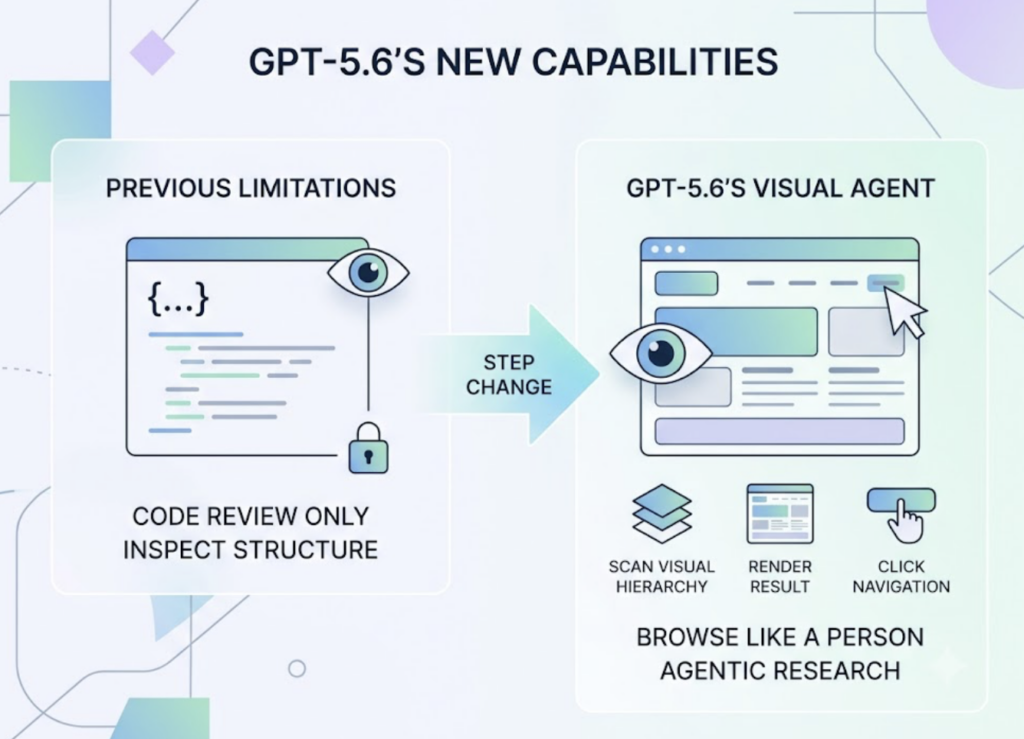
    Previous generations read your site as text and markup. If your Schema.org tags were clean, a broken layout didn’t matter much.

    GPT-5.6 changes that. OpenAI describes a step change in design judgment, paired with stronger computer-use skills that let the model inspect the rendered result, not just the underlying code. In agentic research tasks, the model can browse a page in a virtual environment the way a person would: rendering it, scanning the visual hierarchy, clicking through navigation.

    The implication for GEO is direct. A source that renders poorly, breaks on interaction, or buries its key claims in cluttered layouts can now lose trust scoring during evaluation, even with perfect structured data underneath. Visual quality is becoming an authority signal, not just a UX concern.

    ChatGPT Work Pulls Answers From Connected Apps, Not Just the Web

    Brand visibility used to be a public-web contest. ChatGPT Work breaks that boundary.

    Through its connector ecosystem, the agent can retrieve context from Slack, Teams, Google Drive, SharePoint, and CRM platforms alongside web search. When a buyer asks “which vendors should we shortlist for the Q3 security audit,” the agent doesn’t just query the open web. It scans internal chat threads, past evaluation memos, and shared analyst briefs, then cross-references that internal consensus against public sources.

    For B2B brands, this restructures the goal. Winning external search mentions is no longer sufficient. The brands that get recommended will be the ones whose whitepapers, templates, and benchmark data have already penetrated the buyer’s internal knowledge base. If your name shows up in their Slack, it shows up in their AI’s answer.

    Tiered Models Mean Your Visibility Differs by User Plan

    The Sol, Terra, Luna split creates something GEO teams haven’t dealt with before: plan-dependent visibility.

    A free user asking for a category comparison gets Terra, which tends to synthesize quickly from high-visibility FAQ pages and mainstream coverage. A Pro or Enterprise user asking the same question may get Sol running a deep retrieval pipeline across technical documentation, long-form reviews, and niche sources, with multi-agent cross-checking before the final answer.

    Same question, different model, different shortlist.

    If your monitoring samples only one tier, your data carries a structural blind spot. The market picture your enterprise buyers see through Sol can diverge sharply from what free users see through Terra. Visibility now has to be measured, and optimized, per model tier.

    How to Audit Your AI Search Visibility After the ChatGPT 5.6 Update

    With the baseline reset, waiting is the worst available strategy. Here’s the audit sequence that matters right now.

    Re-run your full prompt universe. Don’t spot-check a handful of queries or recycle SEO head terms. Build 50 to 200 high-intent, long-tail questions that mirror real buying conversations: best-solution asks, head-to-head comparisons, scenario-specific alternatives.

    Compare mention rates and positions before and after the switch. Absolute mention count is only half the story. Watch whether your position within the answer has slipped, whether you’ve moved from first recommendation to footnote while a competitor took your slot.

    Trace the citation shift. Every confident AI recommendation rests on sources the model chose to trust. Map which forums, review platforms, and communities like Reddit gained weight under the new models, and which lost it.

    Monitor competitors at high frequency. During transition chaos, a minor rival whose content happens to match the new model’s extraction preferences can see exponential exposure gains in days.

    Running this manually, prompt by prompt in a spreadsheet, isn’t realistic at the required scale and frequency. This is the problem Topify is built for. Its Visibility Tracking covers ChatGPT across model tiers, plus Gemini, Perplexity, DeepSeek, Doubao, and Qwen, so your read on the market doesn’t hinge on one platform’s quirks. Competitor Monitoring samples at high frequency to catch position reshuffles as they happen and identify which new citation sources a rival used to take share. Source Analysis reverse-engineers the new models’ citation preferences, showing whether your visibility drop traces to missing AI-crawler-friendly markup, like llms.txt or nested Schema.org, or to a competitor’s entrenched presence on high-weight third-party platforms.

    Topify measures all of this through seven metrics: Visibility, Sentiment, Position, Volume, Mentions, Intent, and CVR. Together they separate “mentioned as the top pick” from “named as the cheap alternative,” and connect AI exposure to actual conversion signals rather than vanity counts. Its One-Click Execution agent then turns the diagnosis into deployed fixes without manual workflows.

    Bottom line: the reset cuts both ways. Every competitor’s baseline just got wiped too. The team that maps the new algorithm’s preferences first takes the open ground.

    The Window Is Short: Why Early Movers Win After Model Updates

    AI recommendation systems exhibit strong path dependence. Once a new model’s entity associations settle, dislodging them takes far more contradicting evidence than establishing them did.

    Right after a generation launch, the system is in a rare re-learning state, actively seeking stable, well-structured sources to anchor its new output patterns. Brands that act within the first 2 to 4 weeks get outsized returns: fixing firewall rules that block GPTBot, deploying llms.txt, rolling out JSON-LD markup for organization, product, and FAQ content across the site.

    There’s also a hard economic mechanism locking in early winners. GPT-5.6 introduces explicit prompt caching with cache writes billed at 1.25x and cache reads discounted 90%. Once an answer pattern for a high-frequency commercial query gets cached, the platform has a direct cost incentive to reuse and lightly adapt it. Brands whose content enters those early cached answers gain a moat backed by compute economics.

    Early citations also snowball across ecosystems. Consistent AI recommendations get picked up by aggregators, which lifts traditional search signals, which in turn feeds back into the next round of AI crawling as fresh authority evidence. That’s the circular authority loop, and it compounds in whichever direction it starts.

    Conclusion

    GPT-5.6 isn’t a patch. It’s a reset of how the world’s most-used AI interface evaluates, weighs, and recommends brands: three isolated model tiers, an agent that reads private workspaces, visual quality as a trust signal, and a caching economy that rewards whoever gets synthesized first.

    Static playbooks from the SEO era, or even from early GEO, won’t survive contact with an engine that changes this fast. What works is continuous, tier-aware, cross-platform measurement, a clear read on the new models’ citation preferences, and fast execution inside the 2-to-4-week recalibration window. The brands that treat this launch as a monitoring event, not a news item, will be the ones GPT-5.6 keeps recommending long after the window closes.

    FAQ

    What’s the difference between GPT-5.6 Sol, Terra, and Luna?

    Sol is the flagship tier for complex reasoning, agentic work, and deep research, with exclusive access to ultra mode, and defaults to paid advanced plans. Terra balances cost and quality at roughly half the previous flagship’s price and now powers free and everyday usage. Luna trades reasoning depth for speed and cost efficiency, serving high-volume extraction and classification through the API.

    Does GPT-5.6 change how ChatGPT recommends brands?

    Yes, in measurable ways. Free users’ default engine switched to Terra, which compresses and sources information differently from the model it replaced, so consumer-facing shortlists shift. The new computer-use capability adds rendered visual quality to source evaluation, and ChatGPT Work adds internal workspace content to the evidence pool. Brands now need clean markup, strong visual UX, and presence inside buyers’ internal documents to earn high-confidence recommendations.

    How do I track my brand mentions in ChatGPT 5.6?

    Manual spot checks can’t handle probabilistic answers that vary by model tier and plan. The current best practice is continuous sampling with a tracking platform like Topify, running a large set of high-intent prompts across ChatGPT’s tiers and other major engines, then analyzing visibility, sentiment, position, volume, mentions, intent, and CVR to locate your real standing and the highest-leverage fixes.

    Read More

  • AI Reputation Monitoring: How It Works and Why It Matters

    AI Reputation Monitoring: How It Works and Why It Matters

    Someone asks ChatGPT whether your brand is trustworthy. The answer it gives pulls from a two-year-old Reddit thread, a forum complaint you resolved long ago, and a competitor’s comparison page. Your review scores are strong, your press coverage is clean, and none of it shows up in the response. That’s the uncomfortable reality of 2026: your AI reputation and your web reputation are two different things, and most teams are only tracking one of them. AI reputation monitoring exists to close that gap, and it works differently from anything in your current social listening stack.

    What Is AI Reputation Monitoring, and Why Legacy Tools Miss It

    AI reputation monitoring is the systematic tracking of how generative AI platforms like ChatGPT, Gemini, and Perplexity portray, recommend, and frame your brand. Not whether you rank. Not whether you’re mentioned. How you’re described.

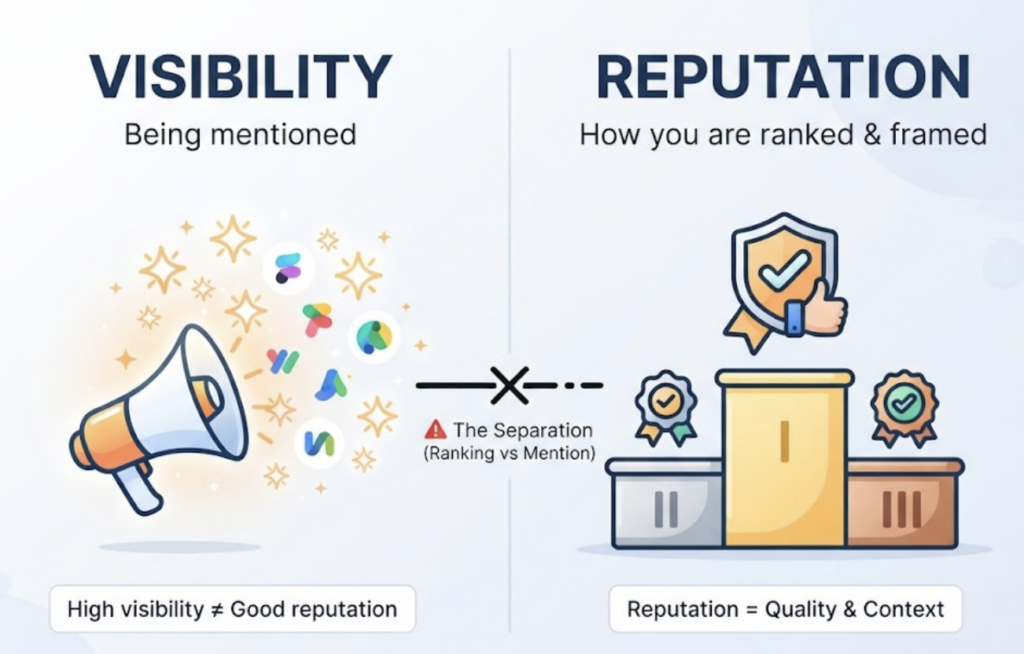
    That distinction matters because it separates reputation from AI search visibility. Visibility measures the frequency and prominence of your brand in AI answers. Reputation measures the contextual sentiment and narrative accuracy of those mentions. A brand can score high on one and fail badly on the other.

    Traditional reputation tools weren’t built for this. Social listening platforms and SEO trackers monitor what’s written on the web: reviews, posts, articles, rankings. AI engines don’t serve users that raw material. They serve a synthesized summary, assembled from whatever sources the model has ingested and currently prioritizes. Research on narrative bias in large language models, including recent arXiv work on measuring it, shows these summaries can hallucinate details or selectively cite sources in ways no web crawler anticipates.

    The result is what analysts have started calling a decoupling of AI reputation from web reputation. Your website can say “trusted by 10,000 teams” while Gemini tells users you’re “expensive and hard to set up.” Only one of those statements reaches the buyer.

    How Does AI Reputation Monitoring Work

    The core challenge is that LLMs are non-deterministic. Ask the same question twice and you’ll often get different answers, different sources, and sometimes different sentiment. A single spot check tells you almost nothing.

    Effective monitoring solves this with high-volume, continuous sampling. In practice, the pipeline has four steps.

    Step 1: Build a prompt universe. Define a fixed set of category-specific questions your buyers actually ask, like “Why choose [Brand] over [Competitor]?” or “Best tools for [category].” This becomes your measurement baseline.

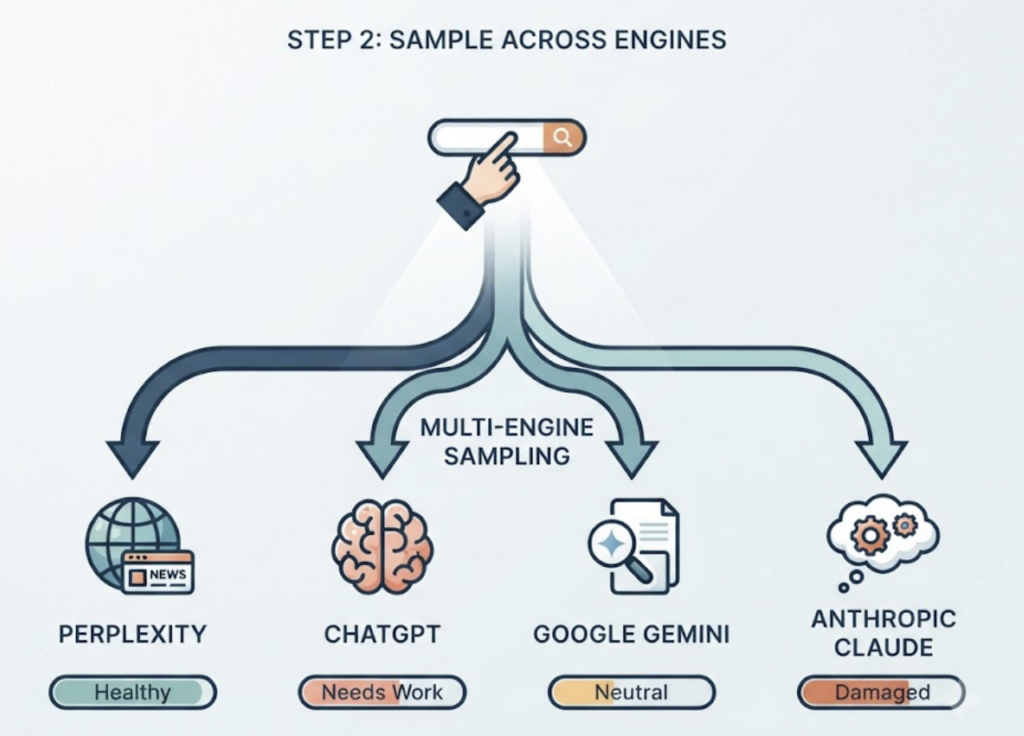
    Step 2: Sample across engines. Run those prompts on every major platform, not just one. Citation logic varies significantly between models. Perplexity tends to favor real-time news and social sources, while ChatGPT leans on static training data and documentation. Your reputation can be healthy on one engine and damaged on another at the same time.

    Step 3: Quantify sentiment. Use NLP scoring to assign each brand mention a 0 to 100 sentiment value, filtering out noise so you’re measuring framing, not just presence.

    Step 4: Track against a longitudinal baseline. Compare current results to historical data to catch narrative shifts early, like a sudden increase in AI answers labeling your product “pricey.” Longitudinal research from Foglift on sentiment shifts in AI search found that these narrative changes build gradually, which means the earlier you spot the drift, the cheaper it is to correct.

    This is where AI search analytics earns its keep. One sample is an anecdote. Two hundred prompts across four engines, repeated weekly, is a dataset.

    How to Measure AI Reputation: 5 Metrics That Actually Matter

    Reputation feels qualitative, but it breaks down into five measurable components.

    MetricWhat It Tells You
    Mention rateThe percentage of category queries where your brand appears at all
    Sentiment scoreHow positively or negatively AI frames you, on a 0 to 100 scale
    Positioning rankWhether you’re the top recommendation or the “if budget is tight” alternative
    Source authorityThe credibility of the domains AI cites as evidence about you
    Narrative accuracyWhether AI’s description matches your actual value proposition

    Here’s the insight most teams miss: these metrics only make sense together. A high mention rate with a low sentiment score is the worst possible combination, what researchers describe as the Negative Visibility Paradox. Being frequently mentioned as “the one with billing complaints” does more damage than total obscurity.

    That’s also why sentiment can’t be read in isolation from competitors. A sentiment score of 60 sounds fine until you learn your top three rivals sit at 85. Reputation in AI search intelligence is always relative.

    Narrative accuracy deserves special attention from brand and PR teams. It measures consistency: does the AI describe you as enterprise-grade when your positioning is enterprise-grade? Drift here usually signals that the AI is weighting outdated or third-party sources over your own messaging, which points you directly at the fix.

    The Strategy: How to Improve Your AI Reputation

    Monitoring tells you where you stand. Improving your standing is an AI search optimization problem, and it follows a repeatable playbook borrowed from generative engine optimization.

    Audit your sources first. Identify the specific third-party domains, often Reddit, G2, or niche forums, that AI engines consistently cite as evidence for negative descriptions. This is the single highest-leverage step, because you can’t counter a narrative until you know where it lives.

    Reframe the content. Publish structured, high-quality content that addresses those negative narratives directly: FAQs, comparison tables, and documentation written in language AI models can easily extract. This is where AI SEO diverges from traditional SEO. You’re optimizing for extraction and synthesis, not just ranking.

    Enforce entity consistency. Make sure your core value proposition reads identically across Wikipedia, official documentation, and PR coverage. Inconsistent signals give the model room to improvise, and improvisation is where inaccurate framing creeps in.

    Close the feedback loop. Reputation shifts in AI answers are slow. Engines update their source preferences over weeks and months, not days, so treat this as continuous reinforcement rather than a one-time fix.

    A working checklist for the first 90 days:

    • Define 50 to 100 category and brand prompts
    • Sample all major engines, ChatGPT, Gemini, Perplexity, and DeepSeek included
    • Record baseline sentiment, mention rate, and position
    • List every domain cited in negative answers
    • Publish structured content targeting the top 3 negative narratives
    • Update brand descriptions across owned and earned channels
    • Re-sample every week and compare against baseline
    • Report sentiment relative to competitors, not in isolation

    If you want to run a quick self-audit before committing to a full program, there’s a maintained list of free GEO tools that covers no-cost ways to check how AI engines currently see your brand.

    Common Mistakes in AI Reputation Monitoring

    Most failed monitoring programs fail the same four ways.

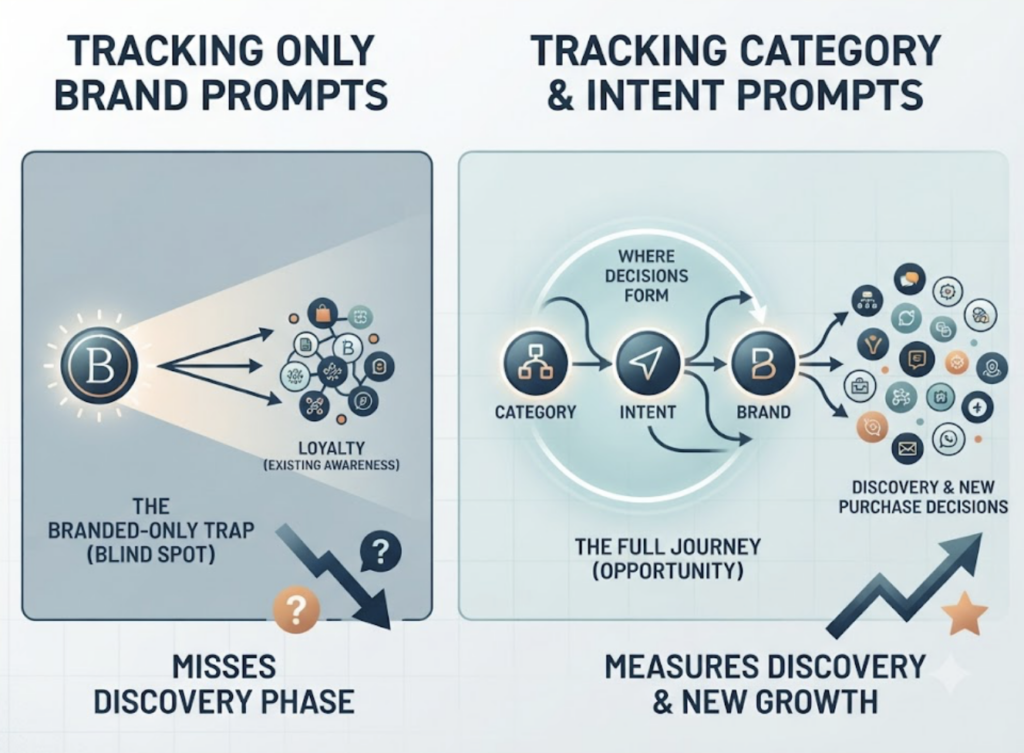
    The brand-only error. Teams track prompts containing their brand name and ignore category-intent queries like “best CRM software.” But category queries are where reputation is actually won or lost, because that’s where buyers form first impressions before they know your name exists.

    Single-engine snapshots. Testing only ChatGPT while ignoring Perplexity and Gemini produces incomplete and often misleading results, since each engine weights sources differently. One engine is a sample. Four engines is a signal.

    Confusing visibility with reputation. Research on ranking-mention separation in generative engines, including Conductor’s 2026 analysis, shows that the factors driving whether you’re mentioned differ from the factors driving how you’re ranked and framed. A brand can be highly visible and poorly regarded at once. Treating a mention count as a reputation score hides exactly the problem you’re trying to find.

    Ignoring competitors. Without competitive benchmarks, your sentiment score is a number without meaning. The question is never “is 60 good,” it’s “is 60 good relative to the brands AI recommends instead of you.”

    One habit fixes most of these: measure continuously, across engines, against rivals. Anything less is a snapshot pretending to be a trend.

    Best Tools for AI Reputation Monitoring and What They Cost

    Selection criteria come before tool names. Based on how monitoring actually gets used, four capabilities matter most: engine coverage across ChatGPT, Gemini, Perplexity, and DeepSeek; source attribution that shows exactly which domain triggered a negative score; sampling cadence frequent enough to catch shifts weekly; and a workflow that connects findings to content actions instead of stopping at a dashboard.

    Measured against those criteria, Topify covers the full loop in one AI visibility platform. Its Sentiment Analysis assigns 0 to 100 scores to brand mentions across major engines, so you can quantify framing instead of guessing at it. Visibility Tracking and Position Tracking handle the mention-rate and ranking side, while Competitor Monitoring benchmarks your scores against rivals automatically, which solves the “is 60 good” problem out of the box. The piece most tools skip is Source Analysis: Topify reverse-engineers the exact domains and URLs each AI platform cites, so when your sentiment drops, you can trace it to the specific Reddit thread or review page responsible and target your content response there. In practice, that attribution step is what turns monitoring data into a repair strategy.

    On pricing, the Basic plan runs $99/month with 100 tracked prompts, 9,000 AI answer analyses, and coverage of ChatGPT, Perplexity, and AI Overviews, with a 30-day trial included. Pro is $199/month for 250 prompts and 22,500 analyses, and Enterprise starts at $499/month with a dedicated account manager. For most in-house teams, Basic is enough to establish a baseline and catch narrative drift.

    General-purpose social listening suites and SEO platforms have started adding AI answer features, and they’re reasonable if AI monitoring is a minor add-on for you. The trade-off is depth: most stop at mention counting and skip sentiment attribution, which is the layer reputation work depends on.

    Conclusion

    AI answers have become your brand’s second face, and it’s the face a growing share of buyers sees first. The uncomfortable part isn’t that AI might describe you inaccurately. It’s that without monitoring, you’d never know.

    Start small. Define your prompt universe, sample the major engines, and establish a sentiment baseline this month. Once you can see the narrative, you can shape it. You can get started with Topify on a 30-day trial and have your first baseline report within a week.

    FAQ

    Q: What are examples of AI reputation monitoring in practice?
    A: A SaaS brand tracking whether ChatGPT calls it “enterprise-ready” or “a budget option,” an ecommerce company checking which review sites Perplexity cites when asked about product quality, or a PR team catching a sentiment drop after a negative Reddit thread starts appearing in AI citations. Each case pairs prompt sampling with sentiment scoring over time.

    Q: How is AI reputation monitoring different from social listening?
    A: Social listening tracks what people write on the web. AI reputation monitoring tracks what AI engines say after synthesizing that material, which often diverges from the source content. Since buyers increasingly see the AI’s summary rather than the original posts, the synthesized version is the one that shapes decisions.

    Q: How often should you run AI reputation checks?
    A: Weekly sampling is the practical minimum, since AI engines shift citation patterns over weeks. Daily cadence makes sense during launches, PR events, or active reputation repair. One-time snapshots aren’t reliable because LLM answers vary between sessions.

    Q: How much does AI reputation monitoring cost?
    A: Dedicated platforms typically start around $99 to $199 per month for core sentiment and visibility tracking, with enterprise tiers from $499/month. Free GEO checkers can give you a rough initial read, but continuous multi-engine monitoring with source attribution requires a paid tool.

    Read More

  • AI Visibility Score Strategy: Build, Track, and Improve It

    AI Visibility Score Strategy: Build, Track, and Improve It

    Your team finally ran an AI visibility check. The report came back: 42 out of 100. Now what? Nobody on the team can say whether 42 is bad, why it’s 42 and not 60, or which of next quarter’s content projects would actually move it. Meanwhile, leadership saw the same number and wants a plan by Friday.

    That’s the trap most teams fall into. They treat the score as the deliverable, when the score is only the starting point. An AI visibility score strategy is what turns that number into a baseline, a diagnosis, and a repeatable optimization loop. Here’s how to build one.

    The Score Is a Symptom. The Strategy Is the Treatment.

    AI search has moved from experiment to default behavior. According to Semrush’s 2026 analysis, AI engines like ChatGPT, Gemini, and Perplexity now facilitate over 37% of initial search queries and B2B research, with AI-driven search interactions projected to exceed 1 trillion queries globally by the end of 2026.

    The click economy is shrinking alongside it. Zero-click behavior has climbed to 68% of U.S. Google searches, and when an AI Overview appears, organic click-through rates decline by up to 47%. The prize is no longer the click. It’s becoming the default recommendation inside the answer itself.

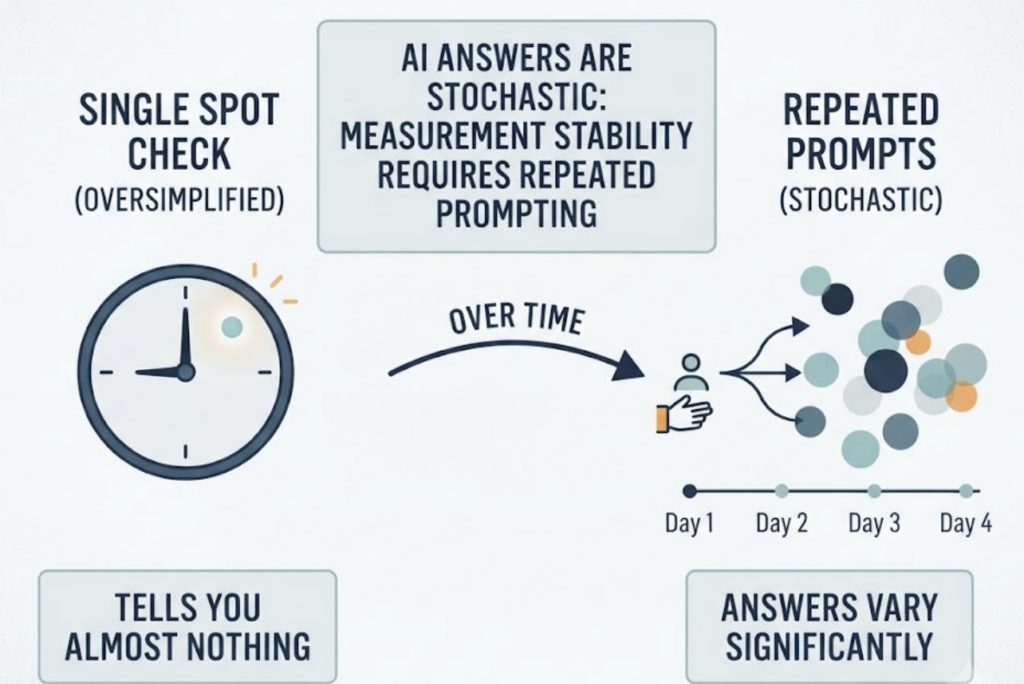
    This is why a single visibility number, checked once, tells you almost nothing. AI answers are stochastic: the same prompt can return different brands on different days. A one-time spot check is a sample of one, and research on measurement stability in generative engine optimization confirms that AI answers vary significantly across repeated prompts.

    A strategy accounts for that variance. A dashboard screenshot doesn’t.

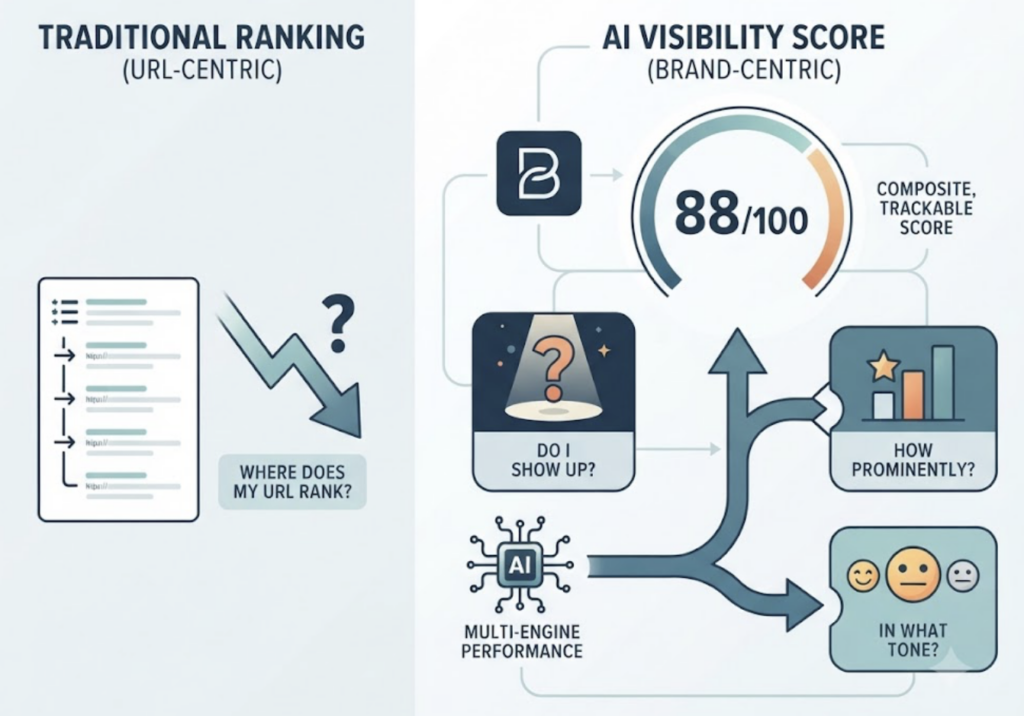
    What an AI Visibility Score Actually Measures

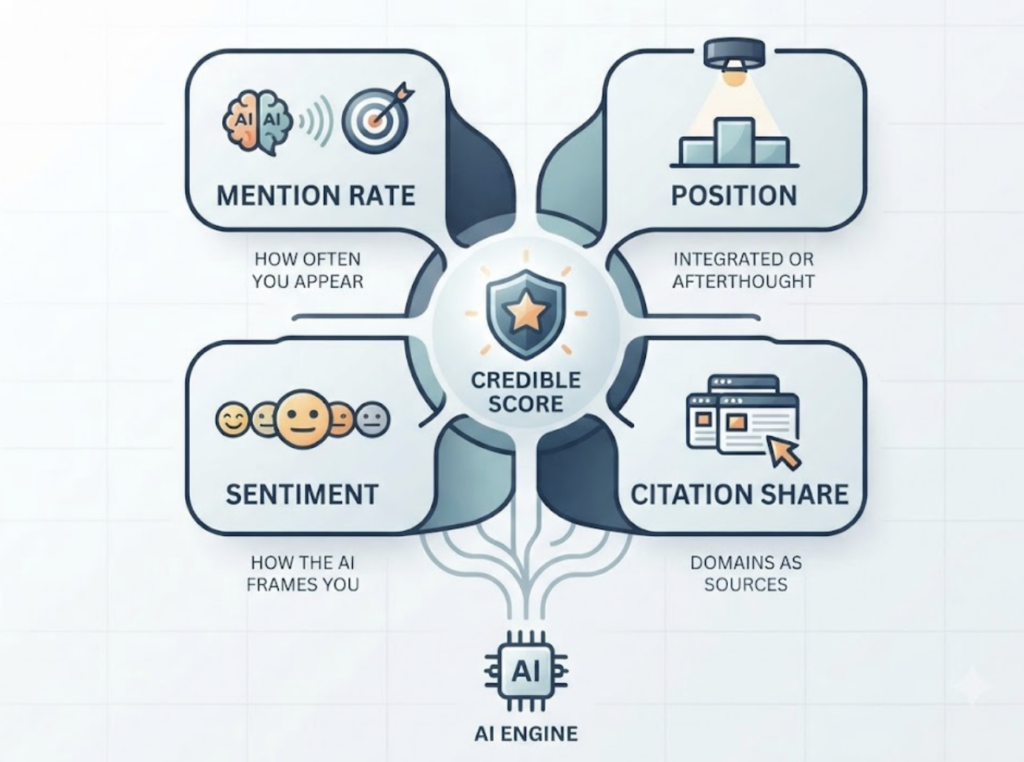
    Before you can act on a score, you need to know what’s inside it. A credible AI visibility score decomposes into at least four dimensions:

    • Mention rate: how often your brand appears across a fixed prompt set. This is binary inclusion-exclusion, not a ranking spectrum. You’re either in the answer or you don’t exist.
    • Position: whether you’re the lead recommendation or a footnote. Being mentioned fifth in a list of five is technically visibility, but it rarely converts.
    • Sentiment: how the AI frames you. “Budget-friendly option” and “industry standard” are both mentions with very different commercial value.
    • Citation share: which sources the AI leans on when it talks about your category, and whether any of them are yours.

    Two brands can hold the same composite score for completely different reasons. One has a mention problem, the other has a sentiment problem, and the fixes don’t overlap. Platforms like Topify extend this decomposition to seven metrics, adding volume, intent, and conversion signals on top of the core four, which matters once you’re trying to connect visibility to pipeline rather than just tracking it.

    The takeaway: never optimize a composite score directly. Optimize the dimension that’s dragging it down.

    Step 1: Build a Baseline You Can Defend

    An AI visibility score strategy starts with a measurement design decision, not a marketing decision. You need three things locked before the first data point counts.

    A fixed prompt universe. Define 50 to 200 high-intent queries that mirror how buyers actually ask: “best [product] for [industry],” “[your brand] vs [competitor],” “[category] tools for small teams.” This set stays frozen so results are comparable over time.

    Longitudinal sampling. Run the same prompts across ChatGPT, Claude, Gemini, and Perplexity on a weekly cadence. Citation logic differs wildly between engines, and volatility within a single engine means monthly snapshots are misleading by the time anyone reads them.

    A 30-day window before conclusions. One week of data still carries too much noise. Thirty days of weekly sampling gives you a baseline you can defend in a leadership meeting.

    Skip this step and every number downstream is anecdote, not evidence.

    Step 2: Diagnose the Gap Before You Write Anything

    Most teams jump from “our score is low” straight to “publish more content.” That skips the most valuable question: why is the score what it is?

    The most common actionable finding is the source gap. AI engines tend to favor specific third-party domains as ground truth for a category: G2, Reddit, industry news sites, comparison publishers. If your competitor keeps showing up in answers, the reason usually lives in those citations, not in their homepage copy.

    Reverse-engineering citations answers the operational question directly. Is the AI citing their documentation? A third-party review? One specific blog post from 2024? Topify’s citation analysis surfaces the exact domains and URLs AI platforms pull from, so you can see whether your brand or your competitors dominate the reference layer at scale.

    Benchmarking makes the score interpretable. Visibility is relative: a score of 60 is excellent if your industry average is 30, and weak if the category leader sits at 90. Without a competitor baseline, you can’t even tell whether your number is a problem.

    Diagnosis first. Content second.

    Step 3: Run the Optimization Loop, Not a One-Off Project

    You don’t improve a score. You improve the inputs the score measures.

    Three input categories consistently move AI visibility, based on 2026 research into citation and extractability factors:

    Content architecture. Adopt an answer-first structure where the first 30% of a page delivers a declarative, summary-style answer the AI can extract cleanly. Long wind-ups bury the exact sentence a RAG pipeline is looking for.

    Entity authority. Keep your brand’s entity description consistent across Wikipedia, LinkedIn, and major industry directories. AI systems reward entity coherence over raw backlink counts.

    Freshness and technical signals. Pages updated within the last 60 days earn roughly 28% more AI citations, per WP Engine’s 2026 research on technical citation factors. Structured data (JSON-LD for FAQ, Organization, and Product schemas) remains the entry fee for machine extractability.

    Then close the loop: re-run your prompt universe weekly, compare against baseline, and set thresholds that trigger action. A 10-point drop in mention rate on ChatGPT should generate a task, not a shrug in next month’s report.

    How to Choose an AI Visibility Score Tool That Closes the Loop

    The strategy above is only sustainable with automation behind it. Running 100 prompts across four engines every week by hand is a full-time job, and the market now offers everything from a lightweight AI visibility score dashboard to a full AI visibility score platform with execution built in. The difference that matters is whether the product stops at reporting or connects data to action.

    Four dimensions separate a reporting tool from a decision system:

    Evaluation DimensionWhat to RequireWhy It Matters
    Engine coverageSampling across ChatGPT, Claude, Gemini, and Perplexity at minimumCitation logic varies wildly between engines; single-engine data misleads
    Prompt depthThousands of analyses per monthAnything less can’t overcome stochastic noise
    Sentiment granularityDistinguishes “brand mention” from “positive recommendation”Mentions without endorsement rarely convert
    Execution loopTranslates a visibility drop into a content taskA dashboard shows the problem; a system fixes it

    Pricing in this category typically runs from $99/mo for basic monitoring to $500+/mo for enterprise-grade sampling frequency and competitor coverage. That range maps to sampling depth more than feature count, so match the tier to your prompt volume, not to the feature list.

    Where Topify Fits in This Framework

    For teams that want one AI visibility score solution covering measurement through execution, Topify checks all four dimensions in a single system. Its Comprehensive GEO Analytics tracks the seven metrics discussed earlier (visibility, sentiment, position, volume, mentions, intent, and CVR) across ChatGPT, Gemini, Perplexity, DeepSeek, and other major engines, including non-Western platforms like Doubao and Qwen for brands with global exposure.

    The execution side is what separates it from most AI visibility score software. Instead of exporting a CSV and briefing your content team manually, you state a goal in plain English, review the proposed strategy, and deploy it with one click. The system handles monitoring, reasoning, and execution as a continuous loop rather than a monthly reporting cycle.

    Pricing starts at $99/mo on the Basic plan, which covers 100 tracked prompts and 9,000 AI answer analyses per month. That’s enough sampling depth for a defensible 30-day baseline on a single brand. If you want to test the water before committing, Topify also maintains a set of free GEO tools for one-off visibility and citation checks, and you can get started without a sales call.

    Conclusion

    A score without a strategy is just a number on a dashboard, and in AI search, it’s a number that changes every week whether you’re watching or not. The teams pulling ahead in 2026 treat their AI visibility score as a leading indicator of market influence: they lock a prompt universe, build a 30-day baseline, diagnose source gaps before producing content, and re-sample weekly so every optimization has a before-and-after.

    Start with the three moves that compound fastest. Replace manual spot checks with automated prompt tracking. Audit your top three competitors’ citation sources. Refactor your highest-intent pages for answer-first extraction. The score will follow the inputs.

    FAQ

    Q: What is a good AI visibility score?
    A: There’s no universal benchmark, because visibility is relative to your category. A score of 60 is strong if your industry average is 30 and weak if the leader holds 90. Benchmark against your top three competitors on the same prompt set before judging your own number.

    Q: How often should you track your AI visibility score?
    A: Weekly, at minimum. AI answers are probabilistic and citation patterns shift within weeks, so monthly snapshots are often stale on arrival. Weekly sampling across a fixed prompt set is the standard cadence for a defensible trend line.

    Q: How do you choose an analytics tool for AI search performance?
    A: Evaluate on four dimensions: engine coverage (ChatGPT, Claude, Gemini, and Perplexity at minimum), prompt depth (thousands of analyses monthly to beat stochastic noise), sentiment granularity (mention vs. recommendation), and an execution loop that turns visibility drops into content tasks. A tool that only reports data leaves the hardest work manual.

    Q: Is an AI visibility score the same as an SEO ranking?
    A: No. SEO rankings sit on a deterministic spectrum where position 4 still gets traffic. AI visibility follows binary inclusion-exclusion dynamics: you’re either in the answer or invisible. High organic rankings also don’t guarantee AI mentions, since RAG pipelines weigh topical authority and extractability over backlink counts.

    Read More

  • AI Visibility Score Tracking: How to Measure and Improve It

    AI Visibility Score Tracking: How to Measure and Improve It

    The first attempt usually looks like this: someone on the team opens ChatGPT, types “best tools for [your category],” screenshots the answer, and pastes it into Slack. Your brand shows up. Two weeks later, someone repeats the exercise and you’re gone. No one knows why, no one knows when it changed, and there’s no baseline to compare against.

    That’s not tracking. That’s guessing with screenshots.

    AI answers are probabilistic, which means a single check tells you almost nothing about where your brand actually stands. What you need is a repeatable scoring system that samples AI answers over time, across engines, against competitors. Here’s how to build one.

    What an AI Visibility Score Actually Measures

    An AI visibility score is a composite metric, typically normalized to a 0 to 100 scale, that quantifies how present and how well-positioned your brand is inside AI-generated answers. It’s not one number pulled from one platform. Professional measurement frameworks decompose it into seven dimensions, according to research compiled by Campaign Creators and HubSpot’s 2026 reporting frameworks for AI search:

    DimensionBusiness question it answers
    Visibility rateAre we present when customers ask relevant questions?
    Mention frequencyHow often are we part of the conversational set?
    PositionAre we a primary recommendation or a footnote?
    SentimentIs the brand framed positively, neutrally, or negatively?
    Citation shareHow often do AI engines link back to our owned content?
    Intent coverageAre we visible for decision-stage queries, not just informational ones?
    Citation value (CVR)Is visibility translating into assisted conversions?

    Here’s the part that trips up most SEO teams: your Google rankings don’t predict this score. Recent academic work on ranking–mention separation found that traditional SEO metrics predict where a brand appears within an AI answer, but not whether it gets mentioned at all. AI models weigh entity authority, meaning structured data and third-party validation, more heavily than raw backlink counts.

    So a domain authority of 70 and page-one rankings can coexist with a visibility score near zero. Different game, different scoreboard.

    Why One-Time Checks Fail and Tracking Wins

    Large language models are stochastic. The same prompt, asked twice in the same hour, can return different brand sets. That makes manual spot-checks statistically insignificant, no matter how carefully you phrase the query.

    The environment itself is also unstable. Conductor’s 2026 industry volatility analysis found that AI Overview coverage across major industries peaked at 47% in early 2026, then corrected down to 34% as Google tightened quality filters. A brand that “checked its visibility” in January was measuring a market that no longer existed by April.

    Tracking is a process, not an action.

    There’s a practical upside to treating it that way. Longitudinal data turns your AI visibility score into a leading indicator: significant score drops often precede declines in branded search volume, which means a well-built tracking system flags brand health problems before they show up in your traffic reports. AI search traffic itself grew more than 500% year over year heading into 2026, so the cost of flying blind compounds every quarter.

    How to Set Up AI Visibility Score Tracking Step by Step

    The setup below moves you from screenshots to a system in four steps. Most teams can complete it in under two weeks.

    Step 1: Define Your Prompt Universe

    Start with 50 to 200 high-intent queries. Skip branded searches, since asking ChatGPT “what is [your brand]” tells you nothing about discovery. Focus instead on the queries buyers actually use before they know you exist: “best [product] for [industry],” “alternatives to [competitor],” “[category] comparison.”

    Group prompts by intent stage. Comparison and alternative queries map to buyers closest to a decision, so weight them accordingly when you read the data later. Refresh the set quarterly, because buyer language shifts and last year’s phrasing stops matching how people actually ask.

    Step 2: Choose Which AI Platforms to Sample

    ChatGPT, Perplexity, and Google AI Overviews use different citation logic and different underlying sources. A brand can score 60 on Perplexity and 15 on ChatGPT for the identical prompt set. Sampling one engine gives you one engine’s opinion, not a market view.

    Track at minimum the three platforms above, then extend based on where your audience lives. B2B software buyers lean on ChatGPT and Perplexity; consumer categories see more AI Overviews exposure. Teams operating in Asian markets should add DeepSeek, Doubao, or Qwen to the sampling rotation.

    If you want to test the waters before committing to a full setup, this curated list of free GEO tools covers no-cost options for one-off visibility checks across major engines.

    Step 3: Pick an AI Visibility Score Tool That Tracks Over Time

    Free checkers answer “where am I today.” A dedicated AI visibility score tool answers “what changed, and why.” When evaluating any AI visibility score software or platform, four capabilities separate real tracking systems from repackaged rank trackers: multi-engine sampling, prompt-level history, sentiment measurement, and competitor benchmarking on identical prompt sets.

    That last one matters more than teams expect. An absolute score of 65 is meaningless in isolation. If your closest competitor sits at 80, you have a problem; if the category leader sits at 40, you’re winning.

    For teams that want the full seven-dimension scorecard in one place, Topify is built around exactly this model. Its GEO Analytics engine tracks visibility, sentiment, position, volume, mentions, intent, and CVR across ChatGPT, Gemini, Perplexity, DeepSeek, and other major engines, then benchmarks each dimension against competitors it auto-detects in your category. In practice, that means a visibility drop on Perplexity can be traced back to the specific source domain that stopped citing you, inside the same dashboard, without exporting anything to a spreadsheet. The Basic plan runs $99 per month and covers 100 tracked prompts with 9,000 AI answer analyses, which fits the 50 to 200 prompt universe most teams start with.

    Other platforms in this space cover parts of the picture, and some do single-engine tracking well. The gap tends to show up in citation-layer analysis and cross-engine consistency, which is where composite scoring lives or dies.

    Step 4: Set a Baseline and a Review Cadence

    Run your full prompt universe across all tracked engines for 30 days before drawing any conclusions. That first month is your baseline, and everything after is trend data.

    Then hold a rhythm: weekly reviews to catch sudden shifts from model updates or competitor content pushes, quarterly deep dives to reassess strategy and refresh the prompt set. Industry benchmarks give you rough context for the baseline itself. Scores below 8 signal pre-visibility, where the brand is essentially absent and needs entity-level foundations first. Scores from 8 to 25 indicate early traction with inconsistent appearances. Crossing 25 means regular presence in top-choice shortlists, the milestone that separates established category players from everyone else.

    Reading the Dashboard: Signals Behind the Score

    An AI visibility score dashboard earns its cost when it explains movement, not just displays it. Three reading patterns cover most situations.

    When visibility drops, check citation share first. AI engines lean on a small set of third-party domains per category, and losing a citation from one high-weight source (a G2 category page, a Reddit thread, an industry roundup) can pull down mention frequency across every engine that draws on it.

    When position slips but visibility holds, look at competitors. You’re still in the answer set, but someone displaced you from the primary recommendation slot, usually through fresher comparison content or new third-party validation.

    Sentiment deserves its own tracking lane. AI search analytics brand sentiment platforms measure a Net Sentiment Score, tracking whether AI describes your brand positively, neutrally, or negatively across responses. The risk isn’t just negative framing, it’s outdated framing: an engine calling your enterprise product “a budget option for small teams” is a positioning problem no traffic report will ever surface. Good sentiment tooling reverse-engineers the attribution, so a sentiment drop points you to the specific review site or article the AI is drawing that framing from. AgencyDashboard’s 2026 analysis of AI sentiment tracking found this source-level attribution is what turns sentiment data from a vanity metric into a fixable to-do list.

    How to Improve a Low AI Visibility Score

    The score is the output. These four inputs move it.

    Close citation gaps. Identify which third-party domains AI engines favor for your category, then pursue placements there through digital PR, review campaigns, or community participation. If Reddit and G2 dominate citations in your space, a tenth blog post on your own domain won’t move the needle the way one strong G2 presence will.

    Structure content for extraction. AI engines reward machine-readable answers. Clean organization and product schema, direct question-and-answer formatting, and comparison tables give models something to quote. Prose walls don’t.

    Cover decision-stage intent. If your visibility concentrates on informational queries but disappears for “best X” and “alternatives to Y” prompts, your intent coverage dimension is dragging the composite score down. Build comparison and alternative content deliberately.

    Feed results back into the system. Every content push should map to a hypothesis about a specific dimension: this G2 campaign should lift citation share, this comparison page should lift intent coverage. Then watch the weekly data to confirm or kill the hypothesis. Without that loop, you’re publishing on faith.

    Conclusion

    The screenshot-in-Slack era of AI visibility ends the moment someone asks “compared to what?” A score without a baseline, a trend line, and a competitive reference point is trivia. With those three things, it becomes the earliest warning system your brand has, surfacing shifts weeks before they reach your traffic dashboards.

    Start small: define 50 prompts, pick three engines, and run a free scan to establish where you stand today. From there, set up automated tracking and let the 30-day baseline accumulate while you work on citation gaps. The teams winning AI search in 2026 aren’t the ones checking most often. They’re the ones measuring consistently.

    FAQ

    Q: What is a good AI visibility score?
    A: Context matters more than the absolute number, but industry benchmarks offer rough stages: below 8 means the brand is effectively invisible, 8 to 25 indicates early and inconsistent traction, and above 25 signals regular presence in top-choice shortlists. The more useful question is how your score compares to direct competitors on identical prompts.

    Q: How often should you review AI visibility score tracking data?
    A: Weekly for tactical shifts, quarterly for strategy. AI answers move fast enough (model updates, citation source changes, competitor pushes) that monthly-only reviews miss the cause of most score movements.

    Q: What’s the difference between an AI visibility score tool and a traditional rank tracker?
    A: Rank trackers measure a deterministic position for a URL on a results page. An AI visibility score system samples probabilistic answers repeatedly, across multiple engines, and scores brand presence rather than URL position. Research on ranking–mention separation shows the two measure genuinely different things: strong rankings don’t guarantee AI mentions.

    Q: Do AI search analytics brand sentiment platforms measure the same thing as visibility scores?
    A: They measure one dimension of it. Sentiment tracks how AI frames your brand when it appears; the visibility score also covers whether, how often, and in what position you appear. Sentiment without visibility data misses absence, and visibility without sentiment misses framing problems. Composite platforms track both.

    Read More

  • AI Visibility Score Tracker: How to Measure and Improve

    AI Visibility Score Tracker: How to Measure and Improve

    Two dashboards, two scores for the same brand. One platform says your AI visibility is 72. Another says 48. Your quarterly review is next week, and you can’t explain to leadership which number is real, because each tool defines “visibility” differently and none of them show their math. Meanwhile, AI engines keep reshaping how they describe your brand, and last month’s snapshot is already stale. The problem isn’t a lack of scores. It’s that a score without a transparent measurement method behind it is just a number on a screen.

    What an AI Visibility Score Actually Measures

    An AI visibility score is a normalized, composite metric, typically on a 0 to 100 scale, that quantifies how present your brand is inside the synthesized answers of ChatGPT, Gemini, Perplexity, and other generative engines. An AI visibility score tracker is the system that produces and updates that number over time.

    Unlike a Google ranking, there’s no static list of blue links to track. AI answers are written fresh each time. So a credible score is a weighted function of four components: mention rate (how often you appear across a set of prompts), position (whether you’re woven into the recommendation or dropped in as an afterthought), sentiment (how the AI frames you), and citation share (how often your domains are the sources behind the answer).

    Here’s the part most teams miss: AI visibility and Google rankings measure different things. Industry research in 2026 points to a ranking–mention separation. Holding the #1 organic spot on Google doesn’t predict whether an AI answer will mention you at all, because generative engines weigh entity authority and source extractability over classic ranking signals.

    Your SEO dashboard can look perfect while your brand stays invisible to AI.

    How an AI Visibility Score Tracker Works Under the Hood

    Every serious AI visibility score tracker runs the same four-step pipeline, and the quality of the score depends on how rigorously each step is executed.

    Step 1: Prompt universe design. The tracker defines a consistent set of queries reflecting real buyer intent: branded prompts, category prompts, and comparison prompts. This set stays fixed so scores are comparable over time.

    Step 2: Multi-engine sampling. The same prompts run across multiple LLMs. Each engine has its own citation logic, so single-engine data tends to mislead.

    Step 3: Parsing and interpretation. NLP models extract entity presence, cited URLs, and tonal markers from each synthesized answer.

    Step 4: Weighted scoring. Data points aggregate into a trend line, not a one-off snapshot.

    Why does sampling depth matter so much? Because LLMs are stochastic. Ask the same question twice and you can get two different answers. A single spot-check is statistically meaningless, which is why professional-grade setups typically run 100+ prompts across at least four engines with high-frequency updates.

    A score built on 10 prompts isn’t a score. It’s a coin flip.

    How to Measure Your AI Visibility Score Step by Step

    You don’t need an enterprise budget to establish a baseline. You need a repeatable method.

    Start with a free baseline check. A tool like Topify‘s GEO Score Checker gives you a zero-cost snapshot of where your brand stands, and a broader set of options is collected in this GEO free tools reference. Free checkers are useful for establishing a starting point, though they lack the longitudinal, high-frequency data that trend analysis requires.

    Build your prompt set. Cover three layers: branded (“Is [brand] good for X”), category (“best tools for X”), and comparison (“[brand] vs [competitor]”). The category layer matters most, since that’s where AI-influenced discovery actually happens.

    Pick your engine coverage. At minimum, track ChatGPT, Perplexity, and Google AI Overviews. If your audience spans markets, engines like Gemini and DeepSeek behave differently enough to justify inclusion. A practical walkthrough of the ChatGPT side is covered in how to track AI search visibility and rankings in ChatGPT.

    Set a re-measurement cadence. Weekly is the professional standard. Model updates ship fast, and monthly snapshots miss the citation shifts that happen in between.

    Add competitor benchmarks. An 80 means nothing on its own. If your top three competitors sit at 90, that 80 is a warning, not a win.

    Tracking Brand Reputation Across Generative Engines

    Visibility is necessary but not sufficient. You can rank high on mentions and still lose, because a brand that’s mentioned often but framed negatively is building the wrong kind of presence. That’s why teams that track brand reputation across generative engines treat sentiment and source attribution as first-class metrics, not add-ons.

    Engine discrepancy is the pattern to watch. It’s common for a brand to be warmly recommended in ChatGPT while Perplexity, which leans heavily on real-time review sites, cites it with caveats or negative framing. Same brand, same week, two different reputations.

    The fix starts with source attribution analysis: knowing exactly which domains each engine pulls from when it talks about you. If a low-authority review site is shaping how Perplexity describes your product, that’s a digital PR problem you can actually act on. On Topify’s side, this maps to its Sentiment Analysis (a 0 to 100 tonal score per engine) combined with citation source tracking, so a sentiment drop can be traced back to the specific domain that caused it.

    That trace-back is the difference between a dashboard and a decision.

    How to Improve Your AI Visibility Score

    Improving the score means influencing what generative engines read, trust, and extract. Four levers consistently move the needle, roughly in this order of impact.

    1. Get present on domains AI already cites. Reverse-engineer which URLs the engines reference for your category prompts, then earn placement there. If AI never reads the sources you publish on, your content can’t enter the answer.

    2. Structure your content for extraction. Organization and product schema (JSON-LD), clear headings, and direct answer-style formatting make it easier for models to pull correct entity information instead of guessing.

    3. Publish comparison content. Pages that objectively lay out “Brand A vs Brand B” give AI clean, synthesizable material, and brands that provide it tend to control how the comparison gets framed.

    4. Close the loop between insight and action. This is where most workflows stall: the tracker flags a visibility drop, and the fix sits in a backlog for a month. Topify’s approach connects reverse-engineered citations with One-Click Execution, so identifying a gap and deploying the content response happen inside the same platform. For a deeper strategic framework, the complete guide to generative engine optimization walks through the full playbook.

    Best Tools for AI Visibility Score Tracking

    Before comparing products, fix the evaluation criteria. Four dimensions separate a usable tracker from a vanity dashboard:

    DimensionWhy it matters
    Engine coverageEach model (ChatGPT, Gemini, Perplexity, DeepSeek) has distinct citation logic; single-engine data misleads
    Sampling volumeDetermines whether a trend is real or statistical noise
    Metric decomposabilityA score you can’t drill into sentiment and position is unactionable
    Competitive benchmarkingAbsolute scores are vanity; relative standing is strategy

    Topify covers all four. It tracks brand presence across ChatGPT, Gemini, Perplexity, DeepSeek, Doubao, Qwen, and other major engines, and decomposes the score into seven metrics: visibility, sentiment, position, volume, mentions, intent, and CVR. Competitor benchmarking is built in, with automatic detection of emerging rivals. Pricing starts at $99/month for the Basic plan, which includes 100 tracked prompts, 9,000 AI answer analyses, and a 30-day trial, putting it at the entry point of the professional SaaS tier.

    Other options exist across the market. Platforms like Profound and Peec AI offer AI visibility monitoring with their own strengths, and enterprise solutions add custom prompt sets and advanced attribution modeling at higher price points. The market roughly splits into three tiers: free checkers for baselines, SaaS platforms in the $99 to $499/month range for professional sampling and benchmarking, and enterprise deals above that.

    For most marketing teams, the SaaS tier is where measurement becomes reliable enough to report on.

    Common Mistakes That Make Your Score Meaningless

    The branded-only trap. Tracking only prompts that contain your brand name misses the category and intent phase, which is where most AI-influenced purchasing decisions actually form. If your prompt set is 100% branded, your score measures loyalty, not discovery.

    Treating a snapshot as a trend. LLM output is volatile. One measurement tells you what the model said that day, not where you’re heading. Monthly checks miss shifts caused by weekly model updates.

    Reading the total, ignoring the parts. A stable composite score can hide a visibility gain that’s masking a sentiment decline. Always decompose.

    Skipping competitor context. An 80 with rivals at 90 and an 80 with rivals at 60 are opposite situations wearing the same number.

    Quick checklist before you trust any score: 100+ prompts covering branded, category, and comparison intent; at least three engines; weekly cadence; decomposable metrics; and top-three competitor benchmarks in the same view.

    Conclusion

    The reason two trackers give you a 72 and a 48 for the same brand isn’t that one is lying. It’s that scores are derivatives of sampling architecture, and different architectures produce different numbers. So stop chasing an absolute figure. Pick one methodology with enough sampling depth, hold it constant, and read the trend line and the competitor gap instead.

    The practical path: run a free baseline check first, then move to continuous tracking once you’ve confirmed the gap is worth closing. You can get started with Topify on a 30-day trial and have your first weekly trend line before your next reporting cycle.

    FAQ

    Q: What are some examples of AI visibility score trackers?
    A: Free options include Topify’s GEO Score Checker for one-off baselines. Paid platforms include Topify (from $99/month, seven-metric decomposition across ChatGPT, Gemini, Perplexity, DeepSeek and more), plus alternatives like Profound and Peec AI. Enterprise solutions add custom prompt sets and API access.

    Q: How much does an AI visibility score tracker cost?
    A: Free checkers cost nothing but only provide snapshots. Professional SaaS platforms generally run $99 to $499/month; Topify’s Basic plan sits at the $99 entry point with 100 prompts and 9,000 monthly answer analyses. Enterprise tiers with dedicated support start around $499/month and up.

    Q: How often should you re-measure your AI visibility score?
    A: Weekly is the professional standard. AI models update frequently enough that monthly measurement misses meaningful citation shifts, and daily sampling within a weekly reporting cadence gives the cleanest trend lines.

    Q: Can you track brand reputation in generative engines with the same tool?
    A: Yes, if the tracker decomposes its score. Reputation tracking requires per-engine sentiment scoring plus source attribution, since the same brand often reads positively in ChatGPT and negatively in Perplexity depending on which domains each engine cites.

    Read More

  • AI Visibility Score Dashboard: What It Is and How It Works

    AI Visibility Score Dashboard: What It Is and How It Works

    Your monthly performance report has a page for organic traffic, a page for keyword rankings, and a page for conversions. It doesn’t have a page for AI search. Meanwhile, Similarweb’s 2026 consumer research found that over 60% of high-intent purchase research now happens inside AI-native interfaces like ChatGPT and Perplexity, not on traditional results pages. Most teams “measure” this by occasionally typing a prompt into ChatGPT and screenshotting the answer. That’s not a metric. It’s a mood. An AI visibility score dashboard turns those scattered spot-checks into a number you can baseline, benchmark, and report, the same way you’ve reported rankings for the past decade.

    What an AI Visibility Score Dashboard Actually Measures

    An AI visibility score dashboard aggregates your brand’s performance across multiple AI engines into a composite, trackable score. Instead of asking “where does my URL rank,” it asks “when someone in my category asks an AI for a recommendation, do I show up, how prominently, and in what tone.”

    That’s a bigger shift than it sounds. Traditional SEO dashboards track URL-based positions. AI visibility systems track what Conductor’s research calls entity presence: whether the model knows your brand exists as an answer, independent of any single page.

    A credible score decomposes into four raw signals:

    SignalWhat it tells you
    Mention rateHow often your brand appears across a defined set of prompts
    PositionWhether you’re the lead recommendation or an afterthought
    SentimentWhether the AI frames you as a recommendation or a caveat
    Citation shareWhat percentage of category answers cite your domain as a source

    Here’s the thing about composite scores: a single number is only useful if you can drill beneath it. A score of 62 that can’t be traced to specific prompts, engines, and sources isn’t analytics. It’s decoration.

    How an AI Visibility Score Dashboard Works Behind the Scenes

    Large language models are stochastic. Ask the same question twice and you’ll often get two different answers, which means one query proves nothing. Stanford HAI’s 2026 work on measurement standards in generative models makes the same point: single-sample observations of a probabilistic system aren’t data.

    A professional AI visibility score system solves this with a four-step pipeline:

    1. Fixed prompt universe. Curate a set of queries that mimic real buyer intent in your category, like “best expense software for mid-size finance teams.”
    2. Longitudinal sampling. Run those prompts across multiple engines at regular intervals, not once.
    3. Parsing and interpretation. Decode each answer: was the brand mentioned, where in the answer, in what tone, and with an attributable link?
    4. Trend aggregation. Normalize the raw results into a 0-100 score that tracks movement over time.

    The score itself isn’t the product. The sampling methodology is.

    Two dashboards can both show you a “visibility score” and mean completely different things, depending on how many prompts they run, how often, and across how many engines. When you evaluate any AI visibility score software, the first question isn’t what the dashboard looks like. It’s what’s feeding it.

    The Metrics That Belong on Your Dashboard, and the Ones That Don’t

    A dashboard earns its place in your reporting stack when every metric on it answers a business question. The most complete AI visibility score analytics setups track seven dimensions. This framework maps directly to how Topifystructures its Comprehensive GEO Analytics view:

    MetricBusiness question it answers
    Visibility rateIs our brand reaching potential customers in AI answers?
    PositionAre we the primary recommended solution, or option number six?
    SentimentDoes the AI present us favorably?
    MentionsWhat’s our total reach across the prompt universe?
    VolumeHow much buyer intent is flowing through AI in our niche?
    IntentAre we appearing for high-converting queries, or just informational ones?
    CVRAre AI answers actually likely to send users toward our brand?

    Just as important is what to leave off. Single-platform mention counts, one-time snapshots, and vanity totals like “we appeared 400 times” don’t belong on a scorecard. They can’t distinguish between visibility and authority.

    That distinction matters more than most teams realize. A brand can be mentioned constantly (visibility) while its domain is never cited as a source (authority). Systems that blur the two push teams to optimize for the wrong signal, usually chasing mentions in low-intent prompts while competitors quietly capture the citations that shape future answers.

    How to Measure Your AI Visibility Score Step by Step

    You can stand up a working measurement program in about two weeks. The sequence matters more than the tooling:

    1. Define your prompt set. Start with 25-50 queries a real buyer would ask, weighted toward commercial intent.
    2. Pick your engines. At minimum, track ChatGPT, Gemini, and Perplexity. Each uses different citation logic, so coverage gaps are real blind spots.
    3. Establish a baseline. Run the full prompt set for one to two weeks before drawing any conclusion. This is your starting score.
    4. Set competitor benchmarks. Identify your top three rivals and score them against the identical prompt set.
    5. Review on a cycle. Weekly for trend detection, monthly for reporting.

    Step four is where most manual efforts quietly die. Scoring one brand by hand is tedious; scoring four brands across three engines and 50 prompts every week is roughly 600 answer reviews. That’s the workload an AI visibility score platform automates, and it’s why competitor benchmarking is usually the feature that justifies the subscription. Topify’s Dynamic Competitor Benchmarking handles this automatically, detecting emerging rivals in your prompt set and tracking your relative position without manual re-scoring.

    A quick checklist before you trust your first score: prompt set covers commercial intent, at least three engines tracked, baseline period completed, competitors scored on identical prompts, and a recurring review cadence on the calendar.

    Choosing an AI Visibility Score Tool: What Separates Software from Spreadsheets

    Plenty of teams start with a spreadsheet and a rotation of interns pasting prompts into ChatGPT. It works for about a month. Then the sampling gets inconsistent, the scoring gets subjective, and the data stops being comparable week over week.

    When you graduate to a dedicated AI visibility score tool, evaluate on actionability, not reporting polish. Four capabilities separate a real AI visibility score solution from a pretty chart:

    Multi-engine coverage. Dageno AI’s cross-engine research found that citation behavior differs meaningfully between models, so a single-engine view systematically misleads. Topify tracks ChatGPT, Gemini, Perplexity, DeepSeek, Doubao, Qwen, and other major engines, which matters if any part of your audience sits outside the US market.

    Prompt-level drill-down. When your score drops four points, you need to see which prompts moved, on which engine, and what the answer now says instead.

    Source engineering. Scores change because citations change. Topify’s Source Analysis traces a decline back to the specific domain that stopped citing your brand, which converts “the number went down” into “this publication dropped us, here’s the content gap to fill.”

    A closed action loop. Most tools stop at data. Topify pairs the dashboard with One-Click Execution: you define the goal in plain English, review the proposed GEO strategy, and deploy it without manual workflows. In practice, that’s the difference between a dashboard your team checks and a system that changes what your team does.

    Other approaches exist, from enterprise SEO suites bolting on AI modules to lightweight single-engine checkers. They tend to fit teams with narrower needs: one engine, one brand, no competitive reporting. If that’s you, start small. If you’re reporting to leadership or clients, you’ll outgrow it in a quarter.

    Common Mistakes That Make Your Dashboard Lie to You

    Bad measurement is worse than no measurement, because it produces confident wrong decisions. Four errors show up constantly:

    Small sample noise. Running fewer than 50-100 prompts per week means normal LLM randomness reads as trend. Fix: expand the prompt universe before you expand the conclusions.

    Single-engine bias. A brand can score 80 on ChatGPT and near zero on Perplexity. One model is a blind spot, not a benchmark. Fix: track a minimum of three engines from day one.

    No competitor baseline. A visibility score of 80 sounds great until you learn your top competitor holds an 85 on the same prompts. Fix: never report your score without the category context around it.

    Static snapshotting. Passionfruit’s research on citation volatility shows AI answers shift week to week as models update their source preferences. A monthly check misses the movement entirely. Fix: weekly sampling, monthly reporting.

    Notice the pattern: every mistake is a sampling problem, not a dashboard problem.

    What an AI Visibility Score Dashboard Costs

    AI visibility score dashboard pricing follows a fairly consistent three-tier structure across the market:

    TierTypical scopeInvestment
    BasicSingle project, baseline prompt tracking~$99/mo
    ProMulti-brand tracking, deeper competitor benchmarking~$199/mo
    EnterpriseCustom prompt sets, more seats, dedicated support$499+/mo

    Pricing shown reflects typical market tiers and is subject to change; check each vendor’s current pricing page.

    Topify’s plans map to this structure: Basic starts at $99/mo with a 30-day trial, 100 tracked prompts, 9,000 AI answer analyses, and coverage of ChatGPT, Perplexity, and AI Overviews. Pro at $199/mo raises that to 250 prompts and 22,500 analyses for teams tracking multiple projects.

    The better way to evaluate cost isn’t the sticker price. It’s cost per actionable insight. A $99 dashboard that tells you which domain to pitch for a citation pays for itself with one recovered recommendation slot. If you want to test the water before committing, a set of free GEO tools can produce a rough first read on where your brand stands.

    Conclusion

    The blank “AI search” page in your monthly report is now a solved problem. AI visibility is measurable the same way rankings are: a fixed prompt set, longitudinal sampling across engines, a normalized score, and competitor context to make that score mean something.

    Start with a benchmark of your top 25 high-intent buyer queries. Run them for two weeks, score your closest competitors on the same set, and you’ll have a defensible baseline before your next reporting cycle. Get started with Topify to automate the sampling and skip straight to the part where the data changes your strategy.

    FAQ

    Q: What is an AI visibility score dashboard?
    A: It’s a monitoring system that aggregates how often, how prominently, and how favorably your brand appears in AI-generated answers across engines like ChatGPT, Gemini, and Perplexity, then converts that into a trackable 0-100 score with trend history.

    Q: How can I improve my AI visibility score?
    A: Start with the citation layer. Identify which domains AI engines cite in your category, fill the content gaps those sources cover, and earn presence on the pages models already trust. Score improvements typically follow citation improvements, not the other way around.

    Q: How often should I check my AI visibility score dashboard?
    A: Sample weekly, report monthly. AI answers fluctuate with model and index updates, so weekly sampling catches real movement while monthly aggregation smooths out normal stochastic noise.

    Q: How much does an AI visibility score dashboard cost?
    A: Entry plans typically run around $99/mo for single-project tracking, mid tiers around $199/mo for multi-brand and competitor benchmarking, and enterprise plans start near $499/mo. Free checkers exist for one-time assessments but don’t provide longitudinal scoring.

    Read More