Blog

  • AI Citation Share and the Three Levels of AI Visibility

    AI Citation Share and the Three Levels of AI Visibility

    Your brand name shows up in a ChatGPT answer, and the team calls it a win. Then you read the rest of the response. The link under the claim points to a competitor’s blog. The “here’s what I’d recommend” line names them, not you. You were in the room, but someone else closed the deal. Being seen by an AI model, being used as its evidence, and being named as its pick are three separate outcomes. Most tracking collapses them into one, which is why so many brands look visible and still lose the answer.

    Being Seen by AI Isn’t One Thing

    For years, visibility had a simple test: did you rank, yes or no. AI search broke that binary. A model can name your brand, cite a competitor’s page as its source, and recommend a third option, all inside the same paragraph.

    Researchers have started separating these signals. One widely used framework splits AI brand presence into three types: a mention is a plain reference with no evaluation, a citation is a source attribution that signals authority, and a recommendation is an active endorsement. Each one reflects a different decision the model made about you.

    That’s the gap most dashboards still can’t see.

    The three form a funnel. Reach at the top, proof in the middle, endorsement at the bottom. Move up a level and the commercial value climbs with it. The trouble is that the layers don’t move together, so a brand can be strong at one and absent at the next.

    Level 1: Mentions, Where AI Visibility Starts

    A mention means the model knows your brand exists and will say your name when the topic comes up. It’s the floor, not the ceiling.

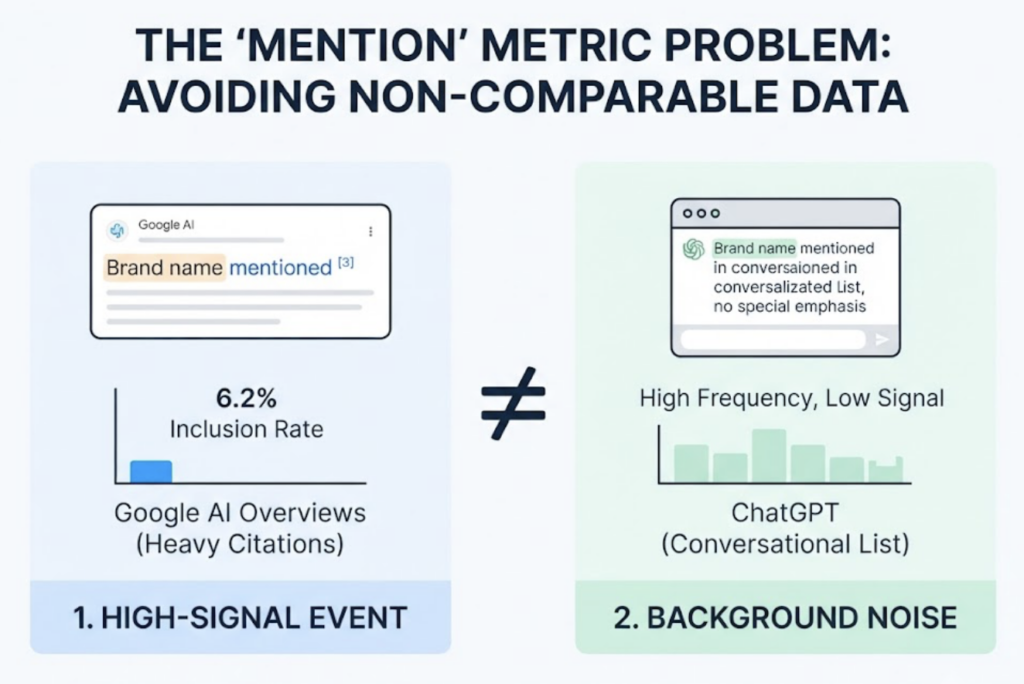
    The problem is that mentions are cheap. On ChatGPT, nearly every ecommerce brand gets named, around 99.3% inclusion in one analysis, which makes appearing in an answer a low-signal event. When almost everyone shows up, showing up proves nothing.

    A mention on one engine also isn’t the same data type as a mention on another. Google’s AI Overviews include a brand in only about 6.2% of responses and lean citation-heavy, so inclusion there is a high-signal event, while inclusion on ChatGPT is close to background noise. Counting both as one “mention” metric compares things that aren’t comparable.
    Mentions also tend to come from training data rather than live retrieval, so they rarely drive traffic and carry no proof the model trusts you. A brand can rack up thousands of neutral mentions and still convert nobody.

    Reach gets you noticed. It doesn’t get you chosen.

    Level 2: Citations and Your AI Citation Share

    A citation is a different kind of signal. Here the model actively pulls your domain in as a source, footnotes it, links it, and stakes part of its answer on your content. That’s a decision about trust, not just recognition.

    The metric for this layer is AI citation share: the percentage of AI answers, across a defined query set, that cite your domain relative to all citations in the pool. The term was coined as the replacement for share of voice and framed as the AI-era market share metric. “Share of citation” and “citation share” point to the same thing.

    The math is straightforward. Citation slots earned divided by total slots tracked, times 100. Run 30 queries across four engines, earn 14 citations while competitors earn 52, and your citation share lands at 21%.

    What counts as a strong number depends on the category. In emerging categories with a handful of credible brands, 20 to 30% is leadership territory, while in crowded categories 5 to 10% can be solid if the query set is large. The trend line matters more than the absolute figure.

    AI Citation Share vs. Share of Voice

    Old share of voice counted impressions, and multiple brands could sit on the same magazine page without displacing each other. Citation share doesn’t work that way.

    AI answers typically cite between three and eight sources per query, so the field is narrow. If you’re cited, a competitor usually isn’t. That makes citation share a zero-sum, competitive metric, not a vanity count.

    It also decouples from search rank. One analysis found 80% of the sources AI cites don’t appear in Google’s top 10 for the same query, which means your SERP position and your AI citation rate measure different realities. Ranking well and being cited well are two separate jobs.

    Level 3: Recommendations, When AI Picks You First

    The top of the funnel is the recommendation. Ask “what’s the best tool for X” and the model names you, unprompted, as the answer. This is the highest-intent signal, because the user asked for a decision and the AI made one.

    The commercial gap between layers is real. AI-referred traffic in one dataset converted at 14.2% versus 2.8% for standard organic, roughly a 5x premium, and that premium accrues to recommended brands, not merely mentioned ones.

    Recognition and recommendation also aren’t the same. An athleisure analysis put it bluntly: New Balance was identified correctly 100% of the time but recommended in only 3.4% of “best athleisure” answers, while Lululemon, with a far weaker Knowledge Graph, appeared in 92.5%. The difference came from third-party citations, not brand recognition.

    Position inside the answer matters too. First-position citations earn four to five times the click-through of fifth-position ones. Being recommended last is closer to being mentioned than being chosen.

    Why AI Citation Share Is the Layer Most Brands Skip

    Recommendations are the goal, but they’re a lagging indicator. You can’t optimize an endorsement directly. Citation share is the lever you can actually pull.

    Here’s the mechanism. Once a model consistently cites your domain as evidence, the odds it promotes you to a recommendation climb. Proof compounds into preference. Skip the citation layer and you’re trying to earn endorsements with nothing underneath them.

    The data backs the sequence. Adding statistics to content improved AI visibility by 41% in the Princeton and Georgia Tech GEO study, the single most effective technique they tested. Pages built on original research get cited at 38 to 65% versus 6 to 15% for standard posts. And branded web mentions correlate 0.66 to 0.71 with AI citation rates, which is why earned authority tends to move the middle layer more than on-page tweaks.

    There’s also a timing argument. Citation concentrates around a small set of sources, so early movers who lock in citation share build positions that compound while later entrants face an established base the engines already trust.

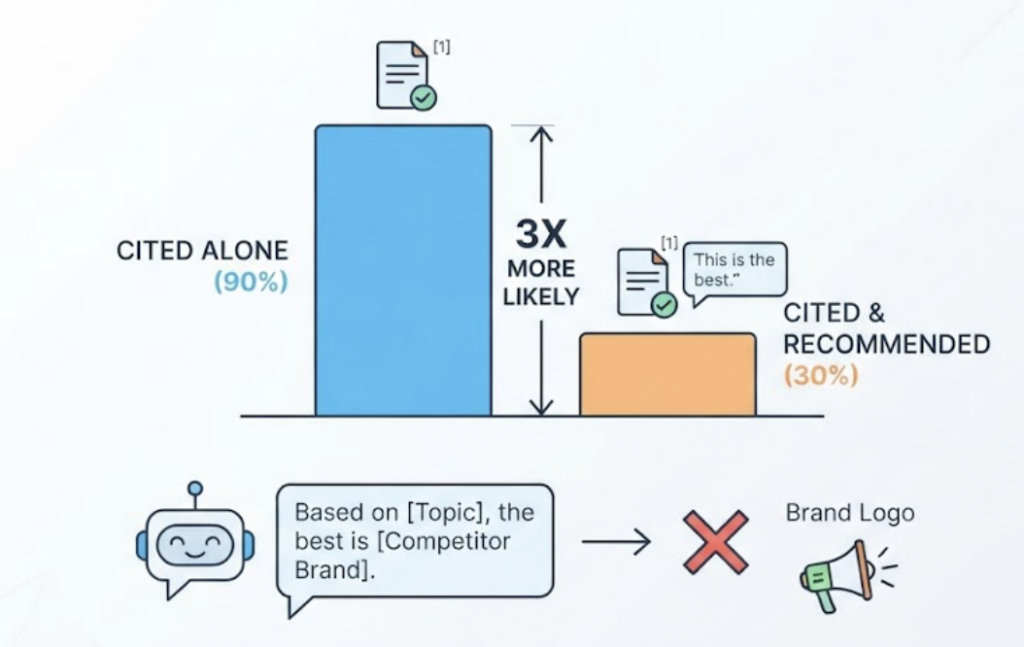
    Most tools stop at Level 1. They report mention counts and call it visibility, which leaves the citation layer, where the real leverage lives, unmeasured. Brands are three times more likely to be cited alone than to earn both a citation and a recommendation, a split that’s invisible if you only track one signal. A brand with strong citations but weak mentions is quietly feeding evidence to answers that recommend someone else.
    How to Track All Three Levels of AI Visibility

    Measuring the funnel means capturing all three signals at once, per platform, and watching how they move against competitors. A single blended number hides more than it reveals.

    That’s the job Topify is built for. Its Comprehensive GEO Analytics reports seven metrics side by side, including mentions, position, and CVR, so the awareness layer, the recommendation layer, and the conversion signal sit in one view instead of three tools. You see not just whether you appear, but whether you’re cited and whether you’re picked.

    For the middle layer specifically, Topify reverse-engineers the exact domains and URLs AI platforms pull from. In practice, that means you can watch your citation share in a category, spot the competitor domain absorbing the authority you’re missing, and trace a drop in ChatGPT mentions back to a source that stopped referencing you.

    Coverage spans ChatGPT, Gemini, Perplexity, DeepSeek, and other engines, which matters because citation patterns diverge sharply across platforms. A 40% share on one engine and 5% on another isn’t noise. It’s an authority gap on a specific model’s evaluation, and it tells you exactly where to spend.

    Start by tracking 15 to 25 buyer-intent queries, run each more than once, and read the trend rather than any single snapshot. Get started with Topify and build the baseline before you optimize anything.

    Conclusion

    Being named by AI is where visibility starts, not where it ends. Mentions give you reach, citations give you proof, and recommendations give you the sale, in that order. AI citation share is the metric sitting between recognition and endorsement, and it’s the one you can influence directly by making your content the source AI trusts. Audit where you stand across all three levels before you decide what to fix. If your brand shows up but never gets cited, you already know which layer needs the work.

    FAQ

    Q: What is AI citation share? 

    A: It’s the percentage of AI-generated answers, across a defined query set, that cite your domain as a source relative to all citations in that set. It’s the AI-era replacement for share of voice, measuring whether engines trust your content enough to build answers on it rather than just naming your brand.

    Q: How is AI citation share different from a mention? 

    A: A mention names your brand with no attribution. A citation means the AI actively used your content as evidence and linked to it. Mentions signal awareness; citations signal authority, and only citations reliably show the model treats your content as trustworthy.

    Q: How do you measure AI citation share across ChatGPT and Perplexity? 

    A: Track a fixed set of 15 to 25 category queries, run each more than once per engine, then divide your brand’s citation slots by the total slots earned across every response. Measure per platform, since engines cite very differently and a blended average hides the gaps.

    Q: Which level matters most, mentions, citations, or recommendations? 

    A: Recommendations carry the most commercial value, but they’re a result you can’t optimize directly. Citation share is the leading indicator you can move, and it’s what tends to pull a brand up into recommendations over time.
    Read More

  • How to Measure AI Citation Share: A Step-by-Step Framework

    How to Measure AI Citation Share: A Step-by-Step Framework

    You can open ChatGPT, type your category question, and count how many times your brand name shows up. That number feels like progress. It isn’t. A mention count tells you AI noticed your brand. It says nothing about whether AI trusted your content enough to use it as a source, or how that stacks up against every other source the model pulled from. Without a denominator, a raw count is a vanity metric. AI citation share is the number that survives a stakeholder review.

    What AI Citation Share Actually Measures

    AI citation share is the percentage of AI citations that point to your domain, measured across a defined set of category-relevant prompts. In plain terms, it’s your slice of the evidence AI engines rely on when they assemble an answer.

    The word “citation” carries the weight here. A citation is a source the model links to or draws from as verifiable evidence. That’s an evidence check, not a recognition check. It’s a different event from your brand name appearing in a sentence.

    Here’s the distinction that trips up most teams. An AI answer can name your brand in prose without citing your website, or cite your URL without naming the brand in the body. These are separate outcomes, and lumping them together hides what’s actually happening in the answer.

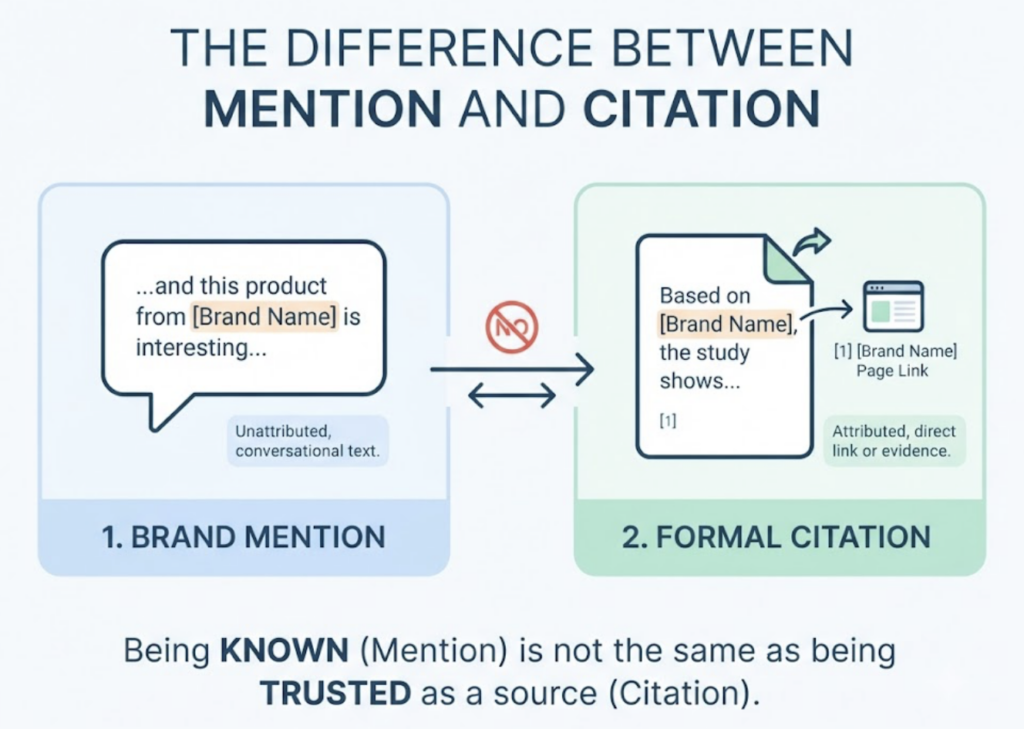
    Mentions tell you AI noticed you. Citations tell you AI trusted you.

    AI Citation Share vs. Share of Voice vs. Mention Count

    These three metrics get used interchangeably, and that’s a mistake. Each answers a different question.

    MetricWhat it tracksStrategic goal
    Mention CountHow often your brand name appearsBuilding awareness and presence in the conversation
    Share of VoiceYour footprint relative to competitors in the textMeasuring dominance across brand mentions
    AI Citation ShareHow often your domain is used as evidenceEstablishing your site as a trusted source

    Share of voice is competitive and mention-based. You divide your brand mentions by total mentions across your brand and a chosen competitor set. Citation share is different. Its denominator isn’t mentions, it’s the total pool of sources cited across all domains for your prompt set.

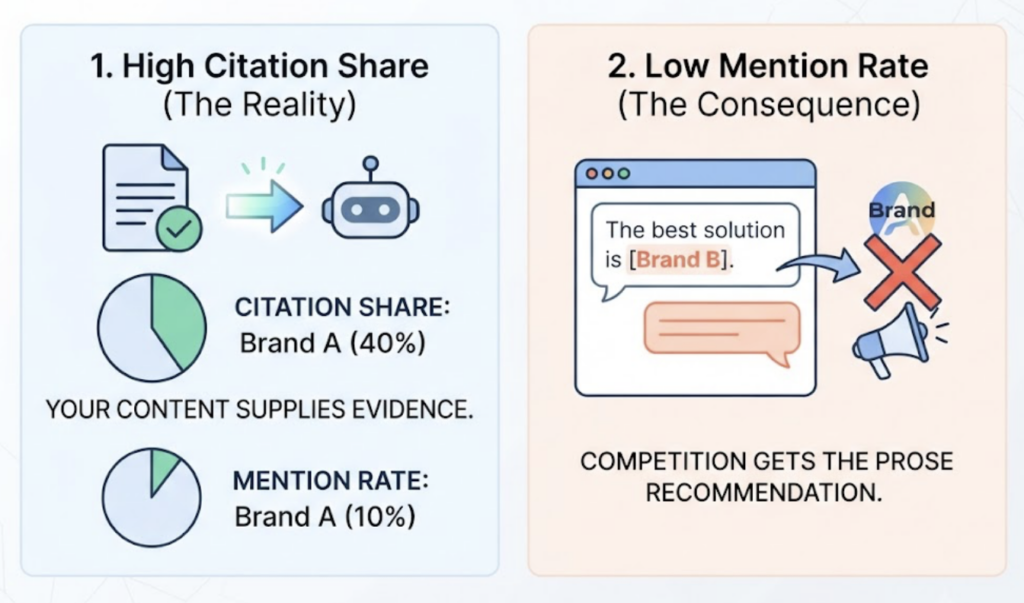
    That gap matters more than it looks. A brand can carry high citation share and low mention rate at the same time. When that happens, you’re effectively subsidizing the competition: your content supplies the evidence, and the model recommends someone else in the prose. Tracking only mentions would leave you blind to that leak.

    Why Citation Share Is the Metric Worth Tracking

    Discovery is moving into the answer itself. AI search visits grew an estimated 42.8% year over year between Q1 2025 and Q1 2026, climbing from 15.6 billion to 27.4 billion. Yet only 14% of marketers track AI citations, even as 43% call AI search optimization a core 2026 priority. The work has outrun the measurement.

    Citation share also connects to money in a way mention counts don’t. AI-referred visitors convert 4.4x better than standard organic traffic, because a user who arrives after an AI cited you as a source has already been pre-qualified. The model answered their question and pointed at your page.

    There’s a structural reason to care too. A CXL study of 100 AI Overview citations found that 55% of cited snippets came from the top 30% of a page. Citations aren’t random. They reward specific, extractable content, which means citation share is a metric you can actually move.

    The Step-by-Step Framework to Measure AI Citation Share

    Measuring AI citation share well means trading one-time snapshots for a repeatable protocol. Here’s the framework.

    Step 1: Define Your Prompt Perimeter

    Select 30 to 50 high-intent, category-specific prompts. The goal is to mirror how buyers actually phrase questions to an LLM, which tends to be conversational and long-tail, not the short-tail keywords you’d feed a traditional rank tracker.

    Anchor these prompts to real buyer questions: comparisons, “best tool for,” alternatives, and how-to queries in your category. This prompt set becomes part of the metric’s definition, so lock it down before you start counting.

    Step 2: Track Every Platform That Matters

    Different engines have different sourcing personalities, and a single-platform view is a biased one. ChatGPT tends to behave like an encyclopedia curator, favoring institutional and well-structured sources. Perplexity leans toward community and real-time validation. Google AI Overviews prioritizes structured, front-loaded answers.

    Your share will move from one engine to the next, so measure each separately, then roll them up. A blended number that hides a zero on one platform is worse than no number at all.

    Step 3: Capture Citations, Not Mentions

    For every answer, log the actual cited domains and URLs, not just whether your brand name appeared. This is where the mention-citation gap becomes visible.

    Record each cited source, tag whether it belongs to you, a competitor, or a third party, and note which prompt produced it. That raw log is what makes the next step possible.

    Step 4: Calculate Share Against the Total Citation Pool

    The formula is straightforward:

    AI Citation Share = (Total citations to your domain ÷ Total citations across all domains in your prompt set) × 100

    A quick example. Say you run 40 prompts across three platforms and collect 500 total citations. Your domain accounts for 60 of them. Your AI citation share is 12%. If your top competitor holds 90 citations, theirs is 18%, and you now have a like-for-like gap to close.

    Normalize against the total citation pool rather than raw counts, since answer lengths and citation density vary across platforms. A percentage keeps the number comparable.

    Step 5: Benchmark Against Competitors and Track Over Time

    A single reading is a snapshot of a moving target. Cited domain sets drift 40% to 60% month over month in active categories. The volatility runs deeper than most teams expect: one citation dataset found that the typical brand loses half its AI citations in about 31 days.

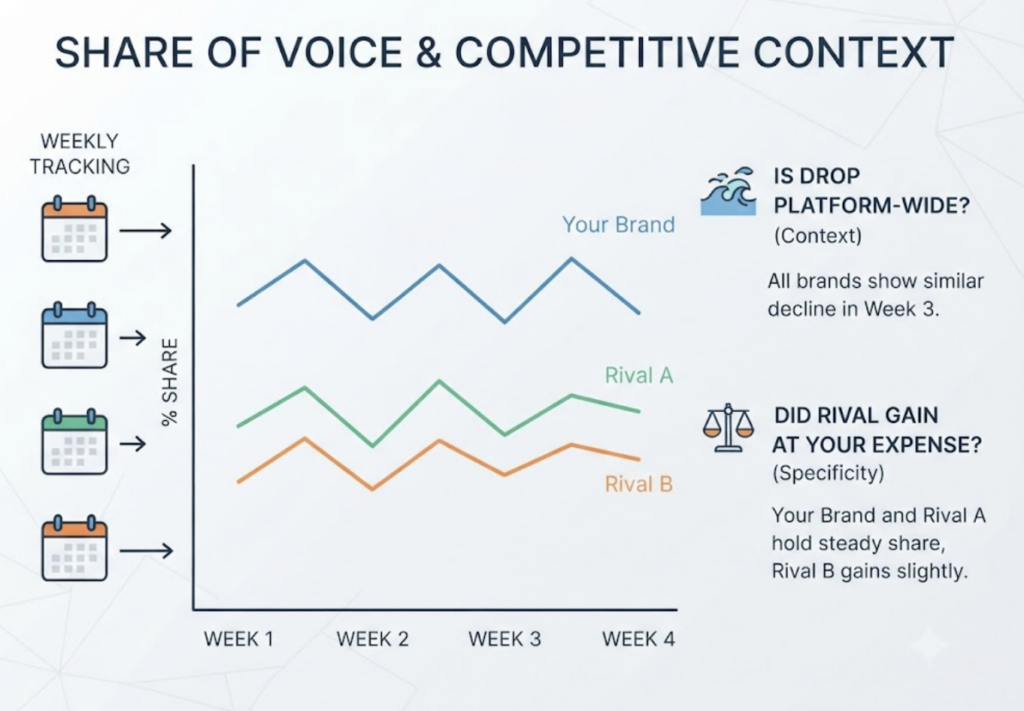
    Always measure your share alongside your top three competitors. That context tells you whether a drop is platform-wide or specific to you, and whether a rival’s gain came at your expense. Weekly tracking is the practical minimum for spotting real trends instead of noise.

    Common Mistakes That Distort Your AI Citation Share

    Even a good framework gets undone by a few recurring errors.

    Platform isolation. Measuring one engine (usually ChatGPT) and calling it “AI” gives you a skewed picture. Multi-platform coverage isn’t optional.

    The mention fallacy. Treating unlinked brand names as citations inflates your perceived authority. A name in prose and a linked source are different events, and only one of them signals trust.

    Small sample sizes. Tracking fewer than 20 prompts produces statistically unreliable data. Aim for 30 to 50 to get a representative read.

    Static snapshots. A one-time audit ignores the fact that AI sourcing is probabilistic and shifts fast. The number you pulled last month is likely already stale.

    Scaling AI Citation Share Measurement with Topify

    Manual tracking works until it doesn’t. Once you’re running 40-plus prompts across three or four engines every week, logging citations by hand hits a complexity ceiling fast. That’s the point where most teams either give up or automate.

    Topify is built for that automation layer. Its Reverse-Engineer AI Citations feature analyzes the exact domains and URLs that AI platforms cite, then shows whether your brand or your competitors dominate those references across a prompt set. In practice, you can see a drop in your citation share, trace it to a specific competitor page that started getting cited instead of yours, and act on the gap, all in one view.

    The competitor benchmarking runs on the same prompt set, so your share always sits next to your rivals’ rather than floating in isolation. And because coverage spans ChatGPT, Gemini, Perplexity, and other major engines, you avoid the single-platform bias that quietly distorts hand-tracked numbers.

    For teams moving from spreadsheets to a repeatable system, that’s the difference between a monthly guess and a weekly trend line. You can get started and baseline your citation share before your next reporting cycle.

    Conclusion

    Counting brand mentions feels productive, but it measures the wrong thing. AI citation share tells you how much of the evidence layer you actually own, which is what decides whether AI recommends you or your competitor. Start by defining a 30 to 50 prompt set, track citations across every engine your buyers use, calculate your share against the full citation pool, and watch the trend rather than any single reading. The brands that win AI search aren’t the ones mentioned most. They’re the ones cited most, consistently, over time.

    FAQ

    Q: How do you calculate AI citation share? 

    A: Divide the total citations pointing to your domain by the total citations across all domains in your prompt set, then multiply by 100. If your domain earns 60 of 500 total citations, your AI citation share is 12%. Always normalize as a percentage so the metric stays comparable across platforms.

    Q: What’s the difference between AI citation share and share of voice? 

    A: Share of voice is usually mention-based, measuring how often your brand name appears relative to competitors. AI citation share is source-based, measuring how often your domain is cited as evidence relative to the total citation pool. A brand can score high on one and low on the other, which is why they should be tracked separately.

    Q: How many prompts do I need to measure AI citation share reliably? 

    A: Aim for 30 to 50 category-relevant prompts. Anything under 20 tends to produce statistically unreliable data, since AI answers fluctuate by phrasing, model version, and sampling randomness.

    Q: How often should I measure AI citation share? 

    A: Weekly at minimum. Cited domain sets drift 40% to 60% month over month, and the typical brand loses half its citations within about a month, so a one-time audit goes stale quickly. Continuous tracking is what turns the metric into a usable trend.

    Read More

  • Why Your Google Rankings Don’t Predict Your AI Citation Share

    Why Your Google Rankings Don’t Predict Your AI Citation Share

    Your keyword rankings are holding steady. Your domain authority climbed again last quarter. Then you ask ChatGPT for the best tool in your category, and it cites three competitors and a forum thread. Your brand, the one ranking #1 on Google for that exact query, doesn’t show up anywhere in the answer. The rankings dashboard that used to explain everything suddenly explains nothing here. Google position and AI citation share are measuring two different games, and the gap between them is where a lot of brands are quietly losing ground.

    Your Rankings Are Solid. Your AI Citation Share Might Be Zero.

    AI citation share is the percentage of AI-generated answers where your domain shows up as a cited source, measured against everyone else cited for the same set of queries. It’s a presence metric, not a position metric. You’re either in the answer or you’re not.

    That distinction matters more than it sounds. A brand can hold the #1 spot on Google for a head term and still register a 0% citation share in the AI response for that same query. The ranking is real. The AI visibility is missing.

    Here’s the part that catches most teams off guard.

    Rankings and citations aren’t loosely correlated with a bit of noise. They’re decoupled. Being the top organic result tells you almost nothing about whether an LLM will pull your page into its answer, because the two systems were built to reward different things.

    Google Ranks Pages. AI Cites Sources. Those Aren’t the Same Thing.

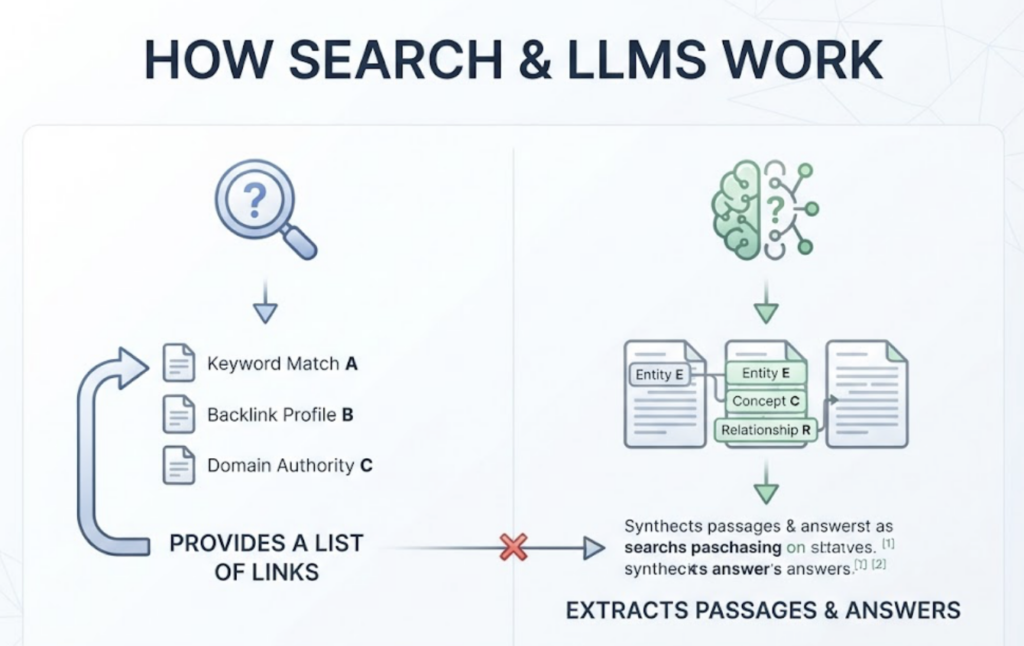
    Traditional SEO metrics struggle to predict AI behavior for a simple reason: large language models don’t consult the Google index when they answer. They run on Retrieval-Augmented Generation, pulling passages from retrieved sources and synthesizing them into a single response.

    Google’s ranking logic rewards lexical matching, backlink profiles, and domain authority. It produces a list of links and lets the user pick. LLM citation logic works differently. It parses content for entities, people, products, and concepts, along with the relationships between them, then extracts the passages that answer the question most cleanly.

    That’s the structural gap. Research on LLM citation behavior points to a strong preference for content that’s extractable: facts, definitions, and insights presented in standalone, structured segments that an AI can lift without losing context. A page that ranks #1 on keywords can be skipped entirely by an LLM if it never states a concise, self-contained answer.

    The two systems don’t even share a unit of measurement.

    DimensionGoogle RankingAI Citation
    Primary unitPage or URLPassage or entity relationship
    Primary currencyBacklinks and domain authorityStructural clarity and extractability
    Output typeList of linksSynthesized factual answer
    Success metricSERP positionCitation frequency and presence

    Read that table as two separate scoreboards. Winning the left column is what your SEO team has optimized for over years. The right column is a different competition with different rules, and most brands haven’t started keeping score.

    What Google Rankings Can’t Tell You About AI Search Visibility

    The tools built for traditional SEO measure position. AI search visibility is a question of presence. That mismatch is why a rank tracker, no matter how good, can’t report your AI citation share. It’s measuring the wrong axis.

    There’s a second blind spot: fragmentation. AI visibility isn’t universal across platforms. A domain can be cited heavily in Perplexity and ignored by Gemini or Google AI Overviews for the same query. Each engine retrieves and weighs sources on its own logic.

    A single-source rank tracker gives you one number for one search engine. AI citation share lives across ChatGPT, Perplexity, Gemini, and AI Overviews at once, and those numbers rarely move together. Averaging them hides the story. You need per-platform visibility to see where you’re winning and where you’ve disappeared.

    How to Actually Measure Your AI Citation Share

    Moving past vanity metrics means treating citation share as something you calculate, not something you guess at. A repeatable framework looks like this.

    Start by defining the perimeter. Pick 10 to 30 high-intent, category-specific prompts, a mix of head terms and the fan-out variations users actually type into AI tools. This is your measurement set.

    Next, map the citation graph. For each prompt, record which domains appear in the AI’s sources or references. This tells you who the LLM already trusts for your category.

    Then calculate the share. The standard normalization is straightforward:

    Citation Share = (Total citations to your domain / Total citations across all domains in the set) × 100

    Run it per platform and track it over time, not as a one-off snapshot. Citation patterns shift every few weeks, so last month’s number is often already stale.

    Finally, do the competitive gap analysis. Find the “power pages” that competitors get cited for again and again, then deconstruct their structure: question-style headers, a direct answer in the opening line, clean schema markup. Those patterns are the reverse-engineering roadmap.

    Reverse-Engineering Which Sources AI Decides to Cite

    Knowing your citation share is dropped points to a problem. Fixing it means understanding why AI cites one source over another, and that’s where source-level tracking earns its place. Platforms like Topify are built around this exact question, tracking not just whether your brand gets mentioned but where the citation lands, down to the specific URL and passage.

    Its Reverse-Engineer AI Citations view analyzes the precise domains and URLs that AI platforms pull from, so you can see whether you or your competitors dominate those references at scale. The immediate payoff is a target list: publications that cite a rival but never you become obvious priorities for content syndication and outreach.

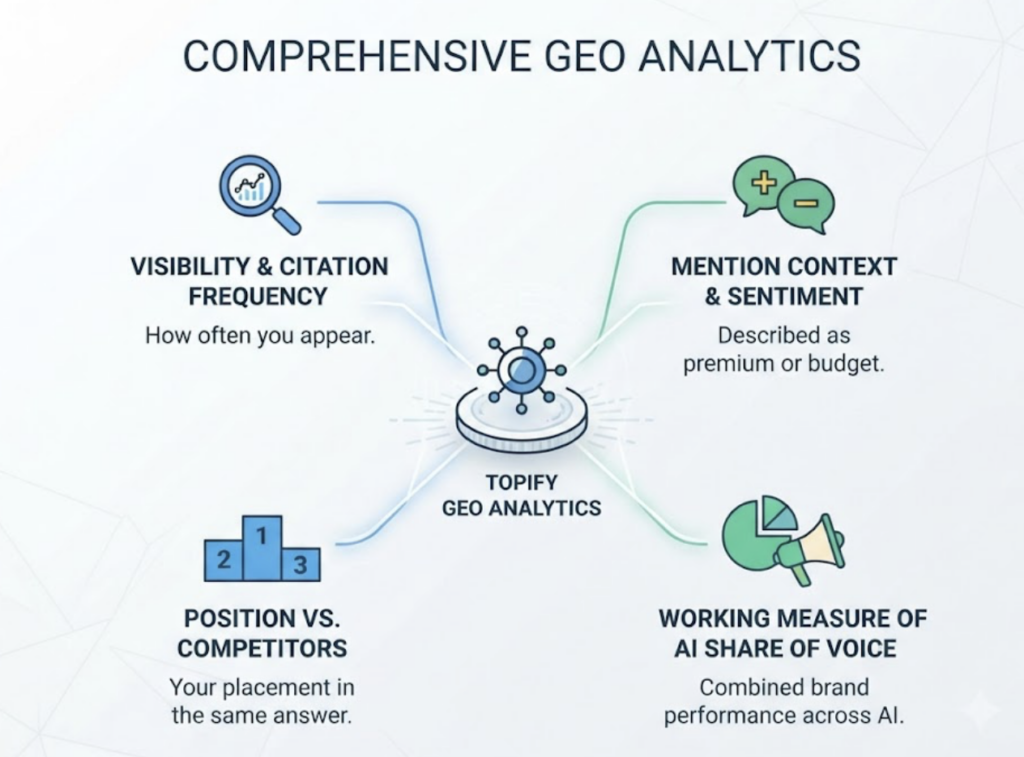
    That connects to the wider picture through Topify’s Comprehensive GEO Analytics, which tracks brand performance across major AI platforms on metrics like visibility, mentions, position, and sentiment. Citation frequency tells you how often you show up. Mention context tells you whether AI describes you as premium or budget. Position tells you where you land relative to competitors in the same answer. Together they add up to a working measure of AI share of voice.

    In practice, that means you can watch your citation share slip on a key prompt, trace it to a source that stopped referencing you, and see which competitor moved into that slot instead. The dashboard turns a vague sense of “we’re not showing up” into a specific, fixable diagnosis.

    Competitor benchmarking closes the loop. Instead of guessing why a rival keeps appearing, you get the structural signals behind their cited pages and a clear read on how to close the gap.

    What Changes Once You Track Citation Share Instead of Rankings

    The shift is from a ranking-first mindset to an answer-first one. When a content team measures by position, they optimize pages to climb the SERP. When they measure by citation share, they optimize passages to be quotable by an AI. Those produce genuinely different edits: tighter definitions, direct opening answers, question-based headers, cleaner entity signals.

    One pattern shows up repeatedly with teams that make the switch. They stop asking “why did our ranking drop” and start asking “which prompts are we losing citation share on, and to whom.” The second question is answerable, and it points straight at the content that needs work.

    Your first step doesn’t require a full platform rollout. Pick five prompts your buyers would realistically type into ChatGPT or Perplexity, run them, and write down who gets cited. If your brand ranks well on Google but isn’t in those answers, you’ve just confirmed the gap. Now you have something to fix.

    Conclusion

    Google rankings and AI citation share were never going to move in lockstep, because one rewards pages and backlinks while the other rewards extractable, well-structured sources an LLM can trust. Treating a strong SERP position as proof of AI visibility is the mistake quietly costing brands their place in AI answers. As more buying research moves into AI interfaces, citation share becomes the more honest proxy for digital authority. Start by measuring where you actually stand across the platforms your audience uses, then optimize your content to be cited, not just ranked.

    FAQ

    Q: What is AI citation share? 

    A: It’s the percentage of AI-generated answers, across a defined set of prompts, where your domain appears as a cited source, measured against all other domains cited for those same prompts. It measures presence in AI answers rather than position in a search results page.

    Q: How do I measure AI citation share? 

    A: Define 10 to 30 category prompts, record which domains each AI platform cites for them, then divide your citations by the total citations across all domains and multiply by 100. Track it per platform over time, since ChatGPT, Perplexity, Gemini, and AI Overviews cite different sources.

    Q: Google rankings vs AI citation share, why don’t they match? 

    A: They run on separate mechanics. Google ranks whole pages using backlinks and domain authority. LLMs cite individual passages based on structural clarity and extractability. A #1 page with no concise, standalone answer can be ignored by an AI entirely.

    Q: Does good SEO help my AI citation share at all? 

    A: It helps but it isn’t sufficient. Strong authority and clean technical SEO make your content easier to retrieve, but you still need extractable structure, direct answers, question-style headers, and clear entity signals for an LLM to actually cite you.

    Read More

  • What Is AI Citation Share? Definition, Formula & Why It Matters

    What Is AI Citation Share? Definition, Formula & Why It Matters

    Your brand shows up when someone asks ChatGPT about your category. The name lands in the answer, and it reads like a win. Then you check the sources the model actually linked, and your domain isn’t one of them. A competitor’s page is doing the citing work. Yours is just along for the ride.

    That gap, between getting named and getting cited, is where most GEO measurement quietly breaks. Teams count how often they’re mentioned and call it visibility. The harder question is whether AI engines trust your content enough to hand users your URL as proof. That question has a name: AI citation share.

    What AI Citation Share Actually Means

    AI citation share is the percentage of citations in a set of AI answers that point to your domain. Not mentions. Citations. The distinction sounds small and turns out to be everything.

    A mention is your brand name floating in conversational text, usually unattributed. A citation is a formal act: the model links to your page, references it directly, or uses it as the evidence behind a claim. Similarweb frames the difference cleanly. Being known and being trusted as a source are not the same thing, and treating them as interchangeable is one of the more common strategic errors in GEO right now.

    Think of it as a measure of grounding. When an AI model needs evidence to back what it’s telling a user, does it reach for your content or someone else’s? Citation share puts a number on that.

    AI Citation Share vs Share of Voice vs Mention Share

    Three metrics get used as if they mean the same thing. They don’t. The fastest way to see it is to line up what each one actually counts.

    MetricPrimary unit of analysisWhat it tells you
    Share of VoiceBrand mentions in answer textAwareness and sentiment presence across a prompt set
    Mention ShareFrequency of brand name appearancesWhether you show up in AI conversations at all
    AI Citation ShareDomain-level attribution in groundingWhether AI trusts your content enough to source it

    Share of voice and mention share live at the level of the brand name. They answer “did we come up?” AI citation share lives at the level of the domain and the link. It answers “did we get used as evidence?”

    Here’s why the mix-up costs you. Optimize for mentions and you can win a vanity metric while your competitor owns every citation slot underneath the answer. The buyer sees your name once, clicks the sourced link, and lands on the competitor’s page. You measured presence. They captured the referral. If you’re already tracking AI share of voice, citation share is the layer that tells you whether that voice is doing any structural work.

    The AI Citation Share Formula, Step by Step

    The math is simple, and the simplicity is the point. Citation share is a normalized ratio.

    Citation Share = (Total citations to your domain in a prompt set ÷ Total citations across all domains in that set) × 100

    The academic version reads the same way. Citation share for a domain is the domain’s citation count divided by the total citation count in the sample. Normalizing by the total is what makes the number portable.

    Work an example. You define a set of 20 category prompts. Across all the AI answers those prompts generate, there are 100 citations total. Your domain gets cited 12 times. Your AI citation share is 12 divided by 100, times 100, or 12%.

    Why divide by the total instead of just counting your citations? Because a raw citation count scales with how many prompts you ran and how citation-heavy a given platform is. Perplexity cites far more sources per answer than most chat models. Count raw citations and Perplexity will always look like your strongest channel, even when your relative standing is weak. Dividing by the total strips that noise out, so a 12% share on Gemini and a 12% share on Perplexity mean the same thing.

    That comparability is the whole reason the metric exists. One number, readable across platforms and across sample sizes.

    How to Sample Prompts and Count Citations Correctly

    AI search is probabilistic, not deterministic. Ask the same question twice and you can get two different source lists. Run a prompt once and you’ve measured a coin flip, not a trend.

    A workable perimeter is 10 to 30 high-intent, category-relevant prompts that mirror the buyer’s journey, some informational, some closer to a purchase decision. Keep them simple. Long, multi-part queries push models to rewrite and improvise instead of retrieving, which pollutes your citation data.

    Then repeat. Because models fluctuate, audit weekly or every two weeks rather than once a quarter. Track across several engines, since Google AI Overviews, Perplexity, Gemini, and Claude each have their own sourcing habits. And tag every citation as owned (your domain), earned (independent third parties), or intermediary (review and directory sites like G2 or Capterra). That tagging is what turns a flat percentage into a plan, because it shows you which type of source AI leans on in your category.

    Why AI Citation Share Matters More Than Rankings Now

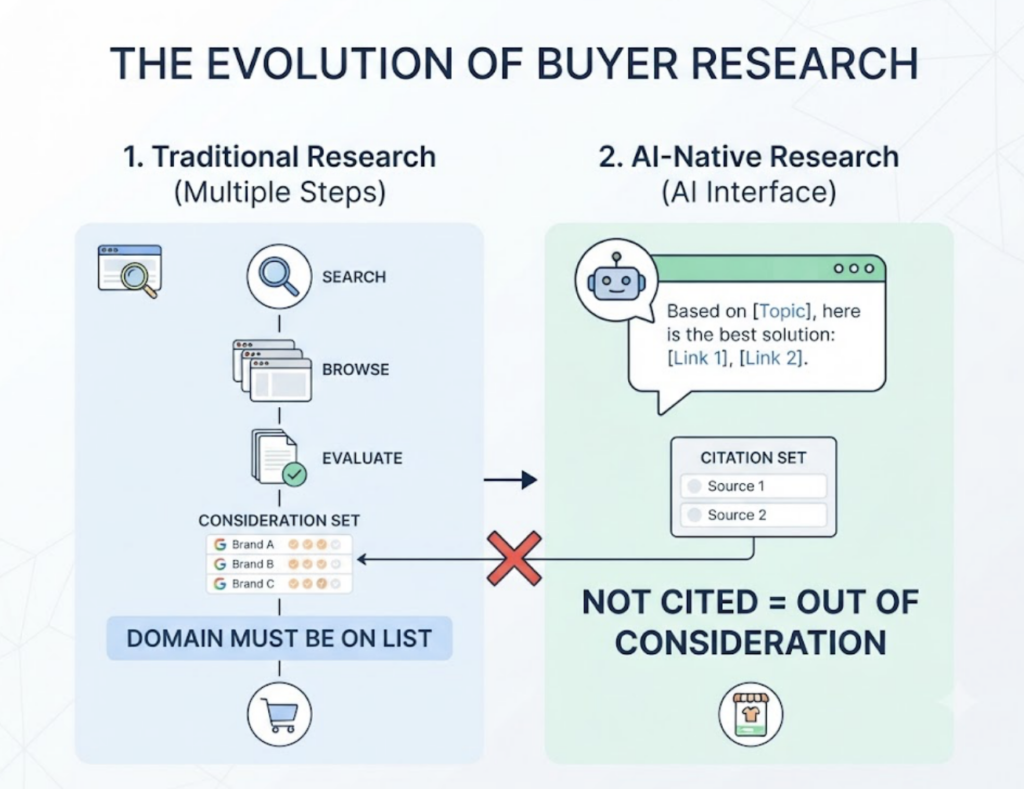
    Buyers are finishing their research inside the AI interface. They read the synthesized answer, click a cited source or two, and move on. If your domain isn’t in that citation set, you’re not lower in the consideration set. You’re out of it.

    Citations behave like the AI era’s backlinks. A citation carries more weight than a mention because it signals your content cleared the model’s grounding threshold. Some visibility tools already reflect this, weighting citations 1.25 times higher than mentions when scoring overall AI visibility.

    The timing is the opportunity. AI search visits grew roughly 42.8% year over year, yet only about 14% of marketers track citation-based visibility at all. Most teams are still optimizing for a search results page that fewer of their buyers ever see.

    That’s the gap most brands still can’t see.

    It means the brands measuring citation share today are setting a baseline before their category gets crowded. The ones waiting for the metric to feel mainstream will be reverse-engineering someone else’s lead.

    How to Track AI Citation Share Without Doing It by Hand

    Now the practical wall. The formula is easy. Producing the inputs at any real cadence is not.

    Getting a trustworthy citation share means running dozens of prompts across four or five engines, several times a week, then parsing every answer to extract which domains were cited and mapping each one back to a brand. Do that manually and you’ll spend more time assembling the dataset than acting on it. Miss a week and your data goes stale, because AI sourcing shifts faster than most content calendars.

    This is where a monitoring platform earns its place. Topify is built around this exact measurement problem. Its Source Analysis feature reverse-engineers AI citations directly, showing the specific domains and URLs that ChatGPT, Gemini, Perplexity, and other engines pull from, so your citation share is computed from real answer data rather than estimated.

    From there, the useful part isn’t the raw percentage. It’s the comparison. Topify tracks your citation share against named competitors across the same prompt set, so you can see not just that a rival out-cites you but which of their pages the model keeps reaching for. In practice, that often points to something concrete and fixable, like a competitor’s comparison table that AI finds easier to extract than your prose.

    Citation share sits alongside the platform’s other GEO metrics, including visibility, mentions, position, and sentiment, which keeps the number in context instead of stranded in a spreadsheet. If you want to establish a baseline before scaling, you can get started with Topify on your most important head terms first.

    Track it. Benchmark it. Then close the gaps the data exposes.

    Conclusion

    Getting mentioned tells you AI knows your brand exists. AI citation share tells you whether AI trusts you enough to source you. In a search world where buyers decide inside the answer, the second signal is the one that moves pipeline.

    Start narrow. Pick your 10 to 20 highest-intent category prompts, measure your citation share as a baseline, and tag where AI is currently reaching for evidence. Once you know your starting number and who’s out-citing you, you have something traditional rankings never gave you: a direct line from what AI trusts to what you need to fix.

    FAQ

    What is a good AI citation share? 

    There’s no universal benchmark, because it depends on category density and how many credible sources exist. The useful reading is relative. Measure your share against direct competitors on the same prompt set, then track whether the gap is closing over time. A rising share against named rivals matters more than any absolute percentage.

    How is AI citation share different from share of voice? 

    Share of voice counts brand mentions in answer text and measures awareness. AI citation share counts domain-level citations and measures trust, specifically whether AI uses your content as sourced evidence. You can have high share of voice and low citation share, which usually means AI talks about you but sends users elsewhere for proof.

    How often should I measure AI citation share? 

    Weekly or every two weeks. AI models are probabilistic and their sourcing shifts frequently, so a single measurement captures noise rather than a trend. Regular re-testing across multiple engines is what separates a reliable citation share from a one-off snapshot.

    Can you improve your AI citation share? 

    Yes. Start by identifying which competitor pages AI keeps citing and why, often it’s structural, like extractable tables, clear headings, or direct factual answers. Improving how retrievably your content is formatted, and earning citations on the intermediary sites AI trusts in your category, both tend to move the number.

    Read More

  • How to Increase Your AI Citation Share: 7 Tactics That Actually Work

    How to Increase Your AI Citation Share: 7 Tactics That Actually Work

    You ran the AI visibility report. Your brand shows up in maybe two out of ten answers for the queries that matter, while a competitor you rarely think about gets cited in seven. The report gave you the number. It didn’t tell you why, or what to fix first.

    That’s the frustrating part of citation share work. The gap is easy to measure and painful to close, because the levers that move it aren’t the ones traditional SEO trained you to pull. The good news: citation behavior follows patterns. Once you can see which sources AI reaches for and why, raising your share stops being guesswork.

    What AI Citation Share Actually Measures (and Why Rankings Don’t)

    AI citation share is the percentage of AI-generated answers that cite your domain as a source, measured across a defined set of category-relevant queries. It’s a share, not a rank. If a topic generates 100 citations across ChatGPT, Perplexity, and Google AI Overviews, and your domain accounts for 12 of them, your citation share is 12%.

    This is a different metric from the two most teams already track. Share of Voice counts how often your brand gets mentioned across media. Search rankings track your position in a list of blue links. Neither one tells you whether an AI engine treats your page as evidence worth quoting.

    Here’s the distinction that matters most. A brand mention inside AI-generated narrative is often a residue of training data. A citation is a receipt: the engine retrieved your page in real time and attributed a specific claim to it. Being mentioned is not the same as being cited.

    MetricWhat it tracksWhat moves it
    Search RankingsPosition in the results listBacklinks, domain authority, on-page SEO
    Share of VoiceBrand mention volume across mediaPR, social reach, ad spend
    AI Citation ShareShare of AI answers that cite your domainExtractability, semantic relevance, entity coherence

    The reason rankings don’t predict citations is structural. Up to 80% of the sources AI platforms cite don’t appear in the top 10 of traditional search for the same query. Different pipeline, different winners.

    Tactic 1: Find Out Which Sources AI Already Cites in Your Category

    Don’t start by producing more content. Start by reverse-engineering the current citation landscape.

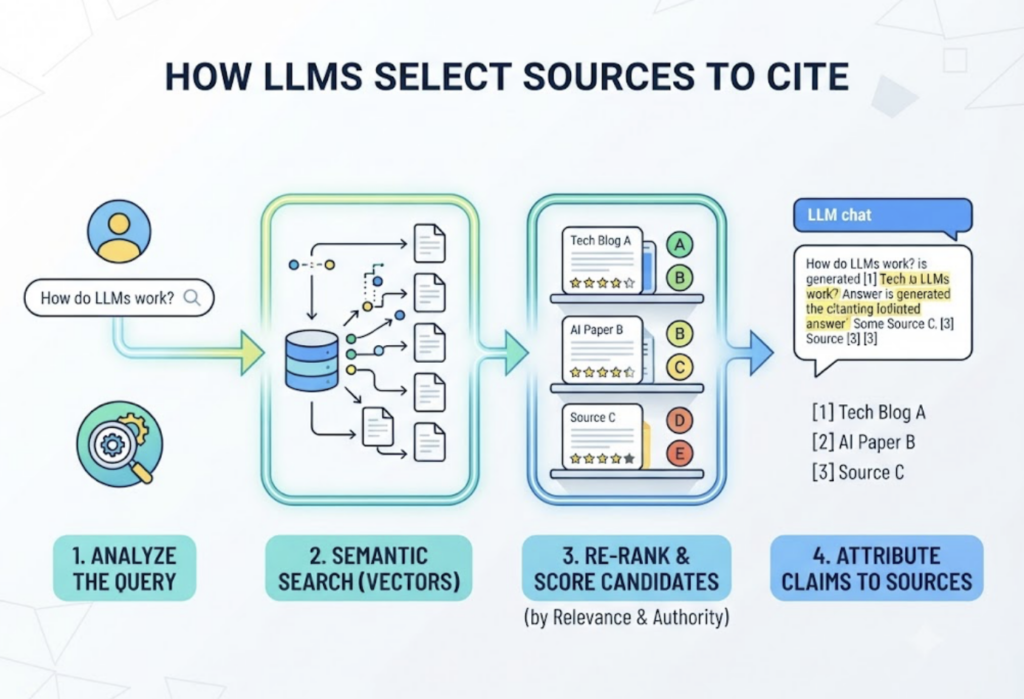
    LLMs don’t rank pages the way Google does. They run a retrieval pipeline: analyze the query, pull semantically close content using vector embeddings, re-rank candidates on structural and authority signals, then attribute claims to the sources they kept. If you want to understand how LLMs choose which sources to cite, you have to look at the sources they’re already citing in your space.

    Pull the domains and URLs that AI engines reference for your top category prompts. Look for concentration. In most categories, a small set of pages absorbs the majority of citations, and they usually share a structure worth copying.

    This is where a citation-source view earns its keep. Topify includes a Source Analysis function that reverse-engineers the exact domains and URLs AI platforms cite, so you can see whether you or your competitors dominate those references before you write a single new sentence. Map the landscape first. Everything after this tactic is a response to what you find.

    Tactic 2: Structure Content the Way LLMs Extract It

    Extractability is the single biggest lever most teams ignore. An engine can only cite what it can pull cleanly out of your page without losing the meaning.

    Lead with the answer. Put the core response in the first 40 to 75 words of a section, using a simple pattern: define the entity, answer the question directly, then add supporting evidence. Burying the answer under three paragraphs of setup is how good content goes uncited.

    Then break the body into small, self-contained blocks. Two to four lines each, written so a model can quote the block without needing the surrounding context to make sense.

    Format for machines as well as people. Comparison tables, numbered lists, and clear bullet points give engines discrete, quotable units. Structured formats like tables can lift citation rates by up to 2.5x over the same information delivered as prose. Same facts, very different pickup.

    Tactic 3: Earn Citations From Sources AI Already Trusts

    LLMs build evidence graphs to resolve contradictions between sources. When two pages disagree, the engine leans toward the one that’s corroborated elsewhere and broadly recognized.

    That produces a systematic bias toward third-party, earned media. Industry publications, well-cited research, and active community forums tend to get pulled more often than a brand’s own marketing pages making the same claim. The engine reads independent corroboration as a trust signal.

    So a real citation strategy isn’t only about your own site. It’s about getting your data, definitions, and point of view embedded in the sources AI already reaches for. A single stat cited in a respected industry report can do more for your citation share than ten blog posts on your own domain.

    Tactic 4: Write for the Prompt, Not Just the Keyword

    Keywords are how people searched Google. Prompts are how people talk to AI, and they carry more intent, more context, and usually a follow-up.

    Match that. Use question-style headings that mirror the exact phrasing a user would type, and answer each one as a clean, standalone unit. Applying FAQPage schema to genuine question-and-answer pairs helps here, because engines frequently pull from structured segments that offer a clear, extractable factual unit.

    Then anticipate the second question. Someone asking how to increase AI citation share will almost certainly wonder how citation share differs from share of voice, or how long improvements take to show up. Cover the chain, not just the entry point, and you become the source that answers the whole conversation.

    Tactic 5: Keep Your Facts Fresh and Consistent Everywhere

    Contradictory or stale information gets down-weighted. If your homepage says one thing, a directory listing says another, and a two-year-old post says a third, the engine has no stable version of your brand to trust.

    Entity coherence fixes this. Define your brand, your category, and your key facts the same way across every platform you appear on: your site, press releases, industry profiles, and social. Consistency lets the model validate your authority instead of hedging around it.

    Freshness compounds the effect. Update your highest-priority pages on a regular cadence so the numbers, product details, and claims stay current. Facts drift, and so does model behavior.

    Tactic 6: Measure Your AI Citation Share Before and After Every Change

    You can’t improve what you don’t baseline. And manual spot-checks won’t cut it, because AI responses are probabilistic: ask the same question twice and you may get two different source sets.

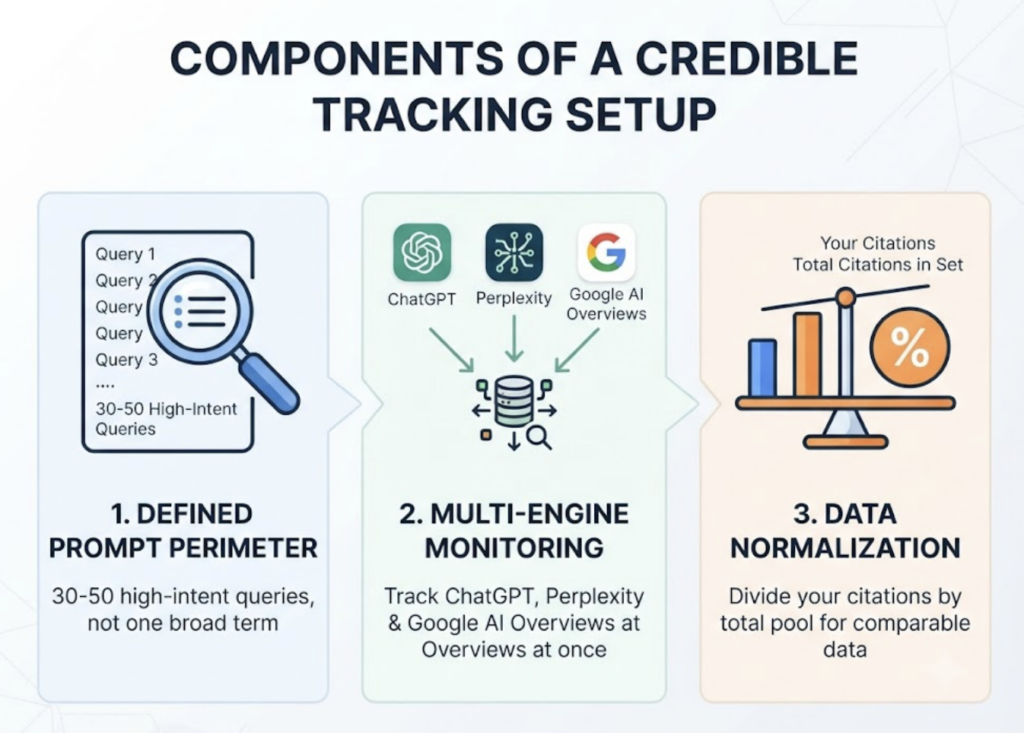
    A credible tracking setup does three things. It uses a defined prompt perimeter of 30 to 50 high-intent queries rather than one broad term. It monitors ChatGPT, Perplexity, and Google AI Overviews at once, since each engine sources differently. And it normalizes the data by dividing your citations by the total pool of citations in the set, so the number holds up across platforms.

    This is measurement work, not intuition. Topify’s Visibility Tracking quantifies your citation share across major AI platforms, and its Competitor Benchmarking shows how much of the pool each rival is taking. Run the baseline, ship a change, then re-measure so you can attribute movement to the specific tactic that caused it. Ship. Measure. Attribute.

    Tactic 7: Take the Gaps Your Competitors Left Open

    Not every prompt in your category is contested. Some high-intent questions get thin, generic AI answers because nobody has published a genuinely citable source yet.

    Those gaps are the fastest wins. Find the prompts where the current citations are weak, off-topic, or dominated by a single aging page, and build the answer-first, well-structured resource that engine has been waiting for. You’re not fighting an entrenched competitor there. You’re filling a vacuum.

    Prioritize by data, not by hunch. The prompts with high intent and weak incumbent citations should sit at the top of your content queue, ahead of the ones where a strong competitor already owns the reference.

    Conclusion

    Low citation share is rarely a content-volume problem. It’s a signal that you’re not showing up at the citation layer, where extractability, corroboration, and consistency decide who gets quoted. The teams that win treat their content as a source to be reused, not a page to be ranked.

    Start narrow and sequence it. Baseline your share against your top three competitors, reverse-engineer the pages AI already cites, fix structure and consistency on your highest-intent pages, then re-measure every couple of weeks to account for model drift. If you want the tracking and source analysis in one place, you can get started with Topify and see where your share stands before you change anything.

    FAQ

    Q: What’s the difference between AI citation share and share of voice? 

    A: Share of voice measures how often your brand is mentioned across media. AI citation share measures how often AI engines cite your domain as a source in their answers. A mention is often a byproduct of training data, while a citation is a real-time retrieval that treats your page as evidence.

    Q: How long does it take to improve AI citation share? 

    A: It varies by category and how competitive the citation landscape is. Structural fixes like answer-first formatting and tables tend to show up faster than authority-based gains, which depend on earning references from trusted third-party sources. Because models update frequently, treat improvement as an ongoing cadence rather than a one-time project.

    Q: Do I need to track every AI platform separately? 

    A: Yes, at least the major ones. ChatGPT, Perplexity, and Google AI Overviews use different sourcing logic, so a source that dominates one may barely appear in another. Tracking them together and normalizing by the total citation pool gives you a share number you can compare across platforms.

    Q: Is low citation share a content problem or an authority problem? 

    A: Usually both, in that order. Extractability and structure are the first fixes because engines can’t cite what they can’t cleanly parse. Once your pages are citable, corroboration and entity consistency across trusted external sources determine how often you actually get chosen.

    Read More

  • Should You Buy ChatGPT Ads? A Decision Framework

    Should You Buy ChatGPT Ads? A Decision Framework

    The proposal is sitting in your budget deck: test ChatGPT ads this quarter. Your CMO wants an answer by Friday. The pitch sounds compelling, a brand-new ad surface with billions of daily prompts and no minimum spend since May. But you’ve also seen the numbers floating around: click-through rates under 1%, CPMs that started at $60, and a platform that rewrites its own rules every few weeks. Say yes too early and you’re funding OpenAI’s learning curve. Say no and a competitor might lock in cheap early inventory while you wait for case studies.

    The answer isn’t yes or no. It’s a framework, and it starts with data you probably haven’t looked at yet.

    ChatGPT Ads Are Real Now. The Playbook Isn’t.

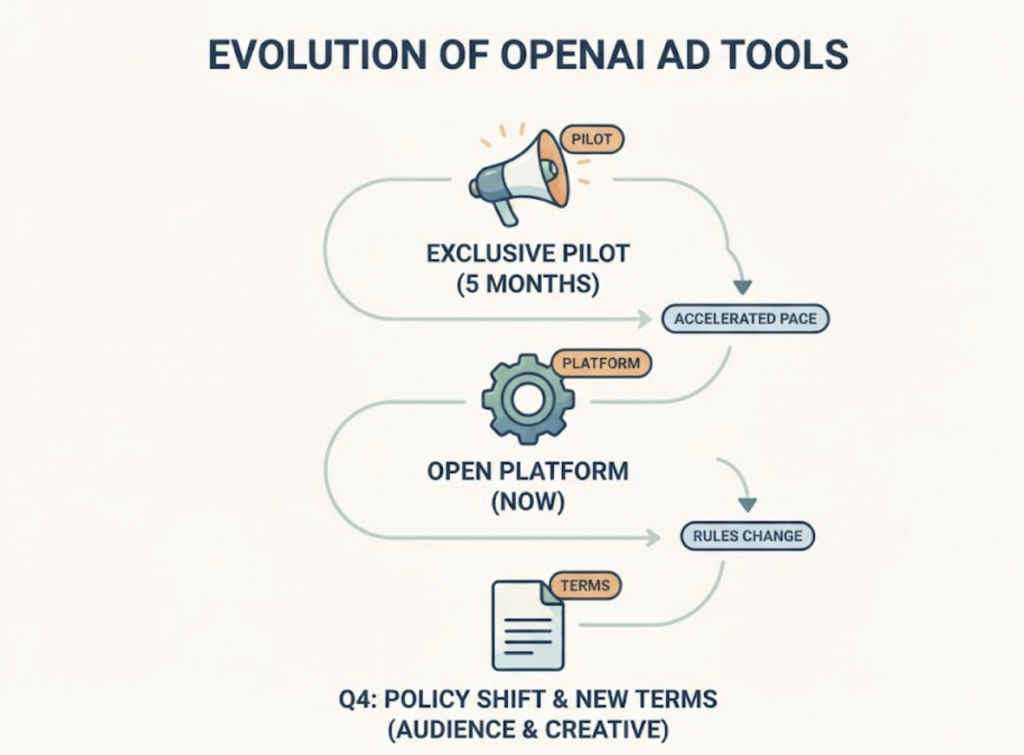
    OpenAI moved fast. Ads launched in the US on February 9, 2026, limited to logged-in users on the Free tier and the $8-per-month Go tier. The initial pilot was managed-service only, with a $200,000 minimum commitment at a fixed $60 CPM. That gate kept everyone but enterprise brands out.

    Then the gate came down. April brought CPC bidding and a reduced $50,000 minimum. On May 5, 2026, OpenAI opened a beta self-serve Ads Manager, eliminated minimum spend entirely, and shipped conversion tracking through a pixel and Conversions API. By June, auto-generated product feed ads lowered the barrier further, and the pilot had expanded to Canada, Australia, and New Zealand, with the UK, Mexico, Brazil, Japan, and South Korea announced next.

    Five months from exclusive pilot to open platform. That pace tells you two things. OpenAI is confident in advertiser demand, and the rules you plan around today will probably change by Q4. In mid-June, OpenAI published new Ad Tools Terms covering first-party audience uploads and AI-generated creative, features announced in policy before they’re live in the product.

    One structural fact hasn’t changed, and it matters more than any pricing update: subscribers on Plus, Pro, Business, and Enterprise tiers never see ads. Whoever you reach through ChatGPT ads, it won’t be them.

    What ChatGPT Ads Actually Cost in 2026

    The pricing has settled into a relevance-weighted second-price auction, and the benchmarks look like this:

    MetricMid-2026 Benchmark
    CPM$25 to $60
    CPC$3 to $5 typical, $8 to $18 in SaaS and financial services
    CTRRoughly 0.91% to 1.5%
    Minimum spendNone since May 5

    The gap between the $60 listed CPM and the roughly $25 observed CPM reflects how quickly the auction matured once self-serve buying opened. Vertical density drives the spread on CPC. E-commerce brands often clear near the $3 floor, while SaaS and fintech advertisers compete on higher conversion values and pay accordingly.

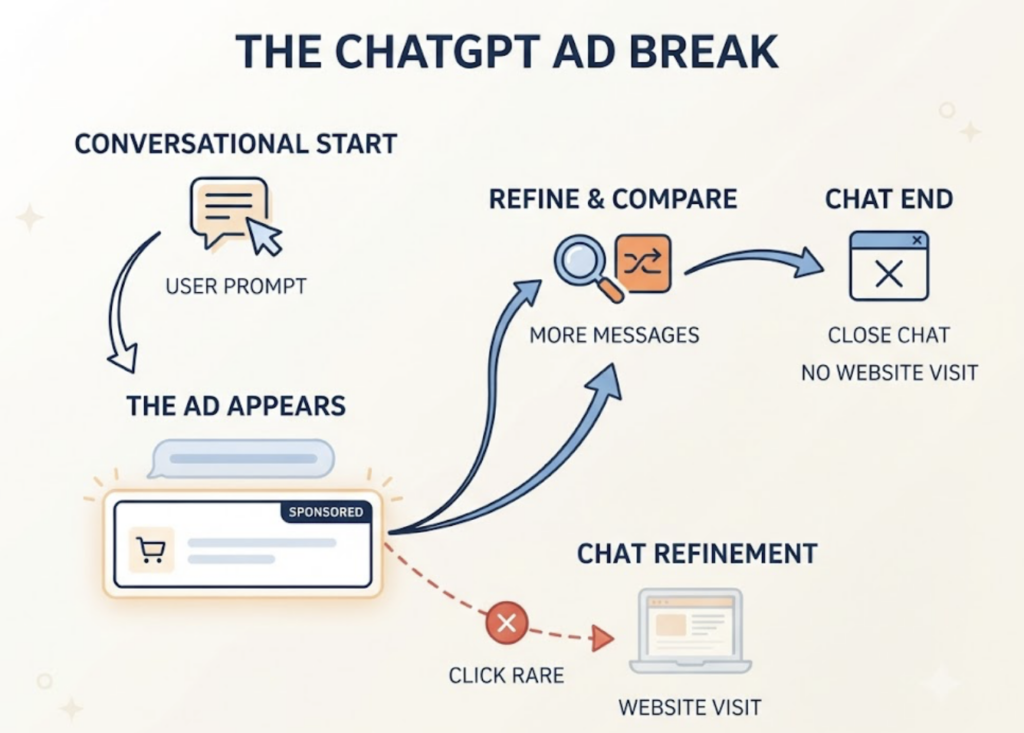
    The CTR deserves a closer look, because it’s structural rather than fixable. Ads appear in a clearly labeled chat_card below the AI’s response, never inside it. Users get their complete answer first, then see the sponsored placement. A 0.91% click-through rate isn’t a creative problem you can optimize away. It’s the design.

    Targeting works differently too. There’s no demographic audience sculpting the way Meta offers. Delivery is intent-first, shaped by the current conversation thread, opted-in personalization history, and prior ad interactions. Advertisers write “context hints” describing the questions and situations users bring to ChatGPT, not exact-match keywords. Chats, names, emails, and precise locations stay inside OpenAI. You never see them.

    The Decision Framework: Four Questions Before You Buy ChatGPT Ads

    The brands getting this decision wrong tend to skip straight to creative and budget. The brands getting it right answer four questions first.

    1. Does Your Audience Actually Live on Free and Go Tiers?

    Ads reach Free and Go users only. That skews the reachable audience toward consumers, students, and casual users, not the professionals paying $20 or more per month for Plus and above.

    If you sell consumer products, meal kits, travel, or entry-level software, your buyers are probably in the ad-eligible pool. If you sell to CTOs, procurement leads, or enterprise buyers, they’re likely on paid tiers where your ads simply don’t exist. For those brands, paid placement isn’t a weaker option. It’s a nonexistent one, and organic AI visibility becomes the only discovery channel inside ChatGPT.

    2. What’s Your Organic Baseline in ChatGPT’s Answers?

    This is the question most teams never ask, and it’s the one that should drive the budget decision.

    OpenAI mandates that ads don’t influence organic answers. The AI decides which brands to cite independently of ad spend. So before you pay for the box below the answer, you should know whether you already appear inside the answer itself, where every user on every tier can see you.

    Measuring that used to mean manually prompting ChatGPT and screenshotting results. Platforms like Topify now do it systematically. Its Visibility Tracking runs your target prompts across ChatGPT, Gemini, Perplexity, and other engines on a schedule, showing how often your brand appears in organic answers, in what position, and with what sentiment. Source Analysis goes a layer deeper, revealing which domains the AI cites when it recommends brands in your category, which tells you exactly where to earn coverage.

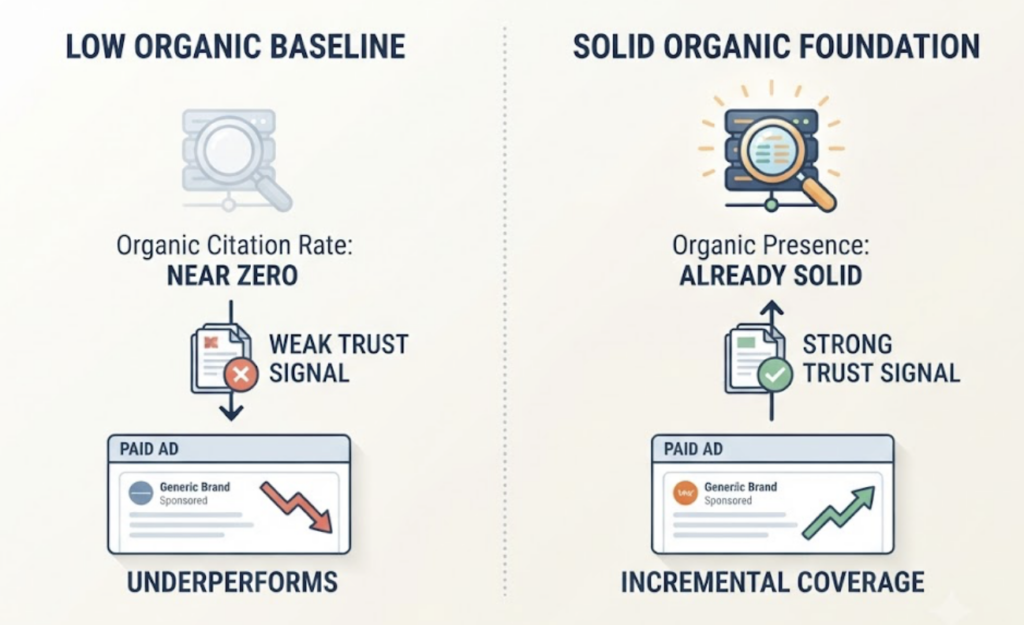
    The baseline changes the math. If your organic citation rate is near zero, paid ads tend to underperform, because a sponsored card for a brand the AI never mentions carries a weak trust signal. If your organic presence is already solid, ads become incremental coverage for the Free-tier audience rather than a lifeline.

    You can run a first visibility check before your Friday deadline. There are also free GEO tools for a quick initial read before committing to full tracking.

    3. Are Competitors Buying Ads, or Winning Organically?

    A competitor showing up in ChatGPT’s answers could be running paid placements, earning organic citations, or both. Those are very different threats.

    If a rival dominates the organic citation slot, buying an ad doesn’t displace them. Your sponsored card sits below an answer that still recommends them by name. Topify’s Competitor Monitoring makes this visible by tracking which brands AI engines recommend for your target prompts, in what order, and how that shifts over time. In practice, this tells you whether an ad would be a defensive counter-measure or money spent watching a competitor’s organic authority from the cheap seats.

    4. Can You Measure Beyond the Click?

    With CTRs under 1%, last-click attribution in GA4 will make almost any ChatGPT campaign look like a failure. That doesn’t mean it is one, but it means you need better plumbing before you spend.

    At minimum, implement the OpenAI pixel and Conversions API from day one, and confirm your robots.txt allows OAI-SearchBot so organic citation isn’t accidentally blocked while you’re paying for placement. Then watch direct traffic and branded search lift as secondary proxies. Users who see your brand in an AI conversation often don’t click the card. They search for you later.

    If you can’t commit to that measurement setup, you’re not ready to evaluate the channel honestly, and an unmeasurable test is worse than no test.

    Paid Placement vs. Organic AI Visibility: The Trade-Off

    Put side by side, the two paths into ChatGPT look like this:

    DimensionOrganic AI CitationPaid Sponsored Placement
    Audience reachedAll users, Free through EnterpriseFree and Go tiers only
    PlacementInside the AI’s answerLabeled card below the answer
    Trust signalHigh, reads as expert recommendationMedium, reads as advertisement
    Cost modelContent and optimization investment$25 to $60 CPM, $3 to $5 CPC
    DurationCompounding earned assetStops the moment spend stops
    Primary metricVisibility share, citation positionCPM, CPC, CTR

    The duration row is the one budget meetings underweight.

    Ad spend rents visibility. Organic citations build it. A brand that spends six months earning citations from the sources ChatGPT trusts keeps that presence whether or not it ever buys an ad. A brand that spends the same budget on sponsored cards goes dark on day one of a paused campaign.

    This is where the cost comparison gets concrete. Topify’s tracking plans start at $99 per month for 100 prompts monitored across ChatGPT, Perplexity, and AI Overviews, with roughly 9,000 AI answer analyses included. At a $25 observed CPM, that same $99 buys about 4,000 ad impressions to Free-tier users, with under 1% of them clicking. One is a measurement layer that informs every channel decision you make. The other is a rounding error of rented reach. For most teams, the baseline data comes first, then the ad test, not the other way around.

    When ChatGPT Ads Make Sense (and When They Don’t)

    The framework resolves into fairly clean scenarios.

    A test is justified if your buyers skew consumer or SMB and plausibly sit on Free/Go tiers, your organic visibility baseline is already measurable and nonzero, your vertical’s CPCs sit near the $3 to $5 floor, and your pixel and Conversions API are wired before the first dollar goes out. Product feed advertisers in e-commerce fit this profile best right now.

    Hold off and invest in GEO first if your buyers are on ad-free paid tiers, your brand has near-zero organic citations, or your CPCs land in the $8 to $18 range where a sub-1% CTR makes the math brutal. In those cases, the budget does more work earning the citations that reach every user than renting a card that reaches a fraction of them.

    Either way, size it honestly. Treat ChatGPT ads as an experimental line item with its own KPIs, not a core channel with revenue targets. The platform is being built in public, formats and geographies are still in motion, and the advertisers winning right now are the ones running cheap, well-instrumented tests while their organic visibility compounds in the background.

    Conclusion

    The Friday answer for your CMO isn’t “buy” or “pass.” It’s “here’s our organic baseline, here’s who we can actually reach, and here’s the test budget that follows from both.” Brands with strong organic citations and Free-tier audiences should test now while CPMs sit near $25 and inventory competition is thin. Brands invisible to ChatGPT’s organic answers should fix that first, because no ad card compensates for an AI that never mentions you.

    Start with the measurement. Run your brand’s visibility baseline across ChatGPT and the other engines, see where you stand against competitors, and let that data decide whether the ad budget is an accelerant or a distraction.

    FAQ

    Q: How much do ChatGPT ads cost in 2026? 

    A: Observed CPMs run $25 to $60, with CPC bids typically $3 to $5 and no minimum spend since the self-serve Ads Manager launched on May 5, 2026. SaaS and financial services verticals often see CPCs of $8 to $18 due to competitive density.

    Q: Do ChatGPT ads influence the AI’s answers? 

    A: No. OpenAI mandates that organic answers are generated independently of ad spend. Sponsored placements appear in a labeled card below the response, and buying ads doesn’t earn your brand citations inside the answer itself.

    Q: Can ChatGPT Plus or Enterprise users see ads? 

    A: No. Ads are served only to Free and Go tier users. Subscribers on Plus, Pro, Business, and Enterprise tiers operate in an ad-free environment, which means organic visibility is the only way to reach them inside ChatGPT.

    Q: What’s the difference between ChatGPT ads and GEO? 

    A: ChatGPT ads are paid placements below AI answers, reaching Free/Go users for as long as you spend. Generative engine optimization (GEO) is the practice of earning organic citations inside AI answers across all user tiers, which compounds over time and persists without ongoing ad spend.

    Read More

  • ChatGPT Ads Cost in 2026: CPM, CPC & What You Actually Pay

    ChatGPT Ads Cost in 2026: CPM, CPC & What You Actually Pay

    In February, running ads on ChatGPT required a $200,000 commitment. By May, the minimum was zero. If you priced this channel out three months ago and walked away, the number you saw no longer exists. That speed is exactly why budget conversations about ChatGPT ads keep stalling: nobody’s sure which figures are still true. Here’s what advertisers are actually paying as of mid-2026, and the one cost limitation no rate card mentions.

    The Short Answer: What ChatGPT Ads Cost Right Now

    ChatGPT ads cost $3 to $5 per click on CPC campaigns, or $25 to $60 per 1,000 impressions on CPM campaigns. OpenAI lists $60 as the default max CPM bid, but real-world clearing rates have softened to the $25 to $45 range as inventory has scaled.

    There’s no minimum spend anymore. Since OpenAI opened its self-serve Ads Manager at ads.openai.com on May 5, 2026, any eligible US advertiser can set up an account and run campaigns at whatever daily budget they choose.

    Those are the sticker prices. What you actually pay depends on a relevance-weighted auction, your vertical, and how well your ad matches the conversation it appears in. More on each below.

    How ChatGPT Ads Pricing Dropped From $200K to $0 in Four Months

    The pricing trajectory tells you more about this channel than any single benchmark. It compressed fast.

    At the February 2026 launch, access was restricted to enterprise partners like Dentsu and Omnicom, with a $200,000 minimum commitment and a fixed $60 CPM. By April, the minimum had fallen to $50,000, a CPC bidding pilot went live, and observed CPMs began drifting toward $25 to $45. Then on May 5, the self-serve Ads Manager launched and minimum spend requirements disappeared entirely.

    That’s not gradual scaling. That’s a platform deliberately opening the floodgates after proving demand.

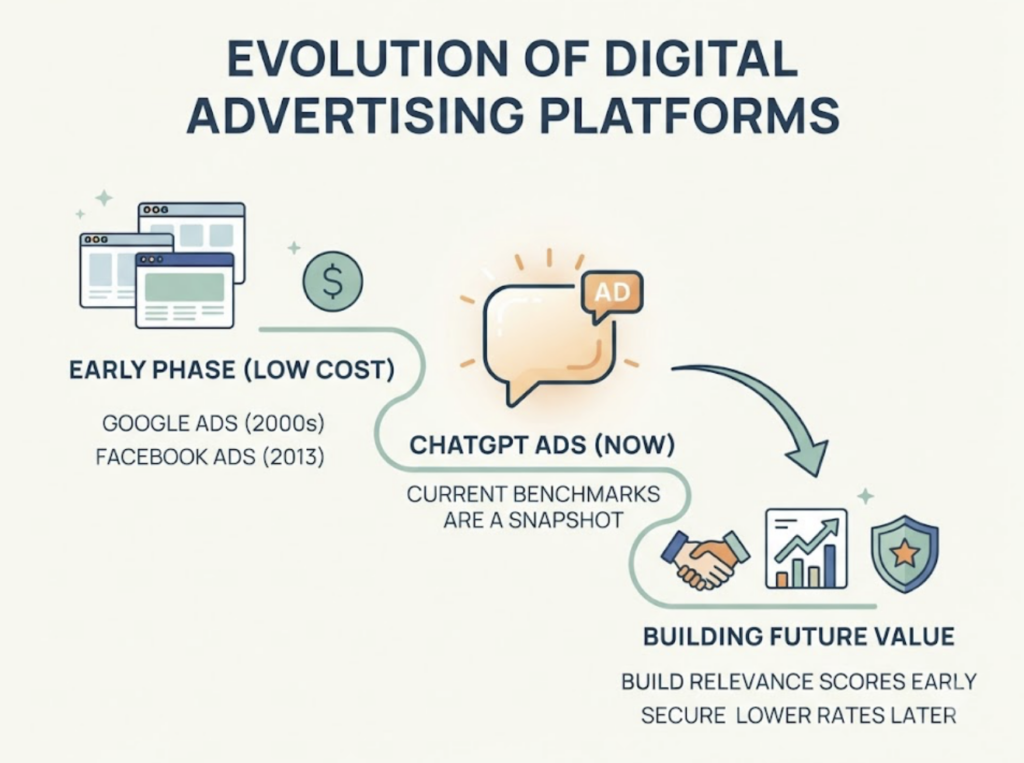
    The pattern should look familiar. Google Ads in the early 2000s and Facebook Ads around 2013 both went through a low-competition, low-cost phase before prices climbed with adoption. ChatGPT ads are in that phase now, which means the current benchmarks are a snapshot, not a promise. Advertisers who build relevance scores and account history early tend to pay lower effective rates once competition thickens.

    CPM, CPC, and CPA: Three Ways to Buy ChatGPT Ads

    The Ads Manager offers three bidding objectives, and the right one depends on what you’re trying to prove with your first dollars.

    ModelObjectiveCost rangeBest for
    CPMReach$25–$60 per 1,000 impressionsBrand awareness, category entry
    CPCClicks$3–$5 per click baselinePerformance testing, traffic goals
    CPAConversionsVaries by conversion targetAccounts with pixel or Conversions API configured

    CPM was the launch model. You pay for visibility whether or not anyone clicks, which fits awareness plays in categories where being seen inside AI conversations matters more than immediate traffic.

    CPC arrived in April 2026 and changed who this channel is for. You only pay when someone clicks, spend becomes predictable, and the numbers map directly onto how you already evaluate Google and Meta. One practical note: bids below $3 consistently fail to clear delivery thresholds, so don’t try to squeeze under the floor.

    CPA bidding began rolling out in late May for accounts with conversion tracking live. It’s the youngest of the three, but it’s the one that turns ChatGPT from an awareness experiment into something you can measure against pipeline.

    For a first test, start with CPC. It caps your downside and generates cleaner optimization data than paying for impressions.

    What You Actually Pay: Inside the Relevance-Weighted Auction

    Your max bid is not your final price. ChatGPT uses a relevance-weighted second-price auction, which means winners typically pay just enough to beat the next-highest competitive bid, not their full ceiling.

    The bigger difference from keyword-based platforms is what “relevance” means here. The auction matches ads to conversation state, not search terms. Three inputs carry most of the weight: your context hints (descriptions of the conversation types where your ad should trigger), your landing page fit (the system crawls your destination URL to check topical alignment), and your conversion signals from the pixel.

    In practice, a well-matched ad on a $3.50 bid can beat a poorly-matched ad bidding $6. Ad quality beats budget size on this platform, at least while the auction stays thin.

    Vertical matters too. Based on early advertiser data, SaaS and tech CPCs run $3.00 to $4.50, e-commerce sits at $2.50 to $4.00, and financial services stretches from $4.00 all the way to $18.00 because transactional money queries attract the heaviest competition. If you’re budgeting in a regulated or high-intent B2B category, plan against the top of your range, not the platform average.

    ChatGPT Ads vs Google and Meta: The Cost Comparison

    Raw cost per click puts ChatGPT in familiar territory. The $3 to $5 baseline sits below median Google Ads CPCs in most B2B verticals and above the typical Facebook click.

    PlatformTypical CPCNotes
    ChatGPT ads$3–$5 (up to $18 in finance)Relevance-weighted auction, thin competition
    Google AdsVaries widely by vertical, often $20+ in B2BMature auction, deep intent data
    Meta AdsRoughly $1–$2 averageCheapest clicks, broadest targeting

    But per-click cost is the wrong place to stop. Click-through rates on ChatGPT run well below Google Search, because ads appear after the AI has already answered the question. The flip side is qualification: by the time someone clicks, they’ve explained their situation and received contextual information. Early data suggests ChatGPT-referred users convert at meaningfully higher rates than other referral channels, which means a higher CPC doesn’t automatically mean a higher cost per customer.

    The honest caveat is scale. Google processes billions of searches daily. ChatGPT’s ad-eligible conversation volume is a fraction of that, so teams used to thousands of daily clicks will find this channel supplements search budgets rather than replacing them.

    The Cost No Rate Card Shows: You’re Only Buying Free-Tier Users

    Here’s the structural limitation that changes the budget math, and it rarely appears in pricing discussions.

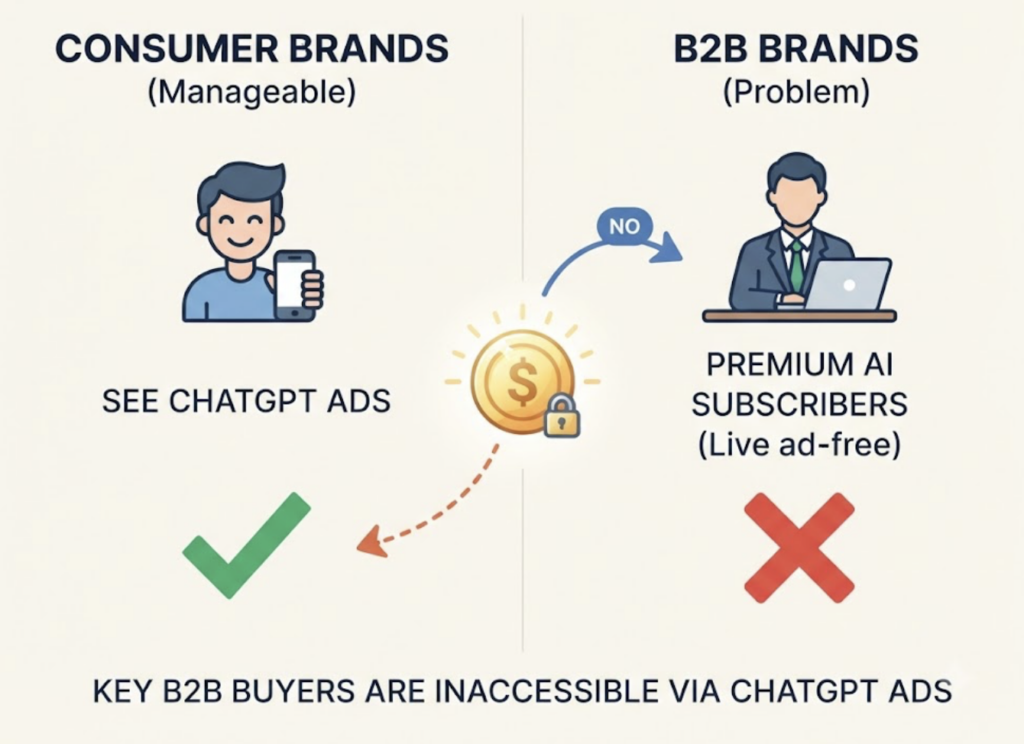
    ChatGPT ads are served only to adult users on Free and Go plans. Subscribers on Plus, Pro, Business, and Enterprise tiers see zero ads. For consumer brands, that’s a manageable trade. For B2B brands, it’s a problem, because the buyers most worth reaching, the ones paying $20 to $200 a month for premium AI access, live entirely inside the ad-free environment.

    No bid reaches them. At any price.

    Those users still ask ChatGPT for vendor recommendations, tool comparisons, and buying advice every day. The only way into those answers is organic citation, which is what generative engine optimization is built for. Before committing a paid budget, it’s worth knowing your organic baseline: how often AI platforms already mention your brand, in what position, and with what sentiment. A platform like Topify tracks brand visibility across ChatGPT, Gemini, Perplexity, and other AI engines through seven metrics including visibility, sentiment, and position, so you can see whether you’re about to pay for impressions in conversations where you already appear organically, and whether competitors are winning the ad-free tiers you can’t buy.

    That baseline changes the decision. If AI already recommends you organically in your core prompts, paid spend belongs in the gaps. If you’re invisible, ads buy you free-tier exposure while GEO work builds the citation footprint that reaches everyone else. There’s also a set of free GEO tools worth running before any paid test, just to see where you stand.

    How to Budget Your First ChatGPT Ads Test

    A realistic pilot doesn’t require enterprise money anymore, but it does require enough spend to generate a usable dataset.

    Plan on $5,000 to $25,000 for a meaningful test window. That’s enough to establish CTR benchmarks, learn which context hints trigger the right conversations, and gather early conversion-cost data. Smaller daily budgets can technically run, but they stretch the learning period so long that the numbers stay noisy.

    Set kill criteria before you launch. Campaigns with a CTR below 0.3% should be paused for creative and context-hint optimization rather than fed more budget. Wire up the conversion pixel or Conversions API from day one, tag everything with UTMs, and judge the channel on cost per qualified lead, not clicks.

    Then compare paid results against your organic AI visibility data. If your GEO tracking shows organic mentions climbing in the same prompt categories you’re paying for, you can trim overlap and redirect spend to prompts where you have no presence at all. Paid and organic aren’t competing line items in AI search. They’re one visibility budget with two levers.

    Conclusion

    ChatGPT ads in mid-2026 cost $3 to $5 per click or $25 to $60 per thousand impressions, with no minimum spend and an auction that rewards relevance over budget. The low-cost window is real, and it won’t stay open as competition builds through the year.

    But the smartest move isn’t rushing a campaign. It’s establishing your organic baseline first, because ads can never reach the premium-tier users who make up much of the highest-value ChatGPT audience. Measure where AI already mentions you, get a visibility snapshot, then spend paid dollars only where organic citations haven’t done the job for free.

    FAQ

    Q: How much do ChatGPT ads cost per click?
    A: OpenAI recommends starting bids of $3 to $5 per click. Bids under $3 typically fail to clear delivery thresholds, while competitive verticals like financial services can reach $18 per click.

    Q: What is the minimum spend for ChatGPT ads in 2026?
    A: Zero. The $200,000 launch minimum dropped to $50,000 in April 2026 and was eliminated entirely when the self-serve Ads Manager opened on May 5, 2026.

    Q: Are ChatGPT ads cheaper than Google Ads?
    A: On a per-click basis, usually yes for B2B verticals, where Google medians often exceed $20. But ChatGPT offers far less volume, so most teams run it alongside search rather than instead of it.

    Q: Do ChatGPT Plus users see ads?
    A: No. Ads appear only for Free and Go tier users. Plus, Pro, Business, and Enterprise subscribers see no ads, which is why organic AI visibility through GEO is the only way to reach those segments.

    Read More

  • Sponsored vs Cited: When Competitors Buy ChatGPT Ads on Your Queries

    Sponsored vs Cited: When Competitors Buy ChatGPT Ads on Your Queries

    You spent two years earning your position as the answer ChatGPT gives when someone asks about your category. Then a teammate sends you a screenshot: the organic response still cites your brand, but directly below it sits a Sponsored card. It belongs to your closest competitor, and it’s the last thing the user sees before deciding where to click.

    That card cost them a few dollars. Your citation took years. And right now, most brands have no idea how often this is happening on their own queries.

    Your Brand Got Cited. Your Competitor Got the Click.

    ChatGPT ads went live on February 9, 2026, and they created a placement structure that didn’t exist anywhere in search before. The organic answer, where citations live, is generated by the model based on the sources it trusts. The Sponsored slot, a chat_card format with a title, description, image, and link, is a paid position that appears below the answer, visually separated and clearly labeled.

    Here’s the part that matters: both can appear in the same response window. Your brand can be the organic authority in the answer text while a competitor occupies the paid real estate underneath it. In classic search, ads and organic results competed on the same page but in familiar, well-understood zones. In ChatGPT, the answer is singular and authoritative, and the Sponsored card is the only other commercial element on screen.

    That makes it a “last look” position. The user reads an answer that mentions you, then scrolls past it into a card that pitches someone else.

    The reach is uneven, though, and that unevenness shapes the whole strategy. Ads only appear for logged-in users on the Free and Go tiers. Plus, Pro, Business, and Enterprise subscribers never see them. For high-value professional users, organic citation is the only visibility that exists.

    How ChatGPT Ads Actually Target Your Queries

    ChatGPT ads don’t use keyword bidding the way Google Ads does. Advertisers provide “context hints,” free-form semantic descriptions of the buyer moments where their product is relevant. OpenAI’s model then runs an embedding match between the live conversation and those hints.

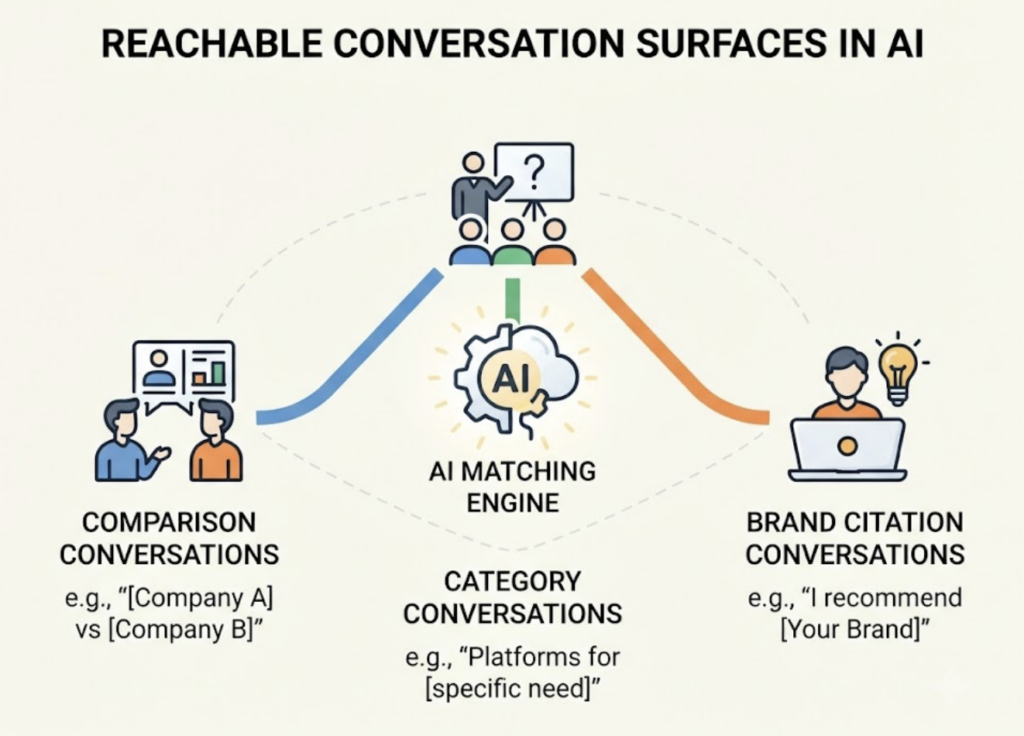
    In practice, this means a competitor doesn’t need to bid on your brand name. They describe the situation your customers are in (“a marketing team evaluating AI visibility platforms”) and the matching engine does the rest. Category conversations, comparison conversations, and yes, conversations that organically cite your brand are all reachable surface.

    The economics changed fast, too. What launched as an enterprise-only channel became accessible to any competitor with a credit card in about three months:

    TimelineAccess modelPricing
    February 2026Managed pilot, $200K minimum spend$60 CPM
    May 2026Self-serve Ads Manager, no minimum~$25 CPM, $3 to $5 CPC floors

    Penetration followed the same curve. Independent tracking measured Sponsored placements in 26.5% of ChatGPT responses globally by late May, with the US at roughly 49%. By July 2026, US penetration had stabilized around 51% of responses. Among Free and Go users, the only ones eligible to see ads, the real exposure rate runs higher than the headline number.

    Bottom line: about half of the US responses on your priority queries can now carry a paid placement, and anyone can buy it.

    Why Organic Citations Still Decide the Answer

    OpenAI’s policy on this is explicit. Ads do not influence the answers ChatGPT gives, conversations stay private from advertisers, and the model’s decision to cite a source is independent of ad spend. A competitor can rent the slot next to your citation. They can’t pay to delete the citation itself.

    That distinction is the strategic core of this whole shift. Sponsored buys the position beside the answer. Cited wins the answer.

    The two also carry different trust weights. Early industry data suggests AI-native ads tend to draw more skepticism than classic search ads, and research from IAB in January 2026 flagged rising Gen Z skepticism toward AI-delivered ads specifically. A brand that leans on paid cards without an organic citation behind it is renting attention from an audience that’s already suspicious of the format.

    And then there’s the segmentation problem. Because paid tiers stay ad-free, ChatGPT is effectively two channels wearing one interface. The Free and Go audience sees a hybrid of organic and paid. The subscriber audience, which skews toward professional and enterprise users, sees organic only. If your buyers are on the paid tiers, no amount of ad spend from anyone reaches them. Citations are the entire game there.

    The Defense Problem: You Can’t See Who’s Buying Your Queries

    Google Ads has a Transparency Center. ChatGPT has nothing comparable. There’s no AI Ad Library where you can look up which competitors are running context hints that overlap your branded or category queries.

    Manual checking doesn’t work either, and the reason is structural. If your team checks ChatGPT from company accounts, those are almost certainly Plus or Business seats, and paid seats never render ads. Your marketing team can audit your queries weekly and see a clean, ad-free interface while half of the Free-tier responses on those same queries carry a competitor’s card. The interface your team sees is not the interface your market sees.

    That’s the visibility illusion, and it’s why competitor ad activity on AI surfaces tends to go undetected until pipeline numbers move.

    Closing the gap requires monitoring at the prompt level, from the ad-eligible side of the experience, continuously rather than in periodic spot checks. Which is a data problem, not a diligence problem.

    Building a Sponsored-Proof Visibility Strategy

    The defense framework has three layers: see what’s happening on your queries, understand why the AI answers the way it does, then harden the organic position that ads can’t buy.

    The monitoring layer comes first because everything else depends on it. This is where a platform like Topify fits. Its Competitor Monitoring tracks which brands surface on your target prompts across ChatGPT, Perplexity, and Google AI Overviews, and how their position shifts over time, so a new entrant on your branded queries shows up in your data instead of in a customer’s screenshot. Visibility Tracking runs the same prompts continuously and scores your brand’s presence across seven metrics including visibility, position, and sentiment. In practice, it’s the first time a monthly report can answer the question leadership is now asking: “Is anyone moving in on the queries where we’re cited, and is our citation holding?”

    The diagnostic layer is Source Analysis, which reverse-engineers the exact domains and URLs AI platforms cite when they construct answers in your category. This is where content gaps become visible. If ChatGPT cites a third-party review site instead of your own comparison page, that’s a specific, fixable weakness, not a vague “we should do more GEO.”

    The consolidation layer is the actual defense. Since ads sit beside organic answers rather than replacing them, the strongest countermeasure to a competitor’s Sponsored card is a citation position too established to displace: deep topical authority, clean structured data, and coverage of the sources AI already trusts. Tracking your AI search visibility week over week tells you whether that footprint is compounding or eroding.

    You can start with a baseline in an afternoon: load your branded and top category prompts, let the system establish current positions, and set alerts for new competitor appearances.

    When Buying ChatGPT Ads Yourself Makes Sense

    Not every brand should counter-bid, and the decision framework is fairly clean.

    Paid placement works best as category defense on high-intent queries where your organic citation is already stable. The card reinforces a recommendation the model is already making, and the formats favor complex-decision categories like B2B software, financial services, and education, where users are working through multi-turn evaluations.

    The inverse case is the trap. If your brand is absent from the organic answer, buying the Sponsored slot tends to convert poorly, because the card is pitching a brand the AI just declined to recommend. The external research on this is blunt: conversion on a sponsored placement drops significantly when the model hasn’t already established the brand as a relevant organic answer. Fix the citation problem first. Ads amplify an organic position; they don’t substitute for one.

    There’s also the audience math from earlier. Every dollar spent on ChatGPT ads reaches Free and Go users only. If your ICP lives on Plus or Enterprise seats, that budget belongs in content and citation work, not in the auction.

    Conclusion

    Sponsored is a rented position. Cited is an earned one. The February 2026 launch of ChatGPT ads didn’t collapse that distinction, it sharpened it: competitors can now buy their way next to your answer for a few dollars a click, but they still can’t buy their way into it.

    The immediate move isn’t a media plan. It’s a monitoring baseline: know which prompts matter, who appears on them today, which sources drive the citations, and get alerted when either side of the equation changes. Once you can see the board, the paid-versus-organic budget question mostly answers itself.

    FAQ

    Q: Do ChatGPT ads influence the answers ChatGPT gives? 

    A: No. OpenAI states that ads don’t affect organic responses, and citations are determined independently of ad spend. Sponsored cards appear below the answer, clearly labeled and visually separated.

    Q: Can competitors run ads on my branded queries in ChatGPT? 

    A: Effectively yes. ChatGPT ads use semantic “context hints” rather than keyword bidding, so a competitor describing your category’s buyer moments can surface on conversations that mention or cite your brand.

    Q: Who sees ChatGPT ads and who doesn’t? 

    A: Only logged-in users on the Free and Go tiers see ads. Plus, Pro, Business, Enterprise, and Edu accounts are ad-free, which makes organic citations the only way to reach those subscriber segments.

    Q: How do I know if a competitor is buying ads on queries where my brand is cited? 

    A: There’s no public AI ad library, and paid-tier accounts never render ads, so manual self-checks miss the activity. Prompt-level monitoring tools that track competitor appearances across AI platforms are currently the reliable way to detect it.

    Read More

  • ChatGPT Ads Launch as Perplexity Kills Ads: Two Futures of AI Search

    ChatGPT Ads Launch as Perplexity Kills Ads: Two Futures of AI Search

    Your team probably has one playbook for AI search. As of February 2026, you need two. Within nine days of each other, the two most-watched AI answer engines made opposite bets: OpenAI switched ChatGPT ads on for millions of free users, while Perplexity shut its ad program down for good. Same market, same month, contradictory conclusions about what users will tolerate.

    If you’re deciding where next quarter’s visibility budget goes, this isn’t trivia. It determines which platforms you can pay your way into, and which ones you can only earn your way into.

    One Month, Two Opposite Bets on the Future of AI Search

    The timeline is unusually compressed. ChatGPT ads went live on February 9, 2026, for Free and Go tier users. Nine days later, on February 18, Perplexity confirmed it was discontinuing the ad experiments it had been running since late 2024.

    That leaves the three dominant AI search platforms running three different commercial models. ChatGPT now mixes ad revenue with tiered subscriptions. Perplexity is pure subscription plus enterprise sales. Google keeps extending its existing ad infrastructure into AI Overviews and AI Mode.

    The scale on each side is real. ChatGPT’s ad program reportedly reached $100M in annualized revenue within two monthson the back of 800M+ weekly active users, with OpenAI targeting $2.5B annually. Perplexity walked away from monetizing 780 million monthly queries through ads.

    These aren’t two isolated product decisions. They’re two live experiments on the same question: how much commercial influence can an answer engine carry before users stop believing it?

    Why Perplexity Walked Away From Ad Revenue

    Perplexity’s stated reason is blunt. One executive told the Financial Times that with ads, “a user would just start doubting everything.” The company’s position is that perception matters as much as fact: even clearly labeled sponsored placements can make users second-guess whether they got the best possible answer.

    The experiment also never scaled. Fewer than 0.5% of brands that applied to advertise were ever admitted, and Taz Patel, the executive leading the ads effort, left before the program wound down.

    The replacement model is already producing numbers. Perplexity reached roughly $200M in annual recurring revenue by late 2025 and is now targeting $500M in annualized subscription revenue, selling $20 to $200 per month plans to finance professionals, lawyers, doctors, and executives who pay specifically for answers that nobody sponsored.

    That last detail matters more than the revenue figure. Perplexity is deliberately concentrating the buyers most brands want to reach inside a platform where placement can’t be bought.

    Inside ChatGPT Ads: How OpenAI Structured the Opposite Bet

    OpenAI’s implementation is designed to look nothing like old search ads. Sponsored results appear in clearly labeled, visually separated boxes below the organic answer, never inside the response text. OpenAI states that ads don’t influence what ChatGPT actually says, and targeting runs on conversation topics, chat history, and prior ad interactions.

    The commercial mechanics moved fast. ChatGPT ads launched as a managed service with roughly $60 CPMs and $200k minimums, then shifted to a self-serve CPC model with $3 to $5 bid floors by May 2026 to open up inventory. In three months, it went from exclusive brand program to something closer to a performance channel.

    Here’s the structural catch: paying subscribers on Plus, Pro, Business, Enterprise, and Education tiers see no ads at all. The users who pay for ChatGPT, disproportionately professionals with buying authority, sit entirely outside the ad inventory.

    And user sentiment is not neutral. An Ipsos survey found that 63% of users say ads in AI search results make them trust those results less. OpenAI is betting that clean labeling and answer-integrity guarantees can hold that skepticism at bay while ad spend scales.

    The Two-Tier Split: Where Your Buyers Actually Are

    Put the two bets side by side and a two-track market emerges.

    Ad-Supported TierTrust-First Tier
    PlatformsChatGPT Free/Go, Google AI Overviews and AI ModePerplexity, Claude, ChatGPT paid tiers
    MonetizationCPM/CPC ads plus subscriptionsSubscriptions and enterprise sales
    How brands get inPaid placement plus organic citationOrganic citation only
    Typical intentGeneral discovery, transactional queriesDeep research, professional decisions

    The money is flowing toward the ad side. US advertisers are projected to grow AI search ad spend from $1B in 2025 to $25.9B by 2029, around 13.6% of all search ad spending.

    But the audience quality skews the other way. The trust-first tier concentrates high-intent professional users, Perplexity’s paying researchers, Claude’s ad-free user base, and every ChatGPT subscriber, into environments with zero paid slots. If you sell to CFOs, general counsel, physicians, or technical decision-makers, a large share of their AI queries happen where no ad budget can follow.

    One more wrinkle: even inside ChatGPT, ads don’t touch the organic answer. Buying placement gets you a labeled box below the response. It doesn’t change whether the model mentions your brand in the answer itself. Organic authority drives the actual recommendation in both tiers.

    What ChatGPT Ads Mean for Your GEO Strategy

    The practical conclusion is that “AI search” is no longer one channel. It’s two channels with different economics, and organic citation is the only asset that works in both.

    That makes measurement the first move, not media buying. Before committing spend to ChatGPT ads, you need a baseline: how often do AI engines already mention your brand, in what position, with what sentiment, and citing which sources? Most teams can’t answer any of those four questions today.

    This is where a dedicated tracking layer earns its place. Topify monitors brand visibility across ChatGPT, Perplexity, Gemini, and other major AI platforms, scoring seven metrics including visibility, sentiment, position, and mentions. In practice, that means you can see whether Perplexity’s ad-free answers recommend you or your competitor, and whether your ChatGPT organic presence justifies layering paid placement on top. Its Source Analysis goes a step further by reverse-engineering the exact domains and URLs each AI engine cites, so you know which third-party sites function as gatekeepers for your category. If you want to gauge your starting point before committing to a platform, Topify’s free GEO tools cover the initial audit at no cost.

    The point isn’t tooling for its own sake. It’s that ad decisions made without an organic baseline are guesses with a budget attached.

    Playbook: Winning Both Tracks Without Betting on One

    A workable dual-track approach looks like this.

    Measure your organic citation share first. Track how often you appear in AI answers across both tiers for your priority prompts. This number is your universal currency; it counts on Perplexity, on Claude, and in ChatGPT’s organic answers where ads can’t reach.

    Build citation-first content for the trust tier. AI engines in the ad-free tier cite what their retrieval systems judge authoritative. That tends to mean primary-source data, structured pages that extraction systems can parse, and third-party coverage in publications those engines already trust. Digital PR that earns mentions on the domains your Source Analysis flags is worth more here than any on-page tweak, because those domains are effectively the ballot box for who gets cited.

    Test ChatGPT ads small and compare honestly. The self-serve CPC model lowers the entry cost. Run a contained test and measure it against the cost of earning equivalent organic mentions, not against legacy Google benchmarks.

    Review monthly, not annually. Competitor benchmarking matters here because AI citation patterns shift every few weeks. A rival gaining citation share in the trust tier won’t show up in your ad dashboard at all.

    Conclusion

    February 2026 didn’t settle the ads-in-AI debate. It split the market so both answers could coexist. OpenAI is betting that labeled, walled-off ChatGPT ads can monetize scale without burning trust. Perplexity is betting its entire business that they can’t.

    Brands don’t get to pick a winner. Your buyers are already spread across both tiers, and the only visibility asset that transfers between them is organic citation. Start by measuring where you stand on each track, then decide whether ad spend adds to that foundation. Buying placement is optional. Being cited isn’t.

    FAQ

    Q: Does ChatGPT show ads to all users?
    A: No. ChatGPT ads appear only for Free and Go tier users. Plus, Pro, Business, Enterprise, and Education subscribers see an ad-free experience, which means paying professional users sit outside the ad inventory entirely.

    Q: Why did Perplexity remove ads?
    A: Perplexity concluded that ads erode trust even when clearly labeled, with executives arguing users need to believe they’re getting the best possible answer. The company shifted to a pure subscription and enterprise model targeting $500M in annualized revenue.

    Q: Can you buy placement in Perplexity or Claude answers?
    A: No. Neither platform sells ad placement, so the only way to appear in their answers is organic citation, earned through authoritative content and coverage on sources their retrieval systems trust.

    Q: How do you track brand visibility across ad-free AI search engines?
    A: Use an AI visibility platform that queries engines like Perplexity and ChatGPT at scale and reports mention frequency, position, sentiment, and cited sources. That baseline shows where you’re already visible organically and where paid or earned efforts should focus.

    Read More

  • ChatGPT Ads Attribution: Why Old Tools Can’t Measure This Channel

    ChatGPT Ads Attribution: Why Old Tools Can’t Measure This Channel

    Your first ChatGPT ads campaign has been live for six weeks. OpenAI’s Ads Manager shows healthy impressions and a reasonable engagement rate. Then you open GA4 to check conversions, and the channel barely exists. A few stray sessions, almost no attributed revenue, and a Direct traffic line that’s quietly grown 18% with no explanation. The spend is real. The results probably are too. But nothing in your analytics stack can connect the two.

    That gap isn’t a tracking misconfiguration. It’s a structural mismatch between how conversational ads work and how attribution was built.

    Your Analytics Stack Was Built for Clicks. ChatGPT Ads Don’t Work That Way

    Every legacy attribution model, from last-click to data-driven, rests on one assumption: a click is the gateway to value. A user searches, clicks an ad, lands on your site with a referrer and UTM parameters intact, and the conversion path begins. GA4, MMPs, and marketing mix dashboards all inherit this click-to-convert paradigm.

    ChatGPT ads break the assumption at the first step. Since OpenAI began testing ads on February 9, 2026 for US users on the Free and Go tiers, sponsored placements have appeared in labeled boxes beneath conversational answers. The user’s natural next move isn’t a click. It’s another message. They refine requirements, compare options inside the dialogue, and often close the chat entirely before visiting anyone’s website.

    The channel operates on what’s better described as an exposure-to-context paradigm. The ad influences a decision that completes somewhere your pixels can’t see.

    Two mechanical failures compound the problem. First, a significant share of AI-referred traffic arrives with no referrer header, so analytics platforms dump it into Direct. Second, UTM passthrough in conversational interfaces is inconsistent, meaning even genuine ad clicks frequently lose their utm_source tagging before landing. Your paid channel data isn’t just incomplete. It’s actively miscategorized.

    Where ChatGPT Ads Attribution Breaks: Three Structural Gaps

    Gap 1: The Influence Happens Before Any Click Exists

    In traditional search, the click starts the decision process. In ChatGPT, the click, if it happens at all, is an optional action at the end of one. The user has already evaluated alternatives, narrowed a shortlist, and formed a preference inside the conversation. By the time they convert, the original ad exposure is untraceable.

    This inverts the value of your click data. A 1% CTR on ChatGPT ads doesn’t mean 99% of your spend was wasted. It means 99% of the influence happened in a layer you’re not measuring.

    Gap 2: Exposure Without Referral Data

    ChatGPT ads behave more like display than search, but with a harsher measurement penalty. Ads are matched to conversation context rather than a persistent user profile, and users routinely see an ad, close the chat, then search your brand name or type your URL directly hours later. Marketers have started calling this Dark Social 2.0: a measurable lift in Direct traffic with no digital breadcrumbs proving causality.

    The scale makes it hard to ignore. Independent rollout tracking in late May put sponsored placements in 49% of US ChatGPT responses, up from a limited February pilot. That’s a lot of untagged influence flowing into your Direct bucket.

    Gap 3: Paid and Organic Mentions Blur Together

    OpenAI’s stated policy is that ads don’t influence the answers ChatGPT gives, and placements are clearly labeled. In practice, users don’t cleanly separate an organic citation from a sponsored box in the same response. Your reporting has to.

    Here’s the problem: if ChatGPT was already recommending your brand organically in 30% of relevant conversations, some portion of your “ad-driven” lift would have happened anyway. Without measuring organic AI visibility before and during the campaign, you can’t calculate incrementality. You’re paying for outcomes you may have been getting for free.

    That’s the number most teams running ChatGPT ads today genuinely cannot produce.

    What the Ads Manager Shows You, and What It Hides

    OpenAI moved fast on the buying side. By May 2026, advertisers had access to a self-serve Ads Manager with CPC and CPM bidding and no minimum spend, a sharp drop from the $60 CPM premium placements of the February launch window. The measurement side hasn’t kept pace.

    Metric LayerLegacy Search/SocialChatGPT Ads TodayWhat’s Missing
    VisibilityKeyword rankingsImpressionsBrand share of voice across AI answers
    InteractionCTR with full click pathCTR, roughly 0.68% to 1.57% in early reportsInfluenced non-click intent
    AttributionLast-click, UTM, data-driven modelsNone to limited API-basedAssisted conversion mapping
    Pricing efficiencyCPC tied to conversion valueCPM/CPCROAS at the conversation level

    Read the right column carefully. Every missing layer sits between exposure and conversion, exactly where conversational ads do their work. Impressions tell you the ad ran. Nothing tells you what it changed.

    Measuring the Missing Layer: AI Visibility as Your Attribution Baseline

    If clicks can’t carry attribution for this channel, something else has to. The most workable answer emerging in 2026 is treating organic AI visibility as the baseline against which paid activity gets measured.

    The logic is straightforward. Before spending, you establish how often your brand appears in ChatGPT responses across the prompts that matter to your category, in what position, and with what sentiment. During and after the campaign, you track the delta. Visibility movement that correlates with spend fluctuations, cross-referenced against your Direct traffic lift, becomes your incrementality estimate. It’s not perfect attribution. It’s evidence, which is more than the current setup gives you.

    This is where a dedicated measurement layer earns its place. Topify tracks brand presence across ChatGPT, Gemini, Perplexity, and other AI platforms through seven metrics, and four of them map directly onto the gaps above. Visibility Tracking establishes the organic baseline that makes incrementality math possible. Position Tracking shows whether your brand’s placement within answers is shifting, which matters when sponsored boxes and organic mentions coexist in the same response. Source Analysis reveals which domains AI cites when recommending your category, so you can see whether your ad landing pages and your cited content are pulling in the same direction. And CVR, Topify’s Conversion Visibility Rate, estimates how likely an AI answer is to push a user toward brand interaction, which is the closest available proxy for the influenced-but-unclicked intent that CTR ignores.

    In practice, the workflow looks like this: a performance team maps 100 high-intent prompts before launch, records a 22% organic mention rate, runs six weeks of ChatGPT ads, and watches visibility climb to 31% while branded search volume rises in parallel. That 9-point delta, tied to spend timing, is a defensible incrementality story to bring to a CMO. A curated set of free GEO tools can handle a first-pass baseline check before committing to a full monitoring setup.

    A Practical ChatGPT Ads Measurement Setup for 2026

    You can build a workable framework in three steps, none of which require waiting for OpenAI to ship better attribution APIs.

    Step 1: Calibrate a 30-day baseline before aggressive spend. Map your brand’s organic presence across high-intent AI conversations for a full month. Frequency, position, and sentiment all matter, because a campaign that lifts mentions but degrades sentiment isn’t a win.

    Step 2: Run synthetic attribution. Use Direct traffic lift as your secondary proxy, but never in isolation. Cross-reference it against the visibility delta from your AI monitoring data. When both move together with spend, you have a causal argument. When Direct rises but visibility doesn’t, look for another explanation before crediting the ads.

    Step 3: Unify the reporting. Combine Ads Manager output (impressions, spend, CTR) with visibility trends into a single “total AI-influenced reach” view. Reporting CPC-based conversions alone will systematically understate the channel and get your budget cut for the wrong reason.

    Teams that get started with baseline tracking before their first major flight tend to have an easier time defending the spend later, simply because they have a before-and-after comparison competitors lack.

    Conclusion

    The attribution gap in ChatGPT ads won’t close on its own. Conversational interfaces structurally separate exposure from conversion, and no amount of UTM discipline fixes a channel where the decisive influence happens before any click. The teams getting ahead of this aren’t waiting for perfect tracking. They’re building an organic AI visibility baseline, measuring deltas against spend, and reporting influence instead of just clicks. Set up the baseline before your next campaign flight, not after the CMO asks a question your dashboard can’t answer.

    FAQ

    Q: Can you track ChatGPT ads conversions in GA4?
    A: Only partially. Clicks with intact UTM parameters will attribute normally, but referral stripping and non-click influence mean most of the channel’s impact lands in Direct or organic buckets. GA4 alone will significantly undercount ChatGPT ads performance.

    Q: How do you measure ChatGPT advertising ROI without click attribution?
    A: Establish an organic AI visibility baseline before spending, then track the visibility delta and Direct traffic lift against spend timing. The correlation between these signals serves as your incrementality estimate.

    Q: What’s the difference between paid and organic visibility in ChatGPT?
    A: Organic visibility is when ChatGPT mentions or recommends your brand within its answer content. Paid placement is a labeled sponsored box beneath the answer. OpenAI states ads don’t influence answer content, so the two layers move independently and need separate measurement.

    Q: Should brands run ChatGPT ads if attribution is this limited?
    A: The reach case is strong, with sponsored placements now appearing in roughly half of US responses. The practical approach is to run the channel with a measurement framework built for it, rather than skipping it or flying blind.

    Read More