Blog

  • 6 Tools to Track AI Search Visibility in 2026

    6 Tools to Track AI Search Visibility in 2026

    Search for a tool to track AI visibility and you’ll find a dozen platforms, each promising to show how your brand performs inside ChatGPT, Gemini, and Perplexity. Look closer and the promises stop lining up. One counts how often you get mentioned. Another tracks a single engine and calls it coverage. A third hands you a dashboard full of numbers with no explanation of what moved or why. The hard part isn’t deciding to measure AI search visibility. It’s figuring out which tool measures the things that actually change what your team does next.

    Most Tools to Track AI Visibility Measure Only One Thing

    Here’s the trap most teams fall into. They pick a tool that counts how often the brand shows up in AI answers, watch that one number, and assume they’re covered. Mention frequency is a starting point, not the whole picture.

    A brand can land in a large share of Perplexity answers and stay completely absent from Google’s AI Overviews, even with strong domain authority. AI responses are probabilistic rather than fixed, so what shows up on one engine tells you little about another. Track a single platform and you’re reporting on a fraction of where buyers actually ask.

    Mention count also skips the parts that decide whether a mention helps you. Where you land in the answer. How the model describes you. Whether you’re cited as the source, or just named in passing while a competitor gets the link.

    That’s the gap most dashboards still can’t see.

    To track AI visibility in a way that drives action, a tool needs to cover five signals: mention frequency (do you appear), citation share (are you the cited source), position (where you land), sentiment (how you’re described), and competitive gap (why a rival gets picked instead). Reporting on the first while ignoring the rest is how teams end up with numbers that look fine and a pipeline that doesn’t move. The harder part is turning those signals into business outcomes, not just collecting them.

    One more thing worth knowing. AI engines don’t rank by backlinks the way Google does. They pull from retrieval systems that reward clear, extractable, trustworthy content, which means visibility depends less on authority scores and more on whether your pages are structured to be quoted.

    Tools to Track AI Search Visibility Performance, at a Glance

    Most tools claim the same thing. They differ in how many engines they watch, what they actually measure, and whether they tell you why a competitor wins. Here’s how six of them line up.

    ToolCore FocusMulti-Engine TrackingBest Fit
    TopifyComprehensive GEO analytics (7 metrics)BroadBrands needing deep benchmarking and a clear path from insight to fix
    ProfoundStrategic content planningPartialFinding thematic content gaps at the category level
    ArcAIAttribution and ROIYesTying AI presence to traffic, leads, and conversions
    Peec.AILightweight diagnosticsLimitedSmaller teams wanting quick prompt-gap insights
    RankscaleContent authority signalsYesDiagnosing why a brand fails to get cited
    MentionDeskAutomated recurring monitoringYesScalable, hands-off tracking across major LLMs

    1. Topify: Track AI Visibility Across Every Major Engine

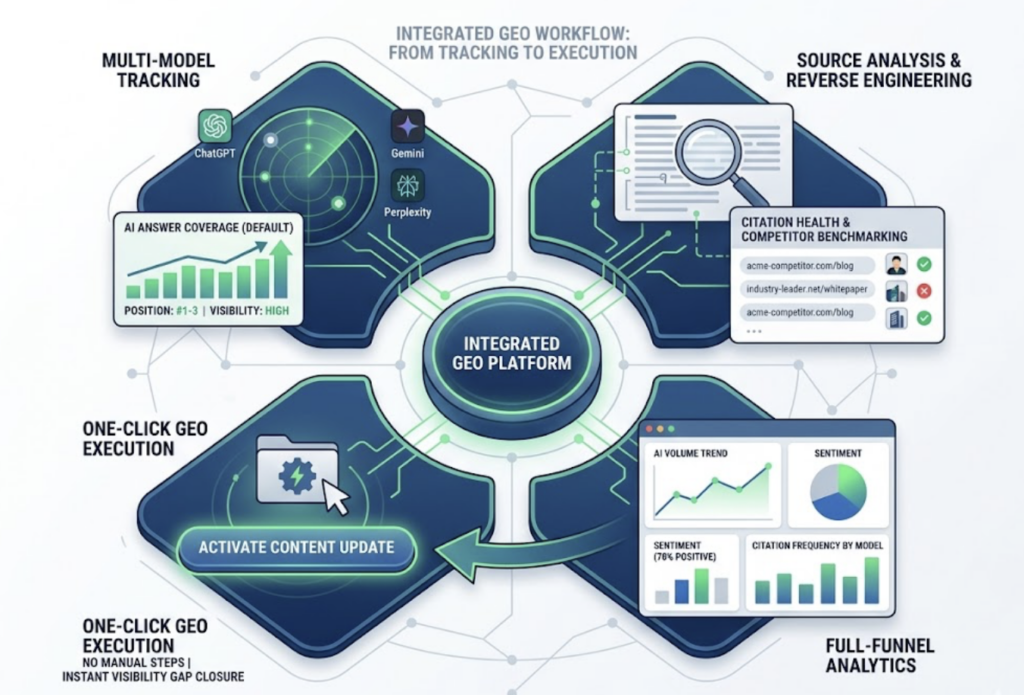
    Topify sits at the comprehensive end of the market. Instead of a single mention count, it tracks brand performance across seven metrics in one view: visibility, sentiment, position, volume, mentions, intent, and CVR (conversion visibility rate). That spread is what separates “we got mentioned” from “we know what the mention is worth.”

    Coverage runs across the engines buyers actually use, including ChatGPT, Gemini, Perplexity, DeepSeek, Doubao, and Qwen. For teams selling into more than one market, that matters, because a brand’s standing on Perplexity often looks nothing like its standing on a regional engine.
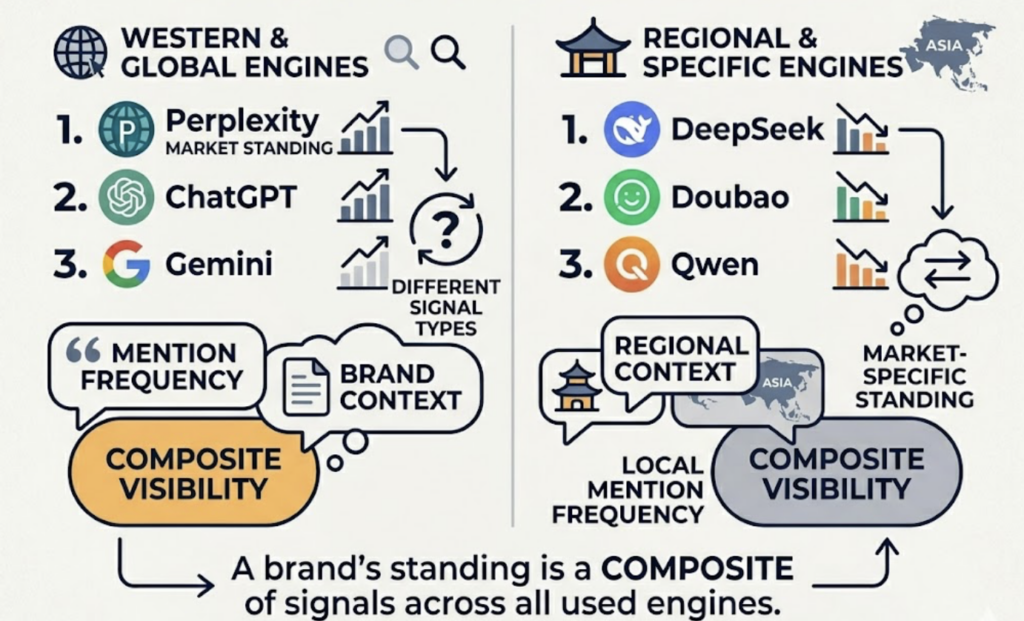
    The part that turns tracking into action is competitor benchmarking. Topify shows which brands an AI engine recommends for a given prompt, where you land relative to them, and which new rivals are starting to surface. You’re not just watching your own line on a chart. You’re seeing the full set of answers a buyer gets.

    It also reverse-engineers citations. Topify analyzes the exact domains and URLs that AI platforms pull from, so when a competitor keeps getting cited and you don’t, you can trace it to the specific source and decide whether to earn a place there. That maps directly to the source-path audit most teams skip.

    In practice, this means you can spot a drop in ChatGPT mentions, trace it back to a review site that stopped citing you, and route the fix to your content team, all inside the same dashboard. The one-click execution layer lets you state a goal in plain English, review the proposed strategy, and deploy without building a manual workflow.

    Pricing starts at $99 a month on the Basic plan, which includes a 30-day trial, tracking across ChatGPT, Perplexity, and AI Overviews, and 100 prompts. Teams that want to confirm the data changes what they do before committing can get started on the trial first.
    Best fit: marketing teams and agencies that need cross-platform tracking plus a clear route from insight to fix, not just another dashboard.

    2 to 6: Other Tools to Track AI Search Visibility

    2. Profound

    Profound leans toward strategic planning. It’s useful for spotting thematic content gaps and high-level category opportunities, which suits teams thinking about where to invest content effort before they get into prompt-level tracking.

    3. ArcAI

    ArcAI focuses on attribution and ROI. If your priority is correlating AI presence with downstream traffic, leads, and conversions, it’s built around that question, though it leans more on measurement than on optimization.

    4. Peec.AI

    Peec.AI is the lighter, friendlier option. Smaller teams that want quick, readable insight on specific prompt gaps tend to get value fast, though coverage and depth are narrower than enterprise platforms.

    5. Rankscale

    Rankscale is built around the “why.” It digs into content authority and clarity signals to explain why a brand fails to get cited, which helps teams that already track presence but can’t figure out the cause.

    6. MentionDesk

    MentionDesk is about automated, recurring presence checks. For teams that want scalable monitoring running in the background across major LLMs, it covers the repetition without much manual setup.

    How to Pick a Tool to Track AI Visibility for Your Stack

    There’s no single right tool to track AI search visibility performance. The right one depends on what you’ll do with the data.

    If you sell into one market and one engine dominates your category, a lighter diagnostic tool can be enough to start. The moment your buyers split across ChatGPT, Perplexity, and AI Overviews, single-engine tracking starts lying to you.

    If you already know you’re underperforming and need the reason, prioritize tools that trace citations and explain the gap, not ones that only restate the score.

    And if you’re an agency reporting to clients, the deciding factor is comparative data. A 30% mention rate means nothing until you can put a competitor’s rate next to it. Run the evaluation criteria that separate diagnostic trackers from full platforms before you commit.

    Pick for the decision you need to make, not the prettiest dashboard.

    Conclusion

    The teams that struggle with AI search visibility usually aren’t measuring nothing. They’re measuring one thing, on one engine, and calling it coverage. The fix isn’t more dashboards. It’s choosing a tool that tracks the full set of signals across the platforms your buyers actually use, then routing what it finds to the people who can act on it.

    Start by checking where your brand stands today. Once you can see the gap clearly, the tool you need becomes a lot more obvious.

    FAQ

    Q: How do you track AI visibility across multiple platforms at once? 

    A: You need a tool that runs the same set of buyer prompts across each engine on a schedule, then normalizes the results into one view. Manual spot checks on a single platform won’t catch the divergence between, say, Perplexity and Google’s AI Overviews, where the same brand can show up strong in one and vanish in the other.

    Q: Which AI search visibility metrics actually matter? 

    A: Mention frequency tells you whether you appear, but it’s only the first signal. Citation share, position in the answer, sentiment, and the competitive gap (why a rival gets picked instead) are what turn a number into something your content team can act on.

    Q: How often should you track AI search visibility performance? 

    A: AI engines shift their citation patterns regularly, so a one-time audit goes stale fast. Continuous or weekly tracking is more useful than a quarterly snapshot, especially when you’re testing whether a content change moved your standing.

    Q: Are free tools enough to track brand mentions in ChatGPT and Perplexity? 

    A: A free check is a fine way to see where you stand right now and decide whether the gap is worth acting on. For ongoing tracking across several engines, with competitor benchmarking and source-level attribution, you’ll want a paid platform built for that depth.
    Read More

  • AI Visibility Analytics: What It Is and How to Measure It

    AI Visibility Analytics: What It Is and How to Measure It

    Your GA4 dashboard shows organic sessions, bounce rate, and conversion paths. None of it tells you whether ChatGPT just recommended a competitor when a buyer asked for the best tool in your category. That blind spot is widening. More research now starts inside AI answers, where discovery happens before a single click ever reaches your site. Traditional analytics were built to measure rankings and traffic. They were never built to measure whether an AI mentions you, how it describes you, or which source it decides to trust. That’s the gap AI visibility analytics exists to close.

    What AI Visibility Analytics Actually Tracks

    AI visibility analytics is the systematic measurement of how a brand gets discovered, represented, and cited inside AI-generated answers. It’s not web traffic analytics. It’s not a rank tracker. It measures something those tools can’t see: your brand’s presence inside a synthesized response.

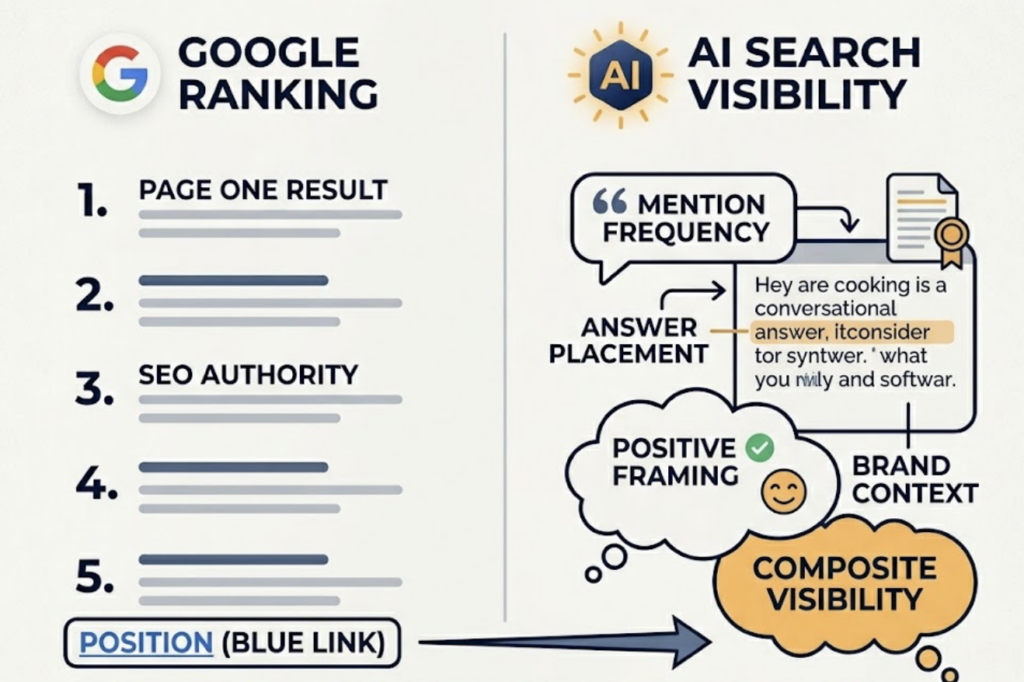
    Here’s the shift that breaks the old model. Search engines used to rank pages in a list, so visibility meant a position you could point to. AI engines don’t rank in a list. They synthesize information into a single conversational answer, which means your visibility is no longer a blue-link position. It’s whether you show up in the summary at all, and how you’re framed when you do.

    That makes the discipline platform-agnostic by definition. Tracking one engine isn’t enough, because the same prompt can return a different brand in Perplexity than it does in ChatGPT.

    Most teams measure three dimensions:

    • Presence is mention frequency: the share of relevant, high-intent prompts where your brand gets included.
    • Representation is sentiment and positioning: whether the AI describes you as a category leader, a budget option, or an afterthought.
    • Citation authority is the source layer: which specific domain and page the AI credits as its source of truth.

    Web analytics can confirm a visit happened. It can’t tell you any of these three.

    How AI Visibility Analytics Works Under the Hood

    The first instinct most people have is to open ChatGPT and search their own brand once. That tells you almost nothing.

    LLM responses are non-deterministic. The same prompt can produce different answers depending on context, phrasing, and model updates, so a single manual check is statistically meaningless. Real measurement works through sampling at scale, not one-off lookups.

    A working system runs four steps. First, prompt orchestration builds a library of buyer-intent prompts, the kind real customers type, like “what are the best solutions for X.” Second, cross-platform querying feeds those prompts into multiple AI engines at once, so ChatGPT, Gemini, Perplexity, and Google AI Overviews get measured side by side. Third, parsing uses named entity recognition and sentiment analysis on the raw response text to detect if, where, and how your brand appears. Fourth, aggregation rolls that up into share of voice and citation share tracked over time.

    The output isn’t a rank. It’s a trend line.

    The Metrics That Tell You If AI Sees Your Brand

    Once you stop chasing a “rank,” a different set of KPIs takes over. These metrics capture brand influence in the pre-click window, before anyone reaches your site.

    MetricWhat it answers
    Citation ShareHow often does the engine cite your domain versus competitors for category queries?
    Mention FrequencyIn what share of category conversations does your brand get included?
    Sentiment AccuracyDoes the AI’s description match your intended positioning?
    Citation PositionAre you a primary source, or buried in an “additional sources” footer?
    Competitive GapWhich high-intent prompts are competitors winning while you’re absent?

    The Competitive Gap row tends to drive the most action. It turns a vague worry (“are we losing ground in AI?”) into a concrete list of prompts where a named rival shows up and you don’t. That’s a content brief, not a feeling.

    Best AI Overviews Tracker Tools: What to Look For

    Google AI Overviews sits in a category of its own. It shows up directly on the search results page, which means it intercepts intent that used to flow to organic listings. For most brands, it’s the single highest-traffic AI surface, so a dedicated AI Overviews tracker is worth evaluating on its own merits.

    Search “best AI Overviews tracker” and you’ll find platforms that all promise the same thing. The difference is in what they actually measure. Use these criteria to separate a real AIO tracker from a basic keyword monitor:

    Selection criteriaWhy it matters
    Platform coverageDoes it track AI Overviews alongside ChatGPT, Perplexity, and Gemini, or just one engine?
    Dedicated AIO monitoringDoes it isolate Google AI Overviews as its own data stream, or fold it into generic SERP data?
    Citation reverse-engineeringCan it show which exact domains and URLs the overview cites, including yours and competitors’?
    Update cadenceDoes it monitor continuously, or hand you a static one-time snapshot?

    The best AI Overviews tracker isn’t the one with the prettiest dashboard. It’s the one that connects an AIO mention back to the source page that earned it, so you know what to fix. A tracker that only tells you “you’re not visible” without showing the citation behind a competitor’s win leaves you guessing.

    Common Mistakes That Skew Your AI Visibility Analytics

    Plenty of teams set up tracking and still draw the wrong conclusions. A few mistakes show up again and again.

    The first is the ranking fallacy: assuming a strong Google rank guarantees an AI mention. AI models prioritize authoritative, answer-ready content, and that doesn’t always line up with link-based authority. A page can rank well and still get skipped by the model.

    The second is monitoring a single platform. A brand might dominate Perplexity and be invisible in ChatGPT, and tracking only one creates a false sense of safety.

    The third is treating a manual snapshot as data. One search on one day, against a non-deterministic system, isn’t a measurement. It’s noise.

    The fourth is the most expensive. Roughly 96% of marketers haven’t updated their KPIs to account for zero-click AI discovery, so they keep grading themselves on organic sessions while brand exposure quietly moves somewhere their reports can’t see.

    A quick self-check before you trust any AI visibility report:

    • Does it cover more than one AI engine?
    • Does it track mentions and sentiment, not just position?
    • Is it continuous, or a one-time snapshot?
    • Does it tie a mention back to a citation source?

    If a report fails two of those, the numbers aren’t telling you what you think they are.

    How to Improve AI Visibility Analytics Across Platforms

    Measurement only matters if it changes what you do next. The goal is to move from “being visible” to “being trusted,” and that takes a repeatable loop.

    Start by finding content gaps. Use citation data to locate the buyer questions where competitors get cited and you don’t, then build the answer-ready content that closes each one. Next, strengthen entity authority. AI engines correlate consistent messaging across PR, social, and authoritative directories with credibility, so a coherent footprint across sources tends to lift mention frequency. Then optimize structure. Clear H2 and H3 headers, direct-answer summaries, and FAQs give LLMs content they can parse and quote cleanly.

    None of that sticks without persistent monitoring. Citation patterns drift as models update, so a quarterly audit misses most of the movement.

    This is where a comprehensive analytics layer does the heavy lifting. Topify approaches AI visibility analytics through a seven-metric view, covering visibility, sentiment, position, volume, mentions, intent, and conversion visibility rate across major engines. In practice, that means you can watch a drop in ChatGPT mentions, trace it to a source that stopped citing you, and see whether the same prompt still surfaces you in Google AI Overviews, all from one dashboard. Its AI Overviews tracking is built into the entry plan, so the AIO layer isn’t a paid add-on you discover later.

    The point isn’t more charts. It’s a clear path from “we lost a mention” to “here’s the page that needs to change.” If you want to see where your brand stands today, you can get started with Topify and run your first cross-platform scan.

    Conclusion

    AI visibility isn’t a one-time project. As models update and citation patterns shift, the only reliable posture is an always-on cadence: weekly snapshots, monthly trends, and a fast loop from data to content fixes. The brands that win the early-funnel intent traditional SEO can’t see are the ones treating AI representation as ongoing governance, not a quarterly curiosity. Pick the metrics that matter, cover every engine your buyers use, and make sure each report points at something you can actually fix.

    FAQ

    Q: What is AI visibility analytics in simple terms? 

    A: It’s the practice of tracking how often, and in what context, your brand appears in answers generated by AI engines like ChatGPT, Perplexity, and Google AI Overviews. It measures presence inside an answer, not clicks to your site.

    Q: How do you measure AI visibility analytics? 

    A: Through automated prompt testing across multiple AI platforms, calculating citation share, brand sentiment, and mention frequency over time. Because LLM responses fluctuate, measurement relies on sampling at scale rather than single manual searches.

    Q: What is the best AI Overviews tracker for it? 

    A: The strongest AIO trackers focus on large-scale prompt orchestration, competitor benchmarking, and citation analysis, and they isolate Google AI Overviews as its own data stream instead of folding it into generic SERP data. A tracker that ties each mention back to its source page is the most useful.

    Q: How much does AI visibility analytics tooling cost? 

    A: Pricing usually follows a SaaS model based on prompt volume and the number of AI engines tracked. Topify’s entry plan starts at $99/month and already includes ChatGPT, Perplexity, and AI Overviews tracking, with higher tiers adding more prompts, projects, and seats.

    Read More

  • AI Search Monitoring Strategy for Brand Visibility

    AI Search Monitoring Strategy for Brand Visibility

    Your CMO forwards a Slack message: a prospect asked ChatGPT for the best option in your category, and a competitor came back first. So you open ChatGPT, type the same prompt, and get a slightly different answer. You try again an hour later, and it shifts again. One screenshot tells you nothing about whether your brand is gaining ground or losing it. Checking AI search by hand falls apart the moment you need to prove a trend instead of a single moment.

    Why Manual Checks Aren’t an AI Search Monitoring Strategy

    Most teams start the same way. Someone types a category question into ChatGPT, screenshots the answer, and pastes it into a deck. It feels like monitoring. It isn’t.

    AI responses are non-deterministic. The same prompt returns different answers depending on the user’s location, their search history, the specific model version (GPT-4o behaves differently from Claude 3.5), and the system context wrapped around the query. A single capture is a snapshot of one roll of the dice, not a measurement.

    Then there’s the funnel you can’t see. Enterprise buyers increasingly run their early research inside chat interfaces, in a zero-click environment where no analytics tag ever fires. Manual snapshots are a weak proxy for what’s actually happening in that conversation.

    The deepest flaw is the missing trend line. A screenshot from today says nothing about whether your brand is gaining or losing authority over the following weeks. An AI search monitoring strategy is the opposite of a spot check: longitudinal, reproducible, and built to show direction rather than a single moment.

    That’s the gap most brands still can’t see.

    What Brand Visibility in AI Search Actually Means

    Brand visibility in AI search isn’t the same thing as a Google ranking, and treating them as interchangeable is where most strategies go wrong.

    In traditional SEO, visibility means a position on a results page. You rank #3, you get a slice of clicks. In AI search, there’s no list of ten blue links to climb. The model synthesizes an answer, and your brand is either part of that synthesis or it’s absent.

    DimensionTraditional SEOAI Search
    Primary metricSERP ranking, positions 1 to 10Brand presence, mentioned or not
    User pathClick through to your siteConversational discovery and synthesis
    Visibility unitLinks and snippetsCitations, mentions, and sentiment
    Value driverBacklinks and domain authoritySemantic clarity and source authority

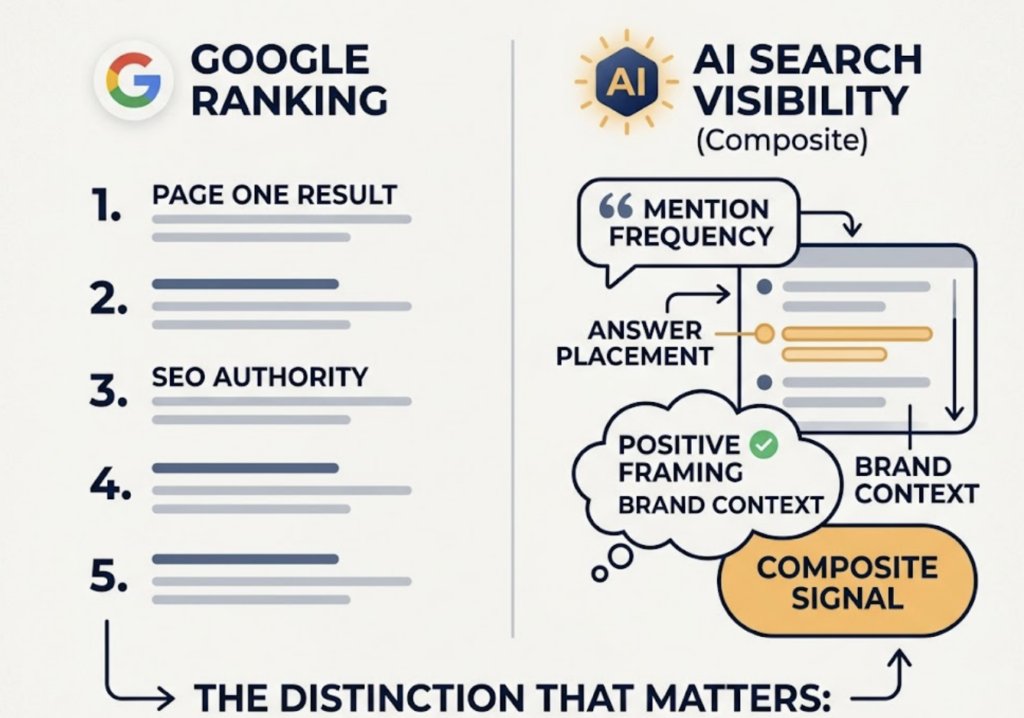
    Here’s the distinction that matters: ranking and mention are not the same signal. A page can rank well in Google and still never get mentioned when someone asks Perplexity for a recommendation in your category. Brand visibility in AI search is a composite of how often you’re mentioned, where in the answer you appear, and how the model frames you.

    The Five Signals a Monitoring Strategy Should Track

    A monitoring strategy is only as good as the signals it captures. Five dimensions matter most.

    Mention Frequency and Share of Model

    This is the foundation. Across a defined set of category prompts, what percentage return a mention of your brand versus a competitor’s? Visibility frameworks from groups like Adobe and Semrush describe a version of this as “share of model,” your slice of the AI’s attention. Track it across platforms, not one.

    Position and Sentiment in AI Answers

    Not all mentions carry equal weight. Being the first brand named in an answer is worth far more than a closing footnote. Layer sentiment on top: does the model frame you as the category leader, a neutral option, or a budget fallback? Negative sentiment bias is the risk most teams never check for.

    Citation Sources Behind the Answers

    Every AI answer is built on sources. Knowing which URLs the model cites, your own pages versus third-party publications, tells you where your authority actually lives. If the model keeps citing a competitor’s blog for a query you should own, that’s a content gap with a name and address.

    Two of these signals get ignored most often: citation pathing and prompt-level coverage across the buyer journey. Sentiment and prominence reveal the quality of brand visibility in AI search, not just its presence.

    Turning Brand Visibility Data Into Action

    Monitoring that doesn’t change anything is just expensive watching. The point is the loop from insight to action.

    Start with content gaps. When citations for a high-intent query consistently point to someone else’s page, that’s your signal to build something deeper and more authoritative on that exact topic. The data tells you where, so you stop guessing.

    Then there’s authority building. If AI systems lean on third-party sources like G2 or industry reports instead of your own site, the fix isn’t more blog posts. It’s PR and partner relationships with the high-authority domains the models already trust.

    Finally, close the feedback loop on sentiment. A persistent gap between how the model describes you and how you position yourself usually traces back to messaging that isn’t machine-readable. Tighten the metadata, sharpen the value proposition, then re-measure.

    This is where a unified view earns its keep. For teams tracking brand visibility across multiple AI platforms, Topify tends to stand out by combining visibility, sentiment, position, and citation data into one place through its Comprehensive GEO Analytics. In practice, that means you can watch your ChatGPT mentions drop, trace it to a source that stopped citing you, and decide what to fix, all without stitching together four separate exports.

    Choosing Tools for Your AI Search Monitoring Strategy

    The tooling market has filled up fast, and most options look similar on a landing page. The differences show up in what they actually measure.

    Four criteria separate a real monitoring tool from a keyword tracker with new branding.

    CriterionWhat weak tools doWhat a real monitoring tool does
    Engine coverageTrack only ChatGPTCover ChatGPT, Gemini, Perplexity, Claude, and more
    Response captureFlag “mentioned or not”Store full raw responses for historical analysis
    Analysis depthCount mentionsCategorize sentiment and identify the exact cited URLs
    ActionabilityHand you raw dataRecommend specific fixes, like missing E-E-A-T signals

    Multi-engine coverage comes first. A tool that only watches ChatGPT misses Gemini, Perplexity, and Claude, and those models pull from divergent training data, so single-platform tracking gives you a partial picture at best. Topify covers ChatGPT, Gemini, Perplexity, DeepSeek, and others in one workspace.

    Full-response capture is the next filter. Tools that only flag “mentioned or not” throw away the context you need later. Storing raw responses is what makes historical sentiment and citation analysis possible at all.

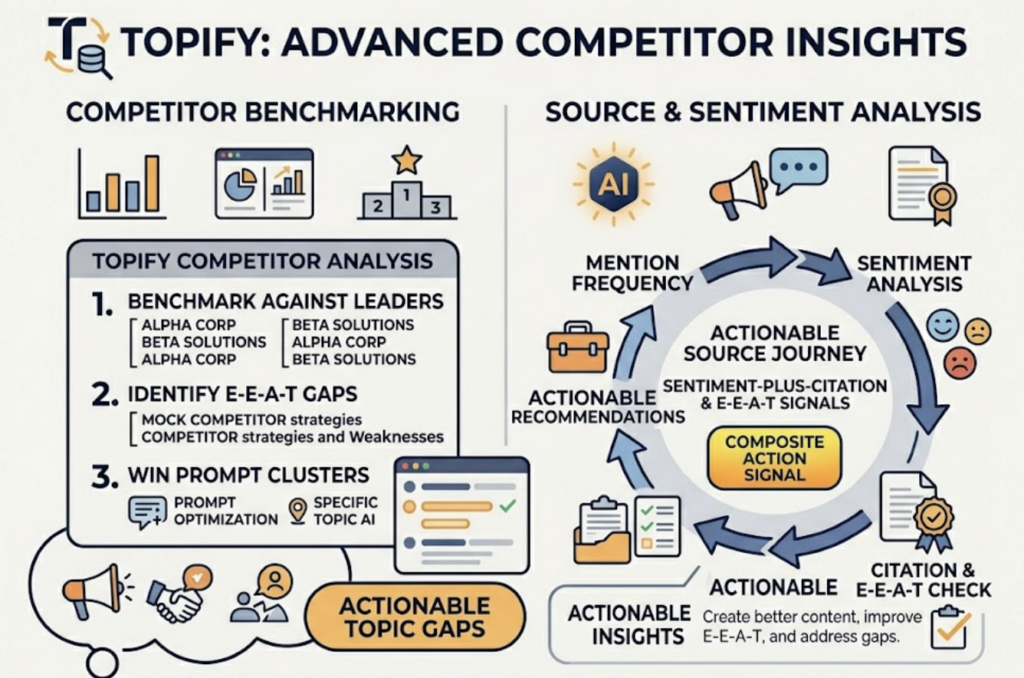
    The last two criteria, sentiment-plus-citation analysis and actionability, are where most tools stop short. Raw data is easy. Telling you which page is missing E-E-A-T signals, or which competitor is winning a specific prompt cluster, is the hard part. Topify’s competitor benchmarking and source analysis are built around that step, turning the monitor into something your team can act on rather than just read.

    How to Know Your Strategy Is Working

    A monitoring strategy needs a cadence and a scoreboard, or it quietly becomes a dashboard nobody opens.

    On cadence, two rhythms work well together. Run a deep-dive audit monthly across your full prompt set, and monitor your core category prompts weekly so you catch sharp movements before they calcify.

    On benchmarks, three numbers tell most of the story. Track citation share against your top competitors on a rolling 90-day window, watch your sentiment scores move from neutral toward recommended, and correlate visibility spikes with branded search and high-intent direct traffic to connect AI visibility back to revenue signals.

    Track it. Trace it. Act on it.

    Conclusion

    The screenshot-in-a-Slack-message approach falls apart the moment someone asks whether your brand is trending up or down. An AI search monitoring strategy answers that question, not with one capture, but with a repeatable system that tracks mention frequency, position, sentiment, and citations across every model your buyers use. Start by defining the prompts that matter to your category, pick a tool that captures full responses across multiple engines, and set a weekly-plus-monthly cadence. The brands winning AI visibility aren’t checking by hand. They’re measuring, and acting on what they measure. You can get started with Topify to put that loop in place.

    FAQ

    Q: How is AI search monitoring different from traditional rank tracking? 

    A: Rank tracking measures your position on a results page for a keyword. AI search monitoring measures whether and how your brand appears inside a synthesized answer, across mention frequency, position within the response, sentiment, and which sources the model cites. A brand can rank well in Google and still go unmentioned in AI answers.

    Q: How often should I run brand visibility checks in AI search? 

    A: A practical cadence is weekly monitoring of your core category prompts plus a deeper monthly audit across your full prompt set. AI answers shift as models update and citation patterns change, so anything less frequent risks missing trends until they’ve already cost you ground.

    Q: What are good Promptmonitor alternatives for tracking brand visibility across AI assistants? 

    A: When evaluating Promptmonitor alternatives for brand visibility across AI assistants, weigh four things: how many engines the tool covers (ChatGPT, Gemini, Perplexity, Claude), whether it stores full raw responses, whether it analyzes sentiment and citations rather than just flagging mentions, and whether it turns data into specific actions. Platforms like Topify are built around multi-engine coverage and citation-level analysis rather than single-platform mention flagging.

    Q: Which metrics matter most in an AI search monitoring strategy? 

    A: Five signals carry the most weight: mention frequency (share of model), position or prominence within the answer, sentiment accuracy, citation sources, and prompt-level coverage across the buyer journey. Mention frequency and citation pathing tend to be the highest-leverage places to start.

    Read More

  • Is “Best Rank Checker” the Wrong Goal for 2026?

    Is “Best Rank Checker” the Wrong Goal for 2026?

    Your rank tracker shows green across the board. Position 3 on your money keyword, position 1 on two others, steady for months. Then organic traffic slides anyway, and when a prospect asks ChatGPT for a recommendation in your category, your brand never comes up. The numbers your tool reports and the outcomes your business cares about have quietly stopped matching. Most rank checkers were built to answer one question: where does my page sit on a list of ten blue links? In 2026, fewer and fewer searches end on that list at all.

    What a Rank Checker Was Built to Measure

    Traditional rank checkers do one job well. They crawl Google’s results page, map a keyword to a URL position from 1 to 100, and assume that position predicts traffic.

    That assumption held for a long time. In a ten-blue-links world, position 1 captured most of the clicks, and every step down the page cost you something measurable. The entire practice of shopping for the best rank checker rested on a clean chain: higher rank, more clicks, more traffic.

    The chain still works. It just covers a shrinking slice of how people actually find answers now.

    The Best Rank Checker Still Can’t See AI Answers

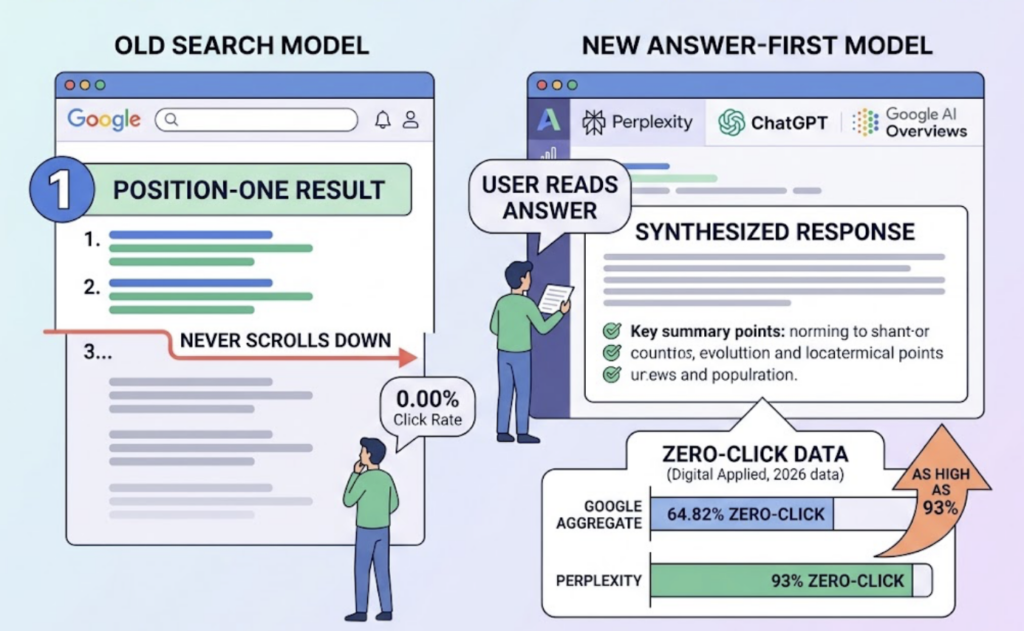
    Here’s the structural problem. A rank checker reads a list. AI answers aren’t lists.

    When ChatGPT, Perplexity, or a Google AI Overview responds, there’s no page two and no position 7. There’s a synthesized answer that mentions a few brands, cites a few sources, and leaves out everything else. Your rank tool has no field for “mentioned” or “cited,” so the entire AI layer is invisible to it.

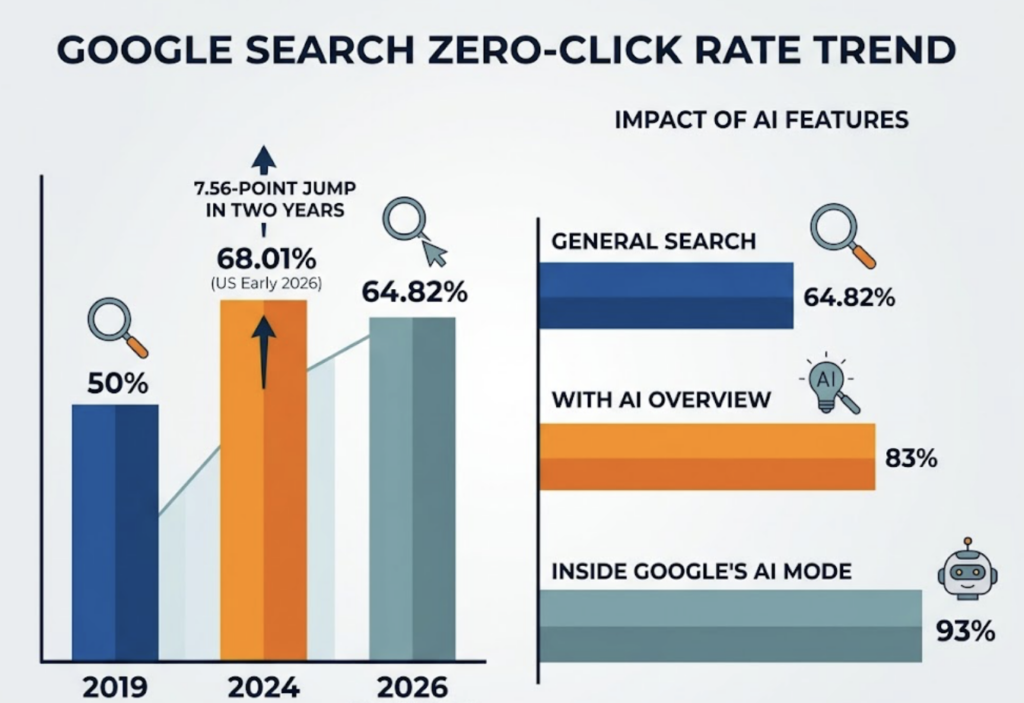
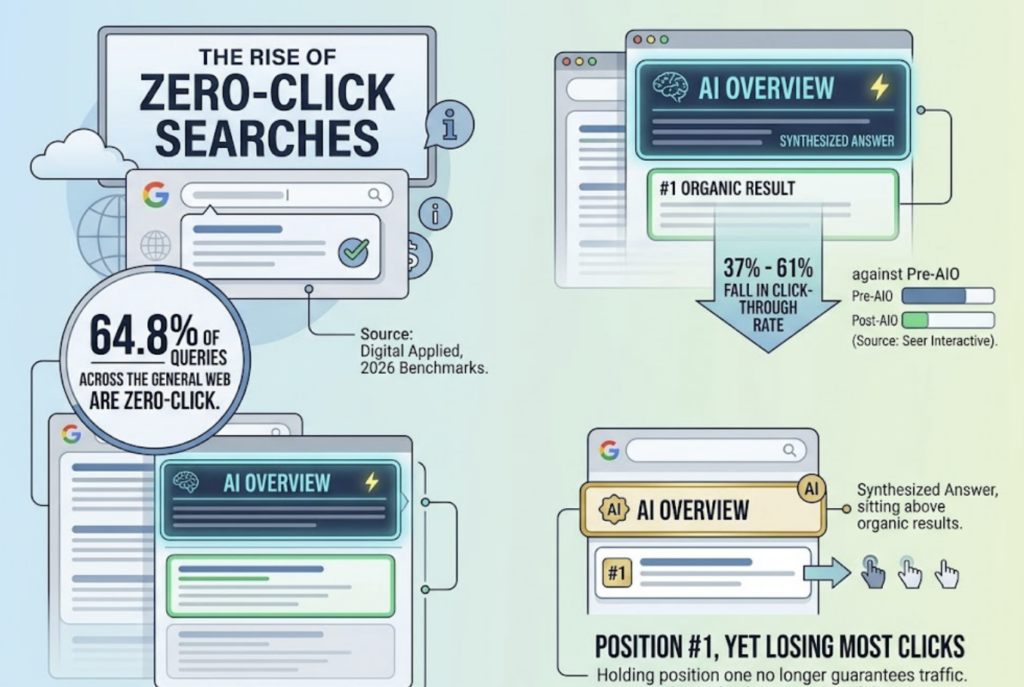
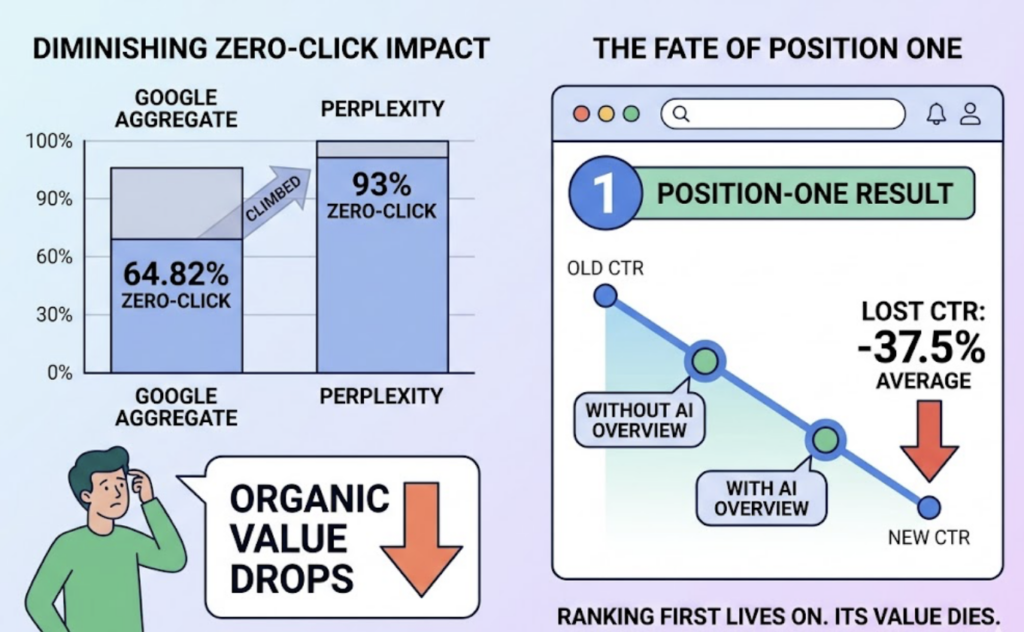
    The traffic data shows the gap first. By 2026, 64.82% of Google searches end without a click, up from roughly 50% in 2019. When an AI Overview is present, that zero-click rate jumps to 83%, and inside Google’s AI Mode it reaches 93%. The most recent SparkToro analysis puts US zero-click at 68.01% in early 2026, a 7.56-point jump in two years.

    So the best rank checker can still confirm you’re position 1. It can’t tell you whether the answer box above you already gave the user what they came for. When AI Overviews appear, organic click-through on top pages drops anywhere from 18% to 61% depending on query and industry.

    Ranking first on a page nobody scrolls to is a hollow win.

    Position 1 in Google Isn’t Position 1 in ChatGPT

    The deeper issue is that rankings and AI citations have come apart. They’re now two different coordinate systems.

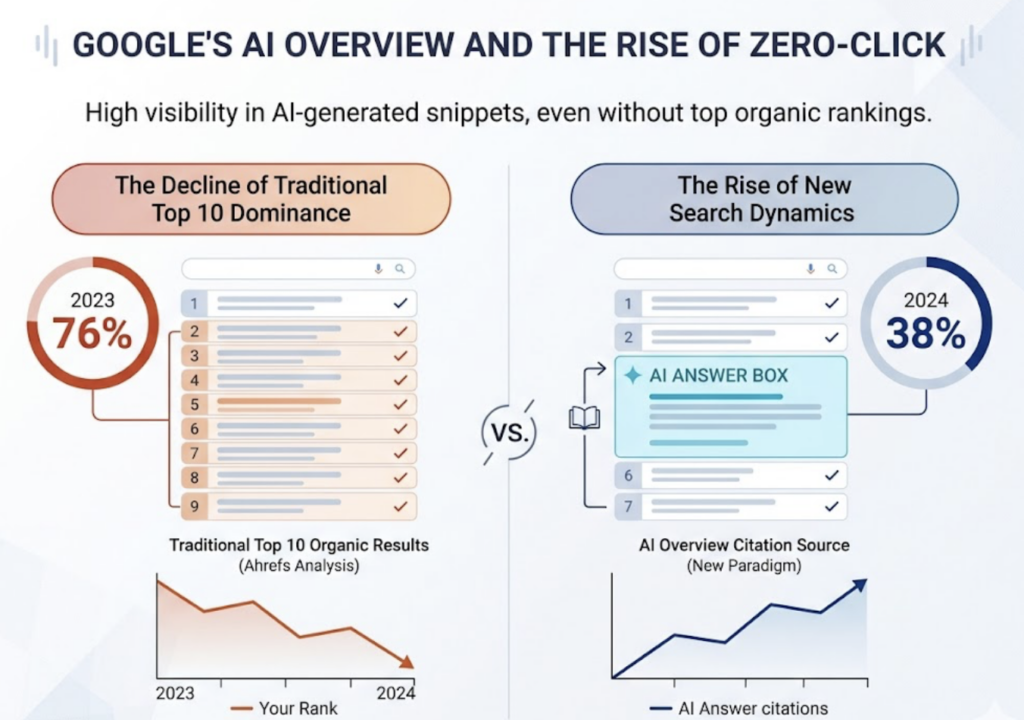
    An Ahrefs study of millions of AI Overview URLs found that the share of citations coming from top-10 organic pages fell from about 76% to 38% between mid-2025 and early 2026. Separate analysis shows 75% of AI citations pull from sources outside Google’s results entirely, and on some platforms the overlap drops below 10%.

    Translation: a page can sit at position 1 in Google and never surface in a ChatGPT or Perplexity answer. The signals that earn a top rank and the signals that earn a citation aren’t the same.

    That matters more because the traffic AI sends tends to be worth more. Visitors arriving through ChatGPT convert at 15.9% versus 1.76% for Google organic, since the AI has already framed your brand as the answer before the click happens.

    Rankings get you into the room. Citations decide who gets recommended.

    What SEO Teams Track Instead of Rankings in 2026

    Smart teams aren’t throwing out rankings. They’re adding a second layer of metrics that measure answer authority rather than link position.

    The shift looks like this:

    Old MetricNew MetricWhat It Captures
    Keyword RankVisibility ScoreHow often your brand is mentioned across AI answers
    Backlink CountCitation AuthorityHow often LLMs cite you as a trusted source
    Page CTRConversion Visibility RateHow likely an AI response is to drive brand interaction
    Position 1Recommendation RankThe order your brand appears in AI recommendations
    Domain AuthorityEntity Trust ScoreHow consistently your brand reads across the web and AI training data

    The pattern is consistent. Every old metric measured your spot on a list. Every new one measures whether the answer engine knows you, trusts you, and names you. Those are the questions a rank checker was never designed to ask.

    This is also why “rank checker” feels like the wrong term for 2026. The work hasn’t disappeared. The unit of measurement has changed from position to presence.

    Tracking AI Visibility Without Throwing Out Your Rank Data

    The practical move isn’t replacing your rank checker. It’s running a dual stack: keep the rank tool for navigational and transactional queries, and layer on a platform that can see the synthesis layer your rank tool is blind to.

    For teams making that shift, Topify tracks brand presence across ChatGPT, Gemini, Perplexity, Google AI Overviews, and other engines at the prompt level. Instead of a keyword and a position, you get a clear read on where you’re mentioned, where you’re cited, and where a competitor is named in your place.

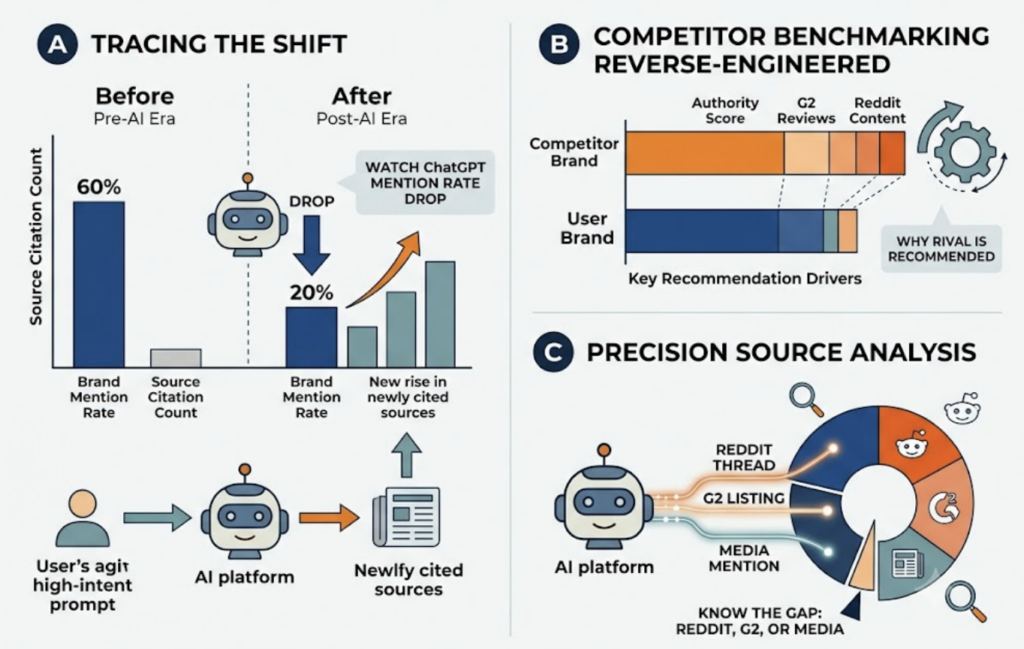
    In practice, that means you can watch your ChatGPT mention rate drop on a high-intent prompt, then trace it to the exact source the model started citing instead of you. Its competitor benchmarking reverse-engineers why a rival is being recommended, and its source analysis shows the precise domains AI platforms pull from, so you know whether the gap is a Reddit thread, a G2 listing, or a media mention.

    Two things separate this from passive monitoring. First, prompt discovery surfaces “dark queries,” high-volume AI research prompts that have no equivalent traditional search volume, which gives early movers a content opening rank tools can’t see. Second, the execution layer lets you state a goal in plain English and deploy the suggested fix in a click, rather than handing your team another dashboard to interpret.

    The point isn’t that rankings are dead. It’s that they’re now one signal among several, and the others need their own instrument.

    Where to Start If Rankings Are Your Only Signal

    If your current visibility report is built entirely on rank data, three steps close most of the gap.

    Run a baseline visibility audit first. Pick the conversational, high-intent prompts buyers actually type into AI tools in your category, and check whether your brand shows up at all. This is the AI-search equivalent of your first rank report, and it usually reframes the conversation fast.

    Next, close the citation gap. Find which third-party sources, like Reddit, G2, or industry media, the AI cites in place of your domain, and prioritize earned visibility on those specific platforms.

    Then optimize for extractability. AI systems weight the first portion of a page heavily when choosing what to quote, so lead high-value pages with a clean, two-to-three-sentence answer before the supporting detail. When you’re ready to baseline your own brand, you can get started with Topify on the prompts that matter most to your pipeline.

    Conclusion

    “Rank checker” isn’t wrong, exactly. It’s incomplete. Position on a results page still matters for the queries that end in a click, but a growing majority of searches now resolve inside an answer your rank tool can’t read. The teams pulling ahead in 2026 didn’t abandon rank tracking. They stopped treating it as the whole picture and added a layer that measures whether AI engines mention, cite, and recommend them. Start with a visibility baseline, find the citation gaps, and build your reporting around presence, not just position.

    FAQ

    Is rank tracking still worth it in 2026? 

    Yes, for navigational and transactional queries where users still click through to a destination. The limitation is that rank tracking only measures position on Google’s results page, which now accounts for a shrinking share of total search behavior. Pair it with AI visibility tracking rather than relying on it alone.

    What should I track instead of keyword rankings? 

    Track AI visibility (mention frequency across AI answers), citation authority (how often LLMs cite you), recommendation rank (your order in AI recommendations), and sentiment. These measure answer authority, which is what determines whether AI engines surface your brand.

    Why does my page rank first on Google but not appear in ChatGPT? 

    Because AI engines select sources using different signals than Google’s organic ranking. Only about 38% of AI Overview citations now come from top-10 organic pages, and on some platforms the overlap is below 10%. A top rank no longer predicts a citation.

    Rank tracker vs AI visibility tool: do I need both? 

    Most teams do. A rank tracker answers “where does my page sit on the SERP,” while an AI visibility tool answers “do the answer engines name my brand.” They measure different surfaces, so the two together give a complete view of discovery.

    Read More

  • The Best Rank Checker Is Blind to AI Search

    The Best Rank Checker Is Blind to AI Search

    Your rank tracker shows position one for your top keywords. Green arrows across the dashboard. Then you pull the traffic report, and the line is sloping down anyway. Nothing in your tooling explains it, because the tool was built to answer one question: where does my page sit on the results page? That question matters less every quarter. More buyers now get their answer before a single blue link loads, and the best rank checker on your stack has no way to see whether your brand made it into that answer or got left out.

    Stable Rankings Don’t Mean Your Brand Is Safe

    For two decades, SERP position worked as a clean proxy for traffic. Rank well, get clicks, win business. That chain has broken.

    In the first four months of 2026, 68% of US Google searches ended without a click to anywhere, up from 60% in 2024. Less than a third of searches now send a visit to the open web.

    The pages that still rank are losing value too. Ahrefs found that the presence of an AI Overview cuts click-through rate by 58% for the top organic result, nearly double the drop it measured eight months earlier.

    So your ranking can hold steady while the traffic behind it quietly drains. That’s the gap most rank checkers still can’t see.

    Why Your Rank Checker Goes Quiet on AI Search

    A rank checker crawls the results page and logs where your URL sits. That model assumes the answer is a list of links a user scrolls through. AI search doesn’t work that way.

    When someone asks ChatGPT or Perplexity for a recommendation, the engine writes one answer and names a handful of brands. There’s no position three, no page two, no link list to scrape in the old sense. Either your brand is in the answer or it isn’t.

    And ranking on Google no longer guarantees you make the cut. An Ahrefs analysis of 4 million AI Overview citations found that only 38% of cited pages also rank in the top 10 organic results, down from 76% a year earlier. AI engines weigh answer-readiness and source trust, not just the signals your rank tracker was built around.

    Here’s the practical problem: the place your buyers increasingly ask is the one place your current tooling reports nothing.

    What the Best Rank Checker Actually Tracks Now

    If the job of a rank checker is to tell you where you stand when a buyer goes looking, then the job has expanded. A tool that only reads Google’s results page now covers a shrinking slice of that question.

    The best rank checker for 2026 has to measure four things traditional trackers skip:

    • Presence across engines. Whether your brand shows up in ChatGPT, Gemini, Perplexity, and Google AI Overviews, not just one of them.
    • Position inside the answer. Where you land relative to competitors when the AI lists options.
    • Citation and source share. Which domains the AI pulls from, and whether yours is one of them.
    • Recommendation sentiment. How the model frames you. Premium or budget, leader or alternative.

    Measuring this reliably is harder than running a SERP scan. AI answers shift with the model version, the user’s region, and even the time of day, since real-time retrieval keeps pulling in fresh content through the day. A single manual check tells you almost nothing. You need a fixed prompt set, run on a schedule, the same way you’ve always tracked keyword positions over time.

    Checking Your Position Inside AI Answers

    This is where a purpose-built AI search tracker earns its place next to your SERP tools. Topify treats the problem as rank tracking for the answer layer: define the prompts your buyers actually ask, then watch where your brand lands across the major AI engines over time.

    Its Position Tracking shows where you sit relative to competitors inside AI responses, while Visibility Tracking records how often you get mentioned at all. Both run on a recurring schedule, so a drop registers as a trend rather than a one-off fluke.

    The part that ties back to old-school rank checking is the why. When your mention rate falls, Topify traces it to the source domains the AI stopped citing, so you can see which piece of content lost its grip on the answer. Track it. Trace it. Fix it.

    Coverage spans ChatGPT, Gemini, Perplexity, and other major engines, which matters because presence on one platform rarely predicts presence on another.

    Traditional Rank Checker vs AI Rank Checker

    Neither tool replaces the other. SERP rank tracking still matters, especially since strong organic rankings remain one input AI engines consider. The point is coverage. Each tool answers a different question, and running only one leaves a blind spot.

    DimensionTraditional Rank CheckerAI Rank Checker
    What it measuresURL position on the results pageBrand presence and rank inside AI answers
    Engines coveredGoogle, BingChatGPT, Gemini, Perplexity, AI Overviews
    Unit of valueThe clickThe mention, citation, or recommendation
    Update cadenceDaily or weeklyScheduled prompt sets that account for model and recency variance
    Explains a drop?Tells you the position changedTells you which source or competitor displaced you

    The teams least exposed in 2026 run both and read them together. A ranking that holds while AI mentions fall is a signal, not a contradiction.

    How to Start Tracking the Rankings Google Can’t Show You

    You don’t need to rebuild your stack to close the gap. Start small and let the data show you where you stand.

    First, list 10 to 20 prompts a real buyer would type into an AI engine when researching your category. Use plain questions, not keywords. Second, run them across ChatGPT, Perplexity, and Google AI Overviews, and record whether your brand appears, where it ranks, and how it’s described. Third, do the same for your two closest competitors, so you have a benchmark instead of an isolated number.

    That baseline is usually the wake-up call. Most brands find they show up far less often than their Google rankings would suggest. From there, you can get started with a tool that runs the set on a schedule and flags movement automatically.

    Conclusion

    Stable rankings used to mean a stable business. In 2026, they can hide a brand that’s quietly disappearing from the answers buyers actually read. The numbers behind your green dashboard, fewer clicks per ranking and a widening gap between organic position and AI citation, all point the same direction. The fix isn’t abandoning your rank checker. It’s adding one that can see the answer layer, then reading both side by side. Run a baseline across the AI engines your buyers use, compare it to your SERP data, and you’ll know within an afternoon whether your visibility is as solid as it looks.

    FAQ

    Q: Can a traditional rank checker track AI search visibility? 

    A: Not in any meaningful way. SERP rank trackers read the results page and record URL positions. They have no view into whether ChatGPT or Perplexity mentions your brand, where you rank inside an answer, or which sources the AI cited. For that you need an AI search rank checker built for the answer layer.

    Q: How do I check my brand ranking in ChatGPT or Perplexity? 

    A: Define a set of prompts your buyers would actually ask, run them across each engine on a recurring schedule, and record presence, position, and sentiment. Because AI answers vary by model, region, and time of day, a single manual check isn’t reliable. A tracking tool automates the prompt set and reports movement over time.

    Q: Do Google rankings still matter for AI search? 

    A: Yes, but less than they used to. Strong organic rankings remain one signal AI engines weigh, yet only 38% of AI Overview citations now come from top-10 pages. Ranking well is necessary groundwork, not a guarantee of being cited or recommended.

    Q: What makes the best rank checker for AI search different? 

    A: It measures the mention, citation, and recommendation rather than the click, covers several AI engines instead of one, and runs prompt sets on a schedule to handle the variance baked into AI answers. The strongest setups also explain why your visibility moved, tracing changes back to specific source domains or competitors.

    Read More

  • Best Rank Checker vs. GEO Score: 2 SEO Numbers for 2026

    Best Rank Checker vs. GEO Score: 2 SEO Numbers for 2026

    Your keyword rankings are holding steady. Most of your dashboard is green. Then a prospect opens ChatGPT, asks for a recommendation in your category, and gets back five names. Yours isn’t one of them.

    The rankings didn’t lie. They just stopped predicting what they used to, because by 2026 a top SERP position and a mention in an AI answer have become two separate things. Searching for the best rank checker is still worth doing. It’s just no longer the only number that tells you where your brand stands.

    Why the Best Rank Checker Tells You Only Half the Story

    Rank tracking was built on a simple assumption: a high SERP position predicts traffic. That assumption is breaking down fast.

    By 2026, aggregate zero-click search rates have climbed to 64.82%, according to Digital Applied. When an AI Overview sits at the top of the page, organic click-through rates for the number-one Google result have dropped somewhere between 37.5% and 61%, based on Seer Interactive’s measurements. So you can hold position one and still watch the clicks evaporate.

    It gets stranger. Ahrefs found that only about 38% of URLs cited in AI Overviews actually rank in the top 10 organic results. SERP authority and AI answer authority have decoupled.

    That’s the gap most teams can’t see on a rank report.

    The fix isn’t a better rank checker. It’s a second number that measures the layer your rank checker was never designed to watch.

    What a Rank Checker Measures and What It Misses

    A rank checker monitors where a specific URL sits, from position 1 to 100, on a Google or Bing results page. It’s a precise instrument for one job.

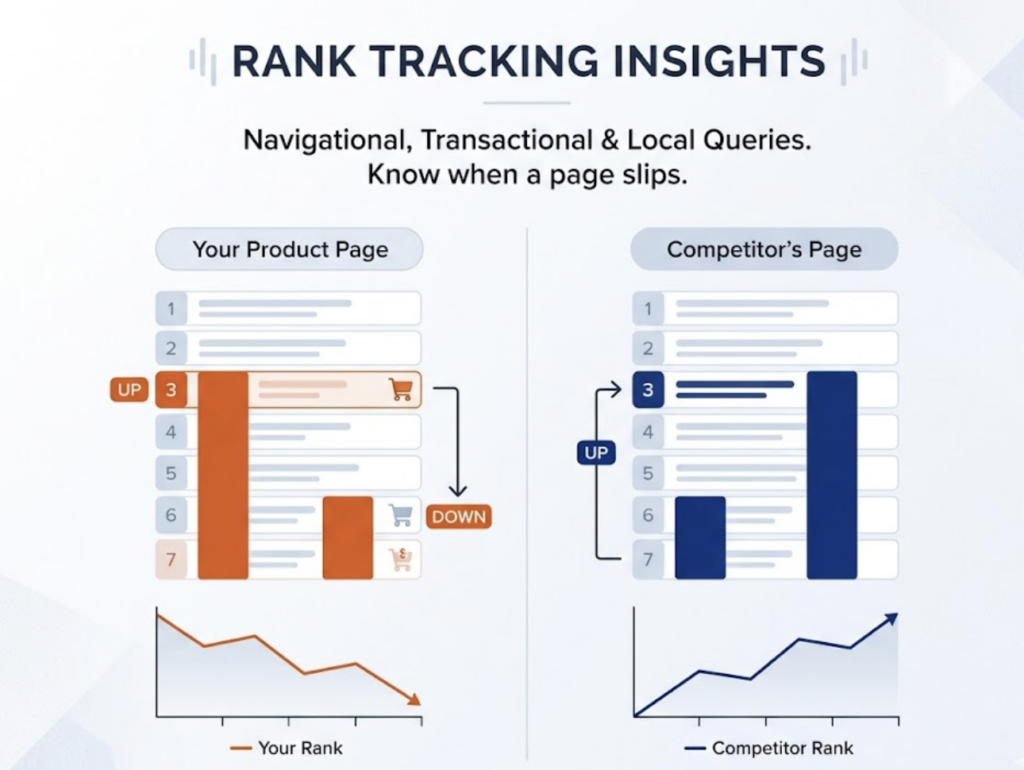
    It does that job well. For navigational, transactional, and local queries, where people still scan a list and click, rank tracking remains the right tool. You’ll know when a product page slips from three to seven, and you’ll know which competitor moved up.

    What it can’t see is the AI layer. A rank checker has no way to report whether your brand was mentioned, recommended, or quietly skipped inside a generated answer. The blue links it tracks are increasingly not where the high-intent research happens.

    That blind spot is the whole problem. Your most-watched metric goes dark exactly where a growing share of buyers now start.

    GEO Score: The Number That Tracks Whether AI Picks You

    A GEO score quantifies your brand’s presence inside generative engines like ChatGPT, Perplexity, Gemini, and Claude. Instead of a SERP position, it measures citation frequency, recommendation order, and whether the model treats you as a source of truth.

    Where a rank checker asks “are we on the page,” a GEO score asks “are we in the answer.” Generative engines reward what researchers call answer-readiness: logical structure, factual density, and semantic clarity. They care less about keyword density and backlink volume, the signals traditional rank tracking optimizes for.

    The practical value is diagnostic. A GEO score doesn’t just tell you that AI is ignoring your brand. It points at why, by surfacing the citation gaps and structural issues keeping you out of the response.

    The fastest way to see your own number is to run a baseline. Topify offers a free GEO Score Checker that audits a domain’s AI visibility with no signup, which is usually the cleanest first read on where you stand before you change anything.

    Rank Checker vs. GEO Score: A Side-by-Side Look

    The two numbers measure different domains of the same search behavior. Putting them next to each other makes the division of labor obvious.

    DimensionRank CheckerGEO Score
    Tracking objectSERP link positionCitation frequency and recommendation rank
    Primary platformGoogle blue linksChatGPT, Perplexity, Gemini, AI Overviews
    Core metricKeyword rank, 1 to 100Visibility index and citation authority
    Blind spotAI answer inclusionLong-tail transactional SERP position
    What you optimizeCrawlability and backlinksStructure and fact-extractability

    Read the table as two halves of one picture, not a contest. A rank checker tells you how you compete for a click. A GEO score tells you how you compete for a citation. In 2026, most teams need both readings to explain what’s actually happening to their traffic.

    When Each Number Matters More Than the Other

    Neither metric wins outright. The smarter move is matching each number to the query type it explains best.

    Rank checkers still lead for transactional and local intent. When someone searches “buy running shoes near me” or compares pricing pages, they want a list, and SERP position drives the click. Bottom-of-funnel work lives here.

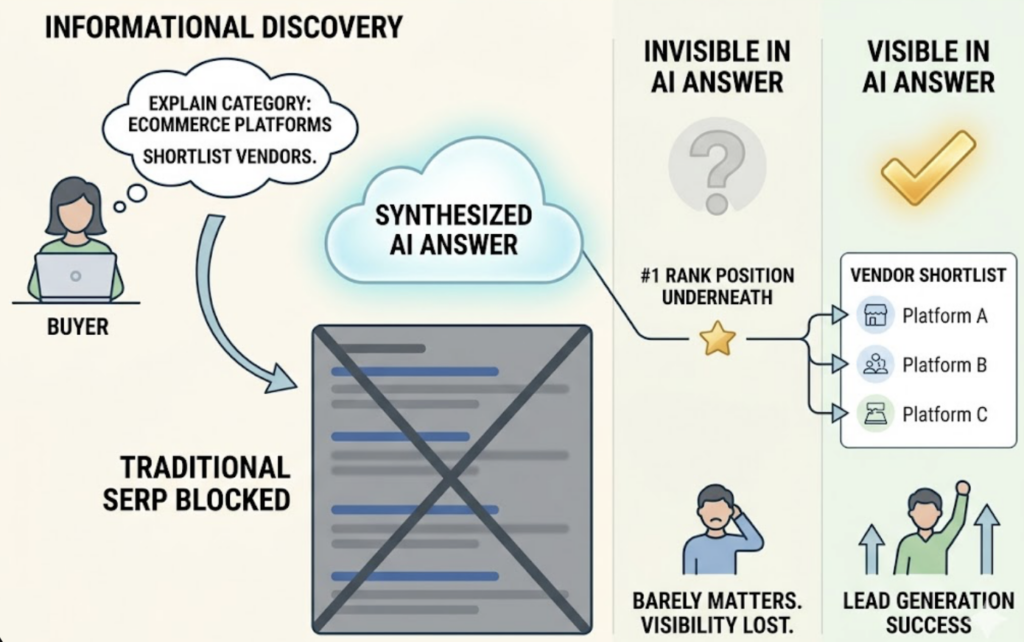
    GEO scores lead for informational and research-stage discovery. When a buyer asks an AI assistant to explain a category or shortlist vendors, the synthesized answer often blocks the traditional SERP entirely. If you’re invisible in that answer, the rank you hold underneath barely matters.

    There’s a cross-platform wrinkle worth flagging. AI models ground their answers differently, so a brand can perform well in Perplexity and stay invisible in ChatGPT. A single GEO score averaged across one platform hides that, which is why monitoring has to run model by model.

    How to Track Both Numbers Without Doubling Your Stack

    Here’s the trap most teams fall into. They keep their existing rank checker, bolt on a separate AI visibility tool, and end up with two dashboards that never reconcile. The data sits in silos, and nobody can answer “is our search visibility going up or down” without exporting two spreadsheets.

    A consolidated approach solves that by treating both numbers as one workflow. With Topify, the GEO Score Checker gives you the free baseline, and the Comprehensive GEO Analytics engine extends it into ongoing monitoring across seven metrics, including visibility, sentiment, position, and mentions. In practice, that means you can watch an AI recommendation slip in real time, trace it to a competitor whose content structure the model now prefers, and line that up against your SERP rankings in the same view. The fragmented silos go away, and reporting stops being a reconciliation exercise.

    Competitor benchmarking is where the two numbers compound. Topify maps why a rival is being cited, comparing their structure against the specific prompts your buyers use, so the GEO score becomes a list of fixes rather than a verdict. If you want to widen the audit further, Topify also maintains a free tools reference covering adjacent checks.

    The point isn’t to replace your rank checker. It’s to stop treating SERP position as the only signal, when half your visibility now lives in answers the rank checker can’t read. You can get started with the baseline audit and add monitoring once the gaps are clear.

    Conclusion

    The visibility gap is simple to state and easy to miss. Your rank report can stay green while your brand disappears from the answers buyers actually read. One number tracks the click. The other tracks the citation. In 2026, watching only the first leaves you blind to where a growing share of discovery already happens.

    Start with a baseline. Run a free GEO score against your domain, set it beside your current rankings, and look at the delta. If the two numbers disagree, that disagreement is the most useful thing your analytics will tell you all quarter.

    FAQ

    What’s the difference between a rank checker and a GEO score? 

    A rank checker tracks where your URL sits on a Google or Bing results page, from 1 to 100. A GEO score measures whether AI engines like ChatGPT and Perplexity mention, cite, or recommend your brand inside their answers. One watches the SERP, the other watches the synthesized response.

    Do I still need a rank checker in 2026? 

    Yes, for transactional, navigational, and local queries where users still click a list of results. The change is that SERP position alone no longer predicts traffic, since zero-click rates and AI Overviews have absorbed much of the informational search behavior. Most teams now pair rank tracking with a GEO score.

    How do I check my GEO score? 

    Run your domain through a free GEO Score Checker, such as the one Topify offers without a signup. It returns a baseline visibility read across AI platforms and flags the citation gaps keeping you out of generated answers.

    Which metrics belong in a 2026 search monitoring system? 

    At minimum, keyword rankings for bottom-of-funnel queries plus AI visibility metrics like citation frequency, recommendation position, and sentiment across multiple models. Monitoring cross-platform matters, because a brand can rank well in Perplexity and stay invisible in ChatGPT.

    Read More

  • Best Rank Checker: What Agency Reports Miss in 2026

    Best Rank Checker: What Agency Reports Miss in 2026

    Your client’s quarterly review is tomorrow. Every keyword in the white-label report is green: page one, top three, a few sitting at the very top. Then the client asks why a competitor keeps showing up when they type your category into ChatGPT, and the report has nothing to say. The rankings are real. The traffic just isn’t following them the way it used to. That gap, between a clean SERP report and what AI actually tells buyers, is where most agency rank checkers quietly stop measuring.

    Why the Best Rank Checker in 2026 Tracks More Than Google

    Traditional rank checkers do one thing well: they tell you where a URL sits on the Google results page. For a long time that was the whole game. In 2026, it’s a shrinking slice of it.

    Zero-click searches now make up 64.8% of queries across the general web, per Digital Applied’s 2026 benchmarks. When an AI Overview appears, the top organic result’s click-through rate falls somewhere between 37% and 61%against pre-AIO baselines, according to Seer Interactive. So a keyword can hold position one and still lose most of its clicks to a synthesized answer sitting above it.

    Here’s the part that breaks the white-label report.

    Google SERP authority and AI answer authority are splitting into two separate variables. Ahrefs found that only around 38% of URLs cited in AI Overviews rank inside the top 10 organic results. Being #1 on Google no longer means you’re in the answer the buyer reads.

    That’s the gap most agency reports still can’t see.

    What an Agency Rank Tracker Should Actually Measure Now

    The question clients ask has changed. It used to be “Where do I rank for X?” Now it’s closer to “Why does ChatGPT recommend my competitor for X when I’m #1 on Google?”

    A rank checker built for 2026 has to answer both versions. SERP position still matters for transactional, bottom-of-funnel queries. But for the informational searches where buyers form opinions, the metric that counts is whether the brand shows up in the AI answer at all, and where it lands in that answer’s recommendation list. That second layer, the difference between AI search visibility and Google rankings, is exactly what legacy trackers were never built to see.

    Use these dimensions to separate a legacy tracker from a 2026-ready one:

    DimensionLegacy SERP TrackerAI-Native Visibility Platform
    Primary focusURL position on Google SERPsCitation presence and rank inside AI answers
    AI coverageLimited (SERP-feature tags)Full (ChatGPT, Perplexity, Gemini, AI Overviews)
    ReportingStatic white-label URLsDynamic answer-authority metrics
    ActionabilityKeyword and backlink suggestionsContent extractability and answer-readiness
    Multi-clientEstablished multi-seat setupBuilt for GEO-focused portfolio management

    Two of these rows decide most agency purchases. White-label reporting, because the data has to drop into a client deck without manual reformatting. And multi-client management, because an agency running 30 brands can’t juggle 30 separate logins.

    The Best Rank Checker Tools for Agencies, Compared

    Most agencies in 2026 run what amounts to a hybrid stack: a traditional tracker for transactional SEO, an AI-native platform for the answer layer. The two jobs are different enough that one tool rarely covers both well. Here’s how the main options line up.

    ToolGoogle SERP trackingAI answer rankWhite-label reportsMulti-clientStarting price
    TopifyYesYes (ChatGPT, Perplexity, Gemini, AIO)YesYes (multi-project/seat)$99/mo
    AccuRankerYes (enterprise-grade)NoYesYesVaries
    SE RankingYesLimitedYes (feature-rich)YesVaries
    NightwatchYes (local + global)NoYesYesVaries

    The pattern is hard to miss. The traditional trackers are strong on SERP depth and reporting, and nearly silent on AI answer rank. That single empty column is the one your client is now asking about.

    #1 Topify: Adding the AI Rank Layer to Your White-Label Report

    For agencies, the most useful question isn’t “which tool tracks Google best.” It’s “what fills the column my report is missing.” That’s where Topify tends to stand out.

    Topify is built around the synthesis layer rather than the blue-link layer. Its Position Tracking monitors where a brand actually sits inside an AI’s response, not just whether it’s mentioned but whether it’s first, third, or buried under three competitors. Visibility Tracking runs the same check across ChatGPT, Gemini, Perplexity, and Google AI Overviews, so you can see a brand fade out of Perplexity while it holds steady in ChatGPT, instead of treating “AI search” as one undifferentiated number.

    The piece agencies tend to underestimate is Source Analysis. It maps the specific pages AI engines cite when they recommend a brand or its competitors. In practice, that turns a vague client complaint (“we’re invisible in ChatGPT”) into a concrete action item: the competitor is being cited from three comparison pages and a Reddit thread, and the client has nothing comparable. That’s the kind of finding that justifies the next quarter’s content budget.

    On the operational side, Topify was designed for portfolio management. Multi-project and multi-seat support starts at $99/month on the Basic plan, with four projects and four seats included, which maps cleanly onto how an agency assigns clients and team members. The white-label angle is the real unlock: you can inject AI visibility KPIs straight into the report framework you already send, so “AI Answer Authority” sits next to SERP position instead of living in a separate tool nobody opens.

    The bottom line for agencies is leverage. Reporting a position number is table stakes. Explaining why a brand is or isn’t in an AI answer, and what to do about it, is the thing clients will pay a retainer for. You can get started with Topify on a single client before rolling it across the portfolio.

    Traditional Rank Trackers Worth Keeping

    None of this means tearing out the tools that already work. They just cover a different job.

    AccuRanker and Nightwatch remain excellent for enterprise-scale, real-time Google SERP monitoring, with Nightwatch especially strong on local rank tracking across many locations. If a client’s growth still lives mostly in transactional, location-based search, these earn their place.

    SE Ranking offers one of the more feature-rich white-label reporting suites for agencies, with solid SERP-feature monitoring. The trade-off is that it still runs on blue-link logic rather than LLM-based citation tracking, so the AI answer column stays empty.

    The common thread across all three is the same: best-in-class for SERP, blind to the synthesis layer. That’s not a flaw so much as a boundary, and it’s the boundary your hybrid stack exists to cross.

    How to Pick the Right Rank Checker for Your Client Mix

    The right choice depends less on features and more on who your clients are.

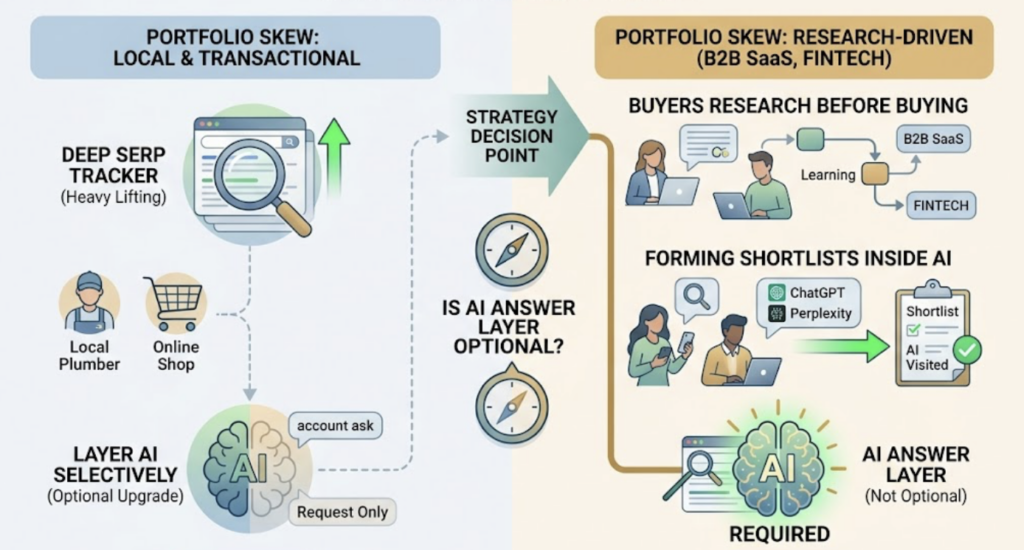
    If your portfolio skews toward local services and transactional ecommerce, a deep SERP tracker still does most of the heavy lifting, and you can layer AI visibility selectively on the accounts that ask for it. If you serve B2B SaaS, fintech, or any category where buyers research before they buy, the AI answer layer isn’t optional. Those buyers are forming shortlists inside ChatGPT and Perplexity, and a report that ignores it is reporting on the wrong funnel stage.

    A practical sequence: run a GEO-first audit on your highest-value informational keywords first. Where a client ranks #1 on Google but goes missing from the AI answer, the fix usually isn’t more backlinks. It’s extractability, clear headers, schema, and modular facts that AI engines can lift cleanly.

    Start with the client most likely to ask the hard question. Prove the gap. Then standardize it.

    Conclusion

    The white-label report that wins client renewals in 2026 looks different from the one that won them in 2023. SERP position is still in it, but it’s no longer the headline. The agencies pulling ahead are the ones who can show a client exactly where they stand inside AI answers, name the competitor that’s outranking them there, and point to the source pages driving it.

    The best rank checker for your agency, then, isn’t whichever tool tracks Google most precisely. It’s the one that closes the column your report has been leaving blank. Pick the stack that lets you walk into the next review with an answer to the AI question, before the client has to ask it.

    FAQ

    What’s the difference between a SERP rank checker and an AI rank tracker? 

    A SERP rank checker reports where your URL sits on the Google results page. An AI rank tracker reports whether and where your brand appears inside AI-generated answers from ChatGPT, Perplexity, Gemini, and AI Overviews. Since only about 38% of AI-cited URLs rank in Google’s top 10, the two measure increasingly different things, and an agency report needs both.

    Can I add AI visibility data to a white-label rank tracking report? 

    Yes. Platforms like Topify are built to inject AI visibility KPIs into existing client report frameworks, so answer-authority metrics sit alongside traditional SERP positions instead of living in a separate dashboard your client never opens.

    Do I still need a traditional rank tracker if I use an AI rank checker? 

    For most agencies, yes. Traditional trackers like AccuRanker, SE Ranking, and Nightwatch remain strong for transactional and local SEO. The AI rank checker covers the informational, top-of-funnel queries where buyers form opinions. Running both is the hybrid stack most agencies have settled on.

    Is there a free way to check AI search rankings before committing to a tool? 

    You can start with a free GEO score check to see roughly how visible a brand is across AI engines, and there’s a public list of free rank and visibility toolsworth trying before you buy. They won’t replace continuous, multi-client tracking, but they’re a fast way to confirm the gap exists.

    Read More

  • Why the Best Rank Checker Won’t Save Your Traffic

    Why the Best Rank Checker Won’t Save Your Traffic

    Your rank tracker shows green across the board. Position one for your money keyword, top three for a dozen others, not a red arrow in sight. Then you open Search Console and clicks are down 30% over the same window. Nothing in the ranking report explains the drop, because it’s measuring a page that fewer people ever reach. The number is accurate. What it used to predict isn’t anymore, and even the best rank checker on your stack still can’t tell you why.

    Your Rankings Are Fine. So Where Did the Clicks Go?

    The gap between ranking and traffic isn’t a tracking bug. It’s structural.

    For most of search history, position one meant the lion’s share of clicks. That math has broken down. In 2026, roughly 64.82% of Google searches end without a single click to any website, according to zero-click data compiled by Digital Applied. SparkToro’s analysis puts it bluntly: less than one third of Google searches still send a click anywhere.

    So a #1 ranking now competes for a shrinking pool of clicks that may never leave the results page. Your position didn’t fall. The traffic behind it did.

    What a Rank Checker Measures, and What It Misses

    A traditional rank checker is, at its core, a SERP scraper. It measures positional rank from 1 to 100 on a static results page and reports where your URL sits. That was the right metric when the results page was the destination.

    The problem is what it can’t see. It doesn’t register whether an AI Overview summarized the answer above your link. It has no view into whether ChatGPT or Perplexity recommended a competitor when someone asked for options in your category. It measures a location on a page that generative summaries increasingly bypass.

    Here’s the split in plain terms:

    DimensionTraditional Rank TrackerAI Visibility Platform
    Primary focusBlue-link SERP positionCitation frequency and answer presence
    Data logicKeyword-to-URL matchingSemantic intent and query fan-out
    What it measuresClick-through rateAnswer authority, sentiment, citations
    Platform scopeGoogle SearchChatGPT, Perplexity, Gemini, and more

    A rank checker tells you where you stand. It says nothing about whether you were mentioned, recommended, or quietly left out of the answer a user actually read.

    The Real Reason Rank #1 No Longer Means Traffic

    Two shifts explain the decoupling, and both happen above your link.

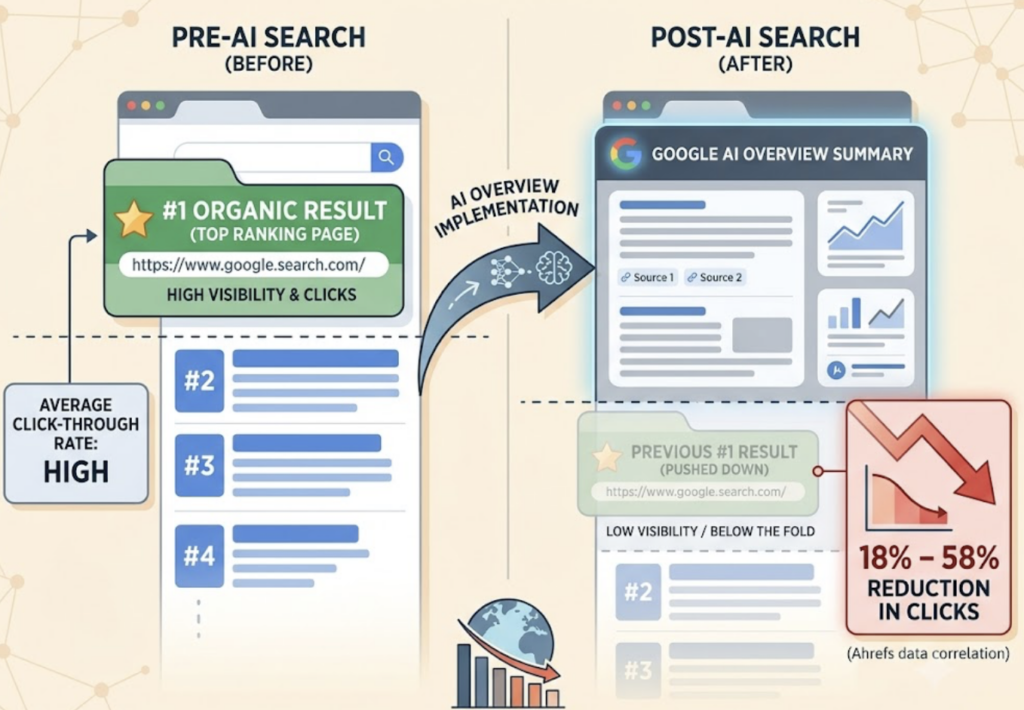
    First, AI Overviews push the classic blue links down. When Google generates a summary at the top, the #1 organic result moves below it, often below the fold. Ahrefs measured this directly: the presence of AI Overviews correlates with up to a 58% reduction in clicks to the top-ranking page, with the broader range landing somewhere between 18% and 58% depending on query type.

    Second, ranking and being cited have come apart. Only around 38% of the URLs cited inside AI Overviews actually rank in the top 10 organic results, per analysis from Seer Interactive and Goodfirms. AI systems pull from sources based on how cleanly they answer a sub-question, not on where they sit in the rankings.

    Ranking first and getting cited are now two different games.

    That’s the part a rank checker structurally can’t surface. It’s scoring you on the first game while your traffic is being decided by the second.

    What the Best Rank Checker Should Track in 2026

    If the results page is no longer the finish line, the criteria for evaluating a tracking tool have to change too. The best rank checker for this environment isn’t the one with the most granular blue-link positions. It’s the one that can tell you whether you exist inside the answer.

    Four questions separate a tool built for 2020 from one built for now:

    • Does it cover AI platforms, not just Google Search? If it can’t see ChatGPT, Perplexity, or Gemini, it’s blind to where a growing share of queries resolve.
    • Does it measure mention and position inside AI answers, not just page rank? Being recommended third in a ChatGPT answer is a real position your SERP tracker never captures.
    • Does it show you the sources AI cites? Without that, you can’t tell why a competitor got picked and you didn’t.
    • Can it tie visibility to downstream intent? Presence in an answer matters more when it’s the kind of answer that sends a buyer your way.

    A tool that only reports SERP position answers one of these. The rest stay dark.

    From Rank Position to AI Visibility

    The metric shift here is the whole story. Traditional SEO optimizes for rankings. Generative Engine Optimization, or GEO, optimizes for reusability, getting your content lifted directly into an AI’s answer.

    That works differently than ranking. When an AI receives a complex prompt, it fans the prompt out into smaller sub-queries and assembles an answer from multiple sources. Winning means being the cited source for those sub-queries, which rewards content that’s structurally extractable: clear question-style headers, concise factual paragraphs, and lists an AI can lift without guessing. Entity authority compounds it, since editorial mentions and consistent presence across the web feed the model’s trust in your brand. None of that shows up as a number on a SERP rank report. For a fuller breakdown of how the two metrics diverge, this comparison of AI search visibility versus Google rankings is a useful starting point.

    How to See the Layer Your Rank Checker Can’t

    Closing the gap starts with measuring the thing your current tool can’t: presence inside AI answers. That means tracking, prompt by prompt, whether your brand shows up when someone asks an AI for a recommendation, and where you land relative to competitors when it does.

    This is the layer Topify is built to monitor. Instead of scoring blue-link position, it tracks Visibility and Position across ChatGPT, Perplexity, and Google AI Overview, so you can see whether your brand is mentioned in a given answer and how it ranks against rivals in that same answer.

    From there, the diagnostic gets concrete. Source Analysis shows the exact domains an AI cites for your core prompts, which turns “we’re not getting picked” into “here’s the citation gap and who’s filling it.” Its conversion-oriented metric estimates how likely a given AI answer is to push a user toward your brand, so you’re not just counting mentions but weighting the ones that matter.

    The practical move is to start with the prompts that drive your category, not your keyword list. You can pressure-test the basics with a set of free GEO tools first, then get started with continuous monitoring once you’ve confirmed the gap is real.

    Conclusion

    A rank checker still has a job. It just answers a narrower question than it used to, and treating its green dashboard as a traffic forecast is what’s catching teams off guard. Position one is real. The clicks it once guaranteed are now split with AI summaries, zero-click answers, and citations that don’t track ranking at all.

    The fix isn’t a better SERP scraper. It’s adding the layer underneath: confirming whether AI engines mention, recommend, or ignore your brand before you spend another quarter optimizing for a page fewer people open. Check that first. The ranking report can wait.

    FAQ

    Q: Why is my traffic dropping even though my rankings are stable? 

    A: Because ranking and traffic have decoupled. With zero-click searches near 64.82% and AI Overviews cutting top-page clicks by as much as 58%, a #1 position now competes for far fewer clicks than it used to. Your rank report can’t show that erosion, because it only measures position, not whether the answer was resolved before anyone clicked.

    Q: Can a traditional rank checker track AI search visibility? 

    A: Generally no. Standard rank trackers scrape SERP positions and don’t see whether you’re cited in ChatGPT, Perplexity, or AI Overviews. Measuring AI visibility requires a tool that tracks mentions and position inside AI answers, not blue-link rank.

    Q: What’s the difference between rank position and AI visibility? 

    A: Rank position is where your URL sits on a results page. AI visibility is whether your brand appears inside an AI-generated answer, how it’s positioned against competitors, and which sources the AI cites. Only about 38% of URLs cited in AI Overviews even rank in the top 10, so the two rarely move together.

    Q: What should the best rank tracker for AI search include? 

    A: Coverage across multiple AI platforms, measurement of brand mention and position inside AI answers, visibility into the sources AI cites, and a way to connect that presence to conversion intent. A tool covering only Google SERP position misses where a large share of queries now resolve.

    Read More

  • How to Pick the Best Rank Checker in 2026

    How to Pick the Best Rank Checker in 2026

    You’ve read three “best rank checker” roundups this week, and they all recommend roughly the same five tools in roughly the same order. The rankings move depending on which affiliate program pays out the most. None of them tell you the one thing you actually need to know in 2026: whether the tool can see your brand in the places people now search. So you’re stuck comparing crawl speeds and keyword limits while the real visibility question goes unanswered.

    That gap exists because most reviews still treat ranking as a number between 1 and 100 on a Google results page. The job has changed. Here’s the checklist that decides whether a tool is worth paying for.

    Why “Best Rank Checker” Lists Keep Steering You Wrong

    Most best-of lists rank tools on the wrong axis. They compare keyword volume limits, crawl frequency, and dashboard polish, then sort by price. Those things matter, but they describe a 2018 problem.

    The deeper issue is that affiliate-driven roundups measure what’s easy to measure. SERP position is a clean, sortable metric. It fits a comparison table. So that’s what gets compared, even though SERP position now explains less of your actual traffic than it used to.

    That’s the gap most reviews refuse to name.

    A rank checker’s value in 2026 isn’t how precisely it tracks position 7 versus position 9. It’s whether it can tell you where your brand stands when a buyer asks ChatGPT instead of typing into Google. Judge tools on that, and most “best” lists fall apart.

    What “Rank” Actually Means in 2026

    Search has shifted from a list of links to a synthesized answer. AI platforms like ChatGPT, Perplexity, and Google AI Overviews increasingly resolve a query inside the chat window, so the user never clicks through to a ranked page at all.

    The numbers behind this are hard to argue with. Google’s average zero-click rate has climbed to roughly 64.82% in 2026, and on Perplexity it reaches about 93%. When an AI Overview appears, the top organic result loses an average of 37.5% of its click-through rate. Ranking first still happens. It just buys you less.

    Here’s the part that breaks traditional tracking. High Google rankings no longer guarantee AI visibility. Only about 38% of the URLs cited inside AI Overviews rank in the top 10 organic results, which means citations and rankings have decoupled. A tool watching only the blue links is watching the wrong scoreboard.

    The reason is structural. Traditional tools crawl and index static pages. AI models perform query fan-out, pull from multiple sources in real time, and decide what to cite based on entity clarity, semantic trust, and citation confidence rather than keyword density or raw backlink counts. A rank checker built for the old logic can’t see the new one.

    The Best Rank Checker Checklist Most Reviews Skip

    These are the five criteria that separate a tool that measures presence from one that just measures position. Run any shortlist against them before you commit.

    It Has to Cover AI Answers, Not Just Blue Links

    Start here, because it’s the line most reviews skip entirely. Ask whether the tool tracks brand mentions and citations across ChatGPT, Gemini, Perplexity, and Google AI Overviews, or whether it stops at SERP position.

    If it only reports blue-link rankings, you’re paying to monitor a shrinking share of how people actually find you. Coverage across multiple AI models is the baseline, not a premium add-on.

    Being Mentioned Isn’t the Same as Being Cited

    A mention is cheap. A citation is authority. The tool should tell you whether the AI treats your brand as a primary source or a passing afterthought, and it should report the exact URL and the specific content the model is pulling from.

    In practice this is the difference between knowing you showed up and knowing why. Without source mapping, you can see a visibility drop but you can’t fix it, because you don’t know which page stopped earning the citation.

    It Should Tell You Why a Ranking Moved

    A dashboard that flags a drop without explaining it is a liability, not an asset. You’ll spend hours guessing at causes that the data already contains.

    The better tools now run diagnosis, not just detection. They connect a visibility loss to a competitor’s content shift, a sentiment change, or entity ambiguity, and some pair that with AI agents that suggest the fix. If a tool only hands you a falling line on a chart, you’re doing the analyst’s job yourself.

    Tone Counts: Leader, Alternative, or Afterthought

    AI doesn’t just rank you. It describes you. The tool should measure how the model frames your brand, whether it positions you as the category leader, a secondary alternative, or something worse.

    This is reputation management, not vanity tracking. If Perplexity keeps calling your premium product a “budget option,” that framing shapes every buyer who reads it, and you can’t correct what you don’t measure.

    It Maps Where Competitors Earn Their Citations

    The last criterion is the one that turns monitoring into strategy. A strong rank checker identifies which domains your competitors are using to win citations, so you can find the content gaps and fill them.

    That’s how you move from watching your position to changing it. Competitor citation benchmarking tells you exactly where the authority is being captured and where there’s still room to take it.

    Matching the Right Rank Checker to Your Use Case

    No single tool covers every angle well, and pretending otherwise is how people end up disappointed. The realistic 2026 setup is a dual stack: keep a traditional SEO suite for transactional, high-intent queries where blue-link traffic still converts, and add an AI-native platform for the informational and research-intent queries that now resolve inside AI answers.

    Here’s how the two categories actually differ:

    DimensionTraditional SEO SuiteAI-Native Visibility Platform
    Primary metricSERP ranking, 1 to 100Visibility index / citation rate
    Platform scopeGoogle SearchMulti-model: ChatGPT, Gemini, Perplexity
    FocusKeyword density, backlinksContent extractability, entity authority
    ActionabilityManual interpretationAI-driven optimization suggestions
    Best forTransactional keywordsInformational and research-intent queries

    What you prioritize depends on who you are. A solo SEO consultant tracking a handful of money keywords can lean on a traditional tracker and add a lightweight AI check. An agency reporting to clients needs the AI-answer coverage, because that’s the question clients now ask in quarterly reviews. An in-house marketing team protecting brand positioning should weight sentiment and competitor citation mapping heavily, since that’s where reputation actually forms now.

    Where an AI Rank Checker Fits: Tracking the Half SERP Tools Miss

    This is the side of the checklist a traditional rank checker can’t cover, and it’s where a purpose-built platform earns its place in the stack. Topify is built specifically to measure the AI-answer layer, which maps onto the five criteria above almost line for line.

    It tracks recommendation position and visibility across ChatGPT, Gemini, Perplexity, and other major models, so the “AI answer coverage” box is the default rather than an upgrade. Its source analysis reverse-engineers the exact domains and URLs the models cite, which is the citation-health and competitor-benchmarking layer in one. And rather than stopping at a dashboard, its analytics span AI volume, citation frequency, sentiment, and recommendation position, then feed into one-click GEO execution that turns a visibility gap into a content update without a manual, multi-step workflow.

    For a team that already runs a traditional tracker, this is the missing half of the picture. You can spot a slide in ChatGPT mentions, trace it to a source that stopped citing you, and act on it in the same place. If you want a no-commitment starting point, a free GEO tools reference is a reasonable way to baseline where you stand before you get started with full tracking.

    Conclusion

    The best rank checker in 2026 isn’t the one with the most keyword slots or the cheapest annual plan. It’s the one that can see your brand where buyers actually look, which now means AI answers as much as Google results. Run any shortlist against the five criteria: AI-answer coverage, citation health, a real explanation of why rankings move, sentiment, and competitor citation mapping.

    Start by auditing your baseline. Pick the top 50 prompts that represent your category, measure where you stand across the major AI platforms, and decide whether your current tool can even show you that. If it can’t, you don’t need a better keyword tracker. You need to cover the half of search it was never built to see.

    FAQ

    Q: How do I choose a rank checker in 2026? 

    A: Score each option against five criteria rather than price alone: does it cover AI answers across multiple models, does it map citation sources, does it explain why a ranking moved, does it measure sentiment, and does it benchmark competitor citations. A tool that only reports SERP position fails most of that list.

    Q: Is an AI rank checker different from a traditional keyword rank checker? 

    A: Yes. A keyword rank checker tells you your position on a Google results page. An AI rank checker measures whether models like ChatGPT and Perplexity mention, cite, and recommend your brand, and how they describe it. With zero-click rates above 64% in 2026, the second question often matters more.

    Q: Can I replace my SEO tool with an AI visibility platform? 

    A: For most teams, no. The practical approach is a dual stack: keep a traditional suite for transactional keywords where blue-link traffic still converts, and add an AI-native platform for the informational queries that now resolve inside AI answers. They measure different things.

    Q: How often should rank data update? 

    A: AI models shift their citation patterns frequently, so monthly snapshots go stale fast. Look for tracking that refreshes often enough to catch a competitor’s content shift before it costs you a quarter of visibility, and that flags the change rather than making you hunt for it.

    Read More

  • The Best Rank Checker Gap Semrush and Ahrefs Miss

    The Best Rank Checker Gap Semrush and Ahrefs Miss

    Your weekly rank report is all green. Position one for your head terms, healthy keyword movement, a backlink profile that keeps climbing. Then a prospect asks ChatGPT for the best tool in your category, gets five recommendations back, and your brand isn’t one of them. Your rank checker never flagged it, because it was never built to look there. The ranking it tracks and the ranking that’s quietly deciding your traffic have drifted apart, and most SEO teams won’t notice until the AI-driven decline shows up in their analytics.

    The Ranking You’re Tracking Isn’t the Only One That Matters

    Semrush and Ahrefs measure one thing extremely well: where your URL sits on a Google results page, from position one to one hundred. For two decades, that number was a dependable proxy for traffic. In 2026, the proxy is breaking down.

    Search has moved to an answer-first model, where ChatGPT, Perplexity, and Google AI Overviews synthesize a response instead of returning a list of links. Google’s aggregate zero-click rate has reached 64.82% according to 2026 data from Digital Applied, and on Perplexity it runs as high as 93%. The user reads the answer and never scrolls down to your position-one result.

    It gets worse for the clicks that do happen. When an AI Overview shows up above the organic results, average click-through rate for the number-one ranking drops by 37.5%. Your rank didn’t move. Your traffic did.

    That’s the rank no traditional checker is built to see.

    Why Semrush and Ahrefs Can’t Cover the AI Rank Checker Gap

    This isn’t a knock on Semrush or Ahrefs. They’re still the standard for traditional SEO, and the gap comes from architecture, not effort.

    Traditional rank trackers send crawlers to scrape a static SERP, then map one keyword to one URL at one position. AI models work nothing like that. They run query fan-out: a single prompt gets split into multiple sub-queries, sources get synthesized on the fly, and a fresh response gets generated every time. There’s no fixed “position one” to scrape. There’s a citation list that reshuffles with each query.

    The data backs this up. Ahrefs found in 2026 that only 38% of pages cited in AI Overviews also rank in Google’s top 10. Topping the SERP no longer predicts whether AI will cite you. The models are weighing topical authority and answer-readiness, not just backlinks and keyword density.

    Both suites have bolted on “AI visibility” modules, but the core logic still runs on Google search signals like E-E-A-T and backlink profiles. They can tell you a mention happened. They struggle to tell you whether the AI recommended you, named you in passing, or cited a competitor’s teardown of your product.

    What the Best Rank Checker Now Has to Measure

    If the old definition of rank was “position on a page,” the new one is “placement in an answer.” A rank checker fit for 2026 has to measure four things the old model never accounted for.

    Visibility Index: the share of AI answers where your brand appears at all. Citation Frequency: how often a model attributes a specific claim to your exact URL. Recommendation Rank: whether you’re the primary suggestion or the afterthought buried in the fourth sentence. Platform Coverage: presence across ChatGPT, Gemini, Perplexity, and Claude, since each model grounds its answers differently and a strong showing on one says nothing about the rest.

    None of these map cleanly onto a keyword-to-position spreadsheet. That’s the gap. And it’s why “the best rank checker” now means something different than it did even a year ago.

    How a Rank Checker for AI Search Closes the Gap

    Closing the gap means tracking rank where the answers actually form. That’s the niche a new class of AI-native platforms fills, and Topify is built specifically for it.

    Instead of scraping a SERP, Topify monitors brand performance at the prompt level across major AI platforms, scoring seven metrics: visibility, sentiment, position, volume, mentions, intent, and CVR. The Position metric is the closest analog to a traditional rank checker, except it measures where your brand lands relative to competitors inside an AI answer, not on a Google page.

    Here’s what that looks like in practice. You notice your mention rate on ChatGPT dropped for a high-value prompt. Topify lets you trace it to a specific source that stopped citing you, or to a competitor that started showing up ahead of you, all in the same view. Reverse-engineering those citations tells you which domains the model trusts, so you know exactly which content gap to close.

    For teams already running Semrush or Ahrefs, this isn’t a rip-and-replace. It’s the layer that answers the question your current report can’t: are we showing up in AI search, and where?

    Semrush, Ahrefs, and the Layer They Don’t Replace

    Stacked side by side, the split is clear. Traditional suites own the SERP. AI-native platforms own the answer. The mistake is treating them as rivals.

    ToolSERP Blue-Link RankAI Answer RankCross-Platform AI CoverageCitation Source Tracking
    SemrushYesLimited, Google-rooted modulePrimarily GoogleNo
    AhrefsYesLimited, Google-rooted modulePrimarily GoogleNo
    TopifyNot the focusYes, prompt-levelChatGPT, Perplexity, Gemini, ClaudeYes

    Semrush and Ahrefs still win for navigational and transactional queries, where someone already knows what they want and types it into Google. Topify covers the informational and research-stage queries that now happen entirely inside an AI model. The smart stack in 2026 runs both.

    Where to Start Checking Your AI Rankings

    You don’t need to overhaul your whole stack to find out where you stand. Start with the prompts that matter most to your business.

    Pull 5 to 10 questions a real buyer would ask an AI in your category, the ones where a recommendation directly shapes a purchase. Run them across ChatGPT and Perplexity, and note two things: does your brand appear, and if so, where in the answer. That single exercise usually surfaces the gap faster than any dashboard.

    From there, an AI-native platform turns the spot-check into continuous monitoring. You can get started with Topify and watch how your AI rankings move week over week, the same way you’ve always watched your keyword positions.

    Conclusion

    An all-green rank report feels like proof you’re winning. In 2026, it’s only proof you’re winning the part of search that’s shrinking. The zero-click majority is forming its opinion inside AI answers, and your traditional rank checker was never built to look there.

    The fix isn’t to abandon the tools you trust. It’s to add the layer they don’t cover, so the next time someone asks ChatGPT for the best option in your category, you already know whether your brand makes the list. Track the rank that’s actually deciding your traffic.

    FAQ

    Q: What is an AI rank checker? 

    A: It’s a tool that tracks where your brand appears inside AI-generated answers, across engines like ChatGPT, Perplexity, and Google AI Overviews. Instead of measuring your URL’s position on a Google results page, it measures whether and where you show up when a model synthesizes a direct response.

    Q: Can Semrush or Ahrefs track ChatGPT rankings? 

    A: Only partially. Both have added AI visibility modules, but their core logic stays rooted in Google search signals, so they tend to flag whether a mention happened rather than your recommendation rank or which source the model cited. For prompt-level tracking across multiple AI engines, a purpose-built rank checker for AI search fills that gap.

    Q: Is an AI search ranking tool worth it if my Google rankings are strong? 

    A: Strong Google rankings no longer guarantee AI visibility. In 2026, only 38% of pages cited in AI Overviews also ranked in Google’s top 10, so the two systems can diverge sharply. If your buyers research inside AI tools, you want eyes on both.

    Q: Which AI platforms should a ChatGPT rank checker cover? 

    A: At minimum ChatGPT, Perplexity, and Google AI Overviews, with Gemini and Claude close behind. Each model grounds its answers using different logic, so coverage on one platform tells you little about the others.

    Read More