Blog

  • AI Blog Generators Are Everywhere. Here’s How to Tell Which Ones Actually Move the Needle

    AI Blog Generators Are Everywhere. Here’s How to Tell Which Ones Actually Move the Needle

    90% of content marketers now use AI to generate blog posts. Only 26% have figured out how to generate tangible value from it.

    That gap isn’t a tool problem. It’s a strategy problem.

    Most teams evaluate AI blog generators on the wrong metrics: output speed, word count, and how quickly a draft lands in Google Docs. Those things matter, but they’re table stakes. The real question is whether the content you’re generating actually gets found, read, and cited by the AI systems your audience now uses to make decisions.

    This guide breaks down the AI blog generators worth your time in 2025, how to build a workflow that produces content at scale, and the piece most teams miss entirely: making sure your content shows up in AI answers, not just search results.

    Most AI Blog Tools Produce Content. Few Produce Content That Gets Found.

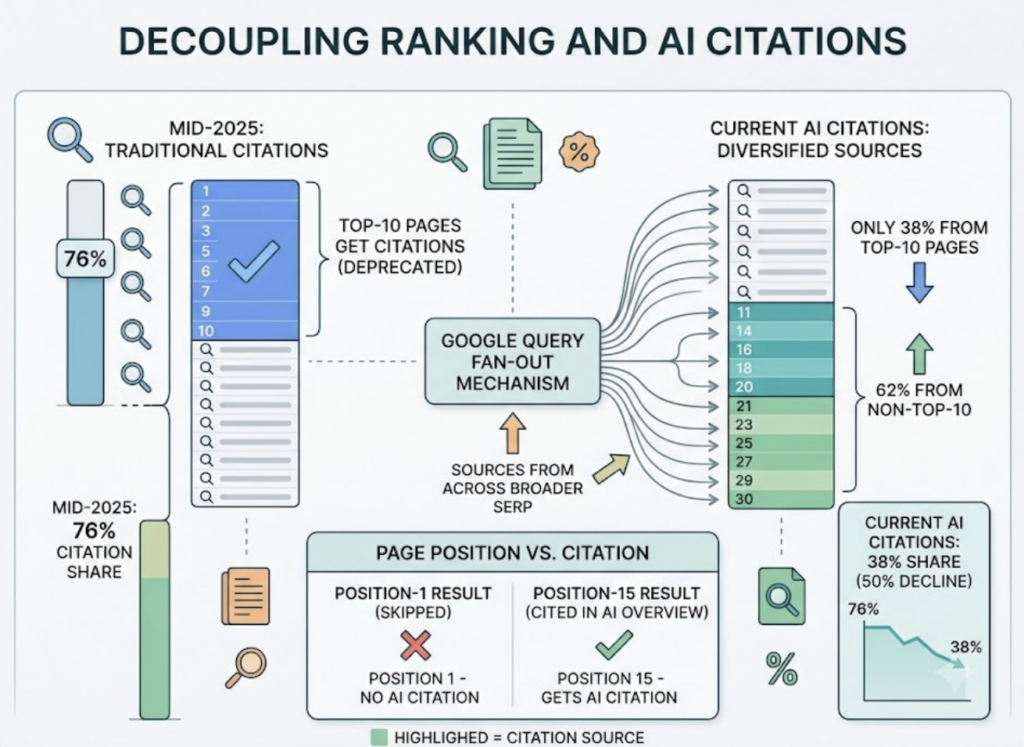
    Here’s a number that should reframe how you evaluate these tools: only 12% of URLs cited by AI assistants like ChatGPT and Perplexity actually rank in Google’s top 10 results.

    That means optimizing purely for Google is no longer enough. A page can rank #1 on Google and still be invisible to the AI systems your prospects are increasingly using to research tools, compare options, and make purchasing decisions. The inverse is also true: some of the most-cited sources in AI answers have modest Google rankings.

    This doesn’t make traditional SEO irrelevant. It means the bar has shifted. Content now needs to satisfy two retrieval systems simultaneously, with different rules for each.

    What a Good AI Blog Generator Actually Does (Beyond Filling a Text Box)

    Speed is the obvious value proposition. Content marketers save an average of 11.4 to 12.2 hours per week per employee by integrating AI into their writing workflow, and teams using these tools complete writing tasks 77% faster than those that don’t.

    But the automated blog generation tools worth investing in go further than raw output speed.

    The differentiators are structural. The strongest AI blog writing tools integrate real-time SEO data so you’re not writing about topics that already peaked six months ago. They handle long-form structure coherently across 2,000 to 5,000 words, not just in the first three paragraphs. They generate metadata, suggest internal links, and flag readability issues before the draft goes to a human editor.

    The underlying technology shift driving this is the move from purely parametric knowledge to Retrieval-Augmented Generation (RAG). Early LLMs fabricated information at rates as high as 55%. Modern tools using live search indices produce outputs grounded in current data, which directly affects whether the content passes editorial review and earns citations from other AI systems.

    That’s the baseline. Here’s what the field actually looks like.

    7 AI Blog Generators Worth Using in 2025, Ranked by What Actually Matters

    ToolStarting PricePrimary StrengthIdeal For
    Jasper$69/moBrand voice & team collaborationEnterprise content governance
    Writesonic$49/moSEO + AI search visibilityContent scaling & GEO
    Copy.ai$36/moWorkflow automationSolo marketers, rapid iteration
    Surfer SEO$79/moReal-time SERP analysisTechnical on-page optimization
    Notion AI$10/mo (add-on)Internal workspace contextInternal docs, summarization
    ChatGPTFree / $20+Flexibility, research-to-draftGeneral drafting, exploration
    PerplexityFree / $20+Real-time source groundingResearch-heavy long-form

    Jasper is the choice for marketing teams that can’t afford brand inconsistency. Its Brand Voice and Knowledge Base features train the model on company-specific tone and facts, making it particularly strong for regulated industries or organizations with multiple content contributors. At $69/month for the Pro plan, it’s on the higher end for smaller teams.

    Writesonic has built a distinct edge by embedding GEO directly into its content suite. Its AI Article Writer 6.0 produces long-form posts up to 5,000 words with real-time competitor analysis, and its GEO tracking layer monitors how content surfaces across ChatGPT and Google AI Overviews. For SEO-led agencies managing multiple clients, it’s one of the more complete auto blog writer options on the market.

    Copy.ai started as a short-form copywriting tool and has evolved into a workflow automation platform. Its strength is speed and repeatability: generating landing page variants, email sequences, and blog outlines in bulk. At $36/month, it’s the most accessible entry point for solo founders and small teams.

    Surfer SEO focuses on technical optimization rather than raw generation. It scores content against live SERP data and tells you exactly what to add or restructure to compete on a given keyword. Best used alongside a generation tool rather than as a standalone AI writing assistant.

    Notion AI is a capable workspace tool, but its long-form content output is generally weaker than purpose-built platforms. It works well for summarizing internal research or drafting meeting notes, less so for publishing-quality blog posts.

    ChatGPT and Perplexity remain genuinely useful for research-to-draft workflows, especially when you need a human editor to do significant restructuring anyway. Perplexity’s source-grounded approach reduces the hallucination risk that plagued earlier generative tools.

    How to Generate SEO-Optimized Blog Posts with AI: A 5-Step Workflow

    The teams producing AI content that actually drives traffic and citations aren’t just prompting an LLM and hitting publish. They’re running a structured process.

    Step 1: Find the right prompts before you write.

    The biggest missed opportunity in AI content strategy is writing about topics people search on Google without checking what people are asking AI systems. Tools like Topify’s AI Volume Analytics surface high-value prompts that are being used in ChatGPT, Perplexity, and Gemini, including prompts with zero recorded search volume in traditional SEO tools. Research shows that 95% of the sub-queries AI models generate to answer a prompt have no search volume in SEMrush or Ahrefs. That’s a massive inventory of uncontested citation opportunities.

    Step 2: Generate a structured draft.

    Use your chosen AI blog generator to produce the initial draft. For long-form content (1,500+ words), Writesonic or Jasper typically outperform general-purpose models on structural coherence. Feed the tool your target keyword, related intents, and any specific data points you want included.

    Step 3: Apply SEO and GEO structure.

    AI-generated drafts often need structural editing. Front-load your key answer in the first 200 words. Research on 1.2 million ChatGPT answers found that 44.2% of all citations are pulled from the first third of a page’s content, while the bottom 10% earns just 2.4% to 4.4%. Break content into 200-400 word sections with clear H2/H3 headings. Add FAQ blocks: pages with FAQ schema average 4.9 citations compared to 4.4 for those without.

    Step 4: Add human signal.

    Google’s 2025 E-E-A-T updates now heavily weight the “Experience” component, favoring content that demonstrates first-hand knowledge. An AI-generated draft that goes straight to publish without original insight, real data, or a human editorial perspective is increasingly likely to underperform. Add a specific case study, a contrarian observation, or original analysis. This is the step that separates content that ranks from content that gets ignored.

    Step 5: Publish and track AI citation.

    Most teams stop at publication. The teams closing the ROI gap track what happens after. Specifically: which of your published posts are being cited by ChatGPT, Perplexity, and Gemini, and which aren’t. Topify’s Source Analysis monitors the exact domains and URLs AI platforms are citing in responses, letting you identify which content is working and which needs to be restructured or updated.

    Does AI-Generated Blog Content Actually Rank on Google and Get Cited by AI?

    These are two different questions with two different answers.

    On Google ranking: the evidence suggests AI-generated content can rank, but the bar has risen. Google’s core updates have tightened requirements for unique, non-commodity content, and the algorithm is increasingly capable of detecting the gap between surface-level coverage and genuine expertise. AI content that includes original research, first-hand experience signals, and specific data points performs comparably to human-written content. Generic AI output doesn’t.

    On AI citation: the rules are different, and most content teams don’t know them.

    AI engines evaluate sources based on domain authority (roughly 40% of the weighting), content quality (35%), and platform trust signals like Trustpilot, G2, or Wikipedia presence (25%). Content updated within the last 30 days is 3.2x more likely to be cited than older material. ChatGPT pulls approximately 6x more pages than it eventually cites, with citation heavily concentrated: around 30 domains capture 67% of citations within any given topic.

    The practical implication: most brands are fighting for Google rankings without tracking whether their content is being cited by the AI systems their prospects are increasingly using to make decisions. That’s a significant blind spot. Topify’s visibility tracking monitors brand mentions across ChatGPT, Gemini, Perplexity, and other major AI platforms, giving content teams a clear picture of where their investment is actually landing.

    Free vs. Paid AI Blog Generators: Where the Real Gap Is

    The honest answer is that free tools have gotten good enough for basic drafting. ChatGPT’s free tier can produce a usable first draft. Notion AI’s add-on handles summarization and short-form content adequately. For solo founders or teams experimenting with AI content for the first time, free is a reasonable starting point.

    The gap widens in three specific areas.

    First, long-form coherence. Free-tier tools often drift in structure and tone past the 800-word mark. Paid tools built specifically for blog generation maintain narrative consistency across 3,000+ word posts.

    Second, SEO and GEO integration. Paid platforms like Writesonic and Surfer SEO pull live search and SERP data into the drafting process, ensuring the content is calibrated to current ranking factors rather than training data from six months ago.

    Third, workflow automation. AI-produced content is estimated to be up to 4.7x less expensive than content created entirely by humans. But that cost advantage scales with automation. Paid platforms that connect keyword research, drafting, optimization, and publishing into a single workflow deliver the full productivity dividend. Free tools require manual stitching between steps, which adds back the hours you were trying to save.

    The decision framework is simple: if you’re publishing more than two posts a week and treating content as a growth channel, the ROI case for a paid AI writing assistant is straightforward. If you’re occasional, start free and upgrade when the bottleneck becomes quality rather than volume.

    The Missing Piece: Generating Blog Content That Drives AI Search Visibility

    Here’s the part most content teams don’t think about until it’s too late.

    AI referral traffic converts at 14.2%, compared to 1.76% to 2.8% for traditional organic search. That’s a 5x+ difference. Traffic arriving from a ChatGPT or Perplexity citation is arriving with higher intent and more context than a generic Google click.

    The brands capturing that traffic aren’t necessarily the ones publishing the most content. They’re the ones that know which content is being cited and why, then systematically build more of it.

    That’s the visibility gap most content marketing teams are running blind to. They can see their Google rankings. They don’t know whether their ten most recent AI-generated blog posts are showing up in any AI answers at all.

    Topify closes that gap. Its platform tracks how brands are mentioned across ChatGPT, Gemini, Perplexity, and other major AI systems, monitoring seven key metrics: visibility, sentiment, position, volume, mentions, intent, and conversion visibility rate. The Source Analysis feature shows exactly which domains and URLs AI platforms are citing in your category, letting you see whether your content is in that mix or sitting invisible.

    For content marketing teams scaling AI blog production, this is the missing feedback loop. Generating posts at 2.5x your previous frequency only compounds your advantage if you know which posts are earning citations and which aren’t.

    Topify’s Basic plan starts at $99/month, covering ChatGPT, Perplexity, and Google AI Overviews tracking across 100 prompts.

    Conclusion

    AI blog generators have made content production fast and affordable. That’s table stakes now, not a competitive advantage. The teams pulling ahead aren’t generating more content. They’re generating content that satisfies two retrieval systems at once: Google’s E-E-A-T requirements and the citation logic of AI engines like ChatGPT and Perplexity.

    The workflow is clear. Use a purpose-built AI blog writing tool that integrates real-time SEO data. Front-load your best answers for RAG extraction. Add human expertise signals that generic AI output can’t replicate. Then close the loop by tracking whether your content is actually being cited by the AI systems your audience uses.

    Most teams nail the generation step and skip the rest. That’s why 90% of content marketers use AI tools and only 26% are generating measurable value from them.

    The gap is closable. It just requires treating AI visibility as a metric, not an afterthought.

    FAQ

    How do you generate a blog post with AI step by step? 

    Start with keyword and prompt research to identify topics with both search demand and AI query volume. Use an AI blog generator to produce a structured draft. Apply GEO formatting: front-load your key answer, break content into 200-400 word sections with clear headings, and add FAQ blocks. Edit for human expertise signals, then publish and track which posts earn AI citations using a tool like Topify.

    What’s the difference between free and paid AI blog generators? 

    Free tools handle basic drafting adequately. Paid platforms add live SEO data integration, long-form structural coherence, and workflow automation that compounds productivity gains at scale. If you’re publishing more than twice a week, the economics of paid tools typically pay for themselves within the first month.

    How do you generate blog posts at scale with AI? 

    The most effective approach combines an AI writing tool for drafting, a structured editorial process for quality control, and a feedback loop that tracks which published posts earn citations from AI systems. Publishing volume alone doesn’t create compounding returns. Citability does.

    Does AI-generated content rank on Google in 2025? 

    Yes, with conditions. Google’s 2025 updates penalize generic, thin content regardless of how it was produced. AI-generated posts that include original data, first-hand expertise signals, and specific case studies perform comparably to human-written content on most queries. Surface-level AI output doesn’t.

    How do you generate blog content that shows up in AI answers? 

    Structure your content for RAG retrieval: lead with a direct answer in the first 200 words, use clear H2/H3 headings, include FAQ schema, and update content regularly (material updated within 30 days is 3.2x more likely to be cited). Track your citation performance using a platform like Topify to identify which posts are being picked up and which need restructuring.

    Read More

  • Most Keyword Research Tools Don’t Show You Where Search Is Actually Going

    Most Keyword Research Tools Don’t Show You Where Search Is Actually Going

    Your keyword rankings look fine. But your traffic is dropping.

    This is the situation more SEO and content teams are walking into in 2026. The disconnect isn’t a technical glitch. It’s a structural gap in how most keyword research tools are built. They were designed for Google. And Google, while still dominant, is no longer where a growing share of your audience starts their search.

    Here’s what that means for your tool stack, and which keyword research software is actually worth running in this environment.

    Most Keyword Research Software Gets One Big Thing Wrong

    The average AI prompt is 7.22 words long. The average keyword these tools are built to track is 2-3 words. That’s not a small gap.

    Traditional tools like Ahrefs, Semrush, and Moz pull from Google’s Keyword Planner and clickstream data. They’re excellent at what they were built for. But none of them natively track what’s happening inside ChatGPT, Gemini, or Perplexity, which is where a growing share of product discovery now happens.

    The numbers back this up. ChatGPT reached 900 million weekly active users by February 2026, up from 400 million in early 2025. Perplexity’s web traffic grew 370% year-over-year. Meanwhile, AI Overviews now trigger on approximately 48% of all tracked queries, and when they do, the average click-through rate for organic links drops by 34.5%. For some high-volume terms, that drop hits 64%.

    That’s the structural problem. Your keyword research tool might tell you you’re ranking. It won’t tell you that an AI summary is absorbing the clicks before anyone reaches your result.

    The 7 Keyword Research Tools Worth Your Time in 2026

    Before going deeper on each, here’s a quick orientation across the full stack:

    ToolStarting PriceBest ForAI Search Data
    Topify$99/moSEO/content teams, agenciesYes (7 AI platforms)
    Semrush$139.95/moEnterprise marketing, PPCYes (via $99/mo add-on)
    Ahrefs$129/moLink building, competitor depthYes (via Brand Radar add-on)
    Moz Pro$39/moSMBs, beginnersPartial
    Ubersuggest$29/moFreelancers, small businessMinimal
    Google Search ConsoleFreeAny site with Google trafficLimited (Google AIO only)
    Google Keyword PlannerFree (requires ad spend)PPC teamsNo

    The most important column isn’t price. It’s the last one.

    #1: Topify — The Only Keyword Research Tool Built for AI Search

    Every other tool on this list started as a Google-first platform that added AI features later. Topify is the exception. It was built to answer a different question: not “what does Google rank?” but “what does AI recommend?”

    That distinction shapes the entire product. Topify’s High-Value Prompt Discovery continuously surfaces the specific natural-language prompts that drive AI recommendations across ChatGPT, Gemini, Perplexity, and four other major platforms. For a content team, this means you can see exactly which prompts are triggering competitor citations and identify where your content has a “citation gap.”

    The AI Volume Analytics feature adds a layer that traditional keyword volume metrics can’t replicate. Instead of 12-month rolling Google averages, you’re looking at prompt frequency data drawn from actual AI search behavior. That’s a different dataset.

    On the Basic plan at $99/mo, you get 100 tracked prompts and 9,000 AI answer analyses per cycle. For an agency already running Semrush or Ahrefs, Topify functions as the dedicated AI visibility layer that neither of those platforms was designed to provide.

    The practical use case is straightforward. If 36% of informational searches in your category have already migrated to AI assistants, optimizing purely for Google rankings is a strategy with a shrinking ceiling.

    #2: SEMrush — Still the Benchmark for Traditional Keyword Research

    For teams with budget and a need for breadth, Semrush keyword research remains the standard. Its database covers 27.3 billion keywords globally, with 3.7 billion in the US alone. That density is hard to match for content clustering, intent mapping, and competitive PPC analysis.

    The Keyword Magic Tool is the core engine here. It groups keywords by semantic similarity and intent type, which makes it genuinely useful for building out topic clusters rather than individual page targets.

    On AI search, Semrush has retrofitted. Its AI Visibility Toolkit tracks brand mentions across ChatGPT and Gemini for a $99/month add-on. It integrates into the broader Share of Voice dashboards, which makes it convenient if your team is already running Semrush as the central reporting hub. That said, it’s an add-on, not a core architecture. The depth Topify offers at $99/mo as a standalone AI-native platform isn’t directly comparable.

    The real consideration for agencies: once you add the AI toolkit and scale to full digital marketing capabilities, the total Semrush investment can exceed $265/month for a single user. That’s a legitimate cost for what you get, but it’s worth knowing upfront.

    Best for: Agencies managing multi-client SEO + PPC + social reporting who need centralized dashboards.

    #3: Ahrefs — Where Backlink Data Meets Keyword Intelligence

    Ahrefs keyword research is built on a different foundation: its 35-trillion-link backlink index. That makes it the preferred tool for technical SEOs who think about rankings through the lens of domain authority and link equity.

    The Keywords Explorer’s “Traffic Potential” metric is worth calling out specifically. Rather than raw search volume, it estimates the actual clicks a page is likely to receive, which accounts for click-through rates suppressed by AI features. That’s a more honest number in 2026.

    Here’s a direct comparison on the dimensions that matter most:

    DimensionAhrefsSemrush
    Backlink Index35T links / 500M domains43T links / 390M domains
    Keyword Database28.7B keywords27.3B keywords
    Best Use CaseLink building, competitor depthContent clustering, PPC
    AI SolutionBrand Radar (from $199/mo)AI Visibility Toolkit ($99/mo add-on)
    Interface StyleMinimalist, data-focusedData-dense, command-center

    Ahrefs’ Brand Radar pulls from 239 million real user prompts to show where a brand appears in AI responses. The limitation is pricing: the single-index plan runs $199/month, and a 6-platform bundle hits $699/month. That puts comprehensive AI coverage squarely in enterprise territory.

    Best for: Content teams and technical SEOs with a strong link-building workflow who need precise competitor analysis.

    Free Keyword Research Tools That Actually Work

    Free tools won’t replace a paid research stack. But the right ones will carry you further than most people realize.

    Google Search Console is the most underutilized free keyword research tool available. Because it pulls from Google’s actual internal logs, the click and impression data is more accurate than anything a third-party scraper can produce. In 2026, GSC added AI-powered querying, so you can now ask it directly: “Show me queries where my CTR dropped despite a top-3 ranking.” That’s not a generic export. That’s a diagnostic.

    The limitation is structural. GSC is a post-click tool. It shows you performance data for keywords you already rank for. It won’t help you discover what you don’t yet target, and it has zero visibility into ChatGPT, Perplexity, or any non-Google platform.

    Google Keyword Planner works as a commercial demand signal, but the volume ranges it shows (1K-10K rather than exact numbers) make it difficult to prioritize between similar-intent keywords unless you’re running consistent ad spend.

    Ubersuggest’s free version gives you 3 web searches per day, or 40 per day via the Chrome extension. It’s a starting point for quick checks and light discovery. It’s not a competitive analysis tool.

    For small businesses and startups who want to find keywords without a paid tool, the practical path is: GSC for existing-page optimization plus manual AI prompting to test how your brand and category appear in ChatGPT and Perplexity. That combination won’t give you volume data, but it will tell you where your content gaps are.

    How to Pick the Right Keyword Research Tool for Your Situation

    The four variables that actually drive this decision: budget, team scale, primary use case, and whether your audience is using AI search.

    That last variable is more decisive than most teams treat it. Data shows that 30% of computer programming searches and 36% of general informational searches have already migrated to AI assistants. If you’re in SaaS, B2B tech, healthcare, or any research-heavy category, the “AI search layer” isn’t optional.

    Here’s how the right stack typically maps to each scenario:

    Your SituationPrimary ToolAI Search Layer
    Solo founder / small businessGoogle Search Console + Ubersuggest (free)Manual ChatGPT auditing
    Content marketing teamAhrefs Lite or StandardTopify (for prompt gap analysis)
    Digital marketing agencySemrush Guru/BusinessTopify (for client-facing AI visibility reporting)
    E-commerce brandSemrush or AhrefsTopify (for product discovery in AI shopping queries)
    SaaS / B2B productAhrefsTopify (AI citation tracking is core, not supplemental)

    The agency case deserves a note. Gartner projects traditional search traffic will fall 25% by end of 2026. Clients are starting to ask about AI visibility. Agencies that can’t report on it are running a gap that will become visible. Semrush handles the traditional reporting layer well. Topify fills the AI-native gap that Semrush’s add-on approaches but doesn’t fully address.

    For content creators and smaller teams where budget is the binding constraint: start with GSC and one paid tool at the Lite tier. Add AI search coverage when your category’s migration becomes measurable in your own traffic data.

    Conclusion

    The honest answer to “which keyword research tool is most accurate?” is: accurate at what, exactly?

    Semrush and Ahrefs are accurate for Google. They’re exceptional at it. But AI Overviews now trigger on 48% of tracked queries, and that rate exceeds 80% in categories like healthcare and B2B technology. The data those platforms can’t show you is increasingly where the competitive gap lives.

    The practical recommendation for 2026: run a traditional tool for your Google infrastructure, and add a dedicated AI layer for the generative search dimension. That’s not a speculative hedge. It’s a response to where user behavior has already moved.

    For teams ready to audit the AI search gap in their category, Topify’s prompt discovery and AI visibility tracking is the most direct starting point available.

    FAQ

    Q: Which keyword research tool is most accurate?

    A: It depends on what you’re measuring. For Google search data, Ahrefs and Semrush are both highly reliable, with Ahrefs generally considered stronger on backlink and traffic potential accuracy, while Semrush offers more granular keyword segmentation. For AI search data, neither covers the full picture. Topify tracks prompt frequency and brand citations across 7 AI platforms, which traditional tools don’t measure at all. In 2026, “accuracy” has to be defined per channel, not as a single tool verdict.

    Q: Free vs paid keyword research tools: when is free actually enough?

    A: Free tools work well for two scenarios: optimizing content you already rank for, and validating demand before committing to a new topic. Google Search Console gives you real click and impression data directly from Google’s logs, which is more accurate than any paid scraper for your existing pages. Ubersuggest covers basic discovery with 3 free web searches per day. Where free tools break down is competitive intelligence. You can’t analyze competitor keyword gaps, track ranking changes over time, or access AI search data with free tools alone. For startups and solopreneurs, start free and add a paid tool when you have consistent publishing volume that justifies the investment.

    Q: How do I use keyword tools to find content gaps?

    A: The most direct path is Ahrefs’ Content Gap feature, which compares the keywords your competitors rank for against your own site and surfaces terms where you have no coverage. Semrush has a similar function under its Keyword Gap tool. For AI search content gaps, the workflow is different: Topify’s Prompt Discovery identifies the specific natural-language prompts where AI platforms are recommending competitors but not your brand. That’s a content gap in the AI layer, and it won’t show up in Ahrefs or Semrush at all.

    Q: What are the best keyword research tools for e-commerce brands specifically?

    A: E-commerce keyword research has two distinct layers in 2026. For traditional product and category page optimization, Semrush tends to perform well because of its deep PPC data and Shopping ad integration, which helps e-commerce teams align SEO and paid spend. Ahrefs is strong for competitor product page analysis. The layer most e-commerce teams are missing is AI shopping queries: when a user asks ChatGPT or Perplexity “what’s the best [product type] under $100,” traditional keyword tools have no data on how often that prompt fires or which brands get cited. Topify covers that gap with AI Volume Analytics, which is increasingly relevant as product discovery shifts toward conversational AI interfaces.


    Read More

  • AI Keyword Research: How to Find the Prompts That Make AI Recommend Your Brand

    AI Keyword Research: How to Find the Prompts That Make AI Recommend Your Brand

    Your Google keyword strategy is probably useless in AI search.

    That’s not a shot at your SEO team. It’s a structural problem. The logic that makes a keyword rank on Google—backlinks, metadata, keyword density—has almost no bearing on whether ChatGPT, Perplexity, or Gemini recommends your brand. These platforms don’t retrieve pages. They synthesize answers. And the inputs they respond to aren’t keywords. They’re prompts.

    If you’re still running AI keyword research the same way you run traditional keyword research, you’re optimizing for a search engine that your audience is quietly leaving.

    Google Keywords Don’t Transfer to AI Search. Here’s the Data.

    The average Google search query is 4 to 5 words. The average prompt entered into ChatGPT is 23 words, nearly five times longer, reflecting full sentences, multi-part conditions, and personal context. Even in Google’s AI Mode, queries now average 7.22 words, and any query over eight words has a 57% probability of triggering an AI Overview instead of a traditional results page.

    The implication is structural. Users aren’t asking AI assistants “best CRM software.” They’re asking “what’s the best CRM for a 12-person sales team that needs Salesforce integrations without the Salesforce price tag?” A keyword-stuffed landing page built for the former cannot satisfy the latter.

    What makes this harder: roughly 70% of prompts entered into AI assistants are unique or rarely repeated in traditional search. That means historical keyword volume, the core input of every traditional research workflow, is an unreliable predictor of AI search demand.

    What “Keywords” Actually Mean in AI Search

    In a generative search environment, “keyword” is the wrong mental model.

    The correct unit is a prompt pattern: a structural shape that captures what a user is trying to accomplish, not just the words they typed. AI systems use embedding models to convert language into numerical vectors that represent meaning and context. They’re not matching strings. They’re matching intent.

    Three prompt pattern categories dominate AI search behavior. Informational prompts (“how does X work,” “what’s the difference between X and Y”) require deep, structured explanations. Comparative prompts (“X vs Y for a specific use case”) require objective trade-off analysis. Recommendation prompts (“recommend the best X for my situation”) require use-case authority and clear brand positioning.

    Here’s the thing: AI platforms also blend these categories simultaneously. A query like “best project management tools for remote engineering teams” combines informational, comparative, and transactional intent in a single prompt. Content that only satisfies one dimension often gets bypassed entirely.

    This is the foundation of GEO keyword strategy. You’re not finding words. You’re mapping the shapes of questions.

    5 Ways to Discover High-Value Prompts in AI Search

    Traditional keyword research tools have a role here, but a limited one. Ahrefs and SEMrush can surface intent signals and long-tail query data. They can’t tell you what prompts people actually type into Perplexity at 11pm when they’re researching your category. For that, you need a different workflow.

    Step 1: Reverse-engineer from user scenarios. Don’t start with keywords. Start with the problems your product solves and the conversational language your customers use to describe them. Mine support tickets, sales call transcripts (Gong or Chorus), Reddit threads, and Quora discussions for natural phrasing. The “how do I” and “what’s the best way to” patterns you find there are the seeds of your AI prompt map.

    Step 2: Map competitor citations across platforms. In AI search, your competitors aren’t just the brands ranking above you on Google. They’re the brands ChatGPT chooses to recommend. Run a set of 20-30 prompts across ChatGPT, Gemini, and Perplexity monthly and record who gets cited. Brands with higher mention rates on high-authority domains consistently receive more AI citations. This is your competitive visibility gap made visible.

    Step 3: Use AI platforms as research tools. Ask ChatGPT directly: “What are 15 questions someone might ask when researching [your category]?” This process surfaces what researchers call “dark queries”: high-intent prompts that haven’t yet been saturated by competitor content. These represent the highest-ROI targets for GEO content production.

    Step 4: Analyze citation source patterns. Each AI platform has citation preferences that reflect its architecture. ChatGPT cites Wikipedia for 47.9% of its top responses. Perplexity leans on Reddit for 46.7% of community-validated claims. Google’s AI Overviews favor YouTube at 23.3%. Knowing which domains an AI trusts most for your category tells you exactly where to build authority. Content distribution strategy follows from citation analysis, not the other way around.

    Step 5: Scale with purpose-built tracking. Manual prompt testing across three platforms is unsustainable past the research phase. Topify’s High-Value Prompt Discovery automates this, continuously surfacing new high-volume prompts in your category as AI recommendation patterns shift. It’s the difference between a monthly audit and a live signal.

    How AI Platforms Rank Keywords Differently From Google

    Google evaluates pages. AI platforms evaluate chunks.

    When a generative engine synthesizes a response, it doesn’t assess your domain authority or your backlink profile. It extracts the most “quotable” paragraph-level sections from across the web and assembles them into an answer. Content that is informatively dense at the paragraph level outperforms content that reads well for humans but buries its key claims in narrative.

    Three factors drive AI ranking decisions. Semantic similarity measures conceptual distance between a prompt and a content chunk. Informational density rewards content that delivers maximum value per sentence. Cross-source corroboration is the most important: if multiple high-authority domains agree on a brand recommendation, AI systems are significantly more likely to include it.

    That third factor changes the game. It means a brand can rank number one on Google for a keyword while remaining invisible in ChatGPT for the corresponding prompt, because the top-ranking page was built for human engagement rather than machine extraction. Princeton research found that adding verifiable statistics to content can increase AI citation rates by up to 40%.

    AI-driven keyword analysis, then, isn’t about finding the words. It’s about building the conditions for corroboration.

    Keyword Research for ChatGPT, Gemini, and Perplexity: Not the Same Problem

    Only 11% of domains cited by ChatGPT and Perplexity overlap for the same query. That single data point makes the case against a one-size-fits-all approach better than any framework can.

    ChatGPTPerplexityGemini
    Query type biasEncyclopedic, factual, structuredReal-time, research-heavy, community-sourcedTransactional, local, multimodal
    Top citation sourceWikipedia (47.9%)Reddit (46.7%)YouTube (23.3%)
    Citation rate62% of claims cited78% of claims citedHigh, aligned with Google top 100
    Content format that winsH1-H2-H3 hierarchy, 120-180 word sectionsRecency signals, comparison tables, forum presenceE-E-A-T, entity authority, Google ecosystem
    Optimization timeline2-4 weeks2-4 weeks4-8 weeks
    Avg. session quality8.1 min on-site9.0 min on-siteHigh conversion, zero-click bias

    The practical implication for keyword research for ChatGPT visibility is different from optimizing for Perplexity. For ChatGPT, you need structured, factual content with clear hierarchies. For Perplexity, recency matters and community platform presence matters more. For Gemini, traditional SEO signals still carry weight because it operates within Google’s ecosystem.

    Most GEO strategies fail because they treat these three platforms as one channel.

    What a GEO Keyword Strategy Actually Looks Like in Practice

    A mature GEO keyword strategy doesn’t produce a keyword list. It produces a prompt map: a hierarchical structure of the questions, comparisons, and recommendation requests users make throughout their research process.

    For a single category like “project management software,” a prompt map might include 80-100 variants segmented by intent stage: informational (“how do project management tools handle dependencies?”), comparative (“Asana vs Monday for a marketing team”), and evaluative (“is [Brand X] worth the price increase in 2025?”). Each node in the map becomes a content brief.

    Content production for keyword research in generative engine optimization must prioritize machine-extractability. That means leading each section with a 40-60 word direct answer, using structured data and tables, and ensuring every key claim is a “quotable chunk” rather than buried in paragraph five of a 3,000-word narrative.

    Traditional SEO tools don’t support this workflow. Topify’s AI Volume Analytics uses real AI search behavior to estimate how many prompts are triggering for specific topics, while its Competitor Monitoring tracks head-to-head citation rates across ChatGPT, Gemini, and Perplexity in a single dashboard. The workflow goes from prompt discovery to content production to performance measurement without switching tools.

    That’s what makes keyword research for AI platforms structurally different from traditional SEO. The inputs, the content format, and the measurement layer are all different.

    How to Track Keyword Performance in AI Search Results

    AI keyword research is not a one-time project. Prompt preferences shift as models update, as competitor content accumulates citations, and as new platforms emerge.

    Tracking performance in AI search requires metrics that traditional analytics can’t capture. In AI Mode environments, zero-click search has reached up to 93%, meaning the goal is no longer to drive clicks. It’s to become the cited authority. Users referred from AI platforms may be fewer in raw volume, but they spend 50% more time on-site and convert at rates up to 4.4x higher than average search traffic.

    The core metrics to track:

    Visibility: How often does your brand appear in AI responses for your target prompt set? This is your share of voice in the synthesis layer.

    Position: Being cited first in a ChatGPT answer carries significantly more weight than appearing as a seventh mention. Topify’s Position Tracking measures relative placement across responses.

    Sentiment: How does the AI characterize your brand? “Affordable and reliable” vs “limited but functional” vs “prone to integration issues” are three very different brand narratives even if visibility is identical.

    A practical monthly workflow: audit 20-50 core prompts across platforms, analyze which competitor content is winning citations you should own, and use that gap analysis to refine your content structure and distribution strategy.

    Conclusion

    The core shift in AI keyword research isn’t technical. It’s conceptual.

    You’re not finding words with volume. You’re identifying the patterns of intent that trigger AI recommendations, building content that satisfies those patterns at the chunk level, and distributing that content across the domains each platform trusts. Then you measure visibility, position, and sentiment instead of rankings and clicks.

    That workflow requires different tools, different content formats, and a different measurement framework. Topify is built specifically for this: prompt discovery, AI volume analytics, competitor citation tracking, and position monitoring in a single platform trusted by 50+ enterprises and startups.

    The brands that figure this out in 2025 will own the recommendation layer. The ones that don’t will keep ranking on Google for queries their audience stopped typing.

    FAQ: AI Keyword Research, Answered Directly

    What keywords make AI recommend your brand? 

    Not keywords in the traditional sense. AI platforms respond to prompt patterns: structured signals of intent. Brands get recommended when their content is semantically aligned with a prompt, cited across multiple authoritative domains, and written in extractable, information-dense chunks. Consistent brand mentions on high-authority sites carry as much weight as direct backlinks.

    What’s the difference between SEO keywords and AI search prompts? 

    SEO keywords are short strings matched against indexed pages. AI search prompts are full conversational inputs matched against synthesized meaning. The average AI prompt is 23 words vs 4-5 words for Google. Optimizing for one doesn’t optimize for the other.

    How do you use keyword research to improve AI brand visibility? 

    Map your target prompts by intent type (informational, comparative, recommendation), produce content that leads with direct answers and includes verifiable data, and build consistent brand mentions across authority domains. Then track visibility and citation rate by prompt, not by page rank.

    How do you discover what prompts your competitors rank for in AI?

     Run your category’s core prompts across ChatGPT, Gemini, and Perplexity monthly and record who gets cited. Topify’s Competitor Monitoring automates this, tracking citation share across platforms and flagging prompts where competitors appear but your brand doesn’t.

    How does keyword research fit into a GEO content strategy? 

    It’s the input layer. Prompt mapping identifies what users ask and how they ask it. Content production converts those prompts into citation-ready answers. Authority building distributes that content across the domains AI platforms trust. Tracking closes the loop. Skip the mapping step, and everything downstream is guesswork.


    Read More:

  • Keyword Research in 2026: A Step-by-Step Guide to Finding Keywords That Actually Rank

    Keyword Research in 2026: A Step-by-Step Guide to Finding Keywords That Actually Rank

    Most content published today will never be read.

    Not because it’s poorly written. Because nobody searched for it.

    Sixty percent of all Google searches now end without a single click to an external website. AI Overviews went from covering 6.49% of queries in January 2025 to 13.14% by March, and that number has kept climbing. The window where good content automatically earns traffic has closed. What replaced it is a more competitive environment where keyword research isn’t optional prep work. It’s the foundation everything else is built on.

    This guide walks through the full process: what keyword research actually involves, which metrics matter, how to find low-competition opportunities, which tools to use, and how to extend your strategy into AI search where the highest-converting traffic now comes from.

    Why 90% of Pages Get Zero Organic Traffic

    The data on this is uncomfortable.

    When an AI Overview is present on a Google results page, the click-through rate for the top-ranking organic result drops between 34.5% and 58%. By late 2025, the average CTR for a position-one informational result had fallen to 0.039, down from 0.076 in 2023. That’s not a minor shift. That’s the economics of organic traffic cut in half.

    HubSpot is the clearest case study. Between late 2024 and mid-2025, its monthly blog traffic dropped from 13.5 million to roughly 6 million visits. The cause wasn’t algorithmic punishment. It was strategy. Years of targeting broad, high-volume informational keywords with weak product relevance. When AI began answering those generic questions directly on the SERP, the clicks evaporated. HubSpot now reports that only 10% of its leads come from traditional blog traffic.

    The failure mode here is specific: publishing content without validating that people are searching for it in a way that leads to your site. Keyword research is exactly what prevents that.

    What Keyword Research Is — and What It’s Really Measuring

    Keyword research is the process of identifying the exact words and phrases your target audience uses when searching, so you can create content that answers those queries better than anything else ranking.

    That’s the operational definition. The strategic one goes deeper.

    What you’re actually doing is search intent analysis. Every query has a reason behind it. “Project management software” is browsing. “Best project management software for remote teams under 20 people” is close to a purchase. The surface-level words are almost irrelevant compared to the mental state of the person typing them.

    Intent breaks into four categories: informational (learning something), navigational (finding a specific site), commercial (comparing options before deciding), and transactional (ready to act now). Match the wrong content type to the intent, and you can rank #1 and still convert at near-zero.

    Here’s a number worth sitting with: the average Google query is 3.4 words. The average ChatGPT prompt is approximately 60 words. That gap reflects how differently people search when they’re in an exploratory, conversational mode versus a quick Google lookup. Keyword research in 2026 has to account for both channels.

    The Metrics That Actually Matter When Evaluating Keywords

    Opening a keyword tool and sorting by volume is the most common mistake beginners make. Volume is one signal. It’s not the strategy.

    Search Volume tells you how many people search a term per month. High volume is attractive, but it almost always means high competition. For a new site, chasing high-volume keywords is a reliable way to produce content that ranks on page 8.

    Keyword Difficulty (KD) is a 0-100 score estimating how competitive a term is. The important nuance: keyword difficulty is relative to your domain’s authority. A KD of 40 might be a realistic target for a site with 2,000 referring domains and completely out of reach for one with 50.

    Search Intent is arguably more important than either metric above. Filter every keyword through intent before adding it to your list.

    CPC (Cost Per Click) shows what advertisers are willing to pay for a click. High CPC signals high commercial value, even if volume is modest. A keyword with 400 monthly searches and a $12 CPC is often more valuable than one with 4,000 searches and a $0.40 CPC.

    Trend direction matters more than snapshot volume. A keyword at 1,500 monthly searches but growing 35% year-over-year is a better investment than one at 4,000 searches in slow decline.

    On long-tail keywords: three or more words, more specific, typically lower competition. They account for over 70% of all web searches and drive 92% of the keywords with meaningful purchase intent. The conversion math is decisive. A recent keyword study found 1-word queries convert at 0.17%, while 6-word queries convert at 1.94%. More specific searches come from more decided buyers. Beginners should start here.

    How to Do Keyword Research: A 5-Step Process

    Step 1: Define Your Seed Keywords

    Seed keywords are the broad topic categories your business operates in. If you sell HR software, seeds might include: HR software, employee onboarding, payroll management, performance reviews, workforce planning.

    Start from your product, your customer’s job title, or the specific problems your service solves. Aim for 10-15 seeds. Don’t filter yet.

    Step 2: Expand Using a Keyword Tool

    Run your seeds through a keyword research tool and generate a full list of variations. Useful expansion patterns to look for: questions (“how to run performance reviews remotely”), comparisons (“HR software vs spreadsheet”), modifier-based long-tails (“for small teams,” “free,” “for startups,” “2026”), and problem-first queries (“employee turnover tracking”).

    Pull everything at this stage. You’ll filter in the next step.

    Step 3: Filter by Search Intent

    Go through your expanded list and assign an intent category to each keyword. For each one, ask: if someone types this, what kind of content are they expecting to find? A blog post? A comparison page? A product landing page? A how-to video?

    Only keep keywords where you can create the content type that matches the intent. A transactional keyword pointing to a blog post is wasted effort regardless of how well you write it.

    Step 4: Find Low-Competition Opportunities

    This is where keyword research becomes strategy. To find low competition keywords, filter for KD under 20 and look at the actual pages ranking for each term. If the top results have weak backlink profiles, outdated content, or poor intent alignment, that’s a real opening.

    For a new website specifically, targeting keywords with KD under 20 and monthly volume between 100-1,000 is the most efficient path to early traction. Product-specific long-tail keywords convert nearly 2.5x higher than broad category terms. Specificity isn’t a concession. It’s an advantage.

    Step 5: Prioritize Into a Content Calendar

    Run your shortlist through three filters: business relevance (does this keyword connect to something you actually offer?), competitive feasibility (can you realistically rank within 6-12 months given your current domain authority?), and conversion potential (will traffic from this keyword lead somewhere meaningful?).

    Build those keywords into a content calendar with target publish dates, intended formats, and a primary CTA for each piece. Keyword research without execution is just a spreadsheet.

    The Best Keyword Research Tools in 2026

    ToolBest ForStarting PriceKeyword DatabaseAI Search Coverage
    Google Keyword PlannerBeginners, AdWords usersFreeGoogle-native dataNone
    AhrefsSpecialists, agencies$129/mo28.7 billion keywordsBrand Radar (add-on)
    SemrushMulti-channel teams$139.95/mo27.9 billion keywordsAI Toolkit (included)
    UbersuggestFreelancers, SMBs$29/mo6 billion keywordsBasic

    Google Keyword Planner is where most people should start. It’s free, pulls directly from Google’s index, and using it for organic research is well-documented despite being built for paid ads. The main limitation: volume data comes in broad ranges rather than precise estimates. Good for direction, not precision.

    Ahrefs is the professional standard. Its backlink index covers 43 trillion links and the Site Explorer is the most reliable tool for competitive analysis. At $129/month, it’s built for teams with active SEO programs.

    Semrush at $139.95/month is the stronger choice for teams needing SEO plus content marketing plus competitive intelligence in one platform. Its keyword database (27.9 billion) is comparable to Ahrefs, and the interface is more accessible for non-specialists.

    Ubersuggest at $29/month covers the fundamentals well enough for solo creators and new sites. It’s not as deep, but for a free keyword research tool in 2026, it’s the most practical entry point outside of Google’s own tools.

    Start with Google Keyword Planner. Move to Ahrefs or Semrush when you’re ready to compete seriously.

    The Keyword Gap Traditional Tools Can’t See

    There’s a blind spot in every traditional keyword tool. They only measure Google.

    AI platforms including ChatGPT, Gemini, and Perplexity are now meaningful discovery channels, and the traffic quality coming from them is unlike anything from organic search. Ahrefs research found that AI-referred visitors generated 12.1% of signups despite making up just 0.5% of total traffic. That’s a conversion multiplier of roughly 23 times compared to standard organic visits.

    The reason is intent filtering. By the time someone clicks a citation link in a ChatGPT answer, they’ve already refined their need through a multi-step conversation. They’re not browsing. They’re verifying.

    The problem: when someone asks ChatGPT “what’s the best project management tool for a 15-person engineering team,” that query leaves no footprint in Ahrefs or Semrush. Researchers now call these “dark queries.” You can’t optimize for them without knowing they exist. The average ChatGPT prompt is 60 words, which means these are highly specific, high-intent searches that traditional volume databases will never capture.

    This is what keyword research for AI search optimization requires a different layer of tooling for. Topify tracks high-value prompts across ChatGPT, Gemini, Perplexity, and other major AI platforms, surfacing the exact queries driving brand recommendations in AI answers. Its AI Volume Analytics identifies which prompts generate significant AI search traffic in your category. High-Value Prompt Discovery continuously surfaces new opportunities as AI recommendation patterns shift.

    For teams already running traditional keyword strategy, Topify’s Source Analysis adds something no traditional tool provides: visibility into which domains AI platforms are actively citing for your target queries. That tells you what content is earning AI visibility right now, not just what’s ranking in Google. By 2028, over $750 billion in consumer spending is projected to flow through AI-powered search channels. The brands building prompt-level visibility now will hold compound advantages when that volume arrives.

    The Keyword Strategy That Compounds: Topic Clusters

    One-time keyword lists don’t scale. They produce a set of disconnected pages with no structural advantage.

    The architecture that consistently outperforms is the topic cluster model: a comprehensive pillar page (2,500-4,000+ words) covering a broad topic, supported by 8-15 cluster pages going deep on specific subtopics, all bidirectionally linked. The performance data on this is consistent. Clustered content generates 30-43% more organic traffic than standalone articles and is 3.2x more likely to be cited by AI platforms.

    That last number matters more than most SEO guides acknowledge. 86% of all AI citations come from sites with five or more interconnected pages on a topic. Bidirectional internal linking between cluster pages increases AI citation probability by 2.7x. The cluster structure doesn’t just help Google. It signals topical authority to every platform doing entity-based retrieval.

    For competitor keyword research, the process is: enter a competitor’s domain in Ahrefs or Semrush Site Explorer, filter their top pages by estimated organic traffic, then identify which keywords are driving results. Cross-reference against your own content. Run a Content Gap analysis to surface keywords they rank for that you don’t. Those gaps are the highest-priority opportunities on your list.

    Review keyword performance quarterly. Pages that have been live 12+ months without meaningful traffic should be consolidated, redirected, or substantially updated. Add new cluster content as your domain authority grows and harder keywords become winnable.

    Conclusion

    Keyword research is not a pre-launch checklist item. It’s an ongoing system for understanding what your audience searches for, how their intent maps to content types, and which opportunities your site can realistically compete for right now versus in 12 months.

    The fundamentals remain: search intent analysis, keyword difficulty assessment, long-tail targeting, and competitive gap research. What’s expanded in 2026 is the scope. AI search platforms account for a small but disproportionately high-value slice of discovery traffic, and that slice is growing faster than traditional organic. Topify sits at exactly that intersection, giving teams visibility into the prompt-based queries that traditional tools can’t see.

    Start with the five-step process in this guide. Build your topic cluster architecture. Then extend your keyword strategy into AI search before your competitors do.

    FAQ

    How do I do keyword research for a new website? 

    Start with 10-15 seed keywords derived from your core product or service. Expand using Google Keyword Planner (free) and filter for keywords with KD under 20 and monthly volume between 100-1,000. Target long-tail phrases with clear informational or commercial intent. Structure your first 10-15 pages around a pillar topic with supporting cluster content, not isolated standalone articles.

    What is search intent in keyword research? 

    Search intent is the reason behind a query: informational (learning), navigational (finding a specific destination), commercial (comparing options), or transactional (ready to act). Matching your content format to the correct intent is often more important than the specific keyword itself. A page targeting a transactional keyword needs to be a product or landing page, not an educational blog post.

    How do I choose the right keywords for a blog? 

    Prioritize informational and commercial-investigation keywords. Look for questions your audience is asking, comparison-style queries, and “how to” searches tied to your topic. Use keyword difficulty as a feasibility filter, and verify that the top-ranking content for each keyword is actually blog-format before committing to writing. If the top results are all landing pages, you’re targeting the wrong intent.

    How do I find high-volume, low-difficulty keywords? 

    In Ahrefs or Semrush, filter by Volume above 500 and KD under 20. Sort by Traffic Potential rather than raw volume to find keywords where the top-ranking page pulls in broad related traffic. Always cross-check the SERP manually. If the top results have weak backlinks, outdated content, or poor intent alignment, that’s a real opportunity regardless of the KD score.

    What’s the difference between short-tail and long-tail keywords? 

    Short-tail keywords are 1-2 words (“CRM software”): high volume, high competition, low conversion rate. Long-tail keywords are 3+ words (“CRM software for freelance consultants”): lower volume, lower competition, significantly higher conversion. Long-tail keywords account for 70% of all searches and drive 92% of high-intent queries. Start there.

    How do I do competitor keyword research? 

    In Ahrefs or Semrush, enter a competitor’s domain in the site explorer and filter their top pages by organic traffic. Identify the specific keywords driving each page, then run a Content Gap analysis to find keywords they rank for that you don’t. Those gaps are your most actionable starting points.

    Read More

  • Topify AI Agent: How One Click Automates Your Entire GEO Workflow

    Topify AI Agent: How One Click Automates Your Entire GEO Workflow

    Your team has the data. You’ve got a dashboard showing brand visibility scores across ChatGPT, Gemini, and Perplexity. You know which prompts you’re missing, and you know which competitor is outranking you.

    But nothing’s been published yet. The brief is stuck in a queue. The writer needs a week. By the time the content goes live, the AI’s response has already changed.

    That’s not a strategy problem. It’s an execution problem.

    Most GEO Teams Are Still Doing It Manually. That’s the Real Bottleneck.

    Generative Engine Optimization isn’t just a new version of SEO. It’s a different operational model. You’re no longer chasing a stable ranking signal on a single platform. You’re competing for inclusion in synthesized AI answers that update in real-time across ChatGPT, Gemini, Perplexity, DeepSeek, Doubao, and more.

    Each platform has its own citation logic, crawl behavior, and trust signals. Manually auditing all of them, tracking sentiment shifts, documenting content gaps, and then coordinating execution across an editorial and technical team is nearly impossible to sustain at scale.

    Research puts the administrative overhead cost of manual workflows in complex data environments at 30% to 40% above what automated systems require. In GEO, that overhead compounds: teams spend weeks identifying high-value prompts, only for the LLM’s response to shift before the optimized content is even published.

    Data is abundant. Actionable execution is what’s missing.

    What Topify’s AI Agent Actually Does (Not What You’d Expect)

    Topify‘s AI Agent isn’t a chatbot layered on top of a monitoring tool. It’s an autonomous execution engine designed to run the entire GEO workflow without manual coordination.

    The agent handles five core operational tasks in sequence: brand tracking setup, prompt discovery, performance synthesis, dashboard monitoring, and GEO optimization. Each stage feeds into the next, creating a closed loop where insights automatically trigger actions.

    What separates it from standard reporting platforms is the “insight to execution” gap it closes. Most tools stop at the data layer. Topify’s AI Agent is specifically architected to move from observation to deployment, without a human needing to write a brief, schedule a call, or wait on approvals.

    That’s a structural difference, not a feature difference.

    The 7 Metrics Behind It

    To understand what the agent is optimizing for, it helps to know what it’s measuring. Topify tracks seven metrics that define a brand’s AI search health:

    MetricWhat It Measures
    Visibility% of AI responses mentioning your brand in a tracked query set
    Sentiment0–100 score of whether AI describes your brand favorably or negatively
    PositionWhether you’re the first or fifth recommended option in an AI answer
    VolumeEstimated monthly audience engaging with a topic via AI tools
    MentionsRaw frequency of brand references across tracked platforms
    IntentWhether user queries are informational, transactional, or comparative
    CVRLikelihood that AI mentions are driving measurable traffic or conversions

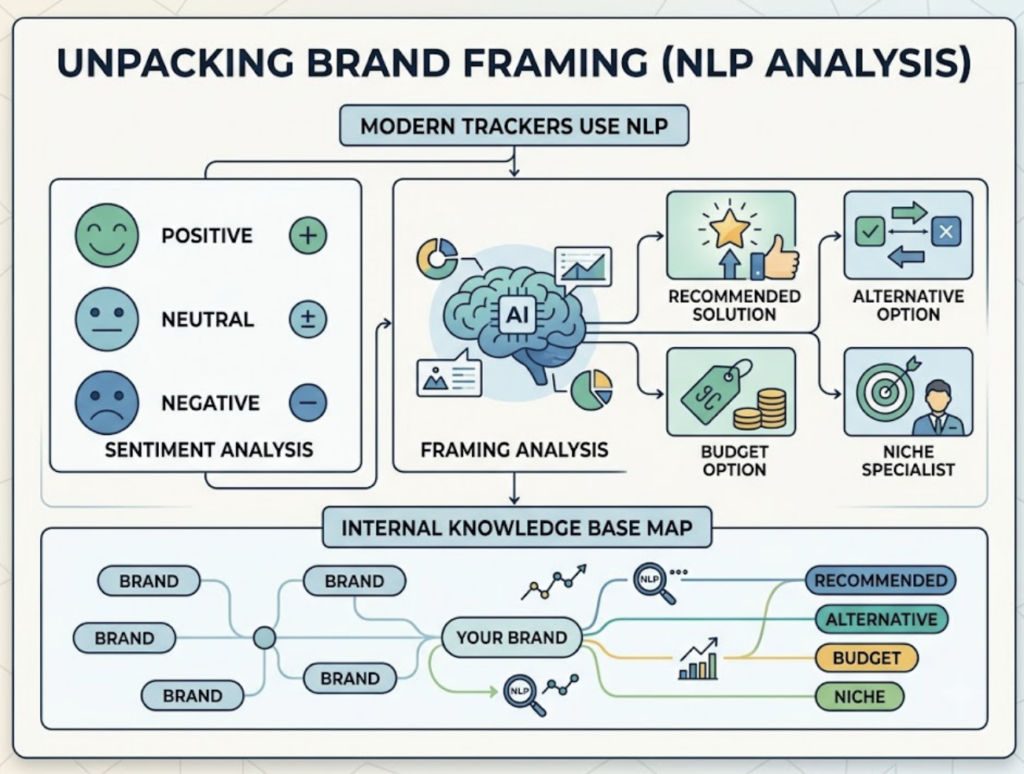
    Sentiment deserves particular attention. In AI search, the engine isn’t just linking to you. It’s describing you. If ChatGPT characterizes your product as “difficult to set up” or “less reliable than alternatives,” that framing shapes buyer perception before they ever reach your site.

    One Click. Zero Manual Workflows. Here’s What That Looks Like.

    Topify’s One-Click AI Agent execution is the platform’s clearest operational advantage. The mechanic is straightforward: you state your goal in plain English, the system proposes a full GEO strategy for your review, and you deploy with a single click.

    What happens after that click is where the complexity lives.

    The agent identifies the specific prompt where your brand isn’t being cited. It selects the appropriate content response, whether that’s updating an existing FAQ, generating a new comparative article, or implementing structured schema markup. It then executes that update and monitors whether the citation signal improves.

    In a traditional workflow, that sequence takes weeks across multiple teams. An agentic system handles it continuously. While a human team might manage 10 to 20 high-priority prompts over a three-month period, the Topify agent manages thousands of prompts in parallel, without hitting capacity limits.

    The efficiency analogy isn’t just theoretical. Automation benchmarks from large-scale industrial deployments, including a widely cited Siemens case, put cost reductions from task automation at around 30%. In GEO, where prompt volume is effectively infinite, the return scales accordingly.

    Topify AI Agent vs. Traditional SEO Tools: Where the Gap Actually Is

    Traditional SEO platforms like Ahrefs and Semrush were built for a specific problem: optimizing visibility in keyword-ranked, blue-link search results. That problem still exists, but it’s no longer the whole picture.

    Here’s where the two approaches diverge:

    DimensionTraditional SEO ToolsTopify AI Agent
    Primary goalSERP rankingAI recommendation and citation
    Data focusBacklinks and keyword densitySentiment and knowledge freshness
    WorkflowManual / diagnosticAutonomous / executory
    Authority signalDomain authority / CTRCitation probability across LLMs
    From data to actionRequires human coordinationExecuted by agent

    Ahrefs holds roughly 14.83% of the SEO tools market; Semrush holds around 6.68%. Both platforms now offer “AI visibility” add-ons to keep pace with the GEO shift. Semrush’s AI Visibility Toolkit, for example, runs at $99/month on top of existing plans. But it remains a monitoring layer. It tells you what’s happening. It doesn’t fix it.

    That’s the practical ceiling of a diagnostic tool in an execution-speed market.

    How the AI Agent Builds and Defends Your Brand Visibility in AI Search

    Brand visibility in generative search isn’t a state you achieve once. It’s a position you continuously defend.

    New competitors can emerge in AI recommendations overnight. If a rival publishes content that an AI crawler rates as highly relevant to a query, they can appear in ChatGPT or Gemini recommendations the next day, displacing you without any signal in your traditional SEO dashboard.

    Topify’s competitor monitoring tracks rival presence in AI responses in real time. When a new entrant appears in prompts you own, the agent flags it and adjusts your content strategy to out-cite them before the shift compounds.

    Source Analysis adds another defensive layer. The agent identifies the specific URLs and domains that AI platforms are using as their primary references. If those sources are giving AI engines inaccurate information about your brand, a common risk in the hallucination-prone early era of generative search, the agent generates knowledge-graph-optimized content to correct the record: structured FAQ markup, clear comparison pages, up-to-date product specs that AI crawlers can use as a ground-truth source.

    Topify covers seven major AI platforms: ChatGPT, Gemini, Perplexity, DeepSeek, Doubao, Qwen, and more. That breadth matters because brand mentions often come from platforms you’re not actively monitoring.

    From Keyword Research to Publishing: What the AI Agent Handles End-to-End

    Conversational AI search creates a keyword research problem that traditional tools weren’t designed to solve.

    A user doesn’t ask ChatGPT “best project management software.” They ask, “Which project management tool works best for a 10-person agency that bills by the hour and needs client-facing dashboards?” Those conversational query patterns are largely invisible to standard keyword research workflows. Topify’s agent continuously surfaces these prompts, prioritizing them by estimated search volume and citation opportunity.

    From there, the content generation pipeline handles production at enterprise scale. Topify generates 50 to 100 GEO-optimized articles per month for full-service clients, each grounded in up to five reference links and targeting up to 10 keywords per piece. The generation process includes an automated fact-checking step, which is a specific trust signal that AI engines weight when selecting citation sources.

    Once generated, the agent coordinates distribution across owned channels (your website, docs, and blog), earned channels (high-authority third-party domains), and community channels (forums and knowledge hubs that AI engines treat as sentiment and social proof signals).

    It’s the full execution cycle, not just the content draft.

    FAQ: What Teams Ask Before Using Topify AI Agent

    What can Topify’s AI Agent do for my brand? 

    The agent handles brand tracking, prompt discovery, competitor monitoring, GEO content generation, and multi-channel distribution, all autonomously. You set the goal; the agent builds and executes the strategy.

    How do I use an AI Agent to improve AI search visibility? 

    Start by establishing your baseline visibility score across AI platforms. The agent identifies which prompts you’re missing, generates optimized content to close those gaps, and monitors whether the citation signals improve after deployment.

    Does it work for smaller brands, or only enterprises? 

    Topify’s platform starts at $99/month on the Basic plan, which covers 100 prompts and core tracking across ChatGPT, Perplexity, and AI Overviews. The Pro plan at $199/month expands to 250 prompts and 8 projects. Enterprise plans start at $499/month for dedicated account management and custom configurations.

    How is Topify different from hiring a GEO agency? 

    A GEO agency typically charges between $2,000 and $20,000+ per month for execution services. Topify’s platform delivers the same execution capacity at a fraction of that cost, with the added benefit of real-time data feedback. The platform also offers full-service GEO packages for teams that want managed execution alongside the software.

    Conclusion

    The GEO market is projected to reach $1.09 billion in 2026 and grow to over $17 billion by 2034, at a 40.6% compound annual growth rate. The brands building AI visibility now are establishing a compounding advantage that will be difficult to close later.

    E-commerce brands implementing structured GEO recommendations have seen a 47% increase in AI-referred trafficwithin 60 days. B2B firms have traced over $230,000 in closed deals directly to AI recommendations shaped by GEO execution.

    The window for early-mover advantage is still open. It’s narrowing.

    Topify’s AI Agent gives marketing teams, SEO professionals, and agencies the infrastructure to act at the speed AI search demands, without adding headcount or waiting weeks for manual workflows to cycle through. You define the goal. The agent handles the rest.

    Start with a free audit to see where your brand stands today.

    FAQ

    Q: How does Topify’s AI Agent work?

    A: The agent runs a five-stage loop autonomously: it ingests your brand URLs to establish a visibility baseline, discovers high-volume conversational prompts that traditional keyword tools miss, synthesizes thousands of AI responses into performance metrics, monitors your dashboard in real time, and then executes GEO optimizations to close citation gaps. You define the goal in plain English. The agent handles everything from strategy generation to deployment.

    Q: What can Topify’s AI Agent do for my brand?

    A: It tracks your brand’s visibility, sentiment, and position across ChatGPT, Gemini, Perplexity, DeepSeek, Doubao, Qwen, and more. Beyond tracking, it generates GEO-optimized content, monitors competitor movements in AI responses, analyzes which URLs AI platforms cite most, and distributes content across owned, earned, and community channels, all without manual coordination.

    Q: How does Topify’s AI Agent replace manual GEO workflows?

    A: A manual GEO workflow typically requires separate audits for each AI platform, a content brief, a writing and editing cycle, and a technical publishing step. That sequence can take weeks per prompt, and AI search patterns shift faster than manual teams can respond. The Topify AI Agent compresses that entire chain into a single click: gap detection, strategy proposal, approval, and automated deployment happen in one continuous loop.

    Q: How is Topify’s AI Agent different from traditional SEO tools?

    A: Traditional SEO tools like Ahrefs and Semrush are diagnostic. They tell you where you rank, but the fixing is left to you. Topify’s AI Agent is executory. It doesn’t just surface a citation gap; it generates the content and deploys it. The underlying metrics are also different: traditional tools optimize for backlinks and keyword density, while Topify tracks sentiment scores, citation probability, and position within AI-synthesized answers.

    Read More

  • AI Blog Generator Showdown: Which One Writes the Best Content?

    AI Blog Generator Showdown: Which One Writes the Best Content?

    Most AI blog generators are solving the wrong problem.

    They’re optimized to produce text that sounds human. Fluent sentences, natural transitions, decent structure. That’s fine if you’re writing for a human reader who clicks a link and scrolls through a page.

    But that’s not how most people find information in 2026.

    AI-powered search now captures nearly 15% of the global search market, and organic click-through rates on traditional SERPs drop by as much as 61% when AI Overviews are present. The real question isn’t “does this content read well?” It’s “will ChatGPT or Perplexity cite it?”

    That gap is where most AI blog generators quietly fail you.


    Most AI Blog Generators Miss the Part That Actually Matters

    Here’s the procurement trap nobody talks about: readability and citeability are not the same thing.

    AI engines don’t read your content for enjoyment. They scan for factual density, entity clarity, and structural markers that signal “this is safe to cite.” Research suggests that content cited by AI typically contains 32% more explicit concepts than uncited content, even when the uncited content is linguistically superior.

    Most AI blog generators are built entirely around the first dimension. They produce fluent, well-organized drafts. What they don’t do is structure content for machine extraction, integrate Answer Engine Optimization (AEO) logic, or track whether the finished article ever gets cited by the AI platforms your audience actually uses.

    The result: high content volume, low AI visibility.

    That’s the blind spot this comparison is designed to surface.


    The Tools in This Showdown

    Five tools represent distinct approaches to the AI blog generation problem. Here’s where each one stands across the dimensions that actually matter in 2026:

    ToolWriting QualityKeyword ResearchAEO/GEO SupportAgentic ExecutionEntry Pricing
    ChatGPT (Plus/Pro)★★★★★Passive (manual input)None nativeNo$20/mo
    Jasper AI★★★★PassiveBasic SEO templatesPartial$59/seat
    Copy.ai★★★PassiveGTM workflows onlyWorkflow-level$49/mo
    Writesonic★★★★Semi-proactiveBuilt-in GEO SuitePartial$16/mo
    Topify AI Agent★★★★Proactive discoveryNative AEO executionFull agentic$99/mo

    The columns matter as much as the ratings. Writing quality is table stakes. The real differentiators are in columns three, four, and five.


    Writing Quality: Who Actually Produces Publishable Content?

    Publishable content in 2026 has to satisfy two audiences at once: human readers and AI extraction algorithms. Most tools are strong on one, weak on the other.

    ChatGPT remains the strongest raw writer in this group. It handles complex reasoning, iterative editing, and nuanced creative tasks better than anything else on the market. The problem is structural: every session starts cold, with no memory of previous brand guidelines, keyword strategies, or content gaps. It’s a brilliant freelancer who forgets everything between meetings.

    Jasper has evolved from a writing tool into a brand governance platform. Its “Knowledge Assets” feature lets enterprise teams upload internal documents and style guides, ensuring outputs stay on-brand. The trade-off: without careful management, outputs become formulaic. Predictable structure isn’t the same as quality writing.

    Copy.ai is strongest in short-form copy. For long-form AEO blog generation, it’s not the right tool.

    Writesonic’s Article Writer 6.0 uses live Google data to generate 5,000-word articles pre-optimized for current SERP trends. The quality is solid for SEO-first content. Where it gets interesting is the GEO tracking layer, which we’ll cover in the next section.

    Topify takes a different approach to writing quality. Content is modular by design, structured to be parsed by machines. This sometimes trades narrative flow for factual density. But that “encyclopedic” style is exactly what Perplexity and Gemini reward with citations. It’s writing optimized for extraction first, reading second.

    Data from 2025 shows 67% of businesses report improved content quality when using AI-assisted workflows, assuming there’s a human fact-checking layer to catch hallucinations. That caveat applies to every tool in this list.


    Keyword Research Integration: Does the Tool Know What to Write About?

    This is where the gap between tools becomes significant.

    The average traditional search query is 3.4 words. The average ChatGPT prompt is 60 words. That’s a 1,700% increase in query complexity, and it fundamentally changes what “keyword research” means.

    Traditional keyword tools tell you “SaaS pricing” gets 12,000 monthly searches. What they don’t tell you is that the AI conversations actually happening look more like: “How does SaaS pricing for remote teams compare to on-premise models for companies under 50 employees?” Those are the queries getting answered by ChatGPT and Perplexity. That’s where your brand either appears or doesn’t.

    Passive tools (ChatGPT, Jasper) require you to bring the keyword. They write what you ask. No discovery, no gap analysis, no competitive intelligence.

    Proactive tools identify what users are actually asking AI engines, find where competitors are being cited, and surface content opportunities before you think to ask. Only 11% of domains are cited by both ChatGPT and Perplexity, which means most keyword strategies are flying blind on at least one major platform.

    Topify’s High-Value Prompt Discovery sits firmly in the proactive camp. It covers ChatGPT, Gemini, Perplexity, and other major AI platforms, continuously surfacing new opportunities as AI recommendation patterns evolve. You’re not guessing what to write about. You’re targeting queries with documented AI search demand.


    AEO Is the New SEO: Which Generator Optimizes for AI Answers?

    Traditional SEO targets rank positions. AEO targets extraction probability.

    The technical distinction matters. Content must meet what researchers call “machine-justified” standards: structured to give AI the data it needs to prove an answer is correct. Based on analysis of 50,000+ queries, a few structural features consistently maximize citation probability:

    • Direct answer format: Answering the query in the first 50-100 words of a section produces a 4x higher extraction rate
    • Academic citation density: 3-5 external citations per 1,000 words boosts the “trustworthiness” classifier
    • Statistic and quote addition: Original data or expert quotes at the start of sections can boost visibility by up to 40%
    • Freshness signals: Visible “Last Updated” text and dateModified schema increase citation frequency by 28%

    Most AI blog generators produce none of this natively. They generate text. AEO structure requires an additional layer that most tools expect you to add manually.

    Writesonic is one of the few general-purpose tools that has integrated a GEO Suite. It provides a dashboard to track brand mentions across ChatGPT, Gemini, and Perplexity, and applies some structural optimization to its outputs. It’s the most credible “transitional” tool for brands moving from traditional SEO to AEO.

    Topify treats AEO as the foundation, not an add-on. Every content output is built on AEO intent from the start. Its Source Analysis feature goes further: it tracks which domains AI platforms are actively citing, identifies where your competitors dominate those citations, and maps the content gaps you need to fill. That’s an optimization loop most tools can’t close.


    Beyond Writing: The Topify AI Agent Runs the Whole Content Operation

    Here’s the fundamental problem with treating AI blog generators as writing tools.

    Writing is maybe 20% of the content operation. The rest is research, strategy, publishing, distribution, internal linking, metadata, tracking, and iteration. Most AI blog generators hand you a draft and stop. Everything after that is still manual.

    That’s the gap the Topify AI Agent was built to close.

    The workflow looks like this: you set a goal in plain English, say “capture 20% share of voice in SaaS project management.” The agent identifies high-value prompts and competitor citation sources, generates AEO-optimized content, handles technical elements (alt text, metadata, internal links), and publishes directly to Shopify, WordPress, or Webflow. Then it monitors CVR and AI citation rates to feed insights back into the next cycle.

    That’s the difference between a writing tool and an execution layer.

    Data from 2025 implementations shows teams switching to agentic workflows see an 80-90% drop in research time and a 5x increase in conversion value per session compared to traditional organic traffic. The economics shift from “more content, more time” to “strategic content, automated execution.”

    Topify’s pricing reflects three distinct use cases:

    PlanMonthly PriceContent OutputAutomation Level
    Basic$99/moUp to 100 products, 50 content generationsBasic SEO syncing
    Pro$199/mo250 prompts, 100 content generations10 Automatic Campaigns
    EnterpriseFrom $499/moCustom volumeFull Agentic Ops

    It’s built for SaaS brands, marketing agencies, and high-growth content teams that need to scale output without scaling headcount.


    Which AI Blog Generator Should You Actually Use?

    The honest answer depends on where you are in the content maturity curve.

    If you need fast, high-quality drafts to edit yourself: ChatGPT Plus or Claude. Best raw reasoning, lowest cost ($20/mo), requires manual execution of everything else.

    If you manage a large marketing team with strict brand guidelines: Jasper. The governance layer and brand voice controls justify the per-seat cost for mid-to-large enterprises.

    If you’re transitioning from SEO to GEO and still care about Google rankings: Writesonic. The GEO visibility tracking is genuinely useful for brands in the middle of that shift.

    If you’re building an AI-first content operation: Topify. It’s not a blog generator with extra features. It’s an AEO execution layer with a content operation built in. The distinction is significant.

    The market is bifurcating between general-purpose assistants and specialized agentic platforms. Most teams will eventually need both: something like ChatGPT for creative and strategic thinking, and something like Topify for execution and AI visibility at scale.


    Conclusion

    The transition from search to synthesis isn’t gradual. Citation authority and share of AI voice are becoming the primary KPIs for content teams in 2026, while traditional click-through rates decline on nearly every major platform.

    The showdown question was “which AI blog generator writes the best content?” The more useful question is “which tool ensures your content gets used by the AI engines that now mediate most information discovery?”

    Writing quality matters. But writing quality without AEO structure, without proactive keyword discovery, and without an execution layer to track what’s actually being cited, it produces content that reads well and ranks nowhere.

    That’s the gap most content teams are still sitting in.


    FAQ

    What is an AI blog generator? 

    An AI blog generator is a software tool that uses large language models to produce written content, typically blog articles, based on keyword input or topic prompts. They range from general-purpose assistants like ChatGPT to specialized platforms like Topify that combine writing with AEO optimization and autonomous publishing.

    How does AEO differ from SEO for blog content? 

    SEO optimizes content for Google’s ranking algorithm, focusing on keyword density, backlinks, and page speed. AEO (Answer Engine Optimization) optimizes content for extraction by AI engines like ChatGPT and Perplexity, focusing on direct answer format, factual density, schema markup, and citation structure. In practice, AEO content tends to be more modular and data-dense than traditional SEO content.

    Can an AI blog generator help with keyword research? 

    It depends on the tool. Passive tools like Jasper and standard ChatGPT require you to provide keywords; they don’t discover them. Proactive tools like Topify perform autonomous High-Value Prompt Discovery, identifying what users are actually asking AI engines and surfacing content opportunities before you think to search for them.

    What makes Topify different from other AI blog generators? 

    Topify operates as an AEO execution layer rather than a writing tool. It combines High-Value Prompt Discovery, AEO-optimized content generation, one-click publishing, competitor benchmarking, and CVR tracking in a single agentic workflow. Most AI blog generators stop at the draft. Topify manages the full content operation.

    How does the Topify AI Agent work for content creation? 

    You define a goal in plain English. The agent identifies high-value AI search prompts, generates AEO-structured content, handles technical optimization (metadata, alt text, internal links), publishes to your CMS, and monitors citation rates and conversion performance. The system continuously refines the strategy based on what’s actually getting cited.


    Read More

  • What Is an AI Blog Generator and Can It Replace Human Writers?

    What Is an AI Blog Generator and Can It Replace Human Writers?

    You can now produce a 1,500-word blog post in under three minutes. That’s not a claim from a product demo. It’s the operational reality for content teams that adopted AI writing tools in 2024.

    And yet, most of those teams are still asking the same question: why isn’t the traffic coming?

    The answer has less to do with writing speed and more to do with what happens after the content is published. AI blog generators changed how fast you can create. They didn’t change how AI search engines decide what to recommend.

    An AI Blog Generator Writes. It Doesn’t Think for You.

    An AI blog generator is a software tool built on Large Language Models (LLMs). It takes a prompt or keyword as input and produces a draft by predicting the most statistically likely sequence of words based on its training data. It doesn’t research. It doesn’t verify. It doesn’t know what your brand actually stands for.

    The quality of the output is shaped by two variables: the temperature setting (which controls creativity vs. factual accuracy) and the quality of the input prompt. A low temperature produces reliable, structured text suited for documentation. A high temperature produces creative phrasing with a higher risk of hallucination — where the model generates plausible-sounding information that is factually wrong.

    That’s the gap most teams underestimate. You can get 10 drafts in an hour. You still need a human to decide which ones are worth publishing.

    Where the Speed Gains Are Real

    The efficiency data is hard to argue with. Organizations using AI content tools report production speeds up to 400% fasterand per-article costs reduced by approximately 50%. The average productivity gain across teams is around 40%, and 78% of organizations have now integrated AI into their content workflows.

    For specific use cases, AI blog generators deliver clear value:

    • Long-tail keyword coverage: AI can generate dozens of topically related articles that a small team couldn’t produce manually
    • Content scaffolding: Outlines, headers, and first drafts that human writers refine rather than build from scratch
    • Repurposing: Turning transcripts, reports, or internal docs into structured blog posts

    The efficiency case is real. The strategic case is more complicated.

    The Part Where Human Writers Still Win

    Here’s the thing: Google and AI search engines are moving in the same direction. Both increasingly reward “Experience” — content that reflects genuine first-hand knowledge, proprietary data, and expert perspective.

    Google’s E-E-A-T framework (Experience, Expertise, Authoritativeness, Trustworthiness) has become significantly more demanding since 2025. Content that simply aggregates existing information without adding real insight is flagged as “lowest quality” by both human evaluators and algorithmic filters. “Scaled content abuse” — publishing hundreds of AI-generated pages that add no unique value — can trigger manual actions and de-indexing.

    AI can draft. It can’t replace the researcher who spent three months in the field, the analyst who found the anomaly in the dataset, or the practitioner who has a counter-intuitive take because they’ve actually done the work.

    The practical model that holds up: AI handles volume and structure. Humans supply the layer of experience that drives both rankings and trust.

    You Can’t Skip Keyword Research, Even with AI

    An AI blog generator is only as useful as the strategic direction you give it. The “garbage in, garbage out” principle applies directly here: if you feed the tool the wrong keywords, you get well-written content that no one finds.

    The bigger problem is that traditional keyword research tools are increasingly insufficient. Research shows these tools miss approximately 88% of the queries that AI systems generate when answering user questions. This happens because of a process called “Query Fan-Out”: when someone asks ChatGPT or Perplexity a question, the system doesn’t look up that exact phrase. It fires 5 to 11 parallel sub-queries targeting different angles simultaneously.

    A search for “best project management software for agencies” might trigger sub-queries about pricing tiers, integration with invoicing tools, onboarding time, and case studies by industry. Your content needs to satisfy those hidden sub-queries — not just the primary keyword.

    The implication: content strategy built around traditional search volume metrics will consistently underperform in AI search. The Total Addressable Search Surface accessible through AI is 10 to 16 times larger than what traditional tools can see.

    Writing for AI Search Is Different. AEO Changes the Goal.

    Traditional SEO aims for page rankings. Answer Engine Optimization (AEO) aims for citations in AI-generated responses. These are not the same thing, and optimizing for one doesn’t guarantee the other.

    The numbers make this concrete: 68% of pages cited in AI Overviews are not in the top 10 organic results for the primary keyword. Ranking well on Google is no longer sufficient to win visibility in AI answers.

    AI platforms cite content based on “Chunk-Level Relevance”: they extract specific passages that directly answer a narrow question. A 3,000-word guide that buries the answer in paragraph 14 will be skipped in favor of a shorter piece that states the answer in the first two sentences.

    This means content architecture changes fundamentally for AEO:

    DimensionTraditional SEOAEO
    Primary goalPage rankings, click-throughCitations in AI responses
    Success metricKeyword position, CTRAnswer inclusion rate
    Content structureLong-form, topic clustersFragment-ready, BLUF structure
    Retrieval modeIndex + keyword matchingRetrieval-Augmented Generation

    Freshness matters more than most teams realize. 85% of AI Overview citations come from content published within the last 24 months, and 76% of ChatGPT’s most-cited pages were updated within the last 30 days. In fast-moving categories, content can lose significant citation share within 90 days.

    The “Bottom Line Up Front” (BLUF) method is the most reliable structural approach: every key section opens with a 1-3 sentence summary that states the answer clearly. The supporting detail follows. AI engines pull the opening; humans read the rest.

    One More Gap: No AI Blog Generator Tracks What Happens Next

    You publish the article. Now what?

    A standard AI blog generator has no visibility into whether your content is being cited by ChatGPT, whether a competitor just displaced your brand in Perplexity’s recommendations, or whether AI is describing your pricing incorrectly. Research shows 67% of AI citations can be “dead” or uncontrollable — and hallucinations about a brand’s features or pricing can damage reputation before a user ever reaches the website.

    This is the visibility blind spot that separates a content production tool from a content growth system.

    Topify‘s AI Agent is built for the part that comes after writing. It continuously monitors how your brand appears across ChatGPT, Gemini, Perplexity, and other major AI platforms. It surfaces the high-value prompts your content isn’t winning. It audits which domains competitors are getting citations from, revealing the topical authority gaps in your own library.

    The underlying data supports why this matters: brand mentions correlate with AI search visibility at 0.664, compared to 0.218 for traditional backlinks. That’s a three-to-one advantage for brand presence over link-building in the AI search era. Topify tracks that presence quantitatively — visibility, sentiment, position, citation frequency — across every major AI platform.

    The workflow it enables:

    1. Discover high-value AI prompts your brand should be winning
    2. Track how your content performs in real AI responses, not estimated rankings
    3. Analyze which sources AI platforms cite in your category
    4. Execute optimization strategies with one-click deployment — no manual workflows

    That’s the gap between a generator and an agent. A generator fills pages. An agent drives growth.

    Conclusion

    AI blog generators are efficiency tools. They solve the “how fast can we produce” problem. They don’t solve the “will AI recommend this” problem.

    The real question for any content team in 2026 isn’t whether AI can write your next article. It’s whether your content will be cited when someone asks ChatGPT or Perplexity for a recommendation in your category. That requires a different kind of strategy: structured content, precise keyword research that accounts for AI query fan-out, AEO-optimized architecture, and ongoing visibility monitoring.

    Writing faster is the easy part. Getting recommended is the work.

    If you’re ready to move from content production to AI search visibility, Topify is built for that shift.


    FAQ

    Can AI-generated blog posts rank on Google? Yes, with conditions. Google’s policy is quality-focused, not origin-focused. AI content can rank if it’s genuinely helpful, accurate, and demonstrates real expertise. Content that mass-produces pages without adding unique insight — what Google calls “scaled content abuse” — risks de-indexing.

    What’s the difference between an AI blog generator and an AI agent? An AI blog generator takes a prompt and produces a draft. An AI agent like Topify operates in a feedback loop: it monitors how content performs in AI search environments, identifies visibility gaps, surfaces new opportunities, and executes optimization strategies autonomously.

    How does AEO differ from traditional SEO? SEO targets page rankings in search result lists. AEO targets citation in AI-generated answers. The success metric shifts from keyword position to “answer inclusion rate” — how often your content is cited when AI engines answer relevant queries. Structure, freshness, and entity clarity drive AEO performance more than backlinks.

    Is AI content good enough to replace a content team? For volume and structure: often yes. For original research, expert perspective, and the “Experience” layer that both Google and AI engines increasingly require: no. The teams seeing the best results use AI for production efficiency and humans for the strategic and experiential layer that drives authority.


    Read More

  • 5 Keyword Research Tools That Actually Save You Time

    5 Keyword Research Tools That Actually Save You Time

    You’ve got Ahrefs running, SEMrush open in another tab, and GSC pulling data in the background. You’re tracking hundreds of keywords. But here’s the thing: none of those tools tell you if your brand shows up when someone asks ChatGPT for a recommendation.

    That’s not a gap you can afford to ignore. AI sessions now account for 56% of traditional search volume, and when an AI Overview appears at the top of Google, organic click-through rates drop by 61%. The traffic is moving. The question is whether your keyword research tools are moving with it.

    This list covers five tools that each solve a different part of the problem, and how to use them together.

    Most Keyword Research Tools Were Designed for a Search Engine That’s Losing Ground

    Traditional tools like Ahrefs and SEMrush were built on a “Keyword → Volume → Rank” logic. That logic works well when users click on blue links. It breaks down when users get their answers directly from an AI.

    Zero-click searches already account for 65% of all Google searches in the U.S., projected to exceed 70% by end of 2026. AI Overviews now appear for roughly 20.5% of keywords, up from 6.5% in January 2025. And conversational queries have changed shape entirely: the average AI prompt in 2026 is 23 words long, compared to the 1-3 word head terms traditional tools were built to handle.

    This doesn’t mean Ahrefs and SEMrush are obsolete. It means they’re now one layer of a stack, not the whole stack.

    Quick Comparison: 5 Tools at a Glance

    ToolBest ForChannels CoveredStarting PriceBiggest Time-Saver
    TopifyGEO + AEO keyword researchChatGPT, Gemini, Perplexity, DeepSeek + more$99/moAutomated AI prompt discovery
    AhrefsTraditional SEO + backlink analysisGoogle (+ Brand Radar add-on for AI)$129/moCompetitor gap analysis
    SEMrushMulti-channel marketing teamsGoogle, PPC, local, + AI Toolkit add-on$139.95/moPersonalized keyword difficulty
    Google Search ConsoleGround-truth Google dataGoogle onlyFreeZero-click intent discovery
    AlsoAskedQuestion cluster mapping for AEOGoogle PAA$12/mo3-level intent tree in 30 seconds

    #1 Topify: The Keyword Research Tool Built for AI Search

    Every tool on this list tracks where your content ranks. Topify tracks something different: whether your brand gets cited when someone asks an AI a question.

    That’s the gap most keyword research workflows still can’t see.

    High-Value Prompt Discovery as the New Keyword Research

    Topify’s prompt discovery engine continuously surfaces high-volume AI prompts relevant to your brand across ChatGPT, Gemini, Perplexity, DeepSeek, and other major platforms. Think of it as keyword research, except the “search engine” is a large language model and the “keyword” is a 23-word conversational question.

    The tool’s AI Volume Analytics shows you how many users are asking specific questions across LLM platforms, not just what they’re typing into Google. This is the forward-looking metric that traditional tools don’t have.

    Source Analysis: Reverse-Engineering Why AI Recommends Competitors

    One of Topify’s most actionable features is Source Analysis. It identifies exactly which third-party domains AI platforms cite when answering brand-related questions. If your competitor is being cited and you’re not, Source Analysis shows you which authoritative sources you’re missing, so your content strategy can target those specific citation gaps.

    This is GEO in practice: not optimizing for Google’s crawler, but optimizing for how AI synthesizes information into a trusted response.

    What You Actually Track

    Topify measures seven metrics: visibility, sentiment (scored 0-100), position, AI volume, brand mentions, intent, and CVR. That last one matters more than it sounds. AI-referred traffic converts at up to 23x the rate of traditional organic traffic. Volume is down. Value is up. Topify tracks both.

    Pricing: Basic at $99/mo covers 100 prompts across 4 platforms. Pro at $199/mo scales to 250 prompts with API access and advanced citation gap analysis. Enterprise starts at $499/mo for custom prompt sets and team workflows.

    Best for: SEO and marketing teams expanding from traditional Google SEO into GEO and AEO. Also strong for agencies managing multiple client brands across AI platforms.

    #2 Ahrefs: Still the Infrastructure Standard

    Ahrefs hasn’t been replaced. Its keyword database covers 28.7 billion terms, and its backlink index remains the deepest in the industry. For building topical authority and identifying competitor content gaps, it’s still the most reliable option at scale.

    The feature that matters most in 2026 is Click Data. Unlike raw volume, click data tells you how many of those searches actually result in a visit to any website. A keyword with 10,000 monthly searches might only drive 2,000 clicks once AI Overviews are factored in. Knowing this upfront keeps your team from investing in terms that no longer drive traffic.

    For AI coverage, Ahrefs offers Brand Radar as an add-on. It uses a library of 260 million prompts to monitor share of voice across ChatGPT, Perplexity, Gemini, and Microsoft Copilot. It’s powerful, but priced accordingly: $199/mo for a single AI index, or $699/mo for the full 6-platform bundle, on top of the base plan.

    Best for: Technical SEOs, link-building specialists, and teams where traditional organic search still drives the majority of revenue.

    #3 SEMrush: Best When Your Team Manages More Than Just SEO

    SEMrush made a smart bet on workflow integration. Its value isn’t any single feature; it’s that keyword research, PPC, content planning, and competitor tracking all live in one dashboard. For marketing teams that can’t afford to context-switch between five different tools, that matters.

    The standout 2025 update is Personal Keyword Difficulty (PKD%), which scores keyword difficulty against your specific domain’s authority rather than a generic benchmark. If your domain isn’t strong enough to rank for a given term, PKD% flags it early. That’s hours of saved research time per week.

    SEMrush also leans hard into Topical Authority, helping teams build the pillar-and-cluster content structures that LLMs favor. E-E-A-T signals aren’t just for Google anymore; AI engines consistently cite domains that demonstrate depth on a subject.

    AI coverage comes via the AI SEO Toolkit ($99/mo add-on), which provides daily rank-style monitoring for ChatGPT and Google AI Mode presence.

    Best for: Large in-house marketing teams running SEO, PPC, and content under one roof. Less ideal for specialists who just need deep keyword or backlink data.

    #4 Google Search Console: Free, Direct, and More Useful Than Most People Realize

    GSC doesn’t get enough credit as an AEO research tool. Here’s why it should.

    Filter your queries for high impressions and zero clicks. Those are your most important targets. They’re terms where Google (or an AI Overview) is already answering the user’s question without sending them anywhere. These zero-click terms are exactly what AEO content should address: structured, concise answers that make your content the source AI extracts from, rather than a destination users click to.

    One important nuance for 2026: GSC now counts impressions from AI Overviews and traditional organic results separately. If your page is cited in an AIO and ranks on page one, you get two impressions per search. CTR appears to drop. That’s not a failure; that’s double visibility. The metric to watch is actual clicks, not CTR alone.

    GSC won’t give you competitor data, and it won’t tell you what’s happening outside Google. But it gives you clean ground truth for your own Google performance, which is the foundation everything else builds on.

    Best for: Every team, as a starting point. Works especially well when piped into AlsoAsked or Topify as a research seed.

    #5 AlsoAsked: The Fastest Way to Map Question-Based Keywords

    AlsoAsked is built around a single insight: Google’s People Also Ask feature reveals how users actually think about a topic, not just what they type first.

    When someone expands a PAA result, Google dynamically generates more related questions. AlsoAsked automates this process three levels deep, surfacing 150+ questions for a single query and organizing them into a visual intent tree. PAA visibility grew 34.7% in the U.S. between 2024 and 2025, which makes this data source increasingly valuable for structuring content.

    For AEO, this is directly actionable. Each branch of the intent tree maps to a specific H2 or H3 in your content. Answer the question concisely and structurally in the first 40-60 words of that section, and you’re building content that’s optimized for extraction, whether into a featured snippet, a PAA box, or an AI Overview summary.

    The Bulk Search feature handles up to 1,000 keywords at once, useful for ecommerce teams mapping intent across large product catalogs.

    Pricing: Free tier (3 searches/day), Basic at $12/mo, Lite at $23/mo, Pro at $47/mo with API access.

    Best for: Content strategists and AEO planners who need to map question intent quickly. Not a standalone tool; pairs best with Ahrefs or SEMrush for volume validation.

    How to Do AEO With These 5 Tools: A 3-Step Workflow

    These tools work better together than in isolation. Here’s the workflow that covers traditional SEO, GEO, and AEO in one pass.

    Step 1: Map the Conversational Ecosystem

    Start with AlsoAsked to build question clusters around your target topic. Then pull zero-click queries from Google Search Console: these are the questions your audience is already asking, where Google is answering them before they ever reach your site. Together, these two sources give you the full picture of what your audience wants to know.

    Step 2: Validate Volume and Topical Difficulty

    Run your question list through Ahrefs or SEMrush. Ahrefs’ Click Data tells you which questions still drive traffic incentives. SEMrush’s PKD% filters out terms where you don’t have a realistic shot. Use the Content Gap feature to find questions where competitors are capturing featured snippets that you should be targeting instead.

    Step 3: Track AI Prompt Visibility

    This is where Topify closes the loop. Upload your priority topics and track whether your brand is being cited in AI responses across ChatGPT, Perplexity, Gemini, and others. If you’re not cited, Source Analysis identifies the authoritative sources you’re missing. If you are cited, Visibility Tracking and Sentiment Scoring show how your brand is being framed. Neither step is possible in any other tool on this list.

    Track it. Optimize it. Done.

    Conclusion

    The keyword research stack of 2026 isn’t one tool; it’s a layered system where each tool handles a different layer of discovery. AlsoAsked maps the questions. Ahrefs and SEMrush validate the opportunity. GSC grounds you in real Google data. And Topify tracks the layer that none of the others can reach: what happens when your audience skips Google entirely and asks an AI instead.

    Research suggests that 76% of AI Overview citations still pull from pages ranking in Google’s top 10, which means traditional SEO is still the price of entry for AI visibility. But entry isn’t enough anymore. The brands that consistently get cited in AI answers are the ones treating AI search as a separate discipline, with its own research tools and its own success metrics.

    The five tools above cover both disciplines. Use them together.


    FAQ

    What’s the difference between GEO tools and traditional keyword research tools?

    Traditional tools focus on “Keyword → Rank” using Google’s index and backlink authority. GEO tools like Topify focus on “Prompt → Citation,” tracking whether your brand appears in conversational AI responses across platforms like ChatGPT and Perplexity. They’re measuring completely different things.

    How do I do AEO keyword research?

    Start with AlsoAsked to map question clusters, then cross-reference with GSC’s zero-click queries to find where AI or Google is already answering without sending traffic. Structure your content to provide direct, extractable answers in the first 40-60 words of each section. Then use Topify or SEMrush’s AI Toolkit to track whether those answers are being pulled into AI Overviews.

    Do I still need Ahrefs or SEMrush if I use Topify?

    Yes. Topify handles the AI citation layer; Ahrefs and SEMrush handle the infrastructure layer, including technical audits, backlink analysis, and traditional rank tracking. Since the majority of AI Overview citations still pull from pages that rank well in traditional Google results, traditional SEO remains foundational.

    What are the best GEO tools for small teams?

    Google Search Console (free) + AlsoAsked Basic ($12/mo) + Topify Basic ($99/mo) gives a capable starting stack for intent research and AI visibility tracking. Adding SEMrush Pro ($139.95/mo) makes sense once the team needs deeper competitive and technical analysis.


    Read More

  • Best Keyword Research Tools in 2026: A Hands-On Comparison

    Best Keyword Research Tools in 2026: A Hands-On Comparison

    Search “best keyword research tools” and you’ll find dozens of platforms all claiming to help you find the right terms. The problem is that most of them are answering the wrong question. They’ll tell you a keyword gets 40,000 monthly Google searches. They won’t tell you how many times that same intent is satisfied inside a ChatGPT session or a Perplexity research thread, with zero clicks and zero referrer data showing up in your analytics.

    That’s the gap most keyword stacks still can’t see.

    In 2026, the SEO specialists getting the clearest picture of their search presence aren’t just using better traditional tools. They’re using a different kind of tool entirely for a different layer of discovery.

    What Changed in Keyword Research Between 2024 and 2026

    Gartner projected a 25% decline in traditional search volume by 2026. That number has largely materialized. Users increasingly turn to AI-native platforms for research-intensive and evaluative tasks because the result is immediate, synthesized, and conversational.

    ChatGPT now handles over 2 billion queries daily. Organic click-through rates for Google’s top positions have dropped 61% when AI Overviews appear. And 70.6% of AI-driven referral traffic arrives without referrer headers, meaning it shows up as “direct” in GA4 and disappears from your attribution model entirely.

    The consequence isn’t just lost traffic. It’s lost measurement.

    High organic rankings no longer guarantee visibility if your brand is omitted from the AI-generated summary occupying the top thousand pixels of the screen. The primary KPI has shifted: from keyword ranking to what researchers now call “Share of Model,” the percentage of relevant AI responses in which your brand appears as a recommended answer.

    Traditional keyword tools weren’t built for this. They remain essential for building the foundational authority that AI crawlers rely on, but they don’t see into the “dark AI” layer where buying decisions increasingly get made.

    The 2026 Keyword Research Toolkit at a Glance

    The keyword research stack in 2026 runs on two distinct layers: the Foundation Layer (traditional SEO) and the AI Discovery Layer (GEO/AEO). Effective strategy requires both. Here’s how the leading platforms compare across the dimensions that matter most this year.

    PlatformPrimary LayerGEO/AEO SupportStarting PriceIdeal ForStandout Feature
    TopifyAI DiscoveryComprehensive (7-metric)$99/moSaaS, Multi-platform teamsAI Volume Analytics + One-Click Execution
    AhrefsFoundationModerate (Brand Radar add-on)$129/moAgencies, Technical Analysts243M+ prompt database, backlink precision
    SEMrushFoundation + MarketingModerate (AI Toolkit add-on)$139.95/moEnterprise, All-in-one teams25.5B keyword database, intent classification
    Moz ProFoundationBasic (intent metrics)$99/moSMBs, BeginnersDomain Authority scoring, Priority Score
    Google Keyword PlannerSearch BaselineNoneFreePPC, Initial ResearchDirect Google source data

    The table above makes the tradeoff visible: traditional tools are strong where AI tools are blind, and vice versa. The platforms that cover both worlds fully don’t exist yet as a single product. That’s why the 2026 stack is a combination play.

    #1 Topify: Where Keyword Research Meets GEO

    Topify doesn’t replace your keyword tool. It covers the part your keyword tool can’t reach.

    The core distinction is the shift from keywords to prompts. Legacy tools report search volume for “cloud hosting.” Topify’s AI Volume Analytics identifies the specific conversational queries people are asking inside ChatGPT, such as “Which cloud hosting is best for a HIPAA-compliant healthcare app with 5,000 users?” Analysis of over 50 million prompts shows that 37.5% are generative and 32.7% are informational. These are the prompt categories where traditional volume metrics tell you nothing useful.

    That’s where Topify starts.

    Seven metrics, one visibility picture. Topify tracks brand performance across ChatGPT, Gemini, Perplexity, and DeepSeek through seven core indicators that redefine what “search performance” means in 2026:

    • Visibility Score: How often your brand appears across a defined prompt set. Appearing in 30% of relevant AI answers often delivers more pipeline impact than a #1 Google ranking with zero clicks.
    • Sentiment Quotient (0-100): Whether AI engines describe your brand positively, neutrally, or negatively. This matters because AI referral traffic converts at an average of 14.2%, roughly five times higher than Google organic. The quality of what AI says about you directly affects conversion.
    • Relative Positioning: Where your brand appears in a list of recommendations. Being mentioned first in a Perplexity summary confers a “first-mover” authority that compounding brand recognition builds on over time.
    • AI Search Volume: The estimated frequency of specific prompt triggers across major LLMs. This is the GEO equivalent of keyword search volume.
    • Mention Density: Your brand’s absolute frequency across varied prompts, indicating topical authority within the model’s knowledge graph.
    • Intent Alignment: Whether AI engines are framing your brand in evaluative, recommendatory, or educational contexts.
    • Attributed CVR: The estimated conversion rate of traffic originating from AI citations.

    Source Analysis: reverse-engineering what AI trusts. The hardest question in modern search is “To be recommended by AI, where do I need to appear?” Only 14% of URLs cited in Google’s AI Mode appear in the top 10 traditional search results. Ranking doesn’t predict citation.

    Topify’s Source Analysis identifies the specific Reddit threads, niche publications, and industry blogs that AI platforms are currently pulling from. This turns Digital PR and community engagement from a guesswork activity into a prioritized, measurable effort.

    Execution, not just data. Most monitoring tools stop at the dashboard. When Topify detects a citation gap or a visibility drop, its AI agent proposes specific content variants or schema updates deployable with one click. No manual workflow required.

    Topify’s Basic Plan starts at $99/month, covering 100 prompts and up to 9,000 AI answer analyses monthly. The Pro Plan ($199/month) extends to 250 prompts and 22,500 analyses, with advanced competitor benchmarking. For teams managing multiple clients or brands, Enterprise plans start at $499/month.

    The Traditional Heavy Hitters, Ranked by What They Can’t Do in 2026

    These tools remain core to any foundation-layer strategy. Their limitations in AI search aren’t reasons to abandon them. They’re reasons to understand what role they play.

    #2 Ahrefs. Still the industry leader for backlink data purity and technical site auditing. The Brand Radar feature indexes 243 million real-world prompts and monitors visibility across 6+ AI platforms including YouTube and Reddit. Its Parent Topic clustering is particularly useful for identifying content that can simultaneously rank in Google and serve as citation material for LLMs. The trade-off: full access to AI index data requires add-ons that can push total subscription costs past $600/month for agencies.

    #3 SEMrush. The most comprehensive multi-channel suite available. Its 25.5 billion keyword database and intent classification are the strongest in the traditional layer. The Unified SEO + AI Visibility dashboard is effective for teams that need to consolidate legacy rankings and generative presence into a single report. The limitation: AI features are often gated behind paid add-ons at $99/user, and teams that only need focused AI monitoring often pay for functionality they don’t use.

    #4 Moz Pro. Moz has maintained relevance by focusing on the “Neighborhood of Trust” through Domain Authority and Page Authority metrics, which AI models still use to evaluate source credibility. The Priority Score system is particularly strong for SMBs: it weights keyword potential by DA, CTR, and difficulty to surface niches where smaller sites can realistically compete. Deep multi-LLM prompt tracking is not available.

    #5 Google Keyword Planner. Not a comprehensive SEO tool, but irreplaceable for one thing: validating ground-truth Google search demand. It’s the only platform with direct access to Google’s source data. Seasonal trend forecasting and organic competition metrics remain accurate and free. For AI search, it offers nothing.

    What AEO Actually Means for Keyword Strategy in 2026

    AEO (Answer Engine Optimization) has moved from a tactical experiment to a strategic requirement. With 69% of Google searches now ending without a click, the primary objective of content is no longer to be visited. It’s to be extracted.

    AI models use Retrieval-Augmented Generation (RAG) to synthesize answers. This process favors content that leads with a direct answer in 40-60 words, followed by supporting data, and ends with contextual nuance. The structure that humans find easy to skim turns out to be exactly what AI systems prefer to cite.

    Here’s how to do AEO in 2026, in three concrete steps:

    Step 1: Identify high-value AI prompts. Move beyond keyword lists. Use Topify’s AI Volume Analytics to find the conversational prompts triggering AI summaries in your category, both for your brand and your competitors. These prompts are the GEO equivalent of seed keywords.

    Step 2: Optimize content for modular extraction. AI systems parse content by section, not by page. Each H2 or H3 heading must function as a standalone unit: a complete thought that can be independently cited without surrounding context.

    Step 3: Monitor and influence your Neighborhoods of Trust. In 2026, 85% of brand mentions in AI search originate on third-party pages. Your domain authority matters, but it doesn’t determine what AI says about you. Topify’s Source Analysis shows exactly which external domains AI platforms are citing in your category so you can prioritize earned media accordingly.

    The business case is concrete. NerdWallet reported a 35% revenue increase in 2024 despite a 20% traffic decline, demonstrating that being cited as the trusted authority captures higher-intent users at the decision stage, regardless of organic click volume.

    GEO vs. SEO Keywords: The Divergence of Search Intent

    The same term means different things depending on the discovery engine.

    Search “project management software” on Google and the intent is navigational. The user knows what they want and is heading somewhere. Ask ChatGPT the same query and the interaction shifts to “Which tool do you recommend for a 15-person remote team with a $200/month budget?” That’s a completely different intent signal, with explicit constraints, a specific context, and a direct invitation for a recommendation.

    This is the core difference between SEO keyword strategy and GEO keyword strategy:

    DimensionTraditional SEO KeywordGEO/AEO Prompt
    User PhrasingShort fragments (“project management software”)Conversational with constraints (“best PM tool for remote team, under $200/mo”)
    Intent SignalLow, inferred from queryHigh, explicitly stated
    Content GoalRank on page oneBecome the recommended solution for specific scenarios
    Primary MetricVolume and DifficultyVisibility Score and Citation Rate

    GEO tools like Topify make the “prompt space” a trackable and optimizable channel. Rather than guessing which prompts AI engines associate with your brand, you see exactly how often you appear, in what context, with what sentiment, and against which competitors. That’s Share of Model tracking. And in 2026, it’s replacing keyword ranking as the north star for brands where AI-driven discovery contributes meaningfully to revenue.

    How to Build a 2026 Keyword Stack That Covers Both Worlds

    No single tool provides 360-degree visibility in 2026. The high-performing teams have settled on a three-layer configuration:

    Layer 1: Foundation (Traditional SEO). Ahrefs or SEMrush for keyword research, backlink analysis, and technical auditing. This layer builds the authority that makes AI engines consider you a credible source.

    Layer 2: AI Discovery (GEO/AEO). Topify for prompt monitoring, visibility tracking, source analysis, and one-click execution. This layer tells you what’s happening in the AI search layer that Layer 1 can’t see.

    Layer 3: Validation (Free). Google Keyword Planner for ground-truth Google volume. Google Search Console for owned-site performance data.

    The budget allocation most teams are landing on: 60-70% of resources to the foundation layer, 20-30% to AI discovery optimization.

    If your traffic is still 80%+ from Google Search, Ahrefs or SEMrush remains the priority. If your goal is to enter the AI recommendation loop for high-intent research queries, Topify’s prompt-level monitoring and execution layer is where the leverage is. If you’re on a constrained budget, start with Topify’s Basic Plan at $99/month to validate the AI search opportunity before scaling up.

    These aren’t competing investments. They’re complementary layers covering different parts of how your audience actually finds you.

    Conclusion

    Keyword research isn’t obsolete in 2026. It’s bifurcated. The brands maintaining strong visibility have built stacks that cover both the Google layer they’ve always optimized for and the AI conversation layer where the highest-converting discovery is increasingly happening.

    Traditional tools like Ahrefs and SEMrush remain the foundation of any credible search strategy. But they were built for a world where search engines matched text to links. That world is still real. It’s just no longer the whole picture.

    Topify fills the part of the picture legacy tools can’t render: what AI says about your brand, who it recommends instead, and what content and sources you’d need to influence to change that. Get started with Topify to see where your brand stands in AI search today.


    FAQ

    Q: What’s the difference between SEO keyword tools and GEO tools?

    A: Traditional SEO tools measure keyword rankings, search volume, and backlinks within search engines like Google. GEO (Generative Engine Optimization) tools track brand visibility, sentiment, and citation rates inside AI platforms like ChatGPT and Perplexity. The data is fundamentally different: SEO tools report positions on a list, while GEO tools report how often and how favorably AI engines recommend your brand in response to conversational queries.

    Q: How do you do AEO in 2026?

    A: AEO (Answer Engine Optimization) centers on three steps. First, use a tool like Topify’s AI Volume Analytics to identify the high-value conversational prompts triggering AI summaries in your category. Second, restructure content with answer-first blocks under each heading, written as standalone units that AI systems can extract without surrounding context. Third, monitor and build presence on the third-party sources (Reddit, niche publications, media) that AI platforms cite most frequently in your category. The goal is extraction probability, not just ranking position.

    Q: Can Topify replace Ahrefs or SEMrush?

    A: No, and it’s not designed to. Topify is a specialized layer for AI search optimization. It complements traditional tools by providing visibility into the AI discovery layer that Ahrefs and SEMrush can’t track. The foundational authority those tools help you build is still what makes AI engines consider your brand a credible source. The two layers work together.

    Q: Which keyword research tool is best for AI search optimization?

    A: For most teams, Topify provides the strongest combination of prompt discovery, multi-platform visibility tracking, and execution capability. It covers ChatGPT, Gemini, Perplexity, and DeepSeek with seven core metrics and a one-click content deployment layer. For teams that already have Ahrefs, the Brand Radar add-on is a useful research starting point, though it functions as a research tool rather than a full execution platform.


    Read More

  • AI Keyword Research: 7 Ways It Outperforms Manual Methods

    AI Keyword Research: 7 Ways It Outperforms Manual Methods

    Your SEO team just spent three days building a keyword list. Clean data, solid volume numbers, competitive difficulty scores. The content calendar is set.

    Then someone types a question into ChatGPT, and your brand doesn’t appear once.

    That’s not a content problem. That’s a research problem. The keywords you found were never the ones people use when they talk to AI.

    Manual Keyword Research Has a Blind Spot Nobody Talks About

    Traditional tools like Google Search Console, Ahrefs, and Semrush were built to track one thing: what people type into a Google search bar. Short phrases. Fragmented queries. “Best CRM.” “Project management software.” Keywords designed for a list of blue links.

    AI search doesn’t work that way.

    Users interacting with ChatGPT, Perplexity, or Gemini don’t type keywords. They ask questions. The average AI-driven query runs 7.2 words, compared to 4.0 words for a traditional Google search. More importantly, the intent is completely different: instead of browsing options, users are asking for a synthesized answer to a specific problem.

    The result? Content teams optimize for phrases that rank on Google but never trigger a mention in any AI-generated response. And with Google’s AI Overviews now appearing in roughly 55% of searches, organic CTR on those queries has dropped 34.5%. The traffic that manual keyword research was built to capture is shrinking fast.

    That’s the structural failure at the center of the manual approach.

    Way 1: AI Keyword Research Captures Prompts, Not Just Phrases

    Manual tools capture “what people search.” AI keyword research captures “what people actually ask.”

    That distinction changes everything for Answer Engine Optimization (AEO). A manual tool surfaces “best project management software” with 40K monthly searches. AI keyword research surfaces prompts like “what project management tool should a 10-person remote team use if they need Slack integration and automated lead scoring.”

    These aren’t the same user. They’re not even in the same stage of decision-making.

    AI systems use Retrieval-Augmented Generation (RAG) to find content that can be directly extracted into a synthesized answer. To appear in that answer, your content needs to match the full conversational structure of the prompt. Optimizing for a 4-word phrase won’t get you there.

    The Princeton GEO study found that adding statistics and direct-answer formatting can boost AI visibility by up to 40%. That kind of optimization only makes sense once you know the actual prompts you’re targeting.

    Way 2: It Covers Platforms Manual Tools Can’t See

    Here’s a number that should change how you think about keyword strategy: only 11% of domains are cited by both ChatGPT and Perplexity for the same query. 71% of all cited sources appear on exactly one platform.

    Visibility isn’t universal. It’s platform-specific.

    Manual keyword research is anchored to Google’s database. But if you’re trying to appear in AI-generated answers across ChatGPT, Gemini, Perplexity, and DeepSeek, you’re flying blind without platform-specific data. ChatGPT heavily favors Wikipedia (47.9% citation share) and editorial sites. Perplexity leans toward Reddit (46.7%) and niche forums. Google AI Overviews prioritize YouTube content and structured data.

    This is why GEO (Generative Engine Optimization) requires multi-platform keyword intelligence. A single-platform approach doesn’t account for where your actual audience is finding answers.

    A “Search Everywhere” strategy starts with knowing what each platform rewards, and that’s not something any manual Google-centric tool can tell you.

    Way 3: Real-Time Discovery vs. Stale Databases

    Legacy keyword tools typically update monthly or quarterly. By the time a trending query appears in Ahrefs, AI platforms have already crawled and indexed the authoritative early sources. The citation loop is essentially closed before you even see the opportunity.

    AI-driven research tools process real-time SERP data and monitor emerging prompt patterns continuously. In fast-moving categories like SaaS, fintech, or AI tools themselves, the window between a prompt trending and a brand capturing that visibility can be hours, not weeks.

    The time-to-action gap is significant. Manual keyword research takes 8 to 16 hours. AI-powered research takes under 15 minutes. Content strategy development drops from 5 to 10 days to under an hour.

    That’s not a marginal improvement. That’s a different operating model.

    AI keyword research also enables predictive discovery: brands can identify emerging topics two to four months before they peak in traditional search volume. By the time a keyword appears in a manual tool, someone else has already built the citation authority.

    Way 4: It Tells You Why a Keyword Matters for AEO

    Traditional tools give you two numbers: Volume and Difficulty. Both measure the same thing: potential for clicks.

    That model breaks down when 93% of interactions in Google’s AI Mode result in zero clicks. High volume doesn’t mean high AI visibility. High difficulty doesn’t predict whether a competitor is dominating that prompt in ChatGPT’s answer.

    AI keyword research introduces influence-oriented metrics. The core one is AI Visibility Percentage: how often your brand appears in AI answers across your tracked prompts. Instead of knowing “we rank #3 for this keyword,” you know “we appear in 34% of AI answers for this intent cluster, and our main competitor appears in 61%.”

    That’s a gap you can actually act on.

    Sentiment analysis adds another layer. AI tools don’t just mention your brand; they describe it. Monitoring how ChatGPT or Perplexity characterizes your product, compared to competitors, is qualitative competitive intelligence that manual research can’t produce at scale.

    Way 5: Competitive Intelligence Reveals the 91% Most Brands Ignore

    Manual competitive research looks at what competitors publish: their pages, their rankings, their backlinks. But in the GEO era, that’s only 9% of the picture.

    Research shows that 91% of brand mentions in AI-generated responses come from third-party sources. A competitor’s own website accounts for less than one-tenth of their AI visibility. The rest comes from Reddit threads, G2 reviews, comparison articles, industry blogs, and forum discussions.

    Web-wide brand mentions correlate with AI citation at r=0.664. Backlink volume correlates at r=0.100. That means brand mentions are more than six times more predictive of AI visibility than the backlinks manual SEO has been optimizing for years.

    AI keyword research exposes where competitors are building this third-party presence. Which directories mention them. Which communities discuss them. Which comparison tables consistently surface their name. That intelligence is the foundation of a GEO strategy that actually moves the needle.

    Way 6: Volume That Reflects Actual AI Search Behavior

    Google’s Keyword Planner measures demand for Google searches. It has no correlation with prompt volume in AI environments.

    AI Volume Analytics tracks the actual frequency of specific intent-based prompts within AI search tools. And the downstream data makes a strong case for why this matters more than Google volume.

    Traffic from AI platforms converts at roughly 14.6%, compared to 1.7% for traditional SEO. AI visitors have already used the tool to research and narrow their options before clicking through. They’re buyers, not browsers. That’s a 4.4x conversion uplift compared to standard search traffic.

    Optimizing for AI prompt volume doesn’t just improve visibility. It improves the quality of every visitor who reaches you.

    For brands building content strategy, using AI volume data to prioritize topics is more accurate than using Google volume for the same purpose. The audiences have different behaviors, different intents, and different conversion profiles.

    Way 7: It Connects Keyword Discovery Directly to Execution

    Traditional workflow: find keywords, write briefs, hand off to content, publish, wait months for rankings. Every step is a manual handoff. Every handoff introduces delay and misalignment.

    AI keyword research platforms close that loop.

    Topify, the AI search optimization platform built by founding researchers from OpenAI and Google SEO practitioners, is built specifically for this workflow. It surfaces high-value prompts where your brand is missing from AI answers, then gives you the data to act immediately — no tool-switching, no manual audits.

    The platform tracks seven core metrics across ChatGPT, Gemini, Perplexity, and other major AI engines: Visibility, Sentiment, Position, Volume, Mentions, Intent, and CVR. Together, they give you a complete picture of where you stand in the citation economy and what’s driving your competitors’ performance.

    Topify’s One-Click Execution model means you can go from discovering a prompt gap to deploying a GEO content strategy without rebuilding a workflow from scratch. For teams managing multiple brands or clients, that operational efficiency compounds quickly.

    Plans start at $99/month, with a 30-day trial on the Basic tier covering 100 prompts and 9,000 AI answer analyses across ChatGPT, Perplexity, and AI Overviews.

    Where This Is All Heading

    By 2028, market analysts project AI platforms will send more qualified traffic than traditional search engines. Over 40% of all searches already run through AI tools. The “traffic flip” isn’t hypothetical.

    The brands that will win aren’t the ones with the most backlinks. They’re the ones that understood early that the prompt box replaced the search bar, and adjusted their research methods accordingly.

    Manual keyword research made sense when the goal was a top-three position on a SERP. That goal is increasingly irrelevant. The new goal is citation authority in AI-generated answers, and you can’t build that with tools designed for a different era.

    Conclusion

    The gap between manual keyword research and AI keyword research isn’t closing. It’s widening.

    Manual tools miss 7.2-word conversational prompts. They can’t see across platforms where 71% of citations are platform-exclusive. They update too slowly to capture emerging AI search patterns. They measure clicks in a zero-click environment. They ignore the 91% of brand visibility that lives on third-party sites.

    AI keyword research addresses all seven of these gaps. For SEO teams, content strategists, and GEO practitioners, the transition from keywords to prompts isn’t optional. It’s the prerequisite for remaining visible in the search environments your audience actually uses.

    FAQ

    What’s the difference between AI keyword research and traditional SEO keyword research?

    Traditional keyword research identifies short phrases people type into Google, optimized for SERP rankings. AI keyword research captures full conversational prompts used in ChatGPT, Perplexity, and Gemini, optimized for citation frequency in AI-generated answers. The two approaches serve different channels and require different tools.

    How do I start doing AEO keyword research?

    Start by auditing your current AI visibility: which prompts are returning answers in your category, and which of those answers include your brand? Map the intent clusters behind those prompts, then restructure your content to lead with direct answers, supported by statistics and structured data. Tools like Topify automate the discovery and monitoring steps.

    What are the best AI keyword research tools for GEO?

    The most effective GEO tools provide cross-platform coverage (not just Google), real-time prompt discovery, sentiment tracking, and third-party source analysis. Topify’s platform covers all of these, tracking brand performance across ChatGPT, Gemini, Perplexity, DeepSeek, and others from a single dashboard.

    How does AI keyword research support a GEO strategy?

    GEO depends on knowing which prompts your brand needs to appear in and why your competitors are already there. AI keyword research provides both: the prompt map and the competitive intelligence. Without that data, GEO strategy is guesswork.

    Is AI keyword research replacing manual keyword research entirely?

    For traditional SEO, manual research still has a role. But for any brand that wants to appear in AI-generated answers, AI keyword research isn’t a supplement. It’s the foundation. The two channels require different research methodologies, and treating them as interchangeable is one of the most common mistakes GEO practitioners encounter.

    Read More