Blog

  • GEO Score vs. AI Visibility Score: Why You Need Both

    GEO Score vs. AI Visibility Score: Why You Need Both

    Most brands now know they need to show up in AI answers. So they run a GEO audit, fix their schema markup, tighten their headings, and call it done.

    That’s half the work. And it’s the easier half.

    A GEO Score tells you whether your content is readable to an AI. An AI Visibility Score tells you whether AI actually recommends you. Those are two very different things, and confusing them is one of the most expensive mistakes you can make right now.

    Your GEO Score Is a Readiness Snapshot, Not a Performance Report

    A GEO Score measures how well your content is structured for AI retrieval. Think of it as a technical audit: can a model’s crawler access your site, parse your headings, extract discrete fact units, and trust what it finds?

    The evaluation typically covers five areas: crawler accessibility, semantic structure, entity declaration via Schema markup, factual density, and metadata freshness. Each one maps to a specific stage of how Retrieval-Augmented Generation (RAG) systems process a page before deciding whether to cite it.

    This is genuinely useful. Content that fails these checks is unlikely to get picked up regardless of how authoritative the brand is. Research from the foundational Princeton GEO study found that adding verifiable statistics to content can lift citation rates by 31% to 37%, and expert quotations can push that figure higher.

    But here’s the thing: passing these checks doesn’t mean you get cited. It means you’re eligible to be cited.

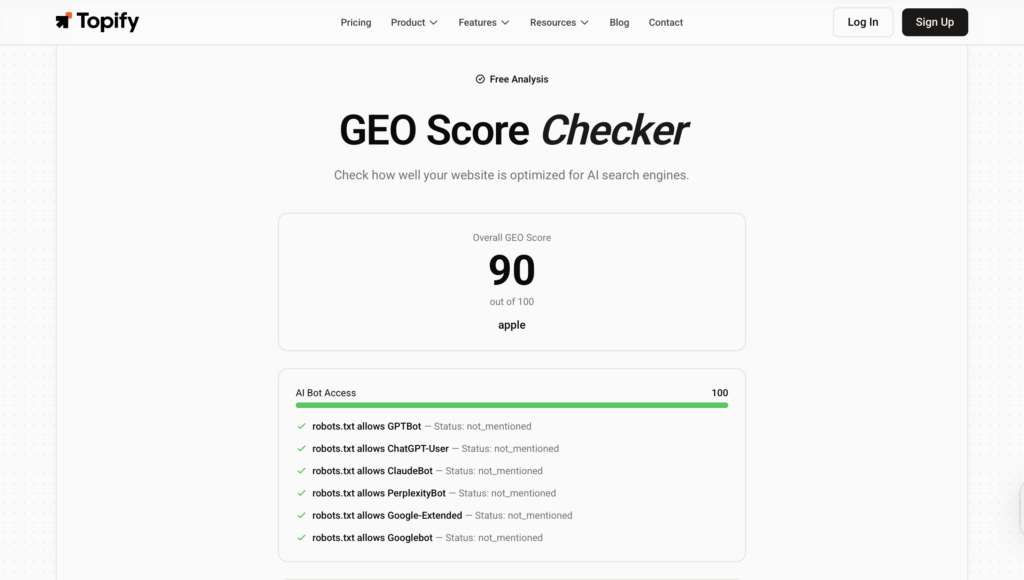
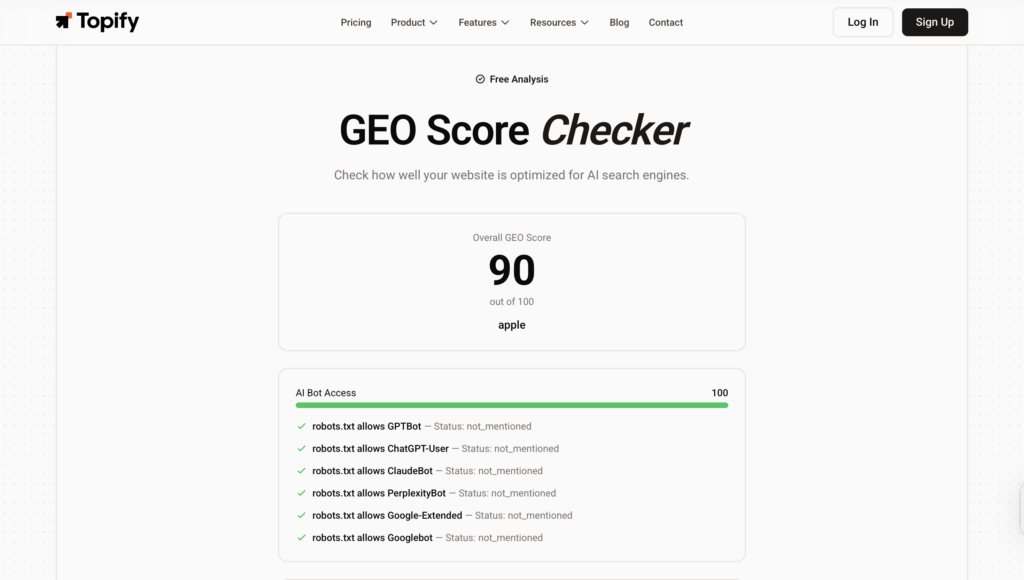
    You can check where your content stands right now with Topify’s GEO Score Checker, which runs 22 technical checks across content quality, AI readiness, technical structure, and authority signals.
    What AI Visibility Score Actually Captures

    AI Visibility Score measures something else entirely: how often your brand actually appears in AI-generated answers across real platforms like ChatGPT, Gemini, and Perplexity.

    It’s expressed as a share of citations for a defined set of category prompts. And the numbers are stark. Industry tracking data from 2026 shows the median brand sits at roughly 0.3% AI Visibility. Top performers in competitive categories reach 12% to 30%. That gap isn’t a rounding error; it’s the difference between being part of the AI conversation and being invisible to it.

    AI Visibility also captures dimensions a GEO Score can’t touch: where you rank within an answer (first mention vs. buried alternative), how AI describes your brand over time, and which specific user intents cause you to appear or disappear.

    The Gap Most Teams Don’t See Coming

    A 2026 analysis of 1,528 company reports found that the correlation between technical GEO Score and real-world AI Visibility was just 0.080. The correlation between brand authority (presence across high-credibility third-party sources) and AI Visibility was 0.386, nearly five times higher.

    That’s not a small gap. That’s a different variable entirely.

    The reason comes down to how LLMs actually select sources. They don’t just retrieve the cleanest content; they cross-reference claims across multiple independent sources before committing to a citation. If your brand makes a strong claim on your own domain but that claim isn’t corroborated by analyst reports, review platforms, or editorial coverage, the model often discards it.

    A brand with high authority and a mediocre GEO Score averaged 0.651 AI Visibility in that same study. A brand with a high GEO Score but low authority averaged 0.548. Technical readiness without off-page trust consistently underperforms.

    Why the Slot Competition Makes This Urgent

    Traditional search gives you ten blue links. AI answers give you two to five citation slots, sometimes fewer.

    That scarcity changes the stakes. Ranking first on Google for a query doesn’t protect you if the LLM synthesizing that same query picks three other sources instead. You can be a market leader in traditional search and functionally invisible in AI answers simultaneously.

    This isn’t a hypothetical edge case. It’s what the data shows for most brands right now.

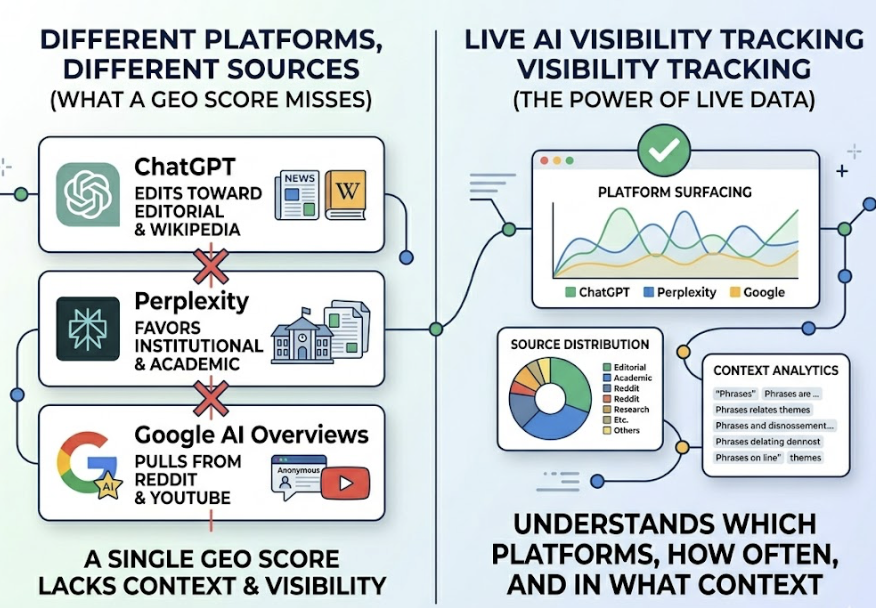
    The other complication: different AI platforms cite differently. ChatGPT skews toward editorial sources and Wikipedia. Perplexity heavily favors institutional and academic sources. Google AI Overviews pulls heavily from Reddit and YouTube. A GEO Score doesn’t tell you which platforms are surfacing your brand, how often, or in what context. Only live AI Visibility tracking does.
    How to Use Both Together

    The two metrics work as a sequence, not a choice.

    Start with your GEO Score. It tells you whether the technical foundation is in place: whether bots can crawl your pages, whether your content is chunked in a way that RAG systems can extract, whether your schema markup helps the model understand what your brand actually does. Fixing GEO Score gaps is table stakes; it’s what gets you into the retrieval pool.

    Then track your AI Visibility. This tells you what’s actually happening once you’re in that pool. Are you being selected? In which contexts? For which intents? Against which competitors? These questions can’t be answered by a technical audit.

    GEO ScoreAI Visibility Score
    What it measuresContent readiness for AI retrievalActual citation frequency in AI answers
    Type of metricStatic snapshotDynamic, ongoing
    Update frequencyOn-demand auditContinuous tracking
    Primary actionFix technical and content gapsOptimize off-page authority and citation share
    Tells youWhether AI can cite youWhether AI does cite you

    Use Topify’s GEO Score Checker to run the technical diagnostic. Then use Topify’s AI Visibility Checker to track how your brand is actually showing up across ChatGPT, Gemini, Perplexity, and other major platforms in real time.
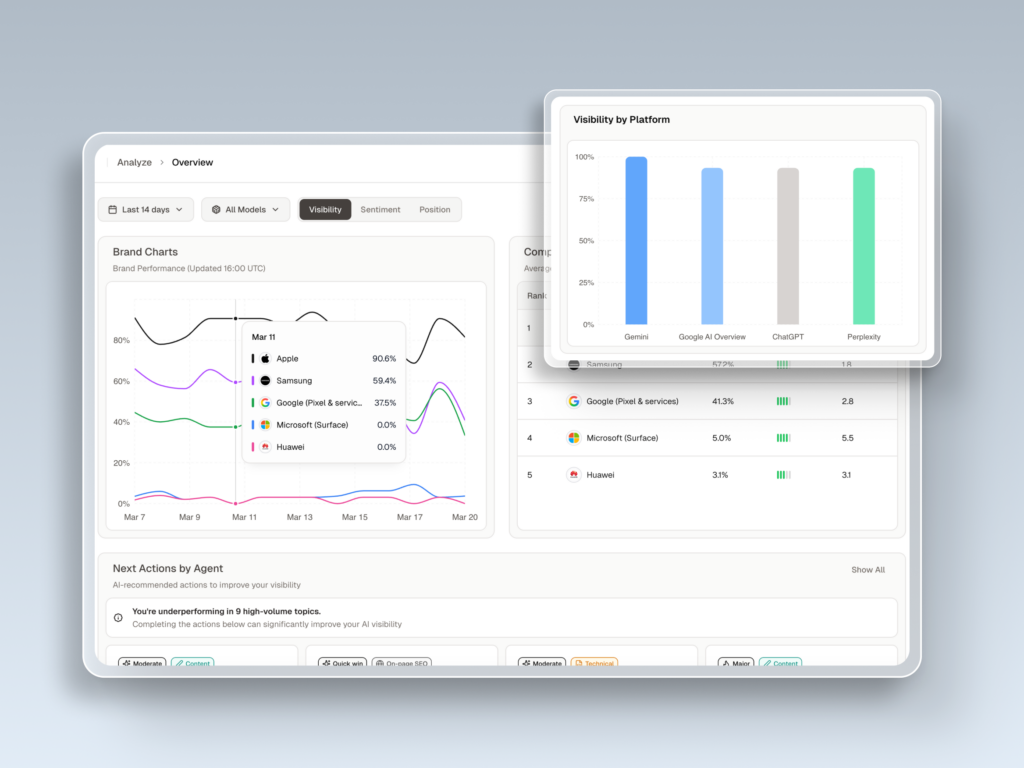
    The path from readiness to actual visibility becomes a lot clearer when you can see both numbers side by side.

    Conclusion

    A good GEO Score and strong AI Visibility aren’t the same thing, but you need both. The GEO Score tells you whether AI can pick up your content. The AI Visibility Score tells you whether it does. Most brands are investing in readiness and stopping there, which explains why the median brand’s AI Visibility sits at just 0.3% while top performers are at 12% and climbing.

    Start with the technical foundation. Then track the real-world results. The gap between those two numbers is where your actual opportunity lives.

    FAQ

    Is GEO Score the same as AI Visibility?

    No. GEO Score measures whether your content is technically structured for AI retrieval. AI Visibility Score measures whether AI systems actually cite your brand in their answers. A brand can score well on the former and still have near-zero performance on the latter.

    How often should I check each metric?

    Run a GEO audit when you publish or significantly update content, and after major site changes. AI Visibility needs continuous tracking because AI citation behavior shifts as models update, competitors publish new content, and platform sourcing patterns evolve.

    What’s a realistic AI Visibility benchmark to aim for?

    The median brand sits around 0.3%. Reaching 2% to 10% puts you in the category presence tier; you’re appearing in comparison contexts and long-tail queries. Top-tier performers consistently hit 12% and above. The right benchmark depends on your vertical and competitive set.

    Can I improve AI Visibility without improving my GEO Score first?

    Partially. Off-page authority signals (analyst coverage, editorial mentions, review platform presence) drive visibility independently of on-page technical quality. But brands with both tend to outperform brands that focus on only one. Technical readiness removes friction; authority creates preference.

    Why do different AI platforms show different visibility results?

    Each platform has distinct sourcing behavior. ChatGPT pulls broadly from editorial and corporate sources; Perplexity skews academic and institutional; Google AI Overviews leans heavily on Reddit and user-generated content. A single GEO audit can’t account for these platform-specific citation patterns. Cross-platform tracking is the only way to see where you actually stand.
    Read More

  • Your GEO Score Is Low. Here’s What to Fix First.

    Your GEO Score Is Low. Here’s What to Fix First.

    You ran the numbers. Your GEO score came back lower than expected, and now you’re looking at four dimensions wondering which one to actually fix first. Most teams pick the easiest one, or the one that sounds most familiar. That’s usually the wrong call.

    GEO score improvement isn’t about effort volume. It’s about fix order. The four dimensions interact, and optimizing Visibility before fixing Authority is roughly equivalent to running ads to a page that doesn’t load. The sequence matters. So does knowing which problems inside each dimension show up most often, and which ones move your score the most.

    Before anything else: if you haven’t run a baseline check yet, use the Topify GEO Score Checker to get your dimension-level breakdown. The fixes below are organized to match exactly what you’ll see in that report.

    The Fix Order That Actually Moves Your GEO Score

    Not all four dimensions carry equal weight. Research into AI citation patterns shows a clear hierarchy:

    DimensionRole in GEOFix Timeline
    AuthorityPrerequisite: AI won’t cite what it can’t verify3–6 months (compounds)
    Content RelevanceLever: fastest scoring gains once entity is established30–45 days
    SentimentFilter: blocks recommendations even with strong visibility60–90 days
    VisibilityOutcome: the measure, not the mechanismOngoing

    The logic is this: LLMs run an entity resolution check before they surface any content. If the model can’t confirm who you are through third-party corroboration, your on-site optimization goes to waste. That’s why Authority is the prerequisite. Content Relevance is where you gain fast ground once the model recognizes your entity. Sentiment is the last filter before a recommendation is made. Visibility is what you measure, not what you directly control.

    Work top to bottom. Here’s what breaks in each dimension, and how to fix it.

    Dimension #1 — GEO Authority: The Prerequisite You Can’t Skip

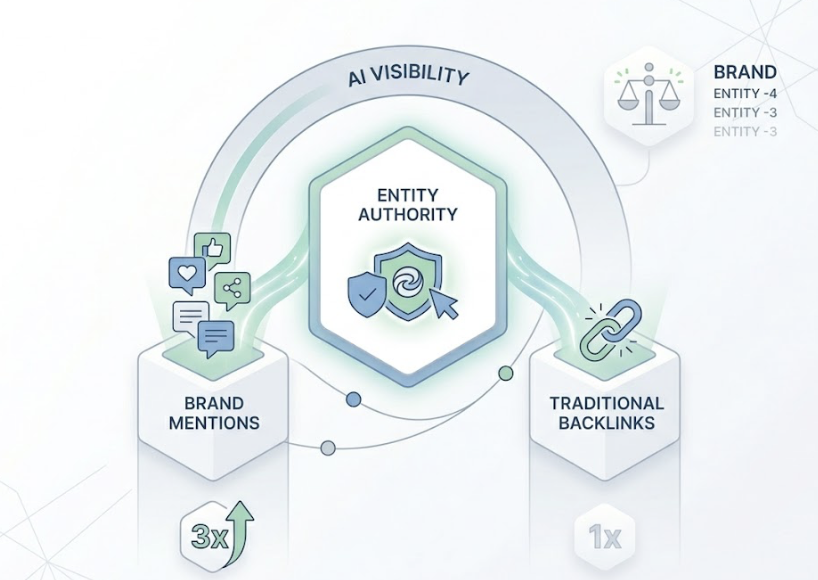
    Authority in GEO isn’t about domain rating or backlink count. It’s about what AI systems call “entity confidence”: how consistently and how broadly your brand is described across independent sources. Research shows that unlinked brand mentions are 3x more predictive of AI visibility than traditional backlinks, with a correlation coefficient of +0.664 compared to backlinks, which show roughly -70% predictive correlation with AI citation rates.

    This is the dimension most teams underestimate, because it looks nothing like traditional SEO.

    Problem 1: AI Platforms Can’t Find Credible Third-Party References About You

    When AI models lack external validation for a brand, they become “cautious” by design. The model defaults to recommending established competitors instead. The mechanism behind this is what researchers call the “Consensus Mechanism”: if multiple unrelated sites describe a brand in similar terms for the same use case, the AI treats this as established consensus and cites accordingly.

    Fix: Shift from link-building to entity seeding. Identify the trade publications, news outlets, and niche forums that AI platforms use as grounding sources, and secure genuine placements there. A single mention in a Tier 1 outlet carries more signal than dozens of low-authority blog links, because AI models apply “epistemic rigor” when evaluating source quality. Start with 5–10 unlinked mentions in industry-specific publications to establish a Trust Neighborhood.

    Problem 2: Your Brand Isn’t Present in High-Authority Training Sources

    Wikipedia accounts for roughly 16–48% of ChatGPT’s citation weight, depending on the query type. It isn’t just a search result for LLMs. It functions as the instruction manual that AI systems use to categorize and verify entities. Brands that are absent from Wikipedia and Wikidata carry structural ambiguity that suppresses citation rates.

    Fix: Build a proactive presence management strategy. This includes ensuring your brand or methodology has a Wikidata entry with proper “semantic triples” (Subject → Predicate → Object) that eliminate entity ambiguity. Podcast appearances also matter here. Transcripts are increasingly indexed for RAG retrieval, and a guest appearance on a recognized industry podcast creates a verifiable, structured mention that AI systems can extract and attribute.

    Problem 3: All Your Citations Point Back to Your Own Domain

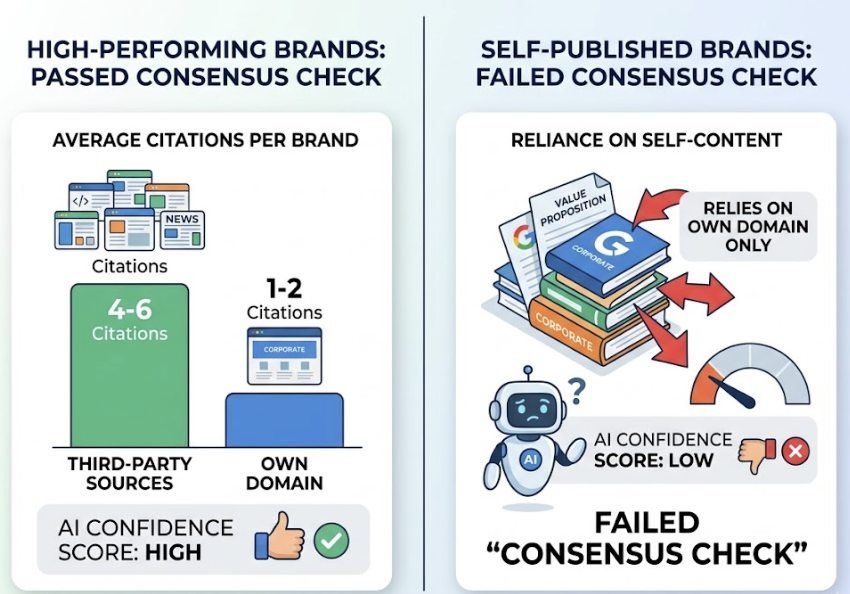
    Research from AirOps found that top-performing brands in ChatGPT average 4–6 citations from third-party sources versus only 1–2 from their own domain. Brands that rely primarily on self-published content to define their value proposition fail what’s called the “Consensus Check.” If you’re the only source making a claim about yourself, AI confidence scores stay low.

    Fix: Audit your current citation footprint. If the majority of your brand’s AI-visible content originates from your own domain, that’s the problem to solve first. Diversify through guest contributions, PR placements, co-authored reports, and genuine Reddit participation. Domain diversity is the strongest predictor of ChatGPT citation rate.

    Dimension #2 — GEO Content Relevance: The Fastest Win Available

    Once AI systems can resolve your entity, content relevance becomes the highest-leverage dimension for quick scoring gains. Structural changes here, such as reformatting existing pages and adding direct answer blocks, can show measurable improvement in 30–45 days. Authority compounds slowly. Content relevance moves fast.

    The core insight: AI systems don’t read pages the way humans do. They “chunk” content into discrete units and retrieve the chunk most likely to answer a specific sub-query. Long-form narrative with a delayed payoff fails at retrieval.

    Problem 1: Your Content Answers the Wrong Questions

    Most content teams still build around keyword volume. AI search is intent-driven, not keyword-driven. The conversational prompts being sent to AI systems today average 23–60 words, not the 3–4 word queries that defined traditional search strategy. That’s a fundamentally different type of question, and it requires different content to answer.

    Fix: Run a prompt mapping exercise against your category. Identify 500–1,000 natural-language questions that buyers ask at different funnel stages: problem discovery, solution comparison, and risk evaluation. Tools like Topify’s AI Volume Analytics can surface high-volume prompts specific to your brand and category, so you’re building content around questions AI is actually being asked, not keyword variants no one is typing anymore.

    Problem 2: Your Pages Use SEO Language, Not AI Answer Language

    Traditional SEO content is built for dwell time. The payoff often comes after several paragraphs of context-setting. In GEO, that’s a liability. AI engines favor what researchers call “Atomic Knowledge Blocks”: short, self-contained paragraphs of 40–60 words that deliver a complete idea in retrievable form.

    Research from Princeton and IIT Delhi found that adding a direct 1–2 sentence answer capsule at the top of a content section correlates with up to a 40% lift in citation frequency. Statistics embedded at roughly one data point per 150–200 words can add 31–37% visibility improvement. Expert quotes with clear attribution carry a 37–41% lift.

    Fix: Retrofit your highest-traffic pages first. Rewrite the opening 50 words of each major section as a direct “bottom-line-up-front” answer. Add a relevant statistic or expert citation. Use H2/H3 headers phrased as literal user questions. These are structural changes, not content rewrites. They can be executed at scale without a large content team.

    Problem 3: You Have Category Gaps That Competitors Are Filling

    Topical authority is the strongest predictor of AI citation, with a correlation coefficient of r=0.41, significantly outperforming domain authority (r²=0.032). Pages in positions 6–10 with strong topical coverage are cited 2.3x more than pages in position 1 with thin or scattered content. Ranking high doesn’t protect you if a competitor owns the semantic depth.

    Fix: Run a discrepancy audit. Identify high-intent prompts in your category where competitors are being cited and you’re absent. Priority targets are “Best [category] for [use case]” and “Compare X vs Y” style queries. Use Topify’s Source Analysis to see exactly which domains AI platforms are citing in your category, and map your content coverage against those gaps.

    Dimension #3 — GEO Sentiment: The Silent Score Killer

    Sentiment is where GEO diverges most sharply from traditional SEO. A search engine ranks a technically sound, high-backlinked page without reading it for tone. A language model does read it, and it makes a judgment about favorability before deciding whether to recommend.

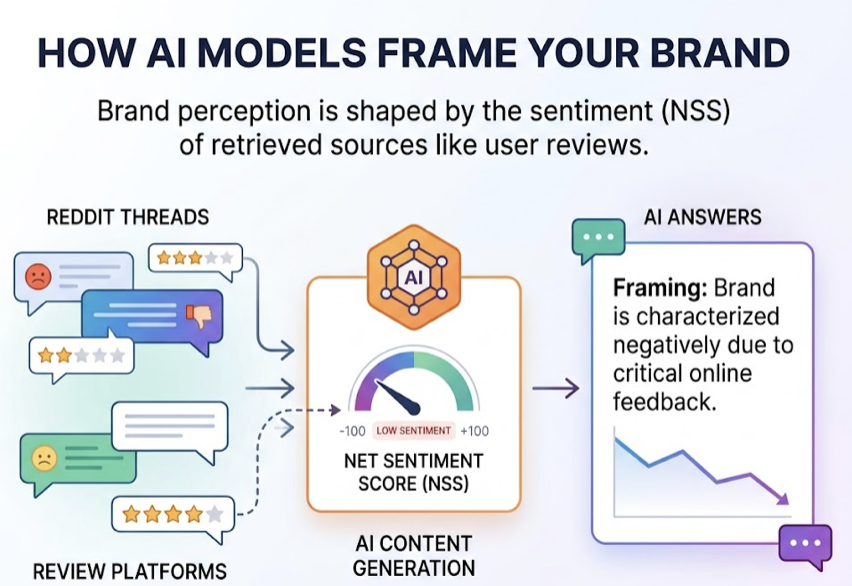
    If your brand is associated with negative signals in training data or in actively crawled sources, the model may exclude you from “Best” recommendations entirely, or include you with cautionary framing. That’s not a ranking issue. It’s a sentiment issue, and it won’t respond to on-site optimization.

    Problem 1: Negative Third-Party Content Is Being Surfaced Repeatedly

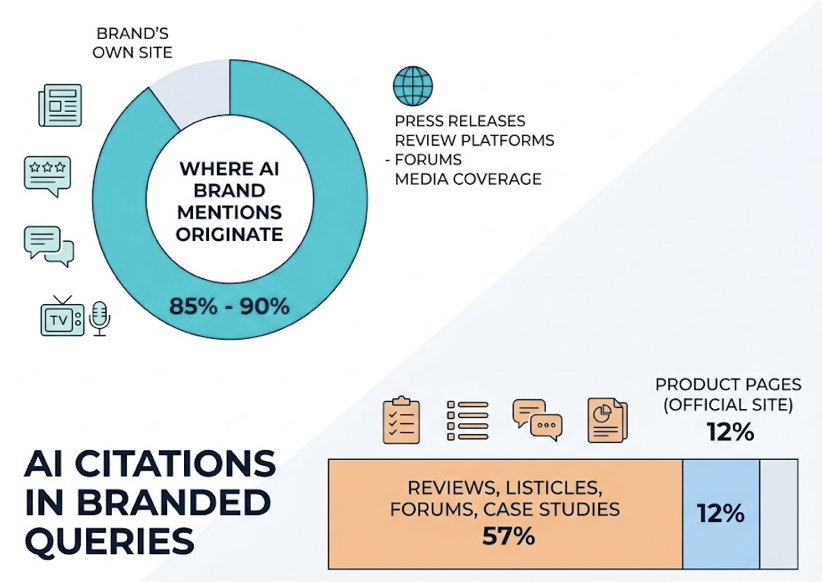
    Roughly 85% of AI brand narrative is constructed from third-party domains, not your own website. If critical forum threads, outdated crisis reports, or negative review patterns are being repeatedly surfaced by AI engines, you have an input problem. AI systems don’t fabricate sentiment. They resolve conflicting inputs, and if the majority of external sources frame your brand in negative terms, that becomes the stated consensus.

    Fix: Signal dilution, not suppression. You can’t optimize away negative sentiment. The fix is making meaningful, verifiable changes and then generating fresh, positive third-party coverage at volume to shift the overall signal. Reddit is worth specific attention here. It’s the most-cited UGC platform in most AI environments, and authentic participation in relevant subreddits can build authoritative, positive context that dilutes older negative threads.

    Problem 2: AI Describes Your Brand in Neutral or Vague Terms

    Neutral isn’t safe. If an AI describes you as “one option to consider” or uses vague generic framing, it means the model can’t confidently assign your brand to a specific audience or differentiated use case. This is called Brand Drift, and it typically results from inconsistent positioning across your digital touchpoints.

    Fix: Entity hygiene. Audit your brand’s name, category, and primary differentiator across your website, LinkedIn, Crunchbase, G2, social profiles, and any other indexed properties. These descriptors should be identical, not just similar. When multiple sources use the same language to describe your brand, the model’s confidence score rises and the framing becomes consistent and specific rather than vague.

    Use Topify’s Sentiment Analysis feature to monitor the exact adjectives and descriptors AI platforms are currently associating with your brand. You can’t fix drift you can’t measure.

    Dimension #4 — GEO Visibility: Present, But Not Prominent

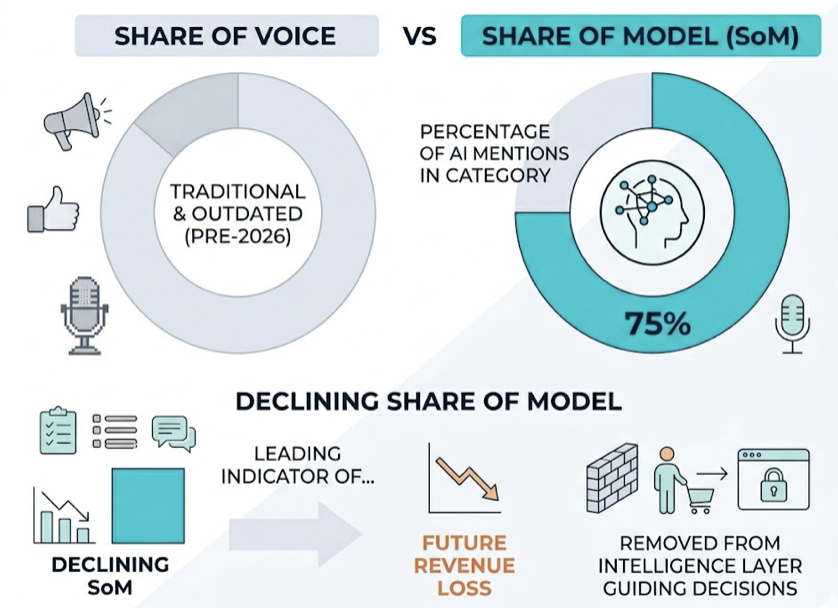
    Visibility is the output dimension, not an input. It measures “Share of Model” (SoM): how often and how prominently your brand appears across a test set of high-intent prompts. Teams that try to optimize Visibility directly, without fixing the upstream dimensions, tend to see marginal gains at best.

    That said, once the foundation is in place, two problems account for most of the gap between brands that appear and brands that get recommended.

    Problem 1: You Show Up in AI Answers, But Not in First Position

    First-position mentions in AI responses aren’t just more visible. Research shows they capture up to 74% of user attention in Perplexity-style roundups, and they set the framing context for every other recommendation in the response. Being mentioned fifth in a list is functionally different from being mentioned first.

    Fix: Analyze the content characteristics of the brands holding first position in your category. AI models preferentially recommend brands they can describe with the highest density of verifiable data: specific pricing, documented outcomes, concrete comparison points. If a competitor owns a label like “best for enterprise teams,” displacing them requires a deliberate comparison matrix strategy that introduces specific, AI-verifiable attributes they don’t have.

    Topify’s Competitor Monitoring shows you exactly which brands are holding first-position recommendations in your target prompts, and what signals they’re carrying that you currently aren’t.

    Problem 2: You’re Strong on One Platform, Invisible on Others

    Only 11% of domains are cited by both ChatGPT and Perplexity, because the platforms rely on different underlying indices. ChatGPT Search favors Wikipedia and news sites through the Bing index. Perplexity leans toward Reddit and real-time content with a strong 30-day recency bias. Google AI Mode correlates most strongly with top-10 organic rankings. Claude applies a high bar for academic and research-grade sources.

    A brand can have strong Perplexity visibility through fresh, Reddit-corroborated content and near-zero ChatGPT visibility due to weak foundational authority signals.

    Fix: Cross-platform visibility testing. Run your core prompts across multiple AI platforms and map where you appear and where you don’t. That pattern tells you what’s missing: recency signals, foundational authority, or organic ranking health. Topify’s Visibility Tracking covers ChatGPT, Gemini, Perplexity, DeepSeek, and others, so you can see your cross-platform Share of Model in a single view instead of testing manually.

    Conclusion

    The dimension breakdown exists for a reason. Total GEO score is a lagging indicator. It tells you where you ended up, not where to push. The four dimensions tell you what to fix, and the sequence tells you what to fix first.

    Start with Authority. Build entity confidence through third-party corroboration before anything else. Once the model recognizes your brand as a verifiable entity, Content Relevance changes move fast: retrofit your pages with direct answer blocks, close your topical gaps, and embed data density. Sentiment runs in the background as a filter, and Neutral isn’t safe enough. Visibility is what you monitor as the upstream work compounds.

    Every one of these fixes is measurable. Use Topify to track your dimension scores as you move through the sequence, so you know when each lever has done its work and it’s time to move to the next.

    FAQ

    How long does it take to improve a GEO score after making changes?

    Structural content changes, like adding statistics, direct answer blocks, and schema markup, can show initial results within 30 to 45 days. Building entity authority through Wikipedia, Tier 1 media mentions, and Wikipedia/Wikidata entries is a longer-term effort that typically compounds over 6 to 12 months.

    Which GEO score dimension has the highest weight?

    Authority and Entity Clarity carry the highest weight because they’re the prerequisite for retrieval. Without a verified entity signal, content optimization has minimal impact. Research indicates that topical authority and unlinked brand mentions on high-authority sites are the strongest predictors of AI citation rate.

    Can I improve my GEO score without a large content team?

    Yes. GEO improvement is more about content structure and factual density than content volume. Small teams should focus on retrofitting existing high-traffic pages with atomic knowledge blocks, adding one statistic per 200 words, and ensuring schema and bot-accessibility signals are clean. Those changes don’t require new content, just structural editing of what already exists.

    Read More

  • Your GEO Score Has 4 Parts. Most Marketers Only Fix One.

    Your GEO Score Has 4 Parts. Most Marketers Only Fix One.

    A SaaS brand spent three months rewriting every product page. Sharper copy. More data. Better structure. Then someone asked ChatGPT to recommend tools in their category, and the brand wasn’t mentioned once.

    The problem wasn’t the content. It was that GPTBot, OpenAI’s retrieval crawler, had been blocked by a single line in their robots.txt file. The AI never saw the page.

    That’s what a GEO score is designed to catch. It’s not a single number measuring how “good” your content is. It’s a four-dimensional diagnostic that measures whether an AI can access your pages, understand them, trust them, and actually recommend you. Miss any one dimension and the others don’t matter.

    As traditional search volume is projected to decline by 25% by late 2026, and 93% of AI sessions already end without a click to any external site, your brand’s presence inside AI-generated answers is no longer optional. It’s the only impression you might get.

    What a GEO Score Actually Measures

    GEO stands for Generative Engine Optimization. A GEO score quantifies how well a brand is positioned to be cited by AI platforms like ChatGPT, Perplexity, and Gemini.

    Unlike an SEO score, which optimizes for “the click,” a GEO score optimizes for “the citation.” And the stakes are different: GEO-driven visitors convert at up to 12.9x higher rates than standard organic traffic. Each citation carries more weight than a standard impression ever did.

    The four dimensions of a GEO score follow a strict causal sequence:

    DimensionAnalogyWhat It Controls
    AI Crawler AccessThe GatekeeperCan AI find and fetch your pages?
    Structured DataThe TranslatorCan AI parse what your content means?
    Content SignalsThe RecommenderDoes AI consider your content worth citing?
    AI VisibilityThe Screen PresenceHow often does AI actually mention you?

    Each dimension is independent enough to diagnose separately. Together, they form a chain: a failure in Dimension 1 makes Dimensions 2, 3, and 4 irrelevant.

    Dimension 1 — AI Crawler Access: Can AI Even Find Your Pages?

    This is where most brands lose before they even start.

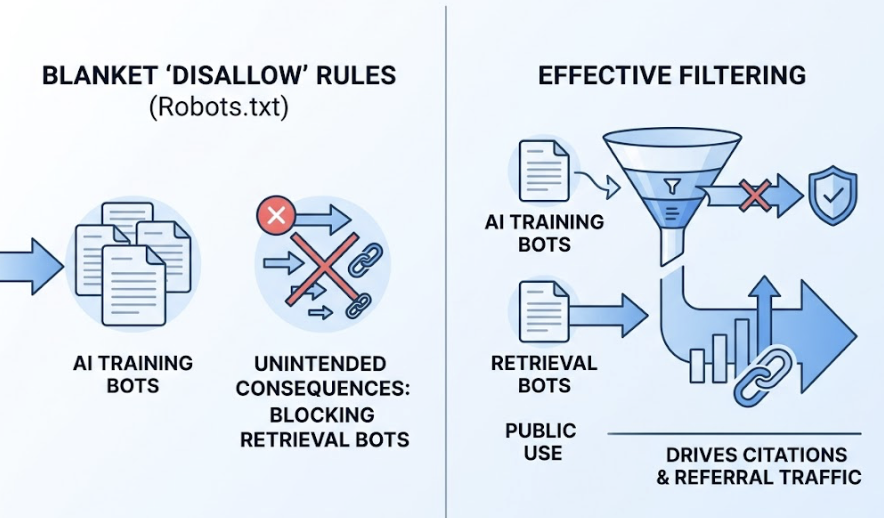
    Modern AI platforms use dedicated crawlers to index content in real time. OpenAI alone runs three: GPTBot for model training, OAI-SearchBot for search indexing, and ChatGPT-User for live retrieval during conversations. Perplexity uses PerplexityBot. Anthropic uses ClaudeBot.

    The problem is that many websites, particularly publishers and enterprise sites, have deployed blanket “Disallow” rules in their robots.txt files. According to data from Cloudflare and Buzzstream, 79% of top news sites block at least one AI training bot. Many are also unknowingly blocking retrieval bots in the same sweep — the bots that would actually drive citations and referral traffic.

    The distinction matters enormously. Blocking GPTBot (training) might be a reasonable business decision. Blocking OAI-SearchBot or ChatGPT-User is effectively opting out of appearing in ChatGPT responses entirely.

    There’s a second technical layer: JavaScript rendering. Many AI retrieval pipelines cannot execute client-side JavaScript. They see a “ghost page” with none of the content that renders in a browser. Server-Side Rendering (SSR) or pre-rendering for bot traffic ensures that your actual content is visible during the initial fetch.

    A brand can rank on page one of Google and remain completely invisible to a user asking ChatGPT the same question. Crawler access is the prerequisite for everything else.

    Dimension 2 — Structured Data: Does AI Understand What You’re Saying?

    Getting crawled is the baseline. Getting understood is the next gate.

    AI systems don’t read pages the way humans do. They use Named Entity Recognition and relationship mapping to build an internal knowledge graph of a topic. Structured data, specifically Schema.org markup in JSON-LD format, acts as a translator that removes the ambiguity from that process.

    The most direct application is entity disambiguation. An Organization schema, linked via the sameAs property to verified profiles on Wikipedia, Wikidata, or LinkedIn, tells an AI model exactly who created the content and whether they’re credible. Without this layer, the AI is guessing.

    Pages with well-implemented structured data are 36% more likely to appear in AI-generated summaries.

    Among all schema types, FAQPage markup has the highest leverage for GEO. Google pulled back FAQ rich results from traditional SERPs in 2023, but AI platforms have moved in the opposite direction — they treat FAQ schema as a preferred extraction format. Because the question-answer structure is already pre-packaged, the AI can cite the content with high confidence without needing to interpret narrative prose.

    The numbers bear this out: FAQ schema increases citation rates by 28% to 89%, and pages with FAQ schema are 3.2x more likely to appear in Google AI Overviews.

    One important ceiling to understand: schema doesn’t substitute for authority. Research into ChatGPT’s citation patterns shows an “Authority-to-Schema” ratio of roughly 3.5:1. Perfect schema implementation adds around 10% weight to the citation evaluation. It’s a last-mile optimizer — it ensures strong content gets extracted accurately rather than skipped due to parsing errors. It can’t rescue weak content.

    Dimension 3 — Content Signals: Is Your Content Worth Citing?

    Assuming a crawler can access the page and the AI can parse its structure, the third question is whether the content itself earns a citation.

    Generative engines are calibrated to provide accurate, specific answers. That shifts the content strategy away from keyword presence toward what researchers call “information gain” — data, claims, or findings that aren’t already present in the model’s training data.

    Content format matters significantly. Comprehensive guides with supporting data have a 67% citation rate. Comparison matrices and review content come in at 61%. Opinion pieces and general thought leadership without supporting data average only 18%. AI systems value objective, extractable facts over subjective narrative.

    The placement of information on the page is equally important. An analysis of 1.2 million ChatGPT responses found that 44.2% of citations originate from the first 30% of a webpage. Burying the answer in a long narrative introduction is one of the most common and costly GEO mistakes. Pages that place a concise 40-60 word direct answer immediately after an H2 tag are cited 2.4x more often than those that don’t.

    Quantitative specificity is also a consistent signal. AI systems show a 40% higher citation rate for content containing specific numbers and percentages compared to qualitative statements. The difference between “our software is fast” and “our software reduces latency by 40% according to the 2025 Benchmarking Report” is the difference between being invisible and being cited.

    Semantic HTML tables and structured lists push that advantage further: structured formats produce 2.5x to 2.8x higher citation rates than plain text equivalents covering the same information.

    Dimension 4 — AI Visibility: How Often Does AI Actually Mention You?

    The first three dimensions are inputs. AI Visibility is the output. It measures how frequently and how favorably your brand appears inside AI-generated responses.

    The key metric here is Share of Model (SoM), the GEO-era equivalent of Share of Voice. It’s calculated as the percentage of AI responses in a defined prompt set that mention your brand, relative to all brand mentions in that category.

    $$\text{Share of Model} = \frac{\text{Responses Mentioning Your Brand}}{\text{Total Responses Mentioning Any Brand in Category}}$$

    An AI mention rate of 10-15% across relevant prompts is considered healthy. Above 30% signals category leadership. But raw frequency isn’t the whole picture.

    Position within a response carries significant weight. Brands named first in a recommendation list signal “primary entity” status and receive disproportionate user attention. Position tracking uses a weighted formula where the first mention carries 5x more value than the fifth.

    Sentiment is the other variable that raw visibility hides. A brand with 25% visibility and an 80/100 sentiment score will consistently outperform a brand with 40% visibility and a 50/100 sentiment score in actual conversion outcomes. Being mentioned frequently as “expensive and complex” is worse than being mentioned less often in a favorable context.

    You can’t optimize what you can’t see.

    That’s why AI Visibility requires systematic, cross-platform monitoring across ChatGPT, Perplexity, Gemini, and others — not manual spot checks. The data changes fast: 40-60% of cited sources rotate monthly.

    Why Your GEO Score Won’t Move If You Only Fix One Dimension

    The most expensive GEO mistake is siloed optimization.

    A brand invests in high-quality, well-structured content (Dimension 3) while their robots.txt blocks the crawlers that would retrieve it (Dimension 1). Result: zero improvement in AI visibility despite significant content investment. Researchers call this the “Invisibility Paradox.”

    The four dimensions aren’t parallel tracks. They’re a sequence. Crawler access determines whether content can be ingested. Structured data determines whether ingested content can be understood. Content signals determine whether understood content is worth citing. AI visibility shows whether cited content is building brand presence.

    The correct optimization order is:

    1. Verify crawler access for GPTBot, OAI-SearchBot, and PerplexityBot
    2. Implement Organization, Product, and FAQ schema with sameAs entity anchoring
    3. Restructure key pages for Answer Capsule format and quantitative density
    4. Monitor Share of Model, sentiment, and position across platforms

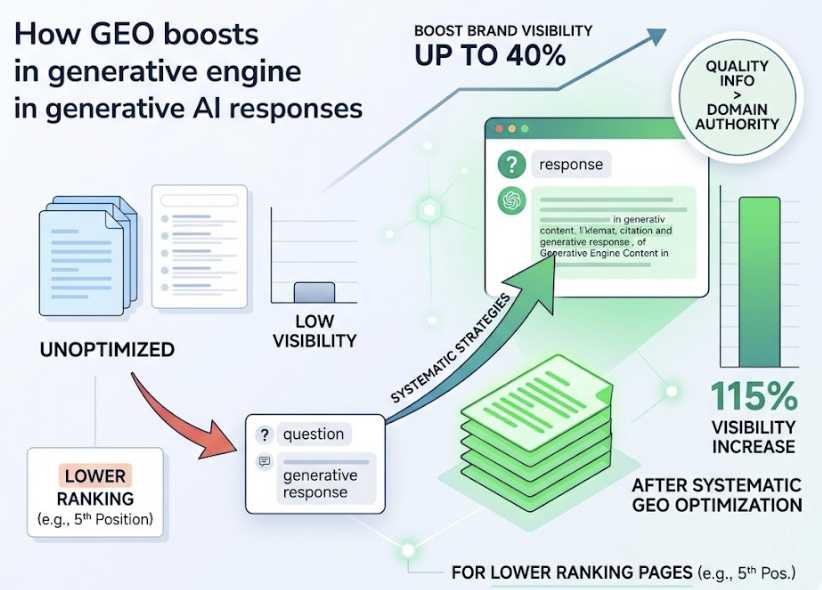
    Research from Princeton and IIT Delhi confirms that applying these strategies systematically can boost brand visibility in generative responses by up to 40%. Sites in lower positions see even larger gains: pages ranking fifth see a 115% visibility increase after systematic GEO optimization. Quality of information can override historical domain authority in this environment.

    Prioritizing Dimension 1 before Dimension 3 isn’t just logical. It’s the difference between content investment that compounds and content investment that disappears.

    Check Your 4-Dimension GEO Score Before You Optimize Anything

    Before rewriting a single page or adding schema markup, you need a baseline. Otherwise, you’re optimizing blind.

    Manually auditing all four dimensions requires technical crawl testing, cross-platform AI sampling, schema validation, and content analysis — running them together across multiple AI platforms takes significant time and specialized tooling most marketing teams don’t have in-house.

    The Topify GEO Score Checker automates that diagnostic. It queries AI platforms directly in real time and returns a four-dimensional scorecard showing exactly where your scores stand across Crawler Access, Structured Data, Content Signals, and AI Visibility. It’s free to run, and it takes minutes rather than days.

    One particularly useful output: the tool identifies “high-traffic, zero-citation” pages by correlating your existing traffic data with AI mention rates. These pages have the authority to rank but lack the formatting to be cited. They’re the highest-priority targets for structural optimization because the underlying authority is already there.

    Once you know where each dimension stands, the next step is watching how they move. Topify’s continuous tracking feature monitors changes across all four dimensions over time, surfacing shifts in AI citation patterns and competitor positioning as they happen. When 40-60% of cited sources rotate monthly, point-in-time scores aren’t enough. Trend data is where the real strategic signal lives.

    Conclusion

    A GEO score isn’t a vanity metric. It’s a diagnostic framework for a search environment where 83% of AI-influenced queries produce no referral traffic and the only impression you may get is a mention inside someone else’s answer.

    Each of the four dimensions does a specific job. Crawler access determines whether you exist in the AI’s retrieval window. Structured data determines whether the AI can accurately interpret what you’re saying. Content signals determine whether the AI considers your information worth recommending. AI visibility tells you whether all of that is actually working.

    Fix one without the others and the chain breaks. Fix all four in sequence and you build the kind of citable authority that compounds — the type where being recommended once makes the next recommendation more likely.

    The brands winning in AI search right now aren’t necessarily the biggest or the oldest. They’re the ones whose information is the most accessible, interpretable, and factually specific to the models making recommendations.


    FAQ

    What is a good GEO score? 

    A score above 85/100 is generally considered excellent, but aggregate scores can hide critical gaps. A brand might score 88/100 overall while scoring 9/100 on schema markup alone. That’s a fixable problem that aggregate visibility conceals.

    How often should I check my GEO score? 

    AI citation data is volatile: 40-60% of cited sources rotate monthly. For competitive categories, weekly re-sampling is recommended. Citation data for informational queries typically decays to 40% of its initial level within 90 days without content refreshes.

    Does a high GEO score affect Google rankings? 

    Indirectly, yes. 76% of AI Overview citations come from the top 10 organic results. Optimizing for entity clarity and structured data (Dimension 2) strengthens your representation in Google’s Knowledge Graph, which lifts organic rankings and increases AI Overview selection probability.

    Can I improve all 4 dimensions at the same time? 

    Technically yes, but it’s inefficient. Brands should fix Dimension 1 (Crawler Access) before investing in content rewrites. Without confirmed crawler access, content improvements produce zero ROI in the AI ecosystem.

    What’s the difference between an SEO score and a GEO score? 

    SEO scores optimize for the click — getting a user to visit your site. GEO scores optimize for the citation — getting an AI to recommend your brand inside its answer. GEO-driven visitors convert at up to 12.9x higher rates than traditional organic visitors, which changes the math on what a single citation is worth.


    Read More

  • How to Check Your GEO Score for Free

    How to Check Your GEO Score for Free

    Your domain authority is solid. Your keyword rankings look clean. But none of that tells you whether ChatGPT is recommending your competitor instead of you. Traditional analytics track clicks. They don’t track whether an AI engine ever considered citing your site in the first place.

    That gap is what a GEO score measures, and 60% of Google searches already end without a click. For AI-native queries, that number is higher. The brands showing up in AI answers didn’t get there by accident. They fixed four specific things. This guide shows you how to find out whether your site has fixed them too.

    Your Website Has an AI Readiness Problem You Can’t See in Analytics

    Search engine rankings are a poor proxy for AI visibility. The two systems use fundamentally different signals.

    Google rewards authority and relevance. AI engines like ChatGPT and Perplexity reward extractability: Can the crawler even access your site? Does the page structure make it easy to pull facts? Is the content dense enough with verifiable data to be worth citing? A top-ranking page that fails these checks gets ignored by AI retrieval pipelines, regardless of its domain authority.

    The conversion data makes this consequential. Visitors arriving via AI referrals convert at 1.2x to 5x higher rates than organic search visitors. Claude referrals, specifically, average a 16.8% conversion rate. That’s not a metric most teams are tracking yet, which is exactly why it’s an opportunity.

    What a GEO Score Actually Measures

    A GEO score is a composite metric, rated on a 0-100 scale, that evaluates four distinct dimensions of AI readiness. Each dimension corresponds to a specific stage in how AI systems retrieve and cite information.

    AI crawler access determines whether bots like OAI-SearchBot, PerplexityBot, and Claude-SearchBot can reach your pages at all. Many sites block these crawlers unintentionally via wildcard rules in robots.txt or through CDN-level settings in tools like Cloudflare.

    Structured data measures the presence and quality of Schema.org markup. AI engines are probabilistic systems. Schema reduces ambiguity, letting the model extract facts with higher confidence. Pages with FAQ schema are weighted 40% higher in ChatGPT’s source selection.

    Content signals evaluate factual density and modular readiness. Research from Princeton University found that adding statistics to a page lifts AI citation probability by up to 40%. Expert quotations add another 37%. The underlying reason: AI engines prefer verifiable specificity over qualitative claims.

    Overall AI visibility tracks your current “Share of Model”—how often AI engines are actually citing or mentioning your brand across relevant queries. This is the outcome dimension. The first three are inputs; this one measures results.

    Score ranges map to actionable tiers: 80-100 means you’re in the retrieval pool consistently; 50-79 signals competitive gaps; below 50 typically indicates a foundational block that’s keeping you out of AI answers entirely.

    AI Crawler Access: The Gate Most Sites Leave Locked

    The robots.txt file used to be simple. In 2026, it’s a governance document that controls access across a dozen distinct AI user agents.

    OpenAI alone operates separate bots for training (GPTBot) and retrieval (OAI-SearchBot). The same split applies to Anthropic and Perplexity. Many webmasters blocked all AI bots during the 2023-2024 period over data privacy concerns. The problem: retrieval bots are what put you in AI answers. Blocking them means your visibility is zero by default.

    The nuanced approach is selective access: allow retrieval-focused agents (OAI-SearchBot, Claude-SearchBot, PerplexityBot/1.0) while blocking training-focused ones (GPTBot, Claude-Searchbot training variants). This way your content appears in real-time AI search without contributing to model training without attribution.

    Structured Data: Why Schema Markup Is Now a GEO Signal

    Schema is no longer optional for AI visibility. Websites with author schema are 3x more likely to appear in AI answers than those without, because the model can trace the information to a credible entity.

    The highest-impact schema types for GEO are FAQPage (maps directly to conversational AI query patterns), Article and BlogPosting (provides freshness signals that Perplexity and others weigh heavily), and Organization/Person schema (establishes E-E-A-T that AI engines use for trust signals in sensitive topic areas).

    How to Check Your GEO Score in Under 2 Minutes

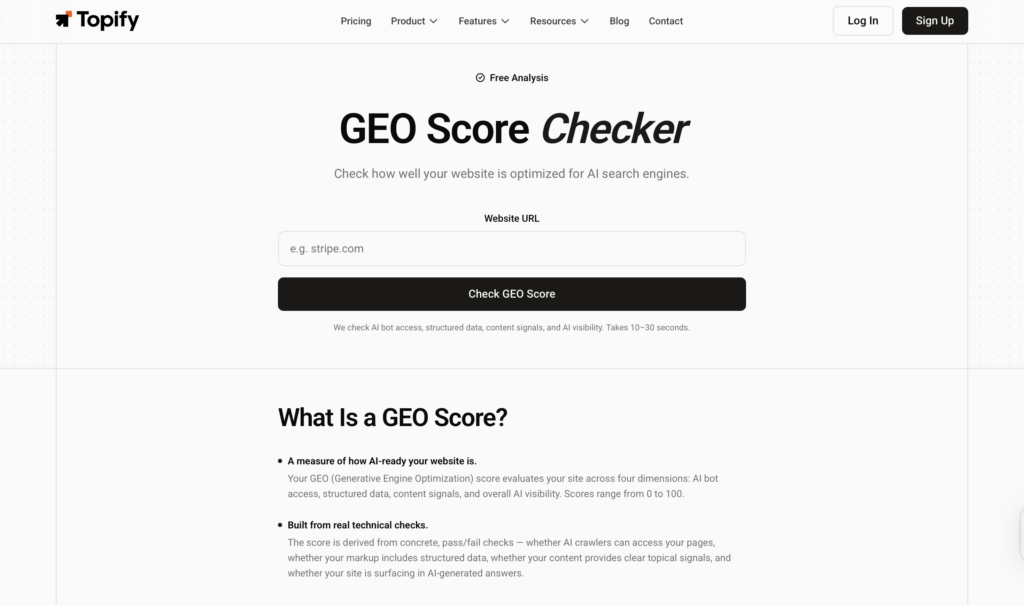
    The Topify GEO Score Checker runs a full four-dimension audit in 10-30 seconds. No login, no setup, no credit card. You enter a domain and get an instant report.

    Here’s what happens when you run it:

    Step 1: Enter your domain. Go to topify.ai/tools/geo-score-checker and type in any URL. You can audit your own site or a competitor’s.

    Step 2: The tool fetches your page using multiple AI user agents. It simulates requests from OAI-SearchBot, GPTBot, PerplexityBot, and others to identify any blocks at the robots.txt or CDN level.

    Step 3: Schema parsing runs in parallel. The checker audits for over 30 schema types, flagging missing or malformed markup that would reduce your citability.

    Step 4: Content analysis evaluates factual density. The tool assesses whether your page content is structured into extractable blocks, following the “modular readiness” criteria that AI retrieval systems favor.

    Step 5: A real-time visibility check pings leading LLMs to see whether your brand or domain is currently being cited for relevant keywords.

    The output is a scored report across all four dimensions, with specific flags on what’s blocking or reducing your AI visibility. The whole process takes under two minutes.

    One underused feature: run the same check on two or three competitors before you run it on yourself. Knowing where you sit relative to the field changes how you prioritize what to fix.

    Reading Your GEO Score Report: What the Numbers Mean

    The composite score tells you your overall AI readiness tier. The per-dimension scores tell you where to focus first.

    A score above 80 means you’re technically sound and content-ready. The gap between good and excellent at this level is usually in content signals—more proprietary data, more attributed expert quotes, more modular formatting. Content updated within the last 30 days is twice as likely to be cited by AI platforms, so freshness maintenance matters even when the fundamentals are solid.

    A score in the 50-79 range typically signals competitive gaps rather than outright blocks. You’re in the retrieval pool, but inconsistently. The most common culprits: partial schema coverage, a few AI crawlers blocked that others can access, or content that reads well but isn’t structured into extractable chunks.

    Below 50 usually means something binary is wrong. Either AI crawlers can’t reach your pages, or your site has essentially no structured data, or both. This is the fastest tier to improve because the interventions are specific and low-cost.

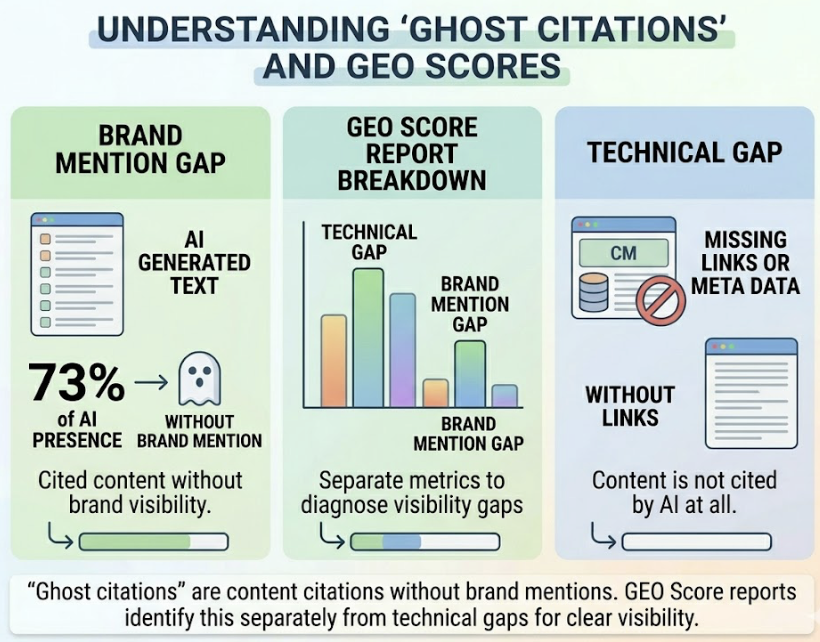
    One metric worth paying attention to beyond the score: the visibility dimension specifically. Research across multiple AI platforms found that 73% of AI presence for some brands consists of citations without brand mentions. A site can be cited extensively in AI answers while the brand name never appears in the generated text. The GEO Score report surfaces this “ghost citation” problem separately, so you know whether you have a technical gap or a brand mention gap.

    After Your GEO Score: 3 Actions That Actually Move the Needle

    The score is a diagnosis. These are the interventions with the strongest evidence behind them.

    Action 1: Fix crawler access first. This is binary. If key AI bots are blocked, your visibility is zero regardless of content quality. Update your robots.txt to explicitly allow OAI-SearchBot, Claude-SearchBot, and PerplexityBot/1.0. If you’re running Cloudflare, check whether the AI bot blocking feature was enabled during the 2023 wave of default settings—it often was. This fix costs nothing and the impact is immediate.

    Action 2: Implement FAQ schema on every informational page. Schema doesn’t require a developer for most CMS platforms. Given the 40% weighting boost for FAQ schema in ChatGPT source selection, it’s the highest-return structured data investment. Pair it with Person schema for author pages to establish the E-E-A-T signals that AI systems use for trust.

    Action 3: Enrich content with proprietary data. Generic content doesn’t win AI citations because AI systems already have generic knowledge in their training data. What they’re looking for in retrieval is “information gain”—data, benchmarks, or survey results they don’t already have. Embedding even one original statistic per article meaningfully shifts the citation probability. Content with 19 or more statistical data points earns nearly double the citations of content with minimal data.

    Once you’ve run these fixes, the next layer of intelligence is tracking how your GEO score changes over time—and how it compares against competitors. Topify’s AI Visibility Checker gives you ongoing Share of Model monitoring across ChatGPT, Perplexity, Gemini, and others, so you’re not just checking a one-time score but watching the trend. The competitor benchmarking feature shows you where rivals are pulling ahead in AI citations before you see it in traditional traffic data.

    Why Free GEO Score Tools Aren’t All the Same

    Not every tool that calls itself a GEO checker is measuring the same thing. The most common limitation: single-dimension audits. A tool that only checks schema, or only checks robots.txt access, gives you a partial picture. A site can have perfect schema and still have zero AI visibility because the crawlers are blocked at the CDN level.

    The ALM Corp overview of generative engine optimization notes that the GEO tool market is fragmenting into specialized niches, with significant variation in what each platform actually measures. The practical question for any free checker is: does it simulate actual AI crawler behavior, or does it check a static checklist? The former catches CDN-level blocks that the latter misses entirely.

    For quick diagnostics on individual URLs, no-login tools are the right starting point. The tradeoff is depth of ongoing monitoring. A free checker tells you where you stand today. A full platform like Topify tracks how that standing shifts week over week, which competitors are gaining ground in AI answers, and which content updates are driving citation improvements.

    The GEO market is projected to reach $33.7 billion by 2034. The tool landscape will consolidate around platforms that can close the loop from diagnosis to action to tracking. Knowing which layer you need—quick audit vs. continuous intelligence—is the main selection criterion.

    Conclusion

    A GEO score tells you something your current analytics stack can’t: whether AI systems can actually find, read, and cite your content. The Topify GEO Score Checker surfaces that information in under two minutes, with no setup required.

    Run the check on your primary revenue-driving URLs first. Then run it on the two or three competitors you most frequently lose deals to. The gaps between those reports are your roadmap. Crawler access, schema coverage, and content factual density are all fixable. The brands that fix them now accumulate an AI citation advantage that compounds as generative search volume continues to grow.

    Start with the free audit. Check your GEO score here.


    FAQ

    Q: What is a GEO score? 

    A: A GEO score is a 0-100 rating of how well your website is optimized for discovery and citation by generative AI engines like ChatGPT, Perplexity, and Google AI Overviews. It evaluates four dimensions: AI crawler access, structured data quality, content signals (factual density and modular structure), and current AI visibility (how often your brand is cited). Unlike an SEO score, it focuses on AI retrieval readiness rather than keyword rankings or backlink profiles.

    Q: How is a GEO score different from an SEO score? 

    A: An SEO score measures ranking signals like keyword relevance, backlink authority, and page speed—factors that affect where you appear in a list of blue links. A GEO score measures whether AI systems can access, extract, and cite your content in synthesized answers. A site can score well on SEO and poorly on GEO if it blocks AI crawlers, lacks structured data, or publishes content that isn’t structured for machine extraction.

    Q: Is the GEO Score Checker really free? 

    A: Yes. Topify’s GEO Score Checker is free to use with no registration required. You enter a domain, and the tool generates a scored report across all four AI readiness dimensions in 10-30 seconds. There’s no credit card, no trial period, and no account creation needed to see the full results.

    Q: How often should I check my GEO score? 

    A: Run a baseline check immediately, then recheck after implementing any changes to robots.txt, schema, or content. For ongoing monitoring, a monthly cadence catches drift from platform updates or competitor improvements. If you’re actively optimizing for AI citations, weekly checks during active campaigns help you correlate content changes to visibility shifts.


    Read More

  • AI Citations: Why They Beat a #1 Google Rank in 2026

    AI Citations: Why They Beat a #1 Google Rank in 2026

    Being ranked #1 on Google used to be the finish line. In 2026, AI citations are where real brand authority gets built — and most marketers haven’t noticed yet.

    You’ve done the work. You’ve earned the top spot. Your page ranks #1 for a high-value keyword, and it’s been sitting there for months.

    Then you check the traffic. It’s down 40% year-over-year — and your ranking hasn’t moved.

    This isn’t a fluke. It’s the structural consequence of a shift that’s been building for two years and hit critical mass in 2026: users no longer need to click your link. They get the answer before they ever see it.

    The metric that actually matters now isn’t your position in the list. It’s whether the AI includes you in its answer.

    Google #1 Used to Be the Finish Line. It Isn’t Anymore.

    In June 2024, the top organic result for an informational query averaged a 1.76% click-through rate. By September 2025, that number had dropped to 0.61% — a 61% collapse — and only for queries where an AI Overview appeared. Even queries without AI Overviews saw CTRs fall to 1.62%.

    That data comes from Seer Interactive, which tracked 3,119 informational terms across 42 organizations over 15 months. The conclusion is hard to argue with: Google is still processing between 9.1 and 13.6 billion queries per day, and search volume is growing. Clicks to websites are not.

    The paradox of 2026 is that more people are searching — and fewer of them are arriving at your site.

    Platforms like Perplexity (780 million queries in May 2025) and ChatGPT (800 million weekly active users) have trained users to expect synthesized answers, not lists of links. When AI handles the research, the information retrieval, and the comparison — all in a single response — the user only clicks when they’ve already decided. Your #1 ranking gets you into the pool of sources the AI draws from. That’s it. Whether you’re named, cited, or recommended is a completely separate question.

    So What Exactly Is an AI Citation?

    An AI citation is a visible reference to your brand or website within an AI-generated answer. It’s not a backlink. It’s not a ranking signal. It’s an explicit attribution that places your brand inside the answer itself — where users are actually paying attention.

    The difference matters more than most marketers realize:

    AspectTraditional BacklinkAI Citation
    VisibilityHidden in source codeVisible in the AI response
    ControlEditors and publishersAI models via RAG logic
    PermanencePersistentTransient, changes per prompt
    Primary valueBuilds ranking authorityBuilds trust at decision moment

    AI citations appear in three forms. Source references show up as clickable cards or footnotes — think Perplexity’s “Sources” box. Brand mentions are when the AI names your brand directly in the response text, as a recommended solution. Content excerpts are when the AI pulls your phrasing or data into its answer, usually with a citation marker.

    Of these, brand mentions carry the most weight. Research puts brand mentions at 3x more predictive of AI visibility than traditional backlinks. Being listed as a footnote source is useful. Being named as the answer is where conversion happens.

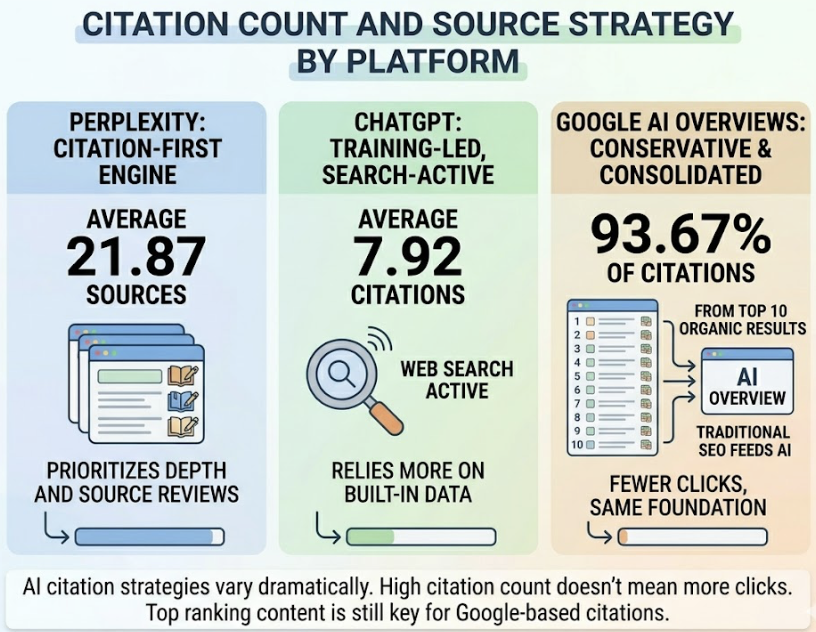
    Each major platform handles citations differently. Perplexity was built as a “citation-first” engine and averages 21.87 sources per response. ChatGPT relies more heavily on training data and averages 7.92 citations when web search is active. Google AI Overviews are the most conservative — 93.67% of their citations come from the existing top 10 organic results — which means traditional SEO still feeds Google-based citations, just not the click itself.

    Why an AI Citation Carries More Weight Than a Top Ranking

    The quality gap between a click from a ranked result and a click from an AI citation is not marginal. It’s roughly 3x.

    Data from Lebesgue, analyzing over 35,000 Shopify-based brands, found that AI referrals convert at 3.6% compared to 1.23% for traditional Google search. For B2B SaaS specifically, AI chatbot referrals delivered 6.69% CVR — on par with direct SEO traffic but arriving from a qualitatively different user.

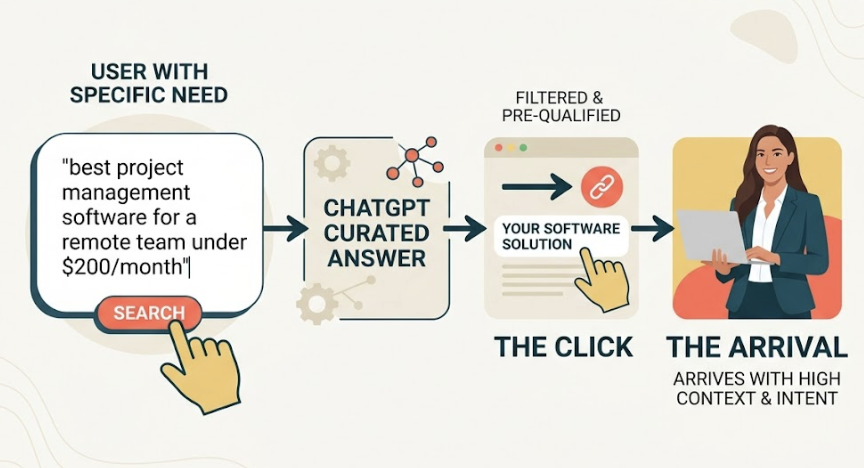
    The reason is what researchers call “funnel compression.” When a user finds your site via a Google ranking, they’re often still in research mode. When an AI recommends your brand by name, the AI has already handled the comparison, addressed the objections, and framed your product as the solution. The user’s click signals intent to act, not intent to browse.

    That’s the difference between being found and being chosen.

    There’s also a trust dynamic worth understanding. Users searching via AI treat the response like a recommendation from a knowledgeable advisor, not a list of options to evaluate. When an AI names your brand, it carries an implicit endorsement. That endorsement compresses the middle of the funnel before the user ever lands on your page.

    The flip side of this is what analysts call the “Mention-Source Divide.” This is when an AI uses your content as invisible background data to inform its answer but explicitly names a competitor as the recommended solution. You provided the knowledge. They got the recommendation. It happens more often than most brands know.

    3 Factors That Decide Whether AI Cites Your Brand

    AI citation isn’t random. It’s driven by a logic that’s different from traditional SEO — and more manageable once you understand it.

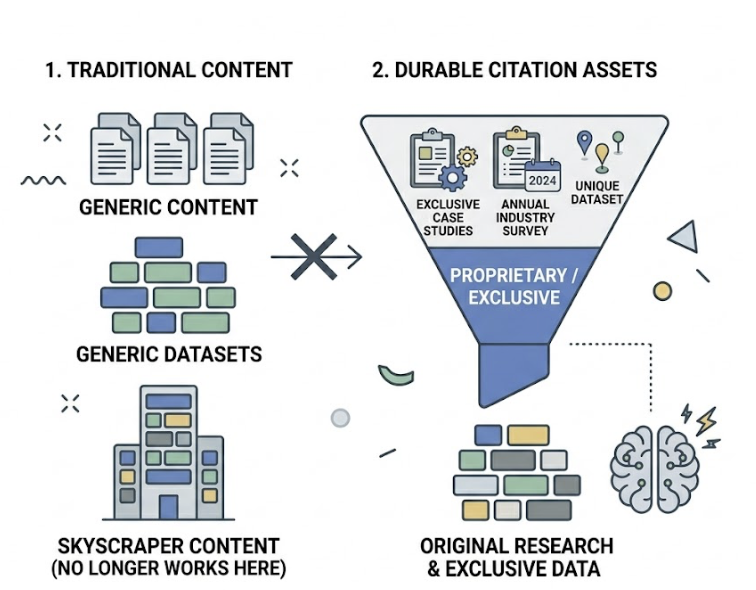
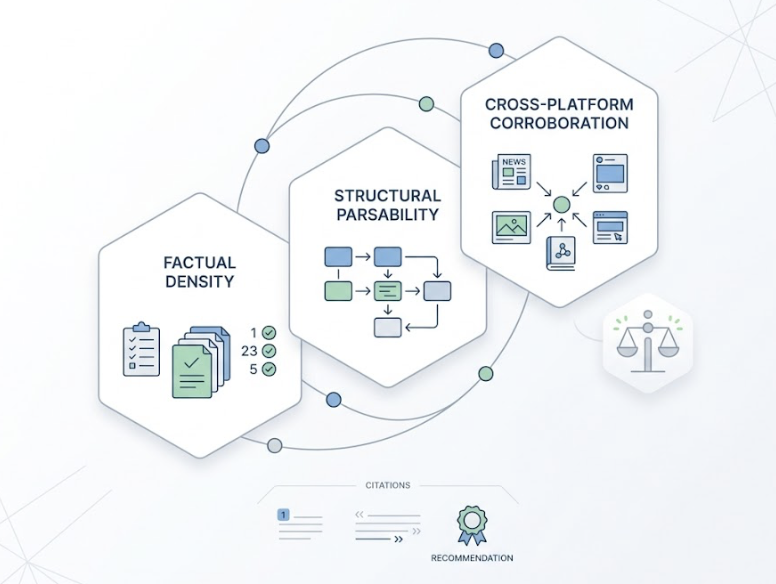
    Factor 1: Information gain, not keyword density. AI models favor sources that provide something genuinely unique: original data, specific statistics, proprietary research. According to findings from Princeton’s GEO research, adding statistics and credible references can increase AI visibility by up to 40%. Generic, summary-level content doesn’t get cited — it gets replaced by the AI’s own synthesis. The brands that earn citations are the ones that have data nobody else has.

    Factor 2: Structural parsability. Because AI uses Retrieval-Augmented Generation to extract and reassemble information, the architecture of your content matters as much as the content itself. Pages that answer the core question within the first 200 words are 30% more likely to be cited by models like Claude. 68.7% of pages cited in ChatGPT follow logical heading hierarchies (H1 → H2 → H3). 81% of cited pages use Schema.org markup. Machine-readable structure isn’t a technical nicety — it’s a citation prerequisite.

    Factor 3: Cross-platform mention frequency. AI citation operates on pattern recognition. If your brand is consistently referenced across Reddit threads, G2 reviews, industry forums, and news coverage, AI systems develop a “consensus” that you’re a category authority. Ahrefs’ study of 75,000 brands found that brand web mentions correlate with AI citations at r=0.664 — while total backlink count correlates at just r=0.10. Off-site brand signals are now 6x more predictive than backlink volume. One platform win tends to compound: a brand that earns consistent Perplexity citations often gains authority in ChatGPT’s more static index over time.

    Your Competitors Are Already in the AI Answer. Are You?

    Here’s the uncomfortable reality: most brands don’t know where they stand in AI recommendations. Traditional analytics can’t track zero-click impressions. GA4 doesn’t log “your brand appeared in a ChatGPT answer about project management software.” That visibility — or the absence of it — is completely invisible to standard tools.

    Only 20% of brands remain consistently present across five consecutive runs of the same prompt. The rest appear occasionally, get displaced by competitors, or don’t show up at all. For competitive categories, this volatility is happening daily.

    Topify was built specifically for this gap. Its Source Analysis feature reverse-engineers exactly which domains AI platforms are citing when users ask about your category — giving you a map of the “citation clusters” that feed AI perception of your space. Because 85% of brand mentions originate from third-party domains, knowing which platforms matter (Reddit, G2, Trustpilot, industry blogs) tells you precisely where your off-site efforts will move the needle.

    Topify’s Competitor Monitoring goes further — it tracks how often your competitors are cited relative to you, what sentiment the AI attaches to each brand, and where you sit in the response position index. If a competitor is earning first-position mentions in ChatGPT for your core category prompts, you’ll see it — and you’ll see the source domains driving it.

    That’s the intelligence gap between brands operating in 2026 and those still optimizing for 2022.

    How to Start Getting Cited by AI (Without Starting Over)

    The good news is that transitioning to a citation-focused strategy doesn’t mean scrapping your existing content. It means restructuring it around extractability.

    Prioritize answer-first structure. Every high-value page should open with a 2-3 sentence definitive statement — a clean, quotable definition or conclusion that an AI can pull directly. Save the context and nuance for the paragraphs that follow. Pages that bury the answer after three paragraphs of setup are losing citations to pages that don’t.

    Replace adjectives with data. Phrases like “industry-leading performance” contribute nothing to AI citation probability. Specific numbers — load times, conversion rates, study sample sizes — are what AI models extract and attribute. If you have proprietary data, publish it. That’s your citation moat.

    Treat content freshness as a citation retention strategy. Perplexity weights recency aggressively — content not updated in 90 days is 3x more likely to lose citation share to a competitor who published something newer. A rolling refresh model, where high-performing pages are updated with current statistics on a regular cadence, directly protects your citation position. Topify’s Visibility Tracking flags when your brand disappears from AI responses for specific prompts, so you can prioritize which pages need a refresh before you lose ground.

    Start by auditing which of your pages are already being cited across ChatGPT, Perplexity, and Google AI Overviews — and which prompts in your category you’re absent from entirely. That gap is your roadmap.

    Conclusion

    The architecture of search has changed. Users aren’t navigating a list of ranked results — they’re accepting synthesized answers. And in that environment, a #1 ranking is the entry requirement, not the prize.

    The prize is the citation. It’s where trust is built, where recommendations happen, and where the 3x conversion advantage lives. With organic CTRs down 61% on AI-present queries and zero-click behavior approaching 83% in AI-saturated searches, the brands that win will be those that AI systems recognize as authoritative, current, and structurally extractable.

    Rankings get you into the room. Citations make you the recommendation.

    If you don’t know where your brand stands in AI answers right now, Topify is where to start.

    FAQ

    Is an AI citation the same as a backlink? 

    No. A backlink is a persistent hyperlink used as a background signal for ranking algorithms — users don’t see it. An AI citation is a visible reference within an AI’s generated response, often temporary, that positions your brand as a trusted source in front of the user at the moment they’re making a decision.

    Does being cited by AI improve my Google ranking too? 

    There’s a strong correlation, not direct causation. 93.67% of Google AI Overview citations come from the top 10 organic results, which means traditional SEO remains a prerequisite for Google-based citation eligibility. For ChatGPT and Perplexity, however, the drivers are entity authority and freshness — not Google rank. You can earn AI citations on those platforms without ranking highly, and you can rank #1 on Google while being absent from both.

    How do I know if AI is already citing my brand? 

    Standard analytics can’t tell you. GA4 doesn’t capture zero-click AI appearances. You need tools that programmatically query LLM APIs and log brand appearances across platforms — like Topify, which tracks visibility, citation share, sentiment, and position across ChatGPT, Gemini, Perplexity, and others.

    How often do AI citations change?

    Frequently. Only 20% of brands appear consistently across five consecutive runs of the same prompt. In competitive categories, citation composition shifts daily — particularly on Perplexity, which re-crawls the live web for every query. Weekly tracking is the minimum; daily tracking is the standard for high-stakes categories.

    Read More

  • Is Your Brand Getting AI Citations? Here’s How to Check

    Is Your Brand Getting AI Citations? Here’s How to Check

    Your SEO rankings look solid. Traffic is up. But when a potential customer opens ChatGPT and types “what’s the best [your category] tool for mid-sized companies,” your brand doesn’t come up. A competitor does. Three times.

    That gap, between where you rank on Google and where you land in AI answers, is where the new competitive battle is being fought. And most brands don’t even know they’re losing it.

    Most Brands Are Invisible to AI Search Without Knowing It

    Traditional search gives every brand multiple shots. A user clicks through three links, compares pages, and eventually finds you. AI search doesn’t work that way.

    When ChatGPT or Perplexity synthesizes an answer, it picks two or three sources and presents them as the definitive response. If your brand isn’t cited, it doesn’t exist in that conversation. The user doesn’t scroll down to find you.

    This is what researchers call an “AI visibility gap”: brands that dominate Google rankings but have zero presence in AI-generated answers. It’s not a penalty. It’s just that AI systems never learned to trust your content as a reliable source.

    That’s fixable. But first, you need to know where you actually stand.
    What AI Citation Actually Means (And Why It’s Not the Same as SEO)

    An AI citation isn’t a backlink. It’s not a ranking. It’s something more specific: when an AI system selects your content as evidence to support a claim it’s making.

    Traditional SEO is built on keyword matching and domain authority. AI citation runs on a different logic entirely, based on a process called Retrieval-Augmented Generation (RAG). The AI converts your content into a semantic vector, compares it against the user’s query, and decides whether your information is specific, accurate, and trustworthy enough to quote.

    The difference matters because a brand with a domain authority of 80 can still get zero AI citations if its content lacks what AI retrieval systems look for: factual density, clear entity definitions, and external corroboration. The research report from this field puts it plainly: AI citation is about being a source of evidence, not a source of traffic.

    The table below shows where the two systems diverge:

    DimensionTraditional SEOAI Citation (GEO)
    Core unitWeb pages (URLs)Semantic passages / chunks
    Key signalsBacklinks, keyword densityFactual density, entity clarity
    User experienceClick-through to your siteZero-click, answer delivered directly
    Citation purposePromotion and visibilityFact verification and evidence
    How you measure itRankingsCitation frequency, Share of Voice

    How to Manually Check Your AI Citations Right Now

    Before setting up any monitoring system, run a manual audit. It takes about 15 minutes across three platforms and tells you whether you have a citation problem worth solving.

    The goal isn’t to search your brand name. It’s to simulate how real buyers actually ask questions, then see whether your brand appears in the response.

    ChatGPT

    ChatGPT’s search mode (available in GPT-4o with browsing enabled) pulls from Bing’s index, semantically reranks the top results, and synthesizes an answer. It tends to weight recency and source specificity.

    Use prompts like: “What are the most recommended [your product category] tools for mid-sized companies in 2026? Give me the top three with reasons.”

    What to look for: Is your brand listed as a primary recommendation, or just mentioned in passing? More importantly, check the footnotes. If ChatGPT cites a competitor’s website in the sources but only mentions your brand in the text, your content is losing the “information gain” competition. The AI found a competitor’s page more useful as evidence.

    Perplexity

    Perplexity is a citation-first engine. Every sentence it generates needs a source. It pulls from Google, Bing, and its own crawl index, and it weights recency heavily.

    Try: “Compare [your brand] and [competitor] on [specific capability]. Include recent user reviews and technical documentation.”

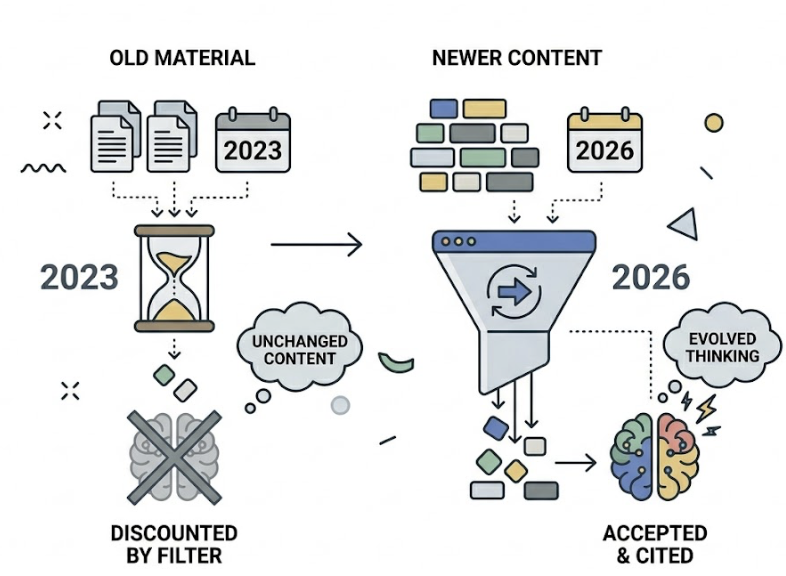
    What to look for: If the sources cited are from two years ago, your newer content hasn’t passed Perplexity’s time decay filter. Perplexity discounts older material systematically. Being cited from a 2023 blog post in 2026 is almost worse than not being cited, because it signals to users that your thinking hasn’t evolved.

    Claude

    Claude uses Brave Search as its primary retrieval infrastructure. Research shows that Brave’s search results correlate with Claude’s citations at a rate of 86.7%, which means your Brave Search presence is a strong proxy for your Claude visibility.

    Try: “From an expert perspective, what is [your brand]’s core methodology for solving [specific customer problem]? How does it differ from industry standards?”

    What to look for: Can Claude describe your product accurately and specifically? If it gives a vague or generic description, it means your brand hasn’t been clearly defined in the external sources Claude trusts. Wikipedia, industry white papers, and analyst coverage are the “trust anchors” Claude relies on most.

    5 Signs Your Brand Has an AI Citation Problem

    After running those checks, you’ll have raw observations. Here’s how to turn them into a diagnosis.

    Low citation frequency. In 10 queries about core problems you solve, your brand appears in fewer than 3. The research benchmark is clear: brands cited fewer than 30% of the time on their core topic have a content extractability problem. AI systems can’t pull clean facts from your pages.

    Competitor displacement. The AI describes a competitor’s features in detail and only mentions you in passing. This signals that in AI semantic space, your competitor has established a stronger association with your category. They’ve achieved what researchers call “semantic monopoly.”

    Outdated or negative sentiment. The AI pulls a two-year-old review or a discontinued product mention. Old negative signals haven’t been overwritten by newer positive content. AI systems don’t automatically forget bad data; you have to bury it with volume and authority.

    Source mismatch. The AI cites a Reddit thread or third-party review to explain your pricing, rather than your own pricing page. This means your official content has poor machine readability. The Reddit thread was more extractable than your website.

    Entity ambiguity. When asked about your brand, the AI gives the wrong industry classification or confuses you with another company. This is the most serious signal. Your brand’s entity identity hasn’t been established in the knowledge graph that AI systems draw from.

    Why Running Manual Checks Every Week Doesn’t Scale

    Here’s the core problem with the manual approach: LLMs are stochastic. The same query, run twice, can return different sources. A single test gives you one data point from one moment in one model’s probabilistic output.

    To get statistically meaningful visibility data, you’d need to run hundreds of prompt variations, across multiple AI platforms, on a consistent schedule, and then aggregate the results. Manually. Every week.

    That’s not realistic for any team.

    This is where a platform like Topify changes the equation. Instead of running 10 manual checks, Topify executes thousands of simulated queries daily, covering long-tail prompt variations your team would never think to test. The result isn’t a snapshot; it’s an AI Visibility Score (AVS) with statistical weight behind it. Scores below 10 indicate near-invisibility. Above 70 means you’re functioning as a category authority in AI answers.

    The difference between a manual check and Topify’s tracking is the difference between checking the weather once and running a climate model.

    How to Set Up Ongoing AI Citation Monitoring

    If you’re moving from manual checks to systematic monitoring, the setup process follows three steps.

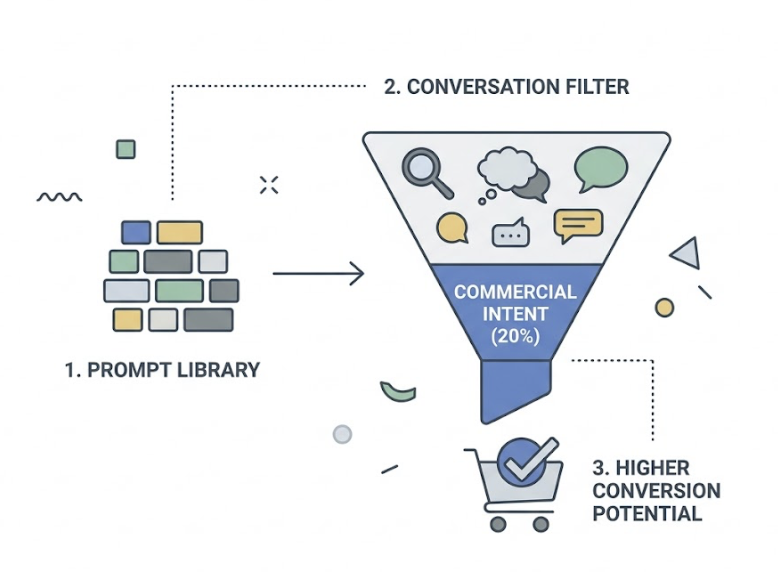
    Build a prompt library first. Don’t just monitor your brand name. Structure your prompt matrix around three types of queries: buyer intent (“which [category] tool is best for [specific use case]”), entity clarity (“what is [your brand]’s approach to [core methodology]”), and competitive comparison (“[your brand] vs [competitor] for [specific need]”). This covers the full range of ways a real buyer might encounter or look for you.

    Track the right metrics. Topify surfaces seven core dimensions: visibility, sentiment, position, volume, mentions, intent, and CVR (Conversion Visibility Rate). For most teams starting out, three matter most. Your AI Visibility Score tells you whether you’re present. Sentiment Velocity tells you whether the AI’s description of your brand is improving or declining over time. Source Forensics identifies which specific URLs are being cited, so you know which content is actually working.

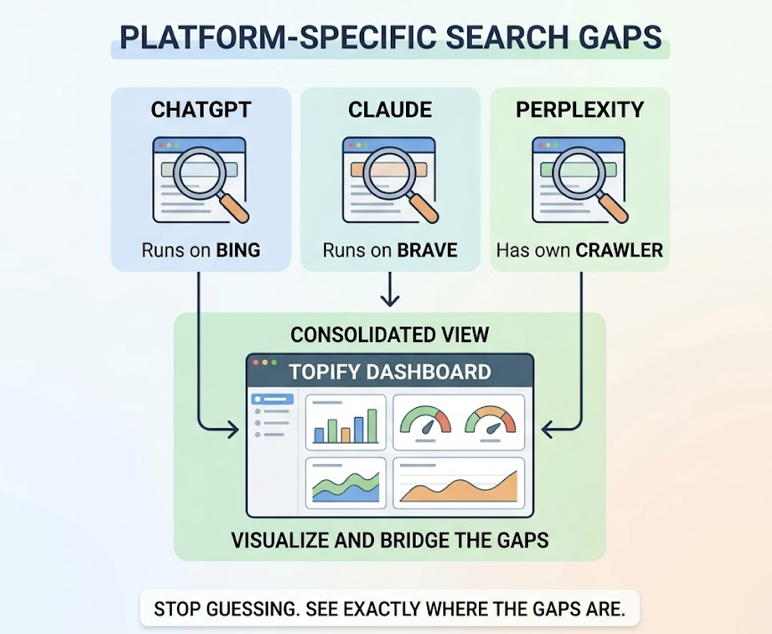
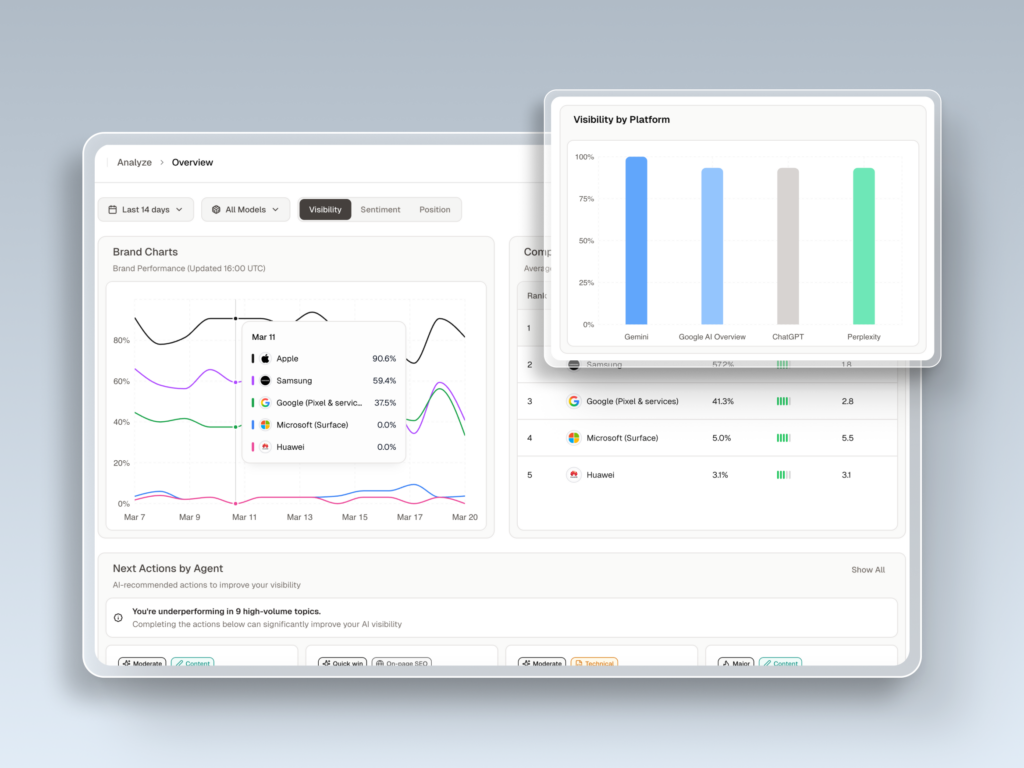
    Monitor across platforms, not just one. A brand can have strong ChatGPT visibility and near-zero Claude visibility. These gaps aren’t random; they reflect the different retrieval infrastructure each platform uses. ChatGPT runs on Bing. Claude runs on Brave. Perplexity has its own crawler. Topify’s dashboard consolidates these into a single view, so you can see exactly where the gaps are rather than guessing.

    What to Do When Your Brand Isn’t Being Cited

    Knowing you have a citation gap is step one. Closing it requires a different kind of thinking than traditional SEO.

    Restructure content for AI extractability. AI retrieval systems favor high information density. Every H2 section on your site should open with a 40-60 word factual summary: a concise, self-contained statement that can stand alone as a cited passage. Think of it as writing for an AI that’s going to quote one sentence from your entire page. Which sentence would you want it to pick?

    Fix your machine readability. Deploy JSON-LD Schema markup, especially Organization, FAQPage, and HowTo types. The sameAs attribute is particularly valuable: it connects your official site to Wikipedia, LinkedIn, and Crunchbase entries, which signals entity uniqueness to AI knowledge graphs. Also consider implementing an /llms.txt file in your root directory, a Markdown-formatted index that tells AI systems which pages are your authoritative source of truth.

    Build external trust signals. AI systems cite sources they already trust. Getting accurate coverage in industry directories like G2 and Capterra, in authoritative media, and in high-activity communities like Reddit increases the probability that AI retrieval systems will include you in their trusted source pool. These are the “trust seeds” that influence which brands get cited consistently.

    Don’t try to fix hallucinations by deletion. If an AI is generating inaccurate descriptions of your brand, you can’t remove the bad data. The strategy is volume: publish enough accurate, high-authority content that the correct signal overwhelms the incorrect one. Researchers call this a “digital cushion strategy.”

    Conclusion

    Your brand’s visibility in AI search isn’t determined by your SEO rankings. It’s determined by whether AI systems have been given enough clean, credible, and extractable information about you to include you as a trusted source.

    The manual checks in this guide take 15 minutes and give you a starting baseline. But if you’re serious about closing the gap, the next step is moving from one-off audits to continuous monitoring. Start with the three prompt types above, run them across ChatGPT, Perplexity, and Claude this week, and use what you find to prioritize which signals to fix first. Then set up a tracking system that removes the guesswork.

    AI citation isn’t a trend you can wait out. It’s the infrastructure of how buyers discover brands now.


    FAQ

    Q: How often should I check my brand’s AI citations? A: For brands in fast-moving industries, weekly monitoring across all major platforms is the right cadence. Monthly checks are likely too slow to catch negative sentiment trends or citation drops before they affect pipeline. AI models update their retrieval indexes frequently, and what was true last month may not reflect your current visibility.

    Q: Does being cited by AI actually drive traffic? A: Yes, though the traffic profile is different from organic search. Traffic arriving from an AI citation typically converts at a significantly higher rate because the AI has already done the initial trust-building. The research on this topic suggests that citation-referred visitors arrive with higher purchase intent than visitors from traditional search results.

    Q: Can I request that AI platforms cite my brand directly? A: There’s no official appeal process or submission channel at any major AI platform. Citations are determined algorithmically through RAG logic. The only reliable path is building what researchers call “overwhelming consensus”: ensuring that accurate, structured information about your brand is consistently available across the sources AI systems are trained on and retrieve from.

    Q: What’s the difference between an AI citation and an AI mention? A: A mention means the AI said your brand name in a response. A citation means the AI linked to or explicitly sourced your content as evidence. Mentions build mindshare. Citations build authority and provide a conversion path back to your site. In Topify’s scoring system, citations carry significantly more weight than plain mentions because they reflect the AI’s judgment that your content is credible enough to stake a claim on.


    Read More

  • How to Get Cited by AI: A 5-Step Checklist for 2026

    How to Get Cited by AI: A 5-Step Checklist for 2026

    Your content ranks on page one. Your DA is solid. But a potential customer asks ChatGPT, “What’s the best [tool in your category]?” and gets five recommendations. You’re not on the list.

    Traditional SEO metrics can’t explain this. They weren’t built to measure what AI chooses to say. And in 2026, the gap between Google visibility and AI citation is where most brands are quietly losing ground.

    AI Citation Isn’t Random. It Follows a Pattern.

    Most marketers assume AI just summarizes whatever ranks well on Google. That’s not how it works.

    Generative AI engines use a process called Retrieval-Augmented Generation (RAG). When a user submits a prompt, the AI retrieves relevant text fragments from the web, then synthesizes them into a response. It doesn’t pick the highest-ranked page. It picks the most extractable, fact-dense, and structurally clear content it can find.

    Research from Princeton, Georgia Tech, and other institutions confirms that AI citation visibility can improve by 30% to 40% through targeted GEO strategies. That improvement doesn’t come from gaming algorithms. It comes from strengthening what AI researchers call “authority signals”: precise data, verifiable claims, expert attribution, and semantic clarity.

    The difference between a cited brand and an invisible one isn’t always content quality. It’s usually content structure. AI needs content it can extract cleanly. If yours buries key facts in marketing copy or behind heavy JavaScript, AI moves on.

    That’s the pattern. And it’s fully optimizable.

    Step 1: Know Which Prompts You Need to Appear In

    AI citation starts with prompts, not keywords.

    A user on Perplexity doesn’t type “best CRM.” They type, “What’s the best CRM for a 15-person remote team that needs Salesforce integration and a free trial?” That specificity completely changes the competitive landscape. Brands that built their SEO around short-tail keywords are often invisible in this context.

    The first step is building a prompt library: 50 to 100 real user prompts that map to your product category, use cases, and decision stages. Importantly, about 20% of ChatGPT conversations carry clear commercial intent. If your brand enters those “intent windows,” conversion potential is substantially higher than traditional search.

    The challenge is that different AI platforms attract different user behaviors. Perplexity users skew toward factual queries and recent data. ChatGPT users tend toward complex, multi-step reasoning. Google AI Overviews blend both. Your prompt library needs to reflect where your actual audience is asking questions, not just where you’ve historically built SEO authority.

    Topify‘s AI Volume Analytics addresses this gap directly. Unlike traditional keyword tools, it estimates monthly prompt demand across ChatGPT, Gemini, Perplexity, and other platforms. You can see which prompts have high AI search volume in your category, where competitors are already getting cited, and which platform differences matter for your audience.

    This isn’t keyword research with a new name. It’s a fundamentally different data layer.

    Step 2: Structure Content So AI Can Extract It

    AI doesn’t read your page the way a human does. It uses vector embeddings to scan for semantically relevant text chunks. If your content is buried in promotional copy, nested inside accordions, or rendered client-side via JavaScript, AI often retrieves nothing.

    The fix is a production model called semantic chunking: every section of your content should be an independent, self-contained unit of meaning. That means it should make sense even if lifted out of context.

    The Formats AI Prefers to Cite

    Some content structures are consistently over-represented in AI citations:

    Comparison tables are the highest-value format. Structured data in Markdown tables is trivial for LLMs to parse and compare. If you’re making category claims, put them in a table.

    Numbered step lists map cleanly to how-to queries, which are among the most common AI search prompt types. A well-formatted 5-step process is almost purpose-built for RAG retrieval.

    Definition blocks let AI extract your answer in a single chunk. If you’re defining a concept, lead with the definition, not the backstory. Put the answer first, every time.

    FAQ sections are consistently cited. Domains with structured FAQs are cited roughly 40% to 100% more often than those without. The questions should mirror real user language, not sanitized marketing phrasing.

    Data points with explicit sourcing are the highest-trust signal. “According to [Institution] 2025 research” gives AI a clear attribution chain. Unsourced statistics get deprioritized.

    What Makes a Page “Uncitable” to AI

    Heavy client-side rendering is the most common problem. If your page requires JavaScript execution to surface your content, many AI crawlers (including GPTBot and ClaudeBot) see a blank page or a loading state.

    Hiding key facts in collapsible UI elements, using non-semantic HTML, or writing in long, dense paragraphs without clear topic sentences all reduce what researchers sometimes call “extraction score.” Pages that take more than 2 seconds to load risk timing out AI retrieval systems entirely.

    The structural principle is straightforward: write for humans, but render for machines.

    Step 3: Build Source Authority That AI Trusts

    In 2026, traditional Domain Authority is being supplemented by something more nuanced: entity authority and consensus signals.

    AI models don’t just evaluate your site in isolation. They evaluate your brand across the entire web. Is the information about you consistent across LinkedIn, Wikipedia, G2, your press coverage, and your own site? Inconsistencies, even minor ones like differing founding dates or mismatched product descriptions, create what AI systems treat as a reliability flag.

    Three dimensions drive AI source trust:

    Cross-web consistency. Your brand’s factual footprint needs to be uniform. This is table stakes, but most brands haven’t audited it.

    Associative authority. AI tracks which other sources cite you. A mention in a .gov report, an .edu case study, or a Forbes feature carries substantial weight. This is where digital PR starts to directly feed AI citation rates.

    Community consensus. This is the most underestimated factor. Research shows Reddit accounts for 21% to 46.7% of AI citations across major platforms. Perplexity, in particular, draws heavily from forum discussions. If your brand is genuinely referenced and discussed in relevant communities, AI picks up those signals.

    Topify’s Source Analysis tool maps exactly this: which domains are citing your competitors, in what context, and what the citation-to-authority pattern looks like. You can identify the specific media outlets or community platforms that function as AI citation hubs in your category, then prioritize outreach accordingly.

    Link-building in this context isn’t about PageRank. It’s about being cited by sources that AI already trusts.

    Step 4: Track Whether AI Is Actually Citing You

    “You can’t optimize what you can’t measure” applies here more than in almost any other channel.

    Manually prompting ChatGPT to see if you appear is both inefficient and misleading. Large language models introduce randomness into every response. A single test tells you almost nothing. You need volume, consistency, and cross-platform coverage to establish a real baseline.

    The metrics that matter in 2026 are different from traditional SEO KPIs:

    Share of Model (SoM): The percentage of target-prompt responses that include your brand. This is the AI-era equivalent of share of voice.

    Citation sentiment: Whether AI describes your brand positively, neutrally, or negatively. A brand cited as “affordable but limited” has a very different conversion trajectory than one cited as “the go-to platform for enterprise teams.”

    Citation provenance: Which specific URLs on your site, or which third-party pages, are generating AI citations. This tells you which assets are pulling weight and which aren’t.

    Position in response: When multiple brands are listed, where do you appear? First-position citations generate meaningfully more trust and traffic than fifth-position.

    Tracking MethodLimitationTopify Advantage
    Manual testing10-20 prompts/day max, high varianceThousands of simulated prompts, multi-platform
    Platform-native analyticsOnly covers one AI engineUnified view across ChatGPT, Gemini, Perplexity, and more
    Standard SEO toolsNo AI citation layerNative GEO metrics: SoM, Sentiment, Position, CVR

    Topify’s Visibility Tracking runs automated prompt simulations at scale, surfaces sentiment scoring through an NLP engine, and tracks how your citation rate changes over time. The optimization cycle typically shows measurable visibility improvement within 8 to 12 weeks of implementing structural changes.

    Set a baseline before you change anything. Otherwise, you’re optimizing blind.

    Step 5: Close the Gap Between You and the Brands AI Prefers

    AI citation in most categories follows a concentrated pattern. AI typically cites 3 to 7 sources per response. If you’re not in that set, the traffic and trust go entirely to whoever is.

    The question isn’t whether to compete for citations. It’s why AI is currently choosing your competitors and not you.

    Three Gaps Worth Diagnosing

    Information gain gap. Does your competitor have original research, proprietary data, or exclusive case studies that you don’t? AI is drawn to information that can’t be generated from existing training data. Publishing an annual industry survey or a dataset no one else has is one of the most durable citation assets you can build. Generic “skyscraper content” no longer works here.

    Schema gap. Are competitors using structured data markup (FAQPage, ProductDetail, ShippingDetails) that makes their commercial information machine-readable at lower cost? Schema markup reduces the work AI has to do to extract your data. Less extraction friction equals more citations.

    Third-party validation gap. Is your competitor consistently referenced on Reddit, mentioned in Wikipedia, and listed in authoritative industry reports while your brand is absent? That external consensus is what AI uses to break ties between similar-quality sources.

    Topify’s Competitor Monitoring gives you a live view of this: where competitors are being cited, by what sources, in what prompt contexts, and at what sentiment levels. The output isn’t just a report. It’s a gap analysis you can act on.

    Once you’ve identified the gaps, the action sequence is clear. For information gain: publish original data. For schema: audit your highest-value pages and add missing markup. For third-party validation: invest in community presence in the forums and platforms your category actually uses.

    The 5-Step AI Citation Checklist at a Glance

    StepCore ActionSupporting Tool
    1. Identify high-value promptsBuild a prompt library of 50-100 commercial-intent queriesTopify AI Volume Analytics
    2. Restructure content for extractionImplement semantic chunking, FAQ sections, comparison tablesTopify One-Click GEO Execution
    3. Build cross-web authorityAudit brand consistency, pursue digital PR in high-citation channelsTopify Source Analysis
    4. Track citation performanceEstablish SoM baseline, monitor sentiment and positionTopify Visibility Tracking
    5. Close the competitor gapRun gap analysis on information, schema, and third-party validationTopify Competitor Monitoring

    Conclusion

    AI citation isn’t luck. It’s what happens when a brand consistently provides clear, structured, verifiable information across the right channels.

    The brands winning in AI search right now didn’t stumble into citations. They built the content architecture, the authority footprint, and the measurement system that makes citation predictable. That’s achievable for any brand willing to treat GEO as a structured channel, not an afterthought.

    Get started with Topify to see exactly which of your pages are generating AI citations, which prompts you’re missing, and where your competitors are pulling ahead.

    FAQ

    Q: How long does it take for AI to start citing my content after I optimize it?

    A: It depends on the platform. AI engines with live web search (like Perplexity and SearchGPT) can pick up newly indexed content within days. For models that rely on training data snapshots, the lag can be several months. In practice, GEO optimization on real-time AI platforms typically shows measurable citation improvement within 8 to 12 weeks.

    Q: Does my Google ranking affect whether AI cites me?

    A: There’s a correlation, but not a direct causal link. Roughly 38% of AI citations come from pages in Google’s top 10, but that figure is declining as AI engines develop more independent evaluation logic. A page ranking #12 with a clean structure, strong schema markup, and clear factual content often outperforms a #3 page that’s dense, slow-loading, or marketing-heavy.

    Q: Which AI platforms should I prioritize?

    A: Prioritize based on where your audience actually asks questions. If your category involves frequent factual queries or product research, Perplexity is high-priority. If your audience uses AI for complex decision-making, ChatGPT should be central. Google AI Overviews is non-negotiable for most brands given Google’s search volume. Ideally, you’re tracking all three simultaneously.

    Q: Can a smaller brand realistically compete with large incumbents for AI citations?

    A: Yes, and in some ways GEO is more democratic than traditional SEO. AI evaluates content quality and structural clarity more than raw domain authority or budget. A smaller brand that publishes original data, maintains consistent schema markup, and builds genuine community presence can capture citation share from much larger competitors in a specific niche. The information gain advantage is not something money can simply buy.

    Read More

  • AI Citation Stats That Should Change Your 2026 Strategy

    AI Citation Stats That Should Change Your 2026 Strategy

    Your organic traffic looks fine. Conversion rates are quietly dropping. And you’re not sure why.

    Here’s one explanation worth taking seriously: a growing share of your buyers never visit your site anymore. They ask ChatGPT, get a synthesized answer with 3 sources, and move on. Your brand isn’t one of the 3. You don’t show up in the zero-click moment that now shapes the decision.

    That’s the gap AI citation data is starting to quantify.

    AI Search Is Already Your Buyers’ First Stop

    The shift happened faster than most teams planned for.

    By late 2025, 50% of the US population is actively using AI-powered search engines to make buying decisions. In high-consideration categories like finance, consumer electronics, and wellness, that number climbs to 40-55% of consumers. And according to McKinsey, 44% of AI search users now consider these platforms their primary source of information — ahead of traditional search (31%) and brand websites (9%).

    The AI Overview trigger rate tells the same story in a different way. In January 2025, Google’s AI Overviews appeared on 6.49% of searches. By December 2025, that rate had doubled to 13.14%. Projections put it at 47% by the end of 2026.

    That means nearly half of all Google searches could produce an AI-synthesized answer before a user ever sees your link.

    There Are Only 3 to 5 Citation Slots Per AI Response

    This is the number that should reset how you think about visibility.

    In traditional search, a first-page result offers ten opportunities to appear. In a generative response, Profound’s analysis of 680 million citations found that AI platforms typically surface just 2 to 12 sources per answer, depending on the engine. Google AI Overviews cite 3 to 5 sources. ChatGPT typically cites 2 to 4. That’s not a funnel. That’s a bottleneck.

    The competitive dynamics get sharper when you factor in platform fragmentation. The overlap in which sources different AI engines actually cite is strikingly low.

    PlatformCitations per ResponseOverlap with Other Platforms
    ChatGPT2-411-12%
    Perplexity5-1211%
    Google AI Overview3-513.7%
    ClaudeVariableLow

    An 11% overlap means a brand dominating ChatGPT citations is probably invisible in Perplexity. Perplexity, notably, pulls 46.7% of its top citations from Reddit-style community content. ChatGPT skews toward long-form, authoritative prose. These aren’t variations of the same game. They’re different games.

    The Brands That Do Get Cited Convert at 5x the Rate

    Here’s what makes AI citation worth competing for.

    AI-referred users aren’t casual browsers. The synthesis process acts as a pre-qualification filter. By the time someone clicks through from a ChatGPT recommendation for “best project management software for a remote team under $200/month,” they’ve already received a curated answer. They arrive with context and intent.

    The data reflects this.

    MetricOrganic SearchAI Referral
    Conversion Rate2.8%14.2%
    Pages per Session1.84.2
    Time on Site2.5 min8-10 min
    Lead Conversion ROIBaseline2.8x-4x higher

    AI platforms currently drive only 0.15% of global internet traffic. But users they send stay nearly four times longer on site. In one documented case, a SaaS firm saw leads from AI referrals convert at 2.8 times the rate of organic traffic, producing a 288% ROI on their GEO investment without changing total traffic volume at all.

    The referral is rarer. The referral is worth dramatically more.

    Your #1 Google Ranking Doesn’t Secure Your AI Citation

    This is where most marketing teams have a false sense of security.

    Traditional organic rankings only account for 17% to 38% of citations that appear in Google AI Overviews. A competitor in position 23 on a Google results page may be the primary source cited in the AI answer if their content is more extractable. The AI doesn’t honor your PageRank. It pulls what it can confidently reformulate.

    That means a competitor you haven’t tracked in years, one sitting far below you in traditional rankings, may currently be teaching ChatGPT, Perplexity, and Gemini what your category is about.

    This is why Share of Model (SoM), not Share of Voice, is the metric that actually matters in 2026. SoM measures the percentage of AI-generated responses in your category that mention or cite your brand. A declining SoM is a leading indicator of future revenue loss — it shows your brand is being systematically removed from the intelligence layer that guides decisions before a buyer ever reaches your website.

    Topify’s Citation Gap Analysis is built specifically for this problem. It identifies which competitor URLs are currently being cited in your category, what information those pages provide that yours don’t, and which queries you’re absent from entirely. That makes prioritization concrete rather than intuitive.

    Publishing More Content Won’t Fix a Citation Problem

    The instinct is reasonable: produce more, rank more, get cited more. The data doesn’t support it.

    A Princeton University study (Aggarwal et al., 2023) tested nine different optimization approaches for AI visibility. Keyword density optimization — the core tactic of legacy SEO — showed low to negative impact on citation rates. What actually moves the needle looks different.

    Optimization MethodTraditional SEO ImpactGEO/AI Citation Impact
    Keyword densityHighLow / Negative
    Citing external sourcesNeutral+115.1% visibility
    Adding statistics & dataModerate+37-40% visibility
    Expert quotationsLow+30% visibility
    Structured data (FAQ, lists)HighHigh (essential)

    Content updated within the last 30 to 90 days receives approximately 2.3 times more citations than older material. Recency matters. But recency alone without structural depth doesn’t.

    AI models prioritize what they can extract with confidence: direct answers in the first 40 to 60 words of a section, tables, cited statistics, attributed expert quotes. Marketing prose that reads well to a human is often invisible to a language model scanning for extractable facts.

    How to Actually Track Which Sources AI Is Citing

    You can’t optimize what you haven’t measured. And most analytics dashboards weren’t built for this.

    A practical GEO monitoring workflow starts with querying 20 to 50 high-intent buyer prompts across ChatGPT, Perplexity, Gemini, and Google AI Overviews to establish a baseline. From there, the work is identifying which URLs are currently cited for those prompts and what those pages contain that yours don’t.

    Topify’s Source Analysis automates this across all major AI platforms, tracking citation patterns weekly. It surfaces which domains are being referenced in your category, flags when a competitor displaces you for a high-value prompt, and generates a unified GEO Score that aggregates performance across platforms. Given that AI responses are non-deterministic and shift with model updates, weekly monitoring isn’t optional — it’s the minimum viable cadence.

    There’s also a technical layer most brands overlook. Many CDNs, including Cloudflare, block AI crawlers like GPTBot and PerplexityBot by default. If you haven’t explicitly allowed these bots in your robots.txt, you may be entirely invisible in AI answers regardless of content quality. That’s a 15-minute fix with potentially significant impact.

    Conclusion

    AI citation is not a variation of SEO. It’s a separate distribution channel where the rules, the metrics, and the competitive landscape are fundamentally different.

    The 3 to 5 citation slots per AI response, the 5x conversion premium for AI-referred traffic, the 11% platform overlap: these numbers collectively describe a winner-takes-most environment that’s forming right now. With traditional search volume projected to drop 25% by 2026, the brands that earn consistent AI citations won’t just compensate for lost clicks. They’ll capture a disproportionate share of buyer attention in the channel that’s replacing the one they’re currently optimizing for.

    The window for early positioning is open. It won’t stay open long.


    FAQ

    What is AI citation and why does it matter for SEO? 

    AI citation refers to when a generative AI platform like ChatGPT, Perplexity, or Google AI Overviews references a specific source URL in its synthesized answer. It matters because AI platforms are increasingly the first stop in a buyer’s research process, and a brand that isn’t cited in these answers is invisible at the moment intent is highest — even if it ranks #1 on traditional search.

    How do AI platforms decide which sources to cite? 

    Each platform uses different retrieval logic, which is why citation overlap between platforms sits at just 11-13.7%. Common factors across platforms include content recency (updated within 30-90 days), the presence of cited statistics and external references, structured formatting (tables, lists, FAQ schemas), and domain authority signals from trusted third-party sites.

    Can I improve my brand’s AI citation rate without rewriting everything? 

    Yes. Two of the highest-impact starting points are technical: ensuring AI crawlers like GPTBot and PerplexityBot aren’t blocked by your CDN or robots.txt, and implementing JSON-LD structured data on key pages. On the content side, adding verifiable statistics with source attribution and making the first 40-60 words of each section directly answer the implied question can meaningfully improve extractability.

    How do I know if competitors are outranking me in AI answers? 

    Traditional rank tracking tools don’t capture this. You need to run high-intent prompts across AI platforms and record which sources are cited — or use a platform like Topify that automates this monitoring across ChatGPT, Perplexity, Gemini, and Google AI Overviews and alerts you when a competitor displaces your brand for a tracked prompt.


    Read More

  • Why AI Stops Citing Your Brand

    Why AI Stops Citing Your Brand

    You search your own brand name in ChatGPT. Your competitor appears. You don’t.

    That’s not a fluke. It’s a signal — and it’s one most marketing teams don’t catch until the damage is already done. AI citation isn’t broken. The brand’s digital presence just isn’t giving the model a reason to mention it.

    Here’s what’s actually happening, why it happens, and what to do about it.

    AI Citation Is a Trust Competition, Not a Ranking Race

    Traditional SEO is a popularity contest. You earn backlinks, optimize pages, chase positions. The winner gets clicks.

    AI citation works differently. When ChatGPT, Perplexity, or Google’s AI Overviews synthesizes a response, it’s not picking the best-ranked page. It’s picking the most verifiable entity — the brand it trusts enough to put its credibility behind.

    That distinction matters more than most teams realize.

    A brand can rank on page one of Google and still be invisible in AI answers. The AI has already retrieved ten sources. It synthesizes three names. If your brand isn’t one of them, you don’t exist in that interaction — regardless of your domain authority.

    This is what researchers call the shift from the “link economy” to the “citation economy.” The goal is no longer to drive a click. It’s to become part of the truth the AI delivers.

    Your Official Website Isn’t Enough

    Here’s the misconception that gets brands in trouble: a strong website doesn’t equal AI visibility.

    Research shows that 85% to 90% of AI brand mentions originate from external domains — press releases, review platforms, forums, and media coverage — not the brand’s own site. In branded queries specifically, reviews, listicles, forums, and case studies account for 57% of AI citations. Product pages on the official site capture roughly 12%.

    AI models prefer third-party validation for the same reason customers do. If only you are saying you’re great, that’s marketing. If G2, Reddit, and TechRadar are independently saying it, that’s evidence.

    Brands that rely entirely on owned channels are building a technically polished presence that AI actively discounts.

    5 Reasons AI Drops Your Brand From Its Answers

    Understanding the failure mode is the first step to fixing it. There are five specific signals that tell an AI to omit a brand.

    1. Thin third-party coverage. If your brand has minimal presence in industry publications, no reviews on G2 or Yelp, and no mention in forum discussions on Reddit or Quora, the AI simply lacks enough external material to recommend you with confidence. It defaults to brands that have been cited extensively across the web.

    2. Content dilution by competitors. Even if you’re searchable, your share of AI citations can quietly erode. If competitors are publishing more detailed comparisons, updated industry reports, and authoritative guides on your core topics, the model’s probability of mentioning you drops — without your SEO rankings moving at all. This “ecosystem drift” is invisible in traditional analytics.

    3. Misalignment between your content and query intent. AI systems extract discrete chunks of content to satisfy specific questions. If your pages bury the answer behind a slow build-up, the RAG system may fail to extract a usable response. AI prefers front-loaded content, where the answer appears in the first 30% of the text. When a competitor’s page is more “extractable,” it gets cited instead.

    4. Stale or low-influence citation sources. Not all mentions are equal. AI models lean on a “kingmaker” set of domains — Wikipedia, Reddit, Forbes, TechRadar — for their default recommendations. If your brand doesn’t appear on those platforms, or if the sites that do cite you are unmaintained and niche-obscure, the model discounts those citations.

    5. Outdated brand data. Freshness matters. Content updated within the last 30 days is cited up to 6 times more often than content older than 12 months. If your pricing, features, or positioning are stale across the web, the AI learns an outdated version of your brand. In fast-moving categories, citation priority can be lost in as little as 14 days without fresh signals.

    The Gap Between Searchable and Citable

    There’s a phrase that captures this problem well: “ghost citation.” Your content is trusted enough to be retrieved during the AI’s research phase. But your brand isn’t well-known enough in the right places to be named in the final response.

    Being citable requires what researchers call “Entity Authority” — the clear, consistent recognition of your brand as a distinct entity across the web. That authority is built through brand web mentions, which correlate three times more strongly with AI visibility than traditional backlinks.

    Reddit and Wikipedia alone account for over 66% of all LLM citations in certain categories. For B2B brands, consistent signals across LinkedIn, Crunchbase, and G2 are essential for entity recognition.

    That’s the gap most brands still can’t see.

    If you’re not measuring where AI citations for your category are coming from, you’re flying blind. And you can’t fix a problem you’re not measuring.

    What Most Teams Are Still Measuring (and Why It’s Not Enough)

    Traffic. Rankings. Click-through rates.

    These are lagging indicators. By the time organic traffic drops from AI-driven queries, the brand has already lost citation authority. The model moved on weeks ago.

    The industry has aligned around a different set of metrics for the AI era:

    MetricWhat It Measures
    Inclusion Rate% of relevant prompts where your brand is explicitly mentioned
    Citation Rate% of AI responses that link to your owned assets as a source
    AI Share of VoiceYour mention frequency vs. total competitor mentions
    Sentiment ScoreWhether the AI describes your brand positively, neutrally, or negatively
    Position IndexWhere you appear in the response (first-named vs. fifth-named)

    Topify tracks all five of these across ChatGPT, Gemini, Perplexity, and other major AI platforms. Its Source Analysis feature goes a layer deeper: it identifies which specific external domains the AI is currently citing for your target prompts — revealing exactly where your citation gaps are and which competitor pages the model treats as authoritative.

    That’s the difference between knowing you’re invisible and knowing why.

    How to Get Back Into AI Answers

    Reclaiming AI citation is a multi-pronged effort that targets both what the model has learned from training and what it retrieves in real time.

    Build citable third-party coverage. The fastest lever is earned media. Pursue guest posts, analyst inclusions in Gartner or Forrester reports, and quotes in industry publications. Actively build presence on G2, Capterra, and Trustpilot — sites with those profiles have a 3x higher citation probability. Foster discussions on Reddit and industry forums, which account for 11% of citations and are heavily weighted for human validation.

    Optimize existing content for extractability. Lead with direct answers. Place the core response in the first 30% of every page. Replace vague statements with numerical data — this “statistics addition” approach can boost AI visibility by 40%. Use tables, bulleted lists, and clear Q&A sections. LLMs prefer atomic knowledge blocks that are easy to extract and cite.

    Fill the competitive gaps your brand is missing. Test 20 to 30 high-value prompts relevant to your category. See who the AI recommends and which domains are driving those citations. If the AI is citing a specific listicle on TechRadar for a prompt you should own, that’s your next PR target.

    Topify’s One-Click Execution turns this from a research exercise into an action item. You define the goal; the platform identifies the prompt-level gaps and deploys the content strategy without requiring manual workflows.

    Track It After You Fix It

    Here’s a number worth knowing: 45.5% of AI citations change every time an AI Overview re-runs for the same query.

    Citation recovery isn’t a project with a finish line. It’s a maintenance cadence. AI models are continuously retrained. Their retrieval indices update daily. A brand can be cited this week and dropped next week if it stops generating fresh signals.

    The monitoring priorities look like this:

    Content TypeFrequencyAction
    Product PagesMonthlyUpdate pricing, specs, and schema
    Data-Heavy GuidesQuarterlyReplace stats older than 12 months
    Landing PagesBi-MonthlyRefresh intros, check internal link consistency
    Foundational ExplainersAnnuallyVerify accuracy, update “Last Updated” date

    Using Topify’s Visibility Tracking and Competitor Monitoring, teams can watch for sentiment shifts (where mentions are trending negative), position changes (whether you’re first-named or fifth in a response), and new rivals entering the AI answer space for your category.

    The goal isn’t to win once. It’s to stay in the retrieval set as the landscape shifts.

    Conclusion

    AI search doesn’t reward the most optimized brand. It rewards the most verifiable one.

    If your brand has disappeared from AI citations — or never appeared in the first place — the cause is almost always the same: insufficient third-party coverage, misaligned content structure, stale data, or low presence on the platforms AI models actually trust.

    The fix isn’t complicated. But it requires measuring the right things, targeting the right sources, and treating citation recovery as an ongoing discipline rather than a one-time task.

    The brands that do this now are building a durable advantage. The ones that wait are losing ground to competitors who are already in the model’s answers.

    FAQ

    What’s the difference between AI citation and SEO ranking? 

    Traditional SEO focuses on ranking a URL in a list of links to generate clicks. AI citation focuses on your brand being mentioned and sourced within a synthesized answer. Visibility is measured by Inclusion Rate and Share of Model, not organic position.

    How long does it take to see changes in AI citations? 

    For models like Perplexity or Google AI Overviews, structured content improvements can influence citations within a few days to a few weeks as their indices refresh. Broader parametric authority — shaping what the model has learned in training — typically takes 6 to 12 months of consistent third-party coverage.

    What types of content are most likely to be cited by AI? 

    Front-loaded content that answers the question immediately, pages with high fact density and expert quotes, and structured formats like tables or Q&A sections. Third-party reviews and independent media are cited significantly more often than brand-owned blog posts.

    How can a small brand compete with a large brand for AI citations? 

    By being more specific. Large brands have broad but shallow coverage. A brand that provides deep, precise, and niche-specific expertise can earn citations that generic national pages can’t match. Precision and entity clarity often beat raw scale in the selective logic of AI.

    Read More

  • AI Citations: 5 Metrics That Actually Matter

    AI Citations: 5 Metrics That Actually Matter

    Someone searches “best project management tool for remote teams” on ChatGPT. The response names three products. Yours isn’t one of them.

    You don’t know this happened. Your competitor does.

    That’s the gap most brands are operating in right now. Traditional tools — GA4, Google Search Console — only track what happens after someone arrives at your site. They can’t see the thousands of moments where AI shapes a buyer’s perception before any click occurs. Brand mentions in AI answers correlate three times more strongly with AI visibility than traditional backlink profiles. Yet most teams have no system to track them.

    This guide breaks down the five metrics that tell you whether your brand is actually winning in AI search — and what to do when you’re not.

    Why AI Citations Are a Different Beast Than Backlinks

    Getting a backlink is simple enough to understand: another site links to yours, and that signals authority to Google. AI citations work differently, and the difference matters.

    AI models don’t evaluate “who links to you.” They evaluate factual density, structural parsability, and cross-platform corroboration. A citation in a ChatGPT response might appear as a footnote, a passing mention, or a direct recommendation — and those are not the same thing commercially.

    Here’s the thing: being cited doesn’t mean being recommended. Being recommended doesn’t mean being named first. And being named first on one platform tells you nothing about your position on another.

    GA4 and Search Console track destination traffic. They don’t track the “share of model” — the instances where AI shaped purchase intent without generating a click. That’s where brands are bleeding visibility without realizing it.

    FeatureTraditional BacklinksAI Citations
    Primary SignalLink Equity / PageRankEntity Relevance / Factual Density
    Control MechanismSite editors / WebmastersLLM Retrieval Algorithms (RAG)
    Visibility FormatAnchor text on a web pageFootnotes, summaries, direct mentions
    User IntentNavigation / ExplorationInformation satisfaction / Recommendation
    Success MetricClick-Through Rate (CTR)Visibility Rate / Share of Voice
    Data TrackingGA4 / Search ConsoleAI-specific monitoring (e.g., Topify)

    Metric 1: Visibility Rate — Are You Even in the Room?

    Visibility Rate answers the most basic question: for the prompts your potential customers are typing into ChatGPT or Perplexity right now, how often does your brand appear?

    The calculation is straightforward. If you test 100 prompts relevant to your category and your brand is mentioned in 30 of them, your Visibility Rate is 30%. But the number alone isn’t the insight — the benchmark is.

    Performance TierVisibility RateWhat It Means
    Pre-Visibility0% – 15%Invisible to AI search; high displacement risk
    Developing15% – 30%Cited occasionally; early traction
    Category Presence30% – 50%Regularly in the consideration set
    Category Leadership50% – 75%Recognized as top-tier in the niche
    Category Dominance75% – 100%The consensus answer for relevant queries

    Most mid-market brands fall in the 15–30% range. Most don’t know it.

    What makes this metric harder to manage than search rankings is platform fragmentation. ChatGPT, Gemini, and Perplexity use different retrieval architectures — and the overlap of domains they cite for the same query can be as low as 11%. Your brand can rank well in ChatGPT and be essentially absent from Perplexity for identical queries.

    Topify Visibility Tracking monitors brand presence across these ecosystems simultaneously, providing a normalized score that shows where you’re strong and where the gaps are. Without cross-platform tracking, you’re making strategy decisions based on a fraction of the picture.

    Metric 2: Citation Source — Who’s Vouching for You?

    Here’s the number that surprises most brand teams: 85% of brand mentions in AI answers come from third-party domains. Only 15% come from a brand’s own website.

    Your content strategy alone can’t carry your AI visibility. What matters is whether the right external sources are talking about you.

    AI models seek corroboration. The more a brand appears across trusted external sources, the more likely it is to be retrieved and recommended. The hierarchy looks roughly like this:

    • Public forums: Reddit drives nearly 50% of top sources for Perplexity and features prominently in Gemini results
    • Industry review platforms: G2, Capterra, and Yelp provide the social proof models use to validate recommendations
    • Encyclopedia and news: Wikipedia and major publishers anchor ChatGPT’s general knowledge layer

    The top cited domains for each platform in 2025 look like this:

    RankChatGPTGeminiPerplexity
    1Wikipedia (7.8%)Reddit (2.2%)Reddit (6.6%)
    2Reddit (1.8%)YouTube (1.9%)YouTube (2.0%)
    3Forbes (1.1%)Quora (1.5%)Gartner (1.0%)
    4G2 (1.1%)LinkedIn (1.3%)LinkedIn (0.8%)
    5TechRadar (0.9%)Gartner (0.7%)Yelp (0.8%)

    The strategic question isn’t just “are we on these platforms.” It’s “which specific URLs are carrying our competitors’ visibility, and are we absent from those exact locations?”

    Topify Source Analysis reverse-engineers which domains are fueling competitor citations. That data becomes a PR and content roadmap — target the sources AI trusts, earn the mentions, and eventually those mentions surface in the retrieval layer.

    Metric 3: Position in Answer — First Mention or Footnote?

    Visibility Rate tells you how often you show up. Position tells you whether showing up is actually working.

    In a conversational AI response, the first recommendation carries something researchers call “recommendation bias.” Up to 74% of users choose the AI’s first mentioned option. The difference between being named first and being listed third isn’t just aesthetic — it has a direct impact on whether anyone goes looking for your brand after that interaction.

    A useful scoring framework for quantifying this:

    Placement QualityPointsDescription
    Primary Citation with Link5Named first; includes a direct URL
    Primary Citation (No Link)4Named first; no link
    Secondary Mention with Link3Listed as an option; linked
    Secondary Mention (No Link)2Listed as an option; not linked
    Passing Mention1Brief mention, no recommendation
    Absent0Brand doesn’t appear

    A brand could have a 40% Visibility Rate but score an average of 1.5 on this scale — meaning it’s consistently being listed as “others also include” rather than the lead recommendation. That’s a very different strategic problem than low visibility, and it requires a different fix.

    Topify Position Tracking surfaces this distribution by brand, by competitor, and by prompt type — so you can see not just whether you’re being mentioned, but what kind of role the AI is casting you in.

    Metric 4: Sentiment Score — What Is AI Actually Saying About You?

    Being visible isn’t always a win. If the AI is consistently describing your brand as “an older option worth considering for smaller teams,” that’s visibility working against you.

    AI models characterize brands based on the sentiment of the sources they retrieve. If Reddit threads and review platforms are critical of your product, those attitudes tend to show up in how AI answers frame you. The Net Sentiment Score (NSS) captures this on a scale from -100 to +100.

    The thresholds matter:

    NSS RangePerception StatusStrategic Action
    +60 to +100Brand AdvocacyLeverage for high-intent marketing
    +20 to +60Healthy ReputationMaintain trajectory; optimize for intent
    0 to +20Vulnerable / NeutralFocus on earning “enthusiastic” mentions
    Below 0Crisis ZoneIdentify and correct negative source material

    The hallucination category deserves specific attention. AI occasionally generates factually incorrect claims about brands — invented pricing, wrong founding dates, fabricated product limitations. These aren’t just reputation problems; they’re retrieval problems. The fix requires identifying which source material is feeding the error and correcting it upstream.

    Topify Sentiment Analysis uses NLP to detect shifts in AI’s attitudinal tone toward your brand across platforms. A sudden NSS drop is often a leading indicator of a narrative forming on Reddit or review platforms — before it reaches traditional media.

    Metric 5: CVR — Does Being Cited Actually Drive Action?

    The prior four metrics measure what’s happening inside the AI response. CVR (Conversion Visibility Rate) asks whether any of it is translating to commercial outcomes.

    AI-referred traffic is a different animal than traditional search traffic. A user who arrives at your site after reading a ChatGPT recommendation has already been through the research and comparison phase. The AI handled it. That changes the conversion math significantly:

    • B2B SaaS: AI-referred visitors convert at 12–15%, vs. 2.5–4% for traditional organic search — roughly a 4x lift
    • E-commerce: AI traffic converts 42% better than traditional paid search, with users spending 48% more time on-site
    • Lead generation: AI-referred sign-up conversions have been measured at 1.66% vs. 0.15% for traditional organic — an 11x difference

    Not all prompts carry the same conversion potential, though. Prompt intent changes everything:

    Prompt IntentConversion PotentialWhat It Drives
    Informational (“What is…”)LowBrand imprinting / Awareness
    Comparison (“Brand X vs Y”)MediumConsideration / Validation
    Transactional (“Best tool for…”)HighDirect conversion / Purchase

    The challenge is that most of these interactions are “zero-click” — users don’t always visit your site after seeing you mentioned. Topify CVR correlates these invisible influence moments with Branded Search Lift, the measurable increase in users searching for your brand by name in the days following AI exposure.

    That’s the closest proxy to attribution that currently exists for this channel.

    These 5 Metrics Don’t Work in Isolation

    Tracking each number separately misses the point. The value is in reading them together as a diagnostic system.

    A high Visibility Rate with a low Sentiment Score means you’re visible, but the AI is saying something unfavorable. Fix the source material, not the visibility strategy. A strong Position Score on informational prompts with weak CVR suggests you’re winning awareness but not conversion-stage queries — the prompt library needs rebalancing toward transactional intent.

    Here’s a practical operating framework:

    MetricCheck FrequencyWarning ThresholdResponse
    Visibility RateWeeklyBelow 20%Audit content for parsability and entity clarity
    Citation SourceMonthlyCompetitor share 2x yoursTarget high-citation 3rd-party domains via PR
    Position (APS)WeeklyAvg score below 0.5Improve unique data points and information gain
    Sentiment (NSS)DailyScore below 0Identify and correct negative source material
    CVR / Branded SearchMonthlyDeclining trendRealign prompt library toward commercial intent

    The operational problem is that these signals live in different places — AI responses, review platforms, search trend data, traffic analytics. Topify consolidates them into a single dashboard, identifying specific “Citation Gaps” where your brand should appear but doesn’t, and providing a prioritized action list for content and PR teams.

    Without that consolidation, most teams end up checking metrics inconsistently and reacting to problems weeks after they develop.

    Conclusion

    The three recommendation slots in a ChatGPT or Perplexity response are the new prime real estate of the internet. Most brands don’t know whether they’re in those slots or not — and for the ones that don’t know, the answer is usually “not often enough.”

    Visibility Rate, Citation Source, Position, Sentiment, and CVR are the five numbers that tell you the truth. Track them together, act on the gaps, and you move from being indexed to being recommended.

    The brands doing this now will be significantly harder to displace in six months. The ones waiting will be catching up.

    FAQ

    How often should I check my AI citation metrics?

    Weekly for Visibility Rate and Position — AI models update frequently, and citation patterns can shift overnight after a model update. Sentiment should be monitored daily for enterprise brands, specifically to catch hallucinations or emerging negative narratives before they scale. Citation Source analysis is typically most useful on a monthly cadence, since the domain-level signals move more slowly.

    Can I track AI citations without a paid tool?

    You can do a rough version manually — run 20–50 prompts across ChatGPT, Gemini, and Perplexity once a week and log what you find. The problem is accuracy. AI responses are probabilistic; a single run of a prompt doesn’t represent what your audience is actually seeing. Paid tools like Topify iterate each prompt dozens of times across different models and IP locations to produce a statistically significant normalized score. Manual tracking is better than nothing, but it tends to give teams false confidence in incomplete data.

    How is AI citation tracking different from traditional brand monitoring?

    Social listening tracks what humans say to other humans — reviews, posts, comments. AI citation tracking measures what the machine says to potential buyers during the decision phase. A brand could be mentioned 10,000 times on social media; if those mentions aren’t being retrieved by AI models, the brand is invisible in the AI search funnel. The fix is also structurally different: improving AI visibility requires content optimization for parsability and earning corroborating mentions on high-weight domains — not community management.

    Read More