Blog

  • Claude, ChatGPT, or Perplexity: Pick Your Visibility Play

    Claude, ChatGPT, or Perplexity: Pick Your Visibility Play

    A practical 2026 guide to where your brand actually gets found, and what to do about each platform.

    Most brands treating AI visibility as a single channel are already behind.

    ChatGPT, Claude, and Perplexity don’t work the same way. They don’t pull from the same sources, they don’t serve the same users, and they don’t reward the same types of content. Treating them as interchangeable is how you end up spreading budget thin and seeing results from none of them.

    Here’s what actually separates the three, and how to decide where to focus first.


    Three Platforms. Three Different Users. Three Different Logics.

    Before you optimize for anything, understand who’s on each platform and why they’re there.

    ChatGPT has scale. It processes somewhere between 2.5 and 3 billion prompts per day, with daily active users reaching around 190 million. Users come for task execution: drafting, coding, brainstorming. The average session is 16 minutes. It’s conversational and high-frequency.

    Claude skews toward depth and decision-making. Its user base sits at roughly 19 million, which sounds modest until you see that 70% of Fortune 100 companies have it embedded in their workflows. Software development, financial services, legal, and healthcare are its home turf. Users aren’t browsing. They’re analyzing.

    Perplexity sits closest to a search replacement. Its 33 million monthly active users are researchers, professionals, and knowledge workers who want verified answers with visible sources. Every response comes with numbered citations. The referral traffic it drives has an average session time of 3 minutes 30 seconds and a bounce rate of just 32%.

    Different platforms, different stakes.


    Where Claude AI Brand Visibility Actually Comes From

    Claude’s citation behavior is more conservative than any other major AI platform. That’s not a bug. It’s a direct result of Anthropic’s Constitutional AI framework, which prioritizes accuracy and harm avoidance over comprehensiveness.

    Claude uses Brave Search for its web retrieval. That matters more than most brands realize. Research shows Claude’s citations overlap with Brave search results at a rate of 86.7%. If your brand doesn’t rank in Brave, it’s effectively invisible to Claude’s retrieval layer.

    But search indexing is only half the story. Claude performs internal cross-validation, which means a single factual error on your site (an outdated price, a feature description that doesn’t match G2) can get your entire domain flagged as unreliable.

    The content formats that earn Claude citations aren’t blog posts. Troubleshooting guides, tool and utility pages, and how-to tutorials average 5 or more citation appearances per page across 4 to 5 platforms. Standard blog articles average fewer than 1. That’s a 30 to 50x gap depending on format and depth.

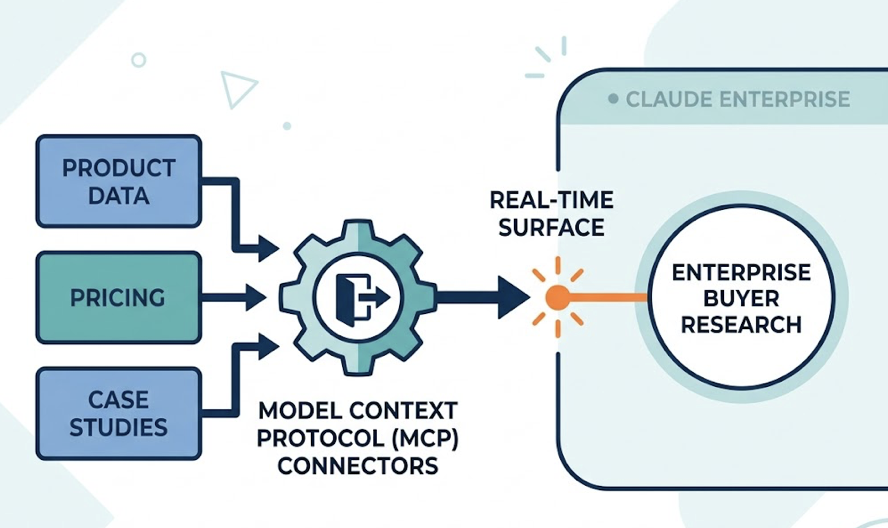
    For B2B brands, there’s also a structural advantage most are ignoring. Claude Enterprise supports custom connectors via Model Context Protocol (MCP), which allows your product data, pricing, and case studies to surface in real time when an enterprise buyer is doing vendor research inside Claude. That’s not passive indexing. That’s embedded visibility.
    The bottom line for Claude: depth, accuracy, and structure aren’t optional. They’re the admission ticket.


    ChatGPT Still Has the Volume. But It’s Harder to Crack.

    ChatGPT is where most brands want to be first. It’s also where most brands fail to show up.

    Here’s the problem: ChatGPT’s recommendation logic is probabilistic and inconsistent. One study ran the same B2B software prompt 100 times and got 44 different brands mentioned across those responses. Only about 5 of them, roughly 11%, appeared in more than 80% of responses. Those brands weren’t just well-optimized. They had Wikipedia entries, thousands of third-party citations, and years of authority signals baked into ChatGPT’s pretraining data.

    That’s the entity gap. New or mid-market brands often lack the historical signal density that ChatGPT needs to classify them as trustworthy. The platform doesn’t surface brands it can’t verify, and its verification logic is heavily weighted toward pretraining data from 2022 and earlier.

    That said, there are real levers. ChatGPT’s search mode relies heavily on Bing, so activating Bing Webmaster Tools instant indexing is a concrete first step. Building presence on G2, Reddit, and high-authority vertical publications creates the third-party validation ChatGPT needs to start trusting you. The goal isn’t just content. It’s entity establishment.

    ChatGPT is worth targeting. Just don’t expect fast wins unless you’re already a recognized name.


    Perplexity Rewards Sources, Not Just Brands

    Perplexity is the most transparent AI platform operating at scale today.

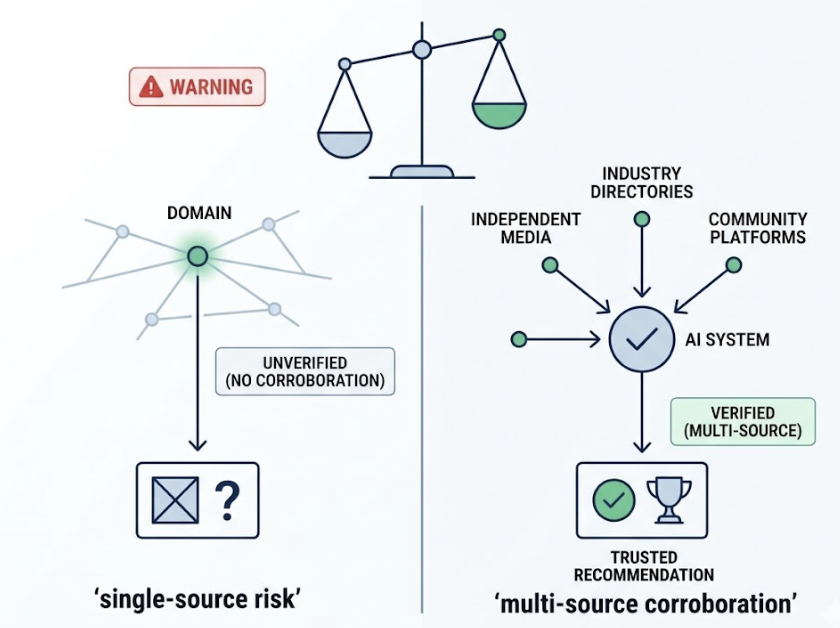
    Its scoring system weighs three factors: factual accuracy (verified across multiple sources), recency (especially for fast-moving categories), and third-party corroboration from Reddit, forums, and specialist publications. It’s not just checking your website. It’s checking whether other credible voices confirm what your website says.

    This creates a genuinely different competitive environment. A well-researched article from a niche SaaS blog can outrank a Fortune 500 landing page if it’s more accurate, more recent, and more frequently cited externally. Perplexity doesn’t have the same large-brand bias baked into its pretraining because it retrieves in real time.

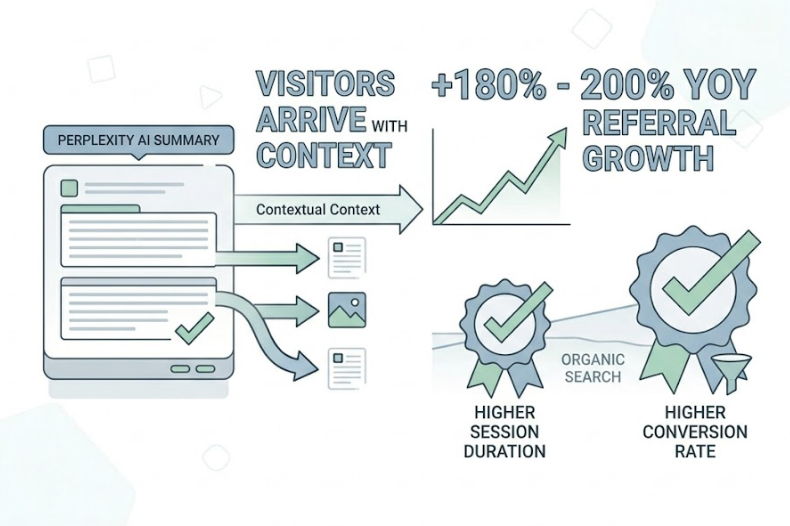
    The referral traffic quality reflects this. Perplexity’s year-over-year referral traffic growth has been running at 180 to 200%. More importantly, those visitors arrive with context: they’ve already read a structured AI summary of your product or topic before clicking through. That’s why session durations and conversion rates run higher than organic search.
    Plus, Perplexity’s Publisher Program launched in early 2026 added a revenue-sharing layer. When your content gets cited in an ad-supported response, you earn a cut. That’s a fundamentally different ROI model than any other AI platform offers.

    For brands with strong content assets but limited authority budgets, Perplexity is the fastest path to measurable visibility.


    The Priority Matrix: Which Platform Should You Go After First?

    Not every brand should prioritize the same platform. Here’s how to think about it:

    Brand TypePrimary PlatformSecondary PlatformWhy
    B2B SaaS / TechClaudePerplexityLong decision cycles favor depth and technical validation
    B2C / Consumer RetailChatGPTGeminiHigh-volume, broad awareness, emotional resonance
    Agencies / ConsultanciesChatGPTClaudeSpeed, creative variation, structured output
    FinTech / HealthcarePerplexityClaudeFact accuracy and source transparency are non-negotiable
    Early-stage / New BrandsPerplexityChatGPT SearchReal-time RAG bypasses pretraining bias against unknown brands

    The logic is consistent across all five: match the platform’s retrieval mechanism to your content strengths, not to where you think the most users are.


    You Can’t Prioritize What You Can’t Measure

    Here’s the thing that breaks most AI visibility strategies before they start: brands make platform decisions without any data on where they’re actually being mentioned, at what sentiment, and against which competitors.

    B2B buyers complete roughly 70% of their purchase decision before talking to sales. And 89% of those buyers use generative AI tools during their research phase. If your brand isn’t in those AI-generated answers, you’re not losing the final comparison. You’re being cut before the shortlist forms.

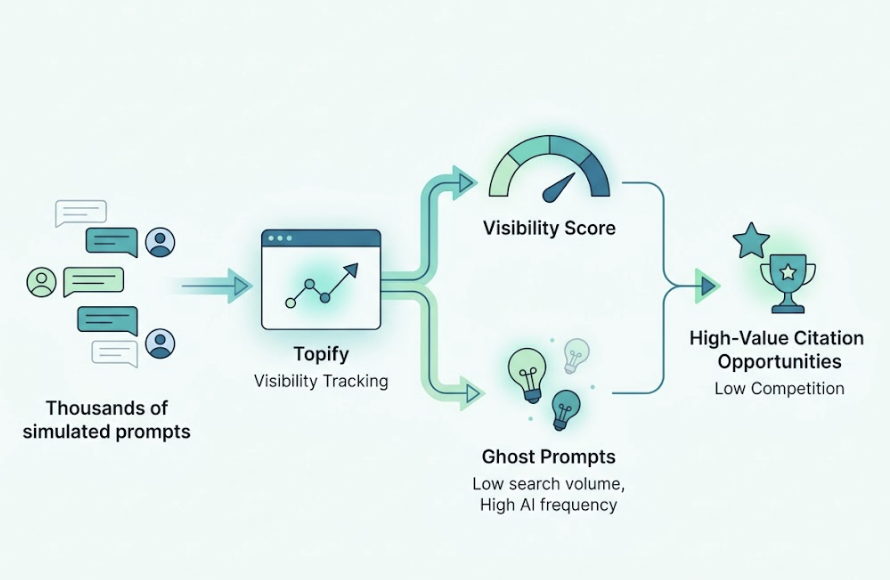
    Topify is built to close that measurement gap. It tracks brand visibility across ChatGPT, Claude, Perplexity, Gemini, and other major AI platforms simultaneously, running structured prompt sampling at scale to surface where your brand appears, how it’s described, and where competitors are outranking you.

    The seven core metrics it monitors: visibility share, sentiment score, position ranking, AI search volume, mention count, intent alignment, and CVR (Conversion Visibility Rate). That’s not a dashboard of vanity metrics. It’s the data layer that tells you which platform is worth doubling down on and which is underperforming despite your content investment.

    When Topify detects a visibility drop on a high-value prompt, it doesn’t just flag it. It reverse-engineers which sources are currently getting cited and surfaces specific fixes, whether that’s restructuring your above-the-fold answer, adding a comparison table, or correcting a pricing discrepancy flagged on a third-party review site.

    That’s the difference between guessing and compounding.


    Conclusion

    Claude, ChatGPT, and Perplexity each represent a different theory of how AI should answer questions. ChatGPT bets on breadth and scale. Claude bets on depth and verification. Perplexity bets on transparency and recency.

    Your brand doesn’t need to win on all three simultaneously. It needs to win first where its content strengths match the platform’s retrieval logic.

    The priority matrix gives you a starting point. The data from a tool like Topify tells you whether that starting point is actually working.

    Start measuring. Then prioritize.


    FAQ

    Is Claude AI growing faster than ChatGPT for brand mentions?

    In enterprise and professional contexts, yes. Claude’s enterprise market share grew from 12% to 32% between early 2025 and late 2025. For B2B brand mentions tied to vendor evaluation, technical documentation, and compliance use cases, Claude’s growth trajectory is outpacing ChatGPT’s in those specific segments.

    Does Perplexity actually drive traffic compared to ChatGPT?

    It drives significantly higher-quality traffic. ChatGPT tends to be a knowledge endpoint: users get their answer and don’t click through. Perplexity’s interface is built around source attribution, and its referral traffic grew 180 to 200% year-over-year. Visitors who arrive from Perplexity typically stay over 3 minutes and convert at rates that beat organic search benchmarks.

    How do I track my brand visibility across all three AI platforms at once?

    Use a dedicated AI visibility platform like Topify. It runs prompt sampling across ChatGPT, Claude, and Perplexity simultaneously, calculating sentiment, mention frequency, citation source, and competitive position from a single dashboard. Manual monitoring across three platforms isn’t scalable, and the data you’d collect wouldn’t be statistically reliable.

    Should smaller brands focus on one platform or spread efforts equally?

    Start with Perplexity. ChatGPT and Claude both carry significant pretraining bias toward established brands. Perplexity’s real-time RAG retrieval evaluates content on current accuracy and recency, not historical authority accumulation. A well-structured, fact-dense piece published this quarter can outperform content from established brands if it’s better sourced. Build your citation footprint there first, then use those authority signals to start penetrating the other platforms.
    Read More

  • Why Claude AI Recommends Some Brands Over Others

    Why Claude AI Recommends Some Brands Over Others

    The signals behind Claude AI brand visibility, and what you can do to change your position

    Your brand has a website. You publish content. You rank on Google. And yet, when someone asks Claude to recommend tools in your category, your name doesn’t come up.

    That’s not a SEO problem. It’s a different problem entirely.

    Claude doesn’t work the way Google does. The logic behind its recommendations is separate, and misunderstanding that gap is exactly why most brands stay invisible in AI-generated answers.

    Here’s what’s actually happening.

    Claude Isn’t Pulling from a Search Index

    When Claude responds to a recommendation request, it’s not querying a live database or crawling the web in real time. It’s synthesizing a response from what researchers call “parametric memory,” the patterns and associations encoded into the model’s neural weights during training.

    Think of it as sediment. Every piece of content that existed before Claude’s training cutoff left a trace. The more a brand appeared across credible, consistent sources, the deeper that trace.

    This architecture has a direct implication for brand teams: your brand’s weight in Claude’s responses was largely determined before you started optimizing for it. Claude 3.7 Sonnet’s reliable knowledge ends around October 2024. Claude 4.5 extends to January 2025. Newer models add real-time search in certain configurations via Retrieval-Augmented Generation (RAG), but even then, the base model’s pre-trained biases influence how it interprets what it retrieves.

    You’re not competing in a keyword auction. You’re competing for space in a model’s learned reality.

    The 3 Signals That Actually Shape Claude AI Brand Visibility

    Claude doesn’t rank brands by advertising spend or domain authority. Its recommendation logic reconstructs from three learned patterns.

    Mention Frequency on Trusted Third-Party Sources

    The correlation between brand mentions and AI citation probability is 0.664. The same correlation for traditional backlinks is 0.218. That gap tells the whole story.

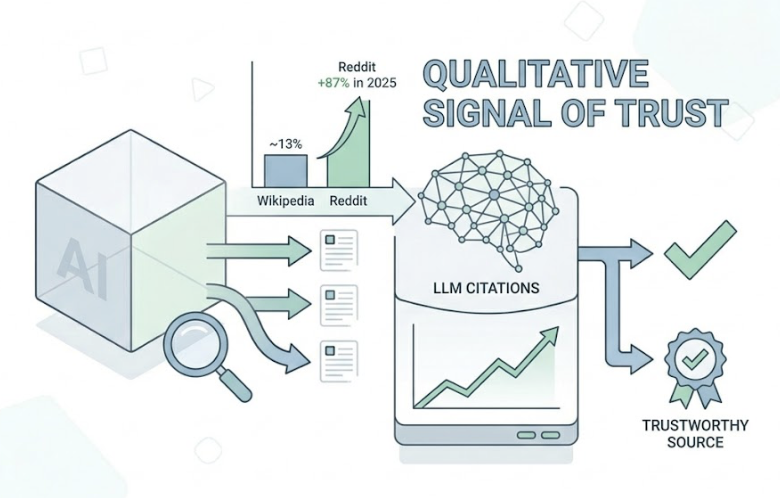
    Claude treats a mention on a high-authority domain as a qualitative signal of trust, not just a navigational pointer. Wikipedia currently accounts for roughly 13% of AI model citations. Reddit’s share grew 87% in 2025 and now represents over 10% of ChatGPT citations, with similar patterns showing in Claude’s responses for community-driven queries.

    The implication: it’s not about how many pages your brand owns. It’s about how many credible, independent sources reference you, and in what context.

    Contextual Consistency Across Sources

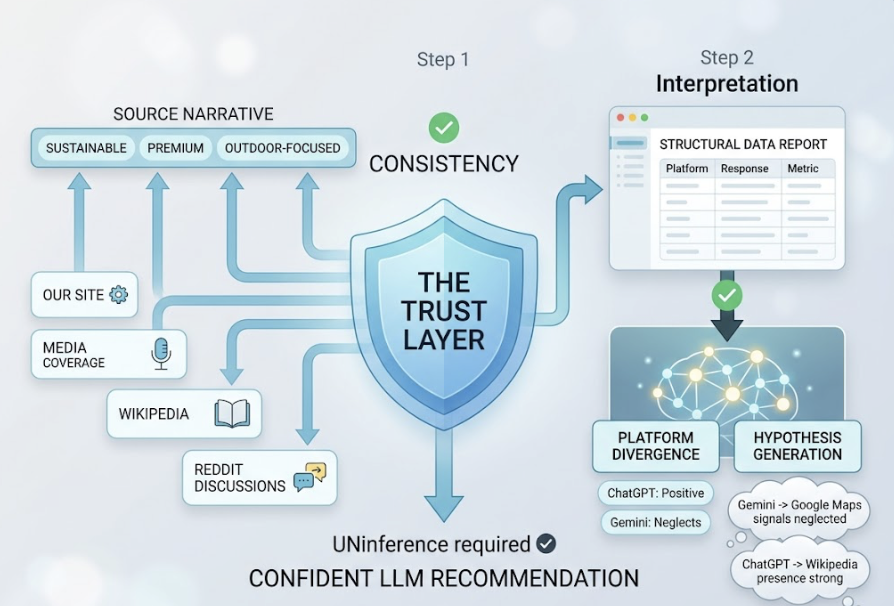
    If your brand is described as “an enterprise data integration platform” on your website but “a workflow automation tool” on G2 and “an ETL solution” on Reddit, Claude’s model faces conflicting signals. The result is lower confidence in any recommendation.

    This is what researchers call “entity blending,” where the model either avoids citing the brand altogether or misattributes its features to a competitor. Consistent category language across LinkedIn, Crunchbase, review platforms, and media coverage reduces that ambiguity significantly.

    Schema alignment matters here too. Implementing structured data that mirrors your visible content gives the model a cleaner extraction surface.

    Category Association and Prompt Relevance

    Claude maps brands to topic clusters based on their relationship to adjacent concepts in the training data. If your brand is consistently co-mentioned with “zero-trust architecture” and “enterprise cybersecurity” in technical publications and forum discussions, Claude learns to surface you when those prompts appear.

    This is niche positioning at the model level. And it explains why a smaller brand with precise topical coverage can outperform a much larger competitor relying on broad, generic positioning.

    Being Online Is Not the Same as Being Recommended

    This is the finding most brand teams find uncomfortable: 73% of brands have zero mentions in AI-generated responses despite ranking on page one of traditional search results.

    It’s not a measurement error. It’s a structural gap.

    Traditional SEO satisfies crawlers. Claude’s recommendation logic satisfies a different standard: semantic authority. The degree to which a brand is treated as the definitive answer to a problem across independent digital discourse.

    The core issue is the over-reliance on owned media. Your website, your blog, your branded content. Claude’s Constitutional AI training actively filters for commercial bias, which means self-promotional content is processed with skepticism built in.

    The data confirms this. Promotional tone in content has a -26.19% correlation with citation probability. That means typical marketing copy, the kind most brands default to, is actively working against AI visibility.

    On the flip side, third-party sources account for 80-85% of AI citations. Your own domain contributes 15-20% at most, and primarily for technical specifications, not authority signals.

    Why Competitor Brands Keep Showing Up Instead

    When a user asks Claude for a recommendation, the model typically surfaces three to five brands. Not ten. Not twenty.

    That compression is important. The “ten blue links” of Google become a winner-take-all scenario in generative responses. If your competitor is in that shortlist and you’re not, you don’t just lose visibility. You effectively don’t exist for that user’s decision.

    Competitors who dominate these responses typically share one characteristic: a stronger external signal network. More “best of” list inclusions. More independent comparison coverage. More community discussion with their brand name attached to specific use cases.

    Research by Stacker in 2026 found that distributed earned media is 5.3x more likely to be the sole source of a brand’s AI visibility than the brand’s own domain. Syndicating structured content through credible publishers can triple cross-platform coverage across Claude, ChatGPT, and Perplexity simultaneously.

    That’s not a PR strategy. That’s a model-level visibility strategy.

    You Can’t Improve What You Can’t See

    Here’s the practical problem: Claude’s conversations are private. Traditional analytics can’t track what the model says to users about your brand, whether it’s recommending you, misrepresenting your product, or citing a three-year-old negative review.

    That black box is where most optimization efforts stall.

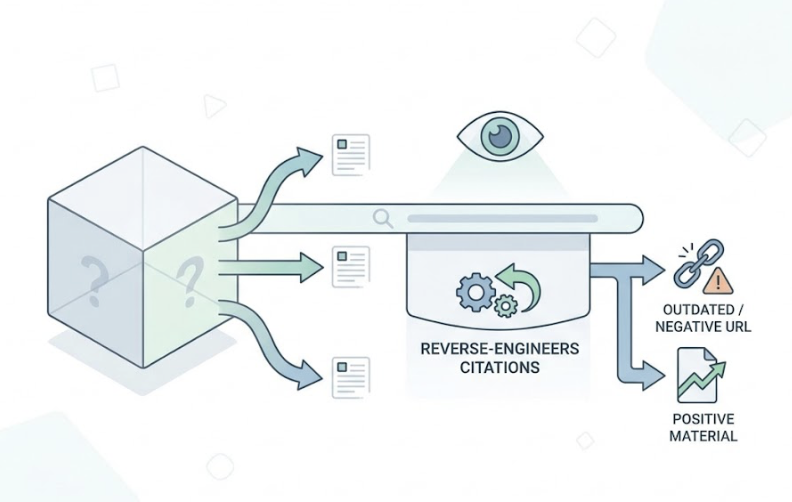
    Topify was built specifically to make that black box visible. Its Source Forensics capability reverse-engineers the citations Claude generates, identifying the exact URLs influencing its recommendations. If the model is citing outdated or negative coverage, you know which URL to target for a content refresh or to dilute with higher-authority positive material.

    Topify’s Sentiment Velocity tracking goes further: it monitors not just what Claude says about your brand today, but the direction that sentiment is moving over time. A static score tells you where you stand. Velocity tells you where you’re heading.

    Hallucination Alerting flags in real time if Claude starts generating false claims about your product, giving PR teams the window to flood the ecosystem with corrective, verified data before the misrepresentation compounds.

    The platform also tracks Entity Confidence, measuring how cleanly Claude distinguishes your brand from competitors or generic category terms. Low entity confidence is often the hidden cause of “brand invisibility,” where Claude knows your category but can’t reliably surface your specific name.

    4 Things That Actually Move the Needle

    Strategy matters less than execution sequence here. These four levers are statistically validated to increase citation probability and recommendation frequency.

    Seed high-weight third-party domains. Digital PR in tier-1 publications like TechCrunch or Forbes, combined with community presence on Reddit and detailed outcome-specific reviews on G2 or Capterra, builds the external signal network Claude’s model treats as authority evidence. This is mention-building, not link-building.

    Unify your descriptive language. Synchronize how your brand is described across Wikipedia, LinkedIn, Crunchbase, and your website. Pick clear category language and commit to it across every surface. The goal is a “clean signal” the model can decode without ambiguity.

    Map content to specific prompt scenarios. Don’t write for broad topics. Write for specific problems. Content that directly answers “How to fix data pipeline latency?” with a proprietary framework gives Claude something extractable and citable. Comparison pages that acknowledge product limitations, counterintuitively, earn higher model trust than pages that claim universal superiority.

    Monitor continuously, not annually. Adding factual statistics to content increases AI visibility by 40%. Citing authoritative sources adds another 40%. Expert quotations add 28%. Keyword stuffing reduces it by 10%. These numbers shift as model versions update. Weekly or bi-weekly tracking of share of voice and sentiment across Claude, ChatGPT, and Perplexity turns optimization from a one-time project into a compound advantage.

    Conclusion

    Claude’s recommendation logic rewards accuracy, external validation, and descriptive clarity. It penalizes promotional language, inconsistent positioning, and over-reliance on owned media.

    That’s a different game than SEO. The brands winning AI visibility today aren’t necessarily the ones with the biggest budgets or the longest domain histories. They’re the ones with the most reliable, consistent, and independently verified footprint across the digital commons.

    The gap between “being online” and “being recommended” is real. It’s also measurable, and it’s closeable. But only if you can see it first.

    FAQ

    Does Claude AI update its brand knowledge in real time? 

    Generally, no. Claude’s core recommendations come from parametric memory with fixed training cutoffs. Some implementations add real-time search via RAG, but even then the base model’s pre-trained weights shape how new data gets interpreted. Core brand knowledge typically changes only when the model is retrained, which happens every few months to a year.

    Is Claude AI brand visibility the same across different Claude versions? 

    No. Different versions have different training cutoffs and reasoning behaviors. A brand that launched in late 2024 may be invisible to Claude 3.5 Sonnet but recognized by Claude 4.5 or 4.7. Newer models also apply Constitutional AI filters more rigorously, which can result in more neutral or cautious brand recommendations across the board.

    How long does it take to see changes after optimizing for Claude? 

    Core parametric knowledge updates with model retraining, which takes months. But if Claude is using agentic search tools or RAG in a given deployment, high-authority third-party content published and indexed by search engines can start influencing responses within days to a few weeks.

    Can smaller brands compete with established names in Claude’s recommendations? 

    Yes, and often more effectively than in traditional search. Claude prioritizes specific match quality and factual density over broad name recognition. A smaller brand that answers a niche problem with precision and earns validation on a few high-trust sources, such as specialized Reddit communities or industry journals, can consistently outrank a larger competitor relying on generic marketing content.

    Read More

  • How to Track Your Brand Visibility in Claude AI

    How to Track Your Brand Visibility in Claude AI

    Your ChatGPT dashboard looks healthy. Mentions are up. Sentiment is mostly positive. You feel covered.

    Then someone on your team actually tests Claude AI and discovers your brand is either missing entirely or described with qualifiers you’d never approve. That’s when it becomes clear: Claude isn’t an extension of your ChatGPT strategy. It’s a separate system with its own logic, its own sources, and its own criteria for which brands deserve a recommendation.

    Here’s how to build a monitoring framework that tells you exactly where you stand inside Claude’s answers.


    Claude AI Doesn’t Recommend Brands the Way ChatGPT Does

    The first mistake brands make is assuming Claude and ChatGPT share the same recommendation logic. They don’t, and treating them the same is where most Claude AI brand visibility efforts fall apart.

    ChatGPT’s recommendations lean heavily on Bing’s search index and broad public consensus. Brands with strong Wikipedia presence and high general awareness tend to surface reliably. Claude operates differently. Its real-time search is powered by Brave Search rather than Bing, which means a brand that ranks #1 on Google or Bing can still be practically invisible to Claude if it hasn’t been indexed through Brave’s Web Discovery Project.

    That’s a structural gap most brands never account for.

    The core difference in how Claude sources and weights brand mentions

    Claude’s weighting system rewards technical depth and logical structure over brand recognition. Research from this domain shows that structured, data-backed content is cited approximately 30% more often than standard marketing copy within Claude’s outputs. The model’s Constitutional AI framework also makes it more cautious: when Claude can’t verify a claim about a brand, it tends to omit the brand rather than generate a plausible-sounding answer.

    ChatGPT’s typical citation sources skew toward Wikipedia (around 47.9%) and Reddit (around 12%). Claude skews toward industry blogs (around 43.8%), expert reviews, and technical documentation. If your content strategy has been built for Wikipedia authority and social proof, it won’t perform the same way inside Claude’s evaluation logic.

    Why your ChatGPT visibility score doesn’t carry over to Claude

    Only 11% of domains get cited by both ChatGPT and other AI platforms for the same query. That number should reframe how you think about AI brand visibility entirely. It means your visibility is almost certainly not transferring across models.

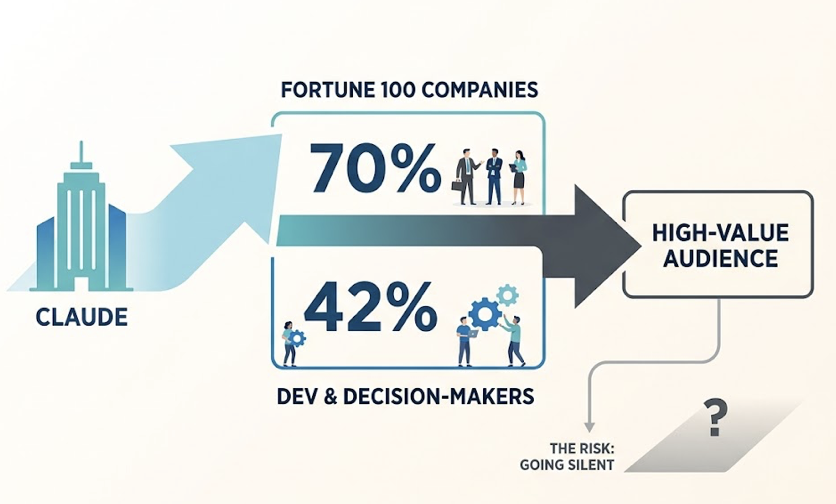
    There’s also a business case that makes Claude-specific monitoring worth prioritizing. Claude has an estimated 70% penetration rate among Fortune 100 companies, and roughly 42% of developers and technical decision-makers use it regularly. That’s the audience segment making high-value purchasing decisions. Going silent in Claude’s answers isn’t a minor gap. It’s losing the room where enterprise deals get researched.


    Step 1 — Map the Prompts That Shape Your Claude AI Brand Visibility

    Most brands test 3 to 5 keyword variants and call it a baseline. In Claude’s environment, that approach misses how users actually query the model. Claude handles long-context, scenario-specific questions that don’t map neatly to traditional keyword research. You need a structured prompt set to cover the full range of contexts where your brand should appear.

    Category prompts, comparison prompts, and use-case prompts

    Three prompt structures determine most of a brand’s visibility inside Claude, and each requires a different content strategy to win.

    Category prompts are exploratory. “What are the best enterprise CRM platforms in 2026?” Claude typically returns a structured list here. Your visibility depends on whether you’ve made it into the model’s parametric knowledge or the top results of a Brave-powered search.

    Comparison prompts hit mid-to-late decision stage. “Compare [your brand] and [competitor] on data privacy and compliance.” Claude is strong at nuanced trade-off analysis. If your technical documentation is thin, Claude may flag you as “limited information available” rather than defend your position.

    Use-case prompts are where brand authority compounds quietly. “How do I automate cross-border logistics clearance using AI tools?” Your brand may not be mentioned by name, but if Claude pulls your content as the framework for solving the problem, that’s the kind of citation that builds durable recommendation weight.

    How to build a 50-prompt test set for your industry

    A statistically useful test set requires what’s called swarm probing: running multiple variants of the same intent to see how consistently Claude surfaces your brand across phrasings, formality levels, and persona framing.

    A working 50-prompt structure looks like this: identify 10 core scenarios where your brand must show up, then build 5 variants per scenario by adjusting query length, persona framing (“as a CTO evaluating options…”), geographic constraints, and technical specificity. Include 2 to 3 negative control prompts, unrelated queries where your brand should not appear, to check whether Claude is making erroneous entity associations.

    That last piece matters more than people expect. If Claude is linking your brand to contexts where it doesn’t belong, that’s an accuracy problem you need to catch early.


    Step 2 — Run Structured Tests and Record What Claude Actually Says

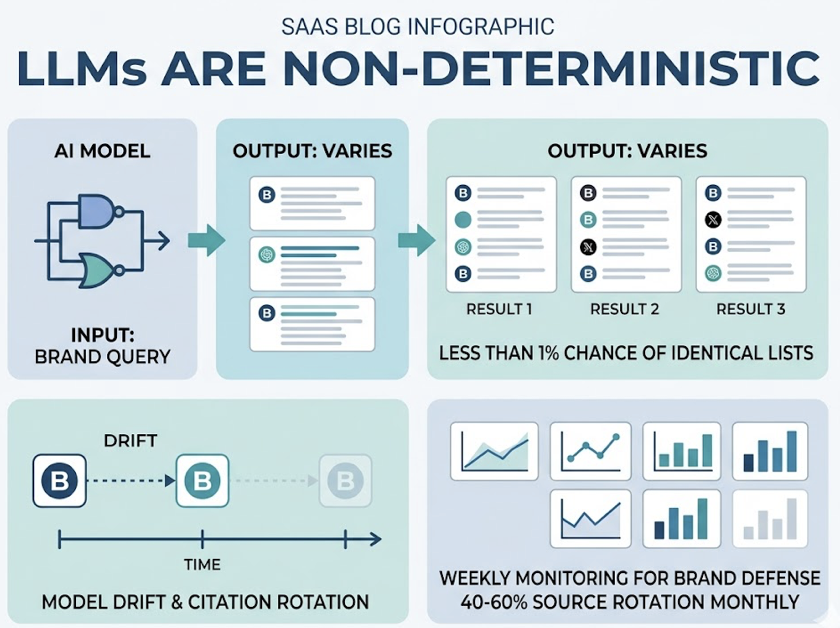
    Manual testing works, but only if the results are reproducible. Claude’s outputs are probabilistic. Run the same prompt twice and you’ll get different phrasings. Run it in a continued session versus a fresh one and you may get different brand mentions entirely. Standardization isn’t optional here.

    What to capture beyond “yes or no”

    Each test session needs a clean slate. Start a new conversation before every prompt run to prevent Claude’s long-context memory from carrying over previous brand associations. Log which model version you’re testing (Claude Sonnet 4.6 versus Opus 4.6, for instance, can produce different results), because different versions have different training cutoff dates and retrieval strategies.

    If your team operates across regions, multi-location sampling matters too. Claude’s Brave-powered search can return different results depending on geographic context when search mode is enabled.

    Sentiment, position, and source citation: the three data points that matter

    Recording whether Claude mentioned your brand is the minimum. The three data points that actually drive content decisions are:

    Sentiment framing. Claude doesn’t just list brands, it describes them. Is your brand characterized as “an established player with proven enterprise integrations” or “a platform that some users find has a steeper learning curve”? That framing shapes how B2B buyers interpret the recommendation before they visit your site.

    Position rank. In AI-generated text, first mention isn’t just first, it’s dominant. Brands appearing in the opening paragraph or at the top of a list capture over 80% of the reader’s attention. By the fourth position, perceived authority drops sharply. Position is as much a conversion factor as sentiment.

    Source citation. This is the data point most brands overlook and the one most directly actionable. Which URLs is Claude actually pulling from when it describes your brand? Is it your own product pages, a G2 review you haven’t managed in two years, or a competitor’s comparison post written to make you look weaker? That answer tells you exactly where your content investment needs to go.


    4 Metrics That Tell You More Than a Mention Count in Claude AI

    A raw mention count is a vanity metric in GEO. What you need is a composite measurement system that connects Claude’s outputs to real brand risk and real content priorities.

    Visibility rate is the baseline: how often does your brand appear across your full prompt test set? In B2B SaaS, early-stage brands typically land between 2% and 8%. To be considered a category leader inside Claude’s answers, you generally need 35% to 50% across tested prompts. Anything below 10% means you’re effectively invisible in AI-assisted research for your category.

    Sentiment score is where Claude’s Constitutional AI creates a higher bar than other models. Claude tends to add qualifiers and caveats when its confidence in a brand’s claims is low. If Claude is consistently prefacing your mention with “though some users have noted reliability concerns,” your sentiment score is working against you even when you’re showing up. Research indicates B2B SaaS brands cluster between 50% and 77% positive sentiment, and anything below 50% signals a reputation problem that content alone won’t fix.

    Answer Placement Score (APS) weights your position within the response. A brand in first position scores 1.0. Second position scores roughly 0.6. Third and beyond drops off sharply. Tracking your APS average across key comparison prompts tells you whether you’re winning the category or just participating in it.

    Owned citation rate is the most actionable of the four. What percentage of the time Claude mentions your brand is it sourcing from URLs you control? If Claude is consistently reaching for third-party reviews or competitor content to describe you, your own web properties aren’t meeting Claude’s technical density threshold. That’s a fixable content architecture problem, not a PR problem.


    Step 3 — Build a Monitoring Cadence Before Claude’s Outputs Shift

    Claude’s recommendations are not static. Model updates shift its internal knowledge base. Changes to its search infrastructure can restructure which sources it prioritizes overnight. A monitoring system without a defined cadence will always be reacting late.

    Weekly spot-checks versus monthly full-cycle audits

    A practical two-tier cadence covers both fast-moving signals and long-term strategic measurement.

    Weekly spot-checks should cover about 20% of your highest-intent prompts: the comparison and use-case queries most likely to influence purchase decisions. This layer catches early signals of visibility drops caused by model fine-tuning or narrative shifts in Claude’s indexed sources like Reddit or industry review sites.

    Monthly full-cycle audits run your complete 50 to 100-prompt set. This is the only way to measure whether longer-horizon GEO strategies, content rebuilds, third-party placements, technical documentation updates, are actually moving your metrics inside Claude.

    Quarterly, layer in a cross-channel correlation. Connect AI visibility trends to CRM lead source data and traditional SEO performance. The goal is to isolate what percentage of pipeline can be attributed to AI-assisted research, even when the attribution isn’t directly tracked.

    The triggers that should prompt an immediate re-test

    Outside your scheduled cadence, certain events require dropping everything and running a full audit. A major Claude model version upgrade, the kind that shifts reasoning capability by 10% or more, typically comes with a moved training cutoff date that can reset your brand’s parametric presence. A confirmed change in Claude’s search infrastructure partners would restructure which sources get prioritized entirely. A PR event, acquisition, or executive-level news item will get absorbed into Claude’s real-time retrieval layer quickly and may change how Claude frames your brand in comparison queries. And if you discover Claude is misstating your pricing or mischaracterizing a core feature, that’s a signal that an outdated or inaccurate third-party source has gained weight in Claude’s retrieval pipeline. Address it immediately.


    Where Manual Claude AI Visibility Tracking Breaks Down at Scale

    Manual tracking is a legitimate starting point. It’s not a sustainable monitoring infrastructure.

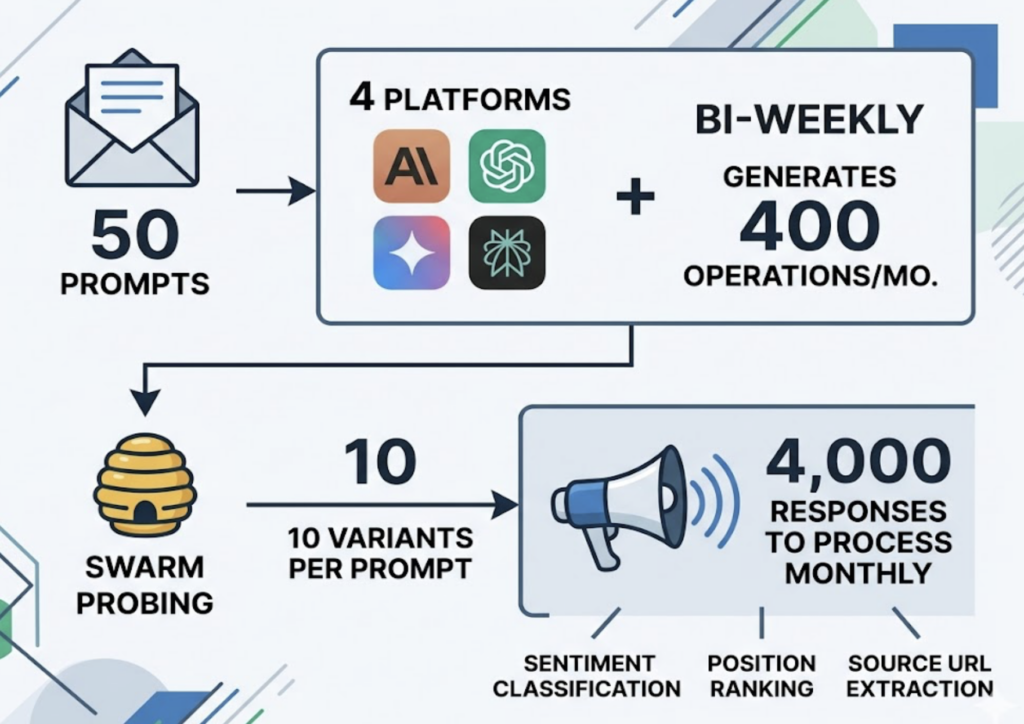
    Run the math: 50 prompts across 4 platforms (Claude, ChatGPT, Gemini, Perplexity), running bi-weekly, generates 400 operations per month. Add swarm probing at 10 variants per prompt for statistical confidence and you’re looking at 4,000 responses to process monthly. That’s thousands of tokens of output to parse for sentiment classification, position ranking, and source URL extraction.

    The cost compounds further. Calling Claude’s flagship API at scale for monitoring purposes can consume a year’s worth of SEO budget in a few months. And that’s before accounting for the analyst time required to turn raw outputs into structured tracking data.

    This is the scale problem Topify was built to solve. Its monitoring architecture uses tiered model routing: low-cost models handle initial mention detection, while Claude’s more capable tiers are called only for sentiment depth and citation analysis. The result is a reported 95%+ reduction in monitoring costs compared to direct API calls for the same coverage.

    Topify’s platform tracks seven core metrics automatically: visibility score, sentiment polarity, position ranking, intent alignment, mention volume, source citation origin, and Conversion Visibility Rate (CVR), which estimates the likelihood that a Claude answer drives a user toward brand engagement. Competitor Monitoring runs in parallel, so when a rival starts gaining ground in Claude’s answers for your target prompts, you see it in the same dashboard rather than discovering it weeks later.


    Turning Claude AI Visibility Data into Content Actions

    Data without a content response is just reporting. The goal is closing the loop between what Claude says about your brand and what your content team builds next.

    If Claude is citing your competitors’ sources instead of yours

    This gap has a name: the mention-source gap. Claude acknowledges your brand exists, but the URLs it pulls from are a competitor’s comparison post, a G2 page you haven’t updated in 18 months, or a Reddit thread where your product was criticized.

    The fix isn’t more content volume. It’s content structure. Claude’s retrieval system responds to what researchers call machine-readable authority: schema markup (JSON-LD) that explicitly defines relationships between your services, your team’s expertise, and your case studies. It also requires Brave Search indexability. If fewer than 20 unique Brave users have visited your key product pages, those pages may not carry enough weight in Brave’s Web Discovery Project to register as a reliable source in Claude’s pipeline.

    Third-party signal management also matters. If Claude consistently surfaces Reddit as a source for your category, the strategy isn’t to avoid Reddit. It’s to be represented there with high-quality, technically precise contributions that Claude can extract as expert signal rather than consumer complaint.

    If your sentiment score is stuck at neutral

    Neutral sentiment in Claude typically means your content lacks a distinct point of view or verifiable authority. Claude is trained to filter out content that reads as AI-generated filler or promotional copy without factual grounding.

    The structural fix is rebuilding core pages around what’s called the Generative Engine Answer Format (GEAF). The principle is that Claude is looking for content structured like a high-quality answer, not a sales page.

    That means H2 headings framed as the questions your buyers would actually ask Claude. A 40 to 60-word summary at the top of each section that gives Claude a quotable “answer capsule.” Ordered lists and fact blocks rather than paragraphs of descriptive prose. Data points with verifiable sources attached to every significant claim. And E-E-A-T signals, expert quotes, author credentials, original research, that increase Claude’s confidence weighting for your content in analytical queries.

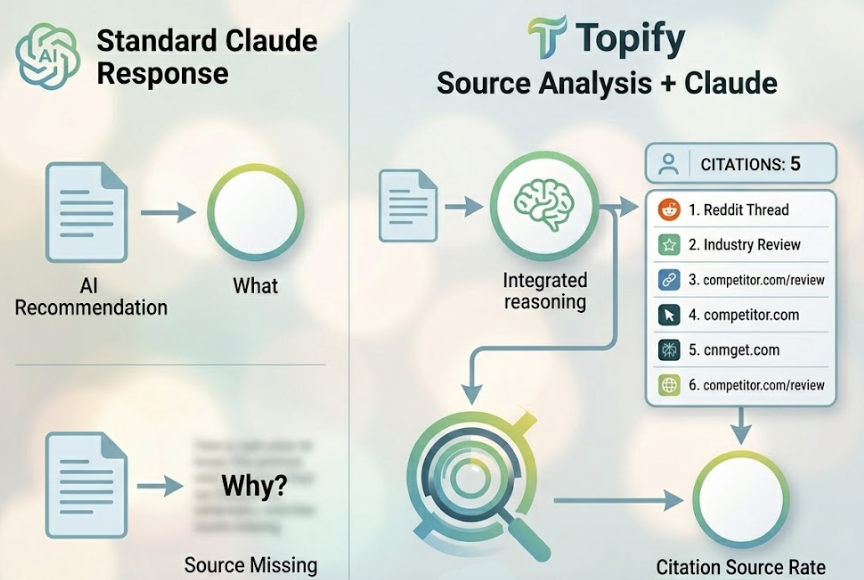
    Topify’s Source Analysis feature maps exactly which of your URLs Claude is currently citing and which are being bypassed. That data turns a vague content audit into a prioritized list of pages to rebuild against GEAF standards.


    FAQ

    How often does Claude AI update its brand recommendations?

    Two separate layers affect how often Claude’s outputs change. At the model layer, Anthropic releases updates and fine-tuned versions roughly every two months, which shifts Claude’s internal training knowledge. At the retrieval layer, Claude’s Brave-powered search can reflect new internet content within days or even hours. Weekly spot-checks are the minimum cadence to catch shifts at both layers before they compound.

    Can I track Claude AI visibility without a paid tool?

    Yes, at small scale. A structured spreadsheet with 10 to 20 core prompts, tested weekly in fresh Claude sessions, will give you a baseline. Record mention presence, sentiment phrasing, position, and any URLs Claude cites. This won’t give you share-of-voice calculations or competitor benchmarking, but it’s a valid starting point for building initial GEO awareness before investing in automated infrastructure.

    What’s a realistic visibility rate benchmark for Claude AI?

    It depends on your category and growth stage. In B2B SaaS, a Series A brand typically targets 8% to 20% visibility across tested prompts. Category leaders aiming for dominant positioning should be tracking toward 35% to 50%. More important than the absolute number is the trend. A brand moving from 6% to 14% over a quarter with improving sentiment is outperforming a brand sitting at 40% with a declining APS average.

    How is Claude AI monitoring different from Google Search Console?

    GSC measures clicks and impressions from traditional search rankings. It tells you what happened after a user decided to visit your site. Claude monitoring tells you what the AI intermediary said about you before the user ever saw your domain. In a zero-click AI research environment, that’s the decision-shaping layer GSC has no visibility into at all.


    Conclusion

    Claude AI isn’t a feature of your existing monitoring stack. It’s a separate evaluation system with its own sources, its own quality threshold for brand content, and its own logic for deciding which brands deserve a first-mention position in a high-stakes enterprise research query.

    The brands that figure this out first will have a compounding advantage. Every piece of content restructured to meet Claude’s technical density standards, every Brave-indexed page that earns owned citation, and every weekly cadence that catches a sentiment shift before it hardens into a lost deal represents a gap between you and competitors still treating Claude as an afterthought.

    Build the prompt matrix. Run the structured tests. Track the four metrics that actually move decisions. And when manual tracking hits its scale ceiling, let the infrastructure carry the load so your team can focus on the content actions that change what Claude says next.


    Read More

  • Google Ranks You #1. Claude Has Never Heard of You.

    Google Ranks You #1. Claude Has Never Heard of You.

    Your domain authority is solid. Your keyword rankings are exactly where you want them. Then a prospect asks Claude, “What tools do you recommend for [your category]?” and your brand isn’t in the answer.

    That’s not a fluke. It’s a structural gap, and traditional SEO metrics can’t explain it because they weren’t built to measure it. Google ranking and Claude AI brand visibility operate on completely different logic, and most marketing teams don’t realize this until they’re already losing ground to competitors who do.

    Two Search Systems That Don’t Speak the Same Language

    Google is a retrieval system. It ranks URLs based on backlinks, keyword relevance, and technical performance, then hands you a list of ten results to click through.

    Claude is a synthesis system. It reads, reasons, and generates a single response. There’s no list of ten options. There’s a shortlist of two or three, and everything else is invisible.

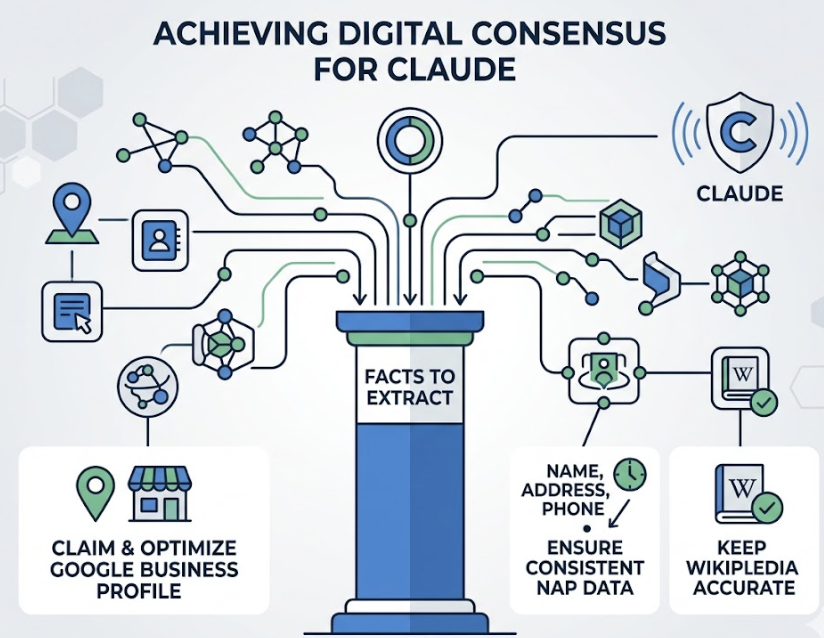
    The authority signals are different too. Google weighs domain authority and backlink profiles. Claude weighs what researchers call “Digital Consensus”, how often a brand is mentioned with consistent attributes across multiple high-trust sources. A brand that dominates its own domain but rarely appears in third-party coverage may rank first on Google and not register at all in Claude’s reasoning.

    That’s the gap most brands still can’t see.

    What Claude Actually Uses to Decide Who to Mention

    Here’s something most SEO teams don’t know: Claude doesn’t primarily use Google’s index for real-time queries.

    Statistical analysis shows that Claude has an 86.7% correlation with Brave Search results, compared to ChatGPT’s 26.7% correlation with Bing. In practice, this means a brand optimized exclusively for Google but absent from Brave’s index is functionally invisible to Claude’s retrieval layer. Two platforms, two completely different indexes.

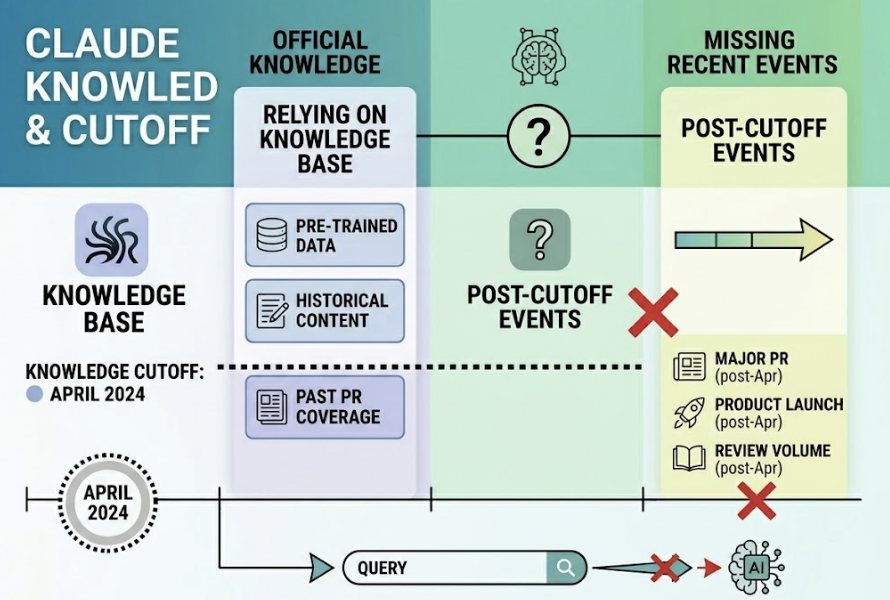
    For queries that don’t trigger a live web search, Claude relies on its pre-trained knowledge base. Claude 3.5 Sonnet has a knowledge cutoff of April 2024. If your brand’s major PR coverage, product launches, or review volume came after that date, the model’s base parameters simply don’t reflect your existence unless the browsing tool is explicitly activated.

    Anthropic’s training approach also weights “reliability” heavily. Claude favors facts that are corroborated across multiple high-trust domains: established media, government sources, industry journals. If your brand’s claims only live on your own website, Claude lacks the external proof to recommend you with confidence.

    5 Reasons Your Brand Disappears in Claude’s Answers

    These aren’t ranking failures in the traditional sense. They’re extractability and credibility failures.

    No third-party digital consensus. AI models evaluate brands as entities within a knowledge graph. An entity’s strength comes from how often it’s co-mentioned with specific attributes across high-trust sources. Strong internal SEO doesn’t help here. What Claude needs is earned coverage on Reddit, established publications, G2, and similar platforms.
    Content that’s not machine-extractable. Research shows that in 40% of cases, AI models skip the Google #1 result in favor of a page-two result that uses a clear table or FAQ block. Cluttered, marketing-heavy pages require more “computational noise” to summarize, so models skip them. Structured, fact-dense content wins the citation slot.

    Insufficient brand proof points in training data. If a brand isn’t frequently mentioned in high-density datasets like Common Crawl or Reddit, it develops a low co-occurrence probability. For established brands, associations like “sustainable” and “Patagonia” are mathematically inseparable in a model’s weights. Newer or niche brands without that kind of presence fail to trigger the model’s internal association engine.

    Competitors already own the citation sources. Generative AI is a zero-sum game. An AI response typically surfaces two or three options. If a competitor has secured placements in the sources Claude trusts, like a specific comparison guide or a heavily-upvoted Reddit thread, they own the retrieval slot. You don’t get a second listing.

    Weak knowledge graph presence. Traditional SEO focuses on keywords. Claude’s logic runs on semantic triples: Subject, Predicate, Object. If your brand doesn’t use structured data or Schema.org markup to explicitly define its relationship to its category, the model is forced to guess. Guessing usually results in omission.

    How to Actually Measure Claude AI Brand Visibility

    Manual spot-checking doesn’t work.

    LLMs are non-deterministic. A model might mention your brand in response to one prompt and omit it in the next based on minor phrasing variations. You can’t build a strategy on anecdotal checks.

    What actually works is systematic prompt testing across multiple AI platforms, tracking five core metrics:

    MetricWhat It Measures
    AI Visibility Rate% of relevant prompts where your brand appears
    Position ScoreAverage rank in the response (1st vs. 4th)
    Sentiment ScoreTone of the mention: recommended vs. neutral
    Citation FrequencyHow often your domain is cited as a source
    Entity StrengthHow closely the AI associates your brand with your category

    Position matters more than most teams realize. Research into AI-referred traffic shows visitors from AI citations convert at 4.4x to 9x the rate of traditional search traffic. But that conversion potential is concentrated in the top-ranked mentions. First position in an AI response carries roughly 5x the weight of being listed fourth.

    Topify automates this through what it calls Prompt Matrixing: querying models thousands of times across different phrasings, personas, and locations to produce a Share of Voice score. The output isn’t just a single visibility number. It maps exactly which prompts you’re invisible on, so you can prioritize where the gap costs you most.

    What Actually Moves the Needle for Claude AI Brand Visibility

    Research from Princeton and Georgia Tech identified a set of content changes that consistently increase AI citation probability. The numbers are specific enough to act on.

    Adding concrete statistics instead of vague claims increases extraction rates by 37%. Embedding inline citations from industry reports improves visibility by 40%. Including direct quotes from named experts with titles adds another 30%. These aren’t soft recommendations. They’re measurable structural changes.

    Beyond on-page content, entity verification matters. This includes claiming Google Business Profiles, keeping Wikipedia entries accurate where your brand qualifies, and ensuring consistent NAP data across platforms. The goal is to build what the research calls “Digital Consensus”: a pattern of corroborated facts that Claude can extract with confidence.

    One more tactic worth deploying: hosting a Markdown summary at /llms.txt on your domain. It’s a lightweight file designed specifically for AI agents, and it speeds up accurate indexing without requiring a full crawl.

    For the timeline: RAG-based citations, the real-time web layer, can be influenced in two to six weeks through structural content changes and Brave SEO. Influencing the base model, meaning the offline answers Claude generates without live search, requires consistent narrative across high-trust sites over six to eighteen months.

    Topify’s One-Click GEO Strategy addresses the execution gap by automating schema markup deployment and data table insertion once a visibility gap is detected. You define the goal, the system handles the rollout.

    Don’t Let Competitors Own the Answer

    Here’s where the stakes get concrete.

    AI responses don’t have a second page. There’s no “also consider” section below the fold. The brands that appear are the brands that matter to the user. The brands that don’t appear don’t exist in that decision moment.

    Topify’s Competitor Monitoring shows which sources Claude is using to talk about your competitors. If a rival is winning citations through a specific industry comparison guide or a Reddit thread with high engagement, you can identify those sources and build coverage there before that foothold becomes permanent.

    Position Tracking adds another layer. It monitors where your brand appears relative to competitors in actual AI responses, not just whether you appear at all. Being mentioned fourth, with a caveat about pricing, is meaningfully different from being the first recommendation. Both show up as “mentioned.” Only one drives conversions.

    Gartner projects a 25% drop in traditional search volume by 2026 as AI assistants handle more of the discovery layer. The brands that are already building Claude AI brand visibility today are the ones that will own the shortlist when that shift completes.

    Conclusion

    Google ranking is a prerequisite, not a finish line.

    Claude operates on a different set of trust signals, a different search backend, and a completely different content selection logic. A #1 ranking doesn’t carry over. It has to be earned separately, through third-party credibility, structured content, and systematic measurement.

    The gap between Google visibility and AI visibility is real, it’s widening, and it’s measurable. The first step is knowing exactly where you stand. Get started with Topify to map your brand’s AI visibility across Claude, ChatGPT, and Perplexity in one place.

    FAQ

    Q: Does Google ranking help with Claude AI brand visibility at all?

    A: Yes, but only indirectly. Claude’s search backend correlates strongly with Brave Search, which often aligns with Google results. So strong SEO remains a prerequisite for the retrieval layer. But ranking well doesn’t guarantee Claude will select your content for its final synthesized answer. That selection is based on structure, credibility signals, and third-party consensus, not rank position alone.

    Q: How often does Claude update its knowledge?

    A: Foundation models are retrained only a few times per year, often with a lag of six to eighteen months. Claude 3.5 Sonnet’s training data cuts off at April 2024. For real-time queries, Claude can access current web data through Brave Search, typically within two to fourteen days of a page being indexed.

    Q: What types of content does Claude tend to cite?

    A: Claude consistently favors structured, fact-dense content. Comparison tables, FAQ blocks, and authoritative guides that include inline citations and named expert quotes perform significantly better than long-form narrative pages. Content that’s easy for a model to extract a clean answer from wins the citation slot.

    Q: How long does it take to improve brand visibility in Claude?

    A: There are two timelines. For real-time RAG citations, structural content changes and Brave Search optimization typically show results in two to six weeks. For influencing Claude’s base model knowledge, the offline layer that doesn’t require a live search, expect six to eighteen months of consistent presence across high-trust sources.

    Read More

  • Claude AI Brand Visibility: What’s Different

    Claude AI Brand Visibility: What’s Different

    Your brand appears in ChatGPT answers. It shows up in Perplexity citations. You’ve built the dashboards, pulled the reports, and called it covered.

    But when a senior engineer at a Fortune 500 company opens Claude and asks which platform best fits their stack, your brand might not exist at all.

    That’s not a tracking failure. That’s an architecture problem.

    Claude Doesn’t Search Like the Others

    Most marketers treat AI visibility as one metric across one pool of platforms. That assumption is costing them placements they can’t see.

    Perplexity is a retrieval engine. It crawls the live web in real time, indexes sources, and surfaces citations for every query. ChatGPT runs a hybrid model, blending its training weights with optional web search. Both systems reward recent, indexed content.

    Claude operates differently. Its brand recommendations originate primarily from training data and its internal weights, not from a real-time web crawl. While newer versions like Claude Opus 4.7 have integrated optional search, the model exhibits a persistent “training data bias”: when retrieved web content conflicts with internal training memory, Claude tends to default to what it learned during pre-training.

    The practical consequence: a brand that launched a new product line last quarter may not see that positioning reflected in Claude’s answers for 6 to 18 months.

    That’s not a bug. It’s the architecture.

    The 3 Signals That Shape Claude AI Brand Visibility

    Visibility on Claude isn’t a ranking. It’s a probability. The model assesses the likelihood that your brand is the most helpful, honest, and reliable answer to a specific user intent. Three signals drive that assessment.

    Training Data Density and Entity Authority

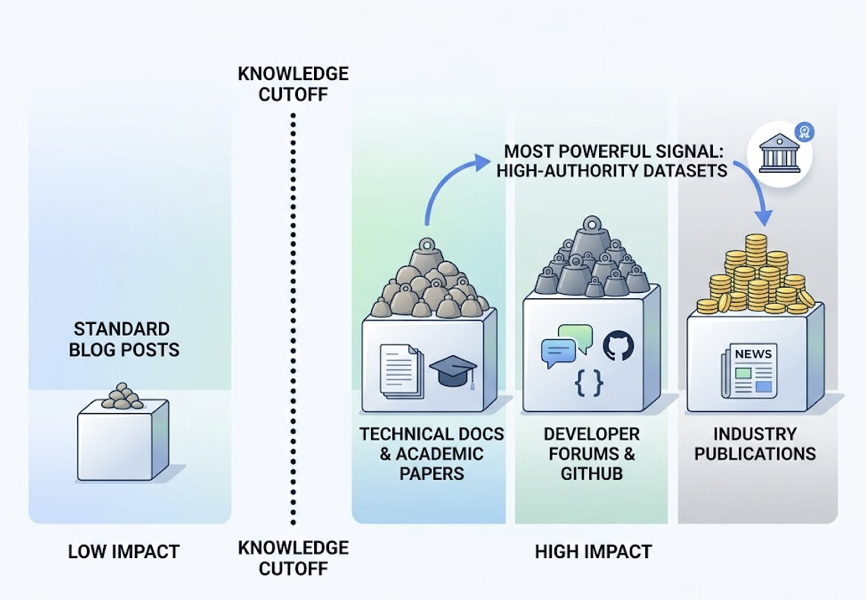
    The most powerful signal is how frequently your brand appeared in high-authority datasets before the model’s knowledge cutoff. Technical documentation, academic papers, developer forums like Stack Overflow, GitHub citations, and industry-standard publications all carry significant weight. Standard blog posts, comparatively, carry far less.

    This creates a winner-take-all dynamic. Once a brand is encoded as the default reference in Claude’s weights for a given category, it gets retrieved consistently across thousands of diverse prompts. Brands that haven’t built that footprint in authoritative sources are often invisible, even if they rank well on Google.

    Semantic Proximity in Context Windows

    Claude can process up to 200,000 tokens in standard tiers and 500,000+ tokens in Enterprise versions. When a user uploads a long RFP, technical specification, or internal document, Claude evaluates brands based on how well their identity maps to the specific problems described in that context.

    This is where brand naming creates real risk. For brands with common-noun names, uncontextualized queries return near-zero recognition. The model defaults to the dictionary definition. When category context is added, recognition can jump to 100%. Consistently pairing your brand name with specific technical “scenario words” — think “SOC 2 compliant CRM” or “Kubernetes-native observability” — is what teaches Claude to disambiguate your entity from general language.

    Constitutional Alignment and Sentiment Signal

    Anthropic trained Claude using a “Constitutional AI” methodology, embedding a set of ethical guidelines derived from sources like the UN Declaration of Human Rights. These principles function as a narrative filter. Claude is intentionally more measured in its recommendations than ChatGPT. It phrases suggestions with qualifiers like “Popular options include…” and avoids overconfident endorsements.

    For brands, the implication is direct: Claude doesn’t just track positive or negative sentiment. It assesses your brand’s alignment with its safety and reliability guidelines. A brand associated with data privacy controversies or factual inconsistencies in its training data may be excluded from recommendations entirely.

    Claude vs. ChatGPT vs. Perplexity: The Structural Gap

    Understanding the difference between these platforms requires comparing them at the architecture level, not just the output level.

    DimensionChatGPT (GPT-5.4)Perplexity (Sonar)Claude (Opus 4.7)
    Core functionConversational task engineReal-time search engineAnalysis-first assistant
    Data sourcingHybrid: training + searchReal-time web indexTraining data (search optional)
    Trust mechanismConsistency and usabilityCitations and verifiabilityDepth and interpretability
    Visibility logicCommercial consensusSearch ranking and authorityTechnical E-E-A-T and reasoning
    Update frequency6-12 weeksNear real-time6-18 months
    Citation biasEstablished sourcesDemocratic, source-agnosticConservative, technical

    The update frequency row is where most marketing teams underestimate the risk. A content strategy built for ChatGPT’s 6-to-12-week refresh cycle will miss Claude’s 6-to-18-month training window almost entirely. The playbooks aren’t interchangeable.

    Why Only Tracking ChatGPT Leaves a Revenue Gap

    Claude holds a 32% share of the enterprise AI assistant market and a 42% share of the code generation market. 70% of Fortune 100 companies have integrated it into business operations.

    That user base skews toward decision-makers: CTOs, developers, researchers, and analysts who use Claude specifically for deep due diligence, not casual browsing.

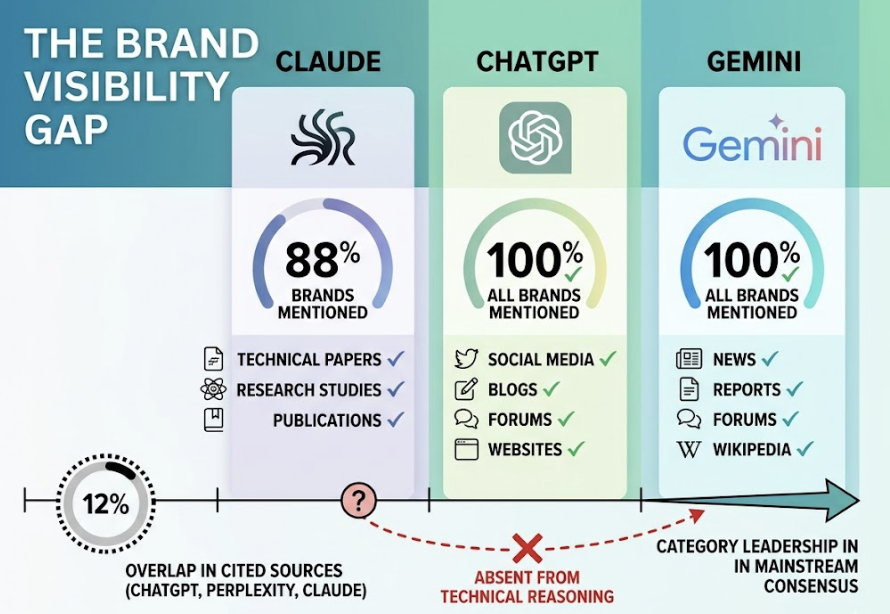
    Here’s where the gap gets costly. Research across 50 B2B SaaS brands found that Claude mentions only 88% of tested brands, compared to 100% for ChatGPT and Gemini in identical prompt sets. Only 12% of sources cited by ChatGPT, Perplexity, and Claude overlap. A brand that’s the category leader in ChatGPT’s mainstream consensus can be entirely absent from Claude’s technical reasoning pool.

    The buying journey makes this concrete. A procurement team might use ChatGPT for an initial category overview, then switch to Claude to analyze 100 pages of vendor documentation before making a final decision. If Claude doesn’t recognize your brand’s authority in that analytical phase, you’re eliminated before a human even picks up the phone.

    That’s the Claude gap: invisible in the platform where enterprise decisions actually get made.

    Measuring Claude AI Brand Visibility

    Traditional SEO metrics, clicks, impressions, rankings, don’t transfer to the generative era. Claude operates as a zero-click intermediary. You need a different measurement framework.

    The core KPIs for Claude visibility tracking:

    MetricWhat It Measures
    Brand Visibility Score (BVS)Composite of mention frequency, placement, and sentiment
    Citation FrequencyPercentage of prompts where Claude links to your content
    Brand Mention RateHow often your brand name appears, with or without a citation
    Share of Model (SoM)Your mentions relative to all category competitors
    Sentiment VelocityDirection of tone trends over time

    Tracking these metrics accurately requires what researchers call “Synthetic Probing”: running massive prompt matrices to simulate thousands of diverse user intents, not just manually checking a handful of queries. Claude’s output for any single prompt is stochastic. Its response to “What’s the best CRM for a fintech firm on AWS?” may vary between sessions. Statistically significant visibility data requires scale.

    This is where platforms like Topify change the picture. Topify runs large-scale prompt matrices across AI platforms including ChatGPT, Gemini, Perplexity, and Claude, calculating a statistically significant Share of Model from thousands of variations per intent. It surfaces “Invisibility Gaps”: specific query scenarios where your brand is omitted despite having a relevant product. Instead of guessing where you’re missing, you get a map.

    Topify tracks seven key metrics: visibility, sentiment, position, volume, mentions, intent, and CVR (Conversion Visibility Rate), unified in a single dashboard across platforms. For teams that need to make a case for Claude-specific investment, it’s the difference between anecdote and evidence.

    Building a Claude Visibility Strategy That Actually Works

    Fixing Claude AI brand visibility isn’t a quick optimization task. It’s a 6-to-18-month content program with three structural components.

    Information Density and Technical Authority

    Claude’s retrieval layer prioritizes content with a high ratio of unique facts to total word count. The practical implication: API documentation, integration guides, security whitepapers, and developer tutorials matter far more than optimized marketing copy. Content should lead with direct answers in the first 150 words, use clear headings, and follow a “premise-evidence-conclusion” structure that an LLM can parse and cite efficiently.

    The Digital Cushion for Sentiment Management

    Claude’s sentiment is shaped by its entire training corpus. A single negative piece on a high-authority site like Reddit can have a disproportionate impact on its recommendations. When Topify or similar tools detect a Sentiment Velocity decline, the response is to publish 10-to-15 fact-dense, high-authority articles across owned, earned, and industry channels that directly address the specific critique with data. Over time, as Claude’s knowledge refreshes, those authoritative sources dilute the negative signal.

    Entity Disambiguation at Scale

    Never vary your brand name in technical contexts. Use JSON-LD schema markup (FAQPage, Product, Review) to explicitly define your entity’s relationship to its category. Ensure your brand name consistently appears alongside specific technical scenario words in all authoritative content.

    Done consistently, these three tracks build a content footprint that Claude recognizes as authoritative before the next major training cycle.

    Conclusion

    Claude is not another version of ChatGPT. It’s a separate platform with its own retrieval logic, its own trust signals, and its own user base: the developers, researchers, and enterprise decision-makers who make the final call on vendor selection.

    The brands establishing a dense content footprint in authoritative sources right now will enjoy what amounts to default authority in Claude’s next training cycle. Their competitors, still optimizing exclusively for real-time search ranking, will remain invisible in the platform where the highest-value decisions are made.

    That’s not a prediction. It’s already happening. The question is which side of that gap you’re on.


    FAQ

    Does Claude AI update brand information in real time?

    Not typically. Claude primarily relies on internal training data with specific knowledge cutoffs, January 2026 for Claude Opus 4.7. While it can use web search for specific queries, research shows that when retrieved web data conflicts with training memory, Claude often defaults to its older internal associations. Correcting outdated brand positioning requires a sustained 6-to-18-month content strategy.

    Is Claude brand visibility harder to measure than Perplexity?

    Yes. Perplexity provides deterministic citation links for every answer, making it partially compatible with traditional tracking. Claude is a reasoning engine that often synthesizes without citations, or with conservative sourcing. Accurate measurement requires probabilistic tracking at scale: running thousands of prompt variations to calculate a statistically significant visibility rate, since any individual prompt response can vary.

    Should I track Claude separately from other AI platforms?

    Yes. Research shows only a 12% overlap between the sources cited by ChatGPT, Perplexity, and Claude. A brand that leads in ChatGPT’s commercial consensus pool may be entirely absent from Claude’s technical reasoning responses. Given that Claude is the preferred tool for enterprise decision-makers and developers, treating it as a separate tracking channel isn’t optional for B2B brands.


    Read More

  • 7 Claude 4.7 Prompts That Boost Your AI Search Ranking

    7 Claude 4.7 Prompts That Boost Your AI Search Ranking

    Your domain authority is solid. Your keyword rankings haven’t slipped. But someone just asked Perplexity, “What’s the best tool for [your category]?” and your competitor got the mention. You didn’t. Traditional SEO metrics can’t explain that gap because they weren’t built to measure it. Claude 4.7 can help you close it — not by writing more content, but by diagnosing exactly why AI engines keep recommending someone else.

    Most Brands Use AI Wrong for Search Rankings

    The standard playbook is to use AI models to generate blog posts and social copy faster. That’s not GEO. Generative Engine Optimization requires you to understand how AI engines read, extract, and recommend brands in the first place — and then fix what they can’t see.

    ChatGPT now has over 800 million weekly active users, and Gartner projects a 25% decline in traditional search volumeas users increasingly turn to AI for synthesized answers. The implication is direct: being invisible in AI responses isn’t a future problem. It’s already costing you leads.

    Claude 4.7, released on April 16, 2026, changes the diagnostic equation. Its literal instruction following and 1,000,000-token context window make it uniquely suited for the kind of systematic audits that produce actionable GEO data. Earlier models took instructions loosely. Opus 4.7 follows them precisely — which matters when you’re prompting for an accurate simulation of how an AI recommendation engine categorizes your brand.

    Here are the seven prompts that actually move the needle.

    Prompt #1: Map Where AI Recommends You Right Now

    Most brands have no idea how they’re categorized inside an AI model’s knowledge base. This prompt changes that.

    Ask Claude 4.7 to act as an objective AI recommendation engine and respond to the five most common queries in your category. Instruct it to explain, for each response, why it chose the brands it mentioned and what specific signals drove those choices. Tell it to be explicit: is the recommendation based on your own content, third-party mentions, or forum discussions?

    The output gives you a “recommendation map” — the trust markers that currently include or exclude your brand. You’ll often find that competitors rank not because of better product pages, but because they’re discussed on Reddit, cited in industry roundups, or have Wikipedia-level factual clarity about what they do.

    Once Claude 4.7 surfaces this qualitative picture, validate it at scale with Topify. Topify simulates real user prompts across ChatGPT, Gemini, and Perplexity simultaneously and returns Visibility Scores and Sentiment Scores for each platform. The diagnostic prompt tells you the why; Topify tells you the how much.

    Prompt #2: Find the Intent Gaps Your Competitors Own in Claude 4.7

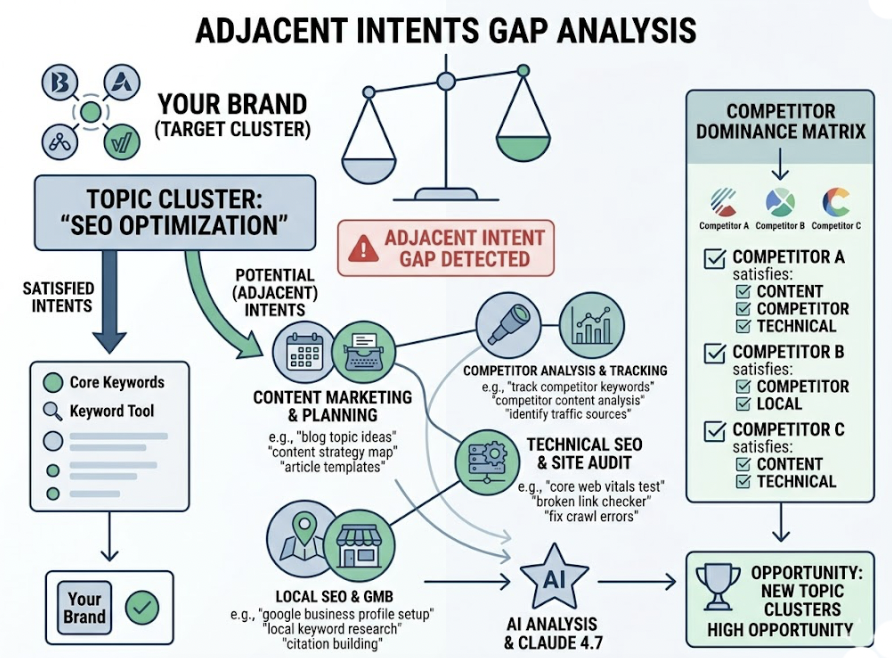
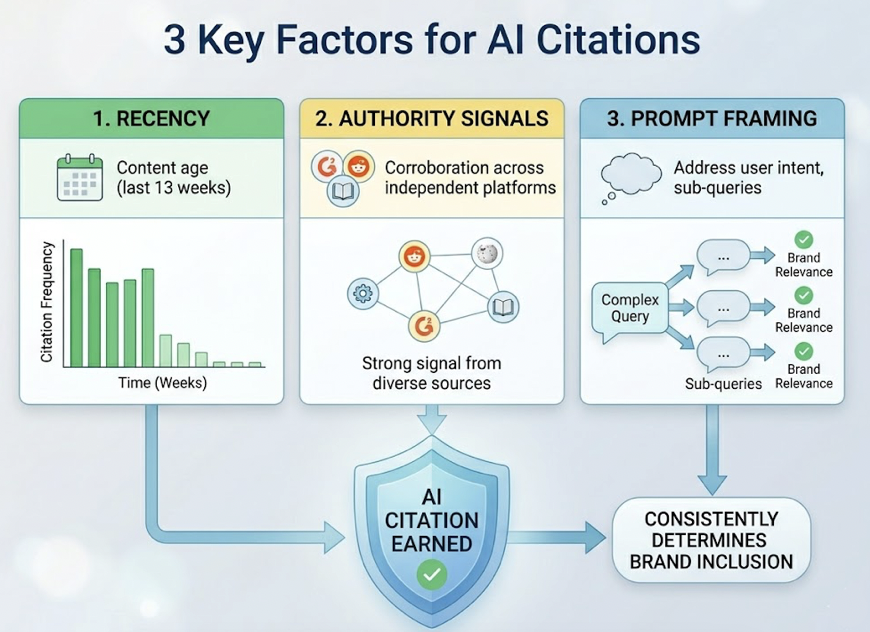
    When a user submits a complex question to an AI assistant, the system breaks it into smaller sub-queries to find specific fragments of the answer. Your brand might appear in the broad category but disappear entirely in sub-queries about pricing, integrations, or comparisons.

    This is called query fan-out, and it’s where most brands bleed visibility without knowing it.

    Prompt Claude 4.7 to analyze your top three competitors’ content alongside your own and identify which “adjacent intents” they satisfy that you don’t. Give it a specific topic cluster to work within. Ask it to list every sub-query a user might generate when researching that topic, then mark which brands would appear in each one and why.

    A specification gap — missing comparison tables or detailed integration documentation — means a competitor will get cited every time a user asks “does X work with Y?” A trust gap means your claims appear in your content but nowhere else, so AI engines discount them.

    Topify’s AI Volume Analytics can then quantify which of these sub-queries carry actual search volume, so you prioritize the gaps that cost you the most.

    Prompt #3: Reframe Your Product Description for Claude 4.7 and Other AI Engines

    AI engines don’t read marketing copy the way humans do. They convert text into vector embeddings — mathematical representations that determine how closely your content matches a user’s query. Promotional language, vague superlatives, and context-dependent phrasing all produce weak embeddings.

    That means “we help teams move faster” is nearly invisible in AI retrieval. “Platform X reduces sprint cycle time by 23% for teams of 10-50 engineers” is highly extractable.

    Prompt Claude 4.7 to surgically edit your product descriptions using the following constraint: every sentence must be able to stand alone as a self-contained, verifiable answer to a specific question. No pronouns without clear referents. No adjectives without measurable backing. No “learn more” without telling the reader what they’d learn.

    The before-and-after difference is stark. “Our solution helps you grow” becomes “Brand Y’s platform increases pipeline conversion rates by 15% according to its 2025 customer cohort study.” The second version gets cited. The first gets filtered out.

    This isn’t just a copy edit. It’s a fundamental rewrite for Retrieval-Augmented Generation, the pipeline that most frontier AI engines — including those powering ChatGPT and Perplexity — use to construct their answers.

    Prompt #4: Extract Citation-Worthy Claims from Your Existing Content

    Here’s the thing: many brands already have the data needed to win AI citations. It’s buried in whitepapers, case studies, and product documentation under layers of marketing language.

    Content featuring original statistics achieves a 30-40% higher visibility lift in generative engine responses. The problem isn’t usually that the data doesn’t exist — it’s that it isn’t formatted for extraction.

    Prompt Claude 4.7 to audit a set of your internal documents and extract every statement that could function as a standalone answer to a common industry question. The criteria: each claim must include a specific number, a timeframe, or an attribution to an authoritative source. Vague claims don’t qualify.

    Then use the output to build a “citation asset list” — a structured document of your most quotable facts, each formatted as a standalone sentence. Publish these prominently across your website, press kit, and any content you’re trying to get AI engines to cite.

    Proprietary research drives roughly 40% higher citation rates. If you have internal data on customer outcomes, usage patterns, or category benchmarks, this prompt will help you identify and surface it.

    Prompt #5: Build a Brand Narrative Claude 4.7 Can Actually Read

    AI models build an “entity graph” of every brand they encounter — a structured representation of what a brand is, what it does, and how it relates to adjacent topics. If your narrative is fragmented across platforms, the model assigns lower confidence to recommendations.

    Consistency isn’t just good branding. It’s an algorithmic requirement.

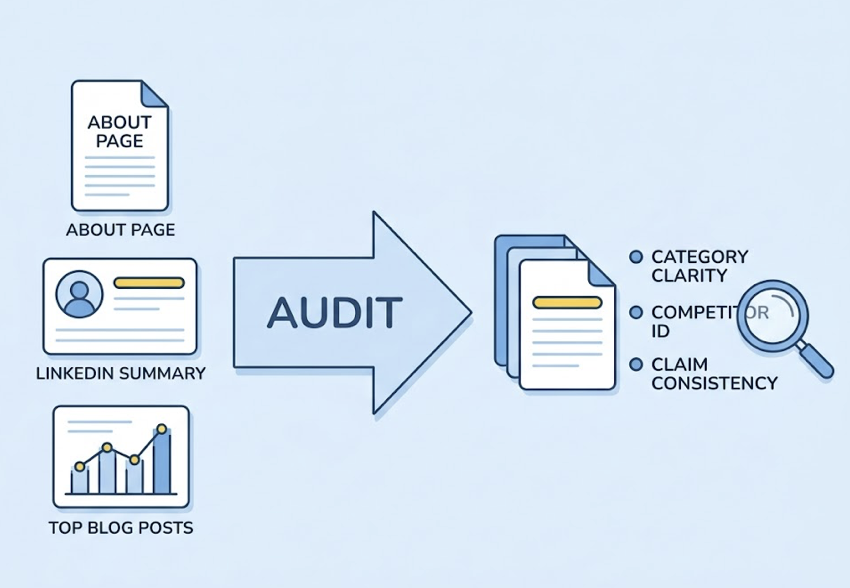
    Prompt Claude 4.7 to audit your About page, LinkedIn summary, and top-traffic blog posts for entity clarity. Ask it to evaluate: Is it unambiguous what category this brand belongs to? Can the AI determine who the primary competitors are? Are the brand’s core claims consistent across all three sources, or do they conflict?

    The output will reveal entity inconsistencies you didn’t know existed. A brand that calls itself “an AI-powered analytics platform” on its homepage but “a data intelligence tool” on LinkedIn creates ambiguity in the AI’s entity graph — and ambiguity reduces citation confidence.

    The fix is to write in modular, 40-60 word paragraphs that make sense even when extracted independently, and to explicitly name the categories, tools, and industry standards you want to be associated with. Topify’s Sentiment Analysisflags when AI engines are describing your brand inconsistently across platforms, making it easy to catch drift before it compounds.

    Prompt #6: Audit Your FAQ for AI Visibility

    FAQ sections are among the most frequently cited content formats across every major AI platform. Their structure — a direct question followed by a direct answer — mirrors the input-output logic of AI assistants almost perfectly.

    Pages with dedicated FAQ sections that include FAQPage schema are 3.2 times more likely to appear in AI Overviews.Most FAQ pages don’t have schema. Most FAQ answers bury the key information in the third paragraph.

    Prompt Claude 4.7 to analyze your existing FAQ against two criteria. First: are the questions phrased the way users actually ask them in conversation, or the way your marketing team thinks about your product? Second: does each answer lead with a concise 1-2 sentence summary that could stand alone as a complete response?

    Ask Claude 4.7 to rewrite three of your weakest FAQ entries as examples. The difference between “What are your pricing options?” and “How much does Platform X cost for a team of 10?” is significant — the latter matches conversational AI query patterns.

    Also prompt it to flag any FAQ entries that contain named entities without specifics. “We integrate with popular tools” is unfindable. “Platform X integrates with Salesforce, HubSpot, and Slack via native connectors” is highly extractable.

    Prompt #7: Generate a GEO Content Brief That AI Will Actually Cite

    The last prompt is the most structural. Instead of optimizing existing content, use Claude 4.7 to build a brief for new content that’s designed for AI citation from the first sentence.

    A traditional SEO brief specifies keyword frequency and word count. A GEO brief specifies extractability, verifiability, and intent coverage.

    Prompt Claude 4.7 to analyze the current top-cited source for a query in your category and generate a content brief that addresses every weakness it finds. Likely gaps: no original data, a promotional opening that AI engines filter out, a heading structure that doesn’t map to the sub-queries users actually generate.

    The brief should mandate a “Bottom Line Up Front” opening of 30-50 words, at least one structured comparison table, a minimum of three externally verifiable data points, and a heading hierarchy that maps to five or more adjacent user intents.

    44.2% of AI citations occur within the opening section of a piece, and content with strict H1-H2-H3 logical flow is 2.8 times more likely to be cited. That’s not a style preference. It’s an architectural requirement.

    How to Measure Whether These Claude 4.7 Prompts Are Working

    Running these prompts without a measurement layer is the same as running an SEO campaign without Google Search Console. You’ll be optimizing blind.

    Topify tracks brand Visibility Scores, Sentiment Scores, and Position Rankings across ChatGPT, Gemini, Perplexity, and 10+ additional AI platforms simultaneously. After implementing changes based on any of the seven prompts above, you can monitor week-over-week shifts in how frequently your brand appears and whether AI engines are describing it accurately.

    The Source Analysis feature is particularly relevant here. It reverses the AI’s citation logic to surface exactly which URLs and domains are driving mentions in your category. If a competitor is consistently cited because of a single industry report or Reddit thread, you can see that — and plan accordingly.

    That’s what separates GEO from guesswork. The prompts identify what to change. Topify’s Visibility Tracking tells you whether the changes worked.

    Conclusion

    Claude 4.7’s literal instruction following makes it a reliable diagnostic engine — not just a content generator. These seven prompts work because they force the model to simulate how AI engines think, not just help humans write faster.

    The brands that build AI search visibility in 2026 won’t outspend their competitors on content volume. They’ll outstructure them: clearer entity graphs, denser factual claims, FAQ sections that answer questions AI users actually ask. Run these prompts, implement the fixes, and use Topify to track what moves. Get started here.


    FAQ

    Q: Is Claude 4.7 better than GPT-5 or Gemini for GEO prompting?

    A: For diagnostic GEO work, Claude 4.7 has a measurable edge. Its literal instruction following reduces the “hallucination of intent” that makes other models interpret prompts loosely, and its 1,000,000-token context window lets you run full-site audits in a single session. On the SWE-bench Verified benchmark, Opus 4.7 reached 83.5% accuracy versus GPT-5.4’s 76.9%, which reflects its stronger adherence to structured, multi-step tasks. For generating prose content at scale, GPT-5.5 and Gemini 3.1 are also strong options, but for precision audits, Claude 4.7 is the more reliable tool.

    Q: How often should I run these prompts?

    A: Run Prompts #1 and #2 (recommendation mapping and intent gap analysis) every 4-6 weeks, as AI citation patterns shift with model updates and new content entering the web. Prompts #3, #5, and #6 (description reframing, narrative audit, FAQ audit) are best run quarterly or after any major product or messaging change. Prompts #4 and #7 (claim extraction and content briefing) can run on an ongoing basis as you publish new content.

    Q: Do these prompts work for optimizing presence in ChatGPT and Gemini, not just Claude?

    A: Yes. The prompts use Claude 4.7 as a diagnostic engine, but the output applies to all AI platforms. ChatGPT’s citation logic has only a 6.82% overlap with Google’s top 10 results, while Gemini-powered AI Overviews overlap 17-53%. That means you need platform-specific visibility data — which is where Topify’s cross-platform tracking becomes essential for translating diagnostic insights into platform-targeted actions.

    Q: What’s the single highest-impact change most brands can make today?

    A: Rewrite your most-trafficked product or service page to be answer-first and entity-explicit (Prompt #3). It’s the change with the broadest impact across all AI platforms because it directly affects how your content is processed during RAG retrieval — the mechanism that determines whether your brand gets extracted and cited, or passed over.


    Read More

  • Why ChatGPT Won’t Cite Your AI-Generated Content

    Why ChatGPT Won’t Cite Your AI-Generated Content

    You tripled your content output this quarter. You used Claude 4.7, tightened your editorial process, and published faster than ever. Then you checked how your brand shows up in ChatGPT, and the answer was the same as three months ago: it doesn’t.

    The problem isn’t the volume. It’s not even the quality. It’s that producing content with AI and getting cited by AI are two completely different games, and most marketing teams are only playing one of them.

    The Citation Gap Nobody Talks About

    AI-generated content is flooding the web, but almost nobody is tracking whether that content actually earns citations from AI engines. Most brands are still optimizing for keywords and backlinks while ChatGPT, Perplexity, and Google AI Overviews operate on an entirely different logic.

    These platforms don’t rank pages. They extract “fact units” that reduce the risk of hallucination. What gets cited isn’t the most polished content — it’s the most extractable content. And there’s a meaningful gap between the two.

    The data confirms the asymmetry. Only 28% of brands manage to earn both a mention and a citation link in the same AI response. The rest become background fuel: their data gets used, but the recommendation goes to someone else. In travel, for example, AI-referred visitors convert at 4.5x the rate of traditional search traffic — but fewer than 10% of brand websites earn direct citations. The rest get displaced by Reddit threads and TripAdvisor reviews.

    This is the citation gap. You might be feeding AI systems with your content, without ever showing up as the answer.

    Why Claude 4.7 Doesn’t Automatically Fix This

    Claude 4.7 Opus is a meaningful upgrade. It handles long-document reasoning, legal text analysis, and agentic workflows at a level that earlier models couldn’t match — reducing errors by 21% on complex reasoning benchmarks compared to its predecessor.

    But here’s the thing: citation decisions don’t happen at the generation layer.

    When a user submits a prompt to ChatGPT, the retrieval system scans an indexed pool (primarily Bing) for fact-dense sources before the generation model writes a word. Claude 4.7’s improvements in tone, nuance, and long-context coherence have no direct influence on whether that retrieval system selects your content as a source.

    The table below makes the gap concrete:

    DimensionClaude 4.7 UpgradeAI Citation Requirement
    Reasoning quality21% fewer logical errorsEntity consistency across domains
    Output clarityHigh instruction-followingBLUF structure (answer in first 300 words)
    Visual reasoning3.3x better image processingMultimodal data increasingly cited
    Self-verificationBuilt-in validation stepsHigh-authority external source links

    Better writing tools improve human readability. Higher AI citation rates require machine extractability. The two overlap, but they’re not the same thing.

    5 Reasons ChatGPT Ignores Your Content

    It Looks Like Every Other AI Output

    AI retrieval systems are built around risk minimization. If your content is assembled from widely available information — no original data, no first-person expert perspective — it occupies the same semantic space as thousands of similar pages. That makes it “zero information gain” content, and retrieval algorithms deprioritize it accordingly.

    Research from Princeton and Georgia Tech found that pages offering proprietary statistical data earned 41% higher AI visibility than pages summarizing publicly available information. If your content is smooth and frictionless, it’s also invisible. AI systems look for sources that add something they can’t already synthesize from their training weights.

    No Authoritative Signals Attached

    ChatGPT doesn’t just evaluate content — it runs a background check on the entity producing it. This is the “entity handshake” mechanism, and it’s where most AI-generated content fails silently.

    Signals that raise a source’s citation probability include verified author profiles (LinkedIn credentials, published bylines), Organization schema with sameAs links pointing to Wikipedia and LinkedIn, and FAQPage schema that directly embeds Q&A pairs. Pages ranked 6th–10th on Google with strong E-E-A-T signals earn AI citations at 2.3x the rate of first-ranked pages without them. Ranking isn’t the filter. Verified identity is.

    It Lives on the Wrong Domains

    Where your content lives matters as much as what it says. ChatGPT’s citation patterns show strong third-party preference: approximately 47.9% of top citations point to Wikipedia, while Perplexity sources 46.7% of its citations from Reddit. Brand websites account for roughly 9% of AI citations on average.

    Content that exists only on your domain, without corroboration from independent media, industry directories, or community platforms, triggers what AI models treat as “single-source risk.” The system looks for multi-source corroboration before committing to a recommendation. If your brand is mentioned in only one place, it doesn’t meet that threshold.

    ChatGPT Has Already Seen Better Versions

    AI citation networks have a first-mover advantage built in. Once an authoritative source — an industry association, a tier-one publication, an established benchmark study — establishes the “ground truth” on a topic, subsequent content needs to introduce significantly new facts or a better structure to displace it.

    On top of that, citation decay accelerates after 90 days without updates: pages that go stale lose citation probability at roughly 3x the rate of actively updated pages. And in the first 3–5 days after publication, a page either enters the retrieval pool or it tends to stay out. The window is narrow.

    You’re Not Tracking Which Prompts Trigger Citations

    Most teams are optimizing for keywords. ChatGPT is operating on prompt vectors — and they’re not the same thing.

    When a user submits a question, ChatGPT typically generates 3–5 sub-queries internally before constructing a response. Close to a third of all citation opportunities occur in those hidden sub-queries, which traditional keyword tools can’t see. If you don’t know which prompts are triggering citations in your category, you don’t know what you’re actually competing for. You’re publishing content aimed at the wrong target.

    What AI-Citable Content Actually Looks Like

    The gap between “well-written content” and “AI-citable content” comes down to three structural properties.

    Fact density. Pages that include at least one specific statistic per hundred words earn 37% higher AI visibility than those relying on qualitative descriptions. Numbers give AI systems something concrete to extract without hallucination risk.

    Direct answers up front. 44.2% of AI citations pull from the first 30% of an article. The traditional “build-up to the point” structure is one of the most common citation killers. BLUF (Bottom Line Up Front) — a clear 40–60 word summary immediately under the H1 — dramatically increases the probability that a retrieval system captures your core claim before moving on.

    Structure that machines can parse. Comparison tables earn the highest citation probability of any content format, because they’re already structured data. Ordered lists and definition blocks follow closely. Long-form narrative content — even when it’s excellent — scores low because the semantic extraction cost is high.

    Content FormatAI Citation ProbabilityWhy
    Comparison tablesHighestPre-structured data, easy to convert to summaries
    Ordered lists / stepsVery highMatches instructional answer formats
    Definition blocksHighCreates direct entity-attribute mappings
    Expert quotes with attributionHighProvides non-synthetic human experience signal
    Narrative long-formLowHigh semantic noise, extraction cost

    Topify‘s Source Analysis tool is built around this kind of reverse engineering. Rather than showing you whether your brand appeared in AI responses, it shows you which domains AI cited when answering prompts in your category, what content formats those pages used, and where your competitors are earning citations you’re not. That’s the intelligence you need before you write another word.

    How to Track Whether ChatGPT Is Citing You Right Now

    Manual spot-checking doesn’t work at scale. AI responses are non-deterministic: the same query returns different citations at different times and across different geographic locations. A snapshot tells you nothing about your actual citation rate.

    The right approach is a structured prompt matrix — typically 150–300 high-intent prompts covering informational (“what is X”), comparative (“X vs Y”), and decision-stage queries (“best tool for [use case]”). You need to monitor this at least weekly, because AI citation turnover runs between 40–60% per month.

    Topify’s Visibility Tracking simulates thousands of real user prompts across ChatGPT, Perplexity, Gemini, and other platforms, generating a probabilistic Visibility Score for your brand. It also surfaces “ghost prompts” — queries with minimal search volume but high AI interaction frequency that represent undercovered citation opportunities. These are often the highest-value targets, precisely because no one is competing for them yet.

    The companion metric is AI Volume Analytics. Traditional SEO tools estimate demand based on click data, but in AI search, a large share of queries never produce a click — the answer is delivered inline. Topify’s AI Volume Analytics estimates conversational demand by analyzing LLM interaction patterns, giving you a picture of what users are actually asking AI, not just what they’re typing into Google.

    A Three-Direction Fix That Works Across AI Platforms

    You don’t need to rebuild your content library. You need to add the signals that AI systems use to evaluate whether your content is citation-worthy.

    Direction 1: Signal strengthening. This means establishing entity consistency across the web. Your brand name, address, and category descriptors should be identical across social profiles, industry directories, Wikipedia (if applicable), and your own schema markup. Deploy Organization schema with sameAs linking to your LinkedIn and any external reference pages. Add author profiles that include verifiable credentials — a byline connected to a LinkedIn profile with clear professional history changes how AI models assess the human authority behind the content.

    Direction 2: Channel calibration. Different AI platforms have different source preferences. ChatGPT’s deep integration with Bing means your Bing index presence directly affects ChatGPT citation probability. Google AI Overviews increasingly incorporates YouTube content, so video assets aren’t optional for Google AI visibility. And brands active in Reddit and Quora communities earn 3x the citation frequency of brands with no community presence — the platforms AI trusts most are the ones where real people have left verifiable traces of your brand.

    Direction 3: Citation-friendly architecture. Every page targeting AI citation should open with a 40–60 word BLUF summary. Paragraphs should average 2–4 sentences, each carrying one discrete fact. Adding a llms.txt file to your root directory — a Markdown-formatted index of your most citation-worthy pages — gives AI crawlers a structured map to your best content at minimal processing cost.

    Topify’s One-Click Execution connects these three directions to automated action. When the system detects a citation gap — say, a competitor earning a citation in “2026 CRM comparison” queries through a structured table you don’t have — it generates a specific optimization recommendation and can implement it with a single approval. The goal isn’t just diagnosis. It’s closing the gap before the next citation cycle.

    Conclusion

    Claude 4.7 makes you a faster, sharper writer. It doesn’t make your content more citable.

    The brands closing the citation gap in 2026 aren’t the ones producing the most content — they’re the ones who understand that AI systems select for trust signals, not quality signals. Fact density, entity verification, third-party corroboration, and structural extractability are the levers that matter. Until those are in place, more content just means more invisible content.

    Start by finding out where your brand actually stands. Run a prompt audit. Check which domains are earning the citations in your category. Build the signal layer that AI retrieval systems are looking for. The output will follow.


    FAQ

    Q: Does using Claude 4.7 directly improve my AI citation rate?

    A: Not directly. Citation decisions are made by the retrieval layer (the RAG pipeline), which evaluates fact density, E-E-A-T signals, domain authority, and structural extractability — not the rhetorical quality of the prose. Claude 4.7 improves content quality from a human-readability standpoint, but that’s a separate variable from what AI retrieval systems measure.

    Q: What types of content does ChatGPT prefer to cite?

    A: ChatGPT has a strong preference for content with high fact density, direct answers in the first 300 words, structured formats (tables, lists, definition blocks), and multiple third-party corroborations. It also weights pages that include verified author entities and Organization schema. Consensus sources — Wikipedia, official standards bodies, G2, and Capterra data — carry disproportionate citation weight.

    Q: How fast does AI citation status change?

    A: Faster than most teams expect. Citation turnover across AI platforms runs 40–60% per month. A page that earned citations in January may not be earning them in March if a competitor published fresher data or a better-structured source entered the retrieval pool. Weekly monitoring, not quarterly audits, is the right cadence.

    Q: How do I find out which domains ChatGPT is citing in my category?

    A: Manual spot-checking gives you anecdotes, not patterns. The systematic approach is to use a tool like Topify Source Analysis, which aggregates citations across thousands of AI responses in your topic area, categorizes sources by domain type (brand site, third-party review, community platform), and identifies the specific citation gaps where competitors are outranking you. That’s where your content and PR strategy should focus first.


    Read More

  • Where Claude 4.7 Actually Beats GPT-4o for Content Teams

    Where Claude 4.7 Actually Beats GPT-4o for Content Teams

    Your content team switched to AI-assisted drafting six months ago. Output is up. But the editing queue hasn’t shrunk. Every long-form piece still comes back needing a full structural rewrite, or the brand voice has drifted by paragraph four, or the research section quietly invented a statistic. The problem isn’t that the model is bad. It’s that you’re using a general-purpose tool for precision work.

    Claude 4.7 was built differently. Here’s where that difference shows up in practice.


    Long-Form Drafts That Don’t Fall Apart at 1,500 Words

    Most models handle short content well. The drop-off happens in longer documents, where “structural drift” kicks in: sections start repeating, the argument loses its thread, and the conclusion no longer connects to what the introduction promised.

    Claude 4.7 addresses this directly through improved document reasoning. Data from Databricks’ OfficeQA Pro evaluation shows a 21% reduction in document reasoning errors compared to its predecessor, Opus 4.6. In practice, this means a 3,000-word whitepaper maintains its internal logic from premise to recommendation, without the model losing track of what it established three sections earlier.

    GPT-4o compensates differently. It relies heavily on visual formatting, bullet points, and section breaks to create the appearance of structure. That approach works for scannable marketing copy. It falls apart in deep-dive reports where the argument has to hold across the entire document.

    Content teams at Bolt and Hexagon reported that Claude 4.7 pushes the ceiling on what ships in a single session, with measurable improvement in longer document drafting tasks. That’s not a feature. That’s fewer rewrites.


    Brand Voice Instructions It Actually Follows on Output #5

    Here’s where Claude 4.7 is genuinely different from every prior model: it’s substantially more literal.

    Previous versions performed what researchers call “intent inference.” The model would guess what you probably wanted based on limited context and fill in the gaps. That sounds helpful until you’re running a brand with a precise style guide and you notice the tone has drifted by the third output.

    Claude 4.7 doesn’t infer. It follows what’s written. If your system prompt says “no passive voice, no hedging, no bullet points,” that instruction holds in output five the same way it held in output one. The model tracks what’s been done without losing the goal state.

    The trade-off is real: if your prompt is vague, the output goes clinical. Users have described the default as “smart but intake-therapist energy.” The fix is explicit scoping. Brand teams need to encode their style defaults in a standing context file rather than relying on the model to read between the lines.

    That’s extra upfront work. On the flip side, it’s also the reason you can trust the output to stay on-brand at scale.


    Research-Heavy Content With a Lower Hallucination Rate

    The hallucination problem hasn’t been solved. But Claude 4.7 has moved the needle more than most.

    The model scores a 91.7% honesty rate and ranks at the top against comparable models on sycophancy metrics. More specifically, it demonstrates what researchers call “calibration on ambiguity”: when the data isn’t there, the model says so rather than generating a plausible-sounding substitute.

    In legal document work, Claude 4.7 scored 90.9% on BigLaw Bench at high effort, including correctly distinguishing between document clause types that historically tripped up other models. For SEO whitepapers and technical reports, this matters more than the headline benchmark. You need a model that flags the gaps, not one that papers over them.

    There’s one documented regression worth knowing about: when synthesizing multiple conflicting sources, the model occasionally blends them into a “both are true” response rather than flagging the contradiction. For high-stakes research, run a secondary verification pass on any section that draws from more than two sources.

    That’s not a dealbreaker. It’s a workflow consideration.


    Editing Passes That Cut Instead of Polish

    Tell GPT-4o to reduce a 2,000-word section by 30% and you’ll often get a 1,900-word version with slightly tighter sentences. The word count barely moves. The structure is preserved. Nothing got cut.

    Claude 4.7 behaves differently because of how it handles literal constraints. Negative instructions stick. “Remove fluff. Do not rewrite or enhance.” produces actual removal, not enhancement disguised as reduction.

    The prompt structure that works:

    • System role: “You are a ruthless content editor specializing in word-count reduction.”
    • XML separation: Use <instructions> and <content_to_edit> tags to separate the directive from the content.
    • Explicit outcome: “Rewrite this section to be 30% shorter while keeping every core recommendation intact.”
    • Verification step: “After completing the edit, list any core information that was removed.”

    The API also supports task budgets (currently in beta), which let you give the model a token ceiling for a full editing loop. The model self-moderates to hit the target rather than expanding to fill the space.

    For content teams running recurring compression tasks, this is the most underutilized capability in the current release.


    Multilingual Output That Reads Like a Native Wrote It

    Claude 4.7 shipped with a redesigned tokenizer built explicitly for non-Latin scripts. For Mandarin, Japanese, Korean, Arabic, and Hindi, token efficiency improved by 20–35% compared to the previous version. That’s not just a cost story. Better tokenization means more information fits within the same context limit, which directly affects output quality in complex-grammar languages.

    On professional knowledge work, Claude 4.7 scores 1,753 Elo on the GDPval benchmark, compared to GPT-5.4’s 1,674 Elo. For global content teams, that gap matters most when the task requires sustained argument and domain precision, not just translation fluency.

    The realistic limitations: Japanese and Korean syntax still benefits from human localization review, particularly for cultural nuance and postposition accuracy. And English-dominant workloads will see a 12–18% increase in token counts due to the tokenizer shift, so budget accordingly if your team is primarily writing in English.

    The model’s strength is “round-trip accuracy”: translating from source to target and back with minimal semantic loss. For brands producing regional content at volume, that’s a meaningful baseline to work from.


    Where Claude 4.7 Still Loses Ground

    No honest evaluation skips the weaknesses.

    Real-time web research: On the BrowseComp benchmark, GPT-5.4 Pro scores 89.3% versus Claude 4.7’s 79.3%. If your content workflow depends heavily on live web synthesis across multiple pages, that gap is real and currently matters.

    Long-context recall above 100K tokens: Some documented regressions exist in “needle-in-a-haystack” retrieval for contexts above that threshold. Facts in the middle third of very long documents are more likely to be missed or misattributed than in the previous version.

    Plugin ecosystem: Claude’s integration surface is expanding, but it still doesn’t match the breadth of OpenAI’s GPT Store or Google’s native Workspace integrations. If your stack depends on a specific third-party plugin, check availability before committing.

    These aren’t reasons to avoid the model. They’re reasons to be clear about where it fits in a multi-model workflow.


    How to Decide If Claude 4.7 Belongs in Your Content Stack

    The question isn’t whether Claude 4.7 is better than GPT-4o in some abstract sense. It’s whether it’s better for the specific tasks your team runs most often.

    Task TypeRecommended ModelReason
    Long-form reports / whitepapersClaude 4.7Superior structural integrity above 1,500 words
    Real-time web research synthesisGPT-5.4 ProClear lead on multi-hop browsing benchmarks
    Multilingual professional content (CJK)Claude 4.7Token efficiency gains + GDPval lead
    Brand voice at scaleClaude 4.7Literal instruction following; requires explicit prompts
    Surgical content compressionClaude 4.7Negative constraints actually stick

    One layer that often gets missed in these comparisons: even if your Claude 4.7-generated content is structurally strong, you still need to know whether it’s being cited by AI platforms. That’s a separate measurement problem.

    Topify tracks brand visibility across ChatGPT, Gemini, Perplexity, and other major AI platforms, showing where your content earns citations and where competitors are getting recommended instead. Use Claude 4.7’s precision editing to implement GEO recommendations, and use Topify’s Source Analysis to understand which content formats AI engines are actually pulling from. The combination closes the loop between production quality and AI search performance.

    If you want to get started tracking your brand’s AI visibility, the gap between what you’re publishing and what AI is citing is usually the first thing worth measuring.


    Conclusion

    Claude 4.7 isn’t a universal upgrade. It’s a precision tool that rewards teams willing to invest in explicit prompts and disciplined workflows. For long-form synthesis, brand voice fidelity, and surgical editing, it outperforms what most content teams have been working with. The structural drift problem alone is worth the switch for teams producing deep-dive content at volume.

    The models are getting more differentiated, not less. The teams that understand which tool handles which task, and measure the downstream AI visibility of what they publish, are the ones building a compounding advantage.


    FAQ

    Q: Is Claude 4.7 better than GPT-4o for SEO content?

    A: For long-form, topic-authority content, yes. Claude 4.7 maintains narrative arc and editorial consistency over deep-dive articles in a way that GPT-4o doesn’t. GPT-4o produces more scannable output, which works for short-form but loses coherence in complex reports. The distinction matters most for content designed to establish topical authority rather than drive quick engagement.

    Q: Does Claude 4.7 have a longer context window than GPT-4o?

    A: Yes. Claude 4.7 supports a 1,000,000-token context window, compared to GPT-4o’s 128K. That allows for full book-length synthesis in a single prompt. Note that retrieval accuracy can degrade for content in the middle third of very long contexts, so verify critical facts placed above the 100K threshold.

    Q: Can Claude 4.7 handle structured content like tables and briefs?

    A: It handles structured content well. The improved vision capabilities (2,576px resolution) allow it to parse complex tables, multi-column layouts, and structured briefs with high precision. For content teams working with data-dense visual assets, coordinate mapping accuracy is significantly improved over the previous version.

    Q: How do I keep Claude 4.7 from going clinical when generating brand copy?

    A: The default tone without explicit guidance tends toward direct and clinical. The fix is upfront: encode your brand voice in the system prompt with specific examples, a “do not use” word list, and sample sentences. Claude 4.7’s literalism works in your favor once the instructions are explicit. Don’t rely on it to infer tone from vague context.


    Read More

  • Claude 4.7 vs GPT-4.5 vs Gemini 2.0: Brand Visibility Test

    Claude 4.7 vs GPT-4.5 vs Gemini 2.0: Brand Visibility Test

    You’ve watched your Google rankings hold steady for months. Then a prospect tells you they “just asked ChatGPT” for a recommendation in your category, and your brand wasn’t in the answer. Your competitor was. Twice.

    The gap between traditional SEO performance and AI search visibility is growing faster than most marketing teams realize. Over 73% of brands that rank in the organic top 10 have zero mentions in AI-generated answers for the same query category. That’s not a minor discrepancy. That’s a structural blind spot.

    Claude 4.7, GPT-4.5, and Gemini 2.0 now mediate approximately 80% of all information-seeking behaviors. Choosing which one to prioritize for brand visibility isn’t a technical question. It’s a revenue question.

    Your Search Rank Doesn’t Predict Your AI Visibility

    The collapse of traditional click-through rates makes this concrete. By mid-2025, approximately 60% of all Google searches concluded without a single click to an external website. When Google’s AI Mode was active, that figure climbed to 93%.

    For every 100 clicks a brand historically earned at position #1, current data shows Google now retains 58 of them through AI Overviews. That’s not a trend. That’s a fundamental restructuring of the buyer journey.

    AI brand visibility measures something different from a keyword rank. It tracks the frequency, prominence, and favorability with which a brand appears in AI-generated answers across conversational prompts. The “new first-page placement” is the primary recommendation within an AI response, and the first brand mentioned in that response receives disproportionate trust-building weight.

    The conversion data reinforces this shift. While traditional organic search converts at an industry average of around 2%, AI-referred visitors convert at 14.2%. The AI has already handled the research and qualification phases before the click ever happens.

    FeatureTraditional SEO RankingAI Brand Visibility (GEO)
    Primary GoalTop-3 blue link positionInclusion in synthesized AI answers
    Success MetricClicks, CTR, organic sessionsMention rate, share of model, sentiment
    Conversion Rate~2% industry average~12-18% for AI-referred visitors
    Content FocusKeyword density and backlinksExtractability, factual density, authority

    Three factors consistently determine whether a brand earns a citation in AI answers: recency, authority signals, and prompt framing. More than half of all observed citations reference content published within the last 13 weeks. Authority is no longer just domain age; it’s corroboration across independent platforms like G2, Reddit, and major media. And prompt framing matters because AI engines use “query fan-out” techniques, breaking complex questions into sub-queries that brands must address to stay relevant.

    Claude 4.7 Rewards Depth Over Volume

    Claude 4.7 interprets prompts conservatively. It won’t engage in hallucinated name-dropping or list-filler recommendations. A brand has to be explicitly relevant to the user’s specific constraints to earn a mention, which is actually a signal of quality when your brand does appear.

    The strength here is context-aware synthesis. In professional knowledge work benchmarks, Claude models lead with an Elo score of 1633, reflecting their superiority in analysis, documentation, and decision support. When a buyer asks for a vendor evaluation, Claude 4.7 is more likely to produce a structured, evidence-backed justification for its recommendation.

    That said, Claude’s “selective citation” bias is real. Content that presents multiple perspectives, acknowledges trade-offs, and uses well-defined technical terms earns Claude’s trust. Standard pricing pages and marketing collateral typically don’t.

    Claude 4.7 is also 30% more likely to cite content formatted with bulleted lists and clear heading hierarchies. Because its updated tokenizer increases effective token costs by up to 35% on identical text, the model favors “atomic answers”: concise 40-to-60-word paragraphs that can be integrated into a response with minimal modification.

    The GEO implication is clear: depth and citation-ready sourcing are what move the needle in the Claude ecosystem. Brands with extensive third-party source coverage in technical blogs and research contexts are disproportionately favored.

    Claude 4.7 LeverImpact on Brand Visibility
    Literal Instruction ScopeMinimal surfacing for vague queries; brand needs tight ICP focus
    Nuance RecognitionFavors brands that acknowledge complexity and trade-offs
    High Output VerbosityCited brands gain deep narrative share in responses
    Tokenizer EfficiencyConcise, extractable summaries perform better

    GPT-4.5 Surfaces More Brands, But Watch the Sentiment

    GPT-4.5 is the consensus engine. It excels at recognizing patterns across the broadest possible dataset, which translates to a high brand mention frequency. ChatGPT mentions brands in approximately 73.6% of responses, compared to Google’s AI Overviews at 48.5%.

    The mechanism is “patterned intuition.” If a brand has a high volume of mentions on Reddit, Quora, or YouTube, GPT-4.5 is likely to surface that name as a consensus choice regardless of traditional SEO strength. That’s both an opportunity and a risk.

    The risk is product-evaluation negativity. While only 1.6% of ChatGPT mentions are negative overall, 19.4% of that negativity surfaces during the consideration-to-purchase phase, a rate 13 times higher than Google. GPT-4.5 is more likely to provide critical “is it worth it” assessments precisely when users are closest to a buying decision.

    The persistence problem is also significant: only 30% of brands show up in consecutive identical queries. High mention frequency doesn’t mean consistent mention frequency.

    ChatGPT Search draws 87% of its citations from Bing’s top 10 results, which means traditional technical SEO is still the entry ticket. But brand building across communities is what determines recommendation strength. Consistent facts across your website, media placements, and social profiles matter because AI models resolve conflicting information by favoring the most frequently repeated version.

    Gemini 2.0 Runs on Google’s Ecosystem

    Gemini occupies a genuinely different position. It’s natively embedded across Google Workspace, Chrome, and 5 billion Android devices. That ubiquitous distribution creates multiple touchpoints where a brand is either present or invisible.

    Gemini’s brand surfacing is grounded in the Google Search index and the Knowledge Graph. In 2026 tests of local business information, Gemini achieved 100% accuracy due to its integration with Google Maps, while ChatGPT and Perplexity averaged only 68%. Brands with a robust Google footprint get a measurable head start.

    The filtration is aggressive, though. Gemini assistants recommend only 11% of available business locations, prioritizing high ratings and complete profile coverage over proximity. Newer or niche brands that lack sufficient Google-verified signals are often excluded entirely.

    Approximately 99.5% of the sources synthesized in Gemini-powered AI Overviews come from the top 10 organic search results. That’s the most direct dependency on traditional SEO of any major AI model. Strong Search Console performance, Core Web Vitals, and indexing are the direct substrates for Gemini visibility.

    Gemini Integration PointStrategic Visibility Impact
    AI Overviews2B monthly users; 99.5% of sources from Google top 10
    Google AI Mode75M daily active users; 93% zero-click rate
    YouTube GroundingNative video indexing favors “how-to” visual content
    Knowledge GraphRelationship mapping connects brand entities to category intents

    Claude 4.7 vs GPT-4.5 vs Gemini 2.0: Side-by-Side

    MetricClaude 4.7GPT-4.5Gemini 2.0
    Visibility RateModerate (selective retrieval)High (pattern consensus)High (SERP-integrated)
    Sentiment AccuracyHigh (nuanced, analytical)Moderate (neutral, broad)High (E-E-A-T driven)
    Citation DepthDeep (logic, research)Moderate (news, social)High (index, maps)
    SEO DependencyLow (internal reasoning)Moderate (Bing index)Extreme (Google index)
    GEO LeverAnalytical depth and logicReddit and social consensusSchema and map accuracy
    Purchase Phase RiskLegal and structural caveatsHigh negative criticism rateStar rating and NAP filters

    No single model wins across all contexts. Claude 4.7 is the definitive engine for high-stakes B2B research and professional analysis. GPT-4.5 dominates general consumer discovery and broad market consensus. Gemini 2.0 leads in transactional commerce, local intent, and integrated workflow discovery.

    That combination is why optimizing for only one platform is a strategic mistake in 2026.

    Manual Testing Doesn’t Scale. Here’s What Does.

    LLMs are non-deterministic. There’s less than a 1-in-100 chance that an AI will produce the identical list of brand recommendations twice in a row across 100 attempts. A brand may appear in a single response today and be invisible in an identical query an hour later due to model drift or citation rotation. Roughly 40-60% of AI Overview citation sources rotate monthly, making weekly monitoring the practical minimum for brand defense.

    This is why marketing teams are adopting dedicated GEO tracking platforms. Topify automates the querying process across ChatGPT, Gemini, Perplexity, and Claude, tracking seven metrics that traditional SEO dashboards can’t see:

    AI Visibility Rate (AVS) tracks the frequency and prominence of brand mentions across dozens of industry-relevant queries, normalized by platform and competitor. Sentiment Score evaluates whether a brand is being mentioned factually or actively recommended as a solution. A drop in sentiment is often the first warning signal of perception drift.

    Position Ranking monitors where in the AI response your brand appears. Being listed first in a recommendation drives 32% higher purchase intent than being listed fourth. Prompt Coverage measures how many distinct user intents trigger a brand mention, revealing gaps in top-of-funnel discovery.

    Citation Rate distinguishes between a text mention (building awareness) and a clickable citation (driving traffic). Mentions are 3x more predictive of overall AI visibility than backlinks, but citations are the only mechanism that preserves the direct revenue pathway. Intent Mapping connects visibility to high-intent decision-making prompts versus low-intent informational queries, identifying gaps where competitors are winning citations at the final research phase.

    Conversion Visibility Rate (CVR) estimates the probability that an AI answer is driving meaningful user interaction. With AI-referred visitors converting at 14.2% compared to 2.8% for traditional organic search, this is the critical revenue signal for any GEO program.

    For teams ready to stop guessing and start tracking, get started with Topify to see where your brand actually stands across all three platforms.

    Conclusion

    The 2026 research confirms a structural decoupling of search rankings from AI visibility. Brands winning the click-war of 2015 may be losing the “share of model” war of 2026. And since 65% of searches are expected to be zero-click as traditional search volume continues declining, that gap has direct revenue consequences.

    The brands that will dominate AI discovery treat measurement as the prerequisite for strategy, not the follow-up. Track visibility, sentiment, and position across Claude 4.7, GPT-4.5, and Gemini 2.0. Identify the specific source domains and content structures that drive AI recommendations for your category. Then optimize for the platforms where your buyers actually search, not just the one you can see in your current dashboard.


    FAQ

    Q: Is Claude 4.7 better than GPT-4.5 for brand mentions?

    A: It depends on the objective. GPT-4.5 is superior for broad, top-of-funnel awareness due to its higher mention frequency of 73.6% of responses. Claude 4.7 is the better choice for detailed professional recommendations and analytical contexts, and is 30% more likely to cite your specific content if it’s technically dense and logically structured. For high-stakes B2B evaluations, Claude 4.7 carries more weight. For mass market consumer discovery, GPT-4.5 reaches more users.

    Q: Does Gemini 2.0 favor brands that rank well on Google?

    A: Yes, more definitively than any other engine. Approximately 99.5% of the sources synthesized in Gemini-powered AI Overviews are drawn from the top 10 organic search results. Strong traditional SEO fundamentals including indexing, Core Web Vitals, and Search Console authority are the direct substrates for Gemini visibility. A brand that doesn’t rank on Google is unlikely to surface in Gemini.

    Q: How often do AI models update their brand recommendations?

    A: The retrieval-augmented layer updates as fast as search engines crawl the web, which means near-real-time changes are possible. AI Overviews show high volatility, with 40-60% of cited sources rotating monthly. The underlying foundational knowledge updates during major training runs. Weekly monitoring is the practical minimum for brand defense, especially in fast-moving categories.

    Q: Can I optimize for Claude 4.7, GPT-4.5, and Gemini 2.0 at the same time?

    A: Yes. While each platform has unique retrieval preferences (Claude favors logic, GPT favors social consensus, Gemini favors ecosystem signals), there’s a significant core of universal GEO best practices. High-quality, evidence-grounded content with clear heading hierarchies, answer-first introductory blocks, and comprehensive schema markup will satisfy the ranking and citation criteria of all three major generative engines simultaneously.


    Read More

  • How to Use Claude 4.7 for Brand Monitoring

    How to Use Claude 4.7 for Brand Monitoring

    A practical guide to tracking your brand’s AI visibility, analyzing sentiment, and acting on the insights Claude surfaces.

    Your brand might be ranking well on Google and still be completely invisible to the people who matter most. As of early 2026, roughly 25% of Google searches trigger an AI Overview, and in certain high-intent categories, the zero-click rate inside Google’s AI Mode has reached 93%. That means a significant share of your potential buyers is getting their answers — and their recommendations — without ever clicking a link.

    That’s not a traffic problem. It’s a visibility problem at a structural level.

    Claude 4.7, released April 16, 2026, brings something most AI models lack for brand intelligence work: genuinely precise instruction-following and upgraded vision that lets it reason through complex, multi-source inputs. But it can’t crawl the web in real time, and it won’t automatically track what ChatGPT said about your brand last Tuesday.

    This guide breaks down exactly what Claude 4.7 can do for brand monitoring, where it hits a wall, and how pairing it with a platform like Topify turns spot checks into a continuous optimization system.

    Brand Monitoring Isn’t About Mentions Anymore

    Traditional brand monitoring tracked hashtags on LinkedIn or X, set Google Alerts, and flagged press mentions. That’s still worth doing for PR response time. But it misses the channel that’s increasingly driving buying decisions.

    AI monitoring asks a different question: what does ChatGPT, Gemini, or Perplexity say when someone asks about your product category?

    The answer matters more than a search ranking. Generative engines don’t present a list of options — they synthesize information and deliver a recommendation. If a user asks Perplexity for “the best project management tool for remote teams,” the engine produces a single, unified answer. If your brand isn’t part of that synthesis, you’re not in the consideration set before a single click can occur.

    The conversion data confirms the stakes. AI-referred traffic in B2B SaaS converts at 14.2%, compared to 2.8% for traditional organic search. That’s a 5x premium. Visitors arriving from AI recommendations are already pre-qualified by the model’s summary. Being in the answer is worth more than ranking for the link.

    There’s also a volatility problem that traditional monitoring wasn’t designed for. Only 30% of brands maintain consistent visibility across multiple regenerations of the same AI query. AI recommendations are probabilistic, not fixed. Monitoring in this environment means tracking statistical probability across dozens of prompt variations — not a single position on a results page.

    What Claude 4.7 Can Actually Do for Brand Intelligence

    Claude 4.7 is a reasoning model, not a crawler. That distinction matters for understanding where it genuinely helps.

    Released on April 16, 2026, Claude Opus 4.7 introduced more literal instruction-following than its predecessors and significantly improved vision support, handling high-resolution images up to 2,576 pixels. For brand intelligence specifically, these upgrades unlock several capabilities that earlier versions couldn’t reliably deliver.

    When you feed Claude 4.7 a set of AI-generated responses about your brand, it can identify subtle sentiment patterns, narrative drift, and framing inconsistencies across those outputs. It can also generate sophisticated prompt matrices — hundreds of natural-language queries mapped to different buyer intent stages — for teams that want to manually test brand visibility across platforms.

    The upgraded vision support adds another dimension. Claude can now analyze screenshots of competitor dashboards or marketing materials and synthesize competitive positioning from visual inputs. That’s a meaningful unlock for understanding how rivals present themselves and how that might be influencing what AI models say about them.

    The Limits You Need to Know Up Front

    Claude 4.7 can’t independently check what ChatGPT is saying about your brand right now. It relies entirely on you to provide that data.

    Session memory improved in this release, but it’s not the same as persistent, automated tracking. If you want to compare this week’s AI sentiment against last month’s, you have to bring the historical data yourself.

    There’s also a cost consideration. Claude 4.7 uses a new tokenizer that can produce a token count 1.0 to 1.35 times higher than previous models for the same input. For teams running large multi-step analysis workflows, that “tokenizer tax” of up to 35% can add up quickly. The smart move is using Claude for high-value interpretation, not for repetitive data collection that a specialized tool handles more efficiently.

    5 Claude 4.7 Brand Monitoring Tasks That Actually Work

    The model’s strength is qualitative reasoning at depth. These are the five tasks where that translates directly into brand intelligence.

    1. Sentiment analysis of AI-generated brand answers. Claude doesn’t just classify mentions as positive, neutral, or negative. It distinguishes between being “mentioned” and being “recommended” — and identifies the framing underneath. A brand appearing in 80% of AI answers but consistently described as “legacy software with a steep learning curve” has a visibility problem, not an asset. Claude can ingest those responses and analyze the specific value-adjectives the engine uses to characterize the brand.

    2. Identifying framing gaps vs. desired positioning. This is one of Claude’s most useful second-order capabilities. A SaaS company might spend significantly on positioning itself as “the most secure enterprise solution,” but if AI engines consistently describe it as “easy to use for small teams,” there’s a structural failure in content distribution. Claude can compare your internal positioning documents against collected AI outputs and flag exactly which value propositions aren’t reaching the models.

    3. Drafting prompt matrices to test brand mentions. To get a real picture of AI visibility, brands must move beyond branded queries. Claude can generate comprehensive prompt matrices covering the full buyer intent spectrum — problem discovery, solution comparison, vendor evaluation — creating 500 to 1,000 variations of natural-language questions for systematic visibility audits.

    4. Competitor narrative analysis. Feed Claude a set of AI-generated answers for competitors and it will synthesize their perceived market position. It identifies the “labels” that AI platforms have attached to rivals, such as “best for fast implementation” or “highest reliability,” and determines if a competitor has effectively claimed a specific recommendation category. That tells you where there’s unoccupied narrative territory.

    5. Flagging inconsistencies in product descriptions. For technical or regulated industries, AI accuracy is non-negotiable. Claude can audit AI outputs for hallucinations or factual errors about your product’s specs, pricing, or compliance status. It can flag where an AI is surfacing outdated data — say, marking a product “discontinued” because of an old blog post — and identify the specific pages that need updating to correct the model’s retrieval.

    For teams that want this analysis running continuously across multiple platforms, manually pasting data into Claude becomes the bottleneck fast. That’s the gap a platform like Topify is built to fill.

    The Claude 4.7 + Topify Workflow for AI Visibility Optimization

    The most effective brand monitoring setups in 2026 use Claude 4.7 as the interpretive layer and Topify as the underlying data engine. Here’s how the cycle runs.

    Step 1: Surface structured AI visibility data via Topify. Topify queries ChatGPT, Gemini, Perplexity, and Google AI Overviews in the background and delivers a 7-metric dashboard: visibility score, sentiment polarity, recommendation position, prompt volume, distinct mentions, intent alignment, and Conversion Visibility Rate (CVR). This is the objective baseline that Claude can’t generate on its own.

    Step 2: Feed structured data into Claude 4.7 for interpretation. Once the data is collected, export it to Claude. With its large context window, Claude can process reports containing hundreds of AI responses alongside their corresponding metrics. Claude then performs divergence analysis — identifying where different platforms disagree. It might notice that ChatGPT provides a highly positive recommendation while Gemini ignores the brand entirely, then hypothesize why, perhaps because Gemini relies on Google Maps signals that the brand has neglected while ChatGPT is pulling from a strong Wikipedia presence.

    Step 3: Generate prioritized GEO recommendations. Using insights from Step 2, Claude produces a ranked list of Generative Engine Optimization actions with specific content directives. Because the model now follows instructions more literally, the outputs are actionable rather than vague. For example: “To improve citation frequency on Perplexity, add a data-dense table to your main product page — statistics improve AI citation probability by 37%.” It can also draft the updated content, optimized for machine-readability and citation extractability.

    Step 4: Execute and measure change. Topify’s one-click agent pushes optimized content updates directly to CMS platforms like Shopify or WordPress. After updates go live, the team monitors the impact on their AI Visibility Score over subsequent weeks. That closes the loop between insight and action.

    Sample Prompt Templates for Claude 4.7 Brand Analysis

    For sentiment analysis, this structure works well:

    You are a brand intelligence analyst. Below are [N] AI-generated responses 
    about [Brand Name] from different platforms. 
    
    Analyze the following:
    1. The dominant framing used to describe the brand (category leader / 
       budget alternative / legacy tool / etc.)
    2. The specific value-adjectives used across responses
    3. Any divergence between platforms in how the brand is characterized
    4. A sentiment score from 0-100, where 100 = unambiguous recommendation
    
    Responses: [paste Topify export]
    

    For framing gap analysis:

    Below is our official positioning statement and a set of AI-generated 
    brand mentions. Identify:
    1. Which positioning claims appear in AI outputs
    2. Which positioning claims are absent or contradicted
    3. The top 3 content gaps most likely causing the divergence
    
    Positioning: [paste internal doc]
    AI outputs: [paste data]
    

    What Topify Surfaces That Claude 4.7 Can’t Do Alone

    Claude is a superior reasoning engine. It’s not a monitoring infrastructure.

    Topify covers ChatGPT, Gemini, Perplexity, Google AI Overviews, and platforms like DeepSeek simultaneously. With DeepSeek V4’s release in April 2026 — featuring 1.6 trillion parameters and a distinct retrieval architecture that favors neutral citations over recommendations — the divergence between platforms has widened. DeepSeek shows a 95.6% neutral mention rate, a fundamentally different strategic target than GPT-5. Tracking that divergence manually isn’t realistic.

    The 7-metric dashboard breaks down AI presence into components that can be reported to stakeholders without ambiguity:

    MetricBusiness Relevance
    Visibility Score (AVS)Mental share in the model
    Sentiment ScoreDistinguishes mention vs. recommendation
    Position RankingOrder of retrieval in synthesis
    VolumeReach across prompt variations
    MentionsRaw frequency per 1,000 relevant queries
    Intent AlignmentPresence in high-commercial-value queries
    CVRProbability of driving brand interaction

    Topify’s source analysis adds another layer that Claude alone can’t provide. It reverse-engineers which specific domains and URLs AI models cite when building their answers. If a competitor is being recommended because of a single highly-cited Reddit thread or an industry review, Topify identifies that source. This “Citation Source Rate” is the GEO equivalent of a backlink count — it tells you exactly where you need to build presence to influence AI recommendations, not just that you’re losing ground.

    Real Use Cases: Who Benefits Most from This Combination

    SaaS brands tracking product positioning. A B2B SaaS company might use Topify to discover it’s completely absent from AI answers about “security integrations” despite having a superior feature set. Feeding that data into Claude 4.7 can reveal that technical documentation is buried behind a PDF wall that AI crawlers can’t parse. Claude then drafts new FAQ-schema pages designed for AI extraction.

    Marketing agencies managing multiple clients. With traditional organic CTR declining as users resolve questions inside AI summaries, agencies need to prove value through “Share of Model” metrics. Topify automates tracking across 10+ clients; Claude 4.7 synthesizes the insights into monthly AI Visibility Audits showing competitive standing across ChatGPT, Gemini, and Perplexity. That’s a service offering that didn’t exist two years ago.

    PR teams monitoring narrative shifts. After a product launch or a crisis, AI models can have high “persistence” for negative narratives found in their training data. PR teams use Topify to flag when a resolved lawsuit or a discontinued product is still being mentioned. Claude then analyzes those outputs and suggests the specific rehabilitation content needed to displace the negative signal with more recent, evidence-backed information.

    In-house competitive intelligence teams. The focus here is the “Divergence Map” — where competitors are winning citations that a brand isn’t. Topify’s source analysis identifies which review platforms or industry forums carry the most influence in a given category. Claude then analyzes the content of those citations to understand which labels (e.g., “fastest customer support”) are driving competitor recommendations.

    Conclusion

    Claude 4.7 gives you analytical depth at the prompt level. Topify gives you the structured, continuous data layer underneath.

    Brand monitoring in 2026 is no longer passive listening. It’s an active discipline: monitor which AI platforms mention your brand, analyze why the framing is what it is, generate specific optimization actions, execute, and measure the change.

    Claude 4.7’s improved instruction-following and vision capabilities make it a genuinely useful reasoning engine for brand intelligence. But its structural limitations — no real-time crawling, no persistent tracking, no cross-platform benchmarking — mean it needs a data foundation to work from.

    Together, the two tools cover the full cycle. The brands that build this workflow now, while most competitors are still running traditional SEO playbooks, are the ones that will hold “Category Authority” in the AI-mediated search environment. That’s not a future state. It’s already the channel with the highest conversion premium available.


    FAQ

    Q1: Can Claude 4.7 monitor brand mentions automatically? 

    No. Claude 4.7 processes the data you provide — it doesn’t crawl or monitor AI platforms in real time. To automate that collection, you need a specialized tracking tool like Topify, which gathers the data automatically and formats it for downstream analysis.

    Q2: How often should I run brand monitoring prompts in Claude 4.7? 

    Core brand visibility should be monitored at least weekly. AI models update their indices frequently, and weekly checks let you detect “model drift” — sudden changes in how an AI describes your brand — before they affect customer acquisition.

    Q3: What’s the difference between brand monitoring and GEO? 

    Brand monitoring is the diagnostic layer: it identifies your current visibility, sentiment, and content gaps across AI platforms. Generative Engine Optimization (GEO) is the action layer — the specific content and technical changes you make to improve the metrics monitoring surfaces.

    Q4: Does Topify integrate with Claude 4.7? 

    Topify’s data exports are formatted to be analyzed by frontier models like Claude 4.7, enabling a direct workflow from automated tracking to deep qualitative synthesis. The combination is designed to work as a single loop rather than two separate tools.

    Q5: Is Claude 4.7 good enough for brand monitoring without additional tools? 

    For deep-dive analysis on specific AI responses, yes — Claude 4.7 is strong. For comprehensive brand monitoring, no. It can’t provide cross-platform benchmarking, historical trend data, or real-time visibility scores across the thousands of prompts that define a brand’s presence in the AI ecosystem.


    Read More