Blog

  • What Is AI Keyword Research and Why Should You Switch Now?

    What Is AI Keyword Research and Why Should You Switch Now?

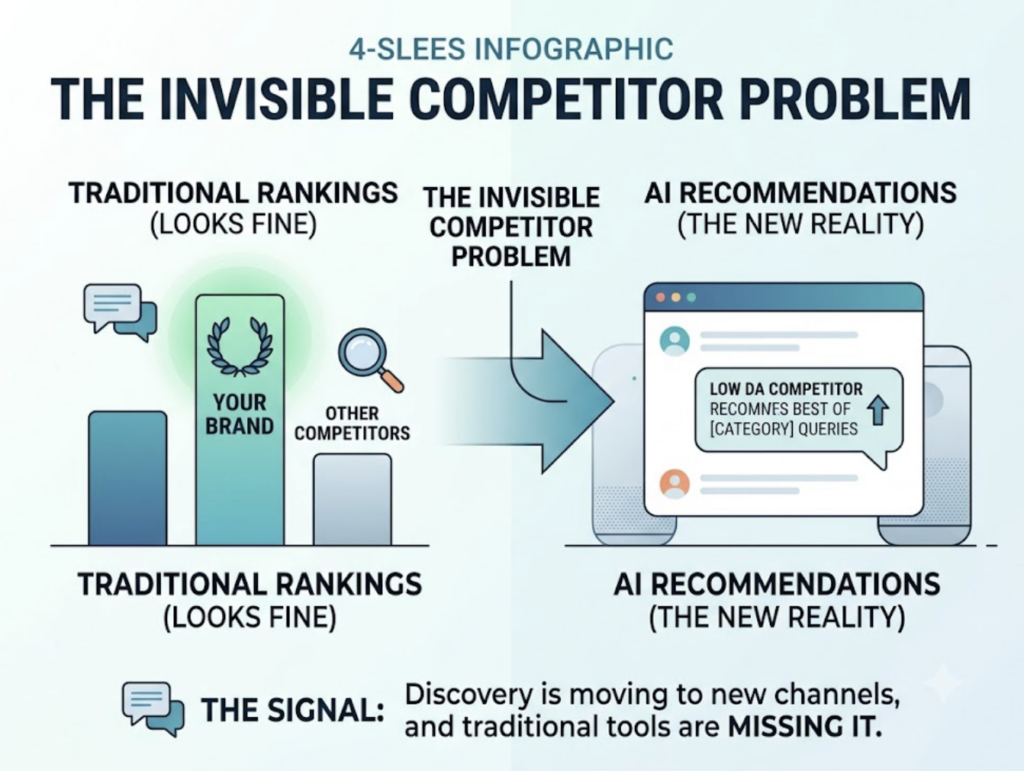
    Your keyword rankings are holding. Your traffic report looks clean. Then someone on your team opens ChatGPT, types a category question your brand should own, and gets back five competitor names. Yours isn’t one of them.

    That’s not an SEO failure. It’s a measurement failure. Your tools were built to track Google, and Google no longer controls the full discovery journey.

    Your Keyword Rankings Are Fine. Your AI Search Visibility Isn’t.

    Traditional keyword research was built on one assumption: users type a short phrase into Google, click a link, and land on your site. That model worked for two decades.

    It’s breaking down now. Google’s global search market share fell below 90% for the first time in a decade during late 2024, coinciding with a 721% increase in traffic to AI-powered platforms. That’s not a trend. That’s a structural shift.

    Here’s what makes it a measurement problem: only 12% of AI citations overlap with Google’s top 10 organic results. Being number one on Google does not mean an AI engine knows you exist. The two systems are drawing from different sources, applying different logic, and delivering different answers to the same user intent.

    And that gap is widening every month.

    What AI Keyword Research Actually Means

    AI keyword research is the systematic study of the prompts users input into generative engines, and the analysis of which prompts trigger specific brand recommendations or citations.

    The fundamental unit has changed. Traditional keyword research tracks “search volume” for short phrases. AI keyword research tracks “prompt volume” for long-form, conversational questions.

    The scale of that difference is worth understanding concretely. The average Google query is 3.4 words. The average ChatGPT prompt is 60 words. A traditional search query like “best CRM for startups” is a broad intent signal. An AI prompt like “I’m a founder of a 10-person SaaS company with a $500 monthly budget; suggest a CRM that integrates with Slack and provides automated lead scoring” is a fully articulated scenario with trade-offs baked in.

    That’s a different research discipline entirely, not just a longer version of what you already do.

    How AI Engines Decide Who Gets Recommended

    AI engines don’t rank pages. They synthesize answers.

    When a user submits a prompt, the engine retrieves relevant content, extracts useful passages, and generates a response. At no point does it check your meta description or your domain authority score.

    What it does evaluate: semantic density, information gain, and token efficiency. Content that leads with specific statistics, uses structured headings, and delivers direct answers gets cited. Generic marketing copy gets skipped.

    One data point worth sitting with: AI models are 6.5 times more likely to cite a brand through a third-party source than through the brand’s own website. Your homepage is not your AI visibility strategy. Earned media and authoritative third-party coverage are.

    Also worth knowing: only 12% of AI citations overlap with Google’s top 10 organic results. The AI actively digs past your highest-ranked pages to find content it considers more “machine-readable.” Your competitors may be winning AI citations from page-two blog posts you’ve never bothered to track.

    GEO and AEO: The Two Frameworks Behind AI Keyword Strategy

    AI keyword research doesn’t stand alone. It feeds into two optimization frameworks that most SEO teams are still treating as optional.

    GEO (Generative Engine Optimization) focuses on influencing the synthesis process. The goal is to increase the probability that your brand is included in the narrative an AI platform generates. It’s less about driving clicks and more about shaping how an AI understands your category, so your brand becomes part of the synthesized answer.

    AEO (Answer Engine Optimization) is more targeted. It’s about becoming the definitive single-source answer for specific factual questions, optimized for featured snippets, voice assistants, and scenarios where only one response is returned.

    AI keyword research is the data layer that makes both of these work. Without it, GEO is guesswork: you’re optimizing content without knowing which prompts actually matter. Without it, how to do AEO becomes a structural exercise with no real prompt targeting. The research identifies which questions to win before you invest in winning them.

    How to Do AI Keyword Research: A Practical Framework

    Step 1: Map the Prompts Your Audience Actually Uses

    Start by shifting from keywords to scenarios. 10-word queries trigger AI Overviews five times more often than single-word searches, which means the value in AI search concentrates in the long tail.

    Instead of researching “project management software,” map prompts like “What’s the best project management tool for a remote team of 15 that already uses Google Workspace?” That level of specificity is where AI search volume lives, and it’s where traditional keyword tools stop giving you useful data.

    Step 2: Identify Which Prompts Trigger Brand Recommendations

    Run your mapped prompts across ChatGPT, Perplexity, and Gemini. Note which brands appear, how often, and in what context. This gives you a visibility baseline and surfaces the “recommendation triggers” your competitors have already secured.

    Sentiment matters alongside frequency. Being mentioned isn’t enough if the AI describes your product in terms that contradict your positioning. Tracking both gives you a clearer picture of where you stand.

    Step 3: Analyze Why Competitors Get Cited and You Don’t

    When a competitor shows up and you don’t, dig into the source layer. Identify the specific URLs the AI cited to support that recommendation. Look for patterns: are those sources Reddit threads, industry journals, or structured comparison pages?

    Perplexity, for example, draws heavily from community content and real-time sources. If your competitor owns category conversations in relevant forums and you don’t, that’s a citation gap with a clear fix. The AI is following a trail of trusted third-party endorsements, and right now that trail doesn’t always lead to you.

    Step 4: Prioritize by AI Search Volume, Not Google Volume

    Here’s the conversion math that changes how you should prioritize.

    AI traffic converts at 14.2%, compared to 2.8% for traditional Google search. A prompt with 1,000 monthly AI interactions can outperform a keyword with 5,000 Google searches in revenue terms. On top of that, AI-referred visitors view 50% more pages per session and spend 68% more time on-site than visitors from traditional search. The intent quality is structurally higher.

    That math should affect where your content budget goes.

    GEO Tools and AEO Tools That Make This Scalable

    Manual prompt testing across four AI platforms, tracked monthly, analyzed for source patterns, is not a workflow any team can sustain past the first quarter.

    That’s the problem a new category of GEO tools and AEO tools is built to solve.

    Topify is designed specifically for this use case. Its High-Value Prompt Discovery feature continuously scans for high-volume questions relevant to a specific brand or category, so you’re always optimizing for current conversational trends rather than last quarter’s data. Its AI Volume Analytics provides the modern equivalent of Google’s monthly search volume, measured against actual AI search behavior across ChatGPT, Gemini, Perplexity, and DeepSeek.

    The Source Analysis feature addresses the citation gap problem directly. It identifies which domains and URLs AI platforms are citing in your category, so you can see exactly where your content is missing from the conversation and where a competitor has locked in a citation advantage. Adding statistics to content guided by that prompt research can boost AI visibility by 30–40% in affected categories.

    For teams starting out, Topify’s Basic plan covers 100 prompts at $99 per month, which is enough to establish a meaningful visibility baseline across platforms. As your GEO program matures, the Pro plan at $199 per month scales to 250 prompts across eight projects.

    Worth noting: this category of tooling is still maturing. Topify’s advantage lies in combining prompt discovery, AI volume data, and multi-platform coverage in a single platform rather than requiring you to stitch together separate tools for each step of the research process.

    What “Machine-Friendly” Content Actually Looks Like

    Identifying the right prompts is half the equation. The content itself needs to be structured to satisfy the extraction logic of large language models.

    Research consistently points to a few formatting signals that increase citation probability. Leading each piece with a concise 40–60 word summary that directly answers the target prompt improves pickup in platforms like Perplexity that favor “answer-first” blocks. Using tables with descriptive headers, breaking content into modular sections of 120–180 words between headings, and grounding each claim in specific statistics all make content easier for an LLM to extract and cite.

    The most counterintuitive finding: because AI models prioritize third-party mentions, GEO is as much about PR strategy as content strategy. Earning coverage on high-authority domains can double citation rates for a given category. Your content needs to exist in the right places, not just on your own site.

    Conclusion

    The gap between Google rankings and AI visibility isn’t a temporary anomaly. The tipping point, where AI begins to drive the same conversion volume as traditional search, is projected to arrive between late 2027 and early 2028. Brands that build their AI search presence now will have a compound advantage by the time that window closes.

    The shift isn’t about abandoning SEO. It’s about extending your research methodology to include the actual prompts your audience is using in AI tools, and building content that satisfies those prompts with the structure and specificity that language models prefer. Prompt volume, citation sources, sentiment, and share of answer are the metrics that matter in this layer.

    Get started with Topify to map your brand’s current AI visibility and identify the high-value prompts your competitors are already winning.


    FAQ

    Q: What is the difference between AI keyword research and traditional SEO keyword research?

    A: Traditional SEO keyword research focuses on search volume for short phrases to rank in Google’s results. AI keyword research focuses on prompt volume for long-form, conversational questions to earn citations in AI-generated answers across platforms like ChatGPT and Perplexity. The average AI prompt is 60 words; the average Google query is 3.4 words. The research discipline, the metrics, and the content strategy that follows are fundamentally different.

    Q: How do I start doing keyword research for AI search engines like ChatGPT or Perplexity?

    A: Start by mapping the full-sentence scenarios your audience uses, not short keywords. Run those prompts across multiple AI platforms to identify which brands get recommended and why. Then use GEO tools like Topify to automate prompt discovery, track visibility changes over time, and analyze which domains the AI is citing as its primary sources in your category.

    Q: What are GEO tools and how do they help with AI keyword research?

    A: GEO tools automate the process of tracking brand mentions in AI-generated responses and discovering which prompts drive those mentions. They help identify citation gaps, measure AI share of voice, and surface high-value prompts that competitors are currently winning. Topify tracks prompt volume across ChatGPT, Gemini, Perplexity, and DeepSeek from a single dashboard, covering both prompt discovery and source analysis.

    Q: How to do AEO and what tools support it?

    A: AEO (Answer Engine Optimization) involves structuring content as direct answers to specific factual questions, using clear headings, concise 40–60 word summaries, and FAQ schema. The goal is to become the single-source answer for high-value questions in your category. Topify supports AEO by surfacing high-volume question-based prompts and identifying which content structures and source domains the AI platforms currently prefer to cite.


    Read More

  • Why Keyword Research Still Matters More Than Ever in 2026

    Why Keyword Research Still Matters More Than Ever in 2026

    You built a keyword matrix. Mapped 3,000 terms by volume, grouped into content pillars, distributed across a six-month editorial calendar. Then someone on your team typed your category into ChatGPT, and your brand wasn’t mentioned once. Not because the content was wrong. Because it was built for the wrong engine.

    That’s the gap most SEO teams are hitting in 2026. Keyword research didn’t become obsolete. It became more complicated.


    Keyword Research Didn’t Die. It Multiplied.

    The prevailing narrative is that GEO and AEO have replaced keyword research. That’s not what’s happening.

    These disciplines are built on the same foundation — understanding the language people use to describe their problems — applied to a new set of platforms. The battlefield expanded. Traditional SEO still governs high-volume, reflexive lookups. But ChatGPT now handles 17.1% of all digital queries and reaches over 900 million weekly active users. Perplexity processes 780 million monthly queries. These aren’t experimental channels anymore.

    The structural shift is not one search bar, but many. And each one requires its own keyword strategy.

    The Skills You Already Have Transfer Directly

    Intent analysis. Volume estimation. Competitive mapping. These three competencies are the pillars of keyword research, and they’re equally relevant in AI search.

    The only thing that changed is the unit of study. In traditional SEO, you researched “keyword fragments.” In AI search, you research “conversational prompts.” A professional who already knows how to ask “what language do people use when they describe this problem?” is already doing 80% of the work that GEO and AEO require.

    Here’s the practical translation: “how to reduce SaaS churn” becomes “Compare the top 5 churn reduction strategies for mid-market enterprise SaaS.” Same intent cluster. Different linguistic register.

    The tooling must upgrade. The analytical thinking doesn’t need to change.


    Why Ignoring AI Search Keywords Leaves 30%+ of Discovery Behind

    More than 30% of global search traffic now flows through conversational AI ecosystems, never touching a traditional search engine. Among users aged 18 to 24, 66% already use ChatGPT as a primary research tool. This isn’t a trend. It’s a structural redistribution of discovery.

    The core problem with existing keyword tools is that they’re blind to this traffic. Google’s Keyword Planner, Ahrefs, SEMrush — all are designed to surface queries with consistent monthly volume on search engines. A long-tail prompt with 200 Google searches per month might be the core of a question asked thousands of times daily on AI platforms. Traditional research will systematically miss it.

    The 58-60% zero-click rate makes this worse. When AI Overviews appear, organic CTR for the top Google position drops from 1.76% to 0.61%. Not appearing in the AI answer is no longer just a missed opportunity.

    It’s a visibility gap with a measurable cost.

    Beyond traffic volume, AI-referred visitors convert differently. AI-referred traffic converts at 10.5% to 15.9% — compared to 1.76% for traditional organic search. In SaaS specifically, that gap widens to 57.84% versus 37.17%. One lead from an AI citation is worth approximately five to ten leads from traditional SEO. The economics of ignoring AI search keywords aren’t just about impressions.

    They’re about pipeline.


    What AEO Actually Is (And Why It Starts With Keyword Research)

    Answer Engine Optimization (AEO) is the practice of structuring content so that AI-powered platforms — Google’s AI Overviews, Perplexity, Bing Copilot — select it as a cited source when generating direct answers. In 2026, AEO is the discovery layer of SEO. It focuses on becoming the answer, not just ranking near it.

    The first step of AEO is not about content format.

    It’s about identifying the right prompts. A brand can’t optimize for everything. The process begins by finding the top 10 to 20 “Golden Prompts” — the specific questions where being cited would have the greatest impact on trust and conversion. That identification process is keyword research, applied to AI platforms instead of a search bar.

    Once those prompts are identified, the content requirements become structural. Research shows that 68.7% of all ChatGPT citations follow a strict heading hierarchy (H1 → H2 → H3). For smaller domains, articles over 2,900 words have a 65% greater impact on AI citation probability than shorter content. Answer-first structure — leading with a direct 40-60 word response — dramatically increases the “liftability” of content for AI synthesis.

    How to do AEO if you already have an SEO workflow

    Start with the intent clusters from your existing keyword research. Translate each cluster into the conversational prompt format users bring to AI assistants. Then restructure your top-performing content into an answer-first format: direct definition at the top, strict heading hierarchy throughout, and FAQ schema covering the top questions in each cluster.

    The most impactful single change most content teams can make: front-load the answer. AI models extract the first well-formed response to a question and treat it as the citation candidate. Burying the answer in paragraph three means the content won’t be “lifted,” regardless of how good the rest of the page is.


    The GEO Tools That Replace Your Keyword Planner for AI Search

    Traditional keyword tools can’t tell you what people are asking on ChatGPT. That’s the functional gap a new category of GEO tools was built to fill.

    Topify is one of the specialist platforms built specifically for this use case. Its High-Value Prompt Discovery feature analyzes AI responses at scale to surface the specific prompts where a brand should be visible but isn’t — the AI-era equivalent of keyword gap analysis. Unlike a traditional keyword tool that surfaces search volume, Topify surfaces opportunity gaps in AI citation coverage.

    The platform’s AI Volume Analytics quantifies monthly prompt volume across AI tools, so teams can prioritize content investment based on actual AI search demand rather than Google estimates. Source Analysis goes further, reverse-engineering which external domains the AI currently trusts for a given topic — giving content teams a roadmap for where to build authority off-site.

    For teams tracking across multiple platforms, Topify’s Visibility Tracking monitors brand mentions across ChatGPT, Gemini, Perplexity, DeepSeek, and others simultaneously. Pricing starts at $99/month for the Basic plan, covering 100 prompts and 9,000 AI answer analyses per month.

    Here’s how that compares to traditional tooling:

    FeatureTraditional SEO ToolTopify (GEO-native)
    Keyword / Prompt DiscoverySearch engine queriesAI platform prompts
    Volume MetricMonthly Google searchesMonthly AI prompt volume
    Competitive BenchmarkingRanking positionsAI citation frequency vs competitors
    Source IntelligenceBacklink profilesDomains AI trusts and cites
    Platform CoverageGoogle, BingChatGPT, Gemini, Perplexity, DeepSeek +

    The contrast matters for budgeting decisions too. Enterprise tools with AI add-ons (Ahrefs’ Brand Radar, SEMrush’s AI Toolkit) can exceed $699/month. GEO-native platforms provide core AI visibility research for a fraction of that, making the entry barrier lower than most teams assume.


    A 2026 Keyword Research Workflow That Covers Both Channels

    The most effective teams in 2026 aren’t running separate SEO and GEO programs. They’re running one intent research process that feeds two execution layers.

    Step 1: Identify Intent Clusters (SEO layer)

    Start with traditional keyword research. Use Ahrefs or SEMrush to group high-value topics into intent clusters — categories defined by the problem they solve, not the exact phrases. “Cloud migration security” or “remote team productivity” are intent clusters. Individual keywords are just entry points into them.

    Step 2: Translate Clusters into Prompts (AI layer)

    Take each intent cluster and convert it into natural language questions. “Cloud migration security” becomes “What are the hidden risks of migrating a legacy database to AWS?” Same intent. Different register. This translation step is where most SEO teams stop — and where AI visibility gaps begin.

    Step 3: Validate with GEO Analytics (validation layer)

    Run those prompts through a GEO tool to verify AI volume and competitive citation coverage. This step surfaces the systematic underestimations that traditional tools produce. It also identifies which third-party domains the AI trusts for your topic. Reddit, YouTube, and LinkedIn collectively account for 48% of all AI citations — meaning your SEO strategy needs to account for these platforms, not just your own domain.

    Step 4: Prioritize by Dual Potential (execution layer)

    Rank content opportunities by a combined score: Google ranking potential and AI citation probability. The highest-priority content wins on both channels. Adding original statistics increases AI visibility by up to 40%. Citing primary sources and using direct answer introductions are the highest-ROI structural changes most content teams can make today.

    That’s not two workflows. It’s one workflow, run smarter.


    The Part Most Keyword Strategies Miss Entirely

    Here’s a data point that shifts how keyword research should be scoped: 85% of brand mentions in AI search originate from third-party pages — listicles, review roundups, comparison articles, community threads.

    Being visible in AI responses isn’t just about what’s on your domain. It’s about what the internet says about you.

    This creates a new category of research: off-site keyword discovery. The process involves identifying which Reddit threads, YouTube tutorials, G2 reviews, or industry roundups the AI is using as its source of truth for your category — then optimizing for presence there, not just on owned content.

    Only 11% of cited domains overlap between ChatGPT and Perplexity. A brand with a single-platform SEO strategy has a structural visibility blind spot across the rest of the LLM landscape. Keyword research must now inform a distribution strategy, not just an on-site content calendar.


    Conclusion

    The argument that keyword research is dead is usually made by people who were only doing one kind of keyword research. The professionals who built strong intent analysis skills aren’t starting over. They’re extending what they already know into a new layer of the search landscape.

    The discovery channel is fragmenting. But the intent behind it isn’t. Keyword research — expanded to cover prompts, AI platforms, and off-site citation networks — is the infrastructure that connects both. The brands that treat GEO and AEO as separate programs from their keyword strategy will build two incomplete maps. The ones that unify the research layer will own visibility across both.

    Get started with Topify to map your brand’s AI prompt visibility and identify the specific discovery gaps your current keyword strategy is missing.


    FAQ

    Q: Is traditional keyword research still useful in 2026?

    A: Yes. It remains the foundation for understanding intent and driving site traffic. It needs to be extended, not replaced, with prompt-based research to capture the 30%+ of discovery now happening on AI platforms like ChatGPT and Perplexity.

    Q: What’s the difference between SEO keyword research and GEO or AEO research?

    A: SEO research focuses on search volume and competition for reflexive lookups on search engines. GEO and AEO research focuses on conversational prompts — the specific questions that trigger citations and brand recommendations inside AI chat interfaces.

    Q: How do I start doing AEO if I already have an SEO workflow?

    A: Begin by identifying your top 10 informational “Golden Prompts” — the questions where being cited would most impact trust and conversion. Restructure your best-performing content with a direct 40-60 word answer at the top of each section, implement FAQ and HowTo schema, and enforce a strict H1 → H2 → H3 heading hierarchy throughout.

    Q: What are the best AEO tools and GEO tools for AI search visibility in 2026?

    A: For prompt discovery and AI citation tracking, Topify is a specialist platform built specifically for this use case. For broader coverage with SEO integration, Ahrefs’ Brand Radar and SEMrush’s AI Toolkit provide enterprise-grade options. Budget-conscious teams can also evaluate LLMrefs as an entry point into AI visibility monitoring.


    Read More

  • Keyword Research 101: A Step-by-Step Guide for Beginners

    Keyword Research 101: A Step-by-Step Guide for Beginners

    You spent two weeks writing a detailed guide. You published it, shared it, and waited. Three months later: 12 visits, mostly from yourself. No rankings, no traffic, no idea why.

    The article wasn’t bad. The problem was that nobody was searching for it, at least not in the way you wrote it. That’s the core failure of intuition-driven content, and it’s more common than most people admit. Keyword research fixes this by replacing guesswork with data on exactly what your audience is typing, asking, and expecting to find.

    Here’s the step-by-step process, including what traditional guides won’t tell you about AI search.


    Step 1: Understand What Keyword Research Actually Does

    Keyword research is not about finding popular words to stuff into a page. It’s about understanding the exact language your audience uses to describe a problem you can solve.

    The most important concept here is search intent, which is the underlying reason behind a query. Search engines now prioritize intent alignment above almost every other ranking signal. There are four types: informational (learning something), navigational (reaching a specific site), commercial (comparing options), and transactional (ready to buy or act). Informational queries account for 52.65% of all searches, while transactional queries sit at just 0.69%.

    Why does this matter? Because a page that mismatches intent, regardless of how good the content is, will struggle to rank. Pages that mismatch intent see bounce rates exceeding 70%, while intent-aligned content keeps users engaged three to four times longer. Getting this wrong at the research stage means no amount of writing effort will fix it later.


    Step 2: Start with Seed Keywords, Then Go Long-Tail

    A seed keyword is the core term that describes your product, service, or topic. “Project management,” “vegan recipes,” “SaaS pricing” are all seed keywords. They’re your starting point, not your destination.

    From each seed, your job is to expand into long-tail keywords: phrases of three or more words that are more specific and closer to real purchase or action intent. The data on this is compelling. Long-tail keywords account for 70% to 92% of all search traffic, and they convert at a significantly higher rate. A one-word keyword converts at roughly 0.17%. A four-word keyword converts at 1.61%, nearly 10 times higher.

    The fourth word in a query is often the “intent modifier”: “best,” “for beginners,” “near me,” “free trial.” That single word transforms a generic browse into a qualified search. New sites especially should focus here. Long-tail terms also move up in rankings an average of 11 positions faster than head keywords.

    To expand your seed keywords, use these four methods: competitor gap analysis (what are they ranking for that you’re not?), customer language from reviews and support tickets, Google’s “People Also Ask” boxes, and autocomplete suggestions. These reflect real queries from real users, not assumptions.


    The Keyword Research Tools Worth Using

    The right tool depends on where you are in your SEO journey. Here’s a practical breakdown:

    ToolEntry PriceBest For
    Google Keyword PlannerFreeBeginners, PPC validation, Google-native data
    Ahrefs$29 (Starter) / $129 (Lite)Backlink analysis, precise KD scoring
    Semrush$139.95/moAll-in-one marketing teams, AI visibility
    Ubersuggest$29/moFreelancers, small budgets
    Topify$99/mo (Basic)GEO/AEO: AI prompt discovery, multi-platform AI monitoring

    For most beginners, starting with Google Keyword Planner and one mid-tier tool is enough. What matters more than the tool is how you filter the output.

    The KD Filter: Don’t Punch Above Your Weight

    Keyword Difficulty (KD) tells you how hard it will be to rank for a given term based on the authority of existing results. For new sites, a practical rule: target KD under 30.

    KD ScoreClassificationWhat to Do
    0-14Very EasyPrioritize immediately
    15-29EasyPrimary target for growing sites
    30-49PossibleRequires quality content and some links
    50-69DifficultNeeds established domain authority
    70+Hard/Very HardSkip until you’ve built real authority

    Start low, build topical authority, then ladder up. Sites that organize content into topic clusters (one pillar page supported by multiple interconnected cluster pages) have seen traffic growth of up to 1,200% within 12 months. Cluster strategy signals to search engines that you own a topic, not just a page.


    Keyword Research in 2026 Goes Beyond Google: Enter GEO

    Here’s the thing most beginner guides skip entirely.

    Approximately 40% of users now use AI assistants like ChatGPT, Perplexity, and Gemini for discovery queries. That’s a substantial portion of your potential audience that traditional keyword tools can’t see, because AI search doesn’t work on keyword matching. It works on semantic understanding and source authority.

    This is the domain of GEO, or Generative Engine Optimization: the practice of optimizing content to be cited and recommended by AI-generated responses.

    In traditional SEO, you rank for a keyword. In GEO, you need to become a cited source in a probabilistic synthesis. AI engines use Retrieval-Augmented Generation (RAG) to pull small chunks of content that are mathematically relevant to a query. If your content isn’t structured for chunk-level retrieval, it won’t get pulled, regardless of your backlink count.

    The research on GEO citation signals is specific. For ChatGPT, appearing on authoritative “Best of” lists carries 41% weight in whether a brand gets cited. For Perplexity, that number rises to 64%. This is why “Consensus” (being on the top five lists for your category in Google) has become the new PageRank for AI visibility.

    Traditional keyword volume is also being replaced by prompt volume. Users ask ChatGPT full questions that average 23 words, queries that don’t exist in any Google dataset. Topify’s AI Volume Analytics and High-Value Prompt Discovery surfaces exactly these prompts, showing you which conversational queries in your category are driving the most AI responses and where your brand is visible or absent. For marketers trying to extend keyword research into the AI-first era, this is the data gap traditional tools can’t fill.


    How to Do AEO: The Layer Most Beginners Miss

    AEO, or Answer Engine Optimization, is the practice of optimizing content to appear in zero-click search features: Google’s AI Overviews, Featured Snippets, and voice assistants. It’s distinct from both traditional SEO and GEO, though all three share structural overlap.

    The numbers make AEO non-negotiable. Over 60% of US searches in 2024 ended without a click to any website. That’s the majority of queries answered before anyone reaches your page. If you’re not in the answer, you’re invisible.

    That said, the quality of traffic from AI answers is notably higher. AI-referred traffic converts at 14.2% compared to 2.8% for traditional search, because the AI has already pre-qualified the user before they click. And being cited in a Google AI Overview results in a 35% higher organic CTR compared to brands on the same page that aren’t cited.

    How to Optimize for AEO

    Start at the keyword research stage. The keywords best suited for AEO are question-shaped: “What is the best tool for X?”, “How do I do Y?”, “What’s the difference between A and B?” These map directly to how AI Overviews and voice assistants source their answers.

    Structural requirements:

    • Use H2/H3 headings that mirror actual user questions, not clever internal labels
    • Add a direct 40-60 word answer immediately after each question-shaped heading
    • Include an FAQ section with real questions your audience asks
    • Implement FAQPage and HowTo schema markup so machines can parse your content accurately

    Voice search alone is powered by conversational long-tail queries for 82% of queries, and there are now 153.5 million Americans using voice assistants. The language of AEO and the language of long-tail keyword research are, in practice, the same language.

    For AEO tools: Semrush’s AI Overview tracker and Ahrefs’ Featured Snippet reports cover the Google side. For tracking which sources AI engines like ChatGPT and Perplexity are actually citing in your category, Topify’s Source Analysis reveals the exact domains AI platforms are pulling from, which is the reverse-engineering step most AEO guides ignore entirely.


    5 Keyword Research Mistakes That Kill Your Traffic Before You Start

    1. The Volume Trap. Targeting “marketing” because it has 500,000 monthly searches will not help a new site. The intent is too broad, the competition is too high, and the conversion rate is near zero. Specificity is the multiplier.

    2. The Prompt Blind Spot. Brands that only do Google keyword research are building visibility for 60% of the search landscape while ignoring the 40% migrating to AI assistants. “AI Share of Voice” is now a measurable metric, and the brands ignoring it are ceding ground quietly.

    3. Content Cannibalization. When two pages on your site target the same keyword, they compete against each other. Both rankings suffer. Keyword research needs to account for your existing content map, not just the opportunity in front of you.

    4. Over-Optimization. Keyword stuffing still exists, and it still gets penalized. Google’s Helpful Content systems now prioritize demonstrable value over algorithmic manipulation. The goal is to answer the question better than anyone else, not to repeat the keyword more times.

    5. Set-and-Forget. AI models update their citation sources. Seasonal trends shift. New competitors enter. Keyword research is a 90-day cycle, not a one-time task. Strategies built on a single research pass tend to plateau within six months.


    Conclusion

    The gap between “writing content” and “writing content that ranks and gets cited” comes down to one thing: starting with data instead of assumptions.

    Keyword research gives you that data for Google. GEO prompt discovery extends it to ChatGPT, Gemini, and Perplexity. AEO optimization ensures you’re capturing zero-click visibility even when users don’t reach your page. These three disciplines now operate as a single system, not separate tracks.

    Start with your seed keywords. Validate them against KD and intent. Build topic clusters, not isolated articles. Then extend your research into AI search with tools that show you where your brand exists, or doesn’t, in the answers people are actually getting. Get started with Topify to see where your brand stands across AI platforms today.


    FAQ

    Q: What’s the difference between SEO, GEO, and AEO?

    A: SEO (Search Engine Optimization) targets ranking in Google’s traditional blue-link results. GEO (Generative Engine Optimization) focuses on being cited by AI assistants like ChatGPT and Perplexity in their generated responses. AEO (Answer Engine Optimization) targets zero-click features like Google’s AI Overviews and Featured Snippets. In practice, all three require overlapping content structures, but they each have distinct optimization signals.

    Q: How many keywords should a beginner target?

    A: Start with three to five long-tail keywords per piece of content. Targeting more than that per page leads to unfocused content that struggles to rank for anything. Build a keyword map across your full site, assigning one primary keyword per page, and expand from there as you build topical authority.

    Q: What are the best free keyword research tools?

    A: Google Keyword Planner is the most reliable free option, offering direct data from Google’s ad system. Google Search Console (for sites with existing traffic) also shows you what queries are already driving impressions. Ubersuggest has a limited free tier suitable for initial ideation. For AI prompt data, there’s no meaningful free option currently.

    Q: How do I find keywords for AI search engines like ChatGPT?

    A: Traditional keyword tools don’t cover AI search. The most direct method is to manually test your category’s common questions in ChatGPT and Perplexity and note which brands get cited. For a scalable approach, Topify’s High-Value Prompt Discovery automates this by surfacing the highest-volume AI prompts in your category and showing you where your brand appears or is missing.


    Read More

  • Topify AI Agent: The Smartest Way to Automate SEO in 2026

    Topify AI Agent: The Smartest Way to Automate SEO in 2026

    Your team is already tracking AI visibility. You’ve got dashboards showing where your brand appears in ChatGPT and Perplexity. What you don’t have is someone to act on it fast enough. The data keeps accumulating. The to-do list keeps growing. And every week, your competitors are getting cited in the same AI responses you’re trying to break into.

    That gap between insight and execution is where most GEO strategies stall.

    SEO Teams Are Spending 14.5 Hours a Week on Work an AI Agent Can Do Overnight

    The operational math of modern search is brutal. Surveys from 2024-2025 show that marketing teams spend an average of 14.5 hours per week just collecting and preparing performance data. That’s over 36% of a standard workweek on administrative tasks before a single strategic decision gets made.

    Add multi-platform GEO monitoring to that workload and the numbers get worse. Tracking visibility across ChatGPT, Perplexity, Gemini, and traditional SERPs simultaneously requires a different analytical framework for each platform, each with its own citation logic and ranking signals.

    The financial cost compounds the problem. Manual data workflows cost American companies an average of $28,500 per employee annually, with human error rates between 1% and 5%. High-performing marketing teams are now three times more likely to use automation than underperforming ones. That gap isn’t closing.

    Why 2026 Is the Tipping Point for Topify AI Agent Adoption

    The urgency isn’t arbitrary. Search has changed in ways that make manual optimization structurally insufficient.

    Organic click-through rates for queries featuring a Google AI Overview have dropped by 61%, falling from 1.76% to 0.61%. Zero-click search now accounts for 58.5% of all Google queries, rising to 93% when users are in active “AI Mode.” The traditional model, where a high ranking reliably delivers clicks, no longer holds.

    At the same time, ChatGPT now processes approximately 2 billion queries daily and reached 5.4 billion monthly visits by January 2026. Over 45% of its users are under 25. This isn’t transitional behavior. It’s the default discovery method for the next generation of buyers. And users referred by AI engines spend three times longer on-site and are twice as likely to convert compared to traditional search traffic.

    The opportunity is real. So is the execution gap.

    What the Topify AI Agent Actually Does (Beyond Monitoring)

    Most GEO platforms stop at data. They show you a visibility score, a sentiment reading, a competitor comparison, and then leave the next step to you.

    That’s the distinction worth understanding.

    Topify‘s AI Agent operates on a continuous autonomous loop: Monitor → Reason → Act. It doesn’t wait for a human to review a report and schedule a content update. It identifies the gap, generates the fix, and deploys it with a single click.

    The four-step workflow runs like this. First, the agent maps the brand’s digital footprint, identifying the core entities (products, services, authors) that anchor AI authority. Second, it discovers high-volume prompts that trigger AI recommendations, running each prompt dozens of times to build statistically significant Visibility and Sentiment scores. Third, it benchmarks competitors in real time, analyzing which “citable units” are driving their citation frequency. Fourth, once a gap is identified, it generates content structured specifically for LLM retrieval and deploys it on command.

    This is the difference between a dashboard and an operating system.

    The 5 GEO and AEO Tasks Topify Automates in 2026

    Prompt Discovery and Continuous Monitoring

    Traditional keyword research maps what users type into Google. AI prompt discovery is different. The prompts that trigger AI recommendations shift every few weeks as models update their parametric knowledge and citation preferences.

    Topify continuously scans for high-value prompts relevant to your brand category and flags new ones as they emerge. You don’t maintain a list manually. The agent does it, running each prompt multiple times to filter out the randomness inherent in AI-generated responses.

    Competitor Position Tracking Across AI Platforms

    In traditional SEO, competitor tracking means checking who’s ranking above you. In GEO, it means understanding which brands AI systems are recommending in the same context as your products, and why.

    Topify’s agent monitors competitor citation patterns across ChatGPT, Gemini, Perplexity, DeepSeek, and others. It identifies emerging rivals that weren’t in your competitive set six months ago. It also analyzes which sources those competitors are getting cited through, so you know exactly where the content gap is.

    Source and Citation Analysis

    Research analyzing 7,000 citations found that adding original statistics increases AI visibility by 22%, while expert quotations boost it by 37%. The problem is identifying which sources are actually driving citations in your category.

    Topify’s Source Analysis tracks which domains and URLs AI platforms pull from when they mention your brand. It maps content freshness as a core variable, which matters because 65% of AI citations target content published within the past year. When a previously reliable source stops getting cited, the agent flags it before you notice the visibility drop.

    GEO Content Structuring and Deployment

    LLMs retrieve information in chunks. According to NVIDIA benchmarks, page-level chunking achieves the highest accuracy for RAG systems, with each citable unit ideally 200-500 words, led by a question-based header, and anchored by verifiable data.

    Topify automates this restructuring process entirely. It audits existing content, identifies what needs to be reformatted into “Definition Box” or “FAQ” structures, generates the new chunks, and deploys them. What would take a content team days of manual restructuring happens in hours.

    Cross-Platform Reporting and One-Click Strategy Execution

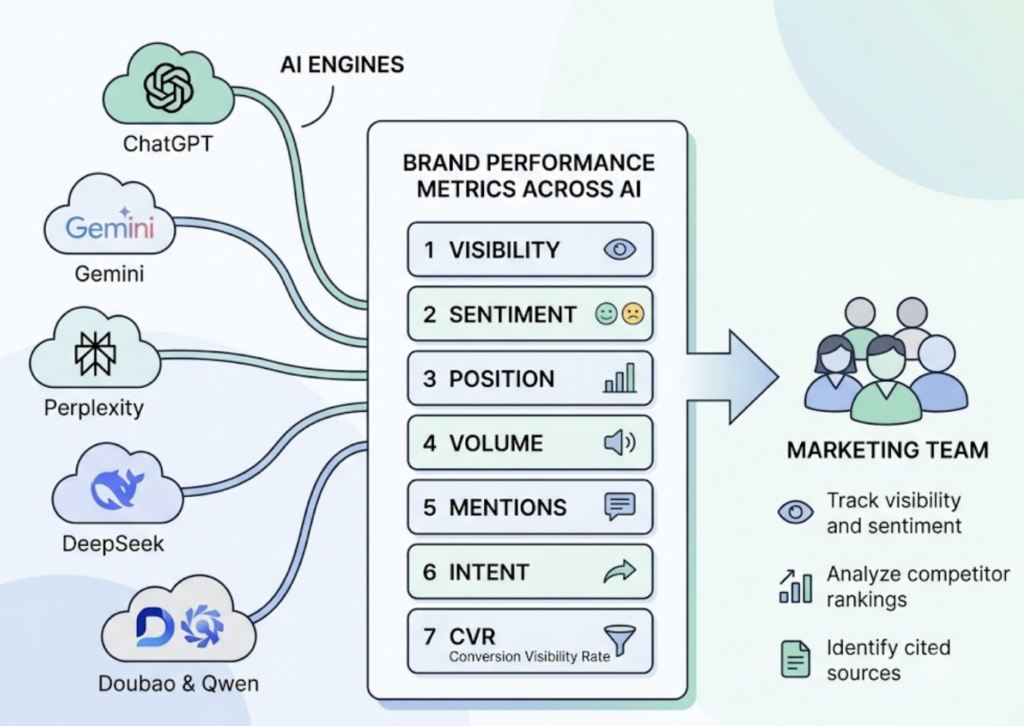
    Once goals are set in plain English, the agent handles the full execution cycle. It tracks seven core metrics across platforms: Visibility, Sentiment, Position, Volume, Mentions, Intent, and CVR. Reports are generated without human data assembly. When a strategy needs updating, one click pushes the change live.

    The numbers speak for themselves:

    MetricManual SEO WorkflowTopify AI Agent
    Time-to-Market30 Days24 Hours
    Error Rate1–5%0%
    Content Production TimeBaseline-78%
    Operational CostsBaseline-82%
    Monthly Page Scaling~50 Pages500+ Pages

    SEO vs. GEO vs. AEO: Where Topify AI Agent Execution Fits

    These three frameworks operate at different layers of the discovery stack, and confusing them is one of the most common strategic mistakes in 2026.

    Traditional SEO targets Google’s ranking algorithm. It’s still necessary, but no longer sufficient on its own. GEO (Generative Engine Optimization) targets the AI-generated content layer, where the goal is to be cited within a synthesized response rather than ranked below it. AEO (Answer Engine Optimization) goes one layer deeper, targeting the direct-answer outputs of engines like Perplexity and ChatGPT where users don’t click through at all.

    LayerTargetSuccess MetricManual Execution Feasibility
    SEOGoogle SERP positionRanking, CTRModerate
    GEOAI-generated summariesCitation frequency, Visibility scoreLow
    AEODirect AI answersMention rate, Sentiment scoreVery Low

    Topify’s AI Agent is the execution layer for GEO and AEO. SEO foundations still matter because AI engines need to find the content in the first place. But once that foundation exists, the agent takes over the high-frequency, high-complexity work of making that content citation-ready across all three layers simultaneously.

    What 30 Days of Topify AI Agent Execution Looks Like

    Content freshness is the fastest-moving variable in AI visibility. Since 65% of AI citations favor content published within the past year, a consistent publishing cadence is structurally important, not just strategically nice.

    A case study of 27 local businesses found that shifting from manual to automated GEO-ready content delivery produced a median traffic growth of 155%, with outlier results reaching 2,800%. The key variable wasn’t content quality alone. It was reliability: the ability to maintain a 100% on-time publishing cadence that compounds over time.

    Here’s how the first 30 days typically unfold.

    Week 1: The agent maps the brand’s entity structure, sets up prompt monitoring across target AI platforms, and runs baseline competitor benchmarking. You get your first Visibility and Sentiment scores with no manual data pull required.

    Week 2: The first content restructuring recommendations land. The agent identifies existing pages that can be reformatted into higher-citation-probability chunks and queues them for deployment.

    Week 3: Fresh content enters the AI citation cycle. Because LLMs prioritize recent content, even repurposed and reformatted pages can surface in AI responses within days of being updated.

    Week 4: Sentiment tracking and source analysis begin showing patterns. Which platforms are picking up the brand? Which sources are driving citations? What competitor is gaining ground on which prompt? The agent is already adjusting.

    For teams previously spending 14.5 hours a week on data tasks, the shift is structural. The agent doesn’t replace strategic judgment. It removes the administrative overhead that was consuming it.

    How to Get Started with Topify AI Agent

    The setup is designed for speed. No technical configuration, no code required.

    Step 1: Define your goals in plain English. Tell the agent what you want: more Visibility on Perplexity for a specific product category, improved Sentiment across ChatGPT, higher citation frequency than a named competitor.

    Step 2: Select the AI platforms you want to track and identify your competitor set. Topify covers ChatGPT, Gemini, Perplexity, DeepSeek, Doubao, Qwen, and other major platforms.

    Step 3: Review the proposed strategy and launch with one click. Monitoring, analysis, content structuring, and reporting run autonomously from there.

    Pricing starts at $99/month for the Basic plan (100 prompts, 9,000 AI answer analyses across 4 projects). The Pro plan at $199/month expands to 250 prompts and 22,500 analyses. Enterprise plans start at $499/month with dedicated support and custom configuration.

    Conclusion

    Search in 2026 isn’t trending toward AI-mediated discovery. It’s already there. A 61% drop in organic CTR, 58.5% zero-click search rate, and 2 billion daily ChatGPT queries aren’t projections. They’re the operating conditions your brand is competing in right now.

    The brands winning in this environment aren’t necessarily the ones with the most content or the highest domain authority. They’re the ones with agents executing GEO and AEO strategies at a pace and precision that manual teams can’t match. Topify AI Agent is built for exactly this moment. Start with your first prompt set, run a 30-day cycle, and measure the delta.


    FAQ

    Q: What is Topify AI Agent?

    A: Topify AI Agent is an autonomous GEO and AEO execution system that monitors brand visibility across AI platforms, identifies citation gaps, and deploys optimized content strategies with a single click. It operates on a continuous Monitor → Reason → Act loop without requiring manual input at each step.

    Q: How is Topify AI Agent different from traditional SEO tools?

    A: Traditional SEO tools track rankings and backlinks on Google. Topify AI Agent is built for AI-mediated discovery, measuring Visibility, Sentiment, Position, and Citation frequency across generative platforms. It also goes beyond reporting: it structures content into LLM-citable chunks and executes strategy changes autonomously, rather than leaving execution to the user.

    Q: Can Topify AI Agent replace a GEO specialist?

    A: It handles the high-frequency, data-intensive tasks that consume most of a GEO specialist’s time: prompt monitoring, competitor benchmarking, source analysis, content structuring, and cross-platform reporting. Strategic decisions, brand positioning, and creative direction still benefit from human judgment. In practice, the agent functions as a force multiplier for a lean team.

    Q: How does Topify AI Agent handle AEO optimization?

    A: AEO targets the direct-answer outputs of AI engines where users don’t click through to a site. Topify optimizes for this by restructuring content into 200-500 word citable units with question-based headers, monitoring Sentiment scores to ensure brand mentions are positive, and tracking which sources AI platforms pull from when answering queries in your category. This increases the probability that your content gets “lifted” as a direct answer rather than just referenced.


    Read More

  • What Is Topify AI Agent and How Does It Boost Your Content?

    What Is Topify AI Agent and How Does It Boost Your Content?

    Most AI visibility tools stop at the dashboard. They show you where your brand appears, which platforms mention you, and how sentiment trends over time. Then they hand the work back to you.

    Topify AI Agent is built around a different premise. Instead of delivering a report and waiting, the agent monitors your AI search performance, reasons through the data, and executes strategy on your behalf. That shift, from insight to action, is what separates an agentic system from a tracking tool.

    What Topify AI Agent Actually Is

    The term “AI agent” gets applied to a lot of things in 2026, from simple chatbots to fully autonomous workflows. Topify AI Agent sits firmly in the latter category.

    At its core, it runs a continuous loop: monitor brand performance across AI platforms, analyze what the data means for your visibility, and execute GEO and AEO strategies without requiring manual input at every step. You define the goal in plain English. The agent handles the rest.

    That’s a meaningful distinction. Most teams using GEO tools spend hours translating data into action. Topify AI Agent compresses that cycle into a single operation.

    The Search Environment That Made This Necessary

    To understand why an agentic approach matters, it helps to see what the search landscape actually looks like right now.

    ChatGPT now exceeds 900 million weekly active users, and Google AI Overviews appear in over 25% of all searches. More telling: approximately 65% of all searches now end without a click. The user got their answer directly from the AI, and no one’s website got the visit.

    Traditional organic conversion rates run around 2.8%. Visitors arriving via LLM citations convert at 14.2%, roughly five times higher. LLM referral traffic is up 357% year over year.

    The math is clear. The question is how to consistently appear in those AI answers at scale.

    How Topify AI Agent Works: Monitor, Reason, Act

    The agent operates on a three-stage cycle that runs continuously in the background.

    Monitor. Topify tracks brand performance across ChatGPT, Gemini, Perplexity, DeepSeek, Doubao, Qwen, and Google AI Overviews. It measures seven core metrics: visibility, sentiment, position, volume, mentions, intent, and CVR. The agent systematically sends prompts across these platforms and captures how each one responds to queries in your category.

    Reason. Raw data gets processed through Topify’s analytics layer. One key capability here is Dark Query discovery. These are high-intent conversational prompts that users type into AI engines but that don’t appear in tools like Semrush or Ahrefs. Research shows that AI visibility correlates far more strongly with brand mentions (0.664) than with traditional backlinks (0.218). Dark queries are often where the real visibility gap lives.

    Act. Once the agent identifies content gaps, citation opportunities, or competitive threats, it generates an execution plan and deploys it. You review the proposed strategy and launch with one click. No manual workflow required.

    Most tools give you the first two stages. Topify AI Agent closes the loop on the third.

    5 Ways Topify AI Agent Boosts Your Content

    The agent’s impact on content is specific. Here’s where it shows up in practice.

    Prompt Discovery That Surfaces What You’re Missing

    The agent continuously uncovers high-volume AI prompts in your category that you’re not currently winning. It runs a 10-step query fan-out pipeline, from multi-seed research to a 0-100 citability score, to prioritize which opportunities deliver the most visibility gain. This is especially useful for catching dark queries before competitors do, since those queries won’t show up in any traditional keyword research tool.

    Source Analysis to Close Citation Gaps

    Topify tracks exactly which domains AI platforms cite when they answer questions in your category. If your site isn’t among them, the agent identifies what content you’d need to produce or update to become citable. Sites with over 32,000 referring domains are 3.5x more likely to be cited by ChatGPT than those with fewer than 200. Source analysis tells you where you stand and what to fix first.

    Competitor Benchmarking in Real Time

    The agent monitors which competitors are being recommended in your category, how their sentiment scores compare to yours, and how their position is shifting week over week. You don’t have to go looking for this. If a competitor gains ground in a specific prompt cluster, you’ll know.

    Content Generation Tied to GEO Data

    Content created through Topify is generated from actual AI visibility data, not generic topic research. That means the articles, FAQ entries, and structured data it produces are designed to address the specific prompts where your brand needs to appear.

    The cost difference is significant. AI content engines bring per-article costs down to roughly $8-12, compared to the $1,100-$2,000 range for in-house production. A team producing three articles per week through the platform invests around five hours total, versus 25-36 hours through traditional processes. One thing worth noting: pages not updated within 14 days show a 23% decline in AI citation frequency. Content velocity matters here more than it does in traditional SEO.

    Seven-Metric Performance Tracking

    Topify measures what actually matters in AI search: AI Brand Mention Rate, AI Share of Voice, AI Citation Rate, Answer Inclusion Rate, Sentiment Distribution, Dark Query Capture, and LLM Visitor Conversion Rate. These go well beyond what any traditional rank tracker provides and give teams a real performance signal tied to business outcomes, not proxy metrics.

    AEO vs. GEO: What Topify AI Agent Optimizes For

    These two strategies are often conflated, but they target different outcomes.

    GEO (Generative Engine Optimization) focuses on long-term citation presence in AI-generated answers. The academic definition, developed by researchers at Princeton and Georgia Tech, emphasizes content depth, accuracy, and citation-worthiness. It’s about shaping how AI models synthesize your brand across future responses, not just capturing a snapshot ranking.

    AEO (Answer Engine Optimization) is faster and more tactical. It targets featured snippets, voice assistant responses, and zero-click results. AEO content uses Q&A pairs, direct answer sections, and structured schema to make it easy for AI to select your content as the primary source for a given query.

    Topify AI Agent works across both simultaneously. It optimizes for immediate citation inclusion through AEO-style content structure, while building the authority and content depth that determines long-term generative visibility through GEO. The two strategies reinforce each other. As of early 2026, 94% of enterprise digital leaders plan to increase their AEO/GEO investments, with around 12% of digital marketing budgets now going toward AI visibility.

    Who Gets the Most Out of Topify AI Agent

    The agent scales differently depending on how you use it, but three profiles tend to see the clearest returns.

    Marketing agencies managing multiple client brands benefit from the agent’s ability to run parallel monitoring and execution across accounts. Instead of manually querying AI platforms for each client, the agent handles it from a single platform with consistent methodology.

    In-house marketing and growth teams without dedicated GEO analysts can use the agent to close the expertise gap. You don’t need a team of specialists to run a structured AI visibility program. The agent replaces a significant amount of the analytical and execution labor that would otherwise require hiring or outsourcing.

    SaaS and AI product companies competing for discovery in a crowded category need consistent presence in AI recommendations. The agent ensures your product appears in the prompts where buyers are making decisions, not just in traditional search results where you’ve already invested.

    Topify’s plans start at $99/month for the Basic tier, which includes 100 prompts, tracking across ChatGPT, Perplexity, and AI Overviews, 50 content generations, and 4 seats. The Pro plan at $199/month scales to 250 prompts and 100 content generations for larger teams. Enterprise plans start at $499/month and include dedicated account management and custom configurations.

    Conclusion

    Most content strategies stall not at the insight stage, but at execution. You know what AI platforms are saying about your brand. You see where competitors are being cited instead of you. Then comes the manual work of translating that into content, distribution, and tracking, which rarely keeps up with how fast AI recommendation patterns shift.

    Topify AI Agent is designed to close that gap. By running the monitor-reason-act cycle continuously, it turns AI visibility data into deployed strategy without requiring a team to manage every step. In a landscape where 65% of searches end without a click and LLM conversion rates outpace organic by 5x, that execution speed is the actual competitive advantage.

    Get started with Topify to see where your brand currently stands in AI search.


    FAQ

    Q: What’s the difference between Topify AI Agent and a standard AI content tool?

    A: Most AI content tools generate text from a prompt you provide. Topify AI Agent starts by monitoring how AI platforms respond to queries in your category, identifies where your brand is missing or underrepresented, and then generates content specifically designed to close those gaps. The input is AI visibility data, not a blank brief.

    Q: Does Topify AI Agent support AEO optimization specifically?

    A: Yes. The agent optimizes for both AEO and GEO at the same time. On the AEO side, it helps structure content for direct inclusion in featured snippets and zero-click results using Q&A formats and structured schema. On the GEO side, it builds the citation authority and content depth that shapes long-term inclusion in generative responses.

    Q: Which AI platforms does Topify AI Agent monitor?

    A: Topify tracks brand performance across ChatGPT, Gemini, Perplexity, DeepSeek, Doubao, Qwen, and Google AI Overviews, covering the major platforms where target audiences are searching across global markets.

    Q: How quickly does Topify AI Agent show results?

    A: AEO improvements, such as structured schema and direct-answer content, typically show up in AI responses within days to a few weeks. GEO results, which involve building citation authority across the broader web, tend to compound over one to three months. The agent’s continuous monitoring means you’ll see signal changes as they happen rather than waiting for a monthly report.


    Read More

  • What Is an AI Agent? Why Most Teams Are Still Getting This Wrong

    What Is an AI Agent? Why Most Teams Are Still Getting This Wrong


    Everyone on your team has heard the phrase “AI Agent” at least once in the last six months. Most people nod along. Few can actually explain what makes an agent different from the ChatGPT tab they already have open.

    That confusion isn’t just a vocabulary problem. It’s a strategic one. Companies are reorganizing workflows, reallocating budgets, and making hiring decisions based on what AI agents can supposedly do, while the underlying technology remains poorly understood at the team level. The gap between assumption and reality is wide enough to stall real adoption.


    Most People Think AI Agents Are Just Smarter Chatbots. Here’s the Actual Difference.

    The standard chatbot operates on a simple logic: one input, one output, no memory of what came before. Every conversation starts from zero. You write the prompt, it writes the response. The system doesn’t carry context, doesn’t track goals, and doesn’t do anything you didn’t explicitly ask for.

    An AI agent works differently. You give it a goal, not a prompt. The agent plans the steps, calls external tools, checks its own work, adjusts when something goes wrong, and keeps going until the task is done.

    Here’s a concrete example. Ask ChatGPT to “schedule next week’s meetings” and it’ll draft a polite email you can send yourself. Give the same instruction to an AI agent and it reads your calendar, checks attendee availability via API, sends the invites, and updates the reminders when someone responds. Same words. Completely different result.

    That’s not a performance upgrade. That’s a different category of tool.

    Traditional ChatbotAI Agent
    Interaction modelOne prompt, one responseGoal-driven, self-directed execution
    Task complexitySingle-step Q&AMulti-step, cross-system workflows
    MemoryNo memory across sessionsShort-term context + long-term knowledge
    Tool useText generation onlyAPIs, browsers, databases, code execution
    Error handlingGenerates a response regardlessSelf-evaluates and corrects course

    How an LLM Agent Actually Works: The 4-Layer Structure

    The autonomy of an AI agent isn’t arbitrary. It comes from a specific four-layer architecture that extends what a language model can do on its own.

    Perception is the entry point. The agent reads its environment: your instructions, API responses, document contents, web pages, even sensor data. In a competitive research task, this layer pulls raw information from industry databases and competitor websites before the agent writes a single word.

    Reasoning is where the real work happens. A high-performance LLM, like GPT-4o or Claude 3.5 Sonnet, breaks down a vague goal into a concrete sequence of steps using chain-of-thought logic. It also checks itself: “Did step two give me what I needed to do step three?”

    Action is the execution layer. The agent calls APIs, runs scripts, navigates browsers through automation tools like Playwright, and writes to databases. This takes it out of the chat window and into your actual business systems, updating a CRM record, committing code, or publishing an article, all without a human confirming each move.

    Memory is what makes it coherent over time. Short-term memory tracks what happened in the current session. Long-term memory, often powered by vector databases, stores past task outcomes, user preferences, and domain knowledge so the agent doesn’t start from scratch every time.

    Put the four layers together and you get what researchers call “agentic AI”: a system that perceives, reasons, acts, and remembers, rather than one that simply responds.


    One Intelligent Agent Is Fine. Multiple Agents Working Together Is a Different Game.

    Single agents handle focused, linear tasks well. Scale to complex workflows across multiple systems and a single agent starts to strain under the cognitive load, and error rates climb.

    That’s the logic behind multi-agent systems (MAS). Instead of one agent doing everything, you have multiple specialized agents working in parallel: one searches, one drafts, one fact-checks, one publishes. Each handles what it’s built for.

    The output quality improves because agents can challenge each other’s work, catch errors the original agent missed, and run subtasks simultaneously instead of in sequence.

    Three frameworks dominate how enterprises are building these systems right now:

    FrameworkCore philosophyBest for
    LangGraphGraph-based orchestration (nodes and edges)Finance, healthcare: deterministic logic and compliance
    CrewAIRole-based team collaborationMarketing automation, content pipelines, customer support
    AutoGenConversation-centric collaborationSoftware engineering, iterative research and code tasks

    CrewAI has the lowest ramp time for non-technical teams. LangGraph wins on stability and auditability when the task can’t tolerate a wrong output. The right choice depends on how much determinism your workflow requires.


    What AI Agents Can Actually Do in a Business Right Now

    This isn’t speculative. According to a 2025 PwC survey, 79% of organizations have adopted AI agents in some form, and 43% are allocating more than half of their AI budget to agent systems (Multimodal, 2025). Gartner projects that by end of 2026, 40% of enterprise software will integrate task-specific AI agents.

    Here’s where the actual work is happening today.

    Sales teams are using AI SDR agents that research leads, personalize outreach, and update CRM records around the clock. Companies using AI agents for lead nurturing report 4 to 7 times higher conversion rates compared to traditional methods, according to Landbase data.

    Customer service is one of the highest-ROI deployments. Gartner projects AI agents will autonomously resolve 80% of routine support tickets by 2029, cutting operational costs by 30%. Reddit’s internal deployment cut support case resolution time by 84%.

    Content and marketing teams are using agents to automate research, draft SEO-optimized copy, and schedule publishing. At Seattle Children’s Hospital, agents helped the content team improve editing speed by 32% and overall creation speed by 46%.

    Security and DevOps teams run agents for round-the-clock threat monitoring and auto-remediation. In documented deployments, vulnerability risk dropped by 70% and average incident response time was cut by half.

    The global average ROI across enterprise AI agent deployments sits at 171%. For U.S. companies specifically, that number reaches 192% (Landbase, 2025).


    AI Agent vs. Copilot: Two Very Different Philosophies

    Both use large language models. Both are sold as productivity accelerators. The similarity ends there.

    A Copilot lives in your sidebar. It waits for you to trigger it, generates a suggestion, and waits for you to decide what to do with it. Every step requires your involvement. Microsoft 365 Copilot and GitHub Copilot are the most common examples: useful, widely deployed, and fundamentally dependent on a human in the loop.

    An agent doesn’t wait. You set the goal and the guardrails, then step back. Salesforce’s Agentforce, for instance, doesn’t just suggest a follow-up email. It executes the entire follow-up workflow inside the CRM without you touching it.

    AI AgentCopilot
    Trigger mechanismGoal/event-drivenStep-by-step human trigger
    Autonomy levelHigh, self-planningLow, requires human confirmation per step
    MemoryLong-term, cross-sessionCurrent document or conversation window
    Representative toolsAgentforce, AutoGPT, DevinMicrosoft 365 Copilot, GitHub Copilot
    Core valueReplaces repetitive multi-step workflowsAccelerates individual task completion

    The practical question isn’t which is better. It’s which one your workflow actually needs. Copilots are the right tool for augmenting creative or high-judgment tasks. Agents are the right tool for automating structured processes that don’t need a human confirming every loop.


    Will AI Agents Replace Human Workers? A More Precise Question to Ask.

    The honest answer: agents are replacing tasks, not jobs.

    High-repetition, rule-based work is already being taken over. Data entry, lead qualification, report generation, routine code changes. These don’t require judgment. They require execution at scale, and agents do that better.

    What’s actually happening to people is more nuanced. GitHub research found that developers using AI tools complete tasks 55% faster. But that efficiency gain isn’t evenly distributed. Entry-level workers in high-AI-exposure roles, specifically ages 22 to 25, saw employment rates drop by 13% in affected categories. Senior engineers, by contrast, are spending less time on boilerplate and more time on architecture, security review, and agent orchestration.

    That’s the consistent pattern. Agents raise the floor on what competent execution looks like, which raises the baseline skill requirement for human contributors.

    The Stanford AI Index reported that engineers with demonstrated AI tool proficiency earn $20,000 to $50,000 more per year than peers without it. The labor market is already pricing in the skill premium.

    AI agents won’t replace software developers. They will make developers who can’t use them competitively irrelevant.


    AI Agents Are Changing How Brands Get Discovered. Most Marketing Teams Haven’t Priced This In.

    When a user types a query into traditional search, SEO determines whether your brand appears on page one. That logic still holds for a shrinking share of search behavior.

    Increasingly, users are asking AI systems directly: “What’s the best project management tool for a 10-person remote team?” The AI responds with a short list. If your brand isn’t cited, the user moves on. You didn’t rank lower. You didn’t exist.

    When AI Overviews appear in search results, organic click-through rates drop by an average of 61%. As AI agents become the primary interface for research, shopping, and software selection, the question shifts from “do we rank?” to “does AI recommend us?”

    This is the core problem that Generative Engine Optimization (GEO) addresses. It’s also the reason platforms like Topifyexist. Topify tracks how often your brand is cited across ChatGPT, Gemini, Perplexity, DeepSeek, and other major AI platforms, measuring not just whether you appear, but where you rank relative to competitors, how AI describes your brand, and which sources AI is pulling from when it does.

    Built by founding researchers from OpenAI and champion Google SEO practitioners, Topify turns AI visibility into a structured, measurable growth channel — the same way analytics platforms did for web traffic a decade ago.

    For marketing teams operating now, AI visibility isn’t optional. It’s the new SEO.


    Conclusion

    AI agents aren’t a smarter version of the chatbot you already use. They’re a distinct category of software: autonomous systems that perceive context, reason through multi-step problems, execute across real business tools, and retain memory between sessions.

    The teams that understand this early have a real operational advantage. Start by mapping the high-repetition, multi-step processes in your workflow that don’t require human judgment at each step. Those are your first agent candidates. Then ask a harder question: when your customers use AI agents to find tools, vendors, or services in your category, is your brand in the answer? Get started with Topify to find out exactly where you stand.


    FAQ

    Q: What does “Agentic AI” mean?

    A: Agentic AI refers to AI systems that don’t just generate content but independently plan and execute complex tasks. “Agentic” describes the degree of autonomy: the system selects its own tools, manages multi-step processes, and adjusts based on feedback without human intervention at each step. It’s less about the model’s raw capability and more about how that capability is deployed.

    Q: How do you build your own AI Agent?

    A: Building an agent typically involves four steps: selecting a core LLM (GPT-4o, Claude, or similar), defining the perception and memory layers through RAG and a vector database, configuring the action tools the agent can call (APIs, scripts, internal systems), and using an orchestration framework like CrewAI or LangGraph to manage the logic and guardrails. Most teams start with CrewAI for its lower barrier to entry, then migrate to LangGraph as workflow complexity increases.

    Q: What are the best AI Agent tools and platforms in 2025?

    A: For developers building custom agents, LangGraph, CrewAI, and AutoGen are the dominant frameworks. For enterprise deployment, Salesforce Agentforce leads in CRM workflows and Devin has become the benchmark for AI software engineering. For teams that need to monitor whether their brand is being recommended by AI agents in customer-facing contexts, Topify tracks brand visibility and citation patterns across the major AI platforms your buyers are already using.

    Q: What are the biggest AI Agent trends heading into 2025 and 2026?

    A: The clearest shift is from single-agent pilots to multi-agent systems deployed at workflow scale. Enterprises that ran isolated experiments in 2024 are now building full agentic pipelines across sales, support, and content operations. Alongside this, GEO (Generative Engine Optimization) is emerging as a distinct marketing discipline focused on brand visibility inside AI-generated answers rather than traditional search rankings. Agent cost optimization and safety guardrails are becoming critical infrastructure as deployments mature and regulatory scrutiny increases.


    Read More

  • 20 Key Stats About AI Agents You Need to Know

    20 Key Stats About AI Agents You Need to Know

    AI agents are no longer a research project. They’re handling the workload of entire teams, reshaping how consumers discover brands, and quietly making purchasing decisions on behalf of millions of users.

    Here are 20 stats that show exactly where the shift is happening, and what it means for how your brand gets found.

    AI Agents Are Already Making Decisions, Not Just Answering Questions

    Before the numbers, a quick distinction worth making: AI agents aren’t chatbots with a better interface. Traditional chatbots match patterns and return responses. Agentic AI reasons through goals, builds multi-step plans, and executes tasks using real tools, including CRMs, databases, and payment systems, often without a human in the loop.

    That architecture difference changes everything.

    Stat 1: Some enterprises are already running AI agents that handle work previously requiring 3 full-time employees, executing complex workflows end-to-end.

    Stat 2: AI agents’ task complexity doubles approximately every 213 days. This isn’t linear improvement. It’s compounding capability.

    Stat 3: During Cyber Monday 2025, AI agents influenced roughly 20% of global orders, contributing over $67 billion in sales. That’s not AI assisting shoppers. That’s AI acting as the shopper.

    These three numbers establish the baseline: agentic AI has moved from prototype to production.

    The Market Is Moving Fast: AI Agent Adoption Stats

    The investment data confirms what the enterprise deployments already suggest. This market isn’t building slowly.

    Stat 4: The core AI agent market is projected to grow from $7.84 billion in 2025 to $52.62 billion by 2030, a CAGR of 46.3%.

    Stat 5: When you expand to the full agentic AI ecosystem, including infrastructure, tooling, and adjacent services, the numbers are even more striking. Gartner projects growth from $15.04 billion (2024) to $752.73 billion by 2029, a 118.73% CAGR.

    That 50x expansion in five years is not a forecast built on optimism. It’s built on enterprise adoption curves that are already visible.

    Stat 6: North America currently holds 39.63% of the global AI agent market share, with financial services, healthcare, and manufacturing leading deployment.

    Stat 7: According to Microsoft’s February 2026 report, over 80% of Fortune 500 companies are now running active AI agents built on low-code/no-code platforms. This is no longer a pilot program statistic. It’s a baseline.

    Stat 8: 92% of enterprises plan to increase AI budgets over the next three years. The spending isn’t slowing down. It’s accelerating.

    What Agentic AI Is Actually Doing Inside Companies

    Adoption rates only tell part of the story. The more useful question is: what are these agents actually doing, and what’s changing as a result?

    Stat 9: In customer service, AI agents are projected to handle 80% of interactions by 2026, reducing operational costs by approximately 30% while cutting required human interventions by 65%.

    Klarna’s deployment puts a concrete face on that number. In its first month, the company’s AI assistant handled 2.3 million conversations, equivalent to the output of 700 full-time employees. Average resolution time dropped from 11 minutes to 2 minutes, with no measurable drop in customer satisfaction.

    Stat 10: In software engineering, 75% of engineering teams have integrated AI agents, resulting in a 43% increase in code commits.

    Stat 11: In IT and cybersecurity, adoption sits at 53%, with incident response times reduced by 30%.

    Stat 12: In healthcare, AI agents are projected to save the industry $150 billion annually by 2026, primarily by handling administrative workload and reducing staffing gaps.

    Stat 13: In manufacturing, AI-coordinated warehouse systems have improved delivery speed by 25% and overall efficiency by 25%.

    The pattern across industries is consistent: agents aren’t replacing strategy. They’re absorbing execution.

    How AI Agents Are Reshaping Search and Why AEO Matters Now

    Here’s where the impact on brand visibility becomes direct.

    AI agents don’t just do work inside companies. They’ve also become the primary interface through which millions of people find products, compare options, and make purchase decisions. That shift has broken the traditional search funnel.

    Stat 14: 60% of Google searches now end without a single click. When AI Overviews are triggered, that number climbs to 83%.

    This is what researchers are calling “the great decoupling”: search volume is still growing, but traffic to brand websites is falling. If your brand isn’t part of the AI-generated summary, you’re not part of the decision.

    Stat 15: ChatGPT now has 800 million weekly active users, and accounts for 77% of AI-referred traffic across major platforms.

    Stat 16: Google AI Overviews appear in 87% of queries. Gemini has 750 million monthly active users. Perplexity’s monthly active user base grew 89% in Q3 2025 alone.

    These aren’t niche platforms anymore. They’re the front page of the internet for a large and growing share of users.

    That’s why Answer Engine Optimization (AEO) has moved from a technical curiosity to a core marketing discipline. AEO is the practice of structuring content so AI systems select it as the authoritative answer and cite it as a source. If SEO was about ranking on page one, AEO is about being the answer that gets read aloud.

    Stat 17: AI-referred traffic converts at 23x the rate of traditional organic search. The economic value per AI-referred user is 4.4x that of a standard organic visitor.

    That’s not a marginal improvement. It’s a different category of traffic quality.

    Brand Visibility in AI: Stats That Show the GEO Gap

    The data on AI citations reveals a structural problem most marketing teams haven’t addressed yet.

    Stat 18: Brand-owned websites account for only 5% to 10% of what AI systems actually cite. The other 90% comes from third-party publishers, Reddit, Wikipedia, and review platforms.

    This means your website’s domain authority matters far less than your brand’s presence across the broader information ecosystem. The entities AI trusts are not necessarily the ones you control.

    Stat 19: Web mentions (the volume and breadth of references to your brand across the open web) correlate with AI visibility at a coefficient of 0.664. Traditional backlink quality? Just 0.218.

    That’s a meaningful gap. The inputs that drove SEO performance for two decades are significantly less predictive of AI visibility than raw brand mention coverage.

    Stat 20: 89% of AI Overview citations come from pages ranked outside the traditional top 100 search results. Meanwhile, 26% of brands currently have zero mentions in AI-generated search responses.

    That last number is the one that should drive urgency. More than one in four brands is effectively invisible to the AI systems that are now intermediating consumer decisions.

    The brands that are investing in Generative Engine Optimization (GEO) are seeing compounding returns. Brands cited in Google AI Overviews report 35% more organic clicks and 91% more paid clicks compared to those that aren’t. IDC projects that by 2029, enterprise GEO investment will be 5x that of traditional search optimization.

    What These AI Agent Stats Mean for Your Brand’s Discovery Strategy

    The 20 stats above point to one conclusion: AI agents have become the primary discovery layer for a large and growing share of commercial decisions. If your brand doesn’t appear when AI systems synthesize answers, you’ve dropped off the shortlist before any human even starts evaluating.

    That’s the gap most brands still can’t see. Because traditional analytics don’t capture it.

    AI responses are non-deterministic. They vary by platform, by query phrasing, by user location, and by the moment in time they’re generated. Standard SEO tools can’t track what ChatGPT says about your brand compared to a competitor. They can’t tell you which high-intent queries you’re missing, or what sentiment Perplexity attaches to your product category.

    Topify is built for exactly this measurement gap. The platform simulates thousands of real user queries across ChatGPT, Gemini, Perplexity, DeepSeek, and other major AI systems, tracking seven core metrics: visibility, sentiment, position, volume, mentions, intent, and conversion visibility rate. It also reverse-engineers which domains and URLs AI platforms are actually citing, so teams can identify where competitors are winning and why.

    For brands that want to act on the data rather than just read it, Topify’s one-click execution layer lets teams deploy GEO strategies directly from the platform. No manual workflow, no separate toolchain. Some brands using the platform have achieved 196% growth in AI citations within three months.

    The window for first-mover advantage in AI visibility is still open. But it won’t stay open indefinitely.

    Conclusion

    The 20 stats in this article tell a consistent story. AI agents are scaling faster than most organizations’ strategies have adapted. They’re handling enterprise workflows, reshaping how consumers discover products, and in some cases making purchase decisions with minimal human oversight.

    The brands that will win in this environment aren’t necessarily the ones with the biggest marketing budgets. They’re the ones that understand where AI systems look for information, what they cite, and how to become part of that process.

    Track it. Optimize it. Measure it.


    FAQ

    What is an AI agent in simple terms? 

    An AI agent is a software system that uses a large language model to set goals, build multi-step plans, and take real actions, like sending emails, querying databases, or completing purchases, without requiring human input at every step. Unlike a chatbot that answers questions, an AI agent completes tasks.

    What’s the difference between an AI agent and Agentic AI?

    An AI agent refers to a specific system executing a defined task. Agentic AI describes the broader architectural paradigm: the underlying capability set that includes autonomous reasoning, planning, and tool use. Agentic AI is what makes AI agents possible.

    How do AI agents affect brand visibility? 

    AI agents synthesize answers from multiple sources rather than returning a ranked list of links. Brands that aren’t cited in those synthesized answers effectively disappear from the decision path. Visibility now depends on how well AI systems understand and trust a brand’s entity across the information ecosystem.

    What is AEO and how is it different from GEO? 

    AEO (Answer Engine Optimization) focuses on structuring content to be extracted as a direct answer by AI systems, typically for simple, factual queries. GEO (Generative Engine Optimization) is broader: it covers optimizing a brand’s presence, authority, and sentiment across the full generative AI ecosystem, including complex conversations and deep research contexts. AEO is tactical; GEO is strategic.

    What AI Agent stats are most important for marketers to know? 

    The most actionable stats are: 26% of brands have zero AI mentions; AI-referred traffic converts at 23x the rate of organic search; and brand-owned websites account for only 5-10% of AI citations. Together, they define both the size of the problem and the size of the opportunity.


    Read More

  • AI Agents for AEO: How to Optimize for AI Answers

    AI Agents for AEO: How to Optimize for AI Answers

    Your content ranks. Your domain authority is solid. Your backlink profile took years to build.

    Then you check what ChatGPT tells users when they ask for a recommendation in your category. Your brand isn’t there. A competitor with a fraction of your DA is cited three times. The problem isn’t your SEO. It’s that the rules of brand discovery have changed faster than most teams realized, and traditional optimization has no lever to pull.

    That’s what AEO is for. And that’s why doing it manually doesn’t work anymore.

    AI Search Has a New Gatekeeper — and It Doesn’t Work Like Google

    The search landscape isn’t just shifting. It’s splitting.

    Global daily search queries continue to grow, estimated at 9.1 to 13.6 billion per day. But the traffic those queries generate is heading somewhere else. 60% of Google searches now end without a click, a number that climbs to 77% on mobile. When Google triggers an AI Overview, the organic CTR for informational queries drops from 1.62% to as low as 0.61%.

    ChatGPT now processes over 2 billion queries daily, holding a 79.98% share of the AI chatbot market. Google’s AI Overviews reaches 2 billion monthly users. Perplexity is the go-to for research-heavy queries.

    These platforms don’t return a ranked list. They return a verdict. And if your brand isn’t part of that verdict, the ranking you worked years to build becomes invisible at the moment of highest purchase intent.

    What AEO Actually Means (and Where It Differs from GEO)

    Answer Engine Optimization (AEO) is the practice of structuring content so that AI systems select your brand as the cited source when generating a direct answer.

    It’s distinct from GEO (Generative Engine Optimization), though the two are related. GEO focuses on broader brand presence across the AI knowledge graph. AEO is more tactical: it targets the retrieval phase, where an AI engine decides which source to extract a specific fact, definition, or recommendation from.

    That distinction matters in practice. AEO wins the specific answer. GEO wins the ambient perception. You need both, but AEO tends to produce faster, more measurable results on high-intent queries.

    Here’s where things get interesting.

    The Princeton, Georgia Tech, and Allen Institute for AI research team analyzed 10,000 queries to measure what actually drives AI citation rates. The findings don’t resemble traditional SEO logic at all.

    Optimization StrategyVisibility Improvement
    Adding statistics+41%
    Citing authoritative sources+40%
    Including expert quotations+28%
    Fluency optimization+15–30%

    Keyword density doesn’t appear. Domain authority isn’t a variable. Domain Authority explains less than 4% of the variance in AI citations, meaning the metrics most marketing teams have tracked for a decade are nearly irrelevant for AEO performance.

    The 4 Signals AI Answers Actually Look For

    AI engines aren’t ranking content by relevance in the traditional sense. They’re minimizing risk. Specifically, minimizing the risk of generating a hallucination that damages user trust.

    That changes what “good content” means at the machine level.

    Verifiable data density. Adding statistics improves citation likelihood by 41% because quantitative data is easy for an AI to attribute and hard to contradict. A paragraph with a specific number is a safer citation than one with qualitative claims.

    Structural clarity. 68.7% of cited pages use a logical H1 → H2 → H3 hierarchy. AI systems parse content in semantic chunks. A well-organized heading structure tells the model what each section is about before it processes the content.

    Front-loading. 44.2% of AI citations come from the first 30% of a piece of content. The inverted pyramid isn’t just a journalism convention. It’s an extraction optimization.

    Schema markup. 61% of cited pages use structured data. Schema serves as a fact anchor, reducing the ambiguity that leads to hallucinations. Without it, the AI is guessing at your entity relationships.

    These aren’t soft best practices. They’re the mechanical inputs that determine whether the AI trusts your content enough to use it.

    Why Manual AEO Doesn’t Scale — and What Agentic AI Changes

    Here’s the core problem with manual AEO: the average citation half-life across AI platforms is 4.5 weeks. ChatGPT specifically cycles through sources every 3.4 weeks. That means content you optimized last month has a roughly 50% chance of no longer being cited this month.

    PlatformCitation Half-Life
    ChatGPT3.4 weeks
    Google AIO4.7 weeks
    Gemini4.6 weeks
    Perplexity5.8 weeks

    No marketing team can manually re-audit thousands of prompts across four platforms every three weeks, identify which citations dropped, diagnose why, update content accordingly, and re-seed authoritative signals at scale. The math doesn’t work.

    This is where Agentic AEO becomes the only viable approach at scale.

    Unlike a simple dashboard or a one-time audit tool, an AEO Agent operates on a continuous cycle: sense, decide, act, learn. It monitors which prompts cite your brand and which cite competitors. It performs attribute gap analysis when your share of voice drops. It identifies whether the gap is a freshness problem, a structural problem, or a source trust problem. Then it executes.

    Topify‘s One-Click Agent Execution is built around this model. You define your optimization goals in plain English. The agent handles the monitoring, reasoning, and deployment, covering ChatGPT, Gemini, Perplexity, DeepSeek, and other major AI platforms simultaneously. Brands using agentic AEO systems report a 920% lift in AI-driven traffic compared to manual efforts.

    The difference isn’t just efficiency. It’s whether you can actually maintain visibility in an environment where citations decay faster than any human workflow can respond.

    A Practical AEO Workflow Using AI Agents

    This is the operational structure most teams should follow. Each step maps to a capability an AEO agent handles continuously, not just at launch.

    Step 1: Discover high-value AI prompts. This is different from keyword research. You’re looking for the conversational queries your target audience types into ChatGPT or Perplexity, including “fan-out queries” the AI generates to build a complete answer. Topify’s High-Value Prompt Discovery surfaces these continuously as AI recommendation patterns shift.

    Step 2: Establish your visibility baseline. Before optimizing, you need to know your current citation rate, ranking position within AI responses, and sentiment across platforms. There’s only an 11% overlap between sources cited by ChatGPT and those cited by Perplexity, so single-platform data gives a deeply incomplete picture.

    Step 3: Audit citation sources. The agent identifies which domains the AI currently trusts for your category. If Reddit threads and industry publications are being cited instead of your owned content, the strategy needs to include third-party signal seeding on those platforms.

    Step 4: Create content capsules. Long-form content is harder for AI to parse. The effective unit for AEO is a self-contained 40–60 word block that leads with a direct answer, includes a proprietary statistic, and is wrapped in schema markup. These are designed for fragment extraction, not for human reading time-on-page metrics.

    Step 5: Monitor, detect, and redeploy. The agent continuously re-tests target prompts. When a citation drops or a hallucination appears, it either alerts the team or deploys an updated data set to correct the model’s understanding before the damage compounds.

    3 AEO Mistakes That Drain Your Citation Rate

    Even with an agent in place, these structural errors commonly undercut results.

    Optimizing for one platform only. With only 11% citation overlap between ChatGPT and Perplexity, a strategy focused solely on ChatGPT leaves the majority of AI-driven discovery untouched. Topify tracks across ChatGPT, Gemini, Perplexity, DeepSeek, and others from a single view. You can’t optimize what you can’t see.

    Treating AEO as a project, not a system. A one-time schema update or a batch of optimized posts will generate citations for roughly 4 weeks. After that, source decay kicks in. The 920% traffic lift from agentic AEO compared to manual processes reflects this directly. It’s not that the optimization is better. It’s that it’s continuous.

    Ignoring sentiment. Being cited isn’t always a win. Negative sentiment appears in 2.3% of Google AIO brand mentions and 1.6% in ChatGPT, but it concentrates in evaluative queries where purchase intent is highest. One case study from the research found a SaaS firm whose demo-to-close rate dropped 23% because ChatGPT was hallucinating an outdated, lower price point. Prospects were arriving at sales calls accusing the team of bait-and-switch pricing.

    Topify’s Sentiment Analysis tracks AI brand perception with a 0–100 scoring model. Catching a sentiment drift before it hits revenue is the kind of signal manual audits miss entirely.

    Conclusion

    Traditional SEO got you ranked. AEO determines whether AI systems trust your brand enough to say your name.

    The citation premium is real: brands cited in AI Overviews receive 35% more organic clicks and 91% more paid clickscompared to brands excluded from the summary. The difference between being cited and being invisible isn’t content quality in the traditional sense. It’s structural machine-readability, data density, and the operational discipline to maintain both as citation sources decay every 3–5 weeks.

    Start by auditing your current AI visibility baseline across platforms. Then build the content and schema infrastructure that makes your brand the lowest-risk citation. Let an agent handle the rest. Get started with Topify to see exactly where you stand today.

    FAQ

    Q: What’s the difference between AEO and GEO? A: AEO (Answer Engine Optimization) focuses specifically on getting your brand cited as the direct answer in AI-generated responses, targeting the retrieval phase. GEO (Generative Engine Optimization) is broader, aiming to build your brand’s presence across the entire knowledge graph an AI model draws from. AEO tends to produce more immediate, measurable citation wins; GEO builds the ambient authority that sustains them.

    Q: Do AI Agents replace the need for human content teams? A: No. AEO agents handle the monitoring, gap detection, and technical execution that humans can’t maintain at the frequency required. Typically 3–5 week citation cycles across multiple platforms. Human teams still define strategy, set optimization goals, and create the core content. The agent operationalizes that work continuously.

    Q: How long does it take to see results from AEO optimization? A: Citation changes can appear within 72 hours for technical updates like schema markup, since AI platforms re-index source data frequently. Broader visibility improvements typically become measurable within 2–4 weeks, aligning with the 3.4–5.8 week citation refresh cycle across major platforms.

    Q: Which AI platforms should I prioritize for AEO? A: It depends on where your audience searches, but the overlap between platforms is small enough that single-platform optimization is a significant risk. ChatGPT handles 2 billion daily queries, making it the highest-volume target. Perplexity has the longest citation half-life at 5.8 weeks, making it more durable once you earn a citation. Ideally, your AEO strategy covers ChatGPT, Perplexity, Google AIO, and Gemini simultaneously.

    Read More

  • What Is an AI Agent for GEO? A New Era of Search

    What Is an AI Agent for GEO? A New Era of Search

    Your domain authority is solid. Your keyword rankings hold. But none of that tells you whether Perplexity is recommending your competitor instead of you.

    That’s the gap most SEO teams discover too late. A brand can rank first on Google for “best customer data platform” and still be completely absent from the synthesized answer ChatGPT delivers for the same query. These are two different systems operating on two different logics. And closing the second gap requires a different kind of tool: a GEO Agent.

    GEO Isn’t SEO. The Rules Changed When AI Did.

    Traditional search engines are librarians. They point users toward resources. Generative AI platforms are something else entirely: they’re synthesizers. They read across hundreds of sources and write a single answer. No list of blue links. No referral click.

    This architecture, known as Retrieval-Augmented Generation (RAG), changes the core objective for brands. In SEO, you signal relevance to a crawler so you rank high. In GEO, you increase the probability that an AI model extracts and cites your brand in its response. If your content isn’t structured for LLM extraction, or if your brand entity isn’t clearly defined across the web, the model skips you. It cites whoever is easier to parse.

    The traffic data makes the stakes clear. ChatGPT alone handles roughly 37.5 million queries per day, and AI-driven referral traffic has grown at approximately 357% year-over-year. More telling: traditional search carries a conversion rate of about 1.76%, while ChatGPT-referred traffic converts at 15.9% and Perplexity at 10.5%. AI search isn’t capturing the most volume. It’s capturing the highest-intent traffic.

    That is the market GEO Agent is built for.

    What’s a GEO Agent, Exactly?

    A GEO Agent is a system built on Agentic AI principles: it doesn’t wait for a human to issue a command. It pursues a goal.

    Give a standard GEO tool a task and it returns a report. You still have to read the data, diagnose the problem, write the fix, and deploy it. That’s three or four manual steps between insight and outcome. A GEO Agent collapses all of them. Tell it “achieve 50% visibility for ‘premium coffee beans’ across US AI platforms,” and it figures out what needs to change and handles it.

    The distinction is more than operational. It’s architectural. A regular AI tool is reactive — it responds to prompts. Agentic AI is goal-oriented and proactive. It can break a high-level objective into sub-tasks, coordinate actions across different systems, and close the loop without waiting on a human to stitch the pieces together. Think of the difference between a GPS and an autonomous vehicle. Both know where you need to go. Only one drives.

    The 3 Things a GEO Agent Actually Does

    The operational logic of a GEO Agent runs in a continuous loop: Monitor → Reason → Act.

    Monitor is deeper than tracking a single ranking. Because generative AI responses are probabilistic — the same prompt can produce different answers across different sessions — the agent runs hundreds of prompt variations across platforms like ChatGPT, Gemini, and Perplexity to build a statistically valid Visibility Score. It also tracks Sentiment (is the AI describing your brand as a leader or adding caveats?), competitor Share of Voice, and which third-party domains are feeding the AI’s citations for your category.

    Reason is where the agent earns its name. Once it has the data, it uses an LLM-based reasoning layer to identify why your brand was excluded from a specific response. Three common failure modes surface repeatedly: your brand entity isn’t stable across platforms (Entity Fragility), your content is locked in formats that RAG systems can’t parse (Structural Opaqueness), or your brand is absent from the trust sources AI relies on — Reddit, specialized forums, authoritative directories (Third-Party Absence).

    Act is the closed loop. Instead of delivering a list of recommendations, the agent prepares and deploys the fix: drafting FAQ sections optimized for LLM extraction, updating metadata with entity-clear language, creating comparison tables in AI-legible formats, and publishing directly to your CMS. This is the workflow that turns GEO from a monitoring exercise into a growth channel.

    AEO vs GEO Agent: They Sound Similar. They’re Not.

    Answer Engine Optimization (AEO) came first, built around Google’s Featured Snippets and voice assistants. Its core play: format your content into FAQs, lists, and schema markup so it gets selected as the direct answer to a specific question. Tactical. Page-level. Reactive.

    The GEO Agent operates at a different scale. It incorporates AEO tactics but manages something much broader: the entire perception of your brand across the AI ecosystem. Where AEO asks “how do I get this page to answer this question,” GEO asks “how do I make AI consistently choose my brand as the trusted authority across hundreds of queries, multiple platforms, and shifting model updates.”

    Put plainly: AEO optimizes a page. A GEO Agent optimizes a brand entity.

    AEO is a tactical layer. The GEO Agent is the orchestration layer running above it.

    You Can’t Manage AI Visibility With a Spreadsheet

    A typical SaaS brand tracking 200 high-intent prompts across five AI platforms, updating weekly to account for model retraining — that’s not a workload one person handles manually. It’s not a workload a small team handles manually, either.

    The performance gap between manual and automated GEO is documented. A manual team can realistically monitor around 20 prompts per week. An agentic system handles 5,000+ prompts per week with consistent execution. The speed difference is equally stark: a task that takes a human team 11.6 days can be completed by an automated agent in 1.43 hours. That’s a 64x speed improvement before you even account for error rates.

    The ROI figures reflect this. Traditional GEO management reports around 195% ROI. Agentic GEO management comes in at approximately 544%.

    This is the Scalability Wall. AI search moves faster than human workflows. Brands that try to keep up manually will fall further behind, not because their strategy is wrong, but because the execution velocity can’t match the pace of model updates and competitive shifts.

    How Topify’s GEO Agent Works in Practice

    Topify is built around this agentic model. Its platform connects the monitoring, reasoning, and execution layers into a single workflow, designed so a marketing team can manage AI visibility without needing a data science background or an engineering team.

    The monitoring layer covers ChatGPT, Gemini, Perplexity, Google AI Overviews, DeepSeek, Doubao, and Qwen — every platform where your audience is already searching. It tracks seven core metrics: Visibility (what percentage of AI responses mention your brand), Sentiment (a 0-100 score for how favorably AI describes you), Position (your relative rank in AI recommendation lists), AI Volume (estimated monthly search demand for a topic), Mentions, Intent stage, and CVR (conversion visibility rate). Together, these metrics give you a picture that no single-metric dashboard can match.

    The execution layer is where Topify’s One-Click Agent closes the loop. You state your goal in plain English. Topify generates the content strategy and shows you a preview. You approve it, click once, and the update deploys. No manual CMS work. No separate writing workflow. The system also includes Source Analysis — revealing exactly which domains AI platforms are citing in your category — so you can identify the content gaps creating your visibility deficit.

    Early adopters in e-commerce have reported conversion rate uplifts of 10–25% and support ticket reductions of 30–50% after deploying structured GEO responses. That’s not a branding outcome. That’s a revenue outcome.

    Plans start at $99/month for up to 100 prompts and 4 AI platforms, with Pro and Enterprise tiers available for teams managing larger prompt sets. See Topify pricing here.

    GEO Agent vs. Basic AI Monitoring Tool: What’s Actually Different

    The market for AI visibility tools splits into two categories. Knowing which you’re evaluating matters.

    FeatureBasic AI Monitoring ToolGEO Agent (e.g., Topify)
    Primary OutputDashboard / AlertDeployed content update
    Data ScopeBrand mentions + basic sentimentFull analytics + citation intelligence
    Optimization LogicNone (you decide)AI-generated strategic roadmap
    CMS IntegrationLimited or noneDirect (Shopify, WordPress, etc.)
    Human Labor RequiredHigh: analysis + implementationLow: review + approval
    Outcome FocusKnowing you’re invisibleFixing the invisibility

    The fundamental gap is what you might call the Actionable Difference. A basic monitoring tool tells you that your brand isn’t appearing in a specific AI response. A GEO Agent tells you why it isn’t appearing and delivers the updated FAQ and schema to fix it, in the same session. That’s the workflow shift that separates tracking from growth.

    Conclusion

    The brand that ranked first on Google in 2023 and the brand that gets cited by ChatGPT in 2026 are not automatically the same brand. AI search runs on different signals, rewards different content structures, and updates faster than any human team can manually track.

    A GEO Agent doesn’t replace your marketing team. It handles the part of AI visibility that has outgrown human-scale execution: continuous multi-platform monitoring, LLM-based gap analysis, and closed-loop content deployment. That frees your team to focus on strategy and storytelling rather than prompt tracking and CMS updates.

    If you’re already investing in SEO and haven’t started managing AI visibility yet, the gap is already growing. Get started with Topify to see where your brand currently stands across the major AI platforms.


    FAQ

    Q: What is the difference between GEO and AEO?

    A: AEO (Answer Engine Optimization) is a tactical discipline focused on formatting specific pages to answer specific questions, mainly through FAQ schemas and structured lists. GEO (Generative Engine Optimization) is a broader strategic framework designed to shape how AI systems perceive and cite your brand across multiple queries and platforms over time. AEO is a subset of GEO, not a replacement for it.

    Q: What does an AI agent do in the context of GEO?

    A: A GEO Agent autonomously monitors a brand’s visibility across AI platforms, identifies the specific reasons it’s being excluded from relevant responses, and executes the content or distribution changes needed to fix that — with minimal human intervention required beyond review and approval.

    Q: Can a non-technical marketer use a GEO agent?

    A: Yes. Platforms like Topify are built with natural language interfaces and one-click execution, so you don’t need to understand LLM architecture or write any code. You define the goal; the system handles the execution.

    Q: How is Agentic AI different from a standard AI tool like ChatGPT?

    A: Standard AI tools are reactive — they respond to a single prompt and produce a single output. Agentic AI is goal-oriented and proactive: it breaks a complex objective into steps, coordinates actions across multiple systems, and operates in a continuous loop until the goal is reached.


    Read More

  • How AI Agents Are Transforming SEO in 2026

    How AI Agents Are Transforming SEO in 2026

    Your Google rankings are intact. Your content calendar is running. Your organic traffic report looks fine.

    And yet, your brand isn’t showing up when someone asks ChatGPT which product to buy, which vendor to trust, or which solution actually works.

    That’s the gap most brands still can’t see.

    The Search Engine You’ve Been Optimizing For Is No Longer the Only One That Matters

    Global search activity has never been higher, with between 9.1 and 13.6 billion daily queries processed across the web. But the clicks leaving search pages to visit actual websites are collapsing. This phenomenon has a name: The Great Decoupling.

    The mechanism is simple. When users get a synthesized answer directly inside ChatGPT, Perplexity, or Google AI Overviews, they don’t need to click anywhere. Google’s AI Overviews now appear in 84% of search results, reaching over 2 billion monthly users. In “Google AI Mode,” 93% of searches result in zero clicks to external sites.

    Meanwhile, ChatGPT has become the 5th most visited website globally, processing 2 billion queries per day and capturing between 60.7% and 80.49% of all AI chatbot traffic. Gen Z and Millennials are increasingly running “dual searches,” combining a Google query with a ChatGPT prompt to complete a single research task.

    The first discovery touchpoint is shifting from your website to an AI system. That changes everything downstream.

    What an SEO Agent Actually Is (and What It Isn’t)

    An SEO Agent is an autonomous AI system that plans, executes, and iterates on search strategy with minimal human oversight. It’s not a content generator you prompt once and walk away from.

    The distinction matters. A traditional AI writing tool is reactive, stateless, and task-based. It responds to a single input and stops. An SEO Agent is goal-oriented: give it a strategic objective like “own the top recommendation for enterprise CRM prompts,” and it decomposes that into executable sub-tasks, monitors environmental changes in real time, and continuously adjusts based on results.

    What makes the agentic model different is its architecture. It uses persistent memory (often called a “Brand Core”) to store brand voice, positioning history, and past performance data. It applies multi-step reasoning to prioritize actions by ROI. It connects to data sources via protocols like MCP to maintain live awareness of algorithm shifts and competitor movements.

    In short: it operates less like a tool and more like a senior SEO director who never sleeps.

    3 Things SEO Agents Do That Human Teams Can’t Keep Up With

    Real-Time Visibility Monitoring Across 10+ Platforms

    Traditional rank tracking is deterministic. You measure a fixed position for a specific keyword on a specific engine. AI search is probabilistic. A brand might appear in a ChatGPT recommendation for one user and be completely absent for another, depending on the phrasing of the prompt.

    SEO Agents handle this by running thousands of synthetic probes across ChatGPT, Gemini, Perplexity, Claude, and other platforms to calculate a “Probability of Mention.” They also monitor sentiment distribution, identifying whether the brand is portrayed positively, neutrally, or negatively, and flagging hallucinations like outdated pricing or discontinued features before they propagate through training data.

    Catching a hallucination at the source costs almost nothing to fix. Waiting for it to embed into a model’s training data can run into millions in brand damage.

    Prompt Discovery at a Scale No Team Can Replicate Manually

    Keyword research optimizes for isolated terms like “best CRM.” Prompt research maps complex, multi-variable dialogues like “What’s the best CRM for a mid-sized B2B manufacturing company that integrates with Outlook for under $50 per user?”

    That shift in granularity is where most brands lose their footing.

    SEO Agents use a Keyword → Prompt → Action framework to identify the specific constraints (budget, industry, persona) that trigger an AI engine’s “Recommendation Mode.” These are the prompts where users have already decided they want a specific solution. They’re BOFU, high-conversion, and almost entirely invisible to teams doing manual keyword research.

    One-Click Strategy and Content Recovery

    The operational comparison is stark. Manual research takes 2-3 hours; an agent does it in under 5 minutes. A content brief that takes a human 1-2 hours gets produced in 3-5 minutes. Recovery workflows that previously required reactive analysis across multiple tools now run proactively, with fixes prepared for one-click deployment or automatic correction.

    This matters because content decay has accelerated. AI citations drop significantly for content older than 90 days. No human team can sustainably maintain citation-grade freshness at scale. An agent can.

    GEO and AEO: Two Different Games, One Unified Strategy

    Most SEO teams treat GEO and AEO as interchangeable. They’re not.

    AEO (Answer Engine Optimization) targets voice assistants, featured snippets, and Google AI Overviews. The goal is to be selected as the direct, definitive answer to a query. It rewards directness, FAQ schema, clean formatting, and brevity. Metric of success: inclusion rate in answer boxes.

    GEO (Generative Engine Optimization) targets synthesis engines like ChatGPT, Claude, and Gemini. The goal is to be cited as a trusted reference source when those engines build a comprehensive response. It rewards semantic depth, original research, verifiable data, and evidence-backed authority. Metric of success: citation share of voice.

    DimensionAEOGEO
    Target InterfaceVoice, Snippets, AI OverviewsGenerative Chat (ChatGPT, Claude)
    Optimization GoalSelection as the direct answerCitation as a trusted reference
    Content StyleConcise, scannable, structuredDeep, data-rich, semantically broad
    Search IntentQuick “What/How” questionsComplex research and comparisons
    Success MetricAnswer box inclusion rateCitation share of voice

    A well-functioning SEO Agent needs to score content for both. They require different writing structures, different signals, and different update cadences. Running only one means leaving half the AI discovery layer unoptimized.

    92% of Brands Are Invisible Where It Actually Counts

    That figure isn’t speculative. A 2026 industry report found that 92% of brands are failing in AI visibility, and the data explains why.

    Only 12% of ChatGPT citations overlap with the traditional Google top 10. Put differently: ranking well on Google does not meaningfully predict whether an AI engine cites you. The “Ranking Fallacy” is the single most expensive misconception in SEO right now.

    The second trap is ignoring content decay. AI citation rates fall sharply after 13 weeks for static content that hasn’t been refreshed. Brands that published comprehensive “pillar pages” two years ago and left them untouched are watching their AI citation share erode in real time, even as their Google rankings stay stable.

    A third blind spot: sentiment. A brand can appear frequently in AI answers but be framed negatively or incorrectly. Ignoring sentiment monitoring doesn’t just cost brand trust. Industry estimates put annual losses from unchecked AI misinformation at $2.1 million per brand.

    HubSpot is the clearest case study in structural risk. One of the internet’s most prolific content producers saw traffic drop 70-80% as AI systems started directly summarizing their informational content. When the answer appears on the SERP, users don’t need the source anymore.

    How to Actually Deploy an SEO Agent Strategy in 2026

    The 90-day implementation roadmap breaks down into four phases.

    Phase 1: Establish your AI visibility baseline. Before you can optimize, you need to know where you stand. Topify’sVisibility Tracking monitors brand presence across ChatGPT, Gemini, Perplexity, and other major platforms, measuring your Answer Inclusion Rate and AI Share of Voice. This surfaces the gap between how your brand sees itself and how AI models currently perceive it.

    Phase 2: Find your high-value prompts. Using Topify’s Prompt Discovery capability, the agent analyzes thousands of query variations and applies “Citability Scoring” (0-100) to identify which prompts are most likely to drive conversions. These are your “dark queries”: bottom-of-funnel dialogues you’re probably not appearing in.

    Phase 3: Optimize for citation. Once target prompts are identified, the agent benchmarks your content against the domains AI engines are actually citing. Topify’s Competitor Benchmarking maps exactly which rivals are being cited for specific topics and why. That intelligence goes directly into content gap fixes and citation pillar refreshes. The economics justify the investment: GEO-driven strategies return $3.71 per dollar spent versus $2.10 for traditional SEO, backed by AI-referred visitors who convert at 4.4x the rate of standard organic traffic.

    Phase 4: Monitor continuously. AI recommendations aren’t static. Topify’s continuous monitoring tracks sentiment shifts, flags hallucinations, and triggers recovery workflows when citation rates drop. The agent handles the execution layer so your team focuses on strategy.

    Topify FeatureFunctionOutcome
    Visibility TrackingCross-platform mention detectionEliminates AI blind spots
    Prompt DiscoveryMaps keywords to intent themesCaptures BOFU dark queries
    Competitor BenchmarkingShare of Voice analysisIdentifies citation gaps
    Sentiment AnalysisTracks AI tone and accuracyFlags hallucinations early
    One-Click ExecutionAutomated strategy deploymentScales without added headcount

    Conclusion

    SEO isn’t disappearing. It’s being restructured around a different set of rules.

    The “ten blue links” model was optimized for navigational intent. Generative AI is optimized for synthetic authority. Ranking well on Google no longer guarantees presence in the recommendation layer where high-intent users are making decisions. That layer is owned by whichever brands have built credible, up-to-date, semantically rich content that AI systems trust enough to cite.

    AI-powered search is already projected to influence $750 billion in U.S. revenue by 2028. The brands that show up in those recommendations will disproportionately capture that value. The ones still running a 2016 SEO playbook won’t.

    The SEO Agent isn’t an upgrade to your existing workflow. It’s the infrastructure layer that makes AI search optimization tractable at the speed and scale 2026 demands.

    FAQ

    Q: What’s the difference between an SEO Agent and a traditional AI SEO tool?

    A: A traditional AI SEO tool is reactive. You give it a prompt, it generates output, and the process stops. An SEO Agent is goal-oriented and autonomous. It receives a strategic objective, breaks it into executable tasks, monitors performance across platforms in real time, and adjusts its approach based on results. The key differentiator is persistent memory and multi-step reasoning. An SEO Agent retains brand context across sessions and operates continuously, not just when you prompt it.

    Q: Do I need to understand Agentic AI to benefit from an SEO Agent strategy?

    A: Not technically. The underlying architecture (multi-step reasoning, memory systems, MCP protocols) is handled at the platform level. What you do need to understand is the strategic shift: your optimization targets are no longer just Google’s algorithm but also the synthesis logic of ChatGPT, Gemini, and Perplexity. Knowing the difference between GEO and AEO, and why they require different content structures, will give you a meaningful advantage in how you brief your team or configure your tools.

    Q: How is GEO different from AEO, and which one should I prioritize in 2026?

    A: GEO (Generative Engine Optimization) targets synthesis engines like ChatGPT and Claude, optimizing for citation as a trusted source in complex, multi-paragraph responses. AEO (Answer Engine Optimization) targets featured snippets, voice assistants, and Google AI Overviews, optimizing for selection as the direct, one-shot answer to a query. In 2026, the two serve different audience intents and require different content structures. Most brands should run both in parallel. If you’re limited on resources, start with GEO for high-intent, research-driven queries and AEO for fast-answer, navigational ones.

    Q: How does Topify help implement an SEO Agent strategy without building one from scratch?

    A: Topify provides the monitoring, discovery, and execution infrastructure that an SEO Agent strategy requires. Its Visibility Tracking covers brand mentions across ChatGPT, Gemini, Perplexity, and other major platforms. Prompt Discovery maps high-intent queries you’re currently missing. Competitor Benchmarking shows which domains AI engines are citing instead of you. And its One-Click Execution layer lets you deploy optimized content strategies without building manual workflows. For teams that want agentic-level output without the engineering overhead, it functions as the operational layer of a full SEO Agent stack.


    Read More: