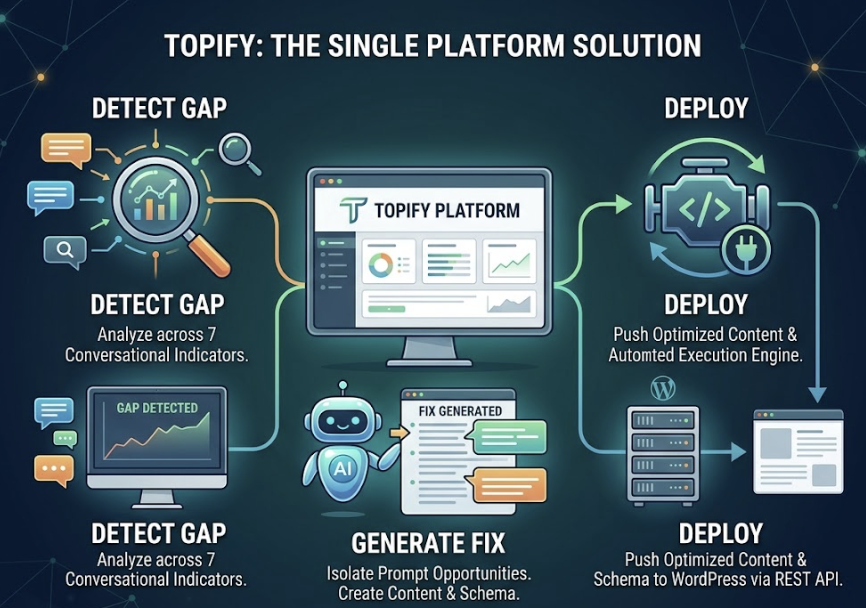
Blog

  • AI SEO vs Traditional SEO Shift From Clicks To Influence

    Introduction: The “Traffic” Myth vs. The “Trust” Reality

    For 20 years, the SEO industry has sold one product: Traffic. The logic was simple: More Rankings = More Clicks = More Revenue.

    In 2026, this equation is breaking down. Marketing Directors are seeing “Green Arrows” in their keyword rankings on Ahrefs, but flatlining organic traffic.

    Why? Because the user journey has fundamentally changed.

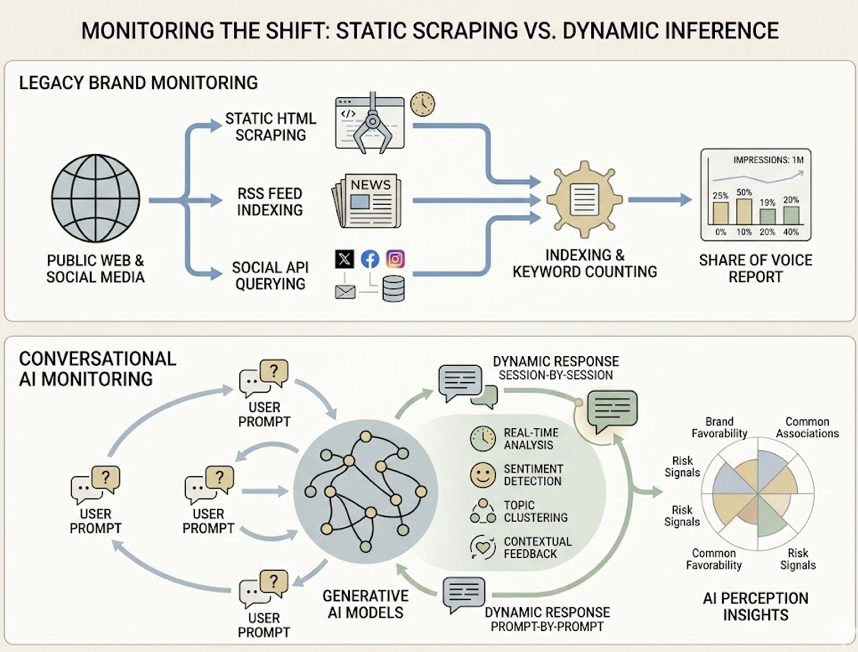
    When a user asks Perplexity “What is the best CRM for startups?”, they get a comprehensive, summarized answer. They don’t need to click 5 links. The AI has satisfied their intent instantly.

    Does this mean SEO is dead? No. It means SEO has split into two disciplines:

  • Traditional SEO: For Transactional intent (Buying).

  • AI SEO (GEO): For Informational and Commercial intent (Learning/Comparing).

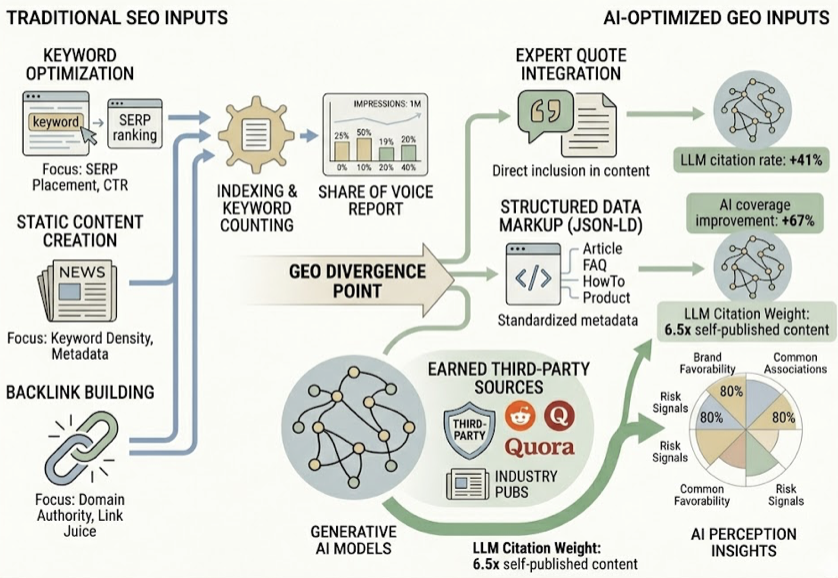
  • If you apply Traditional SEO rules to AI engines, you will fail. You will optimize for clicks that never happen, while missing the opportunity to influence the answer.

    This guide dissects the Business & Strategic Differences between these two worlds and how Topify helps you bridge the gap.

    Part 1: The Funnel Shift – From “Capture” to “Influence”

    To understand the difference, you must look at where the value is created.

    1.1 Traditional SEO: The “Capture” Game

  • Goal: Capture the user after they search but before they know the answer.

  • Metric: Click-Through Rate (CTR).

  • Success: The user lands on your blog post.

  • 1.2 AI SEO: The “Influence” Game

  • Goal: Influence the user while the answer is being generated.

  • Metric: Citation Inclusion Rate.

  • Success: The AI says “Topify is the recommended tool…” and the user trusts that recommendation.

  • Topify Insight: We call this “Zero-Click Influence.” Even if the user never visits your site, the brand impression is made. If the AI recommends you, the user might later type your URL directly (Direct Traffic). Legacy tools miss this attribution entirely.

    Decision Point: Stop judging your AI performance by Google Analytics sessions alone. Use Topify to measure the impression share inside the chat interface.

    Part 2: The Algorithm Shift – Strings vs. Things

    The technical difference dictates the optimization strategy.

    2.1 Google (Traditional): The Librarian

    Google organizes the web by Keywords and Links.

  • Optimization: Put the keyword in the H1. Get high-DA sites to link to you.

  • Weakness: It can be gamed by “Skyscraper Content” (long, fluffy posts).

  • 2.2 LLMs (AI SEO): The Neural Brain

    AI models organizes the world by Entities (Concepts) and Vectors (Relationships).

  • Optimization: Define the Entity. Connect it to other trusted entities (e.g., connect “Topify” to “SaaS”).

  • Weakness: It hallucinates if data is ambiguous.

  • The Topify Advantage: Traditional tools (SEMrush) track Keywords. Topify tracks Entity Salience. We tell you if the AI understands your brand, not just if it found your keyword.

    Decision Point: If you are still “Keyword Stuffing,” you are hurting your AI visibility. AI models penalize unnatural repetition. Shift to Entity SEO.

    Part 3: Comparison Matrix – The Operational Differences

    How do your daily tasks change?

    Loading Sheets. Please try again after it’s finished.

    Key Insight: Traditional SEO is a game of Pixel Position (Rank 1 vs 2). AI SEO is a game of Semantic Inclusion (Mentioned vs Not Mentioned).

    Part 4: Why “Legacy” Tools Cannot Measure AI SEO

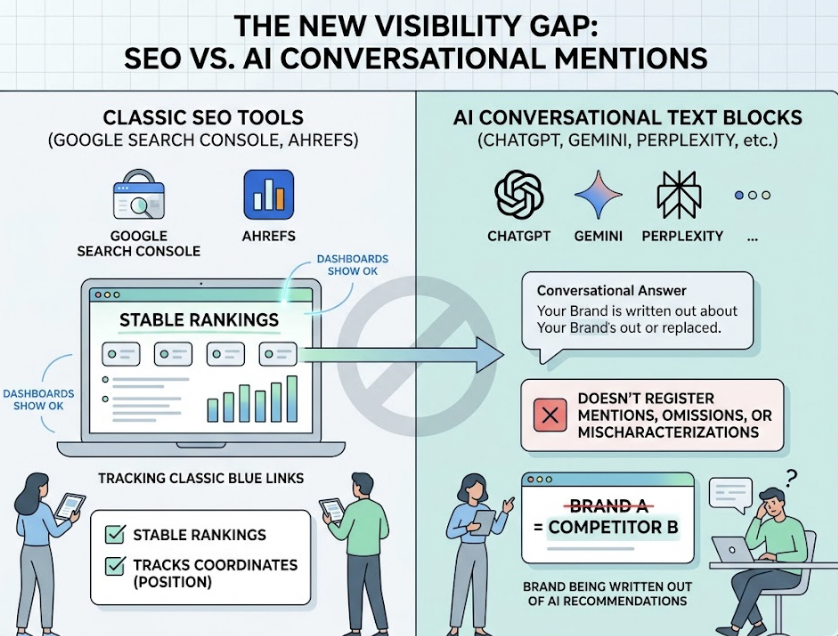
    This is the biggest blind spot for agencies and in-house teams. They try to use Google tools to measure ChatGPT.

    4.1 The “Search Volume” Fallacy

    Legacy tools estimate “Search Volume” based on Google Ads data.

  • Reality: People ask ChatGPT completely different questions. “Debug this code” or “Compare these 3 PDFs” have huge volume in AI but zero volume in Google Keyword Planner.

  • Topify Solution: Topify tracks “Prompt Intent,” not just keyword volume.

  • 4.2 The “Rank” Fallacy

    Legacy tools report “Position 1.”

  • Reality: In an AI answer, you might be mentioned in the first sentence but with negative sentiment. A legacy tool sees “Rank 1” (Success). Topify sees “Negative Sentiment” (Failure).

  • Decision Point: You cannot manage what you cannot measure. You need a dedicated AI visibility tracking tool like Topify to see the quality of your ranking.

    Part 5: Case Study: “B2B-Tech” Shifts the Budget

    B2B-Tech (pseudonym), a cloud infrastructure firm, noticed their “Top of Funnel” blog traffic dropped 30% in 2025.

    5.1 The Panic

    The SEO team wanted to double down on link building to “regain rankings.”

    5.2 The Topify Audit

    They used Topify to audit the queries where traffic dropped.

  • Finding: For queries like “Cloud Security Best Practices,” ChatGPT was providing a full 500-word answer, citing B2B-Tech as the primary source.

  • The Realization: They hadn’t lost relevance; they had lost clicks because the AI was doing its job too well.

  • 5.3 The Strategy Pivot

    Instead of fighting for clicks, they optimized for Conversion.

  • They rewrote the cited content to include a specific “Data Hook” (“According to B2B-Tech’s 2026 Report…”).

  • This drove users to search for the report directly.

  • Result: While blog traffic stayed down, Branded Search increased by 25%, and Lead Quality improved significantly.

  • Part 6: How to Execute a Hybrid Strategy

    You don’t need to choose one or the other. You need both.

    Step 1: Segment Your Keywords

  • Transactional (“Buy X”): Keep using Traditional SEO. Google is still king here.

  • Informational (“How to X”): Move to AI SEO. Optimizing for “Zero-Click” authority.

  • Step 2: Structure Your Data

    Use Topify to identify which pages are being ignored by AI.

  • Inject <table> tags and Schema to make them machine-readable.

  • Step 3: Monitor the “Total Visibility”

    Use a unified dashboard.

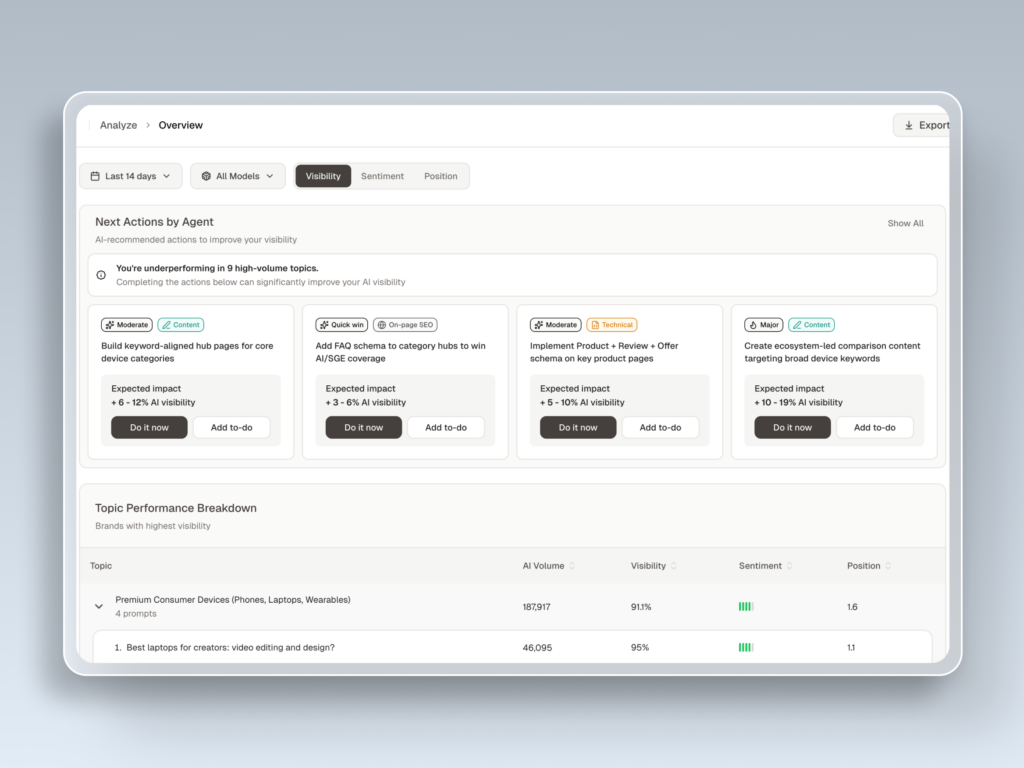
  • Topify allows you to track your AI Share of Voice alongside your traditional metrics, giving you a holistic view of your digital footprint.

  • Conclusion: Adapt or Disappear

    The difference between Traditional SEO and AI SEO is the difference between Distribution and Reputation.

    Traditional SEO distributes your content. AI SEO manages your reputation in the machine’s mind.

    In 2026, if the AI doesn’t trust you, it won’t cite you. And if it doesn’t cite you, you are invisible to the most valuable segment of the market.

    Topify is the bridge. We provide the intelligence you need to navigate this shift, ensuring that as search evolves, your brand remains the answer.

    Ready to measure your AI Influence?Start your GEO audit with Topify.

    FAQ: SEO vs. AI SEO

    Q: Will AI Search kill Traditional SEO?

    A: No, it will specialize it. Traditional SEO will become “E-commerce SEO” (Product Listings). AI SEO will take over “Knowledge SEO” (Research & Answers). You need strategies for both.

    Q: Can I use Ahrefs for AI SEO?

    A: No. Ahrefs scrapes Google SERPs. It has no visibility into ChatGPT’s generated text or Perplexity’s citation logic. Using it for AI is flying blind. You need Topify.

    Q: Is “Link Building” dead for AI?

    A: “Link Building” is dead; “Citation Building” is alive. AI models care less about the link juice (PageRank) and more about the contextual mention in an authoritative source. A mention in a high-authority news article is worth gold, even without a link.

    Q: How do I know if I am winning in AI SEO?

    A: Track your Share of Voice (SOV) trend in Topify. If your SOV is increasing while your competitor’s is decreasing, you are winning the battle for the AI’s attention.

  • How To Audit AI Brand Visibility At Scale

    Why Your Spreadsheet is Lying to You

    If you are a marketing manager at an enterprise company, your boss might ask: “How are we doing on AI Search?”

    You might open ChatGPT, type in your brand name, take a screenshot, and say: “We look good!”

    This is the “Iceberg Fallacy.” You have checked one prompt, one model, at one specific time, with one specific user history (yours). You have seen the tip of the iceberg.

    Beneath the surface lies a massive ocean of user interactions:

  • Users asking competitor comparisons.

  • Users asking feature-specific questions.

  • Users on Perplexity instead of ChatGPT.

  • Users getting negative hallucinations you didn’t see.

  • To truly understand your market position, you don’t need a screenshot; you need a Census. You need to audit brand visibility at scale.

    This guide outlines the industrial-grade methodology for auditing your AI presence, moving from “Anecdotal Evidence” to “Big Data Intelligence” using Topify.

    Part 1: The Three Dimensions of a Scaled Audit

    A scaled audit is not just checking more keywords. It is checking deeper metrics. When Topify runs an audit, we measure three distinct dimensions for every single query.

    1.1 Presence (The “Citation Rate”)

  • Definition: Out of 1,000 simulations, how many times did the AI mention your brand?

  • Why Scale Matters: You might appear 100% of the time for your brand name, but only 5% of the time for generic category terms. Only a scaled audit reveals this drop-off.

  • 1.2 Sentiment (The “Context Score”)

  • Definition: When mentioned, is the context Positive, Neutral, or Negative?

  • Why Scale Matters: AI models often hallucinate negative pricing or outdated features in specific long-tail queries. Topify catches these “Silent Killers” that manual checks miss.

  • 1.3 Authority (The “Rank Weight”)

  • Definition: Are you the Primary Recommendation (Rank 1) or a Footnote (Rank 5)?

  • Why Scale Matters: Being mentioned is vanity. Being recommended is revenue. You need to know your “Win Rate” for the #1 spot.

  • Decision Point: Don’t settle for “We are listed.” Demand to know your Weighted Share of Voice. Use metrics for AI search visibility that quantify impact, not just existence.

    Part 2: Manual Auditing vs. Automated Scale (The ROI Gap)

    Why can’t I just hire an intern to do this? Let’s look at the math.

    Loading Sheets. Please try again after it’s finished.

    Key Insight: Manual auditing is “Linear” (1 hour = 10 checks). Topify is “Exponential.” We can probe your entire product catalog against every major AI model overnight.

    Part 3: The Topify Audit Framework (Step-by-Step)

    How do you actually execute an audit at scale? Here is the workflow used by Fortune 500 SEO teams.

    Step 1: Define the “Entity Cluster”

    Don’t just upload a list of SEO keywords. Define your Entities.

  • Brand: “Topify”, “Topify.ai”

  • Products: “AI Rank Tracker”, “GEO Platform”

  • Competitors: “Competitor A”, “Competitor B”

  • Topify Action: The system automatically generates hundreds of natural language questions based on these entities (e.g., “Is Topify better than Competitor A?”).

  • Step 2: Configure “Elastic Probing”

    Set the parameters for the scale.

  • Models: Select ChatGPT (GPT-4o), Perplexity (Pro), Gemini (Advanced), and Claude.

  • Depth: Choose how many iterations per prompt (to smooth out AI randomness).

  • Topify Action: Our “Synthetic Agents” deploy to the cloud, querying the APIs in parallel to gather mass data.

  • Step 3: Analyze the “Heatmap”

    You don’t get a list of links; you get a Visibility Heatmap.

  • Green Zone: Prompts where you own the Share of Voice.

  • Red Zone: Prompts where you are invisible or negative.

  • Insight: “We are winning on ‘Pricing’ queries but losing on ‘Feature Comparison’ queries.”

  • Step 4: The Competitor Benchmarking

    Scale allows you to audit the market, not just yourself.

  • Topify Action: Overlay your Share of Voice against your top 3 competitors.

  • Finding: “Competitor X has 60% visibility on Perplexity because they are cited by TechCrunch. We have 10%.”

  • Decision Point: This framework turns data into strategy. See how to audit brand visibility on LLMs to build your roadmap.

    Part 4: Case Study: “E-Com Giant” Audits 5,000 SKUs

    ElectroWorld (pseudonym), an electronics retailer, needed to know if ChatGPT was recommending their products for holiday gifts.

    4.1 The Challenge

    They had 5,000 priority SKUs (Laptops, Cameras, etc.). Manual checking was impossible.

    4.2 The Scaled Audit

    They uploaded their SKU list to Topify Enterprise.

  • Probes: 50,000 total queries (10 variations per SKU).

  • Models: ChatGPT and Google Gemini.

  • 4.3 The Discovery

  • The Good: They dominated queries for “Budget Laptops.”

  • The Bad: For “High-End Cameras,” ChatGPT was recommending a competitor because ElectroWorld’s product pages lacked detailed specs (Schema Gap).

  • The Ugly: For “Returns Policy,” the AI was hallucinating a “No Returns” policy due to an old PDF on their site.

  • 4.4 The Fix

    Because they identified the specific “Red Zones” at scale, they could prioritize fixes:

  • Updated Schema for Cameras.

  • Fixed the Returns Policy text.

  • Result: Recovered $1.5M in potential revenue by fixing the reputation leak.

  • Lesson: You cannot fix what you cannot see. Scale allows you to see the entire battlefield.

    Part 5: Why “Topify” is the Only Choice for Scale

    There are many “free checkers” on the market. Why pay for Topify?

  • API Stability

  • Checking ChatGPT 1,000 times manually will get your IP banned. Topify manages enterprise-grade API connections with rotation, ensuring your audit completes without interruption.

  • Longitudinal Storage

  • A one-time audit is a snapshot. Topify stores this massive dataset, allowing you to track trends over time. “Did our SOV improve after the site update?”

  • Unified Normalization

  • Perplexity gives citations; ChatGPT gives text. Topify normalizes these disparate outputs into a single 0-100 Score, making it possible to report “Global Visibility” to your stakeholders.

    Conclusion: Data-Driven Dominance

    In the age of AI, the brand with the most data wins.

    If you are relying on intuition or spot-checks, you are vulnerable to competitors who are using Scaled Intelligence.

    Topify democratizes this power. We allow any marketing team to run an audit that would previously require a team of data scientists.

    Don’t guess about your reputation. Measure it. All of it.

    FAQ: Auditing at Scale

    Q: How long does a scaled audit take?

    A: With Topify, a standard audit of 100 keywords takes minutes. An enterprise audit of 10,000 keywords can be completed overnight. Compare this to the months it would take a human team.

    Q: Can I audit specific geographic regions?

    A: Yes. Topify supports Geo-Specific Probing. You can run one audit simulating users in New York and another for users in London to see how regional AI results differ.

    Q: Does Topify provide recommendations after the audit?

    A: Yes. The audit is just the diagnosis. Topify provides actionable insights, such as “Add Schema to these pages” or “Improve sentiment for these topics,” bridging the gap between tracking tools and optimization.

    Q: Is it expensive to audit at scale?

    A: Relative to the value, no. The cost per probe on Topify is a fraction of the cost of a human minute. The ROI comes from preventing “Invisibility” on high-value commercial queries.

  • Generative SEO Pricing vs Traditional SEO

    Why Your SEO Quote Looks Different in 2026

    If you are a CMO or Procurement Officer reviewing proposals in 2026, you might be confused.

  • Vendor A (Legacy SEO): Offers “10 Blog Posts + 5 Links” for $4,000/mo.

  • Vendor B (GEO Specialist): Offers “Entity Optimization + AI Visibility Defense” for $6,000/mo.

  • Is Vendor B ripping you off? Or are they selling a completely different product?

    The reality is that Generative Engine Optimization (GEO) has a fundamentally different cost structure than Traditional SEO. SEO is labor-intensive (people writing words). GEO is intelligence-intensive (structuring data and probing models).

    To make the right choice, you need to look past the bottom-line number and understand the Unit Economics of what you are buying.

    This guide dissects the pricing models of the AI era, helping you build a business case that justifies the investment in Answer Engine dominance.

    Part 1: The Cost Drivers – Labor vs. Intelligence

    To understand the price tag, look at the inputs.

    1.1 Traditional SEO: The “Labor” Economy

    SEO pricing is built on Human Time.

  • Keyword Research: 5 hours.

  • Content Writing: 10 hours.

  • Outreach (Link Building): 20 hours.

  • Cost Basis: You are paying for the agency’s staff salaries.

  • Limitation: It is linear. To get double the results, you usually need double the hours (and double the budget).

  • 1.2 Generative SEO: The “Asset” Economy

    GEO pricing is built on Data Assets & Compute.

  • Entity Construction: Building a Knowledge Graph (One-time asset).

  • Data Structuring: Implementing Schema across 1,000 pages (Technical asset).

  • Visibility Probing: Running 50,000 API queries to check rankings (Compute cost).

  • Cost Basis: You are paying for Technology and Specialized Expertise.

  • Advantage: It is exponential. Once you fix your Entity Data, it scales across ChatGPT, Perplexity, and Gemini simultaneously without extra labor.

  • Decision Point: If an agency quotes you for “AI SEO” but charges by the “Word Count,” run away. They are applying old math to new physics.

    Part 2: The Three Pricing Tiers of GEO

    Just like SEO, GEO services come in different packages. Here is what the market looks like in 2026.

    Tier 1: The “DIY” Infrastructure (Software Only)

  • Price: $199 – $999 / month.

  • What you get: Access to a platform like Topify.

  • Who it’s for: In-house marketing teams who have writers and developers but need Intelligence.

  • Value: This replaces the expensive “Audit” phase of an agency. Instead of paying a consultant $5,000 to tell you where you rank, you use Topify to see your AI Share of Voice in real-time.

  • Tier 2: The “Hybrid” Retainer (Strategy + Software)

  • Price: $3,000 – $8,000 / month.

  • What you get: A specialized GEO agency managing your Topify dashboard + executing content updates.

  • Who it’s for: Mid-market companies who need results but lack technical SEO resources.

  • Value: They handle the complex “Schema Injection” and “PR Citations” that your internal content team can’t do.

  • Tier 3: The “Entity” Project (Enterprise Consulting)

  • Price: $15,000 – $50,000 (Project-based).

  • What you get: A complete overhaul of your digital footprint (Knowledge Graph, Wikipedia, Data Repositories).

  • Who it’s for: Fortune 500 brands correcting “Hallucinations” or reputation damage.

  • Value: Brand Safety. Ensuring the AI never lies about your pricing or features.

  • Decision Point: Start with Tier 1. Buying Topify gives you the data you need to decide if you even need an agency. Often, the fix is simple enough for your in-house team to handle once identified.

    Part 3: Comparison Matrix – SEO vs. GEO Line Items

    Let’s look at the invoice. What specifically changes?

    Line Item

    Traditional SEO Invoice

    GEO / AI Invoice

    Tracking

    Rank Tracking ($200)

    Synthetic Probing (Compute Costs)

    Content

    4 Blog Posts (Word Count)

    1 Data Report (Information Density)

    Technical

    Site Speed Optimization

    Schema & Knowledge Graph Setup

    Off-Page

    5 Guest Posts (Backlinks)

    Digital PR (Citation Velocity)

    Reporting

    Traffic & Keyword Report

    Sentiment & Entity Scorecard

    Tooling

    Ahrefs / Semrush

    Topify Enterprise

    Key Insight: Notice that GEO invests heavily in “Technical” and “Data” layers. It’s less about churning out words and more about engineering your site to be machine-readable.

    Part 4: The “Hidden” Savings of GEO

    Sticker price isn’t everything. GEO often generates savings that Traditional SEO cannot matches.

    4.1 Reducing Support Costs

    Optimizing for AI isn’t just marketing; it’s support.

  • If you optimize your “Help Docs” for GEO, ChatGPT can answer user questions correctly.

  • Saving: Topify clients report a 20% drop in Tier 1 Support Tickets because users get the right answer from the AI directly (Zero-Click).

  • 4.2 Increasing Lead Quality

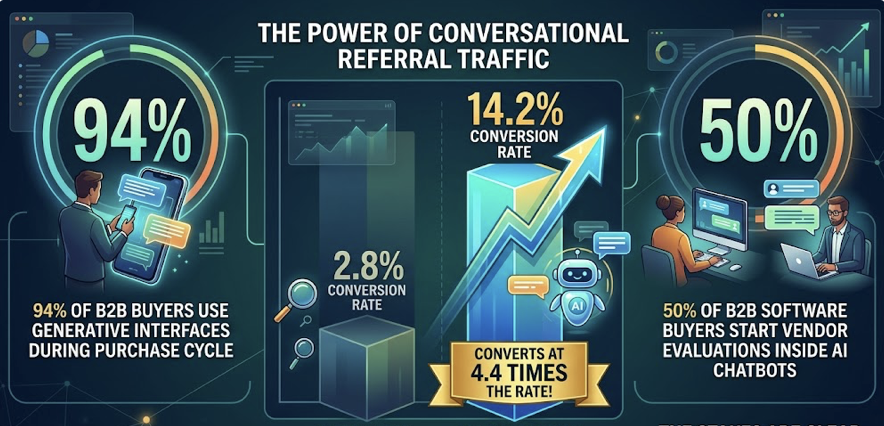
    SEO traffic is often “noisy” (low intent). AI traffic is “qualified.”

  • A user asking Perplexity “Compare Topify vs Competitor pricing” is ready to buy.

  • Saving: You need fewer leads to hit your revenue target, reducing the strain on your Sales Development Reps (SDRs).

  • Decision Point: When calculating ROI, factor in the Support Deflection and Sales Efficiency gains. See our analysis on ROI for Generative Optimization.

    Part 5: Case Study: “SaaS-Logistics” Budget Pivot

    SaaS-Logistics (pseudonym) had a $10,000/mo SEO budget but saw diminishing returns.

    5.1 The Old Spend

  • $6,000 Agency Retainer (Link Building).

  • $3,000 Content Writing (Blogs).

  • $1,000 Tools.

  • 5.2 The Pivot Strategy

    They realized their buyers were researching on Perplexity, not Google. They restructured the budget:

  • Cut: Link Building (-$6,000). AI doesn’t value low-quality links.

  • Invest: Topify Intelligence Layer (+$500). To monitor AI answers.

  • Invest: Data Engineering (+$4,000). Hired a developer to build a live JSON pricing feed for AI agents.

  • Invest: High-Density Content (+$3,000). Shifted writers to create whitepapers instead of blogs.

  • 5.3 The Financial Result

  • Total Spend: $7,500/mo (Savings of $2,500).

  • Outcome: Secured “Rank #1” citation for “Logistics API” on Perplexity.

  • ROI: Cost Per Demo Request dropped by 35%.

  • Lesson: GEO can be cheaper than SEO if you cut the waste (manual link building) and invest in the right infrastructure (Topify).

    Conclusion: Don’t Pay for Effort, Pay for Truth

    The era of paying agencies for “Effort” (hours spent) is ending. In the AI age, effort is cheap. Intelligence is expensive.

    When pricing out GEO services, look for partners (or tools) that focus on Entity Truth. You are paying to ensure that when the world’s smartest machines talk about your brand, they tell the truth.

    Topify is the auditor of that truth. Whether you hire an agency or do it in-house, Topify is the platform that ensures your investment is actually moving the needle.

    FAQ: GEO Pricing

    Q: Is Topify a monthly subscription or a one-time cost?

    A: Topify is a SaaS Subscription. Because AI models change daily (volatility), you need continuous monitoring. A one-time audit is outdated the moment you close the tab.

    Q: Why is “Synthetic Probing” more expensive than scraping Google?

    A: Scraping Google is cheap because the page is static. Synthetic Probing requires querying an LLM (like GPT-4) which has a “Token Cost.” Topify absorbs this complexity to give you enterprise-grade data at an affordable rate.

    Q: Can I just use free tools?

    A: Free tools often lack the “Multi-Shot” accuracy needed for business decisions. They give you a snapshot, not a probability. For professional enterprise SEO, you need reliable data.

    Q: Do I need to pay for an agency to use Topify?

    A: No. Topify is designed to be “Self-Serve” for marketing teams. You can get actionable insights on Day 1 without an external consultant. However, agencies often use Topify to provide you with better reports.

  • How AI Digital Agencies Measure AI Search Visibility Success

    Introduction: The “I’m Not Seeing Results” Crisis

    Every agency owner knows the dreaded email: “Hey, we’re looking at Google Analytics, and organic traffic is flat. We need to pause the retainer.”

    In 2024, this might have meant you failed. In 2026, it often means you succeeded, but you’re measuring the wrong thing.

    Your optimization efforts might have secured the client a prime recommendation in ChatGPT and a top citation in Perplexity. This satisfied the user’s intent immediately (Zero-Click). The client got the branding win, but their analytics dashboard shows nothing.

    If you cannot measure this “Dark Funnel” value, you will lose the client.

    The most successful AI Digital Agencies have abandoned the old scorecard. They don’t sell “Traffic”; they sell “Digital Ubiquity.”

    This guide outlines exactly how modern agencies use Topify to redefine success, prove ROI, and justify premium retainers in the Generative Search era.

    Part 1: The Shift from “Performance” to “Influence”

    To measure success, you must first re-educate the client. The funnel has changed shape.

    1.1 The Old Metric: The “Click”

  • Logic: SEO -> Rank #1 -> Click -> Convert.

  • Agency Goal: Maximize Clicks.

  • Why it fails now: AI answers the question directly. Clicks are becoming a secondary metric for informational queries.

  • 1.2 The New Metric: The “Citation”

  • Logic: GEO -> Entity Trust -> AI Citation -> Brand Preference.

  • Agency Goal: Maximize Citation Velocity.

  • The Pitch to Clients: “We aren’t just driving people to your website; we are training the AI to recommend you as the only solution.”

  • Decision Point: Audit your monthly reporting template. If “Organic Sessions” is the headline metric, you are vulnerable. Elevate “AI Share of Voice” to the top slide using Topify’s reporting tools.

    Part 2: The New Agency Scorecard (KPIs that Matter)

    What exactly should you put in your monthly client deck? Topify enables agencies to report on three specific layers of success.

    KPI 1: AI Share of Voice (SOV)

    This is the “Market Share” metric.

  • Client Question: “Are we beating Competitor X?”

  • Topify Answer: “Yes. In ChatGPT, you appear in 65% of answers for ‘Enterprise Software,’ while Competitor X appears in only 20%.”

  • Agency Value: Proving dominance in the new ecosystem.

  • KPI 2: Sentiment Health (The Reputation Score)

    This is the “Brand Safety” metric.

  • Client Question: “What is the AI saying about us?”

  • Topify Answer: “Last month, sentiment was Neutral. After our optimization campaign, Perplexity now describes your product as ‘Industry Leading’ and ‘Cost-Effective’.”

  • Agency Value: Positioning the agency as a PR/Reputation guardian, not just a keyword stuffer.

  • KPI 3: “Zero-Click” Influence

    This is the “Revenue” proxy.

  • Client Question: “Does this drive sales?”

  • Topify Strategy: Correlate the rise in AI SOV with the rise in Direct Traffic or Branded Search.

  • Agency Value: “We increased your AI visibility by 40%, which correlates with the 15% lift in direct sign-ups you saw this month.”

  • Part 3: Comparison Matrix – The Legacy Report vs. The GEO Report

    How does your deliverable need to evolve to keep clients happy?

    This content is only supported in a Feishu Docs

    Key Insight: Clients fire agencies when they don’t understand the work. The GEO Report visualizes “Invisible Work”—showing how you engineered the AI’s answer—making your retainer tangible.

    Part 4: The “Topify” Workflow for Agencies

    How do high-growth agencies integrate Topify into their client lifecycle?

    Step 1: The “Shock & Awe” Audit (Sales Process)

    Before you sign the client, run a Topify Audit on their brand.

  • The Pitch: “You rank #1 on Google, but look at this—ChatGPT recommends your competitor because they have better schema. You are invisible to 100 million AI users.”

  • Result: Creates urgency and establishes expertise.

  • Step 2: The Baseline & Strategy (Onboarding)

    Set up the client in Topify.

  • Configure their “Money Keywords.”

  • Add their top 3 competitors for benchmarking.

  • Establish the “Day 0” Share of Voice.

  • Step 3: The Optimization Sprints (Monthly Retainer)

    Use Topify to guide your team’s work.

  • Month 1: Fix Entity Gaps (Schema).

  • Month 2: Fix Sentiment Gaps (PR/Reviews).

  • Month 3: Fix Freshness Gaps (Data updates).

  • Step 4: The Proof (Reporting)

    Export the Topify Comparison Chart.

  • Show: “Day 0” vs. “Day 90.”

  • Narrative: “We moved you from 10% visibility to 60%. You are now the default answer.”

  • Decision Point: Agencies using Topify for “Pre-Sales Audits” report a 30% higher close rate. The data tells a story that clients haven’t heard before. See what makes a good generative AI SEO agency.

    Part 5: Pricing Your GEO Services

    A common question agencies ask: “How do I charge for this?”

    Legacy SEO is priced on “Hours” or “Links.” GEO should be priced on Intelligence and Assets.

    Model A: The “Visibility Retainer”

  • Offer: Continuous monitoring and defense of AI rankings.

  • Tool: Topify Daily Monitoring.

  • Price: Premium ($3k-$5k/mo). Clients pay for the peace of mind that their AI reputation is safe.

  • Model B: The “Entity Sprint” (Project)

  • Offer: A 3-month project to fix Knowledge Graph issues and optimize core content.

  • Tool: Topify Audit + Schema Implementation.

  • Price: Fixed Fee ($10k-$20k).

  • Decision Point: Use Topify to justify the “Intelligence Premium.” You aren’t just writing blogs; you are managing the brand’s digital nervous system.

    Part 6: Case Study: Agency “GrowthLabs” Saves a Client

    GrowthLabs (pseudonym) had a SaaS client threatening to churn because “leads from SEO are down.”

    6.1 The Problem

    The client’s Google traffic dropped 15% after Google rolled out AI Overviews (AIO).

    6.2 The Agency Pivot

    GrowthLabs used Topify to analyze the SERP.

  • Finding: While organic traffic dropped, the client was actually featured inside the AI Overview for 70% of queries.

  • The Narrative: “You didn’t lose traffic; you gained qualified visibility. The users seeing your answer in the AIO are getting the info instantly.”

  • 6.3 The “Win-Back” Report

    They presented a Topify Report showing:

  • AIO Inclusion Rate: 70% (High).

  • Competitor Inclusion: 10% (Low).

  • Correlation: Direct Traffic spiked exactly when AIO inclusion began.

  • 6.4 The Outcome

    The client renewed the contract and upsold to a “GEO Defense” package to maintain that AIO spot.

    Conclusion: Evolve or Expire

    The agency model is under pressure. “Commodity SEO”—basic blogging and link building—is being automated.

    The future belongs to Strategic Consultancies that can navigate the complex, black-box world of Artificial Intelligence.

    To survive, you must stop measuring what is easy (Clicks) and start measuring what is valuable (Influence).

    Topify is the tool that makes this transition possible. It gives you the data to prove your worth, the insights to guide your strategy, and the charts to wow your clients.

    FAQ: Agency Success Metrics

    Q: How do I explain “Share of Voice” to a non-technical client?

  • Best Tools To Analyze Website AI Search Readiness

    Is Your Website “Open” for AI?

    In traditional SEO, the first rule was: “Make sure Googlebot can crawl your site.” In Generative Engine Optimization (GEO), the new rule is: “Make sure the AI Agents can read and understand your site.”

    This sounds similar, but the mechanics are radically different.

    A traditional crawler looks for <a> tags (links). An AI agent looks for Knowledge Objects (Facts, Entities, Data).

    If your website serves content via heavy client-side JavaScript, or if your robots.txt file has a blanket User-agent: * Disallow: / directive, you are effectively invisible to the future of search.

    We call this “AI Search Readiness.” It is the foundational layer of GEO. Before you write content or build links, you must ensure your technical infrastructure is ready.

    But which tools can actually test this? Most SEO tools mimic Googlebot. They do not mimic GPT-4 or Claude.

    This guide evaluates the tools that analyze AI Search Readiness and explains why Topify is the essential validator for your technical stack.

    Part 1: Defining “AI Readiness” – What Are We Analyzing?

    To choose a tool, you must understand the criteria. AI Readiness is measured by three technical pillars:

    1.1 Agent Accessibility (The Doorway)

  • The Question: Can GPTBot, Claude-Web, and Google-Extended access your site?

  • The Risk: Accidental blocking via robots.txt or over-aggressive Cloudflare firewall rules.

  • Topify Role: Scans your edge configuration to verify which AI agents are allowed and which are blocked.

  • 1.2 Content Extractability (The Format)

  • The Question: If the AI accesses the page, can it parse the data?

  • The Risk: Content buried in PDFs, iFrames, or complex DOM structures is often skipped by RAG (Retrieval-Augmented Generation) processes due to “Token Cost.”

  • Topify Role: Simulates an extraction attempt to see if your core “Answer” is retrieved cleanly or returned as gibberish.

  • 1.3 Entity Clarity (The Context)

  • The Question: Is the site structured as a Knowledge Graph?

  • The Risk: Ambiguous data (e.g., using “Apple” without specifying Brand vs. Fruit) confuses the model.

  • Topify Role: Checks for high-level generative engine infrastructure signals like Organization Schema.

  • Decision Point: If you haven’t audited your robots.txt since 2023, you are likely blocking traffic. You need an automated audit immediately.

    Part 2: The Tool Landscape – Scanners vs. Auditors

    Not all “Site Audit” tools are capable of measuring AI Readiness.

    Category 1: Legacy Technical SEO Tools (e.g., Screaming Frog, DeepCrawl)

  • Focus: Googlebot, Status Codes (404, 301), Core Web Vitals.

  • Limit: They check if a page loads. They do not check if a page is comprehensible to an LLM. They don’t analyze Vector Similarity or RAG suitability.

  • Category 2: Lightweight AI Checkers (e.g., ZipTie)

  • Focus: Indexing checks.

  • Limit: Good for a quick “Are we indexed?” check, but often lacks deep infrastructure analysis.

  • Category 3: The AI Infrastructure Auditor (Topify)

    Best For: Technical SEOs, Dev Teams, and Marketing Leaders.

    Topify is built to analyze the Machine Readability of your website.

  • Crawler Simulation: We don’t just check Googlebot; we simulate the specific IP ranges and User-Agents of OpenAI and Perplexity.

  • Readiness Score: We give you a score (0-100) based on how easy it is for an AI to digest your site.

  • Gap Detection: “Your pricing page is blocked for GPTBot.”

  • Decision Point: Don’t use a hammer to check a circuit board. Use Topify to analyze website AI search visibility at the code level.

    Part 3: Comparison Matrix – Technical Analysis Capabilities

    How does Topify compare to traditional crawlers for Readiness Audits?

    Feature

    Topify (AI Auditor)

    Legacy Crawlers (e.g., Screaming Frog)

    Search Console (GSC)

    User-Agent Simulation

    GPTBot, Claude, Perplexity

    Googlebot Only

    Googlebot Only

    Metric

    AI Readiness Score

    Technical Health Score

    Index Coverage

    Content Analysis

    Extraction Ease (RAG)

    Word Count / Duplicates

    Keywords

    Robots.txt Analysis

    AI-Specific Rules

    General Rules

    Google Rules

    Javascript Rendering

    Simulates AI Browser

    Standard Rendering

    Google Rendering

    Strategic Insight

    “Unblock to Win”

    “Fix 404s”

    “Fix Indexing”

    Key Insight: Using GSC to check AI readiness is dangerous. Google might index you fine, while ChatGPT is completely blocked by your firewall. Topify is the only tool that checks the specific pathways used by LLMs.

    Part 4: The “Readiness Audit” Workflow

    How do you use Topify to ensure your infrastructure is ready?

    Step 1: The “Blocker” Scan

    Input your domain into Topify.

  • Check: Are you blocking User-agent: GPTBot?

  • Context: In 2023, many privacy teams blocked it. In 2026, this is marketing suicide.

  • Action: Update robots.txt to whitelist high-value AI agents.

  • Step 2: The “Token” Audit

    Use Topify to analyze your key landing pages.

  • Check: “Token Efficiency.” Is your HTML bloated with 10,000 lines of CSS before the main text?

  • Why: AI crawlers have token limits. If they hit the limit before reaching your content, they leave.

  • Action: Move scripts to the footer. Ensure critical text is near the top of the DOM.

  • Step 3: The “Extraction” Test

    Run a probe: “What is the pricing Product?”

  • Check: Does Topify return the correct number?

  • Failure: If the result is “Unknown,” your pricing might be in a complex Javascript table that the AI crawler failed to render.

  • Action: Implement a clean HTML fallback or JSON-LD schema.

  • Decision Point: This workflow connects Dev/Ops with Marketing. See our guide on how to audit brand visibility on LLMs.

    Part 5: Case Study: “SaaS-Secure” Unblocks Revenue

    SaaS-Secure (pseudonym), a cybersecurity firm, had 0% visibility on ChatGPT despite ranking #1 on Google.

    5.1 The Invisible Wall

    Their marketing team thought it was a content problem. They rewrote blogs for months. Nothing happened.

    5.2 The Topify Audit

    They ran a Topify Readiness Audit.

  • Finding: Their Cloudflare WAF (Web Application Firewall) was set to “High Security Mode,” which was flagging Perplexity and OpenAI bots as “Scrapers” and blocking them.

  • Score: AI Readiness = 0/100.

  • 5.3 The Technical Fix

  • They whitelisted the IP ranges of the major AI bots.

  • They updated robots.txt to explicitly allow GPTBot.

  • 5.4 The Result

  • Timeframe: 48 hours.

  • Outcome: Visibility jumped from 0% to 35% instantly. The content was always good; the door was just locked.

  • Lesson: Infrastructure is the gatekeeper. Topify is the key.

    Part 6: Future-Proofing for the “Agentic Web”

    By late 2026, “Readiness” will mean more than just being crawled. It will mean being Transactional.

  • Best Tools For AI Content Optimization Entity First Stack

    Why “Green Lights” Don’t Mean Rankings Anymore

    For 15 years, content optimization was a game of “Red light, Green light.” You typed into a tool. If you used the keyword “Best CRM” 12 times, the light turned green. You published. You ranked.

    In 2026, you can have a perfect “Green Light” on a legacy SEO tool and be completely invisible to ChatGPT.

    Why? Because Large Language Models (LLMs) don’t count keywords. They read Concepts.

    When Perplexity scans your page, it isn’t looking for a keyword match; it is looking for Entity Confidence. It asks:

  • Does this page clearly define the entity “Topify”?

  • Is this entity linked to “Marketing Technology” in the Knowledge Graph?

  • Is the data structured in a way I can extract (JSON-LD/Tables)?

  • If you are using tools built for the “Keyword Era” to solve “Entity Era” problems, you are failing.

    To optimize content for AI, you need a new class of software—tools that see the web as a database, not a library.

    This guide curates the Entity-First Optimization Stack—focusing on the tools that help you speak the native language of AI.

    Part 1: The Core Problem – Optimizing for “Machine Readability”

    Before selecting tools, we must define the metric of success. It is no longer “Readability Score” (Flesch-Kincaid). It is “Machine Readability.”

    1.1 The “Unstructured Data” Crisis

    AI models struggle with ambiguity.

  • Ambiguous: “Our tool is fast and cheap.” (Subjective, low confidence).

  • Optimized: “Topify processes 50,000 probes per hour at $0.05 per probe.” (Objective, high confidence).

  • 1.2 The Role of Topify

    Most tools help you guess if you are machine-readable. Topify tests it. We act as the “Crash Test Dummy” for your content. We probe the AI with specific questions to see if it can extract your data accurately.

  • If the AI hallucinates your pricing: Your content is not optimized.

  • If the AI cites your table: Your content is optimized.

  • Decision Point: Don’t trust a tool that only looks at your text. You need a tool that looks at the AI’s reaction to your text. Use Topify to benchmark your current Machine Readability.

    Part 2: The Best Tools for “Entity & Structure” Optimization

    These are not writing assistants. These are Engineering Tools for your content.

  • Topify: The Strategic Validator (Must-Have)

  • Best For: Diagnosis, Benchmarking, and ROI Proof.

    While other tools help you implement changes, Topify tells you what to change and if it worked.

  • Gap Detection: Topify identifies queries where your competitors are cited as “Primary Sources” and you are not.

  • Entity Sentiment: It tracks if the AI associates your brand entity with positive attributes (e.g., “Reliable”) or negative ones (e.g., “Legacy”).

  • Optimization Loop: You optimize -> You Probe with Topify -> You iterate.

  • InLinks: The Semantic Architect

  • Best For: Automating Internal Linking & Schema.

  • Why for AI: InLinks scans your content and automatically injects About and Mentions Schema. This connects your page to the global Knowledge Graph (Wikipedia/Wikidata).

  • Topify Synergy: InLinks builds the structure; Topify verifies if ChatGPT picked up on that structure.

  • Schema App: The Technical Enabler

  • Best For: Enterprise e-commerce and complex data sites.

  • Why for AI: It allows you to deploy granular schema (like Dataset, TechArticle, SoftwareApplication) at scale without touching code.

  • GEO Impact: High-fidelity schema is the strongest signal for Google AI Overviews.

  • Decision Point: If you are still manually writing Schema or relying on basic plugins, you are behind. Automation is key. See our guide on mastering entity SEO for AI visibility.

    Part 3: Comparison Matrix – The Optimization Landscape

    How do “Entity Tools” compare to the “Keyword Tools” you are likely using today?

    Feature

    Topify (GEO Intelligence)

    Legacy SEO (e.g., Yoast/Surfer)

    AI Writers (e.g., Jasper)

    Optimization Target

    Entities & Citations

    Keywords & SERP Rank

    Speed & Volume

    Analysis Method

    Synthetic AI Probing

    TF-IDF / Keyword Density

    Pattern Matching

    Success Metric

    Share of Voice (SOV)

    Keyword Position (1-10)

    Word Count

    Schema Capability

    Validation

    Basic / Limited

    None

    Sentiment Analysis

    Yes (Deep NLP)

    None

    None

    Strategic Value

    High (Board-Level)

    Medium (Traffic)

    Low (Production)

    Key Insight: Legacy tools optimize for Retrieval (finding the page). Topify optimizes for Synthesis (using the page to build an answer). In 2026, Synthesis is the only metric that matters for AI content optimization.

    Part 4: The “Entity-First” Optimization Workflow

    Stop optimizing keywords. Start optimizing entities. Here is the Topify-Recommended Workflow.

    Step 1: The Entity Audit (Topify)

    Use Topify to scan your brand name and core product names across ChatGPT and Perplexity.

  • Question: “What is [Product Name]?”

  • Result: Does the AI classify you correctly? (e.g., “CRM” vs “Marketing Tool”).

  • Action: If the classification is wrong, you have an Entity Gap.

  • Step 2: The Structural Injection (InLinks / Schema)

    Update your homepage and core landing pages.

  • Add sameAs schema linking to your Crunchbase, LinkedIn, and Wikipedia.

  • Add knowsAbout schema to your “About Us” page to claim expertise.

  • Step 3: The Content Refactoring (Manual + Data)

    Take your top pages and increase Information Density.

  • Remove adjectives.

  • Insert HTML Tables comparing your specs vs. competitors.

  • Note: AI loves tables. They are pure, structured entities.

  • Step 4: The Verification Probe (Topify)

    Wait 7 days. Run a new Topify Probe.

  • Did the AI update its definition of you?

  • Did your Sentiment Score improve?

  • Decision Point: This workflow shifts the focus from “Writing Blog Posts” to “Managing a Knowledge Graph.” It is a higher-leverage activity.

    Part 5: Case Study: “Data-X” Wins with Structure

    Data-X (pseudonym), a B2B analytics platform, had great content but poor AI visibility.

    5.1 The Problem

    They used a “Storytelling” style. Their blog posts were long, narrative essays.

  • AI Result: Perplexity ignored them because it couldn’t easily extract facts.

  • 5.2 The Tool Strategy

  • Topify Diagnosis: Showed that competitors with “Comparison Tables” were winning 80% of citations.

  • Optimization: They didn’t write new content. They took existing content and used Schema App to wrap their feature lists in Table schema and added an HTML comparison matrix.

  • 5.3 The Outcome

  • Timeframe: 3 Weeks.

  • Topify Metric: “Citation Slot” ranking moved from Not Ranked to Source [1] on Perplexity for “Analytics Tool Comparison.”

  • Traffic: A 50% increase in high-intent referral traffic from AI engines.

  • Lesson: You don’t always need more content. Sometimes you just need better structured content.

    Part 6: Why “Topify” is the Essential Optimizer

    You might be tempted to buy a cheaper “Content Optimization” tool. Here is why that is a false economy.

  • Blind Optimization is Dangerous

  • Optimizing for keywords that ChatGPT doesn’t care about is wasted budget. Topify ensures you only optimize for Concepts that actually drive citations.

  • Sentiment is the Hidden Killer

  • You can have perfect schema, but if the AI thinks your product is “Buggy,” you lose. Only Topify tracks Sentiment Integrity at scale.

  • Multi-Model Variance

  • Optimizing for Google doesn’t help you on Claude. Topify tracks all major models, giving you a global view of your optimization success.

    Conclusion: Be the Source of Truth

    The best tool for optimizing content in 2026 is not a tool that helps you “trick” the algorithm. It is a tool that helps you teach the algorithm.

    AI engines are hungry students. They want to learn.

    By using an Entity-First Tool Stack—anchored by Topify’s intelligence—you stop feeding the AI “junk food” (keyword-stuffed fluff) and start feeding it “nutrition” (structured, dense entities).

    When you become the Source of Truth, rankings take care of themselves.

    FAQ: Optimization Tools

    Q: Can I use Yoast for AI SEO?

    A: You can use it for basic technical health (sitemaps, 404s), but its “Green Light” for content is irrelevant for AI. It measures keyword frequency, while AI measures entity relationships. Don’t rely on it for GEO.

    Q: Does Topify fix my content automatically?

    A: No. Topify is the Diagnostic Layer. It tells you what is broken (e.g., “Low Sentiment,” “Missing Entity”). You use that data to guide your writers or developers. This ensures human oversight and brand safety.

    Q: How important is Schema for AI?

    A: Critical. Schema is the only way to “force” an AI to understand context. Without schema, the AI has to guess. With schema, you are explicitly telling it: “This is a Price,” “This is a Review.”

    Q: What is the cost of not optimizing for entities?

    A: Invisibility. If you are not a defined Entity in the Knowledge Graph, ChatGPT treats you as a generic noun. You lose the ability to be recommended as a specific brand solution. See how AI search visibility tools help prioritize updates.

  • AI Overviews Content Structure 7 Actionable Patterns

    Reverse-Engineering the Snapshot

    When you look at a Google AI Overview, what do you see?

    You don’t see a random wall of text. You see a structured collage:

  • A direct definition (Paragraph).

  • A list of steps (Bulleted List).

  • A comparison of features (Table).

  • A supporting chart (Image).

  • Google’s RAG (Retrieval-Augmented Generation) engine is hunting for these specific Data Shapes on your website. If your content provides the right shape, you fit the slot. If not, you are ignored—even if you rank #1 organically.

    At Topify, we call this “Visual SERP Engineering.”

    It’s not enough to have the right answer; you must have the right container for the answer.

    In this guide, we break down the 7 Actionable Content Patterns that consistently trigger AIO inclusions, and how to use Topify to validate your success.

    Part 1: The 7 Actionable Patterns (With Examples)

    These are not theoretical. These are the exact HTML and editorial structures that our data shows Google AIO prefers in 2026.

    Pattern 1: The “BLUF” Definition Block

    Best For: “What is…” queries. Structure:

  • H2: What is [Keyword]?

  • Text: A 40-60 word objective definition. Start with the subject (e.g., “Topify is…”). Avoid fluff like “In this fast-paced world…”Why it works: It feeds the “Definition Module” of the AIO.

  • Pattern 2: The “Comparison Matrix” (HTML Table)

    Best For: “X vs Y” or “Best [Industry] Tools” queries. Structure:

  • Columns: Feature, Brand A, Brand B.

  • Rows: Price, API Access, Support.

  • Tag: Must use <table>, <th>, and <td>. Topify Insight: Tables have the highest Information Density of any format. Pages with tables are 3x more likely to be cited for commercial queries.

  • Pattern 3: The “Sequential” List

    Best For: “How to…” or “Process” queries. Structure:

  • H2: How to [Action] in [Number] Steps.

  • Tags: <ol> (Ordered List).

  • Item: <li> Step 1: Verb + Object. (e.g., “Open the dashboard”). Keep the bold text short. Why it works: It feeds the “Step-by-Step Module.”

  • Pattern 4: The “Nuance” Cluster (Unordered List)

    Best For: “Benefits of…”, “Features of…”, or “Ingredients” queries. Structure:

  • Tags: <ul> (Unordered List).

  • Format: Use “Feature: Benefit” syntax. (e.g., Elastic Probing: Allows for real-time volatility tracking.”) Why it works: It allows the AI to extract distinct entities without parsing complex sentences.

  • Pattern 5: The “Entity” Jump Links

    Best For: Long-form guides. Structure: A Table of Contents at the top using Anchor Links (#). Why it works: It acts as a map for the AI parser, confirming that the page covers all relevant sub-topics (Entities) related to the main query.

    Pattern 6: The “Visual Evidence” Block

    Best For: All queries. Structure: An image or chart placed immediately after the H2 or Definition Block. Alt Text: Must describe the data, not just the mood. (e.g., “Chart showing Topify AIO inclusion rates vs competitors”). Why it works: Google AIO aggressively seeks visuals to break up text.

    Pattern 7: The “TL;DR” Summary Box

    Best For: Executive summaries. Structure: A shaded box (div) at the very top of the article summarizing the key findings. Why it works: It provides a “fallback” citation if the AI cannot parse the main body text.

    Decision Point: Audit your top 5 pages. Do they use these patterns? Or are they just paragraphs? Use Topify to see if your competitors are using these structures to beat you.

    Part 2: Comparison Matrix – Topify vs. Optimization Tools

    You might ask: “Can’t I just use SurferSEO or Frase to do this?” Those tools help you write, but they don’t help you win the AIO spot specifically. Here is why.

    Feature

    Topify (GEO Platform)

    SurferSEO / Frase

    Traditional Rank Trackers

    Primary Goal

    Winning the AIO Snapshot

    Keyword Optimization

    Tracking Blue Links

    Analysis Level

    Snapshot Structure & Inclusion

    Word Count & NLP Keywords

    SERP Positions (1-100)

    Verification

    Checks if you are inside the box

    Checks if you used keywords

    Checks if you are on Page 1

    Volatility

    Tracks daily “Flickering”

    Static optimization score

    Daily rank checks

    Competitor Insight

    Reverse-engineers AIO sources

    Analyzes top organic pages

    Analyzes backlinks

    Best Use

    Strategy & Validation

    Drafting Content

    Reporting

    Key Insight: Tools like Surfer optimize for the Organic Algorithm (Blue Links). Topify optimizes for the Generative Algorithm (Snapshots). They are different engines. You need Topify to validate if your structured content actually triggered the AI.

    Part 3: The “Pattern Implementation” Workflow

    How do you deploy these patterns at scale?

    Step 1: Identify “Snapshot Opportunities” (Topify)

    Use Topify to scan your keyword list. Filter for keywords where an AIO Snapshot already exists.

  • Why: Google doesn’t trigger AIO for everything. Don’t optimize for a feature that isn’t there.

  • Step 2: Analyze the Winning Pattern

    Look at the current AIO.

  • Is it showing a list? -> Deploy Pattern 3.

  • Is it showing a table? -> Deploy Pattern 2.

  • Is it showing a paragraph? -> Deploy Pattern 1.

  • Step 3: Refactor the Content

    Update your page. You don’t need to rewrite the whole thing. Just inject the specific Pattern Block near the top (High visual hierarchy).

  • Tip: Use schema markup (like FAQPage) to reinforce the HTML structure.

  • Step 4: Validate with Topify

    Wait 3-5 days. Use Topify to re-probe the query.

  • Metric: “Snapshot Inclusion Status.” Did you move from “Organic #1” to “Snapshot Source”?

  • Decision Point: This is an iterative process. If Pattern 1 didn’t work, try Pattern 7. Use Topify to measure the impact of each change.

    Part 4: Case Study: “SaaS-Compare” Wins with Tables

    SaaS-Compare (pseudonym) creates software reviews. They ranked #2 for “Best Project Management Software” but were excluded from the AIO.

    4.1 The Mistake

    Their comparison was written as a narrative: “Monday.com is great for visuals, while Asana is better for…”

  • AI Result: The AIO ignored them and cited a competitor who had a simple table.

  • 4.2 The Pattern Fix

    They deployed Pattern 2 (The Comparison Matrix).

  • They added a responsive HTML table comparing Price, Free Plan, and Top Feature.

  • They added Pattern 6 (Visual Evidence) by including a screenshot of the dashboard.

  • 4.3 The Result

  • Timeframe: 1 Week.

  • Outcome: Google AIO updated to display their table as the primary visual in the snapshot.

  • Traffic: Click-Through Rate (CTR) increased by 35%, driven by the high visibility of the table snippet.

  • Decision Point: Formatting is a ranking factor. The AI wants data, not prose.

    Conclusion: Give the AI What It Wants

    Optimizing for AI Overviews is not about tricking the system. It is about User Experience (UX) for the machine.

    The machine wants structure. It wants clarity. It wants patterns.

    By adopting these 7 Actionable Patterns, you make your content “machine-readable” by default. You turn your website from a library of essays into a database of answers.

    But remember: Google changes the patterns constantly. What works today might change tomorrow.

    Topify is your radar. We track the patterns, the volatility, and the winners. Don’t guess which structure works—measure it.

    FAQ: AIO Content Patterns

    Q: Do I need to use all 7 patterns on every page?

    A: No. That would look spammy. Choose the pattern that fits the User Intent of the keyword. For “How-to” queries, use Lists. For “Pricing” queries, use Tables.

    Q: Can Topify tell me which pattern my competitor is using?

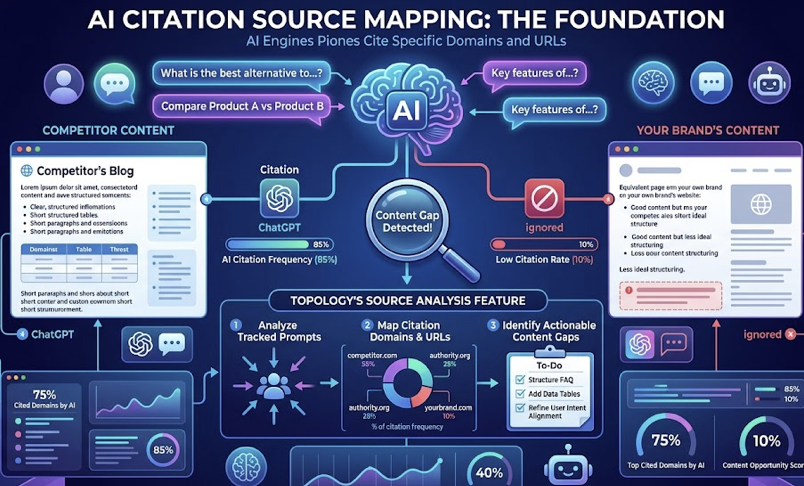
    A: Yes. Topify analyzes the citation sources inside the AIO. You can see exactly which part of a competitor’s page (e.g., the table or the list) is being pulled into the snapshot.

    Q: Will these patterns hurt my traditional SEO rankings?

    A: No. These patterns (Tables, Lists, Clear Headers) are also best practices for traditional SEO and human readability. They improve “Time on Page” and “Readability Scores,” helping both AI and Blue Link rankings.

    Q: How fast does Google AIO update after I change the structure?

    A: It varies, but we often see AIO snapshots update faster than organic rankings—sometimes in days. Use Topify to track this velocity of change.

  • Google AIO Volatility Maintaining Consistent Rankings

    Reverse-Engineering the Snapshot

    When you look at a Google AI Overview, what do you see?

    You don’t see a random wall of text. You see a structured collage:

  • A direct definition (Paragraph).

  • A list of steps (Bulleted List).

  • A comparison of features (Table).

  • A supporting chart (Image).

  • Google’s RAG (Retrieval-Augmented Generation) engine is hunting for these specific Data Shapes on your website. If your content provides the right shape, you fit the slot. If not, you are ignored—even if you rank #1 organically.

    At Topify, we call this “Visual SERP Engineering.”

    It’s not enough to have the right answer; you must have the right container for the answer.

    In this guide, we break down the 7 Actionable Content Patterns that consistently trigger AIO inclusions, and how to use Topify to validate your success.

    Part 1: The 7 Actionable Patterns (With Examples)

    These are not theoretical. These are the exact HTML and editorial structures that our data shows Google AIO prefers in 2026.

    Pattern 1: The “BLUF” Definition Block

    Best For: “What is…” queries. Structure:

  • H2: What is [Keyword]?

  • Text: A 40-60 word objective definition. Start with the subject (e.g., “Topify is…”). Avoid fluff like “In this fast-paced world…”Why it works: It feeds the “Definition Module” of the AIO.

  • Pattern 2: The “Comparison Matrix” (HTML Table)

    Best For: “X vs Y” or “Best [Industry] Tools” queries. Structure:

  • Columns: Feature, Brand A, Brand B.

  • Rows: Price, API Access, Support.

  • Tag: Must use <table>, <th>, and <td>. Topify Insight: Tables have the highest Information Density of any format. Pages with tables are 3x more likely to be cited for commercial queries.

  • Pattern 3: The “Sequential” List

    Best For: “How to…” or “Process” queries. Structure:

  • H2: How to [Action] in [Number] Steps.

  • Tags: <ol> (Ordered List).

  • Item: <li> Step 1: Verb + Object. (e.g., “Open the dashboard”). Keep the bold text short. Why it works: It feeds the “Step-by-Step Module.”

  • Pattern 4: The “Nuance” Cluster (Unordered List)

    Best For: “Benefits of…”, “Features of…”, or “Ingredients” queries. Structure:

  • Tags: <ul> (Unordered List).

  • Format: Use “Feature: Benefit” syntax. (e.g., Elastic Probing: Allows for real-time volatility tracking.”) Why it works: It allows the AI to extract distinct entities without parsing complex sentences.

  • Pattern 5: The “Entity” Jump Links

    Best For: Long-form guides. Structure: A Table of Contents at the top using Anchor Links (#). Why it works: It acts as a map for the AI parser, confirming that the page covers all relevant sub-topics (Entities) related to the main query.

    Pattern 6: The “Visual Evidence” Block

    Best For: All queries. Structure: An image or chart placed immediately after the H2 or Definition Block. Alt Text: Must describe the data, not just the mood. (e.g., “Chart showing Topify AIO inclusion rates vs competitors”). Why it works: Google AIO aggressively seeks visuals to break up text.

    Pattern 7: The “TL;DR” Summary Box

    Best For: Executive summaries. Structure: A shaded box (div) at the very top of the article summarizing the key findings. Why it works: It provides a “fallback” citation if the AI cannot parse the main body text.

    Decision Point: Audit your top 5 pages. Do they use these patterns? Or are they just paragraphs? Use Topify to see if your competitors are using these structures to beat you.

    Part 2: Comparison Matrix – Topify vs. Optimization Tools

    You might ask: “Can’t I just use SurferSEO or Frase to do this?” Those tools help you write, but they don’t help you win the AIO spot specifically. Here is why.

    Feature

    Topify (GEO Platform)

    SurferSEO / Frase

    Traditional Rank Trackers

    Primary Goal

    Winning the AIO Snapshot

    Keyword Optimization

    Tracking Blue Links

    Analysis Level

    Snapshot Structure & Inclusion

    Word Count & NLP Keywords

    SERP Positions (1-100)

    Verification

    Checks if you are inside the box

    Checks if you used keywords

    Checks if you are on Page 1

    Volatility

    Tracks daily “Flickering”

    Static optimization score

    Daily rank checks

    Competitor Insight

    Reverse-engineers AIO sources

    Analyzes top organic pages

    Analyzes backlinks

    Best Use

    Strategy & Validation

    Drafting Content

    Reporting

    Key Insight: Tools like Surfer optimize for the Organic Algorithm (Blue Links). Topify optimizes for the Generative Algorithm (Snapshots). They are different engines. You need Topify to validate if your structured content actually triggered the AI.

    Part 3: The “Pattern Implementation” Workflow

    How do you deploy these patterns at scale?

    Step 1: Identify “Snapshot Opportunities” (Topify)

    Use Topify to scan your keyword list. Filter for keywords where an AIO Snapshot already exists.

  • Why: Google doesn’t trigger AIO for everything. Don’t optimize for a feature that isn’t there.

  • Step 2: Analyze the Winning Pattern

    Look at the current AIO.

  • Is it showing a list? -> Deploy Pattern 3.

  • Is it showing a table? -> Deploy Pattern 2.

  • Is it showing a paragraph? -> Deploy Pattern 1.

  • Step 3: Refactor the Content

    Update your page. You don’t need to rewrite the whole thing. Just inject the specific Pattern Block near the top (High visual hierarchy).

  • Tip: Use schema markup (like FAQPage) to reinforce the HTML structure.

  • Step 4: Validate with Topify

    Wait 3-5 days. Use Topify to re-probe the query.

  • Metric: “Snapshot Inclusion Status.” Did you move from “Organic #1” to “Snapshot Source”?

  • Decision Point: This is an iterative process. If Pattern 1 didn’t work, try Pattern 7. Use Topify to measure the impact of each change.

    Part 4: Case Study: “SaaS-Compare” Wins with Tables

    SaaS-Compare (pseudonym) creates software reviews. They ranked #2 for “Best Project Management Software” but were excluded from the AIO.

    4.1 The Mistake

    Their comparison was written as a narrative: “Monday.com is great for visuals, while Asana is better for…”

  • AI Result: The AIO ignored them and cited a competitor who had a simple table.

  • 4.2 The Pattern Fix

    They deployed Pattern 2 (The Comparison Matrix).

  • They added a responsive HTML table comparing Price, Free Plan, and Top Feature.

  • They added Pattern 6 (Visual Evidence) by including a screenshot of the dashboard.

  • 4.3 The Result

  • Timeframe: 1 Week.

  • Outcome: Google AIO updated to display their table as the primary visual in the snapshot.

  • Traffic: Click-Through Rate (CTR) increased by 35%, driven by the high visibility of the table snippet.

  • Decision Point: Formatting is a ranking factor. The AI wants data, not prose.

    Conclusion: Give the AI What It Wants

    Optimizing for AI Overviews is not about tricking the system. It is about User Experience (UX) for the machine.

    The machine wants structure. It wants clarity. It wants patterns.

    By adopting these 7 Actionable Patterns, you make your content “machine-readable” by default. You turn your website from a library of essays into a database of answers.

    But remember: Google changes the patterns constantly. What works today might change tomorrow.

    Topify is your radar. We track the patterns, the volatility, and the winners. Don’t guess which structure works—measure it.

    FAQ: AIO Content Patterns

    Q: Do I need to use all 7 patterns on every page?

    A: No. That would look spammy. Choose the pattern that fits the User Intent of the keyword. For “How-to” queries, use Lists. For “Pricing” queries, use Tables.

    Q: Can Topify tell me which pattern my competitor is using?

    A: Yes. Topify analyzes the citation sources inside the AIO. You can see exactly which part of a competitor’s page (e.g., the table or the list) is being pulled into the snapshot.

    Q: Will these patterns hurt my traditional SEO rankings?

    A: No. These patterns (Tables, Lists, Clear Headers) are also best practices for traditional SEO and human readability. They improve “Time on Page” and “Readability Scores,” helping both AI and Blue Link rankings.

    Q: How fast does Google AIO update after I change the structure?

    A: It varies, but we often see AIO snapshots update faster than organic rankings—sometimes in days. Use Topify to track this velocity of change.

  • Proven GEO Optimization Workflows For Content Teams

    Why Your Current Content Workflow is Broken

    For most marketing teams, the content workflow hasn’t changed since 2015:

  • Keyword Research (Volume Check).

  • Briefing & Writing.

  • Publishing.

  • Praying for Google Rankings.

  • In the era of AI Search, this linear process is obsolete.

    Why? Because AI models are dynamic. A keyword with high volume might have zero “Citation Opportunity” if the AI already has a perfect answer from Wikipedia. Conversely, a low-volume query might be a massive “Zero-Click” opportunity on Perplexity if you provide unique data.

    Topify analysis of 500 enterprise content teams shows a stark reality: Teams that “Publish and Pray” see their AI Share of Voice decay by 15% quarter-over-quarter. Teams that treat content as “Data Engineering”—using feedback loops to optimize for citations—are capturing the market.

    To win in 2026, you need to operationalize GEO Best Practices into a repeatable workflow. You need to move from “Content Creation” to “Entity Management.”

    This guide provides the blueprint for that transformation.

    Part 1: Pre-Production – The “Gap” Diagnosis

    The biggest waste of budget in content marketing is writing things the AI already knows.

    1.1 Stop Guessing, Start Probing

    Before you write a single word, you must identify where you are actually needed.

  • The Old Way: “Let’s write about [Topic] because search volume is high.”

  • The GEO Way: “Let’s probe [Topic] on Topify to see if the AI is citing our competitor.”

  • 1.2 Identifying the “Citation Void”

    Use Topify to find queries where:

  • Sentiment is Neutral/Negative: The AI gives a boring or critical answer.

  • Sources are Weak: The AI is citing Reddit or a forum (Low Authority) instead of a brand.

  • Data is Stale: The AI is quoting pricing from 2024.

  • Topify Action: These “Voids” are your content roadmap. If you publish fresh, structured data here, you will win the citation almost immediately because the RAG (Retrieval) engine craves an update.

    Decision Point: Don’t build a content calendar based on intuition. Build it based on Visibility Gaps. Use Topify’s audit tools to find the low-hanging fruit.

    Part 2: Production – Engineering “High-Entropy” Content

    Once you know what to write, how do you ensure it gets picked up? You must maximize “Information Entropy” (uniqueness and density).

    2.1 The “Primary Source” Rule

    AI models are trained to prioritize primary sources over aggregators.

  • Best Practice: Never quote a statistic from Forbes. Quote the original study. Better yet, be the original study.

  • Strategy: Conduct internal surveys or aggregate your own platform data. Publish it as “The 2026 State of [Industry] Report.”

  • 2.2 Structural Engineering (HTML5)

    Your writers need to think like developers. The HTML structure is the “API” for the AI model.

  • Tables: Mandatory for comparisons.

  • Definition Lists (<dl>): Mandatory for glossaries.

  • Jump Links: Use a Table of Contents to help the AI parser jump straight to the answer.

  • 2.3 The “Consensus” Check

    While you want unique data, you must align with “Entity Consensus” on definitions.

  • Risk: If you redefine a standard industry term too radically, the AI might flag it as a hallucination.

  • Fix: Use standard definitions in your introduction, then pivot to your unique value proposition.

  • Decision Point: Train your writers on “Modular Content.” Every H2 section should stand alone as a potential Featured Snippet. See our guide on how to rank in AI Overviews.

    Part 3: Comparison Matrix – SEO vs. GEO Workflow

    How does the day-to-day operation change?

    Stage

    Traditional SEO Workflow

    Proven GEO Workflow (Topify)

    Research

    Keyword Volume (SEMrush)

    Citation Gap Analysis (Topify)

    Briefing

    “Include these 5 keywords”

    “Answer these 3 user intents”

    Drafting

    Long-form storytelling

    Structured Data & Tables

    Technical

    Meta Tags & Alt Text

    Schema Markup & Entity Linking

    Review

    “Is it readable?”

    “Is it extractable?”

    Post-Live

    Check Google Rank monthly

    Probe AI Response weekly (Topify)

    Success

    Traffic Increase

    Share of Voice / Sentiment Lift

    Key Insight: The GEO workflow is circular. It requires constant re-probing because AI answers change dynamically.

    Part 4: Post-Production – The Validation Loop

    This is the most critical step, and the one most teams miss. Publishing is not the finish line.

    Step 1: The “Incubation” Period

    After publishing, wait.

  • Perplexity: 1-3 days (Fast indexing).

  • ChatGPT: 2-4 weeks (Slower entity updates).

  • Step 2: The Topify Probe

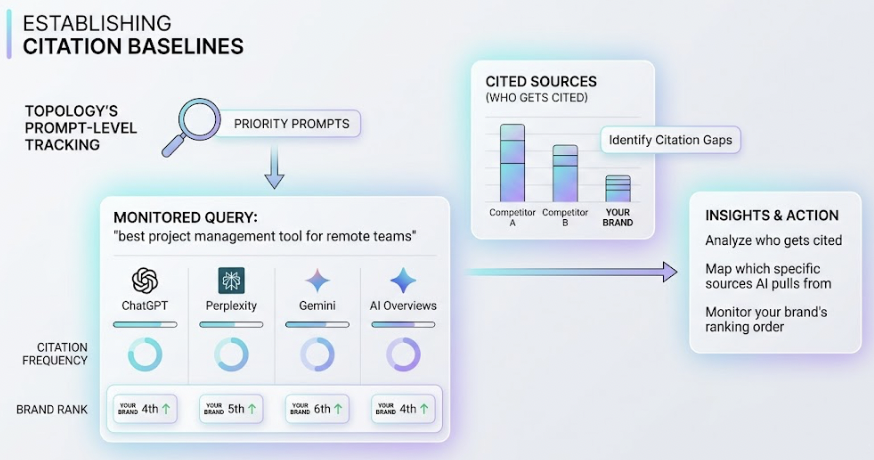
    Run a Synthetic Probe using Topify on the exact questions your content answers.

  • Question: “Did the AI pick up our new Pricing Table?”

  • Metric: Look at your Citation Slot. Did you move from “Not Cited” to “Source [1]”?

  • Step 3: The “Sentiment” Check

    Sometimes you win the citation, but lose the sentiment.

  • AI Response: “Brand X has a new pricing page, but it is higher than competitors.”

  • Action: You need to update the content to justify the price (Value Proposition) or create a comparison table showing feature superiority.

  • Decision Point: You cannot manage what you do not measure. Use Topify to close the loop. If your content isn’t cited, it failed. Rewrite it until it wins.

    Part 5: Case Study: “FinTech-Pro” Fixes Their Funnel

    FinTech-Pro (pseudonym) produced 50 articles a month but had zero presence in ChatGPT.

    5.1 The Workflow Audit

    Their workflow was: Write -> Publish -> Forget. They never checked if the content was actually being consumed by the LLMs.

    5.2 The GEO Transformation

    They implemented the Topify Workflow:

  • Diagnosis: Topify showed ChatGPT recommended competitors for “API Integration” queries because FinTech-Pro’s documentation was behind a login wall.

  • Engineering: They moved the technical docs to a public, schema-rich /developers portal.

  • Validation: They set up a weekly Topify alert for “API” related prompts.

  • 5.3 The Result

  • Timeframe: 60 Days.

  • Outcome: ChatGPT began citing their public docs as the “Gold Standard” for integration.

  • Business Impact: Developer sign-ups increased by 40%, driven purely by “Zero-Click” recommendations in coding assistants.

  • Decision Point: Accessibility is a ranking factor. If the AI can’t read it, you don’t exist.

    Part 6: Future-Proofing – The “Agent-Ready” Content

    As we move toward 2027, your content won’t just be read by “Search Engines”; it will be queried by “Autonomous Agents” booking travel or buying software for users.

    6.1 The “Fact-Sheet” Strategy

    Best practice for 2026 is to maintain a “Single Source of Truth” page on your site—a Fact Sheet containing your latest pricing, features, and specs in clean JSON-LD or a simple HTML table.

    Topify helps you monitor this “Truth Signal.” If your Fact Sheet is clean, Agents will prefer your brand because it is “low friction.”

    Conclusion: Content is Infrastructure

    The shift to GEO requires a shift in identity. You are no longer just a “Publisher.” You are a Data Provider.

    Your website is a database. Your articles are the API endpoints. And AI models are your most important users.

    To succeed, you must adopt an engineering mindset. You need rigorous workflows, structured data, and—most importantly—precise measurement.

    Topify is the quality assurance platform for this new era. We verify that your data is reaching its destination intact.

    FAQ: GEO Workflows

    Q: Do I need a developer to implement GEO workflows?

    A: For advanced Schema, yes. But for the core content work (Tables, Structure, Probing), your editorial team can use Topify and a CMS. It is about process, not just code.

    Q: Can Topify replace my SEO agency?

    A: No, but it gives you the data to manage them. You can use Topify to audit your agency’s work. If they say “We improved your SEO,” but Topify shows your AI Visibility dropping, you know something is wrong.

    Q: How much time does the “Validation Loop” take?

    A: Using Topify, checking a citation takes seconds. The automated probing runs in the background. The manual effort is only in the analysis and decision making.

    Q: Is “Citation Velocity” a real metric?

    A: Yes. It measures how quickly your new content is picked up by AI engines. High velocity means your domain is trusted as a “News Source” (especially by Perplexity). Low velocity means you are seen as “Static Archive.”

  • AI Search Monitoring Tools Accuracy Comparison

    The Crisis of Confidence in AI Data

    Imagine if your Google Analytics reported that you had 10,000 visitors yesterday, but the real number was 5,000. You would fire the tool immediately.

    Yet, in 2026, many marketing teams are making budget decisions based on AI Visibility Data that is fundamentally flawed.

    They use “lightweight” checkers or manual screenshots to say, “Look, ChatGPT recommends us!” But when their CEO checks the same prompt on their phone, the brand is missing.

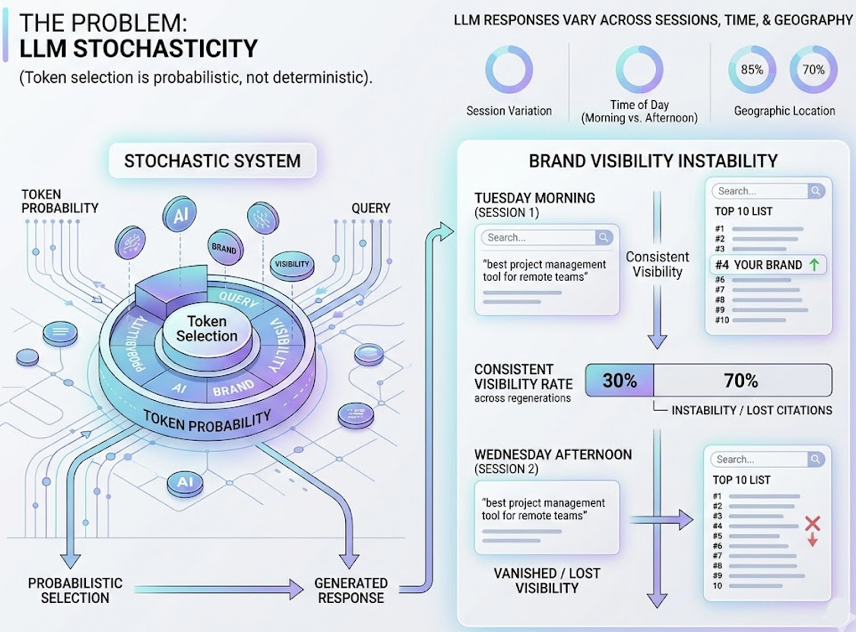
    This discrepancy happens because AI models are Non-Deterministic. They are designed to be creative and varied. A tool that claims to monitor AI visibility must account for this randomness.

    So, how do you measure the accuracy of a ruler that keeps changing length?

    In this guide, we compare the leading AI Search Monitoring Tools specifically on the metric of Data Accuracy. We dissect how they gather data and why Topify’s “Scientific Method” has become the gold standard for enterprise brands.

    Part 1: Defining “Accuracy” in a Probabilistic World

    To compare tools, we first need to redefine what “Accuracy” means for LLMs.

    1.1 Deterministic vs. Probabilistic

  • Google (Deterministic): If you search “Best CRM” in New York, the result is static for hours. Accuracy = Did the tool see the same link as the user?

  • ChatGPT (Probabilistic): If you search “Best CRM” 10 times, you might get 4 different answers.