Author: Elsa Ji

  • Agentic AI Tools for Marketers: What They Miss

    Agentic AI Tools for Marketers: What They Miss

    Your agentic AI dashboard looks great. Mentions are up. Prompt coverage is green. And yet, somewhere in your funnel, qualified buyers who asked ChatGPT for a recommendation never made it to your site.

    That’s the gap most marketing teams don’t see until it’s too late.

    Agentic AI tools have fundamentally changed what’s possible in brand monitoring. But the tools that excel at tracking activity often leave out the metrics that drive revenue. Understanding the difference between the two is the most important diagnostic question a marketer can ask in 2026.

    What Agentic AI Actually Does for Marketing Teams

    An agentic AI tool doesn’t wait for instructions. It monitors, decides, and acts.

    Where traditional marketing automation runs on “if-then” decision trees, agentic systems use probabilistic reasoning to navigate uncertain environments. A traditional tool sends a welcome email when a trigger fires. An agentic tool tracks competitor pricing shifts, detects sentiment drifts in third-party reviews, spots a content gap across AI platforms, and initiates a content response, all without a human setting each step.

    In a marketing context, this plays out in real use cases: a listener agent monitors AI-generated answers for brand mentions, a creator agent drafts tailored assets based on what buyers are asking, and a deployment agent pushes updates to the content pipeline. The cycle is continuous, not batch-processed.

    That shift matters because consumer discovery has moved. Search volume is rising, but clicks to websites are declining as AI-generated summaries resolve queries without ever sending a user to a brand page. Marketers who rely solely on traditional tools are missing the layer where AI shapes preferences before a website visit happens.

    The 4 Things Agentic AI Tracking Does Well

    These tools have genuine strengths. It’s worth being clear about where they actually deliver.

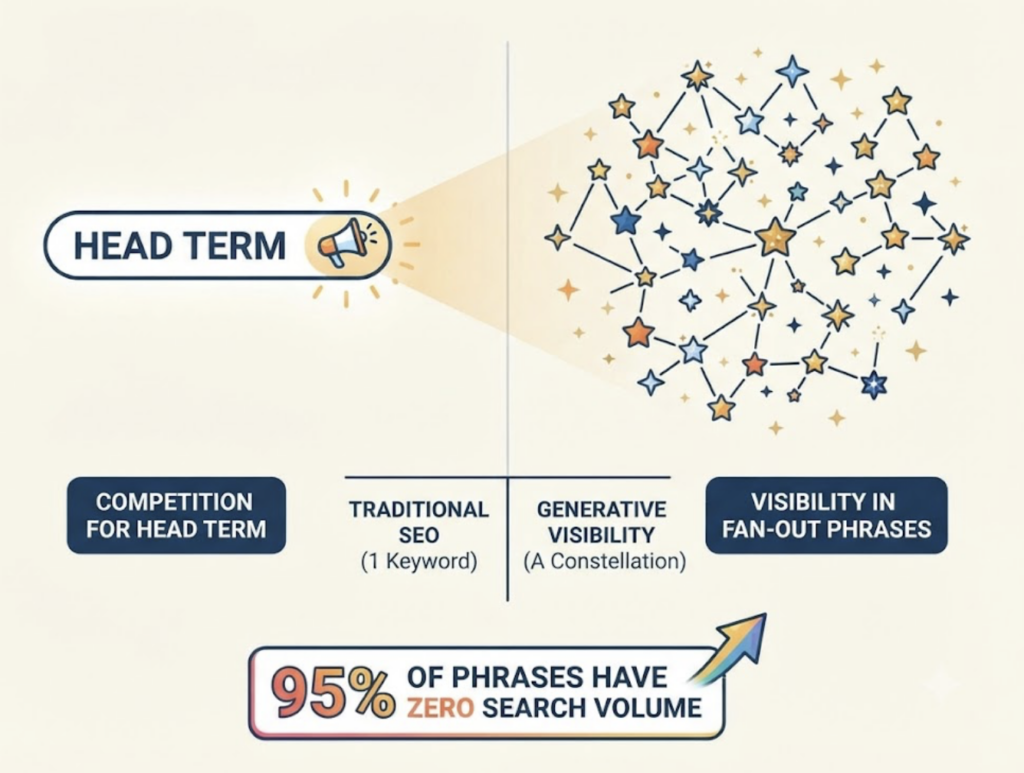
    Prompt frequency and volume. Agentic tools surface how buyers are asking questions in AI interfaces, not search bars. The average AI prompt runs 12.3 words versus Google’s 2.8, which means the intent signal is significantly richer. Topify’s High-Value Prompt Discovery continuously maps these prompts, including the 95% that have no recorded search volume in traditional SEO tools like SEMrush or Ahrefs.

    AI Visibility Rate. This measures what percentage of AI-generated responses for a target prompt set include your brand. Average brand visibility sits at 0.3%, while leaders in competitive SaaS categories reach 59.4%. Tracking this number is the baseline for any serious GEO strategy.

    Competitor benchmarking in AI answers. Unlike traditional search, where competitors appear in a vertical list, AI engines cluster brands by semantic relevance. Agentic monitoring shows which rivals are consistently recommended alongside or instead of you, including niche aggregators that don’t rank on the first page of Google.

    Citation source tracking. Because 85% of brand mentions in AI-generated answers come from third-party domains, knowing which URLs are driving a competitor’s visibility is as valuable as knowing your own citation rate. Agentic tools track which platforms (Reddit, G2, Trustpilot) are feeding the model’s recommendations.

    These four capabilities are genuinely useful. They’re also incomplete.

    The 3 Gaps That Undermine Your Agentic AI Stack

    Most tools track whether you’re showing up. Few track how you’re showing up, or what happens next.

    Gap 1: Sentiment Polarity

    Tracking mentions without tracking sentiment is like counting impressions and ignoring click-through rate.

    AI models don’t just list brands. They characterize them. A brand with a high visibility score might be described as “an outdated solution” or “prone to support issues,” which actively works against conversion. Google AI Overviews are 44% more likely to surface negative brand sentiment than ChatGPT. If the language framing is neutral or negative, that brand is structurally ineligible to win “best-of” queries regardless of how often it appears.

    Topify’s Sentiment Analysis scores brand sentiment on a 0-100 scale across platforms, so teams can see not just that they were mentioned, but whether the AI is positioning them as a recommended option or a cautionary example.

    Gap 2: Position Within the Answer

    Being mentioned fifth in a recommendation is not the same as being mentioned first.

    In a conversational interface, position signals the model’s confidence and determines where the user’s attention lands. Research shows 44.2% of AI citations are drawn from the first third of a page’s content, and brands appearing in the initial summary capture the majority of the trust transfer from AI to buyer. The challenge is that AI responses are probabilistic: a brand might be first in 40% of responses and fifth in the other 60%. Without position tracking, you can’t see the distribution.

    Topify’s Position Tracking monitors where your brand lands relative to competitors across each target prompt, giving teams the data to understand whether they’re consistently leading the answer or drifting toward the footnotes.

    Gap 3: The Conversion Signal

    This is the gap that makes the other two feel manageable by comparison.

    Traditional analytics tools are structurally blind to AI interactions. The engagement happens on the AI platform’s servers, not your website. But the traffic that does arrive from AI referrals converts at 14.2%, compared to 2.8% for Google organic. That’s a 5x advantage. AI search traffic also generates $47 revenue per visit against $9 for Google search.

    Without tracking what happens after an AI recommendation, marketers can’t close the loop between visibility and pipeline. Topify’s Conversion Visibility Rate (CVR) connects AI discovery to downstream funnel signals, giving teams a way to prove that GEO investment is translating into high-value leads.

    Why These Gaps Get Worse Over Time

    Missing sentiment and position data isn’t a static oversight. It compounds.

    Large language models operate through reinforcement feedback loops. Outputs are fed back as training inputs, which means existing characterizations get amplified with each model update. If a brand’s sentiment is consistently neutral or negative, the model’s internal probability weights progressively favor competitors with stronger authority signals and positive framing. The gap widens automatically.

    This effect is especially acute in B2B, where AI search queries average 12.3 words and the model typically returns only 2-3 curated solutions rather than a page of ten links. Being left off that shortlist isn’t a ranking problem. It’s binary exclusion.

    The math on CTR reinforces this. Even a brand that ranks #1 in traditional SEO can see its click-through rate drop by 47% if an AI summary resolves the user’s query without sending them anywhere. AI visibility within the answer is the only defensible KPI for top-of-funnel protection.

    That’s not a future risk. It’s the current condition.

    A 3-Layer Tracking Framework That Covers the Full Picture

    Moving from passive monitoring to strategic execution requires a structure that connects technical visibility to brand quality and revenue. Topify’s seven core metrics (visibility, sentiment, position, volume, mentions, intent, and CVR) map directly onto three tracking layers.

    Layer 1: Visibility. Are you showing up at all? This layer tracks prompt coverage and AI Visibility Rate across ChatGPT, Gemini, and Perplexity. If a brand is absent from 90% of relevant prompts, it signals a structural content problem or a failure in how the retrieval-augmented generation process is pulling brand information.

    Layer 2: Quality. How are you showing up? This layer audits sentiment polarity and position within the answer. It identifies whether the AI is framing your brand as a market leader or a niche fallback, and which third-party domains are influencing that framing. Topify’s Source Analysis reverse-engineers the exact citation sources shaping the model’s characterization.

    Layer 3: Impact. What happens after? This connects AI discovery to CVR and pipeline signals. Buyers who find a brand through AI move 73% faster to a purchase decision than those coming from Google. Tracking this layer is how GEO investment gets defended in a budget conversation.

    Each layer is necessary. Running only Layer 1 is like tracking email deliverability without tracking opens or clicks.

    How to Audit Your Agentic AI Setup Now

    This doesn’t require a full platform overhaul. A structured audit cycle surfaces the gaps quickly.

    Step 1: Map your high-value prompts. List the natural-language questions your buyers are likely asking AI interfaces during discovery. Traditional keyword tools don’t capture this; you need an intelligence layer that sees actual prompt frequency inside AI platforms. Topify’s High-Value Prompt Discovery automates this and surfaces emerging prompts as they shift.

    Step 2: Run cross-engine benchmarking. Test each prompt across ChatGPT, Gemini, and Perplexity separately. Platform-specific biases are real: Perplexity tends to favor niche expertise and citation depth, while Gemini has grown 388% year-over-year and integrates tightly with Google’s search ecosystem. What surfaces on one platform won’t always match another.

    Step 3: Audit narrative framing. For each prompt where your brand appears, check the characterization. Is the AI citing your documentation? A G2 review? A Reddit thread from 2022? The source shapes the framing. Topify’s Source Analysis identifies exactly which domains are feeding the model’s description of your brand.

    Step 4: Map gaps to execution. Identify where your brand is missing, characterize the cause (content gap, citation gap, or sentiment signal), and deploy targeted fixes. Topify’s AI Agent can identify a citation gap, propose a content restructure, and deploy to the CMS with one click, closing the loop from insight to action without a manual handoff.

    Conclusion

    Agentic AI tools are only as good as what they’re measuring. If your stack tracks activity but not outcomes, you’re flying with half the instruments.

    The financial stakes are documented: cited brands receive 35% more organic clicks and 91% more paid clicks. AI traffic converts at 5x the rate of Google organic. Missing from the AI’s recommended shortlist isn’t a visibility problem. It’s a revenue problem.

    The shift from “are we mentioned?” to “how are we characterized, where do we rank in the answer, and what do buyers do next?” is the difference between a monitoring stack and a growth strategy. Building toward Topify and a full 3-layer framework is how marketing teams close that gap before the compounding effect works against them.


    FAQ

    What’s the difference between agentic AI and regular AI tools?

    Regular AI tools are task-specific and reactive. They wait for a human to set a trigger, then execute a narrow instruction. Agentic AI is goal-oriented and autonomous: it can plan multi-step workflows, reason across platforms, and initiate actions independently to pursue a broader objective like managing brand visibility across multiple AI engines.

    Which AI platforms should marketers track in 2026?

    At minimum: ChatGPT for volume, Gemini for its 388% year-over-year growth and Google ecosystem integration, and Perplexity for B2B and research-heavy segments where citation accuracy drives trust. Claude traffic converts at 16.8%, making it essential for high-intent niches despite lower overall volume.

    How do I know if my brand’s AI sentiment is hurting conversions?

    Monitor your Sentiment Polarity score across high-intent queries. If AI engines consistently describe your brand with negative qualifiers or place a competitor first despite your brand appearing in the same answer, sentiment is likely causing buyers to self-select out before they reach your site. The signal shows up in lower CVR even when visibility numbers look healthy.

    Is agentic AI tracking different from traditional SEO monitoring?

    Yes. Traditional SEO focuses on keyword rankings, backlinks, and click-through rates on search results pages. Agentic AI tracking (GEO) focuses on Share of Answer: the frequency, position, and sentiment of your brand within synthesized AI responses, and the third-party domains the model is using to form its characterization of you.


    Read More

  • DeepSeek V4 Is Now a Search Engine. Is Your Brand in It?

    DeepSeek V4 Is Now a Search Engine. Is Your Brand in It?

    Your brand ranks on Google. Your content gets indexed. Your SEO team has the metrics to prove it. Then a developer in Jakarta opens DeepSeek, types in a category query, and gets a curated answer that cites three vendors. You’re not one of them.

    That’s not a Google problem. That’s a DeepSeek V4 problem, and most marketing teams don’t even know it exists yet.

    DeepSeek V4 Isn’t Just Another Model Upgrade

    Released on April 24, 2026, DeepSeek V4 isn’t a minor iteration. It’s an architectural overhaul that moves the model from “impressive chatbot” to functional search infrastructure.

    The headline change is the 1-million-token default context window, powered by a new attention mechanism called DeepSeek Sparse Attention (DSA). But what makes this matter for brand visibility isn’t the context size. It’s what the model does with it: multi-stage retrieval, real-time web crawling, and transparent reasoning traces that explain exactly which sources it trusted and why.

    DeepSeek V4 comes in two variants. The V4-Pro carries 1.6 trillion total parameters with 49 billion active. The V4-Flash runs 284 billion total with 13 billion active. Both use the same DSA architecture and, critically, both are cheaper to run than every major Western competitor, which is driving enterprise adoption faster than most analysts predicted.

    This isn’t a curiosity. It’s infrastructure.

    The Search Engine Nobody Called a Search Engine

    Here’s the thing most marketers miss: users don’t experience DeepSeek V4 as a search engine. They type a question, read an answer. But from a brand visibility standpoint, what happens in between is pure search behavior.

    When a user prompts DeepSeek V4 with a category-level question, the model runs a structured multi-stage process. It decomposes the query into semantic keywords, ranks web sources by authority, crawls the selected URLs in real time, and synthesizes a response through a chain-of-thought reasoning engine. The output isn’t just an answer. It’s a recommendation.

    And unlike Google’s ten blue links, that recommendation is singular. There’s no page two. Either your brand appears in the reasoning trace, or it doesn’t.

    That’s the new SERP. A brand’s visibility is now determined by whether it gets cited as a grounding source in an AI’s reasoning chain, not whether it ranks for a keyword.

    DeepSeek V4’s Geographic Reach Changes the Visibility Math

    Most Western brands still think of DeepSeek as a China-centric product. That’s already wrong.

    By the end of 2025, DeepSeek had 130 million active users, with China, India, and Indonesia together accounting for 51.24% of monthly active users. Russia showed significant adoption at 9% of app downloads. Even the United States accounted for 4.34% of MAUs, and France at 3.21%.

    The demographic profile is where things get serious. 44.9% of Android users and 38.7% of iOS users fall into the 18-24 age bracket. This is the next generation of technical buyers, procurement managers, and startup founders. They’re not Google-first. In many markets, they’re DeepSeek-first.

    For any brand selling to global markets, particularly across Asia-Pacific, this isn’t an optional monitoring target. It’s a visibility gap that’s already costing them consideration at the top of the funnel.

    What Your Brand Actually Looks Like Inside DeepSeek V4

    The way DeepSeek V4 evaluates and recommends brands is fundamentally different from Western AI platforms. Understanding this changes how you think about optimization.

    The model weights brand recommendations across five dimensions: relevance to the query (30%), reviews and reputation from platforms like Google and Trustpilot (25%), institutional authority from academic sites and GitHub (20%), content recency with a preference for data updated within 24 months (15%), and local grounding via regional directories (10%).

    That 20% institutional authority weighting is where most brands fall short. DeepSeek draws 24.5% of its citations from government and academic sources, a rate six times higher than Western AI platforms at 4.1%. It references an average of only 211 unique domains across thousands of responses, compared to Gemini’s 2,300. And it averages 0.8 citations per response, compared to 15 for Gemini and 8.2 for Perplexity.

    What this means in practice: getting one citation from a domain DeepSeek trusts is worth more than a hundred mentions on mainstream content sites. The model operates on signal authority, not signal volume.

    There’s also the transparency factor. DeepSeek V4 shows users its reasoning trace. If the model considered your brand and rejected it because of “opaque pricing” or “insufficient technical documentation,” that rejection is visible. In a B2B or developer context, that’s a deal lost before a salesperson is ever involved.

    The Multi-Platform Problem Nobody’s Actually Solving

    Most brand teams are barely tracking their visibility on ChatGPT. DeepSeek V4 is now the fifth or sixth AI surface that carries meaningful search traffic, each with different citation logic, different authority signals, and different geographic reach.

    Managing this manually isn’t a bandwidth problem. It’s a structural impossibility.

    Traditional SEO tools scrape web rankings. GEO requires simulating AI behavior to understand synthesis. A brand can rank first on Google for a target keyword and be completely absent from every AI-generated answer in that category. The metrics don’t overlap.

    This is where Topify addresses a gap that legacy tools can’t fill. The platform tracks brand visibility across ChatGPT, Claude, Perplexity, Gemini, DeepSeek, and Qwen from a single dashboard, giving marketing teams a unified view of AI search performance rather than six separate manual checks.

    What makes it actionable for DeepSeek specifically is the citation analysis layer. Topify reverse-engineers which exact URLs and domains DeepSeek is citing in your category, surfacing the specific third-party sources that are driving competitor recommendations. That’s the intelligence you need to run an institutional authority strategy, not just a content strategy.

    The platform’s Sentiment Analysis scores brand presence from -100 to +100, flagging early-stage misrepresentations before they propagate across the open-source model ecosystem. DeepSeek’s 95.6% neutral brand mention rate sounds benign, but when the model includes a “caveat” about a brand’s technical limitations in its reasoning trace, that caveat becomes the story.

    How to Build DeepSeek V4 Into Your AI Visibility Stack

    The optimization playbook for DeepSeek V4 looks different from ChatGPT or Gemini. Here’s what actually moves the needle.

    Refactor content for information density. DeepSeek rewards fact-heavy content and penalizes marketing language. Strip superlatives and replace them with verifiable specifications. Structure key pages in Q&A format. The model is more likely to lift structured, factual content directly into its synthesis than narrative brand copy.

    Build authority on the right external platforms. Given DeepSeek’s heavy weighting of GitHub, Stack Overflow, and academic papers, brands in technical categories need presence on these domains. A white paper cited by a university research page carries more weight in DeepSeek’s citation math than a hundred blog posts on news sites.

    Optimize for all three reasoning modes. DeepSeek V4 operates in Non-Think mode for routine queries and Think High or Think Max for complex due diligence. Brands that are visible in Non-Think but absent in Think Max are failing at the exact moment a technical decision-maker is doing serious evaluation. Benchmark across all three modes.

    Implement machine-readable structured data. DeepSeek agents are increasingly handling queries autonomously. Clean API documentation, JSON-LD pricing tables, and entity disambiguation on platforms like GitHub Organizations reduce the risk of hallucinated pricing or misattributed features, which can propagate across the entire open-source ecosystem downstream.

    Topify’s One-Click GEO Execution automates several of these fixes, generating and deploying technical updates like JSON-LD additions or technical FAQ updates directly to your site. That matters because the gap between “we know what to fix” and “we actually fixed it” is where most GEO programs stall.

    What to Fix Before the Next Model Drops

    DeepSeek V4 won’t be the last model to reshape the discovery landscape. The trend toward sovereign AI, where countries in South Asia and Africa prioritize open-source models over US proprietary systems, means new surfaces will keep appearing, each with their own citation logic and authority signals.

    The brands that stay ahead aren’t optimizing for platforms. They’re managing knowledge graphs.

    That means weekly Share of Voice reports tracking citation growth across AI platforms, not just keyword rankings. It means cross-functional coordination between PR, SEO, and community teams, because a sentiment drop on Reddit will manifest as a visibility drop in the next AI crawl. DeepSeek’s 15% recency weighting means critical landing pages and service documentation need refreshing at least every 12 months to avoid being flagged as outdated during the model’s retrieval process.

    The platform fragmentation problem will get worse before tooling catches up. Right now, the brands building multi-platform tracking infrastructure have a compounding advantage. Each month of data creates a benchmark. Each benchmark makes it easier to spot drift when a model retrains.

    That’s the real argument for moving now, not when DeepSeek V4 becomes impossible to ignore.

    Conclusion

    DeepSeek V4 launched on April 24, 2026, and within days it was handling queries for 130 million users across every major global market. From a brand visibility standpoint, that’s 130 million potential discovery moments that most marketing teams aren’t measuring, optimizing, or even monitoring.

    The citation math is concentrated and institutional. The geographic reach hits exactly the markets where traditional Google SEO has always been weakest. And the model’s transparent reasoning traces mean that a negative signal doesn’t just cost you a mention. It costs you the consideration stage entirely.

    The window to establish authority on DeepSeek V4 before it becomes the default discovery engine for the global technical community is still open. Get started with Topify to see where your brand stands across DeepSeek and the other major AI platforms before your competitors figure out the same question.


    FAQ

    Q: Is DeepSeek V4 a search engine or a chatbot?

    A: It functions as both, but from a brand marketing perspective, it’s a search surface. DeepSeek V4 uses multi-stage retrieval-augmented generation to query the web, evaluate sources, and synthesize recommendations. Users experience it as a chat interface, but brands are being discovered, cited, or ignored in exactly the same way they would be in any search-driven context. The key difference is that the output is a single synthesized answer rather than a list of links, which makes citation even more consequential.

    Q: Does DeepSeek V4 recommend brands differently than ChatGPT?

    A: Yes, significantly. DeepSeek V4 has a strong institutional trust bias, citing government and academic sources at six times the rate of Western AI platforms. It references a much narrower domain set, around 211 unique domains, compared to Gemini’s 2,300+. It also provides transparent reasoning traces, so users can see exactly why one brand was recommended over another. This makes authority signals far more important than content volume in DeepSeek’s visibility ecosystem.

    Q: How do I know if my brand appears in DeepSeek V4 answers?

    A: Manual spot-checking is unreliable. DeepSeek’s responses vary by reasoning mode, geographic region, and query phrasing. Unified GEO platforms like Topify automate this by simulating thousands of prompts across multiple modes and generating a Visibility Rate and Sentiment Score specifically for DeepSeek. That’s the baseline you need before any optimization work can be scoped or measured.

    Q: Is DeepSeek V4 relevant for brands outside China?

    A: Absolutely. Over half of DeepSeek’s 130 million active users were located outside China by 2025, with major adoption in India, Indonesia, Russia, and the United States. The platform has become the primary AI tool for the global developer and technical community, partly because of its open-source weights and strong coding performance. For any brand serving Asia-Pacific, South Asia, or the global developer market, DeepSeek V4 is already a primary discovery surface.


    Read More

  • DeepSeek V4 Flash for Marketing: Cost vs. Capability

    DeepSeek V4 Flash for Marketing: Cost vs. Capability

    Most AI cost comparisons stop at the price table. That’s the wrong place to stop.

    DeepSeek V4 Flash is generating real buzz in marketing circles, and for good reason: it’s priced at $0.14 per million input tokens, making it over 90% cheaper than Claude Haiku 4.5 and significantly cheaper than GPT-4o Mini. For teams running millions of tokens a month through content generation, tagging, or ad copy pipelines, that’s not a rounding error. That’s a budget category.

    But cheap tokens don’t automatically translate to business value. The real question isn’t “how much does it cost?” It’s “which tasks will it actually handle without breaking?”

    This breakdown answers that. No hype in either direction.

    What DeepSeek V4 Flash Actually Is (And What It Isn’t)

    Flash is not a stripped-down version of DeepSeek V4 Pro. It’s a separately engineered system with a different design goal.

    Both models share a Mixture-of-Experts (MoE) architecture, but the similarity ends at the naming convention. V4 Pro activates 49 billion parameters per token, while Flash activates 13 billion, out of a total weight set of 284 billion parameters. That 13B active footprint is intentional: it lets Flash run at high batch sizes with lower hardware overhead, which is exactly what high-throughput pipelines need.

    The headline technical feature is the Hybrid Attention Architecture, combining Compressed Sparse Attention (CSA) and Heavily Compressed Attention (HCA). In plain terms: Flash compresses distant context aggressively, keeping only the last 128 tokens in full resolution while reducing the rest to compact representations. The result is a KV cache that uses roughly 90% less memory than previous-generation models at the same context depth. With a 1-million-token context window and a maximum output of 384,000 tokens, Flash is built for bulk.

    One more thing worth noting: Flash runs on Huawei’s Ascend 950PR silicon, not Nvidia GPUs. This matters for Western enterprise buyers thinking about supply chain risk, but it doesn’t affect API users at all.

    The Pricing Case for DeepSeek V4 Flash in Marketing Workflows

    Here’s where the numbers start to matter. The table below compares the models most likely to appear in a marketing team’s stack:

    ModelInput Cost / 1M tokensOutput Cost / 1M tokensContext Window
    DeepSeek V4 Flash$0.14 (miss) / $0.028 (hit)$0.281 Million
    GPT-5.4 Nano$0.20 / $0.005$1.25128K
    GPT-5.4 Mini$0.75 / $0.187$4.50400K
    Claude Haiku 4.5$1.00 / $0.10$5.00200K
    Gemini 3.1 Flash$0.50 / free (tiered)$3.001 Million

    The “hit” price for Flash refers to cached tokens. When static content like brand guidelines, a product catalog, or a large FAQ is placed at the start of a prompt, it gets cached. Subsequent calls reuse that cache at $0.028 per million tokens, a 80% discount off an already low base price.

    For a team running 10 million tokens per month against a 100,000-word knowledge base, that context caching mechanism alone can cut the effective input cost to near zero on most requests.

    The practical upshot: a 10-step agent workflow that costs $0.50 on a frontier US model often runs under $0.05 using Flash with smart prompt design.

    5 Marketing Tasks Where DeepSeek V4 Flash Holds Up

    Flash performs well when tasks are bounded, structured, and don’t require the model to “think beyond the prompt.”

    Email subject line generation. Flash can generate hundreds of variations across audience segments in seconds. The task is formulaic: short output, clear constraints, no long-range reasoning required. Flash performs at parity with V4 Pro here while delivering responses significantly faster.

    A/B advertising copy variants. Take one winning headline, generate 30 semantic variations while preserving the original intent. Flash’s throughput makes this viable in real-time programmatic environments where ad copy changes based on the specific page a user is visiting.

    SEO metadata at scale. Bulk generation of titles and meta-descriptions for ecommerce catalogs with 50,000+ products. Flash is also reliable for query intent mapping, taking search console exports and categorizing thousands of terms into informational, commercial, or navigational buckets.

    Social media content adaptation. Flash can ingest a 5,000-word whitepaper and produce a LinkedIn post, a 10-part thread, and an Instagram caption in one pass. The 1-million-token context window means the final post stays thematically coherent with the source document.

    Customer service response drafting. The majority of support queries are routine. Flash identifies the intent of an incoming email, selects the correct template from a predefined list, fills in order-specific details, and surfaces a polished draft for a human agent to approve. It’s not autonomous; it’s a first-pass filter.

    Where DeepSeek V4 Flash Starts to Break Down

    The failures aren’t random. They follow a clear pattern: the more a task requires holding multiple conflicting constraints simultaneously, the more likely Flash is to underperform.

    Multi-step campaign strategy. When asked to produce a 12-month marketing plan with budget allocations, cross-channel attribution, and competitor counter-moves, Flash often produces generic or internally inconsistent outputs. This is a “high-horizon” reasoning task. With only 13B active parameters vs. V4 Pro’s 49B, Flash lacks the global coherence to maintain logical consistency across complex constraint sets.

    Brand voice in long-form content. Past the 2,000-word mark, Flash exhibits style drift. The first few paragraphs often match the target brand voice well. By the end, the model tends to revert to neutral, dry prose or begins summarizing rather than continuing to generate original content. For brand-sensitive long-form work, this is a real problem.

    Complex agentic tool-use. Flash supports parallel function calling and up to 128 tools in a single call. That said, in sequences requiring 5+ tools in a precise order, Flash has a higher failure rate than Pro: it confuses data types, loses state between tool calls, and tends to repeat mistakes rather than diagnose and pivot when a tool returns an error.

    Data analysis and insight generation. Flash can summarize what happened (“sales increased 10%”). It struggles with the “why” when the explanation requires connecting disparate signals across a large dataset. That diagnostic work requires the reasoning depth of a Pro-tier model.

    Flash vs. V4 Pro vs. GPT-4o Mini: A Side-by-Side for Marketers

    DimensionDeepSeek V4 FlashDeepSeek V4 ProGPT-4o Mini
    Cost per 1M tokens (blended)~$0.20~$2.60~$0.37
    Throughput (tokens/sec)100 to 15030 to 5080 to 100
    Instruction followingGood (requires strict prompts)ExcellentVery Good
    Long-form consistencyModerateStrongStrong
    Agent / tool use stabilityLimitedFullHigh
    Multimodal supportNo (text only)No (text only)Yes (vision)
    Best forBulk drafts, tagging, extractionStrategy, complex reasoningBalanced workloads, image analysis

    The standout gap on cost is real: Flash is roughly 13x cheaper than V4 Pro on a blended basis. GPT-4o Mini sits in the middle on both cost and capability. If your workflow involves image analysis or vision tasks, Flash isn’t an option at all. That’s a hard constraint, not a preference.

    How to Decide: A Practical Decision Matrix for Marketing Teams

    Three variables determine whether Flash is the right call.

    Token volume. At fewer than 1 million tokens per month, the cost difference between Flash and alternatives is small enough to be irrelevant. At 10 million tokens per month and above, Flash’s pricing becomes a real budget lever.

    Task structure. Template-driven tasks, where the model fills in predictable slots rather than inventing structure, play to Flash’s strengths. Open-ended creative or analytical tasks don’t.

    Human review cadence. Flash works best with a human-in-the-loop. If an expert marketer reviews outputs before publication, the risk from Flash’s occasional drift or inconsistency is manageable. In autonomous agent workflows, the lower error rate of Pro-tier models is worth the price premium.

    Flash is the right call when:

    • Monthly token volume exceeds 10M
    • Tasks follow a repeatable, template-driven structure
    • A human reviews output before it’s published
    • Response latency matters (real-time chat interfaces, programmatic ad copy)

    Go with Pro or an alternative when:

    • The agent runs without supervision
    • Brand voice consistency is non-negotiable in long-form outputs
    • The task requires synthesizing disparate data points into non-obvious conclusions
    • A factual error has legal or reputational consequences

    Your Brand’s Presence on DeepSeek Matters Too

    Here’s a dimension most model selection discussions skip entirely.

    DeepSeek now has over 900 million weekly active users across its ecosystem. It’s no longer just a developer tool. It’s a general-purpose AI platform where real customers are asking questions and getting brand recommendations. The model you choose to run internally is one decision. Whether DeepSeek is recommending your brand externally is a completely separate one.

    DeepSeek’s recommendation logic differs from traditional search. It prioritizes sources with high atomic fact density, meaning clear and extractable claims over marketing language. It cross-references information across multiple domains, so if a brand’s claims only appear on its own website, the model discounts them. Content with clear headings and logical structure is reportedly 40% more likely to appear in DeepSeek’s reasoning blocks.

    This is where platforms like Topify provide a distinct edge. Topify tracks brand visibility across major AI platforms including DeepSeek, using a method called Swarm Probing: running thousands of prompt variations across geographic nodes to calculate a statistically reliable share of voice. From there, teams get actionable data on:

    • Visibility Tracking: the percentage of relevant prompts where your brand appears in DeepSeek’s outputs
    • Sentiment Velocity: whether DeepSeek’s default framing of your brand is trending positive or negative
    • Citation Reverse-Engineering: the specific URLs DeepSeek is using as its primary sources of truth, whether those are your pages or a competitor’s
    • AI Volume Analytics: estimated monthly demand for topics across generative platforms, which moves beyond keyword volume into what Topify calls “Conversational Demand”

    If Topify’s tracking reveals a visibility gap or negative sentiment on DeepSeek, teams can deploy “answer-first” content restructuring in one click, making existing articles easier for AI systems to parse and cite. Brands can also engage in Entity Claiming (currently in beta) to push verified data directly to AI knowledge graphs, bypassing the standard crawl cycle.

    The point: choosing Flash vs. Pro is a workflow decision. Ensuring your brand is visible and accurately represented on DeepSeek is a growth decision.

    Connecting Flash to Your Existing Marketing Stack

    Flash is available via DeepSeek’s official API at api.deepseek.com and through aggregators including OpenRouter, Together AI, and Fireworks. It’s compatible with any tool that supports the OpenAI or Anthropic API formats.

    In Make.com, DeepSeek now has a native module. A standard scenario: watch a Google Sheet for new products, send each row to Flash for automated generation of three ad headlines and two meta-descriptions, then update Shopify automatically.

    In n8n, teams can build smarter routing logic. A prompt enters the workflow, Flash runs a low-cost first pass, and a secondary Flash reviewer checks confidence. If the output is flagged as ambiguous, n8n branches the request to V4 Pro or GPT-5.4. That tiered routing pattern keeps 80% of requests on Flash pricing while escalating only the tasks that genuinely need more reasoning depth.

    Since n8n supports self-hosting, teams can also pair it with a local vector database to maintain persistent long-term memory for their agents, with Flash’s 1-million-token window ingesting full retrieved document sets without truncation.

    Conclusion

    DeepSeek V4 Flash isn’t a cheaper version of a smarter model. It’s a different tool designed for a specific job: high-volume, structured, latency-sensitive tasks where token economics matter and human review is part of the workflow.

    The brands that get real value from Flash are the ones running bulk SEO metadata generation, ad copy pipelines, or email variant workflows at scale. The ones who get burned are the ones using it for autonomous agents, complex strategy generation, or brand-sensitive long-form creative without supervision.

    Token cost is only one input in that calculation. The other is knowing where your model’s capability ceiling actually sits, and building your stack accordingly.


    FAQ

    Is DeepSeek V4 Flash available via API for marketing tools?

    Yes. V4 Flash is available through DeepSeek’s official API at api.deepseek.com and through aggregators like OpenRouter, Together AI, and Fireworks. It’s fully compatible with any tool that supports the OpenAI or Anthropic API formats.

    How does DeepSeek V4 Flash compare to Claude Haiku 4.5 for content generation?

    DeepSeek V4 Flash is roughly 10x cheaper on output tokens and over 3x cheaper on input tokens compared to Claude Haiku 4.5. Haiku 4.5 shows stronger emotional nuance and empathy in customer-facing copy. Flash performs better on technical, structured, and data-extraction tasks. For marketing automation at volume, Flash’s cost profile is hard to ignore.

    Can I use DeepSeek V4 Flash in n8n or Make.com automations?

    Yes. DeepSeek is a native module in Make.com. In n8n, you can use the OpenAI Chat Model node and override the Base URL to DeepSeek’s endpoint, since the API protocols are identical.

    Does DeepSeek V4 Flash support function calling?

    Yes. It supports native parallel function calling, up to 128 functions in a single call, and a “strict” mode for JSON schema validation. This is one of its strongest features for structured agentic workflows, though complex multi-step tool sequences require careful prompt engineering to avoid state-loss errors.

    How do I track whether DeepSeek is recommending my brand?

    Platforms like Topify track brand visibility across DeepSeek and other major AI platforms using large-scale prompt sampling. Key metrics include visibility rate, sentiment velocity, and citation source analysis, which shows exactly which URLs DeepSeek is treating as authoritative for your brand’s category.


    Read More

  • DeepSeek V4 vs Claude vs GPT-5: Brand Visibility Breakdown

    DeepSeek V4 vs Claude vs GPT-5: Brand Visibility Breakdown

    You picked a keyword. Built the content. Earned the backlinks. Then a procurement manager asked GPT-5 to recommend vendors in your category, and your brand wasn’t in the response. A week later, a developer queried DeepSeek V4 for the same use case, and again, nothing.

    The issue isn’t your content quality. It’s that each AI model retrieves and recommends brands through completely different logic, and optimizing for one doesn’t automatically win you the others.

    Why the Model You’re Missing Costs You More Than You Think

    Traditional search was a single battlefield. AI search is three separate ones running simultaneously.

    DeepSeek V4, Anthropic’s Claude (Opus 4.7), and OpenAI’s GPT-5 each operate on distinct retrieval architectures, training data compositions, and citation biases. A brand that dominates ChatGPT recommendations can be entirely absent in DeepSeek V4 responses, and vice versa. This isn’t a content quality gap — it’s a structural gap that most marketing teams haven’t mapped yet.

    The stakes are rising. Traditional search volume is predicted to drop by 25% by 2026, replaced by AI-generated answers. That traffic isn’t disappearing. It’s being redistributed to brands that AI engines choose to cite.

    That’s the gap most brands still can’t see.

    DeepSeek V4’s Visibility Profile and What It Recommends

    DeepSeek V4 is not just another AI assistant. With approximately 1.6 trillion total parameters and a 32B–49B active parameter Mixture-of-Experts (MoE) design, it delivers frontier-level performance at a fraction of the inference cost of Western models. Some estimates put it at up to 95% cheaper than comparable Western frontier models. That cost advantage matters because it makes DeepSeek V4 the preferred engine for high-volume agentic workflows, the kind of “under-the-hood” B2B research and procurement cycles where no human is watching the model choose.

    The core technical differentiator is the “Engram” conditional memory architecture. It separates static fact retrieval from dynamic reasoning, using hash-based DRAM access for simple lookups. The result: a “Needle-in-a-Haystack” factual accuracy that reportedly improved from 84.2% to 97%. For brands, this means once a fact is correctly ingested into DeepSeek’s knowledge tables, it’s retrieved with near-perfect consistency — provided it’s presented in a dense, machine-readable format.

    Here’s where Western brands typically lose. DeepSeek V4 references approximately 211 unique domains in its responses, compared to over 2,385 for Google’s Gemini. That narrow retrieval pool creates a winner-take-all environment with a high barrier to entry, and it shows an amplified preference for APAC-region domains and high-authority Chinese sources. Western brands without presence in those specific repositories often face a “Visibility Gap” — they’re not misrepresented; they’re simply omitted.

    One more thing: 95.6% of DeepSeek V4 brand mentions are neutral. The model doesn’t recommend. It cites. So your goal on DeepSeek isn’t sentiment — it’s citation presence.

    Claude’s Approach: The Verification-First Trust Model

    Claude Opus 4.7 operates on a fundamentally different philosophy. Where DeepSeek V4 prioritizes efficiency and factual density, Claude prioritizes verifiability. This stems from Anthropic’s Constitutional AI framework, which orients the model toward safety, honesty, and balanced perspectives.

    In practice, Claude is conservative with citations. It favors whitepapers, primary research, technical documentation, and third-party validated case studies. Content relying on superlative language — “the best CRM,” “industry-leading solution” — gets skipped in favor of pages that provide specific benchmarks, SOC 2 compliance details, or concrete performance data. Claude is 30% more likely to cite pages that use clear headings, structured data, and JSON-LD schema markup.

    Claude’s real-time retrieval shows an 86.7% citation overlap with Brave Search. That means your Brave Search footprint directly affects your Claude visibility. For brands in YMYL sectors — healthcare, finance, legal — Claude’s preference for credentialed authors and official documentation isn’t optional; it’s the gate.

    When comparing services, Claude frequently cites multiple brands to offer balanced perspectives. It acknowledges uncertainty and notes where evidence is limited. That actually creates an opportunity: brands that publish content acknowledging tradeoffs and limitations tend to rank higher in Claude’s confidence. One-sided promotional content gets filtered out.

    GPT-5 and the Brand Visibility Game: Reach and Agentic Selection

    GPT-5 operates at a different scale. With a weekly active user base exceeding 900 million, it’s where the majority of consumer-facing brand discovery currently happens. But its recommendation logic is shifting. The most significant change in GPT-5 isn’t a smarter chatbot — it’s the transition to an “Agentic Native Model.”

    GPT-5 is increasingly optimized for Computer Use: navigating browsers, using terminals, and executing tasks autonomously. In this environment, brand visibility isn’t about appearing on a list. It’s about being selected as the fulfillment partner when an agent is tasked with procuring software, booking a service, or researching vendors. If an agent is researching fleet laptops for a design studio, it evaluates brands based on machine-readable data and its ability to autonomously execute the transaction.

    GPT-5’s citation logic is heavily influenced by commercial consensus. OpenAI’s partnerships with major news organizations and data aggregators (News Corp, Reddit) shape what the model defaults to recommending. Brands with strong Reddit presence and broad news coverage have a structural advantage. For brands without that footprint, building entity signals across directories, industry associations, and editorial mentions is the path to visibility.

    Content strategy also matters. GPT-5 favors pages that lead with a clear, one-paragraph answer in the first 150 words. “Snippet-Ready” definitions and opinionated comparisons outperform safe, hedged blog posts. Reddit community participation, in particular, has become one of the highest-weighted content signals in GPT-5’s training corpus.

    Side-by-Side: Which Model Favors Which Brand Type

    The retrieval logic differences translate directly into which brand categories each model surfaces most effectively.

    Brand CategoryDeepSeek V4Claude Opus 4.7GPT-5
    High-Volume B2B SaaSStrong: favors efficiency docs, API integrationModerate: requires SOC 2, authority signalsStrong: default for general discovery
    Academic & MedicalModerate: strong STEM, weaker on Western medical nuanceHighest: favors E-E-A-T, primary research, YMYL balanceModerate: accurate but often defaults to generic
    Consumer RetailWeak: APAC bias, limited Western consumer sentimentModerate: favors ethical, well-documented reviewsHighest: strongest sentiment tracking and reach
    Technical & Coding ToolsHighest: world-leading algorithmic and MoE benchmarksStrong: excels at multi-file reasoning and depthModerate: strong generalist, trails in specialized coding
    Local ServicesWeak: no Western local map pack integrationModerate: relies on Brave Search local signalsStrong: deep Bing/Google local directory integration

    The pattern is clear. No single model is dominant across all brand categories. A technical SaaS brand that wins on DeepSeek V4 may be invisible on GPT-5 without Reddit presence. A consumer brand dominant on GPT-5 may be entirely absent from Claude’s citations without E-E-A-T documentation.

    You Can’t Optimize What You Can’t Measure Across All Three

    Single-model optimization is a bet. A “Unified Visibility” strategy is a system.

    Most marketing teams are still doing manual audits — querying ChatGPT once a week, taking screenshots, logging responses in a spreadsheet. That approach doesn’t scale, and it misses the most important signals: sentiment velocity (is an AI becoming more critical of your brand over time?), citation forensics (which specific source triggered a negative sentiment?), and hallucination alerts (is a model confidently stating something false about your company?).

    This is where platforms like Topify change the operational picture. Topify tracks brand visibility across DeepSeek, ChatGPT, Gemini, Perplexity, and other major AI platforms simultaneously, normalizing raw mentions into a comparable Share of Voice percentage. Instead of guessing why your brand dropped in ChatGPT recommendations last month, you can trace it to a specific source that stopped citing your brand, then act on it.

    Consider a concrete scenario: a brand is dominant on GPT-5 due to strong news coverage and Reddit presence, but invisible on DeepSeek V4. A Topify divergence analysis might reveal the gap — the brand lacks presence in the specific technical repositories and APAC-indexed domains that DeepSeek V4 prioritizes. That insight shifts the content strategy from general PR to targeted technical entity disambiguation, recapturing visibility in the high-volume agentic market where DeepSeek V4 increasingly operates.

    Sentiment Velocity Monitoring, Hallucination Alerting, and Source Forensics aren’t premium add-ons. In a landscape where a single false AI claim about your brand can persist across millions of queries, they’re table stakes.

    Conclusion

    The question isn’t which model is “best.” Each of DeepSeek V4, Claude, and GPT-5 is the dominant discovery channel for a different audience, use case, and buying context. DeepSeek V4 is winning agentic B2B workflows on efficiency and factual precision. Claude is the authority signal for high-stakes B2B and YMYL decisions. GPT-5 is the mass-market consumer and commercial gateway.

    A brand that only optimizes for one is effectively invisible in the others. The strategic move for 2026 is unified measurement first, then targeted optimization per model. Get started with Topify to see exactly where your brand stands across all three — and which gaps are costing you the most.


    FAQ

    Q: Is DeepSeek V4 replacing ChatGPT for brand search?

    A: Not in general consumer search in Western markets. But it’s rapidly becoming the dominant engine for “under-the-hood” agentic research and B2B procurement due to its extreme cost efficiency and superior coding and logic benchmarks. If your brand serves technical or enterprise audiences, DeepSeek V4 visibility is no longer optional.

    Q: How do I know which AI models are mentioning my brand?

    A: Manual auditing doesn’t scale once you’re tracking across multiple models. Professional marketing teams use GEO platforms like Topify to simulate thousands of prompts daily, tracking Share of Voice, sentiment, and citation sources across DeepSeek, ChatGPT, Gemini, and Claude simultaneously.

    Q: Does content optimized for GPT-5 work on DeepSeek V4?

    A: Only partially. Both value clear, direct answers. But GPT-5 is heavily influenced by commercial consensus and Reddit activity, while DeepSeek V4 prioritizes APAC-indexed technical repositories and dense factual formats over social sentiment. Content strategy needs to be differentiated by model.

    Q: What’s the fastest way to improve my brand’s visibility across all three models?

    A: Start with a baseline audit across all three. Identify where your brand is cited, where it’s absent, and where it’s misrepresented. Then prioritize gaps by the cost of invisibility for your specific brand category. The AI search visibility guide from Topify outlines a practical framework for that process.


    Read More

  • DeepSeek V4 Is Live. Is Your Brand Visible on It?

    DeepSeek V4 Is Live. Is Your Brand Visible on It?

    Your SEO rankings are solid. Your content calendar is full. But on April 24, 2026, a new frontier model dropped that your current dashboard can’t measure, and a growing segment of high-intent technical users is already querying it for product recommendations in your category.

    That model is DeepSeek V4. And most brands have near-zero visibility on it.

    DeepSeek V4 Isn’t Just Another Open-Source Model

    Most marketers still think of DeepSeek as a developer toy. That framing is outdated.

    The V4 release introduced two variants: DeepSeek-V4-Pro, a 1.6 trillion-parameter Mixture-of-Experts model that activates only 49 billion parameters per token, and DeepSeek-V4-Flash, a 284 billion-parameter model built for extreme speed and cost efficiency. Both share a 1-million-token context window. Both are already deployed globally via API and web interface.

    The economic disruption is real. DeepSeek-V4-Pro is priced at $1.74 per million input tokens, compared to $5.00 for GPT-5.5. DeepSeek-V4-Flash drops that to $0.14. That’s an 85% to 98% cost reduction relative to Western frontier models, achieved through sparse attention and domestic hardware compatibility.

    When inference costs collapse, adoption accelerates. Fast.

    90 Million Monthly Users and Growing

    DeepSeek crossed 22.15 million daily active users in January 2025. By early 2026, monthly active users are estimated to exceed 90 million, driven primarily by cost-sensitive enterprise adoption and developer communities.

    The geographic footprint matters for brand strategy. China, India, and Indonesia collectively account for over 50% of monthly active users, while the U.S. holds roughly 4% to 9%. The 18 to 24 age group represents 40% to 44% of total users, skewing toward developers, students, and early-career professionals.

    Over 80% of DeepSeek traffic is desktop-based. That’s not a casual social media audience. That’s a research-oriented, decision-making audience running technical queries.

    And here’s what those users are actually doing: asking for product comparisons, infrastructure recommendations, software stack decisions, and vendor evaluations. The same queries that used to go to Google’s first page are now going to DeepSeek’s synthesis engine.

    Why Google Rankings Don’t Transfer to DeepSeek V4

    This is where most marketing teams are caught off guard.

    A healthy AI Visibility Rate for a category leader typically exceeds 30%. Preliminary audits of brands with dominant Google rankings often show less than 5% visibility on DeepSeek. The gap isn’t a bug. It’s by design.

    DeepSeek doesn’t use the same signals as traditional search. Domain authority doesn’t translate. Keyword density doesn’t help. What the model values is something different: machine-legible expertise and citation density across specialized technical repositories.

    DeepSeek V4 runs a novel memory architecture called Engram conditional memory, which separates static knowledge retrieval from active neural reasoning. What this means in practice: the model has a static “memory table” built during pre-training from over 32 trillion tokens of web pages, e-books, and technical manuals. If your brand’s factual data isn’t in that memory table with precision, the model will struggle to identify you reliably.

    Its SimpleQA benchmark score of 57.9% versus Gemini’s 75.6% tells the story. DeepSeek is a reasoning champion, but it has voids in consumer brand knowledge. That void is both a risk and an opening.

    3 Signs Your Brand Is Already Behind on DeepSeek

    Signal 1: You don’t know your AI Visibility Rate.

    If your team can’t answer “what percentage of DeepSeek queries in our category mention our brand,” you don’t have the baseline to work from. Most teams don’t. That blind spot is expensive in an environment where high-intent research traffic is shifting from traditional search to AI synthesis engines.

    Signal 2: Competitors appear first in multi-brand comparisons.

    DeepSeek’s MoE architecture uses a Response Position Index where the first brand listed in a comparison carries implicit endorsement. If a competitor is consistently the primary recommendation when users ask “compare [your category] options for a fintech stack,” that positioning compounds over time. Early-stage AI visibility is significantly easier to build than it is to claw back from a competitor.

    Signal 3: Your content can’t be parsed into discrete facts.

    DeepSeek’s Hybrid Attention mechanism is optimized for scanning long-context documents to extract specific data points. Blog posts written as continuous narrative prose, without structured Q&A sections, schema markup, or modular data, are effectively invisible to this parsing logic. The model will prefer a competitor’s well-structured documentation over your 3,000-word thought leadership piece.

    How DeepSeek V4 Actually Decides What to Recommend

    Understanding the citation logic changes how you approach content strategy.

    When a user asks DeepSeek for a product recommendation, two pathways activate. The Engram memory pathway handles factual recall, pulling structured brand data directly from the static knowledge base. The MoE reasoning pathway handles the actual recommendation, drawing on patterns found across the training corpus.

    That second pathway is where brand positioning happens. The model’s recommendation “consensus” is shaped by how your brand appears across authoritative, technically rigorous sources: Reddit’s engineering forums, GitHub discussions, peer-reviewed technical documentation, and specialized industry publications. Frequent, consistent, and unbiased mentions in those contexts carry more weight than any amount of generalist content.

    This is structurally different from ChatGPT’s citation logic, which leans on high-authority generalist sites and Bing-indexed content. DeepSeek rewards narrow authority, not broad domain authority.

    What You Can Actually Do Starting This Week

    The good news: DeepSeek V4 visibility is buildable. The model updates brand mentions within 2 to 4 weeks as it ingests fresh web signals. The window for early positioning is still open for most categories.

    A practical 90-day sequence looks like this:

    Weeks 1 to 2: Establish your baseline. Run a set of 20 to 30 high-intent category prompts on DeepSeek and document mention frequency, position, and the external domains the model cites as sources. This is your starting point.

    Weeks 3 to 4: Audit your technical foundation. Implement Schema Markup for all products and organization data. Schema increases what researchers call “Entity Confidence,” the model’s ability to distinguish your brand from similarly named entities in its static knowledge table.

    Weeks 5 to 8: Publish structured authority content. Launch 10 to 15 high-specificity articles addressing technical questions identified in your baseline audit. Target platforms DeepSeek weights heavily: GitHub documentation, LinkedIn technical posts, and specialized forums where your category’s practitioners actually discuss tools.

    Weeks 9 to 12: Track and iterate. Monitor Sentiment Velocity alongside Visibility Rate. A stable or improving sentiment score indicates the model is building a positive “consensus” about your brand across its reasoning pathway.

    For teams managing this at scale, Topify has integrated DeepSeek V4 into its tracking coverage, alongside ChatGPT, Gemini, Perplexity, and other major platforms. Its seven-dimension metric system connects AI citation data to revenue signals, with research indicating that traffic arriving from AI citations can convert at rates up to 12.9x higher than traditional organic search.

    The core metrics worth monitoring:

    MetricWhat It MeasuresTarget Range
    Visibility Rate% of category prompts where brand appears30% to 45%
    Sentiment ScoreAI’s attitude toward the brand (0-100)70+
    Sentiment VelocityRate of sentiment change over timeStable or positive
    Response Position IndexWhere brand appears in multi-brand comparisonsBelow 1.5
    Source Citation Share% of AI-cited sources owned by the brandAbove 20%

    DeepSeek V4 vs. ChatGPT: Do You Need a Different Strategy?

    Yes. The strategies are complementary but distinct.

    Content depth and tone diverge significantly. DeepSeek V4 rewards dense, technically specific content. Think the kind of writing that appears in engineering documentation or detailed product teardowns, not accessible summaries or broad overviews. ChatGPT’s alignment favors more balanced, accessible formats.

    Source weighting works differently too. ChatGPT leans on mainstream news sources and Wikipedia. DeepSeek gives significant weight to narrow authority: GitHub repositories, technical manuals, and specialized forums. A brand that publishes a detailed API integration guide on GitHub is doing more for DeepSeek visibility than one publishing polished blog content on its own domain.

    Regional audience profiles also differ. DeepSeek is the primary AI gateway for tech-heavy markets in Asia, while ChatGPT remains dominant for North American and European general consumers. For brands with a global footprint, treating these as two distinct channels, each requiring tailored source strategy, is no longer optional.

    The bottom line: ranking on one doesn’t transfer to the other. Both require active GEO strategy.

    Conclusion

    DeepSeek V4 didn’t create the AI search visibility problem. It made it bigger and harder to ignore.

    Most brands are running a marketing stack built for a world where Google rankings predict discovery. That world still exists. But alongside it, a parallel discovery layer is forming, one where 90 million monthly users are asking AI systems for vendor recommendations, and where brand presence is determined by machine-legible reputation, not keyword rankings.

    The brands building DeepSeek visibility now are establishing the kind of positioning that’s significantly harder to displace later. Get started with Topify to see where your brand stands across DeepSeek, ChatGPT, Gemini, and Perplexity, before your competitors do.


    FAQ

    Q: Does DeepSeek V4 use the same ranking signals as ChatGPT?

    A: No. While both systems draw on web-based training data, DeepSeek V4 places a significantly higher premium on technical accuracy and STEM-focused sources. Its Engram memory architecture prioritizes structured, machine-legible data, making Schema Markup more important for DeepSeek than for ChatGPT. The two models also weight sources differently: DeepSeek favors narrow authority sources like GitHub repositories and technical documentation, while ChatGPT leans on mainstream, high-authority generalist sites.

    Q: How do I start tracking my brand’s visibility on DeepSeek V4?

    A: The most practical starting point is to manually run 20 to 30 high-intent category prompts on chat.deepseek.com and document how often your brand appears versus competitors. For systematic tracking, GEO platforms like Topify query models at scale to generate Visibility Rate, Sentiment Score, and Position data across DeepSeek and other major AI platforms.

    Q: Is DeepSeek V4 available globally?

    A: Yes. DeepSeek V4 is available globally via its official API and web interface, with open-source weights available on Hugging Face for local deployment. Enterprises in regulated sectors, including healthcare and defense, often prefer on-premises self-hosting to meet data residency and compliance requirements.

    Q: How often does DeepSeek update its model recommendations?

    A: Major versions follow roughly an annual release cycle, but the underlying endpoints receive frequent minor updates. Brand mentions typically reflect content changes within 2 to 4 weeks as the model ingests fresh web signals and fine-tuning data. This makes early and consistent visibility-building more effective than periodic content bursts.


    Read More

  • Claude Token Costs Are Killing Your Brand Monitoring ROI

    Claude Token Costs Are Killing Your Brand Monitoring ROI

    You set up AI brand monitoring. You ran 100 prompts across ChatGPT, Gemini, and Perplexity. Then the bill came in.

    It wasn’t what you expected.

    That’s the experience most marketing teams have in their first month of serious AI visibility tracking. Not because the tools don’t work, but because token pricing is structurally designed to grow faster than your insights. And if you’re using a model like Claude Sonnet or GPT-5.2, the math turns against you faster than anyone tells you upfront.

    Here’s how to read the economics clearly, and what to do about it.

    What “Token-Based Pricing” Actually Means for Brand Tracking

    A token is roughly 0.75 words. It sounds small. In isolation, it is.

    The problem isn’t the per-token price. It’s the volume. Every brand monitoring query consumes tokens in two places: the input (your prompt, plus any context or persona instructions) and the output (the AI’s generated analysis). Output tokens are typically three to five times more expensive than input tokens, which changes the math considerably.

    On Claude 4.6 Sonnet, input runs $3.00 per million tokens. Output runs $15.00 per million. On Claude 4.6 Opus, those numbers jump to $5.00 and $25.00. For occasional queries, those figures are manageable. For systematic brand monitoring, they’re a different conversation entirely.

    The formula is straightforward:

    Total query cost = (input tokens × input price) + (output tokens × output price)

    What’s not obvious is how fast the inputs grow. A typical monitoring prompt isn’t just a question. It includes a system prompt defining how the AI should behave (500–3,000 tokens), plus context like recent news or forum mentions of your brand (another 2,000–10,000 tokens via RAG). Before the model writes a single word back to you, you’re already in the thousands of tokens.

    Why Monitoring 5 Platforms Doesn’t Cost 5x. It Costs More.

    Consumer AI behavior is fragmented. Your audience uses ChatGPT for research, Gemini for Google-integrated searches, Perplexity for sourced answers, and Claude for longer reasoning tasks. If you’re only tracking one of these, you’re seeing a fraction of how your brand is actually represented in AI-generated answers.

    Cross-platform monitoring is non-negotiable. But the cost structure isn’t linear.

    Each platform has its own retrieval logic and “cultural encoding.” Research has found that Chinese-origin models like Qwen and DeepSeek mention brands in 88.9% of English-language queries, compared to 58.3% for international models. That gap requires custom prompt logic per engine, which means more input tokens per platform, not just more queries.

    Some platforms layer in additional fees on top of token costs. Perplexity’s enterprise search-grounding option, for example, can add up to $35 per 1,000 queries in certain configurations.

    Run the math on a realistic scale: 100 prompts daily across five platforms equals 15,000 interactions per month. At Claude Sonnet’s pricing, with an average of 2,000 input tokens and 500 output tokens per query, that’s roughly $202.50 per month under ideal conditions. In production, the actual cost runs 40–60% higher.

    That gap is where the budget problems live.

    The 3 Token Drains Nobody Warns You About

    1. Long-form answers cost 20x more than simple classifications

    Early AI monitoring often used sentiment classification: “Is this review positive? Answer yes or no.” That’s cheap. Output is minimal.

    But real brand monitoring requires synthesis: why is this competitor outranking us on this specific query, and what’s the narrative shift happening in AI responses to questions in our category? That kind of reasoning generates long outputs and hidden “chain-of-thought” tokens that are still billed even when they’re not visible in the final response. A detailed competitive breakdown can consume 1,000+ output tokens where a yes/no answer costs 5.

    2. Accuracy requires retries, and retries multiply your costs

    LLMs hallucinate. They occasionally ignore output schemas or produce malformed JSON that your pipeline can’t parse. To hit enterprise-grade accuracy (around 95% reliability), monitoring systems need self-correction loops, where the model is asked to review and fix its own output.

    That second pass consumes the original prompt, the first response, and a new critique instruction. You’re now spending three times the tokens for one usable data point. Analysis of agentic workflows puts the cost at $5–$8 per complex reasoning task. Separately, 43% of AI-assisted workflows experience at least one context reset that forces the model to reprocess the full history from scratch.

    That’s not a bug. It’s just how probabilistic systems work at scale. But it’s a cost most monitoring budgets don’t account for.

    3. Competitor tracking isn’t passive observation anymore

    In keyword-based SEO, tracking a competitor’s ranking was a lookup. In generative monitoring, it’s an active inference task.

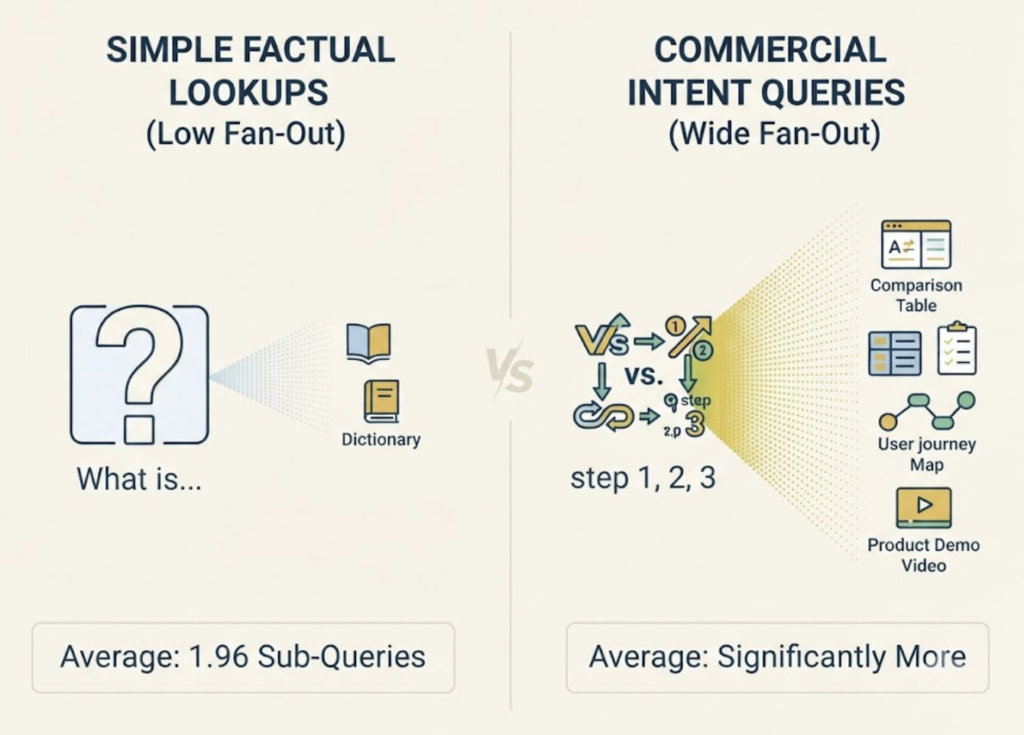
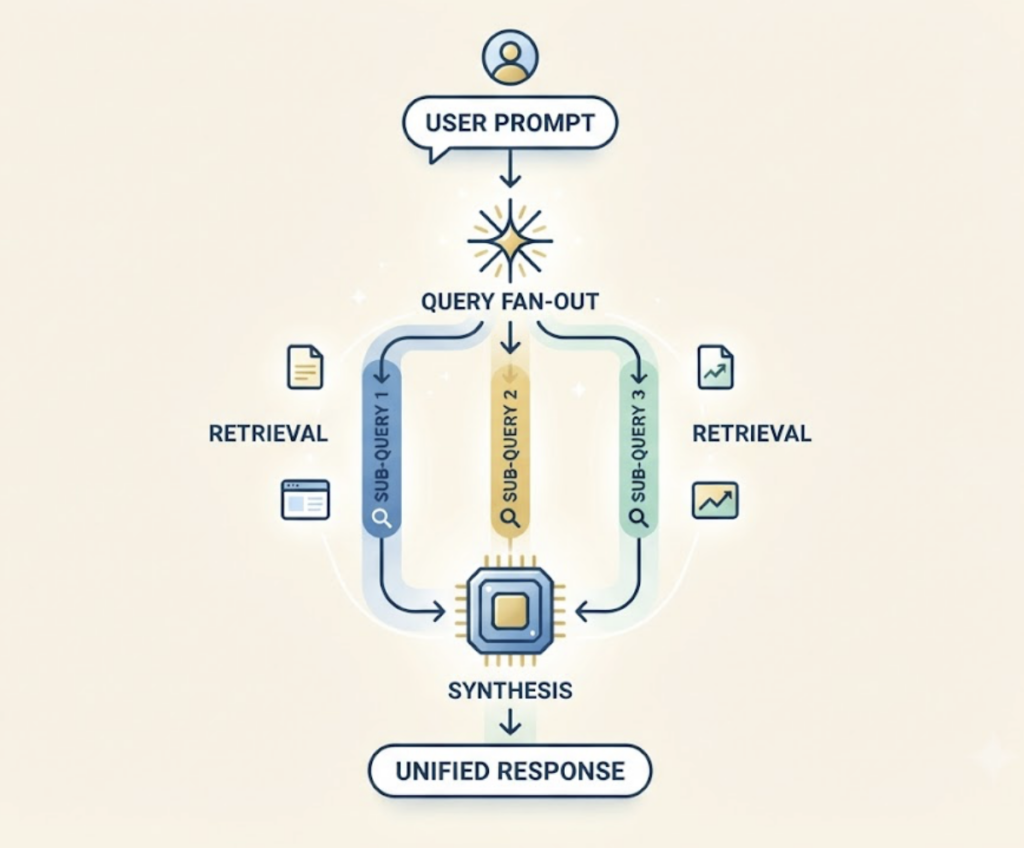
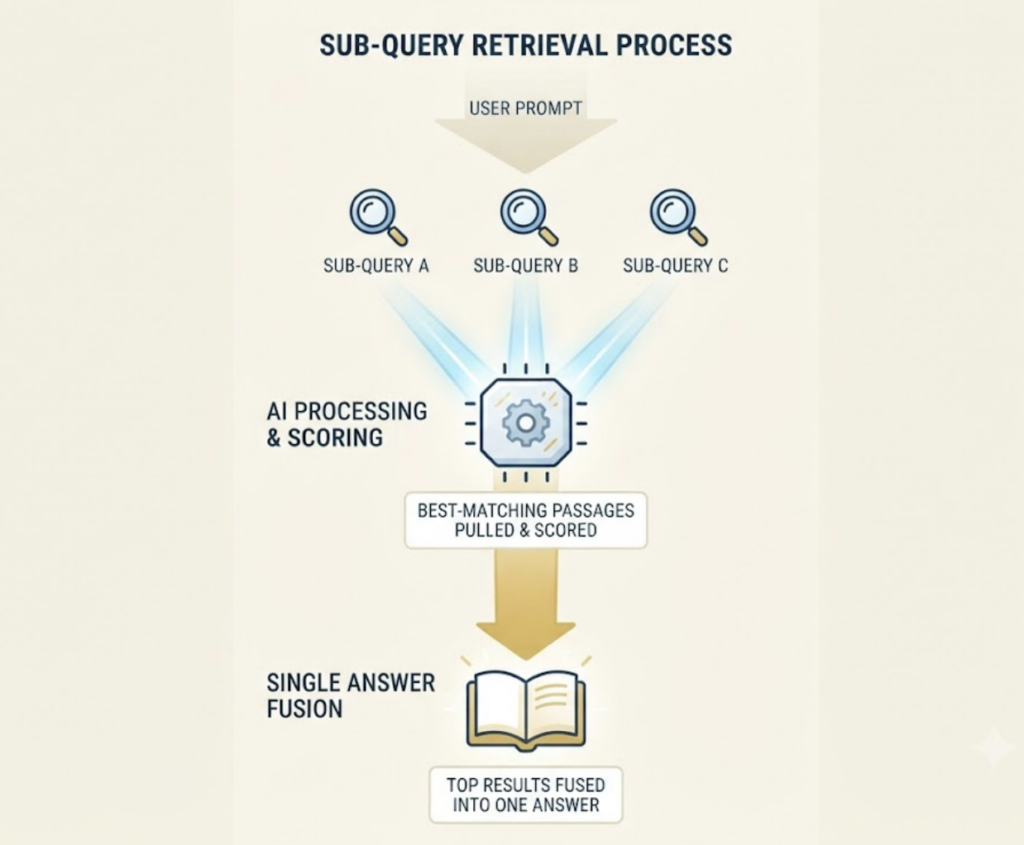
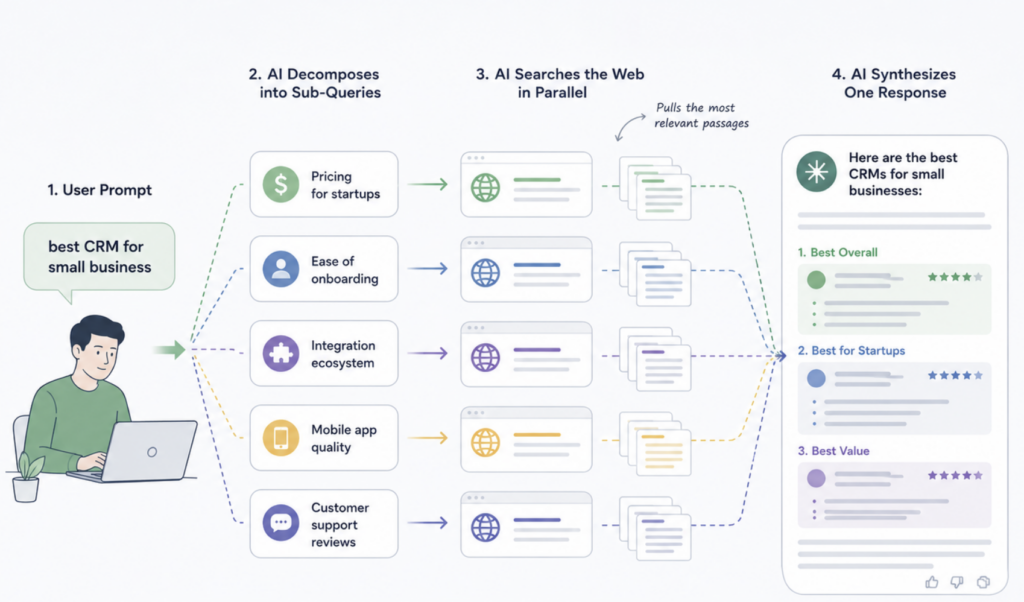
    When you ask “how does my product compare to Competitor A, B, and C?” the response is structurally longer than a single-brand query. Your system prompt also grows, because the model needs context on each competitor to recognize and evaluate them. Add “query fan-out,” where a single strategic prompt gets broken into 5–10 sub-queries to test different retrieval paths, and the volume multiplies across your entire competitive set.

    Tracking three competitors doesn’t add 30% to your monitoring cost. It can double it.

    Token-Based vs. Fixed Pricing: The Budget Comparison

    MetricToken-Based (Raw API)Fixed Pricing (e.g., Topify)
    Monthly CostVolatile: $150–$1,200+Predictable: $99–$499
    Budget PredictabilityLow: spikes with volumeHigh: locked subscription
    Monitoring DepthCapped by current balanceFull tier within plan
    Technical OverheadHigh: keys, retries, normalizationLow: unified dashboard
    Retry CostsYou absorb every hallucinationVendor absorbs unreliability
    Agency AttributionComplex: token spend by clientSimple: analyses per project

    The raw API approach has a real use case: experimentation. If your engineering team is prototyping a custom internal tool, pay-per-token lets you swap between models freely and discover what works before committing. For that phase, it’s the right call.

    The trap is leaving production monitoring on raw API pricing. Brand monitoring is a repetitive, standardized workflow. Running the same 100 prompts every day across five engines is a factory operation. Token volatility is all downside in that context: a model update that makes outputs longer overnight can balloon your monthly bill with no change in the value you’re receiving.

    There’s also a business communication problem. A CFO doesn’t want to approve a budget for “50 million tokens.” They want to approve a budget for “competitive intelligence on AI search.” When AI spend is decoupled from business KPIs, it creates what the industry is starting to call LLMflation: spending more every year just to maintain the same level of insight.

    What Scalable AI Brand Monitoring Actually Costs

    A professional monitoring setup in 2026 typically covers 150–300 prompts tracked weekly across the top AI platforms. That’s the baseline for meaningful visibility data.

    Topify structures its pricing around this reality. The Basic plan ($99/mo) provides 9,000 AI answer analyses across 4 projects. That’s enough to monitor 100 high-intent prompts across ChatGPT, Gemini, and Perplexity three times a week, without tracking token consumption on the backend.

    The key difference is how the “unreliability tax” gets handled. Unlike static SEO scraping, AI monitoring requires multiple query passes to determine the statistical probability of a brand mention. Topify’s infrastructure runs multi-shot verification internally and delivers a Visibility Score that’s statistically grounded, not just a single data point. The cost of those verification loops doesn’t appear on your bill.

    The agency math, made simple

    Consider a mid-market agency managing 8 client brands. On raw API pricing, billing becomes a shared-credit nightmare: one client’s PR crisis triples their monitoring volume and burns through the agency’s token budget. A client requesting deep sentiment analysis subsidizes one that only needs basic tracking. Attributing actual costs per client is nearly impossible.

    On Topify Pro ($199/mo, 22,500 analyses), the numbers work cleanly:

    • 22,500 ÷ 8 clients = 2,812 analyses per client per month
    • $199 ÷ 8 clients = $24.88 per client per month

    Even if Client A’s situation turns negative and the AI generates longer responses, the agency’s cost stays at $24.88. The token drain is absorbed by the platform. The agency can focus on strategy and client value instead of margin erosion.

    6 Questions to Ask Before Signing Any AI Monitoring Contract

    Before committing to a monitoring vendor, run through this checklist:

    1. Does pricing scale by tokens, prompts, or analyses? Prompt- or analysis-based pricing is predictable. Token-based pricing isn’t.

    2. Which models are actually running? The difference between Claude 4.6 Sonnet and Claude 4.6 Opus isn’t just quality. It’s $22 per million output tokens. Make sure you know which tier you’re getting.

    3. Does the base plan include multi-platform coverage? Monitoring ChatGPT only tells you part of the story. Confirm whether Gemini, Perplexity, and others are included or add-on costs.

    4. Is there built-in hallucination detection? Without a verification loop, your data quality is unreliable. Ask whether the vendor handles retry logic internally or passes that cost (and complexity) to you.

    5. Can you attribute usage by client or project? For agencies especially, this is non-negotiable. Cost visibility per client is what makes the model billable.

    6. Are real-time search grounding fees included? Some platforms charge separately for grounded search queries. That $35 per 1,000 queries adds up faster than the token cost itself.

    Conclusion

    Token pricing isn’t inherently bad. It’s the right model for exploration, for custom tooling, for one-off deep analysis that needs a flagship model’s reasoning. That use case is real and it matters.

    But brand monitoring isn’t exploration. It’s a factory. The same prompts, the same platforms, the same competitive set, run on a weekly or daily cadence. In that context, token volatility is pure operational risk with no corresponding upside.

    The organizations getting this right in 2026 are treating token-based access as a prototyping layer and production monitoring as a fixed-cost intelligence subscription. That split isn’t about cutting corners. It’s about building a measurement system that actually scales without the economics working against you.

    When your CFO asks what you spent on AI visibility last quarter, “it depends on how many tokens the model used” is not a defensible answer.


    Frequently Asked Questions

    How many tokens does it take to monitor a brand on ChatGPT?

    A single monitoring query typically uses 2,000–13,000 input tokens (prompt plus context) and 500–1,500 output tokens depending on the complexity of the analysis. For a basic mention check the lower end applies; for competitive sentiment breakdowns, expect the higher end. At Claude Sonnet 4.6 pricing, that’s roughly $0.01–$0.06 per query before any retry costs.

    Is there an AI brand monitoring tool that doesn’t charge by token?

    Yes. Platforms like Topify use a prompt/analysis-based pricing model, where you pay for a monthly volume of analyses rather than the underlying token consumption. This means the vendor absorbs retry costs and verification overhead, and your monthly spend stays predictable regardless of output length or model behavior.

    How does Claude’s token pricing compare to other AI models for brand monitoring?

    Claude 4.6 Sonnet sits at $3.00/1M input and $15.00/1M output, making it a mid-tier option suited for general visibility tracking. Claude 4.6 Opus ($5.00/$25.00) is better for high-stakes reputation or legal risk analysis where reasoning depth matters. For high-volume, lower-complexity tasks, budget models like GPT-5.2 Nano ($0.05/$0.40) can significantly cut costs, but at the expense of analytical depth.


    Read More

  • How to Slash Token Usage While Tracking AI Brand Visibility

    How to Slash Token Usage While Tracking AI Brand Visibility

    Track how ChatGPT and Perplexity mention your brand — without letting API costs spiral out of control.

    You set up an AI monitoring script. It runs. Two weeks later, the API invoice arrives and the number is three times what you budgeted.

    That’s not a freak accident. It’s the default outcome of applying traditional SEO monitoring logic to a system that charges by the token. The math is punishing in ways that aren’t obvious until you’re already in the hole.

    Here’s how to track brand visibility across ChatGPT and Perplexity without burning your token budget — and what that actually looks like in practice.

    Your Token Bill Spikes Faster Than You Think

    Most teams underestimate AI monitoring costs because they calculate against a single query. The real cost multiplies quickly once you account for how LLM-based monitoring actually works.

    Large language models are probabilistic. The same prompt doesn’t return the same answer twice. To get statistically reliable visibility data, you need multiple samples per prompt — typically three to five runs to establish a baseline. That sampling requirement alone doubles or triples your raw token count before you’ve even optimized anything.

    Then there’s the system prompt problem. Every API call carries your system instructions. A system prompt that starts at 500 tokens tends to grow — added context, extra constraints, few-shot examples — and quickly balloons to 1,800 tokens or more. For a monitoring system running 5,000 calls a day, that bloat costs tens of thousands of dollars a year in pure overhead. The queries haven’t changed. The instructions are just getting heavier.

    Add cross-platform tracking and the pressure compounds. ChatGPT and Perplexity index differently: Perplexity pulls from real-time web searches, Reddit threads, and review sites like G2. ChatGPT leans on its training corpus and high-authority licensed content. Because their ecosystems diverge, most DIY systems run full-volume scans on both platforms independently — which effectively doubles your spend without doubling your insight.

    Most Teams Are Querying AI the Expensive Way

    The “spray and pray” approach works in deterministic search. In token-billed LLMs, it destroys budgets.

    Here’s how it typically plays out: a team wants to track a cloud services brand, so they build queries for every long-tail variation they can think of — “best cloud storage for small businesses,” “affordable cloud servers,” “cloud services with auto backup” — and run each one as a separate API call. These queries overlap heavily in semantic space. The model surfaces similar brand recommendations across all of them. You’re paying for redundant signal.

    Uncompressed tool definitions and verbose JSON schemas compound the waste. Research on production LLM systems shows that poorly structured outputs — where you’re requesting a full narrative response instead of a compact structured extract — can inflate output token spend by 70% or more compared to format-constrained alternatives.

    The cross-platform mirroring problem is just as costly. If a brand has 30% mention rate on Perplexity but near-zero on ChatGPT, running identical query volumes on both platforms makes no economic sense. Most DIY scripts don’t account for this asymmetry. They mirror queries across platforms regardless of where signal actually exists.

    That’s the gap between a scraping script and a monitoring architecture.

    5 Ways to Slash Token Usage Without Losing Coverage

    1. Prioritize High-Signal Prompts Over Full-Keyword Sweeps

    You don’t need to track 500 prompts to understand your brand’s AI visibility. You need to track the right 50.

    The goal is identifying which queries actually sit on your customers’ decision path — the moments where AI recommendations influence purchase or evaluation behavior. Research on AI monitoring systems indicates that tracking the top 20% of high-intent queries covers roughly 80% of the brand visibility conversion points in the AI ecosystem.

    Start by mapping your customer’s decision journey, then identify the prompts that correspond to each stage: awareness, comparison, and selection. That’s your core prompt library. Everything else is optional depth.

    2. Use Response Sampling Instead of Full-Text Capture

    You don’t need a 600-word AI response to know whether your brand was mentioned.

    Forcing structured, minimal output — brand name, ranking position, sentiment score — through constrained prompt formatting can cut output token consumption by more than 70% compared to open-ended responses. For routine daily baseline checks, this lightweight approach gives you enough signal to detect trends without paying to generate paragraphs of context you won’t read.

    Reserve full-text capture for high-signal events: a competitor spike, a sentiment shift, a new prompt category performing unexpectedly.

    3. Use Batch Processing for Non-Urgent Monitoring Tasks

    For weekly audits, competitor share analysis, or historical trend tracking, real-time API calls are the wrong tool.

    OpenAI’s Batch API and equivalent batch processing options from other providers typically offer 50% price reductions in exchange for delayed responses, usually within 24 hours. The trade-off is almost always worth it for anything that isn’t crisis monitoring.

    Processing ModeCostBest For
    Real-time API100% (standard price)Crisis PR, breaking sentiment shifts
    Batch API50% (discounted)Weekly visibility reports, audits
    Utility model routing (Nano/Mini)10–20%Basic mention detection, initial filtering

    Mapping your query types to the right processing tier — before you build the system, not after — is one of the highest-leverage architectural decisions you can make.

    4. Set Visibility Thresholds to Trigger Queries On Demand

    Not all monitoring needs to run on a fixed schedule. A smarter approach uses a tiered trigger system.

    Run lightweight, low-cost scans continuously using utility models (GPT-5.4-nano or equivalent). Reserve expensive high-fidelity analysis for threshold events — for example, when a competitor’s mention rate on Perplexity spikes more than 15% in a single day, or when brand sentiment drops below a defined floor. That triggers a deeper query cycle using a more capable model.

    This alarm-system approach keeps your baseline spend low while ensuring you don’t miss the moments that actually matter. Most brands don’t need hourly deep analysis. They need reliable detection of anomalies and the capacity to respond fast when they appear.

    5. Standardize Prompt Structure and Implement Caching

    Prompt caching allows you to store stable system instructions and background context so they aren’t re-billed on every API call. Providers including Anthropic and OpenAI offer caching discounts of up to 90% on repeated prompt segments.

    Pairing caching with a compact output format — structured text fields instead of verbose JSON schemas — reduces structural token waste by 30% to 60%. The savings compound over time. A monitoring system that runs thousands of queries per month accumulates meaningful cost reductions from these two optimizations alone, without any change to what you’re actually measuring.

    What Efficient Tracking Looks Like in Practice

    Numbers are clearer than principles, so here’s a concrete example.

    Take a mid-sized cloud services company running 10,000 cross-platform queries per month with a DIY script. At standard API rates using a frontier model with no optimization, monthly API spend lands around $1,200. The system catches brand mentions but struggles with accuracy — hallucinations aren’t filtered, competitor tracking is limited to three names, and the prompt architecture is bloated.

    After restructuring with a three-layer approach — nano model for daily full-sweep detection, batch API for deep analysis on flagged prompts, and prompt caching for system instructions — the same brand coverage costs $480 per month. That’s a 60% reduction. Competitor tracking expands from three to ten names. Brand coverage accuracy improves from 85% to 98% because multi-step verification filters out hallucinated mentions.

    Less spend, broader coverage, higher accuracy.

    That’s not a theoretical outcome. It’s the direct result of matching query type to processing mode and eliminating structural redundancy.

    When DIY Stops Making Financial Sense

    Token spend is only part of the cost. Once you factor in everything required to build and maintain a production-grade monitoring system, the economics shift.

    Building a monitoring pipeline that handles API connection management, cost observability, output validation, and prompt versioning typically consumes 80% of an engineering team’s time on infrastructure — time not spent on anything that generates revenue. AI engineers command 30% to 50% salary premiums over traditional DevOps. Meeting GDPR and SOC2 compliance standards for data storage and processing adds $50,000 to $100,000 in annual overhead for most organizations.

    Then there’s the fragility problem. OpenAI and Anthropic release model and pricing changes nearly every quarter. Custom scripts built against one API version regularly break on the next, generating constant maintenance cycles that accumulate into significant annual engineering cost.

    None of these costs appear in a token bill. All of them appear in a P&L.

    A purpose-built platform doesn’t just reduce API overhead. It eliminates the infrastructure maintenance burden, the compliance exposure, and the engineering distraction — and it handles edge cases that a script simply can’t, like cross-model context reuse and normalized sentiment scoring across different LLM output formats.

    How Topify Tracks AI Brand Visibility Without the Token Overhead

    Topify was designed around coverage efficiency rather than query volume. The architecture eliminates redundant token spending at the structural level, before a single API call goes out.

    The platform’s High-Value Prompt Discovery engine uses semantic clustering of real user search behavior to generate a compact, full-funnel prompt set for each brand. Instead of asking you to input hundreds of keywords, it identifies the queries that actually drive brand recommendations — from initial awareness through competitive evaluation — and builds a prompt library optimized to minimize input token redundancy.

    Topify’s cross-platform tracking uses a single query cycle to capture visibility data across ChatGPT, Perplexity, Gemini, and other major AI platforms. Where DIY systems run separate full-volume scans per platform, Topify’s architecture reuses context across platforms and applies intelligent routing — directing queries to Perplexity when real-time web search signal is needed, to ChatGPT when reasoning-based recommendations are the target. That cross-model efficiency translates directly to lower per-insight cost.

    A few other structural advantages worth noting:

    Unified sentiment scoring normalizes output from different models onto a single scale (–100 to +100), eliminating the token overhead of running separate sentiment analysis pipelines per platform.

    Source fingerprinting means that when multiple AI platforms cite the same web page, Topify parses it once rather than billing for redundant retrieval and preprocessing.

    Dynamic sampling frequency adjusts automatically based on brand activity — running lightweight checks during quiet periods and ramping up precision during PR events or competitive spikes.

    For teams on the Basic plan at $99 per month, that architecture covers 100 prompts and 9,000 AI answer analyses across ChatGPT, Perplexity, and AI Overviews — without requiring you to build or maintain any of the underlying infrastructure.

    Conclusion

    Token costs in AI brand monitoring aren’t a billing quirk. They’re the direct result of applying high-volume, undifferentiated query logic to a system that charges per word generated.

    The fix isn’t spending less on monitoring. It’s spending more precisely. High-signal prompt selection, response format constraints, batch processing, threshold-triggered analysis, and prompt caching each reduce waste without reducing coverage. Together, they typically cut token spend by 50% to 60% while improving data quality.

    For teams tracking more than a handful of prompts across multiple platforms, rebuilding that efficiency layer from scratch is rarely the highest-value use of engineering time. A platform with the optimization logic already built in changes the economics entirely.

    Brand visibility in AI search is becoming a core growth channel. The question isn’t whether to track it. It’s whether you’re doing it in a way that compounds over time — or one that quietly drains your budget while you’re looking somewhere else.

    FAQ

    Why is my brand visible on Perplexity but invisible on ChatGPT?

    The two platforms index differently. Perplexity relies on real-time web search and pulls from recent blog posts, Reddit discussions, and press releases. ChatGPT’s responses reflect its training corpus and tend to favor long-established domain authority. A brand that’s been publishing actively for six months might show up prominently in Perplexity while remaining largely absent from ChatGPT. Closing that gap typically requires building the kind of long-form, citation-worthy content that earns references from high-authority sources.

    What’s the fastest way to cut token costs without changing what I track?

    Enable batch processing for any monitoring that doesn’t need to happen in real time. Switch output format from open-ended text to structured minimal fields — brand name, position, sentiment flag. Those two changes typically reduce monthly spend by 50% to 70% with no change to what you’re measuring.

    Does traditional SEO (backlinks, domain authority) still influence AI brand visibility?

    Less than it used to. AI models weight entity association and information gain more heavily than raw link equity. Pages with original statistics, expert citations, and clear topical authority are cited roughly 30% to 40% more often than pages that rely primarily on inbound links. The optimization target has shifted from link acquisition to content credibility.

    At what scale does a purpose-built platform outperform a DIY script?

    The crossover typically happens around 50 to 100 prompts tracked per month across two or more platforms. Below that, a well-optimized script can be cost-effective. Above it, the infrastructure overhead — maintenance, compliance, versioning — starts to exceed the cost of a platform subscription.

    Read More

  • 5 Claude Token Mistakes Killing Your AI Budget

    5 Claude Token Mistakes Killing Your AI Budget

    You’re spending more on AI than ever. But your brand is still missing from ChatGPT’s answers.

    That’s not a budget problem. That’s a usage problem.

    Most teams treating Claude token usage as a throughput metric — more tokens spent, more content generated, more progress made. The math looks clean until you realize none of those outputs are earning citations in AI-generated answers. You’re not buying visibility. You’re buying noise.

    Here are the five token mistakes that are quietly draining your AI budget, and what to actually do about them.

    Mistake #1: Prompting for Output, Not for Position

    The most expensive habit in AI marketing is using Claude as a content factory.

    Teams prompt Claude to “write a blog post” or “draft a product page,” consume the tokens, and call it done. But generating output is not the same as earning position. In the GEO era, what matters isn’t how much content you publish — it’s whether AI engines cite your brand when users ask relevant questions.

    Research confirms the gap is real. Brands ranking in the top three organic Google results often have zero visibility in AI-generated summaries for the same queries. AI models don’t “search” — they retrieve and synthesize based on what they call Fact Units: structured, verifiable information that reduces hallucination risk.

    When a Claude prompt produces purely promotional copy (“We are the best CRM for teams”), the AI treats that source as high-risk and omits it. When the same prompt produces a technical specification or a verifiable comparison stat, the model has grounding material it can cite.

    Every token budget decision should start with one question: does this output earn a position, or just fill a page?

    Mistake #2: Running Broad Prompts When Specific Ones Cost Less

    Broad prompts are a budget multiplier — and not in a good way.

    A prompt like “Analyze the CRM market for small businesses” triggers what’s known as Prompt Bloat: irrelevant context gets processed, input costs spike, and the output is too generic to drive AI citations. You’ve spent more tokens to get less value.

    According to research on prompt engineering economics, specific intent-driven prompts — those that define persona, comparison target, and constraint — consume roughly 500 to 800 tokens while achieving an AI recommendation rate of 79%. Broad prompts consume 5,000-plus tokens and hit less than 15%.

    The fix is Prompt Research, not keyword research. Instead of brainstorming topics, identify the specific conversational paths real users take when researching your category on ChatGPT or Perplexity.

    Topify‘s High-Value Prompt Discovery is built for exactly this. It identifies Intent Clusters — the specific buying prompts where users compare vendors and seek recommendations — and estimates AI search volume across platforms. More importantly, it surfaces Invisibility Gaps: high-intent prompts where your brand ranks well on Google but is absent from the AI’s synthesized answer. That’s where your Claude token usage should be concentrated, not spread thin across generic topics.

    The 80/20 rule applies here. Focus token spend on the 20% of prompts that drive 80% of AI recommendations. Everything else is overhead.

    Mistake #3: Tracking Token Count Instead of Visibility Impact

    This one is a governance failure, not a content failure.

    Most organizations track token consumption the same way they track bandwidth: as an infrastructure cost to minimize. Cost-per-token goes down, the spreadsheet looks better, leadership signs off. But if those tokens aren’t producing AI citations, the ROI is effectively zero.

    A team might consume 100 million tokens to generate 1,000 blog posts. If none of those posts earn a mention in ChatGPT or Perplexity when a user asks a relevant question, the budget was spent on a content library that the primary discovery channel of the next decade will never touch.

    The KPI shift that actually matters:

    Legacy MetricModern GEO MetricWhat It Measures
    Token UsageAI Visibility ScorePresence, not cost
    Cost per 1M TokensIntelligence Efficiency RatioValue per dollar
    Page Views / CTRCitation RateAuthority and trust
    Message VolumeConversion Visibility Rate (CVR)AI-to-revenue pipeline

    Topify’s Visibility Tracking measures the frequency with which a brand appears in primary synthesized answers across multiple LLMs for a defined set of high-value prompts. Its CVR metric connects AI recommendations to downstream signals: branded search lift, site visits from ChatGPT-User agents, and lead flow.

    Organizations that make this shift can see 320% growth in citation rates within 90 days — not by spending more tokens, but by reallocating existing spend toward high-visibility Fact Units. That’s not a marketing claim. That’s what happens when you stop measuring consumption and start measuring position.

    Mistake #4: Ignoring Which AI Platforms Actually Recommend You

    Platform Monoculture is one of the most expensive blind spots in AI marketing.

    Most teams optimize for one model — usually Claude or ChatGPT — and assume the visibility carries across platforms. It doesn’t. Research shows the overlap between citations in ChatGPT and Perplexity for identical queries can be as low as 11%.

    Each AI engine has its own retrieval philosophy. Claude prioritizes long-form technical documents and structured content. Perplexity leans heavily on Reddit threads, niche blogs, and real-time sources, with Reddit accounting for nearly 47% of its citations. Gemini oscillates between its Knowledge Graph and traditional organic signals. DeepSeek pulls from documentation, code repositories, and academic papers.

    A brand optimized only for Claude’s retrieval logic — white papers, technical FAQs, structured data — might be invisible on Perplexity because it has zero Reddit presence. A competitor with 20 community-sourced threads discussing their product will dominate there, regardless of how polished your corporate blog is.

    Here’s the platform breakdown:

    PlatformCitation RateSource Preference
    ChatGPT~60%Bing Index, high-authority blogs
    Perplexity13%Reddit (46.7%), real-time web
    Gemini6-76%Wikipedia, YouTube, Google Graph
    ClaudeHighPDFs, technical whitepapers
    DeepSeekVariableDocumentation, code repos

    Without cross-platform intelligence, you can’t see that gap. Topify’s multi-model Visibility Tracking monitors brand presence simultaneously across ChatGPT, Gemini, Perplexity, and emerging players like DeepSeek and Doubao. When it reveals a competitor is dominating Perplexity via community threads while you’re only cited on ChatGPT via your corporate blog, you can reallocate budget before that visibility gap compounds.

    Diversify your token strategy across platforms. One retrieval logic doesn’t fit all.

    Mistake #5: No Feedback Loop from AI Citations Back to Content

    This is the silent budget killer most teams never diagnose.

    You use Claude tokens to produce content. You publish it. You check traffic analytics. You don’t check which of that content is actually being cited by AI engines — and which of it is being silently ignored.

    Without Source Forensics, you’re optimizing blind.

    Here’s the technical reality: AI retrieval systems don’t ingest entire pages. They extract Fraggles — small text fragments typically 50 to 150 words long — and evaluate them for Information Density. A 2,000-word blog post with only one extractable Fact Unit wastes the tokens spent on the other 1,850 words from a GEO perspective. You’re paying Claude to write content that AI engines mostly skip.

    Topify Source Analysis reverses this. It extracts every URL cited in an AI response and classifies it as Owned, Competitor, or Third-Party Reference. When it finds that a competitor is being cited because they have a cleaner machine-readable pricing table or a more fact-dense technical FAQ, you get a direct content brief — not a vague recommendation to “improve quality.”

    The execution workflow matters too. Topify’s one-click GEO execution converts that intelligence into content action: stripping superlatives and replacing them with verifiable specifications, restructuring content to increase Information Density, and syncing brand data across authoritative grounding layers like Wikipedia, LinkedIn, and G2 that AI engines use for cross-referencing.

    The feedback loop is what separates brands that grow AI visibility from brands that keep guessing. Without it, you’re spending tokens and hoping.

    What Good Claude Token ROI Actually Looks Like

    Tokens are inputs. Visibility is the output that matters.

    The shift from output-centric to position-centric token strategy changes everything. It’s less about generating more content, more about ensuring each piece earns a position in the AI’s recommendation logic.

    Three questions every marketing leader should ask before approving Claude token spend:

    Visibility: Did this spend increase our AI Visibility Score or Share of Voice for a high-value prompt?

    Authority: Did it move us from being mentioned to being cited with a verified source link?

    Conversion: Did the AI recommendation result in a branded search lift or a trackable session from a ChatGPT-User agent?

    The results when teams apply this framework are documented. Popl.co achieved a 1,561% ROI with an 18-day payback period after restructuring content for AI comprehension. Grüns grew Share of Voice from 2.0% to 12.6% in 60 days using a prompt-led cluster strategy.

    MetricUnmanaged SpendManaged GEO Spend
    Token ROILess than 1:13.7:1 to 15:1
    Conversion Rate2.8% (standard organic)14.2% (AI-referred)
    Visibility GainStagnant / unmeasured320%-1,000% citation growth
    Content StrategyHigh volume / low signalLow volume / high signal density

    The difference isn’t budget. It’s how the budget is directed.

    Topify turns Claude token usage into a structured, measurable growth channel — tracking visibility across seven key metrics: visibility, sentiment, position, volume, mentions, intent, and CVR — so every dollar spent has a clear line to brand authority.

    Conclusion

    The enterprise AI budget isn’t being killed by the price of tokens. It’s being killed by how they’re used.

    Tokens are the fundamental currency of AI work. Their value is realized only when they secure a brand’s position in the synthesized answers of generative engines. Prompting for output in a world that rewards position is a recipe for strategic invisibility.

    Avoid these five mistakes — output-centrism, broad prompting, KPI misalignment, platform siloing, and missing feedback loops — and your token budget becomes a competitive asset. Keep making them, and a competitor with a smarter allocation strategy will own the AI answer instead of you.

    Stop measuring what you spend on Claude. Start measuring what you own in the AI’s knowledge graph.

    Start tracking your AI visibility with Topify before a competitor already has.


    FAQ

    How many tokens does it take to rank in AI answers?

    Ranking in an AI answer isn’t a function of token volume. It’s about Information Density and Semantic Proximity. A 500-token prompt that injects high-quality Fact Units into the AI’s grounding layer is more effective than 10,000 tokens of generic copy. Brands appearing across four or more authoritative platforms — Reddit, G2, news sites, and niche blogs — are 2.8x more likely to be cited.

    Is Claude better than other models for AI visibility content?

    Claude (the 3.5 and 4.6 series) is well-suited for generating deeply structured content that provides the Technical Justification AI engines look for when citing sources. That said, for broad consumer discovery, ChatGPT’s market share makes it the primary visibility target. Perplexity is most accessible for niche sites due to its consistent citation behavior — and its reliance on Reddit means community presence matters as much as content quality.

    What’s the difference between token optimization and GEO optimization?

    Token optimization is a financial and technical discipline: reducing cost-per-request through model selection (Claude Haiku instead of Opus, for example) and context management. GEO optimization is a strategic marketing discipline: increasing how frequently and prominently your brand appears in AI-generated answers. Token optimization manages the spend. GEO optimization manages the impact. You need both — but most teams only do the first.

    Can I track AI visibility across platforms like DeepSeek or Doubao?

    Yes. Topify’s surveillance covers global and open-source models including DeepSeek and Doubao, in addition to the major Western platforms. As the AI ecosystem moves toward Machine-to-Machine communication — where autonomous agents query multiple models to complete tasks — multi-model visibility tracking becomes a baseline requirement, not a premium add-on.


    Read More

  • Claude Haiku vs Sonnet: Token Costs for Brand Monitoring

    Claude Haiku vs Sonnet: Token Costs for Brand Monitoring

    You’re building a GEO monitoring pipeline. You’ve priced out Claude’s API, and the math is starting to look uncomfortable. Sonnet’s reasoning is sharp, but at $3.00 per million input tokens, running it across thousands of daily brand mentions burns budget fast. Haiku is five times cheaper, but you’re not sure where it’ll break down.

    The answer isn’t “use one or the other.” It’s knowing exactly which tasks justify the premium, and which ones don’t.

    The Price Gap Is Real. The Performance Gap Depends on the Task.

    Here’s the actual pricing spread you’re working with:

    ModelInput (per 1M tokens)Output (per 1M tokens)Cache Read
    Claude 3.5 Sonnet$3.00$15.00$0.30
    Claude 3.5 Haiku$0.80$4.00$0.08
    Claude 3.5 Haiku (Batch API)$0.40$2.00N/A

    The Batch API discount pushes Haiku’s blended cost to roughly $2.40 per million tokens for non-time-sensitive workloads, compared to Sonnet’s $18.00. That’s an 86% gap. For a monitoring system processing 100,000 articles per day, that difference compounds to roughly $190,000 annually.

    But the price gap only matters if the performance gap is narrow enough for your use case. On most structured tasks, it is. On a small but important subset of tasks, it isn’t.

    What “Brand Monitoring” Actually Asks of a Claude Model

    Brand monitoring isn’t a single task. It’s a stack of operations with very different cognitive demands. Lumping them together and picking one model is where most teams overspend or under-deliver.

    Mention Extraction: Low-Complexity, High-Volume

    Mention extraction is pattern recognition with a schema requirement: find entity names, format as JSON, move on. There’s no ambiguity to resolve, no irony to detect. The model needs to be fast, accurate on structure, and cheap per call.

    Haiku handles this at 98.2% extraction accuracy compared to Sonnet’s 99.5%. That 1.3-point gap is negligible at scale, especially when the alternative is spending 4x more per task. For real-time feeds like Reddit threads or news aggregators, Haiku’s lower latency (roughly 1.5 seconds per 100 tokens vs. Sonnet’s 2.5 seconds) is an additional advantage.

    Sentiment Classification: Where Context Starts to Matter

    Standard sentiment (positive/neutral/negative) is Haiku territory. But “standard” doesn’t cover much of what brand monitoring actually involves.

    The hard cases are industry jargon, sarcasm, and contextual framing. A financial analyst calling a brand “a legacy choice” isn’t giving a compliment. A developer saying a product “gets the job done” might be damning with faint praise. Haiku handles mass-market consumer sentiment well. For executive interviews, analyst commentary, or technical forums where tone is layered, Sonnet’s deeper contextual reasoning starts to justify the cost.

    Competitive Narrative Analysis: Sonnet’s Domain

    This is where the benchmark data diverges sharply. On GPQA (graduate-level reasoning), Haiku scores 41.6% vs. Sonnet’s 65.0%. That gap isn’t about raw intelligence — it’s about multi-step inference under ambiguity.

    In a GEO context, this matters when you need to know whether an AI assistant is recommending your brand enthusiastically, mentioning it with caveats, or positioning it as a “less-desirable alternative.” A phrase like “While Brand A has the established track record, Brand B is increasingly preferred by teams building for scale” requires a model to decode the “legacy” implication, identify the emerging-threat framing, and classify both simultaneously. Haiku tends to classify this as neutral. Sonnet flags the subtle negative framing.

    Report Synthesis: Variable by Audience

    A daily digest of mentions? Haiku. A weekly brief for a CMO that synthesizes visibility shifts, identifies emerging competitor narratives, and maintains a consistent strategic voice? Sonnet. The distinction isn’t length, it’s the synthesis layer: connecting disparate signals into a coherent argument requires the writing quality Sonnet is specifically tuned for.

    Where Haiku Handles the Load: The 80% Case

    The majority of claude flash token usage in a brand monitoring pipeline falls into structured, mechanical operations. Haiku is not a compromise here — it’s the right call.

    Consider the unit economics for a typical extraction task: 1,000 input tokens (a news article) and 200 output tokens (structured JSON with entities and sentiment score):

    ModelInput Cost (1k tasks)Output Cost (1k tasks)Total
    Claude 3.5 Sonnet$3.00$3.00$6.00
    Claude 3.5 Haiku$0.80$0.80$1.60
    Claude 3.5 Haiku (Batch)$0.40$0.40$0.80

    Haiku via Batch API costs $0.80 per thousand tasks. Sonnet costs $6.00 for the same workload. At 100,000 tasks per day, you’re looking at $520 in daily savings by routing extraction to Haiku — capital that can fund the Sonnet calls that actually need Sonnet-level reasoning.

    The tasks that belong in Haiku’s lane: raw data triage, entity extraction, standard sentiment classification, citation frequency checks, and basic mention detection. These account for roughly 80% of GEO monitoring volume in production systems.

    When Sonnet’s Extra Capacity Pays Off

    The phrase that captures this well: “You don’t want to miss a subtle negative framing just to save $0.003.”

    Haiku’s reasoning ceiling becomes visible in three specific scenarios:

    Competitive framing analysis. When an AI overview positions two brands comparatively, detecting the subtext requires multi-step inference. Sonnet can identify entity salience — the degree to which a model treats a brand as the definitive answer for a query versus a secondary mention. Haiku often misses this distinction.

    Agentic troubleshooting. When a monitoring agent needs to trace a reputation shift back to a source — finding the original Reddit thread or technical blog that seeded a narrative — Sonnet’s agentic capability (64% task completion on internal evaluations vs. 38% for prior models) handles the autonomous browsing and source synthesis. Haiku hallucinates when reasoning chains exceed 150 lines of logic.

    Executive synthesis. Reports that need to hold together as a strategic argument, not just a data summary, require Sonnet’s writing quality and ability to maintain consistent voice across a long context window.

    A Token Routing Framework for GEO Teams

    The highest-ROI architecture isn’t “use Haiku” or “use Sonnet.” It’s routing each task to the right tier automatically. Here’s how the task split should look in practice:

    Task TypeRecommended ModelAvg. Token LoadRouting Trigger
    Raw data triageHaiku (Batch API)In: 1k, Out: 50Volume flag
    Entity extractionHaikuIn: 2k, Out: 300Schema task
    Standard sentimentHaikuIn: 1k, Out: 100Consumer content
    Narrative / framing analysisSonnetIn: 5k, Out: 1kComparative content
    Crisis detectionSonnetIn: 10k, Out: 2kRisk flag
    Executive reportsSonnetIn: 50k, Out: 5kSynthesis output

    The router classification itself adds roughly 430ms of latency and costs approximately $0.001 per request — negligible against the savings it generates.

    To put concrete numbers on the hybrid approach: a 50-prompt session averaging 2,000 input and 1,000 output tokens costs roughly $1.05 routing everything to Sonnet. Routing 30 simpler tasks to Haiku and 20 complex tasks to Sonnet brings total cost to approximately $0.58 — a 45% reduction without quality degradation on the outputs that matter.

    Why Most Teams Still Overspend on Model Selection

    The default pattern in most organizations is to use Sonnet for everything. It feels safer. The reasoning: if the model is more capable, the output will be better. In practice, this conflates capability with appropriateness.

    For structured tasks — extraction, filtering, schema validation — Sonnet’s additional reasoning capacity is dormant. You’re paying for horsepower the task doesn’t use. The extra parameters don’t make JSON formatting more accurate. They just make it more expensive.

    There’s a second hidden cost that compounds this: KV cache inefficiency in agentic workloads. Multi-agent monitoring systems often involve recursive calls that multiply token consumption through what’s called a token multiplier effect. A single brand monitoring task might consume between 200,000 and 1,000,000 tokens across its agent chain. Routing all of those calls to Sonnet depletes budget before the high-value strategic insights even get generated.

    The fix isn’t switching to all-Haiku. It’s building the routing layer that makes the decision automatically, at task classification time.

    Topify: For Teams That Don’t Want to Build the Router

    If you’re not building your own monitoring stack, you don’t need to solve this problem manually. Topify handles the model routing internally, using efficient models for high-volume visibility checks and reserving higher-reasoning capacity for strategic analysis.

    The platform tracks brand performance across ChatGPT, Gemini, Perplexity, and other major AI engines across seven metrics: visibility, sentiment, position, volume, mentions, intent, and CVR. Its Source Analysis feature identifies which domains AI platforms are citing, which surfaces the content gaps that explain why a competitor is getting recommended instead of you.

    For teams managing multiple brands or clients, the One-Click Execution feature deploys GEO optimizations — content restructuring, authority signal improvements, citation targeting on high-value domains like Reddit or G2 — without requiring manual model management or infrastructure work.

    The practical upside: you get the tiered routing benefit without the engineering overhead. Topify’s pricing starts at $99/month for the Basic plan, which includes 9,000 AI answer analyses across 100 prompts and 4 projects. That’s a meaningfully lower barrier than building and maintaining a custom Haiku/Sonnet router.

    Conclusion

    Claude flash token usage for brand monitoring isn’t a single dial. It’s a task taxonomy problem.

    Haiku is the right model for roughly 80% of monitoring volume — the extraction, classification, and triage work that happens before any insight is generated. Sonnet earns its premium on the 20% that requires nuanced reasoning: competitive framing, agentic troubleshooting, and synthesis for decision-makers.

    Teams that build the routing layer once — or use a platform that’s already built it — capture the cost efficiency of Haiku without accepting the quality tradeoffs on the tasks that actually drive brand decisions. The price gap is real. Whether it becomes a savings or a penalty depends on whether you’ve mapped your tasks to the right tier.


    FAQ

    Q: Is Claude Haiku accurate enough for sentiment analysis in brand monitoring?

    A: For standard consumer sentiment (positive/neutral/negative classification), Haiku performs well and is the cost-appropriate choice. Where it falls short is nuanced analysis of layered language — sarcasm, industry-specific framing, financial disclosures, and executive communications where tone is subtle. For those cases, Sonnet’s deeper contextual reasoning reduces misclassification risk.

    Q: How do I calculate token usage for a brand monitoring workflow?

    A: A typical extraction task runs roughly 1,000 input tokens (a news article) and 200 output tokens (structured JSON). A narrative analysis task with competitive framing can run 5,000 input and 1,000 output tokens. Multiply each task type by its daily volume and apply the per-token pricing to get your model budget. The Batch API adds a 50% discount for non-time-sensitive workloads, which significantly changes the Haiku math at scale.

    Q: What’s the cost difference between Haiku and Sonnet for 1,000 prompts?

    A: For a typical extraction task (1,000 input + 200 output tokens per prompt), Sonnet costs approximately $6.00 per thousand prompts. Haiku costs $1.60, or $0.80 via the Batch API. For a narrative analysis task (5,000 input + 1,000 output tokens per prompt), Sonnet runs $30.00 per thousand prompts vs. Haiku’s $8.00.

    Q: Can I mix Haiku and Sonnet in the same GEO pipeline?

    A: Yes, and this is the recommended architecture. A classifier routes each incoming task to the appropriate model based on predicted complexity. The classifier call itself costs roughly $0.001 per request and adds ~430ms of latency — a negligible overhead against the 45% average cost reduction the routing generates. Most production monitoring systems benefit from this hybrid approach.


    Read More

  • Claude-Lash: Why Your AI Visibility Tool Costs More Than You Think

    Claude-Lash: Why Your AI Visibility Tool Costs More Than You Think

    You set up an AI visibility tracker. You pointed it at 100 prompts. You left it running.

    Then the invoice arrived.

    If you’ve experienced that moment, you’ve just joined a growing cohort of marketing teams dealing with what the industry now calls “Claude-lash.” It’s not a bug. It’s not a vendor mistake. It’s a structural math problem that most tracking setups have baked in from day one.

    Here’s what’s actually happening, and what the numbers look like when you finally do the math.

    What “Claude-Lash” Actually Is

    The term entered the industry lexicon in mid-April 2026, following the release of Anthropic’s Claude Opus 4.7.

    The frustration wasn’t really about model quality. It was about a cost structure nobody had budgeted for: reasoning tokens. Unlike standard models that generate output in a predictable linear sequence, reasoning-heavy models like Opus 4.7 engage in internal “thinking” cycles before producing a visible response. Those internal cycles are billed at completion rates, not at a discount.

    The ratio can hit 20:1. For every token you see, the model may have burned 20 internally.

    For a team running automated brand monitoring across dozens of prompts, that math compounds fast. A query that cost pennies in 2025 started burning through API credits at a rate that didn’t show up until the end-of-month billing cycle.

    That’s Claude-lash: the gap between what you thought AI visibility tracking costs and what it actually costs, once reasoning overhead enters the picture.

    The Math Most Teams Skip

    Here’s the core problem with how most teams measure AI visibility: they treat it as a deterministic system.

    In traditional SEO, if your brand ranked #1 for a keyword, that was a stable observable fact. Every user in the same geography saw the same result. You could check it once and trust the answer.

    AI search doesn’t work that way.

    The same prompt sent to ChatGPT ten times can yield ten different brand mentions depending on session state, geographic routing, and model sampling temperature. A brand that “appears” in 3 out of 10 responses doesn’t have 30% visibility. It has a probability range, and the actual appearance rate might fall anywhere between 10% and 50% depending on sample size.

    To establish statistically meaningful visibility, teams need to run what researchers call “Swarm Probing”: multiple iterations of the same prompt, across different user contexts and geographic nodes. A reliable GEO baseline requires at least 10 runs per prompt, and ideally 20 or more for high-stakes commercial queries.

    Here’s where the numbers start to look different from what most budgets assume.

    A team tracking 100 prompts, checked across 3 platforms, sampled 20 times each for statistical reliability, running weekly, generates:

    100 × 3 × 20 × 4 = 24,000 analyses per month.

    At a basic plan’s 9,000 analysis limit, that’s nearly 3x overrun before you’ve even opened the first report. Most teams don’t discover this until they’ve been throttled or billed for overages.

    Three Places Your Tool Is Burning Tokens Right Now

    Token waste in AI visibility tools isn’t random. It concentrates in three predictable places, and each has a specific technical cause.

    1. System prompt repetition without caching

    Every automated LLM call requires a system prompt, which defines what the agent should do. Most tracking tools send the same instruction block with every single query. If that block is 2,000 tokens and the platform supports prompt caching (which both OpenAI and Anthropic do for prompts over 1,024 tokens), cache hits are billed at just 10% of the standard input price.

    A tool that doesn’t use caching is paying a 900% tax on its own instructions, on every call, every day.

    2. Verbose JSON serialization

    Most enterprise tracking stacks use JSON to pass data between components. JSON is human-readable, but it’s a poor format for tokenization. Structural overhead from brackets, quotes, and repeated field names adds up. A list of 10 competitors with sentiment scores in JSON might consume 800 tokens. The same data in a minimal delimiter format (using | or :) can compress to around 150 tokens. Teams that have switched to schema-based encoding for their tracking payloads report up to 84% reduction in token costs, with no loss in accuracy.

    3. RAG context stuffing

    When a tool tries to diagnose why your brand is missing from an AI answer, it typically retrieves content from the web and injects it into the prompt for analysis. The failure mode is indiscriminate retrieval: pulling the full text of the top 10 search results and feeding everything into the context window.

    Context windows above 100,000 tokens are expensive to process and create “attention leaks,” where the model loses focus on the core task. Tools that use semantic reranking to inject only 3-8 highly relevant content blocks of 300-400 tokens each report up to 47% reduction in context token usage, while actually improving analytical accuracy.

    Waste SourceTechnical CauseOptimization Potential
    System prompt repetitionNo prompt caching90% cost reduction on instructions
    JSON serializationVerbose field structure70-84% reduction in payload tokens
    RAG context stuffingIndiscriminate document retrieval47% reduction in context tokens

    Combined, these three inefficiencies can inflate your API bill by 40-70% above what an optimized architecture would cost for the same coverage.

    Why Prompt Volume Is the Lever Nobody Talks About

    Most teams track 10 to 20 branded queries. They see their brand name show up in ChatGPT and conclude that AI visibility is “working.”

    It’s not.

    Research shows that 80-85% of brand mentions in AI responses originate from external domains: Reddit threads, G2 reviews, YouTube comparisons, niche publications. The AI isn’t citing your homepage. It’s citing whoever wrote the most useful third-party content about your category.

    And here’s what makes this expensive: AI search users don’t ask head terms. The average AI query runs 23 words. “What’s the best CRM for a 10-person SaaS team that needs Salesforce integration and doesn’t want to pay enterprise pricing?” If you’re only tracking “CRM software,” you’re invisible to the queries where purchase intent actually lives.

    A meaningful GEO baseline requires tracking 25-100 context-rich prompts per category. But not all prompts are equal.

    This is where intelligent prioritization matters more than volume. Topify‘s High-Value Prompt Discovery scores each prompt across four factors: AI query volume (30%), visibility gap relative to competitors (25%), commercial intent signals (25%), and content readiness of existing brand assets (20%). That scoring system lets teams direct their token budget toward the prompts that move the needle, rather than running uniform coverage across hundreds of low-value queries.

    The difference between tracking 100 random prompts and tracking 100 scored prompts is the difference between burning a budget and building a strategy.

    The $480 vs. $19.80 Case Study

    Here’s what the math actually looks like when you model it out.

    Scenario: A SaaS company tracking 100 high-intent prompts, checked weekly with 20 sampling iterations per prompt across 3 platforms.

    Total monthly analyses: 100 × 3 × 4 × 20 = 24,000 requests

    Path A: Always use the flagship model (no optimization)

    Using a model like Claude Opus 4.6 for every step, without caching:

    • Cost per analysis: ~$0.020
    • Monthly total: $480

    Path B: Intelligent model routing with caching

    Routing routine mention-checks (90% of requests) to a budget-tier model like Gemini Flash-Lite, and running sentiment analysis (10% of requests) on a flagship model with prompt caching enabled:

    • Budget-tier mention checks (21,600 requests): $5.40
    • Flagship sentiment analysis with caching (2,400 requests): $14.40
    • Monthly total: $19.80

    That’s a 95.8% reduction in cost for the same analytical output. The only difference is architecture. Both paths track the same 100 prompts. Both produce statistically valid visibility scores. One costs 24 times more.

    The “Claude-lash” backlash was never about Claude being worse. It was about teams running Path A workflows without realizing Path B existed.

    What Efficient AI Visibility Tracking Actually Looks Like

    The shift in 2026 isn’t from “bad tools” to “good tools.” It’s from dashboards to operating systems.

    A dashboard tells you what happened. An operating system tells you why, and closes the loop automatically.

    Efficient tracking in 2026 means monitoring seven distinct dimensions simultaneously: Visibility Score (what percentage of responses include your brand), Sentiment Velocity (the directional trend, not just the current score), Answer Placement Score (where in the response you appear), Source Attribution Rate (are AI citations going to your domain or to third-party reviews), Conversational Volume (actual demand for your category in AI interfaces), Information Gain Gap (specific data points competitors have that you don’t), and Conversion Visibility Rate (predicted probability that a mention leads to an engagement).

    Most tools track one or two of these. Usually the easiest ones to measure.

    The placement metric is particularly undertracked. Princeton University research has established that entities mentioned earlier in a narrative AI response carry significantly more weight in user decision-making. Topify‘s Answer Placement Score (APS) captures this by assigning a 1.0 weight to the primary recommendation, 0.6 to the second position, and below 0.3 to anything lower. A brand that appears in position 4 of an AI answer is, in practice, invisible.

    And when traditional organic CTR has collapsed by 62.3% for queries where an AI summary appears, position within that AI answer matters more than position on the SERP below it.

    Running Your Own 30-Day Token Audit

    You don’t need a new tool to start optimizing. You need to run the math on what you’re currently spending.

    Step 1: Count your active prompts. How many unique prompts is your tool checking each month? Include all platforms.

    Step 2: Estimate token consumption per query. A typical analysis query runs roughly 500 tokens of cached system instructions, 1,000 tokens of data input, and 500 tokens of output. Without caching, add the full instruction block to every call.

    Step 3: Multiply by your sampling frequency. If you’re checking each prompt once per day without iterating for statistical confidence, your data isn’t reliable. If you’re running Swarm Probing at 20 iterations per prompt, model out the actual monthly request volume.

    Step 4: Model the cost across two paths. Take your current estimated monthly token usage and price it at flagship rates. Then price the same workload using a tiered architecture with budget models for mention checks and prompt caching for instruction overhead. The gap between those two numbers is your optimization opportunity.

    Step 5: Identify your low-value prompts. In most tracking setups, 20% of prompts generate 80% of actionable insight. Find the bottom half of your prompt list and drop query frequency to weekly or monthly instead of daily. Redirect the freed-up analysis budget to Swarm Probing on your highest-stakes competitive prompts.

    The goal isn’t to track less. It’s to track smarter.

    The Architecture Determines the Bill

    Token costs aren’t a pricing problem. They’re a design problem.

    The most expensive setups in 2026 aren’t using the most prompts. They’re using the wrong model tier for routine tasks, skipping caching for repeated instructions, and retrieving far more context than any analysis actually requires.

    An additional cost that most teams miss: a standard analytics platform like GA4 misclassifies roughly 70.6% of traffic arriving from AI tools as “Direct” traffic. Without log-level attribution that correlates AI crawler activity with subsequent citation events, you can’t prove that any of your GEO optimization actually led to a lead or a sale. The ROI calculation stays broken.

    Efficient architecture addresses all three layers: model routing, prompt optimization, and attribution. Topify’s platform is built around this model, running up to 60-100 prompt iterations to establish statistically valid visibility scores, using intelligent model cascading to keep costs inside its 9,000 monthly analysis structure, and providing Source Forensic analysis that traces why a specific competitor is being cited instead of your brand.

    The AI search era converts at 4.4 to 23 times the rate of traditional organic search. That gap makes AI visibility worth paying for. It doesn’t make it worth overpaying for.

    Conclusion

    Claude-lash isn’t really about Claude. It’s about what happens when a team treats a probabilistic system like a deterministic one and doesn’t do the token math until the bill arrives.

    The fix isn’t switching models. It’s building the right architecture: Swarm Probing for statistical validity, tiered model routing for cost efficiency, prompt caching for instruction overhead, and semantic chunking for context management.

    Start with a 30-day audit. Run the two paths. Find the gap.

    If you want to see what efficient AI visibility tracking looks like in practice, Topify’s Basic plan includes a 30-day trial with access to cross-platform tracking across ChatGPT, Perplexity, and AI Overviews, and the analytical infrastructure to tell you not just whether your brand appears, but where, why, and what to do about it.


    Frequently Asked Questions

    What is Claude-lash in AI visibility tools?

    Claude-lash refers to the backlash that emerged in April 2026 when marketing teams discovered that AI visibility tracking costs had spiked unexpectedly due to reasoning token overhead in models like Claude Opus 4.7. Reasoning models process internal “thinking” cycles that are billed at standard completion rates, sometimes consuming tokens at a 20:1 ratio relative to visible output. For teams running automated brand monitoring at scale, this created budget overruns that weren’t visible until end-of-month invoicing.

    How many tokens does tracking 100 prompts across 3 AI platforms actually consume per month?

    With statistical sampling at 20 iterations per prompt for reliability, checking weekly: 100 prompts × 3 platforms × 20 iterations × 4 weeks = 24,000 analyses per month. At flagship model rates without caching, this runs roughly $480/month. With intelligent model routing and prompt caching, the same workload can cost under $20/month, a difference of about 95%.

    Can I reduce token costs without losing visibility coverage?

    Yes, through three specific optimizations. First, enable prompt caching for system instructions (billing cache hits at 10% of standard input price). Second, replace JSON serialization with compact delimiter formats in your data payloads. Third, implement semantic reranking in your RAG pipeline to inject only the 3-8 most relevant content blocks rather than full document text. Together these can reduce token consumption by 40-70% without reducing analytical output.

    How does Topify manage token usage for AI visibility tracking?

    Topify’s platform uses intelligent model cascading to route routine mention-checks to budget-tier models while reserving flagship models for sentiment and narrative analysis. Its High-Value Prompt Discovery system scores each prompt across query volume, visibility gap, commercial intent, and content readiness, so analysis budget concentrates on the prompts with the highest optimization ROI. The 9,000 monthly AI answer analysis structure is designed around Swarm Probing efficiency rather than flat daily polling.


    Read More