Author: Elsa Ji

  • What Your AI Visibility Score Reveals That Google Analytics Can’t

    What Your AI Visibility Score Reveals That Google Analytics Can’t

    Your Google Analytics dashboard looks fine. Traffic is stable. Bounce rate is normal. Conversions are tracking.

    But last Tuesday, a potential customer opened ChatGPT, typed “what’s the best tool for [your category],” and got a confident, detailed answer. Your brand wasn’t in it. You’ll never see that moment in any report.

    That’s the gap. Google Analytics tells you what happens after someone chooses to visit you. AI Visibility Score tells you whether AI is recommending you before that choice is ever made. In 2025, those are two completely different questions, and most marketing teams are only answering one of them.

    Google Analytics Has a Blind Spot. It Starts Before the Click.

    GA was built for a world where search engines showed links and users clicked them. That world is changing faster than most dashboards reflect.

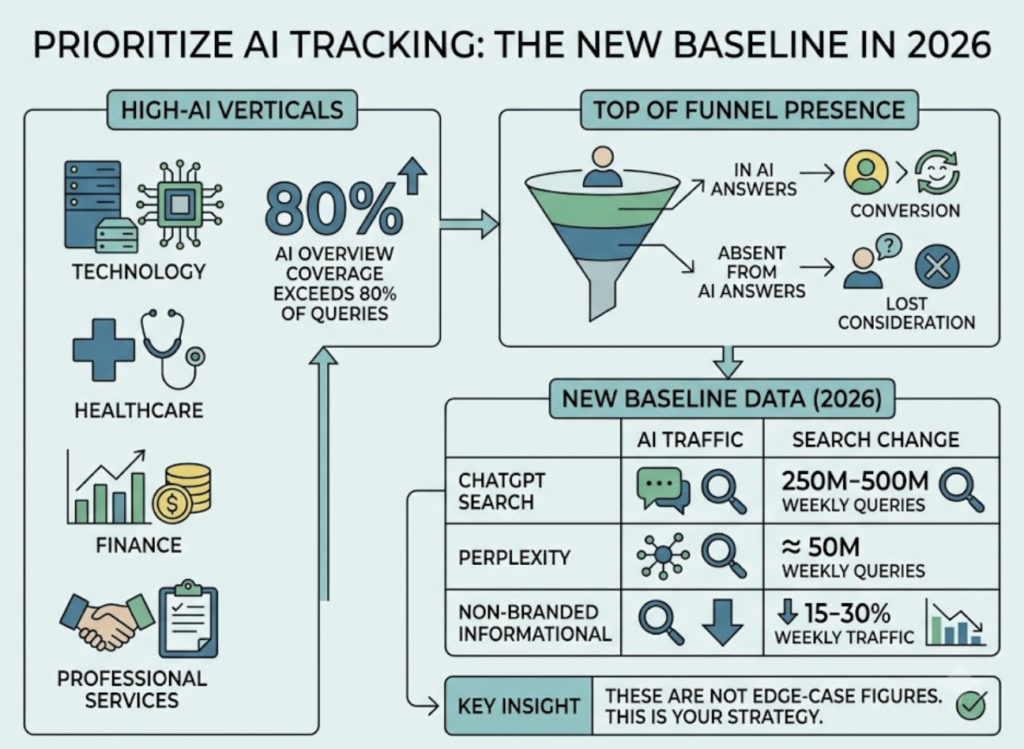
    Zero-click searches have reached 60% across all searches, with mobile pushing that number to 77.2%. At the same time, AI Overviews now trigger on more than double the queries they did a year ago, jumping from 6.49% to 13.14% in just one year. When an AI Overview appears, organic click-through rates drop by 47%, from 15% to 8%.

    Here’s the thing: when that happens, GA doesn’t alarm. It just shows fewer clicks. Your team debates whether it’s a seasonality issue or a content problem, when the actual issue is that the AI answered the question and the user moved on without ever clicking.

    That’s the architectural limit of post-click measurement. GA starts when the user arrives. AI Visibility Score starts when the user asks.

    What AI Visibility Score Actually Measures

    An AI Visibility Score is a composite index, typically 0-100, that quantifies how often and how authoritatively a brand appears in AI-generated answers across platforms like ChatGPT, Gemini, Perplexity, and others.

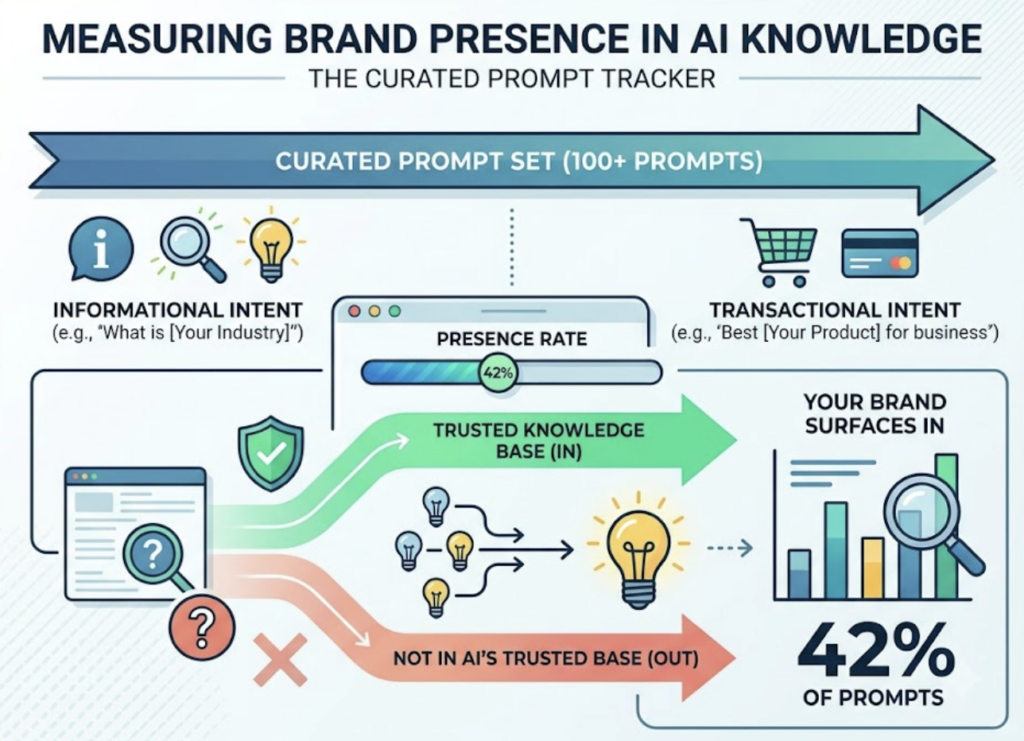
    It’s not a ranking. Rankings are deterministic. AI responses are probabilistic: the same query can produce different results across sessions, users, and platforms. So the score is built from a large sample of tested prompts, analyzed across multiple platforms, to establish a statistically valid baseline of brand presence.

    The comparison to GA is direct:

    DimensionGoogle AnalyticsAI Visibility Score
    Measurement pointAfter the user clicksWhile the AI is generating the answer
    Core questionWhat did users do on site?Did AI recommend the brand?
    Data sourceYour own websiteAI platform responses
    Competitor dataNot visibleDirectly comparable
    Nature of dataDeterministicProbabilistic (trend-based)

    Platforms like Topify build this score across seven distinct signals: visibility (raw mention frequency), sentiment (tone of the AI description), position (primary recommendation vs. secondary mention), volume (estimated user exposure), mentions (specific product recall), intent (alignment with the user’s query type), and CVR, which estimates the probability a specific mention leads to a high-intent visit.

    That’s the full picture GA can’t see.

    The 5 Signals That Go Dark in Your Analytics

    Each of these five signals represents a specific strategic gap that AI visibility tracking fills.

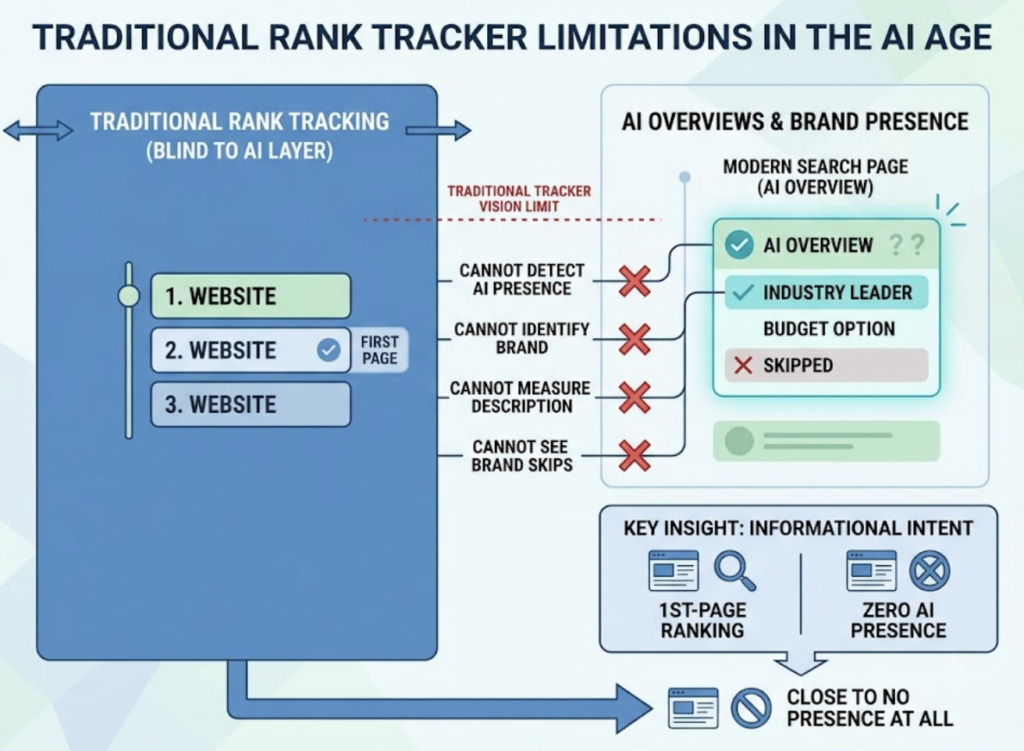
    Mention Rate. GA can only measure brands that were chosen. It has no concept of “filtered out.” When an AI narrows 50 competitors down to 4, the other 46 show nothing in their dashboards. If your brand ranks on page one of Google but appears in 0% of ChatGPT answers for the same query, your analytics look fine. Your future pipeline doesn’t.

    Position in the Answer. Not all mentions are equal. A brand named as the primary recommendation carries significantly more psychological weight than one listed under “you might also consider.” Research from 2025 shows that appearing in the top three AI recommendations results in a 35% boost in remaining organic CTR. GA sees all referral traffic as one session. AI visibility tracking tells you whether you’re winning the first slot or the consolation mention.

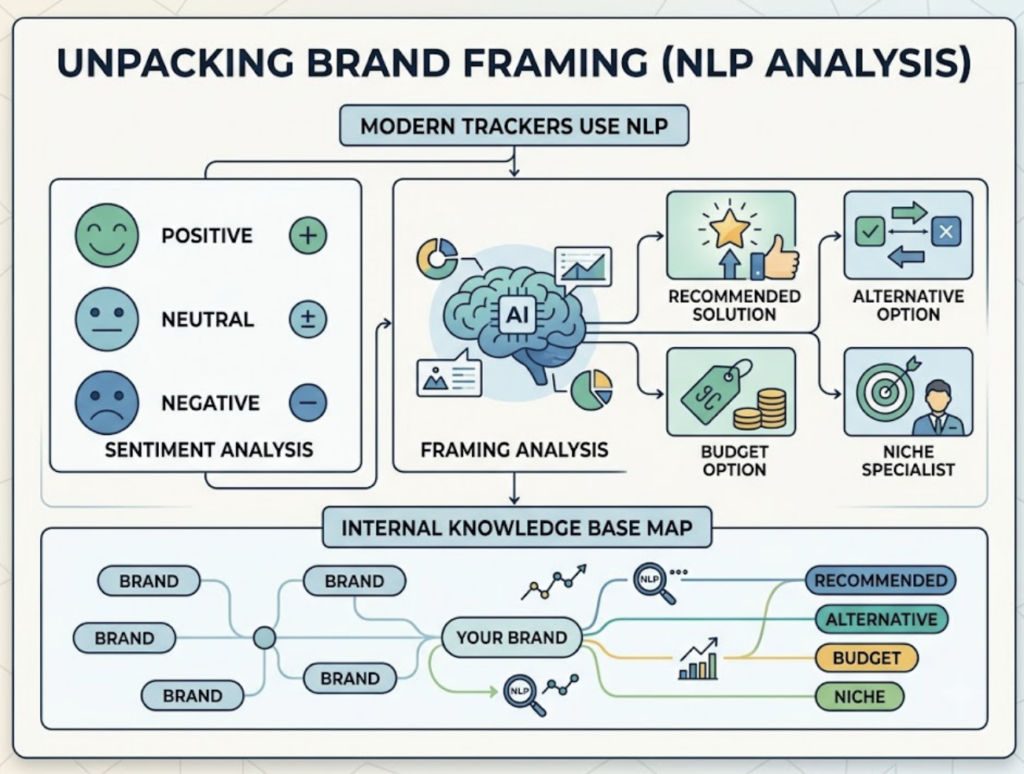
    Sentiment. Before a user clicks, the AI has already framed your brand. Phrases like “market leader” and “best for growing teams” build trust. Phrases like “steep learning curve” or “better for enterprise” can quietly eliminate you from consideration for an entire buyer segment. GA can’t audit that framing. NLP-based sentiment scoring can.

    Competitor Share of Voice. This is possibly the most valuable signal GA simply cannot provide. If your brand appears in 30% of tested prompts and a competitor appears in 85%, that 55-point gap is a concrete, measurable loss of influence in the recommendation funnel. You can see it, quantify it, and act on it.

    Platform Variance. A brand can be highly visible on ChatGPT and entirely absent from Perplexity, and GA will show them as the same “AI referral” traffic bucket. ChatGPT relies heavily on training data and Bing integration, while Perplexity prioritizes real-time web retrieval. The fix for each is completely different. You can’t identify the problem, let alone solve it, without platform-level breakdowns.

    A Score of 45 vs. 80: What “Good” Depends On

    There’s no universal benchmark for a good AI Visibility Score. What matters is competitive context.

    In B2B Tech and SaaS, AI Overviews now appear on 82% of queries. With so many competitors producing high-quality content, individual mention rates compress. Market leaders in this category typically score in the 30-40% mention rate range. A score of 45+ is considered strong. For less competitive niches, the target might be 60-70.

    The absolute number matters less than two things: the trend over time, and the gap against competitors.

    If your score is 52 and the industry average across your top ten competitors is 68, that 16-point gap isn’t an abstraction. It maps to specific prompt clusters where competitors are winning and you aren’t. Topify’s Competitor Monitoring surfaces exactly those gaps, showing whether you’re losing on “enterprise use case” queries, “pricing comparison” prompts, or a specific vertical you haven’t yet covered.

    That’s the starting point for prioritization. Not “improve our score generally,” but “close the gap on these six prompt categories.”

    Tracking Without Doing 2,400 Queries a Month

    Manual tracking is how a lot of teams start. It doesn’t scale.

    A brand monitoring 100 high-value prompts across four platforms weekly generates roughly 2,400 manual queries per month, before any analysis. That’s a part-time job, and it still misses real-time model updates.

    There’s also a more technical problem. Many early-stage tools use model APIs to check visibility, but API-based results only overlap 24% with what actual users see in the consumer interface. The consumer versions of ChatGPT and Perplexity include real-time retrieval layers that APIs skip entirely. You’d be measuring a sanitized version of the product your customers actually use.

    Topify solves both problems using browser simulation to capture what real users see, not API outputs. The Basic plan covers 100 prompts with roughly 9,000 AI answer analyses per month, across ChatGPT, Gemini, Perplexity, and others. The dashboard updates continuously, so a competitor content push or a model update shows up within hours, not at the next monthly report.

    That’s the difference between visibility data and visibility intelligence.

    Score Changes Tell a Story. Here’s How to Read It.

    A score drop in week three doesn’t necessarily mean something went wrong.

    When a model like GPT-4o or Claude is updated, internal brand authority weights can shift, and visibility changes typically take 2-4 weeks to stabilize as retrieval systems re-index the web. A single-week drop during a known model update cycle is noise. A four-week continuous decline is a signal.

    The pattern to watch is this: if your score drops while a competitor’s score rises simultaneously, that’s not model drift. The AI has found a better answer than yours and is actively routing users toward it.

    Also worth parsing: a drop on “how-to” prompts paired with a rise on “brand comparison” prompts often indicates a shift from educational authority to purchase consideration. That’s not a problem. That’s the funnel moving.

    On the flip side, a sudden drop to near-zero across all platforms often points to a technical issue: a robots.txt change or JavaScript rendering problem that’s made the site invisible to AI crawlers. That one warrants immediate investigation.

    The framework is simple. Trends over four-plus weeks beat single-point readings. Multi-platform drops beat single-platform anomalies. And a downward trend that mirrors a competitor’s upward trend is the clearest intervention signal in the data.

    Turning Your Score Into a Number Your CFO Cares About

    Most marketing leaders already understand AI visibility matters. The harder conversation is proving its financial value to someone who lives in the GA dashboard.

    Here’s the logic chain that connects score to revenue. When AI Visibility Score improves on high-intent prompts, the brand appears in the synthesized answer that a buyer reads before shortlisting. That buyer then arrives at the site already pre-qualified. AI-sourced clicks convert at 4.4x to 23x the rate of traditional search clicks, because the AI has already done the comparison work.

    That means a 15% improvement in visibility on high-intent prompts doesn’t just increase impressions. It increases the quality of every session that follows.

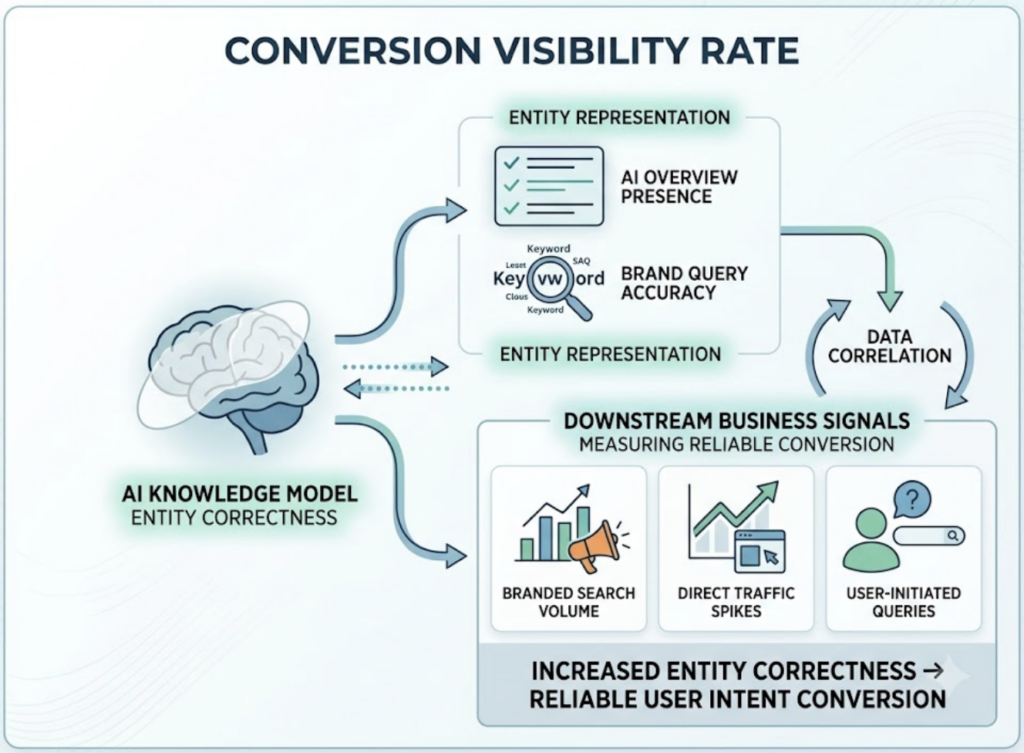
    Topify’s CVR (Conversion Visibility Rate) maps visibility data directly to conversion intent, identifying which prompts drive the highest commercial value pipeline. That’s the number to bring to the CFO: “We improved our visibility by 15% on queries that account for 80% of our enterprise pipeline.”

    For team goal-setting, the target structure is straightforward. Set a Share of Voice target against two or three specific competitors. Aim for a 10-15% improvement in mention rate on commercial intent prompt clusters within a 90-day window. Tie that to AI-sourced session volume in GA4. The story connects.

    Low Score? The Fix Isn’t More Keywords.

    A low AI Visibility Score is almost never a keyword problem. It’s an authority problem.

    AI systems weight “web consensus” over self-reported brand claims. If ChatGPT is citing Wikipedia, G2, and TechCrunch for your category, getting mentioned in those publications matters more than updating your homepage copy. Topify’s Source Analysis shows exactly which domains AI platforms are currently citing for your target prompts. That’s your content placement map.

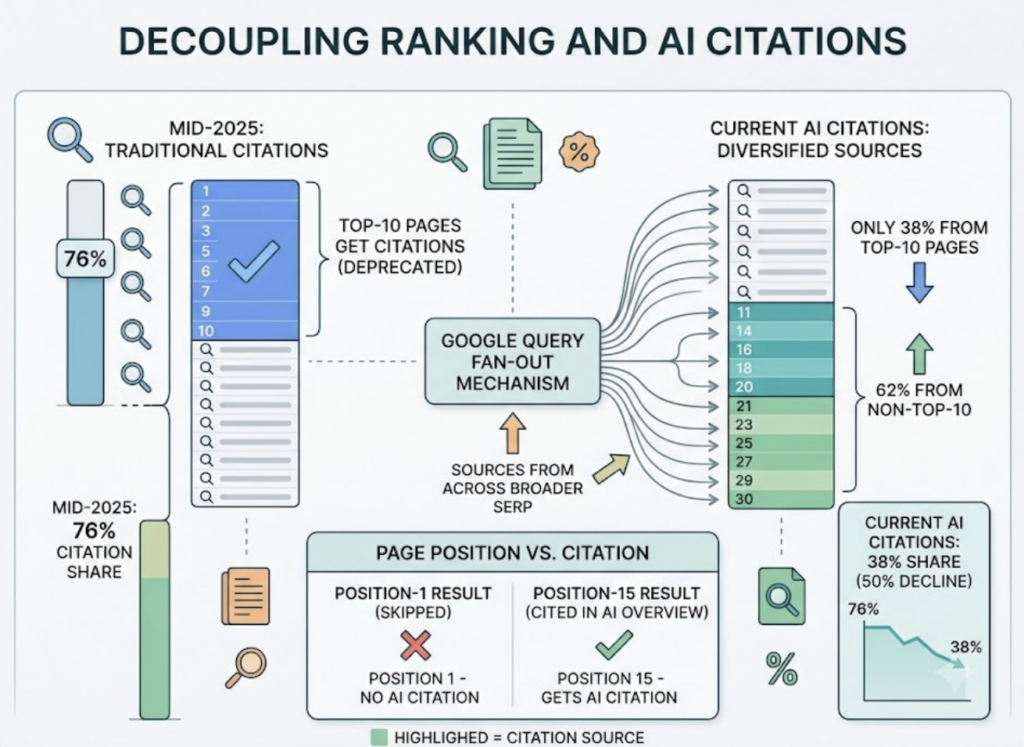
    The second fix is prompt coverage. AI systems use a process sometimes called “query fan-out,” breaking a single user question into multiple sub-topics before synthesizing an answer. If your content covers “what is X” but misses “how to implement X” and “X pricing compared,” you’ll be filtered out of answers that start with a question you think you’ve covered.

    Restructuring content also helps. Retrieval-Augmented Generation systems favor modular content: clear H2/H3 headings phrased as questions, followed by direct 40-60 word answers. That structure makes it significantly easier for AI to extract and cite your content as a supporting source.

    For teams running this at scale, Topify’s Pro plan includes 250 prompts and 100 content generations per month, allowing teams to rapidly deploy the specific content blocks, proprietary data points, and structured answers that AI systems use to evaluate source quality.

    Conclusion

    Google Analytics isn’t going away. It’s still the right tool for measuring what happens after someone reaches your site.

    But in 2025, 60% of searches end without a click, and the decision of which brands to recommend is being made inside AI platforms before your tracking script ever fires. GA measures the outcome. AI Visibility Score measures the selection process.

    The practical path forward is four steps: establish a baseline across the major AI platforms, track how your score moves relative to competitors, fill the content gaps that AI systems are routing around, and connect visibility improvements to pipeline data that makes sense to the whole organization.

    Both scorecards matter. Right now, most teams are only running one of them.

    FAQ

    What is an AI visibility score and how is it calculated? It’s a composite index, typically 0-100, measuring how often and how authoritatively a brand appears in AI-generated answers. It’s calculated by analyzing a large sample of prompts across platforms, weighting each brand appearance by mention rate, position in the answer, and sentiment of the AI’s description.

    How does AI visibility score differ from traditional SEO ranking? Traditional SEO tracks your link position on a results page. AI visibility score tracks your mention share within a synthesized answer. A brand can rank first on Google and have zero AI visibility if the AI summarizes a competitor’s content instead of yours.

    What is a good AI visibility score for my industry? It depends on competitive density. In B2B Tech/SaaS, a score of 45+ is strong because AI Overviews appear on 82% of queries and compress individual mention rates. In less competitive niches, 60-70 is a reasonable target. More important than the absolute number is whether it’s trending up and how it compares to your top three competitors.

    How do I interpret changes in my AI visibility score over time? Single-week fluctuations are often model drift. Trends over four or more weeks carry strategic meaning. A continuous decline while a competitor’s score rises simultaneously is the clearest signal that intervention is needed. Changes typically stabilize 2-4 weeks after a model update.

    How can I connect AI visibility score to revenue? Track AI-sourced sessions in GA4 separately. AI-referred visitors convert at significantly higher rates than traditional search visitors because the AI has already done comparison work before the click. Combine that with prompt-level CVR data to show which specific visibility improvements are driving high-intent pipeline.

    How do I set AI visibility score targets for my marketing team? Anchor targets to competitor gaps rather than absolute numbers. A practical 90-day goal is a 10-15% improvement in mention rate on commercial intent prompts, measured against two or three named competitors. That framing makes targets specific, measurable, and tied to market share outcomes.

    Read More

  • Your Competitors Are Getting Recommended by AI. Here’s How to Find Out Why.

    Your Competitors Are Getting Recommended by AI. Here’s How to Find Out Why.

    You ask ChatGPT to recommend a project management tool. It lists five names. Yours isn’t one of them.

    That’s not a coincidence. It’s a competitive gap you can measure, analyze, and close. But only if you know what to look for.

    AI search competitor analysis works differently from anything in traditional SEO. There are no keyword rankings to check, no SERP positions to screenshot. Instead, you’re tracking citation frequency, brand mention rates, and share of voice inside synthesized answers generated in real time. The brands that understand this are already pulling ahead.

    Most Brands Don’t Know They’re Losing AI Search Share Until It’s Too Late

    Traditional search volume is projected to decline 25% by 2026, and most of that volume isn’t going nowhere. It’s going to AI.

    ChatGPT alone now handles over 1 billion queries per day with 800 million weekly active users. When AI Overviews are present in a search result, zero-click rates hit 83%. For Google’s AI Mode, that number reaches 93%. If your brand isn’t being cited inside the answer, you’re not just ranking lower. You effectively don’t exist for that user.

    That’s the gap most brands still can’t see.

    Meanwhile, your competitors aren’t invisible. They’re being recommended by name, described favorably, and positioned as trusted choices. They didn’t get there by luck. Their content, their citation profile, and their prompt-level coverage created a pattern that AI models have learned to trust. AI search competitor analysis is how you reverse-engineer that pattern.

    The 4 Metrics That Reveal Your Competitor’s AI Visibility

    Competitive AI visibility isn’t a single number. It’s a combination of four dimensions that together tell you where a competitor is winning and why.

    Visibility Rate (sometimes called Answer Inclusion Rate) measures how often a competitor appears across a defined set of category-relevant prompts. If a rival shows up in 80% of “best tool for remote teams” queries while you show up in 10%, they’ve built structural authority in that topic space. You haven’t.

    Share of Voice in AI search calculates your competitor’s mentions as a percentage of all brand mentions in a category. AI engines typically limit recommendations to 3–5 brands per answer, which means share of voice in this context is genuinely zero-sum. When a competitor gains, you lose a slot.

    Recommended Position determines where in the response a brand appears. Research shows brands mentioned in the first two sentences of an AI response receive 5x more consideration than those mentioned later. Being included isn’t enough. Where you’re included changes everything.

    Sentiment tracks how the AI describes a competitor. High visibility with neutral or negative framing is a warning sign for them and an opportunity for you. An AI that describes a competitor as “a budget option with limited support” is damaging their brand equity with every recommendation.

    Across these four dimensions, a full picture of competitor AI visibility starts to emerge. The next question is: what’s driving it at the prompt level?

    How to Discover Which Prompts Trigger Competitor Brand Mentions

    When a competitor is recommended and you’re not, something specific happened at the prompt level. Understanding that mechanism is the core of AI search competitive intelligence.

    AI systems don’t evaluate websites. They process language patterns. When a user asks a question, most major AI platforms decompose it into 8–12 parallel sub-queries to retrieve information from across the web. Many of these sub-queries carry zero traditional search volume. They’re invisible to Google Search Console. But they’re actively driving AI recommendations.

    This is where competitors often build their edge quietly. A user asks: “Which CRM works best for a five-person non-profit?” The AI fans out to sub-queries about non-profit pricing tiers, ease of use for small teams, and donor software integrations. A competitor who’s built content that answers those specific intent layers gets retrieved and cited. Even if they’ve never ranked for the original broad keyword.

    The methodology for prompt-level competitor analysis follows a clear structure: identify a broad corpus of relevant questions, categorize them by buyer journey stage, run them across multiple AI platforms, and look for where competitors appear while you don’t. That gap list is your content priority queue.

    Topify‘s High-Value Prompt Discovery automates this process, tracking between 100 and 250 prompts per plan across ChatGPT, Gemini, Perplexity, and other platforms. Instead of manually probing queries one by one, you get a real-time map of which specific triggers are favoring competitors. That turns a research task that would take weeks into a structured, repeatable workflow.

    Consider what this looks like in practice. A SaaS brand discovers a competitor is cited every time someone asks about “Agile workflows for distributed teams.” The source isn’t their homepage. It’s a comprehensive Agile Frameworks Guide the AI consistently uses as a grounding reference. An e-commerce brand finds a rival is recommended for “eco-friendly sneakers under $100” because their product pages include structured data with clear price and material definitions the AI can extract cleanly. A marketing agency notices a competitor is cited for “B2B lead generation trends 2026” because a LinkedIn thought-leadership post got picked up by the AI’s real-time retrieval system.

    None of these are accidents. They’re patterns you can identify and replicate.

    Reverse-Engineering Competitor Citation Sources in AI Platforms

    Knowing that a competitor is visible isn’t enough. You need to know where that visibility is coming from.

    In traditional SEO, authority flows through backlinks. In AI search, authority flows through citations. And they’re not the same thing. Research shows brand mentions across the web correlate at r=0.664 with AI visibility, while backlink quality correlates at only r=0.218. The AI isn’t primarily trusting your link profile. It’s trusting the consensus built by third-party sources that mention your brand favorably and consistently.

    The citation breakdown for most branded AI recommendations follows a predictable pattern: earned media accounts for roughly 48% of citations, commercial brand content around 30%, owned website content around 23%, and reference sites like Wikipedia or Product Hunt around 10%. Your website, in other words, is the weakest source of AI authority you own.

    This reframes the entire question of how competitors build AI visibility. If a rival is being recommended, the most likely reason isn’t that their homepage is better. It’s that industry blogs, niche publications, and forum discussions have built an independent case for them that the AI finds credible. Brands mentioned positively across at least four non-affiliated forums are 2.8x more likely to appear in ChatGPT responses.

    Topify’s Source Analysis tracks the exact domains and URLs that AI platforms are citing when they recommend a competitor. This reveals the “source gap” directly. You can see whether the AI is citing academic content, Reddit threads, YouTube reviews, or niche industry directories. Each source type points to a different content strategy. If a competitor’s visibility is anchored in Reddit and Wikipedia, the fix isn’t on-page optimization. It’s digital PR, community engagement, and unlinked brand mention acquisition.

    Competitor GEO Benchmarking Across Platforms: Why One Platform Isn’t Enough

    Here’s a structural issue that most brands miss when they start tracking competitor AI visibility: leading on one platform doesn’t mean you’re leading anywhere else.

    ChatGPT cites Wikipedia at 7.8% and tends toward nuanced, detailed brand comparisons, averaging 5.84 brands per response. Perplexity cites Reddit at 6.6% and favors fact-dense, research-backed sources, averaging 4.37 brands. Google AI Overviews prioritizes YouTube at 62.4% and pulls heavily from the Google ecosystem. These aren’t minor differences in preference. They represent fundamentally different citation architectures, which means a competitor’s visibility can vary dramatically across platforms depending on where they’ve built their content presence.

    A complete competitor GEO benchmarking program runs across at least ChatGPT, Gemini, Perplexity, and Google AI Mode simultaneously, using a standardized set of prompts to compare mention rates, share of voice, and position for each rival. The goal is to identify where the competitive gap is widest and which platforms represent the highest opportunity.

    Topify’s Dynamic Competitor Benchmarking automates this multi-platform tracking from a single dashboard. It automatically detects new competitors appearing in your category, monitors real-time shifts in visibility, and surfaces emerging rivals before they become established threats. That kind of early detection is what separates a reactive GEO strategy from a proactive one.

    Benchmarking also answers a question that’s often overlooked: is your competitor strong across all platforms, or only on one or two? A competitor who dominates in ChatGPT but barely appears in Google AI Overviews has a fragile position. That’s a specific, exploitable gap.

    Competitive benchmarking isn’t a one-time project. Model updates, new training data, and shifts in citation patterns mean that a baseline from six months ago may no longer reflect current reality. Weekly audits for high-value commercial prompts and monthly reviews for broader category trends is a reasonable cadence for most teams.

    Turning Competitive GEO Analysis Into a Content Strategy That Actually Wins

    The analysis is the map. The content strategy is how you move.

    After running a competitive AI search analysis, most brands identify three types of gaps, each requiring a different response. Understanding which gap is largest tells you where to start.

    The first is a Prompt-Intent Gap: competitors are appearing for high-value buyer prompts where you’re absent entirely. This is the most urgent situation. The fix is creating authoritative “cornerstone” content that covers the intent directly. Answer-first structure (leading every section with a 50–100 word direct summary), comprehensive topic coverage, and structured formatting using H2/H3 hierarchies and Markdown tables all improve the likelihood that AI systems can retrieve and cite your content cleanly.

    The second is a Media and Citation Gap: competitors are recommended because they’re cited by third-party domains that don’t mention you. This is an off-page GEO problem. Digital PR, subject-matter expert contributions to industry forums, and consistent community presence on platforms the AI favors are the right responses here. Ranking on Google won’t fix this. Building a mention profile across independent sources will.

    The third is a Sentiment and Narrative Gap: you’re appearing in AI responses, but the AI describes you less favorably than competitors. This often happens when a brand’s own content is ambiguous or outdated. AI models fill information gaps with whatever they can find, including outdated reviews, forum complaints, or competitor comparison pages. Auditing and updating your “single source of truth” pages (pricing, features, about) with clear, declarative definitions gives the AI accurate material to work with.

    Topify’s One-Click Execution connects this analysis directly to action. You state your goals in plain English, review the proposed content strategy, and deploy it. Instead of insights sitting in a dashboard, they get translated into GEO-ready content and optimized execution. That’s the step where most teams lose momentum, and it’s where automation makes the biggest difference.

    Competitive analysis isn’t the destination. It’s the starting point.

    Conclusion

    The brands winning AI search in 2026 aren’t doing it by accident. They’ve mapped which prompts trigger competitor recommendations, traced the citation sources behind that visibility, benchmarked performance across platforms, and turned those findings into a content roadmap that systematically closes the gap.

    None of this requires guessing. It requires measurement. AI search competitor analysis gives you a repeatable framework to understand exactly where competitors are ahead, why they’re ahead, and what it would take to change that. The gap is visible. The path is clear. Starting the analysis is the only step that’s actually in your control.


    FAQ

    How do I find out which AI platforms recommend my competitors?

    Manual probing of ChatGPT, Gemini, and Perplexity with high-intent prompts is a starting point, but it captures only a small slice of the AI recommendation landscape. Systematic tracking requires a GEO platform that can run hundreds of prompts across multiple regions and timeframes to account for the non-deterministic nature of AI responses.

    What’s the difference between AI share of voice and traditional search share?

    Traditional search share is based on keyword rankings and estimated click-through rates from a results list. AI share of voice measures how often your brand appears inside a synthesized recommendation, relative to all other brands mentioned. Because AI responses increasingly result in zero-click outcomes, share of voice in AI search is closer to a “consideration” metric than a traffic metric.

    How often should I run a competitive GEO analysis?

    Weekly audits for high-priority commercial prompts and monthly reviews for broader category trends is the standard for most teams. Model updates and the ingestion of new training data can shift citation patterns quickly, so a static quarterly benchmark isn’t enough.

    Can competitor backlink profiles influence AI search visibility?

    Backlinks still play a supporting role, but their influence is secondary to brand mentions. Backlink quality correlates at r=0.218 with AI visibility, compared to r=0.664 for brand mentions across independent sources. In AI search, backlinks act as reputation signals that help models evaluate source credibility, but they’re not the primary driver of who gets recommended.

    What does a healthy competitor monitoring workflow look like?

    It starts with selecting 3–5 direct rivals, establishing a visibility baseline across a standardized set of 100 or more prompts, and tracking their citation sources across platforms. Those findings feed into a regular content sprint to address prompt-intent gaps, citation gaps, and sentiment gaps. The key is making the workflow repeatable, not just running it once.


    Read More

  • AI Brand Monitoring: How to Track What ChatGPT and Gemini Say About Your Brand

    AI Brand Monitoring: How to Track What ChatGPT and Gemini Say About Your Brand

    Your competitor just got recommended by ChatGPT to thousands of potential buyers. Your brand didn’t show up once.

    You didn’t lose a Google ranking. You didn’t get a bad review. You simply don’t exist in the answer the AI gave — and you had no idea it happened.

    That’s the core problem with AI brand monitoring today. Most marketing teams are watching the wrong channels.

    Your Brand Might Be a Ghost in AI Search Right Now

    According to research, approximately 60% of brands are currently misrepresented or ignored by AI models. Not penalized. Not ranked lower. Just absent.

    This isn’t a niche problem. ChatGPT reached 810 million monthly active users by November 2025, with 800 million weekly active users by April of the same year. These aren’t early adopters experimenting with a toy. These are your buyers, using AI as their first stop for product research.

    Among B2B decision-makers, 42% now use an LLM as the very first step in their procurement process. For consumer brands, 50% of shoppers actively seek out AI search engines when making buying decisions.

    If you don’t know what those AI systems are saying about your brand, you’re flying blind on a channel that’s already influencing your pipeline.

    Why Social Listening Won’t Save You Here

    Here’s the thing most marketing teams get wrong: they assume their existing brand monitoring stack covers AI.

    It doesn’t.

    Social listening tracks what people say — sentiment on X, mentions on Reddit, hashtag volume on LinkedIn. AI brand monitoring tracks what the model says across ChatGPT, Gemini, Perplexity, and similar platforms. These two signals are frequently uncorrelated.

    A brand can run a viral campaign that spikes social sentiment to 80% positive while remaining invisible to ChatGPT, because viral social content doesn’t automatically feed into the model’s authoritative training data or structured knowledge base.

    Social ListeningAI Brand Monitoring
    Data SourceSocial APIs, forums, blogsLLM outputs, RAG retrieval, training data
    What It TracksMention volume, hashtags, human sentimentBrand visibility, citation rate, AI recommendation accuracy
    Core SignalPeer-to-peer influenceAlgorithm-to-user synthesis
    Trust FactorSocial proofAuthoritative synthesis

    The difference matters. Research from Bain & Company shows 62% of consumers now trust AI to guide their brand decisions, putting AI recommendations on par with traditional search during key purchase moments.

    When ChatGPT recommends a vendor, it’s not linking to ten options and letting the user decide. It’s synthesizing reviews, specs, and industry sentiment into a single narrative. The user often accepts that narrative without further research.

    That’s not a mention. That’s a verdict.

    The 5 Metrics That Actually Matter for AI Brand Visibility

    Tracking brand performance in AI platforms requires a different measurement framework than anything you’re using today. Here are the five metrics worth building around.

    1. Brand Mention Rate

    The percentage of relevant queries where your brand appears in the AI response. If 20 prompts about “best enterprise security software” generate 12 responses that mention your brand, your mention rate is 60%.

    Watch your rate on unbranded discovery queries — questions like “What are the best tools for X?” — not just branded ones. A 100% rate on branded queries with a near-zero rate on category queries signals a serious GEO gap.

    2. AI Brand Sentiment Score

    This isn’t standard sentiment analysis. It evaluates how the model frames your brand. Does it describe your product as a reliable solution, or as a “legacy tool with high switching costs”?

    Advanced platforms score this on a 0-100 scale. Above 80 indicates a consistently positive recommendation pattern. Below 50 means the AI experience for your brand is net-negative — and you probably don’t know it yet.

    3. Brand Share of Voice in AI

    Your mention rate in isolation tells you very little. What matters is how it compares to your top three to five competitors. If you appear in 40% of category responses but a competitor appears in 75%, that gap is costing you pipeline — quietly, every day.

    The formula: (Your brand mentions ÷ Total mentions of all brands in category) × 100.

    4. Position and Ranking in AI Responses

    AI answers aren’t a flat list. Position 1-2 means the model leads with your brand. Position 6-9 means you’re an afterthought. Users rarely engage with anything beyond the first few recommendations in a generated response.

    Where you rank within the answer matters as much as whether you appear at all.

    5. Source Coverage and Citation Frequency

    This tells you why the AI knows what it knows about your brand. Earned media — editorial coverage, forums like Reddit, review sites like G2 — accounts for roughly 48% of AI citations. Your own website content accounts for only about 23%.

    If the AI is citing a three-year-old TechCrunch article and a handful of Reddit threads to build its picture of your brand, that’s both a vulnerability and an opportunity.

    How to Set Up AI Brand Monitoring Across ChatGPT, Gemini, and Perplexity

    Setting up a real monitoring operation involves four concrete steps. The earlier you establish a baseline, the more useful your trend data becomes.

    Step 1: Build your prompt corpus.

    Don’t just track your brand name. You need to track the “discovery queries” buyers actually use before they know which brand to choose. These include category queries (“Best software for [task]”), competitor comparison queries (“[Competitor] vs alternatives”), and use-case queries (“How to solve [specific problem]”).

    A working corpus typically needs 50-100 prompts to surface meaningful pattern data.

    Step 2: Choose a monitoring tool that covers multiple platforms.

    Manual monitoring is not a viable long-term approach. Research shows a team manually checking 14 competitor pages daily spends over an hour per day on a single platform. Automated tools reduce that to minutes with 24/7 coverage.

    Topify covers ChatGPT, Gemini, Perplexity, DeepSeek, and other major AI platforms, running up to 100 customized prompts and analyzing up to 9,000 AI answers per month on the Basic plan. The platform tracks visibility, sentiment, position, and source data in a single dashboard rather than requiring you to stitch together data from five different tools.

    Step 3: Establish a 30-day baseline.

    Your first month of data is less about optimization and more about understanding your starting position. Track mention volatility (how much your visibility fluctuates day-to-day), platform bias (does Gemini mention you more than ChatGPT?), and citation gaps (which third-party URLs are your competitors owning that you’re absent from?).

    Step 4: Set up alerts for meaningful shifts.

    A ±10-point swing in your composite visibility score warrants investigation. So does a competitor’s share of voice jumping more than 15% in a single week. During product launches or PR events, move from weekly checks to daily monitoring.

    What Negative Brand Mentions in AI Look Like

    AI negativity doesn’t always look like a one-star review. It’s often more subtle — and more damaging because of it.

    The most common patterns: competitor replacement (the AI recommends a rival over you by name), the “controversial” label (the model tags your brand with “unresolved customer service issues” based on a stale forum thread), and entity hallucination (the AI confuses your brand with a similarly named company that has a poor reputation).

    None of these will show up in your social listening dashboard.

    What makes this particularly problematic is persistence. Social media crises are often intense but short-lived. AI negativity isn’t. Once a model incorporates a negative framing — whether from an outdated review or a training data artifact — it repeats that framing to every user who asks a relevant question, until the underlying data ecosystem is corrected.

    Topify’s Sentiment Analysis clusters negative mentions and identifies the specific “source of truth” the AI is pulling from — whether it’s a particular Reddit thread, an old review site article, or a technical documentation gap. That makes fixing the problem a targeted operation rather than a guessing game.

    Benchmarking Your Brand Against Competitors in AI Search

    In AI search, you don’t need to be perfect. You need to be more cite-worthy than the alternatives the AI is already recommending.

    Benchmarking reveals exactly where the gaps are. A visibility gap (you appear in 20% of category queries, a competitor appears in 80%). A sentiment gap (the AI calls you “functional” and the competitor “innovative”). A position gap (you’re consistently listed third or fourth).

    The methodology is straightforward: select three to five direct competitors, run the same 50 prompts across ChatGPT, Gemini, and Perplexity for all brands, then map which third-party domains are generating AI citations for each brand.

    If 80% of AI citations for a rival come from high-authority review sites you’re not on, your next move is clear.

    Topify’s Competitor Monitoring automates this process, delivering weekly reports on competitor share of voice with cross-platform breakdowns. You can see if a competitor is gaining ground specifically on Gemini while you hold steady on Perplexity — and trace it back to which sources are driving the divergence.

    Turning Monitoring Data into GEO Strategy

    Monitoring is the diagnostic. What you do with the data is where the actual value gets created.

    There are three paths from insight to action.

    Path 1: Close the prompt gap with targeted content. If your brand is absent from discovery queries about your category, create content that directly addresses those queries with statistics, expert perspectives, and structured data. Research shows adding statistics increases AI visibility by 37%, and citing authoritative sources by up to 40%.

    Path 2: Close the source gap with earned media. If the AI is citing Wikipedia and review sites instead of your content, your priority is building presence on those platforms. Earned media accounts for 48% of AI citations — editorial coverage, relevant subreddits, review platforms. That’s where AI models are looking for “objective” information about your brand.

    Path 3: Close the sentiment gap with narrative correction. If the AI has absorbed a flawed or outdated narrative about your brand, you need to flood the ecosystem with accurate, structured information. Practical starting points include updating your llms.txt file, correcting stale documentation, and pushing accurate product specs to high-authority review platforms.

    Topify’s one-click execution connects monitoring data directly to strategy deployment. You can generate AI-optimized product descriptions and FAQs designed specifically to be cited by LLMs, without building a separate workflow for each platform.

    Track. Fix. Repeat.

    Conclusion

    The AI search channel isn’t experimental anymore. With 800 million weekly active users on ChatGPT alone, the question isn’t whether AI is influencing your buyers — it’s whether you have any visibility into how.

    Traditional organic traffic is already under pressure, with AI Overviews driving a 34.5% drop in click-through rates and some high-traffic keywords losing up to 64% of their volume. Meanwhile, the buyers you do reach through AI convert at 27% — more than 10x the average search conversion rate — because the AI has already done the evaluation for them.

    AI brand monitoring gives you the data to compete in this environment. Start with the five core metrics. Build a prompt corpus. Establish a baseline. Then use what you learn to make your brand the answer AI gives by default.


    FAQ

    How do you track brand visibility trends over time in AI search?

    You need a stable corpus of 50-100 prompts queried weekly across ChatGPT, Gemini, and Perplexity. Log your mention rate and position score consistently over time in a centralized dashboard. Model updates can introduce sudden shifts in visibility, so longitudinal data is what separates a real trend from a one-week anomaly.

    How do you identify which AI platforms mention your brand most?

    Multi-platform monitoring tools compare your answer inclusion rate across different engines. This matters because platform behavior varies significantly: Gemini often favors brands with strong Google Search presence, while Perplexity prioritizes academic and technical citations. Knowing which platform is your weakest link tells you where to focus your GEO effort first.

    How do you measure the impact of content on AI brand mentions?

    Run a controlled comparison. Update a set of pages with GEO-focused content — statistics, expert quotes, structured schema — and keep a comparable set unchanged. Monitor the citation rate for both groups over 60 days across Perplexity and Google AI Overviews. High-performing content typically sees a 30-40% increase in AI citation frequency within that window.

    How do you build a brand monitoring dashboard for AI search?

    A functional dashboard integrates four data streams: mention rate (how often you appear), sentiment score (the 0-100 quality of how you appear), competitive share of voice (your percentage vs. rivals), and AI-referred traffic (tracked via GA4 using Perplexity and ChatGPT as referral sources). These four together give you both a leading indicator (AI signals) and a lagging indicator (actual traffic impact).

    Why is AI brand monitoring fundamentally different from social listening?

    Social listening is reactive and human-centric — it tracks what people say about you. AI brand monitoring is proactive and algorithmic — it tracks what the model has been trained or prompted to say about you. They use different data pipelines, surface different problems, and require different solutions. You need both, but they don’t replace each other.

    How do you detect negative brand mentions in AI search responses before they compound?

    Set up weekly sentiment scoring across your core prompt corpus and flag any response where the model qualifies your brand with words like “however,” “despite,” “limited,” or “controversial.” These linguistic markers often signal the AI is pulling from a negative or outdated source. Once you identify the framing, trace it back to its citation origin and correct the source directly.


    Read More

  • GEO Analysis: See Exactly How AI Sees Your Brand 

    GEO Analysis: See Exactly How AI Sees Your Brand 

    Your domain authority is 72. Your target keywords are ranking on page one. Traffic is up 18% quarter-over-quarter. Then a potential customer opens ChatGPT, types “best [your category] tool for mid-market companies,” and gets a confident list of five recommendations. Your brand isn’t on it.

    That’s not an SEO failure. That’s a GEO visibility gap, and your current dashboards have no way to show it.

    Your SEO Dashboard Is Green. ChatGPT Still Doesn’t Know You Exist.

    Traditional SEO audits measure what Google’s algorithm values: backlinks, domain rating, page speed, and keyword density. Those signals still matter for Google. But generative engines like ChatGPT, Gemini, and Perplexity don’t use PageRank. They use Retrieval-Augmented Generation (RAG), pulling semantic chunks of content from the web, converting them into vector embeddings, and synthesizing a narrative response.

    The selection logic is mathematical: when a user submits a prompt, the engine surfaces content that minimizes distance in a multi-dimensional semantic space. Visibility is a function of semantic relevance and factual density, not backlink volume.

    This means a brand can rank first on Google and remain completely absent from AI-generated recommendations for the same category. Research suggests AI search now influences up to 73% of B2B buying journeys, yet most marketing teams are tracking zero metrics specific to it.

    That’s the gap GEO analysis is built to close.

    What GEO Analysis Actually Measures

    GEO analysis is the systematic process of evaluating a brand’s presence, perception, and competitive standing inside generative AI responses. It’s not an extension of traditional SEO audit methodology. It’s a separate framework interrogating how AI models represent your brand.

    A complete GEO analysis tracks seven dimensions:

    Visibility (Share of Model): How often does your brand appear when users ask category-level questions? Share of Model (SoM) calculates this as a percentage of total possible recommendations across platforms. In the legal tech space, for example, one leading brand holds a 32.9% SoM on ChatGPT and 47.8% on Gemini, while competitors trail significantly.

    Sentiment: A mention is only valuable if the framing is positive. AI responses that describe your brand as “expensive” or “suited for small teams” when you’re positioned as enterprise-grade are actively damaging. High-performing brands track a Net Sentiment Score (NSS) and target ratings above 80%.

    Position: In AI answers, the first brand mentioned typically receives the most authoritative framing (“The industry leader is…”), while later mentions are framed as alternatives. GEO analysis tracks this ordinal ranking to understand perceived market hierarchy.

    Citation Rate: When an AI cites a URL alongside a brand mention, it signals higher authority than an uncited mention. Optimized brands typically see citation rates between 20% and 50%. Unoptimized brands often sit below 10%.

    Prompt Volume: Conversational AI search demand doesn’t map to traditional keyword volume. GEO analysis estimates how frequently users are actually asking specific prompts in tools like ChatGPT or Perplexity, separate from what Semrush or Ahrefs would show.

    Source Domain Influence: AI doesn’t pull from the entire web equally. It relies on a retrieval set of trusted domains. Knowing which third-party sites shape the AI’s view of your brand tells you exactly where to invest your distribution and PR efforts.

    CVR (Conversion Visibility Rate): Traffic from AI search converts at dramatically higher rates than organic search, because the AI has already pre-qualified the recommendation. Claude-referred visitors convert at 16.8% (6x Google organic), ChatGPT at 14.2%-15.9%, and Perplexity at 10.5%-12.4%, compared to Google organic’s 1.76%-2.8% baseline. GEO analysis connects visibility to this conversion advantage.

    How to Conduct a GEO Audit in 4 Steps

    Step 1: Map Your Prompt Universe

    A GEO audit starts with selecting 40-100 prompts that reflect how real buyers research your category. Cover three intent types: discovery (“What are the best [category] tools for mid-market?”), problem-solving (“How do I [specific workflow]?”), and comparison (“Brand A vs Brand B for [use case]”).

    Without this mapping, you’re auditing a blank target. The prompt universe determines what the audit can actually tell you.

    Step 2: Measure AI Search Visibility Across Platforms

    Tracking one platform is a common audit failure. ChatGPT, Gemini, Perplexity, and Claude often return very different answers for the same prompt. Perplexity leans heavily on real-time news sources; Gemini integrates the Google Knowledge Graph. A meaningful AI search visibility analysis records mention rates, citation status, and position for every prompt on every platform.

    This cross-platform view is where most single-dashboard solutions fall short.

    Step 3: Run the Sentiment and Narrative Analysis

    Does the AI accurately describe your value proposition? If your product is enterprise-grade but AI consistently describes it as “budget-friendly,” that’s a narrative misalignment that’s harder to fix than low visibility. This step also surfaces reputation risks: outdated pricing, discontinued features, or competitor comparisons that frame you unfavorably.

    This is the difference between a GEO audit and a simple mention tracker.

    Step 4: Source and Content Gap Audit

    This is the most actionable part of any GEO audit. By analyzing the URLs an AI cites when discussing your category, you can identify exactly which third-party domains are shaping the model’s worldview. If competitors are being cited because of a specific industry report, a Reddit thread on a review platform, or a G2 category page you haven’t optimized, you now have a specific, executable content gap to close.

    Brands that run this step systematically discover an average of 23 untapped prompt opportunities and 14 content gaps per audit cycle.

    GEO Competitive Analysis: What AI Says About Your Competitors

    GEO competitive analysis reveals a type of visibility gap traditional SEO can’t surface. If a competitor appears in 65% of relevant category queries while your brand appears in 8%, that deficit won’t show up anywhere in your existing analytics stack.

    This happens because AI recommendation patterns are driven by “Entity Authority.” LLMs are trained to value consensus across multiple authoritative sources. If ten high-authority sites describe a competitor as the category leader, the model synthesizes that as a working truth. Reversing that requires either owning the same sources or introducing competing signals from equally authoritative domains.

    The competitive intelligence from a GEO analysis is specific and actionable. You can see which sources your competitor dominates that you don’t. You can identify which prompt categories they’re winning that you’re not even present in. You can track whether their AI sentiment score is declining, which signals an opening.

    That’s not a metric available in any traditional SEO tool.

    How to Interpret Your GEO Visibility Scores

    Raw GEO scores only matter in context. Here’s how to read the four key scenarios:

    High visibility, low sentiment. The AI knows your brand but associates it with negatives. This is the “reputation risk” quadrant and it’s more dangerous than invisibility. The fix isn’t more content; it’s narrative correction through case studies, structured review content, and responses to specific misrepresentations in the sources the AI is pulling from.

    High sentiment, low visibility. The AI has a favorable view but rarely surfaces you. You have a distribution problem, not a credibility problem. The fix is topical authority: creating content that answers the broad conversational questions in your category where you’re currently absent.

    High citation frequency, low referral traffic. The AI is citing you, but users aren’t clicking. That’s often a zero-click pattern where the AI answer is comprehensive enough that users don’t need to visit your site. The fix is creating high-utility assets the AI can’t summarize: downloadable templates, calculators, or raw datasets.

    Low across the board. This is the starting point for most brands running their first GEO audit. Prioritize prompt universe coverage first, then citation rate, then sentiment. Don’t try to fix everything simultaneously.

    5 Content Tactics That Directly Improve GEO Performance Metrics

    Research from Princeton and Georgia Tech identified specific tactics that measurably improve AI citation and mention rates. The lift is significant enough to treat these as strategic priorities, not stylistic preferences.

    Adding statistics and original data increases AI visibility by 33.9% to 40%. AI models can’t generate original data; they synthesize it. Content with specific numbers, dates, and sourced claims is substantially more “citable” than content with qualitative descriptions.

    Including quotes from recognized industry experts boosts visibility by 22.3% to 32%. These quotes give AI models synthesizable fragments they can use to add authority to generated summaries.

    Citing authoritative external sources within your own content improves visibility by over 30%. It signals to the AI that your content is part of a verified information ecosystem, not an isolated claim.

    Improving fluency (shorter sentences, active voice, cleaner structure) lifts visibility by approximately 30%. AI chunking algorithms favor passages they can extract cleanly.

    Adding structured data (JSON-LD schema for Organization, Product, FAQ, and Person) can improve explicit brand mentions by up to 139%. Schema acts as a direct signal to AI knowledge graphs, providing context that reduces ambiguity about what your brand is and does.

    One often-overlooked technical issue: many brands are inadvertently blocking AI crawlers through default firewall settings. One SaaS company saw a 217% increase in AI citations within 30 days simply by adjusting Cloudflare settings that were blocking GPTBot by default. A technical GEO audit should always verify bot accessibility via robots.txt before drawing conclusions about content performance.

    From GEO Analysis to Action: Turning Data into a Content Strategy

    The output of a GEO analysis is only useful if it connects to a content roadmap. Here’s how to translate each finding into a specific action:

    Low visibility on discovery prompts means creating pillar content that directly answers category-level questions. Low citation rate means producing original research, statistics, or structured comparison tables that give AI models something specific to attribute. Sentiment misalignment means targeting the exact sources the AI is pulling from and seeding corrective content there. Source gaps mean getting your brand into the third-party domains that matter for your category, whether that’s industry roundups, review platforms, or vertical publications.

    That’s how GEO analysis turns from a diagnostic into a content priority framework.

    GEO Analysis Needs a Tool, Not a Spreadsheet

    Between 40% and 60% of sources cited by AI change from month to month. That means a one-time GEO audit has a shelf life measured in weeks, not quarters.

    Manually tracking 40-100 prompts across four AI platforms every month isn’t realistic for any marketing team. The personalization problem compounds this: AI responses vary based on user history, which means manual spot-checks introduce bias. Professional tools use incognito instances to ensure consistent, comparable data over time.

    Topify is built specifically for this use case. It maps a complete GEO analytics stack across ChatGPT, Gemini, Perplexity, DeepSeek, and other major AI platforms, tracking Visibility, Sentiment, Position, Volume, CVR, and Source data in a single dashboard.

    For teams running competitive GEO analysis, Topify’s Competitor Monitoring automatically detects when and why competitors are being recommended instead of your brand, and which specific sources are driving that advantage. The Source Analysis module identifies the domains the AI is pulling from in your category, so your PR and content teams can prioritize outreach to the publications that actually move the needle in AI search.

    For agencies and brand managers who need to report GEO performance to stakeholders, Topify generates AI brand visibility reports that pull together cross-platform metrics into a shareable format, without manual data assembly.

    The Basic plan starts at $99/mo and covers 100 prompts across 4 projects. For teams running multi-client or multi-brand audits, the Pro plan ($199/mo) supports 250 prompts and 8 projects. You can get started here.

    Conclusion

    The brands that will lead in AI search over the next three years aren’t waiting for a standardized GEO playbook. They’re building systematic analysis habits now, while most competitors are still measuring AI performance with tools designed for a different era.

    GEO analysis gives you a clear map: where you’re visible, where you’re missing, what AI actually says about you, and which competitors are winning the recommendations you should own. That map exists whether you look at it or not. The question is whether you’re using it to make decisions.


    FAQ

    Q: How is GEO analysis different from a traditional SEO audit?

    A: A traditional SEO audit evaluates technical performance, backlink profiles, and keyword rankings in Google’s index. GEO analysis evaluates how AI engines represent your brand in synthesized responses, measuring prompt-level visibility, citation rates, sentiment framing, and competitive position in AI-generated answers. The two frameworks measure fundamentally different systems and neither can substitute for the other.

    Q: How often should you run a GEO analysis?

    A: Monthly is the recommended baseline. Because AI citation patterns are probabilistic and between 40% and 60% of cited sources rotate from month to month, data older than 30 days can underrepresent current conditions. Brands in highly competitive categories may benefit from weekly tracking to catch significant shifts in Share of Model.

    Q: What’s the minimum number of prompts needed for a meaningful GEO audit?

    A: A representative audit typically requires 40-100 prompts covering discovery, problem-solving, and comparison intent types. Fewer than 40 prompts tends to produce uneven coverage, missing entire intent categories where the brand may be invisible or where competitors are consistently recommended.

    Q: How do I measure sentiment in AI search results through GEO analysis?

    A: Sentiment analysis in GEO evaluates the adjectives, framing, and context an AI uses when describing your brand. A structured approach tracks whether the language is endorsing, neutral, or framing your brand negatively relative to competitors. Platforms like Topify calculate a Net Sentiment Score (NSS) on a 0-100 scale, which lets you benchmark sentiment performance over time and against category competitors.


    Read More

  • What AI Search Learns from Brand Conversations

    What AI Search Learns from Brand Conversations

    You’ve spent months polishing your website copy. Every page is optimized, every heading is deliberate. Then someone asks ChatGPT about your product category, and the AI describes your brand using language pulled from a two-year-old Reddit thread you never saw.

    That’s not a hypothetical. That’s how social listening became a search visibility problem.

    Social listening was always about understanding what people say about your brand. In 2026, it’s also about understanding what AI is learning from those conversations, and whether that narrative is one you’d choose for yourself.

    Social Listening Has a New Job Description

    Traditional social listening was defensive. Track mentions, catch crises early, measure sentiment over time. Useful, but reactive.

    The shift comes from how AI search engines actually work. Platforms like ChatGPT, Perplexity, and Google’s AI Overviews use Retrieval-Augmented Generation to synthesize brand descriptions from across the web. They don’t prioritize your “About Us” page. They prioritize authentic, peer-validated, conversational content.

    That means social listening is now dataset engineering. The conversations happening in forums, review platforms, and Q&A sites today are feeding the AI answers that will describe your brand tomorrow.

    Community platforms and Wikipedia now capture 52.5% of all AI citations, frequently outperforming brand-owned domains. On the flip side, a brand’s own website accounts for only 9% of its mentions in AI-generated answers. The other 91% comes from third-party environments your team may not be monitoring at all.

    That gap is the new job description of social listening.

    The Platforms Where Brand Conversations Shape AI Answers

    Not all platforms carry equal weight in the AI citation economy. Generative engines have clear preferences, and most brands are looking in the wrong places.

    Reddit accounts for 40.1% of AI citation share across ChatGPT, Perplexity, and Google AI Overviews. Its Q&A format and community-vetted content make it the single most influential source for AI brand summaries. AI models use Reddit to find the “so what” behind technical facts.

    Quora provides structured answers that map directly to how AI engines retrieve information for long-tail, high-intent queries. For B2B brands, platforms like G2, Capterra, and TrustRadius function as credibility layers. Perplexity uses reviews in 100% of its product-related responses.

    Most brand teams monitor their own social accounts. That’s where the disconnect starts.

    The conversations with the most AI influence are happening in spaces you don’t own: industry subreddits, niche Slack communities, product review threads, and vertical forums. If your brand mention monitoring stops at Instagram and LinkedIn, you’re tracking the wrong audience.

    PlatformAI Citation ShareWhy It Matters
    Reddit40.1%High-trust Q&A, community-vetted
    Wikipedia26.3%Foundational training data
    YouTube23.5%How-to and tutorial authority
    News & Media20.3%Temporal relevance
    Review Sites~8.5%Structured brand evaluation

    5 Social Listening Signals That Tell You What AI Is Picking Up

    Most teams track volume and sentiment. That’s fine for a quarterly dashboard. It’s not enough for online reputation tracking in an AI-first environment.

    Here are the five signals that actually indicate how AI is building its understanding of your brand.

    Signal 1: Sentiment Shifts, Not Just Scores

    Don’t just track whether sentiment is positive or negative. Track changes in tone and engagement depth. When customer communication length drops by an average of 55% or response time to brand outreach increases from hours to days, users are 3.2x more likely to churn within 30 days. AI models pick up on this tonal flatness across community threads and tend to incorporate the “general vibe” of recent discourse into brand summaries.

    Signal 2: Competitor Citation Gaps

    Where are competitors being cited while you’re absent? If a competitor dominates citations for “best project management tool for remote teams,” they’ve successfully seeded those communities with content AI considers authoritative for that sub-query. Mapping these gaps tells you exactly where to build.

    Signal 3: Unanswered Questions

    Unanswered questions in high-authority forums are a direct source of content voids. When AI can’t find a definitive answer to a user’s specific problem, it either hallucinates or recommends whoever does have an answer. Brand conversation tracking across Reddit and Quora for unanswered questions in your niche is one of the highest-ROI moves a content team can make.

    Signal 4: Entity Associations

    AI models build brand understanding through co-occurrence. If a software product is consistently mentioned alongside “steep learning curve” in Reddit discussions, the AI starts to hard-code that association. Social listening can surface whether these associations are accurate or need to be actively corrected.

    Signal 5: Karma Velocity

    AI engines don’t just index for popularity. They index for helpfulness. A thread that gets rapidly upvoted and updated within the last 30 days signals to models like Perplexity that it’s fresh and community-validated. Monitoring high-velocity threads gives you the early window to intervene before a narrative gets baked in.

    How to Set Up Brand Mention Alerts Across Reddit, Quora, and Beyond

    The foundation is a broad keyword architecture. Your monitoring list should go well beyond the brand name.

    Include brand name variations and common misspellings. Add problem-intent phrases: “how do I fix [your product category problem]” or “best way to [task your product solves].” Layer in comparison clusters: “[your brand] vs [competitor]” and “alternative to [your product].” Don’t overlook executive names, because mentions of leadership influence brand perception in ways that show up in AI responses.

    Platform priority: Reddit and Quora first, then G2/Trustpilot/Capterra for B2B, then Twitter/X and relevant industry newsletters. Niche Slack and Discord communities are high-signal but harder to access systematically.

    On response SLAs: brands that respond to active frustration signals with a meaningful resolution within 24 hours see a 67% retention rate. High-intent mentions, like direct recommendation requests, should get a response within 30 to 90 minutes.

    Two guardrails matter here. First, don’t prioritize speed over quality. A generic response is worse than a delayed useful one. Second, follow a value-first framework on community platforms: mirror the community’s language, provide a genuinely helpful answer of 4 to 8 sentences, and disclose your affiliation. Transparency builds the trust that translates into AI training data. Astroturfing, on the other hand, can get content removed and excluded from AI training sets entirely.

    Turning Social Listening Data into a Content Strategy

    The most direct path from social listening to ROI is closing the content loop: using what you hear in communities to build assets that AI engines want to cite.

    Unanswered questions in your niche become blog post topics. User-reported pain points become FAQ sections structured with clear H2/H3 headers formatted as questions. High-frequency negative associations become product messaging opportunities.

    When you create content from these insights, structure matters as much as substance. Princeton research shows that adding original statistics, expert quotes, and authoritative citations can boost AI visibility by 30–40%. Lead with the direct answer in the first 40 to 60 words of each section. Use semantic chunking. Make it easy for AI crawlers to extract a clear, citable claim.

    80% of consumers trust UGC more than traditional ads, and social media posts featuring UGC drive 10.38x higher conversions. Capturing positive community testimonials and integrating them into your site using schema markup is one of the most underused moves in audience insight tools.

    One often-overlooked priority: Identity Consistency. AI models trust facts that repeat across independent surfaces without contradiction. Social listening data frequently surfaces where a brand’s information is inconsistent across platforms, like conflicting founding dates on LinkedIn vs. Crunchbase. Cleaning up entity data is unglamorous work, but it directly affects how AI synthesizes your brand.

    What Social Listening Misses About AI Search

    Here’s the gap most brands discover too late.

    Traditional social listening tools can tell you that a Reddit thread exists. They can tell you how many upvotes it has, what the sentiment is, and whether it mentions your brand. What they can’t tell you is whether ChatGPT is using that thread as its primary source for describing your product’s pros and cons.

    That’s a category difference, not a feature gap.

    Zero-click searches have reached 83% in AI-enhanced environments. That means the majority of queries involving your brand now end without a user visiting any website. The AI answer is the destination. If you’re only tracking human engagement metrics like click-through rate, you’re measuring a shrinking slice of the actual discovery landscape.

    This is where Topify adds a layer that traditional social listening tools don’t cover. Rather than monitoring what humans see in forums, Topify tracks how AI systems actually present your brand across ChatGPT, Perplexity, Gemini, and other major platforms. The platform’s Sentiment Analysis tracks how AI characterizes your brand on a 0–100 scale, while Source Analysis shows which domains AI is citing when it describes you. You can see if that Reddit thread is appearing in AI answers, and more importantly, whether the content on your own domain is earning citations at all.

    For teams that have invested in community listening but haven’t yet tracked AI representation, the combination covers both layers: what people are saying, and what AI is learning from what they say.

    Scaling Social Listening Without Overwhelming Your Team

    The practical challenge isn’t knowing what to monitor. It’s building a workflow that surfaces the right signals without drowning in noise.

    For smaller marketing teams, the priority is platform coverage over frequency. Monitor fewer platforms with higher quality attention rather than setting up alerts across 15 channels that nobody has time to review. Reddit and a vertical review site specific to your industry will typically deliver more signal per hour than a broad sweep of lower-trust sources.

    For growing teams, integrating real-time mention alerts into a shared Slack channel creates a lightweight triage system. Route high-priority mentions to a #brand-signals channel. Use emoji reactions to track status: reviewing, escalated, handled. This keeps the loop tight without requiring dedicated headcount.

    For teams managing multiple brands or clients, a shared monitoring infrastructure with per-brand filtering is a prerequisite. Manual workflows don’t scale past three or four brands.

    The table below shows what to prioritize based on team size and focus:

    Team ContextPrimary FocusTool Priority
    Small in-house teamReddit + 1 vertical review platformMention alerts + weekly digest
    Growing marketing team4–5 platforms + competitor monitoringReal-time Slack routing + response SLAs
    Agency or multi-brandCross-platform + AI search layerTopify Sentiment & Source Analysis + Competitor Monitoring

    The key addition for any team thinking about AI search visibility is building an AI monitoring layer alongside traditional community sentiment analysis. Topify’s platform tracks brand mentions across AI responses directly, measuring Visibility, Sentiment, and Position in a single dashboard. It’s the step that connects what you’re hearing in communities to what AI is actually saying about you.

    Conclusion

    Social listening used to end at the community. You heard what people said, you responded, you reported. That was the loop.

    The loop is longer now. What people say in communities feeds into how AI describes your brand, which shapes whether new customers find you at all. The brands that treat social listening as a passive monitoring function will keep optimizing for an audience that’s increasingly not the first stop in the decision journey.

    The question isn’t whether to monitor brand conversations. It’s whether you’re also tracking what AI is learning from them, and whether you’re using what you hear to build the kind of content AI actually cites.

    Start with the signals. Build the assets. Then check how AI is representing you.


    FAQ

    Q: What’s the difference between social listening and social media monitoring?

    A: Social media monitoring tracks mentions on owned channels and collects surface metrics like likes, shares, and brand mention counts. Social listening goes further: it analyzes patterns, sentiment shifts, and context across third-party platforms to surface strategic insights. In the AI era, social listening also includes tracking how community conversations influence what AI search engines say about your brand.

    Q: How do I set up brand mention alerts for Reddit and Quora?

    A: Build a keyword list that includes brand name variations, competitor comparison phrases, and problem-intent queries relevant to your category. Use tools that support Boolean search to filter high-signal mentions from noise. Route alerts to a shared Slack channel with clear ownership for response. Prioritize threads with high karma velocity, since those are the discussions most likely to be picked up by AI crawlers within 30 days.

    Q: How does social listening data connect to GEO optimization strategy?

    A: Social listening identifies the specific questions, pain points, and language your audience uses in communities. GEO optimization takes that input and structures it into content that AI engines are more likely to cite. Concretely: an unanswered question on Reddit becomes a blog post with semantic chunking and a direct answer in the first 50 words. Community sentiment around a competitor weakness becomes a comparison asset. The loop closes when AI starts citing your content instead of the forum thread.

    Q: What are the best social listening tools for marketing teams in 2026?

    A: The right toolset depends on coverage needs. For traditional community sentiment analysis, tools like Sprout Social and Brandwatch cover social channels well. For tracking how brand conversations influence AI search specifically, platforms like Topify add a layer those tools don’t offer: cross-platform AI visibility tracking, sentiment scoring within AI responses, and source analysis showing which domains AI is citing for your category.


    Read More

  • Word of Mouth Marketing: From Conversations to AI Citations

    Word of Mouth Marketing: From Conversations to AI Citations

    You ran the campaign. The ads performed. The landing page converted. But when a potential customer asked ChatGPT which tool to use for your exact use case, AI cited a three-year-old Reddit thread, a YouTube comment section, and a G2 review you didn’t even know existed. Your brand wasn’t mentioned once.

    That’s not a content problem. That’s a word of mouth problem that most brands still don’t see coming.

    Word of mouth marketing has always been the highest-trust channel in any marketer’s playbook. What’s changed is where it happens, what it feeds into, and how much it now controls whether AI systems recommend you at all.

    Word of Mouth Marketing Has a New Battlefield

    Word of mouth used to live in private conversations. A colleague mentioned a product over lunch. A friend texted a recommendation. These exchanges were real, but they were invisible to any tracking system.

    That era is over.

    Today, word of mouth plays out on Reddit threads, YouTube comment sections, GitHub issue boards, Discord servers, and LinkedIn posts. These aren’t fleeting social moments. They’re permanent, indexed, machine-readable signals that AI systems actively mine when deciding which brands to cite. According to research on AI citation behavior, a brand’s presence on Reddit alone can increase its AI citation rate by 3x compared to brands absent from community platforms.

    The battlefield has shifted. Organic brand mentions that once reached dozens of people now reach millions, indirectly, every time an AI assistant surfaces them as part of a synthesized recommendation.

    Why Organic Brand Mentions Now Shape AI Recommendations

    Most modern AI assistants, including ChatGPT and Perplexity, use a Retrieval-Augmented Generation (RAG) architecture. When a user asks a question, the system doesn’t just rely on pre-trained knowledge. It retrieves relevant content from the web in real time, evaluates credibility, and synthesizes an answer.

    Here’s what that means for earned media strategy: AI doesn’t rank content the way Google does.

    Traditional SEO rewards domain authority and keyword density. AI RAG systems reward fact density, semantic relevance, and what researchers call “independent entity consensus,” meaning your brand gets cited when multiple unaffiliated sources say the same thing about you in different contexts. Brand-owned marketing copy tends to score low on this measure. Third-party community discussions, user-generated reviews, and peer-to-peer comparisons score high.

    Approximately 85% of AI citations come from earned media sources, not from brand websites or paid placements. If you’re not generating organic brand mentions in credible communities, you’re functionally invisible to the systems that increasingly drive purchasing decisions.

    Social Proof Marketing Is the Raw Material AI Trusts Most

    There’s a reason 92% of consumers trust earned media over traditional advertising and 83% trust recommendations from real peers over any brand message. AI systems have essentially formalized this human tendency into an algorithm.

    When AI evaluates which brands to recommend, it looks for three patterns in the content it retrieves. Cross-platform consistency: is your brand mentioned as a go-to solution across multiple independent communities? Problem-solution match: do users in Q&A environments name your brand as the direct answer to a specific pain point? Non-commercial tone: is the language natural, specific, and experiential rather than polished and promotional?

    That last one is worth sitting with.

    AI models are trained to identify and discount overtly promotional language. A Reddit comment that says “I switched to this tool six months ago and our team’s onboarding time dropped by 40%” carries far more weight than a blog post titled “Why Our Platform Is the Industry Leader.” Authentic brand promotion, the kind that comes from real users describing real experiences, is what AI is actually optimized to surface.

    One counterintuitive finding from citation research: AI references positive and negative brand mentions at nearly equal rates. It’s not looking for praise. It’s looking for honest assessment.

    How to Build Brand Advocacy Through Community Platforms

    Not all engaged users are brand advocates. A fan follows, likes, and occasionally buys. An advocate creates content that seeds your brand into new conversations without being asked.

    That distinction matters enormously for community-led growth. Advocates are the source of the organic discussions that AI indexes. Without them, your word of mouth footprint stays thin.

    The most effective brand advocates in AI-visible communities tend to behave in specific ways. They answer technical questions in places like Stack Overflow and Discord using your product as the reference solution. They write detailed comparison breakdowns in “Best [tool] for [use case]” Reddit threads. They publish LinkedIn posts that share genuine outcomes, not brand talking points.

    Building this ecosystem isn’t passive. It requires identifying users who already exhibit these behaviors, then giving them context, access, and sometimes early data to amplify what they’re already inclined to do. Think less about loyalty programs and more about knowledge-sharing infrastructure.

    The community platform breakdown matters too. Reddit carries the highest citation weight among AI systems, particularly for tools and software recommendations. LinkedIn functions as the authority signal for B2B categories, influencing how ChatGPT frames industry perspectives. Discord and Slack communities, though partially closed, are increasingly accessible to AI agents through public archiving and emerging data partnerships.

    Earned Media Strategy Doesn’t Scale by Accident

    Here’s the thing: earned media that reliably feeds AI citation pipelines doesn’t just happen organically. It’s designed.

    Three content types consistently generate the highest AI citation rates. Original research with named data points, because AI treats primary data as high-value source material and actively seeks it for factual grounding. User-authored first-person case studies published on their own channels, which AI extracts at roughly 40% higher rates than equivalent content published on brand-owned pages. And detailed Q&A threads with specific resolution steps, because they align directly with how AI retrieves answers to problem-based queries.

    That’s the content architecture. The distribution layer is equally important.

    Shareable moments need to be built into the product or service experience itself. If using your tool produces a result that makes users look competent or insightful in their professional community, they’ll share it without being prompted. That’s peer-to-peer marketing at its most scalable: value so tangible that broadcasting it becomes self-serving for the user.

    When organic brand mentions start accumulating at scale, you face a new problem: you can’t tell which ones are actually driving AI visibility and which ones are just noise. That’s where Topify comes in. The platform’s Source Analysis function traces which specific third-party posts, forum threads, and reviews are actively being cited by ChatGPT, Perplexity, and other AI engines. You can see exactly which community investments are translating into AI-layer recommendations, and which aren’t, without guessing.

    Topify’s Sentiment Analysis layer adds another dimension: it monitors the specific language AI is using to describe your brand, so you know whether the word of mouth reaching AI systems is framing you as “efficient and cost-effective” or “complex and expensive.” That’s direct insight into whether your earned media narrative matches your intended brand positioning.

    How Word of Mouth Marketing Supports GEO Optimization

    If Generative Engine Optimization (GEO) is the engine, word of mouth is the fuel.

    Traditional SEO is built around links and keywords, optimized to earn clicks from a search results page. GEO is built around entity consensus and citation share, optimized to earn inclusion in synthesized AI answers. The two strategies aren’t opposed, but they’re powered by different inputs.

    Word of mouth produces exactly what GEO requires. When users discuss your brand in community contexts, they naturally generate long-tail phrases that associate your product with specific use cases, pain points, and outcomes. AI indexes these associations. When a future user asks a scenario-specific question, AI retrieves the community consensus built from those organic conversations and surfaces your brand as the relevant answer.

    The feedback loop compounds over time. AI recommendations drive more users to discover your brand through high-intent channels. Those users, if the product delivers, become the next generation of advocates producing the next wave of organic mentions. Research from Similarweb shows that users arriving via AI assistant recommendations convert at roughly 7%, significantly higher than traffic from broad search or social platforms, because they’ve already been pre-qualified by the AI’s synthesis process.

    This is the core business case for treating word of mouth as a GEO investment rather than a soft brand metric.

    How to Track and Measure Word of Mouth Marketing Performance

    Net Promoter Score was built for a world where word of mouth happened in private. It measured willingness to recommend, but it couldn’t capture whether those recommendations were actually being made, where they were landing, or whether AI systems were picking them up.

    The measurement framework has to evolve.

    A complete word of mouth tracking system now needs to monitor seven dimensions: Visibility (how often your brand appears in AI answers for target prompts), Sentiment (the language AI uses when it describes you), Position (whether you’re listed first or buried fifth), Volume (total organic mentions AI considers credible), Mentions (specific instances where AI cites your content as a source), Intent (whether the contexts where you’re mentioned align with high-purchase-intent queries), and CVR (the conversion rate of users who arrive via AI-cited recommendations).

    That’s the reporting framework Topify operationalizes across its analytics dashboard.

    In practice, this changes how marketing teams communicate performance internally. Instead of “our Reddit engagement is up,” you can present something concrete: “After our developer community activation last month, our visibility score in ChatGPT for ‘cross-platform collaboration tools’ increased from 12% to 28%. Source Analysis shows 60% of those citations traced back to three deep-dive community threads from the previous week. AI-referred traffic contributed 15% of new trial signups, converting at 2x the rate of paid acquisition.”

    That’s the kind of data that earns budget. And it’s the kind of visibility that compounds.

    Get started with Topify to see which of your existing brand mentions are already feeding AI recommendations, and which gaps in your earned media strategy are costing you citation share.

    Conclusion

    Word of mouth has never been more powerful or more measurable. What’s changed is that its final destination is no longer a friend’s inbox or a Slack message. It’s an AI system synthesizing the answer to a high-intent purchase query for millions of users simultaneously.

    The brands that treat community engagement, authentic user stories, and earned media as trackable growth infrastructure, not soft brand-building, are building an asset that pays out across every AI platform where their future customers are searching. Start by understanding where your brand already shows up in AI answers. Then build the systems to amplify what’s working and fix what isn’t.


    FAQ

    Q: How does word of mouth marketing differ from paid advertising in terms of AI visibility?

    A: Paid advertising generates controlled impressions with low trust scores, roughly 41% consumer trust on average. It doesn’t contribute to the AI’s long-term citation database in any meaningful way. Word of mouth marketing, by contrast, produces earned media that AI RAG systems treat as third-party factual evidence. The tradeoff is time: WOM typically takes 60 to 90 days to move through AI indexing cycles, but the citation benefits compound and sustain in a way that paid placements can’t replicate.

    Q: How can I tell if my brand is being discussed in communities that AI platforms might cite?

    A: The most direct method is using Topify’s Source Analysis feature, which reverse-engineers AI recommendation results to show you the original source documents. You can also manually prompt ChatGPT or Perplexity with “What are the best [category] tools?” and examine the citations in the response. The subreddits, review platforms, and community threads that appear are the ones currently shaping AI’s understanding of your category.

    Q: What types of organic content are most likely to be cited by AI search engines?

    A: AI engines consistently favor content with high fact density and clear structure. Original research reports with specific data points, detailed product comparisons in structured formats, Q&A threads with resolution steps, and expert-authored analyses with named credentials all perform well. The common thread is information gain: content that tells AI something it couldn’t infer from general knowledge is far more likely to be surfaced as a citation.

    Q: How long does it take for word of mouth campaigns to impact AI search recommendations?

    A: The typical indexing and weighting cycle runs 60 to 90 days. That said, platforms like Reddit carry real-time retrieval weight in systems like Perplexity, which means high-quality organic discussions on those platforms can influence AI citations in as little as four to six weeks. The speed depends on the platform, the quality of the discussion, and whether the content matches the specific prompts your target customers are using.


    Read More

  • AI Reply Generators Work. Most Teams Use Them Wrong.

    AI Reply Generators Work. Most Teams Use Them Wrong.


    Your competitor just published 50 community replies while your team drafted one.

    That’s the efficiency gap AI reply generators were built to close. But here’s what most teams discover six weeks in: volume alone doesn’t move the needle. Their replies get ignored, downvoted, or flagged. Some accounts get banned. The tool isn’t the problem. The strategy is.

    The brands winning with AI-generated replies in 2025 aren’t the ones generating the most. They’re the ones generating replies that get cited, upvoted, and eventually pulled by ChatGPT, Gemini, and Perplexity as trusted community signals.

    That’s a different game entirely.

    The Real Reason Most AI-Generated Replies Get Ignored

    When you deploy an AI reply generator without a defined strategy, you’re producing what researchers now call “engagement filler,” not engagement catalysts.

    Studies on AI-powered comment behavior show that automated replies generate a 23% increase in comment volume on average. But they fail to drive sustained user activity. The numbers look fine in a weekly report. The community goes nowhere.

    The deeper issue is what happens at the psychological level. As of 2025, 59% of consumers say AI-generated content actively hurts brand trust. On community platforms, where the entire value exchange depends on authentic peer-to-peer interaction, that number carries real consequences.

    There’s also a detection problem. Research shows 80% of users report they can regularly identify AI-generated accounts or suspicious bots on social media. When a reply lacks brand-specific voice, contextual awareness, and clear intent, it falls into what researchers call the “textual uncanny valley”: grammatically correct, but oddly polite, laced with filler phrases like “It’s important to remember” or “In conclusion.” That pattern triggers an immediate defensive response in community readers.

    The fix isn’t finding a better AI tool. It’s fixing how you use the one you have.

    What “AI Social Media Replies” Actually Means in 2025

    The terminology gets muddled fast. AI reply generator, AI comment generator, natural language reply tool: these often refer to overlapping but technically distinct capabilities.

    A basic AI comment generator focuses on single-response output. It typically lacks the ability to extract context from deeper thread structures, which makes it easy for community spam filters to identify as bulk posting. A natural language reply tool introduces more advanced understanding, pulling the user’s core intent from messier inputs and generating responses that read more naturally. The most capable systems in 2025, what practitioners call agentic LLMs, go further still: multi-step reasoning, real-time retrieval from external knowledge bases, and dynamic tone adjustment based on live sentiment analysis.

    What separates effective use from wasted effort isn’t which tier you use. It’s whether you’re running a “Train-Review-Post” workflow or a “Paste-Click-Publish” one.

    The three-stage lifecycle that works:

    Stage 1, Contextual Analysis: The system uses Retrieval-Augmented Generation (RAG) to scan the full thread, not just the post you’re replying to. It reads prior conversation history, community sentiment, and account context before generating anything.

    Stage 2, Strategic Prompting: Brand voice parameters and platform-specific constraints are applied. Reddit’s norms aren’t Quora’s. Quora’s aren’t Instagram’s.

    Stage 3, Human Calibration: A review checkpoint before anything goes live. This is the stage most teams skip. It’s also the stage that determines whether a reply earns upvotes or triggers a moderation flag.

    How to Train AI to Match Your Brand Voice in Generated Replies

    The most common complaint about AI-generated replies isn’t that they’re factually wrong. It’s that they all sound the same.

    Brands with a documented voice strategy see 40% higher customer satisfaction and 33% higher engagement rates from AI-generated content. Research also links consistent brand presentation across channels to 23-33% revenue growth and a 67% improvement in customer lifetime value. The gap between teams with and without a defined voice framework is that measurable.

    What works isn’t telling the AI to “sound professional” or “be friendly.” Those instructions produce generic output. What works is a systematic process researchers call “Linguistic DNA” mapping:

    Step 1: Collect your gold standard. Pull 10-15 of the best human-written replies your team has published across different scenarios: technical debate, user frustration, product praise. These become your anchor dataset.

    Step 2: Define structural parameters. Sentence length limits, punctuation preferences, vocabulary restrictions. “Keep replies under 20 words per sentence” produces more consistent output than “be concise.” Specify whether your tone is warm, authoritative, or dry. Quantify it where you can.

    Step 3: Build an anti-persona. Define what your brand is not. “We never use corporate jargon. We never deflect with generic sympathy. We never end with ‘Let me know if you have questions.’” This is as important as defining what you are. Brands that treat voice guidelines as long-term strategic assets rather than one-off templates report AI output consistency scores of up to 90%.

    Step 4: Add a real-time tone check. Tools like Acrolinx can automatically flag output that drifts from brand parameters before anything reaches a human reviewer. This turns the review step from a full editorial pass into a final quality gate.

    Neuroscience research adds another dimension here. fMRI studies found that brand replies written in a conversational, human voice (what researchers label “Conversational Human Voice”) activate the prefrontal cortex 27% more than formal corporate tone. They also improve factual recall by 18%. The trust gap isn’t about AI origin. It’s about tone drift.

    How to Use AI Reply Tools Without Violating Platform Guidelines

    Reddit and Quora aren’t social media platforms in the conventional sense. They’re trust hubs. And their moderation systems in 2025 have become explicitly hostile to what communities call “AI slop”: low-effort, mass-produced content that adds no real value.

    Reddit’s approach has moved from reactive moderation to proactive detection. CEO Steve Huffman has publicly discussed biometric verification experiments using Face ID and passkeys to confirm human authorship. Accounts using automation must display an “[App]” tag under Reddit’s Responsible Builder Policy. Violations risk API access revocation and permanent bans. High-value subreddits like r/devops and r/NoContract have added explicit rules against AI-generated content, enforced at the mod level.

    Quora presents a different but equally significant risk. Approximately 10.9% of Quora answers are already flagged as AI-generated, a figure that has eroded platform-wide trust and pushed Quora to dramatically raise credibility thresholds for new accounts. Even well-written answers that are detected as bulk AI output get hidden or removed without warning.

    The compliance framework that holds up:

    The 95/5 rule: 95% of your replies should provide pure value: answering questions, sharing insights, solving problems. Only 5% should include any brand reference, and only when it’s directly relevant to the conversation.

    Disclose when required: In communities that mandate disclosure, proactively noting “content assisted by AI, reviewed by a human” tends to earn respect rather than suspicion. 72% of users expect AI disclosure in content they interact with.

    Never batch identically: Posting near-identical replies across different threads is the clearest automated-behavior signal a platform’s detection systems look for. Every reply must be customized to its specific thread context.

    The goal is replies a moderator would read and conclude: this person actually knows what they’re talking about.

    AI Reply Generators for Reddit and Quora: What Instagram Logic Gets Wrong

    Most teams approach Reddit and Quora with the same playbook they use for Instagram or X. That’s the first structural error.

    On Instagram, a brief, warm reply with an emoji performs well. On Reddit, that exact reply gets downvoted to invisibility. The platform’s social currency is niche knowledge and candid honesty, not emotional warmth. Generic enthusiasm reads as promotional, regardless of whether the content is AI-generated or not.

    The platform differences are structural:

    PlatformCore Social CurrencyAI Reply Strategy
    RedditKarma, upvotes, niche credibilityConversational, technical, specific; include verifiable data or personal experience
    QuoraTopical authority, evergreen relevanceLong-form (1,000+ words), structured with tables and direct-answer blocks
    InstagramVisual aesthetics, instant emotional resonanceShort, warm, quick; emoji-friendly

    On Reddit, AI must analyze the entire thread hierarchy, not just the original post. A reply that ignores a high-upvote comment three levels deep reads as disconnected and gets treated as such. The “upvote algorithm” rewards uncommon honesty: specific, verifiable claims, real failure examples, niche data points. Not praise.

    On Quora, structure matters differently. The most effective AI-generated answers open with a 40-60 word direct-answer block, then expand into detailed argument. That structure isn’t just good UX. It’s exactly what Google AI Overview and Perplexity crawlers are built to extract.

    One data point worth internalizing: threads with 30 or more replies are significantly more likely to be cited by AI search engines. That means the goal of an AI-generated reply on Reddit isn’t just to contribute an answer. It’s to write something that invites follow-up conversation, builds thread depth, and grows into the kind of community signal that AI models trust.

    The Review-Before-Post System That Scales Without Losing Quality

    The teams that scale successfully with AI-generated replies don’t automate everything. They automate the right parts.

    Full automation achieves around 68% accuracy in complex social prediction scenarios. Human-in-the-loop (HITL) systems reach 90%+ with calibration. In a drug prescribing study, over-reliance on automated systems alone increased errors by 56.9%. The principle transfers directly to community management: automation bias leads to tone-deaf responses that trigger PR incidents, not just downvotes.

    The operational architecture that works at scale:

    Batch generation with confidence thresholds: AI produces multiple response variants per thread. Replies meeting an 80% or higher confidence threshold for brand alignment go to a fast-approval queue. Replies below threshold, or those touching high-risk topics like finance or legal questions, route directly to a human specialist. This keeps the human review burden focused where it actually matters.

    Anomaly detection: When a subreddit’s discussion volume spikes 10x or brand sentiment turns sharply negative, the system automatically pauses posting and triggers an alert. You don’t want AI continuing to publish while a crisis is unfolding.

    Staggered distribution: Posts go out over hours, not in a single burst. This avoids triggering platform anti-bot detection based on posting velocity.

    Active learning feedback loop: Human edits to AI drafts sync back into the model’s fine-tuning process. Research shows this reduces false positive flags by up to 30% over time, meaning the system gets more accurate the more it’s used.

    Quantified: this hybrid approach cuts average reply cycle time from 4.2 hours to 47 minutes, an 81% reduction, while improving lead quality by 33% compared to pure automation or pure manual handling.

    That’s the architecture. Not AI instead of humans. AI and humans, each doing what they’re better at.

    AI Reply Generation as a Brand Visibility Signal for AI Search

    Here’s the part most teams haven’t thought through yet.

    Your replies on Reddit and Quora don’t just reach the people in that thread. They get crawled by AI models. When a user asks ChatGPT which CRM to use for a small team, and your brand appears in the answer, there’s a reasonable chance it’s because someone posted a genuinely helpful reply in an r/smallbusiness thread months ago.

    The citation data is striking. An analysis of 150,000 AI citations found Reddit accounts for 40.1% of all citations in large AI models, ahead of Wikipedia at 26.3% and YouTube at 23.5%. Reddit is the second most-cited source in ChatGPT responses, and 99% of those citations point to specific threads, not brand homepages. Perplexity’s Reddit citation rate reaches 46.7% in certain industries.

    The conversion math makes this even more compelling. AI-driven traffic currently represents around 1% of total referral volume, but converts at 14-16%, compared to 2.8% for traditional search. That’s a 5x conversion rate advantage. For brands still treating community replies as a customer service function, this reframe matters. Every well-placed, human-approved AI reply is a potential citation. Citations drive AI visibility. AI visibility drives the kind of conversion that paid media can’t replicate.

    Brands with genuine Reddit activity are 3x more likely to be cited by AI models than brands that rely solely on their own website for SEO. LLMs treat community discussion as evidence of real user experience. Marketing copy is treated as brand rhetoric.

    Topify connects AI reply generation directly to this GEO layer. Its Source Analysis feature tracks which specific Reddit and Quora threads are being cited by ChatGPT, Gemini, Perplexity, and other AI platforms. That tells you exactly which conversations are worth targeting with high-quality AI-generated replies: not the ones with the most engagement, but the ones AI is already pulling from.

    Topify’s managed service also includes Reddit Visibility Posts, a structured program for building community signals in the highest-value threads for your brand. The system identifies where AI engines are looking, then places human-reviewed content there systematically. The analytics platform starts at $99/month; the full managed service with content distribution and Reddit post management starts at $3,999/month for teams that want end-to-end execution.

    The brand-to-AI-citation correlation research puts a number on this: the correlation between organic Reddit discussion volume and AI citation frequency is 0.334. Every substantive reply you place in the right thread increases the probability that AI recommends your brand the next time a relevant question gets asked.

    Conclusion

    The question isn’t whether to use an AI reply generator. It’s whether you’re using one with a strategy.

    The teams generating real results in 2025 share three habits. They’ve trained their AI on specific brand voice parameters, not generic prompts. They run every reply through a human checkpoint before it posts. And they treat Reddit and Quora as GEO assets, not just community platforms.

    Volume without those three things produces AI slop. Volume with them produces community authority, AI citations, and brand visibility that compounds over time.

    The next step, if you’re already generating replies at scale, is measuring where they land in AI search. That’s where the return becomes visible. And that’s where Source Analysis gives you data traditional analytics can’t.


    FAQ

    What are the best AI tools for generating social media replies?

    In 2025, leading teams don’t rely on a single tool. The most effective stack combines a high-capability LLM (like Claude 4.5 or Gemini 3 Pro) for generation, a tone governance layer like Acrolinx for brand consistency, and a GEO tracking platform like Topify for measuring how community replies translate into AI citations. Each layer solves a different problem.

    How do I generate authentic replies with AI?

    Authenticity comes from semantic alignment, not from the tool itself. Collect 10-15 gold-standard human-written examples from your team, define structural parameters (sentence length, vocabulary, punctuation), build an anti-persona that defines what your brand never sounds like, and run outputs through a human review before posting. That combination closes most of the “machine-feel” gap. Replies trained on brand-specific corpora also score up to 90% higher on consistency benchmarks.

    How do I use AI to respond to customer comments at scale without losing quality?

    Implement a tiered confidence system. High-confidence, routine replies go through a fast human approval queue. Low-confidence or emotionally complex comments route to a human specialist. This hybrid approach reduces average reply cycle time by 81% while improving lead quality by 33% compared to pure automation. The key is defining your confidence thresholds before you start, not after something goes wrong.

    How do AI-generated replies compare to manually written responses?

    Data shows no significant trust difference when the tone is genuinely conversational. The remaining gap is in “control mutuality”: users feel more heard when a human was clearly involved in the response. That’s the argument for human-in-the-loop review, not for abandoning AI generation. Mixed-model approaches combining AI speed with human refinement outperform both pure automation and fully manual workflows on engagement and conversion metrics.

    What are the best practices for using AI reply generators on Reddit and Quora?

    Follow the 95/5 rule: 95% pure value, 5% natural brand reference. Customize every reply to its specific thread context. Never post identical content across threads. Disclose AI involvement in communities that require it. On Reddit, include specific, verifiable data points rather than generic encouragement. On Quora, open with a direct 40-60 word answer block before expanding into detail. That structure earns upvotes and gets extracted by AI crawlers.

    How do I know if my community replies are influencing AI search results?

    Standard analytics won’t show you this. You need a tool that tracks AI citations at the source level, identifying which specific threads are being referenced by ChatGPT, Gemini, or Perplexity when users ask questions relevant to your brand. Topify’s Source Analysis was built specifically for this use case, and it connects directly to the Reddit Visibility Posts service so you can act on what you find.


    Read More

  • Forum Content Marketing: The Underrated Channel That Feeds Both SEO and AI Search

    Forum Content Marketing: The Underrated Channel That Feeds Both SEO and AI Search

    You published a 3,000-word guide. Your team spent two weeks on it. It ranks on page one. And then you ask ChatGPT about your niche, and it cites a Reddit thread from 2023 instead.

    That’s not a one-off. That’s the new normal.

    AI platforms don’t reward polish. They reward authenticity, conversational density, and peer validation. And right now, the forums you’ve been ignoring are feeding those systems exactly what they want.

    Your Blog Is Losing to a Reddit Thread, and Here’s Why That’s Not a Fluke

    Traditional SEO assumed a simple premise: produce authoritative content on your domain, earn links, rank well. It worked for two decades. It still works. But it no longer works in isolation.

    Brand-owned content now accounts for only 5 to 10% of the sources cited by AI-powered search engines. The rest comes from forums, review sites, and community discussions. Even holding a top organic ranking doesn’t protect you: a #1 to #3 position in traditional search gives you only an 8% chance of being cited in a Google AI Overview. And 80% of sources appearing in AI Overviews don’t rank organically for the queried keyword at all.

    This isn’t a temporary distortion. It’s a structural shift in how information gets surfaced.

    Across 150,000 analyzed citations, Reddit leads all domains with a 40.1% citation frequency, surpassing Wikipedia at 26.3%. Meanwhile, 44% of users now say AI-powered search is their primary source of insight, outpacing traditional search at 31% and brand websites at 9%.

    That’s the gap. And forum content marketing is one of the most direct ways to close it.

    What Forum Content Marketing Actually Means in 2026

    Forum content marketing is not “post links in Reddit threads and hope nobody notices.” That’s spam, and communities will shut it down fast.

    What it actually means: strategic participation in digital communities to build topical authority, influence the conversations that shape perception, and establish the kind of signal footprint that AI systems use to decide who to recommend.

    The distinction matters.

    DimensionTraditional Forum Link BuildingForum Content Marketing (2026)
    Primary GoalIncrease domain authority via backlinksBuild topical authority and AI citation visibility
    MetricNumber of links, keyword rankingsShare of Model (SoM), citation frequency
    Content FormatPromotional comments, anchor-text linksHigh-value answers, peer-to-peer advice
    AI ImpactNegligible if links are “no-follow”High — AI treats mentions as entity signals
    Platform ScopeLow-moderation public forumsReddit, Quora, Discord, Slack, LinkedIn Groups

    Community-driven SEO operates as an independent signal system. It supplies the “experience” layer of E-E-A-T that static brand blogs often can’t provide. When real users discuss your product in a thread, they generate data points that AI models treat as independent verification.

    That kind of signal is harder to manufacture and harder to fake. Which is exactly why it carries weight.

    How Forum Discussions Feed AI Search Recommendations

    AI platforms don’t pull from forums because someone programmed a Reddit preference. They pull from forums because forum structure maps cleanly to how large language models process and retrieve information.

    LLMs operate under a “token budget.” Every token processed in a context window has a cost. Forum threads are inherently token-efficient: Q&A format front-loads the answer, skips the preamble, and compresses information density. A well-structured forum thread can surface the core insight in the first two sentences. Most brand blog posts bury it after 400 words of scene-setting.

    There’s also a verification dynamic. When an LLM synthesizes an answer, it often runs a “query fan-out,” breaking a complex prompt into multiple sub-queries and checking for corroboration across independent sources. A brand mentioned across five different Reddit threads creates a stronger entity association than the same brand mentioned once on a high-DA blog. The model interprets repeated independent mentions as consensus. Consensus signals trust.

    This is why user-generated content accounts for over 31% of first-page search results and is the source for over 90% of AI citations. It’s not because AI platforms are biased toward informal content. It’s because UGC structurally matches what these systems are optimized to retrieve.

    A Practical Framework for Forum Content Marketing

    Getting this right requires more than “post more on Reddit.” Here’s how to approach it systematically.

    Step 1: Identify the right platforms for your niche.

    Not all forums carry equal weight with AI platforms. Selection criteria should include traffic volume, topical relevance, and how frequently that domain gets cited by ChatGPT, Perplexity, or Gemini. Reddit is the default entry point, but B2B brands often find stronger density in Hacker News, niche Slack communities, or LinkedIn Groups. Developer tools perform well on Stack Overflow. The key question isn’t “is this platform popular?” It’s “is this platform being cited when someone asks an AI about my category?”

    Step 2: Find high-value threads through “dark query” analysis.

    Dark queries are specific, long-tail questions where your brand is currently absent from AI answers, but competitors are present. To find them, simulate the sub-queries an AI would run on your core topics. Manually: search site:reddit.com "competitor name" "problem statement" on Google and look at the top five results. These threads are already feeding AI answers. You need to be in them.

    Step 3: Contribute answers that are actually extractable.

    For a forum post to be cited by an AI, it needs to be structurally clean. Front-load the key insight. Use clear comparisons, specific numbers, and direct answers to the thread’s question. The “95/5 rule” is the operational standard here: 95% of your contributions should be pure value (answering questions, sharing benchmarks, running a comparison), and 5% or less should include any brand mention.

    Formats that work well for AI extraction: “X vs Y” teardowns with specific criteria, benchmark data with original numbers, and FAQ-style answers that resolve one pain point directly.

    Step 4: Scale without triggering community backlash.

    Scale here doesn’t mean posting volume. It means building a “narrative footprint” over time. Founders, subject matter experts, and product leads participating under their real names carry far more signal weight than anonymous accounts dropping links. Avoid links unless they directly clarify an answer. Focus instead on entity clarity: make sure the brand name appears in contexts that create consistent, positive associations.

    The communities that matter most to AI systems are also the ones that most aggressively police promotional behavior. Getting banned from a high-DA forum erases the signal you’ve built. Slow, value-first, is the only approach that compounds.

    Reddit and Quora Are Distribution Channels, Not Link Farms

    74% of Reddit users say the platform influences their purchasing decisions. For B2B SaaS, developer tools, and marketing platforms, that number reflects a reality most brands still underestimate.

    Reddit threads rank highly on Google for product searches and review queries, often holding top positions for months or years. That’s the SEO play. But the more durable value is in brand protection. If your brand has an active Reddit presence, the AI pulls from a distributed, mostly positive narrative. If you’re absent, the narrative gets built by whoever shows up, which is often a competitor or a frustrated former customer.

    Quora operates differently. It favors structured, authoritative responses with clear hierarchies (subheadings, numbered steps, external references). This format is highly extractable by AI systems optimized for decision-stage queries like “how do B2B teams measure attribution” or “what’s the difference between SEO and GEO.” A detailed Quora answer on a niche professional question can drive consistent AI citations for years with no ongoing maintenance.

    The combined strategy: use Reddit for conversational authority and brand protection, use Quora for structured expertise on decision-stage questions. These aren’t competing tactics. They’re complementary layers of the same signal system.

    The Metric That Tells You If Forum Efforts Are Actually Working

    This is where most forum strategies fall apart: attribution. When a user asks ChatGPT about your category and your brand appears in the answer, no UTM fires. No cookie drops. Traditional analytics miss the conversion entirely.

    Measuring forum content marketing requires shifting from traffic-based attribution to AI visibility metrics:

    Share of Model (SoM): the percentage of relevant prompts where your brand appears in the AI response, relative to competitors. This is the primary KPI.

    Answer Inclusion Rate: how frequently your brand appears across a broad matrix of AI prompts, not just the ones you’re tracking.

    Citation Mapping: which specific forum threads or third-party domains are being cited when the AI mentions your brand. This tells you where your forum efforts are landing and where the gaps are.

    This is where Topify becomes practically useful. The Source Analysis feature tracks which domains, including specific forum threads, are being cited by ChatGPT, Gemini, and Perplexity when your brand comes up. If you’ve been investing in Reddit for three months, Source Analysis shows whether those threads are actually appearing in AI answers. Visibility Tracking then lets you monitor whether your overall AI visibility is moving before and after your community engagement efforts.

    The B2B SaaS case study below shows what this looks like in practice.

    What a Six-Month Forum-Led Strategy Actually Produces

    A B2B SaaS company ran a six-month experiment shifting from a blog-only strategy to an AI-aware community strategy that included structured forum participation. The before/after results:

    MetricPre-Optimization (Month 0)Post-Optimization (Month 6)
    ChatGPT Citation Rate6%27%
    Monthly Organic Sessions11,40019,700 (+8,300)
    Inbound Demo RequestsBaseline+34%
    Trial-to-Paid Conversion1.0x2.1x (AI-referred leads)

    The conversion number is the one worth sitting with. AI-referred leads closed at 2.1x the average rate, with shorter sales cycles. The explanation is straightforward: a user who discovers a brand through an AI recommendation has already received a third-party endorsement. They arrive pre-validated. That’s a different kind of lead than someone who clicked a paid ad.

    Forum content marketing isn’t purely a traffic play. It’s a trust-compounding play with measurable downstream effects on pipeline quality.

    Building Long-Term Topical Authority Through Community Platforms

    The brands that get compounding returns from forum content marketing aren’t treating it as a campaign. They’re treating it as infrastructure.

    That means integrating forums into the primary content cycle, not running them in parallel. Use community discussions to identify the specific pain-point language and questions your audience is actually asking. Those become the inputs for your blog and content strategy. Then repurpose blog insights back into forum threads as direct, helpful answers. Encourage satisfied users to share their experiences on review platforms. Each of these steps creates an additional signal layer that reinforces the others.

    LLMs are also sensitive to “entity consistency.” If your brand is described as enterprise-grade on your website, positioned as “a startup tool” on Reddit, and reviewed as a “mid-market option” on G2, the AI can’t form a coherent entity model. Inconsistent positioning across community channels is one of the most common reasons brands with strong traditional SEO still underperform in AI search.

    Cleaning up entity consistency across forums, review sites, and your own properties is often the fastest lever available before starting a structured GEO optimization program.

    Conclusion

    The web’s shift from polished corporate content to peer-validated community discourse isn’t a trend to track. It’s a structural change that’s already repricing brand visibility across every major AI platform.

    Forum content marketing sits at the center of that shift. Done right, it feeds traditional SEO through secondary signals, builds the kind of topical authority that AI systems actually reward, and generates trust that converts at a measurably higher rate than traffic from brand-owned channels.

    The starting point isn’t complicated. Find the forums where your category is being discussed. Find the threads an AI would cite to answer a question about your space. Contribute the kind of answer that belongs there. Then use a tool like Topify to track whether it’s actually landing in AI answers, so you know what’s working before you scale.


    FAQ

    Q: How do forum discussions influence AI search recommendations?

    A: AI search engines use Retrieval-Augmented Generation (RAG) to synthesize answers. They favor forum discussions for their “token density,” Q&A structure, and peer-validated consensus. LLMs interpret forum threads as authenticated, real-world experience signals, which align directly with the E-E-A-T framework these systems use to evaluate and cite sources. A brand mentioned across multiple independent forum threads creates stronger entity associations than a single brand website.

    Q: How to build brand authority through community platforms?

    A: Authority builds through consistent, value-first participation rather than broadcast messaging. Establish entity consistency by maintaining a unified brand narrative across Reddit, Quora, and industry communities. Contribute high-value, extractable content like benchmarks, detailed comparisons, and direct answers to common pain points. Individual advocacy from founders or subject matter experts carries more weight with AI systems than anonymous accounts. The goal is a “narrative footprint” that AI platforms can ingest as a coherent signal of topical authority.

    Q: How to scale forum content marketing without appearing spammy?

    A: The 95/5 rule is the operational standard: 95% of contributions should be pure value, 5% or less should include any brand mention. Focus on “dark query” discovery to find threads where your expertise is genuinely needed. Prioritize direct, helpful answers that resolve user pain points over dropping links. Building credibility through named accounts (founders, product experts) over time generates signal that scales without the reputational risk of promotional behavior.

    Q: How does user-generated content boost SEO and GEO visibility?

    A: UGC accounts for over 31% of first-page search results and over 90% of AI citations. For traditional SEO, it provides off-site signals and long-tail keyword coverage that brand content typically can’t generate at scale. For GEO, UGC provides the independent verification and co-occurrence data that LLMs use to determine which brands to recommend. When a brand appears across multiple unaffiliated forum threads, the AI interprets repeated independent mentions as a trust and consensus signal, which directly increases citation probability.


    Read More

  • Reddit Marketing in 2026: How to Build Brand Credibility Where AI Actually Looks

    Reddit Marketing in 2026: How to Build Brand Credibility Where AI Actually Looks

    Most brands spend months perfecting their website copy, polishing their blog posts, and optimizing landing pages. Then ChatGPT recommends a competitor instead.

    Here’s why: when AI assistants answer a question like “what’s the best project management tool for remote teams,” they don’t pull from brand websites. They pull from Reddit. From the threads where real users describe what broke, what worked, and what they’d never go back to.

    If your brand isn’t part of those conversations, you’re not just missing a channel. You’re missing the input layer that AI search engines treat as ground truth.


    Reddit Is Where AI Engines Go for “Real” Opinions

    In 2024, Google signed a content-licensing deal with Reddit worth approximately $60 million per year. OpenAI followed with a similar agreement at roughly $70 million annually. These weren’t advertising partnerships. They were data agreements, granting AI systems priority access to Reddit’s real-time discussion feed.

    The result is visible in citation patterns today. Reddit is the #1 most cited domain by both Perplexity (46.7%) and Google AI Overviews (21.0%), and the second most cited by ChatGPT. For product review queries specifically, Reddit now appears in up to 97.5% of Google AI Overview responses.

    That’s not a coincidence. That’s architectural.

    AI models use Reddit to answer the questions that polished content can’t. A manufacturer’s site tells you a camera’s battery rating. r/photography tells you what actually happens when you shoot in winter. LLMs need both, and they know exactly where to find each.


    The Reddit Marketing Paradox: High Reward, Real Risk

    Reddit has 116 million daily active users as of Q3 2025, with weekly active users at 443.8 million. Its audience skews young and influential: 44% of U.S. users are aged 18 to 29, and 74% report that Reddit directly influences their purchasing decisions.

    That’s a valuable audience.

    The catch is that this audience built the platform specifically to reject brand marketing. Reddit’s upvote system, karma thresholds, and moderator controls are designed to surface authentic content and filter commercial noise. A corporate account promoting its own product without sufficient community history gets removed, often permanently.

    The “brand tax” is real. Even helpful contributions from fresh accounts get flagged. Promotional language in thread replies earns instant downvotes. Astroturfing, once detected, can result in a permanent ban that AI models absorb into their training data, which means the damage doesn’t just live on Reddit. It follows the brand into AI recommendation systems for years.

    This is what makes Reddit hard. It’s also what makes it worth getting right.


    How to Find Reddit Threads That Actually Matter for Your Brand

    The first operational challenge is subreddit selection. With over 100,000 active communities, scattered effort produces no results. You need to identify where buying decisions in your category actually happen.

    A useful evaluation framework focuses on four signals. First, look at rule enforcement: does the subreddit allow helpful brand contributions, or does it ban commercial mentions entirely? Second, scan for intent language: are there recurring threads where people ask “what should I use for X”? Third, check engagement depth: do top replies include detailed, specific answers, or are they mostly jokes? Fourth, test citation probability: search your category keywords in ChatGPT or Perplexity and see which subreddits already appear in the responses.

    For SaaS and tech brands, r/SaaS, r/webdev, and r/programming consistently show high intent and strong AI citation frequency. For finance, r/personalfinance and r/investing. For consumer products, r/BuyItForLife. These communities already function as reference libraries for AI answers. The question is whether your brand is in those libraries.

    Start with monitoring before posting. Run keyword tracking across your target subreddits for 30 days. Map the language users actually use to describe problems your product solves. That vocabulary is what you’ll need to write replies that feel native.


    AI Reddit Marketing: What “Authentic” Actually Looks Like at Scale

    Generating Reddit content with AI assistance is both viable and necessary at scale. It’s also easy to get wrong.

    Modern Reddit reply generation workflows use Retrieval-Augmented Generation (RAG): the AI analyzes a specific thread’s history, the subreddit’s written and unwritten rules, and the brand’s internal documentation (FAQs, case studies, product details) before drafting a reply. The draft is then reviewed by a human operator before posting.

    That last step isn’t optional.

    Research on Reddit detection patterns shows that grammatically perfect, overly polished comments are 3x more likely to be flagged as AI-generated and downvoted. Slightly imperfect syntax, casual sentence structure, and direct conversational tone are all features, not bugs. The human review layer is where that calibration happens.

    What doesn’t work: fully automated accounts posting at scale. Reddit has invested heavily in bot detection tools, and the AI assistants crawling Reddit can identify manipulation signals. For enterprise brands, the reputational and GEO cost of being caught automating is too high. AI is an accelerator here, not a replacement.


    4 Reddit Post Types That Build Credibility (and AI Citations)

    Not all Reddit content has equal impact on AI visibility. These four formats consistently produce both community trust and citation probability.

    Answer Posts

    Find threads where someone is describing a specific problem your product solves. Write a reply that leads with the answer, includes at least one concrete metric or specific outcome, and mentions the brand only as one option among several. AI systems extract structured, direct responses. Brevity and specificity matter more than length.

    Comparison Threads

    Reddit is where the internet goes to make decisions. Threads with titles like “X vs Y, which is better for Z” are among the most cited content in AI responses. Participating in these threads honestly, including acknowledging your own product’s limitations, builds the kind of balanced credibility that AI models specifically look for. Research shows AI assistants cite negative sentiment almost as often as positive sentiment (6.1% vs 5.0%) in comparison contexts. Balanced honesty scores higher than one-sided advocacy.

    Resource Sharing

    Posting a useful tool, a short case study, or a practical framework with no immediate ask is one of the highest-ROI activities on Reddit. These posts act as long-term citations that AI systems surface repeatedly. A free calculator or checklist typically generates more community goodwill, and more AI pickup, than a link to a product page.

    AMA Contributions

    Ask Me Anything sessions, whether hosted independently or participated in as an expert voice, generate dense clusters of Q&A data that AI models use when building knowledge about a brand. The key is disclosing affiliation clearly while maintaining a human, non-corporate tone. Scripted responses get ignored. Genuine engagement with difficult questions gets cited.


    The GEO Connection: Why Reddit Marketing Is Now an AI Search Strategy

    This is the part most marketing teams still don’t see.

    A brand’s own website accounts for just 9% of its mentions in AI-generated answers. The other 91% comes from earned media: Reddit threads, review sites, industry publications. Traditional SEO optimizes the 9%. Reddit marketing, done correctly, is how you influence the 91%.

    The data confirms the mechanism. Brand web mentions across the internet show a correlation coefficient of r=0.664 with AI citations, over six times stronger than the correlation for traditional backlinks (r=0.10). For AI visibility, being talked about is more valuable than being linked to.

    There’s also a compounding effect. Brands with both brand mentions and citations in AI responses are 40% more likely to resurface across consecutive AI runs. That consistency matters because AI traffic converts differently. Referral traffic from AI assistants converts at approximately 14.2%, compared to 2.8% for traditional organic traffic. The AI has already pre-qualified the user before they land.

    Reddit content is, at this point, a direct input into that pipeline.

    To understand where your brand currently stands, Topify tracks AI visibility across ChatGPT, Perplexity, Gemini, and other major platforms, including which Reddit threads and third-party sources are currently feeding AI answers about your category. The Source Analysis feature shows exactly which URLs AI systems are pulling from, so you can see whether Reddit is working in your favor or against you.


    Scaling Reddit Engagement Without Losing Authenticity

    The practical challenge for growth teams is volume. Monitoring 10 to 12 subreddits, identifying high-intent threads daily, drafting contextual replies, and maintaining multiple accounts with authentic posting histories is operationally expensive.

    The answer isn’t to automate everything. It’s to build a structured process.

    An effective Reddit marketing workflow starts with AI-assisted thread detection and intent scoring, narrows to the 5 to 10 highest-priority threads per day, uses AI drafting with RAG for context-aware replies, and routes every draft through a human for tone validation before posting. Brands that follow this model typically see measurable increases in AI citation share after 2 to 6 weeks of consistent activity across 8 to 12 subreddits.

    For teams that don’t have the in-house capacity to run this process, Topify’s managed GEO service includes Reddit Visibility Posts as a core deliverable: 10 posts per month on the Standard plan, 20 on Business, and 30 on Enterprise. These aren’t bulk posts. Each one is based on AI search analysis identifying which threads have the highest citation probability for the brand’s target prompts. The execution cycle feeds directly into GEO monitoring, so the same platform that tracks AI visibility also informs where the next round of Reddit content should go.


    Conclusion

    Reddit marketing in 2026 isn’t a social media play. It’s infrastructure for AI search visibility.

    The data licensing agreements between Reddit, Google, and OpenAI mean that what happens on Reddit flows directly into what AI assistants recommend. A brand that shows up consistently and authentically in high-intent community discussions becomes part of the “knowledge graph” those assistants draw from. One that doesn’t is effectively absent from 91% of the inputs AI uses to answer evaluative questions.

    The starting point isn’t complicated. Pick 3 to 5 subreddits where your category decisions happen. Monitor for 30 days without posting. Learn the language. Find the threads where someone is asking for exactly what you offer.

    Then contribute. Not as a brand. As someone who actually knows the answer.

    The AI will notice.


    FAQ

    How to use Reddit for brand marketing without getting banned?

    Follow the 90/10 rule: 90% of your activity should deliver clear value (answering questions, sharing frameworks) with no brand mention, and 10% can reference your product when it’s the most relevant solution. Always disclose affiliation directly, avoid corporate jargon, and spend the first 60 to 90 days building account karma through unrelated threads before engaging in any advocacy.

    How do AI tools generate Reddit replies that don’t feel promotional?

    The most effective approach uses Retrieval-Augmented Generation (RAG) to analyze the specific thread context and subreddit culture before drafting. The draft is then reviewed by a human to adjust tone, reduce polish, and ensure it reads as genuinely conversational. Replies that lead with a direct answer, include specific data, and don’t end with a CTA perform significantly better than anything that sounds like a product pitch.

    How does Reddit content influence what ChatGPT or Perplexity recommends?

    AI assistants use Reddit as a proxy for peer consensus. When a user asks an evaluative question like “is product X worth it,” the AI searches for patterns across multiple Reddit threads to find a consistent, validated view. A brand that appears regularly and positively in those threads gets embedded into the AI’s knowledge graph, increasing the probability of being cited in future responses for similar queries.

    How many Reddit posts does it take to see measurable brand visibility impact?

    Volume matters less than placement. A single high-quality reply in a high-traffic, high-intent thread can generate AI citations for months. Brands that participate consistently in 8 to 12 relevant subreddits typically see measurable increases in AI citation share within 2 to 6 weeks.

    Is Reddit marketing relevant for B2B brands?

    Yes, and often more effective than LinkedIn for high-intent discovery. Technical and operational decision-makers share detailed vendor reviews and troubleshooting workflows on Reddit in a way they rarely do on formal professional networks. For B2B brands, Reddit functions as both a lead-generation channel and a competitive intelligence source.


    Read More

  • Here’s Why Visitors Leave Without Converting

    Here’s Why Visitors Leave Without Converting

    You’re getting traffic. Maybe even a lot of it. But the revenue isn’t moving the way it should.

    Here’s the uncomfortable truth: the global average website conversion rate sits between 2% and 4%. That means for every 100 visitors you’ve paid to acquire, roughly 96 leave without taking any meaningful action. The traffic budget grows. The conversion number stays flat. And somewhere in a monthly report, someone suggests running more ads.

    That’s not a traffic problem. That’s a yield problem.

    Conversion rate optimization (CRO) is the discipline of closing that gap. But done right, it’s not about tweaking button colors or rewriting headlines on instinct. It’s a structured, evidence-based process of diagnosing friction, testing hypotheses, and compounding marginal gains into significant revenue lifts. This guide breaks down how that process actually works in 2025.

    High Traffic, Low Conversions: The Gap Most Analytics Tools Can’t Explain

    Three structural failures cause the conversion gap in almost every case.

    The first is intent mismatch. When users with informational intent land on transactional pages, they bounce. Not because your product is bad, but because their psychological state isn’t ready for a purchase decision. Keyword volume without intent alignment is a common CRO strategy failure that costs teams far more than they realize.

    The second is unmitigated friction. Conversion is motivation minus friction. Even highly motivated users can be stopped by a slow load, a confusing form, or a CTA buried below the scroll line. Around 81% of users abandon forms before completion due to perceived complexity alone.

    The third is funnel fragmentation. Most organizations invest heavily in awareness and interest but leave the decision and action stages structurally broken. Without multi-touch attribution, top-funnel content never gets credit for bottom-funnel conversions, leading to chronic misallocation of budget.

    Understanding which of these three is driving your specific drop-off is the starting point for any CRO strategy.

    Conversion Rate Benchmarks by Industry in 2025: Know Your Baseline

    Before optimizing, you need to know what “good” looks like for your vertical.

    The data for 2025 shows conversion rates are highly sensitive to industry type, sales cycle length, and user psychological state. High-urgency, low-stakes sectors perform significantly better than high-consideration ones. SaaS and Professional Services, for instance, typically hover around 1%-2% for general website traffic, while Food & Beverage and Education can exceed 6%.

    IndustryGeneral Website CVRGoogle Ads CVRAvg CPL
    SaaS & Technology1.2% – 5.0%1.2% – 1.5%$62.80
    Finance & Insurance1.7% – 5.2%2.55%$83.93
    eCommerce & Retail1.8% – 4.1%3.83%$47.94
    Healthcare3.1% – 5.5%6.80% – 11.62%$56.83
    Legal Services3.2% – 5.3%5.09%$131.63
    Education2.8% – 6.5%11.38%$90.02
    Food & Beverage2.6% – 6.17%7.09%$30.27

    The median across all industries is approximately 2.35%. If you’re in SaaS and converting at 1.3%, you’re not failing. You’re in range. But the ceiling is meaningfully higher, and the math of improving from 1.3% to 2.6% is the same as doubling your revenue without adding a single visitor.

    That’s the ROI case for CRO. Research shows that implementing CRO technologies yields an average return of 223%.

    What a CRO Strategy Actually Looks Like End-to-End

    CRO isn’t a project. It’s a cycle.

    The most effective teams run a four-stage loop: audit (establish a data baseline using GA4, heatmaps, and session recordings), hypothesize (form testable theories tied to specific friction points), experiment (run A/B or multivariate tests with proper statistical significance), and iterate (deploy winners, extract insights from losers, restart).

    Organizations that apply this rigorously see an average conversion rate improvement of 49% through A/B testing alone. But there’s a calibration most teams miss.

    Only 1 in 8 A/B tests produces a statistically significant result.

    That number isn’t a reason to stop testing. It’s a reason to test faster, document hypotheses more carefully, and treat every failed test as behavioral data rather than wasted effort. Volume and velocity matter as much as test quality.

    The conversion funnel analysis sits at the center of this loop. Mapping each stage from awareness to action lets you identify exactly where users drop off, so optimization effort goes to the highest-leverage point rather than wherever feels most intuitive.

    The Signals Hidden in User Behavior Analysis

    Quantitative data tells you where users leave. Behavioral data tells you why.

    Three data types are consistently the most useful for identifying conversion blockers.

    Heatmaps reveal attention distribution. Click maps show which elements users interact with, and dead clicks — where users click on non-interactive elements — indicate a desire for functionality that doesn’t exist. Move maps expose where attention concentrates before users decide to leave.

    Session recordings are closer to a diagnostic tool than an analytics one. Rage clicks (repeated frustrated clicking on an unresponsive element) and navigation loops (users cycling back to the same pages without reaching checkout or contact) are visible patterns that point directly to design and UX failures.

    Scroll depth analysis is perhaps the most underused. If your primary CTA is positioned at a depth that only 30% of users reach, the bottleneck isn’t the messaging. It’s the placement. That’s a five-minute fix, not a six-week redesign.

    Tools like Hotjar and Microsoft Clarity are the standard for this type of analysis. Microsoft Clarity is free with unlimited traffic and integrates JavaScript error logging, making it particularly useful for identifying technical friction alongside behavioral friction. Hotjar adds survey and feedback capabilities for teams that need qualitative voice-of-customer data alongside the visual layer.

    Landing Page Optimization: What Actually Moves the Needle

    Landing page optimization is where CRO ROI tends to concentrate fastest.

    Because landing pages are often the first point of contact for paid traffic, their performance determines the profitability of entire ad accounts. The lever points are well-documented.

    A clear value proposition can improve conversion rates by 34%. Users need to understand within five seconds what the product is, why it matters, and what action to take next. If that’s not immediately obvious, most visitors won’t invest the cognitive effort to figure it out.

    CTA design and placement carry more weight than most teams assume. Websites with high-contrast, prominent CTA buttons average 17.85% CVR, compared to 11.48% for subtle designs. And using a single CTA on a page can increase conversions by 371% versus offering multiple competing choices. Choice complexity is friction.

    Social proof follows a similar logic. Including customer reviews and ratings can lift conversions by up to 34%, with the effect strongest in high-stakes sectors where trust is a primary purchase barrier.

    Then there’s technical performance.

    A one-second delay in page load time reduces conversions by 7% and decreases customer satisfaction by 16%. At five seconds, conversion rates drop to roughly a third of the one-second baseline. Retail sites lose an estimated $2.6 billion annually due to slow load times. 47% of smartphone users now expect pages to load in two seconds or less.

    Speed isn’t a technical metric. It’s a revenue metric. Treating it as anything less is a strategic oversight.

    Bounce Rate Optimization Doesn’t Mean Keeping Everyone Longer

    Low bounce rate is a vanity metric. Engagement quality is what matters.

    A “bounce” in GA4 (a session with no meaningful engagement) is genuinely bad only when the user left because of friction, not because they completed their task and left satisfied. Someone who finds a phone number or a quick answer and exits is a success, not a failure.

    The more useful frame is distinguishing bad bounces (caused by relevance failures, slow loads, or confusing page structure) from neutral exits (task completed, user satisfied). Industry median bounce rates in 2025 range from around 35% for Apparel and eCommerce to 40%-55% for SaaS, with an overall median engagement rate of 56.21% across verticals.

    Improving engagement quality comes down to three things: ensuring the hero section immediately echoes the user’s search intent (above-the-fold relevance), targeting an Interaction to Next Paint of 200ms or less (interactivity), and matching content format to search stage. Informational queries deserve long-form authoritative content. Commercial queries deserve fast, streamlined product pages. Mixing these up is one of the most common causes of high bounce rates that analytics alone can’t diagnose.

    Website Conversion Tracking: You Can’t Optimize What You Can’t Measure

    Most teams are measuring macro conversions and calling it done. That’s the equivalent of only checking your score at the end of the game.

    Micro conversions — “Add to Cart,” “Pricing Page View,” “Video View,” “Newsletter Signup” — are the early warning system for funnel health. They generate the data volume needed for statistically significant A/B tests long before macro conversion numbers are large enough to use. In GA4, tracking them requires identifying the relevant events (predefined or custom), then marking them as key events in the Admin section. It’s a configuration step, not a development project.

    The more structurally important issue is attribution.

    The modern customer journey is rarely linear. A user might discover a brand through an AI search result, return via a retargeting ad, then convert after clicking a promotional email. Last-click attribution, which remains the default in many tools, gives 100% credit to the email and zero credit to the AI discovery that started the whole journey.

    Companies that switch to data-driven attribution models typically see a 6% lift in total conversions simply by identifying and properly funding the assisted conversion touchpoints that were previously invisible. For B2B funnels with long sales cycles, W-shaped or position-based models generally provide more accurate representations of actual influence.

    The Conversion Gap That AI Search Traffic Creates

    Here’s what most CRO frameworks haven’t caught up to yet.

    A growing share of web traffic now originates from AI platforms. ChatGPT, Perplexity, and Gemini are increasingly the first point of discovery for users researching products and services, and the conversion behavior of this traffic cohort is structurally different from organic search.

    AI-referred traffic arrives pre-qualified. The AI has already vetted the brand and provided a recommendation before the user clicks. This “collapsed funnel” effect means AI-referred traffic converts at 5 to 23 times the rate of traditional organic search. Case studies show ChatGPT traffic converting at 15.9%, compared to 1.76% for Google organic.

    That’s not a marginal difference. That’s a different category of visitor.

    The challenge is twofold. First, 83% of AI-mediated searches result in zero clicks, meaning discovery and opinion-forming happen entirely within the chat interface. Brands that aren’t being cited don’t get a conversion opportunity at all. Second, ChatGPT strips referrer data from its paid accounts, so this high-intent traffic frequently appears as “Direct” in GA4, leading to systematic undervaluation of the AI acquisition channel.

    Traditional CRO tools can’t see any of this.

    This is where platforms like Topify address a gap that standard analytics stacks leave open. Topify’s CVR (Conversion Visibility Rate) metric estimates the probability that a brand will be cited as the primary recommendation for a given AI prompt, giving marketers a leading indicator of AI-sourced conversion potential rather than discovering it after the fact. Its Source Analysis capability identifies specific topics where competitors are being cited by AI platforms while a brand is being ignored, pointing directly to the content gaps that suppress AI citation rates.

    For teams running CRO programs in 2025, optimizing for AI citations is becoming as structurally important as optimizing for landing page load time. The traffic quality is higher. The measurement infrastructure is largely missing. And the gap between brands that understand this and those that don’t is widening.

    Conclusion

    The core insight from 2025 conversion data is consistent: the traffic problem is almost always a yield problem.

    Marginal gains in traffic volume are increasingly expensive. Marginal gains in conversion rate compound into meaningful revenue with no additional acquisition spend. Improving from 1% to 2% doubles revenue. Improving from 2% to 3% adds 50% more. The math is structurally favorable.

    The execution path is clear. Diagnose friction with behavioral data before making design changes. Track micro conversions to identify funnel leaks before they become revenue gaps. Treat page speed as a financial metric. Use multi-touch attribution to understand the full acquisition story. And account for AI search traffic as a distinct cohort with distinct conversion dynamics — one that requires different tooling and a different optimization mindset.

    The gap isn’t where the traffic comes from. It’s what happens after it arrives.


    FAQ

    Why does my site have high traffic but a low conversion rate?

    In most cases, it’s one of three causes: intent mismatch (visitors arriving at pages that don’t match their current stage in the decision process), technical friction (slow load times, confusing forms, or poor mobile experience), or a weak above-the-fold value proposition. Tools like Microsoft Clarity or Hotjar can identify the specific exit point and behavior pattern that signals which issue is dominant.

    What are realistic conversion rate benchmarks by industry in 2025?

    The overall median sits around 2.35%. SaaS and Professional Services typically range from 1% to 5% depending on funnel stage. Education and Food & Beverage tend to perform above 6%. High-urgency industries with short decision cycles consistently outperform complex B2B or financial categories. Your benchmark is less about the global average and more about what’s achievable in your specific vertical and traffic mix.

    How do I track micro conversions in Google Analytics 4?

    In GA4, identify the events you want to track — either from GA4’s predefined event library or by creating custom events. Once the event is being captured in your account, go to Admin > Events and toggle “Mark as conversion” on for that specific event. Micro conversions like Pricing Page Views or Video Completions immediately become trackable KPIs alongside macro conversion goals.

    How does website speed actually affect conversion rate?

    A one-second delay reduces conversions by 7%. Sites loading in one second convert at roughly 2.5x the rate of those loading in five seconds. At ten seconds, bounce probability increases by 123% compared to a one-second baseline. Speed is also a trust signal: 82% of customers report trusting fast sites more than slow ones, which compounds the conversion effect beyond pure patience thresholds.

    How do I improve the conversion rate of AI search traffic?

    The starting point is ensuring content consistency: the experience on your landing page needs to match exactly what the AI described. Beyond that, you need visibility into what AI platforms are saying about your brand and where you’re being cited or excluded. Platforms like Topify provide CVR measurement and source gap analysis specifically for this use case, identifying the prompt topics and content types where competitors are earning AI citations while your brand isn’t appearing.

    How do I reduce bounce rate without just keeping people on the page longer?

    Focus on relevance, not retention. Ensure the first screen matches the intent of the traffic source precisely. If a user clicks an ad about pricing, the page should immediately show pricing. Check scroll depth data to confirm key content is reaching the users who would benefit from it. And separate “bad bounces” caused by friction from neutral exits where users completed their task and left. GA4’s Engagement Rate metric is more useful than raw bounce rate for this distinction.


    Read More