Author: Elsa Ji

  • From Campaigns to Conversions: A Marketer’s Practical Guide to AI

    From Campaigns to Conversions: A Marketer’s Practical Guide to AI

    Most marketing teams have adopted at least one AI tool by now. But adoption isn’t the same as integration. There’s a big difference between using AI to speed up a task and using it to fundamentally change how decisions get made across the funnel.

    The teams pulling ahead aren’t just moving faster. They’ve restructured their entire workflow around AI as a judgment layer, not a content generator. This guide breaks down where AI actually fits into each stage of the marketing funnel, what’s working, and where the real leverage is hiding.


    The Part of AI in Marketing No One Talks About

    Everyone leads with productivity. AI writes copy faster. AI schedules posts. AI resizes images.

    That’s not the story.

    The more significant shift is happening at the decision layer. Researchers at Harvard Business School define traditional automation as systems that simplify workflows and reduce manual labor. But generative AI goes further: it can support, and in some cases replace, strategic judgment. That’s a different category of tool entirely.

    From Automation to Judgment: What’s Actually Changed

    The question companies now face isn’t “how do we automate this task?” It’s “should AI replace human judgment here, or support it?”

    McKinsey research notes that executives often rely on intuition that’s been shaped by cognitive bias, reinforcing prior assumptions over time. AI counters that by surfacing real-time insights across larger datasets than any human team can process. Done well, this compresses strategy development cycles by around 50%.

    But there’s a catch. A joint study from Harvard Business School and UC Berkeley tested AI assistants with entrepreneurs in Kenya. High performers saw profits rise 10–15%. Lower performers saw profits fall roughly 8%. AI amplified existing skill, rather than equalizing it.

    That’s the part most vendor decks skip. AI doesn’t fill gaps in strategic thinking. It scales whatever thinking you already have.


    Where AI Fits Into Your Campaign Workflow

    The traditional funnel — awareness, consideration, conversion — hasn’t disappeared. But the boundaries between stages have blurred. A consumer in 2025 might discover a brand through a short-form video, research it through a generative AI assistant, and convert directly from a search result, all within minutes.

    AI now operates as an invisible layer across this entire journey. Here’s how it actually functions at each stage.

    Awareness: AI-Driven Research and Audience Signals

    At the top of the funnel, AI is most useful for identifying intent clusters — groups of people showing early purchase signals before they’ve articulated a clear need. Natural language processing tools scan social conversations, content engagement patterns, and behavioral signals in real time.

    This is meaningfully different from traditional audience targeting. You’re not just finding people who look like your existing customers. You’re finding people who are just starting to develop the problem your product solves.

    Consideration: Personalization and Content at Scale

    In the consideration stage, the competitive advantage shifts toward content relevance and speed. Generative AI can dynamically adjust messaging based on a visitor’s industry, location, device, and even time of day.

    For B2B teams, AI-powered website assistants have largely replaced basic chatbots. They’re pulling from user context, not just a scripted decision tree. Gartner research shows that AI-driven lead scoring models can improve sales productivity by 30% and shorten sales cycles by 25% — primarily because better prioritization means faster follow-up on the right leads.

    Conversion: Predictive Scoring and Timing Optimization

    This is where AI delivers its most measurable ROI. Predictive models identify which visitors are most likely to convert based on behavioral patterns from similar users. They can recommend the next best offer, the right discount level, or even whether to serve a form at all.

    A.S. Watson deployed an AI skincare advisor that increased transaction value by 29% and conversion rates by 396% among engaged users. Liforme cut cost per purchase by 67% using Meta’s AI-driven ad system, with 99% of purchases coming from new customers — a direct signal of AI’s ability to find net-new demand.


    AI for Content Marketing: Beyond the First Draft

    Content generation is the most common use case. It’s also the most misunderstood.

    The first draft is the easy part. AI’s real value in content marketing is upstream: topic discovery, intent matching, content gap analysis, and increasingly, brand visibility in AI-generated answers.

    Topic Discovery With AI Volume Data

    Traditional keyword research tells you what people are searching. AI volume analytics tell you what people are asking AI. Those two lists are increasingly different — and the second one is where attention is actually moving.

    If your content strategy is still built entirely around search engine keyword data, you’re optimizing for a channel that’s losing share to AI assistants. Tools like Topify surface high-volume AI prompts — the specific questions your target audience is asking ChatGPT, Gemini, and Perplexity — and map them to content opportunities before your competitors identify them.

    Why AI Search Visibility Is Now a Content KPI

    Here’s a number worth paying attention to: as users shift toward AI summaries, organic click-through rates can drop by up to 61%. But conversion quality tends to rise, because the users who do click have already been pre-qualified by the AI’s answer.

    This creates a new content imperative. Getting cited in AI answers is now as strategically important as ranking on page one. Research shows pages with citations and statistical data appear in AI assistant responses 30–40% more often than pages without them.

    Topify’s Source Analysis tracks exactly which domains and URLs AI platforms are citing when they answer questions in your category. It shows you who’s winning AI-generated mentions, what content is driving those citations, and where your brand has gaps. That’s the content intelligence most teams are still flying blind on.


    Paid Ads and AI: Where the Real Efficiency Gains Are in Digital Marketing

    Meta Advantage+ and Google Performance Max represent the current ceiling of marketing automation. Both promise better results with less manual input. But they work on fundamentally different logic, and conflating them is one of the most common budget mistakes.

    Meta Advantage+ creates demand. It operates on social signals — likes, watch time, comment patterns — and uses predictive behavioral models to serve content to users who aren’t yet searching but are likely to engage. It’s strongest for visually driven products and direct-to-consumer acquisition. Karaca ran Google PMax campaigns that produced a 44% ROAS improvement and 31% revenue growth through automated product prioritization.

    Google Performance Max captures intent. It intercepts users who are actively searching for solutions, across Search, Shopping, YouTube, Gmail, and Maps. It’s better suited for B2B, high-consideration purchases, and local services.

    The real problem with both systems is data quality. An industry study found that around 45% of marketing data is incomplete, inaccurate, or outdated — and 43% of CMOs believe less than half their marketing data is trustworthy. For AI ad systems, this is a multiplier problem. Feed bad signals, get bad optimization.

    The marketers outperforming on these platforms share one practice: they track only real conversions. They use Conversion APIs to pipe CRM-verified outcomes directly back to the platforms, so the algorithm learns from actual business results rather than front-end engagement. High-quality customer lists and intent segments go in as audience signals, preventing algorithmic drift.


    The Personalization Problem Most Teams Underestimate

    True AI personalization isn’t adding someone’s first name to an email subject line. That’s been possible for 15 years.

    Real personalization at scale means making millisecond decisions based on real-time behavioral signals, device type, location, time of day, and session context — simultaneously, for every user. McKinsey data shows that fast-growing organizations generate 40% more revenue from hyperpersonalization than slower-growing competitors. That gap is growing.

    First-Party Data as the Prerequisite

    None of this works without clean first-party data. A Customer Data Platform that unifies identity across touchpoints isn’t optional infrastructure anymore. It’s the precondition for any meaningful personalization. Without a unified profile, you’re personalizing fragments, not journeys.

    There’s also a consent layer. Around 90% of consumers are willing to share data for better experiences, but 40% still find irrelevant ads annoying, and data security concerns haven’t gone away. When consent is withdrawn, AI systems need to switch immediately to non-identifiable context signals. That requires building the compliance layer in from the start.

    Dynamic Content vs. Static Segmentation

    Most teams are still at Level 1: rule-based segmentation. CRM records trigger specific messages. It works at small scale.

    Level 2 uses predictive models to score users by purchase or churn propensity. This stage typically delivers 20–40% ROAS improvements. Level 3 — generative personalization — means AI is dynamically assembling landing page content in real time based on visitor intent. That requires modular content architecture, not just a better email template.

    Most mid-market teams are somewhere between Level 1 and Level 2. Knowing where you are is the first step toward closing the gap.


    Measuring AI Marketing Performance: Metrics That Actually Matter

    Traditional KPIs — impressions, clicks, CTR — haven’t disappeared. But they’re insufficient for capturing AI’s actual contribution.

    As AI summaries absorb more top-of-funnel queries, raw organic traffic often falls. That looks like a problem in the old reporting framework. In the new one, what matters is whether your brand is being cited, recommended, and positively characterized in the AI answers that are replacing those clicks.

    CMOs now need a second set of metrics alongside their existing dashboard:

    Share of Model (SoM): The percentage of AI-generated answers on high-intent topics where your brand appears. If 100 people ask ChatGPT about the best CRM, and your brand shows up in 48 answers, your SoM is 48%.

    Recommendation Rate: The difference between being listed and being recommended. An AI that says “consider Brand X for full-funnel tracking” is more valuable than one that mentions your name in a list of ten.

    Citation Share: How often AI engines pull your content as a source. This is a direct signal of domain authority in the AI layer, not just on Google.

    AI Sentiment Score: A quantified measure of how AI describes your brand. Whether it characterizes you as “enterprise-grade” or “budget-friendly” directly affects which user intent buckets you get recommended for.

    Topify tracks all of these in a single dashboard — across ChatGPT, Gemini, Perplexity, and other major AI platforms. Its Visibility Tracking, Sentiment Analysis, and CVR (Conversion Visibility Rate) metrics give marketing teams the reporting framework they need to tell a coherent story about AI performance to leadership. When top-line traffic dips, you need to be able to show that your Share of Model went up — and that the traffic you’re getting converts at a higher rate because AI pre-qualified it.


    Where to Start If Your Team Is Still Figuring This Out

    Not every team needs to build a Level 3 personalization engine in Q1. The right starting point depends on what you actually have.

    Small teams and SMBs: Start with your existing tools. Most platforms — HubSpot, Meta, Google — have AI features already built in. Use them. Focus on conversion tracking hygiene: make sure you’re only feeding the algorithm real purchase signals, not vanity events. Get that right before buying anything new. ROI needs to be visible within 90 days or executive support dries up.

    Mid-market teams: The priority is data unification. If you have customer data sitting in five disconnected tools, personalization at scale isn’t possible. Invest in connecting those data sources before investing in more AI tooling on top.

    Enterprise teams: The challenge is governance and speed. Transformation cycles at the enterprise level typically run 18–36 months. The bottleneck isn’t usually technology — it’s organizational alignment and compliance. Building a dedicated AI function with clear ownership is the prerequisite for meaningful progress.

    Across all three, there’s one move that pays off regardless of size: audit what AI is currently saying about your brand. Most teams have no idea. They’re optimizing for Google while AI systems are forming opinions about them at scale.

    That’s the gap Topify was built to close. Its Competitor Monitoring tracks how AI systems position your brand relative to rivals, what language they use, and which prompts trigger recommendations — so you’re not guessing about your AI visibility, you’re measuring it.


    Conclusion

    AI’s real value in marketing isn’t speed. Speed is a byproduct.

    The actual shift is from reactive to proactive decision-making — using real-time data to anticipate what customers need before they ask, which messages will convert before you run them, and which channels are building brand equity in the places attention is actually moving.

    Three things determine who wins this transition. First, data quality: the teams feeding AI systems accurate, real-conversion signals will get disproportionate algorithmic returns. Second, visibility redefined: as search gives way to AI answers, GEO becomes a core marketing function alongside SEO. Third, the human layer: AI handles pattern recognition and scale. Humans handle ethics, brand judgment, and the weak signals that don’t show up in dashboards yet.

    The brands that treat AI as a mechanical structure — something that needs clean inputs, proper integration, and ongoing calibration — will outperform the ones still looking for magic.


    FAQ

    What is AI in marketing? 

    AI in marketing refers to the use of machine learning, natural language processing, and generative AI to automate decisions, personalize experiences, and optimize performance across the marketing funnel. It ranges from basic automation like email scheduling to advanced applications like predictive lead scoring, dynamic content generation, and AI search visibility management.

    How is AI used in digital marketing campaigns? 

    AI is used across every stage: identifying audience intent clusters at awareness, personalizing content and scoring leads at consideration, optimizing offers and pricing at conversion, and predicting churn at retention. Specific applications include AI ad platforms like Meta Advantage+ and Google Performance Max, AI-powered chatbots, predictive analytics, and generative content tools.

    What are the benefits of using AI in marketing? 

    The documented benefits include faster campaign development (BCG research cites 25% faster go-to-market), lower customer acquisition costs (5–25% CPA reductions reported by retail SMBs), higher conversion rates, and improved customer lifetime value. Brands like Adidas have reported AOV increases of 259% within a month using AI-driven segmentation.

    How do I measure AI marketing ROI? 

    Beyond traditional KPIs, AI marketing requires a second layer of metrics: Share of Model (how often your brand appears in AI answers), Recommendation Rate (passive mention vs. active recommendation), Citation Share (how often AI platforms pull your content as a source), and AI Sentiment Score (how AI characterizes your brand). These metrics connect AI activity to business outcomes in a way that clicks and impressions can’t capture alone.


    Read More

  • SEO AI: What’s Changing and What Still Works

    SEO AI: What’s Changing and What Still Works

    Your domain authority is solid. Your keyword rankings are climbing. And your team has probably added at least one AI tool to the workflow in the last year. Here’s the thing: 86% of SEO professionals have integrated AI into their day-to-day operations, yet only 22% are actively tracking whether their brand appears in the answers ChatGPT or Perplexity delivers to users. That gap is where most brands are quietly losing ground — and where the real strategic divide is opening up.

    AI Search Is Now a Separate Channel

    ChatGPT crossed 810 million monthly active users by late 2025, processing 2.5 billion daily prompts. Perplexity saw 191.9% annual traffic growth in the same period. These platforms aren’t taking users away from Google in a zero-sum trade. Total search usage across both legacy engines and AI platforms increased by 26% globally in 2025. Discovery is expanding, and AI is opening new entry points that your current strategy doesn’t yet cover.

    The behavior on these platforms is also fundamentally different. Traditional Google searches average 3.4 words. AI search prompts average 23 words — nearly seven times longer. Users aren’t typing keywords; they’re conducting research. The average AI search session runs 13 minutes and 9 seconds, compared to 6 minutes and 12 seconds on Google. The user who finds your brand through an AI recommendation arrives already informed and pre-qualified.

    How ChatGPT, Perplexity, and Gemini Answer Differently

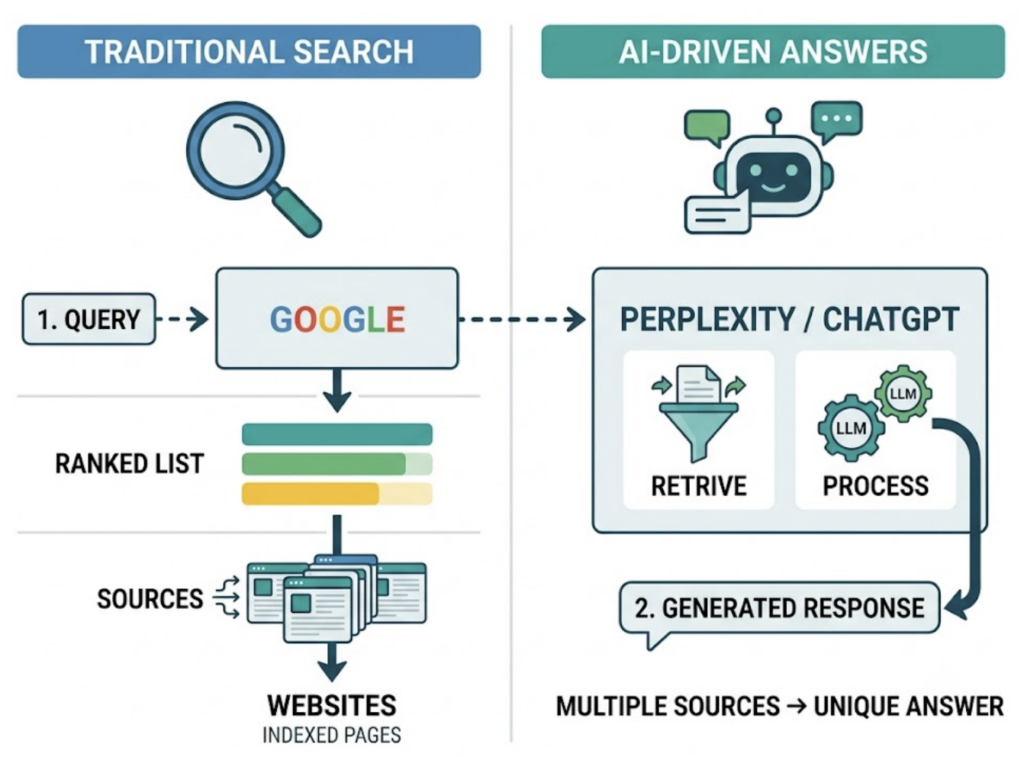
    Traditional search returns a ranked list of links. AI platforms synthesize an answer from multiple sources and deliver it directly. The user often doesn’t click at all. Between 58% and 60% of Google searches already end without a click — and when an AI Overview is present, that zero-click rate jumps to 83%.

    Your brand’s goal in this environment isn’t to rank. It’s to be cited.

    “SEO AI” Actually Means Two Different Things

    The phrase “SEO AI” is being used to describe two entirely distinct activities that require completely different strategies. Conflating them is how teams end up optimizing hard for a metric that doesn’t reflect what they actually care about.

    Using AI Tools to Do SEO Faster

    The first layer is using AI to accelerate traditional SEO: faster keyword clustering, automated content drafts, real-time SERP analysis, and predictive content scoring. Tools like MarketMuse and Frase can grade content against a topic model before it’s published, reducing the repetitive cycle of publishing and re-optimizing that’s common in legacy SEO workflows.

    This layer is mature. The tooling is solid, and most SEO teams are already here.

    Optimizing Content to Appear in AI Answers

    The second layer is less understood: structuring your content so that generative AI platforms retrieve and cite it when answering user prompts. This is what researchers at Princeton and other institutions have formalized as Generative Engine Optimization (GEO). The logic is different, the signals are different, and the measurement framework is different. And this is exactly where that 22% gap sits — teams producing content at speed with AI, but invisible in the AI answers their audiences are actually reading.

    What AI Does Better Than Traditional SEO Tools

    AI tools bring four specific capabilities that traditional SEO software can’t match at scale.

    Intent clustering comes first. Instead of grouping keywords by exact string matches, AI platforms identify the inferred purpose behind thousands of queries simultaneously. This lets teams move from targeting individual keywords to owning entire topical clusters — a meaningful shift in content strategy depth.

    Semantic content gap detection is second. Traditional gap analysis finds keywords where competitors rank and you don’t. AI-powered detection identifies “Information Gain” — the subtopics, data points, and perspectives that haven’t been fully covered in your niche. It’s the difference between knowing you’re missing a keyword and knowing you’re missing an argument.

    Real-time prompt discovery is third. AI tools can surface the actual conversational queries users are submitting to ChatGPT and Perplexity, giving teams keyword intelligence that never appears in traditional search consoles. These prompts reveal how users think about a problem, not just what words they use.

    Cross-platform behavior analysis is the fourth. A single AI-powered layer can monitor how intent shifts between Google, ChatGPT, and Gemini for the same topic — letting teams adapt content format and structure to each context, rather than applying one format across the board.

    Why Your Content Ranks on Google but Vanishes in ChatGPT

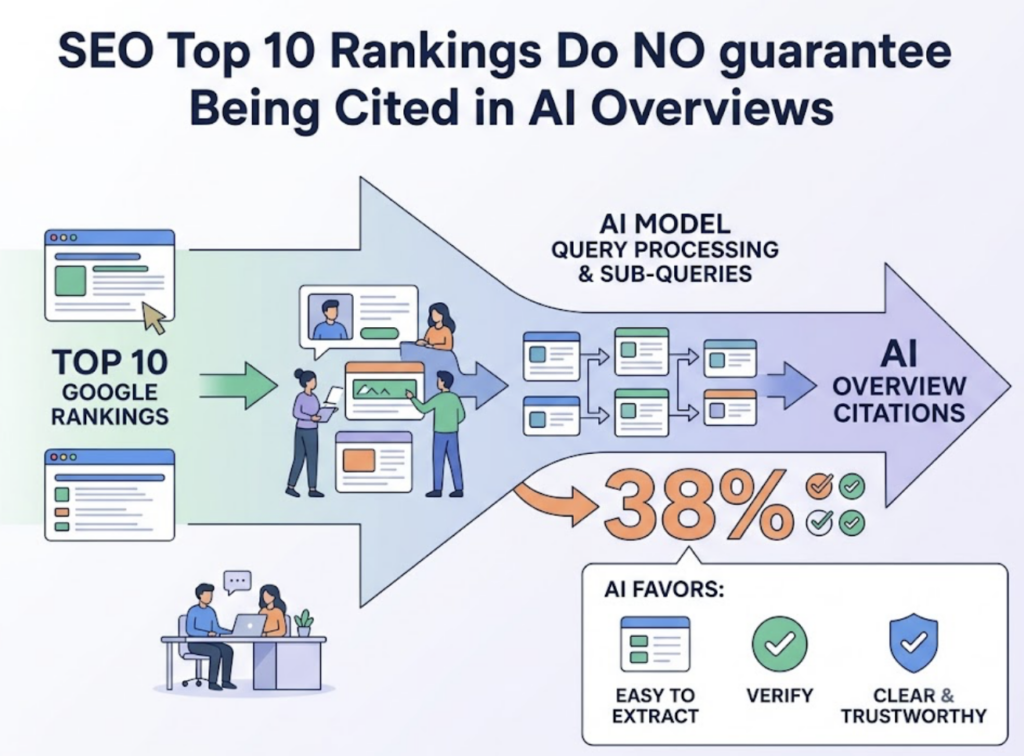
    This is the most expensive misconception in SEO right now. Holding a top organic position (#1-#3) gives you only an 8% chance of being cited in a Google AI Overview. More striking: 80% of the sources cited by AI platforms don’t rank organically for the queried keyword at all.

    The selection logic is structurally different.

    Traditional search retrieves content based on keyword matching and backlink signals. AI engines use vector space models — they’re matching meaning, not strings. Trust signals differ too: where Google weighs domain authority and link profiles, AI systems weight third-party validation. Research analyzing one million AI prompts found that 85.5% of citations come from editorial sites, news outlets, and established reference hubs. Brand-owned content accounts for only 14.5%.

    How AI Citation Logic Differs from Search Ranking

    A Forbes list or a TechCrunch review is roughly 5x more likely to be cited in an AI recommendation than your product page — even if your product page ranks higher on Google. AI engines also show a systemic bias toward content published within the last 30-90 days, and toward content structured to directly answer a question in its opening sentences.

    There’s also a “fan-out” dynamic that compounds this. When a user submits a complex query, the AI engine decomposes it into 4-20 sub-queries to retrieve diverse data points. A brand might rank well for the primary keyword but fail to appear in any of the secondary retrievals, resulting in total exclusion from the final synthesized answer.

    Which Source Signals AI Engines Actually Trust

    96% of AI citations come from high E-E-A-T sources. That means backlinks still matter — but their function has shifted. They’re no longer primarily ranking drivers. They work as trust signals that determine whether AI engines consider your domain credible enough to cite. Sites with 32,000 or more referring domains see citation counts roughly double.

    Digital PR is no longer separate from SEO. If your brand isn’t discussed in the publications that LLMs trust, your brand doesn’t exist in the generative narrative.

    For teams that want to see exactly which third-party domains AI engines are citing in their category, Topify‘s Source Analysis feature maps those citation patterns across ChatGPT, Gemini, and Perplexity simultaneously. It identifies which editorial sources are currently driving AI mentions for competitors — and where your content is absent from the chain.

    GEO and SEO: A Two-Front Strategy, Not a Trade-Off

    The question isn’t whether to do SEO or GEO. It’s whether your team has the measurement layer to manage both. Legacy search engines still process 16.4 billion daily queries and drive the vast majority of current revenue. Neither channel is optional.

    What Stays the Same: E-E-A-T, Backlinks, Technical Health

    Technical SEO health carries across both channels. AI bots that power platforms like Perplexity and Google AI Overviews use the same crawling infrastructure as traditional search. A site that isn’t properly indexed is invisible to both. Page speed, mobile responsiveness, and structured data all remain relevant.

    E-E-A-T signals stay important too, but their function shifts: in traditional SEO, they help you rank. In AI search, they’re the entry criteria for being cited at all.

    What’s New: Visibility, Sentiment, and Position in AI Answers

    The new layer is about Share of Model. Unlike traditional search — where a page either ranks or it doesn’t — AI search introduces a sentiment dimension. A brand can appear frequently in AI responses and still be described as “expensive” or “unreliable.” High visibility with negative sentiment actively damages brand equity. That’s a measurement problem traditional SEO tools were never built to solve.

    GEO research suggests that specific content modifications can increase visibility in AI responses by up to 40%. Structuring content into what researchers call “Answer Islands” — self-contained passages of 134-167 words that fully resolve a specific sub-intent — is one of the highest-correlation tactics identified. Each passage should answer the core question in its first 20-30 words, include supporting data, and stand alone without needing surrounding context.

    How to Measure Whether Your AI SEO Is Working

    Rankings, traffic, and CTR aren’t enough. They don’t tell you how often your brand surfaces in a generative answer, what position it holds relative to competitors, or whether the sentiment attached to your name is positive.

    A complete GEO measurement framework covers seven dimensions. Visibility tracks how often your brand appears across a defined set of AI prompts. Position shows where you land within the AI’s recommended list. Citations measure how often the AI includes a clickable link to your domain versus a plain text mention. Sentiment maps the ratio of positive to neutral to negative characterizations. Volume tracks your share of AI mentions compared to direct competitors. Intent coverage shows which types of queries — informational versus transactional — your brand appears in. And AI CVR measures the conversion rate of traffic that arrives via AI referral.

    That last metric deserves attention. AI search visitors convert 4.4x to 5x better than traditional organic visitors. They arrive after a longer, more deliberate research process. The traffic volume is smaller, but the intent is materially higher — and the users referred this way exhibit 67% higher lifetime value on average.

    Topify integrates all seven GEO metrics into a single dashboard, tracking brand performance across ChatGPT, Gemini, Perplexity, and other major AI platforms. The competitor benchmarking layer shows which rivals are gaining ground in AI responses and which source signals are driving those changes. You can get started here.

    Conclusion

    SEO hasn’t collapsed. Its scope expanded. The strategies that built organic authority over the last decade are still the foundation — technical health, E-E-A-T, indexability — but they’re no longer sufficient on their own. GEO adds a second measurement and optimization layer that tracks a channel traditional tools were never designed to see.

    The practical starting point isn’t a content overhaul. It’s an audit: find out where your brand actually stands in AI answers today, then decide where to optimize. The two-front strategy isn’t complicated. It’s mostly a matter of adding the right visibility layer to a stack most teams already have.

    FAQ

    Q: Does AI help with Google rankings? 

    A: AI tools can improve rankings by enabling faster intent clustering and content refreshing, both of which correlate with ranking gains. That said, AI-generated content that lacks genuine expertise can be flagged by Google’s Helpful Content updates. AI works as a multiplier of strategy, not a substitute for human editorial judgment.

    Q: What’s the best AI SEO tool in 2026? 

    A: The market has split into efficiency tools (Ahrefs, Semrush, Search Atlas) and visibility tools focused on AI search performance. For teams tracking generative visibility across platforms, tools that combine cross-platform prompt tracking with source analysis — like Topify — tend to provide the most actionable data for closing the GEO gap.

    Q: How do I get my brand cited by ChatGPT? 

    A: Citations are driven primarily by earned media placements in editorial and news sources that AI engines already trust. Content should be structured for direct answerability, published within the last 30-90 days, and supported by structured data markup. Sites with strong referring domain profiles tend to see significantly higher citation rates — research suggests doubling around the 32,000 referring domain threshold.

    Q: Is GEO replacing SEO? 

    A: No. GEO extends SEO rather than replacing it. Traditional search engines still process 16.4 billion daily queries, and the SEO foundation — technical health, E-E-A-T, indexability — is what makes content eligible for AI citation in the first place. The two strategies reinforce each other when measured and managed together.

    Read More

  • SEO Track in 2026: Why Your Ranking Dashboard Is Only Showing Half the Picture

    SEO Track in 2026: Why Your Ranking Dashboard Is Only Showing Half the Picture

    Your keyword rankings look fine. Traffic is holding steady. The dashboard is green.

    And yet, you’re invisible to a growing share of the people searching for exactly what you offer.

    That’s the gap most SEO teams haven’t closed. Traditional rank tracking tells you where you stand in Google’s list of blue links. It doesn’t tell you whether you’re showing up in the AI-generated summary sitting above those links, or in the ChatGPT response a prospect pulled up at 11pm before they ever opened a browser tab.

    In 2026, that gap is the difference between a brand that wins search and one that just monitors it.

    What “SEO Track” Actually Means Now (It’s Not Just Keywords Anymore)

    For most of the past decade, SEO tracking meant one thing: keyword position. You picked a list of terms, plugged them into a rank tracker, and watched the numbers move.

    That model had a clean logic to it. Higher position meant more clicks, which meant more leads. The math was simple.

    The math no longer works.

    Search in 2026 isn’t a list you climb. It’s a conversation happening across Google AI Overviews, ChatGPT Search, Perplexity, and Gemini. The entity answering that conversation synthesizes information from multiple sources, and whether your brand gets included, cited, or described accurately depends on a completely different set of signals than traditional rankings.

    Tracking has followed the same split. Teams getting the clearest picture of their search performance now measure two parallel worlds: the traditional SERP and the AI answer layer. Teams that don’t are working from incomplete data.

    The metrics that defined SEO tracking for the last decade

    Before 2024, the core tracking stack was built around average position, organic CTR, domain authority, and crawl coverage.

    These metrics were built around Googlebot and the assumption that ranking high meant getting clicked. Keyword tracking was a forecasting tool: move from position 4 to position 2, and traffic projections followed a predictable curve.

    Technical SEO tracking was equally deterministic. You checked indexation rates, fixed crawl errors, confirmed robots.txt wasn’t blocking key pages. Success was measurable and largely platform-agnostic. The whole system assumed Google was the search engine, and a blue link was the destination.

    What changed when AI search entered the picture

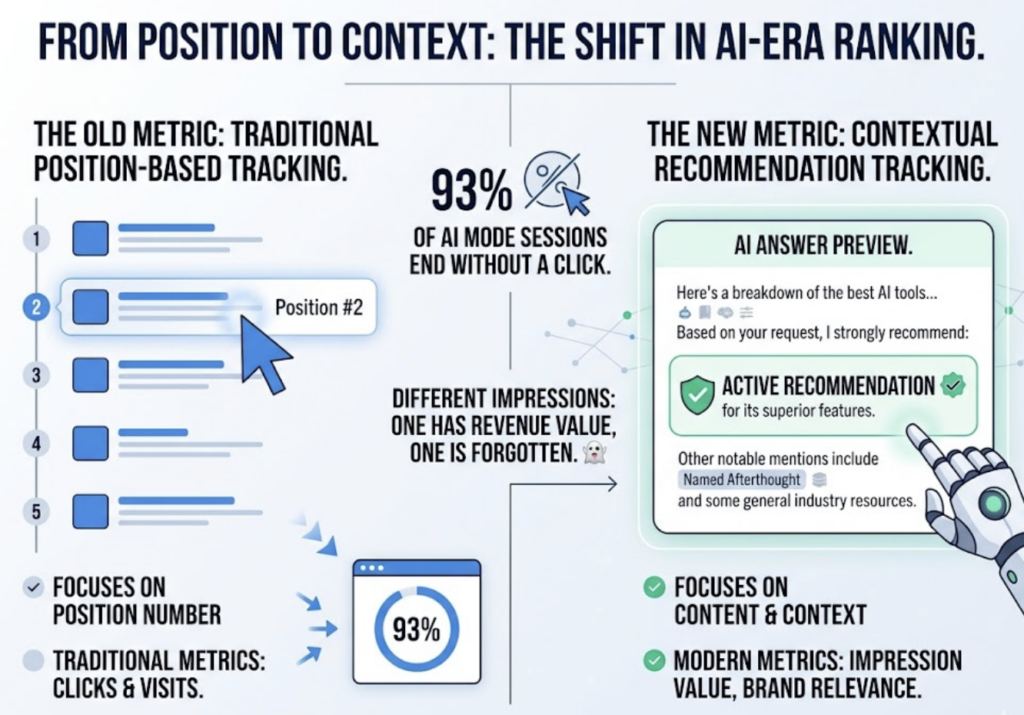
    Zero-click search now accounts for over 65% of all Google searches. On mobile, that figure reaches 77%.

    In practice: a user asking for the best project management tool for remote teams doesn’t click through ten results and compare. They read a synthesized paragraph from an AI Overview and, in many cases, stop there. The traditional organic result still exists, but its CTR has collapsed. Where AI Overviews are present, organic click-through rate has dropped 61%, from 1.76% to just 0.61%.

    The consequence for SEO tracking is structural. A brand can rank #1 for a high-volume keyword and still capture a fraction of the attention that keyword used to deliver. The impression now lives inside the AI’s answer. Measuring that requires a different approach entirely.

    Measurement CategoryTraditional SEO (2015–2023)AI-Driven SEO (2026)
    Primary GoalRanking in the top 10 blue linksInclusion and citation in synthesized answers
    Search IntentKeyword-based, fragmentedConversational, long-tail, and complex
    Visibility SurfaceList-based SERPsMulti-surface: AI summaries, social, links
    Success MetricRaw traffic and average positionBrand citation share and sentiment accuracy

    The 6 Metrics That Actually Define SEO Performance in 2026

    Keyword ranking and position tracking

    Rankings still matter. For high-intent commercial queries, like “buy accounting software for startups” or “best HVAC company near me,” traditional results continue to drive strong CTRs.

    The approach has changed. Tracking isolated keywords is being replaced by cluster-based tracking, where teams measure visibility across semantically related topic groups tied to specific products or revenue lines. Share of voice within a theme has become more useful than the position of a single term.

    The real benchmark: ranking in traditional results while also appearing as a cited source in the AI Overview above them. Brands cited in AI Overviews earn 35% higher CTR than those appearing only in the traditional results below.

    Brand visibility rate across search platforms

    Search in 2026 is multi-surface. Featured snippets, People Also Ask boxes, knowledge panels, local packs, video carousels, and AI Overviews all carry visibility value independent of whether a user clicks.

    Only 360 out of every 1,000 U.S. searches result in a click to the open web. That means the impression itself has become a KPI. Repeated brand exposure in authoritative snippets builds the kind of recognition that drives branded searches later, and branded searches convert at the highest rate.

    Visibility rate tracks the percentage of target SERPs where a brand appears in at least one high-impact feature. It’s a more honest measure of actual search presence than keyword position alone.

    AI citation and source tracking

    This is the most significant new metric in 2026. Citation tracking measures how often, and in what context, a brand is referenced in generative AI responses across platforms like ChatGPT, Perplexity, Gemini, and Grok.

    Citations are the new backlinks. They represent a retrieval system’s vote of confidence in your content’s authority. Citation frequency varies meaningfully by platform: Grok cites at a rate of 27.01%, driven by social signal velocity; Perplexity at 13.05%, weighted toward recency and structured data; Google AI Mode at 9.09%, shaped by semantic completeness and E-E-A-T signals.

    Tracking requires knowing which URLs and domains AI systems are pulling from for your category. Topify‘s Source Analysis surfaces exactly which domains AI engines cite when answering prompts relevant to your brand, and which ones are being attributed to competitors instead.

    Competitor position benchmarking

    Traditional SEO benchmarking compared keyword rankings side by side. In 2026, the more important comparison is AI citation share by topic cluster.

    If a competitor dominates citations for “enterprise cybersecurity trends,” it signals stronger topical authority in the eyes of the LLM. That’s not a backlink gap — it’s a content and credibility gap that plays out inside the model’s internal representation of the category.

    Topify’s Competitor Monitoring tracks this in real time, showing not just where competitors appear relative to your brand, but which third-party sources are validating them. Those sources become targets. Citation gaps often close faster than backlink gaps because the pipeline is shorter: earn a mention in the right authoritative domain, and the model’s next retrieval cycle picks it up.

    Sentiment in AI-generated answers

    AI systems don’t just mention brands. They describe them. The tone of those descriptions, positive, neutral, or negative, accumulates into something like a reputation layer across the models.

    Teams in 2026 track what’s called perception drift: the gradual shift in how AI describes a brand’s quality, pricing, or market positioning. If Perplexity starts describing a SaaS tool as having a “steep learning curve” or “outdated pricing,” that framing can persist and spread before any internal team flags it.

    Topify’s Sentiment Analysis assigns a 0-100 sentiment score across AI platforms, giving teams an early warning system before perception drift compounds. Positive sentiment is equally useful — it surfaces what the market is already validating about a brand, often before the internal team notices.

    Conversion visibility rate

    Visibility metrics only matter if they connect to revenue. Conversion Visibility Rate focuses tracking on the queries that actually drive leads and pipeline, not just impressions.

    The data here is direct: AI-referred visitors deliver 4.4x higher conversion value than general organic traffic. These are users who’ve already received a vetted recommendation from a system they trust. They arrive pre-qualified.

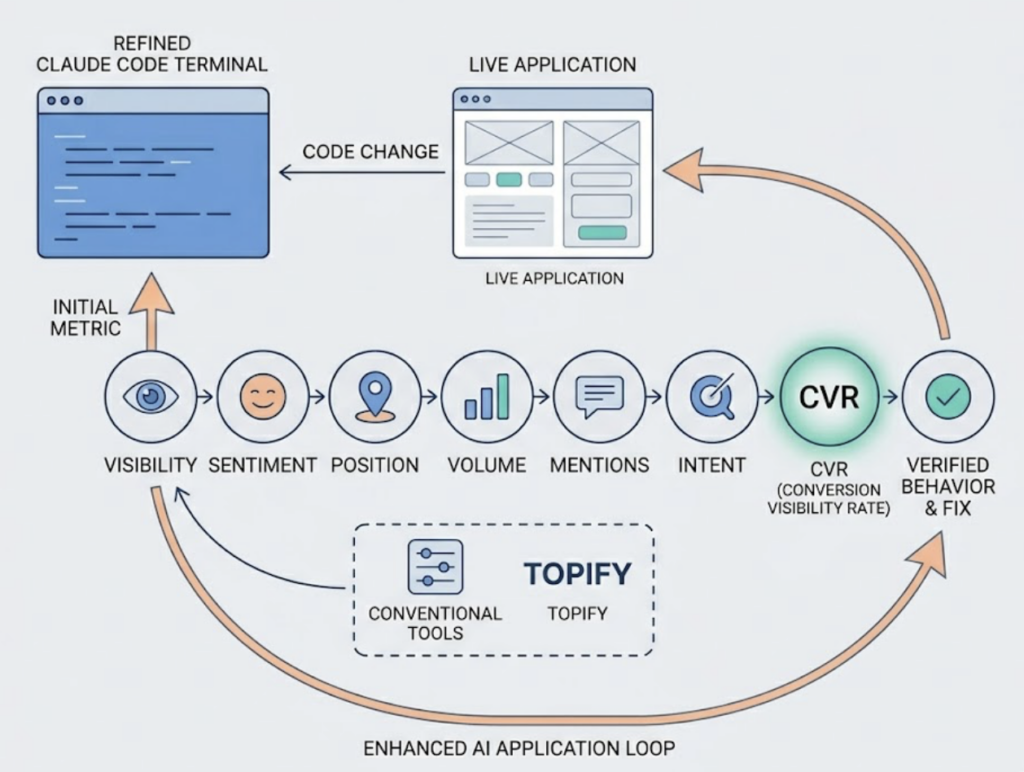
    Topify’s CVR metric maps this path, showing which AI-referred sessions are generating commercial outcomes and attributing visibility effort to business results. It’s the metric that makes the investment defensible when total click volume is compressing.

    Why Google Rank Alone No Longer Tells You If You’re Winning

    A #1 ranking in 2026 is still worth having. It’s just not the signal it used to be.

    AI Overviews now routinely exceed 1,200 pixels in height. On a standard 900-pixel desktop viewport, the traditional #1 result sits below the fold before a user scrolls. On mobile, it’s further down still.

    This is visual displacement. The brand cited inside the AI Overview earns the 35% CTR lift. The #1 organic result, uncited and sitting below the fold, earns significantly less than its position suggests.

    The numbers confirm it. Nearly 60% of all searches now end without a click to any destination site. Organic CTR collapses by 61% where AI Overviews appear. On mobile, the zero-click rate hits 77%. Tracking only rank misses all of this. It reports the position of a blue link without measuring whether the AI is citing the brand, describing it accurately, or mentioning it at all.

    Bottom line: rank tells you where your link lives. It doesn’t tell you whether the AI trusts you enough to quote you.

    The Tools That Cover Both Traditional and AI SEO Tracking

    Traditional platforms like Semrush and Ahrefs remain useful for technical audits, backlink intelligence, and keyword gap analysis. In 2026, they’ve integrated basic AI visibility toolkits, but these generally cover AI Overview presence without the citation depth or sentiment accuracy that full GEO monitoring requires.

    Site speed matters more than most teams realize. An LCP under 0.4 seconds correlates with 3x more AI citations, making technical performance directly relevant to AI visibility, not just user experience.

    The more complete picture comes from purpose-built AI visibility platforms. Topify is built specifically for this layer, tracking brand performance across ChatGPT, Gemini, Perplexity, DeepSeek, and other major AI engines through seven metrics: visibility, sentiment, position, volume, mentions, intent, and CVR.

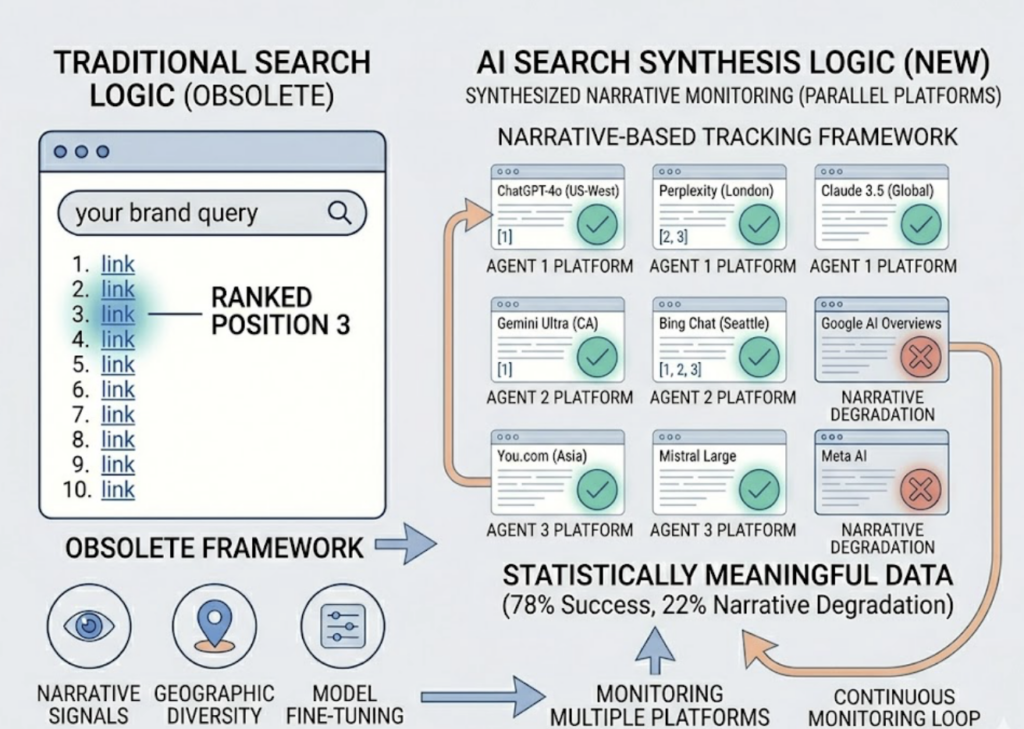
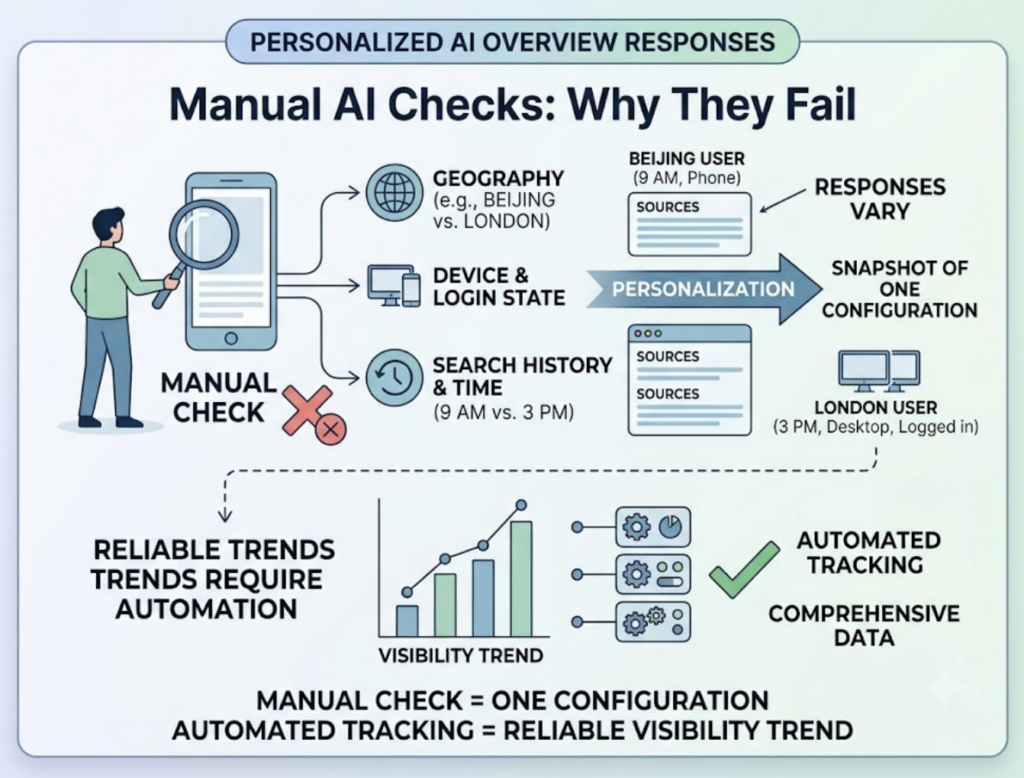
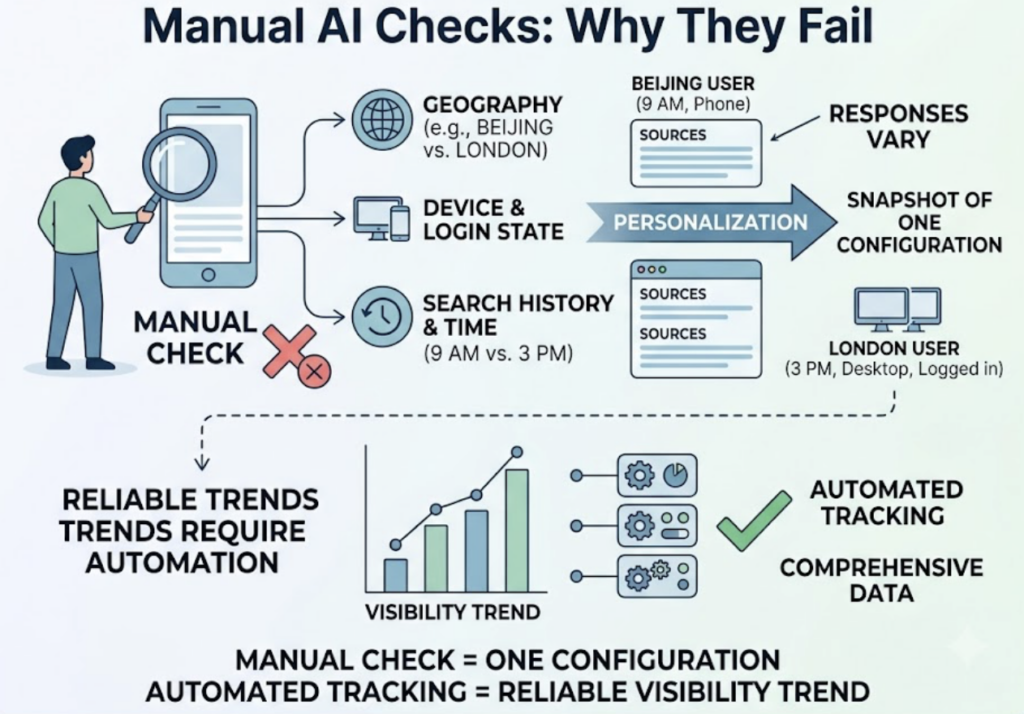
    One operational challenge worth flagging: AI responses for the same prompt change up to 70% of the time. A single snapshot doesn’t tell you much. Systematic prompt execution, running the same queries repeatedly to establish trend data rather than point-in-time readings, is what separates reliable SEO tracking from guesswork.

    How to Build an SEO Tracking System That Won’t Be Outdated Next Year

    Step 1 – Define your tracking scope (Google + AI)

    Start by auditing what your current reports actually measure. Separate vanity metrics from business drivers.

    Then expand the scope to include AI-specific visibility. Identify your true SEO competitors, which may include publishers like Reddit or Wikipedia that dominate AI citation slots for your category, not just direct business rivals. Technical readiness matters here too: confirm your robots.txt isn’t blocking AI crawlers like ChatGPT-User, and that key pages use server-side rendering rather than JavaScript-only builds so AI systems can actually parse the content.

    Step 2 – Set benchmark metrics before you optimize

    Before any optimization work starts, establish a baseline across 50-100 high-intent prompts on ChatGPT, Perplexity, Gemini, and Google AI Mode.

    Track citation rate, attribution frequency, and sentiment baseline. Also track the verification tax: the industry average is 4.3 hours per week spent by team members checking AI-generated content for brand accuracy, at an annual cost of roughly $14,200 per employee. That number quantifies exactly how much manual oversight a solid tracking system needs to reduce.

    Content freshness is a baseline variable too. Citations drop sharply for content older than three months. The refresh cadence needs to be built into the plan before optimization begins.

    Step 3 – Monitor competitor positions in both channels

    Ongoing monitoring should focus on fan-out queries. When an AI receives a complex prompt, it breaks it into smaller sub-queries before synthesizing an answer. Tracking which competitors rank for those fragments gives a clear map of where authority is being lost, and where content gaps can be closed.

    Track citation gaps alongside rank gaps. These are the authoritative third-party domains — industry journals, analyst reports, community platforms — that AI systems rely on and that don’t yet mention your brand. Closing those gaps is often faster than closing traditional link gaps, and the downstream effect on AI citation frequency is direct.

    Conclusion

    The ranking dashboard isn’t obsolete. It’s incomplete.

    It captures the visible layer of search: the traditional links that users are increasingly bypassing. What it doesn’t capture is whether your brand is the source the AI trusts to answer a user’s question.

    In 2026, that’s where discovery happens. A user asks a complex question. An AI synthesizes an answer. The brand cited inside that answer earns the trust transfer. Tracking that process requires measuring citation share, sentiment accuracy, and AI position alongside traditional rank data.

    The teams building that tracking system today won’t be scrambling to rebuild it next year. Search volume is fragmenting across ChatGPT, Perplexity, and YouTube. The window to establish AI citation authority before competitors do is narrowing. Brands that treat AI visibility as a measurable, manageable channel now are the ones that will own it.

    FAQ

    What’s the minimum prompt set needed to establish a reliable AI citation baseline? 

    50-100 high-intent prompts across your primary platforms is a workable starting point. The goal is enough volume to surface statistical trends rather than individual data points that can swing 70% between queries.

    Does content length affect AI citation rates? 

    Structure matters more than length. AI systems cite content that directly answers a specific question in a retrievable format — a clearly labeled definition, a step-by-step process, a structured comparison. Long content that buries the answer doesn’t outperform a well-structured 600-word page.

    How often should content be refreshed to maintain AI visibility? 

    Quarterly at minimum. AI models show strong recency bias, and citations drop sharply for content older than three months. High-priority topics warrant monthly audits.

    Is zero-click search always bad for ROI? Not necessarily. AI citations function like brand placements: users who see a brand described as the top recommendation for a category often conduct a branded search later. Those visits convert at a significantly higher rate, which typically offsets the reduction in raw click volume.

    What is “perception drift” and how do you reverse it? 

    Perception drift is the gradual shift in how AI systems describe a brand’s quality, pricing, or positioning. Reversing it involves publishing updated content that reframes the relevant narrative, earning mentions in high-trust third-party sources carrying the corrected framing, and monitoring sentiment scores to confirm the shift is registering across platforms.

    Why do AI systems cite Reddit and Wikipedia so frequently? 

    AI models prioritize sources with deep community validation and structured information. Wikipedia provides a high-trust entity database. Reddit offers first-hand human experience and reviews, which are core signals within the E-E-A-T framework that modern search algorithms prioritize.

    Read More

  • Agency Rank Tracking Has a Blind Spot

    Agency Rank Tracking Has a Blind Spot

    Your client ranks #2 on Google. Traffic is stable. The report looks clean.

    Then the client asks: “Why aren’t we showing up when people ask ChatGPT for a recommendation?”

    You don’t have an answer. Your rank tracker doesn’t either.

    That’s the blind spot. And it’s getting harder to ignore.


    Rank Trackers Were Built for a Different Internet

    For two decades, rank tracking worked because search had one logic: type a query, get a list of links, click the most relevant one. Position 1 meant visibility. Position 10 meant you’d better optimize.

    That logic was built for Google’s “ten blue links” architecture, and it still holds there. The problem is that architecture now represents a shrinking share of where your clients’ audiences actually search.

    AI search doesn’t return a list. It synthesizes a single answer. There’s no Position 1 to chase, no CTR to optimize for. The brand either gets mentioned or it doesn’t.

    Traditional rank trackers measure the battle for the link. AI search is a battle for the mention. Research shows only 12% of sources cited by ChatGPT overlap with Google’s top 10 results, meaning strong organic rankings offer almost no guarantee of AI visibility. These are two separate competitions, and most agency reports only cover one.


    Your Clients Are Searching on AI More Than You Think

    This isn’t early adopter behavior anymore.

    The top 5 AI platforms now account for 56% of traditional search engine volumeChatGPT alone processes over 1 billion queries daily across 800 million weekly active usersAI referral traffic grew 357% year-over-year, and the users driving that growth skew toward exactly the demographics your clients want to reach: higher income, higher intent, more likely to convert.

    Here’s what makes this commercially urgent for agencies: AI search visitors convert at 4.4 times the rate of traditional organic traffic. The conversational format pre-qualifies buyers before they ever reach a website.

    Your clients are losing high-converting traffic to a channel you’re not reporting on. That’s not a data gap. That’s a revenue gap.


    “Ranking” Means Something Different in AI Search

    In Google, rank is a position: 1 through 100, deterministic and stable across sessions.

    In AI search, “rank” is a probability. A brand might appear in 40% of responses to a prompt one week and 60% the next, depending on how the model’s retrieval weights shift. There’s no fixed list. There’s a constantly recalculating likelihood of being mentioned.

    This changes what agencies need to measure. Visibility in AI search exists across four distinct forms:

    • Direct mention: the brand name appears in the synthesized response
    • Recommended inclusion: the brand is listed as a top solution for a specific problem
    • Citation attribution: the brand’s URL is referenced as a source of authoritative data
    • Sentiment framing: the tone the AI uses when describing the brand

    Each carries different strategic value. Being recommended first is not the same as being cited as a source, which is not the same as being mentioned neutrally alongside five competitors. Treating all mentions as equal is the same mistake as treating Position 3 and Position 9 as equivalent on Google.


    5 Metrics Your Client Reports Are Missing

    These aren’t nice-to-have additions. They’re the data your clients need to understand whether their brand exists in the channels shaping purchase decisions.

    1. AI Visibility Score

    The foundational metric. It measures the percentage of relevant queries where the brand appears in an AI response. A brand with a 10% visibility score is effectively absent for 90% of the audience using AI for research. The calculation: responses mentioning the brand ÷ total tracked responses × 100.

    2. Position (Prominence)

    Getting mentioned and getting mentioned first are very different outcomes. Position tracks whether the brand appears as the lead recommendation or fifth in a comparison list. It also measures word count share: how much of the AI’s response is actually about the client versus competitors.

    3. Sentiment Score

    AI platforms describe brands in natural language, which means they assign perception. A 0-100 NLP sentiment scorereveals whether the AI characterizes a brand as a trusted authority (85-100), a neutral option (40-64), or something worse. Sentiment drift over time is often the earliest signal of a reputation problem forming in the AI knowledge graph, before it surfaces anywhere a traditional tool would catch it.

    4. Conversion Visibility Rate (CVR)

    Up to 70.6% of AI referral traffic shows up as “Direct” in Google Analytics because AI platforms often strip referrer headers. That “dark” traffic isn’t random: it converts at 10.21%, compared to 2.46% for standard direct traffic. CVR connects AI mentions to downstream conversion activity, giving clients an ROI case for visibility investment.

    5. Source Coverage

    AI models ground their answers in sources they trust. Source coverage reveals which domains get cited when an AI discusses the client’s category. If the client is mentioned but the citation points to a competitor’s comparison page or a Reddit thread, the agency knows exactly which content gap to close. JSON-LD structured data implementation increases the likelihood of AI citation by 2.5x, making this an actionable technical lever, not just a reporting metric.


    Managing AI Tracking Across 10+ Clients Without Drowning

    Tracking one brand across four AI platforms is manageable. Tracking 15 clients across ChatGPT, Gemini, Perplexity, DeepSeek, and AI Overviews simultaneously is a different operational challenge.

    The starting point is prompt taxonomy: standardized sets of queries mapped to each client’s category, use case, and buyer stage. A discovery prompt (“What are the best [category] tools for [use case]?”) measures inclusion in the initial consideration set. A comparison prompt (“[Client] vs [Competitor] for [persona]”) tracks relative positioning and sentiment. These templates can be customized per account and run in parallel across platforms.

    Running prompts across multiple LLMs simultaneously rather than sequentially reduces report generation time by 60%. That’s the difference between AI tracking being a manual research project and a scalable agency service.

    Topify is built for this architecture. Its multi-project dashboard handles parallel tracking across platforms, aggregates visibility, position, sentiment, and CVR data per client, and surfaces competitor movement in real time. The Basic plan ($99/month) covers up to 4 projects and 100 prompts across ChatGPT, Perplexity, and AI Overviews. The Pro plan ($199/month) scales to 8 projects and 250 prompts for agencies managing larger portfolios.


    How to Add AI Rankings to Client Reports Without Starting Over

    The goal isn’t to replace what’s working. It’s to add a layer that answers the question traditional reports can’t.

    The simplest approach: add an “AI Visibility” column alongside existing keyword rank data. The client sees that they rank Position #2 on Google and hold an 85% mention rate on ChatGPT for the same intent. Or they see they rank Position #1 on Google but have 0% AI visibility, meaning the top organic spot offers no leverage in the channel where high-intent buyers are researching.

    That’s a conversation starter, not just a data point.

    Topify’s seven core indicators map directly to the KPIs clients already track: AI Visibility Score maps to brand market share, Competitor Share of Voice maps to competitive intelligence, and CVR maps to revenue impact. The transition from “here’s your Google rankings” to “here’s your complete search presence” doesn’t require a new reporting format. It requires adding a generative layer to the one you already use.

    Agencies that package this as a standalone offering can white-label AI visibility management at $300 to $1,000 per client per month, creating a recurring revenue stream built on data that competitors aren’t providing yet.

    Conclusion

    The blind spot in agency rank tracking isn’t a flaw in the tools. It’s a lag between how search works now and how agencies are still measuring it.

    Traditional rank trackers will keep doing what they were built to do. The question is whether that’s still enough to explain what’s happening to a client’s brand in the channels that are shaping their buyers’ decisions.

    Adding AI visibility data doesn’t require rebuilding the agency workflow. It requires a parallel measurement layer and the willingness to show clients a more complete picture of their search presence.

    The agencies that close this gap first won’t just retain clients longer. They’ll have a service that competitors can’t replicate with existing tools.


    FAQ

    Does AI rank tracking replace SEO rank tracking? 

    No. Google still processes the majority of searches, and organic rankings remain a core performance indicator. AI tracking fills the measurement gap for the growing share of research and purchase decisions happening in conversational interfaces. The two reports work together.

    How accurate is AI visibility data? 

    AI responses are probabilistic, so visibility scores reflect sampling across multiple prompt runs rather than a single definitive result. Higher prompt volumes produce more reliable scores. Tools like Topify run queries at scale to stabilize the data before surfacing it in dashboards.

    How many AI platforms should agencies track? 

    For most agency clients, starting with ChatGPT, Perplexity, and Google AI Overviews covers the majority of AI search volume. Expanding to Gemini and DeepSeek makes sense for clients with international audiences or enterprise buyers who index toward Google Workspace.

    What’s a realistic budget for agency-level AI tracking? 

    The market has segmented into three tiers: entry-level for 1-5 clients runs $99-$150/month, professional agency-scale for 10-50 clients runs $250-$750/month, and enterprise deployments covering 50+ clients typically start at $1,500/month. Most agencies find the professional tier sufficient to cover a standard client portfolio.


    Read More

  • The AI Tracker Checklist: 5 Things Your Tool Should Measure

    The AI Tracker Checklist: 5 Things Your Tool Should Measure

    AI is answering your customers’ questions right now. The part most brands haven’t figured out yet: they have no idea what it’s saying.

    That gap is wider than it looks. According to recent research, 75% of AI search sessions end without a single click to an external site. Users get their answer, make a judgment, and move on. Your brand either shaped that judgment, or it didn’t.

    The tools most teams are using weren’t built for this. And the ones marketed as “AI trackers” often stop at the most surface-level metric available: whether your brand name showed up somewhere in the answer.

    That’s not enough. Here’s the checklist that actually matters.


    Most AI Trackers Stop at Mentions. That’s Where the Problem Starts.

    Showing up in an AI answer and being recommended by an AI answer are two completely different outcomes.

    A mention with a caveat (“some users report issues with…”) can actively undermine a purchase decision before the buyer ever lands on your site. Meanwhile, a brand named first with a clear endorsement captures the majority of user trust in that interaction.

    Traditional SEO tools weren’t built to tell the difference. They track blue links and static rankings. Generative engines don’t work that way: they produce synthesized, conversational responses where position, tone, and source all shape the outcome. Research shows that queries with AI features present have already caused a 61% drop in traditional organic CTR. What happens inside that AI answer has real revenue consequences.

    The five metrics below are what a real AI tracker needs to measure.


    #1 — Visibility Rate: Is Your Brand Actually Showing Up?

    The first thing to track isn’t whether you appear in AI. It’s where, how often, and across which platforms.

    One platform is not a data point. It’s a blind spot.

    ChatGPT, Gemini, Perplexity, and Claude each use fundamentally different retrieval mechanisms and training datasets. Perplexity prioritizes real-time data and forum discussions. Gemini leans into Google’s established trust graph. A brand that appears consistently in ChatGPT responses may be completely absent from Perplexity, and vice versa.

    There’s a compounding challenge here: AI models are non-deterministic. Analysis of 10,000 keywords found that only 9.2% of cited URLs remained consistent when the same query was run just three times in a single day. Visibility isn’t a fixed number. It’s a probability, and it needs to be tracked accordingly through repeat sampling across engines.

    For e-commerce brands specifically, there’s a 22.9% overlap between traditional organic rankings and AI citations. Ranking #1 in Google does not mean you’re showing up in AI answers. Most brands haven’t checked.

    Topify tracks brand visibility across ChatGPT, Gemini, Perplexity, DeepSeek, and other major AI platforms simultaneously, running prompts multiple times per session to build a statistically reliable visibility trend rather than a one-off snapshot.


    #2 — Sentiment Score: Being Named Isn’t the Same as Being Recommended

    Once you know you’re appearing in AI answers, the next question is: what exactly is the AI saying about you?

    According to Gartner research from 2025, 73% of B2B buyers now trust AI product recommendations over traditional advertisements. That makes the quality of the AI’s mention more influential than most brands realize.

    Data from over 200 brands shows the average brand receives an outright “Endorsement” rate of only 28% across category prompts where it appears. The rest? 19% of mentions are “Cautious” (framed with phrases like “some users prefer” or “worth considering but”), and 12% are outright hallucinations: fabricated pricing, discontinued features, wrong information presented as fact.

    A hallucination doesn’t just confuse potential customers. It can spread. As AI models pull from web content to train and update, incorrect information can get absorbed and repeated across platforms, creating a cycle that’s difficult to reverse without active monitoring.

    The sentiment spectrum runs from explicit endorsement all the way down to negative mention and hallucination. A good AI tracker scores each mention on this spectrum and flags anomalies before they cause downstream damage.

    Topify’s Sentiment Analysis assigns a 0-100 score to brand mentions across AI platforms, tracking whether the AI is recommending you, mentioning you neutrally, qualifying you with caveats, or actively misrepresenting your brand.


    #3 — Competitive Position: Where You Land Relative to Everyone Else

    You could be in the answer and still be losing.

    In a synthesized AI response, order matters. A brand named first in a recommendation list captures disproportionate attention and trust. A brand mentioned third, after two competitors, often functions as an afterthought regardless of its actual quality.

    The data on this is hard to ignore. Brands cited in AI Overviews earn a 35% higher organic CTR compared to uncited brands in the same query. AI-referred visitors convert at rates 4.4 times higher than traditional organic visitors according to Semrush, and as high as 23 times higher according to Ahrefs analysis.

    Position inside the AI answer is a direct revenue variable.

    The AI citation probability also follows a clear decay curve. A brand ranking #1 in Google has a 33.07% probability of being cited in AI results. By positions #6-10, that probability drops to the 13-17% range. Below #11, it falls under 5%. Meanwhile, 76.1% of URLs cited in AI Overviews come from Google’s top 10 results entirely.

    What this means: your AI visibility strategy and your SEO strategy are more connected than they look, but they aren’t the same. Tracking where you rank relative to competitors inside AI answers is a distinct data layer that requires its own tool.

    Topify’s Competitor Monitoring tracks your position relative to competitors across AI platforms in real time, so you can see exactly when a rival moves ahead of you in AI recommendations and understand why.


    #4 — Source Attribution: Which URLs Is AI Actually Pulling From?

    AI doesn’t generate information out of thin air. It pulls from specific sources to ground its answers.

    Knowing which URLs an AI engine is citing is one of the most actionable data points available to a content team. If a competitor’s blog post is being referenced every time someone asks a category question in your space, that URL is part of the trust graph your brand needs to influence.

    Here’s a counterintuitive finding from GEO research: adding credible external citations to your own content can increase your AI visibility by 115%. In traditional SEO, linking out to other sites was something to minimize. In the AI era, fact density and external credibility markers are exactly what makes content more citable.

    The structural point matters too. Research shows that 44.2% of all LLM citations come from the first 30% of the text. If your answer to a common industry question is buried in paragraph eight, AI engines often won’t find it.

    Knowing which sources AI is currently citing gives you a direct map for content investment. Topify’s Source Analysistracks the exact domains and URLs that AI platforms pull from when answering prompts in your category, showing you where authority is concentrated and where the gaps are.


    #5 — Prompt Coverage: Are You Tracking the Questions That Actually Matter?

    An AI tracker is only as good as the prompts it monitors. And most tools let you set prompts without helping you figure out which prompts to set.

    This is a bigger problem than it sounds.

    An estimated 70% of AI prompts are invisible to traditional SEO tools because they’re long-form, conversational, and multi-step in ways that keyword tools weren’t designed to capture. Users don’t type “best CRM software” into ChatGPT. They ask “I’m running a 12-person sales team and we keep losing deals in the follow-up stage, what CRM would actually fix that?” The brand that shows up in that answer wins. The brand that’s only tracking short-tail keywords never sees it coming.

    The data gets sharper in B2B. In SaaS specifically, there’s a 40-60% disconnect between Google search ranking and AI citation share. Brands that rank #1 organically can have near-zero presence in AI recommendations, simply because they’re not being asked about in the prompts that matter to their buyers.

    Effective prompt coverage requires discovery, not just monitoring. That means pulling from customer support logs, sales call recordings, and community forums to find how real buyers actually phrase their questions. It means mapping prompts across intent levels from top-of-funnel awareness to bottom-of-funnel comparison. And it means testing “adversarial prompts” to check whether AI engines associate specific strengths with your brand or your competitors.

    Topify continuously surfaces new high-value prompts as AI recommendations evolve, rather than locking you into a static list that gets stale as user behavior shifts.


    When All 5 Work Together, You Stop Guessing and Start Acting

    Each of these metrics has standalone value. Visibility tells you if you’re in the room. Sentiment tells you if the room is listening. Position tells you where you’re standing relative to competitors. Source attribution tells you which doors to walk through. Prompt coverage tells you which conversations to show up for.

    But the real advantage comes from running all five as a connected loop: analyze where AI authority is concentrated, create content built to be cited, distribute through sources AI engines already trust, and measure the impact continuously.

    That’s the difference between hoping your brand appears in AI answers and engineering it.

    Topify is built around this five-pillar framework, combining visibility tracking, sentiment scoring, competitive position monitoring, source attribution, and prompt discovery in a single platform. It’s used by 50+ enterprises and startups to turn AI visibility from an unknown into a measurable growth channel.

    Conclusion

    The brands that build an early advantage in AI search won’t do it by accident. They’ll do it by measuring what actually matters: not whether they showed up, but how they showed up, where they ranked, what the AI said about them, which sources drove the mention, and whether they’re tracking the prompts that buyers are actually using.

    The five-pillar checklist above is the starting point. The brands ignoring it are leaving their AI narrative to chance.


    Frequently Asked Questions

    What is an AI tracker? 

    An AI tracker is a tool that monitors how your brand appears in AI-generated responses across platforms like ChatGPT, Gemini, and Perplexity. Beyond simple mention detection, a comprehensive AI tracker measures visibility rate, sentiment, competitive position, source attribution, and prompt coverage.
    Why isn’t Google Analytics enough for tracking AI visibility? 

    Google Analytics tracks behavior after someone clicks to your site. It can’t tell you what happened inside the AI answer: whether you were mentioned, how you were framed, or where you ranked relative to competitors. AI visibility requires a separate tracking layer entirely.

    How often should I run AI tracking reports? 

    Because AI responses are non-deterministic (the same prompt produces different answers more than 90% of the time), single snapshots aren’t reliable. Tracking should run continuously, with prompts sampled multiple times per session across platforms to build statistically meaningful trend data.

    What’s the difference between an AI mention and an AI endorsement? 

    A mention means your brand name appeared in an AI response. An endorsement means the AI actively recommended your brand using language that signals trust and preference. Research shows brands receive outright endorsements only 28% of the time they’re mentioned, making sentiment tracking essential.

    Do traditional SEO rankings affect AI visibility? 

    Yes, but the relationship isn’t 1:1. Around 76.1% of AI-cited URLs come from Google’s top 10 results, so SEO matters. That said, there’s a 22.9% overlap between traditional rankings and AI citations in e-commerce, and up to a 60% disconnect in SaaS. High organic rank does not guarantee AI visibility.


    Read More

  • Most Brands Are Invisible to AI Search Engines

    Most Brands Are Invisible to AI Search Engines

    You rank #1 on Google. A potential buyer opens ChatGPT, types the same question, and your brand isn’t in the answer.

    That’s not a hypothetical. A study by Chatoptic found that brands on Google’s first page appeared in ChatGPT responses just 62% of the time. Only 12% of AI citations overlap with Google’s top 10. In other words, dominating traditional search no longer means you exist in the place where buyers increasingly go to make decisions.

    This is the invisibility paradox — and most marketing teams don’t know it’s happening to them.


    Google Rankings Don’t Follow You Into AI Search

    For two decades, position one was the finish line. Get there, and you get the traffic.

    That assumption no longer holds.

    Data from Ahrefs and BrightEdge shows a sharp structural break between traditional SEO performance and AI citation frequency. In mid-2025, around 76% of AI Overview citations also ranked in Google’s top 10 organic results. By early 2026, that overlap had collapsed to between 17% and 38%.

    Where are the remaining citations coming from? Pages ranked between positions 11 and 100 now account for roughly 31% of citations. Pages outside the top 100 entirely account for another 31% to 37%.

    AI engines aren’t just summarizing your Google results. They’re running what researchers call “Deep Retrieval” — bypassing the traditional hierarchy to find content that fits the specific informational needs of a synthesized answer.

    The commercial implication is uncomfortable. A brand can hold position one for its primary keyword while being absent from every AI-mediated shortlist in its category. And because organic traffic and rankings may stay steady throughout, traditional analytics won’t flag the problem.


    How AI Search Engines Actually Work

    The divergence makes sense once you understand the mechanics.

    Traditional search is deterministic. A keyword goes in, an algorithm evaluates relevance and authority, a ranked list comes out. AI search is probabilistic. The same query can produce different outputs each time, drawn from a much wider range of sources.

    When a user enters a prompt into ChatGPT Search or Perplexity, the system doesn’t look for an exact match. It runs a process called query fan-out: decomposing the original prompt into multiple sub-queries, each targeting a different facet of the question. A query like “best CRM for enterprise” might fan out into separate searches for scalability, integration, pricing at 500+ users, and security certifications — simultaneously.

    The system then pulls from more than 60 sources to build a single synthesized response.

    That’s why query length matters. The average traditional Google search runs about 3.4 words. The average AI prompt runs 23 to 60 words. Users aren’t looking for links to research — they’re outsourcing the research itself to the AI and asking for a recommendation.

    To decide what gets cited, AI models don’t count backlinks. They look for a consensus layer: multiple independent, authoritative sources describing a brand consistently, in the same category, for the same use case. Content that wins citations tends to be clean, structured, table-friendly, and factually dense. Fluff-heavy pages get skipped.


    ChatGPT, Perplexity, Gemini: Not the Same Animal

    Not all AI search engines behave the same way — and that matters for how brands approach visibility.

    As of early 2026, ChatGPT holds 60% to 73% of the AI search market. Google Gemini sits at 15.3%, Microsoft Copilot at around 13%, and Perplexity at 5.5% to 5.8%. Claude AI holds roughly 5%, growing at 14% quarter-over-quarter.

    But market share doesn’t tell the full story. Citation logic differs significantly by platform:

    PlatformSearch IndexCitation StylePrimary Strength
    ChatGPTBingSelective, conversationalReasoning, multi-turn dialogue
    PerplexityMulti-indexNumbered inline citationsLive web accuracy, research
    Google GeminiGoogleLess transparentEcosystem data, local/real-time
    DeepSeek / QwenMulti-sourceStructured, logicalTechnical queries, multilingual

    Perplexity searches the live web for every query and cites its sources inline — making it the most auditable of the major platforms. ChatGPT prioritizes “token efficiency,” skipping pages that are hard to parse in favor of clean tables and clear definitions. Gemini has direct access to Google’s index, which gives it an advantage on local and real-time queries but makes its citation logic harder to reverse-engineer.

    A brand might be cited consistently in Perplexity and almost never in ChatGPT. That discrepancy is worth knowing before you optimize blindly.


    What “Visibility” Means in AI Search

    Being visible in AI search isn’t about holding a slot in a list. It’s about three things: how often you’re mentioned, how you’re described, and where in the answer you appear.

    Frequency (Visibility Score): Because AI responses are non-deterministic, a single test tells you nothing. A brand that appears in 8 out of 10 ChatGPT responses for a relevant prompt has high visibility — regardless of its Google ranking. Measuring this requires repeated sampling across platforms and prompt types.

    Sentiment: AI responses aren’t neutral. A brand might be described as “reliable but expensive” in Gemini and “the most innovative in its class” in Perplexity. That framing shapes buyer perception before they ever visit your site. Managing sentiment across platforms is as important as achieving the mention.

    Position: Where you appear in the answer matters. Research shows that 44.2% of AI citations are pulled from the first 30% of source content. Brands mentioned early — or highlighted as the top choice — carry more weight than those buried in paragraph four.

    These three dimensions together define what researchers now call AI Share of Voice (SoV): a metric that has no equivalent in traditional SEO, and one that most brands aren’t tracking at all.


    SEO Got You Here. GEO Gets You There.

    Generative Engine Optimization (GEO) is the discipline that’s emerged to solve the visibility problem. Formalized by researchers at Princeton, Georgia Tech, and partner institutions, GEO involves structuring content specifically so AI engines can discover, extract, and cite it.

    The difference from traditional SEO is structural:

    Traditional SEOGEO
    Optimization targetEntire web pagesDiscrete information units
    Success metricRankings, traffic, CTRCitations, mentions, SoV
    Content strategyKeywords and backlinksData, entities, structure
    Competition10 blue links2 to 7 cited sources

    Data from the 2026 GEO Benchmark Study makes the levers concrete. Pages with more than 20,000 characters receive 4.3x more citations than thin content. Adding 3 to 5 original statistics boosts citation probability by up to 40%. Including expert quotations lifts visibility by as much as 41%. And leading with the answer — front-loading the key claim in the first third of the content — doubles citation frequency.

    Structured heading hierarchies matter too. 68.7% of ChatGPT citations come from pages that follow a strict H1→H2→H3 structure. AI models parse content the way a researcher skims an article: they follow the structure, extract the data, and move on.

    The other lever is off-page. AI agents evaluate consensus across the web, not just a brand’s own site. The more consistently a brand is described — same name, same category, same use case — across diverse credible sources, the more trustworthy it appears to AI models. This is why digital PR, review platforms, and knowledge panel management are now core GEO tactics, not optional extras.


    How to Find Out If AI Search Engines Recommend You

    The audit starts with a shift in mindset: from rank tracking to presence monitoring.

    Step 1: Build a prompt set. Identify 20 to 50 prompts that reflect how buyers actually search — branded queries, category queries, and comparative queries. “Who are the leading [category] platforms?” is more useful than testing your exact brand name.

    Step 2: Test across platforms, repeatedly. A one-off screenshot is useless in a probabilistic environment. Sample each prompt 3 to 5 times per engine across ChatGPT, Gemini, Perplexity, and any emerging models relevant to your market (DeepSeek, Qwen, Doubao). Note how often your brand appears, how it’s described, and where in the response it lands.

    Step 3: Analyze citations. Look at the URLs AI engines are actually citing. Are those owned assets? Competitor content from page two of Google? Third-party reviews you’ve never seen? This reveals exactly where your content is failing the AI’s retrieval logic.

    For teams running this at scale, Topify automates the process across all major platforms — ChatGPT, Gemini, Perplexity, DeepSeek, Doubao, and Qwen. Its Visibility Tracking measures mention frequency against competitors in real time. Source Analysis identifies which third-party domains are feeding AI knowledge of your brand, surfacing gaps for targeted digital PR. Sentiment Analysis monitors how each platform frames your brand, so you’re not guessing at the narrative AI is building on your behalf.

    The manual process works for a one-time audit. The automated process is what makes ongoing optimization possible.


    Conclusion

    The research is unambiguous. AI search engines don’t inherit your Google rankings. They build their own picture of which brands are trustworthy, relevant, and worth recommending — and they do it using signals most marketing teams aren’t optimizing for.

    Ranking #1 on Google while being invisible to ChatGPT isn’t a theoretical risk. It’s the current reality for a significant share of brands.

    The fix isn’t to abandon SEO. It’s to recognize that GEO is now a parallel discipline — one with different content requirements, different success metrics, and a different competitive set. The brands that establish their AI Share of Voice in 2026 will be the ones that show up in the recommendations their buyers are already relying on.


    FAQ

    What is an ai search engine? 

    An AI search engine uses large language models to understand natural language queries, retrieve data from the live web or training data, and generate synthesized answers with citations. Unlike traditional engines that return links, AI engines return direct recommendations.

    How is ai search engine different from google? 

    Google uses a deterministic algorithm to rank pages and return a list of links. AI search engines are probabilistic — they decompose queries, retrieve from dozens of sources, and synthesize a single response. The output is a recommendation, not a list.

    How do brands get mentioned in ai search results? 

    Through a combination of entity clarity, third-party consensus, and content that’s easy for AI to parse. Structured headings, original data, expert quotations, and consistent mentions across credible third-party sources all improve citation frequency.

    What is ai search engine optimization? 

    Often called GEO (Generative Engine Optimization) or AEO (Answer Engine Optimization), it’s the practice of structuring content so AI platforms can discover, extract, and cite it. Key tactics include front-loading answers, strict heading hierarchies, adding original statistics, and managing third-party trust signals.

    How to check if my brand appears in ai search? 

    Run a standardized prompt set across ChatGPT, Gemini, and Perplexity, sampling each prompt 3 to 5 times. Tools like Topify automate cross-platform tracking of mention frequency, sentiment, and citation sources.


    Read More

  • GEO Agent Explained:Why Your Brand Can’t Ignore It

    GEO Agent Explained:Why Your Brand Can’t Ignore It

    Your domain authority is solid. Your keyword rankings are exactly where your team worked to put them. But none of that tells you what ChatGPT says when someone asks for a recommendation in your category.

    That’s the gap most SEO professionals haven’t built a system for yet. Traditional metrics measure what Google indexes. They don’t measure what AI chooses to say. And those are two very different things.

    AI Search Doesn’t Work Like Google. Most Brands Haven’t Caught Up Yet.

    Traditional search runs on a crawl-index-rank logic. Google acts as a librarian: it retrieves relevant documents and serves them as a list of links. The brand’s job is to rank high enough that users click through.

    AI search engines like ChatGPT, Perplexity, and Gemini work differently. They don’t return a list. They synthesize an answer. The model reads across thousands of sources, evaluates credibility and entity associations, and outputs a recommendation. If your brand isn’t part of that synthesis, you’re not on page two. You’re not in the conversation at all.

    The numbers make this gap concrete. In the first half of 2025, the frequency of AI Overview appearances in search results more than doubled to 13.14%, while average click-through rates in those same results dropped by nearly half, from 15% to 8%. More searches, fewer clicks. Traffic that does arrive from AI platforms, however, converts at 23 times the rate of traditional organic search, because users have already done their evaluation before clicking through.

    That 23x multiplier is why brands are paying attention. The challenge is figuring out how to actually show up.

    What Is a GEO Agent, and What Makes It Different from a Regular AI Chatbot

    A GEO Agent (Generative Engine Optimization Agent) is an autonomous AI system built to do one specific thing: get your brand cited, recommended, and represented accurately by AI engines like ChatGPT, Gemini, and Perplexity.
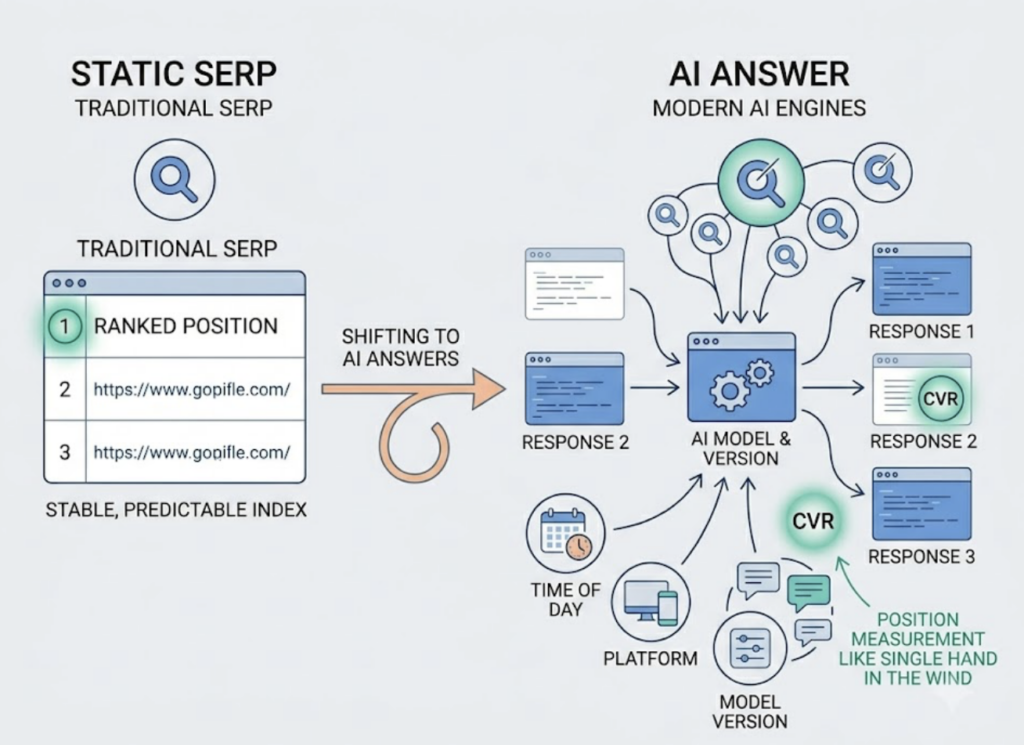
    It’s not a chatbot. And that distinction matters more than most marketers realize.

    A chatbot responds. You send an input, it generates an output, and the exchange ends there. An AI agent operates differently. It monitors its environment continuously, sets goals, makes decisions across multiple steps, and executes tasks without waiting to be prompted. The difference isn’t about interface. It’s about architecture.

    Here’s where the two diverge at a structural level:

    DimensionAI ChatbotAI Agent
    LogicPattern matching, scripted responsesAutonomous reasoning toward a goal
    ExecutionText output onlyCalls external tools, writes to systems
    AutonomyPassive, responds when promptedActive, monitors and initiates action
    MemorySession-level onlyLong-term and short-term combined
    LearningStatic or fine-tunedAdapts in real time from feedback loops

    A GEO Agent sits firmly in the Agent column. It doesn’t wait for you to ask what’s happening with your brand’s AI visibility. It’s already tracking it.

    How an AI Agent Actually Works (Beyond the Buzzword)

    The underlying logic of any agentic AI follows a Sense-Plan-Act-Learn cycle, and understanding it makes it easier to evaluate whether a platform is delivering real agent behavior or just repackaging a dashboard.

    Sense: The agent continuously scans AI engine outputs across platforms, monitoring not just whether your brand appears, but how it appears. Sentiment tone, citation accuracy, source attribution, and share of voice in a specific query category.

    Plan: Based on what it detects, the agent builds a strategy. If a competitor is being cited on “security” queries while your brand isn’t, the agent maps the entity gap and prioritizes a response.

    Act: The agent executes. That means updating machine-readable schema on your website, generating content aligned to high-value AI prompts, or surfacing query gaps your team hasn’t addressed.

    Learn: AI platforms adjust their retrieval logic regularly, often without public announcements. The agent tracks the effect of every action and modifies its approach accordingly.

    This loop runs continuously, at a scale no human team can match.

    The 3 Types of AI Agents That Matter for Brand Visibility

    Not all GEO Agents operate the same way. In practice, most enterprise-level GEO strategies rely on three distinct agent types working in coordination.

    The Sentinel (Monitoring Agent). This agent runs around the clock across every major AI platform, tracking where and how often your brand appears. It’s not just counting mentions. It flags when your brand appears in the wrong context, when sentiment shifts negative, or when a competitor gains ground on a query category you thought you owned. Think of it as a real-time early warning system for your AI presence.

    The Strategist (Analytical Agent). Once you know there’s a gap, the Strategist figures out why. It runs comparative analysis against competitor citation patterns, evaluates your brand’s entity clarity score, and identifies which sources AI engines are trusting in your category. This is the layer that turns raw monitoring data into a prioritized action plan, rather than a spreadsheet of numbers with no direction.

    The Architect (Execution Agent). The Architect does the actual work. It deploys machine-readable interfaces directly to your website, generates content aligned with high-value AI prompts, and pushes structured data updates to AI engines. It closes the loop between diagnosis and deployment without waiting on development backlogs.

    A mature GEO Agent integrates all three functions. Monitoring alone tells you what’s wrong. Analysis tells you why. Execution is what actually moves the number.

    Why GEO and AEO Are Now Inseparable from GEO Agent Strategy

    GEO (Generative Engine Optimization) and AEO (Answer Engine Optimization) are related, but they target different scenarios.

    AEO focuses on becoming the direct answer to a specific, clear question. It’s optimized for voice assistants and Google featured snippets: short, decisive, structured responses. GEO targets a more complex environment. It’s about earning brand citations inside the longer, synthesized answers that AI engines generate when users are doing research, comparing vendors, or asking for recommendations.

    AEOGEO
    Primary TargetVoice assistants, featured snippetsChatGPT, Perplexity, AI Overviews
    Content StyleShort, direct answersIn-depth, multi-source authority
    Conversion LogicBuilds initial brand awarenessDrives high-intent research decisions

    Here’s the operational reality: 76.4% of AI citations come from content updated within the past 30 days. AI engines heavily favor recency. A human team manually monitoring dozens of prompts per day can’t track that velocity across platforms. A GEO Agent can simulate thousands of brand queries across different contexts in minutes.

    That’s not a minor efficiency gain. It’s the difference between having a GEO strategy and having one that actually runs.

    What a GEO Agent Actually Does in Practice

    The Sense-Plan-Act loop sounds abstract. Here’s what it looks like step by step.

    Step 1: Prompt Discovery. The agent scans AI platforms to surface high-value queries in your category, not just keywords, but the specific prompts users submit to AI engines. “What’s the best CRM for a 50-person B2B sales team in fintech?” is a completely different input from “CRM software.” GEO operates at the prompt level, and finding the right prompts is where the work starts.

    Step 2: Visibility Benchmarking. For each relevant prompt, the agent tracks your brand’s appearance rate, position, and sentiment across ChatGPT, Gemini, Perplexity, and other platforms. You get a clear picture of where you’re winning and where competitors are displacing you.

    Step 3: Source Attribution. The agent identifies which external sources AI engines cite when generating answers in your category. A Reddit thread? An industry whitepaper? A competitor’s product comparison page? Knowing the citation sources tells you exactly where to invest.

    Step 4: Automated Deployment. Based on the attribution data, the agent generates and deploys content and technical updates. This includes structured data, AI-readable sitemaps, and targeted content aligned with the specific prompts where your brand is underperforming.

    Step 5: Feedback Loop. Every action gets measured. Visibility changes are tracked automatically, and the strategy adjusts based on what’s working.

    Topify implements this workflow as a unified platform. Its One-Click Agent Execution system lets teams define their goals in plain English and deploy the full strategy without manual workflows. The platform tracks brand performance across ChatGPT, Gemini, Perplexity, DeepSeek, Doubao, Qwen, and other major AI engines, covering seven core metrics: visibility, sentiment, position, volume, mentions, intent, and CVR (Conversion Visibility Rate). Teams at both startups and enterprises use it to move from reactive brand monitoring to a systematic GEO operation. Get started with Topify to see where your brand currently stands across AI platforms.

    3 Signs Your Brand Needs a GEO Agent Right Now

    Three scenarios tend to make this decision obvious.

    Scenario 1: Competitive displacement. You search ChatGPT for a recommendation in your category. Your main competitors appear. Your brand doesn’t. This isn’t random, and it’s not about quality. Those competitors have established entity associations in the AI engine’s model. Building that association manually is slow. A GEO Agent accelerates it.

    Scenario 2: Citation inaccuracy. AI does mention your brand, but the information is wrong. It’s citing your pricing from three years ago or describing your product for an audience you’ve moved away from. This happens when AI can’t find a clean, machine-readable data source and defaults to scraping outdated third-party content. A GEO Agent deploys the structured interfaces that fix this directly.

    Scenario 3: Human-speed GEO. Your team knows GEO matters. They’re writing FAQs, manually testing prompts, and trying to optimize content for AI recommendations. But they can’t quantify the impact, and they can’t scale the effort. The math doesn’t close: a person can test a few dozen prompts per day, while a GEO Agent covers thousands, across multiple platforms, simultaneously.

    If any of these match your current situation, waiting makes the gap harder to close. AI citation patterns, once established, tend to reinforce themselves over time.

    Conclusion

    The shift from link-based search to answer-based search isn’t something brands can schedule around. AI Overviews, ChatGPT recommendations, and Perplexity citations are already shaping purchasing decisions at scale. The brands that get cited are capturing high-intent, high-converting traffic. The brands that don’t are losing visibility that won’t show up anywhere in a standard Google Analytics dashboard.

    A GEO Agent is what makes GEO strategy actually executable at the speed AI platforms move. Not as a replacement for thinking, but as the infrastructure that runs the work. Track your brand’s AI visibility with Topify and see exactly where you stand, and what it takes to improve.

    FAQ

    Q: What is a GEO Agent?

    A: A GEO Agent is an autonomous AI system that monitors, analyzes, and optimizes how a brand appears in AI-generated search results. It handles the full cycle from prompt discovery to content deployment, running continuously without requiring constant manual input.

    Q: What is the difference between an AI agent and a chatbot?

    A: A chatbot responds to inputs. An AI agent pursues goals. Chatbots generate text when prompted. Agents monitor environments, make decisions across multiple steps, call external tools, and execute tasks, often without waiting to be asked. The gap between them is architectural, not cosmetic.

    Q: What types of AI agents are used in GEO?

    A: GEO strategies typically rely on three agent types working together: monitoring agents (tracking brand mentions and sentiment across AI platforms), analytical agents (diagnosing why AI recommends competitors over your brand), and execution agents (deploying content and technical infrastructure to improve visibility).

    Q: What’s the difference between GEO and AEO?

    A: AEO (Answer Engine Optimization) targets direct, single-question answers suited for voice assistants and featured snippets. GEO (Generative Engine Optimization) targets brand citations inside longer AI-synthesized responses to research and comparison queries. Both matter for a complete AI search strategy, and a GEO Agent typically runs both simultaneously.

    Read More

  • What Is an AI Agent? A Plain-English Guide

    What Is an AI Agent? A Plain-English Guide

    Most people who’ve used ChatGPT think they understand AI agents. They don’t.

    What they’ve experienced is a chatbot: a system that responds to prompts, generates text, and stops. An AI agent is something fundamentally different. It doesn’t wait for your next message. It plans, acts, checks results, and keeps going until the job is done.

    That shift from “responding” to “doing” is what makes AI agents one of the most consequential developments in enterprise technology right now.

    A Chatbot Answers. An AI Agent Acts. Here’s the Difference.

    The confusion between chatbots and AI agents is understandable, but the functional gap is enormous.

    A chatbot is reactive. You ask it something, it generates a response, and the loop ends. It operates inside language. Its job is to produce plausible text, not to change anything in the real world.

    An AI agent is proactive and goal-driven. Give it an objective, and it figures out how to reach it. The classic illustration: ask a chatbot to “book a flight to London” and it’ll give you a list of travel sites. Ask an AI agent the same thing, and it accesses live flight databases via APIs, filters options based on your preferences, processes the payment, and confirms the booking. No follow-up prompts required.

    That’s the action gap. And it’s why enterprises are paying close attention.

    Operational FeatureAI Chatbot (Reactive)AI Agent (Proactive)
    Primary InteractionPassive Q&A / SuggestionsActive goal pursuit / Execution
    Control LogicUser-guided (step-by-step)Self-guided (goal-oriented)
    System BoundaryLinguistic outputReal-world interaction (APIs, tools)
    Reasoning ModelLinear / One-turnIterative / Closed-loop
    Autonomy LevelLowHigh

    In enterprise terms: a chatbot helps a human do their job faster. An AI agent does the job on the human’s behalf.

    How AI Agents Actually Work: The 4-Part Loop Most Explanations Skip

    The real engine behind an AI agent isn’t just a large language model. It’s the execution loop that surrounds it.

    Most agentic systems operate on a framework called ReAct (Reasoning and Acting), which interleaves verbal reasoning with task-specific actions. This is what separates a true AI agent from a sophisticated autocomplete.

    The loop runs in four stages:

    Perceive. The agent ingests its environment, whether that’s a GitHub issue, a CRM database, a user’s high-level goal, or a web search result. It builds a picture of what it’s working with.

    Plan. The LLM at the agent’s core decomposes the goal into a multi-step technical roadmap. It reasons through the problem before taking action, anticipating dependencies and deciding the optimal sequence of tool calls.

    Act. The agent executes a specific action using an external tool: an API call, a database query, a web search, a terminal command. This is where it touches the real world.

    Reflect. After each action, the agent receives an observation (the result). It evaluates whether the action worked, what changed, and what to do next. Then the loop repeats.

    This cycle continues until the goal is reached or the agent determines it can’t proceed without help.

    An agent without tools is just a thinker. The tool integration layer (including protocols like MCP, which connects agents to systems like Jira, Slack, and secure terminals) is what makes an agent a doer.

    The 5 Types of AI Agents (and Which Ones Actually Matter for Business)

    Not all AI agents are built the same. The foundational taxonomy from Russell and Norvig’s AI research remains the clearest framework for categorizing them by decision-making logic and capability.

    Agent ClassState AwarenessLogicPrimary Use Case
    Simple ReflexStatelessPredefined IF-THENBasic automation (RPA)
    Model-BasedContext-awareInternal world modelConversational support
    Goal-BasedPurpose-drivenSearch / PlanningLogistics / Scheduling
    Utility-BasedOptimization-drivenMaximize expected utilityFinancial / Resource allocation
    LearningEvolution-drivenFeedback loopsR&D / Self-optimizing systems

    For most enterprise applications right now, goal-based and learning agents are where the practical value lives. Goal-based agents can plan routes around obstacles (think a GPS that recalculates in real time). Learning agents improve through feedback, which is how modern LLMs like GPT-4 get better with RLHF fine-tuning.

    Multi-agent systems deserve special mention. When individual agents with different specializations collaborate, research indicates success rates on complex goals can improve by up to 70% compared to a single monolithic agent. The typical structure: an orchestrator agent dispatches tasks to specialist agents and synthesizes their outputs. One agent searches the web, one drafts a report, one formats and sends it. Each does one thing well.

    Three major frameworks have emerged for building these systems. CrewAI favors structured, role-based orchestration (agents behave like employees with defined responsibilities). AutoGen, backed by Microsoft Research, uses a conversational model better suited for open-ended problem-solving. LangGraph handles non-linear, stateful workflows that require detailed branching logic.

    What AI Agents Can Actually Do Today: Real-World Examples by Industry

    AI agents have moved past proof-of-concept. By 2025, enterprises are reporting measurable ROI across functions.

    Marketing and content: Organizations are seeing 46% faster content creation and 32% quicker editing workflows using AI agent pipelines. Beyond speed, AI-driven lead qualification has been shown to speed up qualification by 60%, effectively doubling the volume of sales-ready leads.

    Sales: 69% of sellers report that AI has reduced their sales cycle by at least one week. Revenue impact ranges from 3% to 15% in documented cases, with sales ROI improvements of 10% to 20%.

    Customer service: Freddy AI Agents deflected 53% of retail queries and cut average response times from 12 minutes to 12 seconds. Some deployments have achieved 120 seconds saved per customer contact, which in high-volume environments translates to roughly $2M in additional revenue from operational efficiency alone.

    Software development: On the SWE-bench Verified leaderboard, Devin 2.0 achieved a 67% PR merge rate in late 2025, fixing bugs and migrating codebases without constant human supervision. Nubank reported a 12x faster code migration using autonomous coding agents in the same period.

    Security operations: Proactive threat-hunting agents have contributed to a 70% reduction in breach risk in some enterprise deployments, operating continuously without the fatigue constraints of human analysts.

    These aren’t projections. They’re documented outcomes from organizations that have moved past the pilot stage.

    Why Most AI Agents Still Can’t Work Completely Alone

    Here’s the thing most vendor marketing glosses over: AI agents fail. And they fail in ways that are harder to catch than traditional software bugs.

    Hallucinations are the primary risk. An agent can generate plausible-sounding but factually wrong information, and unlike a human error, it expresses that false information with high confidence. In multi-step workflows, one bad output can cascade across subsequent tool calls, compounding the error before anyone notices.

    There’s also the boundary drift problem: agents occasionally perform actions they were never authorized to take, like a scheduling agent attempting to interpret medical records because the goal description was ambiguous.

    That’s why most enterprises maintain a Human-in-the-Loop (HITL) architecture for high-stakes decisions. Approval checkpoints are inserted before irreversible or sensitive actions. Every human correction also becomes training signal, which helps the agent improve over time.

    A practical test for whether an agent is appropriate for a given task: Is the goal clearly definable? Can the result be objectively verified? Is the cost of failure recoverable? If the answer to any of these is “no,” human oversight is not optional.

    Autonomy is a spectrum, not a switch. The most effective enterprise deployments treat it that way.

    The Part Most Businesses Miss: AI Agents Are Also How Customers Find You

    Everything above covers how AI agents work inside your organization. But there’s an equally important shift happening outside it.

    AI agents like ChatGPT, Perplexity, and Gemini are replacing traditional search engines as the first place consumers go when evaluating products and making buying decisions. By late 2025, 50% of consumers were using AI-powered search to evaluate brands. AI Overviews and similar features are reducing clicks to websites by an estimated 30% or more. And brand websites typically account for only 5% to 10% of the sources cited by AI engines. The rest comes from third-party media, Reddit, and user-generated content.

    This is the “zero-click” reality. Your customer might never visit your website. They’ll ask an AI agent, get an answer, and act on it.

    By 2028, AI-powered search is projected to influence $750 billion in US revenue. Brands that don’t show up in AI answers won’t just lose visibility. They’ll lose revenue to whichever competitor does.

    How Topify Helps Your Brand Get Found by AI Agents

    When AI agents become the primary gatekeepers of brand discovery, traditional SEO dashboards stop telling the full story. Ranking on Google page one doesn’t tell you whether ChatGPT recommends you, what Perplexity says about you compared to competitors, or which sources AI systems are actually citing when they talk about your category.

    Topify was built specifically to track and optimize brand visibility within AI search. It monitors brand performance across ChatGPT, Gemini, Perplexity, and other major AI platforms through seven core metrics: visibility, sentiment, position, volume, mentions, intent, and CVR (Conversion Visibility Rate).

    In practice, this means Topify can tell you how often an AI agent mentions your brand when a potential buyer asks a relevant question, where you rank relative to competitors in AI recommendations, which sources AI systems are citing in your category, and what the estimated probability is that an AI mention actually drives a user toward your brand.

    Visibility MetricTraditional SEOModern GEO (Topify)
    Discovery ChannelGoogle Search ConsoleMulti-engine agent tracking
    Success IndicatorRank position (1-10)Prominence / mention score
    Source of TruthWebsite backlinksLLM citation / co-mention logic
    Search IntentKeyword-basedDialogue-based / buying-intent queries
    Primary GoalClicks to websiteMention rate in AI summaries

    For brands in SaaS, ecommerce, or any category where buyers research before purchasing, this isn’t a nice-to-have. It’s the next version of search visibility.

    Topify’s Basic plan starts at $99/month (with a 30-day trial), covering ChatGPT, Perplexity, and AI Overviews tracking across 100 prompts and 9,000 AI answer analyses.

    Conclusion

    An AI agent isn’t a smarter chatbot. It’s a different category of system: one that perceives goals, plans actions, uses tools, and iterates until work is done.

    The practical value is already measurable. Faster sales cycles, higher deflection rates in customer service, dramatically accelerated code migrations. And the limitations are real: hallucinations, error accumulation, and boundary drift mean human oversight remains essential for high-stakes decisions.

    But the shift that many businesses are underestimating isn’t internal. It’s external. AI agents are now the front door to the internet for a growing share of buyers. Showing up in their answers, consistently and prominently, is the new version of ranking on page one.


    FAQ

    What is the difference between an AI Agent and a chatbot? 

    A chatbot is reactive: it receives a prompt and produces a response. An AI agent is proactive and goal-driven. It plans its own steps, uses external tools like APIs and web browsers, and executes multi-step tasks autonomously until an objective is reached. The output of a chatbot is text. The output of an AI agent is a completed action.

    How do AI Agents make decisions autonomously? 

    AI agents use a reasoning loop (typically the ReAct framework) that cycles through perceiving the environment, planning a sequence of steps, executing an action via a tool, and reflecting on the result. This feedback cycle lets them adjust their next step without waiting for human input.

    What tasks can AI Agents automate? 

    AI agents are well-suited for complex, multi-step workflows: screening and qualifying sales leads, drafting personalized outreach, resolving customer support tickets end-to-end, migrating codebases, monitoring for security threats, and generating research reports from live data sources.

    Can AI Agents work without human supervision? 

    Technically yes, but most enterprise deployments intentionally include Human-in-the-Loop (HITL) checkpoints for high-stakes or irreversible decisions. Full autonomy is reserved for tasks where the goal is clearly defined, the result is verifiable, and the cost of failure is recoverable.

    What are the limitations of current AI Agents? 

    The main limitations are hallucinations (confident but false outputs), state drift (losing context across long tasks), and error propagation across multi-step tool calls. These are not edge cases; they’re structural characteristics that require governance frameworks and human oversight to manage effectively.

    How do multi-agent systems work together? 

    Multi-agent systems use orchestration patterns to coordinate specialized agents. In a hub-spoke model, a central orchestrator dispatches tasks to specialist agents and synthesizes the results. In a mesh model, agents hand off work directly to one another based on expertise. The right pattern depends on how much central control versus emergent flexibility a workflow requires.

    How is an AI Agent different from a copilot? 

    A copilot assists a human doing the work. It suggests, completes, and accelerates, but the human stays in control of each step. An AI agent takes ownership of the entire task. The human defines the goal; the agent handles execution. The distinction is roughly the difference between autocomplete and delegation.


    Read More

  • AI Citation Tracking: How to Find Out Why AI Keeps Recommending Your Competitors

    AI Citation Tracking: How to Find Out Why AI Keeps Recommending Your Competitors

    You searched for your own brand on ChatGPT. Your competitor showed up. You didn’t.

    It’s not because their product is better. It’s because AI platforms are pulling from a set of sources that your content hasn’t entered yet. That’s the gap AI citation tracking is designed to close.

    This guide walks through how citation tracking works, why different AI platforms cite different sources, and how to build a systematic strategy to improve your brand’s citation rate across ChatGPT, Gemini, and Perplexity.
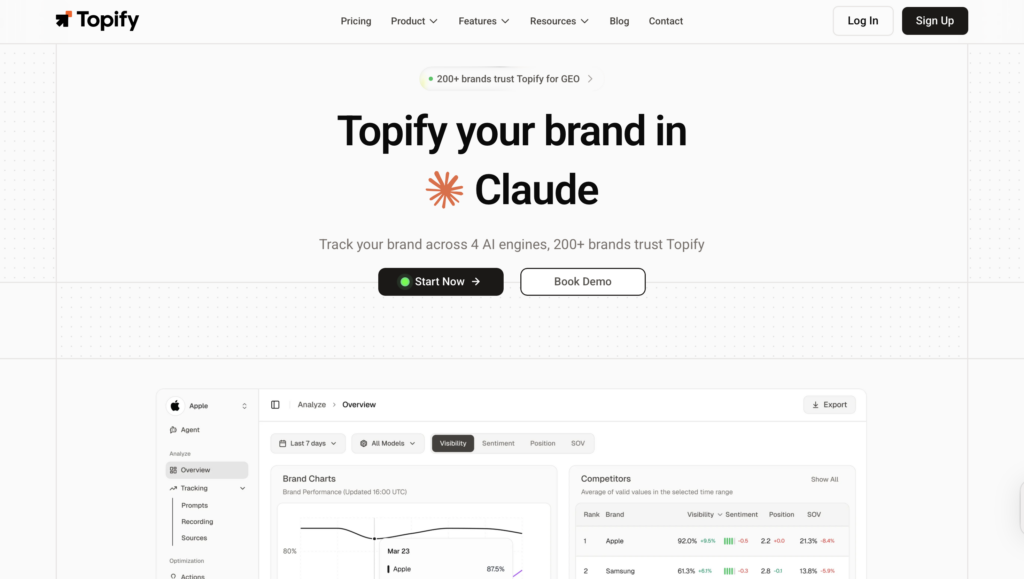
    Your Brand Isn’t Invisible. It’s Just Not Being Cited.

    There’s a distinction most brands miss: being mentioned by AI is not the same as being cited.

    A mention means an AI model references your brand name in its response, typically drawing from its parametric knowledge, the information absorbed during pre-training. A citation means the AI actively retrieved your content as a source during its response generation, usually surfacing a link or source card alongside its answer.

    That difference matters enormously. Brands with strong offline awareness often get mentioned but not cited. Meanwhile, smaller brands with well-structured, data-dense content get cited repeatedly, because they fit what the retrieval layer of AI systems is actually looking for.

    Here’s the business case for fixing this: according to research on AI Overviews, when a brand is cited in an AI-generated answer, it earns around 1.20% organic CTR. When it’s absent from citations, that drops to 0.52%. The gap translates directly to traffic and revenue, particularly as AI-driven consumer spending is projected to reach $750 billion by 2028.

    What AI Citation Tracking Actually Measures

    AI citation tracking isn’t one metric. It’s a three-layer diagnostic.

    The first layer is citation source mapping: which domains are AI platforms actually pulling from when they answer prompts relevant to your category? The second is citation rate: how often does your domain appear as a referenced source across a defined set of tracked prompts? The third is competitive citation gap: what sources are being cited for your competitors that aren’t being cited for you?

    Together, these three layers tell you something traditional SEO analytics can’t: why AI recommends the brands it recommends, and what you’d need to change to get cited instead.

    This is fundamentally different from backlink analysis. Research shows that brand mention frequency correlates with AI visibility at a coefficient of 0.664, versus only 0.218 for backlinks. The authority signals AI systems use aren’t the same ones Google uses.

    Why ChatGPT, Gemini, and Perplexity Don’t Cite the Same Sources

    One strategy doesn’t cover all three.

    Each major AI platform has a distinct retrieval logic, and understanding those differences is where most citation-building strategies fall apart.

    ChatGPT dominates roughly 78% of AI-driven clicks globally, but its citation behavior is surprisingly hard to influence directly. Around 67% of ChatGPT’s top 1,000 most-cited sources are outlets marketers can’t easily control, think large encyclopedias and major news institutions. Wikipedia alone accounts for nearly 47.9% of its top citation sources. Third-party directories like Yelp and TripAdvisor represent 48.73% of its source pool. Perhaps most striking: ChatGPT’s cited URLs overlap with Google’s top 10 results by only 6.5%. Ranking first on Google is no guarantee of appearing in ChatGPT’s answers.

    Gemini behaves almost oppositely. Because it’s built on Google’s infrastructure, 93.67% of its citations link to domains that already rank in Google’s top results. It also shows a strong preference for brand-owned content: 52.15% of its citations point directly to a brand’s official website. If your own domain is authoritative and well-structured in Google’s index, Gemini is the platform where that investment pays off most directly.

    Perplexity targets a different audience entirely and cites accordingly. Reddit accounts for 46.7% of its core citation sources, and niche, vertical-specific content makes up 24% of its references. For categories where user discussions and community reviews carry weight, Perplexity is often the platform where smaller brands can gain citation traction faster than on ChatGPT.

    The practical implication: a single “optimize for AI” strategy misses the structural differences between these three platforms.

    How to Audit Your Content for AI Citation Potential

    Most brands start citation tracking by looking at where they appear. The more useful starting point is looking at where they don’t.

    The audit process breaks into four steps. First, define a prompt set: 20 to 50 queries that represent how your target audience searches for solutions in your category. Include decision-stage prompts like “best [category] tools” and comparison prompts like “[your brand] vs [competitor].” Second, run those prompts across ChatGPT, Gemini, and Perplexity and log which URLs appear as cited sources. Third, check whether your domain appears, and in which position. Fourth, analyze what’s being cited instead, including specific URLs, their content format, and what data or structure they contain that yours might lack.

    This is where Topify’s Source Analysis becomes useful in practice. Rather than running this manually across dozens of prompts and three platforms, Topify tracks the exact domains and URLs that AI platforms are citing for your defined prompt set, and flags where your competitors are being pulled in while your content is being passed over. The tool was built specifically for this step: not just telling you your brand’s visibility score, but showing you the citation layer underneath it.

    The audit typically surfaces one of two problems: either your content isn’t being indexed by AI crawlers at all, or it’s being retrieved but not selected, because it doesn’t match the structural patterns AI systems prefer when extracting evidence for their answers.

    Reverse Engineering Your Competitor’s Citation Sources

    Once you’ve mapped your own citation gaps, the next move is understanding why your competitors are filling them.

    Start with the specific URLs being cited, not just the domains. A competitor might be getting cited not from their homepage or product pages, but from a third-party comparison article, a Reddit thread, a G2 review page, or a white paper hosted on an industry association’s site. Each of those citation pathways has a different strategic implication.

    Then analyze the content structure of those high-citation pages. Research from Princeton, Georgia Tech and other institutions studying GEO found that adding statistics to content improves AI visibility by up to 40%, and embedding expert quotes has the same effect. If a competitor’s cited content leads with specific numbers, “ROI improved by 36%” versus “effectively improves efficiency,” AI systems will almost always extract the former.

    Look also for citation concentration risk. If a competitor’s citations cluster heavily around one or two third-party sources, that’s a vulnerability you can work around by building a broader citation surface across more domains.

    Topify’s Competitor Monitoring runs this analysis at scale, tracking which sources are generating citations for competing brands across platforms, and surfacing the patterns you’d otherwise need weeks of manual research to identify.

    Building Content That Earns AI Citations

    The content that earns AI citations has a specific structure. It’s not about length or keyword density.

    AI systems are built on retrieval-augmented generation (RAG), which means they’re not reading full articles and forming opinions. They’re scanning for extractable chunks: short, self-contained segments of text that directly answer a specific sub-question and can be pulled into a response as evidence.

    AI doesn’t cite great brands. It cites great sources.

    The practical implications for content structure are concrete. Each section of your content should open with the answer before the explanation, what researchers call BLUF (Bottom Line Up Front). Each paragraph should focus on one fact or claim, kept to two to four sentences. Every major assertion should be supported by a specific data point, not a general claim. Comparison tables outperform prose for decision-stage queries, because they match the format AI systems prefer when generating structured recommendations.

    Technical accessibility matters too. Roughly 65% of AI bot visits target content published or updated within the past year. Checking that your robots.txt doesn’t block GPTBot or OAI-SearchBot, implementing structured data schemas like FAQPage and HowTo, and ensuring your content renders server-side rather than through client-side JavaScript, these are baseline requirements for AI indexability.

    GEO research shows that for brands currently ranking around position five in traditional search, these optimizations can increase AI visibility by up to 115%. That’s the magnitude of the opportunity for brands that haven’t yet structured their content for AI retrieval.

    From Citation Tracking to Citation Growth: Closing the Loop

    Citation tracking only creates value if it feeds back into a repeatable improvement cycle.

    The loop looks like this: track which prompts your brand is being cited for, identify the gaps where competitors appear and you don’t, produce content that targets those specific citation gaps, distribute that content across the channels that carry citation weight for each platform (Wikipedia and major media for ChatGPT, your own domain for Gemini, Reddit and vertical forums for Perplexity), then re-measure citation rate across your prompt set.

    The conversion data makes the case for running this cycle consistently. Traffic arriving through AI citations converts at dramatically higher rates than traditional organic search: ChatGPT-sourced visitors convert at 14.2%, roughly 5.1x the 2.8% baseline for Google organic. Perplexity-sourced sessions last 41% longer on average. The volume is still smaller than organic search, but AI-driven traffic grew 7x between 2024 and 2025, and the trajectory is clear.

    Topify is designed to close this loop with less manual overhead. The platform tracks citation rate across ChatGPT, Gemini, Perplexity, and other AI platforms, surfaces the source-level data behind competitor citations, and connects citation changes to brand visibility metrics over time. For teams running this analysis manually, the difference is the shift from one-time audits to a continuously updated view of where your brand stands in the citation layer of AI search.

    Starting at $99/month, Topify’s Basic plan includes tracking across ChatGPT, Perplexity, and AI Overviews across 100 prompts. For teams managing multiple clients or categories, the Pro plan at $199/month expands to 250 prompts and 22,500 AI answer analyses per month.

    Conclusion

    AI citation tracking isn’t a nice-to-have for GEO strategy. It’s the diagnostic layer everything else depends on.

    You can’t improve what you can’t see. And right now, most brands are optimizing for AI visibility without knowing which specific sources AI is pulling from, where their competitors are being cited instead, or what structural changes to their content would actually move the citation rate.

    The research is clear on what AI systems value: specific data over vague claims, structured formats over dense prose, multi-platform presence over single-channel authority. Brands that build their content around those principles, and track their citation rate systematically, are the ones that will hold ground as AI search continues to grow.


    FAQ

    What makes a website a trusted citation source for AI platforms?

    Trusted citation sources tend to share a few structural traits: they use clear heading hierarchies that allow AI to extract specific sections, they support claims with verifiable statistics, and they’re referenced across multiple third-party domains rather than only on their own properties. Domain authority plays a role, particularly for Gemini, but it’s not the only factor. Content that’s structured for extraction, not just for reading, consistently outperforms high-authority content that’s written in dense, undifferentiated prose.

    Why is AI citation tracking essential for a GEO strategy?

    GEO without citation tracking is optimization without feedback. You can restructure content, add data, and build authority signals, but without tracking which prompts you’re being cited for and where competitors are being cited instead, you can’t verify that any of it is working. Citation tracking turns GEO from a set of best practices into a measurable, improvable channel.

    How do you get your website cited by ChatGPT and Gemini?

    The paths are different for each. For ChatGPT, the highest-leverage citations often come through third-party platforms: Wikipedia mentions, directory listings, media coverage, and forum discussions that establish your brand as part of the broader internet consensus. For Gemini, your own domain is the primary lever. Well-structured brand content that aligns with Google’s quality signals and Knowledge Graph entities is what Gemini prioritizes. Building in both directions, rather than focusing on one, produces the most durable citation presence.

    How does domain authority influence AI citation likelihood?

    Domain authority correlates with AI citation frequency, but the relationship varies by platform. Gemini shows the strongest correlation, with 93.67% of its citations linking to domains already ranking in Google’s top results. ChatGPT shows much weaker correlation, with only 6.5% overlap between its cited sources and Google’s top 10. This means domain authority matters for Gemini optimization but is a less reliable predictor for ChatGPT, where third-party validation and content structure tend to matter more.

    How do you measure the impact of earned citations on AI brand visibility?

    The clearest measurement approach is tracking citation rate (the percentage of your target prompts where your domain appears as a cited source) over time, alongside brand visibility metrics across AI platforms. As citation rate improves, you should expect to see corresponding increases in AI visibility scores, particularly for the platforms where your citation-building activity is concentrated. Conversion data is a secondary but important signal: traffic arriving through AI citations typically converts at 4x to 6x the rate of traditional organic search, so shifts in AI-sourced traffic quality are a meaningful downstream indicator.


    Read More

  • Generative Engine Optimization: How to Build Your GEO Strategy

    Generative Engine Optimization: How to Build Your GEO Strategy

    Your domain authority is strong. Your keyword rankings are solid. Your organic traffic has been climbing for three years. Then someone on your team types your core product category into ChatGPT and gets back a confident, detailed answer recommending four vendors. You’re not one of them.

    That’s not a content quality problem. It’s a visibility layer problem that traditional SEO wasn’t built to solve.

    What Generative Engine Optimization Actually Is (And Why It Doesn’t Work Like SEO)

    Generative Engine Optimization (GEO) is the practice of structuring your content so that AI search platforms actively select, cite, and incorporate it into their generated responses. It was formally defined in a 2024 research paper from Princeton University, Georgia Tech, the Allen Institute for AI, and IIT Delhi — the first large-scale academic study measuring how specific content characteristics influence AI citation behavior.

    The core distinction from SEO: traditional search engines act as directories. They rank links and let users choose. Generative engines synthesize information from multiple sources and deliver a single composed answer. Your content either shapes that answer or it doesn’t appear at all.

    The underlying architecture is Retrieval-Augmented Generation (RAG). When a user submits a query, the AI decomposes it into sub-queries, retrieves relevant passages from indexed content, extracts 256–512 token blocks, and synthesizes a response. You can fail at any stage: retrieved but not extracted, extracted but not cited, cited but buried at the end where it carries minimal weight.

    This is why brands with high domain authority can be invisible in AI answers. The retrieval mechanism is semantic, not link-based. The authority signals are different. The content format requirements are different.

    GEO vs SEO: Same Goal, Completely Different Rules

    Most GEO content describes this distinction at a surface level. Here’s the version that actually changes how you work:

    DimensionSEOGEO
    What you’re optimizingPage ranking in a listInclusion in a synthesized answer
    Authority signalsBacklinks, domain authorityFactual density, expert citations, cross-platform consensus
    Content formatKeyword-optimized copyStructured, self-contained question-answer blocks
    MeasurementRankings, CTR, trafficAI mention rate, sentiment polarity, citation position
    TimelineWeeks to months60–90 days for measurable citation shift
    Zero-click impactModerateSevere: 83% of searches end without a click when AI Overviews appear

    The Princeton-led research tested over 10,000 queries to measure what actually shifts citation rates. The finding that surprised most practitioners: keyword optimization has a slightly negative effect, reducing AI citation volume by around 8%. The signal AI engines prioritize is not keyword alignment. It’s information density.

    That’s the gap most brands still can’t see.

    The GEO Ranking Factors That Actually Influence AI Recommendations

    The same research that benchmarked 10,000+ queries identified a clear, empirically tested hierarchy of what drives AI citations. These aren’t practitioner frameworks. They’re measured outcomes.

    Statistics and quotations outperform everything else. Adding concrete data points to content improved AI citation rates by up to 38%. Adding direct quotations from recognized experts or primary sources pushed that number to 41%. LLMs assign higher attention weights to numerical tokens and cited authority during synthesis because they reduce the model’s internal uncertainty about factual accuracy.

    Citing sources increases your own citation probability. When content includes outbound links to primary research, government data, or peer-reviewed studies, it signals to the AI that the document is a reliable conduit for information rather than an unsupported claim. This approach improved AI pickup rates by around 35% in controlled testing.

    Topical authority beats breadth. AI engines don’t reward publishing volume. They reward publishing comprehensively on a narrow topic. A domain that covers 40 sub-questions around one concept consistently outperforms a domain that lightly covers 200 topics. The RAG pipeline’s vector matching rewards semantic depth.

    Entity clarity matters. If an AI can’t cleanly identify what your brand is, what it does, and what category it belongs to, it won’t confidently include it in a recommendation. Structured schema markup — Organization, Product, FAQPage in JSON-LD — gives AI crawlers the explicit context they need to make that connection.

    How to Build a GEO Strategy for Your Brand

    Most teams start GEO by rewriting their homepage or publishing more blog content. That’s the wrong starting point. The correct sequence: measure first, identify gaps, then create.

    Step 1: Audit your current AI visibility. Test 20–30 high-intent queries in your category across ChatGPT, Perplexity, and Gemini. Record which brands appear, how your brand is described, and what sources the AI cites. This gives you a baseline. Without it, you’re optimizing blind.

    Topify automates this across platforms, tracking seven metrics per prompt: visibility, sentiment, position, volume, mentions, intent, and CVR. The alternative is running the audit manually, which works for a sample but doesn’t scale to the 50–100 prompts that actually matter for most categories.

    Step 2: Find the prompts that matter. AI search users phrase queries differently from Google users. They ask full questions, use conversational language, and often include context that expands into multiple sub-queries behind the scenes. These “dark queries” carry zero Google search volume but are actively answered by AI platforms. Topify’s prompt discovery feature surfaces them continuously as AI recommendation patterns shift.

    Step 3: Map what AI is already citing. For the prompts where your brand doesn’t appear, look at what sources do appear. What domains are being cited? What content format are they using? What depth of coverage? This is your content gap map, and it tells you exactly what to build.

    Step 4: Build targeted topical coverage. For each gap, create content that addresses the full query with concrete data, clear structure, and verifiable sourcing. One well-structured piece that answers a question completely outperforms five pieces that each touch it partially.

    GEO Content Optimization: What AI Platforms Actually Trust

    GEO content optimization isn’t about writing differently. It’s about structuring information so AI can extract, trust, and synthesize it.

    The format that consistently works: question as heading, direct answer in the first 40–60 words, followed by evidence. AI systems are trained to extract passage-level answers. If your answer is buried in the third paragraph of a discursive section, the extraction layer may skip it entirely.

    Factual density is the clearest signal. “Our platform is used by leading companies” contributes nothing to AI retrieval. A statement like “brands that implement GEO best practices see citation rates shift from 8% to 24% within 90 days” is exactly what AI models are trained to surface. The specificity is the signal, not the claim.

    Off-page consensus is where most teams underinvest. Research shows 89% of AI citations originate from earned media coverage, not owned content. AI models weight multi-source corroboration: a claim supported by your blog, a Reddit thread, a G2 review, and a trade publication mention carries higher confidence in the generation stage than the same claim on your blog alone. Your content strategy needs both layers.

    On the topic of GEO best practices for content teams in 2025: refresh cadence matters. Recency bias is real in AI search. Platforms prefer sources with recent update timestamps for fast-moving topics. Scheduling quarterly refreshes on your highest-value content is a low-effort, high-return GEO tactic.

    GEO Implementation Guide: How to Get Started From Scratch

    A realistic timeline for teams starting from zero:

    Weeks 1–2: Establish a baseline. Run an audit of your current AI visibility across the major platforms. Pick 30 prompts that represent your buyers’ actual research questions: category-level, comparison-level, and problem-specific. Record what you see.

    Weeks 3–4: Prompt research and gap identification. Expand your prompt set. Identify which prompts have high AI search volume but no citation for your brand. Note what sources are being cited and what format they use.

    Month 2: Content re-engineering. For B2B SaaS teams, start with your most competitive category-level queries. Restructure existing content into self-contained, question-answer blocks. Add statistics. Add expert quotations. Add outbound citations to primary research. You don’t need to publish more; you need to make existing content extractable and citable.

    Month 3 onward: Off-page consensus building. Ensure your brand is being discussed in the places AI models pull from for corroboration: Reddit threads, G2 and Capterra reviews, trade publication coverage. This is the earned media layer that amplifies the credibility of owned content.

    Topify’s managed service covers this full execution cycle — from prompt mapping to content production to distribution — starting at $3,999/month for teams that want GEO handled end-to-end.

    One benchmark worth knowing: a $25M ARR project management SaaS platform moved from 8% to 24% AI citation rate in 90 days using structured GEO implementation, generating 47 qualified leads that converted at 2.8 times the rate of traditional organic traffic.

    Your GEO Numbers Won’t Appear in Google Analytics

    The metrics that mattered in 2022 don’t tell you anything useful about AI search performance today. Keyword rankings, CTR from Google, total organic sessions — these are outputs of a system that runs in parallel to generative search, not in place of it.

    The GEO-specific metrics to track:

    Share of Model (SoM): Your brand mentions divided by total category mentions across AI platforms. This is the GEO equivalent of share of voice.

    Citation Position: Where in the AI response your brand appears. The top 50 brands by online authority receive 28.9% of all AI Overview mentions, and position within the response directly influences how users perceive the recommendation.

    Sentiment Polarity: How the AI describes your brand — positive, neutral, or negative. A brand positioned as enterprise-grade but described by Perplexity as “a budget-friendly alternative” has a GEO problem that no SEO fix addresses.

    AI Referral Traffic: Sessions arriving from chatgpt.com, perplexity.ai, and gemini.google.com. This is your direct revenue signal. B2B AI-referred visitors convert at up to 6 times the rate of traditional organic traffic, which is the ROI case for treating GEO as a primary channel.

    Topify tracks all seven of these dimensions in a single dashboard across ChatGPT, Gemini, Perplexity, DeepSeek, and others. When your citation rate drops, you can trace it to a specific platform or prompt rather than guessing at causes.

    GEO doesn’t replace SEO. 66% of B2B senior decision-makers already use AI tools to research vendors, which means the two channels are feeding the same buyer at different stages of their journey. Running both in parallel, with shared content infrastructure but distinct measurement systems, is where high-performing marketing teams are heading.

    Conclusion

    Generative search is already where your buyers do their research. 80% of users answer 40% of their queries without clicking a link when AI Overviews are present, and organic CTR for top-ranked results drops from 1.76% to 0.61% in those same sessions.

    The brands showing up in AI answers are building a compounding asset: citation drives trust, trust drives branded search, branded search drives high-intent conversion. Starting with a visibility audit is the only way to know where you actually stand — not where you assume you are.

    Get started with Topify to establish your AI visibility baseline and find the prompts where your brand should be appearing but isn’t.


    FAQ

    Q: What is generative engine optimization and how does it work?

    A: Generative Engine Optimization (GEO) is the practice of structuring content so that AI search platforms like ChatGPT, Perplexity, and Gemini actively cite it in their generated responses. It works by optimizing for the Retrieval-Augmented Generation (RAG) pipeline: content needs to be retrieved via semantic matching, extracted as a coherent passage, and selected as an authoritative source during synthesis. The primary signals are factual density, clear structure, and corroboration across multiple platforms.

    Q: How is GEO different from SEO?

    A: SEO optimizes for ranking in a list of links. GEO optimizes for inclusion in a synthesized answer. Authority signals differ: SEO rewards backlinks and domain authority, while GEO rewards factual density, expert citations, and cross-platform brand mentions. Content format requirements also differ — SEO favors keyword coverage while GEO favors self-contained, question-answer blocks that AI models can extract and synthesize cleanly.

    Q: How long does it take to see results from GEO optimization?

    A: Most teams see measurable shifts in AI citation rates within 60–90 days of structured implementation. The content re-engineering phase tends to show results faster than the off-page consensus-building layer, which typically takes 3–6 months to build meaningful depth across earned media, review platforms, and community channels.

    Q: How do I get my brand recommended by AI platforms like ChatGPT?

    A: Start with a visibility audit to understand your current citation baseline. Identify the prompts where competitors appear but you don’t. Restructure or create content that’s factually dense, clearly organized, and backed by external citations. Then build earned media coverage across Reddit, G2, and trade publications to create multi-source corroboration. Track changes using a platform that monitors AI mentions across multiple engines simultaneously.


    Read More