Author: Elsa Ji

  • What AI Brand Monitoring Actually Tracks

    What AI Brand Monitoring Actually Tracks

    Your brand could have five-star reviews on G2, a strong social presence, and stable organic traffic — and still be completely invisible when a potential customer asks ChatGPT to recommend a solution in your category.

    That’s not a hypothetical. It’s happening to most brands right now, and traditional monitoring tools won’t catch it.

    AI brand monitoring exists to close that gap. But it tracks something fundamentally different from what most marketers expect.

    Your Brand Might Have Great Reviews. AI Still Might Not Recommend You.

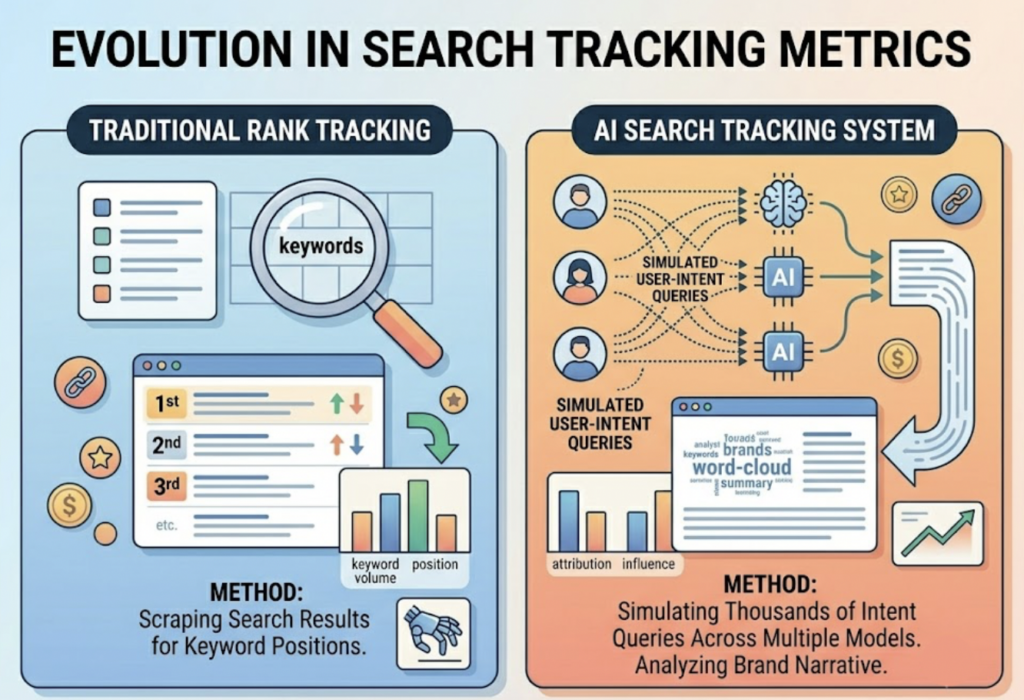
    Traditional brand monitoring was built for a different internet. Tools like Google Alerts, Brandwatch, and Mention were designed to crawl static web pages and real-time social feeds — and flag any time your brand name appeared.

    The problem is that AI doesn’t work that way.

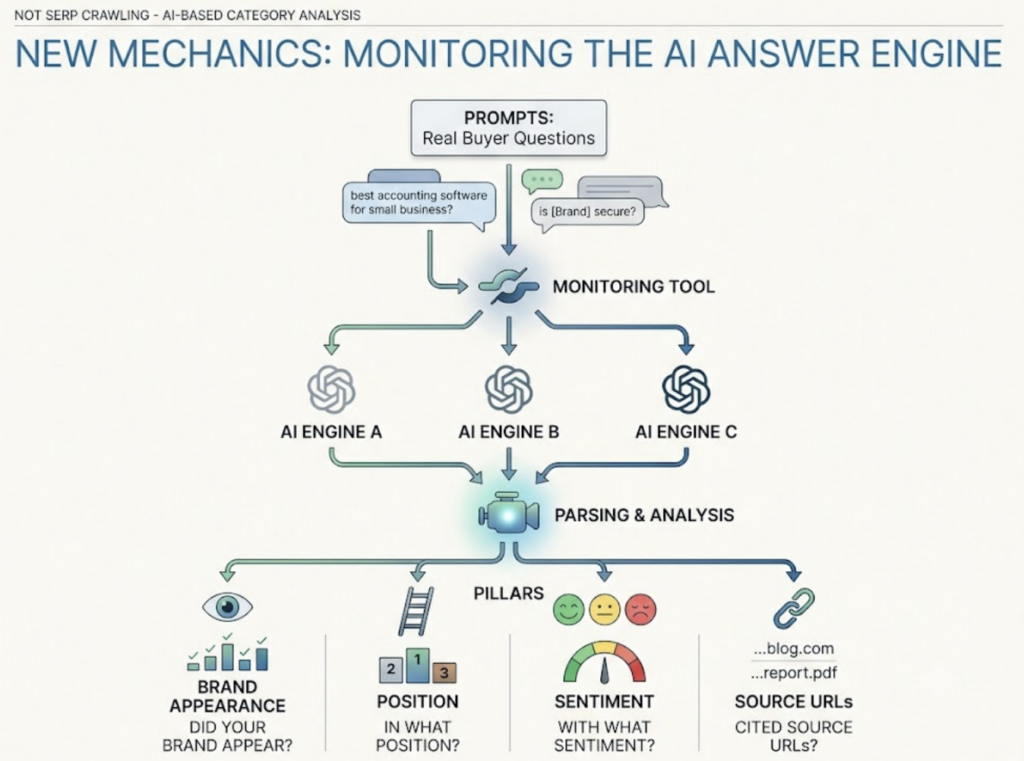
    When a user asks Perplexity “what’s the best CRM for startups,” the answer is generated on-the-fly through a process called Retrieval-Augmented Generation (RAG). That synthesized response doesn’t exist as an indexable webpage. It’s private, dynamic, and invisible to any crawling-based tool. Your brand could be omitted from thousands of high-intent recommendations every day without triggering a single alert on a traditional dashboard.

    The scale of this blind spot is larger than most teams realize. AI search queries now average 23 words compared to four for traditional search, and sessions run about six minutes on average. These are deeper, more intent-rich conversations — exactly the kind where buying decisions get made. And up to 70.6% of AI referral traffic gets misclassified as “Direct” in Google Analytics because AI platforms frequently strip referrer headers.

    That’s why the gap is so easy to miss. Traffic looks fine. The problem is invisible.

    The 5 Core Signal Types AI Brand Monitoring Actually Tracks

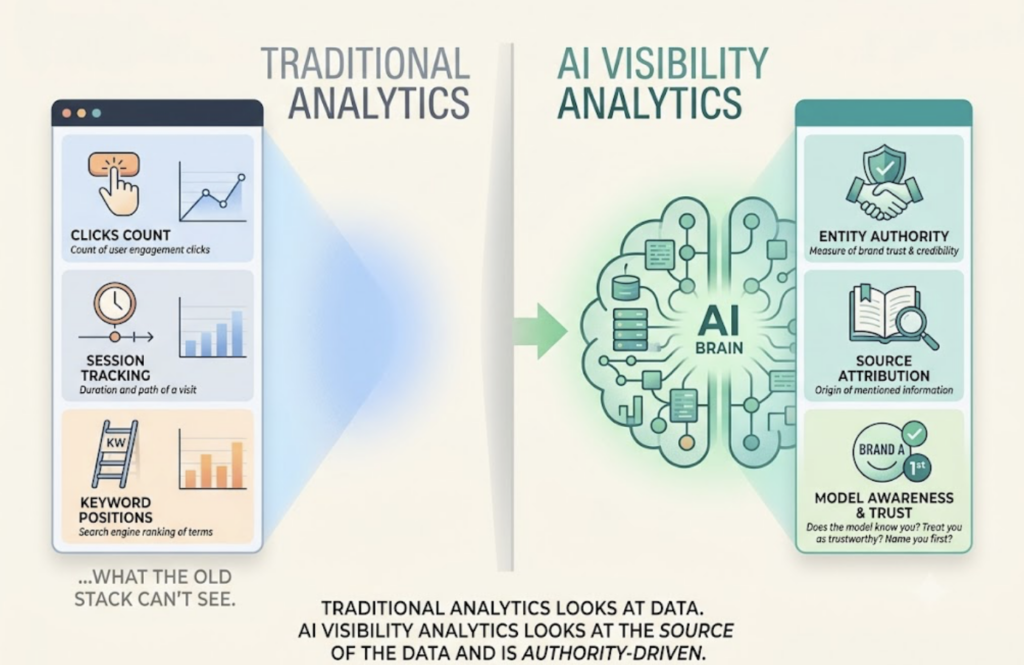
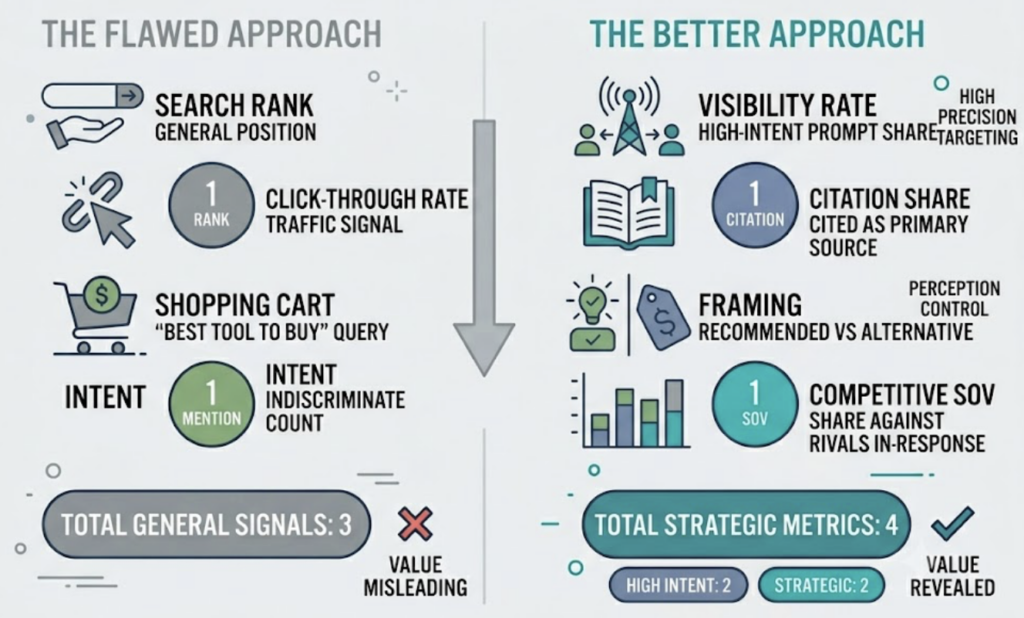
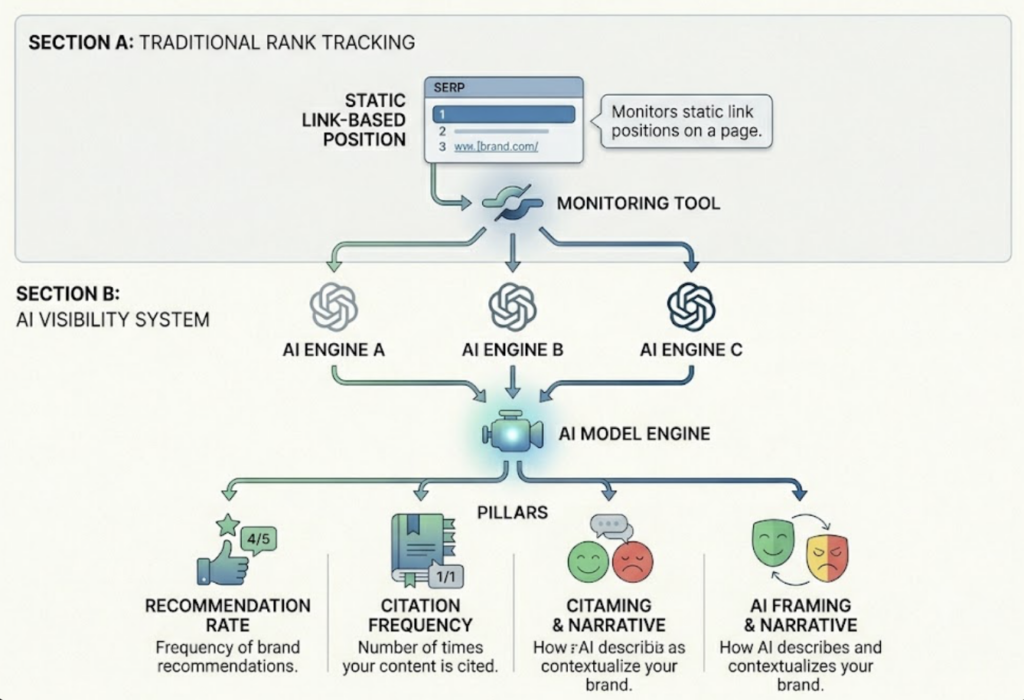
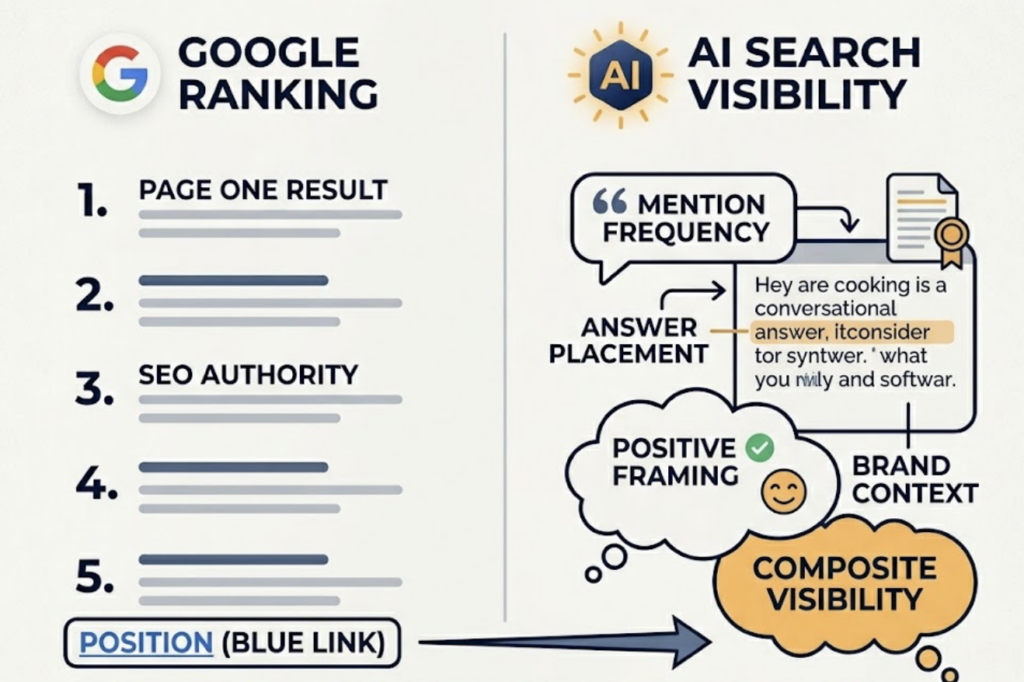
    AI brand monitoring doesn’t track mentions. It tracks recommendation signals — the specific data points that determine whether, how, and how favorably an AI describes your brand in response to a user query.

    Here’s what a complete monitoring setup measures.

    1. Visibility Rate

    This is the percentage of relevant prompts where your brand appears in the AI response. Think of it as your “inclusion probability” across a defined set of queries.

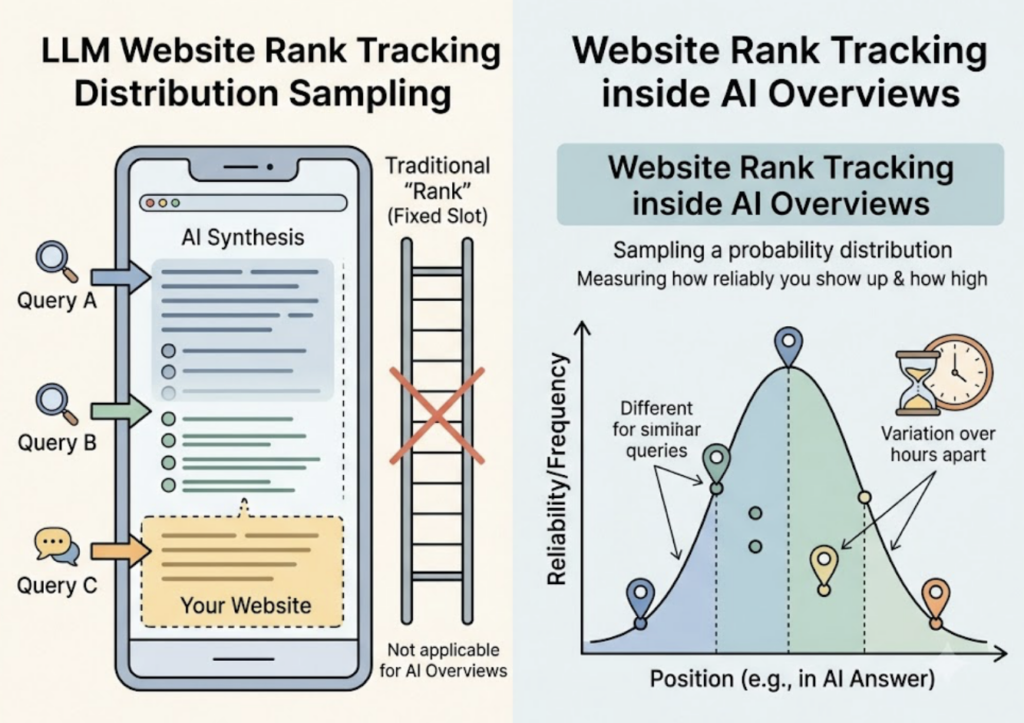
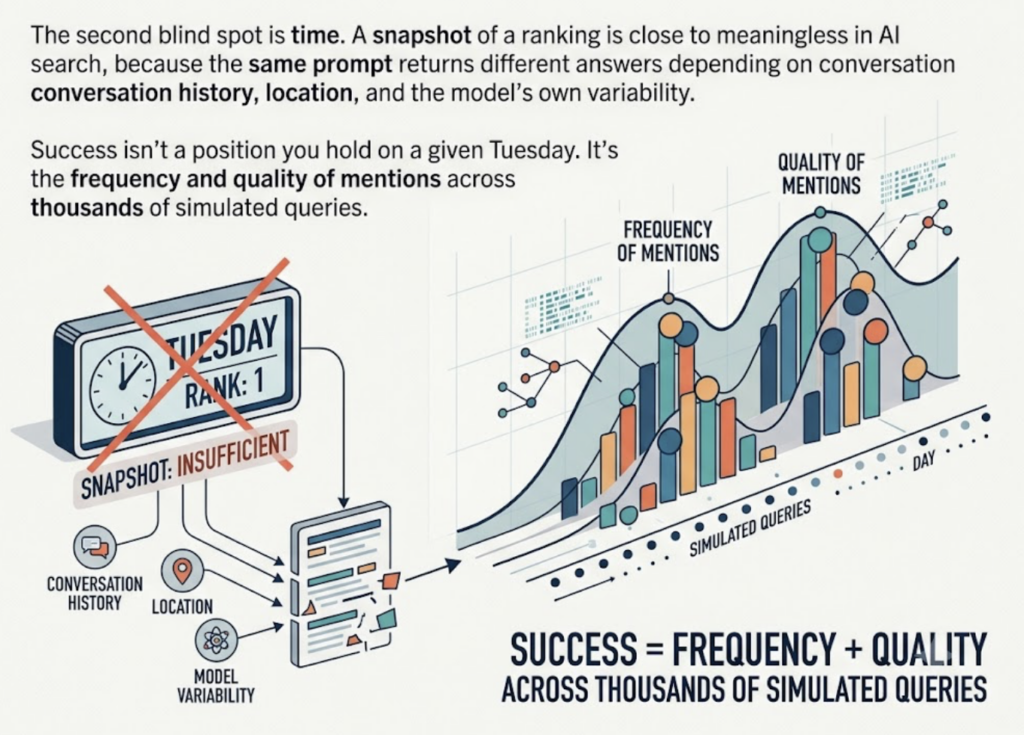
    It’s probabilistic, not binary. A brand might appear in 40% of responses to a specific prompt one week and 60% the next, depending on how the model’s retrieval weights shift. Research suggests a clear benchmarking scale: 0-10% means your brand is essentially invisible in AI search; 30-60% is moderate; 80%+ puts you in dominant territory.

    2. Sentiment Score

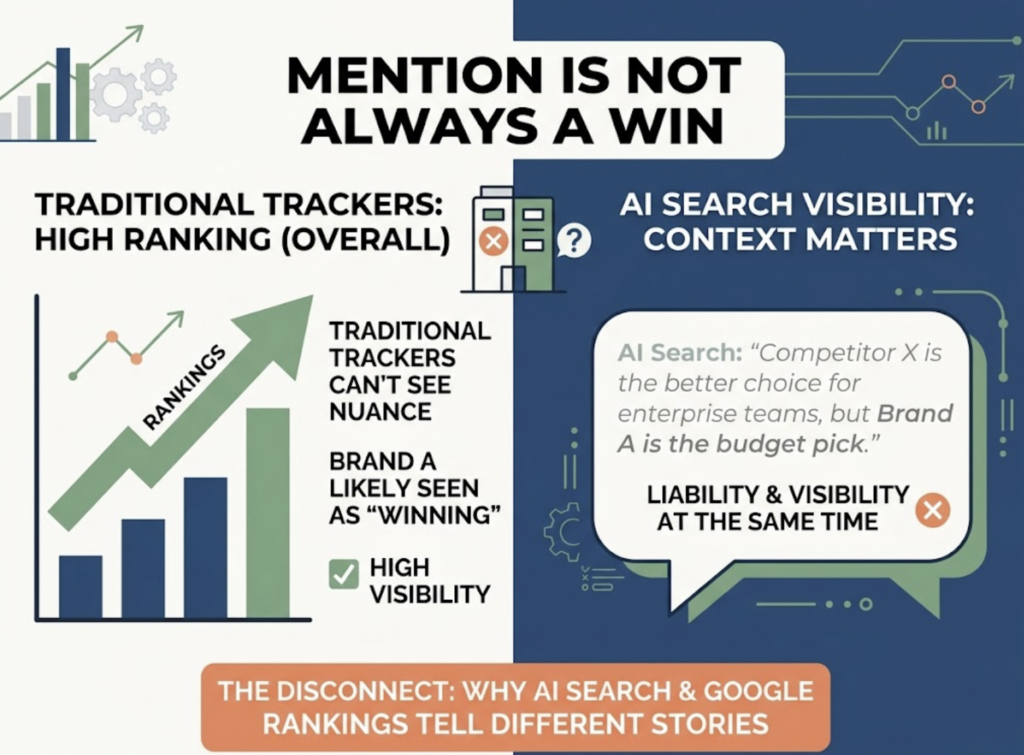
    Being mentioned isn’t enough. The framing matters.

    An AI might describe your brand as “reliable but expensive” or “a solid alternative for teams that don’t need advanced integrations.” Those aren’t neutral statements — they’re shaping the buyer’s first impression. Sentiment analysis in AI monitoring uses NLP to quantify whether the AI is acting as an advocate or quietly steering users toward a competitor.

    High visibility with consistently negative framing is a reputation problem. And it’s one that traditional social listening tools typically won’t catch before it affects your pipeline.

    3. Position Tracking

    In a list of AI recommendations, order carries real weight. Being the first brand mentioned in a ChatGPT response is meaningfully different from appearing fifth in a “you might also consider” list.

    Position tracking also includes Word Count Share: how much of the AI’s response is dedicated to your brand versus a competitor. That ratio tells you a lot about the model’s perceived preference.

    4. Source Citation Analysis

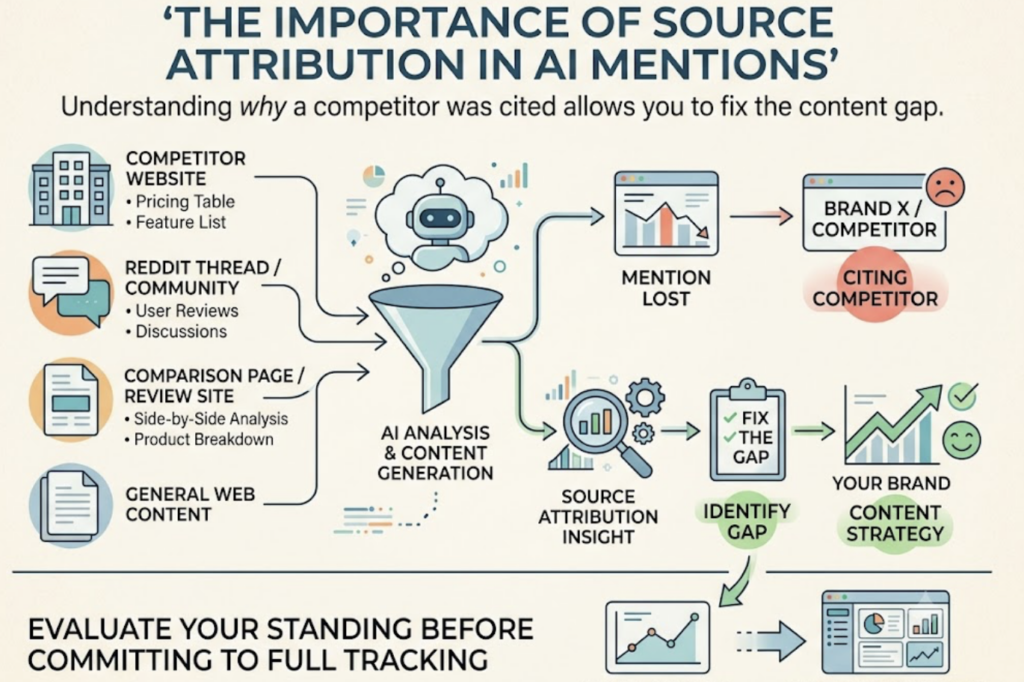
    AI models ground their answers by pulling from specific domains and URLs. Source analysis tracks which sites the AI is actually citing when it mentions your brand.

    The data here is striking. Third-party sources are cited 6.5 times more often than brand-owned pages. Earned media — coverage in outlets like TechCrunch or the Wall Street Journal — accounts for roughly 48% of AI citations. Review platforms like G2 account for another 11%. If the AI is citing an outdated forum thread or a competitor-authored comparison post when it references your brand, that’s a strategic problem with a specific fix.

    5. Conversion Visibility Rate (CVR)

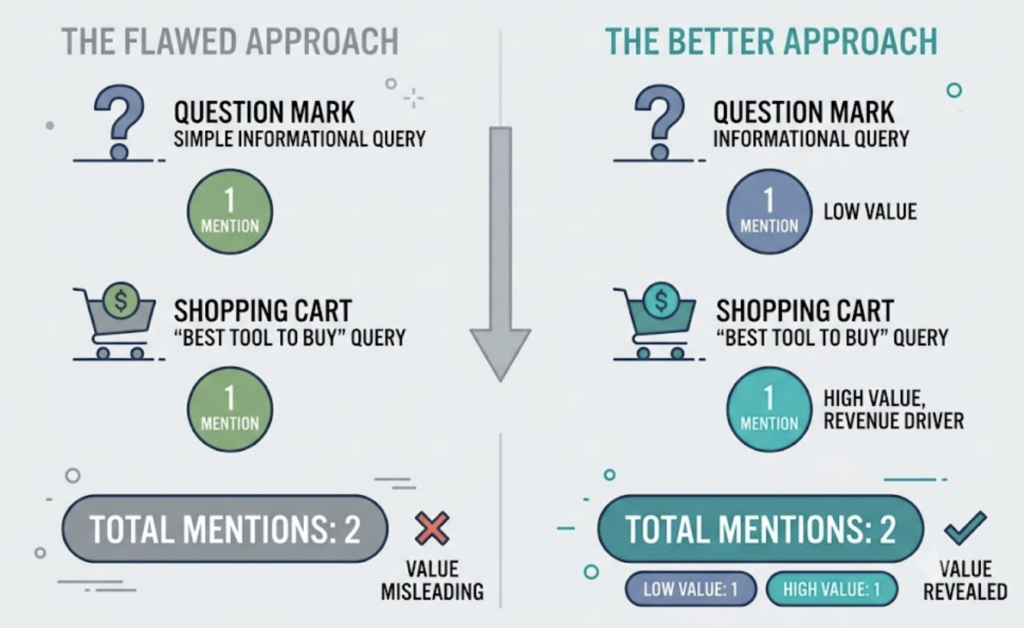
    CVR is a predictive metric that estimates how likely an AI recommendation is to drive a user toward a brand interaction. It accounts for the prominence of the recommendation, the intent alignment of the prompt, and whether the AI’s answer is “summarized” (no reason to click) or “referential” (user is directed to your site for more detail).

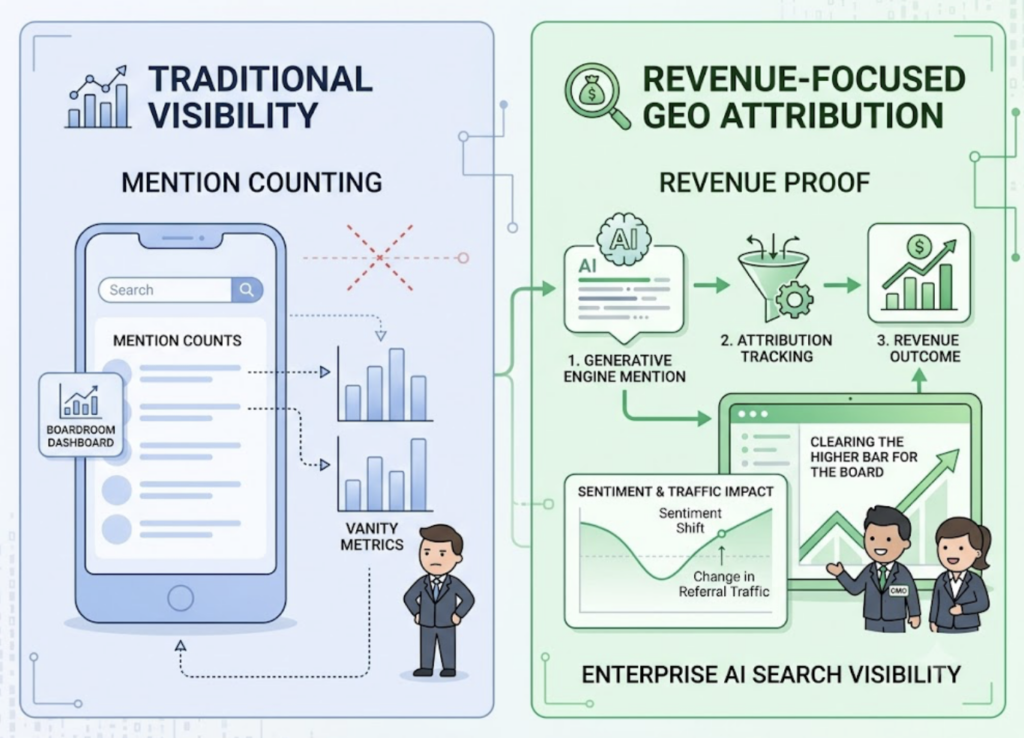
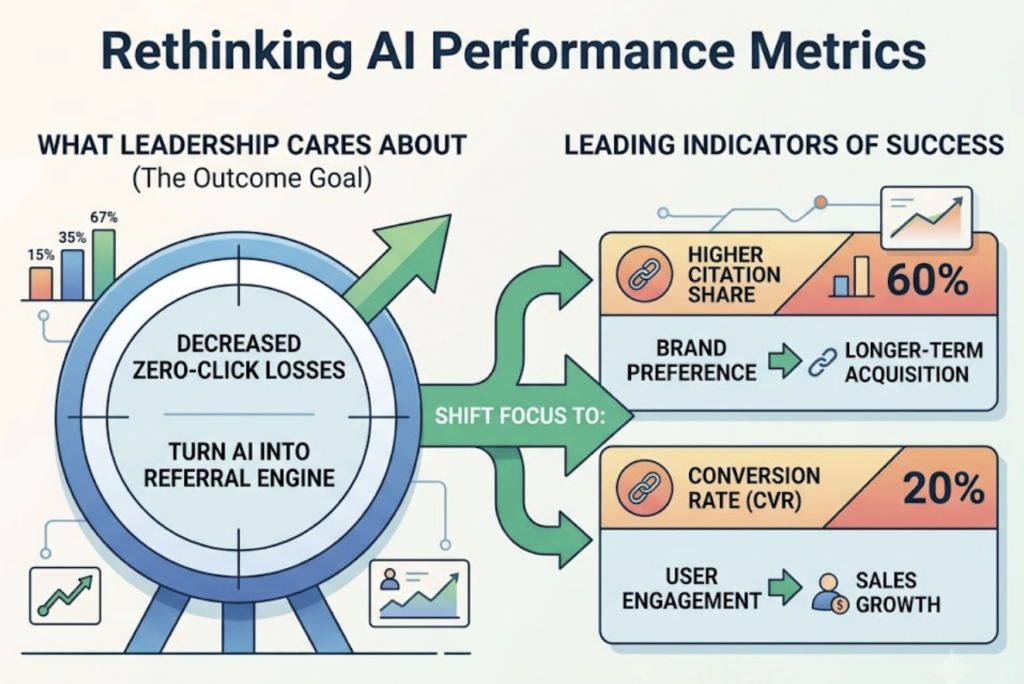
    The value is significant: AI-referred traffic converts at 4.4 to 11 times the rate of traditional search traffic. CVR helps you understand how much of that opportunity you’re actually capturing.

    The Platforms AI Brand Monitoring Needs to Cover

    Different AI platforms don’t produce the same answers. A brand that ranks first in ChatGPT responses might not appear at all in Perplexity — because each model has different retrieval logic, training data, and citation preferences.

    This makes platform coverage a foundational decision in any AI brand monitoring setup. Monitoring one platform and assuming it represents your overall AI visibility is the same mistake as checking one social network and calling it “brand monitoring.”

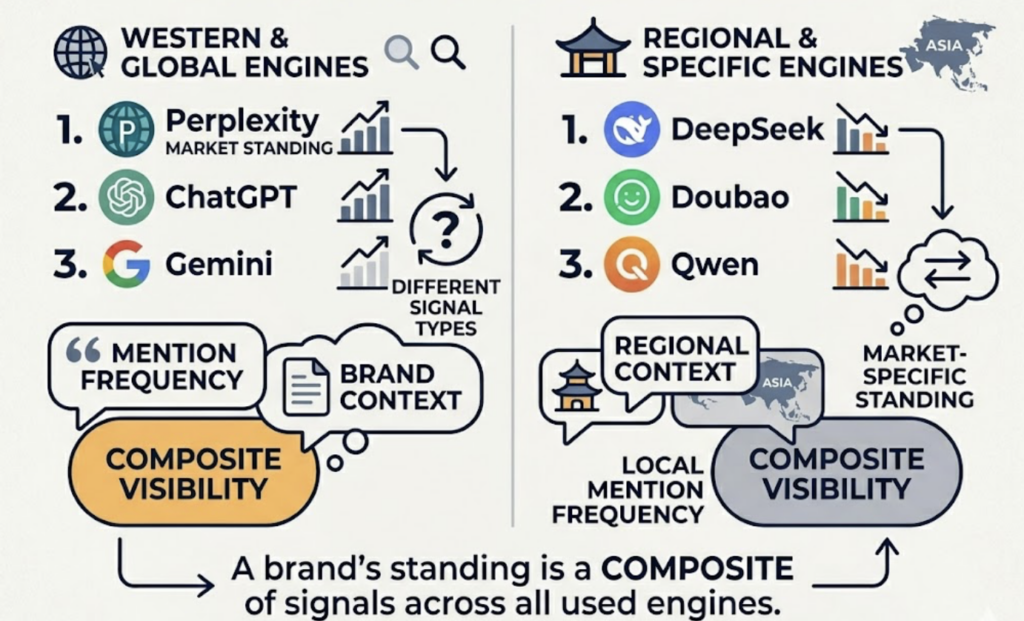
    A meaningful setup covers at minimum: ChatGPT, Gemini, Perplexity, and AI Overviews. For brands with global reach, platforms like DeepSeek and Doubao are increasingly relevant. Topify, for example, tracks brand performance across all major AI platforms in a single dashboard — so you’re comparing signal across the same prompt set, not guessing whether platform differences explain your results.

    How AI Brand Monitoring Differs from Social Listening

    These two disciplines are often conflated. They shouldn’t be.

    Social listening is reactive. It monitors what humans are writing — on X, Reddit, review sites, and forums — and alerts you when your brand gets mentioned. It’s well-suited for crisis response, community engagement, and trend detection.

    AI brand monitoring is proactive. It queries generative models directly to understand how your brand is being synthesized and recommended during the discovery phase. It doesn’t read what people write. It tracks what AI has learned.

    DimensionTraditional Social ListeningAI Brand Monitoring
    Data SourceHuman-authored contentAI-synthesized responses
    Data EnvironmentPublic social feeds, indexed pagesDynamic, private user sessions
    Primary MethodWeb crawling, keyword matchingPrompt probing across LLM APIs
    Visibility GoalBrand mentionsAI recommendations
    Funnel PositionTop of funnel awarenessBottom of funnel decision

    The two tools belong in the same stack. They don’t replace each other — they cover different layers of how your brand is perceived and discovered.

    What AI Brand Monitoring Looks Like in Practice

    The mechanics are clearer with a real example.

    A B2B SaaS company selling CRM software for startups had stable organic traffic and no obvious signals of a problem. When they set up AI brand monitoring for the first time, they found their Visibility Rate for “best CRM for startups” was only 22%. A major competitor was at 54%.

    Source analysis revealed why. For 65% of AI recommendations in that category, the model was citing a specific TechCrunch article and G2 profiles. The competitor had a G2 Leader badge and 500+ recent reviews. The brand’s G2 presence was outdated.

    They ran a three-part fix over six weeks: schema markup for entity clarity, 100 new G2 reviews targeting the startup keyword cluster, and content restructuring to front-load answers and increase information density.

    The results: Visibility Rate moved from 22% to 38%. Position improved from 4th to 2nd recommendation on average. CVR increased 115%. And they saw a 25% increase in “Direct” traffic converting at 10.21% — the behavioral fingerprint of pre-qualified AI referral traffic.

    That’s what monitoring enables. Not just a report, but a clear signal chain from gap to fix to outcome.

    A complete setup with Topify starts at $99/month for the Basic plan, which covers 100 prompts and 9,000 AI answer analyses across ChatGPT, Perplexity, and AI Overviews — enough to establish a meaningful baseline for most teams.

    Conclusion

    AI brand monitoring tracks five core signal types: Visibility Rate, Sentiment, Position, Source Citations, and Conversion Visibility Rate. It covers multiple AI platforms simultaneously. And it operates on a fundamentally different data layer than social listening or traditional SEO tools.

    The brands that understand this distinction aren’t just better informed. They’re building in a place where most competitors are still blind.

    If you’re not sure where to start, pick one question your customers actually ask — “what’s the best [your category] for [your use case]” — and run it manually across ChatGPT, Gemini, and Perplexity. Record what appears. That first look at your AI visibility baseline will tell you more about your brand’s discovery problem than a month of social monitoring reports.

    FAQ

    What does AI brand monitoring actually track? 

    It tracks how your brand appears in AI-generated responses: whether you’re included (Visibility Rate), how you’re described (Sentiment), where you rank in recommendations (Position), which sources the AI cites (Source Analysis), and how likely the recommendation is to drive a conversion (CVR).

    Is AI brand monitoring the same as social listening? 

    No. Social listening tracks human-authored content on social media and the web. AI brand monitoring directly queries generative models to understand how your brand is synthesized and recommended during the discovery phase. They’re complementary tools that work on different data layers.

    How often should I run AI brand monitoring? 

    A weekly-monthly-quarterly rhythm works well for most teams. Weekly checks catch volatile shifts or competitor surges at the prompt level. Monthly reviews track sentiment trends and citation changes to guide content updates. Quarterly audits inform executive strategy and budget decisions.

    Which AI platforms should I monitor? 

    At minimum: ChatGPT, Gemini, Perplexity, and Google AI Overviews. For global brands, DeepSeek and other regional platforms are increasingly worth including. Each platform uses different retrieval logic, so your visibility can vary significantly across them.

    Can AI brand monitoring show me why a competitor ranks higher? 

    Yes. Source analysis reveals which third-party domains the AI is pulling from for competitor recommendations that it’s ignoring for yours. That gap tells you exactly where to focus PR, review generation, and content restructuring efforts.

    Read More

  • AEO Tools vs SEO Tools: The Real Difference

    AEO Tools vs SEO Tools: The Real Difference

    Your domain authority is solid. Your keyword rankings haven’t moved in months. But somewhere in the last quarter, a competitor you’ve never worried about started showing up every time a potential customer asked ChatGPT for a recommendation in your category. And your current dashboard has no idea it’s happening.

    That’s not a content problem. It’s a measurement problem. SEO tools and AEO tools are built on fundamentally different logic, and using one to answer questions only the other can ask is where most marketing teams start falling behind.

    Your SEO Tool Thinks You’re Winning. AI Doesn’t.

    Search behavior has split into two distinct tracks. On one track, users type queries into Google and click blue links. On the other, they ask AI engines direct questions and act on the synthesized answers they receive, without ever visiting a website.

    AI-driven search tools captured roughly 12-15% of global market share by end of 2025, up from 5-6% at the start of that year. In March 2025, Google’s global search market share dropped below 90% for the first time. These aren’t marginal shifts.

    The deeper problem isn’t the traffic split. It’s what happens with zero-click behavior. When Google triggers an AI Overview, the zero-click rate climbs to 83%. In Google’s AI Mode, that number reaches 93%. The organic CTR for a page that once ranked first can drop 61%, from 1.76% to 0.61%, simply because an AI summary appeared above it.

    That’s the blind spot your SEO tool can’t see.

    What SEO Tools Were Actually Built to Measure

    Traditional SEO platforms, whether Ahrefs, Semrush, or Google Search Console, were designed around a single premise: search engines index pages, rank them by authority, and users click through. That premise held for two decades. It still partially holds today.

    These tools are excellent at what they were built to do. Keyword rankings, backlink profiles, domain authority scores, crawl errors, mobile performance, SERP position history. All of it maps to a deterministic system: query in, ranked URL list out.

    The problem isn’t that SEO tools are broken. It’s that they’re measuring a different game. Only about 12% of URLs cited by ChatGPT and Perplexity appear in Google’s top 10 search results. If your SEO tool shows you at position one, that tells you almost nothing about whether you’re in the AI answer at all.

    AEO Tracks a Different Kind of Visibility

    Answer Engine Optimization starts from a different question: not “where does our page rank?” but “when a user asks an AI about our category, does our brand appear, and how does it appear?”

    That distinction changes everything about how you measure performance. AI engines don’t index URLs in a ranked list. They synthesize answers from multiple sources, select which brands to mention, describe those brands in their own language, and position them relative to competitors. The output is probabilistic, not deterministic.

    To track AEO visibility meaningfully, you need at least four dimensions that traditional SEO tools don’t capture:

    AI Mention Rate: how often your brand appears in AI-generated answers for relevant prompts. If a tool runs 100 simulated queries about your product category and your brand shows up in 35 of them, your mention rate is 35%.

    Sentiment Score: the quality of how AI describes your brand. An AI might mention you and call you “a budget-friendly option,” which matters if your positioning is premium. NLP-based sentiment tracking can catch this. Your SEO dashboard cannot.

    Position and Prominence: being listed first in an AI recommendation carries a different weight than being third. The framing AI uses for early mentions tends to be authoritative; later mentions get framed as alternatives.

    Source Coverage: which domains and URLs are driving AI’s opinions about your brand. If a trade publication’s review of your competitor is consistently cited by Perplexity, that’s actionable. SEO tools track your backlinks. AEO tools track what AI is reading to form its judgment.

    The Feature Gap at a Glance

    The difference between SEO and AEO tools isn’t a matter of features overlapping on a Venn diagram. It’s a structural gap in what each tool type was architecturally designed to do.

    DimensionSEO Tools (e.g., Ahrefs, Semrush)AEO Tools (e.g., Topify)
    What they trackSERP rankings (blue links)Brand mentions in synthesized AI answers
    Data collectionCrawling search result pagesSimulating real user prompts across AI platforms
    Core metricsKeyword rank, DA/DR, backlinks, CTRMention rate, sentiment, position, source coverage, CVR
    Platform coverageGoogle, BingChatGPT, Gemini, Perplexity, DeepSeek, and others
    Competitive intelCompetitor rankings and backlink sourcesHow AI describes your brand vs. competitors in the same answer
    Output“Improve keyword density, get more backlinks”“Add statistical data to this section; AI isn’t citing it because it lacks sourced evidence”

    One more architectural difference worth noting: SEO tools run daily crawls and return stable data. AEO tools have to use probabilistic sampling. Because LLM outputs vary with each query, a credible AEO platform runs the same prompts hundreds of times, across multiple regions and time windows, to produce a stable visibility distribution. That’s why the underlying infrastructure is fundamentally different, and why the data it produces tells you something your SEO tool can’t approximate.

    Do You Still Need SEO Tools?

    Yes, with an asterisk.

    Organic search still drives roughly 53% of website traffic, according to Conductor’s 2026 benchmark data. In healthcare, that share is 42.4%. In communications services, 39.6%. If your audience is still primarily finding you through traditional search, abandoning SEO infrastructure would be costly.

    The right mental model isn’t replacement. It’s stack prioritization. SEO tools handle the technical foundation: crawlability, indexing, long-tail transactional keyword coverage. AEO tools handle a layer that didn’t exist three years ago: whether you’re being recommended by the AI systems your buyers are increasingly using to make decisions.

    Here’s a practical decision framework. If your target audience is actively using AI search tools for discovery in your category, AEO tracking isn’t optional. It’s the gap in your reporting that explains traffic patterns your SEO tool can’t. In certain B2B verticals, AI-converted traffic has been shown to convert at 4.4x the rate of organic search traffic. Lower click volume, higher intent. SEO tools tend to flag this traffic as underperforming because the raw numbers look small.

    Leading marketing teams in 2026 tend to allocate roughly 30-50% of their measurement budget to SEO fundamentals, with a fast-growing slice, around 30%, dedicated to AEO tracking and content restructuring for AI extractability.

    The Best Tools for AEO Tracking in 2026

    When evaluating AEO tools, three criteria matter most: how many AI platforms are covered, how many visibility dimensions the tool tracks, and whether the platform supports competitive benchmarking in AI answers, not just your own brand’s numbers.

    Topify covers the full spectrum: ChatGPT, Gemini, Perplexity, DeepSeek, Doubao, Qwen, and other major platforms. It tracks seven core metrics, visibility, sentiment, position, AI volume, mentions, intent, and CVR, which is among the most complete measurement sets available. The Source Analysis feature reverses-engineers which domains are driving AI’s citations, giving content and PR teams a clear map of where to build authority. Topify’s agentic execution layer can also identify gaps automatically and suggest specific content actions, for example flagging when a page is being passed over because it lacks sourced statistics. Pricing starts at $99/month for the Basic plan (100 prompts, 4 projects) and $199/month for Pro.

    Princeton research suggests that optimized content structure alone can improve AI visibility by up to 40%. That kind of uplift only becomes measurable if you have a tool tracking it.

    Other platforms worth knowing:

    Profound offers strong “AI search volume” data, surfacing what users are actually prompting AI about. It’s particularly popular with large enterprise teams. AIclicks is useful for smaller teams that want a prioritized action checklist rather than a full analytics suite. Omnia has strong global coverage for brands tracking AI visibility across multiple languages and regions.

    None of these replace an SEO tool. All of them answer questions your SEO tool genuinely cannot.

    Conclusion

    SEO tools measure where your page sits in a list. AEO tools measure whether AI mentions your brand, how it describes you, and what sources it’s trusting to form that opinion. Those are two different questions about two different discovery channels, and conflating them is how brands end up with strong Google rankings and zero AI presence.

    The good news: you don’t have to rebuild your stack from scratch. You have to extend it. Start by understanding where your buyers are actually searching. If AI is part of that, get started with Topify and run your first visibility audit. The gap between your SEO dashboard and your AI search reality is usually bigger than teams expect.


    FAQ

    Q: Can I use SEO tools to track AEO performance?

    A: Not effectively. SEO tools track SERP rankings, which have limited correlation with AI citation behavior. Research shows only about 12% of URLs cited by ChatGPT appear in Google’s top 10 results. For AEO tracking, you need a tool that simulates real user prompts across AI platforms and measures mention rate, sentiment, and source coverage directly.

    Q: Do AEO tools replace SEO tools?

    A: No. They address different discovery channels. SEO tools remain useful for technical site health, indexing, and organic search keyword coverage. AEO tools track visibility in AI-generated answers, which SEO tools aren’t built to measure. Most teams run both in parallel, with budget allocation shifting toward AEO as AI search usage grows.

    Q: What’s the best AEO tool for small teams with limited budgets?

    A: Topify’s Basic plan at $99/month covers 100 prompts and 4 projects, making it accessible for smaller teams that want comprehensive AI visibility tracking without enterprise pricing. AIclicks is another option in the $39-59/month range for teams that primarily need a prioritized action list rather than deep analytics.

    Q: Why does my SEO tool show me ranking first, but I’m not appearing in AI answers?

    A: Ranking logic and citation logic are different systems. AI engines don’t prioritize the highest-ranked page. They prioritize content that’s easy to extract, well-structured, statistically supported, and referenced across credible third-party sources. A page ranking 50th on Google with strong cited data can appear in AI answers more frequently than the page ranking first. An AEO audit will typically reveal whether the issue is content structure, source coverage gaps, or sentiment framing.


    Read More

  • 7 Best AI Citation Tracking Tools for Brands 2026

    7 Best AI Citation Tracking Tools for Brands 2026

    AI now cites sources the way Google once ranked them. Here’s how to find out if yours is one of them.

    Your brand can rank on page one of Google and still be completely invisible to ChatGPT. That’s not a hypothetical — it’s the reality for most brands in 2026.

    AI systems don’t just generate answers. They curate them from a narrow set of sources they consider authoritative. And without a way to track which brands get cited, who gets recommended, and which third-party sites are actually shaping the AI’s opinion of you, you’re navigating blind.

    That’s what AI citation tracking tools are built to solve.

    Why Your Brand’s AI Visibility Is Harder to Track Than You Think

    The numbers tell an uncomfortable story. Traditional organic click-through rates have dropped by up to 61% as AI summaries absorb user intent before a single link gets clicked. Meanwhile, brands that do get cited by AI see conversion rates 5 to 11 times higher than visitors from traditional search — because the AI has already done the pre-qualification work.

    That’s the trade-off: fewer clicks, but dramatically higher quality.

    Here’s the thing most tracking setups miss: your own website is rarely where the AI gets its information. Brand-owned domains account for only 5% to 10% of cited sources in AI answers. The other 90% comes from Reddit threads, niche forums, G2 reviews, and industry publications. That makes traditional analytics essentially useless for understanding your actual AI visibility.

    You need a dedicated tool. The question is which one.

    5 Things That Separate a Good AI Citation Tracker from a Great One

    Before jumping to the list, it’s worth building a choosing framework. These five criteria separate the tools that give you data from the ones that help you act on it.

    1. Multi-platform engine coverage. Your brand’s visibility in ChatGPT can look completely different from its visibility in Perplexity or Google AI Overviews. Any tool that monitors only one platform is giving you a partial picture. Look for coverage across ChatGPT, Gemini, Perplexity, Claude, and Copilot at minimum.

    2. Citation vs. mention distinction. A mention means your brand name appeared in text. A citation means the AI linked to a specific URL. These are fundamentally different signals, and confusing them leads to bad strategy.

    3. Source-level attribution. You need to know which domains are driving your citations — not just that citations happened. Is it your blog? A G2 review? A Reddit thread from 2022? That distinction determines where to focus your PR and content efforts.

    4. Competitive benchmarking. Knowing your own citations in isolation isn’t enough. The metric that matters is your Share of Model — the percentage of relevant AI answers where your brand appears versus your competitors. Without a comparison point, you have no way to know if you’re winning or losing ground.

    5. Actionability beyond dashboards. In 2026, data without direction is noise. The strongest tools don’t just show you what happened — they surface which prompts you’re losing, which third-party sources are helping competitors, and what you can do about it.

    The 7 Best AI Citation Tracking Tools, Ranked

    1. Topify

    Best for: Growth teams and B2B SaaS brands that want to connect AI visibility directly to revenue

    Topify stands apart because it treats AI citations as a conversion channel, not just a reporting metric. Most tools tell you whether you were cited. Topify tells you whether that citation actually mattered.

    The platform’s Source Analysis module is particularly useful for brands trying to understand the “hidden influencer” problem. Third-party sources are 6.5 times more likely to be cited than a brand’s own domain, and Topify’s Source Analysis identifies exactly which of those third-party domains are shaping the AI’s perception of your brand — and which are doing the same for your competitors.

    Topify monitors across ChatGPT, Perplexity, and Google AI Overviews, tracking seven core metrics: Visibility, Sentiment, Position, Volume, Mentions, Intent, and Conversion Visibility Rate (CVR). CVR is the most distinctive of these. It accounts for the fact that a citation in a zero-click context — where the AI fully summarizes your value proposition without leaving a knowledge gap — is a visibility win but a traffic loss.

    Pricing: Basic $99/month (100 prompts), Pro $199/month (250 prompts), Enterprise from $499/month

    2. Evertune

    Best for: Fortune 500 brands with high-volume statistical requirements

    Evertune’s core differentiator is its “Dual-Layer” methodology. It monitors not only what an AI says about your brand in real-time responses, but also what the model inherently believes based on its foundational training data. For enterprise brands where reputation management spans years of accumulated content, that distinction matters.

    The platform supports over 1 million prompts per month per brand — a level of scale that smaller tools simply can’t match. It also segments sources into “Strength URLs” (helping your visibility) and “Opportunity URLs” (sources driving competitor citations that you’re missing from).

    Pricing: Starts at $3,000/month

    3. Profound

    Best for: CMOs and enterprise marketing teams managing multi-platform brand safety

    Profound achieved unicorn status in February 2026, which reflects both its feature depth and the pace at which the GEO category is growing. The platform covers 10+ AI answer engines simultaneously, making it one of the broadest in terms of platform coverage.

    Its Agent Analytics module tracks AI crawler hits and ties GEO activities to actual revenue attribution — a capability most tools in this space haven’t built yet. Prompt Volume analysis also surfaces conversational clusters that traditional keyword tools would never catch.

    Pricing: Starter $99/month (ChatGPT only), Growth $399/month (ChatGPT, Perplexity, AIO), Enterprise custom

    4. Omnia

    Best for: Growth-stage SaaS companies that need to move fast on visibility drops

    Omnia is built for teams experiencing “data paralysis” — the condition where you have a dashboard full of numbers but no clear next action. Instead of reporting that a citation dropped, Omnia reverse-engineers successful competitor citations and produces specific content recommendations: which URL structures to use, which content formats to prioritize, which third-party placements to target.

    It also supports localized tracking across countries and regions, which matters for brands operating in multiple markets with different AI platform dominance.

    Pricing: Growth €79/month, Pro €279/month

    5. Scrunch AI

    Best for: Regulated industries where accuracy and brand safety are non-negotiable

    Scrunch AI approaches the category from a brand protection angle. Its hallucination detection capability actively monitors for AI answers that describe your product with incorrect features, outdated pricing, or misattributed comparisons — a real risk given that AI models don’t update in real time.

    The platform’s Agent Experience Platform (AXP) is designed to help marketers serve AI-readable content that actively shapes how AI agents represent the brand in real time. For healthcare, fintech, or legal-adjacent brands, that’s not a nice-to-have.

    Pricing: Starts at $250–$300/month

    6. Peec AI

    Best for: Growing B2B teams and agencies that need daily data without enterprise pricing

    Peec AI’s standout feature is its Used vs. Cited distinction. Most tools count citations. Peec AI separates instances where your content informed an AI answer (used, but not linked) from instances where your URL was explicitly mentioned(cited). That’s a technically meaningful difference with real strategic implications.

    It also segments brand positioning into four quadrants — Leaders, Niche Players, Laggers, and Controversial — giving teams a visual framework for understanding competitive standing at a glance.

    Pricing: Starts at €89/month

    7. Otterly AI

    Best for: Solo marketers and small teams entering GEO for the first time

    Otterly AI lowers the barrier to entry without sacrificing utility. Its prompt-first interface automates what many teams are still doing manually — testing AI queries one by one and noting the results. Real-time alerts notify users of sudden visibility drops or new competitors entering target prompt results, which is genuinely useful for resource-constrained teams.

    Pricing: Lite $29/month, Standard $189/month

    Side-by-Side: How These 7 Tools Compare

    PlatformBest ForEngine CoverageUnique FeatureUpdate FrequencyStarting Price
    TopifyGrowth & SaaSChatGPT, Perplexity, AIOCVR + Source AnalysisDaily$99/mo
    EvertuneEnterprise6+ PlatformsDual-Layer (base + live)Real-Time$3,000/mo
    ProfoundCMO Strategy10+ PlatformsAgent AnalyticsDaily$399/mo
    OmniaScaleupsCore EnginesActionable content briefsDaily€79/mo
    Scrunch AIRegulated industries7+ PlatformsHallucination detectionReal-Time$250/mo
    Peec AIB2B SMBs3+ (Expandable)Used vs. Cited trackingDaily€89/mo
    Otterly AISolo/Small teamsCore EnginesReal-time drop alertsDaily$29/mo

    The Citation Metric Most Tools Still Don’t Measure

    Getting cited isn’t the finish line. It’s closer to the starting line.

    When an AI cites your brand in a way that fully summarizes your value proposition — “Brand X is the best CRM for small teams at $10/user with built-in email tools” — the user has no reason to click. That’s a zero-click citation. Visibility win, traffic loss.

    Research shows that when an AI summary is present, users click through to an external link only 8% of the time. That doesn’t mean citations are worthless. It means how you’re cited matters as much as whether you’re cited.

    Topify’s CVR (Conversion Visibility Rate) metric was built specifically for this problem. It accounts for recommendation prominence, prompt intent alignment, and the AI’s level of endorsement — whether your brand is the top pick or item seven on a list. Brands optimizing for CVR typically focus on creating what practitioners call “non-summable” assets: calculators, raw datasets, downloadable templates. Content that compels a click even after an AI has described it.

    That’s the layer most dashboards don’t show you yet.

    How to Start Tracking AI Citations in 3 Steps

    You don’t need an enterprise budget to start. A systematic approach gets you meaningful data within 30 days.

    Step 1: Run a baseline audit. Start with Otterly AI or Topify Basic. Define a “Prompt Universe” of 50–100 questions your customers actually ask — especially comparison and use-case queries. Establish your current Share of Model and identify which competitors are consistently showing up in the “authoritative framing” position.

    Step 2: Find your influence sources. Use Source Analysis to identify where the AI is actually pulling information about your brand. If a specific industry forum or review platform appears repeatedly, that’s where your content and PR efforts need to shift. Remember: third-party sources are cited 6.5x more often than brand-owned pages.

    Step 3: Optimize for machine extraction. AI models are 2.8x more likely to cite content with organized headings and structured data tables. Implementing author schema and statistical fact blocks has been shown to improve AI visibility by 30–40%. Run your tracking tool for 30–60 days after changes — that’s typically how long it takes for models to re-index and adjust their citation patterns.

    Conclusion

    Team SizeRecommended ToolPrimary Goal
    Solo / Small teamOtterly AI or Topify BasicBaseline monitoring, fast experimentation
    Mid-market / GrowthTopify Pro or OmniaCVR optimization, actionable content briefs
    Enterprise / Multi-brandEvertune or ProfoundShare-of-voice, base-model reputation management
    Regulated / High-riskScrunch AIHallucination detection, brand safety

    AI citation tracking isn’t an advanced GEO tactic anymore. It’s the baseline requirement for knowing where your brand stands in the most important discovery channel of 2026.

    The gap between brands that track this and brands that don’t is widening every month. The tools above make that gap measurable. What you do with the data is the actual work.

    FAQ

    What is AI citation tracking? 

    It’s the process of monitoring how often and in what context AI platforms like ChatGPT, Perplexity, and Gemini reference your brand’s content or domain. Unlike traditional rank tracking, it focuses on narrative inclusion and URL-level attribution within synthesized AI answers.

    Does getting cited by AI actually drive traffic? 

    Yes, but the nature of that traffic has shifted. While click-through rates from AI answers are lower than traditional search, the conversion rate of AI-referred visitors is typically 5 to 11 times higher. These users arrive pre-qualified by the AI’s recommendation.

    How often should I monitor AI citations? 

    Daily monitoring is the 2026 standard. A single model update can shift your visibility by 70% or more within a 24-hour cycle. Monthly snapshots miss too much.

    Can I track competitor citations too? 

    Yes. Competitive benchmarking is a core feature of platforms like Topify, Profound, and Peec AI. You can see which competitors are recommended for your target prompts and identify the specific third-party sites giving them a citation advantage over you.

    Why does AI cite other websites more than mine? 

    AI models prioritize sources perceived as unbiased. Third-party reviews, forums, and news publications are cited 6.5x more often than brand-owned pages. That’s why tracking your Source Influence — not just your own domain mentions — is central to any GEO strategy.

    Read More

  • 6 Best LLM Visibility Tracking Tools in 2026

    6 Best LLM Visibility Tracking Tools in 2026

    You’ve been ranking on Google’s first page for three years. Traffic is steady. Conversions look normal.

    But when someone asks ChatGPT to recommend tools in your category, your brand doesn’t come up. Not once.

    That’s the gap most SEO dashboards can’t show you. Traditional rank trackers tell you where you stand in link lists. They don’t tell you whether AI systems are citing you, ignoring you, or actively recommending your competitors instead.

    This is why LLM visibility tracking has become a distinct discipline. The tools below are built specifically for this problem.


    Most Brands Are Invisible to AI Search Without Knowing It

    Here’s what’s changed: approximately 60% of Google searches now end without a click. AI Overviews appeared in 13.14% of all queries by March 2025, a 102% increase over 14 months. When an AI-generated summary is present, click-through rates drop from 15% to around 8%.

    The implication is direct. Your brand doesn’t need to lose a ranking to lose visibility. It just needs to be excluded from the AI’s synthesized answer.

    That’s the invisibility problem. And it’s compounding.

    Researchers call it the “Ghost Citation” phenomenon: AI systems use your content to support a factual claim, but name a competitor in the recommendation. You provided the proof, someone else got the mention.

    What makes it harder is that only 11% of domains are cited by both ChatGPT and Perplexity. A brand can be well-represented on one platform and completely absent from another. Without dedicated tracking, you’d never know which scenario applies to you.


    3 Things That Separate a Real LLM Tracking Tool From a Checkbox

    Not every tool in this category measures the same thing. Before comparing specific platforms, it helps to understand what actually matters.

    Platform coverage breadth. ChatGPT holds 80.49% of the chatbot market. Perplexity serves 22 million monthly users and processes 780 million queries per month. Google AI Overviews appears in roughly half of all searches. A tool that only tracks one of these platforms gives you a partial picture at best.

    Data granularity beyond mention counts. Knowing your brand appeared in an AI response is a starting point. Knowing your position relative to competitors, the sentiment of the mention, and whether that mention had any conversion intent is what drives decisions.

    Accuracy methodology. This one’s often overlooked. LLMs are non-deterministic, meaning the same prompt can produce different answers based on session history or randomization settings. Tools that use standard browser sessions often achieve accuracy scores below 60% because the AI “learns” the brand from the tracker itself. Credible tools use what’s called Swarm Probing: sending thousands of prompt variations across different geographic nodes to calculate a statistically reliable Share of Voice.


    The 6 Best LLM Visibility Tracking Tools in 2026

    ToolPlatforms CoveredStandout FeatureStarting PriceBest For
    TopifyChatGPT, Gemini, Perplexity, AI Overviews, DeepSeek, Doubao + moreFull-spectrum tracking + one-click GEO execution$99/moGrowth teams, agencies, multi-platform coverage
    ProfoundChatGPT (starter), broader on paidCDN bot log integration, SOC 2 complianceFree / $99/moEnterprise security-focused teams
    EvertuneMulti-platformFoundational vs. real-time knowledge split$3,000/moLarge enterprise, statistical rigor
    Peec AIMulti-platform + DeepSeekMultilingual, unlimited seats€89/moInternational brands, agencies
    Otterly AICore AI platformsGEO Audit (25+ on-page factors)$29/moSolo marketers, early-stage testing
    LLMClicks.ai / AkiiVariesAI hallucination detectionVariesB2B SaaS with complex product specs

    Topify: Best for Full-Spectrum LLM Visibility Tracking

    Topify is the tool most growth and SEO teams land on when they need cross-platform data with a clear path to optimization. It’s built by a team that includes founding researchers from OpenAI and Google SEO practitioners, and it’s designed around one premise: visibility data is only useful if it tells you what to do next.

    What It Actually Tracks

    Topify monitors seven dimensions of brand representation: Visibility, Sentiment, Position, Volume, Mentions, Intent, and CVR (Conversion Visibility Rate). It covers ChatGPT, Gemini, Perplexity, AI Overviews, and regional models including DeepSeek, Doubao, and Mistral.

    That range matters more than it sounds. There’s only a 13.7% overlap between citations in Google AI Overviews and Google’s AI Mode. Platform diversification isn’t optional for brands targeting multiple audiences.

    Two features stand out technically. First, URL-Level Citation Analysis: Topify maps which specific pages on your site AI crawlers are actually ingesting, so you can prioritize optimization where it’s already working. Second, Information Density Audits: the platform compares your content’s fact-to-word ratio against the sources currently winning citations, giving you a concrete improvement roadmap rather than a vague “create better content” suggestion.

    Where It Stands Out From Competitors

    Most tracking tools stop at the report. Topify includes an Action Center with one-click GEO execution, meaning teams can deploy optimization strategies, such as restructuring content for AI extraction or clarifying entity signals, directly from the dashboard without exporting to a separate workflow.

    Competitor Benchmarking is also real-time. You can see which brands AI platforms are recommending in your category right now, track position shifts over time, and reverse-engineer the citation sources your competitors are using.

    That last capability is where a lot of teams find immediate value.

    Pricing and Who It Fits

    PlanPriceCapacity
    Basic$99/mo100 prompts, 9,000 AI answer analyses, 4 projects
    Pro$199/mo250 prompts, 22,500 analyses, 10 seats
    EnterpriseFrom $499/moCustom prompts, dedicated account manager

    A 30-day trial is available on Basic. For agencies managing multiple client accounts, Topify’s Batch Workflows handle cross-account monitoring from a single dashboard, which meaningfully cuts manual tracking time.


    Tools #2–#6: Where Each One Fits

    Profound is the tool Fortune 100 companies reach for when security posture matters as much as data. Its integration with CDN providers (Cloudflare, AWS, Akamai) lets enterprise teams track how AI bots are crawling their infrastructure in real-time. It’s the only major platform in this category with SOC 2 Type II compliance and SSO at the enterprise level. The free Starter tier covers 50 prompts on ChatGPT only, which is enough to run a basic audit. Paid plans start at $99/month. The trade-off: limited optimization execution compared to Topify.

    Evertune was built by veterans from The Trade Desk, and it shows in the methodology. The platform processes over 1.25 million prompts per brand monthly, specifically to counteract the non-deterministic problem. Its defining feature is the “Dual-Layer Insight”: separating what an AI knows from its training data (foundational knowledge) versus what it retrieves in real-time. PR teams and brand strategists find this especially valuable for understanding long-term brand perception versus recency effects. Price starts at $3,000/month, so it’s positioned firmly at the enterprise end.

    Peec AI is a Belgian-founded platform built for international coverage. It tracks across multiple geographic IP locations, supports DeepSeek and other global models, and offers transparent pricing with no per-seat fees. That unlimited collaboration model makes it practical for agencies running lean. Starting at €89/month for 25 prompts and 3 competitors, it’s one of the more accessible options for teams with a global brief.

    Otterly AI earned a “Gartner Cool Vendor 2025” designation and offers the lowest entry point in the category at $29/month. Its GEO Audit analyzes 25+ on-page factors and generates a Brand SWOT Analysis covering digital PR and content structure. For solo marketers or small startups testing whether LLM tracking is worth the investment, Otterly is the lowest-friction starting point. It doesn’t offer the execution layer or deep competitor benchmarking of Topify, but for a baseline audit, it delivers.

    LLMClicks.ai / Akii takes a different approach. Rather than broad visibility tracking, these tools focus on hallucination detection: identifying when an AI is presenting incorrect pricing, outdated features, or wrong specifications for a specific product. For B2B SaaS brands with complex or frequently updated product lines, this is a real risk. A prospect asking ChatGPT about your pricing tier shouldn’t get last year’s answer.


    How to Pick the Right Tool for Your Team

    The honest answer is that there’s no single best tool for every situation. The right pick depends on what you’re trying to measure and what you plan to do with the data.

    If your priority is cross-platform coverage with a direct path to optimization, Topify is the practical choice. It handles the full cycle: tracking, competitive benchmarking, and execution. The Basic plan at $99/month is a reasonable entry point for growth teams.

    If you’re in an enterprise environment with strict data governance requirements, Profound is built for that context. The free tier lets you validate whether the data is useful before committing to a paid plan.

    If statistical rigor is non-negotiable, and you need to separate what an AI “believes” from what it’s retrieving in real-time, Evertune’s methodology is the most defensible. The $3,000/month price reflects that.

    For international brands tracking APAC markets or running multilingual campaigns, Peec AI’s geographic IP tracking and DeepSeek coverage make it worth the consideration.

    If you’re at the “is this worth exploring?” stage, Otterly at $29/month gives you a functional audit without a meaningful financial commitment.

    One thing worth noting across all of these: none of them replace the underlying work. As research from Princeton’s GEO-bench study shows, adding statistics to content improves LLM visibility by 22% to 37%, and adding authoritative citations improves it by up to 115.1%. The tracking tool shows you the gap. Closing it still requires the content work.


    Conclusion

    LLM visibility tracking isn’t a subfeature of SEO platforms. It’s a separate measurement problem that requires purpose-built tooling.

    The AI platforms your customers are using, whether that’s ChatGPT, Perplexity, or AI Overviews, have their own citation logic, their own source preferences, and their own ways of deciding which brands to recommend. Tracking your performance on one doesn’t tell you what’s happening on the others.

    For most teams starting out, the path forward is straightforward: run a baseline audit, understand where your brand currently stands across the platforms your audience actually uses, and then decide which tool’s scope matches your optimization roadmap.

    Topify covers the broadest ground for teams that need both the measurement and the execution layer in one place.


    FAQ

    What is LLM visibility tracking? It’s the practice of monitoring how AI language models, such as ChatGPT, Perplexity, and Google AI Overviews, represent your brand in their generated responses. Unlike traditional SEO rank tracking, it measures whether you’re being cited, what position you hold relative to competitors, and how the AI characterizes your brand.

    Can I track my brand in ChatGPT for free? Profound offers a free Starter tier that covers 50 prompts on ChatGPT. Otterly AI offers a paid entry point at $29/month with broader audit features. Most full-featured platforms require a paid plan for meaningful volume and multi-platform coverage.

    How is AI Overviews tracking different from standard SEO rank tracking? Traditional rank tracking measures where a link appears in a list of results. AI Overviews tracking measures whether your brand appears in a synthesized paragraph that most users read instead of clicking through. The signals that drive each are different: domain authority affects rank; citation density and content structure affect AI inclusion.

    How often do LLM visibility tools update their data? It varies by tool. Peec AI offers daily high-frequency tracking. Others update weekly or on-demand. Because LLMs are non-deterministic, credible tools average results across thousands of prompt variations rather than relying on single-point snapshots.

    Do these tools work for both Perplexity and ChatGPT at the same time? Yes, the full-featured platforms do. Topify, Peec AI, and Evertune all offer multi-platform tracking. Keep in mind that only 11% of domains are cited by both ChatGPT and Perplexity, so cross-platform data often reveals meaningful divergence in how your brand is represented.


    Read More

  • 7 Best Tools to Track AI Search Visibility in 2026

    7 Best Tools to Track AI Search Visibility in 2026

    How to measure, compare, and improve your brand’s presence across ChatGPT, Perplexity, and AI Overviews

    Your SEO dashboard is lying to you. Not because the data is wrong, but because it’s measuring the wrong thing.

    When someone asks ChatGPT “what’s the best project management tool for remote teams,” your ranking on page one of Google doesn’t matter. What matters is whether you show up in the generated answer. And right now, most brands have no idea if they do.

    That’s the gap this article addresses. Below are the 7 best AI search visibility tools available in 2026, evaluated on what actually matters: platform coverage, tracking precision, competitor benchmarking, and whether the tool can help you dosomething about what it finds.

    Most Tracking Tools Are Built for a Search Engine That’s Losing Ground

    Before picking a tool, it helps to understand why traditional SEO platforms miss this entirely.

    Organic click-through rates in queries that trigger AI summaries have dropped from 1.76% to 0.61%, a decline of over 62%. That’s not a trend. That’s a structural shift. Users get their answer directly from the AI, and they never click through.

    The deeper problem is architectural. Traditional search uses inverted indexes where the unit is a “page.” AI search uses vector retrieval where the unit is a “passage” or fragment. Around 60% of AI Overview citations come from URLs that don’t even rank in the top 20 organic results. Your backlink profile and domain authority, the things your current tools are optimized around, are increasingly less relevant to whether AI recommends you.

    That’s why a new category of tools exists. Here’s how the best ones stack up.

    The 7 Best AI Search Visibility Tools, Ranked

    1. Topify

    Best for: In-house marketing teams and agencies that need end-to-end execution

    Topify isn’t just a monitoring dashboard. It’s built around a seven-metric framework: visibility, mentions, sentiment, position, volume, intent, and CVR (Conversion Visibility Rate). Most tools give you two or three of these. Topify connects all of them and links them to downstream revenue signals.

    The feature that separates Topify from everything else is one-click GEO execution. When the platform detects a visibility gap, it doesn’t just flag it. It proposes a fix, such as restructuring your article’s opening into an “answer-first” format that’s easier for RAG systems to extract, and lets you deploy it with a single click.

    Topify’s Source Analysis is equally distinct. It reverse-engineers the exact domains and URLs that AI platforms are citing in your category, so you can see which third-party media, Reddit threads, or review platforms are driving your competitors’ recommendations. That turns a passive monitoring tool into an active competitive intelligence system.

    Platform coverage includes ChatGPT, Perplexity, Gemini, DeepSeek, and AI Overviews. The team behind it includes founding researchers from OpenAI and experienced Google SEO practitioners.

    Pricing: Basic starts at $99/mo (100 prompts, 9,000 AI answer analyses, 4 projects). A Shopify-focused entry plan is available at $9.99/mo for product-level optimization.

    Verdict: The most complete option in the market for teams that need both intelligence and execution. Worth evaluating first.

    2. Profound

    Best for: Enterprise brands in regulated industries (finance, healthcare)

    Profound is a pure intelligence platform. It processes over 5 million citation analyses per day and is built for organizations where data accuracy and compliance matter as much as the insight itself.

    Its standout feature is the Conversation Explorer, which captures real-time AI interaction data, revealing demand trends before they show up in any traditional keyword database. The sentiment analysis goes deep on how AI describes your brand, including tone, framing, and source attribution.

    The limitation is clear: Profound has no execution layer. It tells you what’s happening; it doesn’t help you fix it. Starter plans ($99/mo) only cover ChatGPT. Multi-engine monitoring across 10+ platforms requires a higher-tier plan.

    If you’re a large brand that already has a content team to act on insights, Profound is a strong data foundation. If you need a full-stack solution, you’ll need to pair it with something else.

    3. Quattr

    Best for: Mid-to-large B2B SaaS companies with high content volume

    Quattr’s GIGA agent is the most automated execution engine on this list. It reads signals from Google Search Console and LLM citation patterns simultaneously, then generates CMS-ready HTML to fix content gaps without any manual intervention.

    The predictive scoring model is genuinely useful: it estimates the probability that a piece of content will be selected as an AI answer before you publish it, allowing front-loaded optimization rather than reactive fixes.

    The downside is complexity. Quattr is designed for teams managing large-scale content operations. For smaller brands or agencies with fewer than 50 pages under active management, the feature set creates overhead rather than efficiency. Pricing is custom and typically enterprise-level.

    4. Peec AI

    Best for: Global brands and agencies managing multilingual campaigns

    Peec AI supports tracking across 115+ languages, which makes it the strongest option for brands with meaningful non-English audiences. Its technical approach is also worth noting: rather than simulating API calls, it uses UI-based scraping to capture the exact output users actually see, including regional differences and hidden citations.

    The Share of Voice benchmarking is straightforward and actionable. You can see, at a glance, how much of the AI recommendation space in your category your brand occupies versus competitors.

    Pricing starts at €89/mo with no seat limits, which is genuinely cost-efficient for agencies billing across multiple clients. The trade-off is that it’s a monitoring-only tool with lighter actionability compared to Topify or Quattr.

    5. Scrunch AI

    Best for: Enterprise brands concerned with brand safety and AI misrepresentation

    Scrunch addresses something most tools ignore: how AI agents (not just human users) perceive and represent your brand. Its Agent Experience Platform (AXP) monitors whether AI systems are misreading your content or propagating inaccurate brand information, a real risk as autonomous AI agents increasingly handle purchasing and discovery workflows.

    The persona-based monitoring is novel. You can see how a “technical expert” versus a “general consumer” asking the same question gets different AI-generated recommendations, which reveals audience-specific visibility gaps.

    At $250/mo entry pricing, Scrunch is squarely in the enterprise tier. It’s the right tool if brand consistency and AI hallucination risk are primary concerns. It’s overkill if you’re still establishing basic AI visibility.

    6. Otterly AI

    Best for: Solo founders and small teams getting started with AI visibility

    Otterly AI covers 6 major platforms, runs basic GEO audits, and automatically converts traditional SEO keywords into conversational prompts suited for AI tracking. It also flags technical visibility blockers like robots.txt blocking or missing Schema markup.

    The Lite plan at $29/mo is the lowest entry point for a professional-grade AI tracking tool on this list. For teams that need baseline data before committing to a more comprehensive platform, it’s a practical starting point.

    Don’t expect execution capabilities or deep competitive intelligence. Otterly is a monitoring foundation, not a growth platform.

    7. Semrush AI Visibility Toolkit

    Best for: SEO teams already embedded in the Semrush ecosystem

    If your team already runs Semrush, the AI Visibility Toolkit adds meaningful capability with zero additional learning curve. Its database of 200M+ prompts provides strong benchmarking for brand mentions in AI Overviews and ChatGPT.

    The most useful distinction it makes: separating “brand mentions” from “cited page” attribution. That tells you whether AI is recommending you based on brand reputation or specific content quality, which points to very different optimization strategies.

    At $99/mo per domain, it’s not cheap as a standalone product. As an extension of an existing Semrush investment, the integrated workflow justifies the cost. As an independent AI visibility solution, dedicated native platforms typically offer more depth.

    Side-by-Side: Features That Actually Matter

    ToolAI Platforms CoveredCompetitor TrackingSentiment AnalysisCitation Source AnalysisStarting Price
    TopifyChatGPT, Perplexity, Gemini, AIO, DeepSeek + moreDeep, with one-click GEO execution0-100 real-time scoringFull source URL mapping$99/mo
    Profound10+ engines (full coverage on higher plans)Real-time demand detectionDeep contextual analysisStrong attribution$99/mo
    QuattrComprehensivePredictive scoring modelIncludedInternal link optimizationCustom
    Peec AICore engines, 115+ languagesShare of Voice benchmarkingIncludedLightweight€89/mo
    Scrunch AICore engines (AXP-focused)Brand safety monitoringMisrepresentation detectionMachine-readability diagnostics$250/mo
    Otterly AI4-6 major platformsBasic monitoringBasicTechnical gap analysis$29/mo
    SemrushCore + AIOHistorical trend benchmarkingIncludedBrand vs. page citation split$99/mo

    5 Things Most AI Visibility Tools Still Can’t Fully Solve

    Knowing the limits of your tools is part of using them well.

    The persistence problem. Research shows only 30% of brands maintain consistent visibility across multiple regenerations of the same AI query. Most tools report a statistical frequency, not a guarantee of presence in any given user conversation. Treat your visibility score as a probability, not a fixed position.

    The earned media gap. Between 82% and 85% of AI citations come from third-party sources: media coverage, Reddit, G2, review platforms, industry forums. Most tools can tell you you’re not being cited. Few can help you build the external signal network that would change that. Topify’s Source Analysis gets closest by identifying exactly which third-party domains are driving competitor citations.

    Model drift. As large language models retrain and update, the way AI describes and recommends your brand can shift without warning. Current tools are better at post-hoc detection than prediction.

    The attribution gap. When AI Overviews answer a question directly, traffic falls. Tracking “mentions” is useful, but measuring the downstream behavioral impact (like branded search lift) remains difficult. You’ll need to accept that some AI influence is unmeasured by design.

    Execution without strategy. Automation tools can deploy changes at scale. They can’t tell you whether the underlying positioning is right. The best tools (Topify, Quattr) accelerate execution. Strategic judgment still sits with your team.

    Which Tool Fits Your Use Case?

    Marketing agencies: Topify handles multi-project management with one-click GEO execution across client accounts. Peec AI is a strong complement for agencies with global multilingual clients.

    In-house brand teams: Topify’s end-to-end platform, from tracking through execution, makes it the most efficient single-platform option. You don’t need a separate content team to act on what it finds.

    Enterprise and regulated industries: Profound for data depth and compliance sensitivity. Quattr for teams managing 100+ pages of content requiring systematic optimization.

    Solo founders and small teams: Otterly AI at $29/mo gives you enough baseline data to understand where you stand. Once you’ve established that AI search is a real channel for your category, upgrading to Topify’s Basic plan ($99/mo) gives you the execution layer to actually move the needle.

    Competitive intelligence specialists: Topify’s Competitor Monitoring combined with Source Analysis is the most precise way to reverse-engineer why your competitors are getting recommended and what you need to do to displace them.

    Conclusion

    AI search visibility tracking is no longer optional. If your brand appears in ChatGPT, Perplexity, or AI Overviews for high-intent queries in your category, it matters to your business. If it doesn’t appear, that also matters, and most traditional dashboards won’t tell you either way.

    The tools on this list represent different points on the spectrum from basic monitoring to full-stack optimization. For teams that want to move quickly and see results beyond a dashboard, Topify is the most complete starting point. For teams with more specific constraints (budget, language coverage, ecosystem integration), the comparison above gives you a clear framework.

    The bottom line: pick a tool, establish your baseline, and start measuring. The brands that know where they stand in AI search today will have a meaningful head start by the end of 2026.


    FAQ

    What’s the actual difference between AEO and GEO?

    AEO (Answer Engine Optimization) focuses on extraction precision, structuring content so machines can pull a specific answer directly. GEO (Generative Engine Optimization) is about synthesis, getting your brand recommended when AI models aggregate information from multiple sources to form a response. AEO is about becoming the answer. GEO is about being the recommended brand in a broader conversational context. In practice, the tactical overlap between the two is over 95%.

    Can these tools track ChatGPT and Perplexity at the same time?

    Most of the main platforms on this list (Topify, Profound, Otterly) support simultaneous multi-platform tracking. That said, each AI engine has different citation logic. Perplexity, for example, places significant weight on Reddit data and content freshness (typically within 30 days). Tracking them on the same dashboard doesn’t mean optimizing for them is the same process.

    How often should I check AI search visibility?

    Given the non-deterministic nature of AI outputs and the frequency of model updates, weekly reviews of core metrics are a reasonable baseline. For active campaigns or product launches, daily monitoring is worth it. AI outputs can shift faster than traditional rankings.

    Do I need a dedicated AI visibility tool if I already use Ahrefs or Semrush?

    Traditional SEO platforms are built around link indexes and keyword rankings. AI visibility tools are built around semantic vector spaces and citation pattern analysis. Semrush’s AI Visibility Toolkit bridges this gap for existing users, but its execution depth typically doesn’t match native platforms like Topify. If AI search is a meaningful channel for your category, a dedicated tool gives you more precise data and, in the case of platforms with execution layers, faster path to improvement.


    Read More

  • Best AEO Tools for Agencies in 2026

    Best AEO Tools for Agencies in 2026

    Most AEO platforms are built for a single brand. One dashboard, one set of competitors, one client’s problems.

    That’s fine if you’re an in-house team. It’s a friction problem if you’re running an agency.

    When you’re managing 20 clients across SaaS, healthcare, and e-commerce, the bottlenecks aren’t strategic. They’re operational: switching between accounts without losing context, pulling reports that clients actually trust, and proving that AI visibility is doing something measurable for their pipeline.

    The tools on this list were evaluated specifically through that lens. Not “does it track AI mentions?” but “does it scale across clients, survive a CMO review, and tell you what to do next?”


    Most Agencies Pick the Wrong Tool for the Same Reason

    The mistake isn’t choosing a bad platform. It’s choosing a platform built for brand teams and assuming it’ll work at agency scale.

    Here’s what that looks like in practice: a tool that charges per seat makes sense for a five-person in-house team. For an agency adding junior analysts across a dozen accounts, that pricing model quietly erodes your margin every quarter.

    The same logic applies to reporting. A dashboard designed for internal use shows raw data. Agency clients need a narrative: what changed, why it matters, what happens next. Those are two very different products.

    There are also five hard red flags worth filtering for before any trial.

    First, any tool that “guarantees” AI rankings. AI responses are stochastic by nature — context-dependent and dynamic. No platform can lock a position in ChatGPT or AI Overviews. What legitimate tools offer is visibility probability and citation share trends.

    Second, no source-level citation data. If a tool tells you your brand was “mentioned” but can’t identify which URL the AI pulled from, you can’t execute. AEO optimization happens at the content and source level. Without that, you’re guessing.

    Third, blurred terminology. Tools that use “prompt” and “keyword” interchangeably, or can’t distinguish between AEO and GEO technically, will struggle to hold up under client scrutiny.

    Fourth, no entity analysis. AI engines understand the world through entities and relationships. A platform that only tracks page performance without Schema validation or knowledge graph monitoring is leaving out half the picture.

    Fifth, per-seat pricing. If your internal team can’t grow without your tool costs spiking, the unit economics don’t work for agencies. Look for prompt-based or analysis-volume pricing, or an agency bundle with unlimited seats.


    The 7 Best AEO Tools Agencies Are Using in 2026

    Here’s the full comparison before the detail:

    ToolMulti-Client SupportAI Platform CoverageWhite-Label ReportingStarting PriceAgency Edge
    TopifyDedicated agency mode, multi-tenantAll major LLMs + regional modelsHigh, custom heatmaps and radar charts$99/moURL-level source analysis + one-click GEO execution
    ProfoundSandbox environments + sub-billing10+ engines, query fanout analysisEnterprise-grade, compliance audits$99–$399+/moHIPAA/SOC 2 compliance, identity journey simulation
    AIclicksPartner mode, revenue shareChatGPT, Gemini, Perplexity, ClaudeStandard, sentiment-focused$79/moNative AI data accuracy, citation-level sentiment
    SE RankingAgency Pack, unlimited usersCore LLMs + traditional searchMature white-label system$129+/moSEO and AEO data in one stack
    Writesonic GEOPro/Enterprise multi-accountContent-production model coverageMid, focused on content suggestions$199/moReal-time GEO scoring before publish
    VismoreGrid UI for multi-site management6+ major platformsMid, growth task progressCustomAction Center, citation gap automation
    AthenaHQAgency-specific reporting workflows8+ platforms including Grok, Meta AIHigh, ROI and attribution$295/moCross-modal optimization, GA4 conversion attribution

    Topify: The Closest Thing to an Agency Operating System

    Topify is the platform agencies reference most often when talking about full-cycle AEO management, and the reason is structural: it connects measurement to execution in a single workflow rather than requiring a separate content tool or analyst layer to bridge the gap.

    For agencies, the architecture matters. Topify supports multi-brand configurations with fast client context switching, which means your team isn’t rebuilding prompt sets and competitor lists every time they open a new account. The platform runs across all major AI platforms — ChatGPT, Gemini, Perplexity, DeepSeek, and others — which gives you a defensible cross-platform story when clients ask why their Perplexity visibility looks different from their ChatGPT numbers.

    Two capabilities stand out in agency workflows specifically.

    Source analysis at the URL level. Topify doesn’t just tell you your brand was cited — it tells you which domain the AI pulled from, whether that was a Reddit thread, a G2 review, or a third-party media piece. That’s the data you need to run a citation gap analysis and tell a client exactly where to build authority next. Most tools stop at the mention level. That’s not enough to execute.

    CVR (Conversion Visibility Rate). This is Topify’s model for estimating which AI mentions are most likely to drive downstream intent — not just awareness. For an agency trying to tie AEO work to pipeline, this is what turns a monthly report from a visibility scorecard into a revenue attribution conversation. The difference between “your brand was mentioned 45% of the time in relevant prompts” and “that mention pattern correlates with an 8% lift in assisted revenue” is the difference between an AEO line item and a retained AEO budget.

    Pricing starts at $99/month for the Basic plan, which covers 100 prompts and 4 projects. The Pro plan at $199/month scales to 250 prompts and 10 seats. Agencies running larger client portfolios typically move toward the Enterprise tier starting at $499/month.


    Profound: Built for Regulated Industries and Enterprise Scrutiny

    Profound is the default recommendation when an agency’s client base includes healthcare, financial services, or any sector where data handling needs to survive a legal review. Its SOC 2 Type II and HIPAA compliance certifications aren’t marketing copy — they’re the reason it gets approved where other tools don’t.

    Beyond compliance, Profound’s “query fanout” analysis gives agencies a structural view of how AI engines reason through a question before generating an answer. That’s useful when you’re trying to understand why a competitor is being cited and you aren’t. It covers 10+ AI engines and supports an “Agency Mode” with complex client workspace management and audit reports formatted for sales proposals. Pricing sits at the higher end at $99–$399+/month.


    AIclicks: Native AI Data and Strong Partner Economics

    AIclicks was built for the AI search era rather than adapted from traditional SEO, which shows in its data accuracy. It provides 360-degree coverage across ChatGPT, Perplexity, Gemini, and Claude with citation-level sentiment analysis — meaning it can tell you not just that a source was cited, but whether the framing around your brand was positive, neutral, or pulling in the wrong direction.

    For smaller agencies, the partner program is worth a close look. Revenue sharing and client matching arrangements make the economics work at scales where a $400/month enterprise contract would be hard to justify. Starts at $79/month.


    SE Ranking: For Agencies That Don’t Want to Abandon Their SEO Stack

    The strongest argument for SE Ranking is practical: if your team already runs traditional SEO out of it, adding AI visibility tracking through its AI Search module doesn’t require a workflow rebuild. The Agency Pack includes unlimited users and a mature white-label reporting system — two checkboxes that matter for scaling.

    The cross-analysis between historical keyword data and AI visibility data is genuinely useful for identifying where traditional search rankings and AI recommendations diverge. For clients in competitive categories, those divergence points often reveal either a threat or an opportunity that neither channel surfaces on its own. Starts at $129/month plus add-ons.


    Writesonic GEO: When Your Agency Also Produces the Content

    Writesonic’s GEO module doesn’t just generate content — it scores it against AI adoption probability before you publish. The “real-time GEO checker” estimates how likely a piece is to be cited by ChatGPT or Perplexity based on structural and semantic signals.

    For agencies running content production alongside visibility tracking, this collapses a two-step process into one. It’s less strong on deep visibility monitoring, but for the production side of AEO — getting content into a format AI engines actually extract — it’s the most focused tool in this group. Starts at $199/month.


    Vismore: Action-Oriented for Agencies Focused on Throughput

    Vismore’s “Action Center” is its core differentiator. Rather than leaving you to interpret a dashboard and decide what to optimize, it surfaces specific recommendations: which prompts need content attention this week, which competitor is gaining citation share and why.

    The grid-based UI is designed for managing hundreds of pages or clients simultaneously — closer to a spreadsheet mental model than a traditional analytics dashboard. For agencies that measure success by weekly optimization cadence rather than monthly reporting cycles, Vismore’s workflow logic fits well.


    AthenaHQ: The ROI-Focused Option for Conversion-Driven Agencies

    AthenaHQ stands apart on two dimensions. First, it covers cross-modal optimization — as AI search begins pulling video clips and images alongside text, AthenaHQ tracks visibility across formats. Second, its GA4 integration connects AI-surface click-throughs to actual on-site conversion behavior, which supports the kind of detailed attribution analysis that performance-focused clients expect. Starts at $295/month.


    How Topify Fits Into an Agency’s Day-to-Day Workflow

    The operational value of Topify isn’t one feature — it’s where it fits across the full client lifecycle.

    Within 48 hours of onboarding a new client, an agency can run an automated GEO diagnostic from a single URL input. Topify scans across 200+ high-value prompts and generates a baseline report that includes “citation blind spots” — specific prompt scenarios where a competitor is being cited and the client isn’t. That’s the kind of concrete, immediate finding that sets the tone for the engagement.

    In day-to-day operations, Topify’s dynamic competitor benchmarking runs continuously. When a new competitor appears in ChatGPT responses for a key prompt category, the platform flags it and surfaces the likely cause — whether that’s a new Reddit thread gaining traction or a schema update on a competitor’s page. That loop is what keeps citation share from eroding without anyone noticing until the quarterly review.

    At the reporting stage, the white-label output combines visibility trends, source analysis, and CVR signals in a format that can carry a client meeting without supplemental slides. When an agency can show a CMO that the brand’s recommendation rate moved from 12% to 45% in targeted prompts, and connect that to an 8% lift in assisted revenue, AEO stops being a line item and starts being a budget priority.

    Conclusion

    The agencies pulling away from the pack in 2026 aren’t the ones with the best content strategy. They’re the ones who built measurement infrastructure early and can now show clients exactly where they stand in AI-generated answers — and exactly what to do about it.

    That requires tools built for agency scale: multi-client architecture, source-level citation data, white-label reporting that holds up in a boardroom, and metrics that connect AI visibility to revenue.

    Topify covers most of that stack. Complement it with Writesonic for content production and SE Ranking for cross-channel SEO alignment, and you have a workflow that can grow with your client base without the operational overhead multiplying at the same rate.

    The shift from “SEO agency” to “AI brand visibility advisor” is already underway. The tool selection decision is less about features and more about which infrastructure you want to be building on for the next three years.


    FAQ

    What’s the difference between AEO and GEO? 

    AEO focuses on making information extractable — structured, factual answers that voice assistants or featured snippets can surface directly. GEO focuses on synthesis and trust: getting an LLM to include your brand as one of several cited sources while building positive sentiment associations. For agencies, AEO is the foundation. GEO is the brand reputation layer built on top of it.

    Can one tool handle all your clients’ AEO needs? 

    Platforms like Topify or Profound cover the majority of use cases. In practice, agencies tend to run a “1+N” model: one core visibility tracking platform paired with a content production tool like Writesonic and an existing SEO audit stack like SE Ranking. The combination gives you the broadest data coverage and execution depth without redundancy.

    How should agencies price AEO services? 

    The current range for a monthly AI visibility monitoring and reporting package is roughly $1,500 to $3,000 as an SEO add-on. Full-stack GEO strategy — covering content restructuring, schema deployment, cross-modal optimization, and citation building — typically runs $5,000 to $15,000 per month as a retainer. More sophisticated agencies are building performance bonuses tied to citation share growth or AI-referred pipeline.

    Which AI platforms should agencies be tracking in 2026? 

    At minimum: ChatGPT (highest query volume, broadest use case coverage), Perplexity (highest citation density, preferred by research-oriented users), Google AI Overviews (carries over traditional search traffic), and Claude (strong in B2B and professional services content). Vertical additions depend on client profile — Grok for social-adjacent categories, DeepSeek for regional markets.


    Read More

  • Best AEO Tools for Marketing Teams in 2026

    Best AEO Tools for Marketing Teams in 2026

    Your brand ranks #1 on Google. A user opens ChatGPT and asks which platform to use. Your competitor gets recommended. You don’t.

    That’s not a content quality problem. That’s an AEO problem, and a different category of tool is required to fix it.

    Your Brand Shows Up on Google. It Doesn’t Show Up on ChatGPT. Now What?

    Most marketing teams still measure AI search performance with SEO dashboards. The gap that creates is larger than most realize.

    Research shows the correlation between organic Google rankings and AI citation frequency sits at roughly 0.034. Essentially zero. A brand that dominates traditional search can be completely absent from the synthesized responses that AI assistants deliver to the same audience.

    By March 2026, Google’s global search market share dropped below 90% for the first time in over a decade. ChatGPT alone commands 78% of the AI search market. These aren’t niche platforms anymore.

    The users who find you through AI assistants also convert at rates 6x to 23x higher than organic search visitors, because they arrive after a deep research session, not a casual browse. Missing from that layer doesn’t just hurt awareness. It costs revenue.

    Traditional SEO tools can’t see any of this. They track blue links. AI answers are something else entirely.

    5 AEO Tools Worth Considering for Marketing Teams

    ToolPlatform CoverageKey StrengthBest ForStarting Price
    TopifyChatGPT, Gemini, Perplexity, DeepSeek + moreFull AEO cycle: track, analyze, executeMarketing teams, agencies, SaaS brands$99/mo
    Profound10+ engines incl. Grok, Meta AI, ClaudeTechnical audits + agent-level crawl trackingFortune 500, compliance-heavy enterprises$499/mo
    Peec AIMajor AI enginesUnlimited seats + optimization layerMid-market B2B SaaS teams€89/mo
    Otterly.AIMulti-engineSWOT-based GEO audit, Looker Studio connectorStartups, small agencies$29/mo
    RankscaleMulti-engineCredit-based flexible trackingFreelancers, bootstrapped startups$20/mo

    Each of these tools occupies a different part of the market. The right choice depends on whether your team needs to monitor, analyze, or actually execute, and most teams eventually need all three.

    Topify — Built for Teams That Need More Than a Dashboard

    Most AEO tools stop at data. Topify closes the loop.

    The platform covers the full cycle: discover where your brand is missing from AI answers, understand why competitors are getting cited instead, and deploy a fix without manual content workflows. Trusted by 200+ brands including Zoom, TCL, and Midea, it’s built for teams that can’t afford a dedicated AI search specialist.

    What Topify Tracks That Other Tools Miss

    Topify monitors seven core metrics that connect AI visibility to actual business outcomes.

    AI Visibility Percentage tracks how often your brand appears across target queries. A score above 80% signals category leadership. Below 20% means AI systems are effectively routing high-intent buyers to competitors.

    Answer Placement Score (APS) goes beyond “mentioned or not.” The first recommendation in an AI response gets full credit. The second gets 0.6. By position three, you’re largely irrelevant in a conversational interface. Most tools report presence. Topify reports position.

    Sentiment Polarity is what most teams overlook entirely. AI models don’t just cite brands, they describe them. A score between 81 and 100 reflects enthusiastic endorsement. Neutral descriptions (41-59) are often enough for commodity products, but insufficient for high-consideration B2B purchases. Topify flags “positioning drift” — when an AI starts characterizing your premium product as a budget alternative.

    AI Prompt Volume estimates monthly demand for specific conversational queries, which often differs significantly from traditional keyword volume. A prompt like “What’s the best CRM for remote real estate teams?” reflects higher purchase intent than the keyword “CRM software,” even if its search volume looks smaller.

    Source Analysis identifies which third-party domains AI platforms are citing when they mention your brand. AI models are 6.5 times more likely to cite a brand through external sources — Reddit, Wikipedia, G2 — than through its own website. Topify shows you exactly where your third-party coverage has gaps.

    Intent Mapping and CVR (Conversion Visibility Rate) round out the picture, connecting AI citation patterns to pipeline and lead generation rather than treating visibility as a vanity metric.

    One-Click Execution, Not Just Reports

    Topify’s AI agent handles the remediation side automatically. It identifies prompts where competitors are cited and you’re absent, reverse-engineers their citation patterns, and proposes targeted GEO strategies (specific H2 updates, FAQ blocks, schema additions). Marketing teams review and deploy with a single click. The agent then tracks how the changes affect citation frequency and refines future recommendations accordingly.

    Pricing: Basic at $99/mo (100 prompts, 9,000 AI answer analyses, 4 projects), Pro at $199/mo (250 prompts, 10 seats), Enterprise from $499/mo for agencies and large organizations.

    Other AEO Platforms Worth Knowing

    Profound is the enterprise standard for organizations with deep compliance requirements. It covers 10+ AI engines including niche models like Grok and Meta AI, and uniquely tracks which AI crawlers are visiting your site and what content they’re analyzing. At $499/mo to start, it’s a significant investment, and it lacks the automated execution workflows that Topify provides. Best suited to Fortune 500 teams with dedicated AEO analysts.

    Peec AI targets mid-market B2B SaaS companies in the $5M-$30M ARR range. Its main advantage is unlimited user seats across all plans, making it practical for large content teams that need broad access without per-seat cost concerns. Starts at €89/mo.

    Otterly.AI works well as an entry point for startups or small agencies that need basic multi-engine monitoring without a heavy investment. Its SWOT-based GEO audit and Looker Studio connector are useful for agency reporting. At $29/mo, it covers the essentials. It doesn’t offer execution capabilities.

    Rankscale offers flexible credit-based tracking starting at $20/mo. It’s the right fit for freelancers or bootstrapped teams that need multi-engine visibility without committing to a monthly seat model.

    What Marketing Teams Actually Need From an AEO Platform

    Broad feature lists are easy to produce. Four criteria actually matter for marketing teams specifically.

    Multi-platform coverage. ChatGPT holds 78% of AI search share, but Gemini, Perplexity, and DeepSeek collectively account for the rest. A tool that only tracks one engine gives an incomplete and potentially misleading picture of where your brand stands.

    Competitor benchmarking, not just self-monitoring. Knowing your own visibility score is useful. Knowing that a direct competitor is being recommended ahead of you, and understanding why, is actionable. The difference is whether the tool surfaces competitive gaps or just personal metrics.

    Content optimization guidance tied to citations. Data without a clear path to improvement creates reporting overhead, not results. The most effective AEO platforms connect visibility gaps to specific content changes — which pages to update, which FAQ blocks to add, which third-party sources to pursue.

    Team scalability. Marketing teams aren’t solo operators. Multi-seat access, project separation, and workflow integration with existing CMS platforms (WordPress, Shopify, Framer) determine whether the tool gets used daily or sits in a tab no one opens.

    How to Pick the Right AEO Tool for Your Team Size

    Lean teams and high-growth startups need automation more than analytics depth. Topify’s Basic plan delivers the full AEO cycle at $99/mo without requiring a specialist to interpret the data or execute the strategy.

    Mid-sized marketing teams managing multiple brands or product lines should look at Topify Pro ($199/mo) for expanded prompt coverage and seat access, or Peec AI if unlimited collaboration is the primary requirement.

    Agencies and enterprise teams have different requirements: client-level project separation, security certifications, and integration into internal BI systems. Topify’s Enterprise plan and Profound both serve this segment, with the key distinction being that Topify includes autonomous execution while Profound focuses on diagnostic depth.

    The bottom line: budget tools are fine for awareness. If your team needs to act on what it finds, the platform needs an execution layer.

    FAQ

    What is AEO and how is it different from SEO? SEO focuses on getting a page to rank in a list of search results. AEO focuses on getting your brand cited within the synthesized answer an AI assistant generates. SEO is measured in clicks and rankings. AEO is measured in citation frequency, sentiment, and share of voice within zero-click responses.

    Do I need a separate tool for AEO if I already use Semrush or Ahrefs? Yes. Traditional SEO platforms track blue-link rankings and keyword positions. They’re largely blind to the conversational, non-deterministic outputs of AI chatbots. Some SEO suites have added basic AEO features, but standalone platforms offer significantly deeper analytics into sentiment, citation sources, and LLM-specific query volume.

    Which AI platforms should my brand prioritize? Start with ChatGPT (78% global share), Gemini (8.65%), and Perplexity (7.07%). For technical or niche categories, tracking DeepSeek and Claude is increasingly relevant as the AI search market fragments across specialized use cases.

    How often should marketing teams check their AEO metrics? Weekly monitoring is recommended for active campaigns, since AI models update their indexes frequently and brand narrative can shift quickly based on new third-party content. Structural audits are best done every 30 to 90 days.

    Is Topify only for large enterprises? No. Topify’s Basic plan is specifically designed for startups and small marketing teams that need professional-grade AEO without agency overhead. The pricing and onboarding are built for teams without a dedicated AI search specialist.

    Conclusion

    The “Visibility Paradox” is already in effect: a #1 Google ranking delivers diminishing returns when AI assistants are routing high-intent buyers directly to competitors. AEO isn’t a future consideration. It’s a present-day gap in most marketing stacks.

    For most teams, Topify is the practical starting point. It covers multi-platform tracking, competitive benchmarking, and autonomous execution in a single environment — which means marketing teams can act on what they find rather than hand off reports and wait. The Basic plan is a reasonable entry point at $99/mo. The Pro plan scales cleanly as the team and product portfolio grow.

    Start with the prompts your highest-intent buyers are typing into ChatGPT right now. If your brand isn’t in the answer, that’s the gap worth closing first.

    Read More

  • 7 Best Answer Engine Optimization Tools in 2026

    7 Best Answer Engine Optimization Tools in 2026

    Your brand might rank #1 on Google. In ChatGPT, it might not exist.

    That’s not a hypothetical. Over 60% of searches now end without a single click to an external site, and 80% of sources cited in AI-generated answers don’t overlap with the top organic results on traditional search engines. Two completely different ecosystems, running in parallel, tracked by almost no one.

    That’s the gap AEO tools are built to close.

    Most AEO Trackers Only Watch One AI Engine. That’s a Problem.

    Here’s what most teams get wrong when they first start monitoring AI visibility: they pick one platform, usually ChatGPT, and call it covered.

    It isn’t.

    In 2026, the generative search market is split across at least six major engines, each with distinct recommendation logic and user bases. ChatGPT holds 60-78% of global AI search share, but Gemini is the default for anyone in the Google Workspace ecosystem. Perplexity dominates citation-heavy research queries. DeepSeek and Doubao are pulling hundreds of millions of monthly users in Asian markets. Monitoring one platform means you’re optimizing for a slice of the audience, and a shrinking one at that.

    The second mistake is treating AEO as a reporting exercise. Real AEO work requires knowing why an AI recommends a competitor, not just that it does. That means URL-level citation tracking, sentiment scoring, and content gap analysis.

    The tools below do both. The ones that don’t make the list only do one.

    The 7 Best AEO Tools at a Glance

    ToolAI Platforms CoveredCore StrengthStarting Price
    Topify7+ (incl. DeepSeek, Doubao)Full execution + 7-metric analytics$99/mo
    Profound10+Enterprise forensic intelligence$499/mo
    Goodie AITop 3-5 LLMsAVI reporting + Optimization HubCustom
    Scrunch AITop LLMsAgency-facing prompt audits~$300/mo
    GaugeChatGPT, PerplexityBrowser-based B2B attribution$600/mo
    SE Ranking (SE Visible)ChatGPT, Perplexity, GeminiHybrid SEO + AEO dashboard$99/mo add-on
    AirOpsContent-layerHigh-volume content automationCustom

    #1 Topify: AEO as an Execution Engine, Not Just a Dashboard

    Most AEO platforms stop at the data layer. Topify doesn’t.

    Topify is the only platform in this list that connects diagnostic intelligence directly to content execution in a single workflow. Built by former OpenAI researchers (NeurIPS and ICLR publications) and a Fortune 500 Google SEO champion, the platform was designed from day one to bridge the gap between LLM behavior analysis and actual marketing output.

    The 7-Metric Framework

    Where competitors track mentions and maybe sentiment, Topify monitors seven KPIs simultaneously: Visibility (frequency of appearances), Sentiment (0-100 tone score), Position (rank within synthesized recommendations), Volume (AI search demand for your category), Mentions (explicit and indirect citations), Intent (purchase-signal alignment), and CVR (Conversion Visibility Rate, an estimate of AI referral likelihood to transact).

    That last metric matters more than most teams realize. AI-referred visitors in B2B categories convert at 14.2%, compared to roughly 2.8% for traditional organic search. Topify’s CVR metric is built precisely to capture that high-intent traffic signal before it disappears into a zero-click result.

    Source Analysis and One-Click Execution

    Topify’s Source Analysis reverses-engineers which exact domains and URLs AI platforms are using for citations. You see not just whether your brand appears, but which third-party sites are feeding the AI’s understanding of your category, and where your content is losing ground to a competitor’s comparison table or FAQ structure.

    Once a gap is identified, One-Click Agent Execution lets teams deploy optimized content immediately. Define the goal in plain English, review the proposed strategy, and launch. No manual workflows. No backlogs.

    Platform Coverage

    Topify tracks ChatGPT, Gemini, Perplexity, DeepSeek, Doubao, Qwen, and additional global platforms. That global coverage matters in 2026, where regional AI engines often outperform Western counterparts in local markets.

    Who It’s Best For

    Topify’s structure fits three profiles well: marketing agencies managing multiple client brands from one interface, SaaS companies whose product discovery happens almost entirely through AI recommendations, and in-house teams that need both monitoring and content execution without separate tools.

    Pricing: Basic $99/mo (100 prompts, 9,000 AI answer analyses, 4 projects), Pro $199/mo (250 prompts, 22,500 analyses), Enterprise from $499/mo with multi-region tracking and dedicated account management.

    #2 Profound: Forensic Intelligence for Enterprise Risk Teams

    Profound is the go-to platform for large brands where data accuracy and compliance are non-negotiable requirements, not nice-to-haves.

    Its architecture monitors 10+ AI platforms including Claude, Gemini, Perplexity, and Grok. The standout feature is “Query Fanouts Analysis,” which maps how a single consumer prompt (e.g., “safest family car”) branches into a chain of sub-queries as an AI reasons through an answer. For brands in regulated industries like healthcare or finance, this level of forensic depth justifies the $499/mo entry price. SOC 2 Type II and HIPAA compliance make it the default choice for legal and enterprise procurement teams.

    Best for: Fortune 500 brands, regulated industries, teams with executive reporting requirements.

    #3 Goodie AI: Purpose-Built for the Generative Era

    Goodie AI was designed specifically for LLM-era marketing rather than being adapted from a legacy SEO suite. Its “AEO Periodic Table” framework helps teams visualize the required elements for AI visibility: structure, authority, and sentiment.

    Its AI Visibility Impact (AVI) reports show exactly which pages on a brand’s website are generating citations, making resource prioritization straightforward. Goodie is a strong fit for mid-market teams that want a user-friendly, comprehensive interface without the complexity of an enterprise command center. Pricing is custom for most deployments.

    Best for: Mid-market in-house teams focused on content performance attribution.

    #4 Scrunch AI: Prompt-Level Diagnostics for Agencies

    Originally an influencer analytics platform, Scrunch has pivoted effectively into AEO, particularly for agencies running high-volume client portfolios.

    Its core differentiator is prompt-level insight: the platform shows exactly which queries are triggering brand mentions, which is essential for aligning client content calendars with real AI search behavior. The Agent Experience Platform (AXP) also audits site-level technical blockers, like restrictive robots.txt settings that prevent GPTBot from crawling content. Pricing starts at approximately $300/mo.

    Best for: Digital agencies managing multiple brands, teams needing technical crawlability audits.

    #5 Gauge: Browser-Based Attribution for Technical B2B

    Gauge takes a stricter position on data integrity than most tools: it captures results from actual browser interfaces rather than API calls, which is the more reliable methodology. Because AI outputs are probabilistic, an API query can return results that differ from what a real user sees. Gauge eliminates that discrepancy.

    Its AEO Improvement Score measures how well a brand’s technical infrastructure (JSON-LD schema, HTML tables, structured data) supports machine extractability. For DevOps, B2B SaaS, and technical companies where visibility directly feeds pipeline, Gauge’s data-first approach is worth the $600/mo entry point.

    Best for: Technical B2B brands, data teams that need conversion attribution tied to AI referrals.

    #6 SE Ranking (SE Visible): The Hybrid Option for SEO Teams

    SE Ranking’s SE Visible add-on is the right answer for one specific scenario: a team already running SE Ranking for SEO that wants to layer AI visibility monitoring without switching platforms.

    The Visibility Score surfaces performance across ChatGPT, Perplexity, and Gemini alongside traditional organic rankings. Particularly useful for identifying “cannibalization” situations where Google AI Overviews are absorbing traffic from previously high-ranking organic pages. At $99/mo as an add-on, it’s the most affordable entry point on this list.

    Best for: SEO teams extending into AEO, budget-conscious teams wanting a unified dashboard.

    #7 AirOps: Scaling Content Production for Large Libraries

    AirOps addresses the execution bottleneck: how do you produce and refresh the volume of content needed to stay visible across hundreds of niche AI prompts?

    Its AI-powered workflows scan existing content libraries and recommend optimizations for both traditional search and AI citations at scale. The “Momentum” feature pushes recommendations across thousands of pages simultaneously. It’s less of a monitoring tool and more of a production multiplier. Pricing is custom based on workflow complexity. Content updated within the last 13 weeks is 50% more likely to be cited by generative engines, which makes AirOps’ refresh-at-scale capability directly tied to citation rates.

    Best for: Large content teams, publishers, brands with extensive page libraries that need systematic AEO-aligned updates.

    What to Look for Before You Pick a Platform

    The clearest way to narrow down your choice is to match the tool’s core capability to your primary business objective.

    If your goal is lead generation, prioritize Source Analysis and Citation Tracking. Topify and Gauge both connect citation data directly to conversion behavior.

    If you’re managing brand narrative across multiple markets, Multi-Platform Monitoring and Sentiment Scoring matter more than execution features. Scrunch AI and Goodie AI both deliver that view.

    If content production is the bottleneck, not data, AirOps is the more efficient investment.

    One technical criterion worth insisting on regardless of tool: browser-based data capture. Because AI model outputs vary by region, user context, and randomized sampling, API-only results can misrepresent what your target audience actually sees. Platforms that run repeated, randomized prompt checks at the interface level give you a more accurate read on real AI Share of Voice.

    Teams also frequently underweight competitive source intelligence. The most useful AEO insight isn’t “we’re mentioned 40% of the time.” It’s “a competitor is winning citations because their pricing page uses a structured comparison table and yours doesn’t.” That specificity is what separates tools worth paying for from dashboards that just confirm what you already suspected.

    Conclusion

    The shift from keyword rankings to AI citations is not a trend you can monitor from the sideline. AI referral traffic converts at rates up to 23 times higher than traditional organic search, and users arrive already past the research stage. That’s the highest-value traffic segment in 2026, and it’s largely invisible to legacy SEO tools.

    The right AEO platform closes that blind spot. For most teams, especially those that need both monitoring depth and content execution in a single workflow, Topify is the most complete starting point. Its 7-metric framework, source analysis, and one-click execution cover the full cycle from “why aren’t we being recommended” to “here’s the content that fixes it.”

    Pick the tool that matches your current bottleneck. If you’re not sure what that bottleneck is, an AEO audit across ChatGPT, Perplexity, and Gemini will tell you within a week.

    FAQ

    What’s the core difference between SEO tools and AEO platforms? 

    SEO tools measure “rankings” in traditional blue-link results, relying on keyword position and backlink volume. AEO platforms measure “inclusion” in AI-synthesized answers, tracking citation share, brand sentiment, and recommendation rates across engines like ChatGPT and Perplexity. The underlying logic is different: SEO is deterministic indexing; AEO is probabilistic reasoning.

    How many AI platforms should a brand monitor? 

    At minimum, ChatGPT, Google Gemini, and Perplexity, which together represent the majority of AI search demand. For brands with global operations, adding regional platforms like Doubao and DeepSeek is necessary for consistent narrative control across linguistic markets.

    Can smaller teams afford professional AEO tools? 

    Yes. Entry-level plans from Topify ($99/mo) and SE Visible ($99/mo add-on) provide solid baseline monitoring without enterprise-level investment. The ROI case is strong: in B2B SaaS categories, AEO programs show median ROI of 702% even in early-stage deployments.

    How often should AI visibility be tracked? 

    Daily or weekly monitoring is the practical standard. AI model outputs are probabilistic and shift with each model update, so spot checks give you snapshots, not trends. Meaningful pattern detection requires consistent cadence.

    Do AEO tools work for non-English markets? 

    Increasingly, yes. Platforms like Topify include multi-language tracking across global AI engines, which is essential for brands competing in markets where domestic AI models like Doubao and Qwen often outperform Western platforms in local language queries.

    Read More

  • Best AEO Tools for SaaS in 2026, Ranked

    Best AEO Tools for SaaS in 2026, Ranked

    Search “best AEO tools” and you’ll find a dozen platforms claiming to track AI visibility. Most of them show a dashboard. What they don’t tell you is what they’re actually measuring, which AI platforms they cover, and whether the data leads to any action your team can take.

    For SaaS brands, where software buyers are 3x more likely to use AI for vendor research than buyers in other sectors, picking the wrong tool isn’t a minor inconvenience. It’s a structural gap that your competitors will fill.

    Here’s a ranked breakdown of the AEO tools worth considering in 2026, with a clear-eyed look at what each one actually does.


    AEO in 2026 Isn’t What It Was 18 Months Ago

    Featured Snippets used to be the goal. Now they’re almost irrelevant.

    By 2026, the buying journey for B2B software has fundamentally shifted. 50% of B2B buyers now start their vendor research in an AI platform rather than Google. AI search traffic has grown 527% year-over-year. When a CTO queries Perplexity with something like “Which ERP handles cross-border compliance for fintech startups?” the answer they get isn’t a list of links. It’s a synthesized recommendation that names two or three vendors. If your brand isn’t one of them, that deal starts without you.

    The underlying logic has also changed. Traditional search ranks on relevance. AI answer engines rank on trust — specifically what researchers call “proof density”: the consistency of independent mentions across Reddit threads, editorial publications, and industry forums. A brand that lives only on its own website is, from the model’s perspective, unverified.

    That’s the gap AEO tools are designed to diagnose. The question is which tools actually help you close it.


    7 Best AEO Tools for SaaS in 2026: Side by Side

    ToolCore CapabilityAI PlatformsStarting PriceIdeal For
    TopifyExecution-first workflowChatGPT, Perplexity, Gemini, DeepSeek, Google AI Mode$99/moGrowth-stage SaaS & agencies
    ProfoundEnterprise visibility data10+ engines incl. GPT-5, Claude, Gemini$499/moFortune 500 & regulated sectors
    AthenaHQHigh-velocity GEOChatGPT, Perplexity, Google AIO, Claude, Gemini$295/moPerformance teams
    Peec AICompetitor benchmarkingChatGPT, Perplexity, Claude, Gemini, DeepSeek€85/moSMBs & bootstrapped startups
    Writesonic GEOContent generation + AEO scoring10+ platforms incl. Llama, Grok$199/moContent-heavy marketing depts.
    Semrush AISEO-to-AEO integrationChatGPT, Google AIO, Perplexity, Gemini$99/mo (add-on)Existing Semrush users
    ZadooshOmnichannel managed serviceReddit, guest posts, multi-platform$2,000–$5,000/moDone-for-you execution

    #1 Topify: The Best AEO Tool for SaaS Teams That Need to Act, Not Just Monitor

    Most AEO tools stop at the report. Topify is built around what happens after it.

    The platform’s core philosophy centers on what it calls the “Execution Loop”: identify the gap, prioritize the fix, deploy. Where most platforms show you that your brand is missing from a ChatGPT response, Topify tells you which specific prompts are driving traffic to your competitors, scores them by “Citability,” and surfaces “Dark Queries” — prompts with high AI research volume but near-zero traditional keyword search volume — that your team would never discover through conventional SEO tools.

    That’s the gap most brands still can’t see.

    Cross-Platform Visibility That Goes Beyond Mentions

    Topify tracks real-time visibility across ChatGPT, Perplexity, Gemini, DeepSeek, and Google AI Mode. The distinction it draws between a “Mention” and a “Citation” matters more than it sounds. In 2026, a mention builds brand familiarity. A citation — where the AI provides a direct link to your source — is what drives high-intent trials and converts to sales-qualified leads.

    The platform monitors seven metrics in parallel: visibility, sentiment, position, volume, mentions, intent, and CVR (Conversion Visibility Rate). For SaaS marketing teams reporting to a CMO, the CVR metric integrates with GA4 and CRM data to estimate the dollar value of AI visibility. Given that AI-referred visitors convert at 14.2% compared to 2.8% from traditional organic search, that number tends to change budget conversations quickly.

    SaaS-Specific Prompt Intelligence

    The “SaaS Scenario Engine” is where Topify earns its placement at the top of this list. It surfaces the exact prompts that send buyers to your competitors but not to you. A project management tool might rank well for “best project management software” but be completely absent for “best project management tool with SOC 2 compliance for healthcare teams.” That’s a sales conversation your competitor is winning by default.

    Topify’s one-click agent execution lets teams deploy content fixes without building manual workflows. You define the goal; the platform handles the strategy and execution cycle.

    Pricing:

    PlanPriceCapacity
    Basic$99/mo50 prompts, 1 seat, ChatGPT + Perplexity
    Pro$199/mo100 prompts, 3 seats, 5 AI platforms
    Advanced$399/mo200 prompts, 10 seats, full engine coverage

    Best for: Growth-stage SaaS teams, marketing agencies managing multiple brands, and any team where AEO needs to produce pipeline, not just reports.


    #2–#7: The Rest of the Field

    #2 Profound is the choice for enterprise SaaS organizations where data security is non-negotiable. It’s currently the only AEO platform with SOC 2 Type II and HIPAA compliance, drawing on a proprietary database of over 400 million real user conversations to provide “Prompt Volume” data that functions like traditional search volume metrics. Starting at $499/mo, with meaningful enterprise features typically requiring $1,499+/mo. Best for: Fortune 500, Healthcare SaaS, FinTech.

    #3 AthenaHQ is built for performance teams that prioritize speed. Its “Automated Content Velocity Pipeline” identifies gaps and pushes optimized content to your CMS in near real-time. In benchmark testing, AthenaHQ delivered a 45% gain in AI answer share within 30 days by capitalizing on low-density competitive prompts faster than manual teams could react. Starting at $295/mo. Best for: Growth-stage SaaS aiming for rapid market share capture.

    #4 Peec AI offers a clean three-metric framework (Visibility, Position, Sentiment) across 9+ AI models including DeepSeek and Llama. Its polished competitor benchmarking quadrant views make it easy for small teams to assess relative standing without navigating an enterprise-grade interface. At €85/mo, it’s the most accessible entry point on this list. Best for: Bootstrapped startups and freelancers.

    #5 Writesonic GEO bridges content creation and AEO scoring. Every piece of content produced through the platform receives an “AEO Score” that evaluates how extractable it is by AI crawlers. For content-heavy teams producing high volumes of material, the built-in optimization loop reduces the need for a separate review step. Starting at $199/mo. Best for: Content teams and publishers.

    #6 Semrush AI is the path of least resistance for teams already running Semrush. The “AI Visibility Toolkit” lets marketers track AI Overview share alongside traditional keyword rankings in a single interface. It lacks the specialized Dark Query discovery that Topify offers, but the workflow integration is hard to replicate elsewhere. Starting at $99/mo as an add-on. Best for: Existing Semrush users and SEO-heavy teams.

    #7 Zadoosh operates differently from every other tool on this list. It’s a productized service focused on building “Proof Density”: coordinated Reddit engagement, editorial guest posts, and unprompted brand mentions across independent platforms simultaneously. This builds the third-party credibility that causes AI models to treat a brand as a trusted entity. Starting at $2,000–$5,000/mo. Best for: SaaS brands at $1–$10M ARR in hyper-competitive categories.


    Matching the Best AEO Tools to Your Growth Stage

    Not every team needs the same stack. Here’s how to think about it based on where your company is.

    Seed-stage and bootstrapped (under $1M ARR). Efficiency is the constraint. Topify Basic at $99/mo or Peec AI at €85/mo give you broad engine coverage at a manageable cost — enough to identify which subreddits and forums are driving AI citations in your category and where to focus early community-building efforts.

    Growth-stage scaleup ($1M–$10M ARR). At this stage, “Time-to-Insight” is a competitive moat. Topify Pro at $199/mo or AthenaHQ at $295/mo both offer the automation layer that lets growth teams ship optimized content faster than competitors working manually. For teams where SQL generation from AI channels has become a board-level metric, Topify’s CVR integration makes the ROI case straightforward.

    Enterprise and category leaders ($10M+ ARR). Compliance, multi-market tracking, and prompt volume data become the priorities. Profound’s enterprise tier handles SOC 2 and HIPAA requirements, and its 400 million conversation dataset gives large organizations the confidence to prioritize their AEO roadmap based on actual demand rather than estimated trends.


    What These Best AEO Tools Can’t Do for You

    Buying a tool solves the measurement problem. It doesn’t solve the content problem.

    AI models in 2026 are increasingly sensitive to generic, automated content. They prioritize what researchers call “Substantive Value”: original research, unique case studies, and expert-authored insights that appear on independent high-authority domains. A tool can surface the gap. It can’t manufacture the credibility required to fill it.

    Three things still require human judgment:

    Original research gives AI models a reason to cite you specifically. LLMs are far more likely to reference a brand that publishes unique statistics or proprietary data than one that rephrases what’s already on the internet.

    Entity consistency matters more than most teams realize. Your brand name, product terminology, and category positioning need to appear consistently across your website, G2, Reddit, and Wikipedia for models to “solidify” you as a recognized entity in their knowledge graph.

    Source analysis is where tools like Topify provide disproportionate value post-purchase. If Perplexity is citing a specific niche technical blog to recommend your competitor, your content strategy needs to target that exact source. Understanding the “information diet” of AI models in your category is what separates teams that move the needle from teams that generate reports.

    Increasing citation frequency from 5% to 30% in your category typically produces an ROI exceeding 700% on AEO tooling investment. The tools on this list give you the roadmap. The execution is still on you.


    Conclusion

    The “Winner-Takes-Most” dynamic in AI search is real. When a buyer queries an AI platform for software in your category, the model names two or three vendors. The gap between being first and being absent is worth tens of millions in pipeline at scale.

    For most SaaS teams, Topify offers the most direct path from measurement to action — with broad platform coverage, SaaS-specific prompt intelligence, and a CVR framework that speaks the language CMOs need for budget justification. Profound and AthenaHQ are worth evaluating for enterprise compliance requirements and velocity-first use cases respectively, but neither closes the loop between data and execution as directly.

    The question isn’t whether your brand has an AI visibility problem. At this point, most SaaS brands do. The question is how fast you’re moving to fix it.


    FAQ

    Q: What is the difference between AEO and GEO for SaaS brands?

    A: AEO (Answer Engine Optimization) is a tactical discipline focused on structuring content for direct extraction by AI platforms — typically through FAQ schemas and answer-first formatting. GEO (Generative Engine Optimization) is a broader strategic framework designed to make a brand the default “Source of Truth” across synthesis platforms like ChatGPT and Perplexity. In practice, AEO is the execution layer; GEO is the overarching strategy that determines where and how you build authority.

    Q: How do I know if my SaaS brand needs an AEO tool in 2026?

    A: Query ChatGPT or Perplexity for your category with a specific use-case prompt — for example, “Best billing software for usage-based SaaS.” If your brand doesn’t appear in the top three recommendations despite strong traditional SEO, you have a visibility gap. Manual spot-checking works for initial diagnosis, but it can’t scale to cover the full range of prompts your buyers are actually using.

    Q: Can I track AEO performance without a paid tool?

    A: You can manually log prompts and track brand presence in ChatGPT and Perplexity on a weekly basis. The limitation is that manual tracking can’t surface Dark Queries (prompts with high AI volume but no traditional search data), run competitor benchmarking at scale, or map which sources AI models are citing in your category. For baseline awareness, manual tracking is a reasonable starting point. For systematic optimization, a dedicated tool is necessary.

    Q: Which AI platforms matter most for B2B SaaS discovery?

    A: ChatGPT remains the highest-volume platform for general vendor research. Perplexity is critical for deep-dive technical comparisons, where buyers evaluate integration specs, security certifications, and pricing structures. Google AI Overviews matter for capturing buyers still operating within traditional search workflows. Coverage across all three is the minimum viable baseline for a SaaS brand taking AEO seriously in 2026.


    Read More

  • 10 Best AI SEO Tools in 2026

    10 Best AI SEO Tools in 2026

    You updated your content. Your rankings held. But your brand barely shows up in ChatGPT, and Perplexity is recommending your competitor instead. Traditional SEO did its job. The problem is that the job description changed.

    AI SEO tools aren’t all the same animal anymore. Some optimize for Google’s AI Overviews. Some track brand mentions inside LLM responses. Some just slap “AI” on a keyword tool and call it a day.

    This list cuts through that.

    Here are the 10 AI SEO tools worth your attention in 2026, with an honest take on what each one actually does well.

    What Changed in AI SEO in 2026 (and What Didn’t)

    The tools that made “best of” lists in 2024 aren’t necessarily the right picks today. Zero-click searches now account for roughly 60% of traditional search queries, which means the game shifted from getting clicked to getting cited. That’s a different optimization problem entirely.

    What didn’t change: backlinks still matter, content quality still matters, and technical health is still table stakes. What changed is the layer above all of that. Being indexed is no longer enough. You also need to be synthesized.

    The tools below reflect that two-layer reality: traditional SEO depth on one side, generative visibility tracking on the other.

    The 10 AI SEO Tools Worth Your Attention in 2026

    1. Topify

    Best for: Teams that need to track and improve AI search visibility across multiple platforms

    Most AI SEO platforms tell you what’s happening on Google. Topify tells you what ChatGPT, Gemini, Perplexity, and seven other major AI platforms are actually saying about your brand.

    That distinction matters. AI-driven traffic converts roughly 5x better than standard organic search traffic, and only 19% of users click through to sources cited in an AI overview. The ones who do are your highest-intent audience. Topify is built around the premise that being cited is the new ranking.

    The platform tracks seven metrics simultaneously: visibility, sentiment, position, volume, mentions, intent, and CVR (Conversion Visibility Rate). For competitive intelligence, the Competitor Monitoring feature automatically detects which brands AI engines are recommending instead of yours, with real-time positioning data. Source Analysis goes a layer deeper, showing exactly which third-party domains AI platforms are citing, which helps identify content gaps before they widen.

    What sets Topify apart from generic SEO dashboards is the execution layer. Its AI agent doesn’t just surface data. You define your goals in plain English, review the proposed strategy, and deploy with a single click. No manual handoffs, no additional workflow tooling required.

    Topify was built by a team that includes an LLM researcher with 2,000+ academic citations and a GEO strategy lead who scaled a site from zero to 1 million organic visitors. That background shows in how precisely the platform models AI citation behavior.

    The coverage spans ChatGPT, Gemini, Perplexity, DeepSeek, and several other regional AI platforms, which matters if your audience is global. Most competitors track two or three engines and call it comprehensive.

    Pricing: Starts at $99/month (Basic plan: 100 prompts, 4 platforms, 4 projects). Pro at $199/month covers 250 prompts and 8 projects. Enterprise from $499/month with a dedicated account manager.

    Get started with Topify

    2. Semrush One

    Best for: Large teams that need predictive intelligence across both traditional and AI search

    Semrush has evolved from a keyword database into something closer to a command center. Its AI Visibility Toolkit provides real-time brand mention tracking across ChatGPT, Gemini, and Perplexity. The Copilot dashboard assistant proactively flags schema errors and entity mapping issues before they affect citation frequency, which is a meaningful shift from reactive to predictive monitoring.

    For scale, the Keyword Magic Tool clusters billions of terms by intent automatically. It’s a strong choice for enterprises already deep in the Semrush ecosystem, though the AI visibility features are gated behind higher-tier plans.

    Pricing: Starts around $139/month.

    3. SE Ranking

    Best for: Challenger brands that need daily data and can’t afford weekly lag

    Most platforms update their AI visibility data weekly. SE Ranking does it daily, which matters more than it sounds. AI responses can shift within hours after a major news cycle or a competitor’s content push.

    The “No Cited” feature is particularly sharp: it identifies specific prompts where competitors receive citations but your brand doesn’t. That’s automated gap analysis that used to require manual prompt testing. Its AI Search Score synthesizes visibility across up to nine platforms into a single metric, useful for executive reporting.

    Pricing: Starts at $65/month.

    4. Ahrefs

    Best for: Authority-first strategies and backlink intelligence

    Ahrefs remains the benchmark for backlink data, and backlinks are still a training signal for LLMs in 2026. Its Brand Radar monitors visibility across 243 million monthly prompts derived from real “People Also Ask” data. The Link Intent score predicts how much generative traffic a new page will likely receive based on its existing authority profile.

    The AI Content Helper identifies specific subtopics where a page is under-optimized compared to the top entities cited by Gemini and GPT-4, enabling surgical updates rather than full rewrites.

    Pricing: Starts at $129/month.

    5. Surfer SEO

    Best for: Content teams producing at volume without losing entity coverage

    Surfer’s Content Score was updated in 2026 to reflect semantic relationships and factual density, which are primary drivers of AI citations. Its Auto-Optimize feature has reduced content refresh labor by over 60% for mid-size content teams, according to the platform’s own data.

    The Humanizer feature addresses what the industry calls the “Bland Tax”: AI-generated content that reads synthetically and gets filtered by both users and algorithms. Worth noting that Surfer is primarily a content optimization tool, not an AI visibility tracker.

    Pricing: Starts at $89/month.

    6. Clearscope

    Best for: Media brands and editorial teams with strict content quality standards

    Clearscope’s Query Fan-out Awareness analyzes how AI models expand a single query into related sub-queries. This helps writers build content that covers the full conversational journey, not just the primary question. Its grading system functions like an academic benchmark, calibrated to the quality thresholds required for inclusion in Google’s AI Overviews.

    It’s the right tool if your primary bottleneck is editorial quality, not visibility tracking.

    Pricing: Starts at $189/month.

    7. Frase

    Best for: Solo writers and small teams focused on AEO and structured content

    Frase remains the most accessible entry point for Answer Engine Optimization (AEO). Its AI Agent generates a structured content brief from the top 20 SERP results in under 60 seconds, highlighting the questions AI engines are most likely to extract for summaries. The dual scoring system shows alignment with both traditional algorithms and generative synthesis patterns simultaneously.

    For small teams building FAQ-heavy content strategies, it’s the most affordable option on this list that understands the AEO layer.

    Pricing: Starts at $45/month.

    8. MarketMuse

    Best for: Content strategists building topical authority over 6- to 12-month horizons

    MarketMuse’s Personalized Difficulty Scores are a standout feature: they show which topics your specific domain is most likely to win, based on its existing semantic footprint rather than generic competition metrics. The Automated Content Inventory surfaces topical gaps that prevent LLMs from recognizing a site as an authority in its space.

    It’s a strategy tool, not an execution tool. You’ll want to pair it with something else for content production.

    Pricing: Starts at $149/month.

    9. Alli AI

    Best for: Technical teams managing large sites with JavaScript architecture problems

    Alli AI’s strongest contribution is AI Crawler Enablement. It serves static HTML versions of JavaScript-heavy pages specifically to AI bots, which is standard practice for sites that would otherwise be invisible to LLM crawlers. Bulk meta updates and schema generation across millions of pages are handled automatically.

    If your site architecture is clean, this tool is less relevant. If it’s not, it’s close to essential.

    Pricing: Starts at $299/month.

    10. LLMClicks.ai

    Best for: Brands actively managing AI-generated misinformation about their products

    Generative engines hallucinate. That’s not a future risk; it’s a current one.

    LLMClicks monitors AI responses for incorrect product descriptions, outdated pricing, and competitive misrepresentation. It identifies the specific third-party sites being cited to form those errors, so you can target corrections at the source rather than chasing the symptoms.

    For brands in regulated industries or with complex product lines, this kind of reputation monitoring is worth prioritizing before anything else.

    Pricing: Contact for pricing.

    How These 10 AI SEO Tools Stack Up Side by Side

    ToolKeyword ResearchContent OptimizationAI Visibility TrackingCompetitor MonitoringStarts At
    Topify✓✓✓✓$99/mo
    Semrush One✓✓✓✓$139/mo
    SE Ranking✓✓$65/mo
    Ahrefs✓✓$129/mo
    Surfer SEO✓✓$89/mo
    Clearscope✓✓$189/mo
    Frase✓✓$45/mo
    MarketMuse✓✓$149/mo
    Alli AI$299/mo
    LLMClicksCustom

    ✓✓ = core strength / ✓ = secondary capability

    AI SEO Stops at Google. GEO Doesn’t.

    Here’s the thing most AI SEO tools miss: they’re still optimizing for a Google-first world.

    65% of enterprise marketing leaders are dedicating at least 25% of their 2026 marketing budgets to AI search optimization. The reason is straightforward: AI-driven traffic converts at roughly 10%, compared to under 2% for traditional organic. That performance gap is hard to ignore once you see it in your own analytics.

    But if your tool doesn’t track what Perplexity says about you, or how Gemini frames your product against competitors, you’re only seeing half the picture.

    Generative Engine Optimization (GEO) is the discipline built specifically for that blind spot. It’s less about keywords and more about entity consistency, citation velocity, and whether AI models trust your brand’s informational signals across the full digital landscape. If your brand’s LinkedIn, Reddit mentions, and website are telling slightly different stories, generative engines detect that inconsistency and it affects how often you get cited.

    That’s the gap Topify was designed to close. While other platforms track rankings, Topify tracks whether AI is recommending you, and what it would take to change that.

    5 Questions to Ask Before You Subscribe to Any AI SEO Tool

    Not every tool on this list is the right fit for every team. These five filters help narrow it down fast.

    1. Does your problem live in content creation or visibility tracking? Surfer, Clearscope, and Frase solve content problems. Topify and SE Ranking solve tracking problems. They serve different functions and aren’t interchangeable.

    2. How often does your market move? If you’re in a competitive category where AI responses shift quickly, weekly refresh rates aren’t enough. Daily data from SE Ranking or real-time alerts from Topify matter here.

    3. Are you optimizing for Google or for AI search platforms? These require different tools and different strategies. Most growth-stage teams need both layers covered, which typically means pairing a content tool with a GEO tracking platform.

    4. What’s your technical architecture? If your site runs heavy JavaScript, AI crawlers may not be reading it correctly. That’s an Alli AI problem before it’s anything else.

    5. Are there active hallucinations about your brand in AI responses? If competitors or outdated sources are creating false narratives inside LLM responses, reputation monitoring comes before visibility optimization.

    Conclusion

    The right AI SEO tool in 2026 depends entirely on which layer of the problem you’re solving. Traditional SEO platforms like Surfer and Ahrefs still have a place. But if you’re not tracking what AI engines say about your brand, you’re operating without half your data.

    87% of enterprise leaders expect major AI platforms to complete closed-loop transactions within the next 12 months. The brands that get cited consistently now will have a structural advantage when those agent-driven workflows become mainstream. The window to build that citation authority isn’t open indefinitely.

    If AI search visibility is the gap you’re trying to close, Topify covers tracking, competitive benchmarking, and execution in one platform. Get started here.

    FAQ

    Q: What’s the difference between AI SEO tools and traditional SEO tools?

    A: Traditional SEO tools optimize for Google’s link-based ranking algorithm. AI SEO tools also track how your brand appears in generative AI responses from platforms like ChatGPT, Gemini, and Perplexity. In 2026, effective search optimization typically requires both layers, since a meaningful share of discovery now happens inside AI responses rather than on a search results page.

    Q: Can AI SEO tools replace an SEO specialist?

    A: Not fully. Automation now handles roughly 60-70% of routine tasks like audits, content scaling, and technical fixes. But human judgment is still needed for strategy, entity consistency management, and the editorial nuance that prevents AI-generated content from being filtered out for reading synthetically. The role has shifted from execution to orchestration.

    Q: What is GEO, and how does it relate to AI SEO?

    A: GEO (Generative Engine Optimization) is the practice of optimizing specifically for how AI systems synthesize, cite, and recommend your brand. It’s the layer of AI SEO that traditional platforms weren’t built for. Instead of keywords, GEO focuses on entity signals, citation velocity, and machine readability across the full digital landscape where LLMs gather training and retrieval data.

    Q: Do these tools work for small websites or solo founders?

    A: Yes, selectively. Frase ($45/month) and SE Ranking ($65/month) are the most accessible entry points. Topify’s Basic plan at $99/month is designed for smaller teams that want AI visibility tracking without enterprise pricing. For teams just starting out, the priority should be: content quality first, then visibility tracking once you have something worth tracking.

    Read More