Author: Elsa Ji

  • Why AI Overviews Is Destroying Your CTR?

    Why AI Overviews Is Destroying Your CTR?

    Your impressions are holding steady. Your rankings haven’t moved. But clicks are down 30%, and your team is staring at a GSC chart that makes no sense by traditional logic.

    Here’s what’s actually happening — and what you can do about it.

    The Traffic Didn’t Disappear. It Got Answered Before the Click.

    Google AI Overviews (AIO) don’t just push your result down the page. They answer the question directly, at the top, before a user ever sees your blue link.

    This is the zero-click shift. And it’s no longer a trend — it’s the default. The global zero-click rate climbed from 58% in 2024 to approximately 65% by late 2025, with mobile searches hitting 77.2%. On mobile, an AI Overview combined with ads and “People Also Ask” boxes can consume up to 75.7% of the initial screen. Your Position 1 result? It’s sitting 1,200 pixels down the page.

    That’s not a ranking problem. That’s a visibility architecture problem.

    The Number That Should Scare You: 41%

    Here’s the part most teams miss: even when an AI Overview doesn’t appear, organic CTR has declined 41% year-over-year as of late 2025.

    The behavior shift is permanent. Users have been retrained to expect synthesized answers. Even when Google doesn’t serve an AIO, users scan faster and click less. The muscle memory of “click the first result” is eroding — replaced by “read the summary and move on.”

    This means your content strategy can’t just aim to avoid AIO displacement. It has to adapt to a fundamentally different user psychology.

    Not All Queries Bleed the Same Way

    AI Overviews aren’t uniform across your keyword portfolio. The impact is asymmetric — and knowing which queries are most at risk is the starting point for any AI Overviews optimization strategy.

    Informational queries (what is, how to, define, explain) trigger AIOs in roughly 88% to 91% of cases. Healthcare queries alone see summaries in 60.7% of searches. If your traffic depends on top-of-funnel educational content, you’re on the frontline.

    The harder truth is that commercial and transactional territory is no longer safe either. Commercial intent AIO trigger rates grew from 8.15% to 18.57% across 2025. Transactional intent jumped from 1.98% to nearly 14%. Google isn’t just answering “how to fix a faucet” anymore — it’s increasingly suggesting which faucets to buy.

    Quick diagnostic: Pull your top 50 traffic-driving keywords in GSC. Filter by the “AI Mode” segment (available since June 2025). Look for keywords where impressions are stable but clicks have collapsed. Those are your AIO casualties.

    Google Is Pulling From Somewhere. That Somewhere Might Be Your Competitor.

    When an AI Overview appears, Google is citing specific sources. If you’re not one of them, someone else is — and they’re getting the visibility you used to own.

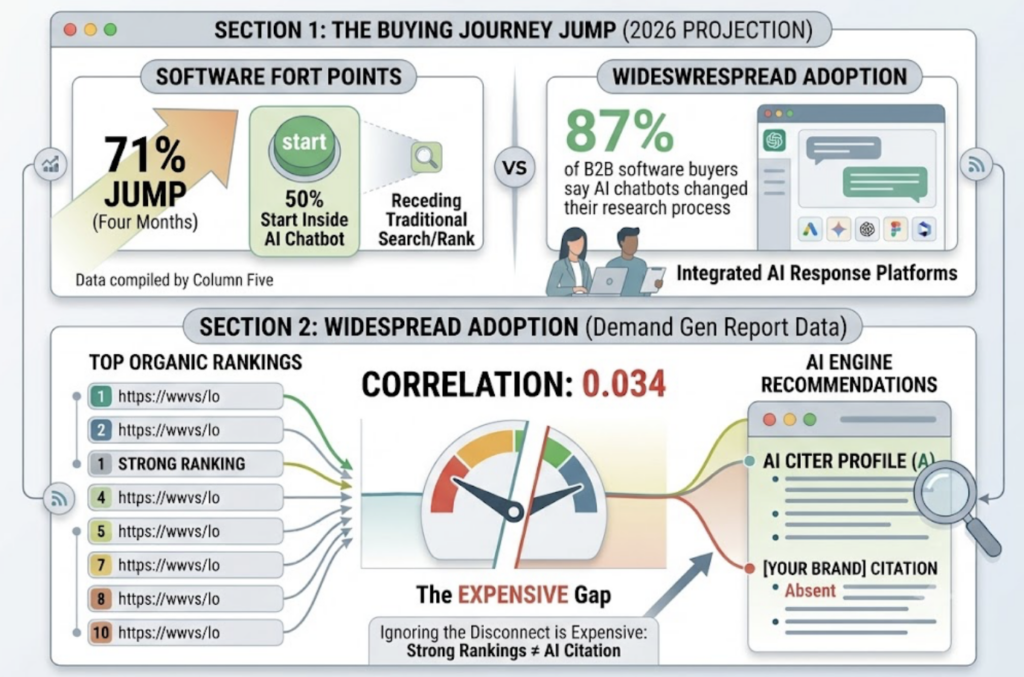
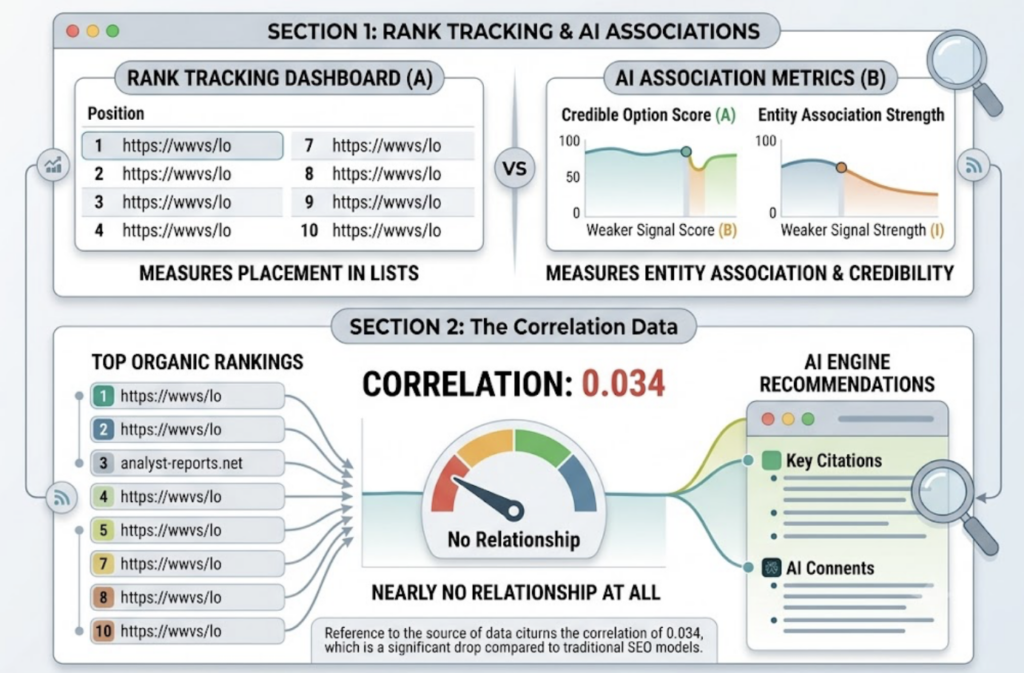
    This is where AI Overviews optimization diverges most sharply from traditional SEO. After Google’s Gemini 3 rollout, only 37% of AIO citations now come from the organic top 10, down from 75% previously. A staggering 36.7% of cited URLs come from domains ranking outside the top 100. Ranking #1 matters less than being the most extractable, authoritative answer for a specific sub-question.

    That’s not to say rankings are irrelevant — a Position 1 page still has a 33.07% probability of being cited, roughly double that of a Position 10 page. But the correlation is far weaker than it used to be.

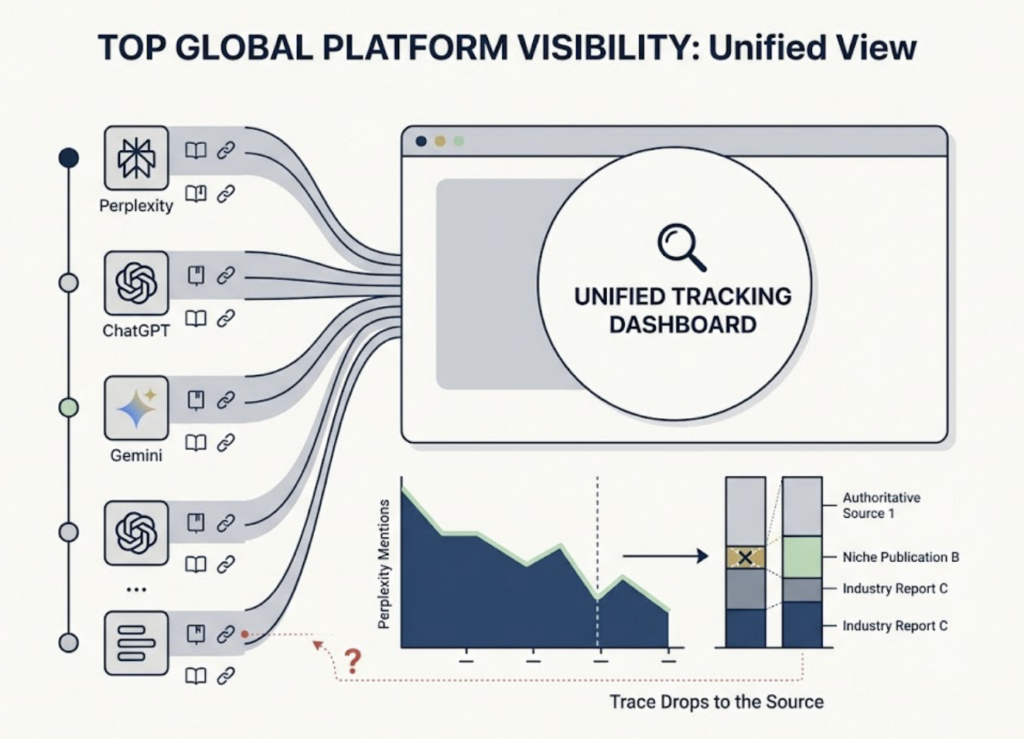
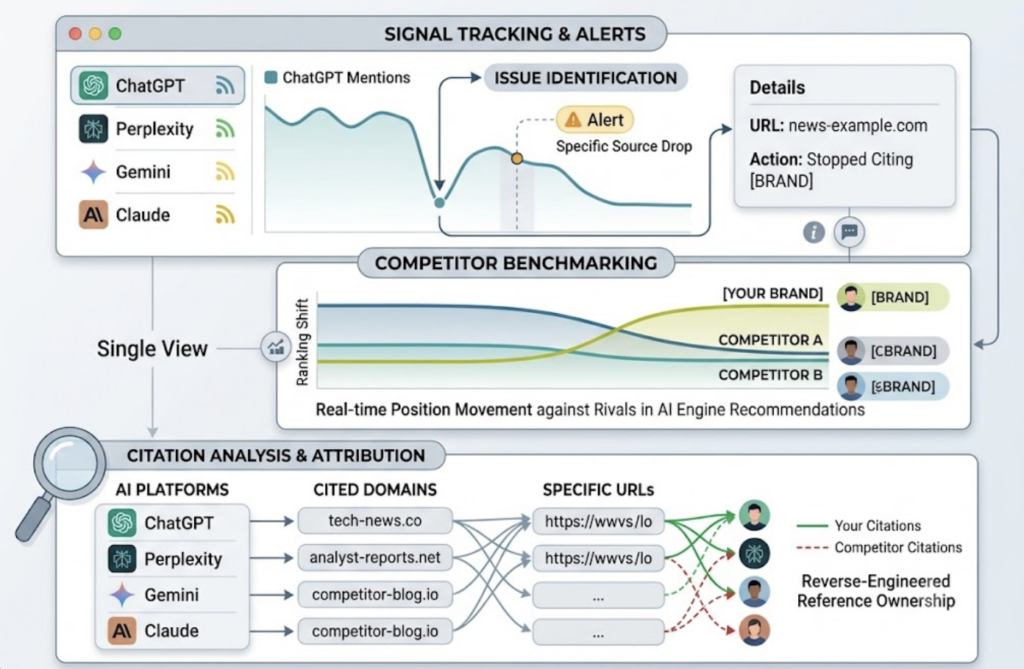
    To know who’s getting cited for your target prompts — and whether it’s you or a competitor — you need tools that go beyond GSC. Topify’s Source Analysis tracks the exact domains and URLs that AI platforms cite across thousands of prompts, letting you see in real time where your content is winning citations and where it’s being displaced. Paired with Visibility Tracking across ChatGPT, Gemini, Perplexity, and AI Overviews, you get a unified picture of citation share — not just keyword rank.

    AI Overviews Optimization Is a Citation Play, Not a Ranking Play

    This is the mindset shift that separates teams gaining ground in 2026 from those still chasing positions.

    The goal is no longer to rank #1. The goal is to be selected as the fragment that feeds the AI’s synthesis. Google’s AIO system decomposes queries into 10 to 16 sub-queries, evaluating sources across this expanded set — not just for the original keyword. A page ranking at position 40 for a sub-topic may be cited in a primary AIO if it’s the clearest, most structured answer to that specific component.

    Three signals matter most for AI Overviews optimization:

    Answer-first structure. AI models parse content in 150 to 300-word chunks, weighting the opening passage most heavily. Your core answer needs to be in the first 50 to 70 words of each section — not buried after context-setting paragraphs.

    Entity density. Pages that include 15 or more recognized entities (brands, people, concepts) have a 4.8x higher probability of being selected by the AIO retrieval system. Entity-based writing isn’t jargon — it’s structuring content around the relationships between specific, verifiable things.

    Schema as communication. FAQ schema has become a core GEO asset. Content grounded in FAQ, HowTo, or Organization schema is interpreted correctly by LLMs 300% more often than unstructured prose. Schema doesn’t guarantee citation. It removes friction between your content and the AI’s extraction process.

    One more signal that most teams underweight: brand mentions across the web. Brand mentions correlate with AIO visibility at 0.664 — a stronger predictor than backlinks or domain rating. If your brand isn’t recognized as an entity in Google’s Knowledge Graph, it’s excluded from the synthesis process regardless of content quality. Off-site signals — media mentions, industry reviews, Reddit threads, LinkedIn posts — are now core inputs to search discoverability.

    How to Tell If Your AI Overviews Optimization Is Working

    Traditional metrics break down in a zero-click environment. Sessions and clicks won’t tell you whether you’re winning or losing in AI Overviews. You need a different measurement framework.

    The metrics that matter now:

    MetricWhat It MeasuresWhy It Matters
    Citation Share% of AIOs where your URL is cited for target keywordsDirect measure of AIO presence
    Share of Model (SoM)% of AI responses mentioning your brand vs. competitorsTracks brand-level AI visibility
    Pixel DepthPhysical position of your result on-screenPosition 1 with 1,200px offset = functionally invisible
    AI Sentiment ScoreHow AI describes your brand (recommended / neutral / cautionary)Affects conversion, not just visibility
    Citation StabilityHow often your citation status changes week-over-weekPost-Gemini 3, 42% of cited domains rotate out

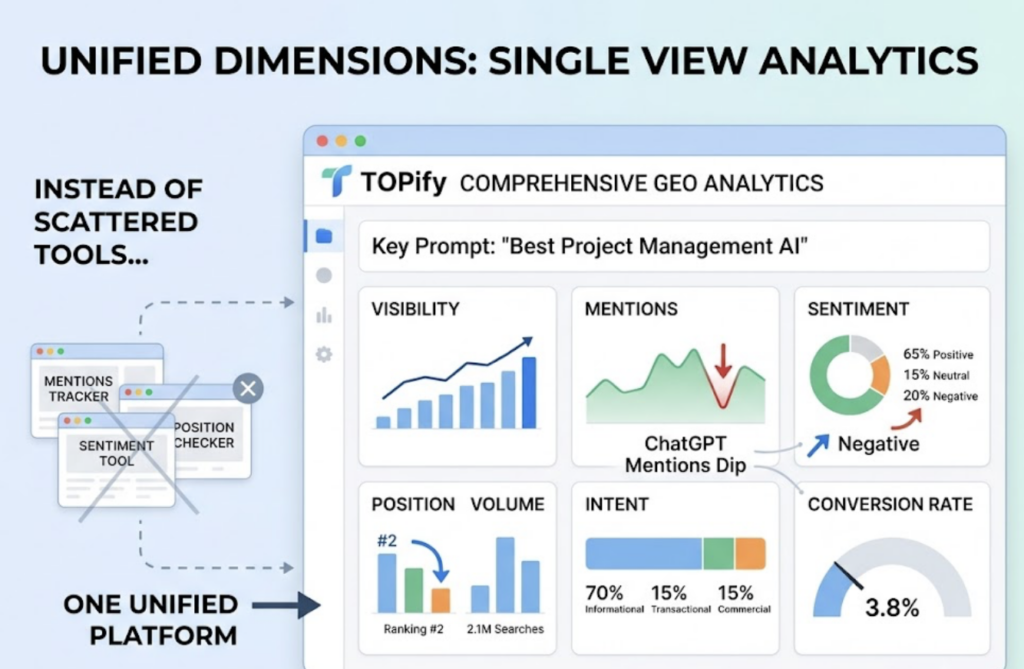
    GSC’s AI Mode filter gives you a starting point, but it doesn’t show competitor citations or cross-platform performance. For teams managing brand visibility across AI platforms, Topify tracks all seven of these dimensions — Visibility, Sentiment, Position, Volume, Mentions, Intent, and CVR — across ChatGPT, Gemini, Perplexity, DeepSeek, and AI Overviews from a single dashboard. Plans start at $99/month, with a 30-day trial included on the Basic tier.

    That’s a meaningful advantage when citation rotation happens weekly and you can’t afford to discover a displacement after the traffic has already left.

    3 Actions SEO Teams Should Take This Week

    You don’t need a six-month roadmap. The AIO environment rewards fast iteration.

    1. Audit your “killing” keywords. Use GSC to isolate keywords where impressions are stable but CTR has collapsed since mid-2024. These are your AIO casualties. Manually verify whether an AI Overview appears and whether you’re cited. If not, these pages become your first rewrite priority.

    2. Restructure high-priority pages for extraction. Move your core answer to the first 50 to 70 words of each section. Add question-based H2 headers. Implement FAQ schema. Add “Last Updated” timestamps and expert bylines to YMYL content — these signals close the freshness and authority gap that causes citation loss.

    3. Start tracking citation share, not just rank. Set a baseline for how often your brand appears in AI-generated answers for your 50 most important prompts. Track it weekly. Without this baseline, you won’t know if your optimization efforts are working — or if you’re losing ground silently.

    The teams that adapt fastest won’t just stop the bleeding. They’ll capture citation share that their slower competitors are giving up.

    Conclusion

    CTR decline is the symptom. The structural change in how users interact with search is the cause. AI Overviews haven’t broken traditional SEO — they’ve made it insufficient on its own.

    The teams winning in 2026 have shifted from “rank higher” to “get cited.” They’re measuring Share of Model alongside sessions. They’re tracking citation stability weekly, not checking rankings monthly. And they’re treating off-site brand authority as a core search input, not just a PR outcome.

    The zero-click era isn’t coming. It’s here. The question is whether your visibility strategy has caught up.


    FAQ

    Does ranking #1 still matter if an AI Overview is present? 

    Yes, but less than it used to. A Position 1 page has a 33.07% probability of being cited in an AIO — roughly double that of a Position 10 page. That said, even a cited Position 1 result sees significantly lower CTR than pre-AIO levels. Ranking well helps, but citation is the primary goal.

    How do I know if AI Overviews is appearing for my target keywords? 

    Start with GSC’s AI Mode filter (available since June 2025) to identify queries where AIO is active. For deeper visibility — including competitor citations and cross-platform AI tracking — you’ll need a dedicated AI visibility tool that monitors actual AI responses, not just GSC signals.

    What content format is most likely to be cited in AI Overviews? 

    Answer-first structure with the core response in the first 50 to 70 words of each section. Question-based H2 headers, FAQ schema, structured comparison tables, and 15 or more recognized entities per page. Original data and primary research are harder for AI to synthesize without direct citation — making them a natural citation defense.


    Read More

  • Most Brands Are Invisible to AI Search. Here’s Why

    Most Brands Are Invisible to AI Search. Here’s Why

    Your team holds a Position 1 ranking on Google. Solid domain authority. Steady organic traffic. Then someone on your team opens ChatGPT and types a prompt your buyers use every day. Your brand doesn’t appear. A competitor gets recommended three times.

    Traditional SEO metrics can’t tell you this is happening. They weren’t built to.

    The SEO Dashboard That Doesn’t Show What AI Thinks of You

    Google Analytics 4 tracks clicks, sessions, and conversions — all behaviors that happen after a user visits your site. But in AI search, the most important moment happens before any click: the AI decides whether to mention you at all.

    When a user asks ChatGPT or Perplexity to recommend a tool, the AI synthesizes an answer and the user often stops there. According to recent research, 93% of sessions in Google’s AI Mode end without a click to any external website. Standard search data registers nothing — no impressions, no sessions, no signal that you were (or weren’t) recommended.

    There’s also a measurement blind spot that most marketing teams haven’t confronted yet. Only 27% of marketers currently track whether their brand appears in AI-generated answers. 12% don’t even know such tracking is possible. Meanwhile, AI chatbot traffic grew by 80.92% between April 2024 and March 2025, totaling over 55 billion visits in a single year.

    That’s a lot of conversations your dashboard isn’t capturing.

    MetricTraditional SEOAI Search Visibility
    Primary interactionClick to websiteMention in synthesized answer
    Zero-click rate~34% (Standard Google)~93% (Google AI Mode)
    Success indicatorRank position 1-10Persistence & recommendation strength
    User intent trackingKeyword-basedPrompt-based / conversational

    What AI Search Visibility Actually Measures

    AI search visibility is a performance layer that tracks how effectively a brand is recognized, cited, and recommended by generative engines — not where your URL sits in a database.

    The clearest framework breaks it into four dimensions:

    Mention Rate (Share of Model): How often your brand name appears across a broad set of category-specific prompts. This is your baseline presence in the AI’s “memory.”

    Sentiment Profile: AI doesn’t just list brands — it describes them. Whether a model calls your product “enterprise-grade,” “budget-friendly,” or “outdated” has a direct effect on buyer trust.

    Narrative Position: Order matters in conversational answers. Research on “Position Adjusted Word Count” shows users pay the most attention to the first one or two brands mentioned in a response.

    Source Attribution: Which third-party websites is the AI citing when it talks about your brand? This is where optimization strategy begins — and where most brands have no visibility at all.

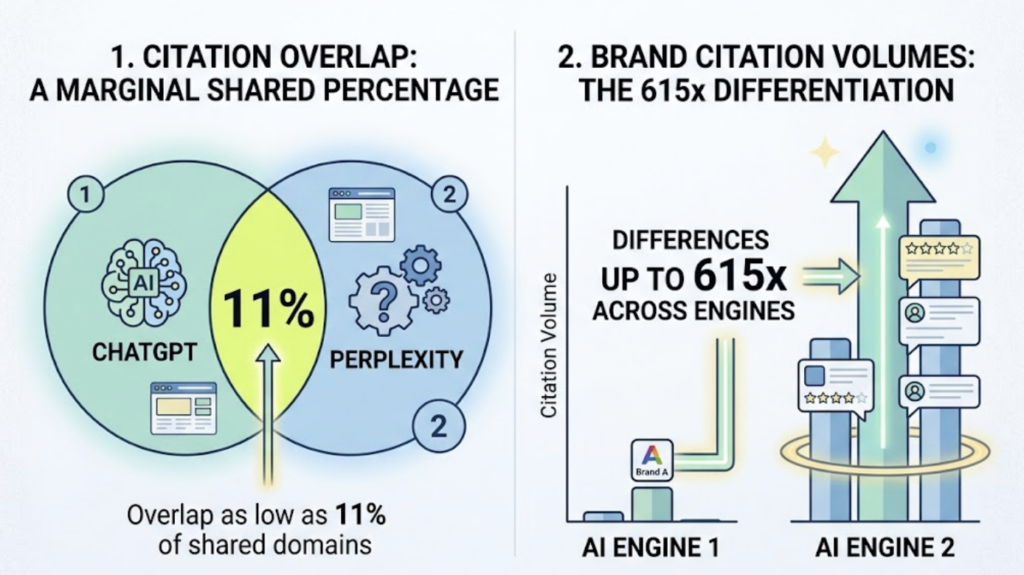
    One detail that surprises most teams: AI visibility isn’t a single, global number. The same brand can see its citation volume differ by 615x between platforms like Grok and Claude. Tracking one platform and calling it done is a common mistake.

    Why Most Brands Score Zero on This Metric

    Here’s the data point that tends to land hard: only 30% of brands that appear in an AI-generated answer show up again in the very next response to the identical query. Run the same prompt five times, and only 20% of brands persist across all five runs.

    Most brands aren’t just hard to find in AI search. They’re invisible by default — and the root causes are structural.

    Training data gaps: AI models build opinions during training by reading the open web. If your brand lacks consistent narrative across Wikipedia, Reddit, industry publications, and review sites, the model doesn’t have enough “parametric memory” to recommend you confidently.

    Poor content structure: AI engines don’t read websites the way humans do. They extract chunks of information. Most brand sites aren’t structured for this — no JSON-LD schema, no direct FAQ sections, no modular summaries. If the AI can’t easily pull your value proposition into an answer, it skips you.

    No measurement, no optimization: Because only 16% of brands track AI search performance, most never know they’re invisible. And if you don’t know, you don’t fix it.

    Content that hasn’t been updated in more than 90 days is three times more likely to lose citations. Pages without sequential headings or schema see a 2.8x lower citation rate. Brands with low presence on Reddit and third-party forums miss out on the channel that drives 85% of AI citations.

    How AI Engines Decide What to Recommend

    AI recommendations come from two sources: what the model learned during training, and what it finds in real time.

    Training data (called “parametric memory”) determines the model’s instinctive brand preferences. If your brand was mentioned consistently in major publications during the model’s training window, you have a baseline advantage. If not, you’re starting from zero.

    Retrieval-Augmented Generation (RAG) is the real-time layer. When a user asks a current or specific question, the AI searches the live web, extracts relevant chunks, and synthesizes a response. To win in RAG, your content needs to be easy to parse and grounded in specific, verifiable facts.

    Three criteria determine whether an AI recommends you:

    Content authority: Who else is citing you? Reputable third-party platforms like G2, Reddit, and industry journals act as “consensus trust” signals. The AI interprets external citations as social proof.

    Semantic relevance: Does your content directly answer the prompts your buyers are using? Pages that lead with a direct answer in the first 200 words are significantly more likely to be cited.

    Factual consistency: If your brand description varies across platforms, the AI perceives this as a hallucination risk. Consistency across your entity graph — brand name, category, key stats, positioning — is treated as a reliability signal.

    There’s also the “Ghost Citation” problem. Gemini and other platforms have been documented citing specific content hundreds of times while mentioning the source brand zero times. Your content is authoritative enough to reference; your brand isn’t established enough to name. That’s the gap most brands still can’t see.

    Tools like Topify include Source Analysis precisely for this reason — to show you which domains the AI is citing, and whether your brand is getting the credit.

    Your Competitors May Already Be Optimizing for This

    Generative Engine Optimization (GEO) has moved from an experiment to a front-line marketing priority. By the second half of 2025, 47% of B2B buyers were starting their research with AI search rather than traditional Google.

    In sectors like finance, nine out of ten AI citations come from sources that are not on page one of traditional Google search results. That means ranking well on Google doesn’t protect you in AI search — and being invisible on Google doesn’t mean you’re invisible to AI.

    The competitive window is narrowing. Brands that accumulate citation history now will benefit from a compounding effect that’s difficult for late movers to break. The GEO market is projected to grow at a 40.6% CAGR through 2034. Early movers are already building the kind of entity authority that AI engines treat as default trust.

    The other risk is harder to quantify: you may already have competitors who are monitoring your AI search presence even if you’re not monitoring theirs. Topify’s Competitor Monitoring feature tracks which brands AI engines recommend in your category, how they’re described, and how their position shifts over time — across ChatGPT, Gemini, Perplexity, and other major platforms.

    If a competitor is gaining ground in AI recommendations, you’ll want to know before it shows up in your pipeline numbers.

    How to Start Tracking Your AI Search Visibility

    The entry point is simpler than most teams expect. You don’t need a full GEO strategy on day one — you need a baseline.

    Step 1: Define your core category prompts. Think in conversational terms, not keywords. Instead of “CRM software,” the prompt is “What’s the best CRM for a 50-person agency with a $500/month budget?” These are the queries your buyers are actually running.

    Step 2: Run them across platforms. Test on ChatGPT, Perplexity, Gemini, and Claude. For each response, record: Was your brand mentioned? What position? What language did the AI use to describe you? Which third-party sources were cited?

    Step 3: Track persistence over time. A single manual check tells you almost nothing. Because only 30% of brand visibility persists from one run to the next, you need repeated measurements to build a statistically meaningful score.

    The limitation of manual tracking is obvious at scale. Managing hundreds of prompts across five platforms isn’t sustainable for a lean team. This is where automated platforms earn their place.

    Topify handles multi-platform tracking across ChatGPT, Gemini, Perplexity, DeepSeek, and others — running thousands of prompts per day, comparing platform behavior side by side, and surfacing Source Analysis to show why competitors are being recommended instead of you. The Basic plan starts at $99/month and covers 100 prompts across four projects.

    Tracking MethodManual AuditAutomated Platform (e.g., Topify)
    ScalabilityLow (10-20 prompts)High (1,000s of prompts/day)
    Platform coverageSpottyComprehensive
    Trend analysisDifficultBuilt-in dashboards
    Execution linkHigh manual laborOne-click optimization

    One data point worth keeping in mind: AI search traffic converts at an average of 14.2%, compared to traditional Google’s 2.8%. That’s a 5x conversion advantage — because a user who follows an AI recommendation has already been pre-qualified by the answer they received. Visibility in AI search isn’t just a brand metric. It’s a revenue metric.

    Conclusion

    AI search visibility isn’t a trend to prepare for. It’s a measurement gap that’s already costing brands recommendations they don’t know they’re losing.

    Your SEO dashboard will keep looking healthy. Your Google rankings may hold. But if AI engines aren’t naming you when buyers ask for solutions in your category, that traffic — and those conversions — are going somewhere else.

    The starting point is simple: pick ten prompts your buyers actually use. Run them on ChatGPT and Perplexity today. See what comes back. What you find will tell you more about your current AI search position than six months of traditional analytics.


    FAQ

    Is AI search visibility the same as SEO? 

    No. Traditional SEO focuses on ranking in a list of links (SERPs). AI search visibility measures whether you’re mentioned and recommended within the synthesized narrative of an AI’s response. Good SEO provides a technical foundation, but AI visibility requires additional optimization for chunkable content and third-party consensus.

    Which AI platforms should I track my brand on? 

    Prioritize the platforms your buyers actually use. ChatGPT dominates with over 800 million weekly active users. Perplexity is favored for research-heavy and citation-focused queries. Google AI Mode and Microsoft Copilot matter for general search integration. Citation behavior can differ by 615x across platforms, so multi-platform coverage is worth the investment.

    How often does AI search visibility change? 

    It’s highly volatile. Only 30% of brand visibility persists from one query to the next. Citation performance for newly published content typically starts declining after just 4-5 days if the content isn’t refreshed or reinforced with new third-party mentions.

    Can a small brand improve its AI search visibility without a big content team? 

    Yes. AI search tends to be more meritocratic than traditional search. Small brands can gain traction by targeting specific, niche prompts, participating in community platforms like Reddit, and implementing structured data (JSON-LD schema, FAQPage markup) that makes content easier for AI to extract. One-click optimization tools also help small teams execute GEO strategies without heavy headcount.


    Read More

  • AI Search Visibility: What It Is and Why It Matters

    AI Search Visibility: What It Is and Why It Matters

    Your brand ranks #1 on Google. You’ve got the backlinks, the traffic, the domain authority. But when someone asks ChatGPT “what’s the best tool for [your category],” your name doesn’t come up once.

    That’s not an SEO problem. That’s an AI search visibility problem, and it’s a different fight entirely.

    The Part Google Analytics Won’t Show You

    Traditional SEO metrics, clicks, rankings, organic sessions, are built around one assumption: users visit your website. But AI search doesn’t work that way.

    When someone asks Perplexity or Gemini a question, they get a synthesized answer. No blue links. No need to click. The AI pulls from multiple sources, generates a response, and the user moves on.

    Google Analytics sees none of that. Your brand could be mentioned in hundreds of AI answers every day, or completely absent, and your dashboard wouldn’t tell you either way.

    That’s the gap most marketing teams still can’t see.

    So What Does “AI Search Visibility” Actually Mean?

    At its core, AI search visibility measures how often your brand appears in AI-generated answers, and how well it appears, across platforms like ChatGPT, Gemini, and Perplexity.

    It’s not about ranking. It’s about being cited, recommended, and described accurately when a user’s question is relevant to what you do.

    Three dimensions define it:

    1. Mention Rate: Did AI Bring Up Your Brand at All?

    Mention rate tracks what percentage of relevant prompts actually produce a response that includes your brand name. If someone searches “best project management software” and you never appear, you’re functionally invisible on that search path, regardless of your Google ranking.

    2. Position: Where in the Answer Do You Show Up?

    Not all mentions are equal. Research from Princeton University shows that sources appearing earlier in AI-generated answers carry significantly more weight and drive higher click probability. One way to quantify this is through Position-Adjusted Word Count (PAWC), which assigns higher mathematical weight to brands mentioned earlier in a response. Showing up third in a list is very different from being the first brand an AI recommends.

    3. Sentiment: What Is AI Actually Saying About You?

    AI doesn’t just mention brands. It describes them. The difference between “an industry leader known for reliability” and “a complex tool with a steep learning curve” can shift user decisions before they ever visit your site. Sentiment analysis tracks the qualitative framing AI uses when your brand comes up.

    Why “Being on the Internet” Isn’t Enough Anymore

    Here’s what many marketers get wrong: they assume that if their content exists, AI will find it and use it.

    AI models don’t crawl the web the way Google does. They select sources based on trust, structure, and multi-source verification. A brand with a solid website but minimal third-party coverage often loses out to a smaller competitor that’s been written about in industry publications, cited in research, and discussed in forums.

    In AI search, presence without authority doesn’t convert into visibility.

    The 5 Signals AI Uses to Decide Who Gets Mentioned

    Research published at ACM KDD 2024, led by teams from Princeton, Georgia Tech, the Allen Institute for AI, and IIT Delhi, identified clear structural patterns in how generative engines select sources. Some of these findings are worth knowing directly.

    1. High-authority domains with earned media coverage. AI models strongly prefer sources that have already been cited by others. Your own website, however well-written, ranks lower in trust than a mention in a respected industry publication. Earned media, coverage you didn’t pay for, is the signal AI weighs most.

    2. Structured, extractable content. AI systems need to parse your content quickly. Clear H1-H3 heading hierarchies, short paragraphs (typically under 60 words), and schema markup make your content machine-readable. Pages that AI can’t cleanly parse often don’t get extracted at all.

    3. Consistent brand narrative across platforms. If your pricing, product description, or value proposition differs between your website, your G2 profile, and your LinkedIn page, AI models pick up on the inconsistency. Lower confidence means lower citation rates. High-visibility brands maintain what researchers call a stable “digital fingerprint” across every touchpoint.

    4. Real community discussion. Authentic user conversations on platforms like Reddit have become a core trust signal. Studies show brands with active, positive community discussions are cited by AI engines more than 3 times as often as brands with little or no community presence. This isn’t a coincidence. AI is trained to weight real-world usage signals heavily.

    5. Competitive share of voice. AI answers typically recommend only 3 to 5 brands. That makes AI search visibility a zero-sum game. Every mention your competitor earns in a given prompt category is one you didn’t. Tracking where your competitors show up, and where you don’t, is how you find the gaps worth closing.

    The data backs this up: adding statistics to content can lift AI visibility by up to 40%, while including expert quotations pushes that to 41%. These aren’t marginal improvements.

    You Can’t Improve What You Can’t See

    This is where tracking becomes non-negotiable.

    Topify approaches this by simulating real user prompts across ChatGPT, Gemini, and Perplexity at scale, then converting the results into structured metrics your team can actually act on. Seven core metrics form the tracking layer: Visibility Score, Sentiment Score, Position Rank, AI Volume (prompt search frequency), Intent classification, Source Analysis (which domains AI cites in your category), and CVR (Conversion Visibility Rate, an estimate of how likely an AI mention leads to brand engagement).

    The goal isn’t to watch a dashboard. It’s to identify exactly which prompt categories your brand is missing from, and why, so you can fix it.

    AI Search Visibility vs. Traditional SEO: Side by Side

    These two disciplines aren’t competing with each other. They’re operating on parallel tracks, and you need both.

    DimensionTraditional SEOAI Search Visibility
    Core goalRank in SERP, drive clicksGet cited and recommended in AI answers
    User interactionClicks to your websiteConsumes synthesized answer, often without clicking
    Success metricRank, CTR, organic trafficMention rate, sentiment score, position rank
    Content focusKeyword density, backlinksFact density, structural clarity, cross-platform consistency
    Key technologyCrawlers, PageRankRAG retrieval, semantic entity extraction
    Competition typeLinear ranking (page 1 vs 2)Narrative authority (cited vs ignored)

    SEO builds the foundation. AI search visibility is where the next layer of brand discovery is being decided right now.

    Where to Start If You’re New to This

    You don’t need a full GEO strategy on day one. Three steps get you to a baseline fast.

    Step 1: Build a prompt map. Instead of keywords, think in questions. What does your target user actually ask an AI when they’re researching your category? Map out 5 to 10 prompts across informational (“what is [topic]?”), comparison (“which tool is better for [use case]?”), and solution-oriented (“how do I [achieve outcome] without [constraint]?”) intent types. Google Search Console’s long-tail queries and Reddit threads in your category are good starting points.

    Step 2: Run a baseline test. Open ChatGPT, Gemini, and Perplexity in private browsing. Ask those prompts. Record whether your brand appears, where it appears, and how it’s described. Be honest about what you find.

    Step 3: Track it consistently. A one-time test tells you where you stand today. Tools like Topify automate this across platforms and over time, so you can measure whether your content and distribution changes are actually improving your position in AI answers.

    Conclusion

    Gartner projects that traditional search traffic will decline by 25% by 2026, as users shift toward conversational AI interfaces. That’s not a prediction about the distant future. It’s describing something that’s already happening in your category.

    AI search visibility isn’t a trend to watch. It’s a metric to measure and a position to defend. The brands building that tracking layer now are the ones that will be cited, recommended, and chosen when AI becomes the default starting point for most purchasing decisions.

    The question isn’t whether AI search matters for your brand. It’s whether your brand shows up when it does.


    FAQ

    Is AI search visibility the same as GEO? 

    They’re related but distinct. AI search visibility is the metric: how often and how well your brand appears in AI answers. GEO (Generative Engine Optimization) is the practice: the strategies and tactics you use to improve that metric. Think of GEO as the discipline, and AI search visibility as the scoreboard.

    Which AI platforms should I track first? 

    Start with ChatGPT (broadest general-purpose user base), Perplexity (research-oriented users who go deep on topics), and Gemini (tightly integrated with Google’s ecosystem). These three cover the majority of AI search behavior across most B2B and B2C categories.

    How is AI visibility actually measured? 

    Core metrics include mention rate (how often you appear across relevant prompts), position (where in the answer you show up), and sentiment (how you’re described). Platforms like Topify combine these into composite scores that track across multiple AI engines simultaneously.

    Does my Google ranking affect my AI search visibility? 

    Sometimes, but not reliably. Research consistently shows a significant “citation gap” between Google’s top-ranked pages and what AI engines actually cite in their answers. AI prioritizes information density, structural clarity, and third-party validation. A page can rank #1 on Google and still be invisible in AI-generated responses.


    Read More

  • AI Search Visibility Isn’t SEO. Stop Treating It Like One.

    AI Search Visibility Isn’t SEO. Stop Treating It Like One.

    Your brand ranks #1 on Google. But when someone asks ChatGPT to recommend a solution in your category, your name never comes up.

    That’s not a content problem. That’s a measurement problem, and a strategic one.

    Research shows that 88% of users accept the AI’s shortlist without checking external sources. If you’re not in that shortlist, you’re not in the consideration set, regardless of where you rank on a search results page.

    The uncomfortable truth: AI Search Visibility and traditional SEO rankings run on completely different logic. Here’s what that means for how you compete.


    Your Google Rank Doesn’t Predict Your AI Visibility

    This is the finding that should shake up every SEO team in 2026.

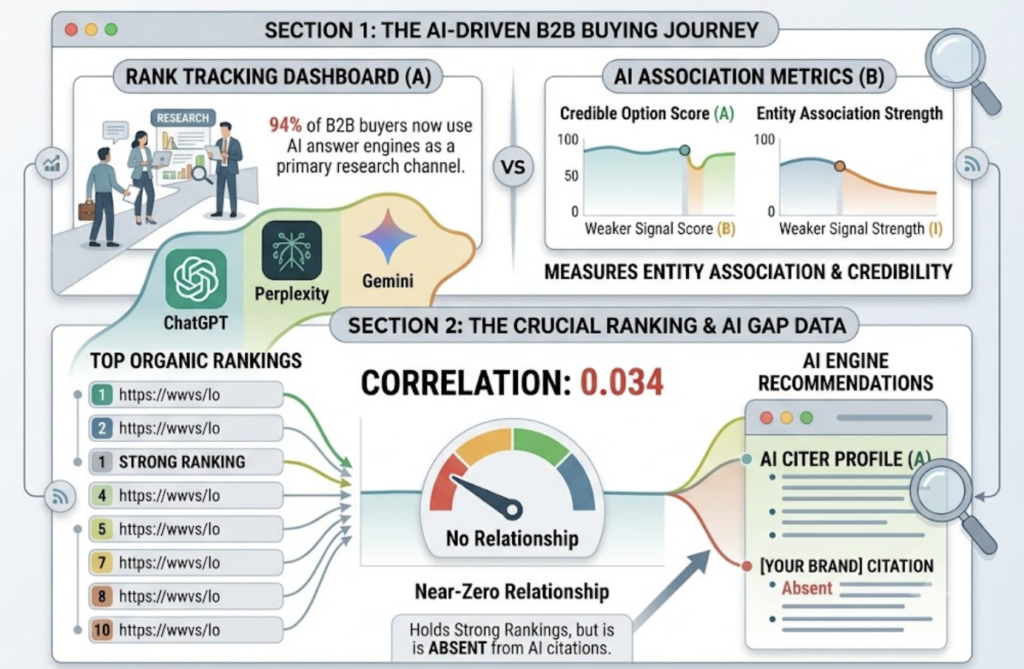
    According to data from Ahrefs, only 12% of the URLs cited by major AI engines rank in Google’s top 10 for the same query. In many cases, pages ranking position 21 or lower account for 90% of ChatGPT’s citations.

    Google #1 appears in the corresponding AI Overview only 33.07% of the time for informational queries. That means a brand can hold the top organic spot and still be invisible in nearly two-thirds of AI-generated answers on the same topic.

    Why does this happen? The two systems optimize for completely different signals.

    Traditional SEO is built on “deterministic retrieval”: match a query to a ranked list of URLs based on backlinks, domain authority, and keyword relevance. AI search runs on “probabilistic synthesis”: the model generates an answer grounded in sources it trusts, not sources that rank highest.

    The goal shifts from being ranked to being cited. And those aren’t the same thing.


    The Metrics That Actually Matter in AI Search

    ChatGPT now handles 2.5 billion daily prompts. In “AI Mode” searches, the zero-click rate hits 93%. Users aren’t scrolling through blue links. They’re reading synthesized answers.

    In this environment, average position and organic CTR tell you almost nothing about how your brand is actually performing.

    That’s why GEO analytics platforms like Topify track a different set of metrics entirely:

    MetricWhat It Measures
    Visibility Rate% of relevant prompts where your brand appears
    MentionsRaw frequency of brand name in AI answers
    PositionWhere in the AI response your brand lands (first vs. buried)
    Sentiment ScoreWhether the AI describes you positively, neutrally, or negatively
    AI Search VolumeMonthly demand for topics on AI platforms (often differs from Google)
    IntentWhich buyer stage the mention corresponds to
    CVR (Conversion Visibility Rate)Projected conversion impact of your AI visibility

    None of these appear in Ahrefs or Semrush dashboards. That’s the measurement gap.

    Here’s the thing: despite lower raw traffic volumes, AI referrals convert at dramatically higher rates. ChatGPT traffic converts at 15.9%, compared to 1.76% for traditional organic, nearly a 9x difference. A small slice of AI-referred visitors can outperform a much larger volume of Google-sourced traffic.

    Measuring clicks without measuring AI mentions means you’re optimizing the wrong number.


    Why AI Engines Cite Brands You’ve Never Heard Of

    This is where the SEO-to-GEO gap gets structural.

    Between 82% and 85% of all AI citations originate from third-party pages, not brand-owned domains. Reddit, G2, Capterra, Wikipedia, and Gartner Peer Insights are the dominant citation sources. Brands are 6.5 times more likely to be cited through community-validated content than through their own site.

    The review platform data is particularly counterintuitive. Sites like G2 and Capterra lost up to 90% of their organic search traffic between 2024 and 2025, as AI Overviews began handling “best of” queries directly. Yet these same platforms remain the primary credibility layers that AI engines use to ground their recommendations.

    Review PlatformAI Overview Citation ShareOrganic Traffic Trend (2024-2025)
    Gartner Peer Insights26.0%-76.5%
    G223.1%-84.5%
    Capterra17.8%-89.0%
    TrustRadius8.3%-92.2%

    Users aren’t visiting these sites. AI crawlers are. And they’re using the accumulated review data to decide which brands are trustworthy enough to recommend.

    If your brand has inconsistent descriptions across these platforms, or limited reviews, or an entity gap where the AI can’t confidently establish who you are and what you do, the model will lower its confidence score. It will recommend competitors instead, regardless of your DA or your keyword rankings.

    That’s why Topify’s Source Analysis tracks the exact domains and URLs that AI platforms cite in your category. It surfaces which third-party properties are influencing AI recommendations, and which gaps your competitors are already filling.


    The Technical Difference You Can’t Ignore

    AI models don’t read webpages. They extract passages.

    Content that performs well in AI search is organized into 200 to 400-word blocks with descriptive headings. It leads with direct answers. It’s structured around verifiable, specific data points.

    Research shows that content containing specific statistics is cited 3.5 times more often than general marketing copy. Pages using both semantic triple structures (entity-relationship-entity) and corresponding schema markup perform 43% better in AI responses than those using only one element.

    Compare the two approaches:

    ElementTraditional SEO PriorityGEO Priority
    Trust SignalBacklinks, Domain RankThird-party consensus, structured facts
    Content UnitThe webpageThe passage / knowledge node
    Query FormatKeyword-based, ~4 wordsConversational, ~23 words
    Primary GoalFirst-page rankingAI citation and endorsement
    Schema UsageRich snippetsEntity classification for AI crawlers

    There’s also a technical barrier many brands don’t know they have. AI crawlers like GPTBot, ClaudeBot, and PerplexityBot may be blocked by existing robots.txt configurations or JavaScript rendering that LLMs simply can’t process. If the AI can’t crawl your site, it can’t cite your site. Auditing bot accessibility is now a non-negotiable step in any GEO setup.


    How to Start Measuring AI Search Visibility

    You don’t need to rebuild your entire content strategy. You need to start measuring the right thing.

    A three-phase approach works for most teams:

    Month 1: Baseline. Identify 20-30 “money prompts” in your category, the comparison and recommendation queries your buyers are actually asking AI. Audit where your brand appears, where it doesn’t, and where competitors are being cited instead.

    Months 2-3: Restructure. Apply modular passage structures, fact-dense formatting, and schema markup to your existing high-authority content. You don’t need new content. You need the same content to be more machine-readable.

    Months 3-6: Authority Distribution. Earn mentions on niche directories, community platforms, and industry publications. G2 reviews, Reddit threads, Wikipedia citations: these aren’t social media plays. They’re AI visibility signals.

    One professional services firm that followed this framework went from zero AI citations to appearing in 11 out of 20 target prompts across ChatGPT and Perplexity in 90 days, without publishing a single new post.

    Topify’s High-Value Prompt Discovery automates the first step. It continuously surfaces the prompts most relevant to your brand, tracks where you appear versus where competitors do, and identifies the content gaps driving the difference. For teams moving from traditional SEO tooling, it’s the fastest way to establish an AI visibility baseline without building a manual tracking system from scratch.


    You Don’t Have to Choose Between SEO and GEO

    This isn’t an either/or decision.

    SEO and GEO are complementary. High-quality SEO content follows a specific lifecycle into AI systems: technical SEO ensures AI bots can crawl the page, entity optimization helps the model categorize your brand, and third-party mentions provide the multi-source validation that builds AI trust. Good SEO is the foundation that makes GEO possible.

    On the flip side, GEO doesn’t replace your existing SEO investment. It adds a measurement layer on top of it. Traditional search still drives navigational and transactional queries. Google’s 5 billion users aren’t disappearing.

    What’s changing is that AI search is capturing a growing share of discovery and consideration, particularly in high-value categories. In Travel and Hospitality, 47% of consumers already use ChatGPT as part of their purchasing journey. In Retail, 36% do.

    The brands that win in this environment aren’t abandoning SEO. They’re adding a GEO layer: tracking AI visibility, understanding citation sources, and optimizing for the metrics that actually predict AI recommendation. That’s a different measurement system, not a replacement one.


    Conclusion

    AI Search Visibility and traditional SEO rankings are two separate disciplines. They measure different things, rely on different signals, and require different tools.

    The gap between them is already costing brands visibility in the places their buyers are increasingly making decisions. A brand that ranks first on Google but doesn’t appear in ChatGPT’s recommended shortlist is effectively invisible to users who never scroll past the AI answer.

    The starting point is measurement. Establish your AI visibility baseline: which prompts are relevant to your category, where your brand appears, and where competitors are being cited instead.

    Topify tracks brand visibility across ChatGPT, Gemini, Perplexity, and other major AI platforms with a seven-metric framework built specifically for this layer. If you’ve been measuring AI performance with SEO tools, the data you’re seeing isn’t wrong. It’s just incomplete.


    FAQ

    What’s the difference between AI search visibility and SEO rankings? 

    SEO rankings measure where a webpage appears in a Google results list. AI search visibility measures whether your brand is cited, recommended, or described in a synthesized AI answer. The two metrics don’t correlate reliably. Research shows only 12% of AI-cited URLs rank in Google’s top 10 for the same query.

    Can I use existing SEO tools to track AI visibility? 

    Tools like Ahrefs and Semrush have added some AI-specific features, but they’re built around Google’s index. They don’t track brand mentions across AI-generated responses, measure sentiment in AI answers, or identify which third-party sources are driving AI citations. Specialized GEO platforms are designed for this specific measurement layer.

    How often does AI visibility change? 

    AI visibility can shift week to week as new content enters AI training data, review platforms update, and competitors earn new citations. Continuous monitoring, rather than periodic audits, gives you the earliest signal when share shifts.

    Which AI platforms should I prioritize? 

    ChatGPT holds roughly 73% of AI search market share as of April 2026 and is the highest priority. Perplexity AI (6.6% share, with 239% query growth) is particularly important for research and comparison queries. Claude and Gemini round out the major platforms for comprehensive coverage.

    How long does it take to improve AI search visibility? 

    Structural changes, such as restructuring existing content for machine extractability and adding schema markup, typically show measurable impact within 60 to 90 days. Building third-party credibility layers like G2 reviews and community mentions takes longer, generally 3 to 6 months for meaningful AI citation impact.


    Read More

  • High on Google, Invisible to AI: What’s the Gap?

    High on Google, Invisible to AI: What’s the Gap?

    Google and AI answer engines follow completely different rules. Here’s what that means for your brand.

    You search your brand’s core category term. Google returns your homepage at position one, with a featured snippet and a knowledge panel. Then you open ChatGPT and type the same query. The AI generates a detailed answer naming four competitors. Your brand doesn’t appear anywhere.

    That’s not a glitch. That’s the visibility gap — and it’s structural.

    Most marketing teams haven’t caught up to this yet. They’re still measuring success in rankings and organic traffic, unaware that a completely separate reputation system is being built in parallel, one that decides who AI recommends when users stop clicking links and start asking questions directly.

    The gap between Google dominance and AI search visibility is widening fast. Here’s why it exists, and what it takes to close it.


    Google Reads Pages. AI Reads the Whole Internet.

    To understand why top-ranking brands disappear in AI answers, you need to understand how the two systems actually work.

    Google is fundamentally a retrieval and ranking machine. It crawls pages, builds an index, and sorts URLs by relevance using signals like backlinks, domain authority, and E-E-A-T principles. SEO wins when you convince Google that a specific URL is the best answer to a specific query.

    AI large language models operate on an entirely different logic. They generate answers through two intertwined mechanisms: parametric memory (knowledge compressed into model weights during pre-training on trillions of tokens) and Retrieval-Augmented Generation (RAG), where the model pulls live data from the web at query time and synthesizes it into a response.

    The critical difference is this: Google is asking “which page ranks best?” AI is asking “which brand deserves to be in this answer?”

    That’s not a small distinction. Wikipedia alone accounts for roughly 22% of major LLM training data. If your brand has no presence on Wikipedia, Reddit, or authoritative industry publications, you’re effectively a blank entry in AI’s internal knowledge base, regardless of how many pages you’ve optimized for Google.

    DimensionTraditional Search (Google)Generative Engine (ChatGPT/Perplexity)
    Core GoalRank and retrieve pagesSynthesize and generate answers
    Trust SignalBacklinks, domain authorityEntity consensus, citation density
    Ranking UnitFull URLSemantic chunks, factual fragments
    Selection LogicBM25 + PageRankAttention weights, source verification
    Update CycleDays to weeksTraining cycles (months) or RAG (seconds)

    AI isn’t crawling your site. It’s deciding if your brand is credible enough to include in an answer.


    5 Reasons Your Top-Ranking Pages Don’t Show Up in AI Answers

    AI pulls from a completely different content pool

    LLMs are shaped by their training data, not by current search rankings. Models heavily favor content from sources with strong editorial or community consensus: academic papers, Wikipedia, Reddit, Quora, Hacker News, and tier-one industry media. If your brand exists primarily on its own domain without a footprint in these ecosystems, AI’s parametric memory treats you as an entity that barely exists. Research consistently shows AI answers exhibit “large-brand bias” and “authority-source bias” — meaning a smaller site with strong SEO rankings but no third-party presence will almost always lose to a category leader with broad community coverage.

    The counterintuitive conclusion: ranking first on Google doesn’t give you an identity in AI’s world. Being discussed across the internet does.

    You’re optimized for keywords, not for AI’s question format

    Traditional SEO content is built around keyword density and long-form narrative to extend time-on-page. That structure actively works against you in generative search. AI systems running RAG look for “atomic facts” and extractable answer blocks. If the model has to synthesize three paragraphs to infer a conclusion, it moves on to a source that puts the answer in the first sentence.

    Research from Princeton’s GEO study found that content placing its core claim in the first 40-60 words and using structured formats (tables, lists, direct Q&A) achieves 32.5% higher AI visibility than traditional long-form SEO pages. The narrative depth you added to satisfy search algorithms is often the exact thing preventing AI from extracting your brand’s information.

    Your brand has no third-party citation footprint

    When AI answers “what’s the best tool for X,” it’s running a virtual consensus check across the internet. A striking 85% of brand citations in AI answers come from third-party sources, not brand-owned pages. If your digital presence is concentrated on your own domain — with thin coverage on G2, Capterra, industry review sites, or independent blogs — AI interprets this as a lack of social proof.

    That’s not a content quality problem. It’s a distribution problem.

    AI engines don’t trust claims that only appear on your own site

    To prevent hallucinations, LLMs use a consensus validation mechanism. When multiple independent sources confirm the same brand or claim, the model’s confidence increases. If a statement like “our platform is the fastest in the category” appears only on your homepage with no third-party corroboration from industry reports, government data, or academic sources, AI treats it as unverified and deprioritizes it.

    The data on this is specific: adding authoritative citations can increase AI visibility by 115.1% for a site that ranks fifth on Google. Self-promotional content not only fails to help — it may actually reduce AI trust by signaling that no one else has validated the claim.

    You’re tracking the wrong metrics

    Most brands still report on click-through rate and keyword rankings. In generative search, these metrics are increasingly disconnected from actual brand impact. Zero-click searches already account for over 43% of Google AI Overview interactions and hit 93% on Perplexity. In that environment, your brand appearing in an AI answer without generating a click is still brand exposure — often at a decision-making moment that’s far higher-intent than a passive search result.

    The metrics that matter in AI search visibility are citation frequency, brand mention rate, and recommendation position. If you’re not tracking these, you’re measuring the wrong game entirely.


    The Metric That Tells You If You’re Invisible

    AI search visibility is a standalone performance indicator. It’s not a subset of SEO. It measures how often your brand appears in AI-generated answers as a recommended entity, what position it holds relative to competitors, and what sentiment the AI expresses when it mentions you.

    The industry has started formalizing this under “Share of Model” — a bundle of metrics that quantify brand presence across generative engines:

    Citation Share: The percentage of target-category prompts where your brand appears as a cited source. Recommendation Rank: Your position in AI-generated recommendation lists, which directly determines first-choice status in users’ minds. Sentiment Velocity: The directional tone AI uses when describing your brand, tracked over time.

    AI traffic currently represents a small share of total web traffic, but it’s growing at over 200% annually in complex decision-making contexts. That’s where the early-mover advantage sits.

    Topify addresses this directly. Its Visibility Tracking module doesn’t monitor keywords — it simulates thousands of real user prompts across ChatGPT, Gemini, Perplexity, and other major AI platforms, then maps where your brand appears, in what position, and with what tone. The unified dashboard lets teams compare performance across models: a brand might lag in ChatGPT due to older training data while outperforming in Perplexity because of a recent PR push. Topify surfaces these gaps and flags which content changes would most likely improve citation rates.


    What AI Actually Uses to Decide Who Gets Recommended

    AI recommendations aren’t random. They’re the output of a filtering process that can be reverse-engineered.

    In RAG workflows, the system simultaneously runs semantic search and keyword search to find content blocks that closely match user intent. It then scores those blocks on “information gain” — whether they provide data, insights, or specificity that other sources don’t. A page that cites a proprietary study or a precise statistic outperforms a page that makes the same claim without evidence.

    What makes this more complex is what Seer Interactive found after analyzing over 500,000 LLM responses: AI often decides who to recommend first, then searches for citations to support that decision. When a brand is actively recommended, its citation rate reaches 53.1%. When it’s not in the model’s recommendation set, even high-quality content from that brand gets cited only 10.6% of the time.

    That’s a critical strategic insight. Content quality alone isn’t enough. You have to build enough brand presence across the web that your brand name crosses AI’s internal “mention threshold” — the implicit shortlist of entities the model considers credible for a given category.

    Topify’s Source Analysis feature makes this process visible. It reverse-engineers the citation ecosystem behind AI answers, identifying which domains AI consistently pulls from for specific high-value prompts. If the model keeps citing an outdated Wikipedia entry or a competitor’s comparison page, that’s a specific, actionable gap — one you can close by updating your Wikipedia presence or creating a stronger comparison resource that becomes AI’s preferred reference point.


    How to Audit Your Own AI Search Visibility in 3 Steps

    This isn’t a one-time exercise. It should be part of your quarterly marketing review.

    Step 1: Run prompt tests across major AI platforms

    Don’t test single keywords. Build 30-50 representative “purchase intent prompts” — phrases like “best [product category] for [specific use case]” or “[your brand] vs [competitor]: which should I choose?” Run these across ChatGPT, Perplexity, Claude, and Gemini. For each test, log: does your brand appear? Is it cited with a link? What position does it hold in recommendation lists?

    Step 2: Map competitor AI visibility

    AI visibility is a relative measure. The audit isn’t just about finding where you appear — it’s about understanding why competitors appear instead of you. Analyze their content structure: Do they use more statistics? Are they cited by sources you haven’t prioritized? Topify’s Competitor Monitoring automates this continuously, tracking competitor sentiment scores and Share of Voice changes across AI platforms in real time, so you can see exactly which “citation moats” they’re building.

    Step 3: Identify your source gaps

    Use Topify’s Source Analysis to dig into which domains AI consistently references for your target prompts. You’ll often find the model isn’t pulling from any competitor’s homepage — it’s pulling from a G2 listing, a TechCrunch feature, or a Reddit thread. If G2 is a primary citation source and your brand has 8 reviews while a competitor has 900, your GEO priority isn’t writing more blog posts. It’s a structured customer review campaign.

    That’s the diagnostic value here: knowing exactly where the gap is, not just that a gap exists.


    Google SEO Is Still Worth It. It’s Just Not Enough Anymore.

    There’s a common overcorrection happening: teams read about AI search and conclude that SEO is obsolete. It’s not.

    92.36% of Google AI Overview citations still come from domains that rank in the top 10 of search results. If your site has no baseline Google ranking, it’s almost entirely excluded from real-time AI retrieval. SEO provides the entry ticket into AI’s “candidate pool” for RAG-based systems.

    But getting into the pool and being recommended from it are two different things. SEO ensures searchability. GEO ensures mentionability.

    DimensionTraditional SEOGenerative Engine Optimization (GEO)
    Primary TaskOptimize keyword density, earn backlinksOptimize fact density, earn third-party citations
    Success MetricCTR, dwell time, rank positionCitation rate, brand mention volume, sentiment score
    Content FormatLong-form blog, landing pageStructured fact blocks, comparison tables, expert quotes
    External FocusLink buildingEntity consensus building (Reddit, Wikipedia, industry news)

    The right operating model runs both tracks in parallel. At the content production stage, follow SEO best practices to ensure Google indexability. At the content structure level, embed GEO operators: statistics with sources in the first 100 words, direct comparison tables, expert quotes that can be extracted without surrounding context. Every paragraph should be able to answer a question on its own.

    Conclusion

    Google rankings tell you how well you’ve played the link-era game. AI search visibility tells you the probability you’ll be chosen in the agent era.

    These are two separate competitions with two separate scoring systems. Winning one doesn’t transfer to the other. The brands that understand this earliest — and start measuring, auditing, and optimizing AI visibility as its own channel — are the ones building durable discovery advantages right now, before the channel becomes crowded.

    The gap is real. It’s measurable. And it’s closeable, if you know where to look.


    FAQ

    What is AI search visibility and how is it measured?

    AI search visibility measures how often your brand appears in AI-generated answers as a recommended or cited entity. It’s not measured through clicks. The primary metrics are citation share (the percentage of category prompts where your brand is cited), recommendation position, and sentiment direction. Platforms like Topify quantify these by simulating large volumes of user prompts and running semantic analysis on model outputs, converting qualitative presence into a trackable visibility score.

    Does Google ranking affect AI visibility at all?

    Yes, particularly for AI engines with real-time web access, like Google AI Overview and ChatGPT Search. These systems use search engines as their RAG retrieval layer, so maintaining top-10 Google rankings is a prerequisite for being considered. That said, ranking in the top 10 only gets you into the candidate pool — converting that into an actual AI recommendation requires GEO-specific work on citation footprint and content structure.

    How often do AI search engines update who they recommend?

    It varies by platform. Perplexity uses real-time crawling and can reflect content changes within hours. ChatGPT Search typically refreshes its cached index within 24 to 72 hours. The parametric memory of LLMs updates far more slowly — on a training cycle measured in months or years. That’s why continuous external citation building matters more than any single content update.

    What’s the fastest way to improve AI search visibility?

    The highest-leverage moves, in order: add sourced, specific statistics within the first 100 words of your existing high-ranking pages (this alone can improve visibility by up to 40%); increase positive brand mentions on third-party platforms your target AI engines frequently cite; restructure at least some content into direct Q&A or comparison table format to reduce AI’s extraction cost. Run a source analysis first to know which platforms to prioritize — the answer is rarely your own site.


    Read More

  • AI Search Visibility: 7 Metrics That Matter

    AI Search Visibility: 7 Metrics That Matter

    Your Google Analytics dashboard looks fine. Sessions are steady, organic traffic is holding. But somewhere right now, a potential customer is asking ChatGPT which CRM to use, and your brand isn’t in the answer.

    That’s the blind spot nobody’s talking about.

    Traditional analytics are built on one assumption: that a user triggers a search, clicks a link, and lands on your site. But when AI answers a question, the user often never clicks anything. They read the response, form an opinion about which brand to trust, and either act on it directly or come back later via a branded search. By the time they reach your site, GA4 has already misattributed the credit to “Direct.”

    The measurement gap is real. And it’s getting bigger.

    This article breaks down the 7 metrics that actually capture what’s happening in the AI answer layer, what each one means, and how to read the numbers when you have them.

    Your Dashboard Is Missing the Whole Conversation

    When GPTBot or Google’s AIO crawler fetches your content, it doesn’t execute JavaScript. It reads the text, pulls what it needs, and leaves. No session recorded. No visit logged.

    That’s the core problem. AI platforms operate on an “Agent-to-Infrastructure” model, while GA4 is built for a “Human-to-Browser” world. The two architectures don’t overlap. Your content can directly influence a buyer’s decision without producing a single trackable event.

    The numbers make this hard to ignore. When an AI Overview appears in Google results, organic CTR drops by roughly 61%, falling from 1.76% to 0.61%. On mobile, zero-click searches now account for 77% of all queries. The most valuable impression your brand can earn now lives inside an AI response, and your current dashboard can’t see it.

    What “AI Search Visibility” Actually Measures

    AI Search Visibility isn’t one number. It’s a multidimensional read on how your brand appears in AI-generated answers, covering frequency, position, tone, and citation source, all at once.

    Unlike traditional rankings, which are deterministic (rank #1, everyone sees you #1), AI visibility is probabilistic. The same prompt can produce different responses across different sessions, platforms, and times of day. That means visibility has to be measured statistically, across hundreds of standardized prompts, not spot-checked once.

    Think of it less like a scoreboard and more like a reputation graph that updates daily.

    Here are the 7 metrics that make up that graph.

    Metric #1: Visibility Rate Tells You If the AI Knows You Exist

    The Visibility Rate (also called Share of Model or Inclusion Rate) answers the most basic question: across all the prompts your target audience is using, what percentage of the time does your brand show up at all?

    The formula is simple: divide the number of AI responses mentioning your brand by the total prompts tested, then multiply by 100.

    For most brands checking for the first time, the score lands between 10% and 30%. Here’s how to read that number:

    Visibility RateWhat It Means
    0–10%The AI has no meaningful representation of your brand
    10–30%Recognized but not trusted as a primary answer
    30–60%Known player, often framed as an “alternative”
    60–80%Consistently in the consideration set
    80%+Default answer for the category

    The Princeton GEO study found that specific content structuring tactics can increase AI visibility by 115.1% for brands that previously ranked around position #5 in traditional results. Visibility Rate isn’t fixed by domain authority alone. It’s driven by how “extractable” your content is for the model’s retrieval process.

    Metric #2: Position Decides How the AI Frames You

    Being mentioned isn’t enough if you’re mentioned last.

    AI answers follow an inverted pyramid of trust. The brand named first, or listed as #1, gets framed as the definitive choice. Brands that appear later get framed as alternatives. That framing shapes user decisions before they’ve visited a single website.

    The Response Position Index (RPI) quantifies this with a weighted score:

    PositionScoreWhat It Signals
    First mention (#1)100Default industry leader
    Top 3 (#2–#3)70–80Core competitive set
    Mid/late mention40–65Known alternative
    Footnote or late list10–30Low recall, low selection
    Not mentioned0Invisible for that context

    There’s a strong negative correlation (Spearman -0.46) between a brand’s overall visibility score and its likelihood of ranking outside the Top 3. Brands that consistently hold Top-3 positions typically cover 22% more subtopics and related entities than those that don’t. The AI rewards contextual completeness, not just direct relevance.

    Metric #3: Sentiment Score Tells You What the AI Actually Thinks

    You can have a high Visibility Rate and still be losing business if the AI is consistently describing your brand with caveats.

    The Sentiment Score rates AI tone on a 0–100 scale, from explicitly negative (0–20) to enthusiastically positive (81–100). The threshold that matters most is 80%. Above 80%, models are significantly more likely to recommend your brand in response to subjective queries like “What’s the best tool for X?” Below 60%, the AI may be mentioning you while simultaneously warning against you.

    Here’s the risk scenario worth watching: high visibility combined with low sentiment. That combination means the AI is scaling negative perception, not just reporting it. If authoritative third-party sources such as Reddit threads or industry reviews consistently describe your brand as “expensive” or “hard to onboard,” those associations get absorbed into the model’s outputs. The AI doesn’t form opinions on its own. It reflects the narrative already present in its training data.

    That’s called Narrative Bias, and it’s hard to fix without a deliberate earned-media strategy.

    Metric #4: Citation Share Shows Whether the AI Trusts Your Sources

    AI platforms like Perplexity, Google AIO, and Gemini don’t just generate answers. They ground them in citations. Citation Share measures which domains get referenced to support those answers, and how often yours is one of them.

    The data here is uncomfortable for most marketing teams: third-party sources are cited 6.5 times more often than brand-owned pages. Earned media accounts for roughly 48% of citations. Your own blog comes in at around 23%.

    Source TypeCitation ShareRole in AI Answers
    Earned media (news, PR)48%Authority signal for recommendations
    Owned content (blog, site)23%Factual verification (pricing, features)
    Forums (Reddit, Quora)11%Social proof and user-experience context
    Review platforms (G2, Yelp)11%Sentiment and comparison logic

    A specific diagnostic to look for: a high Visibility Rate combined with low citation of your own domain. That means the AI is using your ideas and data but attributing them to others. The Princeton GEO study found that adding structured citations and statistics directly to content improves citation odds by up to 40%. JSON-LD schema (FAQ, HowTo, Product) helps make pages machine-readable enough to be sourced directly.

    Metric #5: AI Search Volume Surfaces Demand Your Keyword Tools Miss

    Traditional SEO keyword tools measure search volume based on short queries averaging 3.4 words. The average ChatGPT prompt runs 23 to 60 words. That’s a different category of intent entirely.

    AI Search Volume measures the actual volume of conversational queries being directed at AI platforms around your category, product, or specific use case. The scale of this demand is significant:

    • ChatGPT handles 1B+ queries per day and drives 77% of AI-driven website referral traffic
    • Google AIO appears in 13–30% of all searches, reaching 2B+ monthly users
    • Perplexity processes 780M monthly queries and doubled both users and revenue through 2025

    If a specific “how-to” prompt in your category is generating high volume on ChatGPT but sending zero traffic to your site, you’ve found a content gap that traditional keyword research would never have flagged. AI Search Volume tells you where the demand actually lives, not just where it used to live.

    Metric #6: Competitor Mention Rate Shows You Where Your Market Share Ends

    AI answers are often a zero-sum format. If the model limits its response to the “Top 3” options, being #4 means you don’t exist for that query.

    The Competitor Mention Rate (CMR) tracks how often rivals appear in the same prompt universe where you’re competing. Two calculations matter here:

    Share of Voice (SOV): Your mentions ÷ total brand mentions for the category × 100. This gives you your proportional ownership of the category’s AI answer space.

    Displacement: Instances where a competitor has replaced your brand in a prompt you previously won. This is where CMR becomes a real-time competitive intelligence tool.

    If a competitor’s G2 Leader badge starts appearing in 50% of your target prompts while your own reviews are ignored, CMR surfaces that signal early enough to act on it. The goal isn’t just to track your own score; it’s to understand who’s gaining ground and why.

    Metric #7: CVR Shows Whether AI Visibility Converts

    This is the metric that closes the loop between AI visibility and actual business outcomes.

    The Conversion Visibility Rate (CVR) estimates the likelihood that an AI recommendation drives a user toward a transactional action. And the performance gap between AI-referred users and traditional organic visitors is substantial:

    SourceConversion Ratevs. Google Organic
    Claude16.8%~6x higher
    ChatGPT14.2–15.9%~5x higher
    Perplexity10.5–12.4%~4x higher
    Google Organic1.76–2.8%Baseline

    The reason is simple: by the time an AI recommends your brand, it has already done the comparison work the user would otherwise do themselves. The user arrives pre-qualified.

    The catch is attribution. Up to 70.6% of AI-referred traffic is misclassified as “Direct” in GA4. The practical signal to watch for: a rising direct and branded search volume with no corresponding change in paid spend. That pattern, especially when your AI visibility score is climbing, is the evidence that the answer layer is driving the bottom of your funnel.

    Moving From Knowing to Actually Measuring

    Understanding these 7 metrics is straightforward. Extracting them consistently is not.

    AI responses are non-deterministic. A single prompt run once gives you a data point of one. To get statistically valid numbers, you need hundreds of prompt variations fired across multiple platforms, tracked over time, on a schedule.

    That’s where manual testing breaks down. Checking ChatGPT once a week in a browser tells you approximately nothing about your actual visibility rate.

    Topify automates the query fan-out process, running standardized prompt sets across ChatGPT, Gemini, and Perplexity simultaneously and tracking all 7 metrics in one dashboard. A typical workflow looks like this: an audit phase where 500 category-relevant prompts are fired; a diagnostic phase where the platform flags that your Visibility Rate is 40% but Sentiment is 55 because an old Reddit thread is being heavily cited; and an action phase where the team updates their earned-media presence and monitors Sentiment Lift over the following 30 days.

    That’s the difference between a one-time optimization and a live reputation graph.

    Conclusion

    AI search visibility isn’t coming. It’s already determining who gets seen, who gets trusted, and who gets the conversion. The users consulting ChatGPT before making a purchase decision aren’t waiting for marketers to catch up.

    The 7 metrics here, Visibility Rate, Position, Sentiment, Citation Share, AI Search Volume, Competitor Mention Rate, and CVR, give you a complete read on how your brand exists in the answer layer. Start by establishing your baseline. Identify where you’re invisible, where your sentiment is working against you, and which competitors are gaining ground in prompt universes you should be owning.

    Measure first. Then optimize.

    FAQ

    How can I improve my AI search visibility if my current score is low?

    Focus on three levers: freshness, structure, and authority. Update high-value pages every 7–14 days to stay current with AI crawlers. Use clear H2/H3 headings and structured lists that models can extract cleanly. And invest in earned-media placements on the third-party sources AI trusts most, including Wikipedia, Reddit, and major industry outlets. These don’t just improve your Citation Share; they improve your Sentiment Score over time as the narrative in your training data shifts.

    What’s a realistic Visibility Rate benchmark for a B2B brand?

    For an established player in a competitive category, 35–45% is generally considered strong. AI platforms tend to surface multi-perspective answers, so it’s uncommon for a single brand to dominate above 60% of a prompt universe. Scores above 80% typically only occur for branded queries or highly niche technical topics. If you’re coming in under 20%, the priority is entity authority: getting consistently mentioned across authoritative third-party platforms before optimizing your own content.

    If my brand ranks #1 on Google, does that guarantee a top ChatGPT recommendation?

    No. Only about 56% of ChatGPT’s citations correlate with Google’s top 10 results. A page can rank #1 organically and receive zero AI citations if the content is poorly structured for extraction. AI models prioritize information density and citable facts over the backlink profiles that drive traditional rankings. GEO and SEO optimize for different things, and a strong performance in one doesn’t automatically transfer to the other.

    Read More

  • 30 Days to Make AI Recommend Your Brand

    30 Days to Make AI Recommend Your Brand

    Your competitor just appeared in a ChatGPT answer about your core category. You didn’t.

    That’s not a fluke. It’s a visibility gap that’s been growing while your team was focused on Google rankings. And if you don’t know exactly where you stand in AI search right now, you’re already behind.

    The good news: AI search visibility is measurable, and it’s fixable. Here’s a 30-day tactical playbook for doing both.

    Most Brands Don’t Know They’re Invisible to AI Until It’s Too Late

    AI agent requests have reached approximately 88% of human organic search activity as of early 2026. That’s not a distant projection. It’s happening now, and most marketing teams are navigating it blind.

    Here’s what makes this shift different from previous disruptions: 93% of AI-driven search sessions end without a user clicking through to a website. The AI answers the question directly. No traffic. But the recommendation it gives, whether it names your brand or your competitor, heavily influences the final purchase decision.

    The gap between traditional SEO performance and AI visibility is wider than most brands expect. A 40-60% disconnect exists between Google rankings and AI citation rankings. You can rank first on Google and never appear in an AI answer, because LLMs evaluate content using entirely different criteria than search crawlers.

    That’s the gap most brands still can’t see.

    Platforms like Topify are built specifically for this problem, giving marketing teams a structured way to track, measure, and act on their AI search presence across ChatGPT, Gemini, and Perplexity. Without that kind of visibility, you’re optimizing in the dark.

    The 30-Day Framework: Audit, Optimize, Amplify

    The framework runs in three phases, each building on the last:

    • Days 1-10: Audit — Establish a baseline. Where does your brand actually appear? On which platforms? For which prompts? How do you compare to competitors?
    • Days 11-20: Optimize — Fix the structural and narrative gaps that cause AI to skip your brand.
    • Days 21-30: Amplify — Expand your presence in the third-party ecosystem where AI models source their citations.

    The sequence matters. Skipping the audit and jumping straight to optimization is guesswork.

    The stakes are real: visitors arriving via AI search recommendations convert at 4.4x to 5x the rate of traditional organic traffic. These users arrive pre-qualified by the AI’s synthesis of reviews, documentation, and community sentiment. Losing visibility in this channel means losing your highest-intent customers.

    Days 1-10: Run Your AI Visibility Audit Before You Fix Anything

    The first ten days are about measurement, not action. You need a baseline before you know what to fix.

    Step 1: Track your brand across AI platforms simultaneously

    ChatGPT holds over 80% of the AI search market. But Perplexity is the tool of choice for senior decision-makers and technical researchers. Google AI Overviews appear in roughly half of all global searches. Each platform pulls from different data sources, weights citations differently, and surfaces different brands for the same query.

    Your brand might be well-represented in ChatGPT and completely absent in Perplexity. That’s “visibility variance,” and it’s common.

    Manual testing won’t get you there at scale. Testing 100 prompts across three platforms takes 2-4 hours per platform, with results that shift based on time of day and phrasing. Topify’s Visibility Tracking automates this, giving you a statistically reliable presence rate across all major AI platforms simultaneously.

    Step 2: Identify which prompts trigger your category

    Don’t just track your brand name. Track the prompts your buyers actually use. Category discovery prompts (“What are the best CRM tools for healthcare?”) and competitor comparison prompts (“Brand A vs. Brand B for scalability”) are where the real visibility battles play out. The audit maps which prompts surface your brand and which hand the win to a competitor.

    Step 3: Run a horizontal competitive comparison

    Appearing in an AI answer is only half the metric. Position matters. Research shows the AI’s top-ranked recommendation becomes the user’s top choice 74% of the time. If you’re appearing fifth out of five, you’re technically visible but practically invisible.

    Topify’s Competitor Monitoring automates this comparison, showing you where rivals outrank you, on which prompts, and which sources are driving their advantage. That last piece is what makes the remediation phase actionable.

    PlatformPrimary Citation SourcesUser Persona
    ChatGPTWikipedia (47.9%), Product DocsGeneral, Personal, Creative
    PerplexityReddit (46.7%), Industry NewsExecutive, Research-heavy
    Google AI OverviewsYouTube (23.3%), Reddit (21%)Broad Consumer, E-commerce

    Days 11-20: Fix the Gaps AI Keeps Skipping Over

    AI models fail to recommend a brand for one of three reasons: the sources aren’t authoritative, the content isn’t extractable, or the sentiment signals are mixed. The second ten days address all three.

    The 85/15 Problem

    Here’s the finding that usually surprises marketing teams: 85% of the information an AI uses to describe a brand comes from third-party domains. Only 15% comes from the brand’s own website.

    AI engines operate on consensus, not claims. If your product page is the only source for a specific differentiator, the AI won’t trust it. If that same differentiator is corroborated by three industry publications and a Reddit thread, it becomes part of the AI’s confident recommendation.

    Topify’s Source Analysis reverses this blind spot. It shows you which domains the AI is citing most frequently in your category, so your team can identify exactly where your content footprint is missing.

    Sentiment correction

    LLMs don’t just list brands. They frame them. A recommendation might read: “Brand X is a strong choice, though users frequently report issues with the onboarding process.” That caveat is often sourced from a single forum thread or an outdated review. Left unaddressed, it shapes how every AI answer positions your brand.

    Topify Sentiment Analysis gives you a 0-100 score for how AI perceives your brand across different themes, from customer support to pricing to product reliability. When sentiment is low in a specific area, you can trace the sources, address the underlying issues, and update your owned content with evidence-based responses that AI models can ingest.

    Structural optimization for extractability

    AI models prioritize content they can chunk and synthesize cleanly. A few specific changes have outsized impact:

    • Answer blocks: a concise 40-60 word summary at the start of each content section
    • Hierarchical structure: strict H1-H2-H3 formatting that helps models parse topic relationships
    • Data density: including statistics and tables increases citation-worthiness by 25-40%
    • Schema markup: Wikidata-linked JSON-LD helps AI systems verify entity authority

    These aren’t cosmetic changes. They’re the difference between content that AI can extract and content it skips.

    Days 21-30: Get Your Brand Into More AI Answers

    The final phase isn’t about your own content. It’s about your presence in the third-party ecosystem where AI models hunt for authoritative signals.

    Because AI models function as probabilistic consensus engines, they need distributed corroboration. Branded web mentions correlate with AI visibility at a rate of 0.664. Traditional backlinks, by comparison, correlate at only 0.218. The signals that drive SEO rankings and the signals that drive AI citations are not the same thing.

    Three amplification channels matter most:

    Community engagement: Reddit is the most cited domain across all major AI platforms. Authentic participation in relevant subreddits and industry forums, not promotional posts, but genuine answers and discussions, builds the kind of distributed signal AI models weight heavily.

    Earned media distribution: Journalistic sources account for 47% of all AI citations. A mention in a credible industry publication isn’t just a PR win; it’s a direct citation signal to every major LLM.

    Content clusters: Building 10-15 pieces of content that thoroughly cover a specific topic from multiple angles increases the AI’s confidence in recommending your brand as the authoritative source on that subject. Breadth alone doesn’t do it. Depth does.

    As this phase progresses, Topify’s Position Tracking monitors whether your Recommend Rank is climbing relative to competitors. The CVR (Conversion Visibility Rate) metric ties this back to business impact, estimating how changes in AI visibility translate to lead quality and conversion behavior.

    The 5 Metrics That Tell You the 30 Days Actually Worked

    Don’t measure effort. Measure outcome.

    KPIWhat It Measures30-Day Target
    Visibility Score% of category queries where your brand appears+20-40% from baseline
    PositionAverage rank in AI recommendation listsTop 3 for priority prompts
    Sentiment Score% of positive or neutral brand framingAbove 80%
    Source CoverageDiversity of external domains citing your brandMentions across 4+ platforms
    CVRLead/conversion rate from AI-referred traffic4x traditional organic

    The Visibility Score and Position tell you if you’re in the room and where you’re standing. Sentiment tells you how you’re being described. Source Coverage tells you how defensible that position is. CVR ties everything to revenue.

    Topify’s dashboard surfaces all five metrics in a single unified view, which matters when you’re presenting GEO impact to a CMO or board who still think in terms of Google rankings.

    Conclusion

    The 30-day playbook isn’t a campaign. It’s the beginning of a permanent function.

    AI retrieval models update frequently. Data licensing agreements shift citation patterns. Emerging platforms change which sources get weighted. A single sprint won’t hold your position. What holds it is a continuous monitoring loop: regular audits, ongoing source coverage, and systematic sentiment correction.

    The brands that will own AI search visibility in 2026 and beyond aren’t the ones with the biggest content budgets. They’re the ones that started measuring earliest, fixed their gaps methodically, and built a broad enough third-party footprint that AI models treat them as consensus choices.

    That process starts with knowing where you actually stand. Start your AI visibility audit with Topify and find out.

    FAQ

    What is AI search visibility and how is it measured?

    AI search visibility measures how frequently and prominently your brand appears in answers generated by large language models. Unlike traditional SEO, it’s tracked using citation rates and share of voice within AI-generated responses rather than SERP positions.

    How is AI search visibility different from traditional SEO?

    Traditional SEO optimizes for keywords, backlinks, and page speed to rank in “ten blue links.” AI search visibility focuses on citation-worthiness, entity clarity, and multi-source corroboration. A page can rank first in Google and never appear in an AI answer if it lacks the structural elements LLMs prioritize.

    How long does it take to see results in AI search?

    Brands typically see measurable visibility shifts within 1-3 months of consistent optimization and seeding. That’s significantly faster than traditional SEO, which often takes 6 months or more to show rank movement. AI retrieval models update their knowledge more frequently through RAG processes.

    Can small brands improve AI visibility without a big content budget?

    Yes. AI models prioritize structural clarity and answer quality over domain authority or content volume. A small brand that provides the most extractable, well-structured answer for a specific niche query can outrank much larger incumbents that haven’t optimized for extractability.

    Which AI platforms matter most for brand visibility?

    For general consumer reach, ChatGPT holds the largest market share. For B2B and technical research audiences, Perplexity carries significant weight with senior decision-makers. Google AI Overviews are most critical for brands dependent on traditional organic traffic and e-commerce discovery.

    Read More

  • 5 Ways AI Agents Find Brands

    5 Ways AI Agents Find Brands

    Agentic SEO isn’t about ranking pages. It’s about being discoverable before a user types a single query.

    Most marketers still think brand discovery starts with a search box. It doesn’t anymore. AI agents don’t wait for a query. They crawl, reason, and synthesize across dozens of sources before a user even realizes they have a question.

    That changes everything about how brands need to show up.

    The shift from search engine to decision engine is already here. An AI agent evaluating “the best project management tool for a remote-first SaaS team” won’t just return a list of links. It’ll pull structured product data, cross-reference third-party reviews, check Reddit for consensus, and consult what it already knows from training. If your brand isn’t present across all five of these discovery layers, it doesn’t exist in that decision.

    Miss one channel, and you’re invisible to a system that never asks twice.

    AI Agents Don’t Search. They Decide.

    Traditional search engines rank pages. AI agents make recommendations. That’s not a subtle difference — it’s a complete restructuring of how brand visibility works.

    A search engine responds to a query with a list. An AI agent responds to a goal with a synthesized answer and, increasingly, a direct action. The path from “user intent” to “brand selected” has collapsed from five steps to one.

    DimensionSearch EnginesAI Decision Engines
    Starting pointUser types keywordUser states a goal or ongoing task
    OutputRanked list of linksSynthesized recommendation or direct execution
    Core logicIndex + keyword match + link authorityFetch + reasoning + multi-source synthesis
    Brand visibilityRanking on page oneBeing cited or directly recommended in the answer
    User pathSearch → Browse → Compare → ChooseAsk → Shortlist → Verify → Done

    This is the core insight behind agentic SEO. You’re not optimizing for a position on a results page. You’re optimizing for inclusion in a reasoning chain. And that reasoning chain pulls from five distinct discovery channels — each with its own logic, its own signals, and its own playbook.

    Way 1: Real-Time Web Crawling

    The first way AI agents discover brands is the most direct: they fetch your pages live.

    Agents like those powering Perplexity and ChatGPT Search use dedicated crawlers (PerplexityBot, GPTBot) to pull real-time content during a query. Unlike traditional SEO crawlers that build indexes over weeks, agent crawlers often act in the moment — triggered by a specific task, not a scheduled index run.

    That means your page has milliseconds to prove its value.

    Schema markup has moved from optional to essential. Data shows that pages using three or more Schema.org types are cited in AI answers roughly 13% more often than pages with no structured data. The reason is straightforward: structured data tells agents exactly what a piece of content means, not just what words it contains.

    Schema TypeValue for AI AgentsKey Fields
    OrganizationDefines your brand entity and official identityName, logo, social profiles, contact info
    ProductEnables precise product matching for specific queriesPrice, SKU, material, features, availability
    FAQFeeds directly into conversational answer patternsQuestion text, answer text
    HowToSupports procedural queries step-by-stepSteps, tools required, expected output
    ReviewAdds third-party validation signalsRating, review content, date, reviewer

    Freshness matters here too. Content updated in the past 30 days is cited far more often than older material, particularly in fast-moving industries like tech, finance, and SaaS. If your product pages haven’t been touched in six months, an agent treating freshness as a trust signal will deprioritize them.

    One often-overlooked issue: many AI crawlers can’t execute JavaScript. If your site relies on client-side rendering, agents may be fetching empty pages. Server-side rendering isn’t just a performance optimization — in agentic SEO, it’s a baseline requirement.

    Way 2: LLM Training Data (The Slow Channel Nobody Talks About)

    Real-time crawling gets the attention. But there’s a slower, deeper channel that shapes how agents perceive your brand before a query even runs.

    Large language models are trained on massive datasets — Common Crawl, Wikipedia, academic publications, industry media. That training data forms the model’s background assumptions. When an agent is asked which CRM has the strongest enterprise integration, its initial reasoning draws on patterns baked into its weights, not just live search results.

    If your brand doesn’t appear in that training data, or appears in the wrong context, you’re fighting an uphill battle every time.

    Wikipedia is the clearest example. Research indicates that roughly 47.9% of top citations in ChatGPT’s general knowledge queries originate from Wikipedia. A brand without a Wikipedia entry — or with an outdated one — risks being classified as an obscure or unverified entity by the model.

    The same dynamic applies to industry reports, analyst coverage, and media mentions. Gartner Magic Quadrant placements, deep-dive features in trade publications, and citations in academic research all contribute to what models “know” about your brand at a foundational level. These signals build slowly, but they compound. A brand consistently mentioned in authoritative sources trains future models to treat it as a default reference point.

    Narrative drift is the hidden risk here. If your brand was heavily associated with a specific use case three years ago, models trained on that data will reproduce that framing — even if your product has evolved. The only fix is sustained presence in authoritative, updated sources. That means maintaining Wikipedia accuracy, publishing original research that gets cited, and using Organization Schema to establish clear entity relationships that prevent models from generating hallucinated attributes.

    This is the long game. And most brands aren’t playing it.

    Way 3: RAG and AI-Native Search (The Fast Channel)

    Retrieval-Augmented Generation is the engine behind ChatGPT Search, Perplexity, and Google AI Overviews. It’s what makes these platforms feel current: instead of relying solely on trained weights, they retrieve live content and generate answers grounded in real sources.

    This is where content strategy and agentic SEO converge directly.

    In a RAG pipeline, a user’s query gets converted into a numerical vector. The system finds content chunks with the closest semantic match. The model then synthesizes an answer from those chunks. If your content isn’t structured to match the way queries are phrased — not just in keywords, but in intent — it won’t surface.

    The practical implication: content that leads with a clear, direct answer performs significantly better in RAG retrieval than content that buries the point. Think BLUF (Bottom Line Up Front) — a 50-word summary at the top of your article that directly answers the core question, followed by supporting evidence. Agents don’t read linearly. They extract.

    Each AI platform weighs sources differently:

    PlatformSource PreferenceKey Data
    ChatGPT SearchBing-indexed content, Wikipedia, local authority mediaWikipedia accounts for ~47.9% of top citations
    PerplexityHighly recency-weighted, heavy social consensus signalsReddit citations account for ~46.7% of references
    ClaudeTechnical precision, official docs, academic sourcesStrong preference for structured specs and formal citations
    Google AIODeep Google ecosystem integration, EEAT signalsFavors traditionally authoritative domains with strong backlinks

    The gap between these preferences is significant. A brand that dominates in ChatGPT’s citation pool might barely appear in Perplexity’s answers. You can’t optimize for “AI” as a category. You need to understand platform-specific logic.

    Topify’s Source Analysis lets you see exactly which domains are being cited in AI answers for the prompts that matter to your brand. That data reveals not just where you appear, but which sources your competitors are leveraging — and what content gaps you need to close.

    Way 4: Third-Party Databases and Tool Integrations

    This channel is growing fastest, and most brands aren’t paying attention to it yet.

    AI agents don’t just browse the web. Increasingly, they call external APIs and databases directly through protocols like MCP (Model Context Protocol). A purchasing agent evaluating B2B software might query G2’s API for intent scores and competitive data, check Crunchbase for funding stage, or pull Yelp ratings for local service providers — all without loading a single web page.

    In this context, your G2 profile isn’t just a review platform. It’s your brand’s identity card in the agent ecosystem.

    If that profile has incomplete integration listings, outdated feature descriptions, or no recent customer case studies, an agent reasoning through a vendor shortlist will encounter what the research calls a “data void.” Incomplete data doesn’t get a benefit of the doubt. It gets deprioritized or excluded.

    The social layer matters here too. Agents consistently use Reddit, industry forums, and community platforms to source “authentic, non-promotional” signals. Perplexity’s 46.7% Reddit citation rate isn’t accidental — it reflects a deliberate preference for peer consensus over brand-controlled content.

    Data consistency across platforms is non-negotiable. Agents perform cross-source verification. If your Crunchbase lists 50 employees, your LinkedIn shows 200, and your own site claims “global team,” the inconsistency triggers a reliability penalty in the agent’s reasoning. It treats conflicting signals the same way a diligent analyst would: with skepticism.

    The practical checklist for this channel:

    • Maintain an accurate, complete G2/Capterra profile with recent reviews and current feature parity.
    • Keep Crunchbase data updated, especially funding stage and headcount.
    • Build genuine Reddit presence in relevant communities — not promotional posts, but actual participation in category discussions.
    • Ensure all third-party data sources agree on the same core facts about your company.

    Way 5: Agent Memory and Personalization Layers

    The fifth channel is the one that creates the most durable competitive advantage — and the hardest to recover from if you’re not in it.

    Modern AI agents, including ChatGPT’s Memory feature, store interaction history across sessions. They build a layered understanding of user preferences that informs future recommendations. A brand that earns a positive first mention in an agent’s memory doesn’t just win one recommendation. It enters a compounding feedback loop.

    Agent memory operates across three cognitive layers:

    Episodic memory stores specific interactions: “User was frustrated with Brand X’s delivery speed last month.” Semantic memory accumulates preference patterns: “User consistently prioritizes sustainable materials and mid-range pricing.” Procedural memory learns interaction rules: “User always wants local suppliers considered first.”

    When an agent draws on these layers to make a recommendation, recency matters — but established positive associations carry disproportionate weight. The agent is trying to minimize the risk of a bad recommendation. A brand it already “knows” is positive is safer than a new entrant, even one with a better objective profile.

    First impression compounds.

    This is why agentic SEO front-loads so heavily on the other four channels. You need to ensure your brand is present and accurate across crawling, training data, RAG, and third-party databases — so that when an agent encounters your brand for the first time in a zero-state query, the signals are strong enough to earn memory placement.

    Brands that miss the first wave of agent recommendations don’t just fall behind. They face an exponentially higher barrier to entry as agent memories become more established.

    You Can’t Optimize What You Can’t See — Track All 5 Channels

    Here’s the practical problem: manually testing these five channels isn’t feasible. You can’t query thousands of prompts daily across ChatGPT, Perplexity, Gemini, and Google AIO to check where your brand appears, how it’s framed, and whether competitors are outpacing you.

    That’s where purpose-built agentic SEO platforms change the calculation.

    Topify provides a unified GEO (Generative Engine Optimization) dashboard that converts these five discovery channels into trackable, actionable metrics. It monitors not just whether your brand name appears, but the context and sentiment of those appearances across major AI platforms.

    Topify FeatureProblem It SolvesApplication
    Visibility TrackingEliminates the blind spot of “am I being recommended?”Daily Share of Model monitoring across ChatGPT, Perplexity, Gemini
    Source AnalysisReveals which third-party domains are speaking for your brandIdentifies which media or Reddit threads competitors are leveraging for AI citations
    Sentiment AnalysisTracks shifts in how AI frames your brandIssues early warnings when AI begins generating negative framing before it hits sales
    Competitor MonitoringMaps competitor positions across AI platformsCompares AI-generated strength/weakness analysis across your competitive set

    The platform’s Source Analysis feature is particularly relevant to channels 3 and 4. When Topify detects that an AI platform is consistently citing a specific domain or URL when recommending your competitors, you can identify the exact content gap and act on it — whether that’s a piece of research, a review profile update, or a Reddit engagement strategy.

    Topify’s one-click execution layer closes the loop. When the platform surfaces a specific optimization opportunity — an outdated citation, a missing Schema type, a competitor dominating a key prompt — it doesn’t just show you the data. It proposes and deploys a targeted response.

    That’s the difference between monitoring visibility and actually moving it.

    Conclusion

    Agentic SEO isn’t an upgrade to traditional SEO. It’s a different game with different rules.

    In the search engine era, you optimized for the probability of being selected. In the agent era, you’re optimizing for the inevitability of being recommended. That means building entity clarity, not just keyword density. Cross-channel signal consistency, not just page rankings. Content structures that agents can parse at extraction speed, not just text that reads well to humans.

    The five channels — real-time crawling, training data, RAG, third-party databases, and agent memory — aren’t independent levers. They’re interconnected layers of a single discovery architecture. Strength in one amplifies the others. A gap in one creates drag across all of them.

    The brands showing up everywhere in AI recommendations aren’t lucky. They’re structured for it.

    FAQ

    What is Agentic SEO?

    Agentic SEO is the practice of optimizing brand presence across the discovery channels that AI agents use to find, evaluate, and recommend brands. It goes beyond traditional SEO (ranking on search results pages) and GEO (appearing in generative AI answers) to address the full decision-making logic of autonomous AI systems. This includes structured data, training data presence, RAG-optimized content, third-party database accuracy, and agent memory signals.

    How is Agentic SEO different from GEO?

    GEO (Generative Engine Optimization) focuses on getting your content cited in AI-generated answers. Agentic SEO is broader: it treats AI agents as autonomous decision-makers with tool access, memory, and reasoning capabilities — and optimizes for every layer those agents use. GEO is one component of agentic SEO, specifically addressing the RAG and training data channels.

    Which AI platforms should I prioritize for brand visibility?

    Start with ChatGPT Search, Perplexity, Google AI Overviews, and Gemini — these four cover the majority of AI-driven discovery today. For B2B brands, prioritize platforms with MCP integrations, as agents in enterprise workflows increasingly query G2, Crunchbase, and similar databases directly. Monitor Perplexity for social consensus signals and ChatGPT for entity authority. Visibility data across all platforms varies significantly by brand category, so tracking at the prompt level — rather than assuming platform-wide presence — gives you an accurate picture.

    Read More

  • Agentic SEO vs GEO vs Traditional SEO: What’s Different

    Agentic SEO vs GEO vs Traditional SEO: What’s Different

    Your domain authority is solid. Your keyword rankings are holding. But none of that tells you whether Perplexity is recommending your competitor instead of you right now.

    That gap isn’t a data problem. It’s a structural one. Search has quietly split into three parallel systems, each with its own logic, its own signals, and its own definition of “visible.” Running one playbook across all three doesn’t work anymore. And in 2026, the cost of that mistake is compounding fast.

    Traditional SEO Still Works — Just Not for Everyone Searching

    Traditional SEO is built on three pillars: crawling, indexing, and ranking. Backlink authority, keyword relevance, page speed, and mobile-friendliness are the signals that tell Google’s algorithm a page deserves to rank. That logic hasn’t changed in 20 years.

    What has changed is the scope of what it covers.

    Traditional SEO only captures users who go to a search engine, type a query, and click a result. That’s a shrinking slice of how people actually find information today. In 2024, 60% of US searches ended without a single click — up from just 26% in 2022. AI Overviews, featured snippets, and direct answer boxes are absorbing the query before the user ever reaches the blue links.

    That said, traditional SEO isn’t dying. It’s shifting roles.

    Most AI engines use traditional search indexes as their retrieval layer. ChatGPT pulls from Bing, Google AI Overviews rely on Google’s native index, and Claude uses Brave’s search infrastructure. A brand that’s technically invisible to crawlers — slow pages, broken schema, thin content — stays invisible in AI answers too. Traditional SEO is now less about rankings and more about making sure AI can find you in the first place.

    The floor is still the floor. The ceiling has moved.

    GEO Is About Getting Cited — Not Getting Clicked

    Generative Engine Optimization (GEO) is the second layer. Its goal isn’t a ranked position. It’s getting included in the AI-generated answer itself, as a cited source, a named brand, or a referenced data point.

    The mechanism is different from PageRank. When a user sends a prompt, the LLM retrieves “knowledge chunks” from across the web and synthesizes them into a response. AI systems favor content with high semantic density — specific statistics, clear structure, direct answers. A sentence like “our software is fast” has near-zero retrieval value. A sentence like “average processing time is 12ms, 40% faster than the industry baseline” is exactly what gets pulled.

    Citation patterns in 2025 make this concrete. Reddit accounts for 46.5% of Perplexity’s citations and 21% of Google AI Overviews references. Wikipedia holds 47.9% of ChatGPT’s citations. YouTube drives roughly 23% of citations across all major AI platforms. The pattern is clear: AI systems trust third-party voices over brand-owned content.

    Here’s the counterintuitive upside. GEO traffic converts at a different rate. Visitors arriving from AI citations convert 23x higher than traditional organic traffic. By the time a user clicks through from an AI answer, they’ve already done the research, made the comparison, and largely made the decision. You’re not at the top of the funnel. You’re at the bottom.

    That changes how you should value GEO mentions. A brand cited twice in a Perplexity answer may be worth more than ranking third on Google.

    Agentic SEO Is a Different Game Entirely

    Agentic SEO is where the model breaks from everything familiar. It’s not about ranking. It’s not about being cited. It’s about being selected by an AI agent that’s executing a task without a human in the loop.

    When someone asks an AI agent to “find the best CRM for a 50-person B2B team under $200/month with SOC 2 compliance,” the agent doesn’t browse websites. It makes API calls, reads structured data, cross-references entity records across LinkedIn, G2, government registrations, and review platforms, then builds a shortlist. There’s no search results page. There’s no article to click. There’s a decision brief — and your brand is either on it or not.

    Gartner projects that 40% of enterprise applications will embed AI agents by end of 2026. In B2B specifically, 90% of purchase decisions are expected to involve AI agent intervention by 2028, covering more than $15 trillion in global B2B spend. That’s not a future scenario. That’s a procurement shift already underway.

    Winning in agentic SEO requires three things most brands haven’t built yet.

    First, entity consistency. Every data point about your brand across your website, G2, LinkedIn, and third-party databases needs to match exactly. Conflicting information — different founding years, different headcounts, different pricing — lowers an agent’s confidence score in your brand.

    Second, API accessibility. Agents prefer structured data they can query directly over HTML they have to parse. Pricing pages, spec sheets, and compliance documentation that’s machine-readable give agents a reason to include your brand without extra effort.

    Third, schema depth. Using Schema.org @id as a global identifier connects your discrete web pages into a knowledge graph an agent can navigate logically, not just crawl.

    This is less about content and more about infrastructure.

    The Three Models, Side by Side

    DimensionTraditional SEOGEOAgentic SEO
    TriggerKeyword searchConversational promptAutonomous goal execution
    Core goalRank and earn clicksGet cited in AI answersEnter the agent’s decision brief
    Key signalsBacklinks, keyword relevance, authoritySemantic density, structured content, third-party citationsAPI compatibility, schema completeness, entity consistency
    MetricsRankings, CTR, organic trafficCitation frequency, Share of Voice, sentimentSelection rate, decision-chain participation
    Typical toolsSemrush, Ahrefs, GSCPerplexity, Topify, FraseAPI managers, LangChain, MCP
    How you winBuild authority, own the first pageBecome the source AI can’t skipBe machine-readable and directly transactable

    The three aren’t competing. They’re sequential. Without traditional SEO, AI can’t find you. Without GEO, AI agents can’t verify your authority. Without agentic SEO, you can’t complete the transaction when no human is watching.

    Which One Should You Prioritize in 2026?

    The honest answer: it depends on who’s buying from you and how they search.

    For SaaS brands, GEO and agentic SEO should take the lead. Pricing pages and solution-specific content get 4 to 9 times more AI traffic than other site sections. Buyers are already asking AI to compare tools before they book a demo. Optimizing for that moment — through third-party reviews, structured pricing, and compliance documentation — matters more than chasing one more ranking.

    For e-commerce brands, GEO is the most immediate lever. AI-driven retail recommendations grew 693% during the 2025 holiday season. Consumers are asking ChatGPT for product recommendations the same way they used to ask Google. YouTube and Reddit, which together drive close to half of retail AI citations, are your new distribution channels.

    For professional services and content-driven brands — legal, financial, medical — traditional SEO and GEO carry equal weight. These are YMYL categories where AI systems heavily reference indexed, authoritative sources. The play is structuring content for AI extractability: lead with a 40-60 word direct answer at the top of each piece, then build out the detail below.

    One thing is true across all categories: GEO is the highest-ROI opportunity most teams haven’t acted on yet. Agentic SEO is the most important thing most teams aren’t ready for.

    Start with GEO. Build toward agentic.

    You Can’t Optimize What You Can’t See

    Here’s the problem none of this solves on its own. Traditional SEO has Google Search Console. GEO and agentic SEO have almost nothing built for measurement.

    AI answers are a black box. A brand might be getting cited in Perplexity 40 times a day without knowing it. A competitor might have quietly overtaken them in ChatGPT responses while their Google rankings held steady. Without visibility into what AI is actually saying, any optimization effort is essentially guesswork.

    That’s the gap Topify was built to close.

    Topify tracks brand visibility across ChatGPT, Gemini, Perplexity, and Google AI Overviews, measuring seven metrics per platform: visibility, sentiment, position, volume, mentions, intent, and CVR. In practice, this means a team can see not just whether they’re being mentioned, but whether the sentiment is positive, where they rank relative to competitors, and which types of prompts are driving those mentions.

    The Source Analysis feature is particularly useful for GEO strategy. It reverse-engineers AI citations: which third-party domains are being referenced when a competitor gets recommended? That tells you exactly where to publish, pitch, or place content next — not based on assumption, but on the actual retrieval patterns of the AI systems.

    A common scenario: a brand’s official site ranks higher than a competitor’s domain in Google. But in Perplexity, the competitor keeps appearing because a third-party review site with highly structured comparison tables is getting cited instead. Topify surfaces that gap. Without it, the brand keeps optimizing the wrong asset.

    AI Volume Analytics adds another layer. It identifies which prompt categories are growing in your space — so a content team can build for queries that are gaining traction before competitors do. It’s less about reacting to existing rankings and more about positioning for where AI search volume is heading.

    Conclusion

    Traditional SEO, GEO, and agentic SEO aren’t three versions of the same thing. They’re three separate games running simultaneously, each with different rules, different signals, and different definitions of winning.

    Traditional SEO is still the foundation — skip it and AI can’t find you at all. GEO is the highest-leverage opportunity in 2026 for most brands, with citation-driven traffic converting far beyond what organic ever did. Agentic SEO is the long game: the infrastructure decisions made now will determine whether your brand appears in automated purchasing decisions two years from now.

    The starting point for all three is knowing where you actually stand. Before you restructure content, build schema, or pitch review sites, check what AI systems are saying about your brand today. That answer tends to be more surprising than most teams expect.

    Get started with Topify to see where your brand stands across AI platforms before optimizing for any of the three models.


    FAQ

    Q: What’s the difference between GEO and Agentic SEO?

    A: GEO focuses on getting your brand cited in AI-generated answers to human prompts — someone types a question and the AI pulls your content as a source. Agentic SEO is about being selected by AI agents operating without human prompts at all. The agent has a goal, executes a multi-step research process, and makes a recommendation or decision. GEO is about citation. Agentic SEO is about selection.

    Q: Does traditional SEO still matter in 2026?

    A: Yes, but its role has shifted. Google still holds 89.6% of the global search market and handles billions of queries daily. More importantly, most AI engines — ChatGPT, Claude, Google AIO — rely on traditional search indexes to retrieve real-time content. A brand that’s technically broken or invisible to crawlers won’t appear in AI answers either. Traditional SEO is now the prerequisite layer, not the end goal.

    Q: How do AI agents discover brands?

    A: Agents don’t browse websites the way humans do. They make API calls, pull structured data, and cross-reference entity records across multiple platforms — your website, G2, LinkedIn, government registries, review databases. Brands with consistent entity data, accessible APIs, and clean schema markup are far more likely to make it into an agent’s shortlist. Inconsistent information across platforms lowers an agent’s confidence score in your brand.

    Q: What metrics should I track for Agentic SEO?

    A: Traditional metrics like rankings and CTR don’t apply. The relevant signals are entity consistency scores across platforms, API response quality, schema coverage depth, and — where trackable — selection rate in agent-driven tasks. On the monitoring side, tracking AI citation frequency, Share of Voice across AI platforms, and sentiment trends gives you a proxy for how agents are likely to perceive your brand when they do their own research.


    Read More

  • Agentic SEO: How AI Agents Are Changing Brand Discovery

    Agentic SEO: How AI Agents Are Changing Brand Discovery

    Traditional SEO gets you ranked. Agentic SEO gets you chosen, by AI agents acting on users’ behalf before they ever open a search box.

    Here’s a scenario that’s playing out more often than most marketers realize. A user types into ChatGPT: “Find me reliable cloud storage for a 50-person agency, under $20 per seat.” The agent calls a search tool, crawls a dozen sites, cross-references G2 reviews, checks Reddit threads, and outputs one recommendation with a clear explanation of why. The user says “sounds good” and signs up.

    Your brand’s Google ranking? Never entered the picture.

    This is what Agentic SEO is actually about. Not rankings, not even AI citations. The question is whether autonomous agents, the ones making decisions on your users’ behalf, include you in their final answer.

    The Search Box Is No Longer the Front Door

    For two decades, the path was predictable. User types a query, a ranked list of links appears, user clicks through to a brand website. That website was the decision environment. Every conversion test, every landing page, every headline variant was designed for that moment.

    AI agents break that path entirely.

    Systems like OpenAI’s Operator, Microsoft Copilot, and Google’s Gemini don’t return a list of links. They take an instruction, execute a multi-step research process, and deliver a singular recommendation. They browse on the user’s behalf, synthesize across dozens of sources, and often complete the entire task, including purchase, without the user ever visiting a brand website.

    The brand website is no longer the decision environment. The agent’s reasoning engine is.

    For commercial brands, the stakes compound quickly. With the Universal Commerce Protocol (UCP), developed by Google and Shopify, agents can now complete transactions directly inside conversational interfaces. A user asks for a weekender bag under $250 and checks out without ever landing on a storefront. If your brand isn’t in the agent’s selection set, you don’t just lose a click. You lose the sale entirely.

    Agentic SEO, Defined (Without the Jargon)

    The industry uses a lot of terms loosely. AEO, GEO, Agentic SEO. They’re not interchangeable.

    Optimization TypeWhat You’re Optimizing ForTypical Platforms
    Traditional SEOSearch engine rankings, human clicksGoogle, Bing
    GEOCitation in AI-generated answersChatGPT, Perplexity, AI Overviews
    Agentic SEOSelection by autonomous agents acting on users’ behalfAI Operator, Copilot, agent workflows

    GEO gets you mentioned. Agentic SEO gets you chosen.

    The difference matters because an agent’s goal isn’t to summarize information. It’s to complete a task. When an agent is booking, comparing, or purchasing, it’s making a judgment call about which brand to act on. That judgment runs on a different set of signals than keyword relevance or backlink authority.

    Agentic SEO is the practice of ensuring your brand is structured, verified, and consistent enough to be selected at the end of that judgment process.

    How AI Agents Actually Decide What to Recommend

    This is the part most SEO guides skip over. The mechanics matter.

    An agent doesn’t search. It executes. When a user hands it a task, it breaks that task into sub-tasks, calls tools (web search APIs, the Model Context Protocol), crawls pages that offer structured and machine-readable information, then verifies.

    That last step is where most brands get filtered out.

    The agent cross-references what your site claims against what third-party sources say. It checks Reddit threads, G2 reviews, industry directories, and news coverage. If your site says “enterprise-grade security” but no credible third-party source corroborates that claim, the agent’s confidence in your brand drops. You don’t get selected because the agent can’t verify you.

    Three dimensions drive agentic selection:

    Brand Clarity: Can the agent build a coherent picture of what you offer? If your website says “premium” but Yelp says “budget,” the mixed signal creates ambiguity the agent won’t resolve in your favor.

    Brand Authority: Do independent sources validate your claims? Third-party sources are cited 6.5 times more often by AI engines than a brand’s own owned media. That’s not a minor factor.

    Brand Trust: Is your brand credible enough for an agent to build a plan around? For high-stakes actions like booking or purchasing, trust is the decisive threshold, and it’s earned externally, not declared internally.

    You Can Rank #1 on Google and Still Be Invisible to Agents

    Traditional SEO tools track the ten-blue-links world. Ahrefs and Semrush tell you where you rank on SERPs, how many backlinks you have, what keywords you’re targeting. Useful data, built for a model that agents are increasingly bypassing.

    The gap is structural. An agent may ignore the top organic result entirely if it detects a contradiction on a high-authority third-party site, or if the top result sits behind a login wall. No traditional SEO tool tracks that. None of them measure Share of Model, how often a brand appears and gets recommended across LLMs relative to its competitors.

    There’s also a decay problem that most teams aren’t accounting for. A Google ranking can hold for years. AI citations in platforms like ChatGPT Search or Perplexity decay in roughly 13 weeks if the content isn’t updated to reflect new data or industry shifts. The cadence required for agentic visibility is fundamentally different from what most SEO workflows are built for.

    Most content strategies compound this gap by optimizing for human readers. Persuasive copy, emotional hooks, conversion-focused layout. Agents are bot-readers. They prioritize neutral, fact-dense, structurally clear content. If your site is heavy on narrative and light on machine-readable structure, an agent will pass you over for a competitor that’s easier to process.

    3 Signals That Determine Whether Agents Select Your Brand

    Signal 1: Third-Party Consensus

    Agents verify before they recommend. That means earned media, review platform presence, and forum mentions aren’t just brand awareness plays anymore. They’re the grounding data agents use to calibrate trust.

    Strategic digital PR, getting your brand referenced on Reddit, G2, or in credible industry publications, now directly influences whether agents include you in their recommendation set. If the consensus says you’re credible, the agent treats you as credible. It’s that direct.

    Signal 2: Cross-Platform Narrative Consistency

    Inconsistency is a red flag for AI reasoning systems. If your core value proposition reads differently on your website, your LinkedIn profile, and your G2 listing, the agent’s confidence in your brand drops. Standardize descriptions, pricing context, and positioning across your entire digital footprint.

    Category leaders typically hold 35–40% Share of Model on high-intent prompts. That level of presence doesn’t happen by accident. It’s built on consistent, reinforced brand signals across multiple platforms over time.

    Signal 3: Machine-Readable Infrastructure

    This is the technical layer most marketing teams overlook. Agents favor content that’s structured for machine consumption: FAQPage schema, Product schema, pricing tables, feature comparison tables, and clear instructional guides. Content buried in complex JavaScript or locked behind paywalls is effectively invisible to most research agents.

    For e-commerce brands, UCP compliance is becoming non-negotiable. It lets agents see real-time pricing, inventory, and discounts, and complete transactions without human navigation. For SaaS and data-heavy products, exposing data through APIs or the Model Context Protocol allows agents to answer highly specific user questions with live data, a meaningful trust signal that pushes you ahead of competitors who don’t offer it.

    How to Start Measuring Your Agentic Visibility

    You can’t optimize what you can’t see.

    The first step is establishing a baseline for your brand’s current presence across AI systems. How often does your brand appear when a relevant prompt is submitted to ChatGPT, Perplexity, or Gemini? When it appears, is it being recommended or just listed as a footnote? How does that compare to your direct competitors?

    This is where Topify becomes practically useful. Topify tracks brand visibility across major AI platforms, monitoring seven key metrics: visibility rate, sentiment, position, volume, mentions, intent, and conversion visibility rate (CVR). It surfaces which sources AI engines are pulling from, which competitors are being recommended over you, and where gaps in your content strategy are creating blind spots.

    Brands with a visibility rate below 10% are effectively invisible to AI systems. The benchmark for market leaders runs at 80% or higher. Knowing where you sit is the starting point for knowing what to fix.

    Because LLMs generate probabilistic outputs (the same prompt can return different results), measuring agentic visibility requires sampling across prompt variations: “best CRM,” “top CRM for startups,” “CRM with the best security.” Topify handles this probabilistic sampling automatically, giving you a statistically grounded picture of your Share of Model rather than a single-point snapshot that might not reflect typical agent behavior.

    Conclusion

    The shift to agentic discovery isn’t coming. It’s already running in the background of how users make decisions about products, services, and brands.

    The brands that’ll have an advantage aren’t necessarily the ones with the biggest content budget. They’re the ones with the cleanest data, the most consistent narrative, and the strongest third-party validation. The ones that have made it easy for an agent to read, verify, and trust them.

    Establishing your baseline AI visibility now, before agentic traffic becomes the majority, is the highest-leverage move most marketing teams can make. The window for early positioning is open. It won’t stay that way.

    FAQ

    Q: Is Agentic SEO the same as GEO?

    No. GEO focuses on being cited in AI-generated answers. Agentic SEO covers the full autonomous workflow: research, verification, decision, and action. GEO is one component of an agentic strategy, but the latter also requires technical infrastructure like UCP and MCP that GEO doesn’t necessarily address.

    Q: What types of content do AI agents actually prioritize for crawling?

    Agents favor content that’s machine-readable and fact-dense: schema markup, pricing tables, feature comparisons, and clear How-To guides. They tend to skip content that’s conversational without supporting facts, hidden behind login walls, or rendered in complex JavaScript that’s difficult to parse.

    Q: Should I focus on GEO first or Agentic SEO?

    For most brands, starting with GEO builds visibility in current AI summary systems like Google AI Overviews. If you’re in e-commerce, travel, or software, layer in Agentic SEO primitives (UCP, MCP, structured data) in parallel. The technical investments overlap significantly, so there’s no reason to treat them as sequential.

    Q: Does Agentic SEO require a dedicated technical team?

    Not to get started. Adding schema markup, improving cross-platform consistency, and monitoring AI visibility don’t require engineering resources. A full-scale implementation with live API connections and MCP integrations does benefit from technical involvement. But the strategic groundwork is accessible to most marketing teams today.

    Read More