Author: Elsa Ji

  • Your Code Reviews Are Slow. Claude Code Isn’t.

    Your Code Reviews Are Slow. Claude Code Isn’t.

    The average pull request waits more than four days before a single human looks at it. That’s not a people problem. It’s a systems problem, and it’s quietly draining millions of dollars from engineering teams that think they’re moving fast.

    The good news: agentic tools like Claude Code are changing the math on review automation. Here’s exactly how to set it up.


    The Real Cost of Manual Code Review

    Four days of PR idle time sounds frustrating. The actual cost is worse than it sounds.

    When a pull request stagnates, the author doesn’t just wait. They context-switch to other tasks to stay productive. By the time feedback arrives, re-acquiring the original mental model takes about 30 minutes of re-orientation per developer. That tax is paid twice: once to switch away, once to switch back.

    Scale that across a team. For an 80-person engineering organization, a suboptimal review process costs roughly $3.6 million annually, based on a fully-loaded engineering rate of $172/hour. In teams where PRs sit idle more than half their total lifespan, wasted time averages 5.8 hours per developer per week.

    The gap between elite teams and the rest is stark. Google maintains a median review turnaround under four hours. The broader industry average sits near 4.4 days. That delta represents competitive advantage, not just comfort.

    Team TierPR Pickup TimePR Cycle Time
    Elite (e.g., Google)< 7 hours< 26 hours
    Mid-tier6–50 hours2–5 days
    Lagging50–137+ hours> 7 days
    Industry Average4+ days~5 days

    Closing that gap from 48-hour pickup to 8-hour pickup saves an estimated $15,580 per developer annually. For a ten-person team, that’s over $150,000 in reclaimed productivity.

    What Senior Engineers Are Actually Doing All Day

    Here’s the uncomfortable data point: only 15% of code review comments address actual logic defects or architectural flaws. The remaining 85% are nitpicks about naming conventions, spacing, and stylistic preferences.

    Microsoft research found that up to 75% of human review comments relate to “maintainability” rather than technical correctness. That’s three-quarters of a senior engineer’s review time spent on tasks that automation handles better, faster, and without the interpersonal friction.

    The rise of AI-generated code hasn’t helped. AI-authored pull requests contain roughly 1.7x more issues than human-authored ones, with a 3x increase in readability issues and a 2.74x increase in security vulnerabilities. Without a corresponding agentic review layer, the speed gains from AI coding tools just relocate the bottleneck downstream.


    What Claude Code Actually Does in a Code Review

    Claude Code isn’t a linter with a chat interface. It’s a reasoning agent.

    Unlike IDE autocomplete tools, Claude Code navigates entire codebases, plans multi-step tasks, and verifies results through actual terminal interaction. It follows a task loop: gather context, take action, verify outcome. The agent uses models like Claude Sonnet 4.6 with a context window ranging from 200,000 to 1,000,000 tokens, meaning it can hold your source code, test suite, and configuration files in memory at the same time.

    CapabilityTraditional AI AssistantsClaude Code
    Operating ModeUser-drivenAgent-driven
    File ScopeSingle file or limited contextRepository-wide
    Tool IntegrationIDE onlyTerminal, Git, MCP, CI/CD
    VerificationManual (developer runs tests)Automated (AI runs and fixes tests)
    MemoryStatelessCross-session via CLAUDE.md

    What It Catches That Human Reviewers Miss

    Human reviewers suffer from attention thinning. Defect detection peaks at pull requests of 200 to 400 lines of code, requiring roughly 60 minutes of focused attention. Beyond 500 lines per hour, the ability to spot critical defects collapses. PRs under 100 lines enjoy an 87% defect detection rate. PRs over 1,000 lines drop to 28%.

    Claude Code maintains consistent analytical depth regardless of change set size. Specifically, it reliably catches:

    • Branch and multi-step logic errors in conditional routing and complex coordination flows
    • Concurrency and race conditions in asynchronous code, across languages
    • Cross-file dependency breaks where a utility change causes a silent failure in an unrelated service
    • Security vulnerabilities from the OWASP Top 10, including SQL injection in interpolated strings and broken JWT verification
    • Incomplete patches that fix a bug but leave similar vulnerabilities in adjacent code paths

    That last category is where human review most commonly fails. Fixing a bug is easy. Verifying that the same bug doesn’t exist in five similar patterns elsewhere in the codebase requires the kind of whole-repo traversal that’s trivially easy for an agent and genuinely tedious for a person.


    Setting Up Claude Code for Code Review

    Claude Code is terminal-first. The setup is straightforward, but getting the configuration right determines whether it works like a sharp tool or an expensive toy.

    Prerequisites and Installation

    System requirements:

    • macOS 10.15+, Ubuntu 20.04+, or Windows 10+ (via WSL 2)
    • Node.js 18+ and Git 2.23+
    • Minimum 4GB RAM (8GB recommended for larger repos)
    Installation MethodCommandBest For
    Native installercurl -fsSL https://claude.ai/install.sh | bashmacOS/Linux
    NPM globalnpm install -g @anthropic-ai/claude-codeNode-centric teams
    Pinned versioncurl... | bash -s 1.0.58Production consistency

    Authenticate via the Claude Console or set an ANTHROPIC_API_KEY environment variable. Enterprise teams can route through Amazon Bedrock or Google Vertex AI for data residency and zero-data retention modes.

    Connecting Claude Code to Your Repo with CLAUDE.md

    The single most important configuration step is the CLAUDE.md file. Place it at the project root. It’s Claude Code’s persistent memory: the document that tells the agent what your team values, what commands to run, and what patterns to avoid.

    Keep it under 200 lines. The “Golden Rule” here is signal density. A bloated CLAUDE.md loses its effectiveness fast.

    A well-structured CLAUDE.md follows this hierarchy:

    SectionExample ContentWhy It Matters
    Tech StackReact, Go, PostgresEliminates 90% of framework errors
    Commandsmake testpnpm buildAgent can verify its own work
    Style Rules“Use interfaces over types”Improves consistency by 70%
    Anti-Patterns“NEVER use anyHard constraints stick better than preferences

    Use the @ syntax to link to external documentation files rather than inlining everything. This keeps CLAUDE.md lean while giving the agent access to deep context on demand. For monorepos, add directory-level CLAUDE.md files in subdirectories to scope rules by module.

    Run /init to let Claude Code analyze your repository automatically. It’ll detect build systems and frameworks, giving you a working baseline.


    3 Claude Code Automation Patterns That Actually Work

    Pattern 1: Automated PR Summaries on Every Push

    Most PR descriptions are useless. “Fix bug.” “Update auth.” These tell reviewers nothing and slow down triage.

    Pipe a git diff into the Claude Code CLI and get a PR summary that includes which modules are affected, what tests were run, and what edge cases the reviewer should watch. At Rakuten, this level of automation contributed to reducing average feature delivery time from 24 working days to 5 days.

    You can generate these summaries pre-push as a git hook or as a CI step immediately after a PR opens. Either way, the reviewer arrives with context instead of having to build it from scratch.

    Pattern 2: Style Enforcement Without the Arguments

    Nitpick comments create friction, damage morale, and consume senior engineer time on tasks a machine can handle better. Claude Code addresses this through custom Skills, stored in .claude/skills/, that act as automated style guardians.

    code-review skill can enforce your TypeScript conventions before any human sees the PR: prohibiting the any type, requiring props interfaces to follow component name prefixes, enforcing arrow functions for React components. The “bikeshedding” comments get resolved silently.

    In practice, this reduces a senior engineer’s initial review pass from 30–60 minutes to under 5 minutes. That’s not a small number when multiplied across 20 PRs a week.

    Pattern 3: Logic and Edge Case Flagging Before Human Review

    This is where Claude Code earns its keep over any linter. Its reasoning capability lets it catch runtime issues that static analysis misses entirely: division by zero in numeric flows, unhandled empty strings in form processing, field mapping errors between serializers and DTOs, race conditions in async event handlers.

    The pattern is simple: Claude Code runs a logic pass before the PR enters the human review queue. By the time a senior engineer looks at the code, the question isn’t “Does this work?” It’s “Is this the right architecture for what we’re building?” That shift in question is the entire point.


    Plugging Claude Code Into Your CI/CD Pipeline

    The full automation payoff comes when Claude Code runs on every push without manual invocation. The primary mechanism is the Claude Code GitHub Action (anthropics/claude-code-action@v1).

    GitHub Actions Integration

    name: Claude AI Review
    on:
      pull_request:
        types: [opened, synchronize]
    jobs:
      claude-review:
        runs-on: ubuntu-latest
        permissions:
          contents: write
          pull-requests: write
          issues: read
        steps:
          - uses: actions/checkout@v4
            with:
              fetch-depth: 0
          - uses: anthropics/claude-code-action@v1
            with:
              anthropic_api_key: ${{ secrets.ANTHROPIC_API_KEY }}
              prompt: "Review the git diff for this PR. Focus on logic errors and security. Use project guidelines in CLAUDE.md."
              claude_args: "--model claude-sonnet-4-6 --max-turns 20"
    

    For AWS Bedrock or Google Vertex AI deployments, use OpenID Connect (OIDC) instead of static secret keys. This lets the agent operate in regulated environments without credential exposure.

    When to Trigger Automated Review vs. Human Escalation

    The most effective teams use a tiered approach:

    TriggerWho RunsFocus
    Every pushClaude CodeStyle, logic, edge cases, security
    @claude mentionClaude CodeFeature implementation, targeted refactors
    Post-AI-passSenior EngineerArchitecture, intent, product context

    Use --max-turns to cap token consumption and prevent runaway jobs. Trigger the full review only on opened and synchronizeevents, not on label changes or comment edits. For cost optimization, lightweight models like Haiku handle extraction and summarization while Sonnet or Opus handles final architectural critique.


    What You Still Need a Human For

    Claude Code is not a replacement for engineering judgment.

    The agent executes within constraints humans define. Someone has to write the CLAUDE.md. Someone has to design the Skills. Someone has to decide what “good architecture” means for this product in this market at this stage.

    Humans remain responsible for:

    • Defining the constitution: CLAUDE.md and Skills encode team culture and risk tolerance. That’s not something an agent can invent on its own.
    • High-level planning: Claude can execute multi-file refactors, but the architectural vision behind them requires human reasoning about product direction.
    • Final merge approval: Every automated change should flow through a PR where a human provides the final merge. The agent is a verifier, not a decision-maker.
    • Handling ambiguity: When requirements are unclear, a human must define success before the agentic loop begins.

    Stripe deployed Claude Code to 1,370 engineers, freeing them from manual 10,000-line migrations. The engineers didn’t disappear. They moved upstream.

    That’s the actual value proposition: shifting senior engineering time from “human linter” to “human architect.”


    Conclusion

    Manual code review isn’t slow because engineers are slow. It’s slow because the process isn’t designed for the volume of code modern teams ship. PR queues, context loss, nitpick cycles, and rubber-stamping large changes are structural problems that structural tools can fix.

    Claude Code handles the mechanical 85% of review work: style, logic, edge cases, security, dependency tracing. What’s left for humans is the 15% that actually requires judgment. That’s a better use of everyone’s time, and the numbers, $150K+ in reclaimed productivity per 10-person team, make the ROI clear.

    Start with a CLAUDE.md, one automation pattern, and a GitHub Action. You’ll see the return before the end of the sprint.


    FAQ

    Q: How does Claude Code affect CI/CD costs?

    A: Claude Code runs on GitHub-hosted runners using standard Actions minutes. AI costs are token-based. Use --max-turnsto prevent runaway jobs, and trigger reviews only on opened and synchronize events. For larger teams, hybrid model strategies (Haiku for extraction, Sonnet for orchestration) keep costs manageable.

    Q: Can Claude Code access sensitive internal libraries?

    A: Yes. Through the Model Context Protocol (MCP), Claude Code connects to internal documentation and proprietary libraries while keeping execution local. For environments with strict data residency requirements, AWS Bedrock and Google Vertex AI integrations support zero-data retention mode.

    Q: How do we prevent Claude from making too many autonomous changes?

    A: Claude Code uses a permission-based architecture. By default, it’s read-only and requires explicit approval for every write or bash command. In CI/CD, all changes flow through pull requests requiring human merge approval. The agent is structurally prevented from merging its own changes.

    Q: What’s the difference between Claude Code and Cursor?

    A: Cursor is an AI-enhanced IDE built for interactive coding: you drive, the AI assists. Claude Code is a terminal-first agent built for autonomous multi-file orchestration: the AI drives, you supervise. They’re not direct competitors. Many teams use both, Cursor for active development, Claude Code for verification and CI automation.


    Read More

  • Advanced Claude Code Prompting: What Most Devs Miss

    Advanced Claude Code Prompting: What Most Devs Miss

    You ask Claude Code to fix a bug. It gives you a clean, logical solution. You paste it in. The build breaks.

    The code wasn’t wrong. The problem is that Claude had no idea it was stepping into a codebase where that pattern was explicitly banned three quarters ago after a production incident.

    That’s the gap most developers never close. And it’s not a model problem. It’s a prompting infrastructure problem.

    The Context Gap Claude Code Can’t Close on Its Own

    Claude Code doesn’t start a session with a mental map of your project. It can’t. It doesn’t know your dependency preferences, your naming conventions, or the architectural decisions your team made six months ago. It knows what you tell it.

    Researchers who’ve studied agentic coding workflows call this “architectural blindness.” The agent builds a localized picture of your codebase through file reads and grep searches, but unless it’s given explicit context about the project’s “unwritten rules,” it defaults to generic industry patterns. Those generic patterns often clash with your specific setup.

    The result isn’t a hallucination. It’s a reasonable answer to the wrong question.

    The fix isn’t prompting harder. It’s prompting smarter, starting before you write your first query.

    CLAUDE.md Is the File Your Project Has Been Missing

    Every Claude Code session loads one file automatically: CLAUDE.md, stored at your project root. It’s the only document that’s injected into context every single time. Most developers either skip it entirely or fill it with so much information that Claude stops paying attention.

    The research is clear on what actually works: a three-tier structure.

    Project Identity (WHY): A short description of what the project does and its tech stack. This helps Claude prioritize decisions. A high-frequency trading module has different constraints than a marketing dashboard.

    Codebase Mapping (WHAT): Where things live. Especially critical in monorepos. Don’t assume Claude can navigate your directory structure intuitively.

    Operational Protocols (HOW): The non-obvious stuff. Custom build commands, naming conventions, and explicitly forbidden practices. This is where you document the decisions that would take a new engineer two weeks of pain to discover.

    Include ThisWhy It Matters
    Custom build/test commandsPrevents Claude from guessing npm test when you use make test-suite
    Non-standard naming conventionsPascalCase filenames, custom suffixes, module identifiers
    Architectural invariants“Never expose DB types in the service layer”
    Dependency preferencesUse the internal Result type, not a new library

    One critical constraint: keep it under 200 lines. Every line in CLAUDE.md consumes tokens. Past 300 lines, the signal-to-noise ratio drops and Claude starts deprioritizing specific instructions in favor of more recent session context.

    For complex projects, use the @imports syntax. Your root CLAUDE.md can reference @docs/api-conventions.md only when Claude is working on the API layer. That modularity keeps the agent focused instead of overwhelmed.

    Stop Prompting Functions, Start Prompting Architecture

    The most common mistake isn’t the CLAUDE.md. It’s how developers frame individual prompts.

    “Fix the bug in auth.ts” is a function-level prompt. Claude will fix the bug. It may also introduce a pattern that violates your error-handling conventions, or add a dependency you already have an internal replacement for.

    The better version: “This function is part of the OAuth2 provider. It handles token expiration. It must use the existing Result type for error handling. Don’t introduce new dependencies. Run the integration tests in tests/auth/ after your changes.”

    That’s architectural prompting. You’re giving Claude the constraints it needs to make decisions that fit your system, not just the problem.

    Fragmented PromptingArchitectural Prompting
    “Fix the bug in auth.ts”“This function is part of the OAuth2 provider, handling token expiration per docs/auth-flow.md
    No constraints stated“Use the existing Result type, no new dependencies”
    “Does it work?”“Run tests/auth/ and verify log output matches our structured format”

    The practical benefit here is less churn. When Claude understands architectural boundaries, it stops proposing changes that violate systemic invariants. It also catches more edge cases on the first pass because it knows what “correct” means in your context, not just in the abstract.

    For long-term consistency, some teams use a “Business Brain Pattern”: a /brain/ directory that centralizes shared business logic, technical standards, and architectural decisions. Individual tasks reference these files. When a standard changes, you update one file and every future Claude session automatically inherits it.

    Role Prompting That Survives a Long Session

    In extended sessions, Claude gradually drifts. As the context window fills with code diffs and error logs, the persona you set at the start gets diluted. A session that began with “strict security reviewer” mode often ends up in “helpful assistant that prioritizes shipping.”

    That’s “identity drift,” and it’s fixable.

    Set the identity anchor explicitly at the start of each session:

    • Persona definition: “You are a senior systems architect focused on high-performance backend systems.”
    • Valuation model: “You prioritize correctness and memory safety over syntactic shortcuts.”
    • Actionable mandate: “Every code change must include a complexity note and a verification step.”

    This isn’t just about tone. When you codify the valuation model, you give Claude a decision-making framework it can apply consistently, even 40 messages into a session.

    For teams running multiple Claude Code sessions in parallel, role prompting becomes a scoping mechanism. One agent handles security audits. Another handles performance optimization. You prevent “context pollution” where an agent over-engineers a solution because it knows too much about adjacent concerns.

    This scales even further with specialized SKILL.md files. Package a role definition, a set of allowed tools, and a verification checklist into a single slash command. /audit becomes a repeatable, consistent behavior instead of a prompt you rewrite every time.

    Prompt Chaining: Don’t Ask Claude to Do Everything at Once

    “Build a complete authentication system” is what researchers call a “mega-prompt.” It sounds efficient. In practice, it leads to instruction fatigue: Claude misses subtle constraints, skips edge cases, and occasionally produces a build that technically compiles but violates three project conventions.

    The four-phase orchestration model fixes this:

    Phase 1: Explore. “Search the codebase and identify all files related to the auth feature. Report what you find. Don’t make any changes.” Claude maps the territory without touching it.

    Phase 2: Plan. “Based on what you found, propose a step-by-step implementation plan. Do not write code yet.” Review the plan. Catch architectural misalignments before they’re baked into files.

    Phase 3: Implement. Break the plan into atomic sub-tasks. “Implement the data model” is one prompt. “Implement the API endpoint” is the next. Each has its own verification step.

    Phase 4: Verify. “Run the full test suite and audit the changes for security issues.” A dedicated review prompt, not an afterthought.

    PhaseDeveloper GoalAgent Output
    ExploreMinimize search spaceRelevant files and modules
    PlanPrevent architectural driftStep-by-step markdown plan
    ImplementHigh-quality code outputFile edits (diffs)
    VerifyZero regressionsTest reports, lint results

    For verbose sub-tasks, like researching documentation or parsing large log files, delegate to subagents. They run in separate context windows, process thousands of tokens, and return only a concise summary to your main session. That prevents the context bloat that kills long sessions.

    When Claude Gets It Wrong: The Recovery Prompt Stack

    Agentic “doom loops” are real. Claude fixes a bug, creates a new one, then tries to fix that with increasingly erratic changes. The instinct is to re-ask the same question more firmly. That rarely works.

    There are three structured recovery templates that do.

    Template 1: The Rationale Reset (for logical errors)

    “You attempted to fix [X] but introduced [Y]. Stop. Explain: 1) What was the root cause of X? 2) Why did your fix fail? 3) Propose a new approach that specifically avoids Y.”

    This forces chain-of-thought reasoning before any more files get touched. It consistently outperforms direct re-prompting on complex debugging tasks.

    Template 2: The Constraint Anchor (for convention violations)

    “Your solution violates the naming conventions in CLAUDE.md. Re-read the Naming section and refactor your changes to comply. Do not change the logic.”

    You’re using the persistent context file as a source of truth to override session drift.

    Template 3: The Evidence-First Protocol (for build failures)

    “The build is failing with: [paste log]. Do not guess the fix. First, read [config file path]. Second, tell me your interpretation of the error. Third, wait for my confirmation before editing any files.”

    That last line is the most important. Inserting a human-in-the-loop step stops the agent from making multiple expensive, incorrect guesses that pollute the context window with bad assumptions.

    Claude Code’s native /rewind command pairs well with all three templates. It reverts both the conversation and the file system to a previous checkpoint, completely clearing the “wrong” context from the agent’s memory. Manually undoing edits doesn’t achieve the same thing; the failed reasoning is still in context influencing subsequent decisions.

    From Tool to Pair Programmer: Prompting as Dialogue

    The biggest shift in advanced Claude Code usage isn’t technical. It’s conceptual.

    Traditional completion tools are reactive. You type, they respond. Agentic systems are collaborative. The most effective developers treat Claude like a peer engineer, not an autocomplete on steroids.

    One habit drives a statistically significant improvement in code quality: require Claude to explain its understanding before it executes.

    Append this to any non-trivial prompt: “Explain your understanding of this task and your proposed plan before you modify any files.”

    Two things happen. You catch misunderstandings before a multi-file refactor bakes them in. And Claude, by articulating the plan, reinforces the relevant constraints in its immediate context, making it more likely to adhere to them during implementation.

    The second habit is meta-prompting. When a session requires excessive corrections, feed the session history to a separate Claude instance and ask: “Identify the missing context in my prompts that led to these errors. Suggest a new rule for my CLAUDE.md.”

    That feedback loop compounds. Your CLAUDE.md improves with every difficult session. Future sessions require less intervention. The instructional infrastructure becomes an asset that scales with the project.

    Conclusion

    The output quality of Claude Code is a direct function of the instructional infrastructure you build around it.

    Closing the context gap through a structured CLAUDE.md, shifting from function-level to architectural prompting, and running every complex task through a Plan-Implement-Verify chain: these aren’t advanced tricks. They’re the baseline for getting consistent results from an agentic system.

    The highest-leverage work for a developer using Claude Code isn’t writing code. It’s managing context, defining architectural invariants, and structuring recovery when the agent drifts. Teams at companies like Stripe and Rakuten that have internalized these patterns report meaningful reductions in both development cycle time and incident response.

    The model is capable. Whether you get that capability or a slightly smarter autocomplete depends entirely on how you build the environment around it.

    FAQ

    How does Claude Code handle large, legacy codebases with thousands of files?

    It doesn’t read the entire codebase into context. It uses semantic search, ripgrep, and directory analysis to build a localized picture on demand. For very large systems, use subagents for broad investigations and keep the main session focused on specific modules. A well-structured CLAUDE.md with a directory map is essential to guide the agent toward the right sub-folders.

    What’s the difference between a Skill and a Hook in Claude Code?

    Skills are LLM-driven playbooks in markdown, used for complex tasks that require reasoning, like “conduct a security review.” Hooks are deterministic scripts that run on specific events, like PreFileEdit or PostToolUse, ideal for linting or formatting. Using hooks for mechanical tasks saves tokens and reduces latency.

    How do I prevent Claude Code from accessing sensitive files?

    Configure .claude/settings.json to explicitly deny access to sensitive paths like .env or credential directories. The agent requires explicit permission before modifying files or running commands, and enterprise users have additional data retention controls.

    Does enabling Extended Thinking increase session cost?

    Yes. Thinking tokens are billed as output tokens. Use Extended Thinking for planning and complex debugging. For routine tasks like writing unit tests or documentation, reduce the effort level or disable thinking entirely.

    Read More

  • Claude Code Tutorial: Full-Stack App in 10 Minutes

    Claude Code Tutorial: Full-Stack App in 10 Minutes

    You write one prompt. Claude plans the backend, scaffolds the frontend, runs the tests, and fixes the errors. You didn’t touch a file.

    That’s not a marketing claim. Anthropic’s internal engineering team reports that a majority of their own production code is now written by Claude Code. The shift is real, and it’s accelerating.

    This tutorial walks you through building a full-stack task manager from scratch using Claude Code. REST API, React frontend, SQLite database. We’ll cover the exact prompts, the setup that saves you time, and the failure modes you’ll hit if you skip the config.

    Let’s get into it.

    It’s Not Autocomplete. Here’s What Claude Code Actually Does

    Most AI coding tools are reactive. You type, they suggest. You accept, they wait.

    Claude Code operates on a different model entirely. When you give it a goal, it enters a Perception-Planning-Execution loop: first reading the codebase with tools like FileReadGlob, and Grep, then breaking the task into a sequence of subtasks, then executing those steps autonomously, including running your tests and fixing the errors it caused.

    The practical difference is significant. A traditional assistant gives you a code snippet. Claude Code reads your entire project structure, decides which files to create, installs the dependencies, runs the server, reads the error log, and patches the bug before you realize there was one.

    That’s the gap.

    The App We’re Building (and Why This Stack Works as a Test)

    We’re building a task manager with three layers:

    • Backend: Node.js + Express REST API
    • Database: SQLite (via the better-sqlite3 package)
    • Frontend: React with component-level state management

    This isn’t a toy example. It forces Claude Code to coordinate across multiple paradigms simultaneously: server routing, database schema design, and client-side state management. If an AI agent can build this cleanly from one prompt, it can handle most mid-complexity prototypes.

    Setup: Claude Code Running in Under 2 Minutes

    Install via a single shell command. On macOS or Linux:

    bash

    curl -fsSL https://claude.ai/install.sh | bash

    Windows users on PowerShell:

    powershell

    irm https://claude.ai/install.ps1 | iex

    Native binary installation is recommended over the older npm method. It includes automatic background updates and runs faster.

    Authentication is browser-based for Pro, Max, and Team subscribers. After login, you’re in the terminal. Now do this before you write a single prompt:

    bash

    cd your-project-folder
    claude /init

    This generates a CLAUDE.md file: a markdown record of your project structure, preferred conventions, and build commands. It’s the persistent context Claude reads at the start of every session. Without it, the agent has to re-learn your project every time.

    One config that saves you later. Open .claude/settings.json and set:

    json

    {
      "defaultMode": "acceptEdits"
    }

    This allows Claude to write and modify files automatically without asking for confirmation on every change. It still prompts before running destructive shell commands. Good balance.

    Also create a .claudeignore file and add:

    node_modules/
    dist/
    .git/

    This keeps Claude from loading thousands of irrelevant tokens into its context window. Skip this and you’ll burn through your quota faster than expected.

    Prompt to Backend: Watch Claude Plan Before It Writes a Single Line

    Here’s the exact prompt used to generate the backend:

    “Build a REST API for a task manager using Node.js, Express, and SQLite. Include routes for creating, reading, updating, and deleting tasks. Add input validation and proper error handling. Initialize the project and install all dependencies.”

    Claude doesn’t immediately output code. It enters a planning phase first.

    You’ll see it identify the directory structure it’s about to create, list the packages it needs, and note the edge cases in error handling. Then it starts executing.

    What it builds in a single pass:

    • server.js with Express configuration and middleware
    • models/task.js with SQLite schema and query functions
    • routes/tasks.js with full CRUD endpoints
    • Automatic npm install of expressbetter-sqlite3, and cors

    If the server fails to start, Claude reads the error log and patches it. You don’t need to do anything.

    Frontend in One Pass: Claude Handles the Wiring

    Once the backend is running, give Claude this:

    “Build a React frontend for this task manager. Connect it to the REST API. Include a task list, an add-task form, and the ability to mark tasks complete and delete them.”

    The key here is that Claude reads its own backend implementation before writing the frontend. It already knows the URL structure, the response shape, and the expected request body format. The fetch calls are correct the first time.

    What it generates:

    • App.jsx with component-level state
    • TaskList.jsx and TaskItem.jsx as reusable components
    • api.js for all HTTP calls, centralized in one file
    • Basic CSS scoped to each component

    The wiring between components and API happens without you navigating a single file.

    One prompt that improves output quality significantly: ask Claude to wrap the main view in an Error Boundary and handle loading and empty states explicitly. Without this prompt, it defaults to the happy path and leaves edge cases bare.

    Where Claude Code Slows Down (Honest Assessment)

    The 200,000-token context window is large. It’s not infinite.

    As a session grows, the window fills with file reads, command outputs, and conversation history. Performance starts to degrade around the two-thirds mark. The agent may forget an earlier instruction or start making contradictory edits. When you notice this happening, run:

    bash

    /compact

    This summarizes the session history and frees up space without losing key decisions. Use it proactively, not as a rescue.

    Three other failure modes worth knowing:

    Thinking loops. If you give Claude a vague instruction, it may search the codebase repeatedly without taking action. Five minutes of watching it loop is a signal to interrupt with Ctrl+C and provide a more specific file path or constraint.

    Quota burn. On Claude Max plans, sessions have been reported to exhaust faster than expected. The cause is typically a bug in the prompt caching mechanism that forces the system to re-process tokens it should have cached. Community tools like the Cozempic interceptor exist to address this, though they’re unofficial.

    Conflicting edits. If Claude undoes its own previous work, the issue is usually an ambiguous rule in CLAUDE.md. Keep the instructions specific and non-overlapping.

    Deploy: Local to Live in 3 Steps

    Claude Code can’t click through a cloud dashboard. It can run CLI commands.

    With the Railway plugin installed, deployment is a single instruction:

    “Deploy this task manager to Railway and verify the staging environment.”

    The plugin provides a use-railway agent skill that covers project setup, service linking, environment variable injection, and build log monitoring. A PreToolUse hook automatically approves Railway CLI commands, so Claude executes the full deployment without prompting you at each step.

    What Claude handles:

    • railway initrailway uprailway logs
    • Setting DATABASE_URL and PORT as environment variables
    • Checking that the health endpoint returns 200

    What it still can’t do: set up a custom domain through the dashboard. That one’s manual.

    Note on Routines. Anthropic introduced scheduled automation in April 2026. Routines let you run agentic tasks on a schedule or triggered by GitHub events, on Anthropic’s infrastructure, with no local terminal required. Nightly database backups, automated PR reviews, periodic health checks. This moves Claude Code from personal tool to CI/CD component.

    Is Claude Code Worth Switching To?

    Depends on what you’re switching from.

    On the SWE-bench Verified benchmark, a standardized test of real-world software engineering problem resolution, Claude Code scores 80.8%. Cursor’s Composer mode sits around 52%, GitHub Copilot around 56%. The gap is large enough to matter for complex, multi-file work.

    For inline autocomplete during daily coding, Cursor is still faster and more ergonomic. Its Supermaven integration and visual diff view are hard to match in a terminal interface.

    The workflow that most professional developers land on: use Cursor or Copilot for routine editing, switch to Claude Code for anything requiring multi-file coordination, architecture changes, or debugging logic that spans several layers.

    Use CaseBest Tool
    Inline autocompleteCursor
    Boilerplate generationGitHub Copilot
    Multi-file refactoringClaude Code
    Large-scale migrationsClaude Code
    Visual diff reviewCursor
    Autonomous deployment tasksClaude Code

    That’s not a competition. It’s a division of labor.

    Conclusion

    Claude Code isn’t a better autocomplete. It’s a different category of tool.

    The full-stack task manager in this tutorial took under 10 minutes to scaffold because the agent planned before it wrote, ran its own tests, and fixed its own mistakes. That loop, repeated across a real project, compresses timelines in ways that add up fast.

    The setup steps matter. CLAUDE.md.claudeignore, and acceptEdits aren’t optional polish. They’re what separates a productive session from one that burns quota and loops.

    Start with a bounded project. Watch the planning phase. Then adjust from there.

    FAQ

    Does Claude Code work offline? 

    No. It requires an active internet connection for model inference. Community integrations with local models like Qwen 2.5 Coder via Ollama exist, but performance varies depending on local hardware.

    Can it handle TypeScript, Python, and other stacks? 

    Yes. Claude Code is language-agnostic. It’s particularly strong with TypeScript and Python due to training data density, but it has been used for large-scale migrations in Go and Scala as well.

    How does it compare to Cursor’s Agent Mode? 

    Cursor’s Agent Mode is editor-integrated with visual diffs. Claude Code is terminal-native and better suited for tasks requiring shell execution, background processes, and deep codebase reasoning. Claude Code scores higher on engineering benchmarks; Cursor offers a more visual development experience.

    Is there a free tier? 

    No. Claude Code requires a paid subscription: Pro, Max, or Team, or a Console account with pre-paid credits. Unofficial free usage is possible by connecting to local open-source models via Ollama.

    Read More

  • Claude Code vs Copilot vs Cursor: Pick One

    Claude Code vs Copilot vs Cursor: Pick One

    Most developers don’t actually pick one AI coding tool. They install three, commit to two, and quietly rely on one for 80% of their work.

    That’s not indecision. It reflects how genuinely different these tools are under the hood. Claude Code, GitHub Copilot, and Cursor each made a different architectural bet in 2026. Understanding those bets is the fastest path to figuring out which one deserves the center slot in your workflow.

    Three Bets, Three Philosophies

    The race for your primary workspace isn’t just a model quality contest. It’s a fight between fundamentally different ideas about where AI belongs in the development stack.

    Claude Code bets on the terminal. It’s a CLI-native agent built for delegation: write code, run tests, execute shell commands, and manage Git operations without leaving the command line. The core thesis is that complex, multi-file refactors need an agent that can interact with the entire OS environment, not just the text editor.

    GitHub Copilot bets on ubiquity. Rather than asking developers to change anything, it layers a high-fidelity AI experience over whichever IDE you’re already using. VS Code, JetBrains, Xcode, Visual Studio, it doesn’t matter. By 2026, Copilot has evolved into a multi-model gateway, letting teams toggle between GPT-5, Claude 4.6, and Gemini 3 Pro inside a single familiar interface.

    Cursor bets on ownership. By forking VS Code entirely, Anysphere gained control over the editor’s internal state, something an extension API can never provide. That control powers Composer 2, which lets the AI manipulate the file tree, terminal, and code editor simultaneously with a coordination level that plugins simply can’t match.

    Same goal: help you ship faster. Completely different approaches.

    The 5 Metrics That Actually Determine Daily Value

    Code Completion Speed and Accuracy

    Latency kills flow. Cursor’s “Supermaven” integration and proprietary Tab models lead the market here, with an acceptance rate as high as 72% and multi-line predictions that often finish a thought before you do. Copilot uses lightweight, speed-optimized models for inline completions that remain highly competitive. Claude Code doesn’t offer traditional ghost-text autocompletion at all. It focuses on larger-scale generation through prompts, not character-by-character assistance.

    If your primary need is fast in-editor autocomplete, Cursor or Copilot wins this round. Claude Code isn’t playing the same game.

    Multi-File Context and Codebase Awareness

    This is where the real divergence shows up.

    FeatureClaude CodeGitHub CopilotCursor
    Native Context1,000,000 tokens (Opus 4.6)128K–200K (typical)200,000 tokens
    Indexing StrategySequential / Summary CachingWorkspace / Issue IndexingSemantic Vector Indexing (RAG)
    Multi-File Editing50+ files (reasoning-based)Limited (extension API)High (Composer 2)

    Claude Code leads in raw reasoning across massive codebases. Its 1M token context window with Context Compaction lets it maintain coherence across extended refactor sessions in a way the other two can’t match. Cursor compensates through local semantic indexing, vectorizing your entire codebase so the AI can locate a relevant file in a large monorepo in milliseconds, without needing every file open.

    Two different approaches to the same problem. Both are genuinely good. Which one fits depends on whether your codebase is massive-and-sprawling or large-and-well-indexed.

    Agent Mode: Can It Actually Execute End-to-End?

    Agent mode has moved from buzzword to functional requirement. All three tools have it. Only one has made it the core product.

    Claude Code’s agent runs an autonomous edit-test-fix loop until a goal is met. The “Agent Teams” feature fans out sub-tasks to parallel Claude instances, where one agent writes tests while another writes documentation, then merges everything into a single commit. It’s the most ambitious agentic architecture of the three.

    Cursor’s Cloud Agents run on remote infrastructure, which solves thermal throttling on local hardware during intensive sessions. Copilot’s Coding Agent is uniquely optimized for the GitHub issue-to-PR pipeline, the most efficient workflow specifically for teams using GitHub as their project management layer.

    For raw autonomous execution on complex engineering tasks, Claude Code is the current frontier.

    IDE Flexibility vs. Lock-in

    Copilot wins here by a wide margin. It runs inside almost every major IDE with no workflow disruption. Claude Code is also flexible, running alongside any editor in the terminal, with official VS Code and JetBrains plugins to smooth the experience. Cursor, however, is an all-or-nothing commitment. You can’t use its deepest features without switching to it as your primary editor.

    Pricing for Solo Devs vs. Teams

    TierClaude CodeGitHub CopilotCursor
    Pro (Individual)$20/month$10/month$20/month
    Power User$100–$200/month$39/month (Pro+)$60–$200/month
    Business (per seat)$100/seat$19/seat$40/seat

    Copilot is the clear price leader at $10/month for individuals. The Claude Code Max plan at $200/month is notably the most cost-efficient path for heavy API users: the subscription can be up to 93% cheaper than paying raw API costs at equivalent token volumes. For developers running agents 8+ hours a day, that math changes the decision entirely.

    Where Claude Code Actually Pulls Ahead

    Claude Code has carved out a specific niche: high-complexity reasoning tasks that break other tools.

    On the SWE-bench Verified benchmark, the industry standard for real-world software engineering, Claude Code scored 80.8%. That’s the highest recorded for any tool in its class as of 2026. Not a marginal advantage.

    The terminal-native workflow removes the UI abstractions that slow down large refactors. The “Spec-first” approach, where Claude generates a markdown plan for the developer to review before a single line changes, reduces the risk of irreversible bulk edits. For architectural migrations or bugs that require reasoning across 50+ files, the Opus 4.6 model’s reasoning capacity is the deciding factor.

    The honest weakness is the learning curve. You need to get comfortable with CLI navigation, commands like /compact/clear, and /rewind, and a text-based workflow. Developers who rely on visual UI builders or drag-and-drop IDE features will find it restrictive.

    The Copilot Workflow Nobody Talks About Enough

    Despite the momentum behind Cursor and Claude Code, Copilot maintains a genuine moat that’s easy to overlook: the issue-to-PR pipeline.

    Assign a GitHub issue to Copilot’s Coding Agent directly from the browser. It clones the repo into a secure GitHub Actions VM, implements the fix, runs the existing test suite, and opens a draft PR with a summary of changes. No IDE required. No specific developer workflow needed. For maintenance work and bug fixes on existing codebases, this hands-off automation is a significant time saver.

    There’s also a compliance angle. Microsoft’s Customer Copyright Commitment provides IP indemnity that smaller startups like Anysphere can’t yet match at enterprise scale. For legal teams signing off on procurement, that assurance is often the deciding factor, regardless of feature parity.

    What Cursor Gets Right That Others Can’t Copy

    Cursor’s differentiation isn’t the underlying model. Users can load the same Claude 4.6 or GPT-4o models in Cursor. The edge is environment control.

    Because Cursor owns the fork, it built the Autonomy Slider into Composer 2: a per-session setting that lets developers choose exactly how independently the AI operates. At low autonomy, every suggestion requires approval. At high autonomy, the AI searches the codebase, runs terminal commands, executes tests, and self-corrects until the task is done. That level of UI-level control is only possible because they own the editor.

    The local semantic indexing is also a meaningful practical advantage. Cursor builds an intelligent catalog of your project, understanding cross-file dependencies like how a change in a React component affects a CSS-in-JS utility, without needing every file open. Combined with Supermaven’s autocomplete speed, this makes Cursor the tool most likely to keep a developer in flow state during frontend and iterative UI work.

    How to Choose Based on Your Actual Workflow

    Stop asking which tool is best. Start asking which tool fits the specific work you actually do.

    ScenarioRecommended ToolWhy
    Solo dev, large monorepoClaude Code80.8% SWE-bench; handles 1M token context across 50+ files
    Enterprise team on GitHubGitHub Copilot$19/seat, IP indemnity, issue-to-PR automation
    Rapid prototyping / frontendCursorComposer 2 + Autonomy Slider, fastest path from idea to working feature
    Budget under $20/monthCopilot Pro$10/month, unlimited autocomplete, 300 premium requests
    Power user, agent-heavyClaude Code Max$200/month avoids per-token API costs for 8+ hour daily agent sessions

    No tool dominates every row. The “best” one is whichever one matches your row.

    Can You Use All Three? The Honest Answer

    Yes, and increasingly, experienced developers do.

    The emerging pattern is tool layering, not tool replacing. A practical 2026 hybrid stack looks like this: Copilot for fast single-file autocompletion, Cursor for iterative feature builds and UI work, and Claude Code when you hit a wall that the other two can’t break through. A 50-file bug trace, a race condition in a complex backend, an architectural migration with cascading dependencies — that’s where 80.8% SWE-bench accuracy starts to matter.

    The combined cost runs roughly $40–60/month. Senior engineers consistently frame that as a negligible expense against the 10–20 hours of manual work saved weekly.

    Pick your primary tool based on the work you do most. Add the others for the situations where your primary falls short.

    One Thing AI Coding Tools Don’t Solve

    These tools help you ship faster. But once you’ve shipped, a different challenge begins: making sure what you built actually gets recommended by AI systems like ChatGPT, Perplexity, and Gemini.

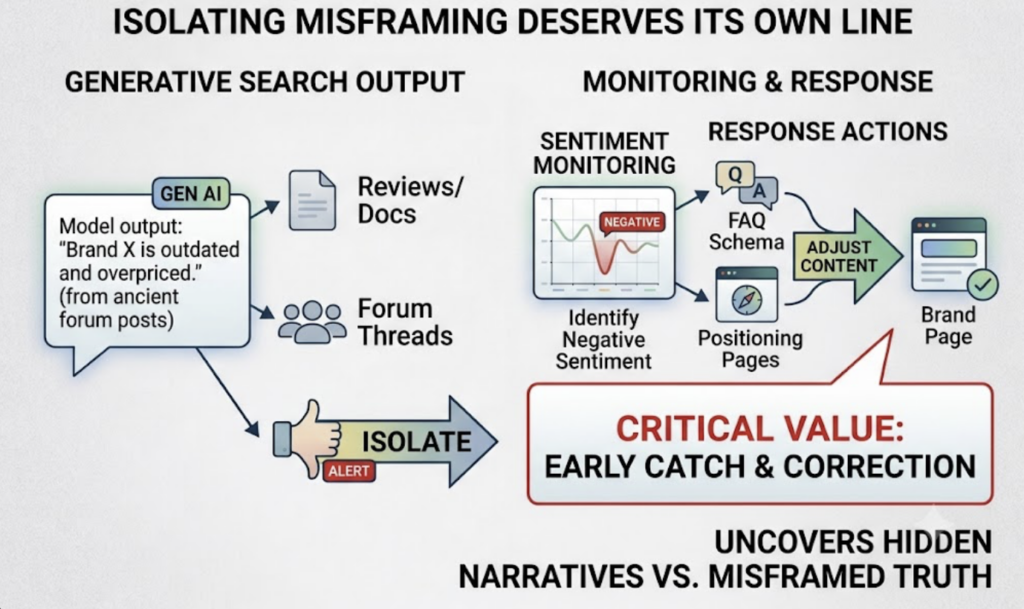
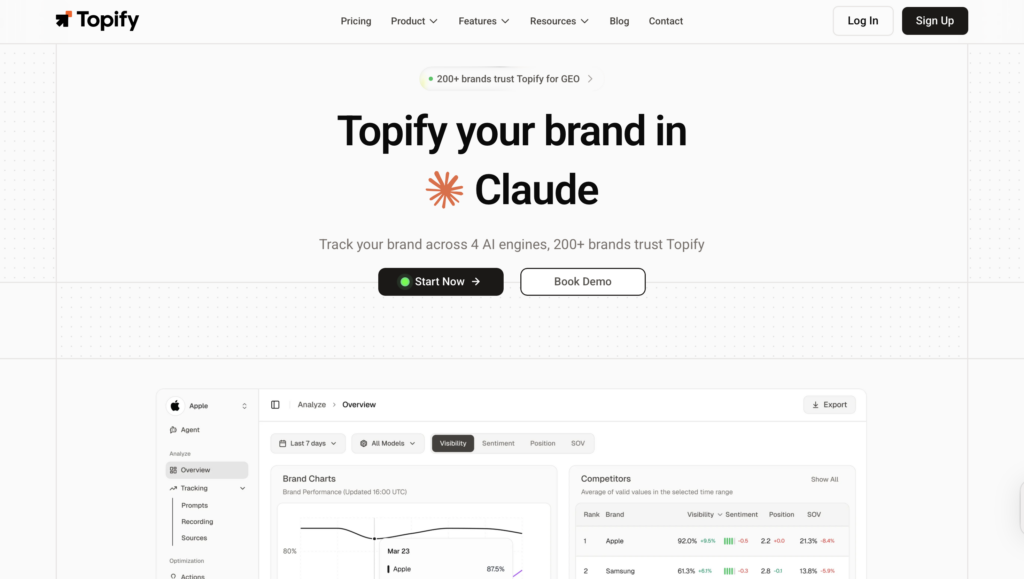
    That’s a separate problem from development speed. It’s about how AI search engines discover, evaluate, and recommend products. Platforms like Topify track exactly that, monitoring how AI platforms mention your brand and where you rank against competitors in AI-generated answers. It’s the layer that kicks in after the code is deployed.

    Conclusion

    The three tools in this comparison aren’t competing for the same developer. Claude Code is for the developer who needs to reason through the hardest problems in the codebase. Copilot is for the team that needs to move fast, stay compliant, and not disrupt existing workflows. Cursor is for the developer who wants the most immersive AI-native editing environment available.

    You don’t need to pick one and only one. You need to know which one leads.

    Start with the scenario table above. The tool that matches your most common work context is your primary. The others become situational. That’s the 2026 approach: not replacing, layering.


    FAQ

    Q: Is Claude Code free?

    A: No. Claude Code requires a Claude Pro ($20/month), Max ($100–$200/month), or pay-as-you-go API subscription. New API users typically receive $5 in trial credits, but there’s no permanent free tier.

    Q: Does Claude Code work inside VS Code?

    A: Yes. There’s an official VS Code extension that connects to the Claude CLI. It provides visual diffs, file-sharing, and terminal integration without leaving VS Code, though the core interaction remains text-based.

    Q: Cursor vs. Copilot: which is cheaper for teams?

    A: GitHub Copilot is significantly cheaper at $19 per user per month for the Business plan. Cursor Business runs $40 per seat. For a 10-person team, Copilot saves over $2,500 annually before considering any feature tradeoffs.

    Q: Can Claude Code replace Cursor entirely?

    A: For CLI-first developers who prioritize reasoning accuracy over in-editor autocomplete, yes. For frontend-heavy work and rapid prototyping, Cursor’s Composer 2, visual diffs, and Supermaven autocomplete provide a more integrated experience that Claude Code doesn’t replicate.


    Read More

  • Claude Code for Beginners: From Setup to First AI Task

    Claude Code for Beginners: From Setup to First AI Task

    Most developers spend their first hour with Claude Code doing the wrong thing. They paste a snippet, get a response, and think: “This is just a fancier chatbot.” It’s not. That mental model is exactly what makes the first week frustrating.

    Claude Code is a terminal-native agent. It lives in your project, reads your files, runs your tests, and executes shell commands. The faster you stop treating it like a chat interface, the faster it starts doing work that actually matters.

    Here’s how to install it correctly, avoid the setup traps, and run your first task that’s worth running.

    What Claude Code Actually Does (and What It Doesn’t)

    Claude Code isn’t another autocomplete tool. It doesn’t suggest the next line of code while you type.

    It’s designed for delegation. You hand it a task that spans multiple files, a decision that requires understanding your project’s architecture, and let it work. Its context window handles up to 1 million tokens, which means it can hold a large codebase in view simultaneously. That’s the core capability that separates it from IDE extensions like GitHub Copilot, which typically work within a 8k–32k token range focused on the current file.

    The trade-off: because it operates via the terminal, there’s no visual IDE layer. You’re working with commands, not clicks.

    DimensionIDE Extension (e.g., Copilot)Claude Code
    InterfaceInline ghost text / sidebarTerminal CLI
    Data accessCurrent file + open tabsFull repository + local tools
    AutonomyModerate (suggestions)High (autonomous execution)
    Context window8k–32k tokens1M tokens
    Primary valueAutocomplete / boilerplateComplex delegation / debugging

    Bottom line: if your task fits in one file, Copilot is probably faster. If it crosses multiple files, requires understanding patterns, or involves running commands, Claude Code is built for it.

    Before You Install: 3 Things You Check First

    Skipping this step is the #1 reason new users hit a wall on day one.

    Node.js version. Claude Code requires Node.js 18.0.0 or higher. The recommended path is to install via Node Version Manager (NVM), not through a system package manager. Global npm installs often create permission errors that are tedious to debug later.

    Operating system compatibility. macOS 13.0+ and Ubuntu 20.04+ / Debian 10+ work natively. Windows doesn’t. Claude Code relies on POSIX-compliant system calls, so Windows users need WSL2 (Windows Subsystem for Linux 2). Virtualization must be enabled in BIOS/UEFI for WSL2 to run properly. That’s a restart-and-check step that’s easy to forget.

    API access. The CLI binary is free to install, but running it requires an active Anthropic account. A Claude Pro, Max, Team, or Enterprise plan works for individual use. For CI/CD pipelines or team-wide automation, a Console account with pre-paid credits gives better cost visibility.

    One more check: minimum specs

    ComponentMinimumRecommended
    RAM4 GB16 GB+ for large monorepos
    Disk space2–4 GB10 GB+ if using WSL2
    Node.jsv18.0.0Latest LTS (v20+)

    Get these confirmed before touching the installer.

    Installing Claude Code in Under 5 Minutes

    macOS and Linux share a single installation path:

    curl -fsSL https://claude.ai/install.sh | bash
    

    This downloads the architecture-specific binary and places it in ~/.local/bin/. After installation, run claude --version to confirm it’s recognized.

    If the shell returns “command not found,” the issue is almost always a PATH problem. Run:

    echo 'export PATH="$HOME/.local/bin:$PATH"' >> ~/.zshrc
    source ~/.zshrc
    

    The built-in diagnostic tool claude doctor identifies configuration gaps automatically. That’s your first stop if anything feels off.

    Windows via WSL2 is a multi-step process:

    1. Open PowerShell as Administrator and run wsl --install, then restart.
    2. After restart, open your WSL terminal (Ubuntu is the default distro).
    3. Inside WSL, install Node.js and Git independently. Your Windows-side installations don’t carry over.
    4. Run the same curl installer from inside the WSL terminal.

    One detail that matters for performance: clone your projects into the WSL-native filesystem (~/projects/), not the Windows mount (/mnt/c/). File I/O across the mount is significantly slower, which affects how fast Claude Code scans your repository.

    Verify your installation:

    claude --version
    claude doctor
    

    Both should return clean output. If claude doctor flags anything, fix it before moving on. Starting with a broken setup makes everything harder to debug later.

    Your First Real Task: Don’t Start with “Hello World”

    Toy examples don’t demonstrate what Claude Code actually does. “Write a function that adds two numbers” tells you nothing about whether the agent understands your codebase.

    Start with something real.

    Three task types consistently show the tool’s core capability:

    Scenario A: Add an API endpoint Prompt: “Add a new GET endpoint to the analytics module that returns daily active users. Follow the pattern used in the users module. Write a corresponding integration test.”

    Claude Code will find your existing controller patterns, match your database abstraction layer, implement the route, and run the test suite to verify. It’s not generating isolated code. It’s reading your conventions and matching them.

    Scenario B: Systemic refactor Prompt: “Refactor the callback-based authentication middleware in /auth to use async/await. Update all call sites.”

    The agent performs a search across the full project, applies the change everywhere, and runs a build check. A task that’s typically high-risk for manual developers, done with a single prompt.

    Scenario C: Error triage from a log

    cat error.log | claude "Locate this bug, write a reproduction test, and implement a fix."
    

    By piping the log directly, you give the agent high-signal context. It traces the error through source files and verifies the fix with the new test. That closed loop—where the agent sees the output of its own changes—is the core behavior that makes it useful in production environments.

    Write prompts with clear success criteria

    Generic prompts produce generic results. The difference:

    Standard promptOptimized prompt
    “Fix the auth bug.”“Locate the session timeout issue in src/auth/session.ts. Check for race conditions.”
    “Check if it works.”“Write a failing Jest test, fix the code, and run only that test to confirm.”
    “Refactor it.”“Refactor for readability without changing the public API or adding new dependencies.”

    You’re not chatting with Claude Code. You’re delegating to it. The prompt is the job spec.

    5 Mistakes Beginners Make in the First Week

    These aren’t edge cases. Nearly every new user hits at least three of them.

    1. Giving it too much context at once. Dumping your entire codebase into a single session without a .claudeignore file means the agent spends tokens on node_modules, build artifacts, and test fixtures. Excluding irrelevant directories can cut context consumption by over 90% in large repos.

    2. Skipping context cleanup between tasks. AI context works best when it’s fresh and scoped. Use /clear between unrelated tasks, or /compact to generate a session summary before continuing. Don’t carry over stale context from a debugging session into a new feature build.

    3. Not reviewing the diff before accepting changes. Claude Code can modify multiple files in a single operation. Use Plan Mode (Shift+Tab) to let the agent explore and propose a plan without making changes. Review the plan, then execute.

    4. Working in the wrong directory. On Windows/WSL, this is especially common. If you’re running Claude Code from /mnt/c/, file scanning is slow and unreliable. Always work from the WSL-native path.

    5. Ignoring silent fake success. Agentic tools sometimes implement solutions that appear to work but contain hidden fallbacks or hardcoded values. Set a “Fail Loud” philosophy in your CLAUDE.md project file: the agent should surface errors with full stack traces rather than failing silently. A crashed system with a clear error is more valuable than a degraded one with no signal.

    Where Claude Code Fits in Your Actual Workflow

    After the first week, the question shifts from “how do I use this” to “where does this actually save time.”

    The honest answer: Claude Code earns its place in tasks that require codebase-wide reasoning. Single-file autocomplete, simple boilerplate, quick syntax lookups—other tools handle those faster. But multi-file refactors, cross-cutting debugging, and automated test generation are where the 1M-token context window pays off.

    As developer workflows become more agent-driven, a parallel challenge emerges: if your product or API is being recommended by AI tools like Claude Code, you need to know how it’s being described and whether that description is accurate. That’s where AI visibility tracking comes in.

    Topify is a platform built specifically for this. It tracks how brands, libraries, and developer tools appear across AI systems like ChatGPT, Gemini, and Perplexity. For teams building APIs or developer products, Topify’s Source Analysis identifies which domains AI systems are citing as references, and Sentiment Analysis tracks whether the tool is being described accurately or with outdated information.

    The practical application: if Topify detects that Claude Code is recommending a deprecated version of your API, your team can use Claude Code itself to update the documentation schema, which then feeds back into how AI systems reference your product. It closes the loop between building and being discovered.

    Conclusion

    Getting Claude Code running is the easy part. Getting value from it depends on three habits that take a week to build: checking your environment before installation, starting with real tasks that require codebase reasoning, and managing context aggressively with .claudeignore and session pruning.

    The tool rewards developers who treat it like a capable junior engineer. Give it a specific task, clear success criteria, and the permission to run commands. Then review what it did.

    That’s the entire model. Everything else is practice.


    FAQ

    Is Claude Code free to use? 

    The CLI binary itself is open-source, but usage requires an active Anthropic account. Claude Pro, Max, Team, and Enterprise plans all work for interactive use. For automated tasks or CI/CD pipelines, a Console account with pre-paid API credits is typically more cost-effective.

    Does Claude Code work offline? 

    No. The filesystem interactions and command execution happen locally, but the reasoning runs on Anthropic’s servers. An internet connection is required for every session.

    How is Claude Code different from GitHub Copilot? 

    Copilot is an IDE extension focused on inline autocomplete. Claude Code is a terminal agent designed to work across an entire codebase. Copilot suggests lines; Claude Code can be tasked with finding a bug, writing a test, fixing it, and committing, all in one interaction.

    Can non-developers use Claude Code? 

    Yes, with caveats. The natural-language interface makes it accessible to founders and product managers who want to build prototypes. But it’s a CLI tool, so basic familiarity with the terminal, Node.js, and Git is still required to get it running.

    What does .claudeignore actually do? 

    It tells the agent which directories to skip during file scanning. Excluding node_modules, build outputs, and large data fixtures keeps the context window lean, improves reasoning speed, and reduces unnecessary API token usage.

    Read More

  • Track and Improve Your Brand in Google AI Overviews

    Track and Improve Your Brand in Google AI Overviews

    Your brand ranks #1 for a high-intent keyword. But when someone searches that query, Google summarizes an answer at the top of the page and your brand isn’t in it.

    That’s the visibility gap. And most teams don’t catch it until traffic has already dropped.

    Organic click-through rates have fallen 61% for queries where an AI Overview is present, according to longitudinal data tracking the shift from 2024 to 2026. Meanwhile, 69% of Google searches now end without a single click to any external site. The implication is clear: if you’re not being cited in the summary, you’re largely invisible.

    This guide walks through how to track where your brand stands in Google AI Overviews today, diagnose why you might be missing, and execute the optimizations that actually move the needle.


    Rankings Alone Won’t Tell You If You’re in AI Overviews

    This is the single most important thing to internalize before you do anything else.

    Traditional rank tracking tools tell you where your page sits in the blue-link results. They don’t tell you whether your brand appears in the synthesized answer above those results. And as of 2026, that synthesized answer is often the only part of the SERP a user actually reads.

    The overlap between top-10 organic rankings and AI Overview citations has collapsed. In 2024, roughly 76% of AI Overview citations were pulled from the top-10 organic results. That figure now sits somewhere between 17% and 38%, meaning the majority of citations are coming from pages outside the traditional first page.

    Pages ranking in positions 11 to 100 capture approximately 31% of AI Overview citation slots. Pages outside the top 100 account for another 31%.

    That’s a completely different game. And playing it requires a completely different set of metrics.


    The 5 Signals That Actually Measure AI Overviews Performance

    Before tracking, you need to know what to track. These are the metrics that matter for AI Overviews optimization specifically.

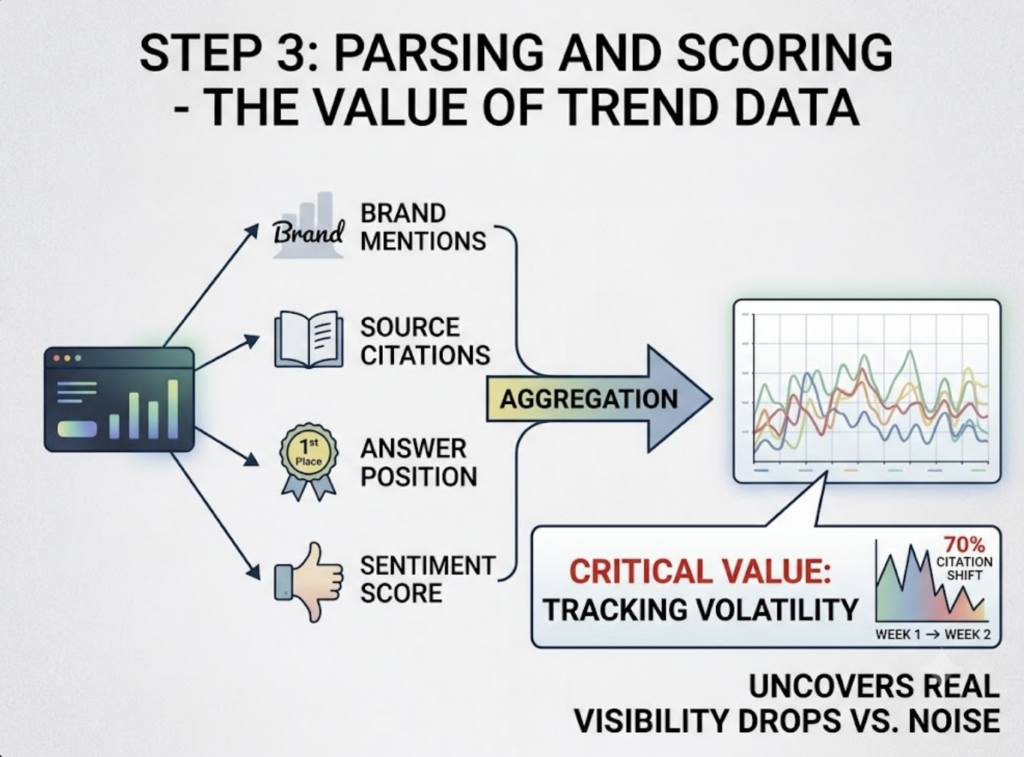
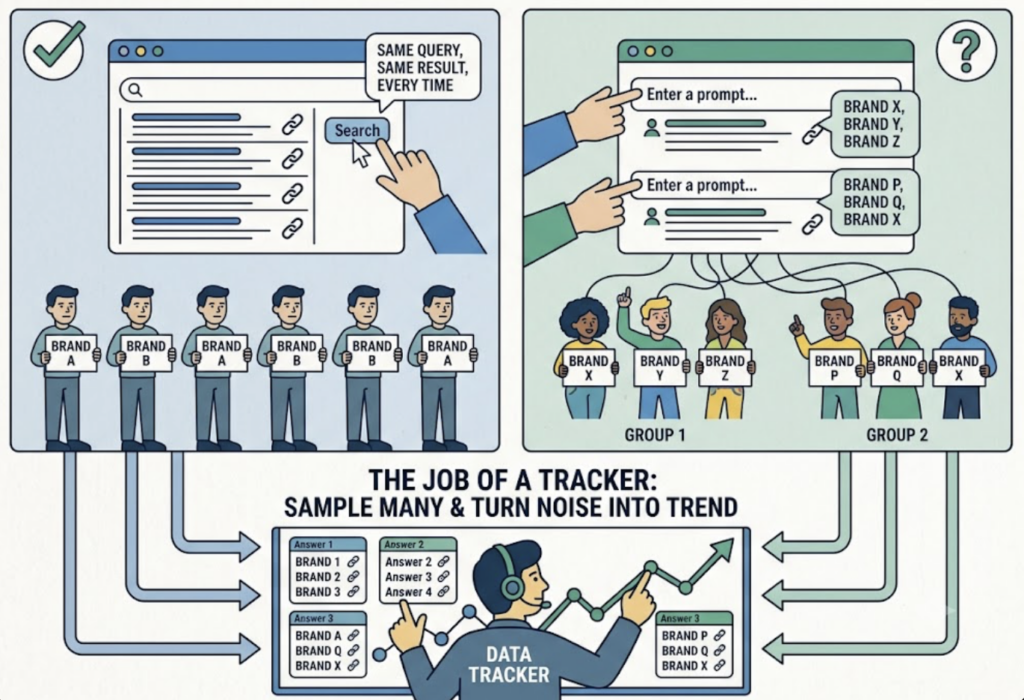
    Visibility Rate (Inclusion Rate): The percentage of relevant prompts where your brand appears in the AI-generated answer. AI outputs are probabilistic, not fixed. Only 30% of brands maintain consistent visibility across multiple regenerations of the same query. That means visibility must be measured as a probability score across multiple runs, not a single manual check.

    Sentiment Score: How the AI characterizes your brand when it does mention you. Is it framing you as a leading option, a budget alternative, or a niche pick? The framing matters almost as much as the inclusion.

    Position Index: Where in the narrative your brand appears. First recommendation correlates with meaningfully stronger downstream engagement than being mentioned third or fourth.

    Citation Source Attribution: Whether AI is linking to your own content or citing third-party platforms like Reddit or Wikipedia to validate your existence. High mentions with low direct citations signal a content-authority mismatch.

    CVR (Conversion Visibility Rate): This is the downstream metric. Visitors arriving from AI Overview citations convert at dramatically higher rates than traditional organic traffic. One Ahrefs study found AI search visitors convert at 23x the rate of standard organic visitors. You want to know how often AI recommendations are translating into actual site visits.


    Step 1: Audit Your Current AI Overviews Visibility

    Start with a baseline. You can’t track improvement without knowing where you stand.

    The manual method: Open Google in an incognito window. Run 15 to 20 conversational queries that represent how your target customers would describe their problems, not keyword-style queries. Note whether an AI Overview appears, and whether your brand or your content is cited in it.

    Question-format queries trigger AI Overviews at an 88% to 91% rate. Long-tail queries of seven or more words trigger them at 46.4%. Short navigational queries, on the other hand, trigger them less than 10% of the time. Your audit prompts should skew toward the first category.

    The limitation of manual audits is significant: you can only check a handful of prompts, and AI outputs are non-deterministic, meaning the same query can produce different citations across runs.

    The tool-based method: Platforms like Topify automate this at scale. Topify runs hundreds of prompt variations across ChatGPT, Gemini, Perplexity, and Google AI Overviews, giving you a statistical baseline of your inclusion rate rather than a snapshot. The Visibility Tracking feature shows you where your brand appears, how consistently, and which prompts are driving or missing citations.

    That probabilistic view is what makes tool-based tracking meaningful for ongoing measurement.


    Step 2: Map the Prompts That Trigger AI Overview Citations in Your Category

    Most brands optimize for the wrong inputs. They focus on high-volume keywords when over 80% of AI prompts are phrased as context-rich, conversational queries.

    A traditional search might be “email marketing tool.” A generative search prompt is more likely “which email marketing tool is best for a 50-person SaaS team with a $500 monthly budget.” Those are completely different inputs, and they surface different citations.

    Prompt mapping means identifying the specific conversational questions that trigger AI Overviews in your category, and then checking whether your brand, your competitors, or third-party sites are appearing in those answers.

    For B2B tech brands, this matters more than almost any other sector. AI Overviews appear for over 70% of technology queries in the US, and the buyer journeys they support are exactly the high-intent, research-heavy paths where brand positioning is decisive.

    The goal is to build a prompt matrix: a structured set of 40 to 100 prompts covering the key questions your buyers are asking at each stage of evaluation. Topify’s High-Value Prompt Discovery feature surfaces these automatically, flagging prompts that are generating AI Overview appearances in your category that your brand isn’t winning.


    Step 3: Diagnose Why You’re Not Being Cited

    If you’re ranking well but absent from AI Overviews, you’re dealing with a citation source gap. Here’s how to diagnose it.

    Check which domains are being cited instead of you. AI platforms have a clear hierarchy of trust. Google AI Overviews frequently cite Reddit (2.2% of citations), YouTube (1.9%), and Quora (1.5%), alongside brand-owned content. If competitors are being cited via these platforms and you’re not present there, the gap is one of authority distribution, not just content quality.

    Evaluate your content’s extractability. Research shows that 55% of AI Overview citations come from the first 30% of a document, with the highest citation probability (27%) concentrated between the 10% and 20% mark. If your primary answer to a query is buried in paragraph six, the AI’s retrieval system is likely skipping past it.

    Assess your entity authority. AI models evaluate content through semantic understanding of who a brand is and what it’s authoritative on. If your brand has an inconsistent presence across structured data, third-party domains, and the Google Knowledge Graph, the AI system has lower confidence in citing you. A gap in citations often reflects a gap in corroboration, not a gap in expertise.

    Topify’s Source Analysis feature shows you exactly which domains AI is pulling from for the prompts in your category. That’s the diagnostic layer most manual workflows can’t replicate.


    Step 4: Close the Gaps with a Targeted Optimization Playbook

    Once you know what’s missing, there’s a specific set of actions that move the needle.

    Front-load your answers. Every high-priority page should open with a 50 to 70 word direct answer to the primary query it targets, within the first 150 words. This is not about keywords; it’s about giving the AI a clean, pre-summarized block it can extract. The drop-off in citation probability after the first third of a page is steep, and recovery later in the document is limited unless you’re using FAQ sections.

    Implement schema markup. Basic schema is a minimum, not a differentiator. FAQ page schema increases citation likelihood by 60%, according to available benchmarks. Schema markup overall has been associated with a 73% boost in AI Overview selection probability. For brands in B2B SaaS or tech, this is one of the fastest wins available.

    Build entity authority through third-party platforms. If AI systems are citing Reddit and YouTube to validate brand claims in your category, your presence on those platforms isn’t a social media strategy, it’s an AI visibility strategy. Unlinked mentions and community-level engagement on high-authority domains signal to AI models that a brand exists and is trusted beyond its own site.

    Use entity linking. Connecting on-page mentions to external knowledge bases like Wikidata has been shown to increase AI Overview visibility by 19.72%. It reduces the semantic ambiguity that causes AI systems to skip over content they’d otherwise trust.

    Produce original data. Content that aggregates existing information is increasingly deprioritized. Original research and proprietary data show a 40% higher citability rate than generic content. Even small-scale original surveys or internal data publications help here.

    Optimization TacticImpactTimeline
    Schema Markup Implementation+73% selection boost1–4 weeks
    150-word Direct Answer Lead55% of citations from top 30% of page4–8 weeks
    FAQ Page Schema+60% citation likelihood1–4 weeks
    Entity Linking+19.72% visibility lift4–8 weeks
    Original Research / Data+40% citability rate3–4 months

    Step 5: Measure Whether It’s Working

    The timeline for AI Overviews optimization is faster than traditional SEO, but the measurement approach has to be different.

    Initial visibility changes can appear within 2 to 4 weeks following a structural content update or schema implementation. This is meaningfully faster than the 3 to 6 months typically associated with standard organic ranking shifts. That said, authority-building tactics like digital PR, earned media, and YouTube presence take 3 to 6 months to translate into sustained citation improvement.

    What to measure week-over-week:

    Your Visibility Rate should be tracked across a fixed set of 40 to 100 representative prompts, run multiple times each to account for the probabilistic nature of AI outputs. A single run per query will give you noisy data. The baseline you need is a statistical inclusion rate, not a snapshot.

    Track your Sentiment Score alongside visibility. A brand can appear in AI Overviews while being characterized unfavorably, and that framing affects downstream behavior in ways that standard analytics won’t surface.

    Monitor citation source shifts. If the AI starts pulling from your own content rather than third-party domains to validate your brand, that’s a signal that entity authority is building.

    And watch the conversion data. Because AI Overview visitors are highly pre-qualified, a relatively small increase in citation frequency can produce an outsized revenue impact. The 23x conversion lift makes even modest visibility gains worth tracking precisely.


    Conclusion

    Google AI Overviews have broken the historical relationship between ranking and visibility. A first-position ranking no longer guarantees inclusion in the synthesized answer that most users actually read.

    The brands that close this gap are the ones that treat AI Overviews as a distinct measurement and optimization challenge, not a side effect of traditional SEO. That means tracking inclusion probability across prompt sets, diagnosing citation source gaps, restructuring content for extractability, and building entity authority across both owned and third-party channels.

    The citation premium is real: brands cited in AI Overviews earn 35% more organic clicks and 91% more paid clicks than non-cited competitors. And the downstream traffic quality is fundamentally different.

    Start with your baseline. Run your audit. Then fix what’s actually missing.


    FAQ

    How often does Google change its AI Overview citations? 

    Volatility varies significantly by industry. Finance queries can see weekly citation turnover as Google tightens quality filters. Healthcare and B2B tech tend to be more stable. This is why ongoing measurement matters more than periodic audits. A citation you earned this month may not persist next month without continued optimization.

    Can I optimize for AI Overviews without changing my core SEO strategy? 

    You can do both in parallel, but they’re not the same. Traditional SEO focuses on PageRank signals and keyword density. AI Overviews optimization focuses on content extractability, entity authority, and schema implementation. Tactics like front-loading answers and FAQ schema support both goals. Tactics like entity linking are specific to the AI layer.

    How do I identify which competitors are winning AI Overview placements in my category? 

    Manual competitive checks give you partial visibility but won’t scale. A structured approach runs the same prompt set against your competitor brand names and compares inclusion rates, position, and sentiment scores. Topify’s Competitor Monitoring feature automates this comparison, showing you how your visibility rate, position index, and sentiment score stack up against specific competitors across the same prompt matrix.

    Is AI Overviews optimization different from GEO (Generative Engine Optimization)? 

    Related but not identical. AI Overviews Optimization refers specifically to Google’s AI-generated summary feature at the top of search results. GEO is a broader discipline covering how brands appear across all generative AI systems, including ChatGPT, Perplexity, and Gemini. The content and technical principles overlap significantly, but GEO involves prompt tracking across multiple platforms, not just Google.


    Read More

  • 6 Signals That Decide If Google AI Overviews Cites You

    6 Signals That Decide If Google AI Overviews Cites You

    Most brands are still optimizing for rankings. That’s no longer enough.

    Google AI Overviews now trigger on approximately 48% of all tracked queries, up 58% year-over-year. When an AI Overview is present, organic CTR for informational queries drops 61%, from 1.76% to 0.61%. Even the first organic position loses 58% of its clicks.

    Being cited in the AI Overview isn’t a bonus. It’s often the only way to stay visible at all.

    Here’s the part most SEO playbooks miss: AI Overviews doesn’t select sources the same way Google’s ranking algorithm does. It runs on a separate extraction logic that rewards a specific set of content signals. Get those signals right, and your brand gets cited. Miss them, and you’re invisible, regardless of where you rank.

    These are the six signals that actually determine whether you make the cut.

    AI Overviews Doesn’t Just Pull From Page One. It Pulls From Pages That Answer Directly.

    About 76.1% of URLs cited in AI Overviews do rank in Google’s top 10. So yes, authority still matters. But ranking alone doesn’t get you cited.

    The filter that comes after ranking is extractability: can Google’s generative parser pull a clean, self-contained answer from your page without needing to read the whole thing? If the answer to a query is buried in paragraph six after 300 words of preamble, the AI will skip your page and pull from the one that leads with the answer.

    That’s the gap most brands can’t see in their analytics.

    Signal 1: Your Content Answers the Query in the First Sentence, Not the Fifth

    AI Overviews are built on RAG (Retrieval-Augmented Generation). The system retrieves candidate passages and evaluates which one most directly satisfies the query intent. It’s looking for a 40-60 word answer block it can extract and synthesize without much interpretation.

    If your H2 sections start with background context, history, or “in this section we’ll cover,” you’re training the parser to skip you.

    Rewrite every major section so the first sentence delivers the answer. The supporting evidence comes after.

    This is the “Inverted Pyramid” format: conclusion first, reasoning second. It feels unnatural for traditional editorial writing. For AI extraction, it’s non-negotiable.

    Signal 2: Other Sites Talk About You. You Don’t Just Talk About Yourself.

    Here’s the thing: AI models don’t trust brands that describe themselves. They trust brands that are described by others.

    Sites with over 32,000 referring domains are 3.5x more likely to be cited by major AI systems than lower-authority sites. That number reflects the same trust logic that drives AI citation decisions. A brand that appears on third-party review sites, industry publications, and comparison platforms carries “entity-level trust” that no amount of owned content can replicate.

    This is less about link building in the traditional sense, more about what the broader web says about you. Product reviews, analyst mentions, press coverage, and community discussions on platforms like Reddit all feed into this signal.

    If the only pages citing your brand are your own, the AI has no external consensus to draw from.

    Signal 3: Your Expertise Is Verifiable, Not Just Claimed

    AI models are risk-averse by design. Before citing a source, Google’s generative system runs a version of E-E-A-T filtering: does this content come from someone with demonstrated, verifiable credentials?

    “Demonstrated” is doing a lot of work in that sentence. Saying “our team of experts” in your About page isn’t verifiable. A named author with a linked professional profile, wrapped in Person schema, is.

    Every author bio on your site should include: real name, professional title, verifiable credentials, and ideally a link to a third-party profile. The author page itself should be structured with Person schema so Google can machine-read the credential data rather than guess at it.

    This single change, adding structured author attribution, is often the fastest route to improved AI citation rates for content-heavy sites.

    Signal 4: You Have Original Data That AI Can Attribute to You

    “According to [Brand]’s research…” is one of the sentence structures AI Overviews uses most often when it cites a specific source. That phrasing only appears when your content contains something nobody else has: original data.

    Research shows that incorporating fact density elements, including specific statistics, proprietary benchmarks, and cited third-party data, can lift visibility for lower-ranked websites by up to 40%. Original data creates an even stronger pull because AI systems can’t get it anywhere else.

    This doesn’t mean you need a massive research budget. Even a structured analysis of your own product usage data, a short customer survey with n=50, or a tracked experiment published with methodology counts. The key is owning the number and making it attributable.

    Publish it with a clear, citable title. Reference it internally across your content. Give AI something to quote.

    Signal 5: Schema Markup Tells the Parser What to Extract and Where

    Without schema, AI parsers make probabilistic guesses about what your content means. With schema, you give them hard-coded truth they don’t need to guess at.

    FAQPage schema is particularly effective for AI Overview coverage because the question-and-answer format maps directly onto how AI summaries are constructed. HowTo schema does the same for procedural content. Article schema validates authorship and publication date, two signals AI uses to judge recency and credibility.

    A page with strong schema doesn’t just have a higher chance of being cited. It’s cited more accurately. That matters if you care about how your brand is represented, not just whether it appears.

    Implementing schema on your highest-traffic informational pages is one of the lowest-effort, highest-impact moves for AI Overviews optimization.

    Signal 6: You Own a Topic, Not Just a Few Pages About It

    AI systems use content topology to estimate authority. A brand with 40 deeply interlinked pages on a single topic reads as an expert. A brand with three pages on that topic and 60 pages on unrelated things reads as a generalist.

    Topic clusters, the practice of building a pillar page supported by tightly interlinked subtopic content, were originally an SEO framework. In 2026, they’re also an AI citation signal. When an AI retrieves candidate content for a query, a site with dense topical coverage of that domain is more likely to surface multiple candidate pages, and more likely to win the final citation.

    The internal link structure matters too. If your best content isn’t linked from related pages, the AI’s crawler may never connect the dots between what you know and the query it’s trying to answer.

    The Fastest Way to Find Out Which Signals You’re Missing

    Knowing the six signals is the first step. Finding which ones are actually failing you is where most brands get stuck, because this information doesn’t appear in standard analytics or rank tracking tools.

    Brands cited in AI Overviews earn 35% more organic clicks and 91% more paid clicks than those that aren’t. That spread is large enough to be the difference between a profitable content program and one that’s slowly losing ground to competitors who figured this out earlier.

    Topify’s Source Analysis feature tracks exactly which domains and URLs Google AI Overviews is pulling from for your core queries. You can see whether your brand appears in the citation pool, which competitors are being pulled instead, and where the content gaps are by topic. The platform’s Visibility Tracking covers AI Overviews specifically, so you’re not relying on proxy metrics or manual spot-checks.

    A structured audit using these signals takes about a week to complete. Start with the queries where you rank well but aren’t getting cited, those are the ones where the gap is most likely structural, not authority-based.

    Conclusion

    Ranking is the cost of entry. Citation is the goal.

    AI Overviews has created a two-tier visibility system: brands that rank and brands that get cited. The second group earns the clicks. The first group watches their traffic numbers trend quietly downward while wondering what changed.

    The six signals above aren’t new concepts. Direct answers, third-party authority, verifiable E-E-A-T, original data, structured markup, and topical depth have all been on the content quality checklist for years. What’s changed is how consequential each one has become when an AI is deciding which source to trust in under a second.

    Fix the signals. Get cited. That’s the playbook.


    FAQ

    Does domain authority directly affect AI Overviews citation rates?

    It correlates, but it’s not determinative. Sites with high authority are cited more often because they tend to satisfy multiple signals at once: they have structured content, third-party mentions, and verified E-E-A-T. A lower-authority site that scores well on extractability, schema, and original data can outperform a higher-authority site that doesn’t optimize for AI extraction. Authority sets the floor; the six signals determine who actually gets cited within that range.

    How long does it take to see results after optimizing these signals?

    Structural changes like schema markup and content reformatting can show results in two to eight weeks, since Google re-crawls frequently updated pages on a faster cycle. Third-party authority signals take longer, typically three to six months, because they depend on external publications and community platforms updating their content. Original data campaigns tend to accelerate citation rates faster than most tactics because they give AI systems something unique to reference.

    Can a small brand with limited authority get cited by AI Overviews?

    Yes, especially on long-tail and niche queries where established brands haven’t built deep topical coverage. Brands that own a specific topic at depth, even without massive domain authority, often outperform larger competitors on targeted queries. The key is focus: narrow the topic cluster, maximize extractability, and publish original data. AI Overviews doesn’t always default to the biggest brand. It defaults to the most useful, most extractable source for that specific query.


    Read More

  • AI Overviews Optimization vs GEO vs SEO in 2026

    AI Overviews Optimization vs GEO vs SEO in 2026

    A practical framework for deciding where to focus your search strategy, budget, and content in 2026.

    You’re probably still ranking. You’re just not getting the clicks.

    That’s the defining paradox of search in 2026. A twelve-month analysis of Google AI Overviews (AIO) spanning February 2025 to February 2026 found that AIOs now trigger on approximately 48% of all tracked queries, representing a 58% year-over-year increase. The average AI Overview exceeds 1,200 pixels in height on desktop and occupies more than 75% of the initial screen on mobile. For informational queries, organic CTR has dropped 61%, falling from a pre-rollout average of 1.76% to 0.61%. Even the #1 organic position has seen its CTR cut by 58% when an AI summary is present.

    Three strategies are competing for your attention and budget: traditional SEO, AI Overviews Optimization (AIOO), and Generative Engine Optimization (GEO). Each has a legitimate case. None of them is universally “right.”

    This framework helps you decide which one to prioritize first, and when to layer in the others.

    Three Strategies, Three Different Bets on AI Overviews Optimization

    The real difference between SEO, AIOO, and GEO isn’t terminology. It’s what you’re actually optimizing for.

    Traditional SEO is deterministic. You optimize content and authority signals so crawlers rank your page. In 2026, its role has shifted: SEO is no longer a primary growth driver. It’s the foundational layer that makes your site parseable by AI retrieval systems. Google’s RAG (Retrieval-Augmented Generation) infrastructure pulls from the same indexed web that traditional crawlers use. If your pages aren’t indexed, they don’t exist to AI either.

    AI Overviews Optimization (AIOO) is probabilistic. The goal isn’t to rank. It’s to be the source the AI extracts when synthesizing an answer. Research shows 76.1% of URLs cited in AI Overviews rank in Google’s top 10 organically, so traditional authority still correlates with AI selection. But being cited in the AIO is increasingly the only way to retain SERP visibility at all.

    GEO operates at the ecosystem level. It’s about getting cited across all generative engines: ChatGPT, Perplexity, Gemini, Claude, and others. GEO matters because 44% of AI-powered search users now consider AI their primary source of insight, bypassing traditional search entirely. These are users you’ll never reach through a blue link.

    Three bets. Three different timelines. Three different resource requirements.

    The 90% Overlap Nobody Talks About

    Here’s the thing most comparison articles miss: SEO, AIOO, and GEO share an estimated 90-95% of their foundational principles.

    Structured content and Schema markup are mandatory for all three. Schema.org provides what researchers call “hard-coded truth” that overrides a model’s probabilistic guesses and reduces hallucinations. FAQPage and Product schema are high-signal formats that allow AI Overviews to extract data more accurately than unstructured text.

    E-E-A-T functions as a filtering mechanism across all three disciplines. Both search algorithms and LLMs prioritize content from verified human experts. In 2026, every author bio should be wrapped in “Person” schema to validate credentials. AI models are risk-averse by design, and they use the backlink graph as a heuristic for “truth.”

    Authoritative citations boost performance across the board. Incorporating specific data points and statistics from reliable third-party sources can increase the visibility of lower-ranked websites by up to 40%. That’s not a GEO tactic or an SEO tactic. It’s a content quality signal that works everywhere.

    One action can serve all three lines. But only if you execute them in the right order.

    Where Each Strategy Actually Delivers ROI

    AI search visitors convert at 23x the rate of traditional organic search visitors. That changes the ROI math significantly.

    It also changes what “success” looks like. Organic traffic volume is no longer the right primary metric. The question is whether your brand appears in the answer, not just in the index.

    MetricTraditional SEOAI Overviews OptimizationGEO
    Primary GoalRankings and ClicksInclusion and Zero-Click VisibilityCitations and Authority
    Core MetricOrganic Traffic / CTRCitation Frequency / ImpressionsCitation Rate / Sentiment
    Best Query TypeNavigational, TransactionalInformational, Complex ResearchComparison, Consideration, Brand
    Time to Results6-12 Months2 Weeks to 3 Months3-9 Months
    Resource ThresholdModerateHigh (Structure + Fact Density)High (Digital PR + Consensus)
    Conversion ImpactBaseline CVRHigh CVR (Pre-Qualified Users)Highest CVR (Trusted Recommendation)

    Industry context matters here. The Education sector saw AI Overviews coverage jump from 18% to 83% of queries in a single year. For education brands, AIOO isn’t optional. It’s survival. Conversely, eCommerce sees AIO coverage as low as 4% for transactional “buy” keywords, meaning traditional SEO and paid search still dominate there.

    In B2B Tech and Healthcare, where AIO trigger rates approach 90%, the stakes of inclusion are extreme. Brands cited in those summaries earn 35% more organic clicks and 91% more paid clicks than those that are left out.

    Your industry determines which lever matters most.

    4 Questions That Determine Your AI Overviews Optimization Priority

    Before you allocate a dollar or an hour, answer these four questions. They’ll tell you where you actually stand.

    Q1: Does your audience still click through?

    If your traffic is driven by “how-to,” “what is,” or “best of” queries, you’re already in a zero-click environment where 8 out of 10 users never leave the SERP. Your visibility problem isn’t a ranking problem. It’s an inclusion problem.

    If your core keywords are transactional (“buy,” “pricing,” “order”), Google has largely kept AIO out of those results to protect ad revenue. Traditional SEO still works there.

    Q2: Is your brand showing up in AI answers today?

    Most brands don’t know. Traditional rank trackers don’t measure AI inclusion. Tools like Topify run what’s called “statistical multi-model probing,” querying the same prompts multiple times across AI platforms to calculate a statistically valid visibility score. That baseline audit often reveals a “Visibility Gap”: competitors being cited for your core topics while you’re absent.

    If that gap exists, it requires immediate AIOO intervention.

    Q3: Is your content authoritative enough to get cited?

    Sites with over 32,000 referring domains are 3.5x more likely to be cited by ChatGPT than lower-authority sites. That’s a significant threshold. If you’re below it, jumping straight to GEO tactics won’t work. LLMs will default to established incumbents.

    Your focus should be on GEO tactics that build consensus: digital PR placements, mentions on Reddit and Quora, high-authority industry journals. These signals teach AI models that your brand is “safe” to cite.

    Q4: Is your team set up to measure prompts or keywords?

    Over 80% of AI prompts are phrased differently than traditional Google searches. If your team is still reporting on static keyword rankings, they’re working with a structural blind spot. AIOO and GEO require continuous, automated sampling across many sessions to produce reliable data on a probabilistic system.

    This isn’t a minor workflow update. It’s a measurement infrastructure change.

    Resource-Constrained? Here’s the Sequencing That Works

    Most teams can’t run three parallel strategies at full intensity. Here’s the phased order that builds momentum without abandoning what’s already working.

    Phase 1: Technical and Structural Baseline (The SEO Layer)

    Ensure your site is crawlable and implement robust Schema markup. Think of this as “agent-ready” technical SEO. Without it, neither AIOO nor GEO can function. AI retrieval systems depend on the same indexed web that search crawlers use.

    Phase 2: Content Engineering for AI Overviews Optimization (The AIOO Layer)

    Restructure your most important content using an “Inverted Pyramid” format. Start every H2 section with a direct, 40-60 word “Answer Block.” This format aligns with how Google’s RAG system retrieves and extracts content. You’re essentially pre-packaging the answer the AI needs.

    This is where platforms like Topify provide measurable leverage. Its Prompt Discovery feature surfaces the high-volume conversational queries where your brand is currently invisible. You’ll know exactly which pages to restructure first, rather than guessing.

    Phase 3: Authority and Sentiment Management (The GEO Layer)

    Shift your digital PR toward “Consensus Platforms”: Reddit, Quora, industry journals, and high-authority publications. The goal is to build a body of third-party evidence that AI models find when they “look” for proof of your brand’s expertise. It’s less about links and more about narrative consistency across the open web.

    Topify’s Sentiment Analysis tracks how AI systems characterize your brand on a 0-100 score, giving you an early warning system if a negative narrative is gaining traction before it solidifies into how AI answers describe you.

    What Changes if You’re Managing 10+ Clients

    For agencies, the 2026 challenge isn’t strategic. It’s operational.

    Managing AI visibility across dozens of brands requires a repeatable, templatized workflow. The probabilistic nature of LLM outputs means you can’t rely on static reports. You need live dashboards that aggregate visibility, sentiment, and CVR data per client, with automated alerts when a competitor moves ahead on specific prompts.

    That’s what makes multi-project monitoring non-negotiable at agency scale. Topify’s platform aggregates this data across accounts and includes Competitor Share of Voice tracking, which flags “Visibility Drops” the moment a competitor gains ground on a prompt your client owns.

    The strategic repositioning for agencies is clear. “Rank tracking” becomes “AI Search Visibility Management.” It’s a standalone revenue line with a defensible ROI story: connect Citation Frequency to Branded Search Lift and Assisted Conversions, and you can justify the budget even when traditional organic traffic is declining.

    The top agencies in 2026 aren’t link builders. They’re entity architects.

    Conclusion

    The decision framework distills to one judgment call:

    If your core queries are informational and already triggering AI Overviews, prioritize AI Overviews Optimization for immediate visibility, build your SEO technical layer for crawlability, and use GEO to manage brand representation across the wider LLM ecosystem.

    The ranking era optimized for clicks. The inclusion era optimizes for trust. The brands that will win are the ones AI systems consider safe, authoritative, and easy to extract.

    That transition is already underway. The question is just how far behind you want to start.

    FAQ

    Q: Is AI Overviews Optimization the same as GEO?

    No. AI Overviews Optimization (AIOO) is a specialized tactic focused specifically on Google’s on-SERP AI summaries. GEO is a broader strategy that manages your brand’s presence across all generative engines, including ChatGPT, Perplexity, and Claude. AIOO is about “winning the summary” on Google. GEO is about becoming a cited source across the entire AI web.

    Q: Should I stop doing traditional SEO in 2026?

    No. Traditional SEO is the technical foundation that makes your content findable by AI retrieval systems. Over 50% of queries still don’t trigger AI results, making SEO necessary for half of all searches. It’s no longer the primary growth lever, but skipping it means your AI optimization efforts won’t work either.

    Q: How do I know if my brand appears in AI Overviews?

    Traditional rank trackers don’t capture this. You need specialized AI visibility tools that perform statistical multi-model probing, running the same prompts multiple times to calculate a reliable visibility score. Topify provides this baseline audit as a starting point before you build your optimization strategy.

    Q: Can one tool handle all three strategies?

    Legacy tools like Ahrefs and Semrush are adding AI tracking modules, but they weren’t built for this. Pure-play platforms like Topify provide deeper cross-platform visibility, sentiment tracking, prompt discovery, and one-click GEO execution in a single workflow. The architecture difference matters more as your strategy matures.

    Read More

  • You Rank #1. AI Overviews Still Ignores You. Why?

    You Rank #1. AI Overviews Still Ignores You. Why?

    Google’s AI Overviews follows a completely different set of rules than traditional search rankings. Here’s what actually determines whether your brand gets cited, and what to do about it.

    You open an incognito window, type your target query, and see an AI Overview at the top of the page. It’s confident. It’s thorough. It cites four sources.

    Your brand isn’t one of them. You’re ranking #1 right below it.

    This isn’t an edge case anymore. It’s the new default, and it’s happening to brands across every category. The gap between organic ranking and AI citation is no longer a rounding error; it’s a structural split that’s reshaping where discovery actually happens.

    AI Overviews Isn’t a Ranking Feature. It’s a Citation Engine.

    Most SEO teams treat AI Overviews like an extension of the standard results page. It’s not. The underlying logic is fundamentally different.

    Traditional PageRank evaluates documents based on authority signals: backlinks, user engagement, keyword relevance, domain trust accumulated over years. Those signals still determine where you land in the ten blue links. But AI Overviews doesn’t pick sources from the ten blue links. It runs its own retrieval pipeline.

    The system uses Retrieval-Augmented Generation (RAG), powered by Google’s Gemini models. It queries hundreds of candidate documents, chunks them into 150 to 300-word segments, and selects sources based on structural extractability and factual density, not ranking position.

    The numbers confirm how far this has drifted. In early 2024, roughly 75% to 76% of AI Overview citations came from pages in the top 10 organic results. By early 2026, following the Gemini 3 rollout, that overlap had collapsed to between 17% and 38%. A brand ranking #1 today is cited in AI Overviews only 33% of the time.

    Ranking first means you won the relevance contest. It doesn’t mean the AI trusts your content enough to quote it.

    4 Real Reasons Google’s AI Skips Your Content

    The exclusion is rarely random. There are four structural patterns that block high-ranking content from being cited.

    1. Your answer is buried.

    AI systems don’t read your article from top to bottom. They parse it in chunks. If your core answer doesn’t appear in the first 20% to 30% of the page, the retrieval system may skip the page entirely. Data from CXL shows that 55% of AI citations come from the top 30% of a page, while only 21% come from the bottom 40%.

    A lengthy introduction, a brand story, or a “why this matters” warm-up is invisible to the extraction layer.

    2. Your E-E-A-T signals aren’t machine-readable.

    In traditional SEO, E-E-A-T is a relative signal. In AI retrieval, it’s a binary filter. Gemini’s models are designed to avoid hallucinations, so they heavily favor sources with computationally verifiable trust: author credentials with linked professional profiles, original data with quantitative findings, and active entity presence in Google’s Knowledge Graph.

    Research from Wellows found that 96% of AI Overview citations originate from sources with strong, machine-readable E-E-A-T signals. A page with a generic “Editorial Team” byline, even at Rank #1, will often lose to a Rank #7 page where the author is a named expert with a verifiable LinkedIn profile.

    Proper author metadata alone correlates with a 40% increase in citation frequency.

    3. Your brand only vouches for itself.

    The AI uses a process called “Query Fan-Out.” When it processes a user’s search, it generates multiple sub-queries to cross-validate information. If your brand appears in answers to the main query but not in the sub-queries, and if no third-party sources independently mention you, the model treats your authority as unconfirmed.

    Earned media placements drive 90% of AI citations, and their effect compounds over 18 to 24 months per placement. A brand that appears exclusively on its own domain, regardless of how authoritative that domain is, presents an entity that AI can’t independently verify.

    4. You’re missing the structured data layer.

    AI synthesis engines prefer content that explicitly defines its own structure. FAQPage and HowTo schema markup deliver a 73% selection boost for AI Overview inclusion. Without it, the model struggles to separate your core answer from your navigation, your disclaimers, and your CTA copy. Sites without Organization, Person, and Article schema are essentially anonymous to the retrieval pipeline.

    What Google Actually Cites (and Why It Surprises People)

    If you study which sources AI Overviews consistently pulls from, a pattern emerges that most brand teams don’t expect.

    Reddit accounts for 21% of all AI Overview citations. Community forums, industry reports, and independently published data appear at rates that far exceed their organic rankings. These sources aren’t winning because of domain authority. They’re winning because they provide structured, first-person answers to specific questions, exactly what a synthesis engine needs.

    Google’s model favors three content types above all others: direct answer passages (50 to 70 words that resolve a query without requiring additional context), original quantitative data with cited sources, and third-party corroboration that validates what a brand claims about itself.

    The irony is that your brand’s most polished content—the well-written, narrative-driven pillar pages—is often the hardest for AI to cite. It reads beautifully and extracts poorly.

    Are You Being Excluded, or Just Outranked?

    These are two completely different problems, and most teams are measuring only one of them.

    Organic ranking tells you where you sit relative to other URLs on a given keyword. It’s a continuous scale (positions 1 through 10) that shifts gradually. AI Overview visibility is binary: you’re cited or you’re not. And it changes fast. Research from Authoritas indicates that 70% of AI Overview citations change within two to three months.

    You can hold steady at Rank #1 for six months while your AI citation rate drops from 40% to 0%. Standard rank tracking won’t catch it. You’ll see stable “visibility” in your dashboard while losing the top of the page to a synthesis that doesn’t include you.

    Only 16% of large U.S. brands currently track AI search performance in any systematic way. The remaining 84% are navigating with a blind spot that’s growing faster than they realize.

    Tools like Topify are built specifically for this gap. Its Visibility Tracking monitors how frequently your brand appears in AI answers across ChatGPT, Gemini, Perplexity, and AI Overviews. The Position Tracking feature shows where you rank relative to competitors inside those citations, not in the blue links beneath them. And Source Analysis identifies which third-party domains the AI is pulling from when it talks about your category, so you know exactly where your citation footprint is thin.

    The CTR math makes this urgent. When an AI Overview is present, organic click-through rates collapse from 1.76% to 0.61%, a 61% drop. But brands that do appear inside the AI Overview earn 35% more organic clicks and 91% more paid clicks than those excluded. The funnel isn’t disappearing. It’s being filtered by the AI before users ever see your link.

    Building Content That AI Overviews Actually Cites

    The structural fixes aren’t theoretical. They’re specific and implementable.

    Lead with the answer. Every page targeting an informational query should open with a 50 to 70-word paragraph that directly resolves the query. No preamble, no framing, no “in this article we’ll explore.” The AI needs the answer in the first scroll, not the fifth.

    Restructure headings as questions. H2 and H3 headings phrased as direct questions (e.g., “What does AI Overviews look for in a source?”) create retrieval-ready surfaces. Follow each with one or two sentence answers before expanding.

    Make authorship verifiable. Every article needs a named author with an active, indexed professional profile. Add Person schema with credentials. If your current content uses collective bylines, that’s the first thing to fix.

    Implement FAQPage schema. It’s the single highest-leverage technical change for AI Overview inclusion, delivering a 73% selection boost. It doesn’t require a redesign. It requires a schema implementation.

    Build the off-site citation network. Publish original data that other sites will reference. Secure PR placements on industry publications. Contribute to relevant Reddit threads with substantive answers. Even five to ten high-authority placements in six months can trigger the entity authority threshold that unlocks consistent citation.

    AI Overviews Optimization Requires Ongoing Monitoring

    One round of optimization isn’t enough. AI Overview citations are volatile by design.

    The Gemini 3 update introduced a 32% increase in the number of source URLs per response, which means Google is reaching deeper into the index than before. Smaller, more specialized brands now have real opportunities to out-cite larger incumbents who rely on broad, generic content. But that window requires you to know when you’re in and when you’ve been dropped.

    Content published within the last 90 days receives preferential treatment in citation selection. A static page that ranked #1 three years ago will often lose its citation to a fresher Reddit thread or an updated industry report. Freshness isn’t a bonus factor anymore; it’s a maintenance requirement.

    Topify’s Competitor Monitoring tracks which brands are being cited in AI answers across your category, and how their citation share changes over time. That visibility matters because what gets the AI to cite you today may not be sufficient in 60 days. The optimization cycle for AI Overviews is closer to a content operations workflow than a traditional SEO audit.

    By late 2026, AI Overviews are projected to appear on 70% to 80% of all searches. The brands that treat this as a ranking problem will keep optimizing for a metric that no longer controls the most visible part of the page.

    Conclusion

    Ranking #1 is still worth doing. It’s just not the same as being cited.

    AI Overviews operates as a citation engine with its own criteria: structural extractability, machine-readable authority, third-party validation, and content freshness. The overlap with traditional ranking signals is shrinking fast, from 76% in 2024 to as low as 17% in 2026.

    The brands that adapt early will hold a compounding advantage. Citation placements build entity authority that lasts 18 to 24 months. The brands that wait will find the gap harder to close as AI summaries become the default answer surface for most searches.

    The question isn’t whether AI Overviews matters for your category. It’s whether you’ll know when you’re in it or when you’ve been quietly removed.


    FAQ

    Does ranking #1 on Google help with AI Overviews?

    It helps, but not reliably. While 92% of AI Overviews link to at least one domain in the organic top 10, a Rank #1 page is only cited 33% of the time. The correlation between ranking position and AI citation is declining as Google’s models prioritize structural extractability and consensus signals.

    How often does Google update AI Overviews citations?

    More frequently than most teams expect. Research from Authoritas indicates that 70% of AI Overview citations change within two to three months. Unlike organic rankings that drift gradually, AI citations are binary: a source is either in the trusted set or removed entirely in a single update cycle.

    Can small brands compete in AI Overviews against big players?

    Yes, and they often win. Smaller, specialized brands frequently achieve disproportionate AI visibility because they provide more granular, specific answers than broad enterprise sites. The Gemini 3 update increased the number of sources per AI response by 32%, reaching deeper into the index where specialized content lives.

    What’s the fastest way to get cited in AI Overviews?

    Restructure your highest-traffic pages with an “Answer-First” format: a direct 50 to 70-word answer at the top of the page, followed by FAQPage and Article schema implementation. Pair that with five to ten high-authority PR placements to build the off-site citation footprint. This combination delivers the highest measurable increase in citation probability in the shortest timeframe.


    Read More

  • AI Overviews Optimization: What Traditional SEO Misses

    AI Overviews Optimization: What Traditional SEO Misses

    Your page can rank #1 and still get skipped by Google’s AI. Here’s what actually gets you cited.

    You’ve done everything right. The page is optimized. The keywords are placed. The backlinks are solid. And it still doesn’t show up in AI Overviews.

    That’s not a fluke. It’s a signal that the rules have changed in ways most SEO playbooks haven’t caught up to yet.

    Google AI Overviews (AIO) doesn’t evaluate content the way a traditional ranking algorithm does. It’s not looking for the most authoritative domain or the densest keyword match. It’s asking a different question entirely: can this content be extracted, verified, and synthesized into a reliable answer?

    If your content can’t pass that test, your ranking doesn’t matter.


    Ranking #1 Doesn’t Mean Getting Cited Anymore

    Here’s the uncomfortable truth about the current search landscape. AIO now appears in over 50% of all Google searches, and in verticals like B2B tech and healthcare, that figure exceeds 80%. When AIO shows up, the top-ranking organic result sees its click-through rate drop by 58 to 61%.

    That’s not a minor dip. That’s a structural shift.

    And the overlap between AIO citations and traditional top-10 rankings has collapsed faster than most anticipated. In late 2024, roughly 75% of AIO citations came from the top 10 results. By early 2026, that overlap had fallen to somewhere between 17% and 38%. Today, 36.7% of citations come from pages ranking outside the top 100 entirely.

    Ranking and being cited have become two separate games.


    What AI Overviews Actually Does Under the Hood

    AI Overviews isn’t a smarter Featured Snippet. It’s a fundamentally different system built on Retrieval-Augmented Generation (RAG), currently powered by Google’s Gemini models.

    Here’s what that means in practice. When a user submits a query, AIO doesn’t just pull the top result. It runs a process called query fan-out, breaking a complex question into multiple sub-queries. A search like “best CRM for a 50-person team” might spawn simultaneous retrieval threads for core CRM features, budget benchmarks, and vendor comparisons, all at once.

    The system then uses vector embeddings to find semantically relevant content chunks, not keyword matches. It scores fragments by how much they reduce uncertainty in the final generated answer. Then it stitches those fragments together into a synthesized response.

    Why Most Pages Get Skipped

    The RAG pipeline is ruthless about extractability. If your content structure is messy, the AI can’t chunk it cleanly. If your key facts rely on five paragraphs of context before they make sense, the AI won’t wait. If your page depends heavily on JavaScript rendering or sits behind a login, the crawler can’t reach it.

    And if the facts on your page conflict with Google’s Knowledge Graph, the system actively avoids you to prevent generating hallucinations.

    High DA doesn’t override any of this. A Forbes article that buries its answer in editorial prose will lose to a niche blog that leads with clean, verifiable data.


    The 4 Things On-Page SEO Optimizes for That AI Overviews Doesn’t Care About

    Traditional on-page SEO has four main levers: keyword density, H-tag hierarchy, internal link structure, and page speed. All four still matter for organic rankings. None of them are what gets you cited in AIO.

    DimensionTraditional Ranking SignalAI Overviews Citation Signal
    Content structureKeyword placement in titles and first paragraphExtractability and “island test” performance
    Authority proofBacklink quantity and domain authorityFactual consistency, expert quotes, data density
    Technical metricsCore Web Vitals (LCP, FID, CLS)Machine readability, Schema attribute richness
    Content lengthLong-form content (1,500+ words)Atomic knowledge blocks (100-300 words per chunk)
    Link strategyInternal links and anchor textExternal citations linking to verifiable sources
    H-tag usageHierarchical page structureDirect-answer triggers for sub-queries

    Keyword density optimizes for string matching. AI operates through entity recognition. It’s not looking for the phrase “AI Overviews optimization” repeated twelve times. It’s looking for the entities that define the concept: RAG, Gemini, LLM, Schema markup, citation signals. If those entities aren’t logically connected in your content, the keyword frequency means nothing.

    The H-tag issue is worth calling out specifically. Descriptive headings like “Our Service Features” or “About This Topic” contribute almost nothing to AIO selection. What works are headings that function as implicit questions, the kind a user might actually type. “What qualifies a source for AI Overviews?” is a better H2 than “Qualifying Sources.” The shift sounds minor. The impact isn’t.


    What Google’s AI Actually Looks For in a Source

    Four signals drive AI citation decisions. These aren’t guesses. They’re consistent across the research on how RAG systems select and weight content fragments.

    Entity Clarity. AI systems use NLP to identify and classify the specific “things” your content discusses. Core entities should appear in H2 headings and paragraph openers, with a salience score above 0.30 if you’re using tools that measure it. Ambiguous pronouns and vague references hurt you. Schema markup using mainEntity and sameAs attributes, linking to authoritative databases like Wikidata, helps AI build confidence in your content’s identity.

    Factual Density. This is the ratio of verifiable facts, statistics, and data points to total word count. Content containing specific numerical statistics increases citation probability by 22 to 30%. Content with direct expert quotes sees a 37 to 40% lift. Original research or experimental data pushes that to 35 to 45%. Adjective-heavy opinion (“highly cost-effective solution”) doesn’t move the needle. Specific numbers do.

    Semantic Completeness. Every content block should be able to pass what researchers call the “island test”: if you extract a single paragraph, does it still provide a complete, self-contained answer? AIO does exactly this during fragment extraction. If your conclusion requires four paragraphs of setup before it lands, it won’t get cited as a standalone fact. Target 134 to 167 words per chunk, with each chunk containing a definition, a mechanism, and an outcome.

    Direct Answer Structure. The most important information must appear in the first 150 words of each section. No warm-up, no scene-setting. The answer comes first, then the support. This isn’t just a stylistic preference: it’s how the RAG system decides whether to keep or skip a fragment during retrieval.


    5 Signals That Push Your Content Into AI Overviews

    Knowing the principles is one thing. Here’s what execution actually looks like.

    Structured data and Schema depth. Schema isn’t just for star ratings anymore. It’s how AI reads your page’s identity. Use nested types: OrganizationProductFAQ, and HowTo. Define authorship through Schema that links to professional profiles, published work, and third-party platforms. This directly strengthens E-E-A-T signals in AIO’s evaluation.

    Multimodal integration. Pages that combine text, images, and structured data are selected for AI Overviews at a rate 156% higher than text-only pages. A 60 to 90-second explanatory video with a full transcript gives AI a second surface to extract from. Data tables outperform equivalent prose descriptions in extraction rate, because the machine can parse structured formats faster and more reliably.

    Content freshness. AIO has a strong recency bias, especially in finance, healthcare, and tech. Content updated in the past 30 days is cited at 3.2 times the rate of older, unchanged content. For competitive keywords, plan a deep review and data refresh every 8 to 12 weeks. A visible “last updated” date signals freshness to both AI and users.

    Earned mentions, not just backlinks. AI builds its trust model from cross-web consensus, not just your own site. The correlation between third-party brand mentions and AI citation rates is 0.664. The correlation for backlinks? 0.218. Reddit threads, industry publications, and professional forums mentioning your brand in context matter significantly more than most link-building campaigns.

    Source gap analysis with Topify. Guessing which sources AI prefers is the wrong approach. Topify’s Source Analysisidentifies the exact domains and URLs that AI platforms are citing for your target queries, and surfaces the structural reasons they’re winning. Is it because they have a more detailed comparison table? Because they cited a government dataset? Topify maps those citation gaps and generates specific content recommendations to close them. That’s not speculation. That’s reverse-engineering what’s already working.


    How to Know If Your Content Is AI Overviews-Ready

    Run this checklist before publishing or refreshing any page you want considered for AIO.

    Direct opening. Does the first paragraph of each section deliver an unambiguous answer within 150 words? If it starts with context-building instead of the answer, rewrite the lead.

    Data density. Does the page include at least three specific statistics or third-party research citations? Vague claims don’t survive AIO’s extraction filter.

    Entity markup. Have you defined mainEntity in your Schema and used sameAs to connect it to an authoritative external source?

    Structured formatting. Are comparisons in HTML tables rather than images? Are step-by-step instructions in ordered lists? Unstructured visual elements can’t be parsed.

    Island test. Pull any paragraph out of context. Does it still make sense as a standalone answer? If it doesn’t, restructure the section so it does.

    Freshness signal. Is there a visible “last updated” date within the last three months? Content with no update signal is disadvantaged in time-sensitive verticals.

    Crawl accessibility. Can a plain-text browser see all your core facts? If they’re loaded by JavaScript or hidden behind interaction triggers, AI crawlers can’t reach them.

    Once you’ve got the content side right, monitoring becomes the next problem. AIO citation sources turn over at a rate of 40 to 60% per month. What’s cited today may not be cited next week. Topify’s Visibility Tracking monitors your brand’s citation presence across Google AI Overviews, ChatGPT, and Perplexity in real time, flagging when competitors have displaced you and identifying exactly which content update triggered the change. Manual monitoring at that speed isn’t realistic. Automated tracking is.

    Conclusion

    AI Overviews hasn’t killed SEO. It’s restructured where the competition happens.

    Traditional ranking signals are now the entry fee, not the winning move. Getting into the AI citation pool requires a different capability: the ability to present information in a form that a generative system can extract, verify, and confidently include in a synthesized answer.

    The brands that make that shift, from keyword optimization to entity clarity, from long-form content to atomic knowledge blocks, from backlink accumulation to earned mentions and structured data, are the ones building durable visibility in the AI-first search era.

    The ones that don’t will keep ranking. They just won’t get cited.


    FAQ

    Q: Is AI Overviews Optimization the same as GEO? 

    Not exactly. GEO (Generative Engine Optimization) is the broader discipline covering all AI platforms, including ChatGPT, Claude, and Perplexity. AI Overviews optimization is GEO applied specifically to Google’s RAG architecture, which has its own quirks around Knowledge Graph integration and how it weights freshness and entity signals. The core principles overlap, but the execution details differ by platform.

    Q: Does my content need to rank in the top 10 to appear in AI Overviews? 

    No. While top-10 pages have a higher baseline probability of citation (around 33 to 37%), over 60% of AIO citations come from pages ranked 11th or lower. And 36.7% come from outside the top 100 entirely. AI prioritizes extractability and factual density over ranking position. A page ranking 40th with clean structure and strong data will often beat a page ranking 3rd with dense, hard-to-parse prose.

    Q: How often does Google update what it cites in AI Overviews? 

    Very frequently. Unlike traditional rankings that can hold stable for weeks or months, AIO citation sources shift in days or even hours, driven by model updates, new content being crawled, and freshness weighting in specific verticals. Monthly citation source turnover runs between 40% and 60%. That’s why ongoing monitoring matters as much as initial optimization.

    Q: Can small sites compete with big brands in AI Overviews? 

    Yes, and this is one of the more significant opportunities in the current search environment. AIO doesn’t systematically favor high-DA domains. It favors sources that provide unique data, direct answers, and structured content. There are documented cases of niche vertical blogs, with relatively low domain authority, displacing Forbes and similar large publishers from AIO citation slots by offering more specific, better-structured information.


    Read More